CONVERSATION PIECE/ANNIVERSARY FROM OUR FRIENDS AT Kalporz
AUTHORED BY PAOLO BARDELLI/SAMUEL CONFICONI/RAFFAELE CONCOLLATO
TRANSLATED BY DOMINIC VALVONA
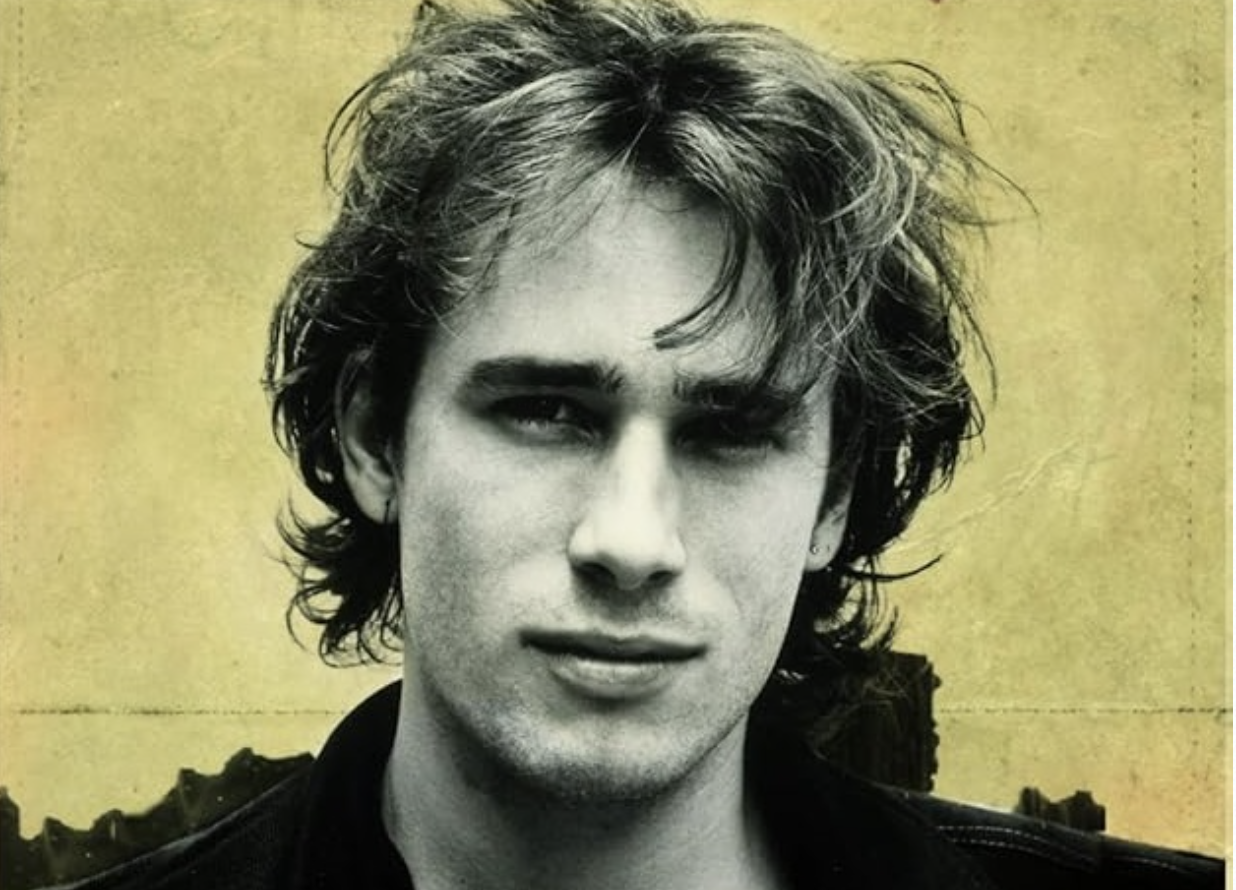
Continuing our successful collaboration and synergy with the leading Italian music publication Kalporz , the Monolith Cocktail shares and translates reviews, interviews and other bits from our respective sites each month. This month the Kalporz editorial team explore the legacy of the late and great tortured troubadour Jeff Buckley, thirty years after the release of his decade defining album Grace.
Jeff Buckley’s “Grace” turns 30 on August 15 [1]. Instead of making a complete analysis of that album ,which we have already done song by song for the 20th anniversary , this time we asked ourselves what remains – today – of Jeff Buckley’s artistic legacy. These are the contributions of Paolo Bardelli, Samuele Conficoni and Raffaele Concollato to the question.
Let’s immediately address the legacy that pisses us off the most: that Jeff Buckley has been transhumed into the collective imagination of talent shows because at least one in three approaches his version of “Hallelujah” , thus reaching us for a song that wasn’t even written by him, is truly a crime. But, as we know, we shouldn’t worry about talent shows and we shouldn’t even consider them, so let’s focus the answer on much more important areas. Like whether there are artists today who can build on his legacy, and whether his memory and importance are well understood today. The fact that there are few artists who demonstrate a talent comparable to Jeff demonstrates his uniqueness: among the many, only that loose cannon that is Tamino would come to mind , but it would be nice to identify someone who has the same fire of passion for music and not someone who is similar on an artistic level.
As for his importance today, we know that music cannot be recomposed and evaluated only with numbers, but sometimes they can help: this month on Spotify Buckley has totalled 3.9 million listeners, against for example Lou Reed’s 5.5 million. If we want to consider that Reed has produced much more, it would seem that there is still a lot of attention on Jeff Buckley, and the streaming numbers should represent the new generations more than the old ones (who have the possibility of physical listening). It is therefore difficult to answer the question we asked ourselves, whether Jeff Buckley is still influential or not, as there are contrasting elements. There is one certainty though: we must stop looking at the new releases that will continue from now on with material pulled out of the drawers, because Jeff Buckley’s legacy is clear with only “Grace” and “Sketches…”, in addition – if you really want to -there are the first official live performances (“Live at Sin-é”, “Mystery White Boy”, “Live A L’Olympia”) and the outtakes “Songs To No One” with Gary Lucas. Last year “Gods And Monsters” was released which is indecent in terms of sound quality, it would be worthy of immediate denunciation.
Personally, to feel close to him, I have been using a tactic for some time: following an Instagram page that only posts photos of Jeff Buckley (among the many I point out this one ) which creates an alienating effect: on the one hand, at first glance, Jeff might seem always present, but it is a fleeting sensation, which disappears immediately to leave room for the awareness of the melancholy of no longer having him with us. We who wait every day for another artist like him (and like Kurt Cobain) with the same desire for redemption, for emotion, for beauty, for anger, to express himself, to unite, to tell, to communicate, to make ourselves better by receiving his notes . That is his legacy.
(Paul Bardelli)
The greatness and relevance of Jeff Buckley, like that of the many artists who have left us too soon, lies not only in what he wrote, said and published, but also in what he could have written , said and published if he had not passed away. “Grace” is a traditional rock album and at the same time seminal and innovative, and this is perhaps its most extraordinary quality and its most surprising merit, which make it a milestone even thirty years after its publication. Without messing up the pages and the history of the novel of American rock which in the meantime continued to be written, adjusted and annotated, Jeff Buckley was able to give his contribution and make that genre his own by emptying it and making it a primitive shell to be filled; to be able to arrive at “Grace” he immersed it in a noble and refined musical tradition whose fil rouge was able to make the jazzy chanson of Nina Simone , the acid rock of Led Zeppelin , the poetic and visionary songwriting of Bob Dylan and Leonard Cohen and even classical music coexist. Where a cacophonous and ungovernable chaos could have arisen, a grace has instead sprouted that which seemed impossible to model from those ingredients, but which in the end succeeded.

It is precisely this gigantic merit of his, which has been able to influence artists of the caliber of Radiohead, Lana del Rey, Adele, Mitski and Phoebe Bridgers , just to name a few, and which has made him recognized as a big name in music by sacred monsters such as Bob Dylan himself, David Bowie and Morrissey, which makes his first and only studio album a room whose doors fold in on themselves and always lead back to that same place: the revolutions that started from there will be captured and in all respects written by others, others who have visited, lived and studied that room deeply. We already know where the others have gone and, as far as the future is concerned, we will know. Where he would have gone, on the other hand, we will never know, even if the never-completed recordings for what would have been his second studio album give us some clues. Unfortunately for us, however, that is a dead-end track, and here we return to the incipit of our discussion: it is as if two paths emerged from “Grace”, one that we have tested – and that, after thirty years, we are still testing – with our hands, and one that we will never know and that perhaps, in a parallel universe, is still being completed. But “this is not for our eyes”.
(Samuel Conficoni)
Despite his short career, Jeff Buckley’s influence on the music of the last few decades is profound. The unclassifiable genre he created, a mix of folk, rock, blues and world music, has left an indelible mark on many artists. His enormous talent in the use of his voice, capable of conveying the delicate vulnerability that inspired a generation of singers and pushed them to explore their vocal abilities in an unconventional way, is proof that he was not just ‘one of many’.
Just think of his cover of Leonard Cohen‘s “Hallelujah”, which became so iconic that it became a point of reference for subsequent reinterpretations. His expressiveness led to a return to authenticity and emotional honesty that left a mark on Thom Yorke, who often cited him as one of his main influences, both for his vocal style and for having pushed him to think outside the box. Damien Rice , whose direct and intimate style he took, also carries his legacy. Of course, Damien then completed the “masterpiece” with poetic lyrics, but the affinities with Jeff’s style are evident. Another artist inspired by Buckley was Justin Vernon (Bon Iver) , where the introspection and songwriting leave no doubts.
From a strictly musical point of view, Buckley can be found in the British band Alt-J, who with their experimental and eclectic sound echo the fusion of different genres mentioned above. Finally, we cannot fail to mention Daughter, with the delicate and desperate voice of Elena Tonra and the haunting melodies of the group, where Buckley’s spirit echoes in almost every song.
Others, perhaps even indirectly or lateral, have inherited Jeff Buckley’s legacy, ensuring him an artistic legacy that places him among the most influential figures in modern music.
(Raffaele Concollato)
 Monolith Cocktail Blog