PLAYLIST/ARCHIVES: DOMINIC VALVONA

The Monolith Cocktail Digest is both home to Dominic Valvona’s long-running eclectic, cross-generational Social Playlist, and a platform for celebrating significant anniversary albums and, more sadly, commemorating those artists we’ve lost in the last month, with pieces from the Archives.
Starting with the 81st edition of that playlist, Dominic has curated a selection of past glories, music from his own collection, reissues, newish tracks and a smattering of choice tunes from albums that have reached either a 60th, 50th, 40th, 30th, 20th or 10th anniversary. In that camp, there’s nods to Yoko Ono’s Feeling The Space, John Lennon’s Mind Games, Alejandro Jodorowsky’s Holy Mountain Soundtrack (see the archive spot piece further down the post) and one of the crowning achievements in documentary, The World At War. All of which have reached the 50th landmark, released and aired as they were in 1973.
A decade later and the electronic/synthesized progenitor Dieter Moebius released both the solo Tonspuren offering and, in communal partnership with krautrock/kosmische pioneer producer Conny Plank and Guru Guru’s maverick drummer-leader Mani Neumeier, the Zero Set albums: both of which have been repackaged and reissued this month. From the same year of 1983, there are tracks from The Rolling Stones’ patchy Undercover and The Fall’s rambunctious magnificent Perverted By Language LPs.
Into the 1990s, and Dominic has chosen representative choices from the Staten Island branch of the shaolin school of kung-fu hip-hop, the Wu-Tang Clan’s classic debut Enter The Wu-Tang (36 Chambers); A Tribe Called Quest’s seminal Midnight Marauders; Bowie’s less than universally championed The Buddha Of Suburbia; and Ritchie Hawtin’s highly influential Plastikman alter-ego intelligent techno masterpiece, Sheet One – another recent reissue, repackaged release.
The rest of the Social features a couple of recent-ish tracks from Lisa Butel and foil Brent Cross, and Royal Flush. And from across the decades and genres, music by Tyvek, Ron House, Mircea Florain, Kong Ney, Crossbones, Lazy Smoke and more… In the Archive section this month, there’s a short piece on Jodorowsky’s alchemist tapestry of esotericism, the Holy Mountain Soundtrack, and from a decade ago, plucked from the back pages, a review of M.I.A.’s Matangi.
TrackList:::
The Rolling Stones ‘Undercover’
The Fall ‘Neighbourhood Of Infinity’
Voluntarios da Patria ‘Io Io’
Tyvek ‘Circular Ruins’
Ron House ‘New Maps Of Hell’
John Lennon ‘Tight A$’
A Bolha ‘E So Curtir’
Yoko Ono ‘Woman Power’
Mircea Florian ‘Harap Alb A Treia Oara Ratacit In Padure’
Jackson Conti ‘Nao Tem Nada Nao’
Moebius/Plank/Neumeier ‘All Repo’
Plastikman ‘Koma’
A Tribe Called Quest ‘We Can Get Down’
Wu-Tang Clan ‘Method Man’
Royal Flush ‘B.O.B.’
Crossbones ‘You Always Get Me Wrong’
Alejandro Jodorowsky ‘Trance Mutation’
Kong Ney ‘Bom Pet’
Luiz Eca ‘La Vamos Nos’
Dick Khoza ‘WD 46 Mendi Road’
Travel Agency ‘Cadillac George’
Danny & Dusty ‘Baby We All Gotta Go Down’
Baker Gurvitz Army ‘The Dreamer’
Under Milkwood ‘Empty Room’
Kaira Ben ‘Mousso Loule’
Moebius ‘Contramio’ Piotr Figiel ‘Skrawek Przestrzeni’
David Bowie ‘Ian Fish UK Heir’
Baaska & Scavelli ‘The Green Hills Of Earth’
Lazy Smoke ‘Sarah Saturday’
Lisa Butel & Brent Cross ‘Vox Canon’
The City Of Prague Philharmonic Orchestra ‘End Theme From The World At War’
ARCHIVE SPOTS

Alejandro Jodorowsky, Don Cherry and Ronald Frangipane ‘Holy Mountain Soundtrack’ 1973
Never formally released at the time of the film itself, the soundtrack to Alejandro Jodorowsky‘s esoteric kool-aid psychedelic movie, The Holy Mountain, has since languished in folklore, only to be bundled out at a later date as part of subsequent DVD reissues. I myself have relied upon the good-nature of others to obtain my copy.
Though the ins-an-outs of musical accreditation remain somewhat recondite and obscure – Jodorowsky taking the lions share –, the well-revered avant-jazz cornetist, Don Cherry, and composer Ronald Frangipane (credits include playing on The Midnight Cowboy and Barberella scores) both played an integral and major part in playing and producing this potted spiritual and alchemical mind trip. Meandering eastern dirges and fluted love swanned serenades meet cult funky B-movie cuts and the less memorable vignettes, used to create the enlightened scenes and atmospherics. ‘Trance Mutation’ for my money, entrancing and ritualistically Kabbalah and Eastern arts/Tibetan hums as it is, cries Cherry. But don’t expect anything close to revelatory; as this soundtrack is for the most part mediocre.

M.I.A. ‘Matangi’ 2013
(Taken from Our Daily Bread 022)
Not so much a klaxon sounding clarion call as a reaffirmation of the voracious M.I.A. manifesto, the latest ‘hyperbolic’ riot of polygenesis colour and sound, Matangi, is quite a measured, translucent, and sparkly in places, personal affair. Mellowed somewhat by the delay in its release by more than a year (at one point M.I.A. threatened to leak the record online, frustrated at the label’s negative response – apparently it wasn’t dark enough for them!).
But fear not as that same explosive ennui driven mix of earth-shaking bhangra, boombox subversion and Arabian chic – as evidenced on the last three records – still permeates and threatens to piss on the apathetic parade: Indecorous to a fault, yet dangerously alive and exciting.
Following in the family name tradition of the last three albums, Mathangi ‘Maya’ Arulpragasam explores the etymological source of her own namesake, the Hindu goddess Matangi. Found amongst the ‘untouchables’ – the poor and destitute – in the slums, Matangi chose to live away from the temples of the gods, to gain a deeper understanding and knowledge of the lower castes: the salt of the earth so to speak. The goddess of inner thought as well as music, her mythical presence and attitude are used as a reference and guide throughout, channeled in the more meditative escapist passages.
A perfect figurehead and encapsulated spirit of the times, a cross-pollinated artist-musician-polymath character seemingly congruous with the Internet, M.I.A. is both an advocate and fierce foil of the digital world. The burgeoning promise of a carefree, interconnected, community, richly educated and informative, has rather disappointingly been hijacked by a camarilla of ‘facilitators’, corporations and an over-zealous state. Intent it seems on eroding free speech and free movement, imposing instead a military style control and surveillance on our lives. In short…. we’ve been sold down the river.
None of this is new to M.I.A. of course, already a well publicised supporter of Wikileaks and its defacto – exiled to the Ecuadorian embassy in London – leader Julian Assange (who recently opened for a M.I.A. performance in New York, via a skype link, and is said to have contributed to the schizoid dubstep Matangi LP track, ‘atTENTion’). But with the ongoing revelations of Edward Snowdon and the increasing torrid of abusive vitriol from her detractors (mostly it must be said from America), there’s more than enough material to transduce into anger, even if M.I.A. and her augury warning, ‘THE MESSAGE’ (the opening gambit from the 2010 MAYA LP), pretty much summed it all up: “iPhone connected to the internet/ Connected to the Goggle/ Connected to the government.”
Using a similar template then, M.I.A. begins with a mantra of intent, delivered over a stuttering electric current: “Ain’t Dalai Lama, Ain’t Sai Baba/ My words are my armour, and you’re about to meet your kharma.” From then on in she amorphously twists and turns, from protestation to romantic stomp, cutting up and reworking R&B, pop and Hip Hop into ringside swagger (‘Only 1 U!’), bombastic gangsta strut (‘Warriors’) and bubblegum dancehall (‘Come Walk With Us’).
Hardly light on rhetoric – whether collecting all the data of hate and criticism, leveled against her (including the ‘one-finger’ Super Bowl debacle, N.Y. Times spread and accusations of provocation), or banging heads on the lack of originality in culture and railing against our failure to fight the systems that seek to turn everything into a humongous pile of shit: “If you only live once, why keep doing the same shit?”
‘Bad Girls’, ‘Bring The Noize’ and ‘Y.A.L.A.’ have all previously been made public in the long run-up to this fourth LP – the original Bad Girls in incubated form was first aired on the 2010 mixtape, Vicki Leeks, later to be accompanied by a car-crazy, Sheiks-do-Hip Hop wild video in 2012. This triumvirate of revved-up ‘nasty’ tracks more or less gives the album its most hardened, prowling highlights. But as the smoke from those riotous, sophisticated joints clear, M.I.A. choses a more indolent swaying direction (well less threatening anyway), her rhyming couplets smoothed and laid back on the neon lit, Siam charmed, ‘Come Walk With Me’, and lamentably swinging on the bookended pairing of ‘Exodus/Sexodus’.
In case you never got the admonitory memo or understood the ‘Lady of Rage’ the first, second and third time around, she once again rattles off another dictate and denunciation for you, whilst raising the game for those who seek to follow in the vapour trail. M.I.A. proves to be the most exhilarating, provocative artist to crossover into the general psyche, without losing their soul; able to roll with the punches and at least stand for something in a mixed-up world of contrary stifled debate and fucked-up moral objection to all the wrong things.
Hi, my name is Dominic Valvona and I’m the Founder of the music/culture blog monolithcocktail.com For the last ten years I’ve featured and supported music, musicians and labels we love across genres from around the world that we think you’ll want to know about. No content on the site is paid for or sponsored and we only feature artists we have genuine respect for /love. If you enjoy our reviews (and we often write long, thoughtful ones), found a new artist you admire or if we have featured you or artists you represent and would like to buy us a coffee at https://ko-fi.com/monolithcocktail to say cheers for spreading the word, then that would be much appreciated.
The Perusal #22: Dear Laika, Stereo Total, Boom. Diwan Ft. Nduduzo Makhathini, Spacelab…
November 4, 2021
A Look At What’s Out There/Albums and EP reviews/Dominic Valvona

Jaguwar ‘Gold’
(Tapete Records) 22nd October 2021

Literally bursting back on the ‘scene’ with a driven psychedelic and rocking cyclone of future on-message pop, the Berlin and Dresden spanning Jaguwar trio finally release their new album after a three-year period of “intense” touring (well, up until Covid put travelling on hold).
In a constant reverberated state, Oyémi, Lemmy and Chris pummel and whip up a both halcyon and brooding maelstrom; raging against the machine, monuments and constraints of the now, whilst clearing a path for a giddy borderless utopian future. There’s “strength in individuality” they cry as another mini-epic of drilled drums, acid kinetics, echoed cybernetic growled bass and speed shift effects blast away.
Less noisy in part, but no less ambitious and sprawling sound wise, with constant crescendos and climaxes, Jaguwar conjure up a lush, dreamy but also moodier musical soundscape. At the heart of each flurry of sonic activity lies a more commercial friendly pop melody: think Mew or MGMT. The rounded softened anger of ‘Monuments’ has an air of Tears For Fears; the skipping prog-rock edged title-track ‘Gold’ a hint of Bloc Party and Muse; and the big drum sound opener ‘Battles’ an echo of the Secret Machines.
Gold is an intense maelstrom, bursting to explode; a warbled duel vocal yearning and rile for a brighter, inclusive future.
Boom. Diwan Featuring Nduduzo Makhathini ‘Minarets EP’
5th November 2021

Lushly conceived across three countries (UAE, Kuwait and South Africa), if not at times caught in descriptive choppy maelstroms, the Arabian-African collaboration between Boom. Diwan and Nduduzo Makhathini is imbued with the spirit and soul of both partner’s heritage. From the Abu Dhabi-based musician and ‘applied-ethnomusicologist’ Ghazi Al-Mulaifi led Boom. Diwan ensemble the rhythm and song of Kuwait’s pearl divers and Islamic poetry, and from the Blue Note showcased South African pianist Makhathini the spiritual sounds of the Zulu heartlands and a blend of the semi-classical and jazz.
Named, as are the EP’s tracks, with titles that act as much as metaphors for forgiveness and the tumult of the times “Minaret” in the Arabic language is a beam of light, a lighthouse even, but in the Islamic world is usually meant as the tower attached to a mosque, from where the daily calls to prayer are sung. Here its venerable position is part of a fluid, often melodious swept-up landscape in which Arabia meets Southern Africa.
Flowing across the peacefully lulled lyricism, hand-clapped and gently splashing or tumbled drums and almost transcendent guitar accents (which on the more chaotic but no less hymnal ‘Blood In The Wind’ plaint grows increasing distorted and wild), Makhathini’s piano flows freely like gently trickled and more disturbed waters. In that range you can hear echoes of Abdullah Ibrahim, Mingus, McCoy Tyner and John Hicks (in particular Pharaoh Sanders ‘Africa’).
Diving for ‘The Pearl’ both musical spheres come together in an almost romantic performance: vulnerable but warm. Melodic spiritual Arabian sung harmonies with spells of free jazz, the cinematic and classical feel the air as the dramatic Gulf waters swell from the blessed to the choppy – the piano starts to emulate a touch of the Jaws theme by the end of this pearl dive. It’s a beautiful transportive piece of music, moving, exotic but instantly emotive.
For some reason the next suite (the already mentioned ‘Blood In The Wind’) reminded me of Robert Wyatt: albeit moved to the Middle East. With far more in the turbulent tank, this traverse promises upheaval, even if it is executed most tenderly.
Featuring those handclap rhythms and a tonal serial piano that dances, the proverb-like ‘Raise Your Words’ (“not your rage”) finds more relaxed, calmer seas.
Despite neither of the two collaborators meeting – forming as they did a trusting partnership over candid Zoom calls – Minarets is an incredibly intuitive and nuanced balance of musical styles; a work of great traversing beauty and yearning. I really look forward to these two coming together again in the future.
Also See…
Nduduzo Makhathini ‘Modes Of Communication: Letters From The Underworlds’ Choice Albums of 2020. Here
Noah ‘Étoile EP’
(Flaur) 22nd October 2021

In wisped apparitional and soothed vocal form the Japanese artist Noah evokes a dreamy spell of hushed yearns and beyond-these-realms tidings on her new French-esque EP, Étoile. Translated that title means, “star”, though it’s also the leading ballet dancer in a company, an opera and 1989 movie – in which, the main protagonist is possessed by the dead spirit of a former ballerina. There’s certainly a kind of haunted if diaphanous suffusion of voices and vocals, and more than a fleeting élan of France. The opening floral ‘Rosa Alba’ (the EP’s second single) evokes a late 70s, perhaps early 80s, French movie soundtrack that enraptures romance and mystique into one realist-fantasy. Slowed, steamed trip-hop beats, glistening caresses of angelic harp, tinkles of piano and strings, and patted breaths create an electric glide in blue.
Despite (which no artist can avoid) the pandemic and the driver s behind this EP’s trio of tracks (a rebellion against tradition/authority, and an awareness of deep emotions like anger and sadness) it all sounds so gauzy and beautiful. Often it sounds like we’re hearing just the faintest traces and reverberations of a song. Even when those electronic beats and synthesized drum kit sounds are brought in they are softened, or, motion wise, bobbing along nicely within these translucent structures.
Both the emotional “ah’d” ‘Perdu Au Paradis’ and magical ‘Moonchild’ (the first single) move towards sophisticated shuttered House and minimal Basic Channel beats and clipped baubles of light. Beautifully embodying a smoke-like vapour, Noah weaves emotive vibes from the ether.
Dear Laika ‘Pluperfect Mind’
(UK: Memorials Of Distinction/ROW/US: NNA Tapes) 29th October 2021

Atmospherically sounding like an out-of-body experience of the blurred and gauzy, Dear Laika’s debut album for the label is actually a both dreamy and dramatic celebration and outpouring of emotional-driven articulations born out of finding one’s true self. As a certain death knell toll of bowl and bell-like inner piano workings strike, Isabelle Thorn is set free from one life so she can transition into another.
Despite the anxieties and stressful processes (both medically and emotionally), the years spent in a certain solitude waiting for hormone treatments, the Pluperfect Mind album is filled with a slow-release of elation. “Inhabiting a body that now feels right” the extraordinary choral-voiced experimental artist makes the abstract sound tactile and diaphanous; creating a beautiful, if at times moody and darker, effective soundtrack of venerable, semi-classical relief and hurt.
Although in her notes Thorn declares she has a love/hate relationship with classical music – perhaps because its allurement reaches back to a pre-transitional past -, she casts a magical spell over the piano mechanisms, boundary pushed influences of Reich and Cage, the music of such luminaries as Messian, Finzi and Ravel, and the stirring holy choruses of the Russian Orthodox Church. This is all pulled together and given an almost ethereal and cosmic synthesized treatment of deeply felt purred bass, vapours and various entrancing ambient filters.
That incredible voice, which reads French poetry in the intricate, rattled and chimed ballet ‘Lilac Moon, Reflected Sun’, seems timeless yet also very much of the moment. It can sound under a myriad of reverberated, vaporised and cyber effects like FKA Twigs, Kate Bush, Bat For Lashes and on the scrunch-clap, storm raised ‘Guinefort’s Grave’ like a merger of Bjork and Beverly Craven. At its most haunting, accompanied by that holy choral chorus, like the ‘Requiem’ from 2001: A Space Odyssey. Almost a mirage in places, airy and with a lofty gravitas, Thorn attentively fades in and out of the music, and even time itself – walking off the contemporary set into a Medieval tapestry on the ‘Phlebotomy’ track.
References, connections are made to the Judaic and atavistic myths of the ‘primordial she-devil’ Lilith, who’s symbolism has been transformed to mean all manner of things to all manner of people, religions. In this instance a bewitching Lilith graces the title of a celebration. Another reference title name checks the home made famous in the lead up to Goya’s exile. The “deaf man’s villa’, or “Quinta del Sordo”, was the place where this famous Spaniard painted his haunting and sometimes grotesque character ‘black paintings’ (Saturn Devouring His Son, that kind of thing). Here we are led into a sort of Moorish Spain atmosphere of translucent mysteries. And the already mentioned ‘Guinefort’s Grave’ is song about the legend of St Guinefort: ‘the only saint who is also a dog’.
Processing the memories and the reminders of a less happy life whilst striking out after inhabiting the body she should have, Thorn, under her Dear Liaka moniker, eludes a fragile, vulnerable state yet somehow produces a very confident album. With depth and feeling, she reconnects with a highly intoxicating and mature work of incredible beauty and realisation. Expect to see this album in my choice list at the end of this year.
Charlotte Greve, Wood River, Cantus Domus ‘Sediments We Move’
(New Amsterdam Records) 15th October 2021

The second release this week to feature a highly atmospheric, often dramatic, choral accompaniment; a heaving and diaphanous swell of voices in this case, provided by the Berlin choir Cantus Domus. Controlling these venerable voices is fellow Berliner and award-winning composer-singer-saxophonist Charlotte Greve, who magic’s up a stunning musically amorphous requiem on her new mini-opus.
Once more with the Brooklyn (where the artist now resides) band Wind River backing her, the ever-experimental Greve builds an impressive (almost seamless) album of suites in her image: that’s open, vulnerable and free-spirited creatively. With an emphasis on inter-generational family dialogues and connections too, Greve’s brother Julius has contributed lyrics, which in the mouths of the Cantus Domus choir are filled with the gravitas of an operatic production and given a technically brilliant workout.
The saxophone part of Greve’s accolade-rich CV would reasonably suggest that her music of choice could be jazz. And yes there are hints of it woven and contouring and drifting across some of these seven untethered tracks (a bit of lighter cosmic Donny McCaslin perhaps), but it’s only a small part of the overall sound dynamics. For at times there’s a mix of prog-rock, Zappa, the Floydian, These New Puritans, post-punk and even 80s Yes! All together it makes for a lunar-bounding, often free-falling and barreling religious and avant-garde piece of theatre.
Captivating at every turn, dreamy and floated, Sediments We Move is a gorgeous filmic and evocative album of timeless emotional pulls and élan, with an ear for the experimental.
Lisa Butel & Brent Cross ‘A Low Lament For Love And Loss/The Feeling Of Walking’ (Somewherecold Records) 5th November 2021

This month selection of choice music (as you may have noticed) is particularly heavy on voice/vocal experimentation; none so more then the double offerings from the Vancouver-based collaboration of sound artists, Lisa Butel and Brent Cross.
Another product of stress-relief and vehicle for abstract anxieties, feelings and terms of bereavement felt through the creation of music, during the harrowing and restrictive pandemic this sonic and empirical voiced partnership created a moiety of albums. As release valves for pent-up feelings of loss and isolation, these two album suites are full of blended and manipulated minimal synthesised sounds, piano accompaniments from a family heirloom, and a gauzy flow of uttered, elegiac, aria and tonal vocals.
A Low Lament For Love And Loss takes a one-hour improvised session and breaks it down into seven parts of varied elegy and ethereal sung mystique and diaphanous outpours. To a flutter, ripples and fuzzy synth undulations and drones, Butel’s voice yearns syllables and sounds. Often they sound otherworldly, or as in the case of the slowed, stripped Red Mecca era Cabaret Voltaire, buzzing and crisp Middle Eastern tinged ‘Intro To Lament’, like a mysterious call to prayer from atop of a minaret.
Wafted, drifted, translucent yet deeply felt that voice and accompaniment is entrancing but often tragic; dealing as it does from the loss of Cross’s mother, whose Heintzman piano can be heard throughout, fluctuating between sentimental tinkles, singular patted notes and melodious dreamy passages.
The Feeling Of Walking is in a very similar vein, though the process is a little different, using the voices as a sort of comfort and meditation. Opening beautiful gesture ‘I’m Giving Out The Love’ is like a mix of ambient generated dreaminess and slowcore; ‘Super Skies’ an almost monastic kind of poetry. There’s even a kind of Japanese dulcimer-like feel to the ghostly, delicate ‘The Beautiful Women’.
Two congruous releases of pent-up emotions delivered in the form of an experiment between voice, piano and a palette of purposeful oscillations and manipulations, Cross and Butel’s lockdown albums act as a personal process but above all sound fully immersive and cathartic: A communal, connective experience.
Hellenica ‘Blood Meridian: An Imagined Soundtrack’
(Somewherecold Records) 15th November 2021
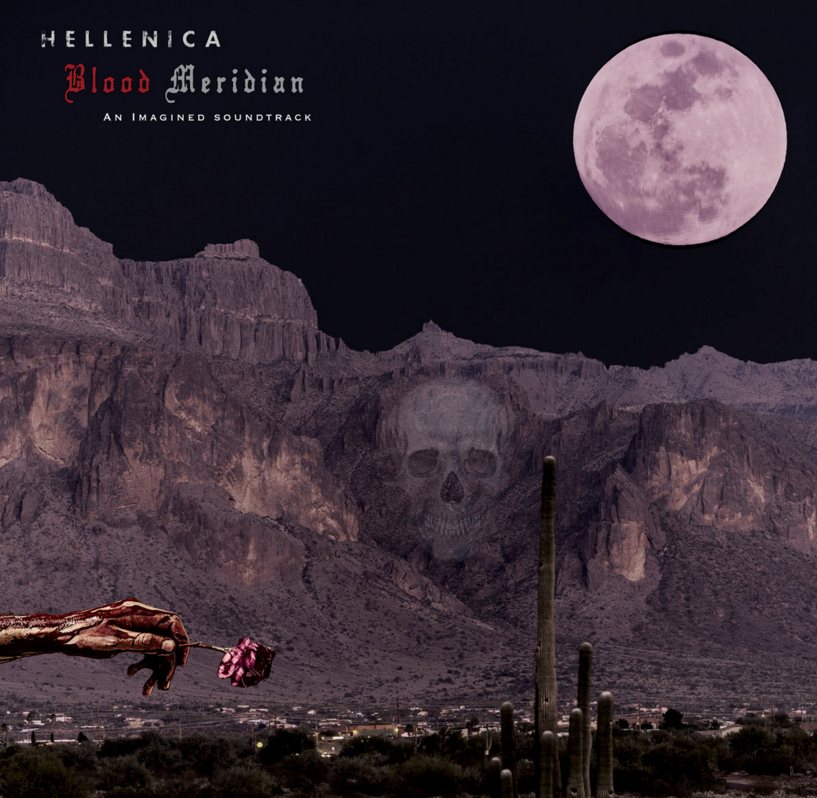
You can’t read everything. And so now wishing I had read the evangelised Cormac McCarthy’s supernatural anti-Western Blood Meridian tome, I’m left feeling out-of-the-loop with Jim Demos (aka Hellenica since 2009) imaginative soundtrack for that acclaimed novel. Like one of those “what could have been” fandom generated homages, Jim’s cinematic score graces the movie yet to be made of that violent story – think Peckinpah totally uncensored and off the leash.
I admit I’ve had to do my research – yeah it’s a book friends have championed in the past, but never made my reading list. But in brief, Blood Meridian is at least tenuously based on the all too real horrifying exploits of the Glanton gang of miscreants; led by the early Mexican-Texas settler, ranger and mercenary John Joel Glanton. Scalp-hunters for hire, accustomed to blood bath massacres of not just the indigenous people but also anyone that crossed their path, this notorious skulk ran riot in the old West. Told from the perspective of a volunteer (I say volunteer, it was this or the rope) known only as “the kid”, the reader’s immersed in a old Western story of hurt and pain, and introduced to the gang’s leader “The Judge”; a sort of daemonic magnetism of a character, half gory guru, half Kurtz, who every character in the book meets and leaves the presence of in some state of semi-spiritual conversion and menace.
Jim loosely makes references to various chapters, scenes from the story; the most obvious being the opener ‘The Blood Of Toadvine’, which refers to the character of the same name, an acquaintance of “the kid”, member of the gang and the link in the chain of events that lands our protagonist towards almost esoteric barbarity. Here it’s scored with a yearning Western vibrato twanged arrangement that takes us across a supernatural-desert landscape. Hints of a voiceless Crime & The City Solution, the Bad Seeds, Alex Puddu and a very removed Roy Budd merge into that setting.
A re-imagined Morricone rubs shoulders with John Carpenter, Mandy soundtrack Jóhana Jóhannson, Wovenhand and Belbury Poly on this intrepid gothic, often eerie album of bloodletting. Yet amongst the Western tremolo and rattles, the mirages and warbles, there’s a suffused current of 80s sci-fi, adventure, and a dream-realism spell of Gallo thriller/horror. There’s even a touch of early Mute Records synthesized drums, and an air of new romanticism Visage on the deep groaning, skeleton bones traced ‘Parallax And False Guidance’. And the “169” frequency broadcasting, soft cantered ‘Westward Again’ sounds like a meeting between Kavinsky and Moroder.
Despite the material at its core, this soundtrack is peppered with sounds of celeste like chimes, soft walking melodies and dreamy halftime progressive jazz drums.
If they do ever get past all the issues and actually get this book on the screen, Jim’s got the soundtrack ready to go. Western scores have rarely sounded so different and mysterious; tragic and esoteric.
Spacelab ‘Dead Dimension’
(Hream Recordings) 12th November 2021
Growth and death manifest themselves in the celestial vortex and expanses of an imagined universe on the new Spacelab album. The strains of coping with a pandemic that is far from over, the anger, resentment, paranoia and hopelessness of it all is channeled into a soundtrack made in real-time: a spontaneous process that captures the exact state of mind and resulting mood music there and then.
Always in a spiral or cyclonic loop; always travelling at a certain velocity through space, Dead Dimensions captures the dying reverberations of a dead star, or, sets the dials towards hyper-drive, thrusting through tunneled and warped light passages of kosmische, ambient and sci-fi music on its way to a rendezvous with otherworldly escapism.
In amongst the pulses, continuous reversal effects, speed-shifts and oscillations the sound of plucked ambiguous instruments, even melodies, can be heard: but only in snatches. At times choral voices can be made out, leading to distant cathedral symphonic music and a mere resonance of Kluster and Tangerine Dream.
Spacelab’s emotional states lead to skying across neutron-calculated clouds, probing paranormal activity aboard a space freighter, and journey’s inside a roulette table spinning transport hub. Satellites, fleeting snippets of memories and debris fly by on this hurtle through a universe of mystery, lament, curiosity and gravitas, as Spacelab concentrates grief, rage and despair into a sonic cosmology.
See Also…
Spacelab ‘Kaleidomission’
Almeeva ‘To All My Friends EP’
(Baciami Disques) 29th October 2021

A touching, inclusive gesture from the electronic composer Gregory Hoepffner, who welcomes one and all to experience the ecstasy and euphoria under the roof of his Almeeva dance music club. Amongst a special set of N-R-G, Euro-dance music, techno and electronic body movement, the multi-instrumentalist producer lives in the moment for once.
With a mixed CV that includes stints as a producer and collaborator, and compositions that span TV, film and commercial projects, a slight jaded Hoepffner has now been revitalized and “redeemed” after a move to Sweden and creative exchange with the producer of critical and commercial heft Christoffer Berg (Depeche Mode, The Knife, Robyn, Fever Ray) – Those creative sparks must fly continuously as both producers now share a studio together.
Hoepffner’s relatively new Almeeva guise and EP suggests, at least, a happy medium of club land dance music and a free-flow of expanded ideas: even the cerebral. For amongst the house music style piano refrains, swimmingly sun filtered melodies, Euro-trance and beats there’s snatches of sagacious freedom from the trans icon Beverly Glenn-Copeland (the jazz-poet-singer-songwriter who went public in 2002, identifying as a trans-man). In a tribute to the now late Andrew Weatherall, Hoepffner leads the listener through a myriad of sonic rooms; from trebly gnarled Killing Joke post-punk to indie-dance, baggy and the Chemical Brothers. Basically a crossover of styles that’s very much in keeping with the late eclectic artist: the spirit of Weatherall is strong on this one.
As if to mix things up, slowcore siren Diane Pellotieri (of Pencey Sloe fame) sings like a mirage-filtered apparition on the cyclonic swirled dance track ‘Slowly Fading’. This dreamy voiced haze of Balearic and love blanketed Euro-dance music reminded me a little of the Boston synth group Violet Nox. Another surprise is the short lived ‘interlude’ of cathedral rays and airy veils ‘Church Of Ecstasy’ – a kind of ambient cosmic release of Vangelis meets Sven Vath.
If as the Almeeva style Hoepffner says, he’s trying to avoid fitting labels, then I’d say the To All My Friends EP is a success. He doesn’t just side step them as to run freely across a whole array of electronic genres, never settling in any of them for long: always on the move.
Stereo Total ‘Chanson Hystérique 1995 – 2005’
(Tapete Records) 5th November 2021

And so we bid adieu, a fond farewell to the original idiosyncratic bilingual Franco-German duo, who couldn’t have foreseen when setting out this sprawling celebratory box set that it would actually be the last release to feature the maverick magic of Françoise Von Heve (nee Françoise Cactus) who passed away back in February of this year. That now leaves Friedrich Von Finsterwalde, aka Brazil Göring, without his foil.
Alas Chanson Hystérique is now a epitaph and tribute to an astonishing polygenesis mind; one that could effortlessly run through tiki lounge chanson, booted knockabout glam rock, ye-ye, Jacques Detronc, transmogrified spurts of Transvision Vamp, Gainsbourg, Françoise Hardy, Lizzy Mercier Descloux, circus tremolo fandangos across Casio keyboards and The Fall on just one album: namely the duo’s ‘95 debut Oh Ah!
It was a relationship that in the end spanned four decades. But it’s the first decade of recordings, with a number of compilation rarities and some of their theatre work that makes up this seven X CD chronicle. It begins with the already mentioned rambunctious debut and finishes with 2005’s Do The Bambi.
Like the accompanying sketchbook of artwork that comes with this collection, anything goes: as long as its fun. Usually with a Eurotrash of lo fi keyboards, punk-pop low rent drum kit and guitar, the duo serenaded, danced Honolulu style to country music, and performed hijinks versions of both famous and the most underground covers: from KC And The Sunshine’s Euro fun ‘Get Down Tonight’ to an ESG like romp at Salt-N-Pepa’s ‘Push It’ and a version of that famous French pop masterpiece, as made legendary by Vanessa Paradis, ‘Joe La Taxi’.
With much continental élan, pep and humour, plus lashings of irony, Stereo Total switched between French and German (and English too) languages and musical styles; somehow always maintaining their own unique signature. A signature that could be summed up as German new wave meets French gauloises wafted aloofness post-punk. All of which is softened with a Gallic mischief and 60s café culture meets bubblegum pop coolness.
Unless you’re a fan, or familiar with the Monokini, Juke-Box Alarm, My Melody, Musique Automatique, Do The Bambi and Carte Postale albums you’re in for a rare surprising treat. Even if you don’t recognize the name, you’ll recognize the music, which has adorned many TV ads over the years. From the salacious to cute; Mondo to empowering, Stereo Total were a marvel; a unique musical force for good. No one but Sparks comes close. And influence wise their sound has been amplified to all corners of the globe.
This box set could just be the most fun and escapist package of the year. And for that it’s worth owning.
Hi, my name is Dominic Valvona and I’m the Founder of the music/culture blog monolithcocktail.com For the last ten years I’ve featured and supported music, musicians and labels we love across genres from around the world that we think you’ll want to know about. No content on the site is paid for or sponsored and we only feature artists we have genuine respect for /love. If you enjoy our reviews (and we often write long, thoughtful ones), found a new artist you admire or if we have featured you or artists you represent and would like to buy us a coffee at https://ko-fi.com/monolithcocktail to say cheers for spreading the word, then that would be much appreciated.
 Monolith Cocktail Blog