Our Daily Bread 612: Kahil El’Zabar’s Ethnic Heritage Ensemble ‘Open Me, A Higher Consciousness Of Sound And Spirit’
February 26, 2024
REVIEW/DOMINIC VALVONA
PHOTO CREDIT: TRIO SHOT BY CHRISTOPHER ANDREW
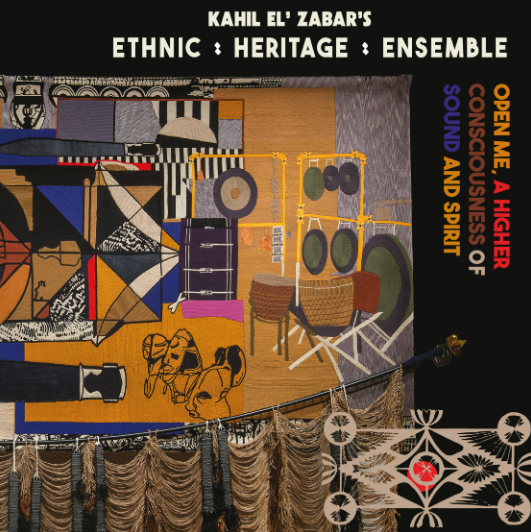
Kahil El’Zabar’s Ethnic Heritage Ensemble ‘Open Me, A Higher Consciousness Of Sound And Spirit’ (Spiritmuse Records) 8th March 2024
I need little persuasion to review this latest album from the Ethnic Heritage Ensemble, having already subscribed and danced to the Kahil El’Zabar rhythm for some time now. I must also declare that this same label invited me a couple of years back to provide the liner notes to the Kahil El’Zabar’s Quartet’s A Time For Healing LP; one of now six such collaborative albums the Chicago doyen has released on the Spiritmuse platform in the last decade – arguably his most prolific period, in a career that stretches back across more than five decades as a willing foil sideman, bandleader and collaborator.
Hot-housed in the Association for the Advancement of Creative Musicians (the mid-1960s nonprofit organization instigated by Muhal Richard Abrams, Jodie Christian, Steve McCall and Phil Cohran in Chicago, which El’Zabar himself once chaired) incubator, El’Zabar’s percussive, drumming rhythms for the mind, body and soul, channeled the windy city’s rich musical lineage of jazz, blues, R&B, soul, Godspell and what would become house and dance music. Within that influence, you can hear the inspiration, pioneering spirit of Louis Armstrong, Jellyroll Morton, Sidney Bechet, Benny Goodman, and trace the beating language of the talking drums of the motherland. Even in that company of such acclaimed innovators, El’Zabar’s style, choice of instrumentation was remarkably unique.
Paying his dues under the mentorship of such deities of the form as Eddie Harris, the multi-instrumentalist and composer went on to found his most enduring troupe, the EHE, in 1974. And so hence the 50th anniversary release date of that group’s Open Me, A Higher Consciousness Of Sound And Spirit LP; a celebratory healing balm of both revisited originals and transformed classics that also coincides with Black History Month and the ensemble’s North American tour. Originally in quintet form, the EHE soon slimmed down to a trio by the time of their first official album release in 1981, the cut-to-the-chase, no explanations needed, entitled Three Gentlemen From Chicago. Whilst the lineup has changed over the ensuing decades (numbering the likes of Light Henry Huff, Kalaparusha Maurice Macintyre, Joseph Bowie, Hamiett Bluiett, and Craig Harris at any onetime over that timespan), in recent times El’Zabar has corralled the well-respected Chicago trumpet player and bandleader Corey Wilkes to his steady ranks, and invited in the Detroit-born baritone saxophonist Alex Harding, who he’s knocked about with since the beginning of the 2000s: both playing together in Joseph Bowie’s Defunkt. But in a change of direction, he’s brought in the evocative and wilder strings of the Chicago-based violin/viola player and leader James Sanders (notably leading the Latin ensembles Conjunto, and Proyecto Libre), and the cellist, improviser and composer Ishmael Ali. This partnership adds a yearned, timeless and sorrowful Michael Urbaniak-esque layer of folk, Catskills country, the classical and wilder sympathies and stirrings to the eclectic range of horn styles and percussion, which also includes a full drum kit by the sounds of it – coming in handy when evocating the busy, always moving splash, bounce and rolling crescendos of drumming demigod Elvin Jones, on the McCoy Tyner burst of restless, near North African, energy, the ‘Passion Dance’. Jones famously appeared alongside Joe Henderson and Ron Carter on the title-track from the jazz pianist Tyner’s Real McCoy Blue Note release in 1967; a classic that has been picked up by El’Zabar on his latest EHE album.

THANKS TO CHRISTOPHER ANDREW FOR THE IMAGE
Following on from last year’s Spirit Gather tribute to Don Cherry (which featured the worldly jazz icon’s eldest son David Ornette Cherry shortly before his death) this latest conscious and spiritual work channels El’Zabar’s legacy whilst once more worshipping at the alter of those icons, progenitors and idols that came before; namely, in this instance, Miles Davis, Eugene McDaniels and the already mentioned Tyner.
It’s a version, of a kind, of Davis’s ‘All Blues’ (with an added “The” from the EHE) that opens the album. Originally the opening suite on Side 2 of the gold standard Kind Of Blue opus, this twelve-minute example of modal blues in G mixolydian piece is, thanks to Wikipedia on this score, ‘a twelve-bar blues in 6/8 time signature’, of which, ‘the chord sequence is that of a basic blues and made up entirely of seventh chords, with a ♭VI in the turnaround instead of just the usual V chord. In the composition’s original key of G this chord is an E♭7.’ On this sympathetic take, an air of the pastoral, of country folk and Southern roots is merged with smokestack smoldered city skylines, skonk baritone sax, turning-over kalimba tines-plucked harmonics and a constant timekeeping jangle of bells. It’s still very much a part of the blues idiom, but there’s a new soul and relaxed murmur of close-eyed healing that takes it someplace else.
A favourite of El’Zabar’s father, Clifton Blackburn, Eugene McDaniels’ stalwart protest song ‘Compared To What’, is given a fresh workout by the ensemble; that original 60s polemic to hypocrisy (taking in the Vietnam War, LJB and inequality), made famous on record by Roberta Flack in 1969 but also given an outing by Les McCann and Eddie Harris at the Montreux Jazz Festival in the same year, is now shuffled along to what can only be described as an acoustic house music beat and elephant trunk lifting heralding honks and jangled bells. Almost riffing at a leisurely pace throughout, El’Zabar channels Gil Scott-Heron vocally on this enriched street level shakedown.
And as with most El’Zabar led projects, there’s always a tribute or two, a homage and laying down of fealty of a most respectful sort, to one of the old guard: the pioneers. And so why not pay it to one of the deities of the form, the free jazz demigod himself, Ornette Coleman. Although neither in the Science Fiction nor Skies Of America modes, the ensemble revise that esteemed innovator’s legacy with what can only be described as a slinky soul-funk and hip-hop groove and untethered flight of Ornette-style brass.
From across the back catalogue, there’s a smattering of original compositions reenergized and given a new impetus. From his 1998 Bright Moments LP collaboration with saxophonists Joseph Jarman and Kalaparusha Maurice McIntyre, bassist Malachi Favors and pianist Adegoke Steve Colson, the titular album and track title ‘Return Of The Tribe’ is like a concrete safari strutting from swing Chicago to hot-stepping New Orleans and Latin Quarters NYC with Cab Calloway, the Art Ensemble Of Chicago and La Monte Young in processional tow.
From the same decade, albeit the opposite end of the 90s, another album and track title take, in the form of the EHE’s ‘Hang Tuff’, is given an airing. Stepping in for the originals, Edward Wilkerson and Joseph Bowie, Corey and Sanders raise their horns skywards, whilst Harding and Ali wildly entangle themselves at a busy junction of avant-garde folk-country and Mondrian age crosstown traffic jazz. From the Ritual Trio’s (that’s El’Zabar with Ari Brown and Malachi Favors; a group that lasted over fourteen albums, right up until 2014) Conversations LP partnership with the venerated Archie Shepp, there’s also an off-kilter, early 60s inspired version of ‘Kari’. Obviously, now featuring the wiry and scribbled addition of cello and violin, the original composition has a new feel and direction of travel.
Elsewhere, ‘Can You Find A Place’ swings from the vine into a spiritual wilderness and swamp of sorrowed cornet blues, whilst ‘The Whole World’ finds El’Zabar channeling Bill Withers, the Isley Brothers and righteous Last Poets on a street side hummed liturgy of godly universal benevolence and unity. But the title-track that brings down the curtain on this conscious elevating rhythm provider evokes both Davis and Coleman, heading out east on an Afro-Latin percussive prayer and house music style primal beat.
El’Zabar’s once more heals, opens up minds and elevates with another rhythmic dance of native tongue and groove spiritualism: a balm for the mind, body and soul. The ancient roots of that infectious groove and the urgency of our modern times are bonded together to look back on a legacy that deserves celebrating. After fifty years of quality jazz exploration and collaboration, El’Zabar proves that there is still much to communicate and share as he and the EHE recast classics and original standards from the back catalogue.
Please help if you can to keep the Monolith Cocktail afloat in 2024:
Hi, my name is Dominic Valvona and I’m the Founder of the music/culture blog monolithcocktail.com For the last ten years I’ve featured and supported music, musicians and labels we love across genres from around the world that we think you’ll want to know about. No content on the site is paid for or sponsored and we only feature artists we have genuine respect for /love. If you enjoy our reviews (and we often write long, thoughtful ones), found a new artist you admire or if we have featured you or artists you represent and would like to buy us a coffee at https://ko-fi.com/monolithcocktail to say cheers for spreading the word, then that would be much appreciated.
 Monolith Cocktail Blog