The Perusal #56: Staple Jr. Singers, A Journey Of Giraffes, L’ Étrangleuse, Head Shoppe, Pastense…
June 4, 2024
A WORLD OF SONIC/MUSICAL DISCOVERIES REVIEWED BY DOMINIC VALVONA
(Unless stated otherwise, all releases are available now)
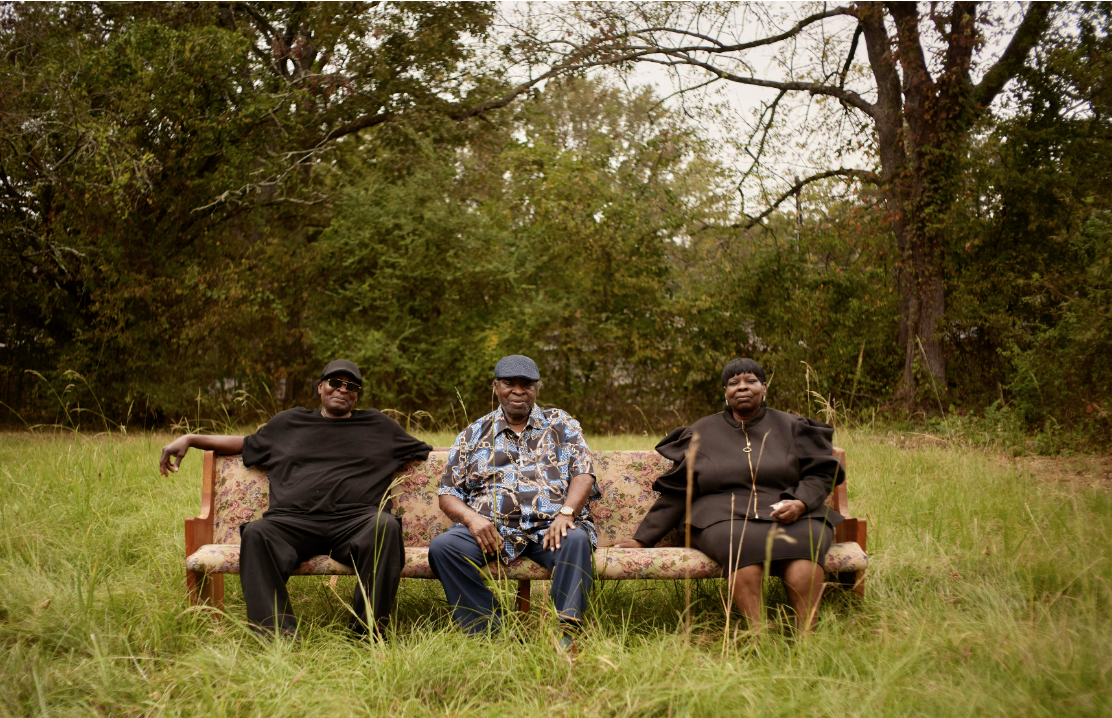
(R.C. Brown, Edward Brown and Annie Brown Caldwell by Adam Wissing)
The Staple Jr. Singers ‘Searching’
(Luka Bop) 14th June 2024
Revived five decades after its original localized release in 1975, the folk at Luka Bop made good on their incredible, enlightening compilation of obscured gospel and soul, The Time For Peace Is Now, with a dedicated reissue of The Staple Jr. Singers rarity When Do We Get Paid.
Pressed by that extremely young family unit themselves and sold at shows and on their neighbors front lawns, that rarefied showcase finally received an international release a couple of years ago, prompting a number of live dates for the trio: their first in forty years! Now, and with an extended cast of second and third generation family members, and with the producing talents of Ahmed Gallab (probably better known under his Sinkone artist name), they’ve recorded their first album proper, Searching – a revived title and re-recorded song that previously opened When Do We Get Paid, given a more echoed, stripped and intimate accompaniment the second time around.
Recorded live over two nights in the reverent and supportive surroundings of The Message Center church in West Point, Mississippi, this family affair picks up from where they left off: as if it were yesterday rather than fifty years ago. Those afflatus voices are not so young now of course, but remain still soulfully enriching and youthful in spirit.
Originally from the banks of the Tombigbee River, the family’s sound was, and continues to be, honed in their hometown of Aberdeen, Monroe County. A salvation searching, baptismal liturgy of Southern gospel is injected with a congruous merger of conscious political soul, R&B, funk and delta blues: the very epitome of the Southern crossroads.
From the name you may have assumed that this trio were scions, the offspring perhaps of the divine stylers themselves: The Staple Singers. But, although without doubt a chip off the old block, the group’s moniker is purely used as homage to their idols. Far younger than Mavis and her siblings and pop when they started out in the mid 70s, the Brown family of beautified and expressive soulful vocalists Annie (appearing here as Annie Brown Caldwell) and R.C., and guitarist Edward were in their teens when they made their first recordings. Yet despite being so young, the travails of the civil rights movement and social issues of the day ran throughout the trio’s equally earthy and heavenly soul music. This was a sound in honor to the Lord yet grounded in the wake of Southern desegregation, unrest, the Vietnam War…the list goes on. So whilst Annie soared in full baby Staples mode, and with a vibe of Eula Cooper and Shirley Ann Lee about her, there was plenty of attitude and sass to go around.
Gospel music remained, and still remains central, with plenty of standard Bible belt exultations, paeans and passionate plaints. Some of which, no matter how familiar, seem to have some pretty unique and idiosyncratic rearrangements going on. Bolstered on those formative recordings by bassist Ronnel Brown and drummer Corl Walker, we were treated to a Stax-like revue of beatitude, the venerable and just down-country soulful funk. Echoes of Sam Cooke, Lulu Collins, Crusade Records, Chairman Of The Board and Nolan Porter followed humbled sermons on the soul train to Galilee. An electrifying songbook, When Do We Get Paid proved that this family trio possessed a raw talent, and could hold their own in a field packed with such incredible voices.
Fifty years later, backed this time by R.C.’s son Gary and grandson Jaylin, and Edward’s son Troy, and with the modern sensitive and magical production of the Sudanese-American musician polymath Gallab, it’s now a much more mature version on show.
Shining through at every turn with rarefied authenticity, the Brown familytakes time to softly preach a bluesy soulful gospel of intimate travails and personalized soul-searching. On the redemptive trail whilst also facing the afterlife, and yet comforting with a praised message of deliverance, the lyrics confirms the family’s dedication to walking that righteous path. And yet, amongst the Muscle Shoals bathed organs and relaxed and soothed B.B. King and Otis Rush twanged and sustained bluesy guitar evocations there’s also echoes of a magical realms hovering Dr. John on both the opening backbeat shuffled ‘Living In The World Alone’ and on the Orleans twilight dreamy juju invocation ‘Don’t Need No Doctor’. For the most part the Brown family lets the studio environment of laughter and encouragement seep out amongst the pews, as they slip between visions of a Pastor Champion fronted bluesy-country The Rolling Stones, Percy Sledge and James Carr.
Fifty years is a lifetime to wait for such talented voices to awaken, when it seems that even amongst such gifted peers and icons The Staple Jr. Singers could have still stood out. It’s been well worth it though, with a most wizened and truthful unfiltered timeless bluesy-gospel sound of communal worship and support.
A Journey Of Giraffes ‘Retro Porter’
(Somewherecold Records) 7th June 2024
The sound of John Lane’s most prolific and artistically successful alias, A Journey Of Giraffes, is given more time (almost unlimited time) and space than ever to unfurl on the ambitious opus-spanning Retro Porter album of ambient empirical suites.
An expansion upon Lane’s previous work – especially last year’s choice album entry, Empress Nouveau – each evolving sensory piece allows all the Baltimore composer’s signatures, motifs and serialism-like enquires to recollect memories of places and scenes, of the abstract, over the course of what sounds like a whole day.
Once more akin to Hiroshi Yoshimura, Susumu Yokoto or Harold Budd absorbing the holiday reminisces of Iberia, Retro Porter picks up on the arts and crafts decorative tracery sketches of Empress Nouveau, taking inspiration this time around from the artistry of Gaudí with references to the cemented-together broken tile shards mosaic method of “Trencadis” and his most ambitious, unfinished cathedral of beatific indulgences, the proposed eighteen spires of The Basílica i Temple Expiatori de la Sagrada Família in Barcelona – the largest unfinished Catholic church in the world. Gaudí originally envisioned crowning this behemoth of a church with his monumental depictions of the Apostles, the four Evangelists, the Virgin Mary and Jesus, but only eight of the eighteen statues were completed – the near century-running project was brought a halt during the Spanish Civil War for obvious reasons, but much later, suffered setbacks due to Covid and remains at this present time a building site still.
And so, the influential Spanish architect’s legacy is picked up, his use of folk art and idiosyncratic framing of the Catalan jewel used as a methodology and inspiration for Lane’s own soundscaping craft and mosaic building ambient compositions. The album title however, I believe, is a reference to Lane’s second inspiration, Walter Benjamin’s The Arcade Project preoccupation; the work, a montage-style critique on the “commodification of things” in the age of La Belle Époque. Reflecting the growth of the “bourgeois” class, framed against the glass-roofed arcades of consumerism in late 19th century France, Benjamin writes of change as the new century beckons: and modernism with it. Originally conceived in 1927, it would take thirteen years to finish; completed just as Nazi Germany occupied Benjamin’s homeland, forcing the thinker-writer to flee. Much like Retro Porter, there’s a recurring semblance of the passing of time, of feelings that can’t easily be expressed and said, formed or quantified but an essence of which conjures up emotional pulls and a sense of environment.
Stained-glass passages, bulb-like notes of inspiration, resonated and tubular metallic rings, linger and drift and float in the vapours and obscured fogs of Lane’s creation. In a constant ebb and flow of iterations, reversals, each track is like the chapter of an extensive soundtrack; a balance between a removed channeling of real tangible geography, architecture and masked. And although all these sounds and inspirations draw upon Europe, and both composition wise and sonically hint at Andrew Heath and Matthew David’s corridors of voices, environment and movement, it all still somehow sounds vaguely Japanese: with just the merest hint of Java too.
Like a dialogue with the past, history and the detritus of previous generations that inhabited Lane’s spaces seem to be constantly present: visitations from unidentified vessels like layers of geology. At times we’re subtly pulled towards the shadows, the alien and otherworldliness. But then some passages are edging more towards Laraaji, to cathedral anointed Popol Vuh and the cloudy bellowed Orb. I’d suggest shades too of Andrew Wasylyk, a trumpet-less Jon Hassell, a Mogadon Panda Bear (especially on the extended opening suite, ‘Happy Every Holiday’), Phew and His Name Is Alive.
Mirages, imaging’s, the sound of birds in the iron lattice gardens of an ostentatious arcade percent as described in late 19th century novella’s, sonorous pitches, the softened sound of a taiko drum at the Kabuki theatre, various hinges, dulcimer-like strokes all evaporate then solidify to create an ambient opus; a lifetimes work coalesced into one expansive, layered work of soundscape art and abstraction. Lane has allowed his mind to wander and explore organic and cerebral long form ideas like never before to produce, perhaps, his most accomplished unrestricted work yet.
Pastense Ft. Uncommon Nasa ‘Sidewalk Chalk, Parade Day Rain’
(Uncommon Records)
Continuing to attract and surround himself with like-minded curious, inventive artisans of prose from the underground leftfield hip-hop scene, the Long and Staten Islands’ rapper and producer/beatmaker Uncommon Nasa now facilitates Pastense’s return with a post-pandemic opus of metaphysical, cosmological unraveled consciousness alchemy.
Joining the Uncommon fold and orbit, the eloquently descriptive and connective rapper Pastense emerges from the dystopia of COVID; navigating the current social, divisive and polarizing ills of the modern world by taking sanctuary amongst the city’s sometimes innocuous, passed over and by, patches of life-affirming “beauty”. In a world of urban chaos, destruction and impending war our main protagonist finds solace and inspiration, but also embarks on a whole universal journey of connections prompted by the smallest of curiosities. Inspired by his father’s own ever-inquisitive fascination with the world around him – describing his dad as “the kind of person that will pull over the car just to look at a interesting stone” – and his artistry – providing the artwork for this album’s cover and CD inlay -, he attempts to find the rays of hope in a shadowy miasma of volatility.
With a Your Old Droog crossed with Beans-like delivery, those lyrical links reference both high and low art, culture, basketball gods, the pulling down of statues – at one point connecting the recent destruction wrought and fueled by the BLM movement with the famously, quite literally, armless Venus de Milo – and death: or rather its unavoidable approach.
Creatively opening up the mind and memory banks to contemplate life’s travails and inevitabilities, Pastense cleverly runs free with his highly descriptive and omnivorous evocations. These deliveries are prompted by such original influences as the Portrait of Whistler’s Mother to the unframed beauty of graffiti on the side of a subway train and the way the rain droplets form like “pearls” on the metal debris and rusted machines of industry and transit, left to degrade in every corner of the city. The latter resonates later with the venerated NBA legend Erol Monroe, known as “The Pearl”. It’s as if everything is linked, and comes full circle, with the recurring words, phrases and name-checks popping up across the album’s twelve tracks of astral-planeing, dream realism and sci-fi expansive universal mining: What can’t be solved on Earth, is looked for in the cosmology and future.
With Uncommon as his foil, offering his own lucid candid lines but also building a both menacing and unique sound and sampled world of fluty prog-jazz, video nasties and 80s sci-fi like soundtracks, cult Samurai flicks, mystique and krautrock, Pastense’s visions come to vivid psychedelic life. It’s as if we’d been pulled into The Matrix, or the retrograde arcade where Tron still sits tucked away in the shadows, as those heavy synths invoke dystopian Vangelis, Schulze, later Tangerine Dream, Bernard Szajner, Zeus B. Held and others.
There’s some really cool productions nods, some I just can’t place, including a thriller-type brooding rolling piano (Lalo Schifrin perhaps?) on ‘The Ills’, and a sort of post-krautrock loosened faux-reggae beat that sounds like either the Phantom Band or Dunkelziffer on ‘Broken Statues’. Hopefully Uncommon and Pretense will take this as a compliment, but the whole thing has that Madlib vibe and quality; a touch of the moodier parts from BDP’s final album, Sex and Violence too – especially the atmospherics of ‘The Real Holy Place’ speech. There’s certainly no wastage, nothing out of place; which isn’t to suggest it is lean, but just perfectly aligned, layered and mixed. I especially like the go-go meets Tonto slow roll of ‘Journey Back To Reality’, which also reminded me of the UK’s very own King Kashmere.
From the extended pool of Uncommon Records there’s signature lyrical contributions from Shortrock, Guilty Simpson (highly recommended if you are in the mood for digging), Guillotine Crowns (the Hills To Die On comes highly recommended by me and our resident hip-hop aficionado Matt Oliver), Shortfuze and Junclassic. None of these guest spots seem like opportune showboating, nor are they incongruous to the flow and direction of travel, and the themes. It is yet another example of the rich tapestry of talent that is out there and being missed in favour of vacuous grudge theatrics and tiktok trends.
The fruity shogun beat-provider, Banana Samurai remixes the bonus version of the oasis picturesque urban-building ‘Beautiful’; the beats more staggered and now featuring a ringing glassy resonance and echo.
With no let up in the quality of the expansive lyrical metaverse, tech comes in conflict with the forest’s birds and nature’s fight for survival amongst the concrete and chemically poisoned wells of so-called progression on an artistically simulated and stimulating canvas of thoughts and connectivity.
Pastense, in partnership with Nasa, creates a most excellent mind-expanding universe, and in doing so, one of the year’s best hip-hop albums: this is an artist and record worth championing.
L’ Étrangleuse ‘Ambiance Argile’
(La Curieuse) 7th June 2024
Drawing once more upon his ngoni training and visits to Mali’s capital and centre of musical influence, Bamako, Maël Salètes continues to entwine the sound of his feted African lute instructor Abdoulaye ‘Kandiafa’ Koné and reverberations of Lobi Touré, Bassekou Kouyate and Ali Farka Touré into the Lyon-based L’ Étrangleuse partnership. With his vocalist and harp-playing foil Mélanie Virot, West Africa travels to the dream-reality rural imaging’s of Eastern France’s Swiss border on the duo’s first album since before the Covid crisis.
Whilst setbacks hampered their progress in lockdown limbo, and with years of anxiety building a less certain future for live performance and recording, they decided a rebirth was in order; a revitalized reboot of the signature cross-pollinated sound they’d honed and explored. Already bringing in the drummer Léo Dumont straight after the duo’s last album, 2019’s Dans Le Lieu du Non-Où, but on hold whilst the pandemic crippled the world, a fourth member, the bassist Anne Godefert (also appearing under the electronic guise of Noon) completed the refashioned quartet in 2022. Both obviously double-up the live like sound (billed in the PR notes for the most part as “the sound of four musicians playing live in a room”) but also expand the possibilities and direction of travel. In this setting, in this case, that translates into both nimble tactile plucked and turned over Tuareg desert contoured blues, Bamako fuzz rock, and riffs that could have easily made Maël’s contributions to the Somaliland freedom fighter activist and siren, Sahra Halgan, mixed with rustic folky, psychedelic and post-punk.
Lyrically and vocally, whether whispered or sung or in choral-like harmony and spoken, the quartet channel (in part) the writing processes and dream-realism of Toni Morrison and Russell Banks, and the poetry of Dadaist modernist progenitor and international socialist Srecko Kosovel – leaving an incredibly influential legacy behind despite dying at the age of 22, the poet remains one of Slovenia’s most noted icons and literary figures of the 20th century.
Fantasy is transcribed across a French/Swiss landscape in the age of great anxiety and uncertainty, as the gnarled and scuzzed is balanced with the pastoral and African. At times it comes across like Ben Zabo meets the Incredible String Band and The Raincoats, and at other times, like Hugo Race crossing the arid Malian outlier with Peter Kernal, Crispy ambulance and the Holydrug Couple. The title-track conjured up Faust, but with R.E.M.’s Mike mills on harmony duties. Meanwhile, Mélanie’s delightful harp, falling at times like bucolic snowflakes, reminded me of Catrin Finch’s collaboration with Seckou Keita.
With constant rhythmic and motion changes, the entire album feels quite naturalistic: “organic” as the PR notes say. Nothing feels pushed, artificial, augmented or forced anyway. Although older than Merril Wubslin and Ester Poly it’s those Mitteleuropa dimension hovering groups that L’ Étrangleuse evoke the most as they hoof it, gallop, meander and navigate the clay beneath their feet.
In a dream world of their own reinvention the newly formed quartet expand the worldliness and dreaminess for a both fantastical and recognized fuzz tone album of experimentation.
Head Shoppe ‘S-T’
(Meadows Heavy Recorders)
Mellowed hermetic dimensions are crossed as California’s pine coves and Idyllwild meadows, and the famous city park lungs of Mexico City are given magical-like properties. Yes, the 1960s West coast imbued Head Shoppe, with vague influences of progressive folk and rock, the psychedelic, krautrock and more modern fare as the Unknown Mortal Orchestra, reference their own escapist pastures and an iconic psychogeography held sacred by the Toltecs and then the Aztecs on a self-titled debut LP.
Away from the mania and chaos of the metropolis sprawl, the Eric Von Harding led troupe, which includes Blake Jordon and the album’s producer Kenneth James Gibson sharing keyboard duties, plus Joe De Flore on flute, Eric and Rhea Harding on apparitional coos and dreamy voices and Charlie Woodburn on drums, finds sanctuary in more bucolic retreats. The Chapultepec Park of the opening magically wistful hauntology instrumental name-checks one such hideaway. One of the largest parks in Mexico City, a place of safety held sacred by the ancients, its most defining typography is a hill. Named by the Toltec’s, it translates as “grasshopper hill”, and it’s the sound of those insects that can be heard later on in a humid heat on the album. And although the musical direction of softly turning guitar, enchanted and meandrous airs is closer to Eroc, Sproatly Smith and Belbury Poly there’s a supernatural atmosphere application of otherworldly Latin America in evidence on both the bone rattled, looking glass transformed cover of Violeta Parra’s iconic “prayers of gratitude” ‘Gracis A La Vida’, and on the out-of-body ‘Drive Back From Idyllwild’. The former, with its slow released burnished cymbal reversals and mirage-like dreaminess, channels Alice Coltrane (at the start anyway), Raul Refree, Society Of The Silver Cross and Barrio Lindo on a rattlesnake Blood Meridian reimaging of the classic Peruvian yearn. The latter of the two hovers over a Tex-Mex border version of Twin Peaks, as scored by Broadcast.
Another of the backyard locations, ‘Saunders Meadow’ features some more of that hermetic, pagan naturalistic alchemy; a heavy pollen gauze lingers to a spell of twine and harmonic picked acoustic folksy guitar, felt-ripping flutters, bulb shaped notes, quivery wobbled Moog and Arp and evocations of Mythos, Walter Wegmuller and The Focus Group.
‘Séance’ is every bit as apparitional ether dwelling as it implies. Crossing into the spirit world with Fortean passages of visitation and supernatural elementals, it reminded me in part of Alex Harvey’s more bewitching excursions.
A final ‘Candlelight Vigil’ however, features Faust’s seagulls’ effects, the oceanic lapping tides, country-tone acoustic wanes, pagan-hippie enchantment and touches of Jacco Gardner and the UMO. With a diaphanous mystique of portal-hopping Head Shoppe balance the supernatural with inviting pastoral psych on an occult LP of organic, spiritual simplified escapism; a most spellbinding transported and naturalistically unfurled debut that takes the familiar and makes it sound somehow freshly hallucinating and languidly traversing.
Charlie Kohlhase ‘A Second Life’
(Mandorla Music) 7th June 2024
Maybe it’s with the passing of time, forty years give or take, since the AIDS epidemic, or that despite the initial stigma, ignorance, the lack of compassion and worse, lack of treatment that the autoimmune condition is now, in the space of just one generation (even less) now relatively treatable, understood and certainly far freer from discrimination – there will always be pockets of prejudice and misunderstanding of course, but sufferers no longer face the discrimination, ostracizing they once did; and importantly, it is no longer the death sentence it was neither. Defining the 80s, with gloomy predictions and health campaigns of monolithic doom, AIDS swept through creative society with a scythe; a whole lost generation remembered, amongst its ranks some of the most gifted and accomplished artists/writers/musicians of the age, but still missing. And yet in the last two decades, perhaps even longer, it has been all but forgotten, or at least cosigned to the history books.
Well, that was until now, with concurrent public enquires on the scandal of infected blood both in the UK and USA – as of writing, the UK chair’s damning verdict is both enraging and scary, laying out how governmental ministers and doctors, experts in the NHS acted complicity in covering up infected blood supplies tainted with not only HIV but Hepatitis A, B and C given to hemophiliacs: 30,000 of which were infected between 1971 and 1991, resulting in at least 3000 deaths over time. That scandal aside, HIV and the illness it causes, AIDS is still considered more or less parked: that is unless you are a sufferer.
Contracting HIV in more recent times, a decade ago, the “multi-reedist” and composer Charlie Kohlhase gained the courage to “come out” to his jazz circle, encouraged to tell his story, express his journey by a younger queer jazz musician. The Boston jazz scene stalwart and instigator gives thanks to the Massachusetts health board for his treatment, whilst marking the personal loss of those near to him and the “40 million” people who died from the disease at a time when medical advancements were still a long way off.
A “second life” then, Kohlhase is equally thankful for contracting HIV in more enlightened times, finding empathy in a scene that’s embraced his free-floating and free-jazz triple saxophone explorations since the 80s. Already leading his own Quartet by the end of that decade, Kohlhase also played with the Saxophone Support Group and collaborated long term with the noted John Tchicai, who’s own ‘Berlin Ballad’ composition is sympathetically translated on this new album – still with a certain romantic reflective air of the city, but now with colliery-like brass, a touch of Louis Armstrong and trinket percussive dangles and a shake of Afro-spiritual jazz.
A member of Boston’s Either/Orchestra from ’87 to 2001, rejoining for a second phase in 2008, the baritone-tenor-alto swapping composer also widened his craft collaborating with the Ethiopian icons Mahmoud Ahmed and Mulatu Astatke.
But it’s the lasting relationship with his Explorers Club troupe that is called upon for this latest mix of original material and re-purposed, reconfigured compositions by a host of progenitors and deities of the form. Undergoing various changes over the years, the Explorers Club is now expanded to a Octet, the lineup of which features tenor saxophonist Seth Meicht, trombonist Jeb Bishop, trumpeter Dan Rosenthal, tubist Josiah Reibstein, guitarist Eric Hofbauer, bassist Tony Leve and drummer Curt Newton. In various combinations, with a change in dynamics between all the brass and variations of accompaniment, there’s space enough for each participant to maneuver, diverge and then come together to blend a host of jazz and bluesy styles.
Homages are paid, dues given, to the titans of the free-form and experimental, but also to less championed influences like the jazz pianist, composer and arranger Elm Hope, who recorded with such luminaries as Coltrane and Rollins, working for a large part in the be-bop and hard-bop styles. Hooked on heroin, convicted and encumbered by the authorities in NYC, Hope briefly moved out West, working with Harold Land for a short spell of time (another influence I would suggest is in evidence on this album). Taken far too soon to tragic circumstances, it’s Hope’s noirish plaintive reminisce, ‘Eyes So Beautiful As Yours’ that finds its way on to the album. An empathic version with the evocations of city dockyard blues and Gershwin musical solace, the romantic sympathies remain on what is the most congruous of adaptations.
A moiety of Don Cherry and the science fiction titan Ornette Coleman, ‘Man On The Moon’ borrows liberally and riffs on both icons whilst also channeling Sun Ra, Marshall Allen and Knoel Scott on a celestial wind. The action, part cosmic wild birds, part snuggled elephant trunk rises and part lunar bound.
The album’s more soulful curtain call, ‘Tetractys’, riffs on the American trombonist and composer Roswell Budd’s catchy “four-bar line”. After a serenade and subtle swing, a little echo of Freddie Hubbard, each band member drops out, one-by-one, to mimic the melodious lullaby lull until a harmonious company of voices replaces all the instruments.
Back tot the very start, the personalized ‘Character-Building Blues’ opener is an almost relaxed, a little playful, loose arrangement of New Orleans brass, light jazz guitar hummed meanders and hops, a baritone soliloquy and rustled buzzing trumpet. There are obvious bluesy expressions of doubt, some more woeful uncertain times, but overall it’s a great melodious and yet explorative free-from performance to kick things off with.
The sphere of influence widens on the next arrangement, ‘No Such Explorers’. Inspired in part by the spirited “inganga” music of Burundi, and more dance beat orientated, there’s a bounce and Savoy label skyline sound that also conjures up evocations of Hugh Masekela and Paul Chamber. There are swells of drama, a pecking geese-like wildness and woody harmonic prowling and pulled double bass intro that’s rather cool.
‘Lennette’ – a “portmanteau” of Ornette and the jazz pianist, composer, arranger and teacher Lennie Tristano – has a swing to it, but also features bouts of Roscoe Mitchell heightened stage crescendos, NYC fire escape moon gazing and bleats.
Overall, the Explorers Club lives up to their name across a cross-pollination of moods and descriptive free form languages. Timeless influences seamlessly come together with more heralded, squealed brassy resonance and burnished untethered expressions, and the abstract with the more melodic and tuneful. The sound of many struggles, diagnosis is transduced into an incredible testimony; a “second life”, rebirth that’s sprouted a first rate intelligent and free-spirited leap into the light.
The Nausea ‘Requiem’
(Absurd Exposition/Buried In Slag And Debris)
Anju Singh’s dark materials have developed over time; the breadth and depth expanding from black death metal to chamber and classical heavy meta(l) and dissonance. Under The Nausea inducing guise Singh coalesces the embryonic sound ideas of her 2017 album Requiem Aeternam, and even older catalyst explorations that stretch right back to 2005, for a transmogrified vision of the Latin liturgical and ceremonial.
As any Catholic will know, they can’t half send converts off in morose gilded drama; the funeral services can be lengthy, arcane and solemn. Singh’s own experiences as a young child attending such affairs has struck a chord (or two); the impact, “confusion” and “tears” of which have inspired a strong fascination, leading to such works as this latest repurposed Requiem. With everything that title holds, the history and connotations, Singh processes the various levels of the Latin and Orthodox Greek churches’ writings and etymology on death and fate.
A member of such blood-curdling and morbidly curious bedfellows as Grave Infestation and Ceremonial Bloodbath, the unnerving caustic Fortean-tuned industrial distress that consumes each suite and vignette on this new album is about as close as it gets to those extreme dark invocations. For the multi-instrumentalist stirs up an atmosphere of chthonian Hellenic myth and harrowing distress from Klezmer Galicia, the Balkans and the Middle East through the tonal and psychical experiments of the violin and viola. Already coined as “doom chamber”, this often heightened, sawed, scratched, frayed, attack and stressed style of eliciting and sometimes torturing forebode, trauma and apocalyptic grief summons up vague invocations of Tony Conrad and The Theatre Of Eternal Music, Phillip Glass, Xaos, Scott Walker’s scores for film, Fran & Flora and Luce Mawdsley. And caught between “ascension” and purgatory, reciting Kyrie Eleison and considering the “end”, centuries of melancholic liturgy and dread are stoked up for monumentally disturbing and serious elegies, death marches and Dante spirals into the abyss.
The coarse-charged frazzled override of bestial manifestations, scored marble floors, metal tank reverberations, claw-marked pews, afterlife TV sets, factory noise and apparitions threaten to engulf the classical instrumentation, but the malady, pastoral rustic and fairytale style attuned strings seem to make it out the other side alive.
The album’s enflamed violin artwork is partially right in visioning some funeral pyre; a fiery cleanse of one of the album’s central vessels. But despite the ominous chills, harrowing psychogeography and feel the use of the classical and chamber can sound quite ascendant and sadly yearning in all its dark beauty. Singh’s artistry culminates in a remarkable Requiem for our end times.
QOA ‘Sauco’
(Leaving Records) 21st June 2024
Collaborating with Argentina’s biosphere of fauna, flora, bird and insect life Nino Corti, under the QOA nom de plume, creates a blossoming, growing synthesis of organic and synthesized meta and matter; absorbing the healing, thoughtful and curiosity of a native wilds rich in biodiversity and cleansing balms.
Corti is both replenished by the surroundings and simultaneously plaintive at those elements that have been lost from the atavistic oasis; nature’s medicine cabinet and haberdashery, as referenced in the track-titles, offering up “Senna” – the plant’s leaves and fruit providing a natural laxative amongst other properties – and “Sauco” – used as a dye for basketry by the Coahuilla Indians of Northern Mexico. There are also references to the flowering plant “Lippia Alba”, and the “Anartia” and ‘Zafiro del Talas” butterfly families. From outside the Americas, there is a strange excursion to Japan in the shape of the “Yatai”, or “food cart” that typically sells ramen and other foods. And to further expand the horizons of influence and inspiration, there’s also a reference to the “swamp deer”, the “Barasingha”, found in subcontinent India.
Sonically unfolding and refractive like an engineered life form amongst the glass insect chatter and itches, the crystalized bulbs and filaments, the recurring flow and splash of running water, the jug-like marimba bobs and pebble kinetics envelop transportive airs of Sakamoto and Sylvian Orientalism and soft malleted instruments. And, unsurprisingly considering one of the musician and multimedia artist’s many projects includes a “committed” role as a member of a Gamelan collective, you can hear vague suggestions of Balinese music in the amorphous blending’s of musical and field-recording geography.
Corti pulls you in gently to a both recognizable and almost alien lush, piped, filtered and gladded green world. Ale Hop, the Elusive Geometry of The Reverse Engineer, Autchre, Moebius and Schulze were all brought to mind(fullness) when listening to these absorbed light-bringing tracks, which at times take on a rhythmic quality with mechanized dances of exotic electronica and psytrance.
Alive and in growth at every turn, this is a fecund of meandered and directed chiming, chromatics, searing, sonorous nature, a paradise in the midst of an ever crushingly dull oppressive world of harm and destruction.
___/+ THESE RECOMMENDATIONS IN BRIEF
Regular readers will know that I pride myself in writing more in-depth purview-style reviews with a wider context. This means I naturally take more time and effort. Unfortunately this also means that I can only ever scratch the surface of the 2000+ releases both the blog and I get sent each month. As a compromise of sorts, I’ve chosen to now include a really briefly written roundup of releases, all of which really do deserve far more space and context. But these are recommendations, a little extra to check out of you are in the mood or inclined to discover more.
The Lazy Jesus ‘UA Tribal Vol. 2’
(Shouka) 21st June 2024
A collaborative cross-continental union of the Ukrainian producer The Lazy Jesus, the Peruvian duo Dengue Dengue Dengue and the Argentinian producer JaiJiu, the second volume in this experiment transform’s the former’s heritage of traditional pipe music with bass culture, cumbia and the tribal.
A mizmar-like mystery of faraway places is woven together, through remixes and augmentation, with the stick clattering dance rhythms of South America and Ammar 808-like stumbling and reverberating bass, transporting the source Ukrainian instrumentation beyond its borders into hypnotising realms. A very successful merging of cultures (creating a lost continent of sounds) that makes for some interesting and entrancing club-like imaginings.
Various Artists ‘Turkish Back Porch Scene EP: Vol. 1’
(Bone Union Records) Available Right Now
Hovering Delta slide, bluegrass and heat melting dirt music from the imagined back porches of various (of all places) venues in Turkey, by a clutch of blues-imbibed players, the inaugural EP from the Bone Union label is authentically rich with the genre’s history and legacy, and yet freshly inviting and worth the entrance fee. A mix of standards (Sarp Keskiner’s faithful version of Mississippi Fred McDowell’s quivered sliding ‘Big Stars Falling’) and originals (Bora Çeliker’s ambled old-timer wistful ‘Pine Hill Blues’), each performance is as close as you can get to its source: homage but also the act of passing down to a new generation some of the most authentic of roots sounds. The geography and destination will of course surprise many; a different angle for sure, and reminder that the Blues is universal: think a Turkish Sun Records meets Alan Lomax.
Cumsleg Borenail ‘Another Acid Spew’
Available Right Now
I’ve been meaning to and trying to get a few words up on the site about the prolific discombobulating, A.I. hallucinogenic phantasmagoric maverick that is Cumsleg Borenail for bloody ages. Every time I’m about to, and I think I’ve got a hold on the latest broadcast from that electronic-transmogrifying artist’s over-stimulated mind, another release drops and I’m once more playing catchup. Anyway, I’ve managed to catch this latest squelchy frenzy of high tweaks, acid burbled bubble-baths, bell-tolls and playful twitchy protestations. Think Autechre rewire Lenny Dee’s circuits whilst the Sad Man throws a few spanners into the acid spewing works. Mad, dangerous but good to know, the inner madness and fuckery of Borenail is unveiled in fits and more chemical farting magnificence.
Grotesque Misalignment ‘S-T’
(Syrup Moose Records) 28th June 2024
Prowling amid the gothic, hermetic, post-punk, noisy and bestial the electrifying Grotesque Misalignment sacrifice the Daevid Allen, Killing Joke, Vampire Rodents and other such references on the altar of doom skulking menace. The mysteriously shrouded group, though intensely loaded on the “heavy”, can surprise with their more subtle passages, and even have a swing at times to their rhythm that could almost be interrupted as jazzy! But in the main, this is doom, chthonian metal crawling through a primal abyss.
Saccata Quartet ‘Septendecim’
(We Jazz) 28th June 2024
Avant-hard jazz from the impressive attacking foils Nels Cline, Chris Corsano, Darin Gray and Glenn Kotche, otherwise known as the Saccata Quartet. Stretching, squalling, tearing, drawing wild intensity and ariel droning and alien broadcasts from their apparatus, the free-jazz foursome sound like a harrowing and galloping, scattering merger of Faust, Roscoe Mitchell, Sam Rivers, Zappa and AEOC in a dense experimental world of scares and uncertainty. What’s not to love about that.
E.L. Heath ‘Cambrian’
(Wayside & Woodland) 7th June 2024
Perfectly congruous bedfellows of such scenic cartographers as Junkboy, and for that matter, the entire Wayside & Woodland roster, E.L. Heath’s rolling versent ambles and hazy countryside meanders evoke a pastoral picture of misty recollection, history and daydreams. Trainspotting has seldom sounded so diaphanous as Heath makes personalized, emotively drawn stops along the Cambrian Coast Railway; passing through the loveliest of scenic locations whilst wistfully sighing at the “decommissioned” stations, and unsympathetic, politically motivated and hardened discissions that have left scars across this humbling countryside vista. Totally captivating, a most wispy train ride down memory lane (or should that be memory tracks?).
Hi, my name is Dominic Valvona and I’m the Founder of the music/culture blog monolithcocktail.com For the last ten years I’ve featured and supported music, musicians and labels we love across genres from around the world that we think you’ll want to know about. No content on the site is paid for or sponsored and we only feature artists we have genuine respect for /love. If you enjoy our reviews (and we often write long, thoughtful ones), found a new artist you admire or if we have featured you or artists you represent and would like to buy us a coffee at https://ko-fi.com/monolithcocktail to say cheers for spreading the word, then that would be much appreciated.
Dominic Valvona’s Roundup

The Shorts (videos, tracks, singles)
Stephanie Santiago ‘Activa Tu Cuerpo’
(Movimientos Records)
Soulfully lucid with a tinge of jazzy R&B and a reverberation of Cumbia, the London-born ‘Colombianx’ burgeoning sensation Stephanie Santiago entrances with another vision of her Latin roots. Growing up as the daughter of Colombian musician parents – her father an accordionist, her mother a singer –, in a home filled with the joyous, sauntering music of South America, Stephanie embraced the ancestral vibes but lent them an expanded eclectic mix of sounds: from soul to jazz, reggaeton and even punk.
Via the Latin contemporary Movimientos Records label, Stephanie continues to find her place, sense of community in the bustled melting pot of London. From the Alma Carnavalera EP, and most recent single, the Monolith Cocktail is spreading the good word and happy to share the funk-dripped bass and dreamy rich ‘Activa Tu Cuerpo’.
Celestial North ‘When The Gods Dance’
A magical, softened driving gallop over Celtic folklore and hillsides, the diaphanous voiced Celestial North dreams big, dancing with the gods, on her new enchanted and cinematic swelled gauzy single. From our side of the border here in Scotland, but based in the splendor of the Lake District, the soloist counters turbulence and drama with atavistic veils from a mythology to create a whole new entrancing fantasy.
Orryx ‘Ifera’
(ZamZam Records)
The titular evocation from the Bristol-based artist Christelle Atenstaedt’s new EP, ‘Ifera’ sounds like it’s been woven from the ether. As a repeated chime rings out suffused atmospherics envelope a yearned vocal. Materializing from the vapours, a trance-y beat finds a sort of traction and drive. Under the Lovecraftian guise of Orryx, esoteric and Byzantine stirrings draw the listener into a slowly powerful world of gothic-pop and electronica.
Christelle combines ethereal vocal loops with a selection of hardware synths, samplers and effects pedals on the EP’s quartet of original tracks – the fifth being a remix from dark wave techno duo Fever 103°. Delve in, and succumb to the mantric powers of this hypnotic artist.
ALBUMS/EPs
Black Mango ‘Quicksand’
(Gusstaff Records)

Transforming Mali’s world-renowned signature blues sound – from the city streets, back lanes of the Bamako capital to Tuareg roaming desert regions – the visionary producer Philippe Sanmiguel has been instrumental in fusing that sound with rock music, atmospheric mirages and electronics.
Based in the capital for the last sixteen years, Philippe has amassed an enviable roll call of productions for such icons and talents as Samba Touré, Anansay Cissé, Tartit and Mariam Koné. During that time he’s enjoyed a creative partnership with the Glitterbeat Records label and its founding partner Chris Eckman. Alongside his foil Hugo Race (who appears on this album), Eckman’s Dirtmusic band was drawn to Mali a decade ago, recording sessions for both the Troubles and Lion City albums whilst in Bamako with Philippe.
An integral part of the scene then, I’m guessing it didn’t take much persuading to get most of those artists to appear on his new showcase, Quicksand.
Under the Black Mango alias, Philippe opens up his own compositions to the great and good of Mali, and admirers alike. Produced over several years in various recording sessions, each collaborator has been given “free range”. The results of which are equally as searching as they are dreamy: even hallucinogenic. The opening heat bending, dub-y ‘Bakeina’s Dream’ straddles both; melting in a desert setting as the earthy soulful vocals of Bocar Sana Coulibaly drift through from some mirage oasis. Bocar, a member alongside Ali Traoré (both also nephews of the late esteemed Ali Farke Touré) of Espoirs de Niafunké, makes a second appearance later on, joining the brilliant guitarist and artist Anansy Cissé on the meandered, spoke-plucked and gauzy ‘The First Stone’.
Pretty much one of the most popular and gifted guitarists to emerge from Mali, Samba Touré adds a sustained flange of bended notes and expressive lines to the Phantom Band meets Belgium alt-rock ‘Are U Satisfied’ – Philippe’s voice on this one almost channels Michael Karoli of Can’s languid lyrical, questioning malaise. Samba plays some nice electric-blues and semi-classical tones in harmony with the mandolin and harp-like airy spirals of the ngoni on the infinity ether R&B flavoured ‘Mad Girl’. Offering up the R&B, the soul on that same track is the celebrated Malian songstress, music teacher and Les Amazons d’Afrique super group member Mariam Koné. Mariam can also be found lending a searching cosmic gospel vocal on the Flyodian, astral and progressive tumultuous ‘Minamba’.
From Samba’s regular band setup the ngoni and tama (a hour-glass shaped talking drum, the pitch of which can be tuned mirror the human voice) maestro Djime Sissoko gets to let loose on the percussive heavy, spacey ‘Bankoni’. With buoyant drums, bottle taps, ricochets and buzzes this scrapped and scuttled finale marks a mysteriously veiled ending to a Mali traversing psychogeography of both magic and the all too real consequences of the violence that’s plagued, and continues to plague, the country and its borders.
Talking of those fraught, violent themes, the already mentioned Hugo Race moodily channels his Dirt Music calling on the bleeding ‘Heaven Sands’. Part swamp gator blues, part outback Mick Harvey, Hugo leads us across a much troubled, metaphorical landscape towards better days. Though Philippe’s dub-y, Terry Hall-like ‘Quicksand Blues’ has far more ominous, political references to a desert storm of terrorism, immigration and blood-soaked sand dunes. ‘Ghost Sand’ meanwhile is just that, an instrumental passage of haunted lingers, traces of those both missing or forced to abandon the deserts of Mali for the cities; out of displacement, conflict or poverty.
There’s a far greater talent pool involved on this album, which transcends Mali’s extraordinary legacy as arguably one of the true homes of the blues and rock genres. Quicksand marks a sagacious yet experimental achievement for the producer-musician and artist in his own right. A showcase for his own talents, his friends and for the country itself; roots music taken to another level and given a contemporary lift.
Further Reading::
Private Agenda ‘A Mannequin’
(Lo Recordings)
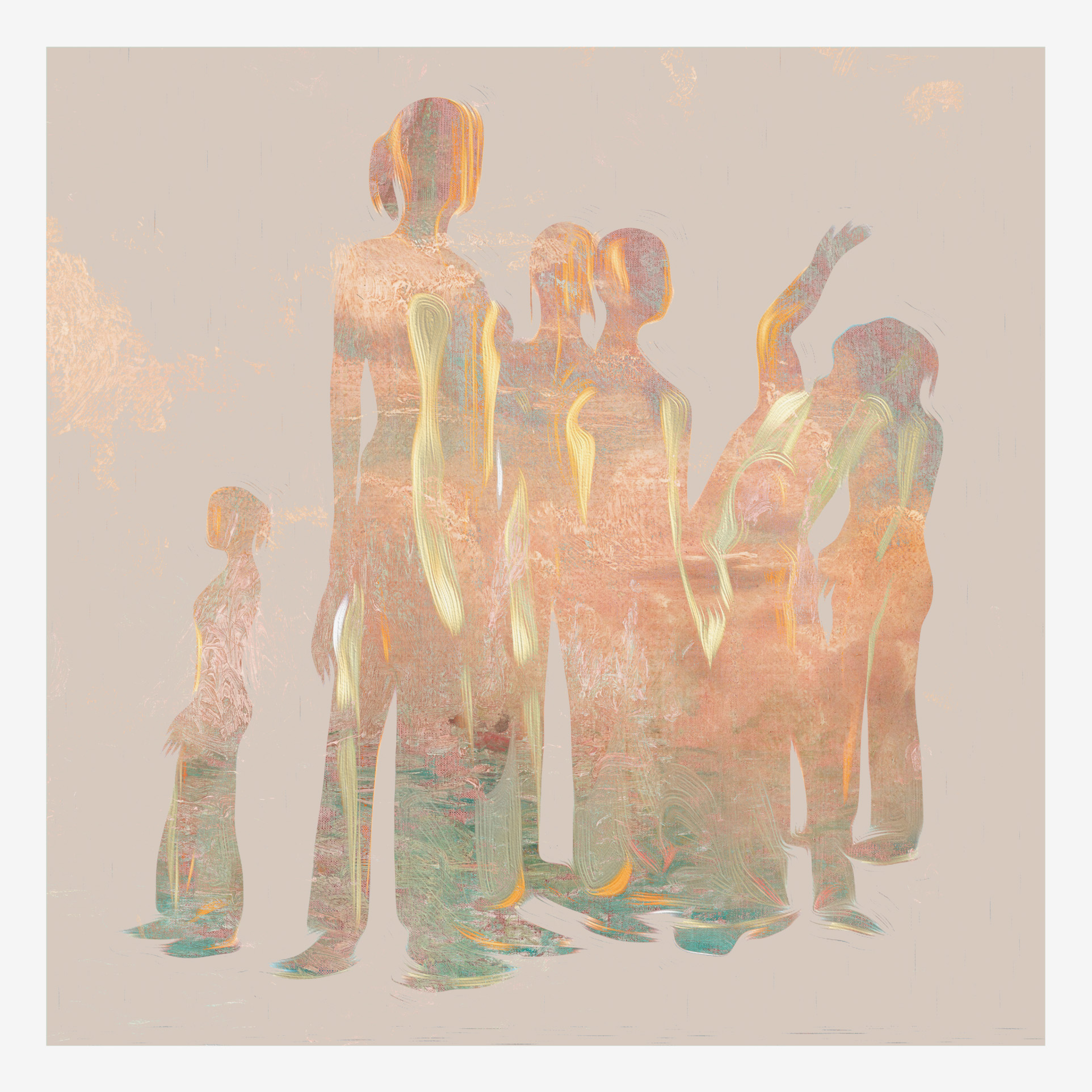
A sophisticated mood board of veiled, gauzy electronica with hints of real tinkered piano, A Mannequin is the second studio album from Berlin/London portal Private Agenda: the languorous sonic partnership of Sean Phillips and Martin Aggrowe.
Conceptually using each song and shorter breather, pause, to reflect particular character traits, and in doing so, asking certain questions about the ‘dichotomies’ that define us, this duo play around with a soundboard of synth-pop, nu-soul, ambient, downtempo, new age, chillwave, new wave, AOR gold and house music.
A fantasy with spells of starry, shimmery tinkled magic and more hazy, vaporous plaintiveness, this mostly dreamy, relaxed album glides or drifts through twelve degrees of being; starting with the ambient turn, the Air-like mirage ‘Irresistible’. I haven’t made my mind up if this is about holding a mirror up to narcissistic self-love or a complete 360 degrees turn, and in fact dreamily cooing for ore of it.
‘Neo-Nostalgia’ not just a track in itself, could be a perfect description for the whole record, with its constant lingering traces, the essence of 80s songwriter and synth pop, electronica, disco and yacht rock. The duelist ‘Gemini’ seems to lushly brood through Tokyo 80s glowing new wave, the Balearic new age, and yet also fit within the perimeters of the music of the cult Laurel Canyon singer-songwriter Ned Dohney.
There’s a change in musical mood, instrumentation by the fourth lovelorn song, ‘Touching’, which features an eloquent spell of classical light piano. It returns later on with just a hint of distant birdsong and a synthesized pre-set on the interlude-like ‘Purity’.
Elsewhere those floated ethereal vocals – which are never pushed, never sang in anger or even loudly – are wrapped in relaxed funk, castaway tropical percussion, neon-lit drama, opulent gauze and airy filters. With nothing strained, no real tensions, the music glides through a swirl of pre-Miami Vice Jan Hammer, Vangelis, Groove Armada, Spaceface, and on the finale, ‘Substance’, an exotic laidback pan-pipe hint of South American trance: As they’ve coined it, a ‘musical hyper-realism’.
Despite that laidback, even disarming if saddened at times production, the personality is seriously mined to create a fantasy come lyrical expression of who we truly are. A voyage of self-discovery you could say.
Saturno 2000: La Rebajada de Los Sonideros 1962 – 1983
(Analog Africa)
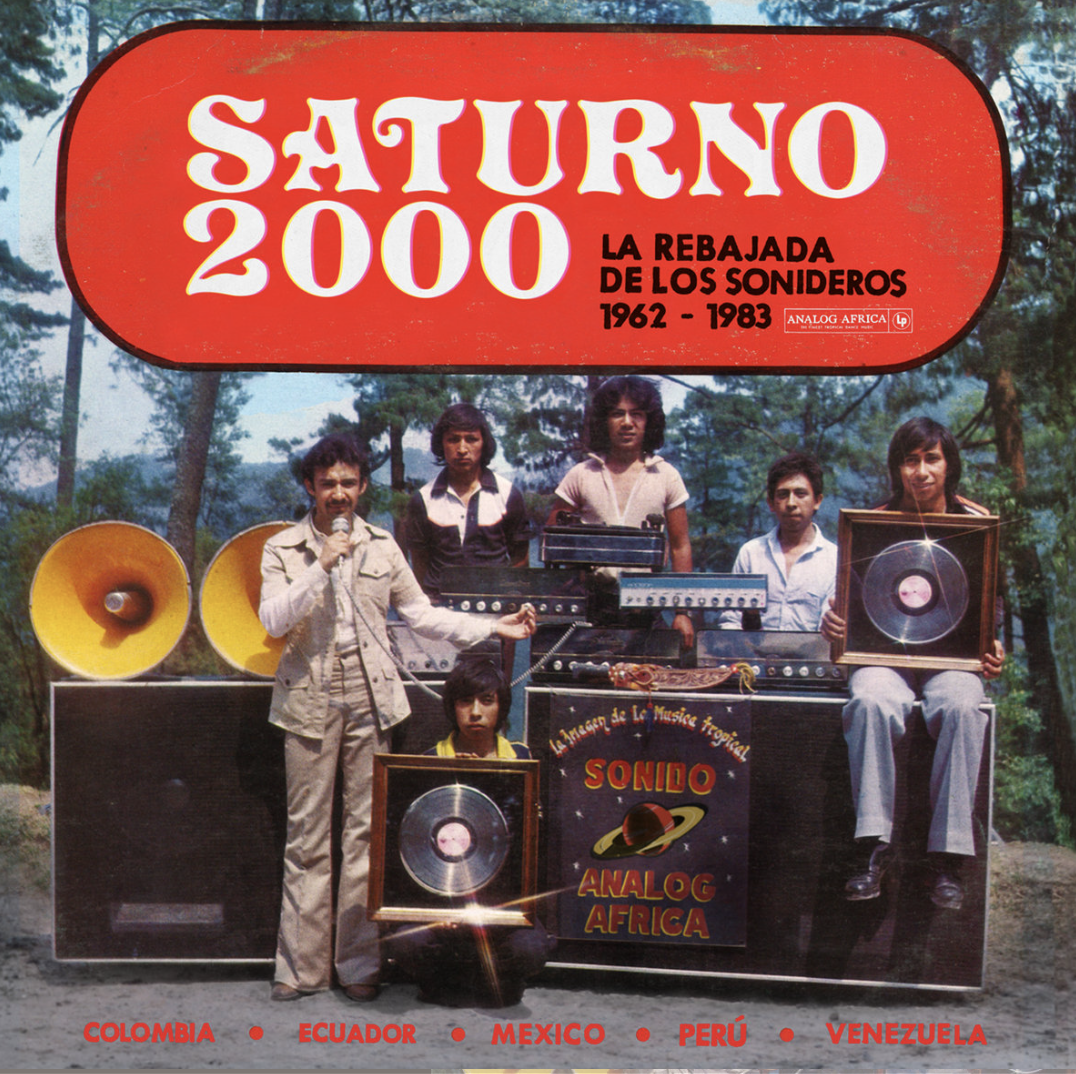
Once more landing on South and Central American shores Analog Africa airways celebrates the obscure ‘Rebajada’ phenomenon with what must be the only, if not first, compilation of its kind dedicated to that trippy, slowed-down form. Originally asked by Analog’s founder Samy Ben Redjeb back in 2010 to come up with an idea for a collection, noted DJ expert Eamon Ore-Giron (stage name DJ Lengua) offered up the Rebajada Mota Mix, which as a real slow-burner took time to reveal its magic. And so more then a decade on, this proposal now sees the light of day on a dedicated 15 track survey, taking in a twenty-one year period from ’62 to ’81.
First though, a little background. In a nutshell, ‘Rebajada’ is a well-coined name that literally translates as ‘to reduce, or to lower’, in this case slowing down the continent’s famous Cumbia and, to a lesser extent, Porro rhythms. Cumbia, a catch-all for a Latin American amalgamation of rhythms and folk dances drawn from the indigenous, enslaved African community and Spanish colonial cultures, and Porro, a style originally seeded in the Caribbean facing region of Colombia that evolved into a ballroom dance played by brass heavy bands and orchestras, are both simmered down with the speed and much of the gallop taken out so as to produce sometimes crazy but often sauntering, more relaxed dances. It’s a sound that allows the listener to drink it all in.
Brought to Mexico by ‘the sonidero’ (sound-system operators as they were known), tunes from Peru and Ecuador were by accident or luck transformed into a new style that sent the audience wild. Two cities and groups of people lay claim to initiating it though. In one corner the catalyst Pereas and Ortegas brothers, who travelled across Latin America crate digging before returning home to Mexico City. They sold their wares, finds to various sound-systems on the hunt for something new and fresh to blow away the competition. A number of which, in trying to match the beats of each region with that of Mexico City’s own styles began experimenting. One such maverick, Marco Antonio Cedilio of the Sonido Imperial fame, created a ‘revolutionary’ pitching system that could slow records down. In the opposing corner, the northern Mexican city of Monterrey and Sonidero Gabriel Dueñez, who by happenstance set in motion a chain of events that would see the city, lay claim to inventing the ‘Rebajada’ style. By escaping electrocution at the hands of a short circuit spark that nearly set his turntable on fire, the revolutions were slurred and slowed down by the damage, playing Cumbia at much reduced bpm and so creating this new rhythm and dance sensation. Another well-known sonidera, Joyce Musicolor, as mediator puts it best: “Rebajada, and the equipment to perform it, is from here [Mexico City] but it was Monterrey that popularized it.”
Contentious to this day, no matter what the truth, a new sound was born that grew and grew, yet remains relatively unknown outside Latin America. Here then is a survey of that scene, with a majority of the songs sounding unlike the originals; notable exceptions being the few classics composed by Polibio Mayorga, or rather the Ecuadorian Junior Y Su Equipo, and the Mexican Los Dinners group’s scrappy, tinny shuffled percussive and giddy-horse canter, bounding drum saunter ‘Sampuesana’.
Although we’ve heard a lot about Mexico, the lion’s share of choice selections are drawn from Venezuela, Ecuador, Colombia and Peru. Well, there’s actually only one apiece from both Venezuela and Colombia; the tremolo quivered Western themed reverberation of Duane Eddy, if produced by Joe Meek, ‘Infinito’ by Hugo Blanco Y Su Arpa Viajera, and the rattle-y percussive chapel squeeze-box, organ stuttered ‘La Danza Del Mono’ by Lucho Gavilanes.
Obviously when taken down a notch of two in the speed stakes it produces some funny as well as odd subgenres, and with the elements of low rent tech makes some tracks sound like 8-bit zappy and warbled versions of Andean pipe music. In that category you can include the oscillating ghost-synth like filtered Ecuadorian Junior Y Su Equipo group’s ‘La Borrachita’ and their second contribution, the googly, high-pitched and fluted ‘Bien Bailadito’.
From Peru, Los Santos’ cosmic futuro entitled ‘Saturno 2000’ (borrowed for this compilation’s title) sounds like a slowed fusion of Porro and Highlife with its raised and suffused blasted horns, galloped hand drums and distinct tropical Latin lilt. Monolith Cocktail followers and Analog Africa aficionados will recognize one name from the list, the Peruvian cat Manzanita. A compilation of his influential music was released only last summer by the label. Here, in a very different guise is his bottle-rolling duet of the slurred ‘Paga La Cuenta Sinverguenza’, and, with Su Conjunto, the more strung-out gangly guitar wondering ‘El Jardinero’.
Back to where it all got so peculiar and relaxed, the Mexican outfit Conjunto Tipico Contreras turn in a shunted, scrappy and concertinaed vision of a epic exotic film score from the MGM studio heydays; a record that has both a mix of the Mayan jungles and fertile crescent. The beat is destined, if not already, to be sampled.
Could Rebajada be the sound of this summer? It’s certainly a contender, just because it’s often so strange and hypnotising. You kind of hear the process, the slowness, yet it works as a sauntering, relaxed yet somehow still busy tropical shuffle. Having constantly documented all the best African nuggets, Samy and his partner on this compilation, Eamon, have put together an essential guide to a Latin American treasure trove.
Ethan Woods ‘Burnout’
(Whatever’s Clever Records)
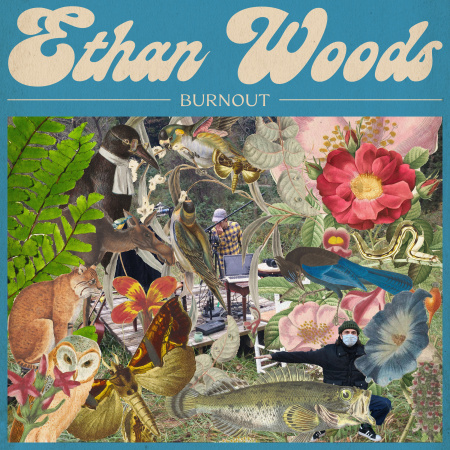
From out of the rustic idylls of Western North Carolina emerges a cabin essence songbook; a disarming pastoral lilted and psychedelic melt of connectedness, and yet, also yearning heartache. Ethan Woods and friends absorbed the meandered thoughts that take shape when disconnected from the newsfeed roll of social media and bustle of the city, out on a summer balm encased porch, and under a wooded canopy.
First conceived back in Brooklyn between 2015 and 2017, Woods fine-tuned his collection of dreamy, mesmerizing songs when he moved to Asheville, North Carolina a year later. Created in-situ at the foothills of the Appalachians, but brushed-up upon returning to Brooklyn once more with added parts recorded at the now defunct Fort Briscoe during the pandemic, the fruits of Woods and his sympathetic ensemble is let loose just in time for the summer of 22.
From beginning to end Burnout unfolds over the course of a day, following the sundial’s shadow until nightfall drops. That’s when the nocturnal soundscape collage, performed in part by the electronic experimentalist Aaron Smith, opens up a whole new evocation of nighttime camouflaged hoots, insect chatter and an Americana ether of obscured sounds.
Apart from Aaron there’s contributions from Woods partner Lauren Gerndt, percussionist Matt Evans, Trevor Wilson, Sarah Goldfeather, Finn Shanahan, Karl Larson, Jude Shimer and Alvin the rooster. Yes that’s correct, a credit goes to the rooster, who sets the alarm and atmosphere. No contribution is too small: from Gerndt’s read out one-liner about teddy bears to helping in the development of the arrangements themselves.
In the press notes, as an ample description, we’re told to think Alan Lomax recording a super group of Sufjan Stevens and The Books. I’d suggest led by David Byrne with Paul McCartney, Animal Collective, Galaxie 500, Ladybug Transistor and Clap Your Hands And Say Yeah vibes. In all, a sort of ebb and flow of psych, troubadour, soft rock and enervated dirt music country.
Characters from childhood, like ‘Mrs. Moo’, are accorded a lo fi swim of the sentimental and playful, with humble spells of honesty. Never quite straight up, always melting in with the arable outdoors on waves and oscillations of marching drumbeats, cymbal splashes, distant snozzles, tinkled piano and lax acoustic guitar. Music finds form and a rhythm; an either melancholic or romantic emotive tune in untroubled and unguarded song forms. Most of which bleed into each other, almost like a continuous recording.
Woods pastoral retreat proves a most magical, heart rendering, if sometimes pining, place to spend an hour or two. I’m really impressed by this slow-burning trip that drops The Books off for the weekend in a log cabin for a soliloquy session of candid therapy.
Misha Sultan ‘Roots’
Gustavo Yashimura ‘Living Legend Of The Ayacucho Guitar’
(Both Hive Minds Records) 6th May 2022
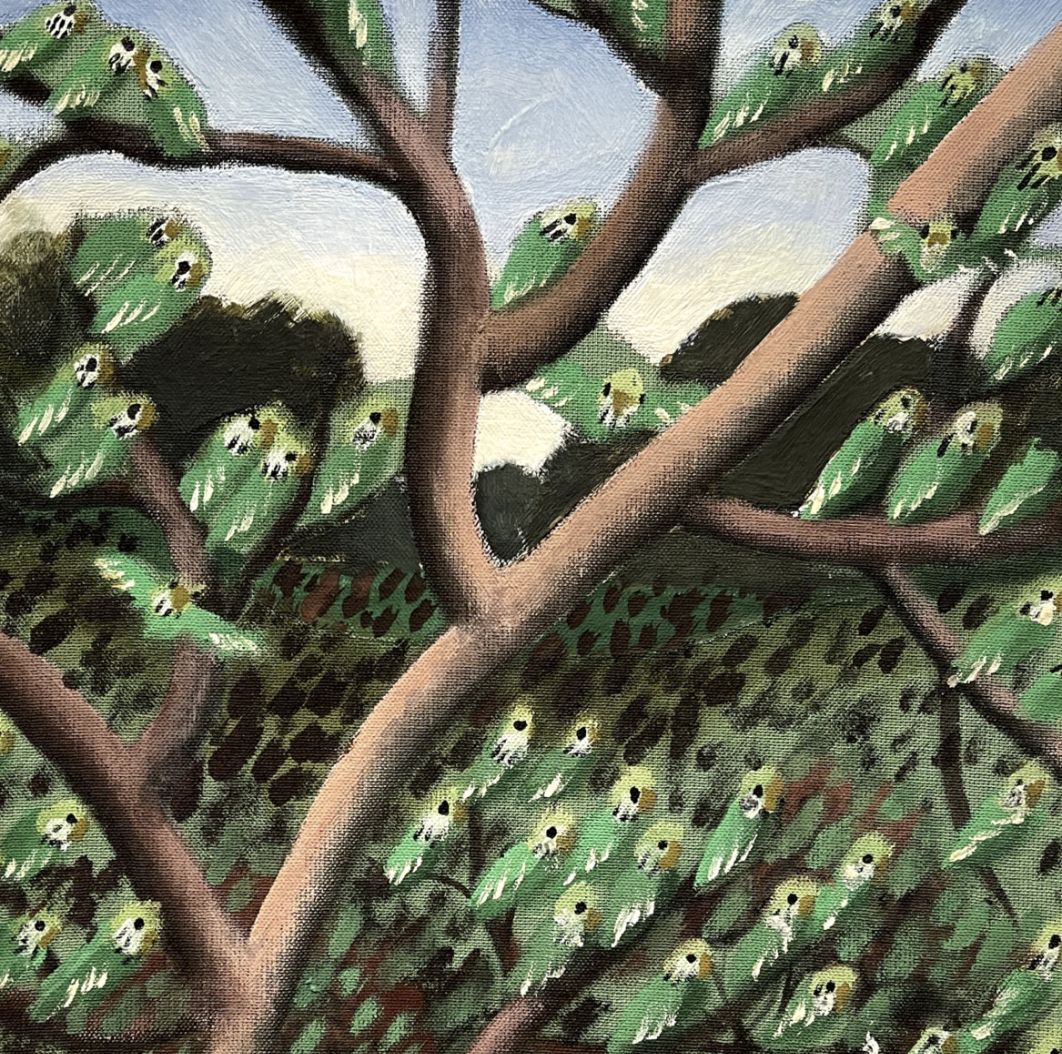
Nearing the label’s fifth anniversary (see my future purview celebration later this year) with no signs of flagging, Hive Mind Records are stepping up with two releases on the same day. Both cassette and digital albums couldn’t be more different too; with organic and global electronica from the Russian artist Misha Sultan and Peruvian Andes guitar evocations, flourishes from the Ayacucho-imbued maestro Gustavo Yashimura.
It shouldn’t really be that surprising, the eclectic richness of this dual release, as the label has previously traversed an electric Atlas Mountains, celebrated the colourful rituals of Gnawa music, and stopped over in Java, Highlife Western Africa and tripped out with the Acid mothers and Reynols.
The first of these showcases brings together the work of the multi-instrumentalist Misha Sultan, collecting pieces from 2015 to 2022. Hailing from the heart of Siberia, and industrious city of Novosibirsk, Misha was forced to leave his homeland.
The so-called ‘Chicago of Siberia’, on the banks of the Ob River, a crossing point of the legendary Trans-Siberian Railway and historically an important flashpoint of the civil war, informs, inspires some of the recordings. A geographical behemoth that sits between the Ural Mountains and Northern Asia, touching the Pacific Ocean in the East, Siberia isn’t just the exiled, infamous hardened remote atelier of literature, art and politics but a beautifully diverse landscape; the Eurasian melting pot as it were. Mirroring that diversity, Misha’s music travels to the Congo, Bali and Arabia whilst absorbing bits of kosmische, ambient, trance, washed-out psych, 90s chill-out, breakbeat and dub.
Real instruments, such as bubbled and shuttled mallets, flighty and dreamy flute and bamboo and metal percussion melt into synthesised waves, rays and atmospherics; some of which, on the odd track, are provided by the mysterious Mårble and Dyad. ‘Ant Invasion’ sets the tone, the scene, with a peaceable-like meadow field recording of hedgerow birds and tranquil washes of Mythos and Andrew Wasylyk. A shuffle of hand drums kick in and vague Ash Ra Tempel prompts take us towards more far eastern fringes. ‘Sand Ashram’ wobbles and bobs to Richard H. Kirk’s red sands invocations, Warp Records early Artificial Intelligence series, Banco de Gaia and the chill-out vibes of Liquid and William Orbit. ‘Why Are We Here?’ meanwhile could be either set in an Finis Africae vision of the Amazon, or indeed, Western Africa, whilst the railway station inspired ‘Beloostrov’ offers a fluted and drifting piano daydream aboard a train bound for the Finnish border. ‘Slow Flow’ with its shooting stars and whistles floats into spacey dub Orb territory, and the banjo-like radiance of ‘Bubbles’ moves from Indonesian evocations to Japan; well, something like that.
The final two tracks journey to the Congo and Bali; with the latter settling into a meditative mood amongst the New Year celebrations of the Balinese day of Silence.
Misha sonically travels the world, bringing together interesting references, emotions and atmospheres. He remains however rooted, connected to that Siberian topography and mood.
The second showcase of the Hive Mind set this month assembles a collection of adroit but also intensely skillful acoustic guitar music by the rather obscure champion of the Ayacucho Peru culture, Gustavo Yashimura.
Picking up the guitar in 1987, Gustavo travelled onto Uruguay to study, later on journeying to Japan where he played a classical style. He’d return home however in 2004 (still eager to learn and study) and would later take up the Andean style of guitar with the onus on the proud Ayacucho region of Peru. His teacher during that period was the 80-year-old veteran Don Alberto Juscamaita Gastelú, known famously as just Rahtako. It seems Gustavo learned much; straddling both the classics and more frantic modern styles.
In trying to reclaim the pre-colonial Spanish Ayacucho folklore and culture, these nimble and busy performances incorporate an age-old yearn.
A number of tracks (‘Dandé Te Fuistes Paloma’ and ‘Negra Del Alma’ being two of them) feature a heartening, aching female vocal: not quite Fado, but certainly on the lamentable side. Beautifully sung, expressive, they prove my particular highlights on this compilation.
Gaucho western horizons, ancient symbols on the plains, romantic flourished and dalliances stream forth from an incredibly fluid style; a mix of Spanish and the indigenous. Dainty, sizzling, blurry at times, Gustavo’s skills prove magical. Well worth adding to an eclectic collection. Better still buy both albums.
Ghost Power ‘S-T’
(Duophonic Super 45s)
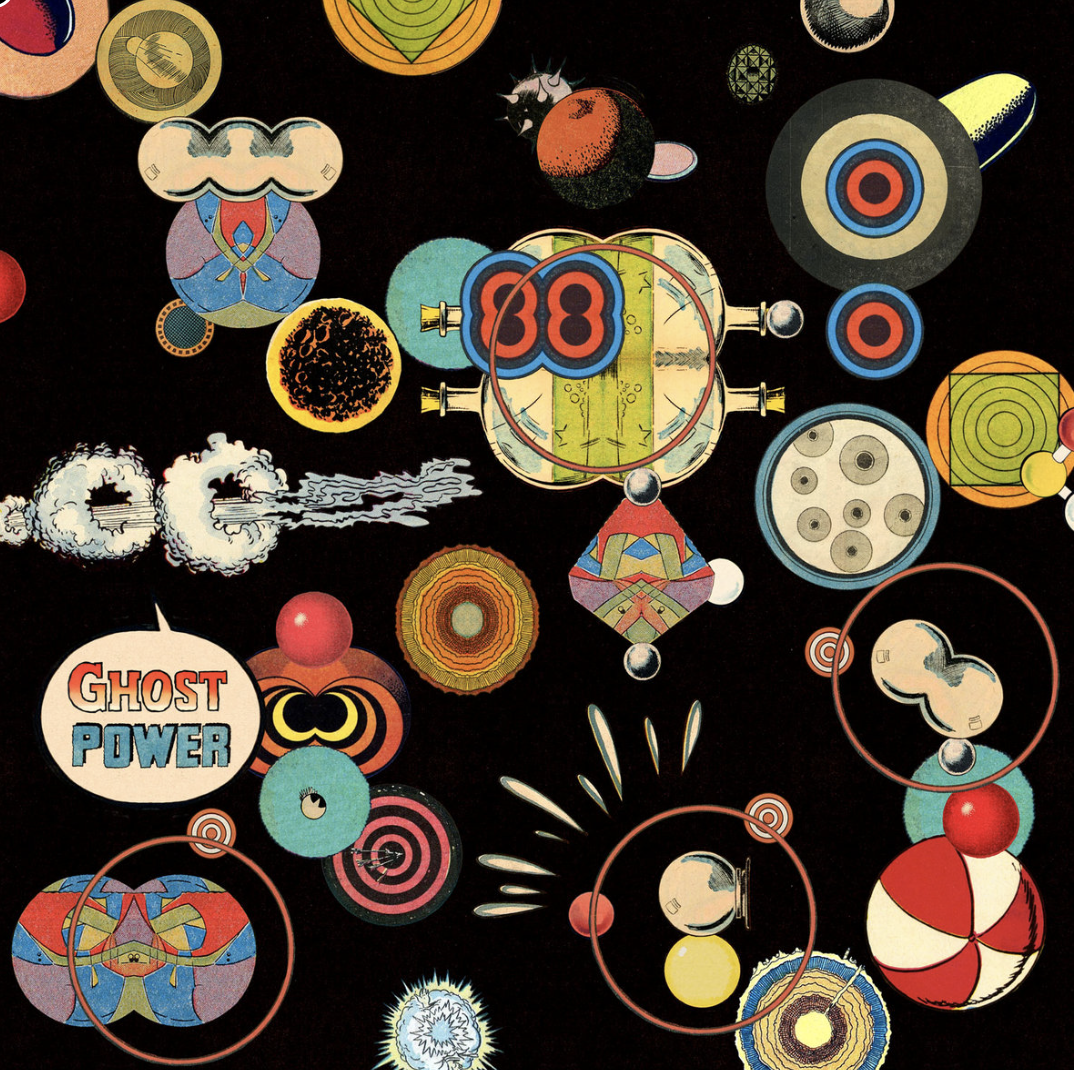
Two of the Duophonic Super 45s mail order label’s roster combine forces this month for a cult sounds coalesce of library music, soundtracks, psych and trip-hop. Serial offender in all things cultish, the kosmische universe and beyond, Stereolab’s Timothy Gane bounces nostalgic trips off his foil, Dymaxion instigator Jeremy Novak, under the newly minted Ghost Power guise.
Imbued by all that’s gone before them, recorded between sessions in both Berlin and New York (and remotely), the duo evoke a cosmology of cool and obscure mavericks on an album of fantasy (see the reference to Joseph Delaney’s witch assassin ‘Grimalkin’) and kitsch.
Matmos on a bum ride bubbles up inside a lava lamp with Bruno Spoerri and Arto Lindsay on the opening ‘Asteroid Witch’, whilst ‘Panic In The Isles Of Splendor’ could be the sort of obscurity dug up by the Finders Keepers label: that and a nocturnal insect rhythm of Alex Puddu and timpani soundtrack rousing piece of nonsense.
A transmogrification of an enviable record collection, in which Giallo schlock shares space on the shelves with space-disco-trance, 60s backbeats and Nino Nardini scores. Ghost power is a very knowing experiment in art for art’s sake; a knowledgeable take on library and cult sounds, with a few contemporary surprises.
Exterior ‘Umbilical Digital’
(Hobbes Music)

Without losing touch with rhythm and melody, the latest album from Edinburgh producer Doug MacDonald (under the guise of Exterior) is an experiment in texture, club sonics and live-sounding instrumentation. A largely percussive tapping, drum-skidding and bouncing affair, Umbilical Digital channels some quite eclectic tastes, with an array of both bpms and styles; from ambient scores to coarse abrasive guitar techno fusions.
The titular track, and opener, is a sophisticated metallic chrome propulsion of Basic Channel, Euro-trance and heightened warbles of something almost quivery and spooked. Yet by the second track, ‘Menu Diving Olympics’, the filters are subdued and more cosmic, the bass deeper, the beats like rattled ricochets, and the direction progressive. ‘Orthodox Dreams’ seems to have been partially lifted from the 90s: a bit of Sabers Of Paradise, a little Future Sound Of London. Yet it knocks and shakes, zaps and reverberates, to a contemporary mix of electronics.
The bottle, metal and tin rhythm tapping and pneumatic alarm clock bell chimed ‘Populist’ has a funky techno bent; reminding me of Psycho & Plastic and International Pony. ‘The Unbearable Shiteness Of Indie’ is less a polemic on guitar bands – MacDonald himself wielding one on this album; all feedback whines and caustic contouring – and more a floated, tunneled and slightly tropical merger between Sven Vath and Andy Weatherall.
The acid effects are subtly turned on for the trance-y geometric and soft thumped ‘Adoption’, and the Aphex Twin is sent down a flume on the slower beat-crunched, reversal tubular, robotic-stuttered ‘Tyranny Of Choice’. Carrying a certain weight, the finale, ‘Load Bearing’, goes all ambient and mysterious; a sort of soundtrack evocation of smoke forming on an otherworldly lake scene: creeping, sad with haunted, apparitional voices. As a last chill, it could be a lost Brian Reitzell score.
Synthesised music with a human touch, this album loses none of its experimental luster; still honed for the dancefloor as well as the head, whilst turning steel into something far more melodious. This is techno, electronica with a heart and purpose.
The Staple Jr. Singers ‘When Do We Get Paid’
(Luka Bop) 6th May 2022
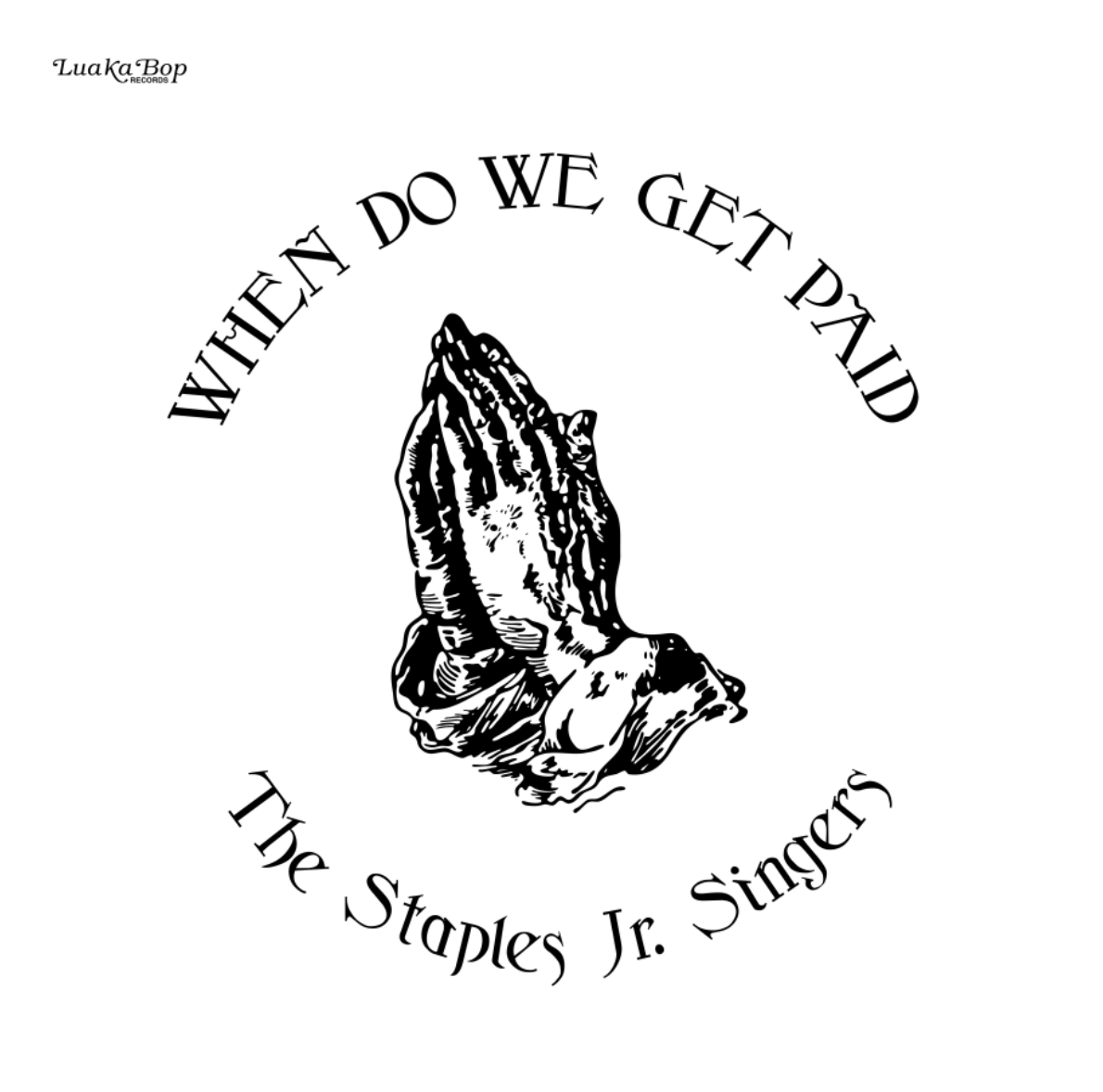
Revived five decades after its original, localized released in 1975, the good folk at Luka Bop make good on their incredible, enlightening compilation of obscured gospel and soul, The Time For Peace Is Now, with a dedicated reissue of The Staple Jr. Singers rarity When Do We Get Paid.
Pressed by that extremely young family unit themselves and sold at shows and on their neighbors front lawns, this rarefied showcase is finally getting an international release, prompting a number of live dates for the trio: their first in forty years!
From the banks of the Tombigbee River, honed in the family’s hometown of Aberdeen, Monroe County, the salvation searching, baptismal liturgy of Southern gospel gets an injection of conscious political soul, R&B, funk and delta blues. From the name you may have assumed that this trio were scions, the offspring perhaps of the divine stylers the Staple Singers. Without doubt a chip off the old block, the group’s moniker is purely used as homage in honour of their idols. Far younger, the Brown family of beautified and expressive soulful vocalists Annie and A.R.C. and guitarist Edward were in their teens when they recorded this, their sole, album in ’75. Yet despite being so young, the travails of the civil rights movement, social issues of the day, run throughout the trio’s equally earthy and heavenly soul music.
This was a sound touched by the afflatus yet grounded in the wake of Southern desegregation, unrest, the Vietnam War…the list goes on. So whilst Annie soars in full baby Staples mode, and with a vibe of Eula Cooper and Shirley Ann Lee about her, there’s plenty of attitude and sass to go around. Gospel music remains central however, with plenty of standard Bible belt exultations, paeans and passionate plaints. Some of which, no matter how familiar, seem to have some pretty unique and idiosyncratic rearrangement going on. Bolstered on the original recordings by bassist Ronnel Brown and Drummer Corl Walker, we’re treated to s Stax-like revue of reverence, the venerable and just down-country soulful funk. Echoes of Sam Cooke, Lulu Collins, Crusade Records, Chairman Of The Board and Nolan Porter follow humbled sermons on the soul train to Galilee. An electrifying songbook, When Do We Get Paid proves that this family trio possessed a raw talent, and could hold their own in a field packed with such incredible voices. It also proves there’s still much to learn and hear from that era of Southern soul and gospel. Great job Luka Bop.
Hi, my name is Dominic Valvona and I’m the Founder of the music/culture blog monolithcocktail.com For the last ten years I’ve featured and supported music, musicians and labels we love across genres from around the world that we think you’ll want to know about. No content on the site is paid for or sponsored and we only feature artists we have genuine respect for /love. If you enjoy our reviews (and we often write long, thoughtful ones), found a new artist you admire or if we have featured you or artists you represent and would like to buy us a coffee at https://ko-fi.com/monolithcocktail to say cheers for spreading the word, then that would be much appreciated.
 Monolith Cocktail Blog