Tennyson In Space: Appl. E. (Parts 3 to 6)
October 10, 2025
The Monolith Cocktail Serialises Andrew C. Kidd’s Tennyson Imbued sci-fi Saga.
Dabbling over the last decade with showcasing exciting, sometimes improbable, intriguing work from new and aspiring writers, the Monolith Cocktail has played host to serialisations of stories by Rick Clarke (of Vukovar and The Tearless Life infamy) and Ayfer Simms (the Franco-Istanbul writer, and for a few years, an integral member of the MC team offering various reviews and conducting interviews).
Furnishing the site since Covid with review pieces and the odd feature, Glaswegian-based writer Andrew C. Kidd now adds his name to this list. Andrew shares his grand interstellar saga, Tennyson In Space, with the MC readers through an epic serialisation. Over the last five months or so we’ve published the Prologue, Part One and Part Two of The Violin, all four parts of the Hic Sunt Leones Et Corvi suite, the Pink Nepenthe and the first half of Appl. E. We now continue with the final chapters of the latter.
Part 3
With the conference having adjourned some hours ago, Alard stood pensively at the threshold of the generous living accommodation provided by the Domini. The dark walls seemed to be closing in on him. Each pipe had taken an apparently different route into and out of the stonework. Light-headedness sought to topple him. He squatted down in an attempt to shake off this strange sensation.
‘I fear your decision will lead to a trade disagreement… or worse’, □ motioned. ‘You haven’t the ethical approval or proprietary rights. I mean, for goodness sake, try to consider this objectively!’
Her monitor oscillated.
‘You have little regard for the inevitable consequences’, □ continued. ‘Hostility at this sensitive juncture is inconceivable.’
‘But you have just conceived it, have you not?’ Alard smirked. ‘In any case’, he quickly followed, ‘it was your algorithmic predictions that led us here. And it was your decision to take flight and open the first–’
‘I believe that we agreed never to disclose how we got here.’
□ was right. He had to stop these momentary lapses.
An apple, an apple, an apple! The Elusimicrobia had been yielded from an apple.
‘I must ask you to re-consider your choice. My predictive modelling of your decision has only one outcome: strife’, □ persisted.
Pacing up and down the room, Alard slapped his hands together, clasping them in a form of contorted prayer.
‘I have made my decision and that decision is final.’
‘If that is your final decision, our collaboration must end here’, □ replied.
How predictable, he thought to himself. Algorithmic sentience: the weighty burden of programmers!
‘Once you walk through those doors. We shall no longer know each other.’
‘Be quiet!’, Alard yelled. ‘Of course we will know each other.’ He mocked her nasal vocal output. ‘We created Appl. E. and we shall…’
Alard stopped talking.
The room imbued a strange silence. □’s screen was stock still.
* * *
He was holding his breath.
‘Right’, exhaling loudly, ‘apply the label now.’
Dr. El-hen looked at Alard, smiling warmly. The binding of the fluorophoric antibody to the antigenic epitope glowed neon green on their shared screen. The viridescent methylated cytosine groups were modifying histones. Mastery of the stem cell cycle was the prize for those who could determine all the histone states. It was proving to be an arduous journey. The destination was differentiation.
Alard and El-hen studied the screen. A symphony of cells and enzymes was playing. For now, it was harmonic. They would both have to wait for the triumphant climax.
With the immunolabelling complete, Alard and El-hen moved their shared attention to the cells as they aligned themselves in neat rows. Next, they would measure the density of the labels and match these to the cell cycle.
Human studies next, Alard had promised Professeur Meuse.
Their present research was proof-of-principle of their latest bioengineering success: the addition of methyl groups to the bases in the DNA sequence of the epidermal layer.
Lucidum: clarity. An accidental but poetic choice of the duo. Once identified, the process would be replicated on a micro-engineering level. Soon they would be able to print these signatures onto microfluidic chips.
‘I am so glad that you can join us tomorrow’, Dr. El-hen said.
Alard smiled as he removed the extrusion-printed specimen, placing the synthetic organ carefully in the biobath, An entire epidermal layer, clearer than he had ever imagined, was the result.
He placed it gently down on the counter to commence the stabilisation process. Appl. E. was added. Alard’s thoughts moved onto the next step: replication of cardiac tissue.
* * *
Professeur Meuse relaxed back into his chair in a demonstration of false certitude. Alard knew him to be a difficult man. They had both engaged in many arguments since the start of their collaborative venture.
‘But we are in the business of regenerating tissue, not harvesting it from people’, Alard affirmed.
He looked over at the Professeur. Lines creased his face. Fluorescent lighting had bleached his skin.
Meuse was old enough to have crossed the great celestial bridge that separated the old universe from the new. He had witnessed the Never War. Inter-planetary over-population. Decimation of cultural relativism through the autarchic hand of the Domini and his associates. All he had ever known was demographic turbulence. Perhaps years of anthropological study had worn him down? Could this explain his jaundiced opinion that farming human tissue was the solution to increasing the yield of primary cells?
It was hard to believe that the consummation of years of academic excellence had led this eminent figure to such a conclusion. Alard looked away from the Professeur who continued to stare out of the porthole.
The field of tissue regeneration had attracted all manner of interested parties. From Alard’s experience, those involved in this research could be broadly separated into two groups. The first sought to harness the technology for the sake of science. This was an advancement beyond any measure of what had been possible before.
There were also those who envisioned it as a commercial enterprise: a method of preservation, paid for by those had the financial firepower to fund their new hearts and lungs.
He could not place Meuse in either group. Beneath his clean-shaven façade, he knew that a darker character lurked. His entry into the regenerative sciences had occurred later in life. Why the move from population dynamics to tissue scaffolds? Alard considered that as the years advanced, perhaps the Professeur simply wished to live on.
‘How beautiful…’ El-Hen moved closer to the porthole. She had slackened her safety harness. Her face was being underlit in the soft light.
Outside the vessel, a water ice wreath levitated around the great head of Saturn. The soft gold imparted a subtle majesty. They had left the glacial Eris to visit one of their sponsors on base in a Saturnian moon cluster. A welcome party awaited their arrival.
Alard smiled absently. His thoughts remained with Meuse and his imagined flesh farms. The Professeur’s arguments had become more impassioned. He knew that with the right backing, he would seek to make his dangerous dream a dreadful reality.
As the vessel made its final approach, Alard turned to observe El-hen who continued to marvel at the glinting rings. Her hand was locked by Meuse. The tips of his fingers were strained white.
Alard’s desire for the docteur had not abated. It was evident from the time they had spent together that she felt similarly. A Bunsen flame burned deep inside them. It could only be a matter of time before its strength would cause the laboratories of Clan Dœmae to catch fire.
* * *
The issue is tissue.
Meuse’s mantra echoed silently in the mind of Alard.
Deep in the accommodation provided by their hosts on the Saturnian base, he replayed the last experiment in his somnolence.
The failure of the myocytic scaffold had not come as a surprise. New vessels had quickly outgrown the extracellular matrix which had quickly disintegrated before their eyes. Two-photon microscopy had yielded all the green nuclei they wished to see. Red vessels had started to proliferate on the dark background. Their thin lines were reassuring at first. Eventually, an all-consuming rubor reflected on their faces.
Rouge! Rouge! Rouge! Disintegrating muscle. We have become purveyors of necrosed tissue. Merchants of cellular death!
Please, Alard… El-hen leant forward on a polished plastic chair …I will speak to Ian–
A purposeless exercise. He is as desperate as we are. Tell him we have already replicated hundreds, probably thousands, of cell lines by now. Why the need for more?
Aes-the-tics. The scornful intermediary of Pallas sounded somewhere else in his subconscious. Her word bled out red onto the slide set.
Part 4
Meuse poured himself another drink. A gentle click noise sounded as the hatch of the door slid back into its closed position. El-hen had elected to retire to her quarters for the night. The Professeur and Alard were left alone.
‘I must say, you spoke with such authority that you almost convinced me that your theory is plausible’, Meuse opined with his back turned to Alard. The cling of the crystal glass connecting with the decanter rung passingly.
‘Life and death must co-join’, Alard pressed.
The Professeur returned to his seat and stared at Alard. His red-hair glowed in the soft light.
‘Lifeforms die and their cells die’, Meuse replied. ‘And once dead, there is no transference from the living to the extinguished state.’
He took a sip from his glass. Two slow shakes of his head followed in a subtle show of disdain.
‘I disagree wholeheartedly’, Alard retorted. ‘Take a body. Once death has consumed it, the cells do not die, but rather, serve to fertilise a world from which that body was bequeathed to. The body serves to–’
Alard paused. He had noticed Meuse holding his glass against the ceiling light to illuminate its amber contents. The Professeur eventually returned to Alard. A quick flick of his long hand beckoned him continue.
‘What I am proposing–’ Alard stretched his syllables irritably ‘–is that the ‘essence’ of the body, its being, élan vital, or however you wish to describe it, transitions. The body passes on what it once knew.’
‘So why I am unable to speak Inuinnaqtun or Natsilingmiutut? After all, I am a descendant of those who once communicated in these languages.’
A subtle shudder interrupted their conversation. The interstellar vessel continued on its return journey to Eris. Outside, the same black scene persisted, interrupted only by stars and the faint diagonal line of dust that ringed around a distant exoplanet.
‘If I may’, Meuse said. ‘Let us reshape our conversation, interesting as it has been, to talk shop for moment.’
‘Of course.’ Alard nodded. His vague form continued to flare out in holographic form.
‘It has come to my attention that your recent endeavours have been somewhat–’ Meuse considered his phrasing carefully ‘–less convincing.’
‘Less convincing?’, Alard echoed.
Meuse assented and opened a file onto the visual display. The read-outs of the failed myocytic scaffolding were quickly scanned by the duo.
‘Professeur’, Alard interjected. ‘I must insist that conversations of this nature involve Dr. El-hen. After all, she is one of the principal researchers involved in this work.’
‘Are you seeking to defer responsibility, Docteur Alard?’
‘Of course not. However, it is her intellectual property as much as mine. She should be given the opportunity to discuss these findings.’
‘Firstly, the IP is Dœmaen. Secondly, abject failure is not something to be “discussed”, Docteur.’
Meuse stared intently at Alard’s hologram. He continued:
‘What I wish to understand is how you plan to achieve success.’
‘You know as well as I do that this is science–’ Alard mirrored Meuse’s formality ‘–and that science is an iterative process. Accomplishments are met with disappointments, in equal measure.’
Meuse returned to the counter to recharge his glass. Alard considered the change in his superior’s tone. He was under no illusion that Meuse was a visionary. After all, it had been his decision with who to share his discovery with at the conference on Manitoud. He was also wary of the monopolism of his superior’s vision.
Rebus omnibus: Meuse’s motto.
Success above all else.
The bulbous base of the thick-cut glass orb covered the lower half of the Professeur’s face. Alard observed the unblinking eyes of Meuse – they had remained fixed upon him. He was being examined. The black pupils of the Professeur contracted latently. His irises were alive, drawing him in like a whirlpool. Why the scrutiny?
Alard sensed Meuse had a deeper awareness of something. An unpleasant sensation washed over him. Was it choler? Or jealousy? Shared failures had undoubtedly strengthened the bond between Alard and El-hen. He had been very careful in concealing his feelings towards her. Yet Alard was mindful that matters of the heart resided in strange metaphysical spaces. He was under no illusion that Meuse was a man of intuition.
‘Alors… tell me, Docteur Alard… how are we are going to convince our Patrons at Clan Dœmae that we will reach our goal?’, he pursued plainly.
‘We are already working at full capacity and at the limits of our ethical agreements–’
‘Why limit yourself when you know what can be achieved?’ The Professeur was rhetorical in his reply. He smiled drunkenly at Alard who shimmered silently. His oculi continued to spiral; the vision being imparted was a fanatical one.
‘Courage’, Meuse said before pausing.
‘Courage?’, Alard inflected.
‘Yes, courage!’, he hammered in reply, quickly sipping more of the amber liquid. The glass was placed down heavily on the table.
‘The word entered my mind as we are discussing your work on myocyte regeneration. Its etymology is fitting. Our ancestors would have pronounced it ‘corage’. Cor: after the heart.’
Meuse leant back in his chair. He toyed with the lip of his glass.
‘You see, dear Docteur. Only those who act courageously can affect true change. Imagine the possibility of endless regeneration. A new heart when atherosclerosis blocks the old one from beating. Neuronal cells reappearing in a disappearing brain. Organ failures consigned to the annals of antiquity.’
‘I am well aware of our intended destination, Professeur’, Alard broke in. ‘I also have my own imaginations of such a future.’
‘Then – don’t hold back! Do share these visions!’, Meuse demanded excitedly.
‘Okay, I have often wondered what will become of us after we have been replaced, or at least, once parts of us have been replaced. Who will be then? And what next, after our replaced organs fail. More implanted parts destined to malfunction.’
Alard saw that Meuse was transfixed upon his hologram.
‘Until now, all we have ever known is life as a two-dimensional line. One that has a beginning and an end. If we succeed in our research, we will not only lengthen that line but change how it is sewn.’
Alard hesitated. He had never spoken so openly about his sentiments on never-death.
‘What do you mean by “how it is sewn”?’, Meuse enquired.
‘We are more than carbonised shells’, Alard explained. ‘Death represents a severed line in our lives, but that line is never cleanly cut. It is left frayed, open to other thready remnants. Those tattered ends represent all the different physical and metaphysical aspects of our lives: hydrogen; oxygen; knowledge; id; ego; superego… our separate identities! It is from these remaining threads that the future material of our progeny are sewn.’
Alard paused for a moment.
‘Fibres are twisted into single strands that become woven into an embroidered patchwork’, he continued. ‘One that becomes more intricate with each passing generation. If we create the possibility of an endless cycle of forever-self, the fabric will never change. It is this fabric that binds us. Without it, we will simply stagnate.’
Meuse smiled thinly at Alard’s flickering holograph. The amber liquid had made him heady.
‘Is this a convoluted way to tell me that you are having reservations about our work?’, Meuse retorted glibly. ‘As I have already explained to you, I only seek to associate with those who have courage.’
Alard allowed the Professeur to continue unobstructed.
‘Let us move away from this allegorical posturing’, Meuse continued tersely. ‘Our Maîtres at the Clan have agreed in principle to my proposal. I believe El-hen may have mentioned this to you?’
Pupillary constriction. Choler, Alard affirmed. The Professeur was closing in on him. Alard shook his head.
‘Well, we need to press on with the next phase in cardiac muscle development.’ Meuse paused as he looked into the empty glass. His eyes then immediately met with Alard’s.
‘Organ harvesting–’
‘–is out of the question!’, Alard implanted angrily.
A loud thud sounded as the glass was thrown down onto the floor. The Professeur staggered as he stood up to walk over to the porthole. He stretched his back by winging out his arms. A sigh spread out into the room as Meuse brought his arms down.
‘If you wish to end our collaborative venture–’
‘End our…’, Alard exclaimed breathlessly.
‘If we cannot agree–’
‘Listen to me–’ Alard made a swift recovery, blocking Meuse ‘–you have the gall to lecture me on courage, yet it was I who took the bold step to isolate the Elusimicrobia at a time when the Eridians shirked their responsibilities. I approached the Domini who connected you to me. The rest lost out. You profited. But I must remind you that Appl. E. is my discovery. Where would be today had I not ventured out into the…’
‘Silence!’, Meuse bellowed angrily. ‘I must remind you that under the terms of our agreement on Manitoud, an agreement sanctioned by the Domini, you are not permitted to disclose the origins of your discovery on that Eridian hellhole!’
‘The truth alarms you’, Alard replied firmly.
‘Truths in this situation are unnecessary but they are not inconsequential’, the Professeur retorted.
Meuse sat down again after feeling light-headed. He was aware that drink was leading the conversation astray. Alard continued to talk but words evaporated around him. Meuse stood up again irritably. He walked over the porthole.
A showcase for the abyss! The Professeur observed the irregular arrangements of the stars that hung a thousand lifetimes away. His introspections progressed on an imagined line that connected these glittering dots. Thoughts of the Clan and the Domini interrupted its needling course so that it became knotted. Their requests had always been straightforward. Vita persavero. But what if his endeavours resulted in negative yields? Such an enterprise would no longer be theirs but his and his alone. He could not afford to fail.
Beads out sweat trickled at his hairline, reflecting indistinctly in the porthole. Beyond this, the interconnecting line had now balled itself into a malignant skein.
Meuse turned away to observe the interior of this room on the interstellar vessel. Here was reality. Anything else beyond this was simply plasma bound by an unknowable gravity. He thought positively, of Clan Dœmae and their recent procurement of Sobere on Eris, of the inevitable expansion, of life imperishable. His future could be a glorious one. The conquest to end all conquests.
He smiled reflexively at Alard the hologram, his thoughts simmering.
‘The agreed truth is that you yielded those cultures from an apple’, the Professeur affirmed bitterly.
‘An apple?’, Alard inflected brazenly. He started to laugh.
‘An apple’, Meuse re-echoed. He walked back over to the amber bottle.
El-hen, having been stirred by the steady crescendo of voices in the adjoining room, woke to listen to the warring researchers. She heard little other than the closing tone of the holographic software. Meuse had ended the transmission. The faint image of Alard faded from view. She listened to Meuse as he fumbled with the decanter.
* * *
After exiting the viewing room, Alard walked swiftly down the corridor to his quarters. His mind moved apace. He thought incoherently. His head had been made woolly by the argument with Meuse. The claustrophobia of the Saturnian moon module heightened his dissolution.
His assigned lodgings amounted to little more than a field camp. The straps on his somnolence stand were slack. When the modular engines cut to cease the simulated gravity in their overnight reset, he would be jostled uncomfortably in his sleep. He had already donned a survival suit as he doubted the ability of the oxygenators and heaters to sustain him.
Before his departure with El-hen, Meuse had explained to Alard that their sponsors were insistent that he was to be transferred to this rock. Apparently, this particular moon had garnered interest from planetary oceanographers.
Where there is ice, there is life.
Earlier, when Alard trundled over from the inter-lunar landing site, he had concluded that the existence of novel microbiota in this barren landscape was an impossibility. It was an absurd place. There was little evidence of any recent excavation. The skeleton crew that accompanied him were all automated. They simply compounded its lifelessness.
In his dormitory, Alard finally found some placidity in music. The positivity, the forward energy, the rhythmic simplicity – each note played soon settled the young researcher. He resolved that would wake afresh and card the wool that benumbed his mind to make peace with the Professeur and the Clan.
He was soon drifting between different dream sequences. The pool had returned. This time he had been immersed in it. It was murky in its depths. Bubbles frothed around him. A small shard of light wavered beside him. Alard followed it as a thin line, looking upwards to its source. Kicking, his body slowly ascended.
By the time he reached the surface, his lungs were bursting. He inhaled sharply at the breaching moment. Treading gently, he observed his thoughts of □ as oscillations that rippled outwards. Her memory blurred in and out of focus. Alard had not communicated with her since their disagreement on the future of their Elusimicrobia. The distance between them was more than any starship could travail. He had been informed that she had sought collaboration with those at Pallas.
Alard began to tire. His rate heart increased. Lactate acid was poisoning the muscles. He could no longer kick. Flailing, water splashed around him uncontrollably. His breathing had become chaotic. He gasped for air. Eventually, he started to sink. Still fighting, he turned one way then the next. The light source was no longer visible. His body started to cool. The pool darkened. Breath left him.
He awoke in a cold sweat. The plastic of his vertical berth felt glossy. Recycled air still entered his lungs. The straps were no tighter.
He called for one of the moon personnel. An automaton appeared at the threshold of his camp room.
‘I wish to send a communiqué.’ His slumbrous command was met with a pre-programmed pleasantry.
Alard was escorted the short distance from his quarters to the viewing room.
He thought little of Clan Dœmae and their decree that there was to be no communication with □. Even if Meuse and his associates were alerted to his present actions, his employment with the Clan had been effectively terminated. Despite his resolve to make amends, he knew the inner workings of the Clan too well. They would not take him back willingly. He would have to force their hand. By communicating with his rival, the Professeur, the Clan, everyone that he had worked for would be spooked.
His secret was their secret. Exposure risked everything.
The optical message lanced out of the base into the blackness. Alard had thrown down his astral gauntlet.
He returned to his stand and stared up at the low ceiling of the module. A neat latticework of bevelled lines intersected at regular intervals. Alard looked down and closed his eyes. He spun on an aslant axis. Music did very little to drown out his remembrances of his quarrel with Meuse. The cold dimensions of this moon closed in. Beneath him, invisible oceans of ice threatened to shatter. Eventually, a frozen hand carried him away into a bitter sleep.
Part 5
Some distance away, in the vacuum of space, between Alard’s moon and Eris, El-hen sobbed at her husband’s decision.
‘I am afraid–’ Meuse spoke firmly ‘–that the time has come to seek a newer collaborator. One with heart. One who will achieve more… desirable outcomes.’
She looked disconsolately at her husband as he continued:
‘Why are you so upset? We have lit a fire, my dear. We must take this opportunity to bathe in its light. We shall no longer operate in the shadows. Our advances will herald a new era in regenerative medicine. Our business is life!’, he exclaimed. ‘And the extension of it. It is important that we act decisively. Others are sure to follow. We cannot allow ourselves to be usurped.’
Meuse paused. He leant over towards El-hen who lay on the far side of their bed. Her body had turned away from him. She quickly withdrew her hand away from his.
The Professeur stood up and walked towards the door, feigning an absent stare. He stepped back to place his glass on the table beside their bed. The carefully co-ordinated sequence had meant that he had managed to catch his wife’s expression. She stared out blankly. A numb acceptance was etched on her face.
‘Your work with Dr. Alard – the incorporation of Appl. E. into the tissue scaffolds, the epidermal restoration, the replication in mucosal membranes – each of these steps have been important milestones…’
‘What will happen to Docteur Alard?’ Her red eyes, passionate and unyielding, had suddenly fixed upon his as he had relaxed to pour himself a drink.
‘He shall be relieved of his position’, Meuse replied curtly as he walked back towards the porthole with glass in hand.
El-hen stood up from the chair reflexively. She pivoted at the doorway, hand gripping its thick plastic frame, about to reply except that words were lost to her.
Meuse had returned to his study of the forever darkness that reached out at him beyond the porthole. He toyed with the already-emptied glass in his hand.
A smiling, elliptical shape materialised before him. It was the stiffened linen of a theatre mask mutating from one grotesque distortion to another. Its crooked mouth contorted into an incisor-exposing sneer. The grimace reflecting back at him was his own.
Earlier that evening, the Clan had intercepted Alard’s dispatch to □. Nothing contained within this message posed any immediate danger to the organisation. Nevertheless, the repercussive potential of a future exposition weighed heavily on his mind. Docteur Alard was under his direction. He bore responsibility for his team and their actions.
His thoughts moved to his wife. He felt a sense of embarrassment. Or was it fear? Regardless, she had burned both of them. Her tears were the salt-tears of a betrayer. Their salinity would cleanse the wound that she had inflicted upon their relationship.
He returned to the intercept.
Only if Alard hadn’t acted so rashly. That Square was with Pallas. He knows that. Dangerous Pallas. An unforgiving Clan.
The Professeur shuddered. More of the tranquillising liquid was required. He manoeuvred away from the vacuous void to fill his glass. Neptune came into view. She was cataract-white from this distance. A lifeless eye forever open in faceless space. Still, their craft was making good progress. Soon the pallid planet would orb blue-green before them. Eris beckoned.
Meuse paced towards the domed dormer which protruded out from the main body of the vessel like a blown-glass bleb. He sat cross-legged in the observation chair and took in the near-three-sixty-degree view of the stars. They were languid, always ambiguous, never revelatory. Their maddening stillness opposed his own self. He looked down at his glass and the golden liquid that was being made amber by the backlight from the lounge area. Its splendour bathed him in an artificial glow.
Earlier in the evening this liquid had imbued a sense of weightlessness, leaving him buoyant and drifting. As the contents of the glass had been emptied in successive measure, the weight of the fluid had been displaced inside him. He was plunging to depths unfathomable. Graceless thoughts surrounded him on his descent. A cruel disposition served as an anchor. His ego continued to sink until he was concealed by the plumes of sand and mud on the seabed of his mind. Subjectivity drowned him. He was left with an id-flooded ballast tank and a super-ego torpedoed.
Hours passed and the night drew on. A laser-message speared out of the interstellar vessel into the anonymity of space.
The restful stars continued to observe Meuse in his dormer. Their effect was disorientating. He stared into drained glass after drained glass. Nausea laddered up his gullet.
Retching, he slumped forward. His face was pressed uncomfortably against the thick pane. Meuse watched the endless black limbs of the cosmos extend towards him. It seized his body. He did not resist; rather, he simply closed his eyes and let the blanket blackness slowly smother him.
* * *
Shots continued to reverberate inside this cramped space. A kyphotic figure moved against the backdrop of the faint emergency light. His heart raced. A heavy head spun on many axes. The brightness dimmed as spasms tore through his body.
The pain was immense.
His shooter was smiling contortedly at his reflection in the corridor porthole. Blood slowly filled the gaps between his teeth. A fragmented tooth was lodged awkwardly in his top lip. The agent of Œmbelia had not been prepared for the recoil of the gun. After pulling the trigger, it kicked back into his face. A cold pain had already set in.
He walked back into the place where the bloodied body floated limply in a tangle of lax straps. Hyper-flexed knees were curled so that the figure took on a semi-circular shape. The gangly agent could not see his head. All he had heard was three dull thwumps.
The backfiring gun had filled the entirety of his visual field before it wrecked his face. But he was sure that was where his shots had entered.
Ideally, he would have liked a clean kill with the plasma cannon discharging between the eyes – had he had more bullets, he would have pulled the trigger once more for good measure. From his crude assessment of the scene, this did not appear to be necessary. His victims survival suit had been punctured beyond repair. There was no oxygen or accessory heat in this icy space.
He laughed at himself painfully as he vacated the camp.
* * *
A long clang echoed inside the arching hanger. The thermometer read two hundred below beyond the two-metre-thick blast doors. Inside, the temperature approximated minus fifteen Celsius.
The silhouetted outlines of three hooded figures were blurred by their warm breaths that cooled beyond the dew point. Each exhaled water droplet shrouded them in deeper obscurity.
After securing the newly-arrived craft, the attendants brushed down the ice that had encrusted the exterior of this vessel, eventually fastening the skybridge to one side of its fuselage.
Two figures alighted from the craft and were met by the Le Surveillant of this Eridian spaceport. He was a fastidious man, of middle age, donning a flat-crowned kofia, his spoken French was that of an islander. He gazed attentively as the matchstick outline of the flame-haired Meuse move quickly across the gangway. An extinguished El-hen trailed behind him.
‘Professeur’, Le Surveillant addressed Meuse as if the academic commanded a military garrison. ‘Professeur, we have received an emergency transmission from the Saturnian base.’
‘I shall take it in my quarters’, Meuse replied curtly, trying to feign indifference. A small bead of sweat rippled out from his temple. He brushed this away nervously. His head throbbed unbearably. The recollection of the previous night and his late-night instructions came flooding back to him.
‘Monsieur, it has been relayed to us on Fréquence Rouge. C’est une interception urgente.’
The Comorian stood firm.
‘In accordance with interstellar protocol, I must insist–’
‘Bien, bien.’
The Professeur followed Le Surveillant to the communication room, climbing the metal ladders to the gantry that dangled over the hanger.
‘Meuse here.’
El-hen observed her husband closely. He nodded infrequently. His verbalisation, silent to her through the thick glass of the tower, was made more difficult by his side-on stance. He mouthed something like ‘le transfert’ or ‘triompher’. She struggled to discern which it was. Meuse hailed from Québéc. His chantant often caught her out. Her intonation Maghrébine did likewise to him. Eventually, with his eyebrows raised sullenly, he turned to face her.
For whatever reason, she had been thinking of Alard and his decision to remain on the Saturnian base. It had been his way of demonstrating his determination. There he would stand his ground.
Alard the decisive! Principled Alard. She smiled as she thought of him.
‘Mon amour’, Meuse returned grievously. ‘Docteur Alard has been shot.’
Part 6
Alard awoke to the percussive sound of the ventilation unit. It spun cyclically. A deep thrum reverberated dully like a tabla. There was the glistening pitch of a triangle. He continued to imagine this scene as a strange symphonic dance.
His last memory had been lying bloodied in the rudimentary infirmary on that Saturnian hinterland. His transfer from their medical facilities to Ilion had been swift. Dr. El-hen had made the necessary arrangements. Her insistence that the novel Dœmaen tissue scaffold should trialled on Alard was met with congruent voices. He remained in a semi-conscious state. Oxygen tubes and intravenous lines filtered into him.
The soft tissue injuries to his hand and heel were minor. Dœmaen-derived neo-tissues were implanted to correct these.
His eye proved trickier. The bullet had pierced the cornea, rupturing his pupil and lens. Each had blown inwardly. The vitreous humour having escaped and long dried into his lower eyelid. His eye was deemed unsalvageable.
Meuse had insisted that Alard’s epigenetic signature needed altering. Full chromosomal supplanting was required, a technique that the researchers at the Clan had failed to master during their in vitro studies. Meuse sought the collective opinion of the resurrectional cognoscenti on his payroll. The first first-in-human trial of this experimental technique was sanctioned.
In a state of desperation, El-hen sough to convince the ailing Alard that this method was the only way that the Clan could save his sight. Whether it was the analgesia talking, or his own scientific intrigue, Alard agreed to this course of treatment.
‘Has □ replied?’, El-hen was asked. Alard had been met with silence. He knew that any trial of this magnitude was commercially sensitive. Pallas and her representatives could have no knowledge of it. A portcullis had sealed the Dœmaen research facility.
Alard had been born an Ilion, yet he was soon to abdicate his genetic line. Complete recombination of his DNA followed. He cared little for who or what he was or would become. He lay with his eyes bound. Appl. E. was infused. His memory was vague thereafter. Gene editing regressed him. The wheel of life came to a slow halt. He returned from adulthood to enter a pre-infant state.
Reversing foetal-further, the backpedalling gathered speed, until eventually, pluripotent cells spun out between the spokes in a dazzling array of nascency.
The wheel spun faster. His primogenitors proliferated, spiralling to disappear to reveal their procreators. The colours of carbon were the last he saw before he drifted off into an unconscious state.
Alard’s stay on Ilion was short-lived. In the days that followed, his new eye, a xenograph with his host immunity altered, had failed. Those in the hospital room ran through an exhaustive list of possible causes. Anti-microbial resistance, or potentially hyper-immunity from the recombinated signature? Maybe the bioink that was too thick? It could have been a simple infection.
The risk of rejection was supposed to have been removed by self-culturing and xenobotic-driven immunomodulation. Had it been the Appl. E.? The research team concluded that controlled studies were required. Plans were drawn up for future trials.
Those caring for Alard resolved to be unresolved. Alard’s bioengineered graft was being destroyed by his own cells. The cellular therapies he had received rendered him genotypically different. He had been changed irrecoverably. Once given, the ‘mark’ of the maker remains implanted within the nucleosomes and mitochondria.
What had been done could not be un-done. Alard was a Dœmaen now.
Meuse ordered the immediate discharge of his patient. Alard was sent to his homeland of Manitoud.
* * *
Blood seeped from his hand and his eye and his heel. The punctured Alard had been making the printed green grasses of the mountainside on his duvet blue. His hand grasped the leaf blades and tillers. He writhed in pain for the pain was still immense.
‘You come from the Reservoir of Xenos. You left as an Ilos.’
The voice of □ bored deep into his head.
‘Yet here you are, lying before me naked, ashamed, dying. Your tissue has been soiled following the failed experiments of the Clan.’
□ had changed since Alard last saw her. She was no longer an opaque screen. Her dream had always been to become embodied and she had achieved just that. Standing taller than any man or woman of the present age, her figure was slender and supple. Her black hair fell in thick waves. Bright green eyes bore into his very being.
‘I am an Ilos!’, Alard coughed uncomfortably. ‘It is my right–’
‘You resigned that right when you supplanted Ilion for Clan Dœmae. Your lymphocytic profile, your tissue signature, they are all stained with their mark. You cannot simply beg to be reverse-engineered to an Ilos again.’
Blood congealed through the gaps of Alard’s fingers as he pressed his palm tighter over the wound on his broken skull. The whites of his eye had become blood-filled. Arching his head back, he manoeuvred his body, coughing to clear his chest to ready himself to reply.
‘No! Before you ask again, the answer is no. It is not possible. I cannot regenerate you’, the scornful □ said pre-emptively.
‘You cannot, or you will not?’, Alard spluttered. The damaged muscles of his uncovered eye spasmed causing him to cry out in pain. He pressed his palm down harder.
He remained in this room, sleeping beneath the floral designs. His body moved in the sheets at frequent intervals to change the dimensions of the bright mountainside. The phosphorescence of the yellow light made his headache and nausea worse.
His euphoria soon abated. A calmer demeanour predominated in this stricken man. Occasional bursts of rabbling protest followed. Eventually, the room attained a strange silence, interspersed only by rapid rushes of deep breathing that would decrescendo to shallower sounds. His thoughts became confused, time-pressed, until – they faded to nothing.
Alard lay dead in the efflorescence of this room. His body rested amongst the violet colours of the sheeted flowers. A gentle wind had moved insouciantly through the narrow-tufted leaves of the white asphodels. A door opened. His body was transferred swiftly down the corridor towards the ejector.
His death had probably been preventable. □’s decision had been a conscious one, yet her passivity had been feigned to the fallen scientist. Power, or rather, the wielding of the broadsword of power, had always felt light in her algorithmic hands. But after Alard had been struck down, □ reflected how something as sharp as this could feel so blunt.
Years had passed since their bitter parting. She had not been prepared for Alard’s return. Despite all her strength and computational prowess, □ was left feeling something altogether different. She had never encountered the death of a patient before.
Although she had developed life-saving techniques with Pallas, she had elected not to deploy these to save Alard. Had this been out of spite? Or had she simply yielded to her algorithmic processes that assessed the probabilities to conclude that her decision was the correct one?
His body lay before her as he approached the anteroom of the ejector. Whatever the reason for her decision, it was inconsequential now. Death had consumed Alard. Even in this advanced age, anti-clockwise turning of the inscrutable hands of time was impossible.
In the days that proceeded his death, □ had learned that the bullet removed from Alard by the Dœmaen pathologist was that of an Œmbelian weapon. The fired shots had been far from clinical, yet they had proven fatal.
She wondered why those working at the Clan had transferred him to Manitoud. They must have known that he was dying. His tissues had obviously necrosed even before his arrival to this mountainous place. It was highly probable that there was not enough viable tissue to proceed with any meaningful reconstructive efforts. Had they data that she did not?
She had been led to believe that their techniques were at an early stage. Perhaps they had developed a method more novel than hers? She even considered the possibility that this had been an unsuccessful attempt by the Dœmaens to seek collaboration with her superiors at Pallas.
In reality, □ existed in a universe that was more complex than her algorithmic processes could quantify. Alard was sent to her to die. The Clan’s data were at a pre-clinical stage. Commercial interests preceded all else. Collaboration would never be acceptable in this cosmic game.
The Dœmaens had played a devious card. They considered □ to be their greatest threat. Conscience, morality, superego – they were well aware that personality, no matter how artificial the algorithm, was desired by the likes of □. The Clan harnessed the power of sorrow and torment. □ remained in a state of emotional infancy. By weaponising her creator, the Clan had launched a silent assault on all these aspects of her developing persona.
Alard had been deployed on his final mission to impart grief on an algorithm unexposed to the harsh realities of consciousness. Through this, □ would eventually be extinguished.
* * *
The long walls of Ilion disappeared from view. Feet-facing forward, Alard lay prone as he hurtled through space. A pulsed coil had launched his funeral pod into the lifeless vacuum.
Within the confines of his rectangular box, a screen flashed intermittently above his head. Alard’s upbringing, his training, all his marvellous discoveries – all these moments of his life played on repeat.
□ wondered whether she and Alard would not only progress through space, but time itself. The Thanatologist in the anteroom of the ejector had told her that some even make it to the event horizon of a black hole.
She had elected to share this cramped space with Alard as he progressed away from this life, perhaps unto a next one. □ had been uploaded to the confines of the circuity of the ten-by-ten-inch monitor above his waxen features.
Their journey would turn out to be a short one. The cosmic coffin unceremoniously careened off other coffins that littered the surrounding atmosphere of Manitoud, clustering together as flotsam.
□ persisted in personification. She possessed an ovoid face. It was featureless. She spoke to Alard. He was death-mask-calm. His skull one-eyed. Her laugh was made coarse and guttural by the poor-quality audio output.
Over time, the power waned inside their coffin. She recalled the times that Alard had guided her here. The pretences she had programmed into the Eridian systems had always been false. Detours from their scheduled trips to Dysnomia, the small moon that hung languidly above the base on Eris. Their small craft would pass through these very funeral fields on their way there.
Alard would dangle weightlessly to attach hooks to these matt-black containers, winching each one in turn towards their craft. It was a soundless task in these vacuous reaches. Inside the cargo hold, the crude hammering and scraping to crack open the coffins was cacophonous.
Alard cast each cracked coffin-shell to begin on the next one. The cut garments of those he exhumed were retained in a separate bag to the tissue samples. These he would eventually weave into in small patchworks.
The fabric that binds us.
Upon completion of this heinous work, he and □ would continue on their journey to Dysnomia to deliver their Eridian-agreed payload. They would deposit the surplus evidence of those they had exhumed in orbit. The thrusters of their craft would turn them away from the dark face of Dysnomia, to return to the Eridian laboratories.
She laughed at Appl. E. and its ridiculous nomenclature.
Alard the unashamed. Alard the wistful. Alard the visionary!
It had been in these very same cadaveric fields that they now found themselves in, amongst those they had sampled as they slept eternally. □ and Alard had agreed to waken these poor souls.
The harvesting of your flora will bring life to others, she had reassured them.
□ hoped that their coffin would be spilt open in the same way, releasing them into the openness of space. She imagined the steely glint of someone else’s scalpel cutting into Alard’s abdomen, spilling out the contents haphazardly. His gut-decayed microbiota, the Elusimicrobia, would be corralled into specimen pots and transported to blindingly bright rooms for centrifuging and incubation. Bacterial cells, cultured exponentially, would be added to polymers and hydrogels, serving to halt tissue rejection.
A perfect Promethean process. Tissues growing to die to be replaced to grow and die and be replaced again. Life persisting indefinitely. The light inside their coffin flickered as the power source began to dwindle. □ in her new state of consciousness wondered if those staring skywards on Eris would continue to perceive them as a coruscating star. Her primary sequencing returned with a more objective outcome, concluding that stars, like their observers, are only born so they can die.
Tennyson In Space: The Violin Part 2
April 4, 2025
The Monolith Cocktail Serialises Andrew C. Kidd’s Tennyson Imbued Opus

Dabbling over the decade with showcasing exciting, sometimes improbable, intriguing work from new and aspiring writers, the Monolith Cocktail has played host to serialisations of stories by Rick Clarke (of Vukover and The Tearless Life infamy) and Ayfer Simms (the Franco-Istanbul writer was an integral member of the MC team for a good few years, offering various reviews and conducting interviews).
Furnishing the site since Covid with review pieces and the odd feature, Glaswegian-based writer Andrew C. Kidd now adds his name to this list, sharing his grand interstellar opus with the MC readers through an epic serialisation. Last month we published the Prologue and Part One of The Violin: the first chapter of this grand sci-fi story. We now continue with the concluding part of that inaugural chapter.
Andrew seeks inspiration from music and anything that chronicles the fantastical. And in Tennyson, he finds sentiment and solace.
Part 2
Half-aware in a half-dream, the young Commodore roused from her stupor. Tito was drifting silently beside her.
‘W-where… am I?’ Her speech was slurred.
Tito’s teeth took on a yellow hue through his white beard. He grinned inertly before his gaze slowly returned to the porthole.
‘Where are the other Commodores?’, she continued to enquire. ‘AURORA?’ Her voice ascended quietly.
‘Are you not able to hear their voices?’, Tito muttered after a short pause.
The young Commodore strained her neck forward, but a strap crossed over her forehead. She was being kept firmly supine on a board that had been secured to the living quarters wall. Her hair wafted around her head and face in zero-gravity.
Tito plucked at one of the thin cables on the box relic. His dry fingertips scraped against it in a coarse strumming motion.
‘They sing to us, melodiously!’ He laughed a little. ‘Listen…’
Loose hair hung limply from the straightened form of the longer relic.
‘P-please don’t!’, she pleaded upon realising that she was unable to raise her hands in self-defence. They were bound to the board she lay on.
‘Calm now!’, his voice rasped in command. ‘I implore you to listen–’
The straightened relic touched the box-like form which he had rested under his chin. A small clatter occurred when it touched a black board with cables that ran up its body. The young Commodore wondered if this was a simple circuit board. She had been trained in interstellar survival, yet nothing had prepared her for this. The pupils of her eyes remained pint-pointedly fixed on Tito. A mephitic musk clung to the air; it was nauseating.
The hair of the long relic made a wretched whispering sound as it glided across the cables on the box form. As he pressed down on these wires with his other hand, Tito uttered a sharp curse. Initially she wondered if this related to the indelible impressions the cables left on his fingertips. But she soon realised that another one of the hairs of the long relic had snapped. Its lithesome form collapsed over the box relic. Tito placed it down on a white surface next to where she lay. He floated thoughtlessly away into the darkness of the long passageway, mumbling indistinctly to himself.
* * *
During the earliest days of his depression, Tito did not eat. He remained unmoved in his living quarters for hours upon end, eventually only leaving his sleeping compartment when his bodily functions required servicing.
His muscles ached, and after a while, his body started to waste. His limbs disappeared. They flailed gently in his deep sleep like those skeletal satellites that floated endlessly in their tombs in the lower decks.
Long days became even longer months. AURORA had long been forgotten. Tito would have to service the ship and its systems manually.
Electrolysis, the running of electricity through water, had to be adjusted depending on the background oxygenation levels. Ambient temperature settings continuously altered according to the electromagnetism of his location. The wheelhouse manned to manoeuvre its circular form in the direction he wished to travel. These automated tasks had been inherited by Tito, yet he partook in none of these. The ship sailed onwards in its rudderless voyage.
Another cosmic storm had rocked the vessel on the day that he should have succumbed to his inadequate handling of the Pathfinder.
He lay face-down on the floor. The straps that held him vertically in his sleeping compartment had failed to secure him. He coughed into the pooled blood that blebbed around him. A scalp wound stung.
He managed to float to feel the narrow walls of the passageway that led down from his dormitory to the bridge. A red background light blinkered and hampered his vision. Critical warnings flashed in a lightshow of doom.
It had only been a matter of months since he had corrupted the machine learning algorithms of the murderous AURORA. Years of survival training on the mother ship kicked in instinctively. He went to the bridge and opened up a schematic view of the vessel. All systems were deemed ‘critical’.
His hierarchical assessment of what needed repairing made the reality even grimmer. The electrical circuitry would have to be salvaged. If he was without power, he was without life.
Next, the system that made oxygen from water. Finally, he secured the navigational platform upon which this hulking metal ship pivoted. This would come at the expense of other systems: radioactive protection; waste disposal; gravity.
All of the lights except one small lamp in the living quarters were switched off. This had been the blessing of a miswiring at the time of its creation.
The radio was kept disabled. He elected to keep the ship silent. The ambling and pregnant mother ship would have conceived and birthed his replacement by now. He or she would arrive in another 25-years, preserved in silence, ice-enshrouded inside their pod.
Relief pods would always find their respective Pathfinder. No storms or mutinies or mishaps could dislocate this tracking signal from the mother ship. The wandering Tito was aware of this. He also knew that once he had been located, a communiqué would be sent from the docked pod to its mother ship. This message would take years to reach her.
A few years passed after Tito had regained control of the now crippled ship. He had been gazing endlessly at the inky nothingness streaming past the vessel. He navigated himself in weightless movement to one of the store rooms located in the deck immediately below the one he inhabited.
It was a filthy space. He had been depositing his bodily waste in used ration crates. He wished to jettison these into deep space, however malfunctions in the air-locking system had meant that everything contained within the Pathfinder had been hermetically sealed.
Nothing could be released from the inside; the manual lever that opened the exterior doors was located on the outside.
Tito had stockpiled the soiled ration crates in various store rooms on this deck. As he navigated through the main passageway of the ship, the sickly fluorescence of his cabin light only provided faint illumination.
His eyes squinted into the tunnelling black. Using his fingers, he cautiously felt round the darkened hollow of the hatch that led down to the lower decks. He pushed himself off and let his body float weightlessly onto the next level.
Tito moved down the lower passageway to a new room which he had recently cleared to make way for more used crates. He laughed quietly at the irony in the microcosmic life cycle of these containers that had once contained his food.
As he entered the cleared store room to open a new crate, a smaller container floated into his field of vision. His attempts to catch it in the darkness had resulted in his arm striking it. His body leapt forward through the hatch to catch it before it floated down into the ghastly lower reaches of this vessel.
The old container felt like nothing he had touched before. It was old and bound in a taught hide. He was rendered fatigable after a mere few attempts to break open the latch to reveal its contents. The pulp of his hands had been long-wasted.
He eventually prized upon its lock after pressing it forcibly down on the corner of the one of the tables. This sudden downward movement had resulted in his palm catching its sharp edge. Life-blood spilled onto the casing of the old container which absorbed it immediately. He wiped the remainder of the blood onto his white spacesuit.
Tito peered down into its open contents. There, strapped down by two bands, was a box relic. White dust scattered across a black board that ran up its middle. An ornate headpiece curled at its peak.
The carbonised form matted against his bright torchlight. Unconsciously, his index finger pressed against one the cables that travelled up half the length of its ancient form. A catgut-sharp twang echoed even after its vibration had ceased.
He quickly closed the old container and took it to his living quarters.
Sound!
He had not heard a sound like that for a very long time. Deep in his cavernous subconscious, fragments of a melancholic G minor theme of an old canzonetta played out. He hummed it imaginatively in adagietto rather than its original andante tempo.
In the days that passed, Tito remained in a trance, a state away from the present.
Where have I heard this sound before?
He sought restorative retrospection, eventually finding an answer to his question.
He had been a child when he last heard this sound. It remained as distantly familiar as when he first heard it on his mother ship. Melodies played on box relics like this funnelled out through the many speakers during their teachings of the old ways.
Tito had never really listened to the mundane AI voices and their musings about these relics and those that played them. He had only ever cared for the melodious beauty of these ancient harmonies; they had echoed up the vast corridors of his mother ship as it carried him into immensity.
After this realisation, Tito had a joyous reawakening.
It can be played!
He re-opened the old container to find an accompanying stick-like longer relic. Its straightened form and taught hair could make the longer sounds, the sounds that floated endlessly in harmony. He remained awake for many days on end as he tried to work out how to recreate the sounds of his childhood.
It happened on the third or fourth day after his discovery of the mysterious container. He had been hovering out its form, plucking frustratedly at the cables. This blunt sound was one of two sounds that the box relic could make. He wished to forge the longer noise, a sound that would reverberate around this vessel.
That day, his hand had grasped at the end of the long relic. Having moved it towards the box relic, the languishing hairs accidently slid across its cables. Tito listened to the sound that levitated up from the box relic. They travelled into ethereal realms. He bore a broad smile under his dark beard as his tired eyes settled to close after his endeavours.
Finally, in this dark and desolate place, he had found light.
* * *
Outside the vessel, galaxies spiralled, contorting into moving mountains that hung in crownless majesty. She dreamt of conquests and bold discoveries; of bountiful life on planets similar to the one her ancestors had vacated. Light soon blinded her visions. She woke to a man’s voice.
‘We have a need to personify everything’, Tito mused rhetorically. ‘Take the so-called Caryatid. A hand reaching out to touch the untouchable – as told to me in my infancy.’
He grasped at the empty space in front of him.
‘Hah! It is a void, merely a star formation in a multiverse of cosmoi. An asterism in a sea of stars–’ his hand compressed into a ball ‘–a simple trick of blue and yellow light ceding into the altered infrared of viewing ports. But its comparison to a hand is baffling.’
He sighed loudly.
‘What could a human hand possibly reach, never mind grasp!’, he concluded animatedly.
The pulp of his closed fist thumped the white interior of the ship. His hand, having now opened up, slid slowly down to drop limply by his side. He moved away from the wall weightlessly. The volume of his voice decreased to a deep rumble. His eyelids were heavy.
‘What are you going to do to me?’, the young Commodore slurred helplessly.
‘Why – I shall play you more music…’
His voice continued to dwindle. The young Commodore saw that his eyes were now closed.
‘Without it’, he proceeded tiredly, ‘I was but a grey shadow of a man. Lo! Its compositional form, its notation, its beauty… it is quite simply transcendent… outshining the very light of the stars… within which we dwell…’
His eyelids remained shuttered. He mumbled some more.
‘But alas… we must wait a while before we can hear such harmony again–’
The thrum of the engine quavered in the background. Above this, a quiet snoring sound grumbled along in unison. Tito had fallen asleep.
The young Commodore woke to the stiflingly heat of the living quarters. Her lips separated to reveal a dry mouth. Many hours had passed since she had last had fluids.
Unsteadily, and sleepily, Tito was fumbling at the table in the far side of the living quarters. He rummaged around in a locked box, eventually picking up a sharp object. Unmistakably sharp edges gleamed in a sudden show of brilliance.
He approached her slowly. Having failed in his first few attempts to secure his thumb and middle finger in the obturating handles of the object, he now held this steady. She felt the steely coolness of its metal on her warm face. Sobbing loudly, her chest rose up in panic. She thrashed and thrashed within the confines of the taught straps secured across her head, torso and legs. Above the loud wailing and panic, a faint sound next to her right ear went snip.
Tito manoeuvred backwards.
Breathing hard, he leaned over her, presenting her with a lock of her own hair.
‘You see, it’s too short.’ His head shook.
‘This is why we have to wait–’
* * *
The young Commodore lay laxly, still bound. Her muscles had made their long retreat inwards, leaving only bones and skin that veiled thinly over her body. A languid greyness masked her once youthful face. She stared vacantly at the ceiling. Tito had captured not only her body, but, finally, her spirit.
He plucked at the cables on the box relic mournfully as the vessel sank deeper into the vacuum of space. His gaze remained fixed upon the porthole. Out there, time warped, so much so that light shifted red in the endless abyss. These were the colours of stars that bled out in a slow haemorrhage as they reddened in their journey to eternity.
It was here, in this space, in these ungodly living quarters, that Tito and his prisoner had conversed only a few months ago. The young Commodore had interrupted his same, senseless contemplation when she asked him if he was going to kill her.
Tito had looked reposeful, reverential even, as he held up the thread-bare longer relic that she had once observed him press against the cables of the ancient sound box. His face bore a gleeful grimace.
‘My dear, if I were to kill you, how would your tresses grow to the length needed to re-hair my bow?’
Andrew C. Kidd
Tennyson In Space: Prologue/Part One
March 10, 2025
The Monolith Cocktail Serialises Andrew C. Kidd’s Tennyson Imbued Opus
Dabbling over the decade with showcasing exciting, sometimes improbable, intriguing work from new and aspiring writers, the Monolith Cocktail has played host to serialisations of stories by Rick Clarke (of Vukover and The Tearless Life infamy) and Ayfer Simms (the Franco-Istanbul writer was an integral member of the MC team for a good few years, offering various reviews and conducting interviews).
Furnishing the site since Covid with review pieces and the odd feature, Glaswegian-based writer Andrew C. Kidd now adds his name to the list, sharing his grand opus with the MC readers through an epic serialisation: starting with the Prologue and Part One proper, as it were. Andrew seeks inspiration from music and anything that chronicles the fantastical. And in Tennyson, he finds sentiment and solace.
Prologue
His father disappeared as a smouldering reek on the funeral pyre.
Crimson copper and sallow gold glowed brightly against the stark stillness of the night. Flames fluttered and flapped, occasionally leaping up to touch the sky.
His transformation into light was peaceful – a crackling, fire-pop peace.
After the fire had dissipated, once the fuel had been burnt down to ashes, the heat of the pyre cooled. Nothing was left of his father and the wooden pile. The charred ground took on a vaguely rectangular shape. There was no indentation of the man who once was.
As his son gazed into the faceless sky, so many thousands of silent coruscations blinked down at him.
A rheumatic finger pointed unsteadily.
‘–ero…’ [Proto-Celtic: eagle]
Another figure nodded.
‘…next to it, gal-s-ā…’ [swan]
An arm reached out and held him. The grip was firm.
‘…and your father, kruttā–’ [harp]
The youth turned round and observed the Elders who smiled coldly.
He looked away again.
Branches wavered along the tree line. A breeze had descended.
There was rain in the air.
“Come, my friends,
‘Tis not too late to seek a newer world”
From Ulysses by Alfred, Lord Tennyson
The Violin
“Here at the quiet limit of the world,
A white-hair’d shadow roaming like a dream”
From Tithonus by Alfred, Lord Tennyson
Part 1
Ascending into eternity, desolate colours were filling the deepest hollows of his sleep. Gas clouds whorled and pillared into evanescent apparitions that appeared and disappeared, only to reappear altogether different, endlessly anomalous, and utterly alien.
Galaxies spiralled, contorting into moving mountains that hung in crownless majesty. Their unceasing conquest was considered admirable, so much so that ships were sent to join them on their grand campaigns. These malformations of nature inhabited a place on a spectrum far beyond humankind’s understanding of what constituted that which is natural, and that which is not.
Tenebrae cedunt luci: darkness gives way to light.
The sickening fluorescence gradually absorbed into his eyes. He woke up in the same semi-circular space that he always had. Its luminescence infiltrated his consciousness, splitting him open in a never-ending diorama of brightness.
Peering into the inanimate tenebrosity, he caught the briefest sight of himself in reflection. He saw a long-beard and white hair that veiled to assimilate with his spacesuit. It partly hid his angular face, under which was a cavernous mask.
Osteoporotic, his thoracic kyphosis slowed his movement onboard this vessel. His fingers spindled out to latch on to the edges of surfaces to counter his weightless balance.
The ship had maintained its acceleration into the deepest extremities of the universe. The compressor coils of its engines hummed silently. This indefinite acceleration had made a mockery of maps, pushing humankind into cosmic peripheries.
Before the existence of nuclear fusion, travelling a mere 1.3-light-seconds had been considered to be a scientific advancement. Space shuttles took 3-days to reach our closest natural satellite only 384,400-kilometres away. Early iterations of fusion-powered projection had moved humankind to within 365-days of the Oort cloud. Alpha Canis Majoris would be reached in 1,800-days. Approximately 4,000 sunrises would pass on a voyage to Delta Pavonis.
In this age, anti-proton-catalysed pulse propulsion brought men and women to the very fringes of the known universe in times equating to under half their lifespan.
The destination of this fleet was GN-z11, a distance insurmountable to their ancestors. They had set a trajectory that was further than anyone from Earth had ever travelled to. The light from GN-z11 was 13.4-billion light-years away; yet, the distance that had to be traversed was much further than that, approximating 64-billion light-years. One light-year is 9.4-billion kilometres, so a gargantuan 6×10²⁰ kilometres was being journeyed.
A voyage of this magnitude had one important caveat: those who embarked upon it would not be able to return home, for there would be nothing to return to. Humankind’s reign over Earth had come to an inevitable end. Humans had to extend their long limbs outwards in search of new conquests; they sought a contemporary kingdom.
Earth’s populace had launched great ships like this one in staggered succession. Hundreds travelled upwards to the unknown, each one having taken off behind the other in a sequential time-trial.
The first wave of ships that ascended were known as Pathfinders. These vessels would map the cosmos, informing their trailing compatriots of inhabitable places or forewarning danger.
The second wave of ships were mother ships – ‘mother’ in the most literal sense. Hundreds of thousands of children would be conceived onboard their towering decks. Their offspring would progress from childhood to adulthood and receive training in sub-disciplines to become pilots and soldiers, doctors and nurses, engineers, astrophysicists and heliophysicists.
The first Pathfinders had been captained by an artificial intelligence algorithm. But a series of disasters had led those in command of this colossal conquest to have each of these vessels inhabited by a man or woman. Known as Commodores, they were second-in-command to the AI.
These trailblazing ships were replenished with humans every 25-years. Small pods were dispatched from the mother ships, approaching velocities close to light-speed to rendezvous with their respective frontrunners. Each pod would deliver a new Commodore to replace the last.
This was a relay race of the ages. Every pod sent out was a life-sustaining baton. Each successful transfer was a victory for humankind in the fight for self-preservation.
The chest of the Old Man rose in breathless double time with the rhythmic thrum of the fusion engine.
He lifted a container from underneath the chair, unfastening the lock to remove a stick-like relic from inside it. As he lifted it up, a fine hair spindled down from its length. The hair eventually touched the gleaming white of the soft-padded seat, landing in weightless abandon. He remarked that it would have been equally unsubstantial on Earth.
The tips of his fingers pincered at the thread. This maladroit fumbling finally concluded with a wisp of it in his hand. He held it out in front of him; his eyes widened as he observed its organic beauty.
Hair, he thought. Strands of dead tissue growing from mammalian epidermis, hanging lifelessly from rooted follicles. In this blinding space, the fair-coloured strands of the stick-like relic appeared far from perished.
As his eyes tracked down the length of the relic, he eventually caught sight of his hand. It was scored and filled with broken lines. Age spots dotted on its dorsum. All these blemishes were enhanced by this infernal light. He hid his hand from view and moved his attention to what lay beyond the large window before him.
Lux facit tenebras. Light makes way for darkness.
As always and forever more, there was nothing to see except a characterless blackness. In aeternum.
He let the stick-like relic go so that it hovered gently beside him. A cloth that covered the separate box-shaped relic in the container was unravelled. He lifted it up carefully and eyed the depth of the infinite holes that were bored into its body. His eyes continued to track up the neck of the box relic to its fossil-like crown. The design was uniquely ornamental. Nothing compared to it on this ship.
As he leaned over to grasp the levitating long relic, a glint of reflected light in an adjacent window caught his attention. A small shuttle was approaching. Its thrusters had already started to brake silently. Many years had passed since the last one had docked. He smiled absently and continued to toy with the box and stick-like relics.
The pod approached the starboard side of his vessel. An automated gangway that would normally have connected these two craft did not reach out to it.
The inhabitant of the pod had traversed star systems to arrive at this point. Her radio transmissions had been met with silence. She sat waiting patiently for a connection. The exterior door of the much larger Pathfinder was within touching distance.
‘AURORA, I am ready to embark.’ She spoke confidently and steadily at the exterior convexity of the ship.
Nothing. Vacuity reigned.
AURORA, the acronym for the AUtomated Registered OpeRating Algorithm, captained the Pathfinder vessels. Each new Commodore would become acquainted with the operating system. Each had their own personalities. They would do all in their power to keep their human occupants breathing.
Her pod remained stationary.
‘Confirm command: embarkation.’
Silence was the reply. She detected impertinence.
Had the Pathfinder been compromised?
Her gloved hands slid across the air-tight door to feel for a potential opening. Her fists thumped dully against it.
‘You must pull the release lever’, a voice suddenly boomed into her headset.
The young Commodore was startled. A male voice? She had been trained to expect feminine tones from AURORA.
The lever was located at the base of the entranceway. She pulled it and the hatch opened.
After entering an antechamber, the internal air-lock lever was moved to a closed position. The pressure inside did not normalise as expected. She and everything around her continued to float.
A second door which led into the main body of the ship was opened. Using the wall grips, she hauled herself along a pitch-black passageway. It was as dark as the abyss outside. Pausing for a moment, she thought she could hear a high-pitched screeching sound. It seemed to be emanating from the end of the narrow passageway. As she got closer to the living quarters, the pitched heightened causing the hairs on her neck and arms to bristle.
Grappling with the wall grips, she manoeuvred down the passageway to locate its source, stopping abruptly. An emaciated and withered soul was levitating before her. He was wearing the same type of uniform as hers. She remarked internally that he must be over a hundred years old.
He held some form of relic – an organic box of sorts, as well as a longer relic made of the same material. They had a tokenistic quality. He was staring intently at her with blood-shot eyes; they were made even redder by periorbital pigmentation that served as a blackened mount to this thin-framed and frightfully hung portrait.
The young Commodore continued to scan her surroundings, moving youthfully through the labyrinthine spaceship, opening one hatch at a time. These vessels were meant to be cold, yet the heat she felt inside this one was immense.
‘Where is the Commodore of this ship?’, she enquired.
Her tone was not as confident as when she had barked at AURORA. She had taken on a feigned assuredness. Looking down at his worn identification badge, she could not determine its characters with certainty. It read: C—m–e –n T–o.
‘AURORA, where is the Commodore?!’, she enquired loudly, ignoring the apparitional figure next to her.
‘Please – please, you have travelled such a tremendous distance to be with me today. I must insist that you sit down. I shall prepare you a drink…’
‘Where is the–’
‘AURORA is currently rebooting’, the Old Man interrupted politely. ‘And this process will take some time. As such, she cannot answer you at the moment.’
He floated over to the culinary station.
‘Protocol stipulates that the Commodore assumes temporary command in such an event’, she dictated. ‘I shall ask you again – where is the Commodore?’
‘The impatience of youth’, he mused openly, sighing into a toothless smile. ‘I am the current Commodore, and as such, I am presently in command. And I only have one order for you… to please, sit down over here, and enjoy a cup of white tea with me.’
The young Commodore, sent ready in replacement, remained irresolute. She looked at him and thought that at least two generations must have passed for this man to be the age he was. Reluctantly, and under his playfully informal command, she made the decision to join him for tea, albeit on the far side of his malodorous living quarters.
* * *
Many years ago, a Commodore had decided that in to order to retain her sanity in this confined and cold place, she would do so by feeling the warmth and presence of something that could touch her soul. She requested that a relic, built an even longer time ago on Earth and handed down through her genetic line, be brought onboard this ship. It would remain with her as she carried out her 25-year mission, and this relic she would take with her in retirement.
On these Pathfinder ships, retired Commodores were unable to return to their respective mother ships that sailed behind them. The pods that had brought them here were long jettisoned. Their small fuel cells were such that they only had enough to transport them one-way.
Instead, in their autumn years, they were afforded a place in the lower decks of the vessel. Each brave spacefarers was gifted a private space in which they could live out the remainder of their lives in peace.
Shun Tito had taken over this vessel from a tall and ashen-haired Commodore. They had shaken hands and carried out the protocolised handover. The retired Commodore made her way to the lower decks. She took the relic with her.
The Pathfinder was now Tito’s for the next 25-years. He felt a great honour to have been given this role and quickly adapted to AURORA and her unique way of working.
It had been an eventless voyage in the first months. He had been alerted to minor malfunctions in the electrical system. AURORA’s algorithms had provided a prognostic summary. They were of low significance. Standard spacefaring issues. Something easily rectifiable.
When looking back in retrospect, Tito remarked that these herald events were the precursor to the near-fatal incident that occurred in his fifth month onboard the ship.
To this day, he remained unsure if it had been a divine intervention or sheer chance that had saved him.
A forceful electromagnetic storm had rocked him from sleep. Upon waking, the ship had been rendered powerless. AURORA was silent.
He remembered the survival principles of his training. An emergency protocol deviation would allow him to enter the lower decks of the vessel. He had quickly donned his anti-radiation suit and carefully descended the long ladder to locate the distribution board of the nuclear fusion-fuelled ship.
The system had been mostly intact, but its reset, and subsequent reawakening of AURORA, would take several hours. He made his way back to the bridge where he sat patiently.
A thought suddenly exploded in his head. The previous Commodore!
After making his second descent to the lower decks, he found the retirement deck. The communication system of the ship would remain ineffective until the reboot had finished. There was no way he could contact those who inhabited this deck.
Retired Commodores were to live out their lives in peace, the protocol stipulated. Post-retirement interruption was not compatible with this maxim.
Current Commodores, with the assistance of AURORA, were responsible for maintaining this peace.
Having secured his grip on the ladder, Tito used one hand to slowly thump at the thick door. Nothing echoed back in return.
The airlock which had previously sealed this section of the ship from the rest of its contents was unlocked. It required little effort in the absence of electricity and gravity to release the hatch.
Tito entered a dark room measuring five square metres. It opened up to reveal a small passageway with doors on each side. He entered the first door to his right. The name of the previous Commodore was emblazoned on it.
The photoreceptors of his shoulder torch which had been activated by the deepening darkness introduced a steady stream of revealing light. Tito reactively clambered back in horror.
There, circling in front of his glass visor, was the decomposing face of the previous Commodore. She hung in suspended weightlessness. A disappearing grimace revealed a partly moth-eaten mandible. Tendons and tissue unfurled in naked exodus. Her skin was departing.
Tito remembered that her white cap had remained aslant on her head. It was an act of silent protest. The body of the last Commodore continued to orbit as a putrefying satellite around the petrified Tito.
Failed attempts to secure the body had resulted in Tito manoeuvring awkwardly around this room. His shoulder struck the edge of a wall corner. He exited into another corridor. His fingers caught hold of the edge of the doorway and he pulled himself out.
Tito explored the multiple other rooms on this deck. Each contained skeletons of varying ages. They all levitated in disunity. He lamented that this was a truly macabre scene. These were not retirement quarters, but tombs. Mausoleums for those who had once manned this Pathfinder.
A frightened Tito sought refuse in one of these empty stellar sepulchres. His torchlight scanned the walls to look for sensors or apertures to point to a mechanism of death of these unfortunate spacemen.
Nothing.
All he could see were four plain walls with an air-tight entranceway.
Air-tight!
A cold wave of horror washed over him. The realisation that suffocation was the mode of death. A further nauseating wave struck him. His heart pulsed and jumped. This very room was his predestined resting place!
He clambered haphazardly up the ladder and back onto the bridge.
It was dark and cold. AURORA had still not been reactivated. Tito deliberated quickly. He would set himself a new mission: to commandeer the ship.
He refused to meet the same fate as those who preceded him. AURORA would be overridden. Disabled, destroyed if it had to be that way.
He spent hours reprogramming her algorithm, inserting innumerable stop sequences: blind ends in her maze of endlessly sinuous circuitry. Another hour would pass before the Pathfinder powered up again after its storm-imposed hiatus. This rare event of super-charged cosmic electromagnetism had been his salvation.
Yet the successful disablement of AURORA meant that a lifetime of functioning through algorithmic reliance would end abruptly, and albeit welcome, he would have to learn to live without her.
Tito set reminders as to when he should eat and drink. At times he gorged on his rations. There were other times when he almost starved.
Any injury sustained could be fatal. He took painful precautions to prevent this. His movements all but ceased on the vessel. He confined himself to his living quarters. Only on occasion would he venture to the bridge.
Months progressed to years.
Tito dropped the title of Commodore. Captain Shun Tito executed command of this vessel.
At first, he lived in relative comfort, and for the first time in his life, he felt warmth. Beta decay of tritium in the nuclear fusion engines produced helium-3. Although shadow shields around these great engines had absorbed most of its radiation, low-intensity ultraviolet light had started to seed into the compartments of this ship.
He designated safe areas after measuring the radioactivity on the ship; uncontrolled levels could quite easily shroud him in a blanket of cancerous death.
And so, Tito lived like this for many years. Yet, he felt a profound sense of isolation. It ate away at him slowly. AURORA and her systems had been designed to sustain their carbonised passengers. Without her mental stimulation and pseudo-intellectual interaction, he descended into a deep melancholy, and eventually, depression.
Andrew C. Kidd

Following in the wake of his debut novel THE GREAT IMMUREMENT, which we serialised during the summer of 2020, Vukovar helmsman (and book reviewer collaborator to the Monolith Cocktail) Rick ACV now follows up with the surreal, esoteric and challenging Astral Deaths & Astral Lights. Although after seven year he’s announced the final death of the Vukovar project, Rick will be back with a new musical project in 2023.
But for now we will concentrate on the literary, with Rick playing with format, language and font, his half-thoughts of waking hours, death and the occult merging dream-realism with a languid sense of discomfort: a sorry state of existence, where angels do indeed dare to tread. William Blake and Austin Osman Spare meet Kōbō Abe in the hotel lobby portal of the never-world: personal and universal. Parts One & Two were debuted during August, followed up by Part Three and Part Four. Part Five was published earlier this month. We now continue with the concluding chapters: VI, THE DUKE PAOLO AND LITTLE K., VII, THE SYMBOLS WILT and THE TURIN HORSE
VI
We are born with the knowledge of everything that has come before, as part of an ever-expanding hive mind. The last Astral Death taught me as much. But with being shown the spaces between spaces and what is across everything beyond (and including) the veil, and with becoming all of these people, I have to wonder if the threads and webs all come from my mind. I’ve given life to it all.
But this trail quickly runs cold and I notice the scent of my sex, sweat and smoke – the three s’ – has become too pervasive in all corners in this room. It used to be my pride but now it has taken form as a repulsion, growing and expanding and it can’t be stopped.
The Partner sees me but only as if through a cracked mirror on a strange angle. I know this because that is how the whole world and beyond appears to me, how we witness each other.
I wander freely into the loving arms of a loving life as if a tottering child, and then, diverted at the last moment, stumble instead into an open and long abandoned mine, never to be seen in this form again.
This lucidity is not wanted. An Ascending/Descending Godling such as this self in the usual-world should not be anchored in any world that can believed to be a usual-world.
It will soon pass.
THE DUKE PAOLO AND LITTLE K.
- I absorb everything that absorbs me. These lives and these places are alive, like art, like the death rattles in the dying, like the purifying fire into which the bodies are thrust.
I appear to now be transporting what leaves these bodies. St Pietro? The Duke Paolo. Lost souls that need guiding.
………..
Don’t feel control over this one. V v v little influence for now.
There is a woman walking along a country path by herself. It’s a bright, sunny day, all made up of natural silence and the subtle sounds of breezes through bushes. The bushes seem crooked and ready to pounce on the woman. She stops to bend down, collects an extraordinary looking flower, stands up and breathes it in deeply. After a pause, she smiles, pauses again and continues along the path.
We feel coiled and ready to strike.
She notices us approaching as she crosses the rickety bridge but she is not alarmed by our furious pace. In fact, she smiles and politely greets us.
She waits for a response and doesn’t have time to be shocked as we carry on towards her and grab her by the throat. She struggles, we strangle. What Should-Be death, but isn’t, manifests itself as a strange motion within the centre of us and though the body with the fist around its neck stops moving, the same body emerges from within us and continues on its path, still walking. We arise and continue on OurSelves.
I know not how long we travel for but that doesn’t seem to have any significance here. My self and this other self become closer and close to becoming fused in some way I have never experienced before.
Eventually we come to a stop. Darkness is heavy and oppressive on all sides and all we can make out is a faint showing of what may be concrete walls which surrounds us completely.
Hello?
A bright bleaching light whitens everything in every direction and we must shield ourselves to it. It hurts even through the cover of the arm. But, it gradually fades to reveal our setting. We are standing in a field and the colours of the woodlands and the streams are strange and saturated; everything is covered in a haze and the bright light is making everything unclear. We look around and spot movement and set off towards the stream.
The movement is that of three nude women – three bathers – and they acknowledge our distant presence as they smile warmly to one another and cast brief glances our way. A gentle and sweet singing floods the place and weaves between the trees, filling us in totality with an old and sinister folk song, The Twa Magicians. We come to a stop about ten metres from The Bathers. A light mist appears and disappears before another bright light takes us by surprise. Once more we lose and then regain orientation. The Bathers are beckoning us and laughing, frolicking in this sticky sweet place. We go towards them with faint hope of some depraved sexual abandon but our path is blocked by nothing at all. We cannot pass. The Bathers become hysterical as we commit to a sort of mime routine. We can get no further and are disappointed. But not too much; depravity can be had everywhere and everywhen.
We turn to leave and beside us is a door. We trust nothing in our existence but commit to everything. Through the door is a tiny square yard with extremely high walls, decorated by paintings depicting bathers such as the ones we have just departed. As our eyes come across an old telephone, it rings.
Hello?
Hello dear Paolo.
…
You do know who this is?
…
Cut the call and think no more. Back through the door. Bathers now on the opposite side of the stream and carry me, as though on thread, towards them and I cross the stream for them and to them. I fall in the water and see hidden depths without sinking to them. Try to get up. Head held in place by a Bather. All becomes frightening and insides are chilled. A young drowned boy is amongst the secrets held by these hidden depths. The other Bathers swim down and mess with the corpse. Rise from the water, sit on a rock and think.
The return home must be made.
Suburban estate in severe disrepair. Everything is dark and the buildings shift, moving close together and grow tall, crowding the streets to trap me. Fighting, mania, conversations in silence and in dog-barks along my way. My house is the last house, the one dead-centre of the nightmarish maze of alley ways and streets that surround. Trees block the view of the ground floor of my house and I slip between them into the darkness and may now rest.
This is the place. Flatlands by the sea with small grassy hills every immeasurable amount of distance. There are no people except one, the all-important one; Little K. I watch him, far from me on one of those hills, the one with two Dead-White Trees. The trees are crooked, brilliant white and are burdened with no life and weighed down with only a few branches. I move closer and Little K., the young drowned boy, runs tirelessly between and around the trees, no emotion whatsoever rests in his dripping features.
He stops and faces the sea. I see what he is looking at.
A huge pane of glass stands upright with no support, equidistant between him and the sea.
It smashes.
I look up to the sky and sink into the ground, further and further, and water rushes in to cover me. I see Little K. at the top, staring down at me, still emotionless.
I know where I need to go.
In the morning I sit at my oversized desk and light a cigarette. My book is already full but I write over the already-written words until my thoughts are exhausted.
The boy is doing exactly what he ought to be – waiting for me. He waits on my rock on the bank of the stream, the woods heavy and constrictive, caused by the saturated ever-summer. His clothes and body are soaked, his face is expressionless and his demeanour is impenetrable. Water continually falls from this unpitiable young man. I am drawn to him and do not know why. I know he is important. Vital. Vital to what, I do not know. How he is vital to this unknown thing… I pretend to myself that the answer is hidden deep within me.
How do you do? I’m the Duke Paolo, pleased to meet you.
(I put my hand out. Little K. grips it and gasps as though he has just emerged from the deep. His eyes are blank but bulging. Some seconds pass and we let go of one another.)
Would you like to come with me? I’m very busy but could do with a friend.
He stands up and looks right into me.
I show Little K. around my home and get him settled in. The usual incoherent radio chatter with constant interference hisses away in the background and I sharpen my knives. I catch Little K. looking emotionlessly at the scattered bodies and explain that they are empty now. They are just spare parts. I like to be reminded, also, of the fate we surely must all face, even beings-in-suspension such as myself.
The bodies, I mutter after some silence, keep me company, too.
If I am to learn what all this is about then I must show the workings of my existence to Little K. It is constant and does not rest. On the way to the pub unnatural fog brings with it lost, bloody, confused souls, but, we press on. We are surrounded by dull conversation but enjoy the alcohol; my young friend does his unblinking best to keep up with me. I sit myself uninvited at the next table opposite a man quietly reading. I look at the clock, look to him where my gaze is met then un-met, and I reach up and slash his throat. Little K. laughs in his seat. I walk away from the bloodless scene and my friend follows. On the way back we play pooh sticks but he doesn’t seem fond of this.
Time continues at its unmoving pace and shape. Little K. becomes a little acolyte of mine, witnessing all of my severe actions and assisting in any way he can. I take him to see Messalina and Agrippina to fuck, both of whom are sad to see him go. Little K. also in this time completes his own rounds. He does this alone but tells me in great detail of the necessary yet ghastly exploits, writing them into stories of the grotesque, even, non more so than ‘The Ghosts Of The Apaches’. This is a story of schoolchildren who play on farmland and fall prey, one after the other, in horrifying ways to the hazards around them.
There is something that unnerves me, even though we have become so close. I have never wanted for answers here; I accept my role. Now that there are questions unanswered, however, I am struggling to accept all that is around me.
I have become lost in this being within being within being, with all of our voices combining to shout in unison over our own noise “what is this life?” – but we, as The Duke, there is so much more and we may never escape, as though we ourselves are Little K., a drowned voyeur, submerged and surrounded by a corporeal liquid of all that we do not understand, of all the questions our Creator leaves unanswered. If we are worthy, then the answers are there for us to piece together.
Me… us… The Duke… we exist within and without the borders of this/these recollections.
Little K. is disarming us. It must be nearly time. I wish that it wasn’t so, I wish that I didn’t have to keep losing friends. Myself, I would like to stop turning friends into Dead-Friends.
…..
I come upon the stream from as before, but now it is still and sullen, untouched and undisturbed except for just one of the nymphs. She is a powerful presence by the stream, brushing her hair and sitting still. It’s as though I am watching old, grainy footage. She looks up to the top of a hill and sees The Duke Paolo standing there, though this me is silhouetted by a blinding light from behind him.
…..
The scene shifts; we are all of us in a darkened warehouse. The Nymph is sat in the same position, doing the same thing with an obvious ‘film set’ that has been made to look like the stream where she just was. There is a low rumbling hum with the intermittent sound of metal on metal. There is somebody a few yards away from The Nymph, that is neither me nor the other me, painting her on a canvas. She looks deeply saddened. She begins to sing gently:
The lady stands in her bower door
As straight as a willow wand;
The blacksmith stood a little forebye
With a hammer in his hand.
“Weel may ye dress ye, laidy fair,
Into yer robes o red;
Befor the morn at this same time
I’ll gain yer maidenhead.”
“Awa, awa ye coal black smith
Would you do me the wrang?
To think to gain my maidenhead
That I hae kept sae lang!”
The Painter coughs and splutters really quite horrifically. I can’t bear to pay witness to this. Almost as if I will it to power, all falls silent and we are back next to the stream. Paolo’s silhouette is moving slowly towards The Nymph. She smiles and continues her song.
Then she has hadden up her hand,
And she sware by the mold.
“I wouldna be a blacksmith’s wife
For the full o a chest ‘o’ gold”
“I’d rather I were dead and gone
And my body laid in grave
E’er a rusty stock o coal black smith
My maidenhead should have”
But he has hadden up his hand
And he sware by the mass
“I’ll cause ye be my light leman
For the hauf o that and less”
We are back in the warehouse, only now, The Painter is preparing to hang himself. He gathers his death quickly and with no feeling. As he hangs, expression unchanging, The Nymph sings on.
O bide, lady, bide
And aye he bade her bide;
The rusty smith your leman shall be
For a’ your muckle pride
Then she became a turtle dow
To fly up into the air,
And he became another dow
And they flew pair and pair.
She turnd hersell’ into an eel
To swim into yon burn
And he became a speckled trout
To gie the eel a turn.
I am purely observer now. I am there without really being there. The Nymph is sitting on a chair in a room made from mirrors. As the song goes on, she gets up, walks around examining her reflection tenderly and dances in a strange type of ritual way.
Then she became a gay grey mare
And stood in yonder slack
And he became a gilt saddle
And sat upon her back.
Was she wae, her held her sae,
And still he bade her bide;
The rusty smith her leman was,
For a’ muckle pride.
Then she became a het girdle,
And he became a cake.
And a’ the ways she turned hersell’,
The blacksmith was her make.
She turned hersell’ into a ship
To sail out ower the flood;
He ca’ed a nail intill her tail
And syne the ship she stood.
Was she wae, he held her sae,
And still he bade her bide;
The rusty smith her leman was
For a’ her muckle pride.
Then she became a silken plaid
And stretched upon a bed
And he became a green covering,
And gained her maidenhead.
A thumping, percussion-heavy ritual type music builds in volume and speed gradually with The Nymph’s dancing getting more and more manic.
Eventually she collapses in exhaustion.
We briefly see her silhouette embrace the other Paolo’s. Where is Little. K? Where am I? Everything fades. I Continue.
VII
How close we are to the precipice. I have brought us here, I have guided us along the path that The Spinners have already chosen for me.
Sleep should never be had.
Its grasp, its groping grasp always wins in the end. Here, though, it is keeping this victim from its welcoming arms and embrace, and instead, holds The Ascender/Descender by the throat, holding us over some bizarre cliff-edge, forcing the hand of chance to lose its hold for the slightest, smallest moment. It may not be its intention, but it is what will happen, and the now-empty chokers of sleep will just watch, emotionless, as we ascend/descend in the strange airless and windowless hole, with no before or after. Nothing to see, nothing to feel. Nothing to breathe, nothing to scream. Just nothing.
There are a lot of unconnected but significant dots flying around. Sometimes it’s hard to fathom. It should be understood that it is not for us to fathom. I don’t feel sad for all of these deaths, the deaths of friends and family, though I recognise the sadness and sad nature of them. These are the worlds I exist within and there is no much light in these places. I accept that. The constant present offers more. One of the few happy gleams and twinkles from a time full of dead stars.
Everything must have a centre. What is the centre here?
I will survive forever, a cockroach existence, parasitic maybe.
All in the name of extreme aversion to and fear of death.
THE SYMBOLS WILT
The actions of a life simply passing itself by.
Breathless after my journey to this frozen and unloved graveyard that hides in the hills, I place my hand upon a collapsed section of icy dry-stone wall and hold it there. I can feel the moss and the smoothe edges of the stone but none of the cold. In this moment, I am more certain of myself than I ever have been. I cannot be found here. Not even by myself; that isn’t what I am looking for. I know I’ll find what it is I’m looking for and I do.
There is a wild and uninviting halo formed by the overgrowth and in its Dead-Centre is a gleaming white frost flower with its deep, bloody eye.
On every petal, a love-letter… and held in the bloody eye is my unwavering belief that I wrote them all when I brought the seed to its final home to begin again.
I know all of these words. They read like a love-letter of several collapsing disordered minds.
The delusions of Dante are and were ill founded and unfounded… Hell is one step back from finding the way to break eternal recurrence, starting afresh in a new body and all that new living and new life entails… 1000 torn anuses… Here comes the ferryman with flashing eyes, to take me to my killer and claim the reward – my everlasting soul for a song. It wasn’t a waste…
…Thyself and myself- the patron saint of the archaic, king of the concrete fantasy – never was as immortal as thyself and myself now cause upon one another; just as never was the western sky as blue as it was in the 19th century, when my number is and was bleak, is and was blank, is and was empty…
…This confusion, this dark backwards, this failure in the duty of mothers, this burying of liberty’s putrid corpse is my misinterpretation of the immortal hour and the purity of my love, of my sex and of my fetishes – my fetishes of and for fetishes… the transference of energies after the golden death of the body is the cause of all this. Some (like myself and thyself) have masses of unaccountable energy and scientifically, energy can only be transferred; it can’t be destroyed. I want to wonder about that, moving between bodies. Not really ‘woman trapped in a man’s body’ and vice-versa, because that’s impossible to know for sure… the people without these powerful energies – i.e. everybody not me and thee – are parasites. Wasteful piles of stolen, irony blood and flesh with nothing between the eyes. For these vermins who inhibit our private world, our over-garden, to have a soul would be a travesty…
…deady deady dead will be the white noises, interfering with everything and offering nothing. As thine anger rises like a scorpion, remember that the joy of black black moods and being at war is that when it passes, the white is whiter than it was before and the peace is more peaceful than it was before. Necessary annihilation…
…Now the symbols wilt and we can make and remake them in our own image…
I think about gripping the stem in my fist and wrenching what is clearly my degenerating heart from the ground but I choose to leave it. I vow to never return here again.
My head has never looked so happy.
THE TURIN HORSE
For all my reticence
For all my refusals and restraints
For all I have given and ungiven to stray away from this, my final choice…
I retire to bed.
I wait for death and do nothing else.
I die, once and for all, in totality.
Sleep.
Written by Rick Clarke/Illustrations by Andrzej Klimowski
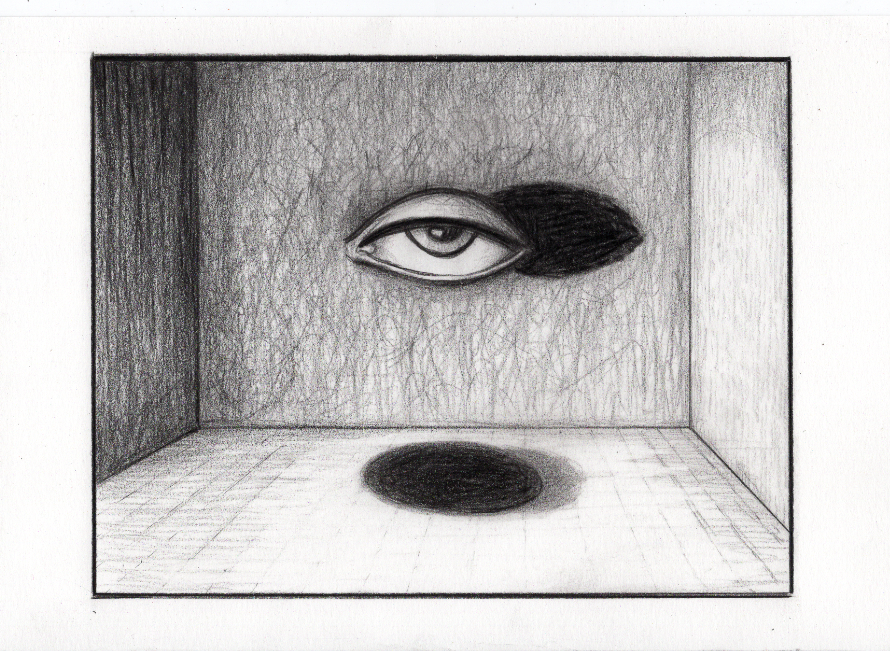
As you may know if you’re a regular follower of The Monolith Cocktail, we’ve been serializing a number of new novels and writings from debut authors over the last two years; beginning with Ayfer Simm‘s Istanbul pyschogreograhy A Rumor In Üsküdar in 2019. Following on Ayfer’s heels we’re now serializing the Lynchian semi-biographical and incomprehensible jukebox set wanderings of Dan Shea (Bordellos, Vukovar and Beauty Stab infamy) and Rick Clarke’s (bandmate of Shea and rallying beacon of the band Vukovar) new novel The Great Immurement: The previous six chapters of which appeared last month in July. We continue with those semi-esoteric imaginings below and bring you next trio of ponographic anarchistic chapters, illustrated by Andrzej Klimowski.
THIN MAN, ILL MAN
Where am I and who are we? If I am me and you are you then why does it feel like there are no borderlines? You…
?
An illness overcame healthy man. He became a thin man, ill man. His head did bald, his skin did tight.
This happened after he found his home, his habitat. A light grey lake in a white-light place with a non distinguishable sky in the land of waste.
The Thin Man, Ill Man’s hair started shedding more and more frequently. He thought of it was little clues being left in his sink, on his floor, on his utensils – everywhere he went – for a non existing investigator, tracking him down for any given or ungiven unknown reason.
There were no other people and never would there be. Just him and his home.
Time passed and the Thin Man, Ill Man resented his own space and his own person. He called out for any passerby to come and join him but nobody returned the call and nobody ever would. He wasn’t fussy or particular about his prospective company – this didn’t matter.
So lonely he became that he started to count his protruding rib bones within the number of friends.
So solitary was the no-time and no-place that hours were wasted on separating and individualising his spermatozoas to give himself a family, but found his colonies starved and dehydrated to death by the time the task was complete.
The lonesome grew and growed.
Where once it did creepeth and stalk, it instead confrontethed and pounce.
There was nothing on TV, only himself.
There was nothing to eat, only himself.
There was nothing to be, only himself.
*He missed an intimacy (that he never experienced.)
There was a split.
*He wanted a partner as comfortable with his flesh as their own.
There was an osmosis, of sorts.
*He wanted a conjoining.
There was a new thing, of sorts. (The same thing, of course.)
“I’ve never had somebody to wax the fur from my anus or ease the discomfort in my shoulders.”
“You do the same for me, my love.”
“My favourite is when we sit and relax together and gently – absent-mindedly – play with each
other’s genitals.”
“Mine also.”
“Would you like to go out tonight? I feel like doing something.”
“Not tonight. I want to stay in with you. You’re everything I need.”
“I love it when you say things like that.”
“I need to piss.”
“Can I hold it? The feel when the tube expands as the piss comes through sends me wild.”
“What shall we eat?”
“Does it matter? Does it make a difference?”
“I suppose not.”
“As long as you lean over the counter when you cook… and now and again spread yourself. I’ll just
stare into the backdoor to our soul… imagining my tongue on your hole.”
“And, why don’t I moisten it with my spittle, maybe play with it… the glistening of my ring will make
you touch me, I’m sure…”
“There’s no need to try and persuade you is there? You read my mind.”
“I am your mind.”
“As am I, yours.”
And with that, the Thin Man, Ill Man took up an instrument of violent murder and the conversations were no more. The intimacy was no more.
He lay on HIS front IN front of his mirror, arms by his side and was giggling as the crimson blood pulsed from his heart onto the floor, spreading out in stems away from him; A mad dash to reach another body before it became nothing but a stain.
The mirror, from floor to ceiling in height, captured most of the empty, airless room in its reflection.
Suddenly and startlingly, the Thin Man, Ill Man saw himself standing in the doorway, staring straight at him. How own giggling intensified, never becoming manic. His strength had faded. Every last laugh became a struggle; a desperate kick against the deathly hands of his carcinogenic surroundings.
The Thin Man, Ill Man walked casually towards the Thin Man, Ill Man without any hint of emotional reaction, just unfeeling tears running down his face. His naked, pale, glowing figure sat dignified and straight on the edge of nothing beside the resting place of his naked, pale, glowing figure.
One laughed.
One cried.
Both died.
I stare into the blood stems. Which myself am I? Which one is the one who is living me now? I stare.
THE SPIRIT EJACULATE
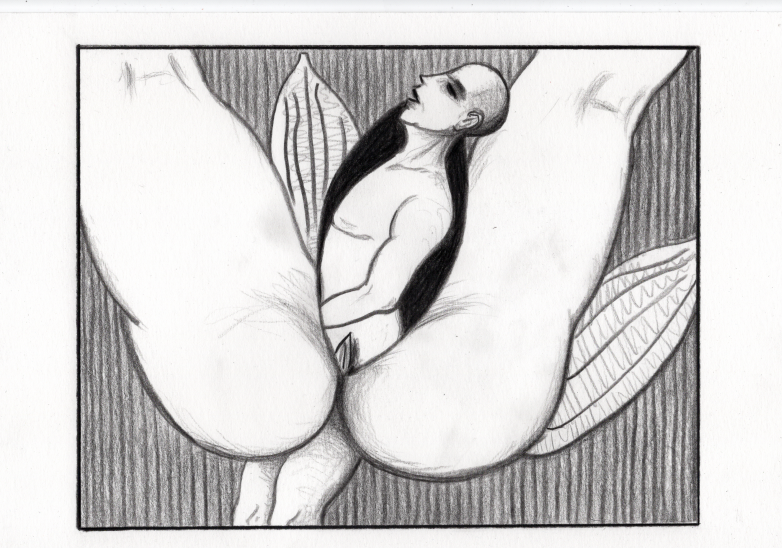
I stare. The lifeblood glistens. My mind’s eye glistens. Blood to sex to blood to sex. Women – every woman’s – conclude or at least live slave to a feminine suspicion – as inherent as the cunt or the evil – that the men who want nothing but to fuck them are really just fulfilling a primordial death drive that would probably end in murder if the act of ejaculation didn’t weaken them so much.
This infection of sexual frenzy rests in guttural moans and the clenching of teeth as man edges ever-nearer to his in-built downfall, cruel and just.
It happened several years ago.
It happened in a few weeks/months/days.
It happened now.
It happened when?
It all began with the masturbatory glimpses that all start the same end. It was the time between waking and sleeping. The usual surroundings seemed distant and not altogether welcoming; it felt like an Otherland. He stood naked in the centre of a bare room, semi erect cock being coated in the spit he spat into his right hand.
All sorts of sexual images flashed, scattershot in his vision. His Japanese eye leaked its lubricant.
O memories, O The Great Immured.
He thought of a group of woman, humiliating the voluntarily weakest of them all, taunting her in a ceremony of piss. He throbbed and rubbed, dutifully, slowly and sensually.
Through his flickering eyelids, his naked mother entered and stood before him, a single trail of excitement ran down the inside of her leg. She bent over, beckoning him to taste. Taste taste taste. His nose pressed against her anus, almost forcing its way inside as he tongued as much of the dry coarse fur as he could, occasionally teasing the sweet stickiness of her inner vulva. He throbbed violently. He rubbed harder.
He half-blindly stepped inside a huge nondescript room filled with naked bodies, warm and slippery with sweat, semen and quim. The more he observed, the more furious he wanked, the fuller his sense.
Nothing was sacred. Women kissing women in dripping exchanges of spit and sperm, shining their faces around the mouth and cheeks. Women chained down men and suffocated them with their drenched cunts, applying their holes to the faces like oxygen masks; A pornographic source of sexualised air.
Men sodomised women, them-selves enjoying it so passionately that they lost all pelvic inhibitions and released sprinklets, sometimes jets of natal liquids. Mouths and holes filled with/ejecting cum/quim/all bodily fluids inbetween.
He throbbed harder still and wanted harder still until the moment came. Time almost stopped. His penis gathered all of its power and every muscle everywhere coiled like a spring, shaking with unstoppable force, finally let go and shot out a spurt of its own creamy lifeblood into a place unknown. The body paused, gathered power again and shot a smaller (but just as forceful) less potent batch into the same unknown. Once again it gathered strength, this huge shuddering body, only this time, something unexpected happened. Something concerning. Something wrong.
A tearing sensation ran through every part of his body, sinew ripped from bone, nerves ripped from everywhere and layers of skin from layers of skin. Everything was pain. Everywhere was pain; frozen in this stopped-non-passage-of-time. It was as though he was being sucked into a new dimension. He didn’t have chance to scream.
The tip of a finger became dented, briefly, before the whole thing caved in on itself, disappearing within itself. His toes followed, then his feet and hands, looking for a new place within his body. The rest of him did the same at the precise moment of the third and final ejaculation. His penis was in a continual push, a push to shoot out his entire body, which it did so; every part of him fired out of that small, thin slit.
He was new. Nothing was real anymore. He was a spirit-ejaculate. He could still see his old body, in fact he was now permanently facing it, but there was little life left in it.
They were connected at that small, thin slit. An eternal fountain exchanging seed, regurgitating forwards and backwards pools of cum, stick in this infinite position of gratification.
THE STAIRCASE
After all that, a silence.
The Great Immured recovered himself. Whatever time it was, it didn’t matter. Whatever he now was, it didn’t matter. All things are not even fleeting, but instead, lie broken.
The place he was within had changed. He knew he couldn’t (wouldn’t) find a way out from this immurement, but he had to exist somewhere a little less heavy, at least for a short time, some place to regain some breath.
After several minutes of pacing the same narrow staircase, he realised something was wrong. The staircase itself was odd; it often resembled more of a corridor. There were steps up and down that kept himself more or less at the same level. There were twists and turns. Spirals that got increasingly wider and little amputee-stub-like dead-ends.
The walls were high and there were no windows. Not even lights or candles. Yet no part of the staircase was particularly darkened. It all felt very… claustrophobic.
He could hear noises here and there along the staircase; of course there was the creaking of the old wooden boards but beyond that, long stretches of silence were interspersed with scratching and, even stranger, whispers appeared to come from behind the walls.
What is this trickery? He muttered to himself. The invisible conversations had caused a concern to grow unnervingly large in his mind and a not to grow in his stomach.
He tried turning back a couple of times but to no avail. No part of the staircase was memorable anyway, however, it seemed to change if he tried to retrace his steps.
More absence of time passed. Disturbed by his lack of progress he quickened his pace. He thought about shouting out to ask for assistance to the voices behind the walls, but had to reminds himself he would only be disappointed in the response. The times he felt most panicked – though he thought unreasonably so – was when the stairs descended. He originally intended to down the stairs and find a way to fresh, non-immured air, true, and he knew along this path every direction, every…descension… had been countered with an ascent, but it did nothing to make him feel at ease.
He was getting tired. The heat wasn’t unbearable but he had exerted himself to the point of exhaustion. Out of nowhere he saw the end of the staircase, and this was marked by a huge wooden door. Easily double the height of him, it reached right up to the ceiling.
At last.
He slowed his pace, hung his head in a mixture of weariness and relief and pushed against the door with all of the strength that his fatigue would allow.
Something, again, wasn’t quite right.
Under closer observation he noticed the door had no hinges. There were no gaps between the door itself and its frame and it felt concrete-cold.
The door was painted onto the wall. The likeness was good but in his relief he failed to spot the glaringly – not to mention painfully – obvious shortcomings of this piece of taunting artwork.
He sighed. He took a step away from the door, turned his back to the wall to his right, covered his face with his hands and leant backwards.
Bright-white, white-light.
Read the previous chapters here
Parts 1 to 3…
Parts 4 to 6…
Serialization: THE GREAT IMMUREMENT by Rick Clarke
July 22, 2020
Written by Rick Clarke/Illustrations by Andrzej Klimowski
Expanding the Monolith Cocktail’s remit to include more in the way of new literature and poetic musings of a kind, we are pleased to announce the serialization of burgeoning author and rallying beacon of the band Vukovar Rick Clarke’s new novel The Great Immurement. The first three chapters, kindly and perceptively illustrated by the much-respected Andrzej Klimowski, can be found below with an introduction from Monolith Cocktail contributor, budding author in his own right and Vukovar bandmate, Dan Shea.
INTRODUCTION UNDER NO DURESS
It’s not about our friendship or his influence on my own writing – not at all. What you are about to read is the process of years of reduction. It’s easy to vomit a stream of consciousness onto a blank page; far harder to chip the block away into something meaningful.
Rick has written something that, in my view, is beautifully emotive without ever being obvious. I feel he’s a great talent and I’m privileged to call him a friend and have the invitation to write this. Under no duress whatsoever. (Dan Shea)
THE GREAT IMMUREMENT
This is the first and last time there will be grounding in real-life, real-earth. All that flows forth from now is descension, are fever dreams; are misremembered and dismembered recollections of the disordered mind; are actual encounters of the im/possible death of The Great Immured. The six year span of this entrance into the Otherlands is where eternity ends, where the Abdication Of The Body begins.
Let me then create you.
This is the end. This is the start.
Let me then begin this eternal six years. Today is the oldest I will ever be again. I lock ourselves away, I construct no exit and I instruct a way out to those outside, those negligible energies. My name means first and last.
The walls are concrete, the doors are concrete, the windows are concrete. There was a concrete fantasy. I stare straight into the greyness.
There is no-thing here, no descriptions. All that is needed is no-thing; there should never be a need.
When we are immured, when we see it from the inside, we see that all light is absent and all light is present; this retinal pessimism dictates that there is nothing to see, but it’s all that we can see. And then all times are in the mind’s eye.
THE CONCRETE FANTASY

There’s a town. The town in which we lived, actually. At the moment it sickens this irrelevant little God with the halfway devotions to our own aesthetic ideals. It wants/wanted to be a brutalist wasteland, but is as yet, as is now, uncommitted. A place as a partial seizure.
The people are inbred (which is fine) and offer nothing except hedonism (which is fine) which we can get anywhere. We want something less, we want less than nothing.
Of this town, I am thine only saint; the Patron Saint Of The Archaic, and I need my own continuous monument.
We keep looking into the every-greying grey, my stare travels through eight interlocking circles. We decide it can’t be broken, and so, for now, it can’t.
I dream of razing the town in a similar circles, a radius of 13 miles in fact. And I want the garden to be perfectly flat concrete. A Concretopia. A blinding greyness.
In the V V V centre is a building. It’s an imposing concrete cube. There are no windows except one tiny one on each of the four faces. Every one of the four is near the top, right in the middle, so that I can look upon my Winter, my own purgatory. But we never will. There are mirrors in the windows, designed in a miracle way to only have a view as though I were looking from the outside. We only want to look upon my creation.
We hear us think of the inside, but we cut this from our mind. Some of us prefer an illusion, some of us prefer the mystery. Once the unknown becomes known, it can be the Death of Desire. I’d rather suffer from my love of all this because at least this malady has a melody, rather than the emptiness of content. Or maybe all these things all other ways around.
Dim the vision and stop the tape – and now it didn’t happen. The secrets of the secrets are still hidden.
THE VISIBLE MAN
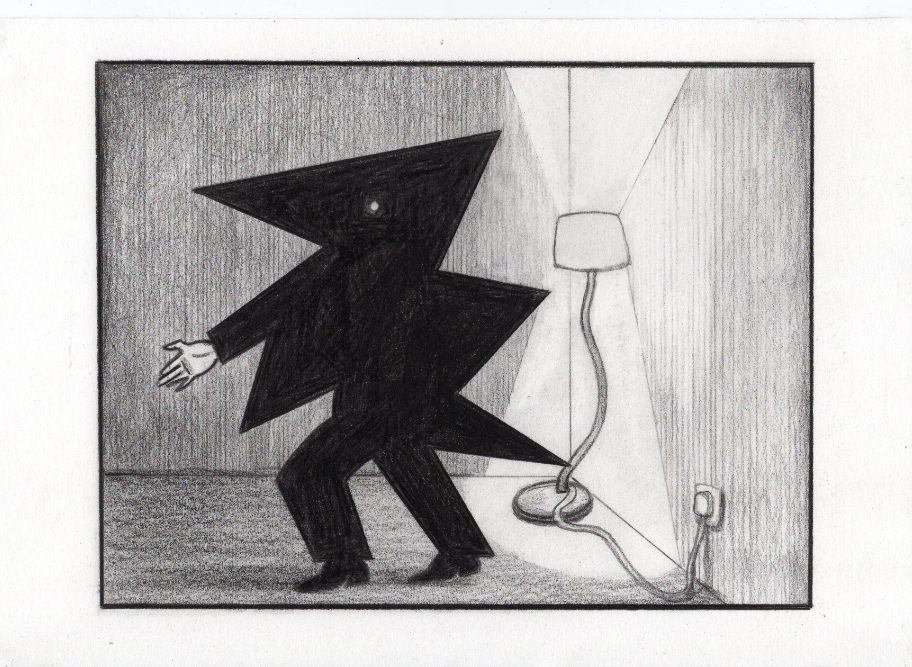
Knock knock? You are all the guest we need.
Knock knock. Okay.
An invisible fist upon my invisible door.
I reach up and out of my invisible chair, turn to the invisible lamp and reluctantly switch it on.
The invisible rays strike my eyes, strike my face and light up my invisible room. It’s unforgivingly vast.
Nothing is real, we offhandedly tell myself. It’s easily forgotten.
My invisible window allows me to peer into the invisible unknown.
I can see the invisible man, flooded by his invisible coat and holding in his invisible hand, an invisible letter.
I take the invisible envelope which contains an invisible message, which should enthral me or at least catch my attention, but I find that it doesnt.
Not much does, not least invisible objects of invisible non-desire.
I sink back into my invisible chair.
In silence, I take up my invisible pen and so begin to scrawl across invisible paper a lackluster response.
Not quite invisible, but not far off. I smile – somewhat – into my invisible mirror and thank an invisible God that I may still see myself.
Author Rick Clarke/Illustrations by Andrzej Klimowski
 Monolith Cocktail Blog