The Digest for November 2025: New Music/The Social Playlist
November 19, 2025
THE MONTHLY DIGEST INCLUDES A CLUTCH OF ACCUMULATED NEW MUSIC REVIEWS AND THE SOCIAL INTER-GENERATIONAL/ECLECTIC AND ANNIVERSARY ALBUMS CELEBRATING PLAYLIST
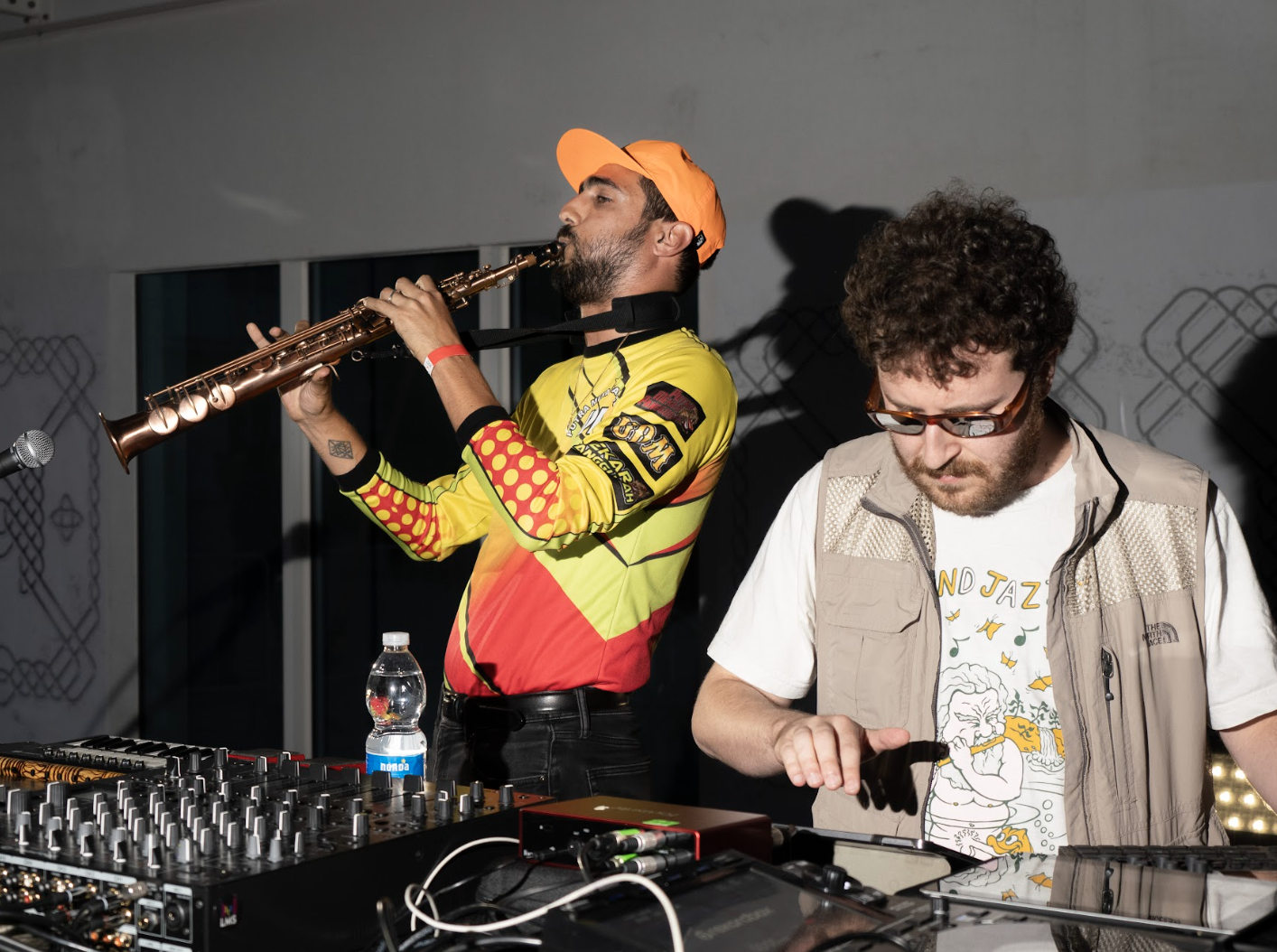
Photo Credit: Babau by Marco Valli
_/THE NEW___
Babau ‘The Sludge of the Land’
(Artetetra) 14th November 2025
A phantasmagorical shifting of tectonic plates and fever dream of a Henri Rousseau conjured equatorial lost world. And I could leave it at just that, but I’m sure both you as the reader and curious mind, and the duo behind this strange fourth worlds peregrination and inhabitation, would want a bit more to go on.
From the Artertra label founding sonic partnership of Italians Matteo Pennesi and Lugi Monteanni and their long-term Babau project an album that moves an imagined continent of influences towards new sonic, hallucinatory and kooky climes. The first “full length” work since 2023’s Flatland Explorations Vol.2, The Sludge of the Land funnels library music, the avant garde, the discombobulated, wonky electronica, the cartoonish, 32-bit console music, vague uses of ethnography and the atavistic, the visions of Jon Hassell, the breakdown shunts and floppy disc music of Esperanto era Sakamoto, the morphing AI electronic lunacy of Cumsleg Borenail, the fun kookiness and springy worlds of Carmen Jaci and Trans Zimmer & The DJs, new age trance, and at times, the more sublime drifts of Wu Cloud and Iasos into an odd repurposed wilderness. A track like ‘I tried to find myself but eventually found another, and now it’s the two of us somehow’ for example, merges Carl Stone with the mirage guitar bends and hangs of Daniel Vickers, the thinly dried blows of Ariel Kalma.
With titles that are so long as to read like haikus or little stories in their own right, there’s much in the way of descriptive prompts – although some seem like they might reflect the overuse these days of feeding blindly words, detritus and meta from the Internet into ChatGPT or some such device. Much of it describes a hodgepodge of ritual, mythologies, culture and the surreal. And musically and sonically reads like a mixed topography of palm trees, exotic islands, deserts, misty mountains and wet vegetation.
As part of a residency at Casa degli Artisti, Milan, in 2022, Babau turned their creative space into a recording studio and performing venue thanks to audio engineer and musician Francesco Piro, who produced the album. That apparatus includes instruments and effects that make sounds like reversed shaves, tangled and gangly wires, springs, chimes, the mistily fluted, and whistled alongside the recognisable sounds of a lingering foggy sax, of sauntered and hand tub drumming rhythms and both the inner workings of and the serial kooky notation of the piano.
This is an environment that squeezes the Mosquito coast up against Java, Malaysia, Polynesia and the near fantastical to produce something familiar but disjointed and surreal.
The Flower Press ‘Slowdance’
6th November 2025
Continuing to pursue a solo course, but now under the new appellation of the delicate craft imbued The Flower Press, Matt Donovan, in his own meditative and wistful way, turns the sudden loss of his sister into a subtly beautiful and reflective work of art on his fourth album.
The process of grief that prompted not only a change in musical direction (not so much that the musical signatures of past albums are entirely lost) but a much-needed therapeutic outlet, a project in which to find meaning from such a tragic event. The softly evocative Slowdance album offers consolation and testament to a life lived; the memories – referenced in a style with the track titles -, near abstract and visceral, are quantified and saved in sound and musical form to reflect upon with a great fondness and love. For Matt doesn’t just pay his respects, but also sends out moving testimony and vibrations as a way of keeping contact, of saying all the things he might have never had the chance to before, whilst healing himself.
Regular readers of the site may know Matt as the former motorising and propulsive drum beat behind Eat Lights Become Lights, and for his collaborative partnership with Nigel Bryant in the psych-Krautrock-post-punk-folk-industrial duo The Untied Knot. Away from the latter, Matt has released a trio of solo albums: Underwater Swimming (’21), Habit Formation (’22) and Sleep Until The Storm Ends (’23). This latest album of mainly instrumental pieces, takes some of the old influences but, with warmth and a wisped gauze of ether, is moving towards the orbits of Ariel Kalma, Daniel Lanois, The Durutti Column, the flange guitar-like ambient works of Harold Budd, Eno, Susumu Yokota and Mark Hollis post Talk Talk. But then there’s always a certain quirkiness and flash of post-punk and no wave dance music trebly bass playing to be found. And of course, the acoustic folksy and troubadour influences that sound particularly pastoral or in-situ: conjuring up some held dear or nostalgic escape, a glade perhaps or the sensation and touch of falling snowflakes and the building of a snowman. Some of those moments reminded me of the Wayside & Woodlands label whilst others of Arthur Russell.
The measuring of time, the chimes and triangle rings; the thin stick hitting tablas and the desert melting mirage guitar evocations of Daniel Vickers; the harmonium like moods and the Fripp-esque articulated memory of a slow dance watched from dreams; and both the stillness and the wavy, reverberated movements all articulate notions of remembrance and invested introspection. But also perhaps, manifestations of better times ahead, of durability in the face of such a heavy personal loss: the loss of a sibling hitting all that much harder.
A most wonderful album that eventually soars towards a starry celestial plane, Slowdance hovers and drifts above terra firma on a quest to evaluate and represent a life lived and the memories that pour forth from such fateful challenges. With a new title, Matt pushes into ever new and emotionally resonating territories.
Erell Latimer ‘Stay Still’
(Kythibong) 18th November 2025
The translation of visceral and abstract speech, dialogue, narration, poetry, testament, inquiry through musique concrète and tape manipulation, the new experiment from the sociolinguist composer and writer Erell Latimer is an immersive performance of reaction, interaction and interruption.
I’m not sure of the apparatus used, but other than the various machines used for effects, distortion, and what sounds like the manipulated in real time, folded, counter-folded and warped tape reels, both the long form pieces that make up this work rely upon Latimer’s voice and readings. Described in the accompanying notes as partly “concrete fiction”, fragments of Latimer’s text pieces and writings are set to a both alien and distorted, machine-like and discombobulated sounds and oscillations. Mostly in French, with passages of often disturbed or obstructed poetic philosophy and forbode from some English male speaker, the texts fluctuate between the hushed, the near in-hiding and held hostage to the clearly proclaimed and read. The cadence, both interrupted and defined signifies pain, anguish, the critical, stress, panic and theory.
The various resonated and reverberated voices and talks move from background quietness to foreground rustled distortion, and often form interlayered semantic rhythms and new utterances. Often though, Latimer’s voice is stripped down to an assortment of breathing techniques: often sounding like the aftermath of a panic attack, with Latimer trying to get her breath back or get it under control: exhales as important as anything else in this experiment and expression of “alienation, confinement, suffering, resignation, abandonment and death”.
There’s plenty of interesting, thrown, or points and nodes where both vocals and sounds interact to form hallucinations or more supernatural and haunting passages. Sometimes these interactions culminate in simulated tumults of hurricane winds, and others, into something far more musical; nearer the end of the first piece, ‘Ils seront silencieux après’ (“they will be silent after”), there’s a sort of lovely piece of music that’s part Gainsbourg, part Krautrock, part classical soundtrack.
From what sounds like paper or tape fluttering in the draft of a ventilation unit or extractor to bulb-like notes rings and chimes and the sounds of the environment, the voices and speech find space across a constantly explored soundscape of effects and obfuscation. At times it reminded me of Michèle Bokanowski, Matija Schellander, Lucie Vítková and that musique concrete progenitor Pierre Schaeffer; in short, an experimental work of language and semantics that deserves greater attention.
Plants Heal ‘Forest Dwellers’
(Quindi) 28th November 2025
The prolific and always into something drummer and trick noise maker Dave De Rose is back with his keyboardist/percussionist foil Dan Nicholls and visual anthropologist collaborator Louise Boer (otherwise known as Lou Zon) for another round of the electroacoustic project, Plants Heal.
De Rose popped up on the site as part of the Rave At Your Fictional Borders union of Jon Scott of (of GoGo Penguin note), Marius Mathiszik (Jan Matiz, I Work In Communications) and Henning Rohschürmann a while back, but his CV is packed with notable creative enterprises and collaborations, including membership of Electric Jalaba, a stint with the acclaimed Ethio-jazz luminary Mulatu Astake and instigation of the Athens-London traversing Agile Experiments project. The initial seeds for the Forest Dwellers project were planted both through the latter and through Nicholls and Lou’s London-based Free Movements events; both acting as intersections for all three contributors to cross paths, and to explore the central tenant of merging instrumental music with live electronics and DJ sets. If we’re talking about spheres of influence and CVs, Nicholls of course has just as prolific and busy schedule as a keyboardist, reeds player, composer, producer, and visual artis, whilst Lou’s documentary and experimental filmmaking and visual skills have led to a teaching role at Goldsmiths.
Lou’s work revolves around ecology, community, plant medicine, feminism, movement and experiments with analogue techniques. And this seems a good base from which De Rose and Nicholls have spontaneously reacted or conjured up improvised-like sounds and rhythms rich with organic meta and matter. During performances Lou improvises with analogue footage from her library run through video mixers and synthesisers, focused on medicinal plants such as yarrow, hawthorn, nettle and thistle. All those plants feature in processed form on the cover of the record, which was designed in collaboration with Lou’s brother Arthur Boer. Meanwhile, Lou recorded additional footage in Athens during the recording sessions to feed into the continued cycle of the project’s live evolution.
The trio’s second album together (their previous self-titled debut was released back in 2021) is a biomorphic eco system of new age trance music, techno, dub, light jazz, breaks, amorphous ethno-beats, acid and both plant-based and more alien atmospherics. Tech and nature combine to create a kind of Fourth World version of electronic dance music. But that’s really only part of the story, as the living and breathing creepers, vines and branches of the forest canopy and floor integrate with pulsations, shuttered, tubular, hollowed pole paddled and shaved or slowly released electronics to produce a camouflage reverberating effect of movement, growth and expansion.
There’s a revolution of a kind in the same air, with whispery like effected and morphed voices emerging from the fauna, and a revision of the old tribal gathering nature-tech and freedom rave-ups of the late 80s and early 90s. I’m hearing vague signs of Richard H. Kirk, FSOL, Jeff Mills, Lukid, Warp Records, Conrad Schnitzler, Mike Dred and Jon Hassell. Still, there’s more to unpick from the very much percussive and drum led rhythmic evolutions on this album; echoes of various more atavistic and exotic musical influences; timings and patterns enhanced by ethnography study and absorption. From terra firma to the stars, this organic flora form of electroacoustic dance music proves pliable, liquid but full of substance and the tactile, the earth and air.
Super Grupa Bez Fałszywej Skromności ‘The Book Of Job’
(Huveshta Rituals) 28th November 2025
From true obscurity and the dusty shelves of dormant archiving, The Book of Job emerges from its forty-year sleep – recorded as it was back in an omnipresent Soviet controlled Poland of 1985 – into a climate that scarily resonates. Whilst the sickle and hammer have disappeared from the flag, and Communist totalitarian rule has been replaced by a new form of oppressive authoritarianism in Putin’s leader-cult Russia, aggression persists and the threat of invasion, or at least escalation against those former countries that fell behind the Iron Curtain after WWII, looms large. No longer an abstract threat, Russia’s expansionist ambitions look to lock horns with Nato and the West, with a near apocalyptic destructive war in neighbouring Ukraine pushing at the borders of Poland. If nerves can no longer hold, if there is no end to the hostilities, no ground given on either side of this brutalist invasion, and if Ukraine is lost, then Poland becomes the new frontier between Europe and dictatorial Russia: a Russia hellbent it seems on regaining its lost influence and control of Eastern Europe.
There will be generations now totally separated from Poland’s past as an occupied state, subjected to draconian control by the USSR. But the timely arrival of this cult recording will once more remind its people and the world at large, of events in the 1980s; a decade when despite violent suppression, the population rose up to eventually overthrow its Soviet authorities at the end of that decade. When the various notable luminaries of the Polish underground and jazz scenes, and the counterculture’s actors and voices behind the collective ensemble of Super Grupa Bez Fałszywej Skromności first performed this multilingual and faith spanning work at the 1981 Jazz Jamboree festival, the omens weren’t quite so grave. Only weeks later the situation had changed dramatically, with Genral Jaruzelski’s ordained Martial Law rules cracking down ruthlessly on the population. In light of civil peaceful protest and the strike action and heroism of Lech Wałęsa’s famous Solidarity movement, the authorities more or less implemented a military coup of extreme measures: As the accompanying album’s scene-setting essay informs us, “Art was replaced by parades of heavy artillery”. By the time this same group recorded an album, four years later, the very act of making music would be considered a symbol of defiance: unless of course it was used to glorify the Soviet regime. “Paradoxically” the Catholic Church of Poland became a sanctuary. This may explain, in part, why the Hebrew’s Old Testament (reused in the Christian Bible and also “echoed” in the An-Nisa chapter of Islam’s Qur’an) chronicle of Job was used as totem for endurance in the face of such suffering. Because much as Job suffered tribulations and trails at the hands of God, beguiled and tempted by Satan to turn away from his piety, many of the Polish people found solace, resistance and hope despite the relentless attacks on their freedoms.
An allegory of the human condition, The Book of Job, for those who never attended their Sunday Schooling lessons, nor attended a faith-based school, tells the tale of the protagonist and his testing by God through litany and prose: that’s three cycles of debates between Job and his friends, Job’s lamentations, a poem to Wisdom, Elihu’s (a critic of Job and his friends, who may have been a descendent of the Abraham lineage) speeches, and God’s two speeches from a whirlwind. In short, Job is a wealthy God-fearing man with a comfortable life and large family, living in the Land of Uz (which has been situated in various locations of the atavistic Levant and beyond by various sources; anywhere from the old Aram, now modern Syria, to the Edomites kingdom, which now stretches across modern Jordon and Israel). God discusses his piety with Satan (though this is often written down as “adversary”, but we know who they mean), who rebukes God, stating that Job would turn away from God if he was to lose everything within his possessions: which was a lot. God decides to test that theory or challenge by allowing Satan to inflict pain on Job. The test increase, the suffering gets much, much worse, and Job ends up losing his wealth, children and health. Through it all he maintains his faith and piety, but not without much discussion and challenge. By the epilogue, Job’s fortunes and family are thankfully returned to him: Satan I take it, scuttling off to curse and sulk in the shadows.
Recorded in a makeshift “high-fidelity” studio at the STU Theatre in Krakow in the Spring of 1985, The Book of Job album draws with serious depth and political allegory upon the text. Covering everything from stage theatre to the filmic, the avant-garde and of course jazz – most of the lineup in this singular gathered super group hail from Poland’s incredible and influential jazz scene -, but so much else, the Holy Land is transported across porous borders to Eastern Europe to take in the Jewish diaspora, acolytes of Indian and Far Eastern scriptures and the then contemporary 80s sounds of the underground.
The “revered” pool of players, luminaries that took part include the multi-instrumentalist Milo Kurtis, a Pole of Greek origin, born into a family of refugees escaping the civil war in Greece, noted for his roles in Grupa w Skład, Ya-Sou, the cult rock band Maanam and jazz-fusion super group Ossian (also said to have worked with Don Cherry, who gifted Milo his ocarina), on percussion, Jew’s harp and trombita; the Polish flutist of world renown, composer and arranger Krzysztof Zgraja, who made his debut in the jazz-rock band Alter Ego, but also played with Czesław Gładkowski and Jacek Bednarek, on not only his main instrument of choice but the lighter made and smaller range Fortepiano; the Polish avant-garde and free jazz player Andrzej Przybielski, who’s notable credits include stints with the Gdansk Trio, Sesia 72, the Big Band Free Cooperation and Acoustic Action, on trumpet; drummer, composer and cultural animator Janusz Trzciński, known for his extensive work in the theatre, a writer of plays and one of the main instigators behind this project, on drums; the highly rated Zbigniew Wegehaupt, who played with just about every Polish jazz icon going and in both Wojciech Gogolewski’s Quartet and Extra Ball, on both electric bass and double-bass; and the Polish composer, multi-instrumentalist, vocalist and teacher Mieczysław Litwiński, who studied with such groundbreaking luminaries as Stockhausen and co-founded far too many groups and projects to list here, but notably the Independent Studio of Electroacoustic Music and Light For Poland, on sitar.
Added to that role call was an ensemble of either commanding, English Repertory-like or ominous voices and vocalists from stage, screen, including Ignacy Machowski, Adam Baruch, Zdzisław Wardejn, Jerzy Radziwiłowicz, Juliusz Berger and Andrzej Mitan. It must be pointed that only Mitan receives the credit of vocalist; the Polish poet, performer, founder of the Alma Art record label, chants a poetically evocative forgiving gospel of obedience and implored yearning whilst on the album track ‘When A Man Dies’. Echoed as much from a cavern or cave on the desolate plains of the Uz as in the synagogue, the repeated mantra of “Man. World. Pain. Silence” is stoically announced over and over to sombre and yet beautiful tones. The rest of that cast find themselves either narrating or interlayered with a whisper, chattering chorus of atmospheric dialogue. It reminded me, in part, of Aphrodite’s Child own Biblical opus 666.
Hallowed yet dark and almost Chthonian in places – a touch of Byzantine too – the album sets an otherworldly, afflatus but esoteric scene with the opening resonated waves of airy, fluted and blowy vibrations, moving like cycled or tubular wind from the subterrain, on the introductory entitled opener. Something mystical dances in the wind, as echoes of Alice Coltrane and Prince Lasha stir up spiritual jazz mirages and something quite ghostly seems to be lurking in the vibrations. The story unfolds, the mood suitably enacted. ‘Satan’s Concept’ follows this with percussive shimmer and shivers and a supernatural voice of forbode. Evocations of both Don Cherry and 80s Miles Davis like trumpet both trill and sound almost swaddled on another visceral and porous geographical musical landscape: the vibrated bowl sounds of Tibet for example. But the whole feel changes on the first of three litanies, with what could be called a post-punk bass and signs of krautrock and jazz-fusion: think an impressive union of Einstürzende Neubauten, My Life In The Bush of Ghosts Eno and Byrne, Desert Players Ornette Coleman, Jon Hassell and Ramuntcho Matta relocated to the land of the lost tribes. ‘Accusation’ has a promising Blue Note jazzy double bass introduction, a little bluesy and bendy. It’s accompanied by some rattled hand drums; the only instruments that express and lay down the atmospheric flexed, stretched, harmonic pinged backing to the biblical echoed English voice that narrates and questions God.
The post-punk-jazz mood is back for the second litany. A sort of no wave funk noodle of Dunkelziffer and Miles, a long low horn from the Steppes, and dialogue of wisped and more esoteric voices spoken in multiple dialects, there’s a supernatural quality to the atavistic summoning of scripture, and the age-old battles between good and evil. Almost skulked, there’s vocal coos and spectre like demons and angels in the shadows of this dramatic Krautrock-esque holy visitation. ‘Hope’ brings back in the Eastern influences, the sound of Buddhist India with the signature reverberations and brassy rings of the sitar: Shiva on the Vistula. With its psychedelic ragga mediations, the sitar acts in unison with the twanged boing sound of the Jew’s harp, the only accompaniment to the Hebrew narration.
The third and last of the litanies is quasi-80s funking jazz, with elements of Hassell’s Fourth World experiments. The flute whistles and flutters willowed fashion on a moving jazzy-fusion-funky-no-wave bass, as overlayed voices create a more convivial dialogue. There’s a smog horn too that creates a misty vapour effect. But the rhythm is like some kind of Israeli or Eastern European dance.
The album finishes on a strongly reverberated Hebrew voiced narration, a sacred holy conversation. Near the end of ‘Final’ a dreamier ray of light like flute emerges, slowly and softly drifting skywards. The sound of relief. A burden lifted.
You can easily find the parallels, the battles with faith in the face of such brutality, of oppression, and in this case, Soviet authoritarianism: The role of religion and believing playing a crucial part in resistance. As a near cryptic or hidden means of showing such defiance, The Book of Job and its lessons carried that message of artistic and political/social hope. This album, even without any of its important cultural and political context, is an artefact that deserves saving and savouring: a real intriguing, atmospheric and near theatrical experience worthy of attention and acclaim. Not just a slice of history but an experimental work of art.
___/The Monolith Cocktail Social Playlist Vol. 103___
For the 103rd time (and most probably the last as I change the format for next year), the Social Playlist is an accumulation of music I love and want to share, with tracks from my various DJ sets and residencies over the years and both selected cuts from those artists and luminaries we’ve lost on the way and from those albums celebrating anniversaries each month.
It was a few months back that I celebrated the 100th edition of this series, which originally began over 12 years ago. The sole purpose being to select an eclectic and generational spanning playlist come radio show, devoid of podcast-esque indulgences and inane chatter. In later years, I’ve added a selection of timely anniversary celebrating albums to that track list, and paid homage to some of those artists lost on the way.
The final social of 2025 merges together anniversary celebrating albums from both November and December. This selection includes 50th trumpeted milestones for Eno’s Another Green World, Patti Smith’s Horses, Kraftwerk’s Radio-activity, Burning Spear’s Marcus Garvey and Parliament’s Mothership Connection. There are even older throwbacks, 60th salutations, to The Who’s My Generation (I’ve gone for The Users version of ‘It’s Not True’ for something a bit different) and The Beatles’ Rubber Soul (I’ve gone for two covers, Davy Graham’s take on ‘I’m Looking Through You’, and Anne Murray’s version of ‘You Won’t See Me’). Added to that impressive list are 40th nods to The Jesus and Mary Chain’s Psychocandy, and LL Cool J’s Radio; and finally, whilst we’re in the hip-hop icon camp, I had to drop a track from the Genuis/GZA’s Liquid Swords, which is 30 this month.
The rest of the list includes songs from across the last five decades, with entries from Excepter, Vitriol, The Mattoid, Cowboys International, Milford Graves triumvirate free jazz experiment with Arthur Doyle and Hugh Glover under the Children of the Forest banner, Pekka Airaksinen, Sir Robert Orange Peel, Byzantium, Thony Shorby Nwenyi, Fat Spirit and more…
Tracks:
The Users ‘It’s Not True’
Anne Murray ‘You Won’t See Me’
Cowboys International ‘Part Of Steel’
Brian Eno ‘I’ll Come Running’
Excepter ‘Maids’
The Mattoid ‘Suicide’
Patti Smith ‘Redondo Beach’
The Jesus and Mary Chain ‘Taste The Floor’
Fat Spirit ‘Planet Earth III’
Catherine Ribeiro ‘Iona melodie’
The Springfields ‘Are We Gonna Be Alright?’
Davy Graham ‘I’m Looking Through You’
This Heel ‘Bad World Above’
LL Cool J ‘That’s A Lie’
Parliament ‘Mothership Connection’
GZA ‘Hell’s Wind Staff/Killah Hills 10304’
Pekka Airaksinen ‘Ratnasikhin’
Vitriol ‘Restart’
Sir Robert Orange Peel ‘Brutalists’
Kraftwerk ‘Antenna’
Et At It ‘Beets’
Burning Spear ‘Marcus Garvey’
Thony Shorby Nwenyi People in the World’
Milford Graves, Arthur Doyle and Hugh Glover ‘March 11, 1976 II’
Byzantium ‘What A Coincidence’
Dry Ice ‘Mary Is Alone, Pt. I’
EABS ‘Niekochana’
Jack Slade ‘Lipstick’
Eberhard Schoener ‘Only The Wind’.
REVIEWS ROUNDUP/Dominic Valvona
Longplayers/Extended
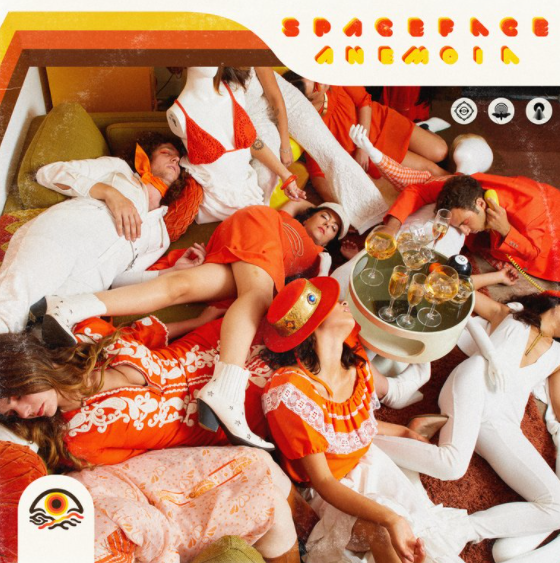
Spaceface ‘Anemoia’
(Mothland) 28th January 2022
Ushered in with a cosmic and exotic air flight announcement the latest disarming psychedelic pop trip from Spaceface brings the slick funk and disco party vibe to the stiff shirted cosmological experiments carried out at the CERN institute. With a vibrant sparkle and rainbow candy élan, the ever-shifting moon unit of past and present members from Flaming Lips and Pierced merge science-fact with groovy sunshine grooves on a smoothly universal album of goodwill.
Written before the pandemic at the Blackwatch Studios with producer Jarod Evans in the hot seat, Anemoia is a cocktail of good times rolled out to a soundtrack that at various points evokes MGMT, Swim Mountain, Tame Impala, the Unknown Mortal Orchestra, Sam Flex and International Pony. The halcyon funk wooed and Labrys guest spot ‘Long Time’ even comes with it’s own cocktail recipe and instructions (1oz each of Bourbon, Vermouth and Lynas, served with orange peel and on the rocks).
Guests appear in various guises throughout, from the brilliant Meggie Lennon (who recently appeared in our choice albums of the year lists) to Mikaela Davis and the sampled effects of the CERN’s scientist choir! Spaceface seem to be reaching beyond the usual themes of pop to metaphysical explorations and a sense of understanding the mind boggling theories of particle physics. It’s also seemingly all connected to the very on trend subject of identity and place in an increasingly dysfunctional uncertain world. Fear not as these concerns all melt away in a soulfully and bubbly millennial soundtrack of the cute, hippie and galactic; a plane of psychedelic pop and yacht rock funk pitched somewhere between a yoga retreat and cult space tour.
Roedelius & Story ‘4 Hands’
(Erased Tapes) 28th January 2021
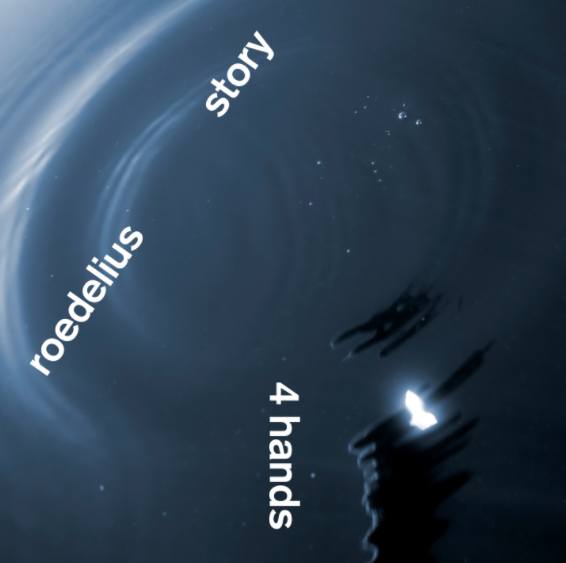
Incredibly now well into his eighties the kosmische and neoclassical pioneer Hans-Joachim Roedelius is still exploring, still intrigued and still, if peaceably, pushing the perimeters of his signature forms on the piano. When not collaborating under the Qluster umbrella (just the most recent three decades adoption of the original Kluster/Cluster arc) or flying solo across the keyboard, Roedelius carefully picks projects that offer stimulus or purpose.
In this instance the self-taught composer once again crosses reflective and experimental paths with the Grammy-nominated American composer and friend Tim Story; the fifth such exercise of its kind with Story since their 2003 album Lunz.
4 Hands proves better than two, with Roedelius laying down patient, fluttered and singular noted “etudes” for Story to harmoniously refine and swell, or, to add sophisticated congruous layers until both performers phrases and playing styles become so entwined as to prove impossible to separate. Hopefully as Story comments in the notes: ‘Because it was all recorded on the same piano, the result has a very appealing consistency of sound, and hopefully blurs our individual contributions into a single integrated voice.’ I’d say they succeeded with this interplay and balance of disciplines, which at times conjures up Chopin’s no.6 etude being transformed by Cage.
This transatlantic exchange between North American and European contemporary classical movements features compositions that seem to measure time and make allusions to various instructive linguistic phrases (the relatively immediate ebb and flow opener ‘Nurzu’ derives from the German encouragement to “go ahead and do it”) and a sense of place, mood. Tellingly the resonating serial 1920s suggestive ‘Haru’ is dedicated to the late great avant-garde composer and poet Harold Budd, who just before his death in December 2020 was played this timeless peregrination.
A forty-year friendship imbues every touch and even the spaces in-between each wave, trickle, glide and tingled gesture. The very workings of this shared instrument, the pins and softened hammers are transformed into spiralled tines and fanned percussive like rhythms – sometimes evoking the Far East. A mix of improvised contours, considered tensions and nodes crisscross and flow together in a complementary fashion throughout this album of entwined synchronicity, as both artist’s read each other’s thoughts with understated adroit perfection.
From The Archive:
Hans-Joachim Roedelius Interview
‘Selbstporträt Wahre Liebe’ Review
Qluster ‘Elemente’ Review
Cluster ‘1971 – 1981’ Review
Cephas Teom ‘Automata’
(METR Music) 28th January 2021
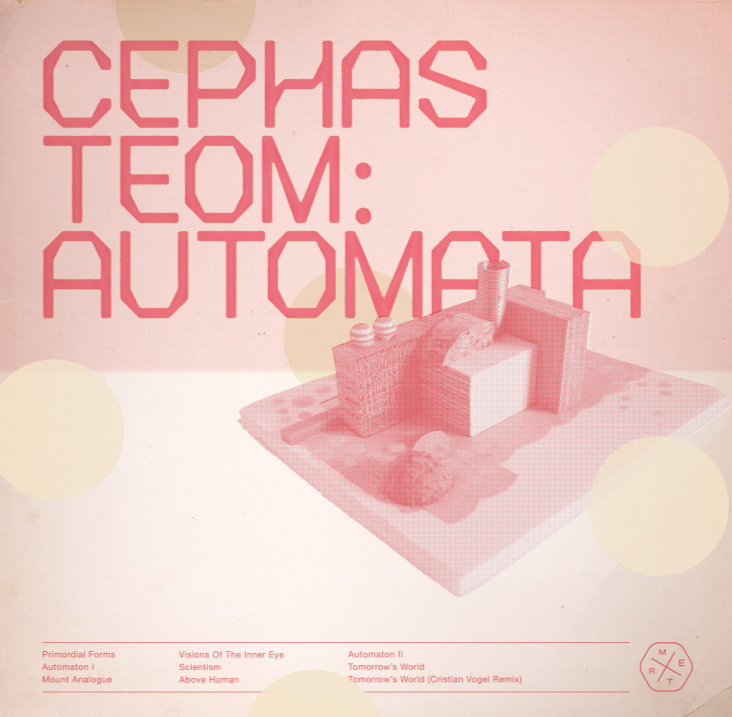
Less Kraftwerk’s “pocket calculator” and more vintage 1980s Japanese Casio digital watch, the debut album from Cephas Teom (the atavistic etymological alias of the West Country musician and producer Pete Thomas) swims and Tokyo drifts in a solution of nostalgic Far Eastern tech. From Japanese sound gardens to retro video arcades and driving across once promising neon lit city highways of the future, Thomas evokes touches of the Yellow Magic Orchestra, Sakamoto, Yukihiro Takahashi and House Of Tapes as he ponders the quandaries of an ever encroaching technology and the wonders of A.I.
Featuring the Monolith Cocktail premiered vaporwave single ‘Tomorrow’s World’ (aired back in November of last year), Automata weaves broadcasts of figures such as Jung and the coiner of ‘cymatics’ Hans Jenny with the fatalistic voices of those drawn to extraterrestrial savior cults (such as the mass suicidal Heaven’s Gate) to present a scientific-philosophical soundtrack of both unease and nostalgia: that’s nostalgia for a society not yet disenchanted with the promises of a brighter hi-tech, computerized utopia.
Skilfully constructed Thomas emulates both the handcrafted mechanisms of Jaquet-Droz automation curiosities from another age and the dreamy airs of a dawning integrated A.I. future. It begins however with the projector-clicked lecture come chimed baubles, zappy squiggled, deep bass throbbing Japanese Zen water feature ‘Primordial Forms’, before winding up with the clicks and movements of a Sakamoto twinkled mechanized but enchanting melodic ‘Automation I’. By comparison ‘Automation II’ sees nature’s son in more pastoral surroundings, still in that contemplative garden, serenaded by classical-like drops of piano and wind chime percussion. Oh the force of the electronic Orient is strong with this one, incorporating everything from subtle hints of bamboo music, a very removed bobble of gamelan and J-pop with intricate layering of Autechre wiring, lo fi 8-bit gaming and bit-crushed effects. Surprisingly Thomas takes a kind of liquid jazz-fusion turn on the psychedelic therapy mindbender ‘Above Human’.
Solar winds blow across a circuit board tundra as Tron-like glowed vehicles cruise to the sounds of acid, techno, Manga, Namco and Sega soundtracks, veiled augurs, virtual paradises and various 80s warbles, variants and equations. A wonderful world in which to contemplate all those delusions of an automated miracle – a world in which Eagle comic’s, the BBC’s long running Tomorrow’s World programme and Silicon Valley optimistically painted as a blissful, harmonious, work-free utopia, Automata explores the networks, nodes and grids of electronic music to navigate a tricky complicated philosophical debate.
From The Archive:
Cephas Teom ‘Feet Of Clay’ Premiere
Cephas Teom ‘Tomorrow’s World’ Premiere
Mondoriviera ‘Nòtt Lönga’
(Artetetra) Available Now

You know you’re getting old when today’s young musicians consider your formative years, back in the 80s, as “nostalgic”. And so it is with Mondoriviera’s recent envisioned ‘fragmented bedtime story’ meets ‘interactive’ supernatural styled soundtrack; one of the last releases of 2021 from the insane, discombobulating ‘mondo bizzaro manufacturer’ Artetetra platform.
For this is a 80s VHS graded score of Italian folk-horror and dream-reality wrapped up in an 8-bit fantasy of crushed Super Mario Bros. platform hopping, early Warp label Aphex Twin, Darrel Fritton and Speedy J, and the combined soundtrack and gaming elements of Takafumi Fujisawas, Akira Yamaoka and Andrew Barnabas.
Unless you read all the accompanying notes you’ll miss the psychogeography apsects of this score: the mysterious cloaked figure behind this glassy spherical mirage and Elm Street dream warrior spooked world invokes the arcane, one time seat of the Western Roman Empire and Byzantine jewel, Ravenna. Quite the historical stargate with its continuous pre-Middle Ages upheavals, reputation as an early centre of Christianity, glorious architecture and mosaics it’s the city’s darker corners, the abattoir and sinister that seeps into Nòtt Lönga’s soundscape.
Strange, eerie in places, this alternative plane of retro arppegiator and algorithms and virtual reality is a nocturnal spell caught drifting and gliding between ominous fairytales and the paranormal: even alien. A disturbed 80s-style electronic hall of mirrors that draws you in with the promise of languid floating, the synthesised melodies softly come in waves before glitching like the glass screen façade of some simulation engineered by a higher intelligence from another dimension. Mondoriviera dares the listener to dream in a soundtrack theatre of his cult imagination.
Sven Helbig ‘Skills’
(Modern Recordings) 4th February 2022
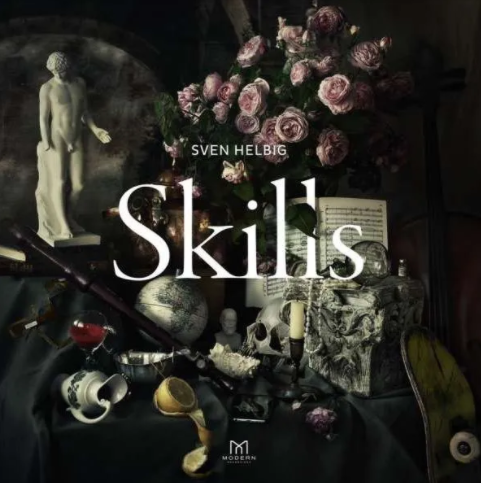
The versatile (from working with such diverse acts as Rammstein to the Pet Shop Boys) East German composer-producer Sven Helbig conducts an incredible suffusion of colliery meets a minimalistic Sibelius brass on his first statement of 2022. The craftsman’s/artisan’s struggles, ‘despair’ and creative processes go through ten stages of varying reflective and plaintive stirring driven drama on an album that draws together the classical and contemporary to create an almost timeless spell.
As timeless that is as the symbolic ‘vanitas’ still life tableaus of the Dutch master Harmen Steenwijck in the 17th century; Helbig’s own modernist take on that tradition of painting places a skateboard and mobile phone next to a mortality loaded allegorical skull: the inevitable death of everything, but in this case, a symbol for the dying art of a craft and ‘skills’. As one tradition perishes another is born so to speak. But this leitmotif runs deep, right back to a pre-unified Germany, when ‘diy culture’ and craftsmanship were a necessity to those unable to afford, or even have any of the luxuries enjoyed in the West. And so Skills is a sostenuto concentrated homage to that tradition, yet also a mood board reification of the passing of time itself: the time between toil and inspiration. In a kind of Lutheran atmosphere of earnest labour, with compositions that can evoke a candlelit garret or bleak workshop in Worms, Helbig’s brass ensemble and string quartet conjure up a most beautiful gravitas that can harmoniously set hardship with the near ethereal.
Straddling the neoclassical, operatic and cinematic there’s even room for the coarser, scrunched synthesized concrete textures and pulsations of the Chicago-based musician Surachai on the album’s sober but stunning unfolding ‘Repetition’ suite.
Tunnels of daylight fall upon mechanisms and cogs as they come to life in atmospheric settings. Baubles and floating dust particles tinkle and slowly cascade gently whilst both longer and shortened strings build the tension and a French horn sounds a low, almost misty-eyed, romantic note. Luminous and dreamy on the starry ‘Vision’, and evoking the avant-garde and a touch of Kriedler on the workbench clockwork diorama ‘Flow’, the Skills album is a measured, aching and brooding work of art; a moving testament to the élan and craft of an impressive composer who’s classical roots transcend the genre.
War Women Of Kosovo ‘A Lifetime Isn’t Enough’
4th February 2022

Never ones to shy away from the harrowing atrocities committed on communities across the world, the partnership of Grammy-winning producer & author Ian Brennan and Italian-Rwandan photographer & filmmaker Marilena Umuhoza Delli have continued to stripe away all artifice and sentimentality from those victim’s stories; recording for posterity some of the most vulnerable accounts of genocide, prejudice and sexual violence in countries such as Rwanda, South Sudan, Comoros, Vietnam, Ghana and Romania. Brennan’s no fuss, in-situ style of recording has brought us unflinching accounts: the onus being on under-represented women, the elderly, and persecuted groups within under-represented populations, languages, and regions.
No less candid in this regard, the partnership’s latest collection features those nameless victims of the horrific Balkan wars of the 1990s; namely the Kosovan community of women and children raped by the aggressors as both an act of subjection, revenge, and as part of a sanctioned campaign of terror and erasure of the region’s Muslim population. Far too complicated and beyond my grasp of history to recount here, the Balkans blew up into an inter-fractional, racial, religious conflict between neighbours once kept together under the iron fist of Tito in the Slavic block of Yugoslavia, and before that, the Ottoman Empire. Once that towering force died, and with the deterioration of Soviet Russia, the region was broken up and plunged into chaos, war. On the doorstep of a practically useless EU, and with little appetite to get involved the escalation of atrocities eventually spurred the UN and NATO into action, with one of the consequences being the formulation of a separate majority Muslim state, the Republic of Kosovo – formerly part of Serbia that was until the late 80s a semi-autonomous state within that country. Admittedly this is a very glib account of events during that decade – I would recommend for further reading trying out Misha Glenny’s Balkans tome.
In what is a subject very close to both Marilena and Ian’s hearts – her only two living Rwandan relatives were born of genocidal rape, whilst Ian’s life was irreversibly impacted by the sexual assault and near murder of a loved one – the voices of Kosovo’s rape victims are given a platform in what amounts to a healing process. The trauma weighs heavy for sure, undulated as it is with the minimalistic, earthy scene-setting sounds of bells, a thrum of lamented, grieving voices, rustic scraps and some obscure stringed instruments – though there’s also some kind of odd keyboard too and a chorus of traumatic sounds that threaten to engulf the listener at one point. The record even comes with a ‘trigger warning’ (just look at the titles); the language and sentiment of those courageous survivors impossible to not take in.
Not the easiest of experiences, but then how could it (and why should it) be. We need such projects to jilt us out of our obsessive virtual realities and comfort zones; to be reminded that in many of the people who will read this review’s lifetime such post-WWII atrocities were carried out in a closeted Europe. As much a piece of activism as a sonic and vocal reminder, A Lifetime Isn’t Enough is an essential plaintive cry from a recent past that needs addressing; the consequences of which are felt every day by the women taking part, to them though this isn’t history or a footnote but an ongoing collective trauma.
From The Archives:
Witch Camp (Ghana): ‘I’ve Forgotten Who I Used To Be’.
Sheltered Workshop Singers ‘Who You Calling Slow?’
Tanzania Albinism Collective ‘White African Power’
The Ian Brennan Interview.
Letters From Mouse ‘Tarbolton Bachelors Club’
(Subexotic Records) 28th January 2022

You can forgive most Scots for the dewy-eyed worship of the unofficial national bard, Robert Burns. After all, every tartan decorated rousing of nationalism, and every lowland toiled symbolic feature of Scotland is run through with the verses of the 18th century poet/lyricist. There’s even a secondary-like New Year type holiday in his name, celebrated up here in Scotland – Burns Night on January 25th.
All roads, threads and references certainly lead back to Burns on Steven Anderson’s latest typographic contoured and fantasised album, the Tarbolton Bachelors Club. The follow-up to his previous window view An Gàrradh album, released under the Burns inspired Letters From Mouse alias, could be described as a psychogeography that takes in prominent locations, the spaces and essence of the venerated subject without all the bagpipes and kilt adorned folklore. Instead, Anderson weaves a captivating, thoughtful ambient, trance and ambiguous electronic soundtrack, both dreamy and with a touch of gravitas: Not so Scottish, glinting and fanned radiant spokes are spindled with an air of the Far East – like a pastoral mirage Masami Tsuchiya – on the opening track ‘Elizabeth’.
Traces of Burns history, brought into our world through a portal, are suffused with a touch of mystery but also beauty: none more so, again, than on that opening softly majestic sentiment to Burns daughter ‘Bess’, the first illegitimate child he had after an affair with his family’s servant girl Elizabeth Paton. Bess appears most notably immortalized in her father’s famous poem, Love-Begotten Daughter as “Lily Bonie”, a line used later on as a track title.
The album title is itself a reference to Burns quasi-masonic gentlemen’s club; a haven for debate and discussion on all the hot topics of the day. There was even a token produced to commemorate this infamous lodge, as alluded to by Anderson on the golden breathed ‘Tarbolton Penny’. Tarbolton for those unfamiliar with the great bard’s locality is a village in South Ayrshire, a county in which the romanticist was born and spent much of his life roaming.
Of course, you can’t construct such an escapist soundtrack without featuring some of Burns actual words; ghostly emerging as they do from the esoteric folk wafts of ‘South Church Beastie’, a past reminder of Burns adoration and forewarning idealised social covenant with nature and classless egalitarianism. Almost in its full version, ‘A Man’s A Man For A’ That’ – a scornful in places stab at those unwilling to rock the boat, carrying on with bowing their heads and doffing caps to their pay masters, although he was one of them himself, the poetic farmer, landowner – is read out to the Eno-esque synthesised curtain call of the same name.
Echoes of Artificial Intelligence Warp, Charles Vaughen, Tangerine Dream, Bradbury Poly and Library music permeate a chimed soundtrack of map coordinates, scenes viewed from propeller powered aircraft, vacuums and walks as Anderson offers a semi-Baroque meets late 20th century abstract vision of a thoughtful, magical sonic historiography. Anderson proves that the ghosts of that period still have much to share; a resonating voice brought back from the enlightenment with an evocative soundtrack to match.
Compilations…
Various ‘Mainstream Funk’
(WEWANTSOUNDS) 28th January 2022

The specialist rare finds and vinyl reissue label WEWANTSOUNDS first release of 2022 is another dip into the vaults of the, crate-digger’s and breakbeat connoisseur’s favourite, Mainstream label.
Bob Shad’s original “broad church” imprint grew out of an already 30 year spanning career when it took shape in the 1960s; a showcase for prestigious artists, session players and Blue Note luminaries chancing their arm it the bandleader or solo spotlight. A musical journeyman himself, Shad (whittled down from Abraham Shadrinsky) began his producer’s apprenticeship at the iconic Savoy label, then moved to National Records before taking up an A&R role at Mercury, where he launched his own, first, label EmArcy. It was during this time that Shad would produce records for the venerated, celebrated jazz singer deity Sarah Vaughan, the Clifford Brown & Max Roach Quintet, Dinah Washington and The Big Brother Holding Company.
As a testament to his craft, Vaughan would go on to record eight albums on Shad’s Mainstream label, the next chapter, leap in a career that traversed five decades of jazz, soul, blues, R&B, rock, psych and of course funk. Mainstream’s duality mixed reissues (from such iconic gods of the jazz form as Dizzy Gillespie) with new recordings; with its golden era arguably the five-year epoch chronicled in this latest compilation. From the first half of the 1970s, WEWANTSOUNDS has picked out twelve nuggets of varying quality, starting with Vaughan who leads the pack with a classy, showy jazz-soul cover of one of Marvin Gaye’s career-defining classics, the downtown social commentary ‘Inner City Blues’. Oozing sophistication amongst a soft tangle of horns and funky licks, the rightly venerated jazz soulstress barely breaks a sweat. Following that icon is the “underrated” alto/tenor saxophonist Buddy Terry with the ten-minute plus jazz-funk exotic peregrination turn workout ‘Quiet Afternoon’, which proves anything but a gentle meander in the park. Probably of note for the appearance of Stanley Clarke, this burnished sun-lit turn changes signatures from the relaxed to a “pure” dynamic free fall of free bird flighty flutes, screaming horns and infused exotic jazz-fusions. An epic of the form this should prompt further investigation of Terry’s small back catalogue – that’s two albums for Mainstream, and not much else.
Many will recognize such names as Blue Mitchell, the former trumpet-player who honed his craft as a member of Horace Silver’s famed Quartet. Already a Blue Note alumni, Mitchell joined the Mainstream label in 1971, going on to record six albums for Shad’s eclectic imprint. On this compilation, taken from his 1973 Tango=Blues LP, is the sassy, San Fran TV detective soundtrack and funk version of Gato Barbieri’s sensual score for the controversial ‘butter wouldn’t melt’ Last Tango In Paris movie. With a dash of Mayfield, some gentle whacker-whacker guitar funk chops and lilt of South America, Mitchell turns a blue movie into the blues. Another former Blue Note acolyte, hard-bop and post-bop pianist LaMont Johnson, who worked with both Jackie McLean and science-fiction jazz progenitor Ornate Coleman, showcases a bit of “state-of-the-art-tech” on his kooky bendy futuristic ‘M-Bassa’ – taken from the 1972 album Sun, Moon And Stars. The rudimental phaser effects of the Yamaha EX42 analog synth augment quickening gabbles up the fretboard and echoes of spiritual jazz.
Moving on there’s a smooth, heartening and snuggled version of the rainbow nation Sly And The Family Stone’s ‘Family Affair’ by the saxophonist and flute prodigy (already able and serving his apprenticeship at the age of 13 in the Baltimore Municipal Band) Dave Hubbard; the original Muscle Shoals lit funky ‘Super Duper Love’ 45” – picked up by Joss Stone a generation later – by the sexed-up Willie ‘Sugar Baby’ Garner; the ridiculous salacious Zodiac chat-up soul-funk ‘Betcha Can’t Guess My Sign’ number (complete with Alvin the chipmonk helium backing vocals) by Prophecy; and a slick rattled percussive jazzy R&B pleaser from the saxophonist Pete Yellin entitled ‘It’s The Right Thing’.
A smattering of sampler’s delights, relatively obscure examples of jazz-funk fusions and more famous classics, Mainstream Funk is a classy and decent compilation to kick off the New Year with.
Various ‘Excuse The Mess Volumes 1 + 2’
(Hidden Notes) 4th February 2022
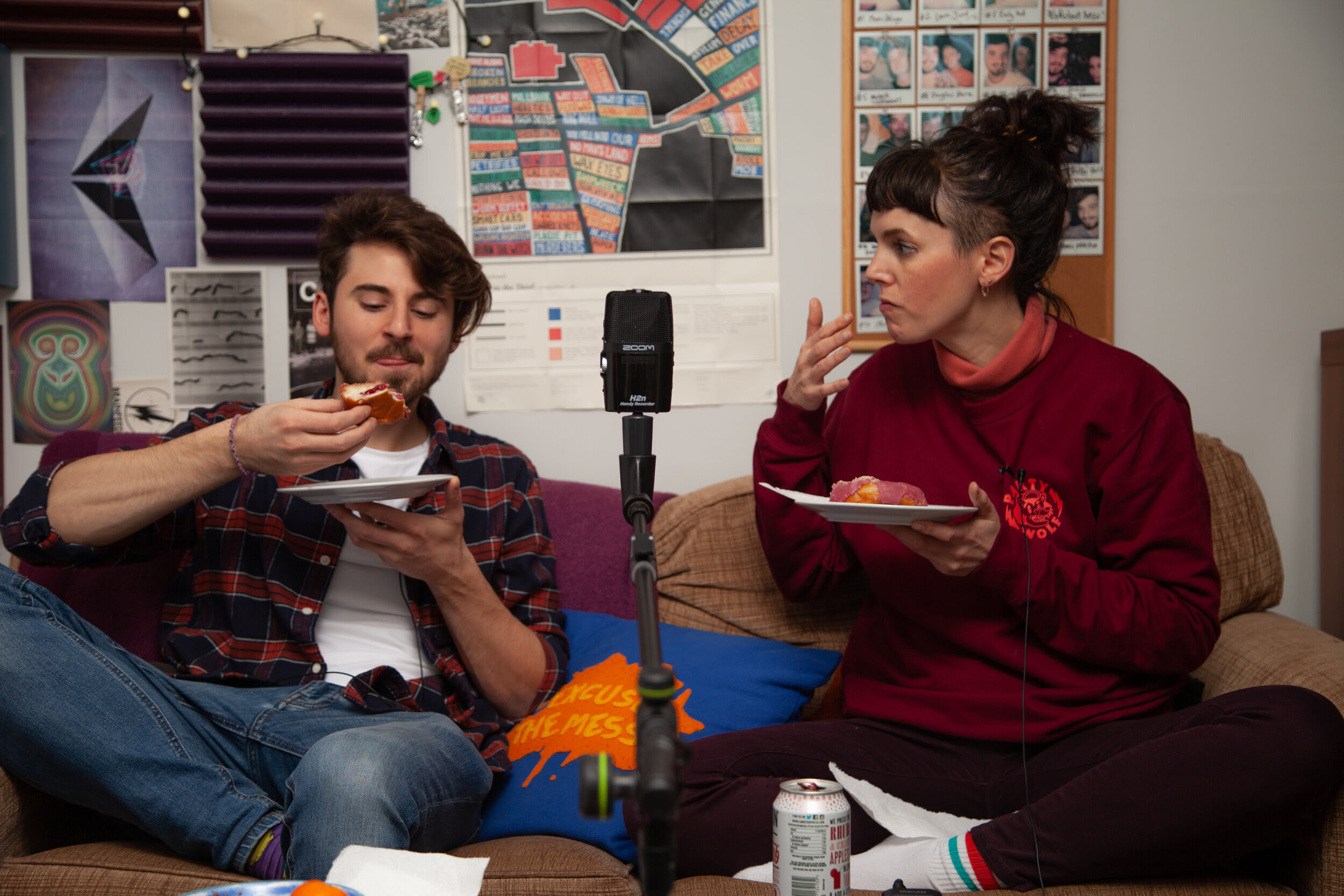
Across two albums of extemporized in-situ performances the great and adroit of UK-based contemporary classical and electronica experimentalism conjure up an imaginative mood board of compositions within the set perimeters of the Excuse The Mess podcast challenge. Invited for a chat in the personable surroundings of the titular space, each interview subject was asked to abide by the rules in creating a special something with the host, Ben Corrigan.
Created in that location, in that time there could be no pre-planning, no added electronic manipulations; each artist was allowed to only use a single instrument. Many of those taking part choose to use their signature instrument, others more obscured props; the most bizarre being the transmogrified ‘ice rink’ field-recorded ice-skating samples (figure-of-eight slushes and sliced ice-skate scrapes transduced into an abstract subterrain) used by the South African born multidisciplinary Warp label artist Mira Calix, and the tub patted oscillating and soft emerging techno rhythmic ‘pesto jar’ that MBE (no less) gonged electronic-acoustic composer Anna Meredith puts to good sonic use on Volume 2 closer ‘Oopsloops’.
More fathomable instruments can be detected however; for example, the renowned hand/steel pan and saucer shaped ‘hang’ player Manu Delago kicks things off by spreading his tapping fingers across his resonating percussive specialty to traverse an ambiguous cosmic atmosphere on the near-sublime ‘Collider’. Following in that peregrination’s wake is Dinosaur jazz quartet stalwart and acclaimed multifaceted composer-improviser Laura Jurd’s trumpeted ‘Copper Cult’ – a changeable vapour and march of soundtrack Miles Davis, Don Cherry and Yazz Ahmed.
In turn, the esteemed composer (pieces performed by the London Symphonic Orchestra and London Sinfonietta) Emily Hall tunes an electronic magnetic harp to ethereal heights; singer-songwriter and Erased Tape regular Douglas Dare, with just the use of his layered uttered, whispered a cappella vocals, magic’s up a dark romantic plead; and the Emmy-nominated composer and BBC 3 broadcaster Hannah Peel builds towards a shuttered clapboard rhythm and chorister-like wafted divine pirouette with just the use of a music box. Other notable inclusions (though every piece is stirring and intriguing in its own right) that piqued my attention were the fizzed and caustic frayed and slow-drawn violin evocations of the Kazakh-Brit improviser-collaborator-leader of the London Contemporary Orchestra Galya Bisengalieva – who seems to evoke Sunn O))), only with just a violin -, and the Canadian-born composer (scoring The Imposter) Anne Nikitan imagines an 8-bit Castlevania as transformed by µ-Ziq, funnelled into an early mute label version of ‘Da Da Da’.
A wealth of talent from the arts, theatre, classical and film score arenas appear on both volumes of this musical challenge: proving if anything, just how lucky the UK is to have so much talent working on its doorstep. The restrictions don’t seem to have narrowed either the quality or the originality. In fact, if anything, each artist has been creatively pushed to use their ingenuity in composing something anew, on the spot. A brilliant double-bill selection, ‘excuse the mess’ can only describe the accumulative space in which these tracks were created, and not the sounds or music, which are anything but. A novel criteria has resulted in some mysterious, spellbinding and often traversing experiments. The Hidden Notes platform ushers in a new year with a quality release package.
Brazen Hussies ‘Year Zero: An Anthology’
(Jezus Factory Records) Vinyl Version January 2022
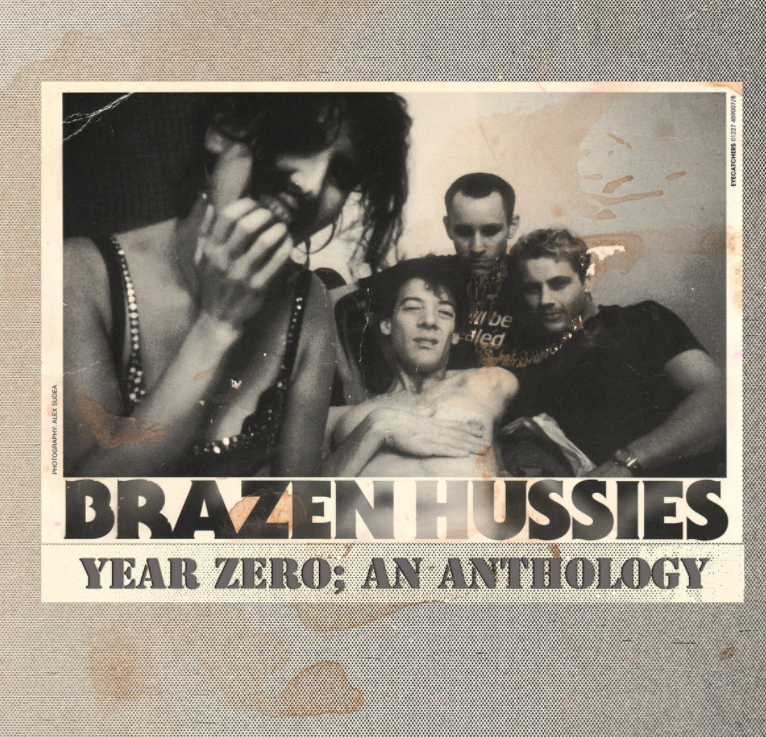
Despite the distain, rambunctious methodology and carefree attitude to making it in the lower levels of the music scene in the 90s and early noughties, the scuzzed and abrasive Brazen Hussies were far too knowing and artful than their shambolic, contrary myth would have us believe. Quite frankly that status is shambollocks!
For this ‘lost’ London group played loosely and quite skilfully with their influences, which ranged (by the sounds of it) to everyone from Richard Hell to The Monochrome Set, from The Pixies to the Nuggets box set. Anything but a complete mess they showed a certain élan for the pivot, for the light and shade as they transitioned from the needled and coarse gnarling for halftime downtime and even a bit of melody. Because out of the ramshackle punk, post-punk and cutting dissonance there was always some remnant, a semblance of a half-decent tune.
Simultaneously as courted as they were slagged off by a hostile music press during their apex in the late 90s, it’s hard to get a handle; difficult to tell if they deserve this anthology reappraisal, or whether it’s all just a scam: elevating fleeting losers from rock’s back pages. Actually they were quite bloody good, and at least (for the majority of the time) only ever recorded three-minute songs so as not to overstay their hobnail Dr. Martens boot on the throat welcome. Their farewell ‘Bridesville’ blowout is one of the few exceptions; running to a ridiculous insufferable 26-minutes of whined post Britpop and salon bar piano malcontent.
Fronted by the duel vocals of Dave Queen (a Canadian by god) and Lou McDonnell, backed by the ‘rhythm section’ of Lunch on trebly Bauhaus-Gang-Of-Four-Killing-Joke bass duties (proving anything but out to “Lunch”) and Russell Curtis on barracking and tom rolled drums, they sounded like a contortion of the Bush Tetras and Stone Temple Pilots on the scowling ‘Touch It’; like a flange-affected X-Ray Spex on the brilliant character assignation turn halftime concerned pathos riled ‘Thin Lips’; and like the Cowboy Junkies on the country-folk-punked counterpoint of squealed industrial shredded guitar and sweeter down-heeled sung ‘Kimberley’.
In between sporadic bursts of an early Manics (Dave sails close to a young, petulant James Dean Bradford), the Stooges, Slater-Kinney, The Fall and Essential Logic they turn in two highly contrasting covers. A more obvious Seeds homage is made with a cover of the acid-garage legend’s Nuggets stalwart ‘Can’t Seem To Make You Mine’ – a real shambles of a badly recorded demo – and an odd enchanted nod to the Beach Boys’ doughy-eyed California daydream ‘All Summer Long’. It’s as if an entirely different band turned up for the second of those: well I’ve since found out that the honeyed, almost Christmas-y, Beach boys take was recorded by a flying solo Dave.
With a bedraggled smattering of releases to their name and odd appearances on a myriad of compilations, what little success they had was never capitalised on. Instead, just as those in the press that saluted their brazen despondency, protests, even heralding them as “visionaries”, they drew just as much scorn and bile. Neither a piece of crap nor the second coming, the Brazen Hussies were a great controlled mess of punk and all its off-shoots, Britpop, garage, alt-rock and skag country: in fact, a very 90s band. Is it worth the plastics melted down to produce the vinyl (digital and CD versions released back in 2021) edition? I’d say so, and I think you’ll agree when you slap it on the turntable; finding a missing link from a decade that’s increasingly becoming the new “80s”.
Hi, my name is Dominic Valvona and I’m the Founder of the music/culture blog monolithcocktail.com For the last ten years I’ve featured and supported music, musicians and labels we love across genres from around the world that we think you’ll want to know about. No content on the site is paid for or sponsored and we only feature artists we have genuine respect for /love. If you enjoy our reviews (and we often write long, thoughtful ones), found a new artist you admire or if we have featured you or artists you represent and would like to buy us a coffee at https://ko-fi.com/monolithcocktail to say cheers for spreading the word, then that would be much appreciated.
 Monolith Cocktail Blog