THE MONTHLY DIGEST OF ACCUMULATED NEW MUSIC; THE SOCIAL INTER-GENERATIONAL/ECLECTIC AND ANNIVERSARY ALBUMS CELEBRATING PLAYLIST; AND ANNIVERSARY PIECES FROM THE ARCHIVES.

THE NEW\___
boycalledcrow ‘Kullau
(Mortality Tables)
A musical atmospheric hallucination and psychedelic dream-realism of a roadmap, the latest transduced-style album from Carl M Knott (aka a boycalledcrow) takes his recollections, memory card filled photo albums, samples and experiences of travelling through Northern India between 2005 and 2006 and turns them into near avant-garde transported passages of outsider art music.
Escaping himself and the stresses and anxieties that had been plaguing him since adolescence, Knott chose to pick up the road less travail(ed) after graduating; making new friends along the way, including the artist (known as James) who provided the album’s image.
If you are aware of the Chester-based composer’s work under numerous labels, and his experiments with weird folk music and signature revolving, splayed, dulcimer and zither-like guitar transformations then Kullu will – albeit more psychedelic and mirage-like – fit in nicely with expectations.
Place names (that album title refers to the village, an ancient kingdom, of ‘Kullu’, which sits in the ‘snow-laden mountain’ province of Himachel Pradesh in the Western Himalayas), Buddhist self-transformation methods (the extremely tough self-observation process of “non-reaction” for the body and mind known as “Vipassana”), Hindu and Jainism yogis (the “Sadhu”, a religious ascetic, mendicant or any kind of holy person who has renounced the worldly life, choosing instead to dedicate themselves to achieving “moksha” – liberation – through meditation and the contemplation of God) and language (the localized distinctive Kullu dialect and syntax of “Kanashi”, currently under threat) are all used as vague reference points, markers in this hallucinatory grand tour.
These captured moments and memories are often masked. It’s the sound of Laaraji stepping across such dizzying spiritually beautiful high altitudes and descending into the valley below; the brief sound of tablas and an essence of reverberating Indian stringed instruments suddenly taking on abstracted forms or reversed and melted into a hazy dream cycle. Nothing is quite what it seems; the imagination reminiscing freely and taking source recordings off on curious tangent. And yet it all makes sense, and somehow quantifies, soundtracks a landscape and period we can identify and experience. You can even work out that much of that plucked, cylindrical, pitch and speed-shifted string sound is coming from the £27 guitar that Knott bought whilst on those same travels (picked up in Dehradun to be specific).
But as with all of Knott’s peregrinations, queries, unrestricted gazes, the sound is very much his own. If you would like some idea of what we are dealing with, maybe Walter Smetak, Land Observation in colour, Fabbrica Vuota, Gunn-Truscinski Nace, and with the playfully strange psychedelic ‘Tuktuk’ ride, a merger of Tortoise, Yanton Gat and Animal Collective. Mind you, the vague echoes of piped church music on ‘Bear River’ (which “bisects” the valley region in which Kullu sits) are closer to the spiritual new age and kosmische – perhaps a hint of David Gasper. If Knott’s soundboard is anything to go by he did indeed find that much needed replenishment of the senses and escape from the mental and health pressures of stress that handicapped his progress. He’s created dreamy encapsulation of a time without burden and restriction; an experience totally free of worry and the strains of the material world out near the roof of the Earth. The results of which can be heard to have clearly been beneficial artistically. Kullu is another magical, strange and explorative soundscape/soundtrack from an independent artist quietly getting on with harnessing a unique sound and way of capturing the impossible.
Amy Aileen Wood ‘The Heartening’
(Colorfield Records)
Not in the literal sense, but the award-winning drummer, multi-instrumentalist, composer and engineer Amy Aileen Wood takes centre stage on her new album for the Colorfield Records label.
The supporting foil on a range of albums and performances with such notable names as Fiona Apple (more from her later), St. Vincent, Tired Pony and Shirley Manson, Wood was initially approached by Colorfield instigator Pete Min (the imprint that’s run out of Min’s Lucy’s Meat Market studios in L.A.) to lead her own solo outing. And although Wood’s stand-out tactile feels and descriptive drumming skills maybe on show and at the forefront, the L.A. based polymath, whilst also playing a wide worldly range of instruments, invites a number of in-demand session players and artists to collaborate, including Apple. An unsurprising choice seeing as Wood’s was not only a member of the recording band on Apple’s Fetch The Bolt Cutters album but also its co-producer. From that same circle, the “veteran” bassist Sebastian Steinberg provides pliable and subtly effective upright bass parts to a majority of the tracks on The Heartening. Apple, for her part, offers cooing “dadodahs” and assonant light dreaminess on the album’s opener, the womb-breached submersed turn Can Unlimited Klezmer ‘Rolling Stops’, and both sighs and giggles of ‘self-love’ on the gamelan cascaded self-help indie-wonk ‘Time For Everything’. Another one of the various guests’ spots goes to Kelsey Wood (relation?), who coos and ahs on the kinetic Alfa Mist-esque ‘Slow Light’.
The Heartening is essentially, if removed and discombobulated or enhanced by a palette of different styles and influences, a jazz album; especially with the addition of the L.A. based saxophonist (amongst other talents) Nicole McCabe, who pushes those personalized thematic exploratory performances and freeform expressions towards flashes of Ivor Pearlman, Alex Roth, Donny McCaslin (I’m thinking especially of his cosmic dissipations), Dave Harrington (funny enough, referenced in the PR notes) and Savoy label era Yusef Lateef.
But the musicality is far reaching, hopping around and landing at one point in Java, the next, in Eastern Europe (those stirring closed-eyes arches, sighs and solace style strings of the renowned Daphne Chen reminding me of Fran & Flora and Alex Stolze’s Galicia classical sympathies). You could also throw in breakbeats, the downtempo, the no wave and various fun fusions into the mix; everything from J Dilla to NAH, TV On The Radio, Arto Lindsay, John Zorn and Lucrecia Dalt.
Wood’s own style of drumming (though as I mentioned, the multi-instrumentalist, true to that title, plays everything from nostalgic iconic midi synths and drum pads to the West African balafon and twines flicked kalimba) is halfway busy and halfway intuitive: a mix of Valentina Mageletti and Emre Ramazanoglo.
Wood is certainly a talented player and full of ideas, as the action moves constantly between the natural and improvised. With a mix of trepidation and “intrigue” Wood’s proves an able leader and catalyst. I’d say this solo venture was the successful start to a new pathway and adventures.
Virgin Vacations ‘Dapple Patterns’
From a multitude of sources, across a number of mediums, the concentrated sonic force that is Virgin Vacations ramp up the queasy quasars and the heavy-set slab wall of no wave-punk-jazz-maths-krautrock sounds on their debut long player. With room to expand horizons the Hong Kong (tough gig in recent years, what with China’s crackdowns on the free press and student activists; installing authoritarian control over the Island) ensemble lay out a both hustled, bustled and more cosmic psychedelic journey, from the prowling to the near filmic and quasi-operatic -from darkened forebode to Shinto temple bell-ringing comedowns that fade out into affinity.
Operating in a liminal realm between the ominous and more mysteriously idyllic; changing mood, sense of place and the sound on every other track; the ensemble channel everything from the Hifiklub, Angels Die Hard and The Pop Group in a wail of bugle horns post-punk jazz (ala Blurt and a vocal-less Biting Tongues) to ‘Gomorrha’ CAN, the Dead Kennedys, film-score Sakamoto, Hawkwind and the Holy Family. That’s of course when they’re not orbiting the celestial jazz of Sun Ra merged with Herbie Hancock on the heavenly spheres and alien evoked ‘Jupiter’: even this track grows into a manic nightmare of broken distorted radio sets.
The trip is a cosmic range of ideas, some driven others far more dreamy, psychedelic and even erring towards the orchestral – there’s plenty of bulb-like note-twinkled glockenspiel to go around too. It begins with a krautrock expulsion of dark materials and ends on a Tomat-like – in union with the Acid Mothers – dissipation of enveloped interplanetary temple vibrations. This only touches the surface however, and Virgin Vacations take flights of fantasy regularly whilst maintaining a heavy-pulsation of uncertainty. Energy is channeled in the right direction, with a force that manages to tap into the anxious and radical whilst finding air to breathe and dappled patterns spread of the title.
he didnt ‘nothingness manifested’
(Drone Alone Records) 24th May 2024
Granular gradients, frazzled fissures and currents appear in the thick set wall of drones emitted by the Oxfordshire-based electronic musician, guitarist and producer’s new numerically demarcated album.
Reading into the monolithic slab sided scale and ambitions of he didnt’s manifestations, these, mostly, long walls of whined, bended, looped, abrasive and sustained guitar and electronic waveforms elicit the feelings of landscape: one that can feel simultaneously overbearing, grand but in motion. Metallic filaments or the pitter-patter of acrid rain, ‘nothingness manifestations III-V’ builds a sonic picture over its duration of some almost alien atmospheric enveloped weather front – reminding me of Hans Zimmer’s bits on Blade Runner 2049, His Name Is Alive, Fiocz and a venerated Tangerine Dream. ‘nothingness manifestations II’ is similar with its alien evocations yet near bestial and slithery too – I’m hearing vague signs of Faust, Sunn O))) and even Spaceman 3 for some reason. Perhaps picking up inspiration from one previous support slot, he didnt channels The Telescopes, minus Stephen Lawrie’s drudgery vocals, and a touch of the J&MC on that heavy meta hewed opener.
But there’s holes too in what is more like a mesh block of wielding drones, with a glimmer, a movement of light audible in the grainy textured fabric around the self-described “void”. In short, something from nothing, materialisations from patterns in the sonic concrete that may just evoke something much bigger.
Ziad Rahbani ‘Amrak Seedna & Abtal Wa Harameyah’
(WEWANTSOUNDS)
Vinyl reprisal specialists WEWANTSOUNDS, in-between reviving and offering remastered runs of cult music from Japan, Egypt and elsewhere, have been picking their way through the back catalogue of the Lebanese polymath Ziad Rahbani (musician, composer, producer, playwright, satirist and activist).
Following on from the crate diggers’ choice 80s Middle Eastern disco-funk-balladry-soul-jazz-Franco-Arabian classic Houdou Nisbi (released by the label in 2022), the Amrak Seedna & Abtal Wa Harameyah combined moiety of congruous theatre play soundtracks offers a generous helping of performance choruses, instrumental theme tunes, ad spots and variations of the main signatures.
Whilst the ongoing sectarian driven civil war (between 1975 and 1990) raged, there was a surreal duel existence of stoicism, the Lebanese people carrying on with life in the face of religious rivalry, unprecedented violence, and infamous acts of massacre (a 150,000 fatalities, maybe more). Importantly Lebanese artists, musicians continued to create – some from abroad as part of a mass exodus (estimates are that a million citizens left the country to escape the horror during that period). Disarming as the musical motifs, dancing rhythms and messages was, cultural idols like Ziad (famously the scion of the feted musician and national star Assi Rahbani and the legendary celebrated siren Fairuz) were fervently political. And among his many talents, Ziad would collaborate with the most vocal of them, including the pioneer singer-songwriter of Arabian political song, Sami Hawat, who appears alongside a whole cast of other notable vocalists on this double helping of stage performances.
Written by fellow Lebanese playwright and actor Antoine Kerbaji, the main acts and catalysts for Ziad’s inspired fusion of the Occidental and Middle East, speak of the times in which they were created. Originally released on the Beirut-based cult label Relaxin in 1987, the emotions run high as the streets outside were paved in bloody retribution along the lines of not only religion (the Christian minority’s rule of decades, and elitist nepotism finally coming to a crashing head as the country’s demographic shifted to a Muslim majority, inflated by two migrations and expulsions from Israel of sizable Palestinians populations in the late 1940s and 60s) but also Cold War divisions. The passion is evident in the various cast or male/female led choruses of yearning expression and more swooning allurement – sometimes almost reminding me of Bollywood, and the dance or romance, courtship between a male and female lead.
Musically however, this is a mixed assortment of near classical piano motifs, Arabian stringed instrumental segments, the new wave, disco and funk fusion and movie soundtrack influences. Glaringly an obvious steal, there’s the recurring use of John Barry’s 007 signature score across a large slice of these tracks. Adopting that most famous iconic mnemonic and its variations, Ziad seems to pinch it back from its own Western takes on the music from his country and the wider region. Marvin Hamlisch dabbled in this area for The Spy Who Loved Me – although his take was on Egyptian disco -, as to did Bill Conti – a mix of Med sounds for For Your Eyes Only. So much of this reminds me of both those top rate composers, especially the near thriller style production and clavichord MOR funky fusion sounds of ‘Al Muqademah 1 (Introduction 1)’. Later on it sounds like Ziad riffs on Hamlisch’s score for The Sting on the relaxed jazzy vaudeville saloon barrel organ reminisce ‘Kabbaret Dancing’.
Away from the 007 themes there’s hints of John Addison and Michael Legrand on the Franco-Arabian boogie musical number ‘Al Piano’, and Richard Clayderman on the beautiful romantic-esque flourish of piano scales, runs and lucidity ‘Slow’. The music slips into the Tango at will, or transports the listener back to the noir 1930s. Although, ‘Mashhad Al Serk’ is a strange one, resembling funky calypso transmogrified with reggae and the new wave. I’m at a loss on occasion to describe what it is I’m hearing, as the palette is so wide and diverse. But in summary, both albums offer a cabaret and theater conjecture of fluidity that takes in the Middle East and fuses it with Western classicism, movie and TV themes, funk and 80s production signatures. Previously only ever released in the Lebanon, WWS have done the decent thing and revived these stage play soundtracks, offering us all a chance to own these expressive and enlightening recordings.
THE SOCIAL PLAYLIST VOLUME 86\____
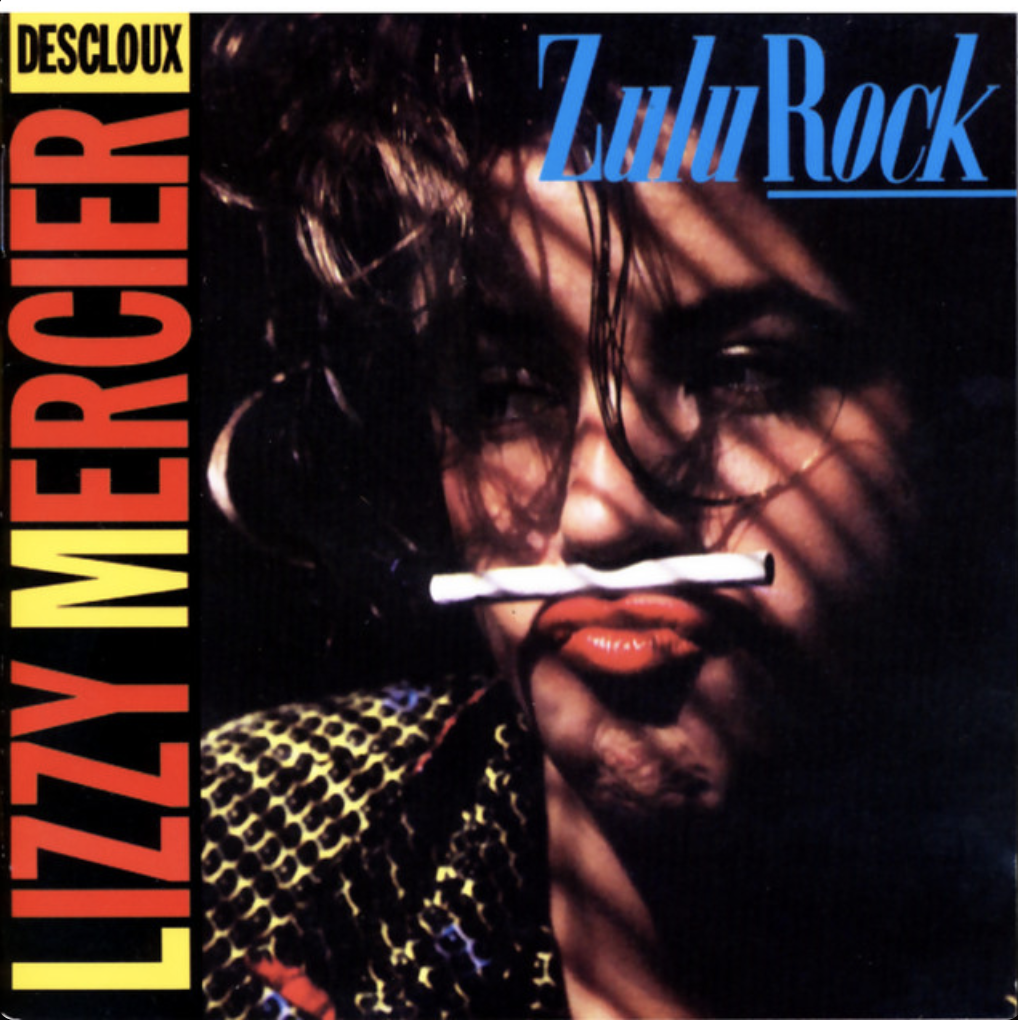
The Social Playlist is an accumulation of music I love and want to share, tracks from my various DJ sets and residencies over the years, and both selected cuts from those artists, luminaries we’ve lost and those albums celebrating anniversaries each month.
Running for over a decade or more, Volume 86 is as eclectic and generational-spanning as ever. Look upon it as the perfect radio show, devoid of chatter, interruptions and inane self-promotion.
In this edition I’ve chosen to mark the 50th anniversaries of Sparks Kimono In My House, Bowie’s Diamond Dogs, Slapp Happy’s Self-Titled – but referred to as Casablanca Moon, after the opening track -, and Popol Vuh’s Einsjager & Siebenjager albums. A decade closer, and into the 80s, I’ve included tracks from my favourite French new wave spark and cool chanteuse Lizzy Mercier Descloux and her Zulu Rock LP of ’84, plus a slightly different performance of Echo & The Bunnymen’s ‘The Killing Moon’ (the original single also included on the Liverpool’s band’s Ocean Rain of course). Another leap closer, and its 30th anniversary nods to the Beastie Boys ambitious double-album spread Ill Communication, Jeru The Damaja’s The Sun Rises In The East, and The Fall’s Middle Class Revolt. The final anniversary spot this month goes to our very own Brian ‘Bordello’ Shea, or rather the whole Shea brood and their might lo fi cult vehicle The Bordellos. The group’s summary of the world and music industry, Will.I.Am, You’re Really Nothing, is ten years old this month.
We lost even more iconic mavericks and leaders of the form this last month or so. Grabbing, quite rightly, the most attention is the loss of Steve Albini. The legacy is ridiculous, and to be honest, far too many people have already dedicated the space for me to now chip in – I will be frank, where do you start? And so I have chosen to give him a mention but not to pay the homage due. We also lost the last remaining member of the motor city five, Dennis “Machine Gun” Thompson, who pummeled and, quite literally, kicked out the fucking jams. I’ve already made note and selected tracks from their catalogue when poor old Wayne Kramer passed just a few months back, and also their manager – for a time between drug busts – John Sinclair. The Detroit misfits are no more. What a sad state of affairs.
I have however chosen to mark the passing of UK rap icon MC Duke and king of twang, and one of the most important, influential guitarists of all time, Duane Eddy.
There’s a couple of “newish” selections – tracks that I either missed or didn’t get room to include in the Monolith Cocktail team’s Monthly Playlists (next edition due in a week’s time) – from Masei Bey and Martina Berther which I hope will prove intriguing. The rest of the playlist is made up of a smattering of tracks from Tucky Buzzard, Prime Minister Pete Nice, The Bernhardts, Nino Rota, It It, Clive’s Original Band, The Four King Cousins and more.
TRACK LIST________
Sparks ‘Barbecutie’
Tucky Buzzard ‘Time Will Be Your Doctor’
Haystacks Balboa ‘Bruce’s Twist’
David Bowie ‘1984’
Masei Bey ‘Beat Root’
Beastie Boys Ft. Q-Tip ‘Get It Together’
Jeru The Damaja ‘You Can’t Stop The Prophet’
Prime Minister Pete Nice Ft. Daddy Rich ‘Rat Bastard’
MC Duke ‘I’m Riffin 1990 Remix’
Helene Smith ‘Willing And Able’
The Bernhardts ‘Send Your Heart To Me’
Tala Andre Marie ‘Wamse’
Lizzy Mercier Descloux ‘Dolby Sisters Saliva Brothers’
Orchestre regional de Segou ‘Sabu Man Dogo’
Slapp Happy ‘Casablanca Moon’
Nino Rota ‘L’Uccello Magico’
Duane Eddy ‘Stalkin”
Dreams So Real ‘History’
Echo & The Bunnymen ‘The Killing Moon – Life at Brian’s Version’
The Bordellos ‘The Gospel According To Julian Cope’
The Fall ‘Middle Class Revolt’
It It ‘Dream Joel Dream’
David Bowie ‘Rock ‘n’ Roll With Me’
The Bordellos ‘Straight Outta Southport’
Clive’s Original Band ‘Oh Bright Eyed One’
Jodie Lowther ‘Cold Spell’
Martina Berther ‘Arrow’
Fursaxa ‘Poppy Opera’
Popol Vuh ‘Wo Bist Du?’
The Four King Cousins ‘God Only Knows’
ARCHIVES\_____

When gracing the Monolith Cocktail with his very own column of reviews was still years away, Brian “Bordello” Shea was featured for his own music as part of the mighty lo-fi malcontents The Bordellos – Brian one of the co-founding Shea sibling forces behind that celebrated cult outfit. Still for my money one of their finest moments on record, the group’s Will.I.Am, You’re Really Nothing (released at a time when that annoying, talentless opportunist was all over the telly and in the charts in the UK) diatribe is ten years old this month. To celebrate, reprise that essential songbook, I’m once more sharing my original review from 2014. Every word of it still, unfortunately, still holds today.
The Bordellos ‘Will.I.Am, You’re Really Nothing’
(Small Bear Records) Released 31st May 2014
It was Blur, in one of their only true flashes of inspiration, who came closest to summing up the times with their dejected conclusion that, “modern life is rubbish”. That was the early 90s, but depending on how long in the tooth, worn-down and jaded you are, every age can be viewed with the same disappointing sigh of resignation.
Yet, surely the present times take some beating, at least to us, the self-appointed custodians of the past, who remember an age when the culture seemed…. well, at least exciting, linear and comprehendible, instead of appropriated without thought or context, screwed-over and manipulated for largely commercial results, and slotted in to a handy off-the-peg lifestyle choice. Pop has eaten itself, with the lifecycles of trends and music becoming ever shorter.
It is with all this in mind that The Bordellos set out their manifesto. Leveling their criticism at commercial radio and TV especially, they aim their guided missile attacks at the harbingers of the Ed Sheeran topped Urban/Black music power lists, and what seems more and more like the UK publicity wing of conservatism, the BBC. The St. Helens, via a disjointed Merseybeat imbued lineage, family affair replace the “happy-go-lucky” lightweight and deciding suspect womens rights champion, totem of Pharrell Williams, Will.I.Am and all his partners in floppy platitude pop, rock and folk with the arch druid of counter-cultural esotericism and miscreant obscure musical sub-genres (Kraut to Jap via Detroit rebellious and experimental rock) Julian Cope. Grinding out a dedicated epistle to Cope, the trio’s sermon ‘The Gospel According To Julian Cope’ prompts a road to Damascus conversion to the spirit of rock’n’roll, in all its most dangerous guises.
De facto idol, Mr.Cope, pops up again on ‘My Dream Festival’, which as the title suggests is a list of the ideal, once in a lifetime, free festival lineups of lineups; read out in a quasi-Daft Punk ‘teachers’ style bastardized litany to an accompanying Casio pre-set drum track and watery effects. The Casio rhythm pre-sets and occasional sound bites come in handy again on the jaunty, deadpan disco jolly, ‘Elastic Band Man’ – a transmogrified Human League meets John Foxx – and on the broken-up, Robert Wyatt emotional drudge, ‘Between Forget And Neglect’.
Despite going at it hammer and tongs on their anvil-beating Cope Gospel, The Bordellos latest long-player protestation is a forlorn and intimate downbeat record. They can still be relied upon to rattle off a list of grievances and opprobrious pun harangued song titles: from the LP’s play-on-words adopted The Smiths song, reworked to accommodate a big fuck-you to that irritable twat, Will.I.Am, to name-checking another hyperbole anomaly of our Youtube, Google, Facebook, Twitter masters’ bidding, the no less frustratingly lame ‘Gangnam style’ viral – joining the call from last year’s Bring Me The Head Of Justin Bieber EP, for another public execution.
But it’s with a certain lamentable introspection that they also tone the vitriol down to attend to matters of the heart: The kiss-me-quick, misty-eyed ballad to love on a northern coast seaside town, ‘Straight Outta Southport’, and the Hawaiian slide guitar country rock ode, ‘The Sweetest Hangover’, both, despite their tongue-in-cheek titles, bellow a fondness for lovelorn adventures and plaintive break-up regret; proving that despite the bellicose calls for the corporal punishment of the foppish elite and its commercial pop music stars, there is a tender side to the group.
Sounding like it was recorded on an unhealthy dose of Mogadon, Will.I.Am, You’re Really Nothing is a composed grumble from the fringes of a battered musical wilderness. A last cry if you will from the pit-face of rock’n’roll.
Also this month, Bowie’s repurposed Orwellian theatre production Diamond Dogs reaches its 50th anniversary.

David Bowie ‘Diamond Dogs’
(RCA) 1974
“As they pulled you out of the oxygen tent, you asked for the latest party…” And with that the future dystopian, biota canine, leapt from its slumber “onto the streets below”: howling for more.
Bowie never really wanted to be a musician as such: or at least not wholly a musical act. His destiny lied with the grease paint of theatre and allure of cinema. Diamond Dogs of course allowed him to create a spectacle, melding the two disciplines together.
Fate would force the original concept to morph into the achingly morbid and glam-pop genius we’ve now come to love: a planned avant-garde, ‘moonage’, treatment of Orwell’s revered novel 1984 was rebuked by the author’s estate.
Still those augural references to state control and totalitarianism are adhered to throughout – both lyrically and in the song titles –, but attached to visions of a new poetic hell!
The loose, all-encompassing, metaphysical language may promise melancholy and despair, yet it also knows when to anthemically sound the rock’n’roll clarion call too.
Decreed as the leading highlight’s of the album by the majority –
Diamond Dogs (single), Rebel Rebel (single), 1984
Pay attention to these often overlooked beauties –
Rock’n’Roll With Me (single), Sweet Thing
Hi, my name is Dominic Valvona and I’m the Founder of the music/culture blog monolithcocktail.com For the last ten years I’ve featured and supported music, musicians and labels we love across genres from around the world that we think you’ll want to know about. No content on the site is paid for or sponsored and we only feature artists we have genuine respect for /love. If you enjoy our reviews (and we often write long, thoughtful ones), found a new artist you admire or if we have featured you or artists you represent and would like to buy us a coffee at https://ko-fi.com/monolithcocktail to say cheers for spreading the word, then that would be much appreciated.
Choice Albums of 2016 (Part One): A – L
December 1, 2016
Aesop Rock to Bob Lind.

Continuing to shy away from fatuous rating systems and ‘best of lists’, the Monolith Cocktail endeavours to offer a more eclectic spread of worthy ‘choice’ picks, with no album dominating or holding any particular numbered position – unlike most of our contemporaries lists; stuck with the ridiculous task, for example, of explaining why one album doesn’t deserve the number 32 spot and has been placed at number 33 instead.
Lined up in alphabetical order then, our favourite new and reissued albums from 2016 are of course considered to be the most interesting, vibrant and dynamic of the year’s releases. But the best? Granted, to make this list you have to make some sort of impact, but we’d never suggest these entries were categorically the best albums of 2016, even if that might be true. Instead our list is an indicator of our amorphous tastes, rounding up a year in the life of the Monolith Cocktail, and we hope, introducing you to titles and artists/bands that may have dropped below the radar.
Split into two parts, the first installment begins with Aesop Rock’s‘s hip-hop masterpiece The Impossible Kid and ends with the latest adroit songbook from the legendary troubadour Bob Lind. In between those two sagacious bookends are albums from David Bowie, David Broughton, Danny Brown, Cluster, Eleanor Friedberger and John Howard (plus many others).
Aesop Rock ‘The Impossible Kid’ (Rhymesayers)
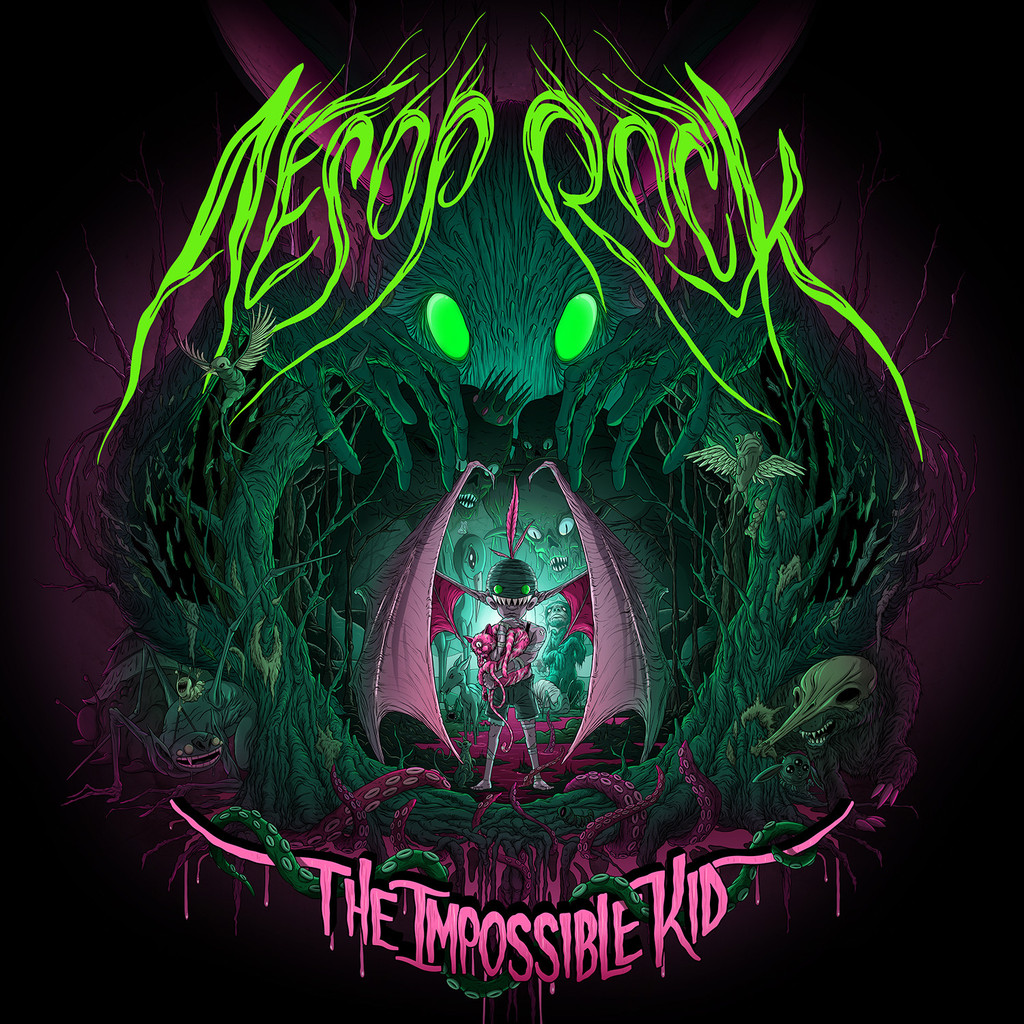
“The waterfall of words, snide quips and intricate stories recalled from both close to home and far away worlds, are as good as he’s ever done”. Matt Oliver
Seeming to get better rather than older (and don’t you dare mention the ageing process as per ‘Lotta Years’), the original ‘Bazooka Tooth’ is still ablaze out of somewhere to the left, but now giving lesser mortals more of a chance of accessing him than ever before. Entirely self-produced and applying funkiness to the bulkiness of alien-scanned beats he’s always rocked his way, AR’s extra superpower as the self-deprecating hero of syllaballistics (“the impossible kid , everything that he touch turns probably to shit”), is to humanise the fantastical and still make the everyday sound like a comic book lead, even when soul is bared for all to analyse. Rock also added more great cover art, and the visuals for ‘Rings’ and ‘Kirby’ are bound to feature in hip-hop video of the year lists.
Read original review here…
Afro-Haitian Experimental Orchestra ‘A.H.E.O’ (Glitterbeat Records)
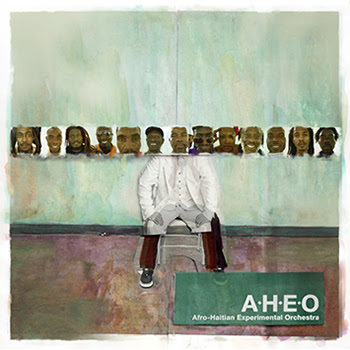
‘Elevating beyond the borders it was created behind, the Afro-Haitian Experimental Orchestra’s root foundations shuffle and shake free of their stereotypes to move freely in an increasingly amorphous musical landscape. You’re just as likely to hear vibrations and traces of Dub, native Indian plaintive ghostly echoes, Sun Ra’s otherworldly jazz and funk as to hear the indigenous Haiti sounds and Afrobeat pulse. Tony Allen is once more at the heart of another bustling, dynamic explosion in rhythm.’ Dominic Valvona
Progenitor and embodiment of the Afrobeat drum sound, still in high demand four decades after his explosive partnership with Fela Kuti, the much-venerated Tony Allen once more extends his infectious percussion style beyond the African homeland. Sharing an obvious entwined history with Africa, the shared Hispaniola Island of Haiti proves both an esoterically mysterious and congruous collaborative foil to Allen’s distinct drumming patois.
Invited to perform in 2014 by the French Institute Of Haiti’s director Corinne Micaelli, Allen’s visit would end with a public broadcasted concert in the main square of the capital, Port-au-Prince. Collaborating with Allen would be a cross-section of local percussionists and singers recruited by vocalist, dancer, ‘voodoo priest’ and director of the Haitian National Bureau Of Ethnology, Erol Josué; Josué would himself lend his sweet yearning and reflective tones to two of the tracks on this album.
The call went out and the great and good of the Haitian music scene came. Racine Mapou de Azor, the Yizra’El Band, Lakou Mizik and, featured on the Monolith Cocktail at the start of the year and one of the choice albums of 2016 with their highly-rated Manman M Se Ginen LP, RAM. Another Monolith regular and one-time Port-au-Prince resident, Mark Mulholland was drafted in as the experimental orchestra’s guitarist, and as it would turn out, eventual legacy overseer. Swelling the ranks still further were Olaf Hund, recruited on keyboards and ‘electronics’, and an old friend of Allen’s, the bassist Philippe Dary, who became the de facto musical director. With only five days of studio rehearsal time to gel and work out their performance, the sessions proved both, as Mulholland observed, ‘chaotic’ and overwhelming’. Based upon various sparks of inspiration and rhythmic workouts the eventual structured compositions took shape from organically flowing jams. At the heart of each, Allen’s signature Afrobeat drums and Dary’s liquid, and often funky sumptuous basslines.
Read the full review here…
Bitori ‘Legend of Funaná – The Forbidden Music Of The Cape Verde Islands’
(Analog Africa)

‘Following the summertime thrills aplenty Space Echo – The Mystery Behind The Cosmic Sound Of Cabo Verde Finally Revealed compilation, with the emphasis on the Funaná; Analog Africa continues to pay homage to the previously suppressed music genre with a reissue of, what many consider, the best Funaná album ever recorded, Bitori Nha Bibinha.’ DV
Helping to ignite a full-on Funaná revival, the quintessential and legendary anthem of Cape Verde’s once banned – considered too salacious and unruly by the Portuguese authorities who ran this archipelago of islands until the mid 1970s – infectious music style was given a reprise by Analog Africa this year. A master class from the inter-generational duo of singer Chando Graciosa and renowned gaïta maestro Victor Tavares (better known as Bitori), who’d both grown up with the blazing and often raucous Funaná, Bitori Nha Bibinha captures the passion and spirit of the people and the times it survived.
Read the full review here…
The Bordellos ‘How To Lose Friends And Influence No-One’
(Small Bear Records)

‘Despite the caustic bravado and world-weary bitterness channeled into the antagonistic song titles on this new album, The Bordellos lo fi edicts are always surprisingly melodic. Think of them as a tuneful The Fall; resigned and swiping at society but hopeful enough to challenge it despite banging their collective heads on the doors of the music industry for years.’
Gaining this coveted spot (sic) in our ‘choice albums’ feature for perseverance in the face of despair, the St. Helens trio once more man the barricades with another despondent protest. Feeling, like many of us (I know we do), out of synch with the digital epoch, they rally against the Internet’s most depressing byproducts, and the loss of real ‘motherfuckers’ from the music world – who they duly list on a song of the same name; a cry for a new leader or at least more individuals and rebels. Wearily antagonistic, righting slights and a lifetime of rejection, The Bordellos go for broke on How To Lose Friends And Influence No-One with titles such as ‘Did The Bastards At The BBC Kill John Peel?’, ‘Gary Glitter’ and ‘Piss On Spotify’. Uneasy truths to a lo fi backing of The Velvet Underground, Julian Cope and The Fall abound, yet this could be the group’s best and most complete songbook to date.
Read the full review here…
David Bowie ‘Blackstar’ (ISO/RCA)

‘…this could be the most pure, at least concerned, version of Bowie yet. Resurrected free of his characterisations, the gilded “Blackstar” is just as uneasy and scared at the anxieties, stresses and daunting prospects of the future as the rest of us. Fame, celebratory is mere smoke after all and offers little in the way of comfort and safety in the face of the impending end times. Yet despite being easily his best album since Earthling, Blackstar is still underwhelming and falls short of being a classic.’ DV
The swansong of an irreplaceable polymath proved to be one of the year’s most sad moments, as the man who fell to Earth, Aladdin Sane, the Young American, the thin white duke, the absolute beginner, whichever version you fell in love with, departed for the ether. We lost a great many unique and inimitable artists in 2016 but though ever death is tragic none left quite the pit of despair that David Bowie‘s did. Don’t even try to crown a successor; he was a force unto himself, the “Blackstar”, the supernova of pop. Reams have been written – a great many by myself – yet no one will ever truly reflect his importance and legacy.
Though released just before his death the augur that is ★ was a curtain call. Just as oblivious to Bowie’s fatal cancer as everyone else, I did remark at the time that this album seemed to be a poignant goodbye, an elegy even. Returning to a first love, jazz, Bowie who proved an eager saxophonist in the burgeoning years of his career worked with a N.Y. West Village jazz troupe to produce one of his best albums in decades. Old faces, including a decomposing Major Tom, themes and sounds returned, with traces of Diamond Dogs, Scary Monsters, Black Tie White Noise and Outside. Despite the often cryptic and veiled words, this was an anxious, weary and reflective Bowie; looking back before a rebirth. A pity time ran out for him.
Read the full review here…
David Thomas Broughton ‘Crippling Lack Vol. 1 – 3’ (Song, By Toad Records)

‘An ambitious undertaking, David Thomas Broughton’s sprawling opus Crippling Lack is both musically and geographically expansive. Recorded trans-continental style with a host of collaborators over the last few years, Broughton, who’s based himself more recently in the capitals of, unbelievably, North and South Korea, has laid down various parts and vocals in France, the UK and the US. Logistically impressive, Crippling Lack is a testament to the DIY ethic and remote collaborative experimentation.’ DV
A magnificent and masterful undertaking by Broughton, the Crippling Lack trio of recordings is demarcated into three parts, the entire song collection, if you decide to experience in one sitting, stretching to 1 hour 40 minutes. It features twelve songs in all of varying meticulously and slowly unfurled beauty, with some, epics in their own right. The press release separates the album out into a musical journey, beginning with what it calls ‘deceptively approachable pop songs’, moving through a more testing ‘unraveling and disintegrating and barely-stretched fragments’ segment, before ending with a final section that ‘slowly weaves’ all the loose and previous sections together.
It is nothing short of a magnum opus; cohesive and flowing along to a sophisticated backing, sonorous with the artist’s venerable travailed voice, and his acerbic foils wit. The album’s scope is immense even though it meanders to a, mostly, folk signature and gentle accompaniment. It is outstanding even by Broughton’s standards.
Read the full review here…
Danny Brown ‘Atrocity Exhibition’ (Warp)
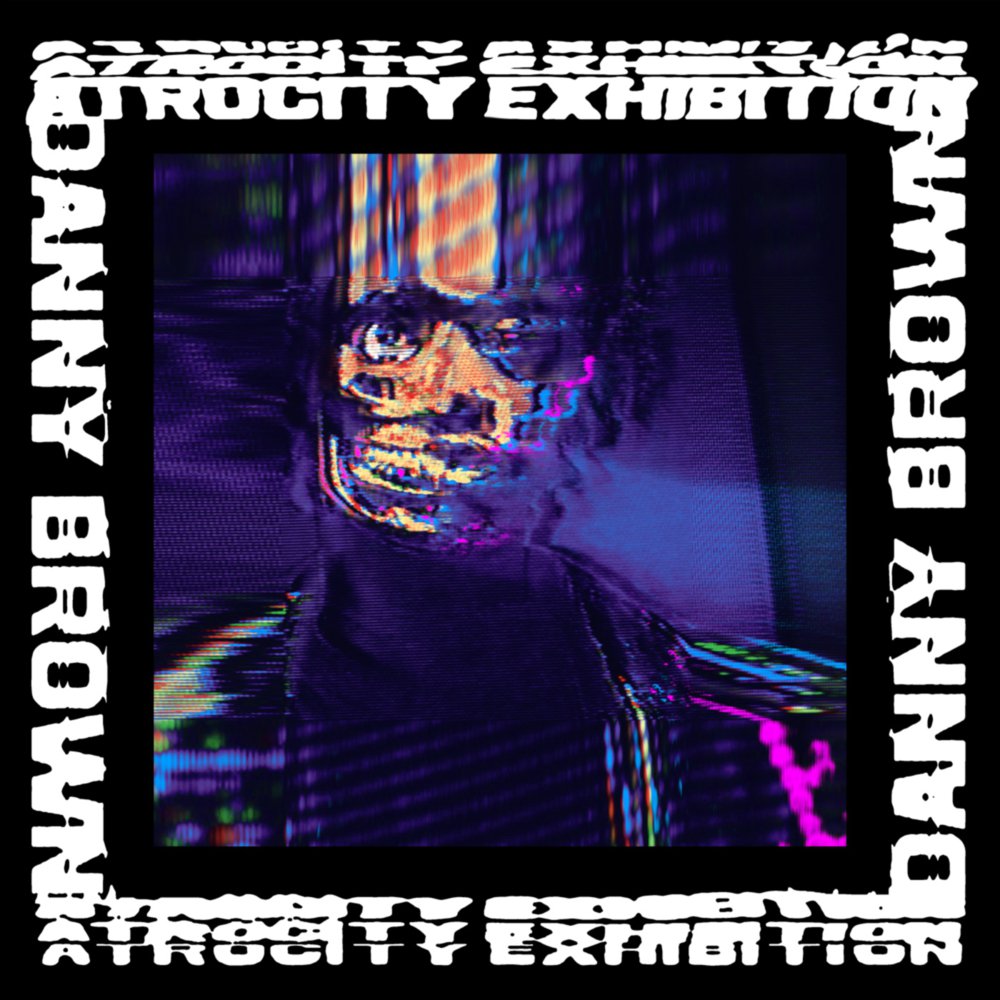
“Juggling the mic like a grenade missing a pin…one of 2016’s most individual threats.” MO
‘Atrocity Exhibition’ throws up so many positive talking points. #1 – the transatlantic odd couple of Danny Brown and Paul White, a relationship rooted in 2011’s ‘Rapping With Paul White’ album, fears nothing and no-one. #2 – Brown continues to show he has one of the maniacal mic grips in the game that you can’t ignore, here with added malleability. #3 – White’s reputation has really hit its stride on an upward curve; though other producers contribute (Black Milk, Alchemist and Evian Christ are not to be sniffed at), it’s essentially the Englishman’s show on the boards. #4 – a show stopping hook from Kendrick Lamar on ‘Really Doe’ doesn’t hurt one bit. #5 – despite Brown’s mile-a-minute persona shearing safety bars off rollercoasters, and White and co by default becoming the straight man sidekick, you really have no idea what’s around the next corner, from soaring superhero soundtracks to proper hip-hop dope to something suspiciously shuffling through the undergrowth. “This is not regular rap”, Brown offers. Amen.
Read the original review here…
Cappo ‘Dramatic Change of Fortune’ (YNR)

“When autumn becomes winter, here’s your listening.” MO
You should always bet on the flow of Nottingham’s finest that has evolved into a complex work of art. On past albums and years gone by Cappo would’ve destroyed opposition with crosshairs locked and ammo loaded; here his own brand of introspection, still packing uniquely orbital rhyme schemes but now more than ever full of coded messages and open ended verses awaiting interpretation, kills the noise and heighten the mysteries surrounding the emcee’s inner thoughts and circles. It packs two absolutely heaters of singles as well – ‘OOB’ and ‘Ether’ are both unassuming phantoms of the opera, but white hot in a pretty slimline session – another contributing factor to the building of the suspenseful and mournful, chilling on a razor’s edge. YNR took the weight off their plates in 2016, but this was easily the jewel in their calendar year crown.
Read original review here…
CHUCK ‘My Band Is A Computer’ (Old Money Records)

‘CHUCK’s kooky collage-rock and lo fi wonky electronic pop, which congruously flows between The Magnetic Fields, Mercury Rev, Weezer, Apples In Stereo and even The Pixies, absorbs its influences to create a gorgeous, quietly optimistic, kind of melancholy and pathos.’ DV
From the inimitable label of hopeless optimism and resigned despair another lo fi songbook of obscure modern idiosyncratic pathos. Released via Audio Antihero’s new imprint Old Money Records this marvelous kooky collection from Massachusetts’s songwriter and multi- instrumentalist CHUCK is a congruous bedfellow of the label’s previous releases from Benjamin Shaw, Frog and Cloud.
Bringing an upstate, more pastoral, lilt to the New York metropolis where he now resides, CHUCK’s quasi-Tropicana Casio preset bed of quirky wounded observations are both funny and profoundly sad; lo fi but ambitious. An outsider in some sense; an observer of the foibles and peculiarities of the Brooklyn boroughs, the maverick artist paints a reflective, wry and often ironic picture of our modern times.
Far too good to be hidden away his collection of songs, penned over the last decade, have thankfully been given the platform to reach a wider audience.
Read the full review here…
Clipping ‘Splendor & Misery’ (Sub Pop)

“Provocative electronics and sermons from the LA leftfielders will clamp you to the edge of your seat.” MO
For the record, ‘Splendor & Misery’ is a 20/80 split in favour of the latter. Comprehensively proving that the end of the days is still compelling material when done as well as this, particularly in this year of all years, Clipping were another to give themselves a veneer of accessibility with their zero gravity screams. Futility set adrift to a perfectly captured fear found frozen behind the visor, had rhymes dealing with the pending shitstorm with West Coast fearlessness usually reserved for low-rider rollin’. Interspersed with choral episodes praying for the album’s lead, the intelligent stage management demands your full attention; that’s to say, it’s a struggle to dip in and out or pick a favourite track by itself – do so and you’ll risk detracting from the whole performance pushing hip-hop’s outersphere. What odysseys are made of and reputations are built on.
Read the original review here…
Cluster ‘1971 – 1981’ (Bureau B)

‘Patriarchs of the German music scene, Cluster, are quite rightly celebrated for their contribution to the last forty-odd years of experimental electronic and ambient music with this latest grandiose gesture of adulation. Though attempts have been sporadic, past collections have gathered together, more or less, all the standard Cluster recordings, leaving out live and more obscure albums, until now. German label Bureau B, concentrating on the group’s output from 1971 to 1981, chronologically compile a full discography from that decade, which for the first time ever includes the previously unreleased Konzerte 1972/1977 album.’ DV
All attentively remastered, rather impressively I might add, by Willem Makkee, the nine-album box set offers the die-hards another excuse to own the back catalogue, with the added bonus of requiring that former live LP that got away, Konzerte, and for those not familiar or with a passing fancy, the best complete picture and evolution yet of the much revered group. 1971- 1981 will serve as a worthy testament and reawakening of the Cluster back catalogue and legacy: now sounding better than ever, the remastering for once very much welcomed.
Read the full review here…
Ian William Craig ‘Centres’
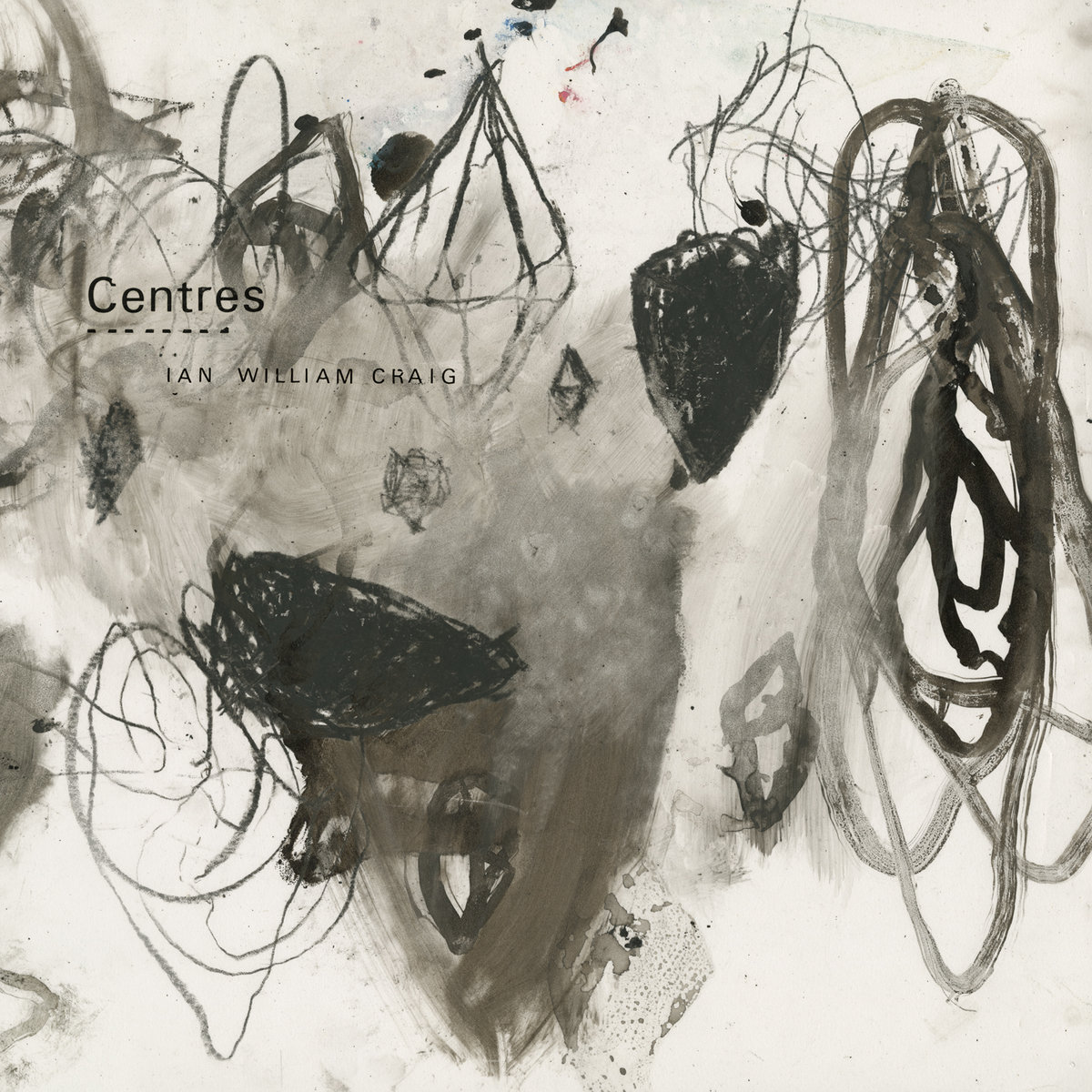
Passing us by on release Ian William Craig‘s unassuming but nevertheless epic sweeping ambient opus Centres arrived without much fanfare on its release. However, these cerebral peregrinations, songs of hope, soulful expansive hymns and sonic journeys into space were given rave reviews by those who did pay attention. And so initially missing coverage on the Monolith Cocktail, we’ve made up for it since by featuring tracks from the album in our ‘quarterly playlists’ and now, in our ‘choice albums of 2016’ feature. It is one of the year’s most beautiful, inspiring and often just meditative concatenate suites; offering glimmers of awe. DV
Dillon & Paton Locke ‘Food Chain’ (Full Plate)
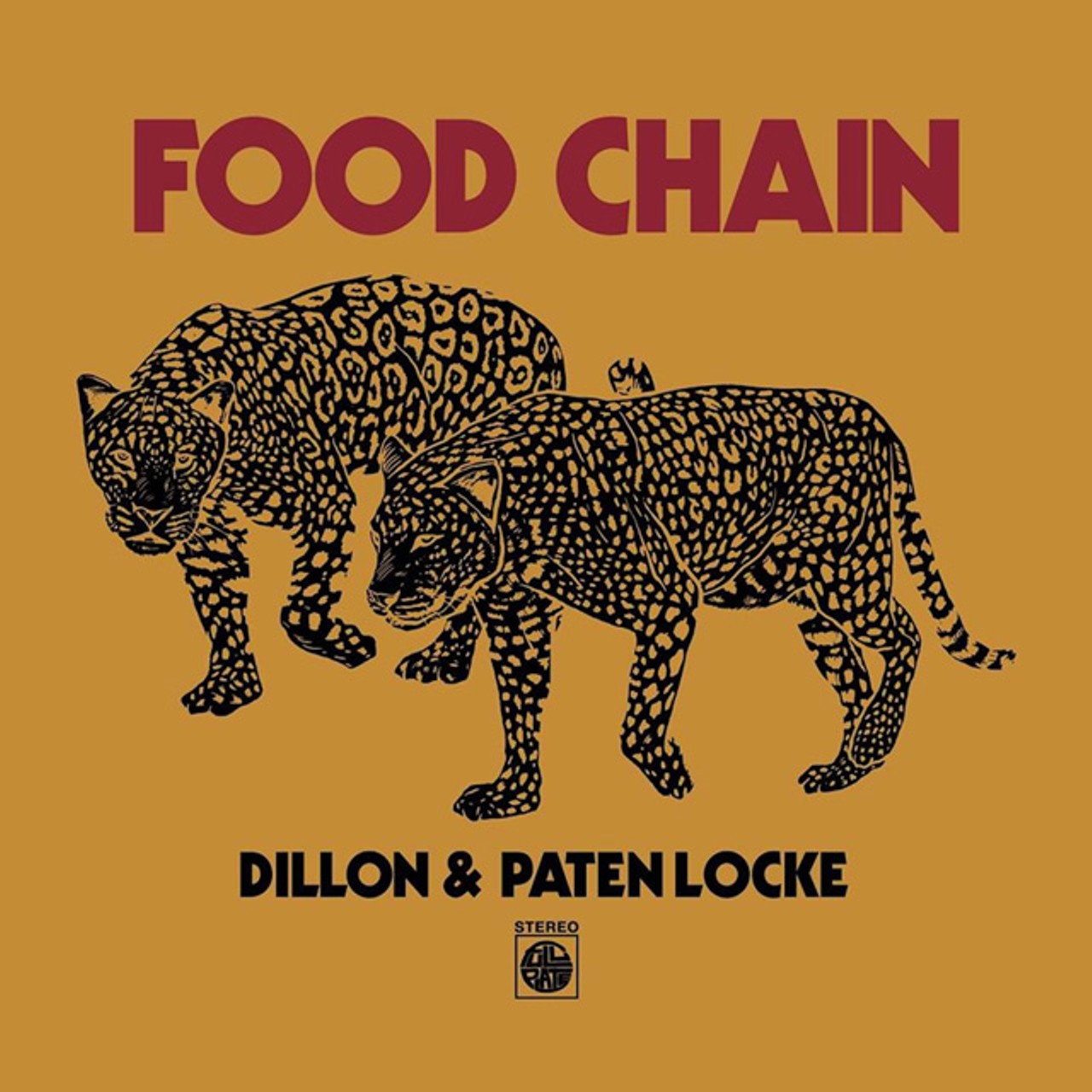
“Gourmet underground platters rooted in the South but giving you seven courses of funk and back.” MO
It might only be found as small print on some menus, but who are we to ignore prime indie cuts encouraging you to “pour a bucket of gravy over yourself and just feel that”. When they’re not rewriting the rules of the Ice Bucket Challenge, Dillon & Paton Locke are always gnawing on something, rhyming as they chew it. Funky, crate-rifling beats are laced with an overzealous streak, cogently able to stop the album dead from 60 to 0 and then re-energise it the other way, and a press-record-and-just-go appetite never misses a trick on the mic, with a hint of political soap-boxing and getting down to some grown man, take a look around biz. Their guest chef specials aren’t too salty either – R&V favourites Homeboy Sandman and J-Live, Dres from Black Sheep and people’s president Lobsterdamus, help flavour a certified belly-buster for 2016.
Read the original review here…
Ed Scissor & Lamplighter ‘Tell Them It’s Winter’ (High Focus)
“An intriguingly created world of wisdom, paranoia, numbness and finding peace in its own mind”. MO
High Focus have had the mother of all years, the consistency of everything they’ve dropped dominating the last 12 months of homegrown hip-hop. Ocean Wisdom (‘Chaos 93’) boasted youthfully infinite ammunition. Dabbla (‘Year of the Monkey’) got up to a whole load of japery reaching across the bar. Fliptrix (‘Patterns of Escapism’) executed label ideals to the fullest. Yet in the spirit of thinking differently, Ed Scissor and Lamplighter, the absolute antithesis of those mentioned, take the honours by a short head. Blair Witch hip-hop with its nose to the wall, barely keeping its head above water while barely raising an eyebrow, pulls off the Houdini-like stunt of subverting hip-hop norms while sticking close to them like a second skin. A slow and deliberate bittersweet bloom of triumph, creating the ultimate flip script of offering easy solace and comfort when all looks lost.
Read the original review here…
Elzhi ‘Lead Poison’ (Glow365)
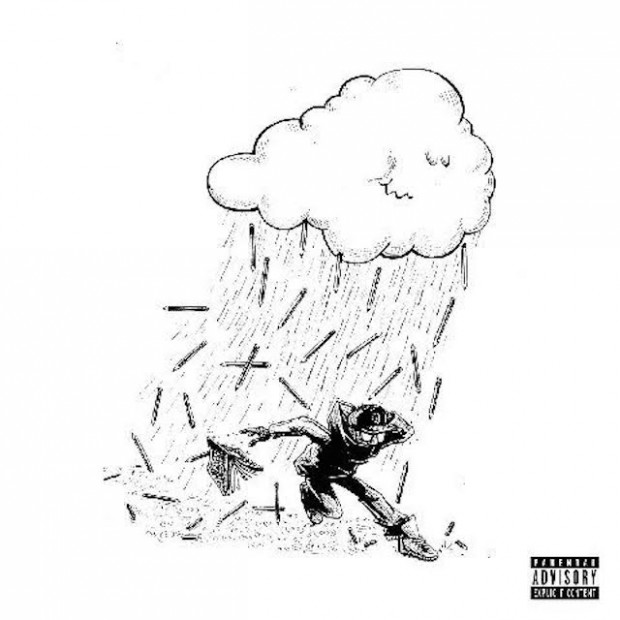
“Ear-catching narratives covering the everyday grind…not far off being a complete LP”. MO
Coming out the other side of mental health issues has Elzhi using ‘Lead Poison’ as catharsis, resulting in some of the year’s most vividly delivered rhymes and storytelling in the process. Done so in near enough bite sized chapters, proves that if the story’s interesting enough, it’s long enough. Never buckling under pressure, even when the likes of ‘Cloud’ feel like everything is conspiring against him (not to mention the potential of his health showing overall weakness), heart is worn on sleeve and self-examinations are set to a forceful soul soundtrack pushing its protagonist. With softer neo-soul going back to Elzhi’s Slum Village heritage, there’s also room for a little light heartedness, with ‘She Sucks’ doing forbidden love by garlic and wooden stakes, and ‘MisRight’ bending the thesaurus. An album that goes from strength to strength, listen on listen.
Read the full review here…
Eleanor Friedberger ‘New Views’ (Frenchkiss Records)

Another album we missed on its release, Eleanor Friedberger‘s third solo spot New View is another impressive songbook of idiosyncratic pop. Streamlining the signature intelligent reference-heavy prose of her sibling act The Fiery Furnaces, Eleanor continues the clever turns of phrase but in a more attentive, breezier and lightened but less cluttered manner. With elan she sets out on a dry-witted but emotionally philosophical picnic through the East Village with Patti Smith and Harry Nilsson in tow.
Paul Hawkins and the Awkward Silences ‘Outsider Pop’ (Blang Records)
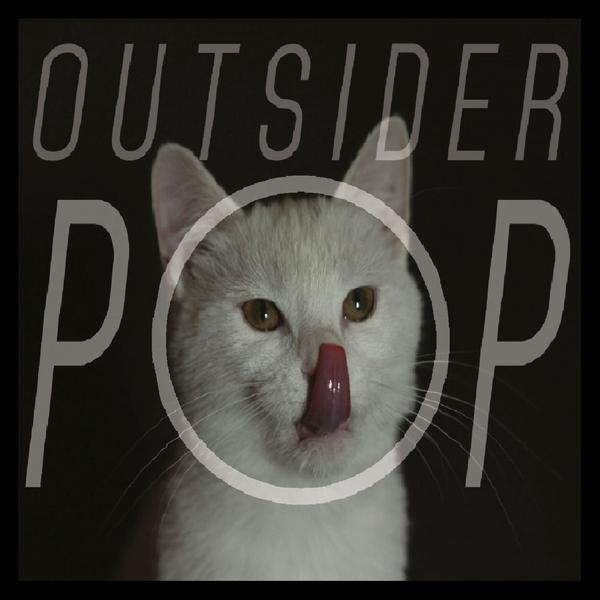
‘Lethargically executed and quintessentially an antifolk statement of protest, Outsider Pop is a highly infectious album of pop parodies that penetrate the bland veneer of the contemporary irksome vacuum known as the mainstream. Shambling discontent at its finest.’ DV
The disgruntled savant of disco funk pop and antifolk Paul Hawkins completely in the dark, oblivious to the dreadful proclamation of David Bowie’s impending death paid an augur homage to his white-suited and booted pop incarnation of the 1980s by transmogrifying ‘China Girl’ into an Outsider Pop anthem. Produced by that nutflake nostalgist, and one of the busiest men in the industry right now Ian Button (of the mighty Papernut Cambridge, Gare du Nord label and umpteen other projects), Hawkins’ third album also finds foibles of inspiration from REM, The Fall, Toto and The Art Of Noise; reflecting a much broader sound than before. The no wave, white funk, pop melodies act as a Trojan Horse, the themes far from advocating a hedonistic lust for life or suggesting the listener suppress the doldrums of modern life, are filled with malcontent at the state of the world.
Read the full review here…
John Howard ‘Across The Door Sill’ (Occultation Recordings)

‘Not so adrift and experimental as to have cut all ties to his signature profound sincerity and sad romanticism, John Howard’s Across The Door Sill dares to go further with an even more immersive experience. Expanding his poetic lyricism and piano performances, stark and stripped-back, his vocals multiplied to fill the space and build the atmosphere; Howard has room and time to create some stirring music. It is a most sagacious reflection from the artist, still finding the inspiration to develop and take risks. In doing so he’s reached what could be one of the creative pinnacles of his career.’ DV
Imbued with the 13th century poet Rumis ‘Quatrains’ poem, which encourages us to broaden our horizons and to not just accept what we’ve done in the past, the adroit songwriter and pianist John Howard experiments with a stripped back sound of multilayered vocals and the melodious gravitas on his latest songbook Across The Door Sill. Attentive and epic the album’s sagacious stream of consciousness is a deeply reflective observance on where we are now. In no hurry to get to a hook or chorus, his source material, a collection of unhindered, unhurried and floating poems, was developed overtime, set to music in an organic fashion. Hence why three of the five songs on this LP are nine-minutes long. On a successful run of collaborations and solo projects Howard is enjoying his most productive period yet in a career that’s spanned five decades.
Read the full review here…
Illogic ‘A Man Who Thinks With His Own Mind’ (Weightless)

“Streams of quotable IQ create a fever dream. Snooze, you lose.” MO
Ohio rhyme scientist Illogic provided his own version of a hip-hop out of body experience, a canon of verbosity when bedding down for the night and setting free streams of consciousness while looking through a telescope. This in itself created its own contradiction of being an album expressly trained to set you afloat (The Sound Cultivator’s star-shaped soul powered by plasma rays > strictly no cloud rap), which still kept you wide awake with naturally intricate rhymes, both book and street smart, about life, the universe and everything else. Anyone who starts an album with the observation that “the tofu was not as firm as I’m used to” deserves nothing but praise and respect. The modern equivalent of becoming engrossed in a good book that tells your imagination to run.
Read the original review here…
J-Zone ‘Fish n Grits’ (Old Maid Entertainment)

“Dripping in home truths from his funk soapbox, disillusionment with hip-hop and its cultural hangers-on has never been more entertaining”. MO
Better placed than most to justify a love-hate relationship with hip-hop, J-Zone proclaimed “there’s only two types of music – good and bad. Make good music, or shut the fuck up.” Paired with helium alter-ego/juvenile imaginary friend Chief Chinchilla as hilarious equal opportunity offender, and showing the strain of ‘Peter Pan Syndrome’ remains strong, ‘Fish n Grits’ goes in with scathingly relatable accuracy about the state of the game, misty-eyed nostalgia replaced by a nose-bloodying team of goons busting a whole load of myths. Additionally, whereas Zone’s production used to pop off all over the place in a skilfully spring-loaded criss-cross, he’s honed his own funk skills into a true mastery to compliment his industry disses. Hallelujah that he can’t leave the game alone.
Read the full review here…
Fela Ransome-Kuti And His Koola Lobitos ‘Highlife-Jazz And Afro-Soul 1963-1969’ (Knitting Factory Records)
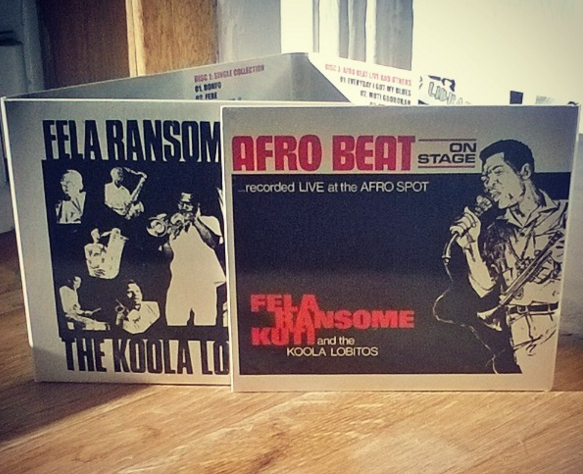
‘Hot stepping and sure footing through Savoy label like jazz and Stax/Volt revue soul, Fela and his first ever professional band Koola Lobitos were the missing link on the eventual road to the Afrobeat phenomenon. An evolving Fela, only a few shuffles short of cultivating his signature, already shows a raw energy on this compilation’s studio and live recordings.’ DV
In the midst of another celebration and anniversary appraisal the Afrobeat pioneer and political protagonist Fela Kuti has seen the back catalogue legacy re-released and repackaged countless times. There’s been a stage production of his life, and a documentary film in the last couple of years alone. But one of the most revealing and raw tributes is this burgeoning showman showcase; a labour of love that collates together a number of previously scattered, thought lost, rare early recordings – both in the studio and on stage – from the stax/funk/soul years. A “labour of love”, stemming from Toshiya Endo’s African Music Home Page website, launched in the late 90s, the Fela Kuti and His Koola Lobitos material were collected from around the world, from the collections of various fans. By day a professor of Chemistry at Ngoya University, Endo’s passion and hobby of cataloguing West African music attracted the author of the Fela: The Life & Times Of An African Musical Icon bio Michael E. Veal. Lucky for us the dynamic duo produced this lavish and arduous compilation of explosive early Fela beauties; one of the best and revelatory introductions to the great polymaths work yet.
Read the full review here…
Bob Lind ‘Magellan Was Wrong’ (Ace Records)

Another masterclass from the sagacious Bob Lind, his latest album is a majestical and often jazzy lilting lesson in songwriting. With decades of elan and adroit performance behind him Lind isn’t ready just yet to rest on past melodic triumphs and spoils, showing himself ready to adopt and try out new ideas on Magellan Was Wrong – a reference to the Portuguese explorer who first circumnavigated the world, proving it was of course a globe and not flat, though Lind’s song of the same name and homage metaphor questions that wisdom in the face of despondency and disappointment. The characteristic voice and style is of course signature Lind, the songs and themes timeless. With a host of producers, including progressive jazz pianist and composer Greg Foat, on board this strongly nautical feel and reference strong songbook, both the entertainer and troubadour are lent a new lease of life.
 Monolith Cocktail Blog