The Digest for November 2025: New Music/The Social Playlist
November 19, 2025
THE MONTHLY DIGEST INCLUDES A CLUTCH OF ACCUMULATED NEW MUSIC REVIEWS AND THE SOCIAL INTER-GENERATIONAL/ECLECTIC AND ANNIVERSARY ALBUMS CELEBRATING PLAYLIST
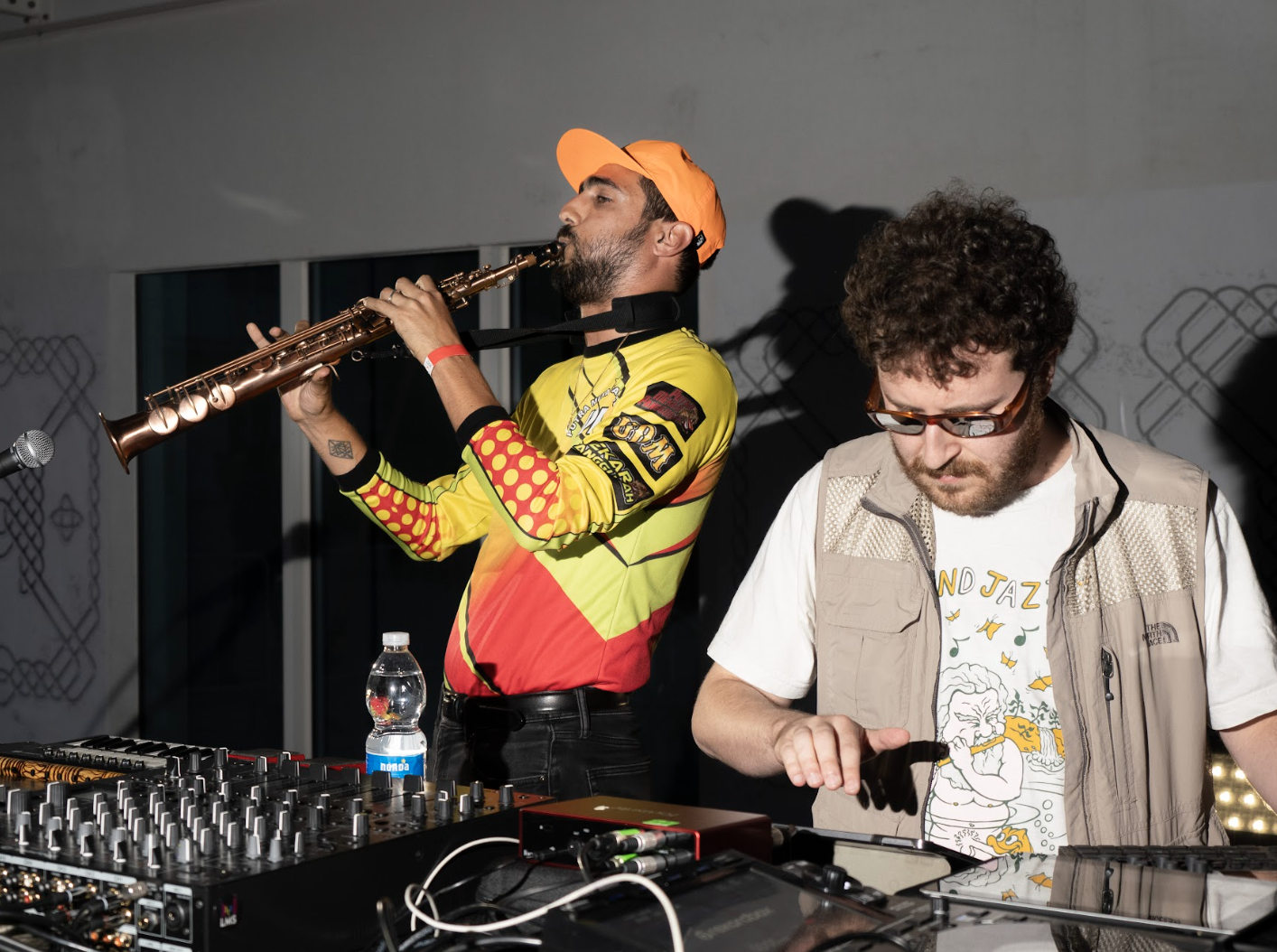
Photo Credit: Babau by Marco Valli
_/THE NEW___
Babau ‘The Sludge of the Land’
(Artetetra) 14th November 2025
A phantasmagorical shifting of tectonic plates and fever dream of a Henri Rousseau conjured equatorial lost world. And I could leave it at just that, but I’m sure both you as the reader and curious mind, and the duo behind this strange fourth worlds peregrination and inhabitation, would want a bit more to go on.
From the Artertra label founding sonic partnership of Italians Matteo Pennesi and Lugi Monteanni and their long-term Babau project an album that moves an imagined continent of influences towards new sonic, hallucinatory and kooky climes. The first “full length” work since 2023’s Flatland Explorations Vol.2, The Sludge of the Land funnels library music, the avant garde, the discombobulated, wonky electronica, the cartoonish, 32-bit console music, vague uses of ethnography and the atavistic, the visions of Jon Hassell, the breakdown shunts and floppy disc music of Esperanto era Sakamoto, the morphing AI electronic lunacy of Cumsleg Borenail, the fun kookiness and springy worlds of Carmen Jaci and Trans Zimmer & The DJs, new age trance, and at times, the more sublime drifts of Wu Cloud and Iasos into an odd repurposed wilderness. A track like ‘I tried to find myself but eventually found another, and now it’s the two of us somehow’ for example, merges Carl Stone with the mirage guitar bends and hangs of Daniel Vickers, the thinly dried blows of Ariel Kalma.
With titles that are so long as to read like haikus or little stories in their own right, there’s much in the way of descriptive prompts – although some seem like they might reflect the overuse these days of feeding blindly words, detritus and meta from the Internet into ChatGPT or some such device. Much of it describes a hodgepodge of ritual, mythologies, culture and the surreal. And musically and sonically reads like a mixed topography of palm trees, exotic islands, deserts, misty mountains and wet vegetation.
As part of a residency at Casa degli Artisti, Milan, in 2022, Babau turned their creative space into a recording studio and performing venue thanks to audio engineer and musician Francesco Piro, who produced the album. That apparatus includes instruments and effects that make sounds like reversed shaves, tangled and gangly wires, springs, chimes, the mistily fluted, and whistled alongside the recognisable sounds of a lingering foggy sax, of sauntered and hand tub drumming rhythms and both the inner workings of and the serial kooky notation of the piano.
This is an environment that squeezes the Mosquito coast up against Java, Malaysia, Polynesia and the near fantastical to produce something familiar but disjointed and surreal.
The Flower Press ‘Slowdance’
6th November 2025
Continuing to pursue a solo course, but now under the new appellation of the delicate craft imbued The Flower Press, Matt Donovan, in his own meditative and wistful way, turns the sudden loss of his sister into a subtly beautiful and reflective work of art on his fourth album.
The process of grief that prompted not only a change in musical direction (not so much that the musical signatures of past albums are entirely lost) but a much-needed therapeutic outlet, a project in which to find meaning from such a tragic event. The softly evocative Slowdance album offers consolation and testament to a life lived; the memories – referenced in a style with the track titles -, near abstract and visceral, are quantified and saved in sound and musical form to reflect upon with a great fondness and love. For Matt doesn’t just pay his respects, but also sends out moving testimony and vibrations as a way of keeping contact, of saying all the things he might have never had the chance to before, whilst healing himself.
Regular readers of the site may know Matt as the former motorising and propulsive drum beat behind Eat Lights Become Lights, and for his collaborative partnership with Nigel Bryant in the psych-Krautrock-post-punk-folk-industrial duo The Untied Knot. Away from the latter, Matt has released a trio of solo albums: Underwater Swimming (’21), Habit Formation (’22) and Sleep Until The Storm Ends (’23). This latest album of mainly instrumental pieces, takes some of the old influences but, with warmth and a wisped gauze of ether, is moving towards the orbits of Ariel Kalma, Daniel Lanois, The Durutti Column, the flange guitar-like ambient works of Harold Budd, Eno, Susumu Yokota and Mark Hollis post Talk Talk. But then there’s always a certain quirkiness and flash of post-punk and no wave dance music trebly bass playing to be found. And of course, the acoustic folksy and troubadour influences that sound particularly pastoral or in-situ: conjuring up some held dear or nostalgic escape, a glade perhaps or the sensation and touch of falling snowflakes and the building of a snowman. Some of those moments reminded me of the Wayside & Woodlands label whilst others of Arthur Russell.
The measuring of time, the chimes and triangle rings; the thin stick hitting tablas and the desert melting mirage guitar evocations of Daniel Vickers; the harmonium like moods and the Fripp-esque articulated memory of a slow dance watched from dreams; and both the stillness and the wavy, reverberated movements all articulate notions of remembrance and invested introspection. But also perhaps, manifestations of better times ahead, of durability in the face of such a heavy personal loss: the loss of a sibling hitting all that much harder.
A most wonderful album that eventually soars towards a starry celestial plane, Slowdance hovers and drifts above terra firma on a quest to evaluate and represent a life lived and the memories that pour forth from such fateful challenges. With a new title, Matt pushes into ever new and emotionally resonating territories.
Erell Latimer ‘Stay Still’
(Kythibong) 18th November 2025
The translation of visceral and abstract speech, dialogue, narration, poetry, testament, inquiry through musique concrète and tape manipulation, the new experiment from the sociolinguist composer and writer Erell Latimer is an immersive performance of reaction, interaction and interruption.
I’m not sure of the apparatus used, but other than the various machines used for effects, distortion, and what sounds like the manipulated in real time, folded, counter-folded and warped tape reels, both the long form pieces that make up this work rely upon Latimer’s voice and readings. Described in the accompanying notes as partly “concrete fiction”, fragments of Latimer’s text pieces and writings are set to a both alien and distorted, machine-like and discombobulated sounds and oscillations. Mostly in French, with passages of often disturbed or obstructed poetic philosophy and forbode from some English male speaker, the texts fluctuate between the hushed, the near in-hiding and held hostage to the clearly proclaimed and read. The cadence, both interrupted and defined signifies pain, anguish, the critical, stress, panic and theory.
The various resonated and reverberated voices and talks move from background quietness to foreground rustled distortion, and often form interlayered semantic rhythms and new utterances. Often though, Latimer’s voice is stripped down to an assortment of breathing techniques: often sounding like the aftermath of a panic attack, with Latimer trying to get her breath back or get it under control: exhales as important as anything else in this experiment and expression of “alienation, confinement, suffering, resignation, abandonment and death”.
There’s plenty of interesting, thrown, or points and nodes where both vocals and sounds interact to form hallucinations or more supernatural and haunting passages. Sometimes these interactions culminate in simulated tumults of hurricane winds, and others, into something far more musical; nearer the end of the first piece, ‘Ils seront silencieux après’ (“they will be silent after”), there’s a sort of lovely piece of music that’s part Gainsbourg, part Krautrock, part classical soundtrack.
From what sounds like paper or tape fluttering in the draft of a ventilation unit or extractor to bulb-like notes rings and chimes and the sounds of the environment, the voices and speech find space across a constantly explored soundscape of effects and obfuscation. At times it reminded me of Michèle Bokanowski, Matija Schellander, Lucie Vítková and that musique concrete progenitor Pierre Schaeffer; in short, an experimental work of language and semantics that deserves greater attention.
Plants Heal ‘Forest Dwellers’
(Quindi) 28th November 2025
The prolific and always into something drummer and trick noise maker Dave De Rose is back with his keyboardist/percussionist foil Dan Nicholls and visual anthropologist collaborator Louise Boer (otherwise known as Lou Zon) for another round of the electroacoustic project, Plants Heal.
De Rose popped up on the site as part of the Rave At Your Fictional Borders union of Jon Scott of (of GoGo Penguin note), Marius Mathiszik (Jan Matiz, I Work In Communications) and Henning Rohschürmann a while back, but his CV is packed with notable creative enterprises and collaborations, including membership of Electric Jalaba, a stint with the acclaimed Ethio-jazz luminary Mulatu Astake and instigation of the Athens-London traversing Agile Experiments project. The initial seeds for the Forest Dwellers project were planted both through the latter and through Nicholls and Lou’s London-based Free Movements events; both acting as intersections for all three contributors to cross paths, and to explore the central tenant of merging instrumental music with live electronics and DJ sets. If we’re talking about spheres of influence and CVs, Nicholls of course has just as prolific and busy schedule as a keyboardist, reeds player, composer, producer, and visual artis, whilst Lou’s documentary and experimental filmmaking and visual skills have led to a teaching role at Goldsmiths.
Lou’s work revolves around ecology, community, plant medicine, feminism, movement and experiments with analogue techniques. And this seems a good base from which De Rose and Nicholls have spontaneously reacted or conjured up improvised-like sounds and rhythms rich with organic meta and matter. During performances Lou improvises with analogue footage from her library run through video mixers and synthesisers, focused on medicinal plants such as yarrow, hawthorn, nettle and thistle. All those plants feature in processed form on the cover of the record, which was designed in collaboration with Lou’s brother Arthur Boer. Meanwhile, Lou recorded additional footage in Athens during the recording sessions to feed into the continued cycle of the project’s live evolution.
The trio’s second album together (their previous self-titled debut was released back in 2021) is a biomorphic eco system of new age trance music, techno, dub, light jazz, breaks, amorphous ethno-beats, acid and both plant-based and more alien atmospherics. Tech and nature combine to create a kind of Fourth World version of electronic dance music. But that’s really only part of the story, as the living and breathing creepers, vines and branches of the forest canopy and floor integrate with pulsations, shuttered, tubular, hollowed pole paddled and shaved or slowly released electronics to produce a camouflage reverberating effect of movement, growth and expansion.
There’s a revolution of a kind in the same air, with whispery like effected and morphed voices emerging from the fauna, and a revision of the old tribal gathering nature-tech and freedom rave-ups of the late 80s and early 90s. I’m hearing vague signs of Richard H. Kirk, FSOL, Jeff Mills, Lukid, Warp Records, Conrad Schnitzler, Mike Dred and Jon Hassell. Still, there’s more to unpick from the very much percussive and drum led rhythmic evolutions on this album; echoes of various more atavistic and exotic musical influences; timings and patterns enhanced by ethnography study and absorption. From terra firma to the stars, this organic flora form of electroacoustic dance music proves pliable, liquid but full of substance and the tactile, the earth and air.
Super Grupa Bez Fałszywej Skromności ‘The Book Of Job’
(Huveshta Rituals) 28th November 2025
From true obscurity and the dusty shelves of dormant archiving, The Book of Job emerges from its forty-year sleep – recorded as it was back in an omnipresent Soviet controlled Poland of 1985 – into a climate that scarily resonates. Whilst the sickle and hammer have disappeared from the flag, and Communist totalitarian rule has been replaced by a new form of oppressive authoritarianism in Putin’s leader-cult Russia, aggression persists and the threat of invasion, or at least escalation against those former countries that fell behind the Iron Curtain after WWII, looms large. No longer an abstract threat, Russia’s expansionist ambitions look to lock horns with Nato and the West, with a near apocalyptic destructive war in neighbouring Ukraine pushing at the borders of Poland. If nerves can no longer hold, if there is no end to the hostilities, no ground given on either side of this brutalist invasion, and if Ukraine is lost, then Poland becomes the new frontier between Europe and dictatorial Russia: a Russia hellbent it seems on regaining its lost influence and control of Eastern Europe.
There will be generations now totally separated from Poland’s past as an occupied state, subjected to draconian control by the USSR. But the timely arrival of this cult recording will once more remind its people and the world at large, of events in the 1980s; a decade when despite violent suppression, the population rose up to eventually overthrow its Soviet authorities at the end of that decade. When the various notable luminaries of the Polish underground and jazz scenes, and the counterculture’s actors and voices behind the collective ensemble of Super Grupa Bez Fałszywej Skromności first performed this multilingual and faith spanning work at the 1981 Jazz Jamboree festival, the omens weren’t quite so grave. Only weeks later the situation had changed dramatically, with Genral Jaruzelski’s ordained Martial Law rules cracking down ruthlessly on the population. In light of civil peaceful protest and the strike action and heroism of Lech Wałęsa’s famous Solidarity movement, the authorities more or less implemented a military coup of extreme measures: As the accompanying album’s scene-setting essay informs us, “Art was replaced by parades of heavy artillery”. By the time this same group recorded an album, four years later, the very act of making music would be considered a symbol of defiance: unless of course it was used to glorify the Soviet regime. “Paradoxically” the Catholic Church of Poland became a sanctuary. This may explain, in part, why the Hebrew’s Old Testament (reused in the Christian Bible and also “echoed” in the An-Nisa chapter of Islam’s Qur’an) chronicle of Job was used as totem for endurance in the face of such suffering. Because much as Job suffered tribulations and trails at the hands of God, beguiled and tempted by Satan to turn away from his piety, many of the Polish people found solace, resistance and hope despite the relentless attacks on their freedoms.
An allegory of the human condition, The Book of Job, for those who never attended their Sunday Schooling lessons, nor attended a faith-based school, tells the tale of the protagonist and his testing by God through litany and prose: that’s three cycles of debates between Job and his friends, Job’s lamentations, a poem to Wisdom, Elihu’s (a critic of Job and his friends, who may have been a descendent of the Abraham lineage) speeches, and God’s two speeches from a whirlwind. In short, Job is a wealthy God-fearing man with a comfortable life and large family, living in the Land of Uz (which has been situated in various locations of the atavistic Levant and beyond by various sources; anywhere from the old Aram, now modern Syria, to the Edomites kingdom, which now stretches across modern Jordon and Israel). God discusses his piety with Satan (though this is often written down as “adversary”, but we know who they mean), who rebukes God, stating that Job would turn away from God if he was to lose everything within his possessions: which was a lot. God decides to test that theory or challenge by allowing Satan to inflict pain on Job. The test increase, the suffering gets much, much worse, and Job ends up losing his wealth, children and health. Through it all he maintains his faith and piety, but not without much discussion and challenge. By the epilogue, Job’s fortunes and family are thankfully returned to him: Satan I take it, scuttling off to curse and sulk in the shadows.
Recorded in a makeshift “high-fidelity” studio at the STU Theatre in Krakow in the Spring of 1985, The Book of Job album draws with serious depth and political allegory upon the text. Covering everything from stage theatre to the filmic, the avant-garde and of course jazz – most of the lineup in this singular gathered super group hail from Poland’s incredible and influential jazz scene -, but so much else, the Holy Land is transported across porous borders to Eastern Europe to take in the Jewish diaspora, acolytes of Indian and Far Eastern scriptures and the then contemporary 80s sounds of the underground.
The “revered” pool of players, luminaries that took part include the multi-instrumentalist Milo Kurtis, a Pole of Greek origin, born into a family of refugees escaping the civil war in Greece, noted for his roles in Grupa w Skład, Ya-Sou, the cult rock band Maanam and jazz-fusion super group Ossian (also said to have worked with Don Cherry, who gifted Milo his ocarina), on percussion, Jew’s harp and trombita; the Polish flutist of world renown, composer and arranger Krzysztof Zgraja, who made his debut in the jazz-rock band Alter Ego, but also played with Czesław Gładkowski and Jacek Bednarek, on not only his main instrument of choice but the lighter made and smaller range Fortepiano; the Polish avant-garde and free jazz player Andrzej Przybielski, who’s notable credits include stints with the Gdansk Trio, Sesia 72, the Big Band Free Cooperation and Acoustic Action, on trumpet; drummer, composer and cultural animator Janusz Trzciński, known for his extensive work in the theatre, a writer of plays and one of the main instigators behind this project, on drums; the highly rated Zbigniew Wegehaupt, who played with just about every Polish jazz icon going and in both Wojciech Gogolewski’s Quartet and Extra Ball, on both electric bass and double-bass; and the Polish composer, multi-instrumentalist, vocalist and teacher Mieczysław Litwiński, who studied with such groundbreaking luminaries as Stockhausen and co-founded far too many groups and projects to list here, but notably the Independent Studio of Electroacoustic Music and Light For Poland, on sitar.
Added to that role call was an ensemble of either commanding, English Repertory-like or ominous voices and vocalists from stage, screen, including Ignacy Machowski, Adam Baruch, Zdzisław Wardejn, Jerzy Radziwiłowicz, Juliusz Berger and Andrzej Mitan. It must be pointed that only Mitan receives the credit of vocalist; the Polish poet, performer, founder of the Alma Art record label, chants a poetically evocative forgiving gospel of obedience and implored yearning whilst on the album track ‘When A Man Dies’. Echoed as much from a cavern or cave on the desolate plains of the Uz as in the synagogue, the repeated mantra of “Man. World. Pain. Silence” is stoically announced over and over to sombre and yet beautiful tones. The rest of that cast find themselves either narrating or interlayered with a whisper, chattering chorus of atmospheric dialogue. It reminded me, in part, of Aphrodite’s Child own Biblical opus 666.
Hallowed yet dark and almost Chthonian in places – a touch of Byzantine too – the album sets an otherworldly, afflatus but esoteric scene with the opening resonated waves of airy, fluted and blowy vibrations, moving like cycled or tubular wind from the subterrain, on the introductory entitled opener. Something mystical dances in the wind, as echoes of Alice Coltrane and Prince Lasha stir up spiritual jazz mirages and something quite ghostly seems to be lurking in the vibrations. The story unfolds, the mood suitably enacted. ‘Satan’s Concept’ follows this with percussive shimmer and shivers and a supernatural voice of forbode. Evocations of both Don Cherry and 80s Miles Davis like trumpet both trill and sound almost swaddled on another visceral and porous geographical musical landscape: the vibrated bowl sounds of Tibet for example. But the whole feel changes on the first of three litanies, with what could be called a post-punk bass and signs of krautrock and jazz-fusion: think an impressive union of Einstürzende Neubauten, My Life In The Bush of Ghosts Eno and Byrne, Desert Players Ornette Coleman, Jon Hassell and Ramuntcho Matta relocated to the land of the lost tribes. ‘Accusation’ has a promising Blue Note jazzy double bass introduction, a little bluesy and bendy. It’s accompanied by some rattled hand drums; the only instruments that express and lay down the atmospheric flexed, stretched, harmonic pinged backing to the biblical echoed English voice that narrates and questions God.
The post-punk-jazz mood is back for the second litany. A sort of no wave funk noodle of Dunkelziffer and Miles, a long low horn from the Steppes, and dialogue of wisped and more esoteric voices spoken in multiple dialects, there’s a supernatural quality to the atavistic summoning of scripture, and the age-old battles between good and evil. Almost skulked, there’s vocal coos and spectre like demons and angels in the shadows of this dramatic Krautrock-esque holy visitation. ‘Hope’ brings back in the Eastern influences, the sound of Buddhist India with the signature reverberations and brassy rings of the sitar: Shiva on the Vistula. With its psychedelic ragga mediations, the sitar acts in unison with the twanged boing sound of the Jew’s harp, the only accompaniment to the Hebrew narration.
The third and last of the litanies is quasi-80s funking jazz, with elements of Hassell’s Fourth World experiments. The flute whistles and flutters willowed fashion on a moving jazzy-fusion-funky-no-wave bass, as overlayed voices create a more convivial dialogue. There’s a smog horn too that creates a misty vapour effect. But the rhythm is like some kind of Israeli or Eastern European dance.
The album finishes on a strongly reverberated Hebrew voiced narration, a sacred holy conversation. Near the end of ‘Final’ a dreamier ray of light like flute emerges, slowly and softly drifting skywards. The sound of relief. A burden lifted.
You can easily find the parallels, the battles with faith in the face of such brutality, of oppression, and in this case, Soviet authoritarianism: The role of religion and believing playing a crucial part in resistance. As a near cryptic or hidden means of showing such defiance, The Book of Job and its lessons carried that message of artistic and political/social hope. This album, even without any of its important cultural and political context, is an artefact that deserves saving and savouring: a real intriguing, atmospheric and near theatrical experience worthy of attention and acclaim. Not just a slice of history but an experimental work of art.
___/The Monolith Cocktail Social Playlist Vol. 103___
For the 103rd time (and most probably the last as I change the format for next year), the Social Playlist is an accumulation of music I love and want to share, with tracks from my various DJ sets and residencies over the years and both selected cuts from those artists and luminaries we’ve lost on the way and from those albums celebrating anniversaries each month.
It was a few months back that I celebrated the 100th edition of this series, which originally began over 12 years ago. The sole purpose being to select an eclectic and generational spanning playlist come radio show, devoid of podcast-esque indulgences and inane chatter. In later years, I’ve added a selection of timely anniversary celebrating albums to that track list, and paid homage to some of those artists lost on the way.
The final social of 2025 merges together anniversary celebrating albums from both November and December. This selection includes 50th trumpeted milestones for Eno’s Another Green World, Patti Smith’s Horses, Kraftwerk’s Radio-activity, Burning Spear’s Marcus Garvey and Parliament’s Mothership Connection. There are even older throwbacks, 60th salutations, to The Who’s My Generation (I’ve gone for The Users version of ‘It’s Not True’ for something a bit different) and The Beatles’ Rubber Soul (I’ve gone for two covers, Davy Graham’s take on ‘I’m Looking Through You’, and Anne Murray’s version of ‘You Won’t See Me’). Added to that impressive list are 40th nods to The Jesus and Mary Chain’s Psychocandy, and LL Cool J’s Radio; and finally, whilst we’re in the hip-hop icon camp, I had to drop a track from the Genuis/GZA’s Liquid Swords, which is 30 this month.
The rest of the list includes songs from across the last five decades, with entries from Excepter, Vitriol, The Mattoid, Cowboys International, Milford Graves triumvirate free jazz experiment with Arthur Doyle and Hugh Glover under the Children of the Forest banner, Pekka Airaksinen, Sir Robert Orange Peel, Byzantium, Thony Shorby Nwenyi, Fat Spirit and more…
Tracks:
The Users ‘It’s Not True’
Anne Murray ‘You Won’t See Me’
Cowboys International ‘Part Of Steel’
Brian Eno ‘I’ll Come Running’
Excepter ‘Maids’
The Mattoid ‘Suicide’
Patti Smith ‘Redondo Beach’
The Jesus and Mary Chain ‘Taste The Floor’
Fat Spirit ‘Planet Earth III’
Catherine Ribeiro ‘Iona melodie’
The Springfields ‘Are We Gonna Be Alright?’
Davy Graham ‘I’m Looking Through You’
This Heel ‘Bad World Above’
LL Cool J ‘That’s A Lie’
Parliament ‘Mothership Connection’
GZA ‘Hell’s Wind Staff/Killah Hills 10304’
Pekka Airaksinen ‘Ratnasikhin’
Vitriol ‘Restart’
Sir Robert Orange Peel ‘Brutalists’
Kraftwerk ‘Antenna’
Et At It ‘Beets’
Burning Spear ‘Marcus Garvey’
Thony Shorby Nwenyi People in the World’
Milford Graves, Arthur Doyle and Hugh Glover ‘March 11, 1976 II’
Byzantium ‘What A Coincidence’
Dry Ice ‘Mary Is Alone, Pt. I’
EABS ‘Niekochana’
Jack Slade ‘Lipstick’
Eberhard Schoener ‘Only The Wind’.
The Digest for September 2025: New Music/The Social Playlist/And Archives
September 22, 2025
The monthly Digest includes a clutch of accumulated new music reviews; the social inter-generational/eclectic and anniversary albums celebrating playlist; and choice timely pieces from the archives.
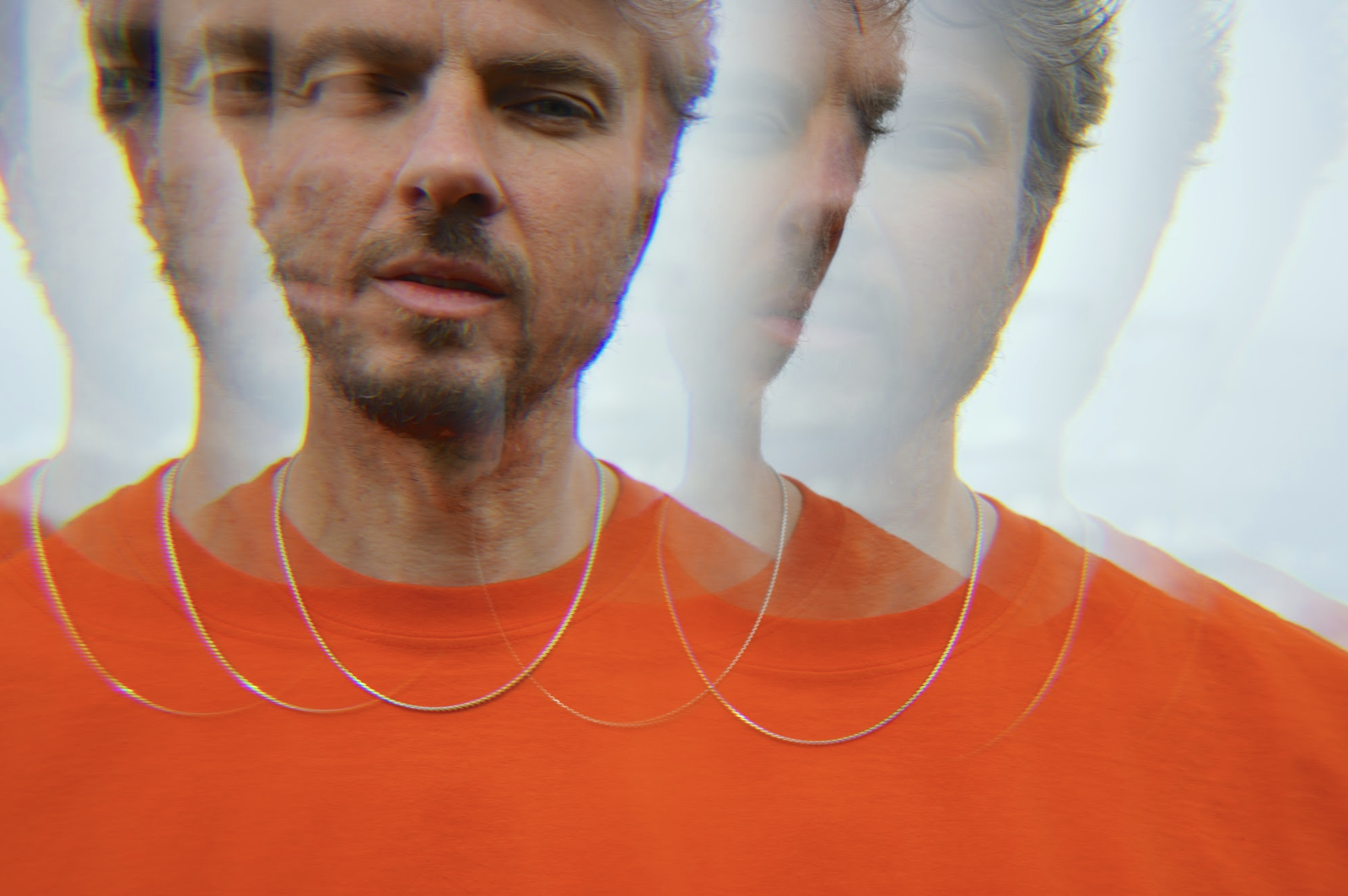
Tom Skinner photograph courtesy of Jason Evans.
___THE NEW___
Group Modular ‘The Tunnel/Lonely Pylon’
Reissue Special Released 19th September
The first transmission (or rather a retransmission if you like) from the Group Modular duo of Mule Driver and Marky Funk in three years, marks the inaugural chapter in a new series of special 7” releases “powered” by the duo’s alter ego Confused Machine and Delights labels. Those lucky enough to have grabbed original copies (sold in separate splits editions, both sold out almost immediately) of ‘The Tunnel’ and ‘Lonely Pylon’ will know that the former was part of Norman Records’ 2021 25th Anniversary split release by Polytechnic Youth, and that the latter was recorded exclusively for the third instalment in Russian Library’s L series of split 7” EPs back in 2022.
Back on the radar, with the chance to own these hauntological sci-fi suites and dramatization soundtracks, the self-described “Outer space sounds from Jerusalem-Tel Aviv route” library music makers reacquaint us all with their brand of analogue period cult space age influences and their taste for atmospheres and theme tunes that emit something that’s near supernatural. ‘The Tunnel’ is a curious Pietro Grossi like rocket ship steam and gas fusion of soft timpani, Roy Budd and Greg Foat-esque barque sci-fi harpsichord, and d ‘n’ b like dub beats. And the electric field throbbed ‘Lonely Pylon’ is a Library music imbued psychogeography of paranormal nature and unnerving children’s sci-fi TV of the 70s and early 80s – imagine Brian Hodgson, Sapphire and Steel and bygone public broadcasted information warnings resurrected by The Advisory Group or My Autumn Empire.
Hopefully this latest 7” series will prove a catalyst for more new recordings from the duo, who haven’t released anything together since Per Aspera Ad Astra in 2022. You’d better be quick, as I have a feeling it will sell out pretty sharpish.
Lt. Headtrip & Steel Tipped Dove ‘Hostile Engineering’
(Fused Arrow Records) 23rd September 2025
The gristle, outpoured thoughts, observations, protestations and glue between the oppressive urban structures of our dysfunctional, unworkable society both poetically and rhythmically twist and flow over a counterculture haunted psychedelic-prog, Krautrock and jazz-soul production on this debut project collaboration.
From the experimental, leftfield platform of Fused Arrow Records and its stalwart producer, engineer, beat maker and artist in his own right, Steel Tipped Dove, a new partnership with rapper, producer and instigator Lt. Headtrip.
Dove’s production and various studio skills can be heard on releases from such notable talent as Fatboi Sharif & Roper Williams, billy woods & Messiah Musik, Darko The Super, MC Paul Barman and Zilla Rocca. He’s also collaborated with the most dope and pioneering Dose One. The Lieutenant’s CV is no less impressive, setting up the ‘we are the karma kids’ label, organizing projects and events in the Brooklyn, Manhattan and Queens areas, and either collaborating or sharing stages with Armand Hammer, Open Mike Eagle, Quelle Chris, Beans, Backwoods Studioz, Reservoir Sound and Uncommon Records.
A magic combination of old hands from the underground scene then, the Hostile Engineering environment that engulfs them is twisted, churned, inhaled and transformed into a sometimes gothic, sometimes industrial, and sometimes more soulfully halo-lit arena for the spoken and rapped lyrics; the cadence of which reminded me at any one time of the Antipop Consortium, Rob Sonic, dalek, and when humorously and from a self-aware but confident in their own skin way, addresses the issues of sexuality, sex and the tired old tropes of rap machismo on the smoochy drifted saxophone and crunched drum beats produced ‘We Got The Sugar’, comes across a little like Homeboy Sandman: a sample of the lyrics being, “last week I was helpin’ his girl find her panties. This week I’m his bro’s new daddy. Just cause I can rap along to Liquid Swords don’t mean my dick’s boring.”
There’s more than enough clever ideas here, with samples I’ve yet to recognize, and an atmosphere that seems to channel all kinds of musical influences; from zappy Kraftwerkian synth and drum pads electro to the Floydian, Roy Ayers, Soul cuts, cult soundtracks (of suspense, horror and sci-fi futurism), heavy rock and prog – I think I’m overthinking it, but alongside what could be a sample from Sabbath or their ilk, it sounds like a short miraged shiver of cymbal resonance and slow drums from Neu!’s ‘Weissensee’ on the automation for the people, insurance servitude and dead-end careers themed polemic ‘0 Days Since Last Accident’.
Bot factories, the nightmarish promises of constant bodily cosmetic regeneration and the self-absorbed legacies that go with hanging on to the bullshit zenith of eternity, high anxiety, and on the repurposed halcyon soul Kayne-Jay-Z-Biggie fantasy “money, money, money” ‘Fund Don’t Stop’, a backslap to rampart consumerism and unsignifying spectacles of Black Friday (“We been shoppin’ since we bought that serpent’s product in the garden.”) – a lifetime of spending, from the womb to the tomb.
At thirty minutes long, there’s no fat on the bones, and yet plenty of tempo, musical changes, and a fresh rap style that neither preaches nor sits back in a nonchalant pose. A really successful pitch, bringing both talents together to fuse and articulate the present depressing miasma of the times in which we all live; glued to this rock, with no anchor, no compass, attached to the screen and validation culture of social media and its puppet masters. One of the freshest hip-hop releases of 2025.
Tom Skinner ‘Kaleidoscopic Visions’
(Brownswood/International Anthem) 26th September 2025
Reaching the midlife point, the UK drummer and composer Tom Skinner finds time to reflect and take stock with a mature kaleidoscope of culminated visions pulled and drawn from a highly prolific career and enviable CV of performances, collaborations and recordings (from Sons of Kemet to The Smile, David Byrne Floating Points…. the notable list goes on).
Arriving a few years after Voices Of Bishara (an album inspired by the American jazz and classical cellist Abdul Wadud and his seminal privately pressed cult masterpiece ‘By Myself’), the follow up weaves the former into a rich, often cinematic, psychedelic and floated meditation and dialogue of jazz, neo soul, cult soundtracks and the contemporary classical. At 45 years of age, the time felt right for such an undertaking. A culmination of experiences, of influences now coming together; a bond that embraces not only Skinner’s vaguely Middle Eastern entitled Bishara live band but a number of congruous international collaborating foils: neo-soul doyen, and right acclaimed, award-wining polymath (but you can list the main qualifications as singer-songwriter, poet and bassist) Meshell Ndegeocello; the self-described multifaceted Charleston musician, score composer, film and radio programmer and vocalist Khari Lucas, otherwise known as Contour; London born and raised but now Berlin-based keyboardist and vocalist Jonathan Geyevu, aka Yaffra; and on electric guitar for a couple of tracks, Adrian Utley of trip-hop luminaries Portishead.
That group of friends is split between two sides of a traditional vinyl format: a moiety of instrumental material and vocalist starring peregrinations, with side A featuring the electric-chamber-jazz Bishara quartet of bassist Tom Herbert, cellist Kareem Dayer, and woodwind and reeds players Robert Stillman and Chelsea Carmichael, and Side B, a cosmic mirage of sung and spoken discourse, soliloquy and healing. Described as “distinct sonic landscapes”, both parts are harmoniously conjoined, with leitmotifs, recurring sounds and an overall feel that draws upon a cosmology of Afro, spiritual, conscious, spacey, psychedelic and experimental jazz.
It begins with the promise of comfort; a putting of the mind at ease so to speak. ‘There’s Nothing To Be Scared Of’ begins with an incipient jingle-jangle and stirring drones of woodwind and the cello before hitting a peak of what can only be descried as Lalo Schifrin meets Bobby Hutcherson and Lonnie Liston Smith and the Cosmic Echoes on a 1960s filmset. From then on out, this jazz-chamber match the flighty, craned and fantastical with amorphous hints of Nicole Mitchell, Village Of The Sun, Kibrom Birhane, the Ancient Infinity Orchestra, Coltrane, Matana Roberts and Sven Wunder. You could call it a cross-generational sound, with the first half of the album feeling itself out across an evocative landscape and more abstract metaphysical space full of reflections on emotional states and those people held either dear or inspirational. That includes the late New Jersey born and raised novelist, writer, memoirist, poet and filmmaker Paul Astor (author of the loose New York Trilogy, Moon Palace and The Music Of Chance), and Skinner’s mother, the former classical concert pianist and victim of the arts misogyny, Anne Shasby.
There are some beautiful moments captured amongst the often-slow momentum, and the gander and bird-like flexes; a sense of the mellow and unfurled: the soulful too. And yet there’s a certain drama to be found, and even mystery to this section of instrumental description, of roots and spiritual emotions.
The second section features the vocal talents and essences of Skinner’s collaborative foils; starting with the soul, funk, jazz, hip-hop, reggae and rock spanning polymath Meshell Ndegeocello, who soulfully and dreamily oozes and woos a sense of both the ancestral therapy and a mirage feeling of homely comfort. Ndegeocello’s voice emerges from a hallucinatory wilderness, floating across a nine-minute cosmic-soul and R&B jazz suite of horn snozzles and soft burbles, glassy bulb vibraphone notes, and gentle plucks.
Taking a sadder, more pained discourse-like tone, Contour’s R&B neo-soul voice aches and yearns on the bluesy chamber-jazz piece ‘Logue’. The language is one of rise and fall, trauma and endurance, survival and striving in a ruthless landscape. And yet, again, there is a kind of near diaphanous beauty about some of the music, the flutier parts and delicate bulb-like notes that seem to float around in a slow ponderous rhythm. It’s the feeling of being drained, and the attempts to break free of the malaise.
The finale, ‘See How They Run’, features the soulful poetic spoken tones of Yaffra both responding to a secondary voice and speaking out loud his thoughts, enquires to the promise of eternal enlightenment, in an almost winding, untethered fashion. It reminded me in part of Andy Hay, Diggs Duke and even Tricky, playing out over another neo-soul leaning dreaminess.
Informed and prompted by middle age (a youthful middle age of experience rather than depressing aging pains), Skinner offers a retrospective pause whilst looking towards a creative future. Cross-generational concerns, references, influences converge in a mature work of feelers, reflections and freedom. Consolation in an age of accelerated isolating atomisation and introspective anxiety.
Water Damage ‘Live At Le Guess Who?’
(Cardinal Fuzz in Europe/12XU in N. America) Released 5th September 2025
In the venerated surroundings of the Medieval city of Utrecht, the religious epicentre of the Netherlands (or so it is said), as part of the Le Guess Who? Festival lineup, the Water Damage ensemble preached their own unique fire and brimstone of monotonous locked-in drones, the wailed and frayed, the squalled and resonant.
Whilst following no recognisable domination on this plane, the Austin collective of like-minded acolytes to all things underground, invoked some kind of near religious sonic experience as they went to work on the opening track, ‘Reel 28’, from their most recent album, Instruments (released back in May of this year). Without a break or let-up, they relentlessly, but slowly, created a mesmerising lumber of the avant-garde, of Motor City, Jap, Kraut and Doom rock. Enslaved to the rhythm you could say, for a full 45 minutes both the group and their audience are caught in the hypnotic flay and sway of the scuzzed and intense bowed needling and sawing momentum that is created.
Absorbed into the core for that performance, guests Ajay Saggar (a serial offender, featured untold times on this site over the years under various collaborative and solo guises: Bhajan Bhoy, Deutsche Ashram, King Champion Sound and University Challenged) and fellow astral traveller Patrick Shiroishi (the Japanese-American multi-instrumentalist and composer, based in L.A., last appeared on this site playing foil on saxophone to Dave Harrington and Max Jaffe on the Speak, Moment collaborative album) take up the mantle on guitar and “free-reeds”. Their contributions are equally as mystical, magical, intense and droning; with Shiroishi especially summoning both a Mogadon Hawkwind and Sam Rivers simultaneously.
With the “Maximal Repetition, Minimum Deviation” motto and mantra, they conure up a monster; a ceremonial rite; even, as the accompanying press release describes it, an exorcism. And yet it is quite melodic. Reference points, for me, would be Tony Conrad and Faust’s seminal Outside The Dream Factory, but also Tony’s Transit Of Venus collab with Hangedup, Glenn Branca, La Monte Young (these last two actually referenced by in the press release), Earth, Boris, Swans, Hala Strana, France, Smote, Pharoah Overlord and Amon Düüls I and II, and The Black Angels. But like the old city that played host to the festival and the Water Damage performance, there’s an almost otherworldly summoning of the Medieval: a sort of mythologised or transmogrified evocation of an abstract atmosphere from that period; it sounds at times almost like a hurdy-gurdy is being wound up like some kind of ancient transmitter; plugged in to a mystical and harrowing age.
I must add, for once, the sound is really good. You can hear every part, every contribution, and even the bass line (you wouldn’t believe how few recordings ever get the bass right, or let you hear anything more than just a mumble of bass; live recordings are often even worse, almost bass free). The bass here is integral to keeping up that never ending rhythmic sway; and despite its repetition, is such a great little riff that is never grows tired. Compliments to the sound engineer, and who ever mastered this performance, then, for instead of a block intensity of lost instruments you get a clear production, with every cog, every drone and note audible.
I’d say an improvement on the album track, and a really intensive yet hypnotic hermetic experience that feels untethered to any particular time, age or period.
___/The Monolith Cocktail Social Playlist Vol. 101___
For the 101st time, the Social Playlist is an accumulation of music I love and want to share, with tracks from my various DJ sets and residencies over the years and both selected cuts from those artists and luminaries we’ve lost on the way and from those albums celebrating anniversaries each month.
Last month we celebrated the 100th edition of this series, which originally began over 12 years ago. The sole purpose being to select an eclectic and generational spanning playlist come radio show, devoid of podcast-esque indulgences and inane chatter. In later years, I’ve added a selection of timely anniversary celebrating albums to that track list, and paid homage to some of those artists lost on the way. In the former camp this month, and to tie in with the Archive spots on Bowie and CAN, there’s a 30th anniversary nod to 1. Outside – a tour I actually witnessed, I kid thee not: Wembley Arena if you must know – and 50th nod to Landed. Joining this celebration there’s also tracks from Kate Bush’s Hounds Of Love (40 this year), The Fall’s This Nation’s Saving Grace (also 40), Blur’s The Great Escape (30), Dexter Gordon’s One Flight Up (60), Wolf Parade’s Apologies to the Queen Mary (20) and Mew’s And The Glass Handed Kites (also 20).
Each month I also like to add a number of newish/recentish tunes (more or less anything from the last year): those that either missed out on the regular Monthly Playlist of brand-new music releases, or only just come to my attention. We have Monde UFO, Lukid, the El Maryacho team up with Nowaah The Flood, Penza Penza, the Tone Of Voice Orchestra, Elkotsch (thanks to blog friend and supporter Andy Haas for recommending this one) and the triumvirate collaboration of Phew, Erika Kobayashi and Moebius. Oh, and something not so much new but surfaced from Dylan this week.
The rest of the playlist is an anything goes selection of stuff I’ve accumulated, loved, treasured, wanted to own or played out during my sets over the decades. In that category there’s music from the Walker Brothers, the Jazzpoetry Ensemble, Mother Lion, Garybaldi, A Tent, The Barrino Brothers, Departmentstore Santas, Gene Martin, and Akofa Akoussah.
Track List:::::
Wolf Parade ‘Shine A Light’
Butterglory ‘She Clicks The Sticks’
Blur ‘Entertain Me’
Mew ‘The Zookeeper’s Boy’
David Bowie ‘We Prick You’
Kate Bush ‘The Big Sky’
Garybaldi ‘Maya desnuda’
The Fall ‘I Am Damo Suzuki’
CAN ‘Vernal Equinox’
The Jazzpoetry Ensemble ‘Motherless (Live)’
Dexter Gordon ‘Darn That Dream’
Polyrhythm Addicts ‘Big Phat Boom’
Akofa Akoussah ‘Sumga Ma Bacci’
El Maryacho & Nowaah The Flood ‘SOAPS’
The Barrino Brothers ‘Born On The Wild’
Tone of Voice Orchestra ‘Tourist at God’s Mercy’
Penza Penza ‘Dusty’
Los Darlings De Huanuco ‘Lobos Al Escape’
Elkotsh ‘Da’a Adeema’
Monde UFO ‘Sunset Entertainment 3’
Phew, Erkia Kobayashi & Moebius ‘Katherine’
The Detroit Escalator Co. ‘Manuel Transmission’
A Tent ‘Seven Years – part 2 (Abundance)’
Lukid ‘The Secret of Bell Making’
Bob Dylan ‘Rocks And Gravel (Solid Road)’
Mother Lion ‘Simple House’
The Walker Brothers ‘Walkin’ in The Sun’
Departmentstore Santas ‘Play in the Sun’
Gene Martin ‘We Shall Be Like Him’
The Hitchhikers ‘Feel A Whole Lot Better’
___/Archives___
From the exhaustive Archives each month, a piece that’s either worth re-sharing in my estimates, or a piece that is current or tied into one of our anniversary-celebrating albums.
This month there’s my previous pieces on CAN’s Landed (50 this year) and Bowie’s 1. Outside (30 years old this month).
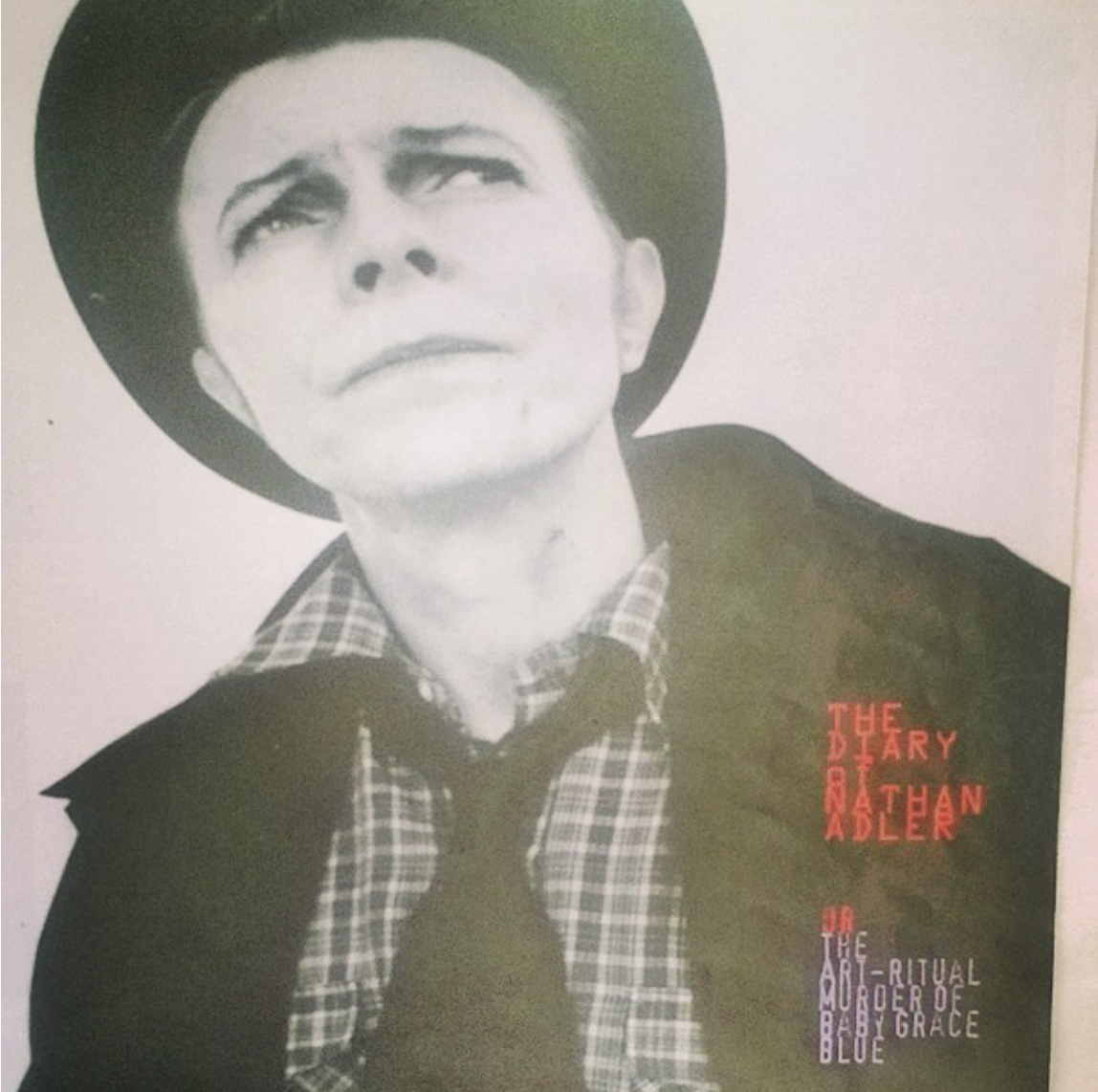
David Bowie 1.Outside (Arista/BMG) 1995
With ‘five years’ remaining until the new millennium, Bowie, tapping into the anxiety and quest for spiritual relief, returned to his first passion: contemporary art.
Back with his most innovative collaborator, Brian Eno, he dredged the bottomless pit of morose and despair. Dreaming up a morbid tale of future sacrificial performance art gone wild and taboo breaking cybernetics he narrated a woeful diegesis through a series of ‘verbasier programmed’ characters.
Disturbing to say the least, our ‘cracked actor’ pitches an avant-garde ‘whodunnit?’, set in a parallel bleak world where the self-mutilated gestures of Günter Brus (the patriarchal figurehead of body art) and ‘the orgiastic mystery theatre’ of Hermann Nitsch have been taken to new, hyper, extremes of bloodletting.
Led by the investigative diary of art crime detective Nathan Adler, a cryptic cut-up of Burroughs/Burgess language is used to not just explain the circumstances that befell the poor victim Baby Grace, but also delve into the collective psyche.
Out on a limb musically, Bowie’s home life may have been content, yet something suddenly propelled him to bravely create a depressive requiem. Easily the best, if not most original, material since Scary Monsters, 1.Outside was entirely written in the studio as the band extemporized: motivated by Eno’s synonymous oblique strategy cards.
Scott Walker lost in cyberspace; the industrial melancholy is at its most anguished on ‘A Small Plot Of Land’ (a version was used on the, Bowie as Warhol starring, tragic biopic of Basquiat directed by Julian Schnabel), yet a more revved-up, pummelling bombastic variant is used on ‘Hallo Spaceboy’ and ‘The Heart’s Filthy Lesson’ (perfectly playing out David Fincher’s Seven).
Leaving many fans bemused (as I myself witnessed on the Outside tour, the baying audience pleading for the greatest hits package), the philosophical snuff opus seemed puzzling to those familiar with the pop-lite Bowie. Thankfully Bowie cut loose the shackles of commerciality for a contemporary blast of shock and dread.
CAN ‘Landed’ (Virgin) 1975
Richard Branson’s pastoral record label Virgin hooked our Cologne ‘seven-day sonic avant-garde evangelists’ in early 1975, tempting them away from the clutches of their former masters United Artists, whose relationship with the band had been tenuous at best. They now joined the hippie-idealistically run, free thinking label of choice – at least that’s how it appeared to the onlooker-, sharing the stable with both fellow countrymen Faust, Tangerine Dream and Slapp Happy, the psychedelic progressive band Gong, and the million zillion selling Mike Oldfield, Virgin’s biggest selling artist by miles – whose Tubular Bells behemoth had reined in a load of money and success, paving and paying the way for most of the roster.
Branson may have looked like he’d stepped off the cover of a Jethro Tull album, but he turned out to be a shrewd businessman. After all, he managed to propel Faust into the album charts with their Faust Tapes mesh-mash classic: albeit that the said album was put on sale for a paltry 49p and probably didn’t actually net the group much money, but hell, it sold over 100,000 copies, so they became a household name in the head community for a while at least.
Business wise, sister label Harvest – equally rich in allusions to the Woodstock ethos – would distribute CAN’s records in their homeland, whilst EMI, who owned both labels, would just count the cash it hoped would now roll in. One of the stipulations in the Virgin contract was that the band would have to use superior recording equipment for their next album. A multi-tracking desk was delivered to their own sacred Inner Space studio HQ, which they were still allowed to use though the records would now be mixed elsewhere. Unfortunately, a deep sense of forlorn began to creep in, mixed with paranoia, the arrival of the new technology now making it possible for the band to record their parts separately if they so wished. Until this point Holger Czukay had masterminded all the recording and editing on just a two-track recorder. He had also always encouraged the group to play together in the spirit of improvisation. But now, the band could successfully overdub and add parts at a higher quality then had previously been possible before, taking a more insular approach to recording.
In scenes not too far removed from the Beatles fractured shenanigans on the White Album, the group began to play some of their own parts in secrecy, the thought of being scrutinized and criticized by their fellow band members filling them with dread.
Again, like The Beatles, they invited an outside musician into the studio to lift the tension and scrutiny. This fortunate man was Olaf Kubler, who had served as producer on both Amon Duul and Amon Duul II albums, although he dramatically fell out with one of AD II’s bandleaders John Weinzierl, who made his feelings towards him pretty clear in recent interviews. Kubler was called in for his saxophone prowess, being asked to lay down some cool sultry cuts on the track ‘Red Hot Indians’ for what would be the Landed LP.
Sessions for what would be the band’s Landed album began in the first few months of 1975, in-between tour commitments, which included a couple of gigs with the troubled American folk troubadour Tim Hardin, who it’s rumoured was asked to join the band full time.
Hardin didn’t really front CAN in these gigs, instead, he would merely leap on stage to perform one of his own tunes, usually something like ‘The Lady Came From Baltimore’, and maybe front a couple of the groups own tracks before exiting stage right. Whether he ever considered seriously joining the band, Hardin’s deadly heroin habit put a damp squib on things, finally getting the better of him in 1980 with one overdose too many.
Anyhow, Karoli had so far done a good job of semi-fronting the band, going on to lead all the vocals on this album; delivering some softly inspired dream like performances throughout.
Landed in some ways directly follows on from their previous effort Soon Over Babaluma, especially in the sound collage experiments of this album’s ‘Vernal Equinox’ centre piece and ‘Unfinished’, both of which re-work similar themes and threads found on ‘Chain Reaction’ and ‘Quantum Physics’. The rest of the LP consists of far rockier progressive tones, with allusions to their contemporaries, particularly Pink Floyd. To a point there is also an attempt towards the glam-rock of both Roxy Music, Bowie and Mott The Hopple – all influences CAN’s peers, Amon Duul II, also breathed-in on the 1974 album Hijack, though to a less successful degree.
‘Full Moon On The Highway’ and ‘Hunters And Collectors’ relish in the glow of these new influences, though remain slightly more conventional compared to CAN’s usual free roaming exploratory material. Most of the seven tracks now run in at under six minutes and sound much more formulated, the exceptions being the already mentioned two saga driven soundscape pieces, which combined, make up three quarters of the overall albums running time.
The lyrics themselves seem to be full of references to mysterious alluring women, clad in leathers, who turn up at ungodly hours on celestial described highways. Analogies run riot, the open road acting as a metaphor for following certain paths, Karoli constantly encouraging the listener to cut loose and float away. Journalist and friend to the band, Peter Gilmour, co-wrote both ‘Full Moon On The Highway’ and the lazy sedate ‘Half Past One’. Peter would also go on to write CAN’s biggest hit, the disco chugger ‘I Want More’.
Many critics have panned Landed, seeing it as the beginning of the end for the group. It does seem a slight exaggeration. Certainly, the dynamics were slowly ebbed away, the production becoming much more polished, though it suffers from some very messy trebly moments at times.
Footage of them performing ‘Vernal Equinox’ on the Old Grey Whistle Test at the time sees Irmin Schmidt wearing a fetching bondage inspired chain mail waistcoat whilst theatrically commits Hari Kari on his keyboards, whilst Czukay, all ten-yard stare, sports white gloves and a sheriffs’ badge. A mid-life crisis beckoned with all this new pomp and strange fashions, turning off many fans, including the disdain of Julian Cope who states that this act of regalia wearing extravagance ended his relationship with the band. So, in a way CAN did seem to be heading over the precipice, the best days behind them, but this album is viewed way too harshly.
Landed for what it’s worth is a decent album, with enough ideas and demonstrations of superb musicianship, Karoli alone performing some of his most sublime guitar work yet.
The albums artwork, by the curiously alluding Christine, displays a collection of passport photo sized images of the band. Each individual photo is covered in graffiti or scribbled on, lending silly moustaches, cartoon glasses and an array of comical hats and hairstyles to the now light-hearted looking band. Peering out from under the heavy de-faced images they pose in a manner that lets us know they still have much to give- also, am I imagining perhaps a Carlos the Jackal type reference here, the many disguises and such.
CAN shifted back towards the Afro-beat and World music styles on their next couple of releases and also brought in ex-Traffic members Rosko Gee on percussion and Reebop Kwaku Baah on the bass to great effect. Czukay moved away from his bass guitar duties so that he could explore radio short wave editing and cutting up techniques in greater detail. He would of course go on to leave the band in 1977, leaving Liebeziet, Schmdit and Karoli to carry on for a while before everyone split for good to pursue their own solo projects, a reunion in 1989 included Malcolm Mooney and resulted in a new album titled Rite Time.
The year is 1975 and CAN have laid down their 7th album, after being together for nearly eight years. To get this far they have travelled an etymological musical odyssey, that has taken in the dark esoteric voila seeped mood of The Velvet Underground, the psychedelic spiritual enlightenment of America’s west coast, the African dance style rhythms of Nigeria and Ghana, the dreamy hypnotic Turkish flavored folk music, the otherworld tour of the nebula emitted from Hendrix and the lessons learnt from Stockhausen and Von Biel. CAN had surpassed all their peers and become possibly one the greatest assembled bands of musicians that the west has ever seen – seriously these guys could out play anyone, though they never had time to wallow in ego and always looked towards experimentation rather than dwelling on their skills.
There now follows a run-through of the album:
Dropping in with an up-tuned arching guitar fuzz and treble heavy hi-hat, ‘Full Moon On The Highway’ leaps straight into action. Jaki Liebezeit sets down an incessant workman like beat, hammering away on the bass drum as Michael Karoli casually begins his salacious vocals –
‘I made it hard today,
For I had to do it to me.
And if it’s only to hold her,
She’s gonna get it today’
A certain sense of portend fear hangs in the air, Karoli in his full Germanic romantic disdain rattles off omnivorous statements about taking to the highway, where star crossed lovers may unlock some inner meaning and truth.
Rock hard screaming lead guitar hooks run rampant, exercising no sign of restraint and sprinting ahead as though in a 100-meter sprint. Piano flourishes and honky tonk bravado light up the mood as those bawling guitars and Alpha 77 effects wail away like banshees. Czukay takes his bass on free roaming tour of run downs, slides and felicitous infused funk workouts, never staying put in one place for too long, always running his fingers all over his instrument. An intense burst of exuberant searing drums, keyboards and clashing turmoil all culminate into a finale furore, that threatens to end in a mess but is saved by the rallying cry of Karoli riding in on his gleamed-up guitar. He transposes glam via Pink Floyd to produce something unheard, a riff from the other side.
Taking a more serene path, ‘Half Past One’ begins with some archaic ethnographically seductive Spanish guitar and heavy tub tapping drums. A dozy laid-back vocal pronounces –
Over the beach,
Into the sun,
Wake again by half past one,
Alright’
The last word being some kind of reassurance amid the strangely relaxed drug induced soirée, that peers at some snapshot of the protagonists’ relationships, a casual affair on the beach in this case.
Schmidt interjects with some delightful mandolin sounding oscillations and yowling alarmed synths, whilst Czukay adds some chuggering engine bass lines, sliding around the neck as though revving it up.
The general breathless ambiance begins to wash ashore, like a lapping tide, meandering its way towards some welcoming gypsy encampment. Quacking wah-wah and folk tale violins add to the general malaise, building towards a newfound intensity as the song picks up momentum: The final 30 seconds bathing in the now pressured final crescendo.
Now steps forward the ambiguous and genre dodging ‘Hunters And Collectors’, with its almost glam postulations and Afro- funk grooves, this four minute Floyd gesturing dose of mayhem ducks any formal categorisation.
A doom-laden piano emphasis each intro chord, like an operatic indulgence. Karoli in magi pose announces the chorus –
‘Hunters and collectors, all come out at night.
Hunters and collectors, never see the light’
The song now kicks in with some sky rocketing theatrics. Dense melodies of climbing synth lines and evocative sexed up Teutonic choral backing adding to the melodrama. Czukay and Liebezeit cook up a fine jumped-up funky backing, with double shimmering hi-hat action and posing bass guitar. They all soon break down into a more stretched out segue way, taking in the early years of Parliament and some Afro highlife.
Karoli now dabbles with the vocals, as they take on some added menace; he conjures up images of leather clad biker gangs, savage sexual degradation and drugs –
Thirty leather kids, on the gang ban trail,
Get your big brown man with the snakes in bed.
Dirty bother me now, it soaks into a cup,
She says “if you don’t start at all, you never have to stop”.
Other worldly radio signals and snippets of conversation from the ether add to the esoteric atmosphere that is entrenched in seedy tales of chemical indulgences.
The opera swoops back in before what sounds like the set-piece breakdown brings the curtain down, as strange broken cogs, ratchets and springs all produce a comical ending, just before the swept in majestic intro of ‘Vernal Equinox’ is brought in.
As the ambivalent last track on side one, ‘Vernal Equinox’ continues the dynamism and piano melody from the previous track, but runs rough shot and fancy free, producing an eight-minute omnivorous jam or epic narrative.
It all begins with a search light introduction of space age doodling, with a chorus of sonar equipment and lasers shooting off in all directions, all played out over a heavy laden piano, hurtling towards a cacophony of destruction.
Rabid lead guitar rips into the track, Karoli literally plays for his life in a fit of feverish exhaustion, running through the full collection of riffs and chord rushes that he’s picked up over the years.
Flailing drums explode like a barrage of mortars, as UFO’s crash land all around, Czukay finds some cover and rattles off his defensive bass.
That Alpha 77, the exulted secret box of tricks, spits out havoc. Crazed wrecking layers of multiplying textures take the drama back to the cosmos soul searching of Soon Over Babaluma, but with a now more invigorated pumped-up stance. The raging narrative falls into one of those accustomed breakdowns. Liebezeit and his meteoric rhythm accompany arpeggiator sonic waveforms and metallic sounding drips during this break in the pace. The full swing returns in style, turning the jamboree into a jazz funk quest, as what sounds like Robert Fripp battling it out with an alien horde from the planet of Sun Ra, delivers a belting finale of elation.
Side two opens with the bongo tribal reggae of ‘Red Hot Indians’, a jaunty slice of infectious pigeon-toed dance rhythms and cool wistful chant like grooves. Karoli goes all faux-Caribbean with his laid-back vocals, he casually lays down some lines in an almost staccato fashion –
‘It’s the DNA song, DNA song, it’s the DNA song.
Strike mess, hole mess, shadow mess’.
Kubler Olaf blurts out an effortlessly uber cool prompting saxophone melody, liberally peppering the track, whist Liebezeit just reclines back on his sun lounger, knocking off some tom rolls and sipping a pina colada.
Mixing in some more African highlife and even-tempered down Roxy Music, this track flows along in its own serenity. The second wind of extra rhythms start to sway in an hypnotic motion, like some kind of mantra as Karoli mumbles recollection of some cryptic halcyon memories –
‘Then you took me back, steam machine.
Dreamt my way into a daydream.
Let me vanish into yesterday,
And my night drops fade away’.
As though to ratify the shambling theme, the song naturally fades out on its own breezy demeanour.
We now come to the soundscape behemoth of ‘Unfinished’, which by its title remains to be determined by the listener as to whether or not this maybe the case.
A set piece of sound cutting and masking that harks back to Future Days, with its reverential cinema scope builds and gliding synths this track could just yet be one of CAN’s finest moments.
Opening with what sounds like an orchestra tuning up, we hear a noisy interlude of violins, strings, brass and unfamiliar instruments all preparing themselves for the performance. That looming ever-present box of tricks, the Alpha 77, fires up and screeches over the top of our orchestra pit, launching bolts of lightning along with the odd spark of lush melodic wonder.
Breathing in the same aroma found on their soundtrack piece ‘Gomorrha’ and the melodic beauty of ‘Bel Air’, our macabre galactic Schmidt now unleashes some welcoming felicitous doses of extreme perturbation, underpinned by some humbling broody but magisterial bass.
All of a sudden, a series of gory effects and sounds enters the stage, as the demonic bound trip to the nebula goes all pants messing chaotic. Squealing guitars, that evoke the sounds of distressed souls pleading, cut through the heightened tense mire.
Factory steam powered machinery like the sort found on the Forbidden Planet, is ratcheted up, bashing away and powering up some monstrous life form. Some tumbling toms are given a swift kicking, the occasional crash of a cymbal unsettling the air as Liebeziet desperately tries to carry on playing whilst his space craft flies into the sun: holding on for dear life he is soon saved by his comrades who now work towards an uplifting final stretch.
Whistling sounds fly overhead, and gongs gently shimmer in the background, Schmidt throws in everything even the studios sink, as a build towards some sort of journey to the upper echelons of the solar system begins.
Escapist melodies and angelic ethereal guitars all scale the dizzying heights, like the dark side of the moon played by Stockhausen and backed by Ornette Coleman. A dream- like vaporous empyrean utopia opens out as our Cologne astronauts now proceed to save the best till last. Pulchritude swathes of divine beauty flow with delight as a lavishly rich melody of heavenly choral opulence raises us to some higher plain. The final few minutes being amongst the most sublime that CAN ever laid down, a spiritual guiding stairway to the universe.
Here’s the message bit we hate, but crucially need:
If you’ve enjoyed this selection, the writing, or been led down a rabbit hole into new musical terrains of aural pleasure, and if you able, then you can now show your appreciation by keeping the Monolith Cocktail afloat through the Ko-Fi donation site.
For the last 15 years both me and the MC team have featured and supported music, musicians and labels we love across genres from around the world: ones that we think you’ll want to know about. No content on the site is paid for or sponsored, and we only feature artists we have genuine respect for /love or interest in. If you enjoy our reviews (and we often write long, thoughtful ones), found a new artist you admire or if we have featured you or artists you represent and would like to say thanks or show support, than you can now buy us a coffee or donate via https://ko-fi.com/monolithcocktail
Dan Shea’s Lynchian Lockdown Jukebox: Part Four
August 7, 2020
Fictions/Selection/Dan Shea
The Monolith Cocktail has coaxed a number of guest spot contributions from the impassioned and adroit musician/writer Dan Shea during the year. Roped into his family’s lo fi cult music business, The Bordellos, from a young age, the candid but humble maverick has gone onto instigate the chthonian Vukovar (currently working through a trio of ‘greatest hits’ packages here) and, with one part of that ever-shambling post-punk troupe, musical foil Buddy Preston, the seedy bedsit synth romantics Beauty Stab (who’ve just this week released their second single ‘French Film Embrace’, here)
An exceptional talent (steady…this is becoming increasingly gushing) both in composing and songwriting, the multi-instrumentalist and singer is also a dab hand at writing. For his debut, Dan shared a grand personal ‘fangirl’ purview of major crush, the late Rowland S. Howard (which can be found here), on the eve of Mute Records appraisal style celebration reissue of his highly influential cult albums ‘Teenage Snuff Film’ and ‘Pop Crimes’. This was followed by an often difficult, unsettling, potted with dark comedy, read on Dan’s friend and foil Simon Morris (of the Ceramic Hobs infamy; the piece can be read here), who took his own life last year.
Now, from his lockdown quarantine, Dan has been providing us with a weekly series of ‘imaginary film screening jukebox’ selections come loose horror and increasingly unfathomable Lynchian, cloaked autobiographical, fictions.
PJ Harvey – To Bring You My Love
I often wish I was PJ Harvey. Less now than when I was a teenager but every time I play this album I find myself wondering what it must be like to exist as that androgynous thug femme fatale archetype. Could any man, woman or anyone else resist me if I could step into that role? This Southern Gothic fog clotted with lust that spills out of my speakers.
I played it to Ronnie and she looked back at me blankly, a dog being taught a card trick. This was the first time she was alive. That mask of canine indifference infuriated me. This was the beginning of the cracks forming in our relationship.
I played it to Gretchen, sorry, Gersten. We danced in monochrome around the living room. Very slowly. I remembered just now. She’s not been in touch so I have to put matches out on myself. It’s not as satisfying a burn as cigarettes but I’m not buying cigarettes just to put out on myself. That’s a step too far.
“You know he’s gonna be here”
The voice cracks and strains. I close my eyes and imagine a mountain range. She atop it, undulating. She could cause an avalanche.
Selfish, Little folds her hands and the world disappears. She yawns in slow motion and lullaby chimes hang all around us. I bat away the weaponised nostalgia the monkey in my back clawing at my veins.
Endless futile arguments, drunkenness on trains.
The holes in the sky and the holes in my arms bleed out imagined futures but our bodies always lie.
The world was growing too loud for us. We had to escape into our record collections and the books we swapped between each other like holy texts. On a rainy afternoon, March 7PM, the world was ours.
“Bring you my love”
I dreamt of Simon last night. I was on my way to a fetish shoot in Brighton. I stopped in a pub in London and sat down with a pint of something dark and fruity (like me, hohoho) when he came over and nudged me, getting in my face in that way of his.
“Fancy seeing you here”
Tears pricked Dan’s eyes in the dream as he pointed out that Simon was dead. Simon offered a characteristically long winded and nonsensical explanation before bringing us over another drink. We had a few, chatting about the future of some band he’d been working with called Vukovar.
Oh yeah I know the singer too Simon
We also talked about Kate McCann’s book among other things. He gave one of his reading lists then said “I’ve got a short cut to where you’re going follow me!”. So we walked out the back of the pub down an alleyway and stepped into the back garden of the woman I’d intended to meet. I turned around to thank him and he was gone.
It’s another one of those dreams I prefer to my waking life.
6
2
1
HTRK – Rent Boy
An overhead shot of us, a rotating ceiling fan pan. My hallway, you should see it.
She’s next to me, head slumped on my shoulder. She sees only static but I’m watching the movie I told you about it even with my eyes open. She encourages me to dream with my eyes open. Saviour. Supplanter. Your film noir heroine, cock sucking seraphim.
Ellroy Steers was a good man. He’d worked for the Farrow corporation since school and had worked his way up in this Kafka-esque organisation to be head of pencil sharpening.
Pulaski told him about the incident. He’d found a cassette tape in a fridge in the alley behind his flat. He would transcribe the contents for Ellroy to feed back to Farrow.
A strange look of fear came over the older man’s face. He expressed an interest in having the contents delivered as soon as possible. He knew what was on the mixtape but he never let on. I couldn’t place the actor playing him but he looked an awful lot like Harry Dean Stanton. The same soulful crags in his hangdog face.
As soon as Pulaski left, Steers placed a pencil up each nostril and head butted the desk. It was to send a signal to Pulaski not to mess with forces he didn’t understand. The holes in the sky grew wider above a canine population and no one stirred at all.
Even though she couldn’t see the action onscreen G was enthralled. Damn, I’m a lucky man. I swear I REDACTED SUPPLANTER could give the whole thing up for her.
I pause the film and kiss her, the blood rushing in my veins. Like our lips were molten. My hands in hers. I want there to be tenderness in this. Not like it is with our clients or when we have an audience. My lips and tongue trace a map of desire over her milk white skin. I whisper my name into the depths of her. This is golden, this is molten. I want to melt into her.
It’s always going to be a little sordid. Do I want to be her or do I want to fuck her? It’s both as it is, for me, with most women. I want to purge myself of some of my toxic masculinity, but I feel every time we collide I sap some of their beauty from them. Their minds contain many rooms and I paint as many of them as I can. As Ellroy’s blood spills out of my TV and pools on the carpet I am whole.
I was telling you about the ritual last week, wasn’t I? Well to be exact that I don’t remember it. Just the whole incident when I was walking walking walking naked through a nightmare. Well I awoke in an invisible pool outside the HACK DOOR. Muddy fingerprints on the handle and a peculiar ashen scent. I turned and stepped in and there she was, sat in the living room. The prized forsaken angelangel returns.
Brian Eno – Sparrowfall
R was sat peacefully gazing at the switched off TV with a blank expression I read as a smile. No definition I can find
“But you’re dead. I’d dreamed of this. Are my dreams becoming my life? Did I succeed when I last tried? There must be more to that than this.”
She looked back at me. That same blank look that used to drive me nuts. I missed it. I gathered her up in my arms and held her to my somehow still beating heart and begged her never to die again. At least not until I had. I cried and cried a whole ghost. I missed her more than I understood and now she was back. I didn’t see the sense in her leaving the first time around and for her to return was more than any mortal mind could bear.
But then I looked at her and took in the dim light in her eyes like the light from distant ships. She smelled of ash, coagulant phlegm from eyes that may be my own, and stank of the second hand regret seeping from her pores. Towards the end how I’d resented her weakness.
She was my super hero. She had saved my life many times over. Held my hair when I was throwing up, soothed the knife point pain and helped remove the sting of the abuse I’d suffered. I hated her for needing help when she was the one I always turned to. I had nowhere else to turn.
“I can’t control these feelings if I tried”
My hand formed a fist in her hair. Her voice pure blurred sound. I think she said it yeah yeah yeah but how could you even tell the fucking difference? She just looked back at me not fully comprehending. But how I’d missed that body. No flesh but hers. No flesh but hers. Viva la muerte.
She could never respond properly, the dumb pony soldier. When she was alive it was apathy. Now it was a mute acquiescence but I’d made a vow. When I said til death do us part I’d meant mine not hers. Why else after she went a second time do you think I went after another woman who looked exactly like her?
The lullaby chimes spill from my unvarnished marble heart, out of the holes ever widening. They pulsate convey fluid through the infant city. Blood will wash blood away. Gemma, baby, how did we fall so far? The lack revealed is what gets me going. The humiliation of the aggressor, splayed open, begetting the dull rhythmic thud of masturbation.
“She would do something like this”
A colonialist simper. One finger in his mouth the other finger circling his nipple. Halting middle class closet case tones as he tells his beard wife all about the new breakthrough in the next quarter, that’s, like, rilly rilly good as I fantasise about garrotting him and sending a picture of his corpse to the idiot kids he spawned. I picture a piss stain spreading across his expensive beige slacks. Blood money.
“She would do something like this”
Where being rich and white is a license to go and fuck kids overseas. In the evening you all bathed each other’s kids. Your letter was only the start of it. One letter and now you’re a part of it. To the pure all things are pure. Images scroll through your head of the perfect little paper stitch twat torn apart.
You would say that about your own daughter you pig you waste you whore yawning for your price.
I hope come the revolution someone eats your stupid fucking useless eyes out of your “living” face while you’re still defending white supremacists and transphobes “valid concerns”. I hope your husband chokes on the dick of the next Grindr hookup behind your back and is deposited neatly on a dark street, just another hit and run. A punch in the face that smashed through to the other side, sculpting the play dough form into another vignette of my toxic masculinity. I’m ashamed of being ashamed.
Sha la la la man. Why don’t you slip away?
Rosie & The Originals – Angel Baby
30 years old her first hangover. I introduce her to the concept of the hair of the dog over a fancy veggie breakfast in Manchester. For once she’s drinking and I’m not. I’m a bad influence on this girl as she is to me: but she only got me into different strands of BDSM and ambient music and I’ve got her into something that rots your liver. I feel like I don’t deserve her but I feel that way about women most of the time. Men on the other hand – scum. I’m such a homophobe that I have in the past subjected gay men to the torment of being in a relationship with me.
Note – bisexual erasure is not just a neat phrase to describe the way bi people are treated but to describe the band Erasure.
Angel Baby is one of those solid gold pop records you can play on a loop and weep to with what is neither joy nor sorrow. It takes me to that diner on Ronnie’s 30th. The quiet booth in the corner where she’d tenderly take my hand and reassure me as the world kept growing louder. The concept of having fries with breakfast seeming impossibly decadent to my provincial Northern mind. The record wasn’t playing in the memory but as I write it it was. I dunno what was really playing I prefer to remember things my way.
There’s something romantic to me about impersonal concrete structures, the kind of rain you only really get in the North and the unpleasant humidity that subsides when you step into her bedroom and slide into her bed. You’ve earned the solace of her arms now. There’s no nobility in it but you can dream. You can even imagine yourself to be the Oscar Wilde of Fetlife.
When the vinyl warps and cracks through that ancient system I’m in Gonesville. The dreaminess of Rick singing Lonesome Town, Elvis singing Blue Moon or Barney singing Dream Attack. These are the songs that saved my life.
Kanye West – FML
First of all this is one of the biggest pop stars in the world sampling Section 25. That’s something.
Second of all, it’s one of the biggest popstars in the world discussing being bipolar. “You ain’t seen nothing crazier than this n***a when he off his LexaPro”.
This has nothing to do with Lynch just given my reference to him last episode I wanted to continue my support. Of this multi millionaire. Sickening. Nothing dates like sincerity.
Fad Gadget – Ideal World
Oh yeah. The blood spilling out of my TV wasn’t so much of a worry. Worse things happen. I mean I’ve seen the much resented woman of my dreams disappear down a plug hole. The first time she left I knew she must have hated me.
You know I just found her. She didn’t even leave a note. Used to be she left a note if she just was going to the shop. So I know at that late stage she despised me. I don’t blame her. I was a waste of skin and teeth. She was in a better place so why did she return just to SPIDERCRAWL leave me again?
Me and her second incarnation watched Blue by Derek Jarman and ripple echoes of the old her I felt them. She always loved Jarman. She identified a lot with gay men. She loved queers like me. Her gaze at the ceaseless blue became less spectral. I looked into her eyes and l saw my own reflected in hers. Eyes. It’s always about eyes.
Sat in a field before I resigned from that job. I was very handsome. A grinning dog disappeared into a summer haze. A yellow dog with huge, ostentatious teeth. I don’t believe I hallucinated that disappearance into undergrowth. The yellow dog trailing the black dog. I finished my veggie burger and went back to the call centre I worked in that resembled a prison complex.
Back to the afternoon with the Mute book. Some very attractive Irish girls sat with me. I saw myself, handsome but childlike and non threatening, the way I did. Truth be told I envied the bench the blonde one was sat on. Then I went home and pissed Rotten sorry Ronett off.
I enjoy the hallways of buildings like that at night. The suicides they sweep under the rug echo back at me. I feel the whisper of the axe and the voices of dead I have loved. I smile at you, vacant. Ingratiating. Watch me jackknife the moon as I smile shaking into your breast. No one is unforgettable. But in a piss stinking basement in June 2018 we overturned the world.
Mr Bungle – Pink Cigarette
I’m going to see this woman in Blackpool and I don’t know why. I’m sat next to a very pretty red haired twink and thinking “I’d rather be hooking up with him”. Looking across the carriage there’s a guy who looks like a low rent low res Francis Bacon Pope, and as he gets off at Poulton le Fylde all those connections are made and I realise why.
I’m nodding off, day drunk on day dreams but he’s here. He’s the man behind the screen pulling the strings. If only he could offer me a shortcut out of my nightmares into someone else’s. Me and Dan the boyband singer met up again. I think he’s in love with me. How embarrassing for at least one of us. Handsome guy but he smells weird.
Imagine a version of Back To The Future where Marty McFly went back in time and molested himself as a teenager. Is that just masturbation? How do you punish the crime without blaming the victim?
If all Mike Patton’s back catalogue sounded like Pink Cigarette he’d be my favourite person. He does the Double R diner atmos really well. I slow danced with Gersten to this as well. Then a client showed up and my soul died a little more. I’m in negative equity as regards my soul at this point.
So I can’t help but see the parallels: Pulaski discovered a cassette in a fridge behind his flat and I did as well. It’s almost as if someone is watching me. Man, I need to block the windows and cover the mirrors again clearly. Wrap up the knives as well. Nothing reflective can be trusted.
“She would do something like this”
I’m. Not. A. Misogynist.
“Can you tell what it is yet?”
I’m just fashionably late.
“Your letter was only the start of it”
5
4.48
0.52
It ends when three reduce to one.
Pulaski and Sam walk off in the direction of a warehouse. Sam, prone to hand dance gestures and the chimes the chimes the chimes has no idea what’s in store for her. They walk past a disused Christian book shop. The continent is burning. The witnesses are burning. The world sighs, steeple red and blood dark.Precious Selfish Little yawns and me I’m in this dream place.
Imagine her spider crawl along YOUR ceiling. Would you be happy? Or would you lose your mind as I have?
Lingering in the Tragic Life Stories section of WH Smiths. The newspapers releasing artfully cropped photos of true depravity. They leave the rest to “their” imaginations. The sickest pornography you can buy in a petrol station or pick up for free on a bus. To the pure all things are pure. They are aware of the audience they garner, never forget these sick fucks run the country.
I‘m not tranquil. I am tranquilised. This rage will never cease. Let the animals tear themselves to death.
Blood oozing softly with a sub-bass pulsated from the bullet hole in Pulaski’s head after the shooting in the school. The snow fell, covering the nightmare. His head lay in the beloved lap of the man who would one day go looking for him.
I’ll let her speak with my voice. I’ll let her see through my eyes. I’ll devote the remains of me to ensuring I prevent as much harm against the innocent as possible. I would give it all up for her. Even if I have to die for it.
Previous Episodes
Part One
Part Two
Part Three
Glitterbeat Records 5th Anniversary: A Celebration
March 22, 2018
Words: Dominic Valvona

If the Glitterbeat Records label had a remit, ‘a raison d’etre’, it would be all about transcending borders, whether it’s the physical, geographical or subconscious kind, to bring the most ‘vibrant’ and ‘committed’ of artists to a global audience. Finding existing and ‘possible musics’ (to borrow a term from the label’s own reissue of Jon Hassell and Brian Eno‘s iconic 1980 transformative soundscape experiment, Fourth World Volume One: Possible Musics) from across the world, the independent German-based sister label to Glitterhouse Records has in a short timeframe helped reshape and redefine what we know as ‘world music’ – a fatuous term in itself, still largely used to denote anything outside the comfort zone of Western commercial music.
Originally putting out a catalogue of sublime and obscure records from some of Malia’s most important, traversing desert blues and rock artists (from Ben Zabo to Tamikrest and the Songs For Desert Refugees compilation) on Glitterhouse, world traveler bluesman Chris Eckman of Dirtmusic fame (the labels unofficial in-house band) went on to co-found the Glitterbeat imprint with Peter Weber in 2013. The inaugural release on that label, now celebrating its fifth anniversary, was a 12″ remix of Ben Zabo’s Dana by Mark Ernestus (Rhythm & Sound, Basic Channel), released sometime around March 22nd, 2013.
From the already mentioned desert blues stars of Mali and ‘beyond’, Eckman’s ever growing roster of contemporary sonic adventurers hail from a number of other African countries, including Ghana, Mauritania and the Bargou Valley bordering Algeria. And has since gone on to expand its remit and reach out to include music from the Balkans, Southeast Asia, the Levant and South America.
As you can imagine, this global expansion encompasses a myriad of musical styles, many of which were in serious danger of disappearing into obscurity if not for the work of music ethnologists such as Paul Chandler and Grammy Award winning field-recordist/producer Ian Brennan (we were lucky enough to interview Ian a couple of years ago), who both recorded for posterity ‘lost voices’ and atavistic guardianship documented collections for the label under the Hidden Musics series.
So busy and bustling with potential releases, in the last couple of years they’ve set up a congruous imprint of their own, the tak:til scion: an extension and home for more transcendental, meditative and experimental material that doesn’t quite fit the main label. Featuring a mix of re-released and remastered iconic albums from the ambient, soundscape and devotional genres – including the already mentioned inaugural Jon Hassell and Brian Eno collaboration -, Tak:til has featured Širom‘s Slovenian odyssey I Can Be A Clay Snapper and 75 Dollar Bill‘s psychedelic desert rock and trance of the Maghreb, avant-garde, jazz and even swamp boogie delta blues transient W/M/P/P/R/R.
From handkerchief waving Albanian songs of sorrow to Istanbul dub; from hybrid collaborations such as Tony Allen‘s album with some of Haiti’s finest musicans, the Afro-Haitian Experimental Orchestra, to the electric griot psych of Noura Mint Seymali; from the Turkish pregriation and siren vocals of Gaye Su Akyol to the carnival funk of Bixiga 70; Glitterbeat Records has helped uncover a whole new musical world of discovery for people like me. It’s no surprise that they’ve won the WOMAX label of the year so many times, and attracted heaps of acclaim. I’ve more or less featured every single one of their forty plus releases, and seldom found a dud. And Glitterbeat Records have appeared more times than any other label in our end of year features.
To celebrate the label’s fifth anniversary, I’ve chosen both personal favourite releases and tracks from the back catalogue.
Lobi Traoré ‘Bamako Nights: Live At Bar Bozo 1995’ 2013
From the very beginning, one of Glitterbeat Records earliest releases, Bamako Nights captures the loose, almost extemporized sounding, drift of the late Malian legend Lobi Traoré (who died at the age of 49 in 2010); capturing one of his ‘packed-to-the-rafters’ live shows from the feted and iconic Bar Bozo. The singer/songwriter takes the crowd with him as he meditatively affects an adroit passage through Mali’s social and political pains. Attenuate guitar lines bolstered by flanger; licks powered by enveloping sustain; and a band whose steady yet often expletory solo spotted, bubbling bass and rapid percussion bind the nuanced accents together, all prove rhythmically hypnotic.
To have been a-fly-on-the-wall at one of these intimate, intense, shows must have been a magical experience; especially as Traoré kept the anticipation building; the appreciative audience either enthralled by every descriptive note and earthy toiled vocal or adding their own backing chorus of spiritual hollering and hand clapping: You’ll be hard-pressed to find a greater live experience and encapsulation of the atavistic West African blues.
Samba Touré ‘Albala’ 2013
As Mali continues to exist in a fragile union after the recent Islamic hijacked insurgency (curtailed by former colonial masters France with additional support from the UK), a host of the country’s great and good (Bassekou Kouyate, Fatoumata Diawara, Baba Salah, Tamikrest to name just a few), compelled to speak out, have added gravitas to their praised sweet tribal blues in defiance of the regimes that would have banned or at the very least censored their music. Known for his work with the late Malian legend, Ali Farka Touré, Samba Touré is an amiable enough chap whose previous acclaimed albums, Songhaï Blues and Crocodile Blues, were more genial affairs, shows his disapproval with a grittier, riskier brand of protest on Albala.
Albala – translated from the Songhaï language as ‘danger’ or ‘risk’ – is a darker, albeit lamentably so, album. But so delicately melodious and nimble is the delivery that the cries of woe remain hymn-like and hypnotically diaphanous: the blues may have turned a deeper shade of forlorn yet still sways with meandrous buoyancy and restrained elegance.
A traditional accompaniment from Touré’s regular band mates Djimé Sissoko (on ngoni) and Madou Sanogo (tapping out a suitable candour on congas and djembe), with guest performances from celebrated ‘master’ of the one-stringed violin, the souk, Zoumana Tereta, and fellow Malian ‘neo-traditional’ singer Aminata Wassidje Touré is bolstered by effective guitar and keyboard layers from Hugo Race (The Bad Seeds, Dirtmusic, Fatalists). This subtle mix works wonders, giving the overall sound a mystical delta blues feel, resplendent with fuzz, wah-wah and wailing soul.
Aziza Brahim ‘Soutak’ 2014

Born in the hardened landscape of a Saharawi refugee camp on the border of Algeria and the Western Sahara, beguiled vocalist Aziza Brahim embodies the wandering spirit of her people; their settled, though often borderless and disputed lands, previously claimed by Spain, were invaded in 1975 by Morocco. Though made up of many tribes with many different goals the Saharawi people did mount a fight back. It was in this climate that Brahim was hewed.
Soutak, or ‘your voice’, is centered on just that. The backing is striped to a degree, so the poetic reverberated vocals can echo and warble soulfully without interruption. Though there is no mistaking that strong, robust and primal Saharan spirit, the congruous accompaniment is a mix of both Balearic and folk rock styles – especially the deep sleek bass guitar notes that slide and weave under Brahim’s distinctive voice.
Produced by Chris Eckman (of Dirtmusic fame), whose assiduous talents have done wonders with Malian blues rockers Tamikrest and Bamako Afrobeat artist Ben Zabo, Soutak was recorded live in Barcelona: the fluid lilting cosmopolitan sound of that city is unmistakable.
Serene and subtly sung, the choral, almost desert gospel hymns take time to unfurl their charms, so be patient. Once again Glitterbeat and Eckman have a classic world music crossover on their hands.
Dirtmusic ‘Lion City’ 2014

Connecting the ‘dirt music’ environment of an unforgiving Australian outback with the Cajun swamplands, desert and bustling African townships, Glitterbeat Records co-founder and producer of their awe-inspiring roster of world music greats, Chris Eckman, leads his nomad troupe across esoteric and meditative terrain soundscapes.
At times almost alien, their borderless approach to mixing rock, blues and (mostly) West African music in a seamless wash, creates something both mysterious and original. Recorded at the same time as their last album Troubles, in Bamako, Lion City couldn’t help but be guided politically and socially by the upheaval in Mali. A testament to the eerie developments and a lament that also offers hope, Dirtmusic and their guests (which include such luminaries as the Ben Zabo Band and Samba Touré) prove that you can work alongside African artists without succumbing to condensation.
Far more successful if not authentic than anything Albarn or indeed the ‘Radio’ polygenesis collectors The Clash could ever produce, these Westerners move serenely, blurring the cultural boundaries as they circumnavigate the psychogeography of the chaotic city and romanticized but often harsh sand dune landscapes of both West and North Africa. You could say it was a culmination of the entire Glitterbeat labels stock, condescend into one challenging soundtrack.
Noura Mint Seymali ‘Tzenni’ 2014

The technicalities, pentatonic melodies and the fundamental mechanics aside, nothing can quite prepare you for that opening atavistic, panoramic vocal and off-kilter kick-drum and snare; an ancestral lineage that reaches back a thousand odd years, given the most electric crisp production, magically restores your faith in finding new music that can resonate and move you in equal measure.
Hailing from the Islamic Republic of Mauritania, nestled in between Algeria, Senegal, Mali and the Western Sahara, with the Atlantic lapping its shoreline, Noura Mint Seymali keeps tradition alive in a modern, tumultuous, climate. Her homeland – run ever since a coup in 2008, by the former general Mohamed Ould Abdel Aziz, duly elected president in 2009 – was rocked by the immolation sparked Arab Spring and subsequent youth movement protests, all of which were violently suppressed by the authorities. Add the omnipresent problems of FGM, child labour and human trafficking to the equation and you have enough catalysts to last a lifetime. However, Noura’s veracious commanding voice responds with a dualistic spirit, the balance of light and shade putting a mostly positive, if not thumping backbeat, to forlorn and mourning.
Recorded in New York, Dakar and in the Mauritania capital of Nouakchott, Tzenni transverses a cosmopolitan map of influences and musical escapism. The original heritage still remains strong, yet the ancient order of griot finds solace with the psychedelic and beyond.
Jon Hassell/Brian Eno ‘Fourth World Vol.1: Possible Musics’ 2014
Already riding high on a crust of acclaimed production projects and numerous semi-successful collaborations and solo albums, when Brian Eno touched down in New York City in 1978 he would unintentionally help direct another important development in ambient and world music (and also end up staying for five-years). Absorbed in what the city had to offer him musically, Eno came across the stripped and atmospherically rich experiments of trumpeter/composer Jon Hassell, who’s own pathway from adroit pupil of Stockhausen to seminal work on Terry Riley’s harangued piano guided In C, encompassed an polygenesis of influences: a lineage that draws inspiration from avant-garde progenitors like La Monte Young, and travels far and wide, absorbing sounds from Java to Burundi.
Though a minor figure in the sense of worldwide recognition, and never one to brush with any sort of commercial popular appeal, Hassell irked out his own personal philosophy. With a handy masters degree in composition, he attempted a reification of what he would term the “fourth world”; a style that reimagined an amorphous hybrid of cultures; a merger between the traditions and spiritualism of the third world (conceived during the “cold war” to denote any country that fell outside the industrious wealthier west, and not under the control of the Soviet Empire) and the technology of the first.
Untethered to any particular landscape and age (though traversing for the most part the mysterious, veiled continent of a inter-dimensional Africa), geographical and environmental alluded titles act as points of reference; alluding both to such diverse subject matter as the traditional songs of the Central African pygmy tribes (Ba-Benzéle) and the latitudes and weather phenomenon of an undisclosed landscape or city (Rising Thermal 14° 16’ N; 32° 28’ E).
Moving at a similar pace throughout, the lingering vapours drift over and enclose the listener; hinting always at some mystical or miasma presence; steeping each composition in a sepia of low emitting foggy harbour like droning horns, plastic pipe sounding percussion, tape echo experimentation, panoramic glides over the savannahs and of course Hassell’s stripped bare, reedy and masked stirring trumpet.
An almost continuous set of transient movements, the mood varied from lightly administered rhythmically slow paced pieces to cerebral blankets of panoptic memory; a style coined as “future primitive”. Reissued by Glitterbeat Records under their visionary imprint Tak:til, this album can be read as a principle guiding light and inspiration for their roster and ambitions.
Various ‘Hanoi Masters: War Is A wound, Peace Is A Scar’ 2015
A side excursion, travelling due east to Asia and breathing in the evocative songs of Vietnam, Glitterbeat Records launched their new series of field recordings entitled Hidden Musics with the Hanoi Masters compilation. Finding a congruous musical link with their usual fare of West African releases, the label sent Grammy-award winning producer Ian Brennan (credits include, Tinariwen, Malawi Mouse Boys, The Good Ones) to Vietnam in the summer of 2014 to record some of the most lamentable and haunting resonating war-scarred music. Indelibly linked to what the indigenous population call ‘the American war’, the examples of both yearning and praise pay tribute to the fallen: delivered not in triumphant or propagandist bombast but in a gentle meditative manner, these survivors, forty years on from the end of the harrowing and catastrophic (the repercussion still reverberating in the psyche of the burned America and its allies) war, were still undergoing the healing process.
Tinged with an omnipresent lilting sadness these songs are imbued with battle scars (hence the albums subtitle War Is A wound, Peace Is A Scar), featured artisans and traditional music masters who had joined the cause, sometimes for the first time in years, allow their voices to be heard once again and recorded for posterity.
Considering the history and ill blood between cultures – though this has eroded as capitalism takes hold and the country opens up – it has in the past been difficult to investigate the serene and attentive beauty of the Vietnam music scene, but this earnest and adroit study into a world seldom covered proves enlightening and humbling.
Bixiga 70 ‘III’ 2015

Speaking Fela fluently with marked respect and reverence, going as far as to borrow part of the late Nigerian bandleader and doyen of Afrobeat’s backing group moniker, Bixiga 70 may be inspired and informed by Kuti but they do so much more with his high energy polyrhythms and feverish hot-footed anthems. The eclectic Sao Paulo band, who joined the Glitterbeat family in 2015, add even more flavour to the Afrobeat template on this their third album. Energised by their performances in the hotbeds of fusion, from North Africa to Europe, and working with a decentralised method of producing new material, the III album reaches out and embraces an even richer array of world sounds.
Incorporating the rhythms and dances of their own continental home, Bixiga shake and shimmy to the local customs of cumbia and the sensual hip movements of the carimbo on a trio of slinky paeans to the indomitable spirit of joyous release. Congruously they go, flowing from one source to the next deftly, passionately and with a raw powered energy, our Brazilian friends relationship with Glitterbeat has proved to be a sound move; an ideal home for the group’s ever expanding fields of sound and exploration.
Afro-Haitian Experimental Orchestra ‘A.H.E.O’ 2016
Progenitor and embodiment of the Afrobeat drum sound, still in high demand four decades after his explosive partnership with Fela Kuti, the much-venerated Tony Allen extends his infectious percussion style beyond the African homeland. Sharing an obvious entwined history with Africa, the shared Hispaniola Island of Haiti proves both an esoterically mysterious and congruous collaborative foil to Allen’s distinct drumming patois.
Invited to perform in 2014 by the French Institute Of Haiti’s director Corinne Micaelli, Allen’s visit would end with a public broadcasted concert in the main square of the capital, Port-au-Prince. Collaborating with Allen would be a cross-section of local percussionists and singers recruited by vocalist, dancer, ‘voodoo priest’ and director of the Haitian National Bureau Of Ethnology, Erol Josué; Josué would himself lend his sweet yearning and reflective tones to two of the tracks on this album.
The call went out and the great and good of the Haitian music scene came. Racine Mapou de Azor, the Yisra’El Band, Lakou Mizik and RAM. Another Monolith regular and one-time Port-au-Prince resident, Mark Mulholland was drafted in as the experimental orchestra’s guitarist, and as it would turn out, eventual legacy overseer. With only five days of studio rehearsal time to gel and work out their performance, the sessions proved both, as Mulholland observed, ‘chaotic’ and overwhelming’.
Elevating beyond the borders it was created behind, the Afro-Haitian Experimental Orchestra root foundations shuffle and shake free of their stereotypes to move freely in an increasingly amorphous musical landscape. You’re just as likely to hear vibrations and traces of Dub, native Indian plaintive ghostly echoes, Sun Ra’s otherworldly jazz and funk as to hear the indigenous Haiti sounds and Afrobeat pulse. Tony Allen is once more at the heart of another bustling, dynamic explosion in rhythm.
Various Artists ‘Hidden Musics Vol 2. Every Song Has Its End: Sonic Dispatches From Traditional Mali’ 2016
Though no less an achievement, the second volume in Glitterbeat Records “Hidden Musics” series offers the full gamut not just musically but visually too, and is a far more ambitious documentation of a troubled country’s lost tradition than the 2015 Hanoi Masters survey. Expanding to include 11 concatenate videos, Every Song Has Its End is the most complete purview of Mali’s musical roots yet. This is due to the project’s mastermind and architect Paul Chandler, who has documented Mali’s music scene for more than a decade.
Forgotten in some extreme cases, ignored or considered as Mali’s past by new generations, maestros of the 6-string Danh, such as Boukader Coulibaly, and the Balafon, Kassoun Bagayoko, are celebrated and interviewed for this collection. Whether it’s traversing the Gao region in the northwest to record the earthy desert pants of the female vocal ensemble, Group Ekanzam, or capturing a Sokou and N’goni love paean performance by Bina Koumaré & Madou Diabate in the heart of the country, this chronicle of the pains, virtues, trauma and spirit of the country’s musical heritage is an extraordinary love letter and testament to the country.
Bargou 08 ‘Targ’ 2017

Ahh…the sounds of a dusky reedy gasba flute; the tactile patted and burnished bendir drum; the rustic, earthy strung loutar, and the flowing, soaring scale vocals of the Bargou 08 project’s chief instigator Nidhal Yahyaoui, set an impressive atmosphere in the first couple of minutes of the album’s opening track, Chechel Khater. And that’s all you’d need, except there’s another eight equally evocative and thrilling tracks to hear.
The source of this sound derives from a relatively uncharted region that lies obscured between the mountains of northwest Tunisia and the Algerian border, called the Bargou Valley, which despite its barren isolation, has cultured a unique musical fusion, stretching back hundreds of years. Captivating and magical enough in its ancestral unchanged form, the songs of the valley, sung in the local Targ dialect (a language that is one part Berber, the other Arabic), are given a contemporary jolt that transforms the atavistic paeans, odes and poetry of yore into an intoxicating swirling rapture of electronic North African funk.
Filled with a legacy of turmoil and tension that goes back an aeon the album’s many themes, from describing a lover’s vital attributes on Mamchout to laments of alienation, resonate strongly with the growing unease of events, initiated six years ago by the Arab Spring. Tunisia itself is facing a struggle and teetering on the edge, with no guarantee that certain cultures won’t just disappear or be fragmented in the ensuing melee. Originally setting out to document his Bargou Valley home’s musical heritage before it disappeared, Yahyaoui has successfully and thankfully, with his musical partner, producer and the album’s keyboard player Sofyann Ben Youssef captured this rich mesmeric culture for posterity. And in doing so, produced a masterpiece that will endure.
Širom ‘I Can Be A Clay Snapper’ 2017
With an unspecified, but as the name suggests, emphasis on the “tactile”, Glitterbeat Records new imprint label gives a welcome platform to entrancing experimental tonal performances and sonic polygenesis traverses alike. In the latter camp is this Slovenian peregrination suite from the landlocked, Alps nestling country’s visceral sonic conjurors, Širom.
Evoking memories and feelings, both real and imagined, with a soundtrack thick with atavistic connections, the trio of punk and post-rockers turn experimental folk and acoustic instrumental cartographers convey a personal relationship to their homeland, on their second album together under the Širom banner.
Yet whatever the backgrounds, traces of North Africa, the Adriatic and the Middle East, the performances sail scenically through a dreamy otherworldly representation of Slovenia: Oriental, alien and Balkan visions permeate the plucked, malleted, chimed and purposefully played compositions, which subtly and rather cleverly build up complicated layers and various overlapping time signatures during the course of their journey.
Theremin like siren voices drift in and out, enacting the myth and seraph, whilst on the watermill turning Everything I Sow Is Fatal Sun Ra travels with John Cale and Pharaoh Sanders on a pilgrimage to Samarkand. The most recurring sounds however pay testament to the Balkans ghosts. The folkloric stirrings, lulls and yearning of Slovenia’s past bordering both a pan-Europa of migration and grief – stretching back a millennia – are transduced into often haunted vistas and metaphysical passages.
A most impressive and expansive inaugural Balkans travail; different from the previous two releases on this burgeoning new imprint, yet keeping to the tactile, accentuate and imaginative remit, whilst conjuring up mystical new soundscapes.
Tamikrest ‘Kidal’ 2017
Still availed of a homeland, though now liberated from their draconian Islamist partners, the Tuareg are once again left as wanderers in their own land, the unofficial guardians and custodians of the Saharan wilderness. For now only a dream, best realized and protested through music, the rock’n’roll Bedouins Tamikrest emerge once more from the barren landscape with a message of “power and resistance” on their fourth, equally entrancing, album Kidal. Paying homage to the strategically and spiritually important cultural trading town of the title, the highly-acclaimed (and rightly so) Tamikrest exude both the sadness and suffering of the dispossessed people who cling to the southwestern Saharan hub that is Kidal: a town which has seen its fair share of fighting, fought over, conquered and reconquered over time, it remains a symbolic home to the Tuareg. This is after all the town that nurtured them and where it all began.
Assiduous, confident and articulate, the musicianship shows not so much a progression as a balance between the meditative and rock’n’roll spirit of the Tuareg musical resistance. Tamikrest are as brilliant as ever musically, and Kidal is, despite its plaintive and lamentable subject woes, a beacon of hope in an ever-darkening world of uncertainty.
Ifriqiyya Électrique ‘Rûwâhîne’ 2017
Capturing something quite unique, the collaborative industrial post-punk and avant-garde rock scenes of Europe clash head-on with the descendants of the Hausa slaves atavistic rituals styled group, Ifriqiyya Electrique, create an often unworldly chthonian conjuncture of Sufi trance, spirit possession performance and technology.
A film project and now immersive sonic experience, inspired by the important Banga music traditions and the accommodating, rather than exorcising, of spirits ceremonial wild dances and call and response chanted exaltations of the black communities – originally transported to the region from sub-Saharan Africa – in the oasis towns of southern Tunisia, this astounding meeting of cultures and history is anything but scenic.
Formed in the Djerid Desert, the idea forged by field-recordist and veteran guitarist of the politically-charged Mediterranean punk and “avant-rock” scenes, François Cambuzat, and bassist Gianna Greco – both of which occasionally join forces with that livewire icon of the N.Y. underground, Lydia Lunch, to form the Putan Club -, the Ifriqiyya Electrique spans both continents and time. For their part, Cambuzat and Greco provide the grind, industrial soundscape texturing, sonorous drones and flayed guitars, but mostly, the “electrique”, whilst, offering a dialogue with the spirits and the tradition, Banga musician Ali Chouchen – joined in the live theatre by an expanded cast of fellow voices, krabebs and Tunisian tabla players from the community, which includes Tarek Sultan, Yahia Chouchen and Youssef Ghazala – provides peripheral sounding evocative echoed and esoteric vocals and equally haunting nagharat.
Spiritual conversations transformed and realigned with the machine age turmoil of industrial noise, Arthur Baker style rock and hip-hop production, post-punk and even Teutonic techno, Rûwâhîne is a rambunctious unique force.
Park Jiha ‘Communion’ 2018
Circumnavigating the globe to bring much-needed exposure to new sounds, Glitterbeat Records imprint tak:til gives a second wind to a suite of acuity serialism from Southeast Asia. Released originally in South Korea in 2016, the neo-classical musician/composer Park Jiha’s debut solo album Communion is given an international release by the label of repute.
Inspiring what we’re told is a burgeoning Korean music scene (well, an alternative to the K-Pop craze), a chief progenitor of the movement Jiha alongside collaborative partner Jungmin Seo originally melded the country’s musical heritage with an eclectic range of contemporary sounds as the 숨[suːm] duo in 2007. Releasing the highly influential regional albums Rhythmic Space: A Pause For Breath (2010) and 2nd (2014), Park and Seo crossed the time zones to perform at both WOMAD and SXSW. Congruously putting the duo on hold to explore a more ‘personal’ and minimalistic ‘musical vocabulary’ as a solo artist, Jiha dexterously balances the air-y abstract breathes of the ‘piri’ double reed bamboo flute, the searing twang of the ‘saenghwang’ mouth organ and the softly paddled patter of the ‘yanggeum’ hammered dulcimer in what is a dialogue between a dulcet calm, the meditative and an entangled dissonance.
Transforming Korean traditions into a more experimental language that evokes the avant-garde, neo-classical and jazz yet something quite different, Park Jiha’s tranquil to entangled discourse evocations reach beyond their Southeast Asian borders both musically and metaphysically into something approaching the unique.
Playlist
 Monolith Cocktail Blog