THE MONTHLY DIGEST INCLUDES A CLUTCH OF ACCUMULATED NEW MUSIC REVIEWS; THE SOCIAL INTER-GENERATIONAL/ECLECTIC AND ANNIVERSARY ALBUMS CELEBRATING PLAYLIST; AND CHOICE PIECES FROM THE ARCHIVES.

Image: Violet Nox artwork by Allison Tanenhaus
_/THE NEW___
Bedd ‘Do Not Be Afraid’
31st October 2025
After an initial break from the site – this is down to me, and not the band -, the Oxford bedd project led by singer-songwriter, composer and producer Jamie Hyatt has now appeared twice in the space of just a few months: firstly, back in the June Digest with a bridging style EP entitled Monday 10:55, and now, this month, with a full debut album called Do Not Be Afraid.
Repeating myself again, sometimes I excel myself with a descriptive summary, and with one of bedd’s most early singles, ‘Auto Harp’ (released during the lockdowns of 2020) I described the sound as “an understated breath of fresh air from cosmic suburbia”. This beauty of a single was followed at a later date, during Covid isolation, by a premiere of ‘You Have Nice Things’, which seemed to have continued with its small-town landmarked sense of isolation and sad detachment on the EP’s title-track, the very specifically timed capture of nocturnal plaint and heartache ‘Monday 10:55’.
None of the tracks on that EP feature on this debut album, but it does gather up a string of previous singles, stretching back over the years, including ‘Party On dude (Endless)’, which featured on Jon Spira’s The Life and Deaths of Christopher Lee homage film in 2024. The track itself, is a two-parter of a sort, starting off with more haunted wistful piano tones, synthesized atmospherics and chemistry set sounds, before suddenly entering a party vibe of 80s old school hip-hop and electro samples and scratches and Chic-like funk: think Lovebug Starski meets Whistle and Doug E. Fresh in the graveyard. Jamie, the mastermind behind bedd and instigator of The Family Machine, The Desires and Medal trio of bands, has scored a few film projects over the years: most notably the Elstree 1976 documentary film that chronicles the making and legacy of Star Wars. You could say that this filmic quality and experience, a bit of scale and drama, has helped to lift much of the material, giving crescendo, a build-up and oomph to the mainly indie-rock and electronic-pop influenced sounds. Sometimes the near fatalistic tone of the voice and lyrics rises above the melancholy, malady and eulogy to twinkle and glisten with a big swell or sense of something much bigger: the universal perhaps.
Before going any further, I need to name the band that has formed around Jamie for this project, which includes “a range of celebrated local Oxford musical talent”. There’s bass player Darren Fellerdale and guitarist Neil Durbridge, both bandmates from Hyatt’s previous project The Family Machine, plus the guitarist Tom Sharp, electronic musician and producer Tim Midlen (aka The Mancles of Acid) and drummer Sam Spacksman. Together, they push the fragility and vulnerability towards the stars with music that sits comfortably between a traditional band set up and the electronic (much of which is atmospheric, rather than in the form of synth waves or bass lines and such; far more in the manner of the cosmic, of adding something more magical, of transmissions, the odd captured recordings of chatter and the environment); they sound on occasions vaguely Britpopish, a little like Radiohead circa Pablo Honey and The Bends, Jeff Buckley, Benjamin Shaw, and on the shorter saddened song track about expectations, of life and being left deflated ‘Bed Sheet’, like both Blur and Gene.
I’ve already used the word fatalistic, and with references to Bowie’s Ziggy period world ending calamity (‘Five Years’), and despondent impressions of our social media and self-obsessed culture and its ways of dealing with tragedy, death and loss (‘Gone’ and ‘I Whoo Yeah’), you’d be right to expect it. And yet, the candidness of Jamie’s lyrics, especially on the nostalgic and fragile eulogy ‘Everything’s Coming Around’, have lift and a quality of endurance as our protagonist pushes through a weight of memories. Cutting through beautifully the filters of an Instagram encased world, Jamie transforms real concerns, injury and failures into something very magical and full of memorable tunes, hooks and feeling. A great album from a fine project indeed.
Yusef Mumin ‘Journey To The Ancient’
(WEWANTSOUNDS) 31st October 2025
Continuing to unearth those both privately pressed and obscure recordings from a golden period of free from conscious and Black identity jazz, the reissue specialists at WEWANTSOUNDS have collaborated with the notable musician Yusef Mumin to bring some of his previously unreleased peregrinations and expressions to vinyl for the first time ever. Following on from last year’s extraordinary Black Artist Group ‘For Peace And Liberty, In Paris December 1972’ special (of which there are some musical parallels), the label has brought together a quartet of recordings from the multi-instrumentalist, co-band leader and pioneer’s personal archive. Bringing an expanded context, and a framing of the history, the relevance, the influences and sparks of inspiration, prominent jazz writer Pierre Crépon joins the dots with some insightful liner notes, making for a very desirable package.
Whilst I won’t just repeat Crépon’s studied but creatively written research and notes, a rough outline of Mumin’s career is needed before we go any further. Born Jospeh W Phillips on August 25th, 1944, the wartime baby grew up in Cleveland, a city that would prove a hub, crossroads for all kinds of societal, spiritual, radical and cultural activities. Drawn from a young age to such luminaries of the jazz form as The Modern Jazz Quartet and Yusef Lateef, but also classical pioneers such like Igor Stravinsky, Phillips would develop his own musical language, inspired by reading liberally a great many esoteric works: taking an interest in everything from Zen Buddhism to the Kabbalah, the Zohar, but eventually finding a calling from Islam. Cleveland during this time, as a growing epicentre of Black Nationalism, of Black self-preservation and worth, hosted such groups as the Nation of Islam (where they set up Mosque No. 18), a Moorish Science Temple and branches of the Ahmadiyya (an international Muslim movement started in India in 1889 by Mirza Ghulam Ahmad, who purported to be divinely appointed as both the Mahdi and Messiah). I’m not sure when, but in the tradition of such Islamic faith conversations, Phillips adopted the Yusuf Mumin name – a reconnection with his African/Islamic roots, a rebirth if you like and shedding of a European-Christianised identity, the mark of ownership.
Taking up alto saxophone, absorbing a fecund of jazz sounds and developments taking shape in the 1960s – from Ornette to Sun Ra and Ayler (an artist he’d have a lifeline interest in, a praise for; his own art said to be a continuation of what the free form tenor saxophonist started), Mumin gravitated towards the trumpeter Norman Howard, who’s credentials included a stint with Ayler: namely playing on his iconic Spirits LP. They formed a group together for a fleeting passage of time before Mumin co-founded his most iconic partnership a year or so later, the Black Unity Quartet. The original quartet soon pared down to the now legendary trio of Mumin (on reeds), the cellist Abdul Wadud and drummer Hasan Shahid (weirdly, and I must point this out, when searching online for a bio or any details of this short-lived group, there are multiple versions of this lineup being shared, examples of misinformation: names spelt wrong, instruments attributed wrongly too.) They’re predominantly known for the cult status and rarity of their only LP, Al-Fatihah, recorded in the December of ’68. Privately pressed with no interference, but crucially no publicity or push from a label, it would take decades for this record to be re-issued and given a larger significant launch and place in free form jazz history – an interview with Mumin, and a playlist selection featured in the Wire magazine at the time of this release. Inspired by the afflatus and the opening chapter of the Quran – the first seven verses of prayer that gives guidance and mercy -, Al-Fatihah can be translated into English as roughly “The Opening” and “The Key”. Carrying on this journey, going on to collaborate with an enviable cast of jazz greats Charles Tyler, Horace Tapscott, Arthur Blythe and Butch Morris, Mumin built up an impressive archive of his own recordings; some of which are now finally seeing the light of day as the Journey To The Ancients album.
With only his Dan Nuby double-bass credited pseudonym and the drummer William Holmes (an “associate” we’re told of the blistering alto free form, modal and hard bop luminary Sonny Simmons) as company, Mumin’s quartet of recordings are brought together for a fitting showcase of spiritual, longed, radical free-play and searching, questioning roots jazz. Despite featuring different themes, it feels like a complete work: a missing act from the celebrated cannon that connects the spiritual and political quest for African American liberty with a hunger for the homelands, and unity under the crescent flag. As my reading goes, the short opening passage of Bakumbadei, is a divine song of longing, and an invocation. As both Mumin himself and Crépon’s make clear, the title “relates to power of definition, or new wine, as offerings to the fathers.” Playing the cello, both as a mark of respect to his former foil Wadud (rightly acclaimed as one its finest practitioners in the jazz and classical fields) and because it just sounds so evocatively deep and almost pained in expressing a majesty, a dignity, and classical strain of the atavistic, Mumin also sings with an equally deep, but not quite baritone, voice, repeating the title chant, spell.
The very next piece, and title-track, now opens the door into a more extensive world of ancient caravan trail jazz. Incipient stirrings, shakes of Kahil El’Zabar and drifted rasps of saxophone moodily conjure up a landscape of some dreamt-up vision of Arabian North Africa, of the Middle East and the Fertile Crescent, but also of something far more out there in an alternative plane or dimension. A spiritual, pining Afro-journey with classical traces and a touch of the New York Art Quartet, Jospeh Jarman, Maurice McIntyre and the James Tatum Trio Plus. An awakening you could say, its sets the pathway up for what’s to come.
‘A Distant Land’ is another of those searches, this time for a new Jerusalem or a land in the sky. What could be tablas set up a more bended and buoyant Eastern feel of the longed. The spaced-out bass notes, sometimes ponderous, make steps on this slow rhythmic trial as the flute now, half in the style of Llyod McNeill and half in the style of Jeremy Steig chuffs and blows its course across a deep dive of temples and jungle.
More unsteady, with Holmes’ improvised like and active minor tumults of free form drumming, ‘Diaspora Impressionism’ is a tumble and uneven keel expression of the misplaced people, but also a response to the pain, ancestral trauma and indignity, the travails of the Transatlantic slave trade legacy. At time Mumin is blowing almost dry, without any spit, in reaching that encapsulation of hurt and anger; there’s parts in which he is literally, or sounds like it, fighting with his instruments as the fraught sax mimics the viola and violin. And yet amongst the splashes and rolls, there’s passages of rhythms and melody to be found; a yearning moment or two in which the trials and tribulations find some sort of peace. But as this combo go at it, they perform a wild form of jazz that has parallels with the art of the Children of the Forest, Wayne Shorter, Evan Parker’s more far out material, Ayler, Sunny Murray and Dewey Redman.
An album of beauty and toil; of consciousness and the imagination; a balanced and congruous set of recordings that feels like a unifying statement of divinity, experimentation, hardships and free expression. WWS have done it again and retrieved a vital album from a key and pioneering artist/musician in the story of free form jazz.
NiCKY ‘with’
(PRAH Recordings) 28th October 2025
Broadening the scope and the queer landscape musically whilst inviting in some congruous collaborative bedfellows since their last outing, with the by EP in 2024, the London songwriter and performance artist simply known as NiCKY presents a new songbook of haunted, touching, tender and resilient balladry, theatre-esque numbers, behind closed doors masquerades and near heartbreaking drama.
From the very first brush of tambourine and affecting touch of late-night saloon poised piano on the opening beautiful, but hunting, declaration ‘I Saw You’, I was sold. Slowly charged with expressions of both vulnerability and lust, played out in the dimmed lit recesses of an after-hours drinking hideaway, with one eye in anticipation of the next affair, the next pick-up, yet desiring a special frisson and love, with the passing influence of Lou Reed, John Cale, Stephan Trask and Anohni, NiCKY reworks lyrics originally conceived by the queer Irish playwright and activist Colm Ó Clúbhán and the theatre group that he became a member of once immigrating from his native Ireland to London in the early 70s, the Brixton Faeries: their activities emerging from the noted Railton Road squats. In its original form, the song first featured in the “agit-pop play about cottaging” GENTS, but finds a new avenue of expression, disarmed with a different kind of poignancy and heartache, and now repurposed for a restaging of Ó Clúbhán’s Reasons For Staying play – an avenue for telling the marginalised stories of the Irish diaspora in the capital, centring on the lives of its queer characters, but also of those women seeking abortions. It’s a highlight for me on a generous EP of such “uninhibited” serenades, off-Broadway cabaret turns, and the requited.
Already off to a great start then, the second number, ‘The Fall’ features the iconic French chanteuse, writer (from the International Times to plays), one-time tightrope walker (taking to the high wire or rope for such diverse companies as COUM Transmissions and Jérôme Savary’s Grand Magic Circus in Paris) and celebrated underground icon (memorably appearing and performing in Derek Jarman’s Jubilee and also, apparently taking part in Andrew Logan’s Alternative Miss World gala) Hermine Demoriane, who’s circus skills come in handy, metaphorically speaking, on a song about emotional support. Providing a safety net, Dermoriane’s unmistakable unique voice (for some reason, reminding me of Isabella Rosselini when she tries on a French accent) spins circus analogies to a piano led ballad that reminded me in part of both Mark Kuzelek and Elton. You can also pick up the soft, near brushed and slipped, drums I believe, of another guest, the alt-jazz, R&B and soul multi-instrumentalist and artist Donna Thompson, and the squeezed subtle wistful saxophone of either Euan Hinshelwood (who also produces and plays some bass on the EP) or CJ Calderwood (the multi-disciplinary artist and composer, who you may recognise as a member of both Lol K and Good Sad happy Bad): sorry, it doesn’t specify which one played on this track.
I use the words torch song, but in a lazy fashion, and it might be out of place here: Though you could perhaps argue that the heartbreaking curtain call, the swan song of ‘Fool’s Convention’ is one such torch song; apparently, so the notes say, a fusion of Kylie’s ‘I Believe In You’ and Nat King Cole’s ‘Nature Boy’. But there is a held, restrained, emotional charge to each of these songs that is hard to put a finger on.
In a liminal spot between resolution and malady; between hurt and lovelorn celebration; the rest of the album falls between Bob Fosse imbued theatre-musical and the music of John Howard, the observatory songwriting of Soho night owls, and a contemporary vision of a wistfully voyeuristic Ivor Novello cataloguing the goings ons and affairs at private views and parties in the capital. Although, the piano riff on ‘LDN Wars’ did remind me for some reason of Bruce Hornsby.
Variations on the signature include both the longed American dreamy stage number ‘Pink Pony Club’, which finds NiCKY adopting more of a Jack Shears persona; carried over into the next track, ‘Private Glance’, which has a Brazilian carnival meets Latin Miami atmosphere, and sounds at any one time like a shimmy-chimmy parade of Grace Jones, Midnight Magic and Roxy.
A most excellent second EP from an artist with much to share and shed on the themes of queer identity, vulnerability and resilience; the craft is superb and affecting. Definitely a choice release this month, if not this year.
Pray-Pax ‘The Lolita Years’
(Zel Zele) 24th October 2025
You’ve got admire anyone who can riff on CAN’s ‘Chain Reaction’ whilst deliberating on sexual and material fancies in the style of Lydia Lunch, but this is just one such take-away from a compilation style overview of the pioneering sound and musical theatre of the 1980s French duo. Combing a Krautrock sample with speeding cars and snatches, manipulations of Musique concrète, they turn a play-of-words on ‘Can’t’ to something approaching no wave post-punk swing. And they do this fusion of the haywire, the silly, the maverick, the dadaist and modern throughout a collection that brings together a multi-disciplinary array of their “unearthed” pieces.
A moiety, a part of the expanded Lolita Danse collective of dancers, artists, set designers and musicians – both that and the name of this survey possibly the very worst thing to ever look up online; that French obsession and flirtation with the taboo and all that -, Pray-Pax provided the soundtrack to an organised chaos of individual expressions and contemporary dances: an act that takes in circus-like acrobatics, the anarchic, kinetic and contemporary. And as part of a greater reprieve of this ensemble’s work, from ’81 to ’89, the design studio Mestiza Estudo is set to publish the Lolita Danse archive at the end of the year. As the press release outlines: “The book features material drawn from a selection of more than 10,000 images that document not only the collective’s performances but the entanglement of their personal and professional lives. This will form a portrait of the collective in motion: sets, costumes, music, videos, drawings, rehearsals, and more. The archive extends far beyond the visual: travel journals, letters, sound recordings, press clippings, and videos trace the full sweep of their creative ecosystem.”
Herding a messy story, from an ensemble that performed either solo in duets or as a group, and one that managed to slip any form of easy categorisation – never unifying under one banner, nor outlying or defining any particular sound or style -, the Istanbul/London shared label and NTS radio show platform Zel Zele present a fourteen (sixteen in the case of the digital formats, with the extras being bonus material as such) track document of art-music and sound fusions.
Behind the Pray-Pax moniker lies the creative instigators Thierry Azam and Alain Michon. These very capable experimental musicians combined the cabaret of the absurd, the frightening and playful with a sound collage that warped, reversed, cut-up and transmogrified everything from no wave to Iberian classical guitar, jazz, the classical, Fluxus, the concertinaed music of old France, post-punk, alt-Catholicism, the mysterious, noirish and the work of Francois Bayle and Pierre Schaeffer – especially on the opening flippery of the vague Afro-rhythmic, marimba bobbled, transmission synching cut-up ‘Domani non c’e sarà più’ (or “tomorrow there will be no tomorrow”), which sounds like a concrete version Holger Czukay, David Byrne and La Monte Young sharing the stage together.
There’s a combination of ideas that run from the rhythmic, the vocalised (though also examples of the talked, narrated and pranked) and beat driven to those that are soundtrack-like or just really odd. Tracks like ‘Down in the North’ sound like a phantom haunting The Residents and Art of Noise, whilst ‘Prudnik Blues’ sounds like a no wave jazz bluesy noirish juxtaposition of Cecil Taylor, Ramuntcho Matta and John Laurie. ‘Le Harve’ imagines Moebius and Roedelius decamping to the Northern French coastline, ‘No Regrets’ seems to transform some silver screen score from the 1920s into a Mexican mule ridden clip-clopping and French serenaded exotic experiment from Sakamoto’s Esperanto album. But bells also chime, pool balls are pocketed, dogs bark, wisps of ether draw across the crypt, and the rain falls on a number of atmospheric pieces. And within those perimeters you can detect passing traces of Devo, The Flying Lizards, Cage, and Lizzy Mercier Descloux.
Your mind has to do the conjuring without the performances (although there is a video of ‘Can’t’), and for that these pieces of music prove very intriguing, imaginative and in some instances, convulsive and hip in that downtown NYC way. In all, a very interesting survey of musicians combining performance art, dance and sound for a snapshot of the French experimental 80s.
Violet Nox ‘Silvae’
(Somewherecold Records) 21st October 2025
Building new worlds, futuristic landscapes and intergalactic safe havens in the wake of vapour trails of laconic, hypnotizing new age psy-trance mysticism, Violet Nox once more embrace Gaia, Greek mythological etymology, astrology and science-fiction/fact on their latest album, the poetically entitled Silvae.
The Boston, Massachusetts trio of synthesists and electronic crafters Dez DeCarlo and Andrew Abrahamson, and airy searching siren vocalist and caller Noell Dorsey occupy a dreamy ethereal plane that fits somewhere between Richard H. Kirk’s Sandoz, Vangelis, Lisa Gerrard, Banco de Gaia and ecological revering dance music – though that trio has expanded its ranks, indeed very pliable, over the course of the last decade.
On their eighth album together (released via the highly prolific and influential North American label Somewherecold Records) the topics of identity, androgyny, resolution, self-discovery, self-love and resistance are lifted towards the stars, pumped and projected through the veils of ambience, trance, dub, EDM, rave, electro-pop, cold wave, techno and more. The trio dreamingly, and in the moment, explore new textures, dynamics and atmospheres, and perhaps, produce their finest work to date: certainly, in places, the sound is more electronic-pop, with vague traces of New Order, Propaganda’s Claudia Brücken and 808 State – their sort of melodica like flutiness especially.
With references, title wise and lyrically to ancient Greek named guardian stars (“Arcturus”, brightest star in the Boötes constellation, notable for its seemingly red colouring, and observed, described by Ptolemy and Chaucer) and the ghostly visages of deep space to the “crescent” shaped cartilage of the knee (“Meniscus”), the album’s themes explore protection, recovery and pain (both physical and mental). Through the beckoning, the near operatic at times scaling, and drifted vocals of Dorsey they find relief, a second chance, in an astrosphere of near organic and sophisticated synthesizer and electronic apparatus plug-ins, effects, pads and keys. And sounds at any one time like a merger between Tangerine Dream, LFO and Massive Attack.
Whether it’s journeying into the subconscious or leaving for celestial rendezvous, Violet Nox turns the vaporous into an electronic art form that’s simultaneously yearning and mysterious, cinematic and ready for the dance floor. Fizzing with techy sophistication and escapism, the American electronic group continue to map out fresh cerebral sonic visions on their new, and again, possibly best album yet.
___/The Monolith Cocktail Social Playlist Vol. 102___
For the 102nd time, the Social Playlist is an accumulation of music I love and want to share, with tracks from my various DJ sets and residencies over the years and both selected cuts from those artists and luminaries we’ve lost on the way and from those albums celebrating anniversaries each month.
A couple of months back I celebrated the 100th edition of this series, which originally began over 12 years ago. The sole purpose being to select an eclectic and generational spanning playlist come radio show, devoid of podcast-esque indulgences and inane chatter. In later years, I’ve added a selection of timely anniversary celebrating albums to that track list, and paid homage to some of those artists lost on the way. In the former camp this month, and to tie in with the Archive spots on Ryuichi Sakamoto ‘Esperanto’ LP from 1985 and, though I actually missed the original release date in September, U.S. Girls’ Half Free LP from 2015. Other anniversary albums this month or year include François Hardy’s L’amitie (60), The Who’s By Numbers (50), Sparks Indiscreet (also 50), Grace Jones Slave To The Rhythm (40), Shriekback Oil And Gold (40), Pulp Different Class (30 this month, which I find hard to believe), DANGERDOOM ‘The Mouse & The Mask’ (20), Super Fury Animals ‘Love Kraft’ (20) and Broken Social Scene self-titled LP from 2005.
On the radar but missing out on a place in the blog’s Monthly Choice Music Playlist, I like to include a number of newish releases – anything really from the last four or five months of 2025. In October this list includes something from the L.A. collective Human Error Club, Alejandrito Argenal, Tetsuo ii, and Connect The Dots Movement collaboration with Sol Messiah.
The rest of this month’s social is made up of tunes loved, played out from across the last 60 or more decades: LICE (that rap union between Aesop Rock and Homeboy Sandman, which just so happens to be a decade old this year), François Tusques and Noel Mcghie, Harold Alexander, schroothoup, Angel Bat Dawid, Sandii, Inherit The Moon…
That Full track list is…
François Hardy ‘En t’attendant’
The Who ‘Dreaming From the Waist’
Broken Social Scene ‘Ibi Dreams Of Pavement (A Better Day)’
Mordicai Jones ‘Son Of A Simple Man’
Steve Reid ‘Kai’
Harold Alexander ‘New York Sister’
Sol Messiah & Connect The Dots Movement ‘What Goes Around’
Lice (Aesop Rock & Homeboy Sandman) ‘Katz’
Sparks ‘The Lady Is Lingering’
SANDII ‘Drip Dry Eyes’
Grace Jones ‘Slave To The Rhythm’
Super Fury Animals ‘Frequency’
Great Speckled Bird ‘Long Long Time To Get Old’
Shriekback ‘Nemesis’
Ryuichi Sakamoto ‘A Wongga Dance Song’
François Tusque & Noel Mcghie ‘Va Et Viens’
Pulp ‘Live Bed Show’
U.S. Girls ‘Sororal Feelings (Live)’
Alejandrito Argenal ‘Apasionada’
DANGERDOOM ‘The Mask’
HUMAN ERROR CLUB ‘FROGTOWN’
Angel Bat Dawid & Naima Nefertari ‘Black Stones of Sirius’
Tetsuo ii ‘Praise the Sun’
schroothoop ‘Bilkschade’
Amadou Diagne ‘Freedom’
We All Inherit the Moon ‘When We Finally Fall Asleep, Pt. 1’
Possible Humans ‘Absent Swimmer’
Polyrock ‘Cries and Whispers’
Trifle ‘Old Fashioned Prayer Meeting’
Excepter ‘Maids’
___/Archives___
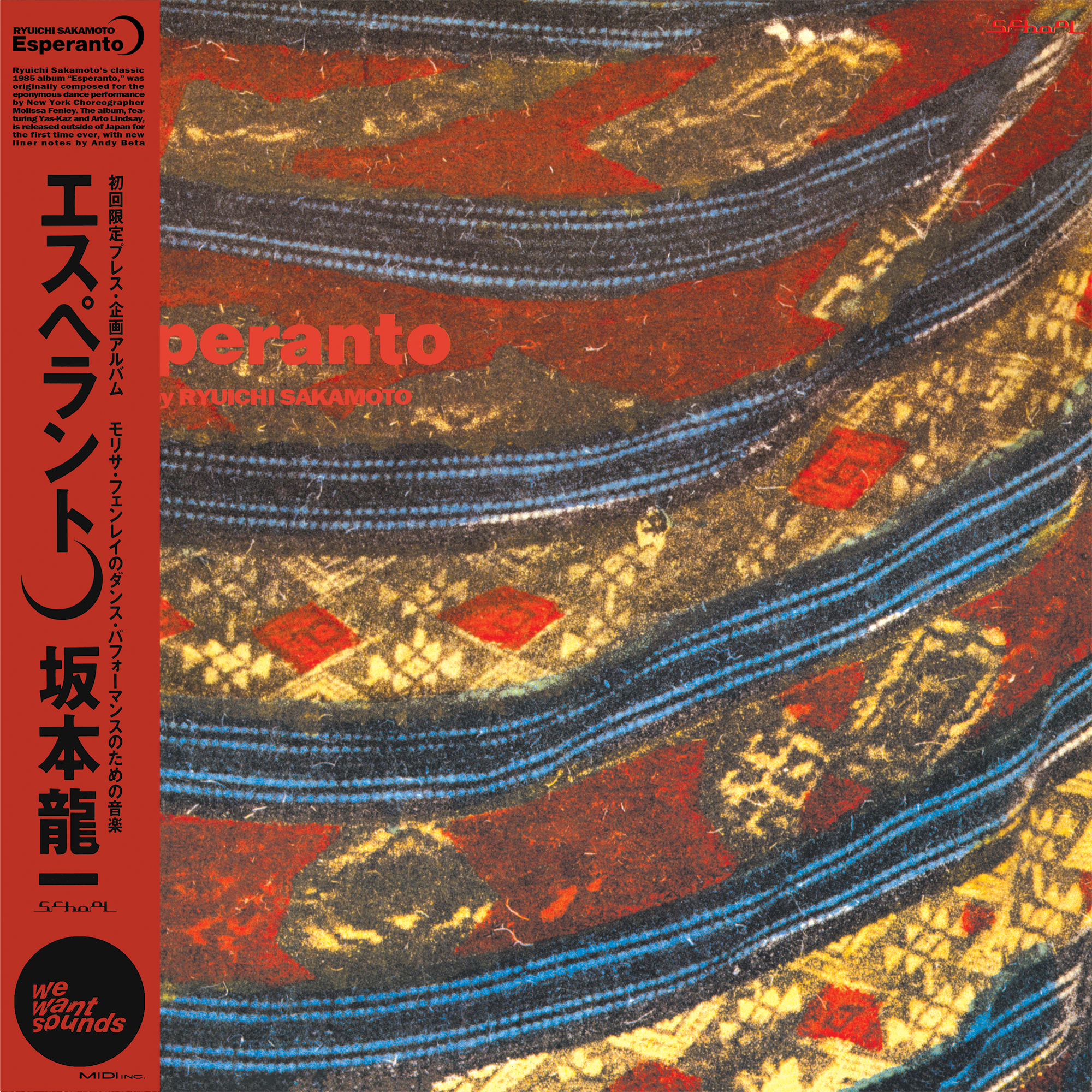
Ryuichi Sakamoto ‘Esperanto’
(Originally released October 5th 1985, and re-released by WEWANTSOUNDS in 2021)
Already riding the visionary synth waves with the Yello Magic Orchestra and through his inspirational projects with David Sylvian, Sakamoto went on to score success with the plaintive, harrowing Merry Christmas Mr. Lawrence soundtrack. The sixth solo release in that oeuvre however was a return to his more leftfield, challenging roots: a marked change from the semi-classical emotional pulls of the film soundtrack. A kind of cutting-edge theatre and ballet, Esperanto was composed for a performance by the New York choreographer Molissa Fenlay with contributions from the Lounge Lizard’s experimentalist guitarist Arto Lindsay and the Japanese percussionist Yas-Kaz. You’ll have to use your imagination to how it all worked visually – though later on art luminaries Kit Fitzgerald and Paul Garrin turned this soundtrack into a conceptual video project.
Sounding very much of its time, on the burgeoning apex of dance music and early hip-hop, electro, this polygenesis experiment often evokes both the Art Of Noise and Herbie Hancock’s ‘Rockit’. Using a super-sized computer and state-of-the-art tech, Sakamoto merged futuristic Japanese theatre with a mechanical Ballets Russes, workshop shunts and huffs with the plastic, and electronic body music with Hassell’s fourth world music inspirations.
Snatches of voices, dialogue get cut-up and looped in a primal techno performance of mechanics, rippled and tapping corrugated percussion, synth waves and oscillations, serial piano dashes and rolls, and Japanese spiritual garden enchantments. At any one time you can pick up the echoes of the Penguin Café Orchestra, Phillip Glass, Stockhausen, Kraftwerk, Depeche Mode, Eno and Populäre Mechanik within the often mysterious, exotic performativity. Motoring, bobbing or in staccato mode, Sakamoto produces a futurist dance set of suspense and experiment, an omnivorous feast of programmed and real sounds. Though very dated by today’s technological wizardry standards, the electro workshop Esperanto remains an iconic, very much sought after work well worth its admission price and indeed reissue status.
U.S. Girls ‘Half Free’
(4AD) 25th September 2015
Beckoned to the label hotbed of deconstructive cerebral pop 4AD, the Illinois raised, Toronto relocated, polygenesis songstress Meg Remy continues to entrance with her latest U.S. Girls album Half Free. Transmogrifying the template evocation of Ronnie Spector and The Shirelles with a fresh perspective and penchant for glitter ball maladies, neon lit dub and glamorous scintillating bubblegum pop, Remy’s moiety of revisionary girl group backbeats and venerable candid highly unsettling laments address a myriad of issues, from disparity between the sexes to the growing pains of modern womanhood – cue the unsettling vignette ‘Telephone Play No.1’, which plays out as a phone call catch-up between siblings but then unnervingly reinforces a deep resentment on stereotype psychology.
Remy’s most dazzling, hypnotically eclectic album yet, both thematically and musically, Half Free is essentially a highly sophisticated and gracefully slick pop triumph: On a parallel, alternative timeline this could have been (stay with me on this one) a Camille Paglia championed Madonna era masterpiece from the mid 80s; her veracious sensual heartache and woozy dream like escapism is certainly evoked at various times throughout the album. Madonna aside, Meg takes on the mantle of various female personalities and vamps, but often desexualizes and reduces their carnal allure to a sense of isolation and discomfort. Her cast of troubled personas this time around owes a debt to the characters of John Cassavetes and Michael Ondaatje, and to the broken-down protagonist of a lost 70s plaintive disco classic.
Channelling the wallowing despair of Ronnie Spector, and loosely walking the line of the troubled Nora Bass from Ondaatje’s Coming Through Slaughter novel, on the opening churning looped melodrama ‘Sororal Feelings’, Meg’s sisterly pleads of the broken wife yearningly progress through a Lee Hazelwood envisioned deep southern soundtrack: the strange fruit and methodology metaphorically replaced: “Going to hang myself. Hang myself from a family tree.” An emotional draining start, which grows on you with repeated plays, Sororal is followed up by the super-charged dub reggae hybrid ‘Damn That Valley’ – perhaps the most refreshing slice of on-message pop in 2015. Taking her cue from the acclaimed journalist Sebastian Junger’s Afghanistan front reportage War chronicles, Meg rages with a reverberating wall of sonic shrilling and grief as an imagined war widower riling against the futility and platitude sentiments of the government. Beating out an electro sound clash, part N.Y. City no wave of the early 80s, part Mikey Dread Jamaican sunshine dancehall, long-time collaborator and Toronto producer Onakabazien takes it to the next level.
Already aired, ‘Damn That Valley’ is the most colourfully vibrant of a trio of songs released since May in the run up towards the release of the LP. The second of these, ‘Woman’s Work’, closes the album. Extended from its more radio and video friendly version to a fading seven-minute plus requiem, the female gaze is sinisterly reproached by a Cindy Sherman posing façade and operatically Baroque gilded Moroder soundtrack. Amplifying the venerable atmospherics, Meg is joined by the siren sonic ethereal pitch of Ice Cream’s Amanda Grist – who can also be heard doubling-up on the Damn That Valley vocals – as they traverse an eerie veil of Catholic electro.
Released in more recent weeks, the last of this trio ‘Window Shades’ revives Gloria Ann Taylor’s original 70s unrequited disco ballad ‘Love Is A Hurting Thing’. Stumbled upon by Meg’s husband and DFA label signed artist Slim Twig (who contributes throughout the album); a touch of Madonna blusher and woozy glitter ball noir is added, whilst the universal theme is updated: apparently written after Meg watched the cod-autobiographical documentary Part Of Me, the meme circus spotlight on the life of Katie Perry that even with a soft coating of saccharine idolisation exposes the cracks and fatuous nature of celebratory.
Elsewhere on the album Meg appropriates the bubble gum glam of Bolan and the spikey punk beat of The Misfits on ‘Sed Knife’ (a minimal poem set to a bouncing backbeat, originally released as the B-side to 2012’s ‘Rosemary’). Whilst she offers an elegantly cool, misty oscillating sonorous bass-y air of mystique, – piqued by cold war jarred piano note suspense – clandestine variant on the spy thriller soundtrack with ‘New Age Thriller’: The actual battle it seems is between self-respect and male pressure. Red lipstick marks the collar of the churning, western guitar twanged, murky ‘Red Comes In Many Shades’, which itself borrows from the put-upon, downbeat beauty of Nancy Sinatra. Whether intentional or not, the song sounds like a slowed down version of New Age Thriller, and thematically dissects the struggles, and in this case, the betrayal of an affair.
Honing the darkness and plight of what was always celebrated as the innocent, teenage growing pains of adolescence with more gravitas, Meg’s robust themes swim amorphously through the dry-ice, crystal waves of the late 70s and 80s to produce a post-modern pop triumph. Progressing from the basement tapes and reverberated Spector sonic loops of the past to her latest incarnation as the pining pop artist, Meg Remy’s production values are highly ambitious: her previous work a precursor series of experimental outings. Without a doubt Half Free is her best, most mature, meticulous and glorious sounding collection of songs yet.
If you’ve enjoyed this selection, the writing, or been led down a rabbit hole into new musical terrains of aural pleasure, and if you can, then you can now show your appreciation by keeping the Monolith Cocktail afloat by donating via Ko-Fi.
For the last 15 years both me and the MC team have featured and supported music, musicians and labels we love across genres from around the world: ones that we think you’ll want to know about. No content on the site is paid for or sponsored, and we only feature artists we have genuine respect for /love or interest in. If you enjoy our reviews (and we often write long, thoughtful ones), found a new artist you admire or if we have featured you or artists you represent and would like to say thanks or show support, than you can now buy us a coffee or donate via https://ko-fi.com/monolithcocktail
THE MONTHLY DIGEST OF ACCUMULATED NEW MUSIC; THE SOCIAL INTER-GENERATIONAL/ECLECTIC AND ANNIVERSARY ALBUMS CELEBRATING PLAYLIST; AND CHOICE PIECES FROM THE ARCHIVES.

Photo Credit:: Shalev Ariel
THE NEW/
Apifera ‘Keep The Outside Open’
(Stones Throw) 21st June 2024
Pouring forth from hangout sessions at Yuvi Haukin’s studio (a member of the L.A. based quartet), the friendly, playful and jovial toking environment around Apifera’s second album inspires a constant change and lucid fluctuation between prompted musical fusions.
Near omnivorous in tastes and drivers, the often dreamy, hallucinating moods envelope a psychedelic, trippy palette of jazz-funk, disco, vapour synth music, the kosmische, the progressive, Euro chic scores and Indian influences. The later is can be heard via the cadence, almost meandered mantra vocals, of the album title (“keep the outside open”) on the opening Secret Machines-esque slow released, spacy ‘Iris Is Neil’ – a reference to the search for a missing cat called Iris, who was chasing a bat named Neil at the time of the feline’s disappearance.
Over the course of fifteen tracks (some mere vignettes in duration) Havkin, Nitai Hershkovits, Amir Bresler and Yonatan Albalak open minds and broaden horizons through various portals and mirrors; soaking up the cosmic rays whilst wistfully contemplating the universal, aching dreamily over infatuations and casting drug-induced allusions. Everything is pretty smooth and evened out, the changes in style rounded so as not jolt, but work in harmony together.
With a diverse and notable range of CVs, we have Havkin’s electronic-jazz alter ego Rejoices, Albalak fronting the post-rock-psych-jazz band Geshem, Bresler’s Afrobeat and jazz blended Liquid Saloon, and Hershkovits’s soloist piano outings for the esteemed ECM label. All of which is channeled and merged further with both suffused waves and shorter flashes of Sven Wunder, Wax Machine, The Future era George Duke, Greg Foat, Flying Moon In Space, The Flaming Lips, Jini Tenor, El Michels affair, Les McCann and The Fatback Band.
Extending the loose configuration of influences further still, the quartet invite the trumpeter and ECM signing Avishai Cohen to blow smokestack Miles Davis and more southern border bluesy expressions over the minimal vapors and gauzy airs of the finale, ‘Sera Sam’.
A smattering of made-up characters fashioned from “smoking jams” act as cartoon, psychedelic-like vehicles for sharing concerns, woes, but also for conveying a message of escapism from the increasingly divided, polarised suffocation of a hostile world at war. Advocating a return of a “wilder” untethered “freestate” of culture, music and life, Apifera leave the gateways permanently open, inviting us all to embrace, not fear, such anarchic freewheeling.
Herald ‘Linear B’
(Errol’s Hot Wax) 14th June 2024
If mid-70s Eno working his magic with Merriweather Post Pavilion sounds like a match anointed in heaven then Lawrence Worthington’s ridiculously long-delayed debut album is going to send you into a woozy alt-pop state of bliss. The latter partner in that ideal fantasy of influences is hardly surprising, with the Animal Collective’s “infrequent” co-founding member Josh Dibb (aka Deakin) playing the part of co-producing foil and soundboard. And although the eventual Linear B album was first conceived twenty plus years ago, when the Animal Collective and Panda Bear and a menagerie of congruous bands were building an alternative-psych-pop scene – the darlings (quite rightly) of Pitchfork and the burgeoning MySpace culture -, and when the musical palette of sounds is produced on cheap 90s Casio and Yamaha equipment, Worthington’s Herald nom de plume still resonates and feels refreshingly dreamily idiosyncratic.
And yet of its time, Linear B chimes, swims, shimmers, drifts and bubbles along to tubular and padded Casio percussive presets and both dream and coldwave patterned synths like it’s the late 90s and early 2000s.
The gap, after drumming his way through the 90s with The Male Nurse, Country Teasers and Yummy Fur, is due to such important affairs of the heart as marriage but also relocation and the pursuit of a useful trade – probably more important than ever, with the musician and artist’s plight never so woefully dire in monetary terms.
Picking up the ideas and partially written songs from that time at a much later date, Worthington met Dibb (a natural music partner if ever there was one) whilst (and here’s where that carpentry trade comes in not only useful but fatefully too) helping to build a recording studio. Getting on like the proverbial house-on-fire through a mutual passion for The Residents, Frank Ocean, Love’s Forever Changes, Portishead’s Third and J&MC’s Psychocandy, and spurred on by close friends, that pair set to creative work: Worthington would send his new friend demos until something struck, at which point Dibb’s would suggest booking time in the studio when the real fun began.
The results set a personal psychedelic language of feels and character-dotted whimsy to a maverick alt-synth-pop production: imagine Syd Barrett, K. Leimar and Edward Penfold backed by a Factory Records White Fence or Panda Bear. Unassumingly lo fi yet symphonic, you can hear hints of neo-romantics, colder synth spells, the post-punk, the Bureau B label’s cult German new wave and post-krautrock offerings, John Cale and a very removed vision of The Beach Boys – a stretch I know, but I swear I can hear them on the album’s closer, ‘SS Caledinghi’.
There’s much to love about this album of vapours, rays, waves, almost angelic-like moments of drifting coos. The quality, production is first rate, with each song opening up more of its subtleties and sophistication on every play.
If anything the passing of time, life hiatus, has helped in giving Worthington the space and wealth of experiences to develop and really make the album he always wanted to.
Sis ‘Vibhuti’
(Native Cat) 21st June 2024
“Vibhuti” means many things to many people; the etymology translated differently by a host of Indian cultures, spiritualists and denominations, and depending on which language, can be defined in a myriad of ways. In this case, Sis, the spiritual imbued recording guise of Jenny Gillespie Mason, uses the Sanskrit meaning of that title: “the divine spirit in the human body”.
Framed as a “roving document of spiritual awakening”, prompted by a series of “healing dreams”, the Vibhuti album channels new age motherhood, rebirth and the poetic output of the Indian mystic, nationalist and Noble Prize contender (nominated twice, once for literature and later, for peace) Sri Aurobindo and his partner in spiritual-literary learning and teaching, Mirra Alfasssa: Known as “Mother”, the French national was considered the equal partner of Aurobindo in every way – she would eventually join the maharishi at his Pondicherry retreat pursing a lifetime of philosophical and devotional learning.
An integral part of Mason’s lyricism, that iconic pairing’s message of humanity and the recognition of our divine origins and future ascension is mixed with environmental poetry, gratitude and the wonders of birth and love, love, love.
The musical vibrations are pretty surprising, helped in part by a guest list that includes the notable addition of Devendra Banhart providing subtle electric guitar lines and vibrations to a couple of tracks, but also Will Miller’s overall suffused Fourth World imbued Jon Hassell-like gauzy trumpet pines and snuggles. Longtime foils Brijean and Doug Stuart are also on hand once more to provide chimed, tinkled and trinket shimmer percussion, smooth basslines and production. But this is both a mirage and trance-like electronic alt-pop-jazz-soul-new-age-chill-wave spread of diaphanous and rainbow refracted vapours and more softly driven swells of yearned searching. One minute we’re in the realms of Alice Coltrane and Carlos Niño, the next, 70s Fleetwood Mac harmonising with Karen Vogt. And then there’s spells in which it sounds like a loose merger of Curtis Mayfield Roots period, EDM and the Tara Clerkin Trio. Beautifully sung, expressed and fluid throughout, the articulations and messages of self-healing prove artistically therapeutic and successful. Mason branches musical experimental and commercial to produce a melodious, memorable entrancing and devotional odyssey of discovery and Indian inspired philosophical mindfulness.
Neuro…No Neuro ‘Mental Cassette’
(Audiobulb) 14th June 2024
Charging up the neurons and memory receptors once more, the Tuscon, Arizona synthesist and electronic artist Kirk Markarian softly captures abstract feels and recollected scenes/evocations from his past. Under the binary Neuro…No Neuro nom de plume, Kirk’s bulb shaped translucent spaced-out notes, pips, bubbles and cloud gazing and horizon opening waveforms soundscape the subtle gauzy mental reminisces contained in the memory banks of a febrile mind.
On cassette form, with all its idiosyncratic tweaks and foibles – from a little hiss, the odd spell of bity granular surface noise and some staccato stuttered cuts and breaks in the flow – this latest hallucinogenic mirage of the tingled, arched, bended, warbled and languorous is like being blanketed in the soft play area of a psychoanalyst session.
Woozy ambience and delicate, rounded pollinations and mauve-coloured coated melodic minimal electronics and echoes of Library music conjure up such innocuous prompts as sticky tape, coaches and playground slides. This is like a watercolor version of fond recollections of innocence; an almost hypnotizing and dreamy abstraction of childhood created by a truly unique sound artist.
But changing the mood, the signature, there’s a longer remix treatment of ‘My words Come Out In Different Ways’ by Subgenuis – who, for all I know, might just be another disguise, alter ego of Kirk. This never quite hits its stride, filtering, as it does, in and out of a sort of vapoured psy and techno futuristic vibe; with a sample (I think) of some female writer/speaker communicating some theoretical address to an audience on the processes of something creative that involves dialogue, the sharing of one’s thoughts: and perhaps, repressed memories.
The Mental Tapes now could be said to archive, document for posterity those feelings and emotional states of regression therapy. Connecting with one’s childhood has seldom sounded so oblique and empirical.
Morio Maeda & All-Stars ‘Rock Communication Yagibushi’
(WEWANTSOUNDS)
As part of the vinyl specialist’s Japanese catalogue, WEWANTSOUNDS have thankfully found the time to reissue, for the first time internationally, the coveted jazz-funk-swing Rock Communication Yagibushi fusion by the renowned arranger, pianist Morio Maeda.
A beat-maker, DJ cut chemist’s and crate-digger’s delight, Maeda’s Americanized swung and Lalo Schifrin cop theme scored reinterpretations of age-old Japanese Islands folk songs and dances was originally released on the cusp of a new decade in 1970.
Using a similar formula to its precursor, This Is Rock (recorded in cahoots with foil saxophonist Jiro Inagaki), only this time replacing international hits with the traditional Shinto, the festive, the fisherman’s laments and romantically alluded handed-down songs and poetry of a diverse Pacific geography closer to home, this cult display takes many of its cues from the U.S. of A. – see the already mentioned Schifrin signatures, but also David Axlerod, a little Jerry Fielding, Jimmy Castor Bunch and Ahmed Jamal (I’m thinking specifically here of ‘Footprints’). That and a smattering of 60s Italian cinema and Library music – Armando Trovajoli springs immediately to mind.
The horns blaze and bristle, trill like a mounted curbside bust on the streets of San Fran, or swoon with lovelorn plaint in a similar West Coast location – a dockside romantic moment perhaps – as the more indigenous sounds and song from Yamageta, Kumamoto, the Island of Sado, Fukushima and Akita are transferred, given oomph and a funky showtime swagger. There are exceptions to that rule; the sake drinking seaman’s ode to love, ‘Sado Okesa’, seems to be channeling an Egyptian Hammond vibe and snake charmer’s oboe.
Largely self-taught – although it was with encouragement from his father, who taught him how to read sheet music – the 1930s born Maeda was quick to embrace jazz. Moving to Tokyo in the mid 1950s, the pianist-arranger joined the Japanese guitarist Shungo Sawada’s ensemble, and a little later, the saxophonist Konosuke Saijo’s West Liners band. In-between both those contributions and afterwards, he started his own group, the Wind Breakers, and founded We3 with the notable jazz players Yasuo Arakawa and Takeshi Inomata. He also penned music for the The Blue Coats, Tatsuya Takahasi and Nobuo Hara. The culmination of that provenance, Maeda’s All-Stars – two actual lineups make up that all-star cast, a quintet and a extended ensemble boosted by a larger horn section – Rock Communication Yagibushi adds a fuzz and twang of 60s guitar and jazz drum rolls, crescendos, a glassy-sounding marimba and sustained Dr. Lonnie Smith organ to the native heritage. Breaks aplenty, samples and fun await all those eager to get their hands on an affordable copy of a cult fusion from a revered artist on the fringes of jazz, swing, TV and film scores.
THE SOCIAL PLAYLIST VOLUME 87\__

The Social Playlist is an accumulation of music I love and want to share, tracks from my various DJ sets and residencies over the years, and both selected cuts from those artists, luminaries we’ve lost and those albums celebrating anniversaries each month.
Running for over a decade or more, Volume 87 is as eclectic and generational spanning as ever. Look upon it as the perfect radio show, devoid of chatter, interruptions and inane self-promotion.
As always, each month I select choice cuts from albums that have reached certain milestone anniversaries. This June (or thereabouts) that selection includes tracks from LPs by Bob Dylan and The Band (Before The Flood, 1974), Jade Warrior (Floating Worlds, ’74), Arti & Mestieri (Tilt, ’74), Miles Davis (Decoy, 1984), Nick Cave And The Bad Seeds (From Here To Eternity, ’84) and Noura Mint Seymali (Tzenni, 2014, which is also featured below in the archives section).
There’s also a smattering of homages to the late French chanteuse of forlorn and sorrow, Françoise Hardy, who passed away just last week. An impossible choice, but I’ve picked out a quartet of interesting tunes and covers from different points of her grand sweeping career that spanned six decades.
I’ve added a sprinkling of newish tunes too; picking tracks I didn’t get the time or room to feature in the Monthly Playlist Revue. That roll call includes Chris Cohen, Ivan The Tolerable, Beak>, The Green Kingdom, and a cut from the recently released collection of ‘homegrown’, homespun songs from the much-overlooked troubadour Tucker Zimmerman.
That leaves room for an eclectic mix of intergenerational tunes from a myriad of genres: KMD, Twenty Sixty Six & Then, the Mo-Dettes, Howdy Moon, Drahla, TVEGC, Peter Principle, Bill Dixon, Tadalat and more…
TRACK LIST IN FULL\__________
Françoise Hardy ‘That’ll Be The Day’
Typical Girls ‘Girl Like You’
Meta Meta ‘Oba Ina’
Beak> ‘Ah Yeh’
Julian Jay Savarin ‘Stranger’
Arti & Mestieri ‘In Cammino’
Kante Manfila ‘Diniya’
Miles Davis ‘That’s What Happened’
Bill Dixon ‘Vecctor’
KMD ‘Popcorn’
Tadalat ‘Tamiditin’
Noura Mint Seymali ‘Hebebeb (Zrag)’
Nick Cave & The Bad Seeds ‘Cabin Fever!’
Jade Warrior ‘Red Lotus’
Ivan The Tolerable ‘Supermoon’
The Green Kingdom ‘Softly Away’
David Gasper ‘China Camp’
Tucker Zimmerman ‘It All Depends On The Pleasure Man’
Françoise Hardy ‘Suzanne’
Bob Dylan & The Band ‘Up On Cripple Creek’
Twenty Sixty Six & Then ‘Time Can’t Take It Away’
Françoise Hardy ‘La Sieste’
Chris Cohen ‘Damage’
Howdy Moon ‘For Tonight’
Françoise Hardy ‘Et Voila’
Mo-Dettes ‘Sparrow’
Drahla ‘Second Rhythm’
The Victorian English Gentlemen’s Club ‘I Kick Higher Than A Child’
Peter Principle ‘Friend Of The Extinction’
Saecula Saeculorum ‘Radio no Peito’
ARCHIVES\_____
This month’s archive spots travel back a reasonable and recent decade ago, with the whirlwind dynamic griot star Noura Mint Seymali’s first album, Tzenni, for the Glitterbeat Records label, and Mick Harvey’s re-released consummate 2014 package of homages to Serge Gainsbourg.

Noura Mint Seymali ‘Tzenni’
(Glitterbeat Records)
The technicalities, pentatonic melodies and the fundamental mechanics aside, nothing can quite prepare you for that opening atavistic panoramic vocal and off-kilter kick-drum and snare; an ancestral linage that reaches back a thousand odd years, given the most electric crisp production, magically restores your faith in finding new music that can resonate and move you in equal measure.
The afflatus titular experience channeled with energetic passion and poetic lament, revolves around the whirling – and at its peak moment of epiphany, a fervor – dance. Performed over time under the desert skies and khaima tents by the Moorish griots, this cyclonic Hassaniya worded movement (which variously translates as, ‘to circulate’, ‘to spin’ or ‘to turn’) that enacts the orbiting solar system and with it all the elements (wind and tides) on Earth, is hypnotically invigorating.
From the German label, Glitterbeat Records, this latest Maghreb African transmission follows in the wake of the equally compelling electric transcendent desert blues of Tamikrest, Dirt Music, Samba Touré and the Bedouin diaphanous song of Aziza Brahim. Tzenni by Noura Mint Seymali and her accompanying clan make suggestive musical and social/political connections with all of these groups and artists.
Hailing from the Islamic Republic of Mauritania, nestled in between Algeria, Senegal, Mali and the Western Sahara, with the Atlantic lapping its shoreline, Noura keeps tradition alive in a modern, tumultuous, climate. Her homeland – run ever since a coup in 2008, by the former general Mohamed Ould Abdul Aziz, duly elected president in 2009 – was rocked by the immolation sparked Arab Spring and subsequent youth movement protests; all of which were violently suppressed by the authorities. Add the omnipresent problems of FGM, child labour and human trafficking to the equation and you have enough catalysts to last a lifetime. However, Noura’s veracious commanding voice responds with a dualistic spirit, the balance of light and shade putting a mostly positive, if not thumping backbeat, to forlorn and mourning.
Recorded in New York, Dakar and in the Mauritania capitol, Nouakchott, the album transverses a cosmopolitan map of influences and musical escapism. The original heritage still remains strong, yet the ancient order of griot finds solace with the psychedelic and beyond. Noura’s family linage is one of the regions most celebrated; her father, Seymali Ould Ahmed Vall, was instrumental in bringing Mauritanian music to the outside world, her late stepmother, who the whole nation mourned, was the great Dimi Mint Abba. Noura would serve an apprenticeship with Dimi, and later strike up an inspired union with her husband, the visionary guitarist Jeiche Ould Chighaly, whose dune-shifting amorphous flange-delivered licks and spindly fingered riffs create a kosmiche alien landscape, flirting with both rock and the blues. No less respected, the bass and drums combo of Ousamane Touré and Matthew Tinari bring the funk and groove.
Moving at a momentum and seamlessly across these musical boundaries, the band articulate a mostly uplifting exultation to turbulence and instability, steering through Amon Duul II and Ash Ra Tempel like field studies on the groups break out titular anthem, meditatively channeling the wah-wah delta blues on ‘El Mougelmen’, and paying homage to the prophet with an epic vocal note holding hymn to forgiveness on ‘Soub Hanallah’.
Noura Mint Seymali will undoubtedly follow Tamikrest’s success in reaching across the divide. The Northern Mali electric-blues Tuareg’s, in no small part brought to attention by the escalations in the country’s insurgency and later containment by the former colonists, France, last year wowed new, less keen world music fans. Though obviously a result of its own unique history and culture, Noura’s sound is congruous with that of both Tamikrest and Aziza Brahim – vocally. Like those artists, she will undoubtedly find a receptive, ever hungry for horizons new, audience.
Mick Harvey ‘Intoxicated Man/ Pink Elephants’
(Mute)

Creatively absent from sparring with Nick Cave and the Bad Seeds in 2013, fellow founding member and stalwart Mick Harvey missed out on the group’s mid-life opuscule, Push The Sky Away: an album that surely marks a pinnacle in meditative requiems.
Yet, since leaving the ranks, Harvey has enjoyed a fruitful run of his very own. Despite being ignored by the majority of press and blogs, his charmingly understated Four (Acts Of Love) album of afflatus paeans and lamentable covers and original numbers was wholly embraced by the Monolith Cocktail, the only blog, to our knowledge, to both critically endorse it and grant it a coveted place in a ‘choice LPs of the year’ list. In 2014, Harvey alongside Crime and the City Solutions’ Alexander Hacke and Danielle De Picciotto and musical director Paul Wallfisch, formed the nursery grime musical outfit The Ministry Of Wolves for a set of theater performances. By way of the Pulitzer Prize winning author Anne Sexton’s, even more, macabre revisionist take on the original Brothers Grimm fairy tales, the acclaimed stage production has also spawned a soundtrack LP, Music From Republik De Wölfe – reviewed favorably by us back in February.
And now, we have the re-release, accompanied by live tour dates, of Harvey’s homages to the late great, salacious Gallic maverick, Serge Gainsbourg to once again fall in love with. To coincide with the anniversary of Gainsbourg’s birth, Harvey’s 1990s moiety duo of tributes to the lecherous titan of cool, Intoxicated Man and Pink Elephants, were trundled out on April 2nd. The vinyl versions are earmarked for the 23rd June. As a precursor to this celebratory push, Harvey and his band performed a selection of songs at the Yeah Yeah Yeahs curated ATP festival back in 2013. Threatening to forever bring down the curtain on this tributary oeuvre, he has recently been back out on the road, performing in his native Australia, the UK and throughout Europe, nailing the lid shut on his Gainsbourg infatuation for good with the last date on the 14th June in Tilburg, the Netherlands: or so we believed.
Not without reservation, Harvey the ardent fan, was persuaded and prompted to record a whole catalogue of cover versions whilst working with fellow Antipodean Anita Lane, in the mid 1990s. The sleepy-eyed coquette singer/songwriter, object of desire for Nick Cave during The Birthday Party and burgeoning Bad Seeds days, Lane proposed to record the post-coital ‘Je T’aime…Moi Non Plus’ in English; originally performed of course by Gainsbourg and his English muse, Jane Birkin. Troubled by the inimitable quirks and idiosyncrasies, Harvey labored long and hard to translate the French into a less than preposterous English version: Je T’aime…Moi Non Plus as ‘I Love You…Nor Do I’ is no less steamy but Nick Cave, filling in for the nonplussed Gainsbourg, is a little too theatrical as the song takes on a less shrouded, more mooning, conversion.
Truly egged on, Harvey expanded his horizons and eventually recorded enough material for two albums and more: left over and unreleased at the time, the sociopath loony, ‘Dr. Jeckyll’ and soft focus love tragedy, ‘Run From Happiness’ have been bundled in with this re-release. But none of this would work without the quality of the supporting cast, who excelled. Channeling Gainsbourg’s leading ladies, Lane oozes that same knowing breathy sexiness, her entwined cooing dove vocals and comely sighs emulating the love nest fey Bardot and Birkin. Lane is joined in these misadventures by a qualitative backing of longtime collaborators, such as the already mentioned Cave, and newly appointed Bad Seed miscreant, Warren Ellis (both appearing on the 1997 Pink Elephants LP). Permeating and driving it all on are the lavish, though sumptuously tentative, string arrangements of French musician/composer Bertrand Burgalat and former Orange Juice bassist David McClymont.
The first of those suites, Intoxicated Man, doesn’t shy away from the hard truths, yet it is perhaps the lighter, popier and accomplished of the two records. Released in 1995, this hangover scoundrel of an album merges those blissfully unabashed dry-humping classics with its newly acquired 90s panache for European Yé-Yé, cutesy 60s nostalgia and, itself spurred on by reliving the golden decade, Britpop. However, Harvey also injects some of the more serious, Gothic-tinged, aspects of his infamous day-job band, into the pulchritude mix for good measure. Rather convincingly, Harvey’s intonations and impressions are quite good, and the English language versions of these iconic songs capture the Left Bank spirit: never availed of Gainsbourg’s ever-present genius, but nevertheless offering a fresh take.
Huskily delivered by our troubadour and caressed by Lane’s sultry enchantress tones, the deadpan Harvey begins as he means to go on, with the opening double-entendre chanson, ‘60 Erotic Year’. Flitting and flirting between erotically charged, metaphorical, pop and wanton lust, it proves the ideal introduction. Highlights are frequent, the chariot-to-the-gods, motorcycle riot, ‘Harley Davidson’, a petulant enough anthem of the ‘die young stay pretty’ variety – a rollicking union of Transvision Vamp and Saint Etienne -, just one of the many great three-minute bursts of rebel-rousing freedom. A predilection for auto-erotica persists with the arousing tribute to the Ford Mustang, and with the unfortunate plunge off the cliff road on the way to Monte Carlo, amusing ‘Jazz In The Ravine’ – “At dawn, they used a spoon to scrape up the remains.”
Harvey ups the ante on the carnival, rolling-conga fueled, ‘New York, USA’, and forlornly duets with Lane – stepping in for Bardot – on the fateful depression-era-most-wanted-on-the-run-Rom-com, and standout, ‘Bonnie And Clyde’. Bridget Bardot, whose fleeting but torrid affair with Gainsbourg left plenty of indelible marks, also inspired the album’s whirlwind, stabbing string, final affair, ‘Initials B.B.’: performed with brilliant understated morose.
Complimenting that first volume, the 1997 released, Pink Elephants, is a slightly darker proposition. It begins with the titular instrumental, a swooning cinematic teary-eyed lament, and is followed by the Massive Attack-esque, rolling trip-hop bassline and drum beat slinky, ‘Requiem’: Harvey with a Jarvis Cocker like contemptuous whisper, relishes the opportunity to sneer detestably, “You stupid cunt.” Continuing to echo Gainsbourg’s morbid curiosity and the allure of dysfunction Harvey tackles the pervy, voyeuristic ‘Hotel Specifics’; warns the kids to stay off the hard drugs (“don’t shoot-up that shit”) with wry cynicism on ‘To All The Lucky Kids’; and as Harvey imitating Gainsbourg imitating Jacques Brel, tells a sorry tale of repetitive boredom and depression, as the suicidal ‘Ticket Puncher’.
From the earliest incarnations via the various troubled and sexually heightened duets, Harvey cast his net wide, choosing a varied feast of delectable and lustfully spurned soliloquies and contemptuous exchanges between lovers. Mambo to disco-noir, each manifestation of the troubled, often objectionable and drunkenly debauched, flawed genius’s work is masterfully handled by the ensemble. Translating those quirks of language, phrases and cadence can’t have been easy, and though Harvey doesn’t exactly treat the source material with kid gloves or reverence, his dedication and love for Gainsbourg shines through every note and verse: It’s really quite an accomplishment; pretty much a resounding success.
Hi, my name is Dominic Valvona and I’m the Founder of the music/culture blog monolithcocktail.com For the last ten years I’ve featured and supported music, musicians and labels we love across genres from around the world that we think you’ll want to know about. No content on the site is paid for or sponsored and we only feature artists we have genuine respect for /love. If you enjoy our reviews (and we often write long, thoughtful ones), found a new artist you admire or if we have featured you or artists you represent and would like to buy us a coffee at https://ko-fi.com/monolithcocktail to say cheers for spreading the word, then that would be much appreciated.
 Monolith Cocktail Blog