The Perusal #57: Hannah Mohan, Black Diamond, Society Of The Silver Cross, Passepartout Duo & Inoyama Land…
July 3, 2024
A WORLD OF SONIC/MUSICAL DISCOVERIES REVIEWED BY DOMINIC VALVONA
(Unless stated otherwise, all releases are available now)

Photo credit: George Rae Teensma
Hannah Mohan ‘Time Is A Walnut’
(Egghunt Records) 12th July 2024
Geographically settling long enough to pen this solo songbook offering, but anything but settled emotionally, the former And The Kids vocalist-songwriter Hannah Mohan attempts to process the break-up of all break-ups.
After leaving home at the age of sixteen, restless and curious, Mohan spent her formative years on the road, crisscrossing North America, busking and honing a creative craft. On returning home, after five years of travel and travail, Mohan formed And The Kids with a school friend. After a trio of albums between 2014 and 2019, and with the global pandemic’s nefarious effects on the music industry and wellbeing, the band unfortunately came to an end. Throw in the heartache, the confusing cross-signals of a fateful relationship, and you’ve suddenly accumulated a whole sorry mess of emotional pain and a lot of questions that need addressing or analyses.
Luckily Mohan is a highly talented musician and songwriter, able to turn sorrow and reflection into gold. For Time Is A Walnut is a rich album full of familiarity and yet melodically and lyrically idiosyncratic, shaped as it is to Mohan’s particular cadence, timbre and way-with-words.
Less moping and more a full gamut of hurt, weariness, despondency, incriminations and plaint, Mohan travels full circle on her break-up journey: from shock to vented indignation, from losing one self in the moment to escaping from reality. All the feelings of resentment, the pulling apart of a fragile soul, and decoupling sound surprisingly melodious and disarmingly anthemic throughout: even during the bitterest exchanges and grievances.
Hand-in-hand with producer and musician Alex Toth (of Rubblebucket and Tōth fame), working away with little sleep in Mohan’s basement, the resulting thematic songbook is filled with great alt-pop songs; some with a country lent, others suddenly mystified and misty with an air of atmospheric Celtic vibes, or, channeling 80s new wave German synth music – Toth, I assume, almost in DAF mode on the darker-lit, hurting ‘Peace Be The Day’.
Almost breezy in parts, there’s tunes galore as Mohan evokes the Cowboy Junkies, Angel Olsen, Tanya Donelly, Madder Rose, Sophie Janna (especially on the vapour-piped Ireland illusion ‘Runaway’) and Feist. But you can also throw in a touch of dry-ice 80s synth-pop and a touch of Bacharach on the whistle-y saddened beauty that is ‘Upside Down’.
In sympathy and often softly lifting, there’s a fair use of trumpet on the album. Less jazzy – although saying that, there’s vague suggestions of Chet Baker – and more Southern, nee Mexican serenade and atmosphere, that instrument’s suffused and occasional enervated brassy blazes is a perfect fit with Mohan’s candid, sanguine delivery.
A congruous choice of guest, working in a similar mode, songwriter-musician Lady Lamb features on the 60s troubadour echoed, vibrato-trilled sing-a-long anthem ‘Hell’. The details and the unforeseen circumstances, the ‘messy eroticism’ and loss, disconnection from someone else’s life are all lay bare in a melodious beauty.
Hannah Mohan rides the roller coaster of a drawn-out break-up with quirkiness and vulnerability, turning tortuous heartache into one of the best and most rewarding songbooks of the year. Mohan may have let her soul sing out, as she comes to accept an emotional turbulent period of stresses and anxieties and pain. But whether she’s finally pulled through the other side or not is up to you the listener.
Black Diamond ‘Furniture Of The Mind Rearranging’
(We Jazz)
Transported back in time, and then propelled forward into the now via Chicago’s musical legacy, its rich heritage of innovators and scope in the world of jazz, Artie Black and Hunter Diamond’s dual saxophone and woodwind focused vehicle can trace a line from the Windy City’s smokestack bluesy outlines of the 50s through the icons Sun Ra, Roscoe Mitchell, Eddie Johnson, Lester Bowie, Art Ensemble Of Chicago, Anthony Braxton and the hothouse of undeniable influence and talent, the Association For The Advancement Of Creative Musicians.
Across an ambitious double-album spread of both quartet and duo mode formations, those Black Diamonds don’t so much shine as smolder and fizzle to a smoky and simmering resonance and metropolis backdrop encroached by wild jungles and fertile growth.
The majority of this moiety evolution is handed over to the quartet ensemble, with Artie and Hunter joined by the softened taut but flexing and always on the move double-bassist Matt Ulery and the constant cymbal splashing and rolling, fills and tight woody rattling drum breaking drummer Neil Hemphill. That set both swells and finds pause to a certain lowness and more weighted pull of the freeform and melodic, the rhythmic.
Saxophones sound willowy as they either entwine, take turns on the climb, exhale drawn-out mizzles or drizzles; all the while the action recalls every formative era from the 1920s onwards, from the blues to the African, the spiritual, bop and the serenaded. All those cats mentioned in the opening paragraph pop up alongside the Pharoah, Ornette, Evan Parker (I’m thinking of the woodwind elements, which both Hunter and Artie switch between throughout), Mingus and on the opener, ‘Carrying The Stick’, Lalo Schfrin of all people.
From concrete to near pastoral dustings, a menagerie of bird-like brass and woodwind sings and stretches, often letting the steam out of those valves with a bristle and rasp. The drum and bass combo keep it all moving forward, developing, with Ulery’s slackened bass even opening a couple of tracks.
In a more stripped-down and even more experimental mode, Side D (in old money vinyl terms) of the album is given over to the duo format of sax and woodwind.
Leaning towards Braxton, John Zorn and Andy Haas in near-non-musical freedom of expression, they probe new, amorphous spaces without clear signage or reference to environments or moods. The saxophone often sounds reedier, more rasping, and is enveloped with the very sound of its brassy metallic resonance and surface makeup. Every exhaled breath is used to conjure up the mysterious, the onset of some unease, but also a pauses for certain moments of reflection.
Perhaps a mizmar played at dusk, an ominous peace or a meditative haze, these experiments, forms of tonal, timberical evocation are difficult to describe or catalogue. Only that they fit in with the freedoms, the expressions and language of the Chicago school of freeform inventiveness and exploration, deconstruction of an instrument.
Black Diamond run with the ‘stick’ or baton passed on by the Chicago hothouse of jazz notables and luminaries, proving themselves to be a quality, dynamic act ready to push forward. Rearranging the cerebral and musicality furniture as never sounded both so classy and explorative.
Damian Dalla Torre ‘I Can Feel My Dreams’
(Squama Recordings) 12th July 2024
Subtle in approach and process, the cross-fertilization of South American and European cultures, prompts and environments on Damian Dalla Torre’s second album, I Can Feel My Dreams, is a tangible synthesis of abstract feels, moods and an exchange of musical ideas.
Nodes, points in a larger dream-realism canvas reference the Leipzig-based multi-instrumentalist, composer and producer’s footprints across both continents.
Sparked by a residency to teach, write and practice his craft in the Chilean capital of Santiago, Torre absorbed all that city and its surroundings had to offer: the vistas, colours and art. With a certain amorphous guaze that magical landscape of rainforest canopy enveloped menageries, flowing waters, Andean fluted heights and valleys, and exotic lushness is merged effortlessly with complimentary vocal harmonies and assonant arias, dewy and caressed extended dainty picked harp, quivers of guitar, trembles of piano and spells of electronica. The realms of jazz, sparse techno, ambience, voice experiment, nature, futurism, sound art and the new age seamlessly yield and relent.
The haul of notable guests invited to play on the album is staggering, and in no way distracts from the main leitmotifs and direction of drifted, wispy travel. Instead, each guest enhances with a certain gracefulness and calm each musical expedition and piece of mood music. Unsurprisingly given Leipzig’s musical history and legacy (home to an enviable catalogue of classical music giants over the centuries; perhaps one of the biggest most impressive concentrations in that genre’s history of iconic composers and musicians), but also its more modern burgeoning jazz and electronic music scenes, there is a host of musicians and artists from or based in the German city taking part on the album; cue the blossoming ‘genre traversal’ Jan Soutschek, ensemble singer and soprano soloist Viola Blanche, guitarist and composer Bertram Burkert and jazz improviser, pianist and composer Jonas Timm. Add to that the Austrian-Ethiopian harpist Miriam Adefris, the Danish composer and arranger Christian Balvig, pianist Felix Römer and the range and influences probe even further and deeper. Altogether, from the replenishing waters of renewal to the generator and manipulated electronics of modernity, all these contributions prove beneficially harmonious and complete.
This is a biomorphic world in which echoes of Eno, Alice Coltrane, Talk Talk, Oh No Noh, and Lara Alarcon all coalesce and dream. The architect, Torre, manages to keep everything constantly green and lush; showcasing a flair for pulling together a myriad of sources to create something almost familiar by new.
Society Of The Silver Cross ‘Festival Of Invocations’
(8668 Records)
Stepping from the shadows after abstaining from the material world for the last five years, the matrimonial partnership of Joe Reinke and Karyn Gold-Reinke return with a second rebirth, regeneration of Indian, Byzantium, Egyptian and Gothic imbued pathos and bathos.
Harnessing the themes of fate, the eventual and unavoidable specter of death and its harbingers, its demons, and even its angels, the Seattle couple walks the path of hermetic cults, atavistic Indian spiritualism and magik to induce cosmic awakenings and transformations. With all of mortality’s connotations and meanings, death is also seen as a renewable force on this couple’s second album under the occultist Society Of The Silver Cross heading.
But there’s no escaping the atmospheric dread and the curiosity of deathly rituals invoked by the Indian-style drones, harmonium-pumped sustains and concertinaed bellows – part ‘Venus In Furs’ Velvets, part Alan Edgar Poe shipwreck hauntology shanty, and part courtly mysticism. And yet Karyn’s siren-esque duets with boa Joe can lift towards the light at times, escaping the Fortean broadcasting waves, the splashed crashed tumultuous sea-like cymbals and gongs, Book of the Dead mantras and distressed Andy Haas-like geese pecked sax (if it is indeed even a saxophone) hauntings.
But for a majority of the time the couple’s counterbalancing act of apparitional, bewitching and more baritone, from the bowels of the deep and human soul, vocals muster spiritualist visitations, a theatre of sorrow, past incarnations and an unbreakable multi-levelled circle of added magic both heavy and foreboding.
I was picking up spells of Death In June, Nick Cave’s duet with Kyle, Mick Harvey’s time with P.J. and Amanda Acevedo, Backworld, David Lynch, Dead Can Dance, Current 93 and Angels of Light. The folksy Gothic-art-music-shanty-motioned ‘When You Know’ (with my imagination) sees Serge Gainsbourg laying flowers on Jim Morrison’s alter in the Cimeti ére du Père-Lachaise. The mystical finale, ‘Rajasthan’, not only features those synonymous Indian tones but also has an air of the Spanish-Baroque guitar and a touch of The Limiñanas about it. Shrouded in rousing tribal dramatics and ether visions, the couple’s lasting nod to the land in which they spent much time absorbing the cultural-musical spiritualist vibes before making their debut singles and album (Verse 1), is steeped in the mists of time; invoking India’s largest state before eventual unification, and its history of early Vedic and Indus civilizations. “Rajasthan” is a portmanteau of words, but can be translated as the “Land of the kings”; its courtly, royal verbose and stately reputation echoes as the final word on this album of rebirth and the coming to terms with death. Making true on their previous chapter, Joe and Karyn once more follow the call of the silver cross-societal allure. Atmospheres, processions and possession that are more than just songs, you don’t so much liberally catch, or, casually listen to each propound and chant-like forewarning as enter a fully constructed world of elementals and alchemist mystique. These are drones, dirges and more opened-up astral projections that will stay with you days after first hearing them. A Festival Of Invocations is a chthonian play of supernatural, spiritualist and funeral parlor riches; a successful follow-up after a five year hiatus.
Droneroom ‘As Long As The Sun’
(Somewherecold Records) 19th July 2024
Amorphous Western sun-cooked melting mirage panoramas are stoked and drawn from the Droneroom’s long form guitar peregrinations. The sixth (I believe) alt-country drone-cowboy album from Blake Edward Conley’s singular experiment for the Somewherecold label, As Long As The Sun is a filmic soundtrack-like conjuncture of Paris, Texas, Blood Meridian and a myriad of supernatural and alien visions of the ‘big country’.
The Western sounds of the twang, rattle and bends is unmistakable, and the sounds we’ve taken for granted, like the freight train convey that hurtles down the tracks and with it’s velocity and size shakes the passing dinging and ringing rail barrier junction, but Conley’s familiar markers, references make them near hallucinogenic under the sun’s powerful debilitating rays. I can imagine Ry Coder fronting Ash Ra Tempel, or early Popol Vuh relocated to the arid planes of outlier Texas, or a mule-riding Don Quixote tilting at the shadows of cacti.
A contemplation of all life’s spiritual quandaries and fate no less, all elicited from the magnified and amplified reverberations, quivers, strokes, gestures, brushes and more driven rhythmic passages of the guitar. Fuzzed-up with flange and sustain, these descriptive lines, resonated waves and vibrations are like drawn-out echoes of Michael Rother, Gunn-Truscinski, Jason Pierce (in his Spaceman 3 days) and Yonatan Gat. On the searing, razored and heated coil moody ‘Last Train To Soda Spring’ (the small Idaho city which gets its name from the 100s of carbonated water springs that dot the landscape) there’s a build-up of layering and rhythms that breaches the hazy space rock barriers – Hawkwind crosses fully into Motorhead. Whilst the shamanic marooned, railroad vision, ‘East Facing Window’ has a kind of krautrock generator field around it that hums and pulsates, invoking both alien and paranormal activity – I’m thinking a little of Roedelius’s experimentation on Sky Records.
As Long As The Sun beats down upon Conley’s cowboy hatted noodle, its gravitas, life force and heat inspiring serious abstract empirical vistas, atmospheres and the soundtrack to a movie yet to be made.
Luke Elliott ‘Every Somewhere’
(AKP Recordings) 12th July 2024
Composing a more inclusive biosphere and exchange of cultures, influences and sounds, the Amsterdam-based, Leeds born, sound artist Luke Elliott transforms his source material of field recordings (from what could be acts of making in a workshop to tramples through the undergrowth of Moat Farm in Somerset and the windy tubular sea organ of Zadar in Croatia) into a fully working lunar off-world vision.
A new world no less, Every Somewhere’s vague, recognizable, or by happenstance, playful tastes of gamelan and Southeast Asia, early analogue modulations and patterns, tape music experiments and sonic land art (that already mentioned Zadar organ, which was built as a large scale land art instrument to bring some sort of random melodious colour to the Dalmatian coastal town’s monotonous concrete wall scape, rebuilt with haste after the devastations of WWII) are sampled then re-sampled, fed through effects and an apparatus to build a more sympathetic, attentive environment.
At least influenced in part by a fascination with Alfred W. Crosby’s ‘Colombian Exchange’ theory, as outlined in his 1972 propound book, which gave a now fashionable name to the legacy of colonialism and the destructive and loaded exchanges between the Western hemisphere and the then ‘New World’, Elliott’s imaginative world is more nurtured towards a beneficial exchange of cultures.
In a liminal zone between the earthly, otherworldly, near cosmic, dreamy and liquid, the kinetic, algorithmic, arpeggiator and magnetic atoms and transparent notes bobble and squiggle about over atmospheric ambience and to the rounded rhythms of paddled tubular obscured instruments. And then, once the guitar is introduced to tracks like the glassy delicate ‘Objects Of Virtue’, the mood changes towards a bluesy post-rock vibe.
Magical escapes, stargazing from the observatory, solar winds, near operatic cloudscaping and various gleams, glints and globules recall Goo Ages’s Open Zone album, Tomat, Raymond Scott, Edgar Froese and Zemertz.
Elliott’s debut for the astute AKP Recordings label maps tactile environments both intriguing and melodically mindful. It paves the way for new visions of a more equal future.
Passepartout Duo & Inoyama Land ‘Radio Yugawara’
(Tonal Union) 26th July 2024
The freely geographical traversing Passepartout Duo find congruous partners with collaborative foils Inoyama Land – those fine purveyors of Japanese Kankyō Ongaku, or environmental ambient new age music – on their latest balance of the tactile, organic and synthesized.
A free association of cultures and musical processes, despite laying down loose perimeters, the Italian/US duo of Nicoletta Favari and Christopher Salvito combine explorative forces with the Japanese musical partnership of Yasushi Yamashita and Makoto Inoue for a remarkable interaction with their surroundings, a mix of children’s instruments and percussive and wind apparatus.
Favari and Salvito have already appeared on the Monolith Cocktail, with reviews of both the Chinese art platform-backed Vis-à-Vis and Daylighting albums. Those experiments in the timbrical, rhythmic and melodic, imbued by the Meili Mountains, Lijiang and fabled imaging’s of Shangri-La, were created during and in-between the restrictions of the Covid pandemic. A year before news broke of that global crisis the duo travelled to Japan. Connecting with the Inoyama Band, a duo that had transformed the abstract feelings, magnetism, sublime transcendence and peace of the landscape since the 1980s, they were invited in to their host’s shared space sanctum – an auditorium inside Inoue’s family-run kindergarten in Yugawasa that doubles-up on Sundays as a studio.
Set out on tables for all participants, a myriad of playful and more studied instruments and a set of “game rules”. The quartet could only use the mix of electronic and acoustic instruments separately or altogether for ‘revolving duets’, with each taking turns to play through a cycle of ‘four duos’. But then ‘anything’ was permitted in that session, which lasted three hours. In this complete state, that long improvisation and set of prompts has been distilled into eleven more digestible parts. Within the sonic, contextual and languid peaceable realms of the Kankyō Ongaku genre and greater scope of Japanese acoustic-electronic music, there’s an air of Satoshi Ashikawa, Yasuaki Shimizu, Yoshio Ojima and Tomo-Nakaguchi about this album. You could add hints of Slow Attack Ensemble, Eno, the Hidden Notes label and Bagaski to a subtle layering environment that takes in all points of the compass, with chimed bulb-like notes and the ringing, searing and chimed bamboo music of Java, Tibet, Vietnam and the dreamy.
The recognizable sound of soft-mallet patterned and paddled glockenspiel and xylophone merge fluidly with hand bells, higher-pitch whistled recorders, concertinaed wafted melodica and harmonicas, and racks of wind chimes. Whilst atmospheric elements and the use of electronic devices create mysterious vapours, oscillated wisps, knocked rhythms and floppy disc sampled voices.
Gazing at diaphanous beamed and lit cloud formations from a comfortable snug in the landscape, or, submerged below Mexican waters inhabited by the strange aquatic Axolotl salamander, each part of this performance is somehow similar and yet variably different. Between the illusionary, dreamy, sonorous, see-through and swimmingly, two sets of adroit partnerships create organic meta and a sublime near-nothingness of slow musical peacefulness and environmental absorbed transience.
Myles Cochran ‘You Are Here’
(9Ball Records) 26th July 2024
Unhurried and once more placable, the all-round embracing American composer, songwriter, multi-instrumentalist and producer Myles Cochran follows up his 2021 debut album (Unsung) with another carefully spun canvas of subtle emotive pulls, TV and filmic-like soundtrack scores, ruminations and mirages.
Traversing an amorphous palette of Americana, the blues, classical, folk, experimental, Baroque and traditional, Cochran integrates his Kentucky roots with spells in New York City and the UK (where he’s lived for some time) whilst letting his unprompted imagination travel to more exotic climes and cerebral dreamscapes.
Although an adroit player of many instruments, Cochran’s work is mostly led, directed, informed and suffused by both the acoustic and electric guitar. Understated but keen and expressive, his choice of guitar is once again left to stir up visions of a celluloid panoramic and more mystifying melting Western America, the Appalachians, Ozarks and home. Only this time around he’s also invited in the accomplished cellist Michelle Packman and bassist Reggie Jones to add a transported subtle semblance of chamber music, period drama and jazz. Jones, playing a stand-up (or upright) bass throughout, emphasizes rhythm, a pace and sense of travel – especially so on the shaky rhythmic travelogue ‘Making Something Out Of Nothing’, which, by its title, indicates a conjuring of a composition, performance out of just playing or fiddling around, but evokes (for me) the imagined title sequences of some wintery Northern American drama, out on the road with the harsh, snowy landscape passing by the window of our protagonist’s truck. Meanwhile, the following countrified-meets-the-pastoral-and-renaissance crafted ‘Signs And Symbols’ has an air of Fran & Flora about it with the sounds of a breathy and fiddle-like cello.
Widening the vistas, the quiet inner battles of turmoil and conflict, sympathetic bowing and pining cello enhances the mood and subtle expressions of Cochran’s compositional style, which both ebbs and flows between the echoes of Chuck Johnson, Ry Cooder, Bill Frisell, John Fahey, Martin Renbourn and Jeff Bird.
There’s a pick up in the pace with dusty brushed drums, but for the most part it’s a quivery horizon gaze of sophisticated slow to mid-tempo observations and introspection. None more so then on the mature vocalized jazzy-bluesy and dusty ‘The Deepest Sea’, which sounds like Hugo Race or Chris Eckman in questioning Leonard Cohen mode backed by Chris Rea.
A culmination of travels, thoughts, hopes and fears, You Are Here further expands Cochran’s musicianship and influence. Those Americana roots are being pushed further into new pastures, helped by his cellist and bassist foils and freshly attuned ear. Eroded, waned, giving and dreamily melting in the heat, his guitar parts overlap and transmute into piano, strings and the ambient. Each track is like a short score, the qualities of which offer sensibilities and a way of following or telling a story, a moment in time or scene. In all: a very sensitive work of maturity and unrushed reflection.
___/+ THESE RECOMMENDATIONS IN BRIEF
Any regular readers will know that I pride myself in writing more in depth purview-style reviews with a wider context. This means I naturally take more time and effort. Unfortunately this also means that I can only ever scratch the surface of the 4000+ releases both the blog and I get sent each month. As a compromise of sorts, I’ve chosen to now include a really briefly written roundup of releases, all of which really do deserve far more space and context. But these are recommendations, a little extra to check out of you are in the mood or inclined to discover more.
Pocket Dimension ‘S-T’
(Cruel Nature Records)
Exploratory voyages into the kosmische and sci-fi, straight from the illustrated pages of Stewart Cowley’s Spacecraft 2000 – 2100 AD, the Lanarkshire-based artist Charlie Butler doesn’t so much launch as fire the languid thrusters into the mesmerizing, enticing and dream like voids of a soundtracked cosmos. On many levels, through four continuous stages, the drifted and wonder of space is balanced with fizzled raspy electronica and eventual IDM, siren wailing bends, shoots, and a rotating centrifugal force that seems to envelope the whole trip in both mystery and the presence of unknown forces hovering in the galactic ether.
Various ‘TRÁNSITOS SÓNICOS – Música electrónica y para cinta de compositores peruanos (1964-1984)’ (Buh Records)
Filling in the blanks in the story of South America’s experimental and avant-garde scenes, Buh Records throws the spotlight on Peru and a host of experimental boffins working to cross indigenous sounds with the new and yet to be discovered.
Off-world, futuristic, UFOs, tape manipulation, the shrills of something magnetic, steely industrial tools, reel to reel melting, mind bending and rattling old atavistic bones, assonant female voices, and shamen augers, this compilation includes examples from the likes of Arturo Ruiz del Pozo, Luis David Aguilar, and Corina Bartra; a wealth of cult composers struggling to explore new sonic boundaries in a country devoid of the apparatus, foresight and laboratory conditions. And so most of the atmospheric – sometimes heading towards chilling alien – and transmogrified Peruvian environmental peregrinations were recorded in private studios. The story and scope needs way more room than this piffy, glib little piece. Suffice to say, I highly recommend it.
Rehman Memmedli ‘Azerbaijan Guitara Vol. 2’
(Bongo Joe)
The history and travails of the fecund oil rich country of Azerbaijan are atavistic. This is a nation that has striven to gain independence from a string of empires: both Tsarist and Soviet Russia, Iran, Albania, and much further back, the great Mongol Khan Timur. Desired not only for its abundance in fossil fuels but for its geographical corridor to its fellow Transcaucasia neighbours of Georgia and Armenia in the west, to the south, Iran, in the north, Russia, and to the west, the vast inland lake, the Caspian Sea. And although at various times at war with its direct neighbour Armenia (recent flare ups have led to a startup in violence, and accusations of ethnic removal), the country’s close proximity to a mix of cross-cultural and geographical influences has led to an absorption of all kinds of musical styles.
Bongo Joe‘s second volume of ‘guitara’ music showcases is fronted by another Azerbaijan legend, Rehman Memmedli (the first volume was handed over to the equally iconic Rüstəm Quliyev), who first learnt the accordion and harmonica before picking up a relative’s guitar – but also the region’s synonymous traditional tar instrument too (an ornate curvy looking waisted long-necked lute). Suitably eclectic in styles, from belly dancing Turkey and Arabia to shimmy Bessarabia and local wedding music, Memmedli scores and scorches up and down the fretboard at speed. Spindling, bending, skirting and wobbling, and even sounding at times like an erratic stylophone, vistas and ruminating sonnets are conjured up from a nibble-fingered maverick: Persia, the Caucasus, and beyond are summoned forth from electrified scuzz and fuzz and drama.
Cumsleg Borenail ‘Fragile And Adaptive’
Video – Taken from the new album Time Is A pˈætɚn Of Shifting d͡ʒiˈɑːmətɹiz
Proving incredibly impossible to pin down, whilst impossible to fully keep a track of, such is the prolific output, the artist formerly known as Cumsleg Borenail has released a host of albums, EPs over just the last few months alone.
The latest, and discombobulating entitled, Time Is A pˈætɚn Of Shifting d͡ʒiˈɑːmətɹiz,will officially go live a week or so after this column. As a teaser, Borenail has fucked around with AI to produce this strange, biomorphic, tumorous metamorphous of metallic clay dancers, bound together in some super fucked up hallucinatory creepy body assimilation style video. I will admit that I fucking hate AI – ‘artificially inflated’ as someone has already quipped – so it is lost on me – for those who want the tech, ‘all models’ were ‘created in blender, then whapped into ADOBE to AI generate backgrounds and randomly alter model edges.’ But musically we are talking about whippy body music that channels Detroit mechanic funk techno and the sound of grooving over broken glass. Derrick May, Suburban Knight, Ron Trent in the mechanics of the surreal and industrial. As artificial as it all is, there’s a certain soul in this machine. I look forward to hearing the rest of the album later in the month.
Neon Kittens ‘In The Year Of The Dragon (You Were A Snake)’
(Metal Postcard Records)
System of downer sinewy post-punk, like the Pop Group falling on top of PiL, the latest video output from the ridiculously prolific Neon Kittens is another semi-metal-guitar-string buzz and grind of gnashing venom and risk. The vocals sound like a toss off and up of honey trap glossed fake AI and taking no crap no wave female provocateur in the mode of Michi Hirota, unimpressed by the snake-like actions of a former lover; the action, like a lost grated down stroke of Fripp(ery) from the Scary Monsters And Super Creeps LP.
Keep an eye out next week for Brian ‘Bordello’ Shea’s review of the band’s EP.
Dyr Faser ‘Crime Fever’
(Self-release)
Boston, Massachusetts duo of Eric Boomhower and Amelia May previously skirted the krautrock dreaminess of Amon Duul II on their hermetic, drowsy Karmic Revenge. They seem to change their sound, if only subtly, on each new album, and Crime Fever’s haunted, scuzzed playfulness leans more towards Lou Reed this time around – but only if he’d jammed with Dinosaur Jnr. Jefferson Airplane and Ty Segall.
Still, they maintain a buzzy, fuzzy, and even Byrds-like loose dusting of the psychedelic and a backbeat throughout, with those ether-giddy vocals tones of May invoking Blonde Redhead, Beach House, and of course a little of a slacker rock, shoegaze vision of Renate Knaup-Krötenschwanz.
Needs far more attention than I have the capacity to manage but have a read of my piece on their KR album from a while back to get enthused.
Hi, my name is Dominic Valvona and I’m the Founder of the music/culture blog monolithcocktail.com For the last ten years I’ve featured and supported music, musicians and labels we love across genres from around the world that we think you’ll want to know about. No content on the site is paid for or sponsored and we only feature artists we have genuine respect for /love. If you enjoy our reviews (and we often write long, thoughtful ones), found a new artist you admire or if we have featured you or artists you represent and would like to buy us a coffee at https://ko-fi.com/monolithcocktail to say cheers for spreading the word, then that would be much appreciated.
Our Daily Bread 313: Vukovar ‘Cremator’
March 29, 2019
Review: Dominic Valvona

Vukovar ‘Cremator’
(Other Voices Records) 25th May 2019
In a constant state of erratic flux, you never know which particular inception of Vukovar will show up when the time comes to laying down their brand of hermetic imbued visions for posterity, the only constant being de facto avatar, whether anyone agreed or not to this appointment, Rick Antonsson.
Yet in only four years since laying down the foundations of their stark morbid curiosity and industrial Gothic pop debut Emperor, Vukovar have managed to record seven albums via umpteen labels and always via a series of travails and fall-outs. Flanked at the time of recording by Dan Shea and Buddy Preston, and with the dutiful Phil Reynolds of Small Bear Records fame sticking it all together once more as producer, the seventh three-syllable signature grand theatre of despondent romanticism is a collaborative affairs of a kind, featuring as it does both the vaporous linger and narration of Holly Hero (Smell & Quim) and omnipresence of Simon Morris (The Ceramic Hobs).
Cremator arrives just as the Vukovar look certain to split: Buddy and Dan breaking away recently to form the Beauty Stab duo, their debut single already released on Metal Postcard Records. Carrying the torch for now, going forward, Rick will continue with the Vukovar mantle. Far from orchestrated, Cremator is nonetheless a swansong, a curtain call at least for the original lineup. It just happens to also be one of the band’s best and most accomplished works.
Suffused with disillusion, as they row across a veiled River Styx (or in this case, as alluded to in the yearning slow junk ride over the lapping black waves of tortured cries of ‘The River Of Three Crossings’, the Japanese Buddhist version of that mythological destination), Vukovar and converts add more fuel to a bonfire of vanities to an overall sound that reimagines Bernard Summer as the frontman of a Arthur Baker produced Jesus And Mary Chain.
Though always wearing their influences on their sleeves, there’s also this time around a trio of cover versions, both obvious and more obscure. These include a despondent if scuzzed growling bass with radiant synth live version of the Go-Betweens ‘Dive For Your Memory’, a cooed ethereal voiced dreamy, with phaser-effects set to stun, diaphanous vision of Psychic TV’s ‘The Orchids’, and, most poignant, a gauze-y heaven-bound ghostly homage (complete with Hebrew vocals) to the late Tel Aviv cowboy Charlie Megira, on the hymnal ‘Tomorrow’s Gone’.
Elsewhere a Gothic esoteric atmosphere of post-punk and apparition crooned rock’n’roll invokes a communion between Alan Vega and the Silver Apples on the magisterial downer ‘Internment By Mirrors’, Coil and Joy Division on the album’s imperial vortex of sorrow, half-narrated, opener ‘Roma Invicta’, and Blixa Bargeld era Bad Seeds leap into the augur’s furnace with The Sisters Of Mercy, on the heavy toiled ‘Voices/Seers/Voices’.
It sounds darkly glorious in all its melodrama and pomposity, with as cerebral high artistic references as the infamous Italian director Pier Paolo Pasolini’s feature length documentary ‘Love Meetings’, and the ‘Decameron’ 100-story spanning novellas of the 14th century Italian author Giovanni Boccaccio: In fact, what with the album’s opening use of the triumphal Latin mantra of an all-conquering Roman Empire (before it’s famous fall), there’s a lot of Italian, both atavistic and modern, on show; that and a prevailing theme of love, whether it’s spurned, lost, mourned or unspoken.
Once more unto the breach, Vukovar cast augurs or reflect, mooningly on the past; channeling various vessels from beyond the ether as they prowl the shadow world in pursuit or articulating a vision of dark arts experimental drama. As with the previous Monument LP they recorded with the gloom luminary Michael Cashmore, Vukovar find congruous soul mates in their choice of collaborators, Hero and Morris; attuning those individuals equally mysterious and supernatural leanings and illusions to the ambitious Vukovar mysticism.
Cremator is a death knell; the end of one era and setting in motion of a new chapter: whatever that ends up looking or sounding like. It just happens that they’ve bowed out in style with, perhaps, the original lineup (of a sort) most brooding masterpiece yet. Long may they continue, in one form or another.
Words: Dominic Valvona
Our Daily Bread 260: Vukovar ‘Puritan’ LP
October 24, 2017
ALBUM REVIEW
WORDS: DOMINIC VALVONA
Vukovar ‘Puritan’
The Brutalist House, 25th October 2017
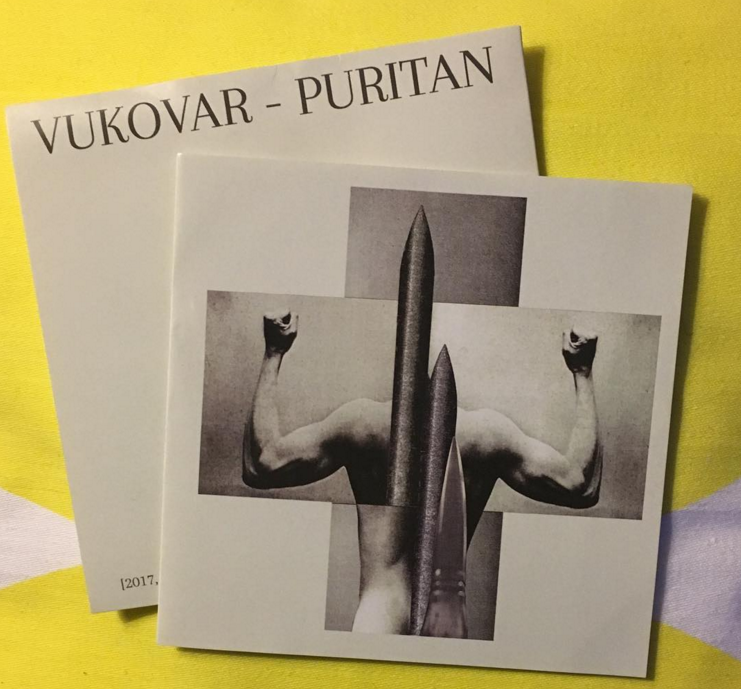
Ah, the times in which we find ourselves. Portrayed in a maelstrom of uncertainty, anxiety and utter chaos by the collective forces of the established press and social media, and by reactionaries on all sides of the political divide: from those who envision a Marxist takeover to those losing their shit over fascistic dystopias. Fear and (self) loathing in a post-postmodernist world, all the constructs and old arguments previously, we believed, answered as democracy, and by its extension capitalism, seemed to have won out, are once more dragged to the surface.
No side in the political struggle, left or right and its various iterations however seem capable or ready to handle the personality cult leaderships (of which Corbyn’s own party could be accused) of Trump, Putin, Xi Jinping, and of course ‘supreme leader’ Kim Jong-un. They also seem almost powerless to legislate and reign-in the domineering forces of Silicon Valley, which continues, in the name of so-called progress, to manipulate and filter much of the content and media we see and hear; taking over from traditional broadcasting whilst circumnavigating any restrictions and collecting our data for their own nebulous (daresay nefarious) intentions – well perhaps it isn’t that much of a secret, we know that Facebook et al are serious about entering the political fray in one way or another, and their tweaking of the algorithms in future will certainly benefit their own held ideals and leanings.
Yet despite the cataclysmic augers and the visions of the four horsemen appearing on the horizon, history proves that the world keeps spinning through all the bullshit regardless. And so proving that age old adage that history not only keeps on turning but often repeats itself (in a manner) the malcontent romantics Vukovar remind us through their chosen moniker that only a mere twenty odd years before in the infamous Croatian city of the same name, on the EU’s own doorstep, 300 poor souls, mostly Muslims, were rounded up and barbarically executed by Serb paramilitaries and the Yugoslav Peoples Army in what remains one of the worst committed atrocities of its kind since WWII. This was of course during the Balkans implosion of the nineties that followed the defrosting of the Cold War, as the Berlin Wall fell and the Soviet Empire crumbled. A decade long war that eventually redrew the map of the region, demarcating for the most part, ethnic groups into their own republics and countries, with the most fought over and disputed being the NATO backed Kosovo. In a different part of the world, in the same generation, a similar genocidal persecution of a Muslim minority unfolds in Myanmar. A former darling of the West and liberals, Aung San Suu Kyi has proven to be anything but the democratic champion in the wings, having after a decades long struggle to hold office and take power away from the totalitarian military regime, turned a blind eye to the massacre of the country’s Rohingya Muslim population. Talks are ongoing, though Aung San’s constant stoicism and ‘fake news’ crowing in the face of blatant persecution doesn’t exactly fill you with confidence that the situation will improve anytime soon.
Before this review becomes an all-encompassing purview style essay of the state of affairs throughout the world and the multiple crisis we all face, I’d better stick to the catalyst of this piece and return to Vukovar.
Following in the tradition of their three-syllable sloganist album titles, Vukovar’s fourth LP drums home the Puritan mantra and analogies; a cleansing if you will of the status quo, a year zero, and perhaps also a return to the roots and communal deliverance of protest in music – not, I hope, the ‘puritanical’ steeple hat and buckle shoe wearing bible bashing of zealots, burning heretics at the stake, nor the bloody zeal of so many badly turned-out revolutions that end up creating just as terrible a reign of tyranny. The only fires here are the metaphorical kind; a funeral pyre of mediocrity, a bonfire of vanities, the-bland-leading-the-bland towards a conversion of raw intensity, dangerous, shamanistic performed anarchistic rock’n’roll: well I think that’s the idea.
Vukovar have their work cut out in a climate of such chaotic unreasoning, as people tend to turn towards escapism or certainty, even assurance. And so it comes as no surprise to find the creative landscape lacking in ‘danger’, new ideas, and confrontation; with much of the most fiery, interesting music coming from outside North America and Europe.
As the band’s previous album, Fornication showed, Vukovar have at least listened to many of the right bands; released at the start of the year, this amorphous, transmogrified covers style collection featured reconfigured homages to a host of iconic luminaries including David Sylvian, Coil, The Monks, The Birthday Party and Neu!. Cultish in a manner, the band’s influences and manifesto statements of propaganda intent, plus allusions to cultural regicidal and ability to shrink from publicity – even self-sabotage any signs of success or promotion – suggests a band that takes itself very seriously.
Yet even with countless references to history’s outsiders, philosophers, discontent mavericks, revolutionaries and demons throughout their previous trio of albums, and the elegiac resignation that shadows them, they waltz sublimely (for a majority of the time), rather than rage in romanticized contempt, as Olympus slowly grumbles.
I’ve stated in the past that Vukovar sound best when encouraged towards the light of melancholic pop and post-punk than when firing into a cyclone of caustic discord and noisy self-indulgence. Better when they enact Joy Division than say Throbbing Gristle; melody doesn’t necessarily mean commercial; doesn’t necessarily mean compromise, whilst industrial strength misery can grate and test the patience: in a live setting, depending on circumstance, a primal cacophony is just what’s needed; captured on record for posterity, it better be good and have some meaning beyond the atmosphere of the studio on the day it was recorded. Thankfully the band seem to have reigned-in the chaos and used it wisely and sparingly. Puritan however is closer to the debut Emperor, inasmuch as it balances the group’s dynamic forces of tortured-soul poetry and violent more aggressive tormented bursts of churning hell and occasional screaming.
Between the Gothic skulking and crystalline rays of shared 80s synth new romanticism Vukovar wander transfixed in a nightmare state of both despair and indolent antagonism; with stark lyrics more descriptively visceral than forced down the listener’s throat. Donning the vestiges of the Puritan, the front man, an amalgamation vocally of both Ian Curtis and Bernard Sumner, sets the scene (“I am a sinful man, yet an honest man”) to a backing track of slung low growled bass, Jesus and Mary Chain’s bastardize Spector drum death knells and the miasma threat of Nick Cave’s Bad Seeds on the opening inflicted and gradually ascendant Nietzsche propound Übermensch.
Pounding away like the BRMC on the life and death rock’n’roll discordant Veil, a tension is first released and then carried over with sinister effect on The Leadership Is My Light: the singer channeling Trent Reznor at Lynch’s Bang Bang Bar stage and Berlin era Crime And The City Solution as he shrieks “I am nothing!” repeatedly on one of the album’s most ominous seedy doomed outpourings of daemonic grief.
Waltzing once more through a gloomy dreamscape, joined for the first of a trio of tracks that feature the daemonic siren folksy vocals of Elizabeth Menally, Once More For The Puritan is a pendulous duet bordering on esoteric shoegaze, and despite its mantra title is anything but puritanical, consulting as it sounds with spirits and hallucinogenic substances. The first of two traditional song translations, and again featuring Menally, who floats in the ether with fateful ghost like calls, the old Appalachian via even older Celtic roots Down In The Willow Garden lament continues in the haunted vein. The macabre beckons, as in a fashion, Menally and Vukovar echo the murder ballad partners Nick Cave and Kylie Minogue; our protagonist inching towards the gallows after doing away with his lover in all manner of diabolical ways, the spirit of his love cooing from a maelstrom of spiraling dread from beyond a watery grave.
The second old faithful, All The Pretty Little Horses – itself a handed-down version of the hush-a-bye lullaby – is given a bewitching enchanting treatment that suggests foreboding rather than comfort and a good night’s sleep.
A second guest spot is reserved for the Lancashire actor, writer and producer, and owner of an equally disenchanted weary ominous voice, Graham Duff, who narrates a despondent eulogy full of death throes, destruction and adages over the two-part A Final Solution. The first part of which is starker, delivered over a drone, the second part submerging his speech beneath a merger of Radiohead, The Stooges and Joy Division influences, and the repeated vocal line, “Without you I’m an empty space”.
If Vukovar were in the business of releasing singles, then the trio of tracks in the last half of the album would prove ideal. I’ve already featured the group’s precursor to Puritan, the rapturous OMD joining Echo & The Bunnyman and The The on Nero’s veranda, A Clockwork Dance – launched on bandcamp in the run-up to this latest album -, but equal contenders for the single status are the Tubeway Army-Visage-OMD(again) melding synth pop indie crawl through the wastelands The Moment Severed, and the brilliantly dark throbbing Radiohead-esque S.S.S.
The most complete and best produced encapsulation of Vukovar’s sound yet, balancing both their experimental raw and ritualistic live performances with melancholic post-punk, and even brooding new romanticism pop, Puritan offers a travail through the dirge and gloom of our (end) times with all its sinful and cleansing, often biblical, connotations and language. Though it also often sounds like some kind of personal tortured Nick Cave love requiem, unfolding in the midst of chaos; looking over the edge into the abyss, the heretics taking over the asylum.
 Monolith Cocktail Blog