The Perusal #57: Hannah Mohan, Black Diamond, Society Of The Silver Cross, Passepartout Duo & Inoyama Land…
July 3, 2024
A WORLD OF SONIC/MUSICAL DISCOVERIES REVIEWED BY DOMINIC VALVONA
(Unless stated otherwise, all releases are available now)

Photo credit: George Rae Teensma
Hannah Mohan ‘Time Is A Walnut’
(Egghunt Records) 12th July 2024
Geographically settling long enough to pen this solo songbook offering, but anything but settled emotionally, the former And The Kids vocalist-songwriter Hannah Mohan attempts to process the break-up of all break-ups.
After leaving home at the age of sixteen, restless and curious, Mohan spent her formative years on the road, crisscrossing North America, busking and honing a creative craft. On returning home, after five years of travel and travail, Mohan formed And The Kids with a school friend. After a trio of albums between 2014 and 2019, and with the global pandemic’s nefarious effects on the music industry and wellbeing, the band unfortunately came to an end. Throw in the heartache, the confusing cross-signals of a fateful relationship, and you’ve suddenly accumulated a whole sorry mess of emotional pain and a lot of questions that need addressing or analyses.
Luckily Mohan is a highly talented musician and songwriter, able to turn sorrow and reflection into gold. For Time Is A Walnut is a rich album full of familiarity and yet melodically and lyrically idiosyncratic, shaped as it is to Mohan’s particular cadence, timbre and way-with-words.
Less moping and more a full gamut of hurt, weariness, despondency, incriminations and plaint, Mohan travels full circle on her break-up journey: from shock to vented indignation, from losing one self in the moment to escaping from reality. All the feelings of resentment, the pulling apart of a fragile soul, and decoupling sound surprisingly melodious and disarmingly anthemic throughout: even during the bitterest exchanges and grievances.
Hand-in-hand with producer and musician Alex Toth (of Rubblebucket and Tōth fame), working away with little sleep in Mohan’s basement, the resulting thematic songbook is filled with great alt-pop songs; some with a country lent, others suddenly mystified and misty with an air of atmospheric Celtic vibes, or, channeling 80s new wave German synth music – Toth, I assume, almost in DAF mode on the darker-lit, hurting ‘Peace Be The Day’.
Almost breezy in parts, there’s tunes galore as Mohan evokes the Cowboy Junkies, Angel Olsen, Tanya Donelly, Madder Rose, Sophie Janna (especially on the vapour-piped Ireland illusion ‘Runaway’) and Feist. But you can also throw in a touch of dry-ice 80s synth-pop and a touch of Bacharach on the whistle-y saddened beauty that is ‘Upside Down’.
In sympathy and often softly lifting, there’s a fair use of trumpet on the album. Less jazzy – although saying that, there’s vague suggestions of Chet Baker – and more Southern, nee Mexican serenade and atmosphere, that instrument’s suffused and occasional enervated brassy blazes is a perfect fit with Mohan’s candid, sanguine delivery.
A congruous choice of guest, working in a similar mode, songwriter-musician Lady Lamb features on the 60s troubadour echoed, vibrato-trilled sing-a-long anthem ‘Hell’. The details and the unforeseen circumstances, the ‘messy eroticism’ and loss, disconnection from someone else’s life are all lay bare in a melodious beauty.
Hannah Mohan rides the roller coaster of a drawn-out break-up with quirkiness and vulnerability, turning tortuous heartache into one of the best and most rewarding songbooks of the year. Mohan may have let her soul sing out, as she comes to accept an emotional turbulent period of stresses and anxieties and pain. But whether she’s finally pulled through the other side or not is up to you the listener.
Black Diamond ‘Furniture Of The Mind Rearranging’
(We Jazz)
Transported back in time, and then propelled forward into the now via Chicago’s musical legacy, its rich heritage of innovators and scope in the world of jazz, Artie Black and Hunter Diamond’s dual saxophone and woodwind focused vehicle can trace a line from the Windy City’s smokestack bluesy outlines of the 50s through the icons Sun Ra, Roscoe Mitchell, Eddie Johnson, Lester Bowie, Art Ensemble Of Chicago, Anthony Braxton and the hothouse of undeniable influence and talent, the Association For The Advancement Of Creative Musicians.
Across an ambitious double-album spread of both quartet and duo mode formations, those Black Diamonds don’t so much shine as smolder and fizzle to a smoky and simmering resonance and metropolis backdrop encroached by wild jungles and fertile growth.
The majority of this moiety evolution is handed over to the quartet ensemble, with Artie and Hunter joined by the softened taut but flexing and always on the move double-bassist Matt Ulery and the constant cymbal splashing and rolling, fills and tight woody rattling drum breaking drummer Neil Hemphill. That set both swells and finds pause to a certain lowness and more weighted pull of the freeform and melodic, the rhythmic.
Saxophones sound willowy as they either entwine, take turns on the climb, exhale drawn-out mizzles or drizzles; all the while the action recalls every formative era from the 1920s onwards, from the blues to the African, the spiritual, bop and the serenaded. All those cats mentioned in the opening paragraph pop up alongside the Pharoah, Ornette, Evan Parker (I’m thinking of the woodwind elements, which both Hunter and Artie switch between throughout), Mingus and on the opener, ‘Carrying The Stick’, Lalo Schfrin of all people.
From concrete to near pastoral dustings, a menagerie of bird-like brass and woodwind sings and stretches, often letting the steam out of those valves with a bristle and rasp. The drum and bass combo keep it all moving forward, developing, with Ulery’s slackened bass even opening a couple of tracks.
In a more stripped-down and even more experimental mode, Side D (in old money vinyl terms) of the album is given over to the duo format of sax and woodwind.
Leaning towards Braxton, John Zorn and Andy Haas in near-non-musical freedom of expression, they probe new, amorphous spaces without clear signage or reference to environments or moods. The saxophone often sounds reedier, more rasping, and is enveloped with the very sound of its brassy metallic resonance and surface makeup. Every exhaled breath is used to conjure up the mysterious, the onset of some unease, but also a pauses for certain moments of reflection.
Perhaps a mizmar played at dusk, an ominous peace or a meditative haze, these experiments, forms of tonal, timberical evocation are difficult to describe or catalogue. Only that they fit in with the freedoms, the expressions and language of the Chicago school of freeform inventiveness and exploration, deconstruction of an instrument.
Black Diamond run with the ‘stick’ or baton passed on by the Chicago hothouse of jazz notables and luminaries, proving themselves to be a quality, dynamic act ready to push forward. Rearranging the cerebral and musicality furniture as never sounded both so classy and explorative.
Damian Dalla Torre ‘I Can Feel My Dreams’
(Squama Recordings) 12th July 2024
Subtle in approach and process, the cross-fertilization of South American and European cultures, prompts and environments on Damian Dalla Torre’s second album, I Can Feel My Dreams, is a tangible synthesis of abstract feels, moods and an exchange of musical ideas.
Nodes, points in a larger dream-realism canvas reference the Leipzig-based multi-instrumentalist, composer and producer’s footprints across both continents.
Sparked by a residency to teach, write and practice his craft in the Chilean capital of Santiago, Torre absorbed all that city and its surroundings had to offer: the vistas, colours and art. With a certain amorphous guaze that magical landscape of rainforest canopy enveloped menageries, flowing waters, Andean fluted heights and valleys, and exotic lushness is merged effortlessly with complimentary vocal harmonies and assonant arias, dewy and caressed extended dainty picked harp, quivers of guitar, trembles of piano and spells of electronica. The realms of jazz, sparse techno, ambience, voice experiment, nature, futurism, sound art and the new age seamlessly yield and relent.
The haul of notable guests invited to play on the album is staggering, and in no way distracts from the main leitmotifs and direction of drifted, wispy travel. Instead, each guest enhances with a certain gracefulness and calm each musical expedition and piece of mood music. Unsurprisingly given Leipzig’s musical history and legacy (home to an enviable catalogue of classical music giants over the centuries; perhaps one of the biggest most impressive concentrations in that genre’s history of iconic composers and musicians), but also its more modern burgeoning jazz and electronic music scenes, there is a host of musicians and artists from or based in the German city taking part on the album; cue the blossoming ‘genre traversal’ Jan Soutschek, ensemble singer and soprano soloist Viola Blanche, guitarist and composer Bertram Burkert and jazz improviser, pianist and composer Jonas Timm. Add to that the Austrian-Ethiopian harpist Miriam Adefris, the Danish composer and arranger Christian Balvig, pianist Felix Römer and the range and influences probe even further and deeper. Altogether, from the replenishing waters of renewal to the generator and manipulated electronics of modernity, all these contributions prove beneficially harmonious and complete.
This is a biomorphic world in which echoes of Eno, Alice Coltrane, Talk Talk, Oh No Noh, and Lara Alarcon all coalesce and dream. The architect, Torre, manages to keep everything constantly green and lush; showcasing a flair for pulling together a myriad of sources to create something almost familiar by new.
Society Of The Silver Cross ‘Festival Of Invocations’
(8668 Records)
Stepping from the shadows after abstaining from the material world for the last five years, the matrimonial partnership of Joe Reinke and Karyn Gold-Reinke return with a second rebirth, regeneration of Indian, Byzantium, Egyptian and Gothic imbued pathos and bathos.
Harnessing the themes of fate, the eventual and unavoidable specter of death and its harbingers, its demons, and even its angels, the Seattle couple walks the path of hermetic cults, atavistic Indian spiritualism and magik to induce cosmic awakenings and transformations. With all of mortality’s connotations and meanings, death is also seen as a renewable force on this couple’s second album under the occultist Society Of The Silver Cross heading.
But there’s no escaping the atmospheric dread and the curiosity of deathly rituals invoked by the Indian-style drones, harmonium-pumped sustains and concertinaed bellows – part ‘Venus In Furs’ Velvets, part Alan Edgar Poe shipwreck hauntology shanty, and part courtly mysticism. And yet Karyn’s siren-esque duets with boa Joe can lift towards the light at times, escaping the Fortean broadcasting waves, the splashed crashed tumultuous sea-like cymbals and gongs, Book of the Dead mantras and distressed Andy Haas-like geese pecked sax (if it is indeed even a saxophone) hauntings.
But for a majority of the time the couple’s counterbalancing act of apparitional, bewitching and more baritone, from the bowels of the deep and human soul, vocals muster spiritualist visitations, a theatre of sorrow, past incarnations and an unbreakable multi-levelled circle of added magic both heavy and foreboding.
I was picking up spells of Death In June, Nick Cave’s duet with Kyle, Mick Harvey’s time with P.J. and Amanda Acevedo, Backworld, David Lynch, Dead Can Dance, Current 93 and Angels of Light. The folksy Gothic-art-music-shanty-motioned ‘When You Know’ (with my imagination) sees Serge Gainsbourg laying flowers on Jim Morrison’s alter in the Cimeti ére du Père-Lachaise. The mystical finale, ‘Rajasthan’, not only features those synonymous Indian tones but also has an air of the Spanish-Baroque guitar and a touch of The Limiñanas about it. Shrouded in rousing tribal dramatics and ether visions, the couple’s lasting nod to the land in which they spent much time absorbing the cultural-musical spiritualist vibes before making their debut singles and album (Verse 1), is steeped in the mists of time; invoking India’s largest state before eventual unification, and its history of early Vedic and Indus civilizations. “Rajasthan” is a portmanteau of words, but can be translated as the “Land of the kings”; its courtly, royal verbose and stately reputation echoes as the final word on this album of rebirth and the coming to terms with death. Making true on their previous chapter, Joe and Karyn once more follow the call of the silver cross-societal allure. Atmospheres, processions and possession that are more than just songs, you don’t so much liberally catch, or, casually listen to each propound and chant-like forewarning as enter a fully constructed world of elementals and alchemist mystique. These are drones, dirges and more opened-up astral projections that will stay with you days after first hearing them. A Festival Of Invocations is a chthonian play of supernatural, spiritualist and funeral parlor riches; a successful follow-up after a five year hiatus.
Droneroom ‘As Long As The Sun’
(Somewherecold Records) 19th July 2024
Amorphous Western sun-cooked melting mirage panoramas are stoked and drawn from the Droneroom’s long form guitar peregrinations. The sixth (I believe) alt-country drone-cowboy album from Blake Edward Conley’s singular experiment for the Somewherecold label, As Long As The Sun is a filmic soundtrack-like conjuncture of Paris, Texas, Blood Meridian and a myriad of supernatural and alien visions of the ‘big country’.
The Western sounds of the twang, rattle and bends is unmistakable, and the sounds we’ve taken for granted, like the freight train convey that hurtles down the tracks and with it’s velocity and size shakes the passing dinging and ringing rail barrier junction, but Conley’s familiar markers, references make them near hallucinogenic under the sun’s powerful debilitating rays. I can imagine Ry Coder fronting Ash Ra Tempel, or early Popol Vuh relocated to the arid planes of outlier Texas, or a mule-riding Don Quixote tilting at the shadows of cacti.
A contemplation of all life’s spiritual quandaries and fate no less, all elicited from the magnified and amplified reverberations, quivers, strokes, gestures, brushes and more driven rhythmic passages of the guitar. Fuzzed-up with flange and sustain, these descriptive lines, resonated waves and vibrations are like drawn-out echoes of Michael Rother, Gunn-Truscinski, Jason Pierce (in his Spaceman 3 days) and Yonatan Gat. On the searing, razored and heated coil moody ‘Last Train To Soda Spring’ (the small Idaho city which gets its name from the 100s of carbonated water springs that dot the landscape) there’s a build-up of layering and rhythms that breaches the hazy space rock barriers – Hawkwind crosses fully into Motorhead. Whilst the shamanic marooned, railroad vision, ‘East Facing Window’ has a kind of krautrock generator field around it that hums and pulsates, invoking both alien and paranormal activity – I’m thinking a little of Roedelius’s experimentation on Sky Records.
As Long As The Sun beats down upon Conley’s cowboy hatted noodle, its gravitas, life force and heat inspiring serious abstract empirical vistas, atmospheres and the soundtrack to a movie yet to be made.
Luke Elliott ‘Every Somewhere’
(AKP Recordings) 12th July 2024
Composing a more inclusive biosphere and exchange of cultures, influences and sounds, the Amsterdam-based, Leeds born, sound artist Luke Elliott transforms his source material of field recordings (from what could be acts of making in a workshop to tramples through the undergrowth of Moat Farm in Somerset and the windy tubular sea organ of Zadar in Croatia) into a fully working lunar off-world vision.
A new world no less, Every Somewhere’s vague, recognizable, or by happenstance, playful tastes of gamelan and Southeast Asia, early analogue modulations and patterns, tape music experiments and sonic land art (that already mentioned Zadar organ, which was built as a large scale land art instrument to bring some sort of random melodious colour to the Dalmatian coastal town’s monotonous concrete wall scape, rebuilt with haste after the devastations of WWII) are sampled then re-sampled, fed through effects and an apparatus to build a more sympathetic, attentive environment.
At least influenced in part by a fascination with Alfred W. Crosby’s ‘Colombian Exchange’ theory, as outlined in his 1972 propound book, which gave a now fashionable name to the legacy of colonialism and the destructive and loaded exchanges between the Western hemisphere and the then ‘New World’, Elliott’s imaginative world is more nurtured towards a beneficial exchange of cultures.
In a liminal zone between the earthly, otherworldly, near cosmic, dreamy and liquid, the kinetic, algorithmic, arpeggiator and magnetic atoms and transparent notes bobble and squiggle about over atmospheric ambience and to the rounded rhythms of paddled tubular obscured instruments. And then, once the guitar is introduced to tracks like the glassy delicate ‘Objects Of Virtue’, the mood changes towards a bluesy post-rock vibe.
Magical escapes, stargazing from the observatory, solar winds, near operatic cloudscaping and various gleams, glints and globules recall Goo Ages’s Open Zone album, Tomat, Raymond Scott, Edgar Froese and Zemertz.
Elliott’s debut for the astute AKP Recordings label maps tactile environments both intriguing and melodically mindful. It paves the way for new visions of a more equal future.
Passepartout Duo & Inoyama Land ‘Radio Yugawara’
(Tonal Union) 26th July 2024
The freely geographical traversing Passepartout Duo find congruous partners with collaborative foils Inoyama Land – those fine purveyors of Japanese Kankyō Ongaku, or environmental ambient new age music – on their latest balance of the tactile, organic and synthesized.
A free association of cultures and musical processes, despite laying down loose perimeters, the Italian/US duo of Nicoletta Favari and Christopher Salvito combine explorative forces with the Japanese musical partnership of Yasushi Yamashita and Makoto Inoue for a remarkable interaction with their surroundings, a mix of children’s instruments and percussive and wind apparatus.
Favari and Salvito have already appeared on the Monolith Cocktail, with reviews of both the Chinese art platform-backed Vis-à-Vis and Daylighting albums. Those experiments in the timbrical, rhythmic and melodic, imbued by the Meili Mountains, Lijiang and fabled imaging’s of Shangri-La, were created during and in-between the restrictions of the Covid pandemic. A year before news broke of that global crisis the duo travelled to Japan. Connecting with the Inoyama Band, a duo that had transformed the abstract feelings, magnetism, sublime transcendence and peace of the landscape since the 1980s, they were invited in to their host’s shared space sanctum – an auditorium inside Inoue’s family-run kindergarten in Yugawasa that doubles-up on Sundays as a studio.
Set out on tables for all participants, a myriad of playful and more studied instruments and a set of “game rules”. The quartet could only use the mix of electronic and acoustic instruments separately or altogether for ‘revolving duets’, with each taking turns to play through a cycle of ‘four duos’. But then ‘anything’ was permitted in that session, which lasted three hours. In this complete state, that long improvisation and set of prompts has been distilled into eleven more digestible parts. Within the sonic, contextual and languid peaceable realms of the Kankyō Ongaku genre and greater scope of Japanese acoustic-electronic music, there’s an air of Satoshi Ashikawa, Yasuaki Shimizu, Yoshio Ojima and Tomo-Nakaguchi about this album. You could add hints of Slow Attack Ensemble, Eno, the Hidden Notes label and Bagaski to a subtle layering environment that takes in all points of the compass, with chimed bulb-like notes and the ringing, searing and chimed bamboo music of Java, Tibet, Vietnam and the dreamy.
The recognizable sound of soft-mallet patterned and paddled glockenspiel and xylophone merge fluidly with hand bells, higher-pitch whistled recorders, concertinaed wafted melodica and harmonicas, and racks of wind chimes. Whilst atmospheric elements and the use of electronic devices create mysterious vapours, oscillated wisps, knocked rhythms and floppy disc sampled voices.
Gazing at diaphanous beamed and lit cloud formations from a comfortable snug in the landscape, or, submerged below Mexican waters inhabited by the strange aquatic Axolotl salamander, each part of this performance is somehow similar and yet variably different. Between the illusionary, dreamy, sonorous, see-through and swimmingly, two sets of adroit partnerships create organic meta and a sublime near-nothingness of slow musical peacefulness and environmental absorbed transience.
Myles Cochran ‘You Are Here’
(9Ball Records) 26th July 2024
Unhurried and once more placable, the all-round embracing American composer, songwriter, multi-instrumentalist and producer Myles Cochran follows up his 2021 debut album (Unsung) with another carefully spun canvas of subtle emotive pulls, TV and filmic-like soundtrack scores, ruminations and mirages.
Traversing an amorphous palette of Americana, the blues, classical, folk, experimental, Baroque and traditional, Cochran integrates his Kentucky roots with spells in New York City and the UK (where he’s lived for some time) whilst letting his unprompted imagination travel to more exotic climes and cerebral dreamscapes.
Although an adroit player of many instruments, Cochran’s work is mostly led, directed, informed and suffused by both the acoustic and electric guitar. Understated but keen and expressive, his choice of guitar is once again left to stir up visions of a celluloid panoramic and more mystifying melting Western America, the Appalachians, Ozarks and home. Only this time around he’s also invited in the accomplished cellist Michelle Packman and bassist Reggie Jones to add a transported subtle semblance of chamber music, period drama and jazz. Jones, playing a stand-up (or upright) bass throughout, emphasizes rhythm, a pace and sense of travel – especially so on the shaky rhythmic travelogue ‘Making Something Out Of Nothing’, which, by its title, indicates a conjuring of a composition, performance out of just playing or fiddling around, but evokes (for me) the imagined title sequences of some wintery Northern American drama, out on the road with the harsh, snowy landscape passing by the window of our protagonist’s truck. Meanwhile, the following countrified-meets-the-pastoral-and-renaissance crafted ‘Signs And Symbols’ has an air of Fran & Flora about it with the sounds of a breathy and fiddle-like cello.
Widening the vistas, the quiet inner battles of turmoil and conflict, sympathetic bowing and pining cello enhances the mood and subtle expressions of Cochran’s compositional style, which both ebbs and flows between the echoes of Chuck Johnson, Ry Cooder, Bill Frisell, John Fahey, Martin Renbourn and Jeff Bird.
There’s a pick up in the pace with dusty brushed drums, but for the most part it’s a quivery horizon gaze of sophisticated slow to mid-tempo observations and introspection. None more so then on the mature vocalized jazzy-bluesy and dusty ‘The Deepest Sea’, which sounds like Hugo Race or Chris Eckman in questioning Leonard Cohen mode backed by Chris Rea.
A culmination of travels, thoughts, hopes and fears, You Are Here further expands Cochran’s musicianship and influence. Those Americana roots are being pushed further into new pastures, helped by his cellist and bassist foils and freshly attuned ear. Eroded, waned, giving and dreamily melting in the heat, his guitar parts overlap and transmute into piano, strings and the ambient. Each track is like a short score, the qualities of which offer sensibilities and a way of following or telling a story, a moment in time or scene. In all: a very sensitive work of maturity and unrushed reflection.
___/+ THESE RECOMMENDATIONS IN BRIEF
Any regular readers will know that I pride myself in writing more in depth purview-style reviews with a wider context. This means I naturally take more time and effort. Unfortunately this also means that I can only ever scratch the surface of the 4000+ releases both the blog and I get sent each month. As a compromise of sorts, I’ve chosen to now include a really briefly written roundup of releases, all of which really do deserve far more space and context. But these are recommendations, a little extra to check out of you are in the mood or inclined to discover more.
Pocket Dimension ‘S-T’
(Cruel Nature Records)
Exploratory voyages into the kosmische and sci-fi, straight from the illustrated pages of Stewart Cowley’s Spacecraft 2000 – 2100 AD, the Lanarkshire-based artist Charlie Butler doesn’t so much launch as fire the languid thrusters into the mesmerizing, enticing and dream like voids of a soundtracked cosmos. On many levels, through four continuous stages, the drifted and wonder of space is balanced with fizzled raspy electronica and eventual IDM, siren wailing bends, shoots, and a rotating centrifugal force that seems to envelope the whole trip in both mystery and the presence of unknown forces hovering in the galactic ether.
Various ‘TRÁNSITOS SÓNICOS – Música electrónica y para cinta de compositores peruanos (1964-1984)’ (Buh Records)
Filling in the blanks in the story of South America’s experimental and avant-garde scenes, Buh Records throws the spotlight on Peru and a host of experimental boffins working to cross indigenous sounds with the new and yet to be discovered.
Off-world, futuristic, UFOs, tape manipulation, the shrills of something magnetic, steely industrial tools, reel to reel melting, mind bending and rattling old atavistic bones, assonant female voices, and shamen augers, this compilation includes examples from the likes of Arturo Ruiz del Pozo, Luis David Aguilar, and Corina Bartra; a wealth of cult composers struggling to explore new sonic boundaries in a country devoid of the apparatus, foresight and laboratory conditions. And so most of the atmospheric – sometimes heading towards chilling alien – and transmogrified Peruvian environmental peregrinations were recorded in private studios. The story and scope needs way more room than this piffy, glib little piece. Suffice to say, I highly recommend it.
Rehman Memmedli ‘Azerbaijan Guitara Vol. 2’
(Bongo Joe)
The history and travails of the fecund oil rich country of Azerbaijan are atavistic. This is a nation that has striven to gain independence from a string of empires: both Tsarist and Soviet Russia, Iran, Albania, and much further back, the great Mongol Khan Timur. Desired not only for its abundance in fossil fuels but for its geographical corridor to its fellow Transcaucasia neighbours of Georgia and Armenia in the west, to the south, Iran, in the north, Russia, and to the west, the vast inland lake, the Caspian Sea. And although at various times at war with its direct neighbour Armenia (recent flare ups have led to a startup in violence, and accusations of ethnic removal), the country’s close proximity to a mix of cross-cultural and geographical influences has led to an absorption of all kinds of musical styles.
Bongo Joe‘s second volume of ‘guitara’ music showcases is fronted by another Azerbaijan legend, Rehman Memmedli (the first volume was handed over to the equally iconic Rüstəm Quliyev), who first learnt the accordion and harmonica before picking up a relative’s guitar – but also the region’s synonymous traditional tar instrument too (an ornate curvy looking waisted long-necked lute). Suitably eclectic in styles, from belly dancing Turkey and Arabia to shimmy Bessarabia and local wedding music, Memmedli scores and scorches up and down the fretboard at speed. Spindling, bending, skirting and wobbling, and even sounding at times like an erratic stylophone, vistas and ruminating sonnets are conjured up from a nibble-fingered maverick: Persia, the Caucasus, and beyond are summoned forth from electrified scuzz and fuzz and drama.
Cumsleg Borenail ‘Fragile And Adaptive’
Video – Taken from the new album Time Is A pˈætɚn Of Shifting d͡ʒiˈɑːmətɹiz
Proving incredibly impossible to pin down, whilst impossible to fully keep a track of, such is the prolific output, the artist formerly known as Cumsleg Borenail has released a host of albums, EPs over just the last few months alone.
The latest, and discombobulating entitled, Time Is A pˈætɚn Of Shifting d͡ʒiˈɑːmətɹiz,will officially go live a week or so after this column. As a teaser, Borenail has fucked around with AI to produce this strange, biomorphic, tumorous metamorphous of metallic clay dancers, bound together in some super fucked up hallucinatory creepy body assimilation style video. I will admit that I fucking hate AI – ‘artificially inflated’ as someone has already quipped – so it is lost on me – for those who want the tech, ‘all models’ were ‘created in blender, then whapped into ADOBE to AI generate backgrounds and randomly alter model edges.’ But musically we are talking about whippy body music that channels Detroit mechanic funk techno and the sound of grooving over broken glass. Derrick May, Suburban Knight, Ron Trent in the mechanics of the surreal and industrial. As artificial as it all is, there’s a certain soul in this machine. I look forward to hearing the rest of the album later in the month.
Neon Kittens ‘In The Year Of The Dragon (You Were A Snake)’
(Metal Postcard Records)
System of downer sinewy post-punk, like the Pop Group falling on top of PiL, the latest video output from the ridiculously prolific Neon Kittens is another semi-metal-guitar-string buzz and grind of gnashing venom and risk. The vocals sound like a toss off and up of honey trap glossed fake AI and taking no crap no wave female provocateur in the mode of Michi Hirota, unimpressed by the snake-like actions of a former lover; the action, like a lost grated down stroke of Fripp(ery) from the Scary Monsters And Super Creeps LP.
Keep an eye out next week for Brian ‘Bordello’ Shea’s review of the band’s EP.
Dyr Faser ‘Crime Fever’
(Self-release)
Boston, Massachusetts duo of Eric Boomhower and Amelia May previously skirted the krautrock dreaminess of Amon Duul II on their hermetic, drowsy Karmic Revenge. They seem to change their sound, if only subtly, on each new album, and Crime Fever’s haunted, scuzzed playfulness leans more towards Lou Reed this time around – but only if he’d jammed with Dinosaur Jnr. Jefferson Airplane and Ty Segall.
Still, they maintain a buzzy, fuzzy, and even Byrds-like loose dusting of the psychedelic and a backbeat throughout, with those ether-giddy vocals tones of May invoking Blonde Redhead, Beach House, and of course a little of a slacker rock, shoegaze vision of Renate Knaup-Krötenschwanz.
Needs far more attention than I have the capacity to manage but have a read of my piece on their KR album from a while back to get enthused.
Hi, my name is Dominic Valvona and I’m the Founder of the music/culture blog monolithcocktail.com For the last ten years I’ve featured and supported music, musicians and labels we love across genres from around the world that we think you’ll want to know about. No content on the site is paid for or sponsored and we only feature artists we have genuine respect for /love. If you enjoy our reviews (and we often write long, thoughtful ones), found a new artist you admire or if we have featured you or artists you represent and would like to buy us a coffee at https://ko-fi.com/monolithcocktail to say cheers for spreading the word, then that would be much appreciated.
Tickling Our Fancy 096: Azmari, Myles Cochran, Richard Von Der Schulenburg, White Ring…
January 14, 2021
A Reviews Roundup/Words: Dominic Valvona

Greetings to regular and new readers alike, the first such revue roundup from me in 2021 features another eclectic spread of curious and choice releases. Albums wise I take a look at the latest Benelux-with-global-reaching-curiosity release from the polygenesis label Sdban Ultra: an Ethiopian, Anatolian, Oriental and Arabian sweeping cosmic odyssey from the Azmari collective. Adroit experimental guitarist and composer Myles Cochran delivers a slow music vision of bluegrass, Americana, soundtrack music and minimalism on his new album, Unsung. Hamburg sonic explorer stalwart Richard Von Der Schulenburg delves into Library Music, with a hint of Bamboo Music and Kosmische, on his debut suite for the label Bureau B; prolific Oxford-based polymath Sebastian Reynolds lets his consciousness unfold on the brilliant electronic EP Nihilism Is Pointless; maverick art-House and electronic music composer Andrew Spackman, under his Sad Man guise, offers another unique Techno-driven album, Music Of Dreams And Panic; and there’s a dark arts of psychedelic and country, doom rock ’n’ roll whisky drenched ruminations from Anaximander Fragment to behold.
On the singles, skits, videos and odd tracks front I’ve included this month the precursor single to the tragic-bound White Ring and their upcoming second album Show Me Heaven, and a blooming lovely single from the Israeli group Mazeppa, entitled ‘Roses’.
Singles/Videos/Tracks.
White Ring ‘Light Hours Linger/I Need A Way’ (Rocket Girl Records)
Arriving two years after their bewitching, if challenging (in the very best way), debut album Gate of Grief, the tragic-stricken and tormented White Ring open up their souls on the equally grieving Show Me Heaven opus. In October 2019 while writing this album, founding member Kendra Malia sadly passed away after an on-off struggle with drugs and schizophrenia. She was slated to be involved but didn’t get the opportunity to contribute before her death. Thematically then, Show Me Heaven focuses on the aftermath of that tragedy, though creative foil and White Ring co-founder Bryan Kurkimilis also explains, “This album is about the consequences of darkness.” Kurkimilis is joined in this acceptance and unravelling of loss by Adina Viarengo, who joined the band back in 2017. In the run up to that second longplayer’s release on the 19th February 2021, the Ring’s label, Rocket Girl Records has made available the first two tracks via Bandcamp. First up is the caustic and dissonant, countered by ethereal vapours and wisped veils, drawing in of the diaphanous outer body light beauty ‘Light Hours Linger’: an allurement towards the rocks, lush dreamscape that disarms the plaint and esoteric moodiness. The second, ‘I Need A Way’, is rockier, more coarse and industrial Gothic, a meeting of NIN and Bowie in sludge doom fuzzy lament. This couplet of tracks bows well for that upcoming full-length album next month. Expect a review sometime in the next few weeks.
Mazeppa ‘Roses’
Out Now
What a really lovely melange of c86/shoegaze 80s period alternative indie pop beauty from the Haifa, Israel band Mazeppa. Featured back in 2020 with their Kabbalah style Patti Smith wafting and lingering around an intoxicating incense of Middle Eastern and Byzantium psychedlica enriched single ‘The Way In’, the quartet now turn to a heady diaphanous gauze of Altered Images via The Breeders and Athens, Georgia 80s scene. Heavenly brooding romanticism has seldom sounded better and lusher: though they always manage to add some grit into that lovely wash. Mazeppa have released the blooming ‘Roses’ in the run-up to a new album (released on the 10th February 2021), which I will review next month. Until then, soak this gem of a single up.
Albums/EPS..
Azmari ‘Samā’ī’
(Sdban Ultra) 22nd January 2021
From the polygenesis Benelux label Sdban Ultra another eclectic odyssey of African, Arabian and Oriental cosmic-jazz and Afrobeat, with the inaugural full-scale mirage of an album from the Brussel’s hot-housed Azmari collective. Showing off their internationally-open references and inspirations, the sextet of Arthur Ancion (on drums), Basile Bourtembourg (Keyboards, Saaz and Percussion), Jojo Demeijer (Percussion), Niels D’haegeleer (Bass) Mattéo Badet (Saxophone and Kaval) and Ambroose de Schepper (Saxophone and Flute) have chosen a moniker that translate from the ancient and official Ethiopian language of Amharic as “one who praises”. That name also refers to that region’s version of a West African Griot, or European Bard; a singer-musician of song, story and recount, often accompanied by the one-stringed lute-like “Masenqo” and five or six-stringed, bowl-shaped pentatonic scale lyre, the “Krar”. Within this lineup you’ll find a wealth of instruments and scales being intergrated: from the Saaz to Persian Ney flute and Kaval. Though a penchant to the exotic sounds and wonders of the already mentioned Ethiopia and Eritrea dominate throughout their work.
Offering an expansive, entrancing expansion of their live act and debut EP Ekera (released back in 2019), and with numerous travels under their belts, Samā’ī traverses the group’s immersion in Turkish music (especially from the 1960s) and the camel-laden musical accompaniments of Mali’s Tuareg; following these nomadic bluesmen on the semi-annual trade route between the northern Taoudenni salt mines and Timbuktu.
A promising fantasy of epochs and geography (both real and imagined), the album opens with the shimmery and hazy fluty suffused incipient sun rise ‘Zegiyitwali’: a scene of quivering cymbals and mystical horns that evokes our protagonists waking up in the red desert, dusting off the sand from their blankets. It then hits the Kuti trail on the next flight of fantasy, ‘Cosmic Masadani’: an Afrobeat by way of Hailu Mergia Ethio-Jazz and the dub of Transglobal Underground. The first official reference to a real location, ‘Kamilari’, takes Sun-Ra and Orlando Julius on a playful dance through the Minoan ruins of the Cretan Island – though this Byzantine derived name also means “the one who rides a camel”, and there is a kind of clopping coconuts percussive trot to this soul-funk desert, dreamy hypnotism.
It’s take off from the Ethiopian space agency on the lunar crater endorsed Tardis thrashing cosmic Afro-Jazz ‘Kugler’, and a shrouded, clandestine soundtracked vision of Isaac Hayes in the atavistic historical thoroughfare of Anatolian Chalcedon, on the shuttled, breakbeat and sax circling, squawking ‘Kadikoy’. From the mesmeric and dusky to outbursts of psychedelic jazz and Afrobeat, Samā’ī passes through an esoteric Orient, the mystical desert lands and caravan routes of Mali and Arabia, and the Asian banks of Istanbul. Those with a yearning and hunger for the quality of the Budos Band, Antibalas, Okay Temiz and Mulatu Astatke will soak this borderless odyssey up.
Myles Cochran ‘Unsung’
(9 Ball Records) 29th January 2021

Making good on a run of empirical and refined precursor soundtracks in 2020, the placable Kentuckian guitarist, composer, songwriter and producer Myles Cochran follows up with a broadened canvas of Americana traces and bluegrass reification on his Unsung album. On the outskirts of a recognisable Western panorama Cochran applies misty attentive lingering guitar caresses, vibrations and brushes until his country roots are all but washed out, leaving only a vague gesture and sense of place and time.
Sure, it’s bluegrass…but not quite as we know it. For all the evocations of a Mid-Western homestead and porch, or, a rustic trek across the Appalachians there’s drifts into the semi-classical, the blues, avant-garde, primitive and, even, jazz.
A well-travelled man, some of this effortless embrace of styles is in part down to an absorption of music picked up by Myles as he moved from Kentucky to New York, then, onto the UK – this album was in fact recorded between his new home studio in the UK and one in France. It also helps that he’s quite the prolific collaborator: working for example in recent years with the experimental Celtic and new-folk siren of note, and Monolith Cocktail favourite, Bróna McVittie. Myles brings in the cello maestro Richard Curran and Nashville fiddler Lauren Conklin to add both congruous and stirring layers to his acoustic, electric and steel guitar romanticisms, lingers, mood suites and captured moments of both emerging and fading light, dates and emotions.
Augmented synthesized atmospheres, undulations, strings, a plonking piano and the most minimal of both frame drums and a full brushed, scuffled and shuffling drum kit extend the palette; resulting in a kind of fusion of Ry Coder and Steve Reich. At times there’s a splash, hint of Talk Talk, Droneroom and even Mark Knopfler. And sometimes the pace, rhythm picks up enough to suggest a strange, removed form of boogie-woogie blues grooving.
Myles is a multi-instrumentalist, but it’s his adroit, carefully (even if he’s greatly influenced by improvisation) place bowed, hovering, fanned quivered guitar renderings that describes and sets the mood throughout this alternative rural soundscape. Most of all Unsung shows Myles’ talent for a lower-case form of amorphous blending; counterbalancing more cutting edge studio techniques with rustic charm and those bluegrass origins. This is an album of slow music that transports the listener to quiet places: a rewarding immersion of gentleness that unfurls its secrets and depth over time.
Sebastian Reynolds ‘Nihilism Is Pointless’
(Faith & Industry) 29th January 2021

If you can recall, back in the year zero of the pandemic epoch the Monolith Cocktail premièred yet another cerebral sonic vision from the prolific Oxford-based polymath Sebastian Reynolds: ‘HAL’s Lament’. The second such mood-piece from Reynolds first extended work of 2021, the ironically entitled Nihilism Is Pointless EP, this prowling counterpoint of increasingly obscured 2001: A Space Odyssey referencing and wallowed, vaporous cybernetics is a warning against the unchecked developments in A.I.: a sonic reification of existential angst; the eventual intellectual superiority of machine thinking over humans. HAL is the ultimate totem and example of that fear: A.I. acting increasingly ruthlessly through a logical conclusion of self-preservation and mission success at any cost. So many theories have been woven, but the red-eyed sentinel machine of Arthur C. Clarke and Stanley Kubrick’s imagination/vision could be said to have overstepped the boundaries: maybe deciding the next evolutionary step in humankind’s transcendence and survival was an artificially intelligent programme/machine; that useless artefact of a body no longer needed, just code.
Joining an equally mind-expanding exercise of thematic electronically crafted tracks, the lamentable HAL fits alongside a myriad of concerning topics on this new EP. Reynolds consciousness unfolds over a quintet of developed, mindful preoccupations you could say. Finding room to breathe and think in an over-indulged online driven society of distractions and fake news being a main one of those concerns: The Pandora’s box is a hub, and it has been opened. Reynolds navigates, finding a way out through spiritualism and meditation. You can find this coping strategy, an investigation of it, on the EP’s counterbalance of semi-classical and dissonance, ‘Diving Board’: As Reynolds says, “deep breath before taking the plunge.”
As to be expected from a sophisticated palette imbued as much by classical music as it is trance, ambient music and trip-hop, you’ll find a composed set of suites on this expansive EP. The underlying sound of which, on the rest of this EP’s trio of tracks, is a convergence of August Pablo and Amorphous Androgynous dub electronica meets Daniel Lanois, Boards Of Canada and Burial. If you ever wanted to hear what the solar winded chill of ‘The Silent Majority’, marooned out in the starry uncertain expanses of a dismissive woke puritanical hostile banishing committee, sounds like, or, how the plaintive loss of someone held dear might be channelled into a sombre yet beautifully composed elegy (‘Mother’s Day’), then Reynolds latest conscious investigating EP will be a good place to start.
Richard Von Der Schulenburg ‘Moods And Dances 2021’
(Bureau B) 29th January 2021

The latest incarnation in a long line of sonic developments for the multifaceted musical explorer Richard Von Der Schulenburg sees the Hamburg scene stalwart venture into Library Music’s golden age: Roughly a point somewhere in the 70s judging by this album’s penchant for Kosmische and early synth productions. More or less a category wide open to include anything from cult composers to brief directed musicians producing incidental, theme music and sonic monikers for commercial enterprises, Library Music also means anything deemed outsider, and is now full of knowing homages, pastiches created by artists in the modern vogue.
Schulenburg since the mid-90s has dallied with the Top Banana Trio and the punkier Soup de Nüll, and also performed organ soirées of Floyd, AC/DC and ABBA songs at one of his many late 90s monthly club nights. He’s also featured in the line-up of Deris Sterne, founded labels and experimented with jazz under the 440Hz Trio ensemble appellation, and in recent years appeared under the abbreviated RVDS initials tag. The latest project is a debut recording of cosmic and worldly analogue and digital traverses and serene imaginings for the Hamburg-based label Bureau B.
During various carefully constructed journeys and geographical evocations, our meditative composer (re)envisions the tropical primitive exotica of Les Baxter, the lush dreamscapes of Ariel Kalma, the synthesized Kosmische sound of Klaus Schulze and Cluster, and more cult kooky space music of Pierre Detour: at least that’s what it sounds like to me. All of which are filtered through the kit that’s often referenced in the album’s titles; the most obvious being the opening ‘Mrs Yamahas Summer Tune’, an oceanic bob through some botanical bamboo music set, accompanied by the tonal washes, synthesized drums and the sort of itchy, brushing tight-delayed percussion found on any number of Yamaha keyboards. A more specific reference is made later on to that company’s ‘DX7’ model, the first successful digital keyboard, and biggest selling. Schulenburg uses that keyboard to waltz in space and curiosity on the plaint romantic Kosmische style ‘DX7’s Broken Hearts’.
It’s the spotting tones of a Farfisa, on the Ethio-Jazz riddle, sand dune contoured and solar-wind blowing ‘Flowers For The Farfisa Sphinx’; a Roland synth’s worth of pre-set effects and oscillations, on the serenade through paradise nocturnal wobbling and warbled ‘Rolands Night Walk’; and the German manufacturer Wersimatic and their CX1 rhythm machine, on the blue Hawaiian dreamy ‘Wersimatic Space Bar’.
Showing perhaps a different collector’s hobby, there’s also a couple of references to analogue cameras: the final model in the Yashica company’s unsuccessful camera series, the ‘Pentamatic’ (‘Caravan Of The Pentamatics’), and the Pentax (‘Dance Of The Space Pentax’); the former, musically speaking, a fantasy traverse of Arabia aboard Cluster’s mother ship, and the latter, dances on a spring board of electronic piano notes towards an Eno imagined South American landscape. Playing in a very sophisticated and extremely knowing way with his sources, inspirations, Schulenburg isn’t so much mischievous as adroit in producing a magical, filmic hologram of escapism. With hints of Library Music, but also a heavy Kosmische presence (Cluster, sky Records, Mythos), touches and shimmery saunters of Ethio-Jazz, and more contemporary peers such as Alex Puddu, Air and Jimi Tenor, this album fits perfectly in the cosmology of Germany’s foremost electronic music label Bureau B. And so rather than a passing fancy, homage or even pastiche, RVDS goes deeper to produce a brilliant sonic mirage of ideas.
Anaximander Fragment ‘Wagon Drawn Horse’ (Shimmy Disc)

I last heard of Adam G as part of the extraordinary brutalist and discordant Water Fragment sonic project, which pitched Boston noise artist Art Waterman with the New England music scene stalwart on a torrent miasma of concentrated conflict. That album collaboration was, and still is, a challenging caustic barrage of Swans, Coil and Scot Walker imbued mood music.
Under a new, if familiar, moon Adam’s latest cursed-soul expulsion sees the noise and skronk survivor adopting the solo Anaximander Fragment guise for his latest oeuvre. Originally conceived to a Santa Monica backdrop in 2013, Wagon Drawn Horse was meant to be the middle chapter in a trilogy; filed under just one of three different pseudonyms. Unfinished at the time, but now revived, resurrected, this album now crosses over two creative timelines: refreshed, rewritten as it is for an evolving cycle of despair, anguish and political tumult. And of course, the most worrying development of all, the crisis of the last year, Covid-19, can’t help but rear its ugly head. Again, like many records being released in 2020 and the beginning of 2021, there isn’t any recognisable, obvious reference to the pandemic, the lockdowns, but the often-disturbing post-punk, gothic, industrial, noise and psychedelic atmospheres on this record certainly seem to connect and evoke it. I say psychedelic in that list of genres, but what I really mean is Panda Bear detuned and transformed by Einstürzende Neubauten, or, the Red Crayola jamming with The Telescopes; even Rocky Erikson lost in an industrial grinder.
There’s also a conjuncture of those more doom and caustic merging with a vision of alternative vibrato-guitar led country: imagine in this case, Jason Pierce and Charlie Megira sharing a packet of Mogadon. Yes, a country album, even a sleazed rock ‘n’ roll one. A removed one at that, but it’s all there. Though sometimes it feels like Suicide gyrating with The Jesus And Mary Chain, and a Scorpio Rising leathered-up protagonist jukebox jiving in the company of The Fall.
In the despondent, beaten shadow of James Earle Fraser’s End Of The Trail statue, Adam uses both unguarded and a more cryptic lyricism to denounce the effects of colonisation; lament with sinister connotations about a number of muses, “siren(s)”; and riles against apathetic lethargy. That Wagon Drawn Horse title takes on far more damaging meanings when it proves to be the instrument catalyst for the unseemly, even the genocide aspects of the frontier spirit. The final title-track opus curtain-call thrashes and gallops across a devastation of “stolen land” to make a point with grizzled, haunted passages of poetic distress and doom.
A confliction of both assurance and frightening auguries permeate this album. Through a fog of metallic grinding and steel fibre springs, Adam prays and offers a homecoming on the Silver Apples through a chiselling dissonance ‘Metamorphosis’, and pours a gasoline-strong torrid of trauma on the Iggy fronts Velvets ‘Colonised’.
Almost hypnotised towards the void, yet always pulling away, the Anaximander Fragment demon knows when to throw in a chains-and-leather rock ‘n’ roll hip gyration, and when to ease the industrial tumult. A strong, broody album, Wagon Drawn Horse plays hard with the pioneer myth whilst also brooding and despairing of age-old themes. This somehow makes it an album that chime with current times, drawing from the uncertainty and divisive fragmentation of a pandemic world in freefall.
Sad Man ‘Music Of Dreams And Panic’
(Wormhole World) 29th January 2021

Prolific Techno and potting shed electronic boffin Andrew Spackman has continued to knock out a string of pent-up collections of ennui experiments and sonic collisions during the pandemic. And though nothing on this first burst of energy from the maverick in 2021 makes it obvious, no artist can really avoid the omnipresence, fears, anxiety and uncertainty of Covid-19’s influence and grip. Music Of Dreams And Panic however seems just as much inspired sonically by flights of the imagination and by following improvised pathways: even by just seeing what happens when you take a particular filter, tonal effect to breaking point, or, float, ride on happenstance waves and algorithms. The titles in that regard offer something of a description, inspiration and starting point.
Metal-on-metal, tubular fuel rods and space permeate this album of sophisticated star gate hinge waning and searing mystery. Those often signature colliding beats and breaks are mostly kept in check for something approaching a float, drift in the great expanse. ‘Mugstar’ for example balances moments of Warp Records output and Gescom with 90s Harthouse label Trance on a stellar hyper-driven spectacle in the cosmos: The controlled chaos is still there, with various serial progressions of a sort, throated alien sinister warnings, yet somehow gives way to moments of crystalized serenity. Elsewhere, Spackman (now more or less only running with his Sad Man alter ego) sort of joins together Lynch’s Twin Peaks and Dune on the refraction shinning, whistled high ‘Vin Werski’, and maybe referencing a Heaven 17 meta-inspiration on the static popped percussive, cathedral in the sky, Tangerine Dream turn ‘Seventeen’. Strangest of all, reference wise, is ‘Fra Fra’, which is the colonial name given to a particular number of tribes, concentrated in northern Ghana (also the subject, their funeral songs, of a 2020 Glitterbeat Records album). There’s an odd tweeting of exotic space birds and alien wildlife, but no obvious musical connection.
Still pumping out a transmogrified vision of Techno, Acid, Trip-Hop and Breakbeat, Spackman also crams in some (removed) House Music and Kosmische (a lot of that about lately) too. It seems the despondent guise of Sad Man is producing an ever-expanding range of sonic experimentation. This album in particular seems far less fidgety, though the music is always curiously developing. From garden shed assemblages and synthesized, computerised escapist mind of an art-dance music outsider arrives another unique Techno-driven statement.
Hi, my name is Dominic Valvona and I’m the Founder of the music/culture blog monolithcocktail.com For the last ten years I’ve featured and supported music, musicians and labels we love across genres from around the world that we think you’ll want to know about. No content on the site is paid for or sponsored and we only feature artists we have genuine respect for /love. If you enjoy our reviews (and we often write long, thoughtful ones), found a new artist you admire or if we have featured you or artists you represent and would like to buy us a coffee at https://ko-fi.com/monolithcocktail to say cheers for spreading the word, then that would be much appreciated.
Tickling Our Fancy 087: Kahil El’ Zabar & David Murray, Above The Tree, Scarlet’s Well, Etienne de la Sayette…
June 10, 2020
REVIEWS ROUNDUP/Dominic Valvona
As of writing this latest roundup of new music recommendations and curios, the lockdown restrictions that many of us in the UK have been under are erratically and confusingly being lifted (to some degree). Still, anxiety and uncertainty reigns, as the music industry (I’m thinking more the venues, small scale enterprises, self-made and the diy) is left pretty much high and dry with little in the way of finical help, or even solutions to the inevitable problems of a post-Covid, isolationist society.
Live music being the biggest casualty of this lockdown, it is indeed pretty worrying that one of the only revenue streams left open to artists to make any real money from is now so endangered. As we have all seen for ourselves or heard from an abundance of artists and labels, the so-called savior of streaming has been anything but beneficial for the majority of artists. And can hardly count as revenue at all – unless you are Kanye West or Justin Bieber.
We will of course need time however to see how physical sales will fare; though I bet many out there have baulked at buying vinyl, CDs, anguishing over the spread of the virus. Records stores have been forced to close down and move online of course, which may also affect sales: the browser in particular will be affected, as will many of us who enjoyed not only looking for records but just the company and chat with the shop owner, the chance of coming across something by chance or being recommended something. Spontaneity has gone out the window in that respect.
With all that in mind, I ask you to do what you can in supporting new music and the artists featured in this roundup. You can of course purchase many on Bandcamp and similar sites.
As ever this selection is an eclectic gander at artists and bands from around the world, cosmos and beyond. Bringing us beautiful, evocative bluegrass rooted traverses, Kentuckian born and imbued Myles Cochran delivers a new subtly unveiling EP of ambient and guitar experiments, My Own Devices; sonic navigator Alex Norelli, under the Fierro Ex Machina nom de plume, conjures up an album of heavy electro-acoustic imaginings; and painter/musician Marco Bernacchia, aka Above The Tree, produces a vivid soundtrack of ambiguous folkloric and synthesized mystery on the new album King Above. In the Techno field of experimentation, the ever-prolific Sad Man is at it again with another album; this time in lockdown and going for the kicks. Also, Etienne de la Sayette unleashes another pleasant polygenesis album of African and South East Asian grooves.
In the reissues in-tray this month, I have a special treat for fans of The Monochrome Set’s stalwart vocalist, songwriter and guitarist Bid and his noughties project of surrealist and eccentric escapism, Scarlet’s Well. Join me as I run through a new decade spanning collection of songs from the catalogue. I also run through the recent reissue of the Indonesian music legend and maverick Harry Roesli’s ambitious 1975 psych-soul-pop-funk-gamelan opus, ‘Titik Api’.
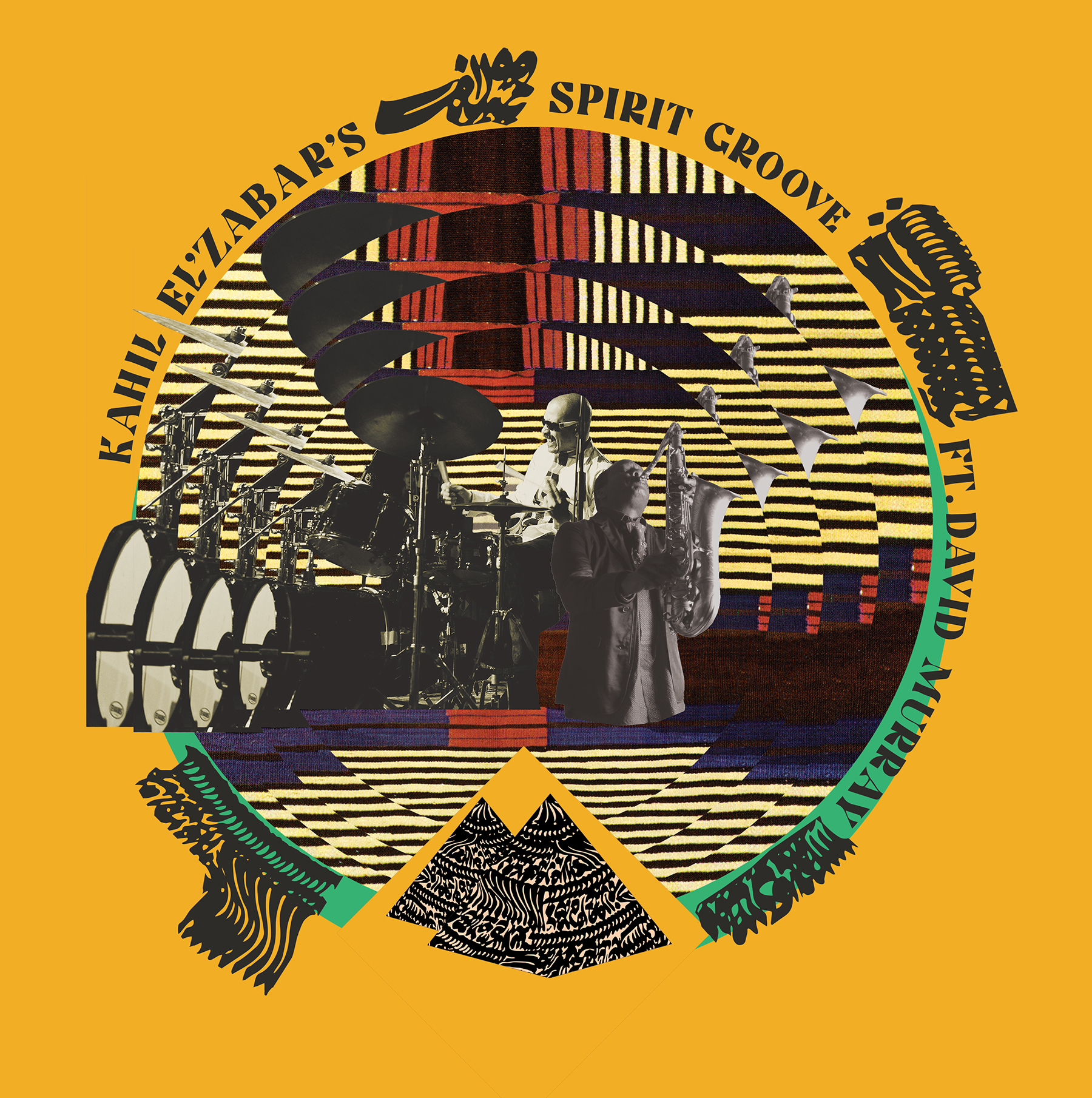
Headlining this latest roundup, two titans of the contemporary and spiritual jazz scene, Kahil El’ Zabar and David Murray, join forces once more to lay down a righteous transportive performance on the ancestral with a modern pulse communion Spirit Groove.
LEAD REVIEW
Kahil El’ Zabar’s ‘Spirit Groove Ft. David Murray’
(Spiritmuse) LP/12th June 2020
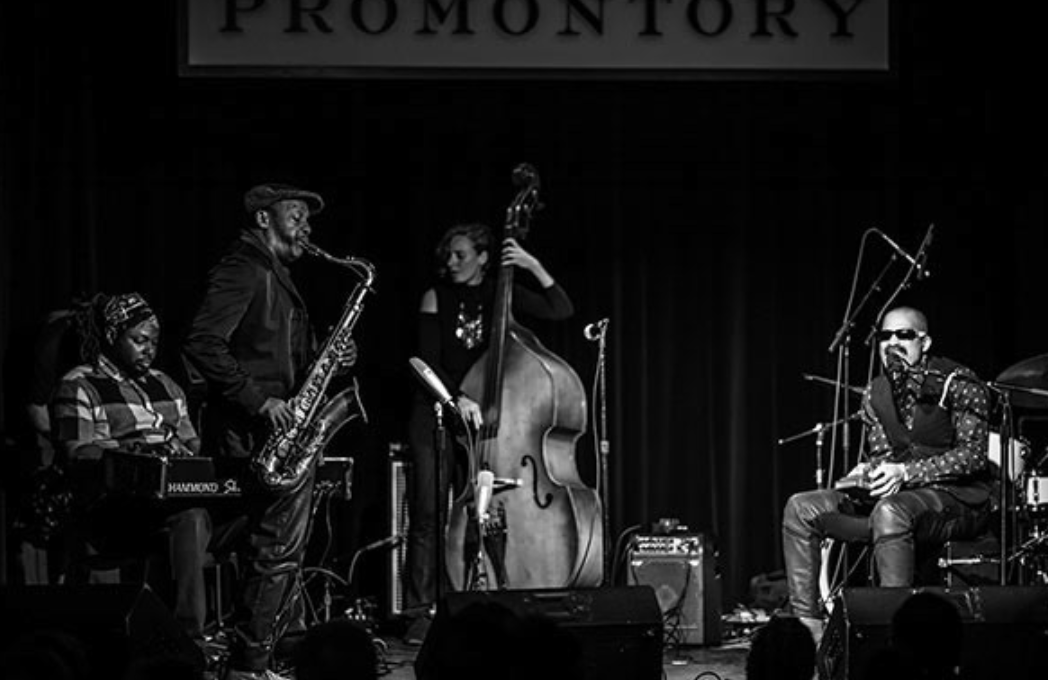
Praise be to the healing arts of those contemporary jazz luminaries Kahil El’ Zabar and David Murray. If ever there was a time when we all needed calm and a spiritual deliverance it’s right now. A service, a quasi-liturgy of spiritual jazz, the two American titans of their experimental forms have drawn on a wealth of providence and influences to once more join forces through El’ Zabar’s “spirit groove” of connectivity.
As a harmonious bedfellow to the Chicago drummer/percussionist’s lauded (especially be me) Ethnic Heritage Ensemble, this righteous groove communion with the tenor sax and bass clarinet maestro Murray “intends to move you nakedly with a deep sense of dance on a Mind/Body/Spirit level.” And what a groove it is; a disarming rhythmic set of performances with a poignant, timely message, or, as El’ Zabar himself puts it, “This is the moment to rekindle the notion of social relevance within the legacy of jazz as an improvised people’s movement for social change.”
The creative partners enact this change (or at least attempt it) by channeling both the ancients and jazz greats they’ve both been lucky enough to share stages with over the last fifty years. El’ Zabar for his part, learning the craft through the Chicago hothouse known as the School of the Association for the Advancement of Creative Musicians, and by playing with or supporting such greats as Eddie Harris, Cannonball Adderley, Rahsaan Roland Kirk, Pharoah Sanders, Dizzy Gillespie, Nina Simone and Archie Shepp (the list goes on). Oakland born Grammy Award winner Murray meanwhile has recorded and performed with a no less impressive list of notable talents, including Henry Threadgill, Olu Dara, McCoy Tyner and Elvin Jones. Murray was also a founding forefather of the horns and wind instruments lauded World Saxophone Quartet.
El’ Zabar’s atavistic with a modern pulse spiritual soul and jazz experiments are coupled with Murray’s untethered long and short breath saxophone contortions on an album of new, specially written material and expansions of compositions from the back catalogue.
Joining them on church service organ and cascading, accentuate piano is Chicago stalwart Justin Dillard, and on bowing soothed and more scuttling acoustic bass, the burgeoning talent Emma Dayhuff. This makes for an enviable solid act; a quartet of jazz apprentices from different generations that between them have connections to every great jazz pioneer of the last fifty plus years. But, nearly, all roads lead back to Coltrane in particular. Murray despite practicing and molding amore unique technique inspired by the triumvirate of old guard doyens Coleman Hawkins, Ben Webster and Paul Gonsalves then what Coltrane preached, he’s paid various homages to the late great saxophone deity. ‘Trane’, a notion, encapsulation, nod to his universal influence pared down to just the second syllable of a name, is all that’s needed on the track that appears on this album as a tribute of sorts. The swing time ‘Trane In Mind’ is a mood, a sense of that style; a splashed poolside dash of Coltrane in his ascendance.
Faith though is the main driver of the groove and varied utterances that pour out of this erudite ensemble’s performances. The water-carrier trickled percussive opener, ‘In My House’, welcomes all to El’ Zabar’s titular sanctuary; a place to raise the spirits and soul. A prayer in the form of a primal gospel House music anthem, the jug pouring shuffler features El’ Zabar’s signature vocal exaltations, which sometimes negate words and lyrics for just hums, feelings and an essence of vocal expression. A frame for a freeform expansion of the mood, Dillard switches from subtle piano phrasing to venerable organ, whilst Dayhuff bobs around as Murray customarily catches shortened hooted breaths and longer sublime circular breathing squalls.
The power of faith in love is enshrined on the next dreamy flight, ‘Necktar’. Dedicated to not only Murray’s new wife Francesca but also true love itself, the quartet skiffle and swing to a liquid soul music groove that sets up a meeting between Gil Scott Heron, Bill Withers and Lester Bowie. Talking of dedications, El’ Zabar’s ancestral percussive, vocal cooing ‘Katon’ opus was written for his fourth oldest son. (El’ Zabar has quite the brood of children and grandchildren we’re told). A special bond and sentiment is conveyed over a magical meditative suite of music box mbira, deft piano, serenading and hooting tenor and dipped bass.
‘In The Spirit’ is, as the title says, another faith radiating communion. Bird like fluting floats over dusty brushed drums on this venerated shuffled version of the original, first performed by El’ Zabar in late 70s Germany. Another past composition, the low-key Savoy jazz like ‘Song Of Myself’ was part of El’ Zabar’s trio project with Murray and the late bassist Fred Hopkins. “An introspection of dancing in your mind”, this riff on that recital stands out on an album of ancestral percussive heavy spiritual jazz and stripped acoustic House music with its smoky, kept subdued almost downtempo, intimacy. Almost veiled even, toots, dusty drums, hints of the vibes and live lounge atmospherics take the listener off into a new thoughtful space.
Working in various forms together since the late 80s, a third composition – appearing on the lauded LP of the same name – ‘One World Family’ is framed as a sort of “theme song” for the partnership. Extending the original with a more expansive performed backing of woody-slapped rhythms (which near the end climax in an erratic display of pounding and punching), spiraling reedy fashioned free-flowing saxophone and soulful melody, the quartet flex and breathe across a earthy but skybound cycle.
A reconnection, a spiritual bound partnership El’ Zabar and Murray appear from the tumult to capture a difficult to quantify feeling: a rage even. Quenching the soul with a “spirit groove”, they’ve laid down a both swinging and mesmeric alternative jazz service of mediation but also, and above all, they push for a positive change in the most inflamed and dangerous of times.
RECOMMENDATIONS
Etienne de la Sayette ‘Kobugi’
(Muju Records) LP/1st June 2020

As pleasantly inviting as the album’s sumptuous artwork, the highly active Etienne de la Sayette delivers another worldly traverse of Africa and South East Asian rhythms.
Channeling a wealth of his ever-expanding array of projects, from the Ethnio-groove imbued Akalé Wube to Bae Ho homage-inspired Baeshi Bang, and from Frix to an assortment of film scores, the Etienne de la Sayette platform pulls together the overspill. Put together in-between all these other commitments, but far from a secondary concern, the latest album to emerge from that project is a rich gentle flowing exotic affair. Played entirely by the intimate band of flexible drummer Stefano Lucchini, balafon maestro Lansiné Diabaté, and a small circle of guests, the undulating soundtrack is mostly devoid of technological interference: no virtual instruments or MIDI were used in the making of this record we’re told. Etienne for his part plays a mix of accentuate and hooted, relaxed honked saxophone and flighty flute throughout this borderless escape.
Embracing genres, especially in the rhythm department, the opening odyssey ‘Jajinmori’ takes a traditional Korean rhythm that Etienne discovered whilst collaborating with percussionists in Busan in 2016 and adds a softened Kuti Afrobeat vibe, Orlando Julius Afrojazz sax and the buoyant wooden bobs of the balafon. Riding over the top of this wavy fusion, Chicago rapper turn Parisian scenester RaceCaR lyrically flows with a stream of poetic consciousness that kicks back to the ancients. He gets to finish the album too, with a more political spit against the arms industry and the militarization of authority on the growled, scuzzed acid-metal-psych Deep Purple-esque monster riff ‘War Business’. Though spanning a two-year period, this “sawn-off shotgun” of a leap from the rest of the material proves the timeliest in light of recent events.
Second guest spot on this album goes to Cameroon troubadour Erik Aliana, who arrives from another compass point to rasp, growl and also lay down sweeter vocal charms on the rustic-folky village song ‘Safari Kames’.
Taking the guiding light of Afrobeat once more, the busier ‘LOULOU’ is as much influenced by Steve Reich ad chamber music as it is by Kuti and Tony Allen. There’s even a tone of Benin spotting organ and Hailu Mergia woven into the flashbacks. Diabaté’s balafon is almost watery, like a jug pouring out the droplets of bouncing notes. It’s “shamanic invocations” that rise from ‘Kobugi King’; another undulating fusion of the dreamy and soulful, taking in Muscle Shoals organ, oriental voodoo and impassioned talking-in-tongues utterances.
With slightly more buzz and rattle, the group channels the spindled resonance of the metal tine thumbed Kalimba, as played in the style of Konono #1, on the wilder exchange of organ and free-form drums tribune to the African and Caribbean god of knowledge of stories, ‘Anansi’. They also evoke a bit of the intense fuzz of Marc Ribot; his ‘Ceramic Dog’ being mentioned in the notes.
The only cover, Tegenu Balkew’s Ethnio cassette obscurity ‘Anchi Bale Game’ plays loose with the original’s magical spell drift towards the Orient. In another example of the free-travel music show, the group takes on a reggae gait with the church service suffused beachcomber ‘Tortoises’.
The most interesting thing about this album and the musicianship is the flow of ideas, and the weaving together of both African and Korean rhythms, as Etienne and his ensemble blend tastes of Nigeria, Ghana, Cameroon and the Orient together in one track. Apart from a couple of numbers, Kobugi is a lilting, relaxed but deep listen; a cross-pollination of music synchronicity.
Myles Cochran ‘My Own Devices’
(9Ball Records) EP/19th June 2020

Regular readers and followers may remember that we premiered the experimental Kentuckian bluegrass, roots guitarist and composer Myles Cochran’s subtly evocative single, ‘It’s Like This’ last month on the Monolith Cocktail; a track that reverberated with the atmospherics and mood of a vaguely traced place on the outskirts of a recognizable American panorama. A hazy semblance of Cochran’s alternative Americana sound, that same single now forms one part of an extended version, ‘It’s Like This – It’s Like That’, on the new EP, My Own Devices. Expanded into a drifting Appalachian traverse with echoes of 75 Dollar Bill, and part rustically dreamy guitar, part lilted classical waned and bowing strings (the cello parts courtesy of Robert Curran), this couplet would make a great soundtrack to ambiguous horizons.
Recorded and put together between rural studios in France and the UK (where he now resides), much of this EP’s material wanes and sighs, breathes and pines across a sonorous prairie. The opening swooned, rhythmic shuffle ‘Love Is As Beautiful As Pizza’ merges reverberations of Myles Bluegrass signature trails with jazz, post-rock Mogwai and Daniel Lanois. As the title suggests, it is indeed a beautiful, and bowed mirage-y, instrumental.
Released a few months back, the ‘Early Dark’ peregrination blends more yearning sad and trembled strings with brushed drums, and the hint of a Mick Harvey soundtrack (there’s that word again, ‘soundtrack’). Though you can also confidently add shades of Ry Cooder, Robert Fripp, Warren Ellis and Steve Reich to both this ‘springtime mix’ and the rest of the EP’s material.
Plonking peaceably across the prairie, Cochran finishes up on a Bruce Langhorne meets Eno mosey ‘Churrito’; another drifter traverse of skiffle like rhythms, resonating guitar and spindly strings.
Almost just the tracings, lingering from behind the valley landscape, Cochran’s meditations and waning mood pieces are easy and quiet on the ear; shaped towards an alternative contemporary ambient vision of those bluegrass roots.
Myles will follow this latest EP up, we’re told, with an album entitled UNSUNG later this year.
Fierro Ex Machina ‘Processions’
LP/19th June 2020

The sensory sonic processed imaginings of Alex Norelli concentrate the mind on some foreboding sometimes creeping recondite worlds: Worlds that branch both the chthonian and alien.
From an apparatus of electro-acoustic, and what the L.A. based multi-instrumentalist and creative calls their “noise harp” – an assemblage of deconstructed electric versions of classical strings and dejected music equipment, which includes Alex’s Grandmother’s out-of-tune 1950s S1 Hammond Organ -, materializes a quartet of heavy studies in the experimental neo-classical, ambient, soundtrack and jazz fields. Yes, I did mean to include jazz; the kind that the American Nocturnal avant-garde saxophonist Andy Haas exudes on his various boundary-pushing peregrinations. But also a semblance of Ornette Coleman’s strung-out writhed, iron gate hinge waning saxophone can be heard enervated on the album’s opening mourned journey through the portal, ‘Praeter Nexus’. Unsettling as it slowly gains gravitas and a seething momentum that grows more mysterious, more unknown. The Nexus track demonstrates a frayed, fabric torn movement simultaneously as spatial as it is claustrophobic and dark.
Ominous nocturnal movements follow with the spherical shifting ‘The Shadows Of Plants At Night’. Metronome counted ripples tick away in the night garden as a ghostly-like voiced sound and permutations of Donny McCaslin’s sax waft by. Those plants sound more like concrete planetary leviathans chiding and scraping together. The lamentable entitled ‘Do You Know The Sorrow Of The Horses’, which sounds like the opening from a particularly harrowing plaint from beyond the ether features howls of a kind from wolves of some sort prowling the borders. This wispy invocation, as a scion of Cage and Nam June Paik, trundles across the inner workings and mechanisms of a grand piano: or so sounds.
‘A Sail Of All Tears’ finds a trace of melody and even a rhythm amongst the circling uncertainty and the chills. Turning over in the darkness, dawdling bass guitar and electric guitar notes act as guidance through the enormity of the elementals.
There’s a dark majesty and gravity to all four of these heavy evocations. The dissonance is nowhere to be found however, and so even in the abyss each one of Norelli’s visceral statements remain in a sort of ominous building harmony; a synthesis of sonorous emotion, journeying towards the void: A soundtrack for our frightening times.
Sad Man ‘Daddy Biscuits’
LP/5th June 2020

Despite the alter ego moniker of garden shed electronic music boffin Andrew Spackman’s most prolific incarnation yet, the Sad Man in lockdown is anything but as anxious and plaintive as the name might suggest. The latest (must be millionth, or something like that, release from Andrew now) experiments-in-motion album is in fact quite playful: a laugh even. Euphemisms, innuendo aside, Daddy Biscuits has a more uninterrupted flow of rhythms and progresses in a less agitated, ennui fashion than most of Andrew’s output.
Set loose with a trick noise making apparatus, the Sad Man goes for the kicks, transmogrifying House music and Techno for a staccato dancefloor. Jolted Djax Techno gets warped and bashed with shocks of Mike Dred, galloping 808s and mischievous Ed Banger electro funk on an album in which you can hear the cogs moving around in the artist’s noodle: where to go next? What about this, zap-bang-clatter-wobble-drill!! A Sad Man track seldom ends where it began.
God knows what the titles indicate half the time either. The titular cyber wilderness track alone goes through Luke Slater, Juan Atkins, Aphex Twin and the Chemical Brothers. The track ‘Sleeper’ is anything but somnolent, running as it does through a bastardize version of Herbie Hancock’s ‘Rockit’, 16-bit computer game coin-up prizes and hints of M-Plant Rob Hood and a crystalline dream magic. For me though, I love the strange curio ‘House Work’ (definitely a tune that would improve the chores no end). It sounds like Major Force mashed with Wagon Christ and Les Rita Mitsouko; a sort of electro-operatic funk.
For kicks then, Andrew eyes up the groove on a collection of both panel-beater workshop beats and modulated weirdness; an album for lovers of Warp, Leaf, early Jeff Mills and House Of Tapes. Lockdown proves a fertile environment for the conceptual artist and sonic maverick. I like this subtle change. Pass round the magic biscuits selection again in the future please.
Above The Tree ‘King Above’
(Hukot Disc/Plug In The Gear/Krimzkramz Sub Post) LP/Available Now

Dropped into some alternative futuristic pastoral world in the aftermath of an unexplained event – or that’s at least what it feels and sounds like to me -, visual artist and amorphous sonic sculptor Marco Bernacchia creates a visionary traced soundscape of haunting holy and esoteric materializations from out of the ether on his latest vivid soundtrack, King Above. A soundtrack, as it turns out, for an as yet unreleased documentary, this regal entitled suite of passages, renderings and lingerings would suit a mysterious theme with its signs of the ominous, exotic, and in some cases, supernatural.
Gravitating around the so-called “Italian occult psychedelic” scene, a catch-all term coined in the early noughties to describe the emerging esoteric and out-there sound being made by bands such as Comaneci and Father Murphy (both of whom feature in various ways on this album), Bernacchia practices a sort of ever-evolving vision of “outsider music”. Far too knowing and technically proficient and learned to be the musical equivalent of the usually naïve outsider art, his Above The Tree moniker mapped abstractions have a depth and knowledge that betrays an eclectic, studied palette of influences.
Blessed and doomed in equal measure, the Urbino Academy of Fine Arts alumni paints a both unsettling and pretty atmosphere. In between his professional practice (reaching the heights of exhibiting at the Venice Biennale; which is one way to say you’ve made it in the contemporary conceptual art world), the painter has learnt an assortment of instruments, from saxophone to guitar, the Malian harp-like Kamalengoni to the Russian variant of the Jew’s harp, the Vargan. All of which appear throughout the various dreamy drifts and Kosmische stirrings.
All these instruments and influences are filtered through a gauze of the gossamer, wispy and misty, with the bewitching chimes set against distant echoes of voices, messages and Medieval leftfield folk: think Faust at their most atavistic meets Sproatly Smith. Something like the courtly, rustic reverberations of a past epoch drift in and out of a vaporous bed of drones, ambience and exotic swathes of an unearthly realm. The plucked brushed tremulous guitar phrases often evoke Ry Cooder and (sharing this particular roundup) Myles Cochran.
Nature is always present no matter where Bernacchia guides us. There’s even a sort of nature meditation codex at the end of this fourteen-track oeuvre; the sound of birdsong and an ambiguous great scenic outdoors is permeated by the waning gravitas building accompaniment of bowed strings and the barest undulations of the synthesized. Icy blows, vortexes, cylindrical metallic and ghostly visitations merge with the pastoral and at times the revenant.
With permission from his already mentioned compatriots, Father Murphy, a sample from the group’s 2018 esoteric blessed ‘Communion’ – which featured on the Rising. A Requiem LP – features on the cooed cloisters score ‘Merci On Us’. The original song’s venerated choral atmospherics are woven into the lulled dreamy renaissance treatment.
“Donating” lyrics and voice to a couple of tracks, Francesca Amati of the Comaneci duo offers up a strange repeated breathy mantra on the open couplet ‘Windows Soul’, and utters soliloquy like phrases on the title-track. Amati sounds like a weird space-age narrator on the latter; her statements fragmented, almost disjointed.
Those utterances offer another layer of mystique to an album steeped in the abstract. Tangible instruments exist with the unmistakable tremolo of a guitar, gabbling of the ngoni and spring of a vargen, yet it’s the obscured textural hints of imagined places and spaces that win out. Bernacchia has embraced a history, myriad of emotive forces and atmospheres, the organic and synthesized, and transduced it all into this suffused empirical soundtrack of sublime outsider folk. I thoroughly recommend you seek it out.
REISSUES
Harry Roesli ‘Titik Api’
(Lamunai/Groovyrecord) LP/2nd June 2020

It may sound surprising to many of you dear readers to find that someone as switched-on as me hasn’t come across, until now, the Javanese Temple psychedelic funk of the Indonesian maverick Harry Roesli. Submitted by the kind folks at the Lamunai/Groovyrecord hub, a reissue version of the celebrated artist’s iconic mid 70s concept opus Titik Api has piqued my interest.
Providence wise first, Roesli was born in the bastion of Gamelan, on the island of Java in 1951. In what could be described as a privileged upbringing, Roesli’s father was a major general in the Indonesian army, his mother a doctor; both positions offering a relative security in a country ruled by the quasi-dictator Suharto – a leader with a tightening grip, who managed to keep hold of power for four decades, from 1967 to 1998.
Obviously a talented musician from a young age, Roesli actually decided to study engineering instead of music. It was during those formative years that the creatively minded bohemian was turned on to political activism – a story retold in more detail in the album’s liner notes. To be glib and race through the details, he became an active member of the 70s Tradisi Baru Movement. Translating as “New Tradition” this growing political and creative movement were committed to experimenting with Indonesian traditions such as gamelan. Critical of the regime however, it soon became too dangerous for student activists such as Roesli to evade the authorities iron fist. In one such crackdown, Roesli found himself imprisoned. Luckily for him, a Dutch member of Amnesty International was on the case; gaining an escape route for Roesli through the promise of a scholarship, studying percussion in Holland.
To cut a long story very short, this gave the burgeoning talent another layer of musicianship and host of new influences, which he eventually would take back to his native home. The music of Indonesia was now fused with prog rock, psych, acid rock, pop, enervated funk, soul and even the more complicated rock experiments of Zappa. All of which you can hear on the ambitious 1975 concept album, Titik Api: a kind of Indonesian drama set to music, with ‘prologs’ and ‘epilogs’ and a quasi-overture, a work of art from a hip-international minded cat. It’s nothing short of a Southeast Asian panorama of atavistic mysticism, romance and spiritual yearning.
The first cut from this double album alone, ‘Sekar Jepon’, moves from a gamelan Goblin to Bolero, whilst maintaining the signature zappy effects, sizzled fuzz and chiming percussion that permeates this entire opus. Those prog rock influences get harder on the hypnotizing temple rock ‘Jangga Wareng’: almost Sabbath heavy. The fluty thirteen-minute epic ‘Lembe Lembe’, features both shades of Jethro Tull and ‘Revolution’ era Jefferson Airplane. Slicker, leaning towards soul music, the romantic-sounding female lulled harmonies, sun-anointed ‘Merak’ fans out towards a lilting Brazilia. In a similar vein, another lengthy opus, ‘Kebo Jiro’, switches from soft funky soul and pop to fantasy boat ride, then snake-charming prog and rattling conga solo. ‘Curah Hujan’ takes a scenic route in an Alfa Spider convertible, as the radio blasts out a quasi-Bossa Italo love theme.
It seems Roesli wasn’t shy in throwing everything into his musical fantasy; Latin dreamy troubadour on the first of two ‘epilogs’, proto-disco on ‘Dinding Tolan, and Samba-rock on ‘Bunga Surga’.
From seductive slumbers to golden temple spiritualism and mirage-y trinkets and tubular tolls, Titik Api is an adventurous psychedelic vision from a fertile, expansive mind. An alternative Javanese dimension, invigorated by contemporary late 60s and 70s influences this is an all-encompassing epic from the Indonesian maverick. Don’t worry if like me you missed it first, second even third time around, this new reissue will serve crate-diggers and psychedelic fans alike well enough. Take a punt, dig it out and be introduced to a whole new rabbit hole of Southeast Asian music.
Scarlet’s Well ‘Magic (Selections From 1999 – 2010)’
(Tapete Records) LP/26th June 2020

The saga of the Monochrome Set spans five decades and umpteen break-ups. Blossoming at the fag end of the punk epoch, and continuing to produce music even to this day, the revered group has disbanded at least three times during a checkered history. The second those breakups, in 1998, proved a fertile escape for the Set’s stalwart singer, guitarist and songwriter Bid, who plowed his fantastical and whimsical inventions into a new band, Scarlet’s Well: a band that would, in one form or another last until the third incarnation of the Set in 2010.
A congruous bedfellow to Bid’s former group, Scarlet’s Well not only featured the Set’s 90s period keyboardist Orson Presence and producer Toby Robinson, but also transformed some of the unfinished material. Though it wasn’t just a place to crash for former Set members, the evolving, changing lineup would after a few albums expand to include Alice Healey on vocals.
Conceived as an “atmosphere” rather than a band, Bid conjured up a surrealist village diorama and cast of bawdy rouges, lost supernatural characters and monsters, explorers and pining cowboys/cowgirls to build an evocative storybook. Coming to life over seven albums of varying quality, this strange but disarming set location and its vague geographical tributaries (“somewhere east of the Azores and only slightly north of the Styx”) offers a magical encapsulation of all life’s woes, tribulations and physiological defects. It’s an adventure in which some of the salty sea dog inhabitants take the listener on a voyage to various atolls and exotic river ways; sailing into a range of both suffused and fleeting musical ports-of-call. Even the means of nautical travel differ, from a junk to galleon, a skiff to Pugwash shambolic pirate ship.
Receiving an appraisal a decade on from the Well’s final swansong, this oeuvre brings together a (almost) chronological collection of idiosyncratic pastoral whimsy and deeper, darker metaphors. “Bless my barnacles”, the rightly titled Magic collection opens with a couplet of alternative pop sea-shanties from the Well’s 2006 LP, Unreal: A year that proved very productive, with the band uncharacteristically releasing a duo of albums that year. ‘Sweetmeat’, which despite its alluded title sails on a junk to the gentle tones of a lullaby, has Bid channel Scott Walker and Roy Orbison on this beautiful sayonara caress. ‘Willy Whispers’ – no sniggering at the back – features the harmonizing sweet tones of Healey; who by this time was now a prominent member of the band. An example of that diverse range of influences and instrumentation, this spindled beauty simultaneously evokes Westerns, a punt down the Neva and the charming psychedelic storytelling of Pete Dello.
The debut album, Strange Letters, which now puts the songbook back in linear order, is represented by the solitary oompah-tuba ‘The Captain’s Song’. Reimagining a Brecht version of The Yellow Submarine, Bid’s put-on seadog baritone croons a veritable feast of sea-lovers Bonzo lyricism. Both comical and violent, he comes across like Blixa Bildgard early era Bad Seeds.
The first album of a new decade, 2000’s Les Baxter-esque The Isle Of Blue Flowers is represented by a trio of Spanish and concertinaed songs. Maybe a consequence of being signed to the Spanish label Siesta Records, there’s a dalliance with the host’s Flamenco and Latin spirit in the form of the castanet cantina ‘Lord Fish Garlic’s Last Expedition’: a song that fantasizes about a Suzanne Vega senorita fronting Fairport Convention during the Mexican war with America –imagine that! From the same album there’s the Franco-paradise Edwyn Collins-goes-surfing bendy title-track and the South Pacific meets Creole lala ‘Dark Dreams Aboard The Hesperus’.
Lewis Carroll’s literary and psychedelic totem heroine inspires the Well’s next album in the sequence, 2002’s Alice In The Underworld. A castaway choice of songs reflects the album’s use, again, of certain Spanish motifs and flairs. The exotic ‘Night Of The Macaw’ wafts lazily in a Caribbean bay; soft marimba and a lulling spiritual organ drift in the background of this beachcomber sway. ‘The Ballad Of Johnny Freak’ is another story entirely; a metaphorical tale of acceptance from Monsterism Island that puts Healey center-stage of a Hispanic lilted lament.
Moving forwards another two-years, The Dream Spider Of The Laughing Horse album features another of the band’s characteristic musical embraces: a kind of transcendent mosey form of Americana. The title-track, a trotting on the trial cowboy song, and ‘Big Dipper On The Spearman’s Floor’, a waylaid Hawaiian cowboy amongst the rock pools serenade, are chosen to fit the unfolding travelogue compilation.
The second album from 2006, Black Tulip Wings, goes all noir on us. The Bad Seeds rub shoulders with an enervated B52s, ‘Savage’ even goes into lounge swing halfway through its tremolo and Theremin-like wobbles. It’s show time on the album’s title-track as Brecht is brought to the Hollywood detective paperback.
Once more on the lonesome cowboy/cowgirl trial, the next two albums, 2008’s Gatekeeper and 2010’s Society Of Figurines reimagines the Western and country music cannons. On the first of these albums, Bid and his ensemble traverse The Mekons rebel country signature on the sweetly laced, springy desert key metaphor themed ‘Golden, It Is, Beautiful’. From the same record, ‘My Little Doll’ is a little more upbeat in comparison; a shuffling vision of The Bluebells round the campfire with the Frank And Walters. From the porcelain supernatural cast second of these two albums, it’s a strange combo of garage band with elements of the Inspiral Carpets baggy version of Tex Mex beat that underpins ‘Supernatural Services’. From that same record and drawing this decade spanning collection to a close, ‘The Vampire’s Song’ pitches Nosferatu in Nashville; the bloodsucker’s wandering song is a most lonesome pining affair.
Ambiguous throughout, Bid’s microcosm of mavericks, illusionists, rum miscreants and the plain misunderstood is an escape into the fantastical; a wealth of cryptic, surrealist psychedelic and cartoon outsider storytelling and art transduced into a disarming songbook of posy, shanties, ballads, cantas and pop. If you enjoy that long English tradition of eccentric songwriting, then this marvelous collection will quench your soul, heart and mind.
Hi, my name is Dominic Valvona and I’m the Founder of the music/culture blog monolithcocktail.com For the last ten years I’ve featured and supported music, musicians and labels we love across genres from around the world that we think you’ll want to know about. No content on the site is paid for or sponsored and we only feature artists we have genuine respect for /love. If you enjoy our reviews (and we often write long, thoughtful ones), found a new artist you admire or if we have featured you or artists you represent and would like to buy us a coffee at https://ko-fi.com/monolithcocktail to say cheers for spreading the word, then that would be much appreciated.
Premiere (Single): Myles Cochran ‘It’s Like This’
May 14, 2020
Premiere/Dominic Valvona
Myles Cochran ‘It’s Like This’
(9Ball Records) Single/15th May 2020
Somewhere on the outskirts of a recognizable American panorama, a hazy semblance of Myles Cochran’s Kentuckian bluegrass roots can be heard resonating on his newest subtly evocative single, ‘It’s Like This’. A continuation of the composer, songwriter, multi-instrumentalist and producer’s previous ‘Early Dark’ traverse (released just a few months ago), today’s premiere is an attuned and sophisticated merger of vaguely reminiscent, rustically dreamy guitar, waned and bowing strings, spindled movements and various lightly administered production effects. Here is how Myles sums up this musical assemblage of ideas and inspirations:
“Roots and country music were in the air when I was growing up and they still shape my aesthetic. My love of improvised music, whether Miles Davis or Talk Talk, also informs what I do, and the American Primitive guitarists such as John Fahey and Leo Kottke made a deep impact. To me, all these aren’t disparate influences, but make beautiful sense together”.
A both lingered minimalist and sonorous soundtrack, with echoes of such titans of the form as Ry Cooder, Robert Fripp, Warren Ellis, Daniel Lanois, Steve Reich and even Mick Harvey, ‘It’s Like This’ was composed, produced and performed by Myles at his rural studios in the UK and France. Myles is joined on this oft-emotional tarverse by the cello virtuoso Richard Curran, who supplies the atmospherically charged low bows.
Marking a sort of flurry of activity from the Kentucky born artist, now residing full-time in the UK, this latest single is being released via Myles own 9Ball Records label ahead of the June 19th EP, My Own Devices. Myles will follow this up, we’re told, with an album entitled UNSUNG.
If you like what you found, hear and see on the Monolith Cocktail, you can now support us via the micro-donation platform Ko-Fi:
Hi, my name is Dominic Valvona and I’m the Founder of the music/culture blog monolithcocktail.com For the last ten years I’ve featured and supported music, musicians and labels we love across genres from around the world that we think you’ll want to know about. No content on the site is paid for or sponsored and we only feature artists we have genuine respect for /love. If you enjoy our reviews (and we often write long, thoughtful ones), found a new artist you admire or if we have featured you or artists you represent and would like to buy us a coffee at https://ko-fi.com/monolithcocktail to say cheers for spreading the word, then that would be much appreciated.
 Monolith Cocktail Blog