Our Monthly Playlist selection of choice music and Choice Releases list from the last month.

We decided at the start of the year to change things a little with a reminder of not only our favourite tracks from the last month but also a list of choice albums too. This list includes both those releases we managed to feature and review on the site and those we just didn’t get the room for – time restraints and the sheer volume of submissions each month mean there are always those records that miss out on receiving a full review, and so we have added a number of these to both our playlist and releases list.
All entries in the Choice Releases list are displayed alphabetically. Meanwhile, our Monthly Playlist continues as normal with all the choice tracks from October, taken either from reviews and pieces written by me – that’s Dominic Valvona – and Brian ‘Bordello’ Shea. Our resident Hip-Hop expert Matt Oliver has also put forward a smattering of crucial and highlighted tracks from the rap arena.
CHOICE RELEASES FROM THE LAST MONTH OR SO:
Bedd ‘Do Not Be Afraid’
Review
Joel Cusumano ‘Waxworld’
(Dandyboy Records) Review
Peter Evans’ Being & Becoming ‘Ars Ludicra’
(More Is More Records) Review
Will Glaser ‘Music of The Terrazoku, Ethnographic Recordings From An Imagined Future’
(Not Applicable) Review
Amira Kheir ‘Black Diamonds’
(Sterns Music/Contro Culture Music) Review
The Legendary Ten Seconds ‘Ricardian Churchward’
Review
NiCKY ‘with’
(PRAH Recordings) Review
Picniclunch ‘snaxbandwitches’
Review
Cosimo Querci ‘Rimane’
(Quindi Records) Review
Širom ‘In the Wind of Night, Hard-Fallen Incantations Whisper’
(Glitterbeat Records)
Striped Bananas ‘Eternity Forest’
Review
Sum of R ‘Spectral’
Tortoise ‘Touch’
(International Anthem X Nonesuch Records) Review
Vexations ‘A Dream Unhealthy’
(Cruel Nature Records) Review
Violet Nox ‘Silvae’
(Somewherecold Records) Review
THE PLAYLIST::
Howling Bells ‘Heavy Lifting’
Melody’s Echo Chamber ‘Eyes Closed’
Arcigrandone & Sone Institute ‘Ancide Sol La Morte’
Pray-Pax ‘Can’t’
Peter Evans Being & Becoming ‘Pulsar’
Petter Eldh Ft. Savannah Harris ‘MIDSUM BREW’
Myka 9, Blu & Mono En Stereo ‘Battle’
Jesse the Tree & Sage Francis ‘A Bad MFer’
Verb T & Vic Grimes ‘Distraction’
Elsio Mancusco & Berto Pisano ‘Nude per l’assassino’
Joker Starr Ft. AnyWay Tha God & Jazz T ‘Don’t Try to Test’
Summers Sons Ft. Ben B.C ‘Promises’
Sebastian Rojas ‘Pulmon Del Tropico’
Amira Kheir ‘Rabie Aljamal (Spring of Wonder)’
Oswald Slain ‘Cranberry Juice’
NiCKY ‘I Saw You’
The Legendary Ten Seconds ‘Bones in the River’
Edward Rogers ‘Astor Place’
Joel Cusumano ‘Death-Wax Girl’
The Stripped Bananas ‘Vampire of Mine’
Bedd ‘Paulie’s a Bum’
Legless Trials ‘American Russ Never Sleeps’
Vexations ‘Let Me In’
OvO ‘Gemma’
Sum of R ‘Violate’
GRABENFUSSS ‘Broken Kingdoms’
Cosimo Querci ‘Rimanemai’
Valley Voice ‘As Though I Knew’
Samara Cyn ‘vitamins n minerals’
The Strange Neighbour ‘No Mans Land’
Truth by Design ‘Stray Shots’
The Cool Kids, Sir Michael Rocks & Chuck Inglish ‘We Got Clips’
Dillion & Paten Locke ‘Always Never’
Sol Messiah & Connect The Dots Movement ‘Small axe wins the battle’
Tortoise ‘Works and Days’
Sirom ‘For You, This Eve, the Wolves Will Be Enchantingly Forsaken’
Violet Nox ‘Whisper’
Liz Cooper ‘New Day’
Sweeney ‘Silent J’
RULES ‘Run Boy’
Tinariwen ‘Chaghaybou – Adalan’
For the last 15 years both me and the MC team have featured and supported music, musicians and labels we love across genres from around the world: ones that we think you’ll want to know about. No content on the site is paid for or sponsored, and we only feature artists we have genuine respect for /love or interest in. If you enjoy our reviews (and we often write long, thoughtful ones), found a new artist you admire or if we have featured you or artists you represent and would like to say thanks or show support, than you can now buy us a coffee or donate via https://ko-fi.com/monolithcocktail
THE DIGEST FOR NOVEMBER 2024: New Music/The Social Playlist/And Archives
November 22, 2024
THE MONTHLY DIGEST INCLUDES A CLUTCH OF ACCUMULATED NEW MUSIC REVIEWS; THE SOCIAL INTER-GENERATIONAL/ECLECTIC AND ANNIVERSARY ALBUMS CELEBRATING PLAYLIST; AND CHOICE PIECES FROM THE ARCHIVES.

Photo Credit:: Giovanna Ferin
____/THE NEW
Juanita Stein ‘The Weightless Hour’
ALBUM (Agricultural Audio) 29th November 2024
And perhaps it all comes to this, that after twenty-five years in the music business as both the frontwoman of the Howling Bells and as an established solo artist Juanita Stein has finally found the strength of her own voice and creative force. Stepping out from behind the safeguards of noisy rock to find that silence resonates deeper and further, Juanita erases everything but the most vital, emotionally receptive and connective elements from her music to produce a sagacious, confident (despite the fragility and vulnerability in places) songbook of personal memories.
Stripped back then, but even more powerful, Juanita faces up to her family’s past and her own, and faces up to the more troubled, traumatic experiences in the most diaphanous of ways. There’s a real clarity lyrically and musically, despite the coos, the often near ethereal airs and veils, and the reverberated echoes. And the minimal accompaniment, which changes between the acoustic and note struck electric guitar, and features a subtle gravitas of strings at times, chimed elements and the odd bass drum, either weaves or rings out evocations of Southern Gothic and Lee Hazelwood country, magical carousal and Laurel Canyon 60s influences, the music of 90s Drugstore and Juliana Hatfield, and a hint of Radiohead.
I’ve always loved Juanita’s voice, which is pretty unique in the best possible way: soothing, beautiful yet full of emotional turmoil, and verging on the apparitional on occasion. Here she sounds at times like a mix of Kristin Hersh, Tanya Donelly, Lana Del Rey and June McDoom at its most breathlessly gossamer. And considering the themes, that voice is never projected with anger, resentment or resignation at any time during the ten songs on this near perfect album. Put it this way, there’s neither a flood of emotions nor a moment in which the whole experience threatens to engulf Juanita.
Rather than write for characters, every lyric can be identified as a feeling, an experience that Juanita has personally been troubled by, gone through and lived. Growing up in a talented Australian family of artists (her late father Peter Stein, the renowned songwriter/musician, her mother Linda a former stage and TV actress, and her brother Joel the lead guitarist in the Howling Bells), but brought up in the Orthodox Jewish faith with its strict adherence to the Torah and just as strict schooling methods, Juanita claws, or takes, back what was lost during her childhood with a lyrical passion that borders at times on the poetic wise honesty of Leonard Cohen.
The accompanying PR notes use the word “imposed” when outlining Juanita’s Jewish roots. But that would suggest an abandonment or uneasy relationship with her identity, which you are born into. Juanita seems to me to be more objectional to the dominate patriarchal and masculine aspects of Judaism; the restrictive nature of old lore and laws and rules. For she stands up against antisemitism, especially recently with record numbers of incidents and violence meted out against the Jewish community around the whole Western world after the horrifying, barbaric murders and kidnaps perpetrated by Hamas on October the 7th last year. ‘Old World’ is a reminder of the evils of antisemitism, but also a reckoning with that ancestry. Unfolding over an acoustic country and Laurel Canyon-like trial of striking imagery that most beautifully haunting song finds Juanita revisiting her grandmother’s Prague home, now, even eighty years later, emptied of its once thriving Jewish communities – communities that can be traced back a thousand years or more, as mentioned in the Sephardi-Arabic Jewish merchant and traveller Ibrahim ibn Yaqub’s famous travelogues in 965 AD, and which numbered 92,000 before the Bohemia/Moravia partition of 1938/39, when Nazi Germany attempted to wipe them from the face of the earth; nearly succeeding, it’s believed at least two thirds of that figure perished in the Holocaust. Using a beautiful language of descriptive geography, the way the light falls upon that absence and legacy of destruction, the piles of ash, Juanita observes the eradication of the faith, the synagogues, and the way they were brutally changed into Christian places of worship: the recurring crucifix for example. Juanita’s grandmother was forced to leave at the age of fourteen, escaping the fate that awaited: namely transportation to the Theresienstadt camp built outside Prague, and eventual death in Auschwitz in Poland or the killing sites of the Baltic states.
Making some references to that Orthodox schooling again, but also written whilst waiting out the Covid lockdowns in Italy, the picturesque ‘Carry Me’ finds solace and sanctuary in a most charming, idyllic Tuscany surroundings. As the world grinds to an uneasy halt, Juanita, accompanied by subtle birdlife and the even softer sound of crickets and the environment, coos whilst playing a resounding, sounding out electric guitar turned up loud: but vulnerable and fragile. Again, I’m hearing Leonard Cohen. And there’s a nice, real softened plink-plonk of piano that’s just about there, which comes in at the end.
Moving on, the near aimless evoked ‘Driving Nowhere’ recollects a relationship going…well, nowhere. Featuring the duet partner of North Ireland artist Pat Dam Smyth, there seems to be a channelling of Hazelwood via Nick Cave and Roland S. Howard. The drifting apart of once entwinned partners is played out on the Australian country highway of heartache and emotional breakdowns, with Smyth, who supported Juanita in on her first London solo performance, adding a very congruous if deeper voiced sense of lived-in, resigned sadness.
Reflections there are many, especially when facing the “heady days” of the early noughties as the frontwoman of the highly successful (and a damn good band) Howling Bells on ‘The Game’, which sounds like Lana Del Rey backed by R.E.M. Not so much regrettable, as sadly conveyed recollections of fame and being at the centre of a whirlwind, a storm that left no room to breathe or process, it seems she both suffered and yet misses it. ‘Motionless’ has a heavy strum and chug to it that reflects the open-hearted revelations of another broken relationship; the stage set for honest reflection and for saying what needs to be exorcised before moving on.
The Weightless Hour is the perfect album from a great voice and songwriter, who’s now able to find that distance from the events of the past and a new sense of reflected candidness and honesty in motherhood. Juanita’s true self and strength opens-up, the noise diminished for something far more powerful. Not so much defiant as confident. A definite album of the year.
Spaces Unfolding + Pierre Alexandre Tremblay ‘Shadow Figures’
ALBUM (Bead Records)
Coinciding with the 50th anniversary of the revitalized Bead label, a special challenging site-specific work of non-musical experimentation and evocation from both the Spaces Unfolding trio of flutist improvisor Neil Metcalfe, avant-garde violinist Philip Wachsmann and drummer improvisor Emil Karlsen, and the electronic explorer Pierre Alexandre Tremblay.
In merging their own specialist forms – the acoustic and electronic – both partners on this improvised serialism of avant-garde, textural, atonal and more recognisable sound and instrument sources, expand the sonic palette further towards the abstract, mysterious and near paranormal. “In Praise Of…” and making concrete the otherworldly “Figures” from the “Shadows” this collaboration seems to channel the ominous and a sense of disturbance. The electronic effects, beds and signals set off an uneasy sense of technologies creeping encroachment, its power sources and unseen, near subverted presence.
But the triplet of atmospheric “In Praise Of Shadows” suites is dedicated to and takes its name from the celebrated Japanese titan of provocative literature Jun’ichirō Tanizaki and his notable essay on Japanese aesthetics. Noted for both his shocking depictions of sexuality, of kinks, of the submissive, and obsessions, and subtler portrayals of family life in his native country during a time of upheaval, as modernism took hold, as Imperialism rose and then was crushed and replaced by Westernized consumerism and progress, Tanizaki’s usual schtick was to place characters, affairs against a backdrop of cultural anguish. However, published in the 1930s, In Praise Of Shadows is a little different; made-up of 16 sections (a sample of titles: “The toilet aesthetic”, “A novelist’s daydreams”, “An uncanny silence”), the central theme uses analogies and abstract ideas of light and darkness to depict the comparisons between Western progress and its search for light and clarity with the subtilties and appreciation of the subdued and shadows in East Asian art and literature – or more specifically an appreciation of the Japanese concept of “Sabi”, or “world view”, which is centred around transience and imperfection. There’s far more to it all of course, including, which is very important in this context and as an influence on this recording, a piece on the layered tones of various kinds of shadows and their power to reflect low sheen materials: see the various “Refraction” entitled pieces of textual shadowy play.
I’m not sure if it is intentional or not, but some of the both harder and dulcimer-like plucks on the violin, the whistly aspects and higher pitched flutters of the flute and some of the near-taiko-like thunders of the drums evoke the music of Japan: somewhere between the traditional and the work of Yamash’ta & The Horizon and Farabi Tushiyuki Suzuki. It builds a sort of Oriental mysticism at times, a mysterious atmosphere of shadows, or an estranged Kubuki theatre, and of deeper meanings channelled by the tactile and textured.
At times I’m picking up echoes of Anthony Braxton, the work of Larry Austin, the Giuseppi Logan Quartet, some Sandro Gorli, Alan Sondheim and Fernando Grillo amongst the electrical fields, the sparks of freeform jazz, the scurries, the spidery finger work, restless crescendos, dry fluted chuffs and rasps, and solid thick-stringed pinches and strains. Untamed with moments of reflection, uncertainty, Shadow Figures pitches an environment and its sounds, its unseen wound-up, ratcheted and twisted objects with more skeletal, shaved, sieved and high-pitched avant-garde expressions.
Maalam Houssam Guinia ‘Dead of Night’
ALBUM (Hive Mind Records)
Accomplished student and innovator of the traditional Islamic dance, music and poetry exaltation of ‘Gnawa’ and the three-stringed lute-like instrument that goes together with that ancient practice, the ‘Guimbri’, Houssam Maalam Gania pays a certain homageto his upbringing and his roots as the scion of the late Gnawa master Maalam Mahmoud Gania. A catalyst for the label, a repackaged special reissue of Maalam Mahmoud’s sublime venerable Colours Of The Night performances kick-started the whole Hive Mind platform label back in 2017 – a label, I might add, with a considered taste in some of the more understated, lesser known recordings of world-class artisans and genres. This was soon followed by the label’s fourth release, Mosawi Swiri LP, which featured Houssam Maalam and a troupe of lively young musicians from the country’s fishing port town of Essaouira.
The youngest son of the virtuoso has obviously inherited all the right creative and musical attributes, performing as he does a remarkable adroit and earthy vocalised songbook of affectionate and devotional Gnawa-style pieces; pieces that his father would play and sing in the family home to his children. The title is both a riff on his father’s iconic LP and a reference to the nighttime hours in which this album was recorded, stripped down with no accompaniment, live on the 3rd of June 2022 in Casablanca using only a Tascam field recorder and two microphones.
Uncloyed (as the field-recordist producer Ian Brennan would say) and as intimate and atmospheric as you can get, with the tape left running to pick up any clearing of the throat and the breaths between singing, each performance is a one-man demonstration of the Gnawa artform and a hybrid of influences from Westernized blues to the music of the Tuareg and the influences of a wider West and North African geography. For that Moroccan heritage bleeds over borders, chiming even with certain traditional forms from as far as Southeast Asia: whether intentional or not. In solo form, Houssam Maalam manages to play polyrhythmically; using, what sounds like, the flat of his hand on occasion to simulate either a bass part or a hand drum. Plucked elasticity is combined with paddled hand movements, whilst a constant buzzy and wobbled rhythm is kept going. Sometimes it sounds more like a banjo, and at others like a makeshift guitar, but is always played with either a delicate, intricate hand or a more physical, bassy one. Expressively conveying the Godly, moments of joy and comfort, and the questioning, the voice resonates from the very soil. But it sounds like that voice has matured somewhat since Mosawi Swiri, grown perhaps as it resonates with those songs of childhood. Dead of Night achieves two things. Firstly, Houssam Maalam grows closer to his father’s legacy, and secondly, forges his own pathway and identity honing a unique Gnawa legacy. Be quick, as this is yet again a limited release – though I’m sure of there is enough demand, there might be a second repress.
Baldruin ‘Mosaike der Imagination’
ALBUM (Quindi Records)
Mosaike der Imagination, or “mosaics of the imagination”, is the latest mirage fantasy of vague worldly evocations, hallucinations, magical folk music and gossamer traverses from the German electronic artist Johannes Schebler, under the guises of Baldruin.
Regular readers may recall my review of last year’s Relikte aus der Zukunfti album, which I described as “lying somewhere between the Reformation, hermetic, supernatural and mysterious Far East”. I also pointed out the air of religious bellowed organ, the church atmospherics, and the toll of bells on that release. For just as Roedelius, Moebuis and Schnitzler’s first recorded experiments, under the Kluster title, found a home on the synonymous German church organ music label Schwann, so congruous were those early kosmische innovators “hymnal qualities” and, if removed, links to the country’s rich venerated history of religious music, Schebler’s own small Bavarian village rectory upbringing can be heard permeating this latest album too.
You can pick up passages of Tangerine Dream cathedral vibes and a glass-stained organ on, what is, a kaleidoscopic tapestry of fourth world music, occult folk and the amorphous international traditional sounds of (from what I can make out) Japan, India, Southeast Asia, Tibet and an imaginary vision of ritualistic, tribal paganist Europe.
From Orthodox monastery moans to the whispered spells, invocations of Baroque and folk-styled esotericism, and from the ceremonial to mysticism and the burning coals of martyrdom, spindled and softy but quickly malleted instrumentation, hand drums, the fluted and bone-like vibraphones merge with electronic algorithms, various forms of crystalized and tubular light and recurring chiming of timepieces.
This a strange coalesce of Laraaji, aboycalledcrow, David Casper, Xqui, Jon Hassell, Caravan of Anti-Matter, Belbury Poly and Benjamin Law on a diaphanous and hallucinatory alternative plane of light and shadows. Baldruin conjures up the dreamy, the haunted, and the magical on yet another transmogrified and reconfigured album of folk, worldly and religious imbued recondite sources.
Mauricio Moquillaza ‘S-T’
ALBUM (Buh Records)
Exotic, alien and near supernatural organisms and life emerge from machines on the new four-suite release from the Peruvian musician, sound artist and cultural manager of various projects and platforms Mauricio Moquillaza. Working across a diverse range of mediums, from theatre to dance, and part of the experimental Lima scene of recent times, Moquillaza has cultivated a process of organic and improvised electronica from an apparatus of electronic tools – specifically a Eurorack modular of hardware.
On this untitled experiment of “generated possibilities”, the sounds, repetitions and changing patterns are untethered; recorded as they are in one take and without any overdubs. Allowed to develop almost naturally, each piece sounds like a balancing act between stimulated machine learning and free improvisation; the results, a continuous hybrid of cosmic, cerebral and mystical languages, calculus, exotic birdlife simulated pitches and warbles, moist cave-like atmospheres and the rhythms of life.
As a bassist too, you’ll hear singular notes that are both deep and low, but fluctuating, as each movement of the cylindrical, the tubular and more openly expansive create a magical and sometimes ominous shadowy world. At times it sounds like transduced or transformed echoes of bobbled, chimed gamelan from an alternative plane, or a fourth world take on early techno music. And as is the artist’s raison d’etre, there is a constant looming edge of dissonance, some near crushing and crashing haywire noises (like some galactic space battle on the album’s third suite) ready to develop out of the various patterned process, the inter-dimensional free-exchanges and dancing arpeggiator-like notes that bob around in the lusher, more fun sections.
Like A.R. And The Machines rewired via a portal into a futuristic vision of South America, or Tangerine Dream fusing with the Eyot Tapes, Tomat, Richie Hawtin, and Autechre, Kosmische influences, cult pioneering library music, more stripped techno and contemporary experimental electronica combine to form both a cascading and ever-changing layered album of quality freeform electronica. If you follow or are aware of the quality Buh label, then you know that every release is intriguing and interesting, introducing us to great new innovators from the South American scene. And Moquillaza self-titled debut is no exception. A highly recommended release.
____/THE SOCIAL PLAYLIST VOL.92

The Social Playlist is an accumulation of music I love and want to share, tracks from my various DJ sets and residencies over the years, and both selected cuts from those artists, luminaries we’ve lost and those albums celebrating anniversaries each month.
Running for over a decade or more, Volume 92 is the latest eclectic and generational spanning playlist come radio show from me – the perfect radio show in fact, devoid of chatter, interruptions and inane self-promotion.
Each month I chose a select number of anniversary-celebrating albums, and in November that means a cheeky 60th throwback to The Beatles’ For Sale (which actually was released in December of ‘64, but I’m not doing a social playlist next month and have instead stuck it here), 50th nods to CAN’s Soon Over Babaluma (see my updated piece from the archives below), Kraftwerk’s Autobahn and Bernie Maupin’s The Jewel In The Lotus, 30th salutations to Autechre’s Amber, and a 20th salute to MF Doom’s MM..Food.
I like to include a smattering of newish or 2024 releases that I missed on release, or that failed for one reason or another to make the blog’s Monthly Playlist selection – usually down to a lack of room. That means inclusions for Paten Locke, itsokaylove & Black Wick, Jagu-Naut, Rosaceae, joe evil, Dad Doxxer – the last two transmogrifying The Beach Boys songs as part of the surreal dairy Sad Milk Collective’s recent compilation It’s Three O’ Clock, Go To Your Sink, Pour Some Milk, And Start To Think.
That leaves the rest of the playlist to my eclectic imagination, and pick of records I own, once owned or wished I’d owned. In that list, you will hear Suzanne Langille and Neel Murgai, Five Day Week Straw People, Ventre de Biche, Def IV, Creative Arts Ensemble, Principle Edwards Magic Theatre, Laercio De Freitas, Lightshine, Armando Trovajoli, Black Mist, Scribble, Dow Jones And The Industrials, Tiny Yong, International Harvester, UV Race, Claudya and Ken McIntyre.
TRACKLIST
Secret Oyster ‘Black Mist’
Dad Doxxxer ‘409’
Dow Jones And The Industrials ‘Let’s Go Steady’
Claudya ‘Jesus Cristo’
Ken McIntyre ‘Cosmos’
MF Doom Ft. Count Bass D ‘Potholderz’
Juga-Naut Ft. Mr. Brown ‘Same Planet’
Def IV ‘Do It E-Z’
Paten Locke ‘Widdit’
Creative Arts Ensemble ‘Unity’
Armando Trovajoli Ft. Monica Vitti ‘Suor Kathleen’
Laercio De Freitas ‘Pirambera’
Bernie Maupin ‘Mappo’ Lightshine ‘Lory’
International Harvester ‘There Is No Other Place’
CAN ‘Splash’
Autechre ‘Silverside’
Rosaceae ‘Rue Norvins’
Scribble ‘River’
Kraftwerk ‘Morgenspaziergang’
Suzanne Langille & Neel Murgai ‘Bury Myself Where I Stand’
itsokaylove & Black Wick ‘Real Dangerous Louis V Gold for the Cosmic Stoner’
UV Race ‘Nuclear Family’
Ventre De Biche ‘Les murs de brique’
MF Doom ‘Poo-Putt Platter’
Principle Edwards Magic Theatre ‘McAlpine’s Dream’
joe evil ‘All I Wanna Do’
Five Day Week Straw People ‘I’m going out Tonight’
Tiny Yong ‘Le Sauvage’
The Beatles ‘No Reply – Anthology 1 Version/Demo’
____/ARCHIVE
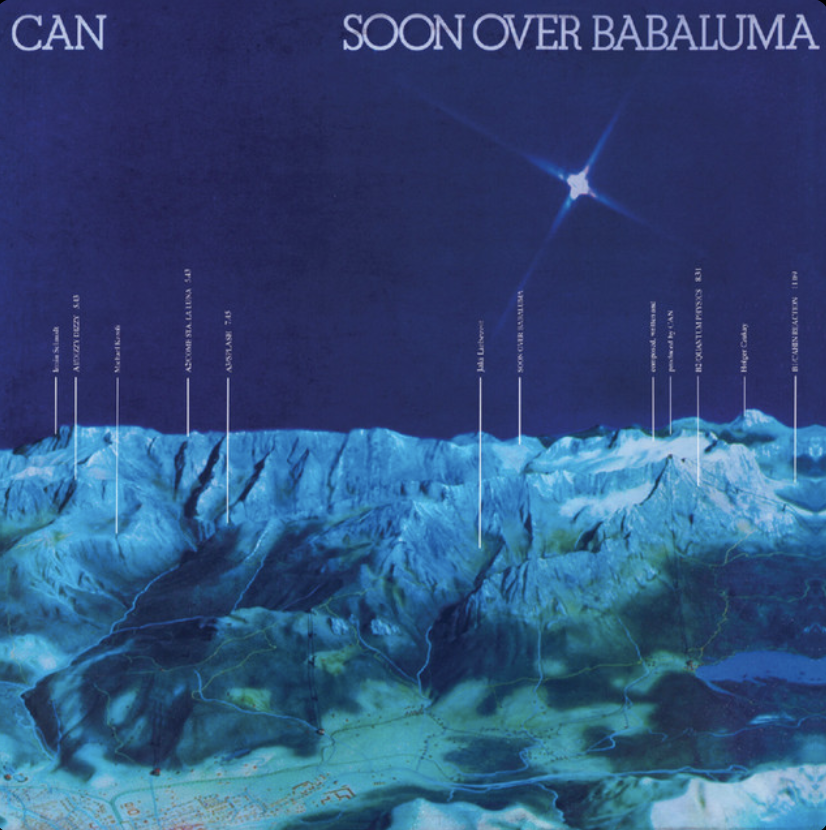
Retrieved and reshared from the Monolith Cocktail archives this month, a 50th anniversary special on CAN’s 1974 LP Soon Over Babaluma.
CAN ‘Soon Over Babaluma’
(United Artists) November 1974
Hawkwind once sang enthusiastically that, indeed, “Space Is Deep” on their 1972 progressive nebula traveling album Doremi Fasol Latido. Unfortunately for all the postulations and far out oscillating effects they failed to launch us further than our own stratosphere.
Interstellar overdrive and the promise of a journey beyond the stars never quite managed to leave behind the familiar sounding musical structures and instruments of Earthly genres, such as rock or jazz. Even Sun-Ra for all his visitor/emissary from another world talk, was still to a point chained to classicism; those outbursts of improvisation never quite soared to the dizzying celestial heights that we were promised.
Which leads me to CAN and their sixth studio album Soon Over Babaluma, a genuine bold attempt to lavish the cosmos with a fitting soundtrack; delivered by Cologne’s very own branch of NASA.
Previously on the 1973 heavenly diaphanous hymn Future Days, CAN had scaled new empyrean heights of excellence. Now they sat in the very lap of the Gods themselves, the only logical next step being outer space.
It helped of course that the injection of funds, acquired by Hildegard Schmidt, now paid for some new equipment; namely the futuristic sounding Alpha 77, a serious piece of kit that interrupts the sounds emanating from a keyboard to produce some startling effects and soundscapes. Looking like some kind of radioactive scanner and housed in a bog-standard clunky metal box, the Alpha 77 could have fallen off the back of truck bound for some nuclear science facility. The flight deck controls and rather old-fashioned register dials don’t quite reflect the abundance of sounds that can be created and fooled around with; Irmin Schmidt teases a vast array of ethereal sweeping sound collages from this box of tricks, that coats every part of this album.
Irmin wasn’t the only one to receive some new equipment, the band, as a whole, upgraded their sound desk: for the first time being able to record straight onto stereo. Also editing and overdubbing became a lot easier, benefiting the overall quality of sound and mixing. Technology always played its part but now it would direct the proceedings in 1974, as they began to lay down what would be the forthcoming Soon Over Babaluma album.
December 1973 saw the departure of Japanese troubadour and mushroom haiku mantra singer Damo Suzuki. A heated confrontation during a session for a TV soundtrack resulted in Damo snatching up his mike and a pre-amp, exclaiming, “That’s mine!” before skulking off in a strop.
The gear was returned in due course, but Damo remained aloof, never to return, the recent marriage into and conversion over to the Jehovah’s Witness religion playing a major part in his decision making. He may as well joined the Quakers, as hanging out with avant-garde rock stars was now frowned upon and discouraged to the point where life must have become quite square. Although the late experimental, improvising icon would later return to music full-time; going on to collaborate with some of the most inventive heirs of krautrock and a whole new generation of experimental artists and groups: the list is endless.
An empty vacuum emerged at first, the rest of the band feeling left in the lurch, the upcoming album deadline and tour commitments placing intense pressure on the group to find a replacement.
Unfortunately finding a new singer/front man wasn’t easy, either due to unsuitability or previous prior engagements that role remained aloof and unfilled. In the end it was their own transcendental guitar genius Michael Karoli who stepped up to take on the vocal duties, with Irmin lending his support and backing.
For the record Karoli does a pretty good job of it, sounding like a Germanic Syd Barrett and even at times evoking the dreamy quality of Suzuki himself. Irmin on the other hand comes across all creepy and crazed.
With an emphasis on the pursuit of other worldly experiments and space exploration, Soon Over Babaluma sports a suitable cover. Graphics artist Ulli Eichberger delivers a shining reflective moonscape cartography, with the song titles and personal etched over the lunar terrain as though they were the names of craters and the barren land features: though it also resembles some Alps type snowbound mountain scape.
The album title itself is claimed to be a parody type anagram of the old Weimar Republic era showtune ‘Moon Over Alabama’, made famous in renditions by Nina Simone and even David Bowie. Originally written by Bertolt Brecht, the genius German poet and playwright, and put to music by fellow countryman Kurt Weill for the 1930 satirical opera Rise and Fall of the City of Mahogany, the song was made even more iconic when the Nazis banned it three years later. Maybe it reeked too much of Cabaret and the savage biting social depictions of George Grosz, who painted grotesque images of the obscene decadence taking part in German society. The surge of the far-right encroaching on what they saw as bedlam with their even worse replacement ideology, turning on the social commentary of Brecht and Weill with vengeance.
Whether or not this is indeed the reason behind the moniker, there is no real reference to historical context; rather the mood is entirely directed towards space. Track titles such as ‘Come Sta, La Luna’, closest translation being “as it is, the moon”, and the scientific-in-nature ‘Chain Reaction’ and ‘Quantum Physics’, CAN certainly laid down enough signs of their newfound commitment to the course.
A move towards the more technological progressive and experimental ethos mixed with the jazz boundary defining pronunciations made by Ornette Coleman, Miles Davis and the already mentioned ex-resident of Saturn, Sun-Ra, CAN’s sound managed to surpass the previous journeyman as they now set out to tip toe across Orion and penetrate deep space.
But this wasn’t the only album released by CAN in the 1974, oh no! They also released a collection of studio offcuts and even further out there avant-garde sound collages entitled Limited Edition; so called as it was limited to only 15,000 copies, though only two years later it was released as a double album with 5 extra tracks.
Both versions include the Ethnological Forgery Series and the scraps and fragments of sound pieces and obscure cluttered impromptu jams that littered their back catalogue. The standout track is the ambient moving viscerally inspired ‘Gomorrha’, one of the most ethereal quality pieces they ever recorded and possibly the track that Damo walked out on. Its science fiction searching, and hearts of darkness espionage drama evoking atmosphere perfectly encapsulates the sea change taking place, having been recorded only months before work started on Soon Over Babaluma.
——A Deeper Reading—–
The sound of a small leap across the surface of the Moon, whose gravity has been swallowed by the Alpha 77 and re-directed into one illuminating bended note, this is how ‘Dizzy Dizzy’ begins.
Karoli floats in on a passing solar wind, floating above the rim shots and deeply reverberated bass like a lurking rock astronaut ready to pounce with his introduction gambit “rat-a-tat-a-tat-a-tat” vocal scat.
A sultry Afrobeat enriched beat bounces along as twangs of guitar mark the way, all the while Schmidt strokes his alluring array of space organs, fermenting some lofty aspiring effects with which the groove can walk on.
Soon the violin strikes up a haunting weeping melody that cuts through the expansive air, exquisite emotive strains from the stringed solo stir up a certain amount of pulchritude.
Soft brush strokes and heavily comatose cymbals contact Holger Czukay’s one note comfort blanket warm bass, rich in rebounded echo.
Karoli breathlessly sings such wise pronunciations as,
“I know, I don’t smoke with the angels, I know
Don’t throw ashtrays at me”
I think we know what kind of brand of choice he’s more than hinting at!
He goes onto lay his soul bear with the romantic gestured lines,
“I’m not made out of mature,
But I’m something out of the heart.
Throwing on you a kiss, kiss”
Almost jumbled around or miss-translated, these lyrics read like a cut and paste experiment.
Dizzy in love or dizzy due to the air being so thin up here in the upper echelons of space, Karoli seems to levitate on his whispered sonnet to some higher beings.
Schmidt eventually takes over, draining the vocals to a mere trace, that Alpha 77 synth manipulator now warming up and taking on a life of its own, becoming like a fifth member of the group. But it will be those felicities violins that have the last word, ending on a majestic duelling climax.
‘Come Sat, La Luna’ opens with a field trip recording of some stroll alongside the canal, the occasional croaking from some walk on part crow, interrupts the serene ambience. Karoli then rumbles in with a pleading dramatic rendition of the title off the back of some heavy duty compressed reverb, that makes it sound like the band are playing in a diving bell chamber.
The sense of entrapment and struggle to breathe in this now thick atmosphere, a morphine induced state is evoked in this dense sounding eulogy to some far-off planetary dimension.
Schmidt recites rather than sings his lines, which are deep in creepy effects and delivered through some unsettling eerie cadenced nonsense.
These vocals are more like riddles or cryptic announcements of foresight, such as the lines,
“I am not fighting, but I’m the night,
I am not dying, and I’m not hurt.
I am the right or the wrong, your hope,
I am the dancer on the tender road”
He goes on to express,
“I am the water and how I can flow”
Schmidt seems to be angling at some descriptive analogy, continuing with more caustic questioning,
“And why don’t you call me Sta?
Flowing over Babaluma,
It ain’t your friend.
You can do it alone,
And you don’t have to pay”
The song picks up some pace, almost swinging along in a jaunty motion, Liebezeit taps his way through, giving a special decompressed bass drum and kick drum solo, losing himself in a sudden joyful upturn.
From out of the mire approaches a grand piano and squalling guitar, both lost in a mini battling concerto, which grows towards an almost full on avant-garde free for all before calm is restored with the last warbling chorus from Karoli. Almost sorrowful in manner, the finale words almost trapped as though Karoli is zapped of his strength.
Side one ends with the all-out galactic jazz ensemble instrumental ‘Splash’.
Sun-Ra, Miles Davis, Ornette Coleman bump into each other on the set of Mission Impossible, all vying for elbowroom and paranoid up to the eyeballs.
Squawking, hooting sousaphone and grumbling thunder striking bass are met with fret board scrapping and incessant scratching, Liebezeit rattling off a series of rolling drums and double kicks, booting his kit round the room.
Just as a certain rhythm is broken in, cowbells and trinket percussion enter the alarming fray, bringing with them the black box recorder omnipresence of Schmidt’s 77, a glorious soundtrack to the stars is eminent.
Karoli begins a dystopian guitar solo from on top of some desolate mountainous range or Olympus Mons itself, melancholy wines and strains of harrowing pleads echo round the empty immense affinity of space.
An excitement of sorts starts to boil over as a barracking charge from the drums now piles in to the accompaniment of strangled brass and eastern harem sounding oboes, which pursue a deconstructed noisy voyage of discovery, wrestling control of these nine headed monster jams.
Once you’ve had time to calm down from the audio assault of ‘Splash’, side two awaits your attention with the doubled up ambient suites of ‘Chain Reaction’ and ‘Quantum Physics’, the energy and matter evoking scientific epic.
Beginning with the now familiar sound of the 77 revving up like some organic spacecraft dreamed up by Frank Herbert – in fact reminding me of the special effects from Dune the movie -, drums and bass slowly fade in with a soul shaking tambourine, shimmering and arousing r’n’b, before Karoli slides and rides all over his guitar, the celestial conductor.
The brewing accompaniment runs riot until fitting into an assured stride, the low plains pan out in front of us as the beat remains steady and ambitious in outlook.
Schmidt unveils grand gestures of melody from his very own inter-galactic flight deck, painting multiple soaring swathes of astrological envy for Karoli to now glide over with his best Damo evoking vocals.
Surreal imagery is conjured up and uttered with breathless enthusiasm; analogies of a Soviet flavour are transcribed thus,
“Elephant dominating Russian,
Don’t be running hurt.
Elephant running,
Dominating the deep”
The attitudes change with the take it or leave it gay abandon of the chorus,
“Chain reaction incoming when you get so small,
I said chain reaction incoming when you get so rushed”
Probing, encroaching guitar searches roam the moonscape, taking part in a call and response with Schmidt’s now crescendo illuminating collage of sound.
Liebezeit and Czukay both slump off into solo frenzies, traveling their very own particular rhythmic paths before a giant thunder clap strikes and sends the track towards free-fall.
Tribal beats clatter and clash, whilst haunting encircling brooding organs and ascending synths swoop, then the beats are reigned back in, as Karoli recalls the chorus.
Cyclonic chuggering grooves are interrupted with some unworldly seething effects, that wouldn’t sound out of place in 2001: A Space Odyssey, as the ghosts of Mars and the trembling spooky reaches of the far-off universe now hang heavily over the space flight.
Rim shots and interplanetary musings seep into the final outro of the track before bleeding over to the second act of ‘Quantum Physics’.
Gentle ramblings and distressing noises unearthed from the science lab, emanate throughout, all the while Liebezeit attempts to keep a groove going, constantly banging away in the background.
From out of nowhere, an unseemly black hole maybe, Schmidt unleashes a brave new world of sublime washes and choral ethereal charm. The sky at night has never sounded so angelic and worth investigating.
No description quite explains the climactic finale that signs off Soon Over Babaluma, invigorating escapism and traveling through the cosmos, in scenes reminiscent of Solaris.
Breathtaking in vision, the perfect emotional drama set in space takes some beating. Perhaps they should include this in any future first contact package shot into the universe; then again, any alien life form may just think we’re showing off.
If you enjoyed, felt informed, or marvel at my words and those of the Monolith Cocktail, please take a second or two to read the following message of alms pleading. Whilst I’m fully aware of the austerity, the lack of money, and an industry set on reducing all its creators, its critics and writers and motivators to a life of poverty, it is becoming near impossible to continue without support. And so with that in mind:
For the last ten years I’ve featured and supported music, musicians and labels I and the blog’s other collaborators love across genres from around the world that we think you’ll want to know about. No content on the site is paid for or sponsored and we only feature artists we have genuine respect or love for. If you enjoy our reviews (and we often write long, thoughtful ones), found a new artist you admire, or if we have featured you or artists you represent and would like to buy us a coffee at https://ko-fi.com/monolithcocktail to say cheers for spreading the word, then that would be much appreciated.
PLAYLIST SPECIAL

Another eclectic spread of all the artists/bands/ensembles/collaborations that have piqued our interest, warmed our hearts and got us thinking during March, the Monthly playlist collects tracks from all the reviews, mentions during the last 31 days on the blog. There are also a number of tracks that got away, or we just didn’t have room for.
We have Matt Oliver once more on the rap control, picking another essential showcase of new hip-hop cuts from Your Old Droog, Fly Anakin, Juga-Naut, The God Fahim and Jesht. Plus a myriad of borderless picks from every genre imaginable; including tracks from El Khat, Koma Saxo, Big Thief, Sweeney, ASSASSUN, Crows, Alice Dreamt, Kick, Adam Walton, Kristine Leschper and plenty more.
THOSE TRACKS IN FULL ARE:::
Paten Locke & Edan ‘Fried’
Koma Saxo w/ Sofia Jernberg ‘Koma Krig (Ft. Lucy Railton & Maria Reich)’
El Khat ‘Djaja’
Terakaft ‘Jagwar’
Etienne Jaumet & Fabrizio Rat ‘Rive Opposte’
Big Thief ‘Time Escaping’
Tone Of Voice Orchestra ‘That Kind Of Day’
Pussy Riot w/ Vérité & Latashá ‘Laugh It Off’
Martha D Lewis ‘Dawn’
Sweeney ‘The Break Up’
ASSASSUN ‘Over Again’
Le Pietre Dei Giganti ‘Ohm’
Bleak Soul ‘Mundane, USA’
Kick ‘Sirens Never Sleep’
Nova Charm ‘Over.Loading’
Exociety ‘Good Grief (Ft. Rav, Kill Bill: The Rapper, Scuare & Airospace)’
Raw Poetic & Damu The Fudgemunk ‘Chewing Gum’
Fly Anakin ‘Sean Price’
Neuro… No Neuro ‘Take A Step Outside Of Yourself’
Mai Mai Mai ‘Fimmine, Fimmine (Ft. Vera Di Lecce)’
Your Old Droog ‘.500’
Flying Monk ‘Fuck The Fame (Ft. Axel Holy)’
Elzhi & Georgia Anne Muldrow ‘Every moment (Ft. Dudley Perkins)’
PLOP & JUNNU ‘Totnoy’
Tom Caruana ‘3000 Volt Scarf (Ft. Lee Scott & Jazz T)’
Psych Major ‘Peace Bridge (Ft. Jamal Gasol, Wyze Wonda, DNTE & Toneyboi)’
J Scienide ‘Danceteria’
Juga-Naut ‘Dressed As Myself’
V Don & Sauce Heist ‘Wray & Nephew’
The Other Guys ‘Crepes And Breaks’
Isambard Khroustaliov ‘Cryptoersatz’
Simon McCorry & Anthéne ‘Distant Glitter’
Leaf Dog & BVA ‘Devil’s Breath’
Stinkin Slumrok ‘SHOW ME’
Jehst, Confucius & Mr Brown ‘Daily Planet’
The God Fahim ‘4 Matic’
Nicolas Zullo ‘Strano Siero’
Chlorinefields ‘Finally’
The White Russian ‘B Child’
Shelterheart ‘Empty Pockets’
The Lancashire Hustlers ‘Happiness On A String’
David Åhlén ‘My Only Treasure’
Rodrigo Bragança ‘Third Walkers’
Fatoumata Diawara ‘Dji L’eau (Malian Movement)’
Amaru Tribe ‘La Serpiente’
Istanbul Blues Kumpanyasi ‘Keep The Lord (In You) – Live’
Papercuts ‘Palm Sunday’
Crows ‘Garden Of England’
Alice Dreamt ‘All Those Little Things’
Harry Christelis & Pedro Velasco ‘LD13’
Alex Izenberg ‘Egyptian Cadillac’
Bart Davenport ‘Billionaires’
Carl Erdmann ‘Turritella Flats’
Σtella & Redinho ‘Charmed’
Adam Walton Cloudbursts II’
Kristine Leschper ‘Carina’
Pjusk ‘Aftenblå’
The essential Hip-Hop Review/Words: Matt Oliver
With the eight LP Eric B and Rakim vinyl reissue under our arm and tickets for both the B-Boy Championships (October, Kentish Town) and DMC World DJ Championship Finals (October, Camden, with the reigning champion being a stupefying 12 years old) in the back pocket, Rapture & Verse has a spring in its step and something special for sunburnt ears. South London producer Charles Edison, whose ‘My Name Is’, ‘Bitstorm’ and ‘Waking Up’ EP have done the business in this column down the years, lets us in on a sneak preview EP of five instrumentals from his forthcoming upcoming full length. Seamless with the sampler and as inventive as his surname demands, this exclusive preview of ‘Beats from the Seventh Floor’ reads between the lines of relaxation and tension, delivering head nodding from on high.
Singles/EPs
We love nothing more than the smell of ‘Sulphur’ in the morning. Britcore pioneers Gunshot return to set the record straight with a dramatic re-entry seizing a widescreen tracking shot and provocatively resonant lyricism. ‘2 Feel So Good’ by Tha 4orce and Poynt Blak is to acknowledge a morose head nodder looking for the change in seasons, before coming one time ‘4 The Mind & Soul’ with something to roll out red carpet lino for.
A reissue of classic Def Jux between Mr Lif and El-P brings back robotics from the lab and for the tracksuit at 45RPM, announcing the ‘Return of the B-Boy’. On his own version of Beast Mode, Mick Jenkins goes ‘Bruce Banner’ on an absolutely stone cold four minutes, taking his time before clicking into gear over a nervous lullaby. How about some hardcore? DJ Premier slamming pianos is a red rag to the bull that is Casanova, ‘Wut U Said?’ a certified dome cracker coating speakers in saliva and the kickback of a ton of guns. The ivories are quieter on Reks’ ‘Planz’, but the tirade is just as fierce, launching into ‘Bread and Roses’ with Shortfyuz with a sustained appetite for destruction.
Making headway through woozy neo-soul and underground cool, Blu, MED and Lojii supply quick on the draw rhymes for the star-dusted Oscillations project, seven tracks split between producers Dizz1, Swarvy and Teebs. Following the ‘Signs’ marked ‘snug coffee shop corner in Autumn’, Ace Clark breaks bread with Talib Kweli and Joell Oritz over some of the mellowest jazz on the menu. You probably couldn’t ask for a more Atmosphere track than ‘Make It All Better Again’, their requisite, relatable, days of our lives bitter sweetness getting lighters up and devotees swaying across the land. If you’ve ever wondered what the greatest hits of Slick Rick and Audio Two would sound like in an episode of Peanuts, wonder no more – Will C’s ‘Don’t Break Down’ re-houses a couple of old skool classics with folk-B-Boy whimsy.
Albums
Filled with gastro quotable, Scran Cartel nominate themselves as ‘Blue Plaque Candidates’. Master chefs MNSR Frites and Benny Diction stack up and snack on salivary stimulation, joined at the table by Oliver Sudden, Chemo, Morriarchi, Downstroke and more. Primarily smooth with a piquant palette rising from under the tongue, it’s a great, belt-loosening spread grilling you with much more than just a bunch of culinary one-liners.
Behind ‘The Purple Door’ you’ll find boss hogs Juga-Naut and Sonnyjim, spreading their rule over the Midlands and beyond with celebratory funk and status elevation prepared to take it outside when desired. Their usual, indomitable personas on the mic never skimp on Michelin-starred quality – a buffet of rhymes to return to, if you will – and they still aren’t the ones to test if you think they’re pushing their luck.
If you need sharp, accurate, dark and clean UK hip-hop, give the secret knock and ask for ‘617 Black Label’, where you’ll be met by Heavy Links’ Habitat. Moving like a safecracker slipping detection, Kuartz, Evil Ed, El Tel, DJ Obsolete and Cappo all keep a watch out for a rhymer whose strength is all in the stealth, smooth enough to make sure bad boys stay silent. ‘Crowns and Camo’ is the coat of arms for UK grafter Reds, an unapologetic spitter with an East Anglian ear for rocking clubs to their core. The album doesn’t get more complicated than that, posing crossover questions without dilution or losing any firepower, and riding basslines to turn spines to jelly. For as long as the sun stays out, this one will pose a threat. Man-machine rhymes and boom bap vectors mean a straight ahead onset of the Plague. ‘Where’s the World Gone?’ is the question of Xeno and Secondson, rising phoenix-like to dominate the skyline with a dominant distaste. Powerful stuff.
Napoleon da Legend and Giallo Point cause a ‘Coup D’Etat’, casual gangsterisms unflinching when reporting the unspeakable and the opulent, and the latter’s signature of taking soap opera themes down dark alleys until they’re shook for the rest of their days. ‘Societal Pressure’ starring Micall Parknsun, is the album’s significant turn for the worse. We still need a ‘Resolution’, so Paten Locke engineers a seven-track remix of 2017’s Perceptionists reunion, with an added bonus original. Putting Akrobatik and Mr Lif in the fresh new light of ‘Low Resolution’ sometimes sounds unerringly familiar – there’s a feeling the three have been discussing what’s left on Def Jux’s post-millennium to-do list. Additional subtle switch-ups create a high quality cross referencing.
For those that like their hip-hop on the verge of sleepwalking, Kev Brown offers you his ‘Homework’, the low-key exertions of a distracted doodler. Smoke filled listening booths are the target for retrained funk, sometimes done brusquely, other times with kid gloves, to the tutelage of a scholarly-sleepy voice “looking at the credits: if it says Kev Brown – get it”. The restless soul of Jeremiah Jae under his Daffi guise – fractured, hazy, clammy, intense, and unaffected – sharpens razors as night time therapy. A mind illuminated at the same it can shift backwards, processes and destabilises folk, funk, beats and pieces to a happy medium where he’d “rather be underrated than over-hyped”. Both are given a rude awakening by Q-Unique’s lesson in roach-stomping street cinema: ‘The Mechanic’ is all dramatic strings, drums of death and Arsonist threats never to be taken lightly.
 Monolith Cocktail Blog