The Perusal #60: Anna Butterss, Niwel Tsumbu, TRAINNING + Ruth Goller, Donald Beaman…
October 10, 2024
A WORLD OF SONIC/MUSICAL DISCOVERIES REVIEWED BY DOMINIC VALVONA
(Unless stated otherwise, all releases are available now)

Anna Butterss ‘Mighty Vertebrate’
(International Anthem)
Branching out once more to lead a company of long-time collaborators on an expletory journey of groove and rhythm (because no matter what the concept, the theory, the strategy, this album has both), bassist and composer Anna Butterss fuses the likely and unlikely into a new album of expressive possibilities, landscapes and feels.
The scope of wandering into new worlds, conjuring up new moods and peregrinations is large. Mainly a result of wanting to write music after a long period of extensive touring, Mighty Vertebrate is a refreshing outlet of ideas prompted by Oblique Strategy-like stimulations. Hardly restricting, as I’ve already laid out, these strategies spark creative trains-of-thought, of process, methodology and performance. So, for example, as Butterss describes, they are “…going to make a song where the bass doesn’t function in the role of a bass”, or, “…make a song that uses groups of three-bar phrasing”. And so on. Technical yet simultaneously vague and even open-ended, this amorphous set of rules merely acts as a starting point: not only for the in-demand bassist but their foils as well. And despite all that technical musical language and the range of influences, sounds, ideas, the bass guitar (sometimes Butterss switches to the upright) is mostly recognisable: sounding on occasion quite funky (think Bootsy Collins) and soulful, rather than avant-garde and deconstructed.
Moving in the right-on circles in L.A., and very much in-demand for not only heading their own projects but collaborating and improvising with such notable names as Jeff Parker, Makaya McCraven, Phoebe Bridges and Jason Isbell, the Australian-born artist is a member of that city’s Small Medium Large super-quintet. Members of that same group now join their bandmate on their solo adventure, with both Gregory Uhlmann (on guitar) and Josh Johnson (on saxophone) contributing parts throughout alongside International Anthem’s (pretty much) in-house sound mixer, Call & Response concert series founder, in-demand drummer and multi-instrumentalist Ben Lumsdaine (acting as the album’s co-producer and percussionist). Added to that quality lineup, the L.A. based guitarist and composer, “prolific sideman”, oft member of the highly influential Tortoise and founding member of both Isotope 217 and the Chicago Underground, Jeff Parker offers up a special one-off turn on the electro 80s, Japanese new wave and jazz twiddling fusion ‘Dance Steve’.
Hints and recalls from all the above’s own groups, ensembles and projects can be heard at one time during the duration of Mighty Vertebrate. And why not? This is one talented bunch of players and innovators, working in a very hot scene right now; encouraged by one of the most prolifically brilliant labels of recent years in contemporary jazz and beyond. And yet it feels like a culmination of musical threads being put together, whether intentionally or just going with the energy, the directional prompts of the moment.
Across many of the tracks there’s a balafon-like bobble and shuttering woody percussive influence of Africa (Mali, perhaps Kenya too), a simmered down Afrobeat rhythm ala Tony Allen in places, and the saxophone of Peter King. This fuses with a Tortoise, Yoshiaki Ochi and Ramuntcho Matta vibe on the opening ‘Bishop’, and merges with touches of label mates Jeremiah Chiu And Sofia Honer, Antibalas and LAGOSS on the fluted and smoky sax serenaded ‘Shorn’.
The more gently inclined and peaceable ‘Ella’ reminisce takes a jazzier blues and American prog approach. And the following mirage shimmered ‘Lubbock’ (named after the Texan city with a famous son, Buddy Holly, and famously nicknamed “Hub City”) reminded me of both Daniel Vickers and Daniel Lanois. ‘Breadrich’ is a real mix, with its crunching more gnarly bass, Cobham fusion jazz inklings and Brides Of Funkenstein meets cosmic 80s Italian new wave vibes. And then at other times it’s more like Ariel Kalma, Chick Corea’s Elektric Band, Alfa Mist, Joe Zawinul, Coltrane, and Matthew Halsall. But regardless of all that, Butterss finds a near intuitive pathway of individuality that crosses borders, timelines, moods, musical signatures and structures to find rhythm and groove balanced by emotional pulls to important reference points and feelings in their life. I’m not even sure if you’d call it leading so much, but this solo gig proves a stimulating treasure trove of musical and sonic ideas with purpose and skill.
TRAINNING + Ruth Goller ‘threads to knot’
(Squama Recordings) 18th October 2024
Two connective forces in the experimental, inventive contemporary jazz scenes combine their experiences and art on this sonic and musical hybrid.
Although both participants have crossed paths previously, this is the inaugural adventure from the German drumming and saxophone combo of Max Andrzejewski and Johannes Schleiermacher and the serial UK jazz movement instigator Ruth Goller. Regular readers may have recognised the former pairing, both being synonymous with the HÜTTE name, an ensemble that began back in 2011, and featured on the Monolith Cocktail back in 2019 with their radical take on the music of Robert Wyatt. Born out of more recent rehearsals, the TRAINNING appellation has stuck for now, and it is in this form that they appear now – although that Northern European HÜTTE influence is hard to resist.
Goller’s CV is way too impressive and prolific to list in its entirety here, but the composer and bass player’s most notable credits include two of the most important and influential groups to set off a jazz renaissance in recent years, Acoustic Ladyland and Melt Yourself Down. Goller has also performed with such luminaries as Kit Downes, Sam Amidan, Marc Ribot and (Sir) Paul McCartney, and plays with both Let Spin and Vula Viel.
There’s enough threads, nodes and junctions in between to feed off, but both partners in this knotted tension and more spiritual, lofty, airy and aria-like ether Linda Sharrock “ah’d” fusion of influences and prompted sparks of inspiration read each other very well. Directed by, and riffing off, the “Exquiste Corpse” parlour game so beloved by the Surrealist movement, the trio of players expand beyond the jazz idiom into shadow worlds, the mysterious, supernatural, cosmic and near industrial.
Although popular in France amongst many circles, the Surrealists used the exquisite corpse game as a subversive collaborative drawing exercise in which each participant added whatever subconscious extension they could dream up to a chain of hidden images, the results of which when revealed could result in the weirdest of oddities. With the likes of grand doyen of the form, and way beyond, Max Ernst taking part alongside Dali and Miró you might have big bird’s plumage next to the shapely naked crossed legs of a muse and tennis racket feet. It’s used differently here however, generations on, and in musical form, with one of the players either writing bars or music, but then passing only the last bar, or sometimes only the last two notes, onto the next, then the same again to the next player and so on until a song’s skeleton was formed.
Far from exotic creatures and humans of dreams and nightmares, the results are a mix of chaotic freeform, post-punk prowling, the down beat, the foggy and the fourth world experiments and suffused atmospheres of Jon Hassell.
Both the TRAINNING lads also play synths and guitars, and so the range of sounds and instruments is expanded even further than sax, drums, voice and bass: sometimes towards the electronic. There are oscillations, arpeggiators and synth lines that hint at the kosmische and early analogue sound: from Conrad Schnitzler to Kraftwerk and Schulze. The guitars meanwhile have more than a hint of Marc Ribot about them, especially in passages on the hovering, alt-country ritual of ‘Backlog’ – this one is as disturbing as it is mysterious and vague with its post-rock doom threads, singular thumped drum, shimmered hazy rattle shakes of percussion and harmonic picks and plucks.
Elsewhere, old as dirt, ‘Agelong’ walks in the shadows of Scott Walker and Krononaut; the bass guitar, gnarled and trebly in a post-punk fashion, lurking and shaking in an atavistic gloom. And the messy off-kilter escalation that grows out of the opening electronics of ‘Threadfin’ is more like Last Exit and Peter Brötzmann. But then as the track progresses the mood changes again, merging math rock and punk no wave with Ethio jazz, veiled gauzy voices and instances of a more soothed Ivo Pearlman in a spiritual communion with Matana Roberts. By contrast, ‘Finback’ reminded me of Tortoise in some parts, and Donny McCaslin in others, whilst the dotted cone-like electronics that bring in ‘Lineage’ change shape and form, breaking out into a spell of Ill-Considered jamming with Nocturnal Emissions.
Pretty much out on the peripherals of jazz, ascending, flexing, rasping, soothing and breathing iterations and more untethered expressions of freeform music, TRAINNING + Ruth Goller fashion organic fusions from a process that promises the wild, tumultuous, wrangled and strange, yet also provides the melodic and dreamy.
Niwel Tsumbu ‘Milimo’
(Diatribe Records)
So, what does it sound like when a Democratic Republic of Congo born and raised virtuoso guitarist brought up on that central African region’s homegrown Soukous, studies the classical, relocates to Ireland, and finds themselves recording their debut LP at Peter Gabriel’s famous Real World label studios with the assistance of the renowned engineer Dom Shaw. Well, it sounds almost courtly, Iberian, Baroque, intricate, studied, and bluesy with a jazzy lilt and underlying feel of the homeland. For such is the range of Niwel Tsumbu’s skills as a deft and expressively rich maestro of the nylon-stringed guitar that the blending of international inspirations and absorptions is near effortlessly merged to create something quite unique.
Outlined in the press blurb, Tsumbu’s music and direction of travel is as influenced by the classical genius of Bach as it is by the Spanish Flamengo maestro Paco de Lucía and jazz deity Charlie Parker. Match this with the inspirational sounds of François Luambo Luanzo Makiadi, aka the legendary “Sorcerer of the guitar” Franco, one of the most influential figures in Congolese music in the last century (one time leader of the mighty TPOK Jazz band), and Congolese Rhumba’s more up-tempo and brighter, more intricately played scion/offshoot, Soukous, and you have a real worldly fusion of cultures at play.
With not much more than a guitar, and on only one occasion, a voice that seems to follow that guitar’s versant and twirling patterns, you can hear legato, glissando and the “rubato” (from the Latin for “stolen time”) signature of expressing rhythmic freedom by slightly speeding up and the slowing down the tempo forms of those referenced inspirations. It’s de Lucía, with a little Sabicas too, on the opening ‘Rubato’ reflection, and on the entwinned gypsy classical, plucked and pricked ‘Polyphony’; Bach, with touches of courtly old England on the trio of ‘Etude’ shorts; and Parker, joined by Wes Montgomery, on the near romantic dappled and picked ‘Tirizah’. The open-ended finale of watery motioned notes, ‘To Be Continued’, could be Bach resurfacing during the jazz age of 1920s America. And the sliding intro title-track has a nylon buzzy toned resonation of Mali blues to it.
The album’s most experimental performance/composition, ‘The Silence Within’, takes a completely different turn. A resonation of harmonics, a shimmer and rung pluck of notes hangs and lingers in the echoed canyons of Tsumbu’s inner sanctum.
With both a depth and real intricate lightness of touch to the often rapid, near seamless phrases, runs, articulations and intonations on this solo offering, and with a foot in both Africa and abroad, a classical learning is blended with a contemporary ear and musically well-travelled soul to produce a modern guitar gem.
Donald Beaman ‘Fog On Mirror Glass’
(Royal Oakie) 25th October 2024
The play and course of light, the recurring “phantom” and a beautiful subdued, nigh on elegiac poetry conjures up a simultaneous union of the beatific and longing on the latest solo effort from Donald Beaman.
Like a drifter’s songbook of subtle, intimate and home-recorded wanderings, metaphors and the like for yearned and plaintive romantic loss, fondness, the passing/measuring of time, and the urge to find comfort and solace, Fog On Mirror Glass uses memories of the weather, the way the light touched or dimmed at a given moment in time, and the smallest of witnessed movements/touches to evoke the right atmosphere of gossamer and sparsity.
Although backed on his previous four outings by a full band, Beaman has stripped right back, recording the bulk of the material in his own living room: where he sat and wrote most of the songs. Longtime stalwart Kit Land helped Beaman set up a makeshift studio of a sort, whilst also contributing bass and keys, and that room’s resonance and reverberated surface sounds can be heard throughout. It also gives the album sound an almost lo fi quality at times: in a good way. Yet despite that pared down approach, Beaman states that this album emerged from an idea he had to “present solo performances in conversation with full-band work”. And so, he brings in Michael Nalin on brushing and dusting light drum duties – occasionally those same accentuated, snare resonating rattled and languid drums gather some more pace and rhythm -, Jen Benoit to add a subtle and emotional touch of attentive backing vocals to the stairway of winding time, ‘Awhile’, and the yearned, disconsolate ‘Usual Phantom’, and Ken Lovgren on additional guitar for the slow-paced, fatigued title-track.
In a former life part of The Doubles band, and a mover on the turn of the new millennium New York City scene, Beaman has in one guise or another shared stages with a staggeringly impressive range of artists, from the late Jonathan Richman to Sharon Van Etten, Mdou Moctar and Marisa Anderson, and toured with an eclectic list of noughties influencers.
But his music, and in this instance, is like a Venn diagram of Cass McCombs, Bob Dylan, Bert Jansch, Jeffery Silverstein, Jake Xerxes Fussell, The Mining Co. and early Fleetwood Mac. However, the opening lovely trickled and drifted warmth and resonance of ‘Glass Bottom Boat’, formed in New York and finished once making it to his new home of North California, has an air of Robbie Robertson playing some Baroque or near Greek beauty on a mandolin about it – by the way, I don’t believe it is actually a mandolin being played on the record, just has that feel. A wanderer’s tale; an alternative aquatic floating road trip in the humid heat, it’s perhaps one of my favourite songs on the album.
Some songs also have almost a country and bluegrass feel to them, like the skiffle and shuffled “drawn by the light” ‘Old Universe’ – one of those themes of distilling the entire gravity of it all, the world, the universe, into a moment captured, a gesture, a turn or look in a very particular room, on the stairwell or in an idyllic but less than homely scene by a river. There’s also the inclusion of a church-like organ to add some kind of beatific bathed light on the Leonard Cohen-esque ‘Your Dreaming Eyes’.
In all, a most impressive and understated songbook of honest quality and performance, themed largely around the way light falls upon any given metaphor, analogy, phrase, description and texture. Unadorned, the feelings are left to pull and draw the listener into a most intimate world. Each play reveals more, as the album really begins to grow on you. A fine record indeed.
Rhombus Index ‘hycean’
(See Blue Audio)
Named after the hypothetical type of planet with liquid water oceans under a hydrogen atmosphere – in other words, a promising candidate for habitability -, Rhombus Index’s fourth album for the discerning introspective ambient and electronic label See Blue Audio reflects on the ever expanding, and encroaching, fusion of artificial intelligence and the organic. Sonically in wonderment, if near joyously radiant and positive in places, that relationship between nature and the digital is stimulating, regenerative and subtly hypnotically entrancing.
Back in solo mode after his collaboration with See Blue Audio label mate f5point6, the West Yorkshire artist and crafter of biomorphic worlds continues that “symbiotic” union by releasing his album on the same day as his foil. Both are similarly cut from the same kinetic ambient and electronic cloth it seems.
hycean however, has a certain life force of softly bobbing bulb-like notes, melodic wave forms, gentle ebbing synthetic tides, dancing atoms and dispersing playful pollen fizzes that builds towards insect wing fluttered and rotor-bladed itchy ticking techno beats. The natural shapes of geography are mapped out on a soundboard of the blanketed, submerged, the beaming and vaporous. In fact, the gentle ambient undulated ‘Coastal Curve’ uses a “sonification of coastal path measurement data” to evoke the desired effect.
Sometimes the beats are more active, like on ‘Flotsam’. Here they sound almost like some kind of transformed version of sticks or hand drums, or even tablas, tapping away in a near soft d’n’b style. ‘Digital Anemone’ (from looking it up, I’ve come up with “anemone” being the word for a genus of flowering plants in the buttercup family) doesn’t so much break out into but builds lovingly towards a joyful beaming dance of subtle techno and trance.
A musical photosynthesis; a sonic growth of fauna, flora and algae; hycean is both an audio and image generated fusion – see the videos and accompanying artwork – of crystallisation, the blooming and expanding: an image manifestation that shows nature in a very alien new light. Part Dr. Alex Paterson ‘Loving You Live’, part Seefeel, part eco trance, it will (excuse the pun) really grow on you with each new listen.
Poppy H ‘Wadham Lodge’
(Self-Release)
Haunted invocations of past lives and half lost and half hallucinatory recalled memories swim around in the metallic filament ether of Poppy H’s imagination on the mysteriously veiled experimental artist’s latest release.
In “celebration” of the cassette format – the first physically tactile album in a while from the prolific composer -, all the foibles of that format are emphasised and played with; from the degradation in quality, changes in speed, and the signature surface sounds of tape itself, to the physical presses of the stop, pause and play buttons on a tape recorder. Finding its way onto tape culture, the expletory concept and processes used to conjure up Wadham Lodge – apart from the name of the semi-professional East London football team Walthamstow F.C.’s home ground, and the Tudor era Wadham patrons who founded an Oxford Collage, I’m not sure if this title is borrowed, meant to be based on a real place or a reference, or made up – are new. Physical recordings of his catalogue of work, both old and unreleased, were played and mixed live simultaneously, and accompanied by original live improvisation and compositions. This multilayered process was then captured and mixed, like much of his work, on to a mobile phone.
An interesting and novel concept that results in Fortean transmissions, mirages and vague traces of human activity, conversations and environment. Greyed out, filtered and often in a lo fi magnetic shroud that borders on the paranormal and apparitional, more melodic tunes, mechanised beats and sonic illusions manifest from the mystical fabric of reconstructed time.
Memories are fed into a cryptic model of visitations and sonic consciousness. Take ‘loosely based on grief’, which merges the familiar – albeit manipulated and filtered – sounds of industry and the train yard contact points – the iron scuffed and screeched sounds of a train moving down the tracks – with a Faust Tapes-like foreign broadcast. Or the woody mechanical slot machine-like sounds that merge with a mist of a supernatural Murcof and the Aphex Twin and tweeting bird life on the time measured ‘wild stab in the dark’. From these prompts, these maybe half lingered forgotten thoughts of scenes and the moving world around him, emerge visages and emotions.
It’s the sound of the Boards of Canada, Matthewdavid, Lukid and Oberman Knocks half reminisced, and captured on to ghost tapes. Another unique experiment from Poppy H that elicits new visions.
The Galactic Cowboy Orchestra ‘Lost In Numbers’
(Independent) 11th October 2024
Losing themselves in the mathematical technicalities, phrasings and time signatures of a tumultuous, but kind and melodious, jazz-prog-country-indie-alt-rock fusion, the highly talented Galactic Cowboy Orchestra run the numbers forwards, backwards and every which way their dynamic performances take them.
Originally founded back in 2009 by bassist extraordinaire John Wright, imbued and prompted by the music of such notable influences as King Crimson, Mahavishnu Orchestra and The Dixie Dregs, the quartet have since fashioned their own form of technically challenging music that expands beyond the fusion sphere into all kinds of genres and moods.
The most recent iteration of the group features John’s wife and electric violin/lead vocalist foil Lisi Wright, drummer/percussionist Mario Dawson and acoustic and electric guitarist Dan Neale (who also occasionally picks up the mandolin, in true prog rock instrument switching style). Across various themes they masterfully gallop, spike and pique, riding a constant shimmer and splash of cymbals and percussion, as they fuse a squalling Michael Urbaniak and Jessica Pavone with Arti & Mestieri, a noodling Jaco Pastoruis and King Crimson: and that’s just on the opening title-track. When Lisi sings however, the mood is more like The Charlottes or Belly, even Madder Rose, backed by Zappa or Rush – see the math rock prog and alt 90s female-led ‘Righteous’ and more enchanting lyrical winding ‘Faith, Peace, Hope’.
To further the sound and influences even further, the group mimic the speedy flourishes and scales of the Raga Piloo on ‘In Passing’ – entwinning the traditional Indian form with ariel-like violin and active busy drums -, and sound positively supernatural, otherworldly on, what I take to be a tamed riff on Coltrane’s even wilder, maddening ‘Ascension’.
The Galactic Cowboy Orchestra’s new album (their sixth I believe) is for those seeking something different in the jazz and rock-fusion worlds, something as melodic and tuneful as it is technically clever and complicated.
Groupe Derhane/ freddie Murphy & Chiara Lee ‘Batch #4’
ALBUM (Purplish Records)
When not in the company of the celebrated Tuareg musician-guitarist Mdou Moctar (in a roll that includes bass, guitar, backing vocals, drum machine and producing duties) Mikey Coltun runs his Purplish Records label, dropping unconventional releases in “batches”: a singing of which is the already mentioned Moctar. With this unique method, Coltun twin’s artists from completely different backgrounds, international zones and genres, in a double cassette package.
Volume #4 really attracts polar opposites, with albums from both the Niger Tuareg band Groupe Derhane, fronted by Issouf Derhane, and the Italian experimental partnership of freddie Murphy and Chiara Lee, who also go under the name of Father Murphy, channelling Catholic guilt through natural and synthetic manipulation.
What unites both participants is a shared reification of the concepts, atmospheres and geographies of deserts; Derhane, with the most exquisite camel motioned rhythm and with that signature desert blues and rock guitar resonance, contouring and paying respect, whilst also longing, for the south central Saharan region of Ténéré (which in the Tuareg language literally means “desert”), and the Murphy/Lee duo scoring the overwhelming nothingness of the white desert landscapes of Antarctica for fellow Italian film director Lorenzo Pallota. Both works find their creators embedded in the landscape, performing and extracting the mood of the place.
With a remarkable back story of travails and movement, Issouf Derhane started off life in the Tuareg (though it must be pointed out, depending on who you ask, that many from this community of freewheeling Beaudoin prefer the term Kel Tamashek instead of the later Tuareg colonial loaded name) encampment of Tidene in Niger, a hub as it turns out for exceptional musicians, including Omara “Bombino” Moctar. But he was quickly swept up, we’re told, and itching to travel, ending up in Libya where he picked up the guitar. As the horrific, destabilising shitstorm of that country’s civil war broke out, and the Gaddafi regime tumbled, Derhane was forced to move once again, returning to Niger and the city of Agadez, the “gateway to the desert”, in 2015. This is where he met a fellow guitar enthusiast by the name of Mohamed. A connection was made, fuelled by shared roots, and together they formed the Groupe Derhane band, which quickly became a bit of a sensation in Tuareg circles.
Channelling a tumultuous time in the Tuareg plight, with the fight still ongoing for autonomy within the regions that spread across Niger, Chad, Mali and the Sahel, the increasingly alarming over-desertification and effects of climate change, and preservation of their way of life, the Derhane group encapsulate a longing and paean for home and their roots that sounds entrancing, beautifully and emotionally charged. The clapped rhythms, motions of the camel trail and shifting sand dune contours, and constantly turning, brightly resonating and buzz of the guitar are close to the sound of such Tuareg icons of the form as Faris, Terakraft and Tinariwen. It’s not mentioned in the notes, but I take it that both the opening ‘Tamidtin’ and closing ‘Ténéré’ are both riffs on or covers of Tinariwen’s songs, albeit with a less bassy and low vocal, more echo and brightness.
There’s a subtle use of the synthesized and electronic, which makes the reverberating and buoyant ‘Khay Tamadroyte Tamacheq’ sound near cosmic and throbbing.
The six-track showcase is an invitation to dig deeper, consume and absorb a burgeoning talent on the Tuareg scene.
Sharing this dispatches double-bill, the Torino-based sonic partnership of freddie Murphy (the lower case is intentional) and Chiara Lee channel a whole different kind of desert. More an isolated, white awe-expansive tundra, they transform the abstract forbode, mystery and overwhelming senses of vast Antarctica into a soundtrack for Lorenzo Pallotta’s experiences aboard an icebreaker. On his return from this field trip, the film director emphasised the shock of readjustment in a land where the sun never sets; where time has no meaning, or at least is hard to measure. Pallotta also described the vibrations, the breakage of the vessel as it cut through the ice, sounding like a constant earthquake.
All of this is fed into a soundtrack of the paranormal, primal, fogged, beastly and wonderous. Manipulated off-world readings, hums, surfaces noises, drones, dissonance and obfuscated voices provide the paranoid, the esoteric and a sense of movement through a world with no borders, nothing concrete but just space: lots of white space. Nurse With Wound, Throbbing Gristles, Gunther Westhoff and Szajner lost in the cold psychogeography, the Antarctic is as disturbing as it is a polar adventure vision of the Heart Of Darkness. But then the finale double of ‘Intermezzo + Closer’ sounds like an electronic kosmische scenery of Dinger and Cluster and cult Library music; the radiant magnetic lights of the southern hemisphere shimmy to a tubular dance.
Consider the mood set, the senses retuned.
Batch number four is yet another unique pairing of influences and sounds; two different geographies, different methods, yet both sharing a general theme of landscape and all the unsaid or unsayable abstract feelings, atmospheres that go with it.
Pyramid Waves ‘Screaming Brain’
(Syrup Moose Records) 18th October 2024
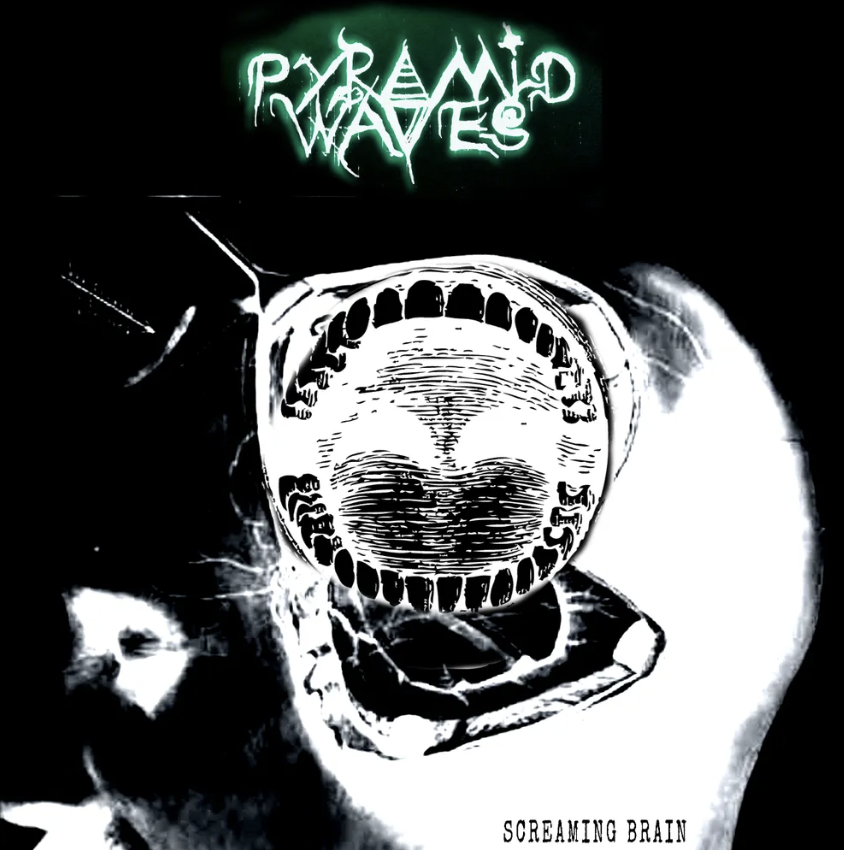
A cerebral haemorrhage; a blunt force of industrial sonics, caustic electronica and Fortean distress, the fifth work of traumatic discourse and dissonance from the French duo of Pyramid Waves drills into the four pillars of our dysfunctional modern society: that being, addictions, mental health, anxiety and cravings.
A bastard trauma of Front Line Assembly, Test Dept. and Merzbow, the Screaming Brain improvisations (recorded at their home studio) will leave you in no doubt as to the pained sufferings of its creators.
Demarcated into four parts of static white noise, analogue reverberations and interdimensional radio transmissions, crunch and crumbled beats, and echoed voices from some distant harrowing memory, doors to a tumultuous mind are opened to forces from beyond the mortal world. Because whilst the gristle for this album is all very real, the sounds grate, spin, switch towards a phantasm of the paranormal and alien. It’s as if a trapped psychogeography of echoing stresses and long dormant troubled episodes in the cortex has been wired into a supernatural apparatus of haunted and bestial sonorous severe disturbances.
Unsettling to put it mildly – especially the repeating dreamy melodic piano part that plays and meanders over a coarse bed of fearful distortion on ‘Trapped Underwater’ -, this uncomfortable but fascinating pull into the metal torture workshop of neuroscience squeals, slaps meat, drills and thumps its way to challenging and meeting its psychological demons.
If Richard H. Kirk, Richard James and SEODAH invoked Cthulhu whilst all in a room together, hunched over an apparatus of transistors, generators, motors, tools, drum pads and effects, then this is surely what it would sound like. Screaming Brian by name and nature, Pyramid Waves dissect the psyche of our troubling times, and the battles faced by the individual screwed-up by the system with horror and hurt.
Hi, my name is Dominic Valvona and I’m the Founder of the music/culture blog monolithcocktail.com For the last ten years I’ve featured and supported music, musicians and labels we love across genres from around the world that we think you’ll want to know about. No content on the site is paid for or sponsored and we only feature artists we have genuine respect for /love. If you enjoy our reviews (and we often write long, thoughtful ones), found a new artist you admire or if we have featured you or artists you represent and would like to buy us a coffee at https://ko-fi.com/monolithcocktail to say cheers for spreading the word, then that would be much appreciated.
A WORLD OF SONIC/MUSICAL DISCOVERIES AND POSSIBILITIES REVIEWED BY DOMINIC VALVONA
(Unless stated otherwise, all releases are available now)
Credit: Hanne Kaunicnik
Poeji ‘Nant’
(Squama)
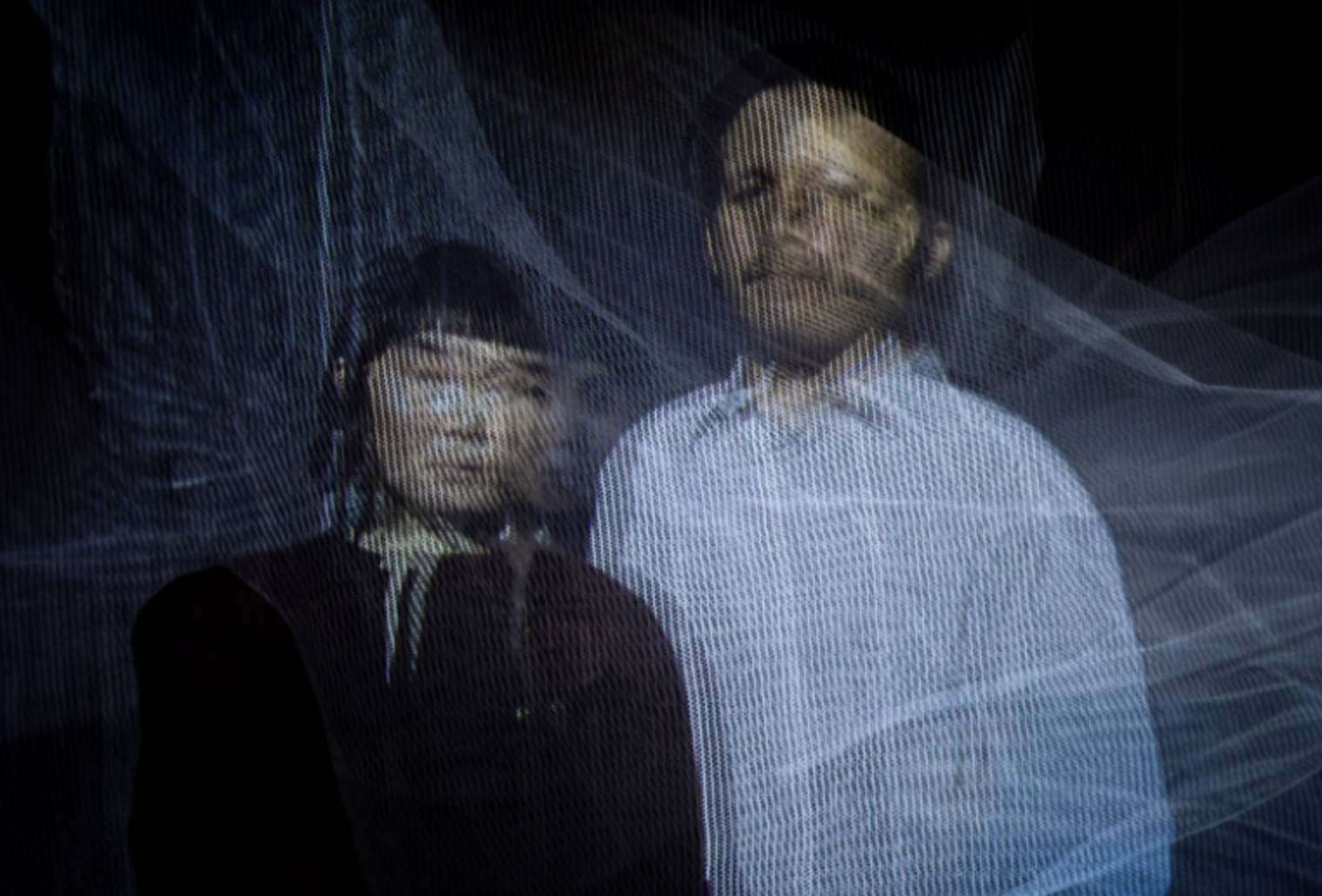
In shrouded chambers polygenesis cultures and roots cross paths and open up an amorphous portal to a unique world of redolent Asian percussion and Mongolian “urtyn duu” vocal soundings.
Making good on their cryptically coordinate-like coded 031921 5.24 5.53 EP from 2022, German drummer extraordinaire Simon Popp and the Ulaanbaatar born vocalist Enkhjargal Erkhembayar (shortened to Enji) have combined their individual disciplines and scope of influences to venture even further into uncharted territory.
For his part, the Bavarian Popp uses an extensive apparatus of hand drums and worldly sourced percussion to conjure up an atmosphere of both atonal and rhythmic (sometimes verging on a break or two) West Africa, Tibet, gamelan Indonesia and Japan. This in turn evokes a transmogrified vague sense of the avant-garde, of Kabuki theatre, of Shinto and Buddhist mysticism and mystery.
Popp’s collaborative foil Enji is a scion of the old Mongolian tradition of the Long song, a form of singing that emphasis and extends each syllable of text for long stretches of time. It’s said that a song with only ten actual words can last hours. Strong on the symbolism of the Mongolians much dependable horse, the long song form can be philosophical, religious, romantic or celebratory. Now, in a different century, Enji channels this heritage to voice, utter, accent, assonant, woo, and like breathing onto a cold glassy surface, exhales the diaphanous, gauzy, ached and comforting – the truly mysterious hummed ‘Buuwein Duu’ sounds like a lullaby.
Although much of the wording is linked to those roots, there’s an ambiguity to much of the carrying style vocals. For instance, the duo’s appellation of Poeji was chosen because it can be translated into various languages: meaning “sing” in Slovenian and roughly “poetry” in Japanese. The album title, Nant, is itself old Welsh in derivation, and can be translated as both “stream” and “valley”.
A fourth world dialect is achieved; a communication that needs no prior knowledge or understanding as the meaning is all in the delivery, emotion the cadence and largely extemporized feels and mood of the moment.
Described as working in the vernacular of post-dub and the downtemp, Nant reminded me in parts of the “tropical concrete” of the Commando Vanessa label pairing of Valentina Mag aletti and Marlene Riberio, Hatis Noit, Steve Reich and Werner “Zappi” Diermaier’s various drumming experiments as part of the faUSt duo with fellow original Faustian Jean Harve-Pèron. It is a unique conjuring of tones, textures, atmospheres, the avant-garde, the spontaneous (wherever the mood takes them) and the esoteric that won’t scare the horses. Instead, it sets a wispy, shrouded course to ventures into new realms of improvised communication; a bridging of cultures that reaches into new spheres of worldliness and the realms of new dimensions.
Raymond Antrobus & Evelyn Glennie ‘Another Noise’
30th August 2024
So tangible and effective is the clever – if taking a leap into the unknown and by chance – union between the two accomplished deaf artisans of their artistic forms that each pin-like sharp spike, each metallic shave, rattle and atmospheric undulation that builds around the unflinching candid delivery really hits hard and marks: leaves an audible impression.
The musicality, the rhythm is all in the poet Raymond Antrobus’ voice and often put-upon and sometimes self-doubting, cadence. It can’t all be put down to his deafness, but it offers something unique – although the William Blake professor of the album’s final bittersweet sign-off was both condescending and embittered-sounding in his succinct dismissal of Antrobus. I guess what I’m trying to say, is that sure the deafness is crucial, and that it opens up new or different ways of creating and circumnavigating the loss of this sense, but there is so very much more to both partners in this venture’s art form and genius that transcends the deaf condition.
Framed as it is, this inaugural collaboration between the poet and the virtuoso percussionist/composer Evelyn Glennie pushes the boundaries of poetry and sound; causing us to reevaluate our own perceptions. And with the equally acclaimed – and no stranger to this blog, as probably its most prolific featured artist/producer – in-situ producer Ian Brennan on board there’s an authenticity to what develops from the readings and mostly improvised percussive soundscapes.
Both partners on this evocative project can hardly be said to have a condition, a disability, or suffer for it. Glennie especially, through her old teacher Ron Forbes during her formative years, learnt to hear sound through different parts of her body: a physical response and channeling of sound that has helped and shaped the star percussionist to become one of the world’s greatest living musicians.
Unencumbered, the poetic language conveys, describes that unique relationship with sound, music and noise. The opening tubular shaken and spindled ‘The Noise’, which features the wooing, near ethereal sweet hummed undulations of guest artist Precious Perez, is the most obvious example of this. Rather importantly, the classically trained but eclectic Latin singer/songwriter/educator Perez, who is herself blind, is the president of the RAMPD.org charity fighting for disabled performers in the arts and more access. But it is her evocative voice that is called upon to offer something approaching a subtle wooing-like hum.
Giving each poetry performance a shiver of avant-garde, concrete and abstract sound art (even near Dadaist and Fluxus), Glennie (who had no prior knowledge of the material she was contextualizing or sounding) uses an apparatus of spokes, chains, tubes, bells and metallic-sounding brushes to articulate but also dramatically jolt and jar the alien, the unknown, but also the disturbing. She can also emphasis a state of isolation very well too; her foil’s themes often touching on a feeling of dislocation, not only because of his own deafness but because of his mixed ethnic roots: a feeling of the other you could say; of feeling adrift of both his English and Caribbean heritage.
Antrobus is unflinching on the topic of ancestral Black trauma and legacy. ‘Horror Scene As Black English Royal’ is a vivid example of slavery and that heritage that the Black community feels it can never leave behind or unshackle; prompted, I take it, by the whole Meghan Markle debacle and her fleeting acceptance into English royalty before the deluge of perceived outsider, and skin colour muddied the calm waters of stiff upper lipped etiquette in the White establishment. Glennie scores this poem with an atmosphere of horror and hurt; the sound of what could be an animalistic growl and pain striking out from the torture of slavery. ‘Ode To My Hair’ meanwhile, deals with the kinks and prejudice of a said Black “throw”, with Antrobus underlying dislocation once more emphasized as Black enough to be the victim of racism, but not Black enough for some in the Black community itself. There’s also a secondary theme of reconnection, using a haircut to talk about his relationship with his father. There are a few poems like this, where the touching relationship to a loved one, a child and even a cat is poignantly open and candid without resorting to the saccharine or to platitudes.
Talking of animals, birds, with all their various connotations, feature at various points on the album; cleverly linked to the learning of signing and to the very rhythm of city life on the visceral and incredible ‘Resonance’. I love some of the descriptions on this reading, especially the lyrically language used to describe their movement, like an “uncharted astronomy”, and the way Antrobus describes city birds as a whole different species to their country cousins.
Affectionate, personal as much as near dystopian, unnerving and hurting, Another noise is unlike anything you may have heard or felt in some time. For both artists sound and speech is near tangible; something you can almost touch. A sensory experiment, this collaboration does much to push, probe and explore perceptions of language, timbre, performance and delivery. This album is nothing less than a genuine work of artistic achievement from two of the UK’s most important artists.
The Mining Co. ‘Classic Monsters’
(PinDrop Records) 9th August 2024
Continuing to mine his childhood the London-based singer-songwriter Michael Gallagher once again produces a songbook of throwbacks to his formative adventures as a kid growing up in Donegal in Ireland.
His previous album almanac, Gum Card, touched upon a silly fleeting dabble with the occult, but this latest record (his sixth so far) is filled with childhood memories of hammy and more video nasty style supernatural characters, alongside a whole host of “weirdos”, “freaks” and “stoners”.
Once more back in his childhood home, frightened to turn the lights off, checking for Christopher Lee’s Dracula and the Wolfman under his bed, yet daring himself to keep watching those Hammer house of horror b-movies, Salem’s Lot and more bloody shockers, Gallagher links an almost lost innocence with a lifetime of travails, cathartic obsessions and searching desires.
A recurring metaphor, analogy and theme of blood runs throughout Classic Monsters, whether it’s the Top Trumps ghoulish kind of youth, or the more mature, adult-themed kind found on the taking-stock, trying not to run away, ‘Rabbit Blood’. The life force is both a reminder of immortality and the source of adolescent frights.
As always Gallagher’s lyrics are layered with references and meaning, and stretch the loose concept to open-up about anxieties, growing up and both the bliss and pains of love; the alum finale, ‘Planetarium’, sets a near ethereal astrological scene from the said title’s stargazer observatory, as two star-crossed in stoned awe and wonder look up to the celestial heavens to a retro-lunar, Theremin-like voiced and ballad style piano soundtrack. Songs like that evoke Gallagher’s sci-fi passions, and alternative Dark Star songbook score fixations (see the brilliant Phenomenology album). But even though there’s a smattering of space dust, and no matter what, a musical signature that runs throughout all his work – enervated cosmic cowboy troubadour, soft rock and evocations of the Eels, The Thrills, Josh T Pearson, Rezo and The Flaming Lips – Gallagher has changed his set-up a little.
Recording back in the Spanish studio environment that has served him so well, and once again working with the musician and producer Paco Loco (credits and highlights include working with the outstanding Josephine Foster, the Jayhawks’ Gary Louris and The Sadies), Gallagher is now also backed by the Los Jaguares de la Bahía band, who bring subtle psychedelic country and alternative rock influences to the sound. The cover art, especially the lettering style, signals The Flying Burrito Brothers or The Byrds – both of which you may detect – but there’s an almost distinct CAN-style drum on the opening sparse and wisped ‘Failure’, and a touch of Bonnie Prince Billy, Phosphorescent and Fleet Foxes.
Step forward Pablo Erra on bass, Patri Espejo on piano, Esteban Perler on drums and Loco on synths and ambient effects, for they manage to seamlessly evoke Bill Callahan one minute and Lou Reed the next. And yet also sound like Joe Jackson teaming up with Nick Lowe and the Boomtown Rats – to be honest, that last reference is largely down to the piano sound. They make the vampiric and howling themed ‘Blood Suckers’ sound disarmingly like a Scarlet’s Well fairytale of sweet dreams, soothed from beneath a baby’s calming mobile hanging over the cot. Weirdly (or not) both the band and Gallagher reminded me of Elbow and David Gray on the very 90s upbeat tempo’d ‘Killer Sun’.
It’s a winning combination that expands Gallagher’s musical scope without altering his signature style and voice, feel and intimacy. I’ve said it before about Phenomenology, but I really do think this is now his best album to date. And I’m still astounded by the lack of support for his music or exposure, as Gallagher’s The Mining Co. vehicle is worthy of praise, airplay and attention. Hopefully it will be sixth album lucky for the Irishman.
Jessica Ackerley ‘All Of The Colours Are Singing’
(AKP Recordings) 16th August 2024
Gifted guitarist, composer, bandleader and soloist Jessica Ackerley adds even more colour (sometimes vivid and striking, at other times, more pastel or muted) to their pliable sonic/musical palette. Seamlessly crossing over into art – inspired in part by the arid desert outdoor symbolic and metaphorical flowerings and abstracted landscapes of Georgia O’ Keefe – the now Honolulu-based musician turns markings and sketches into both untethered performative compositions that traverse the avant-garde, jazz, blues, experimental rock, R&B and the virtuoso. O’ Keefe’s “to see takes time” wisdom is used almost like a catalyst for the album’s articulation and more energetic ways of seeing.
Recorded in the unceded territory of the indigenous Kanaka Maoli, in the Mānoa Valley (one of Hawai’i’s venerated mythological creation story landscapes) All Of The Colours Are Singing filters an inspiring geography, sense of time and place whilst also channeling Ackerley’s synesthesia – hence that title.
With a rich CV of performances (from John Zorn’s The Stone to The Metropolitan Museum of Art) and projects behind them (from their extensive catalogue of eclectic work with such notable musicians as Marc Edwards, Tyshwan Sorey and Patrick Shiroshi), it’s no wonder that Ackerley manages to attract a talented pool of collaborators or foils. Step forward Walter Stinson on upright bass, Aaron Edgcomb on drums and Concetta Abbata on alternating violin and viola. Boundaries are crossed and blurred with this ensemble on an album of varying beauty and wilder improvisations; an album in which subtle sensibilities are comfortably followed by challenging free expressions of fusion and freeform progressive jazz. If there was an underlying genre or influence sound wise, then it must be jazz in its many forms, with echoes of the Sonny Sharrock Band and Philip Catherine, but also shades of the noirish, the smooth and more impressively quickly played and bent-out-of-shape kinds. Edgcomb’s drums can add to the jazzy feel, but also sieves, brushes and sweeps across the snare in a more tactile fashion – almost like applying brush strokes at times. It might just be me, but he reminded me of Guru Guru’s Mani Neumeier on the changeable in tempo and style, jazz-fusion ‘The Dots Are The Connection’.
But then there’s the near sweetly hummed and dreamy intro to that O’ Keefe borrowed title quote, and then what sounds like Tuareg desert or Songhoy blues guitar on the first part of the ‘Conclusion: In Four Micro Parts’ finale – this soon develops into a bout of buzzy intense Yonatan Gat experimental physical rock. That use of strings obviously steers the music away from the jazz sound towards the classical and chamber. Abbato, subtly reinforcing or emphasising the moments of grief, mourning and thoughtfulness, can both articulate dew being shaken off fluttered shaken feathers and stretch, strain and fray the violin and viola in a more avant-garde fashion – reminding me of Alison Cotton, Alex Stölze and, although she is a cellist, Anne Müller. Ackerley uses the guitar like an artist’s brush stroke, whether it is in a frenzy or blur of abstract or rapid markings and swishes, or more placed and calming. Invoking such refined and experimental bedfellows as Joe Pass, Marisa Anderson, Bill Orcutt, Chuck Johnson and the Gunn-Truscinski Duo, they walk a unique personalised pathway between medias and art forms to showcase and push at the boundaries of artful guitar-led performance and inner emotional workings.
Drew Mulholland & Garden Gate ‘Night Blooming Flowers’
(Subexotic Records) 23rd August 2024

Serial offenders of occult sounds and more nostalgic early analogue and library music, the transatlantic sonic conjuring sparring partners Drew Mulholland and Timmi Meskers have coalesced their individual disciplines for a suitably atmospheric esoteric soundtrack of retro horror novelties and pastoral chamber folkloric magik.
By candelabra light Meskers’ Garden Gate alter ego is called upon to bring a certain ethereal apparitional siren allure, enchantment and vintage, and bowed classical heightened spine-tingles and spooks to Mulholland’s BBC Radiophonics Workshop and his very own Mount Vernon Arts Lab project style electronics.
The University of Glasgow lecturer and composer-in-residence and his American “Baroque psych/horror savant” foil don’t do things by halves, having written a mini synopsis storyline of a kind for the protagonist of this horticultural paranormal and dream-realism tale. The title more or less tells you all you need to know: that is, a search and waylaid adventure to find the rarest of flowers, the botanist’s precious treasure, that only bloom’s at night. In between the start of a expedition and the final unveiling of this sought-after flower, there’s many a misstep along the pathway, as the dark arts merges with pagan and idyllic folklore to drag our main character into various spellbound jeopardies, fairytales and hallucinations.
Imbibed and inspired by a number of sources, one of Meskers most notable is the late British historian Emma Wilby’s Cunning Folk And Familiar Spirits: Shamanistic Visionary Traditions In Early Modern British Witchcraft And Magic tome; the central propound argument of which is that early modern beliefs and witchcraft were influenced by a substratum of shamanistic beliefs found in pockets of Europe – of which they are many detractors. You can throw in the Tarot and what musically sounds like to me the cult British horror soundtracks of the Amicus and Tigon studios, Dennis Wheatley, Isobel Gowdrie and a whole woodland of sprites, fairies and mythical beasts.
Altogether, with both partners’ range of influences, the soundtrack shivers, creeps and in both a supernatural and merrily manner merges the otherworldly analogue-sounding atmospheres of Belbury Poly, The Focus Group, Pye Corner Audio and Bibio with the pastoral willowy tapestries and bewitching spells of Tristram Cary, Marc Wilkinson, James Bernard, Harry Robinson and Sproatly Smith.
From dramatic stiletto piano and meanderings amongst the grass snake foliage and Piltdown Man decorated hilltops, to more hallucinatory passages of enticement, each piece of music conjures up a scene or chapter in a larger idiosyncratic tale from the pages of the Fortean Times, King James’s Daemonologie or pulp supernatural fiction. As Hauntology projects go, Night Blooming Flowers is a retro-styled success of subtle but effective storytelling, mystery and cult references; a soundtrack that now needs a film to go with it.
Asteroide & Fiorella16 ‘Suni A Través Del Espejo’
Downtime ‘Guts’ (Cruel Nature Records)
Through the various sonic peregrinations, noises and protestations of their extensive roster, the Northumberland diy label Cruel Nature travels between the hard bitten dystopias of life in a modern fractured state to more fantastical climes out in the expanses of space. Keeping up a steady prolific schedule each month, the label covers everything from the psychedelic to riled punk and societal angst.
Just dipping into the July haul of releases, I’ve picked out two albums from the mysteriously cosmic and krautrock imbibed camps; the Peruvian pairing of the Asteroide duo and Fiorella16’s Suni A Través Del Espejo and Downtime’s seemingly uninterrupted one-take Guts jam.
The former channels the psychogeography (both atavistic and otherworldly) of the Andean Altiplano, which spans Boliva, Chile and Peru. A natural phenomenon, the Altiplano (from the Colonial Spanish for “high plain”) is the most extensive high plateau on the planet outside of Tibet. It encompasses a whole high altitude giddy biosphere of pristine environments: from the famous Salar de Uyuni salt plains to Lake Titicaca – one of the main hubs along its banks, Puno, is where one half of this collaboration, the indy rock siblings Asteroide, hail from. “Through the looking glass” (as that album title translates), alongside sonic foil José María Málaga, aka Fiorella16, they magic up a highly mysterious communion with the elements and the forms, the ghosts and the extraterrestrial bodies that flicker in and out of the consciousness; that appear like dizzy, lack of oxygen and air, hallucinations and mirages.
A biomorphic score created in-situ, the properties of water, the season of Spring and a hilltop suddenly sound like the cosmic whirrs of UFOs, alien transmissions and caustic stirrings from the belly of volcanic chambers. A mixture of Steve Gunn and The Howard Hughes Suite-like post-rock Americana and harder Sunn O))) and Gunter Schickert guitar and synthesised atmospherics, generators, oscillations, satellites and Throbbing Gristle coarseness build up a near esoteric, primal communication with the plateau’s guardians. The finale, ‘PRIMAvera’, with its ‘Jennifer’ style reverberated throbbing wobbled bass, sulfur waves and data exchanges, finds the collaborative partners finally beamed-up via the tractor beam to some subterranean alien dimension.
A little bit different, though there are some krautrock-style overlaps, the “power duo” Downtime orbit head music space on their latest just-let-the-tape-record-whatever-emerges-from-an-intense-heavy-jam-like-session. Over forty minutes of edited thrashing, kraut/heavy/acid/doom rock, the participants in this expulsion of energy channel everything from the Boredoms, Acid Mothers Temple, Zeni Geva, Hawkwind, Ash Ra Tempel and Boris.
In a cosmic vacuum, near virtuoso fuzzy and scuzzy soloing and ripping phaser and flange guitar and tempo-changing beaten, crashed, squalling drums and acid galactic effects create a heavy meta(l) space rock behemoth of interstellar proportions.
A mere whiff of what to expect from this label’s catalogue, both albums are worthy of your credit and spare change.
Zack Clarke ‘Plunge’
(Orenda)
The critically hailed pianist-composer, New York improvised jazz scene stalwart, and bandleader Zack Clarke finds ever more inventive and omnivorous ways to push both the jazz form and his studied instrument on his latest album for the Orenda label.
“Building” (to paraphrase the album notes) bridges between groups of people, and cleverly merging the intelligent dance music movements with cosmic-funk-jazz, hip-hop breaks, prog and both classical and avant-garde forms, Clarke takes the proverbial “plunge” and resurfaces with a sometimes fun and at other times intense serialism of either spasmodic and stuttering or free-flowing discombobulating performative fusions.
Using modern production methods and a whole kit of tech, Clarke takes the idea of jazz in its earliest incarnation as dance music and runs with it; aping the minimalist techno and electronic rhythmic off-kilter mayhem of such iconic labels as Warp through an effects transforming removed version of the piano.
Dashed, chopped and cross-handed sophisticated modal runs and the piano’s very guts (its inner wiry stringy workings played at times almost like a splayed mallet(ed) chiming dulcimer) work with varied combinations of breakbeats, clattered, rattled, splashing and electronic padded drums and what sounds like 303 or 808 electro synths across a generous sixteen tracks.
At times all this sounds like Keith Jarrett corrupted by Drukqs era Aphex Twin; or like µ-Ziq fucking around with zappy-futuristic Herbie Hancock; or even Zappa jamming with Chick Corea. But then certain compositions (if that’s the appropriate word) reminded me of The Bad Plus, of Radiohead In Rainbows, of Mantronix, Squarepusher and Andrew Spackman’s Sad Man alter ego. It might only be me, but album finale ‘ANTHEM’ sounds like Abdullah Ibrahim transduced through d’n’b and breakbeat filters.
There’s a lot to unpick, to absorb, but weirdly enough Clarke’s inventive intentions are successfully accomplished as he bridges the avant-garde and jazz with a spectrum of fusions and experimental technology to produce a unique vision of dance music for a new century.
___/+ THESE RECOMMENDATIONS IN BRIEF
Any regular readers will know that I pride myself in writing more in depth purview-style reviews with a wider context. This means I naturally take more time and effort. Unfortunately, this also means that I can only ever scratch the surface of the thousands of releases both the blog and I get sent each month. As a compromise of sorts, I’ve chosen to now include a really briefly written roundup of releases, all of which really do deserve far more space and context. But these are recommendations, a little extra to check out of you are in the mood or inclined to discover more.
Poppy H ‘Good Hiding’
ALBUM (Adventurous Music)
In a constant artistic flux, the idiosyncratic trick noise maker and musical statements composer Poppy H always manages to embody a whole new sound with each release and project. The latest is no different for being different in that regard. A Good Hiding (a reference to taking a good beating or kicking, or just literally a “good hiding place”) is both a studied and beautifully evocative chamber haunting of removed folk and traditional ideas, windy funnelled atmospheres, low key padded bobbling and spinning electronics, voices and whispers from the air, ghostly classical piano and suffused ambient drama. To truly articulate the elegance, near Gothic mystery and dreaminess of it all would need far more words and depth: a real long form reading. But hopefully this will be enough to whet the appetite, as this is a very good album indeed.
Cumsleg Borenail ‘Broadmoor Time’
TRACK/VIDEO
Prolific instigator of phantasmagoria electronica Cumsleg Borenail is at it again with another fucked-up nightmare of sonic disturbance. As you may have rightly guessed from the title, this ominous, scary score channels the abusive, harrowing pained psychogeography of the infamous high-security psychiatric hospital in Berkshire, England. A right rogue’s gallery of inmates has occupied this facility over the decades; some of the UK’s very worst and unhinged offenders and murderers. And you can read much into the reasons behind the subject matter, the mental health care aspects and treatment especially, but it is a very haunted soundtrack of the recognisable made otherworldly, scaly and metallic.
Pauli Lyytinen ‘Lehto/Korpi’
ALBUM (We Jazz) 30th August 2024
Conjuring up a whole eco system of forest canopy menageries and lush greenness, the Finnish saxophonist Pauli Lyytinen sets out a “deep forest grove” biosphere of fertile heavenly auras and bird-like reedy probes on his solo debut for the We Jazz label.
A moiety of Don Cherry, both 60s hippy idealistic eco-friendly and more divine Biblical MGM sound studios soundtracks, cylindrical Fourth World blasts, and hints of Stetson and Brötzmann, Lyytinen’s saxophone positively sings on the wing whilst opening a blessed environment. Mentioned in the references, and on the nose, our fluttered, feathery saxophonist has Evan Parker’s own bird songs down to a tee. An unassuming charmer and yet full of experiment and organic untethered freedoms, Lehto/Korpi is far too good an album to be missed or overlooked.
Hi, my name is Dominic Valvona and I’m the Founder of the music/culture blog monolithcocktail.com For the last ten years I’ve featured and supported music, musicians and labels we love across genres from around the world that we think you’ll want to know about. No content on the site is paid for or sponsored and we only feature artists we have genuine respect for /love. If you enjoy our reviews (and we often write long, thoughtful ones), found a new artist you admire or if we have featured you or artists you represent and would like to buy us a coffee at https://ko-fi.com/monolithcocktail to say cheers for spreading the word, then that would be much appreciated.
THE MONTHLY DIGEST OF ACCUMULATED NEW MUSIC, THE SOCIAL INTER-GENERATIONAL/ECLECTIC AND ANNIVERSARY ALBUMS CELEBRATING PLAYLIST, AND ARCHIVE MATERIAL CHOSEN BY DOMINIC VALVONA

Continuing a series that started in 2023, the Digest is my one-stop column of the new and the old; a secondary home to all those releases I missed out on or didn’t get room to feature in either my Perusal reviews features or singular Our Daily Bread posts, plus a chance to celebrate timely anniversary albums and dip into my own record collection with the a special anything goes playlist, and to, finally, dip into the Monolith Cocktail Archives.
The New: this will be a briefing of a sort, with a short outline, thoughts and reactions to a number of recent albums from my inbox – currently a 1000+ releases a month on average!
The Social Playlist: choice music collected from across the ages, borders and genres, with a smattering of tracks from choice anniversary celebrating albums of worth and cult status. Consider it my unofficial radio show. The Archives: self-explanatory, but each month I chose past pieces from the extensive Monolith Cocktail back pages that have a timely ring to them.
___/NEW\___
Mohammad Syfkhan ‘I Am Kurdish’
(Nyahh)
To do justice to the backstory (one that’s filled with tragedy and yet musically inspiring) of the Syrian-Kurdish surgical nurse and musician-artist Mohammad Syfkhan, I’d need far more room. But in brief, the heralded ‘bouzouki’ (a round bodied, with flat top, long-necked lute with resonating and sharp metal strings strummed and picked with a plectrum, that was brought to Greece from Anatolian refugees) maestro and singer was forced to abandon his family’s home in the city of Raqqa during the senseless apocalyptic Syrian civil war. As various fractions fought against the Assad regime, Islamist’s most feared and brutal cult, ISIS, swooped in and proclaimed that atavistic Euphrates located city their capital: the centre of operations and a new sickening, destructive caliphate. As a minority Kurd, Syfkhan was already in danger, but when one of his son’s was murdered by the terror group, they had to join the growing diaspora of Syrians fleeing the country and region to escape persecution (by not only ISIS but Assad too); splitting the family between Germany and Ireland, where Syfkhan, his wife and young daughter were kindly taken in.
Poured into his debut album (although he started his own band The Al-Rabie Band decades ago back in Syria; and a very popular, sought-after troupe they were too) that loss and upheaval is balanced with certain joyous and romantic gusto. Longing for home mostly certainly, and yet making a new life in his adopted Leitrim sanctuary on the River Shannon; in the moment, spreading the traditional and more contemporary music of his Kurdish and Syrian roots whilst also collaborating with those native musicians and those that have also made that same Irish village their home too (including on this stunning album the composer, improviser, sound artist and saxophonist Cathal Roche, and the composer, improviser and cellist Eimear Reidy).
Like a ascending stairway, or flowing and resonating with evocative melodies magic, lute stirring ruminations sweep over Arabia and surrounding regions; referencing anonymous, collective and some original-penned compositions and dances to Islam’s ‘golden age’ of fairytale (‘A Thousand And One Nights’), Kurdish pride in the face of repression (the title-track of course) and its peoples’ struggle for independence and respect (‘Do Not Bow’), lovelorn enquires (‘Do You Have A Lover Or Not?’), and the missed daily activities, interactions of life back home in Raqqa Across it all the hand drums tab, rattle and roll; the cello arches, weeps and bows in sympathy; and the bouzouki lute swoons and rings out the most nimble and beautiful of ached and more up-tempo giddy tunes. There’s a real weight and energy at times, balanced out with slower emotional reflections; but when they go, they go! All the while you can trace the lineage, the scope of the sound back to the Middle East, to old Anatolia, more modern Turkey, and even the Hellenic; and from weddings parties to the courtly, to the caravan trails and souk. I couldn’t recommend this album enough; already sitting as it does in my favourite choice releases of 2024.
epic45 ‘You’ll Only See Us When The Light Has Gone’
(Wayside And Woodland)
With enervated and evaporated applied washes, and drifting along with a certain despondency, Ben Holton and Rob Glover’s long-running – but due to circumstances beyond their control, interrupted – epic45 project finds much to cover; from Brexit to the lunacy of the housing ladder; the parental cliques of the school gates to the death-by-a-thousands-cuts decline of England’s rural and seaside towns.
Already, unbelievably, four years since the last album (finding a favourable audience at this blog) Cropping The Aftermath (released during the height, more or less, of the Covid pandemic), You’ll Only See Us When The Light Has Gone arrives in the wake of setbacks – from the repercussions of both Brexit and Covid on touring (with the band’s Japanese tour cancelled, but also, Europe for us Brits, no longer part of the free-movement agreement, becoming a major pain-in-the-arse to circumnavigate) – to the on-going issues of Holton’s severe back problems.
But persist they did, and went away to produce this idiosyncratic take on the modern life is rubbish (and expensive) idiom. This is a resigned but rallying push back against life in, what they call, the ‘edgleland’, the ‘nowhere places’; pushed out onto the peripherals of society and inclusion. The very English preoccupations of owning a home permeate, from the ill-planned ‘floodplain’ sites that many are forced to accept, to the grander housing development promises of ‘stepping stones to country homes’. But this is a wider statement on a nation in crisis, and the pressures of keeping heads and minds above the crushing effects of unceasing disillusion; ‘dignity’ in the face of narcissistic cultural and political vacuous, the cost of living and bad health.
A very different record from its predecessor, Holton and Glover bring songwriting and vocals to the forefront; from the near forlorn shoegaze-y and woe of late 80s and early 90s indie, to what I can only describe as higher scale soulful indie and more modern effected R&B aches. But the music hasn’t exactly taken a back seat, with vapours of ‘Oh So’ period Charlatans, Neon Neon, Seefeel and The Last Sound, touches of soft power rock from the 80s and 70s, and the appearance of their former live, and My Autumn Empire, drummer Mike Rowley powering the breaks with evocations of Bloc Party at their most subdued and building a soft momentum when the drive is needed to escape the wispy drifting. Within that framework there are other nice little touches too: the glimpse of surface, environmental ambience and dialed-out conversations, a touch of folksy Iberia guitar here and there, and veil-like chime of the celeste.
epic45 somehow manage to retrieve hope and possibility from the ether of debilitating tiredness on an album that sees them move in more melodious and vocalised direction.
Boštjan Simon ‘Fermented Reality’
(Nature Scene)
Glitches in the cerebral; a coming to terms with the current age of high anxiety and alternative realities of a world in turmoil and flux; the debut solo turn from the Slovenian saxophonist and various electronic apparatus experimentalist Boštjan Simon puts the former instrument through a process of external effects to sound a surprisingly rhythmic vision of explorative jazz, broken beats, breakbeats, library music, kosmische and fourth world music.
Regular readers of the blog might recognize the name as part of the Slovenian trio of Etceteral, but Simon’s CV and involvement also runs to the groups Velkro and Trus!, plus a duo with the percussionist Zlatko Kaučuč. But now, stepping out on his own, he creates a soundboard and environment from a modified sax fitted with sensors to enable the triggering of oscillators in a modular system setup, using a new experimental interactive module called Octosense.
The results of which combine abstract blows, holds and wanes with more melodic and fluty vapours of sax, and Eastern German space programme oscillations with primal lunar bobbles and Asmus Tietchens popcorn. Taking the Jazz Messenger Jackie Mclean’s famous “saxophone is a drum” as a prompt, that instrument is reshaped in the style of Alex Roth and Andy Haas to explore new quadrants and feels of the keen and untethered: remarkably very melodious and tuneful in places, with some beats sounding like Madlib or Farhot at the helm. You can add Thomas De Pourquery to that list of reference points, but also Frédéric D. Oberland, Otis Sandsjö, Laurence Vaney, Joe Meek, Bernard Estardy (the last three in relation to the more playful, retro sounding bobbly liquids and satellite communication moments) and, on the near new age disorientated dance of ‘Gmnoe’, Ariel Kalma. That should be enough to go on for now. A solid, or not so solid but more open-ended and explorative, start to the solo career, Fermented Reality is a unique album of saxophone evocations and environmental probes.
Poppy H ‘Grave Era’
(Cruel Nature Records)
Zombie medication, zombie blades, zombie government: what a world to be dragged into. As the always awake screen lights up another terrible, distressing notification, or yet another crisis to weigh on the mind, the multi-instrumentalist, field recordist and producer Poppy H holds a phone up to society and openly records the decay, the innocuous and fleeting interactions of a world on standby as Rome burns to the ground all around them. Coping for many – and it’s neither their fault nor ours – is to keep keeping on with the daily grind; the one highlight of the day, picking up that mundane “flat white”.
All the commonality and evaporated stains of modern Britain are played out across a simultaneously creepy, lo fi bucolic, planetary, industrial and Fortean soundscape of café orders, snippets of conversations and crackles of interference. The Grave Era is certainly haunting and gray at times, and yet has a sort of reverberation of Andrew Wasylyk and the Cold Spells’ hallucinatory pastoral rusty piano, and a dreamy filter of piped church organ music – there’s even a sort of spell of what sound like the courtly music of Medieval or Tudor England at one point. For the most part, this is an album of chemical and more obscure prompts; a window in on the radioactive, plastic and technological flitching and glitch fabric of a fucked-up culture in turmoil and decline, yet far too inoculated through drugs (both the legal and illegal kinds) and the social media validation cult to face it or indeed change it. The sounds, production and vapours, visitations reminded me in equal parts throughout of the Sone Institute, Belbury Poly, Walter Smetek, Fiocz and Boards Of Canada, but go far further outside this country’s borders on tracks like the drifted passing melodious ‘Shaid & Irfan’, which could be a recording, as the traffic and daily business of others carries on in the foreground and background, of musicians from anywhere in North Africa, the Middle East, Afghanistan or Pakistan.
A country haunting itself, this is England in the dying embers of climatic, societal and political change; scored by a unique theme of recordings that masterfully encompass the erosion of action, living and hope in the “grave era”.
Meiko Kaji ‘Gincho Wataridori’
(WEWANTSOUNDS) 23rd February 2024
Heralding the transition of the cult Japanese actress-singer Meiko Kaji’s move to recording artist in the early 1970s, the vinyl specialists at WEWANTSOUND, in partnership with Teichiku Records, continue to reissue the leading star of B-movie and “ero guro” movie franchises’ back catalogue of influential albums. Following in the wake of last year’s Hajiki Uta LP, and reissued for the very first time, Tarantino’s crush (no Kill Bill’s bride without Kaji’s groundwork as the avenging Lady Snowblood; one of her most iconic roles) and untold influence for many over the decades, the star of many infamous Japanese schlock and brutal revenger horrors and violent killings sprees’ debut LP, Gincho Wataridori is up next in the roster.
Originally coaxed into the studio environment to sing the songs that would appear in and accompany a list of movie franchises (from Female Prisoner Scorpion to Blind Woman’s Curse and Stray Cat/Alleycat Rock), Kaji’s songbook repertoire expanded to include the Enka (a performative traditional form that often carried masked messages of political texts, later on, stylized with modern pop sensibilities in the post-war period), psych rock and Kayokyoku (a Japanese pop style with simple melodies and lyrics easy to play and sing along to).
The first of five albums recorded between 1972 and 1974 for Teichiku, the inaugural songbook in this run features a quartet of softly lush and Vaseline camera smeared dramatic fatale yearns and spindled, gently mallet(ed) funk-whacker and tremolo fuzzed dramas from both the Wandering Ginza Butterfly and Blind Woman’s Curse films – both Yakuza and Bōsōzoku themed revenge twists on the genre. The rest of the songs comprise of signature Oriental riffs on Axelrod, Bacharach, 60s French and Italian pop sirens and smoky cocktail cabaret jazz. Keji’s accompaniments are masterful, if light, and do the trick as her alluring, coquettish and often longed vocals rise to the occasion. Sven Wunder seems to make a Mosaic out of it, and a multitude of Hip-Hop artists have sampled it, but Gincho Wataridori remains a cult album ripe for reevaluation and attention.
Ap Ducal ‘U’
(Weisskalt Records)
Visioning a saturated spectral display of waveforms, moving bass lines and acid turned dials Camilo Palma (under his twelve year running project alter ego Ap Ducal) manages to blend kosmische and early synthesizer music with the German New Wave and post-punk genres, and various other cosmic electronics on his new succinct, minimalist entitled album U.
Collaborating with the Chilean musician Sebastián Román (otherwise known as Persona RS), Palma unites two sounds, two crafts to a fizzled, metallic filament cold wave soundtrack that moves between soft deep curves on the radar to the motorik and interstellar. Amongst the analogue electronics, the synthesized algorithms, the oft four-to-the-floor beat, and the paddled, rotor-bladed and tubular rhythms there’s echoes of Bernard Szajner, Sky Records, Heiko Maiko, Ulrich Schnauss, Michael Rothar, Eat Lights Become Lights, Basic Channel and Leonidas. ‘UUUU’ is a little different however: reminding me a bit of a Goblin Italo-Giallo horror soundtrack merged with the icy distillations and peregrinations of Edgar Froese; a bit of mystique, the occult and cold airy vacuums folded within the cold wave calculations.
Cosmic Couriers of a kind, the sonic partners on this forward propulsion make kosmiche and krautrock influences dance to a filter of tape music and minimalist techno. I’d say it was a successful conversion of all those inspirations/influences; making for a roaming and hypnotic experience.
____//THE SOCIAL VOLUME 83\\____
Continuing with the decade-long Social – originally a DJ club night I’d pick up at different times over the past 20 plus years, and also a café residency from 2012 to 2014 – playlist, each month I literally chose the records that celebrate anniversary albums, those that I’d love to hear on the radio waves or DJs play once and while, and those records that pay a homage and respect to those artists we’ve lost in the last month.
February has been a harsh harbinger of death, taking away from us both the mushroom incantation haiku experimental artist Damo Suzuki and motor city muthafucking jam kicking guitar-slinger antagonist Wayne Kramer. As a front man of a sort for Can during perhaps their most creatively fertile and influential period, from Soundtracks through to the Future Days opus, Suzuki also fronted numerous collaborative projects, his own “network” and “band”, whilst also knocking about with the post-punk-kruatrock legends Dunkelziffer. Tracks from more or less all of these ensembles appear here, alongside a couple of homages to the former MC5 rebel Kramer – ‘Ramblin’ Rose’ from the defining live rallying call for a generation Molotov Kick Out The Jams, something from his Citizen Wayne solo affair, and, just to be different, a track from his drug-addled hangout with Johnny Thunders, ‘They Harder They Come’.
Anniversary spots this month are taken up with covers of songs from Bob Dylan’s 1964 LP, The Times They Are A-Changin’, something off Amon Duul II’s less than celebrated, but much loved by me, Hijack LP from ’74, and tracks from Aretha Franklin’s Let Me In Your Life (50 this month), Mick Ronson’s Slaughter On 10th Avenue (another 50th celebration), Tangerine Dream’s Phaedra (see my archive piece below), Julian Cope’s Fried (40), Pavement’s Crooked Rain, Crooked Rain (30) and Down South’s Lost In Brooklyn (also 30 this month).
Scattered throughout are tracks I just love or dig from across the spectrum of time and genres, and, just recently loaded up onto streaming services and let out of the vaults, the title-track performance from the goddess of sublime mediative vibrations, Alice Coltrane’s Shiva-Loka Live album.
Tracks In Full:::::
Damo Suzuki ‘Wildschweinbraten (Single)’
Amon Duul II ‘Mirror’
Omar Rodriguez-Lopez and Damo Suzuki ‘Please Heat This Eventually Pt. III’
Wayne Kramer ‘Stranger In The House’
Hunger ‘Portland 69’
Aretha Franklin ‘Let Me In Your Life’
Damo Suzuki’s Network ‘Manager Cinderella’
CAN ‘Moonshake’
CAN ‘Don’t Turn The Light On, Leave Me Alone’
Johnny Thunders & Wayne Kramer ‘The Harder They Come’
Pavement ‘Elevate Me Later’
Dunkelziffer ‘Network’
Odetta ‘The Times They Are A-Changin’
Down South ‘Sitting Here’
Julian Cope ‘Me Singing’
Matt Donovan ‘Black Crow’
MC5 ‘Ramblin’ Rose’
Supersister ‘She Was Naked’
Mick Ronson ‘Growing Up And I’m Fine’
Billy Childish ‘Ballad Of Hollis Brown’
The Yankee Dollar ‘Live & Let Live’
Alice Coltrane ‘Shiva-Loka (Live)’
Tangerine Dream ‘Movements Of A Visionary’
Lee Hutzulak ‘Behind The Singing Bush’
Limber Limbs ‘Golden Rust’
James Quell ‘The World Got Taken Over By Billionaire Scum’
Arti & Mestieri ‘Saper Sentire’
PTC ‘Freestyle Na Vrtaci’
CIX ‘Clitor’s Eye’
CAN ‘I’m So Green’
____///ARCHIVES\\\____
Tangerine Dream ‘Phaedra’ Reaches 50 (From my original piece for the now sadly defunct London electronic music and architectural journal Vessel, nearly 14 years ago)
Phaedra the tragic mythological love-torn, and cursed wife of Theseus has lent herself to many plays, poetic prose, operas and even an asteroid. This rebuked siren from Greek tragedy is immortalised for a new epoch as part of the West Berlin synthesizer group’s re-textured sweeping experiments. Covering the entirety of side one, on this their first LP for Virgin, Phaedra is like an acid-trance choral eulogy of incipient multilayer motifs and arpeggiator modulations. The sounds of a ghost ship’s switchboard interlaced with twisting metallic reverb both gravitate and loom over a meandering pan-European work-out on this improvised track, which unintentionally, but rather pleasingly and to great effect, fluctuated in tone and tempo-atmospheric changes that played havoc with the analog equipment. Edgar Froese and his ever-rotating line-up of fellow freethinking cohorts had moved on from their so-called ‘Pink Period’ on the German Ohr label, to a more transcendental and ambient approach on the burgeoning Virgin imprint. Phase three in the Tangerine Dream life cycle saw them showered with, almost, unlimited funds and full use of the famous Virgin Manor Studios in Oxford – where fellow compatriots Faust recorded their IV album, a few months before. Flanking Froese on this adventure were the ex-Agitation Free drummer Chris Franke, and Peter Baumann; who’d already left the trio once before, returning just in time to record this musical suite.
Phaedra would be an album of firsts for the band with the introduction and use of sequencers and the MOOG. Franke would adopt DR. Robert Moog’s invention as a substitute to the bass guitar on the visionary soundscape ‘Mysterious Semblance At The Stand Of Nightmares’ – surely the catalyst and influence behind Bowie’s ‘Warszawa’. The polyphonic Mellotron, used to elegiac effect on the very same track, is tenderly coaxed and teased by Froese, whilst the VCS 3′s battleship pin board decked oscillation generator glides and bubbles throughout the four musical vistas of heavenly orchestrated electronica. Baumann explores the use of tape-echo and filtered effected flute on his own paean composed passage, ‘Sequent C’; a short wistful and haunting soundtrack to some imagined eastern elegy.
Released simultaneously in both Germany and the UK on the cusp of 1974, this album more than any ever by the Dream team cemented their reputation. With scant publicity and sporadic underground radio play, it sold in excess of 100,000 copies overseas and entered the top twenty album charts in Blighty, changing the fortunes of the Virgin label forever. However these prophets failed to drum-up the same exultation and adulation back in their homeland, barely shifting 6,000 records. Considered a sea-change in style and dynamics; a marked departure from their classic ‘Alpha Centauri’, this New Age themed cantata pitches itself somewhere between pantheism, mythology and a nebula traversing flight.
 Monolith Cocktail Blog