Our Daily Bread 281: Malawi Mouse Boys ‘Score For A film About Malawi Without Music From Malawi’
September 12, 2018
LP REVIEW: WORDS: DOMINIC VALVONA

Malawi Mouse Boys ‘Score For A film About Malawi Without Music From Malawi’ 21st September 2018
The cheek of it, yet sadly all too common practice of the film and music industries I’m afraid to say, the authentic sound of the much-loved and acclaimed Malawi Mouse Boys was unceremoniously dropped from the first ever Malawi feature film; replaced by the music of an ‘experienced’ composer from outside the country. The location and story of impoverishment is one the Mouse Boys know only too well: a group if anything that after seeing footage from the film felt they were even poorer than the stories poverty-stricken protagonist, whom they felt was actually well off in comparison.
Though unconventionally discovered by the Grammy Award winning producer, instigator and field recording maestro Ian Brennan (no stranger to this blog) at the side of a Malawi freeway selling barbecued mice skewered on sticks as a fast food pick-me-up for passing motorists (hence the group’s, as it turns out, self explanatory if odd nom de plume), their earthy gospel blues vocals revealed, caught on tape and subsequently beamed to a global audience, the Mouse Boys lives changed it seemed for the better; the revenue from their first LP showcase with Brennan He Is #1 making things a little more tolerable; enabling them the fundamental comforts of an air mattress, as opposed to sleeping directly on the hard dirty floor, English lessons and a bicycle. Despite this they remain embedded in the same community, but resented by some of their compatriots for the little success they’ve had but destitute enough to have no access to a reliable electricity source or running water. And two of the core quartet that emerged out of an originally wider circle of mouse-hunters and coal-hawkers (slightly safer than catching mice in the snake infested dangerous wild bush) from the Sunday Church imbibed community, have through desperation fled across borders to find work in an increasingly hostile-to-incomers South Africa.
In a country where most of the population live on less than a dollar a day, the Mouse Boys have at least reached out beyond their impoverished state and received a small compensation for their unique gospel imbued talents: Not the first Westerner to discover this community of phenomenal rough-around-the-edges singers and players, the revered producer is the only one to keep to his side of the deal, returning to Malawi and handing over every cent they’re due.

Saving what could have been a major financial setback for the group after they forked out the money and time to produce the material for a soundtrack that wasn’t to be, Brennan, who’s done more than most to facilitate and bring the music of isolated communities to an international audience (often as part of a healing process after various traumas; see his work in Cambodia and Vietnam), has helped to salvage their spurned material; collating an alternative cinematic score, releasing it as the Mouse Boys fourth official album. Of course the title says it all; instead of abandoning what is a highly supernatural otherworldly but also earthy dusty sketchbook of vignettes, fragments and longer pieces of mostly stripped-down-to-an-essence vocal and Musique Concrete – the real sources used to create an almost esoteric sound environment deriving from water buckets, a broken spoke, beer bottles, an alpha monkey’s call, shovel scrapes and a machete – that fateful ghostly soundtrack lives on.
Raw and atmospherically in-tune with the film’s premise, it would have been great to experience the audio and visuals together. But we are where we are. And we are asked to experience the sounds and music in isolation; our imagination left to fill in the blanks.
Track titles describe what would have been the film scenes; from the distant sonorous booms and crackle of the opening ‘Power Lines’ to the tool-clanging and ad hoc rhythmic patterns that emerge from clambering over a ‘Tin Roof’. Those celebrated gospel choral vocals, when they do appear (spread out between the more experimental environment soundscapes), are transcendent, plaintive and venerable. Making an afflatus call on the beautifully yearned hymn ‘Hunger’, or, tongue-clicking and soulfully gathered in ‘Hope’, the vocal chorus is as heavenly as it is earthy and sad.
Experimenting like never before there’s plenty of strange, sometimes eerie, sounds being used to conjure up both the spiritually alien and all too real tragedy of survival in Malawi. ‘Dirt Floors’ for instance stirs up a spindly, twanging synthesis of rustic blues from striking, scraping and pulling at and running up and down the frets of a homemade amplified and distorted guitar, whilst ‘Ghosts’ appropriately features an apparitional looming scene, produced in part from a chirping chorus of jarred bugs.
The Malawi Mouse Boys first leap into cinema may have hit the buffers, but with Brennan’s help they manage to save what is a most unique soundtrack from total obscurity. Few albums will sound as raw, remote or strange this year as this truly haunting, as it is beautiful and experimental, score.
Words: Dominic Valvona
Tickling Our Fancy 068: Kammerflimmer Kollektief, Picturebox, Bokanté And Metropole Orkest, Perhaps…
September 3, 2018
Dominic Valvona’s New Music Reviews Roundup
A bumper roundup this month from me of eclectic tastes from across the sphere, including albums, singles, cassettes and EPs from Kammerflimmer Kollektief, Andrew Heath, Picturebox, Bokanté And Metropole Orkest, Acid Mothers Temple & The Melting Paraiso U.F.O., Perhaps and Stringmodulator.
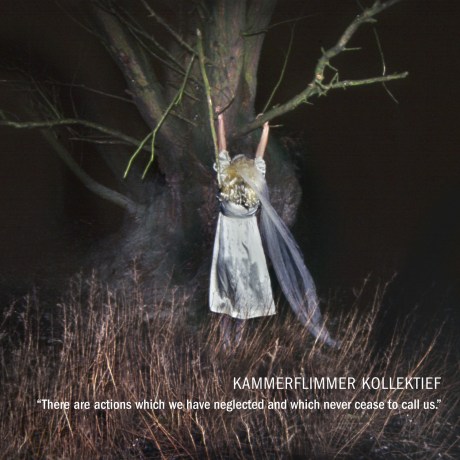
In brief, ‘lower-case’ minimalist composer Andrew Heath delivers another almost recondite album of in-situ recordings for the Disco Gecko label, with his fifth album Evenfall. In the same orbit, albeit far more mysterious, haunted and experimental, the Kammerflimmer Kollektief conjure up seven cerebral mood environment themed extemporized performances on, what could be, the longest entitled LP of 2018, There Are Actions Which We Have Neglected And Which Never Cease To Call Us. Crossing over with the titans of proto-Krautrock, the freak-out that is the Acid Mothers Temple & The Melting Paraiso U.F.O., Jim Haney’s own Kosmische Afrobeat and jazz explorers Perhaps feature two of its members on their upcoming improvisation Hexagon. Haney also, through the boutique Kamikaze cassette tape platform, re-releases/re-introduces two of the legendary astral-travellers iconic albums to the world, In C and La Novia. Plus we have the latest recruit to join the Submarine Broadcasting Company hub, the German ten-string duo Stringmodulator; delivering their debut manifesto of noise for the label, all sounds emanating through just a bass and electric guitar.
Away from the electronic traverses and peregrinations there’s the new album of maverick Canterbury psych and new wave pop eccentricity from Picturebox; the Gare du Nord label supergroup long for ‘escape’ on their second album. And the cinematic transglobal partnership Bokanté And Metropole Orkest release a dramatic sweeping suite, What Heat.
Bokanté And Metropole Orkest – Conducted By Jules Buckley ‘What Heat’ (Real World Records) 28th September 2018
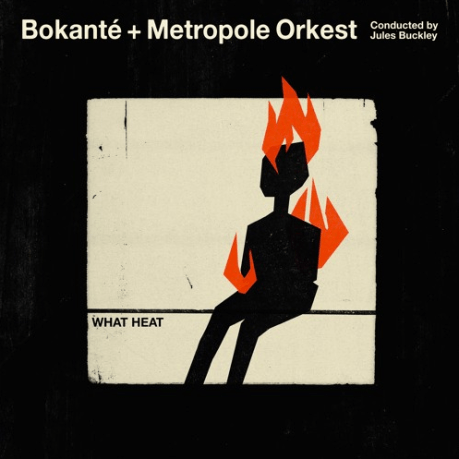
Unsurprisingly, considering the renowned cast of musical talent that has joined forces to create this sweeping cinemascope suite, the supergroup-within-a-supergroup behind this global union of outstanding collectives has risen to the challenge of producing a polygenesis epic. The providence is as rich as it is long, with the ‘Texan-bred’ New York instrumental jazz hybrid Snarky Puppy founder Michael League the instigator behind the continent-straddling intergenerational Bokanté, and the acclaimed English conductor, composer and musician Jules Buckley leading the multiple Grammy-winning cross-discipline and genre Metropole Orkest ensemble.
Within those two groups number a multitude of talented individuals and guests too numerous to name, though one of the most integral performers, a co-founder of Bokanté, is the Montreal-based Guadeloupean vocalist Malika Tirolien, who’s robust if diaphanous pitch and scale fluctuating coos and song can be found navigating and articulating the themes and distresses on every composition. An awe-inspiring voice of transglobal tones, expressions and dynamism, Tirolien’s meandering vocals are informed and graced by the Creole language – a most flowing of French-based languages that can sound especially percussive and funky, the dialect of her home being quite a specific form of it, though not too dissimilar to the Creole of Martinique and other former colonial French territories. It also lends its etymology to the ensemble that League and Tirolien started; Bokanté translates as ‘exchange’.
Musically transcending borders, the catalyst for this ambitious project – theoretically an acoustic one – is to not only share and celebrate cultures but draw attention to the increasingly hostile political tensions that threaten to cut off communities around the world. A reminder then of the benefits of our multicultural legacy, What Heat returns to the source, combing the Arabian and North African lands for inspiration.
A highly atmospheric and dramatic soundtrack with a stirring, accentuate company of strings adding a certain gravitas this sprawling panorama is cinematic in scope and mood. Broodily romantic, traversing a West African diorama, with guest Weedie Braimah on the djembe, the opening ‘All The Way Home’ fuses the true soul of that continent with flashes of jazz and urban modern R&B, tracing a connection all the way from New York to Ghana and Mali: Rustic sounding banjo and pedal steel guitar giving the impression that the group are merging the desert plains of Africa with American bluegrass and the Morricone imagined Wild West on the tribal soulful ‘Fanm (The Woman)’ and more enigmatic sounding ‘Chambre à Échos (Echo Chamber)’.
Elsewhere the evocation of Hispaniola, Brazil, Tunisia merges and crosses amorphously to an often lush but also tumultuous Buckley conducted Orchestra and quivered springy flute-y and skittering percussion. Plaintive, mournful and equally in anger at topics such as the migrant crisis, the album can’t help but sound like a rousing filmic adventure throughout: a most beautifully performed and sung one at that. Remarkably considering how densely packed the arrangements’ cast is, there is plenty of space to be found, even when a maelstrom turbulence is stirred up.
Swooning over vistas like a contemporary Gershwin who’s been listening to Beck, Trip-Hop, Afro-Futurist jazz, country and Malian blues, this, as it turns out, most congruous partnership successfully conjures up a wondrous hybrid drama that pushes each of the respective ensembles to the limits.
Perhaps ‘Hexagon’ (Riot Season Records) 12th October 2018
Acid Mothers Temple & The Melting Paraiso U.F.O. ‘In C’ & ‘La Novia’ (Kamikaze Tapes) Out Now
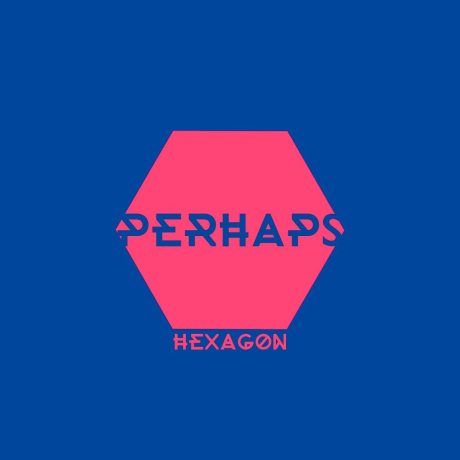
In what is a crossover of mutual appreciation and ‘head music’ hedonism, Jim Haney of the Kamikaze Tapes felicitator and astral-navigator of the Boston, Massachusetts cosmic-jazz-psych-Krautrock band Perhaps has been sucked-in to the acid-cosmology of the legendary Japanese ‘freak-out’, the Acid Mothers Temple & The Melting Paraiso U.F.O.. The Acid Mothers’ only real constant presence, and its founder, Kawabata Makoto, alongside just one of the group’s many band members over the decades, Mitsuru Tabata, both feature on Perhaps’ latest traverse, Hexagon. Meanwhile the Acid Mothers have re-released two of their most fabled albums, In C and La Novia, through Haney’s ‘boutique’ tape platform: I believe for the first time on cassette.
Both sharing similar musical tastes and penchant for experimental improvisation, it seems an obvious choice for Haney to absorb their experience and free-form escapism on Perhaps’ sixth long player; an album that features one long extended flight of woozy fantastical psychedelic-Afrobeat-jazz-Kosmische jamming, cut into a moiety over two sides of vinyl. ‘The Number Of The Priest’, parts one and two, pit Tony Allen’s repetitive Afrobeat drum beat an Idris Ackamoor breaks bread with Xhol Caravan style peregrination against a constant tide and enveloping of zapping, rippling, squelched, high velocity takeoffs and oscillations. All of which threaten to fold or tear the melodic celestial fabric.
On the shore of an Afro-Futurist style Topographic Ocean, journeying across alpha waves and signing squiggles across the Milky Way, part one of this cosmic soundtrack opens with a more earthy rustic country blues harmonization. Members of the extensive guest list ape a despondent Crosby, Stills & Nash or Mike Nesmith style chorus: “Oh the water runs high on the river at midnight/I sit on the shore to grieve and to cry/The woman I love she left me this morning, with no one to kiss me goodnight.” They soon leave these weeping shores, beckoning in the acid Afrobeat and deconstructive forces that try to dismantle it.
The second part continues the same vibe but with more strangled, scratchy and tangled guitar, synth polygons and six-sided mayhem! Despite the stellar meteorite shower of debris and harsher effects that threaten to destroy it, there’s a great Afro-jazz melody and beat at the heart of this trip. A trip that at its most hallucinatory-chaotic and noisiest bears all the hallmarks of the Acid Mothers.

Speaking of which. Two of the loose freak-out ensemble’s prolific back catalogue titles are gathered together on tape, re-released or re-introduced to the universe twenty years on from their original release dates. For those unaware of this Japanese institution that sprouted out of the kool-aid soup in the early 1990s, the Acid Mothers haven’t just taken a liberal sip from the Krautrock chalice but bathed in it as the natural disciples to that epochs cosmic explorers and innovators. They do such a good job of it that you could easily mistake them for golden era Amon Düül I and II, Ash Ra Tempel, Can, Popol Vuh or Birth Control. In the mode of a transient, transcendental Les Rallizes Dénudes they absorb and produce a psychedelic phantasm of both meditative mysticism and freeform thrashing acid rock. Constantly evaluating and evolving, even forming alliances with their influences, just one example being Acid Gurus Temple (later changed to Acid Mothers Guru Guru) with madcap drumming progenitor and bandleader of Guru Guru Mani Neumeier, only the founding arch druid of this enterprise, Kawabata Makoto remains at the helm after twenty-five years of spewing out proto-Krautrock explorations.
Originally released in 1998 as a transmogrification riff on Terry Riley’s masterpiece of minimalism, ‘In C’, the Acid Mothers push the perimeters of that exalted composer’s loose concept towards the dreamy and haunted. Consisting of fragments and modules in C (though even this basic premise isn’t written in stone, with other notes and scales allowed if the situation and environment call for it), the actual rudimental arrangement can be shortened, extended, played within various structures and at a variety of tempos. An open-ended performance the Acid Mothers use a similar chiming, ringing vibraphonic introduction but transformed so it takes on the ascendant visage of an astral spiritual pilgrimage. That is until they throw in the overlapping rotating drum barrage. Sort of split, though thin quieter dissipation passages link each section together, into three parts (the third I think is a separate track entirely), the dizzy Wurlitzer motion calms into a mystical Tibetan meets Afghan occult of ghostly visitations (the ghost train to Lhasa!) section before communing with the reverberating spirits of early Can and Yeti and Wolf City period Amon Düül II.
From the dawn of the new millennium La Novia builds another one of those haunted mystical freak-outs, on this occasion channeling the atavistic folk music of the southern European Occitanian tradition. Historically spanning a third of southern France, parts of Catalonia, Monaco and Italy, this region, once know under the Roman Empire’s yolk as Aquitania, is still imbued with its legacy and cultural connections. Here, the Acid Mothers troupe take one of the Occitanian’s lamentable folk ditties and transform it into mantra like liturgy, half Axlerod, half Tibetan. Monk like hums and strange annunciations overlap with female apparitions to set up a spooky atmosphere. Guitars and drums eventually seep into the tapestry of amplified Popol Vuh, Phallus Dei Amon Düül II and the Ash Ra Tempel, but then fade into a medieval spell. A second track strikes up when the first melts away; this last peregrination drifting in a dreamy state on an Eastern pillow before fleshing out another fuzzy psychedelic, otherworldly jam.
Both albums prove invaluable to the evolution of psych and Krautrock, the Acid Mothers possibly one of the most experimental and best groups to emerge in the aftermath of the original scene. They’ve arguably become one of the most highly influential groups of their own era. Many, if not all, inroads into this freakzone over the last three or more decades lead back to those crazy Japanese. Long may they continue to oscillate towards the stars in their Technicolor U.F.O. If you want to own any of their extensive, haphazard and often impossibly hard to track back catalogue, this double-bill cassette would be a great start.
Kammerflimmer Kollektief ‘There Are Actions Which We Have Neglected And Which Never Cease To Call Us’ (Bureau B) 23rd September 2018
Fathoming serialism soundtracks from, as the group put it, ‘who the fuck knows’ for over twenty years, across ten albums, the Kammerflimmer Kollektief once more peer into the ether to extract another avant-garde-ambient-industrial-kosmische-jazz vision on what could be the year’s longest entitled album.
Going through a manner of changes during that time, the Kollektief’s constant presence and founder Thomas Webber is bookended on the new album by the deft, probing, double-bass player Johannes Frisch and atmospherically eerie harmonium vessel Heike Aumüller – though Webber, on whining and waning guitar sculpting duties, and his companions use a host of instruments throughout their conceptual-minded performances.
Countering various moods with a number of real locations, each extemporized track is framed as a ‘Action’; each example of which counterbalances the ‘immersive’ with the ‘haunted’, the ‘lucid’ with the ‘impassioned’ and the recondite with the concrete. A reification of ideas and psycho-geography that informs each destination, all seven action titles offer vague clues and prompts to the group’s inspirations; many of which hold a literary reference – the radio signal melee, ‘Action 2: Discharged, Quauhnáhuac’ referencing the double volcanic snuggled small Mexican town made famous by the acclaimed writer Malcolm Lowry in his critically venerated Under The Volcano novel as the diorama for a day (of the dead) in the life of its fateful alcoholic British consul protagonist, Geoffrey Firmin.
Elsewhere in the purview of feelings and environments, the trio articulate a lucid state in the San Diego coastal Imperial Beach; a location of Surf lore that has appeared in a myriad of fictional titles, but equally notable for its strong US Navy presence. Though eventually clicking into a twisted esoteric Western ritual, this opening action is anything but a moody soundtrack to this surfing paradise, travelling as it does through an inverted test tube into a menacing landscape of controlled wailed guitar, harmonium drones and sawing, scraping strings; breaking out into a final jazzy, skipping outro. Keeping Stateside and in the Californian outlier, ‘Action 5’ features the small Marin County town of Bolinas: the mood ‘resplendent’. Though the improvised soundscape drifts between the ominous and weird, the harmonium is the only instrument that is easy to identify amongst the wooden creaks and stretches (a set of oars perhaps?), rotors and hums.
Back on European shores we have invocations of the Jean-Jacques Rousseau inspired French park and commune, Ermenonville (planned in 1752 by Rousseau patron and friend, René Louis de Girardin; the philosopher’s tomb famously sits on an artificial island in the middle of a lake in the gardens); the foot-of-the-Carpathian town of Ivano-Frankivsk, part of Western Ukraine (changing hands between various empires, including the Holy Roman and Soviet, over the ages); and the Saxony-Anhalt town, resting on the east side of the Elbe River, of Jerichow (not incidentally translated etymology style from the Biblical Jericho). Closer still to home, the album’s most serene moment is a Roedelius/Möbius/Eno/Rother Harmonia style drift into the port of Hamburg. ‘Action 3’ is anything but as ‘thoughtless’ as the mood prefix suggests; instead it sounds like a gentle but deep sailing meditation into the veils of some mysterious salvation.
Impossible to escape the German lineage of Krautrock, post-industrial and Kosmische, the Kollektief often evoke the folkloric mysticism atmospheres of Dance Of The Lemmings and older Amon Düül II albums, Faust, Einstürzende Neubauten. But they also stir up the most experimental of European jazz, esoteric Americanna, avant-garde and Godspeed You! Black Emperor influences too. Yet they conjure ghostly apparitional manifestations both imaginatively disturbing and dreamy, and entirely their own. TAAWWHNAWNCTCU is a topography of not only real historical, literary places but also feelings, emotions; a deep suffusion of enigmatic intelligence.
https://soundcloud.com/bureau-1/kammerflimmer-kollektief?in=bureau-1/sets/kammerflimmer-kollektief-there-are-actions-which-we-have-neglected-snippets
Andrew Heath ‘Evenfall’ (Disco Gecko) 21st September 2018
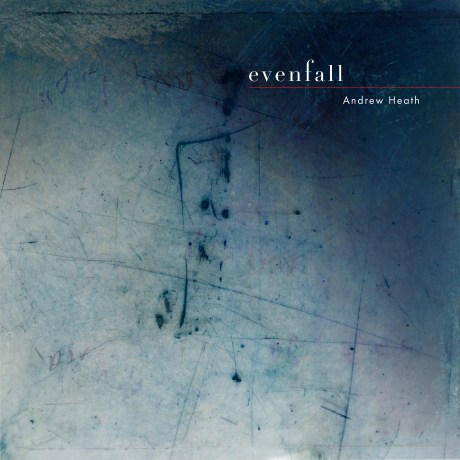
Once more resonating with the piano explorations of open-ended collaborative partner on a series of projects over the years, Hans-Joachim Roedelius – most famously on the Meeting The Magus album, and more recently with the live improvised recording Triptych In Blue, which also features fellow avant-garde composer/artist Christopher Chaplin – Andrew Heath’s latest album for Disco Gecko (his fifth) continues to emanate the most deft and ambient of musical articulations from a chosen environment. As with his last album Soundings, the self-styled composer of ‘lower-case’ minimalism evokes enigmatic, mysterious and occasionally mournful passages of evolving, passing time through the use of found and created sound manipulation and in-situ (a concatenate theme that connects to Heath’s site specific video art) field recordings.
The ‘in-situ’ of this soft imbued tribute to the Evenfall hour of light that beckons the start of the evening is a remote woodland glade in the English Cotswolds. It’s a place where nocturnal nature meets the machinations of human activity, the friction buzz and fizzled zap of a manmade electric fence and distant humming drones of an unidentified engine offer a constant synthesized undulation for light rain and stirrings in the undergrowth.
Articulating the seclusion, though never far away from the presence of the outside world, and passing of time in his chosen Avalon, Heath’s signature phrased piano note caresses, couplets and subtly-placed chords are this time accompanied and expanded upon to not only feature his own underwater bendy guitar and Morse-code tapping tape manipulations but also the searing soprano saxophone of the award-winning (Young Musician Of The Year 2018) Lydia Kenny and poignantly stark narrated poetry of the prize-winning Romanian poet, writer and journalist Maria Stadnicka. You could say it was a Gloucestershire effort, if not certainly informed by the county, as all the cast on this recording are based there or have an affinity with it, and of course it is home to the location from which the field recordings are taken from.
Kenny for her part, offers a suffused longing with occasionally piercing notes traverse to Heath’s piano and burnished, rubbing metallic drones on ‘The Still Of Evenfall’, and Stadnicka reads, in an almost automated, somehow not quite human mimicry of A.I. fashion, her intimate elegiac and startling erudite poem Breathing on the floating, misty ambient ‘The Garden Reveals Itself’: A poetic revelation metaphor that chimes with Heath’s unhurried compositions, the final line of Stadnicka’s poem lending itself to the title, describing artfully through the action of ‘breathing’ the memories, sense and sensations that come to those awaiting the inevitable; ruminating on the hours left:
‘He believes in time,
and in mistakes –
the heroic stare of heavy hours,
equally empty for all.’
With what sounds like all the time in the world, unpressured and untethered Heath creates the minimalist musical equivalent of slow food – though every effort is made at a serialism non-musical exploration, rhythms and patterns emerge to put this album in the neo-classical and melodious ambient camps. Adding at a slow pace a number of instruments and techniques Heath expands his nuanced experiments on Evenfall to shift, however minor, the focus and atmosphere on each new album. Heath stakes his claim as a natural scion of the ambient progenitors, especially his sometime foil, Roedelius: A compliment that don’t come any better.
Picturebox ‘Escapes’ (Gare du Nord) 21st September 2018

As if the cottage-industry polyglot Ian Button hadn’t led or collaborated enough already, more or less appearing as he does as the omnipresent instigator of the lion’s share of releases on his own diy-fashioned Kent-Paris international connected label Gare du Nord, he’s back once more stoking the fires of another unassuming supergroup: Picturebox. Two years on from the Canterbury soft bulletin psych and curious pop-imbued band’s last album, Button has somehow not only found the time and the patience to recall songwriter Robert Halcrow, Ben Lockwood and Alex Williams but also corralled fellow label stalwart Jack Hayter (a multi-tasker in his own right, he’s let loose on the violin on the Slim Chance-esque rustic canal path ‘The Vicar’s Dog’) and one-man band Matthew Dutra (not letting anyone else get a look in, Dutra not only co-wrote the concertinaed train journey inspired ‘GNER’ but also plays the guitar, piano and harmonica on it). In many ways a crossover project, Picturebox shares members with Buton’s other label love-in, and growing super-supergroup, Papernut Cambridge.
Quintessentially English, channeling many of the Kentish and bordering counties cannon of lo-fi mavericks and psychedelic eccentrics, from Kevin Ayers to Syd Barrett, though equally comfortable evoking new wave, Britpop and indie, the Picturebox set out to produce ‘pop music with an edge.’ And so just when you think the grinding fuzz and warping that introduces the album’s opening track, ‘Stumble’, indicates we might be in for an abrasive psych trudge they break out into a jangly pop mash-up of The Lemonheads, Stiff Fingers and Robyn Hitchcock. Elsewhere they evoke a melancholic Boo Radleys on the wistful daydream ‘Secret Escapes’, Denim on the Casio bossa-shimmer pre-set kooky ‘Nice Boys’ Mobile Disco’ and The Kinks on the downer minor bass chord pinged and submerged ‘Sirens’.
Those familiar to the label and its signature themes will recognize the idiosyncratic whimsy, sometimes surreal resignation, that often disarms or brings a comical veil to the sadder tropes of loneliness, unrequited love, and political climate, or as this album’s title makes apparent, the idea of and need to escape. Frustrations and the feelings of powerlessness, whether it’s in a job or relationship transcribe into quirks and metaphors: For example, the trapped in uninspiring low paid work after leaving school, encapsulated in the conformity of a ‘Uniform’.
Escaping by train, cab and airplane, Picturebox seem to have failed in getting away if the album’s final vignette swansong is anything to go by. That finale, ‘Troyte’, is a fleeting elegiac woozy Church organ service; a pastoral English past encapsulated and recalled in a short venerable passage; a reminder of the past, nostalgia and parochialism, which might be a comment on Brexit. The mood and outcome of which the group really hopes to break free and escape from. Pop music with an edge indeed, Escapes is another brilliant curious songbook of melodic eccentricity from the Gare du Nord stable.
Stringmodulator ‘Manifesto – Noises Made By Guitar And Bass’ (Submarine Broadcasting Company) 10th September 2018

Pretty much summing up the methodology of the German duo, the Stringmodulator moniker and title of their latest album is self-explanatory: Basically take your guitar and bass strings and…well, modulate them. Modulate them that is, through an effects-pedal switchboard of phaser, fuzz, reverb, cosmic flange and delay; ten strings looping, overlapping and pulsing to create a sound greater than the sum parts of Jan Quednau’s bass and Fabian Chmielewski’s electric guitar.
Entirely channeling through these two instruments, composed spontaneously and recorded on a two-track device without overdubs, the duo’s manifesto-driven debut for the Submarine Broadcasting Company platform transduces elements of Krautrock, post-rock, electronica and jazz fusion into a warped soundtrack of curious, wild and motoring instrumentals.
After the swirling ambient mists and distant low airplane engine like hums have dissipated on the ‘Prologue’, repetitive notation nodes, loops, patterns and resonance form to produce a Techno rhythm and bounce on the rock music version of ‘Pocket Calculator’ meets Yellow Magic Orchestra ‘Thump & Shriek’. Ruminating over pining, often meditative, landscape, Chmielewski’s guitar phrases arch and arc like the communing astral postures of Manuel Göttsching; especially on the ballad-esque scenic cave with water pool feature curtain call ‘A Quiet Place’.
Providing a varied and echo-y bed for his musical partner, Quednau offers a driving, prowling rhythm with his bass, but can also create a vaporous presence. On the Mike Oldfield lurking in the crypt with John Carpenter spooky suspense ‘Horror Vacui’, that bass guitar lays down an ominous and looming Goblin-esque atmosphere, and manages to turn the Kosmische chugger ‘Growl’ into a twisted Native Indian tribal beat.
Careering between a possessed, strangulated Land Observations on the ghost-in-the-machine ‘Guitar Sabotage’ and a caustic reverberating The Normal on the sharp squiggly sculpted ‘White Noise’ the duo sure know how to fill enough space and make enough noise for just two instruments. Yet they can articulate and describe subtly and skillfully the emotions and themes of their attuned performances, especially on the aching distressed rebounded ‘Echo Chamber’.
Not unique by any stretch Stringmodulator are however quite different in their approach; many of their contemporaries choosing similar two-instrument collaborations, though it’s usually twinned with a drum kit, work in the rock and indie genres. More like an amped-up Eno & Fripp or loopcentric lapping Math Rock version of Ash Ra Temple colliding with Einstürzende Neubauten this ten-string project is influenced by a wide range of conceptual and experimental artists: even soundtrack composers. Arty, technical yet ballsy, they span many moods; energetic being one of their strongest. I’m recommending it though because it is so different and difficult to define. It confounds me to be honest. And I find that interesting.
Words: Dominic Valvona
Review: Words: Dominic Valvona
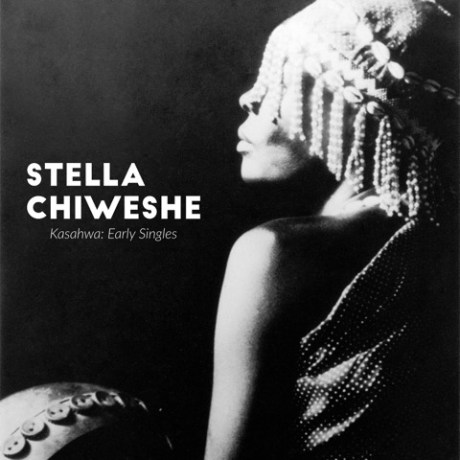
Stella Chiweshe ‘Kasahwa: Early Singles’ (Glitterbeat Records) 14th September 2018
Spearheading a second revival and paving the way to a comeback of a sort, the previously only available as a digital-release version (via that increasingly encroaching behemoth, Bandcamp) of the Zimbabwe music icon and maestro of the mbira instrument Stella Chiweshe’s Kasahwa: Early Singles collection, has been picked up by the award-winning global music label Glitterbeat Records. To be released on the full gamut of formats (both physical and digital) this remastered smattering of previously rare healing paeans and emotional tumults will for many, be an introduction to the diaphanous and earthy roots metal-y springy mbira accompanied soul of Chiweshe.
With her most formative years spent in colonial Rhodesia, before Zimbabwe’s eventual independence in 1980, in an environment that didn’t exactly encourage or foster equality between races let alone sexes, the strong-willed Chiweshe nevertheless pursued a career in music. More attuned to the Western sounds of Rock’n’Roll and Country than the atavistic culture of her native homeland, feasting instead on a diet of Elvis Presley, Ricky Nelson, Jim Reeves and The Everly Brothers (and why not), it would take some time and an epiphany before Chiweshe picked up the mbira: an instrument and style she would soon master; so much so that she would be hailed as the ‘Queen of Mbira’ in the following decades.
Confusingly for the student and novice, mbira refers not only to an instrument – made-up of 22 to 28 metal keys, mounted on a ‘wooden healing tree body’ – but also an all-encompassing Zimbabwean spiritual but also secular culture and way of life. Mbira, which is cultivated by the Shona people of the region, involves the ceremonial ritual practice of invoking contact with deceased ancestors and tribal guardians through musical accompaniment; just one of the influences that imbues the voice and playing style of Chiweshe’s captivating songs.
Showing the independent spirit she’d long be admired and celebrated for, a younger Chiweshe would, despite meeting stoic opposition, overcome the bigotry of her male compatriots and elders to embrace not only the Mbiri heritage but the instrument too. Stiff resistance from teachers and even instrument makers, outright refusing to build her a mbira, wouldn’t stop her from recording a debut single (the one that give’s its name to this compilation) in 1974: even though she would have to borrow an ad hoc thumb piano; unable to lay her hands on a mbira. Chiweshe would not only preserver but flourish.
Trumpeted in our modern virtue-labeling climate as a ‘feminist’, the outspoken star was certainly strong-willed, even a rebel. Making a name for herself overcoming the obstacles of tradition and a patriarchal-dominated society, her obstinacy soon garnered attention, not only in Zimbabwe but further afield. In a decade that saw a surge in Western interest in ‘world music’, thanks in part to (in the UK anyway) such global music explorers and passionate advocates as Andy Kershaw and John Peel (who would play host to two Chiweshe performances on his coveted Radio 1 sessions), the Mbira star would soon be touring internationally: first as a featured soloist with the New National Dance Company of Zimbabwe, and later under her own name. Chiweshe would even make a second home for herself in Berlin, criss-crossing between the German city and her native home for the next 35 years.
Still performing her spiritually soulful intense and trilling vocals and mbira craft, but perhaps not as prominent a figure on the world stage, this re-introduced eight song package of formative years recordings will revive an interest in not only Chiweshe but the music of Zimbabwe: a state that looked to be finally emerging from the grasp of Robert Mugabe, whose role (lets face it) has soured and hidden the true face and culture of the country; though in the aftermath of his resignation and after new elections, his successor in the ZANU-PF party, candidate President Mnangagwa and self-declared winner of those elections, has meted out extreme violence on oppositions supporters (killing a number of them in the process) taking to the streets in protest at the contested results. An uneasy tension exists, even with outside observers presiding over these elections, as Zimbabwe’s Movement for Democratic Change candidate Nelson Chamisa stoically refuses to back down, rejecting the results outright.
With helpful encapsulation style suffixes summing up each song’s theme, the early singles opens with the determined ‘Ratidzo’; a high whistling and trickling stream like mbira melodic accompanied invocation of the lush landscapes of Zimbabwe that pretty much encompasses Chiweshe’s struggle to become a musician with its matter-of-fact subtitle, ‘Managing to do what people considered impossible’. More traumatic themes follow, with the unceasing waterfall cascades of the mbira and earthy lamented ‘Musarakunze’ suddenly making an emotional impact when translated as ‘An orphan seeing what the late elders never saw’; so beautifully played as to almost hide the plight. The ‘Innermost emotional pain is like a fishbone stuck in the throat’ ‘Kasahwa’ has a similar air of beautiful delivery even when kicking up the dust and rotating to a more abrasive and rubbing scratchy percussion; the pained evocations confined to that title rather than performance.
Mbira as a living tradition and healing process is enacted on the grasslands lilted ‘Chipindura’ – ‘The herb that transforms anything’ – and the placeable tubular turning ‘Mayaya’ (in two parts no less; the longest articulation on this entire collection) – ‘The effect of healing herbs’. Both of which, whether it’s intentional or not, feature a percussion that reflects the rubbing, grinding preparation of these herbs. Elsewhere the routine travails of a people kept through colonial oppression and then the misrule, surviving in abject poverty, is evoked on the yodeled sung ‘Nhemamusasa’; a song that describes and articulates ‘Cutting branches for a temporal home’.
Channeling the very soul of Zimbabwe, performing the mbira with energy but also certain serenity, and in a soliloquy manner voicing the empirical, Stella Chiweshe’s early recordings may sound swimmingly diaphanous, yet they serve as a reminder to the struggles of change. Recorded during the Chimurenga – roughly translating from the Shona language as ‘revolutionary struggle’, this, the second such ‘war’ or uprising, pitted African Nationalist groups against the predominantly white minority government; also known by its eventual victors as the Zimbabwe Liberation War, it would lead to independence and the rise of one of the resistance’s key figures, Robert Mugabe – revolution these singles, no matter how lilting, could be celebrated as a testament and clarion call for not only a resistance to the patriarch but seen also as a break from the atavistic status quo, with Chiweshe’s twist laying down the path for those to follow; a more equal rebalance giving voice to the often repressed matriarchal singers and musicians of Africa.
Monolith Cocktail Social Playlist XXXIV
July 31, 2018
Playlist Selection From Dominic Valvona

Our imaginary radio show, a taste of our DJ sets, the Monolith Cocktail Social is a playlist selection that spans genres and eras to create the most eclectic of soundtracks. Placed in a way as to ape a listening journey, though feel free to listen to it as you wish, each playlist bridges a myriad of musical treasures to enjoy and also explore – and of course, to dance away the hours to.
Volume XXXIV of this intrepid voyage begins with a musical traverse of the Sudanese and Ghanaian Highlife and funk scenes, with short intermissions from the all-too forgotten Psychedelic R&B and bluesters on the 6os West Coast, Electric Flag, and jazz explorations from the Invisible Astro Healing Rhythm Quartet. After that we’re off into calypso, kosmische, prog, golden era hip-hop, gangly post-punk love songs and alternative American rock music from the 90s, via Laba Sosseh, Thee American Revolution, Adam’s Castle, Novalis, Frick And Frack, Asher D, Archers Of Loaf, Ludus, Dunkelziffer, Grace Jones and many more. Plenty more genres pop up, with a few surprises from artists we feel have been neglected. The full track list can be viewed below.
Tracklist:-
Kamal Keila ‘African Unity’
Sweet Talks ‘Akampanye’
Pasteur Lappe ‘Dora’
The Electric Flag ‘See To Your Neighbour’
Invisible Astro Healing Rhythm Quartet ‘Praise One’
Vis a Vis ‘Obi Agye Me Dofo’
Pratt & Moody feat. Cold Diamond & Mink ‘Words Words Words’
Laba Sosseh ‘Maria Elena’
Marvin Pontiac ‘Small Car’
Lionlimb ‘Turnstile’
Les Variations ‘Silver Girl’
Thee American Revolution ‘Electric Flame’
Adam’s Castle ‘Dark Party’
Novalis ‘Dronz’
Ihre Kinder ‘Stunden’
Just-Ice feat KRS-One ‘Going Way Back’
Frick And Frack ‘Go Southside’
She Rockers ‘Give It A Rest’
Special Ed ‘Think About It’
Boogie Down Productions ‘Stop The Violence’
Asher D ‘Brutality’
Daddy Freddy feat Tenor Fly ‘Go Freddy Go’
The Cutlass Dance Band ‘Hwehwe Mu Yi Mpena’
N’Ghare Hi Power Band ‘Campus Rock’
Clive Zanda ‘Chip Down’
Tapes ‘n Tapes ‘Just Drums’
These Animal Men ‘You’re Always Right’
Subcircus ‘Shelly’s On The Telephone’
Archers Of Loaf ‘Wrong’
Exploded View ‘Summer Came Early’
Family Fodder ‘Deja Déjà Vu’
Ludus ‘Let Me Go Where My Pictures Go’
Josef K ‘Sorry For Laughing’
Dunkelziffer ‘Give Me Your Soul’
Ray Brown And The Whispers ‘Go To Him’
Joanne Grauer ‘Who I Am’
Grace Jones ‘I’ll Find My Way To You’
Michael Nesmith & The Second National Band ‘Bonaparte’s Retreat’
Graham De Wilde ‘Stratus’
Dominic Valvona
New Music Reviews/ Words: Dominic Valvona
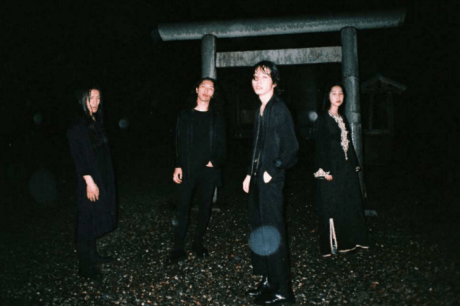
Welcome to Dominic Valvona’s regular reviews roundup. This latest edition of Tickling Our Fancy includes albums, EPs and singles by Stella Sommer, Otis Sandsjö, Yiddish Glory, Yazz Ahmed, Franklin and Qujaku.
In another eclectic edition, with releases pulled together from across international date lines and genres, there’s the beautifully morose Nico-esque Gothic indie solo debut album from Stella Sommer (tipped as one of my albums of 2018 already); a no less striking debut from the Scandinavian jazz saxophonist Otis Sandsjö, who mixes European jazz styles and modernism with the cut-and-paste techniques of hip-hop and electronica in real time on the brilliant Y-OTIS; a remixed treatment EP of songs from Yazz Ahmed’s Arabian jazz suite La Saboteuse; the debut EP, Some Old Tracks, from the polygenesis psychedelic and pool splash electronic sample collage artist Franklin; and an intense dramatic overture like suite of post-punk, drone, Gothic psychedelia and doom from the skulking Japanese troupe Qujaku.
With more serious intentions, shining a light on a lost chapter in WWII Jewish history, I also look at the beautifully produced Yiddish Glory testimony of tragic laments, ballads and elegiac songs written by the Soviet Union’s Jewish community during the barbaric invasion of Russia.
Stella Sommer ’13 Kinds Of Happiness’ (Affairs Of The Heart) 10th August 2018
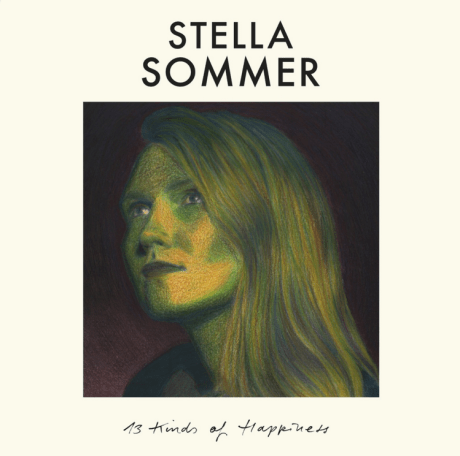
In the vogue of an age-old central European malady, the dour romanticism that permeates the stunning solo debut album from the German singer/songwriter Stella Sommer is wrapped in a most beautiful gauze of melodious uplift and elegiac heartache.
Artistically, as the results prove, making the best decision of her career, Sommer steps out for a sojourn from her role in the German band Die Heiterkeit. Far from an extension of that group (though band mates Hanitra Wagner and Phillip Wolf both join her on this album), there are of course concomitant traces of it. Sommer however makes louder but also accentuates these traces and lingering relationships; her lived-in, far-beyond-her-years vocal more sonorous and commanding than before.
Possibly as perfect as an album can get, 13 Kinds Of Happiness is an ambitious, slowly unveiling album of diaphanous morose. Pastoral folk songs and hymn-like love trysts are transduced by a Gothic and Lutheran choral liturgy rich backing that reimagines Nico fronting Joy Division, or Marianne Faithfull writhing over a Scary Monsters And Super Creeps era Bowie soundtrack (especially on the galloping Northern European renaissance period evoking thunderous drumming ‘Dark Princess, Dark Prince’; just one of the album’s many highlights). I don’t use that Nico reference lightly: Sommer channeling the fatalistic heroine’s best qualities atmospherically speaking.
Rather surprisingly, especially with the influences I’ve outlined, the torment and caustic swirls of the enveloping ominous fog cloaked dramatic title-track, vocally crosses Nico with Tim Booth of James fame. ‘Collapse/Collapsing’ even sounds a bit late 70s Fleetwood Mac, whilst ‘I Take An Interest’, with its ethereal lulling choruses and cathedral atmospherics isn’t a million miles away from a Holy Roman Empire inspired Beach House – imagine that!
The rest of this album is very much in the Germanic mode of religious drama and mystery. Hidden amongst the cloisters, Baroque drones and dark serious conservatism faith and tradition is brighter pop relief and troubadour, even Dylan-esque, odes on love, loss and anxiety. A perfect example of this serious but lilting, Gothic but often melodically harmonious counterpoint is the mellotron entrancing boat ride across a Kosmische river Styx, as painted by Caspar David Friedrich, ‘Boat On My River’. Following in the grand tradition of river songs, or alluding to Germany’s timeless relationship to the waters that run throughout its legacy, Sommer evokes Neu! and Cluster on this foreboding romanticized voyage, yet shows a certain vulnerability and lightness of touch too. That same vulnerability is also in evidence on the nocturnal, birds-of-a-feather duet with (I think) the lead singer (and fellow compatriot) of Tocotronic, Dirk Von Lowtzow, ‘Bird’s Of The Night’.
A curious Teutonic travail of venerable lovelorn despair and modesty, Sommer’s debut LP will take time to work its magic. But work its magic it will. A tremendous talent lyrically and vocally, serious and astute yet melodically enriching and lilted, her sagacious deep tones are starkly dramatic, but above all, rewarding. 13 Kinds Of Happiness is destined for many end of year lists; I for one, living with it for the past two months, find it one of 2018’s highlights, and one of the best debuts I’ve heard in ages. Here’s to a solo indulgence that I hope long continues.
Otis Sandsjö ‘Y-OTIS’ (We Jazz Records) 1st June 2018

Imbued as much by the complex language of North American and European modernist jazz as those who use it to riff on in the hip-hop and electronic music genres, the adroit Gothenburg saxophonist and composer Otis Sandsjö transmogrifies his own jazz performances so they transcend, or at least amorphously (like liquid) expand into polygenesis soundscapes.
His debut album, released via the Helsinki festival and label platform, We Jazz Records, is a multilayered serialism suite of ideas and experimental visions. All of which, despite that complexity, keep an ear out for the melody.
Y-OTIS reimagines a musical union between Flying Lotus and Donny McCaslin, or better still, Madlib reconstructing the work of 3TM; the flow, if you can call it that, sounding like a remix deconstruction in progress as the rapid and dragging fills and staggered rolls of Tilo Webber’s drums are stretched out, inverted and reversed into a staccato to dynamic bursting set of breakbeats and loops. Mirroring all the various cut-and-paste techniques of the turntablist maestros, Sandsjö and his dexterous troupe of keyboardist Elias Stemeseder, bassist Petter Eidh and the already mentioned Webber sound like a group being remixed in real time, live: And it sounds brilliant, as you’re never quite sure where each of these compositions is going to end up.
Sandsjö’s own articulations as bandleader never grandstand or take precedent, let alone dominate; his saxophone in a constant suffused circular and flighty motion, always there yet often drifting and dissipating. Of course there are occasional bursts of flute-y soloing and more rapid energetic squawking.
Tripping both across space, counterpointing Jerry Goldsmith’s optimistic siren-ethereal Star Trekking with Kosmische, yet also inspired by tribal and soulful earthly vistas too, Sandsjö offers up some surprising musical evocations. The avant-garde snozzling, drum rim-tapping and lumbering funk ‘BOO!’ sounds like Tortoise and a chilled Dunkelziffer, whilst the dreamy merging, of what could be two entirely separate tracks, ‘YUNG’, with its elongated rhythms, could be Coldcut going at a warped Mardi Gras Afrobeat inspired improvisation.
Importantly Sandsjö offers a jazz style birthed from an eclectic melting pot of hip-hop, dance music and even more experimental edgier R&B; reorganized into a fresh exploration. If the ACT label, or ECM ever converges with Leaf and Anticon, Y-OTIS might well be the resulting album. As 2018 shapes up to be another great year for jazz releases, the inaugural album from Sandsjö and his troupe looks set to showcase a great talent, and make the end of year lists: it will most definitely make ours.
Yazz Ahmed ‘La Saboteuse Remixed’ (Naim Records) 10th August 2018

Working her dreamy enchanted magic, encapsulating a transcendental, exotic version of Arabian jazz, on last year’s traversing trumpet suffused La Saboteuse LP, Yazz Ahmed calls on a congruous trio of remixers and artists to interpret a handful of peregrinations from that well-received suite.
This new EP of re-contextualized voyages and evocations also features, a sort of, new production hybrid that uses Ahmed and her producer Noel Langley’s self-sampling and deconstructing techniques to refashion a ‘fourth world’ sound collage. Inspired in part by Jon Hassell’s amorphous ‘possible musics’ experiments and the equally polygenesis floatisms and shifting lingers of Flying Lotus, ‘Spindrifting’, as the title suggests, languorously drifts between gauze-y environments and borders; re-placing fragments and textures from the La Saboteuse recordings.
Reflecting a constant unending journey of interpretation, filtered through ‘alternative visions’ and ‘perspectives’, burgeoning South London DJ and graphic artist Hector Plimmer, who released his debut LP Sunshine last year, cuts down and transduces Ahmed’s original lengthy ‘The Lost Pearl’ into a nuanced tropical lilt and itching understated electronic shuffler. Whereas, self-proclaimed ‘Afro-futurist’ beatmaker DJ Khalab, takes the Arabian delights and Tangier trumpet suffusions of the original ‘Jamil Jamil’ into the cosmic ether on his treatment. The Italian DJ undulates that belly-dancing souk vista with moody pulses, kinetic connective beats, vapours and starry space atmospheres.
Originally a tub-thumping percussive and trumpet heralding panoramic meditation, ‘Al Emadi’ is given a buoyant dub wafting veil by the Lisbon trio of brothers and close pal Blacksea Não Mayo. DJs Noronka, Kolt and Perigoso add a bounce and short yelp like punctuations to that vision; moving it closer towards classy electronica dance.
An articulate extension of Ahmed’s original album template, her already traversing evocations are taken on vaporous and often subtle cosmic and dreamy detours by this carefully chosen cast. A parallel navigated piece of escapism rather than enhancement, the remix EP enervates the jazz for a more electronic music feel to guide Ahmed’s 21st century Arabian imaginations across new boundaries and vistas.
‘Yiddish Glory: The Lost Songs Of World War II’ (Six Degrees) Out now

Few albums can stir the soul let alone give a voice to such harrowing anguish as the sacrifices made by the Soviet Jewish community during one of history’s most brutal conflicts – 2.5 million poor souls from this Jewish community would perish in the European territories of the Soviet Union alone. A forgotten chapter, expedient to Stalin and his successors own tyrannical political airbrushing of events, 440,000 Jewish citizens from all corners of the then Soviet Empire enlisted to fight the Nazis during the 1940s.
Though an integral part of the Bolshevik revolution that preceded it decades earlier – the Jews often suffering under the Imperial regime of the Tsars and Tsarinas in countless programs over the centuries; Tsar Nicholas II no better than previous holders of the title, stirring up hatred towards the faith by propagating the most fatuous blood libel and protocols of Zion conspiracies as proof of his own idiotic prejudices and envy -, the Jewish population that survived the second World War soon found themselves the victims of Stalin’s purges.
Despite the paranoia, mistrust and the megalomaniacal politics of one of the most murderous regimes in history, the Jews of Russia have always remained loyal. Even during the enlightened age of Napoleon, with his promises during the misconceived and doomed invasion of Russia in 1812 of liberating not only the population from serfdom but also the Jews (Napoleon having kept his word in freeing the Jews from the various ghettos they found themselves herded into throughout Europe; Venice being one the most famous examples), Russia’s Jewish population remained stoic in their support of the homeland.
Lost in the annals of time then; suppressed, if thought destroyed, the tragic but poetic WWII testaments, made lyrical prose, of just a small cross-section of Russia’s Jews is given the richly evocative and adroit production showcase it deserves by a collective of professors, producers and musicians. Originally unified in an anthology by an ethnomusicologist from the Kiev Cabinet For Jewish Culture, Moisei Beregovsky, alongside colleague Rovim Lerner, hundreds of Yiddish songs written by Red Army soldiers, victims and survivors of the Nazi’s apocalyptic massacres were gathered in the hope of being eventually published and performed. Unfortunately at the very height of the Communist Party’s purges in the decades that followed the end of WWII, both these well-intentioned preservationists were arrested. Subsequently the project was never finished, the work sealed up and hidden away. But as it would later transpire, not destroyed.
Decades later in the 1990s, the Soviet archives now under the ownership of a collapsed Communist state, as the Iron Curtain finally tumbled, librarians from the Vernadsky National Library Of Ukraine found these lost treasures in unlabeled boxes. One of these librarians, Lyudmila Sholokhova, would catalogue these findings – just one of the many cast members in this story. Fast-forward another decade and by coincidence, one of this project’s eventual instigators, Anna Shternshis, stumbled upon these treasured songs whilst visiting Kiev. Highly fragile, deteriorating quickly, these original notes (some handwritten, others typed) opened up a whole undiscovered chapter in Jewish history to both Shternshis and her eventual colleagues on this project, musician Psoy Korolenko (known in his academic life as Dr. Pavel Lion), Al and professor of Yiddish Studies and Director of the Anne Tanenbaum Centre For Jewish Studies at the University Of Toronto Malka Green, and musical director and violinist Sergei Erdenko.
Transcribing these laments and firsthand accounts of endurance (many of which included testament evidence to various Nazi atrocities) would take patience, skill but above all respect. The results of this this most tragic desideratum, entitled Yiddish Glory, are underscored by an Erdenko-led stirring accompaniment ensemble of classically trained instrumentalists and singers, brought together by the producer Dan Rosenberg.
Challenging perceived conventions throughout this magnificent suite of eighteen songs, silencing detractors now as it would have back then, amongst the laments are stirring motivationals that adhere to a long lineage of Jewish and Russian history. Weaving in one of the revered fathers of the Russian classical school of music, Mikhail Glinka’s 1840 ‘The Skylark’ tune with a rousing call for his fellow Red Army comrades to support their Jewish compatriots, Odessa soldier (known only by his first name) Yoshke answers the anti-Semitic propaganda that ‘Jews don’t fight in war’ with his, perhaps not so lighthearted as it would seem from the title, ‘Yoshke Fun Odes’. The accompanying linear notes – featuring the lyrics to all the songs (in most cases) in Hebrew, Cyrillic and English – tell us that Yoshke is himself fighting to ‘avenge his brutally murdered Jewish family’. Though as it would prove, when the survivors of this war returned home, the Jewish population would have to once more fight for their lives, but this time against many of their Russian comrades: tragic when viewed form our vantage point, as many would end up arrested or liquidated on the most spurious and paranoid of charges; Stalin’s position after WWII solidified, clearing the path for his many sweeping purges. Showing every bit as much passion for and attachment to their country and regime as any hardline dye-in-the-wool Communist, songs such as the panoramic ‘Kazakhstan’ – possibly written, we’re told, by one of the 250,000 Polish Jewish refugees that survived the war – could have been ripped from the very soil itself. Two different vocalist versions of this minor opus feature on this album; the one sung by the smoky jazzy and commanding singer Sophie Milman is a personal dedication to her grandmother, a Soviet Jewish refugee survivor in Kazakhstan, but also a wider tribute to the millions of women who were involved in the war effort; the second version, sung by Erdenko, pays homage to the often forgotten Roma community, murdered in great numbers in the ensuing Holocaust.
Nothing could be more heart wrenching than the plaintive ‘My Mother’s Grave’, originally penned by the ten year old Valya Roytlender, a native of Bratslav in the Ukraine. Channeling the loss but also survivor’s guilt, the youngest of the ensemble cast of vocalist (five in total), Isaac Rosenberg, gets the bottom lip quivering and the tear ducts ready to flood with lines as moving as, “Oh mama, who will wake me up [in the morning]? Oh mama, who will tuck me in [at night]?”
Many of the songs are surprisingly violent in retributive prose – a result of Soviet censors adding the revengeful party line to every song; part of the state machinery’s propaganda in stirring up hatred towards their enemies, but also a nationalistic fervor -, the language of dehumanization prevalent throughout: the Nazis often referred to as vermin to be eradicated and shown no pity. Considering the Nazi’s barbarity, but also Stalin’s own ineptitude and grasp of unfolding events, caught by surprise at Hitler’s invasion of the Soviet Union, it’s hardly surprising to find such encouragement in these songs. Yet it often feels, as it turns out, to have been added in many cases later by the state, to be in contradiction to the sentiment. Whilst certainly ready to pick up a machine gun in a heartbeat, going as far as to even taunt on songs like ‘Mayn Pulemyot (My Machine Gun)’, the lyrics often attempt to make sense of what is…well, a senseless brutalism.
An equal opportunity employer in carnage and slaughter, the stoic, hardened women of the Soviet Union feature just as heavily and prominent as the men in these songs: ‘Chuvasher Tekhter (Daughters Of Chuvashia)’, penned by a young Communist League member from Kharkov in 1942, bares testament to those women from the region of the title who were drafted into the Red Army to fight on the frontline; just a small fraction of the 900,000 women who would eventually join the rank and file.
The stars ask me [to speak]: “Tell us!
Who is marching so late at night?”
The answer: “Chuvash daughters
Preparing themselves to go into battle.”
Other songs pay homage to those women working on the production lines. All of which offer words of encouragement to their lovers to fight the good fight.
Firsthand accounts of atrocities appear on both ‘Babi Yar’ and ‘Tulchin’; the first of these harrowing laments and ballads referring to the massacre of the titular ravine near Kiev, where an astonishing 33,771 Jews were shot in 48 hours, in the September of ’41, the second, dedicated to the small Ukrainian town of the title, which lost its entire Jewish community.
Later on though, as if in a chronological timeline, there are songs celebrating the end of WWII; the finale, ‘Tsum Nayem Yor 1944 (Happy New Year 1944)’, featuring the full cast and singing circle, ushers in the New Year and ultimate victory over fascism that would soon follow.
Enough crying over our beloved dead,
The Red Army has the upper hand now.
Hitler can only kill us at night in our dreams.
Woe will be upon him, when we have peace!
Despite the materials obvious harrowing and tragic nature, the music throughout is a dizzying, waltzing mix of Yiddish, Roma, Klezmer, folk and even jazzy cabaret that’s often upbeat. The band does a sterling job in breathing life back into historical testimony; giving voice to those suppressed individuals and the songs that were believed lost forever, destroyed by a regime that would treat its loyal Jewish community, many of which made the ultimate sacrifice, little better than the Nazis they so valiantly overcame.
This is a poignant reminder that we should do more to educate ourselves on lost histories such as this; especially in the times we find ourselves with anti-Semitism once more on the rise and in the news (especially in the UK). Yiddish Glory is not just a reminder however, or even just a revelation, but a beautifully produced performance.
Franklin ‘Some Old Tracks’ Out now

Keeping the brief scant but candid, the artist(s) behind this project create a bright polygenesis EP out of frustration: ‘After a truly terrible session with an artist trying to force me to copy a hook from The Chainsmokers, it was enough for me.’ Bounding back from one too many constrictions, Franklin, in a manner, returns to its youth and the music that soundtracked it. Never able to afford the clearance but carrying on nevertheless, the spark of inspiration that now ignites Franklin, sampling montages and collages, is brought together once more and made into a vibrant psychedelic pool party splash of filtered funk, staccato House and light breeze West Coast hip-hop.
Criss-crossing genres at will over a quartet of tracks on the Franklin debut, tunes and samples, loops and ideas seem to melt and merge harmonically. For instance, the opening track ‘Frankie’ swims along to a fragmented cut-and-paste dance groove of moody breaks, shuffles and a hooting Afro sax honk, whilst the soulful plaintive tropical flavoured ‘Hate Myself’ sounds like a surfing International Pony.
A mysterious French soulstress can be heard meanwhile at the start of the low-rider ‘L’aéroport De Paris’, which in spite of its title evokes a sense of Japonism – J Dilla on a slow boat to Shogun Japan. ‘Clear My Name’ is more in the dance-y mode however; warping bowed and wooden sounding beats and enveloping waves around quasi-80s House.
This debut EP reconnects with the past to go forward. Stripped of hubris and baggage, and restriction, a breath of fresh air, it is beyond being, as the title suggests, just Some Old Tracks, and is instead an exploration of those imbued sounds and what they represent, restructured into a contemporary eclectic psychedelic dance and pop record.
https://soundcloud.com/franklinswe/sets/some-old-tracks
Qujaku ‘Qujaku’ (So I Buried Records) 16th August 2018

Occupying both the spiritual and cosmic planes, emerging from the gloom and holy sanctuaries of the dead, the brooding Hamamatsu-based Japanese band Qujaku are back with a second grand opus of Gothic psychedelia and operatic doom post-punk. Gathering together titular EP tracks from the last couple of years and new material, this eponymous entitled epic thrashes, rattles, drones and skulks with sonorous intensity throughout. The opening ‘Shoko No Hakumei’ suite, more an overture, is itself a full on Ring cycle (as conducted by Boris) that is dramatic and sprawling: running almost the entire length of a full side of a traditional vinyl album.
On a very large foreboding canvas, Qujaku build-up an impressive tumult across the album’s nine-tracks of prowling esotericism and galloping drum barrage immensity. Between crescendo-bursting three-part acts and shorter volatile slabs of heavy caustic drone rock, the group often evokes an Oriental Jesus And Mary Chain, Black Rebel Motorcycle Club and Spacemen 3, or Nine Inch Nails when at their most enraged. Psychedelic in the mode of The Black Angels, but also straying at their most languid and navel-gazing towards Shoegaze, Qujaku’s dark spanning cacophony of throbs and trembles bear many subtle nuances and becalmed breaks amongst the masses and maelstroms. A balance between those forces is struck for instance on the dreamy plaintive love-crushed ‘Yui Hate No Romance’ and Spiritualized hymn-like finale ‘Sweet Love Of Mine’.
Vocally obscured by the cyclone of screeching feedback, grinding, spiraling ritual and creepy atmospherics the band’s mix of saddened male sung lovesickness and dystopia, and female ethereal sirens often invoke a ghostly, doomed horror soundtrack: The spirits in communion; floating and cooing, always present.
Though heavy-going for sure, even stifling in places, this ceremony come seething dark alchemy of an album is a brilliant minor masterpiece of Gothic, doom, psych and progressive pretensions. Limited physically to only 500 copies, this cultish group and album will sell-out quick, especially off the back of the band’s upcoming European promotional tour. On an epic scale, dreaming big and intensely, Qujaku perform the most dramatic of daemonic theatre.
Words: Dominic Valvona
Our Daily Bread 277: Premiere: Vukovar ‘Infinitum’
June 23, 2018
Premiere: Review: Words: Dominic Valvona
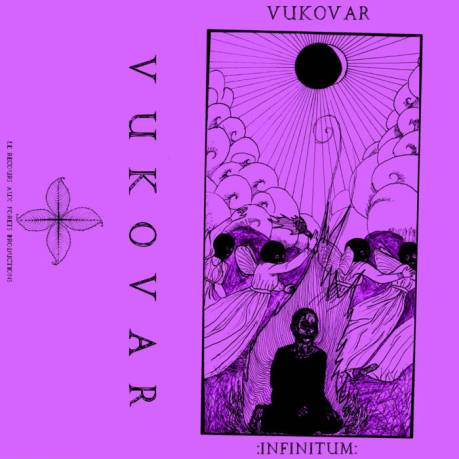
Vukovar ‘Infinitum’ Le Recours Forêts Production, 8th July 2018
Not since Richey Edwards etched ‘4 Real’ in blood across his arm, or Ian Curtis decided to hang himself have artists and bands taken themselves so seriously and to such extremes to prove their commitment to a musical cause; or even before that, checked out of for good at the ’27 club’. The romantically despondent and incredulous Vukovar are, in this non-committal age of vacuous validation and smoke, very much cut from that same cloth. Even their band name is taken from a most serious harrowing episode of modern barbarism: Vukovar the infamous and harrowing Croatian city where 300 poor souls, mostly Muslims, were rounded up and barbarically executed by Serb paramilitaries and the Yugoslav Peoples Army (the worst committed atrocity of its kind since WWII) during the implosive Balkan wars of the 1990s.
Easily one of the UK underground’s most promising bands, if not among the most important in the last five years, Vukovar have already produced a sizable catalogue of material; though each release barely has time to sink into the public consciousness before another ambitious epic replaces it. Infinitum is unquestionably one of the band’s deepest, darkest and mysterious records yet; inspired no doubt by recent events and the wearisome ebb and flow of jeopardy that surrounds them. Living by their art – almost dying by it in fact -, Vukovar are not to be taken lightly.
Consistently snatching defeat from the jaws of victory and hardly adverse to self-sabotage, Vukovar have despite countless mishaps, frustrations and fall-outs managed to release a quartet of three-syllable sloganize entitled albums of morbid Gothic and post-punk curiosity in that time. Their latest, and fifth, Infinitum pulls at the mortal coil of human misery in a murky quagmire. An endless backing track of reverberating delayed snare strikes, a rolling timpani bounding bass drum, esoteric stately sounding waltzes, unwieldy bestial guitar, resigned new romantic synth and escaped melodies muddily, and often amorphously, swim and oscillate around a combination of longing, if worn down and depressed, swooning vocals and Rimbaud-meets-Crowley-meets-Kant-on-the-edge-of-an-abyss poetic despairing narration, on what is a bleak if at times gloriously dark beauty of an album.
Often channeling the spirit of Ian Curtis (though not so much alter-worshipping the miserabilist icon as imbued by him), Scott Walker, The The, Martin Rev, David Sylvain and The Sisters Of Mercy on not just this album but the previous four opuses, it’s the ghostly echoes of Alan Vega’s inimitable rock’n’roll croon and nod to the melancholic heart of Spector’s girl group maladies that can be heard on the album’s most swaddled and beautifully sad song, ‘The Destroying Place’. And the album’s grand finale, delivered with a shade of monastic incantation, ‘Remains’, with its odd sound collage passages of insect-like chatter, strange foreign voices, far off screams and pitch-shift centrifugal motion effects, sounds vocally like John Cale sharing narration duties with his old Velvet’s honcho, Lou Reed.
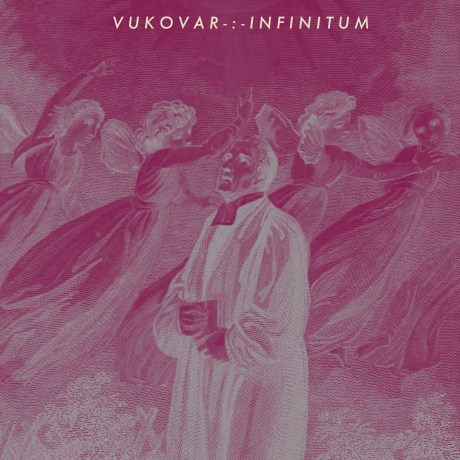
Bound-up in their own self-imposed limitations, these anarchistic dreamers go one further than the Hebrew code of law commandments by adhering to 13 of their own; each one a rule or restriction in the recording process that couldn’t be broken, at any cost. So strict were these conditions that even if the band were close to finishing the album, any infringement no matter how minor, would result in the entire sessions being abandoned. Mercifully they made it through to the end; releasing a troubled, bleak lo fi ritualistic romance of an album.
Vukovar, even if the resignation and despondency in the music reflects a broken spirit just waiting for the end times and a final release, are growing in confidence and creativity; stretching themselves to encompass the Gothic and miserable but also brilliant at escaping the murky waters’ pull of desperation to occasionally break free into the light with bursts of radiant post-punk pop excellence.
Pouring fuel on a bonfire of vanities, whilst pouring out their hearts, this serious act recoil from the spotlight with nothing short of contempt for many of their peers; frustrating even fans, and once again limiting the album’s release physically; confining it to a special limited edition number run on cassette tape.
The fact they can back it up, gives them an edge, way ahead of the usual indie and post-punk fodder we’re normally fed on a daily basis. As the bland-lead-the-bland in a merry dance, Vukovar, as they did on their last single, read from the cerebral, philosophical and the political in a ‘Clockwork Dance’ towards the precipice of doom; their fifth album no less polemical and important.
Dominic Valvona
Previous Vukovar reviews:
Emperor LP
Fornication LP
Puritan LP
The Clockwork Dance Single
Live Review: Words: Dominic Valvona

U.S. Girls Live At Stereo, Glasgow, May 19th 2018
Swapping the tape collage and loops (to a point) for the full-on experience of a live band on tour, Meg Remy seduces the Glasgow audience tonight with the most sophisticatedly sexy, often louche, of pop dynamics.
Remy is able to captivate with bittersweet pouting malady the most traumatic, darkest nature of patriarchal sexual control and seamiest aspects of capitalism whilst slinking to a cerebral mix of glitterball disco, raunchy pop fantasy and on as demonstrated on the finale from her most recent album, In A Poem Unlimited, and tonight’s curtain dropper, ‘Time’, no wave meets contorted jazzy break beats.
Embracing then, the seductive forces of pop music, Remy’s unsavory but vital exposés and therapeutic exercises in acknowledging trauma and abuse are made more palatable by this shift; and in turn reaches an increasingly wider audience. Channeling femme fatales and maverick artists such as Ronnie Spector and Gloria Ann Taylor and more modern alluring pop stars, Remy slips these dark themes under a sonic soundtrack of glorious disco, boogie and avant-garde experimentalism.
Showcasing a looser funky sound, backed by the Toronto hothouse supergroup The Cosmic Range (a collective that at any one time traverses Afrobeat, Krautrock, boogie and free-jazz), the central force of nature at the heart of what was initially a solo project, since expanded with a full cast of writers, producers and collaborators all willing her on, Remy yet again performs in character. Previously taking the brilliant (and one of our albums of 2015) Half Free out on the road with just the backing vocalist Amanda Grist (of Ice Cream fame) to keep her company, dressed like a leotard wearing Olivia Newton John, sporting a chic cropped hairdo, Remy returns with longer sporty locks, wearing a laced backed crop top, flanked by a duo of energetic male and female vocal sparring partners.
Performing more or less the entirety of this year’s album (her second for 4AD), with subtle transformed versions of Half Free tracks ‘Window Shades’ and ‘Sororal Feelings’ (made far more limbering, elastic and, again, sexy), this flexing multi-limbed incarnation of the U.S. Girls powers through, what seems, a short but explosive set.
Far too many band members to name, let alone all chronicle their ever entangling nuances and connections, Remy’s Cosmic Range troupe notably features husband and native Canadian Maximilian Turnbull, aka the space boogie guitar maverick Slim Twig, on doodling and noodling guitar duties, but also, playing his lungs out, some guy whose name I didn’t catch sucking and blowing on the tiniest of saxophones a wailing but also accentuate contortion of the Plastic Ono Band and a strung-out soul imbued Bowie.
Arriving late and already half-cut (blame the Cup Final, Royal Wedding and a surprisingly summery day in Glasgow; celebrated with liberally poured cheap Champagne from Aldi) we missed ShitKid, who I’m sure was a perfectly congruous support act. But apologies aside the vocals tonight could have been clearer, obfuscated at times by the sonic overload of the Cosmic Range, bouncing off the venues walls and the unfortunately placed concrete column that cuts the room in two. We could have also done with an encore; the band pretty quickly exiting without a word, disappearing off stage with no announcement (in fact there wasn’t any dialogue with the audience at all) at barely 9:30pm (possibly the earliest finishing gig I’ve ever been to). But despite this and though the words and subjects may get lost, the cadence, mood and anger translates into the most hypnotizing of agonies and troubling ecstasy.
Still, the Obama berating cooed disco thumper ‘M.A.H’ sounded lusher and hypnotizingly powerful live, and the twisted gospel Catholic gilted ‘Pearly Gates’ (originally featuring the soulful tones of James Bayley) was positively withering with venerated parody and a sweating chemistry between Remy and her vocal partners. The all too soon last song of the evening, ‘Time’, was a wig out of taut jamming and increasingly distressed, almost primal, screaming: A sonic funk attack.
Remy once again held the audience in her gaze and proved beyond doubt that she is one of the most exciting, dynamic and interesting artists of the last five years. Me and my entourage, and by the look of it that night, the entire Glasgow audience was enthralled anyway.
Book Review: Words: Dominic Valvona
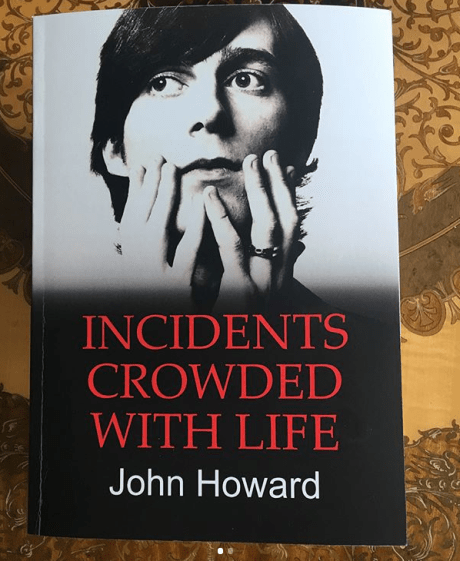
John Howard ‘Incidents Crowded With Life’
Fisher King Publishing, 26th March 2018
Enjoying a comfortable revival (of a sort) in what is essentially his semi-retirement, bon vivant pianist, troubadour, former A&R man and now author, John Howard has finally managed, after decades of being misguided and encumbered, to record and release a series of critically successful albums of a cerebral quality on his own terms, without the travails of middlemen and agents. The humble working class lad from Lancashire, Howard’s musical career started off with such potential but was cruelly crushed, hindered by a steady stream of miscreants, businessmen, producers and the BBC, who refused to play his singles – whether, as Howard recounts out of homophobic prejudice, or just plain ignorance we will never really know.
Signed to CBS Records in the early 70s Howard’s glittering debut LP Kid In A Big World was shunted, overproduced than reproduced, passed around and eventually mishandled, until its eventual release in 1975. Rightly revered decades later, with a number of re-releases (including a very recent celebratory version), this debut became an instant cult classic; critically adored but unable to attract commercial success, mainly as a consequence of the to and froing and mismanagement, it was met with general indifference by the public. Despite an obvious talent and potential, Howard’s stop/start career went from bad to worse until he was dropped in 1976 by CBS after various aborted projects and makeovers, including a disco pop crossover with the producer Biddu (enjoying a succession of hit records at the time off the back of Carl Douglas’ Kung Fu Fighting novelty).
Chronicling that burgeoning period in what is the first of a series of autobiographies, Howard candidly reminisces, entwining his family history and eventual move to London with his various musical mishaps and highlights, and his sexual exploits. As much a history of the perils but also free-for-all misadventures of homosexuality as the hardships of making it in the music business, the first part of Howard’s story reads like an ever-horrifying recollection of violent encounters with the most ill suited of partners. Going full circle, the book opens and finishes on one of the most life changing of these ‘incidents’, with Howard’s fateful leap from the window of an apartment he shared with some colourful Filipino gay characters (as it proved, relocating to London to escape the clutches of dictator Ferdinand Marcos), who brought back a mad Russian ‘bit of rough’ intent on murder – Howard would break his back and smash both his feet in the fall. Incidents Crowded With Life then, is recounted via his recuperation; the formative years looked back on with mostly a fondness as a modest curtain is raised ‘on the living-room in a semi-detached council house in Heywood, Lancashire.’
Observations, asides are mixed with the musings on the musicians that inspired him: Dylan, The Beatles, Mothers Of Invention, Incredible String Band, Bolan and of course Bowie. Signs that Howard wasn’t exactly cut from the same Catholic cloth as his family are made abundantly clear when at an early age he develops a crush on PJ Proby – whilst his sister is clamoring and screaming for the Fab Four -, replaces religious symbolism for posters of the elfin beatific Bolan, and as the book’s quote so aptly puts it, ‘swaps the guilt for gilt’. Not that dear Mum and Dad minded; their humble upbringing causing some uncomfortable situations, yet hardly the stuff of fire and brimstone puritanical condemnation. Though they were right to worry about their lad; especially when you read about his stunningly naïve exploits and trusting nature. Incidents that include a savage beating by a thuggish minor East End gangster lover, a lucky escape from a gang rape whilst holidaying in Malta, and an even luckier escape from a serial killer -posing as a taxi driver – in New York. It’s not all bad though, Howard has just as much fun throwing caution to the wind and partaking with abandon in orgiastic gatherings on Hampstead Heath.
Despite experiencing some of the most traumatic escapes, Howard’s accounts are free of victimhood. In a matter of fact way, neither told as a warning or even alluding to the present frenzy of #metoo, Howard’s honesty is unapologetic, with no blame attached to anyone other than himself.
Probably not quite as insightful for those unfamiliar with his work, this 600 page tome details various recording sessions – some of which are at the famous Abbey Road studios -, performances – both as an aspiring artist on his uppers and as a jobbing pianist/singer, making ends meet playing for diners in various hot spots throughout London – and his inspirations; the things that prompted and triggered those beautifully caressed and erudite songs in the first place. It also details all the ensuing rewrites, overdubs and constant bickering – mostly between his management and the litany of producers who were brought in by a label unsure of the precious signing they’d landed. Howard often frames his insights on the creative process with a synopsis on his favorite artists, showing quite a deft passion for music writing. Here’s just an extract from a flowery evocation of Bowie: ‘Setting out surreal, slightly disturbing panoramas like a screenplay writer in a moonlit park at midnight, Bowie intoned each line perfectly. He sang of times gone like a lost Atlantis, while sounding utterly NOW!’
The good times and fatuous nature of the music industry go hand-in-hand with the highlights: such as penning and recording the theme song for the William Holden and Peter Fonda movie Open Season, which started off so well with Hollywood schmoozing and the hint of a brilliant future, but soon turned to shit; the show time TV appearances that amounted to nothing, and the various meetings with iconic songwriters that ended up blindsiding or leading our author down the wrong garden path entirely.
Hardly the first artists to be chewed up and spat out by the corporate fangs of the industry, Howard’s refreshing, witty and sagacious autobiography is an often heartwarming read (especially when talking about his dear old man and dad); absolved and free of regret and bitterness. Coming out the other side, unceremoniously dumped by CBS Records at the end of this first life works volume in 1976, laying in a hospital bed looking ahead lamentably to years of recovery, the reader is left at Howard’s most low period. Without giving too much away, Howard does bounce back, turning to A&R but also continuing to record and play: even though fame will continue to elude him. An entertaining if overlong read, Incidents Crowded With Life is an interesting survey of the ‘nearly man’ of pop, an insight on both the industry and gay life in 70s swinging London.
Previous John Howard posts:
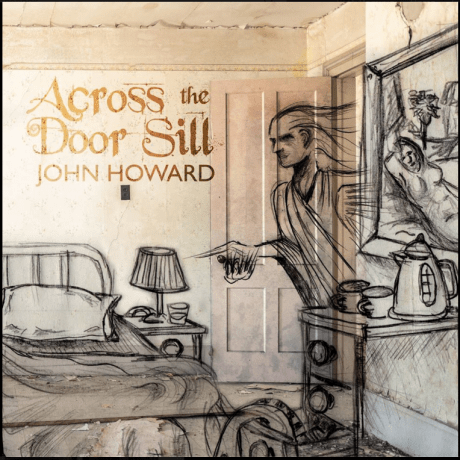
The Monolith Cocktail Social: Playlist #XXXIII
May 3, 2018
DOMINIC VALVONA’S PLAYLIST

In danger of repeating myself forever, but for newcomers to the site here’s the premise of my playlist selections. Previously only ever shared via our Facebook profile and on Spotify our regular Monolith Cocktail Social playlists will also be posted here on the blog itself.
With no themes or demarcated reasoning Dominic Valvona picks songs from across a wide spectrum of genres, and from all eras; Selection #33 being no different, with it’s venerated and Tarot card reader divine styler Kosmische intro from Walter Wegmuller and Popol Vuh and musical journey through Ethiopian spiritual paeans (Berthe Raza), Swedish jazz fusion (Solar Plexus), sublime drifting electronic heartache (Left Of Manila), French new wave electronic agit punk (Kas Product), Arabic fuzzed-up R&B (Sharhabeel Ahmed) and 32 other just as wonderful excursions through time and place.
Tracks:

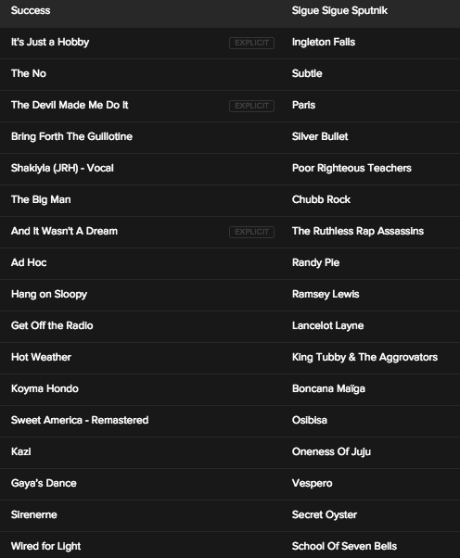
Our Daily Bread 271: Samba Touré ‘Wande’
April 27, 2018
WORDS: DOMINIC VALVONA

Samba Touré ‘Wande’ Glitterbeat Records, 25th May 2018
In a country abundant with guitar virtuosos, the highly genial Samba Touré still stands out as one of Mali’s most celebrated; transducing the travails, heartache but also joy of his homeland through his signature articulate nimble-fingered style of playing.
His third album for Glitterbeat Records – the first, Albala, was the label’s inaugural release in 2013 – Wande is billed as a warmer homely songbook. Recorded in under two weeks, allowing weekends for band members to scratch a living playing at weddings, sessions for the album were relaxed, performances captured on their first take with few overdubs. Previous albums Albala and 2015’s Gandadiko were made during the Islamist insurgency that swept aside and hijacked the Northeastern Tuareg communities’ battle for an autonomous state within the desert borderlands of Mali. Based in the western, more urban, Bamako, Touré encapsulated the fears of his fellow countrymen caught up in, what seemed highly probable until an intervention from the former colonial masters France, a struggle of ideologies that threatened to destroy Mali and bloodily remove its government. Reaching far into the Mali interior, certainly victorious in the field of propaganda in taking the legendary trading post of Timbuktu, Touré was well within his rights to feel anguish and fear as the hardliners – hardly an accommodating presence, known to burn instruments and even musicians that entertained anything other than their own warped sense of myopic worship – inched ever-closer to Mali’s capital.

Photo: Karim Diarra.
Darker albums certainly, yet still so lovingly meandrous, even buoyant, as to exude hope and caring sensibility. Better still, and even with the fallout from this insurgency ongoing (if forgotten by western media), Touré calls, as he does now, for unity: a return to peace.
Far from a complete break, the sadness endures on Wande: though Touré sadness is a most beautiful, cantering and lingering one. Especially when paying tribute to his friend and collaborator, sokou fiddle maestro Zoumana Tereta, on the spoken word with wavering drifty, almost dub-like echo-y effects tracks of the same name, which features the late musician’s spindly evocations from beyond the ether.
The ‘Songhai’ and ‘Crocodile’ bluesman, for that is the style he is most synonymous with, wouldn’t pigeonhole himself personally, preferring to call it contemporary ‘universal’ rock music. Touré has previously said, and reiterates now, that he doesn’t play ‘desert blues’ – a term he rightly associates as the music practiced in Northern Mali, Niger and Mauritania -, and you can also forget about calling it African ‘this’ or African ‘that’ too. Yet at the roots and core, for these are the lands where it all started, Touré’s subtle and relaxed guitar lines traverse the very ideas of blues etymology. The lo fi production feel of the rocking blues Yerfara/We Are Tired could be a lost inspiration for 80s period Rolling Stones with its almost transmogrified Start Me Up like Richards riff. Goy Boyro/The Good Work (Well Done) even begins with a Taj Mahal, BB King reminiscent introduction hook, before dipping over the horizon.
Throughout the album, whether it’s in paying a devotional paean to his beloved wife on the title track or gliding magically on the opening Yo Pouhala/Blah Blah Blah, Touré’s electric, and occasionally deft acoustic, guitar is accompanied by the buoyant and bobbing bending rhythms of the traditional tama talking drum, bowed waiving of the sokou and the vibrating spindle sound of the ngoni: All of which are played with an emphasis on the natural, unrehearsed and relaxed.
Not quite such a leap of faith or different to previous albums, an unpolished and laidback methodology has produced a slightly more sagacious, free-floating quality and another essential Touré classic.
 Monolith Cocktail Blog