The Perusal #48: Crime & The City Solution, Tele Novella, Chouk Bwa & The Angströmers, Yara Asmar…
October 5, 2023
A WORLD OF DISCOVERIES REVIEWED BY DOMINIC VALVONA
(Unless stated otherwise, all releases are available now)

Chouk Bwa & The Angströmers ‘Somanti’
(Bongo Joe)
Reuniting for a second explosive dynamic album of electrified Vodou and Mizik Rasin, the Haitian collective Chouk Bwa and the Belgian production duo The Angströmers once more propel ritual and ceremony into an otherworldly futuristic setting.
Originally crossing paths back in 2016, formulating a project performance two years later followed by the release of the partnership’s inaugural album, Vodou Alé, in 2020, this Euro-Haitian combination was interrupted by the Covid pandemic. Unable to meet in the flesh, as it were, for two and a half years they still managed to release a string of 12” EPs; the bridge to what would be that eventual reunion in the May of 2022 and an intensive workout tour of Europe.
This enabled them to record their second album together, Somanti, in a Brussels studio; the culmination of tour performances and interactions, quickly recorded in just one day, such was the energy.
Framed as a more “mature” record, and different in focus to Vodou Alé, there’s now an emphasis on the ritual, ceremonial aspects of this African exported religion, spiritualism and rites, and the sagacious proverbs that are hailed, harnessed and playfully invoked by the Vodou chorus of voices. The hypnotizing and galloping barrage of drums are back, with each ritual subscribed its own rhythm and call. But if we go deeper, the hotbed of Haitian independence Gonaïves-hailing Chouk Bwa also invoke their ancestral African homelands; that being the once powerful, rich and pivotal kingdom of Oyo (growing to become the largest Yoruba speaking state in what is now eastern Benin and western Nigeria); the central African kingdom of Kongo (a Portuguese vassal but independent state with 600 years of history behind it); and key regional kingdom of Dahomey in what is now within the borders of Benin (once uncoupled from a tributary state to the larger Oyo, a global trading post built unfortunately on slavery and conquest). The latter of which, a prominent source of Vodun, the belief system that was torn from its roots and shipped with the poor souls that were transported into slavery, to the Americas and Hispaniola.
That age-old roots music, summoning of spirits, pummeled, beaten and danceable rhythm is given a transformation by the Belgian duo, who zap it with shooting laser beams and cosmic fuzz, fizzles, buzzes of oscillations and reverberations. The dub genes of Lee Scratch Perry, African Head Charge and Major Lazer can be heard throughout, alongside post-punk, Ammar 808, Moonlight Benjamin and Ifriqiyya Electrique on an album of both mysticism, danger (in an exciting way) and spirit world communion.
The groove on the female lead and group sung ‘Fèy Nan Bwa’ is like a cool no wave vision of Vodou-House music – it actually reminded me of Glasgow’s own international project, The Green Door Allstars. But that contemporary fused electronica of magnetic force fields, echoes, phasers, subsonic bass thumps and metallic elements never overshadows the authentic rollicking, tribal bounding and bobbing drums and the expressive, sometimes bordering on hysterical and manic vocals/voices.
Music from another dimension, the Haitian roots music and performative religious invocations and words of wisdom from Chouk Bwa are sent through a vortex into the future on another successful union.
Crime & The City Solution ‘The Killer’
(Mute) 20th October 2023

A decade on from the last project inception of the Simon Bonney and Bronwyn Adams led Crime & The City Solution, and yet another restless move back to one of the city’s that solidified their gothic, hard won reputation and shadowy presence, Berlin.
If 2013’s American Twilight was suffused with the dying embers and toxic fumes of Detroit, with its mass unemployment, foreclosures and desperations, then The Killer seems almost resigned to the fate and inhumanity of our divisive post-Covid times. Incidentally, American Twilight was itself released after an even longer hiatus of twenty years, and with a, near enough, entirely different lineup. Although conceived back in Bonney and Adams native Australia (where Crime & The City Solution were born in the late 70s, burning up the Sydney and Melbourne scenes before following their skulking bedfellows of Nick Cave and Mick Harvey to London, and then onto Wim Wender’s Wings Of Desire backdrop Berlin) during the harsh conditions of lockdown, the band and production were forged in the German capital. The roll call of which includes Frederic Lyenn (on piano, bass and synth), Donald Baldie (guitar), Georgio Valentino (synth and guitars), Chris Hughes (drums and percussion) and Joshua Murphy (piano and guitar). That ensemble is overseen, or rather, ‘conducted’ as it were, by the highly respected producer Martin J. Fiedler.
Originally conceived as a PhD application on decision-making in Afghanistan during the late 1980s, the initial brief was expanded by Bonney’s work delivering aid programmes across the Indo-Pacific region, his professional and personal relationship with Adams, his brief time in post-invasion Ukraine, and lyrically by the ‘syncopated’ delivery rap styles of Mos Def and Talib Kweli’s Black Star collaboration. Although America isn’t mentioned, its leading part in the events that unfolded during the 80s in Afghanistan is impossible to deny. As part of the Cold War strategy to checkmate an expansion-driven Soviet Union, America unintentionally stirred up a viper’s nest in aiding the Mujahedeen and warlords in their outgunned fierce war against the invading aggressor. In forcing the Soviets into a humiliating withdrawal, followed by the entire collapse of the Bloc and regime, and the fall of the Berlin Wall, those Cold War partners turned on their enablers, as they became hardline Islamist fanatics.
Decades later, and after the still never reconciled bloody Balkan wars, and it’s the turn of Putin’s Russia to unleash barbaric bloodshed. But this time, after successfully propping up the heinous regime of Assad in Syria, death and destruction has been dragged to Europe’s front door. The scenes of dead bodies may keep Bonney awake at night, but it’s also the resilience, the matter-of-fact manner in which lives go on in the face of such despairing evil that filters through to the music, themes and lyrics of The Killer. Just as one of his idols, Scott Walker, could convey horror and resignation but love too, Bonney and his foil and muse, Adams, churn up a tempest of emotional tumult in which romance of the hungered, yearned, longed and sentimental kind offers some sense of humanity: the spirit not yet crushed by the enormity of it all. And again, though never mentioned, it is to a both Southern Gothic and Cormac McCarthy-esque America that they turn musically. For this is the broody, Biblical Western terrain the band and their Bad Seeds, Wovenhand peers have trodden for decades; a kind of almost esoteric Americana and dark moody Southern rock ’n’ roll signature that offers haloed magnificence, reverence in the face of apocalyptic dread.
The album begins with the morbidly sinister entitled ‘Rivers Of Blood’ and Bonney’s plaintive, ached declarations for his muse, under a blood moon lit panorama. Danger prowls the Chris Isaak on the road with Cave mood, as a broken Bonney pines with fatalistic worship for his flame, and makes sense of, processes the turmoil in his psyche.
‘Hurt You, Hurt Me’, with its subtle sentimental, wept strings, sounds more like a loose duet between Avalon era Bryan Ferry and Patti Smith. Two voices starting at different points, shadowing each other, emote pain and suffering, and breath languid despondency on frosted glass. Angels cry and faith is promised on a flange affected entwined romance.
A sullen longing pervades the dramatic, slow, testament-poetic ‘River Of God’ (another of those river metaphors). And yet despite the various references to death, the suffrage of the “children of war” and somber tones, there’s a message that “you can be anything you want to be” after all, and a sprouting of wings encouragement – the very opposite of Icarus’ sticky fall to Earth.
As mentioned and alluded to earlier, Bonney pays a most deeply felt form of romantic thanksgiving to his partner Adams with the resounding ‘Brave Hearted Woman’. Going through sophisticated changes – from Cohen to Dylan and Barrett vibrato psychedelics -, Bonney, with the occasional lofty yearns from Adams herself, shares his passionate wants for the woman he so obviously holds in the highest of regards, respects, loves, falls to his knees for, and forms part of his very fibre: “She is ecstasy, filled inside me”; “You are creation for all to see”.
I’m sure it’s Adams’s coos on the next song, ‘Killer’, a piece of torn gothic withering noir, malevolence and redemption. It’s yet another protagonist who’s no damn good, strung out, morose and struggling with self-identity, their place in the world, and perhaps, their heinous crimes. Those syncopated influences that I mentioned much earlier, can be heard weaving an almost non-stop serious-voiced incantation of consciousness and gristlier Western preacher’s song. It seems to take notes from Amon Düül II (Yeti period) and The Rolling Stones.
It’s followed by the outlaw pained ‘Witness’ wake-up call and the seriously hard won conclusion of ‘Peace In My Time’. With a resigned sadness to suffering and a gothic simmered weep of Diamanda Galá style piano arrangement, the latter song, and finale, finds some reconciliation with a world in eternal chaos and torment; Bonney unsurprised, yet not humbled, to the atrocities and harm that we humans dish out on a hourly basis. And yet, there’s an eventual peace in the valley moment there; a glimmer that love will lead Bonney out of the nightmare of his own troubled psyche.
As a statement on Afghanistan, the references are very cryptic, symbolic and veiled. Rather it’s a catalyst, prompt for the Bonney and Adams and the band to expand those horizons and murky textures, and to say much about the external and internal state of the world we live in.
Tele Novella ‘Poet’s Tooth’
(Kill Rock Stars)

A wistful, almost disarming, Tele Novella weave their magic on an album that takes its cues from Harold & Maude and a removed version of the heartbreak yearning vulnerability of Nashville and Texas country music; albeit a version in which Cate Le Bon and Aldous Harding sip despondently from a bottle of life’s despair.
As whimsical and beautifully executed as it all is, Poet’s tooth is a moving album of timeless tropes, somehow delivered musically and visually through a slightly off, sometimes surreal, vision of the familiar. Natalie Ribbons and foil Jason Chronis dream up an idiosyncratic staged world, their moniker taken from the serial drama/soap opera phenomenon of the “television novel”, a format most prominently produced for the Latin American markets.
It’s a world in which, much like Harold and Maude, the bonus of youth is squandered until a mature presence at the very opposite end of the aging equation – with death not far away and looking to grasp every opportunity of youthful risk and carefree adventure – closes the circle with a life lived without regret. That cult movie said much about the Boomers age of high anxiety, caught in the headlamps fretting away their youth; stuck between suicide and depression, hard drugs (proscribed and otherwise) in the face of a society moving past the hopes of the last decade into the violence and despondency of the 70s: Take your pick, from Nixon to Vietnam, the crushing resistance in the Soviet Bloc and so on…
Roles are reversed, with Maude more childlike (yet wise) and the morbidly curious Harold, fearing for experiences yet to materialize, on a death trip. The most obvious reference to this movie’s odd romance can be found in the video for the band’s toy box like, almost twee but charmingly evocative ‘Broomhorse’, which features one such dark comedic episode, with Chronis playing the part of a bathtub, wrists slashed suicidal Harold in a magical world of 70s furnishings and wallpaper. Maude is from a pre-war generation, with the all too real traumatic experiences of her youth literally tattooed on her arm, and yet attempts to bring her partner round to the possibilities of perseverance and making do with one’s lot in life – Harold is a typical lost child of the wealthy Socialite classes; in material and nepotistic terms rich, yet devoid of connection and mentally adrift.
Before I start running away with myself, and this becomes some sort of screen review, the purpose of all this analysis is that Poet’s Tooth is suffused with those same themes; borrowing heavily from the Hal Ashby playbook of tragic-comedy and the screwball to make some sense of the world now. And yet this is only one aspect of the album.
Ribbons and Chronis – joined it must be mentioned by Danny Reisch, who handles the drums, samples, loops and field recordings but is also involved with the production too – hail from an increasingly creatively changing Austin, Texas. And so this is also a 21st century take on that State’s cowpoke, steers and rodeo signature of yodeled hangdog country music; only the heartbreak is coming from a female protagonist’s point. Not a new concept but any stretch, but still undervalued. But this is a whole other version of that; the Country & Western scores of Morricone and music of Sacri Cuori, Bonnie Dobson, K.d. Lang, Chris Isaak merged with an air of Lynch’s go to composer Angelo Baldametti, Kathy Smith, Gene Clark, Elyse Weinberg, the Laurel Canyon, Georgia Greene and Rosemary Clooney.
This music is both knowing and naïve, charming and disturbing. For there’s an esoteric alchemy of pitched-perfect fluid poetry on the surreal pillow, Lewis Carroll and Sandy Denny reading the Tarot, ‘The Unicorn’ song. Part renaissance, part death pact, part Percy Sledge’s reverent church organ, and part Temperance Society, Ribbon’s captivating voice charms us into a magical kingdom that at first seems to hide a much creepier menace; the language fantastical but progressively alluding to “poison”, “zombies” and what can only be described as some cultish gathering, waiting on “angels” to arrive. Meanwhile, the titular song – utterly compelling and beautiful – alludes to “incantation”, a “goblin”, a “cloak” and a “cauldron” on a song that sounds more fairytale than dark bewitching arts. Although of the metaphorical kind – A mosey June Carter and Lee Hazelwood type of down-on-the-ranch country tune, with a rhythmic horse canter -, there’s a ‘Vampire Cowgirl’ to add to that sense of the “other”. There is the mention of war too; or a war: The Vietnam War? The Iraq War? The American Civil War perhaps?
But just when you get some sort of measure, songs like ‘Eggs In one Basket’ takes an arty Baroque turn (courtesy of the autoharp I’m sure), via Gainsbourg and 60s cult French/Italian cinema: I say Baroque, it could easily by Tudor. Imagine the Thomas Crown Affair scored by Michel Legrand as Fellini directs and you’ll half way there.
Adolescence escapism wrapped in a softened, but no less stirring, epiphany, Tele Novella has a surreal, dreamy quality about them. From the Tex-Mex border of yore to the contemporary Austin scene of City Limits, they weave a really impressive songbook that’s as Hal Ashby and Sidney Lumet as it is pining Country and Western. Poet’s Tooth is both lyrically and musically perfect; one of my favourite albums of 2023 – no idle boast. Prepare to be equally charmed and moved with a counterculture resurgence of quality, subtle comedy and tragedy, eccentric disillusion.
Raf And O ‘We Are Stars’
(Telephone Records) 27th October 2023

Few artists have purposely entwined themselves so deeply with their idols than the Raf And O duo of Raf Mantelli and Richard Smith (the “O” in that creative sparked partnership). David Bowie and Kate Bush loom large, permeating near every note and vocal infliction of their idiosyncratic, theatrical, cinematic and up-close-and-personal intimate style of avant-garde pop and art school rock experimentation. Raf even has a Kate Bush tribute side project; coming the nearest I’ve yet heard of anyone to that maverick progenitor’s range-fluctuating, coquettish and empowered delivery, and her musicianship and erudite playful and adventurous songwriting.
The death of Bowie however, must have had a crushing effect on the duo, who, perhaps, covered his music better than anyone else: at least in spirit. They got close to their hero through the supportive words of Bowie’s key pianist foil of the 70s, Mike Garson. But an audience with the thin white duke eluded them. It’s a pity, as I think he would have certainly connected with the duo’s fifth album, We Are Stars. He certainly would have recognized the signatures and the references, both the in your face eulogies, homages to his most dedicated of alien roles in The Man Who Fell To Earth, and the less obvious but musically inspired ones too.
Omnipresent throughout, there’s the angular, shredded and bended guitar of Scary Monsters era Robert Fripp and Carlos Alomar, and the strangely interesting progressions of the arty-pop and dress-up of that album, but also some pre-Ziggy albums too. ‘Tommy Newton’ stands out of course; the Icarus alien fallen to Earth in the hope of returning with water to save his family on an arid distant star, is woven into a fatalistic existential love eulogy, as told in the third person by Mary-Lou, his estranged human love interest: if you can call her that. Recognizable plots and scenes from Walter Tevis’ novel and Nicolas Roeg’s film versions – later given a second wind in the form of the Lazarus ‘off-Broadway’ musical, based on Enda Walsh’s book vision, and with lyrics provided by Bowie -, appear in a non-linear, otherworldly mournful tragedy. Loving the alien, Mary-Lou’s character introduced the distracted, disconcerted Newton to some of Earth’s vices, little knowing his true identify until the dramatic reveal: unknowingly waylaying his task, plied with alcohol and the foibles, deceit and nature of humankind. Raf embodies this dislocated figure, lost and cast adrift in a thematic void; pining for what was and what could have been.
But it’s not all about Bowie and his famous film role. That last track also reminds me of Deux Filles, and so much of this soundtrack to the current restless age of high anxiety, disconnection and our reliance on technology, swims around in a most curious new wave suffusion of 70s and 80s sounds. The opener, ‘Still Sitting In Our Time Machines’, actually seems to recall the duo’s decade-old Time Machine EP, but has a more cosmic, canoodled, neo-romantic soul funk sound and feel. With a message for retro nostalgia, with nothing moving on since the last time machine voyage, the early 80s portal is reopened.
Raf comes close to Lene Lovich on the Radiohead crosses paths with a Latin-flavoured Banshees ‘Andy Warhol’. Warhol is the theme here on this yearned, wooed and urgent changeable curio; or rather the pop art icon’s obsession by a homeless character.
The titular song itself once more enters a starry void; those common celestial objects and all their various metaphors, analogies form the substance to an alternative, stressful The Man Who Fell To Earth soundtrack, yet recalls the influence of Tricky and Portishead.
It’s all change by the time we reach the avant-garde electronic pop ‘Every Time It’s Bleak We Dance’, with Raf now channeling a merger of Alison Goldfrapp and Liela Moss, but with a meandrous European allurement. Stranger too, the makeup in ‘Eyeliner’ is blusher coquettish Bush languidly draping an arm around Jane Birkin at her most untethered, whilst Joe Meek’s reverb pings and ‘Telstar’ whizzes by. Ah yes, as if to reinforce a thematic thread of retro-futurism there’s a lot of 1950s space sounds and effects: part of the sci-fi tapestry. But it’s the 1960s, albeit a fantastical version, I’ve dreamt up as a critic to describe the beguiling oddity ‘Waterloo’; a beautiful sentiment to an inspiring, supportive partner, and not a cover of The Kink’s standard paean to London. In my mind this sounds like Lou Reed penning a Berlin period balled, time travelling back to the early 60s and handing it over to beat group era Rolling Stones, who in turn, pass it on to Marianne Faithful.
If you’ve never had the pleasure of experiencing Raf And O in a live setting before, then drink in the intimacy of the club lounge-esque ‘The Guardian Of Your Mind’. During or in between Covid lockdowns, the duo performed a series of incredibly striking, fragile and artful concerts online; and this stripped, but no less powerful, untethered, vibrato echoed and Raül Refree-esque performance shows you what you missed.
An alternative time travelling theatre of interwoven fantasy, dream realism and the reimagined, We Are Stars is as playful with its unique style as it is only too aware of the deep held stresses, strains, pain and detachment that plagues society in the aftermath of a global pandemic, economic meltdown and war. Looking to the stars, but knowing that even escapist dreams of the cosmos have failed us, Raf And O (who I haven’t mentioned in name at all, but is an adroit craftsman of his form, accentuating, punctuating or loosely weaving a meandered musicality around Raf) take their concerns, observations and curiosities into ever more arty and intriguing directions. They remain one of the most individual acts in the UK; true inheritors of Bowie and Bush’s legacy and spirit.
Yara Asmar ‘Synth Waltzes And Accordion Laments’
(Hive Mind Records)

In a diaphanous gauze of dream-realism, the Beirut multi-instrumentalist, composer, video artist and puppeteer Yara Asmar conveys a sense of dislocation, loss and remembrance on her second album for one of the Monolith Cocktail’s favourite labels, Hive Mind.
Last year’s Home Recordings palette of serialism, atonal atmospheres, ambience and minimal semi-classical melodies has been expanded upon, with an emphasis on the synth and accordion of the title. Surrounded by a sound source of electronics, toy xylophones, a metallophone, music box, percussive mobiles and wind chimes, and of course her grandmother’s handed-down green-coated accordion, Asmar seems to float once more above a city in turmoil and distress; a place in which psychogeography and family history haunt present Beirut. For as beautiful, immersive and dreamy as it all is, these ‘waltzes’ and ‘laments’ seem to have an almost supernatural, even spooky feel: The veiled wisps, high sounded whistles and bubbled ‘Everything Is Wrapped In Cling Film’ reminded me of both Jodie Lowther and Lucrecia Dalt in that regard; bewitching but not so much scary. The fate prompting ‘It Is 5PM And Nothing Bad Has Happened To Us (Yet)’ actually reminded me of that knowing supernatural and library music group, Belbury Poly. I guess what I mean is that this sound, mood is more like the suffused enveloping veils of the ether, a translucent resonance, reverberation of Asmar’s family tree and the lives they lived then esoteric.
This is the sonic memory of that family’s toil, trauma, but also the small observations of daily life, For example, ‘three clementine’s on the counter of a blue-titled sun-soaked kitchen’; scenes that hold more than just a descriptive title for a good painting. Like that kitchen scene, those meanings soak through to emote a magical garden in a bustling city.
A bellow or concertinaed accordion movement can say so much. That same accordion was originally made in a workshop in the German town of Trossingen; a stones throw from Asmar’s residency in the Black Forest, last March. Locally famous it would turn out; people recognized its maker’s mark and directed Asmar to visit the source. Although the town was a farming community, during the winter they’d turn their hands towards building clocks and accordions. Asmar’s workable heirloom, keepsake, was recorded in an old ledger at the back of the workshop that made it; sent to the Lebanon on the 21st October 1955 with seven other models. That date, or near enough, marks the release of this album, and that providence is inspiring enough to inform some of the direction of wafted travel and emotions contained within.
Better times perhaps, less upheaval; maybe with hope for something, whatever happened or was dreamed for in the past, the present is full of uncertainty. Clinging to those memories, there are abstract sonic feelings of limbo and loneliness; a call to those that left the city, but also a reference to those that returned or stayed throughout. ‘Are These Your Hands? Would You Like Them Back?’ the only peregrination to feature a clear voice, features the poetic questioned turmoil of Majd Chidiac, who poses a consciousness of lament, unfairness and grief to a Carlos Niño-like spell of xylophone-esque bulb notation, atmospheric wisps and dreamy uncertainty. Elsewhere there are the faint, obscured or just ether-emitted signs of either a siren spiritual voice, or those that are more sorrowful and harrowing: Not so much haunted as the apparitional calls for remembrance and recognition of that which was lost or taken away.
And yet, there is a real alluring, magical pull to those strange warm ambient reverberations and removed ideals of waltzes. It’s much in part down to the accordion (French sounding on some tracks, and like a church organ on others) that these visions sound so unique; taking ambient music in a different direction and to a different environment that few have attempted before. Saying that, although performed in Beirut it remains universal, with themes and feelings we can all recognise, or at least sympathise with. But Asmar stays true to her home; bringing us adroit but empirical examples of quality ambient and explorative music that hopes to convey stories from the family photo album; the observed scenes from childhood made real in a sonic, immersive experience.
Bex Burch ‘There Is Only Love And Fear’
(International Anthem) 20th October 2023

In the moment extemporized expressions in multiple locations, both in Europe and North America, the feels on Bex Burch’s new album are led or prompted by a hand made xylophone. Any yet, there’s no particular pattern nor pathway to these captured performances; Burch joined as she is by a myriad of notable artists/musicians, all of whom only met for the first time before each improvised performance. That collaborative roll call was picked by International Anthem’s Scottie McNiece and Dave Vettrainoi, the same label responsible for invitng the percussionist, producer and instrument maker over to the US to make this album.
Proving fruitful foils, the eclectic polymaths Ben LaMar Gay and Macie Stewart, the in-demand bassist and composer Anna Butterss, drummer Mikel Patrick Avery and Tortoise member and multi-instrumentalist Dan Bitney pop up alongside Rob Frye (on clarinet and flutes), Diego Gaeta (piano), Ben Lumsdaine (the second drummer to join this cast), Oren Marshall (tuba) and Anton Hatwich (another bassist is seems) across various location stimulated pieces of music. Yorkshire, The Baltic Sea, Berlin, SüdTirol, Wyoming, L.A. and a storefront in Bridgeport, Chicago stand in as the stages for descriptive sound work and grooves that traverse between freeform/cosmic/spiritual/Afro-jazz and the arty and avant-garde. But even within that scope there’s elements of Appalachian country, Hassell’s fourth world possible musics series, the 80s no wave melting pot of Ramuntcho Matta and The Lounge Lizards, and the more contemporary partnership of Matthew Herd, Will Glaser and Liam Noble. And it all begins with nature’s spell on the cuckoo-proclaimed rhythmic trudge through the woods, ‘Dawn Blessings’. Burch lightly introduces us to the glassy bulb bobble of her beatific xylophone on a slowly awakening intimate landscape.
The great outdoors is suffused across much of Burch’s ‘love’ and ‘fear’ emotive passages; a chorus of birdcalls, chirps and warbles, the sound of the sea crashing against the beach, the breeze itself mixed with human interactions such as the bustle and greetings on the street, an appreciative audience in the garden and the feint recordings of conversations. Intimate and up close, even on the more avant-garde needs to draw breath, you can hear all the squeezed and winded blows, the strained exhales of the brass and woodwind on the Anthony Braxton-like ‘If I Was You I’d Be Doing Exactly The Same’. Well, the first part anyway, as this same sucked and almost inaudible reedy rasped piece goes on to feature more recognizable instruments, an increase in volume, and hits a Marshall Allen and Yusef Lateef burst of jazz energy.
The rhythm, groove is changed again on ‘You Thought You Were Free’; a kind of amalgamation of the Art Ensemble Of Chicago, Sun Ra, New Orleans Nightcrawlers and Hugh Masekela herding percussive cattle across a police siren urban street corner.
‘This Is The Sound Of One Voice’ is a pretty clear title description, featuring as it does a soothed faint female “doo-doo” woo over, what sounds like, tine plucks and scrappy, scuffled and shaken percussion (Širom meets Alice Coltrane’s healing balm).
‘On Falling’, which I take it is in the more anxious fear category, sounds like watery plops and the quiet slow turn of a winding down music box.
Burch’s instrument of choice, a bought handmade xylophone, often sounds like a vibraphone or Gamalan mettlaphone. On the Laraaji-esque ‘Don’t Go Back To Sleep’ you can hear a polyrhythm trickled variation of that xylophone: Two of them in fact, crossing over into separate timing signatures.
Each day is a different sound and a new canvas for Burch, who transcends her bearings and musical boundaries. There’s rhythm to these improvisations, a real groove that at times counterbalances the passages of avant-garde expression to create a non-linear journey of emotions, thoughtfulness and sense of yearned fears.
Mike Reed ‘The Separatist Party’
(We Jazz/Astral Spirits) 27th October 2023

It wasn’t planned this way, and both releases are from entirely different labels, but the drummer, composer and band leader Mike Reed’s new album shares collaborators with the previous album (see above) by Bex Burch. It’s also entrenched in the same Chicago hothouse. For also appearing on Burch’s There Is Only Love And Fear is the multi-instrumentalist, singer, poet Ben LaMer Gay and flute clarinet maestro Rob Frye. Both join Reed’s oft-used live performance appellation, The Separatist Party; now used as a album title for his latest album project.
And added to that Constellation in-situ hive of creativity (the C being the multi arts venue in Reed’s hometown that he’s successfully owned and operated since 2013) is Cooper Crain on guitar, synth and engineer duties; Dan Quinlivan on synth; and Marvin Tate on vocals.
Drawn together under less celebratory circumstances, the Chicago AACM hot-housed Reed and his talented troupe explore the societal, political and monetary crisis of ‘forced seclusion’; inspired, influenced by both the renowned New York Times reporter and non fiction author N.R. Kleinfield’s 2016 Pulitzer Prize nominated essay on the death of George Bell, and the restricted rules of Covid lockdowns. The former, a sad indictment on isolation, the lack of human contact and neighborly care, the latter, a self enforced curtailment of freedoms that led to a tsunami of mental problems, and again, isolation. Bell’s fate is said to have haunted readers, including Reed: We all unfortunately know or have heard of such scenarios; the hoarder neighbor with no family, the neighbor that no one looks in on; dying without anyone even noticing for a week. In the case of this Jackson Heights (79th Street to be exact) resident, the authorities, of which there were many, struggled to piece his life together. The Pulitzer Prize site described Kleinfield’s expose as a ‘part detective, part eulogy, and part exploration of a city’s bureaucracy of death’.
Although not named specifically, the first chapter in what will be a three-album cycle, finds a vocalized and musical language that demonstrates this growing epidemic and its causes. This can sometimes be delivered with clear urgency, and at other times with a more abstract but emotive expressive performance, from a band totally in synch, yet still able to crisscross, counter and push at the direction of travel. What I mean by that is, in spite of the tumult, untethered freedoms, there’s never a chance this music will come unstuck, nor descend into chaos.
With a voice pitched somewhere between blues-rock performer, Malcolm Mooney and Amiri Baraka, spoken and word artist poet Marvin Tate adds a very loose narration. On the opening synth undulated and drum shuffled ‘Your Soul’, Tate’s intensity strengthens as he sorts through a “mosh pit” of a life lived, laid bare with cryptic descriptions: “I reached the wooden floor/Decades of old shit.” A hoarder’s accumulation piled high; nonsocial and maddening to those who don’t get it, or understand. The musical style is partially Idris Ackamoor, partially Kahil El’ Zabar and a little Don Cherry’s Organic Society. It’s followed up by the Werner ‘Zappi’ Diermaier drum motioned, and Hugh Masekela conducted Mardi-Gras ‘A Low Frequency Nightmare’, which now moves on over into a semi-Krautrock-jazz lane. That same track features some great trumpet action (hence the Masekela reference), and a Donny McCaslin cosmic synth signature that envelops his saxophone peregrinations. ‘We Just Came To Dance’ has Tate repeating the titular statement over a backing or primal Chicago House music, as played by El’ Zabar, and laid out in Embryo’s African percussion explorations. It pops and clops along like Basquiat’s figure limbering and breaking down a 80s NYC no wave boardwalk.
A musical partner to Reed over recent years, the incredible visionary Nicole Mitchell springs to mind on the fluted and diaphanous constellation yin of ‘Floating With An Intimate Stranger’. Almost in the spiritual waterfall vein, this feels like a tranquil spot to gather one’s thoughts; take a pause and then float on up into the astral.
Rolling in on a Sam Rivers’ vibe and tumble of drums, ‘Hold Me, Hold Me’ is more a case of spurned pleas of unrequited love declaration. And yet it’s followed by the cupped trumpet serenade of ‘Our Own Love Language’, which features dappled electric piano and Bobbi Humphrey style flute; taking romance into the spheres of Knoel Scott and early Miles Davis.
Tate is back to walk through a neighborhood photo album of foibles, connections, anecdotes and fate, on the centerpiece track, ‘One Of Us’. Amongst the characters (the guy too fucked-up on booze to make anything of an invitation to join The Temptations, to some guy who could punch like “Tyson”) and location spots on this bluesy saunter, Tate regales the story of someone he grew up with (attending the same “fucked-up schools” and church): “one of us”. And despite being on the receiving end of the “N” word from Mary Wells (I’m not sure if this is “the” Mary Wells, Motown songstress, fucked over by that label and many others during a career of false starts and travails), her idiosyncrasies and failures, is someone whose loss is to be marked and mourned: a missed part of the community. That final vocal statement of the album proves one of its most insightful and visceral.
Reed and his troupe pull off a real feat in drawing the listener into a rich Chicago imbued and eclectic soundtrack: that’s Chicago Jazz, Godspell, Blues and House merging with New Orleans, Afro, the spiritual, and consciousness styles of jazz. A deep emotive statement about societal ills and seclusion is made by a seriously class act. I look forward to the next cycle in this conceptualised body of work.
Raül Refree & Pedro Vian ‘Font De La Vera Pau’
(Modern Obscure Music) 20th October 2023

A most auspicious occasion, the Iberian pairing of avant-garde polymaths Raül Refree and Pedro Vian marks a rightly welcoming proposition for those of us in the experimental scene.
A familiar name to Monolith Cocktail readers over the years, Refree has gained plaudits for his transformation of the Flamenco tradition, with such doyens of the form as Rosalía and Rocío Márquez, and for his Fado reinvention partnership with the extraordinary and captivating Lina. In between those projects he’s also produced a number of albums for other artists, including Sonic Youth’s Lee Ranoldo. That relationship in particular has led to Refree’s wider role in the contemporary New York scene. As a composer he’s scored music for various films, some of this material released in the form of his Spanish sketchbook, La Otra Mited, followed up by the El Espacio Entre album, released at the beginning of the year: an album I rated highly at the time, describing it as a ‘Spanish Neel Murgai Ensemble and Hackedepiccotto trapped with Nacjo Mendez in an undefined, veiled timeline and atmosphere…’ It’s no surprise, considering the ambiguous blurring of boundaries between disciplines and styles that Refree is set to make his theatre director’s debut next year.
Finding it hard to believe, but Vian is a stranger to this site. Making his debut appearance in the MC, the Catalan producer, musician, composer and DJ also runs the deep thinkers’ experimental label that is facilitating this album of nine explorative suites. Vian has previously released a trio of solo albums and a collection of singles for his imprint, and last year, after instigating an ‘immersive’ live set at the Sonar Festival, released the Cascades collaboration with the Piedmont-born composer and producer Mana; setting him up nicely for this tactile, sometimes physical, stretch of piano, synth and organ – those being the main trio of instruments used on Font De La Vera Pau; the replenishing, fluctuating fountain waters of serialism, the atonal and the more melodic.
Simply labeled with no prompts or points of reference, each improvised sounding piece is a passage in itself and yet part of a whole performance, with both partners taking the familiar into curious, mysterious and often alien settings. And yet, when the droplets of piano notes, and moist resonance evoke the subterranean (a pool of water in the cavern), the sound of chirping birds and the sunlit woods opens up a window into the fresh air.
The low but soft rumbles of bass piano and metallophone like playing of that instrument’s inner workings conjures up hints of Alice Coltrane’s Turiya Sings, Terry Riley and Fluxus. Even the piano’s lid and frame is used in the process, tapped to create a rhythm of a kind. And at other times, it all sounds like a glass-strung vision of Chinese music, or something from South Korea: dal:um spring to mind. But then there’s obscured valves, whistles of a strange pitch, the hovering presence of spacecraft and evocations of slow ships moving through a vapour.
Surface noises; the sound of a running film projector, there’s more to decipher from what appears to be minimalistic, marginal changes and hidden instrumentation.
The fluctuating undercurrents, patterns, trickles of melodious notes float between echoes of Harold Budd, John Lane, Sylvain & Sakamoto, The Corrupting Sea, Vangelis, Roedelius and Susma Yokota on a hard to define collaboration. Not so much out of either foil’s comfort zone, this partnership does offer something challenging; a link back to their respective catalogues, and yet intuitively, texturally and tonally something a little different. It is another immersive experience in avant-garde, in the moment exploration.
Fantastic Twins ‘Two Is Not A Number’
(House Of Slessor) 13th October 2023

Competitive from the outset, birthed from a primordial cosmic womb, the Fantastic Twins in Julienne Dessagne’s otherworldly sci-fi fantasy go through hellish travails and separation before finding a final resolution. From the bawled birth of ‘I Was First’, the Berlin-based French producer, musician and vocalist explores the magic, duality and multiplicity of twins over an album of metallic, chrome and liquefied material sci-fi and otherworldliness: even the haunted and supernatural.
This is the dry-ice coldness of futurism merged with the Lynchian, strung out and drifting in a cerebral void. The title of this album, Two Is Not A Number, paraphrases a quote from the schizophrenic monkey in Lynch’s What Did Jack Do?, but is also suffused by the atmospheric esoteric wisps and vapours of that cult auteur’s go-to composer, Angelo Baldametti.
With a sizable apparatus of the electronic, synthesized and sequenced, Dessagne creates a refined concept, imbued with influences and a multimedia stimulus of ideas and sparks. In the PR spill, which more or less writes the review for itself, Sun Ra’s New Horizons is mentioned as resonating with Dessagne’s approach to music: “The sight of boundless space reaching ever outward as if in search of itself.” Another reference point is the Blight Of The Twin documentary, filmed in Vodun practicing Benin. As an added layer it forms another piece in the collage, taking in, as it does, the cultural mythology of this atavistic African religion and its ritual celebration of twins.
On the number counting, cyborg techno building ‘Land Of Pleasure Hi Fi’, one or both of the twins is cast adrift in that infinite space; repeating the ached “Feel alone in space” line as Basic Channel, The Pyrolator and Cabaret Voltaire coolly and intelligently pulse and reverberate away.
Albums from Carl Craig, Man Parrish, Fever Ray, Andy Stott and others, alongside the influence of Cosey Fanny Tutti, Chris Carter, Coil, Nina Simone and Pan Sonic can be added to the depth and range of this accumulative mood board and framework. And you can indeed pick up all of it, especially in the second data count of ‘Silver Moon Dial’, which is very Germanic, but a little Cosey too. Yet is also the most club-like of techno tracks too; a sort of Boiler Room session remix of Dessagne’s music in real time.
The vocals are wafted and manipulated in vapours, but sound at their most agitated and conniption-like a smoother Diamanda Galás apparition, and at other times when more icy, cleaned by the frosted synth waves, like Fever Ray, Ladytron and Zola Jesus.
The Fantastic Twins at the heart of this album are brought into a gauzy tubular paddled and padded melodic dream hallucination of a technological world; reconciled at last in the final Sylvain and Sakamoto-esque ‘All Of This Is Resolved’: the lasting statement of reassurance, connection and family unity being “I’ve come to take you home with me”.
It proves a fertile concept and doorway to the investigations of the “psyche” and its relationship to all manner of inquisitive explorations. A most striking sophisticated debut from an artist with depth and curiosity.
Lukid ‘Tilt’
(Glum)

It might well be a sizable break between Luke Blair’s last solo Lukid alias expanded work and this newest album (eleven years in all!), yet the North London artist has still been busy and prolific: as his CV will testify. In that period of time Luke has worked with Jackson Bailey under the Rezzett duo title; formed his own label, Glum; created another pseudonym, Refreshers, for his more dance focused productions; and of course notched up credits as a composer for projects with the BBC, ESPN, Palace Skateboards, the American Ballet Theatre and Arsenal Football club. And in between that there’s also been a smattering of releases on a number of other notable labels. I think we can all agree it’s a very full schedule.
Those of you waiting on a new Lukid album will not be disappointed. If more ‘refined’, composed and ‘simplistic’ than before, there’s still a real rhythm to Luke’s form of subtle but effective electronica. A ‘tilt’ perhaps of process, method and outcomes, this is a minimalistic iteration styled vision of dance music, submerged in lo fi veils, fuzz and gauze.
At the most purposely-produced low quality filtered end, ‘Confessions Of A Wimpy Kid’ sounds like an old cassette recording from an early 90s rave; compressed and under a sizzle of static, the tape so poor as to wind in and out of becoming inaudible, as if disappearing into water: More the memoary, mirage of a Techno track, played in the open air.
Despite the lo finess and more stripped-down approach, this is a danceable album: of a sort. There’s a bounce, spring to the rhythms that easily flow between deep House and Techno. But the percolated muffled beat and percussion of the opening track, ‘End Melody’, evokes a vague suggestion of Finis Africae and Jon Hassell (albeit it without Jon’s purred trumpeted wisps).
The subtle old school Techno tempered ‘Harringey Leisure’ has the air of a bobbed fourth world marimba or bamboo instrument; part African, part South American perhaps, but nestled in North London.
The environment seems to bleed into some tracks; distant, obscured chatter, utensils in a kitchen perhaps, extending out into the ‘Daisy Cutter’ rotor arppegiator, playful and Roedelius-like soundtrack garden lawn.
The almost foggy, gauzy ‘The Great Schlep’ has a more classical sound: more in the style of Reich or Glass, albeit with a Techno undulation. And the final ‘End Loop’ seems to hazily ebb in the clouds on a Boards Of Canada vibe. But for the majority of the time there’s a real subtle network of sophisticated generated beats that recall everyone from Richard H. Kirk to Tim Hecker, Black Dog and Autechre gently powering along trance-y and attenuated square waves. Tilt is an album of real quality; a cerebral distillation of Ambience, Techno, House and Electronic forms into some reification of time and moments caught before they disappear in smoke. This is a great returning album from the Lukid alias, one of the best in its field in 2023.
boycalledcrow ‘//MELODY_MAN’
(Waxing Crescent Records) 27th October 2023

The face behind the most recent incarnation of the Chester-based sound artist, Carl M Knott, earlier this year revealed a very unique vision of folk music with the Nightmare Folk album. Mysterious, near supernatural and alien in a manner, but hardly nightmarish: just different. Filtered, rotor-bladed, flipped and fluttered through various effects, and seen through many angles, the familiar sounds of a nylon-stringed guitar were transmogrified beyond recognition.
That previous album was in part, inspired by William Gibson’s dystopian sci-fi novel Virtual Light. And although there’s no direct mention of that alt-futuristic San Francisco plotted work here, the second boycalledcrow album of the year is musically, sonically and atmospherically similar. And that translates as both melodically spindled and tabbing guitar being concertinaed and chopped up through various effects across passages or score that are alien, esoteric and hallucinatory. This is a kind of pastoralism and primitivism folk music, channeled through a Fortean radio set, the obscured machinery of alien spacecraft, and the stray heavens.
Between darker passing phases of heavier set metallics (‘8lob’), a Lucrecia Dalt and Emptyset invocation (‘1414[]’), and ambient solar pleasantries (the eventual Boards Of Canada and Ariel Kalma softly radiant ‘SUNSun+’, and the changing course of the elephant machine noisy, turn crystalized Peter Schickele fluted, ‘FOREST/…\MOON’), there’s vague speed-shifted hints of dulcimer and zither; paddled, tub-hand thwacked rhythms; removed versions of techno electronics; shadowy forces; and strange folkloric dances from another dimension.
I’m picking up Laraaji, Xqui, Black Dog, Eno & Fripp and Panda Bear’s Portuguese-imbued Tomboy vibes. And yet, //MELODY_MAN, with its coded, distinct titles, is a quite idiosyncratic and unique vision: folk music from off-worlds and alternate histories…some not yet written.
Andrew Heath ‘Scapa Flow’
(Disco Gecko)

Always developing and exploring his self-coined ‘lowercase minimalism’ craft, the adroit Andrew Heath has produced a number of sublime and empirical albums for the Disco Gecko label over the years. His latest carries on the good work with a deep ambient reading of the Scapa Flow body of water that lies surrounded by the Orkney Islands of the Mainland, Graemsay, Burray, South Ronaldsay and Hoy.
A geopoetry; a psychogeography of that famous body of shallow waters, Heath’s gauzy drifts, serene washes, glassy piano notes, Myles Cochran and Joe Woodham-like post-rock refracted guitar bends and harpic zither spindles coalesce to score an effective mysterious soundtrack to the former naval base and battleship graveyard.
Closer to Norway than the capital of Scotland, it’s unsurprising that the Orkney Islands have a shared history with the Vikings; both on land and with Viking kings mooring their longboat fleets in the waters – as recorded in the famous sagas. The Vikings called it ‘Skalpaflós’ (‘bay of the long isthmus’); a name that through dialectal changes stuck. Fast-forward to the War Of The Three Kingdoms during Charles I’s ill-fated reign, and Scapa Flow (as it was now known) was the anchorage point of operations for the 1st Marques of Montrose’s preparations to raise a rebellion in Scotland, from his Herderinnan ship.
By the turn of the 1900s, in the face of German expansionism and a build up of their naval forces, the British looked towards protecting their North Sea borders. Although a number of harbours were considered, Scapa Flow would eventually be chosen for mooring the northern wing of British sea power. When the cataclysm of war finally did come, in 1914, German U-boats attacked it: unsuccessfully I might add. Although the Vanguard was a non-combatant casualty of that period, exploding and sinking beneath the waves; one of the harbor’s noted war graves. The Germans would be forced to surrender their fleet just four years later; through subterfuge they would famously scupper their ships rather than hand them over. Joining those shipwrecks, twenty odd years later, German submarines managed to penetrate Scape Flow and sink the anchored HMS Royal Oak (a WWI era battleship). Days later, the Luftwaffe would go on to damage HMS Iron Duke.
The Royal Navy pulled out of the site during the 1950s, whilst the petroleum industry moved in. Scapa Flow became the main hub for oil and gas operations in he Orkneys after that, hosting the Flotta Oil Terminal. Amongst the near haunted calls and apparitions from under the shallow waters, there’s traces or an essence of hidden industrial machinery, the pulling of chains and swept brushes of work.
Some titles helpfully set the scene, mood, and subject matter sparks of inspiration. They also point to Heath’s expansion of the main theme, outbound from the Orkney Islands to the autonomous (but considered part of the Kingdom Of Denmark) archipelago of the Faeroes, and generally out into the North Seas and beyond. For example, the opener is a reference to the powerful warm Western boundary current of the ‘North Atlantic Drift’.
Mostly capturing a shrouded, blanketed feel of the environment, its past livelihoods, distress and natural powers, this album mines the impressions left behind; from the murky depths where the light barely touches, to the prowling silent creep of submersibles.
Andrew plays a combination of instruments, merged with ambient and real sounds that falls somewhere between such notable artists as his old foil Roedelius, Eno, John Lane (i.e. A Journey Of Giraffes), Jon Tye, Ulrich Schnauss and Flexagon. Stirrings from beneath are conveyed with a subtle drama and sonic history on yet another exemplary album of minimalist music.
Hi, my name is Dominic Valvona and I’m the Founder of the music/culture blog monolithcocktail.com For the last ten years I’ve featured and supported music, musicians and labels we love across genres from around the world that we think you’ll want to know about. No content on the site is paid for or sponsored and we only feature artists we have genuine respect for /love. If you enjoy our reviews (and we often write long, thoughtful ones), found a new artist you admire or if we have featured you or artists you represent and would like to buy us a coffee at https://ko-fi.com/monolithcocktail to say cheers for spreading the word, then that would be much appreciated.
Our Daily Bread 594: Sebastian Reynolds ‘Canary’
October 3, 2023
ALBUM REVIEW/DOMINIC VALVONA
Sebastian Reynolds ‘Canary’
(PinDrop Records)
After what seems like an age, and with a prolific string of projects, collaborations and EP releases behind him, Sebastian Reynolds finally unveils his debut solo album. Then again, the musician, artist, producer, remixer, PR and label boss has been busy: both creatively and privately.
A quick run-through of the CV since 2017 reveals two impressive volumes of electronic-chamber music with the Anglo-German Solo Collective (a trio that included the virtuoso cellist Anne Müller alongside Reynolds’ longtime foil, the violinist, electronic music star Alex Stolze, who makes several appearances on this album); the multimedia Jataka texts inspired Maṇīmekhalā dance and musical scored drama with a host of collaborators, including the Neon Dance company, chorographer Pichet Klunchun and The Jongkraben Ensemble; The Universe Remembers, Nihilism Is Pointless and Crows run of cerebral EPs; and the long distance running inspired Athletics EP (a sporting passion for Reynolds, who’s a pretty decent amateur runner and contender in his own right). That’s without taking into account all his production and remixing duties, or his various stints in other groups. And as you will hear on the Canary album of augurs and forewarnings, there’s been much to process from a private life of loss: but joy too.
You could say this has all been channeled into the sonic tapestry of this expanded statement: the grief of losing his mother and baby, Noah; a study of Buddhism and meditation practices; and quest for realisation and rationality in an increasingly hostile world of self-absorption, vacuous validation, the non-committal and self pity.
Finding plenty of sample material from the self-help industry of podcasts (personally I find the whole medium tedious, and one of the very worse ways of communication) and endless analysis (enough already), Reynolds’ Canary (as in the famous trope of the ‘canary in the coal mine’ warning) album is part counselling manual, part encouraging transcendence, part cerebral, and part grief management. And whereas Akira The Don used Jordon Peterson, Reynolds envelopes the “when things get crazy, don’t get crazy too” actualisation mantra of the former Navy SEAL, Iraq combatant turn author and podcaster Jocko Willink in wavy vapours, psy-trance and Orb-like wafts of ambience. The author of Extreme Ownership peddles a more responsible approach to coping with whatever life throws at you; in a fashion, the very opposite of the confessional therapeutic method that puts the individual before and above every one else. And then there’s Carl Jung, who’s quantified abstracts of the consciousness and its relation to reality crops up on the opening oboe-fluted-melodica vaped ‘Sleeping Meadow’; a floated crossover of post-punk dance music, FSOL, 808 State and Yann Tierson.
Certainly a thinker, Reynolds weaves his penchant for such philosophical enquires and curiosities, both scientific and spiritual – see the repeating theme of Buddhist liturgy references suffused throughout the album. The more modern scientist scholars of serial podcasts, Sam Harris and Lex Fridman, appear on the Pali language (the traditional language of the Theravada Buddhist scriptures) entitled ‘Viññāna’. A conversation on the “nature of mind” and “consciousness” is lifted and given a suitable Eastern feel and touch of Vangelis, Boards Of Canada and Black Dog; a buoyant dip of tablas on a slow march towards the mysterious.
In the same sphere, ‘Temple Gong’ stirs up more of those Buddhist vibes with its mallet-like bamboo flutters of gamelan and Eastern menagerie; and the two-part ‘Vimutti’ suite, which features the already mentioned Stolze on chamber violin woes and more wispy experimental touches (merging with the synthesised), is the filmic soundtrack to a mirage retreat of enveloping washes, Ajay Saggar and Jóhann Jóhannsson.
Circling back on grief and the process period of the initial shock at the passing of family members, the eventual acceptance and the coping strategies that are needed are aired on a number of tracks. The ambient wafted, faint piano dappled, muffled padded deep plunge into conveying death and memories themed ‘Shortest Day’ mourns the loss of Reynolds’ mother who passed away in the summer of 2016. As the seasonal and metaphorical light fades away, this improvisational bedded piece proves a subtle augur, recorded as it was three years before his computer engineer mother died; her, now much missed, comforting voice just about audible in the last wisps and vapours of the track. Growing up surrounded by now defunct, nostalgic electronic equipment and computers – the objects, apparatus and tools amassed by his mother who built computers for Research Machines -, Reynolds was always destined to pursue a pathway in electronic, synthesised and computerised music it seems.
Tragically, Reynolds and his partner Adrienne lost their baby Noah in the July of 2020. And all the sorrow and questions that such an incomprehensible event can manifest are channeled into the wept, hurt and ached emotionally charged ‘Fetus’. Submerged in a moving electronic score of McCorry and Jed Kurzel-like plaintive and deepened cello drones (courtesy of Jonathan Ouin), higher pitched whistles of a kind and subtle hints of mystical gamelan gongs, bowls being vibrated, a life is both missed and remembered in an abstract sonic suite.
The finale, ‘The After Life’, is more about acceptance; the fate we’re all promised at some point. The vibe is more twinkly, childlike and starry, like Banco de Gaia’s trance-Tibetan train chuffing through Prokofiev’s woodwind magical forest. A release, some kind of comfort, the next incarnation awaits if you’re a student of Buddha.
But back to the defining themes of Canary once more; the titular track of which features a speech by JFK – the dream martyr of interlocking, multilayered crisscrossing conspiracy theories the world over. It does feed into the whole third, fourth, fifth column of paranoia (which doesn’t mean they’re not out to get you!) theory, his prophetic words on secret societies (the secret state) and the concealment and sinister nature of such cabals sealing his fate. Of course it’s circumstantial, the food of podcasts, the alt-right and alt-left, but there’s some essential truth to operating in the light, with information open to all citizens. Unfortunately overreach and the increasing encroachment of hostile forms of authoritarianism have spread eerily and with ease in recent times. Any form of true democracy on the ropes; beaten black and blue from every direction. To a near sci-fi trance of moody veiled African mysticism (a touch of Ethiopian vibes about it) and a slow frame or hand drum, the soon-to-be assassinated president’s monologue is left to be absorbed like a sagacious fatalistic omen: spooky stuff indeed.
A near lifetime’s experience and musicology is called upon for a mostly sophisticated and subtle amalgamation of the electroacoustic, trance, EDM, electronic-chamber music, techno ambience and soundtracks on an album that draws on all of Reynolds passions and emotional threads. Self-help guidance with the neurons fired-up, the mind open, Canary counterpoints mistrust with wonderment, alarm with the rational and the optimistic. It has taken a while to arrive, but Reynolds debut expanded album of thoughts and ideas is a mature statement of quality.
Hi, my name is Dominic Valvona and I’m the Founder of the music/culture blog monolithcocktail.com For the last ten years I’ve featured and supported music, musicians and labels we love across genres from around the world that we think you’ll want to know about. No content on the site is paid for or sponsored and we only feature artists we have genuine respect for /love. If you enjoy our reviews (and we often write long, thoughtful ones), found a new artist you admire or if we have featured you or artists you represent and would like to buy us a coffee at https://ko-fi.com/monolithcocktail to say cheers for spreading the word, then that would be much appreciated.
Monthly Playlist Revue: September ’23: Flagboy Giz, Darius Jones, Vumbi Dekula, Rob Cave, Lalalar, Babel…
September 28, 2023
PLAYLIST SPECIAL/SELECTED BY DOMINIC VALVONA/MATT OLIVER/BRIAN ‘BORDELLO’ SHEA

Each month the Monolith Cocktail distils an entire month’s worth of posts into a choice, eclectic and defining playlist. Due to the sheer volume of releases on our radar, we don’t always get the time or room to feature all of them. And so, the Monthly is also an opportunity to include those tracks we missed out.
Dominic Valvona, Matt ‘rap control’ Oliver, and Brian ‘Bordello’ Shea put September’s selection together, which features New Orleans rap and bustle, émigré Russian post-punk, Fluxus imbued jazz and diaphanous vaporous ambience.
____/TRACK LIST\____
Flagboy Giz Ft. Spyboy T3 ‘Still Beat Cha’
Kurious, Cut Beetlez/Yahzeed The Divine ‘Mint Leaves’
Lucidvox ‘Don’t Look Away’
Flat Worms ‘Sigalert’
Public Speaking ‘Swollen Feet’
Guilty Simpson, Uncommon Nasa, Guillotine Crowns, Short Fuze ‘The Era That Doesn’t Know’
Donwill Ft. Rob Cave ‘Snob’
Apollo Brown, Planet Asia ‘Fly Anomalies’
Black Josh, Wino Willy, Lee Scott, Sonnyjim ‘E R M8’
Darius Jones ‘Zubot’
Gard Nilssen’s Supersonic Orchestra ‘The Space Dance Expirement’
Marike Van Dijk ‘Landed’
Trupa Trupa ‘Thrill’
Red Pants ‘Watch The Sky’
The Crystal Teardrop ‘By The River’
Connie Lovatt ‘Heart’
Mike Gale ‘Grumble Pie’
Yungchen Lhamo ‘Sound Healing’
Violet Nox ‘Ascent’
Vumbi Dekula ‘Afro Blues’
Anon (Parchman Prison) ‘I Give Myself Away, So You Can Use Me’
Blck.Beetl, Vermin The Villain ‘flowers.’
The Strangers, General Elektriks, Leeroy, Lateef The Truthspeaker ‘2222 (Go That Way)’
Dillion, Diamond D ‘Turn The Heat Up’
Napoleon Da Legend Ft. Crazy DJ Bazarro ‘Burning My Cosmos’
Ol’ Burger Beat, Gabe ‘Nandez Ft. Fly Anakin ‘Recuperating’
Smoke DZA, Flying Lotus Ft. Black Thought ‘Drug Trade’
Bisk, Spectacular Diagnostics ‘DIVE’
Declaime, Theory Hazit ‘Asylum Walk 2023’
Rob Cave, Thxk_u ‘Morning Prayers For Strange Days’
Dead Players, Jam Baxter, Dabbla, Ghosttown ‘Death By A Thousand Cocktail Sticks’
Marina Herlop ‘La Alhambra’
Aoife Nessa Francis ‘Fantasy’
Maija Sofia ‘Saint Aquinas’
Tori Freestone, Alcyona Mick, Natacha Atlas, Brigitte Beraha ‘Who We Are Now’
Charlie Kaplan ‘I Was Doing Alright’
Novelistme ‘I Need New Music’
Neon Kittens ‘I Was Clumsy’ Tony Jay ‘The Switch For The Light’
Graham Parker & The Goldtops ‘Sun Valley’
Lalalar ‘Göt’
Buildings And Food ‘Blank Slate Cycle’
Carlos Niño & Friends ‘Etheric Windsurfing, Flips And Twirls’
Richard Sears ‘Oceans’
Babel ‘Crush’
Louis Jucker ‘Seasonable’
Late Aster ‘Safety Second (Live)’
Rita Braga ‘Illegal Planet’
Paula Bujes, Alessandra Leão ‘Na Sombra Da Cajazeira’
Our Daily Bread 590: Violet Nox’Vortex And Voices’/Droneroom ‘The Best Of My Love’
September 1, 2023
A SOMEWHERECOLD RECORDS DOUBLE BILL/DOMINIC VALVONA
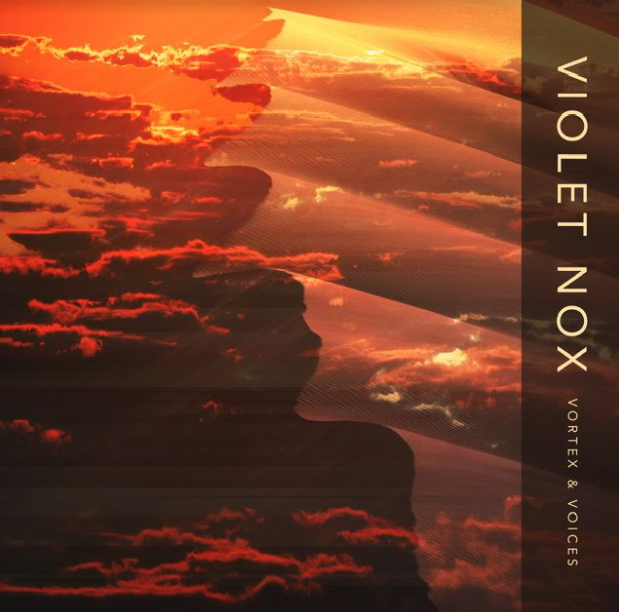
Violet Nox ‘Vortex And Voices’
(Somewherecold Records) 15th September 2023
A sci-fi chemistry of vapours the Boston, Massachusetts electronic outfit Violet Nox once more entrance with a futuristic new age album of psy-trance, cerebral techno and acid ethereal-voiced self-realization/self-discovery. Wired into the “now” however, messages of self-love and inclusiveness waft and drift to a rhythmic, wavy vision of EDM, crossover rave music and soulful electronica.
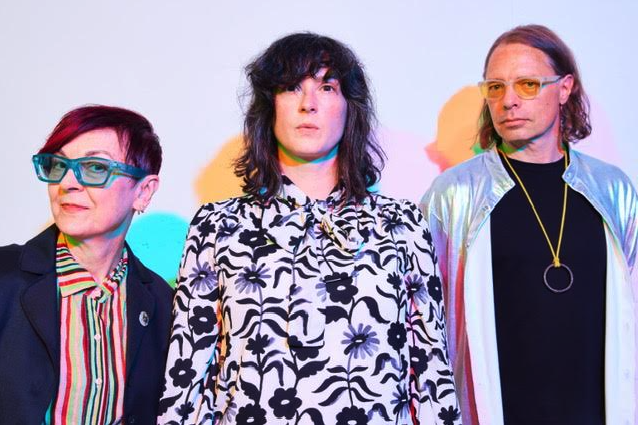
For this newest venture – their first for the highly prolific and quality North American label Somewherecold Records – features, more than ever, the experimental, often effected, vocals of group member Noell Dorsey: a mix of hippie cooed yearn, Tracey Thorn, Claudia Brücken and Esbe if you will.
A siren-in-the-machine, Dorsey expresses dreaminess, sadness and on the near mystical, wispy and lightly dub-y ‘Loki’, a past life as some Egyptian wraith – yes, I get that the title would favour something more Nordic in atmosphere and theme, but this regression into an old incarnation sounds more like a oboe trippy hallucination of Egyptology.
Often expanding the set-up, apparatus and lineup, this time around the Gaia attuned ensemble consists of core members Dez DeCarlo (on synth/effects pedals), foil Andrew Abrahamson (“synthesis”, sampler and clocked machines) and the already mentioned Dorsey. Musically, sonically they keep up the trance and minimal techno, melodic and kinetic rhythmic signatures, whilst erring towards club-like sung vocals and electronic pop. But it’s a real mix of synthesized influences, cybernetics and cosmic voyages into the internal and external mind.
The opening magnesium cooking vapoured and ached ‘Ascent’ evokes elements of Musicology, The Higher Intelligence Agency and Jarré; a lost trance-y peregrination from the early Warp label files. The more ominous, leviathan shadowed drama in granular cyberspace, ‘Chaos’, reminded me more of Harthouse, even Kraftwerk (those mesh-sizzled compressed drum pads especially), and the light note arpeggiator cascading and floated gauzy ‘Senzor’ sounds like a mix of Sven Vath and Vangelis’ Blade runner score.
Whether it’s journeying into the subconscious or leaving for celestial rendezvous’, Violet Nox turn the vaporous into an electronic art form that’s simultaneously yearning and mysterious. Fizzing with techy sophistication and escapism, the American electronic group continue to map out a fresh sonic universe.
Droneroom ‘The Best Of My Love’
(Somewherecold Records) 22nd September 2023
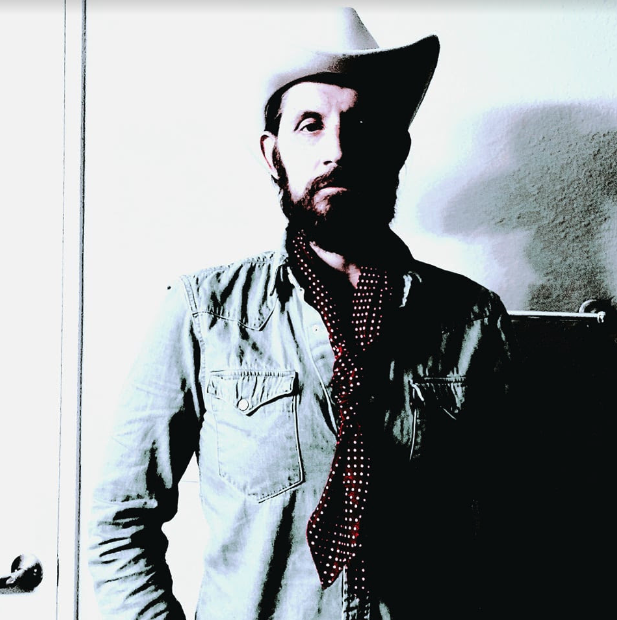
The barest hovering of a held note and most minimal of traced finger work, brushes and brassy resonance is enough to conjure up arid vistas, rumination and “sullen” emotions on Blake Edward Conley’s fifth album for the North American label Somewherecold.
The Louisville-based guitarist-composer can convey or draw out deep-held feels, sentiments and remembrance from scarcely rhythmic loops and drones – hence the Droneroom moniker. And whilst recording stations include the arrival/departure lounges of the Soulsville, Memphis TN and Denver International airports – Las Vegas too –, this latest vaporous and resonated transformation pictures mirages on mysterious desert horizons and both McCarthy and Lynch’s supernatural, occult ghosts of the old American West; think Ry Coder as an alternative choice for The Blood Meridian, or, the Gunn-Truscinski duo collaboration scoring Paris, Texas. ‘You Can’t Piss In The Same River Twice’ (sound advice) goes even further in evoking something both alien but recognisable. A filtered, muffled spherical vortex spins around like some off-world portal as Conley picks at and sort of strums a very removed vision of bluegrass on a brassy-resonating banjo.

‘Other Desert Cities’ sounds more like an enervated Sunn O))) with Brian Rietzel in a haze of blurred and more trilled echoes of nothingness. And yet a landscape image of something other and paranormal emerges from razor buzzes, scaly nickel strings and soft harmonies. It’s as if there’s a prevailing presence of someone, a thing, even time itself. ‘Cole Morse Was A Friend Of Mine’ whilst not so much elegiac, does paint a personalized desolate empty world of dust and reflection. It’s followed by another tribute/homage/thank you allusion to remembrance. ‘Nothing Of Value Is Ever Truly Lost (For Jess)’ is filled with warm feelings, a fondness, that’s weaved into an intimate gentle cascade of melodic country-folk-Americana guitar stirrings (reminding me a little of Raul Refree) that sound almost sitar like.
Abandonment, oaths, mourning and love hang like tangible descriptions in rippled, palpitating and softly juddered panoramas. Loops, vibrato, fanning effects are both wispy and sonorous; the guitar and banjo both recognisable and oblique on an album that applies an ambient and drone mystery to what you could call an abstract expansion of Americana.
The Monthly Playlist: Choice Music From August 2023: GOAT, Ramson Badbonez, Jaimie Branch, Part Bat, Dave Meder ..
August 30, 2023
PLAYLIST/TEAM EFFORT
A summary of the last month on the Monolith Cocktail site

Each month Dominic Valvona curates an eclectic musical journey from all the choice releases featured on the Monolith Cocktail, with records selected from reviews by Dominic, Brian ‘Bordello’ Shea and Andrew C. Kidd. Plus Matt Oliver’s essential hip-hop revue and a smattering of tracks we didn’t get the chance to write about for a lack of time and space.
_____TRACKLIST_____
Ramson Badbonez ‘Weight’
FRSHRZ X Tom Caruna Ft. Essa, Phill Most Chill, Clencha, Frisco Boogie, YU, Jehst, Homeboy Sandman, Willie Evans Jr., Dr Syntax, Doc Brown, Wizdom (Green Jade), Chill aka Greenzilla, Jaz Kahina, Mas Law, Koba Kane, Blade, Pavan, Seanie T, Michie One, Graziella, Watusi87, K9, Si Philli, Apex Zero, Genesis Elijah, Longusto, Nutty P, Tubby Boy, LeeN, Skillit, F-Dot-1, SKANDOUZ, Dray, Artcha, Georgious Lazakis, Dekay, Dee Lush, Briti$h, Anyway tha God, Quartz Crystallius, Lemzi, BREIS, Leo Coltrane, Jugg GTB, Slippy Skillz, Scorzayzee, Obi Joe, El Da Sensei, Whirlwind D, Dillon, Cuts From Jazz T ‘BARS 50MC – Remix’
Azalu ‘Fleshbite’
Lunch Money Life ‘Love Won’t Hide Your Fears (The Bishop And The Bunsen Burner)’
GOAT ‘Unemployment Office’
Flat Worms ‘Suburban Swans’
Part Bat ‘Okay’
Group O ‘The Answer Machine’
Black Milk ‘Downs Get Up’
Apollo Brown ‘Three Piece’
Open Mike Eagle ‘We Should Have Made Otherground A Thing’
Raw Poetic, Damu The Fudgemunk ‘The Speed Of Power’
Stik Figa, Blu ‘Uknowhut? (The Expert Remix)’
Jaimie Branch ‘Bolinko Bass’
Trademarc, Mopes, SUBSTANCE810 ‘No Huddle’
Joell Ortiz, L’ Orange ‘In My Feelings’
Kut One, Jamal Gasol ‘Stay Sucker Free’
Belbury Poly ‘The Path’
Hydroplane ‘Stars (Twilight Mix)’
Slow Pulp ‘Broadview’
Yann Tiersen ‘Nivlenn’
Rojin Sharafi ‘dbkkk’
Andrew Hung ‘Find Out’
Misya Sinista, ILL BILL, Vinnie Paz, DJ Eclipse ‘Verbal Assualt’
Verbz, Nelson Dialect, Mr. Slipz ‘Edge Of Oblivion’
Koralle, Kid Abstrakt ‘Mission’
Rhinoceros Funk, Rico James ‘Pump This’
Sa-Roc ‘Talk To Me Nice’
Elisapie ‘Isumagijunnaitaungituq (The Unforgiven)’
MacArthur Maze, DJ D Sharp, Blvck Achilles, Champ Green, D. Bledsoe ‘Switching Lanes’
Bixiga 70 ‘Malungu’
Gibralter Drakus ‘Exode Ritual’
Dave Meder ‘Modern Gothic’
Knoel Scott, Marshall Allen ‘Les Funambules’
Vitamin G, Illinformed ‘Big Spender’
NC Lives ‘Cycle’ Candid Faces ‘Coming Home’
The Legless Crabs ‘Unstoppable’
Neon Kittens ‘Sunburn On My Legs’
En Fer ‘Mon Travail, Mon Honneur Et Ma Perseverance’
Craig Fortnam ‘All Dogs Are Robots’
Liraz ‘Bia Bia – JM Version’
Galun ‘Mirror’
Exit Rituals ‘A Fluid Portrait’
Dot Allison ‘220Hz’
Hi, my name is Dominic Valvona and I’m the Founder of the music/culture blog monolithcocktail.com For the last ten years I’ve featured and supported music, musicians and labels we love across genres from around the world that we think you’ll want to know about. No content on the site is paid for or sponsored and we only feature artists we have genuine respect for /love. If you enjoy our reviews (and we often write long, thoughtful ones), found a new artist you admire or if we have featured you or artists you represent and would like to buy us a coffee at https://ko-fi.com/monolithcocktail to say cheers for spreading the word, then that would be much appreciated.
Our Daily Bread 589: Exit Rituals ‘Blinding Void’
August 23, 2023
ALBUM REVIEW/ANDREW C. KIDD

Exit Rituals ‘Blinding Void’
(Just Isn’t Music)
Blinding Void (Just Isn’t Music, August 2023) is the collaborative effort of husband and wife, Alan Myson (Ital Tek) and Anneka Warburton. I have previously written about Itak Tek on the Monolith Cocktail, which included a brief overview of his back catalogue: Our Daily Bread 579: Ital Tek ‘Timeproof’ June 22, 2023.
Anneka Warburton has an extensive musical curriculum vitae. She has collaborated with various artists on Mike Paradinas’s Planet Mu label; examples include the track Heart Space on the Vex’d album Cloud Seed (March 2010), the single of Starkey’s Ear Drums and Black Holes LP (April 2010), and my favourite FaltyDL vocal track, the rhythmical Gospel Of Opal on his You Stand Uncertain LP (March 2011). She collaborated with Forest Swords on the tribal track Anneka’s Battle from his lauded Engravings LP (Tri Angle, August 2013). Warburton also collaborated with Myson, featuring on Restless Tundra, the concluding track to Ital Tek’s Midnight Colour LP (Planet Mu, June 2010) – a time when footwork was regal, when bells and hit-hat hits and four-four beats tripped to skip into their next bar. Anneka has an EP to her name: the soulful Life Force (Anti Ghost Moon Ray, April 2017), the fourth track of which was showcased by Mary Anne Hobbs on BBC 6Music in January 2015. Her quasi-baroque experimentations using a Korg Minilogue on the track Burst (self-released, February 2018) confirmed her compositional skill.
We return to August 2023. Alan Myson and Anneka Warburton have collaborated again, this time as Exit Rituals, a group in its own right. Blinding Void opens with Soon Bloom. Sustained glass-shattering synths pierce the headphones; beneath this, the deep sounds of a cello bowing. A three-note pad eventually filters through, its minor melody proliferates, ascending to fuse in unison. Everything eventually exits. Warburton’s vocals are expanded further on A Fluid Portrait. She sings atop a sonic soup which stirs circumspectly. The vocoded vocals double up over an alarm-like synth that keys indistinctly.
A thudding heartbeat rumbles on Dream Canyon. This is not the lub-dub of a mammalian heart. Perhaps the life sounds of an object in the cosmos, or even light? Its reverberated third beat thrums. On the subject of light, this appears in many forms on this track, and the EP more generally: vocals, pushed away into the peripheries, aerate; an occasional electronic flourish tremolos into the distance. As the denouement of Dream Canyon is reached, the heartbeat becomes clearer, less muddy, until suddenly – it cuts out. Treble reigns supreme at this juncture. I am reminded of Björk circa Vulcincura (One Little Independent Records, January 2015).
The double-unison vocals of The Knife play out on The Light. The deep cello sound makes a further appearance. Staccato-synths provide momentary reference. There is no exposition on this track, no coda; rather, it moves seamlessly onto the title track which showcases the vocal talents of Warburton. She sings hazily, wavering even. I imagine her sung voice corresponding to the visible wavelengths of light; drawn out across their electromagnetic spectrum, the sharper frequencies are red, and the quieter violet stretch until they become ultraviolet, and onwards to X-rays. The synths are stripped-back and the bass bright. Everything coalesces.
Warburton’s vocals chop and stutter on Lacerate, helicoptering around to achieve impossible frequencies. In time they descend to merge with the bass-heavy undertones that have rumbled throughout this EP. The concrete synths of Myson begin to pummel the aural cavities of the listener. We are offered only perfunctory light on this track: the slightest of key changes in its very last moments.
Does Blinding Void have a narrative? It has yet to become clear. The highlight? The electro-classical Soon Bloom which mirrors the life-cycle of a flower. And where does this EP stand in the respective output of the couple? The earliest collaboration between Myson and Warburton was on Ital Tek’s 808-driven, sitar-infused dubstep EP, Deep Pools (Square Records, December 2007). The intensity of Weave on that release echoed the likes of Benga and Skream and Shackleton. Their collaboration then was a modern Lamb, of sorts. The respective sounds of Myson and Warburton have travelled a long way since then. With Exit Rituals, they achieve balance. Warburton brings warmth and light and organicity that offsets the machinations of the drum machines and caliginous synthwork of Myson. With Exit Rituals, there is a suggestion of gravity in the deep vacuum of electronica.
Jointly by Andrew C. Kidd and Ross Perry

Black Dog Productions ‘Bytes’ [1993]
The Black Dog ‘Spanners’ [1995]
(Warp Reissues)
Intelligent dance music. IDM. A difficult-to-define genre (if it even was one). Experimentation in dance music? The awkward shoehorning of ambience and danceable music? Flawed nomenclature aside, pinpointing the start of the movement is an even trickier task.
To dance is to move rhythmically. Ussachevsky and Stockhausen were creating electronic music in the 1950s, albeit it is difficult to argue that their creations were ‘danceable’. There are danceable moments on Spiral (Vangelis, 1977) and Équinoxe (Jean-Michel Jarre, 1978). Then there was the electro-pop Kraftwerk and the danceable synth-pop sounds of the likes of OMD, Moroder, Numan and Cabaret Voltaire. Yet, the sound that we most associate with modern-day IDM probably arrived in the very early 1990s. Utd. State 90 by 808 State (ZZT Records, June 1990) is an early example of the abstraction which underpins IDM, albeit that album was palpably more familiar as a resident in acid house. Tricky Disco by Tricky Disco (Warp, July 1990), Frequencies by LFO (Warp, July 1991) and Analogue Bubblebath by Aphex Twin (Mighty Force, September 1991) were IDM pathfinders. The public were probably exposed to IDM through Accelerator by Future Sound of London in April 1992 (released on Jumpin’ & Pumpin’). Warp can take credit for the naming of IDM on the compilation album, Artificial Intelligence, in July 1992.
Bytes (originally released in March 1993) is one of the most influential works in the intelligent dance music scene (it is regarded by some as the seminal work of IDM). The first iteration of the track Clan (Mongol Hordes), the work of I.A.O, an early moniker of Ken Downie (one of three aliases used on Bytes), featured on Warp’s AI compilation. Although Bytes is a compilation album, it has always been more synergistic than that – a musical Megazord of sorts (if such an obviously ‘90s reference can be afforded!). It was the third album in the Artificial Intelligence series and is thirty this year. When it was first released, it was a promise of futurity. Akin to the golden age of science fiction, there was experimentation, and comparatively difficult-to-differentiate narratives – the listener is drawn in and out of various sequences, some real, others fanciful.
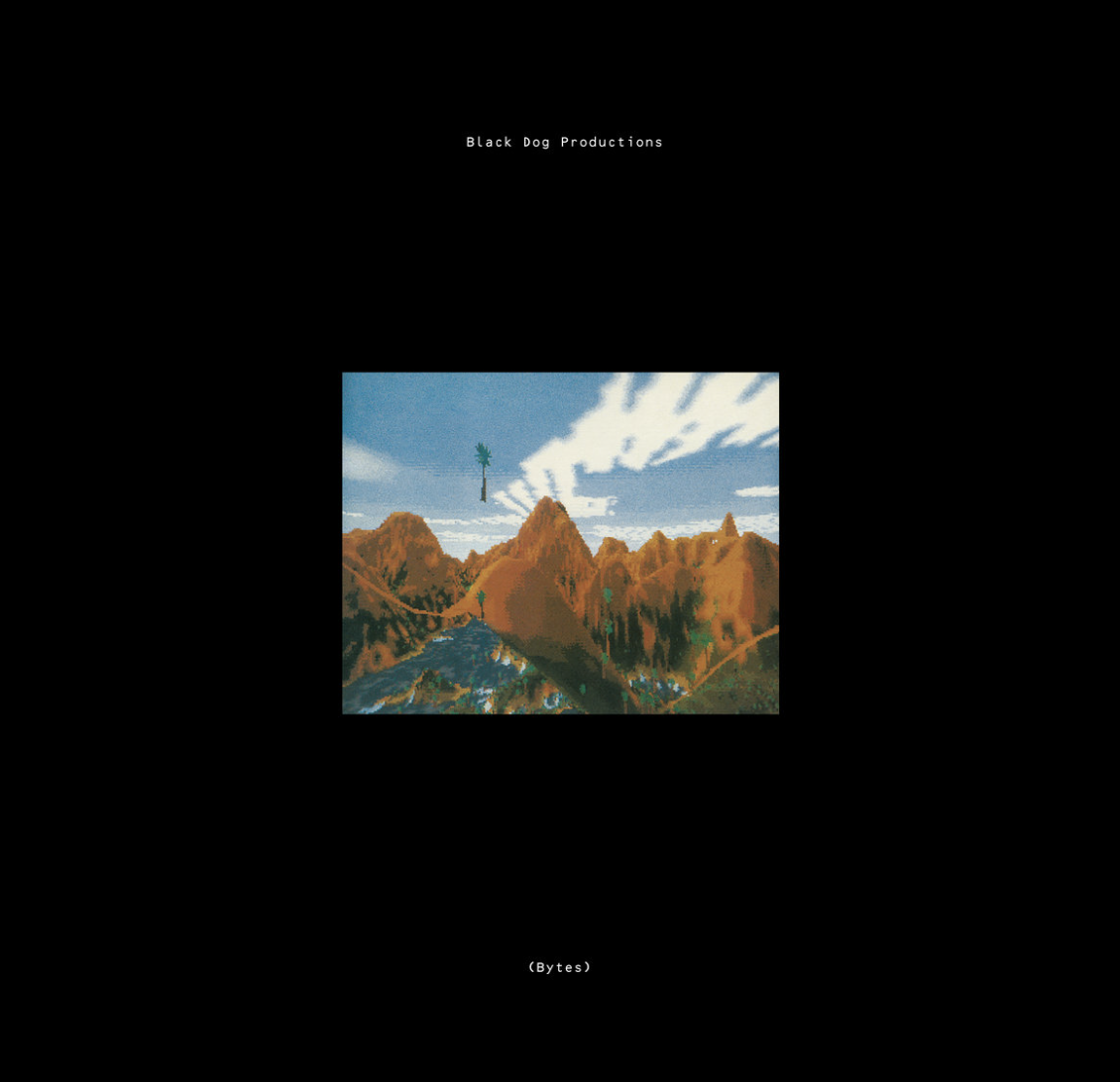
There is no doubting the influence of the Detroit techno scene of the mid-1980s and its dramatis personae: the joyful R-Tyme; the villainy of Suburban Knight; the realism of Model 500; and of course, Derrick May. Listen to the analog crunch and pulsing rhythm on the opening Object Orient (Plaid) – two hallmarks of that sub-genre. It railroads through the sonic journey with playfully synthetic melodies, slowing only occasionally for brief vinyl cuts. It is a deconstruction of what preceded it, like time folded up in slow motion. Similarly, the repetitive four-four chops on Merck are akin to a Mayday track; the keys, syncopated at times, improvised later, dance their macabre dance. The Phil 5 interlude that precedes Fight The Hits harkens back to The Art of Stalking by Suburban Knight; the same could also be said for Atypic’s masterpiece Otaku which sadly did not appear on Bytes – this featured on the Black Dog Productions E.P. released in May 1992.
Bytes is fantastically congruous. After Merck (Balil) fires off high-frequency plasma rifle shots in rapid succession, its latter half is mesmeric and glistens into the orchestral opening of Jauqq (Close Up Over)*. As the syncopated rhythm fades, a metallic beat enters, and the sound is progressed. Another fine example of this is Olivine (Close Up Over) – IDM in the definitive sense – and its light synths that dot around the checked squares of some strange sonic chessboard. Here, the rhythm progresses up and down like opposing rooks; the L-shapes of the syncopated synth are warring knights. The lithe ending is regal, and heralds Clan (Mongol Hordes) (I.A.O.)– queenly, like the multidimensional chess piece, it serves to take the rest of the board out. It is IDM ex-animo. Its movements pitch-alter. This is music from the soul. It sounds as genre-buckling now as it will have done in the early 1990s. The alarm-like initial melody initially hides the subtle breakbeat that builds into the piece. The 4-4 rhythm doubles up, almost rolling over itself. The four-key synth melody stirrups. The melody changes. A deeper bass commandeers.
Futurism: lasering zaps and string stabs on Caz (Close Up Over) and the steely undertones of Jauqq (Close Up Over). Sporadic canons also unload on Focus Mel (Atypic) in a manner that is not too dissimilar to early Subotnick and Nu-Sound II Crew (nearly a half-century later), or an A. Bertram Chandler hero travelling ahead to save us, the listeners in the present day. Its outro is an echoing aftershock from another place – the future is being told by Xeper as he knocks hard on the other side of the great glass door of time. The track preceding it – Carceres Ex Novum (Xeper) – underpins the experimentation which defines Bytes.
Fight the Hits (Discordian Popes) is an awesome percussive assault (similar to Polygon Window’s Quoth) which serves as a bit of a palate cleanser and a much-needed bridge between the chaotic Yamemm and Handley’s magisterial three-track denouement. Yamemm (Plaid) itself is fragmented and perhaps anomalous in this album†.
Bytes concludes with 3/4 Heart (Balil). The stock-heavy modulations are polyrhythmic. A Vangelis-esque synth is organ-like at points. The melody is snappy – danceable even! A half-clap effect – perhaps an imagined crowd – heralds the vocal line, “we must surf the universe”. The sound at this juncture is more refined, the narrative complex – the listener revolves around in a full-circle. Oneness is achieved.
At this point, it is worth mentioning how instrumental Ed Handley is to the legacy of Bytes as a groundbreaking album in IDM’s naissance. Atypic(Turner)’s Focus Mel is excellent, but it his only solo track on the entire record, and Downie’s three contributions are dynamic detours in their own right. Handley absolutely dominates this album with five solo tracks and two as part of Plaid. Whether it is Balil or Close Up Over, his mastery of clever arpeggios, countermelodies and otherworldly harmonic pads married with second-wave Detroit rhythms give the album a melodic heart, which beats all the way through from Object Orient to 3/4 Heart.
Bytes (and by extension, The Black Dog Productions moniker) also acts as an important milestone in Plaid’s evolution as a duo. Before it, we can hear on disc one of Trainer (Warp, July 2000) – an excellent compilation of Plaid’s early career output – that the group were more experimental, sample-happy, willing to genre-hop. Take the Latin-infused breakbeat stylings of Scoobs In Columbia, the jazz-tinged Slice of Cheese, or even the proto-jungle of Perplex (all these tracks were originally released from the oft-forgotten debut album Mbuki Mvuki, released on The Black Dog Productions label in 1991). Bytes on the other hand showcases a more focused pair, albeit a little lop-sided, that fills the record with top-tier ambient techno (which yes, will always get the IDM treatment!).
Spanners (originally released in January 1995), their first release on Warp, was the hit LP of The Black Dog – and for good reason. It is great to think that ‘way back then’ albums that clocked in at 75-minutes were charting (imagine that nowadays when albums are often sub-30-minutes). Admittedly, we live in a different time where attention spans are shorter. Most tracks on Spanners feel like a tug-of-war between Plaid as a duo and Downie as a solo artist. Plaid in 1994/95 had their more functional IDM/ambient-techno sound figured out, whilst Ken Downie remained somewhat of a wild-card: his trappings being more cinematic, sample-based and experimental, drawing from a much broader spectrum of influences. One of the elements we most enjoy about the output from the original Black Dog has been trying to surmise not only who did what in each track, but also which members were involved in certain outings. This is no more rewarding than on Spanners where some tracks seem like the work of a sole member (usually Downie), whereas other tracks feel like the work of a tag-team, either consisting of a Plaid member and Downie, or in the case of Tahr and Frisbee Skip, Plaid on their own. Frisbee Skip could very well double as a bonus track on the duo’s first (mainstream/Warp) full length, Not for Threes, released in October 1997.
The opening to Spanners is Raxmus, a classic in the downtempo repertoire; its sawing introductory synth leads into a horizontally relaxed beat. Raxmus feels like one of the more seamless tracks on the album, and we speculate that it is possibly a Downie/Handley duet: Downie providing the trip-hop template; Handley layering in his Balil-style harmonics.
The heavily-syncopated rhythm on Barbola Work (which disintegrates towards the end of the track) is interspersed with boings and hits and twizzles. It follows the formula that many of the early tracks on this album have: Downie providing the track’s introduction, throwing a wide range of vocal samples and/or exotic instruments at you, before Plaid build the track up with their infectious basslines, whirring clicks, zapping sound effects and magical synths. The Sugarhill Gang-laced explosion of an intro on Barbola Work is Downie through and through. Plaid then takes over to put down the melodic scaffolding and beat-work. The transition admittedly does not work quite as well on this occasion as it does on the proceeding track, Psil-Cosyin, perhaps coming off as a little dissonant.
Arguably the most cohesive three-track sequence (or four if one includes Bolt 3) follows. A major Locrian scale surfaces on Psil-Cosyin and scintillates in scaling brightness as the piece progresses. This is one of two clear highlights of the album where all three members of The Black Dog play to their individual and collective strengths and produce a definitive masterpiece. As an early Spanners track, the song structure is as described in the last paragraph. One can consider Psil-Cosyin as being composed of three suites: in the first, Downie arrests your attention with a mysterious intro of odd vocal samples and pipes; the second is signature Plaid with a slow and progressive build-up; the third is a roaring crescendo which serves as a climax. Here, all three members of the group function as a rare and perfect whole: Turner’s acid synths; Downie’s eclectic sampling; Handley’s Balil-esque angelic arpeggio. The concluding higher-rpm of the track serves perfectly to lead-in the membranophonic beat that anchors the light synth swathes on Chase The Manhattan, which may be a Downie solo venture or a collaboration between Downie and Turner. It is tribal-house-infused. The spacey pads are those that we often associate with Downie’s Xeper alias; Turner possibly contributes with acid licks and humming bass lines.
Tahr is an amalgam of the latter two tracks: a polymer-pungi weaves around a 4-4 beat. In this piece we hear a lot of Turner’s percussive sensibilities, addictive basslines and frantic trance-like synths (these can also be heard on Atypic’s Jolly on Trainer). Handley comes in later with another Locrian melodic flourish. Although Tahr is a short track, it is a great example of Plaid’s symbiosis.
One criticism we have of Spanners is its length. The 19 tracks are not an issue (the Bolt skits are sometimes only seconds long); rather, it is the occasional meanderings of the trio. Perhaps this is because thirty years have passed and listeners of the present day are used to more perfunctory albums clocking in at sub-30-minutes. Take Further Harm as an example. It is an expansive piece, one that stretches in and out, starting in the realms of downtempo, ending in synth-plopping abstraction. That said, it is one of the greatest examples of the stylistic fork-in-the-road (or tug-of-war) between Plaid and Downie. All three members are involved here, and the stop-start industrial breakbeat combined with the odd mantra of a vocal sample gives it a ‘train that is meandering down the track and picking up steam’ feel. More samples are layered in as well as all the sonics that Downie brings to the table, and then, two minutes in, the signature Plaid-synths, pads and basslines play out to give the track a melodic grounding that it did not have before. The hip-hop breakbeat is replaced entirely by a more industrial one in its later stages. As a piece that starts off travelling in one direction, Further Harm changes tracks, and an unpredictable journey ensues – it is a microcosm of Spanners.
Utopian Dream is similarly frequentative. It is one of the most leftfield pieces on the album. We have never heard anything like this from the Plaid members (was this a Downie solo?); imagine a harsher version of Boards of Canada’s Zoetrope on In A Beautiful Place Out In The Country (Warp, November 2000). The elegiac Nommo and its modulated synth stanzas and bassline climb their respective octaves – sequentially. It could have featured in a fictional Xeper album along Carceres Ex Novum on Bytes. Could the track idea have been consolidated, or even progressed like Olivine or Clan On Bytes? Regardless, Nommo remains cinematic.
The right balance between track length and monoinstrumention is achieved on Chesh, the other album highlight (it feels like more of a Handley solo piece, or mostly Handley with (possibly) Turner adding in a background layer). Pseudo-mythical modulations ascend and descend masterfully – imagine Ransom first exploring Malacandra (an Out Of This Silent Planet by C. S. Lewis reference), or the space sequence in the 1950 film, Destination Moon. There are echoes of Andreas Vollenweider too. The Balil style countermelodies and light airy synths interplay with the heavier reverb-laden keys – it is a magnificently poignant closer.
Spanners is a work of subtly in both melody and rhythm. Take the lithe key flourishes on Pot Noddle, ceilinged by the quiet clarion of higher synths; the guitar is indistinct, and the rhythm section almost organic. Fast forward to the sounds of Four Tet. The start-stop breakbeats we heard on Further Harm, albeit slower. The frantic ‘western saloon piano’ sample serves as a mid-point alarm clock. End of Time thunderously drums around penetrating synthetics. It is punchy, echoing the head nodding thrums of Fight the Hits (Discordian Popes) on Bytes. It is also trancey, and chaotically space-like (imagine the Starship Enterprise on an intentional suicide mission!). The time-warping synths are magnificent and reminiscent of early Black Dog tracks like Ambience With Teeth and Virtual, both released on the Virtual EP (Black Dog Productions, April 1989).
The skits Bolt 1 – 7 appear at varying intervals on Spanners. Some are simply white noise and filtered static, others almost wheezy. Their purpose is unknown – are they the voices of pulsars, or the sounds one would experience in the belly of an exploratory spaceship? Bolt 3 harks back at the Phrygian Psil-Cosyin and the chaotic goblet drum effect that thrums on Chase The Manhattan. Bolt 7 slides into obliquity, and onwards to Frisbee Skip. Listening to the Bolt skits again, their darker and more intense aesthetic share a similarity to Allegory 1 [Red], which Downie et al dropped in 2020. The third track on that release – Bar 331 – is metallic and off-key, an eerie transmission that has resurfaced 25-years later. Unlike the Phil interludes on Bytes, which serve as key intros and outros and transitions between certain tracks, the Bolt skits feel more like aural non-sequiturs. After listening to them again, they remind us of the more experimental segments of tracks we would hear on later Plaid albums such as Rest Proof Clockwork (Warp, June 1999) and Double Figure (Warp, May 2001).
Perhaps due to it being released on General Production Recordings rather than Warp, we consider it interesting that The Black Dog’s second album – Temple Of Transparent Balls – has not been reissued. It split their audience down the middle. We still enjoy listening to the ‘progenitor’, almost stock sounds that feature on that release. It had a machine-like quality, an insight into the deeper engineering works of IDM: a sonic forge with the anvil strikes on display.
On Spanners and Temple Of Transparent Balls, Downie’s approach and sound is definitely more unpredictable and harder to pin down than the Plaidsters’ experimentations and manipulation. We feel that the Plaid duo provide the two Black Dog albums‡ with less experimentation and a lot of the more conventional beat-work, basslines and melodic structure that would soon form the foundations of their Warp-era work, whilst Downie, the aforementioned wild-card of the trio, added in an off-the-cuff sample here, some industrial Meat Beat Manifesto-esque breakbeats there, or some bizarre and dissonant sound effects out of nowhere. He also seems to be the more cinematic of the three; his sounds are often themed on science fiction, and past and future landscapes.
So, in 2023, where do Bytes and Spanners sit in the pantheon of intelligent dance music? Well, Handley, Turner and Downie are rightly the archetypes of the IDM sound in the same way that Richard D. James (as The Dice Man), B12 (as Musicology), Autechre and Alex Paterson (as Dr Alex Paterson) are by their participation on the first Artificial Intelligence release. Having been forged out of the molten ambient techno and fiery rave scenes, the joy in returning to Bytes has been its rhythmic experimentation. Although not perfect, Spanners achieved what it set out to do. It is expansive, and labyrinthine – it washed away the harsh melodia of Detroit techno to toy with its listeners.
After the synergy, the separation. We are left with The Black Dog Mk.2 (Downie and the Dust brothers) and Plaid. The subsequent releases of The Black Dog marked a departure in sound in some regards, yet their output remains as heterogenous and experimental as it did all those years ago. The ambience of Music For Photographers (2021) is one for the musical aesthetes of this world; as an album inspired by the slab-grey brutality of the concrete architecture of Sheffield, it is wonderfully light.
The work of Turner and Handley continued as the dynamic Plaid. The duo would go on to become a permanent fixture with electronic giants Warp, starting with the ambitious and guest-heavy Not For Threes in 1997, consistently putting out records with the label to this day, a very impressive feat indeed. But how does Spanners fit in with Plaid’s break-away from The Black Dog? From what we can hear on Spanners, Plaid had become an almost-finished article with both members Handley and Turner comfortable in their respective roles. Handley clearly had already found his niche as the melodic heart of the group under his Balil alias on Parasight EP (Rising High Records, November 1993) and Bytes. We hear this consistently again and again on the most melodic segments on Spanners. By this point, Turner had also spread his wings under the Tura alias, switching to this from Atypic around 1994 (his work as Tura can be heard on the earlier-mentioned Trainer). This cemented his role as the more technical of the two: a master of infectious basslines, staccatic synths and dissonant zaps. Interestingly, Handley and Turner’s decision to move on as a duo also led to them re-embracing the genre-bending experimentalism that marked their earliest Plaid material, particularly Mbuki Mvuki. Nevertheless, no matter what sub-genre they would delve into on subsequent albums, Bytes and Spanners provided the blueprint for what would become Plaid’s core sound.
Those who listen to Bytes and Spanners in the present day will enter a sonic-time capsule: a time when a new world was burgeoned upon the drawing of the hip hop, electro and early Detroit techno influences of the late 1980s. This was a time of innovation, and deeply intelligent composition.
Footnotes:
* On the original Bytes release, this opening was actually an interlude titled Phil(7), the final of the Phil interludes. These interludes (mysteriously credited to Echo Mike, a handle to whom the identity has never been revealed) are not listed as separate tracks on the re-issue, yet they are vital elements ensuring that Bytes as an album works as a cohesive whole.
† This feels like something from Plaid’s 1989–1992 phase when they were experimenting with different sounds and styles, particularly hip-hop, early ‘90s industrial-breakbeat and house. These styles are also evident on the early EPs of The Black Dog.
‡ We are careful not to classify Bytes as a Black Dog album as it was released under Black Dog Productions, the name of their label, and a sort of holding company of all three members of the group’s respective aliases. We have also been careful in differentiating between this and The Black Dog which was the name used for their group efforts as a trio.
DOMINIC VALVONA’S MONTHLY RECCOMEDNATIONS AND DISCOVERIES
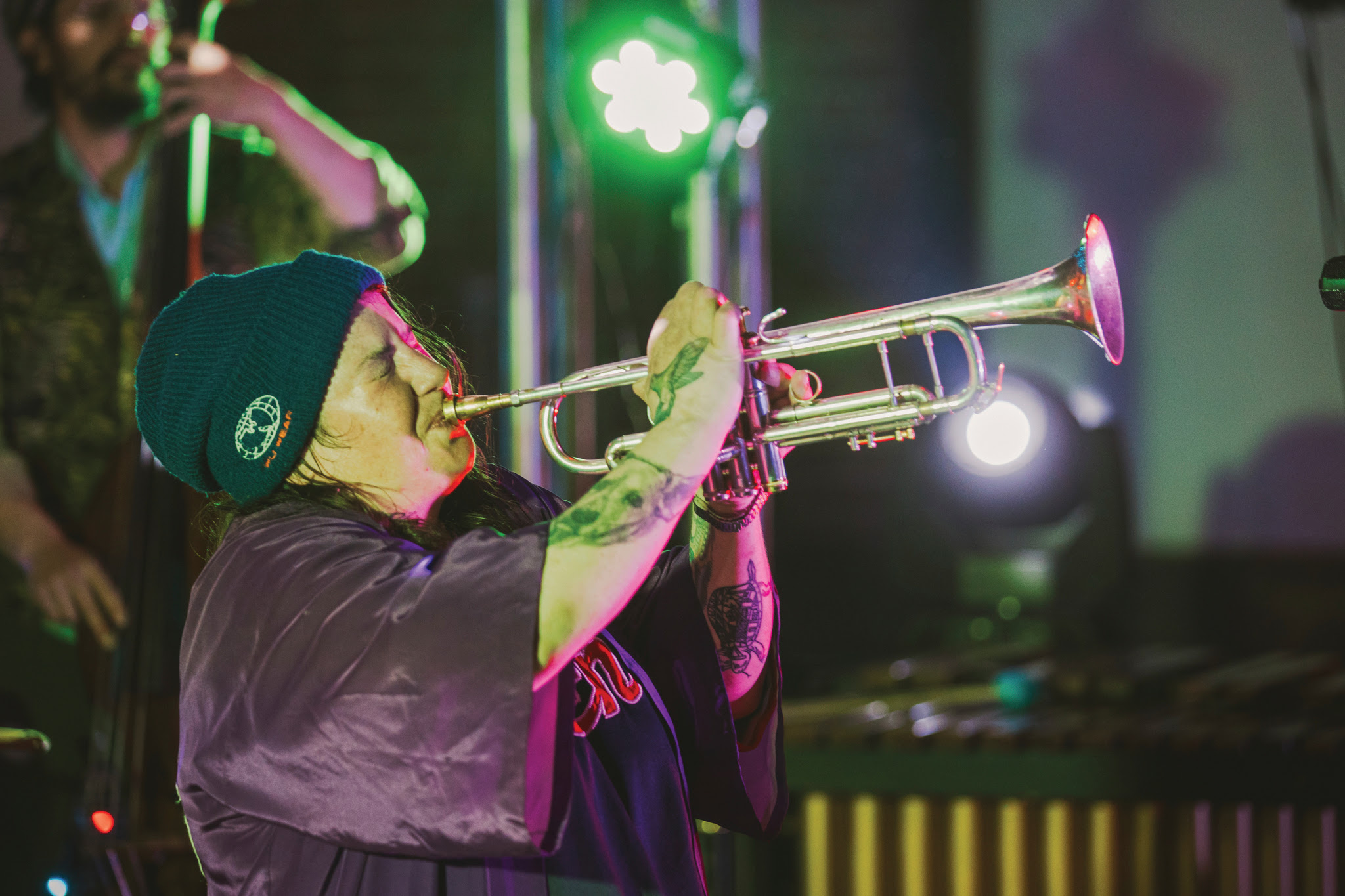
(Photo credit: Ben Semisch, courtesy of Bemis Center for Contemporary Arts)
Jaimie Branch ‘Fly Or Die Fly Or Die Fly Or Die ((word war))’
(International Anthem) 25th August 2023
As an unwittingly last will and testament, the late experimental trumpeter Jaimie Branch’s final led album with her Fly Or Die ensemble is a beautiful collision of ideas and worldly fusions that pushes and pulls but never comes unstuck. In fact, despite the “world war” suffix backdrop this album of both hollered and more disarming protestation colourfully embraces the melodic, the groove and even the playful.
Whilst the “avant-garde” label sticks, this rambunctious, more ambitious, more demanding minor opus flows and swings to a polygenesis mix of spiritual, conscious, Afro, Latin and Ethio-jazz, the great American songbook, no wave, noise and the psychedelic. And yet, on the other hand, is almost punk in attitude; a sort of anything goes in the pursuit of the message: an embodiment of challenging the boundaries.
In light of her untimely death at the age of just thirty-nine last year (the release of this album tying in with the first anniversary of her passing), this incredible statement can be read as a sonic monument; a legacy project left behind as a blueprint for a whole movement. The lyrics to the actionist rumpus ‘Burning Grey’, delivered more like Ariel Up or Polystyrene, to a swinging protest march of Phil Cohran, the Pan Afrikan Peoples Arkestra and Cab Calloway, seem almost prophetic: “Wish I had the time” and the lasting sign-off, “Don’t forget to fight”.
The final album is one Branch would recognize; more or less musically complete, recorded as it was back in April of 2022 during an artist residency at the Bemis Center For Contemporary Art in Omaha, Nebraska. However, Branch’s sister Kate and a cast of collaborators rallied round to finish the artwork and production; the final article a proud achievement encouraged on by well-wishers and friends alike.
Alongside “Breezy” Branch, who not only masters the trumpet but pushes her voice like never before and picks up on the percussion and some keys, is her stalwart troupe of Lester St. Louis (cello, flute, keys, marimba and voice), Jason Ajemian (double bass, electric bass, marimba and voice), and Chad Taylor (bells, drums, mbira, timpani and, you guessed it, marimba). That quartet is expanded further by an array of guests, including a trio of notable Chicago-hailed innovators (the city, one of Branch’s biggest influences and home for a period), the arranger/composer/engineer/trombonist Nick Broste, musician/vocalist Akenya Seymour and fellow International Anthem label mate, the drummer Daniel Villarreal (he released his debut, Panama ’77 on the imprint last year). Rounding that worthy impressive list off is the American multi-instrumentalist, Cave/Exo Planet/Circuit des Yeux (the list goes on) instigator Rob Frye.
Not so much a surprise, the album opens with a sort of stained glass bathed organ overture: part the afflatus, part pastoral hallowed ELP, part new age kosmische. A roll of bounded controlled thunder and gravitas is added to a crystal bellow and squeeze of radiant notes and the thinly pressured valves of Branch’s trumpet, which makes a brief appearance after the Ariel Kalma-like transcendence. ‘Aurora Rising’ lays down a short ceremonial communion with nature’s light before changing gear and spheres of influence. ‘Borealis Dancing’ now adds Mulatu Astake Ethio-jazz, a touch of Fela Kuti, Don Cherry and Yazz Ahmed to the ephemeral Northern Lights show as Branch toots long and softly at first before changing to higher pitch shrills. The rhythm, timing changes at the halfway mark towards a slinking groove of funk and Afro-jazz, the trumpet now cupped and echoing.
By the fourth track, ‘The Mountain’, there’s a complete sea change in mood, direction as Branch and her foils transform The Meat Puppets quickened country yin ‘Comin’ Down’. A dueting Branch and Ajemian bring it back home (so to speak) to the Ozarks and Appalachians via Paul Simon, Dylan, 60s West Coast troubadour traditions and a reimagined Sun Records. A brassy-sounded trumpet repeats the tone and springy country vocals as a gurgle of drawn-out cello plays a more somber rumination of hardy travail. To be honest, I was unaware of The Meat Puppets original, but this is a welcome meander in a different direction.
A full lineup joins in on the marimba heavy carnival turn mysterious swamp ether ‘Baba Louie’. Francis Bebey swerves to Satchmo New Orleans, whilst taking a dance around Masekela’s Soweto on a bustled bounce of joy and triumph, before succumbing to the voodoo psychedelic vapours; enticed by a cooing R&B flavoured misty Seymour. This bleeds into the bluegrass fiddled stirrings of ‘Bolinko Bass’, another Orleans evoked, almost regimental drummed bayou Mardi Gras of David Byrne, Funk Ark and Phil Ranelin. Almost mournful, ‘And Kuma Walks’ is more bluesy sounding, yet estranged at the same time; skulking amongst the spirits as someone saws through a fiddle as the trumpet aches in elegiac plaint.
Single, ‘Take Over The World’ is a hyped-up rattle and untethered excitement of no wave, punk jazz. Branch repeats a wild mantra and plays a burning bright thrill of trumpeted blasts whilst a controlled chaos spins all around her. Protest and partying converge for an electrifying, and later on, psychedelic bending stretched act of defiance.
The album ends by simmering down to a period of Afro-spiritual lament and reflection, on the sloganist berating ‘World War (Repirse)’. There’s serious bowed strings, trilled and forewarned trumpet, a sustained organ and windy, desolate enacted atmosphere on this weary actionist swan song: Branch urging caution at “false flags” and encouraging the fight.
For me Branch’s main instrument burns bright, and yet never seems to dominate, lead or overstay its welcome at any point on the album. Not for nothing is her own quote of “…meaning every note”, with not one rasp, trill, toot and cycle out of place; nothing is pushed but just felt and right at that moment. It feels to me, despite such a rich and diverse back catalogue, that Branch had so much more to give, her best still to come. And her gift was not just in crossing and mixing styles, influences, but also in pushing others to reach their own full potential as musicians. Fly Or Die Fly Or Die Fly Or Die ((word war)) is an accomplished album that channels the legacies of Chicago, New Orleans and New York to create an eclectic modern adventure in protest jazz.
Knoel Scott Ft. Marshall Allen ‘Celestial’
(Night Dreamers)
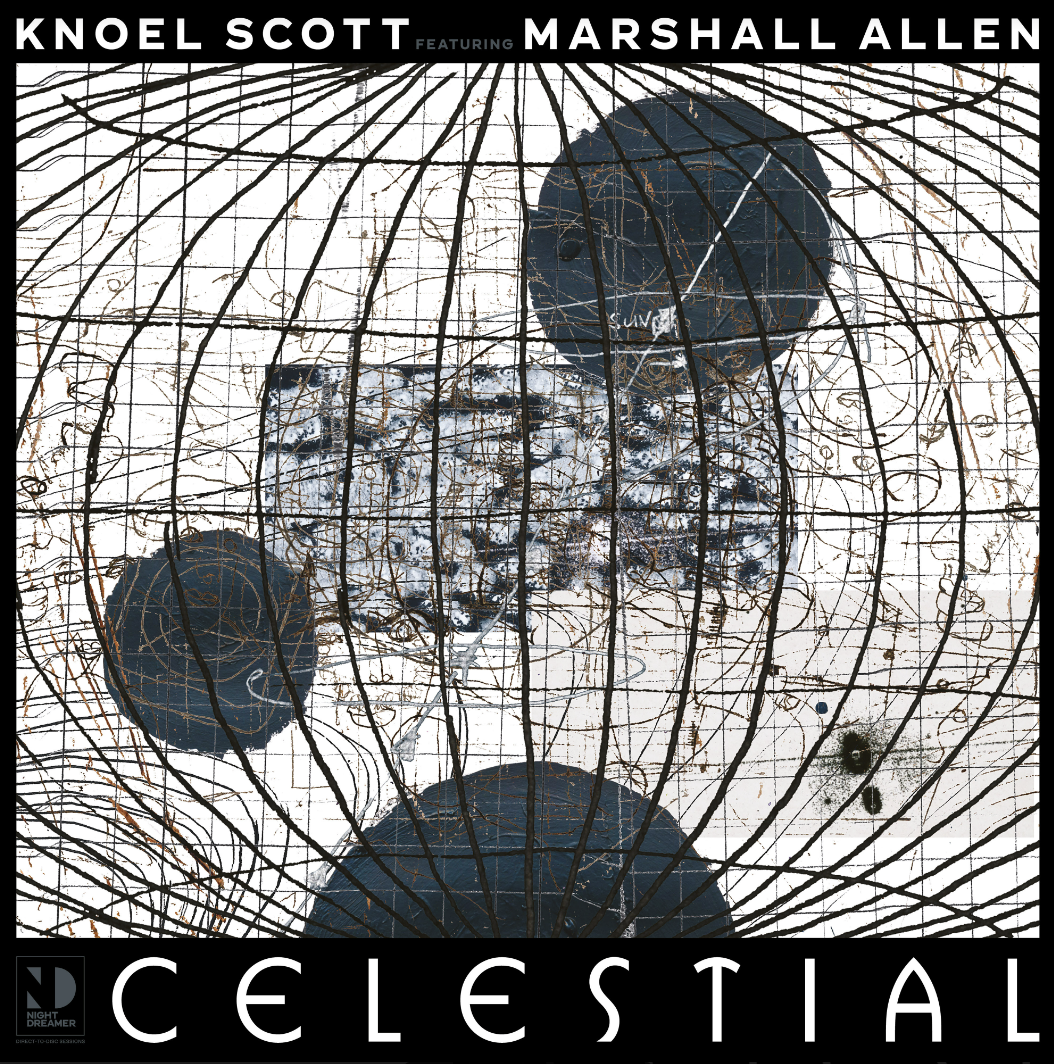
A leading light in the Sun Ra cosmology since auditioning for the Saturn jazz ambassador’s famous Arkestra ensemble in 1979, the baritone saxophonist, composer, vocalist and, when the occasion arises, dancer Knoel Scott amasses a lifetime of experience and musicianship on his debut solo-headed album. I say debut and solo, and without the extension of his previous KS Quintet named release, but the reeds specialist shares his Celestial project title with the Arkestra’s freeform progenitor, Marshall Allen.
Allen’s relationship with Sun Ra, on an album positively radiant and lunar with his guardianship and influence, goes back much further than Knoels; a stalwart since the ensemble’s formation in the 1950s, leading the troupe, the baton passed down as it were, after the cosmic Afrofuturist titan’s death in 1993. Unbelievably still in fine fettle, despite almost celebrating his centenary (that’s next May by the way), the avant-garde, inter-dimensional alto saxophonist, flutist, oboe, piccolo and EWI (that’s Electronic Wood Instrument) synthesist can be heard lending the latter’s strange sci-fi arcs, bends and space dust to the album’s title-track. It’s unsurprising to find that ‘Celestial’ has all the hallmarks of Ra too, written as it was originally with strings for the Arkestra, but never recorded.
The Arkestra family is extensive with celestial poetry taken from the late Arnold “Arto” Jenkins, recited on this universal lullaby. Art stuck with the Arkestra for thirty-six years, right up until his death in 2012. You can hear him and his “space megaphone” delivered offerings to the galaxy on Secrets Of The Sun, way back in 1962. As a homage to that universal-spiritualist’s wanton guidance, Knoel trips the radiant light fantastic, giving praise to the wisdom of the ancients and star people on a seeker’s performance of UFO oscillations, serenaded sentiments and dreamy translucence. It sounds like Cab Calloway and 50s wings being beamed up into Sun Ra’s off-world paradise.
The influence continues with the presence of the Paris scene stalwart and multifaceted (from Dancehall to Makossa, and of course jazz) drummer Chris Henderson, who’s experiences lend a both studied and more untethered freeform feel that moves between swing, big band, Latin, bop and the experimental.
This however is an inter-generational album, with fresher faces of the London scene, the very much in-demand UK keyboardist and versatile pianist Charlie Stacey and Verona-bred electric bassist and oft Arkestra and Knoel Quartet foil, Mikele Montolli. Hailed, quite rightly, as an advanced player, able to adapt to a wealth of styles, Stacey’s touch can evoke the best of those sublime 50s Blue Note recordings, touches of Oscar Peterson and Allen collaborator Terry Adams. The piano both flows with a tinkled busy lightness or strikes the heightened and jarring near-dissonance of freeform jazz; a descending off-tune part here, Cuban show time and bluesy or smoky lounge parts elsewhere: Unstated, yet moving along the action, or taking a soft stroll down the scales.
It’s another musician, part of the luminary brethren, that inspires the Afro-Cuban via Saturn’s rings ‘Makanda’. Paying tribute to a late mentor, Dr. Ken “Makanda” McIntyre, Knoel cooks up a Latin flavoured cool breeze of Havana, Harold Land vibes and R&B grooves: all undulated by sci-fi warbles and flits. A pivotal figure and influence for Knoel, “Makanda” (a name bestowed upon the reeds maestro and composer when playing in Africa, it translates from the Ndekele language as “many skins”, and in the Shona as “many heads”) founded the first ever African American music program in the States in 1971, and had worked with such notable talent as Eric Dolphy, Cecil Taylor and Nat Adderlay. Knoel and friends up the funk and balmy rhythms on this soulful homage to the late great man.
On his part, Knoel’s saxophone squawks, strains, honks and squeaks, and yet also serenades: even soothes. Wilder higher registered beak pecks turn into a near chaos, a cacophony, on the improvisation piece ‘Conversation With The Cosmos’. Coltrane, Sam Rivers and Anthony Braxton wail in zero gravity, whilst those wild rasps feel almost smoldering and lounge-like on the final mid paced twelve-bar slinky ‘Blu Blues’.
What a stellar set from the Arkestra acolyte, the Marshall and inner circle; and well done to the Night Dreamers for coaxing out this cosmic marvel. The process if you’re new to this label project, is to record the performances direct to tape before cutting on a Sally lathe the final vinyl artifact. In mono, recorded in an analogue studio, the sound is alive, inviting and, well, “celestial”. The experience speaks, communicates, and pushes the perimeters on every note, as a culmination of African American jazz styles are attuned to the stars.
Andrew Hung ‘Deliverance’
(Lex Records) 11th August 2023
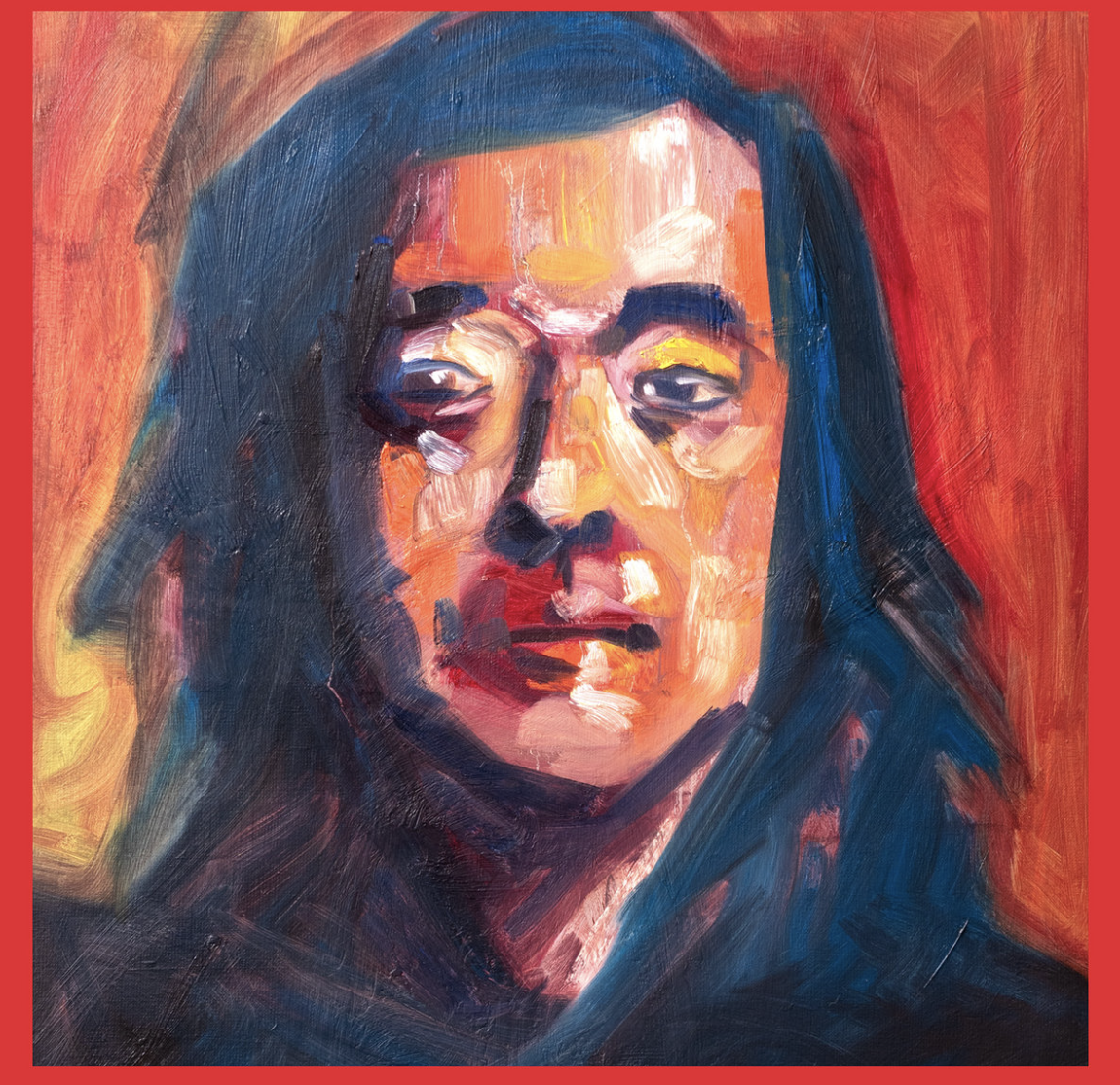
With pain, suffering and anguish former Fuck Buttons trick noise maker Andrew Hung finds a cathartic release on his third solo outing, Deliverance. But as that title suggest, the anxieties and sense of isolation and belonging now seem to have slowly dissipated as Hung feels he’s been delivered from the morose and dark fog of depression; although there’s plenty of broody, moody despair and darkened thoughts to wade through before catching the light of hope.
Hope, being set free, the constantly developing artist and producer does seem to have found his creative peace; likening this album to “the end of the chrysalis stage, like breaking free from a previous life.” Not so much reincarnation as a new incarnation, pushed on during lockdowns to mine the deep well of his soul, to face regrets and failings, but also find what’s missing.
An act of self-realization perhaps, Hung conducts a therapeutic session both unflinching and revealing. If the lyrics of ‘Don’t Believe It Now’ are anything to go by, thoughts and mental anguish at one point were truly dark. However, that filtered vapour counters the resigned with a reviving build up. And on the opening tunneled, Sister Bliss and Underworld like, moody turn freedom spin, ‘Ocean Mouth’, Hung faces a list of disappointing traits head on: Almost like taking a breath as the Robert Smith-like palpitations and rave-y Bloc Party velocity of the production avoids suffocation and gravitates towards the techno cathedral of light. Submerged at every turn with recurring references to water, Hung swims and navigates the torrents and tides to find a number of revelations about himself: conquering fear.
The previous solo album, Devastations (a choice album no less in my end of year lists for 2021) looked to the cosmos with a propulsion of electronic, kosmische, motorik, Madchester and synth pop influences, and featured Hung the self-taught singer evoking a mix of Robert Smith (some very cure-esque touches musically too), Karl Hyde, Mark Hollis and The Cry’s Kim Berly. More distressed, gasping and wrenching Hung takes some of those same influences forward on Deliverance, whilst also seeming to whip up a touch of Minny Pops, New Order, Soft Cell and John Foxx on the struggles of isolation and need to belong themed neo-romantic ‘Find Out’.
In another honest cycle of shedding shame and casting away the pain in favour of finding that alluded love “saturation”, ‘Never Be The Same’ builds from synthesized drum pad elements of the 80s German new wave, Factory Records and industrial synth-pop into another unshackled escape towards the light of revelation. I’d throw in Martin Dupont, Tears For Fears and Yazoo to that both pumped and vapourous mix.
Floundering no more, Hung looks to have found his place, his voice too. Deliverance finds him channeling his lamentable, pained, and unsure emotions into something positive and bright with another candid confessional solo album of rave-y synth-pop indie brilliance.
Various ‘Intended Consequences’
(Apranik Records)
With a hellish multitude of flashpoints and distractions across the globe keeping the continuing fight for women’s liberation in Iran off the news rolls, it has become apparent that the Iranians themselves have been left to carry on the struggle with little support. In an ongoing war between the forces of the authoritarian religious state and a younger generation demanding an end to the erosions of there civil liberties and freedoms, the crisis in the country entered a dark bloody chapter last year with the murder in custody of Masha Zhina Amini by the “morality police”.
After a rightful campaign of protest and action at such a heinous crime, a brutal crackdown by the state led to mass arrests and even executions (mostly of male supporters, activists, and usually on trumped up charges). Further restrictions were invoked. And just as horrifying, in the last year, and right up to the last few months, there has been a nationwide spate of deliberate poisonings of schoolgirls (one of the groups who mobilized against the authorities in the wake of Amini’s cruel death) on mass. Defiant still, even in the face of such oppression, the brave women of Iran have strengthened their resolve only further.
In the face of such attacks, clampdowns, the music scene has responded with a strong message of resistance and solidarity. Despite everything, cities like the capital of Tehran have a strong music scene of contemporary artists, composers, DJs and performers working across all mediums, including art (which is probably why so much of the music is also so visceral, descriptive and evocative of imagery). One such collaborative force of advocates, AIDA and Nesa Azadikhah, co-founded the Apranik Records label, a platform for female empowerment. Following this year’s earlier Women Life Freedom compilation, a second spotlight volume delves further into not only the Tehran scene but picks out choice tracks from those female Iranians working outside the country, in such epicenters as London (AZADI.mp3) and Berlin (Ava Irandoost).
Sonic wise it covers everything from d’n’b, trance, deep house and techno to sound art experimentation. The range of moods is just as diverse in that respect, from restlessness to the reflective and chaotic.
Contributions from both Azadikhah (the hand drum rattled d’n’b breaks and spacy, airy trance ‘Perpetual’) and AIDA (the submerged melodious and dreamy techno ‘Ode To Expectations’, which features the final love-predicament film sample, “You know that I love you, I really do. But I have to look after myself too.”) can be found alongside a burgeoning talent pool. The already mentioned London-based producer and singer AZADI.mp3 opens this collection with a filtered female chorus of collective mantra protest, set to a sort of R&B, 2-step and bass throbbed production, on ‘Empty Platform’– just one of many tracks that uses the sounds of a more traditional Iran, especially the daf drum, alongside modern and futuristic warped effects. The sound artist and composer Rojin Sharafi likewise features the rattled rhythms of hand drums and some hidden spindled instrument – like running a stick across railings – on her entrancing kinetic techno ritual of “trauma”, ‘dbkk’.
Abji_hypersun allows the sounds of the environment to seep into her slow-building track of field recordings, collage and breaks (two-stroke scooters buzz by as distant female conversations reverberate on the street). Part jungle breaks pirate radio, part Matthew David, Jon The Dentist and LTJ Bukem, ‘Resist The God Trick’ evokes a tunneled vision of haunted reminisces and resistance in the shadows.
Emsho’s ‘Down Time’ is a rotor-bladed electro mix of Basic Channel and The Chemical Brothers, and Aida Shirazi’s mysterious wind of dark meta ‘R.E.V.O.L.U.T.I.O.N’ spells out the rage with a shadowy, near daemonic scripture of wrath and revenge – a gothic synth sinister avenging angel promises that the women of Iran will neither “forget” nor “forgive” their oppressors, torturers and murderers. Farzané seems to evoke the alien, the sci-fi on her experimental, sometimes disturbing dial twisting and crackled ‘Quori’ transmission, and the Berlin-based DJ, video artist and music producer Ava Irandoost draws on Laraaji-like dulcimer tones for her dream mirrored kosmische evocation ‘CINEREOUS’. The Tehran composer, pianist and bassist Ava Rasti draws a close to the compilation with a classical-tinged, harmonic ringed, saddened piano-lingering performance, entitled ‘Eight Night’ – an atmospheric troubled trauma is encapsulated with the deftest of touches.
It might be my own nostalgic penchant for 90s electronic music (my formative years of course), but this series (if we can call it that) could be an Iranian version of the Trance Europe Express compilations brought out during that decade; a treasure trove of discoveries and whole scenes that opened up a world of previously unknown music to many of us not living in the epicenters of North America, the UK and Europe and beyond. Hopefully this latest platform of innovative artists from across the arts will draw the attention it deserves; the message hardly virtuous, in your face, but sophisticated: the very act of female Iranians making a name for themselves despite censorship and bans a sign of empowerment and resistance in itself. Few groups deserve our support (which in the West has been sadly absent) more, but don’t just purchase for the cause but for the musical strives being awakened and produced under tyrannical oppression, and because this is a solid collection of great electronic music.
Nagat ‘Eyoun El Alb’
(WEWANTSOUNDS) 25th August 2023
Renowned as one of the greatest, most exceptional voices to have emerged from the golden 40s/50s/60s epoch of Egyptian and the greater Arabian songstresses and divas, Nagat El Seghirah was a rightly revered performer, who’s career spanned more than half a century.
Even in an age rich with accomplished, influential and groundbreaking singers Nagat held her own against such icons as Oum Kalthoum, Fairuz, Warda and perhaps the most celebrated of the lot, the anointed “voice of Egypt” Umm Kulthum. The latter, hailed the “star of the east”, was an influence on the early starter during the burgeoning years of imitation, when Nagat was a child, barely in her teens. Her affectionate appellation, “El Seghirah” or “El Sagheera”, can be translated as “the small”, “the young”, and marks the singer, performer and film star’s young apprenticeship; from entertaining the notable guests that gathered at her father’s (the famed calligrapher Mohamad Hosny) home at the age of five onwards, to her first role in cinema at the age of eight, starring in the 1947 film Hadiya. Hosny was known to push his extensive brood of children from two marriages, sometimes excessively, into various creative careers: Nagat’s half-sister was the famous actress Soad Hosny, her older brother, Ezz Eddin Hosni, a notable composer who helped her own development and natural talent.
During those initial years of development Nagat would interpret songs by such legendary figures as Mohamed Abdel Wahab, Baligh Hamdy and Kamal Al Taweel, but would find both her true and distinctive voice when interpreting the work of the Syrian diplomat-poet Nizar Qabbani. She gained adulation and fans after performing the esteemed poet’s tragic ‘Irja Ilyya’ (“Return To Me”), which is based on his sister who committed suicide rather than enter into an arranged marriage. Plaintive, stark, it rightly struck a chord with the public at the time, with its feminist lyrics and spotlight on forced marriages. It would be become a torchlight for freedom and injustice, with Nagat adding her own improvised original lines during the 1970s.
Born in 1938 but already gaining plaudits by the end of the next decade, into the next, Nagat released her first actual song ‘Why Don’t You Allow Me To Love You’ in 1955; the year she would also be married, for the first time, to a friend of one of her brothers: still only sixteen. It’s no surprise, although in no way a forced marriage, that she could, with a commanding voice, perform Qabbani’s tragedy. That marriage would only last however until the turn of the 1960s; when Nagat went on to marry the Egyptian film director Houssam El-din Mustafa in 1967 (a marriage that lasted an even shorter time). Nagat would remain, in fact seeing as she is still alive, in her eighties, remains unmarried. In recent years, since her singing retirement over twenty years ago, living a semi-reclusive life in Cairo but in poor health, there’s been some contact, even projects floated. Only last year she was featured on the official soundtrack for the streaming service series Moon Knight.
From concert to soundstage with starring roles in the films Black Candles, Beach Of Fun, My Dear Daughter and Dried Tears, Nagat gradually moved from shorter songs to ever more lengthy performances, some of which would last an hour. As time went on the songstress actress would find it harder to find those inspired works to perform. Retiring from film in 1976, Nagat would still persevere with music. And by the time she reached her early forties, in the 1980s, would release this four-track showcase of matured talented performances entitled Eyoun El Alb.
Originally brought out exclusively on cassette (like so much of the Egyptian music market), forty odd years later the reissue vinyl specialists of impeccable tastes (releasing a myriad of jazz titles and nuggets from across the Arabian world and Japan), WEWANTSOUNDS in conjunction with the Arabia and North African crate-digger Disco Abrabesquo (the moniker of the Egyptian, Amsterdam-residing DJ, Moataz Rageb), have pressed it onto vinyl for the first time. If you are a regular reader, or in fact a regular WWS’s follower and buyer, then you will be aware of that label’s previous collaboration with DA, last year’s (although they’ve also released a smattering of Egyptian focused records too over the years) Sharayet El Disco compilation. One notable inclusion on that eye-opening compilation (reviewed by me in May’s Perusal column) was from the legendary Al Massrieen. A much sought after recording outfit, the group’s Hany Shenouda produced the scenic, romantic ‘Ana Bashaa El Bahr’ (or “I Adore The Sea”) finale on this Nagat album. Adoration and yearned dreaminess for a place and time are evoked to Shenouda’s trebly near-psych tremolo guitar and light hand drum patters. Alongside the more lilting and fluted ‘Bahlam Meeak’ (“I Dream With You”), this is one of those examples of Nagat’s shortened form of storytelling romance and heartache. ‘Bahlam Meeak’ is also an example of Nagat’s more lightened, honeyed approach to what is a tinkled serenaded, wafted vision of blossom scented sand dune balladry. It evokes the music of Bacharach and the cool soundtracks of early 60s French and Italian new wave cinema.
Taking up the entirety of Side One, there’s the long form titular performance of heightened drama and searing swirled strings oboe and scuffled trinkets. Over eighteen-minutes of longed romantic gestures, the action pauses repeatedly between undefined sections; allowing the auditorium audience to show its appreciation, encouragement, which they do constantly, even when the music starts back up again. On a Matinee scale, this mini-story, unveiling of lovelorn exultations, but vulnerability and occasional lament, moves like a desert caravan across an Egyptian set, or, sumptuously glides into a Persian court. A fantastic display of sagacious craft, Nagat’s voice never has to rise or push to convey a class piece of theatre and effective yearn of love.
Only half that duration, but still a long track, ‘Fakru’ (“Do You Remember”) is a rumination; the vibrating pools of memoary reflected in the dreamy wobbled effects that permeate this fluctuating lead vocal delivery and prompting chorus of female voices. Classical Cairo, there’s a chink and tinkle of percussion and shimmy-shaking, belly dancing rhythm that luxuriantly accompanies a yearning poetic and sometimes coquettish Nagat on her reminisces. As I said already, this album represents various sides of the enchanting, soulful and also distinctive icon’s vocal presence and range. The long and short: the unmistakable sound of Egypt, but also those influences from abroad too, are melded together on a classy piece of cinematic and poetic mastery. Make room again on those creaking shelving units for another vinyl addition to the collection.
CHELA ‘Diagonal Drift’
(Echodelick – USA, We Here & Now – CA, Ramble Records – Aus, Worst Bassist Records – EU)
In communion with his long-time friend and collaborative foil in the University Challenged trio (alongside Oli Heffernan) Kohhei Matsuda, Ajay Saggar extends his blessed travels along the astral highways and byways with a new venture, CHELA.
Absorbed, imbued and inspired by Indian spiritualism, history and travails, its psychogeography and trauma, both partners in the new direction come together under the Sanskrit word for “disciple”; taken from the verb and root “to serve”, the “Chela” is similar in concept to a student, but implies a more loyal closeness with their teacher. In Hinduism this bond is considered sacred: An apt moniker for such inter-dimensional, afflatus dreamers and acolytes of raga, the new age, psychedlia and kosmische music.
Divine styler Saggar (who is also a member of King Champion Sounds, solos under the Bhajan Bhoy alias, and collaborates with Merinde Verbeck in the Deutsche Ashram duo) and Japanese noisenik Matsuda (most notably a member of the Bo Ningen quartet) spent much of 2022 putting this inaugural baptism together. And so with dedication to their art, the duo have sonically and melodically taken time, given depth to their new mysterious broadcast; that is, broadcasts from the ether, supernatural, uncertain, Fortean and cosmic. Different yet not entirely detached from previous incarnations, fans of both artists will pick up on past signatures, sounds and conceptions. However, they’ve managed to realign those same signatures, tuning into the mystical but often with trepidation and a sense that the noisier elements could consume all in their path.
Think Julius Eastman meets Fennesz we’re told; a good succinct summary. But I’d add a hell of a lot more, including Taylor Deupree and a cosmology of cosmic couriers. The opening ripple in the fabric of time, ‘Flyspray’, is an expanded peregrination of Beautifully tinkled Florian Fricke-like piano hauntings, Ariel Kalma and Syrinx new ageism and various Sky Records pioneers (Asmus Tietchens and Riechman spring to mind), all caught up in analogue wispy wind cacophony of divine rays, the esoteric and Eastern drones. Trippy warped reversals and folds, generator and processors nearly overwhelm the vague evocations of Tony Conrad, Schultz and a springy, but also spoke splayed banjo (which in itself seems to vaguely evoke the Balkans, Greece and strangely, India) on the reverberating ‘Appalachjo’.
In what could be a suggestion of “peace” and “harmony”, or reference to the Japanese town, ‘Heiwa’ is a hummed raga-like hymnal. A stand-up barrel-type piano plonks away from the ether, whilst ambient waves and traces of Dyzan invite heavenly reflection. ‘Ticker’ is a very different proposition. An intense chemistry of signals, beeps, quickened arrpegiator, moody signs of Faust and the sound of the Heart Of Darness are melted with Günter Schickert guitar, heavy acid Gong and various calculations.
‘Tanker’ feels like the most obvious attempt to score the sound of the title’s overbearing object; sounding like a alien freighter, both foreboding and mysterious. A scrawl and flapped ripple of radar and sonar bites into a resonating field of drones and sound waves, fog and guitar.
The final, spiritual and otherworldly track, ‘Worship’, features ghostly Indian voices and visitations from an event, service or chapter in time and history. A melodious piano chimes away in wisps of fanned cosmic mystique and cyclonic radio effects, whilst shades of FSOL, King Creosote (From Scotland With Love period) and Boards Of Canada linger. The video is more illuminating, a sepia film of bedside “worship”, healing for a leader, martyr, and a travelling funeral cortege that takes in rows of witnesses moved to touch, or just be in the essence of a distinguished teacher.
Once again with the cosmic and afflatus, Saggar and Matsuda expand their sound further. Diagonal Drift’s transcendental projection is just that, despite the building intensity and uncertainty, the broadcast noise of krautrock and kosmische styled aerial bends and radio tunings. CHELA is another welcome addition to the two artists oeuvre: one more step on the astral journey of mind-expanding experimentation.
Monthly Playlist Revue: July 2023
July 28, 2023
CHOICE MUSIC SELECTION FROM THE LAST MONTH ON THE MONOLITH COCKTAIL
TEAM EFFORT: DOMINIC VALVONA/MATT OLIVER/BRIAN ‘BORDELLO’ SHEA/GRAHAM DOMAIN/ANDREW C. KIDD
The Monolith Cocktail Monthly playlist is a revue of the last month on the blog, plus those tunes we didn’t get time to review or feature: including Matt Oliver‘s special hip-hop selection. Curated as a musical journey by Dominic Valvona, there’s a huge diverse array of choice tunes from across the genres and the globe, collated from an amalgamation of posts by Dominic Valvona, Brian ‘Bordello’ Shea, Graham Domain and Andrew C. Kidd.
THOSE TRACKS IN FULL ARE…
Habitat 617 Ft. Jack Slayta ‘Bricklayer’
Young Van Gundy Ft. Al Divino & Tha God Fahim ‘Fuyu No Senso’
J. Scienide & Napoleon Da Legend ‘Wind Parade’
Annie Taylor ‘Fucking Upset’
White Ring ‘Before He Took The Gun’
African Head Charge ‘Asalatua’
Mokoomba ‘Ndipe’
OKI ‘Tukinahan Kamuy’
Dip In The Dub ‘La Cumbia Del Sufi Que No Sabia Bailer’
Luiza Lian ‘Eu Estou Aqui’
Deja Blu ‘Crash’
It’s Karma It’s Cool ‘Vacations In A Taxi Cab’
Life Strike ‘Whip Around’
K-Nite 13 & Lee Scott Ft. Homeboy Sandman ‘Staple Junk’
The Moose Funk Squad ‘Abe Simpson’
Verb T & Vic Grimes ‘Your Heart Deserves’
SadhuGold ‘Fear Of A Black Yeti’
The Difference Machine ‘His Country’
Rusty Santos ‘Focus’
August Cooke ‘Shed With Me’
Maija Sofia ‘Telling The Bees’
Circe ‘My Boy Aphrodite’
Natalie Rose LeBrecht ‘Holy’
Hackedepicciotto ‘La Femme Sauvage’
Fat Frances ‘The Worm In The Wood’
Mike Gale ‘Summer Be Gone’
Stella Burns & Mick Harvey ‘My Heart Is A Jungle’
Emil Amos ‘Jealous Gods’
Oopsie Dasies ‘Illusioned-Broken Toys’
Zohastre ‘DUNE’ <THIS MONTH’S COVER ART STARS>
The Holy Family ‘Hell Born Babel’
The Dark Jazz Project ‘Jazz’
Healing Force Project ‘Inharmonious Layer’
Sebastian Reynolds ‘Cascade’
Caterina Barbieri ‘Sufyosowirl’
Ziur Ft. Abdullah Miniawy ‘Malikan’
Pierce Artists ‘Black Hooded Generals’
Stu Bangas & Chino XL ‘Who Told You’
Teflon/M.O.P. & DJ Premier ‘The Thoro Side’
Remulak & Moka Only ‘Starlings Green’
Jonny Wickham ‘Uncanny Valley’
Marty Isenberg ‘Life On Mars’
Gibralter Drakus ‘Exode Rural’
Las Mijas ‘Ronca (Carta Para Una Mija)’
Our Daily Bread 585: An Experiment with Myuthafoo
July 21, 2023
LITERATURE/ANDREW C. KIDD
Caterina Barbieri explores the mutability of time on Myuthafoo, a 6-track piece released on the Light-Years label on 16th June 2023. It was composed in the same period as Ecstatic Computation (Editions Mego, 2019).
I have written a short story which references the broad-themed narrative of time. The two characters in the story are connected through a transient common consciousness, independent of time, each sharing their own respective experiences millennia apart. They are unconscious of this at first, but gradually develop insights into the event.
The first character is a cosmometeorologist (denoted as *) who exists in the distant future, returning from an interstellar mission, repeating his observations of TOI-2180 b, the Jupiter-like planet located 379 light-years away in the Draco constellation. The second character is a taikonaut (denoted as ∆) who is the first person to enter the orbit of Mùxīng. Mùxīng is the Mandarin word for Jupiter, translating as ‘Star of Wood’. They both listen to Myuthafoo on their respective journeys.
*
After a rapid deceleration, the long body of the survey vessel made an uncomfortably abrupt stop. A single occupant was jolted forward in his harness. The monitor projecting inside his helmet blinked the characters TOI-2180 b. The red writing of the display flooded through his visor as the synthesisers of Memory Leak sawed and played out triumphantly in his headset.
Finally!, he gleamed inside, the Draco constellation. The journey had been a long one, and
not without challenge.
Steely synths arped and orbited on Math of You in a manner not too dissimilar to his own trajectory around the exoplanet. He smiled witlessly at this reference.
He vacated the lead-lined safety of his survival pod and immediately felt the stifling heat within the grand archways and long corridors of the ship – this was the unintended transference of heat through the protective shields of its fusion reactors. His heart rate still bounded away at a fast-tempo; it held steady as he glimpsed out of the bow window.
The familiar rubor of this exoplanet reddened the white suit of the cosmometeorologist in pinkish projection. He observed its clouds that banded and danced in linear synergy as they rapidly rotated upon its axis. Their formations and morphology were recorded perfunctorily. Superstorms he named after other nebulae because that was easier than remembering the names of men and gods that he had never known or cared to know. The cloud vortices expanded and contracted in eternal rage. He marvelled at their fury.
This visit to Draco was a routine one: a simple stop-off to allow the hot heat exchanger to cool on his return from the recesses of intermediate space. Soon, his palm would hover over the propellant injector control, releasing the fusion pellet to send the ship forward, and him homeward.
After collating the new data, he made arrangements to have these safely stored for future analyses. During this process, he had started to feel uneasy: an unnerving sensation was propagating through him. He turned off the music blaring loudly in his headset, beckoning silence and space to breathe. The dizzying modulations of the synths had reached a pinnacle of inorganic arrhythmicity – perhaps this had been the cause for his unsettling?
He stared out silently at the hulking exoplanet for a while longer, pondering whether the way he felt had something to do with its magnetic energy. He peered into the dense orb in an act of mindfulness, imagining what metals and minerals its core contained. This had little effect. The discomforting feeling had become more pervasive.
What is this!? His mind called out in internal inquisition.
It was as if an invisible force was streaming slowly through him, illuminating not only his body, but his very being.
∆
A white-suited taikonaut was sitting at a seemingly incommodious 45-degree angle. Yet he sat quite comfortably, completely weightless in space, shuffling through the alphabetically-stored sounds that he had brought with him on this momentous journey.
Don Buchla – not today…
A reading of Golden Apples of the Sun…
No, no… it’s under ‘m’… ah, m…
The North Shanxi Suite by Ma Ke…
Moon, Silver Apples of…
Yes… here it is…
Myuthafoo
He pressed the play button on his receiver, smiling broadly because the celebratory opening track embodied the spirit of adventure. Minutes later, the shorn cross-section of the wooden planet came into view through the bow window.
Mùxīng, he declared to himself.
*
Mùxīng? I… I… what is this? I have never been here before – the star system, it… it is completely unrecognisable. It seems… illusory – a déjà vu, but…
Moving his hand away from the propellant injector control, he turned around to look through the observation aperture on the starboard side.
Barked appearance; ringed by age; gaseous whorls; circular and impermeable –
He paused to observe the ever-changeability of the line-like clouds that wrapped around the planet. They moved in opposing directions like some great puzzle that would eventually split open to reveal its hidden contents.
He left the observation station and made the short walk to the bridge; there, he would recalibrate the cartograph.
Red words continued to blink TOI-2180 b in his visor. He knew that the co-ordinates of the ship would have already been checked and double checked by the on-board neural network; still, he manually validated these in accordance with protocol. His location had been confirmed: he remained within the confines of Draco.
The cosmometeorologist had already passed through this constellation on his forward voyage. He compared the measurements of the specific gravity that he had obtained those short years ago with his updated readings.
It is much lighter… three-times lighter on this occasion!
His stomach had started to churn and a mild nausea built up inside him – invocations of the unexpected sight of this strange planet. For the first time in his life, he experienced the nervous excitement of uncertainty, the heavy weight of expectation. It was quite a remarkable achievement: he was the first to…
He stopped himself.
I have not been the first to observe this.
He sat down guardedly. Thoughts oscillated in his head. Eventually he calmed his mind by visualising absolutely nothing. He inhaled and exhaled four times a minute, repeating internally:
I am a cosmometeorologist. I am recording the density of TOI-2180 b. The presence of this exoplanet is undeniable. I knew it was here. I observed it only a few short years ago. This is a routine mission. My forward and return data should be the same.
I am not here to discover. There are vessels for that purpose situated in deep space.
I cannot discover something that has already been discovered!
I… I have discovered nothing here!
∆
‘Are you getting this, Control?’
The taikonaut remained suspended in pseudo-weightlessness, the padded shoulder straps securing him to the modular seat. He had already pressed the blue ‘load’ button on the grey panel in front of him. The dimly-lit red display blinked in confirmation that his message had been sent.
‘Affirmative. We have your location. Aphelion: 816 Gm. Perihelion 740 Gm. Location confirmed as Mùxīng.’ The static in his receiver crackled in return. It continued.
‘Commander, Mùxīng marks a colossal milestone in our celestial journey!’
This congratulatory statement had washed over the taikonaut. The reference had made no sense: he had trodden on nothing. His focus remained firmly on the readings on his monitor. He leant forward and pressed the blue button again.
‘Control, it is…’.
‘Repeat…’, Control broke in. ‘We could not make out your last transmission.’
‘The exoplanet…’, the taikonaut paused momentarily. ‘It is… much denser than I imagined. Also, it has far fewer moons than we had previously considered’.
‘Exoplanet?’, the static of Control enquired.
*
Am I truly conscious of this? Has the arduous journey unlocked some deeper awareness within me?
My vital signs are normal.
What is this feeling that… no, it is not fleeting because I can still feel it – it is… fading.
I must be imagining it. Yes, it is in my imagination.
But how can I be imagining something that I already knew was there.
The cosmometeorologist had closed his eyes to enter the deeper reaches of his mind.
I cannot be experiencing this… it… it is as if someone else has already lived in this moment… transf–… transference of thought… that would be improbable… impossible, even!
The cloud-ringed planet continually resurfaced in his consciousness. He opened his eyes to stare at its globular shape, the Great Spot, its barge, its moons –
The moons! Hah! the radius of its moons and their respective orbits – yes, the moons… I will use them to calculate its density.
The cosmometerologist peered through his viewing apparatus, eventually recoiling in shock.
How can that be?! 95 moons!
As he leant back in his chair, his headset clipped the edge of its protective padding, switching the music suddenly back on. The step-like cyclisms of Alphabet of Light played unhurriedly. He listened to the organic sound. It was oxymoronic. The pioneering excitement still fluttered within him. He turned around as the Gas Giant momentarily left his visual field: the window pillar of the ship had blocked out its unfamiliar appearance in quiet orbit.
∆
A soulful symphonia continued to play with the starlight: the two-toned lightness of Sufyosowirl echoed back the title track. It was organ-like as it entered another modular sequence. The taikonaut remained poised in controlled weightlessness.
‘I can confirm my last transmission as being correct. Exoplanets. I repeat: exoplanets, and exomoons. I am visualising something truly marvellous here. A Mùxīng-like planet, Jovian in stature; yet, something on a wholly grander scale.’
‘According to our readings, your present location is Mùxīng’, Control hissed into his receiver. ‘Please relay your bearings.’
The taikonaut remained silent: he had sunk into a deep introspection.
Am I imbalanced because I am listening to a contrapuntal melodia, one that holds its notes before stepping down the next rung of the polyphonic ladder? Disorientation through some form of sonic imbibement…
‘Please repeat’, Control rasped.
A new sound for a new vision – synthetic and tom-tom like, steadily moving me further away from the reality of this moment.
The taikonaut observed the exoplanet long after his vessel had escaped its magnetic pull. He moved slowly away on his mission to reach the dust-ringed world of Saturn.
*
The image of the gaseous clouds slowly dissipated into the ether of the cosmometeorologist’s mind. Swirls of You crackled indistinctly in his headset, bringing him back to the present. He knew that this would fade into a calming niente.
His monitor repeatedly blinked out the characters TOI-2180 b. His hand moved down to prime the nuclear fusion engines. He returned to the sanctity of the lead-lined survival pod during this pre-propulsive state. Glancing one last time at the disappearing planet, his ship lurched forward to leave a long and vapour-like trail of plasma that stretched far enough to traverse infinity.
 Monolith Cocktail Blog