The Monthly Playlist For September 2024
September 30, 2024
CHOICE MUSIC FROM THE LAST MONTH ON THE MONOLITH COCKTAIL: TEAM EFFORT

The Monthly Revue for September 2024: Fifty choice tracks from the last month, chosen by Dominic Valvona, Matt ‘Rap Control’ Oliver and Brian ‘Bordello’ Shea. Features a real shake up and mix of tracks we’ve both covered in our review columns and articles. We’ve also added a smattering of tracks that we either didn’t get the room to feature or missed at the time. Covering many bases, expect to hear and discover new sounds, new artists. Consider this playlist the blog’s very own ideal radio show: no chatter, no gaps, no cosy nepotism.
TrAcKliSt
David Liebe Hart ‘James Earl Jones’
Mosik Rhymes & Tha God Fahim ‘E.S.P.’ – this month’s cover art
Seez Mics & Metermaids ‘Walter Wrong’
Kong The Artisan, Essa & Phat Kat ‘Get Nasty’
Etran de L’Air ‘Amidinine’
Carmen Souza ‘Amizadi’
Daniel Inzani ‘Beyond The Pale’
Zerrin ‘Spring Cleaning’
Black Artist Group ‘For Peace And Liberty Part 2’
Michal Urbaniak ‘UrbTrap’
AINON ‘Komorebi’
Derrero ‘Painting with Sound’
Neon Kittens ‘Lika Like’
SHITNOISE ‘Gum Opera’
The legless Crabs ‘Piercings And Tattoos’
I do You do Karate ‘Jabiru’
Cuushe ‘Faded Corners’
Inflatable Men ‘He’s Going Out With Marilyn’
Inre Kretsen Grupp & Prins Emanuel ‘Volta Semantron’
Phantom Handshakes ‘Dusk Enchanted’
Xeno & Oaklander ‘Via Negativa (in the doorway light)’
Beauty Stab ‘Use Me As Bait’
Wings Of Desire ‘OTTAMYMIND’
Nonpareils ‘Bring It On’
Short Fuze & 4Most ‘3AM Thoughts’
Desert Camo, Heather Grey & Oliver the 2nd ‘Sun Lord Mixtape’
leisure fm ‘illuminated manuscript’
Ghostwriter ‘Satan, Your Kingdom Must Come Down’
Elea Calvet ‘Trigger – Acoustic’
Holy Matter ‘The Dove’
Trust Fund ‘The Mirror’
Christopher Haddow ‘Look Homeward’
John Howard ‘Great Horse’
Minarets of Nessef ‘Instrumental’
Daniilaioi Brotherhood Choir ‘Christos Anesti, Mode Plagal A’
Umlaut ‘Gaze back into you’
Anja Ngozi & OKI ‘Utanobori’
Will Lawton and the Alchemists ‘Fossils of the Mind – Sebastian Reynolds Rework’
The New Tigers ‘Saba’
Viktor Ori ‘Vsetci sme v tom spolu’
Banca De Gaia ‘Electric Sheep’
Tanya Morgan, 6th Sense & Rob Cave ‘The Motion’
The Doppelgangaz ‘W.I.T.H.H.’
Xray & Monsta Island Czars ‘Evacuate The Club’
Jon Phonics ‘U JUST A LYING ASS HOE’
Ant ‘4-Track Beyond Beat 1996’
Leonard Charles ‘Rose’
Dr. Syntax & Pete Canon ‘Robot Problem’
Diamond D & KRS-One ‘THE KINGS’
Dead Players ‘Just Above Water’
The Perusal #59: Nonpareils, El Khat, BAG, Christopher Haddow, Daniel Inzani, John Howard…
September 9, 2024
A WORLD OF SONIC/MUSICAL DISCOVERIES REVIEWED BY DOMINIC VALVONA
(Unless stated otherwise, all releases are available now)

Nonpareils ‘Rhetoric & Terror’
(Mute) 20th September 2024
Amicably uncoupling, nearly eight years ago, from the group he co-founded with foil Angus Andrew, the former Liars instigator Aaron Hemphill has pursued an inventive conceptual imbued pathway collaborating, recording and scoring a host of projects, from cinema to the gallery space and music stage. The L.A. born and raised artist upped sticks for the year before the Liars split for new horizons and a new cultural hotspot.
Three years later and with a fresh start and process of working, Hemphill released his debut solo album Scented Pictures under the Nonpareils appellation – chosen so that it didn’t evoke a single person or a producer’s name but instead, hopefully, in Hemphill’s words, “sounded like a group or a band name…something plural too.” Christened as “metaphysically reconstructed pop” at the time, that inaugural album was accorded a raving review from me. My description went a little something like this: “Cyclonic churning and confusing barrages of sonic displacement”, and “a window in on the woozy state of Hemphill’s mind, all those ideas, snippets and memories channelled through an abstract and broken staccato and heavy reverb obstruction that’s still capable of throwing out some pretty good hooks and tunes.” My favourite track from that album, ‘The Timeless Now’, sounded like a centrifugal space sequence breakdown of time itself.
But now moving away slightly, philosophically and methodically, Hemphill attempts an unbroken flow between family life and his theoretical practice. The personal relationships arrive in the form of Hemphill’s spouse and creative foil Angelika Kaswalder, who lends voice to many of the tracks on this second Nonpareils album; sharing space with old pal and post-hardcore Blood Brother Morgan Henderson, who is on hand to suffuse the constantly changing sonic and musical landscape with chamber-style enchanted fairy tale and pastoral woodwind.
Although now embracing a fluid relationship between the reasonability’s of home life, of bring up children and his art, Hemphill has lost none of his conceptual curiosity. Rhetoric & Terror is a very different album yet still carries some of the debut’s signatures: highly experimental with signs of John Cale, R. Stevie Moore, Coil, Deerhunter and Royal Trux-like feel of druggy-induced languidness.
More “emotionally available” this time around, but not without devices and themes, the album takes its name from a chapter in Giorgio Agamben’s The Man Without Content. The Rhetoric & Terror heading in the original book is used to describe two different types of writers: the “terrorist” being the misologist (in its simplest terms, someone with a hatred for argument, debate or reasoning) who is only into feeling, and the “rhetorician”, committed to logic and form. The connotations and feels/emotions all play out across a mix of fantasies, nightmares, hallucinations, and corrupted industrial and Gothic pop-synth duets of a very removed kind, or swell into crescendos of the tortured, the sonic howled and distorting unsettling blocks of corrosive scuzz. During these moments Kaswalder’s voice sounds either like Jarboe or peculiarly like a haunted Lennon! Whilst Hemphill’s voice is smothered at times in a Bradford Cox fog, in pain or strung out.
With the additional subtly of woodwind, there’s suggestions of dreaminess and woodland adult tales. There’re multilayers of Meta, heaps of influences at play, and counterbalances of light and shade, repulsion and candid sexuality, morphed into a constantly changing soundtrack. At any one time this can all sound like the Flaming Lips, the Legendary Pink Dots, Glenn Branca’s Symphony No.1, the atmospherics of Norman Westburg, Swans, Faust, DAF, Current 93, FLips or Brian Reitzell. There’s a lot to unpick, and some tracks threaten to overload the listener on the first run through: everything from post-punk to the German new wave, the gothic, indie-dance music and the psychedelic wrapped up and expelled, catching the emotional rollercoasters. Logic and feelings clash, with the latter winning out.
Gristly fear and surreal theatre find common ground in a strange reality on yet another successfully untethered and unbound album of ideas from the Nonpareils project.
Various ‘Synthesizing The Silk Roads: Uzbek Disco, Tajik Folktronica, Uygher Rock & Crimean Tatar Jazz From 1980s Soviet Central Asia’
(Ostinato Records) 20th September 2024
Everything you’d expect to hear in the West but transported via the 80s equivalent of a workhorse camel along the silk roads network that connected an age-old trade between nations, kingdoms and city states across Eurasia and beyond, the latest compilation “anthology” from the Ostinato label surveys a synthesizer-fuelled musical revelation in the Soviet Union’s double landlocked central Asian realm of Uzbekistan.
No one asked the various mix of Turkic peoples that made up this trading post and hub whether they wanted to be absorbed into the Russian and then, later, revolutionary Soviet communist empires. An old community of diverse ethnicities (though originally, so I believe, descended from Scythian nomads) once divided for an epoch between the Emirate of Bukhara and Khanates of Khiva and Kokand, the lands known as Uzbekistan (named after the largest of the Turkic official languages, Uzbek) contain such real but fantastical exotic atavistic draws as Samarkand and Tashkent. Surviving brutal conquests by Tamerlane in the 14th century, and waves of interference, authoritarian rule and cultural, historical erosion and the quashing of nationalism and identity by the Russians, these nomadic peoples have managed to maintain their roots and practices and spirit.
The demographics were radically shaken up during the summer of 1941 when a struggling USSR – caught out and caught short by Nazi Germany’s invasion -, under a panicking Stalin, ordered a mass evacuation eastwards of sixteen million people. Many of ended up in Tashkent. Not only the Uzbekistan capital but the country’s largest city, Tashkent was infamously destroyed by Genghis Khan in 1219. Rebuilt over time, but felled by a devastating earthquake in 1966, it was once more put back together, but this time built in the image of a model Soviet propaganda city.
One of many such transfers of people – from 1930 to 1952, Stalin forced various groups east, either as punishment, as labour or to fill ethnically cleansed territories – the wartime waves included, of all trades, several gramophone engineers. This would prove very handy, leading to the establishment of the Gramplastinek pressing plant in Tashkent near the end of the war; a central, we’re told, player in Soviet era record production, knocking out 200 million records by the 1970s. With the death of Stalin in 1953, the iron glove replaced the, well, just iron fist, and the Soviet music scene saw a “blossoming” of jazz clubs and later, discotheques. The story behind this selection brings together a number of communities, all playing their part in building a unique multicultural scene in the face of dictatorial censorship, surveillance and continued repression.
One such vital contribution includes those members of the Bukhavan Jewish community that had started importing “state-of-the-art” music technology from the USA and Japan to the region: namely both Moog and Korg synths. Combined with a growing demand for homegrown produced music, the sounds of disco, fuzz rock, the pop new wave (the American, French and German kinds), funk, soul and the troubadour were all lent a distinct Eurasian romantic fantasy of the pouted, the courtly, the lovelorn, dreamy and pumped. Several artists on this compilation suffered for it, punished by the KGB, sent to the gulags and even forced to undergo psychiatric treatment in some cases: hardly the fertile conditions for the music artist and industry. But then some, still, view that time, before the Berlin wall came down, as a golden period of art and cultural expression.
Words such “groundbreaking” and “rare” are used by the label and their curatorial partners Maqom Soul. And to be fair, I’ve certainly never heard any of the records included here, nor was I previously aware of an Uzbekistan scene as such. But from a “dead stock” of vinyl retrieved from the Gramplastinok plant (which closed its doors in 1991) and a smattering of live TV recordings that period is revived and roused from relative obscurity. What with all those diverse threads, musically and ethnicity wise, we’re introduced to transit points between Western and Eastern, Northern and Southern Asia; a place in which the Uzbek meets the Afghan, the Russian, the Uyghur, the Tatar and the Tajik. A veritable fusion of cultures bounce, zip and zap around a track list that includes doe-eyed dreamy and phaser effected vapours of the silk road, woven into chanteuse stepper pop (Nasiba Abdullaeva’s Afghan dialect oozed and longing caravan trail ‘Aarezoo Gom Kardam’ – or translated into English, “I lost my dream”); Lipps Co. laser-beam shooting disco with a macho beat (the “live” edit of the Original Band’s pumped ‘Bu Nima Bu’); NRG consults with Gino Socco and bamboo music Sakamoto (Bolalar’s Jewish harp springy muse yearn ‘Lola’); and inspiral garage organ and scuzzy fuzz rock guitar (Yashlik’s joyful ‘Radost’).
Outside those spheres of influences, the misty drizzled Minarets Of Nessef’s (Uzbekistan has been and is still majority Sunni Muslim) ‘Instrumental’ wouldn’t sound out of place on a Greg Foat album these days, with its smoky and smooching bluesy and jazzy saxophone, smozzy romantic landscaping cult sounds and Aphrodite’s Child like evocations. Khurmo Shirinova’s filmic mirage ‘Paldot Kardam’ (“found a sweetheart”) sounds like a lost Michael LeGrand ballad from Never Say Never Again, and the Korean ethnic Ariran’s ‘Pomni Menya’ (“remember me”) sounds like a saddened hybrid of Issac Hayes and Lalo Schifrin dropped into Seoul during the early 1970s.
You’ll hear soundalikes of Jarre, Space, Patrick Cowley, Carrone and, rather surprisingly, Liquid Liquid, but with a Eurasian twist of the exotic, sometimes naïve, and on occasion, fun. In my books, that makes Synthesizing The Silk Roads everything you’d hope it would be; the gateway to a chapter in synth history you never knew existed, never knew you needed, and now can’t wait to add to your life.
Christopher Haddow ‘An Unexpected Great Leap’
(Erol’s Hot Wax)
A comfort blanket bookended by the reassuring signs of life via the sounds of an ultrasound, Christopher Haddow’s first steps out as a solo artist (flanked on either side by the contributions of Josh Longton on double-bass and Jamie Bolland on piano) capture the abstract feelings of parenthood. An Unexpected Great Leap is in fact, partially, an ambient tool to send both Christopher and his artist wife Athene Grieg’s son Louie off to sleep.
As a documentation, a lovely musical sonic gift, this debut album is also a response to Athene’s 2020 Til Morning Wakes exhibition: “a reflection on time spent as a new parent”. As companion pieces they evoke the sleep-deprived hours spent waiting for baby to nod off. This is often represented by the continuous loops, the actions of pushing a buggy in circles around the park. And yet, aside from the child rearing, the ambient mirages, illusions on this album offer a vague semblance of Americana and Western panoramas, but also a sense of landscape and atmospheres captured by time-motion cameras; places mostly empty, devoid of people, machinery and distractions: and all the better for it too.
This is ambience style music with a specific mission; a hazy congruous score of beautifully crafted melodious serialism and deeply felt tactile evocations. And although Christopher probably didn’t envision this when producing this work of languid patience, my Jack-Chi Poppet fell gently asleep in peaceful comfort beside me as we both listened through the album.
Laconic in a good way, dreams are cast, but mysteries too. And that sense of building scenes thousands of miles away. For this sounds like a fantasy collaboration that never was between Eno and Daniel Lanois, Paul Tasker, Daniel Vicker and Chuck Johnson.
Away from a Glasgow environment and the local famed Green Door studios, and his own Stroud studio, there’s echoes of country-folk, porch music and bluegrass melting into subtle painted ebbing strokes of ambience and the neo-classical – the piano of Roedelius, and although it’s not an instrument listed in the making of this record, some of the plucks, bows and tactile quivers sound like the work of the experimental cellist Simon McCorry.
There’s so much more going on beneath and above the surface: a texture of whirring tape machine, flange-like mirages and magical bendy open-tuned guitar-rung versions of the dedicatedly romantically swooned ‘Plaisir d’amour’ (or as Elvis crooned, making it truly famous, “I just can’t help falling in love with you”) under crepuscular skies.
You may know Christopher as the former lead guitarist of Paper Planes and as a member of Jacob Yates and the Pearly Gates, but under his own name and with a different, more personal, direction he’s beautifully, imaginatively and conceptually complimented his wife’s visual feels of parenthood with a searching and settling album of ambient Americana and womb music.
Daniel Inzani ‘Selected Worlds’
(Hidden Notes Records/Tardigrade Records)
Still leading a myriad of ensembles and collaborating with a host of artists and collectives both on and outside the Bristol contemporary and neo-classical scenes, Daniel Inzani, after two decades, is only now stepping out under his own name.
The CV is an enviable one, and far too long to list here, but in the last four or five years the composer, pianist and arranger and oft musical director has worked with the label and festival platform Hidden Notes Records, both recording albums with his own Spindle Ensemble quartet and teaming up with the Toronto-based Evergreen Club Contemporary Gamelan octet. His third project for that facilitator hub of carefully chosen discerning releases in the experimental classical and worldly spheres is a most ambitious trio of connected, but also experienced in their singular forms, vinyl albums made with different ensembles and bands with various configurations, and with the sound, musicality and performances gradually transforming from chamber impressionism to jazz and the cosmic.
As intimate as it all is truly cinematic, the scale and breadth are impressive; the performances as articulate and stirring as they are dramatic and full of descriptive scenes, thoughts, meditations and moods.
As I’ve already said, you can either take this triple spread in as a whole work or individually, as each LP (broken up into the Form, Lore and Play titles) is a complete concept, an encapsulation of a separate recording sessions with several different lineups, and even sometimes, different instrumentation – although some instruments, including Inzani’s piano remain constant across all three records. What also stays constant is the influence of such pioneers and mavericks as Moondog and a mix or reignited classical and more modernist, avant-garde composers.
However, the scope is stretched towards African (Ethiopia specifically but also Northern and Western Africa) and American jazz, soundtrack scores and the one-man omnivorous Zappa by album number three. But Selected Worlds first begins with the impressionist brush strokes of a small chamber ensemble and a mix of string movements, suites and soloist piano performances. Recorded live, like all the albums in this collection, over three days, Form takes the classical sparks and the pastoral scenes of both the romanticised and more sorrowful evocations of Ravel and Mahler and wraps it around heightened, thriller and cutting shrilled violins, 50s cinema, theatre, the more modern work of Johnny Greenwood and Steve Reich’s Mallet Quartet. ‘Midsummer Piano Trio’ captures that titular seasoned yearn as Inzani’s piano touches on vague reminisces of Duke Ellington, Pascal Amoyel and Camille Saint-Saëns, or a silent age soundtrack.
Not quite the Four Seasons, the Form album does however capture seasonal changes with a palette of both the measured and more dramatic.
Album number two, Lore, extends the orchestral ensemble of players, introducing more percussion and, I believe, the deep bassy tones of the cello. This set-up takes the mood into ever more expansive areas of inquiry, of intensity, and at times the ominous. Here the influences (whether purposefully or not) point to Bernard Hermann, Krzysztof Penlerecki, Riley, György Ligeti (especially on the sombre and scary swelled creation of ‘In The Midst’) and Sun Ra. You can a semblance of Saturn’s cultural ambassador to Earth’s celestial-otherworldly-meets-transformed-old-time-jazz-vibes throughout, but notably on the sweetly sorrowful stargazing ‘The Zodiacal Light’.
As I mentioned, you can hear a lot more percussion, and the soft bass drum and dusting, sifting and brushing of cymbals and snare.
The serious ‘Based Around’ pulls the listener back into the soundtrack world, with viola (maybe) and violins at one point aping the menacing shark signatures of Jaws, albeit if Hitchcock and not Spielberg had made the movie and commissioned the score.
Album three, the final piece in this grand work, retains some of the previous musicality but now finds a new rhythm, a groove even, as it shifts the classical action towards Africa, the Levant, Anatolia and America. Performances now take in a vague lilt of Morricone and combine it with the Ethio-jazz sax and melody of Getatchew Mekurya, the beautiful scores of the cult Norwegian composer Sven Libaek and a hint of Mingus and the more contemporary Misha Panfilov: and that’s all just on the LP’s opening somnolent spell ‘Sleepwalking’. ‘Beyond The Pale’, meanwhile, sounds like a restless Marshall Allen squawking and pecking over a mix of Anatolian scuzz rock, Jimi Tenor, Mulatu Astake and The Heliocentrics: the soundtrack for a chase through the souk. ‘Sultana’ takes a leaf out of the Kasmi Washington’s playbook but also features the bobbing bulb-like notes and hallowed tubular sounds of gamelan. ‘The Great Nebula’ matches that malleted influence with an Afro shuffle backbeat and clarinet to create a Javanese-Ethio Tony Allen fusion. It’s the saxophone of Peter King that can be felt on the Afro-jazz imbued ‘The Wind Bids Me Leave You’ – that title sounds more like a haiku than sweltered African movement -, and on the ‘Roundup’ track, it sounds like he’s been joined by a rasping, mooning Pharoah and Idris Ackamoor. It all ends with the sleepy dust sprinkled Satie meets Sven Wunder dream sequence ‘Glasswing’, which is every bit as glassy as that title suggests.
It seems like a lifetime of work and practice has gone into this impressive cycle of albums, with every composition and performance a rich, stirring and cinematic dance of sources and influences moulded to make something anew. Classical theory and foundations are reignited, revitalised and congruously fused with jazz, film scores, the avant-garde, pastoral, the impressionistic and worldly to announce the inaugural Daniel Inzani-named opus. Fans of the Spindle Ensemble, his contributions to Cosmo Sheldrake’s big band and the Ethiopian inspired octet Tezeta, and his work with Alabastor deplume, will find some common ground and overlaps, but be surprised in the scale and the free reign that he’s been given. There’s no fear either of showboating and egotistical grandstanding, despite that scope and broad canvas as Inzani is generous in letting others come to the forefront. Selected Worlds is nothing less than an incredible achievement.
El Khat ‘Mute’
(Glitterbeat Records) 13th September 2024
The great upheavals that once forced the Jews of the Yemen to emigrate, at first in waves then on mass, to Israel during both the late 19th and mid 20th centuries mark out this unique community. Before Islam, and even before the birth of Christ, Jewish settlements in Northeastern Africa and the Arabian Peninsula were numerous. It’s believed that the Yemenite Jews can trace their roots all the way back to 110 BC, during an epoch in which the Yemen was considered a vital rich interchange of cultures and trade. It proved a haven two centuries later to those Jews escaping the barbaric fallout of the Bar Kokhba revolt against Rome in 132 AD.
These same Jewish communities survived for a further thousand years, even in the face Islamic conquest and conversation. Yemenite Jews had previously, during a sixty-year period since the 1880s and rise of Zionism (the return) emigrated in small numbers to their spiritual home of Israel. But in1924 (Northern) Yemen ruler Inman Yahya forbid any further attempts to leave. Once Israel was (re)established a generation later, and although reluctant and unprepared for such an influx, David Ben-Gurion’s government carried out the controversial Operation Magic Carpet uplift of those Yemenite Jews still trapped there. Because of the 1947 UN Partition Plan, Yemen’s authorities, and many in the Muslim community, began to persecute their Jewish neighbours; partly fuelled by the declaration of an Israeli state, but also, specifically, down to the claims that Jews had murdered a couple of Muslim Yemeni girls. Alongside smaller community numbers in Aden, Djibouti, Eritrea and Saudi Arabia, around 47,000 Yemenite Jews were brought to Israel. Not without criticism, many were forced to live in transit camps, with mortality rates high, corruption and a government that had stalled and questioned whether it should have even carried out this mass immigration plan.
Fast forward to modern times, and bearing that legacy, the Eyal el Wahab led El Khat trio have continued the nomadic-like exodus, emigrating from their Jaffa home to Berlin. Never an easy fit in Israel and abhorred by the politics of their adoptive home in recent years, they’ve chose to leave in the summer of 2023. This was of curse before the war in Gaza, which they strongly condemn. The title of their third album, Mute, is a reference to this, but also takes that word’s many other connotations into account too. But specifically, it is used to define the absence of unity, of finding commonality and resolution. As el Wahab puts it: “Every distance between two people is an opportunity for conflict. Two of anything creates sides and sides create conflict. In such cases there will be muting.”
The journey to Europe is chronicled in the El Khat way, with a both hypnotising and elliptical shambled buzz of swaddled heralded horns, taut-strung sawing and bowing, scrappy percussion and dot-dash staccato organ and haunting old country, salon barrel, Lloyd Miller-like piano.
Somehow the multi-instrumentalist el Wahab and his percussionist Latan Yaish and organist Yefet Hasan foils manage to convey the seaward passage (I suppose they could have just caught a plane, but it sounds so much less romantic and adventurous) of a ship horn, the nomadic caravan motion of emigration with the emotions of leaving something precious behind. With a fusion of Yemeni influences – especially Fatimah Al-Zaelaeyah on the “la la” lulled bandy, scrapped, rubbed and dusted percussive canter and clopped ‘Commodore Lathan’, but also Raji Ali and abu Baker Salim – plus something from Egypt, Anatolia, Arabia and Ethiopia – Emahoy Tsega Mariam Gebiu and Getatchew Mekurya -, El Khat mix traditional pulls with a modern twist of dub and post-punk and a subtle use of electronic frequencies and filters.
Not so much a cacophony as a diy, raw and lively ramshackle brilliance of Yemenis wedding and processional marching bands music and the craziest of taxi rides amongst the Arab diaspora, the sound lollops, circles, whirls or stumbles along gloriously.
El Khat throw up some surprises too, sounding like a removed Two-Tone Specials waylaid on the Arabian coastline waiting to board an ocean liner to Europe on the tub-rattling, funnel horn sounding ‘La WaLa’. They evoke label mates Avalanche Kaito on the clanging and fiddled, Ethio-organ drumming circle ‘Zafa’. The electrified garage band stamping and tin can rattle ‘Ward’ even reminded me of those Istanbul legends Baba Zula, whilst yet another former Glitterbeat label mate, Bargou 08 rings loud throughout the entire album.
But I’m not sure anything else quite sounds like this mix of cultural and geographical influences; the hybrid of their former Jaffa port scene, the Levantine and greater regional fusions all coming together on traditional instruments and reconstituted junk. It all makes for a dizzying, mystifying, energetic and yet near languid spin of speeds, timings signatures and tunings. El Khat finds a language of their own to express serious issues in an amazing colour of rambunctious rustic yearning, joy and magic.
John Howard ‘Songs For Mr. Feld’
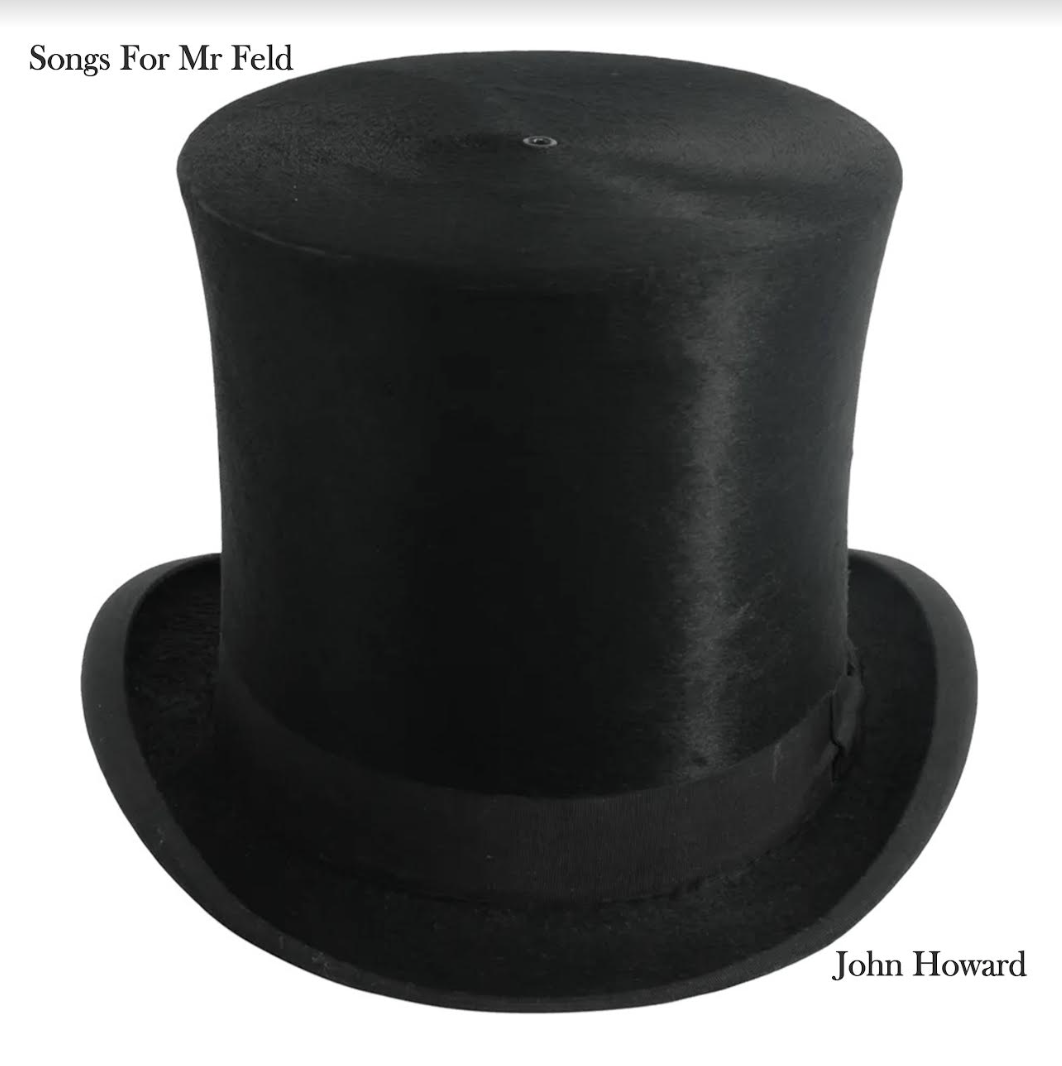
Stick with me on this one, but if you’d previously zero knowledge of Marc Bolan and his music, or didn’t recognise the song titles you could easily imagine this homage EP being from the hand of, and written, by John Howard. Replacing Bolan’s characteristic fey acoustic, and later leaner electric, guitar and the percussive elements of both Steve Peregrin Took and his replacement Micky Finn with the piano and just a little touch of strings and low bass-y cello (or so that’s what is sounds like), Howard makes every reinterpretation sound his own.
The lyrical flairs of Tolkenism, magical scenes, pastoral fairytale is not so much Howard’s, but here he is taking a quintet of songs from Bolan’s transformative period between the campfire invoked fantasies of Tyrannosaurus Rex and the full-on boogie glam rocking T. Rex and lending them a certain committed touch of flowing but weighted graceful wisdom.
There’s been many such dedications to Bolan, or should I say, as Howard does, Mr. Feld –that’s Mark Feld, the name his parents gave him. Nick Cave for one, during Covid, set to the ivories and attempted a frank plaintive version of ‘Cosmic Dancer’.
Howard has however chosen an eighteen-month (give or take) period, pre the rock-pop titan of ‘Get It On’, ‘20th Century Boy’ and ‘Jeepster’. A time when Bolan was still lost and swept-up in wistful enchantment, lyrically painting images of faraway places across an imagined time. This would all tie-in with Howard’s own formative years, studying for ‘O’ Levels whilst hanging out with his best friend and confidant Pauline in her bedroom, playing all their latest musical discoveries on the record player. Regaling in a bon vivant mood, Howard wraps each song he performs – be it a track or single that appeared on either the Unicorn, A Beard Of Stars or the eponymous T. Rex albums – with anecdotal context and fond memories.
He’s had plenty of practice at this in the last five or so years, turning raconteur author with three volumes of autobiography, staring with Incidents Crowded With Life. I feel a brief outline of those chronicles is needed now, before we go any further. After an almost meteoric rise to fame off the back of his accomplished piano-driven Kid In A Big World songbook in 1975, it soon became apparent, as the first honest account in his triple autobiographical series documents, that the adulation and glitter would quickly fade. Though never written-off as such Howard was, like a magnitude of artists before him and ever since, continuously hampered and screwed-over; the records ever far and few between as time went on. The next “big thing” at one point Howard’s real troubles began after a life-changing accident in 1976. In an attempt to escape the mad raging clutches of his Filipino housemates’ bit of rough (a violent maniacal Russian sailor as it turned out), Howard jumped from a flat window, breaking his back in the process. Despite this horrific chapter there was still the CBS contract, recording at the fabled Abbey Road studios, the theme song to a Peter Fonda movie and countless promises to lift the mood. But by the end of the 70s and early 80s the music career had all but stalled, with only brief flashes of ill-advised makeovers and one-off songwriting projects. Book two in this life story, Illusions Of Happiness picked up that period, documenting a post recovery Howard on the cusp of a new decade and mounting a comeback. Again, even with such future big names as Trevor Horn and Steve Levine in his corner, nothing really took off. Frustrated by various ill-thought out and misplaced marketing ploys Howard gallivanted to a soundtrack of synthesised Eurovision pop and overproduced easy listening balladry.
Volume three, or the third chapter, in that life story finds a not so much disillusioned Howard as a waning artist making the most of it; playing the cards dealt, moving from front stage to a role behind the scenes in music licensing. Making perfect sense really, keeping a hand in the game so to speak, Howard began this career change of a sort at Pickwick Records in 1986. As it turns out, even this corner of the industry is riven by egos and petty one-upmanship, bitter jealousies. And so, there’s a number of “jump ships”, with stints at MCA and Readers Digest to follow. Sorry tales of bad bosses and greed follow as In The Eyeline Of Furtherance fills in the blanks of a decade in which Howard really swam against the tide of the bean-counting petty executives in charge. Even when successful (and Howard was constantly that) his actions would rile whoever was in charge it seems.
If we fast-forward, and into the 2000s, with Howard now in semi-retirement, enjoying the idyllic countryside of Pembrokeshire, his debut LP was reissued to another generational audience. Receiving much critical acclaim and coverage in the music press, it sparked what was perhaps and still is, Howard’s most prolific creative period. Starting with the Robert Cochrane collaboration, The Dangerous Hours, and Howard’s first collection of wholly original material in decades, As I Was Saying, albums, another seven albums of quality songwriting followed. But it was his 2015 collaboration with Andy Lewis and the estuary pipe-dreaming Gare du Nord record label chief Ian Button, and one of his signings, Robert Rotifer, under the John Howard & The Night Mail moniker that really set things in motion. Garnered with countless plaudits and five-star reviews that most brilliant album drew the biggest attention yet and proved another ideal opportunity to perform the back catalogue. However, two years on from his last solo effort, My Name Is, and with a renewed vigour to try something different, Howard experimented with long form songwriting on Across The Door Sill – in my estimation, one of his finest albums yet. Untold records have followed, from the accomplished Cut The Wire LP to the From The Morning covers EP (Howard’s version of Mike Heron‘s bucolic, sun anointed delight ‘You Get Brighter’ was playing in my head whilst listening to a number of songs from this latest EP) to concept works such as LOOK! The Unknown Story Of Danielle Du Bois.
But now, even more sagacious and happy with their lot, Howard chooses the projects that give him complete freedom, joy and creative control.
His latest EP is another fond piece of nostalgia, a return to his formative years; a time when Howard may have struggled with his sexuality, brought up as he was in a staunchly Catholic household during the 1950s and 60s, but nevertheless, had rebellious fun replacing the religious symbolism of the church with elfin beatific posters of Marc Bolan. With a fifty-year distance or more, he now pays a certain recollected homage to Mr. Feld. Far from a work of idol worship and fandom, Howard lends credible depth, emphasises the brocade and Baroque tapestry of Bolan’s original ‘Dead Meadows’ by playing what sounds like a harpsichord, and reflects even more the ephemeral veiled nature of Bolan’s muse on ‘The Seal Of Seasons’.
Bolan had a beautiful poetic gift for setting imaginative illusions, myths and legends with just a rhyming couplet of lines. The saddened Barrett-esque dreamy ‘Great Horse’ is no exception: “Great horsey champer goldbriad, pranced proudly in the golden villas/Dipped diving with his horned onyx, saddle shinning in the black aped eyeballs of the gun.” An Arthurian magical, near hazy plaintive yearn from A Beard Of Stars, here it’s given an equally diaphanous fluidity by Howard.
The already referenced, and earliest recording (taken from the Unicorn LP, released in the May of 1969) on this EP, ‘The Seal Of Seasons’, with its Orcadian lore and allure, is lent a more oceanic motion. But it all begins with ‘Dove’, the song that Bolan once introduced at a BBC concert taping on New Years Day in 1970, as his first “love song”. The gentle original pastoral acoustics and tubbing hand drums are replaced with semi-balladry classical piano, a new sense of gravity, and the barest of sympathetic strings. Howard underlines a more purposeful, meditative mood with a long-undulated bass-y piano fade out.
I think ‘Dead Meadows’ could also claim to be a love song. Taken from the filed-down, easier to consume, T. Rex LP, and now featuring more of that electric guitar, more riffs (also minus the Hobbit inspired Steve Peregrin Took, who was quietly fired and replaced by Micky Finn), ‘Dead Meadows’ has a Medieval courtly magic about it. The original featured some chamber strings, and Howard seems to have stayed relatively faithful with what sounds like a viola or cello on his most prettily woven interpretation.
Moved onto the piano, or pianos if you like, Bolan’s more fey, wistful and longed storyteller lovelorn hippie enchantments, the loss of a certain innocence, are treated with respect and the gentlest of touches by Howard. His fondness and love for the work is undeniable. And yet he somehow makes the material his own, attaching his own memoirs to each song. I think Bolan would have approved.
Black Artist Group ‘For Peace And Liberty, In Paris December 1972’
(WEWANTSOUNDS)
Saved from obscurity and jazz lore, the previously believed “long-lost” recordings of the Black Artist Group’s radical free, avant-garde, spiritual and Afro jazz (with a side order hustle of funk) performance in Paris has been thankfully unearthed, dusted off and remastered in a project partnership between the band and the French Institut national de l’audiovisuel. Facilitating this operation are the reissue revivalist vinyl specialists WEWANTSOUNDS – regularly featured in my review columns over the years -, who’ve invited various connoisseur experts to provide liner notes, essays and photographic images to this package.
Only the actual second official release from the St. Louis group, For Peace And Liberty, In Paris December 1972 is taken from a session recorded at the French state broadcasters ORTF (that abbreviation reads as the Office de Radiodiffusion Télévision Française, an institution that lasted between 1964 and 1975) for the Jazz sur Scene radio show; the format of which included a two hour showcase of groups (usually four) performing live for a studio audience.
Radically different, we’re told, to the quintet’s first and only album proper, Aries from 1973, the near continuous thirty-five-minute set finds the lineup of Oliver Lake (on saxophone), Baikida Carroll (trumpet), Floyd LeFlore (trumpet), Jospeh Bowie (trombone) and Charles “Bobo” Shaw (drums/percussion) totally untethered: at liberty and free.
Part of this title expression is down to the group’s recent, at that time, move to France; partly encouraged by Jospeh Bowie’s older brother and established jazz supremo Lester Bowie, but partly because that city offered more culture and a less racially hostile environment in which to push the limits of jazz. Leaving behind the bitter, divisive fallout of the Vietnam War, of segregation, of Watergate for pastures new, BAG made steps to leave America for France, which beckoned a host of Black artists to its shores and capital, mostly because Black jazz artists felt more appreciated on the European continent; their practice better understood.
The quasi-house band of a sort for the much larger St. Louis BAG collective of musicians, poets, playwrights and dancers, they found a fertile scene filled with compatriots, many of which the quintet had individually worked with back in the States. The CVs read like a jazz family tree. At a glance you have the alto/soprano saxophonist/flutist/composer/poet/visual artist Lake who founded the World Saxophone Quartet and Trio 3; the trumpeter, big band director, sextet band leader Carroll who worked with such illustrious company as Lester Bowie, Albert King and Little Milton; the composer/poet/trumpeter and BAG founding member LeFlore; Lester’s younger sibling, the trombonist and vocalist Joseph Bowie, who would go on to lead the jazz-punk outfit Defunkt and join Kahil El’Zabar’s Ethnic Heritage Ensemble; and the free jazz drummer “Bobo” Shaw who played with Lester, Anthony Braxton and Cecil Taylor and led the Human Arts Ensemble. You won’t be surprised to learn that this ensemble also found common ground and had links with the Association for the Advancement of Creative Musicians, Chicago’s iconic hothouse for Black artists and jazz musicians.
Channelling that whole bag of experiences, the different strands, motivated by forces inside and outside the jazz idiom, the extemporised quintet both naturally and in sporadic leaps and bounds performed a set (not so much divided into five parts as congruously labelled with natural pauses and winding downs between each movement) without boundaries. Shaw’s drums alone follow from the African and near Latin to swing joints like a New Orleans marching band at a sports day. There’s also a section in which he drills the snare like he’s at a military revue, which isn’t so surprising as Shaw, like some of his other band mates, had drummed for the Bugle Corp in the 1950s – Carroll had spent some of his formative years of study at the Armed Forces School of Music, and LeFlore had served in the army during the early to mid 60s. Cattle bells and other percussive trinkets evoke either African pastures or spiritual mystery.
Brass wise you can hear both familiar cupped and unhindered heralding, hooks, blazes and ascendent spirals of trumpet, sax and bassoon, but also shrills, the driest of near fleeting ripping, tearing and zippy rasps, gasps for air and chirped experimental expressions. From near excitable elephant trunk calls to a menagerie of duck-billed pecks, swallows and ruffling feathered turmoil the action evokes an exotic wildlife. This is matched with the inner arty smokestack outlines of NYC and Chicago, and the police-like whistles, the careering horn-honked freight train and bustles of the streets.
At times we’re talking Coltrane and Sun Ra, and at other times Roscoe Mitchell, Carlos Garnett and the Art Ensemble Of Chicago. You can also pick up some Chick, a touch of Cymande, of Art Blakey, Sam Rivers and Anthony Braxton. But to be specific, if you dig Rahsaan Roland Kirk’s ‘Safari’, Ornnette Coleman’s ‘Lonely Woman’ and Don Cherry’s Organic Music Society then you’ll really need to part with the cash and have this on your shelf asap: not before blasting it out from your turntable.
Ghostwriter ‘TREMULENT’
(Subexotic) 13th September 2024

Drawn from the veils of time and from several overlapping spiritualist and reverent sources, author, musician and instigator Mark Brend once again winds up and sets in motion the mechanisms and retunes the hauntology radio for a third Ghostwriter album.
A collaborative affair since day one (started back in 2009), with a revolving cast of cross-disciplinary “music-makers”, writers and vocalists, the Ghostwriter lineup this time around includes the talents of Michael Weston King (formerly of the alt-country pioneers The Good Sons, soloist and currently one half of the country duo My Darling Clementine), Suzy Mangion (musician, artist and historian) and Andrew Rumsey (an Anglican bishop, of all things, writer and musician who released the critically acclaimed Evensongs album just last year, and who also provides this album’s cover photo).
All three provide a suitable beatific, near supernatural and spiritual hymnal atmosphere of vocals to the pipe organ imbued and inspired TREMULANT. That title references the device on a pipe organ that varies the wind supply to the pipes of one or more divisions, causing amplitude and pitch to fluctuate. This produces a tremolo and vibrated effect. You can hear its more subtly sustained and held suffused bellows and air-pumped tremulant effects throughout on a record that occupies a liminal space between pastoral English church service, the American spiritual, and esoteric.
Altogether it sounds like a collage of antique recording sources from another age and the ghostly – like parlour seances in places – stirrings and visitations of Americana, gospel music, Georgian posey, the Celtic, folk and late 90s and early 2000s alternative American indie (Mercury Rev, The Music Tapes). But within that sphere of influence there’s an air of Christian Evangelism and the twinkled chimes of a godly majorette marching band on the opening traditional inspired ‘Satan, Your Kingdom Must Come Down’; a vibrato voiced supernatural Blood Meridian redemptive take on a standard covered by a wealth of country and bluesy-rock icons, from Robert Plant to Willie Nelson.
Amongst the reversals, the vortex and morphing elementals and more uncertain passages, the vocals can be harmonious and moving. Especially the contributions of Mangion, who can channel a choral, hymnal beauty that lies somewhere between holy communion and the Laurel Canyon (see the 1960s troubadour evocations of ‘Often Forfeit’).
Seeking sanctuary and protection in the face of tumult and torment there’s fishing community set anchor metaphors and analogies, devotions and shipwreck coastline pleas that merge The Polyphonic Spree with The Mekons’ ‘How Many Stars’ tricorn hatted period Georgian Child of the Jago influences too to be found amongst the purposely dated evocations.
Considering that all four participants on this album recorded their parts in isolation – I believe none of collaborators have ever actually met in person – project coordinator Brend has managed to pull together a complete coalesced soundtrack of both changeable and repeated phases, ideas, passages and swells. TREMULANT by name, tremulant by nature and divine calling, the third Ghostwriter album is a curious cult recommendation.
 Monolith Cocktail Blog