Most Loved and Enjoyed Highlighted Albums of 2024: Part One: A – L
December 10, 2024
Welcome to part one of the Monolith Cocktail’s most loved and favourite albums of 2024 lists.
Picked by Dominic Valvona and Brian ‘Bordello’ Shea.

Despite the tumult of problems that face artists and bands in the music industry, from a lack of general interest to the increasingly punitive costs of touring and playing live, the worrying trend of venue closures, the ever-encroaching domination of streaming against physical sales and exposure, and the onslaught of AI, people just can’t quit making music. And that’s all without listing the political, social and economic woes that continue to make life unbearable for most of us; the scandalous forces of austerity/cost-of-living crisis and post-Covid hangover threatening to constantly drag us under. We, as critics – though most of us have either been musicians or still are – really appreciate what you guys, the music makers, do in the face of such intense stresses.
In fact, as we have always tried to convey, we celebrate you all. And so (as I say every year) instead of those silly, factious and plain dumb numerical charts that our peers and rivals insist on continuing to print – how can you really suggest one album deserves their place above or below another; why does one entry get the 23rd spot and another the 22nd; unless it is a vote count, and even then, does it really come down to a popularity contest? –, the Monolith Cocktail has always chosen a much more diplomatic and democratic alphabetical order – something we (more or less) started in the first place.
The lists are broken up this year into two parts, A-L, and M-Z, and include those albums we’ve reviewed or featured on the site in some capacity, plus a smattering of those we just didn’t get the time to include. All entries are displayed thus: Artist (in alphabetical order) then the album title, label, who it was chosen by and a review link, if there is one. We also included quotes and summaries underneath.
Before we precede, we’d like to thank the following contributors to the site this year: Dominic Valvona, Brian ‘Bordello’ Shea, Matt Oliver, Graham Domain, Mikey McDonald and Andrew C. Kidd, plus our Italian friends at Kalporz. Also, our gratitude and love for all our supporters during the year, and to those that have donated to https://ko-fi.com/monolithcocktail We really can’t have continued without it.
A_
A Journey Of Giraffes ‘Retro Porter’ (Somewherecold Records)
Chosen by Dominic Valvona/Review
“The sound of John Lane’s most prolific and artistically successful alias, A Journey Of Giraffes (no stranger to the blog, and often featured in our choice end of year features) is given almost unlimited time and space to unfurl on the ambitious opus-spanning Retro Porter album of ambient empirical suites.
An expansion upon Lane’s previous work – especially last year’s choice album entry, Empress Nouveau – each evolving sensory piece allows all the Baltimore composer’s signatures, motifs and serialism-like enquires to recollect memories of places and scenes, of the abstract, over the course of what sounds like a whole day.
Mirages, imaging’s, the sound of birds in the iron lattice gardens of an ostentatious arcade percent as described in late 19th century novella’s, sonorous pitches, the softened sound of a taiko drum at the Kabuki theatre, various hinges, dulcimer-like strokes all evaporate then solidify to create an ambient opus; a lifetimes work coalesced into one expansive, layered work of soundscape art and abstraction. Lane has allowed his mind to wander and explore organic and cerebral long form ideas like never before to produce, perhaps, his most accomplished unrestricted work yet.” DV
Annarella and Django ‘Jouer’ (We Are Busy Bodies/Sing A Song Fighter)
Chosen by DV/Review
“Born from the Senegalese imbued and inspired hub built around Sweden’s Wau Wau Collectif, another cross-cultural project that embraces that West African nation’s (and its neighbours) rich musical heritage. Fusing the roots, landscape and themes of Senegal with those of Europe, the partnership of Swedish flutist Annarella and the Malian born ngoni master Django absorbs the very atmosphere of that westernmost African republic, transposing and transforming age old traditions with a hybrid of contemporary musical effects and influences and guest list of diverse musicians and voices.
Django’s home environment and the outlier around it seeps into and materializes like a dreamy haze across all the album’s tracks, as evocations of the classical, of jazz and the blues mixes with the local stew of diverse languages. Tracks like ‘Degrees of Freedom’ are more mystical sounding, near cosmic, as the band saunter like gauze under the moon and across the desert’s sandy tides. Jouer, which translates from the French into “play”, is just that, a lovely stirring union of the playful that seamlessly entwines the two musician’s respective practices with sympathy, respect and the earthly concerns of our endangered societies and world. Hopefully this collaboration will continue and grow over the years; there’s not been a better one since Catrin Finch teamed up with Seckou Keita.” DV
Fran Ashcroft ‘Songs That Never Were’ (Think Like A Key)
Chosen by Brian ‘Bordello’ Shea/Review
“There is a uniqueness about this album; a trueness and soul you do not come across often much in these days of music to be played on phones. These are songs that could have been written anytime over the last 50 or so years, with some quite beautiful melodies and great lyrics; songs made for and by a music lover…already one on my end of the year best list.” BBS
B__
Donald Beaman ‘Fog On Mirror Glass’ (Royal Oakie)
Chosen by DV/Review
“The play and course of light, the recurring “phantom” and a beautiful subdued, nigh on elegiac poetry conjures up a simultaneous union of the beatific and longing on the latest solo effort from Donald Beaman.
Like a drifter’s songbook of subtle, intimate and home-recorded wanderings, metaphors and the like for yearned and plaintive romantic loss, fondness, the passing/measuring of time, and the urge to find comfort and solace, Fog On Mirror Glass uses memories of the weather, the way the light touched or dimmed at a given moment in time, and the smallest of witnessed movements/touches to evoke the right atmosphere of gossamer and sparsity.
In all, a most impressive and understated songbook of honest quality and performance, themed largely around the way light falls upon any given metaphor, analogy, phrase, description and texture. Unadorned, the feelings are left to pull and draw the listener into a most intimate world. Each play reveals more, as the album really begins to grow on you. A fine record indeed.” DV
Beauty Stab ‘Guide/Frisk’
Chosen by BBS/Review
“After a five plus year wait, we have the debut, and who knows, only album from the one time much tipped for big things Beauty Stab. An album filled with sex sleaze and glamour but with a healthy or unhealthy dose of darkness.
The sound and feel of eighties chart land I think has a big influence on Beauty Stab. They do share a name with ABC’s second album after all, and I can almost hear Martin Fry emote over the bass heavy synth pop funk of “Manic”.
“GUIDE/FRISK” is a wonderful and inventive crafted album that celebrates the joy and darkness and power that great pop music can bring to your life and really deserves to be heard by all.” BBS
Black Artist Group ‘For Peace And Liberty, In Paris December 1972’ (WEWANTSOUNDS)
Chosen by DV/Review
“Saved from obscurity and jazz lore, the previously believed “long-lost” recordings of the Black Artist Group’s radical free, avant-garde, spiritual and Afro jazz (with a side order hustle of funk) performance in Paris has been thankfully unearthed, dusted off and remastered in a project partnership between the band and the French Institut national de l’audiovisuel. Facilitating this operation are the reissue revivalist vinyl specialists WEWANTSOUNDS – regularly featured in my review columns over the years -, who’ve invited various connoisseur experts to provide liner notes, essays and photographic images to this package.
At times we’re talking Coltrane and Sun Ra, and at other times Roscoe Mitchell, Carlos Garnett and the Art Ensemble Of Chicago. You can also pick up some Chick, a touch of Cymande, of Art Blakey, Sam Rivers and Anthony Braxton. But to be specific, if you dig Rahsaan Roland Kirk’s ‘Safari’, Ornette Coleman’s ‘Lonely Woman’ and Don Cherry’s Organic Music Society then you’ll really need to part with the cash and have this on your shelf asap: not before blasting it out from your turntable.” DV
Black Diamond ‘Furniture Of The Mind Rearranging’ (We Jazz)
Chosen by DV/Review
“Transported back in time, and then propelled forward into the now via Chicago’s musical legacy, its rich heritage of innovators and scope in the world of jazz, Artie Black and Hunter Diamond’s dual saxophone and woodwind focused vehicle can trace a line from the Windy City’s smokestack bluesy outlines of the 50s through the icons Sun Ra, Roscoe Mitchell, Eddie Johnson, Lester Bowie, Art Ensemble Of Chicago, Anthony Braxton and the hothouse of undeniable influence and talent, the Association For The Advancement Of Creative Musicians.
Across an ambitious double-album spread of both quartet and duo mode formations, those Black Diamonds don’t so much shine as smoulder and fizzle to a smoky and simmering resonance and metropolis backdrop encroached by wild jungles and fertile growth.” DV
Bloom De Wilde ‘The Circular Being’
Chosen by BBS/Review
“I love the muse and the music of Bloom de Wilde. It has a tender all-consuming innocence and hope that calmly plays Rock Paper Scissors with a wistful sadness and melancholy.
Bloom writes songs that offer hope against all the odds; songs that embrace the eccentrics and outsiders, all the underdogs in life. Maybe that is why I feel a connection to her music and at times find myself totally engrossed with her beautiful tapestry of pop, jazz, folk and psychedelia, which she has woven with great love and skill to make great art.
Bloom is a fine songwriter, which may sometimes be overlooked due to the wonderful eccentricities of her personality and is a quite an accomplished and original lyricist, as this fascinating eleven song album of love, hope and magic shows.” BBS
The Bordellos ‘Nobody’s Listening’ (Metal Postcard Records)
Chosen by DV/Review by Graham Domain
“This is another perfect ‘slice of life’ album from The Bordellos. If all they had was a pair of spoons and a cassette-recorder, they would still be driven to record these hazy snapshots of life, in the same way that L S Lowry splashed his canvas with the daily drudgery and drama of the northern working-class. Was anyone paying attention to Mr Lowry at the time? No! But today there are hotels, theatres and tree-lined streets named after him. (Even Bowie was one to acknowledge the match-stalk painters genius titling his best album Low)!” Graham Domain
boycalledcrow ‘Kullau (Mortality Tables)
Chosen by DV/Review
“A musical atmospheric hallucination and psychedelic dream-realism of a roadmap, the latest transduced-style album from Carl M Knott (aka a boycalledcrow) takes his recollections, memory card filled photo albums, samples and experiences of travelling through Northern India between 2005 and 2006 and turns them into near avant-garde transported passages of outsider art music.
Place names (that album title refers to the village, an ancient kingdom, of ‘Kullu’, which sits in the ‘snow-laden mountain’ province of Himachel Pradesh in the Western Himalayas), Buddhist self-transformation methods (the extremely tough self-observation process of “non-reaction” for the body and mind known as “Vipassana”), Hindu and Jainism yogis (the “Sadhu”, a religious ascetic, mendicant or any kind of holy person who has renounced the worldly life, choosing instead to dedicate themselves to achieving “moksha” – liberation – through meditation and the contemplation of God) and language (the localised distinctive Kullu dialect and syntax of “Kanashi”, currently under threat) are all used as vague reference points, markers in this hallucinatory grand tour.” DV
Brevity ‘Home Is Where Your Dog Is’ (Think Like A Key)
Chosen by BBS/Review
“The wonderfully named “Home Is Where your Dog Is” is the unreleased album, plus some demo recordings, by late the 60’s early 70’s Chicago rock band Brevity, a band who never actually got to release anything at the time but had interest and encouragement from both Island Records and Frank Zappa’s Bizarre/Straight Records. Truth be told, released here for the first time by Think Like A Key Records, it is indeed a bit of a lost and now found musical treasure.
“Home Is Where Your Dog Is” is one of those rare lost albums that actually deserves to be labelled a lost classic, and the added demos actually have an indie/post punk feel to them that reminded me strangely of very early Pulp in their more acoustic like days. Yes, one of my favourite albums I have had the pleasure to listen to this year: a true Gem of an album.” BBS
Charlie Butler ‘Wild Fictions’ (Cruel Nature Records)
Chosen by DV/Review originally by Brian ‘Bordello’ Shea
“The music is all that you hoped it would be, for music without hope is hopeless and this is anything but that; it is the cream cake among lesser mortals.” BBS”
C___
Chris Corsano ‘The Key (Became the Important Thing [and Then Just Faded Away])’
(Drag City) – Chosen by DV
The prolific free-jazz, avant-garde and avant-hard drumming innovator Chris Corsano can be found as an instigator or willing foil across a multitude of experimental collaborations (recently on the MC appearing alongside Nels Cline, Darin Gray and Glenn Kotche as part of the We Jazz signed-off Saccata Quartet) but his soloist works are just as numerous and far reaching/influential. I lost count of appearances and album releases in 2024, but this constant rhythmic and non-rhythmic progressing album is my favourite, taken from back in June.
Literally letting rip with an apparatus of recognisable and often non-musical implements, Corsano fuses a noise and splash of ripping and tearing sounds with no wave Kraut-punk (think CAN, Faust), West African drumming, alternative jazz and jazz-prog-rock. Untethered, clever, and anarchistic in equal measures. DV
Alison Cotton ‘Engelchen’ (Rocket Recordings)
Chosen by DV/Review
“In the wake of the barbaric terrorism of Hamas on October 7th, and the ensuing destructive retaliation/ obliteration of Gaza by Israel since, there seems little room – let alone nuance and balance – on the debate; battle lines have been drawn and divisions sowed. And so, this inspired tale of ‘derring-do’ (originally performed live at the Seventeen Nineteen Holy Church in Sunderland) performance suite from the Sunderland composer Alison Cotton is a most timely reminder of dark history, but also of altruistic acts of kindness.
Scoring the story of the innocuous Cook sisters, Ida and Louise, and their incredibly brave rescue attempts to save the lives of twenty-nine Jews from occupied Europe during the build-up and eventual outbreak of WWII, Cotton ties in the modern plight of refugees escaping similar persecutions.
Less a morbid, dark soundtrack to the evils of the Nazi regime and Holocaust, Cotton instead conveys the enormity and the danger of the Cook’s enterprise through slow tidal movements, tones, intonations and changes in the atmosphere. Throughout it all a prevailing presence and emotional pull can be felt: The mood music of grief, the plaintive and sorrowful cumulating in a beautifully played series of arrangements and suites that are as sombre as they are beautiful and moving – reminding me in parts of Alex Stolze, Anne Müller, Simon McCorry and Aftab Darvishi.” DV
D____
Ëda Diaz ‘Suave Bruta’ (Airfono)
Chosen by DV/ Review
“A rarefied artist who manages to merge dream-realism with both the traditional and contemporary, Ëda Diaz occupies multiple realms of geography to produce sublime and club-lite Latin-European R&B pop music. Between spheres of influence, her French-Colombian heritage is bonded across an exotic soundboard of effects, precise cut electronica, and transformed repurposed old dances and song; the latter of which includes an electrified form of currulao, ‘wonky’ Colombian salsa, bolero, bullerengue, vallenato and ‘dembow’. I absolutely love this spellbinding, vulnerable and playful Latin-Euro vision.” DV
E_____
Kahil El’Zabar’s Ethnic Heritage Ensemble ‘Open Me, A Higher Consciousness Of Sound And Spirit’ (Spiritmuse Records) – Chosen by DV/Review
“Originally hot-housed in the Association for the Advancement of Creative Musicians (the mid-1960s nonprofit organization instigated by Muhal Richard Abrams, Jodie Christian, Steve McCall and Phil Cohran in Chicago, which El’Zabar himself once chaired) incubator, El’Zabar’s percussive, drumming rhythms for the mind, body and soul channelled the windy city’s rich musical lineage of jazz, blues, R&B, soul, Godspell and what would become house and dance music.
Following on from last year’s Spirit Gather tribute to Don Cherry (which featured the worldly jazz icon’s eldest son David Ornette Cherry shortly before his death) this latest conscious and spiritual work channels that rich legacy whilst worshipping at the altar of those icons, progenitors and idols that came before; namely, in this instance, Miles Davis, Eugene McDaniels and McCoy Tyner.
El’Zabar’s once more heals, opens minds and elevates with another rhythmic dance of native tongues and groove spiritualism. The ancient roots of that infectious groove and the urgency of our modern times are bonded together to look back on a legacy that deserves celebrating. After fifty years of quality jazz exploration and collaboration, El’Zabar proves that there is still much to communicate and share as he and the EHE recast classics and original standards from the back catalogue.” DV
Empty House ‘Bluestone’ (Cruel Nature Records)
Chosen by DV/Review
“The megalithic period “cromlech” (frequently interchanged with and referred to a “dolmen” too) construction of large stone blocks that stands within the borders of the Pembrokeshire Coast National Park, in the village of Pentre Ifan, acts as a gateway to the imagination for the Blackpool-based musician Fred Laird, who goes under the moniker of Empty House.
Avalon mists descend across a communication with the landscape, whilst shriven archaic reenactments stir-up the hallucinatory and esoteric. Old vacuums of air blow through the spaces in between the stones as a haunted geology shrieks, howls, mourns and swirls. And a wispy passage of monastery choral voices carries on the wind as children giggle and the neolithic generator revs up vibrations and pulses from the afterlife. The Incredible String Band makes merry with Julian Cope; Steve Hillage joins Ash Ra Tempel; and Affenstunde period Popol Vuh invokes ghostly parallel histories with Xqui and Quimper on a tour of Ley lines. Atmospheres and scenes from a long history of settlement, of the spiritual, envelope the listener on a most subtle but rich field recording trip.” DV
Peter Evans ‘Extra’ (We Jazz)
Chosen by DV/Review
“A meeting of avant-garde minds to savour, the union of Peter Evans with Koma Saxo and Post Koma instigator and bassist Petter Eldh and New York downtown experimental rock and jazz drummer pioneer Jim Black is every bit as dynamic, explosive, torqued, moody, challenging and exciting as you’d imagine.
A crossroads of separate entangled influences and backgrounds, legacies, with all three practitioners in this Evans-fronted project and their CVs stretching back a few decades, the avant-garde rubs up against the blues, hard bop, atmospheric set scores, hip-hop style breaks, the electronic and classical. By using both the piccolo and flugelhorn on this album, some passages sound like Wynton Marsalis playing over Mozart, or Alison Balsom lending classical airs to an Alfa Mist production.
One of the best jazz albums you’ll hear all year, with a spot saved for the choice albums of the year lists, Extras is a thoroughly inventive and exciting dynamism of contemporary luminaries at the height of their skills and knowledge.” DV
F______
Ibelisse Guardia Ferragutti & Frank Rosaly ‘MESTIZX’ (International Anthem X Nonesuch)
Chosen by DV/Review
“Transformed and remoulded for a more progressive age the “MESTIZX” title of this partnership’s debut album takes the Spanish term for “mixed person” (namely, a union between those indigenous people in the Latin conquered territories of South America and the Spanish) away from its colonial roots and repurposes it on an album of dream realism duality.
With the multimedia performer and singer Ibelisse Guardia Ferragutti’s Bolivian and the jazz drummer Frank Rosaly’s Puerto Rican heritages, the pre-colonial history of South America is woven into a contemporary revision of magic, organic forms and ritual rhythms mixed with elements and a suffusion of Chicago post-rock, post-jazz and alternative Latin leftfield pop.
There’s much to admire in this world of the untamed and wild, with new perspectives, mixed histories and the largely melodious reverberations of the lost exercising a new language of ownership. Ibelisse Guardia Ferragutti and Frank Rosaly perfect and expand their organic explorations, bewitching messages and oracles on an intriguing, moving and dreamily trippy debut album.” DV
G_______
Michal Gutman ‘Never Coming Home’ (Cruel Nature Records)
Chosen by BBS/Review
““Never Coming Home” is a darkly beautiful album; an album of twisted musical discovery, with songs worthy to fall from the lips and the pen of the great Dory Previn; songs that pull you into a strange and beguiling solitude place, where you only have memories and fears and regrets for company. Musically stark and bewitching like an unused broken fairground ride: a bass guitar has never sounded so much like the faded remnants of an old lover’s final kiss. “Never Coming Home” is quite simply stunning.” BBS
Nino Gvilia ‘EP Number 1: Nicole’ & ‘EP Number 2: Overwhelmed By The Unexplained’ (Hive Mind Records) – Chosen by DV/Review
“Creating a musical, lyrical eco system of their own, soundtracked by folk, minimalism, the hallucinatory and pastoral – with only the final vaporous misty esoteric second EP’s titular track changing from cuckoo-like voiced loops and sympathetic strings to disturbing futuristic daemonic augur –, the Nino Gvilia encompassed guise ebbs and flows with the movement of the replenishing waters, the lakeside and mill turning scenes of the surroundings, to produce a disarming hymn. Idiosyncratic in beauty, I’d recommend this diaphanous accomplished mini opus to those with a penchant for Hatis Noit, Seaming To, Tia Blake and Roberto Musci.”
H________
Hackedepicciotto ‘The Best Of Hackedepicciotto (Live In Napoli)’ (Mute)
Chosen by DV/Review
“As a duo in recent years, Alexander Hacke and Danielle de Picciotto under the twinned Hackedepicciotto moniker, have channelled their diverse experiences as members/instigators of such groups as Einstürzende Neubauten, Crime And The City Solution and the Space Cowboys, into a signature sound that embraces the cabaret and soundtrack gravitas of post-punk, post-industrial, electronica, the esoteric, weird folk and twisted fairytale: which they themselves have described as “symphonic drone”.
Their fifth album, the partial sonic and lyrical autobiography, part photo album scrap book dedication, Keepsakes, was released last year. As with most of their catalogue, the duo’s albums are either recorded in a stirring, inspiring location, or in a different country. The most recent being no exception, recorded as it was at Napoli’s legendary Auditorium Novecento using the famous venue’s stock of various instruments. That album now forms the focal or centre point for this live release of choice bell tolled maladies and drone sonnets from the duo’s back catalogue. Performed over two nights, they’ve chosen to return to the Auditorium Novecento setting that made Keepsakes such an atmospherically rich and momentous, dramatic record. And so, they perform a quartet of songs from that most recent album alongside picks from the Menetekel (2017), The Current (2020), The Silver Threshold (2021) and Perseverantia (2023) albums. And it proves a winning formula as the perfect showcase, and a more unique approach to performing the “best of” their back catalogue.” DV
Christopher Haddow ‘An Unexpected Great Leap’ (Erol’s Hot Wax)
Chosen by DV/Review
“A comfort blanket bookended by the reassuring signs of life via the sounds of an ultrasound, Christopher Haddow’s first steps out as a solo artist (flanked on either side by the contributions of Josh Longton on double-bass and Jamie Bolland on piano) capture the abstract feelings of parenthood. An Unexpected Great Leap is in fact, partially, an ambient tool to send both Christopher and his artist wife Athene Grieg’s son Louie off to sleep.
You may know Christopher as the former lead guitarist of Paper Planes and as a member of Jacob Yates and the Pearly Gates, but under his own name and with a different, more personal, direction he’s beautifully, imaginatively and conceptually complimented his wife’s visual feels of parenthood with a searching and settling album of ambient Americana and womb music.” DV
Sahra Halgan ‘Hiddo Dhawr’ (Danaya)
Chosen by DV/Review
“Few artists from the disputed region of Somaliland could qualify better than the singer, freedom fighter and activist Shara Halgan to represent their country’s musical legacy. As an unofficial cultural ambassador and symbol for female empowerment Halgan’s journey is an inspiring one: Forced out of her homeland during a destructive civil war – in which she played a part in nursing and “comforting” fighters from Somaliland’s secession movement, sometimes alleviating suffering through song –, Halgan had to flee abroad to “survive” hardships and dislocation in France, but eventually, a decade after the overthrow of Siad Barre’s ruling military junta, returned home to motivate and promote proud in Somaliland’s cultural heritage.
It was during her time in France, removed from her roots and homesick, that Halgan would meet the musicians that went on to form her studio and touring band: step forward percussionist and founder of the French-Malian group BKO Quintet, Aymeric Krol, and the guitarist and member of the Swiss ensemble Orchestre Tout Puissant Marcel Duchamp and L’etrangleuse, Maël Salètes. Both appear on the latest, and third Halgan album, alongside newest recruit Régis Monte, who adds “vintage organ” and “proto-electronic embellishments” to the heady and fuzzed mix.
Enriched soul music with an edge and buzz, Halgan and her troupe strike a balance between the heartfelt and empowered on electrifying album; that focal voice sounding so fresh and young yet wise and experienced, able to encapsulate a whole culture whilst moving forward.” DV
Herandu ‘Ocher Red’ (Hive Mind Records)
Chosen by DV/Review
“Trance is spun with bass noodling, Ethio-jazz, post-punk funk, Moroccan and Arabian cassette culture, retro space age keys, no wave dance music and the Aphex Twin to create an interesting explorative zap, skip, playful, mysterious and dreamy vision that mirrors the Gavrilov brothers feelings of their native landscape, and the episodes of life, the shaping of their creativity, born in that Siberian setting.” DV
Herald ‘Linear B’ (Errol’s Hot Wax)
Chosen by DV/Review
“If mid-70s Eno working his magic with Merriweather Post Pavilion sounds like a match anointed in heaven then Lawrence Worthington’s ridiculously long-delayed debut album is going to send you into a woozy alt-pop state of bliss. The latter partner in that ideal fantasy of influences is hardly surprising, with the Animal Collective’s “infrequent” co-founding member Josh Dibb (aka Deakin) playing the part of co-producing foil and soundboard. And although the eventual Linear B album was first conceived twenty plus years ago, when the Animal Collective and Panda Bear and a menagerie of congruous bands were building an alternative-psych-pop scene – the darlings (quite rightly) of Pitchfork and the burgeoning MySpace culture -, and when the musical palette of sounds is produced on cheap 90s Casio and Yamaha equipment, Worthington’s Herald nom de plume still resonates and feels refreshingly dreamily idiosyncratic.
The results set a personal psychedelic language of feels and character-dotted whimsy to a maverick alt-synth-pop production: imagine Syd Barrett, K. Leimar and Edward Penfold backed by a Factory Records White Fence or Panda Bear. Unassumingly lo fi yet symphonic, you can hear hints of neo-romantics, colder synth spells, the post-punk, the Bureau B label’s cult German new wave and post-krautrock offerings, John Cale and a very removed vision of The Beach Boys.” DV
Holy Matter ‘Beauty Looking Back’
Chosen by DV/Review
“Bathed in a new diaphanous light, Leanna Kaiser steps away from her ambient shrouded Frances With Wolves duo (albeit with an embraced cast of familiar faces and musicians) to take up the soloist guise of Holy Matter.
Following up on a tapestry of enchanted and dreamy singles, woven from gossamer threads of fairytale and fantasy, the musician, songwriter and filmmaker now unfurls an entire beautiful album of nostalgic imbued troubadour-folk, softened psychedelia and country woes, sad lilted resignation, solace, reflection and pathos.
Gazing both lamentably and in sighed resignation from metaphorical fairytale towers and vantage points emphasised by poetic weather patterns, Kaiser gently exudes a longing sense of wistful pulchritude. The past is always near, inescapable and worn like a comfort blanket; moulded to Kaiser’s desires, sorrows, reflections and duality. Holy Matter proves an interesting alluring and enchanting creative progression for Kaiser, her debut solo a refreshing take on the familiar and the tropes of time. “ DV
Hungrytown ‘Circus For Sale’ (Big Stir Records)
Chosen by BBS/Review
“This is the fourth album from Hungrytown, but the first I have had the pleasure of hearing, and indeed it is a pleasure as psych folk with more than a hint of baroque pop is right up my street. There is a beauty and calmness to it that one can lose themself in and ignore and forget briefly the day-to-day turmoil that surrounds them. Vocalist Rebbecca Hall is blessed with a magically sweet innocent voice that floats and weaves its way through the musical sea of melodious tranquillity that wraps itself around the listener: pure bliss.” BBS
K___________
Kitchen Cynics & Margery Daw ‘As Those Gone Before’ (Cruel Nature Records)
Chosen by BBS/Review
“I admit I have a bit of a soft spot for weird, strange folk music, I put it down to watching too much Bagpuss and The Clangers as a toddler: wasn’t the 70’s a wonderful decade to be a child. So, this fine album of weird, strange folk songs is right down my summer pathway stroll of mischievous delight.
Kitchen Cynics & Margery Daw go from the childlike tales of the sinister folk whimsy “Christopher Tadpole” to the dark and cold clawing of “Mole Man“; if you wondered what story time at the nursery school on summer isle might sound like, these gems will answer your wonderings. “The Four Trains That Killed Me” and “Last Of The Little Lost Lambs” are both wonderfully John Cale like in the darkness and utter beauty as much as “Accused Isle” is like listening to a slightly deranged Pam Ayres on the old Radio Luxembourg via an old transister radio under the bed clothes in the darkest of nights [wasn’t the 70’s a wonderful decade to be a child]. “As Those Gone Before” is a true magical gem of off-kilter folk whimsy, an album of true eccentric magnificence.” BBS
L____________
The Legless Crabs ‘No Condoms, Just Satan’ (Metal Postcard Records)
Chosen by BBS/Review
“The sound of rock ‘n’ roll future and past collide in this nineteen-track beauty of anger and attitude: songs that deal with the strangeness of living in this world today.
From the Cramps like “I Catfished My Brother” and the sonic escapades of “Rope Bunny”, to the heaviness and sludge-rock dark humour of “Shark Lover” this is an album that should be all over alternative radio, and once again, has to compete with far less talented and easier and blander beige alternative rock.” BBS
Letters from Mouse ‘Clota’ (Subexotic Records)
Chosen by DV/Review originally by Graham Domain
“In Celtic mythology, the Goddess Clota was patron of the River Clyde and brought purity to the natural landscape. The album pieces reflect the beauty of nature and how nature evolves and changes, both with the day and with the changing of the seasons.
Altogether it’s a beautiful album that deserves to be heard by many. It is also a great ambient album for meditation or creative work such as painting. Wonderful.” GD
LINA_ ‘Fado Camões’ (Galileo Music)
Chosen by DV/Review
“Back this time with the British producer and musician Justin Adams and a small ensemble, LINA_ takes on the classical 16th century poetics of Portugal’s most famous literary son, Luís Vaz de Camões.
Musically tender, accentuated and like a fog, mist at times, even vapour of the mere essence of a score, there’s echoes of old Spain, the Balearics, North Africa, the Middle East but also Turkey and the Hellenic. LINA_ is a leading light, pushing the boundaries without losing the soul, truth and appeal of the music she adopts and transforms. Fado Camões is another artistic triumph.” DV
The Loved Drones ‘Live at Atelier Rock HUY’
Chosen by BBS/Review
“The Loved Drones have a power and an all-round likability and uniqueness that all the great bands have. They are a band who plough their own furrow through live casting off tangent animal shapes at the sun, raising two fingers to the lack of talent and originality that currently is forced upon us by the mainstream radio and press. The Loved Drones are quite wonderful.
“The Hindenburg Omen” is a instrumental that a blockbuster film should be made just so it can be included on the soundtrack, and “Humans Can’t Compete” once again is brimming with a Cope-like magnificence. These eight live tracks show what a great band we have in our mists and really should be heard and appreciated by all of us music lovers who love mind bending space hopping cosmic musical delights.” BBS
A WORLD OF SONIC/MUSICAL DISCOVERIES REVIEWED BY DOMINIC VALVONA
(Unless stated otherwise, all releases are available now)
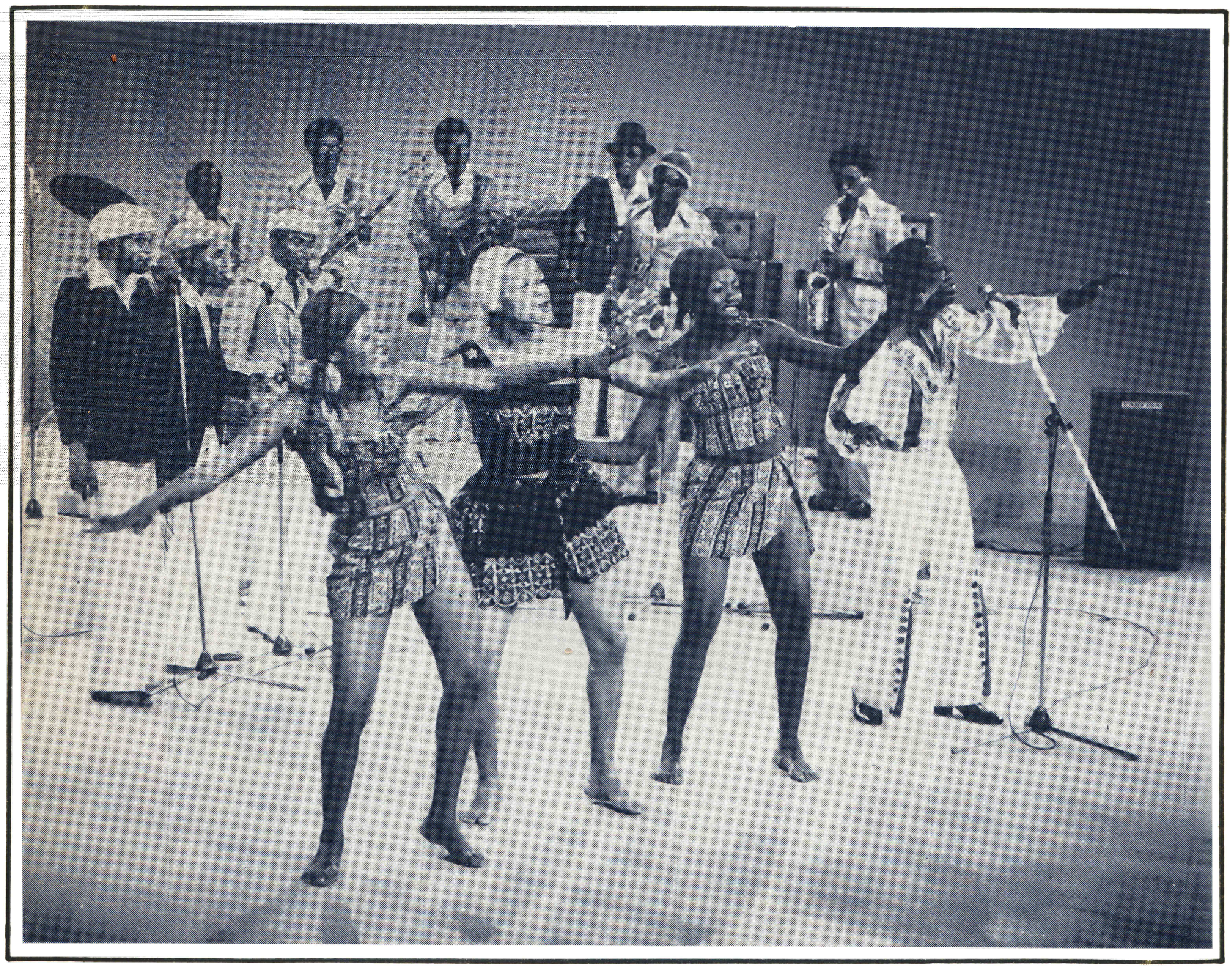
Tabu Ley and African Fiesta National, 1970 (Copyright – Analog Africa)
Various ‘Congo Funk! – Sound Madness From The Shores Of The Mighty Congo River (Kinshaha/Brazzaville 1969-1982)’ (Analog Africa)
A tale of two cities on opposites sides of the same river, the Congo, the latest excursion for the Analog Africa label celebrates and showcases an abundance of dynamite, soul and funk tracks from the two capitals of Kinshasa and Brazzaville.
The roots of both are entwined and yet very different. The mega city of Kinshasa only adopted its name during independence (but not without interference from its former brutal colonial masters Belgium, and also the West, and in more recent times, China) in the 1960s, a product of the “authenticity”, or “renativizing”, policies of Joseph Désiré Mobutu. The largest city and capital of the Democratic Republic of Congo – itself, renamed over centuries depending on who controlled it, but for a twenty-six year window between 1971 and 1997 known as Zaïre – the constantly expanding Kinshasa was founded in the late 19th century by Henry Morten Stanley, who was in the employ at the time of the Congo’s most disastrous barbaric ruler, Leopold II. Named in his honour, it stood for half a century or more as a hub for Belgium’s rape of the gargantuan central African country’s natural resources, minerals and people. Once free (only to a point) of European mastery its name was changed to reflect a hunger for authentic African heritage: named in fact after what was once a humble village on the same site.
On the northern side of the Congo River stands the capital of the Congo Republic, Brazzaville. It too was originally founded by a European, the Italian-born – but later granted French citizenship – explorer Pierre Savorgnan Brazza, who took it as a prize for the French Empire. The name stayed, but after greater independence this city became a thriving hive of activity for the burgeoning music scene: designated by UNESCO in 2013 as a “city of music” no less.
Circling back on its regional neighbor, Kinshasa became a seat of power for the dictatorship of Mobutu (the Belgium and US-backed usurper who took power after the assassination of the promising Black Nationalist, but Soviet-favored, Patrice Lumumba). Famously drawing a global audience in 1974, the world tuned into the legendary, iconic titanic grudge match between Ali and Foreman: aka the “rumble in the jungle”. Instigated by the boxing promoter and hustler Don King off the back of Ali’s full “motherland” endorsed conversion, Mobutu saw the potential in not only raising his own profile but that of his country by vouching for and putting on this great boxing spectacle in a revitalized Kinshasa.
History would later prove Mobutu to be a tyrant and thief, but for this shining moment of self-publicity the American stars of the fighting game and music/entertainment scenes were lured to the city. Seen in various documentaries since, but favouring the American stars of R&B, soul and funk – including the anointed godfather of soul himself, James Brown – the African artists and musicians that took part in a three-day festival of music around the main event included a rafter of local talent too. Competing to gain the spotlight, dominated by the likes of B.B. King, Bill Withers, The Pointer Sisters and The Fania Latin All Stars, were two of the Congo’s most famous icons: the bandleader, honed pioneer of an attacking repetitive guitar style that tore up the local dancefloors and airwaves, Francois “Franco” Luambo, and rival Pascal-Emmanuel Sinamoyi Tabu, aka Tabu Ley, the leading light of African rumba and one of the continent’s most influential artists. Franco fronted the TPOK Jazz troupe at that music extravaganza, a band with a lot of history: famous for their part in spreading Congolese rumba.
The event’s musical organizers, Hugh Masekela and Stewart Levine, gave Franco free reign as a creative guide, but it’s said that Tabu stole the show. It’s a convoluted backstory, but the band that Franco fronted, the TPOK, actually changed their name from the O.K. Jazz band a decade or more after forming in the mid 50s – even more confusing, you will see the name written down in various forms, sometimes with the abbreviated dots. Both this troupe and Tabu make appearances on this Congo Funk! showcase – the funk being only one part of a both dynamite electrifying and more riverside lilted set of Afro-rock, soul, R&B and more localized serenading sweetness. Tabu for his part, leading the Et L’ Orchestra Afrisa, moves to a forgiving soulful rumba-esque groove (Congolese rumba being a signature, often dominate, movement honed in the region by such luminaries as Tabu and the famous Verckys) on the sun-blazed horn serenaded and buzzing guitar licked ‘Adeito’. With their L’ Orchestre additional name, O.K. Jazz makes an appearance under the Lolo affixed title (I will readily admit I have not read the liner notes this time around, and so have no idea if this is an artists or just a reference to one of the villages in the area) on the funky raw Booker T/Stax steal ‘Lolo Soulfire’, and holding the full limelight, go for some “humph” and laughter on ‘Kiwita Kumunani’.
As with much of the collection’s roster, less established acts and groups outside the major label networks (many subsidiaries of Western labels) struggled at first to get heard or raise the prohibitive sums needed to record. The PR notes briefly describe what happened, but to fill the void, a number of pioneering entrepreneurs entered the market to levitate the costly process. The likes of smaller, more independent labels such as Cover No.1, Mondenge, Editions Moninga and Super Contact could take a punt on newly emerging younger artists; those who were influenced by the “rumble in the jungle” festival of sound, going on to cut their own hybrid versions of American soul and funk, of which this compilation is filled. Pumped out across the airwaves of Radio Brazzaville or beamed out by Télé-Zaïre and RTV du Zaïre – the TV shows of which were apparently so huge that the president ordered the latter to put out daily concerts because they were found to quell unrest and criminal activities during transmissions. Arriving at the opposite end of this compilations window, released in 1982, the opening salvo, ‘Sungu Lubuka’ by Petelo Vicka Et Son Nzazi, seems a likely candidate for this change. Sounding like the heralding horn section from a Dexys track and homage to Jackie Wilson and his peers, before slipping into a Latin-like groove, this track connects two worlds: as influenced by the Fania All Stars as it is by disco funk. It’s certainly a blazing start to a cracking collection, and obvious single choice. It’s followed by the Afro-rock and Kuti horns simmering ‘Mfuur Ma’ by the Groupe Minzoto Ya Zaïre; yet another single showstopper that seems to echo the Pazent Brothers and J.B.’s. And another worthy punchy tune, the closing ‘Ah! Congo’ by the Orchestre National Du Congo, proves the perfect, high energy R&B, bookend to a brilliant compilation.
Tracks like Les Bantous De La Capitale’s ‘Ngantsie Soul’ just roll on and on like a 12” disco mix; a funky but not erratic groove that pulls you in with a constantly fluid moving soul riff and clopping percussion. Next to that, Les Frères Soki Et L’ Orchestre Bella-Bella’s ‘Nganga’ shuffles and scuffles down the train tracks to a fit of horns in a workout that lasts nearly nine minutes.
Congo Funk in all its many variations is put under the spotlight, with an outstanding set list of fourteen tracks (whittled down from a container’s worth of singles) that will enthral and educate in equal measures. Essential dance floor fillers await.
Fran & Flora ‘Precious Collection’
(Hidden Notes) 12th April 2024
Arriving just months after Alex Roth’s new Cut The Sky project’s Esz Kodesz debut and Alison Cotton’s Engelchen, Fran & Flora release their own European Jewish culturally and historically inspired album. Addressing similar passages of loss and commemoration to the absence and tragedy of the Eastern and Central European branches of that community’s heritage, they also respond to its most joyous, strengthened traditions, transforming in a sophisticated, adroit and knowledgeable way the music of the Ashkenazi: otherwise known as “Klezmar”. And whilst those mentioned albums by Roth and Cotton channel different aspects of history – the former, covering the same Ashkenazi communities, but in Galicia, and the later, telling the story of the English Cook sisters who helped to save fleeing Jews from Germany during WWII -, the first overlaps this duo’s emotive and stirring story of lineage by overcoming tumultuous times to preserve a culture in a part of the continent that ruthlessly eradicated it’s identity and people.
For as Roth channeled past barbarity and conflict in what is now Ukraine for a harrowing and incredible abstract reaction, Francesca Ter-Berg and Flora Curzon (to give them their full names) also tread the same lands, but also across into Romania – as the album’s second track, the beautifully but moodyily and mysteriously described Eastern-European fairytale ‘Romanian Fantasies II’ makes abundantly clear (imagine the strings aspects of The Holy Mountain soundtrack meets Širom and Gypsy music, whilst a didgeridoo-like sound blows away).
I might be reading too much into it, but the duo’s Precious Collection suite closes with what, over time, has become a formal greeting in the Jewish community: “Sholem Aleichem”. Translating from Hebrew etymology to mean “[May] peace [be] upon you”, it was also the nom de plume of the famous Yiddish author and playwright Solomon Naumovich Rabinovich, whose stories of Tevye the Dairyman were the source for the Fiddler On The Roof musical. Born in the old Tsarist Russian conquered and subjected shtel of Voronkiv in what is now central Ukraine, Rabinovich experienced the pograms firsthand; escaping to the USA at one point, but in doing so promoted the often looked-down-upon Yiddish culture and language. Also, and not surprising when facing the marauding savagery and alienation of the Russian Empire’s genocidal actions, and the Anti-Semitism and ruinous policies of the Austro-Hungarian empire too, that he also advocated the return of his people to the Holy Land as a member of the Hovevai Zion (lovers of Zion) cause. Hounded out of his homeland when alive, a Putin era Russia erected a monument in his honour in Moscow, whilst Ukraine paid homage throughout its many cities and even issued stamps – ironically or not, many of those cities have been bombed relentlessly by Russia in the past two years. Whether this is a mere coincident or not, it’s a useful connection and part of the history of the region covered on this album; especially as the place where Klezmer was born or at least fashioned – that loose confederation of dance tunes, ritual melodies and “virtuosic improvisations” is made up of influences from the Jewish diaspora, from Ottoman Greece and Romania to the Germany and Slavic countries. The “Klei” part of that form means “tools, utensils or instruments of” and the “zemer” translates as “melody”, an assemblage if you like, of different musical threads but rooted in the faith. Klezmer was, and of course still is, played at weddings and other social functions, but more importantly it is a bond and hand-me-down language, poetry and litany of their heritage and story.
Drawing upon this legacy and knowledge the duo of cellist Fran and violinist Flora (both also cover the vocals and electronic elements) both interpret traditional material and compose new arrangements that simultaneously evoke classical music and the atmospheric, with echoes of folktronica, the avant-garde resonance and atonal essence of hidden metallic and instrumental sources and fantastical – imagine Walter Smetek conducting a Eastern European chamber ensemble. There’s even a removed hint of jazz and near breakbeat drums at one point, when they do get to sustain a rhythm. The drumming circle is courtesy of guests Ursula Russell (of Snapped Ankle and Alabaster DePlume fame) and Simon Roth (Chris Potter, Alice Zawadzki, Adrian Dunbar on his CV), plus, what the PR notes call, the appearance of a Ukrainian Poik style marching drum – my research has drawn a blank on this one I’m afraid.
Some pieces of music directly reference Jewish culture, history, with the stripped and plucked diaphanous but haunting ‘Nign’ a unique take on the traditional religious vocal song of the same name. Largely improvised, sung in groups, Bible verses or classical quotes from other Jewish texts are repeated to form what’s know as a “nign”. Sometimes a lamented prayer, and at other times out of joy or victorious, this contemporary vision sounds like beatific and ethereal sirens uttering assonant mystique and worry from behind a translucent covering. But the vibrations, melodies even amongst the most abstracted, near non-musical parts still carry, forming as they do, evocations of landscapes and time. Sympathetic and attentive at all times, the music encompasses wild playfulness and abandonment on the opening running freedom of ‘Nudity’, and nature’s call on the Caucuses imbued, choral lulled ‘Feygele – Little Bird’.
Woven at times like a tapestry, and at other times, near esoteric, the beatific merges with the plaintive, pleaded and mysterious, and folk music is effortlessly weaved with folk-rock, the experimental and the classical. Within that framework traditional dances and songs are wrapped up in a meticulously crafted otherworldly suite of experimental strings and minimalistic electronica. The Klezmer source material is held on to but transformed with a contemporary expansion of ideas and experimental composition, all of which flows lucidly and in a most stirring manner to create an exceptional album.
Herandu ‘Ocher Red’
(Hive Mind Records) 26th April 2024
A second release on the Hive Mind label to feature Misha Sultan, or rather the true face behind that guise, Mikhail Gavrilov, the Herandu debut is a new project and new sound for the Siberian artist and his brother Evgeny (who has his own alias of Dyad).
The siblings, caught between the Covid pandemic and invasion of Ukraine by Russia, put this latest vehicle in motion during trips back home to Siberia’s most populous city of Novosibirsk in 2022. The so-called “Chicago of Siberia”, Novosibirsk is situated on the banks of the Ob River, a crossing point of the romanticised and legendary Trans-Siberian Railway and historically an important flashpoint during the Russian civil war and engine of post-revolutionary Russian industry. Originally founded in 1893 and christened with the Tsarist Imperialist title of Novonikolayevsk after Emperor Nicholas II, the Communists gave it the current name of “New Siberia” in 1926. Geographically sitting between the Ural Mountains and Northern Asia, touching the Pacific in the East, Siberia isn’t just the infamous exiled atelier of record and literature but a beautifully diverse Eurasian landscape.
As on Mikhail’s Misha alias Roots album, released by Hive Mind back in the late Spring of 2022 (as it happens, that marvelous album also included a cameo from his brother, under his Dyad moniker), that famous industrial transport capital and its outlying regions are once more transduced via the soundboard and imagination to articulate and convey backdrop set moments of rumination, of particular captured interactions and moods, and an essence of place and time – the industrial set against the more plush shades of nature. Informing and inspiring a new direction, the label has described the brother’s collaboration as sounding like Metalheadz meets Weather Report; or to my ears, Plug plays around with the music of the Mahavishnu Orchestra using the production of 80s Miles Davis records whilst hauling in later 70s and 80s Herbie Hancock on cosmic ray beam keys and what sounds like a keytar.
Actually, with a mix of warmer sounding live instrumentation (from Stanley Clarke-light jazzy-funk slap and picked bass guitar and Greg Foat-esque electric-piano to pinning, floating and sizzled reedy saxophone – courtesy of friend and musician Vladimir Luchansky) and more programmed synthesized breakbeats, chops and atmospheres, the brothers branche out into all kinds of international genres, with evocations of the Caucasus, Tibet and both East and North Africa merging with photons and clap-drums. Jazz-fusion and world music hybrids from the Silk Road and Samarkand cross paths with Jimi Tenor, Amorphous Androgynous, Rip Rig & Panic, Transglobal Underground and The Pop Group. And yet that only goes so far in describing the subtle but cross-pollination of influences on show. The timpani bounds of ‘An Incident At The Theater’ play up the title’s stage drama, but soon break out into those Weather Report references, and the misty vaporous ‘Downtown Street’, heads off in the direction of both Hansa studio and later Outside period Bowie and 80s Scott Walker.
Trance is spun with bass noodling, Ethio-jazz, post-punk funk, Moroccan and Arabian cassette culture, retro space age keys, no wave dance music and the Aphex Twin to create an interesting explorative zap, skip, playful, mysterious and dreamy vision that mirrors the brothers feelings of their native landscape, and the episodes of life, the shaping of their creativity, born in that setting.
Kira McSpice ‘The Compartmentalization Of Decay’
12th April 2024
Nature’s compartmentalized reactions to injury and decay (via the studied description laid down by the pathologist and biologist Alex L. Shigo) are drawn upon, referenced and used as a metaphor for Kira McSpice’s own coping mechanisms; the American singer-songwriter and musician dealing with trauma by channeling both desirable and undesirable energy into working through the darkest, most fearful physical and mental strains of painful morose.
Almost like therapy, although bad dreams plagued McSpice throughout the writing process, the troubled chanteuse of the self-coined “freak folk” sound faces blow after blow of gothic lament and harrowing despair. And yet there is a beauty too, with passages of the near ethereal, beatific and afflatus ebbing over chthonian mourning and distress. In fact, the suffused nocturnal atmospherics, whilst hiding allegorical esoteric nightmares and spirits, are like a strange fairytale set filled by operatic and theatrical characters and life.
It’s the voice that draws you into that visionary world however; an apparitional-like calling, lulling, assonating and hurting vocal that soars past the contralto-bass to reach near aria like heights. With an obvious keenness and deep knowledge of the craft, McSpice artfully constructs inter-layered choral circles and marooned, mournful and cut-to-the-marrow pained releases, which as the album progresses gradually seem to find the gauzy light – ‘Photosynthesis’ facing that light source and growing in a somnolent fashion sounds almost like a daydreaming Mazzy Star. The welling and plaintive, sometimes struggling, voiced woes and pathos is enveloped with heightened atmospherics, suffused and smothered hazy horns (what sounds like a tuba, but also oboe, clarinet and maybe a saxophone of a sort), a Goth acoustic air of All About Eve, and Tilt-period Scott Walker eerie, stark and heart of darkness style electric guitar. All of which has a very distinct sound: pitched somewhere between haunted chamber music, the operatic and baroque and obscure, hermetic prog-folk. Slowly removing a metaphorical armour. McSpice arises from the symbolic mists and fogs to forge a shaken, knocked but hard-won identity. The rooms and spaces maybe dark, but through McSpice’s cleverly poised and escalating vocal chills and more beautifully heartbreaking, fraught processes there is a clearing of the miasma and the promise of a reprieve. Nothing short of an extraordinary album.
Pando Pando ‘S-T’
(Not Applicable) 12th April 2024
With enviable experience and CVs with incredible depth and variation, all three participants in the Pando Pando project tantalize with the prospects of their experimental explorations. The names of trumpeter, electronic musician, engineer and producer Alex Bonney (performing with Leverton Fox, Scarla O’ Horror, Brass Mask, the list goes on), drummer and percussionist Jem Doultan (played in Róisín Murphy’s band for seven years, drummed in The Thruston Moore Group and is one part of the Too Many Things duo) and fellow drummer/percussionist Will Glaser (a stalwart of the UK jazz scene, teacher and foil for an impressive roster of bands and artists including Soweto Kinch, Kit Downes, Yazz Ahmed and Sly And The Family Drone) will be familiar to many on the contemporary improvisational scene.
All three crossed paths through the New River Studios arts space in London, forming a trio off the back of a series of improvised gigs in the capital. In partially describing their evolution and process they’ve named themselves after one of the natural world’s largest single living connective organisms, or in its scientific terminology, “a clonal organism that represents an individual male quaking aspen that spans 106 acres and is the largest tree by weight and by landmass.” This breathing, living behemoth of plant life is, in case you were interested, located in the District of Fishlake National Forest, between Colorado and South-Central Utah.
Growing in a quasi-organic abstract fashion, the drum and percussion heavy avant-garde movements and stirrings on the trio’s debut album take electroacoustic probes, prods and tumultuous splashes into the depths as a foundation to build otherworldly atmospheric workouts, prowls and freeform breakouts. Recognizable instruments and electronic elements, effects are used to evoke the most unusual and sometimes esoteric. An assemblage of trinkets, bells, finger cymbals, metallic textures, pots and pans and tubular scaffolding are used alongside the drum kit to evoke the influence of such luminaries of the form as the Art Ensemble Of Chicago (mentioned in the PR notes that accompanied this release), but to my ears, also the E.F.S experiment extractions from Can’s Limited/Unlimited LPs, Valentina Magaletti, Krononaut, Mani Neumeier and, on the weird d’n’b veiled clanged and distorted ‘Fluffy Wires’ like Matthewdavid warping a samba band of drummers. However, the peculiarly named ‘Eno’s Bathroom’ is not what I would imagine the ambient doyen’s bathroom to sound like at all; less scented candles, sandalwood and eco-friendly, fair trade handmade soap and more krautrock and ghost freighter Tibetan lurking mind-bended weirdness.
Titles, like much of the music, is on the disturbing side with references to marine deaths (the windbreaker flapping prowl into the ocean abysses ‘The Graveyard Of Sharks’ and incipient sonar signaled, dub-y ricochet thrash around in marooned waters ‘Dolphin Suicide’) and blamed birds (the final wing-flapped primordial squelch, and mystical gongs, bowls and tool brushed and sifted ‘It Must Have Been The Magpies’ –our common English garden visitor has a bad rep for a variety of things, from the old adage about bad luck to stealing anything that glitters, and for savagely protecting its nests).
An evolving organism of their own making, breaking out of, growing and expanding the perimeters of improvised electroacoustic experimentation, the Pando Pando trio make unsettling tones and sounds, rhythms and serialism for ecologically climatic times.
Audio Obscura ‘Acid Field Recordings In Dub’
(Subexotic Records) 26th April 2024

Drifting in and out of post-op drug-induced recuperation, Neil Stringfellow (aka Audio Obscura) laces his dreamscapes and stupors with signature 303 acid squelches and dial releases, frequencies, snatches of broadcasts and bubbled liquids; much of which is transformed or made out of the archive of sounds he’s built up over the last twelve years, from a recurring flock of chirping birdlife to the innocuous, taken for granted and missed, sounds of the streets outside and daily interactions between, in this case, hidden sources of dialogue and conversation, even child’s play.
Take all that and expand the mystery, the unease and esoteric with a wafted reverberation and echo of dub and you have a real hallucinogenic experience, the ebbing of the consciousness between passages of the recognizable and distorted. That roosting menagerie of birds that Neil could hear from his hospital bedside, out of the window on one humid day in 2022, now resembles the acid-dial-turns of Mike Dred, a street cleaner’s broom, banging against his cart as he wheelbarrows it down a hill in Norwich, suddenly mimics a dub snare drum when added with plenty of On-U Sound echo.
The gravity fields, cartography, the memorable (through a soporific haze of painkillers) passages of a day and the unidentified coastline take on otherworldly dimensions through this mirage-inducing lens as elements of Air Liquide, The Orb, Amorphous Androgynous, Cousin Silas And The Glove Of Bones, FSOL, Andrew Wasylak and Cabaret Voltaire pass through – the latter is unsurprising, and not for the obvious reasons that CV are just one of the all-time most influential and inspired electronic groups of all time but because the Cabaret’s Chris Watson hosted a field recording introductory week that Neil attended.
Field recording adventures in sound, under the dreaded sirens of a nuclear winter and apocalyptic distress, this album is a lucid acid wash of near-remembered haunted piano melodies, various sonic yips and yeeps, bulb-shaped notes, recalled melodica, lost transmissions half-heard, radioactive effects, the atonal and prowling. Paranoia meets the languorous and medicated on a productive experiment in acid-dub and sound art.
Khôra ‘Gestures Of Perception’
(Marionette) 19th April 2024
Ambitious in scope and influence, Matthew Ramolo’s Plato-coined Khôra vessel overlaps the afflatus with the mythological, hermetic and philosophical across a double-album spread of peregrinations, processions and transcendental mysticism. References abound from opened seals, with nods to branches of Buddhism, astronomy, the Hellenic, Tibetan, Heliopolis and atavistic: all the way back to the creation myth. Literally from the ground up (the Dzogchen concept of “rigpa”, which subscribes the qualities of purity, spontaneity and compassion to the primordial ground), Ramolo, using an apparatus of international instrumentation, drums-up simultaneous visions of the new age and alien. Name checking the Latinized, the Orient and spiritual Asia in its many forms, but also cosmic projecting, the alchemy at play on this opus vibrates with evocations of ksmische, Jon Hassell’s “fourth world musics” explorations, trance, magnetic electronics, courtly and ceremonial.
The central sounds are percussive in nature; from those Tibetan stirrings of bowls, tubular bells, wind chimes and movements that sound like the turning of a mani wheel, to claves, what sounds like stones, a scaffold of pans and tubes, and frame, hand and other more rhythmic drums. Other elements include electronic vapours and waves, the springy and plucked, divine radio and satellite transmissions, occasional bellowed wafts and bulb shaped notes of light. Yogi talks to, well…the world, as nirvana is opened to all on this trip of dial up meditations, explorations and mysterious off-world atmospherics. The echoes of Syrinx, Kalacakra, Bhajan Bhoy, Ariel Kalma, A.R. & Machines, Sergius Golowin and Iasos wrap themselves around an epic suite of spiritual and mystical excursions in the pursuit of navigating a formless, third way through new envisaged worlds: or something like that. Eastern spiritual music is often abstracted in this world, merged with hidden sources to produce something familiar yet a bit different.
Esbe ‘La Serenissima’
(New Cat Music)
Inhabiting each world she enters as if it were a past life, another reincarnation, the gifted singer-songwriter Esbe steps right out of the times, the locations and scenery as if she was born to it. From atavistic Egyptology to classic songbook reinterpretations, from across the ages and genres, Esbe seems to belong to whatever setting she channels.
Proving consistent in every endeavor and prolific, she now releases her ninth album of magical revue; once more interpreting the old, but also conjuring up original compositions and arrangements that congruously feel like part of the traditional cannon. Sweeping into the city of duality, Venice, or rather the 17th century anointed “La Serenissima” as it was once known, Esbe channels its famous history, literature, art and architecture; from a secret rendezvous on a canal bridge to masked balls, painted scenes from the late Renaissance and cinematic sweeps that move like the tidal currents out of the city and carry on towards the exotic and cosmopolitan hubs of this city-state’s once expansive empire of trading routes. I say duality, because this is both the city of love and center of much political and stately intrigue during the Medieval period, when what we now know as a unified Italian geography was split into various warring and competing Papal states; the port cities being amongst the strongest, carrying more weight with their navies and trading fleets, able to negotiate or bring in allies from abroad to support their claims of dominance.
Mentioned as an inspiration, Shakespeare’s The Merchant Of Venice – or rather its most famed locations within the city – throws up all kinds of Anti-Semitic stereotypes; the city’s Jewish ghetto appalled a conquering Napoléon centuries later: commanding the French forces that occupied Venice in 1797, the as yet to be emperor would famously end the ghetto’s separation from the rest of the city, removing barriers and renaming it the Contrada dell’unione. But Esbe is tapping into the city’s mystery, its art and majesty, whilst casting yearns outbound from the harbor to old trading routes in the Med and further abroad: see the heart-wrenching, diaphanous soaring operatic ‘Palazzo’, a Thomas Newman modern Bond-esque filmic score that evokes Istanbul, passionately sung in the Turkish language.
The very embodiment of a certain style of Venetian art, Canaletto’s iconic (though many disparage it as mere chocolate box art) cityscape dioramas are referenced within the PR briefing; a inspiration, jump off point for magical lyrical and musical painting and storytelling imagination. Almost a feature of a certain time back in England, my late grandfather like many of his generation, had a print on the wall – of Italian decent himself, his one and only actual visit to the homeland was as part of the Allied forces making their way up through Italy to capture Rome during WWII, and even then, he never managed to get to Venice. You can now imagine Esbe, one hand trailing in the canal waters or “sighing” over a romantic set bridge gazing at the light play on the surrounding architecture; dreamily envisioning a bygone time as she sings and coos about imagined liaisons, and characters that could have walked straight off a Medieval tapestry.
As with most of her work, Esbe balances the atavistic and traditional with more modern electronic vapours and wisps of the esoteric, haunting and spellbinding. Sounding somewhere between Dead Can Dance, Maria Callas, the Baroque, folk and Arabian, she can turn a foggy apparitional mystique into an aria, an expelled breath into a whole act, or story. Her most obvious talent is with that already described voice, which is as dramatic and theatrical as it is ethereal and subtle; delivering a suspenseful Latinized lulled and desired vocal on the Catholic regal service ‘Te Amo’ – luring us towards a steeped in mystery and serious alter -, and lending a near dreamy tidal pulled entranced performance on the romantic vision ‘Amarilli, Mia Bella’ – a reinterpretation of Giulio Caccini’s operatic love song, written for the 1602 Le Nuove Musiche collection of monodies and songs for solo voice and basso continuo.
Classical styles feature heavily, but are veiled or gauzily enveloped to sound more haunting, atmospheric and even like a mirage in some cases. Throughout it all the instrumentation, from chamber to synths, guitars and the sound of bubbling waters, are artfully suggestive and stirring; scoring the drama, downcast lament of a returning army from one of the Papal wars, or in emoting misty-eyed overtures to mysterious subjects.
Esbe once again breathes life into her surroundings, this time around playing with and choreographing an inspired songbook of Venetian evocations; absorbing the lagoon and canals of this impressive, iconic city and its forbearers to envision something that’s simultaneously magical and hauntingly surreal.
Hi, my name is Dominic Valvona and I’m the Founder of the music/culture blog monolithcocktail.com For the last ten years I’ve featured and supported music, musicians and labels we love across genres from around the world that we think you’ll want to know about. No content on the site is paid for or sponsored and we only feature artists we have genuine respect for /love. If you enjoy our reviews (and we often write long, thoughtful ones), found a new artist you admire or if we have featured you or artists you represent and would like to buy us a coffee at https://ko-fi.com/monolithcocktail to say cheers for spreading the word, then that would be much appreciated.
 Monolith Cocktail Blog