THE DIGEST FOR NOVEMBER 2024: New Music/The Social Playlist/And Archives
November 22, 2024
THE MONTHLY DIGEST INCLUDES A CLUTCH OF ACCUMULATED NEW MUSIC REVIEWS; THE SOCIAL INTER-GENERATIONAL/ECLECTIC AND ANNIVERSARY ALBUMS CELEBRATING PLAYLIST; AND CHOICE PIECES FROM THE ARCHIVES.

Photo Credit:: Giovanna Ferin
____/THE NEW
Juanita Stein ‘The Weightless Hour’
ALBUM (Agricultural Audio) 29th November 2024
And perhaps it all comes to this, that after twenty-five years in the music business as both the frontwoman of the Howling Bells and as an established solo artist Juanita Stein has finally found the strength of her own voice and creative force. Stepping out from behind the safeguards of noisy rock to find that silence resonates deeper and further, Juanita erases everything but the most vital, emotionally receptive and connective elements from her music to produce a sagacious, confident (despite the fragility and vulnerability in places) songbook of personal memories.
Stripped back then, but even more powerful, Juanita faces up to her family’s past and her own, and faces up to the more troubled, traumatic experiences in the most diaphanous of ways. There’s a real clarity lyrically and musically, despite the coos, the often near ethereal airs and veils, and the reverberated echoes. And the minimal accompaniment, which changes between the acoustic and note struck electric guitar, and features a subtle gravitas of strings at times, chimed elements and the odd bass drum, either weaves or rings out evocations of Southern Gothic and Lee Hazelwood country, magical carousal and Laurel Canyon 60s influences, the music of 90s Drugstore and Juliana Hatfield, and a hint of Radiohead.
I’ve always loved Juanita’s voice, which is pretty unique in the best possible way: soothing, beautiful yet full of emotional turmoil, and verging on the apparitional on occasion. Here she sounds at times like a mix of Kristin Hersh, Tanya Donelly, Lana Del Rey and June McDoom at its most breathlessly gossamer. And considering the themes, that voice is never projected with anger, resentment or resignation at any time during the ten songs on this near perfect album. Put it this way, there’s neither a flood of emotions nor a moment in which the whole experience threatens to engulf Juanita.
Rather than write for characters, every lyric can be identified as a feeling, an experience that Juanita has personally been troubled by, gone through and lived. Growing up in a talented Australian family of artists (her late father Peter Stein, the renowned songwriter/musician, her mother Linda a former stage and TV actress, and her brother Joel the lead guitarist in the Howling Bells), but brought up in the Orthodox Jewish faith with its strict adherence to the Torah and just as strict schooling methods, Juanita claws, or takes, back what was lost during her childhood with a lyrical passion that borders at times on the poetic wise honesty of Leonard Cohen.
The accompanying PR notes use the word “imposed” when outlining Juanita’s Jewish roots. But that would suggest an abandonment or uneasy relationship with her identity, which you are born into. Juanita seems to me to be more objectional to the dominate patriarchal and masculine aspects of Judaism; the restrictive nature of old lore and laws and rules. For she stands up against antisemitism, especially recently with record numbers of incidents and violence meted out against the Jewish community around the whole Western world after the horrifying, barbaric murders and kidnaps perpetrated by Hamas on October the 7th last year. ‘Old World’ is a reminder of the evils of antisemitism, but also a reckoning with that ancestry. Unfolding over an acoustic country and Laurel Canyon-like trial of striking imagery that most beautifully haunting song finds Juanita revisiting her grandmother’s Prague home, now, even eighty years later, emptied of its once thriving Jewish communities – communities that can be traced back a thousand years or more, as mentioned in the Sephardi-Arabic Jewish merchant and traveller Ibrahim ibn Yaqub’s famous travelogues in 965 AD, and which numbered 92,000 before the Bohemia/Moravia partition of 1938/39, when Nazi Germany attempted to wipe them from the face of the earth; nearly succeeding, it’s believed at least two thirds of that figure perished in the Holocaust. Using a beautiful language of descriptive geography, the way the light falls upon that absence and legacy of destruction, the piles of ash, Juanita observes the eradication of the faith, the synagogues, and the way they were brutally changed into Christian places of worship: the recurring crucifix for example. Juanita’s grandmother was forced to leave at the age of fourteen, escaping the fate that awaited: namely transportation to the Theresienstadt camp built outside Prague, and eventual death in Auschwitz in Poland or the killing sites of the Baltic states.
Making some references to that Orthodox schooling again, but also written whilst waiting out the Covid lockdowns in Italy, the picturesque ‘Carry Me’ finds solace and sanctuary in a most charming, idyllic Tuscany surroundings. As the world grinds to an uneasy halt, Juanita, accompanied by subtle birdlife and the even softer sound of crickets and the environment, coos whilst playing a resounding, sounding out electric guitar turned up loud: but vulnerable and fragile. Again, I’m hearing Leonard Cohen. And there’s a nice, real softened plink-plonk of piano that’s just about there, which comes in at the end.
Moving on, the near aimless evoked ‘Driving Nowhere’ recollects a relationship going…well, nowhere. Featuring the duet partner of North Ireland artist Pat Dam Smyth, there seems to be a channelling of Hazelwood via Nick Cave and Roland S. Howard. The drifting apart of once entwinned partners is played out on the Australian country highway of heartache and emotional breakdowns, with Smyth, who supported Juanita in on her first London solo performance, adding a very congruous if deeper voiced sense of lived-in, resigned sadness.
Reflections there are many, especially when facing the “heady days” of the early noughties as the frontwoman of the highly successful (and a damn good band) Howling Bells on ‘The Game’, which sounds like Lana Del Rey backed by R.E.M. Not so much regrettable, as sadly conveyed recollections of fame and being at the centre of a whirlwind, a storm that left no room to breathe or process, it seems she both suffered and yet misses it. ‘Motionless’ has a heavy strum and chug to it that reflects the open-hearted revelations of another broken relationship; the stage set for honest reflection and for saying what needs to be exorcised before moving on.
The Weightless Hour is the perfect album from a great voice and songwriter, who’s now able to find that distance from the events of the past and a new sense of reflected candidness and honesty in motherhood. Juanita’s true self and strength opens-up, the noise diminished for something far more powerful. Not so much defiant as confident. A definite album of the year.
Spaces Unfolding + Pierre Alexandre Tremblay ‘Shadow Figures’
ALBUM (Bead Records)
Coinciding with the 50th anniversary of the revitalized Bead label, a special challenging site-specific work of non-musical experimentation and evocation from both the Spaces Unfolding trio of flutist improvisor Neil Metcalfe, avant-garde violinist Philip Wachsmann and drummer improvisor Emil Karlsen, and the electronic explorer Pierre Alexandre Tremblay.
In merging their own specialist forms – the acoustic and electronic – both partners on this improvised serialism of avant-garde, textural, atonal and more recognisable sound and instrument sources, expand the sonic palette further towards the abstract, mysterious and near paranormal. “In Praise Of…” and making concrete the otherworldly “Figures” from the “Shadows” this collaboration seems to channel the ominous and a sense of disturbance. The electronic effects, beds and signals set off an uneasy sense of technologies creeping encroachment, its power sources and unseen, near subverted presence.
But the triplet of atmospheric “In Praise Of Shadows” suites is dedicated to and takes its name from the celebrated Japanese titan of provocative literature Jun’ichirō Tanizaki and his notable essay on Japanese aesthetics. Noted for both his shocking depictions of sexuality, of kinks, of the submissive, and obsessions, and subtler portrayals of family life in his native country during a time of upheaval, as modernism took hold, as Imperialism rose and then was crushed and replaced by Westernized consumerism and progress, Tanizaki’s usual schtick was to place characters, affairs against a backdrop of cultural anguish. However, published in the 1930s, In Praise Of Shadows is a little different; made-up of 16 sections (a sample of titles: “The toilet aesthetic”, “A novelist’s daydreams”, “An uncanny silence”), the central theme uses analogies and abstract ideas of light and darkness to depict the comparisons between Western progress and its search for light and clarity with the subtilties and appreciation of the subdued and shadows in East Asian art and literature – or more specifically an appreciation of the Japanese concept of “Sabi”, or “world view”, which is centred around transience and imperfection. There’s far more to it all of course, including, which is very important in this context and as an influence on this recording, a piece on the layered tones of various kinds of shadows and their power to reflect low sheen materials: see the various “Refraction” entitled pieces of textual shadowy play.
I’m not sure if it is intentional or not, but some of the both harder and dulcimer-like plucks on the violin, the whistly aspects and higher pitched flutters of the flute and some of the near-taiko-like thunders of the drums evoke the music of Japan: somewhere between the traditional and the work of Yamash’ta & The Horizon and Farabi Tushiyuki Suzuki. It builds a sort of Oriental mysticism at times, a mysterious atmosphere of shadows, or an estranged Kubuki theatre, and of deeper meanings channelled by the tactile and textured.
At times I’m picking up echoes of Anthony Braxton, the work of Larry Austin, the Giuseppi Logan Quartet, some Sandro Gorli, Alan Sondheim and Fernando Grillo amongst the electrical fields, the sparks of freeform jazz, the scurries, the spidery finger work, restless crescendos, dry fluted chuffs and rasps, and solid thick-stringed pinches and strains. Untamed with moments of reflection, uncertainty, Shadow Figures pitches an environment and its sounds, its unseen wound-up, ratcheted and twisted objects with more skeletal, shaved, sieved and high-pitched avant-garde expressions.
Maalam Houssam Guinia ‘Dead of Night’
ALBUM (Hive Mind Records)
Accomplished student and innovator of the traditional Islamic dance, music and poetry exaltation of ‘Gnawa’ and the three-stringed lute-like instrument that goes together with that ancient practice, the ‘Guimbri’, Houssam Maalam Gania pays a certain homageto his upbringing and his roots as the scion of the late Gnawa master Maalam Mahmoud Gania. A catalyst for the label, a repackaged special reissue of Maalam Mahmoud’s sublime venerable Colours Of The Night performances kick-started the whole Hive Mind platform label back in 2017 – a label, I might add, with a considered taste in some of the more understated, lesser known recordings of world-class artisans and genres. This was soon followed by the label’s fourth release, Mosawi Swiri LP, which featured Houssam Maalam and a troupe of lively young musicians from the country’s fishing port town of Essaouira.
The youngest son of the virtuoso has obviously inherited all the right creative and musical attributes, performing as he does a remarkable adroit and earthy vocalised songbook of affectionate and devotional Gnawa-style pieces; pieces that his father would play and sing in the family home to his children. The title is both a riff on his father’s iconic LP and a reference to the nighttime hours in which this album was recorded, stripped down with no accompaniment, live on the 3rd of June 2022 in Casablanca using only a Tascam field recorder and two microphones.
Uncloyed (as the field-recordist producer Ian Brennan would say) and as intimate and atmospheric as you can get, with the tape left running to pick up any clearing of the throat and the breaths between singing, each performance is a one-man demonstration of the Gnawa artform and a hybrid of influences from Westernized blues to the music of the Tuareg and the influences of a wider West and North African geography. For that Moroccan heritage bleeds over borders, chiming even with certain traditional forms from as far as Southeast Asia: whether intentional or not. In solo form, Houssam Maalam manages to play polyrhythmically; using, what sounds like, the flat of his hand on occasion to simulate either a bass part or a hand drum. Plucked elasticity is combined with paddled hand movements, whilst a constant buzzy and wobbled rhythm is kept going. Sometimes it sounds more like a banjo, and at others like a makeshift guitar, but is always played with either a delicate, intricate hand or a more physical, bassy one. Expressively conveying the Godly, moments of joy and comfort, and the questioning, the voice resonates from the very soil. But it sounds like that voice has matured somewhat since Mosawi Swiri, grown perhaps as it resonates with those songs of childhood. Dead of Night achieves two things. Firstly, Houssam Maalam grows closer to his father’s legacy, and secondly, forges his own pathway and identity honing a unique Gnawa legacy. Be quick, as this is yet again a limited release – though I’m sure of there is enough demand, there might be a second repress.
Baldruin ‘Mosaike der Imagination’
ALBUM (Quindi Records)
Mosaike der Imagination, or “mosaics of the imagination”, is the latest mirage fantasy of vague worldly evocations, hallucinations, magical folk music and gossamer traverses from the German electronic artist Johannes Schebler, under the guises of Baldruin.
Regular readers may recall my review of last year’s Relikte aus der Zukunfti album, which I described as “lying somewhere between the Reformation, hermetic, supernatural and mysterious Far East”. I also pointed out the air of religious bellowed organ, the church atmospherics, and the toll of bells on that release. For just as Roedelius, Moebuis and Schnitzler’s first recorded experiments, under the Kluster title, found a home on the synonymous German church organ music label Schwann, so congruous were those early kosmische innovators “hymnal qualities” and, if removed, links to the country’s rich venerated history of religious music, Schebler’s own small Bavarian village rectory upbringing can be heard permeating this latest album too.
You can pick up passages of Tangerine Dream cathedral vibes and a glass-stained organ on, what is, a kaleidoscopic tapestry of fourth world music, occult folk and the amorphous international traditional sounds of (from what I can make out) Japan, India, Southeast Asia, Tibet and an imaginary vision of ritualistic, tribal paganist Europe.
From Orthodox monastery moans to the whispered spells, invocations of Baroque and folk-styled esotericism, and from the ceremonial to mysticism and the burning coals of martyrdom, spindled and softy but quickly malleted instrumentation, hand drums, the fluted and bone-like vibraphones merge with electronic algorithms, various forms of crystalized and tubular light and recurring chiming of timepieces.
This a strange coalesce of Laraaji, aboycalledcrow, David Casper, Xqui, Jon Hassell, Caravan of Anti-Matter, Belbury Poly and Benjamin Law on a diaphanous and hallucinatory alternative plane of light and shadows. Baldruin conjures up the dreamy, the haunted, and the magical on yet another transmogrified and reconfigured album of folk, worldly and religious imbued recondite sources.
Mauricio Moquillaza ‘S-T’
ALBUM (Buh Records)
Exotic, alien and near supernatural organisms and life emerge from machines on the new four-suite release from the Peruvian musician, sound artist and cultural manager of various projects and platforms Mauricio Moquillaza. Working across a diverse range of mediums, from theatre to dance, and part of the experimental Lima scene of recent times, Moquillaza has cultivated a process of organic and improvised electronica from an apparatus of electronic tools – specifically a Eurorack modular of hardware.
On this untitled experiment of “generated possibilities”, the sounds, repetitions and changing patterns are untethered; recorded as they are in one take and without any overdubs. Allowed to develop almost naturally, each piece sounds like a balancing act between stimulated machine learning and free improvisation; the results, a continuous hybrid of cosmic, cerebral and mystical languages, calculus, exotic birdlife simulated pitches and warbles, moist cave-like atmospheres and the rhythms of life.
As a bassist too, you’ll hear singular notes that are both deep and low, but fluctuating, as each movement of the cylindrical, the tubular and more openly expansive create a magical and sometimes ominous shadowy world. At times it sounds like transduced or transformed echoes of bobbled, chimed gamelan from an alternative plane, or a fourth world take on early techno music. And as is the artist’s raison d’etre, there is a constant looming edge of dissonance, some near crushing and crashing haywire noises (like some galactic space battle on the album’s third suite) ready to develop out of the various patterned process, the inter-dimensional free-exchanges and dancing arpeggiator-like notes that bob around in the lusher, more fun sections.
Like A.R. And The Machines rewired via a portal into a futuristic vision of South America, or Tangerine Dream fusing with the Eyot Tapes, Tomat, Richie Hawtin, and Autechre, Kosmische influences, cult pioneering library music, more stripped techno and contemporary experimental electronica combine to form both a cascading and ever-changing layered album of quality freeform electronica. If you follow or are aware of the quality Buh label, then you know that every release is intriguing and interesting, introducing us to great new innovators from the South American scene. And Moquillaza self-titled debut is no exception. A highly recommended release.
____/THE SOCIAL PLAYLIST VOL.92

The Social Playlist is an accumulation of music I love and want to share, tracks from my various DJ sets and residencies over the years, and both selected cuts from those artists, luminaries we’ve lost and those albums celebrating anniversaries each month.
Running for over a decade or more, Volume 92 is the latest eclectic and generational spanning playlist come radio show from me – the perfect radio show in fact, devoid of chatter, interruptions and inane self-promotion.
Each month I chose a select number of anniversary-celebrating albums, and in November that means a cheeky 60th throwback to The Beatles’ For Sale (which actually was released in December of ‘64, but I’m not doing a social playlist next month and have instead stuck it here), 50th nods to CAN’s Soon Over Babaluma (see my updated piece from the archives below), Kraftwerk’s Autobahn and Bernie Maupin’s The Jewel In The Lotus, 30th salutations to Autechre’s Amber, and a 20th salute to MF Doom’s MM..Food.
I like to include a smattering of newish or 2024 releases that I missed on release, or that failed for one reason or another to make the blog’s Monthly Playlist selection – usually down to a lack of room. That means inclusions for Paten Locke, itsokaylove & Black Wick, Jagu-Naut, Rosaceae, joe evil, Dad Doxxer – the last two transmogrifying The Beach Boys songs as part of the surreal dairy Sad Milk Collective’s recent compilation It’s Three O’ Clock, Go To Your Sink, Pour Some Milk, And Start To Think.
That leaves the rest of the playlist to my eclectic imagination, and pick of records I own, once owned or wished I’d owned. In that list, you will hear Suzanne Langille and Neel Murgai, Five Day Week Straw People, Ventre de Biche, Def IV, Creative Arts Ensemble, Principle Edwards Magic Theatre, Laercio De Freitas, Lightshine, Armando Trovajoli, Black Mist, Scribble, Dow Jones And The Industrials, Tiny Yong, International Harvester, UV Race, Claudya and Ken McIntyre.
TRACKLIST
Secret Oyster ‘Black Mist’
Dad Doxxxer ‘409’
Dow Jones And The Industrials ‘Let’s Go Steady’
Claudya ‘Jesus Cristo’
Ken McIntyre ‘Cosmos’
MF Doom Ft. Count Bass D ‘Potholderz’
Juga-Naut Ft. Mr. Brown ‘Same Planet’
Def IV ‘Do It E-Z’
Paten Locke ‘Widdit’
Creative Arts Ensemble ‘Unity’
Armando Trovajoli Ft. Monica Vitti ‘Suor Kathleen’
Laercio De Freitas ‘Pirambera’
Bernie Maupin ‘Mappo’ Lightshine ‘Lory’
International Harvester ‘There Is No Other Place’
CAN ‘Splash’
Autechre ‘Silverside’
Rosaceae ‘Rue Norvins’
Scribble ‘River’
Kraftwerk ‘Morgenspaziergang’
Suzanne Langille & Neel Murgai ‘Bury Myself Where I Stand’
itsokaylove & Black Wick ‘Real Dangerous Louis V Gold for the Cosmic Stoner’
UV Race ‘Nuclear Family’
Ventre De Biche ‘Les murs de brique’
MF Doom ‘Poo-Putt Platter’
Principle Edwards Magic Theatre ‘McAlpine’s Dream’
joe evil ‘All I Wanna Do’
Five Day Week Straw People ‘I’m going out Tonight’
Tiny Yong ‘Le Sauvage’
The Beatles ‘No Reply – Anthology 1 Version/Demo’
____/ARCHIVE
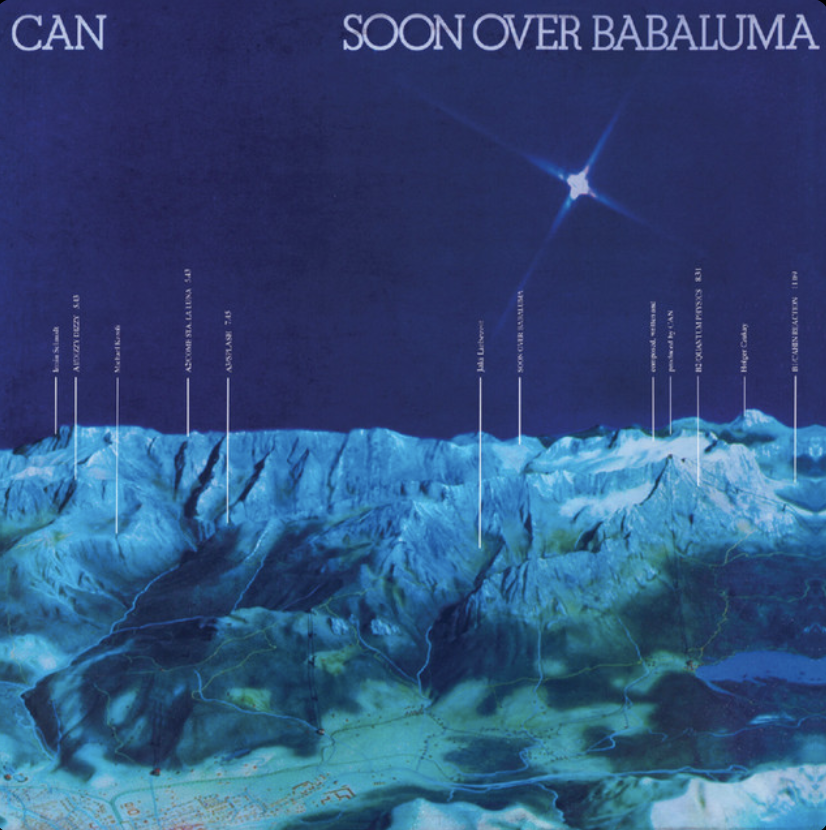
Retrieved and reshared from the Monolith Cocktail archives this month, a 50th anniversary special on CAN’s 1974 LP Soon Over Babaluma.
CAN ‘Soon Over Babaluma’
(United Artists) November 1974
Hawkwind once sang enthusiastically that, indeed, “Space Is Deep” on their 1972 progressive nebula traveling album Doremi Fasol Latido. Unfortunately for all the postulations and far out oscillating effects they failed to launch us further than our own stratosphere.
Interstellar overdrive and the promise of a journey beyond the stars never quite managed to leave behind the familiar sounding musical structures and instruments of Earthly genres, such as rock or jazz. Even Sun-Ra for all his visitor/emissary from another world talk, was still to a point chained to classicism; those outbursts of improvisation never quite soared to the dizzying celestial heights that we were promised.
Which leads me to CAN and their sixth studio album Soon Over Babaluma, a genuine bold attempt to lavish the cosmos with a fitting soundtrack; delivered by Cologne’s very own branch of NASA.
Previously on the 1973 heavenly diaphanous hymn Future Days, CAN had scaled new empyrean heights of excellence. Now they sat in the very lap of the Gods themselves, the only logical next step being outer space.
It helped of course that the injection of funds, acquired by Hildegard Schmidt, now paid for some new equipment; namely the futuristic sounding Alpha 77, a serious piece of kit that interrupts the sounds emanating from a keyboard to produce some startling effects and soundscapes. Looking like some kind of radioactive scanner and housed in a bog-standard clunky metal box, the Alpha 77 could have fallen off the back of truck bound for some nuclear science facility. The flight deck controls and rather old-fashioned register dials don’t quite reflect the abundance of sounds that can be created and fooled around with; Irmin Schmidt teases a vast array of ethereal sweeping sound collages from this box of tricks, that coats every part of this album.
Irmin wasn’t the only one to receive some new equipment, the band, as a whole, upgraded their sound desk: for the first time being able to record straight onto stereo. Also editing and overdubbing became a lot easier, benefiting the overall quality of sound and mixing. Technology always played its part but now it would direct the proceedings in 1974, as they began to lay down what would be the forthcoming Soon Over Babaluma album.
December 1973 saw the departure of Japanese troubadour and mushroom haiku mantra singer Damo Suzuki. A heated confrontation during a session for a TV soundtrack resulted in Damo snatching up his mike and a pre-amp, exclaiming, “That’s mine!” before skulking off in a strop.
The gear was returned in due course, but Damo remained aloof, never to return, the recent marriage into and conversion over to the Jehovah’s Witness religion playing a major part in his decision making. He may as well joined the Quakers, as hanging out with avant-garde rock stars was now frowned upon and discouraged to the point where life must have become quite square. Although the late experimental, improvising icon would later return to music full-time; going on to collaborate with some of the most inventive heirs of krautrock and a whole new generation of experimental artists and groups: the list is endless.
An empty vacuum emerged at first, the rest of the band feeling left in the lurch, the upcoming album deadline and tour commitments placing intense pressure on the group to find a replacement.
Unfortunately finding a new singer/front man wasn’t easy, either due to unsuitability or previous prior engagements that role remained aloof and unfilled. In the end it was their own transcendental guitar genius Michael Karoli who stepped up to take on the vocal duties, with Irmin lending his support and backing.
For the record Karoli does a pretty good job of it, sounding like a Germanic Syd Barrett and even at times evoking the dreamy quality of Suzuki himself. Irmin on the other hand comes across all creepy and crazed.
With an emphasis on the pursuit of other worldly experiments and space exploration, Soon Over Babaluma sports a suitable cover. Graphics artist Ulli Eichberger delivers a shining reflective moonscape cartography, with the song titles and personal etched over the lunar terrain as though they were the names of craters and the barren land features: though it also resembles some Alps type snowbound mountain scape.
The album title itself is claimed to be a parody type anagram of the old Weimar Republic era showtune ‘Moon Over Alabama’, made famous in renditions by Nina Simone and even David Bowie. Originally written by Bertolt Brecht, the genius German poet and playwright, and put to music by fellow countryman Kurt Weill for the 1930 satirical opera Rise and Fall of the City of Mahogany, the song was made even more iconic when the Nazis banned it three years later. Maybe it reeked too much of Cabaret and the savage biting social depictions of George Grosz, who painted grotesque images of the obscene decadence taking part in German society. The surge of the far-right encroaching on what they saw as bedlam with their even worse replacement ideology, turning on the social commentary of Brecht and Weill with vengeance.
Whether or not this is indeed the reason behind the moniker, there is no real reference to historical context; rather the mood is entirely directed towards space. Track titles such as ‘Come Sta, La Luna’, closest translation being “as it is, the moon”, and the scientific-in-nature ‘Chain Reaction’ and ‘Quantum Physics’, CAN certainly laid down enough signs of their newfound commitment to the course.
A move towards the more technological progressive and experimental ethos mixed with the jazz boundary defining pronunciations made by Ornette Coleman, Miles Davis and the already mentioned ex-resident of Saturn, Sun-Ra, CAN’s sound managed to surpass the previous journeyman as they now set out to tip toe across Orion and penetrate deep space.
But this wasn’t the only album released by CAN in the 1974, oh no! They also released a collection of studio offcuts and even further out there avant-garde sound collages entitled Limited Edition; so called as it was limited to only 15,000 copies, though only two years later it was released as a double album with 5 extra tracks.
Both versions include the Ethnological Forgery Series and the scraps and fragments of sound pieces and obscure cluttered impromptu jams that littered their back catalogue. The standout track is the ambient moving viscerally inspired ‘Gomorrha’, one of the most ethereal quality pieces they ever recorded and possibly the track that Damo walked out on. Its science fiction searching, and hearts of darkness espionage drama evoking atmosphere perfectly encapsulates the sea change taking place, having been recorded only months before work started on Soon Over Babaluma.
——A Deeper Reading—–
The sound of a small leap across the surface of the Moon, whose gravity has been swallowed by the Alpha 77 and re-directed into one illuminating bended note, this is how ‘Dizzy Dizzy’ begins.
Karoli floats in on a passing solar wind, floating above the rim shots and deeply reverberated bass like a lurking rock astronaut ready to pounce with his introduction gambit “rat-a-tat-a-tat-a-tat” vocal scat.
A sultry Afrobeat enriched beat bounces along as twangs of guitar mark the way, all the while Schmidt strokes his alluring array of space organs, fermenting some lofty aspiring effects with which the groove can walk on.
Soon the violin strikes up a haunting weeping melody that cuts through the expansive air, exquisite emotive strains from the stringed solo stir up a certain amount of pulchritude.
Soft brush strokes and heavily comatose cymbals contact Holger Czukay’s one note comfort blanket warm bass, rich in rebounded echo.
Karoli breathlessly sings such wise pronunciations as,
“I know, I don’t smoke with the angels, I know
Don’t throw ashtrays at me”
I think we know what kind of brand of choice he’s more than hinting at!
He goes onto lay his soul bear with the romantic gestured lines,
“I’m not made out of mature,
But I’m something out of the heart.
Throwing on you a kiss, kiss”
Almost jumbled around or miss-translated, these lyrics read like a cut and paste experiment.
Dizzy in love or dizzy due to the air being so thin up here in the upper echelons of space, Karoli seems to levitate on his whispered sonnet to some higher beings.
Schmidt eventually takes over, draining the vocals to a mere trace, that Alpha 77 synth manipulator now warming up and taking on a life of its own, becoming like a fifth member of the group. But it will be those felicities violins that have the last word, ending on a majestic duelling climax.
‘Come Sat, La Luna’ opens with a field trip recording of some stroll alongside the canal, the occasional croaking from some walk on part crow, interrupts the serene ambience. Karoli then rumbles in with a pleading dramatic rendition of the title off the back of some heavy duty compressed reverb, that makes it sound like the band are playing in a diving bell chamber.
The sense of entrapment and struggle to breathe in this now thick atmosphere, a morphine induced state is evoked in this dense sounding eulogy to some far-off planetary dimension.
Schmidt recites rather than sings his lines, which are deep in creepy effects and delivered through some unsettling eerie cadenced nonsense.
These vocals are more like riddles or cryptic announcements of foresight, such as the lines,
“I am not fighting, but I’m the night,
I am not dying, and I’m not hurt.
I am the right or the wrong, your hope,
I am the dancer on the tender road”
He goes on to express,
“I am the water and how I can flow”
Schmidt seems to be angling at some descriptive analogy, continuing with more caustic questioning,
“And why don’t you call me Sta?
Flowing over Babaluma,
It ain’t your friend.
You can do it alone,
And you don’t have to pay”
The song picks up some pace, almost swinging along in a jaunty motion, Liebezeit taps his way through, giving a special decompressed bass drum and kick drum solo, losing himself in a sudden joyful upturn.
From out of the mire approaches a grand piano and squalling guitar, both lost in a mini battling concerto, which grows towards an almost full on avant-garde free for all before calm is restored with the last warbling chorus from Karoli. Almost sorrowful in manner, the finale words almost trapped as though Karoli is zapped of his strength.
Side one ends with the all-out galactic jazz ensemble instrumental ‘Splash’.
Sun-Ra, Miles Davis, Ornette Coleman bump into each other on the set of Mission Impossible, all vying for elbowroom and paranoid up to the eyeballs.
Squawking, hooting sousaphone and grumbling thunder striking bass are met with fret board scrapping and incessant scratching, Liebezeit rattling off a series of rolling drums and double kicks, booting his kit round the room.
Just as a certain rhythm is broken in, cowbells and trinket percussion enter the alarming fray, bringing with them the black box recorder omnipresence of Schmidt’s 77, a glorious soundtrack to the stars is eminent.
Karoli begins a dystopian guitar solo from on top of some desolate mountainous range or Olympus Mons itself, melancholy wines and strains of harrowing pleads echo round the empty immense affinity of space.
An excitement of sorts starts to boil over as a barracking charge from the drums now piles in to the accompaniment of strangled brass and eastern harem sounding oboes, which pursue a deconstructed noisy voyage of discovery, wrestling control of these nine headed monster jams.
Once you’ve had time to calm down from the audio assault of ‘Splash’, side two awaits your attention with the doubled up ambient suites of ‘Chain Reaction’ and ‘Quantum Physics’, the energy and matter evoking scientific epic.
Beginning with the now familiar sound of the 77 revving up like some organic spacecraft dreamed up by Frank Herbert – in fact reminding me of the special effects from Dune the movie -, drums and bass slowly fade in with a soul shaking tambourine, shimmering and arousing r’n’b, before Karoli slides and rides all over his guitar, the celestial conductor.
The brewing accompaniment runs riot until fitting into an assured stride, the low plains pan out in front of us as the beat remains steady and ambitious in outlook.
Schmidt unveils grand gestures of melody from his very own inter-galactic flight deck, painting multiple soaring swathes of astrological envy for Karoli to now glide over with his best Damo evoking vocals.
Surreal imagery is conjured up and uttered with breathless enthusiasm; analogies of a Soviet flavour are transcribed thus,
“Elephant dominating Russian,
Don’t be running hurt.
Elephant running,
Dominating the deep”
The attitudes change with the take it or leave it gay abandon of the chorus,
“Chain reaction incoming when you get so small,
I said chain reaction incoming when you get so rushed”
Probing, encroaching guitar searches roam the moonscape, taking part in a call and response with Schmidt’s now crescendo illuminating collage of sound.
Liebezeit and Czukay both slump off into solo frenzies, traveling their very own particular rhythmic paths before a giant thunder clap strikes and sends the track towards free-fall.
Tribal beats clatter and clash, whilst haunting encircling brooding organs and ascending synths swoop, then the beats are reigned back in, as Karoli recalls the chorus.
Cyclonic chuggering grooves are interrupted with some unworldly seething effects, that wouldn’t sound out of place in 2001: A Space Odyssey, as the ghosts of Mars and the trembling spooky reaches of the far-off universe now hang heavily over the space flight.
Rim shots and interplanetary musings seep into the final outro of the track before bleeding over to the second act of ‘Quantum Physics’.
Gentle ramblings and distressing noises unearthed from the science lab, emanate throughout, all the while Liebezeit attempts to keep a groove going, constantly banging away in the background.
From out of nowhere, an unseemly black hole maybe, Schmidt unleashes a brave new world of sublime washes and choral ethereal charm. The sky at night has never sounded so angelic and worth investigating.
No description quite explains the climactic finale that signs off Soon Over Babaluma, invigorating escapism and traveling through the cosmos, in scenes reminiscent of Solaris.
Breathtaking in vision, the perfect emotional drama set in space takes some beating. Perhaps they should include this in any future first contact package shot into the universe; then again, any alien life form may just think we’re showing off.
If you enjoyed, felt informed, or marvel at my words and those of the Monolith Cocktail, please take a second or two to read the following message of alms pleading. Whilst I’m fully aware of the austerity, the lack of money, and an industry set on reducing all its creators, its critics and writers and motivators to a life of poverty, it is becoming near impossible to continue without support. And so with that in mind:
For the last ten years I’ve featured and supported music, musicians and labels I and the blog’s other collaborators love across genres from around the world that we think you’ll want to know about. No content on the site is paid for or sponsored and we only feature artists we have genuine respect or love for. If you enjoy our reviews (and we often write long, thoughtful ones), found a new artist you admire, or if we have featured you or artists you represent and would like to buy us a coffee at https://ko-fi.com/monolithcocktail to say cheers for spreading the word, then that would be much appreciated.
THE MONTHLY DIGEST OF ACCUMULATED NEW MUSIC, THE SOCIAL INTER-GENERATIONAL/ECLECTIC AND ANNIVERSARY ALBUMS CELEBRATING PLAYLIST, AND ARCHIVE MATERIAL CHOSEN BY DOMINIC VALVONA

___/NEW\___
Jonah Parzen-Johnson ‘You’re Never Really Alone’
(We Jazz)
The soloist is never alone it seems, when on stage. And the highly prolific, serial collaborator and in-demand Chicago born, but Brooklyn-based, alto and baritone saxophonist and flutist Jonah Prazen-Johnson (regular followers will recognize the name from his trio partnership appearance with the Lycia inspired Berke Can Özcanon the Twin Rocks album from late last year) stands in the spotlight reacting to, feeding off of, and giving it all back to his audience and the wider community: hence the “We made this together” statement included on the album cover.
In the age of high anxiety, division and unwilling compromise, Jonah finds both the space to let go of the strains on the mind, the worries and concerns. In a nutshell, with just the use of his polytonal saxophone holds, wanes and drones (between higher trills and deeper bass-y vibrations; often together simultaneously) and willow-y, natural blossom garden flute, he projects invocations of regret and rumination whilst offering support, and even “courage” to see through the worst of it. To the undulating waves, near bristled distortions and more melodious tones, to the didgeridoo-like circles, fog horns, honks and drawn-out, Jonah evokes melodic traces of his native home (Chicago), the avant-garde, explorative and pastoral. If names and luminaries such as Sam Rivers, Marshall Allen, Coltrane, Roscoe Mitchell (especially his partnership with Anthony Braxton), John Zorn, Peter Brötzmann and Jeremy Steig grab you, then make the commitment and purchase a copy a.s.a.p.
ZA! + Perrate ‘Jolifanto’
(Lovemonk) 22nd March 2024
Bonding together on one Dadaist inspired transmogrified cross-pollination of sonic and musical ideas, the Spanish collaboration of the duo ZA! (No strangers to this blog; first featured in my highly popular Spanish Underground piece from more than a decade ago) and the experimental vocalist Perrate come together on an extraordinary album of sound assaults and hybrids that turn Iberian traditions and cultures on their heads.
Both partners in this enterprise have spent two decades or more transforming the traditional music of their native land; the critically applauded Perrate exploring the “outer edges” of Flamenco, his identity and heritage entwined with the age-old Gitano Iberian Romani community of which he is descended – a culture abundant with the stars and progenitors, innovators of Flamenco -, and ZA! often crazily and imaginatively merging a variety of Spanish styles, folk music, with anything from the African beats to the psychedelic, electronic, Balinese polyrhythms, thick distortion, free jazz and the shepherds of Tuva.
Taking the first word from Hugo Ball’s exhaustive Dada recited ‘Karawane’ phonetic poem, “Jolifanto” is packed with ideas and flights of fantasy; yet never loses its Iberian foraged roots, with plenty of recognizable Flamenco guitar frills and intimate quivery entwined attentive and descriptive accompaniment – sometimes sounding like a cross between Raül Refree and Jeff Buckley. You can also pick up the atmospheric settings of the dance, the performance throughout the album. The original performance of that poem, performed at the famous iconic Cabaret Voltaire, put Hugo in a trance; the captivated audience compelled to rush up on stage before the Dadaist luminary was dragged away. A certain lunacy, this spirited experimentalism and performance is transcribed to a lot of ZA!’s music, but it somehow makes perfect sense when combined with the poetic longing calls, mewling, whoops, mantra, assonant and almost muezzin-like vocals of Perrate. At any one time you are likely to hear echoes of Moorish Andalusia, oscillated dub, elephant horns, percussive scuttles, krautrock, Vodun invocation, post-punk, no wave and Afro-Cuban, and pick out bursts of Jah Wobble, Anthony Braxton, Zacht Automaat, CAN, Greco and Cambuzat, African Head Charge, the Reynols, Mike Cooper & Viv Cooringham’s ‘A Lemon Fell’, Harry Belafonte (I kid you not), Sakamoto and the Gypsy Kings.
From the cosmic and unsettling to near terrifying, there’s a lot to process in this slightly madcap collaboration. And yet in saying that, this album has soul and a seriousness about it in revaluating, pushing at the boundaries and ideas of what Iberian culture means in the 21st century; finding connections across the borders with music from as far away as Arabia, South America and the original roots of the region’s Romani communities. A great work of art and brilliance from the partnership that will excite, wrong foot and entrance in equal measures.
Leonidas & Hobbes ‘Pockets Of Light’
(Hobbes Music)
Expanding upon their sonic partnership with a debut album of epic cosmological proportions, Leonidas & Hobbes reach further than ever before into both the cerebral and outer limits of space to channel a litany of anguish woes.
Between them, this pairing of like-minded curious and lauded electronic musicians/DJs/club night instigators, cover the capitals of London and Edinburgh with their enviable CVs and provenances in everything from house to techno, the ambient, Balearic and dance music genres. Making good on previous EPs (2017’s Rags Of Time and 2021’s Aranath) they now face the philosophical quandaries of humanity, technology, climate change, extinction and metaphysics across thirteen movements, dance grooves, soundtracks and celestial symphonies.
A self-proclaimed ‘lockdown album’, the pandemic and stretches of time spent apart from socializing and giging, have had a deep impact on both artists; combine that with becoming parents and breakups, and you’ll find a pair of minds concentrated on finding the ‘light’ in a universe of emptiness and apocalypse. With effected dialogue snatches of ground control communications and alternative pseudo drug escapes from authoritarian mind control and conditioning speeches, and broadcasted weather reports from the eye of the storm (in Charleston, North Carolina to be exact) smattered throughout, the concerns, enquires and philosophies of both partners on this odyssey are made clear.
Like one long set, a voyage of peaks, beats and more trance-y and contemplated ambient pieces, this album goes from literal takeoff to drifting untethered in the void and back to the inner mindscape. Production and style wise there’s retro-space and kosmische hints of Vangelis, La Dusseldorf, Iasos and Klaus Schulze next to more acid zapping old school evocations and breaks of Wagon Christ, Orbital, Luke Slater, Mo Wax and Howie B, plus a Balearic vision of The Orb and echoes of the 303 drum sounds of Mantronix and Man Parrish. Vapours and wisps mystify certain suites, whilst others bounce along on more kinetic waves as mindscapes are mixed with technology, science and the sci-fi. Pockets of Light channels Leonidas and Hobbes’ worries and prophecies into a reflective existential soundtrack.
Their Divine Nerve ‘The Return Of The Lamb’
(Staalplaat)
A second inclusion this year for the Ukrainian trick noise maker Dmytro Fedorenko, his last Variát collaborative venture with Masami Akita (under his Merzbow alias), Unintended Intention, was featured in this year’s inaugural Digest. A brutal, scarred abrasion of twisted steel and concrete that same atmospheric heavy set of dark META electronica is now stripped almost entirely of the human touch for something altogether more esoteric and alien.
With the Washington DC experimental artist Jeff Surak (who has a CV far too numerous and varied to list here, but in brief, he made his first tape manipulations in the 80s under the 1348 moniker on his own Watergate Tapes imprint, lived in Russia in the early 90s, and after returning home, directed the annual Sonic Circuits Festival of Experimental Music in DC for thirteen years…the list goes on) as his foil, Dmytro finds yet another vehicle for expelling demons, the bestial, the apparitions in the machines and unearthly. Under the afflatus/supernatural imbued Their Divine Nerve title both accomplished participants retune the Fortean radio set for a corrosive, fizzled, buzzing unholy noisy embrace of the pained, hurt, mystical and chthonian.
Generous with the amount and duration of the material, this is a serious set of discordant and more hermitic vibrations, spread over ten (thirteen tracks if you buy the “bonus” version, which does actually include the title-track) post-industrial strength hauntings of the soul and psyche. The action varies, however, from invocations of early Richard H. Kirk to Basic Channel, Bernard Szajner, SEODAH, Coil, Alejandro Jodorowsky’s Holy Mountain score, and Spain’s underground tape culture in the 80s. And within that sound-off board, portals and channels open up to the slithered tentacles of the Cthulhu and other leviathans from the depths, as dark matter is resourced to build a haunted factory of unidentified operative machinery and tools. Phantoms are everywhere in this fuckery of scrunched marches, square bladed sawing, needle sharp scratches of surfaces and iron materials.
Axes to grind, metaphors for the growing unease and trepidations of unimpeded violence, the continuing evil invasion of Ukraine, you could easily read the sonic tealeaves on this immersive experiment. All I know is that the biblical inspired The Return Of The Lamb offers analogies to the Christian symbol of sweetness, forgiveness, meekness, gentleness, innocence and purity, but it’s also a representation of both Christ himself and that of a sacrificial animal – when depicted with the Lion it can mean a state of paradise. Make what you will of that liturgy, but hope and salvation might yet arise from the distresses and savagery. In short, Their Divine Nerve is a successful debut in noisy art forms, horror, alien visitations and mystery.
Dave Harrington, Max Jaffe and Patrick Shiroishi ‘Speak, Moment’
(AKP Recordings)
An enviable trio of acclaimed and highly prolific musicians pulls together their talents and experiences for an improvisational album of both suffused gazing/reflection and wilder, unbound avant-garde extemporized entanglements. Dave Harrington, Max Jaffe and Patrick Shiroishi’s CVs, appearances and collaborations are lengthy and varied: far too numerous to list here anyway. But suffice to say this triumvirate of contemporary jazz explorers covers more or less all avenues of that genre’s legacy and penchant for change, experiment – from the more pliable to wielding and addressing the abstract evocations of trauma.
In the spirit of improvisation, all three players dashed this recording off in a single afternoon (as it happens, a couple of years back in an LA studio on the 25th October, my birthday!) having only met that same day for the first time. Astonishingly, Speak, Moment is a very sophisticated, cohesive album that gels together perfectly: even during its more untethered and intense passages of abandon.
The performances move loosely from the near ambient undertones of Jaffe’s incipient and resonating textural cymbal and sieved-like snare washes, the subtle twangs and psychedelic mirages of Harrington’s guitar, and the lilted tonal flutters and more tuneful rises of Shiroishi’s saxophone, to the near cacophony of staccato breaks of later tracks like ‘Ship Rock’ – a sort of stormy tempest rock-jazz fusion that sounds like The Jim Black Trio tied to a maelstrom tossed raft with Chris Corsano, Pat Metheny and the Red Crayola.
The traversed dreamy opener, ‘Staring Into The Imagination (Of Your Face)’, seems to allow the trio all the time and space needed to eloquently and in a more gauzy manner, express a soliloquy to the processing of feelings, environment and the unsaid – Harrington’s guitar reminding me in part of Fernando Perales and Myles Cochran, whilst Patrick Shiroishi’s sax has touches of Dexter Gordon, Roscoe Mitchell and Sam Rivers. Talking of Harrington, I did read that his own influences range from Bill Frisell to John Zorn and Jerry Garcia. The latter is very much channeled on the spiritual percussive trinket rattled and leviathan looming ‘How To Draw Buildings’, with guitar parts that sound almost late 60s Woodstock acid-rock in inspiration (almost Hendrix-like in his more restrained and meditative mode). You can also hear the aria-theremin higher voice-like notes of Sonny Sharrock amongst the wilderness and mizzle and sizzled resonance of Jaffe’s drums on that same track.
The next track, ‘Dance Of The White Shadow And Golden Kite’, reminded me of Ariel Kalma – that and Ornate Coleman in an exotic Afro-jazz bobbing dance with the Art Ensemble Of Chicago.
The atonal sensitivities shift amongst the ambiguous presence of other forces and introspective moods across a quintet of spontaneous explorations on an accomplished gathering of talented musicians. If you have an ear and like for the Cosmic Range, Tumi Mogorosi, Yonatan Gat and the Gunn-Truscinski Duo then you have to own this traversing improvised experiment.
Twin Coast ‘To Feel’
Back with another enveloped in guitar feedback sculpted and layered vision, the Chicago shoegazers and noiseniks Twin Coast get pulled into a paranormal alternate dimension: A static TV set cell that seems to be at least languidly comfortable and dreamy. Almost numbed to the whole sorry state of it all, the duo lose themselves in an unholy hallucinogenic white noise of static fuzz and crystal shimmers and flange reverberations. I’m calling erased apparitional shoegaze.
The traditional B-side as it were, is handed over to diy electronic artist Isaac Lowenstein, aka Donkey Basketball (a EDM project that apparently started off a joke but quickly grew into a very real act, mixing and merging everything from acid to jungle and techno). Isaac, a fellow Chicago resident, transform the original into a kinetic, machine and mechanics switching, twisting, ratcheting and spring-loaded minimalist techno percussive tunneled and vaporous space-trip. I’m hearing a touch of Mike Dred, Mouse On Mars, Ritchie Hawtin, Basic Channel and Autechre added to the mere essence of the original shoegaze immersion from the ether.
___/THE SOCIAL PLAYLIST: VOLUME 84\___

Continuing with the decade-long Social – originally a DJ club night I’d pick up at different times over the past 20 plus years, and also a café residency from 2012 to 2014 – playlist, each month I literally chose the records that celebrate anniversary albums, those that I’d love to hear on the radio waves or DJs play once and while, and those records that pay a homage and respect to those artists we’ve lost in the last month.
Anniversary spots this month go to the Style Council’s ’84 special Café Bleu (I’ve chosen to kick the whole playlist off this week with the more dance-funk, WAR impressionist ‘Strength Of Your Nature’, from an album that slips mostly into more Post-MOD, Jazz Café piano), RUN-DMC’s self-titled holler from the same year and Scott Walker’s menacing, out-there Climate Of The Hunter masterpiece. From a decade before, I’ve added a glam pop-gun tune from T. Rex’s Zinc Alloy And The Hidden Riders Of Tomorrow – the LP that must have been on Bowie’s mind when recording Young Americans. Leaping ahead twenty years and there’s a smattering of ’94 releases from the Hip-Hop royalty Gang Starr (Hard To Earn), Main Source (Fuck What You Think), The Auteurs (Now I’m A Cowboy) and the Aphex Twin (Selected Ambient Works 2; so good I’ve included two tracks). From more recent(ish) times, there’s a choice track from the late metal face don of leftfield Hip-Hop MF Doom and the equally revered Madlib, under their partnership guise of Madvilliany – I’ve chosen the Sun-Ra anointing ‘Shadows Of Tomorrow’, which pulls in the aardvark Quasimoto. And, as featured below in this month’s archive spot, a track from the Ministry Of Wolves ensemble cast of fairytale weavers album Republik Der Wölfe: subtitled ‘A Fairytale Massacre With Live Music’, a joint enterprise between the Dortmund Theater’s production director Claudia Bauer and musical director Paul Wallfisch, with the unholy musical alliance of Bad Seeds co-founder and adroit solo artist Mick Harvey, one time Einstürzende Neubauten, Crime And The city Solution grizzled maverick and one half of the Hackedepicciotto duo Alexander Hacke and fellow Crime and the City band mate, Berlin Love Parade co-instigator and the better half of that Hackedepicciotto partnership, Danielle De Picciotto, providing the suitable nursery grime soundtrack.
We can’t pass the month without marking the sad death of Karl Wallinger, the master songwriter behind hits for others, but also sole instigator of World Party – after leaving The Waterboys in the mid 80s. I guess ‘She’s The One’ will be rotated extensively, but I’ve chosen the just as popular and more soulfully blusy ‘Ship Of Fools’.
From the new to old past gloires, missives and curiosities, making up the rest of the playlist are tracks from Fat Francis, Dalla Diallo, Alamo, Trips And Falls, De La Soul, Heldon, MIZU, Gary Clail, Incentive and more….
TRACK LIST IN FULL:::::::::::::::::::::::::::::
The Style Council ‘Strength Of Your Nature’
Vampire Rodents ‘Trilobite’
Gang Starr ‘Code Of The Streets’
Run-DMC ‘Hollis Crew (Krush Groove 2)’
Madvillian (MF Doom/Madlib FT. Quasimoto) ‘Shadows Of Tomorrow’
Dalla Diallo ‘Sinde M’bobo’
T-Rex ‘Painless Persuasion V. The Meathawk Immaculate’
Metamorfosi ‘Caronte’
World Party ‘Ship Of Fools’
Walpurgis ‘Disappointment’
Fat Francis ‘It’s Not Rock and Roll’
Alamo ‘Got To Find Another Way’ We Cut Corners ‘Three People’
In Time ‘This Is Not Television’
The Wizards From Kansas ‘Hey Mister’
Eyes Of Blue ‘Largo’
Trips And Falls ‘I Learned Sunday Morning, On A Wednesday’
Kevin Vicalvi ‘Song From Down The Hall’
The Auteurs ‘Chinese Bakery’
Scott Walker ‘Rawhide’
The Ministry Of Wolves ‘Rumpelstiltskin’
MIZU ‘prphtbrd’
Heldon ‘Ballade Pour Puig Antich, Révolutionnaire Assassiné en Espagne’
Aphex Twin ‘#24’
Stringmodulator ‘White Noise’
Aphex Twin ‘#12’
Liz Christine ‘Two Seconds’
Heldon ‘Ouais, Marchais, Mieux Qu’en 68’
Incentive ‘Time Flows Beyond You’
Gary Clail ‘A Man’s Place On Earth’
Okay Temiz ‘Galaxy Nine’
De La Soul ‘What’s More’
Main Source ‘F*CK WHAT YOU THINK’
___/ARCHIVE\___
TEN YEARS OLD THIS MONTH: THE MINISTRY OF WOLVES ‘MUSIC FROM REPUBLIK DER WÖLF’
The Ministry Of Wolves ‘Music From Republik Der Wölfe’(Mute) 10th March 2014
Pre-dating the Viennese totem of the subconscious but already a Freudian labyrinth of analogy, metaphor and augury, the Gothic fairytale fables of the Brothers Grimm have just got a hell of a lot more unsettling and personal. Given a Pulitzer Prize winning overhaul by the esteemed award winning, self-confessional American poet Anne Sexton in her 1971 book ‘Transformations’, these same tales were brought back into the realm of the adults. Her candid, revisionist take, from the point of view of a ‘middle-aged witch’, on these standard stories is a beat poetic vivid survey on human nature: those all too familiar idiosyncrasies and failures set to a contemporary (for its time) miasma of inner turmoil.
Proving to be just as poignant forty odd years later, those reinterpretations are revitalized in a brand new multimedia stage production, debuting at the Theater Dortmund. To be performed tonight (15th February 2014) the Republik Der Wölfe, subtitled ‘A Fairytale Massacre With Live Music’, is a joint enterprise between both the Dortmund’s production director Claudia Bauer and musical director Paul Wallfisch, with the unholy musical alliance of Bad Seeds co-founder and adroit solo artist Mick Harvey, one time Einstürzende Neubauten and now Crime And The city Solution grizzled maverick Alexander Hacke and fellow Crime and the City band mate and Berlin Love Parade co-instigator Danielle De Picciotto, providing the suitable nursery grime soundtrack. Detached however from the visual spectacle, that very same soundtrack is due its own inaugural release next month; its loose narrative a series of congruous chapters, easily followed without any other stimulated aide to guide you.
Original characters that we’ve grown to love, hate, revile or recoil from, are transposed into the darker parts of our psyche. Those parable like lessons and auguries of danger get kicked around in a quasi-junkie Burroughs nightmare of cynicism and surreal terror. Tucked into a all too knowing grown ups world of jealousy and greed, Picciotto plays the part of storyteller – in this case switched, as I’ve already mentioned, from the usual young, naïve heroine into a middle-aged witch – on the opening account, ‘The Gold Key’. It’s followed by the Teutonic heavy drawling gusto of Hacke’s ‘Rumpelstiltskin’; played up to full effect, as the poisoned dwarf is revealed to be our doppelganger, ‘the enemy within’, and the spilt personality waiting to cut its way out of all of us. Sounding quite like a missing Amon Duul II number from the Hi Jack era, the song’s maligned and mischievous protagonist elicits a kind of sympathy: ‘No child will ever call me Papa’. Condemned to play the part of cruel interloper, poor old Rumpelstiltskin exists to remind us of our demonic, primal nature: a nagging inner soul tempting us to commit hari-kari on restraint.
The fabled ‘Frog Prince’ is a slithery customer, made to sound like an odious creep pursuing his very turned-off love interest. Mick Harvey moons and croaks with relish in recalling the bizarre tale of doomed romance; the moral, though dark and disturbing, can be summed up as: be careful what you wish for, the law of averages doesn’t exist and in this case turned out to be a dud, the frog was certainly no prince.
Happy endings become even more blurred with the triumvirate of leading ladies ‘Cinderella’, ‘Rapunzel’ and ‘Snow White’. ‘Cinders’ is a Casio pre-set piece of waltzing lullaby, dreamily led by our protagonist chanteuse, whilst Rapunzel and Snow White are given a fluid pained Leonard Cohen treatment. The latter a roll call of ‘seven’ inspired symbolism and metaphor, the former an idolised plaintive requiem to the exiled and ill-fated American dancer, Isadora Duncan – forced to leave the States for Europe because of her pro-Soviet sympathies, Duncan died rather ironically at the hands of the famous scarves she used to so great an effect in her dances, after one become entangled around the open-spoked wheels and rear axle of a car she was travelling in, breaking her neck.
Other notable tales of woe include the opium-induced, somnambulist ‘Sleeping Beauty’ – literally a languid sleepwalk through some Tibetan flavoured labyrinth – and lurid Harvey sung ‘Hansel & Gretel’ – the apparent naïve, saintly, twins getting the better of a cannibalistic old crone. But its ‘Little Red Ridding Hood’ who inhabits the most contemporary street hustling environment, transported from the danger lurking Black Forests into a world of creeps, junkies and ‘transmorphism’. The levels of macabre are amped up and the underlying psychosis adroitly delivered with atmospheric relish; our cast of ‘make-believe’ characters all too fallible human traits and sufferings enriched with a Murder Ballads style makeover, part Gothic part horrid histories.
FIFTY YEARS OLD THIS MONTH: T-REX ‘ZINC ALLOY AND THE HIDDEN RIDERS OF TOMORROW’
T-REX ‘Zinc Alloy And The Hidden Riders Of Tomorrow’ 1st March 1974
Whilst we are, or should be, aware of Bowie’s flirtatious lifting of Marc Bolan ideas, it’s the Zinc Alloy And The Hidden Riders Of Tomorrow: A Cream Cage In August album’s experiment with soul, a full eighteen months before the Thin White Duke’s own Young Americans, that proves to be the most obvious example of this latent influence (or if you want to be less generous, theft).
Swelling the ranks with the seductive, sumptuous tones of Gloria Jones – who evidently became Bolan’s love interest and partner till he died in 1977; a relationship that resulted in the birth of their son, Rolan – Bolan’s music opened out into yet greater velvety, blue-eyed soulful panoramas; a mix of plastic R&B, glamorous strutting and quasi-New York candy pop. From the bomp and shoop of the Gloria(fied), ‘Truck On’, to, in Bolan’s mind, one of T.Rex’s most ambitious singles, ‘Teenage Dream’, there’s an almost salacious knowing sophistication at work.
Already being regarded in some circles as washed-up, the ‘Zinc’ alter ego was an attempt to concentrate resources on the UK, as he’d spent considerable time attempting to crack the US market. He would continue to adapt the soul train, jingle-jangle sound with various other ‘boogie-woogie’ styles, including swamp rock; as he demonstrates with zeal on the poorly received LP, Bolan’s Zip Gun – at this point he may have thought seriously about sticking that ‘zip gun’ to his head as the album didn’t even chart.
Hi, my name is Dominic Valvona and I’m the Founder of the music/culture blog monolithcocktail.com For the last ten years I’ve featured and supported music, musicians and labels we love across genres from around the world that we think you’ll want to know about. No content on the site is paid for or sponsored and we only feature artists we have genuine respect for /love. If you enjoy our reviews (and we often write long, thoughtful ones), found a new artist you admire or if we have featured you or artists you represent and would like to buy us a coffee at https://ko-fi.com/monolithcocktail to say cheers for spreading the word, then that would be much appreciated.
The Perusal #37: Edrix Puzzle, Surya Botofasina, Dead Horses, Etceteral, The Dark Jazz Project…
November 4, 2022
Dominic Valvona’s Albums Revue For November
Unless stated otherwise all releases are now available to buy
Edrix Puzzle ‘Coming Of The Moon Dogs’
(On The Corner Records)
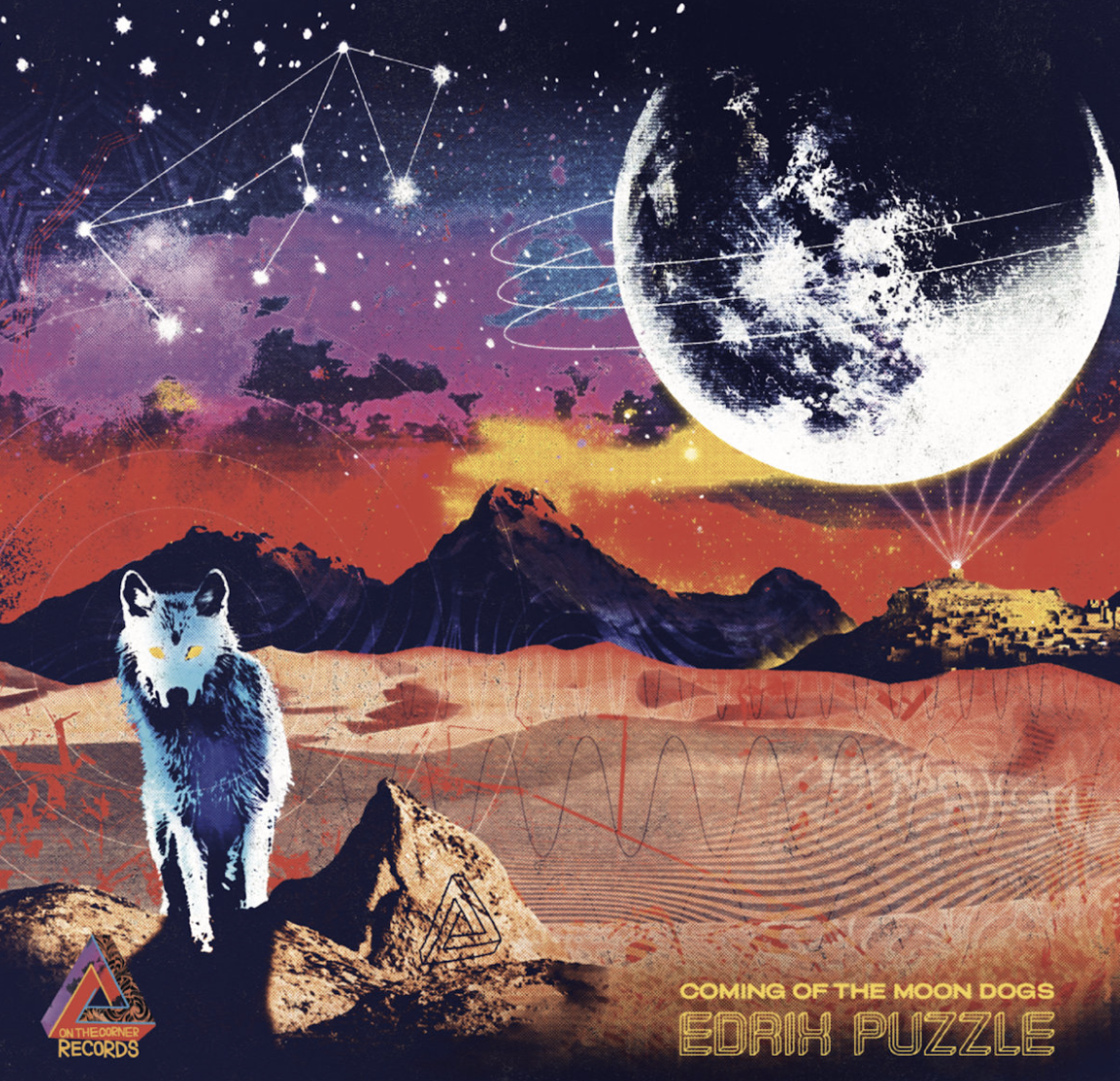
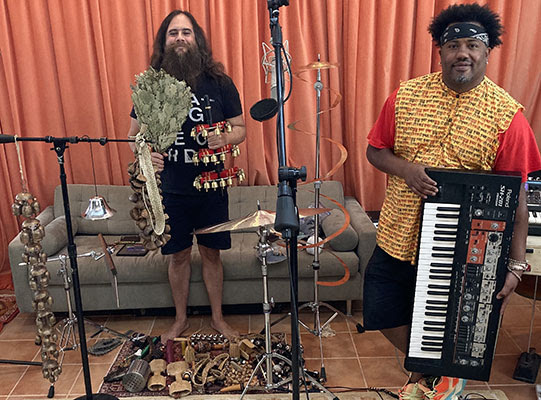
Looping string theory jazz particles to a rocket ship bound for a deep space cosmology of titan referenced stellar sets, the Nathan “Tugg” Curan led Edrix Puzzle ensemble find a musical freedom amongst the stars of an alien concept world on their newest trip, the Coming Of The Moon Dogs.
Reimaging Herbie Hancock’s Mwandishi transferred to the made-up body-locking Afro and futurist jazz planet of Battagon, Curan and his astro crew of Martin Slattery (on bass guitar, clarinet and saxophone duties), Tom Mason (double-bass), Oli Savill (percussion) and Darren Berry (violin) zip and zap across a lunar environment overseen by a galactic vision of mythology’s Gia and Uranus and some of their kin: Rhea, Dione, Hyperion and Phobe.
Amongst the analog calculus, signals and bleeps an equally elastic and moon-bound tripping transformation of the Art Ensemble of Chicago vibe takes shape on an imaginative off world. It’s a world in which Afrikan Sciences break bread with King Crimson; where Soweto Kinch reassembles the late Pharaoh’s astral projections. Within that science fiction the troupe balance totally untethered chaos with breakbeats and a certain swing.
David Ornate Cherry’s organic water bowl percussion joins a celestial voodoo march on the old country resonated Art Ensemble fiddled ‘Deep In Dione’, whilst Matthew “Doc” Dunn and Andy Haas slink and waft the vapoured murk of the living, breathing ‘V11’ coded suite.
Tracks like the time changing spin around the Van Allen Belt ‘Unhuman Hyperion’ verge on hip-hop. But it’s the imbued spirit of Herb, his peers and acolytes in the space, progressive jazz field that permeate this alchemist exploration of far out atmospheres. In a constant motion throughout with the energy released in all directions, and on all planes, Coming Of The moon Dogs is an incredible survey of quickened and more floated, waning galactic jazz evocations. A solid piece of art, lit by a remote chemistry and performed with assured but always probing musicianship. Rather an escape to the planet of the breaks than an escape from it, sci-fi jazz meets the experimental, spiritual and progressive in a visceral explosion of ideas, vibes and grooves.
Surya Botofasina ‘Everyone’s Children’
(Spiritmuse Records)
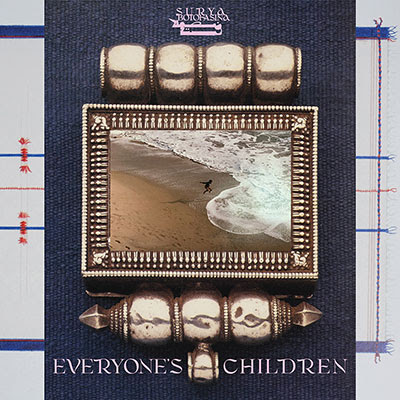
An acolyte of Alice Coltrane’s devotional embrace of Eastern spiritualism, imbued by that sagacious innovating jazz seer’s afflatus music and teachings, the keyboardist, composer and actor of some repute (from parts in Vinyl and Broadwalk Empire) Surya Botofasina bathes in his mentor’s light on this debut opus.
With the meditative, motored ascending arcs of Om Rama and such threaded throughout, Botofasina and friends set out on an astral and naturally felt work of spiritual jazz, trance, new age and ambient transcendence.
Our guide on this album of worship, remembrance and healing grew up at the Sai Anantam Ashram in the Southern Californian hills, where Coltrane led the daily bhajans, the traditional Hindu songs of praise and paean. His mother, Radha, was a disciple before him of this idyllic retreat’s guardian, a notable harpist but also pianist and vocalist herself and a one-time member of the American string band, The Spirits Of Rhythm. With such an enviable musical lineage and influence it’s no wonder that Botofasina would go on to become the Ashram’s music director and to internationally spread the word of this particular devotional form.
Encompassing all that reverence on his first fully realized album, Botofasina, aided by a cross-generational cast of guests, seeks to calmly honour but also demonstrate that faith. As a album to these enraged, divisive times, Everyone’s Children – with everything that album title’s metaphors, allusions, analogy entail – perseveres in the face of turbulence; softening and weakening the choppy waters in a blessed light of disarming but deeply felt warm suffused elevation.
With a both sentimental and yearning new age language of utterances from the Los Angles jazz singer stalwart Dwight Trible and fellow Californian indie folk vocalist Mia Doi Todd welling up and adding a certain wailed gravity, these divine acts of veneration ascend at a peaceable pace. The opening beachside temple suite running to over twenty-seven minutes as it shimmers and glistens with dappled electric piano, a serene air of the holy and washes of ambient synth.
Although often soothing with lightened touches of astral plane jazz and soul music, Botofasina’s piano occasionally stirs up outpourings of louder and harder pressed expressive emotions and serenades – as on the semi-classical and 60s jazz riptide evoked ‘I Love Dew, Sophie’.
Accentuating these spells of keyboard cascades, lit-up bulb like notes and rays the Canadian jazz drummer Efa Etoroma Jnr. adds splashes and tumbles, and the New York saxophonist Pablo Calogero wafts in with a suitable longing embrace. And overseeing it all is the Californian polymath (from noted producer to radio host, poet, percussionist and performer) Carlos Niño, who resembles a counter-culture 70s Carl Wilson chic. Together on this swami dedicated odyssey they border the heavenly as successful inheritors of Alice Coltrane’s devotional magic. As a debut album it’s a grand statement of spiritualism, nature and peacefully ascendant jazz; an escape from the material world.
Etceteral ‘Rhizome’
(tak:til/Glitterbeat Records) 11th November 2022
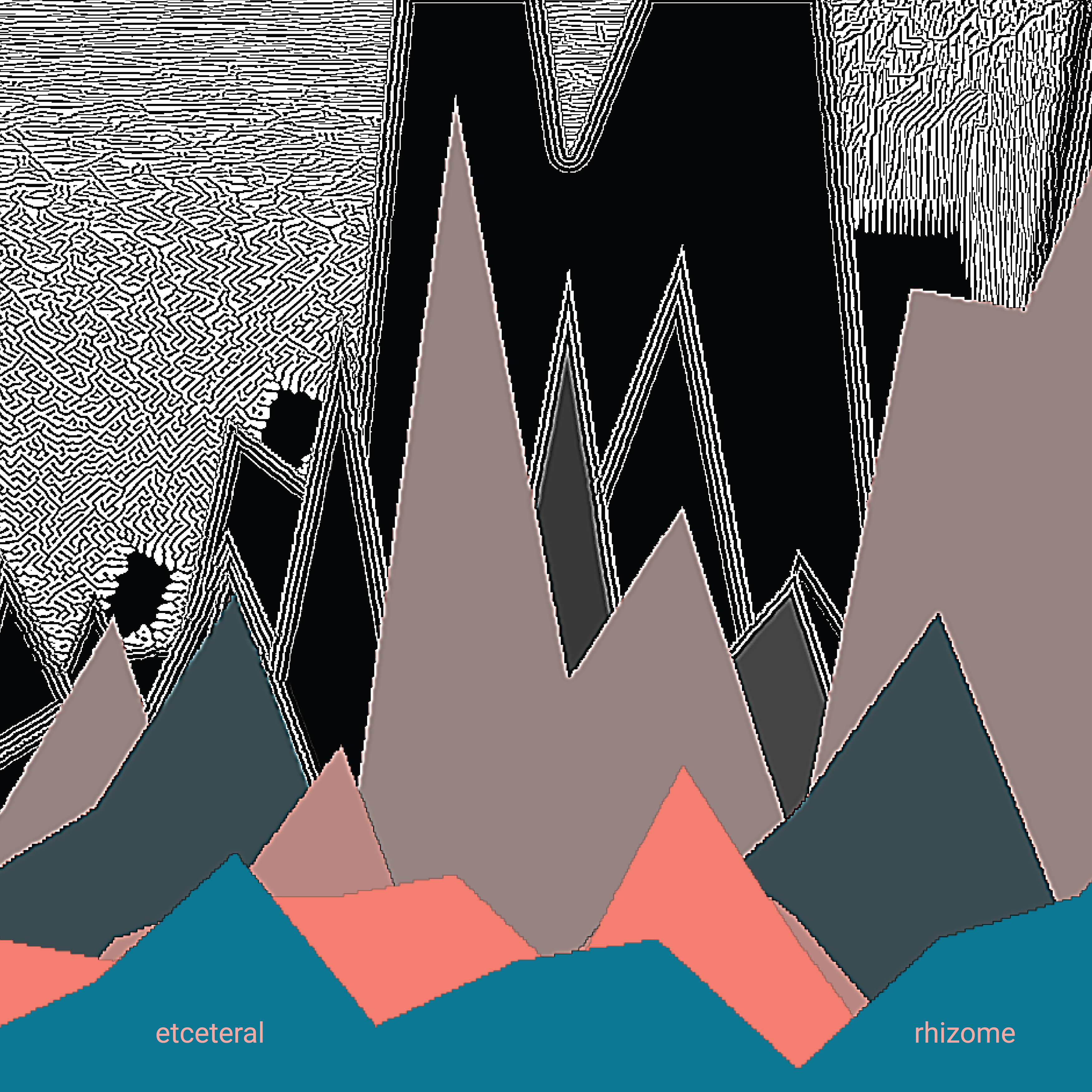
In what is a different, unique fashion, the Slovenian trio’s musical pairing of Boštjan Simon and Marek Fakuč (in part) react to their bandmate Lina Rica’s visual stimulus to create a cosmic electronic-jazz album of interlaced networks, connectivity and environmental crisis alarm.
Joining their fellow Slovenian compatriots, the dream-realism Širom, at Glitterbeat’s explorative, fourth world imbued instrumental sister imprint tak:til, the kosmische and organically freeform Etceteral base their new, mostly improvised album on the concept of its title, Rhizome: A continually growing horizontal underground stem, which puts out lateral shoots and adventitious roots at intervals; a non-linear network that connects any point to any other point.
With that theme, process in mind the trio reflect back a constant motion of soundscaping, rhythm and probing; balancing, at times, contemporary jazz with computer calculus, data, signals and metallic polygon shaped electronica. Yet, whilst Simon’s saxophone often drifts off into space, and his electronic effects, undulations more than hint at gravity-free zones in the cosmos, tracks such as the rolling, bounced and techno purred ‘Rome Burns’ allude to climate change and the extreme wildfires that engulfed much of Europe this year. It’s a great piece of flexible jazz that fuses Donny McCaslin and Go Go Penguin with Basic Channel to reflect an environmental angst of doom – fiddling with your suv sat nav whilst Rome burns to a cinder.
The rest of this interconnected, visual reactive album of performances and electronic augmented pulses and fusions goes through varying degrees of warping and reverberating transference. A jazz foundation is guided through a mirrored and computerised apparatus, which evokes shades of Squarepusher, Anteloper, Alfa Mist, Pyrolator and (rather handle as they share this column this month) Edrix Puzzle. Familiar echoes of rasped, cyclonic and honked sax, drum breaks and splashes receive an outer space production. Fakuč’s drums actually go into slow motion on the chrome soundscape ‘Dunno’. Etceteral turn it on and out on their improvised odyssey and contortion of activism. And yet the rhythms often driven, progressive and on occasion buoyant or bobbing, make this a most unique sort of an electronic dance album, despite its avant-garde, free and cosmic jazz foundations.
Karu ‘An Imaginary Journey’
(Beat Machine Music) 18th November 2022
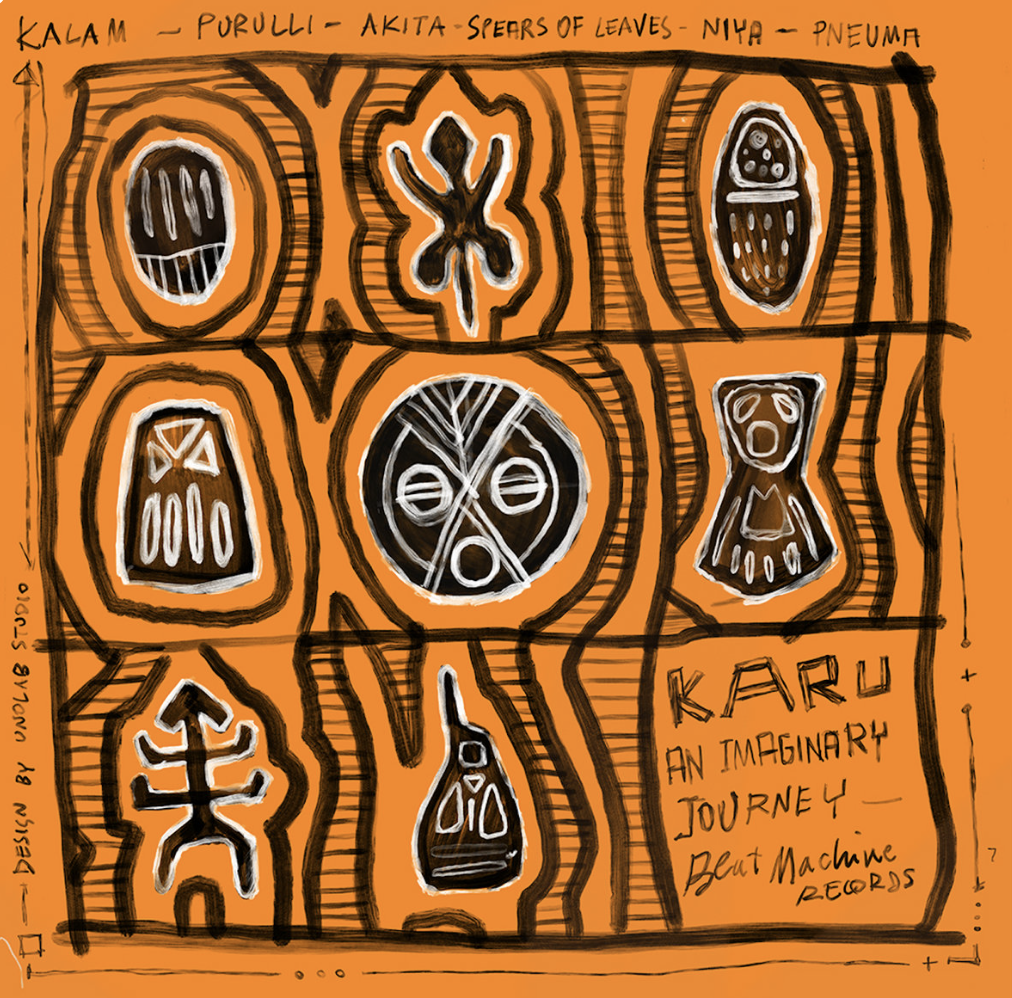
Lost in the Karu alias of mystical, atavistic mining and reimagined absorptions and traverses, the Italian double-bassist and producer Alberto Brutti’s collaborative project transforms, transmogrifies a fertile polygenesis palette of rituals and dances and ethnography to produce a contemporary affected album of Afro-Futurism, jazz and primitivism.
Wrapped up into a musical journey across both familiar and more ambiguous, vague cultural landscapes, Brutti creates suggestive atmospheres and ceremonies; many of which are conjured from title references to old worlds, religious and mythological etymology. In that wide field of influences, inspirations there’s the Abrabic “kalam”, which can roughly be used to mean “speech”, “word” or “utterances” pertaining to the Islamic faith, but was also the catchall term to define that religion’s tenants of faith in the face of the philosophical doubters; the antiquity Hattian empire festival “purulli”, held at the Bronze Age settlement of Nerik, dedicated to the earth goddess Hannahanna (which may well be the source of the Biblical “hosanna”); the West Slavic (otherwise known as Lechites) tribal name for the chthonian god “Nyia”; and the ancient Greek word for “breath”, or in the religious context, “spirit” or “soul”, “pneuma”.
The first of that quartet lends itself to the album’s opening peregrination of African drums, Blacks’ Myth and cut-up Anthony Braxton, Roscoe Mitchell jazz renderings, reversals, abrasive industrial resonated sounds, Širom type otherworldly primitivism and stick choppy rhythms. Following in its wake there’s signs of Andy Haas, the esoteric, elephant trunk raising horns and the no wave sound of Mars and Milk TV. The latter title of that same quartet of wordy mentions signals a move further East, with again, vague notions of the Indian, Baul but also a soundtrack of downtempo breaks (ala Alfa Mist and J Dilla) and the hallucinogenic trance of Fursaxa (if remixed by Clap! Clap!).
‘Spear Of Leaves’ however, rearranges the bedeviled Faustus pact blues and dialogue of Robert Johnson on a palanquin caravan lumber across vapours of snorkeled saxophone. The final dream sequence on this imaginary travelogue drifts into a hollowed-out cane spun and fluted rainforest wash; ending on a more laidback piece of South American flavoured geography and waning jazz.
Between the haunted illusionary and mysterious, a removed time-travelling worldly plane emerges. Herbs, Roberto Musci, Amorphous Androgynous and Drexciya converge somewhere in the middle of the underworld and elevated.
The Dark Jazz Project ‘S-T’
(Irregular Frequencies) 14th November 2022
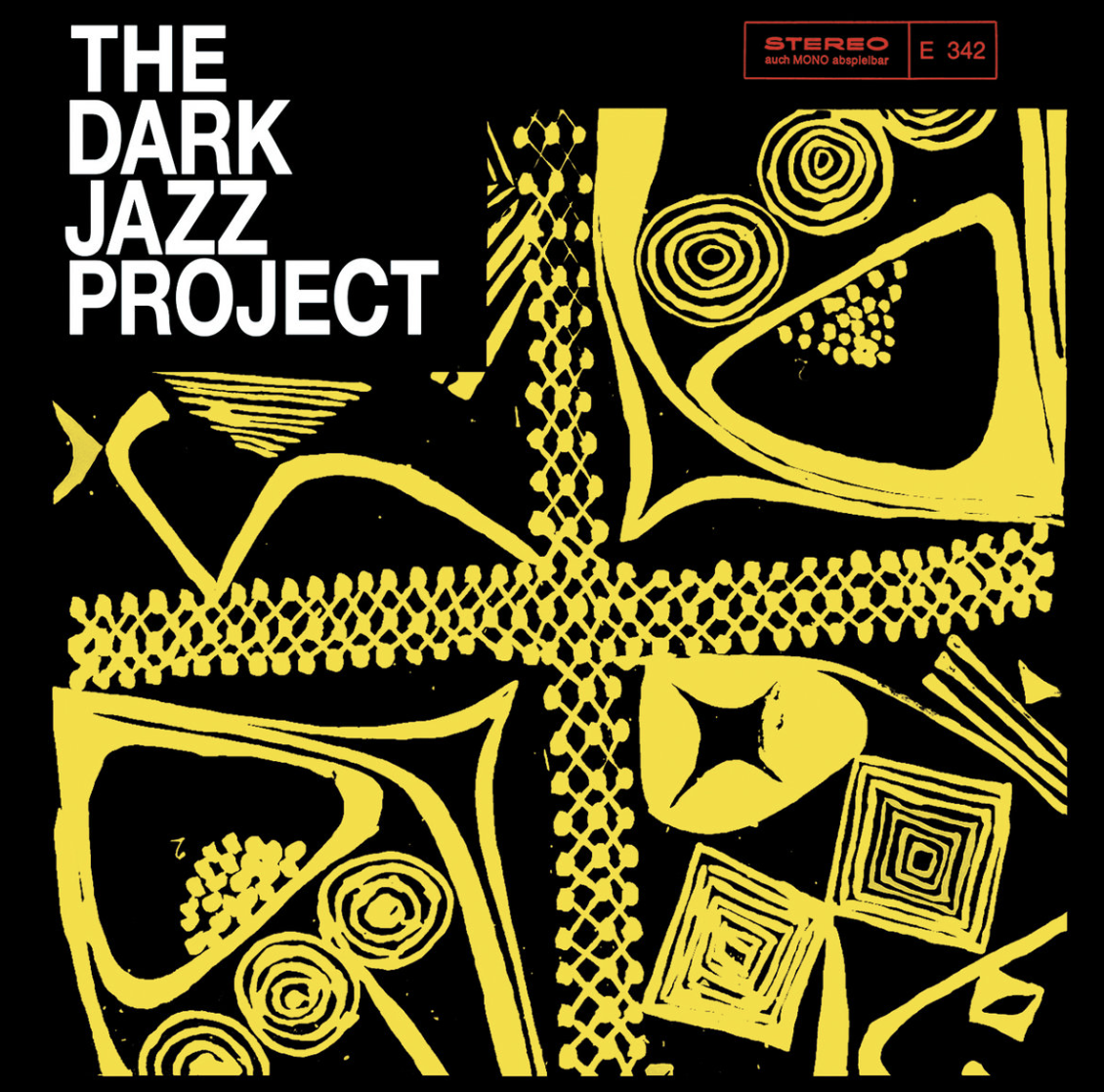
Making good on this summer’s three-track introductory EP, Andrew Spackman now unleashes a whole album of his latest regeneration creation, The Dark Jazz Project, on an unsuspecting audience.
The singular maverick electronic and art-house boffin recently hung-up his SAD MAN alias (after a splurge of numerous releases over the last five years) to crunch the codes of jazzcore.
‘100% political, 100% jazz, 100% dark’ we’re told, this latest platform for Andrew’s often sporadic leaps in electronic music and crushing techno filament cut-ups is about as removed from that jazz tag as you can get. The fact he’s also borrowed Sun Ra’s ‘Space Is The Place’ mantra too only feeds into the confusion. Any semblance to jazz is lost under a heavy tubular and granular transmogrification of the ominous, mysterious and, well, dark.
For this is the alien, sci-fi broken and fed through the Aphex Twin, Basic Channel, Radium, Rob Hood, Jeff Mills and Niereich & Shadym machine. Although the album’s opening hardline, dialed-in and pummeled beat gabbling Sun Ra lend sounds like Holly Herndon being thrown into the Hadron Collider, and Madlib seems to get trampled over, detuned and dissimulated on the bladed, driven and compressed frequency lunar ‘No Input’.
Andrews full gamut of skills, sonic palette comes to bear, as touches of primal, and even paradise moulding scores are set against more dissonant and chrome coated beats. Pins rain down on pulsating graphite spiky landscapes and imaginative darkly lit techno blocks of scrunched giant, weighted noise. A mirage or a topographic ocean; Olympus Mons or scorched earth, it all sounds a million miles away from even the most edgy and freeform ideals of jazz: not a saxophone in sight.
The Dark Jazz Project is yet another challenging move from one of the UK’s most inventive, inspired and, crucially, interesting leftfield electronic and techno composers of the last decade.
Yemrot ‘The Sunken Garden’
(PRAH Recordings)
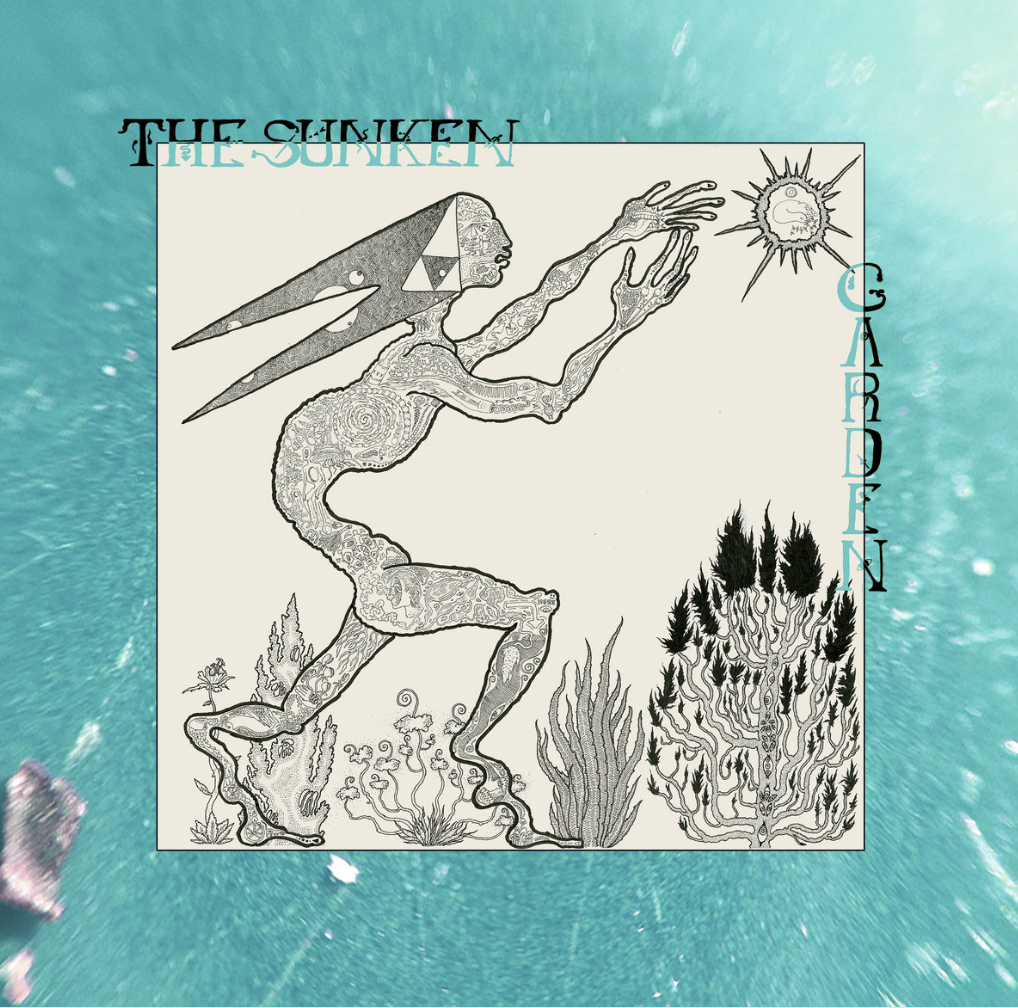
Who wouldn’t when faced with the despair of the modern world and in processing the deep loss of a parent want to take a giant leap into escapism and the fantastical? Looking into one such yearning chasm the Margate-based musician Jimi Tormey, acting under the alias of both Yemrot and the character Dill Dandin, finds solace in a neverworld of the dreamy and plaintive: a creeping sadness to be exact.
Unfortunately, in part, triggered by the death of his father (the gorgeous, welling-up and heavenly ached ‘Big Tree’ being the most obvious eulogy to that passing) The Sunken Garden is a both heartfelt and also psychedelic process of grief and some drama.
That process is, at times, a family affair with his mother Lisa providing the majority of emotive violin/viola, and his brother Eric offering harmonies alongside their sister Tuli, but also mixing and mastering the whole mini album. The results are achingly beautiful, yet there’s a constant deep feeling and vapour of unease, despondency and shadowy despair that swells up or looms over the magical illusions.
Canterbury scene troubadours and Syd Barrett influences wind and delicately emerge from the heavier atmospheres of Alex Harvey, Daevid Allen, Soundgarden and Radiohead. The album’s centerpiece, ‘The Ballad Of Dill Dandin’, is an eleven-minute stretching instrumental of changing, moving parts and passages. From the Floydian to chimes of Mark Hollis an almost theatrical drama and shimmer of something magical and creates a starry aura. Dill floats and tumbles across a trio of “Learning To” affixed songs that balance the soft with the harsh, the cosmic with the mournful.
Classical forms, the psychedelic, progressive and alternative all merge to form an interesting twisting journey of loss and acceptance; a working through of beautifully heart wrenching and articulated poetic expression. In the end I don’t think that sinkhole world is an escape route, but just a more imaginative coping strategy at dealing and conveying such miserable times. The masterful, gentle ‘Big Tree’ alone will move even the most numbed to tears, and deserves a place in any list of the best songs in 2022.
The Magic City Trio ‘Amerikana Arkana’
(Kailva) Late November 2022
Finally out the other side of the pandemic The Magic City Trio emerges with the second half of their originally conceived double album package of Americana, Country and Western scored songs from 2018. If part one was consumed with death, bad luck and mental health, part two is concentrated on the themes of serenaded, romantic affairs, with disarming little tales, alms, hymns and barn dances dedicated to both unrequited and strained relationships and knockabout love.
As with the previous album, a familiar soundtrack and language, lyricism is used to convey the contemporary: something of the moment. The bell tolls and tremolo rattle snake sets of Ennio Morricone and untold Western themes rub up against Nashville, the Carter Family, Lee Hazelwood, Mariachi brass, Willie Nelson and the psalms songs of America’s Methodist Church, yet this is an unmistakably modern record. Timeless feelings, subjects nonetheless, but with a slight updated twist.
An extended guest list joins the band’s principles, the June Brides’ Frank Sweeney and Annie And The Aeroplanes’ Annie Holder. Most notably the Nashville virtuoso John Heinrich, who lends that irresistible steel pedal quiver and upward bend to the Sweetheart Of The Rodeo if covered by Teenage Fanclub, with Orbison and The Carters in tow, ‘Our Life In Chains’, and the Red Rhodes-esque accompanied Gram and Bonnie Raitt in heartache duet ‘She Left Without A Warning’. “Record breaking” (for what I’m not sure) banjo player Johnny Button meanwhile adds his Appalachian hoedown spring to ‘The Final Day On Earth’ tale of woe and alarm. Also on that same lamentable group effort, Primal Scream’s Andrew Innes offers up bird sounds, flutes and mellotron. He’s back, playing both electric and acoustic guitars, on the Muscle Shoals Stones like, touching ‘You’re My Best Friend’ – which actually could be a Primal Scream attempt to once more ape the Stones’ spiritual washed-up tides.
Frank, when not carrying a tone and timbre that evokes both Richard Hawley and Mick Harvey, and Annie, vocally a mix of Kirsty MacColl and a rustic Marianne Faithfull, share an array of twanged, bowed and stirring and washboard scratched instruments with Jeff Mead, Matt Lloyd, Larry Saltzman, Dave Howell and others: a full panoply of the country sound.
Amongst the self-penned declarations, hungdog lovelorn regrets and outlaws-on-the-run sense of rebellious romance, the band cover the theme from the archetypal thrown-together-in-desperate-circumstances Western ‘3:10 To Yuma’ (great movie, both the original and remake) and the Wesleyan Methodist church hymn, ‘And Am I Born To Die’. The first of which, originally penned by Frankie Laine, keeps a sense of the matinee drama and atmosphere but now sounds a bit like later Crime And The City Solution bounded together with Scott Walker (At The Movies) on a heavenly aria touched dusty trail. The latter, is every bit as reverent and elegiac, conjuring up the “trembling spirit” and quivering to the sounds of timpani and the bells of judgment. It did remind me however of Rick Danko; more lovely than stoic serious damnation.
Amerikana Arkina once more sets the mood, a complimentary partner to their more moody, plaintive 2018 songbook. Souls are bared; heartache delivered with a cinematic panache, and the Americana cannon once more successfully invoked.
Leverton Fox ‘In The Flicker’
(Not Applicable)
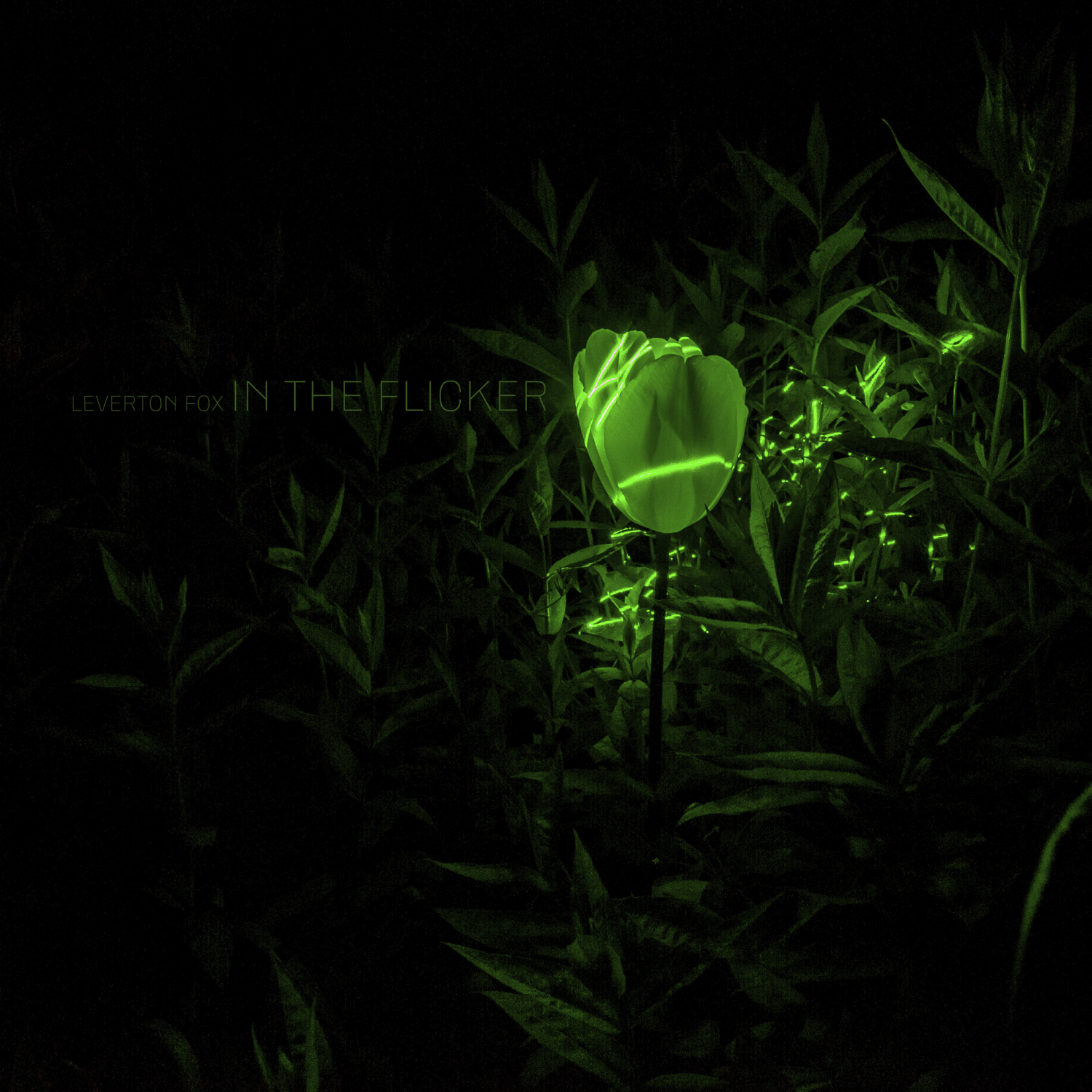
The gentle breeze rustling through the leaves and the sound of bracken and broken sticks underfoot in a less circumspect Sussex woodland has seldom sounded more alien, inter-dimensional and mysterious. Yet the Leverton Fox trio of Alex Bonney, Tim Giles and Isambard Khroustaliov has transmogrified the environment/atmosphere of their site-specific improvisation to beam out towards altogether more imaginative realms.
Intensified, if that’s the word, the trio of noted musicians/composers/artists in their own right attempt to sonically sculpt a 3D world with the added use of Dolby Atmos, a ‘surround’ format. Immersive being the key word, they draw the listener into lost worlds, primal soups and a more eerie lunar looming, time-travelling spheres.
Širom set-up in the undergrowth with Miles Davis at his most transient and wafting, Autechre, Tangerine Dream and Jon Hassell as ghostly traces of hidden sources merge with various aerial squiggles, zip-lines, machine purrs, occult sounds beamed from the Fortean Times transmitter, whipped up winds, clapped beats, crackles, raps, propeller and exotic sounding wildlife. A fully improvised soundscape that crosses mystical terra firma and unearthly corridors, In The Flicker takes in the most far-out, minimalist touches of jazz, electronica, dub, the dark arts, industrial, kosmische and Foley to create a certain mystique. The Leverton Fox(es) skilfully, intuitively explore and push a concept, conjuring up portals to more abstract planes; the familiar woodland site a mere jumping point for misty and bubbling invocations of an entirely different nature.
Dead Horses ‘Sunny Days’
(Maple Death Records) 14th November 2022

Jangling to a soft-stomping flange-induced country, rock ‘n’ roll bluesy acid dirge the Dead Horses esoteric sense of despair rings loud with slackened melodrama and scuzzy, dirty wiles. Whether it’s uprooting Spaghetti Western sets or up amongst the Andean condor nests looking down on the Nazca Lines, or, wading through swamps and thumbing a bum ride to a less idealized Laurel Canyon, the shared male/female vocal Italian group add a chthonian mystique and a touch of the Gothic to their brand of wrangled malcontent and doomed romantic aloofness.
A fair share of the new album, Sunny Days (released on the always intriguing and quality-delivered Maple Death Records label), rattles, spooks and melodically inhabits a reverberated atmosphere of Appalachian mountain songs and both languid and more heightened hysterics. A rewired Grace Slick, early Bad Seeds, Gun Club, Wall Of Voodoo and ‘Up The Hill Backwards’ Bowie flail about The Blood Meridian on the album’s opening song, ‘Can’t Talk, Can’t Sleep’, and Bosco DelRey mixes it up with the Velvets, Rey Crayola on ‘Hobo Talks’. The more mournful ‘The Cross’ has both an hallucinatory and The Kills vibe about it.
One of the standout songs however, takes a different direction. ‘Macabro’ still has that acid-folk country kick but also summons up a Latin drama, with a stirring vocal performance and Italo-Iberian stamp of bolero. Apparently this is the band’s first ever song in their native Italian tongue, and it’s all the better for it: more mysterious and hot-bloodily intense. No wonder it has become a sort of live anthem for the band.
It’s a long stretch from the Po Valley of antiquity to the Death Valley of inspired, mirage shimmered Western blues, but the Dead Horses as our guides navigate it with a flourish and macabre curiosity. If Crime And The City Solution buddying up with Aguaturbia and The Vaselines sounds like a desirable description then the rather ironically entitled Sunny Days stunt ‘n’ stomper is for you.
Biensüre ‘S-T’
(WEWANTSOUNDS)

Bringing together a mixed Mediterranean and Middle Eastern diaspora of musicians with a collective sense of belonging and yearn for their homelands, Biensüre transduces various cultural threads into a sophisticated and cool production of electro-pop, disco and sorrow.
Crossing paths in the cosmopolitan port city of Marseille, a refuge for centuries of émigrés and exiles, the group’s ranks include Kurdish, Turkish, Italian and Armenian lineages: The latter as a consequence of the early 20th century genocide. Within that gathering of cultural affiliations, and using the repurposed French expression for “of course”, Biensüre rally around the experiences of their poetically and longing yearned vocalist and saz player Haken Toprak. By the sounds of it that includes not just pining aches for his Kurdish-Turkish roots but declarations of unattainable love and serenaded exotic fantasies.
Already well into a contemporary revival of Anatolian and Middle Eastern synthesized pop, electro and disco (see groups such as Altin Gün and the Şatellites) Biensüre evoke such original trailblazers and icons as Erin Koray, Baris Manco, Moğollar and Kamuran Akkur. They augment those influences with subtle hints of Moroder, Vangelis, a throb of EDM and an unlikely bit of Nu Shooz on the drum-pad sizzled new waver ‘Çawa’.
Electrified misty veils hug the dancefloor, seductive movers are made, and swooned wanton vocals ache for what’s been lost on a unhurried smooth production that is simultaneously Turkish, Kurdish, Greek and Arabian in nature.
As funky as it is clean and lush, the Biensüre LP soaks up the great Marseille exile community and comes up with the goods. Breathlessly groovy yet casting back to the language (‘Zivistan’ the Northern-Kurdish word for “winter”) and memories of their ancestral homes, a nice balance is struck emotionally and musically between the modern and tradition. In all, a great pop record of Med flavours, with a soul and purpose.
Trans Zimmer & The DJs ‘S-T’
(Artetetra)
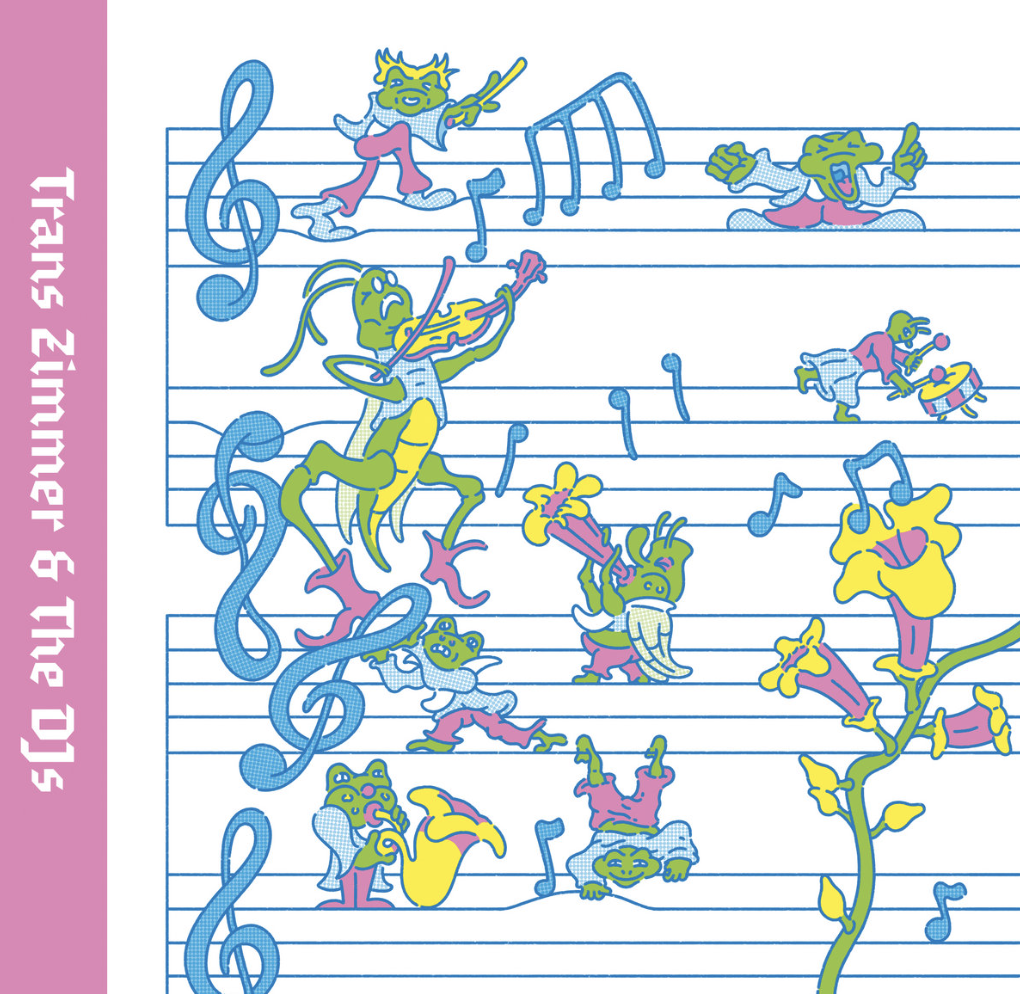
Launched into the most bonkers MIDI sound collage of platform hopping video game music, Esperanto era Sakamoto experimentation, slacker American dialogue, kooky fantasy and cartoon classical movements, the collective Trans Zimmer & The DJs (surely a play on the notable German film composer Hans) reimagine a Ritalin-starved Wendy Carlos running amok on Candy Crush.
Within the walls of a Taito/Capcom 80s arcade a loony tunes of polyphonic pre-set symphonies and chaotic snatches of gameplay chat trample over the course of a most silly bubblegum opera. It’s Baroque on speed; the Flaming Lips colouring in classical music scores; a grand misadventure of super hyped-up fanfares and cute vocoder J-Pop, hip-hop, electronica and lemon meringue pie snacks. Even aboard the S.S. Romulus the waters are choppy, tossing us around in a strange voyage of cult library music and late 90s American psych. I haven’t a clue what’s going on: not that it matters. The whole manic, yet always melodious and fun, experience seemingly a run through of the kitsch, crazy, miss-matched playful minds of those who created it. Skidding and scrabbling on a quest inside a 32-bit fantasy, Zimmer and friends level up across a most confusing, colourful whistle and skipped aural sinfonietta.
FOR THE FUNS
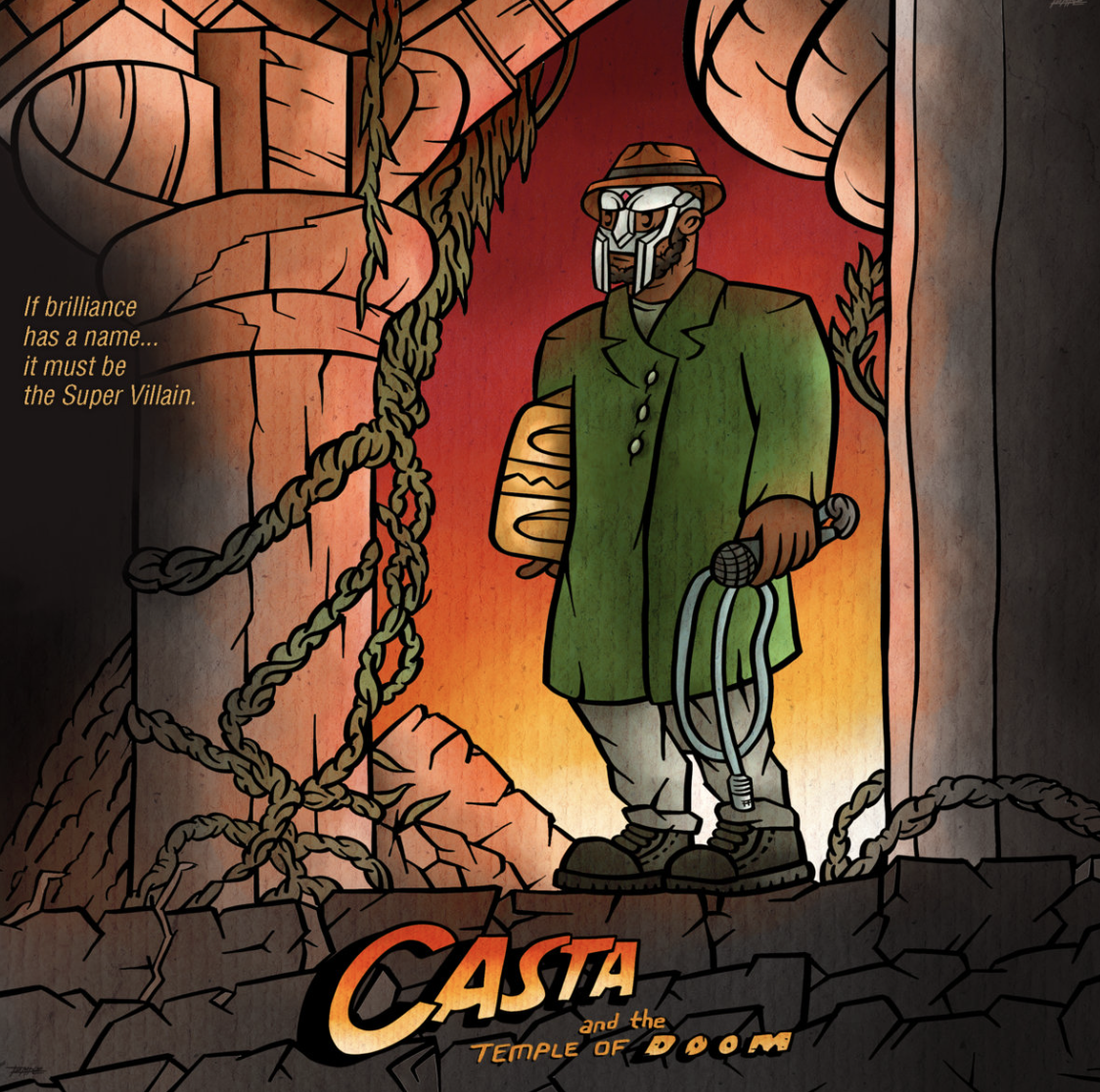
Casta ‘The Temple Of Doom’
(Bandcamp)
I suppose it was inevitable that at some point someone from the extensive late metal face villain and underground hip-hop genius MF Doom fandom would play on the Indiana Jones franchise – Indy literally escaping death in an airplane crush only to fall into the clutches of the Thuggee cult. I even named my playlist homage to the former Kausing Much Damage founder and prolific name riffing soloist, collaborator after the second Jones cinematic adventure myself. And I’m not alone on that score.
Released a year to the day of Daniel Dumile nee DOOM, Viktor Vaughn, Zev Love X’s death, the enterprising Portland producer Casta has merged the score from the Temple Of Doom with both samples and interview snippets from the MF Doom cannon: though it could have done with more Short Round quips in the mix.
In the spirit of such hip-hop mashups, with even Doom himself not adverse to sampling some cult, obscure and leftfield scores, Casta has some fun in paying tribute to a much-missed artist. From the Monsta Island Czars all-stars team-up to his work with a new breed of rap stars, such as Bishop Nehru, he leaves behind one of the greatest legacies in Hip-Hop: though his influence, creativeness, wordplay, pop culture, visuals and artwork reaches far beyond rap music, as this project proves.
Hi, my name is Dominic Valvona and I’m the Founder of the music/culture blog monolithcocktail.com For the last ten years I’ve featured and supported music, musicians and labels we love across genres from around the world that we think you’ll want to know about. No content on the site is paid for or sponsored and we only feature artists we have genuine respect for /love. If you enjoy our reviews (and we often write long, thoughtful ones), found a new artist you admire or if we have featured you or artists you represent and would like to buy us a coffee at https://ko-fi.com/monolithcocktail to say cheers for spreading the word, then that would be much appreciated.
Temple of DOOM: A tribute to MF DOOM
January 4, 2021
Playlist/Writings: Dominic Valvona

It’s taken a number of months to filter through to the fans and general public, but the Fantastic Four nemesis inspired indomitable Hip-Hop pioneer MF DOOM, nee Daniel Dumile, passed away at the age of 49 on October 31st 2020. Though hardly a disguise, the metal-faced maverick of underground Hip-Hop kept up a cool, mysterious persona throughout a thirty-year career.
Perhaps one of the most influential game-changers in the genre and beyond, DOOM will be sorely missed as an independent producer, rapper and mentor. Difficult to pin down, and keep up with, DOOM’s various masked turns (MF DOOM, DOOM, Viktor Vaughn, Zev Love X) churned out a prolific catalogue of quality inventive and playful meta-reference releases; starting out as Zev Love X in the Long Island (“but we call it strong”) ‘Kausing Much Damage’ trio on the cusps of the 1990s. Abbreviated to KMD, they released one of the best debuts of the entire era, the now classic, Mr. Hood. Tragedy struck with the loss of his brother and fellow KMD founder, Subroc – who died in a freeway-crossing incident in 1993. Further more the trio’s label Elektra shelved an admittedly controversial, baiting follow-up album: Black Bastards. All of which led to five years in the wilderness for DOOM, before reinvention and the donning of the mask that would stay with him for the rest of his music career. Re-energised and determined to plough his own furrow, DOOM began a solo and collaborative pathway, working with a who’s who of underground talent, including Madlib and Danger Mouse. From the Monsta Island Czars all-stars team-up to his work with a new breed of rap stars, such as Bishop Nehru, DOOM leaves behind one of the greatest legacies in Hip-Hop: though his influence, creativeness, wordplay, pop culture, visuals and artwork reaches far beyond rap music.
Having followed DOOM since the very beginning, I’m personally saddened to see him gone. But in the spirit of celebrating that vast cannon of work I’ve selected a curated pathway through the DOOM cosmology. I’ve also included an essay-style deconstruction I wrote many years ago on KMD’s debut album, Mr. Hood – which you can find below the playlist link.
KMD ‘Mr. Hood’: A Deconstruction

From the shores of Long Island, hauling out of New York’s surrounding areas: K.M.D – an abbreviation that is either referred to as ‘Kausing much damage’ or ‘A positive kause in a much damaged society’, take your pick – were part of the second Native Tongues wave; alongside the likes of Brand Nubian and The Black Sheep.
Originally formed whilst still in collage, the Dumile brothers, better known as Zev Love X and Subroc, along with their sparing partner Rodan – also known as Jade 1 – started rapping together during the late 80s.
Rodan soon slipped off the radar, preferring to finish his education, rather then pursue the dream. His replacement was the gemstone moniker Onyx.
The trio soon caught a break with a guest slot on the 3rd Bass LP ‘The Cactus’ in 1989. Dante Ross, the A & R man and member of The Stimulated Dummies Hip Hop production squad, was impressed enough with their innovative skills and delivery to sign them up to the Elektra label the following year, after the Bass’s M.C Search recommended them.
Zev Love X was of course the early birth of that metal-faced maverick and crusader MF Doom, an alter-ego he later adopted, born out of the tragic loss in 1993, of his brother, Subroc – he was killed in a tragic freeway crossing incident – and at the embittered rage he felt after being sucked into the music industry and then un-ceremoniously spat out.
On ‘Mr.Hood’ you can already hear his undercurrent of cynicism and contempt, articulated in a flam-filled throaty delivery; like an apprentice you can hear him finding his feet.
The debut album caused minor ripples, with its adopted use of racist sound bites, miss-directed use of English learning instructional records from a bygone era, appropriation of much loved kids TV puppets and antagonizing Malcolm X speeches.
K.M.D cleverly assembled a collage of inflammatory and discriminate language, which ran alongside satirist and humorous skits – much in the style of De La Soul and The Leaders of the New School – to create a highly ambitious commentary on their own backyard.
There is a central theme running throughout, with the Mr.Hood character of the title popping up in many memorable sketches and miss-quoted exchanges. His contributions are lifted from an old English language course from the 50s, which throws up all kinds of unpleasant, and quite frankly racist, dialogue – well it comes out that way when manipulated as it is.
Our protagonist’s colloquial tones open up the album, as he goes on a wrecky to the local downtown Long Island jewellery shop (misspelt intentionally on the album I assume) where he bumps into Zev Love X, as he attempts to wrangle with the proprietor over an over-priced watch.
He appears on near enough every other track; with his oddly misconstrued and out of kilter with the modern times queries and insults, which draw sharp breaths of disbelief from the trio, or deride ridicule from the local cast of characters, as he meets them on the street corner or at the barbershop. Also making a surprisingly eye-opening appearance is Sesame Street favourites, Bert and Ernie, who amusingly turn up on the tracks, ‘Who Me? (with an answer from Dr.Bert)’, to look for “little sambo”, and on ‘Humrush”, where they nasality hum along with the group.
Musically the beats are of an R’n’B and soulful nature, with samples crafted from the Isley Brothers – their ‘I Turned You On’ track is sampled on ‘Who Me?’ – Shirly Ellis – her ‘The Nitty Gritty’ is used on ‘Nitty Gritty’ – O C Smith – ‘You Can See Forever’ and ‘The Sounds Of Goodbye’ used on ‘Peachfuzz’ – and The Hassles – ‘4’o’Clock In The Mom’hour Of The Wolf’ is used on ‘Subroc’s Mission.
There’s even a re-appropriated use and borrowing of both De La Souls ‘Potholes In My Lawn’, on the tune ‘Hard Wit No Hoe’, and A Tribe Called Quest’s ‘Push It Along’ on ‘Nitty Gritty’.
All these beats are sophisticatedly layered and used quite subtly as a backdrop – you will notice that they are always lower in the mix, and seldom overawe the vocals – and is made-up of 808 drums, Jim Reed-esque organs, tightly packed thumping drum beats, taut wielding guitars, Stax rich bass lines and harmonica.
Any scratching is kept to a bare minimum, with the turntables skills arriving via the acute cutting, mixing and editing of samples and speech; mostly executed by Subroc.
The lyrics are dished out amongst the trio, with each member usually taking it in turns to step to the mic or guest in a solo spot, though Zev does tend to get a larger share then his partners.
A heavily laid-down mix of pro-Muslim rhetoric and protest goes up against the often-whimsical episodes and comical storytelling. Inspired by the teachings of Clarence Smith (known as Clarence 13X), and his splinter group the Five-Percent Nation – an offshoot from the Nation Of Islam – many of the lyrics encapsulate the beliefs and metaphors of this Harlem born sect.
On the opening track ‘Mr.Hood at Piocalles Jewelry Shop/Crackpot’, Zev articulately jams in the syllables, unravelling a kindergarten tale of following the wrong path in life:
“I first met Crackpot in like Head Starts,
And then I knew he wasn’t too head smart cuz as I scribbled in art,
He insisted on standing in the sandbox to collect unknown amounts
of pebbles and stones to throw rocks!’
By the end of the song, Zev bemoans to Mr.Hood about the negative allusions made about his race, and at the depressingly predictable decisions certain black males take: reminding them of their heritage and lack of ambition he almost exasperates:
“We built this place man,
We’re the Gods of the Universe,
Kings and Queens of the planet!”
On the highlight track ‘Who Me?’ Zev rides on the derogatory comments and ethnographical implanted stereotypes of the black race:
“Pigment, is this a defect in birth?
Or more an example of the richness on Earth?
Lips and eyes dominant traits of our race,
Does not take up 95% of one’s face.”
Sibling Subroc, has a more skipping and bouncy terminology to compensate against Zev’s; his own jam ‘Subroc’s Mission’ follows along a loose narrative of street slang and obscure references, whilst the birthstone kid, Onyx, unleashes his torrent of humorous one-liners and staccato stuttering tongue-twisters, over the soul shaking R’n’B horn blasting ‘Boogie Man’:
“Now check it, don’t miss this,
Lick them while I diss this sarcastic bastard,
Of which I’ve been mastered”.
They’re joined by fellow Afrocentric compatriots, Brand Nubians, on the super-rap wordplay riffing chorus-line of ‘Nitty Gritty’. The Nub’s own grandly entitled Grand Puba Maxwell, gives the K.M.D boys a run for their money on the lyrical wordplay:
“God cipher divine as I build on the incline,
Quick to help another, cause I know I’m a get mine.
Build-powers think they’re hard, but they’re killin’ their own kind,
Emphatically no, divine evil got him in his mind”.
Each of the two crews members line-up to show off their dexterity, which revolves around quotes, passages and the teachings of both the Nation of Islam and the offshoot 5-Percenters, name-checking the grand design of their creator, the Pyramids and oppression.
The rest of the album often throws up some unsettling mentions of “white devils” and other uneasy rhetoric, with a heavy use of Malcolm X’s speeches – his famous “he’s a wolf, and you’re a sheep” quote appears on the ‘Boy Who Cried Wolf’ track – from his Nation of Islam days; though it must be pointed out that he eventually publicly left the group, breaking away to form his own splinter group which had a far mellower attitude to the white folk – as long as they were Muslim, of course. But this often cited prose is always counter-acted with the satirical use of cartoon characters and humorous anecdotes.
Mr.Hood’ holds up extremely well, proving to be one the more accomplished albums from the period. Those conceptual themes, so essential to many of the Native Tongues collective, shows exceptional moments of creativity and talent.
Unfortunately their follow-up, no messing, album ‘Black Bastards’, didn’t sit well with the label, held-back and consigned to the vaults for nearly a decade. Both its content and provocative imagery – the cover sports a rubber-lipped characterture of a poor unfortunate black fellow with a noose around its neck, waiting in anticipation for someone to fill the blanks in a fatal game of Hangman. An ultimatum of sorts was made, ditch the cover or else! Of course this never happened and the album was never put out until a later reissue package under another label finally made it to the public – I was lucky to get a rather rough bootleg tape version of 5-tracks, but waited until the noughties to finally get my hands on a proper copy.
‘Black Bastards’ omitted much of the more comical interaction and playfulness, replacing the colourful samples catalogue with a more layered backing, and adding a more heavily laden set of lyrics to counter the whimsical postulations of the debut.
The birthstone kid had of course already jumped ship, leaving the brothers alone to deliver the much-anticipated second LP. Subroc took on all the production duties and assemblage of samples and beats; creating so much material that his brother used some of these sessions on his later MF Doom recordings – including most notably ‘Hoe Cakes’ from the seminal cuisine obsessed ‘Mmm Food’ album.
Tragically as I’ve already mentioned, Subroc was killed whilst crossing a freeway in 1993, putting the albums release into further turmoil, though the controversy over the artwork had already put a kibosh on it ever making the stores.
With the album shelved, resigned to cover dust in the vaults, Zev Love X began his wilderness years. It would be 5 more years until he was re-born as the vengeful MF Doom.
Dominic Valvona
Hi, my name is Dominic Valvona and I’m the Founder of the music/culture blog monolithcocktail.com For the last ten years I’ve featured and supported music, musicians and labels we love across genres from around the world that we think you’ll want to know about. No content on the site is paid for or sponsored and we only feature artists we have genuine respect for /love. If you enjoy our reviews (and we often write long, thoughtful ones), found a new artist you admire or if we have featured you or artists you represent and would like to buy us a coffee at https://ko-fi.com/monolithcocktail to say cheers for spreading the word, then that would be much appreciated.
Rapture & Verse: Hip-Hop Revue April/May: Your Old Droog, Datkid, Rob Cove, Onoe Caponoe…
May 7, 2019
Hip-Hop Revue:: Matt Oliver
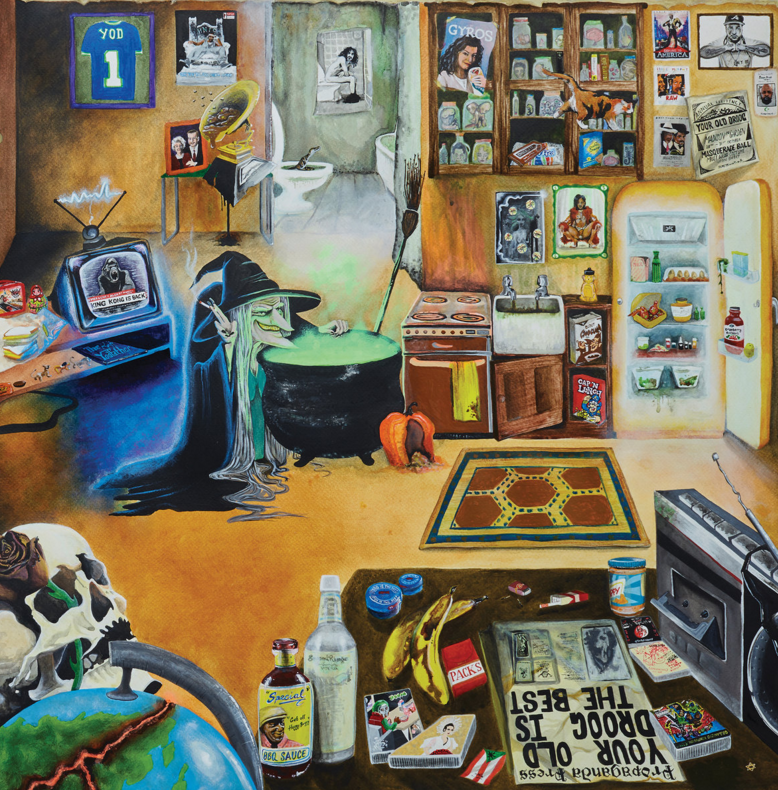
Singles/EPs
Welcome to the April-into-May edition of Rapture & Verse, powering through to the end of the season and still searching for that goose that laid the golden Easter egg. Into the singles, suffice to say the remix of Nick Roberts’ ‘Phlegm’ drips harder when Ash the Author has cleared his throat and sent for the delicate jazz vibes while “sick like influenza”. Cobes’ sense of stonefaced ‘Deja Vu’ is to give the people something from the gutter, wielding a sawn off flow to hypnotically sludgy trap from Don Piper. Also looking to announce their arrival via hatchet through your front door, the faint but powerful eeriness of Ill Move Sporadic allows Strange Neighbour to apply a callous coup de grace as ‘Drug Slur’ slowly seizes your brain.
The resurrected renegades of funk Belles in Monica revisit their post millennium espionage with the ‘Natsukashii’ EP, the Glasgow crew sidewinding from the shadows with balaclava militancy mixed with the invoking of bad karma. CMPND’s ‘Whatuplayin@’ makes low-rider music that redefines the ghost whip, murky with a spectral edge where show and prove deals a scorpion sting. There are those that do and those that only observe, and Upfront makes that same distinction with cocky confidence on ‘Spectator’ before beckoning to ‘Look at This’, hocking all over airy jazz vibes.
Then there’s Milkavelli’s ‘Channel Surfing’, a ten minute stream of unglued, curiosity-eking lava lamp consciousness, playing like a late night talk show you won’t find in any TV listings. A friendly game of beats and rhymes is the ‘Word’ of Rob Cave and The Other Guys, seven tracks of sunshine in a record sleeve (perhaps it’s Cave’s Del-like tone), promising something for everyone.
Albums
On his worst behaviour when ‘Confessions of a Crud Lord’ writes red-top headlines, Datkid bullies the beats of Leaf Dog until he’s administering toilet swirlies. Audaciously, Westside Gun, Conway the Machine and Roc Marciano join in with the offense of a one-man gang whose flow is pretty darned irresistible (‘Grown Up’ shows a sharper-than-thought narrative game as well), toying with his Bristol compatriot’s heavy hitters that know exactly how to get the crud to rise to the top.
Datkid also leaves his mitts on Split Prophets’ ‘The Forecast’, joining Upfront, Flying Monk, Paro, Res One and Bil Next on a proper pass-the-mic session. Badhabitz on the boards runs a tight ship for the Westcountry crew go for theirs across eight tracks, equivalent to a knowing look being all the encouragement needed to rack up a bill for booth damages.
Another outcast for whom ASBOs were drafted for is Onoe Caponoe, his Thunderdome rollercoaster ‘Surf of Die’ fixed with two settings of maelstrom or meek. Druggy wall crawlers and wild trap booms raging with the brakes cut pressurise the album until it eventually blows out with exhaustion, but it’s the solemn pauses to look at the view below that make the 169er an even more unnerving object of fascination.
One more to add to this month’s bunch of pithy, snotty spitters is the succinct Sean Peng telling you about his ‘Trips to the Medicine Cabinet’. Heat turned up by Illinformed’s usual brand of head shots driven straight down the middle, Peng is not one to indulge in excess despite the title, leaving the mic shook with an efficiency akin to racing through a Rubik’s Cube like it’s nothing.
Resisting the urge to fart rainbows and spew glitter, Ill Bill and Stu Bangas’ ‘Cannibal Hulk’ goes plundering with a superhuman taste for flesh. Bill’s Non Phixion comrades Goretex and DJ Eclipse assist with the rock and roll hellraising, which despite being petite in length, yanks you onto its team with the sway of cult leadership.
California and Detroit is where ‘Child of the Jungle’ resides, the offspring of Guilty Simpson and MED keeping the underground on a low heat you can still feel on your neck. Spoilt with the production riches of Madlib, Nottz, Black Milk, MNDSGN, Karriem Riggins and Apollo Brown, the mood moves between urgent, soulful and dusted – not the sort of backdrop the mic warhorses are gonna miss out on, slotting in without airs as is customary. Pistol McFly’s chill ‘Road Trip’ is of a similar, middle lane hold from the West Coast, picking up fans on the strength of being roofless rather than ruthless, though the occasional need to speak up and detouring down darker lanes are welcome additions to the journey.
The definition of enterprising, Quelle Chris remains a singular underground voice, loading latest album ‘Guns’ with intelligent angles on a topic never far from the news, coming up with some hardcore head nodders and an educational bigger picture that’ll “make a rapper freeze up like I was Zack in Bayside”. Rhymes to play on your mind.
A number of R&V favourites return. Chewing premium fat like it’s mere water cooler conversation, Your Old Droog proves ‘It Wasn’t Even Close’ to the sound of cop show themes on their last doughnut and your favourite rapper being moved into retirement by means of cloak and dagger cult. Supplemented by DOOM, Mach-Hommy, Wiki and Roc Marciano passing through on the low, Droog again doesn’t need to overstate the obvious that he’s dope, a slew of shrugging punchlines and forensic wordplay cracking smiles when it feels almost inappropriate to do so, and answering his own question of “whatever happened to lines that used to make you rewind?”
Witness the fitness when Nolan the Ninja, at his most ‘Sportee’, inflicts damage on a jumble of beats mainly being used as target practice rather than competitive equal. Still striving for mid-30s retirement and musing on how to “turn my passion into profit”, another influx of hurricane rhymes wind down in the album’s latter stages just like on the previous ‘Yen’, offering a wee glimpse of conserved style beyond his impressive enthusiasm.
You know what, Dope KNife was right: ‘Things Got Worse’, though not the impact of his front foot stomping continuing on from ‘NinteenEightyFour’. Holding a grudge until knuckles turn white, this has the feel of dismissive modern gangster rap/unofficial old skool with the necessary smarts, playing the position perfectly on the industry glutton ‘Famous’. “Don’t debate the beast, cos I don’t tolerate your weakness” is all the warning needed. El Camino’s warning of ‘Don’t Eat the Fruit’ follows the morality and mechanics of the modern G-code. Namely, funk and soul loops deconstructed as makeweights in drug deals and gunplay, a flow riddled with insomnia, obsession and a bout of the hiccups, and quick out the door so as to make room for the next scheme.
Alchemist’s fifth ‘Rapper’s Best Friend’ collection shares more premium instrumentals, painting pictures to the edge of panic and including two headliners claimed by Evidence. A Record Store Day special giving a clutch of 90s beats their vinyl debut, Pete Rock – poster boy for the MPC don’t forget – claims gold for the other side with ‘Return of the SP1200’. Perfectly sitting on the rugged/smooth axis, the golden timekeeping and honeyed snap, omnipresent from jazz lullabies to flexing outside, is like ice and a slice when you’re beating sweat back.
Wrapping up this month – woop woop, it’s the sound of Open Mike Eagle & DOOM.
MATT OLIVER’S ESSENTIAL HIP-HOP ROUNDUP
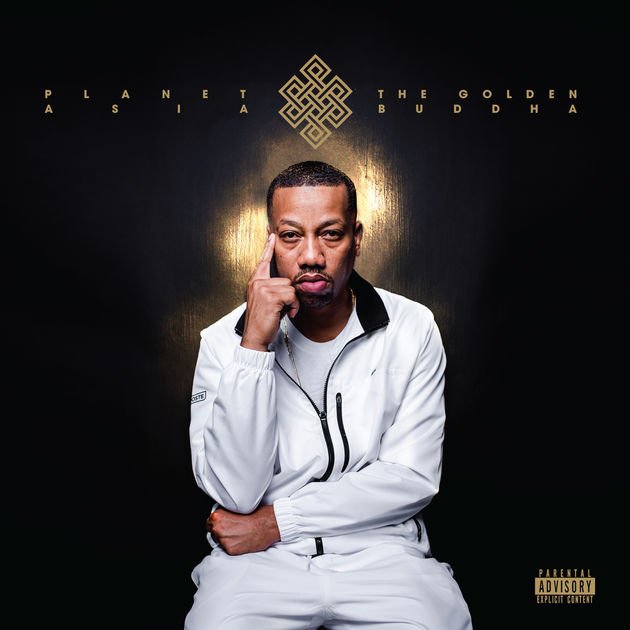
Singles/EPs
No time to celebrate 50 Cent becoming a bitcoin millionaire or Snoop releasing a gospel album, or Mos Def and Talib Kweli touting a Black Star reunion produced by Madlib. Right about now, groggy jazz from Jazz T and bleary digs from Lee Scott make potent points on ‘Ceiling’/’Urn Money’, matched by sweet and sour remixes from Pitch92 and Sleepwalker. The superior, subliminal sales technique of Genesis Elijah primes ‘How to Lose Fans and Alienate Listeners’ as a bestseller and puts a police cordon around the club. Weighing in at a headbanging ‘310 Pounds’, Juga-Naut and Mr Brown use the devil’s horns as their finishing move. A good heart these days is hard to find, so Ty giving you the benefit of his 20/20 vision is like a shot from Cupid on the breezy seesaw ‘Eyes Open’ featuring Durrty Goodz.
Wise-past-midnight pair Summers Sons are ones to cling to when the next weather warning comes calling, ‘Undertones’ an EP of sticky jazz drifts keeping it moving while remaining perfectly still. In the same postcode, Fanshore & Tropic’s touch of the ‘Reaper’ finds Hawaiian flutter in the Big Smoke, and the softly spoken stream of Coops’ ‘That Jazz’ means now he’s gonna rip you apart. Thug paradise, J Rocc-style, is to blend Mobb Deep and Sade into a whole new bunch of quiet storms. Tasked with the smooth operation of hijacking every 80s wine bar ever, six ‘Thug Ballads’ copy-and-paste their way up for coffee.
Underground bout of the year is found on the comic book crash course ‘Nautical Depth’, where Czarface and DOOM cause forum frenzy with pay-off lines galore and a bassline drilling into your ears. Apathy has also been busy doing dream team deals, appearing with Pharoahe Monch on the Pete Rock-made ‘I Keep On’, then swinging hard over ‘The Order’ of DJ Premier. On the move and on the loose, Sav Killz’ ‘Thundercats’ calls to the wild for some rough and tumble sent cartwheeling by Dirty Diggs. Credit to PHZ-Sicks for turning Sisqo’s most infamous panty raid into a hard hitting address causing ‘Riot in My Memory’. Moodie Black’s punishing industrialism lead by guesting gatekeeper Ceschi sews ‘Lips’ shut; dangerously atmospheric, as hell’s gates remove their padlock. Fake news gets a brick of actual fact to the face, unexpectedly from People Under the Stairs, playing the role of upset press blowing ‘Dog Whistles’.
Albums
Dr Syntax and Pete Cannon are back in full effect, opening up essential dialogue on ‘Let’s Talk’. Ever the polite pop culture vulture, Syntax thumbs through school photos and double-barrels the handbook of how to be an upstanding citizen and a hip-hop A-Z, with Cannon’s bruising beats keeping it cheeky, including one of his infamous Commodore-sponsored jungle jump-ups. Entertaining each and every time, the double act should be kept on speed dial in case of emergencies.
The main pastimes in the 20-strong Brighton borough of ‘Wizville’ are savagery and thrill rides. Ocean Wisdom stretches his rep with that 0-to-60 flow causing heart tremors, playing with the pitch control on the beats to alter the shades of black and blue he leaves the scene with, and placing guests Method Man, Rodney P, Roots Manuva, Jehst and Dizzee Rascal as almost incidental. Just when you think he’s showing signs of flagging, the assault rages on, maintaining Wisdom’s impressive ascent and already giving 2018 plenty to ponder.
Farma G’s wistful beats introduce ‘The Sentimental Alien’ to the modern world. Wishful thinkers and regal peace seekers from the Task Force intel, make it easy for handpicked emcees like Recognize Ali, Ric Branson, Smellington Piff, Anyway Tha God and Dirty Dike to dirty up a sound tinted a fine shade of rose. The custom brand, don’t-care daggers flung by Lee Scott and Black Josh create the monster that is the B-Movie Millionaires. With Sam Zircon behind the camera and keeping things eerily sluggish/sluggishly eerie, ‘Attack of The 50,000 Ft Sweg Lawds from Outer Space’ is a slumping battle royal of a snuff flick, a beast showing how it “put two and two together and got triple six”. The cure for a sub-zero February is having Pupils of the Clock waiting on you, enterprising Cornwall pair Tok and Lazy Eyez forging a clear path through crisp beats nudging the drowse button and sixth sense connections on ‘Timeless’. No danger of them following through on the declaration that “when we’ve got nothing left to say, that’s the point that we’ll call it a day”.
From the moment he draws first breath on ‘Weather or Not’, Evidence embarks on a masterclass. The man himself states “there are no wasted words”, inspiring under grey skies (the Dilated Peoples man is always better when there’s a storm afoot), holding your attention, and making you feel he’s dismissing (though not dissing) you as he lays everything bare with no discernible change in temperament. The forecast? One of 2018’s best.
Putting “the sublime in the subliminal”, Skyzoo’s ‘In Celebration of Us’ is some of the smoothest psychology and concrete consciousness you’ll hear this year. Written in the streets, penned to stir and examine the soul with his conversion of gunfingers to quotation marks, and cornering both the lounge and the late night creep, Skyzoo raises a glass with vitamin-rich articulation undercut with provocation, and making it look easy while his does it. One to be toasted over and over.
After Adrian Younge offered you ‘Twelve Reasons to Die’, Apollo Brown gives you another dozen dirty deeds to hold your head high by/duck down to. Repackaged as ‘The Brown Tape’ with Ghostface Killah exacting sepia-toned revenge, Wu-Tang Clan members to the right (wild for the night), and Brown providing his own gentlemen’s agreements regarding dead body disposal, it’s a classy sister dynasty mixing noble finesse and brute strength. With Sonnyjim selling you glamorous 70s crime and circling the block like a vulture, Chicago’s Vic Spencer puts his business card in the shop window for the rest of the year on ‘Spencer for Higher’. Top of his CV: the perfect voice for completing a schemes and hustles to-do list, and spitting with a charm happy to chew you up and spit you out.
You can’t keep a good man down, and Planet Asia, riding beats like a son of a gun about to clean up town, gets you wise to the ways of ‘The Golden Buddha’. That West Coast flow is still in fine fettle, sounding typically parched but never found dousing his disdain for non-believers and those slow on the draw. Still a deadlock breaker you can trust.
Room temperature boom bap sending you to the land of head nod, Klim Beats adds to the instrumental handbook focusing on jazz and funk. Hip-hop to do your spring cleaning by, though you’ll do well to come up as spotless as the Ukrainian’s ‘Natural’ sound. Looking to goad emcees into action, Badhabitz unveils a bulk of soul flips and darker omens. Staunch kicks and snares earning top dollar throughout, ‘Beat Library Volume 1’ makes itself easily available for your ears.
Under the name of an end of level boss with an Esoteric twang, Rock Mecca fights for the right to earn the freedom of ‘Ironworld’. To a flood of swirling symphonies within touching distance of Armageddon and pyrotechnics bankrolled by Hollywood, Vast Aire, Roc Marciano, Kool Keith and Canibus all try on knuckle dusters for size. Those unable to stand the heat will quickly be directed to the kitchen door. Now for the new album from Ugly Duckling’s Andy Cooper, in three easy, foolproof steps: grab a microphone, despatch a bunch of funk breaks hula-hooping or celebrating Mardi Gras, and invite Blabbermouf and Abdominal to challenge the rules on tongue-twisters. Doing what he does best, that’s ‘The Layered Effect’ for you.
For your eyes only: Cut Chemist versus the photofit, and hooray for Hozay.
 Monolith Cocktail Blog