Choice/Favourite Albums Of The Year: Part Two: H to N
December 14, 2023
SELECTED BY GRAHAM DOMAIN, BRIAN ‘BORDELLO’ SHEA & DOMINIC VALVONA

Welcome to PART TWO of this year’s favourite/choice albums features. If you missed PART ONE, follow this link.
2023’s list, as ever in alphabetical order, is broken down into three more digestible parts.
And as we have since our inception back in 2008, the Monolith Cocktail continues to avoid those silly, factious and plain dumb numerical charts that our peers and rivals insist on continuing to print – how can you really suggest one album deserves their place above or below another; why does one entry get the 23rd spot and another the 22nd; unless it is a vote count. We’ve always chosen a much more diplomatic, democratic alphabetical order – something we more or less started in the first place.
Whilst we are proud to throw every genre, nationality together in a serious of eclectic lists, this year due to various collaborators commitments, there will be a separate Hip-Hop roundup by Matt Oliver in the New Year.
The lists, broken up this year into three parts (A to F, H to N, P to Z), includes those albums we’ve reviewed or featured on the site in some capacity, plus a smattering of those we just didn’t get the time to include. All entries are displayed thus: Artist in alphabetical order, then the album title, label, who chose it, a review link where applicable, and finally a link to the album itself and a quote.
So without further ado, cast your eyes over the H to N entries for 2023.
H________
Hackedepicciotto ‘Keepsakes’ (Mute)
Chosen by Dominic Valvona/Reviewed by DV/Link
‘The sound of Berlin with stopovers across Europe and New York City, Keepsakes conjures up evocative visions, dramas and characters out if the arty, the gothic, the cerebral and surreal; creating an alternative photo album and collection of memories, events. As earthy as it is dreamily floating in a constructed world of fairytale, myth and magic, the creatively sagacious couple draws upon a lifetime of experiences, friendships to produce another captivating album for the Mute label.’ DV
H. Hawkline ‘Milk For Flowers’ (Heavenly)
Chosen by DV/Reviewed by Gillian Stone/Link
‘Starting out a certain way, where you think you know what you’re getting into, then taking you by surprise, is the thematic journey of H. Hawkline’s Milk For Flowers (Heavenly). So is lyrical vulnerability.
Milk For Flowers begins steeped in traditional songwriting, takes you on a breathless journey, then brings you back into a place of safety, where feelings can be acknowledged and processed.’ GS
Healing Force Project ‘Drifted Entities Vol. 2’ (Beat Machine)
Chosen by DV/Reviewed by DV/Link
‘The re-rebirth of cool in an ever-forward momentum of flux, Antonio Marini’s Healing Force Project once more tumbles across a broken-beat, jungle, free-jazz and cosmic spectrum of reverberating exploration and spliced assemblage.
A splashy mirage of effected, realigned beats and reframed jazz inspirations sent out into space, Volume 2 in this series continues the ‘spiritual music mission’ but offers something once more eclectic and boundless.’ DV
Andrew Heath ‘Scapa Flow’ (Disco Gecko)
Chosen by DV/Reviewed by DV/Link
‘A geopoetry; a psychogeography of that famous body of shallow waters, Heath’s gauzy drifts, serene washes, glassy piano notes, Myles Cochran and Joe Woodham-like post-rock refracted guitar bends and harpic zither spindles coalesce to score an effective mysterious soundtrack to the former naval base and battleship graveyard.
Andrew Heath plays a combination of instruments, merged with ambient and real sounds that falls somewhere between such notable artists as his old foil Roedelius, Eno, John Lane (i.e. A Journey Of Giraffes), Jon Tye, Ulrich Schnauss and Flexagon. Stirrings from beneath are conveyed with a subtle drama and sonic history on yet another exemplary album of minimalist music.’ DV
The Holy Family ‘Go Zero’ (Rocket Recordings)
Chosen by DV/Reviewed by DV/Link
‘A phantasmagoria of occult manifestations, conjured or drawn from out the old soil, from out of the ether, The Holy Family’s Go Zero album offers darkness with glimmers of light. The Holy of their name, taken from the controversial Angela Carter narrated documentary on Christ’s depiction in the Western art cannon, not so forgiving and Christian, but an open vassal for confronting and exploring the divine and ungodly. Guidance there is none, as the band unnerve, rush, grind or prowl across a mystical dreaded mind fuck of a world that mirrors our own mortal chaotic, ungovernable hell hole. In short, it’s a great dense trip with dramatic voodoo and accelerated velocity.’ DV
James Howard ‘Peek-A-Boo’ (Faith & Industry)
Chosen by DV/Reviewed by DV/Link
‘To a languid soundtrack of bendy, dreamy blue Hawaii (relocated to Margate), and Tales Of The Unexpected and Third Man waltzes performed in a spoiled ballroom that Strictly Come Dancing couldn’t even revive, James Howard once again wanders wistfully across a worn, battered, disconsolate post-Brexit landscape.
Augurs of a reckoning; the sullied state of a septic Isle; an English seaside Ennio Morricone; just some of the feels and atmospheres all listlessly and longingly channeled into a well-crafted songbook (complete with leveling-up asides/intervals). Howard shields the hurt to an extent with his soft stinging observations, aphorisms and melodramas on yet another fantastic album; one of my favourites of 2023 already.’ DV
J__________
Carmen Jaci ‘Happy Child’ (Noumenal Loom)
Chosen by Dominic Valvona/Reviewed by DV/Link
‘A brilliance of candy-electronica and Casio symphonies, Happy Child is a clever work of unburdened, unpretentious, but indeed deliberate and well-crafted, kidulthood. Jacki Carmen’s magical, if occasionally straying into the mysterious, new album pings back and forth with humour and, above all else, playfulness. Not for the burgeoning artist (I say burgeoning, Carmen is quite the professional technician with some years of experience: you can even pay for one-on-one tuitions at her own studio) the sour-faced seriousness of many of her peers, this is electronic music with a taste of fantasy and fun recollections of childhood.’ DV
Kenneth Jimenez ‘Sonnet To Silence’ (We Jazz)
Chosen by DV/Reviewed by DV/Link
‘Taking a leap into the untethered realms of Kenneth Jimenez’s dreams, the jump off point for his newest album literally takes flight. The Brooklyn-based bassist, composer and quartet bandleader runs for the mountains and sprouts wings; flying over the valley and the versant contours of free jazz and hard-bop: ala New York style.
So much is happening on this incredible, engaging and sometimes challenging (in the best possible way) album, which draws you in and then ups or changes the tempo, mood and direction. This is free jazz at its most promising; certainly encouraging and with dreamy quality that lifts you up into an imaginative vision of soaring and more complicated expression. Kenneth Jimenez and his quartet have produced one of the leading jazz albums of 2023.’ DV
Darius Jones ‘fLuXkit Vancouver (i̶t̶s suite but sacred)’ (We Jazz/Northern Spy)
Chosen by DV/Reviewed by DV/Link
‘Absorbing all the history and ethos of Vancouver’s multidisciplinary Western Front hothouse, the acclaimed alto-saxophonist, composer and bandleader Darius Jones conceptually, artfully embodies the spirit of that creative hub’s avant-garde, Fluxus/Duchampian foundations on his new album of free-jazz movements.
Jones and ensemble have created something emotionally charged and highly expressive (challenging too, in a good way) from a site and history. The home of the avant-garde in Vancouver proves fertile, fiery kindle for an impressive, raw at times, catharsis and unload of free thought and art.’ DV
Junkboy ‘Littoral States’ (Wayside & Woodlands)
Chosen by DV/Reviewed by DV/Link
‘A loving tribute, romantic cartography and healing process, Littoral States provides an alternative pathway from another age; a world away from the vacuous self-absorption of popular culture and the distractions of the internet. It’s a wonderful, magical, and for the most part reassuring, gentle gradient landscape that the brothers dream up; tailoring nostalgia and influences into something picturesque, peaceable but above all, moving. Folklore from a recent past is woven into much older geological layers, with the emphasis on the element of water; acting as the source, the road that connects the stopover on this West and East Sussex travelogue photo album. It’s good to have them back in the fold, so to speak, waxing lyrical and dreamily envisioning such beautiful escapism.’ DV
L____________

Laraaji & Kramer ‘Baptismal’ (Shimmy Disc)
Chosen by DV/Reviewed by DV/Link
‘Divine styler of radiant ambiance zither spiritualism Laraaji can be found in communion with no less a pioneer than Shimmy Disc founder and downtown no wave doyen Mark Kramer, on this latest release from the New York label. Two pioneers of their form together over four movements of immersive, deeply affected mood music, draw on their extensive knowledge and intuition to create suites rich in the mysterious, the afflatus and more supernatural. What’s not to like.’ DV
Natalie Rose LeBrecht ‘Holy Prana Open Game’
Chosen by DV & Graham Domain/Reviewed by Graham Domain/Link
‘This is a beautiful album of cosmic folk strangeness singular in its vision and unique today, in its combination of sounds.
Sitting somewhere between Nico, Linda Perhacs and Alice Coltrane, the six haunting songs have superb intricate arrangements and a wonderful spiritual element! It could easily be mistaken for a long-lost album from the 1970’s, such is its charm.
Every home should own a copy of this album and play it each day as the sun rises bringing hope to the world.’ GD
Legless Crabs ‘American Russ’ (Metal Postcard Records)
Chosen by Brain Bordello Shea/Reviewed by BBS/Link
‘What if Joan Jett was telling lies and she did not love Rock ‘n’ roll at all, and she was just playing at it to make her millions, and really she loved nothing better than to listen to the old sequence dance compilations – the Swing And Sway series say – or was really a closet Pat Boone fan and preferred his version of Long Tall Sally and not in a ironic way, and did not believe in the old adage that the devil had all the best tunes (which to be truthful is not true, as Cliff Richards Jesus single was one of the finest singles of the 1970s). If Joan Jett was indeed a fake I am sure The Legless Crabs could and would turn the leather panted one to the dark side. And I don’t mean the Dark Side Of The Moon as that is as rock ‘n’ roll as a defrosted box of Fish Fingers. I mean the dark side of rock ‘n’ roll, the side filled with feedback and Cramps like guitar riffs and both sexual frustration and sexual exploitation (in a seedy 70s porn like way). See, that is what I like about the Legless Crabs, they are rock ‘n’ roll in a seedy 70s porn like way.’ BBS
Yungchen Lhamo ‘One Drop of Kindness’ (Real World Records)
Chosen by GD/Reviewed by GD/Link
‘This is a fantastic album of beautiful spiritual music by the wonderful world-renowned Tibetan female singer. Accompanied by a variety of acoustic instruments from around the world the seven songs are offerings to the Great Divine Spirit ‘devoted to spiritual awakening, unconditional love and compassion for all beings!’ A record to treasure – a beacon of hope in the darkest of times.’ GD
The Lilac Time ‘Dance Till All The Stars Come Down’ (Poetica)
Chosen by BBS
‘‘Why Stephen Duffy is not as big as Bob Dylan, I will never know. Maybe it is because Dylan did not form Duran Duran or make albums with Robbie Williams and Nigel Kennedy (one of the best LPs from the 90’s). Dance Till The Stars Come Down is yet another album from The Lilac Time‘s that is criminally ignored.’ BBS
Antti Lütjönen ‘Circus/Citadel’ (We Jazz)
Chosen by DV/Reviewed by DV/Link
‘During the initial pandemic wave of April 2020 the double-bassist maestro Antti Lötjönen released his debut proper as bandleader to a quintet of exciting Finnish jazz talent.
That album, Quintet East, with its monograph vignettes and flexible free-play of be bop, Sonny Clark, the left bank and Bernstein-like musical NYC skylines, is improved upon by the ensemble’s follow-up, Circus/Citadel. With a title both inspired and imbued by the Romanian-born, German-language titan of 20th century poetry, Paul Celan, the issues of a tumultuous world on the precipice of disaster is channeled through a controlled chaos and a reach for the old and new forms of expressive jazz.
I’m always building the We Jazz label up; always aggrandising that Helsinki based hub of Scandinavian jazz. But really, this is an enriching, immersive and artful start to the label’s 2023 calendar with a classic jazz album in the making. I reckon it will be one of the year’s best.’ DV
Lukid ‘Tilt’ (Glum)
Chosen by DV/Reviewed by DV/Link
‘Those of you waiting on a new Lukid album will not be disappointed. If more ‘refined’, composed and ‘simplistic’ than before, there’s still a real rhythm to Luke’s form of subtle but effective electronica. A ‘tilt’ perhaps of process, method and outcomes, this is a minimalistic iteration styled vision of dance music, submerged in lo fi veils, fuzz and gauze.
Tilt is an album of real quality; a cerebral distillation of Ambience, Techno, House and Electronic forms into some reification of time and moments caught before they disappear in smoke. This is a great returning album from the Lukid alias, one of the best in its field in 2023.‘ DV
Lunar Bird ‘The Birthday Party’
Chosen by DV/Reviewed by DV/Link
‘Disarming malady and alienation with such vaporous gauzy diaphanous veils of dream wave, Lunar Bird with a myriad of fellow Italian artists and musicians weave vulnerability and fragility into the most purified of intoxicating pop songs.
Not so much dipping as submerged fully in that drowsy intoxicating dream vision, Lunar Bird entwine emotional pulls, anxieties with the most delicious, sumptuous of Southern European ethereal pop. The Birthday Party is a spellbinding songbook that subtly pushes the Italo-Welsh group into swimmingly new waters without losing the signature diaphanous bohemian sound we all love them for. There’s absolutely no reason they shouldn’t be much bigger, well known and successful with potential hits like this.’ DV
M_____________
June McDoom ‘With Strings’ (Temporary Residence Ltd.)
Chosen by DV/Reviewed by DV/Link
‘Despite the diaphanous, wispy and hushed delivery, June McDoom’s voice is anything but evanescent or forgettable. Because just like one of her most cherished heroines, Judee Sill, every word and expression is believable as a lived experience of heartbreak, yearning and a close relationship with the elementals of an ethereal, but deeply felt, nature.
McDoom’s inspirations are worn on the sleeves, and yet I keep racking my brain to fathom who she reminds me of. An American Maria Monti? A softer Natalie Ribbons? Maybe a passing resemblance to Connie Converse perhaps? McDoom settles somewhere in-between them all as a refreshing, heavenly talent as she disarms the hurt and depth of emotional turmoil, inquiry and wonder with the most beautiful and impressive of deliveries.’ DV
Jean Mignon ‘An/al’ (Metal Postcard)
Chosen by GD/Reviewed by GD/Link
‘
‘Raucous debut album by New York based Johnny Steines. A mixture of high energy garage punk and high-speed rock and roll – it sounds like a live album such is the energy contained in the grooves!
‘Tackled By Men’ recycles parts of ‘Jumping Jack Flash’, whilst ‘Canadian Exit’ has echoes of Warsaw’s ‘Failures’. If he can produce this excitement in a live-setting he will surely make his own impact! Primal Rock and Roll that screams from the speakers andexcites like a high-speed car chase!’ GD
Liela Moss ‘Internal Working Model’ (Bella Union)
Chosen by GD/Reviewed by GD/Link
‘There are some great melodies and expressive vocal performances on the album. At times, she reminds me of Sarah Blasko at her most colourful and daring! ‘The Wall from the Floor’ sounds like a James Bond theme with its ethereal vocals and ‘Bad World’ refrain! ‘Ache in the Middle’ meanwhile has a melody that falls somewhere in-between Tears for Fears Mad World and Kate Bush the Sensual World! ‘New Day’ feels like a hymn to World Leaders for a better tomorrow – a call to feel empathy for others, concern and love for each other! If the overall feel of the electronic music is one of dystopia, alienation and oppression, the intent, the motivation is human – love and kindness as the antidote to isolation and inertia, feelings of helplessness transformed into positivity and action!’ GD
MultiTraction Orchestra ‘Reactor One’ (Aion Records)
Chosen by DV/Reviewed by DV/Link
‘‘A moving, evocative odyssey [through] a myriad of imaginative, mysterious environments and landscapes. One of those albums that truly gets better and better with every listen.’ DV
N______________

N’dox Électrique ‘Tëdd ak Mame Coumba Lamba ak Mame Coumba Mbang’ (Bongo Joe) Chosen by DV/Reviewed by DV/Link
‘Continuing to circumnavigate the depths of Africa, on a quest to connect with the purest origins of that continent’s atavistic rituals, the Mediterranean punk and avant-rock motivators Gianna Greco and François R. Cambuzat seize on the adorcist practices of Senegal’s Lebu people.
The successor to that partnership’s Ifriqiyya Electrique collaboration with the descendants of Hausa slaves (a project that produced two albums of exciting Sufi trance, spirit possession performance and technology), the next chapter, Ndox Électrique, radically transforms the Lebu’s N’doep ceremonies of spirit appeasement.
Between worlds the Ndox Électrique transformation moulds spheres of history and sound, whilst creating a dramatic new form of communication and ritual. Summoning up answers to a sickening society, both groups of participants in this blurred boundary exchange rev-up the sedate scene with a blast of authentic regeneration and dynamism. One that is neither wholly African nor European. Dimensions are crossed; excitement and empowerment, guaranteed.’ DV
Neon Kittens ‘Nine Doesn’t Work For An Outside Line’ (Metal Postcard Records)
Chosen by BBS & GD/Reviewed by BBS/Link
‘Post-punk beatnik shenanigans are afoot with this the new release from Neon Kittens. Their second album [I think] carries on where their last left off, with spoken female vocals purring erotically like an attractive nun filing her nails, smiling, knowing her crotchless knickers are only slightly hidden by her too short mini habit wondering just where to place her oversized cross next, over the scratch and sniff guitar yearnings that are part Fire Engines, part Scary Monster & Super Creeps, part rock ‘n’ roll, and part sexual abandonment. Yes, this is the true sound of total derailment. This is the sound of a 15 year old girl French kissing her jazz induced slightly older best friend with benefits; an album of pure off-center genius.’ BBS
Sam Newsome & Jean-Michel Pilc ‘Cosmic Unconsciousness Unplugged’
Chosen by DV/Reviewed by DV/Link
‘Joining the ranks of the great jazz (although they go beyond that, into the blues, classical and avant-garde) duos, the partnership of experimental soprano saxophonist and composer Sam Newsome and pianist, composer and educator Jean-Michel Pilc left a critically acclaimed marker with 2017’s Magic Circle album. Before that, and ever since, both foils in that collaborative duet built up enviable reputations, notably with Newsome as a soloist, and Pilc with his trio.
There’s some real class mixed with the unburdened pouring through every second of this album’s fifteen pieces; a real sense of freedom on the move, with the destination uncharted, unsettled and in some small part, mysterious. But as a showcase, the ‘unplugged’ consciousness platform reinforces the reputations of Sam Newsome and Jean-Michel Pilc’s explorative mastership and ingenious collaboration.’ DV
Greg Nieuwsma & Antonello Perfetto ‘Earth’ (Submarine Broadcasting Co.)
Chosen by DV/Reviewed by Andrew C. Kidd/Link
‘The score offered by Nieuwsma and Perfetto is as complex and intricate as the source material. Their waveforms and filters arpeggiate poetically to illuminate its idealism. They bring me closer to the chimaera of collectivisation that Dovzhenko was perhaps intending to showcase.’ ACK
Gard Nilssen’s Supersonic Orchestra ‘Family’ (We Jazz)
Chosen by DV/Reviewed by DV/Link
‘The debut from Gard Nilssen and his Supersonic Orchestra Family album is ambitious in scale and musicality; a real impressive first effort that in which Prikoviv, Ayler, Coleman, Braxton, Dolphy and Phil Ranelin mix it with Ill Considered, Binker & Moses and The Hypnotic Brass Band over an octet of extended suites. I can hardly do it justice in the brief space I’ve got left, but suffice to say, this is an incredible cacophony of every era in the jazz and classical cannon you can think of; everything from Latin to bop, the soulful, theatrical, wild and even stage. Wow. A real feat.’ DV
Hi, my name is Dominic Valvona and I’m the Founder of the music/culture blog monolithcocktail.com For the last ten years I’ve featured and supported music, musicians and labels we love across genres from around the world that we think you’ll want to know about. No content on the site is paid for or sponsored and we only feature artists we have genuine respect for /love. If you enjoy our reviews (and we often write long, thoughtful ones), found a new artist you admire or if we have featured you or artists you represent and would like to buy us a coffee at https://ko-fi.com/monolithcocktail to say cheers for spreading the word, then that would be much appreciated.
The Perusal #42: Tobias Meinhart And Berlin People, Suki Sou, MultiTraction Orchestra, Brìghde Chaimbeul, Lunar Bird…
April 13, 2023
Dominic Valvona’s Reviews Column

MultiTraction Orchestra (Ft. Arve Henriksen) ‘Reactor One’
(Superpang) Available Now
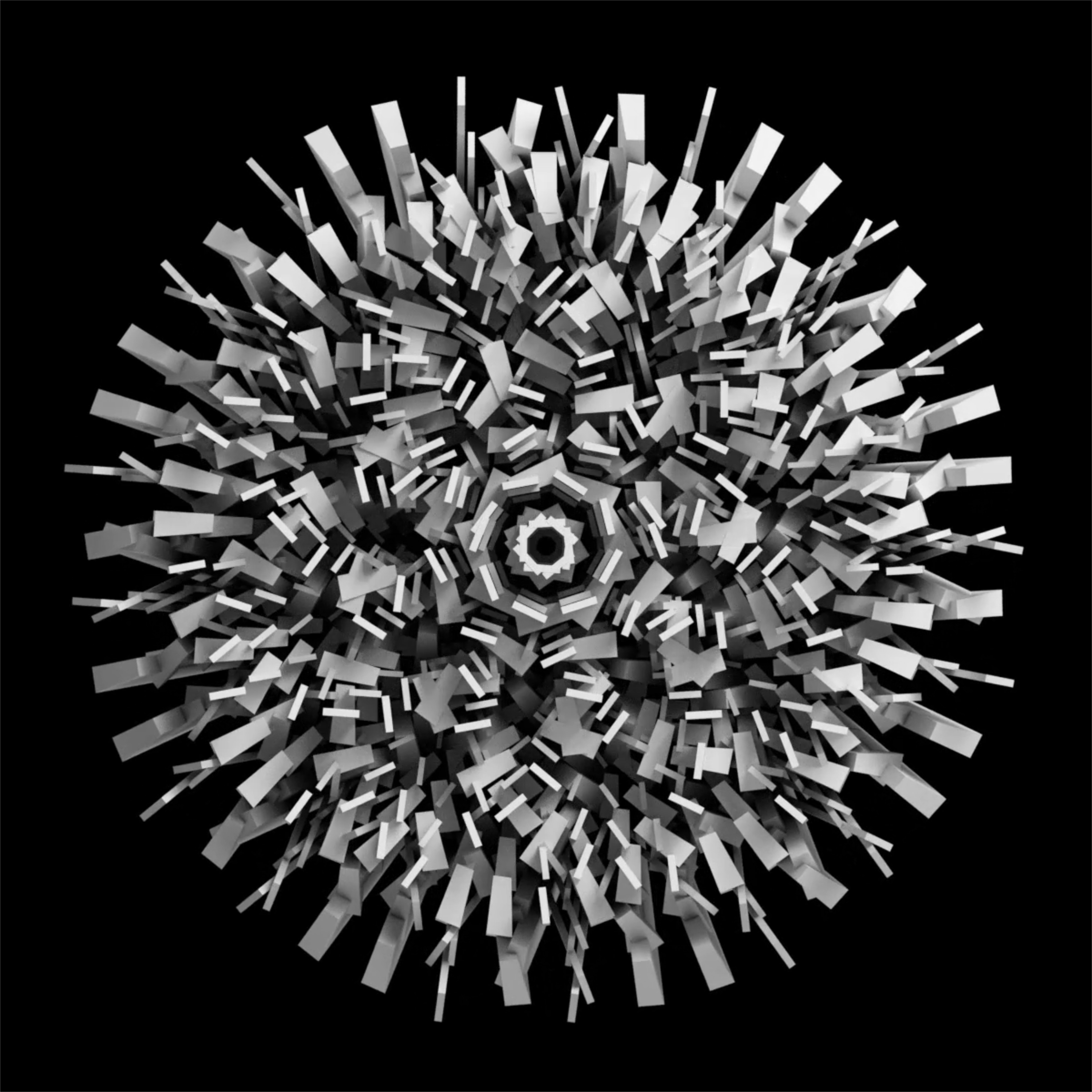
A multiverse of musicians from troupes and bands that congruously intersect, the MultiTraction Orchestra draws in members from GoGo Penguin, Supersilent, Melt Yourself Down, Crash Ensemble, Sly & The Family Drone, Hen Ogledd and beyond. A stellar lineup you could rightfully claim, such talents as the multi-awarding winning saxophonist, clarinetist, composer and Alexander Technique teacher James Alsopp; the “Reductionist School” freeform harpist Rhodri Davis; gifted cellist Kate Ellis; bassist, vocalist, composer, environmentalist and Acoustic Ladyland instigator Ruth Galler; jazz drummer, Son Of Kemet, Jon Scott; and Krakow via London and Detroit composer, guitarist, producer and interdisciplinary collaborator Alex Roth are joined by the Norwegian trumpet star Arve Henrikson on this new project of remote syncopation.
The orchestra’s members, brought together by Roth, made this, their debut expanded work, across various distances; collaborating apart from each other from different locations: A fact that in no way impedes on the quality and harmony of direction; even in the most histrionic parts.
Reactor One may suggest some nuclear fusion, but this feels and sounds almost like an orchestrated gathering “reacting’ to and playing together in one space at one time. Across a set of six performances that ensemble stir the senses and picture a myriad of imaginative, mysterious environments and landscapes. Such eclectic communions unsurprisingly draw a mix of genres, from jazz to the classical, post-rock and soundtracks.
The opening soft and grainy rasped, snozzled saxophone gauzy ‘Reactor I’ has an air of John Cale and Simon McCorry adrift in a mizmar of India or Arabia: and yet, it also sounds rather esoteric and otherworldly. Suite ‘II’ has a sustained post-rock bed of scuzz guitar harmonics, drama and bluesy-droned horns, whilst ‘III’ features delicate rippling harped aria-like pitches and raspy, almost rusted, sax.
‘IV’ is a crepuscular piece of concentrated brow cello and wisped stirrings that build, eventually, into a cacophony of drum breaks and smashed rolls and cosmic articulations. The harps are back on suite ‘V’, but sound almost like the African kora. They’re joined by an elephant trumpeted sax, what sounds like Jed Kurzel’s intense carved-up bowed strings dramatics, and a synthesized sense of unease. The final piece in this moving, evocative odyssey sounds like Popol Vuh caught in metallic, whining hinge bracketed and bass-y resonance.
A serialism of intuitive tonal movements, the sense of an ambiguous geography, mood and time, the combined efforts of so many threads sounds anything but disjointed or disconnected. Instead, the MultiTraction Orchestra deliver a coherent, balanced drama of gravitas and mood music.
Suki Sou ‘Notes On Listening’
(Curious Music) Available Now
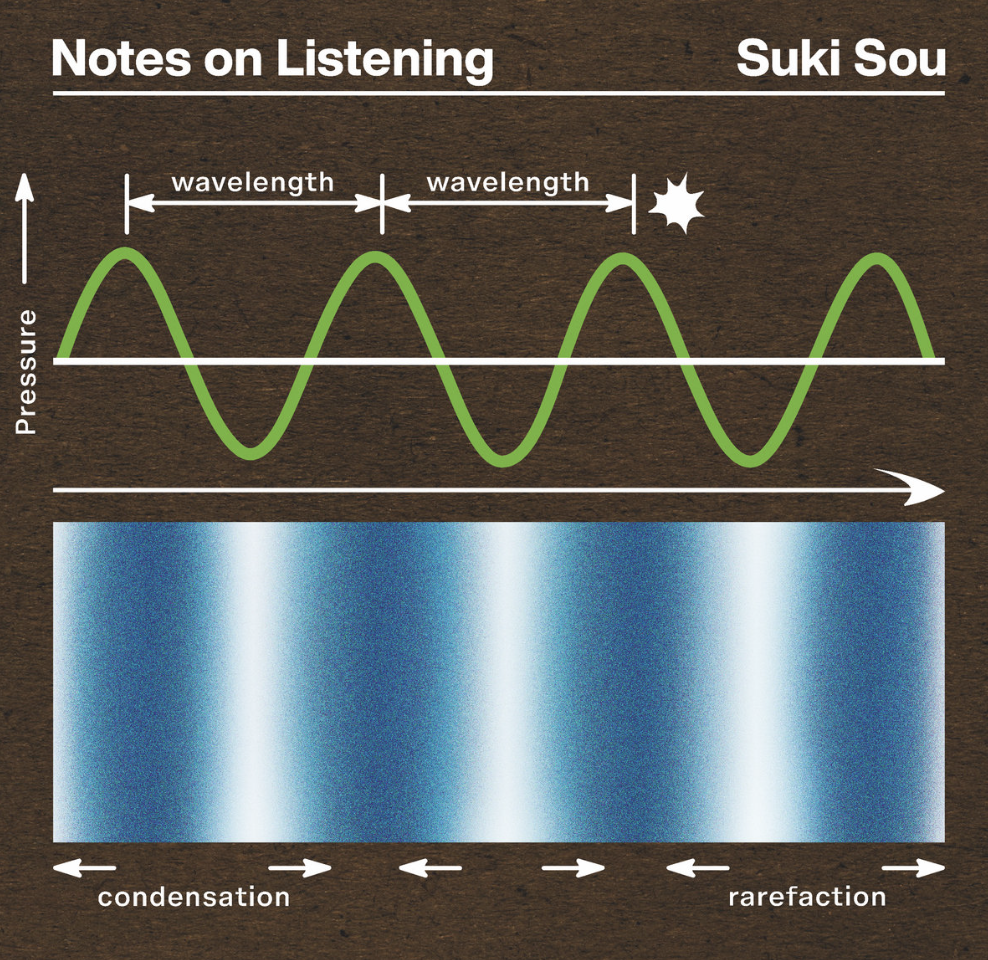
Gentle impressions in the modulated waves, ripples and drones, Suki Sou’s sophisticated analogue electronic pieces require a certain commitment.
Inviting a deeper listening experience, the intuitive self-taught composer and sound designer elicits subtle moods and evocations from a home studio apparatus of Moog, Arps and Buchla synths and MIDI controllers on the debut album, Notes On Listening.
Pitched somewhere between the nostalgic and electronic pioneered sounds of such luminaries as Suzanne Ciani, Sarah Davachi, Roedelius and Klaus Schulze and Library music, yet looking with opportunity towards the future, recollections of childhood out in the Far East are transported and fed into a symmetry of machine produced music and environmental, tactile humanism. There’s a soul within that multilayered network that works arppegiator, waveforms, algorithms and burbled and bobbed synthesized notes into genteel moving translations of abstract projections, feelings, places, even observed weather patterns.
Somewhere in the stratospheric ambient weightlessness of the ‘Kelvin-Helmholtz Clouds’ – the rare billowing wave pattern cloud phenomenon named after the professors of that title – and the moistened kosmische artificial splashes of ‘Velocity Of Water’, the distinctive memories of Sou’s journey from Macau to Berkshire, London and later, the Lake District, are transduced into ambient currents, melodies, languorous drifted spells, liquid flows and airy glides. It could be, as laid out in the notes, the reflections of listening to the Taiwanese pop star Teresa Tang in the rain at grandmother’s that is audible on ‘Petricher’. The outdoors is sealed off with the shut of a door or window in the studio on that one.
If JakoJako or the Warm Colours made an album with Metamono on Sky Records in the 1970s this could well be the result. Too minimal to be lush, yet beautifully, knowingly composed with room for serendipity, Notes On Listening brings warmth, and on the finale ‘Light Intervals’, a sort of pastoralist spiritualism to synthesised analogue electronica. Sou’s sources, influences make for an accomplished debut of subtly and purposeful ambience.
Lunar Bird ‘The Birthday Party’
(Supported by Help Musicians Do It Differently Fund 2022) 28th April 2023
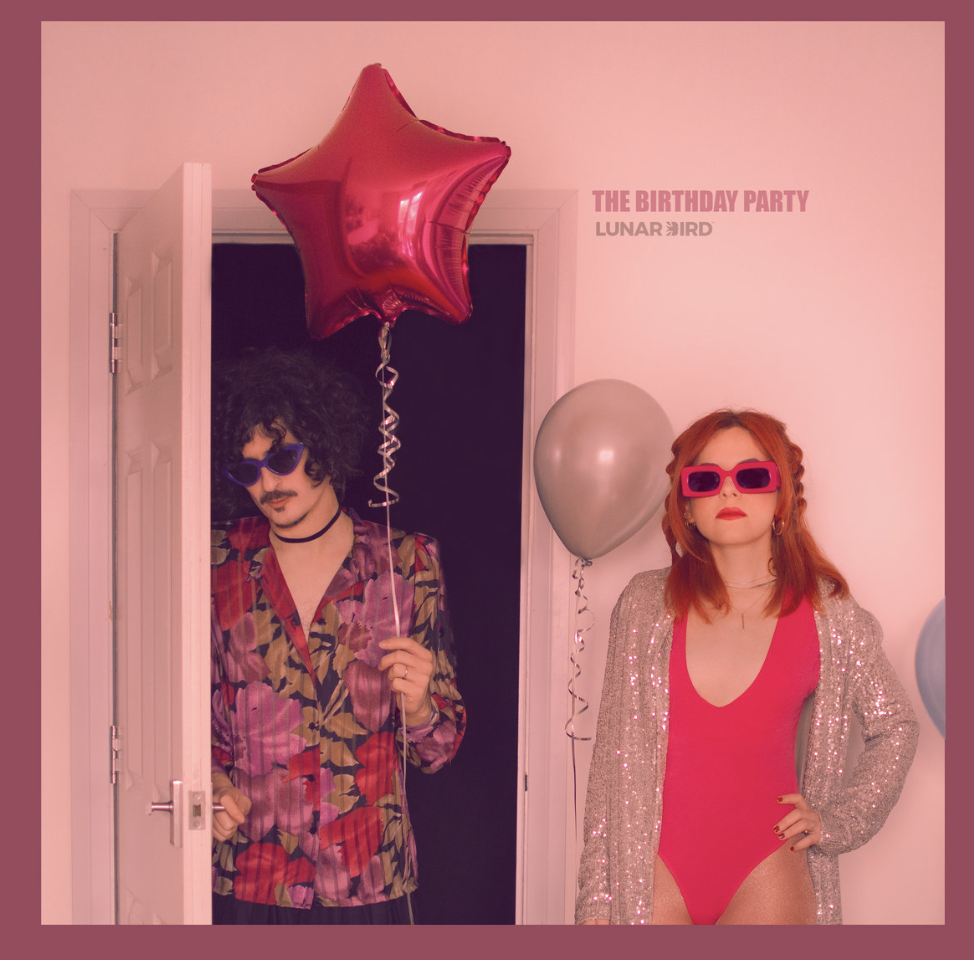
Disarming malady and alienation with such vaporous gauzy diaphanous veils of dream wave, Lunar Bird with a myriad of fellow Italian artists and musicians weave vulnerability and fragility into the most purified of intoxicating pop songs.
Although making the move from their native home to take up residence in Cardiff a number of years back, founding members Roberta Musillami and Eliseo Di Malto evoke a Mediterranean and Adriatic light-giving feel of consumed holiday romance and of longing disconnection: the distance between lovers drawn apart.
Lingering in a lush synthesized haze, Lunar Bird (named after Joan Miró’s signature abstract bronze sculpture) once more ooze a subtle, sophisticated mirage of alternative European pop from the 80s with Beach House, Diva Dompe and Julia Holter. Although, rather surprisingly, the saddened, synth and piano-chimed, near psychedelic ‘Firestorm’ sounds like a collaboration between Kate Bush and The Beatles (Sgt. Pepper era), and the Giorgio Tuma and Riccardo Raho penned coastal Iberian, almost Latin-American percussive, twanged and fluted (courtesy of another guest, Marco Tuma) ‘Dreaming’ reminded me of the late Mandy; a touch too of a Hellenic Lee Hazelwood if you please.
From paradise to metaphorical plunges into the gauzy waters of the deep end, the group’s second album is one long extended languorous dream. The title-track opener both musically and lyrically glows. A slow release of Italo-electronica and strobe-lit soft aches, a near creeping buzz and hint of Numan-sampled Sugarbabes sits comfortably with breathless Beach House vibes.
Recent single-video ‘Creatures’ is a gilded, glistened and softly rippled enchantment, a call-to-arms of a kind for “misfits”, shone down on with certain radiance. The already mentioned Giorgio Tuma joins electro-siren Roberta in a translucent, almost hushed duet on the new wave ‘A Crow’. Another guest of many, Adriano Modica joins Roberta on the Abba-esque Eurovision grand opening ‘Driven By The Light’; Modica “learning to fly” over a blissful, heaven sent production.
Featured on the Monolith Cocktail a while back, another of the already released single-videos, ‘Venilia’ references the Roman deity of the winds and sea to an almost cinematic allurement that conceals a spell of restlessness in paradise.
The album’s bookended by another of those slowly released anthems, ‘Astronaut’. This time celestial fanned rays light up the ephemeral on a golden shimmer of 90s dream pop, as the intangible, the fleeting space dust and romantic allusions are captured and bottled for posterity.
Not so much dipping as submerged fully in that drowsy intoxicating dream vision, Lunar Bird entwine emotional pulls, anxieties with the most delicious, sumptuous of Southern European ethereal pop. The Birthday Party is a spellbinding songbook that subtly pushes the Italo-Welsh group into swimmingly new waters without losing the signature diaphanous bohemian sound we all love them for. There’s absolutely no reason they shouldn’t be much bigger, well known and successful with potential hits like this.
Tobias Meinhart And Berlin People ‘Dark Horse (Live At The A-Trane, Berlin)
(Sunnyside Records) 28th April
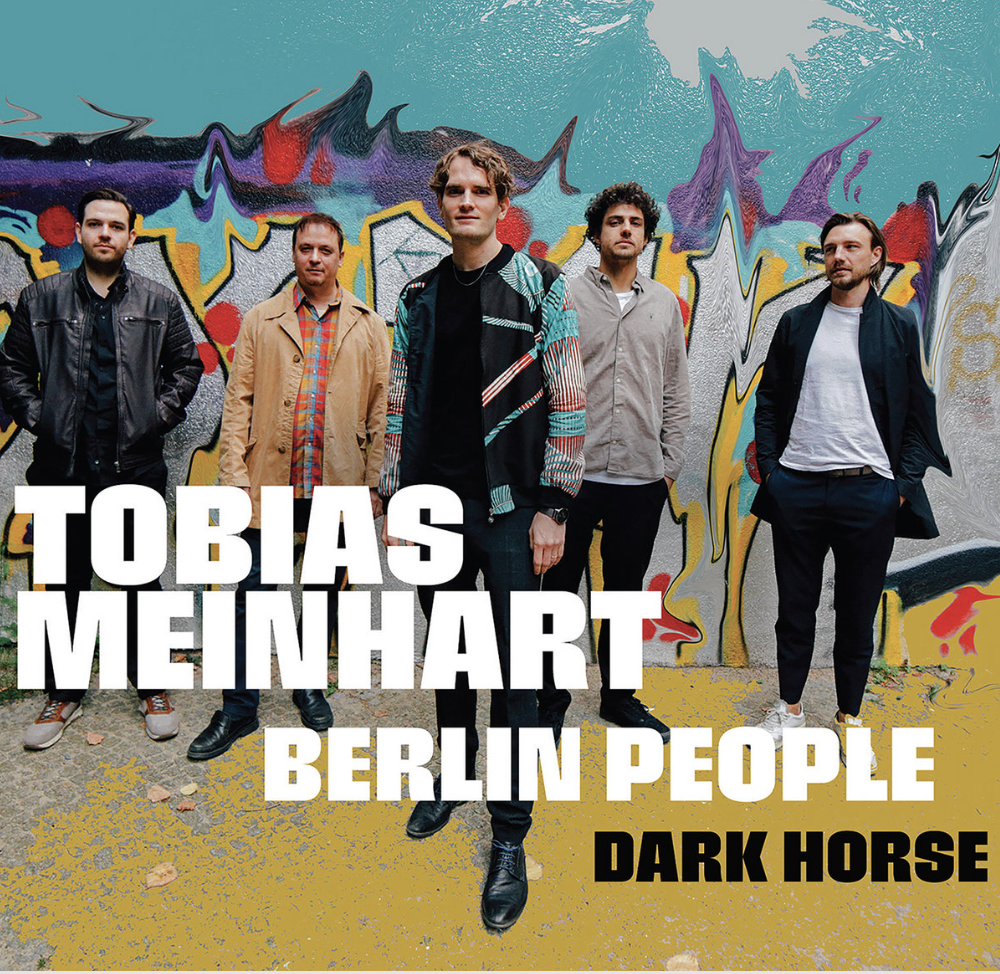
With an ever-widening international flavor, the Bavaria-born, but Brooklyn-based, saxophonist, composer and bandleader Tobias Meinhart picks up and infuses his sound with echoes of the NYC skyline, Latin America and Europe on his new album with the Berlin People ensemble.
Inspired by the dynamics of that set-up’s world tour – out on the road after storming onto the scene with the eponymous acclaimed debut –, Meinhart’s second album showcases a concept-bound live sound with performances from a two week spot at Berlin’s leading jazz club the A-Trane during 2021 and 2022.
Playing every night over the course of that period, encouraged by a respectful but appreciative clapping audience, Meinhart and his accompanying quartet of guitarist Kurt Rosenwinkel, pianist Ludwig Hornung, bassist Tom Berkmann and drummer Mathias Ruppnig shine both together and in the solo spotlight. And as that “dark horse” title suggests, each composition either finishes in a surprising way to where it started out or alludes to some hidden meaning. This might mean virtuoso skills in tandem with a mood, a groove and expressive breakout of dynamism.
With an air of Art Blakey & The Jazz Messengers, Dexter Gordon, Mark Tornes, Albert Ayler and more contemporary touches of European jazz throughout, there’s still room for the Afro-Brazilian style of BRBQ and Spanish flair of Chick Corea on the smooth Latin styled turn scenic dalliance and bustled park activity exchange, ‘Luna Park’, and the guitar work of Zappa and Nir Felder on the subtle Lalo Schifrin accented and tumultuous title-track. That same track has (like the later ‘Sonic River’) its very own introduction part; an almost clarinet-like solo saxophone lead-in of subtle rasped resonance and fluted flight.
Pining serenades softly build into flexed and bounced expressions of free jazz as drummed breakbeats suddenly evoke a splash of Buddy Rich when moving through a set of reflections, mirages and busier performances. Each instrument guided by as much deft skill as spontaneity, but with Meinhart switching between tenor and soprano fusing lighter spiraled climbs with shorter, more pecked or peppered toots.
You can hear that a real fluidity exists between each member of this troupe, as no matter the mood, the surprise, these live actions prove wholeheartedly rhythmic, melodic and above all top quality. Meinhart, as do his bandmates, reinforces an already glowing reputation as a leading light on the contemporary jazz scene with this essential album. This record captures them live on stage turning out both an explorative and classy kind of jazz dynamism; showcasing thought and action in perfect synchronicity.
Ale Hop & Laura Robles ‘Aqua Dulce’
(Buh Records) Available Now

Although both artist-researchers in this debut union grew up on the Peruvian coastline and popular beach area of Aqua Dulce near Lima, it wasn’t until years later and thousands of miles away in Berlin that they crossed paths and decided to work together. With a shared geography and musical interests Alejandro Cárdenas, under the guise of Ale Hop, and her foil Laura Robles liberate and transform the Afro-Peruvian heritage of their homeland from its colonial history: namely the Spanish Imperial Viceroyalty of Peru.
With a legacy of greedy conquest and genocide that wiped out the indigenous Incas, and the heinous uprooting of the people of Western and Central Africa, transported to the Americas including Peru, the local cultures and traditions managed to survive through subversion. One of the most important focal instruments (played here by Robles), the wooden cart-like cajón, was one such traditional percussive form with ties to Africa that was banned by the Spanish. The origins remain blurred but its thought to have originated in the ports of South America as a means to keep that drumming heritage, connection to home alive. Using the wooden packing cases that innocuously carried fruit and other goods, in a rudimental fashion, these boxes were adapted to be played whilst sitting on between the knees with hands, sticks, brushes or mallets. The basic shape remains, but is now no longer banished of course. Instead, it’s a mainstay of such Afro-Peruvian and Colonial-indigenous fusions as the two-bar figure Landó, the Zamacueca, the festive energetic improvised dance of Festejo, the Sande Las Diablos and the Alcatraz. The last of those being an erotic dance in which the man follows behind his tissue-decorated “posterior” female partner with a lit candle!
On this album the cajón’s quickening, stumbling or slowly lumbered rhythms go up against a radical reshaping of the coastal Peruvian environment, with natural evocations synthesized and made alien, otherworldly and futuristic. Improvisations later edited and with additional electronics and more obscured electric guitar, the African-Spanish-Amerindian dance of ‘Son De Las Diablos’ (which according to the late Peruvian “reciter and ethnomusicologist” Nicomedes Santa Cruz, may have no links at all with African rituals) is thrust into a sound world of non-musical wooden mechanized objects, synth purrs, poured primitivism and the atavistic.
A natural canopy of parrots, insect buzzing chatter; the creaks of and expansions of woodland and vines; and humidity are all turned into sci-fi with various effects, lunar bends and metallic fizzes/splashes/tears/ripples. One such scene, ‘El Fenómeno De La Niña’ sounds like Richard H. Kirk mooning in the exotic undergrowth.
Radio tunings and high-pitched whines and frequencies permeate a variation of rhythmic peregrinations and avant-garde sound experiments that build bridges with Peru’s incredible breathtaking landscapes and its ancient forms. Yet, can also evoke such alien and cosmic ideas too. In fact, Aqua Dulce doesn’t really sound much like anything else, except for the hints of Jon Hassell’s fourth world traverses on the brushed cajón, liquid poured title-track. And so both experienced artists/composers create a new dialogue; a sonic soundscape language as they reimagine a Peru unburdened and lifted from its colonial past.
Issei Herr ‘Distant Intervals’
(NNA Tapes)

Liminal in more ways than one, the Brooklyn cellist-composer Issei Herr’s debut album is both imbued and led by a number of transformations. From a change in musical direction to gender transition, a new life is articulated with an incredibly studied, moving work of suites, forms and memories that exist almost simultaneously in the past, present and future.
Classical groundings and that forms language (the “Aria”, “Elegy”, “Toccata” etc.) act as a base from which to explore various states of emotions, but also imagined possibilities. Reminding me in parts of fellow cellist and experimental artist Simon McCorry, Herr’s instrument of choice is similarly processed, overdubbed and improvised with – recorded, we’re told, in a bedroom closet of all places.
Distant Intervals begins with the recent couplet single of ‘Prelude (An Eternity Of Light)’ and ‘Aubade (The Farewell Is A Beginning)’. The former brings forth that yearned light to a stirring classical air, textured drones and a blown, dusted resonance of sophisticated sighs; the latter, a dawn serenade Aubade – a love song to the early morning made famous by John Donne no less – sounds almost like an English pastoralist yearn of majesty, sympathy and love. There’s a certain bass note on that same piece that seems to mark time itself. Both are class acts on an extended captivating album of deeply moving, inquisitive emotional pulls.
The ‘Aria’ on this album is quite different from the operatic allusions that this word would normally conjure; Herr both gracefully playing triplets of bowed notes and churning a kid of dance to the washed-out memories of a busy swimming pool scene. The eve-song ‘Serenata’ – in parenthesis, “To A Hidden Moon” – features a plucked, spring cello, saddening arcs, a certain feeling that borders on a cry, and what sounds like gentle mallets hitting the strings. ‘Fugato (Night’s Transfiguration)’ has a touch of Johann Johannsson and a choral-like quality of both awe and serenity in equal measure. Vocalist Maria BC offers a subtle Dead Can Dance ethereal swooned gravity to the album’s finale, ‘Aveu (The Beginning In A Farewell)’. More or less translating as “confession”, the Aveu here is used as a soothing vehicle for heartache and vulnerability, yet also gives off a real mystery too.
A parting from one stage to the next, Herr’s debut conveys, serenades and also offers more forlorn eulogies to past lives, woes as the pathway illuminates to a better future. This is a confident and quite accomplished work from the burgeoning composer and cellist that will stand the test of time.
James Howard ‘Peek-A-Boo’
(Faith & Industry) 14th April 2023

To a languid soundtrack of bendy, dreamy blue Hawaii (relocated to Margate), and Tales Of The Unexpected and Third Man waltzes performed in a spoiled ballroom that Strictly Come Dancing couldn’t even revive, James Howard once again wanders wistfully across a worn, battered, disconsolate post-Brexit landscape.
Appearing from out of the guises of both the Norfolk recorded, bleached onto parchment septic Isle folk of Thomas Nation (Battle Of The Grumbles), and the Blue House collaboration (Gobstopper), Howard’s newest songbook pulls from both, as a felt, if forlorn, picture of modern lawless Britain unfolds over a eleven-song cycle of idiosyncratic craft: Who else can evoke Roddy Frame, 70s Scott Walker, The Bluebells, Pink Floyd and Hansa studio saxophones all on the same album?
In the middle of an undeclared English Civil War of ideologies, divisions have never seemed so deep: beyond reconciliation. The puritanical demagogues on both sides seem to have drawn on that tumultuous period of our history. The bloodshed of that era left indelible scars on the country’s psyche; putting paid to revolution as a consequence. The film director Ben Wheatly tried, rather surreally, to encapsulate that same age in his 2013 film A Field In England. With all the events – including the roles of the hermetic, of science, religion and kingship versus a limited democracy – all unfolding in a field microcosm, England’s trauma bleed out into a both hallucinogenic and ominous nonsense of dream-realism. In one scene, the old lullaby of ‘Baloo, My Boy’ is sung across the desolation. A version of this ballad and Civil War curio is beautifully delivered by Howard as a wounded closer on Peek-A-Boo. Allegedly composed by the Bishop of Orkney’s daughter, Lady Anne Bothwell, after being “jilted” by the Earl of Mar’s son, Alexander Erskine (though to be fair he did have an excuse, having been killed on the field of battle), this is the lament of an abandoned mother and child. Repurposed rather nicely, this same song becomes a disarming, weepy swansong that makes perfect sense in the context of the album’s themes and mood.
Because somehow, Howard straddles multiple timelines with beautifully evoked ghosts of the Civil War and the Georgian with life in a contemporary setting. Nothing does this better than ‘County Lines’; matching the cross-border drug dealing crisis of the Home Counties and small towns with a languorous alt-pastoral and Scott Walker-esque country (I’m sure that’s a touch of steep pedal guitar) wane musical accompaniment that seems quite timeless. Again, there’s a melodious, lovely disarming quality that hides the pain, tragedy and sheer arrogant selfishness of those involved in the drug’s trade.
I’m not entirely sure what Howard is saying on the Pulp-ish ‘Family Values’ about the “nuclear family” set-up, and the paranoia of Cold War mutual assured nuclear destruction. As a Generation X(er) (just!), growing up in the 80s, it must have seemed a pretty daunting prospect, going toe-to-toe with the “Russkies”. Whilst When The Wind Blows and public information films on hiding under the stairs or an upturned table seemed terrifying, they also seems bonkers in hindsight. I’m not sure; in fact I lie, as I do know, not many of my peers seemed traumatized by it, or have lingering anxiety from that time. And as it turned out, so many of those aggrandized boastful military displays across Red Square included missiles made out of wood; the Soviet powers couldn’t even afford the fuel to power most of their arsenal. I’m wondering if Howard is trying to draw parallels with the present battle lines between much of the West (though allies are everywhere around the world) and Russia over their heinous invasion of Ukraine; that and a side line of disgust at the once accepted nuclear family unit set-up.
Augurs of a reckoning; the sullied state of a septic Isle; an English seaside Ennio Morricone; just some of the feels and atmospheres all listlessly and longingly channeled into a well-crafted songbook (complete with leveling-up asides/intervals). Howard shields the hurt to an extent with his soft stinging observations, aphorisms and melodramas on yet another fantastic album; one of my favourites of 2023 already.
Brìghde Chaimbeul ‘Carry Them With Us’
(tak:til/Glitterbeat) 14th April 2023
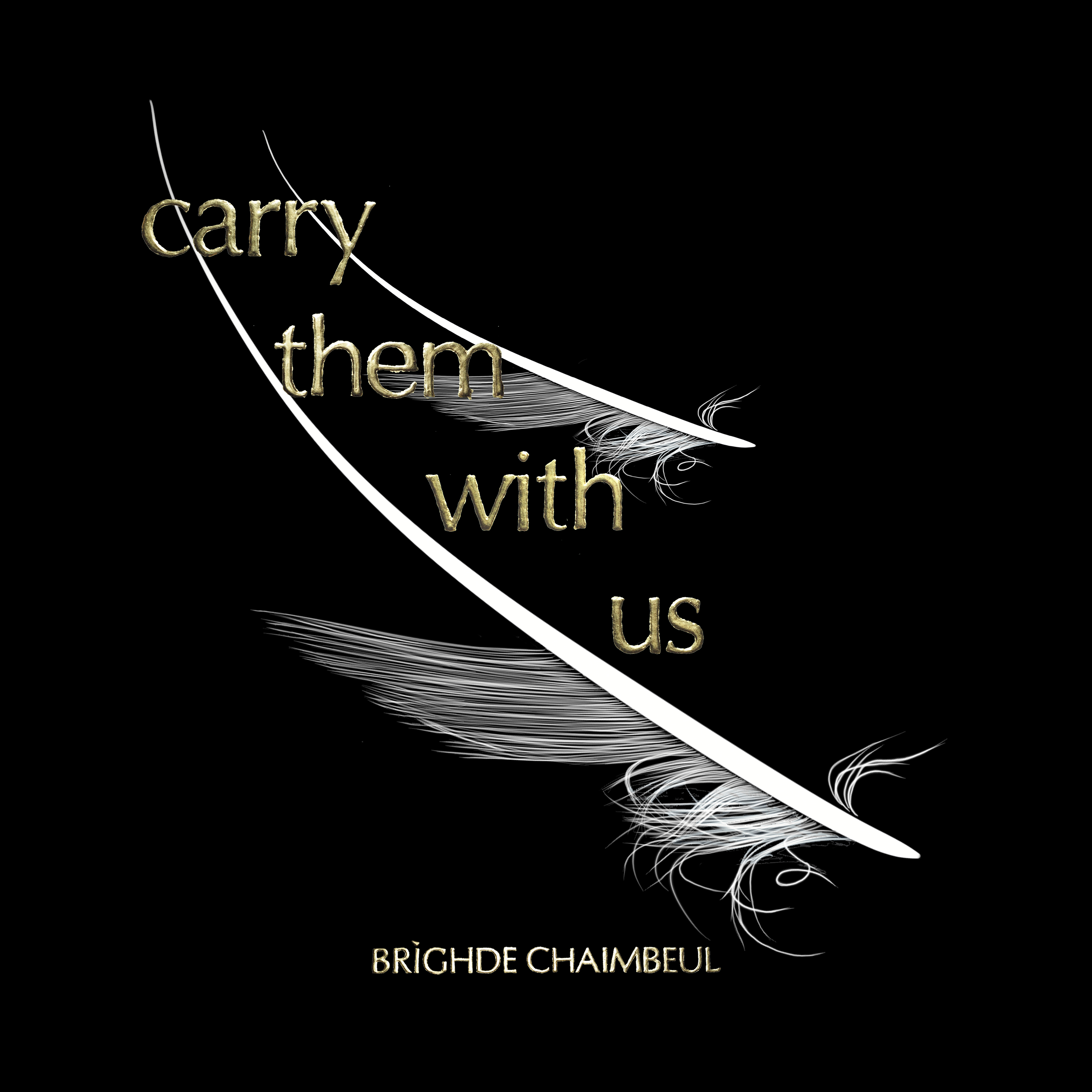
Squeezing new life into the obscure double-note droning Scottish small bagpipes, the Isle of Skye artist Brìghde Chaimbeul explores fertile new atmospheres on her second album, Carry Them With Us. Although borne out of long-held traditions, a bird themed mythology and Western Isles folklore, the piped and circular avian-like suffusions transform old arrangements and tales into something altogether different.
A familiar Celtic air is improvised with, transcribed to sound like a bedfellow of India, the Appalachians and the dream-realism folk of Chaimbeul’s tak:til label mates Širom. Already an award-winner (BBC Young Folk and Horizon prizes), the native Gaelic speaker expands horizons further on this newest work of mysticism and stirring scenic evocations by collaborating with the visionary saxophonist/artist/composer Colin Stetson.
Initially exchanging tweets, with an invitation from Stetson for Chaimbeul to record something for a documentary he was involved with, in kind the explorative American came over for a visit in the summer of last year. Writing and recording with his Scottish host, this sonic partnership ended up producing the “organic” foundations of this nine-track fusion of folk, the neoclassical, new age and fourth world-like peregrinations. Stetson appears on six of those tracks; although its difficult to know where one individual instrument, contribution ends and the other one starts, as both the small pipes and saxophone pretty much meld together in a mizzle or sustained bed of droned impressions. Saying that, ‘Uguviu (II)’ with its almost fiddled dance reminded me in part of Don Cherry, and has more obvious stirrings of new age jazz. It also reminded me a lot of Ariel Kalma. Together on the traditional sourced ‘Órgn An Eich Uisge: Song Of The Waterhorse’ they take what sounds like a Jacobean Highland battle drum arrangement towards the minimalistic borders of Cage and Riley, and the more spiraling vortex cosmos of Frédéric D. Oberland.
This inspired musical partnership proves highly successful envisioning an almost hermetic synthesis of influences and geography; the opening ‘Pilliú: The Call Of The Redshank’ and ‘Tha Fonn Gun Bhi Trom: I Am Disposed Of Mirth’ proving extraordinary, evocative riffs on bird-flight and the ancient lore of the land.
Uncoupled from Stetson, Chaimbeul channels both the Celtic and a whiff of India mountains on the fluty, turn near polka dance, ‘Banish The Giant Of Doubt & Despair’ – a tragic old tale of a drowned, once marauding, giant succumbing to his fate through the alluring siren song of the King’s daughter. We actually get to hear Chaimbeul’s effective apparitional-like voice, singing in the mother tongue on the beautiful misty vaporous finale, ‘Bonn Beinn Eadarra: The Haunting’. Another string to the proverbial bow you could say.
An evolution and a response to the traditions of the Western Isles, Chaimbeul’s drones, bellows and piped vapours conjure up a whole new folkloric magic that sonically reaches beyond Scotland’s borders. This is an album that connects different worlds and centuries on an impressive textural, tonal soundtrack of the recognisable and more abstract forms of Gaelic, minimalism and the new age.
Tuzeint ‘Raixes’
(Extra Soul Perception/Worldwide Records) 21st April 2023

Returning to his roots, Tuzeint opens up his heart on his Latin-soul flavoured debut.
Marking not only the first expansion by the community-collaborative Extra Soul Perception platform into the Spanish language, but this soloist release also finds, for the very first time, Tuzeint singing in his native Mexican-Spanish tongue too; aided by an ensemble of musicians playing a number of localized Central and South American instruments with links back to Iberia.
Channeling a CV that includes stints as the motivational force behind Mexico’s 90s hip-hop legends Control Machete, as a producer, and a remixer for M.I.A., Run The Jewels and Vampire Weekend, the thirty year old Monterrey-based artist weaves together a lilting, sauntering merger of Veracruz region stringed guitar work serenades, Afro-Brazilian percussion, r’n’b and sophisticated breakbeat soul.
Unmistakably Latin but with some subtle, interesting twists and whiffs of 80s new wave, some hip-hop production and a touch of the dreamy, near psychedelic, Raixes is like a tropical bleached romance between Earth period Vangelis, D’Angelo, Manduka, the Buena Vista Social Club, El Michal’s Affair and Les Sins. Accompanied by the plucked, flanged, delicately woven Baroque and folk of Xinto’s nylon-stringed, narrow-bodied Jorana Jarocha (almost a guitar but much smaller), Vico Diaz’s lower-pitched, almost double-bass-like, four-stringed Leona, Lucio de los Santos’ bird-y flute, Alan Fajardo’s shortened tooting and more suffused trumpet and a combined percussive and drummed effort from Jorge Jimenez, Andres Jamie, Orestes Gomez and multi-instrumentalist Enrique Toussaint, Tuzeint sings with a soul-love yearn and lulling relaxed flair.
To echoes of light jazz, tropical mirages, Gulfstream beachside troubadour reminisces and sumptuous soothed croons, burdens and desires are shared equally with romantic, languorous élan. As relaxed and inviting as this music is, the emotional draws are deep and affecting. But its nothing less than a delightful, soul bearing and enjoyable album; a neo-soul delight.
Les Abranis ‘Amazigh Freedom Rock 1973-1983’
(Bongo Joe Records) 28th April 2023
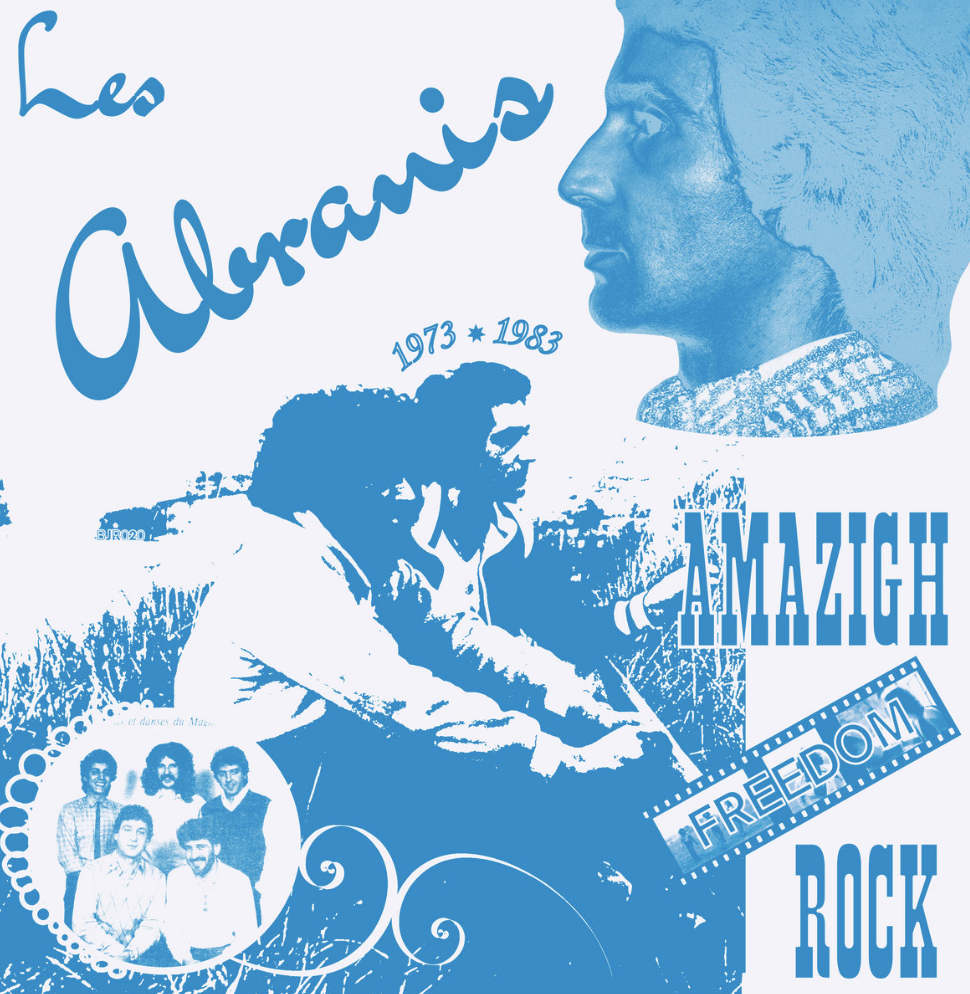
Making good on Bongo Joe’s 2018 45s series showcase of Les Abranis tracks, this expanded compilation follows the eclectic Algerian group’s adoption of garage, psych, disco, acid rock and synth-pop during a decade period of their existence.
Proudly marrying an atavistic Kabyle heritage to Western sounds, Les Abranis were born out of a diaspora and mass migration to France: Paris especially. The Berber Kabyle from Algeria’s Northern region and Atlas Mountains moved in great numbers to escape cultural persecution, civil war and economic strife. This ethnic group’s reach is far, with iconic stars of the screen, music and arts, politics and sports all fully embedded in popular French culture (Zinedine Zidane being one such superstar with those Kabyle roots).
However, politically, as Les Abranis promoted, this million-plus community seek autonomy, self-determination in Algeria: the name of which is used in the “freedom” barricade breaching title, the “Amazigh”. That freedom, found in Paris of the tumultuous counterculture late 60s, was not just political but musically important. It gave a greater scope to the band’s sound, as they opened up the traditional signature rhythms of home with a fusion of genres; sometimes to the consternation of their fellow Algerians, as one highlighted anecdote regales. Performing both this compilation’s opening high-pitched Doors and 60s garage beat grooving ‘Athedjaladde’ (which actually, as it progresses, also pulls in a guitar pedal wah of Isaac Hayes and touch of 60s Zappa) and the Habibi Funk like, suffused Doors (again) organ and handclapped spin ‘Ayetheri A L’ Afjare’ on national Algerian TV in 1973, as part of the more traditional Festival of Modern Algerian Song, they cause a certain furor and were near booted off stage: their hippie, loose liberal interpretation deemed too radical it seems.
Originally crossing paths in one-such Maghreb rich hip Paris neighbourhood in 1967, Shamy El Baz and Karim Abdenour conceived the idea of merging the Western styles they both loved with home. Bassist Madi Mehdi and drummer Samir Chabane would fill out that first proper lineup, playing a form of garage, psych and North African acid-rock. By the time they reached the 80s they’d not only changed personal – recruiting the Corsican jazz drummer and rhythm provider for fellow Kabyle superstar Idir, André “Dédé” Ceccarelli – but their style too; fully immersing themselves in synth pop. A chunk of the choice tracks on this collection actually come from the band’s 1983 album N1; the sound of which is slicker, smoother and enveloped in the decade’s vapoured production of disco, new wave, pop and soft rock. Songs like the female swooned and male vocal caroused ‘Therrza Rathwenza’, and the synthesized wind swept, Sly & Robbie era Grace jones slinked reggae groove ‘Avehri’ are two such examples of this shift. ‘El Guoum Agui’ sounds a bit 80s Paisley Prince, albeit with that exotic Algerian production. The cool Persian discotheque number ‘Akoudar’ is almost Chic-esque. But from a previous chapter in the band’s development, the organ-poked ‘Chenar la Blues’ sounds simultaneously like early Can, Canned Heat, the Stones and the Easybeats shimmying in a Berber dance.
There are some quite incredible progressive fusions and more than enough Parisian-Algerian nuggets to make this a vital addition to the collection. Kabyle culture rocks out in the Western arena.
Kiji Suedo ‘Hosek (EP)’
(Hobbes Music) Available Now
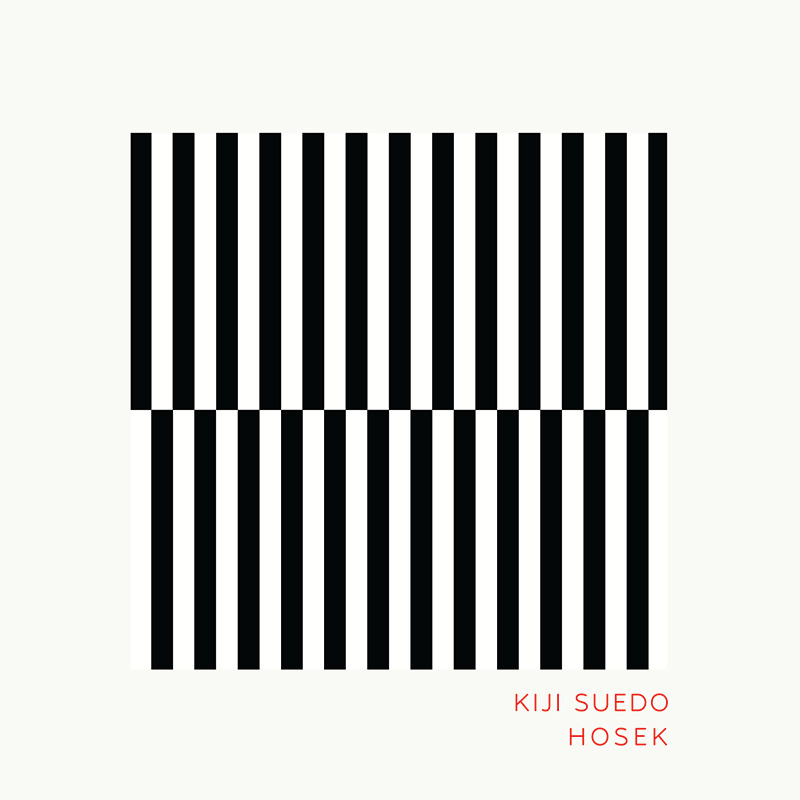
Following up on a well received album in December (Riot) for the Edinburgh electronic label Hobbes Music, Osaka artist Kiji Suedo heads lightly towards the dancefloor with an EP of “working it” House and Techno numeral-loaded tracks.
Jacked-up and softly pumped with various shimmered and melodious wave forms, acid-washes, knocked beats and hushed languid soulful vocal prompts/actions, Suedo offers up a deeper dance music listening experience.
It’s an early House meets Electronic Body Movement and sparse Harthouse/R&S Techno kind of vibe, with additional spells of untethered bulb-like jazzy organ notes, scrapping kinetic marbles and a near constant motion of rotating, sliding, switching and turning synthesized mechanisms.
Good calls have already been made: Moodyman and Herbert on the press sheet, and someone else gave a shout for Theo Parish. I would add to that equation some Basic Channel, Dave Clarke, Mike Dred and a hell of a lot of late 80s/early 90s sounds too. But in short, and without sounding to gauche, this is dance music for the mind, body and soul from an artist on the rise.
Puce Moment ‘Epic Ellipses’
(Sub Rosa) Available Now
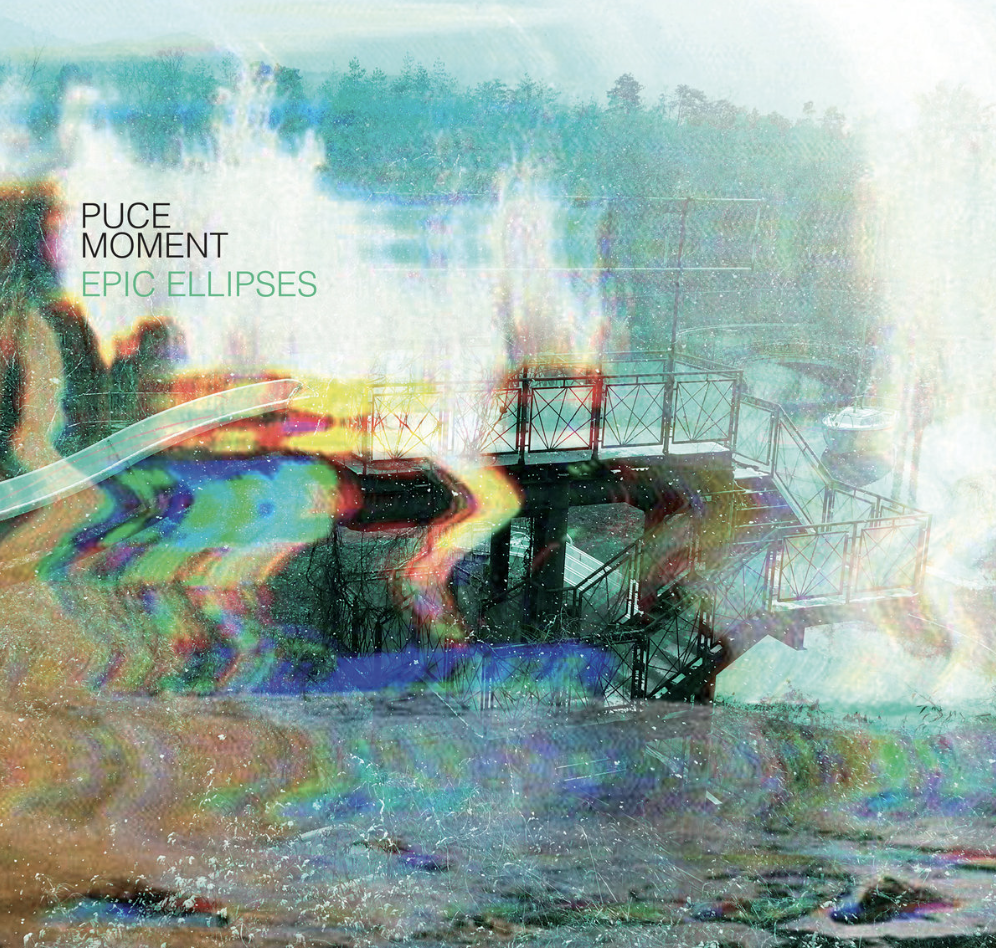
From out of Nicolas Devos and Pénélope Michel’s Puce Moment sound research lab (a French located incubator, inspired, well so it sounds on occasion, by the famous Kosmische Zodiak Club frequented by Moebius, Roedelius and Schnitzler) emerges another self-styled “climatic-noise” soundtrack of slow building drama and gravitas.
Existing somewhere between the forms of peregrination and studious composition, the duo finds conclusions, just the right end points through intuition and experience. Working together now for 15 years, across the arenas of fiction, documentary and virtual reality, both foils on this sonic explorative journey can be said to have found that perfect syncopation.
Their fourth album together, Epic Ellipses evokes both the alien (the sci-fi meaning of the word) and the ambiguous. Over four long organic and synthesized atonal but yet melodious and motored tracks, off-world data, the sounds of strange oscillating and looming craft merge with vague percussive rhythms that could have been sourced from the South Seas, South America or Africa. Not so much ethnography as the balanced but untethered construction of new worlds, ritual is transduced into near-cinematic suspense, thriller and the mysterious.
“Allotropia” sets out from an echoed chasm of sine waves and static-rips in the fabric, before a siren’s ethereal voice materializes from industrial ominous atmospherics and internal, heartbeat rhythms. ‘Skyli’ has robotic-like calculus, fed digital data, cosmic undulations and a distant singular knocking beat. Gradually those knocks turn into a slow beat, as strange noises and the corridor to some distant constellation opens up and guides us onto some new plane. ‘Motor’ reminds me of Hamburg label Bureau B’s output – that tie to kosmische and German minimalist electronica perhaps. Although the lulled voice and vague elements of faraway lands eventually end up sounding quite dramatic: lost in the ether. An air of very early Cluster and Popol Vuh’s Affenstunde debut can be detected alongside Cosey Fanni Tutti under the quietened surface veils of the womb-like ‘Taifuu’. From vaporous mists, waves and ambience a filmic, immersive soundtrack builds; one that entices and organically forms visitations, memories, feelings of time and place: destination. Epic Ellipses is a quartet of moods, emotional draws that ends up inventing environments and score to mysterious surface and horizons.
Carla Boregas ‘Pena Ao Mar’
(iDEAL Recordings) Available Now

Featured last year on the Monolith Cocktail, congruously in electroacoustic jazz-primitivism union with fellow Brazilian explorative sound artist Maurício Takara on the Grande Massa D’Auga peregrination, Carla Boregas now drifts out an ambient, both non-musical and more melodic-hinted sonorous waves with her debut solo offering.
Although already making a name for herself, both in native Brazil and in Europe (currently based in Berlin) with the Rakto trio (with Paula Rebellato and again, Maurício Takara) and Fronte Violeta duo (with Anelena Toku), and as the founder of the experimental AUTA venue and Dama Da Noite label, Boregas now expands on a subtle minimalistic palette of tape play, sonic assemblage manipulations, field recordings and hidden instrument sources.
Conduced to roaming and following the played and synthesized air and wind flows, as we reflect on the tenuous, fragile and complex nature of existence, Pena Ao Mar (or “pity the sea”) envelopes the listener within an ambiguous veil of sci-fi, mysticism and wooded menagerie, and drones that evoke the hermetic and a distant vision of India.
The opening ‘Acôes em Paralelo’ (“actions in parallel”) manipulates, plays with what sounds like a reel-to-reel machine; a reversed, crackled and hum drone mix of the avant-garde tape culture of underground Spain and Italy, with touches of kosmiche. Those early resonations of German cosmic music (from Kluster to Tangerine Dream and Gunther Wüsthoff) and “sisters with transistors” luminaries such as Suzanne Ciani can be heard permeating the title-track’s fanning geometric rays and refractions; the otherworldly harmonium church music gauzy ‘Grafia do Invisível’ (“invisible spelling”); and the robotic calculating, alien bird tweeting and box-of-tricks vibrating ‘A Cidade dos Outros’ (“the city of others”). ‘Current 2 Ventos’ (“wind and currents”) seems to gravitate more towards tubular-like blown droned instrumentation (a kind of transmogrified version of a serialism styled wind quartet, and a Jodorowsky feel, whilst ‘Sopro’ (“breath”), with its night creatures forest atmospherics, spoken word experiments and spooked piano, errs towards hints of Lucrecia Dalt and Xqui.
Along varied vapours, currents, waves and wisps of air, Boregas transports the listener to both evaporated and more tangible (but only just) environments and moods; realms of reflection and mysterious spaces that attempt to capture the abstract feelings of being alive in a most vulnerable state.
A Begging Bowl Request From Your Host:
Hi, my name is Dominic Valvona and I’m the Founder of the music/culture blog monolithcocktail.com For the last ten years I’ve featured and supported music, musicians and labels we love across genres from around the world that we think you’ll want to know about. No content on the site is paid for or sponsored and we only feature artists we have genuine respect for /love. If you enjoy our reviews (and we often write long, thoughtful ones), found a new artist you admire or if we have featured you or artists you represent and would like to buy us a coffee at https://ko-fi.com/monolithcocktail to say cheers for spreading the word, then that would be much appreciated.
 Monolith Cocktail Blog