PART THREE OF THE MONOLITH COCKTAIL’S ALBUMS OF THE YEAR LISTS
Welcome to the concluding part of the Monolith Cocktail’s choice and favourite albums of the year lists (Part One and Part Two). Compiled by Dominic Valvona, Brian ‘Bordello’ Shea and Graham Domain, each entry is in alphabetical order, with this final run down starting at P and finishing at Z.
P________________
Pan Afrikan Peoples Arkestra ‘60’ (The Village)
Chosen by DV/Reviewed by DV/Link
‘Serving the South Central L.A. Black community from within for six decades (and counting), the late Horace Tapscott and his preservation Arkestra ensemble captured and reflected the social and racial injustices of that oppressed community with a righteous politically conscious and radical jazz style blueprint; a documentation, but also self-reliant stand against the state’s brutality and economic suppression.
The 60 album proves an important preservation of a self-reliant social activist institution, integral to the community in which it serves, teaches and rises up. A great encapsulation of that story, musical journey and the changes it has gone through, this will both excite the Ark’s fans and newcomers to the cause.’ DV
Nico Paulo ‘Nico Paulo’ (Forward Music Group)
Chosen by GD/Reviewed by GD/Link
‘This is a wonderful summery album of Bacharach-like melodies by the Portuguese-Canadian singer. A truly remarkable debut of ten self-composed wonderful songs that sound like standards.
Her voice is a bewitching combination of Judy Collins, Joni Mitchell and Natalie Mering (Weyes Blood). Musically it covers a wide spectrum of Tropicalia, Folk, Americana, Jazz and Pop. Her voice conveys real emotion and depth that is bounced off the beautiful melodies and lyrics.
A future classic that will undoubtedly have a far-reaching influence on stars not yet born!’ GD
Hawk Percival ‘Night Moods Vol. 1’ (Think Like A Key)
Chosen by BBS/Reviewed by BBS/Link
‘Oh my god! How I love Hawk Percival. She is like a lo-fi indie Noosha Fox (I am once again showing my age). But come on, ‘S-S-S-Single Bed’ was one of the singles of the 70s and I think that Hawk Percival shows the potential to make something equally as wonderfully magical, as this 6 track mini album shows so much pop suss and quirky originality.
It takes from the past – you can hear the timeless melodies from the 60s/70s – and twists it into something new. She plucks the spinning melodies from the air and weaves them into her own unique creation making an album of future desert island discs. I think Hawk Percival could well be one to watch.
This album is part of the DIY music series released by the excellent Think Like A Key records, and good on them for releasing this little lo-fi treasure.’ BBS
Polobi & The Gwo Ka Master ‘Abri Cyclonique’ (Real World)
Chosen by DV/Reviewed by DV/Link
‘Suffused, elevated and morphed with Parisian-based Doctor L’s jazz, electronica Francophone new waves and trip-hop, the ancestral Guadeloupe rural folk traditions of Léwòz and one of its renowned modern practitioners-deliverers Moïse Polobi is transformed into an environmental traverse. As the good doctor has proscribed so well for Les Amazon D’Afrique and the Mbongwana Stars, the roots of another form are, with subtle wondering and sophistication, given a unique sound experience.
A very personal album, this is the first to be released under Polobi’s own name. Previously the Guadalupe star has performed with his Indestawa Ka band, releasing eight albums and performing internationally. But this cyclonic whirlwind is something different, a galvanised, electrified and bolstered earthy and magical vision of his country’s past, present and future. It’s one of the most interesting albums yet in 2023, with a sound that reboots folkloric traditions in the face of an ever-encroaching modernity.’ DV
Psyche ‘Self-Titled Debut Album’ (Four Flies Records)
Chosen by GD/Reviewed by GD/Link
‘This is a brilliant album of funky Mediterranean psychedelic instrumentals that sits somewhere between Khruangbin and the Barry Gray Orchestra! Every track is a Gem! Wonderful!’ GD
R__________________
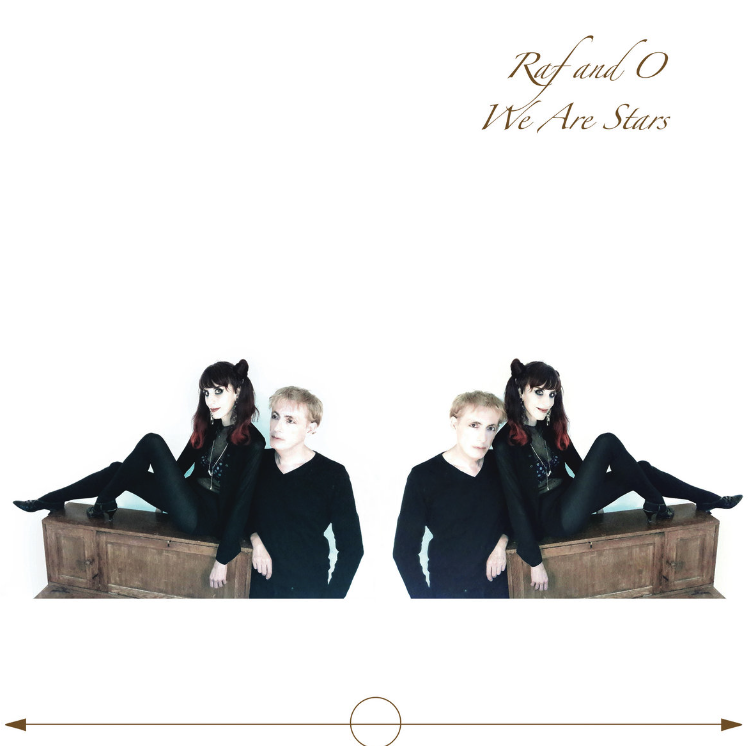
Raf And O ‘We Are Stars’ (Telephone Records)
Chosen by Dominic Valvona/Reviewed by DV/Link
‘Few artists have purposely entwined themselves so deeply with their idols than the Raf And O duo of Raf Mantelli and Richard Smith (the “O” in that creative sparked partnership). David Bowie and Kate Bush loom large, permeating near every note and vocal infliction of their idiosyncratic, theatrical, cinematic and up-close-and-personal intimate style of avant-garde pop and art school rock experimentation. Raf even has a Kate Bush tribute side project; coming the nearest I’ve yet heard of anyone to that maverick progenitor’s range-fluctuating, coquettish and empowered delivery, and her musicianship and erudite playful and adventurous songwriting.
An alternative time travelling theatre of interwoven fantasy, dream realism and the reimagined, We Are Stars is as playful with its unique style as it is only too aware of the deep held stresses, strains, pain and detachment that plagues society in the aftermath of a global pandemic, economic meltdown and war. Looking to the stars, but knowing that even escapist dreams of the cosmos have failed us, Raf And O (who I haven’t mentioned in name at all, but is an adroit craftsman of his form, accentuating, punctuating or loosely weaving a meandered musicality around Raf) take their concerns, observations and curiosities into ever more arty and intriguing directions. They remain one of the most individual acts in the UK; true inheritors of Bowie and Bush’s legacy and spirit.’ DV
Refree ‘El Espacio Entre’ (Glitterbeat Records)
Chosen by DV/Reviewed by DV/Link
‘Coming on like an Iberian vision of the Neel Murgai Ensemble and Hackedepicciotto trapped with Nacho Mendez (I’m thinking of the Ángeles y Querubines album) in an undefined, veiled timeline and atmosphere, the follow up sketchbook album of Raul Refree’s imagination is yet again a unique, “seamless”, amalgamation of reflective enquiry, soundtracks, semi-classical etudes and the visceral.
Not so much an album of performances as a quality production of fleeting descriptions, of moments captured in poignant scenery, Refree’s second such album of scores and sound pieces is an incredible, immersive mood board of magical and often plaintive thoughts, feelings, processes and films yet to be made. I’ve been sitting on this album for months and it never loses its initial pull, gut feeling, and yet I can also hear new things on every listen. Raul Refree is a great talent indeed.’ DV
Sebastian Reynolds ‘Canary’ (PinDrop)
Chosen by DV/Reviewed by DV/Link
‘After what seems like an age, and with a prolific string of projects, collaborations and EP releases behind him, Sebastian Reynolds finally unveils his debut solo album.
A near lifetime’s experience and musicology is called upon for a mostly sophisticated and subtle amalgamation of the electroacoustic, trance, EDM, electronic-chamber music, techno ambience and soundtracks on an album that draws on all of Reynolds passions and emotional threads. Self-help guidance with the neurons fired-up, the mind open, Canary counterpoints mistrust with wonderment, alarm with the rational and the optimistic. It has taken a while to arrive, but Reynolds debut expanded album of thoughts and ideas is a mature statement of quality. ‘ DV
Room Of Wires ‘Welcome To The End Game’ (Ant-Zen)
Chosen by DV/Reviewed by DV/Link
‘A buzz, whine, flex and resonating ring of zinc and alloy, of recondite machines, permeates another heavy set from the Room Of Wires duo. The latest in a strong catalogue of such dark materials and alien mystery, Welcome To The End Game ties together a complex of dystopian woes, rage and dramas into an interlayered twisting and expanding metal muscled album of electronic.
Room Of Wires navigate and balance the uncertainty with glimmers of escape, and moments of hope and release; the machinations and unseen forces that bear down upon us all at least dissipated enough to offer some light.’ DV
Seljuk Rustum ‘Cardboard Castles’ (Hive Mind)
Chosen by DV/Reviewed by DV/Link
‘Imbued by a rich history of place and time, and the trading winds that brought so many atavistic and less ancient civilizations to its natural harbor hub, Seljuk Rustum’s Kochi-base of creative activity is a city steeped in polygenesis sounds and ideas.
For the most part the musical mind of Rustum and his partners on this magical, entrancing and dreamy journey, reveals a great sonic knowledge, both a part of, yet also in some ways, escaping history.’ DV
S___________________
Salem Trials ‘What Myths Are We Living’ (Metal Postcard Records)
Chosen by DV & GD/Reviewed by Graham Domain/Link
‘Crawling along dark streets, shadows loom in every doorway, footsteps echo in the night silence. Cold sweat trickling down spine, dark rumblings from a dirty basement, shadows dancing on the barred windows. Fish bones in a mouth. Coughing up blood and the smell of urine. Decay and aftershave. Cracked voice and beer-stained floor. Each step shoes stick. Black trail like slime from a snail. A coffin landfill club of noise and danger! The night ignites with saw-like melodies and cavernous hypnotic rhythms kicking against the pricks! Smoke and dark truths bounce off the walls shaking flesh and brick, glass and bone. Inspiration as sonic affray, until the last notes flare into a howl of darkness. A murder of youth collapse through doors and out along streets. City centre lights, a loneliness of drinkers cast adrift, flowing like a cut artery in a thrombosis of social isolation. Music smashed against walls! Exciting! Unbreakable!’ GD
Ryuichi Sakamoto ‘Ongaku Zukan’ (WeWantSounds)
Chosen by GD/Reviewed by DV/Link
‘A timely, special release in the wake of the Japanese icon’s death in March of this year, the impeccable vinyl specialists WEWANTSOUNDS have reissued Sakamoto’s cult 1984 solo album Ongaku Zukan (or “Musical Encyclopedia”).
Sakamoto assails the mid 80s with his own manual, a merger of signatures and fresh horizons, but above all, rewriting the Japanese cannon whilst reaching into a future yet unwritten. There will be a lot of people very happy that this classic has been rejuvenated, whilst a new generation can hear what all the fuss is about. Not his best by any stretch of the imagination, but everything Sakamoto touched is worthy of investigation, and this feels like a bridge between periods. WWS has done us all a great favour in resurfacing this lost class piece of experimentation and groove.’ DV
Schizo Fun Addict ‘Love Your Enemies’ (Fruits Der Mer)
Chosen by BBS/Reviewed by BBS/Link
‘This album is one of the best and wormiest sounding albums I have heard in many years. It has the same magic and otherworldly but inwardly peaceful calmness about it as Pet Sounds, and there is something about Schizo Fun Addict that reminds me of the Beach Boys but without ever actually sounding like them – I will put it down to musical genius and heavenly inspiration.’ BBS
Seaming To ‘Dust Gathers’ (O Sing At Me)
Chosen by DV/Reviewed by Gillian Stone/Link
‘The structure and tracking of Dust Gatherers are utterly brilliant. Instrumental “AnOverture” introduces the juxtaposition of the electronic and symphonic elements the make up the album’s ethos. The next three tracks, “Blessing”, “Tousles”, and “Brave” are imbued with choral synths and swirling vocals. It is not until the fifth track, “Traveller”, that acoustic instruments come back into the fold, with the introduction of Seaming To’s clarinet. Clarinets then mesh beautifully with synths on “Water Flows”, followed by the instrumental synth piece “xenanmax”. The album then takes a left turn into the string-quartet-driven “Hitchhiker”, and pivots again into the Björk-style melodies and microbeats of “Look Away”. The final two songs on Dust Gatherers, which appear to be companion pieces, harken back to the golden era of jazz, finishing the record with a sense of timelessness. Piano ballad “Pleasures are Meaningless” alludes to the final track, jazz standard “Tenderly”, which is tethered down by pulsing clarinets and synth glitches. Ever present are Seaming To’s profoundly strong character vocals, which evoke goosebumps at every turn.’ GS
Silver Moth ‘Black Bay’
Chosen by GD/Reviewed by GD/Link
‘Cinematic tracks full of atmosphere and grandeur! 45 minutes of Bliss! It may become the holy grail of lost albums in future years – if it slips under the radar!’ GD
Slow Readers Club ‘Knowledge Freedom Power’ (Velveteen Records)
Chosen by GD/Reviewed by GD/Link
‘The fifth (official) album by Manchester band The Slow Readers Club comes across like a live album such is the energy captured in the recording. First track ‘Modernise’ is perhaps the most powerful, if least representative, song on the album. With its Chemical Brothers rave intro and pounding rhythm it also has the most individual sounding vocal on the album, a bit PIL like! It’s a song created to be exciting live and it serves that purpose well!
A great album of powerful anthemic songs and possibly their most consistent effort to date.’ GD
Lonnie Liston Smith ‘Cosmic Change’ (Jazz Is Dead)
Chosen by GD/Reviewed by DV/Link
‘Smooth soulful vibes, bulb-like notes and cosmic fanning rays from the great jazz-funk doyen Lonnie Liston Smith, who released his first album in 25 years in 2023. Thanks to the overseeing facilitators of the enriching Jazz Is Dead label project, Adrian Younge and Ali Shaheed Muhammad have coaxed the legendary artist, ensemble bandleader and sideman for such impressive luminaries as Miles Davis, Pharoah Sanders, Gato Barbieri and Leon Thomas, back into the studio; just one of many great names from the spiritual, conscious and funky-jazz rolls of inspiring talents.
Co-composing and collaborating with their chagrin Younge and Muhammad both work in the old magic with a sense of the new and forward; paying homage yet creating something new, performing the very kinds of influential music that had an impact on those who came later, namely the hip-hop fraternity (Jazzmatazz era Guru and the Digable Planets being just two such notable collaborators and acolytes). and of course, Liston is in supreme form as sagacious keyboard foil.’ DV
Snowcrushed ‘Snowcrush’
Chosen by BBS/Reviewed by BBS/Link
‘Snowcrushed’s A Frightened Man debut album was one of my fave albums of 2021; an album of beguiling atmospheric found sounds ambient gems. But on Snowcrush he’s gone on an alternative music journey of post-punk, Goth and Darkwave, and on occasion lo-fi folk – the excellent ‘Cowardice’ sounding like someone has taken Kurt Cobain’s tortured soul and spread it on Johnny Cash’s toast, which he ate before recording the American Recordings series of albums: A truly dark wonderful song. Although nothing else on the album quite matches up to the brilliance of ‘Cowardice’, which is no slight as not many other tracks I have heard this year matches up to it, the rest of the album is still full of unsettling dark gems.’ BBS
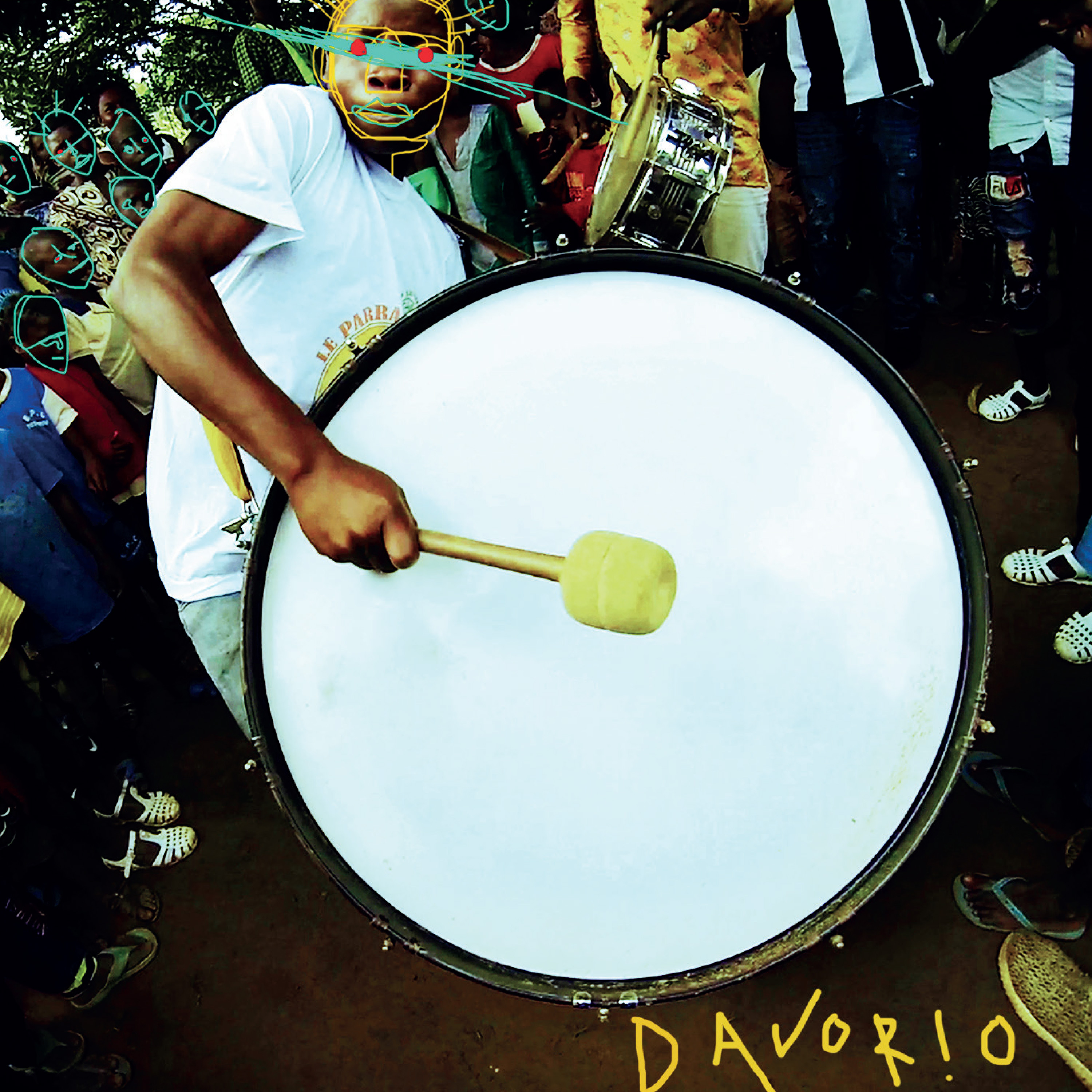
Samuele Strufaldi ‘Davorio’ (Música Mascondo)
Chosen by DV/Reviewed by DV/Link
‘Every expression has meaning, a story, which is then transformed by Strufaldi’s production into something almost dream like and cosmic yet still connected to the villagers’ roots. A transistor radio collage here, some Songhoy Blues on a bustling street with a small amp there; a display of rattled and scrapping percussion and hymnal stirrings merge with zaps, warbles and various embellishments. This cultural exchange with the Ivory Coast blurs the lines between worlds; an act of preservation, but much more, as the foundations of this culture prove intoxicating, dynamic and mesmerising.’ DV
Susanna ‘Baudelaire and Orchestra’ (Susanna Sonata Label)
Chosen by GD
T____________________

Tachycardie ‘Autonomie Menerale’ (Un-je-ne-sais-quoi)
Chosen by GD/Reviewed by GD/Link
‘This is the third album in a trilogy of ambient sound-art works by French composer Jean-Baptiste Geoffroy. Consisting of seven pieces of strange, dark, tribal, alien ambient dissonance and warm unnatural half-light!
In the first piece, ‘Parties sud puis nord’, tribal drums and hyper percussion are intermittently infiltrated by reverberating clangs and deep disturbed atmospheric noise. It is a strangely compelling listen! Although if listened to by those of a disturbed mind it may likely trigger psychosis, one-legged.
You will not find another album like this. It will penetrate your dreams bringing raptures of nightmare terror, joyous pain and nerve scraping pleasure. As the stones with eyes move closer, watching, surrounding your house, you may never ‘escape into night’ or feel at ease again!’ GD
Tele Novella ‘Poet’s Tooth’ (Kill Rock Stars)
Chosen by DV/Reviewed by DV/Link
‘A wistful, almost disarming, Tele Novella weave their magic on an album that takes its cues from Harold & Maude and a removed version of the heartbreak yearning vulnerability of Nashville and Texas country music; albeit a version in which Cate Le Bon and Aldous Harding sip despondently from a bottle of life’s despair. Better still, Mike Nesmith writing for Patsy Cline.
As whimsical and beautifully executed as it all is, Poet’s tooth is a moving album of timeless tropes, somehow delivered musically and visually through a slightly off, sometimes surreal, vision of the familiar. Natalie Ribbons and foil Jason Chronis dream up an idiosyncratic staged world, their moniker taken from the serial drama/soap opera phenomenon of the “television novel”, a format most prominently produced for the Latin American markets.
Adolescence escapism wrapped in a softened, but no less stirring, epiphany, Tele Novella has a surreal, dreamy quality about them. From the Tex-Mex border of yore to the contemporary Austin scene of City Limits, they weave a really impressive songbook that’s as Hal Ashby and Sidney Lumet as it is pining Country and Western. Poet’s Tooth is both lyrically and musically perfect; one of my favourite albums of 2023 – no idle boast. Prepare to be equally charmed and moved with a counterculture resurgence of quality, subtle comedy and tragedy, eccentric disillusion.’ DV
Tomo-Nakaguchi ‘The Long Night in Winter Light’ (Audio Bulb Records)
Chosen by GD/Reviewed by GD/Link
‘This is a beautiful album where each piece conjures-up a different vision of winter – the wonder of nature surviving and flourishing as the seasons change! As the composer himself says, the music reflects the beauty of nature – frost glistening on grass – a field of snow lit by moonlight – the night sky filled with stars! Like a ray of light, a ray of hope, this is beauty that shines through the darkest of times!’ GD
Ali Farka Touré ‘Voyageur’ (World Circuit)
Chosen by DV/Reviewed by DV/Link
‘This latest project, produced by the label’s Nick Gold who spent time with the late Ali (his brilliant accompanying notes are full of vivid anecdotes and adventures spent with the Mali icon) and his scion, the equally gifted virtuoso Vieux Farka Touré is the first album of ‘unheard’ material from the legend since his 2010 posthumously released partnership with Diabate.
Voyageur is a welcoming addition to the catalogue, an incredible nomadic traverse of songs that capture Mali’s diversity and rich musical heritage; especially with his celebrated guests opening the sound up, travelling even further afield to those bordering regions that meet Mali.
Ali Farka Touré aficionados will find this a welcome addition to the chronology, with recordings that many will have either never known about or been anticipating. But I’m sure there’s going to be surprises for even the most committed of fans. And for newcomers to Ali’s legacy, this album will prove a great entry point with its diversity and range, showing Ali with various collaborators and paying homage to several cultural styles, traditions. These songs are anything but unfinished scraps, demos, or downtime experiments. Instead, Voyageur is a collection of real quality.’ DV
Trupa Trupa ‘ttt’ (Glitterbeat Records)
Chosen by DV/Reviewed by DV/Link
‘The Polish outfit Trupa Trupa fashion their very own Faust Tapes out of an accumulation of sonic explorations, unfinished jams and rehearsal sessions, field recordings and play.
In the interval between recording new martial ttt is an almost seamless cassette offering of two experimental sound collages – coming in at just under the forty-minute mark. A development played out under the spell of psychedelic hallucination, mirage and more caustic machined distortions and abrasions, the triple “ts” experiment could be read as a really untethered avant-garde outlet for the band. Not that they’ve ever been conventional on that front with previous works melding and contorting, as they do, psych with no wave, post-punk, the industrial and indie to produce a multi-limbed psycho drama or revelation, the hypnotic and propulsive.
Trupa Trupa are in their ascendency all right, their creative collective consciousness constantly dreaming up fresh ways of hearing and articulating the wastelands of what was once called civilisation; the discourse all but filtered out for the most part on this immersive experience. They can do no wrong it seems at the moment, and must be considered one of the most important bands to emerge from Europe in the last decade. On the strength of this latest release it will be very interesting to know where they will go next.’ DV
V______________________
Various ‘New No York’ (Metal Postcard Records)
Chosen by BBS/Reviewed by BBS/Link
‘A compilation of music from Metal Postcard bands, but what all these bands have in common is Andy Goz. Yes, the guitar genius who’s in all these bands, and all the bands are of course pretty darn special.
New No York is a quite wonderful comp of post-punk invention and fury and no doubt will be soundtracking my next few weeks.’ BBS
Various ‘Parchman Prison Prayer – Some Mississippi Sunday Morning’ (Glitterbeat Records) Chosen by DV/Reviewed by DV/Link
‘Back in the state penitentiary system, the producer, author and violence prevention expert Ian Brennan finds the common ground once more with another cast of under-represented voices. Eight years on from his applauded, Grammy nominated Zomba Prison Project, Brennan, thousands of miles away from that Malawi maximum-security facility in the deep, deep South of America, surprises us with an incredible raw and “uncloyed” (one of Brennan’s best coined interpretations of his production and craft) set of performances of redemption and spiritual conversion.
There’s music, song and litany that would be recognizable to inmates from the turn of the last century, whilst others, tap right into the modern age. The Gospel’s message runs deep in the Southern realms, and encouragingly seems to motivate even those with little hope of being released. Hard times are softened by belief and redemption on a revelatory production. Returning to America after a myriad of recordings throughout the world’s past and present war zones, scenes of genocide and remote fabled communities, Brennan finds just as much trauma and the need for representation back home.’ DV
Various ‘Woman, Life, Freedom’ & ‘Intended Consequences’ (Apranik Records)
Chosen by DV/Reviewed by DV/Link /Link two
‘As the West’s attention is quite rightly invested in the ongoing Russian aggression in Ukraine, it’s fallen on artists, musicians to draw that intense scrutiny on the Iranian regime and its heinous treatment of women. Prompted by the death of Mahsa Jina Amini in the custody of the authorities last year, an ensuing battle of ideals and freedoms has ensued that threatens to topple the tyranny. However, the regime has pushed back harder and with an almost unprecedented violence started executing (mainly men so far) supporters and activists on trumped up, tortured confessional charges of treason. But even in the face of this bloody repression history is on the side of Iran’s younger more liberal generations.
In bringing that plight to Western attention and ears, Iranian artists AIDA and Nesa Azadikhah announced two volumes of not-for-profit compilations.
Both platform a multi-diverse cosmology of electronic female artists working both under endurable pains and censorship inside Iran, or self-exiled and making waves in the diaspora. Each compilation is a discovery of riches in the field of the avant-garde, techno, sound experimentation and protest. There’s been few worthier causes, and few that have been so ignored: the outrage, protests and marches here in the West sadly lacking and silent.’ DV
Violet Nox ‘Vortex And Voices’ (Somewherecold Records)
Chosen by DV/Reviewed by DV/Link
‘A sci-fi chemistry of vapours the Boston, Massachusetts electronic outfit Violet Nox once more entrance with a futuristic new age album of psy-trance, cerebral techno and acid ethereal-voiced self-realization/self-discovery. Wired into the “now” however, messages of self-love and inclusiveness waft and drift to a rhythmic, wavy vision of EDM, crossover rave music and soulful electronica.
For this newest venture – their first for the highly prolific and quality North American label Somewherecold Records – features, more than ever, the experimental, often effected, vocals of group member Noell Dorsey: a mix of hippie cooed yearn, Tracey Thorn, Claudia Brücken and Esbe if you will.
Whether it’s journeying into the subconscious or leaving for celestial rendezvous’, Violet Nox turn the vaporous into an electronic art form that’s simultaneously yearning and mysterious. Fizzing with techy sophistication and escapism, the American electronic group continue to map out a fresh sonic universe.’ DV
W_______________________
The Waeve ‘The Waeve’ (Transgressive)
Chosen by GD/Reviewed by GD/Link
‘The WAEVE are a new band formed by Blur’s Graham Coxon (vocals/sax/guitar/medieval lute) and The Pipettes’ Rose Elinor Dougall (singer/songwriter/piano/ARP 2000 Synth).
The interaction and balance between the two voices is perfect with each singer excelling in their introversion and reserve! The band do have their own sound – a strange mix of folk-rock, punk, no wave, psych and easy listening! A truly great album that deserves a wide audience! Give it a listen – you may be surprised!’ GD
The Wedding Present ’24 Songs’ (HHBTM Records)
Chosen by BBS
‘An album that collects the A and B-sides to the series of singles released last year by the mighty Wedding Present, so obviously one of the best of the year.’ BBS
Y__________________________
Dhafer Youssef ‘Street of Minarets’ (Back Beat Edition)
Chosen by GD
Z___________________________
Zohastre ‘Abracadabra’ (ZamZam)
Chosen by DV/Reviewed by DV/Link
‘Spinning and dancing around the phosphor glowing fire whilst invoking a polygenesis array of pagan, hermetic and galactic deities, the French-Italian combo cast magical spells of progressive, psychedelic, noise, primitivism, electronica and cosmic krautrock on their conjuring sonic Wurlitzer.
Reworking references from each of the duos respective countries into a dizzy and often accelerated kaleidoscope of acid-trip occult ritual and more moody, near eerie, mystical uncertainty, Héloise Thibault and Olmo Guadagnoli combine an electronic soundboard with drums as they hurtle, collide and work a frenzy around the maypole.
For those seeking to discover some lost tribe of extraterrestrial worshipping acolytes with a penchant for Zacht Automaat, Sunburned Hand Of Man and the Soft Machine then ZamZam Records have you covered with an occult and tripping invitation too good to be missed.‘ DV
Hi, my name is Dominic Valvona and I’m the Founder of the music/culture blog monolithcocktail.com For the last ten years I’ve featured and supported music, musicians and labels we love across genres from around the world that we think you’ll want to know about. No content on the site is paid for or sponsored and we only feature artists we have genuine respect for /love. If you enjoy our reviews (and we often write long, thoughtful ones), found a new artist you admire or if we have featured you or artists you represent and would like to buy us a coffee at https://ko-fi.com/monolithcocktail to say cheers for spreading the word, then that would be much appreciated.
The Perusal #44: Pan Afrikan Peoples Arkesta, Matt Donovan, Baldruin, Spindle Ensemble, Marty Isenberg…
June 13, 2023
Dominic Valvona’s Eclectic Reviews Spot (Unless stated otherwise, all releases are available to buy now)
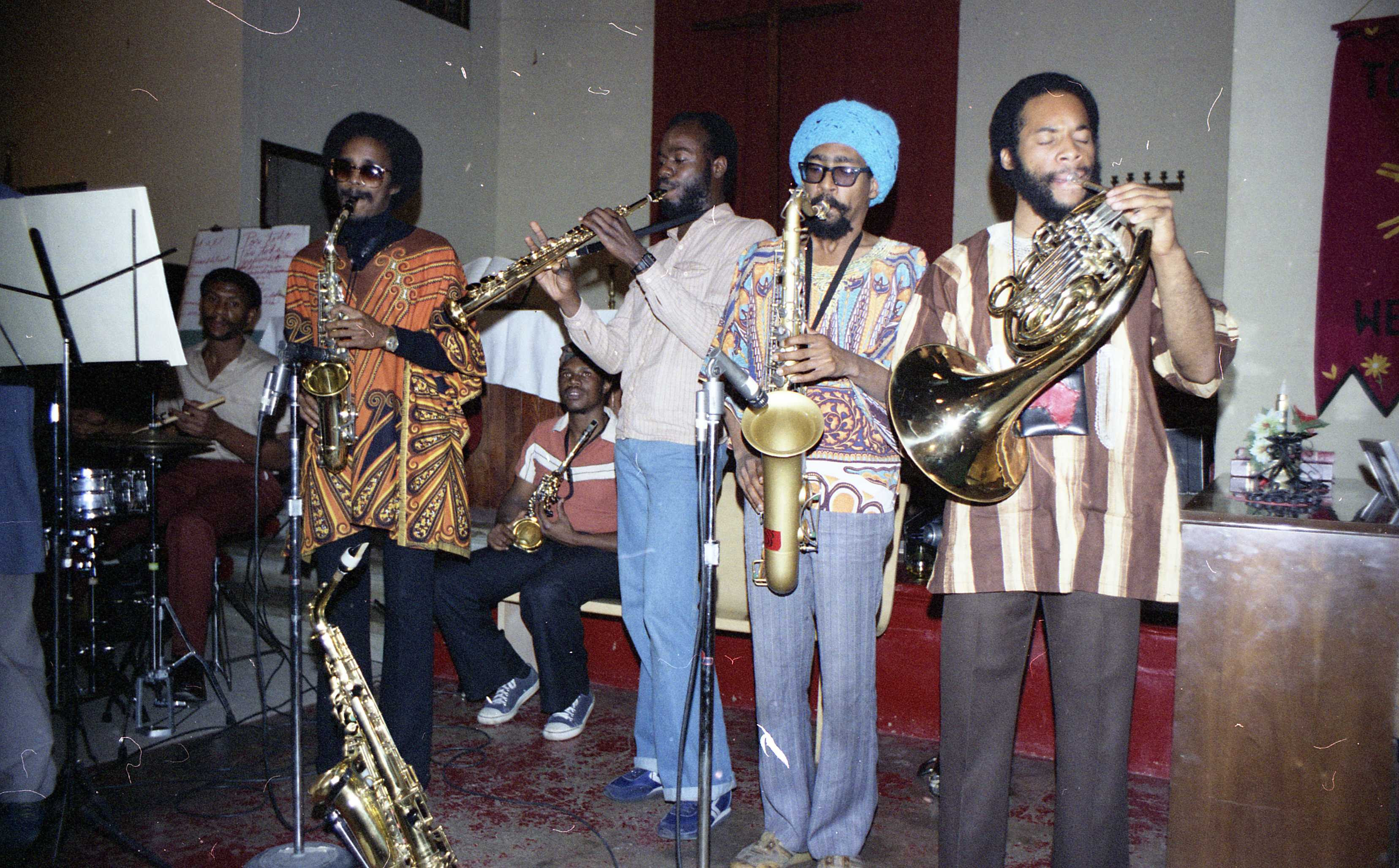
Photo Credit: Mark Weber
Pan Afrikan Peoples Arkestra ‘60’
(The Village) 14th June 2023
Serving the South Central L.A. Black community from within for six decades (and counting), the late Horace Tapscott and his preservation Arkestra ensemble captured and reflected the social and racial injustices of that oppressed community with a righteous politically conscious and radical jazz style blueprint; a documentation, but also self-reliant stand against the state’s brutality and economic suppression.
Two decades on from his passing and Tapscott’s vision has been handed down to a new generation; led in the new century by Mekala Session, scion of Arkestra stalwart alto Michael Session. More or less each incarnation, from a sixty year timeframe (hence that album title) is represented on this new celebratory collection; released by the ensemble’s own label imprint, The Village.
For a platform that continuously swelled its ranks with untold talent from the American West Coast and beyond (oft member, the trombonist and Tribe hub co-founder, Phil Ranelin is synonymous as a mainstay of the Detroit scene for example), and fermented connections culturally throughout the country, inspiring many, the Pan African Arkestra’s recordings on wax are few and far between. Most of the performances on this compilation journey through the years were collated from home-recordings; many of which have previously never been aired before. And the majority of those come from taped concerts in the L.A. arena, the exception being a summer of ’95 performance at the Moers Festival in Germany, during a period of “regrouping”. Some, believed missing, have been literally unearthed from the Ark’s archive; with even the lineup roll call having to be cross-referenced at times: and still not a 100% sure even then.

The Pan African Arkestra exists as a live entity; whether that was playing each weekend in the formative years at the South Park bandstand or, in the line of hostile LAPD fire as they played on a flatbed truck parked right in the middle of the street during the ’65 Watts riots (or “revolt” as its framed from the frustrated, put-upon Black community suffering inequality, little or no representation). In chronological order, the 60 album encapsulates each transformation of the troupe, beginning with the fifteen-minute long tribute to the ‘heart of the Tapscott family’ Pearline Fisher, or Gram Pearl “to those who loved her”. A grand matriarch, at the very centre of the family home, watching all the goings ons, including the band members arriving up the drive for rehearsals in the garage, Gram Pearl’s name was immortalised on the 1961 home recorded ‘The Golden Pearl’. Reverence shines through this early performance that seems to bridge the late 50s jazz of Gillespie, Ellington, Coltrane and the Savoy label with the coming age of the 60s Black consciousness and spiritual enlightenment. A “likely configuration” of Tapscott on a loose Oscar Peterson flow of barrel and saloon piano, Arthur Blythe and either Jimmy Woods or Guido Sinclair doubling up on saxophone, Lester Robertson on fluttered trombone, David Bryant on spoke-like and brushed double-bass and Bill Madison on swing-time and brushed drums mark one of the first lineups of the burgeoning Arkestra. As it turned out, pianist and conductor Tapscott was right to jump off Lionel Hampton’s Big Band tour bus that year; walking all the way back home, pissed but motivated to grow something new.
In the “pressure cooker” tumult of South Central L.A. a close-knit handful of artists gravitated to the beacon; at first going under the UGMA (Underground Musicians Association) abbreviation, this initial lineup included (amongst many others) the vocalist Linda Hill, drummer Donald Dean and the already noted bassist Bryant (who’ll crop up quite a lot during the course of this ensemble’s history) and saxophonist Woods. Many would appear on that compilation opener.
Although not until much later, the obvious influence/inspiration of Saturn’s cultural ambassador in Earth, Sun Ra, most be noted. Tapscott himself, easily an acolyte of that cosmic spirit, pointed out the differences between the two Arkestras; the original envisioned as an ark travelling through space, the other, a “cultural safe house for music” down here on terra firma. Whilst Sun Ra looked to the stars for an escape to some colour-blind society on a distant world, Tapscott’s troupe wanted to be amongst the people: screw the space race.
That blossoming unit found itself under FBI surveillance as a new decade beckoned; much of that paranoia down to the ensemble’s support for the Black Panthers. From the cusp of that decade, the 70s, there’s a recording of the Ark at Widney High School. With a far wider, expanded lineup and the Sarah Vaughan like commanding, but also dreamy, freely moving vocals of Hill and, so it seems, only a recurring Tapscott and Robertson, a lot of new faces appear on the fluctuating ‘Little A’s Chant’. A loose intoxication, a tamed wilderness permeates a mixture of The Lightman Plus One’s Cold Bair, Tyrone Washington’s Roots and the influence of Philip Cohran.
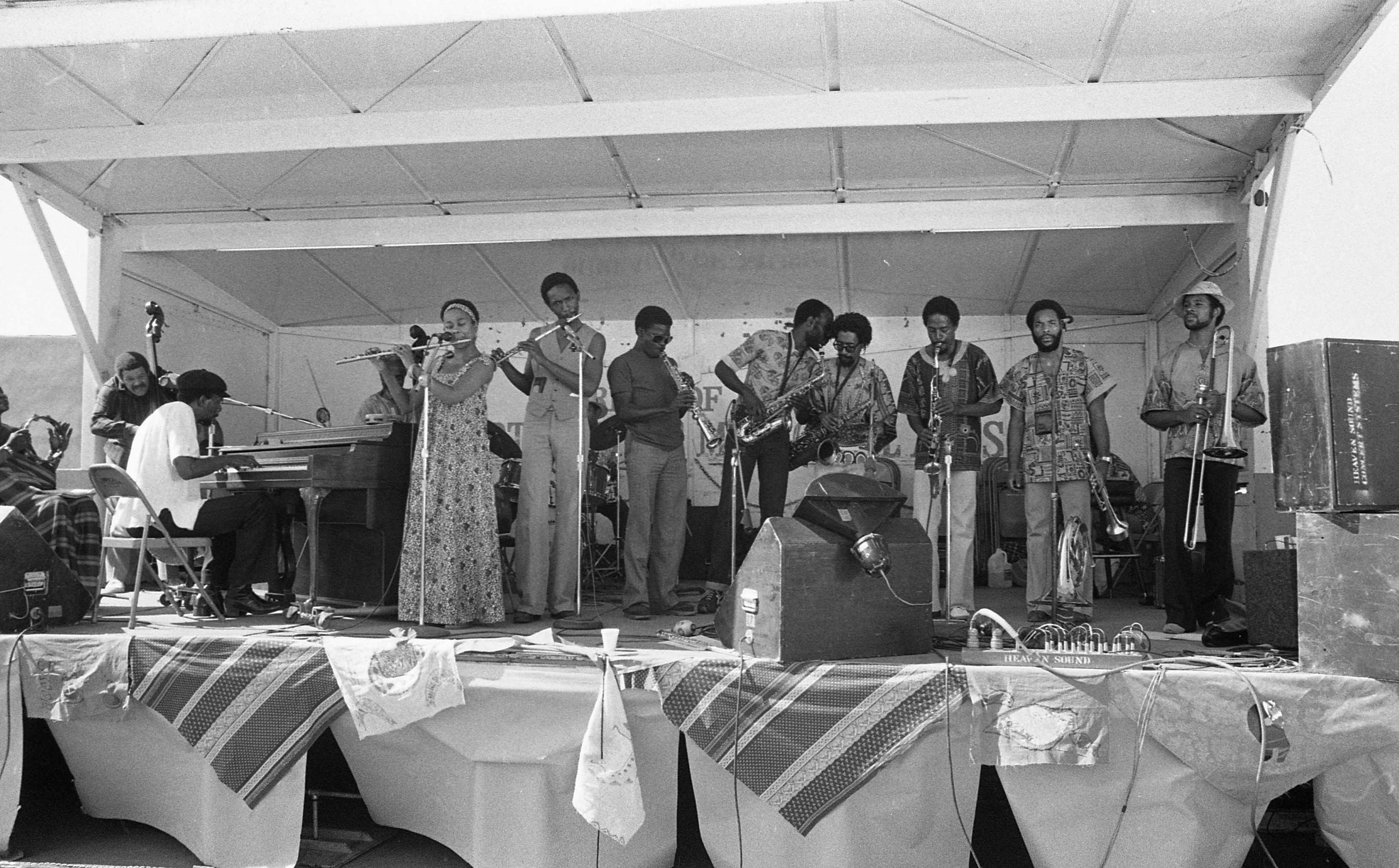
Photo Credit: Mark Weber
With the war paint on, entering the over-commodified decade of the 80s, the Ark, once more changing the roll call, fashion a piano heavy kaftan wearing fire out of Somaya “Peaches” Hasson’s ‘Nation Rising’. Turning in a Last Poets and Leon Thomas vocal performance, Juan Grey (aka Jujigwa) is a man in a hurry: he’s got “work to do”, “rising a nation”. Whistling and swinging down a boardwalk paved Nile on a Yusef Lateef and Pharaoh Sanders vibe, we got a double-front of both willowy flutes (Adele Sebastian and Dadisi Komolafa to thank for that) and altoists (Sabir Mateen delivering a honked and dynamic solo, with Gary Biar as foil), and the rattled congas of Moises Obligacion alongside the mini crescendo spiraling drums of Billy Hinton. Phew!
Forward again, and to the backdrop of an L.A. in flames, sparked by the Rodney King miscarriage of justice, the Ark are to be found on one of their rare trips to Europe; playing a concert at the Moers Festival in the summer of ’95. Regrouping with the help of a returning Jesses Sharps on soprano sax, Tapscott shares piano duties with Nate Morgan and a whole lot of brass on ‘The Ballad Of Deadwood Dick’. I will however name check Arthur Blythe on alto sax and recent converts Michael Session (on tenor), Charles Owens (also on tenor), Fundi Legohn (French horn), William Roper (tuba), Steve Smith (trumpet) and Thorman Green (trombone). An integral founding brother of the Ark, the already mentioned David Bryant is back on double bass, but sharing his duties with fellow bassist Roberto Miranda, whilst doubling up on the drums is the shared union of Fritz Wise and Sonship Theus. All together they conjure up another Egyptian tapestry whilst huffing and in bird-like illusion build up a brass heavy swing and sway. A galloping percussive rhythm (coconuts denoting a hoof-like fast trot) creates a travelling caravan vibe, as the melody, swells and punctuations evoke Skies Of America Ornate and touch of Bernstein.
The new century, a decade on from the death of their mentor and founder Tapscott, and the troupe is under a new steward and embracing another in-take of rightful minded jazz players. From a 2009 recording at the Jazz Bakery (pastries and bread with jazz, what’s not to like), with only a familiar Wise on drums (joined by Bill Madison), Sharp on soprano, Legohn on French horn and Smith on trumpet, we hear a Philip Cohran type spiritual and political fanfare for “justice”. L.A. notable Dwight Trible (recently giving divine voice to Kahil El’Zabar’s Ethnic Heritage Ensemble) is on expressive conscious-unloaded and right-on vocal duties, and the already mentioned Detroit icon Phil Ranelin can be heard on characteristic trombone. A riled and ached, seething indignation with shades of Sun Ra and the Pharaoh, ‘Justice’ is as free as it is fueled by rightful grievances.
The most recent performance, a decade later, is the Zebulon (in L.A. again) convert vision of ‘Dem Folks’. It’s conducted this time by another convert, the Egyptian-American-Muslim trombonist Zehkeraya El-Magharbel, who turns out to be a sound fit. The cast is further expanded with a quartet of spiritual rousing and more Gyrgory Ligeti otherworldly choral vocalists (Aankah Neel, Tamina Johnson-Lawson, Qur’an Shaheed and Maia, who’s also on flute), oboes, bass clarinets, a good showing of horns, and this time out, the keyboard skills of Brian Hargrove. A real fusion of dynamic parts, it begins with a virtuoso drilled, pummeled, slow to fast, percussive and drum introduction of rolls and cymbal hissing shimmers (ala Billy Cobham), before, at first, hitting a dissonance of wild drum mimicked voices. A soul-jazz groove finally lands after going through various changes, from fluted Lateef to echoes of Prince Lasha’s Search For Tomorrow communion with Herbie Hancock and a tumult of incantation and oscillated vocals. An untethered swell of orchestral jazz in the anointed light of Sun Ra and the wisdom of the ancients, ‘Dem Folks’ is the earthly community taken to anthemic highs. What a fitting, electrifying performance to mark the Pan Afrikan Arkestra’s newest incarnation; twenty years on from its pioneer’s death, the baton passed on and, as it obviously proves, is still in safe hands. The future is indeed bright for this long-running ensemble.
The 60 album proves an important preservation of a self-reliant social activist institution, integral to the community in which it serves, teaches and rises up. A great encapsulation of that story, musical journey and the changes it has gone through, this will both excite the Ark’s fans and newcomers to the cause.
Spindle Ensemble & Evergreen Club Contemporary Gamelan ‘Live In Toronto’
(Hidden Notes)
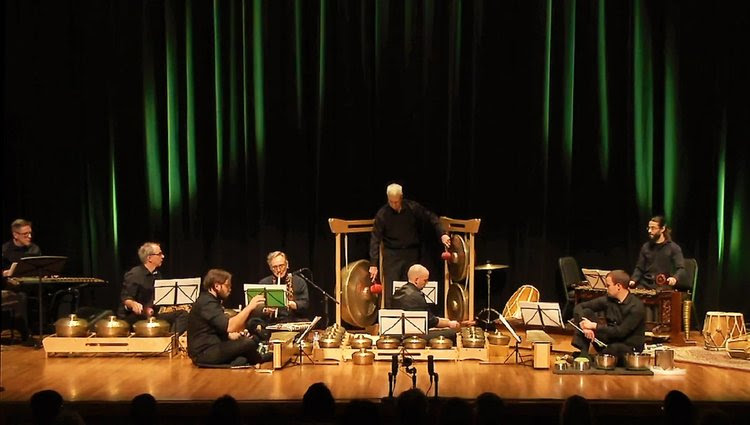
A congruous union of modern classical music and gamelan, Bristol’s Spindle Ensemble quartet and the Toronto Evergreen Club Contemporary Gamelan octet transport the listener to a blossomed, lush and evocative West Java landscape on their EP of both live and recorded studio performances.
In what proves to be an intuitive collaboration – the results of a chance meeting between the Spindle’s Harriet Riley and Evergreen’s Christopher Hull whilst both studying gamelan in Bali -, both partners respect and accentuate the qualities of their chosen forms and inspirations as they meld and weave together instruments from the West and Indonesian East. A balance is struck between contemporary explorations, probes and the timeless across three tracks. The gamelan ‘degung’ family of metallophones and bamboo instruments dance and bob along to and twinkle alongside the Spindle’s harp brushes, bulb-like note dripping marimba and vibraphone, sympathetic-bowed cello and violins, and deft subtle spells and waves of piano.
Written by the Spindle’s composer-pianist and harpist Daniel Inzani, the opening patter cascade of mallet notes and tinkles ‘Lucid Living’, was recorded at the Evergreen’s rehearsal space in downtown Toronto. A light enchanted dance of plucked and picked strings across lily pads, with an air of the willowed fluted pastoral, there’s an almost romantic but simultaneous closed-eyes, deep in thought moodiness to this first performance of adroit musicianship.
Also penned by a Spindle member, Harriet Riley’s mythological-loaded ‘Orpheus’ is part of the two group’s live performance at the city’s 918 Bathurst Street Centre For Culture, Arts, Media And Education – it must be noted at this point that the Bristol quartet travelled to the Evergreen’s backyard to foster this project, spending weeks rehearsing the repertoire before that inaugural live date. Barefoot in jungle temples, the Hellenic bard-poet (an Argonaut and famed survivor of Hade’s underworld) is planted down in the Indonesian exotic; wandering across an uninterrupted proscenium score of various Southeast Asian flavours. All the while accompanied by a soundtrack of pressing repeated chords, metallic chimes and drones, the arched and bowed. At times it’s a rasped mizzle, at others, a slow-paced rhythmic joy or flight that feels almost improvised if not free to fellow its natural path.
The final performance, ‘Open Fifths Gardens’, was composed by the Evergreen’s Andrew Timar and is another exotic allurement of the East. It suggested the dusk hour to me, and evoked the strings of Simon McCorry and Anne Müller: that push of classical instruments made to sound more contemporary and alive if abstract; not just read off the classical cannon score sheet but swelling up with a less guided, personal feel for the time, space and direction of travel in that moment.
In short: the gamelan sound is opened up further and spread wider into the arena of contemporary chamber and symphonic classical music, to conjure up an atmospheric kind of melodious and stirring theatre.
Matt Donovan ‘Sleep Until The Storm Ends’
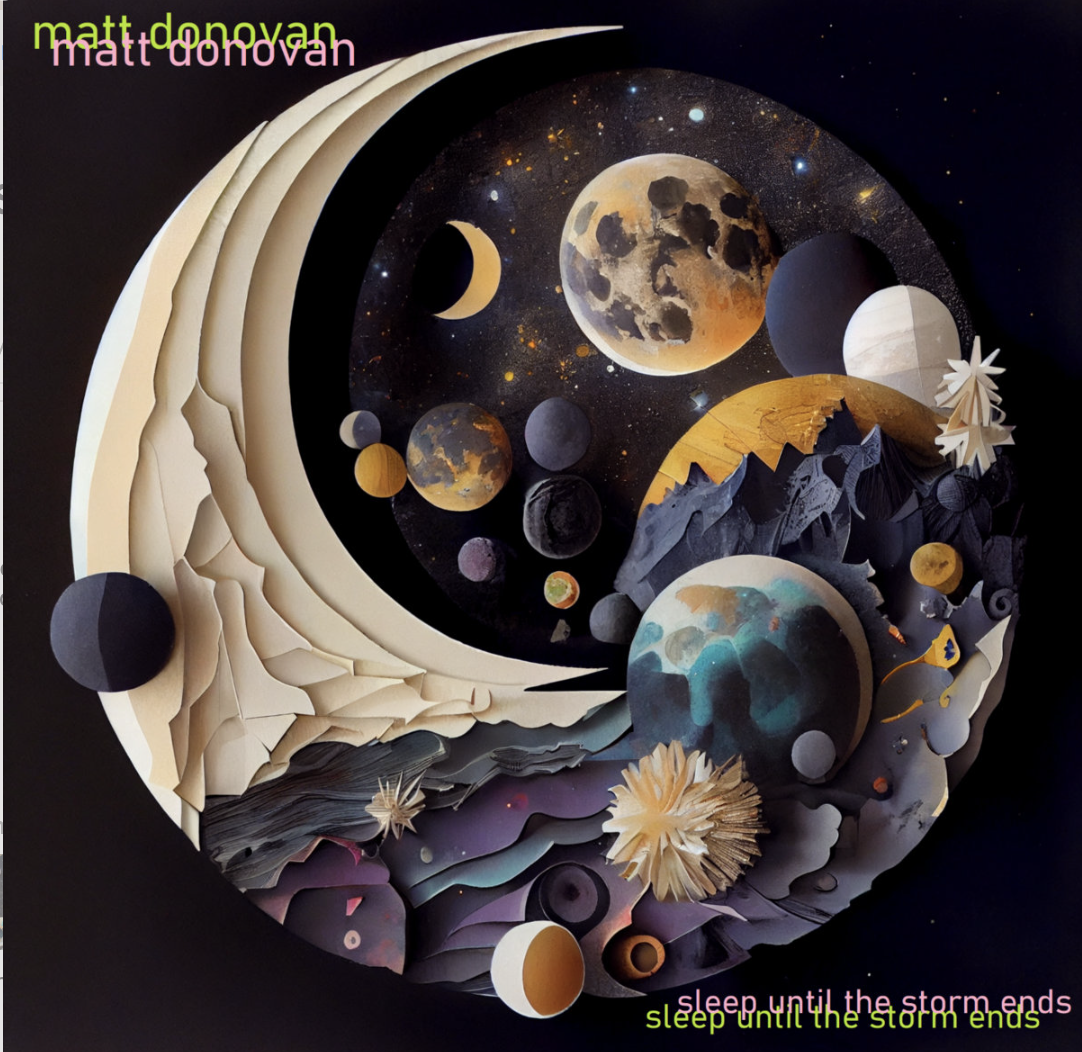
Marking three in a row of annual Spring-time delivered albums, the drummer-percussionist turn multi-instrumentalist solo artist Matt Donovan opens up his personal universe to the world. In the face of political, social discourse and ruin, lawlessness, loss and anxiety Donovan captures the evocative moments and scenes we all often take for granted; turning nighttime walks, the memories of loved ones into something musically and sonically lasting. A time is saved for posterity even if its just for Donovan and no one else; a kind of musical photo album that represents the sentiments, therapeutic stages of a period in his life.
And yet, with such universal tragedy and dislocation, there’s always hope; the music, even when the subject matter chimes with the God awful state of affairs currently destroying the country, remain loving and kind. Those of you who seeked out the (hopefully through my recommendations) previous Habit Formation (’22) and Underwater Swimming (’21) albums will find that Sleep Until The Storm Ends shares a familiar palette of kosmische/krautrock, alt 80s and 90s and post-punk influences. And yet it feels somehow different; mature and comfortable in its skin but exploring all the while.
With propulsive-motored stints in Eat Lights Become Lights, and as a foil to Nigel Bryant in the psych-krautrock-progressive-industrial Untied Knot duo, it’s hardly surprising to hear those Germanic influences permeating this newest album: A spot of the Dingers (Klaus and Thomas) here and a bit of Michael Rother and Manuel Göttsching guitar there. On some of the more reflective tracks like ‘A Sky Full Of Hope’ and ‘Night Walking’ its Tangerine Dream and company, albeit the latter has more than a touch of soundtrack Vangelis about it too, merged with pop, jazz and 80s indie influences. Although not German, just mere cousins on the astral plane, a few of these tracks reminded me of both Syrinx and Ariel Kalma’s new age, spiritual panoramic awakenings.
This is only half the story, as Donovan also effortlessly seems to weave The Field Mice’s ‘…letting go’ with Karl Hyde, Mick Harvey (especially on the few occasions he sings), the Durruti Column, Spaceman 3 and Eno (Another Green World era on the light-effected environmental plaint ‘The Crying Earth’). In practice this results in a sort of bell-tinkled and recalled leitmotif signature unfolding of Donovan’s moods and ruminations: goodbyes too. Sometimes its dreamy and other times near cosmic with climbing scales and Fripp-like sustain and flange-fanned guitar work, synth waves and heartfelt vibrations.
Barefoot Contessa daydreams sit well with clavichord buzz splintered boogies on yet another enriching and rewarding album that slowly unfurls its understated balm of warmth and also protestation gradually over repeated plays. On the fringes certainly, a true independent diy artist, Matt Donovan is far too good to stay under the radar. Do yourselves a favour, grab a copy on bandcamp now.
Baldruin ‘Relikte aus der Zukunfti’
(Buh Records) 19th June 2023

Lying somewhere between the Reformation, hermetic, supernatural and mysterious Far East, the German electronic musician-producer Johannes Schebler simultaneously occupies a liminal past and as yet unsure future on his latest journey, Relikte aus der Zukunfti.
Just as Roedelius, Moebuis and Schnitzler’s first recorded experiments, under the Kluster title, found a home on the synonymous German church organ music label Schwann, so congruous were those early kosmische innovators “hymnal qualities” and, if removed, links to the country’s rich venerated history of religious music, Schebler’s own small Bavarian village rectory upbringing can be heard permeating this fourteen-track traverse and score.
The chime and ring of Lutheran, but also Oldfield’s tubular, bells can be heard across a both holy and unholy atmosphere of cult Italian horror, prog-rock, krautrock, new age and vague Ethnographic absorptions. The paranormal and monastic; the chthonian and Oriental are constantly drawn upon to manifest a fog of uncertainty and intrigue; occasionally delivering heightened dramatics and the chills as the music evokes hints of Goblin, Fabio Frizzi and the presence of some ungodly force.
It begins however, with the blown, sax fluted and veiled ‘Under The Counter’ soundscape, which sounds more like a gauzy apparition of Sam Rivers or Colin Stetson in a Frederic D. Oberland expanse. ‘Ride On The Silver Lizard’ meanwhile, sounds like a brassy sitar transcendental mythology of Steve Hackett, Eroc and Srgius Golowin, and the airy ebbed ‘Predestined’ captures Finis Africae and Vangelis in a cloud vapour loop. The timpani-rumbled ‘Confused’ on the other hand could be a lost Sakamoto score; the late Japanese icon entering the underworld.
Stretching the imagination whilst hinting at various mystical lands, you can detect the more experimental, serial and less musical adventurous work of Širom and Walter Smetek existing in the same space as Popol Vuh, Alejandro Jodorowsky and the melodically afflatus. You’re never quite sure where you are exactly though: nor in what time period. The ground beneath your feet is translucent, or, like an ever-changing shimmer and shiver of evaporated atmospheres. This is a knowing album that taps into its influences and church music groundings to offer a balance between the spiritual and disturbing.
Ramuntcho Matta ‘S/T’
(WEWANTSOUNDS) 16th June 2023
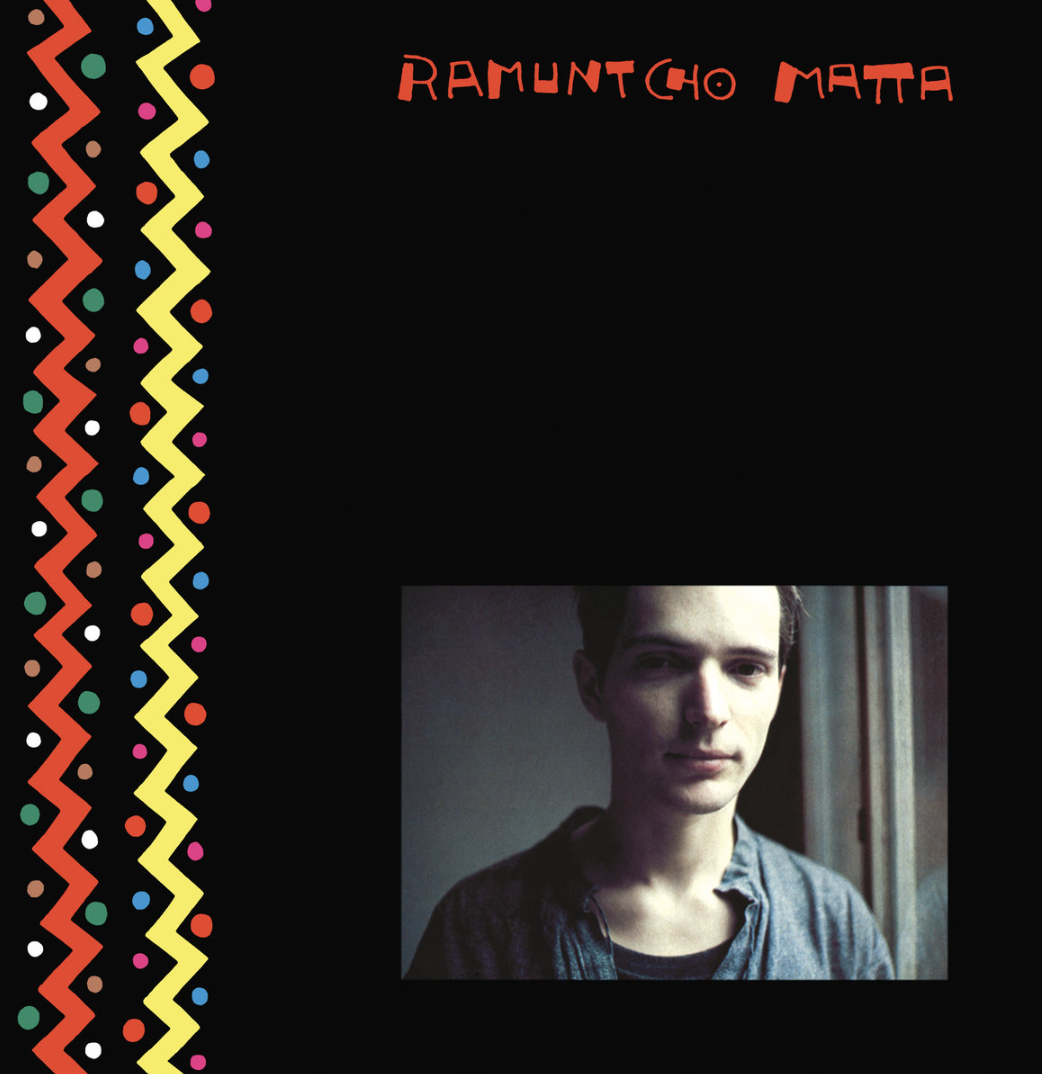
A sound production of contrasts; a collage of time spent in both New York City and Paris, where the graffiti’d downtown meets fourth world music explorations, Ramuntcho Matta’s absorption of those two cultural hives is a no wave and exotic theatre of diverse influences.
The younger sibling to and scion of the Matta arts brood – his father, the Chilean-born Roberto, a key if not always congruous member of the Surrealist movement with his ‘psychological morphologies’ or alien ‘inscapes’ coined subconscious manifestations, and brother, Gordon Matta-Clark, the ‘anarchitecture’ pioneer of such concepts as the ‘split’ house and various art performances -, Ramuntcho was a well-connected creative nomad who chose to plow his own furrow in the field of experimental music. He started out in this regard, in the company of such polymath avant-garde luminaries as Brion Gysin, Don Cherry and Laurie Anderson. The latter opened doors to everything New York had to offer in the late 70s and early 80s. Ramuntcho also shared a flat with scenesters Nana Vasconcelos and Arto Lindsay: living in the same building as the Talking Heads’ Chris Frantz and Tina Weymouth no less. Although tragedy would strike with the death of his brother and conceptual art icon Gordon in the late 70s, the burgeoning producer would stay on, falling in with the Mudd Club, CBGB and Danceteria in-crowd; taking note of the evolving polygenesis movements of early hip-hop, post-punk, electronica, no wave funk and more worldly sounds (from Soweto to the outback, Caribbean and Hispaniola).
But it all came together, or rather this particular project did – dusted off, remastered and given a deserving vinyl reissue by WEWANTSOUNDS – in Paris. With the CV –notably recording Don Cherry’s 1983 ‘Kick’ single for the boutique French label Mosquito, the original imprint for this self-titled album – and network expanding ever further, there would be performances with the Senegalese group Xalam and the Arabic rock group Carte de Séjour, with Rachid Taha. A residency in Lyon led to a meeting with the Algerian-born French avant-garde choreographer Régine Chopinot, who had taught dance at the city’s Croix-Rousse before forming her own experimental multimedia company. Chopinot invited Ramuntcho to compose the soundtrack to her upcoming Via show – the costume designer of which was a young aspiring Jean-Paul Gaultier.
Without seeing the actual production it’s difficult to gauge if the music was successful, complimentary or not. However, removed from that dance theatre setting the album works as a window in on a particular rich cultural exchange of ideas, sonics, sketches and soundscapes.
This ’85 released production was produced between Ramuntcho’s home and the Studio d’Auteuil in Paris; the former, a more solitary space for the album’s soundscapes and more ambient-minded pieces, the latter, a more rambunctious shared environment where all the album’s bandy and shunted no wave funk and Island life Grace Jones-esque tracks were recorded with the Stinky Toys and Elli & Jacno duo’s Elli Medeiros (on vocals), the Uruguayan percussionist Negrito Trasante, Suicide Romeo’s Frederic Cousseau (better known as Fred Goddard) on drums and Polo Lambardo on konks. That list may be extended depending on what information you read, although the WWS label and linear notes writer Jacques Denis have managed to pull together the fullest picture yet of a record hampered by misspelled band members and even a missing track listing. According to those same notes, Ramuntcho didn’t feel that the label had pushed the project or even promote it very well; hence why it disappeared: a find for crate diggers decades later.
A dance fusion of influences and ideas, this counterpoint of diverse elements opens on a gentler, almost mulling day dreamy guitar amble with the light-jazz touched ‘Gesti’. Like Marc Ribot on Iberian shores, there are a couple of these soloist moodscape pieces (see the more classical-tinged and loosened ‘Irimi Nage’). A second strand to this record’s sphere of influence is the didgeridoo sounding passages of Jon Hassell inspired sound cartography; as found on the outback resonated, barked fretboard experimental, water carrier poured ‘Avatar’, and mbira tine, funnel blowing, freight train honked primitive dance music spot ‘Zoique 3’.
The action sprawls across both the NYC and Paris underground on tracks like the shunting cut-up and counterbalance of discombobulated Art Of Noise and a repeated sweeter voiced spell of African or French-Polynesian Island song, on the ‘Sassam Kitaki’ switch. Most surprising is the fluid, bandy amalgamated hip 80s shining ‘Hukai’, which merges Casino Music with Orange Juice, Grace Jones, Lounge Lizards, Talking Heads and the sunny township polyrhythms of South Africa. ‘All Those Years’ in contrast, sounds like Saw Delight era Can rubbing shoulders with a reflectively blue XTC.
Also, in addition to shades of Dunkelziffer, Populaire Mechanik, Don Cherry (of course), Annie Anxiety and the Pop Group, there’s an exotic fauna and animalistic soundscape of French-Arabia, Africa and the Americas, to be found suffused amongst the electrified disjointed and vibrated no wave funky free-play.
I must confess, this album totally passed me by. I wasn’t even aware of it. Although only briefly, I even studied both Roberto and Gordon Matta when I was an art student, but had no idea there was another equally talented member of the clan. Hearing it now makes sense, so much of its makeup integral and over-used in the last two decades as the 80s becomes this generations’ 60s. There are some great eclectic hybrids and even no wave dance tunes to be found. Everything gels perfectly on this evolving, changing production; from the bendy to frazzled; atmospheric to off-kiltered. Ramuntcho’s theatre dance soundtrack is a complimentary bedfellow to Sakamoto’s computer disc experiments of the same(ish) period, released a while back on the WWS label. A great revived lost fusion from the avant-garde funk and no wave cannon.
Marty Isenberg ‘The Way I Feel Inside’
7th July 2023
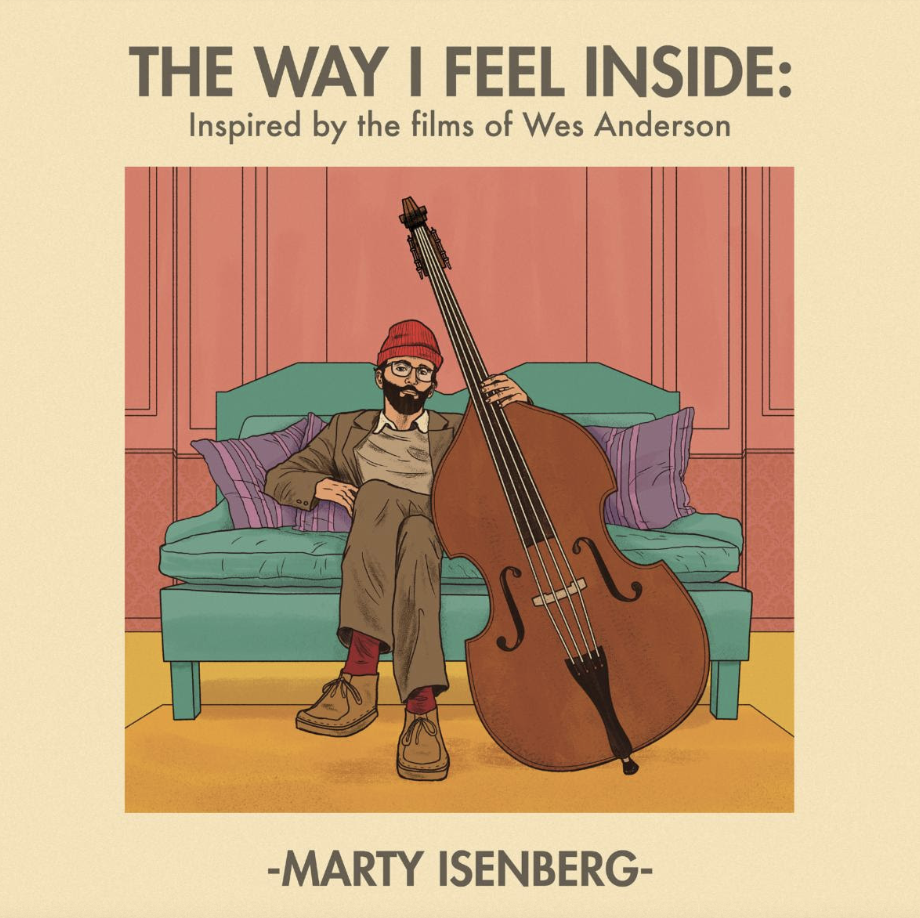
It’s a name synonymous with whimsy poignancy, a signature frame and colour palette, but what the American filmmaker Wes Anderson and his perfectly constructed diorama movies are equally famous for is their carefully curated soundtracks. The scores of which have led to, in some cases, a revival of fortune for the said artists and bands that pepper such iconic films as Rushmore, The Royal Tenenbaums, The Life Aquatic, Fantastic Mr. Fox, Moonrise Kingdom and so on.
The unassuming Anderson has become such a cult figure himself that, in kind, a number of artists have penned homages or name checked his films or idiosyncratic view of the world. Arguably there is a certain hip, generation X selective and knowing calculation to those mixtape-like soundtracks that get used as prompts for poignancy, emotional states and the almost impossible to quantify with just actions or dialogue.
Not quite the homage in itself, the debut album from the NYC bassist and composer Marty Isenberg (stepping out under his own name for the first time) entwines the feelings of his own formative years with Anderson’s filmography: or rather, the music from those beautifully crafted stories of outsider isolation and pain. You could call it a covers album of a sort; an eight-song selection of reinterpretations would be better though. And yet, despite keeping some of the signature melodies, all of the original lyrics, Isenberg extends, menders and sets familiar emoted pulls in a different environment with a rich jazz transformation.
You’ll have to excuse my ignorance and a lack of info on who is joining Isenberg on this album: there’s electric guitar, drums, some sax and cornet, and a beautifully voiced singer with shades of Norah Jones and Esperanza Spalding. I’m going to suggest that members of Isenberg’s Like Minds Trio with Alicyn Yaffee and Eric Reeves could be involved. It would make perfect sense; the music does at least sound congruous.
Proving the most popular choices, The Royal Tenenbaums and The Life Aquatic dominant. From the former there’s a faithful harpsichord spindled version of the Velvet Underground’s ‘Stephanie Says’ that subtly transforms that Stones-like psychedelic old England vibe into a smooth 70s jazz light theme tune, with sections of swing and simmered feels. Velvet third wheel and oft collaborative partner, Nico has her pleasant of Lutheran melancholic song of regret and remembrance. ‘These Days’, lightened and taken back to Jackson Browne’s more lifted, sweetened origins. A Muscle Shoals electric piano (or Hammond) hovers as the vocals acquire more of a lilting and near scat-jazzy vocal arrangement that sounds almost Bacharach(ian).
Another Tenenbaums favourite, Eliot Smith’s ‘Needle In The Hay’ is given a jazzy touch. Isenberg opens with incipient bass bends, scales and nimble introspective picks as a less adolescent moody, despondent vocal points towards both Spalding and Tori Amos. The feels all there: the indie singer-songwriter dourness. Yet it’s given an off-script treatment of drama counterbalanced by the meandered.
Nick Drake’s achingly beautiful ‘Cello Song’, with all its connotations and personal tragedy, is a journey in itself of the wept and sympathetic. Sailing close to Beggars Banquet Stones, and the jazz of Mingus and Bobby Jackson at other times, a “cruel world” of sensitivity is softly expanded upon. That vocal is almost airy, if still carrying a beguiled plaintive tone.
My personal favourite (alongside Rushmore), The Life Aquatic offers up a double helping of Bowie covers and a Lennon/McCartney-like Zombies hymn. In what is a kind of meta exercise, the film’s Belafonte crew member and famous Brazilian musician Seu Jorge originally played around with a songbook of acoustic Bowie numbers; all of which are smattered throughout the Cousteau parody come homage. One of them, ‘Rebel Rebel’, is covered here; attuned more to Jorge’s Latin-sauntered origins than the glam-stomp actionist anthem of Diamond Dogs. In this version the song is played in the background of Peter Sellers’ The Party, or winding out of an early 60s jazz lounge. It’s both very twinkly and Tropicana light. ‘Life On Mars’ however, is faithful in part (tune wise anyway), yet takes the original crooner-vibe towards a mix of colliery band style horns and Stevie Wonder soul-jazz. The drama, edges are rounded but the overriding lament and emotional draw remain in tact. The pleasing ‘The Way I Feel Inside’ from a ‘65 Zombies is handled with a sweetness and enchantment that wouldn’t sound out of place on an Anderson film itself.
I’m totally unfamiliar with the band Steady Holiday, whose ‘So Long’ is playfully sent back to a dancehall era that weaves together echoes of WWII, the 50s and Dixie Jazz for a wistful, cornet nestled smooch.
Isenberg with subtlety and charm offers some surprising renditions. But what’s most surprising is that the bassist doesn’t grandstand, hog the spotlight with his double-bass instrument of choice; nor is this especially a bass-heavy showcase, but an adroit, attentive but ready to leap at a moment’s notice into action playing style that bends and lends itself to a variety of styles. There’s heartfelt connections balanced with a certain magic and even playfulness, a sharing of the artist’s tastes, record collection and personal aspirations; the main one being the loss of his father at a young age: old enough however to have been inspired by his dad’s own musical tastes, loves and collection of instruments. Finding a special affinity perhaps with Anderson’s many protagonists (there is a leitmotif of characters with only one parent in his films), that early loss led to Isenberg’s journey in musical study: from initially learning by feel and intuition, to majoring at the New School for Jazz And Contemporary Music in jazz performance. A beautiful and off-kilter, sometimes whimsical, songbook is transformed with a jazzy touch of personality.
Joe Woodham ‘Worldwide Weather’
(None More Records) 16th June 2023

Noting the changing tides and climate on warm suffused currents of looping guitar, field recordings and kosmische, post-rock and dream progressive styled languorous inspirations, Jouis band member Joe Woodham sonically and melodically charts various lunar-cycle driven weather fronts and metrological phenomena on his first solo album for the None More Records label.
Unburdened by climate change Cassandras’ and apocalyptic predictions, Woodham almost finds a certain comfort – even when yearning – in tracing and capturing the ebb and flow, the awe and beauty of the oceans as they are pulled by the moon’s cyclonic forces.
As an aside, and for trivia fans, album track ‘Neap Gloom’ (anything but as, well, gloomy as that title suggests; rather it’s a more airy and wafted proposition, with rain patters that sound rather nice) is a reference to the tide just after the first or third quarters of the moon: when there is the least difference between high and low waters.
The process of making this album itself comes from enjoyment, not dark clouds of angst or anxiety. The initial experiments were produced in fact on Woodham’s daughter’s Casio keyboard, which in turn was linked to a loop pedal. There’s more to it than that of course, but the intention was one of play and improvisation; later manipulated and layered with the clipped hiss, gates and crackled atmospherics of Matthew David, the suffused bird songs and whistles of Ernest Hood, and crashing surf and spray of the waves crashing against the shoreline.
The enormity is certainly present, but most of the peregrinations and moods slip and wash between the swimmingly and warmly drifting. It could be what sounds like a melodica on tracks like the gamelan malleted bells and concertinaed Parisian wafted ‘Gameplan B’ (no idea about that title, other than this could be a riff on the climate emergency brigades, “there is no planet B”, mantra), and squeezed mellowed, nicely wavy and dreamy (anything but) ‘Overcast’ that makes me think of Alex Paterson’s brand of mirage-dub. And, as referenced by Woodham himself in his accompanying quotes as the listening material when making this record, there’s an enervated whiff of Frances Bebey about the latter track, alongside hints of Jah Wobble and Odd Nosedam.
Amongst the variations of Manuel Göttsching, Michael Rother, Land Observation and Orange Crate Art guitar accents, lines, curves and cycles and sweeping weather fronts, the magical ‘Spring Tides’ builds from a Laraaji-like heavenly introduction into a slow forward momentum of beautiful slowcore and shoegaze (reminding me actually a little of The Besnard Lakes). Woodham actually sings on the psychedelic English folk-pastoral ‘Longshore Drift’ observation; sounding a little like James Yorkston in hymnal echoed benevolence.
Woodham effectively layers the counterflows and melodies of nature and the directions of tidal travel. There are some lovely moments on this album, some spots of reflection, as Woodham makes a case for just letting the music take you in its lunar drawn grasp. A really effective debut for the label.
Hi, my name is Dominic Valvona and I’m the Founder of the music/culture blog monolithcocktail.com For the last ten years this blog has featured and supported music, musicians and labels both I and my team of collaborators love across genres from around the world that we think you’ll want to know about. No content on the site is paid for or sponsored, and we only feature artists we have genuine respect and love for. If you enjoy our reviews (and we often write long, thoughtful ones), found a new artist you admire or, if we have featured you or artists you represent and would like to buy us a coffee at https://ko-fi.com/monolithcocktail to say cheers for spreading the word, then that would be much appreciated.
 Monolith Cocktail Blog