Most Loved and Enjoyed Highlighted Albums of 2024: Part Two: M – Z
December 16, 2024
Part Two of the Monolith Cocktail’s most loved and favourite albums of 2024 lists: from M to Z. Put together by Dominic Valvona and Brian ‘Bordello’ Shea.

Picking up on where we left off with Part One of the Monolith Cocktail’s most enjoyed and loved albums of 2024, Part Two continues to list all entries in alphabetical order, starting with M. So without further ado, here is the concluding spread of chosen albums – although anything we reviewed during the year should be considered a winner in that regard.
M_____________
Felix Machtelinckx ‘Night Scenes’ (Subexotic Records)
Chosen Dominic Valvona, reviewed originally by Graham Domain/Review
“The new album from Belgium singer, songwriter and producer Felix Machtelinckx is a strange album. In part electronic, it has an ethereal dreamlike quality where the music seems distant and the vocals sound as though they have been beamed through space from a distant galaxy.
Night Scenes is an intriguing album that is hard to define, but one that grows in definition, depth and subtle beauty with each play. It might prove to be a contender for album of the year.” GD
Marcelo D2 & SambaDrive ‘Direct-to-Disc’ (Night Dreamer)
Chosen by DV/Review
“Transforming choice tracks from his back catalogue of solo albums, put out between 1998 and 2013, the influential and acclaimed Brazilian rapper Marcelo D2 replaces the samples, breaks and scratching for a live, reactive Latin-jazz and samba trio.
As part of the championed ‘direct-to-disc’ series overseen by the Night Dreamer label, the South American hip-hop legend laid down ten performed tracks backed by the brilliant SambaDrive direct onto vinyl at the Haarlem Artone Studio in Holland. With no cuts, no edits, as little interference as necessary, these recordings sound near spontaneous, in the moment. The attitude, the passion, the crammed-in flow and more peppered lyricism is still very much on show, only now lilted towards a jazzier and Latin-fuelled backing that balances the urgency and freewheeling of the rapping with something more pliable, dissipating, funky and stylishly cool. Marcelo D2 & SambaDrive have created something very special; not so much an improvement as an alternative fruitful vision of Samba-rap. “ DV
Luce Mawdsley ‘Northwest & Nebulous’ (Pure O Records)
Chosen by DV/Review
“Over several years now the former Mugstar guitarist Luce Mawdsley has progressively shorn the more predatory slurred spoken-word mise-en-scenes and lurid, sleazy torturous self-harm from their music; gradually removing the “verbasier” programmed-like demonic effects from their voice and freeing themselves from a circled abyss of sonnets.
An holistic record that rescores the English scenery and places held near for Luce, the unfolding stages are both beautifully conveyed and hallucinatory in equal measure; a retold fairytale without any prompts, and without a human cast; a window in on the enchantments but also non-hierarchical, non-binary and free nature of the wilds and geography: a metaphor for Luce’s struggles to find an identity that feels natural, safe and unburdened. One part classical, one part Americana, and one part folksy (a touch of the Celtic too) there’s still a very modern twist to what we may identify as the familiar: imagine Prokofiev on an acid trip, or Ry Cooder in an English pasture laying down breadcrumbs for Hampshire & Foat.” DV
The Mining Co. ‘Classic Monsters’ (PinDrop Records)
Chosen by DV/Review
“Continuing to mine his childhood the London-based singer-songwriter Michael Gallagher once again produces a songbook of throwbacks to his formative adventures as a kid growing up in Donegal in Ireland.
His previous album almanac, Gum Card, touched upon a silly fleeting dabble with the occult, but this latest record (his sixth so far) is filled with childhood memories of hammy and more video nasty style supernatural characters, alongside a whole host of “weirdos”, “freaks” and “stoners”.
Once more back in his childhood home, frightened to turn the lights off, checking for Christopher Lee’s Dracula and the Wolfman under his bed, yet daring himself to keep watching those Hammer house of horror b-movies, Salem’s Lot and more bloody shockers, Gallagher links an almost lost innocence with a lifetime of travails, cathartic obsessions and searching desires.
I’m still astounded by the lack of support for his music or exposure, as Gallagher’s The Mining Co. vehicle is worthy of praise, airplay and attention. Hopefully it will be sixth album lucky for the Irishman.” DV
Hannah Mohan ‘Time Is A Walnut’ (Egghunt Records)
Chosen by DV/Review
“Geographically settling long enough to pen this solo songbook offering, but anything but settled emotionally, the former And The Kids vocalist-songwriter Hannah Mohan attempts to process the break-up of all break-ups.
Mohan rides the roller coaster of a drawn-out break-up with quirkiness and vulnerability, turning tortuous heartache into one of the best and most rewarding songbooks of the year. Mohan may have let her soul sing out, as she comes to accept an emotional turbulent period of stresses and anxieties and pain. But whether she’s finally pulled through the other side or not is up to you the listener.” DV
Jamison Field Murphy ‘It Has To End’ (Tomato Flower)
Chosen by Brian ‘Bordello’ Shea/Review
“Ah yes this is more like it. At last, an album with warmth, soul experiment and beauty. Just when I was beginning to think that it was a thing of the past James Field Murphy turns up with this home recorded gem, an album that combines all the things I love about the magic of music: songs with melody, “That Boy” could well be an outtake from The Beach Boys Smiley Smile album, and “It has To End” has a wonderful bonkers McCartney feel to it [remember McCartney was the most experimental of all the Beatles], and this track combines pop with experimental to a beautifully short and wistful degree. “Hate” is another beautiful song; yes indeed, a hate that is alright to love and love it I do. I love the tape pops in the background: you really cannot beat recording on tape.
It Has To End is a rare thing, an album you do not want to end. It’s an album I will be returning to on a regular basis over the coming months as James manages to balance off pop/psych beauty with experimentation perfectly.” BBS
N______________
NCD Instigators ‘Swimming With Sharks’ (Metal Postcard Records)
Chosen by BBS/Review
“The NCD Instigators were Tony, Brendan, and Desi Bannon, three brothers from Newcastle County Down in Northern Ireland who decided to form a band in the 80s together after many years of playing in various other bands. They took their love of metal, prog, folk and rock and home recorded several albums for their own pleasure, burning them onto CDRs to give to friends and family and playing the occasional gig.
There is just something quite magical about this album, and it is sad that now it is only being released years after the fact and that Tony (bass and vocals) is no longer with us, having passed away in 2020. Hopefully this release will ignite some long overdue interest in this underground lost great band from Northern Ireland.” BBS
Neon Kittens ‘It’s A NO Thing’ (Metal Postcard Records)
Chosen by BBS/Review
“The Kittens have a magic and their own sound: The guitar wizardry of Andy G (In a ideal world David Bowie would not be dead and Andy would be his guitarist songwriter partner) and the spoken, I am going to shove my stiletto shoe heel into your yearning heart, vocal coolness of Nina K. The Neon Kittens are one of those rare bands; we need them more than they need us.” BBS
Neutrals ‘New Town Dream’
Chosen by BBS/Review
“This is splendid stuff, an album of supreme guitar jangle, of well written and catchy songs about life in a small town that at times musically reminds me of early Wedding Present and The Pastels with such wonderfully British lyrics; although I wonder when “Travel Agents Window’s” was written as he mentions buying a bag of chips for 50p, when was the last time you managed to buy a bag of chips for 50p? Maybe life in this small town isn’t as bad as the Neutrals think. I do love this album though. I love the romance of everyday life songs, like little mini-Kitchen sink dramas filmed in grainy black and white. This is quite a gem of an album.” BBS
Not My Good Arm ‘Coffee’
Chosen by BBS/Review
“They take Rock ‘n’ Roll, Ska, Punk and Soul and tie it up and skin it alive whilst berating it with the sort of political soulful joyful nous that hasn’t been heard or witnessed since the Mighty Dexy’s Midnight Runners held the Top Of The Pops viewers enrapt with their explosion of attitude and musical good taste back in the early 80’s. Yes indeed, Coffee is a Northern indie soulful romp of an album by a band that I can imagine being a hell of a good night out to watch and by the looks of it gig on a very regular basis. So, keep your eyes scanned as they may be coming to your locality soon. I understand you can pick up a copy of Coffee on CD from their gigs, as by the looks of it they’ve not yet updated their bandcamp: probably too busy putting the fun into funk.” BBS
O_______________
OdNu + Ümlaut ‘Abandoned Spaces’ (Audiobulb)
Chosen by DV/Review
“Drawn together on what proves to be a deeply intuitive union for the Audiobulb label, the Buenos Aires-born but NY/Hudson resident Michel Mazza (the OdNu of that partnership) and the US, northern Connecticut countryside dweller Jeff Düngfelder (Ümlaut) form a bond on their reductive process of an album, Abandoned Spaces.
Tracks are given plenty of time to breathe and resonate, to unfurl spells and to open-up primal mirage-like and psyche-concocted soundscapes from the synthesized and played. And although this fits in the ambient electronic fields of demarcation, Abandoned Spaces is so much more – later on in the second half of the eight-track album, the duo expresses more rhythmic stirrings and even some harsher (though we are not talking caustic, coarse or industrial) elements of mystery, inquiry and uncertainty.” DV
Berke Can Özcan & Jonah Parzen-Johnson ‘It Was Always Time’ (We Jazz)
Chosen by DV/Review
““It Was Always Time”, and it was always meant to be, for the telepathic readings of both creative partners in this project prove synchronised and bound, no matter how far out and off-kilter their experiments of curiosity go or take them.
The Turkish polymath drummer and sound designer Berke Can Özcan and his foil the Brooklyn-based baritone/alto saxophonist and flutist Jonah Parzen-Johnson, have worked together before, namely on the former’s Lycian atavistic geographical infused and inspired Twin Peaks album, last year.
But before even that, back in the April of 2022, Parzen-Johnson found himself boarding a flight to Istanbul to perform a one-off gig with Özcan. Incredibly the two had never met until thirty minutes before going on stage for a soundcheck. The gig must have proved a creative, dynamic success as both musicians have now come together under the equal billing of this new album, recorded for the Helsinki-based hub We Jazz.
From the dubby to tribal, the esoteric to cloud gazing, Berke Can Özcan and Jonah Parzen-Johnson play out their fears and joys across an exciting album of possibilities and expressive, erring on the heavenly at one point, feelings. A fruitful combination that will endure, and hopefully reconvene in the future.” DV
P_______________
Pastense Ft. Uncommon Nasa ‘Sidewalk Chalk, Parade Day Rain’ (Uncommon Records)
Chosen by DV/Review
“Continuing to attract and surround himself with like-minded curious, inventive artisans of prose from the underground leftfield hip-hop scene, the Long and Staten Islands’ rapper and producer/beatmaker Uncommon Nasa now facilitates Pastense’s return with a post-pandemic opus of metaphysical, cosmological unravelled consciousness alchemy.
With no let-up in the quality of the expansive lyrical metaverse, tech comes in conflict with the forest’s birds and nature’s fight for survival amongst the concrete and chemically poisoned wells of so-called progression on an artistically simulated and stimulating canvas of thoughts and connectivity.
Pastense, in partnership with Nasa, creates a most excellent mind-expanding universe, and in doing so, one of the year’s best hip-hop albums: this is an artist and record worth championing.” DV
Ivo Perelman, Chad Fowler, Reggie Workman and Andrew Cyrille ‘Embracing The Unknown’ (Mahakala Music) Chosen by DV/Review
“A true “cross-generational” (with two of the participants born in the 1930s) coming together of avant-garde, freeform and hard bop talent, the ensemble quartet of Ivo Perelman, Chad Fowler, Reggie Workman and Andrew Cyrille “embrace” experiment. You could call it an extemporized gathering, with no prior arrangements and not much in the way of dialogue.
Making the abstract seem even more so, yet somehow conveying mood, emotions and self-expression, this descriptive and totally improvisational master class in free-thought-jazz somehow captures the internal struggles and reflections of the mind during an age of high anxiety, rage, divisiveness and unease.” DV
James P M Philips ‘Spite, Bile & Beauty’ (Turquoise Coal)
Chosen by BBS/Review
“Punk, folk, rock and a medieval becoming strangeness all collide to bring us another album of psychedelic whimsy from the head and heart of James P M Phillips: an album of joy, sadness, humour and pain. Whether it be the quite wonderfully disturbingly jagged “My Head Is Full Of Rats” or the quite beautiful folk strum of “My New Friend”, James has his own unique way of making music and writing songs; dipping his own original thought patterns into a hybrid of musical genre hopping eccentricity.” BBS
Poppycock ‘Magic Mothers’
Chosen by BBS/Review
“The whole album is joy. I love the mix of jazz, folk and psychedelic pop: alas, if only the last Zombies album was as enjoyable as this.” BBS
Pound Land ‘Live At New River Studios/ Worried’ (Cruel Nature Records)
Chosen by DV, but reviewed originally by Brian ‘Bordello’ Shea
“This new album by Pound Land is a double whammy of an affair. The first side recorded live, captures the band without guitar but with a rather fetching squelching punk rock synth suppling the health out of the watching masses. Pound Land are of course a punk and post punk rock outfit of political magnitude. A band that captures the atmosphere of living in this divided land we call the United Kingdom and make a hell of a fine racket while capturing the atmosphere as the live side of this cassette magically proves. The second side is taken up by the thirty-one-minute track, “Worried”, which is a fine sonic journey of sadness, horror and experimental splendour that takes in dub, punk, and electro soundscapes; a dream of a nightmare track that really needs to be heard by all.” BBS
R__________________
Revival Season ‘Golden Age Of Self Snitching’ (Heavenly Recordings)
Chosen by DV
Totally missed at the time by us (well, we did feature ‘Chop’ on the February edition of the Monthly playlist), this incredible union between Brandon “BEZ” (B Easy) Evans and beatmaker/producer Jonah Swilley is so “now” it hurts. A synergy that captures the times it was forged in, Golden Age Of Self–Snitching crafts electronic dance music both dystopian and club, hip-hop, 2-Step, the kind of fusions that TV On The Radio used to generate, locked beats and breaks and dub into a commentary on societal change, protestation and revolution. An essential flow of concentrated angst, frustrations and observation criminally overlooked, and which should make every end of year list of there was any real justice in this god damn forsaken world. DV
Kevin Robertson ‘The Call Of The Sea’
Chosen by BBS/Review
““The Call Of The Sea” is the fourth solo album from Kevin Robertson, a man who is also one of the vocalists/guitarists from Scottish guitar band The Vapour Trails. And here we have him once again showering us with sublime melodies. Melodies that are wrapped in Byrdsian like guitar jangle and vocal harmonies that have just stepped from scratched vinyl copies of ye olde mid-sixties beat boom collectables stopped for a cup of the finest Earl Grey with late 80’s early 90’s Scottish indie guitar wunderkinds’ Teenage Fanclub and Superstar while scribbling on postcards to send their love to those old scouse reprobates Shack and The La’s and the Coral.” BBS
S___________________
Salem Trials ‘View From Another Window’ (Metal Postcard Records)
Chosen by BBS/ Review
“The Salem Trials are clinically rambunctious. They are never further than being an arm’s length away from genius. They have their own sound: their own model of post-punk if you like. They take all the usual subjects (The Fall, Wire, Gang Of Four, the Blue Orchids and Subway Army) and mix them with a no wave sound coming from the streets of New York in the late 70s early 80s. They release albums constantly – this is actually the first of 2024 though, and fits in nicely with the army of their previously released albums.
Andy still being the inspired guitarist that he is, riffing like a cross between Keith Richards, Tom Verlaine and Brix Smith with a army of admirers gathering in her Dis guarded nightwear, and Russ still being the nutter on the bus wearing the splatter ballistic cop t-shirt and spitting feathers at the naked chickens queuing up outside to be the first in line for the latest modern contraption while he is creating art at its best out of the fuzzy felt of yesteryears clowns hats. You really have to love the Salem Trials.” BBS
The Salisman Communal Orchestration ‘A Queen Among Clods’ (Cruel Nature Records)
Chosen by BBS/Review
“I love the psychedelic otherworldliness of SCO. I love the way the lead vocalist phrases his words. He sings with the soul of an sad imperfect empathetic angel, you actually believe in what he is saying, “[If I Wasn’t ]So Godam Blue” is so goddamn beautiful, and with some pretty wonderful lyrics: “remember those days when I pissed in the street, well that is not my style anymore”. Pure heartbreak poetry at its best. The following track “Rum Punch” is as equally beautiful, a psych country-tinged beauty full of sadness and pathos.
I really do love this album SCO have the perfect blend of magic and tragic, and “A Queen Among Clods” is defiantly one of the most impressive and heartfelt original sounding albums I have had the pleasure to write about this year. A true stunner.” BBS
Sly & The Family Drone ‘Moon Is Doom Backwards’ (Human Worth)
Chosen by DV/Review
“A wrestling match on the barricades between the forces of Marxism, Populism, the consumer culture, nepotism, and encroaching forces of a technological dystopia, the collective forces of this group provide a reification-style soundtrack to the crisis of our times. Often this means escaping via a trapdoor to beyond the ether, or, to off worlds and mysterious alien landscapes. But we’re always drawn back into the horror, stresses and contorted darkness of reality; a sonic PTSD manifested in industrial noises from Capitalism’s workshop.
Poltergeist’s jamming activity, fizzles of sound waves and transmissions from the chthonian, ghost ship bristled low horns and higher pitched shrieks, bestial tubular growls, cymbal shaves, disturbances in the matrix, a short melody of pastoral reeds, drums that sounding like a beating. This is the sound of Moon Is Doom Backwards; pushing and striving to score this hideous age through the cerebral and chaotic.” DV
Juanita Stein ‘The Weightless Hour’ (Agricultural Audio)
Chosen by DV/Review
“And perhaps it all comes to this, that after twenty-five years in the music business as both the frontwoman of the Howling Bells and as an established solo artist Juanita Stein has finally found the strength of her own voice and creative force. Stepping out from behind the safeguards of noisy rock to find that silence resonates deeper and further, Juanita erases everything but the most vital, emotionally receptive and connective elements from her music to produce a sagacious, confident (despite the fragility and vulnerability in places) songbook of personal memories.
The Weightless Hour is the perfect album from a great voice and songwriter, who’s now able to find that distance from the events of the past and a new sense of reflected candidness and honesty in motherhood. Juanita’s true self and strength opens-up, the noise diminished for something far more powerful. Not so much defiant as confident. A definite album of the year.” DV
Mohammad Syfkhan ‘I Am Kurdish’ (Nyahh)
Chosen by DV/Review
“Like an ascending stairway, or flowing and resonating with evocative melodious magic, lute stirring ruminations sweep over Arabia and surrounding regions; referencing anonymous, collective and some original-penned compositions and dances to Islam’s ‘golden age’ of fairytale (‘A Thousand And One Nights’); Kurdish pride in the face of repression (the title-track of course) and its peoples’ struggle for independence and respect (‘Do Not Bow’); lovelorn enquires (‘Do You Have A Lover Or Not?’) and the missed daily activities, interactions of life back home in Raqqa. Across it all the hand drums tab, rattle and roll; the cello arches, weeps and bows in sympathy; and the bouzouki lute swoons and rings out the most nimble and beautiful of ached and more up-tempo giddy tunes.” DV
T____________________
The Tearless Life ‘Conversations With Angels’ (Other Voices Records)
Chosen by DV/Review
“Both a transference of souls from the now cremated – or laid to rest, depending on your choice of metaphorical ritual death – Vukovar plus a host of orbiting “other voices”, the make-up of The Tearless Life remains relatively, and intentionally, shrouded, obscured.
Taking a while to materialize, The Tearless Life’s debut opus is both the announcement of new age, but also a bridge between this latest incarnation and the former Vukovar invocation – they are in essence, a band that continues to haunt itself. Old bonds remain, sound wise and lyrically, but with a new impetus of murky, vapoured, gossamer, mono and ether effected solace, tragic romanticism, pleaded and afflatus love, spiritual inspired yearning and allegorical hunger.
Talking to angels, conversing with both the seraph and the fallen, the daemons and spirits of the alchemist’s alternative dimensions, the group transduce the writings of that most visionary seer John Dee, the opium eater Thomas De Quincey, William Blake, and the far more obscure Samuel Hubbard Scudder, who’s 19th century, fairy-like, Frail Children of the Air: Excursions Into The World Of Butterflies publication of philosophical essays lends its title to a song of tubular airy manifestations, distortion, wisped spiralling piques and beautified touching emotional anguish.
Conversations With Angels is epic; the first step in, what I hope, will be a fruitful conversation to divine enlightenment, curiosity, psychological and philosophical intelligent synth-pop.” DV
TRAINING + Ruth Goller ‘threads to knot’ (Squama Recordings)
Chosen by DV/Review
“Two connective forces in the experimental, inventive contemporary jazz scenes combine their experiences and art on this sonic and musical hybrid.
There’s enough threads, nodes and junctions in between to feed off, but both partners in this knotted tension and more spiritual, lofty, airy and aria-like ether Linda Sharrock “ah’d” fusion of influences and prompted sparks of inspiration read each other very well. Directed by, and riffing off, the “Exquiste Corpse” parlour game so beloved by the Surrealist movement, the trio of players expand beyond the jazz idiom into shadow worlds, the mysterious, supernatural, cosmic and near industrial.
Pretty much out on the peripherals of jazz, ascending, flexing, rasping, soothing and breathing iterations and more untethered expressions of freeform music, TRAINING + Ruth Goller fashion organic fusions from a process that promises the wild, tumultuous, wrangled and strange, yet also provides the melodic and dreamy.” DV
Twile (featuring Laura Lehtola) “Hunger Moon” (Cruel Nature Records)
Chosen by BBS/Review
““Hunger Moon” is an album that combines folk, trip-hop, electronica and magic, and weaves together a tapestry of undiluted majestic swoonincity that has not been heard since the Portishead debut album “Dummy”.
Hunger Moon really does not put a foot out of place as it flows and hooks you into its warm strangeness, cradling you and sweeping you up to a safe place where dreams are free to play and cast shadows over your deepest thought and emotions. Eight tracks to soundtrack you as you come down from your highest high. Truly magnificent.” BBS
V______________________
Various ‘Athos: Echoes From The Holy Mountain’ (FLEE)
Chosen by DV/Review
“Context is vital: history essential. For the publishing house/record label/curatorial/ethnologist platform FLEE has spent a year unravelling, digging and excavating and researching their grand project dedicated to the Athos monastic community.
No one quite puts in the work that FLEE and their collaborators do, with the scope and range of academia wide and deep. Musically, across a double album vinyl format there’s a split between those artists, DJs and producers that have conjured up new peregrinations influenced by the source material, and a clutch of recordings taken in the 1960s and in recent times of the Daniilaioi Brotherhood Choir, Father Lazaros of the Grigoriou monastery, Father Germanos of the Vatopedi and Father Antypas – there’s also attributed performances to the Iviron and Simonopetra monasteries too.
As an overall package however, Echoes From The Holy Mountain is a deep survey of a near closed-off world and all the various attached liturgical and historical threads. FLEE reawaken an age-old practice, bringing to life traditions that, although interrupted and near climatically hindered, stretch back a millennium or more. No dusted ethnographical academic study for students but an impressive and important purview of reverential dedication and a lifetime of service, this project offers new perspectives and takes on the afflatus. Yet again the platform’s extensive research has brought together an international cast, with the main motivation being to work with tradition to create something respectful but freshly inviting and inquisitive. The historical sound, seldom witnessed or heard by outsiders, is reinvigorated, as a story is told through sonic exploration.” DV
Various Artists ‘I’m Glad About It: The legacy Of Louisville Gospel 1958 – 1981’ (The Louisville Story Program/Distributed Through Light In The Attic) Chosen by DV/Review
“When Ben Jones, one of the many voices of authority and leading lights of the Louisville gospel legacy, enthuses that the talent at every Black church during the golden years chronicled in this ambitious box set was akin to witnessing and hearing “ten Aretha Franklins at every service”, he’s not boasting. Jones’ contributions, as outlined in this multimedia package’s accompanying 208-page full colour booklet, lays down the much unrepresented story of a thriving, enduring scene. Alongside a host of reverent members of the various Evangelist, Pentecostal, Baptist and Apostolic churches, artists, instigators and custodians, his informative, animated and passionate words draw you into a most incredible cross-community of afflatus bearers of the gospel tradition. For the Louisville scene was and continues to be every bit the equal of its more famous and celebrated rivals across the American South. And that Aretha quote is no exaggeration, as you will hear some of the most incredible voices and choirs to ever make it on to wax, or, in some cases, make it onto the various radio stations and TV shows that promoted this divine expression of worship. 83 songs, hymns and paeans of assurance, great comfort, tribulations and travails from a gospel cannon of pure quality, moving testament and joy.
‘I’m Glad About It: The legacy Of Louisville Gospel 1958 – 1981’ is an unprecedented example of just how to display and facilitate such a multifaceted project of documentation and archive – in the package I received there were links to a brilliant visual timeline and archive of some 1000 songs recorded by 125 different gospel artists. A labour of love and recognition, taking over three years to put together, The Louisville Story Program has not just set out to preserve but also equip the communities they serve with a genuine platform which can be added to overtime. But importantly, they’ve brought in a number of inspiring voices to help build a concise story of legacy and continued influence of the city and gospel music in general – Ben Jones citing Drake and Kayne unable to find a beat that they didn’t hear in church.” DV
Various ‘Congo Funk! – Sound Madness From The Shores Of The Mighty Congo River (Kinshaha/Brazzaville 1969-1982)’ (Analog Africa) Chosen by DV/Review
“A tale of two cities on opposites sides of the same river, the Congo, the latest excursion for the Analog Africa label celebrates and showcases an abundance of dynamite, soul and funk tracks from the two capitals of Kinshasa and Brazzaville.
Congo Funk in all its many variations is put under the spotlight, with an outstanding set list of fourteen tracks (whittled down from a container’s worth of singles) that will enthral and educate in equal measures. Essential dance floor fillers await.” DV
Various ‘Ghana Special 2: Electronic Highlife & Afro Sounds In The Diaspora 1980-93’ (Soundway Records) Chosen by DV/Review
“The first decade of the new millennium proved a fruitful period for (re) discovering Africa’s rich dynamic and explosive music heritage, with both (through their various Afro-funk and Afro-psych compilations) Soundway Records and Analog Africa (in particular their influential African Scream Contests) spoiling connoisseurs and those with just a curiosity alike to sounds rarely heard outside the continent. The former’s original five album Ghana Special spread was one such indispensable collection from that time; a perfectly encased box set survey of one of Africa’s most important musical junctions. Now, unbelievably, a full twenty years later Soundway have followed up that “highlife” triumph with a second volume; moving the action on into a new decade. Ghana Special part two is a refreshing map of the diaspora fusions and hybrids that spread across Europe during a time of movement and turmoil from Ghana’s hotbed of influential stars and musicians. In highlighting the stories and journeys of Ghana’s émigrés, and in introducing us to those sounds, movements that remain either forgotten or just not as celebrated, Volume 2 will become as indispensable as the first.” DV
Various ‘Ulyap Songs: Beyond Circassian Tradition’ (FLEE)
Chosen by DV/Review
“Broadening the scope, the guest list of collaborators stretches the imagination; often completely uncoupled from the source material. All together in one bumper package of ethnomusicology, it makes perfect sense, futuristic alternative planes and visions of a forgotten – mostly passed down orally – tradition. This is a document and testament to the hardiness, perseverance and survival of a culture massacred, exiled and incarcerated, the remnants of a culture almost lost in time, but proving to be very much alive and intriguing to our ears. FLEE and their collaborators, aiders have put together a brilliant, thorough piece of musical research that bristles and wafts with a bounty of possibilities.” DV
Various ‘Wagadu Grooves: The Hypnotic Sound Of Camara 1987-2016’ (Hot Mule)
Chosen by DV/Review
“Shedding light on a rarely told story, the latest showcase compilation from the Paris label Hot Mule unfolds the backstory and “hypnotic” sounds of Gaye Mody Camara’s iconic label; a story that encompasses the West African Soninke diaspora and legacy. The entrepreneur turn label honcho and umbrella for those artists both from the mainland French migrant community and from across swathes of what was the atavistic kingdom of the Soninke ethnic groups’ Wagadu, Camara, through various means and links, helped create a whole industry of music production in Paris during the 80s, 90s and new millennium. The sound is always amazing, and the voices commanding, a mix of those inherited Griot roots, the club, pop and caravan trial. Most importantly Wagadu does have that eponymous ‘groove’ of the title: the ‘hypnotic’ bit too.” DV
Violet Nox ‘Hesperia’ (Somehwerecold Records)
Chosen by DV/Review
“Building new worlds, futuristic landscapes and intergalactic safe havens, and leaving vapour trails of laconic, hypnotizing new age psy-trance mysticism, a message of self-discovery and of resistance in their wake, Violet Nox once more embrace Gaia, Greek and Buddhist etymology and astrology to voyage beyond earthly realms.
Referencing mythological starry nymphs, a sun god’s charioteer, Agamemnon’s granddaughter and scientific phenomenon as they waft, drift and occasionally pump through veils of ambience, trance, dub, EDM and techno, the Boston, Massachusetts trio (although this core foundation is pliable and has expanded its ranks on previous releases) of synthesists and electronic crafters Dez DeCarlo and Andrew Abrahamson, and airy, searching siren vocalist and caller Noell Dorsey, occupy a dreamy ethereal plane that fits somewhere between Vangelis, Lisa Gerrard, Mythos, Kavinsky, Banco de Gaia and ecological revering dance music.” DV
Virgin Vacations ‘Dapple Patterns’
Chosen by DV/Review
“From a multitude of sources, across a number of mediums, the concentrated sonic force that is Virgin Vacations ramp up the queasy quasars and the heavy-set slab wall of no wave-punk-jazz-maths-krautrock sounds on their debut long player. With room to expand horizons the Hong Kong (tough gig in recent years, what with China’s crackdowns on the free press and student activists; installing authoritarian control over the Island) ensemble lay out a both hustled, bustled and more cosmic psychedelic journey, from the prowling to the near filmic and quasi-operatic -from darkened forebode to Shinto temple bell-ringing comedowns that fade out into affinity.” DV
Z__________________________
Tucker Zimmerman ‘I Wonder If I’ll Ever Come True’ (Big Potato Records)
Chosen by DV
Whilst living in idyllic seclusion in Belgium during the 1970s, the venerated but underrated idiosyncratic US-born troubadour/singer-songwriter Tucker Zimmerman left the door ajar to friends (namely Ian A Anderson & Maggie Holland) and the like to spin a collection of unburdened, unpressured homegrown recordings. The results, unsurprisingly magical, halcyon and unassumingly poignantly poetic. The first ever release for ‘I Wonder If I’ll Ever Come True’ is as revelatory as much as it is sublime, felt, intimate, boosting a reputation and clamour for an overlooked maestro. DV
If you enjoyed or were introduced to new discoveries and wish to support us, you can donate the price of a coffee to https://ko-fi.com/monolithcocktail
The Perusal #62: Kotra, Niton, Ruth Goller, The Dark Jazz Project, Martin Tétreault…
December 3, 2024
A WORLD OF SONIC/MUSICAL DISCOVERIES REVIEWED BY DOMINIC VALVONA
PHOTO CREDIT: PAULA RAE-GIBSON
(Unless stated otherwise, all releases are available now)
Kotra ‘Grit Light’
(I Shall Sing Until My Land Is Free)
As Putin’s invasion of the Ukraine depressingly continues unabated, passing the 1000 days mark a few weeks ago – which also happens to near enough coincide with the Ukraine’s commemorations of the Holodomer, a timely reminder of “mother” Russia’s destructive despotism and politically sanctioned revenge policies -, it falls upon labels like the electronic artists Dmyto Fedorenko and Kateryna Zavoloka’s I Shall Sing Until My Land Is Free to spread the sound of the sonic resistance. A soft power, a cultural emissary of that country’s experimental scene, the profits from its roster of artists, which includes both its founders, are donated to several self-defence and humanitarian foundations and local volunteer activists.
To paraphrase the opening from my 2024 review of Fedorenko (appearing under his Variát moniker) and the harsh and confrontational Japanese artist Merzbow’s Unintended Intentions collaboration, nothing concentrates the mind more than witnessing the brutal barbaric dystopian-scarred landscapes of war-torn Ukraine, and the carnage, loss of lives in the meat grinder of a bastardised WWI battle for survival. The fear, destruction of this conflict has been transmogrified into the abrasive, concrete debris soundscapes of nightmares on both that album and others; the Berlin-based Fedorenko appearing under a number of different guises, channelling heavy abstractions of sophisticated, industrial, intelligent techno and dance music across a swathe of concepts and works.
Escalating into the broader war many had forewarned, but unless willing to accept capitulation, further violent barbarity and the military conquest of even more of Eastern Europe, the Baltic nations and Balkans, there is no real painless conclusion to this invasion. Trump’s boastful rhetoric is just that. But worrying all the same, as negotiations, which can’t truly be anything other than favourable to Putin in any scenario offered, seem very likely in the New Year. The transactional President will want to wrap this horrifying, economically destructive war up, and so there is a rush now for both sides to gain their territorial footholds (the Ukraine’s incursion and hold over swathes of the Russian Kursk region will be vital in any deal negotiated; one of the country’s most successful military coups, and almost in itself the sole campaign that unnerved and setback Putin’s war machine the most). At long last the UK and America have given the go-ahead for long range missile attacks – though confined to the Kursk region. But it has come at such a late stage, even too late, just as the encumberment Ukraine supporting Biden administration is about to leave the White House. If delivered sooner alongside the delayed Leopard tanks and the F-16s (or in the numbers that President Zelensky asked for), we may very well be seeing the Ukraine in a much more favourable position. As it is, one of the only leverages that Trump could have used, those long range ATACMS, has been played. And what the Ukraine needs more than anything else is manpower.
Still, Putin’s Russia has failed to bully the Ukraine into subjugation and defeat. Russia’s military, for all the world to see, has been shown up on the battlefield and forced into sacrificing untold numbers in suicidal missions to gain mere yards of empty landscape. Drones have had the better of the Russians across the trenches and out at sea against the Black Sea fleet on numerous occasions. And in recent months, they’ve been joined by anywhere between ten to eleven thousand troops from North Korea in an attempt push the Ukrainians out of the Kursk. But even more unnerving and dramatic for the Russians is the unfolding events in Syria, which have taken Putin’s ally Assad by complete surprise. Insurgent/rebel groups opposed to the Syrian dictator have, even to their own astonishment, gained a vital foothold in Aleppo – the first time the Syrian government has lost control of the strategic and important city since the start of the civil war. A stretched Russia is currently bombing the hell out of them. The world is hanging on to see what happens next.
Bearing testimony to what has taken place and what might be about to happen in 2025, Fedorenko once more takes on the guise of another of his many faces, that of Kotra, to charge up the electrodes and electrical barbed wire with another heavy bass suffused and industrial techno album of electrification, force fields and buzzed machine hive activity. From dissonance and pulverizing bass noises a rhythm is hewn and honed; a buzz and scaffold of signals, of invisible forces and currents fused together with a bounce.
Carried across an hour-long immersion of sonic forbode and shuttered, tubed, kinetic and frazzled IDM-styled beats, there’s a thematic atmosphere of heavy payload alienness and humming, engineered and motorised machines. Some of these sounds mirror the ominous buzz of drones in the theatre of war, and others, the propeller-like hovered flight of bombers. In short, picture Rob Hood or Jeff Mills on Tresor, maybe even Basic Channel, collaborating with Carter Tutti Void whilst caught up in industrial scale warfare. I Shall Sing Until My Land Is Free have proved their worth in exporting such electronic experimentation to an international audience if nothing else. But this truly is music with a serious intention, forged in the darkness of barbaric invasion, from those who fight culturally and physically for the survival of their country’s identity.
Niton ‘11’
(Shameless Records/Pulver und Asche Records)
A connection to the Island of my birth, the Italian-Swiss trio of Niton bears the name of the small village on the Isle of Wight where Marconi famously and successfully transmitted some of the first wireless waves. On the 23rd of January 1901, on the verge of a new century, just a day after the death of Queen Victoria and that enduring epoch, the Italian inventor’s transmission reached from the southernmost tip of the Island to Lizard in Cornwall. By the end of that same year Marconi would attempt to reach America.
As we locals pronounce it, “Knighton” – which is really confusing as there is an actual Knighton on the Island too; we differentiate them by calling the latter “K-nighton” -, Niton lies close to the more famous and larger one-time Victorian resort of Ventnor on the southern coast. Marconi’s picturesque spot is the site of St. Catherine’s Lighthouse, looking out to the great beyond, where no land can be sited, and all that lies ahead is the expanse of the English Channel. Many have attached significance to this location over the years, and this experimental electronic-acoustic group have decided to adopt it as a link from one age to the next; of progression, the sense of opportunity and technological advancement against the implications of more foreboding era in which democratized altruism has turned into a dystopian nightmare.
Choosing a significant date of correspondence, “11th January 1901”, from the lead up to that successful experiment, the trio invite the French-born British composer, multidisciplinary artist and researcher Olivia Louvel to run Marconi’s written words through the Fortean radio set on the opening atmospheric piece from side B of their newest, and fourth, album. Currently (or so when I looked it up recently on Louvel’s own site) studying a PhD at Brighton – where coincidently I worked before making the move to Glasgow in 2015 – in the interplay of voice and sculpture across that University’s fine arts and sound art departments, the award-winning artist doesn’t just read aloud but transforms the material by playing with the language, from Italian to English and vice versa. Historical timelines are recalled but also erased by blankets of foggy time, separation and vaporous disembodied elements, as Louvel sounds both of that Victorian-on-the-cusp-of-a-new-century era and yet futuristically oblique.
A reference to that date, but also the number of collaborative artists taking part for the first time in expanding Niton’s sonic investigation and freedoms, 11 marks the group’s tenth anniversary and new approach.
Widening participation with an international cast, electronic violinist Zeno Gabaglio, analogue synthesist Luca Xelius and “amplified objects” manipulator El Toxyque work with both noted veterans and exciting burgeoning artists across a diverse range of genres and disciplines to provide something different; avenues, turns, peregrinations toward the surprising, intense or avant-garde.
Just to pluck out a few examples, the twin contributions of the Casablanca singer-songwriter and solo artist Meryem Aboulouafa and the award-winning Swiss poet, Babel festival for literature and translation founder/artistic director Vanni Bianconi open the album by airing an Italian poem read out and mystified with poignancy and pain of the bittersweet over a wispy mirage of amorphous Arabian and North African desert stirrings. But it’s followed by a complete change in direction with the glitch kinetics and quarks, the Duchampian bicycle wheel spokes turning and rattled, and drum smacked, punched and physically handled abstract ‘Spin-orbit interaction’, which features the experimental drummer-percussionist Julian Sartorius. There are experiments too that sound like a very removed vision of jazz with the English saxophonist John Butcher channelling Mats Gustafsson and Andy Haas strained sucked dry vibes and Krononaut-like abstract chills, visitations and alienness on the alternative Bureau B label-esque ‘I was dying’. And the Ex and Dog Faced Hermans guitarist Andy Moor provides resonating copper stringy wrangle, scraped and scratchy lines, carries, sustained hovers that sound like a fusion of the Red Crayola, Derek Bailey and Yonatan Gat on the psych-jazzy and mysterious living, breathing entity ‘Huella infinite’.
But perhaps the most out-there of these collaborations is with the Cameroon shaman Achille Ateba Mvando, who both ceremonially and excitable utters and dances the ancestors Bantu rituals to a combination of traditional hand drums and handclapped rhythms and more modern buzzes, glitches and starry projected ambience – reminding me in some ways of both Bantou Mentale and Avalache Kaito.
Transcribing a feel, a sense of history, invention and amorphous globalism, Niton and their foils/partners converse with the past whilst venturing further into electronic experiment and soundscaping on an immersive album of sonic atmospheres, investigation and evocation.
Ruth Goller ‘SKYLLA’
(International Anthem) 6th December 2024
For those that missed out at the time on the Italian-born but London-based composer, bassist and experimental vocalist Ruth Goller’s 2021 debut LP, those gracious folk at International Anthem have pressed another batch of vinyl copies: Such was the initial demand, and three years on, a clamour to own Goller’s inaugural soloist fronted album, that it felt right to make it available again. Originally released on longtime collaborator Bex Burch’s Vula Viel Records label – also, confusingly, the name of the composer, percussionist, producer and instrument maker’s group -, SKYLLA showcased an inner lucidity of expressive vocalisation and pinged, plucked, spindled and resonating bass guitar harmonics that garnered a host of plaudits.
But this timely reissue arrives in the wake of Goller’s impressive scope of activities since that album’s release, and just a few months after the release of the follow-up, SKYLLUMINA. The CV is way too prolific to list in its entirety here, but the expletory composer and bass player’s most notable credits include two of the most important and influential groups to set off a jazz renaissance in recent years, Acoustic Ladyland and Melt Yourself Down. Goller has also performed with such luminaries as Kit Downes, Sam Amidan, Marc Ribot and (Sir) Paul McCartney, and plays with both Let Spin and Vula Viel. And just in the last month Goller teamed up with the German drumming and saxophone TRAINING combo of Max Andrzejewski and Johannes Schleiermacher for the wild, tumultuous, wrangled and strange, yet also melodic and dreamy threads to knot album – a collaboration so good that it makes this year’s choice albums list, which goes out in the next week.
In an experimental, expressive and often otherworldly atmosphere – like a cross between introspective cerebralism, the alien and, later, the near chthonian and darkened –, Goller’s Nordic/Icelandic-like vocal utterances, soundings and spatial harmonical airings mirror the vibrating and trebly harmonic twangs, pulls and language of both the electric and double-bass. Accompanied by the attuned, often choral and tripsy sprite vocals of Alice Grant and Lauren Kinsella, the odd caught recognisable word is entwined with coos of the pastoral, the neoclassical, ethereal and pronounced and instrumental gangly strands and shuttered and bassy sonorous reverberations.
You could imagine Bjork, flanked by Susanna and Hatis Noit, conducting an alternative ceremony or a Northern European pagan woodland choir to the experimental bass guitar work of Jaco Pastorius and evocations of dal:um, Gunn-Truscinski, Ramuntcho Matta and on ‘In more turbulent times, she managed to take the perfect shot’ a touch of Refree – there’s what I can only describe as a transmogrified feel of the Iberian to this track. The vibes on the final third part of the album are more ominous, almost menacing, and recall the work of Scott Walker and Boris; albeit with more untethered, lighter voices floating about.
If any of that sounds like an invitation to rediscover Goller’s unique entwinned dance and abstract airs of voice and bass then you’d better make sure you get that copy ordered pronto, as the last time it sold out quickly.
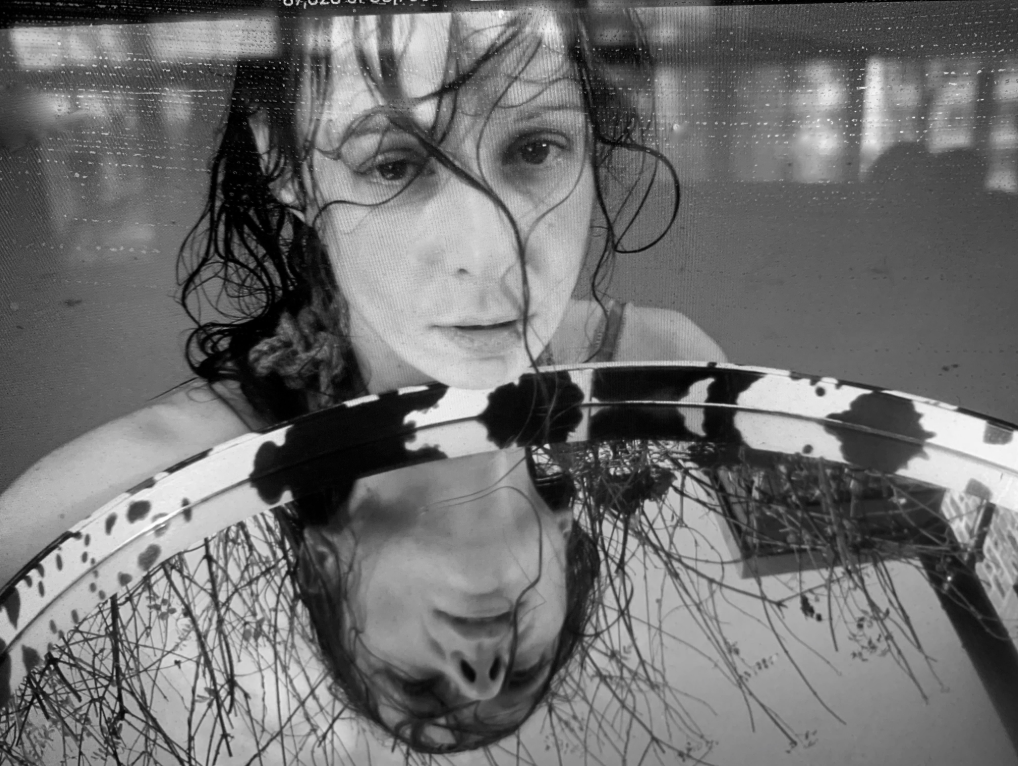
To coincide with this reprise, Goller and filmmaker Pedro Velasco have created a suitable visual abstract swim of a video for the album track ‘What’s really important she wanted to know, pt. 2’. Filmed entirely underwater at a local public pool, the conceptual feelings of both floating and swimming in an abstract liquid are cut to the harmonic pings, padded springy climbs of the music.
The Dark Jazz Project ‘5’
(Irregular Patterns)
After a prolific fluctuation of identities and experiments, the singular maverick electronic and art-house boffin Andrew Spackman hung-up his former SAD MAN alias (after a splurge of numerous releases over the last five years) a few years back to crunch the codes of jazzcore under The Dark Jazz Project title.
‘100% political, 100% jazz, 100% dark’ we we’re told, this most recent platform for Andrew’s often sporadic leaps in electronic music and crushing techno filament cut ups is about as removed from that jazz tag as you can get. Any semblance to jazz has been lost under a heavy tubular and granular transmogrification of the ominous, mysterious and, well, dark. And after three albums in that mode, and after another change in the direction of travel with this April’s cult (re)score of The Cabinet of Dr. Caligari, Spackman drops a surprise album of material that further expands the boundaries – the only recurring theme being that you won’t find a shred of jazz.
Album number “5” combines the apparitional dance music and pop synth vocals of seafarer’s ghosts, dream creations and new age with the techno of the Artificial Intelligence series, House music and a range of sounds that can only be described as whistled pipes, magnetic, kinetic, crystalised and bassy.
Beneath, above and consumed by metaphorical and thematic waves, a shipping forecast of hallucination, ethereal allure, and the emotive is transduced and transmogrified through Spackman’s unique apparatus. For glimpses of Radiance Basic Channel, the acid of LFO, and dreaminess veils of epic45 morph into spells of Mixmaster Morris and 808 State on the 90s meets Ibiza entranced ‘The Boat Is Sinking’ – no, not a screaming tumult of shipwrecked fear and danger, but far more soulful electronic mirage of haunted dance music.
Tracks like ‘Too Far Away’ weave giddy high octave, near cartoonish, EDM singing with Depeche Mode and Mark Franklin, and the spatial counterpoint between space age fantasy and the more unsettling ‘Testpiece’ sounds like acid rain hitting a windowpane whilst Moroder sequences a trip through the mists of time. The opening thwack turn rhythmic, drum pad crunched metallic spindled ‘Thunder’, features turnkey twists and a strange, obscured sound source horn that sounds like something from Eno and Jon Hassell’s “possible musics” explorations.
For a reference and theme, Spackman maps out a new sound by utilising the plaint songs of love lost upon the waves. Meanwhile, the album’s artwork, credited to B.S. Halpern, illustrates the density of commercial shipping throughout the world’s oceans. But, as with so many of Spackman’s projects, those prompts are transformed into something alien and cerebral, yet also striking, discombobulating. I will say, it is among his most soulful and melodious works to date. A layered album of many strands musically and sonically, the voices, mostly ghostly but in a nice melodic dreamy way, go well together with the balance of electronic forces. Considering, and I lost track a while back now, that Spackman has probably released nigh on fifty albums and pieces since this blog started, he continues to equally surprise and develop.
Xqui & Dog Versus Shadows ‘Dwell Time’
(Subexotic) 6th December 2024
Mundane behemoths of consuming spending, the Arndale chain of America-style shopping malls, first exported to UK shores in the early 1960s, provides the environment and atmosphere for the latest project by the sonic partnership of Xqui and Dog Versus Shadows.
Lancashire artist Xqui will need little introduction to regular followers of the Monolith Cocktail. The highly prolific artist, occupying a liminal space between ambient music, sound art, musique concrete, field recordings, hidden source material, found sounds and voice experimentation/transference, has frequented my reviews roundups for years; always playing catch-up, he no sooner releases one project than another arrives along the pipeline a week or two later. But featuring for the first time on the site, Dog Versus Shadows is the nom de plume of the Nottingham-based and no less prolific Lee “Pylon”, who switched roles from platforming an abundance of experimental electronic sounds as the host of the underground radio show Kites & Pylons (broadcast on Doncaster’s Sine FM) to making music himself.
As part of a trilogy of shopping centre albums, made by a host of experimental contemporary artists for the Subexotic Records label, this duo transduces the innocuous consumption and day-to-day thoroughfare of such commercial spaces into J.G. Ballard style dystopias, the sci-fi, esoteric, playful, and inter-dimensional. Defined as the length of time a shopper spends in a shopping centre – from the moment they enter till the moment they leave -, the language of capitalist spending theory, “Dwell Time”, is enveloped by the synthesized, warped, mechanized and consumed atmospherics, sine waves, filters, effects, degraded surface sounds, rhythms, chemistry, liquids and data of electronic music.
Whilst no particular Arndale centre is named or made obvious – there were 23 of them built, from Aberdeen to Dartford -, the most infamous is probably Manchester, which was devastated by an IRA bomb in the mid 90s. Closer to home – well Lee’s anyway, there’s also one in Nottingham. Derided, quite rightly, for their original brutalist and unsympathetic architecture, and the way they popped up over the rubble and dust of far more congruous, loved Victorian High Streets, they’ve often served as the blights of modernity, a totem for all modernist ills and the degradation of far less consumerist-obsessed times, when shopping was a gentler and more localised affair. From the lay-out to displays and choice of pipped “muzak”, the Arndale – a portmanteau of its architects Arnold Hagenbach and Sam Chippendale – meccas of pointless spending lure the consumer into an artificial, alternative reality in which time, location doesn’t exist.
Here, the duo emphasis this dreamier fantastical but alien and looming ominous despair, balancing indoor water feature idyllic whimsy and enchantment, the projected paradise of shop display Flamingos with forbode, unease and the surreal. And so, they somehow express the hallucinatory transfixed shopper’s gaze at plastic exotica, so entranced that for a moment they zone out into a weird void, or, make something as ordinary as roller shutters, the mechanisms, and drudgery of opening or closing up take on something far more dramatic and overbearing – there’s what sounds like a enervated lash or whip that trashes away indolently throughout. ‘Bargain Bin Shuffle’ takes on a sort of train-like rhythm, whilst the retro ‘A Fancy Electronic Gadget’ tweets and bobbles like something from the minds of Bruno Spoerri and Nino Nardini. Weirdly, the title-track sounds like an ethnographic Dadaist take on Javanese music.
Mark E. Smith once prompted a Northern uprising over these encroaching dystopian examples of rampant consumerism, on his 1980 track ‘N.W.R.A.’; lyrically picturing the day it was razed to the ground (which nearly happened 16 years), with “security guards hung from moving escalators” – rather strong. Chiming even then with the loss of community shops to such temples of commercialism, it marked a worrying change in habits and spending powers. Xqui and Dog Versus Shadows channel such apocalyptic concerns, protestations and the mundane and artificialness of such environments into something approaching a both playful, retro, knowing and sci-fi soundtrack of transmogrified muzak.
Various Artists ‘Fauna’
(n5MD) 10th December 2024
A deeply connective reminder about what we owe to the natural environment and its wildlife, the newest compilation from Oakland-based label n5MD finds roster signing Franck Zaragoza (otherwise known as Ocoeur) curating a curious and emotionally pulled gathering of congruous ambient peregrinations, scores and vapoured sensibilities that abstractedly, or otherwise, fall under the topic heading.
The label statement drives at humanities growing divisions, pursuit of consumerist and selfish pleasures, destructive consumptions and exploitation of the planet. All this at the expense of our animal friends; our lengthy historical relationship one of detachment to their pain, emotions and needs. Released on International Animal Rights Day (December the 10th), and with proceeds going towards the French organization L214 (taking their name from the French rural code in which animals are described, or translated, as “sensitive beings”, this group’s origins grew out of a campaign to abolish the cruel practices of foie gras, and mass industrial scale meat and dairy production), Fauna gathers together the work of an international host of mostly solo electronic and neoclassical composers, musicians and duos. Many of which have released or continue to release music on the Californian label.
It’s curator himself, Zaragorza, lends a beautifully cooed and vaporous ambient evocation to the compilation. The French minimalist, known for his introspective pieces and soundtracks for video games and documentaries, appears under his long-standing Ocoeur moniker with the rather pleasing and drifted ‘Second Chance’.
But the album opens with the Turin artist Memory Noise, who ushers in the collection with the recollected vapours, adult and children’s voices of laughter and play, airy and surface atmospheric ‘L’ora’, which reminded me of both the Aphex Twin’s Selected Ambient Works Volume 2 LP and Eno. Memories resonate amongst the sine waves, shrouds of time and melodious textures on this stirring piece.
Within the fields of ambient music and its many pathways there’s examples of artists using subtle if deep and sonorous neoclassical piano (the Athens born but France-based multimedia composer of note, Zinovia Arvanitidi’s capitulating and heavenly play of elemental nature ‘Light And Clouds’, which is exquisite and moving, and reminded me of both Hania Rani and Nils Frahm), and what sounds like guitar (Micah Templeton-Wolfe, otherwise known as Stray Theories, use of a lingered and drifted guitar line on the glassy chimed, deep thinking if broody ‘Veil’ adds a touch of Land Observation to a Boards of Canada backdrop).
In the more ominous category, the Sardinian composer Martina Betti scores a dramatic psychogeography of welled suspense and lament and foreboding electricity on the incredibly evocative ‘Invisible Cities’. Whilst there’s a real hymnal beauty and emotional felt pull on Mikael Lind’s patter-like melodies and searching lullaby turn heightened strings stirring ‘Fur and Feathers’ – think a lamented tearful Sigur Ros collaborating with Harold Budd; one of the compilation’s highlights for me.
An emotional ambient coalesce of like-minded artists, aiming to make the world a better place, and to rebalance our neglective relationship and dominion over those we share planet Earth with, the benevolent Fauna is a gift, a magical and often mood-shifting immersive draw of top-quality stirring electronica.
Martin Tétreault ‘Vraiment plus du Snipettes!!!’
(DAME/Ambiances Magnétiques) 6th December 2024
As the exclamation marks denote this is the third such volume of retrieved archival experiments produced via an apparatus of record player, cassettes, radio and various surface sounds from the free improvisation Québec innovator Martin Tétreault. With over sixty releases under his belt there’s a lot of material floating about: a lot of it previously unused.
Although there’s been considerable gaps in this series, which initially began back in 1992 with the limited cassette collection Snipettes!, followed by a “reprise” in 2007 after that inaugural instalment was re-released on CD, the latest volume continues to draw upon the idiosyncratic turntablist’s more “irreverent” sonic, dialogue, concrete and musical collages. For there is levity, a sense of fun, playfulness, wit in the way each avant-garde etude, passage or improvised performance is spliced (more in the sense of how it sounds than actual methodology) and put together.
At the centre of it all, or most of this play, is the turntable, which often sounds as if it is being impeded or led astray through pitch and speed manipulation and covered or wrapped by hidden materials. Less Qbert or DJ Shadow and more Basquiat or Nam June Paik qualifying for an avant-garde version of the DMC World Championships, captured extracts of serious theory, science, philosophy, lectures, the state of consciousness are morphed, twisted or shunted by a lifetime of accumulated snippets from TV, radio, cartoons, theatre, the opera, the rock concert and the art world. High meets low art, popular soundtracks meet the Afro-Cuban, and retro futuristic predictions of computer power, of domed utopias and the like come up against the mooning, the loony and ridiculous.
At times it plays out like Fluxus skits, and at others, finds a new rhythm and groove bordering on Afro-jazz or no wave or even funk from the transformed source material. A bastardised jazz-prog-noodling Zappa can suddenly also evoke Django Reinhardt fronting The Fugs; an informative French speaker is taken over by staccato nylon-strung Caribbean music and an off-kilter transformation of the Tango; Michèle Bokanowski “cirque’ comes to town under a bendy hallucination of shooting effects and Library music zaps; an echo of Jef Gilson is lost in the background cacophony of classical theatre; articulated ideas on science and reality sit next to feminine coquettish French annunciation and the scraping, rubbing and distorted abrasion of paper; and retro computerised calculus and sci-fi is paired with the spooky gothic theatrics of Edgar Allen Poe. These are just some of the happy accidents or intended results (in my mind) of these often humorous and amusing snippets. The uninspiring concrete mundanity of loading the tape recorder and other mechanised clicks, the dialling of an old telephone, stretch the imagination, whilst also stretching the listener’s patience in what can only be described as another of these Tétreault teases or in-jokes.
Originally these recordings would have been directly recorded on to a reel-to-reel, bypassing any mixing console. And so all the “quirks” the surface noises, the fizzes, crispy crinkles and muffles are kept as part of the makeup, the character; as Tétreault puts it, in keeping with preserving as much of the original recordings as possible.
Reanimating and morphing a diverse range of collected fragments from lessons in hypnotising to Marx Brothers like nights at the opera, and from echoes of the Art Ensemble of Chicago to recontextualised lofty addresses and sketches, Vraiment plus du Snipettes!!! is in many ways an antidote to the seriousness and earnestness of this art form.
Facilitated by the Canadian Ambiances Magnétiques – just one of the many labels that gathers under the Distribution Ambiances Magnetiques (or DAME as it is known) platform umbrella – this third collection of fragments, variations further cements Tétreault’s playful and experimental legacy, whilst also introducing a new generation to his pioneering work in the field of turntable-led, but also radio and cassette tape, exploration and transference. I’d recommend to anyone interested in Philip Jeck, Christian Marcley, People Like Us and Milan Knizak.
Black Temple Pyrämid ‘Frontier Plains Wonderers’
(Cruel Nature Records)
Someone could easily dedicate a blog to just reviewing the output of Cruel Nature Records. This onslaught of a label catalogue can boast of around 58 releases in 2024 alone, ranging from the sublime to barracking and raw, the kosmische to avant-garde.
Brian ‘Bordello’ Shea has already dipped his toe into the prolific giving waters, reviewing a couple of records from the November schedule last month, but I’m going to pick up on a returning entity, the obscured Black Temple Pyrämid, who featured on this site back in 2021 with the veiled atmospheric acid-hippie folk, post-punk and kosmische style The Hierophant album – released on the most brilliant underground label Submarine Broadcasting Co.
Details remain succinct, but opening gateways into cultist worlds, imbued by the Teutonic luminaries of acid, trance krautrock, the Pyrämid seem to broadcast from Colorado. This latest album was previously “nestled” amongst a number of releases held together within Patrick R. Pärk’s Desolate Discs hexalogy, released back in October. Now uncoupled in its full visionary glory, the experience is one of hallucination, the paranormal, the pagan, the hermitic, the entrancing, the disturbed and alien.
Across a quartet of both rhythmic and soundtrack-style preignitions, the mood is one of mysterious immersion, occultist weird folk, of amorphous sounds from different geographical realms and vague religious atmospheres; starting with the near sinister industrial steam-pressed tunnel slow-beaten and clang-reverberated ‘Fishers Peak Worship Song’, which could be a slowed down version of a monotonous Neu! traveling down a metallic corridor with Fritch and A.R. & Machines until the krautrock vibes become overbearing, eating away at this Faust-like march.
‘6,651 Days’ (which I think I’ve calculated as eight years and a few months) is an oddity and off-kilter dance of Krautrock-jazz, Bex Burch and Brahja-like Ethnic fusions, and American Monoexide elements, whilst ‘Alchemy of Emptiness’ draws, at first, on John Carpenter and Goblin, before a supernatural fusion of Current 93 and Drew Mulholland passages emerge. You can throw in a transformed version of techno 2-step, steely effects pedal Ash Ra Tempel, ethereal spells of renaissance hermitic invention and the sound of a guitar being sawed or sheared on a workshop grinder.
The finale is a 23-minute soundtrack of twisted dirge-y post-punk and mystical pagan ceremonial rites and mood music. Suffrage, the state of it all, this traditional whole side of an LP spanning score keeps a constant smirched and gloomy rolling, beating rhythm whilst adding or subtracting, or congruously moving into varied passages of the choppy, the skippy, mystical, pained, recollected and at the very end a droning stained-glass ray of hope. I’m calling this is an atmospheric convene between The Legendary Pink Dots, a more subdued GOAT, the Velvets and Nature And Organisation.
Pitching it just right as always, Black Temple Pyrämid invoke mystery, thought and the abstract feelings of “loss” and “mid-life growth” in a temporal framework of visions.
For the last ten years I’ve featured and supported music, musicians and labels I and the blog’s other collaborators love across genres from around the world that we think you’ll want to know about. No content on the site is paid for or sponsored and we only feature artists we have genuine respect or love for. If you enjoy our reviews (and we often write long, thoughtful ones), found a new artist you admire, or if we have featured you or artists you represent and would like to buy us a coffee at https://ko-fi.com/monolithcocktail to say cheers for spreading the word, then that would be much appreciated.
The Perusal #60: Anna Butterss, Niwel Tsumbu, TRAINNING + Ruth Goller, Donald Beaman…
October 10, 2024
A WORLD OF SONIC/MUSICAL DISCOVERIES REVIEWED BY DOMINIC VALVONA
(Unless stated otherwise, all releases are available now)

Anna Butterss ‘Mighty Vertebrate’
(International Anthem)
Branching out once more to lead a company of long-time collaborators on an expletory journey of groove and rhythm (because no matter what the concept, the theory, the strategy, this album has both), bassist and composer Anna Butterss fuses the likely and unlikely into a new album of expressive possibilities, landscapes and feels.
The scope of wandering into new worlds, conjuring up new moods and peregrinations is large. Mainly a result of wanting to write music after a long period of extensive touring, Mighty Vertebrate is a refreshing outlet of ideas prompted by Oblique Strategy-like stimulations. Hardly restricting, as I’ve already laid out, these strategies spark creative trains-of-thought, of process, methodology and performance. So, for example, as Butterss describes, they are “…going to make a song where the bass doesn’t function in the role of a bass”, or, “…make a song that uses groups of three-bar phrasing”. And so on. Technical yet simultaneously vague and even open-ended, this amorphous set of rules merely acts as a starting point: not only for the in-demand bassist but their foils as well. And despite all that technical musical language and the range of influences, sounds, ideas, the bass guitar (sometimes Butterss switches to the upright) is mostly recognisable: sounding on occasion quite funky (think Bootsy Collins) and soulful, rather than avant-garde and deconstructed.
Moving in the right-on circles in L.A., and very much in-demand for not only heading their own projects but collaborating and improvising with such notable names as Jeff Parker, Makaya McCraven, Phoebe Bridges and Jason Isbell, the Australian-born artist is a member of that city’s Small Medium Large super-quintet. Members of that same group now join their bandmate on their solo adventure, with both Gregory Uhlmann (on guitar) and Josh Johnson (on saxophone) contributing parts throughout alongside International Anthem’s (pretty much) in-house sound mixer, Call & Response concert series founder, in-demand drummer and multi-instrumentalist Ben Lumsdaine (acting as the album’s co-producer and percussionist). Added to that quality lineup, the L.A. based guitarist and composer, “prolific sideman”, oft member of the highly influential Tortoise and founding member of both Isotope 217 and the Chicago Underground, Jeff Parker offers up a special one-off turn on the electro 80s, Japanese new wave and jazz twiddling fusion ‘Dance Steve’.
Hints and recalls from all the above’s own groups, ensembles and projects can be heard at one time during the duration of Mighty Vertebrate. And why not? This is one talented bunch of players and innovators, working in a very hot scene right now; encouraged by one of the most prolifically brilliant labels of recent years in contemporary jazz and beyond. And yet it feels like a culmination of musical threads being put together, whether intentionally or just going with the energy, the directional prompts of the moment.
Across many of the tracks there’s a balafon-like bobble and shuttering woody percussive influence of Africa (Mali, perhaps Kenya too), a simmered down Afrobeat rhythm ala Tony Allen in places, and the saxophone of Peter King. This fuses with a Tortoise, Yoshiaki Ochi and Ramuntcho Matta vibe on the opening ‘Bishop’, and merges with touches of label mates Jeremiah Chiu And Sofia Honer, Antibalas and LAGOSS on the fluted and smoky sax serenaded ‘Shorn’.
The more gently inclined and peaceable ‘Ella’ reminisce takes a jazzier blues and American prog approach. And the following mirage shimmered ‘Lubbock’ (named after the Texan city with a famous son, Buddy Holly, and famously nicknamed “Hub City”) reminded me of both Daniel Vickers and Daniel Lanois. ‘Breadrich’ is a real mix, with its crunching more gnarly bass, Cobham fusion jazz inklings and Brides Of Funkenstein meets cosmic 80s Italian new wave vibes. And then at other times it’s more like Ariel Kalma, Chick Corea’s Elektric Band, Alfa Mist, Joe Zawinul, Coltrane, and Matthew Halsall. But regardless of all that, Butterss finds a near intuitive pathway of individuality that crosses borders, timelines, moods, musical signatures and structures to find rhythm and groove balanced by emotional pulls to important reference points and feelings in their life. I’m not even sure if you’d call it leading so much, but this solo gig proves a stimulating treasure trove of musical and sonic ideas with purpose and skill.
TRAINNING + Ruth Goller ‘threads to knot’
(Squama Recordings) 18th October 2024
Two connective forces in the experimental, inventive contemporary jazz scenes combine their experiences and art on this sonic and musical hybrid.
Although both participants have crossed paths previously, this is the inaugural adventure from the German drumming and saxophone combo of Max Andrzejewski and Johannes Schleiermacher and the serial UK jazz movement instigator Ruth Goller. Regular readers may have recognised the former pairing, both being synonymous with the HÜTTE name, an ensemble that began back in 2011, and featured on the Monolith Cocktail back in 2019 with their radical take on the music of Robert Wyatt. Born out of more recent rehearsals, the TRAINNING appellation has stuck for now, and it is in this form that they appear now – although that Northern European HÜTTE influence is hard to resist.
Goller’s CV is way too impressive and prolific to list in its entirety here, but the composer and bass player’s most notable credits include two of the most important and influential groups to set off a jazz renaissance in recent years, Acoustic Ladyland and Melt Yourself Down. Goller has also performed with such luminaries as Kit Downes, Sam Amidan, Marc Ribot and (Sir) Paul McCartney, and plays with both Let Spin and Vula Viel.
There’s enough threads, nodes and junctions in between to feed off, but both partners in this knotted tension and more spiritual, lofty, airy and aria-like ether Linda Sharrock “ah’d” fusion of influences and prompted sparks of inspiration read each other very well. Directed by, and riffing off, the “Exquiste Corpse” parlour game so beloved by the Surrealist movement, the trio of players expand beyond the jazz idiom into shadow worlds, the mysterious, supernatural, cosmic and near industrial.
Although popular in France amongst many circles, the Surrealists used the exquisite corpse game as a subversive collaborative drawing exercise in which each participant added whatever subconscious extension they could dream up to a chain of hidden images, the results of which when revealed could result in the weirdest of oddities. With the likes of grand doyen of the form, and way beyond, Max Ernst taking part alongside Dali and Miró you might have big bird’s plumage next to the shapely naked crossed legs of a muse and tennis racket feet. It’s used differently here however, generations on, and in musical form, with one of the players either writing bars or music, but then passing only the last bar, or sometimes only the last two notes, onto the next, then the same again to the next player and so on until a song’s skeleton was formed.
Far from exotic creatures and humans of dreams and nightmares, the results are a mix of chaotic freeform, post-punk prowling, the down beat, the foggy and the fourth world experiments and suffused atmospheres of Jon Hassell.
Both the TRAINNING lads also play synths and guitars, and so the range of sounds and instruments is expanded even further than sax, drums, voice and bass: sometimes towards the electronic. There are oscillations, arpeggiators and synth lines that hint at the kosmische and early analogue sound: from Conrad Schnitzler to Kraftwerk and Schulze. The guitars meanwhile have more than a hint of Marc Ribot about them, especially in passages on the hovering, alt-country ritual of ‘Backlog’ – this one is as disturbing as it is mysterious and vague with its post-rock doom threads, singular thumped drum, shimmered hazy rattle shakes of percussion and harmonic picks and plucks.
Elsewhere, old as dirt, ‘Agelong’ walks in the shadows of Scott Walker and Krononaut; the bass guitar, gnarled and trebly in a post-punk fashion, lurking and shaking in an atavistic gloom. And the messy off-kilter escalation that grows out of the opening electronics of ‘Threadfin’ is more like Last Exit and Peter Brötzmann. But then as the track progresses the mood changes again, merging math rock and punk no wave with Ethio jazz, veiled gauzy voices and instances of a more soothed Ivo Pearlman in a spiritual communion with Matana Roberts. By contrast, ‘Finback’ reminded me of Tortoise in some parts, and Donny McCaslin in others, whilst the dotted cone-like electronics that bring in ‘Lineage’ change shape and form, breaking out into a spell of Ill-Considered jamming with Nocturnal Emissions.
Pretty much out on the peripherals of jazz, ascending, flexing, rasping, soothing and breathing iterations and more untethered expressions of freeform music, TRAINNING + Ruth Goller fashion organic fusions from a process that promises the wild, tumultuous, wrangled and strange, yet also provides the melodic and dreamy.
Niwel Tsumbu ‘Milimo’
(Diatribe Records)
So, what does it sound like when a Democratic Republic of Congo born and raised virtuoso guitarist brought up on that central African region’s homegrown Soukous, studies the classical, relocates to Ireland, and finds themselves recording their debut LP at Peter Gabriel’s famous Real World label studios with the assistance of the renowned engineer Dom Shaw. Well, it sounds almost courtly, Iberian, Baroque, intricate, studied, and bluesy with a jazzy lilt and underlying feel of the homeland. For such is the range of Niwel Tsumbu’s skills as a deft and expressively rich maestro of the nylon-stringed guitar that the blending of international inspirations and absorptions is near effortlessly merged to create something quite unique.
Outlined in the press blurb, Tsumbu’s music and direction of travel is as influenced by the classical genius of Bach as it is by the Spanish Flamengo maestro Paco de Lucía and jazz deity Charlie Parker. Match this with the inspirational sounds of François Luambo Luanzo Makiadi, aka the legendary “Sorcerer of the guitar” Franco, one of the most influential figures in Congolese music in the last century (one time leader of the mighty TPOK Jazz band), and Congolese Rhumba’s more up-tempo and brighter, more intricately played scion/offshoot, Soukous, and you have a real worldly fusion of cultures at play.
With not much more than a guitar, and on only one occasion, a voice that seems to follow that guitar’s versant and twirling patterns, you can hear legato, glissando and the “rubato” (from the Latin for “stolen time”) signature of expressing rhythmic freedom by slightly speeding up and the slowing down the tempo forms of those referenced inspirations. It’s de Lucía, with a little Sabicas too, on the opening ‘Rubato’ reflection, and on the entwinned gypsy classical, plucked and pricked ‘Polyphony’; Bach, with touches of courtly old England on the trio of ‘Etude’ shorts; and Parker, joined by Wes Montgomery, on the near romantic dappled and picked ‘Tirizah’. The open-ended finale of watery motioned notes, ‘To Be Continued’, could be Bach resurfacing during the jazz age of 1920s America. And the sliding intro title-track has a nylon buzzy toned resonation of Mali blues to it.
The album’s most experimental performance/composition, ‘The Silence Within’, takes a completely different turn. A resonation of harmonics, a shimmer and rung pluck of notes hangs and lingers in the echoed canyons of Tsumbu’s inner sanctum.
With both a depth and real intricate lightness of touch to the often rapid, near seamless phrases, runs, articulations and intonations on this solo offering, and with a foot in both Africa and abroad, a classical learning is blended with a contemporary ear and musically well-travelled soul to produce a modern guitar gem.
Donald Beaman ‘Fog On Mirror Glass’
(Royal Oakie) 25th October 2024
The play and course of light, the recurring “phantom” and a beautiful subdued, nigh on elegiac poetry conjures up a simultaneous union of the beatific and longing on the latest solo effort from Donald Beaman.
Like a drifter’s songbook of subtle, intimate and home-recorded wanderings, metaphors and the like for yearned and plaintive romantic loss, fondness, the passing/measuring of time, and the urge to find comfort and solace, Fog On Mirror Glass uses memories of the weather, the way the light touched or dimmed at a given moment in time, and the smallest of witnessed movements/touches to evoke the right atmosphere of gossamer and sparsity.
Although backed on his previous four outings by a full band, Beaman has stripped right back, recording the bulk of the material in his own living room: where he sat and wrote most of the songs. Longtime stalwart Kit Land helped Beaman set up a makeshift studio of a sort, whilst also contributing bass and keys, and that room’s resonance and reverberated surface sounds can be heard throughout. It also gives the album sound an almost lo fi quality at times: in a good way. Yet despite that pared down approach, Beaman states that this album emerged from an idea he had to “present solo performances in conversation with full-band work”. And so, he brings in Michael Nalin on brushing and dusting light drum duties – occasionally those same accentuated, snare resonating rattled and languid drums gather some more pace and rhythm -, Jen Benoit to add a subtle and emotional touch of attentive backing vocals to the stairway of winding time, ‘Awhile’, and the yearned, disconsolate ‘Usual Phantom’, and Ken Lovgren on additional guitar for the slow-paced, fatigued title-track.
In a former life part of The Doubles band, and a mover on the turn of the new millennium New York City scene, Beaman has in one guise or another shared stages with a staggeringly impressive range of artists, from the late Jonathan Richman to Sharon Van Etten, Mdou Moctar and Marisa Anderson, and toured with an eclectic list of noughties influencers.
But his music, and in this instance, is like a Venn diagram of Cass McCombs, Bob Dylan, Bert Jansch, Jeffery Silverstein, Jake Xerxes Fussell, The Mining Co. and early Fleetwood Mac. However, the opening lovely trickled and drifted warmth and resonance of ‘Glass Bottom Boat’, formed in New York and finished once making it to his new home of North California, has an air of Robbie Robertson playing some Baroque or near Greek beauty on a mandolin about it – by the way, I don’t believe it is actually a mandolin being played on the record, just has that feel. A wanderer’s tale; an alternative aquatic floating road trip in the humid heat, it’s perhaps one of my favourite songs on the album.
Some songs also have almost a country and bluegrass feel to them, like the skiffle and shuffled “drawn by the light” ‘Old Universe’ – one of those themes of distilling the entire gravity of it all, the world, the universe, into a moment captured, a gesture, a turn or look in a very particular room, on the stairwell or in an idyllic but less than homely scene by a river. There’s also the inclusion of a church-like organ to add some kind of beatific bathed light on the Leonard Cohen-esque ‘Your Dreaming Eyes’.
In all, a most impressive and understated songbook of honest quality and performance, themed largely around the way light falls upon any given metaphor, analogy, phrase, description and texture. Unadorned, the feelings are left to pull and draw the listener into a most intimate world. Each play reveals more, as the album really begins to grow on you. A fine record indeed.
Rhombus Index ‘hycean’
(See Blue Audio)
Named after the hypothetical type of planet with liquid water oceans under a hydrogen atmosphere – in other words, a promising candidate for habitability -, Rhombus Index’s fourth album for the discerning introspective ambient and electronic label See Blue Audio reflects on the ever expanding, and encroaching, fusion of artificial intelligence and the organic. Sonically in wonderment, if near joyously radiant and positive in places, that relationship between nature and the digital is stimulating, regenerative and subtly hypnotically entrancing.
Back in solo mode after his collaboration with See Blue Audio label mate f5point6, the West Yorkshire artist and crafter of biomorphic worlds continues that “symbiotic” union by releasing his album on the same day as his foil. Both are similarly cut from the same kinetic ambient and electronic cloth it seems.
hycean however, has a certain life force of softly bobbing bulb-like notes, melodic wave forms, gentle ebbing synthetic tides, dancing atoms and dispersing playful pollen fizzes that builds towards insect wing fluttered and rotor-bladed itchy ticking techno beats. The natural shapes of geography are mapped out on a soundboard of the blanketed, submerged, the beaming and vaporous. In fact, the gentle ambient undulated ‘Coastal Curve’ uses a “sonification of coastal path measurement data” to evoke the desired effect.
Sometimes the beats are more active, like on ‘Flotsam’. Here they sound almost like some kind of transformed version of sticks or hand drums, or even tablas, tapping away in a near soft d’n’b style. ‘Digital Anemone’ (from looking it up, I’ve come up with “anemone” being the word for a genus of flowering plants in the buttercup family) doesn’t so much break out into but builds lovingly towards a joyful beaming dance of subtle techno and trance.
A musical photosynthesis; a sonic growth of fauna, flora and algae; hycean is both an audio and image generated fusion – see the videos and accompanying artwork – of crystallisation, the blooming and expanding: an image manifestation that shows nature in a very alien new light. Part Dr. Alex Paterson ‘Loving You Live’, part Seefeel, part eco trance, it will (excuse the pun) really grow on you with each new listen.
Poppy H ‘Wadham Lodge’
(Self-Release)
Haunted invocations of past lives and half lost and half hallucinatory recalled memories swim around in the metallic filament ether of Poppy H’s imagination on the mysteriously veiled experimental artist’s latest release.
In “celebration” of the cassette format – the first physically tactile album in a while from the prolific composer -, all the foibles of that format are emphasised and played with; from the degradation in quality, changes in speed, and the signature surface sounds of tape itself, to the physical presses of the stop, pause and play buttons on a tape recorder. Finding its way onto tape culture, the expletory concept and processes used to conjure up Wadham Lodge – apart from the name of the semi-professional East London football team Walthamstow F.C.’s home ground, and the Tudor era Wadham patrons who founded an Oxford Collage, I’m not sure if this title is borrowed, meant to be based on a real place or a reference, or made up – are new. Physical recordings of his catalogue of work, both old and unreleased, were played and mixed live simultaneously, and accompanied by original live improvisation and compositions. This multilayered process was then captured and mixed, like much of his work, on to a mobile phone.
An interesting and novel concept that results in Fortean transmissions, mirages and vague traces of human activity, conversations and environment. Greyed out, filtered and often in a lo fi magnetic shroud that borders on the paranormal and apparitional, more melodic tunes, mechanised beats and sonic illusions manifest from the mystical fabric of reconstructed time.
Memories are fed into a cryptic model of visitations and sonic consciousness. Take ‘loosely based on grief’, which merges the familiar – albeit manipulated and filtered – sounds of industry and the train yard contact points – the iron scuffed and screeched sounds of a train moving down the tracks – with a Faust Tapes-like foreign broadcast. Or the woody mechanical slot machine-like sounds that merge with a mist of a supernatural Murcof and the Aphex Twin and tweeting bird life on the time measured ‘wild stab in the dark’. From these prompts, these maybe half lingered forgotten thoughts of scenes and the moving world around him, emerge visages and emotions.
It’s the sound of the Boards of Canada, Matthewdavid, Lukid and Oberman Knocks half reminisced, and captured on to ghost tapes. Another unique experiment from Poppy H that elicits new visions.
The Galactic Cowboy Orchestra ‘Lost In Numbers’
(Independent) 11th October 2024
Losing themselves in the mathematical technicalities, phrasings and time signatures of a tumultuous, but kind and melodious, jazz-prog-country-indie-alt-rock fusion, the highly talented Galactic Cowboy Orchestra run the numbers forwards, backwards and every which way their dynamic performances take them.
Originally founded back in 2009 by bassist extraordinaire John Wright, imbued and prompted by the music of such notable influences as King Crimson, Mahavishnu Orchestra and The Dixie Dregs, the quartet have since fashioned their own form of technically challenging music that expands beyond the fusion sphere into all kinds of genres and moods.
The most recent iteration of the group features John’s wife and electric violin/lead vocalist foil Lisi Wright, drummer/percussionist Mario Dawson and acoustic and electric guitarist Dan Neale (who also occasionally picks up the mandolin, in true prog rock instrument switching style). Across various themes they masterfully gallop, spike and pique, riding a constant shimmer and splash of cymbals and percussion, as they fuse a squalling Michael Urbaniak and Jessica Pavone with Arti & Mestieri, a noodling Jaco Pastoruis and King Crimson: and that’s just on the opening title-track. When Lisi sings however, the mood is more like The Charlottes or Belly, even Madder Rose, backed by Zappa or Rush – see the math rock prog and alt 90s female-led ‘Righteous’ and more enchanting lyrical winding ‘Faith, Peace, Hope’.
To further the sound and influences even further, the group mimic the speedy flourishes and scales of the Raga Piloo on ‘In Passing’ – entwinning the traditional Indian form with ariel-like violin and active busy drums -, and sound positively supernatural, otherworldly on, what I take to be a tamed riff on Coltrane’s even wilder, maddening ‘Ascension’.
The Galactic Cowboy Orchestra’s new album (their sixth I believe) is for those seeking something different in the jazz and rock-fusion worlds, something as melodic and tuneful as it is technically clever and complicated.
Groupe Derhane/ freddie Murphy & Chiara Lee ‘Batch #4’
ALBUM (Purplish Records)
When not in the company of the celebrated Tuareg musician-guitarist Mdou Moctar (in a roll that includes bass, guitar, backing vocals, drum machine and producing duties) Mikey Coltun runs his Purplish Records label, dropping unconventional releases in “batches”: a singing of which is the already mentioned Moctar. With this unique method, Coltun twin’s artists from completely different backgrounds, international zones and genres, in a double cassette package.
Volume #4 really attracts polar opposites, with albums from both the Niger Tuareg band Groupe Derhane, fronted by Issouf Derhane, and the Italian experimental partnership of freddie Murphy and Chiara Lee, who also go under the name of Father Murphy, channelling Catholic guilt through natural and synthetic manipulation.
What unites both participants is a shared reification of the concepts, atmospheres and geographies of deserts; Derhane, with the most exquisite camel motioned rhythm and with that signature desert blues and rock guitar resonance, contouring and paying respect, whilst also longing, for the south central Saharan region of Ténéré (which in the Tuareg language literally means “desert”), and the Murphy/Lee duo scoring the overwhelming nothingness of the white desert landscapes of Antarctica for fellow Italian film director Lorenzo Pallota. Both works find their creators embedded in the landscape, performing and extracting the mood of the place.
With a remarkable back story of travails and movement, Issouf Derhane started off life in the Tuareg (though it must be pointed out, depending on who you ask, that many from this community of freewheeling Beaudoin prefer the term Kel Tamashek instead of the later Tuareg colonial loaded name) encampment of Tidene in Niger, a hub as it turns out for exceptional musicians, including Omara “Bombino” Moctar. But he was quickly swept up, we’re told, and itching to travel, ending up in Libya where he picked up the guitar. As the horrific, destabilising shitstorm of that country’s civil war broke out, and the Gaddafi regime tumbled, Derhane was forced to move once again, returning to Niger and the city of Agadez, the “gateway to the desert”, in 2015. This is where he met a fellow guitar enthusiast by the name of Mohamed. A connection was made, fuelled by shared roots, and together they formed the Groupe Derhane band, which quickly became a bit of a sensation in Tuareg circles.
Channelling a tumultuous time in the Tuareg plight, with the fight still ongoing for autonomy within the regions that spread across Niger, Chad, Mali and the Sahel, the increasingly alarming over-desertification and effects of climate change, and preservation of their way of life, the Derhane group encapsulate a longing and paean for home and their roots that sounds entrancing, beautifully and emotionally charged. The clapped rhythms, motions of the camel trail and shifting sand dune contours, and constantly turning, brightly resonating and buzz of the guitar are close to the sound of such Tuareg icons of the form as Faris, Terakraft and Tinariwen. It’s not mentioned in the notes, but I take it that both the opening ‘Tamidtin’ and closing ‘Ténéré’ are both riffs on or covers of Tinariwen’s songs, albeit with a less bassy and low vocal, more echo and brightness.
There’s a subtle use of the synthesized and electronic, which makes the reverberating and buoyant ‘Khay Tamadroyte Tamacheq’ sound near cosmic and throbbing.
The six-track showcase is an invitation to dig deeper, consume and absorb a burgeoning talent on the Tuareg scene.
Sharing this dispatches double-bill, the Torino-based sonic partnership of freddie Murphy (the lower case is intentional) and Chiara Lee channel a whole different kind of desert. More an isolated, white awe-expansive tundra, they transform the abstract forbode, mystery and overwhelming senses of vast Antarctica into a soundtrack for Lorenzo Pallotta’s experiences aboard an icebreaker. On his return from this field trip, the film director emphasised the shock of readjustment in a land where the sun never sets; where time has no meaning, or at least is hard to measure. Pallotta also described the vibrations, the breakage of the vessel as it cut through the ice, sounding like a constant earthquake.
All of this is fed into a soundtrack of the paranormal, primal, fogged, beastly and wonderous. Manipulated off-world readings, hums, surfaces noises, drones, dissonance and obfuscated voices provide the paranoid, the esoteric and a sense of movement through a world with no borders, nothing concrete but just space: lots of white space. Nurse With Wound, Throbbing Gristles, Gunther Westhoff and Szajner lost in the cold psychogeography, the Antarctic is as disturbing as it is a polar adventure vision of the Heart Of Darkness. But then the finale double of ‘Intermezzo + Closer’ sounds like an electronic kosmische scenery of Dinger and Cluster and cult Library music; the radiant magnetic lights of the southern hemisphere shimmy to a tubular dance.
Consider the mood set, the senses retuned.
Batch number four is yet another unique pairing of influences and sounds; two different geographies, different methods, yet both sharing a general theme of landscape and all the unsaid or unsayable abstract feelings, atmospheres that go with it.
Pyramid Waves ‘Screaming Brain’
(Syrup Moose Records) 18th October 2024
A cerebral haemorrhage; a blunt force of industrial sonics, caustic electronica and Fortean distress, the fifth work of traumatic discourse and dissonance from the French duo of Pyramid Waves drills into the four pillars of our dysfunctional modern society: that being, addictions, mental health, anxiety and cravings.
A bastard trauma of Front Line Assembly, Test Dept. and Merzbow, the Screaming Brain improvisations (recorded at their home studio) will leave you in no doubt as to the pained sufferings of its creators.
Demarcated into four parts of static white noise, analogue reverberations and interdimensional radio transmissions, crunch and crumbled beats, and echoed voices from some distant harrowing memory, doors to a tumultuous mind are opened to forces from beyond the mortal world. Because whilst the gristle for this album is all very real, the sounds grate, spin, switch towards a phantasm of the paranormal and alien. It’s as if a trapped psychogeography of echoing stresses and long dormant troubled episodes in the cortex has been wired into a supernatural apparatus of haunted and bestial sonorous severe disturbances.
Unsettling to put it mildly – especially the repeating dreamy melodic piano part that plays and meanders over a coarse bed of fearful distortion on ‘Trapped Underwater’ -, this uncomfortable but fascinating pull into the metal torture workshop of neuroscience squeals, slaps meat, drills and thumps its way to challenging and meeting its psychological demons.
If Richard H. Kirk, Richard James and SEODAH invoked Cthulhu whilst all in a room together, hunched over an apparatus of transistors, generators, motors, tools, drum pads and effects, then this is surely what it would sound like. Screaming Brian by name and nature, Pyramid Waves dissect the psyche of our troubling times, and the battles faced by the individual screwed-up by the system with horror and hurt.
Hi, my name is Dominic Valvona and I’m the Founder of the music/culture blog monolithcocktail.com For the last ten years I’ve featured and supported music, musicians and labels we love across genres from around the world that we think you’ll want to know about. No content on the site is paid for or sponsored and we only feature artists we have genuine respect for /love. If you enjoy our reviews (and we often write long, thoughtful ones), found a new artist you admire or if we have featured you or artists you represent and would like to buy us a coffee at https://ko-fi.com/monolithcocktail to say cheers for spreading the word, then that would be much appreciated.
 Monolith Cocktail Blog