The Digest for November 2025: New Music/The Social Playlist
November 19, 2025
THE MONTHLY DIGEST INCLUDES A CLUTCH OF ACCUMULATED NEW MUSIC REVIEWS AND THE SOCIAL INTER-GENERATIONAL/ECLECTIC AND ANNIVERSARY ALBUMS CELEBRATING PLAYLIST
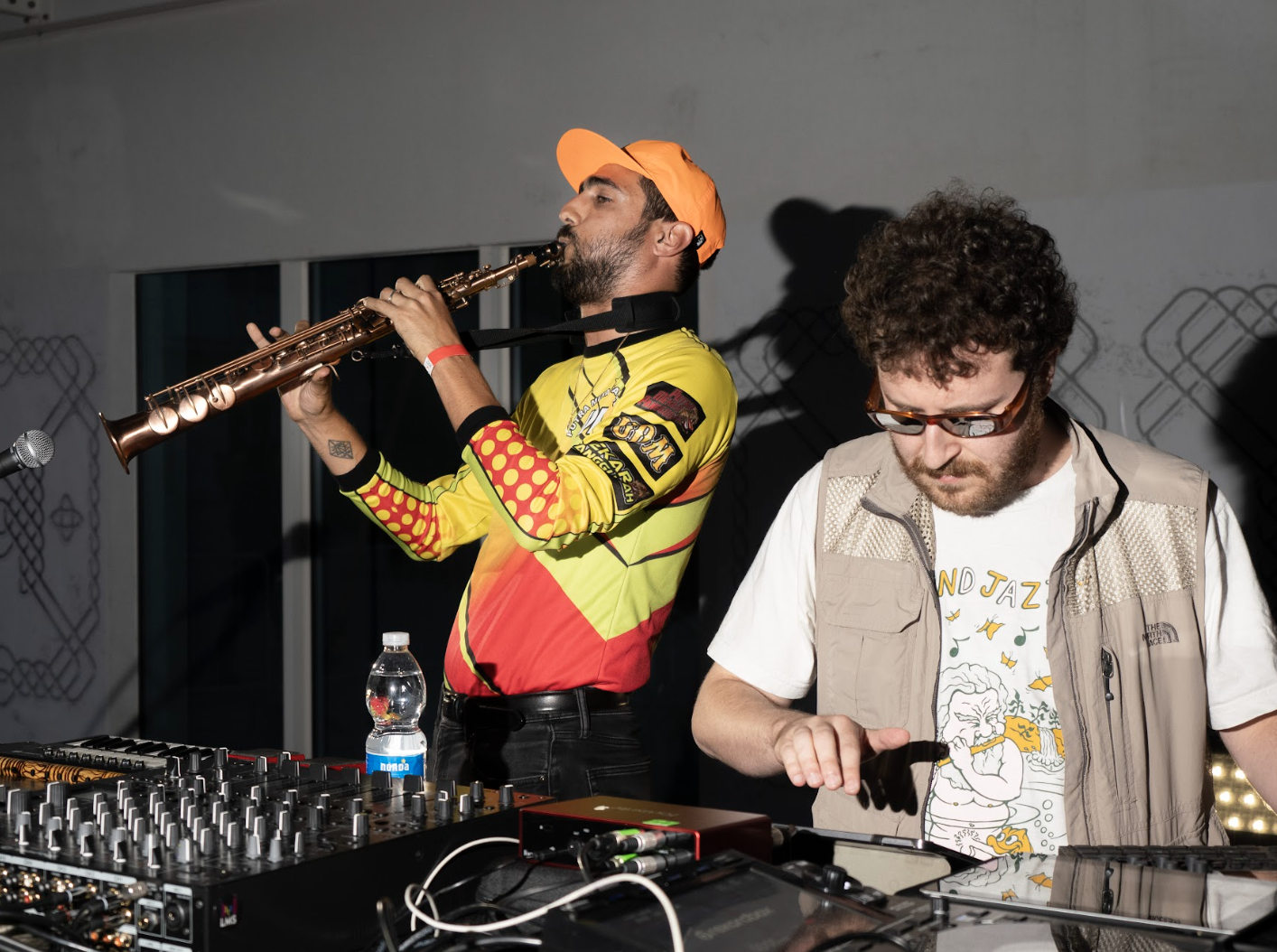
Photo Credit: Babau by Marco Valli
_/THE NEW___
Babau ‘The Sludge of the Land’
(Artetetra) 14th November 2025
A phantasmagorical shifting of tectonic plates and fever dream of a Henri Rousseau conjured equatorial lost world. And I could leave it at just that, but I’m sure both you as the reader and curious mind, and the duo behind this strange fourth worlds peregrination and inhabitation, would want a bit more to go on.
From the Artertra label founding sonic partnership of Italians Matteo Pennesi and Lugi Monteanni and their long-term Babau project an album that moves an imagined continent of influences towards new sonic, hallucinatory and kooky climes. The first “full length” work since 2023’s Flatland Explorations Vol.2, The Sludge of the Land funnels library music, the avant garde, the discombobulated, wonky electronica, the cartoonish, 32-bit console music, vague uses of ethnography and the atavistic, the visions of Jon Hassell, the breakdown shunts and floppy disc music of Esperanto era Sakamoto, the morphing AI electronic lunacy of Cumsleg Borenail, the fun kookiness and springy worlds of Carmen Jaci and Trans Zimmer & The DJs, new age trance, and at times, the more sublime drifts of Wu Cloud and Iasos into an odd repurposed wilderness. A track like ‘I tried to find myself but eventually found another, and now it’s the two of us somehow’ for example, merges Carl Stone with the mirage guitar bends and hangs of Daniel Vickers, the thinly dried blows of Ariel Kalma.
With titles that are so long as to read like haikus or little stories in their own right, there’s much in the way of descriptive prompts – although some seem like they might reflect the overuse these days of feeding blindly words, detritus and meta from the Internet into ChatGPT or some such device. Much of it describes a hodgepodge of ritual, mythologies, culture and the surreal. And musically and sonically reads like a mixed topography of palm trees, exotic islands, deserts, misty mountains and wet vegetation.
As part of a residency at Casa degli Artisti, Milan, in 2022, Babau turned their creative space into a recording studio and performing venue thanks to audio engineer and musician Francesco Piro, who produced the album. That apparatus includes instruments and effects that make sounds like reversed shaves, tangled and gangly wires, springs, chimes, the mistily fluted, and whistled alongside the recognisable sounds of a lingering foggy sax, of sauntered and hand tub drumming rhythms and both the inner workings of and the serial kooky notation of the piano.
This is an environment that squeezes the Mosquito coast up against Java, Malaysia, Polynesia and the near fantastical to produce something familiar but disjointed and surreal.
The Flower Press ‘Slowdance’
6th November 2025
Continuing to pursue a solo course, but now under the new appellation of the delicate craft imbued The Flower Press, Matt Donovan, in his own meditative and wistful way, turns the sudden loss of his sister into a subtly beautiful and reflective work of art on his fourth album.
The process of grief that prompted not only a change in musical direction (not so much that the musical signatures of past albums are entirely lost) but a much-needed therapeutic outlet, a project in which to find meaning from such a tragic event. The softly evocative Slowdance album offers consolation and testament to a life lived; the memories – referenced in a style with the track titles -, near abstract and visceral, are quantified and saved in sound and musical form to reflect upon with a great fondness and love. For Matt doesn’t just pay his respects, but also sends out moving testimony and vibrations as a way of keeping contact, of saying all the things he might have never had the chance to before, whilst healing himself.
Regular readers of the site may know Matt as the former motorising and propulsive drum beat behind Eat Lights Become Lights, and for his collaborative partnership with Nigel Bryant in the psych-Krautrock-post-punk-folk-industrial duo The Untied Knot. Away from the latter, Matt has released a trio of solo albums: Underwater Swimming (’21), Habit Formation (’22) and Sleep Until The Storm Ends (’23). This latest album of mainly instrumental pieces, takes some of the old influences but, with warmth and a wisped gauze of ether, is moving towards the orbits of Ariel Kalma, Daniel Lanois, The Durutti Column, the flange guitar-like ambient works of Harold Budd, Eno, Susumu Yokota and Mark Hollis post Talk Talk. But then there’s always a certain quirkiness and flash of post-punk and no wave dance music trebly bass playing to be found. And of course, the acoustic folksy and troubadour influences that sound particularly pastoral or in-situ: conjuring up some held dear or nostalgic escape, a glade perhaps or the sensation and touch of falling snowflakes and the building of a snowman. Some of those moments reminded me of the Wayside & Woodlands label whilst others of Arthur Russell.
The measuring of time, the chimes and triangle rings; the thin stick hitting tablas and the desert melting mirage guitar evocations of Daniel Vickers; the harmonium like moods and the Fripp-esque articulated memory of a slow dance watched from dreams; and both the stillness and the wavy, reverberated movements all articulate notions of remembrance and invested introspection. But also perhaps, manifestations of better times ahead, of durability in the face of such a heavy personal loss: the loss of a sibling hitting all that much harder.
A most wonderful album that eventually soars towards a starry celestial plane, Slowdance hovers and drifts above terra firma on a quest to evaluate and represent a life lived and the memories that pour forth from such fateful challenges. With a new title, Matt pushes into ever new and emotionally resonating territories.
Erell Latimer ‘Stay Still’
(Kythibong) 18th November 2025
The translation of visceral and abstract speech, dialogue, narration, poetry, testament, inquiry through musique concrète and tape manipulation, the new experiment from the sociolinguist composer and writer Erell Latimer is an immersive performance of reaction, interaction and interruption.
I’m not sure of the apparatus used, but other than the various machines used for effects, distortion, and what sounds like the manipulated in real time, folded, counter-folded and warped tape reels, both the long form pieces that make up this work rely upon Latimer’s voice and readings. Described in the accompanying notes as partly “concrete fiction”, fragments of Latimer’s text pieces and writings are set to a both alien and distorted, machine-like and discombobulated sounds and oscillations. Mostly in French, with passages of often disturbed or obstructed poetic philosophy and forbode from some English male speaker, the texts fluctuate between the hushed, the near in-hiding and held hostage to the clearly proclaimed and read. The cadence, both interrupted and defined signifies pain, anguish, the critical, stress, panic and theory.
The various resonated and reverberated voices and talks move from background quietness to foreground rustled distortion, and often form interlayered semantic rhythms and new utterances. Often though, Latimer’s voice is stripped down to an assortment of breathing techniques: often sounding like the aftermath of a panic attack, with Latimer trying to get her breath back or get it under control: exhales as important as anything else in this experiment and expression of “alienation, confinement, suffering, resignation, abandonment and death”.
There’s plenty of interesting, thrown, or points and nodes where both vocals and sounds interact to form hallucinations or more supernatural and haunting passages. Sometimes these interactions culminate in simulated tumults of hurricane winds, and others, into something far more musical; nearer the end of the first piece, ‘Ils seront silencieux après’ (“they will be silent after”), there’s a sort of lovely piece of music that’s part Gainsbourg, part Krautrock, part classical soundtrack.
From what sounds like paper or tape fluttering in the draft of a ventilation unit or extractor to bulb-like notes rings and chimes and the sounds of the environment, the voices and speech find space across a constantly explored soundscape of effects and obfuscation. At times it reminded me of Michèle Bokanowski, Matija Schellander, Lucie Vítková and that musique concrete progenitor Pierre Schaeffer; in short, an experimental work of language and semantics that deserves greater attention.
Plants Heal ‘Forest Dwellers’
(Quindi) 28th November 2025
The prolific and always into something drummer and trick noise maker Dave De Rose is back with his keyboardist/percussionist foil Dan Nicholls and visual anthropologist collaborator Louise Boer (otherwise known as Lou Zon) for another round of the electroacoustic project, Plants Heal.
De Rose popped up on the site as part of the Rave At Your Fictional Borders union of Jon Scott of (of GoGo Penguin note), Marius Mathiszik (Jan Matiz, I Work In Communications) and Henning Rohschürmann a while back, but his CV is packed with notable creative enterprises and collaborations, including membership of Electric Jalaba, a stint with the acclaimed Ethio-jazz luminary Mulatu Astake and instigation of the Athens-London traversing Agile Experiments project. The initial seeds for the Forest Dwellers project were planted both through the latter and through Nicholls and Lou’s London-based Free Movements events; both acting as intersections for all three contributors to cross paths, and to explore the central tenant of merging instrumental music with live electronics and DJ sets. If we’re talking about spheres of influence and CVs, Nicholls of course has just as prolific and busy schedule as a keyboardist, reeds player, composer, producer, and visual artis, whilst Lou’s documentary and experimental filmmaking and visual skills have led to a teaching role at Goldsmiths.
Lou’s work revolves around ecology, community, plant medicine, feminism, movement and experiments with analogue techniques. And this seems a good base from which De Rose and Nicholls have spontaneously reacted or conjured up improvised-like sounds and rhythms rich with organic meta and matter. During performances Lou improvises with analogue footage from her library run through video mixers and synthesisers, focused on medicinal plants such as yarrow, hawthorn, nettle and thistle. All those plants feature in processed form on the cover of the record, which was designed in collaboration with Lou’s brother Arthur Boer. Meanwhile, Lou recorded additional footage in Athens during the recording sessions to feed into the continued cycle of the project’s live evolution.
The trio’s second album together (their previous self-titled debut was released back in 2021) is a biomorphic eco system of new age trance music, techno, dub, light jazz, breaks, amorphous ethno-beats, acid and both plant-based and more alien atmospherics. Tech and nature combine to create a kind of Fourth World version of electronic dance music. But that’s really only part of the story, as the living and breathing creepers, vines and branches of the forest canopy and floor integrate with pulsations, shuttered, tubular, hollowed pole paddled and shaved or slowly released electronics to produce a camouflage reverberating effect of movement, growth and expansion.
There’s a revolution of a kind in the same air, with whispery like effected and morphed voices emerging from the fauna, and a revision of the old tribal gathering nature-tech and freedom rave-ups of the late 80s and early 90s. I’m hearing vague signs of Richard H. Kirk, FSOL, Jeff Mills, Lukid, Warp Records, Conrad Schnitzler, Mike Dred and Jon Hassell. Still, there’s more to unpick from the very much percussive and drum led rhythmic evolutions on this album; echoes of various more atavistic and exotic musical influences; timings and patterns enhanced by ethnography study and absorption. From terra firma to the stars, this organic flora form of electroacoustic dance music proves pliable, liquid but full of substance and the tactile, the earth and air.
Super Grupa Bez Fałszywej Skromności ‘The Book Of Job’
(Huveshta Rituals) 28th November 2025
From true obscurity and the dusty shelves of dormant archiving, The Book of Job emerges from its forty-year sleep – recorded as it was back in an omnipresent Soviet controlled Poland of 1985 – into a climate that scarily resonates. Whilst the sickle and hammer have disappeared from the flag, and Communist totalitarian rule has been replaced by a new form of oppressive authoritarianism in Putin’s leader-cult Russia, aggression persists and the threat of invasion, or at least escalation against those former countries that fell behind the Iron Curtain after WWII, looms large. No longer an abstract threat, Russia’s expansionist ambitions look to lock horns with Nato and the West, with a near apocalyptic destructive war in neighbouring Ukraine pushing at the borders of Poland. If nerves can no longer hold, if there is no end to the hostilities, no ground given on either side of this brutalist invasion, and if Ukraine is lost, then Poland becomes the new frontier between Europe and dictatorial Russia: a Russia hellbent it seems on regaining its lost influence and control of Eastern Europe.
There will be generations now totally separated from Poland’s past as an occupied state, subjected to draconian control by the USSR. But the timely arrival of this cult recording will once more remind its people and the world at large, of events in the 1980s; a decade when despite violent suppression, the population rose up to eventually overthrow its Soviet authorities at the end of that decade. When the various notable luminaries of the Polish underground and jazz scenes, and the counterculture’s actors and voices behind the collective ensemble of Super Grupa Bez Fałszywej Skromności first performed this multilingual and faith spanning work at the 1981 Jazz Jamboree festival, the omens weren’t quite so grave. Only weeks later the situation had changed dramatically, with Genral Jaruzelski’s ordained Martial Law rules cracking down ruthlessly on the population. In light of civil peaceful protest and the strike action and heroism of Lech Wałęsa’s famous Solidarity movement, the authorities more or less implemented a military coup of extreme measures: As the accompanying album’s scene-setting essay informs us, “Art was replaced by parades of heavy artillery”. By the time this same group recorded an album, four years later, the very act of making music would be considered a symbol of defiance: unless of course it was used to glorify the Soviet regime. “Paradoxically” the Catholic Church of Poland became a sanctuary. This may explain, in part, why the Hebrew’s Old Testament (reused in the Christian Bible and also “echoed” in the An-Nisa chapter of Islam’s Qur’an) chronicle of Job was used as totem for endurance in the face of such suffering. Because much as Job suffered tribulations and trails at the hands of God, beguiled and tempted by Satan to turn away from his piety, many of the Polish people found solace, resistance and hope despite the relentless attacks on their freedoms.
An allegory of the human condition, The Book of Job, for those who never attended their Sunday Schooling lessons, nor attended a faith-based school, tells the tale of the protagonist and his testing by God through litany and prose: that’s three cycles of debates between Job and his friends, Job’s lamentations, a poem to Wisdom, Elihu’s (a critic of Job and his friends, who may have been a descendent of the Abraham lineage) speeches, and God’s two speeches from a whirlwind. In short, Job is a wealthy God-fearing man with a comfortable life and large family, living in the Land of Uz (which has been situated in various locations of the atavistic Levant and beyond by various sources; anywhere from the old Aram, now modern Syria, to the Edomites kingdom, which now stretches across modern Jordon and Israel). God discusses his piety with Satan (though this is often written down as “adversary”, but we know who they mean), who rebukes God, stating that Job would turn away from God if he was to lose everything within his possessions: which was a lot. God decides to test that theory or challenge by allowing Satan to inflict pain on Job. The test increase, the suffering gets much, much worse, and Job ends up losing his wealth, children and health. Through it all he maintains his faith and piety, but not without much discussion and challenge. By the epilogue, Job’s fortunes and family are thankfully returned to him: Satan I take it, scuttling off to curse and sulk in the shadows.
Recorded in a makeshift “high-fidelity” studio at the STU Theatre in Krakow in the Spring of 1985, The Book of Job album draws with serious depth and political allegory upon the text. Covering everything from stage theatre to the filmic, the avant-garde and of course jazz – most of the lineup in this singular gathered super group hail from Poland’s incredible and influential jazz scene -, but so much else, the Holy Land is transported across porous borders to Eastern Europe to take in the Jewish diaspora, acolytes of Indian and Far Eastern scriptures and the then contemporary 80s sounds of the underground.
The “revered” pool of players, luminaries that took part include the multi-instrumentalist Milo Kurtis, a Pole of Greek origin, born into a family of refugees escaping the civil war in Greece, noted for his roles in Grupa w Skład, Ya-Sou, the cult rock band Maanam and jazz-fusion super group Ossian (also said to have worked with Don Cherry, who gifted Milo his ocarina), on percussion, Jew’s harp and trombita; the Polish flutist of world renown, composer and arranger Krzysztof Zgraja, who made his debut in the jazz-rock band Alter Ego, but also played with Czesław Gładkowski and Jacek Bednarek, on not only his main instrument of choice but the lighter made and smaller range Fortepiano; the Polish avant-garde and free jazz player Andrzej Przybielski, who’s notable credits include stints with the Gdansk Trio, Sesia 72, the Big Band Free Cooperation and Acoustic Action, on trumpet; drummer, composer and cultural animator Janusz Trzciński, known for his extensive work in the theatre, a writer of plays and one of the main instigators behind this project, on drums; the highly rated Zbigniew Wegehaupt, who played with just about every Polish jazz icon going and in both Wojciech Gogolewski’s Quartet and Extra Ball, on both electric bass and double-bass; and the Polish composer, multi-instrumentalist, vocalist and teacher Mieczysław Litwiński, who studied with such groundbreaking luminaries as Stockhausen and co-founded far too many groups and projects to list here, but notably the Independent Studio of Electroacoustic Music and Light For Poland, on sitar.
Added to that role call was an ensemble of either commanding, English Repertory-like or ominous voices and vocalists from stage, screen, including Ignacy Machowski, Adam Baruch, Zdzisław Wardejn, Jerzy Radziwiłowicz, Juliusz Berger and Andrzej Mitan. It must be pointed that only Mitan receives the credit of vocalist; the Polish poet, performer, founder of the Alma Art record label, chants a poetically evocative forgiving gospel of obedience and implored yearning whilst on the album track ‘When A Man Dies’. Echoed as much from a cavern or cave on the desolate plains of the Uz as in the synagogue, the repeated mantra of “Man. World. Pain. Silence” is stoically announced over and over to sombre and yet beautiful tones. The rest of that cast find themselves either narrating or interlayered with a whisper, chattering chorus of atmospheric dialogue. It reminded me, in part, of Aphrodite’s Child own Biblical opus 666.
Hallowed yet dark and almost Chthonian in places – a touch of Byzantine too – the album sets an otherworldly, afflatus but esoteric scene with the opening resonated waves of airy, fluted and blowy vibrations, moving like cycled or tubular wind from the subterrain, on the introductory entitled opener. Something mystical dances in the wind, as echoes of Alice Coltrane and Prince Lasha stir up spiritual jazz mirages and something quite ghostly seems to be lurking in the vibrations. The story unfolds, the mood suitably enacted. ‘Satan’s Concept’ follows this with percussive shimmer and shivers and a supernatural voice of forbode. Evocations of both Don Cherry and 80s Miles Davis like trumpet both trill and sound almost swaddled on another visceral and porous geographical musical landscape: the vibrated bowl sounds of Tibet for example. But the whole feel changes on the first of three litanies, with what could be called a post-punk bass and signs of krautrock and jazz-fusion: think an impressive union of Einstürzende Neubauten, My Life In The Bush of Ghosts Eno and Byrne, Desert Players Ornette Coleman, Jon Hassell and Ramuntcho Matta relocated to the land of the lost tribes. ‘Accusation’ has a promising Blue Note jazzy double bass introduction, a little bluesy and bendy. It’s accompanied by some rattled hand drums; the only instruments that express and lay down the atmospheric flexed, stretched, harmonic pinged backing to the biblical echoed English voice that narrates and questions God.
The post-punk-jazz mood is back for the second litany. A sort of no wave funk noodle of Dunkelziffer and Miles, a long low horn from the Steppes, and dialogue of wisped and more esoteric voices spoken in multiple dialects, there’s a supernatural quality to the atavistic summoning of scripture, and the age-old battles between good and evil. Almost skulked, there’s vocal coos and spectre like demons and angels in the shadows of this dramatic Krautrock-esque holy visitation. ‘Hope’ brings back in the Eastern influences, the sound of Buddhist India with the signature reverberations and brassy rings of the sitar: Shiva on the Vistula. With its psychedelic ragga mediations, the sitar acts in unison with the twanged boing sound of the Jew’s harp, the only accompaniment to the Hebrew narration.
The third and last of the litanies is quasi-80s funking jazz, with elements of Hassell’s Fourth World experiments. The flute whistles and flutters willowed fashion on a moving jazzy-fusion-funky-no-wave bass, as overlayed voices create a more convivial dialogue. There’s a smog horn too that creates a misty vapour effect. But the rhythm is like some kind of Israeli or Eastern European dance.
The album finishes on a strongly reverberated Hebrew voiced narration, a sacred holy conversation. Near the end of ‘Final’ a dreamier ray of light like flute emerges, slowly and softly drifting skywards. The sound of relief. A burden lifted.
You can easily find the parallels, the battles with faith in the face of such brutality, of oppression, and in this case, Soviet authoritarianism: The role of religion and believing playing a crucial part in resistance. As a near cryptic or hidden means of showing such defiance, The Book of Job and its lessons carried that message of artistic and political/social hope. This album, even without any of its important cultural and political context, is an artefact that deserves saving and savouring: a real intriguing, atmospheric and near theatrical experience worthy of attention and acclaim. Not just a slice of history but an experimental work of art.
___/The Monolith Cocktail Social Playlist Vol. 103___
For the 103rd time (and most probably the last as I change the format for next year), the Social Playlist is an accumulation of music I love and want to share, with tracks from my various DJ sets and residencies over the years and both selected cuts from those artists and luminaries we’ve lost on the way and from those albums celebrating anniversaries each month.
It was a few months back that I celebrated the 100th edition of this series, which originally began over 12 years ago. The sole purpose being to select an eclectic and generational spanning playlist come radio show, devoid of podcast-esque indulgences and inane chatter. In later years, I’ve added a selection of timely anniversary celebrating albums to that track list, and paid homage to some of those artists lost on the way.
The final social of 2025 merges together anniversary celebrating albums from both November and December. This selection includes 50th trumpeted milestones for Eno’s Another Green World, Patti Smith’s Horses, Kraftwerk’s Radio-activity, Burning Spear’s Marcus Garvey and Parliament’s Mothership Connection. There are even older throwbacks, 60th salutations, to The Who’s My Generation (I’ve gone for The Users version of ‘It’s Not True’ for something a bit different) and The Beatles’ Rubber Soul (I’ve gone for two covers, Davy Graham’s take on ‘I’m Looking Through You’, and Anne Murray’s version of ‘You Won’t See Me’). Added to that impressive list are 40th nods to The Jesus and Mary Chain’s Psychocandy, and LL Cool J’s Radio; and finally, whilst we’re in the hip-hop icon camp, I had to drop a track from the Genuis/GZA’s Liquid Swords, which is 30 this month.
The rest of the list includes songs from across the last five decades, with entries from Excepter, Vitriol, The Mattoid, Cowboys International, Milford Graves triumvirate free jazz experiment with Arthur Doyle and Hugh Glover under the Children of the Forest banner, Pekka Airaksinen, Sir Robert Orange Peel, Byzantium, Thony Shorby Nwenyi, Fat Spirit and more…
Tracks:
The Users ‘It’s Not True’
Anne Murray ‘You Won’t See Me’
Cowboys International ‘Part Of Steel’
Brian Eno ‘I’ll Come Running’
Excepter ‘Maids’
The Mattoid ‘Suicide’
Patti Smith ‘Redondo Beach’
The Jesus and Mary Chain ‘Taste The Floor’
Fat Spirit ‘Planet Earth III’
Catherine Ribeiro ‘Iona melodie’
The Springfields ‘Are We Gonna Be Alright?’
Davy Graham ‘I’m Looking Through You’
This Heel ‘Bad World Above’
LL Cool J ‘That’s A Lie’
Parliament ‘Mothership Connection’
GZA ‘Hell’s Wind Staff/Killah Hills 10304’
Pekka Airaksinen ‘Ratnasikhin’
Vitriol ‘Restart’
Sir Robert Orange Peel ‘Brutalists’
Kraftwerk ‘Antenna’
Et At It ‘Beets’
Burning Spear ‘Marcus Garvey’
Thony Shorby Nwenyi People in the World’
Milford Graves, Arthur Doyle and Hugh Glover ‘March 11, 1976 II’
Byzantium ‘What A Coincidence’
Dry Ice ‘Mary Is Alone, Pt. I’
EABS ‘Niekochana’
Jack Slade ‘Lipstick’
Eberhard Schoener ‘Only The Wind’.
THE MONTHLY DIGEST INCLUDES A CLUTCH OF ACCUMULATED NEW MUSIC REVIEWS; THE SOCIAL INTER-GENERATIONAL/ECLECTIC AND ANNIVERSARY ALBUMS CELEBRATING PLAYLIST; AND CHOICE PIECES FROM THE ARCHIVES.

(Photo by Todd Weaver)
___THE NEW___
Ingebrigt Håker Flaten’s (Exit) Knarr ‘Drops’
(Sonic Transmissions) 22nd August 2025
Growing, developing and expanding the remit from what was meant to be a one-off commission, brought together especially for the Vossajazz Festival, the troupe is now on its third titanic fusion rich studio album proper. Set in motion by Ingebrigt Håker Flaten (who also runs the Sonic Transmissions label, home to the ensemble’s recordings) a number of years back, the (Exit) Knarr now acts as the ‘main creative vehicle’ for the Norwegian bassist going forward it seems.
Settling with a reasonable lineup on this third chapter but inviting in a number of guests on the album’s statement piece, a transformed vision of jazz deity Wayne Shorter’s ‘Deluge’ piece from the revered and influential 1965 album release JuJu, on this outing the sextet takes prompt or inspiration from a more visual source. In the sphere of the Russian maverick abstract visionary and Bauhaus professor Wassily Kandinsky and Swedish mystic and abstract progenitor – some would say the true and first ever abstract artist, beating her peers (Malevich and Mondrian) to pure abstraction by a few good years – Hilma af Klint, a number of graphic scores have been used to foster untethered freedoms and play from a group already in the freeform mode. In one way, addressing perhaps the lack of knowledge, the place in which she should stand, there’s an unsaid elevation of Klint, an early adopter of the very spiritualism, Theosophy, that first led the way for Mondrian and many of his circle to dare to strip away every last visage, reference of the world for abstraction. Arguably Klint can be said to preceded Kandinsky and the others to this goal. And her work is filled with the iconic circular shapes, the colurs that would go on to inspire Sonia Delaunay and many others.
As a visual methodology, these scores go some way to painting a reification of a partly live studio performance and the ‘tweaked’ effected and transmogrified aftermaths.
Bringing together Amalie Dahl on alto, Karl Hjalmar Nyberg on tenor and electronics, Marta Warelis on piano and also on electronics, Jonathan F. Horne on guitar, Olaf Olsen on drums and of course IHF on what sounds like both electric and double bass, the album divides two longer form performances with a couple of shorter pieces. Speaking the experimental language of Anthony Braxton with garbled, hysterical and squeezed abandon, and inspired by the equally freeform pioneering Mats Gustafasson and his No Ensemble, the ensemble open with an already mentioned version of Shorter’s ‘Deluge’; taking the original’s more controlled bluesy swing style of simmering and serenaded and crooned sax for a tumultuous ride on the open seas of both discord and crested freefalls. It starts with twisted guitar wire grabbing and neck sliding and incipient tethered drums but soon develops into a recognisable, familiar feel before numerous swells and peaks resemble a fusion of the Henry Grimes Trio (cicra ‘Fish Story’ if we’re being specific), Rashied Ali, the Anthony Braxton Quartet, Keith Jarratt and Darius Jones. Wild in places, with the guitar going on to sound like a sci-fi dialect of tabbed beeps and switches, and the horns squeezed until the pips fall out, the action is shared out equally between all participants without losing a single instrument.: and that’s when you consider there’s also the guests, Mette Rasmussen on a second alto and a second drummer, Veslemøy Narvesen added to that untamed tidal wave experiment.
The album title is next. A change of a kind in tempo and thought this shorter composition articulates those droplets in various ways on a performance that sounds more open air than studio recorded. The sound of a dragon fly’s wings in rapid hovered form hangs around in a chamber-esque atmosphere of musing and pondering. Part JAF Trio, part ECM and part classical-minded jazz of a certain vintage, the gentle cascade of drips and drops fall very nicely and mysteriously on this Scandinavian ice float.
A second centrepiece if you like, ‘Kanon’ is dedicated to the renowned Norwegian drummer, composer and free jazz improvisor of note Paal Nilssen-Love. From his parents famous Stavanger jazz club located incubator to the capital and onto wide world recognition, Paal played with such notable company as Mats Gustafasson and Peter Brotzmann’s Chicago Tentet, before going on to set up his own All Ears festival. As an inspiration to a generation of Norwegians, Paal’s influence is huge. And in this mode, at this time, the sextet conjures up a semblance of his artform and free experimentation. But first, it all starts with some speaking panning of a curled up rattling drum roll, the quivers and quavers of the piano and what could be the attempt to match the sound of a buzzing bee. But it all soon develops into a wilder proposition of Masayuki Takayanagi, Eric Dolphy (I’m thinking specifically here of Out To Lunch!), Roscoe Mitchell, Andy Haas, Bill Dixon and Last Exit. It keeps changing; whether that’s in the action, dynamics between players, the tampering down parts that then peak into hysterical cries of squeezed, rasped and the burbled. A surprising passage of play even takes on a Lalo Schifrin vibe nearer the end.
The finale is left down to a performance that’s manipulated (or ‘tweaked’ as it’s written here), stretched out and elongated into a sci-fi hallucination. As if being treated and remodelled in real time, it sounds like the band is being pulled via a prism into the mirror backwards. It reminded me of the We Jazz label and their own retreated, remixed projects over the years. But stands as a more electronically led production that offers up a slightly off-kilter and magically alien version of their sound.
Ingebrigt Håker Flaten’s (Exit) Knarr colour new directions with an extended palette of ideas and sounds; heading towards breaking point before returning back to a recognition of the free form jazz movement that we can recognise. Source it out.
Andy Haas & Brian g Skol ‘The Honeybee Twist’
1st August 2025
Striking up an online and postal friendship since first writing about the highly experimental saxophonist, trick noise maker and effects manipulator when touring as a band member with Meg Remy’s Plastic Ono Band-esque U.S. Girls a few years before Covid, the former Muffin, NYC side man to the city’s attracted maverick luminaries of the avant-garde and freeform jazz, and prolific collaborator with Toronto’s most explorative and interesting artists, has sent me regular bulletins (and physical copies) of his various projects. Some have been in the solo mode, others with friends, foils and collectives.
Running off just a smattering of those releases (a majority of which have been with the highly obscure Resonantmusic imprint) from the last decade or so, and you have three extraordinary albums with the stringed-instrumentalist Don Fiorino (American Nocturne, Don’t Have Mercy and Accidentals), various appearances on records by Matt ‘Doc’ Dunn’s The Cosmic Range, the warped and discombobulating For The Time, Being solo act, and the avant-garde improvised performative triumvirate of SCRT with regular collaborator David Grollman and Sabrina Salamone.
Andy Haas now partners up with fellow Toronto native Brian g Skol for an unusual duet of saxophone and drums. Although it was recorded back in that city in 2024, the finished concentration and spatial experiment is now seeing the light with an official release via Haas’s own Bandcamp profile. I’m glad it hasn’t disappeared into obscurity, as it is one of the best, most radical but surprisingly rhythmic and pumped, worldly sounding album’s he’s made; much of this is down to the visual artist and percussionist/drummer Skol’s expressive and grasp/ear for international influences of rhythm, from both the Latin and Afro-South American to North Africa and the influence of Jaki Liebezeit.
The Honeybee Twist is a strange union between two instruments seldom pitted against each other; certainly not in this setting, with Haas once more wildly controlling the panning of his serialism style and both atonal and shrilling, bristled circular breathing sax and Skol combining hand drums, various percussive elements and drum kit breaks to provide a beat, a groove or more sporadic passages of the tactile, textures and tumultuous.
From nothing, reifications of the fire thief Prometheus, compounds, a vertical axis used in a 3-D space to show depth and elevation, self-assembly and play of words take some form of shape across an album of mystery, extemporization, and musing. Whilst stirring up these evocations, these reference points, both players traverse and kick around Arabian landscapes, Jon Hassell’e fourth world, the extremes of Eric Dolphy, Albert Ayler, Sonny Simmons, Andrew Cyrille and Evan Parker, and the factory. The opening mythologically entitled ‘The Eagle And Prometheus’, sounds like a sax and drums transmogrification of Battles; leaping straight in with beating drums, splashes of cymbal and that signature circular breathing technique. This is where I believe you can hear an echo of Saw Delight era CAN relocated to Egypt or the Arabian souk: Haas’s sax starts to sound more like a shrilling vibrating mizmar or even a zurna, and Skol’s drums could be mistaken for the daf and riz on occasion.
Against the near constantly moving, feeling and exploring drums and percussion, Haas’s effected sax goes from blues to freeform jazz, to reflections and colloquy and soliloquy. There’s a harshness and roughness at times to that instrument as it goes through various warbles, buzzes, rasps and drones.
Despite the title of ‘Maybe I’m A Machine’, there is no mistaking that this is a very human interaction between two highly experienced experimental artists circumnavigating any kind of easy label, demarcation. The notes of an abstract nature bristle, vibrate and trill to a near amorphous global rhythm on a most experimentally original collaboration. Please seek it out.
Maria Elena Silva ‘Wise Men Never Try Vol. II’
1st August 2025
As promised last month, the second volume in the Wise Men Never Try series from the near evanescent and relaxed but deeply effecting singer and musician Maria Elena Silva.
After previous releases, some of which featured such notable company as Jeff Parker and Marc Ribot, and after stripping back Bob Dylan’s courtly enigmatic dames to their most essential essences with interpretations of both ‘Queen Jane’ and a summoned bell rung ‘Sad-Eyed Lady of the Lowlands’, the Chicago homed Maria has turned to readapting, revaluating and transposing various themed songbooks from America’s past. Volume I, reviewed in the July Digest, turned to the pages of the Great American Songbook with familiar standards made anew and enigmatic through the emotively ethereal, connective, almost otherworldly and with a real sense of depth and something approaching the tactile – especially instrument wise.
Under that same ‘umbrella title’ the second volume travels further back in time to the America Civil War period of rousing, rallying, sorrow, tragedy and hope sheet music; much of the material used to bolster a flagging campaign by the Union during the early and mid-years of that horrifying, destructive and divisive war – arguably never really settled, with suspicion still between the North and South of the country culturally, politically and economically. In fact, recalling songs from nigh on 160 years ago has never seemed more prescient; chiming true with the age we find ourselves in right now. A balance is struck, history revisited, propaganda resized, and the sentimental repurposed. But arguably, the emphasis in this case is on the music of the eventual winners in this five-year conflict; although a number of the songs and rallying calls for the Union were also adopted and adapted by the Confederacy after they’d seen the effect it had on boosting morale and symbolising the cause.
Once more in an intimate setting with just the accompaniment of Erez Dessel on piano, Tyler Wagner on double-bass, and Maria on guitar, the Civil War period is amorphously twisted into minimalist meanders and dreamily untethered shapes of the tactile, the avant-garde, and descriptive. At the heart of it all, Maria’s voice is relaxed and diaphanous; pitched somewhere between folk, the Celtic, the traditional and the jazzy. The tragically played out ‘Booth Killed Lincoln’ sounds a little like Joan Baez in parts. It certainly, in all its traditionalist lament, has an air of Dylan about it and the Laurel Canyon circle of female troubadours. Like a play in itself, the acts, steps that lead to the assassination of Abraham Lincoln on that fateful day, at that fateful performance at the Ford Theatre, Washington D.C., could be lifted off the sensational pages of that time’s broadsheets. Lincoln’s last breath, rather ironically to the last, is very much Dylan: “Of all the actors in this town, I loved John Wilkes Booth the best.” Musically, there’s but an essence of accompaniment, with the double-bass strings sounding more like a wooden set of spokes and a sort of dampened drum. The odd harmonic is twinged.
However, the album strikes a jarring chord of dissonance, a heavily pressed and free form piano opening gambit of Keith Jarrett and Thomas Schultz. Interpreting the American composer of romance and patriotism George Frederick Root’s most popular rallying call, ‘Battle Cry Of Freedom’, Maria seems to counterbalance Dessel’s passing storms, shades of forbode, salon bar upright tones, uncertainty, the abstract and discordant with disconsolate beauty. A second Root interpretation, the succour giving ‘Tramp Tramp Tramp’ (aka ‘The Prisoner’s Hope’, written in the later stages of the war) is sympathetic to the original, but more melodiously jazzy.
Some of the material leans towards country: albeit a version that exists in a fog of the Appalachians and Woodstock. There’s even a moment on ‘Abraham’s Daughter’ where either the double-bass or guitar resembles a banjo. And the album’s most unusual break from the formula (though to use that word is doing Maria and her foils a disservice), the finale ‘My Old Horse Died’, features a far more rustic, loosely and buzzier more carelessly strummed guitar and the sound of what could be some kind of replicated plucking/picking tines. I do love this song; it sounds like Dylan writing a filmic Western song to feature in Little Big Man or McCabe & Mrs. Miller. As far as I can hear, there isn’t much in the way of horses, but some ironic metaphor for loss, wistful financial and property woes: “Swallowed the place where my home stood. Mortgage guy came round, claimed the hole in the ground where my home once stood.” It almost sounds drunken this slice of Western music from the counterculture.
Remembrance, tragedy, the call to arms, and above all, the encouraging original lyrics of the abolitionist (one of the key themes, subjects of many of these songs) ring like wispy or beautified and pining poetry from the battle fields of America. Only, that same divisive rage, the splits, the distrustfulness and hunger for independence rages still to this day; a constant cry wolf of civil war is voiced whenever the political class weaponizes its losses, or failure to win an election. Handled with subtly, and a classy skill that stretches out the meaning, the lyricism, the mood and intention further, a new spotlight has been drawn upon these historical songs; taken into an avant-garde territory without losing sight of a melody, a form or shape, Maria and her foils create a rather unique and incredible atmosphere; bringing dusted off Civil War pamphlets, sheet music and the like to a new audience. Every bit as encapsulating and dreamy as Volume I. It will be interesting to see what Volume III offers, and where Maria goes next. An excellent, spellbinding series so far.
Saul Williams, Carlos Niño & Friends ‘Saul Williams meets Carlos Niño & Friends at TreePeople’ (International Anthem) 28th August 2025
An enviable collaborative union of talent from both the East and West coasts of an America on the eve (or thereabouts) of Trump’s inauguration, under the TreePeople canopy of righteous indignation at the state of a nation, gathered the totemic voiced poetic polymath Saul Williams, the divine styler, multi-instrumentalist, percussionist and producer of afflatus and new age conscious jazz and its many strands, Carlos Niño, and a host of congruous musical friends from a scene of ever-expanding inter-connections. You can’t get any more symbolic than this; setting up for an experimental – perhaps extemporized in part – performance beneath the black oak and walnut trees in Coldwater Canyon Park, L.A. Recorded at the time and now seeing the light (so to speak) eight months later into the new Presidency, this ensemble piece’s headlined foils and longtime friends since the 1990s, combine forces across an archaeological dig of free associations.
But before peeling back the layers of this psychogeography, a little about the artists involved in this part explorative, part free expressive, part oratory and part theatre. Not that Niño would boast, but the highly prolific producer, ‘expansive percussionist’, experimental composer, connector and communicator, has made albums as and with such notable luminaries as Ammoncontact, Build An Ark, The Life Force Trio, and others. And also overseen the Alice Coltrane protégé – the keyboardist, composer and actor – Surya Botofasina’s2022 devotional Everyone’s Children. All the while, leading or instigating his own loose ensemble of multidisciplinary artists and the & Friends banner. This time around, those friends include recurring foil Nate Mercereau (the solo artist in his own right’s skills include the guitar, composing, songwriting, live sampling and improvising), Aaron Shaw (the horn player has worked with such notable icons and names as Elijah Blake, Anderson Paak., Dave Chappelle, Herbie Hancock, and made music for TV and film), Andres Renteria (the L.A. percussionist/drummer and DJ has worked with an impressive host of artists over the year: Jose Gonzalez, Father John Misty, Flying Lotus and Nick Waterhouse), Maria The Artiste (hot-housed in the AACM of Chicago, the woodwind player, vocalist, vibraphonist, bandleader and composer is also a member of the late Horace Tapscott initiated, and now six decade running, Pan Afrikan Peoples Arkestra), Francesca Heart (the partial alias of Italian artist, researcher and electronic artist with a skill at playing the conch shell Francesca Mariano, who makes new age music of a kind on computers), Kamasi Washington (the saxophonist who’s profile has possibly been highest over the last twenty years, after ushering in a revival of a sort on spiritual, odyssey jazz, has picked up a number of awards and plaudits for his work and collaborations) and Aja Monet (the lauded and awarded contemporary poet, writer, lyricist and activist can be heard joining Williams with a forewarned and haunting poetic vision on ‘The Water is Rising/as we surpass the firing squad’).
Needing no introduction, but getting one anyway, American rapper, singer, songwriter, musician, poet, writer, and actor Saul Stacy Williams first came to attention during the late 1980s on the New York café poetry scene. The burgeoning innovator, mixing beat/poetics/slam and hip-hop, soon stood out. A big break came as the lead in the awarding winning Marc Levin directed movie SLAM in the 90s; the phenomenon of slam poetry, its reach via competitive performance outside academia, set free from the stiff studied branches of the elite institutions. The list of peers that Williams has performed with is incredible; from blast master KRS-One to illmatic Nas, The Fugees, beat poet Allen Ginsberg and Black arts movement luminary Sonia Sanchez. Williams has also been a driving force behind the Brooklyn Afro-punk movement, written a libretto for Ted Hearne’s LA Philharmonic produced oratorio PLACE and two symphonies by the late Swiss composer, Thomas Kessler, based on two books of Saul’s poetry, Said the shotgun to the head and The Dead Emcee Scrolls. The scope and range are wide indeed, with both Williams film roles and a stint on Broadway as the lead in the first hip-hop musical, Holler If You Hear Me – based upon the lyrics of Tupac Shakur – to consider. And on top of that a sextet of studio albums and quartet of poetry books, all translated into multiple languages. The self-titled album debut of which was produced by Rick Rubin. There’s so much more of course; a whole Wikipedia page in fact to delve into.
But what’s important is that the experience, creative richness and innovativeness of all participants in this movement of change is in no doubt. And when all brought together like this, the results have a real depth and breadth, weaving together so many connective threads of outrage and riled injustice and indignation. This is meta, an alternative, sometimes more felt than real, history toiled over until exposing the roots.
To distil this performance down to jazz would be an injustice in itself, as the ensemble and their two leads accentuate, ring and punctuate, and, without rhythm in most cases, build a spiritual, conscious and traumatic atmosphere around and bedded beneath the either peppered, prophesied, near uninterrupted flow of racial injury, of hurt, of rage and recourse. The musical and sound elements certainly recall some of the signatures of jazz; of artists such as Coleman, the Pharoah, the Art Ensemble of Chicago, of Don Cherry, The John Betsch Society, of Brother Ah and Idris Ackamoor. But nothing quite frames this performance, demarcated into four parts with an after show of appreciation and emotional final word sit-down with the audience. For amongst the collage of the atavistic and primal, as prehistoric beasts lift their heads disturbed by the stirring hands of the dig, and Edan’s wildlife emerges from the grasslands, and the sax sings a parched reedy song, the percussion mirrors the sounds of dry bones and beads, and the vibraphone’s bulb-like notes float like particles in the style of Jamal, Williams delivers omens and a associative thread of technological, economic, political, social ills. Williams sounds one part Quelle Chris, another part Amiri Baraka on that opening “land map”: that cradle of uncivilised repeal. Later on, as the poetics seem to be less interrupted or stretched, the style is more Watts Prophets; especially on ‘We are calling out in this moment’, which links together the origins of Manhattan and its stock exchange with the original Lenape peoples that once farmed it, cultivated it and called it home before the arrival of the Dutch and then the English. Origin stories connect with the occupy movement, Black Lives Matter in a flurry of redress; the financial epicentres slave trading roots almost matter-of-factly and shockingly mapped out.
Later on, Williams is joined by Aja Monet for the new age balm turn African wilderness haunting ‘‘The Water is Rising/as we surpass the firing squad’, who’s contribution amongst the vibraphone tinkles and dreamy serenaded saxophone wafts and lingers and pines, and the “insect gossip”, recalls Tenesha The Wordsmith passing the mic to the Last Poets, once Williams takes up his post in front of the said allegorical “firing squad”.
Sitting down with the audience at the very end of this astonishing performance – bordering on both the theatre, the counterculture, and the activist -, and after the stats, the re-purposed jargon, the rebalance of history as it was and is, a time of emotional pleading and reminder that there is still work to be done. But that message is one of community and the need to build and maintain networks of support in the tough times; not to wallow or give in. But as one stage in the fight this album marks a new enterprise and platform for greater harmony and a safe place for experimentation. International Anthem can do no wrong, as they continue to facilitate such creative sparks of inventive free play and poetry.
___/The Monolith Cocktail Social Playlist Vol. 100___
For the 100th time, the Social Playlist is an accumulation of music I love and want to share; with tracks from my various DJ sets and residencies over the years and both selected cuts from those artists and luminaries we’ve lost on the way and from those albums celebrating anniversaries each month.
Running for nearly 12 years now, Volume 100 is the latest eclectic and generational spanning playlist come radio show from me – the perfect radio show in fact: devoid of chatter, interruptions and inane self-promotion.
Here’s to the hundredth edition, which features a homage or two to Terry Reid and Howie Tee, who we both lost recently. Self-coining his own nickname, Reid’s voice was lionised as “superlungs” for his incredible vocal prowess. But as an all-round package, voice, guitarist and rock artist of universal repute – in any article or description, Reid is anointed as the ‘artists’ artist’ -, Reid could shake the foundations of blue-eyed soul and maximum R&B, blues rock and heavy rock. His name was touted around the 1960s, courted to front or join countless luminaries, from Led Zep and Deep Purple (he turned them both down). There’s many eclectic steps on the way, including a penchant for the Latin rhythms of Brazil (falling into his orbit during 1969, Gilberto Gil and Caetano Veloso, recently exiled by the military dictatorship of Brazil, were helped by Reid’s attorney to come to London; they would go on to flank Reid at the seminal Isle of Wight Pop Festival almost a year later in 1970), a direction into introspective jazz, desert mountain commune living and session work for Don Henley, Jackson Browne and Bonnie Raitt – this came after Reid more or less decided to retire from his solo career. A rich life lived. So, in my selection I’ve gone for a smattering spread of tracks from the cannon, starting back at the beginning with the title track from the 1968 LP bang bang you’re Terry Reid plus ‘The Hand Don’t Fit The Glove’, ‘Rich Kid Blues’, ‘Live Life’ and ‘Ooh Baby (Make Me Feel So Young)’.
From a whole other sphere of the musical landscape, Howie Tee, the hip-hop and new jack swing hit maker of repute during the 80s and 90s. Born in the UK, but raised up in Flat Bush, Brooklyn, Tee’s (or the name his folks would recognise, Howard Anthony Thompson) musical protectory took flight with a break in the early electro crew CDIII. Already familiarising himself with the mixing desk and production tools, Tee quickly jumped ship to producing, his first success being in conjunction with U.T.F.O.’s Kangol Kid, with the commercially hot hip-hop group Whistle. At the same time Tee also put together the equally successful Real Roxanne collaboration, scoring with ‘Bang Zoom (Let’s Go-Go)’ – which as the name suggests, rides on the go-go phenomenon. There would also be production credits for records by Cash Crew, Seeborn & Puma, E.S.P. and Izzy Ice. Tee then became the in-house producer for the New Jersey-based independent label Select Records, producing relative hits for Special Ed and Chubb Rock. But it wasn’t all hip-hop orientated, for in 1991 he mixed and co-produced Color Me Badd’s ‘I Wanna Sex You Up’: a Billboard number one. And he also made remixes for such diverse acts as Madonna and Maxi Priest. I’ve chosen both Special Ed and the Real Roxanne, plus Chubb’s bromance cut, ‘DJ Innovator’.
In a celebratory mood, I’ve also kept up the monthly inclusion of anniversary album tracks, with 60th nods to The Beatles Help, Dylan’s Highway 61 Revisited (I’ve gone for, what I hope, is two not so common of known cover versions from both) and Miles Davis E.S.P. There’s also 50th glass raisers to Cortex’s cult favourite, Troupeau Bleu, Don Cherry’s pioneering Brown Rice, and Eno’s Another Green World.
Every month I like to collect up some of the more newish or recent tracks that didn’t make the Monthly playlist selection – either for lack of space or I just forgot to include at the time. In that category there’s Elaine Howley’s diaphanous, translucent ‘Hold Me In A New Way’, Mike Cooper’s vague South Seas, Pacific exotic mirage ‘Eternal Equinox’, U.S. Girls’ Jane (Doe) Country and Plastic Ono Band funk ‘No Fruit’, the collaborative PAUER/Wolfgang Perez/Der Wandler/Magic Island union’s yearning ‘Falling Over You’, and Pons hi-energy 80s work-it no wave dance diatribe ‘Fast Money Music’. There’s also a track from the recently released, and featured, Woody at Home Vols 1 and 2 – Guthrie hanging round like Banquo’s ghost over Dylan, who’s Highway is revisited this month.
The rest of the playlist is made up of cross-generational from across the ages by Jaz-O, Baby Washington, Isan Slete, Vincent Over The Sink, Phantom Payn Days, Lynn Castle, Mad Walls, Massacre and more…
TRACK LISTING:
The Real Roxanne FT. Howie Tee ‘Bang Zoom (Let’s Go-Go)’
Pons ‘Fast Money Music’
Themselves ‘Roman is as Roman Does’
Waylon Jennings ‘You’ve Got To Hide Your Love Away’ Mariangela Celeste & Vangelis ‘Honolulu Baby’
Woody Guthrie ‘One Little Thing An Atom Can’t Do’
Frankie Valli & The Four Seasons ‘Queen Jane Approximately’
Terry Reid ‘The Hand Don’t Fit The Glove’
Baby Washington ‘The Ballad Of Bobby Dawn’
Terry Reid ‘Rich Kid Blues’
U.S. Girls ‘No Fruit’
Lynn Castle ‘You Are the One’
John Baldry ‘It Ain’t Easy’
Isan Slete ‘Lam Phloen’
Terry Reid ‘Bang, Bang (My Baby Shot Me Down)’
Miles Davis ‘R.J.’
Jaz-O ‘Put The Squeeze On ‘Em’
Special Ed ‘I Got It Made’
Cortex ‘Automne – Colchiques’
Brian Eno ‘Sky Saw’
Furniture ‘My Own Devices’
Mad Walls ‘Lily’
Massacre ‘Bones’
Terry Reid ‘Live Life’
Mint Tattoo ‘Wrong Way Girl’
Terry Reid ‘Ooh Baby (Make Me Feel So Young)’
Chubb Rock Ft. Howie Tee ‘DJ Innovator’
Don Cherry ‘Degi-Degi’
Elaine Howley ‘Hold Me In A New Way’
Mike Cooper ‘ETERNAL EQUINOX’
Xul Solar ‘Sigh’
Vincent Over the Sink ‘Number Theory’
Phantom Payn Days ‘primitive chamber music phone call blues’
Woody Guthrie ‘I’m A Child Ta Fight’
Willis Earl Beal ‘Like A Box’
Marcos Resende & Index ‘Nina Nenem’
___/Archives___
From the exhaustive Archives each month, a piece that’s either worth re-sharing in my estimates, or a piece that is either current or tied into one of our anniversary-celebrating albums. From the former category, my original review of Willis Earl Beal’s nite flights soul harrowed and ached Noctunes album, released a decade ago this month.

Willis Earl Beal ‘Noctunes’
(Tender Loving Empire) Released 28th August 2015
Whether stretched beyond the realms of fact and fiction or not, the many travails of Willis Earl Beal fit the outsider artist profile perfectly. With more deaths/rebirths than the Dali Lama’s had reincarnations, Beal’s self-made and put-upon myth status as the Zorro masked articulate esoteric blues and soul poet, only reinforces the mystery that surrounds him. Hardly the result of an easy life – one that’s seen him grow up in a sort of odd isolation, plagued by both physical and mental health; a consequence in no small part of his injuries sustained when trying out for the army.
His musical epiphany arrived whilst down-and-out in Albuquerque, New Mexico. The untrained, and at one time homeless, but naturally gifted songwriter recorded the rawest of lo fi tracks, leaving them with his hand drawn cover art at various coffee shops around town, alongside flyers seeking a girlfriend with his phone number written on them. These unassuming offerings eventually made their way onto the cover of Found Magazine in America and from there, fell into the hands of XL Recordings Jamie-James Medina. Originally signing to the labels Bronx-based offshoot Hot Charity, releasing two well-received albums – his debut Acousmatic Sorcery in 2012 and Nobody Knows follow up in 2013 – Beal succumbed to either ennui, despondency or the pressures of suddenly being foisted into the music business and quit. Beal slopped off into a self-imposed exile in the backwoods of Olympia, Washington, and became the Noctunes crooner.
As the title suggests – a riff on nocturnes – these twelve nocturnal lullabies, paeans and plaintive ballads evoke the romantic nighttime meditations. Stripped to the barest of accompaniments, yearningly swooning with the occasional burst of a drawn-out primal scream, high notes and pained wallowing, Beal creates a haunted soundtrack. Part southern river ambient journey, part soul-baring soliloquy.
Once again dodging definition, he takes the mournful strings and suffused hymn like aspects of his previous recordings and ditches the bounce and R&B elements for minimalism. Still channelling Otis Redding with a side order of Bill Withers and echoing traces of TV On The Radio’s most dilatory maladies, Noctunes is, when prescribed in small doses, a visceral stirring experience. Choosing to say more with a lot less, lyrics, which if uttered by many other artists would sound like mere platitudes, are given a gut-wrenching and despondent leverage when leaving Beal’s lips.
Often draining, and at times laying it on a bit too thick, the album’s impact can be enervated when digested in one session. Lingering manifestations rather than epiphanies, it feels like our protagonist is unburdening his heart. A tough call on paper, yet the bare faint undertones of funeral parlour organ, stuttering jazz style drums, murmuring hums and synths lift the songs gently above morose and indulgence.
We need your help. If you’ve enjoyed this selection, the writing, or been led down a rabbit hole into new musical terrains of aural pleasure, and if you able, then you can now show your appreciation by keeping the Monolith Cocktail afloat by donating via Ko-Fi.
For the last 15 years both me and the MC team have featured and supported music, musicians and labels we love across genres from around the world: ones that we think you’ll want to know about. No content on the site is paid for or sponsored, and we only feature artists we have genuine respect for /love or interest in. If you enjoy our reviews (and we often write long, thoughtful ones), found a new artist you admire or if we have featured you or artists you represent and would like to say thanks or show support, than you can now buy us a coffee or donate via https://ko-fi.com/monolithcocktail
THE DIGEST FOR NOVEMBER 2024: New Music/The Social Playlist/And Archives
November 22, 2024
THE MONTHLY DIGEST INCLUDES A CLUTCH OF ACCUMULATED NEW MUSIC REVIEWS; THE SOCIAL INTER-GENERATIONAL/ECLECTIC AND ANNIVERSARY ALBUMS CELEBRATING PLAYLIST; AND CHOICE PIECES FROM THE ARCHIVES.

Photo Credit:: Giovanna Ferin
____/THE NEW
Juanita Stein ‘The Weightless Hour’
ALBUM (Agricultural Audio) 29th November 2024
And perhaps it all comes to this, that after twenty-five years in the music business as both the frontwoman of the Howling Bells and as an established solo artist Juanita Stein has finally found the strength of her own voice and creative force. Stepping out from behind the safeguards of noisy rock to find that silence resonates deeper and further, Juanita erases everything but the most vital, emotionally receptive and connective elements from her music to produce a sagacious, confident (despite the fragility and vulnerability in places) songbook of personal memories.
Stripped back then, but even more powerful, Juanita faces up to her family’s past and her own, and faces up to the more troubled, traumatic experiences in the most diaphanous of ways. There’s a real clarity lyrically and musically, despite the coos, the often near ethereal airs and veils, and the reverberated echoes. And the minimal accompaniment, which changes between the acoustic and note struck electric guitar, and features a subtle gravitas of strings at times, chimed elements and the odd bass drum, either weaves or rings out evocations of Southern Gothic and Lee Hazelwood country, magical carousal and Laurel Canyon 60s influences, the music of 90s Drugstore and Juliana Hatfield, and a hint of Radiohead.
I’ve always loved Juanita’s voice, which is pretty unique in the best possible way: soothing, beautiful yet full of emotional turmoil, and verging on the apparitional on occasion. Here she sounds at times like a mix of Kristin Hersh, Tanya Donelly, Lana Del Rey and June McDoom at its most breathlessly gossamer. And considering the themes, that voice is never projected with anger, resentment or resignation at any time during the ten songs on this near perfect album. Put it this way, there’s neither a flood of emotions nor a moment in which the whole experience threatens to engulf Juanita.
Rather than write for characters, every lyric can be identified as a feeling, an experience that Juanita has personally been troubled by, gone through and lived. Growing up in a talented Australian family of artists (her late father Peter Stein, the renowned songwriter/musician, her mother Linda a former stage and TV actress, and her brother Joel the lead guitarist in the Howling Bells), but brought up in the Orthodox Jewish faith with its strict adherence to the Torah and just as strict schooling methods, Juanita claws, or takes, back what was lost during her childhood with a lyrical passion that borders at times on the poetic wise honesty of Leonard Cohen.
The accompanying PR notes use the word “imposed” when outlining Juanita’s Jewish roots. But that would suggest an abandonment or uneasy relationship with her identity, which you are born into. Juanita seems to me to be more objectional to the dominate patriarchal and masculine aspects of Judaism; the restrictive nature of old lore and laws and rules. For she stands up against antisemitism, especially recently with record numbers of incidents and violence meted out against the Jewish community around the whole Western world after the horrifying, barbaric murders and kidnaps perpetrated by Hamas on October the 7th last year. ‘Old World’ is a reminder of the evils of antisemitism, but also a reckoning with that ancestry. Unfolding over an acoustic country and Laurel Canyon-like trial of striking imagery that most beautifully haunting song finds Juanita revisiting her grandmother’s Prague home, now, even eighty years later, emptied of its once thriving Jewish communities – communities that can be traced back a thousand years or more, as mentioned in the Sephardi-Arabic Jewish merchant and traveller Ibrahim ibn Yaqub’s famous travelogues in 965 AD, and which numbered 92,000 before the Bohemia/Moravia partition of 1938/39, when Nazi Germany attempted to wipe them from the face of the earth; nearly succeeding, it’s believed at least two thirds of that figure perished in the Holocaust. Using a beautiful language of descriptive geography, the way the light falls upon that absence and legacy of destruction, the piles of ash, Juanita observes the eradication of the faith, the synagogues, and the way they were brutally changed into Christian places of worship: the recurring crucifix for example. Juanita’s grandmother was forced to leave at the age of fourteen, escaping the fate that awaited: namely transportation to the Theresienstadt camp built outside Prague, and eventual death in Auschwitz in Poland or the killing sites of the Baltic states.
Making some references to that Orthodox schooling again, but also written whilst waiting out the Covid lockdowns in Italy, the picturesque ‘Carry Me’ finds solace and sanctuary in a most charming, idyllic Tuscany surroundings. As the world grinds to an uneasy halt, Juanita, accompanied by subtle birdlife and the even softer sound of crickets and the environment, coos whilst playing a resounding, sounding out electric guitar turned up loud: but vulnerable and fragile. Again, I’m hearing Leonard Cohen. And there’s a nice, real softened plink-plonk of piano that’s just about there, which comes in at the end.
Moving on, the near aimless evoked ‘Driving Nowhere’ recollects a relationship going…well, nowhere. Featuring the duet partner of North Ireland artist Pat Dam Smyth, there seems to be a channelling of Hazelwood via Nick Cave and Roland S. Howard. The drifting apart of once entwinned partners is played out on the Australian country highway of heartache and emotional breakdowns, with Smyth, who supported Juanita in on her first London solo performance, adding a very congruous if deeper voiced sense of lived-in, resigned sadness.
Reflections there are many, especially when facing the “heady days” of the early noughties as the frontwoman of the highly successful (and a damn good band) Howling Bells on ‘The Game’, which sounds like Lana Del Rey backed by R.E.M. Not so much regrettable, as sadly conveyed recollections of fame and being at the centre of a whirlwind, a storm that left no room to breathe or process, it seems she both suffered and yet misses it. ‘Motionless’ has a heavy strum and chug to it that reflects the open-hearted revelations of another broken relationship; the stage set for honest reflection and for saying what needs to be exorcised before moving on.
The Weightless Hour is the perfect album from a great voice and songwriter, who’s now able to find that distance from the events of the past and a new sense of reflected candidness and honesty in motherhood. Juanita’s true self and strength opens-up, the noise diminished for something far more powerful. Not so much defiant as confident. A definite album of the year.
Spaces Unfolding + Pierre Alexandre Tremblay ‘Shadow Figures’
ALBUM (Bead Records)
Coinciding with the 50th anniversary of the revitalized Bead label, a special challenging site-specific work of non-musical experimentation and evocation from both the Spaces Unfolding trio of flutist improvisor Neil Metcalfe, avant-garde violinist Philip Wachsmann and drummer improvisor Emil Karlsen, and the electronic explorer Pierre Alexandre Tremblay.
In merging their own specialist forms – the acoustic and electronic – both partners on this improvised serialism of avant-garde, textural, atonal and more recognisable sound and instrument sources, expand the sonic palette further towards the abstract, mysterious and near paranormal. “In Praise Of…” and making concrete the otherworldly “Figures” from the “Shadows” this collaboration seems to channel the ominous and a sense of disturbance. The electronic effects, beds and signals set off an uneasy sense of technologies creeping encroachment, its power sources and unseen, near subverted presence.
But the triplet of atmospheric “In Praise Of Shadows” suites is dedicated to and takes its name from the celebrated Japanese titan of provocative literature Jun’ichirō Tanizaki and his notable essay on Japanese aesthetics. Noted for both his shocking depictions of sexuality, of kinks, of the submissive, and obsessions, and subtler portrayals of family life in his native country during a time of upheaval, as modernism took hold, as Imperialism rose and then was crushed and replaced by Westernized consumerism and progress, Tanizaki’s usual schtick was to place characters, affairs against a backdrop of cultural anguish. However, published in the 1930s, In Praise Of Shadows is a little different; made-up of 16 sections (a sample of titles: “The toilet aesthetic”, “A novelist’s daydreams”, “An uncanny silence”), the central theme uses analogies and abstract ideas of light and darkness to depict the comparisons between Western progress and its search for light and clarity with the subtilties and appreciation of the subdued and shadows in East Asian art and literature – or more specifically an appreciation of the Japanese concept of “Sabi”, or “world view”, which is centred around transience and imperfection. There’s far more to it all of course, including, which is very important in this context and as an influence on this recording, a piece on the layered tones of various kinds of shadows and their power to reflect low sheen materials: see the various “Refraction” entitled pieces of textual shadowy play.
I’m not sure if it is intentional or not, but some of the both harder and dulcimer-like plucks on the violin, the whistly aspects and higher pitched flutters of the flute and some of the near-taiko-like thunders of the drums evoke the music of Japan: somewhere between the traditional and the work of Yamash’ta & The Horizon and Farabi Tushiyuki Suzuki. It builds a sort of Oriental mysticism at times, a mysterious atmosphere of shadows, or an estranged Kubuki theatre, and of deeper meanings channelled by the tactile and textured.
At times I’m picking up echoes of Anthony Braxton, the work of Larry Austin, the Giuseppi Logan Quartet, some Sandro Gorli, Alan Sondheim and Fernando Grillo amongst the electrical fields, the sparks of freeform jazz, the scurries, the spidery finger work, restless crescendos, dry fluted chuffs and rasps, and solid thick-stringed pinches and strains. Untamed with moments of reflection, uncertainty, Shadow Figures pitches an environment and its sounds, its unseen wound-up, ratcheted and twisted objects with more skeletal, shaved, sieved and high-pitched avant-garde expressions.
Maalam Houssam Guinia ‘Dead of Night’
ALBUM (Hive Mind Records)
Accomplished student and innovator of the traditional Islamic dance, music and poetry exaltation of ‘Gnawa’ and the three-stringed lute-like instrument that goes together with that ancient practice, the ‘Guimbri’, Houssam Maalam Gania pays a certain homageto his upbringing and his roots as the scion of the late Gnawa master Maalam Mahmoud Gania. A catalyst for the label, a repackaged special reissue of Maalam Mahmoud’s sublime venerable Colours Of The Night performances kick-started the whole Hive Mind platform label back in 2017 – a label, I might add, with a considered taste in some of the more understated, lesser known recordings of world-class artisans and genres. This was soon followed by the label’s fourth release, Mosawi Swiri LP, which featured Houssam Maalam and a troupe of lively young musicians from the country’s fishing port town of Essaouira.
The youngest son of the virtuoso has obviously inherited all the right creative and musical attributes, performing as he does a remarkable adroit and earthy vocalised songbook of affectionate and devotional Gnawa-style pieces; pieces that his father would play and sing in the family home to his children. The title is both a riff on his father’s iconic LP and a reference to the nighttime hours in which this album was recorded, stripped down with no accompaniment, live on the 3rd of June 2022 in Casablanca using only a Tascam field recorder and two microphones.
Uncloyed (as the field-recordist producer Ian Brennan would say) and as intimate and atmospheric as you can get, with the tape left running to pick up any clearing of the throat and the breaths between singing, each performance is a one-man demonstration of the Gnawa artform and a hybrid of influences from Westernized blues to the music of the Tuareg and the influences of a wider West and North African geography. For that Moroccan heritage bleeds over borders, chiming even with certain traditional forms from as far as Southeast Asia: whether intentional or not. In solo form, Houssam Maalam manages to play polyrhythmically; using, what sounds like, the flat of his hand on occasion to simulate either a bass part or a hand drum. Plucked elasticity is combined with paddled hand movements, whilst a constant buzzy and wobbled rhythm is kept going. Sometimes it sounds more like a banjo, and at others like a makeshift guitar, but is always played with either a delicate, intricate hand or a more physical, bassy one. Expressively conveying the Godly, moments of joy and comfort, and the questioning, the voice resonates from the very soil. But it sounds like that voice has matured somewhat since Mosawi Swiri, grown perhaps as it resonates with those songs of childhood. Dead of Night achieves two things. Firstly, Houssam Maalam grows closer to his father’s legacy, and secondly, forges his own pathway and identity honing a unique Gnawa legacy. Be quick, as this is yet again a limited release – though I’m sure of there is enough demand, there might be a second repress.
Baldruin ‘Mosaike der Imagination’
ALBUM (Quindi Records)
Mosaike der Imagination, or “mosaics of the imagination”, is the latest mirage fantasy of vague worldly evocations, hallucinations, magical folk music and gossamer traverses from the German electronic artist Johannes Schebler, under the guises of Baldruin.
Regular readers may recall my review of last year’s Relikte aus der Zukunfti album, which I described as “lying somewhere between the Reformation, hermetic, supernatural and mysterious Far East”. I also pointed out the air of religious bellowed organ, the church atmospherics, and the toll of bells on that release. For just as Roedelius, Moebuis and Schnitzler’s first recorded experiments, under the Kluster title, found a home on the synonymous German church organ music label Schwann, so congruous were those early kosmische innovators “hymnal qualities” and, if removed, links to the country’s rich venerated history of religious music, Schebler’s own small Bavarian village rectory upbringing can be heard permeating this latest album too.
You can pick up passages of Tangerine Dream cathedral vibes and a glass-stained organ on, what is, a kaleidoscopic tapestry of fourth world music, occult folk and the amorphous international traditional sounds of (from what I can make out) Japan, India, Southeast Asia, Tibet and an imaginary vision of ritualistic, tribal paganist Europe.
From Orthodox monastery moans to the whispered spells, invocations of Baroque and folk-styled esotericism, and from the ceremonial to mysticism and the burning coals of martyrdom, spindled and softy but quickly malleted instrumentation, hand drums, the fluted and bone-like vibraphones merge with electronic algorithms, various forms of crystalized and tubular light and recurring chiming of timepieces.
This a strange coalesce of Laraaji, aboycalledcrow, David Casper, Xqui, Jon Hassell, Caravan of Anti-Matter, Belbury Poly and Benjamin Law on a diaphanous and hallucinatory alternative plane of light and shadows. Baldruin conjures up the dreamy, the haunted, and the magical on yet another transmogrified and reconfigured album of folk, worldly and religious imbued recondite sources.
Mauricio Moquillaza ‘S-T’
ALBUM (Buh Records)
Exotic, alien and near supernatural organisms and life emerge from machines on the new four-suite release from the Peruvian musician, sound artist and cultural manager of various projects and platforms Mauricio Moquillaza. Working across a diverse range of mediums, from theatre to dance, and part of the experimental Lima scene of recent times, Moquillaza has cultivated a process of organic and improvised electronica from an apparatus of electronic tools – specifically a Eurorack modular of hardware.
On this untitled experiment of “generated possibilities”, the sounds, repetitions and changing patterns are untethered; recorded as they are in one take and without any overdubs. Allowed to develop almost naturally, each piece sounds like a balancing act between stimulated machine learning and free improvisation; the results, a continuous hybrid of cosmic, cerebral and mystical languages, calculus, exotic birdlife simulated pitches and warbles, moist cave-like atmospheres and the rhythms of life.
As a bassist too, you’ll hear singular notes that are both deep and low, but fluctuating, as each movement of the cylindrical, the tubular and more openly expansive create a magical and sometimes ominous shadowy world. At times it sounds like transduced or transformed echoes of bobbled, chimed gamelan from an alternative plane, or a fourth world take on early techno music. And as is the artist’s raison d’etre, there is a constant looming edge of dissonance, some near crushing and crashing haywire noises (like some galactic space battle on the album’s third suite) ready to develop out of the various patterned process, the inter-dimensional free-exchanges and dancing arpeggiator-like notes that bob around in the lusher, more fun sections.
Like A.R. And The Machines rewired via a portal into a futuristic vision of South America, or Tangerine Dream fusing with the Eyot Tapes, Tomat, Richie Hawtin, and Autechre, Kosmische influences, cult pioneering library music, more stripped techno and contemporary experimental electronica combine to form both a cascading and ever-changing layered album of quality freeform electronica. If you follow or are aware of the quality Buh label, then you know that every release is intriguing and interesting, introducing us to great new innovators from the South American scene. And Moquillaza self-titled debut is no exception. A highly recommended release.
____/THE SOCIAL PLAYLIST VOL.92

The Social Playlist is an accumulation of music I love and want to share, tracks from my various DJ sets and residencies over the years, and both selected cuts from those artists, luminaries we’ve lost and those albums celebrating anniversaries each month.
Running for over a decade or more, Volume 92 is the latest eclectic and generational spanning playlist come radio show from me – the perfect radio show in fact, devoid of chatter, interruptions and inane self-promotion.
Each month I chose a select number of anniversary-celebrating albums, and in November that means a cheeky 60th throwback to The Beatles’ For Sale (which actually was released in December of ‘64, but I’m not doing a social playlist next month and have instead stuck it here), 50th nods to CAN’s Soon Over Babaluma (see my updated piece from the archives below), Kraftwerk’s Autobahn and Bernie Maupin’s The Jewel In The Lotus, 30th salutations to Autechre’s Amber, and a 20th salute to MF Doom’s MM..Food.
I like to include a smattering of newish or 2024 releases that I missed on release, or that failed for one reason or another to make the blog’s Monthly Playlist selection – usually down to a lack of room. That means inclusions for Paten Locke, itsokaylove & Black Wick, Jagu-Naut, Rosaceae, joe evil, Dad Doxxer – the last two transmogrifying The Beach Boys songs as part of the surreal dairy Sad Milk Collective’s recent compilation It’s Three O’ Clock, Go To Your Sink, Pour Some Milk, And Start To Think.
That leaves the rest of the playlist to my eclectic imagination, and pick of records I own, once owned or wished I’d owned. In that list, you will hear Suzanne Langille and Neel Murgai, Five Day Week Straw People, Ventre de Biche, Def IV, Creative Arts Ensemble, Principle Edwards Magic Theatre, Laercio De Freitas, Lightshine, Armando Trovajoli, Black Mist, Scribble, Dow Jones And The Industrials, Tiny Yong, International Harvester, UV Race, Claudya and Ken McIntyre.
TRACKLIST
Secret Oyster ‘Black Mist’
Dad Doxxxer ‘409’
Dow Jones And The Industrials ‘Let’s Go Steady’
Claudya ‘Jesus Cristo’
Ken McIntyre ‘Cosmos’
MF Doom Ft. Count Bass D ‘Potholderz’
Juga-Naut Ft. Mr. Brown ‘Same Planet’
Def IV ‘Do It E-Z’
Paten Locke ‘Widdit’
Creative Arts Ensemble ‘Unity’
Armando Trovajoli Ft. Monica Vitti ‘Suor Kathleen’
Laercio De Freitas ‘Pirambera’
Bernie Maupin ‘Mappo’ Lightshine ‘Lory’
International Harvester ‘There Is No Other Place’
CAN ‘Splash’
Autechre ‘Silverside’
Rosaceae ‘Rue Norvins’
Scribble ‘River’
Kraftwerk ‘Morgenspaziergang’
Suzanne Langille & Neel Murgai ‘Bury Myself Where I Stand’
itsokaylove & Black Wick ‘Real Dangerous Louis V Gold for the Cosmic Stoner’
UV Race ‘Nuclear Family’
Ventre De Biche ‘Les murs de brique’
MF Doom ‘Poo-Putt Platter’
Principle Edwards Magic Theatre ‘McAlpine’s Dream’
joe evil ‘All I Wanna Do’
Five Day Week Straw People ‘I’m going out Tonight’
Tiny Yong ‘Le Sauvage’
The Beatles ‘No Reply – Anthology 1 Version/Demo’
____/ARCHIVE
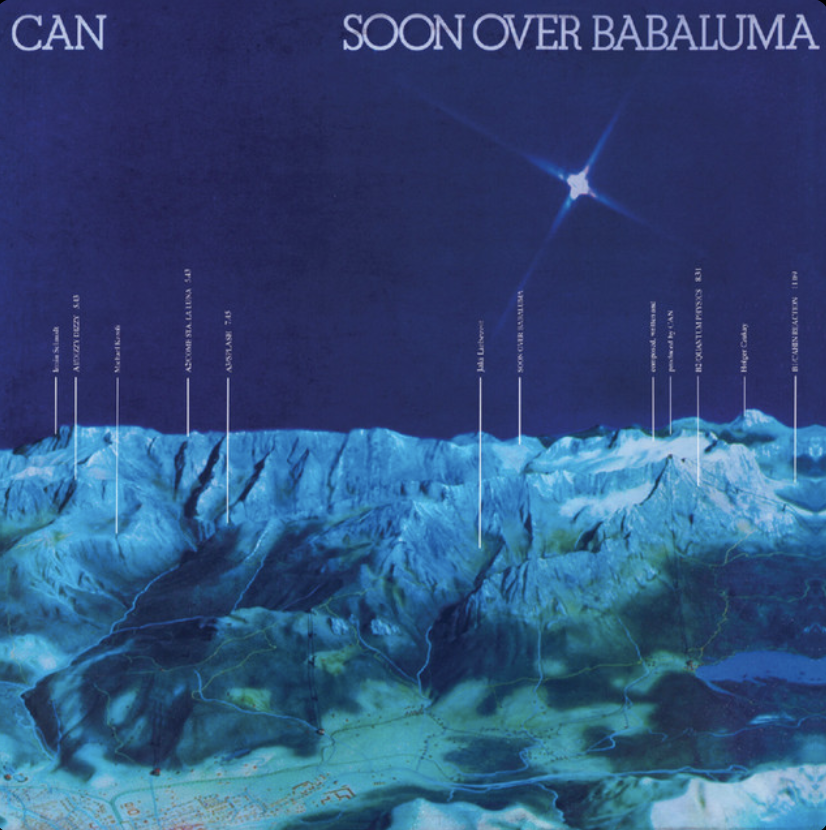
Retrieved and reshared from the Monolith Cocktail archives this month, a 50th anniversary special on CAN’s 1974 LP Soon Over Babaluma.
CAN ‘Soon Over Babaluma’
(United Artists) November 1974
Hawkwind once sang enthusiastically that, indeed, “Space Is Deep” on their 1972 progressive nebula traveling album Doremi Fasol Latido. Unfortunately for all the postulations and far out oscillating effects they failed to launch us further than our own stratosphere.
Interstellar overdrive and the promise of a journey beyond the stars never quite managed to leave behind the familiar sounding musical structures and instruments of Earthly genres, such as rock or jazz. Even Sun-Ra for all his visitor/emissary from another world talk, was still to a point chained to classicism; those outbursts of improvisation never quite soared to the dizzying celestial heights that we were promised.
Which leads me to CAN and their sixth studio album Soon Over Babaluma, a genuine bold attempt to lavish the cosmos with a fitting soundtrack; delivered by Cologne’s very own branch of NASA.
Previously on the 1973 heavenly diaphanous hymn Future Days, CAN had scaled new empyrean heights of excellence. Now they sat in the very lap of the Gods themselves, the only logical next step being outer space.
It helped of course that the injection of funds, acquired by Hildegard Schmidt, now paid for some new equipment; namely the futuristic sounding Alpha 77, a serious piece of kit that interrupts the sounds emanating from a keyboard to produce some startling effects and soundscapes. Looking like some kind of radioactive scanner and housed in a bog-standard clunky metal box, the Alpha 77 could have fallen off the back of truck bound for some nuclear science facility. The flight deck controls and rather old-fashioned register dials don’t quite reflect the abundance of sounds that can be created and fooled around with; Irmin Schmidt teases a vast array of ethereal sweeping sound collages from this box of tricks, that coats every part of this album.
Irmin wasn’t the only one to receive some new equipment, the band, as a whole, upgraded their sound desk: for the first time being able to record straight onto stereo. Also editing and overdubbing became a lot easier, benefiting the overall quality of sound and mixing. Technology always played its part but now it would direct the proceedings in 1974, as they began to lay down what would be the forthcoming Soon Over Babaluma album.
December 1973 saw the departure of Japanese troubadour and mushroom haiku mantra singer Damo Suzuki. A heated confrontation during a session for a TV soundtrack resulted in Damo snatching up his mike and a pre-amp, exclaiming, “That’s mine!” before skulking off in a strop.
The gear was returned in due course, but Damo remained aloof, never to return, the recent marriage into and conversion over to the Jehovah’s Witness religion playing a major part in his decision making. He may as well joined the Quakers, as hanging out with avant-garde rock stars was now frowned upon and discouraged to the point where life must have become quite square. Although the late experimental, improvising icon would later return to music full-time; going on to collaborate with some of the most inventive heirs of krautrock and a whole new generation of experimental artists and groups: the list is endless.
An empty vacuum emerged at first, the rest of the band feeling left in the lurch, the upcoming album deadline and tour commitments placing intense pressure on the group to find a replacement.
Unfortunately finding a new singer/front man wasn’t easy, either due to unsuitability or previous prior engagements that role remained aloof and unfilled. In the end it was their own transcendental guitar genius Michael Karoli who stepped up to take on the vocal duties, with Irmin lending his support and backing.
For the record Karoli does a pretty good job of it, sounding like a Germanic Syd Barrett and even at times evoking the dreamy quality of Suzuki himself. Irmin on the other hand comes across all creepy and crazed.
With an emphasis on the pursuit of other worldly experiments and space exploration, Soon Over Babaluma sports a suitable cover. Graphics artist Ulli Eichberger delivers a shining reflective moonscape cartography, with the song titles and personal etched over the lunar terrain as though they were the names of craters and the barren land features: though it also resembles some Alps type snowbound mountain scape.
The album title itself is claimed to be a parody type anagram of the old Weimar Republic era showtune ‘Moon Over Alabama’, made famous in renditions by Nina Simone and even David Bowie. Originally written by Bertolt Brecht, the genius German poet and playwright, and put to music by fellow countryman Kurt Weill for the 1930 satirical opera Rise and Fall of the City of Mahogany, the song was made even more iconic when the Nazis banned it three years later. Maybe it reeked too much of Cabaret and the savage biting social depictions of George Grosz, who painted grotesque images of the obscene decadence taking part in German society. The surge of the far-right encroaching on what they saw as bedlam with their even worse replacement ideology, turning on the social commentary of Brecht and Weill with vengeance.
Whether or not this is indeed the reason behind the moniker, there is no real reference to historical context; rather the mood is entirely directed towards space. Track titles such as ‘Come Sta, La Luna’, closest translation being “as it is, the moon”, and the scientific-in-nature ‘Chain Reaction’ and ‘Quantum Physics’, CAN certainly laid down enough signs of their newfound commitment to the course.
A move towards the more technological progressive and experimental ethos mixed with the jazz boundary defining pronunciations made by Ornette Coleman, Miles Davis and the already mentioned ex-resident of Saturn, Sun-Ra, CAN’s sound managed to surpass the previous journeyman as they now set out to tip toe across Orion and penetrate deep space.
But this wasn’t the only album released by CAN in the 1974, oh no! They also released a collection of studio offcuts and even further out there avant-garde sound collages entitled Limited Edition; so called as it was limited to only 15,000 copies, though only two years later it was released as a double album with 5 extra tracks.
Both versions include the Ethnological Forgery Series and the scraps and fragments of sound pieces and obscure cluttered impromptu jams that littered their back catalogue. The standout track is the ambient moving viscerally inspired ‘Gomorrha’, one of the most ethereal quality pieces they ever recorded and possibly the track that Damo walked out on. Its science fiction searching, and hearts of darkness espionage drama evoking atmosphere perfectly encapsulates the sea change taking place, having been recorded only months before work started on Soon Over Babaluma.
——A Deeper Reading—–
The sound of a small leap across the surface of the Moon, whose gravity has been swallowed by the Alpha 77 and re-directed into one illuminating bended note, this is how ‘Dizzy Dizzy’ begins.
Karoli floats in on a passing solar wind, floating above the rim shots and deeply reverberated bass like a lurking rock astronaut ready to pounce with his introduction gambit “rat-a-tat-a-tat-a-tat” vocal scat.
A sultry Afrobeat enriched beat bounces along as twangs of guitar mark the way, all the while Schmidt strokes his alluring array of space organs, fermenting some lofty aspiring effects with which the groove can walk on.
Soon the violin strikes up a haunting weeping melody that cuts through the expansive air, exquisite emotive strains from the stringed solo stir up a certain amount of pulchritude.
Soft brush strokes and heavily comatose cymbals contact Holger Czukay’s one note comfort blanket warm bass, rich in rebounded echo.
Karoli breathlessly sings such wise pronunciations as,
“I know, I don’t smoke with the angels, I know
Don’t throw ashtrays at me”
I think we know what kind of brand of choice he’s more than hinting at!
He goes onto lay his soul bear with the romantic gestured lines,
“I’m not made out of mature,
But I’m something out of the heart.
Throwing on you a kiss, kiss”
Almost jumbled around or miss-translated, these lyrics read like a cut and paste experiment.
Dizzy in love or dizzy due to the air being so thin up here in the upper echelons of space, Karoli seems to levitate on his whispered sonnet to some higher beings.
Schmidt eventually takes over, draining the vocals to a mere trace, that Alpha 77 synth manipulator now warming up and taking on a life of its own, becoming like a fifth member of the group. But it will be those felicities violins that have the last word, ending on a majestic duelling climax.
‘Come Sat, La Luna’ opens with a field trip recording of some stroll alongside the canal, the occasional croaking from some walk on part crow, interrupts the serene ambience. Karoli then rumbles in with a pleading dramatic rendition of the title off the back of some heavy duty compressed reverb, that makes it sound like the band are playing in a diving bell chamber.
The sense of entrapment and struggle to breathe in this now thick atmosphere, a morphine induced state is evoked in this dense sounding eulogy to some far-off planetary dimension.
Schmidt recites rather than sings his lines, which are deep in creepy effects and delivered through some unsettling eerie cadenced nonsense.
These vocals are more like riddles or cryptic announcements of foresight, such as the lines,
“I am not fighting, but I’m the night,
I am not dying, and I’m not hurt.
I am the right or the wrong, your hope,
I am the dancer on the tender road”
He goes on to express,
“I am the water and how I can flow”
Schmidt seems to be angling at some descriptive analogy, continuing with more caustic questioning,
“And why don’t you call me Sta?
Flowing over Babaluma,
It ain’t your friend.
You can do it alone,
And you don’t have to pay”
The song picks up some pace, almost swinging along in a jaunty motion, Liebezeit taps his way through, giving a special decompressed bass drum and kick drum solo, losing himself in a sudden joyful upturn.
From out of the mire approaches a grand piano and squalling guitar, both lost in a mini battling concerto, which grows towards an almost full on avant-garde free for all before calm is restored with the last warbling chorus from Karoli. Almost sorrowful in manner, the finale words almost trapped as though Karoli is zapped of his strength.
Side one ends with the all-out galactic jazz ensemble instrumental ‘Splash’.
Sun-Ra, Miles Davis, Ornette Coleman bump into each other on the set of Mission Impossible, all vying for elbowroom and paranoid up to the eyeballs.
Squawking, hooting sousaphone and grumbling thunder striking bass are met with fret board scrapping and incessant scratching, Liebezeit rattling off a series of rolling drums and double kicks, booting his kit round the room.
Just as a certain rhythm is broken in, cowbells and trinket percussion enter the alarming fray, bringing with them the black box recorder omnipresence of Schmidt’s 77, a glorious soundtrack to the stars is eminent.
Karoli begins a dystopian guitar solo from on top of some desolate mountainous range or Olympus Mons itself, melancholy wines and strains of harrowing pleads echo round the empty immense affinity of space.
An excitement of sorts starts to boil over as a barracking charge from the drums now piles in to the accompaniment of strangled brass and eastern harem sounding oboes, which pursue a deconstructed noisy voyage of discovery, wrestling control of these nine headed monster jams.
Once you’ve had time to calm down from the audio assault of ‘Splash’, side two awaits your attention with the doubled up ambient suites of ‘Chain Reaction’ and ‘Quantum Physics’, the energy and matter evoking scientific epic.
Beginning with the now familiar sound of the 77 revving up like some organic spacecraft dreamed up by Frank Herbert – in fact reminding me of the special effects from Dune the movie -, drums and bass slowly fade in with a soul shaking tambourine, shimmering and arousing r’n’b, before Karoli slides and rides all over his guitar, the celestial conductor.
The brewing accompaniment runs riot until fitting into an assured stride, the low plains pan out in front of us as the beat remains steady and ambitious in outlook.
Schmidt unveils grand gestures of melody from his very own inter-galactic flight deck, painting multiple soaring swathes of astrological envy for Karoli to now glide over with his best Damo evoking vocals.
Surreal imagery is conjured up and uttered with breathless enthusiasm; analogies of a Soviet flavour are transcribed thus,
“Elephant dominating Russian,
Don’t be running hurt.
Elephant running,
Dominating the deep”
The attitudes change with the take it or leave it gay abandon of the chorus,
“Chain reaction incoming when you get so small,
I said chain reaction incoming when you get so rushed”
Probing, encroaching guitar searches roam the moonscape, taking part in a call and response with Schmidt’s now crescendo illuminating collage of sound.
Liebezeit and Czukay both slump off into solo frenzies, traveling their very own particular rhythmic paths before a giant thunder clap strikes and sends the track towards free-fall.
Tribal beats clatter and clash, whilst haunting encircling brooding organs and ascending synths swoop, then the beats are reigned back in, as Karoli recalls the chorus.
Cyclonic chuggering grooves are interrupted with some unworldly seething effects, that wouldn’t sound out of place in 2001: A Space Odyssey, as the ghosts of Mars and the trembling spooky reaches of the far-off universe now hang heavily over the space flight.
Rim shots and interplanetary musings seep into the final outro of the track before bleeding over to the second act of ‘Quantum Physics’.
Gentle ramblings and distressing noises unearthed from the science lab, emanate throughout, all the while Liebezeit attempts to keep a groove going, constantly banging away in the background.
From out of nowhere, an unseemly black hole maybe, Schmidt unleashes a brave new world of sublime washes and choral ethereal charm. The sky at night has never sounded so angelic and worth investigating.
No description quite explains the climactic finale that signs off Soon Over Babaluma, invigorating escapism and traveling through the cosmos, in scenes reminiscent of Solaris.
Breathtaking in vision, the perfect emotional drama set in space takes some beating. Perhaps they should include this in any future first contact package shot into the universe; then again, any alien life form may just think we’re showing off.
If you enjoyed, felt informed, or marvel at my words and those of the Monolith Cocktail, please take a second or two to read the following message of alms pleading. Whilst I’m fully aware of the austerity, the lack of money, and an industry set on reducing all its creators, its critics and writers and motivators to a life of poverty, it is becoming near impossible to continue without support. And so with that in mind:
For the last ten years I’ve featured and supported music, musicians and labels I and the blog’s other collaborators love across genres from around the world that we think you’ll want to know about. No content on the site is paid for or sponsored and we only feature artists we have genuine respect or love for. If you enjoy our reviews (and we often write long, thoughtful ones), found a new artist you admire, or if we have featured you or artists you represent and would like to buy us a coffee at https://ko-fi.com/monolithcocktail to say cheers for spreading the word, then that would be much appreciated.
Our Daily Bread 598: The Beatles ‘Now And Then’
November 3, 2023
COMMENT/REVIEW BY DAN SHEA

Back in the Monolith Cocktail fold again, the impassioned and adroit musician/writer Dan Shea passes comment on The Beatles supposed swansong. Roped into his family’s lo fi cult music business, The Bordellos, from a young age, the candid but humble maverick has gone onto instigate the chthonian Vukovar (now unfortunately on the funeral pyre of dead projects, here) and, with one part of that ever-shambling post-punk troupe, musical foil Buddy Preston, the seedy bedsit synth romantics Beauty Stab (another fleeting project that has sadly disbanded, here).
An exceptional talent (steady…this is becoming increasingly gushing) both in composing and songwriting, the multi-instrumentalist and singer is also a dab hand at writing. For his debut contribution to the MC, Dan shared a grand personal ‘fangirl’ purview of major crush, the late Rowland S. Howard (which can be found here), on the eve of Mute Records appraisal style celebration reissue of his highly influential cult albums ‘Teenage Snuff Film’ and ‘Pop Crimes’ a number of years back. This was followed by an often difficult, unsettling, potted with dark comedy, read on Dan’s friend and foil Simon Morris (of the Ceramic Hobs infamy; the piece can be read here), who took his own life. Dan also started up a series of Lockdown Jukebox musings (here).
Firstly I don’t believe this is the “last Beatles song”. There’s got to be other Lennon solo recordings and maybe some of George‘s songs lying around. Even though we’re talking about the band who changed the face of popular music and Western popular culture, this much fanfare and this much work doesn’t go into a single song. Expect more to follow.
Despite the fact that this is a much vaunted digital Beatles reunion, many of the things that made the Beatles great are thrown out of the window in favour of the digital. It’s like the Paul Is Dead myth happened but in a way we never expected: all of The Beatles have been replaced, but by Paul. Ringo, arguably the best rock drummer and definitely one of my favourites, here sounds like he’s been subject to so much Pro Tools drum replacement and quantising that it may as well be me or you or your cousin drumming on it. McCartney’s voice reflects the ravages of age but with Botox and fillers from Antares, which hide nothing. And nor should they, but why bother in the first place?
There’s a lot to be said for crossing the boundaries of time in music, making time non linear and past and future rubbing noses in a practice room nervously trying to make an idea work. There’s a lot to be said for the mixture of audio fidelities, and it could be interesting if we’d had more of that. The roughly recorded original Lennon demo gradually blossoming into a full band arrangement. But they’re not nose to nose, eyeball to eyeball anymore. When the entire selling point is that two of you are dead and you’re not all in the same room anymore with your egos and your splintered alliances, you’re doing yourselves a disservice to release a product (that’s what it is: it’s a product, it’s content) that sounds like a Beady Eye album track. Is it poignant to hear old McCartney’s voice harmonise with Lennon half his age and half his lifetime ago? Yes. Does it sound good? No. I find it intensely moving and I was close to tears on second listening. But it feels like something I shouldn’t be hearing. It feels like I’m eavesdropping on an old timer sat at the bar in The Ship and Mitre, in the lead-up to Christmas, who’s drunk 8 pints and is reminiscing out loud to one of his dead friends. Yeah it’s touching but should the world really be hearing this.
Our Daily Bread 493: Brian Bordello ‘Cardboard Box Beatles’
February 10, 2022
ALBUM FEATURE/REVIEW
Dominic Valvona
Brian Bordello ‘Cardboard Box Beatles’
(Metal Postcard Records) 11th February 2022
Declaration of interests, yes, Brian ‘Bordello’ Shea is a regular contributor to this esteemed blog. And so, in an act of what could be deemed as “pop eating itself” I’m going to somehow balance friendship with critical analyses.
Who am I kidding?! Brian is the best. And anything I’ve written or will write about both his idiosyncratic solo work and his music with the creatively dysfunctional family band, The Bordellos, will probably go unread by the masses, who should really be celebrating this St. Helens lo fi poet-of-the-people: if by people you mean despondent middle-aged white blokes learning to come to terms with their fates; ignored by all and sundry; not quite old enough to prove invaluable, yet too old to start over.
The Les Miserable of the North, Brian’s wit and aphorism one-liners make all his resigned lyricism more palatable. No one quite sums up life in an almost ungovernable modern Britain like our Brian. Yet there’s always a sullen but achingly heartbreaking fragility, delivered on Brian’s second most popular theme of romance: unrequited love; a love lost; a love undeserved. Regrets…he’s had a fair few. But listening to the lo fi (so lo fi as to barely register; making even the late Sparklehorse sound like a flash git) stripped of artifice recordings of this “nowhere man” (A Beatles reference which we shall come back to later) is never a slog.
Across the decades, shovelling away with a kid’s cheap plastic spade – left over from a northern beachside holiday many moons ago I envisage – at the music industry’s coalface, Brian has released his proclamations and wry wisdom in various guises and on a myriad of obscure labels. His latest album is for Metal Postcard Records (no strangers to this site; the “postcard” bit of that imprint the closest a fandom Brian will ever get to the original iconic Scottish label he adores) is about as basic as it gets: just an acoustic guitar, Brian’s wistful soft rasped voice and the hum and slipping rubber band of what sounds like a Tascam four-track.
Cardboard Box Beatle as a title does little to prepare the listener; the Cardboard title-track couldn’t be further from a Beatles homage, sounding like a St. Helens bedraggled Kurt Cobain unraveling his life, baring his soul to the disinterest of everyone else. Instead, the box in question can be seen as a metaphor for a cheap recycled life of low achievement; 50 plus years summed up in a box you might drop off at a jumble sale when someone dies, or leave for the local charity shop: leftovers, mementos, cherished low monitory valued memories deemed worthless. The charity shop will be something Brian is all too aware of, after like many of us, struggling to keep or losing their job in the Covid pandemic.
It’s also, no doubt, a descriptive name for the cheap knock-offs, those who still pray at the altar of a band that spilt up over 50 years ago. Whilst Brian himself wears his influences on his mothball, untangling sleeve, he berates the lack of ingenuity, freshness, zest, protest and, even, fun in most new music. As a reviewer for my site, he’s more than used to reading umpteen thousand press releases, and the eye-catching, dumbed-down use of “soundalike” references. Whilst the 90s to the most recent generation breaking through is the 60s to us 80s kids, there’s still such a hunger to sound, copy the music of their grandfathers and mothers. Brian’s own nostalgia doesn’t get in the way of championing the contemporary artists/bands that are trying something different. He’s sung of a pantheon of “motherfuckers”, from Scott Walker to Gene Vincent; Julian Cope to Dave Gedge; artists he feels gave the bird finger to compromise, or were just one-offs, never to be repeated.
Disparaging catcalls aside, the industry’s reliance on back catalogues is proving destructive to newcomers: Brian can be heard banging his head against Flyod’s brick wall. None more so than on the album’s almost flat, despondent opener ‘Yes, I Am The New Nick Drake’; a low-end wistful jeer no doubt at the production line of acoustic troubadours in awe of the fateful legend: but only in copying the adulation part, the young life cut short bit of that legend being a step too far to copy.
As far as The Beatles go there’s an air of melancholic Revolver on the disarming but pleaded ‘Please’; also hints of a Mogadon induced Wedding Present and The Las in the melody and strumming. It must be said that the low quality of these plaints, laments and maverick observations feels more like eavesdropping than a performance: as if Brian sits all day playing these often candid, cathartic but also piss-taking jibes to himself, and that we’ve just stumbled upon him and decided to secretly press record.
In the romantic, knockabout sentimental vogue, Brian exudes a Northern Syd Barrett (another hero of our Brian’s; forget Floyd after that though) trying to catch a free-spirited ‘Flowerchild’; grumbles about his bland perpetual Autumn wardrobe as a metaphor for lost love and mortality and lockdowns, on the “all my summers have gone” “dododoing” ‘Seasons Change’; languidly strums Catholic metaphors about a muse on the Dan Tracey-esque ‘The True Meaning Of Love’; and on what is a deeply offensive, but all the better for it guilty laugh, ‘Here Comes Eric With His Dead Child Song’ (contender surely for best title of 2022, if not ever), in drudgery, bemoans his own sad existence and behaviour to those held dear.
But as I have mentioned already, this is the unraveling of an artist on the “scrapheap”; a moment (say a year in Covid lockdown) captured of mental fatigue, alienation, defeat. Songs like ‘Catfood On The Floor’ epitomize a modern “nowhere man”; a generation X life boxed-up with nothing worth keeping other than the trinkets that marked personal euphoria against a disposable, unwanted collection of CDs ripped from the covers of NME and Mojo: a summary lament of the emptiness that so many of us felt, experienced during the last two years. Brian even measures himself up for an “Instagram” friendly funeral on the ode to a ‘Salamander Fruit Fly’; a poignant, though well obscured in tune, song about death, mental health and the banality of narcissism seen through the vaporous lifestyles and validations of social media.
Brian takes it all in with an acidic, often witty pun(ing) amusement; even the most depressing moments magically dark in humour and self-depreciation. Never has so little musically evoked such reams of thought; a simple, slipping and warping because of cheap apparatus, guitar and voice denouncement of modern life spent under the cosh of Covid, Cardboard Box Beatles is more than the sum of its cheaply recorded parts.
Coming back round to that Beatles title, the album (as so many of Brian’s releases are) is released on the anniversary of the Fab Fours Please, Please Me recordings; a link back to nostalgia and love for the band that still influences legions fifty-nine years later. Because at the heart of Brian’s diatribes about our reliance for nostalgia, he still can’t quite escape it himself. But then, can any of us truly cut ties with the past and a so-called “golden age”. Perhaps it’s that age’s mysticism, the secret alchemy that Brian so cherishes – a life without 24/7 newsfeeds and Twitter accounts -, a complete opposite to today’s all too knowing show and tells and the relentlessness demystifying commodification of the art form. Striped back to the essentials, Brian encapsulates an array of displeasures like no one else can. Let’s just hope his music reaches the wider audience it deserves.
Monolith Cocktail Monthly: October 2021: David Ornette Cherry, Atmosphere, Dean Blunt, Xenia Rubinos, U.S. Girls…
October 29, 2021
Autumn leaves might be flying past your window, the rain hacking it down. But worry not; here to warm the cockles is the Monolith Cocktail team (that’s me, Dominic Valvona, Matt Oliver and Brian ‘Bordello’ Shea) with another eclectic fanfare of choice music from the last month.
In case you’ve been living in a cave all this time without a Wi-Fi connection, they’ve just released The Beatles fabled locked away Let It Be sessions – and enough candid film to make a documentary (step forward Peter Jackson). And so old gits that we are, there’s a flurry of alternatives and studio chat in this month’s playlist. Back into the present, the rest of this phenomenal selection includes David Ornette Cherry, Atmosphere, Dean Blunt, Xenia Rubinos, U.S. Girls X Glenn Gould, Benny Diction, Lexagon, Deserta, Let Your Hair Down, Oslo Twins, Rosie Tee, Phew, Embryo and tons more.
Those Tracks In Full Are:-
The Beatles ‘Like Making An Album? – Speech’
David Ornette Cherry ‘Parallel Experience’
BlackLiq & Mopes ‘Don’t Ask Me’
Atmosphere ‘Something’
Jamael Dean Ft. Jasik, Jira ‘On Inu’
Dr. Junkenstein ‘Addictive TV’
Bunny & The Invalids ‘A Sniper’s Heart’
Hiatus Kaiyote ‘Canopic Jar’
Late ‘HORROR SEASON 3 THE TRILOGY’
Dean Blunt ‘SEMTEX’
Xenia Rubinos ‘Did My Best’
The mining Co. ‘Astral Investigation’
U.S. Girls X Glenn Gould ‘Good Kinda High’ The Beatles ‘I’ve Got A Feeling (1969 Glyn Jones Mix)’
Magon ‘The Willow’
Ghost Woman ‘Do You’
Dean Wareham ‘The Corridors Of Power’
This Heel ‘Head/Tail’
Das Lunsentrio ‘Der Mann Am Siegestor’
SAD MAN ‘The Green Opal (SOS Mix0’
Legless Trials ‘Faceless Heathen’
S. Kalibre Ft. Slap Up Mill, Genesis Elijah, Verbs Of Iron Bridge & Jabba The Kut ‘Warriors’
Benny Diction ‘Archives’
Guilty Simpson & Gensu Dean ‘Deep Breath’
Lewis Parker Ft. Enny Integrity ‘Keep It on The Low’
Mustard Tiger ‘Aglumni’
King Kashmere/Alecs DeLarge/Maddy ‘North Star’
Dillon & J57 ‘83 Kids’
Lexagon ‘Values’
Ben Osborn ‘The Fire’
Catherine Griandorge ‘Eno’
Roedelius & Dallas Acid ‘Lovely Morning’
Deserta ‘I’m So Tired’
Bamdicoot ‘Life Death And Other Things’
Good Morning ‘Depends On What I Know’
Let Your Hair Down ‘BF Holiday’
Wiki ‘New Truths’
Upfront MC ‘Let’s Go’
Ramson Badbonez & Frost Gamble Ft. Phoenix Da Icefire & Cyclonious ‘Wolves’
Jester Jacobs & Formz ‘Fishing Rod’
Gabriels ‘Blame’
Monocled Man ‘Przhevalsky’
Vapors Of Morphine ‘Phantasos & Phobetor’
La Luz & Adrian Younge ‘Watching Cartoons’
Oslo Twins ‘Circe’
Violet Nox ‘Super Fan (The J. Bagist Remix)’
Rosie Tee ‘Anchors’
Josephine Phillip ‘The Clue’
David Lance Callahan ‘Born Of The Welfare State’
Kuunatic ‘Lava Naksh’
Monoswezi ‘Kuwonererwa’
Phew ‘Days Nights’
Mario Batkovic ‘CHOREA DUPLEX’
Pepe Deluxe Ft. Demon Fuzz ‘Girl From Satanville’
Taraka ‘Welcome To Paradise Lost’
Astrid Swan ‘Drift’
Embryo ‘Baran’
Portico Quartet ‘Ultraviolet’
The Beatles ‘Don’t Let Me Down – First Rooftop Performance’
 Monolith Cocktail Blog