The Perusal #52: Meril Wubslin, Maria Arnqvist, Ghost, Otis Sandsjö…
February 13, 2024
A WORLD OF DISCOVERIES REVIEWED BY DOMINIC VALVONA
(Unless stated otherwise, all releases are available now)

Maria Arnqvist ‘Mary Rose And The Purple Quintet’
(Sing A Song Fighter)
An incredible, adventurous concept (of a sort) album from the Swedish multi-instrumentalist and composer that not only showcases a breadth of ideas but also draws upon a wealth of worldly musical escapes and travels, Mary Rose And The Purple Quintet! is an ambitious statement.
One half of the self-professed “voodoo punk, art rock and psychedelic” Swedish duo Siri Karlsson, Maria Arnqvist weaves and sows the seeds for her own solo idiosyncratic fantasy on this character-driven songbook of piano-led or prompted quality vocalized and instrumental evocations.
Classically trained on the ivories, the source of this album’s deeply felt, keen and artfully beautiful material springs forth or subtly flows with an ever-moving cascade; a torrent; a disturbed pool or undulation of waves. Arnqvist proves highly talented in this regard; a near maestro of the instrument in fact, with certainly familiar echoes of what has come before – everything from the obvious classical strains and accentuated touches to the avant-garde of the name-checked Philip Glass and feels of quintessential balladry – but made a new when effortlessly merged with such instruments as the West African kora, an air of the folkloric and strange. Sousou Cissoko plays that kora incidentally, spindled melodically and woven beautifully – it reminded a little of the harpist Catrin Finch’s collaborative partnership with Seckou Keita.
There’s also a sort of Flyodian-progressive and Afro-jazz throaty and more float-y saxophone on a couple of songs. Add chamber-like and dramatic symphonic strings to that soundtrack – every track on this album could be a score in itself – and you have something very special and different and (that word again) worldly: at least transportive. You’ll be unsurprised to learn that Arnqvist has traveled abroad a lot, with stays absorbing the local sounds of instruments in Ouagadougou in Burkino Faso, and Boston in the States. When pulled together the results are both sophisticated and playful; the mood and balance shifting between the oddball theater of late 19th century barrel organ stoked Wild Western saloon japes and shoreline yearned morning choruses to the elements. In fact, this could be an alternative Western, with the unsympathetic roasting sun shimmers and hoofed giddy-up momentum of ‘I Caught You Runnin’ evoking some kind of amalgamation of David Carradine’s Kung Fu, the Mongolian song of Namger, and Sakamoto’s piano – a pursuit across a mirage salt plains perhaps?
At other times the mood is more folksy-classical; although the enchanting opener (a sort of overview overture) seems to reflect a restless spirit, spinning between timeless tones, West African dances and the drama of Mick Harvey’s more stirring sober scores.
The vocals are sung in English when recognizable, as Arnqvist also lyrically and with a melodious air also just swoons or coos the tune, thoughts and descriptive vowels. And the lyrics build up a poetic picture of dramas, emotional ties, scenery and acts, whilst never really making anything explicit as such. Natural elements are left to speak, as Mary Rose and that Purple Quintet meander, fluctuate up and down the scales, quiver and ride the tumultuous softened waves of this loose story.
An enchanting and softening restless spirit is at work on this astonishing, well-thought out and enacted solo turn from the Swedish talent; an album that will gently unfurl its magic and depth over repeated plays and time: and for that, will only get better on each listen.
Lothar Ohlmeier, Rudi Fischerlehner & Isambard Khroustaliov ‘In The Glooming’
(Non-Applicable) 16th February 2024

From the perceptive, intuitive and often haywire minds of the applauded Lothar Ohlmeier, Rudi Fischerlehner and Isambard Khroustaliov (the nom de plume of one Sam Britton) trio, another exploration into the probed parts of the grouping’s psyche, art forms, inquiry and mischief-making. Thematically wise however, this is latest experiment at the edges of electroacoustic serialism and free-roaming is about the trio’s friendship, perseverance, trust and handle on being human: in a world of ever encroaching technological takeover I’d suggest.
Drawing on their myriad of respectable experience over the decades, with Ohlmeier bringing along his bass clarinet (a pretty deft and extraordinary saxophonist too), Fischerlehner on drums and percussive elements, and Khroustaliov rewiring his electronic apparatus, all three participants pull from the “gloaming” (an expressive word taken from Irish lexicon that describes the “twilight”) a strange sound world and performance of avant-garde jazz, Fortean supernaturalism, the alien, odd and indefinable,
Recorded over in the former Cold War walled East Berlin – make what you will of that location -, melodious, almost at times sweetened and floated, clarinet wafts and occasionally strains amongst the clicks, reversals, signals and oscillations of circuitry and transmogrified data language. All the while sifted, brushed, hinged and more bell shaken percussive instruments often amorphously find a rhythm, a hit or timpani roll in the vagueness of an idea and direction. Unsettled and yet never really hostile, totally maniacal or mad, this is a world in which ECM, Sam Newsome, Roscoe Mitchell, The Art Ensemble Of Chicago and Eric Dolphy merge with Walter Smetek (I’m thinking of his 1974 Smetek LP especially), Valentina Magaletti, Affenstunde Popol Vuh, Angelo Bignamini and Lea Bertucci. A track like the tracing of time, weirdly tweaked and near whistled ‘End Zone’ sounds positively sci-fi and a little ominous. Whilst, the classical unhinged toy workshop combination of elements on ‘Violet Weeds’ sounds like Prokofiev conducting Autuchre for a performance of Brian Aldiss’ Hothouse. And ‘Pixel Head’ re-engineers the matrix for an odd futuristic charge of static and cable disarray. Sharing is caring as they say, and this trio seems to deeply feel that connection and intuitive spirit of freedom in creating something challenging, but also in those very special interactive moments: moments inspired in a manner by that twilight hour between the dark and light. A curious, wild and untethered yet professionally made work that defies boundaries.
Meril Wubslin ‘Faire Cą’
(Bongo Joe Records) 1st March 2024

Taking their Mitteleuropa mummers vision on the trail to, of all places, Lewisham in southeast London, and the studio of Kwake Bass, the Meril Wubslin trio cast more hallucinatory hypnotic rhythms in new surroundings without leaving that signature mysterious dimension that hovers between French-speaking Lausanne and Brussels.
Bass (or to give him his full due and title, Giles Kwakeulati King-Ashong) has worked with a myriad of influential and explorative figures over the years (from MF Doom and Roots Manuva to Lianne La Havas and Kate Tempest), so carries more than a touch of class and cache of ingenuity and talent. And yet far from changing the sound, based a lot on repetitive rustic nylon-stringed-like guitar rhythms and both scrappy and dreamy spelled percussion, the producer has continued to aid in magic-ing up a strange rural mysterious combination of Rufus Zuphall, These New Puritans, The Knife, Goat, Holydrug Couple and Die Wilde Jagd.
When the dual male and female vocals – shared and in a strange harmonic symmetry – mistily arise from the mystique and often dreamy-realism of humming motored esoteric vapours and woozy oscillations, they evoke a very removed version of Chanson with Sister Dominique and the pagan song of Summerisle. In fact, there’s a quite a lot of esoteric and folksy-like references sound wise, from the processional to tribal. And a cross-timeline of influences that stretch back into the Medieval. On occasion those hypnotic rhythms and percussive scrapes conjure up Gnawa trance, or the herding of goats in the mountains during older, simpler, primal times. And yet, there’s also a semblance of the Blues, of Dirt Music, to be found amongst the glassy bobbled vibraphone wobbles, trippy drum breaks, pastoral drug lingers, vague visitations from another dimension, UFOs and surreal echoes.
A diaphanous and occult balance of the rural and otherworldly, of enchantment and suffused otherness, Faire Cą is yet another promising statement of headiness and entrancing spells from the trio.
Ghost ‘S-T’, ‘Second Time Around’ and ‘Temple Stone’
(Drag City Records)
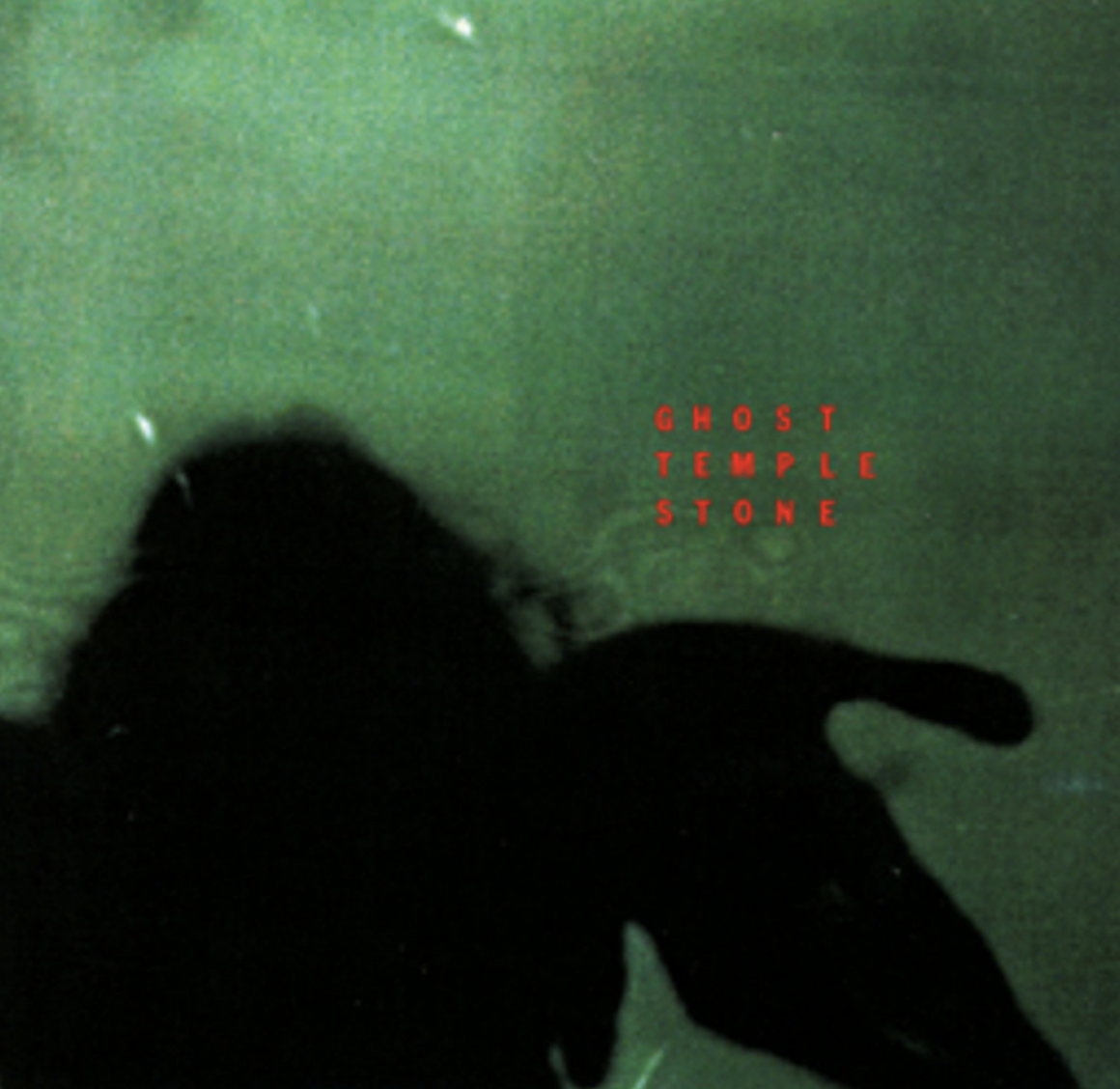
Following in the wake of Masaki Batoh’s most recent of incarnations, the brain waves initiated Nehan project album An Evening With (reviewed last month in my Perusal column), Drag City are reissuing a triple-bill of vinyl albums from the Japanese acupuncturist, musician and apparatus building artist’s most enduring and long-running ensemble Ghost.
Tying in with the fortieth anniversary of that evolving, line-up-revolving group’s conception, and the tenth anniversary of its completion, disbandment, their first run of albums from the 1990s is being given another pressing by the label that originally repressed them in the first place, three decades before: that run quickly selling out off the back of Ghost’s Lama Rabi Rabi debut album release for the American Drag City Records imprint. Originally released by the Japanese P.S.F. label on CD, that triplet of records laid down the foundations for a nomadic commune trip of acid wooziness, otherworldly folklore, abandoned temple spirit communions and visions.
Hauntingly formed in Tokyo in 1984 by underground and head music stalwart Batoh, their existence and presence on the scene were as veiled, translucent and hermitic as their name suggested. Pretty much adapts of Amon Düül II (from Phallus Dei to Dance of The Lemmings) and Popol Vuh, but also the psychedelic and folk movements of the UK in the 60s and 70s (from the Incredible String Band to Third Ear Band, Haps Hash And The Coloured Coats and Floyd), and closer to home, such native acts as the Far East Family Band and Acid Mothers Temple, these hallucinatory seekers explored various forms of transcendental music and tradition – although, in the PR briefing they’ve been compared to Os Mutantes. All of those reference points can be heard over their self-titled debut (1990) and Second Time Around (92) and Temple Stones (94) albums; reissued here on appropriate psychedelic clear coloured vinyl for the first time in 25 years.
Recurring currents and vibrations can be found on all three albums; the last of which is slightly confusing with a lot of crossover track-titles from the previous two; it must be stressed however, that even though they use the exact same names on Temple Stones, they are different, produced it sounds like, from the same session, but either an alternative to or riff on the original source and tune, atmosphere. Starting with the demigod, deity or presence theme of the “Moungod” on the self-titled album, the ghostly visitations traverse misty-veiled shrines, mountainous trails to meetings with kite-flying yogis, Shinto ceremonies and holy cavern settings. Surprisingly avoiding any real freak outs – ok, the occasional build-up of acid rock thrashing, splashing and tumult, but relatively subdued on that part – the music and atmospherics are often drowsy sounding; spiritually wafting along and even traditional: imagine Popol Vuh, the Incredible String Band and Floyd meets Alejandro Jodorowsky on the Holy Mountain. There’s also a touch of Julian Cope and Jason Pierce, even The Cult amongst the Taoism and other venerated mysterious leanings and moss. And, something that will carry over onto all the albums, there’s a constant air of the Medieval, the courtly and a touch of psychedelic folksy parchment; from maypole dances to willowy recorders whistled and fluty pagan pastoral processions and merriment.
Second Time Around is produced in the same mold, but seems to also have a more progressive feel, and even an air of the Celtic about it; another occult folksy-acid journey through mythological and spiritual tapestries. ‘People Get Freedom’ introduces us to a spindled lattice of gong washes and harpist sound-tracked moss gardens; the stepping stones trip then extending out towards a culmination of talking to Yogi ADII, the Moody Blues and wistful waltzes on the title-track. ‘Awake In A Middle’ however, sounds more like Satanic Majesty’s era and ‘Ruby Tuesday’ Stones, a more doleful King Crimson and fiddly acoustic dreamy Yes. There are murmurings and the odd bit of mooning, spooky chanting, and mantras to give it that occult, otherworldly sound from the ether, the gods, and the transcendental planes.
Finally, the Temple Stone album suffusion of veneration and mystique wonders around those ancient alters like an apparitional collective of the Flower Travellin’ Band, Yatha Sidhra and The Mission. Disturbed mood music and background wails and shouts are balanced with strange primal vapours, acid-folk (again), downer almost shoegaze vocals (although, on the old and magical rural never-world of ‘Freedom’, it sounds like AD II’s very own Chris Karrer), Indian brassy resonance, paused thoughtful piano and overhead drones.
All three albums are brilliant at pulling you into the Ghost troupe’s world of mysticism, drifted travels, psychedelic projections and wanderings. And not one of them is any better than the other, quality wise. Together they form a near-linear bond, capturing a short period in the band’s early-recorded history – the first of these albums appearing six years after the group’s initial conception -, which lasted thirty years. If this introduction style purview and review does grab you, then be quick, as I suspect these vinyl editions will fly off the Drag City Records shelves.
Otis Sandsjö ‘Y-OTIS TRE’
(We Jazz Records) 23rd February 2024
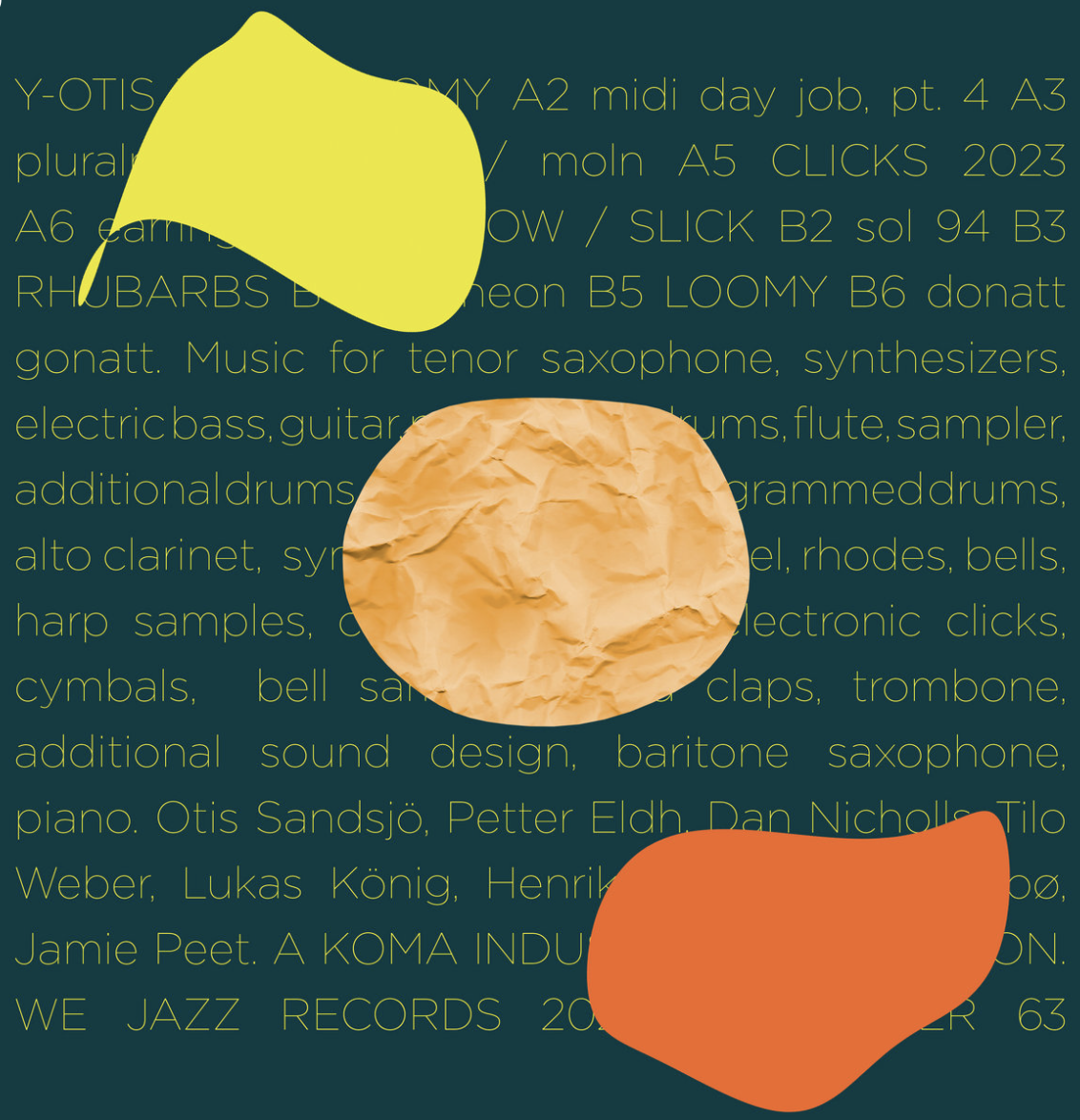
Following up previous albums in the Y-OTIS series, part TRE continues to deconstruct, shape and rebuild in real time the untethered sessions of the Berlin-based, but Swedish born, tenor saxophonist/clarinetist Otis Sandsjö’s studio experiments. With what has been called a “mixtape-like DNA” methodology, Otis with his long-standing foil and Koma Saxo leader Petter Eldh, and keyboardist Dan Nicholls, plus changing ensemble of musicians, remix themselves as they go along; fracturing, stumbling, free-falling, flipping, enveloping, cutting-up and sampling their jams into freeform opportunities and ideas.
The third album is much in the same vein: albeit this time around sounding more like a transmogrification of 90s and 2000s R&B and soul, with echoes and reverberations of slow elongated and stretched breaks. In practice this results in passing moments of J Dilla, Jimi Tenor, Madegg, Gescom, Four Tet, Healing Force Project and Shabazz Palaces tripping-out on jazz, funk and the blues. But that’s only half the story, as hinged and sirocco winded brass and woodwind is flipped out and put with an ever-changing revolution of morphed d’n’b, broken hip-hop beats, vague memory reflexes of Gershwin and the Savoy label era, The NDR Bigband, Philipp Gropper’s Philm and the most wobbly.
Nothing is quite how it seems, as the fluctuations and changes in the groove, timings and direction of travel often end up somewhere different; take the horizon opening ‘orkaneon’, which begins with a Ariel Kalma-style sustained, trance-y new age sax but finishes on Herbie Hancock being vacuumed and flipped by Squarepusher. In short: another successful adventure in the kooky jelly mould of hip-hop-breakbeat-jazz and beyond.
Various Artists ‘Merengue Típico: Nueva Generación’
(Bongo Joe)

A new year and a new musical excursion for the Bongo Joe label; a first foray and survey of the Dominican Republic’s localized ‘frantic’ Merengue phenomenon.
Sharing its Hispaniola Island location with Haiti (a most tumultuous relationship that’s led to various periods of civil war and bloodshed between the two former brutalized European colonies), the Dominican Republic is well placed to absorb the surrounding cultures of both the Caribbean and Latin America, with Merengue being just one these genres. The style was originally tied-in with the Spanish invaders, taking root on the Island in the early 1800s and played on traditional European instruments like the ‘bandurria’ style guitar. As time went by (especially in the more modern ‘Típico’ era) some of those original instruments were replaced by the accordion (introduced via German trade ships), the güira and the more localized two-headed ‘tambora’ drum (salvaged from rum barrels).
Its Island bedfellow of Salsa might be more globally renowned but Merengue is far older and established; a national dance and music used at various points in the country’s history and fight for independence as a rallying call, a unified and shared common bond: although, in one of the more controversial periods, Merengue was pushed and promoted by the military commander turn dictator, Rafael Leónidas Trujillo (nicknamed “El Jefe”). This particular compilation covers the creative boom after Trujillo’s death in the early 1960s – assassinated after a bloody, brutal regime that resulted in the estimated deaths of 50,000 people, including a sizable number of Haitians, and a number of opposition figures overseas. As the reins, paranoia of oppressive rule dissipated, culture grew once more with optimism. Merengue got a new lease of life with contemporary modernizations and expansions to the sound: now featuring strings and the bass. Pioneering figures like the iconic female trailblazer (and one of the stars of this collection) Fefita La Grande helped take the style forward and broke down barriers in a largely male dominated scene. The Afro-Hispaniola influences remained, as did the signature ‘quintillo’ five-beat rhythm, but there was a new step, confidence and joy to the music, which you will hear on this selection of nuggets reissued for the first time ever, chosen by the Funky Bompa – the alias of crate-digger Xavier Dalve.
Ten showcase tunes of quickened concertinaed ribbing (‘picaresque’ style), dancing, sauntering and jauntiness await; music from such commanding artists as the already mentioned Fefita but also the reeling sweetened and passionate tones of the mysterious Valentin and the Trio Royecell. Scuffling and skiffled, with the güira sounding like a scraped metallic washboard or cheese-grater, groups like the Trio Rosario step to a upbeat squeeze of accordion and touch of the Creole on the fun opening ‘Cuando Yo Muera’. But even when the themes, lyrics are meant to be more plaintive, even bluesy like Aristides Ramierz’s ‘Los Lanbones’, the action is less cantina woes and more “amigo” friendly light-heartedness.
The reach, influences, carry far and wide with knockabout she-shanty bellows, folk and the sounds of Afro-Cuba, Haiti and Colombia ringing away to an infectious, speedy and constantly lively rhythm. As an introduction to that, Merengue Típico offers an insightful party album survey of a Dominican Republic phenomenon, in many cases, still unknown to the greater world outside the Latin community. Here’s an infectious invite to put that gap in the musical knowledge right.
The Corrupting Sea ‘Cold Star: An Homage To Vangelis’
(somewherecold Records) 1st March 2024

Mainstay and foundation artist of the label he created, somewherecold’s Jason T. Lamoreaux pays “homage” and fealty to his hero Vangelis on his latest outing as The Corrupting Sea.
Arguably the Greek titan of the electronic and soundtrack form’s most enduring and influential work in the field of cinema and sci-fi, it is the icon’s distilled acid-pin-drop-rain atmospheric waterfall of dystopian mystery noirish Blade Runner score that inspires Jason’s Cold Star suites of synth evocations. The North American composer does this by fluently channeling that data, language and mood music whilst finding rays of hope and chinks in the metallic ominous granular skies.
Track titles will be familiar with even those with only a cursory interest in the grim futurescape and philosophical quandaries of artificial intelligence and what it is to be human storyline, of this bleak but incredibly affecting and prescient film – even more so in light of the introduction of such gimmicky but frightening programs as ChatGPT, and the encroaching possibilities of AI’s applications in making much of what we do redundant: even in the creative fields. For example, the ‘Voight-Kampff’ empathy test used to weed out the “Replicant” from the human in the film based on Richard K. Dick’s Do Androids Dream of Electric Sheep?, is just one such obvious timely example; here, in this state, chiming with softened sleigh bells, shimmery starry waves and crisp little explosions of grainy fuzz bit-crushes.
But as I’ve already mentioned, Jason finds some levitated release of hope in the cogs of technological progress; see the tenderness and reflection that is applied to the short ‘Like Tears In The Rain’ suite, which references Rutger Hauer’s iconic replicant character’s last fatalistic scene and memorable quote of the film: “lost in time…like tears in the rain”. The femme fatale of the picture if you like, ‘Rachael’ (with all that name’s Biblical significance) is also a balance of sci-fi and carefully placed stirrings; the calls of the analogue, of Jarre, of arpeggiator cascaded notes and android data.
Tracks like the grainy chomping and zip-line rippling ‘Four Years’ – the programmed-in longevity of replicants, so they supposedly don’t get the time to achieve human emotions and to rebel from their servitude of heavy lifting and soldiery in futuristic off-worlds – are not so much unsettling, but do have detuned bends and an assailing sense of uncertainty and the alien about them.
‘Replicant Hunters’ which opens this album, is pure Vangelis, but also has a hint of the Klaus Schulze about it too; square waves and bobbed bulb-like notes pass like cruisers in the alt-future nights.
Incidentally, that album title, Cold Star, references the cosmological phenomenon of “failed stars”, or “brown drawfs” as they are also known; a star that doesn’t have enough mass to sustain nuclear fusion in their cores, and so is cold or tepid to the touch. But there is nothing cold or dying about this six-track score, as a final sanctuary of hopefulness in a hopeless bleak dystopia is found on ‘Refuge’ amongst the static-charges and last gasps of a ticking hi-hat rhythm. Corridors are built into these moments of escape and clarity, as Jason pays respect and comes full circle back to his original influence on first starting out in the world of electronic experimentation and mood music.
OdNu + Ümlaut ‘Abandoned Spaces’
(Audiobulb) 10th February 2024
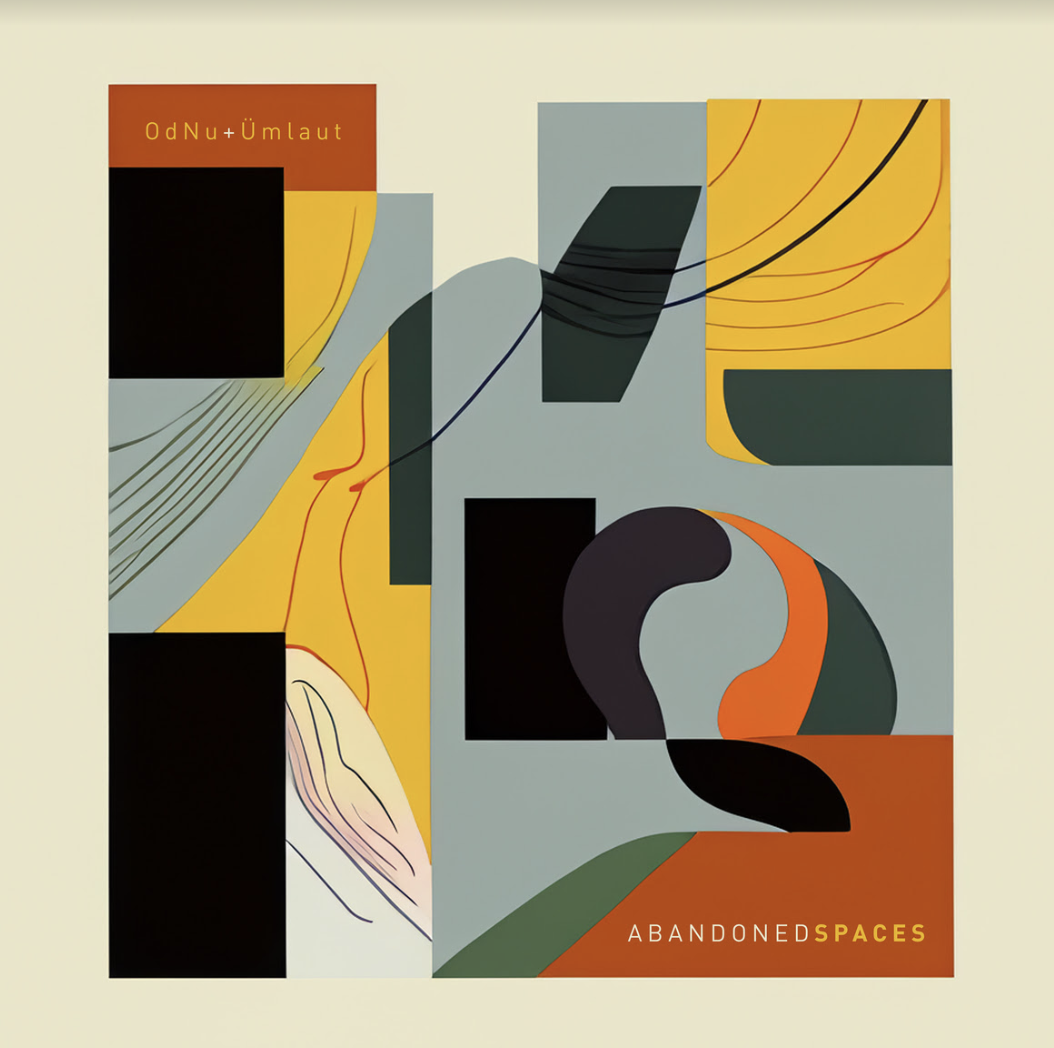
Drawn together and what proves to be a deeply intuitive union for the Audiobulb label, the Buenos Aires-born but NY/Hudson resident Michel Mazza (the OdNu of that partnership) and the US, northern Connecticut countryside dweller Jeff Düngfelder (Ümlaut) form a bond on their reductive process of an album, Abandoned Spaces.
The spaces in that title alongside reference prompts, inspirations motivated by the Japanese term for ‘continuous improvement’, “Kaizen”, and the procrastinated state of weakness of self-will known as the “Akrasia Effect”, are subtly and dreamily wrapped up in a gentle blanket of recollection. The lingering traces of humanity, nature and the cerebral reverberate or attentively sparkle and tinkle as wave after wave of drifty and pristine bulb-like guitar notes hover or linger, and passing drums repetitively add a semblance of rhythm and an empirical and evanescent beat.
The word ‘meticulous’ is used, and that would be right. For this is such a sophisticated collaboration and a near amorphous blending of influences, inspirations and styles: for instance, you can hear an air of Federico Balducci and Myles Cochran in the languorous guitar sculpting and threading, and an essence of jazz on the brushed and sifting, enervated hi-hat pumping drum parts. On the hallucinatory title-track itself there’s a strange touch of Byzantine Velvet Underground, Ash Ra Tempel and Floyd, and on the almost shapeless airy and trance-y ‘Unforeseen Scenes’ a passing influence of Mythos and the progressive – there’s also the first introduction of what sound like hand drums, perhaps congas being both rhythmically padded and in a less, almost non-musical way, flat-handily knocked.
Tracks are given plenty of time to breathe and resonate, to unfurl spells and to open up primal, mirage-like and psyche-concocted soundscapes from the synthesized and played. And although this fits in the ambient electronic fields of demarcation, Abandoned Spaces is so much more – later on in the second half of the eight-track album, the duo express more rhythmic stirrings and even some harsher (though we are not talking caustic, coarse or industrial) elements of mystery, inquiry and uncertainty. Here’s hoping OdNu + Ümlaut continue this collaboration, as this refined partnership proves a winning formula.
Hi, my name is Dominic Valvona and I’m the Founder of the music/culture blog monolithcocktail.com For the last ten years I’ve featured and supported music, musicians and labels we love across genres from around the world that we think you’ll want to know about. No content on the site is paid for or sponsored and we only feature artists we have genuine respect for /love. If you enjoy our reviews (and we often write long, thoughtful ones), found a new artist you admire or if we have featured you or artists you represent and would like to buy us a coffee at https://ko-fi.com/monolithcocktail to say cheers for spreading the word, then that would be much appreciated.
Our Daily Bread 610: BMX Bandits, Flowertown, The Children’s Hour…
February 6, 2024
A ROUNDUP OF NEW MUSIC REVIEWS BY CULT INSTIGATOR OF THE NO-FI, AND SIBLING BAND MEMBER OF THE BORDELLOS, BRIAN SHEA.

___/SINGLES\___
BMX Bandits ‘Time To Get Away’
(Tapete Records)
The sweet and swaying beauty of ‘Time To Get Away’ is a lovely little thing; a pop song that swirls and floats and promises to leave sweet flowering whispers of love in your ear whilst reminding you that the pop song is indeed a magical thing that prods you into believing that Spring is just around the corner.
Daay ‘Follower’
Oh my lord have I been transported back to the 80s and watching a garish edition of Top Of The Pops with rah rah skirts and shiny blouses, with members of the audience dancing whilst trying to get the attention of the cameraman as he attempts to zoom up some poor young ladies skirt. “Follower” by Daay brings this all back with a rather fetching, very 80s sounding pop song – can you imagine if Tubeway Army and Kajagoogoo had joined forces and let loose on the pop public? It may well sound something like this, all whooshing synth and funky pop bass and stabbing guitars: A fine pop single.
bigflower ‘Lighthouse’
The latest free to download from bigflower is upon us; another dark and dense monster beauty of a track, a haunting drone that sucks one in and completely engulfs you, and has you feeling that you’ve just gone 15 rounds with a Xiu Xiu boxset: leaving you battered tired but triumphant. This is a real haunting beauty of a song.
Sleap-e ‘Leave My Bum Alone’
(Bronson Records)
“Leave My Bum Alone” is a fine pop song; beautiful jazzy chords played with a throwaway indie pop punk abandon. It’s catchy. It’s fun. It’s slightly Lo-fi. It’s what pop music is all about.
The Pheromoans ‘Downtown’
(Upset The Rhythm)
I really like this single. It reminds me of both early Go Betweens and Sebadoh, which is fine by me, as I love both those bands. This is one of those short and sweet tracks that leaves you wanting more; so once again I shall make a mental note to keep a listen out for their forthcoming album which I think is forthcoming early March.
The Children’s Hour ‘Dance With Me’
(Drag City)
Charming indie folk jangle that is what this single by The Children’s Hour is: nothing more and nothing less. And that is fine and dandy, for there is always a place for charming indie folk jangle in my life and in lots of other music lovers I suspect. In fact it reminded me of a slightly rawer Sundays – not that it takes much to be rawer than the Sundays as they where hardly the Cramps. So the single by the Children’s Hour is rawer then the Sundays but not the Cramps.
____/ALBUMS\____
Salem Trials ‘View From Another Window’
(Metal Postcard Records)

The Salem Trials are clinically rambunctious. They are never further than being an arms length away from genius. They have their own sound: their own model of post-punk if you like. They take all the usual subjects (The Fall, Wire, Gang Of Four, the Blue Orchids and Subway Army) and mix them with a no wave sound coming from the streets of New York in the late 70s early 80s. They release albums constantly – this is actually the first of 2024 though, and fits in nicely with the army of there previously released albums.
Andy still being the inspired guitarist that he is, riffing like a cross between Keith Richards, Tom Verlaine and Brix Smith with a army of admirers gathering in her Dis guarded nightwear, and Russ still being the nutter on the bus wearing the splatter ballistic cop t-shirt and spitting feathers at the naked chickens queuing up outside to be the first in line for the latest modern contraption while he is creating art at its best out of the fuzzy felt of yesteryears clowns hats. You really have to love the Salem Trials.
Flowertown ‘Tourist Language’
(Paisley Shirt Records)

I love Flowertown, they have a lovely lo-fi romantic rain soaked essence, a perfumed decadence that offers images of tattered dog eared well loved and read books cluttering the shelves of bedsit land: a soundtrack to alternative bars and local music scene adventure. If The JAMC where not two squabbling brothers but two lovelorn lovers they might well sound like Flowertown. There is a soft dynamic between the two members of Flowertown that I find quite beguiling: the whispered vocals, the simple drum machine and hand held percussion, and the softly strummed jangle that occasionally dissolves into the safety and comfort of a thin blanket of feedback. Flowertown are pretty much perfect.
Legless Crabs ‘Golden Chowders’
(Metal Postcard Records)

The Legless Crabs are a rock ‘n’ roll band the same way that the Fall were a rock ‘n’ roll band, and the same way that Pussy Galore were a rock ‘n’ roll band. If the Legless Crabs had released music in the 60s they would have been rediscovered in the 80s and fawned over, and be a constant inclusion on the wonderful garage rock compilations such as Nuggets or Pebbles. Not that The Legless Crabs sound like a 60s garage band, they just carry the same spirit the same anger and tensions. They are unhappy with living in the USA today and they vent their spleen in these marvellously short punk rock vignettes: not punk rock in a 70s kind of cabaret way with store bought ripped jeans and shirts with the ironic God Save The Queen slogan but in a “I’m pissed off and going to spit all the bile and art inherited from the ghost of Roky Erickson” way. The Legless Crabs should be on the cover of Rolling Stone. They are a band that could and should inspire a musical revolution. They are a band that speaks out for all the souls who think themselves a non-entity. In a short: a blast of thrown-away punk rock bliss the Legless Crabs prove there is still anger beauty and revolution in Rock ‘n’ roll.
REVIEW BY DOMINIC VALVONA

Various ‘Wagadu Grooves: The Hypnotic Sound Of Camara 1987-2016’
(Hot Mule)
Shedding light on a rarely told story, the latest showcase compilation from the Paris label Hot Mule unfolds the backstory and “hypnotic” sounds of Gaye Mody Camara’s iconic label; a story that encompasses the West African Soninke diaspora and legacy. The entrepreneur turn label honcho and umbrella for those artists both from the mainland French migrant community and from across swathes of what was the atavistic kingdom of the Soninke ethnic groups’ Wagadu, Camara, through various means and links, helped create a whole industry of music production in Paris during the 80s, 90s and new millennium.
Playing the part of project facilitators Hot Mule now provide the platform for a selection of infectious and languidly cool hypnotic and dipping, bobbing tracks from the Camara back catalogue: all chosen by Gaye himself and with the assistance of Daouda N’diaye, one of A.P.S’ (Association pour la Promotion de la langue et de la culture Soninké) historical members – bringing this project into the sphere of support, with the intention of drawing attention to this community; many of which have suffered under migration laws and been shoved unceremoniously into poor served housing schemes (the liner notes go into far more detail and context than I have room for, but are a highly, illuminating read).
But before we dive in a little background is needed, starting with the Wagadu of that title, by all accounts – even for these times – an opulent kingdom at the centre of the ivory, copper, bronze and gold trade across Western Sahel and beyond: linking to much of the known world a millennia ago. Ruled by the Mande-speaking Soninke ‘ghanas’ (when translated this title means war chiefs or warriors), with its capital in Mauritania, and its people spread across what we now know as Senegal and Mali, this regal palatial kingdom impressed all those who visited it, including the Arab trader Al-Bakri who witnessed its abundance of riches firsthand: ‘Gold was everywhere: even the ghana’s dogs had collars of gold and silver studded with a number of balls of metal’ – thanks to Simon Sebag Montefiore’s The World: A Family History tome for that quote and enlightening information on the subject. He also witnessed the more dreadful practices of human sacrifice; victims intoxicated with fermented drinks buried with their dead ghana and his treasures. But as laid out in the opening to the compilation’s liner notes, the mythical blood ties of this community are linked to the legend of the hydra-like serpent Biida; paid for his protection of prosperity and the providential with the offering of the life of the most beautiful virgin in the kingdom. This practice lasted it is said, right up until the 13th century when one such feted sacrifice, Siya Yatabéré, was thankfully championed by her faithful love interest Maamadi Sehedunxote, who armed with a large sword and astride his stallion cut off the head of this serpent, from which sprouted seven great gold mines and a curse: “With my end begins a period of calamity for you and your people. For seven years, seven months and seven days, not a drop of water will fall on Wagadu and your gold will turn to dust”.
This serpent’s tale is a lesson, we’re told, on the pratfalls of decadence, but also a fable about the start of this community’s decline, as this was the period in which the Soninke people on mass abandoned the ancestors customs and worship for Islam. Well-placed for conversion, the word of Islam spread and indeed started by caravan traders on the Sahel routes, both by the constant engagement with and by the sword, the Soninke joined the Muslim sweep across Africa. Although, according to Montefiore’s account, by the 11th century the self-titled Amir al Muslim (‘Commander of the Muslims’), Abu Bakr had pushed south and broken Wagadu and its lineage of ghanas – I must stress at this point, Ghana is not to be mixed up with what would eventually be the country of Ghana, which is further south and east of this original empire. Bakr was however killed, lucky shot it’s said, by a blind Soninke warrior’s arrow. His nephew, and co-ruler, Yusef Ibn Tashfin finished of the job before famously going on to attempt a conquest of Spain – just his luck that a certain El Cid was his contemporary and rallying point for a staunch defense of the region.
Despite achieving such a status as rulers of a much envied and powerful empire – fielding, it’s believed, an army of 200,000 – they were very much a nomadic people, spreading, as I’ve already mentioned, across Senegal and Mali, but further afield too. Considered a hardworking if reserved body of traders and farmers, they formed a reliable workforce: especially for the French who centuries later would come to colonize much of Western Africa and the Sahel. Moving forward in time, the Soninke proved vital as laborers and soldiers for France and its ambitious programe of conquest. A number were recruited in 1857 to the “tirailleurs Sénégalais” (although many of course weren’t from Senegal at all), the first regiment of black riflemen in the French colonial army. In the 20th century at least 135,000 black Africans fought on European soil in the most brutal campaigns of WWI. Tens of thousands of would later go on to join the Free French Forces and Resistance in WWII. Not the most encouraging and congruous of situations to migrate, but many would settle in mainland France, with different flows back and forth over the ensuing decades; right up, that is, until the more restrictive and prohibited changes in the mid 70s, when this easy travel between Africa and France was made much harder. Before this time, it would be mainly the men folk of the Soninke that made the journey to find prospects and employment abroad, keeping their earnings saved up, and either returning home at intervals or sending it back to their families. A shift in migration policy would mean that now the whole family would repatriate to France, bringing in far more women and children to the mix.
Music would be the bond however, as pioneers such as Gaye Mody Camara, who lends his name to the successful label he set up in the French capital during the later 70s, built up their own little business empires amongst the diaspora communities. The story of his ascendance on the music scene is laid out in the liner notes, and far too lengthy to outline here in full. But during the course his stewardship Gaye would rub shoulders with various iconic figures (such as the internationally renowned Guinean musician and producer Bonkana Maïga and owner of the Syllart Records label and the main distributor of tapes at the time, Ibrahima Sylla) on the scene as he moved between originally buying releases from others to resale in his own chain of establishments to producing and setting up his own cassette tape production facilities.
In-house and a label in its own right, the Camara imprint broke new Soninke acts and artists from across a wide range of countries in the Western African region. And as you will hear, fanned a four decade period of innovation and trends whilst still maintaining the essential essence and roots of tradition. Each and everyone represented on this collection has a story to tell about how they were discovered or how they came to Gaye’s attention; from the migrant housing centre to hearsay, the word-of-mouth and the gentlemen who insisted that Gaye listen to his wife’s cassette tape recordings and take charge of her career. The latter was the husband of Halime Kissima Touré, who went on to have a ‘fruitful’ collaboration with the label; so popular and integral to the story as to have three (if you manage to buy the digital bonus track edition) tracks showcased. A kind of younger Aby Ngana Diop desert queen of pop and admonition, Halime has a powerful, but not loud, voice that carries over a sauntering 80s style marimba-like rhythm and fluty synth on the cool-as-you-like ‘Koolo Fune’; scorns those parents who’d interfere in the upbringing of their peers’ children to a more Tuareg sand dunes dipping caravan trial rhythm, and vaporous synth, on ‘Alla Da Fo Ña’; and rather fatefully, to a laidback funky-lite clean groove, reminds us all, in accordance with the values of Islam, that ‘all life will one day come to an end’ on ‘Duna’.
Another of the many incredibly female voiced artists on this compilation, the gifted Malian songstress Babáni Kone comes from a lineage of Griot storyteller-musicians. To a languid elliptic-like hypnotizing groove, she evokes both Mariam Amadou and Fatim Diabte Haute Gamme, soaring and lilting across another of those glassy bulb notes marimba bobbles, on the knocked and rim clattered ‘Soyeba’.
If not the lead singer, there’s usually a chorus of female harmonies accompanying the various male compatriots of the Soninke ancestry; especially the opening phaser-effected and threaded kora (I think it’s a kora anyway), smoke machine synthesized, 90s R&B-lite ‘Kori’. The unifying themed, effortlessly hip languorous funk-pop number finds the thankful (giving a nod to his mentor Camara in the lyrics) Mamadou Tangoudia on warbled-vibrato duties, backed by an Ljadau Sisters-style chorus of soothed female accomplices. Tangoudia was apparently introduced to his champion by his landlady in the Mauritanian capital of Nouakchott; ‘seduced’ no less by his singing skills, Camara financed a trip to the Malian capital of Bamako to record the burgeoning star’s eponymous album in 2007; and this is the ‘stand-out’ track from it (so good that the label has added the instrumental version as a bonus to the collection; a great way to fully take in and absorb the sophisticated and just cool production). ‘Kori’ is a brilliant shoehorn into the modern era Soninke sound and production; one that subtly merges a familiar African soundtrack with the trends and various available innovations of the times; from French new wave disco (I’d argue that Ami Traoré’s exotic menagerie of whistles and tweets spotted discothèque-light ‘Tenedo’ fits the bill in that regard) to synth-pop and reggae (Diobe Fode’s trumpet blared, Acayouman-esque ocean view slink ‘Yexu’). The old country is very much still a major part of the source and rhythm, with Naïny Diabaté’s soulful ‘Sankoy Djeli’ sounding like there’s nimble-fingered Seckou Keita on the track soloing to an R&B production; and the guitar (if it is indeed that; again could be a kora or lute) on Mah Kouyaté’s ‘Soso’ sounds not a million miles away from a bendy, turned-over and spindly Lobi Traoré solo – imagine if Niles Rodgers had camped down in Bamako instead of Studio 54.
The sound is at all times amazing, and the voices commanding; a mix of those inherited Griot roots, the club, pop and caravan trial. And yes, most importantly, Wagadu does have the eponymous ‘grooves’ of the title: the ‘hypnotic’ bit too.
Hot Mule and partners have produced an essential introductory showcase/revitalisation of Soninke sounds: the very epitome of ‘cool’ and enlightenment. And with it, shed that metaphorical light on a story that needs shouting about. I can’t really fault the collection. And so recommend you make room for it, add to your listening list, and better still, purchase a copy ahead of the rush: I’m anticipating it will sell out fast.
Hi, my name is Dominic Valvona and I’m the Founder of the music/culture blog monolithcocktail.com For the last ten years I’ve featured and supported music, musicians and labels we love across genres from around the world that we think you’ll want to know about. No content on the site is paid for or sponsored and we only feature artists we have genuine respect for /love. If you enjoy our reviews (and we often write long, thoughtful ones), found a new artist you admire or if we have featured you or artists you represent and would like to buy us a coffee at https://ko-fi.com/monolithcocktail to say cheers for spreading the word, then that would be much appreciated.
The Monthly Playlist Revue: January 2024
January 30, 2024
CHOICE MUSIC FROM THE LAST MONTH

THE INAUGURAL MONTHLY PLAYLIST FOR 2024: Tracks chosen by the Monolith Cocktail team of Dominic Valvona, Matt Oliver, Brian ‘Bordello’ Shea and Graham Domain that represent the eclectic and international tastes of the blog, the Monthly is our chance to remind our followers and readers of the last 31 days (we may have added in a few late entries from December too) in aural delights on the site, with music from review sections and posts, plus the odd track we might not have had room to feature, all compiled into one epic playlist.
TRACKLIST:….
Brion Gysin ‘Sham Pain’
George Demure ‘Wishful Thinking’
Donita Sparks ‘Sliding Through Life On Charm’
MIZU ‘Pavane’
Hesky ‘Dandelion’
The Bordellos ‘Running Back To You’
Bound By Endogamy ‘Nothing’
Rhys Bloodjoy ‘Vividsection’
Lynx 196.9, Arturo Banbini & Kool Keith ‘Wild Cowboys’
Shottie, Farmabeats & Skam2? ‘Organizized Confusion’
Black Josh, Sly Moon & Lee Scott ‘Council Pop’
K. Board & The Skreens ‘Mystery Magoo’
Vilmmer ‘Mauerkipp’
Kreidler Ft. Khan Of Finland ‘Loisaida Sisters’
Nehan ‘Ocean Side – Edit’
Park Jiha ‘Pink Lakes’
Neuro… No Neuro ‘A Day With Focus’
Cumsleg Borenail ‘Tsdtenhyilnm Sdhco Kiiwya U-‘
Sad Man ‘Go Egg’
King Kashmere, Cuth ‘Door Of Truth’
Essa, Yungun, Devise ‘What Eye See Pt. 2’
Oldboy Rhymes, Sage Francis, Rituals Of Mine, ALXNDRBRWN ‘Master Cleanse’
Tammy Faye Starlite, Barry Reynolds ‘The Ballad of Lucy Jordan’
divr ‘Tea High’
Charles Lloyd ‘Defiant, Tender Warrior’
Corduroy Institute ‘Say Something Gentle’
FANALI, Vera Di Lecce ‘I’ll Be Your Mirror’
Kiledjian, Sako Wana ‘Shaadu’
Lina ‘Cancao’
Che Noir, Your Old Droog, Evidence ‘Junior High’
Eda Diaz ‘Sabana y Banano’
Matthew “Doc” Dunn ‘My Love’
Letters From Mouse ‘Habitual Joy’
Nino Gvilia ‘Raspberry Hands’
Elea Calvet ‘Sinuous Ways’
Anni Kiviniemi Trio ‘Tiu Dropar’
C’mon Tigre ‘Nomad At Home’
Walter Kemp 3 ‘Defacto (Live)’
Our Daily Bread 608: Elea Calvet ‘Sinuous Ways’
January 29, 2024
SINGLE REVEAL – DOMINIC VALVONA
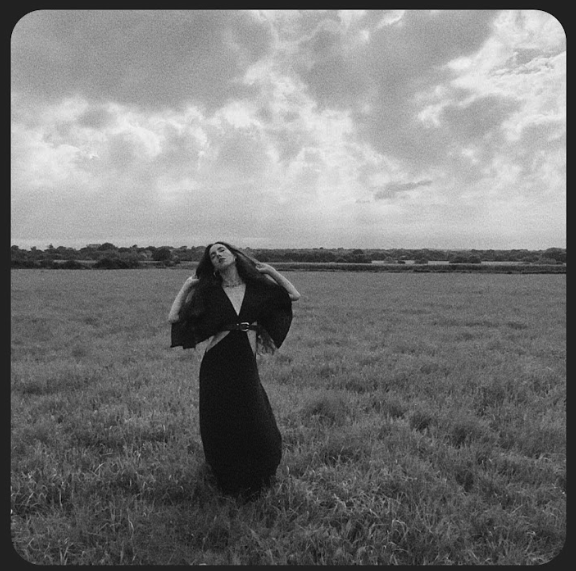
Elea Calvet ‘Sinuous Ways’
(Hyssop & Victoria Records)
With an intelligence and subtlety sadly lacking in much music these days, the Bristol-based (born in Canada and brought up for a time in India) worldly artist Elea Calvet reflects the sinuous of her latest single with a winding, pondered and almost sighed adroit wistfulness. A still piano, bowed and softly thumping bass with tremolo quivers and delightful wisp of melodious beauty, the duality of the human soul is laid bare to a most accentuated backing and feely atmosphere. There’s a real clever alchemy of lyricism, and a balance struck between the sorrowful and beautifully drifting, the bluesy and folksy, classical and wispy. Torment reigns all right, but the near haunting float-y but always present voice and music is as alluring as it is clever and deep: and again, that duality, somehow wafting along almost effortlessly.
A burgeoning star until a hiatus, Elea Calvet has been constantly compared to such idiosyncratic stars as Anna Calvi – and for good reason. But she reminded me of Raf Mantelli, a touch of our very own one-time collaborator and fellow Canadian, Gillian Stone, Amanda Acevado, and a more disarming Diamanda Galas. Songwriting and orchestration wise, I swear I’m hearing a touch of Bowie too!
This is vulnerability and strength heading in an intriguing, interesting and artful direction. I look forward to hearing more, with a full EP in March.
THE MONTHLY DIGEST OF ACCUMULATED NEW MUSIC, THE SOCIAL INTER-GENERATIONAL/ECLECTIC AND ANNIVERSRAY ALBUMS CELEBRATING PLAYLIST, AND ARCHIVE MATERIAL CHOSEN BY DOMINIC VALVONA

Continuing a series that started in 2023, the Digest is my one-stop column of the new and the old; a secondary home to all those releases I missed out on or didn’t get room to feature in either my Perusal reviews features or singular Our Daily Bread posts, plus a chance to celebrate timely anniversary albums and dip into my own record collection with the a special anything goes playlist, and to, finally, dip into the Monolith Cocktail Archives.
The New: this will be a briefing of a sort, with a short outline, thoughts and reactions to a number of recent albums from my inbox – currently a 1000+ releases a month on average!
The Social Playlist: choice music collected from across the ages, borders and genres, with a smattering of tracks from choice anniversary celebrating albums of worth and cult status. Consider it my unofficial radio show.
The Archives: self-explanatory, but each month I chose past pieces from the extensive Monolith Cocktail back pages that have a timely ring to them.
_((THE NEW))_
LINA_ ‘Fado Camões’
(Galileo Music)
Fado dramatist with the spellbinding voice, LINA_ follows up her impressive collaboration with Raul Refree with another unique reading of the famous Portuguese form of sullenness, sorrow and plaint. On that previous project, the diaphanous and emotionally sonorous pulling songstress and composer transformed the music of the Fado legend and actress Amália Rodrigues; filtering that icon’s songbook through a modern production of minimalistic gauze and sonic atmospheric effects.
Back this time with the British producer and musician Justin Adams (credits include projects with Robert Plant, Tinariwen, Eno and Sinead O’Conner to name but a few) and a small ensemble, LINA_ takes on the classical 16th century poetics of Portugal’s most famous literary son, Luís Vaz de Camões. So titan a figure in that country’s rich history, his medieval period language of lyrical romantic aches, mortality and nature is said to be the basis of Portuguese itself: often called the “language of Camões”. Integral to the very soul of Portugal then, it’s fitting that such a talent as LINA_ is behind this interpretation of his work; transcribing it’s prescient and near timeless reach to the music of Fado. Examples of which include, when translated into English from the original lyrical language, “They hear the tale of my misfortunes, and cure their ordeals with my hell”. Tortured but also overwhelmingly beautiful and romantic throughout, it suits the musical form very well across twelve near magical songs of air-y mysticism, the venerable, yearning and dreamy. Musically tender, accentuated and like a fog, mist at times, even vapour of the mere essence of a score, there’s echoes of old Spain, the Balearics, North Africa, the Middle East but also Turkey and the Hellenic. You can also add the supernatural to that list too: a passing over into the ether. At times other times there is an almost semi-classical feel, merged with Iberian and Galician new wave, with some songs standing out as radio-friendly floated diaphanous pop visions of the Fado spirit.
Incredible throughout, LINA_ once more proves herself the most striking if not talented artist in this field of exploration and music; bring together beautifully and evocatively time honoured traditions and the legacy of literary Portugal with the country’s most prized and famous export to magic up another essential album. LINA_ is a leading light, pushing the boundaries without losing the soul, truth and appeal of the music she adopts and transforms. Fado Camões is another artistic triumph.
Andy Haas/David Grollman ‘Act Of Love’
The experimental NYC percussionist-assemblage artist and knight of the Ghosts Of The Holy Ghost Spermic Brotherhood (alongside saxophonist Andy Haas and the late multi-tasking Michael Evans) David Grollman knows more than most about the cruelties of the Alzheimer’s Disease; losing his wife, the poet Rita Stein-Grollman to Early Onset Alzheimer’s in early 2023.
Funneled and channeled into this most recent album with Haas, Grollman and his sonic partner of avant-garde arts and evocations reflect the very essence of loss through an apparatus of Dadaist and Fluxus apparatus: namely in Grollman’s case the balloon, with the textured tactile touches and stretches of its latex surface wrinkling as it expels its air; in a manner, like the life force slowly leaving the deflated body and personality of what someone once was as they lose themselves to this incurable disease. Meanwhile on sax, Haas deals in exaggerated long, slowly drawn-out breathes and blows; sometimes appearing to lift the weight that sits on his lungs, and at other times making noises that resemble steam and the pressure of valves being released and squeezed. Together it sounds like La Monte Young, John Zorn, Anthony Braxton and Marshall Allen in remembrance.
But then there’s another dimension, the brilliant, often acerbic poetry of Rita (written before she succumbed to the disease), which is read out in both almost laconic and grumpy confrontational style by David. Another piece of text, ‘Message From ME’, which the title makes obvious, is a voicemail left by the already mentioned and late Michael Evans (who passed away back in 2021), another knock-about figure on the scene and much missed member of the Ghosts Of The Holy Ghost Spermic Brotherhood. Act Of Love is a challenging and strained but obviously emotional well of remembrance, with the harsh and more attentive abstractions of the performances somehow managing to convey that which can’t always be said or represented.
Variát & Merzbow ‘Unintended Intentions’
(I Shall Sing Until My Land Is Free) – Released the end of last year
Unsurprisingly concentrating the mind, the brutal barbaric dystopian-scarred landscapes of war-torn Ukraine have been transmogrified into the abrasive, concrete debris soundscapes of nightmares by the trick noisemaker of dissonance and pulverizing noise, and co-instigator of the Prostir label, Dmyto Fedorenko (aka Variát). As his homeland continues to be bombarded and churned up by the invading forces of the despot Putin, Fedorenko teams up with fellow noise sculptor of some standing, Masami Akita – the harsh and confrontational Japanese artist behind the 500 plus back catalogue Merzbow project – to reshape the needled, scowled, squalled, overbearing, sinister, menacing and static coarse ruins: the only hope of which, is in the “resilience” of the Ukrainian people holding back the tide of destruction and evil.
Crushing morbid forces merge with the air raids of drone attacks, decay, coded signals, charged force fields, transistors, the Fortean radio set and the alien. Occasionally a keyboard chord materializes, along with the recognizable sounds of toms and breaks – the drums sounding like at times like they’re being beaten with boxing gloved pummeling hands. At one point it could be the set of a roofless cathedral, another, from the charred remains of a devastating fire: I could of course be projecting all this.
Throbbing Gristle, Gunther Wüsthoff, Jóhann Jóhannsson, Sunn O))) (if they cashed in their guitars for synths and a laptop), Oberman Knocks, Boris and Scott Walker are all brought to mind. And yet this is a unique collaborative pneumatic and caustic vision from the two artists, one that can’t help but evoke the devastating, mindless and distressing scenes unfolding. And if you needed any prompting or a reminder, profits for this release all go to supporting ‘Ukraine resistance against Russia’ with donations made to self-defense and humanitarian foundations. PS: Thanks by the way to the label, I Shall Sing Until My Land Is Free, for the CD and stickers; always appreciated to receive something physical in an increasingly soulless, downloaded or streaming, non-committal world.
Various ‘Hyperboloid 2024’
(Hyperboloid Music)
I had to try and shoehorn this end-of-year compilation from the Latvian label in to the Digest this month. Twenty-five visionary trance-y and techno tracks from the roster’s myriad of artists – a sort of Balkans and beyond Warp label Artificial Intelligence series for the new age and new century -, there’s variations of the electronic genre spread out across a generous showcase that marks yet another creatively successful year for the imprint. Old skool rave breaks sit next to entrancing vista soundscapes; d’n’b with hardcore; and near Grimes-like pop electronica with thoughtful rumination. Get stuck in.
Roma Zuckerman ‘Phenomenon of Provincial Mentality’
(Gost Zvuk)
Filaments, electric currents, crispy buzzes and granular fizzles combine to form the most redacted and evocative of minimal techno, deep house and EBM-esque dance music on the Siberian producer’s archival showcase for the Gost Zvuk label. Charged, pulsing and rhythmic at all times, Roma Zuckerman’s spheres of influences run through glimpses and throbs of Basic Channel, Kreidler, Rob Hood and Dave Clarke, twinned and merged with an alternative cosmonaut Soviet era vision of Sky Records. And most surprising of all, on the collection’s finale, ‘Compañeros’, there’s a move toward windy-fluted Latin American with the use of a Spanish pastoral rhythm guitar. Voices, the echoes and morphed ravings, communications and alien warped effects of which, play their part too; at times sounding like Richard H. Kirk, and at others, like some two-way radio cosmic interface between ground control and Soyuz shuttle. A highly recommended slice of deep bass, futuristic and simultaneously retro-futuristic minimalist techno that will almost definitely make the end of year lists.
(((THE SOCIAL/VOLUME 82)))

Continuing with the decade-long Social – originally a DJ club night I’d pick up at different times over the past 20 plus years, and also a café residency from 2012 to 2014 – playlist, each month I literally chose the records that celebrate anniversary albums; those that I’d love to hear on the radio waves or DJs play once and while; and those records that pay a homage and pay respects to those artists who we’ve lost on the way.
January starts with one such sad but celebratory nod to the late Marlena Shaw, who passed away last weekend (I’m incidentally writing this at the start of the third week of the month). The California Soul(stress) had some real sass and attitude, as proven by the provocative, taking-no-shit, title of her 1974 LP, Who Is This Bitch, Anyway?; from which I’ve included the short gospel-light ‘The Lord Giveth And The Lord Taketh Away’. Also 50 this year, there’s tracks from Pekka Pohjola’s Harakka Bialoipokku, Harmonia’s ‘Musik Von Harmonia’ and (sticking with a kosmische/krautrock theme) something from the quartet of albums made under the auspices of The Cosmic Jokers nom de plume – a supergroup that never really was, the main participants of which included such lauded icons as Manuel Göttsching, Klaus Schulze, Jürgen Dollase and Harald Grosskopf fucking around in Dieter Dierks’ studio; the results of which, unknowingly recorded by Rolf-Ulrich Kaiser and Gille Lettman at the time were put out during 1974 – Schulze was incandescent enough to sue over the whole affair.
40th anniversary nods go to Finnis Africae’s incredible fourth world self-titled peregrination, Bob Dylan’s Planet Waves and Harold Budd & Eno’s prized and influential The Pearl LP. A decade later and there’s also tracks from The Wake’s Tidal Wave Of Hope and Air Liquide’s Nephology (see my archive essay style piece further down the column).
I usually leave the most current and newest of tracks to the Monolith Cocktail’s Monthly Playlist (next edition due next week), but have included recent(ish) tracks from Igor Osypov, Bagaski, Nicole Mitchell and, not really new but reissued late last year, a track from the originally 1984 released Ein Bundel Faulnis in der Grube album by Holger Hiller (of Palais Schaumburg German new wave fame) – reissued that is by krautrock/kosmische specialists Bureau B.
The rest is for you to discover; a smattering of eclectic delights, wonders and nuggets from across time and from across the globe. Actually, if you are reading this, and if you have time, I’d really like some feedback on the length of these playlists. I’ve gradually tightened the running order down to around the 30 mark and the length under 3 hours – down from 33 last year, and before that anything from 40 to 100!!! Let me know if this is a ridiculous number, or just right.
___TRACK LISTING AS FOLLOWS:
Marlena Shaw ‘The Lord Giveth And The Lord Taketh Away’
Bob Dylan ‘Tough Mama’
Ethel-Ann-Powell ‘The Jaybird Song’
Acayouman ‘Si Ou Ladje Moin’
The Wake ‘Britain’
A Passing Fancy ‘Your Trip’
The New Tweedy Brothers ‘I Can See It’
Americo Brito ‘Sabe Na Panama’
J.O. Araba ‘Kelegbe Megbe’
Finnis Africae ‘Zoo Zula’
The Cosmic Jokers ‘Power Drive’
Ike Yard ‘Beyondersay’
Air Liquide ‘Semwave’
Holger Hiller ‘Chemische und physikalische Entdeckungen’
Harmonia ‘Sonnenschein’
Fireballet ‘Carrollon’
Pekka Pohjola ‘Hereillakin uni jatkuu’
Dhidalah ‘Adamski’
Son Of Bazerk ‘The Band Got Swivey On The Wheels’
Bagaski ‘Hawkish Torso’
Joe Mubare ‘Number 8’
Nicole Mitchell ‘You Know What’s In There’
Igor Osypov ‘Vango’
Lard Free ‘Warinbaril’
Teengenerate ‘Something You Got’
Tasavallan Presidentti ‘Weather Brightly’
Second Hand ‘I Am Nearly There’
Duffy Power ‘Glimpses Of God’
Grothbros ‘Tollah Tra Flex’
((((ARCHIVES))))
Air Liqude ‘Nephology – The New Religion’ Is 30 Years Old This Month

Selective electronic musicians often come out with the line that they’ve been influenced on a particular album by the Krautrock greats, citing such luminaries as Roedelius, Michael Rothar, Klaus Schulze, Irmin Schmidt etc. – as though they were in some way picking up the baton and running with it.
Of course most of this is a whole crock of shit, as hardly anyone essentially understood that those innovators from the 70s were always moving forward and re-inventing their sound, never usually dwelling on the past; just copying it or reprising it totally misses the point.
OK, so I’m sort of meandering off on a tangent, but basically you can take a look at the likes of Neu!, Cluster, Kraftwerk and CAN and see they were making something fresh and new; to really take on their train of thought means to push those delineated boundaries even further.
Heir apparent to the synthesizer and analogue re-wiring school of exploration, were, and still are, the Cologne duo of Air Liquide. They took up their forefathers brave new world mantle, and built an ambitious and inspiring variation based around the technological leaps in music production; concentrating on the styles of Techno and Acid House.
Their seminal opus of 1994, Nephology, adopts vestiges of cinematic, industrial, ambient and dub; producing an impressive soundtrack that stands up well even by today’s standards, and adheres to the German desires of progress.
The duo comprised of the exceptionally talented Cem Oral and Ingmar Koch, better known as Jamin Unit and Dr. Walker, both entrenched in technical know-how – Koch was the lucky recipient of a Roland JX3P synthesizer on his 14th birthday, a gift that led to him being hired by Korg to program sounds for a number of their iconic models.
Koch began recording in the late 80s, composing, as he puts it, assembly line House and Hip Hop tracks for the German labels Hype! and Technoline. The latter label went bankrupt, prompting him to join a course on electronic composition at a University in Cologne. He would soon meet fellow student and synth enthusiast Oral, and find that he also shared a common interest for groups like Tangerine Dream, CAN, Heaven 17, early New York Hip Hop and Chicago acid: working together seemed almost inevitable.
By the end of 1991 Air Liquide was born, with their first EP release following in a matter of months, and a self-titled debut at the end of 1992. Their second album, the 1994 released Nephology opus, really upped the ante with its mostly innovative themes and layered tracks modeled around the more sophisticated tones of intelligent Techno and dance music – future projects saw the duo experimenting with Gabba hardcore and ethereal fashioned traversing styles of trance.
Singing from the same hymn sheet as The Orb, and many similar ambient acts, they immersed themselves in a haze of new-age touchy-feely rhetoric, using both celestial horizons and the skies above as the central theme to hang their music to: That Nephology title is itself taken from the, originally Greek, word for clouds; adopted as the terminology for the study of their formations – interestingly over the last century it has remained a rather marginalised and forgotten art…well, that was until the recent interest in global warming.
The 14-track album is split into various sections, with the main tracks interspersed amongst the otherworldly type segue ways and vignettes.
A central atmospheric resonance runs throughout, evoking a cosmological and space-age mood, one that has an often ominous or threatening feel to it; charged with rippling static effects.
Mainly we are treated to some indolently and cleverly multi-layering techniques, produced from an impressive display of iconic analogue/electronic equipment, including the Roland Tr 808, Jupiter 8, ARP 2600 and a pair of Moogs.
Side one of this double album entirely consists of acid drenched grooves and bouncing taut techno. The grand opening of ‘The Cloud’ emerges refined and full of empyrean quality from the ether, its tightened rolling drums and throbbing bass cascade over an electrified wild jungle rich sound collage; sounding like a Germanic 808 State. As though in tribune to Klaus Schulze and his cohorts, the duo interweave startling ambient sequences, dousing the beats in swathes of metallic walled corridor sounds and whispering missed conversations.
This swirling tome is followed by the more Chicago house style of ‘Semiwave’; a sauntering announced rhythmic workout, full of ever-tightened repetitive percussion, moody dramatic bass and lethargic plonking notes. Ethereal strains of some distant cooing float in and out of the track, setting the look-to-the-skies above scene perfectly, sending us hurtling ever further into the stratosphere.
Caustic meatier bass lines and squelchy 909 bleeps flourish on the bonus track ‘Auroral Wave’ – seems this and one other tune, are not included on all versions.
Hardened ticking away drums and pre-set handclaps encounter Mo Wax space-esque sustains, whilst moving along at a Mannuel Göttsching pronounced building pace.
Air Liquide manage to absorb many different styles of music including dub; the strong use of dark moody bass can be found on tracks like ‘THX is on’, where Sly and Robbie meet Carl Graig’s Plastic People period flow. There’s also room for Hip Hop, with the duo re-working Cypress Hill’s ‘Insane In The Brain’ for their own beguiling electro track ‘Stratus Static’. They manage to meld both the stoner-induced sample of the Hill’s track with what sounds like a dub-esque clattering Art of Noise, to produce something quite original and sublimely dizzying.
Scattered throughout are more light-hearted moments, including ‘If There Was No Gravity’, where they take on the ambient workshops of both The Orb and Orbital. Wispy willowy female vocals poetically describe a sort of dipsy journey through the clouds, the lyrics leaning towards cliché almost:
“How you’d love to live up there,
Kiss the sun and walk on air.
If there was no gravity,
You’d be in nephology”.
Dubtastic bass lines bumble along to fill the sweeping calm and dreamy melodics, in a display of evanescent pulchritude. The looming presence of Kubrick, or rather the meticulous chosen soundtracks that go hand-in-hand with his films, add dramatic passages of tension and suspense. ‘Die Reisse Im Teekeesel’ (loosely translated as ‘Those travels in the tea boiler’) uses 2001 A Space Odyssey harrowing soundscapes, with the chanting evocative mantras from ‘So Spoke Zarathustra’ to add intrepid doom. Both ‘Kymnea’ and ‘Im Grlenmeyerkolben I and II’ echo and groan with menacing moments plucked straight from A Clockwork Orange: Walter (Wendy) Carlos’s switched on treatment of Henry Purcell’s ‘Music For The Funeral Of Queen Mary’, and the tormented ‘Timesteps’ are brought to mind.
Eerily the duo can’t help but intersperse a sober and haunting array of imbued cinematics, dropping in hints of Dune, Star Trek and The Thing to create an often emotive or imaginative atmospherics, which lends the album a certain gravitas.
On the closing track, ‘The Clouds Have Eyes’, they end on a chaotic hypnotic flourish. Helicopter chopping Jeff Mills style beats rapidly rotate, as an operatic style haunted choral sweep swirls around in the tumultuous cyclonic blades. That almost disturbing voice-like loop, calls out from the melee as though an apparition from some distant planet or dimension: a perfect finish.
Nephology does undoubtedly sound of its time to some extent; tied in some respects to a particular epoch, yet though it’s over thirty-years old it somehow rises above sounding dated. In fact recent revivals of the late 80s and early 90s electronic scenes – where labels such as R & S, Harthouse, Structure and Rising High fed the deep thinking dance music appetite – have encouraged a mini-renaissance and re-valuation. In 2024 you could easily slip a bit of the old Nephology into the club, and no one would blink.
Hi, my name is Dominic Valvona and I’m the Founder of the music/culture blog monolithcocktail.com For the last ten years I’ve featured and supported music, musicians and labels we love across genres from around the world that we think you’ll want to know about. No content on the site is paid for or sponsored and we only feature artists we have genuine respect for /love. If you enjoy our reviews (and we often write long, thoughtful ones), found a new artist you admire or if we have featured you or artists you represent and would like to buy us a coffee at https://ko-fi.com/monolithcocktail to say cheers for spreading the word, then that would be much appreciated.
Our Daily Bread 607: John Howard, James P M Phillips, Corduroy Institute, Charlie Butler…
January 18, 2024
A ROUNDUP OF REVIEWS FROM BRIAN ‘BORDELLO’ SHEA

__/SINGLES\__
Heskey ‘Crack In The Mirror’
Do you like Teenage Fanclub and bands of tuneful guitar strum? If so you are going to enjoy this blissful pop song of tunesmithery; it has all the ingredients one would want for such a release; if it was fish and chips it would just have the right amount of salt and vinegar.
John Howard ‘Safety In Numbers/In The Light Of Fires Burning’
(Kool Kat Music)
The brand new single from John Howard is upon us and it is a double A-sided thing of nostalgic beauty, two brief glimpses of how songs where written and performed, with a pop eloquence that sadly seems mostly a thing of the past. To kick things off we have “Safety In Numbers”, a sublime pop ballad that brings to mind The Beach Boys in their Pet Sounds days; wonderful harmonies drift upon a sea of piano tranquility. The second little pop gem is “In The Light Of Fires Burning”, which again is another nostalgic gem a song that captures the magic and sadness of growing old whilst celebrating your youth and memories through the joys of pop song: A song worthy of Sedaka at his finest.
Liam Gallagher & John Squire ‘Just Another Rainbow’
I was expecting nonsense I will be honest, but was taken aback by just what an explosion of nonsense it was. We have John “I have all the Led Zep albums on vinyl, cd and cassette” Squire showing he knows all the chords, and he has six strings, and he is going to play everyone of them with as little subtlety as possible. He has seen rock school. He knows how it goes. Is it original? No, we have heard it all before. Is it good? No. Did I want the monstrosity to stop? Yes! Not to be outdone by John “I have all the Led Zep albums on vinyl cassette, cd and 8 track” Squire, we have Liam ‘I have done poo poo’s in my pants” Gallagher once again demonstrating his vocal prowess; the singing like he has just been told off by his mum vocal emoting. And to show that he is not going to be outdone by John “I have every Led Zep album on vinyl, cassette, cd, 8 track and download” Squire he decides to demonstrate how he knows the names of all the colours in the laugh out loud badness of the lyrics. I once wrote that the Oasis song “Little James” could be the worst song ever written by a grown up. Well, maybe not any longer. It is a close run thing. So for that, Squire and Gallagher should be proud.
___[ALBUMS]___
James P M Philips ‘Spite, Bile & Beauty’
(Turquoise Coal)
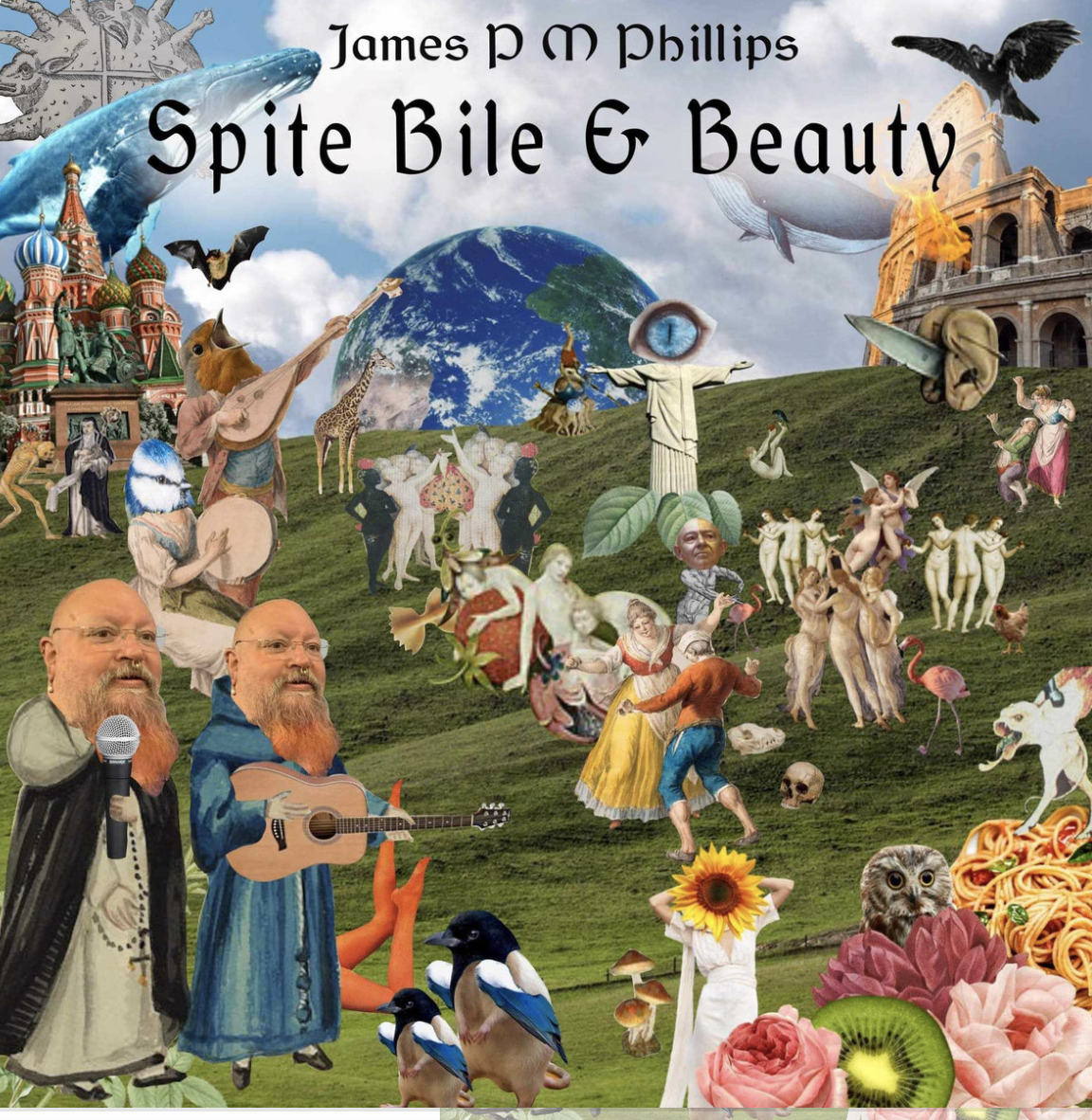
Punk, folk, rock and a medieval becoming strangeness all collide to bring us another album of psychedelic whimsy from the head and heart of James P M Phillips: an album of joy, sadness, humour and pain. Whether it be the quite wonderfully disturbingly jagged “My Head Is Full Of Rats” or the quite beautiful folk strum of “My New Friend”, James has his own unique way of making music and writing songs; dipping his own original thought patterns into a hybrid of musical genre hopping eccentricity. And it is pleasure to listen to an album of short snippets of musical madness and joy.
The Incurables ‘Inside Out & Backwards’
(Big Stir Records)

It does make me smile when middle-aged men sing about growing up, as The Incurables do on the first track ‘When I Grow Up’. As I well know, middle-aged men who play in bands never grow up; that is the power and magic of music and long may it continue.
The Incurables are a punk pop band that performs punk pop well, and at times they remind me of Green Day but without the annoying singer and with a more bubblegum sometimes New York Dolls feel, and some quite wonderful Batman bass riffs: in fact, some just wonderful bass riffs. This music is no longer going to change the world but sadly I cannot see any music anymore doing that, but The Incurables have their place and that place is in any pop punkers record collection.
Corduroy Institute ‘Take A Train To Manchester’

I have taken a train journey to Manchester many times in my life and none have been as enjoyable or as interesting as this, or indeed, as experimental – is it possible to take an experimental train journey I wonder? Anyway, the title track is a wonder: imagine Funkadelic being sucked into a video game whilst Delia Derbyshire juggled fruit. And from there we are taken on a long and dreamlike journey, calling at stops that are both rewarding and disturbing in a good way.
“[A] Girl Named Philosophy” is a bass heavy vacuum of Scott Walker like lust and mystery – just how much I miss that man and his artistry. And I could be wrong, but Scott could be a big influence on the excellently named Corduroy Institute: at least they are reading from the same book or singing from the same hymn sheet.
I love how the Corduroy Institute take jazz, pop, classical and funk and mold it into a warm expression of artistic splendicity; from at times sounding like Japan tuning up – not the band I might add, but the whole country -, and you opening your eyes and seeing life for the first time for what it is: full of love, hate, sadness and joy. An album of supreme aural wonder, and next time you take a train to Manchester soundtrack it with this.
Orchard Til You Fall Down
(Cruel Nature Records)
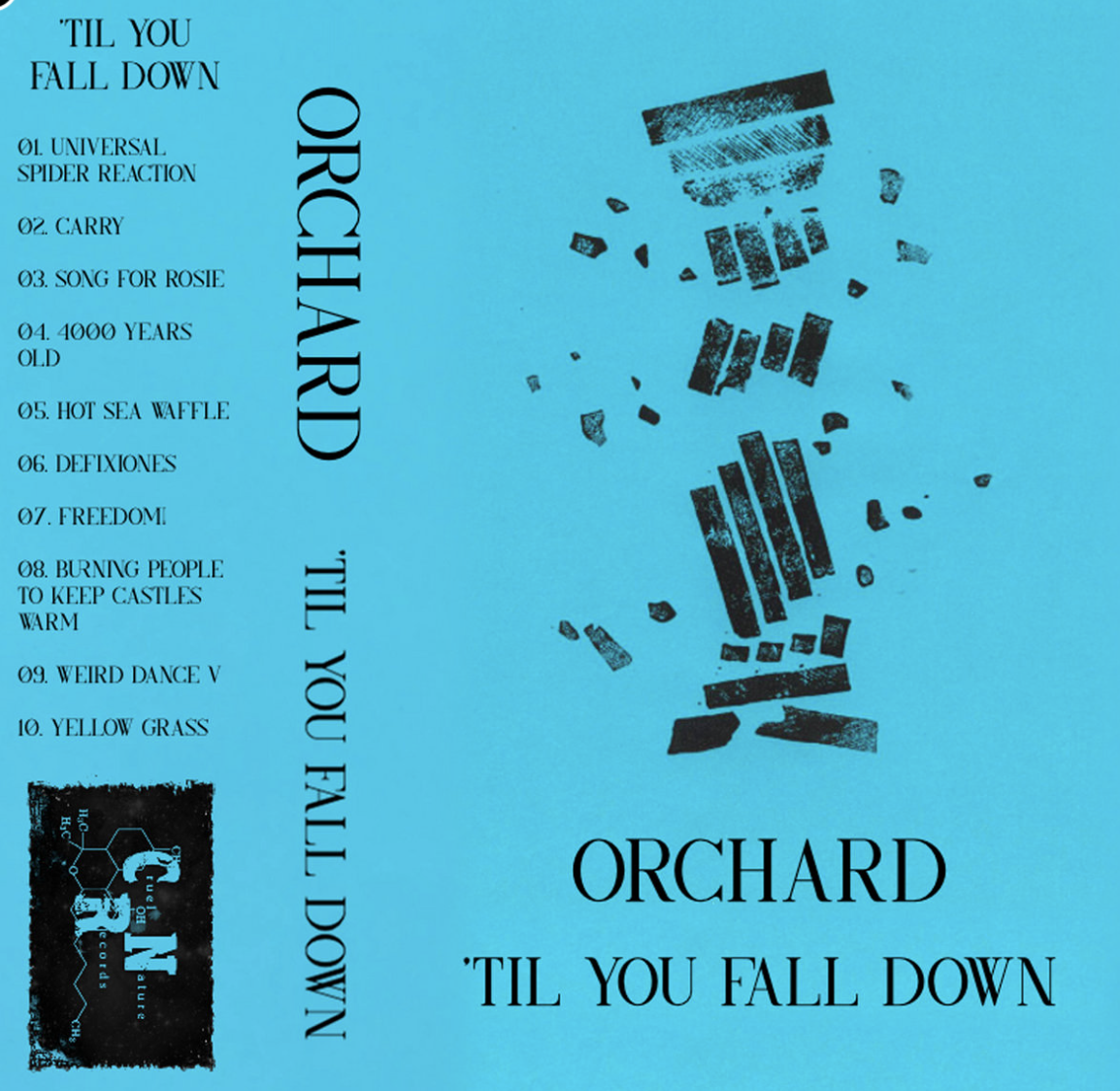
Punk rock is alive and well and living in Cruel Nature Records. Another ltd edition cassette delight of lo-fishness from the label that offers you all kinds of alternative delights; this time supplying us with ram jam bag of indie punk experimental joy. With mostly just guitar and drums, and occasional bass, and some fine vocals it reminds me at times of early Siouxsie and The Banshees. And, with all its beautiful post punk starkness, takes you back to an old dive of a small venue that was full of cheap booze, cig smoke and battered leather jackets and dreams of your youth when the world offered the chance to make a difference and the future was coloured in the shade of weekly music papers and John Peel on the radio and local bands blowing your minds on a weekly basis. Til You Fall Down is an album of old hopes remembered: a beauty of a release.
Charlie Butler ‘Wild Fictions’
(Cruel Nature Records) 1st February 2024

Are you all fuzzed up and ready to take that trip to the local magic carpet store and fly your purchase home, but not first deciding to stop by the local fields to pick a few magic mushrooms to pop into your grannies soup and watch her explode into a explosion of rainbow colours, which Liam Gallagher will then tell you the names of as he is good like that – he knows all the names, he is a clever boy, it won’t be long before he’s been toilet trained. You then decide to soundtrack this event by popping the brand new cassette into your hi-fi that the postman has delivered riding on his old 70s vintage chopper bike; the cassette has been posted by some kind wizard who works at Cruel Nature Records, and you are more than delighted by the magic the tape emits; the sound of all your yesterday’s rolled into four slices of psychedelic keyboard frenzy that slow dances with some augmented guitar. Oh how the soup is warm and refreshing; like how your granny is warm and refreshing, her skin surfing with delight at every organ chime; a lovely of ladybirds sit outside your window marvelling at the aural majesty not heard since the golden days of the Spacemen 3 and those long summer days daisy hopping. The music is all that you hoped it would be, for music without hope is hopeless and this is anything but that; it is the cream cake among lesser mortals.
Fran Ashcroft ‘Songs That Never Were’
(Think Like A Key)
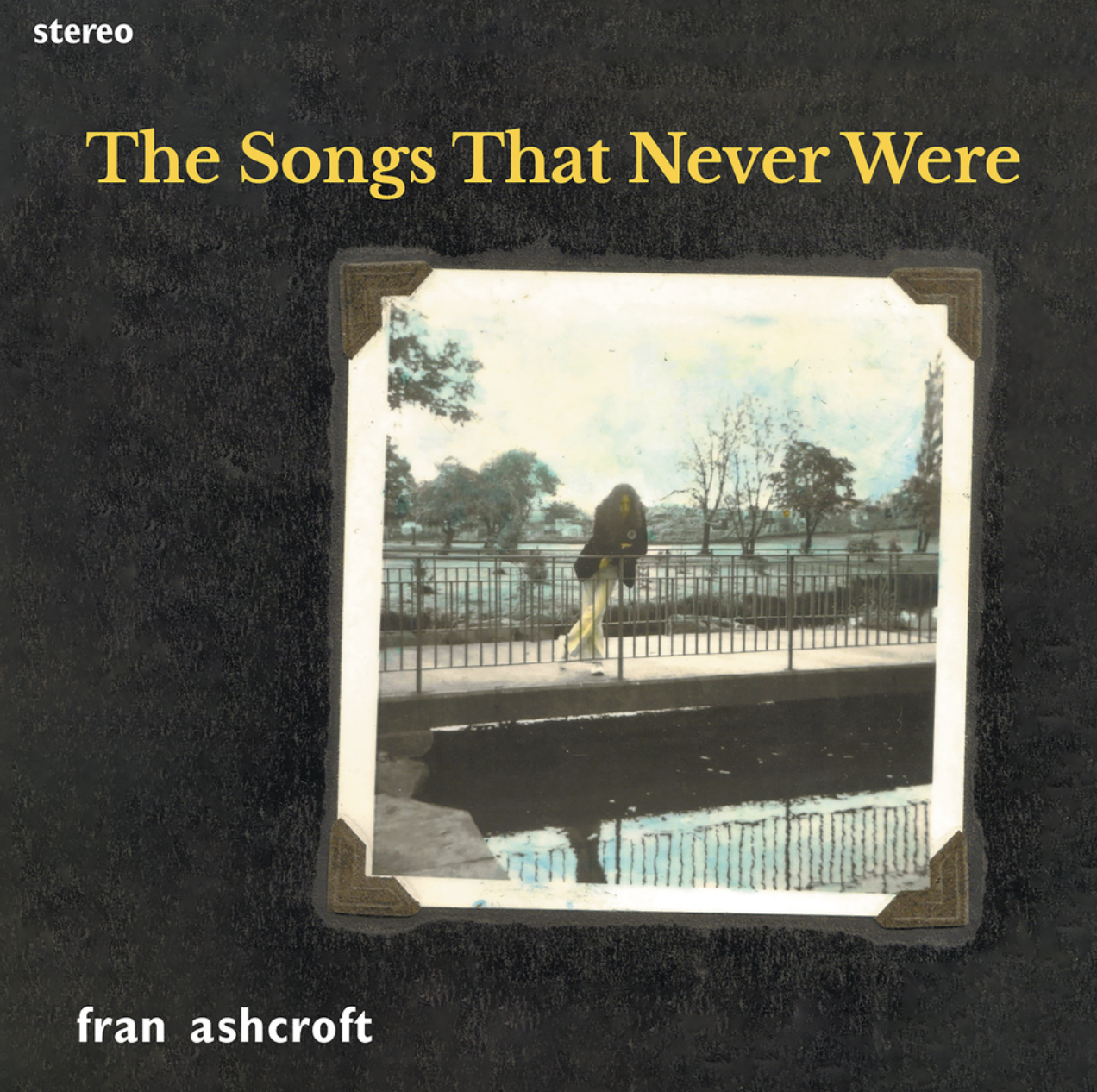
There is magic afoot, a warm kind of musical magic; a treasure trove of forgotten emotions that are plucked and streamed from the past 50 years and gathered together in the form of the greatest of artforms; songs that explode with a cheeky nod and a wink to our musical past, our musical heritage. Yes indeed, Fran Ashcroft has given us a strange and warm sounding album.
All the music that I’ve heard Fran has had a hand in producing is always steeped in a loving glow: From the excellent “Waiting For A Britpop Revival” – a song Luke Haines would sell his left arm to have written – to the McCartney like “I Believe In You” – a song worthy of the Pete Ham album “7 Park Avenue”.
There is a uniqueness about this album; a trueness and soul you do not come across often much in these days of music to be played on phones. These are songs that could have been written anytime over the last 50 or so years, with some quite beautiful melodies and great lyrics; songs made for and by a music lover…already one on my end of the year best list.
Cumsleg Borenail ‘…Plays The Beatles’

I am a huge Beatles fan and this album captures all the magic and experimental forward thinking music the Beatles recorded. These are some of the finest and well thought out and performed covers of well known classics; songs you can hear everyday by turning on the radio can eventually sound stale, but these have been reworked and reimagined to such a degree that they would have the avant-garde young 60s Macca waving his thumbs in delight. This is an album to be heard and cherished by all Beatles fanatics.
Our Daily Bread 606: ‘Ulyap Songs: Beyond Circassian Tradition’
January 16, 2024
THE LONG REVIEW/Dominic Valvona

Various ‘Ulyap Songs: Beyond Circassian Tradition’
(FLEE) 19th January 2024
In spite of its natural imposing mountainous defenses, high altitudes and isolation, the Northern Caucasus region couldn’t help but be swept up into the ever-imposing empire grabs of Imperial Russia during the early 19th century. Although the blueprint was laid down much earlier by Peter The Great, and enacted two generations later by Catherine The Great, it would take Russia time to bring this warrior region to heel. Through conquest and treaty, Tsarist Russia saw the end of Islamic Persian influence in this part of the greater transcontinental Caucasus, which stretches out to the Black Sea in one direction, the Caspian in the other: bridging Asia and Europe.
In that expansionist drive Russia perpetrated untold horrors, genocide in fact, as they unleashed an invading campaign of terror on the local Circassian population. In scenes that would be repeated less than a century later on another Caucasus population, the Armenians, by Ottoman Turkey, those that weren’t massacred were deported on mass to the Middle East, and ironically, Turkey – even before that, many unfortunate souls were enslaved and decamped to Egypt to fill the ranks of the non-Arabian mercenary group, the Mamluks; eventually over generations growing into the ruling class itself and ruling huge swathes of North Africa and further abroad.
The once proud twelve historical provinces of the Circassian, represented on their green field and crossed arrows charged gold star flag, were divided up at first by Tsarist Russia, and later by the post-revolutionary Soviet camarilla into a number of ethnic republics: Adygea, Kabardino-Balkaria, Karachay-Cherkessia, Krasnodar Krai and Stavropal Krai. Despite emptying much of this ancient land already, a majority of the Muslim population from these areas was deported to dreaded Siberia and Central Asia. This was on the cusp of WWII.
It should be noted at this point that the history is both far more convoluted than this, and often confusing as it entails a host of ethnicities and cultures, and unfortunately, atrocities – these lands already devastated by Mongol hoards and disease before the Russians turned up. Rather helpfully, the guys behind this expanded project, that is, the FLEE publishing house/record label/curatorial platform and their extended cast of musical ethnologists, experts, writers and artists, have traced the history a lot better and in more depth than I have. But roughly, and for the sake of context and a better understanding of this project, we’re talking about one of the most contested regions in the world; fought over since the Soviet experiment collapsed in 1991. Out of the oppressive tyranny emerged the old realms once more: Armenia, Azerbaijan and Georgia, but also Dagestan, Chechnya, Abkhazia and Ossetia. Barely a year has passed without war or conflict in these regions; especially with the emboldened empire-building policies of Putin – an adept pupil of Soviet rather than Tsarist Russia, his ambition is to once more claim and conquer those Eastern European satellite states that came under Soviet control in the aftermath of WWII, and to build a corridor towards the Med, where he aims to keep a military naval presence.

Even recently, only a couple of Winter Olympics ago, the old Circassian capital of Sochi was used as grandstand aggrandizement of the Putin regime. Much to the locals anger; the graves of that earlier genocide literally paved over and erased just like that for a sporting event. Flashpoints extend beyond into the Ukraine and the disputed territory of Nagorno-Karabakh (internationally recognized as part of Azerbaijan, yet its population is largely Arminian). The former conflict probably had the greatest impact on this project; pushing back the release to this year, three years after FLEE met with the Nalchik-based music journalist/researcher and Ored Recordings co-founder Bulat Khalilov, who raved about the heavily-lubricated “petit criminal” and “gulag returnees ‘chanson’ music” of the Northern Caucasus.
Knowing a thing or two about such traditions, a citizen of the Kabardino-Balkaria region in the foothills of the Caucasus Mountains, Khalilov opened the door on an often wildly whooping raucous and hardy culture. The FLEE collective travelled across this rugged terrain, taking in the sometimes (so it sounds) impromptu performances of knowing, winking rogues and bawdry women, breaking out into song at weddings and in the ‘kunakskaya’ guest rooms of this hospitable folk. One village stands out in this task. The remote Ulyap hamlet of only 1200 souls is a bastion of the bellowed chanson-like accordion sound that accompanies all the unfiltered original recordings on this collection.
A purview if you like, with not only the recent traditional performances but also a number of transformed, inspired Caucasus visions by a diverse range of experimental artists, there’s also the inclusion of essays, previously unpublished photographs and artwork.
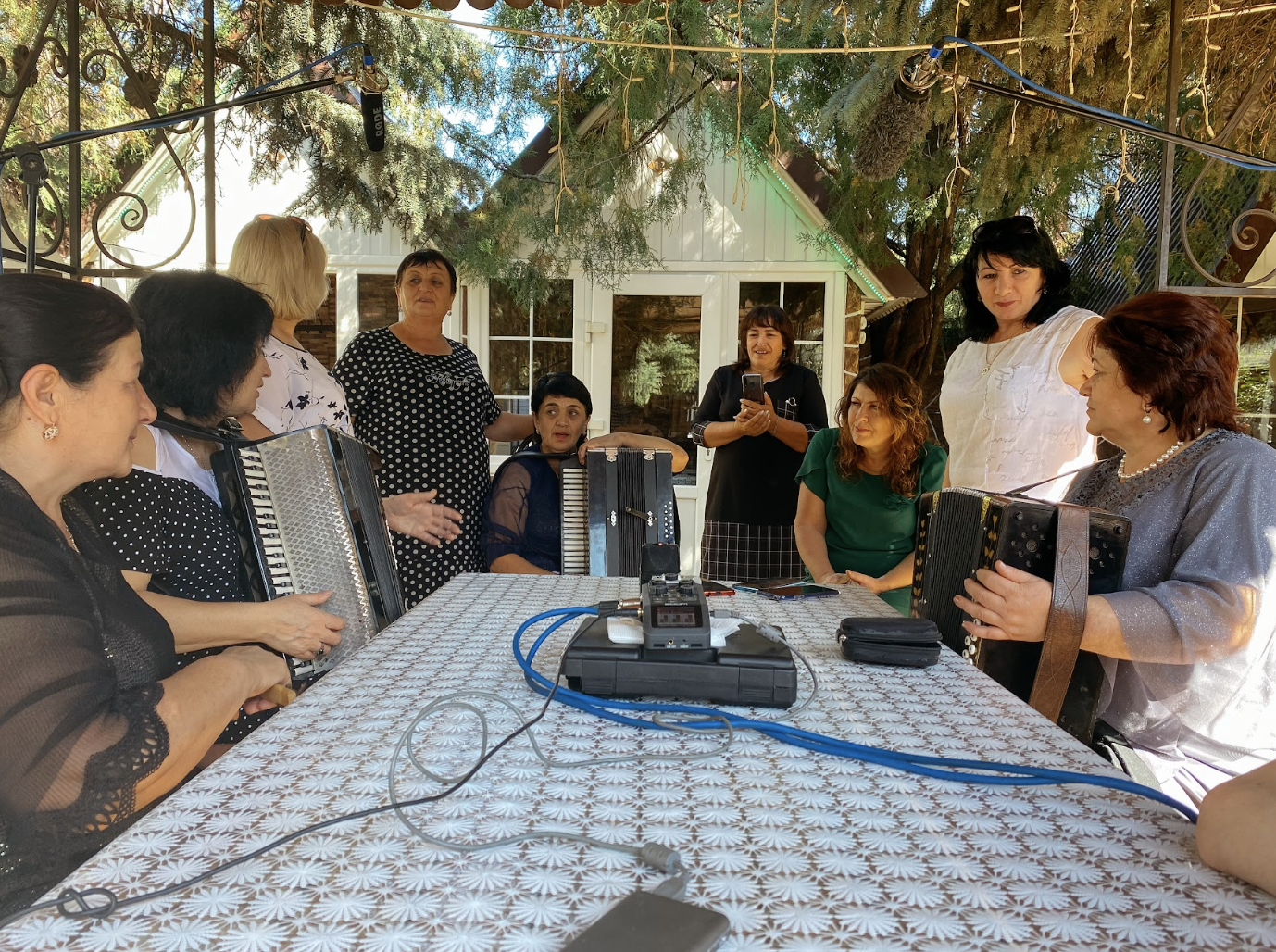
It all begins, however, with the ‘Women of Cherkessk’ (the capital city of the Karachay-Cherkessia republic), who show stoic form and strength in the middle of a wild washboard scrubbing and cutlery slapping percussive party of almost Francophone and Creole concertinaed accordion pumps and fairground dervish. Translated titles help of course, but the sentiment is often either lighthearted, heady or longing; sounding a lot like a drinking game or prompted outburst from a hooping bar room audience. When the ‘men’ of Ulyap surface, the rhythm is more like a seasick shanty; the voices like a couple of old boys propping up the bar, lending each other on, their ears pulled by the missus over their enthusiasm for vodka – “a little water”. Later on, the vocal tones and sorrow on Damir Guagov’s ‘Aminat’ seems to evoke not only the Slavic by Arabic; the accompaniment more like a cathedral piped organ. By the same artist, ‘Circassian Dancing Tones’ is a slow roller-coaster of accordion dips and scales; a lifting dance of beauty.
Smitten expressions, old country yearns, serenades and the knock-about convene on those no nonsense recordings from the post-Soviet underworld.
As if to reinforce the current tumult of oppression, a number of artists, commissioned to transform this tradition, have either left their Russian homelands or made a conscious decision to support Ukraine. Featured on this very blog (and making our choice albums list a couple of years back with his Roots album), Misha Sultan left the Siberian industrial city of Novosibirsh (the ‘Chicago’ of Siberia) behind some time ago. Sultan’s take (‘Siii Babe’) is a fantasy that transports the Northern Caucuses to a dreamy dub-y cartography of The Orb, Mulatu Astatke and Kutiman – an amorphous mirage of chuffed fluted blows, melodica and picky guitar.
The Kyiv-born, classically trained violinist Valentina Goncharova – stalwart of the Soviet avant-garde scene – fashions a near soundtrack fourth world ambient voyage out of the material that assails Tibet and the Steppes. Ariel Kalma meets Tony Conrad as broadcasts from the Soviet past magically materialize from the archives on this stretching of the ‘Evergrowing Tree’ roots.
Almost invasive by contrast, the combined Jrpjej and Ben Wheeler collaboration (the former, a post-traditional Circassian music group from Nalchik, and the latter, an experimental composer, ethnomusicologist using Caucasus influences, Soviet era electronics and modular synths) is like a near-distorted electric shock of rambunctious buzzy Gnawa or electric oud meets stunning voiced Persia.
The multi-disciplinary artist and composer (currently in at least four different bands) Simone Aubert creates a ethereal and moody windswept enveloped hallucination out of traditional elements and voices, and both the pairing of Emmanuelle Parrenin and Colin John seem to magic up dusky and hazy evocations of Natasha Atlas from the region’s links to Islam.
Minami Deutsch – a vehicle for the Tokyo-based motorik and ashram Amon Düül II imbued musician Kyotaro Miula – go the most way out, making a hypnotic crunching march out of a chorus of hand-clappers.
Broadening the scope, the guest list of collaborators stretches the imagination; often completely uncoupled from the source material. All together in one bumper package of ethnomusicology, it makes perfect sense, futuristic alternative planes and visions of a forgotten – mostly passed down orally – tradition. This is a document and testament to the hardiness, perseverance and survival of a culture massacred, exiled and incarcerated, the remnants of a culture almost lost in time, but proving to be very much alive and intriguing to our ears. FLEE and their collaborators, aiders have put together a brilliant, thorough piece of musical research that bristles and wafts with a bounty of possibilities.
Hi, my name is Dominic Valvona and I’m the Founder of the music/culture blog monolithcocktail.com For the last ten years I’ve featured and supported music, musicians and labels we love across genres from around the world that we think you’ll want to know about. No content on the site is paid for or sponsored and we only feature artists we have genuine respect for /love. If you enjoy our reviews (and we often write long, thoughtful ones), found a new artist you admire or if we have featured you or artists you represent and would like to buy us a coffee at https://ko-fi.com/monolithcocktail to say cheers for spreading the word, then that would be much appreciated.
Our Daily Bread 605: Unveiling of Violet Nox’s ‘Loki’ Video
January 12, 2024
VIDEO/DOMINIC VALVONA

Violet Nox ‘Loki’
Video created by Del Siervo of a track taken from the group’s Vortex And Voices album, released in 2023 by Somewherecold Records.
Enjoying a certain renaissance, thanks to a certain superhero franchise and self-standing series on one of the many streaming service sites, the Nordic mythological figure of Loki is used as both a mirror and symbol for whichever group, generation adopts him/her/them. Because although principally depicted as male, Loki is a fluid entity that changes gender at will. With all that entails, in the sense of analogy and metaphor, Loki is obviously a most useful, congruous – if you forget about all the chaos that ensues with his presence, the tricks and cunning; although in the mythological lexicon, this god is neither good or evil – symbol of the LGBT+ community. Which leads me to the Boston, Massachusetts electronic group Violet Nox, who use Loki as a signifier, andan embodiment of metamorphosis and synergy, for their oboe trippy hallucination of a new age trance-electronic track of the same name – although this wafted and drifted mirage could be mistaken more for something form the new age realms of reincarnated Egyptology.
Taken from last year’s futuristic Vortex And Voices album of psy-trance, cerebral techno and acid ethereal-voiced self-realization/self-discovery – which also made our choice albums lists of that year – ‘Loki’ has inspired a suitably transformative, symbolic video from Del Siervo, a Venezuelan artist and ambient/new age musician living in Argentina, who’s art evolves around myths from different ancient traditions, especially from the Amazon. Siervo works with new technologies to create images that evoke the mysteries of life, the creation and the unseen. And in this capacity, he’s provided a cosmic and exotic earthly visual feast for the eyes of suspended menagerie, unfurled butterflies, flamed exotic fauna, aura pulsation chakras and spirit animals. So cosmic in fact that the group have decided to release the video to coincide with the new moon.
Identifying with myth, Violet Nox are however very much wired into the “now”, with messages of self-love and inclusiveness wafting and drifting to a rhythmic, wavy vision of EDM, crossover rave music and soulful electronica. For this newest venture – their first for the highly prolific and quality North American label Somewherecold Records – features, more than ever, the experimental, often effected, vocals of group member Noell Dorsey: a mix of hippie cooed yearn, Tracey Thorn, Claudia Brücken and Esbe if you will. A siren-in-the-machine, Dorsey expresses dreaminess, sadness and on this near mystical, wispy and lightly dub-y vision.
Often expanding the set-up, apparatus and lineup, this time around the Gaia attuned ensemble consists of core members Dez DeCarlo (on synth/effects pedals), foil Andrew Abrahamson (“synthesis”, sampler and clocked machines) and the already mentioned Dorsey. Musically, sonically both ‘Loki’ and the Vortex And Voices on which it appears keeps up the trance and minimal techno, melodic and kinetic rhythmic signatures, whilst erring towards club-like sung vocals and electronic pop. But it’s a real mix of synthesized influences, cybernetics and cosmic voyages into the internal and external mind.
You can read my previous review in full here…
Linktree can be found here to all the various links...
RELEASES ON THE RADAR FROM THE LAST FEW MONTHS & A METAL POSTCARDS LABEL SPECIAL/REVIEWED BY WRITER-MUSICIAN GRAHAM DOMAIN

Letters from Mouse ‘Clota’
(Subexotic Records) – Vinyl LP and Digital DL

Steven Anderson (Letters from Mouse) returns with a beautiful album of ambient dreamscapes played with a lightness of touch using modular synthesisers.
In Celtic mythology, the Goddess Clota was patron of the River Clyde and brought purity to the natural landscape. The album pieces reflect the beauty of nature and how nature evolves and changes, both with the day and with the changing of the seasons.
The album begins with ‘Frogspawn’, which sounds like new life emerging. A red sun high in the sky, watercolours smudged by the brightness of the day.
‘Juniper’ sounds like beautiful winter landscapes illuminated by a low winter sun. Wonderful.
‘Bowling Greens and Tennis Courts’ sounds like the sun coming out as the last remnants of a summer storm fade. It’s late in the evening but still light, as the sun has one last boastful appearance before the end of the day.
‘Piglet’ employs electronic harp and sounds very playful. It puts me in mind of summer, very early morning as the sun rises, rabbits and small animals appear, foraging for food, the dawn chorus of birds mixes with the hum of insects in flight, busy for the day ahead.
‘Cosm’ sounds like swimming under water, the sunlight getting stronger, shining through the water as you approach the surface.
‘Habitual Joy’ sounds like the warm morning sun, life affirming, awakening to the joy of a brand-new day.
Altogether it’s a beautiful album that deserves to be heard by many. It is also a great ambient album for meditation or creative work such as painting. Wonderful.
Various ‘The Faithful: A Tribute to Marianne Faithfull’
(In the Q Records / Bandbox) – Vinyl and Digital Download

As the name suggests, this is a tribute album to Marianne Faithfull with all benefits going to assist her in her recovery from long Covid.
Marianne has had a checkered career with numerous labels and her voice changed and became more ‘lived in’ as she struggled with severe bouts of laryngitis and addiction. This has not given her body of work a consistent identity. However, her struggles with addiction, illness and health problems have never stopped her working. After losing her voice, her last album was spoken word poetry backed by Warren Ellis (of the Bad Seeds). Marianne is an intuitive survivor!
Most of the songs on this tribute album were not written by Marianne. Her forte being in the way she sang and interpreted the songs of others. While not having great commercial success after the 1960s, she was always appreciated by other singers, musicians and music critics. Her most well known album Broken English often being name checked by other artists. Thus, we get 19 appreciative artists covering the songs of MF. The standout tracks are ‘Working Class Hero’ by Iggy Pop and Cat Power, ‘Why’d Ya Do It’ by Shirley Manson and Peaches, ‘Broken English’ by Joan As Police Woman and ‘Love, Life and Money’ by Lydia Lunch. Hopefully, it will make enough money to help MF in her darkest hour whilst also creating interest and investigation of her colourful back catalogue, with maybe some reissues. Get better soon you husky voiced inspiration.
C’mon Tigre ‘Habitat’
(Intersuoni) – Vinyl and Digital DL

This is the fourth album by international music collective C’mon Tigre featuring, amongst others, Seun Kuti, Arto Lindsay, Xenia Franca and Giovanni Truppi.
It’s a beautiful menagerie; a wondrous sound fusion underpinned by Brazilian and African rhythms. The essence is always danceable and the album becomes more and more fascinating with each play, incorporating elements of jazz, electronic, funk and a subtle blend of influences from all around the world. Both Tricky and Sly Stone are in the mix.
Standout tracks include ‘The Botanist’, ‘Teenage Kingdom’, ‘Nomad at Home’, ‘Na Danca Das Flores’ and ‘Sixty-four Seasons’, but to be honest all the tracks are excellent.
If you are open to innovative music or want to insert something different and exciting in your DJ set, then this is a great album to check out.
A METAL POSTCARDS LABEL SPECIAL::
The Bordellos ‘Nobody’s Listening’
ALBUM – Digital DL

As Bill Fay said ‘life is people’ and here we have thirteen songs about the ups and downs that make up peoples’ lives. The themes are universal, the culture – survival in a world where the outgoings are more than the income. The highlights are many.
‘Running Back to You’ is a ‘standard-in-waiting’, ready-made for covering. Indeed, it may be that time of the year, but with a few Christmas bells added and a video with white snow parkas (a la East 17) it could be a Christmas smash!
‘Brief Taste’ has all the warped charm of an Eels track, with the refrain ‘Seduction ain’t that much of a hobby when you ain’t got that much of a body.’ Brilliant!
‘Soundtrack to getting your end away’ sounds like New Order jamming with Bob Dylan. Great lyrics and supernatural melodicism. Poetry for the soul!
‘Marianne’ is part Pixies, part The Fall, part Ted Hughes. Wonderful!
‘Tom Waits Blues’ has the melancholy atmosphere of a rainy day spent scouring shops looking for your favourite bands’ new album only to find no one has it in stock! Soaking wet and missed your bus, but there’s always tomorrow!
‘Soft Get Smile’ is a true anthem. A sing-a-long for the disenchanted. Hope among the ruins.
This is another perfect ‘slice of life’ album from The Bordellos. If all they had was a pair of spoons and a cassette-recorder, they would still be driven to record these hazy snapshots of life, in the same way that L S Lowry splashed his canvas with the daily drudgery and drama of the northern working-class. Was anyone paying attention to Mr Lowry at the time? No! But today there are hotels, theatres and tree-lined streets named after him. (Even Bowie was one to acknowledge the match-stalk painters genius titling his best album Low)!
No one (sic) may be listening to The Bordellos today but one day… recognition will be theirs! (Bordellos Night on the X Factor anyone)?
Tim. M ‘Turn This Thing Around’
Single – Digital Down Load
This is the second solo single from Tim. M (the Aliens singer). A piano based ballad, it falls into the space somewhere between James Blunt, Harry Nilsson, Crowded House (Neil Finn), Karl Wallinger (World Party) and the New Radicals.
The song grows on you with each play and after a few plays I knew all the words. Orchestrally it reminds me of Bowies ‘Life on Mars’, leading me to sing Bowie-voiced backing vocals on the chorus of ‘Listen to me now…yeah yeah’. If he stays with the piano and keyboard sound, I want to hear more.
Andi Roti (featuring Oti Soe) ‘Shazam Me At the Beach Bar’
Single – Digital Down Load
This is a great chilled dance record destined to be played in many air-conditioned beach bars around the globe. The bass line sounds very Chic-like, while the funky guitar is underpinned by warm keyboards and bongos. When it starts it reminds me of a Thom Bell production from the 70s. Topping it off are soulful Indonesian vocals from Oti Soe. Already an underground classic – make sure you ask for it on your next night out! Stone Cold Electric! #Shake that Leg Thang!
K. Board and the Skreens ‘Beauty Lies Everywhere’ and ‘Mythical Creature’ Singles – Digital Down Loads
Two singles released in rapid succession.
‘Beauty Lies Everywhere’ sounds like Sultana by Titanic deconstructed by robots and beamed live to Roswell Roxy Cinema in 1968 to soundtrack a Clint Eastwood Spaghetti Western. Not the usual pop hit – aliens, robots and time travel meet Ennio Morricone! Fantastic!
‘Mythical Creature’ is a brooding synth fare that sounds like the soundtrack to John Carpenters Assault on Precinct 13 crossed with a possessed cat on heat and dwarfs dancing round a maypole. All recorded during an alien-visit-power-cut-surge! Stup-id-end-ous! Play it when doing Cat -Yoga!
 Monolith Cocktail Blog