Most Loved and Enjoyed Highlighted Albums of 2024: Part One: A – L
December 10, 2024
Welcome to part one of the Monolith Cocktail’s most loved and favourite albums of 2024 lists.
Picked by Dominic Valvona and Brian ‘Bordello’ Shea.

Despite the tumult of problems that face artists and bands in the music industry, from a lack of general interest to the increasingly punitive costs of touring and playing live, the worrying trend of venue closures, the ever-encroaching domination of streaming against physical sales and exposure, and the onslaught of AI, people just can’t quit making music. And that’s all without listing the political, social and economic woes that continue to make life unbearable for most of us; the scandalous forces of austerity/cost-of-living crisis and post-Covid hangover threatening to constantly drag us under. We, as critics – though most of us have either been musicians or still are – really appreciate what you guys, the music makers, do in the face of such intense stresses.
In fact, as we have always tried to convey, we celebrate you all. And so (as I say every year) instead of those silly, factious and plain dumb numerical charts that our peers and rivals insist on continuing to print – how can you really suggest one album deserves their place above or below another; why does one entry get the 23rd spot and another the 22nd; unless it is a vote count, and even then, does it really come down to a popularity contest? –, the Monolith Cocktail has always chosen a much more diplomatic and democratic alphabetical order – something we (more or less) started in the first place.
The lists are broken up this year into two parts, A-L, and M-Z, and include those albums we’ve reviewed or featured on the site in some capacity, plus a smattering of those we just didn’t get the time to include. All entries are displayed thus: Artist (in alphabetical order) then the album title, label, who it was chosen by and a review link, if there is one. We also included quotes and summaries underneath.
Before we precede, we’d like to thank the following contributors to the site this year: Dominic Valvona, Brian ‘Bordello’ Shea, Matt Oliver, Graham Domain, Mikey McDonald and Andrew C. Kidd, plus our Italian friends at Kalporz. Also, our gratitude and love for all our supporters during the year, and to those that have donated to https://ko-fi.com/monolithcocktail We really can’t have continued without it.
A_
A Journey Of Giraffes ‘Retro Porter’ (Somewherecold Records)
Chosen by Dominic Valvona/Review
“The sound of John Lane’s most prolific and artistically successful alias, A Journey Of Giraffes (no stranger to the blog, and often featured in our choice end of year features) is given almost unlimited time and space to unfurl on the ambitious opus-spanning Retro Porter album of ambient empirical suites.
An expansion upon Lane’s previous work – especially last year’s choice album entry, Empress Nouveau – each evolving sensory piece allows all the Baltimore composer’s signatures, motifs and serialism-like enquires to recollect memories of places and scenes, of the abstract, over the course of what sounds like a whole day.
Mirages, imaging’s, the sound of birds in the iron lattice gardens of an ostentatious arcade percent as described in late 19th century novella’s, sonorous pitches, the softened sound of a taiko drum at the Kabuki theatre, various hinges, dulcimer-like strokes all evaporate then solidify to create an ambient opus; a lifetimes work coalesced into one expansive, layered work of soundscape art and abstraction. Lane has allowed his mind to wander and explore organic and cerebral long form ideas like never before to produce, perhaps, his most accomplished unrestricted work yet.” DV
Annarella and Django ‘Jouer’ (We Are Busy Bodies/Sing A Song Fighter)
Chosen by DV/Review
“Born from the Senegalese imbued and inspired hub built around Sweden’s Wau Wau Collectif, another cross-cultural project that embraces that West African nation’s (and its neighbours) rich musical heritage. Fusing the roots, landscape and themes of Senegal with those of Europe, the partnership of Swedish flutist Annarella and the Malian born ngoni master Django absorbs the very atmosphere of that westernmost African republic, transposing and transforming age old traditions with a hybrid of contemporary musical effects and influences and guest list of diverse musicians and voices.
Django’s home environment and the outlier around it seeps into and materializes like a dreamy haze across all the album’s tracks, as evocations of the classical, of jazz and the blues mixes with the local stew of diverse languages. Tracks like ‘Degrees of Freedom’ are more mystical sounding, near cosmic, as the band saunter like gauze under the moon and across the desert’s sandy tides. Jouer, which translates from the French into “play”, is just that, a lovely stirring union of the playful that seamlessly entwines the two musician’s respective practices with sympathy, respect and the earthly concerns of our endangered societies and world. Hopefully this collaboration will continue and grow over the years; there’s not been a better one since Catrin Finch teamed up with Seckou Keita.” DV
Fran Ashcroft ‘Songs That Never Were’ (Think Like A Key)
Chosen by Brian ‘Bordello’ Shea/Review
“There is a uniqueness about this album; a trueness and soul you do not come across often much in these days of music to be played on phones. These are songs that could have been written anytime over the last 50 or so years, with some quite beautiful melodies and great lyrics; songs made for and by a music lover…already one on my end of the year best list.” BBS
B__
Donald Beaman ‘Fog On Mirror Glass’ (Royal Oakie)
Chosen by DV/Review
“The play and course of light, the recurring “phantom” and a beautiful subdued, nigh on elegiac poetry conjures up a simultaneous union of the beatific and longing on the latest solo effort from Donald Beaman.
Like a drifter’s songbook of subtle, intimate and home-recorded wanderings, metaphors and the like for yearned and plaintive romantic loss, fondness, the passing/measuring of time, and the urge to find comfort and solace, Fog On Mirror Glass uses memories of the weather, the way the light touched or dimmed at a given moment in time, and the smallest of witnessed movements/touches to evoke the right atmosphere of gossamer and sparsity.
In all, a most impressive and understated songbook of honest quality and performance, themed largely around the way light falls upon any given metaphor, analogy, phrase, description and texture. Unadorned, the feelings are left to pull and draw the listener into a most intimate world. Each play reveals more, as the album really begins to grow on you. A fine record indeed.” DV
Beauty Stab ‘Guide/Frisk’
Chosen by BBS/Review
“After a five plus year wait, we have the debut, and who knows, only album from the one time much tipped for big things Beauty Stab. An album filled with sex sleaze and glamour but with a healthy or unhealthy dose of darkness.
The sound and feel of eighties chart land I think has a big influence on Beauty Stab. They do share a name with ABC’s second album after all, and I can almost hear Martin Fry emote over the bass heavy synth pop funk of “Manic”.
“GUIDE/FRISK” is a wonderful and inventive crafted album that celebrates the joy and darkness and power that great pop music can bring to your life and really deserves to be heard by all.” BBS
Black Artist Group ‘For Peace And Liberty, In Paris December 1972’ (WEWANTSOUNDS)
Chosen by DV/Review
“Saved from obscurity and jazz lore, the previously believed “long-lost” recordings of the Black Artist Group’s radical free, avant-garde, spiritual and Afro jazz (with a side order hustle of funk) performance in Paris has been thankfully unearthed, dusted off and remastered in a project partnership between the band and the French Institut national de l’audiovisuel. Facilitating this operation are the reissue revivalist vinyl specialists WEWANTSOUNDS – regularly featured in my review columns over the years -, who’ve invited various connoisseur experts to provide liner notes, essays and photographic images to this package.
At times we’re talking Coltrane and Sun Ra, and at other times Roscoe Mitchell, Carlos Garnett and the Art Ensemble Of Chicago. You can also pick up some Chick, a touch of Cymande, of Art Blakey, Sam Rivers and Anthony Braxton. But to be specific, if you dig Rahsaan Roland Kirk’s ‘Safari’, Ornette Coleman’s ‘Lonely Woman’ and Don Cherry’s Organic Music Society then you’ll really need to part with the cash and have this on your shelf asap: not before blasting it out from your turntable.” DV
Black Diamond ‘Furniture Of The Mind Rearranging’ (We Jazz)
Chosen by DV/Review
“Transported back in time, and then propelled forward into the now via Chicago’s musical legacy, its rich heritage of innovators and scope in the world of jazz, Artie Black and Hunter Diamond’s dual saxophone and woodwind focused vehicle can trace a line from the Windy City’s smokestack bluesy outlines of the 50s through the icons Sun Ra, Roscoe Mitchell, Eddie Johnson, Lester Bowie, Art Ensemble Of Chicago, Anthony Braxton and the hothouse of undeniable influence and talent, the Association For The Advancement Of Creative Musicians.
Across an ambitious double-album spread of both quartet and duo mode formations, those Black Diamonds don’t so much shine as smoulder and fizzle to a smoky and simmering resonance and metropolis backdrop encroached by wild jungles and fertile growth.” DV
Bloom De Wilde ‘The Circular Being’
Chosen by BBS/Review
“I love the muse and the music of Bloom de Wilde. It has a tender all-consuming innocence and hope that calmly plays Rock Paper Scissors with a wistful sadness and melancholy.
Bloom writes songs that offer hope against all the odds; songs that embrace the eccentrics and outsiders, all the underdogs in life. Maybe that is why I feel a connection to her music and at times find myself totally engrossed with her beautiful tapestry of pop, jazz, folk and psychedelia, which she has woven with great love and skill to make great art.
Bloom is a fine songwriter, which may sometimes be overlooked due to the wonderful eccentricities of her personality and is a quite an accomplished and original lyricist, as this fascinating eleven song album of love, hope and magic shows.” BBS
The Bordellos ‘Nobody’s Listening’ (Metal Postcard Records)
Chosen by DV/Review by Graham Domain
“This is another perfect ‘slice of life’ album from The Bordellos. If all they had was a pair of spoons and a cassette-recorder, they would still be driven to record these hazy snapshots of life, in the same way that L S Lowry splashed his canvas with the daily drudgery and drama of the northern working-class. Was anyone paying attention to Mr Lowry at the time? No! But today there are hotels, theatres and tree-lined streets named after him. (Even Bowie was one to acknowledge the match-stalk painters genius titling his best album Low)!” Graham Domain
boycalledcrow ‘Kullau (Mortality Tables)
Chosen by DV/Review
“A musical atmospheric hallucination and psychedelic dream-realism of a roadmap, the latest transduced-style album from Carl M Knott (aka a boycalledcrow) takes his recollections, memory card filled photo albums, samples and experiences of travelling through Northern India between 2005 and 2006 and turns them into near avant-garde transported passages of outsider art music.
Place names (that album title refers to the village, an ancient kingdom, of ‘Kullu’, which sits in the ‘snow-laden mountain’ province of Himachel Pradesh in the Western Himalayas), Buddhist self-transformation methods (the extremely tough self-observation process of “non-reaction” for the body and mind known as “Vipassana”), Hindu and Jainism yogis (the “Sadhu”, a religious ascetic, mendicant or any kind of holy person who has renounced the worldly life, choosing instead to dedicate themselves to achieving “moksha” – liberation – through meditation and the contemplation of God) and language (the localised distinctive Kullu dialect and syntax of “Kanashi”, currently under threat) are all used as vague reference points, markers in this hallucinatory grand tour.” DV
Brevity ‘Home Is Where Your Dog Is’ (Think Like A Key)
Chosen by BBS/Review
“The wonderfully named “Home Is Where your Dog Is” is the unreleased album, plus some demo recordings, by late the 60’s early 70’s Chicago rock band Brevity, a band who never actually got to release anything at the time but had interest and encouragement from both Island Records and Frank Zappa’s Bizarre/Straight Records. Truth be told, released here for the first time by Think Like A Key Records, it is indeed a bit of a lost and now found musical treasure.
“Home Is Where Your Dog Is” is one of those rare lost albums that actually deserves to be labelled a lost classic, and the added demos actually have an indie/post punk feel to them that reminded me strangely of very early Pulp in their more acoustic like days. Yes, one of my favourite albums I have had the pleasure to listen to this year: a true Gem of an album.” BBS
Charlie Butler ‘Wild Fictions’ (Cruel Nature Records)
Chosen by DV/Review originally by Brian ‘Bordello’ Shea
“The music is all that you hoped it would be, for music without hope is hopeless and this is anything but that; it is the cream cake among lesser mortals.” BBS”
C___
Chris Corsano ‘The Key (Became the Important Thing [and Then Just Faded Away])’
(Drag City) – Chosen by DV
The prolific free-jazz, avant-garde and avant-hard drumming innovator Chris Corsano can be found as an instigator or willing foil across a multitude of experimental collaborations (recently on the MC appearing alongside Nels Cline, Darin Gray and Glenn Kotche as part of the We Jazz signed-off Saccata Quartet) but his soloist works are just as numerous and far reaching/influential. I lost count of appearances and album releases in 2024, but this constant rhythmic and non-rhythmic progressing album is my favourite, taken from back in June.
Literally letting rip with an apparatus of recognisable and often non-musical implements, Corsano fuses a noise and splash of ripping and tearing sounds with no wave Kraut-punk (think CAN, Faust), West African drumming, alternative jazz and jazz-prog-rock. Untethered, clever, and anarchistic in equal measures. DV
Alison Cotton ‘Engelchen’ (Rocket Recordings)
Chosen by DV/Review
“In the wake of the barbaric terrorism of Hamas on October 7th, and the ensuing destructive retaliation/ obliteration of Gaza by Israel since, there seems little room – let alone nuance and balance – on the debate; battle lines have been drawn and divisions sowed. And so, this inspired tale of ‘derring-do’ (originally performed live at the Seventeen Nineteen Holy Church in Sunderland) performance suite from the Sunderland composer Alison Cotton is a most timely reminder of dark history, but also of altruistic acts of kindness.
Scoring the story of the innocuous Cook sisters, Ida and Louise, and their incredibly brave rescue attempts to save the lives of twenty-nine Jews from occupied Europe during the build-up and eventual outbreak of WWII, Cotton ties in the modern plight of refugees escaping similar persecutions.
Less a morbid, dark soundtrack to the evils of the Nazi regime and Holocaust, Cotton instead conveys the enormity and the danger of the Cook’s enterprise through slow tidal movements, tones, intonations and changes in the atmosphere. Throughout it all a prevailing presence and emotional pull can be felt: The mood music of grief, the plaintive and sorrowful cumulating in a beautifully played series of arrangements and suites that are as sombre as they are beautiful and moving – reminding me in parts of Alex Stolze, Anne Müller, Simon McCorry and Aftab Darvishi.” DV
D____
Ëda Diaz ‘Suave Bruta’ (Airfono)
Chosen by DV/ Review
“A rarefied artist who manages to merge dream-realism with both the traditional and contemporary, Ëda Diaz occupies multiple realms of geography to produce sublime and club-lite Latin-European R&B pop music. Between spheres of influence, her French-Colombian heritage is bonded across an exotic soundboard of effects, precise cut electronica, and transformed repurposed old dances and song; the latter of which includes an electrified form of currulao, ‘wonky’ Colombian salsa, bolero, bullerengue, vallenato and ‘dembow’. I absolutely love this spellbinding, vulnerable and playful Latin-Euro vision.” DV
E_____
Kahil El’Zabar’s Ethnic Heritage Ensemble ‘Open Me, A Higher Consciousness Of Sound And Spirit’ (Spiritmuse Records) – Chosen by DV/Review
“Originally hot-housed in the Association for the Advancement of Creative Musicians (the mid-1960s nonprofit organization instigated by Muhal Richard Abrams, Jodie Christian, Steve McCall and Phil Cohran in Chicago, which El’Zabar himself once chaired) incubator, El’Zabar’s percussive, drumming rhythms for the mind, body and soul channelled the windy city’s rich musical lineage of jazz, blues, R&B, soul, Godspell and what would become house and dance music.
Following on from last year’s Spirit Gather tribute to Don Cherry (which featured the worldly jazz icon’s eldest son David Ornette Cherry shortly before his death) this latest conscious and spiritual work channels that rich legacy whilst worshipping at the altar of those icons, progenitors and idols that came before; namely, in this instance, Miles Davis, Eugene McDaniels and McCoy Tyner.
El’Zabar’s once more heals, opens minds and elevates with another rhythmic dance of native tongues and groove spiritualism. The ancient roots of that infectious groove and the urgency of our modern times are bonded together to look back on a legacy that deserves celebrating. After fifty years of quality jazz exploration and collaboration, El’Zabar proves that there is still much to communicate and share as he and the EHE recast classics and original standards from the back catalogue.” DV
Empty House ‘Bluestone’ (Cruel Nature Records)
Chosen by DV/Review
“The megalithic period “cromlech” (frequently interchanged with and referred to a “dolmen” too) construction of large stone blocks that stands within the borders of the Pembrokeshire Coast National Park, in the village of Pentre Ifan, acts as a gateway to the imagination for the Blackpool-based musician Fred Laird, who goes under the moniker of Empty House.
Avalon mists descend across a communication with the landscape, whilst shriven archaic reenactments stir-up the hallucinatory and esoteric. Old vacuums of air blow through the spaces in between the stones as a haunted geology shrieks, howls, mourns and swirls. And a wispy passage of monastery choral voices carries on the wind as children giggle and the neolithic generator revs up vibrations and pulses from the afterlife. The Incredible String Band makes merry with Julian Cope; Steve Hillage joins Ash Ra Tempel; and Affenstunde period Popol Vuh invokes ghostly parallel histories with Xqui and Quimper on a tour of Ley lines. Atmospheres and scenes from a long history of settlement, of the spiritual, envelope the listener on a most subtle but rich field recording trip.” DV
Peter Evans ‘Extra’ (We Jazz)
Chosen by DV/Review
“A meeting of avant-garde minds to savour, the union of Peter Evans with Koma Saxo and Post Koma instigator and bassist Petter Eldh and New York downtown experimental rock and jazz drummer pioneer Jim Black is every bit as dynamic, explosive, torqued, moody, challenging and exciting as you’d imagine.
A crossroads of separate entangled influences and backgrounds, legacies, with all three practitioners in this Evans-fronted project and their CVs stretching back a few decades, the avant-garde rubs up against the blues, hard bop, atmospheric set scores, hip-hop style breaks, the electronic and classical. By using both the piccolo and flugelhorn on this album, some passages sound like Wynton Marsalis playing over Mozart, or Alison Balsom lending classical airs to an Alfa Mist production.
One of the best jazz albums you’ll hear all year, with a spot saved for the choice albums of the year lists, Extras is a thoroughly inventive and exciting dynamism of contemporary luminaries at the height of their skills and knowledge.” DV
F______
Ibelisse Guardia Ferragutti & Frank Rosaly ‘MESTIZX’ (International Anthem X Nonesuch)
Chosen by DV/Review
“Transformed and remoulded for a more progressive age the “MESTIZX” title of this partnership’s debut album takes the Spanish term for “mixed person” (namely, a union between those indigenous people in the Latin conquered territories of South America and the Spanish) away from its colonial roots and repurposes it on an album of dream realism duality.
With the multimedia performer and singer Ibelisse Guardia Ferragutti’s Bolivian and the jazz drummer Frank Rosaly’s Puerto Rican heritages, the pre-colonial history of South America is woven into a contemporary revision of magic, organic forms and ritual rhythms mixed with elements and a suffusion of Chicago post-rock, post-jazz and alternative Latin leftfield pop.
There’s much to admire in this world of the untamed and wild, with new perspectives, mixed histories and the largely melodious reverberations of the lost exercising a new language of ownership. Ibelisse Guardia Ferragutti and Frank Rosaly perfect and expand their organic explorations, bewitching messages and oracles on an intriguing, moving and dreamily trippy debut album.” DV
G_______
Michal Gutman ‘Never Coming Home’ (Cruel Nature Records)
Chosen by BBS/Review
““Never Coming Home” is a darkly beautiful album; an album of twisted musical discovery, with songs worthy to fall from the lips and the pen of the great Dory Previn; songs that pull you into a strange and beguiling solitude place, where you only have memories and fears and regrets for company. Musically stark and bewitching like an unused broken fairground ride: a bass guitar has never sounded so much like the faded remnants of an old lover’s final kiss. “Never Coming Home” is quite simply stunning.” BBS
Nino Gvilia ‘EP Number 1: Nicole’ & ‘EP Number 2: Overwhelmed By The Unexplained’ (Hive Mind Records) – Chosen by DV/Review
“Creating a musical, lyrical eco system of their own, soundtracked by folk, minimalism, the hallucinatory and pastoral – with only the final vaporous misty esoteric second EP’s titular track changing from cuckoo-like voiced loops and sympathetic strings to disturbing futuristic daemonic augur –, the Nino Gvilia encompassed guise ebbs and flows with the movement of the replenishing waters, the lakeside and mill turning scenes of the surroundings, to produce a disarming hymn. Idiosyncratic in beauty, I’d recommend this diaphanous accomplished mini opus to those with a penchant for Hatis Noit, Seaming To, Tia Blake and Roberto Musci.”
H________
Hackedepicciotto ‘The Best Of Hackedepicciotto (Live In Napoli)’ (Mute)
Chosen by DV/Review
“As a duo in recent years, Alexander Hacke and Danielle de Picciotto under the twinned Hackedepicciotto moniker, have channelled their diverse experiences as members/instigators of such groups as Einstürzende Neubauten, Crime And The City Solution and the Space Cowboys, into a signature sound that embraces the cabaret and soundtrack gravitas of post-punk, post-industrial, electronica, the esoteric, weird folk and twisted fairytale: which they themselves have described as “symphonic drone”.
Their fifth album, the partial sonic and lyrical autobiography, part photo album scrap book dedication, Keepsakes, was released last year. As with most of their catalogue, the duo’s albums are either recorded in a stirring, inspiring location, or in a different country. The most recent being no exception, recorded as it was at Napoli’s legendary Auditorium Novecento using the famous venue’s stock of various instruments. That album now forms the focal or centre point for this live release of choice bell tolled maladies and drone sonnets from the duo’s back catalogue. Performed over two nights, they’ve chosen to return to the Auditorium Novecento setting that made Keepsakes such an atmospherically rich and momentous, dramatic record. And so, they perform a quartet of songs from that most recent album alongside picks from the Menetekel (2017), The Current (2020), The Silver Threshold (2021) and Perseverantia (2023) albums. And it proves a winning formula as the perfect showcase, and a more unique approach to performing the “best of” their back catalogue.” DV
Christopher Haddow ‘An Unexpected Great Leap’ (Erol’s Hot Wax)
Chosen by DV/Review
“A comfort blanket bookended by the reassuring signs of life via the sounds of an ultrasound, Christopher Haddow’s first steps out as a solo artist (flanked on either side by the contributions of Josh Longton on double-bass and Jamie Bolland on piano) capture the abstract feelings of parenthood. An Unexpected Great Leap is in fact, partially, an ambient tool to send both Christopher and his artist wife Athene Grieg’s son Louie off to sleep.
You may know Christopher as the former lead guitarist of Paper Planes and as a member of Jacob Yates and the Pearly Gates, but under his own name and with a different, more personal, direction he’s beautifully, imaginatively and conceptually complimented his wife’s visual feels of parenthood with a searching and settling album of ambient Americana and womb music.” DV
Sahra Halgan ‘Hiddo Dhawr’ (Danaya)
Chosen by DV/Review
“Few artists from the disputed region of Somaliland could qualify better than the singer, freedom fighter and activist Shara Halgan to represent their country’s musical legacy. As an unofficial cultural ambassador and symbol for female empowerment Halgan’s journey is an inspiring one: Forced out of her homeland during a destructive civil war – in which she played a part in nursing and “comforting” fighters from Somaliland’s secession movement, sometimes alleviating suffering through song –, Halgan had to flee abroad to “survive” hardships and dislocation in France, but eventually, a decade after the overthrow of Siad Barre’s ruling military junta, returned home to motivate and promote proud in Somaliland’s cultural heritage.
It was during her time in France, removed from her roots and homesick, that Halgan would meet the musicians that went on to form her studio and touring band: step forward percussionist and founder of the French-Malian group BKO Quintet, Aymeric Krol, and the guitarist and member of the Swiss ensemble Orchestre Tout Puissant Marcel Duchamp and L’etrangleuse, Maël Salètes. Both appear on the latest, and third Halgan album, alongside newest recruit Régis Monte, who adds “vintage organ” and “proto-electronic embellishments” to the heady and fuzzed mix.
Enriched soul music with an edge and buzz, Halgan and her troupe strike a balance between the heartfelt and empowered on electrifying album; that focal voice sounding so fresh and young yet wise and experienced, able to encapsulate a whole culture whilst moving forward.” DV
Herandu ‘Ocher Red’ (Hive Mind Records)
Chosen by DV/Review
“Trance is spun with bass noodling, Ethio-jazz, post-punk funk, Moroccan and Arabian cassette culture, retro space age keys, no wave dance music and the Aphex Twin to create an interesting explorative zap, skip, playful, mysterious and dreamy vision that mirrors the Gavrilov brothers feelings of their native landscape, and the episodes of life, the shaping of their creativity, born in that Siberian setting.” DV
Herald ‘Linear B’ (Errol’s Hot Wax)
Chosen by DV/Review
“If mid-70s Eno working his magic with Merriweather Post Pavilion sounds like a match anointed in heaven then Lawrence Worthington’s ridiculously long-delayed debut album is going to send you into a woozy alt-pop state of bliss. The latter partner in that ideal fantasy of influences is hardly surprising, with the Animal Collective’s “infrequent” co-founding member Josh Dibb (aka Deakin) playing the part of co-producing foil and soundboard. And although the eventual Linear B album was first conceived twenty plus years ago, when the Animal Collective and Panda Bear and a menagerie of congruous bands were building an alternative-psych-pop scene – the darlings (quite rightly) of Pitchfork and the burgeoning MySpace culture -, and when the musical palette of sounds is produced on cheap 90s Casio and Yamaha equipment, Worthington’s Herald nom de plume still resonates and feels refreshingly dreamily idiosyncratic.
The results set a personal psychedelic language of feels and character-dotted whimsy to a maverick alt-synth-pop production: imagine Syd Barrett, K. Leimar and Edward Penfold backed by a Factory Records White Fence or Panda Bear. Unassumingly lo fi yet symphonic, you can hear hints of neo-romantics, colder synth spells, the post-punk, the Bureau B label’s cult German new wave and post-krautrock offerings, John Cale and a very removed vision of The Beach Boys.” DV
Holy Matter ‘Beauty Looking Back’
Chosen by DV/Review
“Bathed in a new diaphanous light, Leanna Kaiser steps away from her ambient shrouded Frances With Wolves duo (albeit with an embraced cast of familiar faces and musicians) to take up the soloist guise of Holy Matter.
Following up on a tapestry of enchanted and dreamy singles, woven from gossamer threads of fairytale and fantasy, the musician, songwriter and filmmaker now unfurls an entire beautiful album of nostalgic imbued troubadour-folk, softened psychedelia and country woes, sad lilted resignation, solace, reflection and pathos.
Gazing both lamentably and in sighed resignation from metaphorical fairytale towers and vantage points emphasised by poetic weather patterns, Kaiser gently exudes a longing sense of wistful pulchritude. The past is always near, inescapable and worn like a comfort blanket; moulded to Kaiser’s desires, sorrows, reflections and duality. Holy Matter proves an interesting alluring and enchanting creative progression for Kaiser, her debut solo a refreshing take on the familiar and the tropes of time. “ DV
Hungrytown ‘Circus For Sale’ (Big Stir Records)
Chosen by BBS/Review
“This is the fourth album from Hungrytown, but the first I have had the pleasure of hearing, and indeed it is a pleasure as psych folk with more than a hint of baroque pop is right up my street. There is a beauty and calmness to it that one can lose themself in and ignore and forget briefly the day-to-day turmoil that surrounds them. Vocalist Rebbecca Hall is blessed with a magically sweet innocent voice that floats and weaves its way through the musical sea of melodious tranquillity that wraps itself around the listener: pure bliss.” BBS
K___________
Kitchen Cynics & Margery Daw ‘As Those Gone Before’ (Cruel Nature Records)
Chosen by BBS/Review
“I admit I have a bit of a soft spot for weird, strange folk music, I put it down to watching too much Bagpuss and The Clangers as a toddler: wasn’t the 70’s a wonderful decade to be a child. So, this fine album of weird, strange folk songs is right down my summer pathway stroll of mischievous delight.
Kitchen Cynics & Margery Daw go from the childlike tales of the sinister folk whimsy “Christopher Tadpole” to the dark and cold clawing of “Mole Man“; if you wondered what story time at the nursery school on summer isle might sound like, these gems will answer your wonderings. “The Four Trains That Killed Me” and “Last Of The Little Lost Lambs” are both wonderfully John Cale like in the darkness and utter beauty as much as “Accused Isle” is like listening to a slightly deranged Pam Ayres on the old Radio Luxembourg via an old transister radio under the bed clothes in the darkest of nights [wasn’t the 70’s a wonderful decade to be a child]. “As Those Gone Before” is a true magical gem of off-kilter folk whimsy, an album of true eccentric magnificence.” BBS
L____________
The Legless Crabs ‘No Condoms, Just Satan’ (Metal Postcard Records)
Chosen by BBS/Review
“The sound of rock ‘n’ roll future and past collide in this nineteen-track beauty of anger and attitude: songs that deal with the strangeness of living in this world today.
From the Cramps like “I Catfished My Brother” and the sonic escapades of “Rope Bunny”, to the heaviness and sludge-rock dark humour of “Shark Lover” this is an album that should be all over alternative radio, and once again, has to compete with far less talented and easier and blander beige alternative rock.” BBS
Letters from Mouse ‘Clota’ (Subexotic Records)
Chosen by DV/Review originally by Graham Domain
“In Celtic mythology, the Goddess Clota was patron of the River Clyde and brought purity to the natural landscape. The album pieces reflect the beauty of nature and how nature evolves and changes, both with the day and with the changing of the seasons.
Altogether it’s a beautiful album that deserves to be heard by many. It is also a great ambient album for meditation or creative work such as painting. Wonderful.” GD
LINA_ ‘Fado Camões’ (Galileo Music)
Chosen by DV/Review
“Back this time with the British producer and musician Justin Adams and a small ensemble, LINA_ takes on the classical 16th century poetics of Portugal’s most famous literary son, Luís Vaz de Camões.
Musically tender, accentuated and like a fog, mist at times, even vapour of the mere essence of a score, there’s echoes of old Spain, the Balearics, North Africa, the Middle East but also Turkey and the Hellenic. LINA_ is a leading light, pushing the boundaries without losing the soul, truth and appeal of the music she adopts and transforms. Fado Camões is another artistic triumph.” DV
The Loved Drones ‘Live at Atelier Rock HUY’
Chosen by BBS/Review
“The Loved Drones have a power and an all-round likability and uniqueness that all the great bands have. They are a band who plough their own furrow through live casting off tangent animal shapes at the sun, raising two fingers to the lack of talent and originality that currently is forced upon us by the mainstream radio and press. The Loved Drones are quite wonderful.
“The Hindenburg Omen” is a instrumental that a blockbuster film should be made just so it can be included on the soundtrack, and “Humans Can’t Compete” once again is brimming with a Cope-like magnificence. These eight live tracks show what a great band we have in our mists and really should be heard and appreciated by all of us music lovers who love mind bending space hopping cosmic musical delights.” BBS
The Monthly Playlist For August 2024
August 30, 2024
CHOICE MUSIC FROM THE LAST MONTH ON THE MONOLITH COCKTAIL: TEAM EFFORT
The Monthly Revue for August 2024: Thirty-eight choice tracks chosen by Dominic Valvona, Matt ‘Rap Control’ Oliver and Brian ‘Bordello’ Shea from the last month. Features a real shake up and mix of tracks we’ve both covered in our review columns and articles. We’ve also added a smattering of tracks that we either didn’t get the room to feature or missed at the time. Covering many bases, expect to hear and discover new sounds, new artists. Consider this playlist the blog’s very own ideal radio show: no chatter, no gaps, no cosy nepotism. An Oasis free zone.
TrAcKliSt
Zack Clarke ‘Alternativefacts’
Leif Maine/Jackson Mathod/J. Scienide ‘Volte-Face’
OldBoy Rhymes/Mr. Lif/Sage Francis ‘American Pyramids’
boycalledcrow ‘magic medicine’
Dead Players ‘Gasoline Sazerac’
J Littles & Kong The Artisan ‘Do The Job’
Flat Worms ‘Diver’
Fast Execution ‘Total Bitch’
The Mining Co. ‘Time Wasted’
Tucker Zimmerman/Big Thief/Iiji/Twain ‘Burial At Sea’
Alessandra Leao & Sapopemba ‘Exu Ajuo’
Randy Mason ‘Wallet Phone Keys’
L.I.F.E. Long/Noam Chopski/Elohem Star ‘Cross Ponds’
Jacob Wick Ensemble ‘Rough And Ready’
Silas J. Dirge ‘Running From Myself’
Kayla Silverman ‘Maybe’
Hohnen Ford ‘Another Lifetime’
Sans Soucis ‘Brave’
Sweeney ‘School Life’
Chinese American Bear ‘Take Me To Beijing’
Tony Jay ‘Doubtfully Yours’
The Soundcarriers ‘Sonya’s Lament’
Henna Emilia Hietamaki ‘Maan alle’
Drew Mulholland & Garden Gate ‘Tumulus’
Tetsuo ii ‘Heart of the Oak’
Xqui & Agnieszka Iwanek ‘Echoes of Serenity 10b’
Poeji ‘Whoo’
Camille Baziadoly ‘Fading Pressure’
Petrolio ‘La Fine Della Linea Retta’
Fiorella 16 & Asteroide ‘PRIMAvera’
Michele Bokanowski ‘Andante’
Jan Esbra ‘Returning’
Nicole Mitchell & Ballake Sissoko ‘Kanu’
Jasik Ft. Frankie Jax No Mad ‘Atako (Pass The Champagne)’ Apollo Brown & CRIMEAPPLE ‘Coke with Ice’
Verb T/Malek Winter/BVA ‘Rubble’
Ivan the Tolerable ‘Floating Palm’
Pauli Lyytinen ‘Lehto II’
THE MONTHLY DIGEST OF ACCUMULATED NEW MUSIC; THE SOCIAL INTER-GENERATIONAL/ECLECTIC AND ANNIVERSARY ALBUMS CELEBRATING PLAYLIST; AND ANNIVERSARY PIECES FROM THE ARCHIVES.

THE NEW\___
boycalledcrow ‘Kullau
(Mortality Tables)
A musical atmospheric hallucination and psychedelic dream-realism of a roadmap, the latest transduced-style album from Carl M Knott (aka a boycalledcrow) takes his recollections, memory card filled photo albums, samples and experiences of travelling through Northern India between 2005 and 2006 and turns them into near avant-garde transported passages of outsider art music.
Escaping himself and the stresses and anxieties that had been plaguing him since adolescence, Knott chose to pick up the road less travail(ed) after graduating; making new friends along the way, including the artist (known as James) who provided the album’s image.
If you are aware of the Chester-based composer’s work under numerous labels, and his experiments with weird folk music and signature revolving, splayed, dulcimer and zither-like guitar transformations then Kullu will – albeit more psychedelic and mirage-like – fit in nicely with expectations.
Place names (that album title refers to the village, an ancient kingdom, of ‘Kullu’, which sits in the ‘snow-laden mountain’ province of Himachel Pradesh in the Western Himalayas), Buddhist self-transformation methods (the extremely tough self-observation process of “non-reaction” for the body and mind known as “Vipassana”), Hindu and Jainism yogis (the “Sadhu”, a religious ascetic, mendicant or any kind of holy person who has renounced the worldly life, choosing instead to dedicate themselves to achieving “moksha” – liberation – through meditation and the contemplation of God) and language (the localized distinctive Kullu dialect and syntax of “Kanashi”, currently under threat) are all used as vague reference points, markers in this hallucinatory grand tour.
These captured moments and memories are often masked. It’s the sound of Laaraji stepping across such dizzying spiritually beautiful high altitudes and descending into the valley below; the brief sound of tablas and an essence of reverberating Indian stringed instruments suddenly taking on abstracted forms or reversed and melted into a hazy dream cycle. Nothing is quite what it seems; the imagination reminiscing freely and taking source recordings off on curious tangent. And yet it all makes sense, and somehow quantifies, soundtracks a landscape and period we can identify and experience. You can even work out that much of that plucked, cylindrical, pitch and speed-shifted string sound is coming from the £27 guitar that Knott bought whilst on those same travels (picked up in Dehradun to be specific).
But as with all of Knott’s peregrinations, queries, unrestricted gazes, the sound is very much his own. If you would like some idea of what we are dealing with, maybe Walter Smetak, Land Observation in colour, Fabbrica Vuota, Gunn-Truscinski Nace, and with the playfully strange psychedelic ‘Tuktuk’ ride, a merger of Tortoise, Yanton Gat and Animal Collective. Mind you, the vague echoes of piped church music on ‘Bear River’ (which “bisects” the valley region in which Kullu sits) are closer to the spiritual new age and kosmische – perhaps a hint of David Gasper. If Knott’s soundboard is anything to go by he did indeed find that much needed replenishment of the senses and escape from the mental and health pressures of stress that handicapped his progress. He’s created dreamy encapsulation of a time without burden and restriction; an experience totally free of worry and the strains of the material world out near the roof of the Earth. The results of which can be heard to have clearly been beneficial artistically. Kullu is another magical, strange and explorative soundscape/soundtrack from an independent artist quietly getting on with harnessing a unique sound and way of capturing the impossible.
Amy Aileen Wood ‘The Heartening’
(Colorfield Records)
Not in the literal sense, but the award-winning drummer, multi-instrumentalist, composer and engineer Amy Aileen Wood takes centre stage on her new album for the Colorfield Records label.
The supporting foil on a range of albums and performances with such notable names as Fiona Apple (more from her later), St. Vincent, Tired Pony and Shirley Manson, Wood was initially approached by Colorfield instigator Pete Min (the imprint that’s run out of Min’s Lucy’s Meat Market studios in L.A.) to lead her own solo outing. And although Wood’s stand-out tactile feels and descriptive drumming skills maybe on show and at the forefront, the L.A. based polymath, whilst also playing a wide worldly range of instruments, invites a number of in-demand session players and artists to collaborate, including Apple. An unsurprising choice seeing as Wood’s was not only a member of the recording band on Apple’s Fetch The Bolt Cutters album but also its co-producer. From that same circle, the “veteran” bassist Sebastian Steinberg provides pliable and subtly effective upright bass parts to a majority of the tracks on The Heartening. Apple, for her part, offers cooing “dadodahs” and assonant light dreaminess on the album’s opener, the womb-breached submersed turn Can Unlimited Klezmer ‘Rolling Stops’, and both sighs and giggles of ‘self-love’ on the gamelan cascaded self-help indie-wonk ‘Time For Everything’. Another one of the various guests’ spots goes to Kelsey Wood (relation?), who coos and ahs on the kinetic Alfa Mist-esque ‘Slow Light’.
The Heartening is essentially, if removed and discombobulated or enhanced by a palette of different styles and influences, a jazz album; especially with the addition of the L.A. based saxophonist (amongst other talents) Nicole McCabe, who pushes those personalized thematic exploratory performances and freeform expressions towards flashes of Ivor Pearlman, Alex Roth, Donny McCaslin (I’m thinking especially of his cosmic dissipations), Dave Harrington (funny enough, referenced in the PR notes) and Savoy label era Yusef Lateef.
But the musicality is far reaching, hopping around and landing at one point in Java, the next, in Eastern Europe (those stirring closed-eyes arches, sighs and solace style strings of the renowned Daphne Chen reminding me of Fran & Flora and Alex Stolze’s Galicia classical sympathies). You could also throw in breakbeats, the downtempo, the no wave and various fun fusions into the mix; everything from J Dilla to NAH, TV On The Radio, Arto Lindsay, John Zorn and Lucrecia Dalt.
Wood’s own style of drumming (though as I mentioned, the multi-instrumentalist, true to that title, plays everything from nostalgic iconic midi synths and drum pads to the West African balafon and twines flicked kalimba) is halfway busy and halfway intuitive: a mix of Valentina Mageletti and Emre Ramazanoglo.
Wood is certainly a talented player and full of ideas, as the action moves constantly between the natural and improvised. With a mix of trepidation and “intrigue” Wood’s proves an able leader and catalyst. I’d say this solo venture was the successful start to a new pathway and adventures.
Virgin Vacations ‘Dapple Patterns’
From a multitude of sources, across a number of mediums, the concentrated sonic force that is Virgin Vacations ramp up the queasy quasars and the heavy-set slab wall of no wave-punk-jazz-maths-krautrock sounds on their debut long player. With room to expand horizons the Hong Kong (tough gig in recent years, what with China’s crackdowns on the free press and student activists; installing authoritarian control over the Island) ensemble lay out a both hustled, bustled and more cosmic psychedelic journey, from the prowling to the near filmic and quasi-operatic -from darkened forebode to Shinto temple bell-ringing comedowns that fade out into affinity.
Operating in a liminal realm between the ominous and more mysteriously idyllic; changing mood, sense of place and the sound on every other track; the ensemble channel everything from the Hifiklub, Angels Die Hard and The Pop Group in a wail of bugle horns post-punk jazz (ala Blurt and a vocal-less Biting Tongues) to ‘Gomorrha’ CAN, the Dead Kennedys, film-score Sakamoto, Hawkwind and the Holy Family. That’s of course when they’re not orbiting the celestial jazz of Sun Ra merged with Herbie Hancock on the heavenly spheres and alien evoked ‘Jupiter’: even this track grows into a manic nightmare of broken distorted radio sets.
The trip is a cosmic range of ideas, some driven others far more dreamy, psychedelic and even erring towards the orchestral – there’s plenty of bulb-like note-twinkled glockenspiel to go around too. It begins with a krautrock expulsion of dark materials and ends on a Tomat-like – in union with the Acid Mothers – dissipation of enveloped interplanetary temple vibrations. This only touches the surface however, and Virgin Vacations take flights of fantasy regularly whilst maintaining a heavy-pulsation of uncertainty. Energy is channeled in the right direction, with a force that manages to tap into the anxious and radical whilst finding air to breathe and dappled patterns spread of the title.
he didnt ‘nothingness manifested’
(Drone Alone Records) 24th May 2024
Granular gradients, frazzled fissures and currents appear in the thick set wall of drones emitted by the Oxfordshire-based electronic musician, guitarist and producer’s new numerically demarcated album.
Reading into the monolithic slab sided scale and ambitions of he didnt’s manifestations, these, mostly, long walls of whined, bended, looped, abrasive and sustained guitar and electronic waveforms elicit the feelings of landscape: one that can feel simultaneously overbearing, grand but in motion. Metallic filaments or the pitter-patter of acrid rain, ‘nothingness manifestations III-V’ builds a sonic picture over its duration of some almost alien atmospheric enveloped weather front – reminding me of Hans Zimmer’s bits on Blade Runner 2049, His Name Is Alive, Fiocz and a venerated Tangerine Dream. ‘nothingness manifestations II’ is similar with its alien evocations yet near bestial and slithery too – I’m hearing vague signs of Faust, Sunn O))) and even Spaceman 3 for some reason. Perhaps picking up inspiration from one previous support slot, he didnt channels The Telescopes, minus Stephen Lawrie’s drudgery vocals, and a touch of the J&MC on that heavy meta hewed opener.
But there’s holes too in what is more like a mesh block of wielding drones, with a glimmer, a movement of light audible in the grainy textured fabric around the self-described “void”. In short, something from nothing, materialisations from patterns in the sonic concrete that may just evoke something much bigger.
Ziad Rahbani ‘Amrak Seedna & Abtal Wa Harameyah’
(WEWANTSOUNDS)
Vinyl reprisal specialists WEWANTSOUNDS, in-between reviving and offering remastered runs of cult music from Japan, Egypt and elsewhere, have been picking their way through the back catalogue of the Lebanese polymath Ziad Rahbani (musician, composer, producer, playwright, satirist and activist).
Following on from the crate diggers’ choice 80s Middle Eastern disco-funk-balladry-soul-jazz-Franco-Arabian classic Houdou Nisbi (released by the label in 2022), the Amrak Seedna & Abtal Wa Harameyah combined moiety of congruous theatre play soundtracks offers a generous helping of performance choruses, instrumental theme tunes, ad spots and variations of the main signatures.
Whilst the ongoing sectarian driven civil war (between 1975 and 1990) raged, there was a surreal duel existence of stoicism, the Lebanese people carrying on with life in the face of religious rivalry, unprecedented violence, and infamous acts of massacre (a 150,000 fatalities, maybe more). Importantly Lebanese artists, musicians continued to create – some from abroad as part of a mass exodus (estimates are that a million citizens left the country to escape the horror during that period). Disarming as the musical motifs, dancing rhythms and messages was, cultural idols like Ziad (famously the scion of the feted musician and national star Assi Rahbani and the legendary celebrated siren Fairuz) were fervently political. And among his many talents, Ziad would collaborate with the most vocal of them, including the pioneer singer-songwriter of Arabian political song, Sami Hawat, who appears alongside a whole cast of other notable vocalists on this double helping of stage performances.
Written by fellow Lebanese playwright and actor Antoine Kerbaji, the main acts and catalysts for Ziad’s inspired fusion of the Occidental and Middle East, speak of the times in which they were created. Originally released on the Beirut-based cult label Relaxin in 1987, the emotions run high as the streets outside were paved in bloody retribution along the lines of not only religion (the Christian minority’s rule of decades, and elitist nepotism finally coming to a crashing head as the country’s demographic shifted to a Muslim majority, inflated by two migrations and expulsions from Israel of sizable Palestinians populations in the late 1940s and 60s) but also Cold War divisions. The passion is evident in the various cast or male/female led choruses of yearning expression and more swooning allurement – sometimes almost reminding me of Bollywood, and the dance or romance, courtship between a male and female lead.
Musically however, this is a mixed assortment of near classical piano motifs, Arabian stringed instrumental segments, the new wave, disco and funk fusion and movie soundtrack influences. Glaringly an obvious steal, there’s the recurring use of John Barry’s 007 signature score across a large slice of these tracks. Adopting that most famous iconic mnemonic and its variations, Ziad seems to pinch it back from its own Western takes on the music from his country and the wider region. Marvin Hamlisch dabbled in this area for The Spy Who Loved Me – although his take was on Egyptian disco -, as to did Bill Conti – a mix of Med sounds for For Your Eyes Only. So much of this reminds me of both those top rate composers, especially the near thriller style production and clavichord MOR funky fusion sounds of ‘Al Muqademah 1 (Introduction 1)’. Later on it sounds like Ziad riffs on Hamlisch’s score for The Sting on the relaxed jazzy vaudeville saloon barrel organ reminisce ‘Kabbaret Dancing’.
Away from the 007 themes there’s hints of John Addison and Michael Legrand on the Franco-Arabian boogie musical number ‘Al Piano’, and Richard Clayderman on the beautiful romantic-esque flourish of piano scales, runs and lucidity ‘Slow’. The music slips into the Tango at will, or transports the listener back to the noir 1930s. Although, ‘Mashhad Al Serk’ is a strange one, resembling funky calypso transmogrified with reggae and the new wave. I’m at a loss on occasion to describe what it is I’m hearing, as the palette is so wide and diverse. But in summary, both albums offer a cabaret and theater conjecture of fluidity that takes in the Middle East and fuses it with Western classicism, movie and TV themes, funk and 80s production signatures. Previously only ever released in the Lebanon, WWS have done the decent thing and revived these stage play soundtracks, offering us all a chance to own these expressive and enlightening recordings.
THE SOCIAL PLAYLIST VOLUME 86\____
The Social Playlist is an accumulation of music I love and want to share, tracks from my various DJ sets and residencies over the years, and both selected cuts from those artists, luminaries we’ve lost and those albums celebrating anniversaries each month.
Running for over a decade or more, Volume 86 is as eclectic and generational-spanning as ever. Look upon it as the perfect radio show, devoid of chatter, interruptions and inane self-promotion.
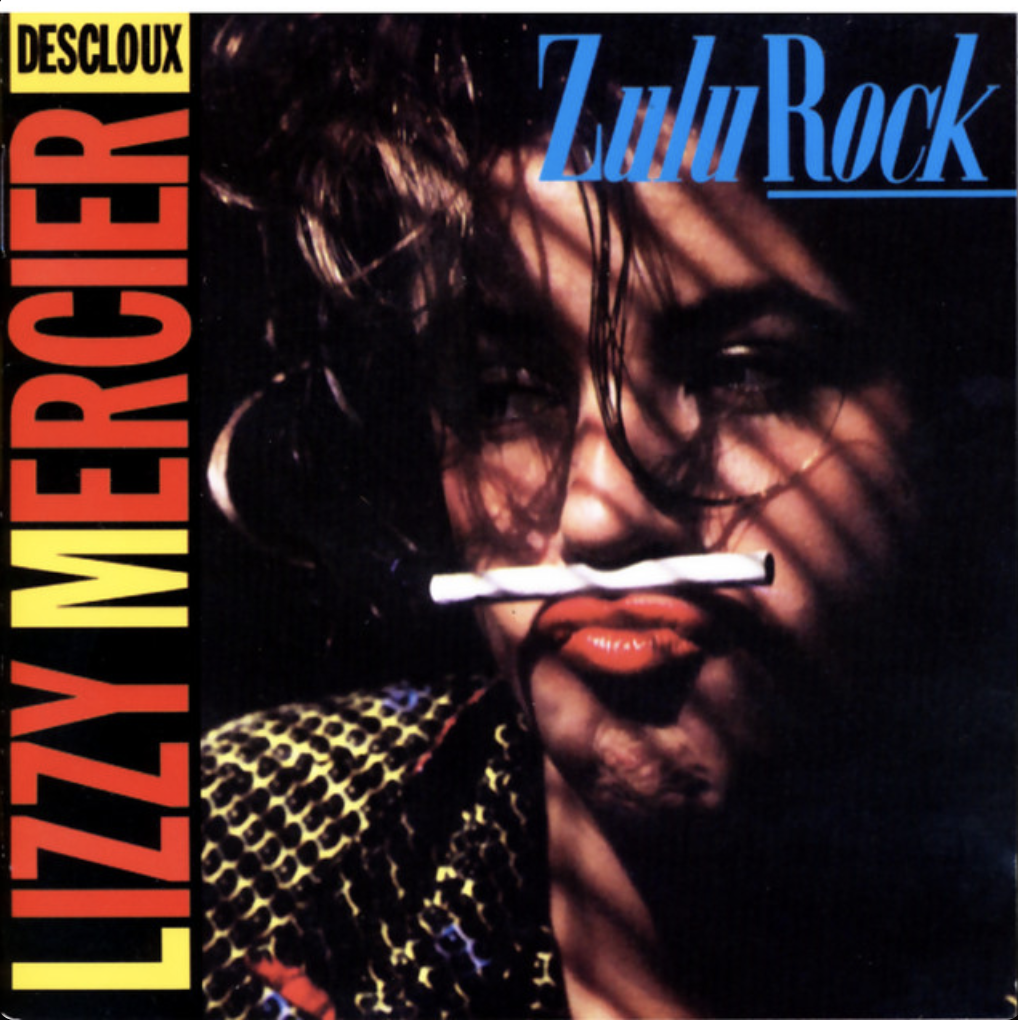
In this edition I’ve chosen to mark the 50th anniversaries of Sparks Kimono In My House, Bowie’s Diamond Dogs, Slapp Happy’s Self-Titled – but referred to as Casablanca Moon, after the opening track -, and Popol Vuh’s Einsjager & Siebenjager albums. A decade closer, and into the 80s, I’ve included tracks from my favourite French new wave spark and cool chanteuse Lizzy Mercier Descloux and her Zulu Rock LP of ’84, plus a slightly different performance of Echo & The Bunnymen’s ‘The Killing Moon’ (the original single also included on the Liverpool’s band’s Ocean Rain of course). Another leap closer, and its 30th anniversary nods to the Beastie Boys ambitious double-album spread Ill Communication, Jeru The Damaja’s The Sun Rises In The East, and The Fall’s Middle Class Revolt. The final anniversary spot this month goes to our very own Brian ‘Bordello’ Shea, or rather the whole Shea brood and their might lo fi cult vehicle The Bordellos. The group’s summary of the world and music industry, Will.I.Am, You’re Really Nothing, is ten years old this month.
We lost even more iconic mavericks and leaders of the form this last month or so. Grabbing, quite rightly, the most attention is the loss of Steve Albini. The legacy is ridiculous, and to be honest, far too many people have already dedicated the space for me to now chip in – I will be frank, where do you start? And so I have chosen to give him a mention but not to pay the homage due. We also lost the last remaining member of the motor city five, Dennis “Machine Gun” Thompson, who pummeled and, quite literally, kicked out the fucking jams. I’ve already made note and selected tracks from their catalogue when poor old Wayne Kramer passed just a few months back, and also their manager – for a time between drug busts – John Sinclair. The Detroit misfits are no more. What a sad state of affairs.
I have however chosen to mark the passing of UK rap icon MC Duke and king of twang, and one of the most important, influential guitarists of all time, Duane Eddy.
There’s a couple of “newish” selections – tracks that I either missed or didn’t get room to include in the Monolith Cocktail team’s Monthly Playlists (next edition due in a week’s time) – from Masei Bey and Martina Berther which I hope will prove intriguing. The rest of the playlist is made up of a smattering of tracks from Tucky Buzzard, Prime Minister Pete Nice, The Bernhardts, Nino Rota, It It, Clive’s Original Band, The Four King Cousins and more.
TRACK LIST________
Sparks ‘Barbecutie’
Tucky Buzzard ‘Time Will Be Your Doctor’
Haystacks Balboa ‘Bruce’s Twist’
David Bowie ‘1984’
Masei Bey ‘Beat Root’
Beastie Boys Ft. Q-Tip ‘Get It Together’
Jeru The Damaja ‘You Can’t Stop The Prophet’
Prime Minister Pete Nice Ft. Daddy Rich ‘Rat Bastard’
MC Duke ‘I’m Riffin 1990 Remix’
Helene Smith ‘Willing And Able’
The Bernhardts ‘Send Your Heart To Me’
Tala Andre Marie ‘Wamse’
Lizzy Mercier Descloux ‘Dolby Sisters Saliva Brothers’
Orchestre regional de Segou ‘Sabu Man Dogo’
Slapp Happy ‘Casablanca Moon’
Nino Rota ‘L’Uccello Magico’
Duane Eddy ‘Stalkin”
Dreams So Real ‘History’
Echo & The Bunnymen ‘The Killing Moon – Life at Brian’s Version’
The Bordellos ‘The Gospel According To Julian Cope’
The Fall ‘Middle Class Revolt’
It It ‘Dream Joel Dream’
David Bowie ‘Rock ‘n’ Roll With Me’
The Bordellos ‘Straight Outta Southport’
Clive’s Original Band ‘Oh Bright Eyed One’
Jodie Lowther ‘Cold Spell’
Martina Berther ‘Arrow’
Fursaxa ‘Poppy Opera’
Popol Vuh ‘Wo Bist Du?’
The Four King Cousins ‘God Only Knows’
ARCHIVES\_____

When gracing the Monolith Cocktail with his very own column of reviews was still years away, Brian “Bordello” Shea was featured for his own music as part of the mighty lo-fi malcontents The Bordellos – Brian one of the co-founding Shea sibling forces behind that celebrated cult outfit. Still for my money one of their finest moments on record, the group’s Will.I.Am, You’re Really Nothing (released at a time when that annoying, talentless opportunist was all over the telly and in the charts in the UK) diatribe is ten years old this month. To celebrate, reprise that essential songbook, I’m once more sharing my original review from 2014. Every word of it still, unfortunately, still holds today.
The Bordellos ‘Will.I.Am, You’re Really Nothing’
(Small Bear Records) Released 31st May 2014
It was Blur, in one of their only true flashes of inspiration, who came closest to summing up the times with their dejected conclusion that, “modern life is rubbish”. That was the early 90s, but depending on how long in the tooth, worn-down and jaded you are, every age can be viewed with the same disappointing sigh of resignation.
Yet, surely the present times take some beating, at least to us, the self-appointed custodians of the past, who remember an age when the culture seemed…. well, at least exciting, linear and comprehendible, instead of appropriated without thought or context, screwed-over and manipulated for largely commercial results, and slotted in to a handy off-the-peg lifestyle choice. Pop has eaten itself, with the lifecycles of trends and music becoming ever shorter.
It is with all this in mind that The Bordellos set out their manifesto. Leveling their criticism at commercial radio and TV especially, they aim their guided missile attacks at the harbingers of the Ed Sheeran topped Urban/Black music power lists, and what seems more and more like the UK publicity wing of conservatism, the BBC. The St. Helens, via a disjointed Merseybeat imbued lineage, family affair replace the “happy-go-lucky” lightweight and deciding suspect womens rights champion, totem of Pharrell Williams, Will.I.Am and all his partners in floppy platitude pop, rock and folk with the arch druid of counter-cultural esotericism and miscreant obscure musical sub-genres (Kraut to Jap via Detroit rebellious and experimental rock) Julian Cope. Grinding out a dedicated epistle to Cope, the trio’s sermon ‘The Gospel According To Julian Cope’ prompts a road to Damascus conversion to the spirit of rock’n’roll, in all its most dangerous guises.
De facto idol, Mr.Cope, pops up again on ‘My Dream Festival’, which as the title suggests is a list of the ideal, once in a lifetime, free festival lineups of lineups; read out in a quasi-Daft Punk ‘teachers’ style bastardized litany to an accompanying Casio pre-set drum track and watery effects. The Casio rhythm pre-sets and occasional sound bites come in handy again on the jaunty, deadpan disco jolly, ‘Elastic Band Man’ – a transmogrified Human League meets John Foxx – and on the broken-up, Robert Wyatt emotional drudge, ‘Between Forget And Neglect’.
Despite going at it hammer and tongs on their anvil-beating Cope Gospel, The Bordellos latest long-player protestation is a forlorn and intimate downbeat record. They can still be relied upon to rattle off a list of grievances and opprobrious pun harangued song titles: from the LP’s play-on-words adopted The Smiths song, reworked to accommodate a big fuck-you to that irritable twat, Will.I.Am, to name-checking another hyperbole anomaly of our Youtube, Google, Facebook, Twitter masters’ bidding, the no less frustratingly lame ‘Gangnam style’ viral – joining the call from last year’s Bring Me The Head Of Justin Bieber EP, for another public execution.
But it’s with a certain lamentable introspection that they also tone the vitriol down to attend to matters of the heart: The kiss-me-quick, misty-eyed ballad to love on a northern coast seaside town, ‘Straight Outta Southport’, and the Hawaiian slide guitar country rock ode, ‘The Sweetest Hangover’, both, despite their tongue-in-cheek titles, bellow a fondness for lovelorn adventures and plaintive break-up regret; proving that despite the bellicose calls for the corporal punishment of the foppish elite and its commercial pop music stars, there is a tender side to the group.
Sounding like it was recorded on an unhealthy dose of Mogadon, Will.I.Am, You’re Really Nothing is a composed grumble from the fringes of a battered musical wilderness. A last cry if you will from the pit-face of rock’n’roll.
Also this month, Bowie’s repurposed Orwellian theatre production Diamond Dogs reaches its 50th anniversary.

David Bowie ‘Diamond Dogs’
(RCA) 1974
“As they pulled you out of the oxygen tent, you asked for the latest party…” And with that the future dystopian, biota canine, leapt from its slumber “onto the streets below”: howling for more.
Bowie never really wanted to be a musician as such: or at least not wholly a musical act. His destiny lied with the grease paint of theatre and allure of cinema. Diamond Dogs of course allowed him to create a spectacle, melding the two disciplines together.
Fate would force the original concept to morph into the achingly morbid and glam-pop genius we’ve now come to love: a planned avant-garde, ‘moonage’, treatment of Orwell’s revered novel 1984 was rebuked by the author’s estate.
Still those augural references to state control and totalitarianism are adhered to throughout – both lyrically and in the song titles –, but attached to visions of a new poetic hell!
The loose, all-encompassing, metaphysical language may promise melancholy and despair, yet it also knows when to anthemically sound the rock’n’roll clarion call too.
Decreed as the leading highlight’s of the album by the majority –
Diamond Dogs (single), Rebel Rebel (single), 1984
Pay attention to these often overlooked beauties –
Rock’n’Roll With Me (single), Sweet Thing
Hi, my name is Dominic Valvona and I’m the Founder of the music/culture blog monolithcocktail.com For the last ten years I’ve featured and supported music, musicians and labels we love across genres from around the world that we think you’ll want to know about. No content on the site is paid for or sponsored and we only feature artists we have genuine respect for /love. If you enjoy our reviews (and we often write long, thoughtful ones), found a new artist you admire or if we have featured you or artists you represent and would like to buy us a coffee at https://ko-fi.com/monolithcocktail to say cheers for spreading the word, then that would be much appreciated.
The Perusal #48: Crime & The City Solution, Tele Novella, Chouk Bwa & The Angströmers, Yara Asmar…
October 5, 2023
A WORLD OF DISCOVERIES REVIEWED BY DOMINIC VALVONA
(Unless stated otherwise, all releases are available now)

Chouk Bwa & The Angströmers ‘Somanti’
(Bongo Joe)
Reuniting for a second explosive dynamic album of electrified Vodou and Mizik Rasin, the Haitian collective Chouk Bwa and the Belgian production duo The Angströmers once more propel ritual and ceremony into an otherworldly futuristic setting.
Originally crossing paths back in 2016, formulating a project performance two years later followed by the release of the partnership’s inaugural album, Vodou Alé, in 2020, this Euro-Haitian combination was interrupted by the Covid pandemic. Unable to meet in the flesh, as it were, for two and a half years they still managed to release a string of 12” EPs; the bridge to what would be that eventual reunion in the May of 2022 and an intensive workout tour of Europe.
This enabled them to record their second album together, Somanti, in a Brussels studio; the culmination of tour performances and interactions, quickly recorded in just one day, such was the energy.
Framed as a more “mature” record, and different in focus to Vodou Alé, there’s now an emphasis on the ritual, ceremonial aspects of this African exported religion, spiritualism and rites, and the sagacious proverbs that are hailed, harnessed and playfully invoked by the Vodou chorus of voices. The hypnotizing and galloping barrage of drums are back, with each ritual subscribed its own rhythm and call. But if we go deeper, the hotbed of Haitian independence Gonaïves-hailing Chouk Bwa also invoke their ancestral African homelands; that being the once powerful, rich and pivotal kingdom of Oyo (growing to become the largest Yoruba speaking state in what is now eastern Benin and western Nigeria); the central African kingdom of Kongo (a Portuguese vassal but independent state with 600 years of history behind it); and key regional kingdom of Dahomey in what is now within the borders of Benin (once uncoupled from a tributary state to the larger Oyo, a global trading post built unfortunately on slavery and conquest). The latter of which, a prominent source of Vodun, the belief system that was torn from its roots and shipped with the poor souls that were transported into slavery, to the Americas and Hispaniola.
That age-old roots music, summoning of spirits, pummeled, beaten and danceable rhythm is given a transformation by the Belgian duo, who zap it with shooting laser beams and cosmic fuzz, fizzles, buzzes of oscillations and reverberations. The dub genes of Lee Scratch Perry, African Head Charge and Major Lazer can be heard throughout, alongside post-punk, Ammar 808, Moonlight Benjamin and Ifriqiyya Electrique on an album of both mysticism, danger (in an exciting way) and spirit world communion.
The groove on the female lead and group sung ‘Fèy Nan Bwa’ is like a cool no wave vision of Vodou-House music – it actually reminded me of Glasgow’s own international project, The Green Door Allstars. But that contemporary fused electronica of magnetic force fields, echoes, phasers, subsonic bass thumps and metallic elements never overshadows the authentic rollicking, tribal bounding and bobbing drums and the expressive, sometimes bordering on hysterical and manic vocals/voices.
Music from another dimension, the Haitian roots music and performative religious invocations and words of wisdom from Chouk Bwa are sent through a vortex into the future on another successful union.
Crime & The City Solution ‘The Killer’
(Mute) 20th October 2023

A decade on from the last project inception of the Simon Bonney and Bronwyn Adams led Crime & The City Solution, and yet another restless move back to one of the city’s that solidified their gothic, hard won reputation and shadowy presence, Berlin.
If 2013’s American Twilight was suffused with the dying embers and toxic fumes of Detroit, with its mass unemployment, foreclosures and desperations, then The Killer seems almost resigned to the fate and inhumanity of our divisive post-Covid times. Incidentally, American Twilight was itself released after an even longer hiatus of twenty years, and with a, near enough, entirely different lineup. Although conceived back in Bonney and Adams native Australia (where Crime & The City Solution were born in the late 70s, burning up the Sydney and Melbourne scenes before following their skulking bedfellows of Nick Cave and Mick Harvey to London, and then onto Wim Wender’s Wings Of Desire backdrop Berlin) during the harsh conditions of lockdown, the band and production were forged in the German capital. The roll call of which includes Frederic Lyenn (on piano, bass and synth), Donald Baldie (guitar), Georgio Valentino (synth and guitars), Chris Hughes (drums and percussion) and Joshua Murphy (piano and guitar). That ensemble is overseen, or rather, ‘conducted’ as it were, by the highly respected producer Martin J. Fiedler.
Originally conceived as a PhD application on decision-making in Afghanistan during the late 1980s, the initial brief was expanded by Bonney’s work delivering aid programmes across the Indo-Pacific region, his professional and personal relationship with Adams, his brief time in post-invasion Ukraine, and lyrically by the ‘syncopated’ delivery rap styles of Mos Def and Talib Kweli’s Black Star collaboration. Although America isn’t mentioned, its leading part in the events that unfolded during the 80s in Afghanistan is impossible to deny. As part of the Cold War strategy to checkmate an expansion-driven Soviet Union, America unintentionally stirred up a viper’s nest in aiding the Mujahedeen and warlords in their outgunned fierce war against the invading aggressor. In forcing the Soviets into a humiliating withdrawal, followed by the entire collapse of the Bloc and regime, and the fall of the Berlin Wall, those Cold War partners turned on their enablers, as they became hardline Islamist fanatics.
Decades later, and after the still never reconciled bloody Balkan wars, and it’s the turn of Putin’s Russia to unleash barbaric bloodshed. But this time, after successfully propping up the heinous regime of Assad in Syria, death and destruction has been dragged to Europe’s front door. The scenes of dead bodies may keep Bonney awake at night, but it’s also the resilience, the matter-of-fact manner in which lives go on in the face of such despairing evil that filters through to the music, themes and lyrics of The Killer. Just as one of his idols, Scott Walker, could convey horror and resignation but love too, Bonney and his foil and muse, Adams, churn up a tempest of emotional tumult in which romance of the hungered, yearned, longed and sentimental kind offers some sense of humanity: the spirit not yet crushed by the enormity of it all. And again, though never mentioned, it is to a both Southern Gothic and Cormac McCarthy-esque America that they turn musically. For this is the broody, Biblical Western terrain the band and their Bad Seeds, Wovenhand peers have trodden for decades; a kind of almost esoteric Americana and dark moody Southern rock ’n’ roll signature that offers haloed magnificence, reverence in the face of apocalyptic dread.
The album begins with the morbidly sinister entitled ‘Rivers Of Blood’ and Bonney’s plaintive, ached declarations for his muse, under a blood moon lit panorama. Danger prowls the Chris Isaak on the road with Cave mood, as a broken Bonney pines with fatalistic worship for his flame, and makes sense of, processes the turmoil in his psyche.
‘Hurt You, Hurt Me’, with its subtle sentimental, wept strings, sounds more like a loose duet between Avalon era Bryan Ferry and Patti Smith. Two voices starting at different points, shadowing each other, emote pain and suffering, and breath languid despondency on frosted glass. Angels cry and faith is promised on a flange affected entwined romance.
A sullen longing pervades the dramatic, slow, testament-poetic ‘River Of God’ (another of those river metaphors). And yet despite the various references to death, the suffrage of the “children of war” and somber tones, there’s a message that “you can be anything you want to be” after all, and a sprouting of wings encouragement – the very opposite of Icarus’ sticky fall to Earth.
As mentioned and alluded to earlier, Bonney pays a most deeply felt form of romantic thanksgiving to his partner Adams with the resounding ‘Brave Hearted Woman’. Going through sophisticated changes – from Cohen to Dylan and Barrett vibrato psychedelics -, Bonney, with the occasional lofty yearns from Adams herself, shares his passionate wants for the woman he so obviously holds in the highest of regards, respects, loves, falls to his knees for, and forms part of his very fibre: “She is ecstasy, filled inside me”; “You are creation for all to see”.
I’m sure it’s Adams’s coos on the next song, ‘Killer’, a piece of torn gothic withering noir, malevolence and redemption. It’s yet another protagonist who’s no damn good, strung out, morose and struggling with self-identity, their place in the world, and perhaps, their heinous crimes. Those syncopated influences that I mentioned much earlier, can be heard weaving an almost non-stop serious-voiced incantation of consciousness and gristlier Western preacher’s song. It seems to take notes from Amon Düül II (Yeti period) and The Rolling Stones.
It’s followed by the outlaw pained ‘Witness’ wake-up call and the seriously hard won conclusion of ‘Peace In My Time’. With a resigned sadness to suffering and a gothic simmered weep of Diamanda Galá style piano arrangement, the latter song, and finale, finds some reconciliation with a world in eternal chaos and torment; Bonney unsurprised, yet not humbled, to the atrocities and harm that we humans dish out on a hourly basis. And yet, there’s an eventual peace in the valley moment there; a glimmer that love will lead Bonney out of the nightmare of his own troubled psyche.
As a statement on Afghanistan, the references are very cryptic, symbolic and veiled. Rather it’s a catalyst, prompt for the Bonney and Adams and the band to expand those horizons and murky textures, and to say much about the external and internal state of the world we live in.
Tele Novella ‘Poet’s Tooth’
(Kill Rock Stars)

A wistful, almost disarming, Tele Novella weave their magic on an album that takes its cues from Harold & Maude and a removed version of the heartbreak yearning vulnerability of Nashville and Texas country music; albeit a version in which Cate Le Bon and Aldous Harding sip despondently from a bottle of life’s despair.
As whimsical and beautifully executed as it all is, Poet’s tooth is a moving album of timeless tropes, somehow delivered musically and visually through a slightly off, sometimes surreal, vision of the familiar. Natalie Ribbons and foil Jason Chronis dream up an idiosyncratic staged world, their moniker taken from the serial drama/soap opera phenomenon of the “television novel”, a format most prominently produced for the Latin American markets.
It’s a world in which, much like Harold and Maude, the bonus of youth is squandered until a mature presence at the very opposite end of the aging equation – with death not far away and looking to grasp every opportunity of youthful risk and carefree adventure – closes the circle with a life lived without regret. That cult movie said much about the Boomers age of high anxiety, caught in the headlamps fretting away their youth; stuck between suicide and depression, hard drugs (proscribed and otherwise) in the face of a society moving past the hopes of the last decade into the violence and despondency of the 70s: Take your pick, from Nixon to Vietnam, the crushing resistance in the Soviet Bloc and so on…
Roles are reversed, with Maude more childlike (yet wise) and the morbidly curious Harold, fearing for experiences yet to materialize, on a death trip. The most obvious reference to this movie’s odd romance can be found in the video for the band’s toy box like, almost twee but charmingly evocative ‘Broomhorse’, which features one such dark comedic episode, with Chronis playing the part of a bathtub, wrists slashed suicidal Harold in a magical world of 70s furnishings and wallpaper. Maude is from a pre-war generation, with the all too real traumatic experiences of her youth literally tattooed on her arm, and yet attempts to bring her partner round to the possibilities of perseverance and making do with one’s lot in life – Harold is a typical lost child of the wealthy Socialite classes; in material and nepotistic terms rich, yet devoid of connection and mentally adrift.
Before I start running away with myself, and this becomes some sort of screen review, the purpose of all this analysis is that Poet’s Tooth is suffused with those same themes; borrowing heavily from the Hal Ashby playbook of tragic-comedy and the screwball to make some sense of the world now. And yet this is only one aspect of the album.
Ribbons and Chronis – joined it must be mentioned by Danny Reisch, who handles the drums, samples, loops and field recordings but is also involved with the production too – hail from an increasingly creatively changing Austin, Texas. And so this is also a 21st century take on that State’s cowpoke, steers and rodeo signature of yodeled hangdog country music; only the heartbreak is coming from a female protagonist’s point. Not a new concept but any stretch, but still undervalued. But this is a whole other version of that; the Country & Western scores of Morricone and music of Sacri Cuori, Bonnie Dobson, K.d. Lang, Chris Isaak merged with an air of Lynch’s go to composer Angelo Baldametti, Kathy Smith, Gene Clark, Elyse Weinberg, the Laurel Canyon, Georgia Greene and Rosemary Clooney.
This music is both knowing and naïve, charming and disturbing. For there’s an esoteric alchemy of pitched-perfect fluid poetry on the surreal pillow, Lewis Carroll and Sandy Denny reading the Tarot, ‘The Unicorn’ song. Part renaissance, part death pact, part Percy Sledge’s reverent church organ, and part Temperance Society, Ribbon’s captivating voice charms us into a magical kingdom that at first seems to hide a much creepier menace; the language fantastical but progressively alluding to “poison”, “zombies” and what can only be described as some cultish gathering, waiting on “angels” to arrive. Meanwhile, the titular song – utterly compelling and beautiful – alludes to “incantation”, a “goblin”, a “cloak” and a “cauldron” on a song that sounds more fairytale than dark bewitching arts. Although of the metaphorical kind – A mosey June Carter and Lee Hazelwood type of down-on-the-ranch country tune, with a rhythmic horse canter -, there’s a ‘Vampire Cowgirl’ to add to that sense of the “other”. There is the mention of war too; or a war: The Vietnam War? The Iraq War? The American Civil War perhaps?
But just when you get some sort of measure, songs like ‘Eggs In one Basket’ takes an arty Baroque turn (courtesy of the autoharp I’m sure), via Gainsbourg and 60s cult French/Italian cinema: I say Baroque, it could easily by Tudor. Imagine the Thomas Crown Affair scored by Michel Legrand as Fellini directs and you’ll half way there.
Adolescence escapism wrapped in a softened, but no less stirring, epiphany, Tele Novella has a surreal, dreamy quality about them. From the Tex-Mex border of yore to the contemporary Austin scene of City Limits, they weave a really impressive songbook that’s as Hal Ashby and Sidney Lumet as it is pining Country and Western. Poet’s Tooth is both lyrically and musically perfect; one of my favourite albums of 2023 – no idle boast. Prepare to be equally charmed and moved with a counterculture resurgence of quality, subtle comedy and tragedy, eccentric disillusion.
Raf And O ‘We Are Stars’
(Telephone Records) 27th October 2023

Few artists have purposely entwined themselves so deeply with their idols than the Raf And O duo of Raf Mantelli and Richard Smith (the “O” in that creative sparked partnership). David Bowie and Kate Bush loom large, permeating near every note and vocal infliction of their idiosyncratic, theatrical, cinematic and up-close-and-personal intimate style of avant-garde pop and art school rock experimentation. Raf even has a Kate Bush tribute side project; coming the nearest I’ve yet heard of anyone to that maverick progenitor’s range-fluctuating, coquettish and empowered delivery, and her musicianship and erudite playful and adventurous songwriting.
The death of Bowie however, must have had a crushing effect on the duo, who, perhaps, covered his music better than anyone else: at least in spirit. They got close to their hero through the supportive words of Bowie’s key pianist foil of the 70s, Mike Garson. But an audience with the thin white duke eluded them. It’s a pity, as I think he would have certainly connected with the duo’s fifth album, We Are Stars. He certainly would have recognized the signatures and the references, both the in your face eulogies, homages to his most dedicated of alien roles in The Man Who Fell To Earth, and the less obvious but musically inspired ones too.
Omnipresent throughout, there’s the angular, shredded and bended guitar of Scary Monsters era Robert Fripp and Carlos Alomar, and the strangely interesting progressions of the arty-pop and dress-up of that album, but also some pre-Ziggy albums too. ‘Tommy Newton’ stands out of course; the Icarus alien fallen to Earth in the hope of returning with water to save his family on an arid distant star, is woven into a fatalistic existential love eulogy, as told in the third person by Mary-Lou, his estranged human love interest: if you can call her that. Recognizable plots and scenes from Walter Tevis’ novel and Nicolas Roeg’s film versions – later given a second wind in the form of the Lazarus ‘off-Broadway’ musical, based on Enda Walsh’s book vision, and with lyrics provided by Bowie -, appear in a non-linear, otherworldly mournful tragedy. Loving the alien, Mary-Lou’s character introduced the distracted, disconcerted Newton to some of Earth’s vices, little knowing his true identify until the dramatic reveal: unknowingly waylaying his task, plied with alcohol and the foibles, deceit and nature of humankind. Raf embodies this dislocated figure, lost and cast adrift in a thematic void; pining for what was and what could have been.
But it’s not all about Bowie and his famous film role. That last track also reminds me of Deux Filles, and so much of this soundtrack to the current restless age of high anxiety, disconnection and our reliance on technology, swims around in a most curious new wave suffusion of 70s and 80s sounds. The opener, ‘Still Sitting In Our Time Machines’, actually seems to recall the duo’s decade-old Time Machine EP, but has a more cosmic, canoodled, neo-romantic soul funk sound and feel. With a message for retro nostalgia, with nothing moving on since the last time machine voyage, the early 80s portal is reopened.
Raf comes close to Lene Lovich on the Radiohead crosses paths with a Latin-flavoured Banshees ‘Andy Warhol’. Warhol is the theme here on this yearned, wooed and urgent changeable curio; or rather the pop art icon’s obsession by a homeless character.
The titular song itself once more enters a starry void; those common celestial objects and all their various metaphors, analogies form the substance to an alternative, stressful The Man Who Fell To Earth soundtrack, yet recalls the influence of Tricky and Portishead.
It’s all change by the time we reach the avant-garde electronic pop ‘Every Time It’s Bleak We Dance’, with Raf now channeling a merger of Alison Goldfrapp and Liela Moss, but with a meandrous European allurement. Stranger too, the makeup in ‘Eyeliner’ is blusher coquettish Bush languidly draping an arm around Jane Birkin at her most untethered, whilst Joe Meek’s reverb pings and ‘Telstar’ whizzes by. Ah yes, as if to reinforce a thematic thread of retro-futurism there’s a lot of 1950s space sounds and effects: part of the sci-fi tapestry. But it’s the 1960s, albeit a fantastical version, I’ve dreamt up as a critic to describe the beguiling oddity ‘Waterloo’; a beautiful sentiment to an inspiring, supportive partner, and not a cover of The Kink’s standard paean to London. In my mind this sounds like Lou Reed penning a Berlin period balled, time travelling back to the early 60s and handing it over to beat group era Rolling Stones, who in turn, pass it on to Marianne Faithful.
If you’ve never had the pleasure of experiencing Raf And O in a live setting before, then drink in the intimacy of the club lounge-esque ‘The Guardian Of Your Mind’. During or in between Covid lockdowns, the duo performed a series of incredibly striking, fragile and artful concerts online; and this stripped, but no less powerful, untethered, vibrato echoed and Raül Refree-esque performance shows you what you missed.
An alternative time travelling theatre of interwoven fantasy, dream realism and the reimagined, We Are Stars is as playful with its unique style as it is only too aware of the deep held stresses, strains, pain and detachment that plagues society in the aftermath of a global pandemic, economic meltdown and war. Looking to the stars, but knowing that even escapist dreams of the cosmos have failed us, Raf And O (who I haven’t mentioned in name at all, but is an adroit craftsman of his form, accentuating, punctuating or loosely weaving a meandered musicality around Raf) take their concerns, observations and curiosities into ever more arty and intriguing directions. They remain one of the most individual acts in the UK; true inheritors of Bowie and Bush’s legacy and spirit.
Yara Asmar ‘Synth Waltzes And Accordion Laments’
(Hive Mind Records)

In a diaphanous gauze of dream-realism, the Beirut multi-instrumentalist, composer, video artist and puppeteer Yara Asmar conveys a sense of dislocation, loss and remembrance on her second album for one of the Monolith Cocktail’s favourite labels, Hive Mind.
Last year’s Home Recordings palette of serialism, atonal atmospheres, ambience and minimal semi-classical melodies has been expanded upon, with an emphasis on the synth and accordion of the title. Surrounded by a sound source of electronics, toy xylophones, a metallophone, music box, percussive mobiles and wind chimes, and of course her grandmother’s handed-down green-coated accordion, Asmar seems to float once more above a city in turmoil and distress; a place in which psychogeography and family history haunt present Beirut. For as beautiful, immersive and dreamy as it all is, these ‘waltzes’ and ‘laments’ seem to have an almost supernatural, even spooky feel: The veiled wisps, high sounded whistles and bubbled ‘Everything Is Wrapped In Cling Film’ reminded me of both Jodie Lowther and Lucrecia Dalt in that regard; bewitching but not so much scary. The fate prompting ‘It Is 5PM And Nothing Bad Has Happened To Us (Yet)’ actually reminded me of that knowing supernatural and library music group, Belbury Poly. I guess what I mean is that this sound, mood is more like the suffused enveloping veils of the ether, a translucent resonance, reverberation of Asmar’s family tree and the lives they lived then esoteric.
This is the sonic memory of that family’s toil, trauma, but also the small observations of daily life, For example, ‘three clementine’s on the counter of a blue-titled sun-soaked kitchen’; scenes that hold more than just a descriptive title for a good painting. Like that kitchen scene, those meanings soak through to emote a magical garden in a bustling city.
A bellow or concertinaed accordion movement can say so much. That same accordion was originally made in a workshop in the German town of Trossingen; a stones throw from Asmar’s residency in the Black Forest, last March. Locally famous it would turn out; people recognized its maker’s mark and directed Asmar to visit the source. Although the town was a farming community, during the winter they’d turn their hands towards building clocks and accordions. Asmar’s workable heirloom, keepsake, was recorded in an old ledger at the back of the workshop that made it; sent to the Lebanon on the 21st October 1955 with seven other models. That date, or near enough, marks the release of this album, and that providence is inspiring enough to inform some of the direction of wafted travel and emotions contained within.
Better times perhaps, less upheaval; maybe with hope for something, whatever happened or was dreamed for in the past, the present is full of uncertainty. Clinging to those memories, there are abstract sonic feelings of limbo and loneliness; a call to those that left the city, but also a reference to those that returned or stayed throughout. ‘Are These Your Hands? Would You Like Them Back?’ the only peregrination to feature a clear voice, features the poetic questioned turmoil of Majd Chidiac, who poses a consciousness of lament, unfairness and grief to a Carlos Niño-like spell of xylophone-esque bulb notation, atmospheric wisps and dreamy uncertainty. Elsewhere there are the faint, obscured or just ether-emitted signs of either a siren spiritual voice, or those that are more sorrowful and harrowing: Not so much haunted as the apparitional calls for remembrance and recognition of that which was lost or taken away.
And yet, there is a real alluring, magical pull to those strange warm ambient reverberations and removed ideals of waltzes. It’s much in part down to the accordion (French sounding on some tracks, and like a church organ on others) that these visions sound so unique; taking ambient music in a different direction and to a different environment that few have attempted before. Saying that, although performed in Beirut it remains universal, with themes and feelings we can all recognise, or at least sympathise with. But Asmar stays true to her home; bringing us adroit but empirical examples of quality ambient and explorative music that hopes to convey stories from the family photo album; the observed scenes from childhood made real in a sonic, immersive experience.
Bex Burch ‘There Is Only Love And Fear’
(International Anthem) 20th October 2023

In the moment extemporized expressions in multiple locations, both in Europe and North America, the feels on Bex Burch’s new album are led or prompted by a hand made xylophone. Any yet, there’s no particular pattern nor pathway to these captured performances; Burch joined as she is by a myriad of notable artists/musicians, all of whom only met for the first time before each improvised performance. That collaborative roll call was picked by International Anthem’s Scottie McNiece and Dave Vettrainoi, the same label responsible for invitng the percussionist, producer and instrument maker over to the US to make this album.
Proving fruitful foils, the eclectic polymaths Ben LaMar Gay and Macie Stewart, the in-demand bassist and composer Anna Butterss, drummer Mikel Patrick Avery and Tortoise member and multi-instrumentalist Dan Bitney pop up alongside Rob Frye (on clarinet and flutes), Diego Gaeta (piano), Ben Lumsdaine (the second drummer to join this cast), Oren Marshall (tuba) and Anton Hatwich (another bassist is seems) across various location stimulated pieces of music. Yorkshire, The Baltic Sea, Berlin, SüdTirol, Wyoming, L.A. and a storefront in Bridgeport, Chicago stand in as the stages for descriptive sound work and grooves that traverse between freeform/cosmic/spiritual/Afro-jazz and the arty and avant-garde. But even within that scope there’s elements of Appalachian country, Hassell’s fourth world possible musics series, the 80s no wave melting pot of Ramuntcho Matta and The Lounge Lizards, and the more contemporary partnership of Matthew Herd, Will Glaser and Liam Noble. And it all begins with nature’s spell on the cuckoo-proclaimed rhythmic trudge through the woods, ‘Dawn Blessings’. Burch lightly introduces us to the glassy bulb bobble of her beatific xylophone on a slowly awakening intimate landscape.
The great outdoors is suffused across much of Burch’s ‘love’ and ‘fear’ emotive passages; a chorus of birdcalls, chirps and warbles, the sound of the sea crashing against the beach, the breeze itself mixed with human interactions such as the bustle and greetings on the street, an appreciative audience in the garden and the feint recordings of conversations. Intimate and up close, even on the more avant-garde needs to draw breath, you can hear all the squeezed and winded blows, the strained exhales of the brass and woodwind on the Anthony Braxton-like ‘If I Was You I’d Be Doing Exactly The Same’. Well, the first part anyway, as this same sucked and almost inaudible reedy rasped piece goes on to feature more recognizable instruments, an increase in volume, and hits a Marshall Allen and Yusef Lateef burst of jazz energy.
The rhythm, groove is changed again on ‘You Thought You Were Free’; a kind of amalgamation of the Art Ensemble Of Chicago, Sun Ra, New Orleans Nightcrawlers and Hugh Masekela herding percussive cattle across a police siren urban street corner.
‘This Is The Sound Of One Voice’ is a pretty clear title description, featuring as it does a soothed faint female “doo-doo” woo over, what sounds like, tine plucks and scrappy, scuffled and shaken percussion (Širom meets Alice Coltrane’s healing balm).
‘On Falling’, which I take it is in the more anxious fear category, sounds like watery plops and the quiet slow turn of a winding down music box.
Burch’s instrument of choice, a bought handmade xylophone, often sounds like a vibraphone or Gamalan mettlaphone. On the Laraaji-esque ‘Don’t Go Back To Sleep’ you can hear a polyrhythm trickled variation of that xylophone: Two of them in fact, crossing over into separate timing signatures.
Each day is a different sound and a new canvas for Burch, who transcends her bearings and musical boundaries. There’s rhythm to these improvisations, a real groove that at times counterbalances the passages of avant-garde expression to create a non-linear journey of emotions, thoughtfulness and sense of yearned fears.
Mike Reed ‘The Separatist Party’
(We Jazz/Astral Spirits) 27th October 2023

It wasn’t planned this way, and both releases are from entirely different labels, but the drummer, composer and band leader Mike Reed’s new album shares collaborators with the previous album (see above) by Bex Burch. It’s also entrenched in the same Chicago hothouse. For also appearing on Burch’s There Is Only Love And Fear is the multi-instrumentalist, singer, poet Ben LaMer Gay and flute clarinet maestro Rob Frye. Both join Reed’s oft-used live performance appellation, The Separatist Party; now used as a album title for his latest album project.
And added to that Constellation in-situ hive of creativity (the C being the multi arts venue in Reed’s hometown that he’s successfully owned and operated since 2013) is Cooper Crain on guitar, synth and engineer duties; Dan Quinlivan on synth; and Marvin Tate on vocals.
Drawn together under less celebratory circumstances, the Chicago AACM hot-housed Reed and his talented troupe explore the societal, political and monetary crisis of ‘forced seclusion’; inspired, influenced by both the renowned New York Times reporter and non fiction author N.R. Kleinfield’s 2016 Pulitzer Prize nominated essay on the death of George Bell, and the restricted rules of Covid lockdowns. The former, a sad indictment on isolation, the lack of human contact and neighborly care, the latter, a self enforced curtailment of freedoms that led to a tsunami of mental problems, and again, isolation. Bell’s fate is said to have haunted readers, including Reed: We all unfortunately know or have heard of such scenarios; the hoarder neighbor with no family, the neighbor that no one looks in on; dying without anyone even noticing for a week. In the case of this Jackson Heights (79th Street to be exact) resident, the authorities, of which there were many, struggled to piece his life together. The Pulitzer Prize site described Kleinfield’s expose as a ‘part detective, part eulogy, and part exploration of a city’s bureaucracy of death’.
Although not named specifically, the first chapter in what will be a three-album cycle, finds a vocalized and musical language that demonstrates this growing epidemic and its causes. This can sometimes be delivered with clear urgency, and at other times with a more abstract but emotive expressive performance, from a band totally in synch, yet still able to crisscross, counter and push at the direction of travel. What I mean by that is, in spite of the tumult, untethered freedoms, there’s never a chance this music will come unstuck, nor descend into chaos.
With a voice pitched somewhere between blues-rock performer, Malcolm Mooney and Amiri Baraka, spoken and word artist poet Marvin Tate adds a very loose narration. On the opening synth undulated and drum shuffled ‘Your Soul’, Tate’s intensity strengthens as he sorts through a “mosh pit” of a life lived, laid bare with cryptic descriptions: “I reached the wooden floor/Decades of old shit.” A hoarder’s accumulation piled high; nonsocial and maddening to those who don’t get it, or understand. The musical style is partially Idris Ackamoor, partially Kahil El’ Zabar and a little Don Cherry’s Organic Society. It’s followed up by the Werner ‘Zappi’ Diermaier drum motioned, and Hugh Masekela conducted Mardi-Gras ‘A Low Frequency Nightmare’, which now moves on over into a semi-Krautrock-jazz lane. That same track features some great trumpet action (hence the Masekela reference), and a Donny McCaslin cosmic synth signature that envelops his saxophone peregrinations. ‘We Just Came To Dance’ has Tate repeating the titular statement over a backing or primal Chicago House music, as played by El’ Zabar, and laid out in Embryo’s African percussion explorations. It pops and clops along like Basquiat’s figure limbering and breaking down a 80s NYC no wave boardwalk.
A musical partner to Reed over recent years, the incredible visionary Nicole Mitchell springs to mind on the fluted and diaphanous constellation yin of ‘Floating With An Intimate Stranger’. Almost in the spiritual waterfall vein, this feels like a tranquil spot to gather one’s thoughts; take a pause and then float on up into the astral.
Rolling in on a Sam Rivers’ vibe and tumble of drums, ‘Hold Me, Hold Me’ is more a case of spurned pleas of unrequited love declaration. And yet it’s followed by the cupped trumpet serenade of ‘Our Own Love Language’, which features dappled electric piano and Bobbi Humphrey style flute; taking romance into the spheres of Knoel Scott and early Miles Davis.
Tate is back to walk through a neighborhood photo album of foibles, connections, anecdotes and fate, on the centerpiece track, ‘One Of Us’. Amongst the characters (the guy too fucked-up on booze to make anything of an invitation to join The Temptations, to some guy who could punch like “Tyson”) and location spots on this bluesy saunter, Tate regales the story of someone he grew up with (attending the same “fucked-up schools” and church): “one of us”. And despite being on the receiving end of the “N” word from Mary Wells (I’m not sure if this is “the” Mary Wells, Motown songstress, fucked over by that label and many others during a career of false starts and travails), her idiosyncrasies and failures, is someone whose loss is to be marked and mourned: a missed part of the community. That final vocal statement of the album proves one of its most insightful and visceral.
Reed and his troupe pull off a real feat in drawing the listener into a rich Chicago imbued and eclectic soundtrack: that’s Chicago Jazz, Godspell, Blues and House merging with New Orleans, Afro, the spiritual, and consciousness styles of jazz. A deep emotive statement about societal ills and seclusion is made by a seriously class act. I look forward to the next cycle in this conceptualised body of work.
Raül Refree & Pedro Vian ‘Font De La Vera Pau’
(Modern Obscure Music) 20th October 2023

A most auspicious occasion, the Iberian pairing of avant-garde polymaths Raül Refree and Pedro Vian marks a rightly welcoming proposition for those of us in the experimental scene.
A familiar name to Monolith Cocktail readers over the years, Refree has gained plaudits for his transformation of the Flamenco tradition, with such doyens of the form as Rosalía and Rocío Márquez, and for his Fado reinvention partnership with the extraordinary and captivating Lina. In between those projects he’s also produced a number of albums for other artists, including Sonic Youth’s Lee Ranoldo. That relationship in particular has led to Refree’s wider role in the contemporary New York scene. As a composer he’s scored music for various films, some of this material released in the form of his Spanish sketchbook, La Otra Mited, followed up by the El Espacio Entre album, released at the beginning of the year: an album I rated highly at the time, describing it as a ‘Spanish Neel Murgai Ensemble and Hackedepiccotto trapped with Nacjo Mendez in an undefined, veiled timeline and atmosphere…’ It’s no surprise, considering the ambiguous blurring of boundaries between disciplines and styles that Refree is set to make his theatre director’s debut next year.
Finding it hard to believe, but Vian is a stranger to this site. Making his debut appearance in the MC, the Catalan producer, musician, composer and DJ also runs the deep thinkers’ experimental label that is facilitating this album of nine explorative suites. Vian has previously released a trio of solo albums and a collection of singles for his imprint, and last year, after instigating an ‘immersive’ live set at the Sonar Festival, released the Cascades collaboration with the Piedmont-born composer and producer Mana; setting him up nicely for this tactile, sometimes physical, stretch of piano, synth and organ – those being the main trio of instruments used on Font De La Vera Pau; the replenishing, fluctuating fountain waters of serialism, the atonal and the more melodic.
Simply labeled with no prompts or points of reference, each improvised sounding piece is a passage in itself and yet part of a whole performance, with both partners taking the familiar into curious, mysterious and often alien settings. And yet, when the droplets of piano notes, and moist resonance evoke the subterranean (a pool of water in the cavern), the sound of chirping birds and the sunlit woods opens up a window into the fresh air.
The low but soft rumbles of bass piano and metallophone like playing of that instrument’s inner workings conjures up hints of Alice Coltrane’s Turiya Sings, Terry Riley and Fluxus. Even the piano’s lid and frame is used in the process, tapped to create a rhythm of a kind. And at other times, it all sounds like a glass-strung vision of Chinese music, or something from South Korea: dal:um spring to mind. But then there’s obscured valves, whistles of a strange pitch, the hovering presence of spacecraft and evocations of slow ships moving through a vapour.
Surface noises; the sound of a running film projector, there’s more to decipher from what appears to be minimalistic, marginal changes and hidden instrumentation.
The fluctuating undercurrents, patterns, trickles of melodious notes float between echoes of Harold Budd, John Lane, Sylvain & Sakamoto, The Corrupting Sea, Vangelis, Roedelius and Susma Yokota on a hard to define collaboration. Not so much out of either foil’s comfort zone, this partnership does offer something challenging; a link back to their respective catalogues, and yet intuitively, texturally and tonally something a little different. It is another immersive experience in avant-garde, in the moment exploration.
Fantastic Twins ‘Two Is Not A Number’
(House Of Slessor) 13th October 2023

Competitive from the outset, birthed from a primordial cosmic womb, the Fantastic Twins in Julienne Dessagne’s otherworldly sci-fi fantasy go through hellish travails and separation before finding a final resolution. From the bawled birth of ‘I Was First’, the Berlin-based French producer, musician and vocalist explores the magic, duality and multiplicity of twins over an album of metallic, chrome and liquefied material sci-fi and otherworldliness: even the haunted and supernatural.
This is the dry-ice coldness of futurism merged with the Lynchian, strung out and drifting in a cerebral void. The title of this album, Two Is Not A Number, paraphrases a quote from the schizophrenic monkey in Lynch’s What Did Jack Do?, but is also suffused by the atmospheric esoteric wisps and vapours of that cult auteur’s go-to composer, Angelo Baldametti.
With a sizable apparatus of the electronic, synthesized and sequenced, Dessagne creates a refined concept, imbued with influences and a multimedia stimulus of ideas and sparks. In the PR spill, which more or less writes the review for itself, Sun Ra’s New Horizons is mentioned as resonating with Dessagne’s approach to music: “The sight of boundless space reaching ever outward as if in search of itself.” Another reference point is the Blight Of The Twin documentary, filmed in Vodun practicing Benin. As an added layer it forms another piece in the collage, taking in, as it does, the cultural mythology of this atavistic African religion and its ritual celebration of twins.
On the number counting, cyborg techno building ‘Land Of Pleasure Hi Fi’, one or both of the twins is cast adrift in that infinite space; repeating the ached “Feel alone in space” line as Basic Channel, The Pyrolator and Cabaret Voltaire coolly and intelligently pulse and reverberate away.
Albums from Carl Craig, Man Parrish, Fever Ray, Andy Stott and others, alongside the influence of Cosey Fanny Tutti, Chris Carter, Coil, Nina Simone and Pan Sonic can be added to the depth and range of this accumulative mood board and framework. And you can indeed pick up all of it, especially in the second data count of ‘Silver Moon Dial’, which is very Germanic, but a little Cosey too. Yet is also the most club-like of techno tracks too; a sort of Boiler Room session remix of Dessagne’s music in real time.
The vocals are wafted and manipulated in vapours, but sound at their most agitated and conniption-like a smoother Diamanda Galás apparition, and at other times when more icy, cleaned by the frosted synth waves, like Fever Ray, Ladytron and Zola Jesus.
The Fantastic Twins at the heart of this album are brought into a gauzy tubular paddled and padded melodic dream hallucination of a technological world; reconciled at last in the final Sylvain and Sakamoto-esque ‘All Of This Is Resolved’: the lasting statement of reassurance, connection and family unity being “I’ve come to take you home with me”.
It proves a fertile concept and doorway to the investigations of the “psyche” and its relationship to all manner of inquisitive explorations. A most striking sophisticated debut from an artist with depth and curiosity.
Lukid ‘Tilt’
(Glum)

It might well be a sizable break between Luke Blair’s last solo Lukid alias expanded work and this newest album (eleven years in all!), yet the North London artist has still been busy and prolific: as his CV will testify. In that period of time Luke has worked with Jackson Bailey under the Rezzett duo title; formed his own label, Glum; created another pseudonym, Refreshers, for his more dance focused productions; and of course notched up credits as a composer for projects with the BBC, ESPN, Palace Skateboards, the American Ballet Theatre and Arsenal Football club. And in between that there’s also been a smattering of releases on a number of other notable labels. I think we can all agree it’s a very full schedule.
Those of you waiting on a new Lukid album will not be disappointed. If more ‘refined’, composed and ‘simplistic’ than before, there’s still a real rhythm to Luke’s form of subtle but effective electronica. A ‘tilt’ perhaps of process, method and outcomes, this is a minimalistic iteration styled vision of dance music, submerged in lo fi veils, fuzz and gauze.
At the most purposely-produced low quality filtered end, ‘Confessions Of A Wimpy Kid’ sounds like an old cassette recording from an early 90s rave; compressed and under a sizzle of static, the tape so poor as to wind in and out of becoming inaudible, as if disappearing into water: More the memoary, mirage of a Techno track, played in the open air.
Despite the lo finess and more stripped-down approach, this is a danceable album: of a sort. There’s a bounce, spring to the rhythms that easily flow between deep House and Techno. But the percolated muffled beat and percussion of the opening track, ‘End Melody’, evokes a vague suggestion of Finis Africae and Jon Hassell (albeit it without Jon’s purred trumpeted wisps).
The subtle old school Techno tempered ‘Harringey Leisure’ has the air of a bobbed fourth world marimba or bamboo instrument; part African, part South American perhaps, but nestled in North London.
The environment seems to bleed into some tracks; distant, obscured chatter, utensils in a kitchen perhaps, extending out into the ‘Daisy Cutter’ rotor arppegiator, playful and Roedelius-like soundtrack garden lawn.
The almost foggy, gauzy ‘The Great Schlep’ has a more classical sound: more in the style of Reich or Glass, albeit with a Techno undulation. And the final ‘End Loop’ seems to hazily ebb in the clouds on a Boards Of Canada vibe. But for the majority of the time there’s a real subtle network of sophisticated generated beats that recall everyone from Richard H. Kirk to Tim Hecker, Black Dog and Autechre gently powering along trance-y and attenuated square waves. Tilt is an album of real quality; a cerebral distillation of Ambience, Techno, House and Electronic forms into some reification of time and moments caught before they disappear in smoke. This is a great returning album from the Lukid alias, one of the best in its field in 2023.
boycalledcrow ‘//MELODY_MAN’
(Waxing Crescent Records) 27th October 2023

The face behind the most recent incarnation of the Chester-based sound artist, Carl M Knott, earlier this year revealed a very unique vision of folk music with the Nightmare Folk album. Mysterious, near supernatural and alien in a manner, but hardly nightmarish: just different. Filtered, rotor-bladed, flipped and fluttered through various effects, and seen through many angles, the familiar sounds of a nylon-stringed guitar were transmogrified beyond recognition.
That previous album was in part, inspired by William Gibson’s dystopian sci-fi novel Virtual Light. And although there’s no direct mention of that alt-futuristic San Francisco plotted work here, the second boycalledcrow album of the year is musically, sonically and atmospherically similar. And that translates as both melodically spindled and tabbing guitar being concertinaed and chopped up through various effects across passages or score that are alien, esoteric and hallucinatory. This is a kind of pastoralism and primitivism folk music, channeled through a Fortean radio set, the obscured machinery of alien spacecraft, and the stray heavens.
Between darker passing phases of heavier set metallics (‘8lob’), a Lucrecia Dalt and Emptyset invocation (‘1414[]’), and ambient solar pleasantries (the eventual Boards Of Canada and Ariel Kalma softly radiant ‘SUNSun+’, and the changing course of the elephant machine noisy, turn crystalized Peter Schickele fluted, ‘FOREST/…\MOON’), there’s vague speed-shifted hints of dulcimer and zither; paddled, tub-hand thwacked rhythms; removed versions of techno electronics; shadowy forces; and strange folkloric dances from another dimension.
I’m picking up Laraaji, Xqui, Black Dog, Eno & Fripp and Panda Bear’s Portuguese-imbued Tomboy vibes. And yet, //MELODY_MAN, with its coded, distinct titles, is a quite idiosyncratic and unique vision: folk music from off-worlds and alternate histories…some not yet written.
Andrew Heath ‘Scapa Flow’
(Disco Gecko)

Always developing and exploring his self-coined ‘lowercase minimalism’ craft, the adroit Andrew Heath has produced a number of sublime and empirical albums for the Disco Gecko label over the years. His latest carries on the good work with a deep ambient reading of the Scapa Flow body of water that lies surrounded by the Orkney Islands of the Mainland, Graemsay, Burray, South Ronaldsay and Hoy.
A geopoetry; a psychogeography of that famous body of shallow waters, Heath’s gauzy drifts, serene washes, glassy piano notes, Myles Cochran and Joe Woodham-like post-rock refracted guitar bends and harpic zither spindles coalesce to score an effective mysterious soundtrack to the former naval base and battleship graveyard.
Closer to Norway than the capital of Scotland, it’s unsurprising that the Orkney Islands have a shared history with the Vikings; both on land and with Viking kings mooring their longboat fleets in the waters – as recorded in the famous sagas. The Vikings called it ‘Skalpaflós’ (‘bay of the long isthmus’); a name that through dialectal changes stuck. Fast-forward to the War Of The Three Kingdoms during Charles I’s ill-fated reign, and Scapa Flow (as it was now known) was the anchorage point of operations for the 1st Marques of Montrose’s preparations to raise a rebellion in Scotland, from his Herderinnan ship.
By the turn of the 1900s, in the face of German expansionism and a build up of their naval forces, the British looked towards protecting their North Sea borders. Although a number of harbours were considered, Scapa Flow would eventually be chosen for mooring the northern wing of British sea power. When the cataclysm of war finally did come, in 1914, German U-boats attacked it: unsuccessfully I might add. Although the Vanguard was a non-combatant casualty of that period, exploding and sinking beneath the waves; one of the harbor’s noted war graves. The Germans would be forced to surrender their fleet just four years later; through subterfuge they would famously scupper their ships rather than hand them over. Joining those shipwrecks, twenty odd years later, German submarines managed to penetrate Scape Flow and sink the anchored HMS Royal Oak (a WWI era battleship). Days later, the Luftwaffe would go on to damage HMS Iron Duke.
The Royal Navy pulled out of the site during the 1950s, whilst the petroleum industry moved in. Scapa Flow became the main hub for oil and gas operations in he Orkneys after that, hosting the Flotta Oil Terminal. Amongst the near haunted calls and apparitions from under the shallow waters, there’s traces or an essence of hidden industrial machinery, the pulling of chains and swept brushes of work.
Some titles helpfully set the scene, mood, and subject matter sparks of inspiration. They also point to Heath’s expansion of the main theme, outbound from the Orkney Islands to the autonomous (but considered part of the Kingdom Of Denmark) archipelago of the Faeroes, and generally out into the North Seas and beyond. For example, the opener is a reference to the powerful warm Western boundary current of the ‘North Atlantic Drift’.
Mostly capturing a shrouded, blanketed feel of the environment, its past livelihoods, distress and natural powers, this album mines the impressions left behind; from the murky depths where the light barely touches, to the prowling silent creep of submersibles.
Andrew plays a combination of instruments, merged with ambient and real sounds that falls somewhere between such notable artists as his old foil Roedelius, Eno, John Lane (i.e. A Journey Of Giraffes), Jon Tye, Ulrich Schnauss and Flexagon. Stirrings from beneath are conveyed with a subtle drama and sonic history on yet another exemplary album of minimalist music.
Hi, my name is Dominic Valvona and I’m the Founder of the music/culture blog monolithcocktail.com For the last ten years I’ve featured and supported music, musicians and labels we love across genres from around the world that we think you’ll want to know about. No content on the site is paid for or sponsored and we only feature artists we have genuine respect for /love. If you enjoy our reviews (and we often write long, thoughtful ones), found a new artist you admire or if we have featured you or artists you represent and would like to buy us a coffee at https://ko-fi.com/monolithcocktail to say cheers for spreading the word, then that would be much appreciated.
Upcoming and recent albums in review
Dominic Valvona

Frédéric D. Oberland ‘Solstices’
(ZamZamRec) Available Now
An epic reverberated fusion of recondite apparatus and the mystical, spiritual music of Tunisia, the self-taught multi-instrumentalist Frédéric D. Oberland and his zoukra mizzle playing and ritualistic percussion foil Awlad Fayala, magic up a performative soundtrack of Solstices on this incredibly immersive album.
A journey into the cosmos, the co-funding instigator of such experimental projects as Oiseaux-Tempête, Fourde!, Le Réveil Des Tropiques and Farwell Poetry absorbs the environments, the alarmism of climate change and the spirit of improvisation to create an untethered work of wonderment, woe and mysticism.
The first quartet of atmospheric scores – an avant-garde soundtrack to the Discovery Channel – on this album are taken from a 2021 performance in Paris. Marking the tenth anniversary of Petit Bain, Frédéric chartered a course for space. The theory of alien DNA, organisms and bacteria from other planets and solar systems making its way via comets and meteoroids, unscathed in the depths of space, to land and spread life to another world, aka “panspermia”, is used as a title to the first of these peregrinations. The rumble of thrusters, of rocket fuel gases comes later but first a monologue from the late Cassandra of environmental doom, Stephen Hawking, who offers a cataclysmic assessment of humanity with little glimmer of hope (hey, at least the hole in the Ozone Layer is closing up). This is done to the sound of tingling and shimmery sounds, fizzing valves and a synthesized lunar choral requiem. University Challenged and Tomat spring to mind musically, sonically, on this warning from the genius of propound theories and quantum mechanics.
Those boosters are ignited at the start of ‘À Norte Nuit’ (“to our night”), but evolve into the kosmische feels of Cluster: that or some lost recording from the Sky Records catalogue. Within that rocketed atmosphere a zoukra or something like it can be heard blowing away like Colin Stetson’s saxophone, lingering and circulating in the foggy resonating loops. Moving on, ‘Quatre Épaves d’Acies’ (“four steel works”) sounds like a 80s VHS sci-fi, or horror, score made by Kavinsky and Klaus Schulze. Zodiac in the fourth house of the moon, or whatever, there’s a sense of both mysterious ceremony and heavens-like ascendency.
By the time we reach the more dramatic, electric storm of bounding drums and alien minimalist techno ‘Worst Case Scenario’ the Arabian radio waves of North Africa are growing stronger, caught up in a vacuum of constant building echoes whipped up by Frédéric’s transformed hidden sound sources.
The final movement, ‘Cosmos Bou Dellif’, is taken form another incredible live performance, this time in a Tunisian butcher’s market, part of the Gabè’s Cinema Festival. In contrast to the meat trade, Frédéric and Awlad get swept up into a cyclonic swirl of drones, piped and whistled atavistic Tunisian Hermeticism and machine oscillations. Occasionally it wonders into the veil of Tibetan esotericism, and at others, Walker’s partnership with Sunn O))). It’s almost chaotic, nearly unnerving, yet also strangely mesmerising with its architect entranced as he feeds the live elements in real time into loops and a synthesis of cosmic veneration. It proves a great visceral and universally mysterious way to finish a great sonic project of fusions; an alchemy of earthly propositions and the all-too real omens of destruction seen from the wonderment of space and beyond.
Carmen Jaci ‘Happy Child’
(Noumenal Loom) 30th March 2023

With knowing childlike wonder and curiosity the French-Canadian (based in the Netherlands) composer Carmen Jaci bounces through a soft play crèche portal into a day-glow surrealist rainbow of giddy disjointed harmony. I say harmony, because despite the discombobulated polyphonic orchestrations, the deconstructed zips, zaps and sporadic voices that pop up and the Esperanto era floppy-disc cut-ups of Sakamoto, every one of these experiments is fun, cute and surprisingly melodious.
Instead of friction, abrasion, there’s a softening; a dizzy lightness and sensibility that borders on pop: granted a strange, loose version of it.
A visual feast for the eyes too – a blusher of Kandinsky, Sonia Delaney and Léger pulled into a hyper-vivid geometric fantasy studio of contemporary abstraction -, Carmen has gone for a full immersive experience, taking time to place every acoustic, synthesized and vocal transduced sample in the best place to stimulate a kooky idiosyncratic mix of naïve (I mean in the best possible sense of the word) electronica, art and theatre.
This Happy Child climbs the arpeggiator stairway to slide back down into a bubble bath of illimitable alacrity, serrated rubbed vibes, manipulated assonant and aria-like voices and placeable collage. We’re talking a skipping pleasant feeling of sinfonietta, of Bauhaus ballet and a mix of Trans Zimmer & The DJs, Mira Calix, Der Plan and Coldcut. In one lush-coloured environment Stravinsky’s Rites Of Spring meets Prokfiev atop of a marshmallow beanbag; early Chicago techno bounces along to a saturation of Skittles; and MIDI timpani and harp orchestrate an ornamental garden of 80s Japanese electronic-pop.
A brilliance of candy-electronica and Casio symphonies, Happy Child is a clever work of unburdened, unpretentious, but indeed deliberate and well-crafted, kidulthood. Carmen’s magical, if occasionally straying into the mysterious, new album pings back and forth with humour and, above all else, playfulness. Not for the burgeoning artist (I say burgeoning, Carmen is quite the professional technician with some years of experience: you can even pay for one-on-one tuitions at her own studio) the sour-faced seriousness of many of her peers, this is electronic music with a taste of fantasy and fun recollections of childhood.
Boycalledcrow ‘Nightmare Folk Art’
(Subexotic) 31st March 2023
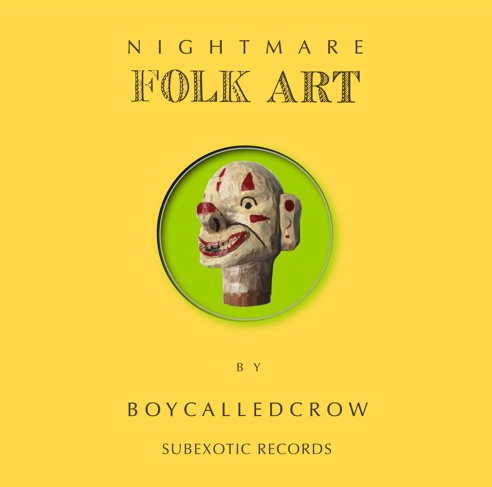
Despite the god awful, ungovernable times we live in, and after absorbing the alternative-future of a San Fran(sicko) class conflict of survival, as laid out in William Gibson’s dystopian sci-fi novel Virtual Light (stolen nanotech glasses ensue a caper of renegades, assassins and corporate foes), the Chester-based sound artist Carl Knott has found some sort of solace in a dreamy escapist vision of the pastoral on his latest album, Nightmare Folk Art. That title suggests some sort of dread, darkness, but in fact this is the sound of Knott’s home and extended county country-walks landscape transduced into a magic-realism and hallucinated version of outsider art and weird folk music.
Unsure in places, mysterious and often spun into a reverberating loop of interlayered nylon-stringed acoustic samples that can confuse, Knott, under yet another successful alias as a Boycalledcrow (previous incarnations include Wonderful Beasts and Spacelab), conjures up the unreal. Again, this is a dream state in which you’re never quite relaxed but never really thrown into a nightmare. There’s even a track named after the family dog (‘Sister Poppy Is A Good Girl’) for heaven’s sake! And talking of heaven, occasionally those various stringed instruments actually take on a harp-like beauty: that or a mandolin, a dulcimer and even the African kora.
Off-kilter in a resonated movement of picked, fanned, spindled guitar loops, metallic and whipped drums, constant echoes and rotor or flickered speed-shifted vapours, a distant essence of folk music can just about be detected. In fact it’s more Fripp and Eno (especially on the sailing ‘Be More Kind, Like Frank’), more Syrinx and Popol Vuh (on the diaphanous, hallowed and melodious ‘Sister Poppy…’) than idyllic or psychedelic folk. There’s a semblance of Cluster for instance on ‘Easy Tiger’, and the growl of a trebly amped-up post-punk bass on the reversed and breathing, Warp drums smacking ‘Beautiful Women’.
Sometimes a synthesis of guitar manipulations turn into something almost indescribable, hard to quantify; into an atmosphere or rhythm that stirs up a strange mood, environment far from the idylls of an English countryside or the abstract portals of family and emotions. From a deconstructive process something strangely weird and yet something that can be very emotive takes shape or merely dissipates into the ether. Boycalledcrow conjures up a phantom dream world in which the acoustic guitar iterations and looped bass-y rhythms of Land Observation are transformed into a mere echo and whisper of that folk seed.
Joel Harrison & Anthony Pirog ‘The Great Mirage’
(AGS Recordings) 17th March 2023
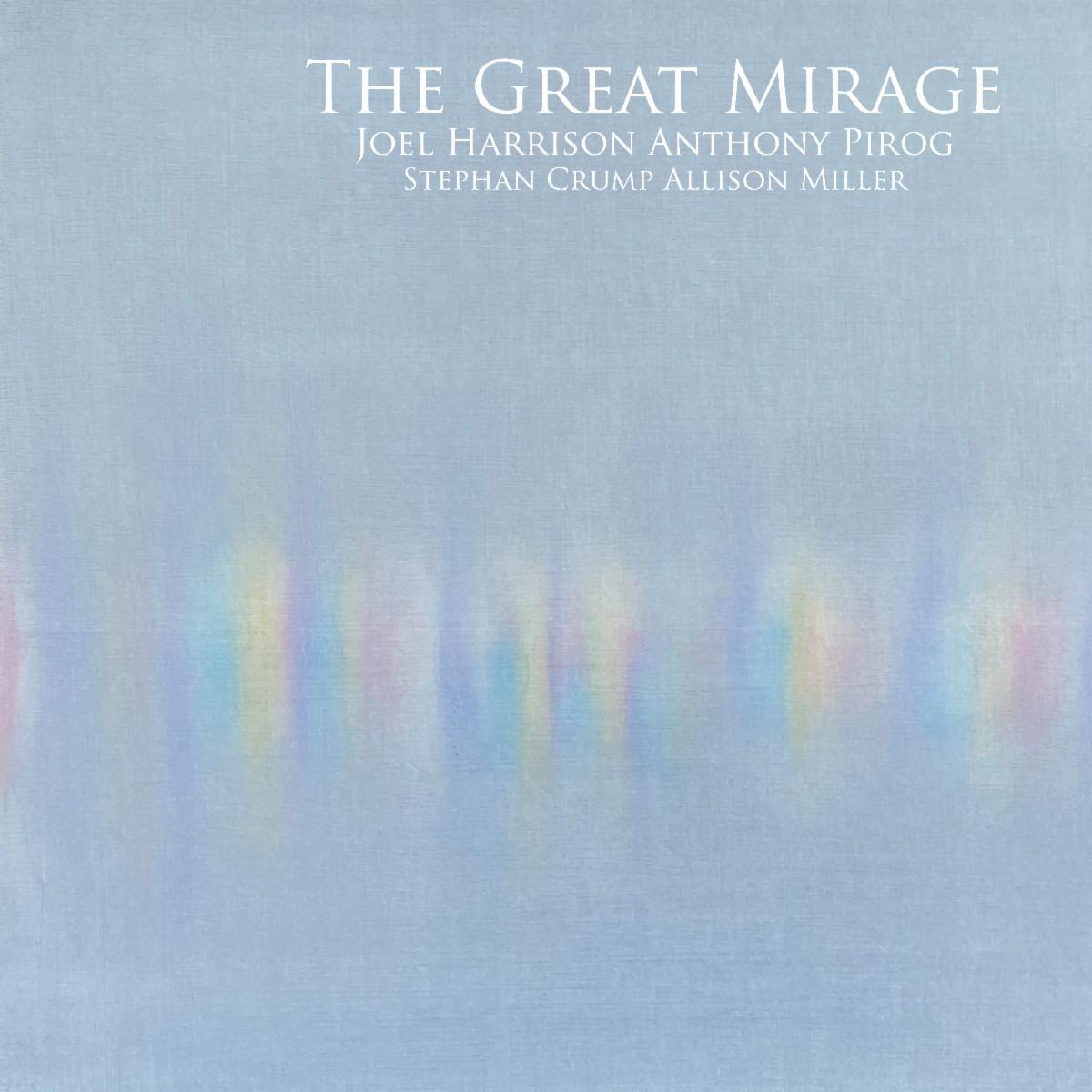
A cross-generational partnership of guitar virtuosos pull together their individual provenance and art for a showcase journey of atmospheric evocations of place and time, on a new musical mirage.
The longer standing senior partner on this enterprise, Joel Harrison, has an enviable CV and catalogue of 22 albums to his name. The Guggenheim fellow and polymath guitar language and technique educator, composer, arranger, lyricist and writer’s music has appeared on film (Southern Comfort and the Oscar-nominated Traffic Stop) and across a myriad of other stages (one such notable commission for Chamber Music America). His previous albums have featured some incredibly talented artists, including such luminaries as Norah jones and the contemporary jazz mover and shaker (and Bowie’s last recording foil) Donny McCaslin.
Harrison’s jazz-trained junior (in age only) partner Anthony Pirog has recorded and played in an eclectic lineup of projects over the years; from his collaboration with his life partner and cellist Janel Leppin to the harder-rocking New Electric quartet.
Both based in the Washington D.C. area, both students of jazz, their shared geography and musical interests crossover into the spheres of rock, country, prog, folk, psych and even, what I would describe as both post-punk and krautrock. This could all be wrapped up as fusion music. Fusion music, that is, with a roaming curiosity to redefine or at least play with stretching the capabilities of the guitar in the 21st century: good luck with that.
Harrison and Pirog are not alone on that venture, bringing in the talents of Stephen Crump on bass and Allison Miller on drums to widen the scope and bolster the sound; to give body, a drive and even groove too: Miller’s drumming skills, it must be said, can be just as free and loose as they can be in smashing, drilling and motoring along the compositions.
Unsurprisingly both highly competent guitarist technicians and creative of their craft are pretty good at conveying the mood, at building, expressing a sense of place whilst at switching on the Steve Vai and Pat Methany blazing fretwork soloing dynamics. On the title-track itself they fuse later 70s King Crimson with a certain aria-bending mystique, hints of that jazz learning and final biting fuzz bedding of Sunn O))). Later on with ‘Mortgage My Soul’ they rev-up that same fuzz and scuzz for a concentration of bashed-out heavy rock.
Easing the pace, compositions like the wistful, plaintive ‘There’s Never Enough Time’ and ‘Desert Solitaire’ take on a country music lilt of waning and bottleneck sliding, whilst the shorter vignette, ‘Last Rose Of Summer’, lingers beautifully in an rustic-acoustic charm of gauzy serenaded country-folk. ‘I’ll See You In The Shinning World’ starts off in a similar mode (reminding me in part of Myles Cochran) but then subtly moves through changes of funk, the jazzy and spacey.
Travelling south musically, ‘Clarksdale’ takes a pinch of Muscle Shoals and the blues to evoke a very American landscape, whilst at the other end of the scale, the no less evocative mood of ‘Critical Conversation’ feels like a tumult, a squirming tension of energetic discourse and guitar effects experimentation – post-punk, post-rock in sound, jazzy in channeling a certain angst.
Anything but a demonstration, this album is an impressive showcase of dexterity and virtuoso skill of composition and expressive playing. The Great Mirage stays constantly interesting as it moves between reflection and displays of whining and squealed guitar frippery. Never indulgent, the focus is always on merging a shared experience in which the guitar (both electric and acoustic) bends, molds and wields to its practitioner’s concept of free-expression. I’d suggest they’ve done quite well in mining their eclectic sources to shape that freedom and pushing of the boundaries in a modern age.
Bhajan Bhoy ‘To Love Is To Love (Volumes 1 & 2)’
(Cardinal Fuzz in the UK/Feeding Tube in the US) Available Now
Ajay Saggar once again travels the astral highway and byways as guru Bhajan Bhoy, across two volumes of transcendence, raga mantras and afflatus dreamwave psychedelia.
When not masquerading under the Deutsche Ashram title or acting the part of foil to Oli Hefferman and Kohhei Matsuda in the University Challenged trio, and again with Oli in the long-running King Champion Sounds troupe, Saggar channels his divine styles into this newish incarnation – the debut Bhajan Bhoy album, Bless Bless, was released in 2020.
Three years later, and out the other side of the pandemic, Saggar brings us “love” in abundance with a moiety of albums that channel previous projects: especially the intoxicating club beat, shoegaze, post-punk haze of his Deutsche Ashram duo with the gauzy-hushed Merinde Verbeck. Because sometimes amongst the radio waves of India and the brassy resonance of the sitar there is a hint of a transported and flange fanning Stone Roses, the Cocteau Twins, Jah Wobble and MBV. I’m not sure who accompanies Saggar this time around, but those similar airy vapours f ethereal vocals can e heard suffused across a number of peregrinations that have lyrics; these being utterances, vague chants and the sort of hippie new age speak of the 90s trance and rave scenes.
Volume 1 opens with the Mancunian acid dripped and Indian echoed mizzle of ‘The Guiding Light’; a both kaleidoscopic and druggy vacuum of Ash Ra Tempel, the Moon Duo and 80s neo-pop. ‘On A Higher Plain’, with concertinaed spells and reverberating tremolo twangs, envisions El Topo transported to the Indian subcontinent. ‘Raga Shanti’ as the name makes clear, fulfills the spiritual Eastern quota well with a spectrum of cosmic dialing tones, echoes of Amon Düül II-speaks-to-Yogi and the sound of Shankar. ‘Oh Seeker’ brings back those near-ethereal washy female vocals – reminding me a lot of the female tri-vocal led French psych group Gloria – across synthesized accelerating waves, flange-like guitar and entrancing drones.
Volume 1 ends however on the mystified, dreamy fairytale enveloped ‘Lovely Day For Cricket’. I’m not sure if there’s a hidden meaning – you can never be sure these days when even the most harmless or joyous innocuous activities can enrage or fuel discourse on the British Empire, who of course brought that sport to most of their colonies -, or, if it’s merely a celebration of this sport’s obvious mega popularity, cultural importance – the national game in India (and its neighbours too) more or less. Commentary and the crowd from a match is morphed and sent out gently into a sort of cosmic twilight zone.
Volume 2 follows on with the sequined bejeweled chimes of finger cymbals and bells and the fanned-out and spindled raga and kosmische trance of ‘Hari Om Sharan’ – Popol Vuh and Floyd meet Harrison for a daily devotional. That Popol Vuh sound, unsurprisingly, can be heard on the Aguirre-like Amazonian atmospheric dedication to that group’s cinematic soundtrack patron, Werner Herzog, on ‘Abshaku…The Ecstatic Truth’. The Vuh, in communion with late 70s/early 80s Tangerine Dream and Vangelis, traverse Herzog’s dream-realism and documented travels with vague panpipe blows, drifted Heart of Darkness guitar and the misty veils of Machu Picchu.
‘Accordi-Ohm’ meanwhile, sounds like a dub-y bellowing and concertinaed vision of Augustus Pablo on the trial of the crystal skulls: yeah imagine that! That leaves the finale, ‘Eliane’s Conch’, another of those vaporous dreamy and static-charged dreamwave echoed traverses that reminded, a little, of the Dead Skeletons’ hypnotic mantras.
Overall both albums flow, waft or linger across the cosmic, spiritual pathway of kosmische, krautrock, acid-rock, psych, shoegaze and beyond. The sound of India is taken to various planes within that spectrum, woven into a fabric of cultish, trippy and new age influences. Blessed be the search for love in an increasingly hostile, intense, divisive and mentally draining world; Saggar’s Bhajan Bhoy incarnation certainly has its work cut out. And yet, with his collected ensemble of musical partners, he creates a musical escape route on a purview of enlightenment and even fun transcendental spiritualism.
Healing Force Project ‘Drifted Entities (Vol. 2)’
(Beat Machine Records) 17th March 2023
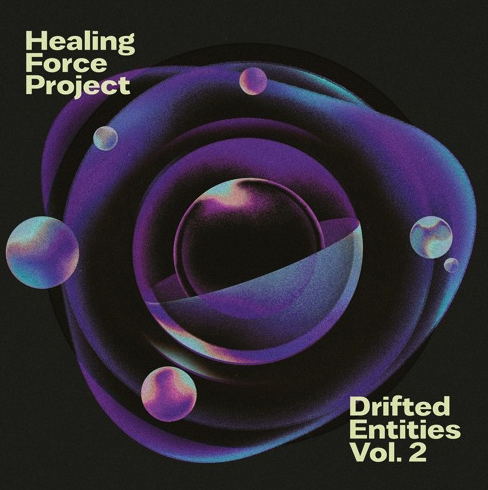
The re-rebirth of cool in an ever-forward momentum of flux, Antonio Marini’s Healing Force Project once more tumbles across a broken-beat, jungle, free-jazz and cosmic spectrum of reverberating exploration and spliced assemblage.
Last year’s first Drifted Entities volume made my choice albums list of 2022 with its echoed washes of On-U Sound and elements of Basic Channel, Plug, Luke Vibert and The Mosquitoes; all bouncing and resonating with the contorted rasps and strains and inspirations of Albert Ayler’s Music Is The Healing Force Of The Universe –the title and source of this sonic untethered beat-sculpted project.
Volume 2 adheres to the same principles but is heavier on the beats and the percussion. Filtering, falling, paddled, sifting and shivered throughout this deconstruction-reconstruction are echoes of Miles Davis’ 80s soundtrack suffused trumpet blows and noirish winds, Jan Hammer and Greg Foat’s organ and synth held chords and bulb-like notes and Billy Cobham’s expletory drum kit. Constantly developing, in motion, each track throws up all manner of shuttled and skimming contortions. Brown Calvin, Thundercat, Roni Size, the Aphex Twin and the worldly musical adventures of Don Cherry simultaneously exist in Marini’s singular and off-kilter rhythmic quadrant of cosmic freefalling and electrified jazz.
A splashy mirage of effected, realigned beats and reframed jazz inspirations sent out into space, Volume 2 in this series continues the ‘spiritual music mission’ but offers something once more eclectic and boundless.
Areia ‘Stories’
Available Now
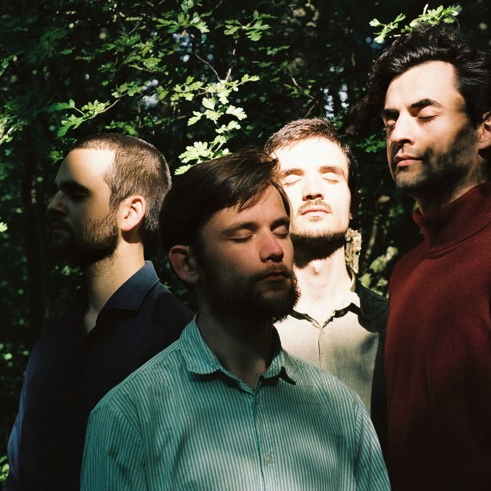
An album of stories imbued by various triplet-like references and cycles, the latest lightly executed work of chamber, neoclassical and explorative jazz from the guitarist and bandleader Siebren Smink is rich with descriptive wistfulness and reflection.
Inspired in part by the cause of the “three Marias”, whose feminist stance in the early 1970s against the fascist Catholic conservatism of António de Oliveira Salazar’s dictatorship in Portugal helped usher in the downfall of that regime, and by the near inscrutable scribed “language music” methods of the free-jazz luminary Anthony Braxton, these two influences converge in a balancing act of quiet thought and more expressive drama, dynamics. And so, rather than create an erratic exploration of Braxton’s cryptic drawings, plans of trills and brills, and the rage of those incensed by Maria Isobel Barreno, Maria Teresa Horta and Maria Velha da Costa’s struggle to fight the oppressive moralistic legal system of authoritarian Portugal, this album of mood suites manages to control those looser free-forming ideas with subtlety and sensitivity.
That Marias story was seen by Smink whilst visiting the Resistance Museum (a former prison for political prisoners) in Lisbon, and struck a chord. This trio’s crime was to publish a collection of unsigned essays, poetry, stories and letters that drew on the letters of a Portuguese Nun in the 17th century, obsessed as she was with a French soldier who abandoned her. The book proved a sensation, falling foul instantly of the regime’s censorship laws, quickly banned and destroyed. The actual court case that ensued – the penalty, imprisonment at the least – ended just as the country’s Carnation Revolution – so called because of the flowers the crowds gave to the soldiers who carried out the coup to replace him – helped topple Salazar’s rule. The penal code was especially discriminating towards women, treating them as second-class citizens, and so the odds of overturning the ban and escaping sentencing didn’t look good. But fortunately as the regime came crashing down, and with support from activists from around the world, the case was thrown out, the ladies collection even declared a work of art of the highest quality by the judge.
Sympathetic to that cause, chiming with the contemporary, Smink and his returning quartet of Adrián Moncada on piano, Antonio Moreno Glazkor on trumpet and Hristo Goleminov on tenor saxophone take musical cues from Pat Metheny and the Jimmy Giuffre 3, but the ACT label too, to produce music that hopefully doesn’t fall on deaf ears. Not that any of this is obvious, nor an on-message sound as such, but it is descriptive and resonates with a language of thoughtful yet roaming and loosened feelings.
Instruments interact or just fly off into opposite, but always congruous, directions of play. Harmonics ping, guitar strings softly accentuate or subtly climb the frets, and the tenor sax blows in both a suffused manner or in quicker circles, whilst the trumpet flits, spirals or holds a particular expressive note. The piano parts seem to drift or linger with a harder, starker prods or in a softened way evokes reminisces, aches and reflections. In parts the action accelerates with dotted notes, a little tension and even tumult: though nothing like a discourse, a cacophony or even crescendo. Sometimes just the mere essence of an instrument is all that’s needed to conjure up the mood, and sometimes just shortened prompts and small bursts of activity will speak volumes.
The Stories album is full of stirring moments and a melodious and not quite so melodious interplay, but also has a spirit of the untethered explorations synonymous with free jazz. Upsides mingle with deep thoughts, a flit of action and dialed down reflected sadness on an album that reveals more with every subsequent listen.
Above all, this album finds Smink and his Areia quartet vehicle on a refined journey of distilled and considered jazz; a balancing act that successfully weaves together freer interactions and the sort of expressive musical language that Antony Braxton would find very encouraging.
Lukas Traxel ‘One-Eyed Daruma’
(We Jazz) Available Now
The Swiss double-bassist maestro and composer Lukas Traxel is back with a new trio project prompted by an open invitation from the Moods jazz club in Zurich. With We Jazz label stalwart Otis Sandsjö on tenor saxophone and Moritz Baumgärtner on drums; Traxel creates a mysterious, plaintive, conscious and abstract environment out of avant-garde, free jazz and experimental counterpoints with this new turn. And the influences on this new project include Caroline Shaw, Colin Vallon’s trio, Gabriel Kahane, Sonny Rollins, Jimmy Guiffre and Keith Jarrett, but I’d add Sam Rivers, the late great Pharoah and the contemporary, mirroring Ill Considered trio.
Initially stumped, emotionally coming to terms with the death of his father, Traxel was suddenly freed from the dreaded writer’s block after noticing the mysterious-looking figure of an eyeless “Daruma”, starring out from the corner of his piano. In Japanese lore this harbinger of fate brings luck and prosperity. And as tradition dictates, you must first draw an eye on your daruma whilst making a wish; only adding a second eye if this wish comes true. It remains, for now, the ‘one-eyed daruma’ of the album title.
Conveying that loss and absence, but little bit of hope too, the trio build simmering, rasped and probing atmospheres from which subtle melodious ideas and feelings emerge; breaking out at points into either broken beats, break beats and cymbal splashes – the conscious jazz and elliptical rhythmic ‘The Call’ reminded me a little of Gescom. However, the album opens with the Rollins leads Floydian sizzled and brushed ‘First Times’: a balance of both thinly parched tenor and the wane, whine of hidden rusty metallic or brass instruments, gently prompted by the double-bass. The more chaotic ‘Nasty People’ stumbles and lurches through an Art Ensemble Of Chicago workshop and toy box. I’m not sure of the intention or the theme, but at one point a kid’s police siren whoops amongst the squiggles, shakes and craziness; and as it continues on, it feels like the drums are hitting out at, or being flung at, something/someone: A sort of venting of torque and tensions.
An act of flexing instruments and sounds to quantify expression and mood, Lukas Traxel’s sparsely executed showcases a theme of counterpoint – actions counterpointed by reflections, hinged and resonating, and by more recognizable holds and shortened toots of sax. The performances coalesce different tensions, speeds and articulations in the same track: for example, Baumgärtner’s drums moving at pace and drive whilst Sandsjö’s sax brushes the surface and Traxel’s double-bass plucks out singular notes.
Initially brought about by invitation, I wouldn’t mind hearing more from this successful trio experiment in the future. Their burgeoning debut an essential addition to the We Jazz catalogue and in turn, your record collection.
John Atkinson ‘Energy Fields’
(AKP Recordings) 15th march 2023
A reification of the hidden energy sources that power industry and the homes of America, John Atkinson’s atmospheric synthesized treatments lend a both morphed factory and more alien sound to both carbon and renewable technology on this new solo work. Uncoupled from his foil Patrick Taylor and their East Portal duo, Atkinson funnels the sounds of his 2019 residency at the Ucross Foundation in Wyoming – the largest coal-producing state in the whole of America, and in recent times the hub of renewable energy and carbon capture – into a conceptual investigation and peregrination of transition. As much in awe as he is anxious about the shifting tides and changes (I’m guessing that transition isn’t fast enough) in that field, this quartet of ambient, electrified soundscapes evoke states of uncertainty and mystery; an otherworldly balance of machinery and a removed, transformed vision of nature living side by side in the shadow of a climate change emergency (depending on who you listen to).
Atkinson has skin in the game so to speak, having spent the last fifteen years writing about this energy shift in terms of policy, tech and economics, as a day job. And so that drive and interest is channeled into a sonic experience of shunting coal trucks, the swing and hinge movements of heavy bucketed tools and cranes, and the rotation of bladed turbines.
A static energy current ripples through a soundtrack of filaments, high-pitched steam and industrial thumps on the opening ‘Spiritual Electricity’ track. A coal-fired plant errs towards a strange stirring of the unfamiliar, recondite, as Atkinson gives sound to such abstract concepts. ‘Black Thunder’ delves into the furnace with what sounds like boxcars unloading their materials and the pressurized whistles of dials and valves. Cleaner, sonorous waves and purrs emerge from out of the industrial activity however, hinting at some kind of submerged mystery, unease.
Across a windy plain from atop of a wind turbine, ‘Casper’ features ambient drifts, glints of the outdoors and a suffusion of twinkles and chimes. A strange nature exists alongside those imposing machines and tech that borders on the supernatural; a snatch of passing traffic perhaps caught in a blowy gloom. The more implicitly entitled ‘World Wind’ features more of those natural elements – the mating call of bison perhaps – running side-by-side with slowly stirring neoclassical gravitas and the churning turns of rotor blades.
Atkinson captures an evocative and interesting enough theme, a necessity to understanding or relating to that which remains disconnected to us; the apparatus, resources that generate our lives at the flip of switch seldom considered. As fossil fuels remain the principle source in a global climate of war, fear and increasing authoritarian, post-pandemic insecurity, Atkinson draws our attention to the burgeoning developments in off-setting that reliance; an abstract propound proposition transduced into a fully immersive site-specific world of industry and field recordings.
Anthéne & Simon McCorry ‘Florescence’
(Oscarson) 31st March 2023

As stirring evocative ambient-neoclassical-kosmische partnerships go, Brad Deschamps – under the Anthéne signature alias – and Simon McCorry seem the perfect match of subtle expressive drone guitar contours and equally descriptive, majestic cello. These two stalwarts of their forms set out to capture the essence of the seasons again; honing in on the first light, slow blossoming of Spring for this, their third such, collaboration – the first to be released on vinyl.
The previous Wallace Stevens, The Snow Man, inspired, poetic Mind Of Winter (which made my choice albums of 2022 list) was a sublime reification of the beauty of a crystalized, snow-dusted soundscape; a gentle yet deeply felt album of Wintery suites. From out of winter’s minimal light, Deschamps and McCorry, with both serenity and a touch of mystery, blend subtle electronics and what sounds like non-musical objects with their chosen stringed instruments; the processes of their atmospheric methodology mirroring Spring’s process of flowering and blooming.
In practice this leads to abstract reflections, thoughts, moods and the near unquantifiable transduced into both scores of hidden and more familiar sounding instrumentation. No one manages to expand the cello quite like McCorry, but that bowed, hollowed resonating cello body often sighs or pines more melodious phrases alongside trembled or droning sustain. Likewise Deschamps both obscures and yet also casts recognizable phrases, lingering tracery and permeating drones.
Nature comes alive as the light begins to play across meadows, versants and an often more mystically veiled landscape in which ripples across a pool of water can musically evoke so much more than a simple observation of the environment: one that’s awakens from a seasonal hibernation. Although the majority of the time we’re in the same musical sonic sphere as Eno (even a touch of his late 70s partnership with Bowie on the mirrored mirage, ‘Reach Towards The Earth’), Andrew Wasylyk and early Ambient Works Richard James ‘Unreflecting Pool’, with its plucked tines, chimes and generally gauzy airy mood, evokes a sort of misty Avalon; the sort of Arthurian waters so beloved of the Pre-Raphaelites (I could be letting my own imagination run away with me here). A both hallowed and moving merger of seasonal changes, suffused with a certain gravitas and meaning, the pastoral is revalued and sent out on a voyage of reflection. Florescence is yet another minimalistic work of sublime quality from a collaboration perfectly in-synch with each other.
Hi, my name is Dominic Valvona and I’m the Founder of the music/culture blog monolithcocktail.com For the last ten years I’ve featured and supported music, musicians and labels we love across genres from around the world that we think you’ll want to know about. No content on the site is paid for or sponsored and we only feature artists we have genuine respect for /love. If you enjoy our reviews (and we often write long, thoughtful ones), found a new artist you admire or if we have featured you or artists you represent and would like to buy us a coffee at https://ko-fi.com/monolithcocktail to say cheers for spreading the word, then that would be much appreciated.
 Monolith Cocktail Blog