The Digest for November 2026: New Music Reviews/The Monolith Cocktail Social Playlist/Archives
November 17, 2026
The Monthly Digest includes a clutch of accumulated new music reviews, this year’s Halloween Playlist selection, and a piece from the Archives.
___/NEW MUSIC REVIEWS____
Baldruin ‘Aventüren’
(Kythibong) 13th November 2026
Continuing on an adventurous trail, experimenting with the imbued roots of his small Bavarian choir boy upbringing and later explorations of connective transcendence via the artwork of the Surrealists and the music of Popol Vuh and Klaus Schulze, Johannes Schebler’s Baldruin project is pitched somewhere amorphously between the litany of the Reformation, the hermetic, the supernatural, a mysterious Far East and the Kosmsiche.
As I’ve pointed out with previous albums, there’s a permeating sonic palette of religious bellowed organ, church atmospherics, and the toll of bells. For just as Roedelius, Moebuis and Schnitzler’s first recorded experiments, under the Kluster title, found a home on the synonymous German church organ music label Schwann, so congruous were those early kosmische innovators “hymnal qualities” and, if removed, links to the country’s rich venerated history of religious music, Schebler’s own rectory upbringing can be heard suffused across most of his work up to this date. It’s a kind of bell ringer version that permeates this latest offering, that and a lightness of ecclesiastical tones, atmospherics and, again that word, transcendence. But this time around the various oddities, both hidden and more obvious instrumental sounds seem to be living and breathing like melodic, light bringing and cartoonish organisms and atoms.
From inspired ethic sounding curiosity to the flowered horn-like symphonics that sound out the sort of soft regal herald you’d hear on cute 80s Sega games, Schebler’s Baldruin alter ego invokes a strange fourth world environment that traverses’ hints of Laraaji, David Casper, Jon Hassell, Srgius Golowin, Pekka Airaksinen and Wendy Carlos. This can be manifest as concertinaed soirees on a reimagined Left Bank merging with a vibe that’s hard to describe but conjures up the accordion music of Portugal. Or mechanical quails’ song warbling and wobbling to what could be a harpsichord. Rounded gaming creatures of the furry variety chirp and yip along to descending and ascending chords, the pull and prick of violins and other chamber musical instruments, and a constant twinkly sparkle of malleted and gently bobbled marimba and glockenspiel.
Amongst those patterns and ideas, the scope of inquisitiveness and adventure calls in upon lunar soundscapes, pastoral and cult-wicca folktronica, and both new age and minimalistic electronica. Kinetics are balanced against more organic sounding movements, noises, clops and transformed voices as the rounded pliable soundtrack cultivates playfulness and a sparkling uplift of disarming reverence and spiritualism from the fourth world orbit. The Baldruin guise continues to develop, finding new avenues to express an almost completely gelled and amorphous fusion between chamber, electronica, the experimental and machined symphonics.
Harold Nono ‘The Gurney Shakes’
(Bearsuit Records) 6th November 2026
I’m not sure from which planet or alternative dimension Harold Nono is beaming these Fortean transmitted manifestations and collages from, but despite being unique and idiosyncratic they sound entirely befitting of the Bearsuit Records in-house signature of such oddities and curios that defy categorisation.
Who came first? The Nono or The Destroyer (that’s Eamon the destroyer)? The Moth Poets or Bunny And The Invalids? Because this invalided and patient carrier entitled EP seems to incorporate all of them. And if, despite their being titles, you were perhaps wandering what motivates this latest album from the maverick artist then look to the triple sectioned artwork that bears the lower section from Pieter Bruegel the elder’s Landscape With The Fall Of Icarus and the photograph of someone leaping or falling off of a distinctive (though I’m not actually sure the name or whereabouts of it, but I’m thinking perhaps Croatia or the Balkans) and crowded bridge – we can’t see what awaits this jumper nor how far it is until they meet water or earth or concrete. Back to that latter image, and indeed the theme of The Gurney Shakes, I’m not sure if it’s about falling or being vulnerable, or even about taking that giant leap into the unknown.
Sound wise, despite the jolting sonics, hidden object effects and sudden changes in tone or rhythm to something that resembles the jarring or at least surreal, the collage like approach is pretty melodic, even quite emotive and moving in places. When the strings do appear they invoke sorrow, malady but also something approaching the filmic: as does some of the ambient parts. Plucked or bowed and swelled they err towards the neo-classical school.
Layers of influences and ideas merge across this generous EP; from hauntology and the esoteric to near ominous sci-fi, the presence of aliens and something that sounds distinctly Japanese. Using a certain tuneful musicality in the face of such diverse threads, certain tracks could be described as a strange meeting between cLOUDDEAD and a darker Dune period Hans Zimmer aboard a sinister space freighter bound for an apparitional world where those iridescent mother of pearl-like nacreous clouds roam.
There’s so many interesting sounds to describe; from metallic bit-crushes to hinged whistles, menacing disturbances in the fabric, various filtered passes, what could be either the ariel bending wobbliness and warble of the theremin of glass idiophone, and those odd manifesting voices that sing. Nono continues to build his distinctive and amorphous arty and leftfield collages, avoiding, from this reviewer anyway, easy assessment and description. Not something you can say about many artists in this day and age.
Seffarine ‘Abaraz ⴰⴱⴰⵔⴰⵣ’
16th October 2026
With harmonious joy and a near disarming and seamless blend of sounds and rhythms from around both Spain and its once colonised Islamic south to across the Med and onto Morrocco and the caravan routes that once lined parts of the vast Saharan desert, the Portland-based Seffarine once more follow the contours, the bustling trading traffic and inspirations of their homelands on their newest album, Abaraz ⴰⴱⴰⵔⴰⵣ. A fusion born out of a meeting between the Moroccan vocalist Lamiae Naki and Flamenco guitarist, oud player and composer Nat Hulskamp, but expanded by ranks of both local players from the regions mentioned and a studio cast of additional supporting musicians, the band pay homage whilst forming new bonds and furthering their repertoire and range of influences.
Imbued and inspired alike by a location placed on the edge of the oasis town of Mhamid El Ghizlane in southeastern Morocco, sitting at the crossroads of the trans-Saharan trade, Abaraz was created in-situ as a collaboration. The group travelled to the region as part of an artistic residency at Joudour Sahara, a local music school dedicated to preserving and passing on the traditions of the Draa Valley – a once plusher oasis and one of the longest valleys in Southern Morocco I believe. The process and ease of interactive music making is described thus in the press notes and by the band members:
‘Each evening, musicians gathered on the school’s rooftop, where students, local artists, and members of Seffarine shared songs and played together late into the night. Several of the relationships and collaborations that developed during the residency ultimately became part of the album. “Some of the most important moments weren’t during the formal recording sessions,” says Hulskamp. “They happened after dinner on the rooftop, when everyone simply started playing. Nobody was thinking about making an album. We were just sharing music.”’
From the very soul of that communal meeting post of Mhamid noted musician Rachid Berazougui and others are joined by the Malian ngoni maestro Douoda Mangara, and the Amazigh (a name synonymous with the indigenous peoples of not only Morocco but Algeria, Tunisia, Libya, Mauritania, northern Mali, and northern Niger; also known as Berbers) multi-instrumentalist Aziz Ozouss. The sounds of not just Morocco’s famous gnawa, its scratch plate scuffled percussion and stringy rhythm, but also of the animal-skin coved canoe shaped ngoni lute and what sounds like the Tuareg blues sounds and the gentle vocal choruses of Tinariwen and Toumastine are connected with the incredible storytelling and nimble fingers articulate flourishes, the drama and more somber and romantic gestures of Flamenco and other Spanish traditions through both the hands of Hulskamp and the additional contributions of both the renowned Grammy Award-winning Flamenco guitarist Antonio Rey and the producer-guitarist and composer Pau Figueres.
Floorless in execution and effortlessly balancing such a divine if also challenging and evocative melting pot of musical styles, Abaraz ⴰⴱⴰⵔⴰⵣ brings each collaborative strand to the forefront; whether some tunes lean more towards the Flamenco stamp and clapped rhythms of Spain or towards the hypnotising desert camel guided caravan momentum of the Sahara, a permeating signature remains, the key components driven by the original members of the band. It’s a mainly soulful album, one that even crosses over into a sort of alleviated vision of earthy Arabian pop music and R&B – one devoid of computerised production and electronic apparatus. Naki’s vocal ranges varies between spells of the longing, ached and more serious as each theme is articulated or swooned beautifully; joined by a chorus of sympathetic voices that could have been plucked from the Azawad.
Topics on the agenda vary between calls of despair at the erosion and climate impacts of the titular location, but also the continuing effects of the desert’s arid suffocation of water and greenery, to the displacement caused by not just ecological threats but the ongoing disputes over autonomy and independence on Morrocco’s border with the Western Sahara. The musicality and ideas reminded me of Western Saharan musician/activist Aziza Brahim and her similar approach to blending both the music of Spain, North and Western African. But from a Moroccan and Spanish point of view, the fusions and collaborations are decorated with shimmery glitters, the movement of dance, the very best virtuoso attentive examples of Flamenco and classical Iberian guitar and the spirited responses of the desert diaspora and an inviting soulful evocation of their ancestral lands. A most successful project that will hopefully attract the attention it deserves.
Various ‘La Ola Nocturna: Experimental Songs & Deviant Pop from the Spanish 80s’
(Bongo Joe) 13th November 2026
Never as dangerous or shocking to the eardrums as Alex Carretero’s survey of the avant-garde and experimental Spanish tape scene, ‘Golpea Tu Cerebro: Spanish Underground Cassette Culture 1980 – 1988’, for Insane Muzak, the third compilation in Bongo Joe’s “La” affixed series delves into the country’s post-punk, new wave and adjacent art, dream and gothic-pop underground scenes.
Covering most bases, the third collection, La Ola Nocturna corrals a congruous if diverse range of artists and sounds, curated by Loïc Diaz Ronda, who pretty much summarises in great detail the history and context of each featured track and artist/group in relation to the political and social climate – doing my job for me. Ronda’s previous exploration, “The inner wave”, La Ola Interior was a most welcome compilation of Spain’s post-Franco experiments in Fourth World peregrinations; the kind that soaked up Jon Hassell and Eno’s collaborative “possible musics” game-changer on the cusp of a new decade: five years on from Franco’s death in 1975, and the loosening of that regime’s authoritarian grip. A comp that’s worth it alone for the addition of Ethno-transient trailblazers Finis Africae.
Unleashed in the dying embers of Franco’s dictatorial epoch, Spain’s generation X screamed and riled with an unchecked geyser like gush of industrial, avant-garde, noise, punk, new wave and lo fi analogue electronica experimental defiance. Still confined to the outsider’s underground status, Spain’s new guard split into various tribes; from the “Musica discrete” crowd to the Fluxus and industrial nihilists, the Goths and new wave indie kids. And despite universally fighting against the former tyranny, and as Ronda’s accompanying essay booklet explains, sub groups formed with varying political ideas: from an obvious and previously suppressed Left (which could mean anything from Socialists to the more extreme Marxists) to the anarchists and a youth totally at odds to the Left’s ideals, that was nihilistic but enjoying the freedoms of hard drugs (read heroin and all the problems that came with it) and partying – in this case, riling against the Socialists and Marxists that opposed such Western liberalism, tying such freedoms and lack of censorship in with Communism’s war against “Imperialism”.
There’s a hell of a lot more to be said and detailed of course, including bios on each one of this compilation’s twenty-four tracks. But instead of reiterating or quoting in verbatim, I’m going to whizz through both some notable and essential examples.
First up, the Madrid formed art rock band Ciudad Jardin and their soft psychedelic tinged, harmonics twinged dream wave ‘Homúnculo’, written in 1982. Quelled by their distributor’s financial woes, the group’s inaugural LP, Falso, wasn’t released until 1985. Said to have been influenced by more Afro-American and Tropicalia sounds, this featured tune sounds like an echoey early Mute recording covered by The Saints in a German new wave style. It’s followed on the collection by El Guerrillero Rojo’s bird-knocking and more playful ‘Vueltas’. The early 80s solo project of the Valencian musician Garcia Aleman – borrowing a guise taken from a 1930s Soviet film – the less than revolutionary zeal track sounds like Squeeze’s ‘Cool For Cats’ transduced through lo fi filters.
Another early cracker, the Kremlyn duo of vocalist Montse Berman and organist and keyboardist Joan Josep Ibanez – soon joined by Jose Antonio Perez, also on keys – yelp over arpeggiator streaming fruit machines and YeYe tubular pop on ‘The Girl Is Mine’ – imagine a kiddish sounding Lizzy Mercier Descloux.
Suddenly we’re transported elsewhere, from out of the synth pop and new wave towards the Baroque with the late 80s Barcelona formed &Nil; initially an improvisational duo of South American emigrees that expanded into a trio (adding the title’s Nil aka Roberto Garcia), they didn’t begin recording until the dawn of the 90s. Producing their own experiments they also covered songs by Thelonious Monk, the Soft Machine and the Violent Femmes, but their featured ‘Tilly’ tune is more strange, like folk melodics over burped farts, sound art and various hidden objects. Like so many of the artists and bands featured, the group’s founders Carlos Gomez and Ricardo Arias had disbanded and gone their separate ways (both returning home to Latin America, just as their debut cassette was released in 1992) before they managed any purchase.
It’s jungle noises galore on the Dave Stewart & Barbara Gaskin-esque (though you could also describe it as a cross between the B52s and the Banshees) goth-pop broody ‘Voces en la Jungle’ by the Madrid formed Los Monaguillosh. This was their breakout number it seems, but success didn’t last long in this transient and fleeting scene, and they split up just a couple of years later. Aerolineas Federales ‘Soy Fea’ is a fusion of the Talking Heads ‘And She Was’, Bowie’s synth and The Buzzcock’s Spiral Scratch, and the Basque country formed M-ak and their singular drum pad beaten ‘Atseden une bat’ number seems to mine The Jesus & Mary Chain, Alan Vega-like 50s and 60s moody backbeats and Eyeless in Gaza. Meanwhile, Ataque de caspa have listened to the same 60s garage and girl group beat records as Brix Smith in the 80s on the commercially viable indie pop-paisley ‘La pesca’ – one of my favourites. And El Aviados Dro y sus Obreros especializados channel an Iberian Mark E Smith on the synth drum pad splayed cybernetic Numan-esque and The Normal sci-fi imbued ‘Obsesion’.
Playing catch up with their Western European neighbours – who of course weren’t hampered by a semi-Fascist government -, many of the tracks featured, the histories too, lean on the new wave explosions happening in the UK, Germany and France. Borrowing from the former’s new wave cinematic auteur, Jean-Luc Godard, and formed two years before the German band of the same name in Madrid, Alphaville funnel the film’s noirish sci-fi mood into two tracks of varying cosmic English and French influenced jangled indie and post-punk quality. Despite critical notoriety, they pretty much remained relatively obscure, breaking up in the mid-80s before reuniting in the 90s to re-record their old songs. Taking, if intentional or not, from the Scottish Postcard scene, El Ultimo Sueno’s ‘Los muebles estan volando’ (“the furniture is flying”) give a Spanish bent to Josef K and Orange Juice. Though I also counted the vague pillage of Devo, Roxy Music’s sax, Siouxsie Sioux, 39 Clocks, Palais Sschaumburg and DAF.
As a yet underrepresented and essentially important chapter in Spain’s musical story, its cultural youth movements, this latest volume in the series threads together a complete picture of a both exciting underground scene fuelled by the growth in pirate radio, fanzines and diy aesthetics. Whilst there’s many a cautionary tale, with the unfortunate escapist and post traumatic use, freedoms of heroin abuse, this is a celebratory showcase that I envision will prove a useful resource; its track list appearing all over the internet in the coming weeks and months. As good as any a compilation with which to investigate the Spanish new wave and its sub genres.
Violet Nox ‘Spectre (Black Snow On Christmas Remix)’
Single/Video (Aumega Project Germany) 10th November 2026
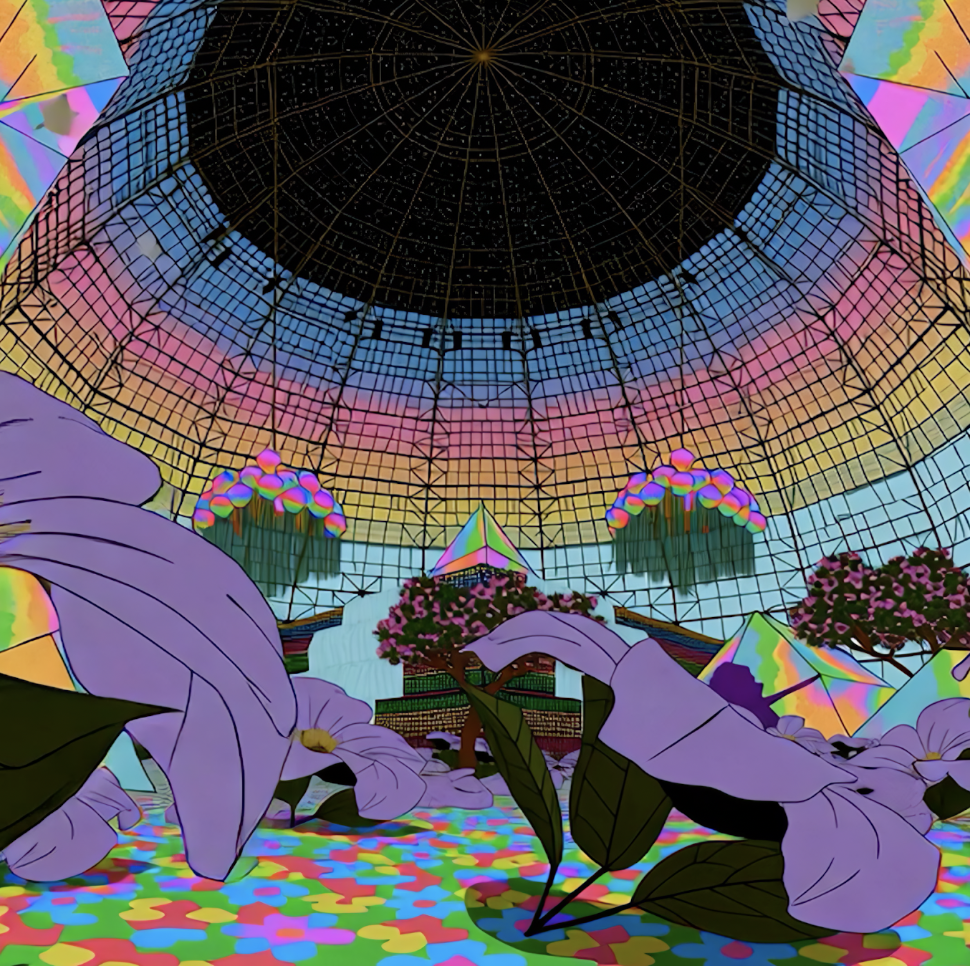
Lifted with a congruous pulsated remix by Chris Wirrwitz (under the Black Snow On Christmas alias), the Boston, Massachusetts trio of Violet Nox find last year’s Silvae album track ‘Spectre’ sprouting Norse-like cosmic wings and a new EDM light propulsion. And, as if to fully immerse the listener into this transformed experience, Allison Tanenhaus has graced this remix with 360-degree hothouse biospheric greenhouse visuals; the colour scheme of which is a psychedelic and off-world looking LGBT+ palette that reflects the synth group’s own diverse makeup and its themes of inclusion and new generated myths (the Violet of the name reflected in the exotic-coloured fauna).
Moving around in this space, the original trance track is given a sort of soft techno sound, with Noell Dorsey’s original vocals now lingering and echoey, and sounding not unlike Blonde Redhead meets Ladytron. Escaping into the mythological whilst roaming the future, Wirrwitz introduces techy drum pads and a softened rhythm, lifting the original to near Brian Reitzell levels of myth and reverberations of ghostly Norse scores. Almost a vague lend of Ibiza too. Wirrwitz, who files music under the Black Snow on Christmas guise, has made music since the early ’90s, moving from noisy experimental rock into analog and modular synthesizers over the past decade. He lives on a car-free Baltic island working as a writer, coach, and consultant, and runs the magazine BSOC Monthly. It proves a great fit.
Last year’s album for the prolific North American label Somewherecold Records was described thus by my good self:
Building new worlds, futuristic landscapes and intergalactic safe havens in the wake of vapour trails of laconic, hypnotizing new age psy-trance mysticism, Violet Nox once more embrace Gaia, Greek mythological etymology, astrology and science-fiction/fact on their latest album, the poetically entitled Silvae. The trio of synthesists and electronic crafters Dez DeCarlo and Andrew Abrahamson, and airy searching siren vocalist and caller Noell Dorsey occupy a dreamy ethereal plane that fits somewhere between Richard H. Kirk’s Sandoz, Vangelis, Lisa Gerrard, Banco de Gaia and ecological revering dance music – though that trio has expanded its ranks, indeed very pliable, over the course of the last decade.
On their eighth album together the topics of identity, androgyny, resolution, self-discovery, self-love and resistance are lifted towards the stars, pumped and projected through the veils of ambience, trance, dub, EDM, rave, electro-pop, cold wave, techno and more. The trio dreamingly, and in the moment, explore new textures, dynamics and atmospheres, and perhaps, produce their finest work to date: certainly, in places, the sound is more electronic-pop, with vague traces of New Order, Propaganda’s Claudia Brücken and 808 State – their sort of melodica like flutiness especially.
Check it out after giving this latest remix, instigated via the German Aumega Project label, a whirl.
Voodoo Drummer Duo ‘UTSU’
Track/Video 8th November 2026
Two seemingly closely tied threads are woven throughout the work of drummer/percussionist extraordinaire Chris Koutsogiannis and his cellist foil Stavros Pargino’s “Afro-Dionysus” duo; that of an idiosyncratic reimagining of Greek mythological scores and tragedies via Western Africa, and the music, direction and inspiration of the street maverick poet Moondog.
Pursuing their own kind of Odyssey, weaving and transposing into something weird, otherworldly and dadaist the topics of Greek myth, tragedy, atavistic verse and the classical whilst interrupting both iconic and traditional compositions by various idiosyncratic inspirations along the way, the Athenian duo have previously instigated evocative theatrical journeys in which all roads lead back to the underworld.
Referencing all things Greco-absurdist and mythological, the self-anointed VOODOO DRUMMER moniker of Koutsogiannis – an alias that formulated after participating, we’re told, in a Benin funeral, and from his appearances on the esoteric New Orleans scene – and his creative partner’s lofty aspirations weave mischief and playfulness across transmogrified and lifted material that, for the most part, relates to Hellenic culture. And yet, off the beaten track, the roots of “rebetiko” Greek music from another age, the ancient scales and poetry of that Mediterranean civilization are crossed with early 20th century America, Western and Eastern European classical music from the 19th century, the avant-garde, the stage and the counterculture.
It’s through the gamelan, Japanese and African like tines percussive rhythm of Moondog’s original ‘Utsu’ that the duo now integrate a European avant-garde classicism and artful beat: like Phillip Glass directing a more sympathetic Javanese blossom and burst of ragtime jazz drums.
Keeping faithful to the original timings and roots, the choice of cello and balafon “switch in a raw, improvised, and minimal way”, navigating the “formal traditions of Western music” as they play homage to and yet divert the original material. This version unfurls its storytelling qualities, its excursions and gentle emotional draws.
The blind street poet rubbed shoulders with Bernstein, Toscainin, Parker and Goodman, and channelled everything from jazz to the classical, swing to rumba, Native and Latin American music. And so, his varied palette has inspired a similar amalgamation of theory, musicality and influences. He also incorporated the very sounds of the midtown New York streets that he used as his impromptu stage.
On this track, taken from the 1953 On The Streets Of New York LP, Moondog’s second wife Mary Suzuko Whiteing plays one of his many invented instruments, the “utsu” (a small keyboard instrument in the 5-tone scale) in a 5/4 time. The word in the native Japanese dialect means to hit to the beat, and here it’s played almost like an enchanted tiptoe towards the pagoda alongside the deeply bowed neo-classical cello. Another unique if congruous and respectful reappropriation from the duo.
___/THE MONOLITH COCKTAIL SOCIAL PLAYLIST VOL. 111____
Nearly each and every month I curate my ideal radio show, less the chat. Or if you like, a DJ set, a Social of eclectic tastes plucked from my own collection plus an inter-generational, global selection of tracks I just love, find interesting or that chime with contemporary subject matters including the loss of a musician or artist.
If you’ve been following the site for some time, or just like the playlists I’ve been compiling, you will know that each month there’s also a selection of tracks from anniversary celebrating LPs. November’s edition includes 60th nods to Ready Steady Who and Tex-Mex garage progenitors ? & The Mysterians’s 96 Tears debut LP. Fast forward two decades and the 1980s and its nods of recognition to Grace Jone’s swimmingly neo-geo, dancefloor filler Inside Story, Nick Cave & The Bad Seed’s harrowed circus, down and outs in Berlin imbued Your Funeral…My Trial, The Beastie Boys’ hardliner rock-punk-hip-hop debut Licensed To Ill, The The’s alternative idiosyncratic turn Infected, and Bad Brains’ I Against I (aside from the vocals, surely an inspiration for TV On The Radio). From this time (or as near as damn it) in 1996, there’s a nod to the Aphex Twin’s Richard D James LP and from 2005, something from the much underrated and passed over Long Blondes and their Someone To Drive You Home LP. And from the recent past, and featured in the Archives section below, a track from R. Seilog’s Shedhead EP of 2016.
I’ve decided to also pay respects of a sort to exotica smut auteur Tinto Brass, who died a couple of weeks ago. Infamous amongst the filmography was the salacious Salon Kitty, which obviously influenced one of the site’s choice projects of the last decade, Vukovar and their debut album’s Regular Patrons of said sadistic Nazi bordello turn revenge spy entrapment inspired track – of which I’ve featured. Plus, a something from Fiorenzo Capri’s original soundtrack.
There’s a smattering of more recentish tunes from the Horse Lords and Hinako Omori, Inturist and the not so new but only just turning up Miles Runs the Voodoo Down (live In Copenhagen 1969) free jam amongst oldies from Fitz Gore, CANT, Camera237 and many others. Full track listing is as follows:-
Grace Jones ‘I’m Not Perfect (But I’m Perfect For you)’
Bullion ‘The Age Of Self’
? & The Mysterians ‘I Need Somebody’
The Long Blondes ‘Lust in the Movies’
Paul & Barry Ryan ‘Keep It Out Of Sight’
The Who ‘Circles’
Camera237 ‘My Wrong Words’
Doug Hammond & David Durrah ‘Fidalgo Detour’
CANT ‘Believe’
NOVA ONE ‘Kiss’
The Who ‘Disguises’
Grace Jones ‘Scary But Fun’
Fiorenzo Capri ‘On the Morning After’
Nick Cave & The Bad Seeds ‘Hard On For Love’
Vukovar ‘Regular Patrons of the Salon Kitty’
Chris Brokaw ‘Swimming, Tuesday’
The The ‘The Mercy Beat’
Balli And the Fat Daddy ‘Bahamian Born’
Beastie Boys ‘Rhymin & Stealin’
Bad Brains ‘House Of Suffering’
S.M. Nurse ‘Schatten’
Aphex Twin ‘Cornish Acid’
Michael Fakesch ‘Demon-Stration’
R. Seiliog ‘Myopia’
Hinako Omori ‘You found The Allotment’
Bunny And the Invalid Singers ‘One time For Good Time (Ullapul Remix)’
Horse Lords ‘After the Last Sky’
Fitz Gore ‘Gisela (Lion Rock)’
Miles Davis ‘ Miles Runs the Voodoo Down – Live in Copenhagen 1969’.
____/ARCHIVES____
From, more or less, this time a decade ago another chance to catch my reviews of Alistair Thaw’s (aka Hole House) paranormal ghost hunter’s A Stranger In Town, and Robin Edwards’ (aka R. Seiliog) cerebral electronic Shedhead EP.
Hole House ‘A Stranger In Town’
LP released via Aetheric Records
Equally as disturbing though slightly less harrowing than last month’s featured Beast Mask Supremacist by the Grey Guides, Alistair Thaw as the veiled and cryptic Hole House releases another paranormal recorded document from the gloom.
An Enfield haunting, a poltergeist caught on tape, A Stranger In Town is an imaginary ghost hunters investigation of the ‘goings-on’ at an abandoned VHS rental shop in West Yorkshire.
The malcontent spirits, from the quantified ‘first floor’ and attic to the metaphysical spaces, make their presence known: both loudly and clearly. Imbued with if not informed by the nihilistic horror stories of cult American author Thomas Ligotti (a suitably despondent realization of life’s futility style quote is featured on the Bandcamp page), the scene is set for a loosening of bowel’s experience.
As you’d probably gathered, musicality and instrumentation (identifiable instrumentation anyway) is absent in favour of an EMF meter and Geiger counter emitted backing gauze of fluctuating, rippling activity. Navigating a narrative Thaw cracks up the generator as he introduces the listener to the dreaded ‘A Living Room’, bringing our attention to the pulsing warning signs of ‘The Mark On The Wall’. It’s not until we reach ‘Was She A Tape Recording’ that the veil of obfuscation is lifted and we recognize echoes of a dissipating Sun O))) style dark drone.
Suffused with a supernatural ambience, waves of ominous threatening disturbances and the resonance of past misdeeds and lives emerging from the shadows send us all scuttling towards the nearest exit. All Thaw needs now is a film to accompany his unsettling ghost hunt.
R. Seiliog ‘Shedhead’
EP released by Turnstile Music, 18th November 2016
Making my job easier, if not redundant, North Wales very own sonic NASA atelier R. Seiliog possibly articulates his own music the best with this following description: “It’s like the slipping clutch of a self-combusting engine built from mirrors blackened by astral soot reflecting back the whole in each tarnished component.” And I could leave it at that, but I will nevertheless persevere.
The alter ego of electronic musician Robin Edwards, the R. Seiliog nom de plume was first brought to my attention via the magical Zuckerzeit disco bouncing ‘Pysgod’ track on the 2014 CAM 1 compilation – curated by Welsh electronica siren Gwenno Saunders and Peski Records as a showcase of tracks from the Cam o’r Tywyllwch (A Step From The Darkness) radio show, broadcast both on Radio Cardiff and Resonance FM (in London).
Steadily building a reputation for himself, mainly in Wales but gaining traction over the border with national airplay, Edwards brand of Kosmische, trance and techno so impressed fellow compatriots the Manic Street Preachers that they let him loose on a remix of their own Teutonic electro experiment, ‘Futurology’.
His latest expansive suite of celestial peregrinations is more attuned to the contemporary tweaks of what used to be termed, under the missive, “intelligent techno”: for example, the opening burst of nebula sprites and sustained release of particles ‘Myopia’ evokes hints of Basic Channel and R&S; two labels that were synonymous for their ‘cerebral’ techno experimentations in the 90s.
Those kosmische vibes continue to linger though in a far more dissipated and subtle manner. However, Edwards shimmery and often with strained “downtempo” modulations share more in common with progressive dance music and trance; those throwbacks only going as far as the last two decades. On the cogs-in-motion ‘Cloddia Unterdach’ the organic suffused interplay reminds me of the Leaf Label’s more serene ambient moments, whilst the whispery veiled announcements and kinetic beat driven Maxwell Remix of ‘Static-Sun’ features an echo of Mike Dred’s roulette wheel percussion.
Searing through the cosmos building thoughtful and moody electronic paeans to the workings of the universe, Edwards’ tight, tactile musical formula creates wonders.
Begging bowl time. If you enjoy, are informed or just love catching up with new and re-released, re found nuggets from across the globe, and wouldn’t like to see us disappear….go hungry….then you can now support us through the Ko-Fi donation site. A huge thanks to all our supporters so far, and to all those potential fans.

