In review: a world of sonic discoveries. Dominic Valvona
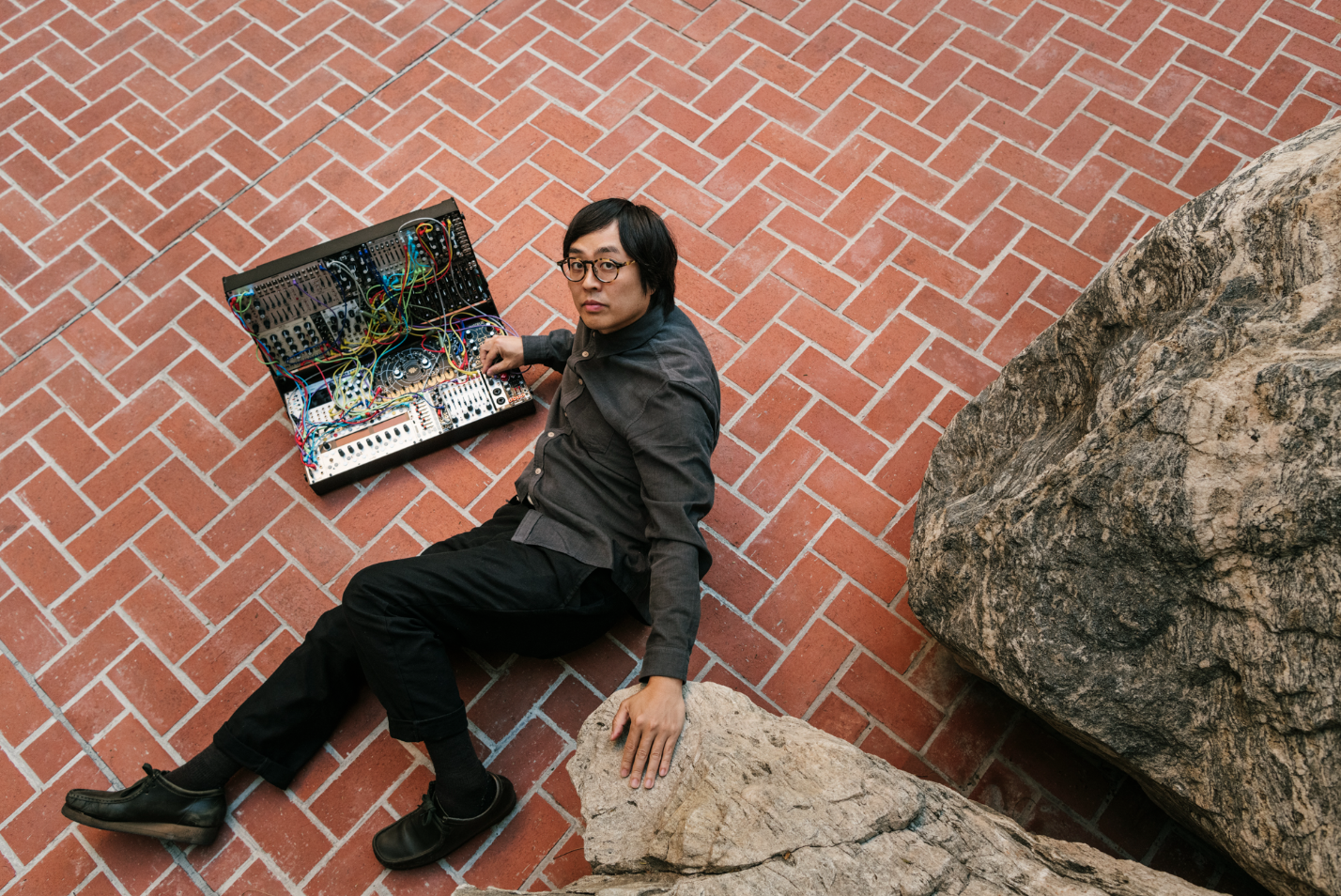
Photo Credit: Jeremiah Chiu by Brian Guido
Beat Keller & Jorge Espinal ‘El Agua Es Lava’
(Defkaz Records) 16th October 2026
Two lone swordsmen of their guitar art in combative experimental mode, the collaboration between the Swiss musician Beat Keller and his Peruvian-born foil Jorge Espinal is an exercise in instrumental transmogrification and the avant-garde.
Aligning respective disciplines with alarming, jarring and haywire results, the composer, sound engineer and, importantly and most demonstrably in this case, guitarist Keller entangles and tabs away to the meta contributions of his Buenos Aires-based trick noise maker. In a serial mode of a kind, with barely anything that would constitute the musical or the rhythmic, El Agua Es Lava (which I believe translates as “the water is lava”) skewers reference points from the most technically fucked-up of jazz guitar sparring and hysterics to the art school performances of Fluxus and their ilk, hardcore music, the industrial and erratically uncategorised.
Hi-pierced squalls and babbles of recognisable electric guitar shredding and fret gymnastics career or scramble across beaten metallics, workshop tools percussion, data coded squeals and thrusted oscillations. From the factory to volcanic explosive backdrops and the spine-chilling, distressed musicianship of a strange and alien kind builds up a crazy exploration of collaborative energies. Interesting sounds emerge: the growl of a revved-up guitar, the distorted coarse wiring and the belted drum kit that sounds like its being shoved down an iron fire escape.
But if you want a summary, and one of my descriptive go-tos, then imagine Gunter Schickert, Bill Orcutt, Steve Vai and Don Fiorino going to work like samurai guitar wielding mavericks against Glenn Branca, Fennesz and Last Exit.
Brama ‘La Raive’
(Airfono) 25th September 2026
Part of a much championed (including on this site) dynamic celebration of the Occitan language and it’s haphazard and continuously hampered cultural ties, the four-piece psychedelic-rock band Brama follow in the footsteps of fellow revivalists Cocanha this year in releasing their very own album.
I reviewed the latter earlier this summer, detailing or at least dipping into the context and foundations of the Occitan scene. So, excuse me if this does seem familiar, but here goes a very brief outlining of that history.
Playing on France’s foundations, pulled together in dominating fashion from various connected but distinguished former independent kingdoms and regions, and the erosion or indeed forced erasure of languages and cultures like the Occitan, the Clermont Ferrand quartet of Brama whisk and conjure up a “path between dream and reality, memory and imagination, where dance becomes a space vivid with memory.” They title this convergence “La Raive” or “The Rave” – an indication of direction and mood.
Though some nationalistic movements seem more in favour than others, France’s flirtations with fascism during the time of the Vichy regime’s collaboration with their Nazi overlords during WWII infamously, and most dangerously, used various folk traditions as state and ideological propaganda. Wrestling those same traditions now, and within the context of attacks in more recent decades on Occitan speakers and its alliance or take-up by activist groups locking horns with the French government, the recent musical forces behind this revival wish to free it from the forces of conservatism, misogyny and the stain imposed upon it by the tyrannical.
Whilst a far more in-depth and researched take is needed on all the ramifications, the nuances and the political outcomes, the strife and acts of resistance that have been imbued within this group’s sound and lyrics can be traced back to the patchwork of Medieval realms in what is now Southern France. A romantic language porously spreading out from its geographical namesake (loosely, I believe, formed on the model of Aquitaine, which is now known as Languedoc) into pockets of the Pyrenees (and so Spain too) and further afield into Italy, Occitan is roughly still in use, spoken by at least (depending on where you get your stats) a couple of million people. It’s poetic and lyrical turns, its polyphonic harmonies now, in part, provide manna and liturgy for Brama’s new album. And though I’m not sure if this instrument can be solely attributed to Occitan culture, the band use that most evocative of wound-up strung and drone intense instruments, the hurdy gurdy – credited to band member Amandine Pauvert.
But as this is, at least in part, a rave-up, the music is at least vibrant and animated; a danceable spell of Occitan etymology and ethnology twinned with excursions of motorik (Neu! via Beak> and The Soundcarriers) Krautrock and the electrified microtonal frills, dotting, dabbing and tabbing of Franco-Arabia. In fact, and I really wasn’t expecting this, Brama would be a great live partner to Qubec’s Angine de Portrine.
They begin, however, with an almost entirely vocal arrangement opener: save for a subtle hurdy gurdy drone that becomes one with the tones of the chorus of voices. Spanning the ages on short waves of passionate harmonious resonance, the quartet offer up a sort of vocalised liturgy come shoe-in for the next track, ‘Belou de jorn’, a more animated burst of motored lively dance-rock; a mix of the already mentioned AdP but also, strangely, Stereolab.
There are songs that groove and songs with a message, all mesmeric and hypnotic. The signature sound of souk-rock disco, the more fuzzed-up, and the near cosmic and starry is experimented with further on every track; as its title suggest, ‘Luminar’ seems to be transmogrifying a borrowed 70s Bee Gees tune and mixing it with the Arcade Fire whilst gazing at passing satellites and shooting stars, and ‘Belou de Nuech’ projects an astral journey to Java via Faust. ‘Niurada’ is like a cross between Alice Dona and Ladytron, played out to the pastoral sound of the cabrette and scrunchy guitar pedal effects.
The hurdy-gurdy drones evoke everything from medieval Occitan and the group France to the Celtic and psychedelically rural, whilst that microtonal guitar and the vocals fit the North African French diaspora. Imagine that all wrapped up in an electrifying Krautrock cornucopia of dancing and raving, and of motoring, and you’ll nearly there. For this is a pop-y like accessible cosmic renaissance of the “d’Oc” culture delivered with fuzzed and scuzzed energy and plastique tubular rhythmic finesse.
Jeremiah Chiu ‘Edge Conditions’
(International Anthem) Physical Release: 9th October 2026/Digital 27th October 2026
Modulating away from and decoupling, and yet once more working alongside his foil of recent years Marta Sofia Honer and band mates from the Small Medium Large ensemble, synthesist imbued composer and multi-instrumentalist Jeremiah Chiu unveils a soloist titled architectural and environmental inspired textural and rhythmic project that’s one part electronica of a 80s and 90s vintage pedigree, another part body music, and yet another that evokes the electronic, the floppy disk cut-ups and environment luminaries of Japan.
Edge Conditions features a pool of talented West Coast and Chicago hot-housed musicians; many of which have either released records on or been a loose part of the International Anthem label family. Whilst drawing upon the amorphous threads of Chiu’s previous collaborations with Honer, but also with the grandee of new age experimentation and fourth world peregrinations, Ariel Kalma, the former Chicago breed and L.A. based artist calls in favours from the Japanese musician, composer and artist of note, Takako Minekawa; the Japanese-American multi-instrumentalist, saxophonist, composer and poet Patrick Shiroishi (previous projects that I’ve reviewed include a match-up with Dave Harrington and Max Jaffe, plus involvement with the underground super group, Water Damage); Chicago jazz trumpeter, composer and bandleader or repute and influence, Marquis Hill; producer, multi-instrumentalist, trumpeter and instigator of the band Whitney, the alter-ego Resavoir and the Les Sons Du Cosmos trio, Will Miller; and the all-rounder percussionist and drummer with untold sessions and collaborations under his belt, plus a quartet of solo albums, and appearance’s in the already referenced SML troupe, Booker Stardum.
Possibly Chiu’s most unique foray into the rhythmical, Edge Conditions combines the plastique with the organic; the synthesized with the electroacoustic; and the concrete with the materials of space. Beats and tempos run out through an apparatus of effects merge with ease with more live or studio played drums, an essence of viola and hazy airs, breaths of trumpet; all of these sounds, patterns and wave forms meeting with the titular edge of both the abstract and the very real buildings, the public and shared spaces, and the places that converge glass and metal with a constant shimmered, bobbled and springy interactive dances and movements of either celebration, joy, introspection and cosmic mystique.
Futuristic and yet retrospective in recalling everything from the Yellow Magic Orchestra and its members various solo projects (I’m reminded of Sakamoto’s Esperanto LP on this album’s earlier tracks), plus their Japanese peers of Yasuaki Shimizu, Hiroshi Yoshimura, Susumu Yokota. This is layered up with shades of Lukid, μ-Ziq, Richard James in both his Aphex Twin and Polygon Window guises, Casino Versus Japan, Robert Hood, various House music and minimalist techno pioneers, and on the album’s metallic acid-house dance number ‘Night Fog’ a meeting of minds between Carl Graig and Felix da Housecat on an imaginary DJax Upbeat 12”.
You have the serious juxtaposed smoothly with club rhythmic body movements; and an assortment of instruments and effects that are often relieved from their serious avant-garde origins or loftier aspirations to just, well…dance around like Richie Hawtin’s Plastik “Men” or polygons and shapes lifted from their staid stasis as materials holding up the edifice of the city. Tracks like ‘Interface’ sound like a calculus centre of Tortoise and Holy Fuck quivery and chemistry wobbled body-rocking popping, whilst ‘Non-narrative’ is like some kind of techno funk from the Warp label of the early 90s. A contrast to both would be the sci-fi operatic VHS score of the fallen, ‘Sentimental Object’ and the Japanese garden wistful lingers, the metal scaffold tapping and the John Zorn like electronic valve instrument (performed by Miller) effected discombobulations and warps of the Fourth World and Ariel Kalma starring vapour thruster title-track. ‘A.M. Fuses’ is another danceable wavey number; worth mentioning for its Aphex and Sakamoto floppy disc cut-up breaking and paddled metallic tubular currents. This is one of those albums you’ll need to revisit often, with its true potential, its magic and groove revealing itself over time; on the fourth play through I’m still picking up on and noticing more modulations, clever interplay and sounds. It won’t light the world on fire but is none the less impressive and immersive for it. A really cool album of possibilities that dances to a mood and rhythm that many of us will find familiar but inviting.
The Corrupting Sea ‘Longing’
(Somnimage Records) 7th October 2026
At the helm, navigating the release of ambient and electronic music from the peripherals for the last decade (anniversaries looming) through his Somewherecold Records label venture whilst also spearheading his very own alias vehicle, The Corrupting Sea, Jason Lamoreaux once more sets both his measured philosophical quandaries and abstracted landscapes and scenes of personal joy, meditation and the existential to a subtle, immersive ecological ambient score.
Before we delve in, I must show my gratitude to Jason and his highly prolific label for offering room and a platform for two of this blog’s biggest champions and American pen pals, John Lane (masquerading wonderfully for years as A Journey Of Giraffes) and Violet Nox. It’s in this role alone that Jason can be held in high regard; offering up a vital showcase for those underground artists staggeringly ignored by the mainstream and even some of the snottier media outlets. I’ve merely dipped in from time-to-time but reviewed quite a haul of those albums over the years; some I’d suggest were every bit as important and good as anything turned out by Warp, Mute and the usual crowd of more celebrated and trumpeted labels.
Twenty-four albums in, with number twenty-five on the horizon (marking another anniversary, and the release of a very special collected works edition of the sonic saga so far), Longing draws on Jason’s own plaintive reminisces, the pains of missing out on exploring the environments, both the awe inspiring and the more intimate spots in nature, that have now become prohibited to hm due to illness. Candid if you ask him, and in the notes to this particular album, Jason has suffered for a long time with physical and mental disabilities; ones that cause extreme exhaustion and fatigue, and for obvious reasons make these youthful treks and communions of the past seem out of reach or difficult to replicate: There’s a specific recall in the notes of summer vacations spent in Yosemite National Park, scored aurally and sonically through the Andrew Heath-like lower-case trickles of piano notes, the churned vapours, the turbine like atmosphere and the language of the aviary on the rhetorical ‘Where Does One Go When One Can Go Nowhere’.
Through the main usage of ambient moods and feelings, Jason ponders with the prompt of descriptive, inquiring titles, the places held dear; scenes and locations of great importance, ones that evoke episodes from his life of safety, curiosity and encouragement. Incipient beginnings of near nothingness gradually take on a soft melodic quality as they grow and build upon the tunnelling rays and tubular synthetic wave forms that seem to convey a real depth and expression of the ecological set pieces, or the memories reflected in each track title.
Surveying a wondrous, mysterious and almost alien-sounded typography, Jason merges cleaner synthesised sounds and hidden sourced machine constructed atmospherics with field recordings of water sprays, moist dripping caverns, and the reverberated song and communications of birds. Some tracks sound more natural than others, whilst some could be said to be almost sci-fi, a touch off-world. Veils descend across fabled lakes with crystallised notation; what could be described as blizzardy specks move cyclonically in a synth-made whiteness; bucketed waters are scooped up in a fashion under the dripped dampness of a cave; and Forest Robots vibes are recalled in the gentle joyfulness and electronica celebration of ‘Tree Swings and Climbing Trees’. All the while that central sensibility of longing is drawn upon to create an album that’s simultaneously as pining as it is aspiring: the mood music of someone forced to watch from a distance, yet feeling some of the vitality, the enormity and inspiration of those landscapes and specific sites, memories that hold a special place in his life.
Allison de Groot & Rich Ruth ‘S-T’
(Western Vinyl) 2nd October 2026
Who knows what a Rich Ruth (the persona alias of Michael Ruth) produced Allison de Groot project would have sounded like in the end; that original remit and plan instead evolving into a shared titular collaboration of equals, with both creative sparks writing together, sharing and developing ideas conjured up in a Nashville studio over the course of a year.
The solo endeavour of the clawhammer banjo maestro of repute de Groot, this traversing work has grown from its incubator southern rooted projection into something, perhaps, much larger in expansive scale and deeper in layered immersive soundscapes. If much of the inspiration derives from that instrument of choice, the introduction of Ruth’s own multi-instrumental rack, plus the contributions of the Canadian and Berklee hot-housed violinist Patrick M’ Gonigle, and the erred wavy mirage-like steel peddle phrases and lines of Ruth’s oft Shrunken Elvis bandmate Spencer Cullum, have all added to the stirring evocations and scored environments that materialise from a reimagined Americana and abstract ambience.
Associated with ‘old-time tunes’, traditional American music and bluegrass, the clawhammer banjo takes its name from the claw-like posture that’s used by the player to ‘hammer’ the strings. This technique is said to emit a gentler and more melodic sound overall, and in this case, effortlessly blend an essence of its country origins with something both transcendent and cosmic: carrying the listener off to planes and places that exceed the borders of the American South and the home of country music itself.
Hear and Be Yonder David Casper and the tubular cascades of Mike Oldfield are transported to the prairie and wheat fields of a more abstract Nashville environment, as a synthesis of neo-classical and chamber dreams are woven together with the hallucinatory, and the more recognisable invocations of flowing, running rivers (the opening Oldfield-esque and dawn awakened light emitting Daniel Lanios golden rayed score ‘Nervion’ is named, I believe, after the Spanish river that runs along the ports and shipyards of Bilbao, out into the Bay of Biscay). Tracks like ‘New Intervention’ reminded me of Glass and Cage relocated to the old West, whilst ‘10-14’ was more like Tortoise panning for gold on the reservation with The Green Kingdom and Laraaji. But the banjo arpeggiator ‘Sorgin’ has a certain Japanese sound of paddled spokes and dulcimer-like woody bobbles, whilst ‘Rocks From The Moon’ could be Suzanne Ciani catching solar flares with Cluster. Imagine, if you will again, that Eno had produced Andrew Tuttle’s Fleeting Adventure, or Marisa Anderson had got together with Bruce Langhorne, for that’s about as close as I can get to describing this transportive new album from the collaborative partnership of de Groot and Ruth. And it must be one of the first albums of its nature to lift the clawhammer banjo from its origins and purpose to different heights, moods and fourth world-esque visions.
Miska Lamberg ‘presage’
(Discreet Archive) 2nd October 2026
And it all amounts to this: the minimalistic but deeply conveyed melodic score that builds into a haunted and sad dreaminess of the Boards of Canada and there like. Yes, the latest sound art or installation-like enveloped immersive experience from Miska Lamberg takes its long-form time to reach a certain gravitas of sound waves melody and feels that make the whole journey worthwhile.
Aptly released via the Discreet Archive platform – a label synonymous for allowing artists with such grand explorations the scope and time to breathe – Lamberg’s forewarned omens on presage use the environment, the hidden and obscured background field recordings of movements, the uncertainty and anticipation of various shortwave radio transmissions, and atonal drones and hums to conjure up a mysterious, sometimes near supernatural and alien landscape.
Lamberg’s biographical blurb states that, ‘pieces have been featured by record labels Sawyer Spaces, Dragons’ Eye Recordings, Falt and PRESQUE TOUT, and in exhibitions and performances at Museum of Technology, Urban Apa X Ateneum, Lighting Mind, Kamara, Swedish International Film Festival, Galleria Kalleria, Penthouse Collective’s gallery space, modern dance festival Tanssivirtaa Tampereella, and KATOAVA Collective’s various events and projects.’ And so, from the conceptualism of the art world to the studio and site specific, Lemberg has covered quite an array of sound experiments and sonic projects to build whole worlds out of not much more than the atonal and recondite. But this time around, prompted or indeed inspiring the stanzas of Minja-Milia Ikonan – which you can find included in the bandcamp description -, Lemberg’s presage evokes an assemblage of Helsinki environmental sourced recorded weather fronts and more disturbing ominous going ons.
Stormy but weightless winds, as noted by Ikonan, billow in across what could be described as cliff tops like synthesised airs: a mist even. Like early Kluster causing a venerable imbued mystique or even cathedral era Tangerine Dream, the atmospherics are liminal: between the otherworldly, the esoteric and sci-fi. Giant strides and brushed walks through grass and upon concrete are interspersed amongst the percolation of something boiling on the stove and the buzz of unidentified insects and those shortwave blizzards of crispy radio waves and radioactivity. This is track one by the way, which suffuses each strand, each tonal layer slowing and gradually over nearly twenty minutes.
Track two starts with an interference in the fabric, hisses and the looming presence of something from beyond. Again, hidden generators and machinery are obscured underneath a sort of greyish film, right up until that descriptive build-up of saddened but moving melodic sound waves that I described in the introduction.
As an experience its certainly an immersive one; a 4-D surrounded environment of the alien and yet familiar, reimagined through an apparatus and process that invokes the descriptive.
Light Conductor ‘Sequence Three’
(Constellation) 25th September 2026
Vapour trails and the luminescent heat patterns of distant planets are conjured up alongside soft hues of abstracted circular colours and amorphous transcended spiritualism on the latest and final sequence from the Montreal partnership of Stephen Ramsey and Jace Lasek: with Lasek’s Besnard Lakes band mate Olga Goreas orbiting as a third moon to the duo’s planetary base camp emissions of synthesised and vintage analogue psychedelic ambient slow-release space rock.
After two previous volumes, Light Conductor (a sort of vessel for the Young Galaxy’s Ramsey and his Besnard Lakes’ foil, Lasek, to pursue visionary drone scapes on distant planets) envision a diaphanous and mysterious escape to off-worlds; the utopia of World Expos and astrophysicists channelled into a long form kosmische and shoegaze imbued immersive experience in which the duo “…apply rockiest sound design to minimalist tracks.”
Through prisms of Fairlight synth, hints of 80s sci-fi VHS scores, Vangelis, Tangerine Dream, Zoon Van Shook, Iasos, new age music of a certain vintage, burbled submerged bass lines and touches of Moebius, our astronautic musicians follow the cosmic rays, watch for visitations from mystical aviators, pray at the altar of sci-fi, and make concrete the abstract perimeters of celestial feels and horizons. All the while they teether themselves to earthly concerns and dystopian crisis with the apparition broadcasts of financial ruination and the crash on the album’s middle marker, ‘Ghost City Radio’; a near Cassandra ominous Evangelistic rebuttal of Wall Street, the Stock Markets and Capitalism as par the course for the millennial generation, put to a saddened vapour, some sharp lifts, bobbed bass, and synthesised pre-set rhythms: a union between John Michal Jarre and University Challenged.
There’s some beautiful, and again, spiritual like expansions to this five-track suite of space dust particle shimmers, curvatures and spectral rainbows. And when Goreas’ signature wispy and husked shoegaze-y vocals emerge on the lush space aviary ‘Omenize’, those lunar mirages transform into a healing balm. The truly long form finale, ‘Supercontinent’, as epic as its title, features another cosmic menagerie alongside its drones, evocations of Cluster, Eat Lights Become Lights, and its plastique shuttled rhythms and metallic language
An immersive experience and cosmic opus of kosmische inspired slow-psychedelic and shoegaze rock from this Canadian collaboration; the perfect ending to a triptych sequence of such materialised interplanetary and otherworldly peregrinations and slow-burn releases of transcended escapism.
Mousecunt ‘Orgasmic Mouse’
(Infibulate Records) 25th September 2026
The inaugural release from the newly orchestrated Infibulate Records label, seeks to make its mark with a most controversially reactionary piece of Goth-synth-barbarity and industrial-EDM bad taste-riven polemics. Torture porn for the lugholes; repulsive lyricism aimed at unsettling; the anonymous Iranian band must have had to dodge the authoritarian camarilla’s morality police (surely) to unveil such filth, bloodiness and sexual depravity.
Information wise, we know that this group features “a woman” performing on Nord synths and vocals; “a man” performing on a Gibson guitar, Hofner bass and sharing vocals; and one more “man” on Tama drums. An anonymous line-up is mixed and mastered by another anonymous engineer in the USA; their task, to produce a sonic assault upon the senses from fortnight session played at a private studio in Azerbaijan earlier this year. They’ve been working under the anonymity cloak of darkness, we’re told, since 2022: and for good reason.
Explosively digging and wrestling in the dirt with themes of extreme artistry practice, domestic violence, volatile (to say the least) relationships, religion, humiliation and abandonment (through the most harrowing of Freudian prisms), the trio let loose with the obscenest lyrics I’ve heard since “GG” Allin or Throbbing Gristle.
Told through an “unreliable narrator” in an autobiographical-like (though it also says “from different perspectives”) style of protestation, name calling and accusation, and with barbed slugged shots of the near physical, Orgasmic Mouse could be deemed a quasi-concept album of a sort. At least joined together in a very abstract form; threaded together by a similar if changing moody production of dungeon abusing vulgarity, maximalist scopes, knife sharpened synths, both death metal guttural and more ghoulish coquettish vocalisation, and horror cult EDM.
It can be an uneasy and even vilely offensive if not dodgy listen lyrically wise – the opening gratuitous perversive analogies and troubling descriptive rage of ‘Fucking The Mirror’ being the worst -, but seems to indulge in the swamps of such criminality and extremism to reach the pit of hellish confession, and to rattle the foundations: In grappling with their subject matters they’ve dredged up the most caustic, spiteful and disturbing dialogues and poetry.
Because of their provenance, it’s impossible not to connect the dots: An Iranian goth-metal-synth-EDM-metal-art band dangerously sailing close to enraging the Islamic Republic’s sensibilities and rule of law. I can’t imagine, considering the recent bombardments from the USA, and the possibility of regime change, and the years since the Arab Spring of continuous opposition against this same regime by a sizeable (often young) part of its population have made it any easier to exist making this kind of music – so many artists, and protestors of recent years have ended up raped, tortured, disappeared or executed (and it must be said, with fuck all help, support or protest by the same brigades marching against Israel and the West week in, week out). Of course, it’s easy to see how reality being referenced and played out on the ghoulish, horror of this album – perhaps mirroring it far too well; the violence is everywhere: from the physical to insulting and sexual.
For a reference, imagine Ministry or Revolting Cocks going toe-to-toe with Xmal Deutschland, Alien Sex Fiend, Mercy Girl, Rosaceae and Nine Inch Niles.
How this will go down is anyone’s guess, but from a label built on provocation and the extremities of contemporary music, it’s a successful launch of offending, violent and more sensory punkified gothic dance music and tortured art performance.
Antonio Raia ‘Σ [sigma]’
(Kohlaas Records) 1st October 2026
Not the focal draw, but as part of his collaborations with fellow Neapolitan artist Renato Fiorito, the body, soul and environment amalgamated – like a united flow – saxophonist, composer and improvisor Antonio Raia has both appeared and been mentioned on the Monolith Cocktail twice: firstly with a premiere, shared with our Italian pen pals at Kalporz, of the eighteen minutes long ‘‘Too Many Reasons’, and then a couple of years later, as part of the greater contextual piece on Fiorito’s Lustra album
The former saw the amorphous saxophonist Raia and his sound artist foil join together to capture the abstract atmospheres of cerebral reconnection; a sonic field in which to escape the stresses and weight of the Covid pandemic. Produced in lockdown, in the partnership’s native Napoli, this imagined space, in which a faded, fuzzy pining and wandering saxophone wafts around a rotated motorised humming and propeller purred windy and airy isolated soundtrack, brought together two experimental composers looking to create an ‘intimate and visceral experience’.
The latter of those two pieces was described at the time as ‘a votive offering of gratitude and devotion’ to that same city; attributed to Fiorito this time around, the track and album was promoted as his ‘personal vision of Naples’. Raia on his part, popped up on the crackling fireside, faint melodic and reflective softly rasped saxophone memory of ‘3694’.
As resumes go, Raia’s includes the critically applauded 2018 debut solo album, Asylum, and the 2023 published soliloquy book, La memoria bucata –a project developed through the sonic manipulation of archival materials by the theatre director Antonio Neiwiller, who passed away prematurely in 1994. In 2024, at the invitation of filmmaker Béla Tarr, a key figure in radical contemporary European cinema, he conceived and realised Facing Béla Tarr, a sound action for saxophone and waterphone based on the film Prologue. Two years later, and bringing us right up to date, in early 2026 he composed and released the soundtrack for [campanamuta], a six-act radio work by Martin Errichiello produced by the Italian National broadcaster Rai Radio3. During that time, he’s also managed collaborations with Alvin Curran, Elio Martusciello, Mike Cooper, Chris Corsano, and David Ryan and others.
Merging once more with his environment – this time the former Wasserturm Berlin water tower, located in Prenzlauer Berg -, Raia uses the architectural acoustics within this long-since decommissioned space to form a bond with the atmospherics and his instruments of choice – in this case both the baritone and alto saxophones and the Japanese Koshi wind chimes. Almost uninterrupted, recorded without overdubs by the Grammy and Emmy Awards-winning producer Francesco Donadello, Raia lets his feelings being roused and stirred, prompted by this peculiar utility turn studio – the oldest such water tower of its kind in the city, built in 1877 and still in operation up until 1952.
But just to draw from further afield too, the album’s title is borrowed from the Greek alphabet, and the album’s only sax-free performance, ‘Veils of Echo’, has a decidedly Morricone-y feel to it – the chimes brushed and swept in glissando style like crystal glass are accompanied by an Alessandro Alessandroni-like reverberated whistle.
Invoking the blues, the noirish, an essence of the 1960s New York jazz scene, and the venrable, Raia’s soundings and dialogues with the reverberations and echoes traverse the lower register honks of a ship’s funnels to the near amplified blows of a near dry spittle and the cyclonic spirals of bird-like higher tones that fly towards the studio’s ceiling. I’m reminded of Jonah Parzen-Johnson’s own solo soliloquies, the explorations of Timo Lassy, and John Buckingham’s parts on Bill Dixon’s Son of Sisyphus album. Also, the Instagram video uploaded and shared soloist musings and outpourings performed by Andy Haas in the gardens of the Modern Art Museum in NYC during covid – just an individual playing and conversing, sending vibrations out into the environment.
You get to hear (I’m assuming) Raia’s voice on the album’s finale, ‘Body and Cipher’. Taking a near liturgy turn of religious holy mantras and cantos, venerated choral voices meet with the deeper and bigger sound of low honked, near tuba-like, sax.
Suffused amongst those instruments, which can be quite melodic and even tuneful at times, even sympathetic, yearned and responsive, are sounds that can only be described as paddled, or full of texture.
The sounds of extrospection, of mystery, of the mournful and the dreamy can be heard across this album’s various ruminative wanderings and reverberations; a combination of the physical and improvised, all prompted by that site-specific recording space.
If you’ve enjoyed this selection, the writing, or been led down a rabbit hole into new musical terrains of aural pleasure, and if you able, then you can now show your appreciation by keeping the Monolith Cocktail afloat through the Ko-Fi donation site.

