The End of the Month Playlist For July 2026
July 30, 2026
Our Monthly Playlist selection of choice music from the last month. Curated by Dominic Valvona & Matt Oliver.
Choice music and sonics from the last month (or so) picked from our reviews, but also featuring the tunes we missed out on or didn’t get the room to feature at the time. Curated by Dominic Valvona with choice hip-hop cuts selected by Matt Oliver.
The Track List:
THAO & The Get Down Stay Down w/ Tune-Yards ‘Sick of the Times’
A Certain Ratio ‘Knife Slits Water (EM) 12” Version’
foamboy ‘FAR AWAY’
Homeboy Sandman & Jack Splash & CeeLo Green ‘World On Fire’
ECID ‘Break Up Insurance’
Space Afrika & Tony Njoku ‘MLN’
Skyzoo ‘Short Money’
Peter Evans ‘Genesis/Schismogenesis – Stage 4’
A-F-R-O & MotionPlus ‘Labor of Fruit’
Brian Ennals & Blockhead & Defcee & Mikie Mayo ‘Yellow School Buses’
King Kashmere & Genesis Elijah & Killa P & Dabbla ‘Big[Bad]’
Chuck Strangers ‘L2LL2C’
Post Elvis ‘Luna (Evil’s Ballad)’
Simon Klein ‘Don’t Leave Me Alone’
Robyn Hitchcock ‘My Dead Astronaut’
Babe Rainbow ‘Acid and Honey’
John Howard ‘Abbey Road, April 1974’
Skyjack ‘Shozi’
Richard Spaven & Wildchild ‘Finders’
The God Fahim ‘GFY’
Distant Fires Burning & Autistici ‘Scalar (Reverend Basstorius Remix)’
hackedepicciotto ‘Zeitwende’
Aisha Vaughan ‘Frozen’
August Cooke ‘On The Line’
Biita Houdei ‘The Ground Here’
Tristan Da Cunha ‘Preludio’
Feverdreamt ‘Shadow Catching Up’
Sir Richard Bishop ‘They Shall Take Up Serpents’
Park Jiha ‘Summer Illusion’
Los Orientales de Paramonga ‘Viajando Con Un Loco’
EYE WITH AN EYE (Bloom de Wilde & Nick Trepka) ‘flow.’
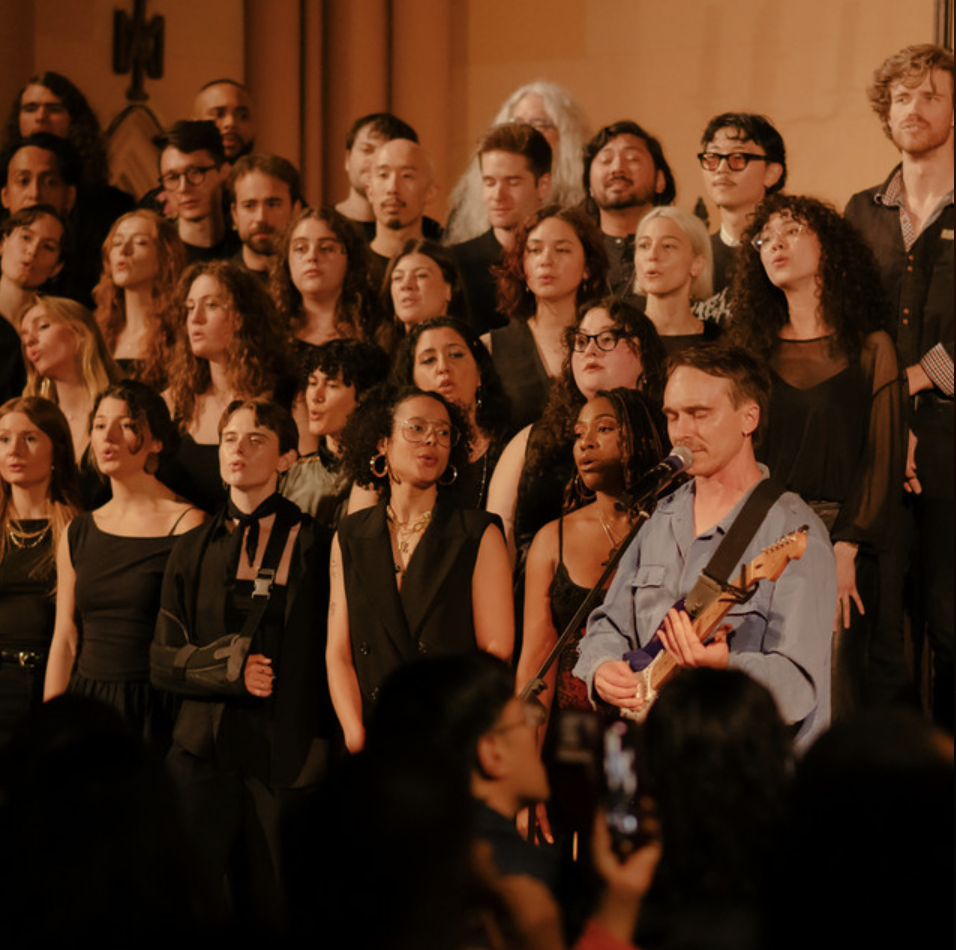
Tōth ‘Easy – Live With the Brooklyn Choir Project’
A world of sonic/musical discoveries reviewed by Dominic Valvona. All entries in alphabetical order.
Photo Credit: Mara von Kumme
AD Ozium ‘In The Style Of Dead Sparrows’
(Saccharine Underground) Released 9th June 2026
Through a storm, a blizzard, and heavy reverberation the Washington D.C. based musician Jeremy Moore (of Zabus, Zero Swann and Bell Barrow note) creates both a mirage and world of paranormal and hallucinatory built-up environments; that and evocations prompted by the various deciphered titles that allude to mysterious enquires into faith and death.
A unique world of transmogrified guitar drifts and twangs and tape manipulations, In The Style Of Dead Sparrows is as esoteric as it is dreamy, with sounds that could only be described as a mutated helicopter-like chop of insects or Captain Beefheart guitars meets a stained-glass-polygon-window version of the Aphex Twin with one foot in dissonance and another in a blanched-out desert. From fear to distortions and white noise you can feel the presence of the unearthly, or at least transformed and made more worrying; unidentified propellers and rotors, the tunnelling scrolls of blanketing winds and the clawed and scratched offer something alien, an inter-dimensional being, or the abstract but sonorous weight of heavy meta.
A coarse atmosphere fizzles and hisses all the while as both enervated and more amped up guitar distortions, pliable twinges and twangs, resonance, and untuned improvs drift in and out of the Fortean surfaces of the spooked and ominous. It parts it reminded me of both of Blake Edward Conley’s Droneroom project and of Steve Gunn – the guitar often sounding like some very removed but evocative indolent glimpse of Hawaiian and a nightmarish Ry Coder -, but then this almost industrial and clanged punctuated blast through imaginative distortions of Death Valley and references to the Nazarene, the throne and terminal, is unique. Projected somewhere between the crumbled and the surreal, the supernatural and engineered, everything is engulfed in a production of magnified magnetics, tape malarky and derangement.
Once in, you become fully absorbed and caught up in the halcyon redial, the layered mechanics and more lo fi experimentation.
Audio Obscura ‘Dream States’
Released 12th June 2028
Drifting between dreamy somnolence and jet-lagged like misperceptions of space and time, Neil Stringfellow’s explorative Audio Obscura project finds a liminal plane of the half-remembered, half-reminisced and a track list of prompting mementos.
Creeping downstairs to unlock the imagination, to freely take to the piano, after restless nights spent fighting off the insomnia of a heatwave, Neil found solace and both inspiration from Duke Ellington’s perceptive and visceral line that “No this is not piano, this is dreaming” – the original extract, along with a little more expansion on dreams, is used on the opening piece, and appears again later, mouthed this time by what sounds like a manipulated and Orb-like child’s voice.
Running untethered from experience, study and the like, this central Ellington description is used like a soft mantra to create various mirages, surrealist dream states, contemplations, thought processes, balladry and the more mysterious. But unconnected to jazz, Neil seems to weave together two different musical or sonic ideas at once; for example, there’s neo-classical fragments of piano that suddenly get overridden by μ-Ziq and Aphex Twin-like dashes of electronica or d ‘n’ b (actually this album did remind me in part of the drukqs album).
Throughout the trickles, tinkles, the diaphanous flows and more plinky-plonky gated reactions of piano you can perhaps be reminded of Keith Jarrett, Cage, of La Monte Young, Sabine Liebner, Margaret Leng Tan and the prepared piano work of Nam June Paik, but compromised or jolted by break beats, ambient passages, satellite beeps, fizzles and phasers and vapours. Those electronic effects, the beats and overrides brought up echoes of Tomat, Apparat and Roni Size.
Surrealist pillows float on heavenly clouds, caressed by the harp, and metallic reverberations chime against a soundscape of breaths, soft choral voices and slow hallucinations to somehow clutch at the abstract; to sound a particular experience, a date and day of great empirical importance. If a piano could in fact dream, then this album does much to convince us of its sentinel being, separated from its author, as if playing and recollecting passages, phrases and ideas itself.
Distant Fires Burning & Autistici ‘Scalar’
(Audiobulb Records) 18th July 2026
The experimental electronic label and hardware hub is known for its unconventional approaches to remix projects. Those familiar with this site may recall one such release by the latter of this team up, the Sheffield-based electronic composer Autistici, whoreleased acollaborative chain of such repurposed, resourced explorations through the Familiarity series. In that series fellow peers and label mates went to work on transducing or expanding upon the original material: or sounds and code adjacent to it anyway. Sharing the spotlight this time around with Belgium bass-player and “knob twiddler” Gert De Meester and his Distant Fires Burning alias (a moniker that leans towards the bass guitar), their Scaler track is given free reign and transported via various electronical fields of inquiry and exploration by a clutch of similar artists.
Opening with an “E-xtended Mix”, the foundation is hollowed tubular bounce and fizzle bed of static-charged kinetic techno track. Partly organic in its makeup but a synthesis of padded beats, squiggles, broadcast interferences and a transformed trebly bass guitar track, it reminded me of Kriedler, Orbital and Cabaret Voltaire. Meester does his own homework later on under the Reverend Basstorius alias, keeping (like most of the crew involved on this seven-track remix special) the static charges, the crispiness but adding a cosmic soundscape of Banco de Giai and early Warp label trance.
UK “sound experimenter” Kingbastard (as he known) continues to play with the crackled atoms of the original, but goes for an electrical charge of techno and filtered passes and switchery zips, whilst the Hungarian producer, sound-designer and instrumentalist Ficture (the solo project appellation of Gábor Tokár) deepens the bass, adds a circulating spin of cyber wind and a Land Observations-style set of guitar loops to the vaporized mood – there’s what can only be described as a sort of Indian-trance-jig at the very end.
Erik Schoster, appearing under the active alias of He Can Jog, seems to be heading towards a similar current as the Bureau B label in Germany; some echoes of Harmonious Thelonious amongst the zippy and farty bass lines, the wizzes and generally slowed down playfulness. Appearing on the site a few times before, northern Connecticut countryside dweller Jeff Düngfelder (who uses the Ümlaut guise) brings the mystique, plus a spring woody ruler-like repeated sound and wispy cosmic dust to the kinetic original.
The final remix is by the rather anonymous Pulse Mandala, who settles the source material into a signature relaxation (though pining and almost electronically bluesy) of space-bound reflection, breaths and drifted neo-classical piano spells.
Combined, this is an interesting, entrancing and kinetic bouncing metallic EP or mini-album or extended 12” release of both subtle and cerebral techno music and genre offshoots; the quality is obvious and the ideas not just intelligent but visceral too.
Hackedepicciotto ‘Lichtung’
(Mute) 10th July 2026
From the metallic synthesised undulations and suffusions of the German hinterlands, the coupling of Alexander Hacke and Danielle de Picciotto once more entwine themselves as they conjure up yet another Gothic romanticism of surrealism, the near theatrical, the magical, and the elegiac.
Proving the most prolific of duos over the last five or six years, with a number of enigmatic and powerful symbiotic albums of the sulfuric and dreamy, they once more draw upon an enviable experience of projects as they return to the wilds and nature of their now rooted German home on the rural outskirts of Berlin. For the nomadic lifestyle and creative process of most of their work (for example, the album Menetekel was recorded in a medieval church in Krems on the Danube, whilst The Current was recorded in Blackpool and Keepsakes was recorded at the famous Auditorium Novecento in Naples) has found a home amongst the “clearings”, the fields, and fauna of that inspired home; one that is just distant enough from the urban pull of the city, but close enough for creative engagements.
Both partners in this marriage share a singular vision to evoke and somehow put into their own language and sonic soundscape their fears, loves, longing appeals, and processes of rumination and more essentially, escapism.
As Covid proved a “weird euphoria” of inspiration for the duo, the alarming discourse and divisive political and societal climate providers suitable fodder, with Alexander and Danielle returning to the land and environments that offer solace and reflection without the noise and rage of the Tiktok generation’s confrontational activism.
Almost looping all the way back to his formative years as a teenager in Germany, experimenting at a young age with electronica, and his membership just a little while later of the iconic and most influential Einstürzende Neubauten, Alexander once more sets to the controls of this synthesized and electro biomorphic concocted pastoral soundtrack – a combination actually of Teutonic kosmische music, a light touch of techno, and smattering of Kreidler, Der Plan, NIN and Thomas Dinger. His wife and musical foil Danielle (a co-founder of Berlin’s most famous techno Mardi Gras, the Love Parade, and collaborator in a number of projects, but also an oft member of Crime & The City Solution) is American, but found herself drawn to Berlin For the first time ever I believe, she has chosen to wholly adopt the German language of romanticism, fantasy and poetry for this latest album Lichtung.
Duetting at every turn, the cadence, syntax and accent is as German as you can get; from the harsher fully announced and pronounced to the softer joys of embodying a life well lived and enjoyed amongst the greenery of their retreat, away from the madness. It’s almost like a return or full embrace of a Germanic culture rescued from nationalism and put to better use amongst the cosmic tubular auras and peaceable longing intentions of their sonic soul partners. For it shares more in common with the land sound artistic experiments and innovations and feels of Cluster, Ariel Kalma and Syrinx, but thrust forward into the 1980s, and augmented by passages of drama, seriousness and elegy: there’s a moment on the haunting funeral procession closer, ‘Der Marschall’ (which isn’t difficult to translate as “the marshal”) when the bell that tolls could equally be taken from the ominous elegiac scene of a Western as it could be from Joachim Patnir’s Charon Crossing The Styx painting.
There’s even more of this Western hint on the warping Gothic and hard German accented ‘Vogelfrei’ (“outlawed”), which reminded me both of Mick Harvey’s more broody bass lines and of Crime & The City Solution. A maverick swell and spindled yarn of tin star weight that evokes something altogether beautifully enigmatic and sombre.
Organic whilst absorbed in a metal and kinetic electro field, machines, drum pads and transmission bleeps and blips interact with weeping and sorrowful lamented strings: often recalling the work of neo-classicism and the score work of Nicolas Britell. Enchantment follows the substance of emotional plaint and recall, as the music takes on a near Kraftwerkian vibe on the most kosmische and German electronic springy bounced plastique and tube-paddled magnetic ‘Zeitenwende’ (“turning point”). And yet strangely, sounding melodically and vocally familiar, it feels like one of those near timeless tributes to the landscape, not so much joyful in abundance but romantically finding a gleam of light in the density of these most troubled times amongst the pastures and wilds of the countryside.
I hope this coupling always continue to make music. They’ve brought a seriousness but also near Dadaist and Surrealist legacy, plus a kind of industrial fairy tale sound, to soundscaping and capturing a most uniquely artful encapsulation of their woes, worries, loves and dreams. Back home, happy – even if this album is filled with an elegiac theme – in their skins and surroundings, rather than draw away into isolation and a cooling balm of therapeutic deliverance from the hostility of the age they’ve continued to explore and magic up a magnetic and beautifully delivered, charismatic soundtrack. Long may it continue.
Skjack ‘Let The Sky Open Under Your Feet’
(Kujua) Released 3rd July 2026
Hardly a recent turn in fortunes or a resurgence of exposure for the melodiously, politically and consciously aware South African jazz scene, the country can however boast of such noughties talents as Nduduzo Makhathini (recording for and anointed no less than by Blue Note), Thandi Ntuli and the alto-saxophonist Mthunzi Mvubu. Those are just a smattering of a worthy and exciting pool of players and artists in a celebrated scene that’s broken internationally. You can also throw in the mixed Swiss and South African, Cape Town formed, quintet of Skyjack to that burgeoning list.
Skyjack are imbued by a most incredible landscape (despite the painful history, the Apartheid system and its barriers to the Black African majority’s access to it; shunted and enclosed into the shanty towns that grew up around the diamond and coal mines) and an equally incredible musical legacy that includes the likes of both Abdullah Ibrahim and his Dollar Bill alias, Hugh Masekela, the Jazz Epistles, Bheki Mseleku, and the Blue Notes. You can hear the influence of those luminaries on the latest, and fourth, album by the quintet of pianist Kyle Shephard, bassist Shane Cooper, drummer Jonno Sweetman, and the dual horns section of trombonist Andreas Tschopp and saxophonist Marc Stucki. And although it’s very much an equally shared recording, you can’t help but be drawn to Shephard’s prowess and, should I dare to suggest, leadership on the piano; one part Ibrahim, another part Oscar Peterson and Thelonious Monk, a mixture of the neo-classical concert hall, the township, the South African vista and a timeless vibe of America’s pioneering and counter experimental leaders of the 50s and 60s. Beautifully melodic with notes and phrases and runs that sometimes softy jar or rise up toward the plateaus and heights, his piano expertise (the CV is indeed wide, with projects that include scores) and ability to cross hands is exemplary and always interesting without losing a sense of touch, feeling and melody. During the course of one track the style can take in the stage, the lounge, the serenaded, and the improvised.
Before drawing in the rest of the group and that inspirational geography, the references that spring to mind whilst taking in this album include Archie Shepp’s union with Jason Moran, Billy Higgins’ Quartet (“Soweto”) and Idris Mohammad’s “Sudan”, but also the very European jazz label ACT and its enviable catalogue of collaborative albums.
Back to that stunning (as you can tell, I’m still going with the superlatives to describe that landscape) topography and the Western Cape province town of Stellenbosch, renowned for its abundance of oak trees, its sheltered valley and hilly terrain, and of course beauty. An eternal reminder of its Dutch settlers founding, Stellenbosch is, I believe, one of the earliest such towns to be imposed on the South African landscape by Europeans. Having never been, the pictures online testify to its outstanding surroundings. In a studio, I presume, within that idyllic spot, Skyjack inspired by that oft quoted 13th century Persian poet, Rumi (a line of which is used as the album title), turn on a deeply interconnective performance of descriptive peregrinations and moods, of the near romantic and philosophical, and a sound that recalls the almost joyful union and resistance of township jazz, and of the tribal – coming off like Ndikho Xabu when escaping dreamily into the bush or conjuring up a dialogue with the ancestors.
Each player has a lot to offer both in the semi soloist encounters and when all playing together at once across a panorama and near flowing abundance of solid great jazz tunes and expressions. Shane Cooper gets to flex, but never so bended or pulled as to lose shape; there’s a solo vignette with his instrument’s name on it, a break, but short spotlight on his spring grooves and bobbled and reverberated improvisations. Meanwhile, Jonno Sweetman changes with the mood music, offering sympathy and the cuddled with passages of splashing and shimmy shimmering cymbals, dynamic swells and upturns in action and rolls. Andreas Tschopp does a cracking job on trombone (a touch of Phil Ranelin perhaps), making that instrument cover a diverse range of tunes, more wild spirals and heralds and blasting when the occasion calls. Keeping on the horns, Marc Stucki’s saxophone parts can be as soulful and serenading as they can be more in keeping with the untethered work of the Pharoah, Wayne Shorter and Grachan Moncur III – there’s a nice fluttery, near buzzed, Cage-like free form expressive study on the moth that lets the sax hog the spotlight nicely against strange ethereal arias.
Creating their very own expansive universe, but somehow describing and paying some kind of homage to the environment itself, Skyjack make a thoroughly impressive melodious album of contemporary and past South African jazz themes. A befitting tribute but also an album to get lost in poetically, spiritually and imaginatively.
Aisha Vaughan ‘Water World’
(Leaving Records) 17th July 2026
Through the studio window and out until the glades, the lush valleys and hills, the meadows and fields and pastures of remote Wales, diaphanous expressions are left to freely roam and hang in the air.
Sharing much with another Celtic siren of the form, Celestial North (the Scottish artist lives over the border these days in the Lake District), Aisha Vaughan embraces a similar New Age vibe of fusing nature with a subtle use of electronica to conjure up misty voiced myths, fantasies and cosmic transcendence. But whilst softly veiled in a both atavistic stripped time – before humans had made their mark or converted the land to the new religions – and something more attuned to the 80s and 90s eras of Trance and the already mentioned New Age musical genre, Vaughan demonstrates the processes and acts of overcoming past traumas and restrictions under the replenishing rains and waters of the Welsh landscape, or under the moon beams of the lunar cycle.
And yet, you could be mistaken in part, especially when the fluty panpipes reveal themselves, for wandering amorphously from the ancient shepherded Bannau Brycheiniog to Breton or the Andes. Such is the near seamless drift and suffusion of ethereal qualities and near wordless beautifully longed and channelled vocals that the Wales backdrop is not so obviously reflected musically You could perhaps find it referenced through the wooded canopies and riverbanks of bird song, the allure and draw of Celtic invoked mysticism from another age and the entrancing undulations of this appropriately entitled Water World.
Electronically placing arpeggiators both beneath and over ambient breaths and a bed of lush if gauzy melodious waves of fairytale, the celestial and twinkled, each piece on this mini album invites you into a carefully constructed cascade of healing and therapeutic deliverance.
Julee Cruise meets Clannad and Amethystium as Moroder and Vangelis build up their synthesis of early electronica; or the Chromatics visit the Celtic psychogeography, invited by Alison Goldfrapp. These are just two descriptions that spring to mind whilst absorbing and laying back in my study of this dreamy, sometimes haunting (but not really in a paranormal or especially supernatural way) shrouded soundscape and vocally expressive peregrination and inviting magical plane.
Colin Webster/ Balázs Pándi/ Matt Cargill ‘Chewed Up And Spat Out’
(Raw Tonk Records) Released 15th May 2026
In sporadic bursts, popping up from time to time over the years on the Monolith Cocktail, agitator sonic noise diviner and hazardous dissonance unloader Matt Cargill is back this early summer with two releases: firstly, as a collaborator on this tumultuous union, and once more with the oft-day-job of Sly & The Family Drone (see this month’s review).
Rolling into London town for a few days, Hungarian drummer extraordinaire Balázs Pándi decided to call upon The Spasm Band, Sex Swing and Dead Neanderthals saxophonist Colin Webster, who in turn pulled Cargill into a death match/death roll of free form jazzcore, noiseniks, doom, alien and hysterical experimentation. Our Hungarian drumming friend has a CV that takes in everything from the Venetian Snares to various collaborative formations with Merzbow, To Live And Shave In L.A., The Kilimanjaro Darkjazz Ensemble and Zu. And that’s keeping it brief by the way.
We can only imagine the scene and set up, but the sound that was produced was both squawked and screwy, frightening and primal; a crazed distressing free jam of the strained (no more so than with the one long strained dump that’s squeezed out in alarming pain and hysterics on the ‘The Money Shitter’), the bestial, and the strangulated (like squeezing the last pips out of a dry reed, or standing on the Webster’s intestines).
Whilst there’s splashes and rolls, breaks on the drums to latch onto, the free spirited if caustic concentrations of interplay are in the avant-garde meets fucked-jazz zone. It reminded me in places of Andy Haas and his various projects, but also of John Zorn, Roscoe Mitchell, a little of such jazzcore noise and histrionics as UIUIUI, and the AEOC. Between and underneath the lattice work of percussion, the rollicking and bashed, beaten, sieved and sifted and spidery drums and the saxophone howls, distress, konks, doom spirals and rasps, Cargill keeps up a communication and undulation/oscillation of rippled effects, ariel-tunings, squiggles, and radio menace. It makes for a strange, sometimes captivating, but always challenging reading of the present confusion of the world; a spontaneous outpouring of aggressions, frequencies, vibrations, expressions and invocations from three always interesting and inventive musicians.
If you’ve enjoyed this selection, the writing, or been led down a rabbit hole into new musical terrains of aural pleasure, and if you able, then you can now show your appreciation by keeping the Monolith Cocktail afloat through the Ko-Fi donation site.

