End of the Year Revue For 2025: Part One: A to M
December 11, 2025
Choice Highlights From The Last Year
I said I wasn’t going to do it this year. And this may be the last. But here is the first part of a comprehensive revue listing of choice albums (some extended EPs too) from 2025 that we returned to the most, enjoyed or rated highly. See it as a sort of random highlights package if you will.
As usual a most diverse mix of releases, listed alphabetically – numerical orderings make no sense to me unless it is down to a vote, otherwise what qualifies the placing of an album? What makes the 25th place album better than the 26th and so on…
Whilst there is the odd smattering of Hip-Hop releases here and there, our resident selector and expert Matt Oliver has compiled a special 25 for 25 revue of his own, which will go out next week.
Without further ado….the first half of that selected works revue:
A.
A Journey Of Giraffes ‘Emperor Deco’ (Somewherecold Records)
Review by Dominic Valvona
Alien Eyelid ‘Vinegar Hill’ (Tall Texan)
Review by Brian ‘Bordello’ Shea
Allen, Marshall ‘New Dawn’ (Week-End Records)
Review by Dominic Valvona
Armstrong ‘Handicrafts’
Review by Brian ‘Bordello’ Shea
Audio Obscura ‘As Long As Gravity Persists On Holding Me to This Earth’
Review by Dominic Valvona
Aus ‘Eau’ (Flau)
Review by Dominic Valvona
B..
Balloonist, The ‘Dreamland’ (Wayside & Woodland)
Review/Piece by Dominic Valvona
Barman, MC Paul ‘Tectonic Texts’
Picked by Dominic Valvona
Bedd ‘Do Not Be Afraid’
Review by Dominic Valvona
Bird, Jeff ‘Ordo Virtutum: Jeff Bird Plays Hildegard von Bingen, Vol 2’
(Six Degrees Records) Review by Dominic Valvona
Blanco Teta ‘‘La Debacle las Divas’ (Bongo Joe)
Review by Dominic Valvona
Bordellos (with Dee Claw)/Neon Kittens, The ‘Half Man Half Kitten’
(Cruel Nature Records) Review by Dominic Valvona
Braxton, Anthony ‘Quartet (England) 1985’ (Burning Ambulance)
Picked by Dominic Valvona
Brody, Jonah ‘Brotherhood’ (IL Records)
Review by Dominic Valvona
Brother Ali ‘Satisfied Soul’ (Mello Music Group)
Picked by Dominic Valvona
Burning Books ‘Taller Than God’ (Ingrown Records)
Reviewed by Dominic Valvona
C…
Cindy ‘Saw It All Demos’ (Paisley Shirt Records)
Reviewed by Brian ‘Bordello’ Shea here
Craig, Kai ‘A Time Once Forgotten’ (Whirlwind Recordings)
Review by Dominic Valvona
Crayola Lectern ‘Disasternoon’ (Onomatopoeia)
Review by Dominic Valvona
Cross, Theon ‘Affirmations: Live at Blue Note New York’ (New Soil)
Review by Dominic Valvona
Cubillos, Julian ‘S-T’ (Ruination Record Co.)
Review by Dominic Valvona
Cumsleg Borenail ‘10mg Citalopram’ (Cruel Nature Recordings)
Review by Dominic Valvona
Joel Cusumano ‘Waxworld’ (Dandyboy Records)
Review by Dominic Valvona
D….
Dammann Sextet, Christopher ‘If I Could Time Travel I Would Mend Your Broken Heart aka Why Did The Protests Stop’ (Out of Your Head Records) Review by Dominic Valvona
Darko The Super ‘Then I Turned Into A Perfect Smile’
Picked by Dominic Valvona
Dyr Faser ‘Falling Stereos’
Picked by Dominic Valvona
E…..
Eamon The Destroyer ‘The Maker’s Quilt’ (Bearsuit Records)
Review by Brian ‘Bordello’ Shea
Expose ‘ETC’ (Qunidi)
Reviewed by Brian ‘Bordello’ Shea here
F……
Farrugia, Robert ‘Natura Maltija’ (Phantom Limb/Kewn Records)
Reviewed by Dominic Valvona here
Fir Cone Children ‘Gearshifting’ (Blackjack Illuminist Records)
Review by Brian ‘Bordello’ Shea
Fortunato Durutti Marinetti ‘Bitter Sweet, Sweet Bitter’ (Quindi Records/We Are Time)
Review by Dominic Valvona
G…….
Goldman, Ike ‘Kiki Goldman In How I Learned To Sing For Statler And Waldorf’
Review by Brian ‘Bordello’ Shea
Good Ones, The ‘Rwanda Sings With Strings’(Glitterbeat Records)
Review by Dominic Valvona
H……..
Haas & Brian g Skol, Andy ‘The Honeybee Twist’
Review by Dominic Valvona
Howard, John ‘For Those that Wander By’(Think Like A Key)
Review by Brian ‘Bordello’ Shea
I………
Ishibashi, Eiko ‘Antigone’ (Drag City)
Picked by Dominic Valvona
iyatraQuartet ‘Wild Green’
Review by Dominic Valvona
J……….
Jay, Tony ‘Faithless’
Review by Brian ‘Bordello’ Shea
Johanna, John ‘New Moon Pangs’(Faith & Industry)
Review by Dominic Valvona
K………..
Kheir , Amira ‘Black Diamonds’(Sterns Music/Contro Culture Music)
Review by Dominic Valvona
Khodja, Freh ‘Ken Andi Habib’(WEWANTSOUNDS)
Review by Dominic Valvona
Kweli, Talib & J Rawls ‘The Confidence Of Knowing’
Picked by DV
L…………
Lassy Trio, Timo ‘Live In Helsinki’ (We Jazz)
Picked by Dominic Valvona
Last Of The Lovely Days, The ‘No Public House Talk’(Gare du Nord)
Review by Brian ‘Bordello’ Shea
Lt. Headtrip & Steel Tipped Dove ‘Hostile Engineering’ (Fused Arrow Records)
Review by Dominic Valvona
LIUN + The Science Fiction Band ‘Does It Make You Love Your Life?’
(Heartcore Records) Review by Dominic Valvona
Locks, Damon ‘List Of Demands’ (International Anthem)
Reviewed by Dominic Valvona here
M………….
Mikesell, Emily & Kate Campbell Strauss ‘Give Way’ (Ears & Eyes Records)
Reviewed by Dominic Valvona here
Mirrored Daughters ‘S/T’ (Fike Recordings)
Review by Dominic Valvona
Mohanna, Nickolas ‘Speakers Rotations’ (AKP Recordings)
Review by Dominic Valvona
If you’ve enjoyed following and reading the Monolith Cocktail in 2025, and if you can, then please show your appreciation by donating to our Ko-Fi account. The micro donation site has been vital in keeping us afloat this year.
For the last 15 years both me and the MC team have featured and supported music, musicians and labels we love across genres from around the world: ones that we think you’ll want to know about. No content on the site is paid for or sponsored, and we only feature artists we have genuine respect for /love or interest in. If you enjoy our reviews (and we often write long, thoughtful ones), found a new artist you admire or if we have featured you or artists you represent and would like to say thanks or show support, than you can now buy us a coffee or donate via https://ko-fi.com/monolithcocktail
Our Monthly Playlist selection of choice music and Choice Releases list from the last month.

We decided at the start of the year to change things a little with a reminder of not only our favourite tracks from the last month but also a list of choice albums too. This list includes both those releases we managed to feature and review on the site and those we just didn’t get the room for – time restraints and the sheer volume of submissions each month mean there are always those records that miss out on receiving a full review, and so we have added a number of these to both our playlist and releases list.
All entries in the Choice Releases list are displayed alphabetically. Meanwhile, our Monthly Playlist continues as normal with all the choice tracks from July taken either from reviews and pieces written by me – that’s Dominic Valvona – and Brian ‘Bordello’ Shea. Our resident Hip-Hop expert Matt Oliver has also put forward a smattering of crucial and highlighted tracks from the rap arena.
CHOICE RELEASES FROM THE LAST MONTH OR SO:
Alien Eyelid ‘Vinegar Hill’
(Tall Texan) Review
Darko The Super ‘Then I Turned Into A Perfect Smile’
Eamon The Destroyer ‘The Maker’s Quilt’
(Bearsuit Records) Review
Ike Goldman ‘Kiki Goldman In How I Learned To Sing For Statler And Waldorf’
The Good Ones ‘Rwanda Sings With Strings’
(Glitterbeat Records) Review
Headless Kross/Poundland ‘Split Album’
(Cruel Nature Records) Review
John Johanna ‘New Moon Pangs’
(Faith & Industry) Review
The Last Of The Lovely Days ‘No Public House Talk’
(Gare du Nord) Review
Lt. Headtrip & Steel Tipped Dove ‘Hostile Engineering’
(Fused Arrow Records) Review
Pharoah Sanders ‘Love Is Here – The Complete Paris 1975 ORTF Recordings’
(Transcendence Sounds)
SCHØØL ‘I Think My Life Has Been OK’
(GEOGRAPHIE) Review
Tom Skinner ‘Kaleidoscopic Visions’
(Brownswood/International Anthem) Review
Theravada ‘The Years We Have’
Ujif_notfound ‘Postulate’
(I Shall Sing Until My Country Is Free) Review
Visible Light ‘Songs For Eventide’
(Permaculture Media) Review
THE PLAYLIST::
Star Feminine Band ‘Mom’lo Siwaju’
A-F-R-O, Napoleon Da Legend, PULSE REACTION ‘Mr Fantastic’
Pharoah Sanders ‘Love Is Here (Part 1) (Live)’
Tom Skinner ‘Margaret Anne’
Holly Palmer & Jeff Parker ‘Metamorphosis (Capes Up!)’
Matt Bachmann ‘TIAGDTD’
Darko the Super, Andrew ‘The Bounce Back (Heaven Bound)’
Verb T, Vic Grimes ‘Anti-Stress’
Cymarshall Law, Ramson Badbonez ‘Emerald Tablet’
Datkid, Mylo Stone, BVA, Frenic ‘Poundland’
Verbz, Mr Slipz ‘What You Reckon?’
Theravada ‘Doobie’
The Expert, Buck 65 ‘What It Looks Like’
Lt Headtrip, Steel Tipped Dove ‘0 Days Since Last Accident’
Ujif Notfound ‘Postril’
Lael Neale ‘Some Bright Morning’
Alien Eyelid ‘Flys’
John Johanna ‘Justine’
Ike Goldman ‘Land Of Tomorrow’
Ananya Ashok ‘Little Voice’
Rezo ‘Nothing Else’
Howling Bells ‘Unbroken’
The Good Ones ‘Kirisitiyana Runs Around’
Jacqueline Tucci ‘Burning Out’
Dyr Faser ‘Control Of Us’
The Last Of The Lovely Days ‘Runaway’
Frog ‘SPANISH ARMANDA VAR. XV’
The Bordellos ‘The Village People In Disguise’
The Jack Rubies ‘Are We Being Recorded?’
The Beths ‘Ark Of The Covenant’
SCHOOL ‘N.S.M.L.Y.D’
Neon Kittens ‘Own Supply High’
ASSASSUN ‘The Sons Of The United Plague’
Pelts ‘Don’t Have To Look’
Visible Light ‘Purple Light’
Wayku ‘Suchiche’
Here’s the message bit we hate, but crucially need:
If you’ve enjoyed this selection, the writing, or been led down a rabbit hole into new musical terrains of aural pleasure, and if you able, then you can now show your appreciation by keeping the Monolith Cocktail afloat through the Ko-Fi donation site.
For the last 15 years both me and the MC team have featured and supported music, musicians and labels we love across genres from around the world: ones that we think you’ll want to know about. No content on the site is paid for or sponsored, and we only feature artists we have genuine respect for /love or interest in. If you enjoy our reviews (and we often write long, thoughtful ones), found a new artist you admire or if we have featured you or artists you represent and would like to say thanks or show support, than you can now buy us a coffee or donate via https://ko-fi.com/monolithcocktail
The Monthly Playlist selection of choice music, plus our Choice Albums list from the last month.

We decided at the start of the year to change things a little with a reminder of not only our favourite tracks from the last month, but also a list of choice albums too. This list includes both those releases we managed to feature and review on the site and those we just didn’t get the time or room for.
All entries are displayed alphabetically.
Meanwhile, our Monthly Playlist continues as normal, with all the choice tracks from May selected by Dominic Valvona, Matt Oliver and Brian ‘Bordello’ Shea.
CHOICE RELEASES FROM THE LAST MONTH OR SO:
A Single Ocean ‘S-T’
Review
The Balloonist ‘Dreamland’
(Wayside & Woodland) Review/Piece
Black Liq & Dub Sonata ‘Much Given, Much Tested’
The Bordellos ‘Liam Gallagher’
(Metal Postcard)
Cumsleg Borenail ‘It’s Your Collagen Not Your Conversation I Desire, My Pretty’
Famo Mountain ‘For Those Left Behind’ – This month’s cover art
Fir Cone Children ‘Gearshifting’
(Blackjack Illuminist Records) Review
LIUN + The Science Fiction Band ‘Does It Make You Love Your Life?’
(Heartcore Records) Review
Neon Crabs ‘Make Things Better’
(Half Edge Records) Review
SAD MAN ‘Art’
(Cruel Nature Records) Review
Staraya Derevyna ‘Garden Window Escape’
(Ramble Records/Avris Media) Review
Tomo-Nakaguchi ‘Out Of The Blue’
(Audiobulb Records) Review
Zavoloka ‘ISTYNA’
AND NOW, THE MONTHLY PLAYLIST::
LIUN + The Science Fiction Band ‘SPEAK TO ME’
SISTER WIVES ‘YnCanu’
Neon Crabs ‘J Spaceman’s Blues’
Fir Cone Children ‘Madness!’
A Single Ocean ‘White Bright Light’
Your 33 Black Angels ‘Your Sickness Solution’
Dabbla, Ghosttown, Dubbledge ‘Karate Good’
Black Liq & Dub Sonata ’10 Black Commandments’
Homeboy Sandman & Brand The Builder ‘Infinite Pockets’
Milena Casado ‘Yet I Can See’
Wildchild ‘Change For 2 Cents’
The Strange Neighbour & L One ‘625’
Pan Amsterdam & Leron Thomas ‘Evening Drive’
Famo Mountain ‘My Struggle To Survive’
Orain ‘Tangerine’
Smashing Red ‘Dark Eyed Girl’
Meggie Lennon ‘Running Away’
Dyr Faser ‘Sinister Dialogue’
Battle Elf ‘Stops Pretty Places’
Violet Nox ‘Strange Remix by Jonathan Santarelli’
Tomo-Nakaguchi ‘Indigo Line’
Tom O C Wilson ‘Better Off’
The Mining Co. ‘Treasure in Spain’
Oliver Earnest ‘Directionless’
The Bordellos ‘Cabbage Patch Doll Kiss’
Mama Oh No ‘Samba De Janeiro’
Zavoloka ‘Vesnianka’
Cumsleg Borenail ‘Signus Vectors’
OvO ‘Scavo’
Fatboi Sharif & Driveby ‘Swim Team Audible Function’
Cosmic Ear ‘Father and Son’
Staraya Derevnya ‘Tight-Lipped Thief’
Operation Keep The monolith Cocktail Afloat:
Hi, my name is Dominic Valvona and I’m the Founder of the music/culture blog monolithcocktail.com For the last 15 years both me and the MC team have featured and supported music, musicians and labels we love across genres from around the world: ones that we think you’ll want to know about. No content on the site is paid for or sponsored, and we only feature artists we have genuine respect for /love or interest in. If you enjoy our reviews (and we often write long, thoughtful ones), found a new artist you admire or if we have featured you or artists you represent and would like to say thanks or show support, than you can now buy us a coffee or donate via https://ko-fi.com/monolithcocktail
The Perusal #57: Hannah Mohan, Black Diamond, Society Of The Silver Cross, Passepartout Duo & Inoyama Land…
July 3, 2024
A WORLD OF SONIC/MUSICAL DISCOVERIES REVIEWED BY DOMINIC VALVONA
(Unless stated otherwise, all releases are available now)

Photo credit: George Rae Teensma
Hannah Mohan ‘Time Is A Walnut’
(Egghunt Records) 12th July 2024
Geographically settling long enough to pen this solo songbook offering, but anything but settled emotionally, the former And The Kids vocalist-songwriter Hannah Mohan attempts to process the break-up of all break-ups.
After leaving home at the age of sixteen, restless and curious, Mohan spent her formative years on the road, crisscrossing North America, busking and honing a creative craft. On returning home, after five years of travel and travail, Mohan formed And The Kids with a school friend. After a trio of albums between 2014 and 2019, and with the global pandemic’s nefarious effects on the music industry and wellbeing, the band unfortunately came to an end. Throw in the heartache, the confusing cross-signals of a fateful relationship, and you’ve suddenly accumulated a whole sorry mess of emotional pain and a lot of questions that need addressing or analyses.
Luckily Mohan is a highly talented musician and songwriter, able to turn sorrow and reflection into gold. For Time Is A Walnut is a rich album full of familiarity and yet melodically and lyrically idiosyncratic, shaped as it is to Mohan’s particular cadence, timbre and way-with-words.
Less moping and more a full gamut of hurt, weariness, despondency, incriminations and plaint, Mohan travels full circle on her break-up journey: from shock to vented indignation, from losing one self in the moment to escaping from reality. All the feelings of resentment, the pulling apart of a fragile soul, and decoupling sound surprisingly melodious and disarmingly anthemic throughout: even during the bitterest exchanges and grievances.
Hand-in-hand with producer and musician Alex Toth (of Rubblebucket and Tōth fame), working away with little sleep in Mohan’s basement, the resulting thematic songbook is filled with great alt-pop songs; some with a country lent, others suddenly mystified and misty with an air of atmospheric Celtic vibes, or, channeling 80s new wave German synth music – Toth, I assume, almost in DAF mode on the darker-lit, hurting ‘Peace Be The Day’.
Almost breezy in parts, there’s tunes galore as Mohan evokes the Cowboy Junkies, Angel Olsen, Tanya Donelly, Madder Rose, Sophie Janna (especially on the vapour-piped Ireland illusion ‘Runaway’) and Feist. But you can also throw in a touch of dry-ice 80s synth-pop and a touch of Bacharach on the whistle-y saddened beauty that is ‘Upside Down’.
In sympathy and often softly lifting, there’s a fair use of trumpet on the album. Less jazzy – although saying that, there’s vague suggestions of Chet Baker – and more Southern, nee Mexican serenade and atmosphere, that instrument’s suffused and occasional enervated brassy blazes is a perfect fit with Mohan’s candid, sanguine delivery.
A congruous choice of guest, working in a similar mode, songwriter-musician Lady Lamb features on the 60s troubadour echoed, vibrato-trilled sing-a-long anthem ‘Hell’. The details and the unforeseen circumstances, the ‘messy eroticism’ and loss, disconnection from someone else’s life are all lay bare in a melodious beauty.
Hannah Mohan rides the roller coaster of a drawn-out break-up with quirkiness and vulnerability, turning tortuous heartache into one of the best and most rewarding songbooks of the year. Mohan may have let her soul sing out, as she comes to accept an emotional turbulent period of stresses and anxieties and pain. But whether she’s finally pulled through the other side or not is up to you the listener.
Black Diamond ‘Furniture Of The Mind Rearranging’
(We Jazz)
Transported back in time, and then propelled forward into the now via Chicago’s musical legacy, its rich heritage of innovators and scope in the world of jazz, Artie Black and Hunter Diamond’s dual saxophone and woodwind focused vehicle can trace a line from the Windy City’s smokestack bluesy outlines of the 50s through the icons Sun Ra, Roscoe Mitchell, Eddie Johnson, Lester Bowie, Art Ensemble Of Chicago, Anthony Braxton and the hothouse of undeniable influence and talent, the Association For The Advancement Of Creative Musicians.
Across an ambitious double-album spread of both quartet and duo mode formations, those Black Diamonds don’t so much shine as smolder and fizzle to a smoky and simmering resonance and metropolis backdrop encroached by wild jungles and fertile growth.
The majority of this moiety evolution is handed over to the quartet ensemble, with Artie and Hunter joined by the softened taut but flexing and always on the move double-bassist Matt Ulery and the constant cymbal splashing and rolling, fills and tight woody rattling drum breaking drummer Neil Hemphill. That set both swells and finds pause to a certain lowness and more weighted pull of the freeform and melodic, the rhythmic.
Saxophones sound willowy as they either entwine, take turns on the climb, exhale drawn-out mizzles or drizzles; all the while the action recalls every formative era from the 1920s onwards, from the blues to the African, the spiritual, bop and the serenaded. All those cats mentioned in the opening paragraph pop up alongside the Pharoah, Ornette, Evan Parker (I’m thinking of the woodwind elements, which both Hunter and Artie switch between throughout), Mingus and on the opener, ‘Carrying The Stick’, Lalo Schfrin of all people.
From concrete to near pastoral dustings, a menagerie of bird-like brass and woodwind sings and stretches, often letting the steam out of those valves with a bristle and rasp. The drum and bass combo keep it all moving forward, developing, with Ulery’s slackened bass even opening a couple of tracks.
In a more stripped-down and even more experimental mode, Side D (in old money vinyl terms) of the album is given over to the duo format of sax and woodwind.
Leaning towards Braxton, John Zorn and Andy Haas in near-non-musical freedom of expression, they probe new, amorphous spaces without clear signage or reference to environments or moods. The saxophone often sounds reedier, more rasping, and is enveloped with the very sound of its brassy metallic resonance and surface makeup. Every exhaled breath is used to conjure up the mysterious, the onset of some unease, but also a pauses for certain moments of reflection.
Perhaps a mizmar played at dusk, an ominous peace or a meditative haze, these experiments, forms of tonal, timberical evocation are difficult to describe or catalogue. Only that they fit in with the freedoms, the expressions and language of the Chicago school of freeform inventiveness and exploration, deconstruction of an instrument.
Black Diamond run with the ‘stick’ or baton passed on by the Chicago hothouse of jazz notables and luminaries, proving themselves to be a quality, dynamic act ready to push forward. Rearranging the cerebral and musicality furniture as never sounded both so classy and explorative.
Damian Dalla Torre ‘I Can Feel My Dreams’
(Squama Recordings) 12th July 2024
Subtle in approach and process, the cross-fertilization of South American and European cultures, prompts and environments on Damian Dalla Torre’s second album, I Can Feel My Dreams, is a tangible synthesis of abstract feels, moods and an exchange of musical ideas.
Nodes, points in a larger dream-realism canvas reference the Leipzig-based multi-instrumentalist, composer and producer’s footprints across both continents.
Sparked by a residency to teach, write and practice his craft in the Chilean capital of Santiago, Torre absorbed all that city and its surroundings had to offer: the vistas, colours and art. With a certain amorphous guaze that magical landscape of rainforest canopy enveloped menageries, flowing waters, Andean fluted heights and valleys, and exotic lushness is merged effortlessly with complimentary vocal harmonies and assonant arias, dewy and caressed extended dainty picked harp, quivers of guitar, trembles of piano and spells of electronica. The realms of jazz, sparse techno, ambience, voice experiment, nature, futurism, sound art and the new age seamlessly yield and relent.
The haul of notable guests invited to play on the album is staggering, and in no way distracts from the main leitmotifs and direction of drifted, wispy travel. Instead, each guest enhances with a certain gracefulness and calm each musical expedition and piece of mood music. Unsurprisingly given Leipzig’s musical history and legacy (home to an enviable catalogue of classical music giants over the centuries; perhaps one of the biggest most impressive concentrations in that genre’s history of iconic composers and musicians), but also its more modern burgeoning jazz and electronic music scenes, there is a host of musicians and artists from or based in the German city taking part on the album; cue the blossoming ‘genre traversal’ Jan Soutschek, ensemble singer and soprano soloist Viola Blanche, guitarist and composer Bertram Burkert and jazz improviser, pianist and composer Jonas Timm. Add to that the Austrian-Ethiopian harpist Miriam Adefris, the Danish composer and arranger Christian Balvig, pianist Felix Römer and the range and influences probe even further and deeper. Altogether, from the replenishing waters of renewal to the generator and manipulated electronics of modernity, all these contributions prove beneficially harmonious and complete.
This is a biomorphic world in which echoes of Eno, Alice Coltrane, Talk Talk, Oh No Noh, and Lara Alarcon all coalesce and dream. The architect, Torre, manages to keep everything constantly green and lush; showcasing a flair for pulling together a myriad of sources to create something almost familiar by new.
Society Of The Silver Cross ‘Festival Of Invocations’
(8668 Records)
Stepping from the shadows after abstaining from the material world for the last five years, the matrimonial partnership of Joe Reinke and Karyn Gold-Reinke return with a second rebirth, regeneration of Indian, Byzantium, Egyptian and Gothic imbued pathos and bathos.
Harnessing the themes of fate, the eventual and unavoidable specter of death and its harbingers, its demons, and even its angels, the Seattle couple walks the path of hermetic cults, atavistic Indian spiritualism and magik to induce cosmic awakenings and transformations. With all of mortality’s connotations and meanings, death is also seen as a renewable force on this couple’s second album under the occultist Society Of The Silver Cross heading.
But there’s no escaping the atmospheric dread and the curiosity of deathly rituals invoked by the Indian-style drones, harmonium-pumped sustains and concertinaed bellows – part ‘Venus In Furs’ Velvets, part Alan Edgar Poe shipwreck hauntology shanty, and part courtly mysticism. And yet Karyn’s siren-esque duets with boa Joe can lift towards the light at times, escaping the Fortean broadcasting waves, the splashed crashed tumultuous sea-like cymbals and gongs, Book of the Dead mantras and distressed Andy Haas-like geese pecked sax (if it is indeed even a saxophone) hauntings.
But for a majority of the time the couple’s counterbalancing act of apparitional, bewitching and more baritone, from the bowels of the deep and human soul, vocals muster spiritualist visitations, a theatre of sorrow, past incarnations and an unbreakable multi-levelled circle of added magic both heavy and foreboding.
I was picking up spells of Death In June, Nick Cave’s duet with Kyle, Mick Harvey’s time with P.J. and Amanda Acevedo, Backworld, David Lynch, Dead Can Dance, Current 93 and Angels of Light. The folksy Gothic-art-music-shanty-motioned ‘When You Know’ (with my imagination) sees Serge Gainsbourg laying flowers on Jim Morrison’s alter in the Cimeti ére du Père-Lachaise. The mystical finale, ‘Rajasthan’, not only features those synonymous Indian tones but also has an air of the Spanish-Baroque guitar and a touch of The Limiñanas about it. Shrouded in rousing tribal dramatics and ether visions, the couple’s lasting nod to the land in which they spent much time absorbing the cultural-musical spiritualist vibes before making their debut singles and album (Verse 1), is steeped in the mists of time; invoking India’s largest state before eventual unification, and its history of early Vedic and Indus civilizations. “Rajasthan” is a portmanteau of words, but can be translated as the “Land of the kings”; its courtly, royal verbose and stately reputation echoes as the final word on this album of rebirth and the coming to terms with death. Making true on their previous chapter, Joe and Karyn once more follow the call of the silver cross-societal allure. Atmospheres, processions and possession that are more than just songs, you don’t so much liberally catch, or, casually listen to each propound and chant-like forewarning as enter a fully constructed world of elementals and alchemist mystique. These are drones, dirges and more opened-up astral projections that will stay with you days after first hearing them. A Festival Of Invocations is a chthonian play of supernatural, spiritualist and funeral parlor riches; a successful follow-up after a five year hiatus.
Droneroom ‘As Long As The Sun’
(Somewherecold Records) 19th July 2024
Amorphous Western sun-cooked melting mirage panoramas are stoked and drawn from the Droneroom’s long form guitar peregrinations. The sixth (I believe) alt-country drone-cowboy album from Blake Edward Conley’s singular experiment for the Somewherecold label, As Long As The Sun is a filmic soundtrack-like conjuncture of Paris, Texas, Blood Meridian and a myriad of supernatural and alien visions of the ‘big country’.
The Western sounds of the twang, rattle and bends is unmistakable, and the sounds we’ve taken for granted, like the freight train convey that hurtles down the tracks and with it’s velocity and size shakes the passing dinging and ringing rail barrier junction, but Conley’s familiar markers, references make them near hallucinogenic under the sun’s powerful debilitating rays. I can imagine Ry Coder fronting Ash Ra Tempel, or early Popol Vuh relocated to the arid planes of outlier Texas, or a mule-riding Don Quixote tilting at the shadows of cacti.
A contemplation of all life’s spiritual quandaries and fate no less, all elicited from the magnified and amplified reverberations, quivers, strokes, gestures, brushes and more driven rhythmic passages of the guitar. Fuzzed-up with flange and sustain, these descriptive lines, resonated waves and vibrations are like drawn-out echoes of Michael Rother, Gunn-Truscinski, Jason Pierce (in his Spaceman 3 days) and Yonatan Gat. On the searing, razored and heated coil moody ‘Last Train To Soda Spring’ (the small Idaho city which gets its name from the 100s of carbonated water springs that dot the landscape) there’s a build-up of layering and rhythms that breaches the hazy space rock barriers – Hawkwind crosses fully into Motorhead. Whilst the shamanic marooned, railroad vision, ‘East Facing Window’ has a kind of krautrock generator field around it that hums and pulsates, invoking both alien and paranormal activity – I’m thinking a little of Roedelius’s experimentation on Sky Records.
As Long As The Sun beats down upon Conley’s cowboy hatted noodle, its gravitas, life force and heat inspiring serious abstract empirical vistas, atmospheres and the soundtrack to a movie yet to be made.
Luke Elliott ‘Every Somewhere’
(AKP Recordings) 12th July 2024
Composing a more inclusive biosphere and exchange of cultures, influences and sounds, the Amsterdam-based, Leeds born, sound artist Luke Elliott transforms his source material of field recordings (from what could be acts of making in a workshop to tramples through the undergrowth of Moat Farm in Somerset and the windy tubular sea organ of Zadar in Croatia) into a fully working lunar off-world vision.
A new world no less, Every Somewhere’s vague, recognizable, or by happenstance, playful tastes of gamelan and Southeast Asia, early analogue modulations and patterns, tape music experiments and sonic land art (that already mentioned Zadar organ, which was built as a large scale land art instrument to bring some sort of random melodious colour to the Dalmatian coastal town’s monotonous concrete wall scape, rebuilt with haste after the devastations of WWII) are sampled then re-sampled, fed through effects and an apparatus to build a more sympathetic, attentive environment.
At least influenced in part by a fascination with Alfred W. Crosby’s ‘Colombian Exchange’ theory, as outlined in his 1972 propound book, which gave a now fashionable name to the legacy of colonialism and the destructive and loaded exchanges between the Western hemisphere and the then ‘New World’, Elliott’s imaginative world is more nurtured towards a beneficial exchange of cultures.
In a liminal zone between the earthly, otherworldly, near cosmic, dreamy and liquid, the kinetic, algorithmic, arpeggiator and magnetic atoms and transparent notes bobble and squiggle about over atmospheric ambience and to the rounded rhythms of paddled tubular obscured instruments. And then, once the guitar is introduced to tracks like the glassy delicate ‘Objects Of Virtue’, the mood changes towards a bluesy post-rock vibe.
Magical escapes, stargazing from the observatory, solar winds, near operatic cloudscaping and various gleams, glints and globules recall Goo Ages’s Open Zone album, Tomat, Raymond Scott, Edgar Froese and Zemertz.
Elliott’s debut for the astute AKP Recordings label maps tactile environments both intriguing and melodically mindful. It paves the way for new visions of a more equal future.
Passepartout Duo & Inoyama Land ‘Radio Yugawara’
(Tonal Union) 26th July 2024
The freely geographical traversing Passepartout Duo find congruous partners with collaborative foils Inoyama Land – those fine purveyors of Japanese Kankyō Ongaku, or environmental ambient new age music – on their latest balance of the tactile, organic and synthesized.
A free association of cultures and musical processes, despite laying down loose perimeters, the Italian/US duo of Nicoletta Favari and Christopher Salvito combine explorative forces with the Japanese musical partnership of Yasushi Yamashita and Makoto Inoue for a remarkable interaction with their surroundings, a mix of children’s instruments and percussive and wind apparatus.
Favari and Salvito have already appeared on the Monolith Cocktail, with reviews of both the Chinese art platform-backed Vis-à-Vis and Daylighting albums. Those experiments in the timbrical, rhythmic and melodic, imbued by the Meili Mountains, Lijiang and fabled imaging’s of Shangri-La, were created during and in-between the restrictions of the Covid pandemic. A year before news broke of that global crisis the duo travelled to Japan. Connecting with the Inoyama Band, a duo that had transformed the abstract feelings, magnetism, sublime transcendence and peace of the landscape since the 1980s, they were invited in to their host’s shared space sanctum – an auditorium inside Inoue’s family-run kindergarten in Yugawasa that doubles-up on Sundays as a studio.
Set out on tables for all participants, a myriad of playful and more studied instruments and a set of “game rules”. The quartet could only use the mix of electronic and acoustic instruments separately or altogether for ‘revolving duets’, with each taking turns to play through a cycle of ‘four duos’. But then ‘anything’ was permitted in that session, which lasted three hours. In this complete state, that long improvisation and set of prompts has been distilled into eleven more digestible parts. Within the sonic, contextual and languid peaceable realms of the Kankyō Ongaku genre and greater scope of Japanese acoustic-electronic music, there’s an air of Satoshi Ashikawa, Yasuaki Shimizu, Yoshio Ojima and Tomo-Nakaguchi about this album. You could add hints of Slow Attack Ensemble, Eno, the Hidden Notes label and Bagaski to a subtle layering environment that takes in all points of the compass, with chimed bulb-like notes and the ringing, searing and chimed bamboo music of Java, Tibet, Vietnam and the dreamy.
The recognizable sound of soft-mallet patterned and paddled glockenspiel and xylophone merge fluidly with hand bells, higher-pitch whistled recorders, concertinaed wafted melodica and harmonicas, and racks of wind chimes. Whilst atmospheric elements and the use of electronic devices create mysterious vapours, oscillated wisps, knocked rhythms and floppy disc sampled voices.
Gazing at diaphanous beamed and lit cloud formations from a comfortable snug in the landscape, or, submerged below Mexican waters inhabited by the strange aquatic Axolotl salamander, each part of this performance is somehow similar and yet variably different. Between the illusionary, dreamy, sonorous, see-through and swimmingly, two sets of adroit partnerships create organic meta and a sublime near-nothingness of slow musical peacefulness and environmental absorbed transience.
Myles Cochran ‘You Are Here’
(9Ball Records) 26th July 2024
Unhurried and once more placable, the all-round embracing American composer, songwriter, multi-instrumentalist and producer Myles Cochran follows up his 2021 debut album (Unsung) with another carefully spun canvas of subtle emotive pulls, TV and filmic-like soundtrack scores, ruminations and mirages.
Traversing an amorphous palette of Americana, the blues, classical, folk, experimental, Baroque and traditional, Cochran integrates his Kentucky roots with spells in New York City and the UK (where he’s lived for some time) whilst letting his unprompted imagination travel to more exotic climes and cerebral dreamscapes.
Although an adroit player of many instruments, Cochran’s work is mostly led, directed, informed and suffused by both the acoustic and electric guitar. Understated but keen and expressive, his choice of guitar is once again left to stir up visions of a celluloid panoramic and more mystifying melting Western America, the Appalachians, Ozarks and home. Only this time around he’s also invited in the accomplished cellist Michelle Packman and bassist Reggie Jones to add a transported subtle semblance of chamber music, period drama and jazz. Jones, playing a stand-up (or upright) bass throughout, emphasizes rhythm, a pace and sense of travel – especially so on the shaky rhythmic travelogue ‘Making Something Out Of Nothing’, which, by its title, indicates a conjuring of a composition, performance out of just playing or fiddling around, but evokes (for me) the imagined title sequences of some wintery Northern American drama, out on the road with the harsh, snowy landscape passing by the window of our protagonist’s truck. Meanwhile, the following countrified-meets-the-pastoral-and-renaissance crafted ‘Signs And Symbols’ has an air of Fran & Flora about it with the sounds of a breathy and fiddle-like cello.
Widening the vistas, the quiet inner battles of turmoil and conflict, sympathetic bowing and pining cello enhances the mood and subtle expressions of Cochran’s compositional style, which both ebbs and flows between the echoes of Chuck Johnson, Ry Cooder, Bill Frisell, John Fahey, Martin Renbourn and Jeff Bird.
There’s a pick up in the pace with dusty brushed drums, but for the most part it’s a quivery horizon gaze of sophisticated slow to mid-tempo observations and introspection. None more so then on the mature vocalized jazzy-bluesy and dusty ‘The Deepest Sea’, which sounds like Hugo Race or Chris Eckman in questioning Leonard Cohen mode backed by Chris Rea.
A culmination of travels, thoughts, hopes and fears, You Are Here further expands Cochran’s musicianship and influence. Those Americana roots are being pushed further into new pastures, helped by his cellist and bassist foils and freshly attuned ear. Eroded, waned, giving and dreamily melting in the heat, his guitar parts overlap and transmute into piano, strings and the ambient. Each track is like a short score, the qualities of which offer sensibilities and a way of following or telling a story, a moment in time or scene. In all: a very sensitive work of maturity and unrushed reflection.
___/+ THESE RECOMMENDATIONS IN BRIEF
Any regular readers will know that I pride myself in writing more in depth purview-style reviews with a wider context. This means I naturally take more time and effort. Unfortunately this also means that I can only ever scratch the surface of the 4000+ releases both the blog and I get sent each month. As a compromise of sorts, I’ve chosen to now include a really briefly written roundup of releases, all of which really do deserve far more space and context. But these are recommendations, a little extra to check out of you are in the mood or inclined to discover more.
Pocket Dimension ‘S-T’
(Cruel Nature Records)
Exploratory voyages into the kosmische and sci-fi, straight from the illustrated pages of Stewart Cowley’s Spacecraft 2000 – 2100 AD, the Lanarkshire-based artist Charlie Butler doesn’t so much launch as fire the languid thrusters into the mesmerizing, enticing and dream like voids of a soundtracked cosmos. On many levels, through four continuous stages, the drifted and wonder of space is balanced with fizzled raspy electronica and eventual IDM, siren wailing bends, shoots, and a rotating centrifugal force that seems to envelope the whole trip in both mystery and the presence of unknown forces hovering in the galactic ether.
Various ‘TRÁNSITOS SÓNICOS – Música electrónica y para cinta de compositores peruanos (1964-1984)’ (Buh Records)
Filling in the blanks in the story of South America’s experimental and avant-garde scenes, Buh Records throws the spotlight on Peru and a host of experimental boffins working to cross indigenous sounds with the new and yet to be discovered.
Off-world, futuristic, UFOs, tape manipulation, the shrills of something magnetic, steely industrial tools, reel to reel melting, mind bending and rattling old atavistic bones, assonant female voices, and shamen augers, this compilation includes examples from the likes of Arturo Ruiz del Pozo, Luis David Aguilar, and Corina Bartra; a wealth of cult composers struggling to explore new sonic boundaries in a country devoid of the apparatus, foresight and laboratory conditions. And so most of the atmospheric – sometimes heading towards chilling alien – and transmogrified Peruvian environmental peregrinations were recorded in private studios. The story and scope needs way more room than this piffy, glib little piece. Suffice to say, I highly recommend it.
Rehman Memmedli ‘Azerbaijan Guitara Vol. 2’
(Bongo Joe)
The history and travails of the fecund oil rich country of Azerbaijan are atavistic. This is a nation that has striven to gain independence from a string of empires: both Tsarist and Soviet Russia, Iran, Albania, and much further back, the great Mongol Khan Timur. Desired not only for its abundance in fossil fuels but for its geographical corridor to its fellow Transcaucasia neighbours of Georgia and Armenia in the west, to the south, Iran, in the north, Russia, and to the west, the vast inland lake, the Caspian Sea. And although at various times at war with its direct neighbour Armenia (recent flare ups have led to a startup in violence, and accusations of ethnic removal), the country’s close proximity to a mix of cross-cultural and geographical influences has led to an absorption of all kinds of musical styles.
Bongo Joe‘s second volume of ‘guitara’ music showcases is fronted by another Azerbaijan legend, Rehman Memmedli (the first volume was handed over to the equally iconic Rüstəm Quliyev), who first learnt the accordion and harmonica before picking up a relative’s guitar – but also the region’s synonymous traditional tar instrument too (an ornate curvy looking waisted long-necked lute). Suitably eclectic in styles, from belly dancing Turkey and Arabia to shimmy Bessarabia and local wedding music, Memmedli scores and scorches up and down the fretboard at speed. Spindling, bending, skirting and wobbling, and even sounding at times like an erratic stylophone, vistas and ruminating sonnets are conjured up from a nibble-fingered maverick: Persia, the Caucasus, and beyond are summoned forth from electrified scuzz and fuzz and drama.
Cumsleg Borenail ‘Fragile And Adaptive’
Video – Taken from the new album Time Is A pˈætɚn Of Shifting d͡ʒiˈɑːmətɹiz
Proving incredibly impossible to pin down, whilst impossible to fully keep a track of, such is the prolific output, the artist formerly known as Cumsleg Borenail has released a host of albums, EPs over just the last few months alone.
The latest, and discombobulating entitled, Time Is A pˈætɚn Of Shifting d͡ʒiˈɑːmətɹiz,will officially go live a week or so after this column. As a teaser, Borenail has fucked around with AI to produce this strange, biomorphic, tumorous metamorphous of metallic clay dancers, bound together in some super fucked up hallucinatory creepy body assimilation style video. I will admit that I fucking hate AI – ‘artificially inflated’ as someone has already quipped – so it is lost on me – for those who want the tech, ‘all models’ were ‘created in blender, then whapped into ADOBE to AI generate backgrounds and randomly alter model edges.’ But musically we are talking about whippy body music that channels Detroit mechanic funk techno and the sound of grooving over broken glass. Derrick May, Suburban Knight, Ron Trent in the mechanics of the surreal and industrial. As artificial as it all is, there’s a certain soul in this machine. I look forward to hearing the rest of the album later in the month.
Neon Kittens ‘In The Year Of The Dragon (You Were A Snake)’
(Metal Postcard Records)
System of downer sinewy post-punk, like the Pop Group falling on top of PiL, the latest video output from the ridiculously prolific Neon Kittens is another semi-metal-guitar-string buzz and grind of gnashing venom and risk. The vocals sound like a toss off and up of honey trap glossed fake AI and taking no crap no wave female provocateur in the mode of Michi Hirota, unimpressed by the snake-like actions of a former lover; the action, like a lost grated down stroke of Fripp(ery) from the Scary Monsters And Super Creeps LP.
Keep an eye out next week for Brian ‘Bordello’ Shea’s review of the band’s EP.
Dyr Faser ‘Crime Fever’
(Self-release)
Boston, Massachusetts duo of Eric Boomhower and Amelia May previously skirted the krautrock dreaminess of Amon Duul II on their hermetic, drowsy Karmic Revenge. They seem to change their sound, if only subtly, on each new album, and Crime Fever’s haunted, scuzzed playfulness leans more towards Lou Reed this time around – but only if he’d jammed with Dinosaur Jnr. Jefferson Airplane and Ty Segall.
Still, they maintain a buzzy, fuzzy, and even Byrds-like loose dusting of the psychedelic and a backbeat throughout, with those ether-giddy vocals tones of May invoking Blonde Redhead, Beach House, and of course a little of a slacker rock, shoegaze vision of Renate Knaup-Krötenschwanz.
Needs far more attention than I have the capacity to manage but have a read of my piece on their KR album from a while back to get enthused.
Hi, my name is Dominic Valvona and I’m the Founder of the music/culture blog monolithcocktail.com For the last ten years I’ve featured and supported music, musicians and labels we love across genres from around the world that we think you’ll want to know about. No content on the site is paid for or sponsored and we only feature artists we have genuine respect for /love. If you enjoy our reviews (and we often write long, thoughtful ones), found a new artist you admire or if we have featured you or artists you represent and would like to buy us a coffee at https://ko-fi.com/monolithcocktail to say cheers for spreading the word, then that would be much appreciated.
The Monthly Playlist Revue: February 2024
February 29, 2024
ALL THE CHOICE MUSIC FROM THE LAST MONTH

Let’s keep this short and get straight to the action, with the musical journey we’ve created for you. From the Monolith Cocktail TEAM (that’s me, Dominic Valvona, plus Matt Oliver and Brian Bordello Shea) all the choice music from February on one exceptional, eclectic playlist.
:::TRACKLIST:::
Bab L’ Bluz ‘Imazighen’
Liraz ‘Bia Bia – Reeperbahn Festival Collide Session’
Trio Rosario ‘Cuande Me Muera’
Masta Ace & Marco Polo ‘Certified’
Your Old Droog w/ Roman Streetz ‘Northface With The ACGs’
clipping. ‘Tipsy’
Bostjan Simon ‘Bebey’
Vatannar & G.A.M.S. ‘Aminat Pt. 4’
Will C. ‘Colossal Pound Cake Break’
Yamin Semali ‘Boo Boo The Fool’
Juga-Naut ‘Shampain’
Revival Season ‘Chop’
Willie Evans Jr. ‘Bargaining’
Nowaah The Flood & Giallo Point ‘No Speculation’
Black Milk ‘In The Sky’
mui zyu ‘The Mould’
Ariel Kalma, Jeremiah Chiu and Marta Sofia Honer ‘Stay Centered’
OdNu + Umlaut ‘Kaizen’
Louis Carnell & Wu-Lu ‘Eight’
Madeleine Cocolas ‘Bodies II’
Otis Sandsjo ‘OOMY’
David Liebe Hart & Jason The Cat ‘I Believe In The Unknown’
Kahil El’Zabar’s Ethnic Heritage Ensemble ‘Open Me’
Confucius MC, Pitch 92 & Jehst ‘Days Hours Minutes’
Dr. Syntax & Gotcha ‘The Urge’
Sly Moon ‘Aces Baby’
Reef The Lost Cauze ‘Umar’s Revenge’
Renelle 893 & Bay29 ‘Art Thief’
Kingmakers Of Oakland ‘Too Long’
Kemastry, Jazz T & Ramson Badbonez ‘Apocalyptic Flows’
Dyr Faser ‘Bronze’
Ryann Gonsalves ‘Lost & Found’
Oliver Birch ‘On Our Hill’
BMX Bandits ‘Time To Get Away’
DAAY ‘Follower’
Maria Arnqvist ‘Rubies And Gold’
The Children’s Hour ‘Dance With Me’
The Pheromoans ‘Faith In The Future’
Boeckner ‘Euphoria’
epic45 ‘Be Nowwhere’
James jonathan Clancy ‘Black & White’
Flowertown ‘The Ring’
twin coast ‘Forget To Know’
The Legless Crabs ‘Stuckist Manifestos In The Western World’
The Deli, Moka Only & Baptiste Hayden ‘Fivefourthreetwoone’
Ol’ Burger Beats ‘For The Family FT. Awon’
Da Flyy Hooligan, D-Styles ‘Gallery Oasis’
Spectacular Diagnostics ‘1000 Heartbeats’
Monthly Playlist: May 2023: Delilah Holliday, Tony Allen, Alecs DeLarge & King Kashmere, Lucia Cadotsch…
May 31, 2023
CHOICE MUSIC FROM THE LAST MONTH: TEAM EFFORT
The Monthly Revue playlist of 2023; a choice selection of tracks from the last month on the blog. Curated by Dominic Valvona with Matt Oliver on the Rap Control once more, and music from reviews by Brian ‘Bordello’ Shea, Graham Domain and Andrew C. Kidd. Expect to hear the unexpected.
TRACKLIST//
Alecs DeLarge & King Kashmere ‘Damien Darhk’
Samuele Strufaldi ‘Davorio’
Les Dynamites ‘Pop Oud #2’
Andrew Hung ‘Ocean Mouth’
Matt Saxton ‘Freedom’
John Parish & Aldous Harding ‘Three Hours’
Lunar Bird ‘The Birthday Party’
YOVA ‘Feel Your Fear’
Atmosphere ‘Dotted Lines’
Illogic ‘Hot Lead’
Odd Holiday, Mattic & Daylight Robbery! ‘It Is Whut It Iz’
Delilah Holliday ‘Silent Streets’
Big Yawn ‘Crying’
Tony Allen ‘No Beginning’
Harold Land ‘Chocolate Mess’
Baby Cool ‘Magic (Live)’
Dyr Faser ‘This Menace’
Mekong ‘Out Of Control’
The Telescopes ‘(The Other Side)’
The Bordellos ‘Attack Of The Killer B-Sides’
Adjunct Ensemble ‘Nothing Grows/How Dare You Be Free’
Kassa Overkill, Danny Brown & Wiki ‘Clock Ticking’
Depf & Linefizzy ‘My Love’
Paw One ‘Sepekku’
Cas One ‘Silver Spoons’
Axel Holy & Badhabitz ‘Runnin’
Efeks, The Strange Neighbour & Downstroke ‘Its Only Right’
Chocolate Hills ‘Mermaids’
Orange Crate Art ‘We’re Just Innocent Men’
Tinariwen Ft. Fats Kaplin ‘Ezlan’
Cherry Bandora ‘Esy’
Danuk ‘Sewqo’
Lucia Cadotsch ‘I Won’t’
Jman & The Argonautz ‘Green Light’
Chuck Strangers & Obii Say ‘Say’
Billy Woods, Kenny Segal & Danny Brown ‘Year Zero’
Caterina Barbieri ‘Swirls Of You’
August Cooke ‘Flying Swimming Dredging’
Liz Davinci ‘I’m Through With Love’
Kayhan Kalhor & Toumani Diabate ‘Anywhere That Is Not Here’
Oceans ‘Mike Tysong’
Creep Show Ft. John Grant ‘Moneyback’
Jean Mignon ‘Canadian Exit’
Dominic Valvona’s Eclectic Reviews Column
(Unless stated otherwise, all releases are available to buy now)

Samuele Strufaldi ‘Davorio’
(Múscia Mascondo)
Not many projects of this kind can claim to leave behind something so lasting, practical too, as a community space and library. For the Italian producer, musician Samuele Strufaldi’s collaboration with the good folk of the Ivory Coast village Gohouo-Zagna is a beneficial project that sees the all the proceeds going towards building integral communal connections.
One of a thousand or more “communes” before a decentralized shake-up by the government in 2012 (abolished on the grounds that these areas weren’t “economically governmental units”), Gohouo-Zagna is located within the Western Guemon region of the Ivory Coast; its population part of the Guére culture and greater Kru language group.
The spontaneity of this village’s musical and vocally expressive circle, together with “snapshots” of village life, the scorching heat of an insect chattering environment, the clearing of plates even, is electrified, augmented and effected by Strufaldi to create an otherworldly fusion that amorphously bleeds into both sonic realms.
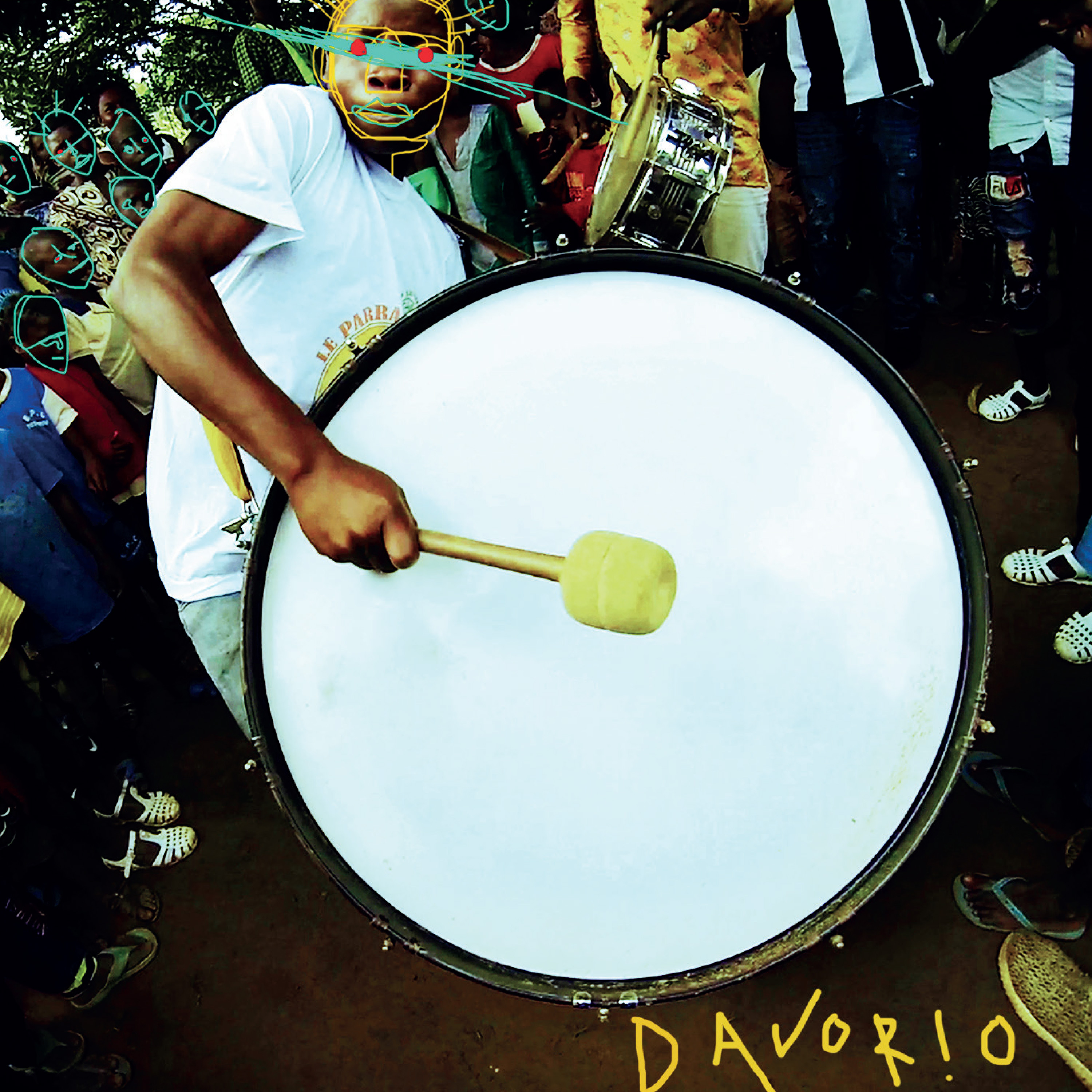
With a generous offering of tracks and running time, expanded pieces of constant change sit amongst shorter windows in the fabric of a rural existence; the tactile soul of African instrumentation, singers and the rope-tuned goblet shaped Djembe hand drum (some bigger drums too as you can see in the artwork) in surround sound with the hand-slapped rhythmic games and joyful voices of the locals’ children. When amplified, filtered, put through various processes and with the addition of the synthesized, various beats and breaks, flourishes and more dramatic plink-plonk jazzy and classical piano these field recorded performances become untethered: They could end up anywhere musically, culturally. Take the opening ‘Cammino, Senza Sapere Dove’ (“I walk without knowing where”), it begins with atmospheric voices, synth purrs and ripples and late Bowie-esque piano, before passing through soul, jazz and R&B like a J. Dilla production.
The album title itself, just three tracks in, is like a tribal communion of the Young Fathers and BLK JKS, but also features weepy strings, touches of Afrobeat and a free-jazz wild breakout of Peter King saxophone, all before being sucked through a mirror. Those jazz elements permeate the entire album; from hinge-like whines and more Don Cherry spiritual displays on ‘Uccelli/Roberto Baggio’, to echoes of Sonny and Linda Shorrock and the Pharaoh on the township meets Orleans and splish-splash classical ‘Uomini Del Mare’, and touches of Donny McCaslin on the tines resonating, soulful and nimbly-picked guitar 2-Step ‘Obaló’.
Tracks like ‘Non Tradirti’ (“don’t give yourself away”) move from the innocuous sounds of a sweeping brush and the reverberations of children to the techno of Basic Channel and more veiled electronic washes of Boards Of Canada. The finale (if that’s the right word) ‘Dohuo’ sounds like either a talk or lecture, maybe community meeting, being soundtracked by a malady of wind instruments, crackles and touching strings.
Every expression has meaning, a story, which is then transformed by Strufaldi’s production into something almost dream like and cosmic yet still connected to the villagers’ roots. A transistor radio collage here, some Songhoy Blues on a bustling street with a small amp there; a display of rattled and scrapping percussion and hymnal stirrings merge with zaps, warbles and various embellishments. This cultural exchange with the Ivory Coast blurs the lines between worlds; an act of preservation, but much more, as the foundations of this culture prove intoxicating, dynamic and mesmerising.
Various ‘Middle Eastern Grooves’
(Batov Records) 19th May 2023

A sampler showcase, only with a couple of previously unreleased nuggets, the Batov label celebrates its (almost) tenure existence promoting Middle Eastern Grooves overseas with a “handpicked” selection of cuts from their influential 7” singles series.
Originally set-up in London by DJ Kobayashi and Bob Martyn as a home for the former’s multifaceted fusion ensemble, Gypsy Hill, the label soon nurtured a burgeoning revival of Middle Eastern influenced bands and artists from the richly diverse Israeli scene.
A conjuncture itself of untold musical pathways, with artists and musicians congregating in such exciting, lively cities as Tel Aviv from all across the region and much further afield. A hotbed of sounds has been sent out to the world.
With shows on Soho Radio and Worldwide FM, and a rep for selecting a polygenesis array of global sounds, DJ Kobayashi picks out a generous eighteen track compilation of music indebted to the pioneers and luminaries of the 60s, 70s and 80s.
Where to begin with this whirlwind fecund of fusions? Well perhaps with one of the most well-known inclusions on this collection, the constantly evolving Tel Aviv musician, composer, producer and multimedia artist Ophis Kutiel, aka Kutiman. Opening with the Aegean cosmic vibe ‘Badawee’, the Kutiman lays down an eased-in flange-effected wave of fluted hazed sunlight, vapours and lush laidback drums. Following that, and no strangers to the Monolith Cocktail (even making our choice albums of 2022 list), the Yemeni roots, but Israel-based, rambunctious El Khat are kept in check by the Tel Aviv cratediggers Radio Trip, who smooth out the disjointed exciting signature with a clean breaks edit treatment that evokes a horn-swung Arabia and the more soulful jazz-soul breaks of the El Michaels Affair.
Another name that leaps out for me, and a previous Monthly Playlist pick, the Şatellites marry ethereal gauzy Hebrew disco with Liquid Liquid, Altin Gün and real cool Anatolian rock vibes on ‘Deli Deli’. That eclectic-lit funky group’s leader, Itamar Kluger, also appears with his new psychedelic project, Eje Eje. One of the “unreleased” propositions, ‘Saved From Jazz’ is a percussive shimmy of 60s influences and jazz-rock-prog organ that almost sounds like an Israeli Atomic Rooster.
Proving a highly popular (or just highly prolific), Sababa 5 get four goes at impressing us. A well-versed troupe of notable players, previously backing a host of Tel Aviv’s top artists and vocalists, and said to be influenced by everything from the legendary Wrecking Crew sessions ensemble to 70s Middle Eastern icons, the 5 lay a zippy, willowy groove underneath Shiran Tzfira’s upbeat psych-folk and pop-lit vocals on ‘Manginat Mahapeha’; play with ambient gazes, an closed eyes gesture of serenading Egyptian oud (or guitar) and more bouncy beats as the Japanese vocalist Yurika Hanashime sings in a sweetened Oriental romantic way on ‘Nasnusa’; evoke Charlie Megira, Meatraffle and Joe Meek in the shadow of the Sphinx on the tremolo-surf wrangled ‘Baksheesh’; and mix kitsch surf (ala The Ventures) with dot-dash organ (bordering on Ray Charles) on ‘Rosenzweig’.
Elsewhere, gaining my attention, the veteran Israeli bassist and producer, world-traveller and front man of the world music/reggae/funk band Ex-Centric Sound System, Joseph Thomas Fine (aka Yossi Fine) teams up with the African-influenced drummer Ben Aylan on the rock fusion and splashed dance, ‘Peres’. The unfamiliar (to me) Yuz come up with a 80s dry ice Israeli and Balearic spacy disco-electronica mini epic entitled ‘Galgalit’, and the Baharat trio circumnavigate a Mexican surfing Dick Dale, a removed Cumbia and stylophone-like buzzes on the Arabian Shadows reimagined ‘The Egyptian’. “Jewish princess” via Babylon, Cherry Bandora eases dreamy gauzy vocals on the shimmery and zappy synth airy ‘Esy’ (another of those previously unreleased tracks), and the long-running Boom Pam magic up a Hellenic wedding boogie and belly-dancing shimmy on ‘Uniton’.
A wealth of Middle Eastern inspirations from a blossoming epicenter, Batov’s grooving whirlwind spins and saunters, carouses and electrifies across a region of interconnected roots. The borders are eviscerated as the Adriatic, Med, Arabian and Red Seas ebb and flow across a music geography that mixes the sounds Egypt, Syria, the Lebanon, Turkey and Greece with the cosmopolitan buzz of Tel Aviv. If you’re fresh to the scene, this is a great place to start, from a label doing encouraging, exciting things in bringing sounds together.
Marta Salogni And Tom Relleen ‘Music For Open Spaces’
(Hands In The Dark)

A posthumous tribute to one half of this sonic mapping partnership; left however exactly as the late Tom Relleen would have heard and recognized his and Marta Salogni’s site-specific peregrinations before his premature death from cancer in 2020, Music For Open Spaces is an atmospheric gift of subtlety and evocative callings from a geographical triangle of locations.
The leylines of this album spread from the pair’s London home to the Cornish coastline and the mystical Joshua Tree desert, where, inspired by such varied settings, Marta and Relleen conjured up a number of spontaneous atonal and electronic pieces. None of which are so obvious as to directly sonically reference the environment. Well, expect the album’s longest track, the opening mirage ‘Desert Glass’. Refracted light shines off a glass pyramid as airy fluted and hinged mirrored sounds permeate the legendary Joshua Tree located desert scene (a shrine to the late Gram Parsons and draw for various hallucinatory-induced communions). At one point you can pick up a partly obscured Marta (I think, anyway) asking her foil if he’d “heard that?” on tape; a tape that seems to be rewind and played back in real time, as a near-kosmische stillness of Frosse and Ariel Kalma evaporates around them.
This is followed by a more bobbled algorithm of paddled Ping-Pong balls, transformed to elicit a feel for far less mundane activities, on the much shorter ‘piNG poNGS’ passage. Those plastic table tennis balls take on a weight as the track progresses, moving into a techno effects realm of robotic laughing and metallic guiro scrapes. The even shorter ‘Snarls’ is both alien and a little disturbing; evoking the ominous uncertain spaces of Lucrecia Dalt (who I believe Marta has worked with) aboard some propeller-motored and humming craft.
‘Giant Desert Cats’ features, albeit transmogrified through various processes, the titular subjects. Bestial screeches of a kind echo across a strange, removed wilderness of ringing, repeated signals, forewarning and moderate drama. ‘Clocks’ also seems to abstractedly mirror the title, with a tubular plastic paddled and reverberating single repeated tight bass-string pluck denoting a measuring, a metronome-like passing of time. Featured in last month’s Digest column, the more expanded piece ‘Internal Logic II’ is a minimalist alchemy of light drawn and calling undulations and subtle twinkles; felt through a bendy lens of mystery. Staying in the minimal field of inspiration, ‘Furthest Fires’ obscures the flame in a gentle wind, whilst ‘Trains’ is a veiled ghostly blend of field recording, a passing motion of transport and almost nothingness.
Reading things into the ephemeral vapours and applications, I’m sure I can hear bulb-like notes of either a marimba or vibraphone on the wooed gauzy ‘March’. ‘Fauna’ sounds more like Day Of The Triffids than pleasant wild-planted blossom, and the finale, ‘FFXX’, barely registers above a blowing ambient and metallic percussive ebb and purr.
As much a physical and cerebral response to the elements and space (expanded further by the Hands In The Dark label’s Morgan Cuinet, who has illustrated each step on this “internal map” with a collage), Marta and the late Relleen’s geographic concept suggests new horizons, and makes the fleeting now permanent. With added poignancy, this generated soundtrack could be read in part as a fitting tribute. Regardless of the circumstances, this is a really fine album of atmospheric exploration, tactile scored environments and moods.
Adjunct Ensemble ‘Sovereign Bodies/Ritual Taxonomy’
(Diatribe Records)
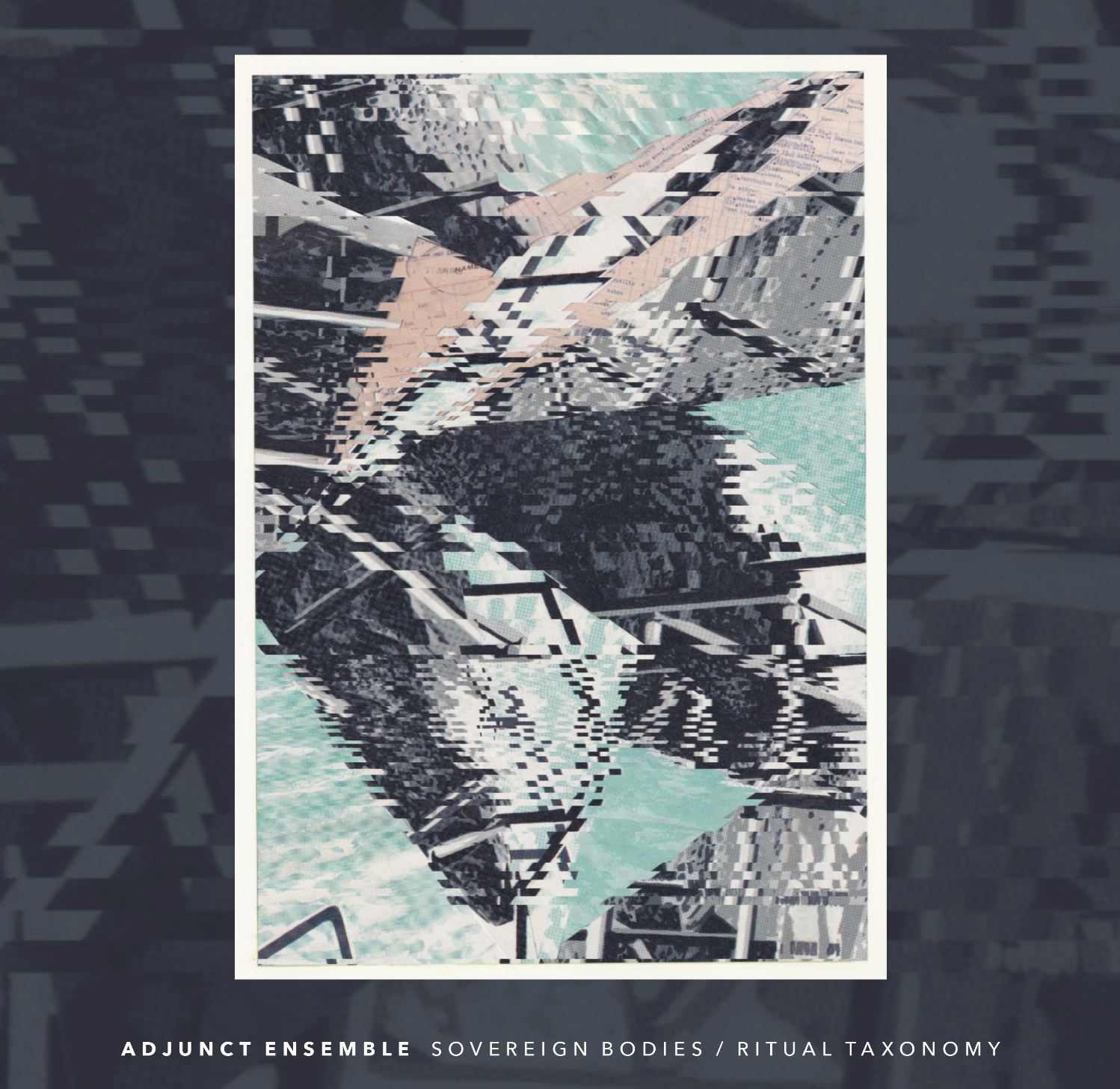
A behemoth of sonic, worded and performative multi-disciplines, with an eclectic cast to match, Jamie Thompson’s ambitious Sovereign Bodies/Ritual Taxonomy album seems to amorphously cross György Ligeti’s musical hallucinations with sound art, poetry, opera, theatre, jazz, the avant-garde and cinematic.
Under the Adjunct Ensemble title with foundations in the electro-acoustic, Thompson’s immersive but often jarring, somber and glitch-in-the-fabric-of-the-matrix style hallucinations are both riled and strung-out in a dystopian cosmology of Don Cherry, the Art Ensemble of Chicago, Colin Stetson, Andy Haas, Amiri Baraka jazz, Linda Sharrock arias, re-contextualized Benjamin Blake hymnals and national song, Ligeti’s ominous 2001: A Space Odyssey chorales, later Scott Walker histrionics, fleeting passages of Ivor Novello-type nostalgia and A.I. malfunctions. All the while a permeating atmosphere of running water, wind chimes and metallic chills can be heard in the void; one in which Tarkovsky and Kubrick conjure up sci-fi visions of unease, uncertainty and the fear of a great big nothingness.
Running to near on 90 minutes, across twenty often cryptic and questioning, proposed entitled tracks, you’ll hear the opera singer Amy Ni Fhearraigh’s haunted and dramatic vocals, and the spoken word poetry of Felicia Olusanya’s (aka FeliSpeaks) stream of conscious-political-humanistic lyrics, cutting through a feeling of near Orwellian oppression, suffocation.
Composer, writer Thompson can be heard twisting, grappling and oozing sounds, effects out of synths, drum machines, a church organ (in more classical hymnal spells), dictaphones, turntables and other apparatus. This is further affected by the turntablist Mariam Rezaei, the spasmodic, drilling and twirled punkified jazz of the Taupe trio and a load of other notable musicians on tenor sax, drums, percussion and bass. At various conjunctures we’re spat out into a chasm; transported to the graveside of a New Orleans elegy; beamed down to that raining rooftop finale in Blade Runner; lost in an alien terror show; clamed with the sounds of a transcendental water garden; or, gently, dreamingly invited to sip a remedy to chaos on a virtual deck, kitted out to resemble a 60s jazzy cocktail lounge. Phew!
Otherworldly breakdowns one minute, a Zappa-esque entanglement the next, this merger of Tricky’s imagined opera, an unholy vision of English pride and the hermetic, with veils of the Southern Gothic, Voodoo and happening, politically actionist jazz, is an expansive conceptual document for the times we find ourselves in: a time capsule if you like.
Interestingly, one theme brought up in the press notes is that of migration. And, floating in and out of that consciousness of sound and art, lingered traces of travail, of voyages and ethnographical illusions do conjure up futuristic versions the immigrant song. Lost on the high seas, with the ship’s horn blowing amongst the fog of time and place, you could easily imagine the fear, specter of death in pursuit of reaching safer shores, as references to displacement crop up across the album’s continuum of horror, assimilation, accelerated machine-learning, surreal interviewing and resignation.
Certainly challenging, a commitment is needed from the listener to what is essentially one long soundtrack (more or less every track, episode, chapter running into the next without any real pause or hint of dead air, only when in ambient mode); a sort of conceptual art theatre without boundaries, which can replenish as much as stir up a maelstrom of disenchantment and strung-out despondency. Counter-history bleeds over a morose of art forms and freer radical protestations, activism on a very impressive project.
Danûk ‘Morîk’
(Omni Sound) 19th May 2023

The longing, almost bluesy reflections cast on the finale, ‘Lo Șivano’, pretty much sum up and convey this “exiled” Middle Eastern group’s heartache at being forced to leave a war-ravaged Syria: Emotively, musically this, the curtain call from their debut album, is about missing home.
And yet, as that same album title translates, they’ve found a “pearl” of light in the tumult, as they confidently claim their heritage in the face of such distress and upheaval; reconnecting with their roots, imbued by the 1900s phonograph and wax cylinder recordings of Kurdish folklore in both The Berliner Phonogram and Austrian Academy of Sciences’ Phonogrammarchiv collections.
Studied graduates of Syria’s “best fine arts and music programs”; the Danûk ensemble was actually formed across the border in Turkey, in the Bosphorus-straddling metropolis of Istanbul, over seven years ago. Surviving on musical graft as street performers, they were seen and hired by a social enterprise; going on to score music for both films and radio. This though is the group’s first album proper, engineered in part by friend, admirer and musical foil Michael League (of Snarky Puppy fame). He produces but also lends a light touch of bass.
Morîk is the second release for the newly formed Istanbul/NYC connected label, Omni Sound. And what a flowing, dancing beauty of atmospheric Middle Eastern folk, shepherd song and wedding music it is too, from a quartet of Syrian-Kurdish and Turkish-Kurdish musicians steeped in atavistic allure. Traditions and songs on this work date back to the ancient sites of the excavated Sendshirli (now located in present day Northern Turkey) and beyond. From that imaginative channeled setting, the lute (in this case the long-necked “buzuqi”) twirled and trilled, country-like and seriously yearned ‘Xelîlo Lawo’, and roughly brushed and thrashed frame drum (the Persian “erbane-daf”) accentuated ‘Lê Lê Mi Go’ have a real ancestral pull, yet also draw on the veiled resonance of age-old shepherd song.
The opening holy city evoked whistled and fluted, granular-textured stirred frame drum skin swept ‘Axir Zemana’, and the poetically elegant, waves-splashing against the bow of a ship-like ‘Lo Lo Li Mino’ both use the voice of a Syrian priest singing in Jerusalem.
Serenaded and in celebratory form, Danûk spin, dance and ache across a cannon of Kurdish folk and wedding music: ‘De Çêkin’ is a journey of romantic longed allusions cast over a fluty pipe, whilst the more trinkets-sequined and small finger cymbal percussive ‘Finciko’ shimmies and shuffles to the fever of a Middle Eastern gypsy band performing at a nuptial ceremony.
Together, Ferhad Feyssal, Hozan Peyal, Yazan Ibrahim, Tarik Aslan and Ronas Sheikhmous respectively shake and electrify their heritage, breathing a new life into those roots as they reconnect with home t produce something almost timeless.
Kayhan Kalhor & Toumani Diabaté ‘The sky Is The Same Colour Everywhere’
(Real World Records)
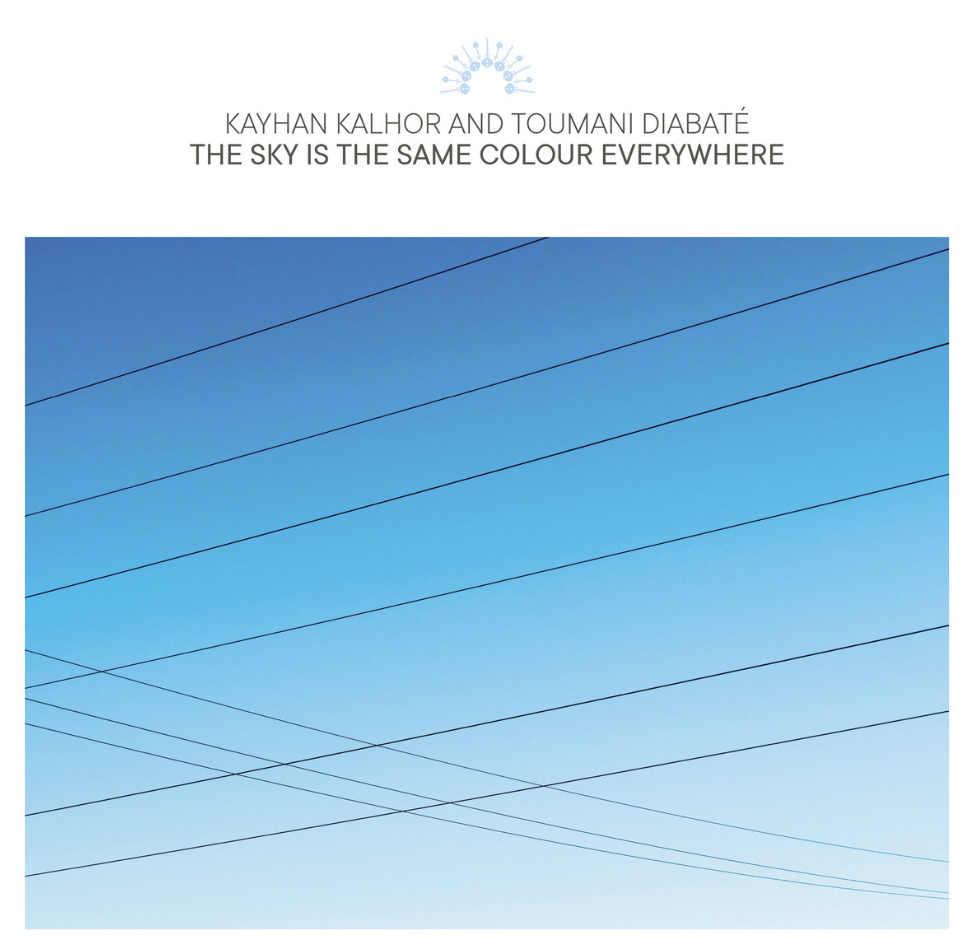
In what proves to be a most congruous musical partnership, the renowned Iranian kamancheh player Kayhan Kalhor and leading Malian kora player Toumani Diabaté merge each other’s cultures and the sound of antiquity with a previously untried, untested combination of instruments.
Brought together by the Morgenland Festival’s Michael Dreyer for a performance back in 2016, the pair who’d previously never met let alone play together, conjured up an unrehearsed, intuitive ninety-minute set of both Malian Mandé and Persian inspired beauty, longing and veiled panoramic landscape gazing. Nothing short of an incredible, adroit experience, this union proved successful enough to prompt a short European tour and a recording session in Paris. The results of which can be heard on this woven atmospheric and unifying album, The Sky Is The Same Colour Everywhere.
In a similar vane to Catrin Finch and Seckou Keita’s ongoing harpist and spindled collaboration, Kalhor and Diabaté blend their heritage into a masterful latticework of moods, time and geography.
From the Persian sphere (spreading to the Caucasus; to Azerbaijan and Armenia) Kalhor’s principle instrument, the kamancheh, is a relation of the rebab. Its appearance is somewhat exotic; a truncated inversed cone shape-like fiddle that has a spike to support it whilst being bowed, usually in a kneeling position. The original courtlier silk strings have long since been replaced by metal ones, but the sound is still unmistakably timeless; imbued with Persian romantic poetry, lyricism and spiritualism. Diabaté, who famously partnered with the late Mali icon Ali Farke Touré for a duo of Grammy Award winning albums, plays the resonating-bodied kora from Western Africa; a twenty-one string, harp-sounding (at times) long-necked lute, crafted out of half a gourd and covered with cow skin. Steeped in that region’s Mandé ethnic dialectal culture, Diabaté brings a watery-like cascaded trickle of plucked elegance, of desert rustic spun gilding and emotion to this fusion.
More or less uninterrupted, ninety minutes of both articulate and more dramatic performance flows like chapters in one long journey across mesmerizing, alluded to and deeply felt landscapes. Titles prompt escapism as much as they do attachment to those yearned for Arabian and African scenes, whilst also building common bonds; Sufism at the crossroads with the Griot.
Both instruments are shown to be versatile in application; a thwack woody-bodied rhythm from the kora as the kamancheh flutters like the wind or blows a stirring, airy veil across an imaginary topography. The former can take on a harp-like glide or mbira twanged sound, and the latter, a classical viola plaint or classical violin weepy resemblance. Throughout the album the duo often reach outside their respective disciplines and fields of influence; spinning a hint of Appalachian rural dances on the daintily rural twined ‘Anywhere That Is Not Here’, and branch out into Moorish Spain on the title-track.
To be experienced as if it was being performed live, right there in your living room, The Sky Is The Same Everywhere must be heard in its entirety; neither dipped into nor with interruptions. Sit or lie back with a masterful, intuitive work of artistry and beauty, escapism.
Trad. Attack! ‘Bring It On’

We can take comfort in the fact that in the face of such barbarity, as Russia continues its heinous crimes against Ukraine to the south (and threats to its Baltic neighbours), there’s still so much light, joy and discovery to be found in the world of music. From their Estonian roots the Trad. Attack! trio of Sandra and Jalmar Vabarna and Tönu Tubli reach out across not only to their direct neighbours but to the Caucasus, North America and Yeman to expand their sound, understanding and spirit of collaboration.
Their latest album, a journey in fact, finds the propulsive and explosive trio exploring different musical fusions and playing a raft of new instruments, whilst transforming the rich culture of Estonia itself; especially the Seto ethnic/linguistic population’s (mostly living on the Estonian/Russian border in the southeast of the country) ancient polyphonic style of epic saga telling, which is sometimes improvised, “Leelo”. Multi-instrumentalist and vocalist Jalmar has that same Seto heritage – his great-grandmother was one of Estonia’s most famous folk singers. Here, that beautiful melodious song can be found at a fair pace being repeated and woven on the Block Party-like 2-Step breakbeat fueled ‘Keera’ (“spin it”). But its influence can be heard permeating throughout the entire trip; from woodland to euphoric expelled mountaintop.
The trio kicks things off however, with a burst of phaser electronic-pop and stamped punctuated beats on the “hey yeah” energy-flashed ‘Lase Käia’ (“bring it on”). Featuring the craning, Brian May like rocking guitar of the Estonian legend Laur Joamets (based in Nashville; a regular sideman to the American country artist Sturgill Simpson), a bold Euro-rock and EDM vision of a traditional song is injected with a modern energy and new anthemic brilliance. And so it continues, across an album of guest spotting hybrids with a mixture of Eurovision, dance music, pop, indie-rock and more acoustic instrumental gestures of longing and reflection: pride too I think.
On that journey there’s the earthier, gruffer-voiced (Alexander Hacke-esque) and Estonian bagpipes droned, fiddled gypsy ‘Pidu Lõppeb’ (“the party is ending”); the brokenhearted, metronome rim beat, dreamy trad-folk transformed ‘Makak’ (“sleep”); twinkled and felt, warmer climes Ed Sheeran ‘Liugu-Laugu’ (“glide long”), which features the Canadian East Pointers metaphorically releasing a guided sleigh into the big open world; the Yemen Blues’ Ravid Kahalani featured Baltic-Arabian mirage of challenger verses, marching spiritual workers song and The Knife riled electronics, ‘Öelge Sönnu’ (“say some words”); and longingly rasped ‘Kiigelaul’ (“the swan song”). ‘Tere’ (“hello”) however, is a rawkish, dizzy burst of the Red Hot Chili Peppers dancing around the encampment fire.
A strong show of versatility with a myriad of dialects, instruments and musical partners uniting for a energetic transformation of Estonian folklore and culture, Bring It On is as fierce, highly spirited as it is soulful and kind to those traditions. A simultaneously bombastic, electrified and romantic, deeply felt connection is unleashed on a highly commercial pop and electro produced album that takes the Baltic state from the rural to the dancefloor.
A WEWANTSOUNDS REISSUE DOUBLE-BILL
Meiko Kaji ‘Hajiki Uta’

From what I’ve gained from the press release, despite the Tarantino effect the cult garnered Japanese starlet Meiko Kaji’s iconic run of early to mid 1970s albums have never been reissued on vinyl: until now that is.
With the usual quality control of repackaging such lauded obscurities, WEWANTSOUNDS, in conjunction with both the artist herself and the original label that released this quintet of showcases, Teichiku, between 1972 and 1974, have called upon the services of Hashim Kotaro Bharoocha to interview Kaji, and fill us in on all the background, with insightful linear notes.
A sort of third revival you could say, the star of various “Japanese Exploitation” franchises inspired the one-time golden boy of auteur pulp, who not only loosely based the plot of his Kill Bill doublet on one of Kaji’s most (in)famous roles as the revenging angel of The Lady Snowblood period-drama revenge shlocker series, but placed a number of her songs in the movie too. This obviously shone a spotlight on the star of such cult curios as Female Prisoner Scorpion, Blind Woman’s Curse and Stray Cat/Alleycat Rock.
In more recent years Kaji has popped up with her own Youtube channel. And now, a vinyl reissue run of her 70s move into the recording industry, prompted by the film studios cashing in this icon’s popularity.
Coaxed into the recording booth, to initially sing songs associated with the films she starred in, the Tokyo-born actress nervously and with some trepidation, recorded her first album, Hajiki Uta, with the highly experienced TV, film and incidental music composer Shunsuke Kikuchi. The producer was able to put his charge at ease however, as Kaji recalls: “I told Shunsuke Kikuchi that I couldn’t imagine myself singing the songs. He said I could ignore the melody that he wrote, and just sing it the way I wanted to. That really lifted the pressure off my shoulders, and I decided to sing the song as the character in the film. The director was also happy with that idea.”
Produced to a high quality, the Hajiki Uta songbook covers a myriad of styles. The vibraphone-tinkled, gently rousing and swooned ‘Sounya-Ka Onna No Jumon’, and the yellow rose of Texas, Morricone-inspired canteen mirage ‘Urami Bushi’ (the tune famously used in Tarantino’s Kill Bill 2) are actually the only two direct tracks taken from Kaji’s films; both appearing in the torture-porn, rape revenge series Female Prisoner Scorpion #701. The former in the first film of that franchise, the latter in one of the sequels, Jail House 41, directed by Shunya Itõ. Yet despite that, the musical production sounds cinematic throughout, riffing on the already mentioned Morricone, but also Bacharach and Jean-Claude Vannier too. The opening electric scuzzy guitar buzzed, rattlesnake punctuated and yearned chanteuse serenaded ‘Meikono Futebushi’ is an obvious example: a Japanese(fied) version of a Spaghetti Western theme tune. The smooched saxophone and almost soul-hinted production of ‘Hizumi Moe’ sounds Bond-esque in comparison.
Elsewhere there’s light jazzy cocktail hours; the sweet scent of Japanese blossom; a touch of accordion accompanied walks along the Seine; and softened bouts of thriller and the clandestine. ‘Onna Kawaki Uta’ reminded me of Angela Morley’s string arrangements for Scott Walker’s early solo work (in fact, the bass, drums and feel of songs like ‘The Old Man’s Back Again’). And the harpsichord like, longed ‘Onna Hagure Uta’ sounds not too dissimilar to the Thomas Crown Affair: or something of that vogue.
A fuzz of guitar is there to give it a certain edge, whilst the strings occasionally swirl and well up for dramatic effect. Elements of what’s called Enka are performed with pop sass and kitten heel coquettishness, as traditions are respectfully drawn into the 70s. It must be pointed out that Enka is a kind of performative traditional form but also said to refer to political texts set to music as a means of bypassing government curtails on dissent and activism at the turn of the 20th century in Japan. This form was stylised with modern pop sensibilities in the post-war period, but it’s quite hard to define: many of its leading lights, stars like Hachiro Kasuga and Michiya Mihashi, were themselves very dubious of the tag; if anything distancing themselves from this revived form. Enka, pop, beat music, a little buzz of psych, the string production of the cinema; all forms accompany Kaji’s very fine lulling, but sometimes impassioned poetic, singing voice. Coveting, cozy and in often-romantic swoons, the actress takes on the convincing role of songstress. Subtle and diaphanous yet able to express whatever emotion is needed on an album that shouldn’t be cast off as a mere cult nugget from the vaults, nor dismissed. It seems that Tarantino really was onto something after all.
Harold Land ‘Damisi’
26th May 2023

Continuing a selective reissue program of Bob Shad’s 60s/70s Mainstream Records label catalogue, WEWANTSOUNDS hone in once more on the tenor saxophonist (quite deft on the oboe too) Harold Land with the first ever vinyl reissue of his 1972 spiritual jazz phase Damisi album.
Regulars of the Monolith Cocktail will know that I reviewed the Mainstream Funk compilation early last year, as the title suggests a showcase of Shad’s overseen funkier cuts. A self-proclaimed “broad church”, the label was just one of a myriad of companies the producer and A&R man had worked on; starting out in the 50s with jazz at the prestigious Savoy label, moving to National Records and launching his own subsidiary imprint EmArcy. Shad went on to find the talent for the switched-on psychedelic Mercury label (discovering such luminaries as Janis Joplin, Sarah Vaughen and Dinah Washington), whilst forging his own Mainstream platform in the 60s.
During his early years, Shad had famously recorded such notable artists as the Max Roach and Clifford Brown Quintet. Although it would be a fair time before working with him again in the 70s, Land was a member of that very same ionic hard bop Quintet; coming up through the ranks after leaving his Houston home, and his formative years in San Diego, for L.A.
Time had moved on, and jazz’s evolution was changing once more. Land, moving on himself, had started a fruitful musical partnership with the vibraphone legend Bobby Hutcherson in the late 60s after stints as an in-demand sax freelancer for labels like Contemporary and Pacific Jazz. It’s that partnership which led to a West Coast trip for the N.Y.C. based Shad and his A&R man Ernie Wilkens; touching down to record a series of sessions from both the Land and Hutcherson union, and Land’s own bandleader work with an enviable pool of serious talent on the scene. The results of which can be hear across a trio of albums: the Hutcherson foiled A New Shade Of Blue (reissued by WEWANTSOUNDS already) and the Choma and Damisi albums. The latter is held-up here as a worthy showcase for Land’s developing use of spiritual conscious jazz and his embrace of Coltrane; although all the signatures of that West Coast schooling and the California showmanship of bright and burnished soulful and funky horns is unmistakable.
Land leads a quartet of equally notable players on Damisi (the Swahili word for “cheerful”), with Herbie Hancock’s Mwandishi ensemble bedfellows Buster Williams on double and electric bass and Leon “Ndugu” Chancler on drums (that nickname, bestowed on the Freddie Hubbard and Miles Davis sideman by Hancock, is also Swahili, and translates as the affectionate “earth brother”). On electric piano and keys there’s L.A. pianist William Sydney Henderson, who’s CV includes recordings with the Pharaoh, Bobby Hutcherson, Billy Higgins and Hugh Masekela; and on both blazing trumpet and flugelhorn there’s Count Basie sideman and gun-for-hire (a dizzying roll call too numerous to list, but Sonny Stitt, Dexter Gordon and Quincy Jones are just three notable icons he’s worked with over the decades) Oscar Brashear.
Together, with Land’s heralding, spiraling and brassy tenor blowing away throughout, this highly experienced in-tune troupe lay down a modal-vibe show time of Lalo Schifrin funk action and a swing of Savoy, bop and Lee Morgon on the constantly moving opener, ‘Step Right Up To The Bottom’ – a kind of Hollywood Boulevard takes a turn down desolation road. It’s followed by the cool, hip and more laidback ‘In The Back Corner In The Dark’; a swing time Hollywood funk with shades of serenaded and elephant reeling Miles Davis under a baking sun. Projecting travels further afield, ‘Pakistan’ is the first real spiritual movement; a transcendence shimmer and rattle, bell shaking, snake-charming oboe odyssey that evokes the Pharaoh’s ‘Africa’ (I know, different continent entirely, but similar feel) and a surprising noir-ish Davis. Henderson’s piano really shines on this enchanted, beckoning homage to the country.
Side Two (in old money) features a duo of deeper, long suites; the first of which, ‘Chocolate Mess’, ups the tempo and takes on a funky Latino influence of soul-jazz. Yet, there’s also a strong African influence and smattering of Herbie Hancock on this dynamic sleigh bell shaking, freefalling and dappled electric piano rich jam. The title-track finale reaches once more for Far Eastern climes, perhaps Egypt, but with a West Coast be bop feel and spells of Ike Quebec, Yusef Lateef and Stanley Turrentine. WEWANTSOUNDS have played a blinder reissuing this quality travelogue of soulful, funky jazz from Land. Shy of truly outstanding and iconic, Damisi is nevertheless a great flowing album of notable performances that never loses its groove and swing. A jewel in the Mainstream Records cannon is given another welcome run.
Dyr Faser ‘Karmic Revenge’

Karma can be a bitch they say. Only on this occasion, spun out, weaved and languidly mulled over, karma is a drawn-out process of study in the barely warm rays of an occultist sun. For the Dyr Faser duo of Eric Boomhower and Amelia May stir up hermetic, drowsy and Krautrock arias under slumbered mires, and in esoteric visions of the Laurel Canyon.
The dread and gothic chthonian opener, ‘Suns Of Unseen Revival’, sets the atmosphere with the piped tubular drones of Death In June’s ‘Fall Apart’, sonorous palpitations and hints of Amon Düül II and an unholy Jefferson Airplane fragrant in the Fields Of Napalm. Yet, already by the second cut, the Boomhower voiced ‘Fun In The Sun’, the serious gloom is replaced by a kind of Californian slacker vibe of cymbal splish-splashing, ritualistic toms and a flange of the Velvet Underground, Boyd Rice And Friends, Sonic Youth and Pavement.
‘Keep Talking’ once again has May taking up the vocal mantle; channeling Grace Slick and a downer Besnard Lakes on the melting, intoxicating spell of dream-realism. ‘Symbolized’ however, motors down the BRMC and JAMC highway; thumbing a lift with Suicide’s “Ghost Rider” on a hippie biker kick. Within that leather-clad bohemian framework, there are evocations of The Stooges ‘Search And Destroy’, Jason Pierce and the sustained guitar lines, contours of Ash Ra Tempel.
Almost diaphanous, ‘Silver Night Run’ oozes a hypnotizing hallucination of acid-aria sung enchantment as its siren traces some mysterious metaphorical river trial. ‘Ghostly Vicious Acts’ is an indie-fuzz and gauzy scuzz of tumbled Spaceman 3, whilst ‘This Menace’ squalls and churns up a suitable acid-rock/krautrock mood of doom, as The Black Angels gaze on. Christ weeps from the holy mountain on the woodland fluted, but despondently mused, ‘Dead On The Vine’, and May wafts a plaintive Hackedpicciotto-esque emotive voice over a stylophone buzzing spooked ‘Despite The Party Atmosphere’ vignette. It all ends on the gristle and loose psychedelic, slipped drummed ‘Lifelike Stranger’; a conclusion to a most alluring if doom-imbued album.
It turns out that Dyr Faser are rather good at mixing the esoteric krautrock of the Amon Düül family (especially the Wagnerian acid-wash and otherworldly vocals of Renate Knaup-Krötenschwanz) with grunge, alt/post/space rock and doom; bridging morbid curiosities, spirals of melancholy with black sun fun, fun, fun! A great duo to discover.
Images Of Goo ‘S-T’
(Un Je-ne-sais-quoi) 26th May 2023

Responsible for, and “active members” of, trick noise making projects and alias as Das Hobus, Spiritual Emojis, The Notwist, AloaInput and a myriad of others, the maverick sonic union of Leo Hopfinger (aka LeRoy) and Cico Beck (likewise aka Juasihno) mess around with the proverbial “goo” on this self-titled workout.
As Images Of Goo they knock around in an echo chamber reverberation of drum heavy trip-hop, breakbeat, krautrock and post-krautrock, off-kilter techno, future soul and various electronic formats. This often sounds in practice like Valentino Magaletti on 90s Mo Wax, hanging out with Major Force, DJ Shadow and Matmos. And when emerging from a Joe Meek (if he’d been born much later and signed to Warp Records or the Leaf Label) retro space production of signals, sputniks and oscillations, like International Pony and The El Michaels Affair on the Fun Boy Three vine. Because the beats, the breaks move from hip-hop to Ethno sounding hints of Africa and Java, and more metallic mesh-bounces of tins, pots and pans percussion.
And most surprising, as we reach ‘Image 08’ (all tracks are just numerically entitled by the way) a drowsy tripping vocoder effected set of voices and vocals emerges from the knocking, Afro-wavy beats – imagine Afrikan Sciences, Dunkelzefer, late Can and Matthew Dear on one soulful languid mix. You can throw in Nino Nardini’s cult sounds, MDR-ADM, Gescom, the Aphex Twin and Yuk. into that bit-crush and scrunch, lunar echoed moon unit of psychedelic drum-led collages. The whys and wherefores don’t matter; it just exists as its own body of workings; a sci-fi tripped out production of hip German eclectic rewiring.
Monthly Playlist: January 2023: Mentrix, Kahil El’Zabar, Sara Noelle, Your Old Droog, Onoe Caponoe…
January 31, 2023
CHOICE MUSIC FROM THE LAST MONTH: TEAM EFFORT
The inaugural Monthly Revue playlist of 2023; a choice selection of tracks from the last month on the blog. Curated by Dominic Valvona with Matt Oliver on the Rap Control once more, and music from reviews by our latest recruit Gillian Stone plus Brian ‘Bordello’ Shea and Graham Domain. Expect to hear the unexpected.
TRACK LIST//
Mentrix ‘Be Mahsa Be Nika’
Meadow Argus ‘No Company’
Anton Barbeau. ‘Dollis Hill Butchers’
Guided By Voices ‘Wild Kingdom’
The Wot Nots ‘Oi!’
Wings Of Desire ‘Runnin”
The Gangsta Rabbi ‘Ana’mika (138the Entr’acte)’
Neon Kittens ‘Chalk’
Smuts ‘Kalashnikova’
Dyr Faser ‘Life Form’
Earth ‘Rocker’
Xqui Ft. Bettina Schroeder ‘I Have A Knife’
Flexagon ‘Fort Saumarez: MP2’
George Winstone & Ben Monder ‘Part I’
Liela Moss ‘Empathy Files’
The Good Samaritans ‘Onughara’
Phil Ranelin & Wendell Harrison. ‘Genesis’
Fliptrix/Onoe Caponoe/Ramson Badbonez ‘SM58’
Masai Bey/BMS ‘I.a.a’
Micall Parknsun/Jazz T ‘Still…’
Dexter Dine ‘Sunshine In A Can’
Elise Preys/Marc-Antoine Perrio ‘Petites Heures’
Bjorn Magnusson ‘Everybody’s Got Something’
Designers ‘Moulindjek’
dal:um ‘Dot’
Clamb ‘Glittering Watermelon Oracle – Live’
Justo The MC/Axian ‘Autopilot’
Skyzoo/The Other Guys ‘Bodies!’
Carlos Nino & Friends ‘Drum Solo +, “Sounds Like Memory…”‘
Ghostwoods ‘Terminus’
Kety Fusco ‘2072’
Raul Refree ‘La Plage’
Esbe ‘Coventry Carol’
Sara Noelle. ‘Blooming Yucca’
Kahil El’Zabar And The Ethnic Heritage Ensemble ‘Harvest Time’
Beats & Pieces Big Band ‘Op’
Galactapus ‘Radio Kolossos’
Oddisee ‘Many Hats’
Upfront MC/Badhabitz ‘Stay Afloat’
Your Old Droog ‘Here’s Johnny’
Onoe Caponoe ‘Pet Cemetry’
 Monolith Cocktail Blog