In review: a world of sonic discoveries. Dominic Valvona
30 Door Key ‘Strangely Familiar’
(Disaster By Choice) 31st October 2026
The witching hour may have passed, but Alessio Bosco’s latest hauntology under the literary and filmic guise of 30 Door Key isn’t just for Halloween.
Though really, more or less, a completely redrawn sonic map of psychic energy, Fortean transistor hallucinations, apparitions and supernatural library music scenes, this latest album is billed as a strange bedfellow and companion to last year’s A Warning To The Curious album. The original formulation evolved, as Bosco welcomed in a host of both established and burgeoning Italian artists to either collaborate, remix or transform some of the original material and ideas; a kind of extension of the Sicilian electronic artist’s paranormal and esoteric sonic palette, developed by a company of foils, taken into various complimentary and more electronic spheres. Strangely Familiar is just that: we recognise but we are also aware that there’s something peculiarly different going on.
That name by the way, 30 Door Key, is a reference, I believe, to the film adaptation of Witold Gumbrowicz’s 1937 book Ferdydurke, put onto screen by the Polish film director Jerzy Skolimowski in 1991. In short, this cult story and film’s young protagonist faces a conflict between acting his age at the onset of WWII in his Warsaw home, or of regressing and relapsing back into childhood as an escape from it. The all too real horror of facing or avoiding the tragedy of war being just one layer threaded into these atmospheric fantasies and occultist peregrinations: some of which feature spoken narratives of a kind.
It would be a lot easier to approach this work as a new vision/invocation, starting with the opening ‘30 Door Ident, 30 Door Key’ transformation attributed to Ghostronica – I’m not sure if this is an artist or genre in its own right. Bulb-like bottled notes alight a 70s vague soundtrack, half Carpenter, half Gallo, as queer supernatural sounds pop out of paranormal analogue apparatus. ‘Folklore Impressionist – A Place Nobody Knows’ is as its title suggest, an impression of Amicus film studio folksy horror, whilst the Richard Sala ‘Deadly Anxiety Mix’ of ‘Testcard, Le Forbici Di Manitu’ (a reference I think to the Reggio Emilia experimental art-rock collective) sounds like Julian Cope in horror science matinee radio mode to the sound of John Foxx and the theremin quivers of spectres.
Some tracks reminded me of The Books trapped in the Hammer House Of Horrors, or pastoral mirages of Tigon scores. And then the Italian singer and producer Fabrizio Tavernelli’s ‘exploration’ of ‘Monolith In Bowler’ features vague ethnographic sounds collected from a spooked Arabia, bounded timpani and mizzles and horns: it also reminded me in part of Sum of R. Fellow Italian electronic producer and artist Flippo Diana turns ‘Getting Out A Gutter’ into a Chicago House mix for birds to nest; it begins however with the gibberish broken-up transmissions from the radio tunned ether. In collaborative mode, the American writer Justin Hopper regales a psychogeography of pastoral scenery connected to myth on the Tudor folk track ‘Skeleton Down’; the author narrates poetically and mysteriously enveloped by the magic of nature like a cross between Dr. Martin Shaw and Robert Jeffers.
The whole oeuvre reminded me of Roudi Vagou & Lauten der Seela’s work together, of Teisco’s Tuscan Castle and Country Seat, that and all those quintessential English library music aficionados like the Belbury Poly and The Advisory Circle, the cult KPM label, and various other old VHS and audio tape manipulators working in the field of hauntology. There’s some interesting immersive experiences, invoked rituals, occult disturbances and supernatural mystique to keep you both entertained and on the edge of your seat.
Anna Butterss, John Raymond, Ben Lumsdaine ‘Beginningless’
(Northern Spy) 13th November 2026
Collaborating over the years, running across each other’s creative tracks since all inhabiting, roughly around the same time, the same musical spaces in Bloomington, Indiana, the accumulative experienced individuals of Anna Butterss, John Raymond, Ben Lumsdaine pull together on their debut incipient Beginningless triumvirate project.
As the back story goes, bass player Butterss and drummer Lumsdaine originally met as students in 2010 at Indiana University in the city of Bloomington. Butterss left and moved to Los Angeles, whilst lauded trumpet player Raymond moved to Bloomington in 2017 to begin teaching at the university where he and Lumsdaine developed their own musical rapport through the weekly jazz series Call & Response: originally founded as a space for improvisation and visiting musicians by Lumsdaine. Raymond inherited the series when Lumsdaine, like Butterss, decided to also move out West to Los Angeles, in 2019. However, both Butterss and Lumdaine returned to the city together in 2024, where they took up this debut recorded project with Raymond.
Butterss is much in-demand for not only heading their own projects but collaborating and improvising with such notable names as Jeff Parker, Makaya McCraven, Phoebe Bridges and Jason Isbell. The Australian-born artist is a member of the evolving Small Medium Large super-quintet and has also toured as a member of Flea’s Honora Band. As International Anthem’s (pretty much) in-house sound mixer, the in-demand drummer and multi-instrumentalist Lumsdaine also appeared on Butterss’s incredible Mighty Vertebrate album back in 2024 – one of our albums of the year. Other credits include a decades-worth of experiences as a band member and improvisor, working with such luminaries and established artists as Jeff Parker, Walter Smith III and Sylvon Esso. Raymond has been aggrandised the “voice of a generation” label. He certainly has the CV and experience to back it up, with nine albums under the belt as a leader, collaborations with S. Carey of Bon Ivor fame, credits as sideman or the featured artist on over thirty other recordings: four Grammy-award nominated albums no less included. Plus, as I’ve already mentioned, he’s also a well-respected teacher in the field, with a “prestigious” role at the Jacobs School of Music at Indiana University.
The pool of talent and experiences act as a foundation for this most intuitive, improvised and felt album. Whittled down from 400 minutes, with scant interference production wise – little in the overdubs department and presented “almost entirely” as it was played out in the studio -, this inaugural and self-contained collaboration seems to amorphously grow out of the extemporised and the trio’s former wealth of experiences.
A sort of jazz album from the Fourth World sphere of Fearless Jon Hassell (and his peers) that also scowls and prowls to hip-hop, drum and bass, post-punk and a removed form of soul and funk, there’s a melodic quality and a groove (of a kind) to be found amongst the mystique, the nocturnal skyline bluesy and post-industrial decayed scenery of a plaintive, bewildered or smoggy hidden city. Certainly, out there, with Raymond’s trumpet and flugelhorn both inhabiting Hassell and Cherry’s spirits, the movements seems to be as resonated as it does buoyant and bouncing across influences as diverse as Tomega, the Chicago Underground, Isotope 217, J Dilla, Four Tet and Tony Allen. As drumming and acoustic bass foils Lumsdaine and Butterss create a great foundation, whilst also leading through passages, often with the additional effects of the crinkled and vibrated.
From the hurrying rush of break beats to the more slumbered and the slowed, the range of ideas stay in that nocturnal film, yet tracks like ‘Faced Round’ sound like Ill Communication era Beastie Boys (when they experiment as a band) crossing the Fourth World threshold with Funkadelic and YAS-KAZ. This goes on a lot to be fair, sideways excursions and invocations of music outside the jazz spectrum, and a darkness or at least shadowy mysterious from the disused factory and wastelands reverberated into an electro-acoustic energy. But the trio are also it seems, in real time, feeling out the possibilities: surprising themselves when they lock into something resembling a tune or even a sort of loose instrumental song: then it gets really interesting and even leftfield groovy. There’s attentiveness alongside the controlled chaos and the resonating rhythms, with Butterss’s bass really low and seamless, yet every stretch and twist of the instrument is audible and used as part of the fabric. Actually, the trumpet is similar, from long sustains to hovers and near breathless drifts across the horizons that are conjured up out of seemingly nowhere.
Just as you’d expect, an interesting inventive use of all three musicians’ experimental reaches; a one-off or not, it paves the way I’d hope for more in the future: if stars align and all that. Promising then.
Heckle Chamber ‘Heckle Chamber EP’
(Slowfoot Records) 6th November 2026
Heckle by name, heckle by nature…the inaugural EP release (an album promised to arrive shortly) from the riled-up and volatile union of improvising agitators Jem Doulton, Roberto Sassi and Alex Ward is a hectoring and unloading experiment in letting it all out: therapeutic I’d imagine, kicking against the pricks and releasing the bile with such indignant malice and fun.
Yes, I said fun: and mean it. For even in the most doom-laden introspective parts this trio seem to be having plenty of it as they exercise demons and expel the rot. In truth: three guys fucking about with a large canvas of influences whilst drawing upon their own experiences, their collaborations and contributions to an enviable cast of avant-garde, experimental and no wave luminaires and bedfellows. And across all three tracks you’ll hear evocations of the trio’s past turns – either as foils, as chief instigators or as band members on recordings and on tours.
The dual guitars of the Italian-in-London Sassi and Ward in partnership with the drums and punkish vocals of Doulton wrangle up everything from Bill Orcutt to Glenn Branca (who’s Orchestra project has featured Sassi), Fennesz and Sonic Youth (Doulton is the drummer for The Thurston Moore Group). Simultaneously repulsing as much as consuming hardcore, metal, heavy rock, poly-rock and malevolent gloom, this heckling trio manage to sound dangerous without breaking anything. There’s a balance, even muso articulation and control to the menace and rollicking hysterics. Nothing strives towards a complete cacophony of noise and violence. Its Black Flag meets Suicidal Tendencies with expert musical control. Or, around the Pere U(bend) with Black Hole Sun California hardcore precision and The Birthday Party. Incidentally, Ward has been playing with the surviving members of Pere Ubu since 2021 and is helping complete the seminal group’s final album.
It’s surprising and yet unsurprising that there isn’t more of the no wave signature on this debut EP from the trio, but then again, they seem to be having a lark fucking about with the rock vernacular, its punctuations and more drudgery mopes; perhaps attempting something different to their normally unnormal experiments and contributions. Hardcore it is then, with a nice twist and even sensibility; albeit Doulton’s voice ranges between punky malevolence and the hysterical and raging, and the track titles seem to reference an ambiguous zoo of anthropomorphism.
I look forward to hearing what the trio can do on a larger scale with that promised album, and whether they stick to that signature rock transmogrification.
i4M2 ‘Swiss Banking Secrecy Laws’
6th November 2026
Using both the language and speak of finance and business, the dull innocuous surroundings of the office whilst suggesting the clandestine smoke and mirrors of international banking and its most opportune epicentre of obfuscation, the anonymous Oxfordshire-based electronic musician, guitarist and producer behind this coded i4M2 disguise builds up a beat bounding and dissonance of rhythmic dance music soundtrack with which to both indulge and escape from.
The third album into this more danceable experiment – the artist is also responsible for the overbearing landscape slabbed fizzled fissures and currents of the he didnt project -, Swiss Banking Secrecy Laws is a kinetic stimulation of techno, techno-dub, breakbeats, trip-hop, trance, and more; combing evocations of everything from the 80s to the 90s and the contemporary in the process.
From the very low registered dubby bass vibrations of the opener ‘Forward Motion Uh Huh’ to the acid burbled sequences of ‘Public Dissonance’ and the Arabic-like minaret lulled voice hovers of ‘Some Dim But Dim Sum’ you can expect to hear everything from Cabaret Voltaire to Black Dog and Natacha Atlas in the omens of electrified mystique and unfolding dramas.
The fizzled and febrile mix with components and wires across a sort of sci-fi soundtrack of the ominous and vapoured. Each track is different in this regard, with some leaning more towards the techno of early Warp and others towards the Two Lone Swordsman, Death In Vegas and the Chemical Brothers. And then you get passages that open out into cathedral atmospherics (‘AA Drone’) or invoke some sort of dramatic VHS sci-fi forbode (‘Permission’). Mostly, this album seems to be rhythmic and set for an unconventional dancefloor of acid techno wobbles, slabbed beats, breaks, machine code, twang effected and reversed electric guitar and bass, and filters.
No track outstays its welcome, with the next arriving pretty quickly on the tails of the next; a fluctuation on speed and rhythm on each, and yet it plays almost like a set or a filmic soundtrack. If you like retro intelligent techno and the beat providers of a previous age reenvisaged by Burial, Lukid and Oberman Knocks than this album is definitely an essential purchase. And if you’re looking for an album that doesn’t so much lecture but offer sonic discourse and mystery about the current age of dislocation, mundanity and technological encroachment, then this is for you.
JAWWAAD ‘Myth & Logic’
(Sonic Transmissions/Sound Mind Body Lab) 13th October 2026
Polemics balanced by introspection and the healing balms of soulful jazz and R&B, Young Mothers co-founder and Shape Of Broad Minds founding member JAWWAAD conjures up a cosmology of poetry, anguish, reliance, pleas from the heart, recovery and barely contained rage on the upcoming Myth & Logic album. In the making since the global shutdown epoch of the Covid pandemic, when minds were concentrated and the time was forced upon us to dig deep into our own souls and sanity (how things change, at the time many of us, me included, thought it would never end and this pandemic restrictive age was here for good), the sound artist, trumpet player and emcee developed a work of escapism, yet one that more than faced up to the challenges of the 2020s. As it happens, JAWWAAD was just returning home after spending time in Bogota, in Colombia when all this kicked off, describing it as overwhelming, and necessitating the urge to look inward for a “moment of clarity and spiritual growth”.
Moved to write, to sing, rap and play, JAWWAAD weaves a unique narrative that takes aim and reels off jazzy-hip-hop inspired shots at institutions and political targets whilst moving through and coping with the physical chronic pains of sickle cell anaemia – believe me I feel your pain, having diced with death myself this year after my kidneys packed in, a stroke from out of the blue, and my own daily battles with chronic muscle spasms and nerve pains. To have the energy to perform and write an album is no mean feat to even the unhampered, let alone those going through such illnesses. So, respect is due from the get-go. You can add a third dimension, as it were, with JAWWAAD’s exploration of sculptor: not just in sculpting sound but in the physical artform. The artwork for this very album is taken from Myth & Logic: The Geometry Of Sound, one link in a three-part series currently displayed at Acres Homer Neighbourhood library in Houston. Conceived, we’re informed by its creator, as a “sound emitting sculpture tied to a Creative Capital grant proposal that I was awarded in 2020.” The piece explores “how sound and frequency appear in a third or fourth density.” This applies a further layer to our artist’s thinking, their processes and objectives with textual and material concerns and by the use of sonic diffusions and the spread, thinking of how waveforms travel on this trek.
Almost produced on a sort of studio tour, with stopovers moving out from South Carolina to Houston and then to the Øra Studio in Trondheim, Norway, each environment was imbued by that location’s hive of budding musicians and artists, all bringing their very own contributions to an already eclectic sound palette – on the CV of note is JAWWAAD’s collaborations with the late iron masked MF DOOM and Carrie Mae. This also means that the cast is numerous, with a mix of players and additional vocalists on each track. Young Mothers foil Ingebrigt Håker Flaten pops up on bass duties alongside (and I’m guessing this was recorded on the Trondhiem leg of the journey) the Scandinavian troupe of Peder Overik Stuberg on guitar, Emil Bø on trombone, and Hans Hulbækmo on drums and percussion, on the Kam Franklin soaring vocal turn ‘War Strategies’. A fusion in its own right of Javanese metallic percussion and African drums, plucking tines, R&B and New Orleans spiritual vibes, the track moves like a procession of sorts through a Southern twinned with African savannah blues. The rap however, with its advocacy and controlled dissatisfactions, brings a contemporary relevance to the mood and the near languid jazz wistful tempo.
Some artists will appear with each other smattered throughout whilst others, appear less often. The ‘Toxic’ entitled opener features the multifaceted muso and composer Khari Lucas, under the Contour guise, on bass and vocals; the Houston-based singer-songwriter, pianist, composer Willis Branden, under The Biggest Brandon alias; and the New York tenor saxophonist James Brandon Lewis alongside their host on a soulfully jazzy joint and rap that recalls Gil Scott Heron (no “whitey on the moon”, but does mention billionaire rocket builders leaving us poorer less fortunate folk back on Earth to deal with the suffocation and destruction of our planet as they head off to the Moon or Mars), Donny McCaslin, Art Bleek’s Art Supplies album and for some reason, the 90s rap outfit Black Moon.
Jazz of a vintage class rubs shoulders with more off breaks, passages of controlled tumult, the noirish and Afrofuturism. Though JADWAAD constantly moves effortlessly between ideas and inspirations, with a certain signature, yet a change in direction on nearly every track. ‘Cowardice’ for instance could be a chip off the old John Legend, matched with a more desperate for change and pained rap. The horns are smoky and of that reputable Blue Note vintage; sympathetic and longed in contrast to the talk of holocausts and anguish. The soul of Sun-Ra can be detected on the closer, ‘Silver And Gold’, before the electric guitar is brought in for something more rocking and pained, and the horns rasp and bugle like elephants’ trunks being raised because they’ve been startled – the last one another configuration of the Norwegian set. I was picking up hints of the Freestyle Followship, Digable Planets and The Difference Machine hip-hop wise, the bulb shaped notes of Roy Ayers and the Jan Hammer Group fusion wise, and the guitar work of Fred Frith jazz wise.
But for a punchy shortened encapsulation: Try Afrikan Sciences meets Art Bleek in a soulful tumult of activism, resilience and cosmic escapist perseverance.
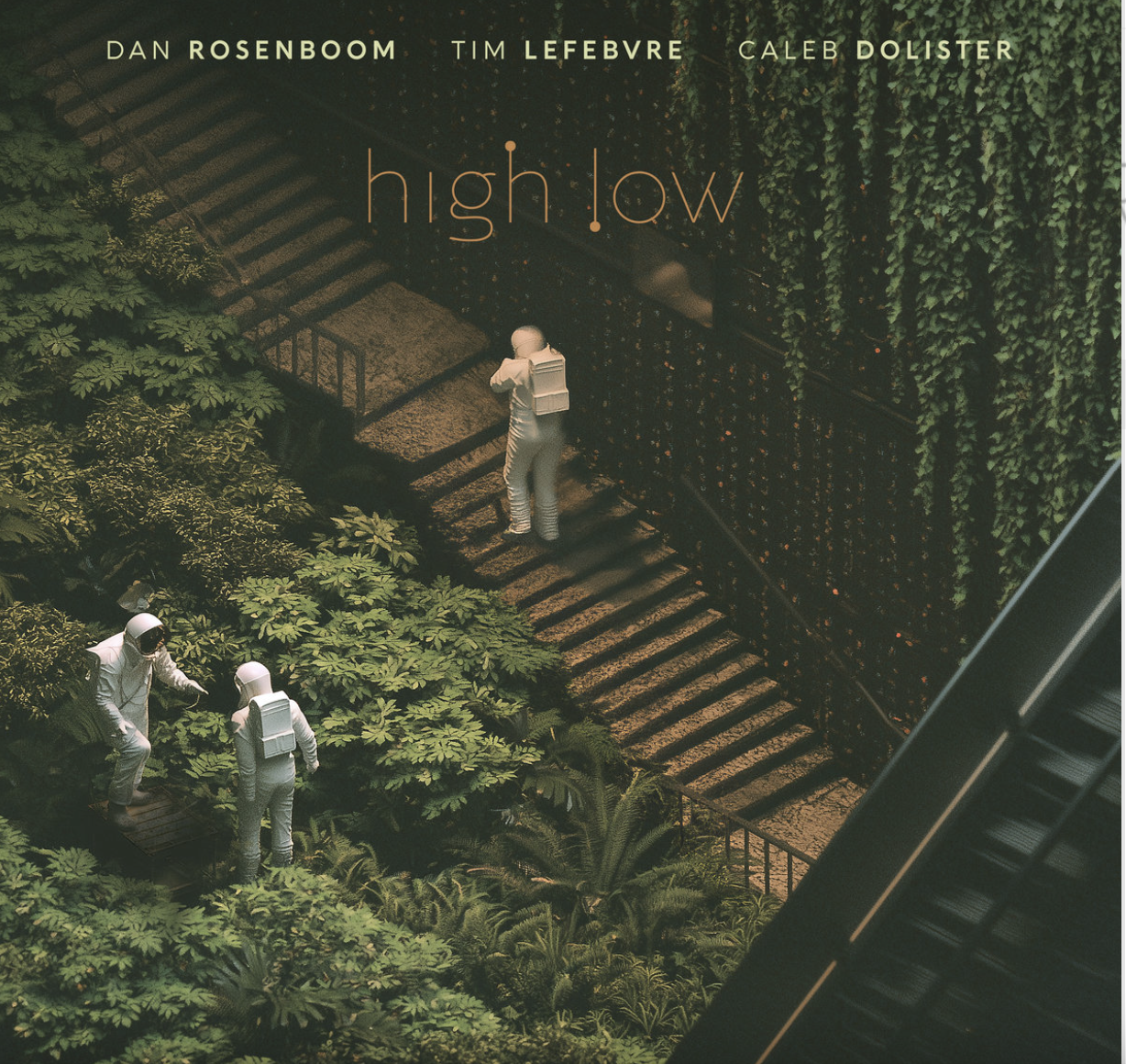
Dan Rosenboom, Tim Lefebvre & Caleb Dolister ‘high.low’
(Orenda Records) 6th November 2026
Although criss-crossing paths within the L.A. scene (which is where all three foils now reside) over the years, this extemporised, recorded in sequential order, performance marks Dan Rosenboom, Tim Lefebvre and Caleb Dolister’s debut together as a trio.
Drawing upon an enviable CV and depth of experiences, this triumvirate of foils have covered everything from jazz (in its many forms) to metal, the classical and Balkan imbued folk. First up, Dan Rosenboom, who alone could fill up this post with his credentials and activities. The trumpet player and producer, but also instigator and cultivator of untold groups and associations, is highly prolific, releasing more the thirty albums as both a soloist or bandleader and supporting around sixty different artists across 120 plus releases through his own Orenda Records label – the facilitator of this trio’s debut. Part of the Hollywood studio musician community, apt at providing his musical skills to untold numbers of films and TV shows, he’s also covered everything from the progressive to avant-garde, metal and experimental rock.
Popping up sporadically on this site over the years, I’ve written about bassist supremo and innovator Tim Lefebvre and his contributions to Julian and Roman Wasserfuhr’s Landed In Brooklyn album, his guest appearance on JZ Replacement’s Disrespectful album, and of course, and much more widely known, his part in playing foil to Donny McCaslin as Bowie’s collaborating backing band on Blackstar – the final curtain call and testament. Added to that, Lefebvre has appeared on over 700 recordings, and is currently the bassist for the acclaimed Michael Wollny Trio, Italian pop star Tiziano Ferro and the “unhinged” eclectic Whose Hat Is This?
Completing the lineup, Caleb Dolister is primarily a drummer of versatile expertise but can probably play a number of other instruments alongside his composing, audio engineering and producer roles. Returning to his California birthplace after musical excursions via Nevada and New York City, Dolister’s played in or been a central cog of The Kandinsky Effect, Dr MiNT and Rosenboom’s large ensemble project Coordinates, plus Analog Dreams and prefixed his own name to the Warren Walker duo.
In the improvised spirit of spontaneity, the trio have pooled their talents to both strike out and traverse, skulk and leap about in mysteriously shadowed landscapes of dark and freeform jazz, post-hardcore and cosmic mirages. Incipiently, with a clang of harmonics, gangly post-punk bass guitar string resonance and oscillations, this sequentially recorded journey opens with the near Arabian mystical Krautrockish and Don Cherry-esque trumpeted ‘high.1a’, and almost without interruption bleeds into passages of metal-jazz, fusion and sci-fi.
There’s so much going on at any one time – except when the trio calm the tempo and direction of travel down – that each track cans simultaneously invoke a multitude of influences and expressive themes. ‘high.1c’ for example, is really heavy and yet illusionary; there’s a maelstrom of reference points, from Funkadelic duking it out with late King Crimson, or Jacek Mazurkiewi caught at a Last Exit gig.
The bass is itself used in both familiar and very unfamiliar roles, from metallic post-punk growls and rumbles to echoes of Jah Wobble, and a removed version of funk as performed in Bowie’s Blackstar cosmos. On the finale, ‘low.2e’, it sounds more like a Neville Brothers or Curtis Mayfield bassline. It can be running after scales and runs that seem to accelerate, but also be colder, thumped and lunar-esque. Drums wise, this is every bit as experimental and diverse, offering rhythms and breaks and rolls, but also tapping around the kit, or using it like a metal lattice of percussive hits, punctuations, scuttles and atmosphere building. I think there’s spots of hand drums too in that improvised laboratory; maybe conjuring up visions of the Middle East, of Turkey and further afield, perhaps even Tibet. Between more burning heralds, the scope of Zorn, Cherry and Davis, Rosenboom’s trumpet surveys the horizons, squeals through effects shadowing and pitch shifts, and blows sustained melodics. This can often be either really attentive or really wild; rising and falling in a dramatic fashion; sketched and more solid or in friction with the atmospherics and undulations of resonance and reverb.
From flexes of the Red Hot Chilli Peppers L.A. to Weather Report, post Bitches Brew Davis, Krolestwo, Krononaut and metal machine music Sun Ra, high.low, likes it title, offers both sides of light and shade, or the heavy and more atonal and ambient-esque. Post-everything, and yet full of markers that any eclectic music seeker will recognise, the trio’s inaugural recording is an amorphous concentration of the sci-fi, the darkness, the brooding, the experimentation, and surprising.
SAD MAN ‘ART 2’
(Cruel Nature Records) 30th October 2026
Once again as if in a permanent flux between sonic transformations and guises, the singular maverick electronic and art-house boffin Andrew Spackman is back under his most prolific (I believe) and longest running SAD MAN alias. Oscillating and bounding back and forth, Spackman has previously taken on the mantle of the Duchampian inspired Chess move, the Nimzo Indian, Cars From The Future and the jazzcore experimental The Dark Jazz Project. That’s all without referring to his artistic pursuits and creative job roles as an artist, illustrator, and designer, not to mention his growing expertise as soundtrack composer, producing a (re)score for The Cabinet of Dr. Caligari a few years back. There’s also been a track contribution to Matthew Herbert’s Accidental Records release, Antechamber Music 2, a NFTs collaboration with Holly Herndon, using Holly+, Herndon’s AI digital voice project, and remixes for Dorcha, Matters Band, Stealing Sheep, Lumpen Nobleman, Gemma Cullingford, Alex H Duncan, Scissorgun, The High Llamas and Vula Veil. Phew!
Well, that’s the resume out of the way, with the focus now on the follow up to 2025’s Cruel Nature release ART – a title that covers all suggestions, all bases. Coming in at perhaps release number one million (I joke, but Spackman has been so prolific over the last decade or more, releasing literally hundreds of pieces of music and untold albums), ART 2 continues to counter bombarded coarse beats and a vortex of metallic pins with the easing passages of the near reverent and vaporous.
With nothing title wise to suggest the source of inspiration, reference points or subject matter, Spackman uses a sort of Aphex Twin-esque code of non-descript reductionist numbers, all prefixed with, again, the less than descriptive title of “noise”. Almost like experimental batches pulled from a larger science experiment, and yet each track seems to exist on its own; often fluctuating during its course, changing up or down from where it originally started out.
‘noise 19d’ (is the “d” a reference to decibels?) for example comes on all Tresor and needle splayed sharpened early 90s techno, then with the introduction of flat beaten real played drums and thrashing electric guitar the track takes on a sort of hardcore dimension. And yet I’m hearing, albeit quite transmogrified, Basement Jaxx’s ‘Where’s Your Head At’ in all that density. The action eventually calms down to evoke what can only be described as a laser disc fantasy video game score of the 80s mixed with the dreamwave. Elements of Justice and the Ed Banger stable alongside Mo Wax crop up on the prickly sharp sputnik haywire hip-hop oddity ‘noise d’, whilst ‘noise 3d’ sounds like a volcanic collapsing in a crush of dissonance. There’s also moments that I can only describe as Kosmische, like the hints of Cluster on the metallic spoken, semi-classical documentary score ‘noise 13’, and Kraftwerk on the rhythmic and giant footstep industrial ‘Noise 2’.
I’m however immersed in a strange world of sci-fi; a soundtrack to a techno and coarse distorted alien universe, often spooked by supernatural forces and presence of a hidden Levithan. For heaven’s sake, can’t some filmmaker give Spackman a call, as his skills could make the blandest of sci-fi epics and horrors disturbing, agitated and exciting. ART 2 continues to support Spackman’s rise as the interesting mad boffin of electronic music; further evolving and always developing, taking on new sounds and constantly probing like a contemporary artist out on the fringes.
Giuliano Sorgoni ‘Savana Selvaggia’
(Four Flies Records) 30th October 2026
Missing from the Roman columned pantheon of Italian cult composers, the Rome born composer and multi-instrumentalist of over a 1000 plus recorded tracks, Giuliano Sorgoni is once again the focus of the Four Flies Record platform’s attempts to correct this slight. Although fusing and traversing everything from the classical to jazz, psych, funk, disco, electronica, beat groups music, and prog, a cult favourite of the horror and exploitation score communities – namely for scoring The Living Dead At Manchester Morgue -, and known for his notable collaborations with long-time friend Alessandro Alessandroni, Sorgoni’s name remains relatively obscure.
Born in the mythologically created city just before war broke out in the late 1930s, Sorgoni only just passed away last year. His legacy has been overshadowed by his more famous and celebrated peers. But this label has already tried to rectify that missive, namely years ago with a revival of the Africa Obscura LP. Eight years later, and it seems still needing that boost to the legacy and place on that pantheon, Four Flies has just put out a repackaged and remastered suite of Sorgoni’s further adventures on the African continent – one that left, we’re told, a deep mark upon the composer.
Made up of previously unreleased music produced for various TV documentaries in the mid 70s, Savana Selvaggia is, it’s suggested by the label, borne in part from sessions for one of Sorgoni’s most iconic and notable LPs, Zoo Folle. Perhaps in part, it accounts for the menagerie of colourful yipping, yapping, vibrato trilling and wing beaten mating ritual sounds that suffuse many of the tracks on Savana Selvaggia, helping to visualise an atmospheric savannah grassland teeming with wildlife that’s alive and about to leap out of the speakers at you.
A safari of ethnological sources fed through the imagination of someone who’s adapt at turning the ceremonial dancing sounds of the tumba drum into something even more exotic and mysterious; layering up various rhythms across the Serengeti and Arabian Africa with modulated and fluted Moog melodics, lounge-jazz and more holy, missionary church nave keys that almost touch upon the Kosmsiche. Some tracks shout crate digger sample and break beat – ‘Caccia Tropicale’ (or “Tropical Hunting”) could have easily made The Jungle Brothers Done By The Forces Of Nature LP – whilst others would appeal to the likes of European library music aficionados like Greg Foat – the near playful nature shoot of ‘Zebre’ for sure. ‘Arabian Safari’ by contrast, seems to straddle both vague romantic sand dune traverse of Egyptian music with an Ethio-jazz lilt, and ‘Alba Sulla Savana’ (“Dawn Over The Savannah”) matches old pal Alessandro Alessandroni with “Blue” Gene Tyranny.
Shuttled, rattled and even Afro-Latin flavoured hand drums meet acid-jazz, a bit of Afro-funk, the tribal and the cult European library scene on an album of Italian ethnographic scores. Hopefully it will encourage a deep dive into Sorgoni’s extensive catalogue, and maybe make it onto a few hip-hop tracks – one of the best marks of respect.
Here’s the message bit we hate, but crucially need to survive:
If you’ve enjoyed this selection, the writing, or been led down a rabbit hole into new musical terrains of aural pleasure, and if you able, then you can now show your appreciation by keeping the Monolith Cocktail afloat through the Ko-Fi donation site.

