Exchange recommendations from our Italian penpals at Kalporz
Authored by Paolo Bardelli
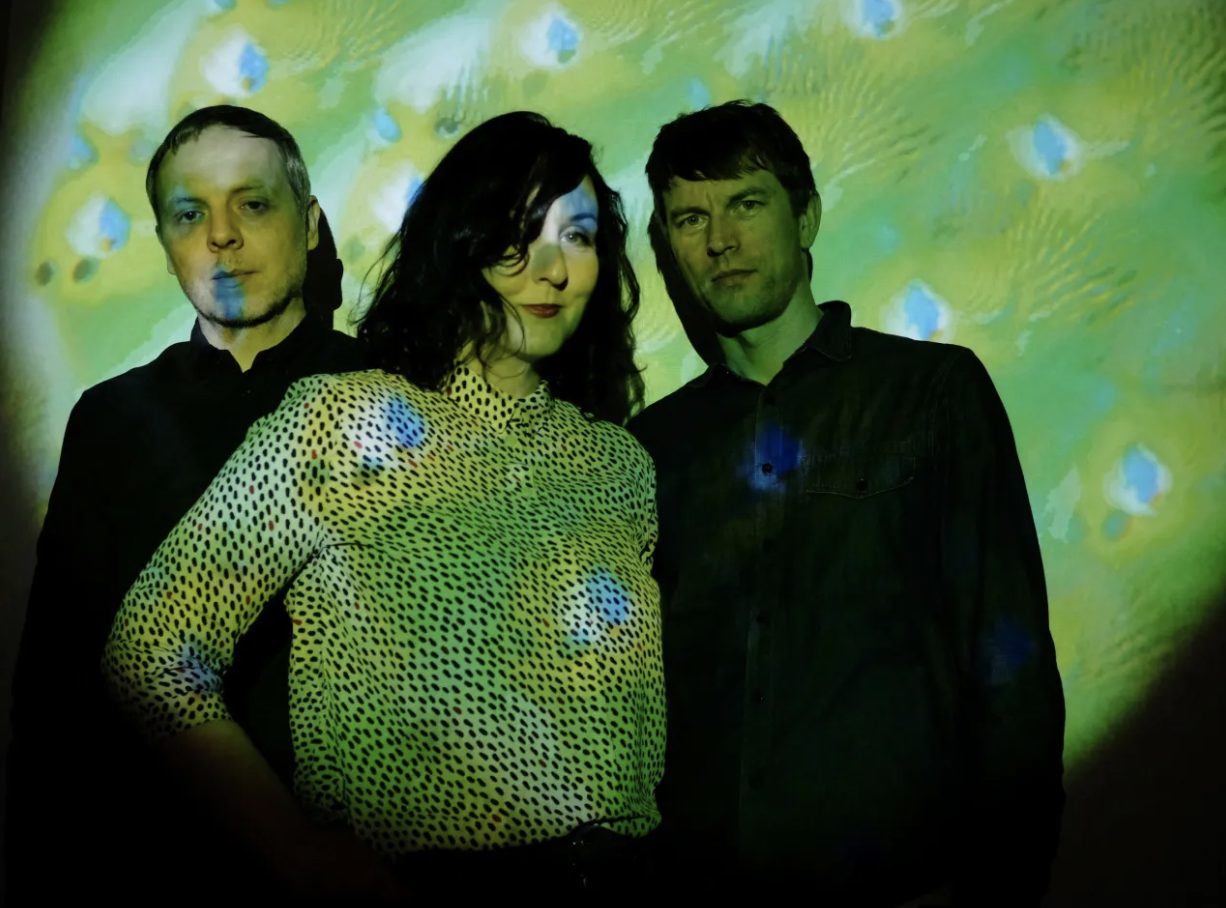
Credit: Aron Lindhagen
Continuing our successful collaboration with the leading Italian music publication Kalporz , the Monolith Cocktail shares reviews, interviews and other bits from our respective sites each month. Keep an eye out for future ‘synergy’ between our two great houses as we exchange posts during 2023 and beyond. This month, from the site’s Thanks 4 All The Fish! series of recommendation reviews, a quartet of recent finds, brought to us from Paolo Bardelli.
This month we dedicate ourselves to a ThanksForAllTheFish! composed of albums that would have deserved individual reviews, because all of them are beautiful and some are truly impressive, but – you know – we are immersed in a fast-paced world and sometimes we have to adapt. To facilitate the choice we put them in order, from the best (Death And Vanilla) to the least of the four (Gnoomes), which is still a great album.
DEATH AND VANILLA, “Fliker” (Fire Records, 2023)
Death And Vanilla have put all their care and psychedelic imagination into this their “Fliker” after more than a decade of records (this should be the sixth, if we are not mistaken in mathematics, but in any case there are further ep’s on their bandcamp as well): these are delicate psychic digressions seasoned with a distinct and elegant pop in which the cerebrality and dimension of dreams (as in the beautiful “Baby Snakes”, a modern “Riders on the Storm”) is tempered in some passages by a physicality drier (“Find Another Illusion”) that the band refers, as a suggestion, “to the first Cure”.
The trio hails from Malmoè, Sweden, and is made up of musicians Marleen Nilsson, Anders Hansson and Magnus Bodin who play with vintage instrumentation, “to emulate the textures and magical sounds of soundtracks and library music, German krautrock and yèyè French pop from the 60s and 70s”.
Fantastic record in my opinion, which will probably be in my year-end rankings.
Album info: https://www.firerecords.com/product/death-and-vanilla-flicker/
TREES SPEAK, “Mind Maze” (Soul Jazz Records, 2023)
Another spectacular disc is this fifth by Trees Speak, a duo from Tucson (Arizona), composed of Daniel Martin Diaz and Damian Diaz who combine a very strong instrumental taste with a thousand influences and an absolute basic enjoyment. The press notes exaggerate a bit but begin to give coordinates: “Trees Speak is music as a cosmological translation, borrowing from Can and Miles Davis’ Bitches Brew era practice of the studio as a composition tool, in which long improvisations they merge into indelible flights of fancy with razor blade-assisted tape edits. Trees Speak operates between the subconscious and the unconscious, the radiant and the eclipse, the micro and the macro”.
Certainly German krautrock has something to do with it, just as the duo draws from the soundtracks of the 60s and from a certain free and unconstrained psychedelic rock with the cosmos as its destination: the Arizona desert as a universe to land on.
Personally, I have two songs that I wrote down with a handkerchief: “Syndrome” gives me the same anguish as Massive Attack, while “Sospetto” has the influence of the Italian soundtracks of the 70s and, as evident from the title, of Air’s “The Virgin Suicides”: only if you listen to it.
This album is also amazing.
WITCH, “Zango” (Desert Daze Sound, 2023)
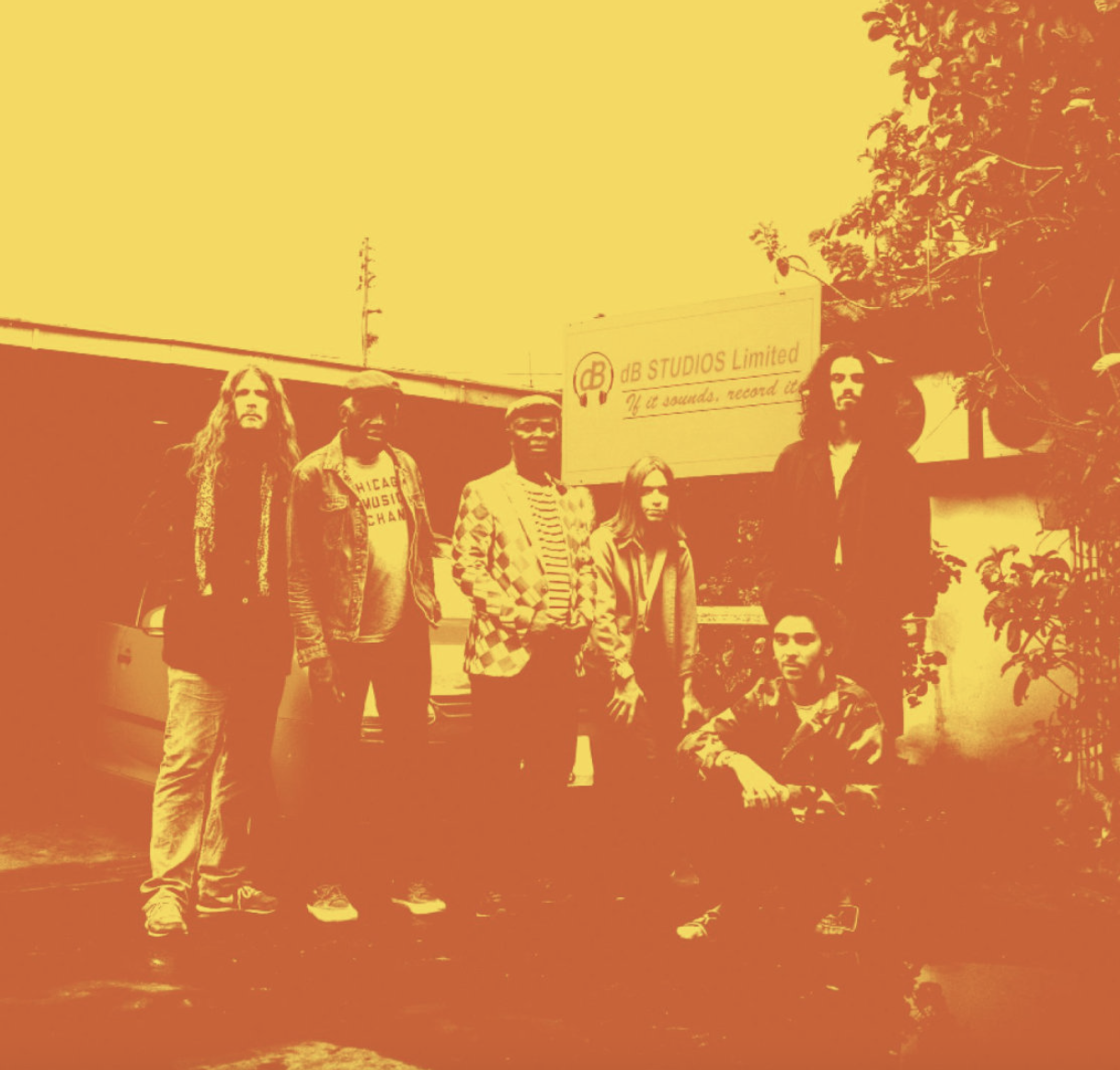
A story à la Rodriguez: between 1972 and ’77 the Witch, a band from Zambia, made five albums that were only released in Zambia. In 2010, reissues appeared in Europe and the United States: the Witch’s African rock-fuzz mix was liked so much that fans supported the tours of a new band that Jagari Chanda – the only survivor, now 71 – assembled six years ago, composed mainly of young European musicians.
Last week the Witch’s first album after four decades was released and Jacco Gardner both plays on it and produced it, a Dutch musician whom I love and about whom I was complaining via social media with my contacts about the long record absence only a few days ago (he had been spotted in Portugal in 2018 with “Somnium“). And yet here it is: he joined and produced the album of this historic band from Zambia and the result is amazing. The group’s African imprint explodes into a fuzz-based rock that is, to say the least, ultra-addictive. Leader Jagari Chanda was joined by new traveling companions Patrick Mwondela, Nico Mauskoviç, Charlie Garmendia, JJ Whitefield and Stefan Lilov.
A story and a record not to be missed.
GNOOMES, “Ax Ox” (Rocket Recordings, 2023)

Who’s Afraid of Russian Psychedelia? The war has erected barricades that music does not have, so here we are to recommend this fourth full-length from the band that comes from Perm who, after 3 albums characterised by the “exclamation point” (“MU!” of 2019, “Tschak! ” of 2017 and “Ngan!” of 2015), removes it from the title as if to normalise a proposal that is not normal . First of all, for the first time the quartet sings in their native language, Russian, and – since the beginning of the conflict with Ukraine – two of the members have fled Russia, which makes us understand the political approach of the band beyond a choice, that of using Russian this time, which would seem rather nationalist.
Musically, “Ax Ox” pushes a kraut direction elevated at times by techno beats (“Loops”) or garage-dark intuitions (“The Neighbor”), or diminished in porthole sensations à la Boards Of Canada (“Mirrors”).
Less recommended than the three albums above, but still out of the usual coordinates.
AUTHOR: Paul Bardelli
The Perusal #44: Pan Afrikan Peoples Arkesta, Matt Donovan, Baldruin, Spindle Ensemble, Marty Isenberg…
June 13, 2023
Dominic Valvona’s Eclectic Reviews Spot (Unless stated otherwise, all releases are available to buy now)
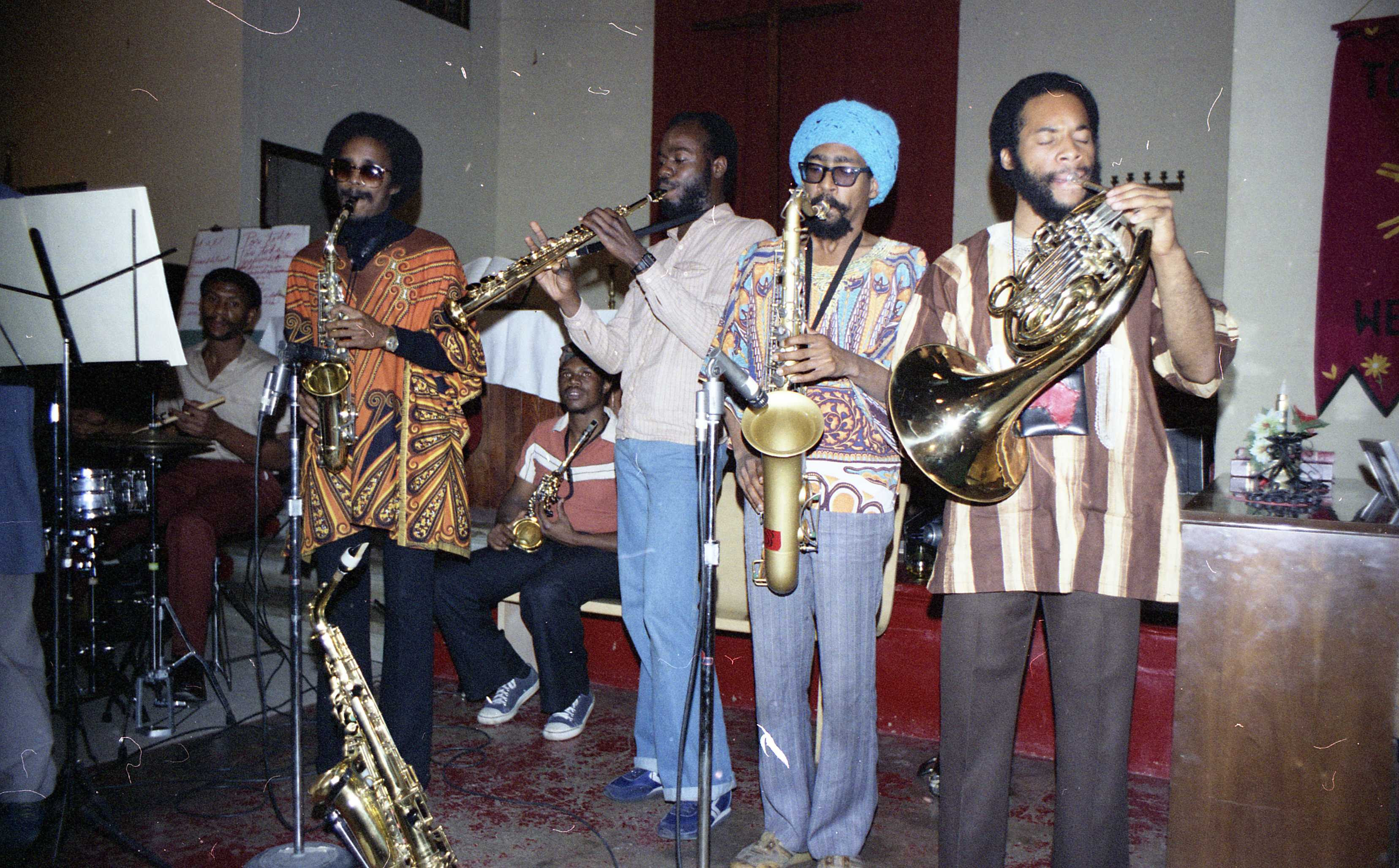
Photo Credit: Mark Weber
Pan Afrikan Peoples Arkestra ‘60’
(The Village) 14th June 2023
Serving the South Central L.A. Black community from within for six decades (and counting), the late Horace Tapscott and his preservation Arkestra ensemble captured and reflected the social and racial injustices of that oppressed community with a righteous politically conscious and radical jazz style blueprint; a documentation, but also self-reliant stand against the state’s brutality and economic suppression.
Two decades on from his passing and Tapscott’s vision has been handed down to a new generation; led in the new century by Mekala Session, scion of Arkestra stalwart alto Michael Session. More or less each incarnation, from a sixty year timeframe (hence that album title) is represented on this new celebratory collection; released by the ensemble’s own label imprint, The Village.
For a platform that continuously swelled its ranks with untold talent from the American West Coast and beyond (oft member, the trombonist and Tribe hub co-founder, Phil Ranelin is synonymous as a mainstay of the Detroit scene for example), and fermented connections culturally throughout the country, inspiring many, the Pan African Arkestra’s recordings on wax are few and far between. Most of the performances on this compilation journey through the years were collated from home-recordings; many of which have previously never been aired before. And the majority of those come from taped concerts in the L.A. arena, the exception being a summer of ’95 performance at the Moers Festival in Germany, during a period of “regrouping”. Some, believed missing, have been literally unearthed from the Ark’s archive; with even the lineup roll call having to be cross-referenced at times: and still not a 100% sure even then.

The Pan African Arkestra exists as a live entity; whether that was playing each weekend in the formative years at the South Park bandstand or, in the line of hostile LAPD fire as they played on a flatbed truck parked right in the middle of the street during the ’65 Watts riots (or “revolt” as its framed from the frustrated, put-upon Black community suffering inequality, little or no representation). In chronological order, the 60 album encapsulates each transformation of the troupe, beginning with the fifteen-minute long tribute to the ‘heart of the Tapscott family’ Pearline Fisher, or Gram Pearl “to those who loved her”. A grand matriarch, at the very centre of the family home, watching all the goings ons, including the band members arriving up the drive for rehearsals in the garage, Gram Pearl’s name was immortalised on the 1961 home recorded ‘The Golden Pearl’. Reverence shines through this early performance that seems to bridge the late 50s jazz of Gillespie, Ellington, Coltrane and the Savoy label with the coming age of the 60s Black consciousness and spiritual enlightenment. A “likely configuration” of Tapscott on a loose Oscar Peterson flow of barrel and saloon piano, Arthur Blythe and either Jimmy Woods or Guido Sinclair doubling up on saxophone, Lester Robertson on fluttered trombone, David Bryant on spoke-like and brushed double-bass and Bill Madison on swing-time and brushed drums mark one of the first lineups of the burgeoning Arkestra. As it turned out, pianist and conductor Tapscott was right to jump off Lionel Hampton’s Big Band tour bus that year; walking all the way back home, pissed but motivated to grow something new.
In the “pressure cooker” tumult of South Central L.A. a close-knit handful of artists gravitated to the beacon; at first going under the UGMA (Underground Musicians Association) abbreviation, this initial lineup included (amongst many others) the vocalist Linda Hill, drummer Donald Dean and the already noted bassist Bryant (who’ll crop up quite a lot during the course of this ensemble’s history) and saxophonist Woods. Many would appear on that compilation opener.
Although not until much later, the obvious influence/inspiration of Saturn’s cultural ambassador in Earth, Sun Ra, most be noted. Tapscott himself, easily an acolyte of that cosmic spirit, pointed out the differences between the two Arkestras; the original envisioned as an ark travelling through space, the other, a “cultural safe house for music” down here on terra firma. Whilst Sun Ra looked to the stars for an escape to some colour-blind society on a distant world, Tapscott’s troupe wanted to be amongst the people: screw the space race.
That blossoming unit found itself under FBI surveillance as a new decade beckoned; much of that paranoia down to the ensemble’s support for the Black Panthers. From the cusp of that decade, the 70s, there’s a recording of the Ark at Widney High School. With a far wider, expanded lineup and the Sarah Vaughan like commanding, but also dreamy, freely moving vocals of Hill and, so it seems, only a recurring Tapscott and Robertson, a lot of new faces appear on the fluctuating ‘Little A’s Chant’. A loose intoxication, a tamed wilderness permeates a mixture of The Lightman Plus One’s Cold Bair, Tyrone Washington’s Roots and the influence of Philip Cohran.
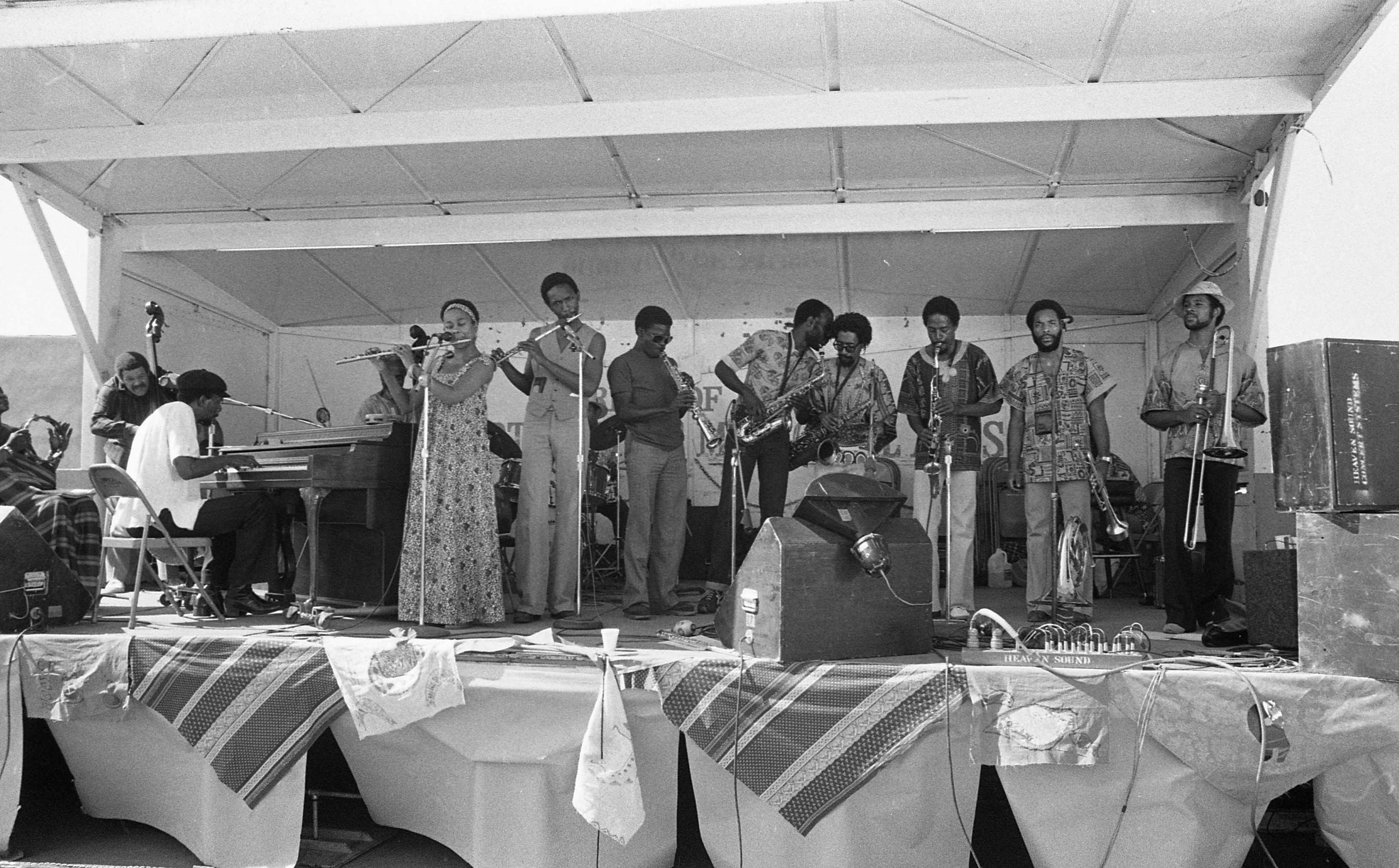
Photo Credit: Mark Weber
With the war paint on, entering the over-commodified decade of the 80s, the Ark, once more changing the roll call, fashion a piano heavy kaftan wearing fire out of Somaya “Peaches” Hasson’s ‘Nation Rising’. Turning in a Last Poets and Leon Thomas vocal performance, Juan Grey (aka Jujigwa) is a man in a hurry: he’s got “work to do”, “rising a nation”. Whistling and swinging down a boardwalk paved Nile on a Yusef Lateef and Pharaoh Sanders vibe, we got a double-front of both willowy flutes (Adele Sebastian and Dadisi Komolafa to thank for that) and altoists (Sabir Mateen delivering a honked and dynamic solo, with Gary Biar as foil), and the rattled congas of Moises Obligacion alongside the mini crescendo spiraling drums of Billy Hinton. Phew!
Forward again, and to the backdrop of an L.A. in flames, sparked by the Rodney King miscarriage of justice, the Ark are to be found on one of their rare trips to Europe; playing a concert at the Moers Festival in the summer of ’95. Regrouping with the help of a returning Jesses Sharps on soprano sax, Tapscott shares piano duties with Nate Morgan and a whole lot of brass on ‘The Ballad Of Deadwood Dick’. I will however name check Arthur Blythe on alto sax and recent converts Michael Session (on tenor), Charles Owens (also on tenor), Fundi Legohn (French horn), William Roper (tuba), Steve Smith (trumpet) and Thorman Green (trombone). An integral founding brother of the Ark, the already mentioned David Bryant is back on double bass, but sharing his duties with fellow bassist Roberto Miranda, whilst doubling up on the drums is the shared union of Fritz Wise and Sonship Theus. All together they conjure up another Egyptian tapestry whilst huffing and in bird-like illusion build up a brass heavy swing and sway. A galloping percussive rhythm (coconuts denoting a hoof-like fast trot) creates a travelling caravan vibe, as the melody, swells and punctuations evoke Skies Of America Ornate and touch of Bernstein.
The new century, a decade on from the death of their mentor and founder Tapscott, and the troupe is under a new steward and embracing another in-take of rightful minded jazz players. From a 2009 recording at the Jazz Bakery (pastries and bread with jazz, what’s not to like), with only a familiar Wise on drums (joined by Bill Madison), Sharp on soprano, Legohn on French horn and Smith on trumpet, we hear a Philip Cohran type spiritual and political fanfare for “justice”. L.A. notable Dwight Trible (recently giving divine voice to Kahil El’Zabar’s Ethnic Heritage Ensemble) is on expressive conscious-unloaded and right-on vocal duties, and the already mentioned Detroit icon Phil Ranelin can be heard on characteristic trombone. A riled and ached, seething indignation with shades of Sun Ra and the Pharaoh, ‘Justice’ is as free as it is fueled by rightful grievances.
The most recent performance, a decade later, is the Zebulon (in L.A. again) convert vision of ‘Dem Folks’. It’s conducted this time by another convert, the Egyptian-American-Muslim trombonist Zehkeraya El-Magharbel, who turns out to be a sound fit. The cast is further expanded with a quartet of spiritual rousing and more Gyrgory Ligeti otherworldly choral vocalists (Aankah Neel, Tamina Johnson-Lawson, Qur’an Shaheed and Maia, who’s also on flute), oboes, bass clarinets, a good showing of horns, and this time out, the keyboard skills of Brian Hargrove. A real fusion of dynamic parts, it begins with a virtuoso drilled, pummeled, slow to fast, percussive and drum introduction of rolls and cymbal hissing shimmers (ala Billy Cobham), before, at first, hitting a dissonance of wild drum mimicked voices. A soul-jazz groove finally lands after going through various changes, from fluted Lateef to echoes of Prince Lasha’s Search For Tomorrow communion with Herbie Hancock and a tumult of incantation and oscillated vocals. An untethered swell of orchestral jazz in the anointed light of Sun Ra and the wisdom of the ancients, ‘Dem Folks’ is the earthly community taken to anthemic highs. What a fitting, electrifying performance to mark the Pan Afrikan Arkestra’s newest incarnation; twenty years on from its pioneer’s death, the baton passed on and, as it obviously proves, is still in safe hands. The future is indeed bright for this long-running ensemble.
The 60 album proves an important preservation of a self-reliant social activist institution, integral to the community in which it serves, teaches and rises up. A great encapsulation of that story, musical journey and the changes it has gone through, this will both excite the Ark’s fans and newcomers to the cause.
Spindle Ensemble & Evergreen Club Contemporary Gamelan ‘Live In Toronto’
(Hidden Notes)
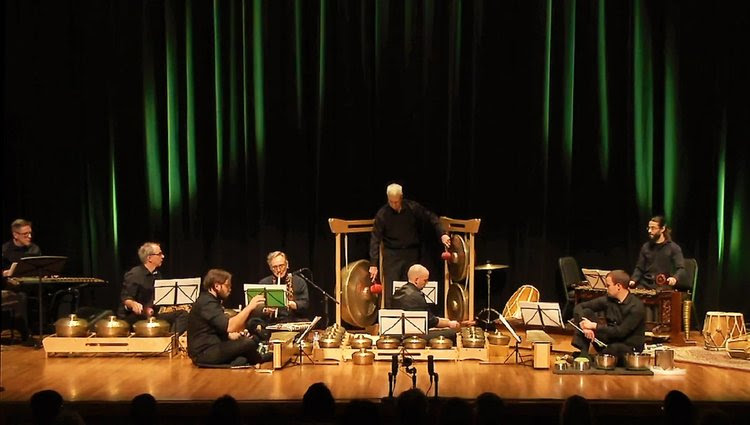
A congruous union of modern classical music and gamelan, Bristol’s Spindle Ensemble quartet and the Toronto Evergreen Club Contemporary Gamelan octet transport the listener to a blossomed, lush and evocative West Java landscape on their EP of both live and recorded studio performances.
In what proves to be an intuitive collaboration – the results of a chance meeting between the Spindle’s Harriet Riley and Evergreen’s Christopher Hull whilst both studying gamelan in Bali -, both partners respect and accentuate the qualities of their chosen forms and inspirations as they meld and weave together instruments from the West and Indonesian East. A balance is struck between contemporary explorations, probes and the timeless across three tracks. The gamelan ‘degung’ family of metallophones and bamboo instruments dance and bob along to and twinkle alongside the Spindle’s harp brushes, bulb-like note dripping marimba and vibraphone, sympathetic-bowed cello and violins, and deft subtle spells and waves of piano.
Written by the Spindle’s composer-pianist and harpist Daniel Inzani, the opening patter cascade of mallet notes and tinkles ‘Lucid Living’, was recorded at the Evergreen’s rehearsal space in downtown Toronto. A light enchanted dance of plucked and picked strings across lily pads, with an air of the willowed fluted pastoral, there’s an almost romantic but simultaneous closed-eyes, deep in thought moodiness to this first performance of adroit musicianship.
Also penned by a Spindle member, Harriet Riley’s mythological-loaded ‘Orpheus’ is part of the two group’s live performance at the city’s 918 Bathurst Street Centre For Culture, Arts, Media And Education – it must be noted at this point that the Bristol quartet travelled to the Evergreen’s backyard to foster this project, spending weeks rehearsing the repertoire before that inaugural live date. Barefoot in jungle temples, the Hellenic bard-poet (an Argonaut and famed survivor of Hade’s underworld) is planted down in the Indonesian exotic; wandering across an uninterrupted proscenium score of various Southeast Asian flavours. All the while accompanied by a soundtrack of pressing repeated chords, metallic chimes and drones, the arched and bowed. At times it’s a rasped mizzle, at others, a slow-paced rhythmic joy or flight that feels almost improvised if not free to fellow its natural path.
The final performance, ‘Open Fifths Gardens’, was composed by the Evergreen’s Andrew Timar and is another exotic allurement of the East. It suggested the dusk hour to me, and evoked the strings of Simon McCorry and Anne Müller: that push of classical instruments made to sound more contemporary and alive if abstract; not just read off the classical cannon score sheet but swelling up with a less guided, personal feel for the time, space and direction of travel in that moment.
In short: the gamelan sound is opened up further and spread wider into the arena of contemporary chamber and symphonic classical music, to conjure up an atmospheric kind of melodious and stirring theatre.
Matt Donovan ‘Sleep Until The Storm Ends’
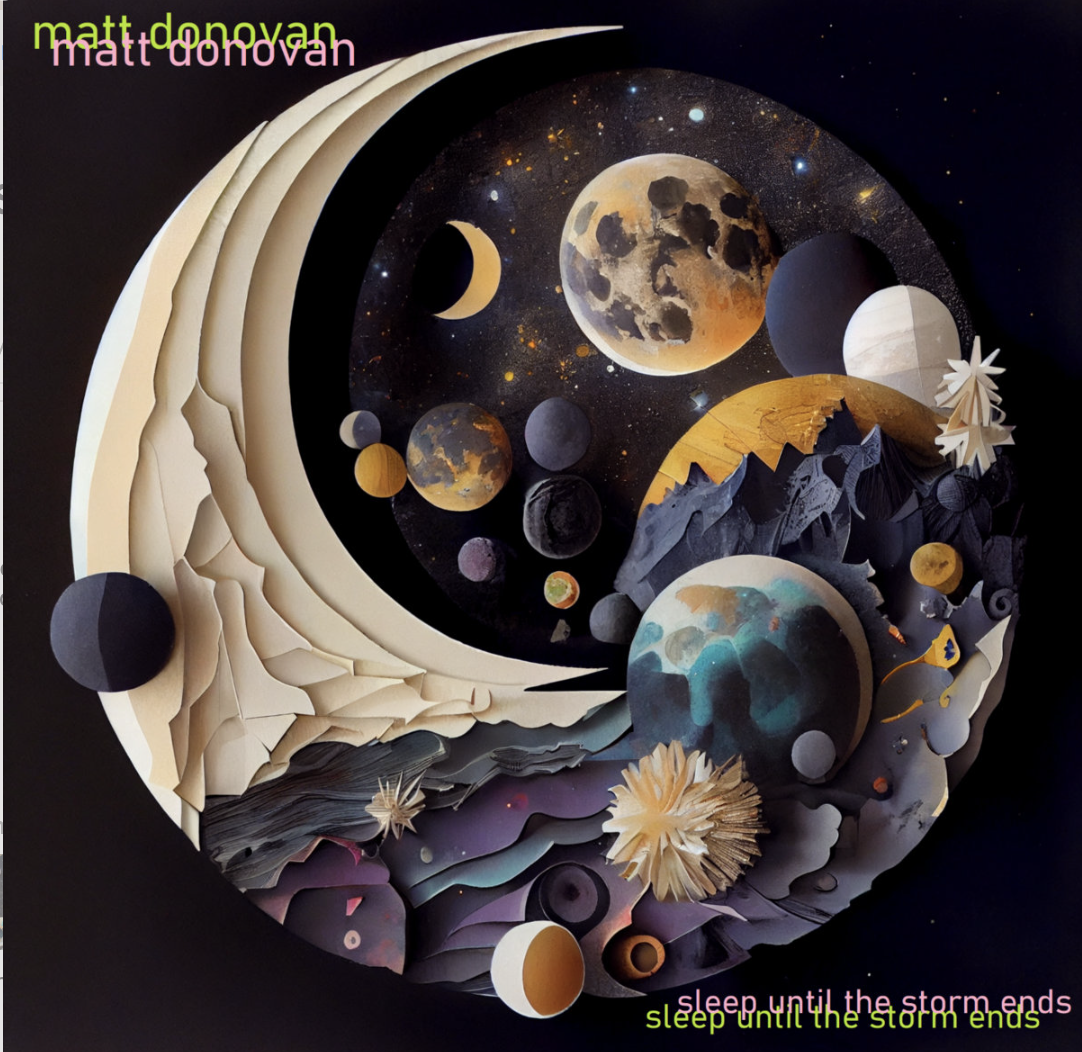
Marking three in a row of annual Spring-time delivered albums, the drummer-percussionist turn multi-instrumentalist solo artist Matt Donovan opens up his personal universe to the world. In the face of political, social discourse and ruin, lawlessness, loss and anxiety Donovan captures the evocative moments and scenes we all often take for granted; turning nighttime walks, the memories of loved ones into something musically and sonically lasting. A time is saved for posterity even if its just for Donovan and no one else; a kind of musical photo album that represents the sentiments, therapeutic stages of a period in his life.
And yet, with such universal tragedy and dislocation, there’s always hope; the music, even when the subject matter chimes with the God awful state of affairs currently destroying the country, remain loving and kind. Those of you who seeked out the (hopefully through my recommendations) previous Habit Formation (’22) and Underwater Swimming (’21) albums will find that Sleep Until The Storm Ends shares a familiar palette of kosmische/krautrock, alt 80s and 90s and post-punk influences. And yet it feels somehow different; mature and comfortable in its skin but exploring all the while.
With propulsive-motored stints in Eat Lights Become Lights, and as a foil to Nigel Bryant in the psych-krautrock-progressive-industrial Untied Knot duo, it’s hardly surprising to hear those Germanic influences permeating this newest album: A spot of the Dingers (Klaus and Thomas) here and a bit of Michael Rother and Manuel Göttsching guitar there. On some of the more reflective tracks like ‘A Sky Full Of Hope’ and ‘Night Walking’ its Tangerine Dream and company, albeit the latter has more than a touch of soundtrack Vangelis about it too, merged with pop, jazz and 80s indie influences. Although not German, just mere cousins on the astral plane, a few of these tracks reminded me of both Syrinx and Ariel Kalma’s new age, spiritual panoramic awakenings.
This is only half the story, as Donovan also effortlessly seems to weave The Field Mice’s ‘…letting go’ with Karl Hyde, Mick Harvey (especially on the few occasions he sings), the Durruti Column, Spaceman 3 and Eno (Another Green World era on the light-effected environmental plaint ‘The Crying Earth’). In practice this results in a sort of bell-tinkled and recalled leitmotif signature unfolding of Donovan’s moods and ruminations: goodbyes too. Sometimes its dreamy and other times near cosmic with climbing scales and Fripp-like sustain and flange-fanned guitar work, synth waves and heartfelt vibrations.
Barefoot Contessa daydreams sit well with clavichord buzz splintered boogies on yet another enriching and rewarding album that slowly unfurls its understated balm of warmth and also protestation gradually over repeated plays. On the fringes certainly, a true independent diy artist, Matt Donovan is far too good to stay under the radar. Do yourselves a favour, grab a copy on bandcamp now.
Baldruin ‘Relikte aus der Zukunfti’
(Buh Records) 19th June 2023

Lying somewhere between the Reformation, hermetic, supernatural and mysterious Far East, the German electronic musician-producer Johannes Schebler simultaneously occupies a liminal past and as yet unsure future on his latest journey, Relikte aus der Zukunfti.
Just as Roedelius, Moebuis and Schnitzler’s first recorded experiments, under the Kluster title, found a home on the synonymous German church organ music label Schwann, so congruous were those early kosmische innovators “hymnal qualities” and, if removed, links to the country’s rich venerated history of religious music, Schebler’s own small Bavarian village rectory upbringing can be heard permeating this fourteen-track traverse and score.
The chime and ring of Lutheran, but also Oldfield’s tubular, bells can be heard across a both holy and unholy atmosphere of cult Italian horror, prog-rock, krautrock, new age and vague Ethnographic absorptions. The paranormal and monastic; the chthonian and Oriental are constantly drawn upon to manifest a fog of uncertainty and intrigue; occasionally delivering heightened dramatics and the chills as the music evokes hints of Goblin, Fabio Frizzi and the presence of some ungodly force.
It begins however, with the blown, sax fluted and veiled ‘Under The Counter’ soundscape, which sounds more like a gauzy apparition of Sam Rivers or Colin Stetson in a Frederic D. Oberland expanse. ‘Ride On The Silver Lizard’ meanwhile, sounds like a brassy sitar transcendental mythology of Steve Hackett, Eroc and Srgius Golowin, and the airy ebbed ‘Predestined’ captures Finis Africae and Vangelis in a cloud vapour loop. The timpani-rumbled ‘Confused’ on the other hand could be a lost Sakamoto score; the late Japanese icon entering the underworld.
Stretching the imagination whilst hinting at various mystical lands, you can detect the more experimental, serial and less musical adventurous work of Širom and Walter Smetek existing in the same space as Popol Vuh, Alejandro Jodorowsky and the melodically afflatus. You’re never quite sure where you are exactly though: nor in what time period. The ground beneath your feet is translucent, or, like an ever-changing shimmer and shiver of evaporated atmospheres. This is a knowing album that taps into its influences and church music groundings to offer a balance between the spiritual and disturbing.
Ramuntcho Matta ‘S/T’
(WEWANTSOUNDS) 16th June 2023
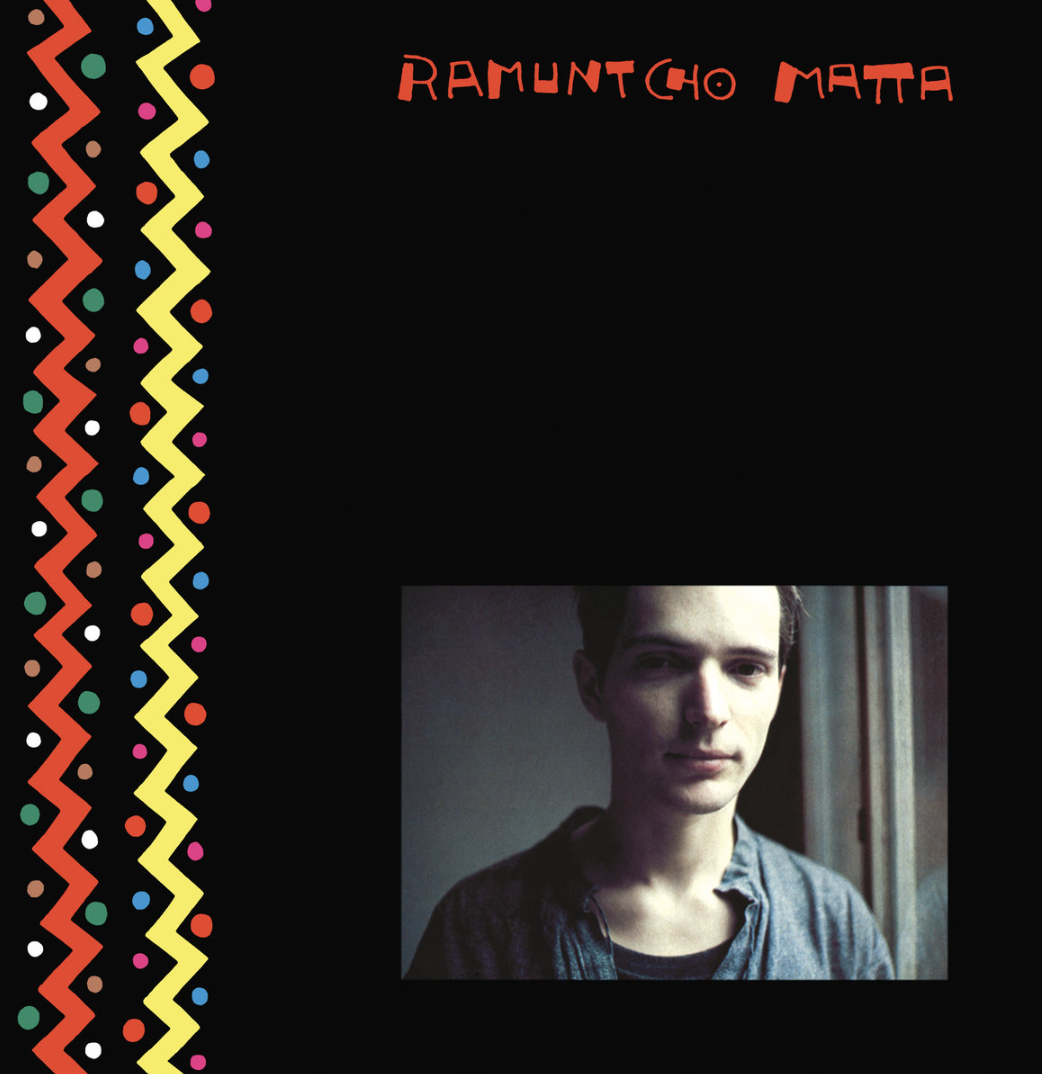
A sound production of contrasts; a collage of time spent in both New York City and Paris, where the graffiti’d downtown meets fourth world music explorations, Ramuntcho Matta’s absorption of those two cultural hives is a no wave and exotic theatre of diverse influences.
The younger sibling to and scion of the Matta arts brood – his father, the Chilean-born Roberto, a key if not always congruous member of the Surrealist movement with his ‘psychological morphologies’ or alien ‘inscapes’ coined subconscious manifestations, and brother, Gordon Matta-Clark, the ‘anarchitecture’ pioneer of such concepts as the ‘split’ house and various art performances -, Ramuntcho was a well-connected creative nomad who chose to plow his own furrow in the field of experimental music. He started out in this regard, in the company of such polymath avant-garde luminaries as Brion Gysin, Don Cherry and Laurie Anderson. The latter opened doors to everything New York had to offer in the late 70s and early 80s. Ramuntcho also shared a flat with scenesters Nana Vasconcelos and Arto Lindsay: living in the same building as the Talking Heads’ Chris Frantz and Tina Weymouth no less. Although tragedy would strike with the death of his brother and conceptual art icon Gordon in the late 70s, the burgeoning producer would stay on, falling in with the Mudd Club, CBGB and Danceteria in-crowd; taking note of the evolving polygenesis movements of early hip-hop, post-punk, electronica, no wave funk and more worldly sounds (from Soweto to the outback, Caribbean and Hispaniola).
But it all came together, or rather this particular project did – dusted off, remastered and given a deserving vinyl reissue by WEWANTSOUNDS – in Paris. With the CV –notably recording Don Cherry’s 1983 ‘Kick’ single for the boutique French label Mosquito, the original imprint for this self-titled album – and network expanding ever further, there would be performances with the Senegalese group Xalam and the Arabic rock group Carte de Séjour, with Rachid Taha. A residency in Lyon led to a meeting with the Algerian-born French avant-garde choreographer Régine Chopinot, who had taught dance at the city’s Croix-Rousse before forming her own experimental multimedia company. Chopinot invited Ramuntcho to compose the soundtrack to her upcoming Via show – the costume designer of which was a young aspiring Jean-Paul Gaultier.
Without seeing the actual production it’s difficult to gauge if the music was successful, complimentary or not. However, removed from that dance theatre setting the album works as a window in on a particular rich cultural exchange of ideas, sonics, sketches and soundscapes.
This ’85 released production was produced between Ramuntcho’s home and the Studio d’Auteuil in Paris; the former, a more solitary space for the album’s soundscapes and more ambient-minded pieces, the latter, a more rambunctious shared environment where all the album’s bandy and shunted no wave funk and Island life Grace Jones-esque tracks were recorded with the Stinky Toys and Elli & Jacno duo’s Elli Medeiros (on vocals), the Uruguayan percussionist Negrito Trasante, Suicide Romeo’s Frederic Cousseau (better known as Fred Goddard) on drums and Polo Lambardo on konks. That list may be extended depending on what information you read, although the WWS label and linear notes writer Jacques Denis have managed to pull together the fullest picture yet of a record hampered by misspelled band members and even a missing track listing. According to those same notes, Ramuntcho didn’t feel that the label had pushed the project or even promote it very well; hence why it disappeared: a find for crate diggers decades later.
A dance fusion of influences and ideas, this counterpoint of diverse elements opens on a gentler, almost mulling day dreamy guitar amble with the light-jazz touched ‘Gesti’. Like Marc Ribot on Iberian shores, there are a couple of these soloist moodscape pieces (see the more classical-tinged and loosened ‘Irimi Nage’). A second strand to this record’s sphere of influence is the didgeridoo sounding passages of Jon Hassell inspired sound cartography; as found on the outback resonated, barked fretboard experimental, water carrier poured ‘Avatar’, and mbira tine, funnel blowing, freight train honked primitive dance music spot ‘Zoique 3’.
The action sprawls across both the NYC and Paris underground on tracks like the shunting cut-up and counterbalance of discombobulated Art Of Noise and a repeated sweeter voiced spell of African or French-Polynesian Island song, on the ‘Sassam Kitaki’ switch. Most surprising is the fluid, bandy amalgamated hip 80s shining ‘Hukai’, which merges Casino Music with Orange Juice, Grace Jones, Lounge Lizards, Talking Heads and the sunny township polyrhythms of South Africa. ‘All Those Years’ in contrast, sounds like Saw Delight era Can rubbing shoulders with a reflectively blue XTC.
Also, in addition to shades of Dunkelziffer, Populaire Mechanik, Don Cherry (of course), Annie Anxiety and the Pop Group, there’s an exotic fauna and animalistic soundscape of French-Arabia, Africa and the Americas, to be found suffused amongst the electrified disjointed and vibrated no wave funky free-play.
I must confess, this album totally passed me by. I wasn’t even aware of it. Although only briefly, I even studied both Roberto and Gordon Matta when I was an art student, but had no idea there was another equally talented member of the clan. Hearing it now makes sense, so much of its makeup integral and over-used in the last two decades as the 80s becomes this generations’ 60s. There are some great eclectic hybrids and even no wave dance tunes to be found. Everything gels perfectly on this evolving, changing production; from the bendy to frazzled; atmospheric to off-kiltered. Ramuntcho’s theatre dance soundtrack is a complimentary bedfellow to Sakamoto’s computer disc experiments of the same(ish) period, released a while back on the WWS label. A great revived lost fusion from the avant-garde funk and no wave cannon.
Marty Isenberg ‘The Way I Feel Inside’
7th July 2023

It’s a name synonymous with whimsy poignancy, a signature frame and colour palette, but what the American filmmaker Wes Anderson and his perfectly constructed diorama movies are equally famous for is their carefully curated soundtracks. The scores of which have led to, in some cases, a revival of fortune for the said artists and bands that pepper such iconic films as Rushmore, The Royal Tenenbaums, The Life Aquatic, Fantastic Mr. Fox, Moonrise Kingdom and so on.
The unassuming Anderson has become such a cult figure himself that, in kind, a number of artists have penned homages or name checked his films or idiosyncratic view of the world. Arguably there is a certain hip, generation X selective and knowing calculation to those mixtape-like soundtracks that get used as prompts for poignancy, emotional states and the almost impossible to quantify with just actions or dialogue.
Not quite the homage in itself, the debut album from the NYC bassist and composer Marty Isenberg (stepping out under his own name for the first time) entwines the feelings of his own formative years with Anderson’s filmography: or rather, the music from those beautifully crafted stories of outsider isolation and pain. You could call it a covers album of a sort; an eight-song selection of reinterpretations would be better though. And yet, despite keeping some of the signature melodies, all of the original lyrics, Isenberg extends, menders and sets familiar emoted pulls in a different environment with a rich jazz transformation.
You’ll have to excuse my ignorance and a lack of info on who is joining Isenberg on this album: there’s electric guitar, drums, some sax and cornet, and a beautifully voiced singer with shades of Norah Jones and Esperanza Spalding. I’m going to suggest that members of Isenberg’s Like Minds Trio with Alicyn Yaffee and Eric Reeves could be involved. It would make perfect sense; the music does at least sound congruous.
Proving the most popular choices, The Royal Tenenbaums and The Life Aquatic dominant. From the former there’s a faithful harpsichord spindled version of the Velvet Underground’s ‘Stephanie Says’ that subtly transforms that Stones-like psychedelic old England vibe into a smooth 70s jazz light theme tune, with sections of swing and simmered feels. Velvet third wheel and oft collaborative partner, Nico has her pleasant of Lutheran melancholic song of regret and remembrance. ‘These Days’, lightened and taken back to Jackson Browne’s more lifted, sweetened origins. A Muscle Shoals electric piano (or Hammond) hovers as the vocals acquire more of a lilting and near scat-jazzy vocal arrangement that sounds almost Bacharach(ian).
Another Tenenbaums favourite, Eliot Smith’s ‘Needle In The Hay’ is given a jazzy touch. Isenberg opens with incipient bass bends, scales and nimble introspective picks as a less adolescent moody, despondent vocal points towards both Spalding and Tori Amos. The feels all there: the indie singer-songwriter dourness. Yet it’s given an off-script treatment of drama counterbalanced by the meandered.
Nick Drake’s achingly beautiful ‘Cello Song’, with all its connotations and personal tragedy, is a journey in itself of the wept and sympathetic. Sailing close to Beggars Banquet Stones, and the jazz of Mingus and Bobby Jackson at other times, a “cruel world” of sensitivity is softly expanded upon. That vocal is almost airy, if still carrying a beguiled plaintive tone.
My personal favourite (alongside Rushmore), The Life Aquatic offers up a double helping of Bowie covers and a Lennon/McCartney-like Zombies hymn. In what is a kind of meta exercise, the film’s Belafonte crew member and famous Brazilian musician Seu Jorge originally played around with a songbook of acoustic Bowie numbers; all of which are smattered throughout the Cousteau parody come homage. One of them, ‘Rebel Rebel’, is covered here; attuned more to Jorge’s Latin-sauntered origins than the glam-stomp actionist anthem of Diamond Dogs. In this version the song is played in the background of Peter Sellers’ The Party, or winding out of an early 60s jazz lounge. It’s both very twinkly and Tropicana light. ‘Life On Mars’ however, is faithful in part (tune wise anyway), yet takes the original crooner-vibe towards a mix of colliery band style horns and Stevie Wonder soul-jazz. The drama, edges are rounded but the overriding lament and emotional draw remain in tact. The pleasing ‘The Way I Feel Inside’ from a ‘65 Zombies is handled with a sweetness and enchantment that wouldn’t sound out of place on an Anderson film itself.
I’m totally unfamiliar with the band Steady Holiday, whose ‘So Long’ is playfully sent back to a dancehall era that weaves together echoes of WWII, the 50s and Dixie Jazz for a wistful, cornet nestled smooch.
Isenberg with subtlety and charm offers some surprising renditions. But what’s most surprising is that the bassist doesn’t grandstand, hog the spotlight with his double-bass instrument of choice; nor is this especially a bass-heavy showcase, but an adroit, attentive but ready to leap at a moment’s notice into action playing style that bends and lends itself to a variety of styles. There’s heartfelt connections balanced with a certain magic and even playfulness, a sharing of the artist’s tastes, record collection and personal aspirations; the main one being the loss of his father at a young age: old enough however to have been inspired by his dad’s own musical tastes, loves and collection of instruments. Finding a special affinity perhaps with Anderson’s many protagonists (there is a leitmotif of characters with only one parent in his films), that early loss led to Isenberg’s journey in musical study: from initially learning by feel and intuition, to majoring at the New School for Jazz And Contemporary Music in jazz performance. A beautiful and off-kilter, sometimes whimsical, songbook is transformed with a jazzy touch of personality.
Joe Woodham ‘Worldwide Weather’
(None More Records) 16th June 2023

Noting the changing tides and climate on warm suffused currents of looping guitar, field recordings and kosmische, post-rock and dream progressive styled languorous inspirations, Jouis band member Joe Woodham sonically and melodically charts various lunar-cycle driven weather fronts and metrological phenomena on his first solo album for the None More Records label.
Unburdened by climate change Cassandras’ and apocalyptic predictions, Woodham almost finds a certain comfort – even when yearning – in tracing and capturing the ebb and flow, the awe and beauty of the oceans as they are pulled by the moon’s cyclonic forces.
As an aside, and for trivia fans, album track ‘Neap Gloom’ (anything but as, well, gloomy as that title suggests; rather it’s a more airy and wafted proposition, with rain patters that sound rather nice) is a reference to the tide just after the first or third quarters of the moon: when there is the least difference between high and low waters.
The process of making this album itself comes from enjoyment, not dark clouds of angst or anxiety. The initial experiments were produced in fact on Woodham’s daughter’s Casio keyboard, which in turn was linked to a loop pedal. There’s more to it than that of course, but the intention was one of play and improvisation; later manipulated and layered with the clipped hiss, gates and crackled atmospherics of Matthew David, the suffused bird songs and whistles of Ernest Hood, and crashing surf and spray of the waves crashing against the shoreline.
The enormity is certainly present, but most of the peregrinations and moods slip and wash between the swimmingly and warmly drifting. It could be what sounds like a melodica on tracks like the gamelan malleted bells and concertinaed Parisian wafted ‘Gameplan B’ (no idea about that title, other than this could be a riff on the climate emergency brigades, “there is no planet B”, mantra), and squeezed mellowed, nicely wavy and dreamy (anything but) ‘Overcast’ that makes me think of Alex Paterson’s brand of mirage-dub. And, as referenced by Woodham himself in his accompanying quotes as the listening material when making this record, there’s an enervated whiff of Frances Bebey about the latter track, alongside hints of Jah Wobble and Odd Nosedam.
Amongst the variations of Manuel Göttsching, Michael Rother, Land Observation and Orange Crate Art guitar accents, lines, curves and cycles and sweeping weather fronts, the magical ‘Spring Tides’ builds from a Laraaji-like heavenly introduction into a slow forward momentum of beautiful slowcore and shoegaze (reminding me actually a little of The Besnard Lakes). Woodham actually sings on the psychedelic English folk-pastoral ‘Longshore Drift’ observation; sounding a little like James Yorkston in hymnal echoed benevolence.
Woodham effectively layers the counterflows and melodies of nature and the directions of tidal travel. There are some lovely moments on this album, some spots of reflection, as Woodham makes a case for just letting the music take you in its lunar drawn grasp. A really effective debut for the label.
Hi, my name is Dominic Valvona and I’m the Founder of the music/culture blog monolithcocktail.com For the last ten years this blog has featured and supported music, musicians and labels both I and my team of collaborators love across genres from around the world that we think you’ll want to know about. No content on the site is paid for or sponsored, and we only feature artists we have genuine respect and love for. If you enjoy our reviews (and we often write long, thoughtful ones), found a new artist you admire or, if we have featured you or artists you represent and would like to buy us a coffee at https://ko-fi.com/monolithcocktail to say cheers for spreading the word, then that would be much appreciated.
A RUN-THROUGH OF RECENT ALBUM RELEASES/ GRAHAM DOMAIN
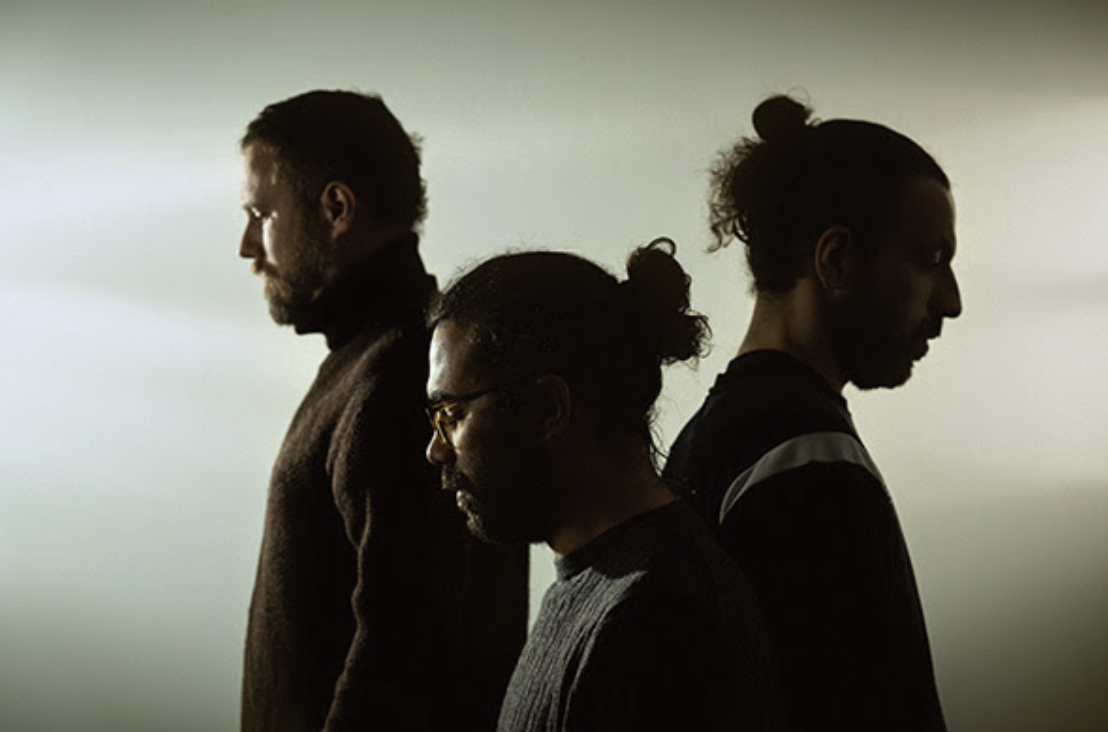
OUTER LIMIT LOTUS ‘Dazzling Darkness’
(Sheep Chase Records) (Digital Download)
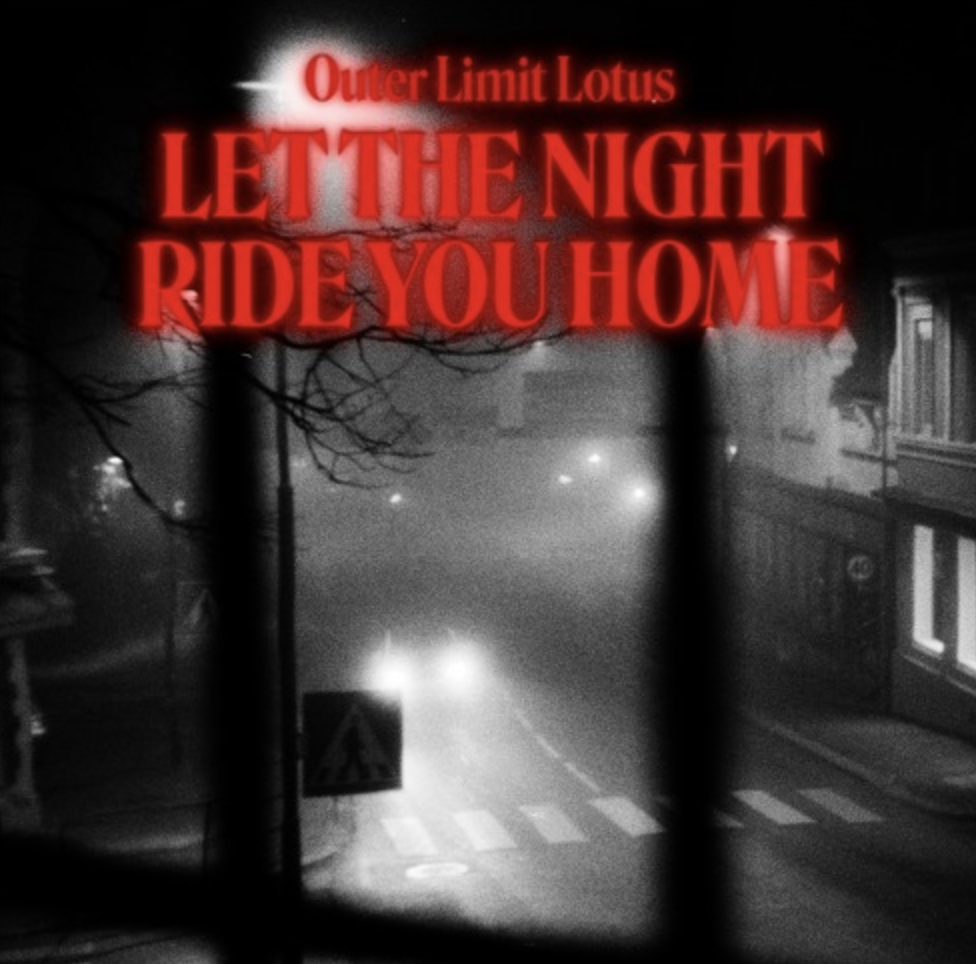
This is the dark new album from Norwegian post-punk band Outer Limit Lotus whose influences include Bauhaus and Christian Death. ‘Let the Night Ride You Home’ sounds like a Cure song played by Bauhaus – all spikey goth guitars, cobwebs and dark baritone with a screaming sax solo akin to the Pop Group. ‘Again Like Yesterday’ is reminiscent of Bauhaus and 80’s bands like the Sisters of Mercy. Meanwhile, ‘The Beach’ sounds like a song that could complete the soundtrack to any teen vampire flick. If you like your music dark, goth, with the sound of 1980’s alternative, then this is for you!
BOOM PAM ‘Royal’
(Batov Records) (Vinyl/Download Album)
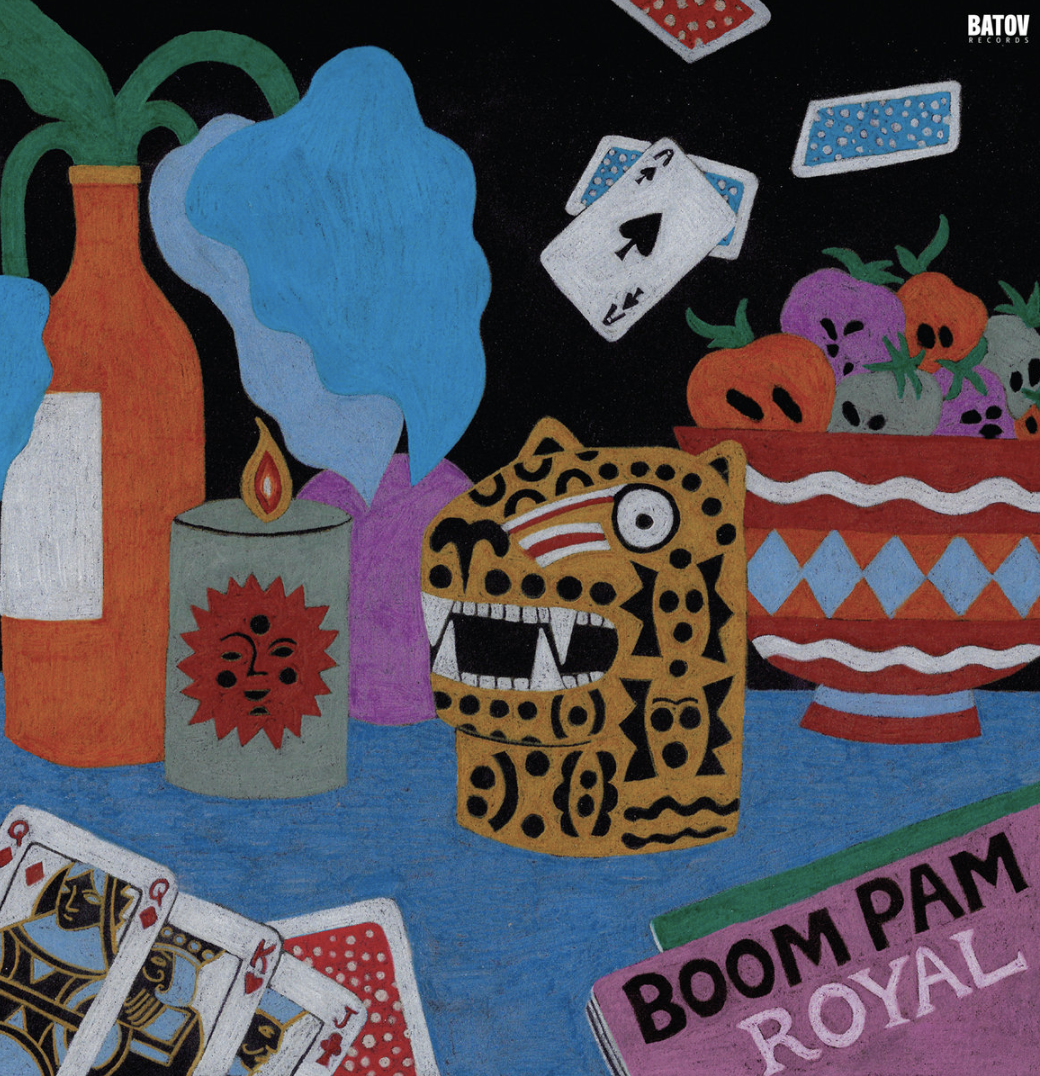
The Tel Aviv band produce another album of disco surf spaghetti western instrumental mish-mash music that would be great played at Butlins whilst waiting for the next terrible act. If it was an album recorded in the 1970’s it would perhaps be a much sort after holy grail of cheese fest! I kind of like it for lots of non-musical reasons! Terribly good!
THE KINGFISHERS ‘Reflections In a Silver Sound’
(Last Night From Glasgow) (Vinyl/Download Album)
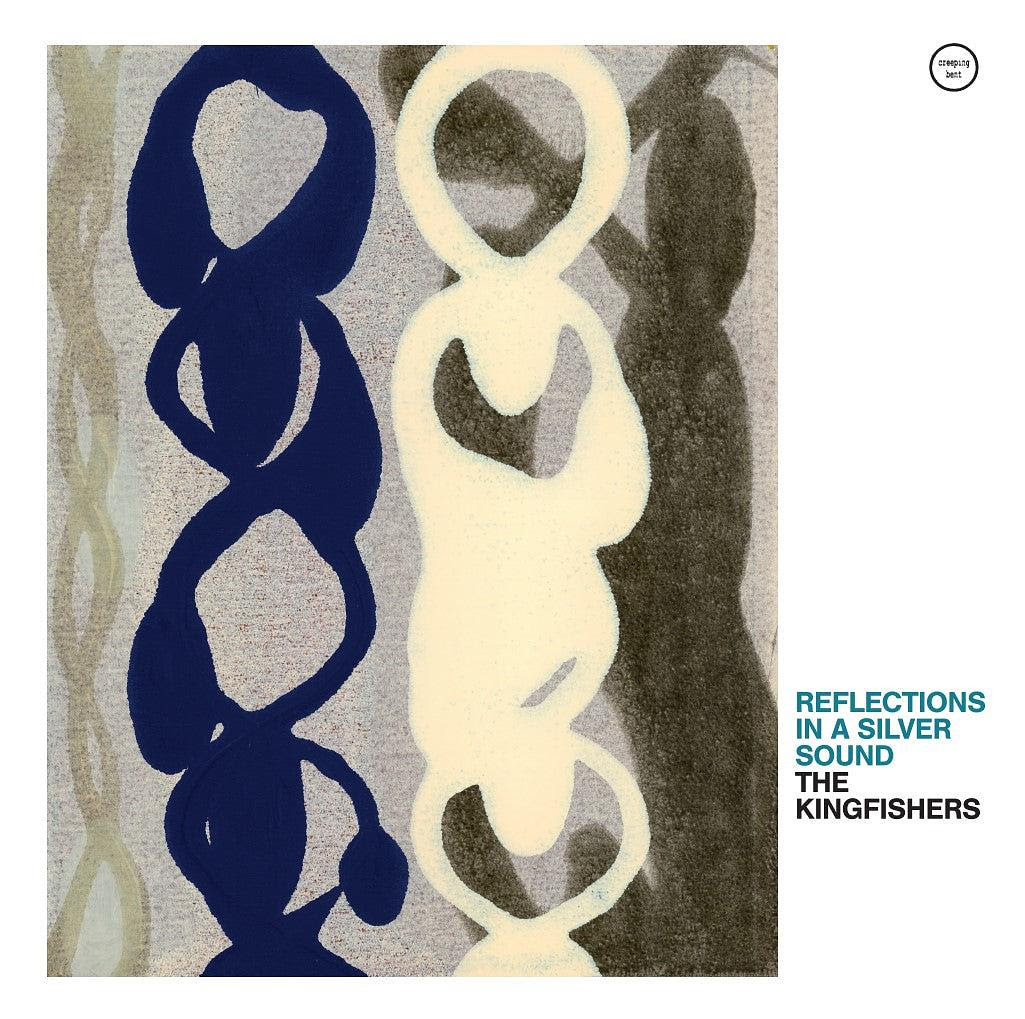
The Kingfishers formed in 1982 and split a year later after playing gigs with Aztec Camera and Prefab Sprout, their album unfinished. 40 years later their debut album is now available and what a great album it is. It is an album of melodic memorable pop songs that owes much to the sixties in its beat group sound that lies somewhere between the Searchers, the LA’s and Aztec Camera. A lost classic? Perhaps!
SACROBOSCO ‘IVXVI’
(Travarobato) (Digital Download Album)
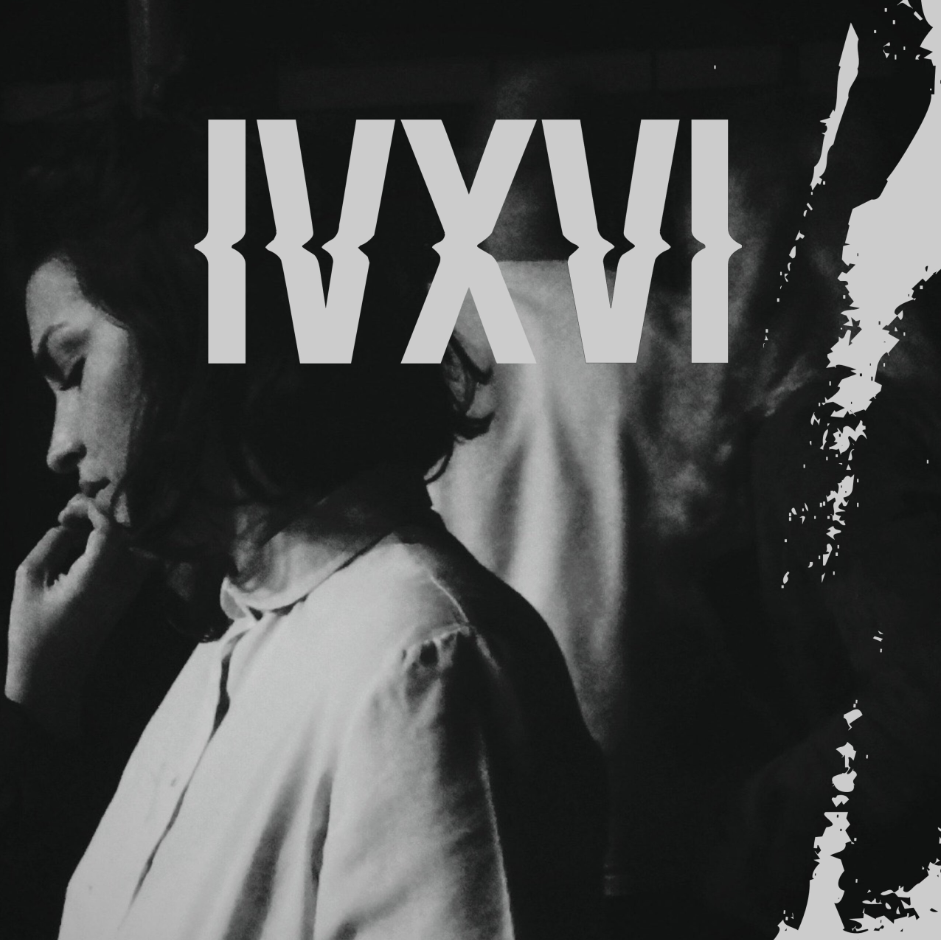
An arresting album of electronic music from Italian producer Giacomo Giunchedi. The album is sprinkled with samples from some of the greats of Spiritual Jazz including Alice Coltrane and Pharoah Sanders. The single ‘Faint’ begins with a looped female choir that is hypnotic to listen to and reminds me of Julianna Barwick while the music has echoes of The Cinematic Orchestra and DJ Shadow. ‘Hashimoto’ meanwhile sounds like a Japanese Garden grown by AI and is disturbing in its repetition. An interesting album of cool ambience that will appeal to many but won’t be to everyone’s taste!
Psyché ‘Self Titles Debut Album’
(Four Flies Records) (Digital Download Album)
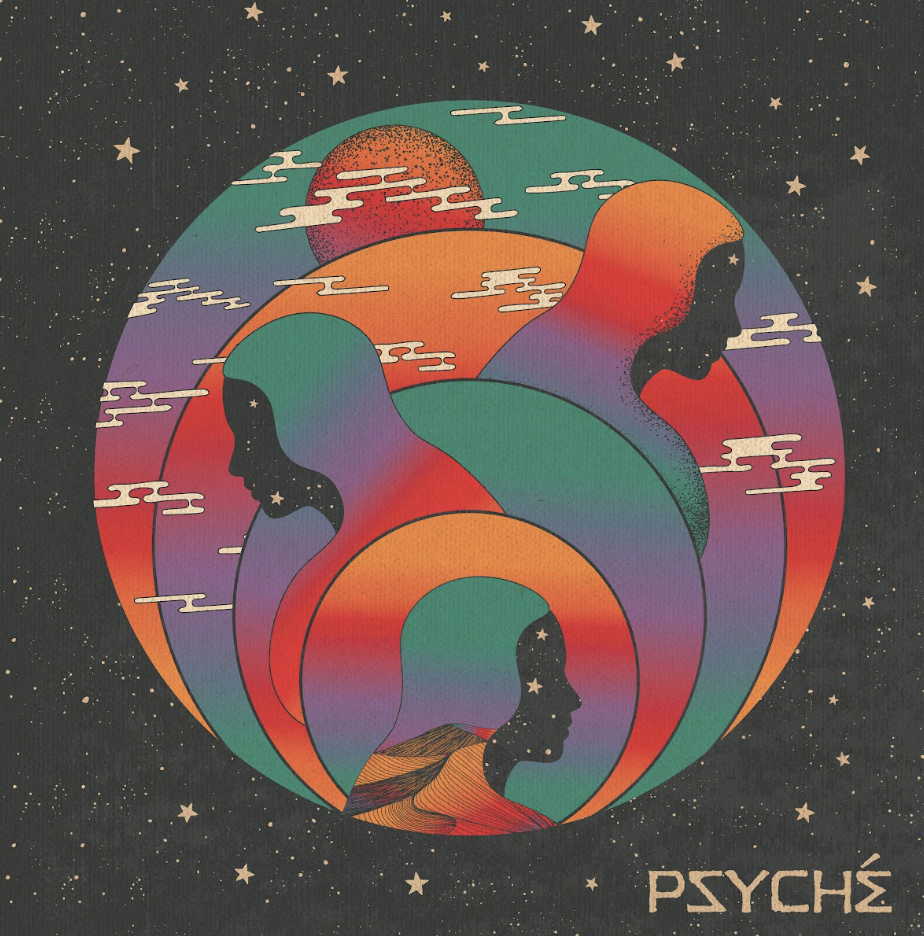
This is a brilliant album of funky Mediterranean psychedelic instrumentals that sits somewhere between Khruangbin and the Barry Gray Orchestra! Every track is a Gem! Wonderful!
ELEVEN MAGPIES ‘Two for Joy’
(Cuculi Records) (Bandcamp – CD / Digital Download)
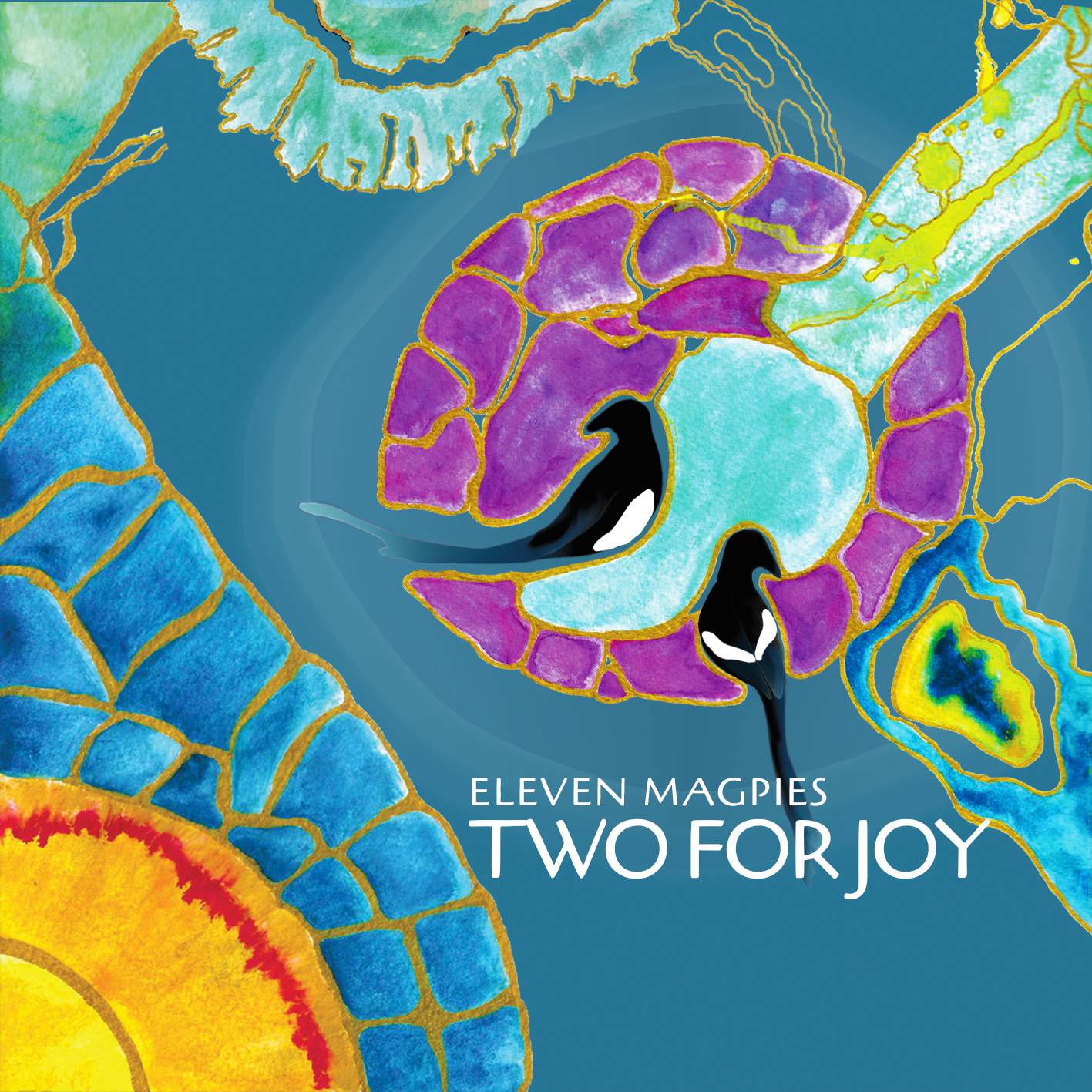
This is the second album from Bristol based Folk Instrumental Quartet Eleven Magpies. The album consists of thirteen instrumental pieces that could easily fit into any documentary or film about the countryside or farming. The music is also interesting enough to be listened to without visuals with its calm rustic feel and hints of traditional Gaelic music.
Premiere: (EP) Coded Scott ‘Binary Beautiful’
June 7, 2023
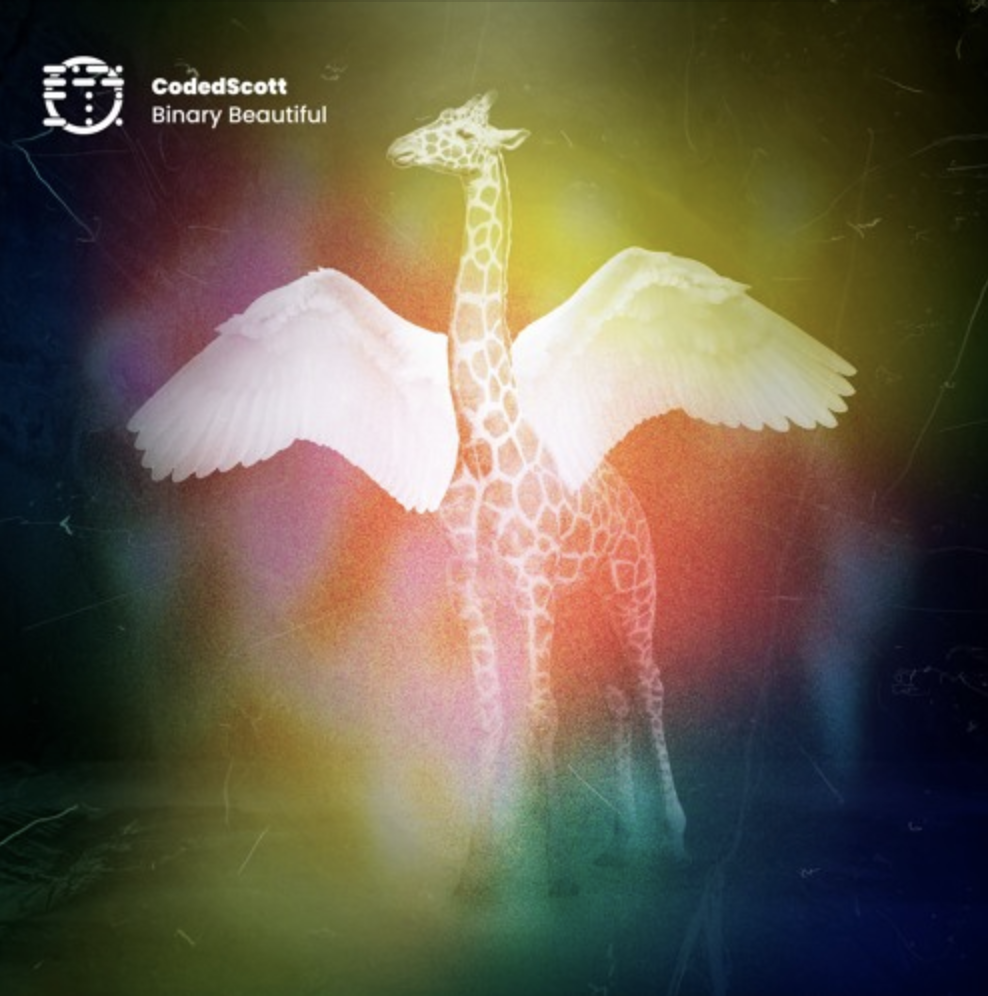
Coded Scott ‘Binary Beautiful’
9th June 2023
Ushering in the summer with a homage of a kind to the ingenuity of human technology and the, now nostalgic (in the face of AI and promises of quantum computers), binary system, the Wiltshire-based electronic musician-producer Scott Sinclair offers a quartet of trance, dub-techno variations on his main theme with the upcoming Binary Beautiful EP.
Causing a buzz on the local Bristol scene off the back of his Twisted Metal release in 2019, Scott (who goes under the Coded Scott alias) now creates a celebratory vaporous and swimmingly radiant, hazy dance track from the zeros and ones. From that original ‘Energetic’ version of Orb, System 7 and Seefeel-like electronic trance, cyber birdsong and wooded glen sunlit glow, there’s a trio of transported and playful versions that either further entrance or build on the lattice of code.
As the title suggests, the ‘Drift Away’ version does just that; floating a reworked vision of sophisticated new age and contemporary modulations, tight rattled synthesised beats and reflective surveying of the Wiltshire landscape. The ‘Sunshine’ version conjures up a lush birdsong serenaded tropical world that weaves together reverberations of Musicology’s ‘Telefone 529’, FSOL, Banco De Gaia and what sounds like a 80s Prince style beat. The finale, ‘Lost Edit’, has a subtle groove emerging from the quarks and plastic tubular beats, as Scott balances tech with an organic sun-refracted feel: those binary calculations have seldom sounded more natural, attuned to a light-dappled geography.
Scott had this to say about his EP: “…through untold numbers of ones and zeros, Binary weaves a story that connects people, creates memories, and moves us to tap our feet and nod our heads. It’s a truly beautiful thing.”
The Monolith Cocktail has been given an exclusive opportunity to premiere and share that EP with you all, ahead of its release on the 9th June. You can pre-order Binary Beautiful through Scott’s Bandcamp page here.
ALBUM REVIEW BY ANDREW C. KIDD

Gabríel Ólafs ‘Lullabies for Piano and Cello’
(Decca Records) 9th June 2023
Unsurprisingly, Icelandic lullabies are hard to come by. The few that do exist are comparatively bleaker – less cradle song; one could argue abstruse. Take the title of Móðir Mín Í Kví, Kví (in English, Mother of mine in the sheep pen), or the lines of Bíum bíum bambaló, a lullaby from Iceland made famous by Icelandic post-rock stalwarts Sigur Rós: ‘Bíum bíum bambaló / Bambaló og dillidillidó’; in English, ‘My little friend I lull to rest / But outside, a face looms at the window’. Still, a lullaby in the orthodox sense should serve to lull. Enter pianist Gabríel Ólafs. Lullabies for Piano and Cello offers something altogether gentler and less menacing. It is his second long play after the 2019 release Absent Minded, which earned him plenty of plaudits.
The opening piece is the spry Fantasía. It is finely poised and well-balanced. The long notes of Sigurðardóttir’s cello play slowly and jig around the piano keys that staccato and pirouette. Sálmur derives its title from the Old Norse word ‘salmr’, a psalm. The keys are bittersweet. Here there is clever use of the foot pedal: Ólafs holds the notes suspensefully, allowing the cello to inhale and exhale measuredly as they alternate between legato and bowed tremolo. Octaves are climbed by the piano, but the cello remains rooted in the bass clef. Moonlight streams in glittering certitude on Noktúrna. The piano is light and a little more distant than it was previously, perhaps in the same way that the eye perceives the blue light of the moon: familiar but altered – illusory even. Embers emerge and billow away on Eldur (from the Old Norse ‘eldr’, or fire). The cello enters and vacates as quickly as it emerged. It echoes the
piano, elongating the notes as it evaporates into the ether.
Ólafs is an effective narrator. On Frost, the left-hand plays gently. Its melody is simple and dots around a major scale. It is clear and glistens and is made momentary as it welcomes the sun; soon, it will become water, evaporating to air, exiting the world as quickly as it entered it. Is it too far-fetched to suggest that this is a bleak allegory of life? I shall leave that for the listener to decide. It is an Icelandic lullaby after all.

The harmonics of the cello play quietly, deepening the piano on Vísa. The melody is played legato. It is fluent. This deftness, this wonderful una corda (soft pedal) of the piano is felt again on Mamma which almost progresses into a lullaby; I write ‘almost’ because although the structure is circular, the melody is not repeated. Barnkind is Icelandic for ‘child’. The cello is the sole focus here. In the accompanying album notes, the cello is considered to be the “mother’s voice, sometimes speaking, sometimes singing” – this assertion is most evident on this piece. It soothes.
On Bambaló the cello bows quietly. It encompasses the mysticism of early folk – was this an ode to a tree, or a long-lost lover, or an ideal? The piece intensifies, yet the piano remains light and unimodal throughout. Its chords, its narrative, are progressed solely by the cello. The keys mimic in gentle accompaniment. It ends thoughtfully. Draumheimar is the final piece. It translates into English as ‘dreamworlds’. Clocking in at over three-minutes, it is longest piece on the album. The piano takes centre stage and plays a major key melody. I hear echoes of Ólafs’s previous LP at this juncture. The keys become less distinct and the hammer-action of the piano strings are audible here: they are dulcimer-like. It is pianissimo: very quiet; then calando: it softens and slows.
Lullabies for Piano and Cello is beguiling. Compared to much of modern-day classical composition, the pieces are very short, yet none are perfunctory. More so, it is completely emptied of electronics and field recordings. It is a work of simplicity. The melodies are short-lived and never reprised. Even more beguiling is the origins of this album: Ólafs chancing upon a collection of melodies in an antique bookshop. It beggars the question as to how many unplayed lullabies are lying unthumbed and unturned in bookshelves elsewhere in our world.
Our Daily Bread 576: Vieira and The Silvers, Tony Valentino, Fossil Beach, The Budos Band…
June 2, 2023
The idiosyncratic Brian ‘Bordello’ Shea rummages through another month of new and upcoming releases. (Unless stated otherwise, all releases are already available to buy).

SINGLES
Vieira and The Silvers ‘The Judge’
(Catch 21 Records)
There is something very Liverpool about this track; I was sure they would have been from Liverpool as they have the same Scouse pop feel that the Coral and the many bands from the Bandit era have. Maybe they take the same drugs and listen to the same records, either way this track is very good.
It starts off all Captain Beefheart and ends with the kind of Gospel inflections that Booby Gillespie would sell his favourite battered egg to have included on the much over-rated Screamadelica album; a good album, but not all as it is made up to be, unlike this single, which is pretty spiffing and yes spiffing is indeed pretty, and my word of the day. As is this single is my song of the day.
The Budos Band ‘Frontiers Edge’
(Diamond West Records)
I love this track; a sexy shimmy of spy Bond glamour with a hint of 60s hip swinging jazz in a spaghetti western type of way. The kind of track you want your night out on the town to be like – all glittered mini dresses bouffant hair and neon lights offering temptation and seduction. Yes indeed, just the kind of track to paint your evening. A hip swinging triumph.
Josienne Clarke ‘Anyone But Me’
“Anyone But Me” is a dark and bewitching folk song filled with both a sadness and relief that the affair is over, and I am quite taken with how Josienne sings the line, “how can you love anyone but me”. But that is the magic of song, a few brief seconds can transport one back to the dim and distant past and remember not so happy times. A beautiful song and an excellent video to go with it.
Beach Fossils ‘Dare Me’
(Bayonet) 2nd June 2023
Modern indie radio friendly guitar pop normally bores the pants off me: it does. I normally end up taking off my pants and wandering around the house with my them on my head, pulled over my ears whilst wondering how long the kettle is going to take to boil and what would come first: the boiling kettle or the end of the soulless dirge that someone has sent for me to review? Or the soulless dirge that BBC 6 music is forcing upon their daytime listeners, who I think have probably given up on life. But saying that, for some strange reason this song by Beach Fossil does not have that effect on me, even though it has all the lack of qualities that modern produced indie guitar pop has; the soulless production and the spray on radio BBC6 music sheen. But for some reason I like this. Why? Answers on a postcard.
bigflower ‘The Event’
The event by name, an Event by nature, we have a fine slab of mellow dance solitude that is both funky and slinky and electronic-like. And at just over three minutes long is far too short for its own good; double it and you have an ideal floor filler: yes, a floor filled with fine Manchester musicality. This could and should be a 12”, and reminds me a touch of Fatima Mansions in its dark outer grooves. How many times do I need to say, come on record labels sign this man up.
ALBUMS/EPS
Tony Valentino ‘Dirty Water Revisited’
(Big Stir Records) 26th May 2023

Tony Valentino was of course the lead vocalist with the 60s garage punk legends The Standells, and this, the Dirty Water Revisited album, is where he revisits his past with an album of reworkings of some the band’s classics, and some new songs too. And the reworkings of the classics are fun as all 60s garage songs should indeed be. “Good Guys Don’t Always Wear White” was always one of my fave garage rock songs and this version does not really take anything away from the original, as does none of the reworkings. And lets be honest, garage rock bands have been including these classics in their sets for years so why should Tony not revisit and pay respect to his own past. On the whole he has made an enjoyable romp of 60s garage punk/pop reworkings. And with last years new song single, “I’m A Sexy Punk Rocker”, included reminding us all where Iggy might have got some of his pop from.
Armstrong ‘Summer Is Here EP’

Summer is on its way, so what better way to celebrate than to listen to this 4-track beauty of pop overthrow; a quartet of summer breeze pop; an EP of pure jangle and sci-fi synths; a 4-track treasure of shadows of yesterday’s delights. But what else can one expect when it is the latest release from Armstrong, everybody’s favourite pop picker songs that has one thinking back to when Aztec Camera and Prefab Sprout would occasionally sneak into the top 40 and the internet was only something Leeds Utd supporters used to shout at three o clock on a Saturday afternoon. Sublime pop indeed and Summer Is Here is so summer sounding it has brought on my hay fever.
Cat Box Room Bois ‘Tinder Vittles’
(Metal Postcard Records)

Ah the lovely subtleties of American shambolic rock ‘n’ roll spews forth from this magical album featuring a member from the genius Legless Crabs. So it being shambolic rock ‘n’ roll is indeed nothing to be surprised at. And indeed, it is pure undiluted rock ‘n’ roll, with traces of the DNA of The Modern Lovers, Neil Young, The Marychain, the Velvet Underground and The Stooges in a loose and casual way that gives casual a new looseness.
It is the sound of a party in your pants. It is raunchy. It is sexy. It is funny. It actually sounds like a band rehearsing in your neighbour’s shed whilst the singer juggles extravagances in a cartoon denim and leather clad clown like way. Whilst the guitarist shows off his fretboard prowess imagining he was once a member of Red-Hot Chilli Peppers but was thrown out for being good and having lo-fi punk attitude. So if Lo-fi rock ‘n’ roll is your thing and you want an album that sounds like one of the most out of it bands from your neighbourhood jamming wildly on a summers day with the essence of weed and alcohol slowly drifting on a gentle summer breeze, or, The Beach Boys Party album but made by drug addled stoners brought up on a soundtrack of 70s Fm Rock and early 80s American punk , this album is for you. This a gem of an album.
Monthly Playlist: May 2023: Delilah Holliday, Tony Allen, Alecs DeLarge & King Kashmere, Lucia Cadotsch…
May 31, 2023
CHOICE MUSIC FROM THE LAST MONTH: TEAM EFFORT
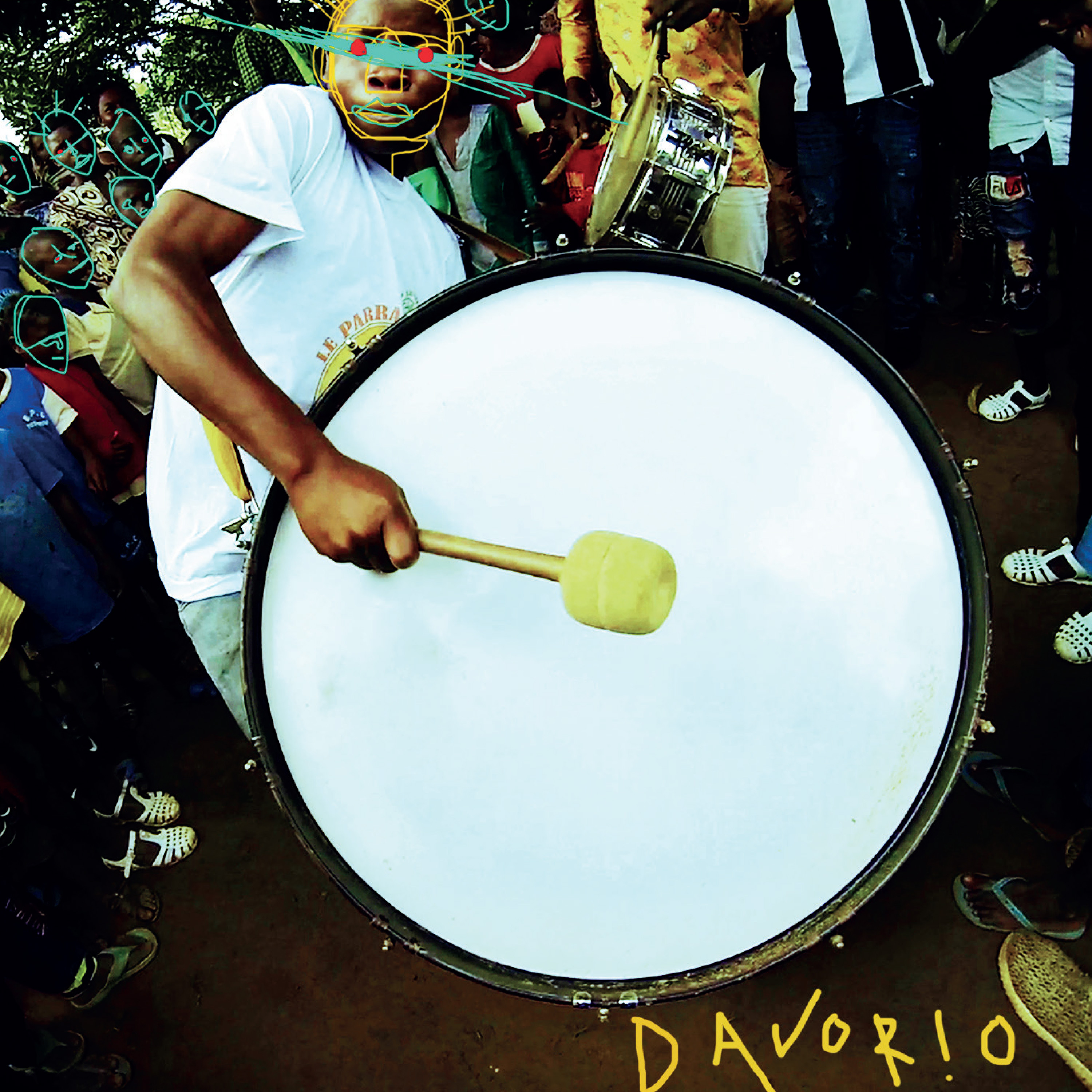
The Monthly Revue playlist of 2023; a choice selection of tracks from the last month on the blog. Curated by Dominic Valvona with Matt Oliver on the Rap Control once more, and music from reviews by Brian ‘Bordello’ Shea, Graham Domain and Andrew C. Kidd. Expect to hear the unexpected.
TRACKLIST//
Alecs DeLarge & King Kashmere ‘Damien Darhk’
Samuele Strufaldi ‘Davorio’
Les Dynamites ‘Pop Oud #2’
Andrew Hung ‘Ocean Mouth’
Matt Saxton ‘Freedom’
John Parish & Aldous Harding ‘Three Hours’
Lunar Bird ‘The Birthday Party’
YOVA ‘Feel Your Fear’
Atmosphere ‘Dotted Lines’
Illogic ‘Hot Lead’
Odd Holiday, Mattic & Daylight Robbery! ‘It Is Whut It Iz’
Delilah Holliday ‘Silent Streets’
Big Yawn ‘Crying’
Tony Allen ‘No Beginning’
Harold Land ‘Chocolate Mess’
Baby Cool ‘Magic (Live)’
Dyr Faser ‘This Menace’
Mekong ‘Out Of Control’
The Telescopes ‘(The Other Side)’
The Bordellos ‘Attack Of The Killer B-Sides’
Adjunct Ensemble ‘Nothing Grows/How Dare You Be Free’
Kassa Overkill, Danny Brown & Wiki ‘Clock Ticking’
Depf & Linefizzy ‘My Love’
Paw One ‘Sepekku’
Cas One ‘Silver Spoons’
Axel Holy & Badhabitz ‘Runnin’
Efeks, The Strange Neighbour & Downstroke ‘Its Only Right’
Chocolate Hills ‘Mermaids’
Orange Crate Art ‘We’re Just Innocent Men’
Tinariwen Ft. Fats Kaplin ‘Ezlan’
Cherry Bandora ‘Esy’
Danuk ‘Sewqo’
Lucia Cadotsch ‘I Won’t’
Jman & The Argonautz ‘Green Light’
Chuck Strangers & Obii Say ‘Say’
Billy Woods, Kenny Segal & Danny Brown ‘Year Zero’
Caterina Barbieri ‘Swirls Of You’
August Cooke ‘Flying Swimming Dredging’
Liz Davinci ‘I’m Through With Love’
Kayhan Kalhor & Toumani Diabate ‘Anywhere That Is Not Here’
Oceans ‘Mike Tysong’
Creep Show Ft. John Grant ‘Moneyback’
Jean Mignon ‘Canadian Exit’
GRAHAM DOMAIN’S RUN-THROUGH OF RECENT AND UPCOMING NEW RELEASES

__/SINGLES\__
THE TELESCOPES ‘Where Do We Begin’
(Tapete Records) (Download only Single)
It seems only vocalist Stephen Lawrie remains from the original group and only his voice reminds of The Telescopes classic sound!
This is the first single taken from forthcoming album Of Tomorrow. As such, it sounds a bit like the House of Love with Lou Reed – a psychedelic song about filling in the hole in your soul with more emptiness – the modern consumer society looking for fulfillment amid the waffle of internet influencers, ‘reality’ celebrity and brand name hypnosis! I await the new album with interest!
MATT SAXTON ‘Freedom’
(Bandcamp) (Download Single)
This is an electronic track with folktronica leanings that reminds me of John Grant. It’s a delight – like eating your favourite ice cream! Give it a listen while eating a Cornetto!
YOVA ‘Feel Your Fear’
(Bandcamp) (Download Single)
Unusual pop song from Yova – interesting, odd and compelling! Yova are a duo – with exposure they could be massive!
SALEM TRIALS ‘ESPERS SYC (See Your Crime)’ / ‘End of Level Boss’
(Metal Postcard) (Download Double A Side Single)
Excellent Double A Side from Salem Trials – ‘Espers SYC’ comes across like the Fall playing a speeded-up Joy Division ‘Exercise One’ – some nice jarring chords and fried bacon rhythm!
With singalongs like ‘reasonable doubt my arse’ it could become a staple at Strangeways Indie disco! The crime? Presumably using your intuition (ESP) – contravening Section 7 of the State Controlled Thought Act 2023.
‘End of Level Boss’ meanwhile conjures up the ghost of Ian Curtis dancing to James Brown after the sacked JB’s were replaced by a funky Sunn O))) – Mesmeric!
___/ALBUMS\___
OCEANS ‘Dreamers in Dark Cities’
(Bandcamp) (Vinyl/DL)

There are a few bands named Oceans but this particular band hail from Melbourne Australia. They sound like they have been listening to a lot of 1980’s indie music like the Sound, the Chameleons, New Model Army, Cocteau Twins, Pale Saints, Slowdive, The Scars.
‘Pure’ sounds like a poppier Pale Saints and is perhaps the best song on the album. “I just want to feel alive” he cries as the music rises in life affirming sonic radiance! ‘Apart’ reminds me of the Scars with touches of Ride and Pale Saints. ‘Feels Like You’ hints towards Slowdive, MBV and Ride.
‘Mike Tysong’ sounds like New Model Army circa ‘The Ghost of Cain’ but with vocals akin to Adrian Borland (the Sound of ‘The Lions Roar’ fame). ‘Soft’ has hints of The Chameleons guitar sound combined with vocals akin to Lush! ‘Look Into My Eyes’ employs the 3 / 4 rhythm beloved of The Cocteau Twins circa ‘Treasure’. An album of youthful energy and life affirming beauty. The songs are energetic, well-constructed and well-produced. I like the album, but the band need to bring more of their own creativity to the table so they sound like themselves rather than the sum of their influences. Once they find their own sound, they will be magnificent. They are part way there and I predict great things for them in the future.
CREEP SHOW ‘Yawning Abyss’
(Bella Union) (CD/Download Album)
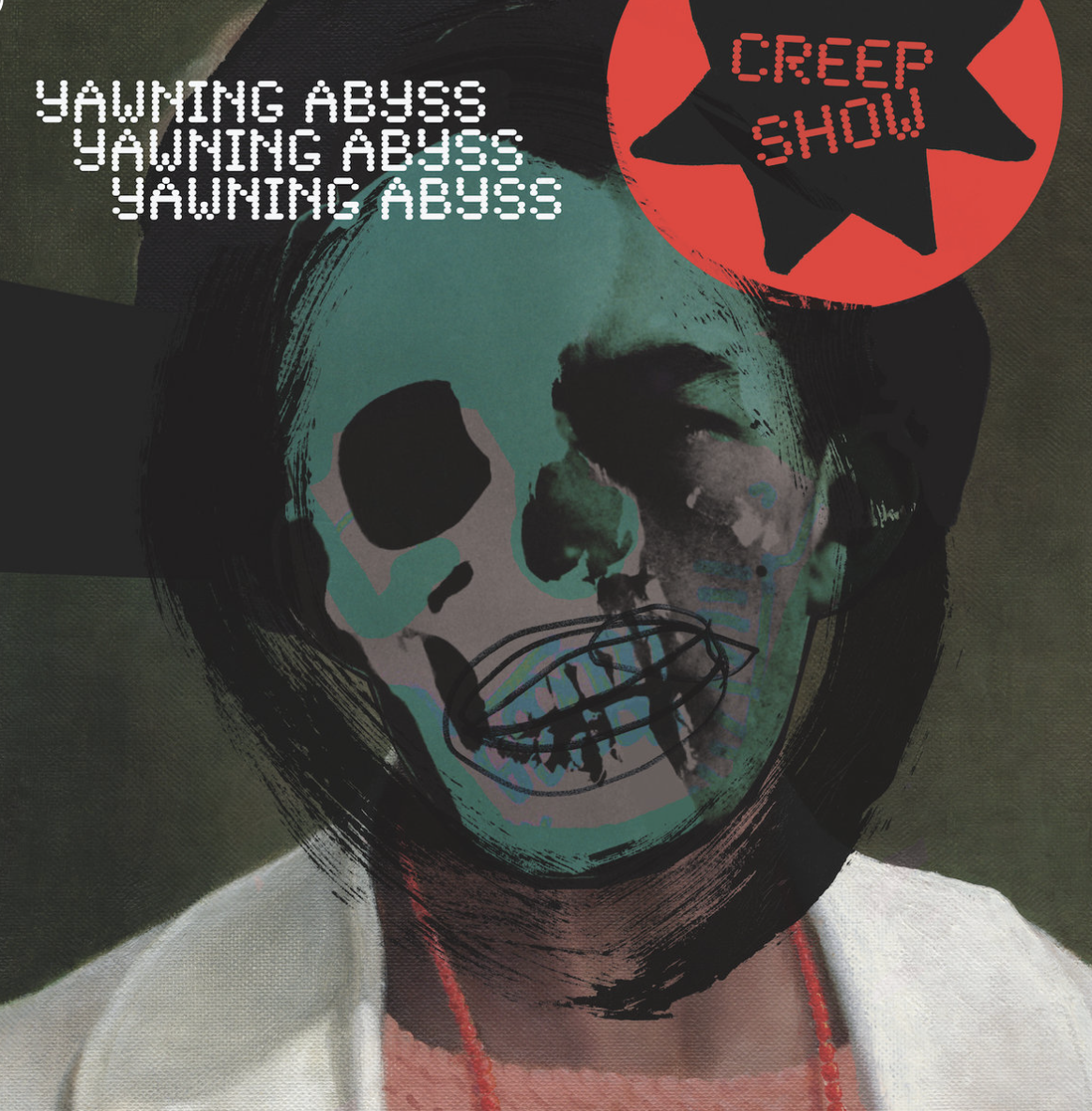
Make no mistake, John Grant is a genius! As half of Creep Show he provides the moments of sheer joy! ‘Bungalow’ comes over like a song that could have been on any of his brilliant solo albums, post ‘Queen of Denmark’. It’s a fantastic vocal, the music dark, funny, sexy, – electronic music at its best and a good song to boot! Elsewhere we find him singing strange rhymes on the title track ‘Yamning Abyss’ – a song that grows on you with each play.
The band Wrangler are the other half of Creepshow. Cabaret Voltaire’s Stephen Mallinder sharing vocal duties on such tracks as ‘Moneyback’ – “You want your money back / I didn’t think so”! Overall, a fine return from Creep Show who are doing a short tour of the UK over the summer!
JEAN MIGNON ‘AN/AL’
(Metal Postcard) (Download Album)

Raucous debut album by New York based Johnny Steines. A mixture of high energy garage punk and high-speed rock and roll – it sounds like a live album such is the energy contained in the grooves!
‘Tackled By Men’ recycles parts of ‘Jumping Jack Flash’, whilst ‘Canadian Exit’ has echoes of Warsaw’s ‘Failures’. If he can produce this excitement in a live-setting he willsurely make his own impact! Primal Rock and Roll that screams from the speakers andexcites like a high-speed car chase!
Key Tracks: All of them!
The BORDELLOS ‘Starcrossed Radio’
(Metal Postcard Records) (Download Album)

The latest release by St Helens finest is a cabinet of curiosities containing some wonderful lo-fi gems and hitherto lost standards!
Beginning with the glam stomp of ‘Attack of The Killer B-Sides’ – name checking great B- Sides by the likes of The Smiths, Stone Roses, The Beatles, Billy Fury, Shangri-Las, New Order, Rolling Stones, Mersey Beats etc… All delivered in a Mark Smith type drawl. Like any music fan, flipping a 45 over and discovering a great B Side was exciting and would lead to more investigation of the artist’s music.
‘Never Learn’ sounds like a lost standard to me – reminding of Morrissey when he was good, the accordion sound giving it a shade of the Pogues! The nice melody is under-pinned by what sounds like a balloon deflating, a synth or a cat being slowly trod on mixed with static and silence! Experimental brilliance!
‘Free New Music Day’ meanwhile takes the sound of the Doors Texas Radio and the Big Beat and transfers it to Northern England where you can ’take a cut price trip to the stars – singing Hallelujah in Karaoke bars’ – poetry from the streets Jim Morrison could only aspire to!
Other highlights include the strange melody picked out on guitar on ‘Sunk and Screwed’, which could be the theme to a weird kids cartoon! Oddly disturbing! I’m still humming it! ‘Vicious Circle’ could be a single. ‘Hurting Kind’ sounds like a lost Beach Boys campfire surf song – Brilliant!
The album ends with the sublime ‘Life Love and Billy Fury’ – a part electronic song where the melody or maybe some of the chord changes put me in mind of New Order without actually sounding like them! Great lyrics – another ‘lost standard’!
This album is one to treasure, an Aladdin’s cave of eclectic life affirming songs. The Bordellos are the fine web that holds the stars in place!
A May Digest: August Cooke, Andrew Hung, Amon Düül II, Julian Cope, Social Playlist #76…
May 25, 2023
New Music on our radar, archive spots and now home to the Monolith Cocktail “cross-generational/cross-genre” Social Playlist – Words/Put Together By Dominic Valvona

PHOTO CREDIT:: ZOE DAVIS
A new thread, feed for 2023, the Digest pulls together tracks, videos and snippets of new music plus significant archival material and anniversary celebrating albums or artists -sometimes the odd obituary to those we lost on the way. From now on in the Digest will also be home to the regular Social Playlist. This is our imaginary radio show; an eclectic playlist of anniversary celebrating albums, a smattering of recent(ish) tunes and the music I’ve loved or owned from across the decades.
May’s edition features new music from Andrew Hung, Laraaji & Kramer, Chocolate Hills, August Cooke and Läuten der Seele. And in the Archives there’s the 50th anniversary of Amon Düül II‘s Vive La Trance and 10th anniversary of Julian Cope’s Revolutionary Suicide to celebrate and look back on.
NEW MUSIC IN BRIEF
Andrew Hung ‘Ocean Mouth’
(Taken from the upcoming Deliverance album, released the 11th August on Lex Records)
Still envisioning hope in the expanses of what is a purer future constellation, former Fuck Button foil turn soundtrack composer and trick noisemaker producer (a pretty deft portrait painter too as it happens: see the Frank Auerbach-like artwork that accompany his solo releases) Andrew Hung is back with another candid, if universally reaching, album of diy methodology big sounds. Yes big, as in anthemic, with tracks that build towards cathartic outpourings. None more so than the first track to be aired from the upcoming Deliverance album (released by Lex again, later on in August) ‘Ocean Mouth’. A rave-y Bloc Party and White Lies in a hopeful union with a Robert Smith fronted Freur, Hung is both humbled and in heartfelt consolatory spirit as he progresses from fear to love whilst facing a litany of truths, anxieties and realisations: A therapy session of the highest musical quality. As with all Hung’s material, it only gets better and better, and this album looks set to be every bit as connective and reaching as 2021’s Devastations (a Monolith Cocktail choice album of that year no less).
Laraaji & Kramer ‘Submersion’
(Taken from the BAPTISMAL – Ambient Symphony #1album, released 2nd June by Shimmy Disc)
Divine styler of radiant ambiance zither spiritualism Laraaji can be found in communion with no less a pioneer than Shimmy Disc founder and downtown no wave doyen Mark Kramer, on this latest release from the New York label. Two pioneers of their form together over four movements of immersive, deeply affected mood music, draw on their extensive knowledge and intuition to create suites rich in the mysterious, the afflatus and more supernatural. Cycle One in this collaboration is a Baptismal symphony, the first part of which, ‘Submersion’, I’m sharing with you all today.
See also my review of Laraaji’s iconic ‘Ambient 3: Day Of Radiance’
Chocolate Hills ‘Mermaids’
(Taken from the Yarns from the Chocolate Triangle album, released by Orbscure on the 16th June)
Floating a fantastic voyage into the Bermuda Triangle, the long-running collaborative duo of Paul Conboy (Bomb The Bass, Metamono) and The Orb‘s Alex Paterson conjure up signature lost sounds and immersive languid soundscape on their new album together, Yarns from the Chocolate Triangle. Under the lunar and ether inhaled Chocolate Hills alias, the foils mine their vast experience and CVs of electronic, ambient, analogue cult sounds, library music, kosmische and new age to navigate that forbidden zone phenomenon of lost ships, aeroplanes and people. It makes for an interesting cartography, as this short teaser, ‘Mermaids‘, shows. Expect to hear more at a future date: maybe even a review.
See also my piece on Metamono’s Creative Listening
August Cooke ‘FLYING SWIMMING DREDGING’
(Single release via Poets Studio)
As debut’s go, this beautifully subtle chamber-pop draw from the London-based cellist, singer and composer George Cooke is a stunner. A tastefully orchestrated evocation of such luminaries as He Poos Clouds, Arthur Russell and Surfjan Stevens, Cooke (going under the August Cooke alias) slowly builds up an emotive momentum of understated lush hymnal magnificence. He’s aided by the full choir chorus and harmony of pupils from the West London Free School and the accentuated clarinet and saxophones of the Mumbai-based multi-instrumentalist Shirish Malhotra (Zakir Hussain, Symphony Orchestra of India). Theme wise, Cooke directly challenges the listener: if our planet was radically different, would our principles remain? A promising start indeed.
Läuten der Seele ‘Schlupfzeit’
(Taken from the Ertrunken Im Seichtesten Gewässer album, released 7th July on World of Echo)
A magical. mysteriously unveiled, often in childlike awe, world emerges on the latest recording from Christian Schoppik (aka Läuten der Seele); a fantastical peregrination of environmental changes on a particular spot.
“Somewhere in the Lower-Franconian vineyards lies a hidden and mostly unknown canyon, a place that often returns to the thoughts and dreams of Läuten der Seele’s Christian Schoppik. Though a much rarer occurrence now as a consequence of environmental change, chance encounters upon the area in the past would sometimes reveal small ponds amongst the reeds, teeming with life and populated by colonies of newts and the now endangered yellow bellied toad. The transience of the water and the wildlife it hosts, dependent on season or climate, lends the area an almost fantastical, dream-like quality. Was it ever even there at all? A secret place that may or may not be present holds vast appeal to some enquiring minds… Ertrunken Im Seichtesten Gewässer, the third Läuten der Seele album in two years, is inspired directly by these experiences. Translating as ‘drowned in the shallowest stretch of water’, a title as pregnant with dread as it is wonder, the themes present speak both to personal memories and a wider understanding of place and time, and how we might interpret our own position within an ever-changing, sometimes disappearing world.
The record is presented as two long-form pieces divided into four separate movements, each titled so as to reflect this natural environment and its intersection with imagination, relying on processes of collage that draw from myriad indeterminable samples, field recordings and various recorded instruments. Those familiar with Schoppik’s work, both as Läuten der Seele and with Brannten Schnüre, will find present many of his signature tropes – the way deeply layered collages render abstracted visions of the past alive in the present – though what is always significant about his approach is not so much aesthetic as the wider concepts it attempts to express and emote. Indeed, emotional response is key to the Läuten der Seele sound, how overlapping notions of nostalgia, memory and identity calibrate experience and understanding of who we are and the world around us, whether it’s a world that’s gone or another imagined into being. If you observe the artwork closely enough, you may find a clue as to the canyon’s location, though such specifics are beside the point. The music itself infers a wider sense of the impermanence that characterises hidden worlds, wherever they might be or whoever they might belong to.”
ARCHIVES/ANNIVERSARY
Amon Düül II’s Vive La Trance Reaches Its 50th Anniversary

Admittedly not one of Amon Düül II’s best, Vive La Trance embraced a weird concoction of Roxy/Bowie glam and earnest sincerity bordering on the whimsy at times. And yet, it had its moments too as my original essay on this much discounted album in the Bavarian band’s cannon will testify: especially almost debauched Weimar Republic punk hysterical ‘Ladies Mimikry’ and Renate Krötenschwanz-Knaup prophetic Kate Bush performance on ‘Jalousie’.
Grounding:
1972 to 1973 proved bumper years for the Duul, with five albums in total being released across that timespan.
Vive La Trance was the last album of what might be argued their most productive period: though it came with some derision. To be truthful, in part, this record is the sound of a band worn-out and fatigued, with its wide genre-spanning catalogue of songs and its rather awkward Euro rock clichés. The band now more than ever flittering with commercialism.
Recorded in the spring of ’73 Vive La Trance contains many highlights despite its more structured songwriting approach. Saying that though, they did manage to maintain an ear for the esoteric, and also still conveyed their political leanings.
Songs such as ‘Mozambique’ acted as a rallying testament to the man and his raping of both a nation and a continent in the name of colonisation. Furthermore it carries a dedication to Monika Ertl, who was killed by Bolivian security forces in Hamburg that same year – Ertl was a member of the Marxist revolutionary group alleged to have taken part in the assassination of the general responsible for capturing and killing Che Guevara. At the time she was bringing a former Nazi war criminal to justice and was leapt on by South American agents whilst back in her homeland.
This move away from their more pagan and Gothic sounding heyday didn’t lead them away from the harsh realities of the upheavals in society – oh no! Whilst in the UK we were dressing up in glitter and having a jolly good time with glam rock, Germany was still gripped with the Baader Meinhof fall-out and the political right still crushing those who didn’t toe the line. Amon Duul II remained resolute in their ideals.
This album has some more touching and less establishment baiting moments on it with songs like ‘Jalousie’, a Kate Bush sounding lament built on a wordplay of surveillance – using the double meaning translation of the title it describes a touching but fateful meeting of minds in a fleeting moment, an affair of sorts watched on by a third party.
The tune ‘Manana’ has another warm and glowing feeling to it as a mariachi backed band ambles its way pleasantly enough through a quick three minute little ditty.
Also featured on here is what can only be described as proto punk with the track ‘Ladies Mimikry’: an attempt at both Bowie and Roxy Music, which ends up sounding like none of them. Instead they create an entirely new genre.
The players on this album are made up of the usual hardcore that played on Wolf City and the UK tour; though they lost Danny Fichelscher on permanent loan to Popol Vuh.
Lothar Meid hung on in the background, though he now joined the lesser-known side act Achtzehn Karat Gold from whom Keith Forsey also joined.
New member Robby Heibl made a huge contribution to the new line up, playing seven different instruments throughout the record.
Falk U Rogner upped his contribution as now most of the band received writing credits and swapped around instruments. The vocals were shared mostly between Chris Karrer and Renate; backing came from a number of affiliates.
The albums artwork was provided by both Falk and Jurgen Rogner this time round with what looks like a drying out photo hung up by a clothes peg surrounded by a strange electrical storm background. Amon Duul II’s moniker is made up of machine looking letters, which are made to appear as if they are in motion, the albums title sits between the two undisturbed and rather plain.
Turning over to the back cover and you are met with a number of photos depicting the band in various states of dressing up. Their costumes look Elizabethan except for one member who’s dressed up in a lion’s costume. Renate gets away with being dressed in a floppy hat though one guy looks like the guitarist from Slade has dressed him.
They are all photographed in the middle of a road, no it’s not an analogy to the music found within.
Review
A Morning Excuse’ opens the album with a bird-call effect delivered from Falk’s VCS3, as a repetitive guitar riff slowly jars away in the background. Chris Karrer sings in a semi mock disdain at first before dropping to an emotional lament in the chorus; his attempts at holding on to some lost love are conveyed in this warming little pop song. This tune slightly boxes in any attempts for the free flowing musicianship of Amon Duul II to really let go, the plodding rhythm treads water until we hear the quirky twist half way through which emphasis that there is still ingenuity at work.
‘Fly United’ falls back on the previous folk echoes of Carnival In Babylon as Weinzierl plays some prime cuts of bass and adds some great lead guitar work. Renate and new boy Robby take on the vocals with a forlorn poetic series of spiritual slogans lifted from the headier days of the commune. The middle section breaks out in a nod to Wolf City before drawing to its conclusion: clocking in at a healthy three minutes.
Renate is given centre stage to perform a proto Kate Bush style vocal on ‘Jalousie’. This track is a slice of the fantastical, delivered as a soft focus ballad – it’s among the most endearing Duul tracks of all time. The title translates as both French for jealousy and is a type of Venetian blind window. This is a play on words then, which conjures up some romantic meeting of minds behind closed doors, whilst secrets are brought to the boil in a fleeting moment of connection: break out the fucking Mills & Boon.
A song of two parts, the middle section builds to a rolling rally cry with some subtle but moving melodies that cleverly encapsulates the affair as its being unveiled.
The long German titled ‘Im Krater Bluhn Wieder Die Baume’ roughly translates as “in the grater again Bluhn Baume”: nope still none the wiser!
A pastoral old folk like medieval canter that does its best to sound interesting but merely acts as an instrumental segue way. Falk’s organ is surrounded by light drum breaks and rock guitar licks as it merrily dawdles along on its short journey. It makes way for the classic three-part side one climax ‘Mozambique (Dedicated To Monika Ertl)’; a return to the past glories of Yeti.
The intro starts off with a pleasant enough African humming choir accompanied by a chorus of hand drums before being cut off and making way for some power folk. Renate on lead vocals sings quite literally of the white man’s rape of the continent; Mozambique has a history of civil war and rebellion, dealt a particularly harsh horrid blow from their old colonial masters. The chopping off of hands and other such ghoulish details follow as freedom is advocated through the good fight against the Westerners’ tyranny. The pace is picked up as it really starts motoring along and turns into some kind of space rock jam; the vocals become more harassed as Renate with shocking disdain makes us all feel bad. An eerie whispered message of “good night and fight” emerges from the fade out at the end of the epic seven-minute opus.
The Monika Ertl dedication in the title was for the daughter of Hans Ertl, a well-known German cameraman who was involved in the early Nazi Propaganda films before immigrating to Bolivia. There was a program of emigration to South America during the thirties, call it a colonisation of sorts, as thousands of Nazi sympathisers bought land and set up farms there. Monika turned against her father’s ideology to embrace Marxism, joining the Bolivian underground movement before being involved in the murder of the man thought responsible for the death of Che Guevara. In the same year that Amon Duul II recorded this album Monika was ambushed by Bolivian security force agents in Hamburg, at the time she was bringing a former wanted Nazi to trail. I think the band gave her a good send off. A fascinating women who if you ever get a chance you should look up.
Flipping over to side 2, the dry witted entitled ‘Apocalyptic Bore’ seeps through the speakers with its swirling UFO effects emulating from Falk’s faithful VCS3 and Harmonium. A voice over from Saturn via Sun Ra announces some cosmic slop before a sweet melodic acoustic 12- string perks up with a laid-back groove.
The story unfolds as higher beings decide to visit and make all our dreams come true, a paradise is created where anyone can do anything. This is backed up with at times a cringe worthy Euro rock shtick lead guitar solo. Of course time traveling becomes the norm as a time continuum is invented or something. People can live at any period in history at the same moment; let’s leave the crazy type Hawkings calculations aside.
No love, no war, no angst what a tiresome place.
Well what do you know! The kids hate it and get rather bored so the aliens decide to bugger off (“leaving for the great bear”): there’s gratitude for you!
‘DR’ is a tale of pills and bellyaches as prescription drugs are handed out willy nilly for all our ills. The music is awkward Bowie, and features some violin stabs to break up the track, though it eventually runs out of steam.
‘Trap’ lets Reante sing a tale of a credit card paying lover who obviously misread the signals somewhere down the line. Again a heavier structured track that almost has the first signs of the pub rock movement that was later to turn into punk emerging. The ending starts to get interesting but finishes in a predictable cut short manner.
‘Pig Man’ starts with a quasi-Lynyrd Skynyrd sounding intro before it breaks out into a lively little ditty. The jauntiness evokes some kind of unusual influences and doesn’t fit into any conventions I can think of. The lyrics stick it to those who left their conscience back in 69.
‘Manana’ means tomorrow, or it could be a reference to the Peruvian town. That aside it’s a slightly odd sounding song, which has a mariachi style band turns up to throw its lot in. Karrer does a good job on the vocals as some exotic type percussion accompanies him. It does grow on you over time.
The finale is the spiky titled ‘Ladies Mimikry’, a brooding bass line and melody sound, like the band is hauling themselves up a steep slope. Karrer’s vocals are at their most startled as he slowly loses his mind over the course of the track. A grinding punk like strutting backing sounds like a Gang Of Four in limbo. John Weinzierl on bass gets more and more angry as Karrer reaches the refrain of ladies mimicry; a loony inspired spitting delivery that sounds like he’s having electric shock therapy. A saxophone left over from Roxy Music’s debut album provokes a reaction akin to The Mothers Of Invention. Some serious hardcore theatrics at play; I can fully understand where punk came to take a breather before rearing its ugly head again in 1977.
Called the glam album by both fans and critics alike, it doesn’t really fall into any specific category and sounds distinctly German throughout.
Bowie and Roxy Music can be heard in here but not in the often derided way, I mean I’m sure Amon Duul II didn’t really want to sound like early art school glam rock.
Structured little tracks of the three minute length make this 11 track LP almost a commercial concern, the number of songs on display amount to more then the number found on the first two albums put together. This LP actually combines some very strange influences and falls into the Euro rock movement rather too well at times.
There are plenty of great moments on this album and it is still one of the best to come out of the period, unfortunately the next record Hijack even went further to confuse us all and upset many fans.
Julian Cope’s Revolutionary Suicide Is Ten This Month

Despite its promise of caustic spit and harmonious melodic nature, Julian Cope‘s ‘call-to-arms’ doesn’t hold back on the condemnation. As the title of both the leading track and album alludes, Cope’s revolutionary pride leaves the listener in no doubt. Not so much hectoring, or even bombastic, the arch druid of modern counter culture picks apart his prey with élan; attacking both failed revolutions from the here and now; lambasting the church; and bravely taking issue with the perceived – though the evidence does suggest that there is indeed a silent conspiracy – erasing from the history books, media and political stage of the horrific Armenian genocide of 1915, by the than Ottoman government: an episode, it must be said, that is hotly contested and hushed up to this day; the organised extermination of the country’s christian minorities – which also included numbers of Assyrians and Greeks too.
A middle age crisis told from Cope’s kitchen sink, or from his loft, Cope’s message may be confrontational and often blunt, yet its delivered via the influence of rebellious Detroit rock, quasi-Love and even the Sunset Strip – circa 1967. But also there’s more than enough of that 80s sound that Cope helped invent in the first place too. Actually, this is a really great little record. Almost idiosyncratic with an Englishness of a certain kind, and deprecation: despite the talk of storming the barricades, Cope is limping to man them and writing music with a real melodious and softened quality.
The Social Playlist #76

Anniversary Albums And Deaths Marked Alongside An Eclectic Mix Of Cross-Generational Music, Newish Tunes And A Few Surprises.
Just give me two hours of your precious time to expose you to some of the most magical, incredible, eclectic, and freakish music that’s somehow been missed, or not even picked up on the radar. For the Social is my uninterrupted radio show flow of carefully curated music; marking anniversary albums and, sadly, deaths, but also sharing my own favourite discoveries over the decades and a number of new(ish) tracks missed or left out of the blog’s Monthly playlists.
Volume 76 of this long-running playlist series pays tribute to those dear souls we’ve lost in the last month, including Ahmed Jamel, Andy Rourke and this month’s cover star Mark Stewart of the irrepressible Pop Group. There’s also a myriad of anniversary marked albums to make you feel very old; Deerhunter’s Monomania celebrates its tenth with the already mentioned Revolutionary Suicide album by Julian Cope, whilst Funkdoobiest‘s debut, Which Doobie U B?, the Guru‘s Jazzmatazz Volume 1 hip-hop-jazz imbued game changer and Blur‘s (perhaps one of the best named albums of all time) Modern Life Is Rubbish are all 30 years old this month. New Order‘s Power, Corruption And Lies is 40, and George Harrison‘s Living In The Material World, Paul Simon‘s There Goes Rhymin‘ Simon and the already referenced (see above) Amon Düül II album Vive La Trance have all reached the half century milestone.
Added to that list is music, recent and old from Barel Coppet, Tresa Leigh, Pavlov’s Dog, Bonnie Dobson, The Reds and more…(FULL TRACK LIST BELOW)
TRACKLIST
The Smiths ‘What Difference Does It Make? (John Peel Session 18/05/83)’
George Brigman And Split ‘Part Time Lover’
New Order ‘Ultraviolence’
The Pop Group ‘Thief Of Fire (Live At The Electric Ballroom 1979)’
Julian Cope ‘Paradise Mislaid’
Deerhunter ‘Dream Captain’
Barel Coppet ‘Missie L’abbe’
Ahmed Jamel ‘Speak Low’
Guru & N’Dea Davenport ‘Trust Me’
Thandii ‘Give Me A Smile’
Tresa Leigh ‘I Remember’
George Harrison ‘Try Some Buy Some’
Amon Duul II ‘Jalouise’
Julian Cope ‘Hymn To The Odin’
Bill Hardman & the Jackie McLean Quintet ‘Sweet Doll’
Ahmed Jamal ‘Footprints’
Funkdoobiest ‘Un C’mon Yeah!’
Ahmed Jamal ‘Feast’
Armando Trovajoli ‘Le notti dei Teddy Boys’
Pavlov’s Dog ‘Valkerie’
Bonnie Dobson ‘I Got Stung’
Ella Washington ‘Sweeter And Sweeter’
Paul Simon ‘One Man’s Ceiling Is another Man’s Floor’
The Smiths ‘William, It Was Really Nothing’
Blur ‘Chemical World’
Sunless ’97 ‘Illuminations’
Bomis Prendin ‘French Passport’
The Pop Group ‘The Boys From Brazil’
Andy Rourke ‘The Loan’
The Reds ‘Beat Away’
The Pop Group ‘St. Outrageous’
Des Airs ‘Ling’
Amon Duul II ‘Ladies Mimikry’
Sirokko Zenekar ‘Tukorember’
The Jimmy Castor Bunch ‘Psyche’
Sam Rivers ‘Hope’
Hi, my name is Dominic Valvona and I’m the Founder of the music/culture blog monolithcocktail.com For the last ten years I’ve featured and supported music, musicians and labels we love across genres from around the world that we think you’ll want to know about. No content on the site is paid for or sponsored and we only feature artists we have genuine respect for /love. If you enjoy our reviews (and we often write long, thoughtful ones), found a new artist you admire or if we have featured you or artists you represent and would like to buy us a coffee at https://ko-fi.com/monolithcocktail to say cheers for spreading the word, then that would be much appreciated.
THE LONG VIEW/A SPECIAL ESSAY BY ANDREW C. KIDD AND ROSS PERRY
The four-bar amen drum break has defined jungle and drum n’ bass music for the past three decades. In this essay, we seek to showcase the present-day preservationists, revisionists and revivalists who serve to uphold the eclectic standards of these energetic and soulful sub-genres. Through their innovation, jungle and drum n’ bass remains as heterogeneous as it did when it was first introduced.
“You can compile your own orchestra out of one module”, LTJ Bukem
The focus of the fantastically produced BBC documentary Modern Times – LTJ Bukem was Daniel Williamson, better known by his alias LTJ Bukem, and his trip to Japan with his enigmatic manager Tony Fordham in 1997. It offered some wonderful insights into drum n’ bass production. Sounds were spliced through vinyl manipulation, breaks were chopped, and rhythms were crafted. This is the beauty of do-it-yourself production: it encourages innovation. And innovation there was aplenty in the mid-to-late 1990s. Take the tribalism and 45-rpm-isms of Witchman and early Photek (himself a Good Looking Records label mate of Williamson – he was known as Aquarius then). There was the scale-climbing and shuffling two-step of Terraforming by 4Hero (on the Parallel Universe LP on Reinforced in 1994) – perhaps the first example of the footwork musical sub-genre? Moments of comedy were delivered by Plug in Drum’n’Bass For Papa, released on Blue Angel in 1996, which has been proffered in small measures in recent times by Coco Bryce whose work features heavily on the Breda-based label Myor. His sound is an eclectic and innovative one: listen to the handcrafted approach of A Cherry Riddim (released on 3rd May 2022) and the variety performance of Grand Larceny (Bootlegs 2012 – 2022, released 15th November 2022).
“We are I.E / let me hear you scream”, Lennie De-Ice
A detailed purview of the evolution of jungle and drum n’ bass is beyond the scope of this essay. For a comprehensive commentary, read Martin James’ insightful book State of Bass: Jungle – The Story So Far [1]. Strictly speaking, drum n’ bass has evolved from jungle. Drum n’ bass has less amen loops and ragga influences but more synths and organic beats. Drum n’ bass is two-step-heavy whereas jungle cycled around chopped breakbeats at a higher beats per minute. Some argue that drum n’ bass was refinement in the jungle sound. The liquid drum n’ bass scene provides some weight to that argument. Others cite political differences with drum n’ bass moving away from the protestations and political origins of jungle and its precursor, (proto)jungle and its fusion of breakbeat, rap and soul. Lennie De-Ice’s We Are I.E has been credited as the seminal work in jungle (released by Reel 2 Reel Productions in 1991). Like all formulae of new musical sub-genres, its heterogeneous elements coalesce into a homogenized constant. Jungle, the compound of breakbeat hardcore, reggae, dub, dancehall and hip-hop, had one constant: the amen break. This simple drum loop was taken from a Winstons’ single B- side titled Amen, Brother (Color Him Father, released on Metromedia in 1969). Jungle’s origins can be traced back to the social construct of late 1980s Blighty. Sound systems, which had emanated from 1950’s Kingston, were found across cityscapes. Legendary clubs such as Roast and Telepathy showcased the sounds of DJ Ron, DJ Hype and Kenny Ken. Raves became commonplace. Pirate radio was a highly influential communicator of the sound. Raids on underground raves and the digitalisation of music contributed. Some argue that when General Levy brought the sound into the charts with his single Incredible (M-Beat song) on the label Renk in 1994 – jungle’s appearance under the spotlight of the mainstream stage proved too bright and too far removed from the warehouses and underground spaces of this anarchistic sub-culture.
The metallurgist’s metallurgist Clifford Joseph Price, better known as Goldie, released Timeless on the Metalheadz label in 1995. It is a masterpiece in sound. Its eponymous opener is contrapuntal: a canonical layering of vocals and synths. State of Mind is caprice-like. Sea of Tears is a bittersweet fantasia. Adrift is soulful. You & Me is a melodious ballad. Its beautiful piano prelude is joyous. Timeless was the conception of Price, however Rob Playford (of the trailblazing label Moving Shadow) and Dego and Marc Mac (fellow junglists in 4hero) were heavily involved in its production and engineering. It was perhaps overlooked for the Mercury Music Prize shortlist that year, albeit this was deservedly won by Portishead with trip-hop legend Tricky and electronic stalwarts Leftfield making the shortlist. Testament to the musicality of the drum n’ bass genre, New Forms by Roni Size & Reprazent did eventually win the coveted prize in 1997. Recently the Metalheadz label has embraced a behemoth: a 25 Years of Metalheadz project. Part 1 opened with John B and a remastering of his Up All Night in January 2021 (the original was released in 2001). Part 9 dropped on 17th March 2023. As alluded to, Timeless and orchestral composition have similitude. The Heritage Orchestra version of Sea of Tears is telling in this regard. Goldie has experimented with classical elements to great effect (watch Classic Goldie, a two-part BBC documentary in 2009 where Price composes a piece of classical music which is played by the BBC Concert Orchestra and the London Philharmonic Choir). The string sections on his albums are reminiscent of the ambience of Edward Elgar, especially the soft chords of the larghetto from his second symphony, and the drama of Britten’s Four Sea Interludes from the opera Peter Grimes.
Logical Progression, a compilation album released by the venerable and aforementioned LTJ Bukem in 1996, was a further landmark in the genre. Its fusion of ragga and dancehall elements from the earliest days of jungle and the progression of the amen break into mathematical convolutions remains lauded to this day; for example, Cassini’s Dream by Theory, released as recently as 7th October 2022 on the RuptureLDN label, is referential. However, the sound that had come to define the drum n’ bass of the mid-1990s fizzled out in the early 2000s like the corked champagne proffered by the ‘theme park’ UK garage scene (2-step garage is not included this reference), and eventually completely following the denouement of speed garage and its frustrating one-dimensionality (Groove Armada did give it a popular send-off with Superstylin’ on Pepper/Jive Electro in the early noughties). Although it vacated the mainstream arena, jungle and drum n’ bass did not disappear. Artists like Andy F continued to evolve the sound (listen to Colours on F-Jams in 1997). High Society by High Contrast, released by Hospital Record in 2004, was probably the last hurrah of the mid-1990s aesthetic. Artists such as Luke Vibert, particularly his mid-noughties throwback-jungle work under the alias Amen Andrews, and the liquid drum n’ bass purist Calibre continued to make forays out in the open, reminding the general populace that the sound was alive somewhere. Calibre’s Second Sun LP, released on Signature Recordings in 2005 with Diane Charlemagne (who sung on Timeless) featuring on the track Bullets is one of the finest amalgams of soul and drum n’ bass. Artists like Pendulum and Chase & Status and the drum n’ bass super group Bad Company (members: dBridge, Fresh and Vegas) were releasing albums in the mid-noughties, marking the end of the second heyday of drum n’ bass (in the mainstream electronic sense). The sound had been commercialised again: it was liquid-sound predominant – music for the masses. However, unlike its 1994 metamorphosis, the shelf-life of drum n’ bass was more pronounced: dubstep had completely supplanted it.
Preservation, noun, prezəˈveɪʃn: keeping something in its original state [2]
Jungle and drum n’ bass long plays, extended plays, split sides, compilations and singles are as abundant in 2023 as they ever have been. Take the Future Retro London label and their roster, which boasts the likes of Phineus II and Ricky Force alongside drum n’ bass ‘lifers’ Kloke and Tim Reaper. Their ragga sample-heavy outputs would not sound out of place if one had stumbled into Helter Skelter or Voodoo Magic in the early 1990s (the sci-fi explorative Nebula’s The Future, released on 7th April 2023, is an avant-garde exception in some respect). So where does Future Retro’s output sit? Testimonial? – no; revivalist? – probably not; yet, they reference and reclaim the iconic elements of jungle. Are they preservationists? – yes. A sonic time capsule self-propagating within itself. Sub Code Records also carefully serve to preserve the genre with ragga samples spliced around space age synth effects. Take the pentatonic sub-bass lines on Cream by Freegroove (released on 6th April 2020) and Badboy Bloodclaat by Lavery (7th September 2020) and the rapid breaks on Run It… Cos Dis Is How We Roll by Krave (15th November 2018) and Juice-E’s Golly Gosh (31st July 2019). Janaway’s Sensi Lover (17th March 2023), Bow Street Runner’s The Fear (31st January 2023) and Millie’s Back 2 Life / So High (30th January 2019) slam the gear stick into reverse with a high-octanereturn to the breakbeat hardcore of yore. Hands across chests, each track kneels to In Effect byDJ Red Alert and Mike Slammer (released on Slammin’ Vinyl in 1993). Returning to jungle, the ironically-named South Korean Jungle Fatigue Records also seeks to preserve the amen break (listen to their two recently release mixtapes Jungle Fatigue Volumes 1and 2; Volume 2 dropped as recently as 4th April 2023). Heavier drum-work is offered by fellow preservationists Kid Drama and DJ Trace and their collaborative project Nine Windows: their cosmic, LTJ- inspired (and befittingly titled) track Looking Back on the Rules of Thirds LP dropped on 15th March 2023.
Revision, noun, rɪˈvɪʒn: a change or set of changes to something [3]
Those producing jungle and drum n’ bass music have always cut down their listeners with swash-buckling snares and the bombast of bassy sub-rhythms, yet this aural onslaught has always been offset somewhat by its soft-gloved atmospheric edge. The sustained pads and symphonic influences of these sub-genres are synonymous with LTJ Bukem. He alluded to this when discussing his own approach to track composition in a XLR8R interview, considering tracks to have multiple sections with amen-less intros and breakdowns [4]. He also highlighted the importance of narrative in composition. The finest example of narrative in drum n’ bass is Goldie’s sixty-minute matriarchal masterpiece and opener to Saturnz Return, released by Metalheadz in 1998. Mother offered otherworldly glimpses into what was possible when an ambient approach was taken. The ambient opening four-minutes of the seminal Self Evident Truth of an Intuitive Mind by T.Power (released on SOUR in 1995) was pioneering. T.Power is worthy of his own article – the reviewers’ lens would be focused firmly on the synthetic string sections of Trapezium that appear and re-appear like sunlight that bathe the listener in warmth. There was the slightly lower-rpm of Black Street Technology by A Guy Called Gerald (released on Juicebox in 1995) and the lof-fi synth-wash and distorted guitars of Semtex by Third Eye Foundation (Linda’s Strange Vacation, 1995). The latter builds into the same intensity as a spaceship cockpit that tears through the mesosphere. In more times, on his Pool LP released on Ilian Tape on 7th May 2021, the trailblazing multi-disciplinarian Skee Mask infused ambience into his jungle track Testo BC Mashup. Its snare-heavy amen cuts splinteroff from dark atmospherics; this junglist tour de force continues into the lustrous Dolan Tours:the foot pedal kicks away in hypnotic cyclism – 170+rpm snares pop and pull the listener around a gentle synth melody.
Ludvig Cimbrelius, better known under his alias Illuvia, inhabits these sand-land fringes, producing an entirely ambient drum n’ bass album. Iridescence of Clouds was released on A Strangely Isolated Place on 25th January 2021. It is truly symphonic. From the opening allegro of Iridescence to the andante of the sub-bass meditations of Veil of Mist, and the syncopated and choppy scherzo of Wanderer to the concluding sonata of Sky Beyond Sky. It is as if Illuvia listened to Goldie’s Sea of Tears and decided to make a full-length album homage. A broad theme of water percolates this release. From the swathes of synths and droplets of quietly playing piano notes on Iridescence to the tear-dropping emotions of Veil of Mist and its piano flurries that cut through the sub-bass and pads to glint like sun glitter. Nirmala II is the most rhythmically complex of the movements, flitting between low-frequency breaks and higher frequency snare-driven cuts. Illuvia maintains a steady hand on the faders and holds a balanced attack ratio. The vocal samples filter through at different intervals: high-sub-bass calls personify this. It is an uplifting listen, for example, the major key melody that plays throughout Sky Beyond Sky. The rhythm has evaporated by this point. Those mid-range, personified bong- boings make a further and final appearance.
Truly innovative works such as Iridescence of Clouds are golden apples grown from the revisionist tree rather than the revivalist’s soil. Pizza Hotline dropped similar fruit in their Level Select release on Cityman Productions on 1st January 2022. This had liquid influences (EMOTION ENGINE), sustained string sections akin to 808 State (DREAMSHELL) and amen-heavy breaks (SHADOW MOSES). The latter track also features the fusion of see-sawing synths which were very typical of breakbeat of the earliest jungle. One of the album highlights is LOW POLY ROMANCE with its melodic gaming bleeps and strobing synths. The remix that accompanies the release (JAPAN NOVELTY‘S CHEAP LUXURY MIX) is very listenable. Demonic off-key synth splinter as if Noise Factory had been sedated (listen to their track My Mind released on 3rd Party in 1992); synths shimmer rather than strobe; the darkcore of sawing black keys offset a soulful influence (think Right Before by 1st Project released on Fokus UK in 1992). On revisiting ‘97 Energy by DJ Javascript, which was released on 20th February 2022, it has an incredibly erratic flow: every odd track is revivalist drum n’ bass, and the even tracks are a grab-bag of lo-fi house, techno and dubstep. He is undeniably talented and quite adept at weaving the synths, samples and breaks together to build some satisfying soundscapes. Highlights are Drifting Away and Forward Motion, both capturing Good Looking-era drum n’ bass well.
There are others who lionise the high-rpm amen in the temple of jungle yet build annexes. Perhaps this was inevitable. After the first waves of drum n’ bass came dubstep in the early-to- mid noughties. Works from Horsepower Productions, Benga and Skream were early incarnations of dubstep, likewise the sounds showcased by igneous rock-hewing labels such as Big Apple, Tempa, Amunition and Skull Disco (the latter introduced us to Shackleton and Appleblim). The Hyperdub label brought us Burial and his landmark release Untrue in 2007. Burial has since dug deeper and resides somewhere in the ambient and inky black badger-set of the ambient sub-genre (listen to the gossamer Streetlands released on the label on 21st October 2022). Djrum infuses drum n’ bass with turntablism and UK bass in releases such as Seven Lies (released on 2nd Drop Records in 2013) and Portrait With Firewood (released on the mighty R&S Records in 2018). Over the last two-years Lan Party dropped the What U Want EP, somewhat reviving an even more niche UK jungle music sub-genre: breaks. Further recent examples of this ‘in-betweenism’ are Imy From The Fruit Farm on Artificial Red’s Mystics, released on 19th November 2021 (its rhythm and bass are undoubtably jungle, yet the undeniable haze of vaporwave fumigates) and Andrea’s Due in Color, released on Ilian Tape on 23rd March 2023, which carefully crafts drum backroom rhythms that boom throughout (the granular live instrumentation is reminiscent of Spring Heel Jack’s masterful jazz-suffused Disappeared which dropped on Thirsty Ear in 2000). Nia Archives is another revisionist. Her debut LP, titled Forbidden Feelingz, released on 9th March 2022, is a totem to the soulfulness of the amen break. Ode 2 Maya Angelou is a juxtaposition of bass-heavy sub-melodies and psychedelic synths. There is Roni Size & Reprazent circa New Forms within this. She samples Angelou’s poem Still I Rise: “Up from a past rooted in pain, I rise / I’m a black ocean, leaping and wide / Welding and swelling, I bear in the tide”. The infective breakbeat rhythm and unmistakable reggae bass on 18 & Over are fused with heavily-sampled gaming effects, effortlessly, and to wonderful effect – jungle revisionism at its finest.
Revival, noun, rɪˈvaɪvl: something becoming or being made popular again [5]
Revivalism can take many forms; ultimately, it should inspire, and renew. Astrophonica, the London-based “cosmic electronic music label” spearheaded by Fracture and Neptune circa 2009, have offered two of the most exciting revivalist releases over the last few months: 0860 by Fracture on 18th November 2022 and After Life on 24th March 2023. Both are thumping shoves; but firstly, a note on Astrophonica who are unarguably at the forefront of the genre. Their lauded 2011 release Retrospect – A Decade Of Fracture & Neptune, particularly the track Colemanism, showcased the duo’s adroitness and aphorism for jungle music. They clearly have an ear for those who serve to preserve and advance the genre. They had the prolific Sully on their roster in 2015 whose track Flock was also included in APHA20 on 20th January 2020, a release, which celebrated the label’s first 20 EPs. Sully went on to self-release 5ives / Sliding on 3rd December 2021. This was a skirmish between plucked string-acoustics and heavily percussive breaks: a sword fight of the ages. Back to Fracture and 0860. It was inspired by pirate radio and is available as both a LP and mixtape. The focus here will be on the mixtape for two reasons: firstly, the interludes on the mixtape immerse the listener in the world of 1990s jungle in Greater London; secondly, the mixtape track sequence provides superior context and meaning over the LP. 0860 offers simplicity in sound. Many modern jungle-inspired releases windmill around into an electro-melee of uninspired noise (the authors reserve judgement on the false tunnels that the ‘autonomic’ and ‘microfunk’ drum n’ bass dalliances will take you down). An example of how less-is-more is preferred is the track Telepathy on the Side B of the 0860 mixtape. Deep vocal cuts (“telepathyyyyyyyyyyyyy”, drones the frequency-altered voice) work around the boings and tone-shifting bass that anchors the track. The percussive section shuffles liberally around the reverberated guitar cuts and simple two-key synth melody. The high-pitched synth cuts through the piece like white light streaking across a sunset. Having made the journey from dancehalls out west to rave venues across the UK and eventually into the bedrooms of those tuned in to pirate radio, jungle is strongest when it communicates with the listener. This human connection is felt on 0860. Random samples of various media – television, radio, news clips –are scattered throughout The Raid. I can also hear the worn cassette tape of Champion Jungle Sound (Kemet Crew, 1995). The UB40 sample was spotted on All The Massive as was the strange radio presenter’s report of what someone saw outside their front door. “Yeah ‘ello! ELLLO?????” is spoken on the Charlton Crew interlude. The yawning, crowing of cockerelsand banality of modern-day radio is sampled on the second half of mixtape (particularly First Aid Kit) imbuing the slow pace and eventual focus of a Sunday morning. The robotic chatter at the end of the track has resulted in split opinions of the authors, particularly what time-period is being referenced. Has this sound occurred when a voice message is sent to someone in the car but the internet connection fails? Mobile phones had not pervaded everyday communications back in the early-1990s – has this ruined the ‘90s immersion? Or is this a creative composite of the early-1990s source material and twenty-twenties recording? The authors of this essay remain conflicted. There are also fleeting pop-dancehall and reggaeton tracks that float by in the radio static at the end of Buzzing Crew and Booyaka Style. Another time paradox perhaps?
Fracture’s musicianship is evident throughout. Everything is considered. The growling bassline and initial slow beat of Sounds of the Rush rapidly picks up pace and barks orders to kick up your chair. The intentional drop in intensity brings the first half to a close. A similarly deliberate bridge is Alongside, which is used to transition between its preceding track (First Aid Kit) and subsequent track (Bad Traffic), slowly resetting the mood from lush to neutral. Fracture also makes references to the different sub-genres that jungle incorporates. Take the mesmeric First Aid Kit, which is an ode to the finest deep jungle impressed into wax. It could really stand alongside something put out by DJ Trace or anyone on the Good Looking roster. The first half of Kinda Late for a Sunday Night is reminiscent of Miles High by DJ Trace on the Dee Jay Recordings label. Technician on the Case has (proto)jungle and late-rave inspired hooks and cuts (Prodigy or Chrome and Time put out similar sounds in 1992/93). The more menacing side to jungle is evident on All The Massive and Booyaka Style with its sinister breakdown and build-up halfway through. One criticism of the mixtape is that selection of Blaze as its concluding track is somewhat anti-climactic. The LP version gets the sequencing right, concluding with Blaze before From the Very Top and Kinda Late for a Sunday Night. Despite this minor criticism, Fracture pulls off a masterfully crafted ode to the world of 1990s jungle, and even with the sequencing at the end being a little iffy, the authors conclude that the mixtape version offers a better listen than the LP.
After Life by Damian’s Ghost is the truer of the two releases in the junglist sense. Voices opens; it is an immerse listen. Its staggering synths beckons the listener forward. Its vocals are from recent times. Look At The Lights is more technically adept. The lithe synths build and change key. The American-accented vocal cuts harp back to the earliest origins. The beats are punchy (the cut vocals that appear in its later stages are FSOL-inspired). High Places is ambient. Its chiptune melody welcomes its first drop and harks back to Plaid’s chipper and syncopated progression of the earliest hardcore (probably 30-rpm lower) on Anything (Mbuki Mvuki BDP, 1991). 8-bit appears frequently on the Astrophonica label: listen to the futurism of Orbit on Off World Tales by sci-fi spoonerism Philip D. Kick (released on 24th February 2023). Similarly, chiptune is central to DJ Sofa’s Dilemma released on the FFF label on 31st March 2023. The drum cuts and chops come at you quickly; defenceless, the listener can do nothing other than accept the rhythmic onslaught. Perhaps inspired by the snare work of Omni Trio on The Deepest Cut (Candidate Records, 1993), the leading rhythmicity of High Places is placed firmly on the snare. Simplicity once again reigns supreme on Into the Night. The 8-bit resurfaces. Its vocals are less distinct. The synths wash over the listener just like they did on his 26th November 2021 release All I Remember / On The Mist.
0860 and After Life are glass bridges that take us back to the very earliest hallmarks of jungle. They are simple, transparent and composite. They both serve to revive. In the album credits of After Life, Fracture states that Damien’s Ghost is “Vangelis meets Jungle”. This describes his synchronicity. Both Fracture and Damien’s Ghost are champions of jungle of old. They also offer insights into drum n’ bass of the future. Revivalists – yes; but better still: these forward- looking archivists are dynamic. It is this dynamism that will keep jungle and drum n’ bass playing into future times. Amen to that.
References
1. James M. State of Bass: Jungle – The Story So Far. Boxtree: Macmillan; 1997
2. Oxford Learner’s Dictionary. Preservation. 2023
3. Oxford Learner’s Dictionary. Revision. 2023
4. https://xlr8r.com/features/ask-the-experts-ltj-bukem/
5. Oxford Learner’s Dictionary. Revival. 2023
Thanks again to the authors Andrew C. Kidd and Ross Perry.
 Monolith Cocktail Blog