Monolith Cocktail Social Playlist XXXIV
July 31, 2018
Playlist Selection From Dominic Valvona

Our imaginary radio show, a taste of our DJ sets, the Monolith Cocktail Social is a playlist selection that spans genres and eras to create the most eclectic of soundtracks. Placed in a way as to ape a listening journey, though feel free to listen to it as you wish, each playlist bridges a myriad of musical treasures to enjoy and also explore – and of course, to dance away the hours to.
Volume XXXIV of this intrepid voyage begins with a musical traverse of the Sudanese and Ghanaian Highlife and funk scenes, with short intermissions from the all-too forgotten Psychedelic R&B and bluesters on the 6os West Coast, Electric Flag, and jazz explorations from the Invisible Astro Healing Rhythm Quartet. After that we’re off into calypso, kosmische, prog, golden era hip-hop, gangly post-punk love songs and alternative American rock music from the 90s, via Laba Sosseh, Thee American Revolution, Adam’s Castle, Novalis, Frick And Frack, Asher D, Archers Of Loaf, Ludus, Dunkelziffer, Grace Jones and many more. Plenty more genres pop up, with a few surprises from artists we feel have been neglected. The full track list can be viewed below.
Tracklist:-
Kamal Keila ‘African Unity’
Sweet Talks ‘Akampanye’
Pasteur Lappe ‘Dora’
The Electric Flag ‘See To Your Neighbour’
Invisible Astro Healing Rhythm Quartet ‘Praise One’
Vis a Vis ‘Obi Agye Me Dofo’
Pratt & Moody feat. Cold Diamond & Mink ‘Words Words Words’
Laba Sosseh ‘Maria Elena’
Marvin Pontiac ‘Small Car’
Lionlimb ‘Turnstile’
Les Variations ‘Silver Girl’
Thee American Revolution ‘Electric Flame’
Adam’s Castle ‘Dark Party’
Novalis ‘Dronz’
Ihre Kinder ‘Stunden’
Just-Ice feat KRS-One ‘Going Way Back’
Frick And Frack ‘Go Southside’
She Rockers ‘Give It A Rest’
Special Ed ‘Think About It’
Boogie Down Productions ‘Stop The Violence’
Asher D ‘Brutality’
Daddy Freddy feat Tenor Fly ‘Go Freddy Go’
The Cutlass Dance Band ‘Hwehwe Mu Yi Mpena’
N’Ghare Hi Power Band ‘Campus Rock’
Clive Zanda ‘Chip Down’
Tapes ‘n Tapes ‘Just Drums’
These Animal Men ‘You’re Always Right’
Subcircus ‘Shelly’s On The Telephone’
Archers Of Loaf ‘Wrong’
Exploded View ‘Summer Came Early’
Family Fodder ‘Deja Déjà Vu’
Ludus ‘Let Me Go Where My Pictures Go’
Josef K ‘Sorry For Laughing’
Dunkelziffer ‘Give Me Your Soul’
Ray Brown And The Whispers ‘Go To Him’
Joanne Grauer ‘Who I Am’
Grace Jones ‘I’ll Find My Way To You’
Michael Nesmith & The Second National Band ‘Bonaparte’s Retreat’
Graham De Wilde ‘Stratus’
Dominic Valvona
New Music Reviews/ Words: Dominic Valvona
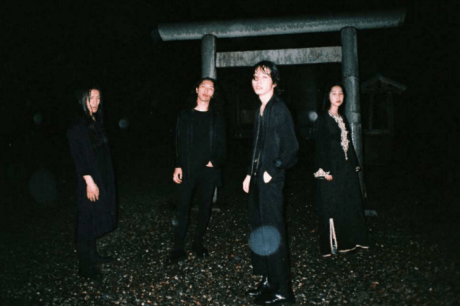
Welcome to Dominic Valvona’s regular reviews roundup. This latest edition of Tickling Our Fancy includes albums, EPs and singles by Stella Sommer, Otis Sandsjö, Yiddish Glory, Yazz Ahmed, Franklin and Qujaku.
In another eclectic edition, with releases pulled together from across international date lines and genres, there’s the beautifully morose Nico-esque Gothic indie solo debut album from Stella Sommer (tipped as one of my albums of 2018 already); a no less striking debut from the Scandinavian jazz saxophonist Otis Sandsjö, who mixes European jazz styles and modernism with the cut-and-paste techniques of hip-hop and electronica in real time on the brilliant Y-OTIS; a remixed treatment EP of songs from Yazz Ahmed’s Arabian jazz suite La Saboteuse; the debut EP, Some Old Tracks, from the polygenesis psychedelic and pool splash electronic sample collage artist Franklin; and an intense dramatic overture like suite of post-punk, drone, Gothic psychedelia and doom from the skulking Japanese troupe Qujaku.
With more serious intentions, shining a light on a lost chapter in WWII Jewish history, I also look at the beautifully produced Yiddish Glory testimony of tragic laments, ballads and elegiac songs written by the Soviet Union’s Jewish community during the barbaric invasion of Russia.
Stella Sommer ’13 Kinds Of Happiness’ (Affairs Of The Heart) 10th August 2018
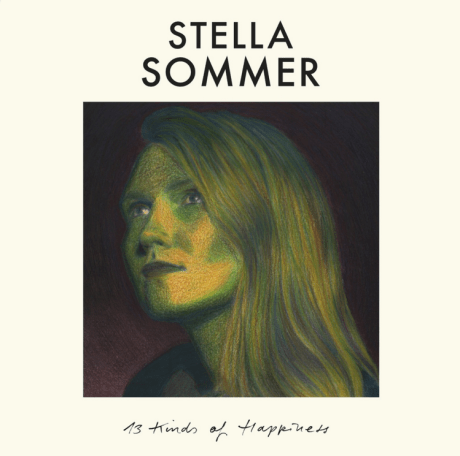
In the vogue of an age-old central European malady, the dour romanticism that permeates the stunning solo debut album from the German singer/songwriter Stella Sommer is wrapped in a most beautiful gauze of melodious uplift and elegiac heartache.
Artistically, as the results prove, making the best decision of her career, Sommer steps out for a sojourn from her role in the German band Die Heiterkeit. Far from an extension of that group (though band mates Hanitra Wagner and Phillip Wolf both join her on this album), there are of course concomitant traces of it. Sommer however makes louder but also accentuates these traces and lingering relationships; her lived-in, far-beyond-her-years vocal more sonorous and commanding than before.
Possibly as perfect as an album can get, 13 Kinds Of Happiness is an ambitious, slowly unveiling album of diaphanous morose. Pastoral folk songs and hymn-like love trysts are transduced by a Gothic and Lutheran choral liturgy rich backing that reimagines Nico fronting Joy Division, or Marianne Faithfull writhing over a Scary Monsters And Super Creeps era Bowie soundtrack (especially on the galloping Northern European renaissance period evoking thunderous drumming ‘Dark Princess, Dark Prince’; just one of the album’s many highlights). I don’t use that Nico reference lightly: Sommer channeling the fatalistic heroine’s best qualities atmospherically speaking.
Rather surprisingly, especially with the influences I’ve outlined, the torment and caustic swirls of the enveloping ominous fog cloaked dramatic title-track, vocally crosses Nico with Tim Booth of James fame. ‘Collapse/Collapsing’ even sounds a bit late 70s Fleetwood Mac, whilst ‘I Take An Interest’, with its ethereal lulling choruses and cathedral atmospherics isn’t a million miles away from a Holy Roman Empire inspired Beach House – imagine that!
The rest of this album is very much in the Germanic mode of religious drama and mystery. Hidden amongst the cloisters, Baroque drones and dark serious conservatism faith and tradition is brighter pop relief and troubadour, even Dylan-esque, odes on love, loss and anxiety. A perfect example of this serious but lilting, Gothic but often melodically harmonious counterpoint is the mellotron entrancing boat ride across a Kosmische river Styx, as painted by Caspar David Friedrich, ‘Boat On My River’. Following in the grand tradition of river songs, or alluding to Germany’s timeless relationship to the waters that run throughout its legacy, Sommer evokes Neu! and Cluster on this foreboding romanticized voyage, yet shows a certain vulnerability and lightness of touch too. That same vulnerability is also in evidence on the nocturnal, birds-of-a-feather duet with (I think) the lead singer (and fellow compatriot) of Tocotronic, Dirk Von Lowtzow, ‘Bird’s Of The Night’.
A curious Teutonic travail of venerable lovelorn despair and modesty, Sommer’s debut LP will take time to work its magic. But work its magic it will. A tremendous talent lyrically and vocally, serious and astute yet melodically enriching and lilted, her sagacious deep tones are starkly dramatic, but above all, rewarding. 13 Kinds Of Happiness is destined for many end of year lists; I for one, living with it for the past two months, find it one of 2018’s highlights, and one of the best debuts I’ve heard in ages. Here’s to a solo indulgence that I hope long continues.
Otis Sandsjö ‘Y-OTIS’ (We Jazz Records) 1st June 2018

Imbued as much by the complex language of North American and European modernist jazz as those who use it to riff on in the hip-hop and electronic music genres, the adroit Gothenburg saxophonist and composer Otis Sandsjö transmogrifies his own jazz performances so they transcend, or at least amorphously (like liquid) expand into polygenesis soundscapes.
His debut album, released via the Helsinki festival and label platform, We Jazz Records, is a multilayered serialism suite of ideas and experimental visions. All of which, despite that complexity, keep an ear out for the melody.
Y-OTIS reimagines a musical union between Flying Lotus and Donny McCaslin, or better still, Madlib reconstructing the work of 3TM; the flow, if you can call it that, sounding like a remix deconstruction in progress as the rapid and dragging fills and staggered rolls of Tilo Webber’s drums are stretched out, inverted and reversed into a staccato to dynamic bursting set of breakbeats and loops. Mirroring all the various cut-and-paste techniques of the turntablist maestros, Sandsjö and his dexterous troupe of keyboardist Elias Stemeseder, bassist Petter Eidh and the already mentioned Webber sound like a group being remixed in real time, live: And it sounds brilliant, as you’re never quite sure where each of these compositions is going to end up.
Sandsjö’s own articulations as bandleader never grandstand or take precedent, let alone dominate; his saxophone in a constant suffused circular and flighty motion, always there yet often drifting and dissipating. Of course there are occasional bursts of flute-y soloing and more rapid energetic squawking.
Tripping both across space, counterpointing Jerry Goldsmith’s optimistic siren-ethereal Star Trekking with Kosmische, yet also inspired by tribal and soulful earthly vistas too, Sandsjö offers up some surprising musical evocations. The avant-garde snozzling, drum rim-tapping and lumbering funk ‘BOO!’ sounds like Tortoise and a chilled Dunkelziffer, whilst the dreamy merging, of what could be two entirely separate tracks, ‘YUNG’, with its elongated rhythms, could be Coldcut going at a warped Mardi Gras Afrobeat inspired improvisation.
Importantly Sandsjö offers a jazz style birthed from an eclectic melting pot of hip-hop, dance music and even more experimental edgier R&B; reorganized into a fresh exploration. If the ACT label, or ECM ever converges with Leaf and Anticon, Y-OTIS might well be the resulting album. As 2018 shapes up to be another great year for jazz releases, the inaugural album from Sandsjö and his troupe looks set to showcase a great talent, and make the end of year lists: it will most definitely make ours.
Yazz Ahmed ‘La Saboteuse Remixed’ (Naim Records) 10th August 2018

Working her dreamy enchanted magic, encapsulating a transcendental, exotic version of Arabian jazz, on last year’s traversing trumpet suffused La Saboteuse LP, Yazz Ahmed calls on a congruous trio of remixers and artists to interpret a handful of peregrinations from that well-received suite.
This new EP of re-contextualized voyages and evocations also features, a sort of, new production hybrid that uses Ahmed and her producer Noel Langley’s self-sampling and deconstructing techniques to refashion a ‘fourth world’ sound collage. Inspired in part by Jon Hassell’s amorphous ‘possible musics’ experiments and the equally polygenesis floatisms and shifting lingers of Flying Lotus, ‘Spindrifting’, as the title suggests, languorously drifts between gauze-y environments and borders; re-placing fragments and textures from the La Saboteuse recordings.
Reflecting a constant unending journey of interpretation, filtered through ‘alternative visions’ and ‘perspectives’, burgeoning South London DJ and graphic artist Hector Plimmer, who released his debut LP Sunshine last year, cuts down and transduces Ahmed’s original lengthy ‘The Lost Pearl’ into a nuanced tropical lilt and itching understated electronic shuffler. Whereas, self-proclaimed ‘Afro-futurist’ beatmaker DJ Khalab, takes the Arabian delights and Tangier trumpet suffusions of the original ‘Jamil Jamil’ into the cosmic ether on his treatment. The Italian DJ undulates that belly-dancing souk vista with moody pulses, kinetic connective beats, vapours and starry space atmospheres.
Originally a tub-thumping percussive and trumpet heralding panoramic meditation, ‘Al Emadi’ is given a buoyant dub wafting veil by the Lisbon trio of brothers and close pal Blacksea Não Mayo. DJs Noronka, Kolt and Perigoso add a bounce and short yelp like punctuations to that vision; moving it closer towards classy electronica dance.
An articulate extension of Ahmed’s original album template, her already traversing evocations are taken on vaporous and often subtle cosmic and dreamy detours by this carefully chosen cast. A parallel navigated piece of escapism rather than enhancement, the remix EP enervates the jazz for a more electronic music feel to guide Ahmed’s 21st century Arabian imaginations across new boundaries and vistas.
‘Yiddish Glory: The Lost Songs Of World War II’ (Six Degrees) Out now

Few albums can stir the soul let alone give a voice to such harrowing anguish as the sacrifices made by the Soviet Jewish community during one of history’s most brutal conflicts – 2.5 million poor souls from this Jewish community would perish in the European territories of the Soviet Union alone. A forgotten chapter, expedient to Stalin and his successors own tyrannical political airbrushing of events, 440,000 Jewish citizens from all corners of the then Soviet Empire enlisted to fight the Nazis during the 1940s.
Though an integral part of the Bolshevik revolution that preceded it decades earlier – the Jews often suffering under the Imperial regime of the Tsars and Tsarinas in countless programs over the centuries; Tsar Nicholas II no better than previous holders of the title, stirring up hatred towards the faith by propagating the most fatuous blood libel and protocols of Zion conspiracies as proof of his own idiotic prejudices and envy -, the Jewish population that survived the second World War soon found themselves the victims of Stalin’s purges.
Despite the paranoia, mistrust and the megalomaniacal politics of one of the most murderous regimes in history, the Jews of Russia have always remained loyal. Even during the enlightened age of Napoleon, with his promises during the misconceived and doomed invasion of Russia in 1812 of liberating not only the population from serfdom but also the Jews (Napoleon having kept his word in freeing the Jews from the various ghettos they found themselves herded into throughout Europe; Venice being one the most famous examples), Russia’s Jewish population remained stoic in their support of the homeland.
Lost in the annals of time then; suppressed, if thought destroyed, the tragic but poetic WWII testaments, made lyrical prose, of just a small cross-section of Russia’s Jews is given the richly evocative and adroit production showcase it deserves by a collective of professors, producers and musicians. Originally unified in an anthology by an ethnomusicologist from the Kiev Cabinet For Jewish Culture, Moisei Beregovsky, alongside colleague Rovim Lerner, hundreds of Yiddish songs written by Red Army soldiers, victims and survivors of the Nazi’s apocalyptic massacres were gathered in the hope of being eventually published and performed. Unfortunately at the very height of the Communist Party’s purges in the decades that followed the end of WWII, both these well-intentioned preservationists were arrested. Subsequently the project was never finished, the work sealed up and hidden away. But as it would later transpire, not destroyed.
Decades later in the 1990s, the Soviet archives now under the ownership of a collapsed Communist state, as the Iron Curtain finally tumbled, librarians from the Vernadsky National Library Of Ukraine found these lost treasures in unlabeled boxes. One of these librarians, Lyudmila Sholokhova, would catalogue these findings – just one of the many cast members in this story. Fast-forward another decade and by coincidence, one of this project’s eventual instigators, Anna Shternshis, stumbled upon these treasured songs whilst visiting Kiev. Highly fragile, deteriorating quickly, these original notes (some handwritten, others typed) opened up a whole undiscovered chapter in Jewish history to both Shternshis and her eventual colleagues on this project, musician Psoy Korolenko (known in his academic life as Dr. Pavel Lion), Al and professor of Yiddish Studies and Director of the Anne Tanenbaum Centre For Jewish Studies at the University Of Toronto Malka Green, and musical director and violinist Sergei Erdenko.
Transcribing these laments and firsthand accounts of endurance (many of which included testament evidence to various Nazi atrocities) would take patience, skill but above all respect. The results of this this most tragic desideratum, entitled Yiddish Glory, are underscored by an Erdenko-led stirring accompaniment ensemble of classically trained instrumentalists and singers, brought together by the producer Dan Rosenberg.
Challenging perceived conventions throughout this magnificent suite of eighteen songs, silencing detractors now as it would have back then, amongst the laments are stirring motivationals that adhere to a long lineage of Jewish and Russian history. Weaving in one of the revered fathers of the Russian classical school of music, Mikhail Glinka’s 1840 ‘The Skylark’ tune with a rousing call for his fellow Red Army comrades to support their Jewish compatriots, Odessa soldier (known only by his first name) Yoshke answers the anti-Semitic propaganda that ‘Jews don’t fight in war’ with his, perhaps not so lighthearted as it would seem from the title, ‘Yoshke Fun Odes’. The accompanying linear notes – featuring the lyrics to all the songs (in most cases) in Hebrew, Cyrillic and English – tell us that Yoshke is himself fighting to ‘avenge his brutally murdered Jewish family’. Though as it would prove, when the survivors of this war returned home, the Jewish population would have to once more fight for their lives, but this time against many of their Russian comrades: tragic when viewed form our vantage point, as many would end up arrested or liquidated on the most spurious and paranoid of charges; Stalin’s position after WWII solidified, clearing the path for his many sweeping purges. Showing every bit as much passion for and attachment to their country and regime as any hardline dye-in-the-wool Communist, songs such as the panoramic ‘Kazakhstan’ – possibly written, we’re told, by one of the 250,000 Polish Jewish refugees that survived the war – could have been ripped from the very soil itself. Two different vocalist versions of this minor opus feature on this album; the one sung by the smoky jazzy and commanding singer Sophie Milman is a personal dedication to her grandmother, a Soviet Jewish refugee survivor in Kazakhstan, but also a wider tribute to the millions of women who were involved in the war effort; the second version, sung by Erdenko, pays homage to the often forgotten Roma community, murdered in great numbers in the ensuing Holocaust.
Nothing could be more heart wrenching than the plaintive ‘My Mother’s Grave’, originally penned by the ten year old Valya Roytlender, a native of Bratslav in the Ukraine. Channeling the loss but also survivor’s guilt, the youngest of the ensemble cast of vocalist (five in total), Isaac Rosenberg, gets the bottom lip quivering and the tear ducts ready to flood with lines as moving as, “Oh mama, who will wake me up [in the morning]? Oh mama, who will tuck me in [at night]?”
Many of the songs are surprisingly violent in retributive prose – a result of Soviet censors adding the revengeful party line to every song; part of the state machinery’s propaganda in stirring up hatred towards their enemies, but also a nationalistic fervor -, the language of dehumanization prevalent throughout: the Nazis often referred to as vermin to be eradicated and shown no pity. Considering the Nazi’s barbarity, but also Stalin’s own ineptitude and grasp of unfolding events, caught by surprise at Hitler’s invasion of the Soviet Union, it’s hardly surprising to find such encouragement in these songs. Yet it often feels, as it turns out, to have been added in many cases later by the state, to be in contradiction to the sentiment. Whilst certainly ready to pick up a machine gun in a heartbeat, going as far as to even taunt on songs like ‘Mayn Pulemyot (My Machine Gun)’, the lyrics often attempt to make sense of what is…well, a senseless brutalism.
An equal opportunity employer in carnage and slaughter, the stoic, hardened women of the Soviet Union feature just as heavily and prominent as the men in these songs: ‘Chuvasher Tekhter (Daughters Of Chuvashia)’, penned by a young Communist League member from Kharkov in 1942, bares testament to those women from the region of the title who were drafted into the Red Army to fight on the frontline; just a small fraction of the 900,000 women who would eventually join the rank and file.
The stars ask me [to speak]: “Tell us!
Who is marching so late at night?”
The answer: “Chuvash daughters
Preparing themselves to go into battle.”
Other songs pay homage to those women working on the production lines. All of which offer words of encouragement to their lovers to fight the good fight.
Firsthand accounts of atrocities appear on both ‘Babi Yar’ and ‘Tulchin’; the first of these harrowing laments and ballads referring to the massacre of the titular ravine near Kiev, where an astonishing 33,771 Jews were shot in 48 hours, in the September of ’41, the second, dedicated to the small Ukrainian town of the title, which lost its entire Jewish community.
Later on though, as if in a chronological timeline, there are songs celebrating the end of WWII; the finale, ‘Tsum Nayem Yor 1944 (Happy New Year 1944)’, featuring the full cast and singing circle, ushers in the New Year and ultimate victory over fascism that would soon follow.
Enough crying over our beloved dead,
The Red Army has the upper hand now.
Hitler can only kill us at night in our dreams.
Woe will be upon him, when we have peace!
Despite the materials obvious harrowing and tragic nature, the music throughout is a dizzying, waltzing mix of Yiddish, Roma, Klezmer, folk and even jazzy cabaret that’s often upbeat. The band does a sterling job in breathing life back into historical testimony; giving voice to those suppressed individuals and the songs that were believed lost forever, destroyed by a regime that would treat its loyal Jewish community, many of which made the ultimate sacrifice, little better than the Nazis they so valiantly overcame.
This is a poignant reminder that we should do more to educate ourselves on lost histories such as this; especially in the times we find ourselves with anti-Semitism once more on the rise and in the news (especially in the UK). Yiddish Glory is not just a reminder however, or even just a revelation, but a beautifully produced performance.
Franklin ‘Some Old Tracks’ Out now

Keeping the brief scant but candid, the artist(s) behind this project create a bright polygenesis EP out of frustration: ‘After a truly terrible session with an artist trying to force me to copy a hook from The Chainsmokers, it was enough for me.’ Bounding back from one too many constrictions, Franklin, in a manner, returns to its youth and the music that soundtracked it. Never able to afford the clearance but carrying on nevertheless, the spark of inspiration that now ignites Franklin, sampling montages and collages, is brought together once more and made into a vibrant psychedelic pool party splash of filtered funk, staccato House and light breeze West Coast hip-hop.
Criss-crossing genres at will over a quartet of tracks on the Franklin debut, tunes and samples, loops and ideas seem to melt and merge harmonically. For instance, the opening track ‘Frankie’ swims along to a fragmented cut-and-paste dance groove of moody breaks, shuffles and a hooting Afro sax honk, whilst the soulful plaintive tropical flavoured ‘Hate Myself’ sounds like a surfing International Pony.
A mysterious French soulstress can be heard meanwhile at the start of the low-rider ‘L’aéroport De Paris’, which in spite of its title evokes a sense of Japonism – J Dilla on a slow boat to Shogun Japan. ‘Clear My Name’ is more in the dance-y mode however; warping bowed and wooden sounding beats and enveloping waves around quasi-80s House.
This debut EP reconnects with the past to go forward. Stripped of hubris and baggage, and restriction, a breath of fresh air, it is beyond being, as the title suggests, just Some Old Tracks, and is instead an exploration of those imbued sounds and what they represent, restructured into a contemporary eclectic psychedelic dance and pop record.
https://soundcloud.com/franklinswe/sets/some-old-tracks
Qujaku ‘Qujaku’ (So I Buried Records) 16th August 2018

Occupying both the spiritual and cosmic planes, emerging from the gloom and holy sanctuaries of the dead, the brooding Hamamatsu-based Japanese band Qujaku are back with a second grand opus of Gothic psychedelia and operatic doom post-punk. Gathering together titular EP tracks from the last couple of years and new material, this eponymous entitled epic thrashes, rattles, drones and skulks with sonorous intensity throughout. The opening ‘Shoko No Hakumei’ suite, more an overture, is itself a full on Ring cycle (as conducted by Boris) that is dramatic and sprawling: running almost the entire length of a full side of a traditional vinyl album.
On a very large foreboding canvas, Qujaku build-up an impressive tumult across the album’s nine-tracks of prowling esotericism and galloping drum barrage immensity. Between crescendo-bursting three-part acts and shorter volatile slabs of heavy caustic drone rock, the group often evokes an Oriental Jesus And Mary Chain, Black Rebel Motorcycle Club and Spacemen 3, or Nine Inch Nails when at their most enraged. Psychedelic in the mode of The Black Angels, but also straying at their most languid and navel-gazing towards Shoegaze, Qujaku’s dark spanning cacophony of throbs and trembles bear many subtle nuances and becalmed breaks amongst the masses and maelstroms. A balance between those forces is struck for instance on the dreamy plaintive love-crushed ‘Yui Hate No Romance’ and Spiritualized hymn-like finale ‘Sweet Love Of Mine’.
Vocally obscured by the cyclone of screeching feedback, grinding, spiraling ritual and creepy atmospherics the band’s mix of saddened male sung lovesickness and dystopia, and female ethereal sirens often invoke a ghostly, doomed horror soundtrack: The spirits in communion; floating and cooing, always present.
Though heavy-going for sure, even stifling in places, this ceremony come seething dark alchemy of an album is a brilliant minor masterpiece of Gothic, doom, psych and progressive pretensions. Limited physically to only 500 copies, this cultish group and album will sell-out quick, especially off the back of the band’s upcoming European promotional tour. On an epic scale, dreaming big and intensely, Qujaku perform the most dramatic of daemonic theatre.
Words: Dominic Valvona
Our Daily Bread 277: Premiere: Vukovar ‘Infinitum’
June 23, 2018
Premiere: Review: Words: Dominic Valvona
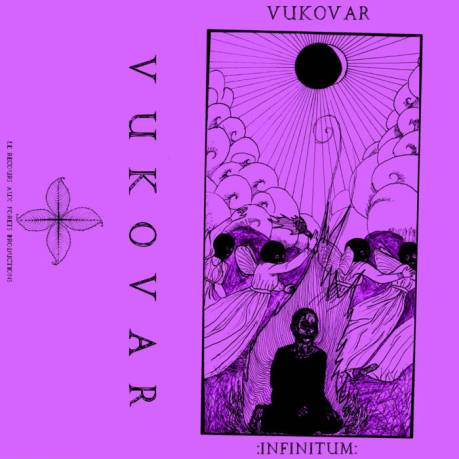
Vukovar ‘Infinitum’ Le Recours Forêts Production, 8th July 2018
Not since Richey Edwards etched ‘4 Real’ in blood across his arm, or Ian Curtis decided to hang himself have artists and bands taken themselves so seriously and to such extremes to prove their commitment to a musical cause; or even before that, checked out of for good at the ’27 club’. The romantically despondent and incredulous Vukovar are, in this non-committal age of vacuous validation and smoke, very much cut from that same cloth. Even their band name is taken from a most serious harrowing episode of modern barbarism: Vukovar the infamous and harrowing Croatian city where 300 poor souls, mostly Muslims, were rounded up and barbarically executed by Serb paramilitaries and the Yugoslav Peoples Army (the worst committed atrocity of its kind since WWII) during the implosive Balkan wars of the 1990s.
Easily one of the UK underground’s most promising bands, if not among the most important in the last five years, Vukovar have already produced a sizable catalogue of material; though each release barely has time to sink into the public consciousness before another ambitious epic replaces it. Infinitum is unquestionably one of the band’s deepest, darkest and mysterious records yet; inspired no doubt by recent events and the wearisome ebb and flow of jeopardy that surrounds them. Living by their art – almost dying by it in fact -, Vukovar are not to be taken lightly.
Consistently snatching defeat from the jaws of victory and hardly adverse to self-sabotage, Vukovar have despite countless mishaps, frustrations and fall-outs managed to release a quartet of three-syllable sloganize entitled albums of morbid Gothic and post-punk curiosity in that time. Their latest, and fifth, Infinitum pulls at the mortal coil of human misery in a murky quagmire. An endless backing track of reverberating delayed snare strikes, a rolling timpani bounding bass drum, esoteric stately sounding waltzes, unwieldy bestial guitar, resigned new romantic synth and escaped melodies muddily, and often amorphously, swim and oscillate around a combination of longing, if worn down and depressed, swooning vocals and Rimbaud-meets-Crowley-meets-Kant-on-the-edge-of-an-abyss poetic despairing narration, on what is a bleak if at times gloriously dark beauty of an album.
Often channeling the spirit of Ian Curtis (though not so much alter-worshipping the miserabilist icon as imbued by him), Scott Walker, The The, Martin Rev, David Sylvain and The Sisters Of Mercy on not just this album but the previous four opuses, it’s the ghostly echoes of Alan Vega’s inimitable rock’n’roll croon and nod to the melancholic heart of Spector’s girl group maladies that can be heard on the album’s most swaddled and beautifully sad song, ‘The Destroying Place’. And the album’s grand finale, delivered with a shade of monastic incantation, ‘Remains’, with its odd sound collage passages of insect-like chatter, strange foreign voices, far off screams and pitch-shift centrifugal motion effects, sounds vocally like John Cale sharing narration duties with his old Velvet’s honcho, Lou Reed.
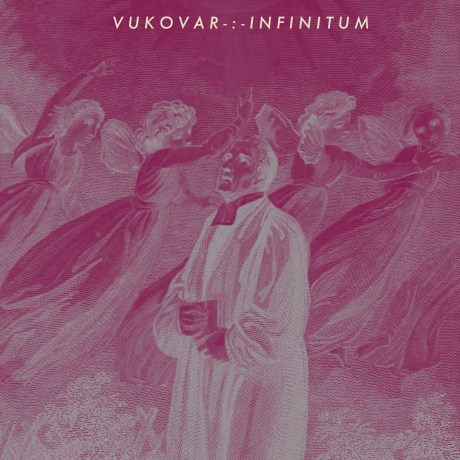
Bound-up in their own self-imposed limitations, these anarchistic dreamers go one further than the Hebrew code of law commandments by adhering to 13 of their own; each one a rule or restriction in the recording process that couldn’t be broken, at any cost. So strict were these conditions that even if the band were close to finishing the album, any infringement no matter how minor, would result in the entire sessions being abandoned. Mercifully they made it through to the end; releasing a troubled, bleak lo fi ritualistic romance of an album.
Vukovar, even if the resignation and despondency in the music reflects a broken spirit just waiting for the end times and a final release, are growing in confidence and creativity; stretching themselves to encompass the Gothic and miserable but also brilliant at escaping the murky waters’ pull of desperation to occasionally break free into the light with bursts of radiant post-punk pop excellence.
Pouring fuel on a bonfire of vanities, whilst pouring out their hearts, this serious act recoil from the spotlight with nothing short of contempt for many of their peers; frustrating even fans, and once again limiting the album’s release physically; confining it to a special limited edition number run on cassette tape.
The fact they can back it up, gives them an edge, way ahead of the usual indie and post-punk fodder we’re normally fed on a daily basis. As the bland-lead-the-bland in a merry dance, Vukovar, as they did on their last single, read from the cerebral, philosophical and the political in a ‘Clockwork Dance’ towards the precipice of doom; their fifth album no less polemical and important.
Dominic Valvona
Previous Vukovar reviews:
Emperor LP
Fornication LP
Puritan LP
The Clockwork Dance Single
Live Review: Words: Dominic Valvona

U.S. Girls Live At Stereo, Glasgow, May 19th 2018
Swapping the tape collage and loops (to a point) for the full-on experience of a live band on tour, Meg Remy seduces the Glasgow audience tonight with the most sophisticatedly sexy, often louche, of pop dynamics.
Remy is able to captivate with bittersweet pouting malady the most traumatic, darkest nature of patriarchal sexual control and seamiest aspects of capitalism whilst slinking to a cerebral mix of glitterball disco, raunchy pop fantasy and on as demonstrated on the finale from her most recent album, In A Poem Unlimited, and tonight’s curtain dropper, ‘Time’, no wave meets contorted jazzy break beats.
Embracing then, the seductive forces of pop music, Remy’s unsavory but vital exposés and therapeutic exercises in acknowledging trauma and abuse are made more palatable by this shift; and in turn reaches an increasingly wider audience. Channeling femme fatales and maverick artists such as Ronnie Spector and Gloria Ann Taylor and more modern alluring pop stars, Remy slips these dark themes under a sonic soundtrack of glorious disco, boogie and avant-garde experimentalism.
Showcasing a looser funky sound, backed by the Toronto hothouse supergroup The Cosmic Range (a collective that at any one time traverses Afrobeat, Krautrock, boogie and free-jazz), the central force of nature at the heart of what was initially a solo project, since expanded with a full cast of writers, producers and collaborators all willing her on, Remy yet again performs in character. Previously taking the brilliant (and one of our albums of 2015) Half Free out on the road with just the backing vocalist Amanda Grist (of Ice Cream fame) to keep her company, dressed like a leotard wearing Olivia Newton John, sporting a chic cropped hairdo, Remy returns with longer sporty locks, wearing a laced backed crop top, flanked by a duo of energetic male and female vocal sparring partners.
Performing more or less the entirety of this year’s album (her second for 4AD), with subtle transformed versions of Half Free tracks ‘Window Shades’ and ‘Sororal Feelings’ (made far more limbering, elastic and, again, sexy), this flexing multi-limbed incarnation of the U.S. Girls powers through, what seems, a short but explosive set.
Far too many band members to name, let alone all chronicle their ever entangling nuances and connections, Remy’s Cosmic Range troupe notably features husband and native Canadian Maximilian Turnbull, aka the space boogie guitar maverick Slim Twig, on doodling and noodling guitar duties, but also, playing his lungs out, some guy whose name I didn’t catch sucking and blowing on the tiniest of saxophones a wailing but also accentuate contortion of the Plastic Ono Band and a strung-out soul imbued Bowie.
Arriving late and already half-cut (blame the Cup Final, Royal Wedding and a surprisingly summery day in Glasgow; celebrated with liberally poured cheap Champagne from Aldi) we missed ShitKid, who I’m sure was a perfectly congruous support act. But apologies aside the vocals tonight could have been clearer, obfuscated at times by the sonic overload of the Cosmic Range, bouncing off the venues walls and the unfortunately placed concrete column that cuts the room in two. We could have also done with an encore; the band pretty quickly exiting without a word, disappearing off stage with no announcement (in fact there wasn’t any dialogue with the audience at all) at barely 9:30pm (possibly the earliest finishing gig I’ve ever been to). But despite this and though the words and subjects may get lost, the cadence, mood and anger translates into the most hypnotizing of agonies and troubling ecstasy.
Still, the Obama berating cooed disco thumper ‘M.A.H’ sounded lusher and hypnotizingly powerful live, and the twisted gospel Catholic gilted ‘Pearly Gates’ (originally featuring the soulful tones of James Bayley) was positively withering with venerated parody and a sweating chemistry between Remy and her vocal partners. The all too soon last song of the evening, ‘Time’, was a wig out of taut jamming and increasingly distressed, almost primal, screaming: A sonic funk attack.
Remy once again held the audience in her gaze and proved beyond doubt that she is one of the most exciting, dynamic and interesting artists of the last five years. Me and my entourage, and by the look of it that night, the entire Glasgow audience was enthralled anyway.
Book Review: Words: Dominic Valvona
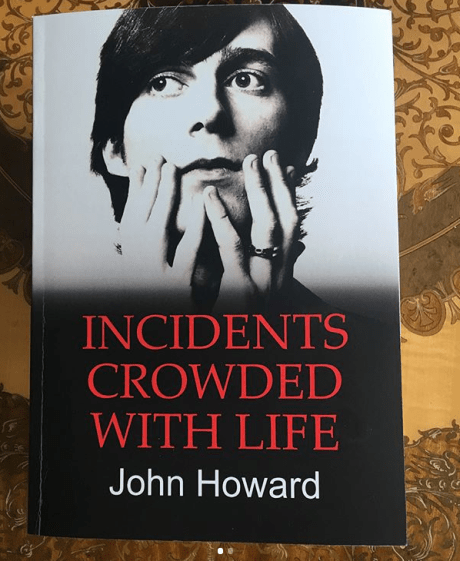
John Howard ‘Incidents Crowded With Life’
Fisher King Publishing, 26th March 2018
Enjoying a comfortable revival (of a sort) in what is essentially his semi-retirement, bon vivant pianist, troubadour, former A&R man and now author, John Howard has finally managed, after decades of being misguided and encumbered, to record and release a series of critically successful albums of a cerebral quality on his own terms, without the travails of middlemen and agents. The humble working class lad from Lancashire, Howard’s musical career started off with such potential but was cruelly crushed, hindered by a steady stream of miscreants, businessmen, producers and the BBC, who refused to play his singles – whether, as Howard recounts out of homophobic prejudice, or just plain ignorance we will never really know.
Signed to CBS Records in the early 70s Howard’s glittering debut LP Kid In A Big World was shunted, overproduced than reproduced, passed around and eventually mishandled, until its eventual release in 1975. Rightly revered decades later, with a number of re-releases (including a very recent celebratory version), this debut became an instant cult classic; critically adored but unable to attract commercial success, mainly as a consequence of the to and froing and mismanagement, it was met with general indifference by the public. Despite an obvious talent and potential, Howard’s stop/start career went from bad to worse until he was dropped in 1976 by CBS after various aborted projects and makeovers, including a disco pop crossover with the producer Biddu (enjoying a succession of hit records at the time off the back of Carl Douglas’ Kung Fu Fighting novelty).
Chronicling that burgeoning period in what is the first of a series of autobiographies, Howard candidly reminisces, entwining his family history and eventual move to London with his various musical mishaps and highlights, and his sexual exploits. As much a history of the perils but also free-for-all misadventures of homosexuality as the hardships of making it in the music business, the first part of Howard’s story reads like an ever-horrifying recollection of violent encounters with the most ill suited of partners. Going full circle, the book opens and finishes on one of the most life changing of these ‘incidents’, with Howard’s fateful leap from the window of an apartment he shared with some colourful Filipino gay characters (as it proved, relocating to London to escape the clutches of dictator Ferdinand Marcos), who brought back a mad Russian ‘bit of rough’ intent on murder – Howard would break his back and smash both his feet in the fall. Incidents Crowded With Life then, is recounted via his recuperation; the formative years looked back on with mostly a fondness as a modest curtain is raised ‘on the living-room in a semi-detached council house in Heywood, Lancashire.’
Observations, asides are mixed with the musings on the musicians that inspired him: Dylan, The Beatles, Mothers Of Invention, Incredible String Band, Bolan and of course Bowie. Signs that Howard wasn’t exactly cut from the same Catholic cloth as his family are made abundantly clear when at an early age he develops a crush on PJ Proby – whilst his sister is clamoring and screaming for the Fab Four -, replaces religious symbolism for posters of the elfin beatific Bolan, and as the book’s quote so aptly puts it, ‘swaps the guilt for gilt’. Not that dear Mum and Dad minded; their humble upbringing causing some uncomfortable situations, yet hardly the stuff of fire and brimstone puritanical condemnation. Though they were right to worry about their lad; especially when you read about his stunningly naïve exploits and trusting nature. Incidents that include a savage beating by a thuggish minor East End gangster lover, a lucky escape from a gang rape whilst holidaying in Malta, and an even luckier escape from a serial killer -posing as a taxi driver – in New York. It’s not all bad though, Howard has just as much fun throwing caution to the wind and partaking with abandon in orgiastic gatherings on Hampstead Heath.
Despite experiencing some of the most traumatic escapes, Howard’s accounts are free of victimhood. In a matter of fact way, neither told as a warning or even alluding to the present frenzy of #metoo, Howard’s honesty is unapologetic, with no blame attached to anyone other than himself.
Probably not quite as insightful for those unfamiliar with his work, this 600 page tome details various recording sessions – some of which are at the famous Abbey Road studios -, performances – both as an aspiring artist on his uppers and as a jobbing pianist/singer, making ends meet playing for diners in various hot spots throughout London – and his inspirations; the things that prompted and triggered those beautifully caressed and erudite songs in the first place. It also details all the ensuing rewrites, overdubs and constant bickering – mostly between his management and the litany of producers who were brought in by a label unsure of the precious signing they’d landed. Howard often frames his insights on the creative process with a synopsis on his favorite artists, showing quite a deft passion for music writing. Here’s just an extract from a flowery evocation of Bowie: ‘Setting out surreal, slightly disturbing panoramas like a screenplay writer in a moonlit park at midnight, Bowie intoned each line perfectly. He sang of times gone like a lost Atlantis, while sounding utterly NOW!’
The good times and fatuous nature of the music industry go hand-in-hand with the highlights: such as penning and recording the theme song for the William Holden and Peter Fonda movie Open Season, which started off so well with Hollywood schmoozing and the hint of a brilliant future, but soon turned to shit; the show time TV appearances that amounted to nothing, and the various meetings with iconic songwriters that ended up blindsiding or leading our author down the wrong garden path entirely.
Hardly the first artists to be chewed up and spat out by the corporate fangs of the industry, Howard’s refreshing, witty and sagacious autobiography is an often heartwarming read (especially when talking about his dear old man and dad); absolved and free of regret and bitterness. Coming out the other side, unceremoniously dumped by CBS Records at the end of this first life works volume in 1976, laying in a hospital bed looking ahead lamentably to years of recovery, the reader is left at Howard’s most low period. Without giving too much away, Howard does bounce back, turning to A&R but also continuing to record and play: even though fame will continue to elude him. An entertaining if overlong read, Incidents Crowded With Life is an interesting survey of the ‘nearly man’ of pop, an insight on both the industry and gay life in 70s swinging London.
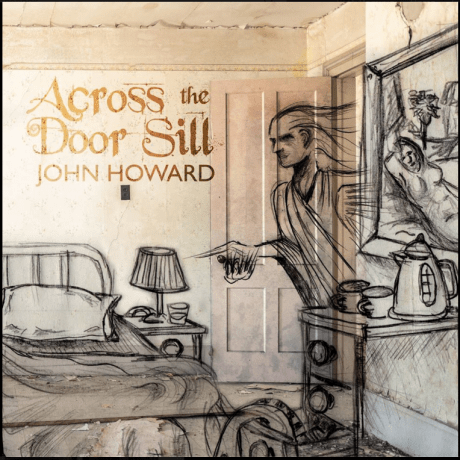
Previous John Howard posts:
The Monolith Cocktail Social: Playlist #XXXIII
May 3, 2018
DOMINIC VALVONA’S PLAYLIST

In danger of repeating myself forever, but for newcomers to the site here’s the premise of my playlist selections. Previously only ever shared via our Facebook profile and on Spotify our regular Monolith Cocktail Social playlists will also be posted here on the blog itself.
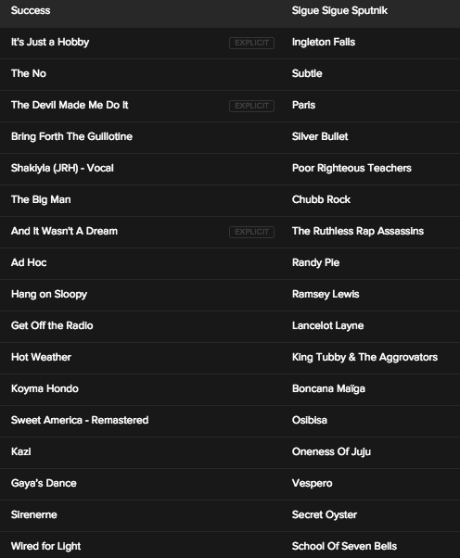
With no themes or demarcated reasoning Dominic Valvona picks songs from across a wide spectrum of genres, and from all eras; Selection #33 being no different, with it’s venerated and Tarot card reader divine styler Kosmische intro from Walter Wegmuller and Popol Vuh and musical journey through Ethiopian spiritual paeans (Berthe Raza), Swedish jazz fusion (Solar Plexus), sublime drifting electronic heartache (Left Of Manila), French new wave electronic agit punk (Kas Product), Arabic fuzzed-up R&B (Sharhabeel Ahmed) and 32 other just as wonderful excursions through time and place.
Tracks:

Our Daily Bread 271: Samba Touré ‘Wande’
April 27, 2018
WORDS: DOMINIC VALVONA
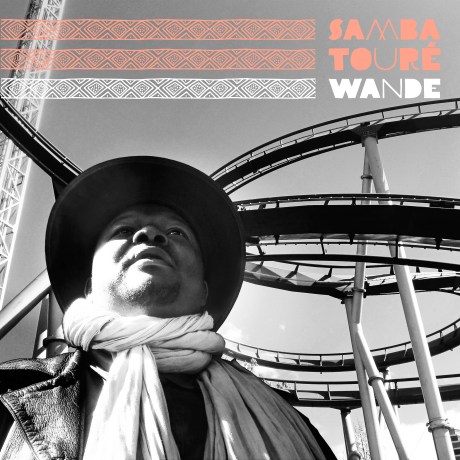
Samba Touré ‘Wande’ Glitterbeat Records, 25th May 2018
In a country abundant with guitar virtuosos, the highly genial Samba Touré still stands out as one of Mali’s most celebrated; transducing the travails, heartache but also joy of his homeland through his signature articulate nimble-fingered style of playing.
His third album for Glitterbeat Records – the first, Albala, was the label’s inaugural release in 2013 – Wande is billed as a warmer homely songbook. Recorded in under two weeks, allowing weekends for band members to scratch a living playing at weddings, sessions for the album were relaxed, performances captured on their first take with few overdubs. Previous albums Albala and 2015’s Gandadiko were made during the Islamist insurgency that swept aside and hijacked the Northeastern Tuareg communities’ battle for an autonomous state within the desert borderlands of Mali. Based in the western, more urban, Bamako, Touré encapsulated the fears of his fellow countrymen caught up in, what seemed highly probable until an intervention from the former colonial masters France, a struggle of ideologies that threatened to destroy Mali and bloodily remove its government. Reaching far into the Mali interior, certainly victorious in the field of propaganda in taking the legendary trading post of Timbuktu, Touré was well within his rights to feel anguish and fear as the hardliners – hardly an accommodating presence, known to burn instruments and even musicians that entertained anything other than their own warped sense of myopic worship – inched ever-closer to Mali’s capital.

Photo: Karim Diarra.
Darker albums certainly, yet still so lovingly meandrous, even buoyant, as to exude hope and caring sensibility. Better still, and even with the fallout from this insurgency ongoing (if forgotten by western media), Touré calls, as he does now, for unity: a return to peace.
Far from a complete break, the sadness endures on Wande: though Touré sadness is a most beautiful, cantering and lingering one. Especially when paying tribute to his friend and collaborator, sokou fiddle maestro Zoumana Tereta, on the spoken word with wavering drifty, almost dub-like echo-y effects tracks of the same name, which features the late musician’s spindly evocations from beyond the ether.
The ‘Songhai’ and ‘Crocodile’ bluesman, for that is the style he is most synonymous with, wouldn’t pigeonhole himself personally, preferring to call it contemporary ‘universal’ rock music. Touré has previously said, and reiterates now, that he doesn’t play ‘desert blues’ – a term he rightly associates as the music practiced in Northern Mali, Niger and Mauritania -, and you can also forget about calling it African ‘this’ or African ‘that’ too. Yet at the roots and core, for these are the lands where it all started, Touré’s subtle and relaxed guitar lines traverse the very ideas of blues etymology. The lo fi production feel of the rocking blues Yerfara/We Are Tired could be a lost inspiration for 80s period Rolling Stones with its almost transmogrified Start Me Up like Richards riff. Goy Boyro/The Good Work (Well Done) even begins with a Taj Mahal, BB King reminiscent introduction hook, before dipping over the horizon.
Throughout the album, whether it’s in paying a devotional paean to his beloved wife on the title track or gliding magically on the opening Yo Pouhala/Blah Blah Blah, Touré’s electric, and occasionally deft acoustic, guitar is accompanied by the buoyant and bobbing bending rhythms of the traditional tama talking drum, bowed waiving of the sokou and the vibrating spindle sound of the ngoni: All of which are played with an emphasis on the natural, unrehearsed and relaxed.
Not quite such a leap of faith or different to previous albums, an unpolished and laidback methodology has produced a slightly more sagacious, free-floating quality and another essential Touré classic.
Our Daily Bread 270: Josh T. Pearson ‘The Straight Hits’
April 9, 2018
REVIEW: DOMINIC VALVONA
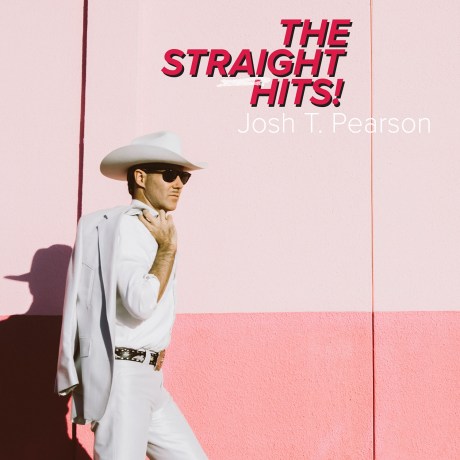
Josh T. Pearson ‘The Straight Hits’ Mute, 13th April 2018
Changing his tune (literally) Josh T. Pearson, the lonesome blues Texan with a wagonload of baggage, heads out on to the range with a swag bag of more joyful, unencumbered ‘golden hits’ on his latest album for Mute Records.
Rather ironic for an artist who despite writing and recording for decades has only one previous solo album to his name (2011’s agonizing confessional Last Of The Country Gentlemen), The Straight Hits feels like a ‘best of’ songbook.
Leaving behind the more apocalyptic gospel concepts of his work with the short-lived but acclaimed Lift To Experience, whose 2001 masterpiece The Texas Jerusalem Crossroads left such an indelible mark on the dirty country and Americana blues scenes, Pearson sets himself new parameters; adhering to a five-point rules system for transforming a “batch of tunes” he’d been working on for a decade. Earmarked originally for the ‘unrecorded’ Bird Songs album, the nine original songs on The Straight Hits are a lighter and as the title suggests ‘straighter’ attempt to change the mood.
Though just as heavy reference wise to the faith, obsessions, cruelties and power of love, Pearson has overcome the all-too real addictions and the collapse of his marriage to fire-off a distilled, riff heavy version of cowboy romance. Motivated recently to share more (“before it’s too late”), an epiphany of a sort sparked by the divisions of the 2016 US elections moved him to question if it was better to spread joy then mope and spread more anger. But it was whilst reading (as you do) the 14th century epic poem The Conference Of The Birds by Attar of Nishapur that Pearson muses, finally turned on the creative tap and helped ease this songbook’s passage.
Far from set in stone – the unwritten rock’n’roll law that all rules are written to be broken is invoked on the tender yearning A Love Song (Set Me Straight) – each song must at least try to follow Pearson’s self-imposed requirements: Number one, all songs must have a verse, a chorus and a bridge; two, the lyrics must run sixteen lines or less; three, they must have the word ‘straight’ in the title; four, that title must be four words or less; and five, they must submit to song above all else i.e. “You do as she tells you, whatever the song tells you”, “You bend to her, and not her to you.”
This probably cuts the fat, indulgence certainly, and makes for a more dynamic sound; especially on the alternative sports anthem opener Straight To The Top! – A pumped-up straight chaser, straight out the gate explosion of country slurred rock and gospel that sounds like Jeff Buckley at the rodeo. Conceived as the sort of fired-up soundtrack Pearson would like to hear, though he says he’s no particular fan, at an American football game, as he prepares for a high-five celebration with his fellow fans. It’s a great start. A fucking great start actually; the faith amped up to match his evangelical bounce back from the precipice: “If you knock me down, I’m gonna rise again. Time after time, there’s no way you can win.”
Taking on a curled lip croon Pearson goes on to sing about interloping lovers on the kooky desert cosmic Straight At Me – playing with the analogies of the old west, and in particular the reservations, the protagonist of this song a native Indian – whilst he reimagines Richard Hell leading The Pretenders through the High Chaparral and bawdy salon piano sing-a-long on Give It To Me Straight. The travails of love are played out to a mix of these more rowdy new wave of Americana hits and more lonesome, serious laments; some of which have a touch of irony, such as the calmer acoustic resigned Damn Straight, the album’s sole cover – originally by the Austin singer/songwriter Jonathan Terrell -, the author of which pines over losing his girl to the seductive power of Nashville’s famous cowboy swooners and crooners. Namechecking a litany of country music legends (“Waylon, Willie and Merle”), the achy-breaky heart singer pines “How could you take her just like that?”, “How could she leave me for a man she don’t even know?”
The Straight Hits is a most rallying rodeo that gives the Americana soundtrack a much-needed kick-in-the-pants; the themes of love, whether it’s the analogical kind, ‘take me right now’ kind, or lamentable kind, enacted across a varied but blistering songbook. Rejecting the stimulants and his demons, Pearson choses the good ol’ fashioned power and redemptive spirit of gospel ye-ye and country rock’n’roll. And don’t it sound just mighty fine and swell!
Tickling Our Fancy 062: The Turbans, Sonido Gallo Negro, Anton Barbeau, Catrin Finch & Seckou Keita, Nonpareils…
March 27, 2018
Dominic Valvona’s new music reviews roundup.

Interesting releases from across the world and music spectrums; Tickling Our Fancy is the most eclectic of reviews roundups. With no themes, demarcations of any kind, or reasoning other than providing a balanced platform for the intriguing, the great and at times, most odd releases, I bring you this month’s latest selection.
I have a truly international spread of releases for you all, even more than usual with one band in particular, the backpacker collective The Turbans, featuring band members from the UK, Eastern Europe, Levant, Africa, Balkans and beyond. I take a look at their borderless debut album for Six Degrees Records. From Mexico way, there’s the b-movie space mambo and cumbia occult of Sonido Gallo Negro: newly signed to Glitterbeat Records and releasing their third album Mambo Cósmico. Uniting for the second time together on a recording, Welsh harpist maestro Catrin Finch and Senegal kora star Seckou Kieta reunite for diaphanous and reflective celebration of the two instruments and their respected native homeland’s heritage on SOAR. Closer to home there’s the latest inimitable psychedelic pop album, Natural Causes, by Anton Barbeau; an EP of blossoming, Kaleidoscopic dance pop from the Leeds duo Lost Colours; the first solo album project to see light after the break-up of The Liars, with Aaron Hemphill’s Nonpareils solo debut Scented Pictures; Sebastian Reynolds’ Mahajanaka odyssey, now finally getting a soundtrack release; and the tortured industrial noise and biblical raging of the Boston duo Water Fragment.
Nonpareils ‘Scented Pictures’ Mute, 6th April 2018

With the Liars now, more or less, the sole concern of Angus Andrew, the first fruits of the schism that split the original band up is now unveiled in the shape of Aaron Hemphill’s solo nom de plume Nonpareils: chosen because it’s a “name that didn’t evoke a single person or a producer name, but hopefully something that sounded more like a group or a band…something plural.”
Moving to Berlin in 2015, a year before he left the Liars, Hemphill has had a good two years break from his former band mate, but instead of reflection or acrimonious scorn he’s decided to deliver a cyclonic churning and confusing barrage of sonic displacement; a window in on the woozy state of Hemphill’s mind, all those ideas, snippets and memories channeled through a abstract and broken staccato and heavy reverb obstruction that’s still capable of throwing out some pretty good hooks and tunes.
‘Metaphysically reconstructed pop’ as Hemphill himself calls it, the druggy feel and lingering traces on his inaugural solo debut, Scented Pictures, was all recorded in Berlin using the most haphazard and off-kilter of processes. Recording ‘stacks’ of acoustic instruments whilst ‘doing the silliest’ of experiments upon them, Hemphill also encouraged the engineer on these sessions to distract and hinder him as he bashed away on the drums (without a click-track), and set up the microphones, when on the piano, to deliberately “fall away from the body of the instrument.” And so there is a strange disconnection and time-lapse, in which everything sounds like it’s running away from its main source or languidly slurring, that runs throughout this album. It ties in to the theme of “time-accelerating” and Hemphill’s premise of a “sensory experience of memory”, which encourages the brain to fill-in the gaps of what is a constantly trudging, stuttering soundtrack of disorientated peculiarities. None more so than The Timeless Now, which sounds like a churned and slurred breakdown of time itself, set to eternal damnation and spinning like a centrifugal space sequence.
Amongst the reversed effects, stumbled drums, tetchy loop oscillations there’s hints of Mogadon induced Atlas Sound (on the surprisingly Spector trippy dream pop plaint Makes Me Miss The Misery Girls), a Coil/John Cale hybrid (Cherry Cola), vaporous synth (ala the Eno-esque Press Play), Alan Vega (more specifically the title track, which also includes a subtle trace of Neukölln Bowie, but his ghostly presence can be heard on many tracks) and R. Stevie Moore.
Often resembling a scratched CD having a fit of the jitters; often obscured under a veil of languorous multilayering; often sounding distant; Hemphill still retains an ear for melody, combining the abstract with post-punk, rock’n’roll and techno to produce something dreamy. His ideas are distilled into a seething disorientation of time and memories; tapping in to the anxious and confusion of our times. Not so distant from the Liars sound, yet different enough to be challenging, Scented Pictures is an enigma waiting to be unraveled.
Sonido Gallo Negro ‘Mambo Cósmico’ Glitterbeat Records, 6th April 2018

Serving up a mystical occult of a third album, the sauntering Sonido Gallo Negro take a trip aboard one of Erich Von Däniken’s ancient astronaut controlled UFO to draw in a wealth of cosmic affected South American styles and exotica.
Slinking all the way the nine-piece outfit reach out beyond the Mexican borderlands to embrace the multicultural dance rhythms brought to the Americas via Africa and the Middle East and of course the centuries ingrained influence of the Hispaniola.
Already interpreting and reframing the popular cumbia – what was originally the folkloric rhythmic dance practiced by the Africans who were en mass displaced and brought to work in Columbia – and mambo on previous records, the group now include a hybrid mix of ‘cha cha’, the Mexican ceremonial dance known as ‘danzón’, and the Sinú River sprung brass orchestra come Caribbean region of Colombia ballroom style ‘porro’.
Oscillating over the Nazca Lines or creeping through the Theremin quivering sorcery mists of Catemaco, every song has an exotic but kitsch like charm; no more so than with the world famous cover of the Mexican bandleader Pablo Beltrán Ruiz’s mambo turn crooner swaying Quién Será?, covered and transformed into an almost comic dash, with Farfisa organ prods and Dick Dale tremolo.
Encompassing Santo vs. the creatures from Mars b-movie cosmic effects (Mambo Cósmico, but also throughout), deity worshipping ritual frazzling (Cumbia Ishtar), bird-like trilled exhales from the cha cha hot-stepping carnival (La Foca Cha Cha Cha), sultry ballroom with Spanish flair (Danzún Fayuquero) and Surf twanged otherworldliness (Danza del Mar), Sonido Gallo Negro perform everything with a lively flair; both busy but controlled.
Like a Mexican Head Hunters celebrating the rich musical diversity and occultist symbolism – from the mysterious allure of Mesoamerican pyramid building societies to magic shamanism – of the Americas, Sonido Gallo Negro meld all their influences together in one big bubbling melting pot of fun.
The Turbans ‘The Turbans’ Six Degrees Records, 6th April 2018

Collecting band members as they busked together in such exotic locations as Kathmandu, the two instigators, and fellow ‘half-Iranian/half-British nomads’, behind the international backpackers The Turbans, (the self-confessed ‘seventh best guitar player in the band’) Oshan Mahony and violinist Darius Luke Thompson, have amalgamated countless styles and cultures towards a largely upbeat celebration of borderless solidarity.
The term for this cross-pollination of the Levant, Balkans, India and Africa, coined by the group’s Kurdish percussionist Cabber Baba, is ‘music from manywheres’, though their base and center for at least half the time when not on tour is Hackney in London – the other half spent in Goa. They sing of this attachment to Hackney, celebrating its multicultural allure and spirit to a loose backing of electrified souk rock and jostled hand drums on the paean tribute song of the same name.
It would take an age to document each of this globe-stretching group’s credentials and heritage, let alone mention all the additional guests that make this, The Turbans, debut album so richly amorphous, traversing as it does so many cultural and national references. Songs such as the folkloric wandering Sinko Moy, written by the group’s former Bulgarian pop star and Django Ze front man, Miroslav Morski, for instance features the lulling atmospheric choral backing of The London Bulgarian Choir, who project us the diaspora and view from the Carpathians, but then other elements of musicality and tone hint at Cairo, Timbuktu and even Ireland. This shifting sense of location is The Turbans signature; one minute gazing from atop of a camel, searching over sand dune landscapes, the next, regaling a romantic atavistic paean to Flamenco accompaniment in Moorish Spain.
Featuring a rambunctious mix of characters, from Belarus oud player Maxim Shchedrovitzki to guembri maestro Simo Lagnawi, the group throw Tuareg blues, gypsy music, Moroccan pop covers, colonial Tunisian lounge music and Greek folk into one gumbo pot of both harried japes and more serene contemplation.
Political by being so diverse in a climate of hostile nationalism and closed borders, The Turbans don’t so much push an agenda as reference the various travails by which many of its members had to overcome to reach these shores. And so this album is more a celebration of universal collaboration.
Recorded, of all places, in a previously abandoned 500 year old property on the borders of Scotland and England, in the Northumberland farmhouse turned community arts centre where the group’s co-founder Mahony grew up, you’d be hard-pressed to find a more international sound right now.
Catrin Finch & Seckou Keita ‘SOAR’ bendigedig, 27th April 2018

Only two releases in and the bendigedig label – an independent partnership between Theatr Mwldan in Cardigan, Wales and ARC Music – is already proving to have erudite tastes for the finer examples of beautifully-crafted folk and traditional music from the versants of Wales and beyond. Following on from the recent Gwyneth Glyn album Tro, the internationally renowned harpist Catrin Finch once more draws parallels musically and culturally between her native Wales and the West African homeland of musical partner Seckou Keita, on the working duo’s second album together, SOAR.
In a similar vein to her fellow compatriot, Glyn, who just as effortlessly blended her Welsh lilted tones with those of the Indian ghazal singer Tauseef Akhtar on the Ghazalaw LP collaboration and has also supported Keita on tour, Finch merges the angelic elegance of the harp with the equally elegant, spindly diaphanous sound of the harp-like Kora, as played by the maestro from Senegal,
Combining the two distinct, but as you’ll hear highly congruous, instruments together and bringing both experts extensive knowledge and talents to the fore (and the bios of these two practitioners is highly impressive and wide), the duo weave an intricate melodious album that celebrates both their diversity and shared goals.
Originally coming together for the award-winning Clychau Dibon LP in 2013, the harp partnership continue with that album’s avian theme, using it as a springboard for another articulated series of paeans and serious reflections. Though it might not be the most obvious of geographical connections, both artists seamlessly tie their respective backgrounds and heritage together, starting with the divine ‘soar’ and flutter of the Dyfi Osprey on the opening bird of prey homage, Clarach. Immortalizing the first Osprey in modern times to be born in Wales after an absence of 300 years (persecuted to extinction by the end of the 17th century), its survival and 3,000 mile migration to West Africa is celebrated by mirroring its travail between the two continents; this majestic creature’s freedom finds solace and respect through the duo’s charming melodies and interplay. It’s a forced migration, and the theme of colonization, that’s given a more jazzy-blues harp voice on the trembled-held poignant 1677. Tilted after the year that Vice-Admiral Jean Il d’Estrees stormed the Dutch fort on the island of Gorèe off the coast of Keita’s birthplace of Senegal, captured in the name of his master King Louis XIV, it marks the point in history where rule in the region passed to France. Gorèe would become a notorious slave trading port over the next century. Capturing the motion of rocking boats in the interaction between the two instruments, the duo mimic a murky back and forth pattern in plaintive remembrance to those who have left the West African coast behind for a better life, and for those who weren’t so lucky.
Staying close to Keita’s heart, they also perform a reinterpretation of the lovely tribute to Yama Ba; written by Keita’s uncle and fellow kora maestro Solo Cissokho as a paean to the woman who believed in him when times were tough, and was willing to invest in his future, buying him the equipment he needed to amplify his instrument. From the semi-nomadic Fulani people who live all over West Africa, Yama Ba is given a peaceable, softly accentuated homage, with Finch replacing and transforming the original melody played by Cissokho’s bassist Kevin Willoughby. There’s also an inviting gesture of effortless warmth on the Senegal split-language entitled Tèranga Bah: A nod to the country’s version of ‘great hospitality’, Tèranga translates as ‘hospitality’ in the Wolof dialect, Bah as ‘great’ in Senegal’s other most common tongue Mandinka. And one of the oldest tunes in the Senegambia kora repertoire, the difficult (only played we’re told by experienced practitioners) Baisso is twinned with an excerpt from Bach’s Goldberg Variations on the surprisingly seamless and classical reverent turn joyfully serene Bach To Baisso hybrid.
Back to the valleys of Wales, and one of the album’s most serious tunes, Finch commemorates an event, a catalyst for an insurgence in Welsh nationalism that led to a groundswell of protest and even sabotage. Cofiwch Dryweryn is a gorgeous lament to the flooding in 1965 of the Tryweryn valley in north Wales; flooded to create the Llyn Celyn reservoir that supplied water to the city of Liverpool. Those unfortunate enough to have lived or worked its land were forced to leave; an action that led to much resentment and went towards a revival in self-determination – though it would of course take a further forty years for Wales to get a devolved powers from Westminster. Here, lost almost in the flow of the watery gushes and drama, Finch’s whispery tones echo the feelings, “remember Tryweryn”, as Keita lends a yearning vocal and kora pinning accompaniment.
It’s often difficult to hear when one instrument begins and another ends, the kora and Welsh harp in such synchronicity. The earthy spindled kora and plucked ebb and flow of the serene harp both prove the most complimentary of companions. The two heritages and ancestral combine for a united front on the plight of not just a migratory bird but people and ideas too. The exchange articulated with beauty and élan.
Sebastian Reynolds ‘Mahajanaka EP’ Nonostar, 20th April 2018

Finally releasing the soundtrack part of his beautifully transcendental Mahajanaka odyssey style dance and music collaboration, the Oxford musician/composer/promoter and member of the Flights Of Helios collective Sebastian Reynolds launches an EP’s worth of variations to promote the upcoming live performance of the Mahajanaka Dance Drama at the Wiltshire Music Centre 2nd April 2018. The beautifully softly malleted and chiming peregrination original is transformed subtly and serenely over the course of a live performance – performed with his Solo Collective triumvirate band mates Alex Stolze, Anne Müller and Mike Bannard – and two remixes.
A keen enthusiast of eastern and oriental cultures, especially Buddhism, Reynolds travelled to Thailand a while back as part of a British Council/Arts Council England funded trip. During that visit he laid down the groundwork for the Mahajanaka project, a collaboration fusion of both traditional Thai forms and Western contemporary dance and music, which reinterprets the ancient stories of Buddha on his multiple incarnations journey of perfection towards becoming fully enlightened.
Partners on this reimagining project include Neon Dance and the acclaimed dancer/choreographer Pichet Klunchun, and on the score itself, features both long-term collaborator Jody Prewett (keyboard) and the Thai pop group The Krajidrid Band under the direction of composer/producer Pradit Saengkrai. Recorded playing the classical Thai “piphat” ensemble music, The Krajidrid Band’s evocative sacred finger cymbal chimes and peaceable soft mallet accompaniment is sampled and looped by Reynolds to produce a gently overlapping and mysterious ambient flight of fantasy. It certainly creates the right mood, successfully merging the source material with the atavistic, transformed by Reynolds’ signature process of reinvention.
Featuring his chamber electronic partners from the already mentioned and most brilliant Solo Collective project, there is a trembled bow and gentle stirring strings version, included alongside the original. Performed at the Roter Salon, Berlin on the 6th February 2017, this live recording adds a gently lilting undulation of European cello and violin, courtesy of Müller and Stolze, to the ceremonial Thai drones and lush divine resonance. Taking it in another direction, albeit subtly, the Emseatee remix adds a ice-y vapour and tight enervated clattery beats, ala Bonobo, to the Southeast Asian suite, whilst the Atlasov remix subtly wafts this soundscape towards a gauze-y The Orb and Artificial Intelligence era Warp label direction. Though nothing quite matches the original Jon Hassell like venerable peregrination, a most beautiful evocation of the Buddha enlightenment transported to another realm.
https://soundcloud.com/sebastian-reynolds/mahajanaka
Anton Barbeau ‘Natural Causes’ Beehive/Gare du Nord, 13th April 2018

Ian Hunter via Robyn Hitchcock via Luke Haines, wrapped inside an enigma, the Sacramento born, Berlin-based, Anton Barbeau changes his style of delivery repeatedly yet always maintains an idiosyncratic ingenuity in whatever he does. Posing in a not too dissimilar fashion to Julian Cope on the cover of his latest (and 23rd) album Natural Causes, he looks to all intents and purposes, standing amongst the long stones, like nature’s son on a Ley Lines trip. You can hear a hint of the arch druid of heads own, more, digestible and melodious brand of psychedelic pop running through Natural Causes, but not exclusively, as he opens up to the 12-string élan of the decade he was born in to: the 60s.
Not so much softening up as choosing a more personal, peaceable approach to ‘glorious sounding’ maverick pop, Barbeau has produced something quite stunning and timely (Barbeau fast approaching his 50th birthday): a cerebral album both instantly memorable, melodic and yet adventurous and inventive.
The results of an aborted project under the Applewax banner, made in the run up to the 2016 US elections, Natural Causes is the reflective, more open antithesis to what would have been a far darker and mournful proposition. In part a request from Barbeau’s French label Beehive (released in conjunction with Monolith Cocktail favourites, Gare du Nord), the album that would eventually grow out of the abandoned Applewax would include remakes of past classics alongside new material.
Having another bite at old faithful, Magazine Street, he amps up the jangle factor and production on this country-rock Byrds meets Green Pajamas classic. There’s also reinforced crisp breezy versions of Creep Tray – this time featuring the lush undulated backing vocals of Karla Kane, who guests on a quintet of songs, adding everything from harmonies to “OMs” – and the fuzzed-out vortex, Just Passing By.
In between the all too fleeting to be effective as anything other than paused intermission style vignettes, Barbeau and a congruous cast of guests lend a touching caress to a songbook of contemporary surreal lyrical musings and love songs. Unrushed, even breezy in places but hardly lacking intensity, there’s an air of nostalgia in homages to the radio stations and DJs that sparked interest in the young Barbeau, on the Hunter fronts Tom Petty band finale Down Around The Radio. And with a nod to one of the music cannons greatest ever records, The Beatles Sgt. Pepper kaleidoscope, a stab at a popsike hit (a missing link from one of Strange Days magazines 80s halcyon compilations) is made with a song that was originally written to be recorded at the venerated Fab Fours’ inner sanctum of Abbey Road, with the quirky Disambiguation, which evidently does have a tenuous link to the Beatles, featuring as it does McCartney (and Pretenders) wingman Robbie McIntosh on 12-string guitar. Meanwhile, the discombobulating time-signature Coffee That Makes The Man Go Round is humbly declared to feature the “second greatest riff ever”, and is in part inspired by one of the 60s most underrated bands, Family.
Perhaps one of the most touching declarations and attempts at a lilting anthem, Summer Of Gold, which features Nick Saloman and Ade Shaw of Bevis Frond fame, and Michael Urbano who works with Neil Finn, sounds like Crowded House backed by a Mellotron accentuated rich Amon Duul II. Adopting an entirely different sound, Barbeau covers a strange space in which Sparks collaborated with Squeeze on Secretion Of The Wafer, and channels George Harrison (yes another Beatles link) on the Krishna referencing peaceful Mumble Something.
Fans of Barbeau will be once again charmed by his unique songwriting abilities, and those still unfamiliar with the inimitable generation X artist of renown will find much to love about his psychedelic pop genius.
Lost Colours ‘A Different Life EP’ 61seconds, 14th March 2018

Featured last month, Lost Colours’ life-affirming cosmos pop single One Space Left sits at the center of their new follow-up extended EP, A Different Life. That debut song, a visceral explosion of colour encapsulating the Leeds-based duo’s optimistic abandon in producing psychedelic pop, with a lilt of globe-travelling trance, to put a smile on your face.
Featured either side of it is a trio of similar universal voyages and a number of various remixes, starting with the slow boat to Goa via the South China Seas caressed and lingering Organic Adventures. Building a relaxed soundtrack into a stronger, more rallying trip-hop explosion, the scale of this adventure expands to include waves of indie rock guitar, strings and crashing drum breaks. On a more jazzy soul trip, part Chemical Brothers, part Acid-jazz, the title track and Technicolor High both feature the earthy indie soulful vocals of Sam Thornton. The first of these is a horns, flute accented cyclonic propelled thrust through “the cosmos”, the second, an indie-dance Coldplay traverse.
A Different Light receives two remix treatments, both of which stretch, chop up or strip the original; the Abstract Orchestra transformation slinky but sharp and optimizing the jazz elements; the Night Stories, amping up the swirls and adding velocity drum’n’bass to the mix. Technicolor High is given the LC Nightshades Euro club treatment, with bongos, vapour trails and ambient pauses.
The Lost Colours duo, already lively for the past few years on the remix scene themselves, have been biding their time, steadily building up material for their move over into producing their own original blossoming, Kaleidoscopic material. They sound to be on the right path, their debut and new EP an unashamed joyful and lifting experience of psychedelic and exotic trance dance music.
Waterman Fragment ‘Waterman Fragment’ Available now on Bandcamp

Though something of an unknown entity, I do know for certain that the often brutal and discordant Waterman Fragment convincingly grind through the miasma, shock and stresses of our unstable, conflict-beckoning world on there recently released self-titled LP. Started by two self-confessed “music survivors” of the 90s New England noise/skronk scene, the Waterman Fragment duo have moved on to summon forth a caustic barrage of demons with this incarnation of metal pummeling, warped and tortuous flagellation.
Quite vivid and fired-up, when you can hear them, the mostly spoken (or barracked through a megaphone) lyrics have a real depth and poetic menace. Layers of meaning and references strike at the bowels of hell; the aftermath of an aerial bombing raid that hits a zoo becomes a quasi prose style menagerie version of Guernica, on the hypnotic quagmire dissection of death from above, A King And A Smak In A Calm. Warning it’s strong stuff, but here’s an example of that distressing vivid lyricism: “Beneath deep rubble reptiles squirm. The aquarium explodes. Monkeys and gorillas flee, hair singeing as they run. Shattered glass aviaries empty themselves. Trapped in their temple, elephants die. Rats work the huge rib cages and mounds of entrails to make a golem, filling its head with flies, as the city shines red through a gate knocked off its hinges in the background.”
The finale, which almost bounces and shimmer along by comparison to the rest of the album, moving along to a double-time mix of the Moon Duo, Sigue Sigue Sputnik, Suicide and The Normal, is an elegiac unflinching discourse on the Crystal Meth epidemic sweeping America (but the rust belt in particular): “A lumber saw took his leg, lost all his teeth to crystal meth.”
Harrow be thy name and all that, there’s plenty of Biblical quotation or allusion to it anyway to be found; extracts of Psalm 51 can be found on the fork-tongued exorcism at the foot of the Babel Tower, The Hyssop – a reference to the brightly coloured shrub found in Southern Europe and The Middle East, mentioned in the bible, known for its medicinal properties as an antiseptic. The Swans argue with 4AD era Scott Walker soundtrack certainly sounds like a brooding combat between the esoteric bible and dark forces. There’s plenty of rage, a lot of the daemonic, and plenty of the Old Testament prophecy amongst the blood and guts and tearing flesh.
A theme of breaking free, shouted over the white noise, and the need to breathe; shedding the old skin, escaping the augurs of destruction; and escaping the Skynet possible future of automation and our robot overlords on the repeated steel ring fence kicking and foot pedal throbbing industrial Function: “Come meet the robot god, your soul’s entrusted to take off his metal mask. I’m staring back at you. I am the function of pure self destruction, anti-reproduction, and pro-automation.”
Sawed, drilled, stamped, teared, hammered and bashed, you really will feel like you’ve been savaged and beaten by the time you reach the end. A challenge certainly; the paranormal, biblical, esoteric no match for the realities of human nature and its darkest misdeeds, distilled through the harsh Gothic and industrial noise soundtrack of the uncompromising Waterman Fragment duo. For those who embrace the gloom and mire consider this a most heavy serious recommendation from me.
Glitterbeat Records 5th Anniversary: A Celebration
March 22, 2018
Words: Dominic Valvona

If the Glitterbeat Records label had a remit, ‘a raison d’etre’, it would be all about transcending borders, whether it’s the physical, geographical or subconscious kind, to bring the most ‘vibrant’ and ‘committed’ of artists to a global audience. Finding existing and ‘possible musics’ (to borrow a term from the label’s own reissue of Jon Hassell and Brian Eno‘s iconic 1980 transformative soundscape experiment, Fourth World Volume One: Possible Musics) from across the world, the independent German-based sister label to Glitterhouse Records has in a short timeframe helped reshape and redefine what we know as ‘world music’ – a fatuous term in itself, still largely used to denote anything outside the comfort zone of Western commercial music.
Originally putting out a catalogue of sublime and obscure records from some of Malia’s most important, traversing desert blues and rock artists (from Ben Zabo to Tamikrest and the Songs For Desert Refugees compilation) on Glitterhouse, world traveler bluesman Chris Eckman of Dirtmusic fame (the labels unofficial in-house band) went on to co-found the Glitterbeat imprint with Peter Weber in 2013. The inaugural release on that label, now celebrating its fifth anniversary, was a 12″ remix of Ben Zabo’s Dana by Mark Ernestus (Rhythm & Sound, Basic Channel), released sometime around March 22nd, 2013.
From the already mentioned desert blues stars of Mali and ‘beyond’, Eckman’s ever growing roster of contemporary sonic adventurers hail from a number of other African countries, including Ghana, Mauritania and the Bargou Valley bordering Algeria. And has since gone on to expand its remit and reach out to include music from the Balkans, Southeast Asia, the Levant and South America.
As you can imagine, this global expansion encompasses a myriad of musical styles, many of which were in serious danger of disappearing into obscurity if not for the work of music ethnologists such as Paul Chandler and Grammy Award winning field-recordist/producer Ian Brennan (we were lucky enough to interview Ian a couple of years ago), who both recorded for posterity ‘lost voices’ and atavistic guardianship documented collections for the label under the Hidden Musics series.
So busy and bustling with potential releases, in the last couple of years they’ve set up a congruous imprint of their own, the tak:til scion: an extension and home for more transcendental, meditative and experimental material that doesn’t quite fit the main label. Featuring a mix of re-released and remastered iconic albums from the ambient, soundscape and devotional genres – including the already mentioned inaugural Jon Hassell and Brian Eno collaboration -, Tak:til has featured Širom‘s Slovenian odyssey I Can Be A Clay Snapper and 75 Dollar Bill‘s psychedelic desert rock and trance of the Maghreb, avant-garde, jazz and even swamp boogie delta blues transient W/M/P/P/R/R.
From handkerchief waving Albanian songs of sorrow to Istanbul dub; from hybrid collaborations such as Tony Allen‘s album with some of Haiti’s finest musicans, the Afro-Haitian Experimental Orchestra, to the electric griot psych of Noura Mint Seymali; from the Turkish pregriation and siren vocals of Gaye Su Akyol to the carnival funk of Bixiga 70; Glitterbeat Records has helped uncover a whole new musical world of discovery for people like me. It’s no surprise that they’ve won the WOMAX label of the year so many times, and attracted heaps of acclaim. I’ve more or less featured every single one of their forty plus releases, and seldom found a dud. And Glitterbeat Records have appeared more times than any other label in our end of year features.
To celebrate the label’s fifth anniversary, I’ve chosen both personal favourite releases and tracks from the back catalogue.
Lobi Traoré ‘Bamako Nights: Live At Bar Bozo 1995’ 2013
From the very beginning, one of Glitterbeat Records earliest releases, Bamako Nights captures the loose, almost extemporized sounding, drift of the late Malian legend Lobi Traoré (who died at the age of 49 in 2010); capturing one of his ‘packed-to-the-rafters’ live shows from the feted and iconic Bar Bozo. The singer/songwriter takes the crowd with him as he meditatively affects an adroit passage through Mali’s social and political pains. Attenuate guitar lines bolstered by flanger; licks powered by enveloping sustain; and a band whose steady yet often expletory solo spotted, bubbling bass and rapid percussion bind the nuanced accents together, all prove rhythmically hypnotic.
To have been a-fly-on-the-wall at one of these intimate, intense, shows must have been a magical experience; especially as Traoré kept the anticipation building; the appreciative audience either enthralled by every descriptive note and earthy toiled vocal or adding their own backing chorus of spiritual hollering and hand clapping: You’ll be hard-pressed to find a greater live experience and encapsulation of the atavistic West African blues.
Samba Touré ‘Albala’ 2013
As Mali continues to exist in a fragile union after the recent Islamic hijacked insurgency (curtailed by former colonial masters France with additional support from the UK), a host of the country’s great and good (Bassekou Kouyate, Fatoumata Diawara, Baba Salah, Tamikrest to name just a few), compelled to speak out, have added gravitas to their praised sweet tribal blues in defiance of the regimes that would have banned or at the very least censored their music. Known for his work with the late Malian legend, Ali Farka Touré, Samba Touré is an amiable enough chap whose previous acclaimed albums, Songhaï Blues and Crocodile Blues, were more genial affairs, shows his disapproval with a grittier, riskier brand of protest on Albala.
Albala – translated from the Songhaï language as ‘danger’ or ‘risk’ – is a darker, albeit lamentably so, album. But so delicately melodious and nimble is the delivery that the cries of woe remain hymn-like and hypnotically diaphanous: the blues may have turned a deeper shade of forlorn yet still sways with meandrous buoyancy and restrained elegance.
A traditional accompaniment from Touré’s regular band mates Djimé Sissoko (on ngoni) and Madou Sanogo (tapping out a suitable candour on congas and djembe), with guest performances from celebrated ‘master’ of the one-stringed violin, the souk, Zoumana Tereta, and fellow Malian ‘neo-traditional’ singer Aminata Wassidje Touré is bolstered by effective guitar and keyboard layers from Hugo Race (The Bad Seeds, Dirtmusic, Fatalists). This subtle mix works wonders, giving the overall sound a mystical delta blues feel, resplendent with fuzz, wah-wah and wailing soul.
Aziza Brahim ‘Soutak’ 2014

Born in the hardened landscape of a Saharawi refugee camp on the border of Algeria and the Western Sahara, beguiled vocalist Aziza Brahim embodies the wandering spirit of her people; their settled, though often borderless and disputed lands, previously claimed by Spain, were invaded in 1975 by Morocco. Though made up of many tribes with many different goals the Saharawi people did mount a fight back. It was in this climate that Brahim was hewed.
Soutak, or ‘your voice’, is centered on just that. The backing is striped to a degree, so the poetic reverberated vocals can echo and warble soulfully without interruption. Though there is no mistaking that strong, robust and primal Saharan spirit, the congruous accompaniment is a mix of both Balearic and folk rock styles – especially the deep sleek bass guitar notes that slide and weave under Brahim’s distinctive voice.
Produced by Chris Eckman (of Dirtmusic fame), whose assiduous talents have done wonders with Malian blues rockers Tamikrest and Bamako Afrobeat artist Ben Zabo, Soutak was recorded live in Barcelona: the fluid lilting cosmopolitan sound of that city is unmistakable.
Serene and subtly sung, the choral, almost desert gospel hymns take time to unfurl their charms, so be patient. Once again Glitterbeat and Eckman have a classic world music crossover on their hands.
Dirtmusic ‘Lion City’ 2014

Connecting the ‘dirt music’ environment of an unforgiving Australian outback with the Cajun swamplands, desert and bustling African townships, Glitterbeat Records co-founder and producer of their awe-inspiring roster of world music greats, Chris Eckman, leads his nomad troupe across esoteric and meditative terrain soundscapes.
At times almost alien, their borderless approach to mixing rock, blues and (mostly) West African music in a seamless wash, creates something both mysterious and original. Recorded at the same time as their last album Troubles, in Bamako, Lion City couldn’t help but be guided politically and socially by the upheaval in Mali. A testament to the eerie developments and a lament that also offers hope, Dirtmusic and their guests (which include such luminaries as the Ben Zabo Band and Samba Touré) prove that you can work alongside African artists without succumbing to condensation.
Far more successful if not authentic than anything Albarn or indeed the ‘Radio’ polygenesis collectors The Clash could ever produce, these Westerners move serenely, blurring the cultural boundaries as they circumnavigate the psychogeography of the chaotic city and romanticized but often harsh sand dune landscapes of both West and North Africa. You could say it was a culmination of the entire Glitterbeat labels stock, condescend into one challenging soundtrack.
Noura Mint Seymali ‘Tzenni’ 2014
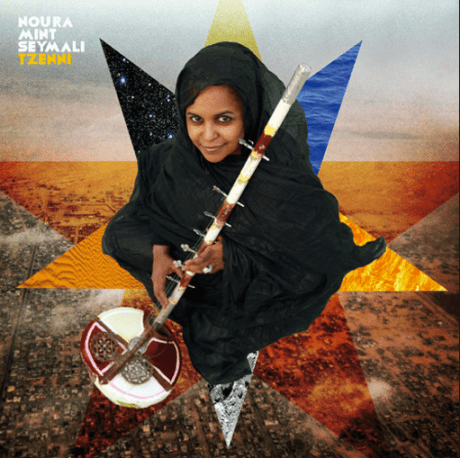
The technicalities, pentatonic melodies and the fundamental mechanics aside, nothing can quite prepare you for that opening atavistic, panoramic vocal and off-kilter kick-drum and snare; an ancestral lineage that reaches back a thousand odd years, given the most electric crisp production, magically restores your faith in finding new music that can resonate and move you in equal measure.
Hailing from the Islamic Republic of Mauritania, nestled in between Algeria, Senegal, Mali and the Western Sahara, with the Atlantic lapping its shoreline, Noura Mint Seymali keeps tradition alive in a modern, tumultuous, climate. Her homeland – run ever since a coup in 2008, by the former general Mohamed Ould Abdel Aziz, duly elected president in 2009 – was rocked by the immolation sparked Arab Spring and subsequent youth movement protests, all of which were violently suppressed by the authorities. Add the omnipresent problems of FGM, child labour and human trafficking to the equation and you have enough catalysts to last a lifetime. However, Noura’s veracious commanding voice responds with a dualistic spirit, the balance of light and shade putting a mostly positive, if not thumping backbeat, to forlorn and mourning.
Recorded in New York, Dakar and in the Mauritania capital of Nouakchott, Tzenni transverses a cosmopolitan map of influences and musical escapism. The original heritage still remains strong, yet the ancient order of griot finds solace with the psychedelic and beyond.
Jon Hassell/Brian Eno ‘Fourth World Vol.1: Possible Musics’ 2014
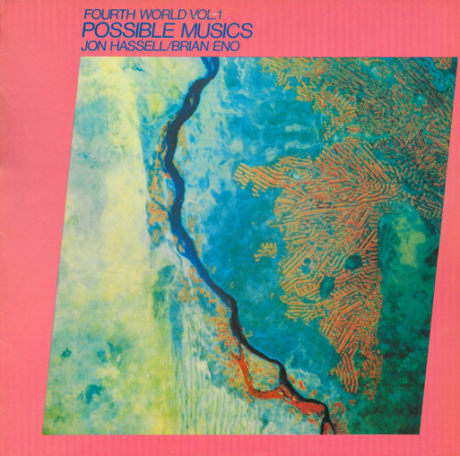
Already riding high on a crust of acclaimed production projects and numerous semi-successful collaborations and solo albums, when Brian Eno touched down in New York City in 1978 he would unintentionally help direct another important development in ambient and world music (and also end up staying for five-years). Absorbed in what the city had to offer him musically, Eno came across the stripped and atmospherically rich experiments of trumpeter/composer Jon Hassell, who’s own pathway from adroit pupil of Stockhausen to seminal work on Terry Riley’s harangued piano guided In C, encompassed an polygenesis of influences: a lineage that draws inspiration from avant-garde progenitors like La Monte Young, and travels far and wide, absorbing sounds from Java to Burundi.
Though a minor figure in the sense of worldwide recognition, and never one to brush with any sort of commercial popular appeal, Hassell irked out his own personal philosophy. With a handy masters degree in composition, he attempted a reification of what he would term the “fourth world”; a style that reimagined an amorphous hybrid of cultures; a merger between the traditions and spiritualism of the third world (conceived during the “cold war” to denote any country that fell outside the industrious wealthier west, and not under the control of the Soviet Empire) and the technology of the first.
Untethered to any particular landscape and age (though traversing for the most part the mysterious, veiled continent of a inter-dimensional Africa), geographical and environmental alluded titles act as points of reference; alluding both to such diverse subject matter as the traditional songs of the Central African pygmy tribes (Ba-Benzéle) and the latitudes and weather phenomenon of an undisclosed landscape or city (Rising Thermal 14° 16’ N; 32° 28’ E).
Moving at a similar pace throughout, the lingering vapours drift over and enclose the listener; hinting always at some mystical or miasma presence; steeping each composition in a sepia of low emitting foggy harbour like droning horns, plastic pipe sounding percussion, tape echo experimentation, panoramic glides over the savannahs and of course Hassell’s stripped bare, reedy and masked stirring trumpet.
An almost continuous set of transient movements, the mood varied from lightly administered rhythmically slow paced pieces to cerebral blankets of panoptic memory; a style coined as “future primitive”. Reissued by Glitterbeat Records under their visionary imprint Tak:til, this album can be read as a principle guiding light and inspiration for their roster and ambitions.
Various ‘Hanoi Masters: War Is A wound, Peace Is A Scar’ 2015
A side excursion, travelling due east to Asia and breathing in the evocative songs of Vietnam, Glitterbeat Records launched their new series of field recordings entitled Hidden Musics with the Hanoi Masters compilation. Finding a congruous musical link with their usual fare of West African releases, the label sent Grammy-award winning producer Ian Brennan (credits include, Tinariwen, Malawi Mouse Boys, The Good Ones) to Vietnam in the summer of 2014 to record some of the most lamentable and haunting resonating war-scarred music. Indelibly linked to what the indigenous population call ‘the American war’, the examples of both yearning and praise pay tribute to the fallen: delivered not in triumphant or propagandist bombast but in a gentle meditative manner, these survivors, forty years on from the end of the harrowing and catastrophic (the repercussion still reverberating in the psyche of the burned America and its allies) war, were still undergoing the healing process.
Tinged with an omnipresent lilting sadness these songs are imbued with battle scars (hence the albums subtitle War Is A wound, Peace Is A Scar), featured artisans and traditional music masters who had joined the cause, sometimes for the first time in years, allow their voices to be heard once again and recorded for posterity.
Considering the history and ill blood between cultures – though this has eroded as capitalism takes hold and the country opens up – it has in the past been difficult to investigate the serene and attentive beauty of the Vietnam music scene, but this earnest and adroit study into a world seldom covered proves enlightening and humbling.
Bixiga 70 ‘III’ 2015
Speaking Fela fluently with marked respect and reverence, going as far as to borrow part of the late Nigerian bandleader and doyen of Afrobeat’s backing group moniker, Bixiga 70 may be inspired and informed by Kuti but they do so much more with his high energy polyrhythms and feverish hot-footed anthems. The eclectic Sao Paulo band, who joined the Glitterbeat family in 2015, add even more flavour to the Afrobeat template on this their third album. Energised by their performances in the hotbeds of fusion, from North Africa to Europe, and working with a decentralised method of producing new material, the III album reaches out and embraces an even richer array of world sounds.
Incorporating the rhythms and dances of their own continental home, Bixiga shake and shimmy to the local customs of cumbia and the sensual hip movements of the carimbo on a trio of slinky paeans to the indomitable spirit of joyous release. Congruously they go, flowing from one source to the next deftly, passionately and with a raw powered energy, our Brazilian friends relationship with Glitterbeat has proved to be a sound move; an ideal home for the group’s ever expanding fields of sound and exploration.
Afro-Haitian Experimental Orchestra ‘A.H.E.O’ 2016
Progenitor and embodiment of the Afrobeat drum sound, still in high demand four decades after his explosive partnership with Fela Kuti, the much-venerated Tony Allen extends his infectious percussion style beyond the African homeland. Sharing an obvious entwined history with Africa, the shared Hispaniola Island of Haiti proves both an esoterically mysterious and congruous collaborative foil to Allen’s distinct drumming patois.
Invited to perform in 2014 by the French Institute Of Haiti’s director Corinne Micaelli, Allen’s visit would end with a public broadcasted concert in the main square of the capital, Port-au-Prince. Collaborating with Allen would be a cross-section of local percussionists and singers recruited by vocalist, dancer, ‘voodoo priest’ and director of the Haitian National Bureau Of Ethnology, Erol Josué; Josué would himself lend his sweet yearning and reflective tones to two of the tracks on this album.
The call went out and the great and good of the Haitian music scene came. Racine Mapou de Azor, the Yisra’El Band, Lakou Mizik and RAM. Another Monolith regular and one-time Port-au-Prince resident, Mark Mulholland was drafted in as the experimental orchestra’s guitarist, and as it would turn out, eventual legacy overseer. With only five days of studio rehearsal time to gel and work out their performance, the sessions proved both, as Mulholland observed, ‘chaotic’ and overwhelming’.
Elevating beyond the borders it was created behind, the Afro-Haitian Experimental Orchestra root foundations shuffle and shake free of their stereotypes to move freely in an increasingly amorphous musical landscape. You’re just as likely to hear vibrations and traces of Dub, native Indian plaintive ghostly echoes, Sun Ra’s otherworldly jazz and funk as to hear the indigenous Haiti sounds and Afrobeat pulse. Tony Allen is once more at the heart of another bustling, dynamic explosion in rhythm.
Various Artists ‘Hidden Musics Vol 2. Every Song Has Its End: Sonic Dispatches From Traditional Mali’ 2016

Though no less an achievement, the second volume in Glitterbeat Records “Hidden Musics” series offers the full gamut not just musically but visually too, and is a far more ambitious documentation of a troubled country’s lost tradition than the 2015 Hanoi Masters survey. Expanding to include 11 concatenate videos, Every Song Has Its End is the most complete purview of Mali’s musical roots yet. This is due to the project’s mastermind and architect Paul Chandler, who has documented Mali’s music scene for more than a decade.
Forgotten in some extreme cases, ignored or considered as Mali’s past by new generations, maestros of the 6-string Danh, such as Boukader Coulibaly, and the Balafon, Kassoun Bagayoko, are celebrated and interviewed for this collection. Whether it’s traversing the Gao region in the northwest to record the earthy desert pants of the female vocal ensemble, Group Ekanzam, or capturing a Sokou and N’goni love paean performance by Bina Koumaré & Madou Diabate in the heart of the country, this chronicle of the pains, virtues, trauma and spirit of the country’s musical heritage is an extraordinary love letter and testament to the country.
Bargou 08 ‘Targ’ 2017
Ahh…the sounds of a dusky reedy gasba flute; the tactile patted and burnished bendir drum; the rustic, earthy strung loutar, and the flowing, soaring scale vocals of the Bargou 08 project’s chief instigator Nidhal Yahyaoui, set an impressive atmosphere in the first couple of minutes of the album’s opening track, Chechel Khater. And that’s all you’d need, except there’s another eight equally evocative and thrilling tracks to hear.
The source of this sound derives from a relatively uncharted region that lies obscured between the mountains of northwest Tunisia and the Algerian border, called the Bargou Valley, which despite its barren isolation, has cultured a unique musical fusion, stretching back hundreds of years. Captivating and magical enough in its ancestral unchanged form, the songs of the valley, sung in the local Targ dialect (a language that is one part Berber, the other Arabic), are given a contemporary jolt that transforms the atavistic paeans, odes and poetry of yore into an intoxicating swirling rapture of electronic North African funk.
Filled with a legacy of turmoil and tension that goes back an aeon the album’s many themes, from describing a lover’s vital attributes on Mamchout to laments of alienation, resonate strongly with the growing unease of events, initiated six years ago by the Arab Spring. Tunisia itself is facing a struggle and teetering on the edge, with no guarantee that certain cultures won’t just disappear or be fragmented in the ensuing melee. Originally setting out to document his Bargou Valley home’s musical heritage before it disappeared, Yahyaoui has successfully and thankfully, with his musical partner, producer and the album’s keyboard player Sofyann Ben Youssef captured this rich mesmeric culture for posterity. And in doing so, produced a masterpiece that will endure.
Širom ‘I Can Be A Clay Snapper’ 2017
With an unspecified, but as the name suggests, emphasis on the “tactile”, Glitterbeat Records new imprint label gives a welcome platform to entrancing experimental tonal performances and sonic polygenesis traverses alike. In the latter camp is this Slovenian peregrination suite from the landlocked, Alps nestling country’s visceral sonic conjurors, Širom.
Evoking memories and feelings, both real and imagined, with a soundtrack thick with atavistic connections, the trio of punk and post-rockers turn experimental folk and acoustic instrumental cartographers convey a personal relationship to their homeland, on their second album together under the Širom banner.
Yet whatever the backgrounds, traces of North Africa, the Adriatic and the Middle East, the performances sail scenically through a dreamy otherworldly representation of Slovenia: Oriental, alien and Balkan visions permeate the plucked, malleted, chimed and purposefully played compositions, which subtly and rather cleverly build up complicated layers and various overlapping time signatures during the course of their journey.
Theremin like siren voices drift in and out, enacting the myth and seraph, whilst on the watermill turning Everything I Sow Is Fatal Sun Ra travels with John Cale and Pharaoh Sanders on a pilgrimage to Samarkand. The most recurring sounds however pay testament to the Balkans ghosts. The folkloric stirrings, lulls and yearning of Slovenia’s past bordering both a pan-Europa of migration and grief – stretching back a millennia – are transduced into often haunted vistas and metaphysical passages.
A most impressive and expansive inaugural Balkans travail; different from the previous two releases on this burgeoning new imprint, yet keeping to the tactile, accentuate and imaginative remit, whilst conjuring up mystical new soundscapes.
Tamikrest ‘Kidal’ 2017
Still availed of a homeland, though now liberated from their draconian Islamist partners, the Tuareg are once again left as wanderers in their own land, the unofficial guardians and custodians of the Saharan wilderness. For now only a dream, best realized and protested through music, the rock’n’roll Bedouins Tamikrest emerge once more from the barren landscape with a message of “power and resistance” on their fourth, equally entrancing, album Kidal. Paying homage to the strategically and spiritually important cultural trading town of the title, the highly-acclaimed (and rightly so) Tamikrest exude both the sadness and suffering of the dispossessed people who cling to the southwestern Saharan hub that is Kidal: a town which has seen its fair share of fighting, fought over, conquered and reconquered over time, it remains a symbolic home to the Tuareg. This is after all the town that nurtured them and where it all began.
Assiduous, confident and articulate, the musicianship shows not so much a progression as a balance between the meditative and rock’n’roll spirit of the Tuareg musical resistance. Tamikrest are as brilliant as ever musically, and Kidal is, despite its plaintive and lamentable subject woes, a beacon of hope in an ever-darkening world of uncertainty.
Ifriqiyya Électrique ‘Rûwâhîne’ 2017

Capturing something quite unique, the collaborative industrial post-punk and avant-garde rock scenes of Europe clash head-on with the descendants of the Hausa slaves atavistic rituals styled group, Ifriqiyya Electrique, create an often unworldly chthonian conjuncture of Sufi trance, spirit possession performance and technology.
A film project and now immersive sonic experience, inspired by the important Banga music traditions and the accommodating, rather than exorcising, of spirits ceremonial wild dances and call and response chanted exaltations of the black communities – originally transported to the region from sub-Saharan Africa – in the oasis towns of southern Tunisia, this astounding meeting of cultures and history is anything but scenic.
Formed in the Djerid Desert, the idea forged by field-recordist and veteran guitarist of the politically-charged Mediterranean punk and “avant-rock” scenes, François Cambuzat, and bassist Gianna Greco – both of which occasionally join forces with that livewire icon of the N.Y. underground, Lydia Lunch, to form the Putan Club -, the Ifriqiyya Electrique spans both continents and time. For their part, Cambuzat and Greco provide the grind, industrial soundscape texturing, sonorous drones and flayed guitars, but mostly, the “electrique”, whilst, offering a dialogue with the spirits and the tradition, Banga musician Ali Chouchen – joined in the live theatre by an expanded cast of fellow voices, krabebs and Tunisian tabla players from the community, which includes Tarek Sultan, Yahia Chouchen and Youssef Ghazala – provides peripheral sounding evocative echoed and esoteric vocals and equally haunting nagharat.
Spiritual conversations transformed and realigned with the machine age turmoil of industrial noise, Arthur Baker style rock and hip-hop production, post-punk and even Teutonic techno, Rûwâhîne is a rambunctious unique force.
Park Jiha ‘Communion’ 2018

Circumnavigating the globe to bring much-needed exposure to new sounds, Glitterbeat Records imprint tak:til gives a second wind to a suite of acuity serialism from Southeast Asia. Released originally in South Korea in 2016, the neo-classical musician/composer Park Jiha’s debut solo album Communion is given an international release by the label of repute.
Inspiring what we’re told is a burgeoning Korean music scene (well, an alternative to the K-Pop craze), a chief progenitor of the movement Jiha alongside collaborative partner Jungmin Seo originally melded the country’s musical heritage with an eclectic range of contemporary sounds as the 숨[suːm] duo in 2007. Releasing the highly influential regional albums Rhythmic Space: A Pause For Breath (2010) and 2nd (2014), Park and Seo crossed the time zones to perform at both WOMAD and SXSW. Congruously putting the duo on hold to explore a more ‘personal’ and minimalistic ‘musical vocabulary’ as a solo artist, Jiha dexterously balances the air-y abstract breathes of the ‘piri’ double reed bamboo flute, the searing twang of the ‘saenghwang’ mouth organ and the softly paddled patter of the ‘yanggeum’ hammered dulcimer in what is a dialogue between a dulcet calm, the meditative and an entangled dissonance.
Transforming Korean traditions into a more experimental language that evokes the avant-garde, neo-classical and jazz yet something quite different, Park Jiha’s tranquil to entangled discourse evocations reach beyond their Southeast Asian borders both musically and metaphysically into something approaching the unique.
Playlist
 Monolith Cocktail Blog