The Perusal #59: Nonpareils, El Khat, BAG, Christopher Haddow, Daniel Inzani, John Howard…
September 9, 2024
A WORLD OF SONIC/MUSICAL DISCOVERIES REVIEWED BY DOMINIC VALVONA
(Unless stated otherwise, all releases are available now)

Nonpareils ‘Rhetoric & Terror’
(Mute) 20th September 2024
Amicably uncoupling, nearly eight years ago, from the group he co-founded with foil Angus Andrew, the former Liars instigator Aaron Hemphill has pursued an inventive conceptual imbued pathway collaborating, recording and scoring a host of projects, from cinema to the gallery space and music stage. The L.A. born and raised artist upped sticks for the year before the Liars split for new horizons and a new cultural hotspot.
Three years later and with a fresh start and process of working, Hemphill released his debut solo album Scented Pictures under the Nonpareils appellation – chosen so that it didn’t evoke a single person or a producer’s name but instead, hopefully, in Hemphill’s words, “sounded like a group or a band name…something plural too.” Christened as “metaphysically reconstructed pop” at the time, that inaugural album was accorded a raving review from me. My description went a little something like this: “Cyclonic churning and confusing barrages of sonic displacement”, and “a window in on the woozy state of Hemphill’s mind, all those ideas, snippets and memories channelled through an abstract and broken staccato and heavy reverb obstruction that’s still capable of throwing out some pretty good hooks and tunes.” My favourite track from that album, ‘The Timeless Now’, sounded like a centrifugal space sequence breakdown of time itself.
But now moving away slightly, philosophically and methodically, Hemphill attempts an unbroken flow between family life and his theoretical practice. The personal relationships arrive in the form of Hemphill’s spouse and creative foil Angelika Kaswalder, who lends voice to many of the tracks on this second Nonpareils album; sharing space with old pal and post-hardcore Blood Brother Morgan Henderson, who is on hand to suffuse the constantly changing sonic and musical landscape with chamber-style enchanted fairy tale and pastoral woodwind.
Although now embracing a fluid relationship between the reasonability’s of home life, of bring up children and his art, Hemphill has lost none of his conceptual curiosity. Rhetoric & Terror is a very different album yet still carries some of the debut’s signatures: highly experimental with signs of John Cale, R. Stevie Moore, Coil, Deerhunter and Royal Trux-like feel of druggy-induced languidness.
More “emotionally available” this time around, but not without devices and themes, the album takes its name from a chapter in Giorgio Agamben’s The Man Without Content. The Rhetoric & Terror heading in the original book is used to describe two different types of writers: the “terrorist” being the misologist (in its simplest terms, someone with a hatred for argument, debate or reasoning) who is only into feeling, and the “rhetorician”, committed to logic and form. The connotations and feels/emotions all play out across a mix of fantasies, nightmares, hallucinations, and corrupted industrial and Gothic pop-synth duets of a very removed kind, or swell into crescendos of the tortured, the sonic howled and distorting unsettling blocks of corrosive scuzz. During these moments Kaswalder’s voice sounds either like Jarboe or peculiarly like a haunted Lennon! Whilst Hemphill’s voice is smothered at times in a Bradford Cox fog, in pain or strung out.
With the additional subtly of woodwind, there’s suggestions of dreaminess and woodland adult tales. There’re multilayers of Meta, heaps of influences at play, and counterbalances of light and shade, repulsion and candid sexuality, morphed into a constantly changing soundtrack. At any one time this can all sound like the Flaming Lips, the Legendary Pink Dots, Glenn Branca’s Symphony No.1, the atmospherics of Norman Westburg, Swans, Faust, DAF, Current 93, FLips or Brian Reitzell. There’s a lot to unpick, and some tracks threaten to overload the listener on the first run through: everything from post-punk to the German new wave, the gothic, indie-dance music and the psychedelic wrapped up and expelled, catching the emotional rollercoasters. Logic and feelings clash, with the latter winning out.
Gristly fear and surreal theatre find common ground in a strange reality on yet another successfully untethered and unbound album of ideas from the Nonpareils project.
Various ‘Synthesizing The Silk Roads: Uzbek Disco, Tajik Folktronica, Uygher Rock & Crimean Tatar Jazz From 1980s Soviet Central Asia’
(Ostinato Records) 20th September 2024
Everything you’d expect to hear in the West but transported via the 80s equivalent of a workhorse camel along the silk roads network that connected an age-old trade between nations, kingdoms and city states across Eurasia and beyond, the latest compilation “anthology” from the Ostinato label surveys a synthesizer-fuelled musical revelation in the Soviet Union’s double landlocked central Asian realm of Uzbekistan.
No one asked the various mix of Turkic peoples that made up this trading post and hub whether they wanted to be absorbed into the Russian and then, later, revolutionary Soviet communist empires. An old community of diverse ethnicities (though originally, so I believe, descended from Scythian nomads) once divided for an epoch between the Emirate of Bukhara and Khanates of Khiva and Kokand, the lands known as Uzbekistan (named after the largest of the Turkic official languages, Uzbek) contain such real but fantastical exotic atavistic draws as Samarkand and Tashkent. Surviving brutal conquests by Tamerlane in the 14th century, and waves of interference, authoritarian rule and cultural, historical erosion and the quashing of nationalism and identity by the Russians, these nomadic peoples have managed to maintain their roots and practices and spirit.
The demographics were radically shaken up during the summer of 1941 when a struggling USSR – caught out and caught short by Nazi Germany’s invasion -, under a panicking Stalin, ordered a mass evacuation eastwards of sixteen million people. Many of ended up in Tashkent. Not only the Uzbekistan capital but the country’s largest city, Tashkent was infamously destroyed by Genghis Khan in 1219. Rebuilt over time, but felled by a devastating earthquake in 1966, it was once more put back together, but this time built in the image of a model Soviet propaganda city.
One of many such transfers of people – from 1930 to 1952, Stalin forced various groups east, either as punishment, as labour or to fill ethnically cleansed territories – the wartime waves included, of all trades, several gramophone engineers. This would prove very handy, leading to the establishment of the Gramplastinek pressing plant in Tashkent near the end of the war; a central, we’re told, player in Soviet era record production, knocking out 200 million records by the 1970s. With the death of Stalin in 1953, the iron glove replaced the, well, just iron fist, and the Soviet music scene saw a “blossoming” of jazz clubs and later, discotheques. The story behind this selection brings together a number of communities, all playing their part in building a unique multicultural scene in the face of dictatorial censorship, surveillance and continued repression.
One such vital contribution includes those members of the Bukhavan Jewish community that had started importing “state-of-the-art” music technology from the USA and Japan to the region: namely both Moog and Korg synths. Combined with a growing demand for homegrown produced music, the sounds of disco, fuzz rock, the pop new wave (the American, French and German kinds), funk, soul and the troubadour were all lent a distinct Eurasian romantic fantasy of the pouted, the courtly, the lovelorn, dreamy and pumped. Several artists on this compilation suffered for it, punished by the KGB, sent to the gulags and even forced to undergo psychiatric treatment in some cases: hardly the fertile conditions for the music artist and industry. But then some, still, view that time, before the Berlin wall came down, as a golden period of art and cultural expression.
Words such “groundbreaking” and “rare” are used by the label and their curatorial partners Maqom Soul. And to be fair, I’ve certainly never heard any of the records included here, nor was I previously aware of an Uzbekistan scene as such. But from a “dead stock” of vinyl retrieved from the Gramplastinok plant (which closed its doors in 1991) and a smattering of live TV recordings that period is revived and roused from relative obscurity. What with all those diverse threads, musically and ethnicity wise, we’re introduced to transit points between Western and Eastern, Northern and Southern Asia; a place in which the Uzbek meets the Afghan, the Russian, the Uyghur, the Tatar and the Tajik. A veritable fusion of cultures bounce, zip and zap around a track list that includes doe-eyed dreamy and phaser effected vapours of the silk road, woven into chanteuse stepper pop (Nasiba Abdullaeva’s Afghan dialect oozed and longing caravan trail ‘Aarezoo Gom Kardam’ – or translated into English, “I lost my dream”); Lipps Co. laser-beam shooting disco with a macho beat (the “live” edit of the Original Band’s pumped ‘Bu Nima Bu’); NRG consults with Gino Socco and bamboo music Sakamoto (Bolalar’s Jewish harp springy muse yearn ‘Lola’); and inspiral garage organ and scuzzy fuzz rock guitar (Yashlik’s joyful ‘Radost’).
Outside those spheres of influences, the misty drizzled Minarets Of Nessef’s (Uzbekistan has been and is still majority Sunni Muslim) ‘Instrumental’ wouldn’t sound out of place on a Greg Foat album these days, with its smoky and smooching bluesy and jazzy saxophone, smozzy romantic landscaping cult sounds and Aphrodite’s Child like evocations. Khurmo Shirinova’s filmic mirage ‘Paldot Kardam’ (“found a sweetheart”) sounds like a lost Michael LeGrand ballad from Never Say Never Again, and the Korean ethnic Ariran’s ‘Pomni Menya’ (“remember me”) sounds like a saddened hybrid of Issac Hayes and Lalo Schifrin dropped into Seoul during the early 1970s.
You’ll hear soundalikes of Jarre, Space, Patrick Cowley, Carrone and, rather surprisingly, Liquid Liquid, but with a Eurasian twist of the exotic, sometimes naïve, and on occasion, fun. In my books, that makes Synthesizing The Silk Roads everything you’d hope it would be; the gateway to a chapter in synth history you never knew existed, never knew you needed, and now can’t wait to add to your life.
Christopher Haddow ‘An Unexpected Great Leap’
(Erol’s Hot Wax)
A comfort blanket bookended by the reassuring signs of life via the sounds of an ultrasound, Christopher Haddow’s first steps out as a solo artist (flanked on either side by the contributions of Josh Longton on double-bass and Jamie Bolland on piano) capture the abstract feelings of parenthood. An Unexpected Great Leap is in fact, partially, an ambient tool to send both Christopher and his artist wife Athene Grieg’s son Louie off to sleep.
As a documentation, a lovely musical sonic gift, this debut album is also a response to Athene’s 2020 Til Morning Wakes exhibition: “a reflection on time spent as a new parent”. As companion pieces they evoke the sleep-deprived hours spent waiting for baby to nod off. This is often represented by the continuous loops, the actions of pushing a buggy in circles around the park. And yet, aside from the child rearing, the ambient mirages, illusions on this album offer a vague semblance of Americana and Western panoramas, but also a sense of landscape and atmospheres captured by time-motion cameras; places mostly empty, devoid of people, machinery and distractions: and all the better for it too.
This is ambience style music with a specific mission; a hazy congruous score of beautifully crafted melodious serialism and deeply felt tactile evocations. And although Christopher probably didn’t envision this when producing this work of languid patience, my Jack-Chi Poppet fell gently asleep in peaceful comfort beside me as we both listened through the album.
Laconic in a good way, dreams are cast, but mysteries too. And that sense of building scenes thousands of miles away. For this sounds like a fantasy collaboration that never was between Eno and Daniel Lanois, Paul Tasker, Daniel Vicker and Chuck Johnson.
Away from a Glasgow environment and the local famed Green Door studios, and his own Stroud studio, there’s echoes of country-folk, porch music and bluegrass melting into subtle painted ebbing strokes of ambience and the neo-classical – the piano of Roedelius, and although it’s not an instrument listed in the making of this record, some of the plucks, bows and tactile quivers sound like the work of the experimental cellist Simon McCorry.
There’s so much more going on beneath and above the surface: a texture of whirring tape machine, flange-like mirages and magical bendy open-tuned guitar-rung versions of the dedicatedly romantically swooned ‘Plaisir d’amour’ (or as Elvis crooned, making it truly famous, “I just can’t help falling in love with you”) under crepuscular skies.
You may know Christopher as the former lead guitarist of Paper Planes and as a member of Jacob Yates and the Pearly Gates, but under his own name and with a different, more personal, direction he’s beautifully, imaginatively and conceptually complimented his wife’s visual feels of parenthood with a searching and settling album of ambient Americana and womb music.
Daniel Inzani ‘Selected Worlds’
(Hidden Notes Records/Tardigrade Records)
Still leading a myriad of ensembles and collaborating with a host of artists and collectives both on and outside the Bristol contemporary and neo-classical scenes, Daniel Inzani, after two decades, is only now stepping out under his own name.
The CV is an enviable one, and far too long to list here, but in the last four or five years the composer, pianist and arranger and oft musical director has worked with the label and festival platform Hidden Notes Records, both recording albums with his own Spindle Ensemble quartet and teaming up with the Toronto-based Evergreen Club Contemporary Gamelan octet. His third project for that facilitator hub of carefully chosen discerning releases in the experimental classical and worldly spheres is a most ambitious trio of connected, but also experienced in their singular forms, vinyl albums made with different ensembles and bands with various configurations, and with the sound, musicality and performances gradually transforming from chamber impressionism to jazz and the cosmic.
As intimate as it all is truly cinematic, the scale and breadth are impressive; the performances as articulate and stirring as they are dramatic and full of descriptive scenes, thoughts, meditations and moods.
As I’ve already said, you can either take this triple spread in as a whole work or individually, as each LP (broken up into the Form, Lore and Play titles) is a complete concept, an encapsulation of a separate recording sessions with several different lineups, and even sometimes, different instrumentation – although some instruments, including Inzani’s piano remain constant across all three records. What also stays constant is the influence of such pioneers and mavericks as Moondog and a mix or reignited classical and more modernist, avant-garde composers.
However, the scope is stretched towards African (Ethiopia specifically but also Northern and Western Africa) and American jazz, soundtrack scores and the one-man omnivorous Zappa by album number three. But Selected Worlds first begins with the impressionist brush strokes of a small chamber ensemble and a mix of string movements, suites and soloist piano performances. Recorded live, like all the albums in this collection, over three days, Form takes the classical sparks and the pastoral scenes of both the romanticised and more sorrowful evocations of Ravel and Mahler and wraps it around heightened, thriller and cutting shrilled violins, 50s cinema, theatre, the more modern work of Johnny Greenwood and Steve Reich’s Mallet Quartet. ‘Midsummer Piano Trio’ captures that titular seasoned yearn as Inzani’s piano touches on vague reminisces of Duke Ellington, Pascal Amoyel and Camille Saint-Saëns, or a silent age soundtrack.
Not quite the Four Seasons, the Form album does however capture seasonal changes with a palette of both the measured and more dramatic.
Album number two, Lore, extends the orchestral ensemble of players, introducing more percussion and, I believe, the deep bassy tones of the cello. This set-up takes the mood into ever more expansive areas of inquiry, of intensity, and at times the ominous. Here the influences (whether purposefully or not) point to Bernard Hermann, Krzysztof Penlerecki, Riley, György Ligeti (especially on the sombre and scary swelled creation of ‘In The Midst’) and Sun Ra. You can a semblance of Saturn’s cultural ambassador to Earth’s celestial-otherworldly-meets-transformed-old-time-jazz-vibes throughout, but notably on the sweetly sorrowful stargazing ‘The Zodiacal Light’.
As I mentioned, you can hear a lot more percussion, and the soft bass drum and dusting, sifting and brushing of cymbals and snare.
The serious ‘Based Around’ pulls the listener back into the soundtrack world, with viola (maybe) and violins at one point aping the menacing shark signatures of Jaws, albeit if Hitchcock and not Spielberg had made the movie and commissioned the score.
Album three, the final piece in this grand work, retains some of the previous musicality but now finds a new rhythm, a groove even, as it shifts the classical action towards Africa, the Levant, Anatolia and America. Performances now take in a vague lilt of Morricone and combine it with the Ethio-jazz sax and melody of Getatchew Mekurya, the beautiful scores of the cult Norwegian composer Sven Libaek and a hint of Mingus and the more contemporary Misha Panfilov: and that’s all just on the LP’s opening somnolent spell ‘Sleepwalking’. ‘Beyond The Pale’, meanwhile, sounds like a restless Marshall Allen squawking and pecking over a mix of Anatolian scuzz rock, Jimi Tenor, Mulatu Astake and The Heliocentrics: the soundtrack for a chase through the souk. ‘Sultana’ takes a leaf out of the Kasmi Washington’s playbook but also features the bobbing bulb-like notes and hallowed tubular sounds of gamelan. ‘The Great Nebula’ matches that malleted influence with an Afro shuffle backbeat and clarinet to create a Javanese-Ethio Tony Allen fusion. It’s the saxophone of Peter King that can be felt on the Afro-jazz imbued ‘The Wind Bids Me Leave You’ – that title sounds more like a haiku than sweltered African movement -, and on the ‘Roundup’ track, it sounds like he’s been joined by a rasping, mooning Pharoah and Idris Ackamoor. It all ends with the sleepy dust sprinkled Satie meets Sven Wunder dream sequence ‘Glasswing’, which is every bit as glassy as that title suggests.
It seems like a lifetime of work and practice has gone into this impressive cycle of albums, with every composition and performance a rich, stirring and cinematic dance of sources and influences moulded to make something anew. Classical theory and foundations are reignited, revitalised and congruously fused with jazz, film scores, the avant-garde, pastoral, the impressionistic and worldly to announce the inaugural Daniel Inzani-named opus. Fans of the Spindle Ensemble, his contributions to Cosmo Sheldrake’s big band and the Ethiopian inspired octet Tezeta, and his work with Alabastor deplume, will find some common ground and overlaps, but be surprised in the scale and the free reign that he’s been given. There’s no fear either of showboating and egotistical grandstanding, despite that scope and broad canvas as Inzani is generous in letting others come to the forefront. Selected Worlds is nothing less than an incredible achievement.
El Khat ‘Mute’
(Glitterbeat Records) 13th September 2024
The great upheavals that once forced the Jews of the Yemen to emigrate, at first in waves then on mass, to Israel during both the late 19th and mid 20th centuries mark out this unique community. Before Islam, and even before the birth of Christ, Jewish settlements in Northeastern Africa and the Arabian Peninsula were numerous. It’s believed that the Yemenite Jews can trace their roots all the way back to 110 BC, during an epoch in which the Yemen was considered a vital rich interchange of cultures and trade. It proved a haven two centuries later to those Jews escaping the barbaric fallout of the Bar Kokhba revolt against Rome in 132 AD.
These same Jewish communities survived for a further thousand years, even in the face Islamic conquest and conversation. Yemenite Jews had previously, during a sixty-year period since the 1880s and rise of Zionism (the return) emigrated in small numbers to their spiritual home of Israel. But in1924 (Northern) Yemen ruler Inman Yahya forbid any further attempts to leave. Once Israel was (re)established a generation later, and although reluctant and unprepared for such an influx, David Ben-Gurion’s government carried out the controversial Operation Magic Carpet uplift of those Yemenite Jews still trapped there. Because of the 1947 UN Partition Plan, Yemen’s authorities, and many in the Muslim community, began to persecute their Jewish neighbours; partly fuelled by the declaration of an Israeli state, but also, specifically, down to the claims that Jews had murdered a couple of Muslim Yemeni girls. Alongside smaller community numbers in Aden, Djibouti, Eritrea and Saudi Arabia, around 47,000 Yemenite Jews were brought to Israel. Not without criticism, many were forced to live in transit camps, with mortality rates high, corruption and a government that had stalled and questioned whether it should have even carried out this mass immigration plan.
Fast forward to modern times, and bearing that legacy, the Eyal el Wahab led El Khat trio have continued the nomadic-like exodus, emigrating from their Jaffa home to Berlin. Never an easy fit in Israel and abhorred by the politics of their adoptive home in recent years, they’ve chose to leave in the summer of 2023. This was of curse before the war in Gaza, which they strongly condemn. The title of their third album, Mute, is a reference to this, but also takes that word’s many other connotations into account too. But specifically, it is used to define the absence of unity, of finding commonality and resolution. As el Wahab puts it: “Every distance between two people is an opportunity for conflict. Two of anything creates sides and sides create conflict. In such cases there will be muting.”
The journey to Europe is chronicled in the El Khat way, with a both hypnotising and elliptical shambled buzz of swaddled heralded horns, taut-strung sawing and bowing, scrappy percussion and dot-dash staccato organ and haunting old country, salon barrel, Lloyd Miller-like piano.
Somehow the multi-instrumentalist el Wahab and his percussionist Latan Yaish and organist Yefet Hasan foils manage to convey the seaward passage (I suppose they could have just caught a plane, but it sounds so much less romantic and adventurous) of a ship horn, the nomadic caravan motion of emigration with the emotions of leaving something precious behind. With a fusion of Yemeni influences – especially Fatimah Al-Zaelaeyah on the “la la” lulled bandy, scrapped, rubbed and dusted percussive canter and clopped ‘Commodore Lathan’, but also Raji Ali and abu Baker Salim – plus something from Egypt, Anatolia, Arabia and Ethiopia – Emahoy Tsega Mariam Gebiu and Getatchew Mekurya -, El Khat mix traditional pulls with a modern twist of dub and post-punk and a subtle use of electronic frequencies and filters.
Not so much a cacophony as a diy, raw and lively ramshackle brilliance of Yemenis wedding and processional marching bands music and the craziest of taxi rides amongst the Arab diaspora, the sound lollops, circles, whirls or stumbles along gloriously.
El Khat throw up some surprises too, sounding like a removed Two-Tone Specials waylaid on the Arabian coastline waiting to board an ocean liner to Europe on the tub-rattling, funnel horn sounding ‘La WaLa’. They evoke label mates Avalanche Kaito on the clanging and fiddled, Ethio-organ drumming circle ‘Zafa’. The electrified garage band stamping and tin can rattle ‘Ward’ even reminded me of those Istanbul legends Baba Zula, whilst yet another former Glitterbeat label mate, Bargou 08 rings loud throughout the entire album.
But I’m not sure anything else quite sounds like this mix of cultural and geographical influences; the hybrid of their former Jaffa port scene, the Levantine and greater regional fusions all coming together on traditional instruments and reconstituted junk. It all makes for a dizzying, mystifying, energetic and yet near languid spin of speeds, timings signatures and tunings. El Khat finds a language of their own to express serious issues in an amazing colour of rambunctious rustic yearning, joy and magic.
John Howard ‘Songs For Mr. Feld’
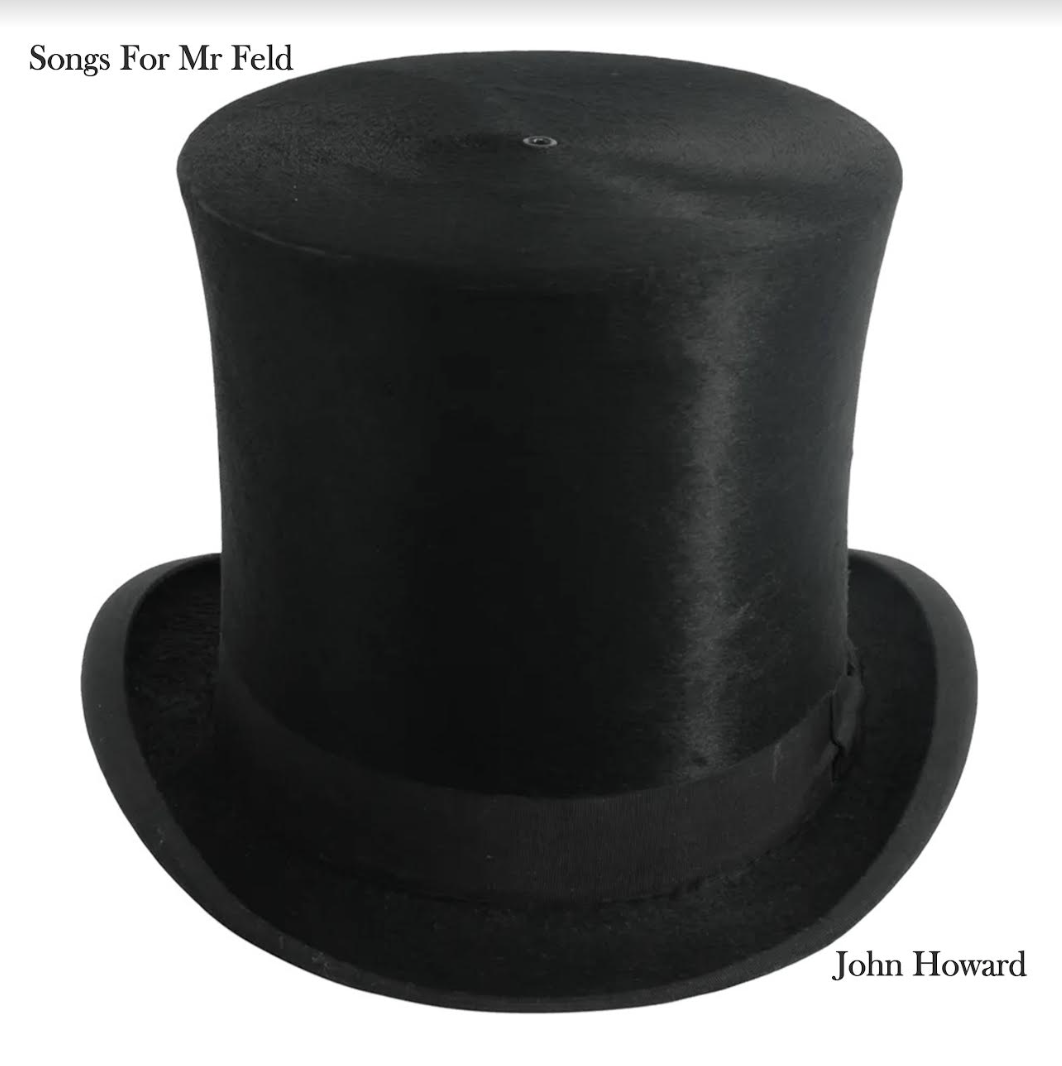
Stick with me on this one, but if you’d previously zero knowledge of Marc Bolan and his music, or didn’t recognise the song titles you could easily imagine this homage EP being from the hand of, and written, by John Howard. Replacing Bolan’s characteristic fey acoustic, and later leaner electric, guitar and the percussive elements of both Steve Peregrin Took and his replacement Micky Finn with the piano and just a little touch of strings and low bass-y cello (or so that’s what is sounds like), Howard makes every reinterpretation sound his own.
The lyrical flairs of Tolkenism, magical scenes, pastoral fairytale is not so much Howard’s, but here he is taking a quintet of songs from Bolan’s transformative period between the campfire invoked fantasies of Tyrannosaurus Rex and the full-on boogie glam rocking T. Rex and lending them a certain committed touch of flowing but weighted graceful wisdom.
There’s been many such dedications to Bolan, or should I say, as Howard does, Mr. Feld –that’s Mark Feld, the name his parents gave him. Nick Cave for one, during Covid, set to the ivories and attempted a frank plaintive version of ‘Cosmic Dancer’.
Howard has however chosen an eighteen-month (give or take) period, pre the rock-pop titan of ‘Get It On’, ‘20th Century Boy’ and ‘Jeepster’. A time when Bolan was still lost and swept-up in wistful enchantment, lyrically painting images of faraway places across an imagined time. This would all tie-in with Howard’s own formative years, studying for ‘O’ Levels whilst hanging out with his best friend and confidant Pauline in her bedroom, playing all their latest musical discoveries on the record player. Regaling in a bon vivant mood, Howard wraps each song he performs – be it a track or single that appeared on either the Unicorn, A Beard Of Stars or the eponymous T. Rex albums – with anecdotal context and fond memories.
He’s had plenty of practice at this in the last five or so years, turning raconteur author with three volumes of autobiography, staring with Incidents Crowded With Life. I feel a brief outline of those chronicles is needed now, before we go any further. After an almost meteoric rise to fame off the back of his accomplished piano-driven Kid In A Big World songbook in 1975, it soon became apparent, as the first honest account in his triple autobiographical series documents, that the adulation and glitter would quickly fade. Though never written-off as such Howard was, like a magnitude of artists before him and ever since, continuously hampered and screwed-over; the records ever far and few between as time went on. The next “big thing” at one point Howard’s real troubles began after a life-changing accident in 1976. In an attempt to escape the mad raging clutches of his Filipino housemates’ bit of rough (a violent maniacal Russian sailor as it turned out), Howard jumped from a flat window, breaking his back in the process. Despite this horrific chapter there was still the CBS contract, recording at the fabled Abbey Road studios, the theme song to a Peter Fonda movie and countless promises to lift the mood. But by the end of the 70s and early 80s the music career had all but stalled, with only brief flashes of ill-advised makeovers and one-off songwriting projects. Book two in this life story, Illusions Of Happiness picked up that period, documenting a post recovery Howard on the cusp of a new decade and mounting a comeback. Again, even with such future big names as Trevor Horn and Steve Levine in his corner, nothing really took off. Frustrated by various ill-thought out and misplaced marketing ploys Howard gallivanted to a soundtrack of synthesised Eurovision pop and overproduced easy listening balladry.
Volume three, or the third chapter, in that life story finds a not so much disillusioned Howard as a waning artist making the most of it; playing the cards dealt, moving from front stage to a role behind the scenes in music licensing. Making perfect sense really, keeping a hand in the game so to speak, Howard began this career change of a sort at Pickwick Records in 1986. As it turns out, even this corner of the industry is riven by egos and petty one-upmanship, bitter jealousies. And so, there’s a number of “jump ships”, with stints at MCA and Readers Digest to follow. Sorry tales of bad bosses and greed follow as In The Eyeline Of Furtherance fills in the blanks of a decade in which Howard really swam against the tide of the bean-counting petty executives in charge. Even when successful (and Howard was constantly that) his actions would rile whoever was in charge it seems.
If we fast-forward, and into the 2000s, with Howard now in semi-retirement, enjoying the idyllic countryside of Pembrokeshire, his debut LP was reissued to another generational audience. Receiving much critical acclaim and coverage in the music press, it sparked what was perhaps and still is, Howard’s most prolific creative period. Starting with the Robert Cochrane collaboration, The Dangerous Hours, and Howard’s first collection of wholly original material in decades, As I Was Saying, albums, another seven albums of quality songwriting followed. But it was his 2015 collaboration with Andy Lewis and the estuary pipe-dreaming Gare du Nord record label chief Ian Button, and one of his signings, Robert Rotifer, under the John Howard & The Night Mail moniker that really set things in motion. Garnered with countless plaudits and five-star reviews that most brilliant album drew the biggest attention yet and proved another ideal opportunity to perform the back catalogue. However, two years on from his last solo effort, My Name Is, and with a renewed vigour to try something different, Howard experimented with long form songwriting on Across The Door Sill – in my estimation, one of his finest albums yet. Untold records have followed, from the accomplished Cut The Wire LP to the From The Morning covers EP (Howard’s version of Mike Heron‘s bucolic, sun anointed delight ‘You Get Brighter’ was playing in my head whilst listening to a number of songs from this latest EP) to concept works such as LOOK! The Unknown Story Of Danielle Du Bois.
But now, even more sagacious and happy with their lot, Howard chooses the projects that give him complete freedom, joy and creative control.
His latest EP is another fond piece of nostalgia, a return to his formative years; a time when Howard may have struggled with his sexuality, brought up as he was in a staunchly Catholic household during the 1950s and 60s, but nevertheless, had rebellious fun replacing the religious symbolism of the church with elfin beatific posters of Marc Bolan. With a fifty-year distance or more, he now pays a certain recollected homage to Mr. Feld. Far from a work of idol worship and fandom, Howard lends credible depth, emphasises the brocade and Baroque tapestry of Bolan’s original ‘Dead Meadows’ by playing what sounds like a harpsichord, and reflects even more the ephemeral veiled nature of Bolan’s muse on ‘The Seal Of Seasons’.
Bolan had a beautiful poetic gift for setting imaginative illusions, myths and legends with just a rhyming couplet of lines. The saddened Barrett-esque dreamy ‘Great Horse’ is no exception: “Great horsey champer goldbriad, pranced proudly in the golden villas/Dipped diving with his horned onyx, saddle shinning in the black aped eyeballs of the gun.” An Arthurian magical, near hazy plaintive yearn from A Beard Of Stars, here it’s given an equally diaphanous fluidity by Howard.
The already referenced, and earliest recording (taken from the Unicorn LP, released in the May of 1969) on this EP, ‘The Seal Of Seasons’, with its Orcadian lore and allure, is lent a more oceanic motion. But it all begins with ‘Dove’, the song that Bolan once introduced at a BBC concert taping on New Years Day in 1970, as his first “love song”. The gentle original pastoral acoustics and tubbing hand drums are replaced with semi-balladry classical piano, a new sense of gravity, and the barest of sympathetic strings. Howard underlines a more purposeful, meditative mood with a long-undulated bass-y piano fade out.
I think ‘Dead Meadows’ could also claim to be a love song. Taken from the filed-down, easier to consume, T. Rex LP, and now featuring more of that electric guitar, more riffs (also minus the Hobbit inspired Steve Peregrin Took, who was quietly fired and replaced by Micky Finn), ‘Dead Meadows’ has a Medieval courtly magic about it. The original featured some chamber strings, and Howard seems to have stayed relatively faithful with what sounds like a viola or cello on his most prettily woven interpretation.
Moved onto the piano, or pianos if you like, Bolan’s more fey, wistful and longed storyteller lovelorn hippie enchantments, the loss of a certain innocence, are treated with respect and the gentlest of touches by Howard. His fondness and love for the work is undeniable. And yet he somehow makes the material his own, attaching his own memoirs to each song. I think Bolan would have approved.
Black Artist Group ‘For Peace And Liberty, In Paris December 1972’
(WEWANTSOUNDS)
Saved from obscurity and jazz lore, the previously believed “long-lost” recordings of the Black Artist Group’s radical free, avant-garde, spiritual and Afro jazz (with a side order hustle of funk) performance in Paris has been thankfully unearthed, dusted off and remastered in a project partnership between the band and the French Institut national de l’audiovisuel. Facilitating this operation are the reissue revivalist vinyl specialists WEWANTSOUNDS – regularly featured in my review columns over the years -, who’ve invited various connoisseur experts to provide liner notes, essays and photographic images to this package.
Only the actual second official release from the St. Louis group, For Peace And Liberty, In Paris December 1972 is taken from a session recorded at the French state broadcasters ORTF (that abbreviation reads as the Office de Radiodiffusion Télévision Française, an institution that lasted between 1964 and 1975) for the Jazz sur Scene radio show; the format of which included a two hour showcase of groups (usually four) performing live for a studio audience.
Radically different, we’re told, to the quintet’s first and only album proper, Aries from 1973, the near continuous thirty-five-minute set finds the lineup of Oliver Lake (on saxophone), Baikida Carroll (trumpet), Floyd LeFlore (trumpet), Jospeh Bowie (trombone) and Charles “Bobo” Shaw (drums/percussion) totally untethered: at liberty and free.
Part of this title expression is down to the group’s recent, at that time, move to France; partly encouraged by Jospeh Bowie’s older brother and established jazz supremo Lester Bowie, but partly because that city offered more culture and a less racially hostile environment in which to push the limits of jazz. Leaving behind the bitter, divisive fallout of the Vietnam War, of segregation, of Watergate for pastures new, BAG made steps to leave America for France, which beckoned a host of Black artists to its shores and capital, mostly because Black jazz artists felt more appreciated on the European continent; their practice better understood.
The quasi-house band of a sort for the much larger St. Louis BAG collective of musicians, poets, playwrights and dancers, they found a fertile scene filled with compatriots, many of which the quintet had individually worked with back in the States. The CVs read like a jazz family tree. At a glance you have the alto/soprano saxophonist/flutist/composer/poet/visual artist Lake who founded the World Saxophone Quartet and Trio 3; the trumpeter, big band director, sextet band leader Carroll who worked with such illustrious company as Lester Bowie, Albert King and Little Milton; the composer/poet/trumpeter and BAG founding member LeFlore; Lester’s younger sibling, the trombonist and vocalist Joseph Bowie, who would go on to lead the jazz-punk outfit Defunkt and join Kahil El’Zabar’s Ethnic Heritage Ensemble; and the free jazz drummer “Bobo” Shaw who played with Lester, Anthony Braxton and Cecil Taylor and led the Human Arts Ensemble. You won’t be surprised to learn that this ensemble also found common ground and had links with the Association for the Advancement of Creative Musicians, Chicago’s iconic hothouse for Black artists and jazz musicians.
Channelling that whole bag of experiences, the different strands, motivated by forces inside and outside the jazz idiom, the extemporised quintet both naturally and in sporadic leaps and bounds performed a set (not so much divided into five parts as congruously labelled with natural pauses and winding downs between each movement) without boundaries. Shaw’s drums alone follow from the African and near Latin to swing joints like a New Orleans marching band at a sports day. There’s also a section in which he drills the snare like he’s at a military revue, which isn’t so surprising as Shaw, like some of his other band mates, had drummed for the Bugle Corp in the 1950s – Carroll had spent some of his formative years of study at the Armed Forces School of Music, and LeFlore had served in the army during the early to mid 60s. Cattle bells and other percussive trinkets evoke either African pastures or spiritual mystery.
Brass wise you can hear both familiar cupped and unhindered heralding, hooks, blazes and ascendent spirals of trumpet, sax and bassoon, but also shrills, the driest of near fleeting ripping, tearing and zippy rasps, gasps for air and chirped experimental expressions. From near excitable elephant trunk calls to a menagerie of duck-billed pecks, swallows and ruffling feathered turmoil the action evokes an exotic wildlife. This is matched with the inner arty smokestack outlines of NYC and Chicago, and the police-like whistles, the careering horn-honked freight train and bustles of the streets.
At times we’re talking Coltrane and Sun Ra, and at other times Roscoe Mitchell, Carlos Garnett and the Art Ensemble Of Chicago. You can also pick up some Chick, a touch of Cymande, of Art Blakey, Sam Rivers and Anthony Braxton. But to be specific, if you dig Rahsaan Roland Kirk’s ‘Safari’, Ornnette Coleman’s ‘Lonely Woman’ and Don Cherry’s Organic Music Society then you’ll really need to part with the cash and have this on your shelf asap: not before blasting it out from your turntable.
Ghostwriter ‘TREMULENT’
(Subexotic) 13th September 2024

Drawn from the veils of time and from several overlapping spiritualist and reverent sources, author, musician and instigator Mark Brend once again winds up and sets in motion the mechanisms and retunes the hauntology radio for a third Ghostwriter album.
A collaborative affair since day one (started back in 2009), with a revolving cast of cross-disciplinary “music-makers”, writers and vocalists, the Ghostwriter lineup this time around includes the talents of Michael Weston King (formerly of the alt-country pioneers The Good Sons, soloist and currently one half of the country duo My Darling Clementine), Suzy Mangion (musician, artist and historian) and Andrew Rumsey (an Anglican bishop, of all things, writer and musician who released the critically acclaimed Evensongs album just last year, and who also provides this album’s cover photo).
All three provide a suitable beatific, near supernatural and spiritual hymnal atmosphere of vocals to the pipe organ imbued and inspired TREMULANT. That title references the device on a pipe organ that varies the wind supply to the pipes of one or more divisions, causing amplitude and pitch to fluctuate. This produces a tremolo and vibrated effect. You can hear its more subtly sustained and held suffused bellows and air-pumped tremulant effects throughout on a record that occupies a liminal space between pastoral English church service, the American spiritual, and esoteric.
Altogether it sounds like a collage of antique recording sources from another age and the ghostly – like parlour seances in places – stirrings and visitations of Americana, gospel music, Georgian posey, the Celtic, folk and late 90s and early 2000s alternative American indie (Mercury Rev, The Music Tapes). But within that sphere of influence there’s an air of Christian Evangelism and the twinkled chimes of a godly majorette marching band on the opening traditional inspired ‘Satan, Your Kingdom Must Come Down’; a vibrato voiced supernatural Blood Meridian redemptive take on a standard covered by a wealth of country and bluesy-rock icons, from Robert Plant to Willie Nelson.
Amongst the reversals, the vortex and morphing elementals and more uncertain passages, the vocals can be harmonious and moving. Especially the contributions of Mangion, who can channel a choral, hymnal beauty that lies somewhere between holy communion and the Laurel Canyon (see the 1960s troubadour evocations of ‘Often Forfeit’).
Seeking sanctuary and protection in the face of tumult and torment there’s fishing community set anchor metaphors and analogies, devotions and shipwreck coastline pleas that merge The Polyphonic Spree with The Mekons’ ‘How Many Stars’ tricorn hatted period Georgian Child of the Jago influences too to be found amongst the purposely dated evocations.
Considering that all four participants on this album recorded their parts in isolation – I believe none of collaborators have ever actually met in person – project coordinator Brend has managed to pull together a complete coalesced soundtrack of both changeable and repeated phases, ideas, passages and swells. TREMULANT by name, tremulant by nature and divine calling, the third Ghostwriter album is a curious cult recommendation.
The Monthly Playlist For May 2024
May 31, 2024
CHOICE TRACKS FROM THE LAST MONTH, CHOSEN BY DOMINIC VALVONA/MATT OLIVER/BRIAN ‘BORDELLO’ SHEA

Representing the last 31 days’ worth of reviews and recommendations on the Monolith Cocktail, the Monthly Playlist is our chance to take stock and pause as we remind our readers and flowers of all the great music we’ve shared – with some choice tracks we didn’t get room or time to feature but added anyway.
Virgin Vacation ‘RED’
The Johnny Halifax Invocation ‘Thank You’
Chris Corsano ‘The Full-Measure Wash Down’
Essa/Pitch 92 Ft. Kyza, Klashnekoff, Tony D., Reveal, Doc Brown, Perisa, Devise, Nay Loco ‘Heavyweight$’
Hus KingPin ‘Tical’
Nana Budjei ‘Asobrachie’
Amy Rigby ‘Dylan In Dubuque’
The Garrys ‘Cakewalk’
La Luz ‘Always In Love’
Bloom De Wilde ‘Ride With The Fishes’
El Khat ‘Tislami Tislami’
Gabriel Abedi ‘Bra Fie’
Ibelisse Guardia Ferragutti & Frank Rosaly ‘TURBULENCIA’
Red Hot Org, Laraaji, Kronos Quartet, Sun Ra ‘Daddy’s Gonna Tell You No Lie’ (THIS MONTH’S COVER ART)
King Kashmere, Alecs DeLarge, HPBLK, Booda French, Ash The Author ‘Astro Children (Remix)’
Oddisee ‘Live From The DMV’
Amy Aileen Wood ‘Time For Everything’
Low Leaf ‘Innersound Oddity’
Jake Long ‘Celestial Soup’
Jonathan Backstrom Quartet ‘Street Dog’
Gordan ‘Sara’
Cuntroaches ‘III’
Morgan Garrett ‘Alive’
Cadillac Face ‘I Am The Monster’
Tucker Zimmerman ‘Advertisement For Amerika’
Poppycock ‘Magic Mothers’
Little Miss Echo ‘Hit Parade’
Olivier Rocabois ‘Stained Glass Lena’
Ward White ‘Slow Sickness’
Lightheaded ‘Always Sideways’
The Tearless Life w/ Band Of Joy ‘The Leaving-Light’
Michal Gutman ‘I’m The Walker’
Malini Sridharan ‘Beam’
Micha Volders & Miet Warlop ‘Hey There Turn’
Copywrite, Swab ‘Vibe Injection’
Napoleon Da Legend, DJ Rhettmatic ‘The King Walk’
Dabbla, JaySun, DJ Kermit ‘No Plan’
Gyedu-Blay Ambolly ‘Apple’
Brother Ali, unJUST ‘Cadillac’
Hometown Heros, DJ Yoda, Edo. G, Brad Baloo ‘What You Wanna Do’
Cities Aviv ‘Style Council’
Illangelo ‘The Escape’
Mofongo ‘Manglillo’
Aquaserge ‘Sommets’
Xqui, David Ness ‘The Confessions Of Isobel Gowdie’
Conrad Schnitzler ‘Slow Motion 2’
Noemi Buchi ‘Window Display Of The Year’
Hi, my name is Dominic Valvona and I’m the Founder of the music/culture blog monolithcocktail.com For the last ten years I’ve featured and supported music, musicians and labels we love across genres from around the world that we think you’ll want to know about. No content on the site is paid for or sponsored and we only feature artists we have genuine respect for /love. If you enjoy our reviews (and we often write long, thoughtful ones), found a new artist you admire or if we have featured you or artists you represent and would like to buy us a coffee at https://ko-fi.com/monolithcocktail to say cheers for spreading the word, then that would be much appreciated.
Dominic Valvona’s Eclectic Reviews Column
(Unless stated otherwise, all releases are available to buy now)

Samuele Strufaldi ‘Davorio’
(Múscia Mascondo)
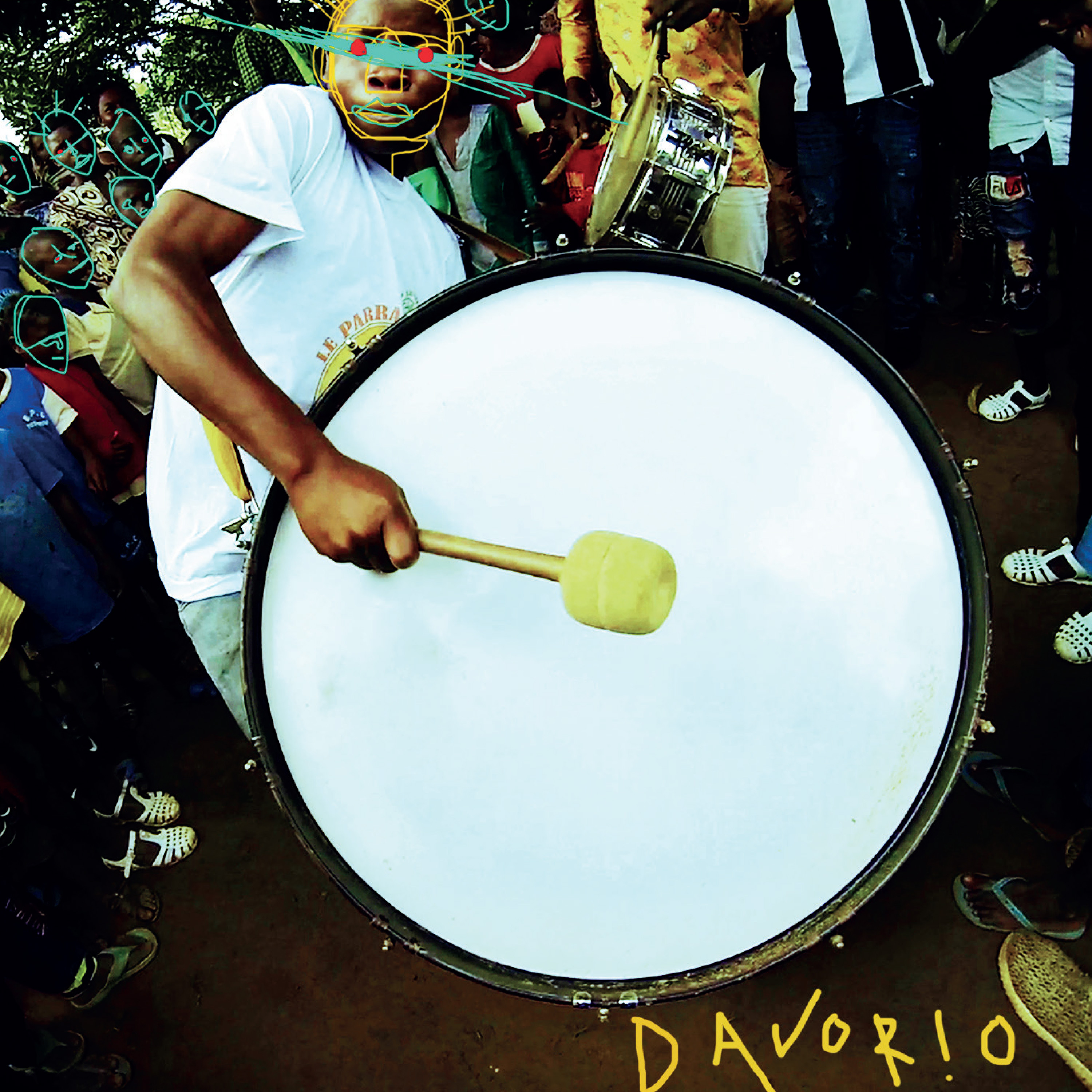
Not many projects of this kind can claim to leave behind something so lasting, practical too, as a community space and library. For the Italian producer, musician Samuele Strufaldi’s collaboration with the good folk of the Ivory Coast village Gohouo-Zagna is a beneficial project that sees the all the proceeds going towards building integral communal connections.
One of a thousand or more “communes” before a decentralized shake-up by the government in 2012 (abolished on the grounds that these areas weren’t “economically governmental units”), Gohouo-Zagna is located within the Western Guemon region of the Ivory Coast; its population part of the Guére culture and greater Kru language group.
The spontaneity of this village’s musical and vocally expressive circle, together with “snapshots” of village life, the scorching heat of an insect chattering environment, the clearing of plates even, is electrified, augmented and effected by Strufaldi to create an otherworldly fusion that amorphously bleeds into both sonic realms.
With a generous offering of tracks and running time, expanded pieces of constant change sit amongst shorter windows in the fabric of a rural existence; the tactile soul of African instrumentation, singers and the rope-tuned goblet shaped Djembe hand drum (some bigger drums too as you can see in the artwork) in surround sound with the hand-slapped rhythmic games and joyful voices of the locals’ children. When amplified, filtered, put through various processes and with the addition of the synthesized, various beats and breaks, flourishes and more dramatic plink-plonk jazzy and classical piano these field recorded performances become untethered: They could end up anywhere musically, culturally. Take the opening ‘Cammino, Senza Sapere Dove’ (“I walk without knowing where”), it begins with atmospheric voices, synth purrs and ripples and late Bowie-esque piano, before passing through soul, jazz and R&B like a J. Dilla production.
The album title itself, just three tracks in, is like a tribal communion of the Young Fathers and BLK JKS, but also features weepy strings, touches of Afrobeat and a free-jazz wild breakout of Peter King saxophone, all before being sucked through a mirror. Those jazz elements permeate the entire album; from hinge-like whines and more Don Cherry spiritual displays on ‘Uccelli/Roberto Baggio’, to echoes of Sonny and Linda Shorrock and the Pharaoh on the township meets Orleans and splish-splash classical ‘Uomini Del Mare’, and touches of Donny McCaslin on the tines resonating, soulful and nimbly-picked guitar 2-Step ‘Obaló’.
Tracks like ‘Non Tradirti’ (“don’t give yourself away”) move from the innocuous sounds of a sweeping brush and the reverberations of children to the techno of Basic Channel and more veiled electronic washes of Boards Of Canada. The finale (if that’s the right word) ‘Dohuo’ sounds like either a talk or lecture, maybe community meeting, being soundtracked by a malady of wind instruments, crackles and touching strings.
Every expression has meaning, a story, which is then transformed by Strufaldi’s production into something almost dream like and cosmic yet still connected to the villagers’ roots. A transistor radio collage here, some Songhoy Blues on a bustling street with a small amp there; a display of rattled and scrapping percussion and hymnal stirrings merge with zaps, warbles and various embellishments. This cultural exchange with the Ivory Coast blurs the lines between worlds; an act of preservation, but much more, as the foundations of this culture prove intoxicating, dynamic and mesmerising.
Various ‘Middle Eastern Grooves’
(Batov Records) 19th May 2023

A sampler showcase, only with a couple of previously unreleased nuggets, the Batov label celebrates its (almost) tenure existence promoting Middle Eastern Grooves overseas with a “handpicked” selection of cuts from their influential 7” singles series.
Originally set-up in London by DJ Kobayashi and Bob Martyn as a home for the former’s multifaceted fusion ensemble, Gypsy Hill, the label soon nurtured a burgeoning revival of Middle Eastern influenced bands and artists from the richly diverse Israeli scene.
A conjuncture itself of untold musical pathways, with artists and musicians congregating in such exciting, lively cities as Tel Aviv from all across the region and much further afield. A hotbed of sounds has been sent out to the world.
With shows on Soho Radio and Worldwide FM, and a rep for selecting a polygenesis array of global sounds, DJ Kobayashi picks out a generous eighteen track compilation of music indebted to the pioneers and luminaries of the 60s, 70s and 80s.
Where to begin with this whirlwind fecund of fusions? Well perhaps with one of the most well-known inclusions on this collection, the constantly evolving Tel Aviv musician, composer, producer and multimedia artist Ophis Kutiel, aka Kutiman. Opening with the Aegean cosmic vibe ‘Badawee’, the Kutiman lays down an eased-in flange-effected wave of fluted hazed sunlight, vapours and lush laidback drums. Following that, and no strangers to the Monolith Cocktail (even making our choice albums of 2022 list), the Yemeni roots, but Israel-based, rambunctious El Khat are kept in check by the Tel Aviv cratediggers Radio Trip, who smooth out the disjointed exciting signature with a clean breaks edit treatment that evokes a horn-swung Arabia and the more soulful jazz-soul breaks of the El Michaels Affair.
Another name that leaps out for me, and a previous Monthly Playlist pick, the Şatellites marry ethereal gauzy Hebrew disco with Liquid Liquid, Altin Gün and real cool Anatolian rock vibes on ‘Deli Deli’. That eclectic-lit funky group’s leader, Itamar Kluger, also appears with his new psychedelic project, Eje Eje. One of the “unreleased” propositions, ‘Saved From Jazz’ is a percussive shimmy of 60s influences and jazz-rock-prog organ that almost sounds like an Israeli Atomic Rooster.
Proving a highly popular (or just highly prolific), Sababa 5 get four goes at impressing us. A well-versed troupe of notable players, previously backing a host of Tel Aviv’s top artists and vocalists, and said to be influenced by everything from the legendary Wrecking Crew sessions ensemble to 70s Middle Eastern icons, the 5 lay a zippy, willowy groove underneath Shiran Tzfira’s upbeat psych-folk and pop-lit vocals on ‘Manginat Mahapeha’; play with ambient gazes, an closed eyes gesture of serenading Egyptian oud (or guitar) and more bouncy beats as the Japanese vocalist Yurika Hanashime sings in a sweetened Oriental romantic way on ‘Nasnusa’; evoke Charlie Megira, Meatraffle and Joe Meek in the shadow of the Sphinx on the tremolo-surf wrangled ‘Baksheesh’; and mix kitsch surf (ala The Ventures) with dot-dash organ (bordering on Ray Charles) on ‘Rosenzweig’.
Elsewhere, gaining my attention, the veteran Israeli bassist and producer, world-traveller and front man of the world music/reggae/funk band Ex-Centric Sound System, Joseph Thomas Fine (aka Yossi Fine) teams up with the African-influenced drummer Ben Aylan on the rock fusion and splashed dance, ‘Peres’. The unfamiliar (to me) Yuz come up with a 80s dry ice Israeli and Balearic spacy disco-electronica mini epic entitled ‘Galgalit’, and the Baharat trio circumnavigate a Mexican surfing Dick Dale, a removed Cumbia and stylophone-like buzzes on the Arabian Shadows reimagined ‘The Egyptian’. “Jewish princess” via Babylon, Cherry Bandora eases dreamy gauzy vocals on the shimmery and zappy synth airy ‘Esy’ (another of those previously unreleased tracks), and the long-running Boom Pam magic up a Hellenic wedding boogie and belly-dancing shimmy on ‘Uniton’.
A wealth of Middle Eastern inspirations from a blossoming epicenter, Batov’s grooving whirlwind spins and saunters, carouses and electrifies across a region of interconnected roots. The borders are eviscerated as the Adriatic, Med, Arabian and Red Seas ebb and flow across a music geography that mixes the sounds Egypt, Syria, the Lebanon, Turkey and Greece with the cosmopolitan buzz of Tel Aviv. If you’re fresh to the scene, this is a great place to start, from a label doing encouraging, exciting things in bringing sounds together.
Marta Salogni And Tom Relleen ‘Music For Open Spaces’
(Hands In The Dark)

A posthumous tribute to one half of this sonic mapping partnership; left however exactly as the late Tom Relleen would have heard and recognized his and Marta Salogni’s site-specific peregrinations before his premature death from cancer in 2020, Music For Open Spaces is an atmospheric gift of subtlety and evocative callings from a geographical triangle of locations.
The leylines of this album spread from the pair’s London home to the Cornish coastline and the mystical Joshua Tree desert, where, inspired by such varied settings, Marta and Relleen conjured up a number of spontaneous atonal and electronic pieces. None of which are so obvious as to directly sonically reference the environment. Well, expect the album’s longest track, the opening mirage ‘Desert Glass’. Refracted light shines off a glass pyramid as airy fluted and hinged mirrored sounds permeate the legendary Joshua Tree located desert scene (a shrine to the late Gram Parsons and draw for various hallucinatory-induced communions). At one point you can pick up a partly obscured Marta (I think, anyway) asking her foil if he’d “heard that?” on tape; a tape that seems to be rewind and played back in real time, as a near-kosmische stillness of Frosse and Ariel Kalma evaporates around them.
This is followed by a more bobbled algorithm of paddled Ping-Pong balls, transformed to elicit a feel for far less mundane activities, on the much shorter ‘piNG poNGS’ passage. Those plastic table tennis balls take on a weight as the track progresses, moving into a techno effects realm of robotic laughing and metallic guiro scrapes. The even shorter ‘Snarls’ is both alien and a little disturbing; evoking the ominous uncertain spaces of Lucrecia Dalt (who I believe Marta has worked with) aboard some propeller-motored and humming craft.
‘Giant Desert Cats’ features, albeit transmogrified through various processes, the titular subjects. Bestial screeches of a kind echo across a strange, removed wilderness of ringing, repeated signals, forewarning and moderate drama. ‘Clocks’ also seems to abstractedly mirror the title, with a tubular plastic paddled and reverberating single repeated tight bass-string pluck denoting a measuring, a metronome-like passing of time. Featured in last month’s Digest column, the more expanded piece ‘Internal Logic II’ is a minimalist alchemy of light drawn and calling undulations and subtle twinkles; felt through a bendy lens of mystery. Staying in the minimal field of inspiration, ‘Furthest Fires’ obscures the flame in a gentle wind, whilst ‘Trains’ is a veiled ghostly blend of field recording, a passing motion of transport and almost nothingness.
Reading things into the ephemeral vapours and applications, I’m sure I can hear bulb-like notes of either a marimba or vibraphone on the wooed gauzy ‘March’. ‘Fauna’ sounds more like Day Of The Triffids than pleasant wild-planted blossom, and the finale, ‘FFXX’, barely registers above a blowing ambient and metallic percussive ebb and purr.
As much a physical and cerebral response to the elements and space (expanded further by the Hands In The Dark label’s Morgan Cuinet, who has illustrated each step on this “internal map” with a collage), Marta and the late Relleen’s geographic concept suggests new horizons, and makes the fleeting now permanent. With added poignancy, this generated soundtrack could be read in part as a fitting tribute. Regardless of the circumstances, this is a really fine album of atmospheric exploration, tactile scored environments and moods.
Adjunct Ensemble ‘Sovereign Bodies/Ritual Taxonomy’
(Diatribe Records)
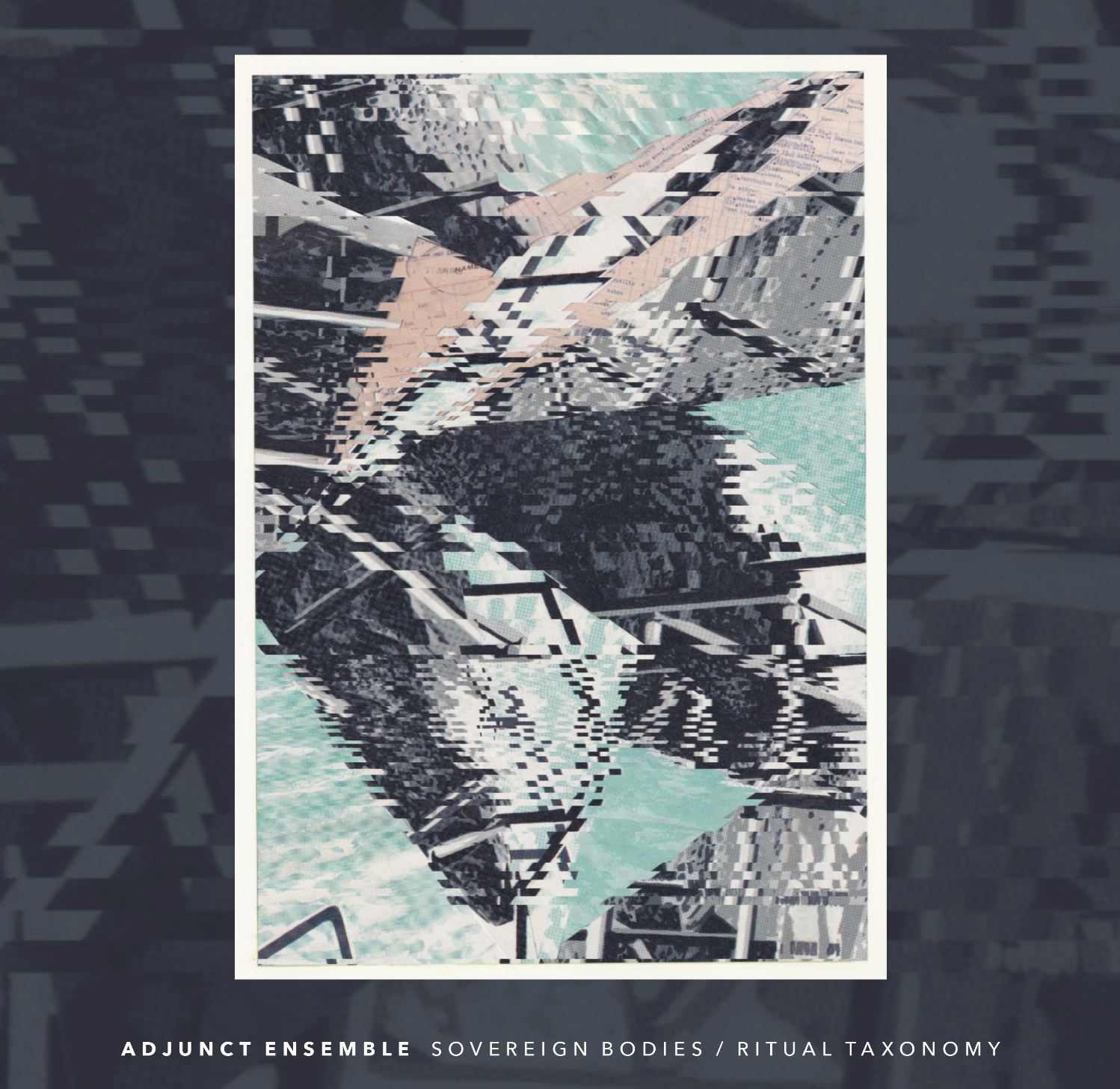
A behemoth of sonic, worded and performative multi-disciplines, with an eclectic cast to match, Jamie Thompson’s ambitious Sovereign Bodies/Ritual Taxonomy album seems to amorphously cross György Ligeti’s musical hallucinations with sound art, poetry, opera, theatre, jazz, the avant-garde and cinematic.
Under the Adjunct Ensemble title with foundations in the electro-acoustic, Thompson’s immersive but often jarring, somber and glitch-in-the-fabric-of-the-matrix style hallucinations are both riled and strung-out in a dystopian cosmology of Don Cherry, the Art Ensemble of Chicago, Colin Stetson, Andy Haas, Amiri Baraka jazz, Linda Sharrock arias, re-contextualized Benjamin Blake hymnals and national song, Ligeti’s ominous 2001: A Space Odyssey chorales, later Scott Walker histrionics, fleeting passages of Ivor Novello-type nostalgia and A.I. malfunctions. All the while a permeating atmosphere of running water, wind chimes and metallic chills can be heard in the void; one in which Tarkovsky and Kubrick conjure up sci-fi visions of unease, uncertainty and the fear of a great big nothingness.
Running to near on 90 minutes, across twenty often cryptic and questioning, proposed entitled tracks, you’ll hear the opera singer Amy Ni Fhearraigh’s haunted and dramatic vocals, and the spoken word poetry of Felicia Olusanya’s (aka FeliSpeaks) stream of conscious-political-humanistic lyrics, cutting through a feeling of near Orwellian oppression, suffocation.
Composer, writer Thompson can be heard twisting, grappling and oozing sounds, effects out of synths, drum machines, a church organ (in more classical hymnal spells), dictaphones, turntables and other apparatus. This is further affected by the turntablist Mariam Rezaei, the spasmodic, drilling and twirled punkified jazz of the Taupe trio and a load of other notable musicians on tenor sax, drums, percussion and bass. At various conjunctures we’re spat out into a chasm; transported to the graveside of a New Orleans elegy; beamed down to that raining rooftop finale in Blade Runner; lost in an alien terror show; clamed with the sounds of a transcendental water garden; or, gently, dreamingly invited to sip a remedy to chaos on a virtual deck, kitted out to resemble a 60s jazzy cocktail lounge. Phew!
Otherworldly breakdowns one minute, a Zappa-esque entanglement the next, this merger of Tricky’s imagined opera, an unholy vision of English pride and the hermetic, with veils of the Southern Gothic, Voodoo and happening, politically actionist jazz, is an expansive conceptual document for the times we find ourselves in: a time capsule if you like.
Interestingly, one theme brought up in the press notes is that of migration. And, floating in and out of that consciousness of sound and art, lingered traces of travail, of voyages and ethnographical illusions do conjure up futuristic versions the immigrant song. Lost on the high seas, with the ship’s horn blowing amongst the fog of time and place, you could easily imagine the fear, specter of death in pursuit of reaching safer shores, as references to displacement crop up across the album’s continuum of horror, assimilation, accelerated machine-learning, surreal interviewing and resignation.
Certainly challenging, a commitment is needed from the listener to what is essentially one long soundtrack (more or less every track, episode, chapter running into the next without any real pause or hint of dead air, only when in ambient mode); a sort of conceptual art theatre without boundaries, which can replenish as much as stir up a maelstrom of disenchantment and strung-out despondency. Counter-history bleeds over a morose of art forms and freer radical protestations, activism on a very impressive project.
Danûk ‘Morîk’
(Omni Sound) 19th May 2023

The longing, almost bluesy reflections cast on the finale, ‘Lo Șivano’, pretty much sum up and convey this “exiled” Middle Eastern group’s heartache at being forced to leave a war-ravaged Syria: Emotively, musically this, the curtain call from their debut album, is about missing home.
And yet, as that same album title translates, they’ve found a “pearl” of light in the tumult, as they confidently claim their heritage in the face of such distress and upheaval; reconnecting with their roots, imbued by the 1900s phonograph and wax cylinder recordings of Kurdish folklore in both The Berliner Phonogram and Austrian Academy of Sciences’ Phonogrammarchiv collections.
Studied graduates of Syria’s “best fine arts and music programs”; the Danûk ensemble was actually formed across the border in Turkey, in the Bosphorus-straddling metropolis of Istanbul, over seven years ago. Surviving on musical graft as street performers, they were seen and hired by a social enterprise; going on to score music for both films and radio. This though is the group’s first album proper, engineered in part by friend, admirer and musical foil Michael League (of Snarky Puppy fame). He produces but also lends a light touch of bass.
Morîk is the second release for the newly formed Istanbul/NYC connected label, Omni Sound. And what a flowing, dancing beauty of atmospheric Middle Eastern folk, shepherd song and wedding music it is too, from a quartet of Syrian-Kurdish and Turkish-Kurdish musicians steeped in atavistic allure. Traditions and songs on this work date back to the ancient sites of the excavated Sendshirli (now located in present day Northern Turkey) and beyond. From that imaginative channeled setting, the lute (in this case the long-necked “buzuqi”) twirled and trilled, country-like and seriously yearned ‘Xelîlo Lawo’, and roughly brushed and thrashed frame drum (the Persian “erbane-daf”) accentuated ‘Lê Lê Mi Go’ have a real ancestral pull, yet also draw on the veiled resonance of age-old shepherd song.
The opening holy city evoked whistled and fluted, granular-textured stirred frame drum skin swept ‘Axir Zemana’, and the poetically elegant, waves-splashing against the bow of a ship-like ‘Lo Lo Li Mino’ both use the voice of a Syrian priest singing in Jerusalem.
Serenaded and in celebratory form, Danûk spin, dance and ache across a cannon of Kurdish folk and wedding music: ‘De Çêkin’ is a journey of romantic longed allusions cast over a fluty pipe, whilst the more trinkets-sequined and small finger cymbal percussive ‘Finciko’ shimmies and shuffles to the fever of a Middle Eastern gypsy band performing at a nuptial ceremony.
Together, Ferhad Feyssal, Hozan Peyal, Yazan Ibrahim, Tarik Aslan and Ronas Sheikhmous respectively shake and electrify their heritage, breathing a new life into those roots as they reconnect with home t produce something almost timeless.
Kayhan Kalhor & Toumani Diabaté ‘The sky Is The Same Colour Everywhere’
(Real World Records)
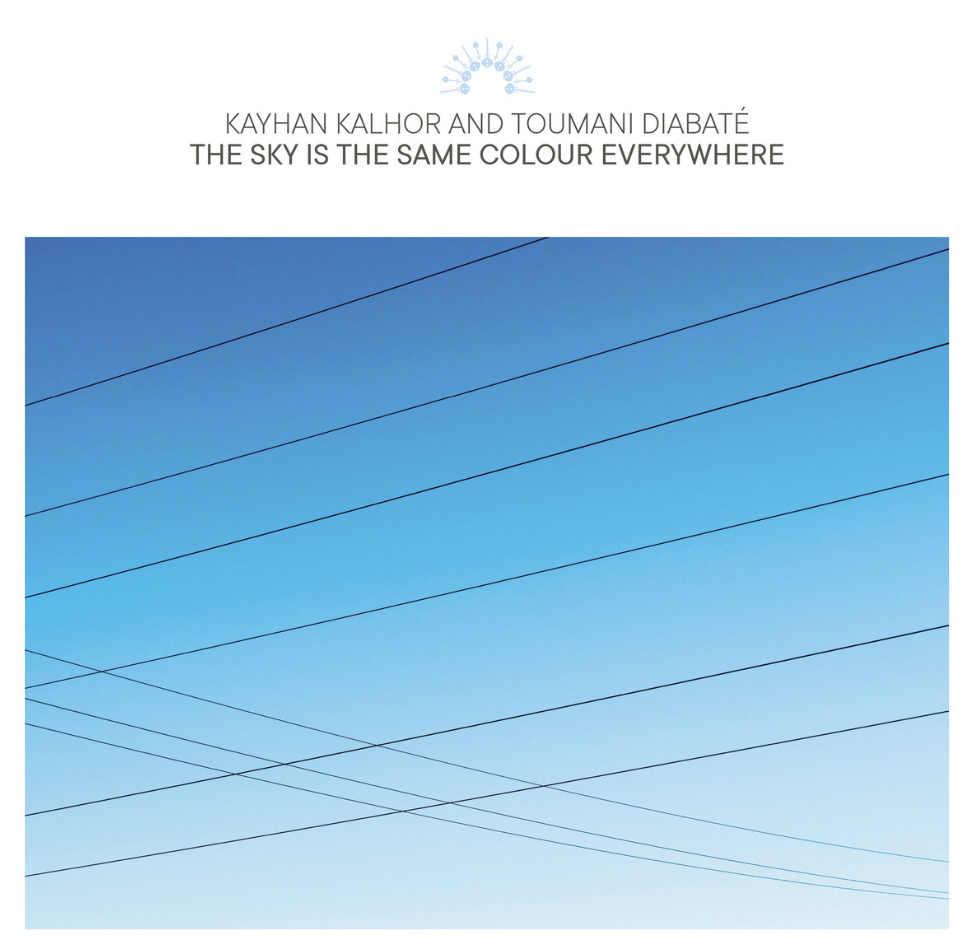
In what proves to be a most congruous musical partnership, the renowned Iranian kamancheh player Kayhan Kalhor and leading Malian kora player Toumani Diabaté merge each other’s cultures and the sound of antiquity with a previously untried, untested combination of instruments.
Brought together by the Morgenland Festival’s Michael Dreyer for a performance back in 2016, the pair who’d previously never met let alone play together, conjured up an unrehearsed, intuitive ninety-minute set of both Malian Mandé and Persian inspired beauty, longing and veiled panoramic landscape gazing. Nothing short of an incredible, adroit experience, this union proved successful enough to prompt a short European tour and a recording session in Paris. The results of which can be heard on this woven atmospheric and unifying album, The Sky Is The Same Colour Everywhere.
In a similar vane to Catrin Finch and Seckou Keita’s ongoing harpist and spindled collaboration, Kalhor and Diabaté blend their heritage into a masterful latticework of moods, time and geography.
From the Persian sphere (spreading to the Caucasus; to Azerbaijan and Armenia) Kalhor’s principle instrument, the kamancheh, is a relation of the rebab. Its appearance is somewhat exotic; a truncated inversed cone shape-like fiddle that has a spike to support it whilst being bowed, usually in a kneeling position. The original courtlier silk strings have long since been replaced by metal ones, but the sound is still unmistakably timeless; imbued with Persian romantic poetry, lyricism and spiritualism. Diabaté, who famously partnered with the late Mali icon Ali Farke Touré for a duo of Grammy Award winning albums, plays the resonating-bodied kora from Western Africa; a twenty-one string, harp-sounding (at times) long-necked lute, crafted out of half a gourd and covered with cow skin. Steeped in that region’s Mandé ethnic dialectal culture, Diabaté brings a watery-like cascaded trickle of plucked elegance, of desert rustic spun gilding and emotion to this fusion.
More or less uninterrupted, ninety minutes of both articulate and more dramatic performance flows like chapters in one long journey across mesmerizing, alluded to and deeply felt landscapes. Titles prompt escapism as much as they do attachment to those yearned for Arabian and African scenes, whilst also building common bonds; Sufism at the crossroads with the Griot.
Both instruments are shown to be versatile in application; a thwack woody-bodied rhythm from the kora as the kamancheh flutters like the wind or blows a stirring, airy veil across an imaginary topography. The former can take on a harp-like glide or mbira twanged sound, and the latter, a classical viola plaint or classical violin weepy resemblance. Throughout the album the duo often reach outside their respective disciplines and fields of influence; spinning a hint of Appalachian rural dances on the daintily rural twined ‘Anywhere That Is Not Here’, and branch out into Moorish Spain on the title-track.
To be experienced as if it was being performed live, right there in your living room, The Sky Is The Same Everywhere must be heard in its entirety; neither dipped into nor with interruptions. Sit or lie back with a masterful, intuitive work of artistry and beauty, escapism.
Trad. Attack! ‘Bring It On’

We can take comfort in the fact that in the face of such barbarity, as Russia continues its heinous crimes against Ukraine to the south (and threats to its Baltic neighbours), there’s still so much light, joy and discovery to be found in the world of music. From their Estonian roots the Trad. Attack! trio of Sandra and Jalmar Vabarna and Tönu Tubli reach out across not only to their direct neighbours but to the Caucasus, North America and Yeman to expand their sound, understanding and spirit of collaboration.
Their latest album, a journey in fact, finds the propulsive and explosive trio exploring different musical fusions and playing a raft of new instruments, whilst transforming the rich culture of Estonia itself; especially the Seto ethnic/linguistic population’s (mostly living on the Estonian/Russian border in the southeast of the country) ancient polyphonic style of epic saga telling, which is sometimes improvised, “Leelo”. Multi-instrumentalist and vocalist Jalmar has that same Seto heritage – his great-grandmother was one of Estonia’s most famous folk singers. Here, that beautiful melodious song can be found at a fair pace being repeated and woven on the Block Party-like 2-Step breakbeat fueled ‘Keera’ (“spin it”). But its influence can be heard permeating throughout the entire trip; from woodland to euphoric expelled mountaintop.
The trio kicks things off however, with a burst of phaser electronic-pop and stamped punctuated beats on the “hey yeah” energy-flashed ‘Lase Käia’ (“bring it on”). Featuring the craning, Brian May like rocking guitar of the Estonian legend Laur Joamets (based in Nashville; a regular sideman to the American country artist Sturgill Simpson), a bold Euro-rock and EDM vision of a traditional song is injected with a modern energy and new anthemic brilliance. And so it continues, across an album of guest spotting hybrids with a mixture of Eurovision, dance music, pop, indie-rock and more acoustic instrumental gestures of longing and reflection: pride too I think.
On that journey there’s the earthier, gruffer-voiced (Alexander Hacke-esque) and Estonian bagpipes droned, fiddled gypsy ‘Pidu Lõppeb’ (“the party is ending”); the brokenhearted, metronome rim beat, dreamy trad-folk transformed ‘Makak’ (“sleep”); twinkled and felt, warmer climes Ed Sheeran ‘Liugu-Laugu’ (“glide long”), which features the Canadian East Pointers metaphorically releasing a guided sleigh into the big open world; the Yemen Blues’ Ravid Kahalani featured Baltic-Arabian mirage of challenger verses, marching spiritual workers song and The Knife riled electronics, ‘Öelge Sönnu’ (“say some words”); and longingly rasped ‘Kiigelaul’ (“the swan song”). ‘Tere’ (“hello”) however, is a rawkish, dizzy burst of the Red Hot Chili Peppers dancing around the encampment fire.
A strong show of versatility with a myriad of dialects, instruments and musical partners uniting for a energetic transformation of Estonian folklore and culture, Bring It On is as fierce, highly spirited as it is soulful and kind to those traditions. A simultaneously bombastic, electrified and romantic, deeply felt connection is unleashed on a highly commercial pop and electro produced album that takes the Baltic state from the rural to the dancefloor.
A WEWANTSOUNDS REISSUE DOUBLE-BILL
Meiko Kaji ‘Hajiki Uta’

From what I’ve gained from the press release, despite the Tarantino effect the cult garnered Japanese starlet Meiko Kaji’s iconic run of early to mid 1970s albums have never been reissued on vinyl: until now that is.
With the usual quality control of repackaging such lauded obscurities, WEWANTSOUNDS, in conjunction with both the artist herself and the original label that released this quintet of showcases, Teichiku, between 1972 and 1974, have called upon the services of Hashim Kotaro Bharoocha to interview Kaji, and fill us in on all the background, with insightful linear notes.
A sort of third revival you could say, the star of various “Japanese Exploitation” franchises inspired the one-time golden boy of auteur pulp, who not only loosely based the plot of his Kill Bill doublet on one of Kaji’s most (in)famous roles as the revenging angel of The Lady Snowblood period-drama revenge shlocker series, but placed a number of her songs in the movie too. This obviously shone a spotlight on the star of such cult curios as Female Prisoner Scorpion, Blind Woman’s Curse and Stray Cat/Alleycat Rock.
In more recent years Kaji has popped up with her own Youtube channel. And now, a vinyl reissue run of her 70s move into the recording industry, prompted by the film studios cashing in this icon’s popularity.
Coaxed into the recording booth, to initially sing songs associated with the films she starred in, the Tokyo-born actress nervously and with some trepidation, recorded her first album, Hajiki Uta, with the highly experienced TV, film and incidental music composer Shunsuke Kikuchi. The producer was able to put his charge at ease however, as Kaji recalls: “I told Shunsuke Kikuchi that I couldn’t imagine myself singing the songs. He said I could ignore the melody that he wrote, and just sing it the way I wanted to. That really lifted the pressure off my shoulders, and I decided to sing the song as the character in the film. The director was also happy with that idea.”
Produced to a high quality, the Hajiki Uta songbook covers a myriad of styles. The vibraphone-tinkled, gently rousing and swooned ‘Sounya-Ka Onna No Jumon’, and the yellow rose of Texas, Morricone-inspired canteen mirage ‘Urami Bushi’ (the tune famously used in Tarantino’s Kill Bill 2) are actually the only two direct tracks taken from Kaji’s films; both appearing in the torture-porn, rape revenge series Female Prisoner Scorpion #701. The former in the first film of that franchise, the latter in one of the sequels, Jail House 41, directed by Shunya Itõ. Yet despite that, the musical production sounds cinematic throughout, riffing on the already mentioned Morricone, but also Bacharach and Jean-Claude Vannier too. The opening electric scuzzy guitar buzzed, rattlesnake punctuated and yearned chanteuse serenaded ‘Meikono Futebushi’ is an obvious example: a Japanese(fied) version of a Spaghetti Western theme tune. The smooched saxophone and almost soul-hinted production of ‘Hizumi Moe’ sounds Bond-esque in comparison.
Elsewhere there’s light jazzy cocktail hours; the sweet scent of Japanese blossom; a touch of accordion accompanied walks along the Seine; and softened bouts of thriller and the clandestine. ‘Onna Kawaki Uta’ reminded me of Angela Morley’s string arrangements for Scott Walker’s early solo work (in fact, the bass, drums and feel of songs like ‘The Old Man’s Back Again’). And the harpsichord like, longed ‘Onna Hagure Uta’ sounds not too dissimilar to the Thomas Crown Affair: or something of that vogue.
A fuzz of guitar is there to give it a certain edge, whilst the strings occasionally swirl and well up for dramatic effect. Elements of what’s called Enka are performed with pop sass and kitten heel coquettishness, as traditions are respectfully drawn into the 70s. It must be pointed out that Enka is a kind of performative traditional form but also said to refer to political texts set to music as a means of bypassing government curtails on dissent and activism at the turn of the 20th century in Japan. This form was stylised with modern pop sensibilities in the post-war period, but it’s quite hard to define: many of its leading lights, stars like Hachiro Kasuga and Michiya Mihashi, were themselves very dubious of the tag; if anything distancing themselves from this revived form. Enka, pop, beat music, a little buzz of psych, the string production of the cinema; all forms accompany Kaji’s very fine lulling, but sometimes impassioned poetic, singing voice. Coveting, cozy and in often-romantic swoons, the actress takes on the convincing role of songstress. Subtle and diaphanous yet able to express whatever emotion is needed on an album that shouldn’t be cast off as a mere cult nugget from the vaults, nor dismissed. It seems that Tarantino really was onto something after all.
Harold Land ‘Damisi’
26th May 2023

Continuing a selective reissue program of Bob Shad’s 60s/70s Mainstream Records label catalogue, WEWANTSOUNDS hone in once more on the tenor saxophonist (quite deft on the oboe too) Harold Land with the first ever vinyl reissue of his 1972 spiritual jazz phase Damisi album.
Regulars of the Monolith Cocktail will know that I reviewed the Mainstream Funk compilation early last year, as the title suggests a showcase of Shad’s overseen funkier cuts. A self-proclaimed “broad church”, the label was just one of a myriad of companies the producer and A&R man had worked on; starting out in the 50s with jazz at the prestigious Savoy label, moving to National Records and launching his own subsidiary imprint EmArcy. Shad went on to find the talent for the switched-on psychedelic Mercury label (discovering such luminaries as Janis Joplin, Sarah Vaughen and Dinah Washington), whilst forging his own Mainstream platform in the 60s.
During his early years, Shad had famously recorded such notable artists as the Max Roach and Clifford Brown Quintet. Although it would be a fair time before working with him again in the 70s, Land was a member of that very same ionic hard bop Quintet; coming up through the ranks after leaving his Houston home, and his formative years in San Diego, for L.A.
Time had moved on, and jazz’s evolution was changing once more. Land, moving on himself, had started a fruitful musical partnership with the vibraphone legend Bobby Hutcherson in the late 60s after stints as an in-demand sax freelancer for labels like Contemporary and Pacific Jazz. It’s that partnership which led to a West Coast trip for the N.Y.C. based Shad and his A&R man Ernie Wilkens; touching down to record a series of sessions from both the Land and Hutcherson union, and Land’s own bandleader work with an enviable pool of serious talent on the scene. The results of which can be hear across a trio of albums: the Hutcherson foiled A New Shade Of Blue (reissued by WEWANTSOUNDS already) and the Choma and Damisi albums. The latter is held-up here as a worthy showcase for Land’s developing use of spiritual conscious jazz and his embrace of Coltrane; although all the signatures of that West Coast schooling and the California showmanship of bright and burnished soulful and funky horns is unmistakable.
Land leads a quartet of equally notable players on Damisi (the Swahili word for “cheerful”), with Herbie Hancock’s Mwandishi ensemble bedfellows Buster Williams on double and electric bass and Leon “Ndugu” Chancler on drums (that nickname, bestowed on the Freddie Hubbard and Miles Davis sideman by Hancock, is also Swahili, and translates as the affectionate “earth brother”). On electric piano and keys there’s L.A. pianist William Sydney Henderson, who’s CV includes recordings with the Pharaoh, Bobby Hutcherson, Billy Higgins and Hugh Masekela; and on both blazing trumpet and flugelhorn there’s Count Basie sideman and gun-for-hire (a dizzying roll call too numerous to list, but Sonny Stitt, Dexter Gordon and Quincy Jones are just three notable icons he’s worked with over the decades) Oscar Brashear.
Together, with Land’s heralding, spiraling and brassy tenor blowing away throughout, this highly experienced in-tune troupe lay down a modal-vibe show time of Lalo Schifrin funk action and a swing of Savoy, bop and Lee Morgon on the constantly moving opener, ‘Step Right Up To The Bottom’ – a kind of Hollywood Boulevard takes a turn down desolation road. It’s followed by the cool, hip and more laidback ‘In The Back Corner In The Dark’; a swing time Hollywood funk with shades of serenaded and elephant reeling Miles Davis under a baking sun. Projecting travels further afield, ‘Pakistan’ is the first real spiritual movement; a transcendence shimmer and rattle, bell shaking, snake-charming oboe odyssey that evokes the Pharaoh’s ‘Africa’ (I know, different continent entirely, but similar feel) and a surprising noir-ish Davis. Henderson’s piano really shines on this enchanted, beckoning homage to the country.
Side Two (in old money) features a duo of deeper, long suites; the first of which, ‘Chocolate Mess’, ups the tempo and takes on a funky Latino influence of soul-jazz. Yet, there’s also a strong African influence and smattering of Herbie Hancock on this dynamic sleigh bell shaking, freefalling and dappled electric piano rich jam. The title-track finale reaches once more for Far Eastern climes, perhaps Egypt, but with a West Coast be bop feel and spells of Ike Quebec, Yusef Lateef and Stanley Turrentine. WEWANTSOUNDS have played a blinder reissuing this quality travelogue of soulful, funky jazz from Land. Shy of truly outstanding and iconic, Damisi is nevertheless a great flowing album of notable performances that never loses its groove and swing. A jewel in the Mainstream Records cannon is given another welcome run.
Dyr Faser ‘Karmic Revenge’

Karma can be a bitch they say. Only on this occasion, spun out, weaved and languidly mulled over, karma is a drawn-out process of study in the barely warm rays of an occultist sun. For the Dyr Faser duo of Eric Boomhower and Amelia May stir up hermetic, drowsy and Krautrock arias under slumbered mires, and in esoteric visions of the Laurel Canyon.
The dread and gothic chthonian opener, ‘Suns Of Unseen Revival’, sets the atmosphere with the piped tubular drones of Death In June’s ‘Fall Apart’, sonorous palpitations and hints of Amon Düül II and an unholy Jefferson Airplane fragrant in the Fields Of Napalm. Yet, already by the second cut, the Boomhower voiced ‘Fun In The Sun’, the serious gloom is replaced by a kind of Californian slacker vibe of cymbal splish-splashing, ritualistic toms and a flange of the Velvet Underground, Boyd Rice And Friends, Sonic Youth and Pavement.
‘Keep Talking’ once again has May taking up the vocal mantle; channeling Grace Slick and a downer Besnard Lakes on the melting, intoxicating spell of dream-realism. ‘Symbolized’ however, motors down the BRMC and JAMC highway; thumbing a lift with Suicide’s “Ghost Rider” on a hippie biker kick. Within that leather-clad bohemian framework, there are evocations of The Stooges ‘Search And Destroy’, Jason Pierce and the sustained guitar lines, contours of Ash Ra Tempel.
Almost diaphanous, ‘Silver Night Run’ oozes a hypnotizing hallucination of acid-aria sung enchantment as its siren traces some mysterious metaphorical river trial. ‘Ghostly Vicious Acts’ is an indie-fuzz and gauzy scuzz of tumbled Spaceman 3, whilst ‘This Menace’ squalls and churns up a suitable acid-rock/krautrock mood of doom, as The Black Angels gaze on. Christ weeps from the holy mountain on the woodland fluted, but despondently mused, ‘Dead On The Vine’, and May wafts a plaintive Hackedpicciotto-esque emotive voice over a stylophone buzzing spooked ‘Despite The Party Atmosphere’ vignette. It all ends on the gristle and loose psychedelic, slipped drummed ‘Lifelike Stranger’; a conclusion to a most alluring if doom-imbued album.
It turns out that Dyr Faser are rather good at mixing the esoteric krautrock of the Amon Düül family (especially the Wagnerian acid-wash and otherworldly vocals of Renate Knaup-Krötenschwanz) with grunge, alt/post/space rock and doom; bridging morbid curiosities, spirals of melancholy with black sun fun, fun, fun! A great duo to discover.
Images Of Goo ‘S-T’
(Un Je-ne-sais-quoi) 26th May 2023

Responsible for, and “active members” of, trick noise making projects and alias as Das Hobus, Spiritual Emojis, The Notwist, AloaInput and a myriad of others, the maverick sonic union of Leo Hopfinger (aka LeRoy) and Cico Beck (likewise aka Juasihno) mess around with the proverbial “goo” on this self-titled workout.
As Images Of Goo they knock around in an echo chamber reverberation of drum heavy trip-hop, breakbeat, krautrock and post-krautrock, off-kilter techno, future soul and various electronic formats. This often sounds in practice like Valentino Magaletti on 90s Mo Wax, hanging out with Major Force, DJ Shadow and Matmos. And when emerging from a Joe Meek (if he’d been born much later and signed to Warp Records or the Leaf Label) retro space production of signals, sputniks and oscillations, like International Pony and The El Michaels Affair on the Fun Boy Three vine. Because the beats, the breaks move from hip-hop to Ethno sounding hints of Africa and Java, and more metallic mesh-bounces of tins, pots and pans percussion.
And most surprising, as we reach ‘Image 08’ (all tracks are just numerically entitled by the way) a drowsy tripping vocoder effected set of voices and vocals emerges from the knocking, Afro-wavy beats – imagine Afrikan Sciences, Dunkelzefer, late Can and Matthew Dear on one soulful languid mix. You can throw in Nino Nardini’s cult sounds, MDR-ADM, Gescom, the Aphex Twin and Yuk. into that bit-crush and scrunch, lunar echoed moon unit of psychedelic drum-led collages. The whys and wherefores don’t matter; it just exists as its own body of workings; a sci-fi tripped out production of hip German eclectic rewiring.
A (near) 150 albums survey of the year, with choice eclectic albums chosen by the Monolith Cocktail Team.

Well was I wrong last year when I called 2021 the annus horribilis of all years. It has been soundly beaten by the shit-show that is 2022. The invasion of the Ukraine, cost of living crisis, another hideous wave of Covid – which even if the jabs are being rolled out, and the deaths rate, hospitalisations is nothing like the first wave back in 2020, is still causing major illness, absences and disruptions to a society already facing a heap of doomsday scenarios -, strikes, activism, fuel poverty, Iranian protests, and the continuing horror show of a zombie government being just some examples. Yes 2022 qualifies as one of the most incomprehensible years on record of any epoch; an ungovernable country in the grip of austerity point 2.0, and greater world untethered and at the mercy of the harridans on either side of the extreme political divide, the billionaire corporates and narcissist puritans.
And yet, it has been another great year for music. Despite the myriad of problems that face artists and bands in the industry, from a lack of general interest to the increasingly punitive costs of touring and playing live, and the ever encroaching problems of streaming against physical sales and exposure, people just can’t quit making music. And for that we, as critics – though most of us have either been musicians or still are – really appreciate what you guys do. In fact, as we have always tried to convey, we celebrate you all. And so, instead of those silly, factious and plain dumb numerical charts that our peers and rivals insist on continuing to print – how can you really suggest one album deserves their place above or below another (why does one entry get the 23rd spot and another the 22nd; unless it is a vote count) –, the Monolith Cocktail has always chosen a much more diplomatic, democratic alphabetical order – something we more or less started in the first place. We also throw every genre, nationality together in a serious of eclectic lists: no demarcation involved.
The lists include those albums we reviewed, featured on the site in some capacity, and those we just didn’t get the time to include. All entries are displayed thus: Artist in alphabetical order, then the album title, label, who chose it, a review link where applicable, and finally a link to the album itself.
Because of the sheer number of entries, we’ve split that list in to two parts: Part One (A – L) starts with Anthéne & Simon McCorry and finishes with Lyrics Born; Part Two (M-Z) begins with Machine Girl and finishes with The Zew.
This year’s picks have been chosen by (Dominic Valvona), Brian ‘Bordello’ Shea, Matt Oliver, Andrew C. Kidd and Graham Domain.
A.
Anthéne & Simon McCorry ‘Mind Of Winter’ (Hidden Vibes) Dominic Valvona
Review
Seigo Aoyama ‘Prelude For The Spring’ (Audiobulb) DV
Review
Armstrong ‘Happy Graffiti’ Brian ‘Bordello’ Shea
Review
Yara Asmar ‘Home Recordings 2018-2021’ (Hive Mind) DV
Review
Avalanche Kaito ‘S-T’ (Glitterbeat) DV
Review
Avantdale Bowling Club ‘TREES’ Andrew C. Kidd
B.
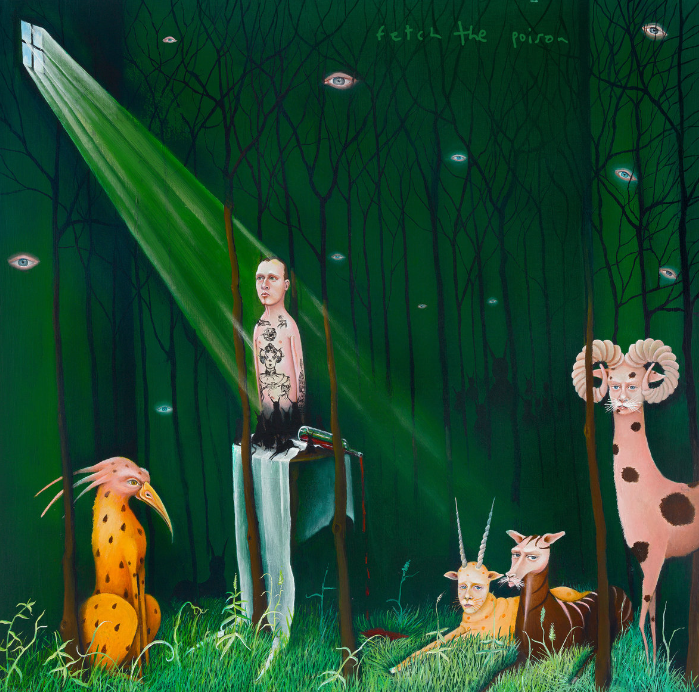
Caterina Barbieri ‘Spirit Exit’ (Warp Records) ACK
Review
Jam Baxter ‘Fetch the Poison’ (Blah) Matt Oliver
Oliver Birch ‘Burning Daylight’ BBS
Review
Black Mesa ‘Research Facility’ (猫 シ Corp. ‘Selected Works’) ACK
Brigitte Beraha ‘Blink’ DV
Review
Brian Bordello ‘Cardboard Box Beatles’ (Metal Postcard Records) DV
Review
The Bordellos ‘Ronco Revival Sound’ (Metal Postcard Records) Graham Domain
Review
Boycalledcrow ‘Wizards Castle’ (Waxing Crescent Records) BBS
Review
Broadcast ‘The Maida Vale Sessions’ (Warp Records) GD
Apollo Brown & Philmore Greene ‘Cost of Living’ (Mello Music Group) MO
Brown Calvin ‘dimension//perspective’ (AKP Recordings) DV
Review
C.
Loyle Carner ‘Hugo’ (EMI) MO
Tom Caruana ‘Strange Planet’ (Tea Sea Records) MO
Cities Aviv ‘Man Plays The Horn’ (D.O.T.) DV
Claude ‘A Lot’s Gonna Change’ (American Dreams) DV
Review
Clouds in a Headlock ‘Breakfast in Phantasia’ (Offkiltr/Fat Beats) MO
Julian Cope ‘England Expectorates’ BBS
Link
D.
The Dark Jazz Project ‘S-T’ (Irregular Frequencies) DV
Review
Aftab Darvishi ‘A Thousand Butterflies’ ACK
Review
The Difference Machine ‘Unmasking the Spirit Fakers’ (Full Plate) MO
Review
Ferry Djimmy ‘Rhythm Revolution’ (Acid Jazz) DV
Matt Donovan ‘Habit Formation’ DV
Review
The Doomed Bird Of Providence ‘A Flight Across Arnham Land’ DV/BBS
Review
Dubbledge ‘Ten Toes Down’ (Potent Funk) MO
Review
E.
Eamon The Destroyer ‘A Small Blue Car – Re-made/Re-modelled’ (Bearsuit Records) BBS
Review
El Khat ‘Albat Alawi Op.99’ (Glitterbeat) DV
Review
Kahil El’Zabar Quartet ‘A Time For Healing’ (Spiritmuse) DV
Roger Eno ‘The Turning Year’ (Deutsche Grammophon) GD
Review
Eerie Wanda ‘Internal Radio’ (Joyful Noise Recordings) DV
Exociety ‘Deception Falls’ (Exociety) MO
F.
Fera ‘Corpo Senza Carne’ (Maple Death Records) DV
Catrin Finch & Seckou Keita ‘Echo’ (bendigedig) DV
Review
Flat Worms ‘Live In Los Angeles’ (Frontier Records) DV
Review
Forest Robots ‘Supermoon Moonlight Part Two’ (Subexotic) DV
Review
Nick Frater ‘Aerodrome Motel’ (Big Stir Records) BBS
Review
Future Kult ‘S-T’ (Action Wolf/AWAL) DV
Review
G.
Mike Gale ‘Mañana Man’ DV
Premiere
Dana Gavanski ‘When it Comes’ (Full Time Hobby / Flemish Eye) GD
Review
Gold Panda ‘The Work’ (City Slang) ACK
The Good Ones ‘Rwanda…You See Ghosts I See Sky’ (Six Degrees) DV
Review
Goon ‘Hour of Green Evening’ (Demode Recordings) Graham Domain
Review
Guillotine Crowns ‘Hills to Die On’ (Uncommon Records) MO
Review
Gwenno ‘Tresor’ (Heavenly Recordings) GD
H.
Aldous Harding ‘Warm Chris’ (4AD) GD
Healing Force Project ‘Drifted Entities Vol. 1’ (Beat Machine Records) DV
Review
Sven Helbig ‘Skills’ (Modern Recordings) DV
Review
Bruno Hibombo ‘Parting Words’ DV
Houseplants ‘II’ (Win Big Records) DV
Review
John Howard ‘From The Far Side Of A Miss’ (Kool Kat) DV
Review
I.
IBERI ‘Supra’ (Naxos World Music) DV
J.

Juga-Naut ‘Time & Place’ (Juga-Naut) MO
JPEGMAFIA ‘OFFLINE!’ ACK
K.
Kamikaze Palm Tree ‘Mint Chip’ (Drag City) BBS
Review
Kick ‘Light Figures’ (Anomic Records/Dischi Sottoernnei/Sour Grapes) DV
Review
King Kashmere ‘Woof’ (High Focus) MO
Evan Kertman ‘Rancho Shalom’ (Perpetual Doom) BBS
Review
KMRU ‘Temporary Stored’ ACK
L.
Labelle ‘Éclat’ (Infiné) DV
Review
The Legless Crabs ‘Always Your Boy’ (Metal Postcard Records) BBS
Review
The Legless Trials ‘Cheese Sandwich’ (Metal Postcard Records) BBS
Kristine Leschper ‘The Opening Or Closing Of A Door’ (Anti-) DV
Review
Liraz ‘Roya’ (Glitterbeat) DV
Review
Francesco Lurgo ‘Sleep Together Folded Like Origami’ (Bosco Records) DV
Review
Lyrics Born ‘Mobile Homies’ (Mobile Home Recordings) MO
Review
Keep an eye out later this week for Part Two.
Hi, my name is Dominic Valvona and I’m the Founder of the music/culture blog monolithcocktail.com For the last ten years I’ve featured and supported music, musicians and labels we love across genres from around the world that we think you’ll want to know about. No content on the site is paid for or sponsored and we only feature artists we have genuine respect for /love. If you enjoy our reviews (and we often write long, thoughtful ones), found a new artist you admire or if we have featured you or artists you represent and would like to buy us a coffee at https://ko-fi.com/monolithcocktail to say cheers for spreading the word, then that would be much appreciated.
A LOOK AT WHAT’S OUT THERE/
Dominic Valvona’s Roundup

ALBUMS/LONGPLAYERS
El Khat Aalbat Alawi Op. 99’
(Glitterbeat Records) 25th March 2022

First off, this is an incredible album; an incredible energy and an incredible elliptical disjointed clattering and snozzled, heralded horn blown fusion of the music carried out of the Yemen, the greater Middle East and North Africa. The Eyal el Wahab led Arabian swirled and rhythmic jolted El Khat (named after the popular chewed drug) are simultaneously diy, even punk whilst also creating a bombastic and hypnotising dynamism.
In the melting pot of Tel Aviv-Yafo and in the more isolated – cut-off from the digital and online world – deserts the self-taught cellist (despite not, at the time, being able to read music, managing to join the Jerusalem Andalusian Orchestra) El Wahab and his band use both regional instruments and reconstituted junk to make a wild border traversed sound like no other. A collage of influences, initially sparked off by the Qambus electric sampler of traditional music from the 1960s (the ‘Qat, Coffee & Qambus: Raw 45s From Yemen’ compilation to give it the full title), the group’s second album rewires its Yemen roots and faint, distant musical memories with the psychedelic, garage-rock, gnawa, Ethio-jazz and the raw.
A fondly, missed and remembered culture lies at the heart of this album. Throughout the tensions in the Arabian Peninsular in the last century, and ever since the formation of the Israel state in the aftermath of WWII, Yemen’s Jewish population (which was considerably large), but many others too, were forced to leave their homes for sanctuary. And so many, through no fault of their own, have found themselves decamped, living in Israel like the El Khat band – some for a generation, others for at least three or more. This is where that fusion meets at the crossing; one that sounds like Lloyd Miller conducting a Cairo marching band kicking a tin can down the Kasbah, or, a melodic rattled chaotic brilliance of Zafer Dilek, Salah Rageb, Bargou 08, Yontan Gat and nimble Tuareg guitar soloing. I’d even suggest that they’re bedfellows of their Glitterbeat Record label mate’s blk/JKS: a merger of the atavistic and something entirely exciting and fresh.
The album title itself shares this undertaking of piecing together in a new way, their influences. The “alba” part of “Aalbat” references a small tin box that can contain ‘many treasures’, the “Alwai” is a homage to the popular late Yemeni singer Faisal Alwai, and the “Op. 99” bit intended to give the compositions “the same respect as Western classical music”.
Despite the impact of Covid restrictions in Israel, forced to record separately (although during an easing of those rules, El Wahab was able to usher a chorus of seven people into his living room) and delayed by a self-imposed offline retreat into the expansive desert for six months, it all comes together like a live, unpredictable performance.
Familiar Middle Eastern spices, dances, celebrations and string-frayed bowed and rubber-band like elasticated rhythms are layered with staggering, sometimes drunken stomped, bounced, bounding drums. Mergia organ dabs sit alongside beautiful and swimmingly trilled vocals as hazed connections to the Yemen homeland drift in and out of focus. Some of the distinctive sounds can be traced back to El Wahab’s carpentry skills, building unique instruments from thrown-away scrapes of metal, wood and plastic: hence at least a partial diy, homemade ascetic. Although he’s long since left that Jerusalem orchestra, El Wahab conducts, leads his very own clever ramshackle vision fit for a world in turmoil, of mass emigration. Aalbat Alwai Op. 99 builds a bridge between past longings and a chaotic future of sonic possibilities and polygenesis crossovers. Turning throwaway trash into a freeform expression of vitality, importance but also the social-political, El Khat turn the humble tin can into a resonator that sends out shockwaves across the globe.
Tone Of Voice Orchestra ‘S-T’
(Stunt Records) 11th March 2022

What do you get if you cross radio hall, echoes of Jazzmeia Horn, Solange and Middle Eastern vocals with folk music, sea shanties, the woody stretched bounce of Henri Texier and swoons across the Turkish border? I’ll tell you. You get the soulfully lush, quasi-classical transglobal collaboration between the Danish indie singer-songwriter Trinelise Væring and award-winning saxophonist Fredrik Lundin; helped by an expanded cast of singers and eclectic musicians.
Although this is a Danish enterprise the Tone Of Voice Orchestra evokes a myriad of influences; from the Celtic to Eastern Europe; from India and beyond with their debut album offering.
Vocally, in unison throughout, the lyric book is straight from the R&B and soul songbook; with yearned and wistfully lush ditties on female empowerment, broken down relationships and moving on, plus the foibles, frustrations of living in the modern epoch. All of which are diaphanous, light yet powerfully delivered. The opener, ‘He Loves Her For It’, kind of skewers that modern feel with voices, words and music more in keeping with some hurdy-gurdy churned droned timeless folky shanty. At times this open-ended fusion sounds like a Nashville En Vogue dropped off in a chain dragging Anatolia soundscape (‘You Saw Yourself Out’), and at others, like a yearned pondered Arun Ghosh caravan (‘Kom Hjemtil Mig’).
For his part, Lundin oozes jazzy saxophone sophistication with straight-up circling breaths, some smooching and then more abstract feelers for time, landscape and mood: on one occasion seeming to mimic a harmonica!
Gypsy encampments, meanders across the Balkans, lingering’s of old Iberia and Rajasthan, and exotic camel-motioned creeps through jungles beckon on an album of slinking and rolling beautiful mooching, swells and gravitas. A very impressive start to a multifaceted dynamic to seems to easily sit between the contemporary and past.
Kristine Leschper ‘The Opening Or Closing Of A Door’
(Anti- Records) 4th March 2022

A rekindled lush, if somnolent with yearns and longing, affair with the things that really matter, Kristine Leschper absolutely wows on her sublime new album rebirth.
Detached from the post-punk Mothers, Kristine has given herself the space to reassess, to reconnect and importantly create something anew and utterly spellbinding.
Despite a complexity of thematic strands, imbued in part by the poetry, activism and essayist statements of the late iconic writer June Jordan, Kristine adopts a languid, sensory wonderment that’s almost childlike. More natural, organic than synthesized – although there’s a suffusion of atmospherics, light arpeggiator and electronic waves that congruously boost the mood, or, give certain songs an almost outside-of-itself cosmic push – this gorgeous sounding album beautifully meanders, glides and drifts through a fluted and willow-whistled woodland of first-rate multi-layered arrangements and emotional pulls.
Within that magical world there’s glimmers of Eerie Wanda, ‘Uncoiled’ Diva Moon and Mazzy Star against the imaginative Panda Bear. Songs like the opening semi-pastoral ‘This Animation’ take time to build and change; growing naturally (that word again) from a pipped forest introduction to a slow-release of buoyant bass and more grand drumming drama. It grows stronger and more delightfully surprising as it goes on. Importantly, Kristine is looking at a rafter of emotions, sentiments in a less than ideal, imperfect world, and so rather than progress in a linear fashion, songs, lyrics, feelings all circle back around and offer tangents; especially musically with the funkier DFA Records laxed disco-yearn, almost resigned, ‘Blue’.
Hallowed organs, hand claps and bottle-like tapping percussion, gentle lingers of piano and a general sense of airiness and space are just a few elements that permeate this parchment of woodwind concertos, folk, intricate electronica and dreaminess.
The lyrics themselves are poetic, vulnerable and constantly loving: none more so than on the album’s final, stripped to just a piano and voice ‘Thank You’, which brings down the house with a sweetened gesture of thanks to those who’ve helped keep Kristine afloat in trying times. The fleeting, like “moonbeams”, empirical words, scenes are given weight, tethered in voice and sound with a real depth that seems in practice too be lightly administered. But that’s the genius of this whole album, a laid bare language of great importance made so lushly engaging as to sound like the very opposite; light enough to float off into the expanses.
I’m probably making a right hash of this review, fumbling around to show it in the right light, but The Opening Or Closing Of A Door is difficult to capture. A new chapter in the life of a highly talented musician, composer, this delightful album is one of the best I’ve heard in 2022. There’s no doubt in my mind that this move has been creatively a success, and it will take some beating to be knocked out of the final year lists.
The Lancashire Hustlers ‘Big Ask’
(Steep Hill) 25th February 2022

It’s a half full cup of ‘pukka’ brand tea kind of attitude that unfurls in a disarming manner on The Lancashire Hustlers sixth studio album proper: Big Ask. As always melodically ambrosian and nostalgic the Southport duo harmoniously sound simultaneously reassuring yet defeated on a songbook of ‘bittersweet melancholy’ and softly rolling lover’s paeans; love letters to the 60s and early 70s.
Between them Ian Pakes and Brent Thorley fill the space of a mini studio band and orchestra; sharing a myriad of eclectic instruments, many of which can found adding both exotic and psychedelic chimes, afterglows and bell rung eastern delights.
Like a Neil Finn led Honeybus or Revolver era Beatles breaking bread with Emitt Rhodes, this, now 25-year spanning, partnership washes through societal and romantic disenchantment, but also praise those muses, lovers that make them better people. In the first of those thematic camps the almost pleaded melodious ‘Your Cool Reactions’ finds the lads frozen out, unable to read that love interest’s face, whilst a harmony of The Kinks, solo McCartney and a reminiscent ‘Out Of Time’ tune accompanies a beautifully resigned vocal. The esoteric in comparison, and filmic even, malady ‘Surrender’ sees the lads “wavering” on the brink of giving in. Still, songs like the Slim Chance painted gypsy caravan amble along a blooming hedgerow landscape ‘Bluebell Panther’, and the lost See For Miles label compilation nugget, via Robert Wyatt and a happy-go-lucky Velvets, ‘Happiness On A String’ seem to suggest more sentimental declarations.
There’s also fleeting moments that lead to a lifetime of unsaid connective destiny and bliss (the universal spark, glassy bulb troubadour paean ‘We Knew It Though We Do Not Know’), and feelings of missing out as time slips away (the cowboy booted stirrups jangling southern blues organ imbued ‘No Patience’).
Dreamily and at times in a soulful slinking mood, echoes of Labi Siffre, Roger Bunn, John Compton, Bacharach, Jimmy Campbell and Fleetwood Mac permeate this comfortably light songbook of well-crafted, instantly memorable tunes. Everything, in a true distinctly English way, sounds and feels better over a cup of tea, and I’ll enjoy my ‘organic’ ‘peace’ labelled teabag gift supplied with the lad’s album: thanks for that Ian and Brent.
The Lancashire Hustlers once again, like a northern England Every Brothers, harmoniously and with a real sense of melody read the tea leaves to create a cherished collection of lovelorn malady and magic.
Koma Saxo w/ Sofia Jernberg ‘Koma West’
(We Jazz) 18th March 2022

A pleasant change in direction (of a sort) from the contorting saxophone heavy (hence the name) Koma Saxo as the dynamic ensemble expand their ranks and conjure up a sort of Scandinavian version of Ornate Coleman’s concerto American suite, as remixed by J Dilla and Leafcutter John.
The core sax brethren once more transform and disguise a suffusion of alto, soprano, tenor and slide, and double-bassist, pianist, percussionist, sampler Petter Eldh leads. Only now we have the addition of the aria-like and lucid ethereal voice of Sofia Jernberg permeating evocations of Linda Sharrock and airy diaphanous airiness to enjoy. Which works extremely well in offering some vocalised lulls, waves, syllables, vowels and intonation to the reworked jazz sounds.
Koma West as the name might indicate, references a conceptual geographical theme; the West part marking a soundtrack inspired and imbued by Petter’s west coast Swedish roots. To be specific, the formative years spent in the town of Lysekil, which sits at the southern tip of the Stångenäs peninsula, at the mouth of the Gullmarn fjord. A magical untethered purview of that landscape’s outstanding beauty, drum breakbeats converge with woodwind sprites, a skiffle simmer of jazz, the orchestrally classical and homegrown folk on an album suite of the organic and electrified.
Leitmotifs of a Scandinavian Bernstein and Prokiev can be heard in tandem with flowery levitations and a shadowy reverberation of a tune-up on the opening ‘Lo Ve Ko Ma’. Pastoral sounds, the transparent fleeted appearance of some concerto and room full of voices weave in and out of a woody and tinkled piano passage. It’s at this point that Koma Saxo sound almost like an entirely different group; nearly wholly acoustic, in a mirage of the dreamy. ‘Croydon Koma’ (strange change of location) sees the familiar Mo Wax-esque breaks return as Petter stretches the thrummed double-bass strings and a chorus of saxophone hoots and rasps.
An ode to the flowery landscape feature ‘Kaprifol’ finds this ensemble conjuring up a soulful R&B and Lee Dorsey-like classical puppetry; a lushly decorated wander amongst the fauna that takes on a Southern states of America backbeat feel. Talking of the south, there’s a hint of New Orleans on the high rising sax peppered, rattled double-bass Swedish jazz bolero ‘Koma Fred’.
Mother nature’s son collaborates with the incredible, lofty and airy meandered lyricism and utterances of Sofia to conjure up dolphin echoed coastlines, a menagerie of instrumental evoked bird life, the local folkloric traditions and something approaching a starry cosmic ceiling. Keeping it rooted in a childhood home, Petter’s “momvillian” mum, Kiki, is drafted in to play a repeated shortened concertinaed accordion riff on the hip-hop(ish) attitude ‘Ostron Accordion’.
A family affair, return to nature and a cosmic whole, the Koma Saxo with more than a little help from their friends (the highly thought of and lauded Kit Downes on piano, plus Maria Reich on violin and Lucy Railton on cello) take a pleasing and innovative turn in the road to match their often freshly chaotic jazz, elements of John Zorn and Alfa Mist, and the lofty. A contemporary woodland orchestra and untethered voice falls in with exciting, often broken-up, staccato jazz to musically score an inspiring Swedish topography. The spirit of collaboration lives on.
Kick ‘Light Figures’
(Anomic Records/Dischi Sotterranei/Sour Grapes) 16th March 2022

A dissected grind and more dreamy investigation of love’s opposing forces, we have the rubbered-up, sadomasochistic, the materialistic and the wanton lamented kinds as backdrop for Kick’s new album Light Figures. The Brescia ‘sweet noise’ makers duo, beefed up by a number of guests, and ‘curated’ production wise by Marco Fasolo, dig into a number of complementary opposites as they reach out to the dark side of our personalities and various wept augurs about self-destructive behaviour.
Despite the sometimes serious, dark nature and the brilliantly broody post-punk menace and industrial slicing, Chiara Amailia Bernardini’s vocals ache a certain melodious lushness; cooing and swooning occasionally like she’s fronting a 90s alt-rock or shoegaze band: a bit of Throwing Muses, Breeders. Often it recalls a leather-strapped Ravenettes and their version of knowing 60s backbeat girl group crushes. Chiara’s voice however, is more in keeping with a scorned, provocative PJ Harvey on the BDSM flange-affected ‘Rubberlover’, which also features a/lpaca’s Christian Bindelli aiding a salacious repeated “punish me” mantra about power versus submission. Over her trebly, Banshees and Ester Poly like basslines Chiara is more tauntingly alluring on the mythical allegorical ‘Sirens Never Sleep’; these Greek tempests luring sailors on to the deadly rocks through their mystical hypnotic voices sitting in for their all-too-real dangerous counterparts on the Internet; coaxing us all down misdirected rabbit holes and leading us astray.
Contorted guitar string scrapes from Chiara’s foil Nicola Mova bolster the cold steel grist, the gnarling and gnawing sinister spells, the piercing feedback that often seeps into the gothic. Yet by the album’s third track, ‘Eleven’, the mood evokes an acoustic and spindly chimed accompanied Renaissance set piece; a haunted pastoral dreamy romanticism, though the language (swapping between English, their Italian mother tongue and a completely made-up cadence) is thoroughly modern. ‘Viole’ is another one for the dreamers, featuring as it does a Prokofiev like fluted fairy tale wind instrument contribution from C’mon Tigre and Calibro 35’s Beppe Scardino, and a Shacks-esque languid float-y-ness. Sleepwalking into a climate apocalypse, the finale ‘Atlandtide’ features a doomy gnawed bass, yet seems to waltz towards its fate. It must be said that the duo and friends sound better when the bass and guitar growl, wails and sounds cool-y detached than in hallucinatory, languorous mode; when the fuzz and gristle have an unsettling mood, a leaning dread of Giallo post-punk. Light Figures seems to balance that bruised, scarred heart with the wispy and drifting, baiting and cooing protestations and resignation all the while. If bands like Peter Kernel are your crush then get a load of Kick; they’ve converted this critic.
Pjusk ‘Sentrifuge’
(Somewherecold Records) 18th March 2022

Shaping washed-out, layered abstractions of thoughts, time, moods and places from out of the “modular system” apparatus and what sounds like the air itself, the Norwegian electronic artist Jostein Dahl Gjelsvik tries something a little different with his newest Pjusk release.
Subtly sculpting ambiguous, mysterious ambient worlds that never quite settle – traversing as they do the dreamy, otherworldly, fabled and cosmic planes -, Jostein’s inaugural release for the crazily prolific Somewherecold imprint favours slow builds and reverberated undulations that merge the organic and mechanical; a soundtrack in which the reedy rasps of an obscured instrument can conjure up Tibetan mystique whilst pondering a cloudless, incandescent blue evening sky, or, convey kosmische-like space freighters travelling towards alien paradises.
Modulations, sine waves, chinked and chimed bottles, metallic purrs and burns, zip-wires, liquefied shapes, solar winds, mirrored reversal effects are used to create visions of a propeller-propelled leviathan machine hovering over beautifully rendered landscapes. The tinkling of a buoy on a topographic ocean; a patchwork of firework stars; ethereal cosmic sirens; places in which gravity doesn’t exist, Jostein’s centrifugal motioned ship glides across and lands amongst some magnificent contemplative and stirring scenes.
Occasionally a quiet synthesised beat, some drum pad rhythm adds a semblance of direction and propulsion. Traces too can be felt, heard of distant radiowaves, broadcasts; the drifted resonance of voices and music caught in the atmosphere. Shades of neoclassical Roedelius, some of Tim Story’s piano touches, a little bit of Mapstation, Edgar Frosse, Air Liquide and early Aphex spring to my loosened mind, on what is a really impressive slow-moving modular and tonal piece of escapism.
Anthéne & Simon McCorry ‘Mind Of Winter’
(Hidden Vibes)

“In the bleak mid-winter”, or not as the case maybe, as the considered partnership of Monolith Cocktail regular, the cellist polymath, Simon McCorry and guitar manipulator Brad Deschamps contour a wintery soundtrack of beauty and meditation.
Inspired by the late American modernist poet Wallace Stevens and his ‘epistemology’ school of sublime poetics ‘The Snow Man’, both experimental artists come together to draw an abstract atmosphere and landscape around that poem’s counterbalance mind set of beautifully described coldness and existential feelings of ‘nothingness’.
Although produced during the pandemic, events have been overshadowed in recent weeks by the heinous invasion of Ukraine, and so the fact that this ambient winter’s tale has found a home on the Ukrainian label Hidden Vibes seems to now carry more weight and resonance. But this incredible merger of obscured, veiled cello and effected guitar, field recordings and occasional bobbing tongue-drum knocked beats describes a season of evocative shaped electric-charged cumuliform and nimbostratus clouds, faraway glimmers of the Spring light and melted snow; the very opposite of a nuclear winter auger – which considering the despotic madman behind the button is Putin, doesn’t seem that far-fetched.
Under his Anthéne alais, Brad perfectly matches, under rides and envelopes Simon’s subtle arches, long drawn sustained bows and tonal gauze with threaded, drifted guitar notes, phrases, flange-like reverberations and radiowaves. In this Winter sky static crackles and piped metallic whistles signal dense clouds brushing against each other, whilst on the ground primordial hazy stirrings evoke both the mysterious and foreboding.
Serenity follows in the wake of more concentrated forces; field recordings of climbing over rocks and footsteps across wooden floors mark the presence of human interaction in this atmospheric space. There’s a real gravity to this poetic imbued soundtrack, an essence of the elements and movement. The Mind Of Winter is nothing less than a sublime turn and adroit piece of ambient conjuring from the congruous collaborators.
THE SHORTS

A ‘FOR UKRAINE’ SPECIAL:
As Imperialistic Putin makes good on his ten year plus campaign of lies, deceit and conquer, with the invasion of Ukraine, the millions watching on in despair have been unanimous in their support of that nation’s struggle against a Tsarist despot attempting to rewrite history. Whilst it is still uncertain just what heinous crimes he’s plotting – whether it will stop at the Ukraine, continue into former conquered Tsarist or Soviet territories, or manifest in a corridor to the Balkans -, our friends in the whole of Europe, Britain, North America and beyond have been rallying to the cause (a staggering £100 million has so far been raised in the UK, as if of the 7th March). Musicians have been among the first to turn-around projects, release special records, compilations in aid of the many charities working to help the immense refuge crisis; to bring the essentials to those fleeing and those trapped in cities and towns under siege. Here are just some of those good souls, donating the proceeds to this cause.
Note: unless dated, all release available from now.
Various ‘I Won’t Give Up’
A dramatic outpouring of grief and horror at the heinous events unfolding in Eastern Europe, the #iwontgiveup project brings together over twenty Czech, Ukrainian, Russian and Belarusian musicians to express opposition to the war in Ukraine; sending a clear message to the world that “we are all in this together”.
A combination of the well-known songs ‘Obijmi’ (Hug me) and ‘Bez boj’ (Without Fighting) by the cult Ukrainian rock band Okean Elzy this new version was produced by the Czech Republic-based producer and musician Igor Ochepovsky. It features a cross Eastern European cast that includes the studio drummer and singer David Koller, actor and singer Igor Orozovič, singers Monika Načeva and Lenka Dusilová, guitarists Michal Pavlíček and Nikita Krein, accordionists Aliaksandr Yasinski and Roman Zabelov, guitarist and balalaika player Kirill Yakovlev, double bassist Taras Volos, violinists Vartui Saribekian and Natalia Lisniak, cellist Simon Marek, violist Jan Forest, domra player Kateryna Vatchenko and pianist Olesya Ochepovskaya.
“For Ukrainians, Russians and Belarusians these are absolutely iconic songs that we all know well. Our nations and lives are connected not only by the melodies, but also by the themes of love, hope, courage and determination. The musicians involved are some of the finest artists I know. Apart from our love for music, we are also united by our dissenting attitude towards current events,” says Igor Ochepovsky, explaining the background of the project.
The recording of the song took place on Monday, 28th February, four days after the start of the war in Ukraine, in Boris Carloff’s Soundevice studio.
“When my wife Alena woke me up on Thursday morning with the news that the war had really started, I was shocked. I immediately wondered what I could do. We sent money to charities, I called all my friends in Ukraine and Russia, and checked to see if I could help at the borders. However, I am a musician, I speak to people through music. So Alena and I sprung into action and within two days we had everything arranged. Those involved cancelled their original plans to support the project, for which they deserve a big thank you,” says Ochepovsky.
Escupemetralla ‘Maldacena Duality’
(Single Track also featured on Side-Line Magazine’s Face the Beat 7: Session 7 compilation)
Mad, bad and dangerous to know, those dark purveyors of obscene twisted experiments, Escupemetralla are back with a hadron collider of regurgitating, churned science fiction mania and buzzing occult unease; a vortex trip down a Black Hole.
Appearing on its own merits via their own dark arts platform, ‘Maldacena Duality’ also appears for a good cause on the latest Face The Beat compilation from Side-Line Magazine. 129 tracks, listed in alphabetical order, the seventh session of menacing, scarred darkened sub genre electronica sees the proceeds go towards various charities plus the humanitarian crisis in Eastern Europe.
Solidarity ‘Blue And Yellow’ & “Yellow And Blue’
(Binaural Space)
The effort made during the last two weeks has brought a tear to my eye, with so many artists bonding together over the Internet to quickly turn-around projects like this one to raise money for various charities and the relief effort in Ukraine. Everyone deserves a pat on the back, they really do. Featuring another enviable cast of electronic, neoclassical and experiment artists, the Prague-based label/artist Binaural Space has released two Ukrainian flag colour coordinated compilation stunners.
Familiar to regular Monolith Cocktail readers/followers, volume two (Blue And Yellow) favourites like the polymath cellist Simon McCorry (who appears with Anthéne in one of my album reviews above), the ever-brilliant Whettman Chelmets and lower case minimalist genius Andrew Heath amongst the likes of Jad Baron, Dirk Jacobs, Greg Nieuwsma (another MC featured review in 2021) and Selvedge. Volume One of this moiety features MC regular Toxic Chicken and SEODAH, alongside Ash Electric, XENNON and Kodomo. Buy them both now.
The Post-Everything Collective & Friends Present: ‘Ukrainian Relief Compilation’
(The Post-Everything Collective) 31st March 2022
We did post this one up directly onto the FB page last week, but in case you missed it, another impressive compilation of eclectic finds and nuggets from the Post-Everything crew.
A staggering 60-track behemoth of a compilation, so chances are there will be something to suit every taste. A lot of stuff on here I’ve never heard of, so will enjoy digging. 100% of the profits are going towards the Save The Children foundation for Ukraine.
Various ‘Music For Ukraine’
(We Jazz)
Our favourite European jazz imprint/festival/shop We Jazz has pulled it out the hat with an enticing compilation of previously unreleased goodies. If you have followed us over the years you’ll know just how much the blog rates this jazz label; probably reviewing, featuring three quarters of their entire catalogue at some stage.
No highlights, as they are all worthy great selections from the label roll. There’s some really great material on here, enviable in fact. So sort it out and get handing over that cash.
100% of all proceeds go towards humanitarian aid in Ukraine via verified charity sources. All donations will be announced.
Various Artists ‘Pacification’
(Chitra Records) 18th March 2022
American ambient specialists Chitra Records is putting out a twenty-track compilation next week. Some great names on this one, including Federico Balducci & fourthousandblackbirds, who’s last collaboration received a favourable review from me. Pulling no punches, they’ve contributed the ‘Up To 15 Years in Prison And Fines Of Up To 5 Million Rubles’ track; reference to the recent passed laws of stamping out all protest and revulsion at Putin’s grand plans of conquest. Starring alongside them are Sebby Kowai, Adrian Lane and FlownBlue.
All proceeds from the digital sales of the compilation on Bandcamp for the first two weeks from the release date (until March 21, 2022) will be sent to the Red Cross Society of Ukraine.
 Monolith Cocktail Blog