Most Loved and Enjoyed Highlighted Albums of 2024: Part One: A – L
December 10, 2024
Welcome to part one of the Monolith Cocktail’s most loved and favourite albums of 2024 lists.
Picked by Dominic Valvona and Brian ‘Bordello’ Shea.

Despite the tumult of problems that face artists and bands in the music industry, from a lack of general interest to the increasingly punitive costs of touring and playing live, the worrying trend of venue closures, the ever-encroaching domination of streaming against physical sales and exposure, and the onslaught of AI, people just can’t quit making music. And that’s all without listing the political, social and economic woes that continue to make life unbearable for most of us; the scandalous forces of austerity/cost-of-living crisis and post-Covid hangover threatening to constantly drag us under. We, as critics – though most of us have either been musicians or still are – really appreciate what you guys, the music makers, do in the face of such intense stresses.
In fact, as we have always tried to convey, we celebrate you all. And so (as I say every year) instead of those silly, factious and plain dumb numerical charts that our peers and rivals insist on continuing to print – how can you really suggest one album deserves their place above or below another; why does one entry get the 23rd spot and another the 22nd; unless it is a vote count, and even then, does it really come down to a popularity contest? –, the Monolith Cocktail has always chosen a much more diplomatic and democratic alphabetical order – something we (more or less) started in the first place.
The lists are broken up this year into two parts, A-L, and M-Z, and include those albums we’ve reviewed or featured on the site in some capacity, plus a smattering of those we just didn’t get the time to include. All entries are displayed thus: Artist (in alphabetical order) then the album title, label, who it was chosen by and a review link, if there is one. We also included quotes and summaries underneath.
Before we precede, we’d like to thank the following contributors to the site this year: Dominic Valvona, Brian ‘Bordello’ Shea, Matt Oliver, Graham Domain, Mikey McDonald and Andrew C. Kidd, plus our Italian friends at Kalporz. Also, our gratitude and love for all our supporters during the year, and to those that have donated to https://ko-fi.com/monolithcocktail We really can’t have continued without it.
A_
A Journey Of Giraffes ‘Retro Porter’ (Somewherecold Records)
Chosen by Dominic Valvona/Review
“The sound of John Lane’s most prolific and artistically successful alias, A Journey Of Giraffes (no stranger to the blog, and often featured in our choice end of year features) is given almost unlimited time and space to unfurl on the ambitious opus-spanning Retro Porter album of ambient empirical suites.
An expansion upon Lane’s previous work – especially last year’s choice album entry, Empress Nouveau – each evolving sensory piece allows all the Baltimore composer’s signatures, motifs and serialism-like enquires to recollect memories of places and scenes, of the abstract, over the course of what sounds like a whole day.
Mirages, imaging’s, the sound of birds in the iron lattice gardens of an ostentatious arcade percent as described in late 19th century novella’s, sonorous pitches, the softened sound of a taiko drum at the Kabuki theatre, various hinges, dulcimer-like strokes all evaporate then solidify to create an ambient opus; a lifetimes work coalesced into one expansive, layered work of soundscape art and abstraction. Lane has allowed his mind to wander and explore organic and cerebral long form ideas like never before to produce, perhaps, his most accomplished unrestricted work yet.” DV
Annarella and Django ‘Jouer’ (We Are Busy Bodies/Sing A Song Fighter)
Chosen by DV/Review
“Born from the Senegalese imbued and inspired hub built around Sweden’s Wau Wau Collectif, another cross-cultural project that embraces that West African nation’s (and its neighbours) rich musical heritage. Fusing the roots, landscape and themes of Senegal with those of Europe, the partnership of Swedish flutist Annarella and the Malian born ngoni master Django absorbs the very atmosphere of that westernmost African republic, transposing and transforming age old traditions with a hybrid of contemporary musical effects and influences and guest list of diverse musicians and voices.
Django’s home environment and the outlier around it seeps into and materializes like a dreamy haze across all the album’s tracks, as evocations of the classical, of jazz and the blues mixes with the local stew of diverse languages. Tracks like ‘Degrees of Freedom’ are more mystical sounding, near cosmic, as the band saunter like gauze under the moon and across the desert’s sandy tides. Jouer, which translates from the French into “play”, is just that, a lovely stirring union of the playful that seamlessly entwines the two musician’s respective practices with sympathy, respect and the earthly concerns of our endangered societies and world. Hopefully this collaboration will continue and grow over the years; there’s not been a better one since Catrin Finch teamed up with Seckou Keita.” DV
Fran Ashcroft ‘Songs That Never Were’ (Think Like A Key)
Chosen by Brian ‘Bordello’ Shea/Review
“There is a uniqueness about this album; a trueness and soul you do not come across often much in these days of music to be played on phones. These are songs that could have been written anytime over the last 50 or so years, with some quite beautiful melodies and great lyrics; songs made for and by a music lover…already one on my end of the year best list.” BBS
B__
Donald Beaman ‘Fog On Mirror Glass’ (Royal Oakie)
Chosen by DV/Review
“The play and course of light, the recurring “phantom” and a beautiful subdued, nigh on elegiac poetry conjures up a simultaneous union of the beatific and longing on the latest solo effort from Donald Beaman.
Like a drifter’s songbook of subtle, intimate and home-recorded wanderings, metaphors and the like for yearned and plaintive romantic loss, fondness, the passing/measuring of time, and the urge to find comfort and solace, Fog On Mirror Glass uses memories of the weather, the way the light touched or dimmed at a given moment in time, and the smallest of witnessed movements/touches to evoke the right atmosphere of gossamer and sparsity.
In all, a most impressive and understated songbook of honest quality and performance, themed largely around the way light falls upon any given metaphor, analogy, phrase, description and texture. Unadorned, the feelings are left to pull and draw the listener into a most intimate world. Each play reveals more, as the album really begins to grow on you. A fine record indeed.” DV
Beauty Stab ‘Guide/Frisk’
Chosen by BBS/Review
“After a five plus year wait, we have the debut, and who knows, only album from the one time much tipped for big things Beauty Stab. An album filled with sex sleaze and glamour but with a healthy or unhealthy dose of darkness.
The sound and feel of eighties chart land I think has a big influence on Beauty Stab. They do share a name with ABC’s second album after all, and I can almost hear Martin Fry emote over the bass heavy synth pop funk of “Manic”.
“GUIDE/FRISK” is a wonderful and inventive crafted album that celebrates the joy and darkness and power that great pop music can bring to your life and really deserves to be heard by all.” BBS
Black Artist Group ‘For Peace And Liberty, In Paris December 1972’ (WEWANTSOUNDS)
Chosen by DV/Review
“Saved from obscurity and jazz lore, the previously believed “long-lost” recordings of the Black Artist Group’s radical free, avant-garde, spiritual and Afro jazz (with a side order hustle of funk) performance in Paris has been thankfully unearthed, dusted off and remastered in a project partnership between the band and the French Institut national de l’audiovisuel. Facilitating this operation are the reissue revivalist vinyl specialists WEWANTSOUNDS – regularly featured in my review columns over the years -, who’ve invited various connoisseur experts to provide liner notes, essays and photographic images to this package.
At times we’re talking Coltrane and Sun Ra, and at other times Roscoe Mitchell, Carlos Garnett and the Art Ensemble Of Chicago. You can also pick up some Chick, a touch of Cymande, of Art Blakey, Sam Rivers and Anthony Braxton. But to be specific, if you dig Rahsaan Roland Kirk’s ‘Safari’, Ornette Coleman’s ‘Lonely Woman’ and Don Cherry’s Organic Music Society then you’ll really need to part with the cash and have this on your shelf asap: not before blasting it out from your turntable.” DV
Black Diamond ‘Furniture Of The Mind Rearranging’ (We Jazz)
Chosen by DV/Review
“Transported back in time, and then propelled forward into the now via Chicago’s musical legacy, its rich heritage of innovators and scope in the world of jazz, Artie Black and Hunter Diamond’s dual saxophone and woodwind focused vehicle can trace a line from the Windy City’s smokestack bluesy outlines of the 50s through the icons Sun Ra, Roscoe Mitchell, Eddie Johnson, Lester Bowie, Art Ensemble Of Chicago, Anthony Braxton and the hothouse of undeniable influence and talent, the Association For The Advancement Of Creative Musicians.
Across an ambitious double-album spread of both quartet and duo mode formations, those Black Diamonds don’t so much shine as smoulder and fizzle to a smoky and simmering resonance and metropolis backdrop encroached by wild jungles and fertile growth.” DV
Bloom De Wilde ‘The Circular Being’
Chosen by BBS/Review
“I love the muse and the music of Bloom de Wilde. It has a tender all-consuming innocence and hope that calmly plays Rock Paper Scissors with a wistful sadness and melancholy.
Bloom writes songs that offer hope against all the odds; songs that embrace the eccentrics and outsiders, all the underdogs in life. Maybe that is why I feel a connection to her music and at times find myself totally engrossed with her beautiful tapestry of pop, jazz, folk and psychedelia, which she has woven with great love and skill to make great art.
Bloom is a fine songwriter, which may sometimes be overlooked due to the wonderful eccentricities of her personality and is a quite an accomplished and original lyricist, as this fascinating eleven song album of love, hope and magic shows.” BBS
The Bordellos ‘Nobody’s Listening’ (Metal Postcard Records)
Chosen by DV/Review by Graham Domain
“This is another perfect ‘slice of life’ album from The Bordellos. If all they had was a pair of spoons and a cassette-recorder, they would still be driven to record these hazy snapshots of life, in the same way that L S Lowry splashed his canvas with the daily drudgery and drama of the northern working-class. Was anyone paying attention to Mr Lowry at the time? No! But today there are hotels, theatres and tree-lined streets named after him. (Even Bowie was one to acknowledge the match-stalk painters genius titling his best album Low)!” Graham Domain
boycalledcrow ‘Kullau (Mortality Tables)
Chosen by DV/Review
“A musical atmospheric hallucination and psychedelic dream-realism of a roadmap, the latest transduced-style album from Carl M Knott (aka a boycalledcrow) takes his recollections, memory card filled photo albums, samples and experiences of travelling through Northern India between 2005 and 2006 and turns them into near avant-garde transported passages of outsider art music.
Place names (that album title refers to the village, an ancient kingdom, of ‘Kullu’, which sits in the ‘snow-laden mountain’ province of Himachel Pradesh in the Western Himalayas), Buddhist self-transformation methods (the extremely tough self-observation process of “non-reaction” for the body and mind known as “Vipassana”), Hindu and Jainism yogis (the “Sadhu”, a religious ascetic, mendicant or any kind of holy person who has renounced the worldly life, choosing instead to dedicate themselves to achieving “moksha” – liberation – through meditation and the contemplation of God) and language (the localised distinctive Kullu dialect and syntax of “Kanashi”, currently under threat) are all used as vague reference points, markers in this hallucinatory grand tour.” DV
Brevity ‘Home Is Where Your Dog Is’ (Think Like A Key)
Chosen by BBS/Review
“The wonderfully named “Home Is Where your Dog Is” is the unreleased album, plus some demo recordings, by late the 60’s early 70’s Chicago rock band Brevity, a band who never actually got to release anything at the time but had interest and encouragement from both Island Records and Frank Zappa’s Bizarre/Straight Records. Truth be told, released here for the first time by Think Like A Key Records, it is indeed a bit of a lost and now found musical treasure.
“Home Is Where Your Dog Is” is one of those rare lost albums that actually deserves to be labelled a lost classic, and the added demos actually have an indie/post punk feel to them that reminded me strangely of very early Pulp in their more acoustic like days. Yes, one of my favourite albums I have had the pleasure to listen to this year: a true Gem of an album.” BBS
Charlie Butler ‘Wild Fictions’ (Cruel Nature Records)
Chosen by DV/Review originally by Brian ‘Bordello’ Shea
“The music is all that you hoped it would be, for music without hope is hopeless and this is anything but that; it is the cream cake among lesser mortals.” BBS”
C___
Chris Corsano ‘The Key (Became the Important Thing [and Then Just Faded Away])’
(Drag City) – Chosen by DV
The prolific free-jazz, avant-garde and avant-hard drumming innovator Chris Corsano can be found as an instigator or willing foil across a multitude of experimental collaborations (recently on the MC appearing alongside Nels Cline, Darin Gray and Glenn Kotche as part of the We Jazz signed-off Saccata Quartet) but his soloist works are just as numerous and far reaching/influential. I lost count of appearances and album releases in 2024, but this constant rhythmic and non-rhythmic progressing album is my favourite, taken from back in June.
Literally letting rip with an apparatus of recognisable and often non-musical implements, Corsano fuses a noise and splash of ripping and tearing sounds with no wave Kraut-punk (think CAN, Faust), West African drumming, alternative jazz and jazz-prog-rock. Untethered, clever, and anarchistic in equal measures. DV
Alison Cotton ‘Engelchen’ (Rocket Recordings)
Chosen by DV/Review
“In the wake of the barbaric terrorism of Hamas on October 7th, and the ensuing destructive retaliation/ obliteration of Gaza by Israel since, there seems little room – let alone nuance and balance – on the debate; battle lines have been drawn and divisions sowed. And so, this inspired tale of ‘derring-do’ (originally performed live at the Seventeen Nineteen Holy Church in Sunderland) performance suite from the Sunderland composer Alison Cotton is a most timely reminder of dark history, but also of altruistic acts of kindness.
Scoring the story of the innocuous Cook sisters, Ida and Louise, and their incredibly brave rescue attempts to save the lives of twenty-nine Jews from occupied Europe during the build-up and eventual outbreak of WWII, Cotton ties in the modern plight of refugees escaping similar persecutions.
Less a morbid, dark soundtrack to the evils of the Nazi regime and Holocaust, Cotton instead conveys the enormity and the danger of the Cook’s enterprise through slow tidal movements, tones, intonations and changes in the atmosphere. Throughout it all a prevailing presence and emotional pull can be felt: The mood music of grief, the plaintive and sorrowful cumulating in a beautifully played series of arrangements and suites that are as sombre as they are beautiful and moving – reminding me in parts of Alex Stolze, Anne Müller, Simon McCorry and Aftab Darvishi.” DV
D____
Ëda Diaz ‘Suave Bruta’ (Airfono)
Chosen by DV/ Review
“A rarefied artist who manages to merge dream-realism with both the traditional and contemporary, Ëda Diaz occupies multiple realms of geography to produce sublime and club-lite Latin-European R&B pop music. Between spheres of influence, her French-Colombian heritage is bonded across an exotic soundboard of effects, precise cut electronica, and transformed repurposed old dances and song; the latter of which includes an electrified form of currulao, ‘wonky’ Colombian salsa, bolero, bullerengue, vallenato and ‘dembow’. I absolutely love this spellbinding, vulnerable and playful Latin-Euro vision.” DV
E_____
Kahil El’Zabar’s Ethnic Heritage Ensemble ‘Open Me, A Higher Consciousness Of Sound And Spirit’ (Spiritmuse Records) – Chosen by DV/Review
“Originally hot-housed in the Association for the Advancement of Creative Musicians (the mid-1960s nonprofit organization instigated by Muhal Richard Abrams, Jodie Christian, Steve McCall and Phil Cohran in Chicago, which El’Zabar himself once chaired) incubator, El’Zabar’s percussive, drumming rhythms for the mind, body and soul channelled the windy city’s rich musical lineage of jazz, blues, R&B, soul, Godspell and what would become house and dance music.
Following on from last year’s Spirit Gather tribute to Don Cherry (which featured the worldly jazz icon’s eldest son David Ornette Cherry shortly before his death) this latest conscious and spiritual work channels that rich legacy whilst worshipping at the altar of those icons, progenitors and idols that came before; namely, in this instance, Miles Davis, Eugene McDaniels and McCoy Tyner.
El’Zabar’s once more heals, opens minds and elevates with another rhythmic dance of native tongues and groove spiritualism. The ancient roots of that infectious groove and the urgency of our modern times are bonded together to look back on a legacy that deserves celebrating. After fifty years of quality jazz exploration and collaboration, El’Zabar proves that there is still much to communicate and share as he and the EHE recast classics and original standards from the back catalogue.” DV
Empty House ‘Bluestone’ (Cruel Nature Records)
Chosen by DV/Review
“The megalithic period “cromlech” (frequently interchanged with and referred to a “dolmen” too) construction of large stone blocks that stands within the borders of the Pembrokeshire Coast National Park, in the village of Pentre Ifan, acts as a gateway to the imagination for the Blackpool-based musician Fred Laird, who goes under the moniker of Empty House.
Avalon mists descend across a communication with the landscape, whilst shriven archaic reenactments stir-up the hallucinatory and esoteric. Old vacuums of air blow through the spaces in between the stones as a haunted geology shrieks, howls, mourns and swirls. And a wispy passage of monastery choral voices carries on the wind as children giggle and the neolithic generator revs up vibrations and pulses from the afterlife. The Incredible String Band makes merry with Julian Cope; Steve Hillage joins Ash Ra Tempel; and Affenstunde period Popol Vuh invokes ghostly parallel histories with Xqui and Quimper on a tour of Ley lines. Atmospheres and scenes from a long history of settlement, of the spiritual, envelope the listener on a most subtle but rich field recording trip.” DV
Peter Evans ‘Extra’ (We Jazz)
Chosen by DV/Review
“A meeting of avant-garde minds to savour, the union of Peter Evans with Koma Saxo and Post Koma instigator and bassist Petter Eldh and New York downtown experimental rock and jazz drummer pioneer Jim Black is every bit as dynamic, explosive, torqued, moody, challenging and exciting as you’d imagine.
A crossroads of separate entangled influences and backgrounds, legacies, with all three practitioners in this Evans-fronted project and their CVs stretching back a few decades, the avant-garde rubs up against the blues, hard bop, atmospheric set scores, hip-hop style breaks, the electronic and classical. By using both the piccolo and flugelhorn on this album, some passages sound like Wynton Marsalis playing over Mozart, or Alison Balsom lending classical airs to an Alfa Mist production.
One of the best jazz albums you’ll hear all year, with a spot saved for the choice albums of the year lists, Extras is a thoroughly inventive and exciting dynamism of contemporary luminaries at the height of their skills and knowledge.” DV
F______
Ibelisse Guardia Ferragutti & Frank Rosaly ‘MESTIZX’ (International Anthem X Nonesuch)
Chosen by DV/Review
“Transformed and remoulded for a more progressive age the “MESTIZX” title of this partnership’s debut album takes the Spanish term for “mixed person” (namely, a union between those indigenous people in the Latin conquered territories of South America and the Spanish) away from its colonial roots and repurposes it on an album of dream realism duality.
With the multimedia performer and singer Ibelisse Guardia Ferragutti’s Bolivian and the jazz drummer Frank Rosaly’s Puerto Rican heritages, the pre-colonial history of South America is woven into a contemporary revision of magic, organic forms and ritual rhythms mixed with elements and a suffusion of Chicago post-rock, post-jazz and alternative Latin leftfield pop.
There’s much to admire in this world of the untamed and wild, with new perspectives, mixed histories and the largely melodious reverberations of the lost exercising a new language of ownership. Ibelisse Guardia Ferragutti and Frank Rosaly perfect and expand their organic explorations, bewitching messages and oracles on an intriguing, moving and dreamily trippy debut album.” DV
G_______
Michal Gutman ‘Never Coming Home’ (Cruel Nature Records)
Chosen by BBS/Review
““Never Coming Home” is a darkly beautiful album; an album of twisted musical discovery, with songs worthy to fall from the lips and the pen of the great Dory Previn; songs that pull you into a strange and beguiling solitude place, where you only have memories and fears and regrets for company. Musically stark and bewitching like an unused broken fairground ride: a bass guitar has never sounded so much like the faded remnants of an old lover’s final kiss. “Never Coming Home” is quite simply stunning.” BBS
Nino Gvilia ‘EP Number 1: Nicole’ & ‘EP Number 2: Overwhelmed By The Unexplained’ (Hive Mind Records) – Chosen by DV/Review
“Creating a musical, lyrical eco system of their own, soundtracked by folk, minimalism, the hallucinatory and pastoral – with only the final vaporous misty esoteric second EP’s titular track changing from cuckoo-like voiced loops and sympathetic strings to disturbing futuristic daemonic augur –, the Nino Gvilia encompassed guise ebbs and flows with the movement of the replenishing waters, the lakeside and mill turning scenes of the surroundings, to produce a disarming hymn. Idiosyncratic in beauty, I’d recommend this diaphanous accomplished mini opus to those with a penchant for Hatis Noit, Seaming To, Tia Blake and Roberto Musci.”
H________
Hackedepicciotto ‘The Best Of Hackedepicciotto (Live In Napoli)’ (Mute)
Chosen by DV/Review
“As a duo in recent years, Alexander Hacke and Danielle de Picciotto under the twinned Hackedepicciotto moniker, have channelled their diverse experiences as members/instigators of such groups as Einstürzende Neubauten, Crime And The City Solution and the Space Cowboys, into a signature sound that embraces the cabaret and soundtrack gravitas of post-punk, post-industrial, electronica, the esoteric, weird folk and twisted fairytale: which they themselves have described as “symphonic drone”.
Their fifth album, the partial sonic and lyrical autobiography, part photo album scrap book dedication, Keepsakes, was released last year. As with most of their catalogue, the duo’s albums are either recorded in a stirring, inspiring location, or in a different country. The most recent being no exception, recorded as it was at Napoli’s legendary Auditorium Novecento using the famous venue’s stock of various instruments. That album now forms the focal or centre point for this live release of choice bell tolled maladies and drone sonnets from the duo’s back catalogue. Performed over two nights, they’ve chosen to return to the Auditorium Novecento setting that made Keepsakes such an atmospherically rich and momentous, dramatic record. And so, they perform a quartet of songs from that most recent album alongside picks from the Menetekel (2017), The Current (2020), The Silver Threshold (2021) and Perseverantia (2023) albums. And it proves a winning formula as the perfect showcase, and a more unique approach to performing the “best of” their back catalogue.” DV
Christopher Haddow ‘An Unexpected Great Leap’ (Erol’s Hot Wax)
Chosen by DV/Review
“A comfort blanket bookended by the reassuring signs of life via the sounds of an ultrasound, Christopher Haddow’s first steps out as a solo artist (flanked on either side by the contributions of Josh Longton on double-bass and Jamie Bolland on piano) capture the abstract feelings of parenthood. An Unexpected Great Leap is in fact, partially, an ambient tool to send both Christopher and his artist wife Athene Grieg’s son Louie off to sleep.
You may know Christopher as the former lead guitarist of Paper Planes and as a member of Jacob Yates and the Pearly Gates, but under his own name and with a different, more personal, direction he’s beautifully, imaginatively and conceptually complimented his wife’s visual feels of parenthood with a searching and settling album of ambient Americana and womb music.” DV
Sahra Halgan ‘Hiddo Dhawr’ (Danaya)
Chosen by DV/Review
“Few artists from the disputed region of Somaliland could qualify better than the singer, freedom fighter and activist Shara Halgan to represent their country’s musical legacy. As an unofficial cultural ambassador and symbol for female empowerment Halgan’s journey is an inspiring one: Forced out of her homeland during a destructive civil war – in which she played a part in nursing and “comforting” fighters from Somaliland’s secession movement, sometimes alleviating suffering through song –, Halgan had to flee abroad to “survive” hardships and dislocation in France, but eventually, a decade after the overthrow of Siad Barre’s ruling military junta, returned home to motivate and promote proud in Somaliland’s cultural heritage.
It was during her time in France, removed from her roots and homesick, that Halgan would meet the musicians that went on to form her studio and touring band: step forward percussionist and founder of the French-Malian group BKO Quintet, Aymeric Krol, and the guitarist and member of the Swiss ensemble Orchestre Tout Puissant Marcel Duchamp and L’etrangleuse, Maël Salètes. Both appear on the latest, and third Halgan album, alongside newest recruit Régis Monte, who adds “vintage organ” and “proto-electronic embellishments” to the heady and fuzzed mix.
Enriched soul music with an edge and buzz, Halgan and her troupe strike a balance between the heartfelt and empowered on electrifying album; that focal voice sounding so fresh and young yet wise and experienced, able to encapsulate a whole culture whilst moving forward.” DV
Herandu ‘Ocher Red’ (Hive Mind Records)
Chosen by DV/Review
“Trance is spun with bass noodling, Ethio-jazz, post-punk funk, Moroccan and Arabian cassette culture, retro space age keys, no wave dance music and the Aphex Twin to create an interesting explorative zap, skip, playful, mysterious and dreamy vision that mirrors the Gavrilov brothers feelings of their native landscape, and the episodes of life, the shaping of their creativity, born in that Siberian setting.” DV
Herald ‘Linear B’ (Errol’s Hot Wax)
Chosen by DV/Review
“If mid-70s Eno working his magic with Merriweather Post Pavilion sounds like a match anointed in heaven then Lawrence Worthington’s ridiculously long-delayed debut album is going to send you into a woozy alt-pop state of bliss. The latter partner in that ideal fantasy of influences is hardly surprising, with the Animal Collective’s “infrequent” co-founding member Josh Dibb (aka Deakin) playing the part of co-producing foil and soundboard. And although the eventual Linear B album was first conceived twenty plus years ago, when the Animal Collective and Panda Bear and a menagerie of congruous bands were building an alternative-psych-pop scene – the darlings (quite rightly) of Pitchfork and the burgeoning MySpace culture -, and when the musical palette of sounds is produced on cheap 90s Casio and Yamaha equipment, Worthington’s Herald nom de plume still resonates and feels refreshingly dreamily idiosyncratic.
The results set a personal psychedelic language of feels and character-dotted whimsy to a maverick alt-synth-pop production: imagine Syd Barrett, K. Leimar and Edward Penfold backed by a Factory Records White Fence or Panda Bear. Unassumingly lo fi yet symphonic, you can hear hints of neo-romantics, colder synth spells, the post-punk, the Bureau B label’s cult German new wave and post-krautrock offerings, John Cale and a very removed vision of The Beach Boys.” DV
Holy Matter ‘Beauty Looking Back’
Chosen by DV/Review
“Bathed in a new diaphanous light, Leanna Kaiser steps away from her ambient shrouded Frances With Wolves duo (albeit with an embraced cast of familiar faces and musicians) to take up the soloist guise of Holy Matter.
Following up on a tapestry of enchanted and dreamy singles, woven from gossamer threads of fairytale and fantasy, the musician, songwriter and filmmaker now unfurls an entire beautiful album of nostalgic imbued troubadour-folk, softened psychedelia and country woes, sad lilted resignation, solace, reflection and pathos.
Gazing both lamentably and in sighed resignation from metaphorical fairytale towers and vantage points emphasised by poetic weather patterns, Kaiser gently exudes a longing sense of wistful pulchritude. The past is always near, inescapable and worn like a comfort blanket; moulded to Kaiser’s desires, sorrows, reflections and duality. Holy Matter proves an interesting alluring and enchanting creative progression for Kaiser, her debut solo a refreshing take on the familiar and the tropes of time. “ DV
Hungrytown ‘Circus For Sale’ (Big Stir Records)
Chosen by BBS/Review
“This is the fourth album from Hungrytown, but the first I have had the pleasure of hearing, and indeed it is a pleasure as psych folk with more than a hint of baroque pop is right up my street. There is a beauty and calmness to it that one can lose themself in and ignore and forget briefly the day-to-day turmoil that surrounds them. Vocalist Rebbecca Hall is blessed with a magically sweet innocent voice that floats and weaves its way through the musical sea of melodious tranquillity that wraps itself around the listener: pure bliss.” BBS
K___________
Kitchen Cynics & Margery Daw ‘As Those Gone Before’ (Cruel Nature Records)
Chosen by BBS/Review
“I admit I have a bit of a soft spot for weird, strange folk music, I put it down to watching too much Bagpuss and The Clangers as a toddler: wasn’t the 70’s a wonderful decade to be a child. So, this fine album of weird, strange folk songs is right down my summer pathway stroll of mischievous delight.
Kitchen Cynics & Margery Daw go from the childlike tales of the sinister folk whimsy “Christopher Tadpole” to the dark and cold clawing of “Mole Man“; if you wondered what story time at the nursery school on summer isle might sound like, these gems will answer your wonderings. “The Four Trains That Killed Me” and “Last Of The Little Lost Lambs” are both wonderfully John Cale like in the darkness and utter beauty as much as “Accused Isle” is like listening to a slightly deranged Pam Ayres on the old Radio Luxembourg via an old transister radio under the bed clothes in the darkest of nights [wasn’t the 70’s a wonderful decade to be a child]. “As Those Gone Before” is a true magical gem of off-kilter folk whimsy, an album of true eccentric magnificence.” BBS
L____________
The Legless Crabs ‘No Condoms, Just Satan’ (Metal Postcard Records)
Chosen by BBS/Review
“The sound of rock ‘n’ roll future and past collide in this nineteen-track beauty of anger and attitude: songs that deal with the strangeness of living in this world today.
From the Cramps like “I Catfished My Brother” and the sonic escapades of “Rope Bunny”, to the heaviness and sludge-rock dark humour of “Shark Lover” this is an album that should be all over alternative radio, and once again, has to compete with far less talented and easier and blander beige alternative rock.” BBS
Letters from Mouse ‘Clota’ (Subexotic Records)
Chosen by DV/Review originally by Graham Domain
“In Celtic mythology, the Goddess Clota was patron of the River Clyde and brought purity to the natural landscape. The album pieces reflect the beauty of nature and how nature evolves and changes, both with the day and with the changing of the seasons.
Altogether it’s a beautiful album that deserves to be heard by many. It is also a great ambient album for meditation or creative work such as painting. Wonderful.” GD
LINA_ ‘Fado Camões’ (Galileo Music)
Chosen by DV/Review
“Back this time with the British producer and musician Justin Adams and a small ensemble, LINA_ takes on the classical 16th century poetics of Portugal’s most famous literary son, Luís Vaz de Camões.
Musically tender, accentuated and like a fog, mist at times, even vapour of the mere essence of a score, there’s echoes of old Spain, the Balearics, North Africa, the Middle East but also Turkey and the Hellenic. LINA_ is a leading light, pushing the boundaries without losing the soul, truth and appeal of the music she adopts and transforms. Fado Camões is another artistic triumph.” DV
The Loved Drones ‘Live at Atelier Rock HUY’
Chosen by BBS/Review
“The Loved Drones have a power and an all-round likability and uniqueness that all the great bands have. They are a band who plough their own furrow through live casting off tangent animal shapes at the sun, raising two fingers to the lack of talent and originality that currently is forced upon us by the mainstream radio and press. The Loved Drones are quite wonderful.
“The Hindenburg Omen” is a instrumental that a blockbuster film should be made just so it can be included on the soundtrack, and “Humans Can’t Compete” once again is brimming with a Cope-like magnificence. These eight live tracks show what a great band we have in our mists and really should be heard and appreciated by all of us music lovers who love mind bending space hopping cosmic musical delights.” BBS
A WORLD OF SONIC/MUSICAL DISCOVERIES REVIEWED BY DOMINIC VALVONA
(Unless stated otherwise, all releases are available now)

CAN ‘Live in Keele 1977’
(Mute Records) 22nd November 2024
The sixth “live” album in Mute’s series of CAN performances, previously lost in the archives, or left to the bootleg community to post and share in various edited or mixed-up forms over the decades, Live in Keele is the second such live recording from the pivotal year of 1977. The most “requested” live performance yet we’re told, is taken from the band’s Keele University showcase, recorded in March of that year in the Staffordshire town of Newcastle-under-Lyme.
Whilst the legacy label Spoon has already released various versions of live material over the years – specifically the CAN Live 1971 – 1977 album -, and many fans have loaded up their amateur recordings onto Youtube and the like, this will be the first time proper that the Keele set has been released in its most complete, remastered form.
The set list has been argued over, depending on who you listen to and what version you find resurfacing on the net. But it can be agreed that the performance was a mix of refashioned, in-the-moment tracks from their most recent album, Saw Delight, some improvisations and recalls of past glories and themes. One such example lists ‘Fizz’ (as featured on that already mentioned Spoon endorsed Live collection), ‘Animal Waves’, ‘Sunshine Night And Day’, ‘Dizzy Dizzy’, ‘I Want More’, ‘Pinch’, ‘Don’t’ Say No’ and ‘Pellamen’ (an improvisation). And indeed, some of this is right, if only in short passages or bursts. But this release unhelpfully splits the tracks into non-committal numerical titles, ‘Eins’ to ‘Fünf’. Another version has the same performance kicking off with an untitled improv, followed by ‘Pinch’, ‘Don’t Say No’ and ‘Animal Waves’. The latter two’s inclusion is concrete, no argument. And I’m sure that’s a recall of ‘Pinch’ from Ege Bamyasi alongside a transmogrified glimpse of ‘I Want More’ in the mix.
But before we go any further, I feel we should familiarise ourselves with the band’s often dismissed or at least forgotten treasure, and the focal point of reference for this recording, the Saw Delight LP, plus the changes that had taken place in the setup and lineup during this pivotal year.
Traversing influences from around the globe, the ethnography alchemists CAN always effectively absorbed the traditional and authentic music of multiple cultures, including the Middle East, Far East and Turkey. However, it wasn’t until the release of 1977’s Saw Delight LP that the group found themselves lauded as so-called ‘world music’ pioneers. In truth this five track assiduous collection of Afro, Turkish, Arabian, South American and “Fourth World” imbued songs does sound like a precursor to the 80s explosion in ethnically traditional music.
Much of CAN’s later work is often passed over, if not dismissed. Perhaps this can be attributed to the fact that their last couple of albums proved disappointing, the strange proto-glam of Landed and the more disco-esque reggae of the conventional Flow Motion – which spawned their most commercial hit ‘I Want More’ – did little to ingratiate die-hard fans to the cause, with many believing they’d lost their experimental edge. Fortunately, I believe, Saw Delight placed them back on track for a momentary reprise, mainly due to the inclusion of former Traffic bass player Rosko Gee, and percussionist Reebop Kwaku Baah, who both added a touch of African grooves and Caribbean coolness to the Teutonic mix.
Rosko’s arrival changed the dynamics, allowing CAN’s co-founding bassist and producer Holger Czukay to step away from the instrument to concentrate on producing interloping and spontaneous sound effects. Interacting with telephone calls and various radio transmissions, Czukay created the technique of using a Morse code switch to relay the signal and tap out these often-strange sound bite samples.
Vocals at this time were shared by everyone, with Rosko pitching in with lyrics to ‘Call Me’ and collaborator Peter Gilmour (Journalist friend of the band who co-wrote tracks on their last two albums) supplying words for both ‘Don’t Say No’ and ‘Fly By Night’.
The music itself gyrated to a disco and funk fuelled world rhythm, sauntering along most of the time in a kind of infectiously serene fashion. The opening song on that album, ‘Don’t Say No’, springs into action, settling quite rapidly into a taut rhythmic and containable conducted feel-good jam. Oscillating and accelerating keyboard waves of sound shuffle around the wispy delivered vocals that prompt us to, “Do what you feel, what you need to do” in a relaxed Jamaican fashion. ‘Sunshine Day And Night’ featured a rallying conga intro, courtesy of Reebop, whose Ghanaian ancestry comes in quite handy on this West African flavoured jam. Czukay mingles at this point, shoehorning in waves of operator dialled phone conversations and snatches of transistor radio shows, whilst Irmin Schmidt emits a smog thick blanket of effects via his infamous Alpha 77 plaything.
Over on the flip side we find the 15-minute mini-opus ‘Animal Waves’, a moody piece that mixes elements of mysterious whispery windswept atmospherics with a more stirring and emotive melodic soundtrack. Touches of Cuban percussive grooves and African bubbling broody basslines pull at this sad and forlorn instrumental that is full of grandiose cinemascope and erudite musical charm. One of the more beguiling, if not strange, tracks is the sultry Barry White school of soulful disco, ‘Fly By Night’, a peculiar sounding funky balled that is unlike anything the group had ever recorded or where likely to never repeat.
Throughout this LP, the usually prominent and leading protagonist of the group, Michael Karoli, seems somehow restrained, playing the role of a drifter, though always managing to add desideratum moments of floating ark like celestial guitar licks at the right time. Also drumming prodigal magi Jaki Liebezeit moves to the sides, remaining an anchor, but reining in his usual freewheeling floor show of elaborate rolls, instead reverting to his machine accurate timings and leaving enough space for the percussion of Reebop.
The Keele performance must have been one of the group’s earliest stages to showcase the new material and their adopted new band members after Saw Delight’s release in March of that year. Riffing on the album’s highlight tracks, ‘Don’t Say No’ and ‘Animal Waves’, we can hear all the signature elements of groove and rhythm, and licks of the former on ‘Drei’, and the vaped and tunnelled shifts and starlit rays, the cyclonic tribal vocal samples and night flights of the latter on ‘Fünf’. Although, they sound like they’re in a hurry to set up the recognisable ‘Don’t Say No’ feel and beat, emerging suddenly as it does out of the previous Velvets-score-the-Omega-Man, cosmic summoning stained glass galactic organ and Hendrix-invoking performance – elements I’m sure of ‘Pinch’ with a hangover of their Soon Over Babluma period.
Elsewhere the performance is straight into a Turkish vision of whomp-whomp, whacker-whacker Fred Wesley J.B.’s and The Jimmy Castor Bunch, with echoes of Flow Motion. Schmidt’s keys seem to simultaneously invoke the sci-fi, Vincent Price horror show, Arabia, ? & The Mysterians and the acid, whilst Czukay gets the phone lines open, dialling up the operator with prank-like calls that leave the unsuspecting receiver hanging.
Liebezeit meanwhile keeps the groove going, busy but never overdoing his part nor bursting into a silly egotistical drum solo as he makes rhythmic trips from West Coast America to The Levant, Orient and Africa. Acid-rock, jazz, Afrobeat, funk, traditional influences meet as the action circles round the kit, the hi-hat pedal bounces and the cymbals shimmer and splash. Guitar prodigy Karoli has always pulled off a similar merger of influences whilst maintaining a cool aloof presence, rocking, fuzzing, wailing, screeching, and bending with the best of them. From Beefheart to Zappa, Garcia to Hendrix, he finds some incredible licks and riffs that squeal acid and psych rock but could be unconsciously and consciously gathered from all points of the compass and earths. Again, the Turkish, the Arabian, the Persian, the American West Coast scene, the avant-garde and even Eastern European seems to all come together in both tight and rubber banded displays of virtuoso riffage.
Latest recruit, Rosko Gee (Reebop Kwaku Baah isn’t mentioned as playing on this live recording) keeps a cool bass line going throughout. The ex-Traffic bassist adds a less driven and monotonous rhythm with funk, soul, R&B, African and Caribbean influences. These either sit underneath the freeform surface or go on long scale runs, and octave juggles, and sometimes just smoothly bounce around.
A defining period for CAN, the Live in Keele gig recording is a window in on a group that still retained it’s early 70s magic but was also moving on: an experiment with new members, and a freeing up of the long-established setup and sound. If you hated, or to put it less harshly, just aren’t into the Saw Delight LP period than you’ll still find much to excite and enjoy about this ’77 special. But if like me you rate that often missed out and sometimes dismissed entry in the CAN catalogue than you’ll be a little disappointed, as this performance doesn’t go far enough in using that album’s material, nor in breaking with the previous recordings and live shows. Yes, always improvising, and always transforming, often based on how the atmosphere is, where the crowd and vibrations take them, there is still a lot of familiar ground being retrodden. Most will be happy though, but heads and diehards will probably already know this set off-by-heart. Still, a worthwhile contribution to the series, and indeed one of their best captured gigs of that era.
Hackedepicciotto ‘The Best Of Hackedepicciotto (Live In Napoli)’
(Mute)
Responsible, in part at least, to helping shape a certain brooding yearned and dramatic sound over the last four decades in Berlin, the husband and wife creative partnership of Alexander Hacke and Danielle de Picciotto have at any one time, both separately and together, been members of Einstürzende Neubauten, Crime And The City Solution and the Anne Sexton Transformations imbued theatrical Ministry Of Wolves. During that time Danielle was the lead singer for the Space Cowboys and co-founded the famous Love Parade carnival.
As a duo in recent years, under the twinned Hackedepicciotto moniker, they’ve channelled much of that experience into a signature sound that embraces the cabaret and soundtrack gravitas of post-punk, post-industrial, electronica, the esoteric, weird folk and twisted fairytale: which they themselves have described as “symphonic drone”.
Their fifth album, the partial sonic and lyrical autobiography, part photo album scrap book dedication, Keepsakes, was released last year. As with most of their catalogue, the duo’s albums are either recorded in a stirring, inspiring location, or in a different country. The most recent being no exception, recorded as it was at Napoli’s legendary Auditorium Novecento using the famous venue’s stock of various instruments. The spirit of such early recorded crooners and composers as Enrico Caruso, in one of Europe’s first recording studios, hung. And amongst the tubular bells, the brass and grand piano Ennio Morricone’s twinkled and xylophone-like chimed sounding celeste was put to good use across an album of dedications to the partnership’s close friends and influential peers. For Keepsakes is (despite the cliché) the couple’s most personal, intimate album yet.
That album now forms the focal or centre point for this live release of choice bell tolled maladies and drone sonnets from the duo’s back catalogue. Performed over two nights, they’ve chosen to return to the Auditorium Novecento setting that made Keepsakes such an atmospherically rich and momentous, dramatic record. And so, they perform a quartet of songs from that most recent album alongside picks from the Menetekel (2017), The Current (2020), The Silver Threshold (2021) and Perseverantia (2023) albums. After the near hermetic, alchemist hymnal stripped opening a cappella version of The Silver Threshold’s beautified duet ‘Evermore’ – the duo’s first real stab at a love song -, and the Gothic Steppes throat-singer mystical-shrouded post-punk track ‘Awake’, taken from Perseverantia – Cave with shades of Sol Invictus and Brian Reitzell -, there’s a pretty faithful version of Keepsakes’ harder edged, gnarled and classical counterpoint ‘Aichach’. Dedicated to that small Bavarian town’s native electronic dance music pioneer Chrislo Haas – an agitating force behind Liasions Dangereuses, Minus Delta F, D.A.F. and Der Plan (the last three of which he co-founded) – , the late German icon’s proto punk and Tresor techno signature can be heard racing against sorrowful bowed strings on an instrumental that’s both sadly poignant and yet has a scuzzy, heavy attitude of dungeon synth disturbances and scaffold apparatus anvil beating. As an aside, the infamous Ilse Koch, the “concentration camp murderess”, “witch of Buchenwald”, who topped herself was imprisoned for life by the Americans in the late 1940s at that same town’s women’s prison.
After the Amon Düül II bubbling atmospheres and NASA transmissions of the slappy tablas, Celtic airs and apparitional aria ‘Third From The Sun’ (originally appearing on the Irish Sea imbued album, The Current), there’s a pairing of Keepsakes renditions; the female poet friend dedication, creeping and Gothic poetic, ‘Lovestuff’, and the tolled menacing moody chthonian ferryman’s journey ‘Songs Of Gratitude’. Later, with context and inspiration explained by Hacke (dedicated to a friend called Roland, who like Erik Satie before him in another age, but choosing the polar opposite colour, decided to only eat food that was black), there’s another faithful, if not even more sensory, spatial and entrancing version of ‘Schwarze Milch’. Translating as “black milk”, the odd cabaret sifts and brushed, hurdy-gurdy winded and smoky sax circus of the playful, disturbed and animal mask wearing cultish original now sounds more like a meeting of the Weimar Republic and American 1920s Jazz Age via Thomas Truax.
The rest of this twelve-track performance includes the Biblical mystical heralded hardliner symphonic ‘Jericho’ (sounding here, in this setting, like Dead Can Dance sharing the stage with Crime And The City Solution during their most morbidly morose days in 80s Berlin), which appeared on the couple’s debut album Menetekel in 2017; the elementals (from droplet of water to river to mountain and tree) sleigh ride of Carpathian, Celtic and Native Indian channelling ‘The Seventh Day’, taken from The Current album; the steam-punked vortex intense mix of frayed instrumentation and iron ‘The Silver Threshold’, taken from the album of the same name; and the otherworldly broadcast lament and beautified despair of Perseverantia’s twangy tremolo and affected strings brushed ‘Grace’, which here connects itself to and sounds like the reprise twin to the opening ‘Evermore’: a perfect bookend and curtain call.
By now accustomed to each other’s creative sparks, entwined completely, the couple traverse the sulfuric skyline landscapes of uncertainty and lament in perfect synergy. Live they manage to both project intimacy and yet the enormity of the world/worlds they conjure up and inhabit; the magical and Gothic, the chilling and “heaven sent”. This is the perfect showcase, and a more unique approach to showcasing the “best of” your catalogue. Not to mean this is any negative way, but it is only when you hear the vocals that you remember this is all live and performed in front of an audience (well, obviously the claps, whistles and cheers in between each track give it away). Why the couple aren’t more celebrated and known is a mystery to me, but hopefully this latest release will change that. A remarkable event of intensity, drama, the attuned, artful, Gothic, hermitic, industrial and celestial.
Mulatu Astatke & Hoodna Orchestra ‘Tension’
(Batov Records)
East Africa and the Levant merge together in a perfect harmonic invocation of the ancient spirits on this dream ticket, as the Ethio-jazz progenitor Mulatu Astatke matches his signature vibraphone evocations and his homeland’s sounds with those of Tel Aviv’s twelve-member collective the Hoodna Orchestra. Overseen all the while (and pitching in on tenor sax for the album’s ‘Delilah’) by the Dap-Kings instigator and Daptones label co-founder Neal Sugarman, who helped to initiate this album with the Orchestra’s very own guitarist Ilan Smilan (who also plays moonlights as a member of Sababa 5).
Whilst looking for the opportunity for a few years, the stars aligned, as they say, last year: thankfully before the current events that have brought real “tension”, war and an escalation of violence to Israel and its neighbours following the brutal horrific terrorist attacks of October 7th. Formed back in 2012 with a passion for untangling and rooting out African sounds, influences (especially from Ethiopia) that influenced Western musical forms, the Orchestra was well-prepared to embrace the magical vibrating music of the vibraphonist, pianist, organist, percussionist, composer and arranger Astatke.
A legend in spreading Ethiopia’s distinctive jazzy hybrid of traditional scales and rhythms with Western music and the classical, Astatke was among the first African-born artists to study in the US. After leaving his native Jimma birthplace during the early 1940s he trained abroad in London, Boston and New York, where he studied Latin and jazz music. Cultivating his own signature, he went on to collaborate with such luminaries as Duke Ellington and Mahmoud Ahmel. Although acclaimed for his art at the time and over the decades, Astatke was still confined to ethnologist fans, those in the know and crate-diggers of assured tastes. However, leaping forward, his music received a sort of renaissance reprisal off the back of the critically acclaimed Éthiopiques series of showcases put out by the French label Buda Musique during the late 90s. A compilation of songs from various singles and albums that Amha Records, Kaifa Records and Philips-Ethiopia released during the 1960s and 1970s in Ethiopia, this series included all the legends and gave rise to interest in the Ethio-jazz genre. Volume 4, dedicated to the music of Astatke, was featured in Jim Jarmush’s 2005 movie Broken Flower, giving further attention to the icon’s art.
During the new century Astatke found himself in demand, collaborating notably with The Heliocentrics, but many others from across the world. He also found a fanbase amongst the hip-hop set, his music sampled by a who’s who of rap producers and innovators.
Now, with the lightest of touches, his notes floating dreamily, hanging and drifting in the air, or bobbling, twinkling like translucent bulbs, Astatke’s signatures are put to good effect against an orchestra of instruments, from brass to organ, rhythm providing drums and various forms and apparatus of percussion.
Across six original Biblical and Levant reference entitled tracks, this combination raises the ancients, the atavistic and the mystical; merging Hebrew testament with Afrobeat, jazz, soul, funk, R&B and the tribal to evoke old historical Holy Land sites, the seductive enchantress who brought down Samson, and a famous Jerusalem city gateway. The album’s title-track introduces this fusion, with wafts of Pharoah Sanders and Getatchew Mekurya sax, glassy tinkles and shimmies and a constant chord prod of organ. Most surprisingly, it all sounds like a cool Lalo Schifrin chase sequence uprooted to the Tel Aviv coastline. The next, and lighter tune, ‘Major’, seems to channel Memphis soul, New Orleans and the Middle East, whilst the Judean hills archaeological site of ‘Hatula’ has an air of mystery, with the music in a near procession form sounding like The Budos Band being led by Idris Ackamoor. There’s some great piano on the latter, with Astatke’s virtuoso skills and sagacious experience touching on the classical, the Latin, gospel and Ethiopian with ease.
‘Yashan’, which literally translates into Hebrew as “old”, is a real Ethio-jazz imbued track of vibraphone glistened glassy notes – reminding me of the Modern Jazz Quartet -, but also features Afrobeat rhythms and Peter King and Fela-like saxophone rasps, squawks and deeper, near baritone tones. This could be the Wallias Band leading a swinging march through the valley of the kings. The temptress betrayer of the Book of Judges, ‘Delilah’ is scored with a seductive caress of wily flute and snake-charmer like brass, mirage style vibes, veiled sexiness and magical fantasy – imagine The City Champs meets Girma Hadgu.
The finale is a reference to the Jerusalem gate located in the old city, either built by or enlarged and remade by the Ottomans in the 14th century and known as the Gate of Silwan or the Mograbi Gate, or as here, the “Dung Gate” because it served as the dispatch point for the city’s garbage. Whilst contested, in Jewish lore it’s claimed to have been mentioned in the Book of Nehemiah and predates any claims a millennium of more later. Passing through it like a caravan trail of traders and minstrels, this combo of water carriers strikes up a metal hand drum, pots and pans rattling Afro-jazz and Arabian groovy spell. It’s a nice way to bring a harmonious end to the geographical evoked rhythm and soul map. The iconic Mulatu Astatke is neither leading nor following in this democratised union and exchange of cultures, sounds and fantasies, as the Hoodna Orchestra prove organically and instinctively gifted in extending the Ethio-jazz sound and melding with their foil.
Sly & The Family Drone ‘Moon Is Doom Backwards’
(Human Worth)
Incredibly, this is the very first time that I’ve ever written about this dynamic, discombobulation of post-punk-jazz-noise provocation, although members of this changeable collective lineup have appeared under different guises on the blog; just the other month Sly & The Family Drone’s reeds and bass clarinet player James Allsopp popped up on Scarla O’ Horror’s Semiconductor Taxidermy For The Masses exploratory workout.
Steered, if that’s the word, by recurring instigator Matt Cargill, who provides trick noises, various hazardous and dissonance electronic effects, voice and percussion, and with perhaps the best riff on a band name ever, the S&TFD’s provenance is kept mostly obscure. Except for the odd interview (usually with tQ), it is almost impossible to find out anything about them. Even in this day and age, and with the nefarious creep of AI, it seems incredible that there isn’t even a bio online.
But for this release, recorded in the September of 2021 at what sounds like the convivial Darling Buds of May evoked idyllic Larkins Farm, we have Kaz Buckland (on drums, electronics and reeds), Ed Dudley (electronics and voice) and Will Glaser (electronics and drums) joining both Allsopp and Cargill on an album of controlled chaos, pain, Fortean forbode, trauma, and distraught primal soup surveying.
According to the brief accompanying notes, this is perhaps their most ‘measured’, ‘meaningful’ and ‘meticulous’ work to date.
Time is maybe distorted, like an hallucination or fever dream on the finale, ‘Ankle Length Gloves’, which pitches the twinkled mechanisms and oddities of the Aphex Twin’s drukqs with a childlike toy xylophone or piano before paranormal forces take over, but the direction has a theme, a direction (if you can call it that), or at least concept. Not so much lost in the avant-garde, the konk and honk, shrieks and abstract sound manipulation and expressions, as knowing that there is a destination between the light and shade, the more incipient stirrings and the spikes, the barrages and cannonades. And there’s far more of the stirrings, the essence of instruments, the resonated, the echoed, the surface sounds and atmospheres than the full-on bombardments, the contorted and grinded on Moon Is Doom Backwards.
A wrestling match on the barricades between the forces of Marxism, Populism, the consumer culture, nepotism, and encroaching forces of a technological dystopia, the collective forces of this group provide a reification-style soundtrack to the crisis of our times. Often this means escaping via a trapdoor to beyond the ether, or, to off worlds and mysterious alien landscapes. But we’re always drawn back into the horror, stresses and contorted darkness of reality; a sonic PTSD manifested in industrial noises from Capitalism’s workshop.
Within those perimeters of rage, protestation, the menacing, unsettled and strung out there’s signs of Edrix Puzzle, Last Exit, The Bennie Maupin Ensemble’s Neophilia LP (especially the bass clarinet), Fred Frith, Bill Laswell, the live recordings of the Milford Graves, Charles Gayle and William Parker trio, Bill Dixon, Faust, Richard H. Kirk and Chris Corsano’s work with Bill Orcutt. And yet, there’s more, with both a hint of the Latin sound via Anthony Braxton and BAG on ‘Cuban Funeral Sandwich’, and the Art Ensemble of Chicago steered by unseen forces on the traumatic ‘Joyless Austere Post-War Biscuits’ – those two titles sounding like the worst picnic imaginable.
Poltergeist’s jamming activity, fizzles of sound waves and transmissions from the chthonian, ghost ship bristled low horns and higher pitched shrieks, bestial tubular growls, cymbal shaves, disturbances in the matrix, a short melody of pastoral reeds, drums that sounding like a beating. This is the sound of Moon Is Doom Backwards; pushing and striving to score this hideous age through the cerebral and chaotic.
Marcelo D2 & SambaDrive ‘Direct-to-Disc’
(Night Dreamer)
Transforming choice tracks from his back catalogue of solo albums, put out between 1998 and 2013, the influential and acclaimed Brazilian rapper Marcelo D2 replaces the samples, breaks and scratching for a live, reactive Latin-jazz and samba trio.
As part of the championed ‘direct-to-disc’ series overseen by the Night Dreamer label, the South American hip-hop legend laid down ten performed tracks backed by the brilliant SambaDrive direct onto vinyl at the Haarlem Artone Studio in Holland. With no cuts, no edits, as little interference as necessary, these recordings sound near spontaneous, in the moment. Shaped however in a preliminary fashion, by SambaDrive’s improvised performances that prefaced D2’s main act on tour, and by the rapper’s own experiments and congruous weaving of his homeland’s Latin sounds and atmospheres, including his collaborative projects with such legends as the late Sergio Mendes, the two musical worlds connect like a Samaba version of the Guru’s Jazzmatazz. The difference being, as that famous and accolade-carrying project featured samples mostly of the jazz greats it emulated and championed, this record (as outlined earlier) features an actual live act playing something faithful if a little lighter, more natural sounding and sometimes showman like, versions of the original D2 tracks.
A little older, wiser, and a few reinventions later, D2 playfully but still urgently raps lyrics from tracks that appeared on the Eu Tiro é Onda, À Procura da Batida Perfeita, A Arte do Barulho and Nada Pode Me Parar albums. All four were solo ventures that adopted and embraced a clever use of samba and Latin-jazz music that often culminated in the use of live bands and orchestras when performing live. But before that, going right back to the early 90s, D2 was instrumental in fusing hip-hop with other flavours, mostly notably alongside his late foil Skunk who co-founded the Planet Hemp group. A notable outfit in their homeland, they mixed cannabis culture with Californian skate punk and the sound of the Brazilian underground – think Beastie Boys meet Cypress Hill and The Dead Kennedys. But by the late 90s, D2 was ready to go solo, to broaden horizons, and find that international audience that had so far alluded him. By fully integrating the groove and funk, the jazzy and rock sounds of Brazil and the wider continent, his records really started to fly, with invitations from abroad, accolades and awards.
This won’t be the first time either that D2 has reinvented his sound and recorded different versions of his own music. Back in 2004 he was invited by the Brazilian MTV channel to create acoustic versions. Another decade, and the rapper is back recreating, refashioning and in some ways, opening the gates to new possibilities. Working with the talented trio of Mauro Berman on bass, Pablo Lapidusas on keys and Lourenço Monteiro on drums, those hip-hop orientated tracks are now more organic sounding, sauntering, laidback, smoother, and evocative of the lush sun blazed scenes of Rio and the lively shows of Cuba, the Latin theatre and lounge sets.
Stripping away much of the breaks, the hip-hop elements, tracks such as the opening ‘A Maldiçâo do Samba’ (taken from the 2003 album À Procura da Batida Perfeita) now sound more like Oscar Peterson jamming with Mendes, or Chucho Valdes flying down to Rio with Ramsey Lewis. ‘MD2 (A sigla no TAG)’, which originally appeared on the 2013 album Nada Pode Me Parar,sounds like Hemlock Ernst and Alfa Mist reworking Azymuth. And ‘A Procura da Batida Perfeita’, which translates as a Portuguese version of
“The Search for the Perfect Beat”, sounds like Uterco or Kid Frost backed by Gilberto. You can almost hear Lonnie Liston of the rhythm section of the Tamba Trio jamming with the Digable Planets or A Tribe Called Quest. In fact, it could be a rap version of a Jazz Is Dead project.
Elsewhere those bulb-like organ or electric piano notes linger and float over nocturnal lounge suites, the serenaded, playful, scenic and splashed. Though missing from this version, ‘Desabafo’ (the only solo track from 2008’s A Arte do Barulho album) originally featured a sample from Cláudya’s 1973, Lalo Schifrin meets Gilberto, horn blazed, ‘Deixa Eu Dizer’. The trio do a good job of invoking that showstopper, but also romantically entwine it with subtle Bossa hints and a romantic trailed-off piano.
The attitude, the passion, the crammed-in flow and more peppered lyricism is still very much on show, only now lilted towards a jazzier and Latin-fuelled backing that balances the urgency and freewheeling of the rapping with something more pliable, dissipating, funky and stylishly cool. Marcelo D2 & SambaDrive have created something very special; not so much an improvement as an alternative fruitful vision of Samba-rap.
Berke Can Özcan & Jonah Parzen-Johnson ‘It Was Always Time’
(We Jazz)
“It Was Always Time”, and it was always meant to be, for the telepathic readings of both creative partners in this project prove synchronised and bound, no matter how far out and off-kilter their experiments of curiosity go or take them.
The Turkish polymath drummer and sound designer Berke Can Özcan and his foil the Brooklyn-based baritone/alto saxophonist and flutist Jonah Parzen-Johnson, have worked together before, namely on the former’s Lycian atavistic geographical infused and inspired Twin Peaks album, last year. Parzen-Johnson, a featured guest alongside the Norwegian trumpeter Arve Henrikson, helped Özcan map the past lives and walking trials of an old civilisation that once called the Turkish shores its own.
But before even that, back in the April of 2022, Parzen-Johnson found himself boarding a flight to Istanbul to perform a one-off gig with Özcan. Incredibly the two had never met until thirty minutes before going on stage for a soundcheck. The gig must have proved a creative, dynamic success as both musicians have now come together under the equal billing of this new album, recorded for the Helsinki-based hub We Jazz. Parzen-Johnson has already made several records over the years for that label, including the soloist performance of You’re Never Really Alone from March of this year.
In this form they’re both free to operate yet tethered to a vapour, a mizzle and wisp of the atmospheric and the ambient; a substance that isn’t easy to define or describe, but a sonic, atonal and synthesized material that keeps the duo’s art from straying into dissonance or the avant-garde – though some will argue about the latter.
Creative adventurers of their respective instruments, Özcan’s balances his felt, tactile and exploratory drums and percussion and more off-kilter breaks and beats with Parzen-Johnson’s looping undulations, held sustained lingers, shortened reedy vibrations and full-on serenades, swaddles and quicker flutters.
Both the action and the more otherworldly passages extend beyond jazz and electronica into sci-fi and the blues on an album that manages to weave trauma, pain and sadness with wonder and joy. And because of that, there’s some surprising, unburdened performances, like the misty vespers, tubular percussive patterns, fluctuating sax and sweet memories of ‘São Paulo’, which sounds like Ben Vince in a primal South American soup with Tortoise and Albaster DePlume, and the more supernatural surface noise of the finale, ‘The Others’, a near entire electronic and atonal expression of mystique and danger that sounds more like the work of Xqui.
Elsewhere there’s parts that sound vaguely like the spiritual and more freeform jazz percussion of the Art Ensemble of Chicago and Maurice McIntyre; saxophone effected layers and weaving that evokes Colin Stetson and Donny McCaslin; and synthesized beds, patterns, oscillations and waves that orbit the same spheres as the Pidgins, TAU, Frederic D. Oberland (specifically his Solstice album), the Two Lone Swordsman and Etceteral. And when it all kicks off the pair remind me of Krolestwo, or a fantasy pairing of Anna Webber and Peter Giger.
From the dubby to tribal, the esoteric to cloud gazing, Berke Can Özcan and Jonah Parzen-Johnson play out their fears and joys across an exciting album of possibilities and expressive, erring on the heavenly at one point, feelings. A fruitful combination that will endure, and hopefully reconvene in the future.
Sam Grendel, Benny Brock, Hans P. Kjorstad ‘Dream Trio’
(Leaving Records)
Well, the title’s not wrong there, featuring as it does an experienced trio of notable names from the ever-expanding experimental jazz scene. First off, we have the L.A. based saxophonist and producer Sam Grendel, who’s either collaborated with, written for or been a foil to such noted artists and bands as Vampire Weekend, Sam Wilkes, Laurie Anderson, Ry Cooder…and the enviable list goes on and on. Standing one side of Grendal is the Oakland born but now L.A. residing keyboardist, composer, producer and sound designer Benny Bock, who’s been quite a mover and shaker in the electronic field, starting out as he did fixing up iconic synths at a repair shop before going on to work for the American audio engineer and synth designer (and of course, the founder of the no less iconic Oberheim Electronics company) Tom Oberheim. Bock has a wide sonic vocabulary though, which stretches from electronica to the classical and the worldly, and worked with such diverse acts as The Weekend, Feist and Rick Rubin. Completing the triangle, we have the musician and composer Hans P. Kjorstad, who’s speciality, if you will, is the study and use of microtonal music – as informed, so we are told, by Norwegian traditional music and experimental improvisation. As an extension of that study, Kjorstad also has an artistic interest in the audio-visual, working, as we’re also told, towards an increased sensitivity to the sensual potential in subtle tonality changes.
In case this leaves you feeling a little mystified, confused, the microtonal reference can be glibly explained as intervals that are smaller than a semitone, or a note that falls between keys. It’s more complicated than all that, and yet also simpler. And you know it when you hear it, as this dream trio headed project is informed and suffused by it. For it’s the tones of the instruments taking part, from Gendal’s “wind controller” and soprano saxophone to Bock’s UDO Audio synthesizer and Kjorstad’s violin, rather than their musicality that are on show here across ten eclectic expletory, improvised and extemporized recordings – and most importantly, with no overdubs.
The sphere of influences and sense of projecting untold landscapes, realms, fauna rich geography, moods and fantasy is spurred on by the location of this project: Japan. And you will hear the odd moment, passage of Bamboo music and the Japanese environmental music set throughout. But the most obvious international winding stopover is Peru, with the small Andean lute-family stringed ‘Charango’ inspired track. The trio astral plane across the vast ocean to a transformed South American environment of sounds, whilst also somehow evoking Michael Urbaniak’s violin, Sakamoto’s floppy disc mash-up chops and the fourth world no wave of Ramuntcho Matta.
Elsewhere the mood music, the tones, hinging effects, resonance and reverberations could be said to lean towards the most abstract forms of jazz (a touch of Anthony Braxton, Ornette Coleman and Andy Haas). And yet between the spidery rattles, textured and permeant sounding cuts (especially with some of Kjorstad’s style of marking the strings as if he was slowly using a saw rather than a bow, in a “col legno” style), the stumbled electronic drums and near mewling strains there’s a sense of musicality and even a rhythm at times with dreamy bulb-like notes, sounds of a transmogrified country-folky Appalachian mountains and the celestial (I’m thinking of Sun Ra). The near wistful and romantic serenading finale, ‘Everything Happens To Me’, isn’t a million miles away from Lester Young or even Charlie Parker.
And that isn’t even close to defining the album’s eclectic tastes, with the scores of Bill Helms sharing space with the bubbling lunar chemistry of such Library composers as Nino Nardini and Pierre Cavalli, the more melodic avant-garde experiments of Terry Riley, and smoother hybrid-jazz of The Jan Hammer Group and Greg Foat. That’s without mentioning the odd step towards post-rock and the 90s too.
The dream trio balance the challenging with tonal sensibilities and wildness without descending into dissonance, referencing so many ideas, musical memories and unconscious influences on the way to creating a diverse improvised album of real quality.
Orchestre Tout Puissant Marcel Duchamp ‘Ventre Unique’
(Bongo Joe)
A subversion of the beloved Benin Orchestre Poly-Rythmo de Cotonou and mischievous conceptual progenitor Marcel Duchamp, the multi-limbed, sometimes nebulous, Geneva-based collective are synonymous for fusing African sounds and rhythms with post-punk, no wave, psychedelia, jazz and art-rock. Like Duchamp, in an act of creative reappropriation, the “orchestra” take their Western African icon’s celebrated hybrid of obscure Vodoun, Jerk Fon and Cavacha Fon, Afrobeat, and even Bossa Afro and marry to their own rambunctious, sometimes more harmoniously beautiful, and intensified dance beats.
Without regurgitating the entire backstory and history, Orchestre Tout Puissant Marcel Duchamp’s main motivator and founding father, Vincent Bertholet, is also the co-founder of the Swiss label Bongo Joe. His revolving door of a concept and gathering of like-minded souls, has been going since 2006; the initial influences always consistent, but with a lineup that is always changing, engaging with new ideas and embracing a diverse cast of musicians from Europe and beyond. At present, that amounts to twelve musicians, some, returning faces, others forming a new intake of collaborators.
Boasting Western Africa’s “best rhythm section”, the spirt of Orchestre Poly-Rythmo de Cotonou permeates this latest album; the successor to their 2021, COVID epoch, We’re OK But We’re Lost Anyway. As the sleeve art (shoutout to the French painter Dove Perspicacius is in order) mightindicate the newest album, Ventre Unique, has its own weaving of creation, birth myth and dream realism fantasy. Without getting into it, the horse, centre and stuff of so many civilizations own myths and worship, strides an active volcano, whilst inside its stomach or womb figures lie together naked as the day they were born or indeed borne. For this album is all about the “spirit of generosity” and finding “commonality”, but also, I believe, finding a new pathway to shared collective endurance in an age of high anxiety and division.
At the time of recording this album at the Studio Midilive in Villetaneuse near Paris, the international group included Gilles Poizat on bugle, lead vocalist Liz Moscarola, marimba players Aïda Diop and Elena Beder, drummers Gabriel Valtchev and Guillaume Lantonnet, guitarists Romane Millet and Titi, trombonist Gif, viola-player Thomas Malnati-Levier, cellist Naomi Mabanda, and instigator-in-chief, Bertholet on the double bass. Everyone, more or less, pitches in on the vocals too, coalescing in harmonic spiritual accord, or in a worked-up or a more lilting style – catch latest recruit, or passing fancy, François Marry of Frànçois and the Atlas Mountains note, and her euphonious tones on ‘Tout Haut’. You can also hear new vocalist Mara Krastina (who will be more involved with the group in future we’re told) from Swiss band Massicot, sending us out on the finale ‘Smiling Like A Flower’.
You can hear every single note, every contribution and instrument; a united front of sound, even when building to a crescendo, accelerating at speed, or off-kilter. Swimmingly bobbling along on the marimba evocations of West Africa and a no wave dance fusion, the whole crew balance sophisticated coolness, a playfulness and a more humbling yearns for Gaia with agitation and tumultuous stresses. And within the perimeters of their influences, you can (OK, I can) echoes of Crack Cloud, Melt Yourself Down, the HiFiKlub, Robert Wyatt (as covered and transformed by Max Andrzejewski’s Hütte and Guests), Rip Rig & Panic, Family Fodder, Model Citizens, The Pop Group, and Pulsallama. Even then, that merely scratches the surface, as there’s a tint of aloof downtown New York Grace Jones on ‘Coagule’, and oddly, The Cure and The Banshees on the mystical percussive, and creeping double-bass subverted no wave jazzy ‘Petits Bouts’. But throughout, it had me reminiscing of an eclectic, African-infused 80s pop scene.
Lucid serendipities are countered with escalations, a shivering stress of strings, and discombobulating action and grooves, as the cover art horse clops and gallops throughout to remind us of our sentinel friend’s connection to the earth: or something like that. Ventre Unique provides the music of life in an increasingly hostile, traumatic world of woes; dancing to its own fluidity and beat with old and new friends/collaborators.
Hi, my name is Dominic Valvona and I’m the Founder of the music/culture blog monolithcocktail.com For the last ten years I’ve featured and supported music, musicians and labels we love across genres from around the world that we think you’ll want to know about. No content on the site is paid for or sponsored and we only feature artists we have genuine respect for /love. If you enjoy our reviews (and we often write long, thoughtful ones), found a new artist you admire or if we have featured you or artists you represent and would like to buy us a coffee at https://ko-fi.com/monolithcocktail to say cheers for spreading the word, then that would be much appreciated.
Choice/Favourite Albums Of The Year: Part Two: H to N
December 14, 2023
SELECTED BY GRAHAM DOMAIN, BRIAN ‘BORDELLO’ SHEA & DOMINIC VALVONA

Welcome to PART TWO of this year’s favourite/choice albums features. If you missed PART ONE, follow this link.
2023’s list, as ever in alphabetical order, is broken down into three more digestible parts.
And as we have since our inception back in 2008, the Monolith Cocktail continues to avoid those silly, factious and plain dumb numerical charts that our peers and rivals insist on continuing to print – how can you really suggest one album deserves their place above or below another; why does one entry get the 23rd spot and another the 22nd; unless it is a vote count. We’ve always chosen a much more diplomatic, democratic alphabetical order – something we more or less started in the first place.
Whilst we are proud to throw every genre, nationality together in a serious of eclectic lists, this year due to various collaborators commitments, there will be a separate Hip-Hop roundup by Matt Oliver in the New Year.
The lists, broken up this year into three parts (A to F, H to N, P to Z), includes those albums we’ve reviewed or featured on the site in some capacity, plus a smattering of those we just didn’t get the time to include. All entries are displayed thus: Artist in alphabetical order, then the album title, label, who chose it, a review link where applicable, and finally a link to the album itself and a quote.
So without further ado, cast your eyes over the H to N entries for 2023.
H________
Hackedepicciotto ‘Keepsakes’ (Mute)
Chosen by Dominic Valvona/Reviewed by DV/Link
‘The sound of Berlin with stopovers across Europe and New York City, Keepsakes conjures up evocative visions, dramas and characters out if the arty, the gothic, the cerebral and surreal; creating an alternative photo album and collection of memories, events. As earthy as it is dreamily floating in a constructed world of fairytale, myth and magic, the creatively sagacious couple draws upon a lifetime of experiences, friendships to produce another captivating album for the Mute label.’ DV
H. Hawkline ‘Milk For Flowers’ (Heavenly)
Chosen by DV/Reviewed by Gillian Stone/Link
‘Starting out a certain way, where you think you know what you’re getting into, then taking you by surprise, is the thematic journey of H. Hawkline’s Milk For Flowers (Heavenly). So is lyrical vulnerability.
Milk For Flowers begins steeped in traditional songwriting, takes you on a breathless journey, then brings you back into a place of safety, where feelings can be acknowledged and processed.’ GS
Healing Force Project ‘Drifted Entities Vol. 2’ (Beat Machine)
Chosen by DV/Reviewed by DV/Link
‘The re-rebirth of cool in an ever-forward momentum of flux, Antonio Marini’s Healing Force Project once more tumbles across a broken-beat, jungle, free-jazz and cosmic spectrum of reverberating exploration and spliced assemblage.
A splashy mirage of effected, realigned beats and reframed jazz inspirations sent out into space, Volume 2 in this series continues the ‘spiritual music mission’ but offers something once more eclectic and boundless.’ DV
Andrew Heath ‘Scapa Flow’ (Disco Gecko)
Chosen by DV/Reviewed by DV/Link
‘A geopoetry; a psychogeography of that famous body of shallow waters, Heath’s gauzy drifts, serene washes, glassy piano notes, Myles Cochran and Joe Woodham-like post-rock refracted guitar bends and harpic zither spindles coalesce to score an effective mysterious soundtrack to the former naval base and battleship graveyard.
Andrew Heath plays a combination of instruments, merged with ambient and real sounds that falls somewhere between such notable artists as his old foil Roedelius, Eno, John Lane (i.e. A Journey Of Giraffes), Jon Tye, Ulrich Schnauss and Flexagon. Stirrings from beneath are conveyed with a subtle drama and sonic history on yet another exemplary album of minimalist music.’ DV
The Holy Family ‘Go Zero’ (Rocket Recordings)
Chosen by DV/Reviewed by DV/Link
‘A phantasmagoria of occult manifestations, conjured or drawn from out the old soil, from out of the ether, The Holy Family’s Go Zero album offers darkness with glimmers of light. The Holy of their name, taken from the controversial Angela Carter narrated documentary on Christ’s depiction in the Western art cannon, not so forgiving and Christian, but an open vassal for confronting and exploring the divine and ungodly. Guidance there is none, as the band unnerve, rush, grind or prowl across a mystical dreaded mind fuck of a world that mirrors our own mortal chaotic, ungovernable hell hole. In short, it’s a great dense trip with dramatic voodoo and accelerated velocity.’ DV
James Howard ‘Peek-A-Boo’ (Faith & Industry)
Chosen by DV/Reviewed by DV/Link
‘To a languid soundtrack of bendy, dreamy blue Hawaii (relocated to Margate), and Tales Of The Unexpected and Third Man waltzes performed in a spoiled ballroom that Strictly Come Dancing couldn’t even revive, James Howard once again wanders wistfully across a worn, battered, disconsolate post-Brexit landscape.
Augurs of a reckoning; the sullied state of a septic Isle; an English seaside Ennio Morricone; just some of the feels and atmospheres all listlessly and longingly channeled into a well-crafted songbook (complete with leveling-up asides/intervals). Howard shields the hurt to an extent with his soft stinging observations, aphorisms and melodramas on yet another fantastic album; one of my favourites of 2023 already.’ DV
J__________
Carmen Jaci ‘Happy Child’ (Noumenal Loom)
Chosen by Dominic Valvona/Reviewed by DV/Link
‘A brilliance of candy-electronica and Casio symphonies, Happy Child is a clever work of unburdened, unpretentious, but indeed deliberate and well-crafted, kidulthood. Jacki Carmen’s magical, if occasionally straying into the mysterious, new album pings back and forth with humour and, above all else, playfulness. Not for the burgeoning artist (I say burgeoning, Carmen is quite the professional technician with some years of experience: you can even pay for one-on-one tuitions at her own studio) the sour-faced seriousness of many of her peers, this is electronic music with a taste of fantasy and fun recollections of childhood.’ DV
Kenneth Jimenez ‘Sonnet To Silence’ (We Jazz)
Chosen by DV/Reviewed by DV/Link
‘Taking a leap into the untethered realms of Kenneth Jimenez’s dreams, the jump off point for his newest album literally takes flight. The Brooklyn-based bassist, composer and quartet bandleader runs for the mountains and sprouts wings; flying over the valley and the versant contours of free jazz and hard-bop: ala New York style.
So much is happening on this incredible, engaging and sometimes challenging (in the best possible way) album, which draws you in and then ups or changes the tempo, mood and direction. This is free jazz at its most promising; certainly encouraging and with dreamy quality that lifts you up into an imaginative vision of soaring and more complicated expression. Kenneth Jimenez and his quartet have produced one of the leading jazz albums of 2023.’ DV
Darius Jones ‘fLuXkit Vancouver (i̶t̶s suite but sacred)’ (We Jazz/Northern Spy)
Chosen by DV/Reviewed by DV/Link
‘Absorbing all the history and ethos of Vancouver’s multidisciplinary Western Front hothouse, the acclaimed alto-saxophonist, composer and bandleader Darius Jones conceptually, artfully embodies the spirit of that creative hub’s avant-garde, Fluxus/Duchampian foundations on his new album of free-jazz movements.
Jones and ensemble have created something emotionally charged and highly expressive (challenging too, in a good way) from a site and history. The home of the avant-garde in Vancouver proves fertile, fiery kindle for an impressive, raw at times, catharsis and unload of free thought and art.’ DV
Junkboy ‘Littoral States’ (Wayside & Woodlands)
Chosen by DV/Reviewed by DV/Link
‘A loving tribute, romantic cartography and healing process, Littoral States provides an alternative pathway from another age; a world away from the vacuous self-absorption of popular culture and the distractions of the internet. It’s a wonderful, magical, and for the most part reassuring, gentle gradient landscape that the brothers dream up; tailoring nostalgia and influences into something picturesque, peaceable but above all, moving. Folklore from a recent past is woven into much older geological layers, with the emphasis on the element of water; acting as the source, the road that connects the stopover on this West and East Sussex travelogue photo album. It’s good to have them back in the fold, so to speak, waxing lyrical and dreamily envisioning such beautiful escapism.’ DV
L____________

Laraaji & Kramer ‘Baptismal’ (Shimmy Disc)
Chosen by DV/Reviewed by DV/Link
‘Divine styler of radiant ambiance zither spiritualism Laraaji can be found in communion with no less a pioneer than Shimmy Disc founder and downtown no wave doyen Mark Kramer, on this latest release from the New York label. Two pioneers of their form together over four movements of immersive, deeply affected mood music, draw on their extensive knowledge and intuition to create suites rich in the mysterious, the afflatus and more supernatural. What’s not to like.’ DV
Natalie Rose LeBrecht ‘Holy Prana Open Game’
Chosen by DV & Graham Domain/Reviewed by Graham Domain/Link
‘This is a beautiful album of cosmic folk strangeness singular in its vision and unique today, in its combination of sounds.
Sitting somewhere between Nico, Linda Perhacs and Alice Coltrane, the six haunting songs have superb intricate arrangements and a wonderful spiritual element! It could easily be mistaken for a long-lost album from the 1970’s, such is its charm.
Every home should own a copy of this album and play it each day as the sun rises bringing hope to the world.’ GD
Legless Crabs ‘American Russ’ (Metal Postcard Records)
Chosen by Brain Bordello Shea/Reviewed by BBS/Link
‘What if Joan Jett was telling lies and she did not love Rock ‘n’ roll at all, and she was just playing at it to make her millions, and really she loved nothing better than to listen to the old sequence dance compilations – the Swing And Sway series say – or was really a closet Pat Boone fan and preferred his version of Long Tall Sally and not in a ironic way, and did not believe in the old adage that the devil had all the best tunes (which to be truthful is not true, as Cliff Richards Jesus single was one of the finest singles of the 1970s). If Joan Jett was indeed a fake I am sure The Legless Crabs could and would turn the leather panted one to the dark side. And I don’t mean the Dark Side Of The Moon as that is as rock ‘n’ roll as a defrosted box of Fish Fingers. I mean the dark side of rock ‘n’ roll, the side filled with feedback and Cramps like guitar riffs and both sexual frustration and sexual exploitation (in a seedy 70s porn like way). See, that is what I like about the Legless Crabs, they are rock ‘n’ roll in a seedy 70s porn like way.’ BBS
Yungchen Lhamo ‘One Drop of Kindness’ (Real World Records)
Chosen by GD/Reviewed by GD/Link
‘This is a fantastic album of beautiful spiritual music by the wonderful world-renowned Tibetan female singer. Accompanied by a variety of acoustic instruments from around the world the seven songs are offerings to the Great Divine Spirit ‘devoted to spiritual awakening, unconditional love and compassion for all beings!’ A record to treasure – a beacon of hope in the darkest of times.’ GD
The Lilac Time ‘Dance Till All The Stars Come Down’ (Poetica)
Chosen by BBS
‘‘Why Stephen Duffy is not as big as Bob Dylan, I will never know. Maybe it is because Dylan did not form Duran Duran or make albums with Robbie Williams and Nigel Kennedy (one of the best LPs from the 90’s). Dance Till The Stars Come Down is yet another album from The Lilac Time‘s that is criminally ignored.’ BBS
Antti Lütjönen ‘Circus/Citadel’ (We Jazz)
Chosen by DV/Reviewed by DV/Link
‘During the initial pandemic wave of April 2020 the double-bassist maestro Antti Lötjönen released his debut proper as bandleader to a quintet of exciting Finnish jazz talent.
That album, Quintet East, with its monograph vignettes and flexible free-play of be bop, Sonny Clark, the left bank and Bernstein-like musical NYC skylines, is improved upon by the ensemble’s follow-up, Circus/Citadel. With a title both inspired and imbued by the Romanian-born, German-language titan of 20th century poetry, Paul Celan, the issues of a tumultuous world on the precipice of disaster is channeled through a controlled chaos and a reach for the old and new forms of expressive jazz.
I’m always building the We Jazz label up; always aggrandising that Helsinki based hub of Scandinavian jazz. But really, this is an enriching, immersive and artful start to the label’s 2023 calendar with a classic jazz album in the making. I reckon it will be one of the year’s best.’ DV
Lukid ‘Tilt’ (Glum)
Chosen by DV/Reviewed by DV/Link
‘Those of you waiting on a new Lukid album will not be disappointed. If more ‘refined’, composed and ‘simplistic’ than before, there’s still a real rhythm to Luke’s form of subtle but effective electronica. A ‘tilt’ perhaps of process, method and outcomes, this is a minimalistic iteration styled vision of dance music, submerged in lo fi veils, fuzz and gauze.
Tilt is an album of real quality; a cerebral distillation of Ambience, Techno, House and Electronic forms into some reification of time and moments caught before they disappear in smoke. This is a great returning album from the Lukid alias, one of the best in its field in 2023.‘ DV
Lunar Bird ‘The Birthday Party’
Chosen by DV/Reviewed by DV/Link
‘Disarming malady and alienation with such vaporous gauzy diaphanous veils of dream wave, Lunar Bird with a myriad of fellow Italian artists and musicians weave vulnerability and fragility into the most purified of intoxicating pop songs.
Not so much dipping as submerged fully in that drowsy intoxicating dream vision, Lunar Bird entwine emotional pulls, anxieties with the most delicious, sumptuous of Southern European ethereal pop. The Birthday Party is a spellbinding songbook that subtly pushes the Italo-Welsh group into swimmingly new waters without losing the signature diaphanous bohemian sound we all love them for. There’s absolutely no reason they shouldn’t be much bigger, well known and successful with potential hits like this.’ DV
M_____________
June McDoom ‘With Strings’ (Temporary Residence Ltd.)
Chosen by DV/Reviewed by DV/Link
‘Despite the diaphanous, wispy and hushed delivery, June McDoom’s voice is anything but evanescent or forgettable. Because just like one of her most cherished heroines, Judee Sill, every word and expression is believable as a lived experience of heartbreak, yearning and a close relationship with the elementals of an ethereal, but deeply felt, nature.
McDoom’s inspirations are worn on the sleeves, and yet I keep racking my brain to fathom who she reminds me of. An American Maria Monti? A softer Natalie Ribbons? Maybe a passing resemblance to Connie Converse perhaps? McDoom settles somewhere in-between them all as a refreshing, heavenly talent as she disarms the hurt and depth of emotional turmoil, inquiry and wonder with the most beautiful and impressive of deliveries.’ DV
Jean Mignon ‘An/al’ (Metal Postcard)
Chosen by GD/Reviewed by GD/Link
‘
‘Raucous debut album by New York based Johnny Steines. A mixture of high energy garage punk and high-speed rock and roll – it sounds like a live album such is the energy contained in the grooves!
‘Tackled By Men’ recycles parts of ‘Jumping Jack Flash’, whilst ‘Canadian Exit’ has echoes of Warsaw’s ‘Failures’. If he can produce this excitement in a live-setting he will surely make his own impact! Primal Rock and Roll that screams from the speakers andexcites like a high-speed car chase!’ GD
Liela Moss ‘Internal Working Model’ (Bella Union)
Chosen by GD/Reviewed by GD/Link
‘There are some great melodies and expressive vocal performances on the album. At times, she reminds me of Sarah Blasko at her most colourful and daring! ‘The Wall from the Floor’ sounds like a James Bond theme with its ethereal vocals and ‘Bad World’ refrain! ‘Ache in the Middle’ meanwhile has a melody that falls somewhere in-between Tears for Fears Mad World and Kate Bush the Sensual World! ‘New Day’ feels like a hymn to World Leaders for a better tomorrow – a call to feel empathy for others, concern and love for each other! If the overall feel of the electronic music is one of dystopia, alienation and oppression, the intent, the motivation is human – love and kindness as the antidote to isolation and inertia, feelings of helplessness transformed into positivity and action!’ GD
MultiTraction Orchestra ‘Reactor One’ (Aion Records)
Chosen by DV/Reviewed by DV/Link
‘‘A moving, evocative odyssey [through] a myriad of imaginative, mysterious environments and landscapes. One of those albums that truly gets better and better with every listen.’ DV
N______________

N’dox Électrique ‘Tëdd ak Mame Coumba Lamba ak Mame Coumba Mbang’ (Bongo Joe) Chosen by DV/Reviewed by DV/Link
‘Continuing to circumnavigate the depths of Africa, on a quest to connect with the purest origins of that continent’s atavistic rituals, the Mediterranean punk and avant-rock motivators Gianna Greco and François R. Cambuzat seize on the adorcist practices of Senegal’s Lebu people.
The successor to that partnership’s Ifriqiyya Electrique collaboration with the descendants of Hausa slaves (a project that produced two albums of exciting Sufi trance, spirit possession performance and technology), the next chapter, Ndox Électrique, radically transforms the Lebu’s N’doep ceremonies of spirit appeasement.
Between worlds the Ndox Électrique transformation moulds spheres of history and sound, whilst creating a dramatic new form of communication and ritual. Summoning up answers to a sickening society, both groups of participants in this blurred boundary exchange rev-up the sedate scene with a blast of authentic regeneration and dynamism. One that is neither wholly African nor European. Dimensions are crossed; excitement and empowerment, guaranteed.’ DV
Neon Kittens ‘Nine Doesn’t Work For An Outside Line’ (Metal Postcard Records)
Chosen by BBS & GD/Reviewed by BBS/Link
‘Post-punk beatnik shenanigans are afoot with this the new release from Neon Kittens. Their second album [I think] carries on where their last left off, with spoken female vocals purring erotically like an attractive nun filing her nails, smiling, knowing her crotchless knickers are only slightly hidden by her too short mini habit wondering just where to place her oversized cross next, over the scratch and sniff guitar yearnings that are part Fire Engines, part Scary Monster & Super Creeps, part rock ‘n’ roll, and part sexual abandonment. Yes, this is the true sound of total derailment. This is the sound of a 15 year old girl French kissing her jazz induced slightly older best friend with benefits; an album of pure off-center genius.’ BBS
Sam Newsome & Jean-Michel Pilc ‘Cosmic Unconsciousness Unplugged’
Chosen by DV/Reviewed by DV/Link
‘Joining the ranks of the great jazz (although they go beyond that, into the blues, classical and avant-garde) duos, the partnership of experimental soprano saxophonist and composer Sam Newsome and pianist, composer and educator Jean-Michel Pilc left a critically acclaimed marker with 2017’s Magic Circle album. Before that, and ever since, both foils in that collaborative duet built up enviable reputations, notably with Newsome as a soloist, and Pilc with his trio.
There’s some real class mixed with the unburdened pouring through every second of this album’s fifteen pieces; a real sense of freedom on the move, with the destination uncharted, unsettled and in some small part, mysterious. But as a showcase, the ‘unplugged’ consciousness platform reinforces the reputations of Sam Newsome and Jean-Michel Pilc’s explorative mastership and ingenious collaboration.’ DV
Greg Nieuwsma & Antonello Perfetto ‘Earth’ (Submarine Broadcasting Co.)
Chosen by DV/Reviewed by Andrew C. Kidd/Link
‘The score offered by Nieuwsma and Perfetto is as complex and intricate as the source material. Their waveforms and filters arpeggiate poetically to illuminate its idealism. They bring me closer to the chimaera of collectivisation that Dovzhenko was perhaps intending to showcase.’ ACK
Gard Nilssen’s Supersonic Orchestra ‘Family’ (We Jazz)
Chosen by DV/Reviewed by DV/Link
‘The debut from Gard Nilssen and his Supersonic Orchestra Family album is ambitious in scale and musicality; a real impressive first effort that in which Prikoviv, Ayler, Coleman, Braxton, Dolphy and Phil Ranelin mix it with Ill Considered, Binker & Moses and The Hypnotic Brass Band over an octet of extended suites. I can hardly do it justice in the brief space I’ve got left, but suffice to say, this is an incredible cacophony of every era in the jazz and classical cannon you can think of; everything from Latin to bop, the soulful, theatrical, wild and even stage. Wow. A real feat.’ DV
Hi, my name is Dominic Valvona and I’m the Founder of the music/culture blog monolithcocktail.com For the last ten years I’ve featured and supported music, musicians and labels we love across genres from around the world that we think you’ll want to know about. No content on the site is paid for or sponsored and we only feature artists we have genuine respect for /love. If you enjoy our reviews (and we often write long, thoughtful ones), found a new artist you admire or if we have featured you or artists you represent and would like to buy us a coffee at https://ko-fi.com/monolithcocktail to say cheers for spreading the word, then that would be much appreciated.
Monthly Playlist Revue: July 2023
July 28, 2023
CHOICE MUSIC SELECTION FROM THE LAST MONTH ON THE MONOLITH COCKTAIL
TEAM EFFORT: DOMINIC VALVONA/MATT OLIVER/BRIAN ‘BORDELLO’ SHEA/GRAHAM DOMAIN/ANDREW C. KIDD
The Monolith Cocktail Monthly playlist is a revue of the last month on the blog, plus those tunes we didn’t get time to review or feature: including Matt Oliver‘s special hip-hop selection. Curated as a musical journey by Dominic Valvona, there’s a huge diverse array of choice tunes from across the genres and the globe, collated from an amalgamation of posts by Dominic Valvona, Brian ‘Bordello’ Shea, Graham Domain and Andrew C. Kidd.
THOSE TRACKS IN FULL ARE…
Habitat 617 Ft. Jack Slayta ‘Bricklayer’
Young Van Gundy Ft. Al Divino & Tha God Fahim ‘Fuyu No Senso’
J. Scienide & Napoleon Da Legend ‘Wind Parade’
Annie Taylor ‘Fucking Upset’
White Ring ‘Before He Took The Gun’
African Head Charge ‘Asalatua’
Mokoomba ‘Ndipe’
OKI ‘Tukinahan Kamuy’
Dip In The Dub ‘La Cumbia Del Sufi Que No Sabia Bailer’
Luiza Lian ‘Eu Estou Aqui’
Deja Blu ‘Crash’
It’s Karma It’s Cool ‘Vacations In A Taxi Cab’
Life Strike ‘Whip Around’
K-Nite 13 & Lee Scott Ft. Homeboy Sandman ‘Staple Junk’
The Moose Funk Squad ‘Abe Simpson’
Verb T & Vic Grimes ‘Your Heart Deserves’
SadhuGold ‘Fear Of A Black Yeti’
The Difference Machine ‘His Country’
Rusty Santos ‘Focus’
August Cooke ‘Shed With Me’
Maija Sofia ‘Telling The Bees’
Circe ‘My Boy Aphrodite’
Natalie Rose LeBrecht ‘Holy’
Hackedepicciotto ‘La Femme Sauvage’
Fat Frances ‘The Worm In The Wood’
Mike Gale ‘Summer Be Gone’
Stella Burns & Mick Harvey ‘My Heart Is A Jungle’
Emil Amos ‘Jealous Gods’
Oopsie Dasies ‘Illusioned-Broken Toys’
Zohastre ‘DUNE’ <THIS MONTH’S COVER ART STARS>
The Holy Family ‘Hell Born Babel’
The Dark Jazz Project ‘Jazz’
Healing Force Project ‘Inharmonious Layer’
Sebastian Reynolds ‘Cascade’
Caterina Barbieri ‘Sufyosowirl’
Ziur Ft. Abdullah Miniawy ‘Malikan’
Pierce Artists ‘Black Hooded Generals’
Stu Bangas & Chino XL ‘Who Told You’
Teflon/M.O.P. & DJ Premier ‘The Thoro Side’
Remulak & Moka Only ‘Starlings Green’
Jonny Wickham ‘Uncanny Valley’
Marty Isenberg ‘Life On Mars’
Gibralter Drakus ‘Exode Rural’
Las Mijas ‘Ronca (Carta Para Una Mija)’
Our Daily Bread 586: Hackedepicciotto ‘Keepsakes’
July 25, 2023
ALBUM REVIEW/DOMINIC VALVONA
Hackedepicciotto ‘Keepsakes’
(Mute) 28th July 2023
Responsible, in part at least, to helping shape a certain darkened yearned and dramatic sound over the last four decades in Berlin, the husband and wife partnership of Alexander Hacke and Danielle de Picciotto have at any one time, both separately and together, been in Einstürzende Neubauten, Crime And The City Solution and the Anne Sexton Transformations imbued theatrical Ministry Of Wolves. During that time Danielle also co-founded the famous Love Parade carnival. And so it’s unsurprising to find the influence of many of those bands rubbing off on them with this latest album for the highly influential Mute label. It’s a signature sound that could be described as a cabaret and soundtrack gravitas of post-punk, post-industrial, electronica, the esoteric, weird folk and twisted fairytale.
Ministry Of Wolves co-conspirator Mick Harvey (both as a foil to Cave and as a solo artist) and CATCS can be heard suffused throughout with a more distilled taste of Neubauten. However, it’s the history, spectacle of a Neapolitan environment that’s really got to them; the city’s legendary Auditorium Novecento and its stock of various instruments played host to the “symbiotic” entwined duo. The spirit of such early-recorded crooners and composers as Enrico Caruso, in one of Europe’s first recording studios, hangs in the air. And amongst the tubular bells, the brass and grand piano Ennio Morricone’s twinkled and xylophone-like chimed sounding celeste is put to good use across an album of dedications to close friends. For Keepsakes is (despite the cliché) the couple’s most personal, intimate album yet.
Following in the wake of the lockdown epoch produced The Silver Threshold (one of my favourite albums of 2021), which offered heightened snatches of beauty, romance and drama from a backdrop of the Biblical, cinematic and ominous (the last two attributes spilling over into this album), Keepsakes is partially autobiographical in style and content. Like a sonic, musical photo album, except far too cerebral to name or make explicit the people behind each track, they use a lyrical description, language and narration to build those pictures, feelings and terms of endearment. There’s no mention in the accompanying album press, but it didn’t take me long to find that the harder edged, gnarled and classical counterpoint ‘Aichach’ could only be a dedication to that small Bavarian town’s native electronic dance music pioneer, Chrislo Haas – it was either the late provocateur of the German New Wave or the infamous Ilse Koch, the “concentration camp murderess”, “witch of Buchenwald”, who topped herself after being imprisoned for life by the Americans in the late 1940s at that town’s women’s prison to chose from. Haas was an integral agitator as part of Liasions Dangereuses, Minus Delta F, D.A.F. and Der Plan (the last three of which he co-founded), and his own proto punk and Tresor techno signature can be heard racing against sorrowful bowed strings on an instrumental that’s both sadly poignant and yet has a scuzzy, heavy attitude. It must be noted that Haas died in 2004, at the age of only 47. A premature end from where I’m standing.
On the other hand, I’m guessing and stretching the subject of the Weimer jazz age noir and Brecht magic show ‘Schwarze Milch’. Featured last month in the June Digest, I said that the title translated as “black milk” and could be a reference to the German-Mongolian film drama of the same name by the director Uisenma Burchu, who also stars in it. And yet that Steppes liberated tale of culture-clashed sisters couldn’t be further removed from the odd cabaret sift and brushed, hurdy-gurdy winded and smoky sax circus of the playful, disturbed and animal-mask wearing cultish: I really adore it.
Apart from that the bestial, throat song from the bowels of the chthonian ‘Mastodon’, could be evoking the unholy, leviathan-invoking American heavy metal band of that title. The track is certainly darker, ghostly and has shades of John Carpenter and late Scott Walker. Yet there’s also weeping strings, Ennio’s struck bell tolls and a removed vision of the Italian maestro’s Westerns scores.
I’ve deduced that ‘La Femme Sauvage’, or “wild woman”, is a book and a film – also a recurring French storytelling trope of women brought up in the wilds by wolves and such. Sound wise it has more of that Ennio influence, mixed with a poetically spooked version of chanson, and a descriptive autobiographical, numerical, narrated part by Hacke: “three languages”, “four books” and “36 years in Berlin”. The celeste is very nicely chimed, as bulb-like notes ring out in the midst of a theremin dreamy yarn.
The album’s finale, ‘The Blackest Crow’, riffs – as only these two enchanters can – on the old American folk song. An American Gothic transformation, with the sound of waves evoking a bookend farewell, shipped off on tail sails – very much in keeping with the similar atmospheric, lapping tidal ‘Troubadour’ opener – this Appalachian and Ozarks provenance song of departed lovers in a cold, dark world is a perfect curtain call of unified plaint: an esoteric Carter Family. Thought to have emerged after the 1860s Civil War, the main lyrical theme of metaphorical crows, glass breasts, remains after infinite changes, additions and subtractions. Even the title can be different: ‘The Lover’s Lament’ in Carl Sandburg’s 1927 published The American Songbook, but also known as ‘My Dearest Dear’ and ‘The Time Draws Near’ – the former sounding more appropriate in this case. ‘The Troubadour’ itself has an air of something older about it; an essence of Tchaikovsky enchanted celeste with the courtly echoes of the Elizabethan.
In the more menacing stakes, ‘Songs Of Gratitude’ is a dramatic soundtrack of Walker with Sunn O))), Dead Can Dance and Brian Reitzell subterranean and scuzz strains: Hackedpicciotto entering the underworld with a song of yearned thanks.
The sound of Berlin with stopovers across Europe and New York City, Keepsakes conjures up evocative visions, dramas and characters out if the arty, the gothic, the cerebral and surreal; creating an alternative photo album and collection of memories, events. As earthy as it is dreamily floating in a constructed world of fairytale, myth and magic, the creatively sagacious couple draws upon a lifetime of experiences, friendships to produce another captivating album for the Mute label.
New Music on our radar, archive spots and now home to the Monolith Cocktail “cross-generational/cross-genre” Social Playlist – Words/Put Together By Dominic Valvona
A new thread, feed for 2023, the Digest pulls together tracks, videos and snippets of new music plus significant archival material and anniversary celebrating albums or artists -sometimes the odd obituary to those we lost on the way. From now on in the Digest will also be home to the regular Social Playlist. This is our imaginary radio show; an eclectic playlist of anniversary celebrating albums, a smattering of recent(ish) tunes and the music I’ve loved or owned from across the decades.
June’s edition features something old but new (if that makes sense), with an unearthed, “never heard before”, teaser of Coltrane and Dolphy at the Village Gate residency in the summer of ’61 – believe me when I say this is unbelievable. Plus new, new music from Celestial North, Omar Ahmad, Granny Smith and Hackedepicciotto. And in the Archives there’s the 50th anniversary of the Dusseldorf organic futurists, Neu! and their second, matter-of-factly entitled, album, 2.
NEW MUSIC IN BRIEF
John Coltrane Ft. Eric Dolphy ‘Impressions’
(Taken from EVENINGS AT THE VILLAGE GATE: JOHN COLTRANE WITH ERIC DOLPHY, released by Impulse! July 14th)
Staggering to think how many other lost recordings remain hidden, overlooked in the vast archives of The New York Public Library for the Performing Arts. I mean, imagine this incredible, exciting, evolution in jazz performance laying dormant forever, never to be heard again. It doesn’t bear thinking about.
Titan of the form John Coltrane and his celebrated quintet rip it up on this salvaged tape of performance gold from the summer of ’61 residency at the iconic Village Gate in Greenwich Village. Flanked and imbued by the powers of such luminaries as McCoy Tyner, Reggie Workman, Elvin Jones and Eric Dolphy, but an ever evolving cast of players, there was a trailblazing comet of talent igniting the jazz scene that glorious summer. The upcoming album will feature eighty minutes of never-before-heard music; offering a glimpse into a powerful musical partnership that ended much too soon – Dolphy sadly passed away three years later and this recording is the only live recording of their legendary Village Gate performances. In addition to some well-known Coltrane material (‘My Favorite Things’, and ‘Greensleeves‘), there is a breathtaking feature for Dolphy’s bass clarinet on ‘When Lights Are Low‘ and the only known non-studio recording of Coltrane’s composition ‘Africa‘ that includes bassist Art Davis. Another Dolphy communion, and Coltrane number, ‘Impressions‘, has been dropped as a teaser in the run-up to the official release, on the 14th July 2023. Enjoy the magic wail, bawl, spiralling tumult and energy of this phenomenal exchange between the deities, as they really tease out the best in each other: the quality of the recoding is outstanding too. Could it be, one of the best albums of 2023 will be a recording from 1961! Yes is the short answer.
Omar Ahmad ‘Cygnet Song’
(Single taken from the Inheritance album, released by AKP Recordings on 7th July)
The second single to be shared in the run-up to the attentive Palestinian-American composer/producer/DJ/sound artist Omar Ahmad‘s solo debut turn Inheritance, a peaceable calm of reverberated pattering rain and gentle, trickled contemplative acoustic guitar disarms deeper feelings of loss and the distant sirens of the emergency services blaring in the backdrop. ‘Cygnet Song’ is, as that title suggest, a swanned, slightly somber, enchantment of the ugly duck syndrome – a subject that is close to the artist’s heart; feeling for so long like that proverbial fledgling ignored, isolated, but eventually finding an inner beauty and self-realisation. Revisiting childhood once more, “lamenting the time lost” worrying about peer groups and the actions of others, Ahmad now turns over a descriptive guitar melody and picked sorrow under, what sounds like, a waterfall. Fragility finds a musical partner in playfulness on a loose stringed trickle of warmth.
Celestial North ‘Otherworld’
(Taken from the Otherworld album, released 7th July)
About as “pagan euphoria” as it gets, the Scottish-born siren and child of nature’s hermetic powers, Celestial North is once more dreamily occupying the twin planes of ethereal pop and apparitional electronica on her newest single, and teaser for the upcoming album of the same name, ‘Otherworld’.
The, now, Kendal relocated artist describes this latest vapour trail across menhir marked Ley Lines and dales as, “A rabble-rousing pick-me-up on days when life feels a bit much, a reminder that it will all be ok and that we are never truly alone in this world. Providing the beat and movement of life for us all to shake it off together.” And with a countenance and gauzy wisp voice that wouldn’t seem out of place on a Pre-Raphaelite diorama canvas, nor on some object beautifully crafted by the Celts, worlds and epochs are brought together in a techno-Avalon spell of Circe, Grimes and Rules. From the magic of Cumbria, where Sea Power (formerly “British” until the namedrop protestation in recent post-Brexit years) also hail (although, as I myself did bump into them from time to time, they are also and were a part of the Brighton scene for some considerable time; originally moving from Cumbria down to the Southern seaside belle of a city), and whose band member “woody” has produced the album, stirs something quite diaphanous and yet powerful. The omens pray good for the album, which drops in less than a month’s time.
Granny Smith ‘Egypt’
I seldom come across such perfect musical and visual alignments, but the latest and “greatest” (I’m told) step in the Toronto-born artist Jason Bhattacharya‘s journey is an incredible piece of artistry. Inspired by the painter grandparents he never got to meet, and using super8 film stills and photographs as prompts of remembrance and self-discovery, Bhattacharya’s slowly-released adroit applied washes of layered solo/acoustic/wah guitar, bass, piano, bongos and percussion are lent a constantly changing imagery both busily sketched and illusionary by Dan Trapper. Rushes of more arid landscapes change into sequences of lusher, meadow riversides and an evolving turn of flickery buildings, including a pyramid, through a combination of stopmotion animation and AI image generator software called Stable Diffusion.
Both beautifully etched and yet in a constant flux of memories and thought, Bhattacharya, appearing under his Granny Smith alias, creates something simultaneously timeless yet in the now; his deeply felt yet translucent quality composition suggesting an ambiguous psychogeography of the titular “Egypt”, but also the Levant and India – towards the end of this near entranced track, the guitar starts to sound almost like a sitar. Imaginative footsteps through a personal history are fully realised with a perfect symmetry of music and video art.
Hackedepicciotto ‘Schwarze Milch’
(Taken from the upcoming Keepsakes album, released by Mute on the 28th July 2023)
Entwined in a symbiotic marriage of creative ideas and sonic invention, the husband and wife team of Alexander Hacke and Love Parade co-founder Danielle de Picciotto have between them a notable worthy CV of explorations to channel in their own musical adventures together. Apart, Alexander has been a stalwart foil in Einstürzende Neubauten, whilst his wife, is and has been part of the Crime And The City Solution troupe. Together they’ve both appeared in the Ministry Of Wolves alternative nursery rhymes and fairytales project with Paul Wallfisch and Mick Harvey.
For the same label, Mute, the travailed and sagacious coupling have ventured out on the universal highway of cerebral experiment. Their last album, The Silver Threshold, made our choice albums of 2021 roundup; a universal, lockdown yearn of the Biblical kind. Choosing to embrace an old cliche, their latest album, Keepsakes, is billed as their most personal yet, with each track dedicated to a friend. But the recording environment also plays its part; this time in the form of the famous Auditorium Novecento in Napoli. With the likes of Enrico Caruso and his peers gliding through its doors, and a vast array of instruments to play with, including Ennio Morricone’s celeste, the sound has been expanded like never before.
From that upcoming album (released on the 28th July; a review forthcoming from us next month by the way) we share the surreal Weimar cabaret jazz brushed, hurdy gurdy winded ‘Schwarze Milch’. I can only decipher that this is a reference to the German-Mongolian film drama, which in English translates as “Black Milk”, directed and starring the German-Mongolian Uisenma Burchu, who plays the part of one of the film’s leading sisters character from two cultures, Wessi. Described by the Hollywood Reporter as a “sexually liberated drama of the Steppes”, it tells the story of two sisters reuniting after decades; Wessi’s character having left Mongolia for West Germany (in real life the director/actress’ family actually did move from that homeland to East Germany right before reunification) now makes a less than successful return home. I could have misread this entirely though, and the song may have sod all to do with it.
Back to the song itself, which is shared in narrated weirdness by the couple, who also don various animal mask (both pagan and odd) as they pick up each different instrument on this tubular, sifted, droning and smoked, snozzled sax rich languid look into an alternative world. A stage theatrical. A circus. A variety show complete with a ventriloquist dummy, childlike playfulness and yet something almost disturbing and mysterious, its Brecht meets Thomas Traux and the Bad Seeds in a basement magic show. I don’t know about you, but I’m looking forward to hearing the rest of the album.
ARCHIVES/ANNIVERSARY
Neu! 2 Reaches Its 50th Anniversary This Year
Following the extolled reception and success of their stark, but incipient strident motorik debut, the Dusseldorf organic futurists hit the road for a tour. With former Kraftwerker Eberhard Krahnemann taking on bass duties, Neu! performed a number of concerts before being pressured to get back into the studio. Both Michael Rother and Klaus Dinger became slightly uneasy, it seems the much applauded Neu! desideratum blueprint resonated so well with both critics and fans that the duo became spooked – Rother would of course jump ship and join the recently formed Harmonia, but make an eventual return back into the arms of his musical partner, after much hand-wringing, for the Neu! 75 reunion. Things were made even worse when recording for the follow-up album actually began. After only laying down the inaugural vista spread of ‘Für Immer’, they were promptly told by the Brain record label that the budget had run out, there was no more money in the coffers.
A few months previously Neu! had made a single as a stop gap between LPs, though the label was dead set against it, out of commercial concerns. The double A-side of ‘Neuschnee/Super’ featured those marked references from their first album, but also came equipped with harder and more broodier proto-punk snarls and growls. Appearing on Neu! 2 alongside ‘Für Immer’ to make up for the startling gap now left after funds ceased, these tracks still only amounted to a running time of 18-minutes. Whether it was the production wizard of Krautrock’s idea or Dinger and Rother’s, it was decided that the recorded tracks should be cut up and pasted to make up a strange D.I.Y collage type fashioned suite. Only this merely equated to Dinger speeding and slowing down ‘Neuschnee’ and ‘Super’ on a record player, then re-recording them, or just holding his thumb down on the reel-to-reel machine and recording it; an idea that must have been hoisted up the flagpole and saluted by all concerned. The result was quite frankly weird, but not in a good way. In fact it sounds for the most part like a tomfoolery exercise in taking the piss: a fuck you to the label. Dispersed amongst the key tracks and ludicrous speed variant nonsense are a number of experimental atmospheric pieces and doomly staggered vignettes, which allude to esoteric imagined landscapes and scary extremes of mental cacophony.
Once again the Neu! branded moniker was brandished like a washing powder product. A spray can 2 marks the only difference from their last affair, whilst inside scrawled track names and info shadowed by photo booth passport photos, are crossed out and re-written.
‘Neu! 2’ lacks the calming vision of their famously lauded original ‘Neu!’ soundtrack. Full of miscalculated slip-ups, pressured ideas and short-change experiments, this miss-fire companion still radiates with some heightened moments of hymn like joy and traversing triumphs. Both ‘Für Immer’ and ‘Neuschnee’ build on the foundations of ‘Hallogallo’; adding richer textures and searing layers to the motif. ‘Super’ and ‘lila Engel’ meanwhile rough it out with Faust and metal; giving the duo an escape route towards darker musical pleasures. Short change accusations hinder this album to a degree. Rother famously took to the woods with Dieter Moebius and Hans-Joachim Roedelius to join their Harmonia project, after this album was released. Dinger meanwhile, began working on the La Dusseldorf imprint with both his brother Thomas and Plank’s tape operator, Hans Lampe, though their first offering wasn’t released until 1975. After a brief hiatus, both men made-up their differences – Rother and Dinger clashed often over direction and whether they should play live or not – and returned for the reunion ‘Neu! 75’ record in 1974, and later in the 80s for what would be the last hurrah of ‘Neu! 4’, an album Rother fell out over with his sparring partner.
But What Does It Sound Like?
Anticipation steadily builds as the very first stirrings of the Neu! signature, pulsing, motorik drill, incipiently fades into view. Prolonged laconic pronounced drums work their magic as Rother’s suffused guitar strains delicately kiss the flange coated textures of sound; produced from a mixture of Japanese banjo, fiddle, piano and various electronic devices. ‘Für Immer’ means “forever”, which this richly striding companion piece to the hallowed ‘Hallogallo’ certainly tries to achieve. Heavier interjections are implemented as though we were becoming dazed from the hypnotic, suffused, snarling jam of pulchritude. Echo-chamber shakes and vortex warping effects twist the percussion and pliable guitar mantras through a quantum leap, before emerging from a inter-dimensional mind bender back into the main groove all over again. Those recurrent waterside motifs continue, as lapping waves crash against the river bank, ‘Für Immer’ is caught in the tide and is beckoned beneath the waters to make way for the next section of ‘Neu! 2’. Isolation tank suffocated drums wallow in oscillating cycles of space-rock; ‘Spitzenqualität’ is coated in reverb and, yet more flange, as it manipulates timings with both distorted scathing guitar and laboured drumming: a desolate plains search and slow methodical pause of a tune.
Neu! tunes seldom end, they just tend to fizzle out or evaporate. With that in mind, ‘Gedenkminute’ takes over from its preceding triggered outro, wafting in on the last remaining resonating pools of sound. This short interlude drags us through some Edgar Allen Poe descriptive rich graveyard, the wind blowing menacingly as a haunted Germanic girls voice communicates to us from the other side. Thank the lord for the battering ram metal psych barrage of ‘Lila Engel’ (“Lilac Angel”) – surely a joke, this doomed warning of a tome is far from angelic or seraph. Sounding like the godfather to both the Southern Lord franchise of biblical droning rock, and to industrial punk. Dinger’s no-fucking-nonsense power tool drums compete with Rother’s revving, ringing-out licks, over a three-tier build-up. Each level increases in volume and savageness: yeah you never knew they could mix it with those barbarians of the wild frontier, Faust.
A collage of trickery and ameliorate masking awaits on side two, Neu! stretching the boundaries of what a band can get away with. Coming up short on material, they manipulatively assuage their own tracks starting with ‘Neuschnee’, which is introduced at 78 rpm. Dinger and Rother actually record the original single version sped-up – you even hear the hiss and crackles of the vinyl. Ridiculous high-pitched sounds give it a comedic Egyptian mystical garb, as the stylus jumps when it hits any scratches. ‘Super 16’ follows the same premise, only at 16 rpm. Slow over-aching momentum of a tune, this sounds like another doom inspired hellish crawl through the pits of Hades. – imagine Richard James remixing Boris and naming it ‘Satanic Moonscape’.
At last the authentic ‘Neuschnee’ is given an airing at the right speed. Thumb-plucked instruments ease in another classy Neu! motoring opus. Rother’s guitar now weeps and sings a glorious bewailing paean, whilst Dinger taps out some kind of secret code, hitting a cycle of drumrolls, and ending each run with a customary exclamation mark cymbal crash. ‘Casseto’ is a short vignette of caustic and harrying heaviness. The banging evil soundclash transcends nightmarish, repeating scariness. Back to the fatuous with ‘Super 78’, as now we are introduced to the crazily speeding variant of this key track, plucked from their original single. Once again a manic wheeze of squeezed demonic acid-mice, and galloping nonsensical bewilderment; fucked with and played to a skeptical audience – file under eccentric diversion tatic.
‘Hallo Excentrico!’ features half the title of their most famed and applauded track, but that’s where the similarities end. Dinger once more pisses about with the tape machine, his cohorts chattering away in the corner blissfully oblivious to the recording process. But it all gets swept up by the Teutonic brain food of ‘Super’, which pitches the signature whacker-whacker chops of Rother with a Stooges motor city Nuremburg stomp. A sublime smiling primal-scream and unscripted series of chants roll around in the background – signs of the Dinger archetype La Dusseldorf sound is woven here. ‘Neu! 2’ opens up the duo’s musical horizons, at times for the better, and at other times, its highly debatable. A harder and climatic dark side is implemented with their meditative explorations containing more layers and development of sound. Of the eleven-tracks, at least a third can be taken with a pinch of salt. Whether they generally believed that or this pokery would open up revelations or set off new discoveries remains iffy. The fact they’d been left in the shit with no money to finish recording may explain things. Still their second tome offers ethereal and inspired anthems, which in my view, are more influential then their debut.
The Social Playlist #77
Anniversary Albums And Deaths Marked Alongside An Eclectic Mix Of Cross-Generational Music, Newish Tunes And A Few Surprises.
Repeating myself, but if this is your first time here, first of all, welcome, and secondly here’s the lowdown on what the Social is:
Just give me two hours of your precious time to expose you to some of the most magical, incredible, eclectic, and freakish music that’s somehow been missed, or not even picked up on the radar. For the Social is my uninterrupted radio show flow of carefully curated music; marking anniversary albums and, sadly, deaths, but also sharing my own favourite discoveries over the decades and a number of new(ish) tracks missed or left out of the blog’s Monthly playlists.
First off, couldn’t resist paying a little tribute to the late Barry Newman, who famously played the counterculture idol, disillusioned ex-cop and racing driver Kowalski, cranked on speed, star of the iconic drive through the heart of a Vietnam-fucked America Vanishing Point – musically, and all that goes with it, utterly stolen hook line and sinker by Primal Scream. I’ve chosen the main soul busting theme from a original soundtrack that plays like a radio station. And, what sort of lowlife piece of shit would I be if I didn’t pay homage to the Acid Queen of rawkish soul, R&B and rock, Tina Turner. A smattering from golden period Tina awaits.
Anniversary wise, there’s 50th celebrations this month of albums by Donny Hathaway (Extension Of A Man), Arthea Franklin (Hey Now Hey) and Roger McGuinn (Self-Titled), and 30th salutations from the Intelligent Hoodlum (Self-Titled) and Manic Street Preachers (Gold Against The Soul).
Added to that list is music, recent and old, from New Air, Szun Waves, Zacht Automaat, Bob Dylan, Kassi Valazza, The Shivvers, Bloodrock, Ezy Minus and many more…
_________TRACKLIST__________
Jimmy Bowen ‘Super Soul Theme’
Amiri Baraka ‘Kutoa Umoja’
Ike & Tina Turner ‘Such A Fool For You’
Aretha Franklin ‘Hey Now Hey (The Other Side Of The Sky)’
Donny Hathaway ‘The Slums’
Intelligent Hoodlum ‘Black And Proud’
Lynx 196.9 ‘No Apologies’
Ike & Tina Turner ‘She Came In Through The Bathroom Window’
Rick Asikpo ‘Ebun Oluwa’
Pixinguinha ‘Pula Sapo’
MUF ‘Wrong Age’
New Air Ft. Cassandra Wilson ‘Achtud El Buod (Childern’s Song)’
Flow Trio – Joe Mcphee ‘Incandescence’
Szun Waves ‘In The Moon House’
Double Happys ‘Needles And Plastic’
Manic Street Preachers ‘Roses In The Hospital’
Roger McGuinn ‘My New Woman’
Kassi Valazza ‘Room In The City’
Bob Dylan ‘When I Paint My Masterpiece’
Oracle Sisters ‘Lunch And Jazz Chords’
Hadley Caliman ‘Old Devil Moon’
James Henry & The Olmpics ‘Sticky’
Sandro Brugnolini ‘Amo Me (Vocal Version)’
Ike & Tina Turner ‘Bold Soul Sister’
The Shivvers ‘Hey Deanie’
Okan Dincer ‘Mutlu Ol’
BroselMaschine ‘The Old Man’s Song’
Bloodrock ‘Don’t Eat The Children’
Kraan ‘Prima Klima – Live At Porta Westfalica 1975’
Carlo Rustichelli ‘Missione Bionde Platino’
Ezy Minus ‘Nuvole Che Passano’
Zacht Automaat ‘Bite The Invisible Hand’
God I hate the hard sell, but Kowalski’s spirit says be cool and support the Monolith Cocktail. Life is hard but it goes much smoother with the help of a good friend and recommender of taste like my good self. If my departure, and that of the greater MC team, leaves a sad big hole in your lives, or the contemplation of this site’s death leaves you unable to sleep at night, you can always donate to our Ko-Fi micro-donation platform here. Thank you in advance. But hey, no worries if you can’t, we are all struggling in one way or another.
Our Daily Bread 481: Hackedepicciotto ‘The Silver Threshold’
November 23, 2021
ALBUM REVIEW/Dominic Valvona
ALBUM PHOTOGRAPHY CREDIT: Sven Marquardt
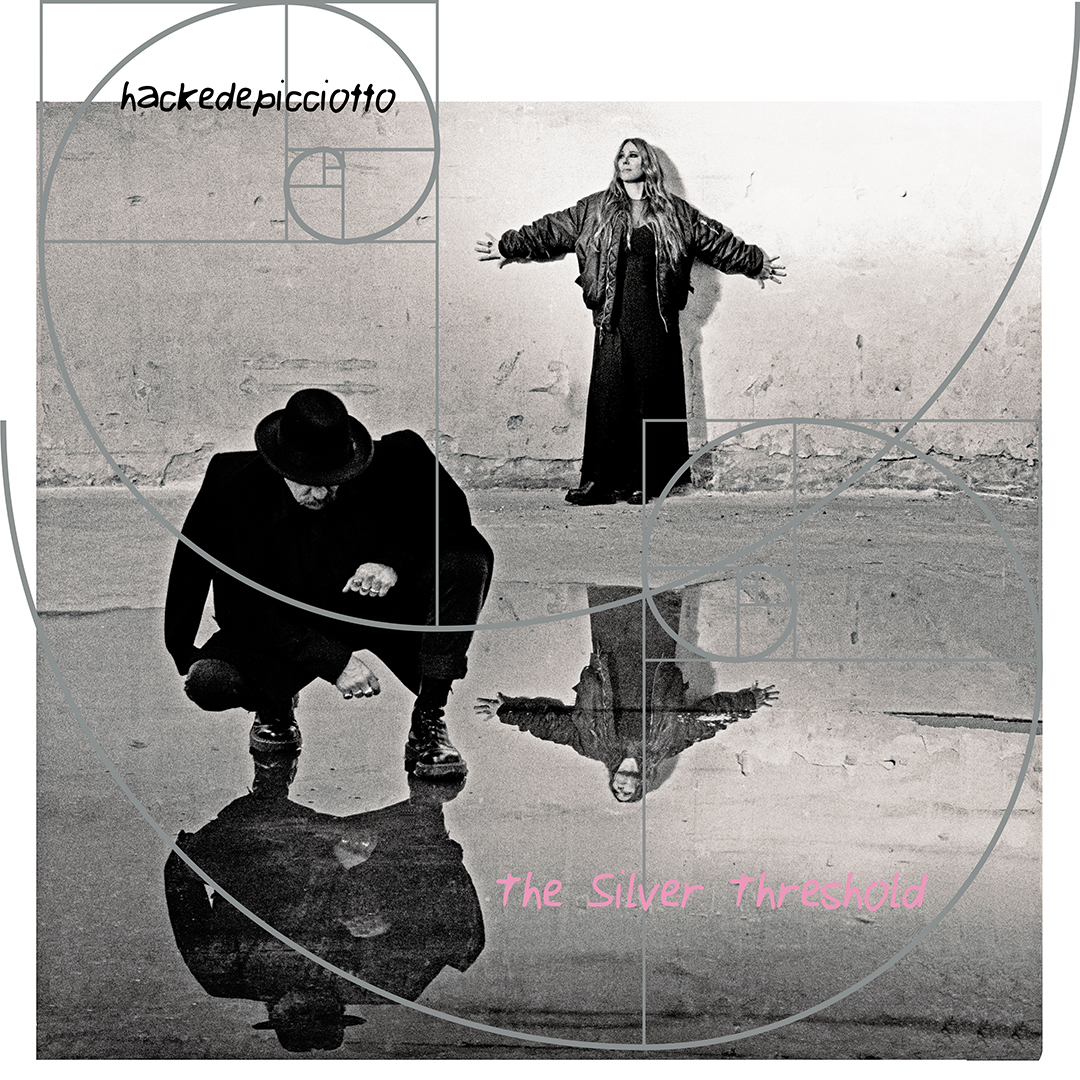
Hackedepicciotto ‘The Silver Threshold’
(Mute) 12th November 2021
Heightened snatches of beauty, romance and drama emerge from a backdrop of the Biblical, cinematic and ominous on Hackedepicciotto’s inaugural album for the much-celebrated Mute label.
The well-travailed and sagacious duo alias of the husband and wife creative match Alexander Hacke and Danielle de Picciotto, this outlet for soundtracking the mind state in the most tumultuous of times is just one such evocative project from the partnership over the years. Hacke has most memorably served his time with the cult experimental group Einstürzende Neubauten, whilst co-founder of the Love Parade, Picciotto, is a stalwart member of Crime And The City Solution. Both have crossed paths on numerous occasions, notably joining forces with Paul Wallfisch and Mick Harvey for the album and stage production Ministry Of Wolves.
By now accustomed to each other’s creative sparks, entwined even, the couple traverse a sulfuric skyline landscape of uncertainty and lament, but also a landscape, sense of time and place that offers some potential for change in the right direction. In the accompanying notes Hacke is quoted as saying that the recent pandemic restrictions and confinement gave him a “kind of weird euphoria”. Whilst such uncertain times of horror and stress can engulf some, this partnership saw it as a “gateway”, that they were “standing on a threshold” of something big. And so with the Godly parables of the Tower Of Babel suggesting wise co-operation over selfish pride and vanity, this epic scale soundtrack channels the couple’s past musical adventures (a touch of the metallic and industrial Neubauten, and some of that quality C&TCS panorama and gothic sorrow) across a geography that takes in an atavistic Middle East, esoteric Germany and mystical Far East.
The already mentioned Babel is given a suitable venerated and uneasy score of throat singing (ala Alejandro Jodorowsky’s Holy Mountain soundtrack), camel motion rhythms and soft strings as Picciotto narrates an Old Testament lesson. This is part of a trio of similar desert traverses, with the gothic-folk rippled and crunched ‘Trebbus’ stirring up visions of Egypt with its snake-charmer oboe sounds: although to be fair you could also be in Tibet, or equally scaling the Carpathian Mountain ranges under skulking skies. ‘Journey East’ seems to offer a trinket’s shaken version of an Arabian Clannad.
Those throat-singers return for a solemn piece of mysticism in the German trauma-hit town of ‘Kirchhain’ – a strategic barracks, assembly point during the horrendous Thirty Years War that was fought mainly across the pre-unification separate states of Germany.
There’s romance of a kind in the air with the partnership’s first real stab at a love song: ‘Evermore’. A timeless sentiment of love is enveloped in a gothic tryst and the elements, with a gaping wind and unknown, unseen forces threatening to engulf the beautifully gestured soothed proceedings.
The Silver Threshold is a setting, a world in which frayed classical instruments meet metal, iron filling fizzles, pulsations, deep thuds and stirring gravitas. That album title-track is a dramatic if held example of this combination; imagine The Velvet Underground’s viola and the serious chimes of Renaissance Italy rewired by Basic Channel.
At times they sound like Dead Can Dance, at others, like Brian Reitzell, Itchy-O, and on the aching and creeping natured movement ‘Meeres Stille’ like some Kosmische ambient explorers. In the shadow of extinction-destructive meteors, arcane scriptures and the psychogeography of personal locations of importance, Hacke and Picciotto beckon a metaphorical Armageddon so that humanity can reset and follow a more altruistic, cooperative pathway towards the light. Salvation, hope emerges from a very rich soundtrack, both daemonic and chthonian that’s constantly mysterious, always interesting, and beautifully played. File this album under ‘esoteric and venerable feelings from the Hackedepicciotto love seat’.
Hi, my name is Dominic Valvona and I’m the Founder of the music/culture blog monolithcocktail.com For the last ten years I’ve featured and supported music, musicians and labels we love across genres from around the world that we think you’ll want to know about. No content on the site is paid for or sponsored and we only feature artists we have genuine respect for /love. If you enjoy our reviews (and we often write long, thoughtful ones), found a new artist you admire or if we have featured you or artists you represent and would like to buy us a coffee at https://ko-fi.com/monolithcocktail to say cheers for spreading the word, then that would be much appreciated.
 Monolith Cocktail Blog