A May Digest: August Cooke, Andrew Hung, Amon Düül II, Julian Cope, Social Playlist #76…
May 25, 2023
New Music on our radar, archive spots and now home to the Monolith Cocktail “cross-generational/cross-genre” Social Playlist – Words/Put Together By Dominic Valvona

PHOTO CREDIT:: ZOE DAVIS
A new thread, feed for 2023, the Digest pulls together tracks, videos and snippets of new music plus significant archival material and anniversary celebrating albums or artists -sometimes the odd obituary to those we lost on the way. From now on in the Digest will also be home to the regular Social Playlist. This is our imaginary radio show; an eclectic playlist of anniversary celebrating albums, a smattering of recent(ish) tunes and the music I’ve loved or owned from across the decades.
May’s edition features new music from Andrew Hung, Laraaji & Kramer, Chocolate Hills, August Cooke and Läuten der Seele. And in the Archives there’s the 50th anniversary of Amon Düül II‘s Vive La Trance and 10th anniversary of Julian Cope’s Revolutionary Suicide to celebrate and look back on.
NEW MUSIC IN BRIEF
Andrew Hung ‘Ocean Mouth’
(Taken from the upcoming Deliverance album, released the 11th August on Lex Records)
Still envisioning hope in the expanses of what is a purer future constellation, former Fuck Button foil turn soundtrack composer and trick noisemaker producer (a pretty deft portrait painter too as it happens: see the Frank Auerbach-like artwork that accompany his solo releases) Andrew Hung is back with another candid, if universally reaching, album of diy methodology big sounds. Yes big, as in anthemic, with tracks that build towards cathartic outpourings. None more so than the first track to be aired from the upcoming Deliverance album (released by Lex again, later on in August) ‘Ocean Mouth’. A rave-y Bloc Party and White Lies in a hopeful union with a Robert Smith fronted Freur, Hung is both humbled and in heartfelt consolatory spirit as he progresses from fear to love whilst facing a litany of truths, anxieties and realisations: A therapy session of the highest musical quality. As with all Hung’s material, it only gets better and better, and this album looks set to be every bit as connective and reaching as 2021’s Devastations (a Monolith Cocktail choice album of that year no less).
Laraaji & Kramer ‘Submersion’
(Taken from the BAPTISMAL – Ambient Symphony #1album, released 2nd June by Shimmy Disc)
Divine styler of radiant ambiance zither spiritualism Laraaji can be found in communion with no less a pioneer than Shimmy Disc founder and downtown no wave doyen Mark Kramer, on this latest release from the New York label. Two pioneers of their form together over four movements of immersive, deeply affected mood music, draw on their extensive knowledge and intuition to create suites rich in the mysterious, the afflatus and more supernatural. Cycle One in this collaboration is a Baptismal symphony, the first part of which, ‘Submersion’, I’m sharing with you all today.
See also my review of Laraaji’s iconic ‘Ambient 3: Day Of Radiance’
Chocolate Hills ‘Mermaids’
(Taken from the Yarns from the Chocolate Triangle album, released by Orbscure on the 16th June)
Floating a fantastic voyage into the Bermuda Triangle, the long-running collaborative duo of Paul Conboy (Bomb The Bass, Metamono) and The Orb‘s Alex Paterson conjure up signature lost sounds and immersive languid soundscape on their new album together, Yarns from the Chocolate Triangle. Under the lunar and ether inhaled Chocolate Hills alias, the foils mine their vast experience and CVs of electronic, ambient, analogue cult sounds, library music, kosmische and new age to navigate that forbidden zone phenomenon of lost ships, aeroplanes and people. It makes for an interesting cartography, as this short teaser, ‘Mermaids‘, shows. Expect to hear more at a future date: maybe even a review.
See also my piece on Metamono’s Creative Listening
August Cooke ‘FLYING SWIMMING DREDGING’
(Single release via Poets Studio)
As debut’s go, this beautifully subtle chamber-pop draw from the London-based cellist, singer and composer George Cooke is a stunner. A tastefully orchestrated evocation of such luminaries as He Poos Clouds, Arthur Russell and Surfjan Stevens, Cooke (going under the August Cooke alias) slowly builds up an emotive momentum of understated lush hymnal magnificence. He’s aided by the full choir chorus and harmony of pupils from the West London Free School and the accentuated clarinet and saxophones of the Mumbai-based multi-instrumentalist Shirish Malhotra (Zakir Hussain, Symphony Orchestra of India). Theme wise, Cooke directly challenges the listener: if our planet was radically different, would our principles remain? A promising start indeed.
Läuten der Seele ‘Schlupfzeit’
(Taken from the Ertrunken Im Seichtesten Gewässer album, released 7th July on World of Echo)
A magical. mysteriously unveiled, often in childlike awe, world emerges on the latest recording from Christian Schoppik (aka Läuten der Seele); a fantastical peregrination of environmental changes on a particular spot.
“Somewhere in the Lower-Franconian vineyards lies a hidden and mostly unknown canyon, a place that often returns to the thoughts and dreams of Läuten der Seele’s Christian Schoppik. Though a much rarer occurrence now as a consequence of environmental change, chance encounters upon the area in the past would sometimes reveal small ponds amongst the reeds, teeming with life and populated by colonies of newts and the now endangered yellow bellied toad. The transience of the water and the wildlife it hosts, dependent on season or climate, lends the area an almost fantastical, dream-like quality. Was it ever even there at all? A secret place that may or may not be present holds vast appeal to some enquiring minds… Ertrunken Im Seichtesten Gewässer, the third Läuten der Seele album in two years, is inspired directly by these experiences. Translating as ‘drowned in the shallowest stretch of water’, a title as pregnant with dread as it is wonder, the themes present speak both to personal memories and a wider understanding of place and time, and how we might interpret our own position within an ever-changing, sometimes disappearing world.
The record is presented as two long-form pieces divided into four separate movements, each titled so as to reflect this natural environment and its intersection with imagination, relying on processes of collage that draw from myriad indeterminable samples, field recordings and various recorded instruments. Those familiar with Schoppik’s work, both as Läuten der Seele and with Brannten Schnüre, will find present many of his signature tropes – the way deeply layered collages render abstracted visions of the past alive in the present – though what is always significant about his approach is not so much aesthetic as the wider concepts it attempts to express and emote. Indeed, emotional response is key to the Läuten der Seele sound, how overlapping notions of nostalgia, memory and identity calibrate experience and understanding of who we are and the world around us, whether it’s a world that’s gone or another imagined into being. If you observe the artwork closely enough, you may find a clue as to the canyon’s location, though such specifics are beside the point. The music itself infers a wider sense of the impermanence that characterises hidden worlds, wherever they might be or whoever they might belong to.”
ARCHIVES/ANNIVERSARY
Amon Düül II’s Vive La Trance Reaches Its 50th Anniversary

Admittedly not one of Amon Düül II’s best, Vive La Trance embraced a weird concoction of Roxy/Bowie glam and earnest sincerity bordering on the whimsy at times. And yet, it had its moments too as my original essay on this much discounted album in the Bavarian band’s cannon will testify: especially almost debauched Weimar Republic punk hysterical ‘Ladies Mimikry’ and Renate Krötenschwanz-Knaup prophetic Kate Bush performance on ‘Jalousie’.
Grounding:
1972 to 1973 proved bumper years for the Duul, with five albums in total being released across that timespan.
Vive La Trance was the last album of what might be argued their most productive period: though it came with some derision. To be truthful, in part, this record is the sound of a band worn-out and fatigued, with its wide genre-spanning catalogue of songs and its rather awkward Euro rock clichés. The band now more than ever flittering with commercialism.
Recorded in the spring of ’73 Vive La Trance contains many highlights despite its more structured songwriting approach. Saying that though, they did manage to maintain an ear for the esoteric, and also still conveyed their political leanings.
Songs such as ‘Mozambique’ acted as a rallying testament to the man and his raping of both a nation and a continent in the name of colonisation. Furthermore it carries a dedication to Monika Ertl, who was killed by Bolivian security forces in Hamburg that same year – Ertl was a member of the Marxist revolutionary group alleged to have taken part in the assassination of the general responsible for capturing and killing Che Guevara. At the time she was bringing a former Nazi war criminal to justice and was leapt on by South American agents whilst back in her homeland.
This move away from their more pagan and Gothic sounding heyday didn’t lead them away from the harsh realities of the upheavals in society – oh no! Whilst in the UK we were dressing up in glitter and having a jolly good time with glam rock, Germany was still gripped with the Baader Meinhof fall-out and the political right still crushing those who didn’t toe the line. Amon Duul II remained resolute in their ideals.
This album has some more touching and less establishment baiting moments on it with songs like ‘Jalousie’, a Kate Bush sounding lament built on a wordplay of surveillance – using the double meaning translation of the title it describes a touching but fateful meeting of minds in a fleeting moment, an affair of sorts watched on by a third party.
The tune ‘Manana’ has another warm and glowing feeling to it as a mariachi backed band ambles its way pleasantly enough through a quick three minute little ditty.
Also featured on here is what can only be described as proto punk with the track ‘Ladies Mimikry’: an attempt at both Bowie and Roxy Music, which ends up sounding like none of them. Instead they create an entirely new genre.
The players on this album are made up of the usual hardcore that played on Wolf City and the UK tour; though they lost Danny Fichelscher on permanent loan to Popol Vuh.
Lothar Meid hung on in the background, though he now joined the lesser-known side act Achtzehn Karat Gold from whom Keith Forsey also joined.
New member Robby Heibl made a huge contribution to the new line up, playing seven different instruments throughout the record.
Falk U Rogner upped his contribution as now most of the band received writing credits and swapped around instruments. The vocals were shared mostly between Chris Karrer and Renate; backing came from a number of affiliates.
The albums artwork was provided by both Falk and Jurgen Rogner this time round with what looks like a drying out photo hung up by a clothes peg surrounded by a strange electrical storm background. Amon Duul II’s moniker is made up of machine looking letters, which are made to appear as if they are in motion, the albums title sits between the two undisturbed and rather plain.
Turning over to the back cover and you are met with a number of photos depicting the band in various states of dressing up. Their costumes look Elizabethan except for one member who’s dressed up in a lion’s costume. Renate gets away with being dressed in a floppy hat though one guy looks like the guitarist from Slade has dressed him.
They are all photographed in the middle of a road, no it’s not an analogy to the music found within.
Review
A Morning Excuse’ opens the album with a bird-call effect delivered from Falk’s VCS3, as a repetitive guitar riff slowly jars away in the background. Chris Karrer sings in a semi mock disdain at first before dropping to an emotional lament in the chorus; his attempts at holding on to some lost love are conveyed in this warming little pop song. This tune slightly boxes in any attempts for the free flowing musicianship of Amon Duul II to really let go, the plodding rhythm treads water until we hear the quirky twist half way through which emphasis that there is still ingenuity at work.
‘Fly United’ falls back on the previous folk echoes of Carnival In Babylon as Weinzierl plays some prime cuts of bass and adds some great lead guitar work. Renate and new boy Robby take on the vocals with a forlorn poetic series of spiritual slogans lifted from the headier days of the commune. The middle section breaks out in a nod to Wolf City before drawing to its conclusion: clocking in at a healthy three minutes.
Renate is given centre stage to perform a proto Kate Bush style vocal on ‘Jalousie’. This track is a slice of the fantastical, delivered as a soft focus ballad – it’s among the most endearing Duul tracks of all time. The title translates as both French for jealousy and is a type of Venetian blind window. This is a play on words then, which conjures up some romantic meeting of minds behind closed doors, whilst secrets are brought to the boil in a fleeting moment of connection: break out the fucking Mills & Boon.
A song of two parts, the middle section builds to a rolling rally cry with some subtle but moving melodies that cleverly encapsulates the affair as its being unveiled.
The long German titled ‘Im Krater Bluhn Wieder Die Baume’ roughly translates as “in the grater again Bluhn Baume”: nope still none the wiser!
A pastoral old folk like medieval canter that does its best to sound interesting but merely acts as an instrumental segue way. Falk’s organ is surrounded by light drum breaks and rock guitar licks as it merrily dawdles along on its short journey. It makes way for the classic three-part side one climax ‘Mozambique (Dedicated To Monika Ertl)’; a return to the past glories of Yeti.
The intro starts off with a pleasant enough African humming choir accompanied by a chorus of hand drums before being cut off and making way for some power folk. Renate on lead vocals sings quite literally of the white man’s rape of the continent; Mozambique has a history of civil war and rebellion, dealt a particularly harsh horrid blow from their old colonial masters. The chopping off of hands and other such ghoulish details follow as freedom is advocated through the good fight against the Westerners’ tyranny. The pace is picked up as it really starts motoring along and turns into some kind of space rock jam; the vocals become more harassed as Renate with shocking disdain makes us all feel bad. An eerie whispered message of “good night and fight” emerges from the fade out at the end of the epic seven-minute opus.
The Monika Ertl dedication in the title was for the daughter of Hans Ertl, a well-known German cameraman who was involved in the early Nazi Propaganda films before immigrating to Bolivia. There was a program of emigration to South America during the thirties, call it a colonisation of sorts, as thousands of Nazi sympathisers bought land and set up farms there. Monika turned against her father’s ideology to embrace Marxism, joining the Bolivian underground movement before being involved in the murder of the man thought responsible for the death of Che Guevara. In the same year that Amon Duul II recorded this album Monika was ambushed by Bolivian security force agents in Hamburg, at the time she was bringing a former wanted Nazi to trail. I think the band gave her a good send off. A fascinating women who if you ever get a chance you should look up.
Flipping over to side 2, the dry witted entitled ‘Apocalyptic Bore’ seeps through the speakers with its swirling UFO effects emulating from Falk’s faithful VCS3 and Harmonium. A voice over from Saturn via Sun Ra announces some cosmic slop before a sweet melodic acoustic 12- string perks up with a laid-back groove.
The story unfolds as higher beings decide to visit and make all our dreams come true, a paradise is created where anyone can do anything. This is backed up with at times a cringe worthy Euro rock shtick lead guitar solo. Of course time traveling becomes the norm as a time continuum is invented or something. People can live at any period in history at the same moment; let’s leave the crazy type Hawkings calculations aside.
No love, no war, no angst what a tiresome place.
Well what do you know! The kids hate it and get rather bored so the aliens decide to bugger off (“leaving for the great bear”): there’s gratitude for you!
‘DR’ is a tale of pills and bellyaches as prescription drugs are handed out willy nilly for all our ills. The music is awkward Bowie, and features some violin stabs to break up the track, though it eventually runs out of steam.
‘Trap’ lets Reante sing a tale of a credit card paying lover who obviously misread the signals somewhere down the line. Again a heavier structured track that almost has the first signs of the pub rock movement that was later to turn into punk emerging. The ending starts to get interesting but finishes in a predictable cut short manner.
‘Pig Man’ starts with a quasi-Lynyrd Skynyrd sounding intro before it breaks out into a lively little ditty. The jauntiness evokes some kind of unusual influences and doesn’t fit into any conventions I can think of. The lyrics stick it to those who left their conscience back in 69.
‘Manana’ means tomorrow, or it could be a reference to the Peruvian town. That aside it’s a slightly odd sounding song, which has a mariachi style band turns up to throw its lot in. Karrer does a good job on the vocals as some exotic type percussion accompanies him. It does grow on you over time.
The finale is the spiky titled ‘Ladies Mimikry’, a brooding bass line and melody sound, like the band is hauling themselves up a steep slope. Karrer’s vocals are at their most startled as he slowly loses his mind over the course of the track. A grinding punk like strutting backing sounds like a Gang Of Four in limbo. John Weinzierl on bass gets more and more angry as Karrer reaches the refrain of ladies mimicry; a loony inspired spitting delivery that sounds like he’s having electric shock therapy. A saxophone left over from Roxy Music’s debut album provokes a reaction akin to The Mothers Of Invention. Some serious hardcore theatrics at play; I can fully understand where punk came to take a breather before rearing its ugly head again in 1977.
Called the glam album by both fans and critics alike, it doesn’t really fall into any specific category and sounds distinctly German throughout.
Bowie and Roxy Music can be heard in here but not in the often derided way, I mean I’m sure Amon Duul II didn’t really want to sound like early art school glam rock.
Structured little tracks of the three minute length make this 11 track LP almost a commercial concern, the number of songs on display amount to more then the number found on the first two albums put together. This LP actually combines some very strange influences and falls into the Euro rock movement rather too well at times.
There are plenty of great moments on this album and it is still one of the best to come out of the period, unfortunately the next record Hijack even went further to confuse us all and upset many fans.
Julian Cope’s Revolutionary Suicide Is Ten This Month

Despite its promise of caustic spit and harmonious melodic nature, Julian Cope‘s ‘call-to-arms’ doesn’t hold back on the condemnation. As the title of both the leading track and album alludes, Cope’s revolutionary pride leaves the listener in no doubt. Not so much hectoring, or even bombastic, the arch druid of modern counter culture picks apart his prey with élan; attacking both failed revolutions from the here and now; lambasting the church; and bravely taking issue with the perceived – though the evidence does suggest that there is indeed a silent conspiracy – erasing from the history books, media and political stage of the horrific Armenian genocide of 1915, by the than Ottoman government: an episode, it must be said, that is hotly contested and hushed up to this day; the organised extermination of the country’s christian minorities – which also included numbers of Assyrians and Greeks too.
A middle age crisis told from Cope’s kitchen sink, or from his loft, Cope’s message may be confrontational and often blunt, yet its delivered via the influence of rebellious Detroit rock, quasi-Love and even the Sunset Strip – circa 1967. But also there’s more than enough of that 80s sound that Cope helped invent in the first place too. Actually, this is a really great little record. Almost idiosyncratic with an Englishness of a certain kind, and deprecation: despite the talk of storming the barricades, Cope is limping to man them and writing music with a real melodious and softened quality.
The Social Playlist #76

Anniversary Albums And Deaths Marked Alongside An Eclectic Mix Of Cross-Generational Music, Newish Tunes And A Few Surprises.
Just give me two hours of your precious time to expose you to some of the most magical, incredible, eclectic, and freakish music that’s somehow been missed, or not even picked up on the radar. For the Social is my uninterrupted radio show flow of carefully curated music; marking anniversary albums and, sadly, deaths, but also sharing my own favourite discoveries over the decades and a number of new(ish) tracks missed or left out of the blog’s Monthly playlists.
Volume 76 of this long-running playlist series pays tribute to those dear souls we’ve lost in the last month, including Ahmed Jamel, Andy Rourke and this month’s cover star Mark Stewart of the irrepressible Pop Group. There’s also a myriad of anniversary marked albums to make you feel very old; Deerhunter’s Monomania celebrates its tenth with the already mentioned Revolutionary Suicide album by Julian Cope, whilst Funkdoobiest‘s debut, Which Doobie U B?, the Guru‘s Jazzmatazz Volume 1 hip-hop-jazz imbued game changer and Blur‘s (perhaps one of the best named albums of all time) Modern Life Is Rubbish are all 30 years old this month. New Order‘s Power, Corruption And Lies is 40, and George Harrison‘s Living In The Material World, Paul Simon‘s There Goes Rhymin‘ Simon and the already referenced (see above) Amon Düül II album Vive La Trance have all reached the half century milestone.
Added to that list is music, recent and old from Barel Coppet, Tresa Leigh, Pavlov’s Dog, Bonnie Dobson, The Reds and more…(FULL TRACK LIST BELOW)
TRACKLIST
The Smiths ‘What Difference Does It Make? (John Peel Session 18/05/83)’
George Brigman And Split ‘Part Time Lover’
New Order ‘Ultraviolence’
The Pop Group ‘Thief Of Fire (Live At The Electric Ballroom 1979)’
Julian Cope ‘Paradise Mislaid’
Deerhunter ‘Dream Captain’
Barel Coppet ‘Missie L’abbe’
Ahmed Jamel ‘Speak Low’
Guru & N’Dea Davenport ‘Trust Me’
Thandii ‘Give Me A Smile’
Tresa Leigh ‘I Remember’
George Harrison ‘Try Some Buy Some’
Amon Duul II ‘Jalouise’
Julian Cope ‘Hymn To The Odin’
Bill Hardman & the Jackie McLean Quintet ‘Sweet Doll’
Ahmed Jamal ‘Footprints’
Funkdoobiest ‘Un C’mon Yeah!’
Ahmed Jamal ‘Feast’
Armando Trovajoli ‘Le notti dei Teddy Boys’
Pavlov’s Dog ‘Valkerie’
Bonnie Dobson ‘I Got Stung’
Ella Washington ‘Sweeter And Sweeter’
Paul Simon ‘One Man’s Ceiling Is another Man’s Floor’
The Smiths ‘William, It Was Really Nothing’
Blur ‘Chemical World’
Sunless ’97 ‘Illuminations’
Bomis Prendin ‘French Passport’
The Pop Group ‘The Boys From Brazil’
Andy Rourke ‘The Loan’
The Reds ‘Beat Away’
The Pop Group ‘St. Outrageous’
Des Airs ‘Ling’
Amon Duul II ‘Ladies Mimikry’
Sirokko Zenekar ‘Tukorember’
The Jimmy Castor Bunch ‘Psyche’
Sam Rivers ‘Hope’
Hi, my name is Dominic Valvona and I’m the Founder of the music/culture blog monolithcocktail.com For the last ten years I’ve featured and supported music, musicians and labels we love across genres from around the world that we think you’ll want to know about. No content on the site is paid for or sponsored and we only feature artists we have genuine respect for /love. If you enjoy our reviews (and we often write long, thoughtful ones), found a new artist you admire or if we have featured you or artists you represent and would like to buy us a coffee at https://ko-fi.com/monolithcocktail to say cheers for spreading the word, then that would be much appreciated.
Dominic Valvona’s Eclectic Reviews Column
(Unless stated otherwise, all releases are available to buy now)

Samuele Strufaldi ‘Davorio’
(Múscia Mascondo)

Not many projects of this kind can claim to leave behind something so lasting, practical too, as a community space and library. For the Italian producer, musician Samuele Strufaldi’s collaboration with the good folk of the Ivory Coast village Gohouo-Zagna is a beneficial project that sees the all the proceeds going towards building integral communal connections.
One of a thousand or more “communes” before a decentralized shake-up by the government in 2012 (abolished on the grounds that these areas weren’t “economically governmental units”), Gohouo-Zagna is located within the Western Guemon region of the Ivory Coast; its population part of the Guére culture and greater Kru language group.
The spontaneity of this village’s musical and vocally expressive circle, together with “snapshots” of village life, the scorching heat of an insect chattering environment, the clearing of plates even, is electrified, augmented and effected by Strufaldi to create an otherworldly fusion that amorphously bleeds into both sonic realms.
With a generous offering of tracks and running time, expanded pieces of constant change sit amongst shorter windows in the fabric of a rural existence; the tactile soul of African instrumentation, singers and the rope-tuned goblet shaped Djembe hand drum (some bigger drums too as you can see in the artwork) in surround sound with the hand-slapped rhythmic games and joyful voices of the locals’ children. When amplified, filtered, put through various processes and with the addition of the synthesized, various beats and breaks, flourishes and more dramatic plink-plonk jazzy and classical piano these field recorded performances become untethered: They could end up anywhere musically, culturally. Take the opening ‘Cammino, Senza Sapere Dove’ (“I walk without knowing where”), it begins with atmospheric voices, synth purrs and ripples and late Bowie-esque piano, before passing through soul, jazz and R&B like a J. Dilla production.
The album title itself, just three tracks in, is like a tribal communion of the Young Fathers and BLK JKS, but also features weepy strings, touches of Afrobeat and a free-jazz wild breakout of Peter King saxophone, all before being sucked through a mirror. Those jazz elements permeate the entire album; from hinge-like whines and more Don Cherry spiritual displays on ‘Uccelli/Roberto Baggio’, to echoes of Sonny and Linda Shorrock and the Pharaoh on the township meets Orleans and splish-splash classical ‘Uomini Del Mare’, and touches of Donny McCaslin on the tines resonating, soulful and nimbly-picked guitar 2-Step ‘Obaló’.
Tracks like ‘Non Tradirti’ (“don’t give yourself away”) move from the innocuous sounds of a sweeping brush and the reverberations of children to the techno of Basic Channel and more veiled electronic washes of Boards Of Canada. The finale (if that’s the right word) ‘Dohuo’ sounds like either a talk or lecture, maybe community meeting, being soundtracked by a malady of wind instruments, crackles and touching strings.
Every expression has meaning, a story, which is then transformed by Strufaldi’s production into something almost dream like and cosmic yet still connected to the villagers’ roots. A transistor radio collage here, some Songhoy Blues on a bustling street with a small amp there; a display of rattled and scrapping percussion and hymnal stirrings merge with zaps, warbles and various embellishments. This cultural exchange with the Ivory Coast blurs the lines between worlds; an act of preservation, but much more, as the foundations of this culture prove intoxicating, dynamic and mesmerising.
Various ‘Middle Eastern Grooves’
(Batov Records) 19th May 2023

A sampler showcase, only with a couple of previously unreleased nuggets, the Batov label celebrates its (almost) tenure existence promoting Middle Eastern Grooves overseas with a “handpicked” selection of cuts from their influential 7” singles series.
Originally set-up in London by DJ Kobayashi and Bob Martyn as a home for the former’s multifaceted fusion ensemble, Gypsy Hill, the label soon nurtured a burgeoning revival of Middle Eastern influenced bands and artists from the richly diverse Israeli scene.
A conjuncture itself of untold musical pathways, with artists and musicians congregating in such exciting, lively cities as Tel Aviv from all across the region and much further afield. A hotbed of sounds has been sent out to the world.
With shows on Soho Radio and Worldwide FM, and a rep for selecting a polygenesis array of global sounds, DJ Kobayashi picks out a generous eighteen track compilation of music indebted to the pioneers and luminaries of the 60s, 70s and 80s.
Where to begin with this whirlwind fecund of fusions? Well perhaps with one of the most well-known inclusions on this collection, the constantly evolving Tel Aviv musician, composer, producer and multimedia artist Ophis Kutiel, aka Kutiman. Opening with the Aegean cosmic vibe ‘Badawee’, the Kutiman lays down an eased-in flange-effected wave of fluted hazed sunlight, vapours and lush laidback drums. Following that, and no strangers to the Monolith Cocktail (even making our choice albums of 2022 list), the Yemeni roots, but Israel-based, rambunctious El Khat are kept in check by the Tel Aviv cratediggers Radio Trip, who smooth out the disjointed exciting signature with a clean breaks edit treatment that evokes a horn-swung Arabia and the more soulful jazz-soul breaks of the El Michaels Affair.
Another name that leaps out for me, and a previous Monthly Playlist pick, the Şatellites marry ethereal gauzy Hebrew disco with Liquid Liquid, Altin Gün and real cool Anatolian rock vibes on ‘Deli Deli’. That eclectic-lit funky group’s leader, Itamar Kluger, also appears with his new psychedelic project, Eje Eje. One of the “unreleased” propositions, ‘Saved From Jazz’ is a percussive shimmy of 60s influences and jazz-rock-prog organ that almost sounds like an Israeli Atomic Rooster.
Proving a highly popular (or just highly prolific), Sababa 5 get four goes at impressing us. A well-versed troupe of notable players, previously backing a host of Tel Aviv’s top artists and vocalists, and said to be influenced by everything from the legendary Wrecking Crew sessions ensemble to 70s Middle Eastern icons, the 5 lay a zippy, willowy groove underneath Shiran Tzfira’s upbeat psych-folk and pop-lit vocals on ‘Manginat Mahapeha’; play with ambient gazes, an closed eyes gesture of serenading Egyptian oud (or guitar) and more bouncy beats as the Japanese vocalist Yurika Hanashime sings in a sweetened Oriental romantic way on ‘Nasnusa’; evoke Charlie Megira, Meatraffle and Joe Meek in the shadow of the Sphinx on the tremolo-surf wrangled ‘Baksheesh’; and mix kitsch surf (ala The Ventures) with dot-dash organ (bordering on Ray Charles) on ‘Rosenzweig’.
Elsewhere, gaining my attention, the veteran Israeli bassist and producer, world-traveller and front man of the world music/reggae/funk band Ex-Centric Sound System, Joseph Thomas Fine (aka Yossi Fine) teams up with the African-influenced drummer Ben Aylan on the rock fusion and splashed dance, ‘Peres’. The unfamiliar (to me) Yuz come up with a 80s dry ice Israeli and Balearic spacy disco-electronica mini epic entitled ‘Galgalit’, and the Baharat trio circumnavigate a Mexican surfing Dick Dale, a removed Cumbia and stylophone-like buzzes on the Arabian Shadows reimagined ‘The Egyptian’. “Jewish princess” via Babylon, Cherry Bandora eases dreamy gauzy vocals on the shimmery and zappy synth airy ‘Esy’ (another of those previously unreleased tracks), and the long-running Boom Pam magic up a Hellenic wedding boogie and belly-dancing shimmy on ‘Uniton’.
A wealth of Middle Eastern inspirations from a blossoming epicenter, Batov’s grooving whirlwind spins and saunters, carouses and electrifies across a region of interconnected roots. The borders are eviscerated as the Adriatic, Med, Arabian and Red Seas ebb and flow across a music geography that mixes the sounds Egypt, Syria, the Lebanon, Turkey and Greece with the cosmopolitan buzz of Tel Aviv. If you’re fresh to the scene, this is a great place to start, from a label doing encouraging, exciting things in bringing sounds together.
Marta Salogni And Tom Relleen ‘Music For Open Spaces’
(Hands In The Dark)

A posthumous tribute to one half of this sonic mapping partnership; left however exactly as the late Tom Relleen would have heard and recognized his and Marta Salogni’s site-specific peregrinations before his premature death from cancer in 2020, Music For Open Spaces is an atmospheric gift of subtlety and evocative callings from a geographical triangle of locations.
The leylines of this album spread from the pair’s London home to the Cornish coastline and the mystical Joshua Tree desert, where, inspired by such varied settings, Marta and Relleen conjured up a number of spontaneous atonal and electronic pieces. None of which are so obvious as to directly sonically reference the environment. Well, expect the album’s longest track, the opening mirage ‘Desert Glass’. Refracted light shines off a glass pyramid as airy fluted and hinged mirrored sounds permeate the legendary Joshua Tree located desert scene (a shrine to the late Gram Parsons and draw for various hallucinatory-induced communions). At one point you can pick up a partly obscured Marta (I think, anyway) asking her foil if he’d “heard that?” on tape; a tape that seems to be rewind and played back in real time, as a near-kosmische stillness of Frosse and Ariel Kalma evaporates around them.
This is followed by a more bobbled algorithm of paddled Ping-Pong balls, transformed to elicit a feel for far less mundane activities, on the much shorter ‘piNG poNGS’ passage. Those plastic table tennis balls take on a weight as the track progresses, moving into a techno effects realm of robotic laughing and metallic guiro scrapes. The even shorter ‘Snarls’ is both alien and a little disturbing; evoking the ominous uncertain spaces of Lucrecia Dalt (who I believe Marta has worked with) aboard some propeller-motored and humming craft.
‘Giant Desert Cats’ features, albeit transmogrified through various processes, the titular subjects. Bestial screeches of a kind echo across a strange, removed wilderness of ringing, repeated signals, forewarning and moderate drama. ‘Clocks’ also seems to abstractedly mirror the title, with a tubular plastic paddled and reverberating single repeated tight bass-string pluck denoting a measuring, a metronome-like passing of time. Featured in last month’s Digest column, the more expanded piece ‘Internal Logic II’ is a minimalist alchemy of light drawn and calling undulations and subtle twinkles; felt through a bendy lens of mystery. Staying in the minimal field of inspiration, ‘Furthest Fires’ obscures the flame in a gentle wind, whilst ‘Trains’ is a veiled ghostly blend of field recording, a passing motion of transport and almost nothingness.
Reading things into the ephemeral vapours and applications, I’m sure I can hear bulb-like notes of either a marimba or vibraphone on the wooed gauzy ‘March’. ‘Fauna’ sounds more like Day Of The Triffids than pleasant wild-planted blossom, and the finale, ‘FFXX’, barely registers above a blowing ambient and metallic percussive ebb and purr.
As much a physical and cerebral response to the elements and space (expanded further by the Hands In The Dark label’s Morgan Cuinet, who has illustrated each step on this “internal map” with a collage), Marta and the late Relleen’s geographic concept suggests new horizons, and makes the fleeting now permanent. With added poignancy, this generated soundtrack could be read in part as a fitting tribute. Regardless of the circumstances, this is a really fine album of atmospheric exploration, tactile scored environments and moods.
Adjunct Ensemble ‘Sovereign Bodies/Ritual Taxonomy’
(Diatribe Records)
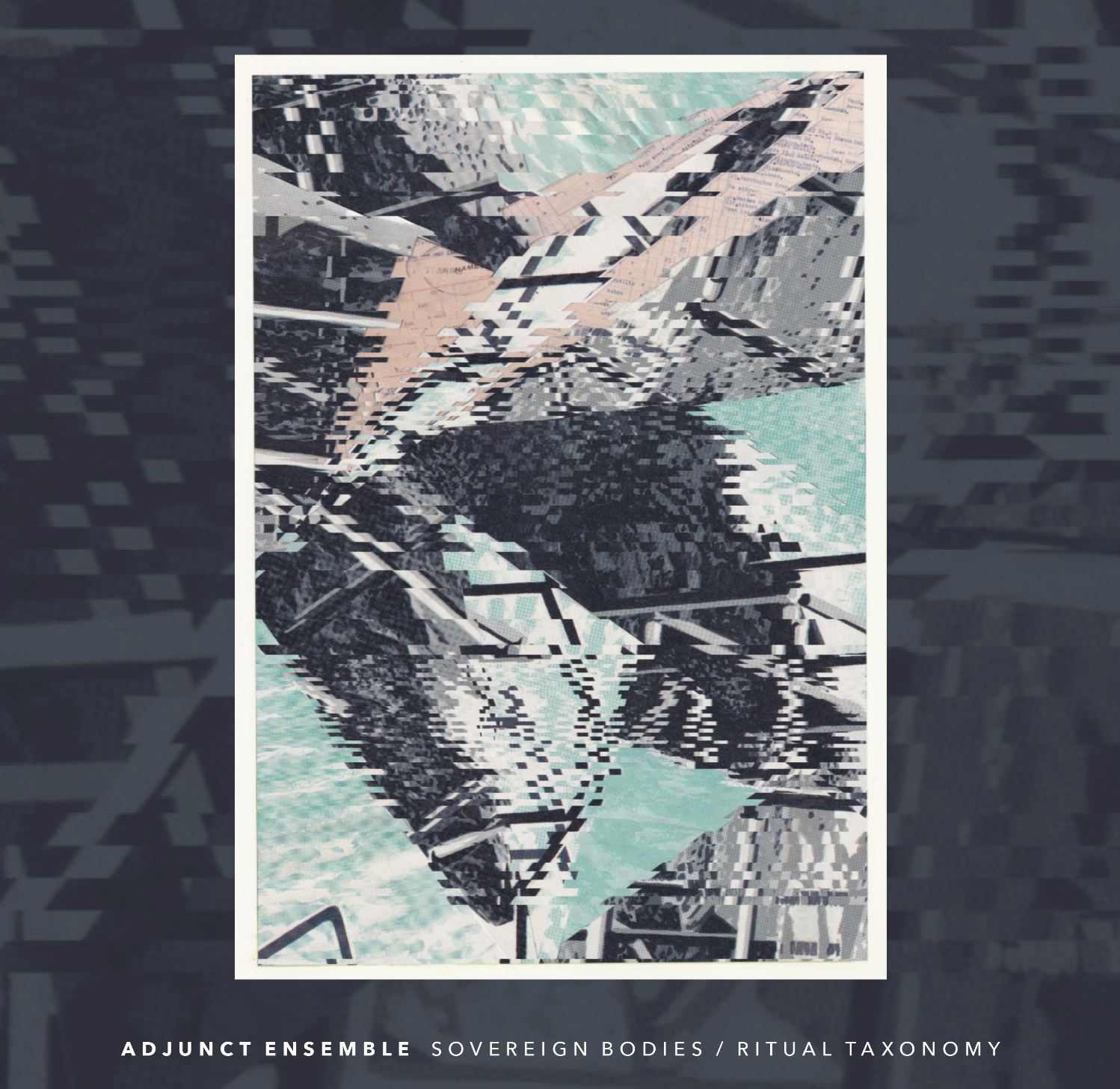
A behemoth of sonic, worded and performative multi-disciplines, with an eclectic cast to match, Jamie Thompson’s ambitious Sovereign Bodies/Ritual Taxonomy album seems to amorphously cross György Ligeti’s musical hallucinations with sound art, poetry, opera, theatre, jazz, the avant-garde and cinematic.
Under the Adjunct Ensemble title with foundations in the electro-acoustic, Thompson’s immersive but often jarring, somber and glitch-in-the-fabric-of-the-matrix style hallucinations are both riled and strung-out in a dystopian cosmology of Don Cherry, the Art Ensemble of Chicago, Colin Stetson, Andy Haas, Amiri Baraka jazz, Linda Sharrock arias, re-contextualized Benjamin Blake hymnals and national song, Ligeti’s ominous 2001: A Space Odyssey chorales, later Scott Walker histrionics, fleeting passages of Ivor Novello-type nostalgia and A.I. malfunctions. All the while a permeating atmosphere of running water, wind chimes and metallic chills can be heard in the void; one in which Tarkovsky and Kubrick conjure up sci-fi visions of unease, uncertainty and the fear of a great big nothingness.
Running to near on 90 minutes, across twenty often cryptic and questioning, proposed entitled tracks, you’ll hear the opera singer Amy Ni Fhearraigh’s haunted and dramatic vocals, and the spoken word poetry of Felicia Olusanya’s (aka FeliSpeaks) stream of conscious-political-humanistic lyrics, cutting through a feeling of near Orwellian oppression, suffocation.
Composer, writer Thompson can be heard twisting, grappling and oozing sounds, effects out of synths, drum machines, a church organ (in more classical hymnal spells), dictaphones, turntables and other apparatus. This is further affected by the turntablist Mariam Rezaei, the spasmodic, drilling and twirled punkified jazz of the Taupe trio and a load of other notable musicians on tenor sax, drums, percussion and bass. At various conjunctures we’re spat out into a chasm; transported to the graveside of a New Orleans elegy; beamed down to that raining rooftop finale in Blade Runner; lost in an alien terror show; clamed with the sounds of a transcendental water garden; or, gently, dreamingly invited to sip a remedy to chaos on a virtual deck, kitted out to resemble a 60s jazzy cocktail lounge. Phew!
Otherworldly breakdowns one minute, a Zappa-esque entanglement the next, this merger of Tricky’s imagined opera, an unholy vision of English pride and the hermetic, with veils of the Southern Gothic, Voodoo and happening, politically actionist jazz, is an expansive conceptual document for the times we find ourselves in: a time capsule if you like.
Interestingly, one theme brought up in the press notes is that of migration. And, floating in and out of that consciousness of sound and art, lingered traces of travail, of voyages and ethnographical illusions do conjure up futuristic versions the immigrant song. Lost on the high seas, with the ship’s horn blowing amongst the fog of time and place, you could easily imagine the fear, specter of death in pursuit of reaching safer shores, as references to displacement crop up across the album’s continuum of horror, assimilation, accelerated machine-learning, surreal interviewing and resignation.
Certainly challenging, a commitment is needed from the listener to what is essentially one long soundtrack (more or less every track, episode, chapter running into the next without any real pause or hint of dead air, only when in ambient mode); a sort of conceptual art theatre without boundaries, which can replenish as much as stir up a maelstrom of disenchantment and strung-out despondency. Counter-history bleeds over a morose of art forms and freer radical protestations, activism on a very impressive project.
Danûk ‘Morîk’
(Omni Sound) 19th May 2023

The longing, almost bluesy reflections cast on the finale, ‘Lo Șivano’, pretty much sum up and convey this “exiled” Middle Eastern group’s heartache at being forced to leave a war-ravaged Syria: Emotively, musically this, the curtain call from their debut album, is about missing home.
And yet, as that same album title translates, they’ve found a “pearl” of light in the tumult, as they confidently claim their heritage in the face of such distress and upheaval; reconnecting with their roots, imbued by the 1900s phonograph and wax cylinder recordings of Kurdish folklore in both The Berliner Phonogram and Austrian Academy of Sciences’ Phonogrammarchiv collections.
Studied graduates of Syria’s “best fine arts and music programs”; the Danûk ensemble was actually formed across the border in Turkey, in the Bosphorus-straddling metropolis of Istanbul, over seven years ago. Surviving on musical graft as street performers, they were seen and hired by a social enterprise; going on to score music for both films and radio. This though is the group’s first album proper, engineered in part by friend, admirer and musical foil Michael League (of Snarky Puppy fame). He produces but also lends a light touch of bass.
Morîk is the second release for the newly formed Istanbul/NYC connected label, Omni Sound. And what a flowing, dancing beauty of atmospheric Middle Eastern folk, shepherd song and wedding music it is too, from a quartet of Syrian-Kurdish and Turkish-Kurdish musicians steeped in atavistic allure. Traditions and songs on this work date back to the ancient sites of the excavated Sendshirli (now located in present day Northern Turkey) and beyond. From that imaginative channeled setting, the lute (in this case the long-necked “buzuqi”) twirled and trilled, country-like and seriously yearned ‘Xelîlo Lawo’, and roughly brushed and thrashed frame drum (the Persian “erbane-daf”) accentuated ‘Lê Lê Mi Go’ have a real ancestral pull, yet also draw on the veiled resonance of age-old shepherd song.
The opening holy city evoked whistled and fluted, granular-textured stirred frame drum skin swept ‘Axir Zemana’, and the poetically elegant, waves-splashing against the bow of a ship-like ‘Lo Lo Li Mino’ both use the voice of a Syrian priest singing in Jerusalem.
Serenaded and in celebratory form, Danûk spin, dance and ache across a cannon of Kurdish folk and wedding music: ‘De Çêkin’ is a journey of romantic longed allusions cast over a fluty pipe, whilst the more trinkets-sequined and small finger cymbal percussive ‘Finciko’ shimmies and shuffles to the fever of a Middle Eastern gypsy band performing at a nuptial ceremony.
Together, Ferhad Feyssal, Hozan Peyal, Yazan Ibrahim, Tarik Aslan and Ronas Sheikhmous respectively shake and electrify their heritage, breathing a new life into those roots as they reconnect with home t produce something almost timeless.
Kayhan Kalhor & Toumani Diabaté ‘The sky Is The Same Colour Everywhere’
(Real World Records)
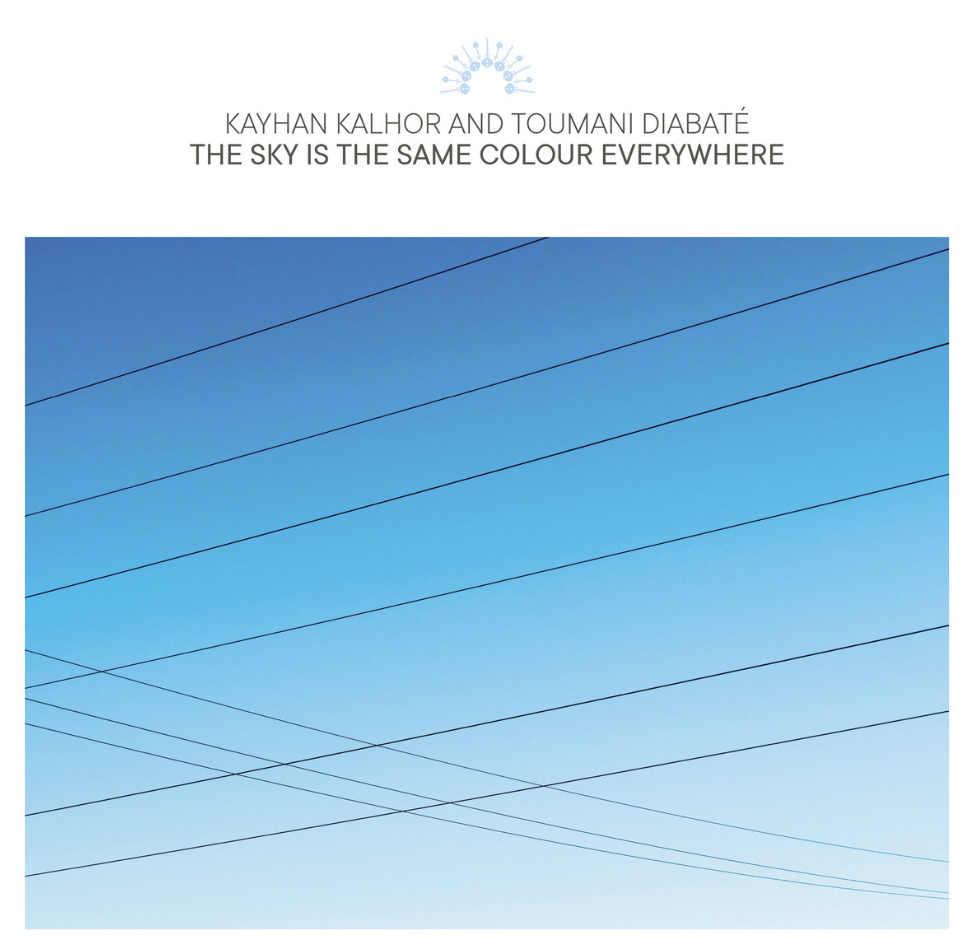
In what proves to be a most congruous musical partnership, the renowned Iranian kamancheh player Kayhan Kalhor and leading Malian kora player Toumani Diabaté merge each other’s cultures and the sound of antiquity with a previously untried, untested combination of instruments.
Brought together by the Morgenland Festival’s Michael Dreyer for a performance back in 2016, the pair who’d previously never met let alone play together, conjured up an unrehearsed, intuitive ninety-minute set of both Malian Mandé and Persian inspired beauty, longing and veiled panoramic landscape gazing. Nothing short of an incredible, adroit experience, this union proved successful enough to prompt a short European tour and a recording session in Paris. The results of which can be heard on this woven atmospheric and unifying album, The Sky Is The Same Colour Everywhere.
In a similar vane to Catrin Finch and Seckou Keita’s ongoing harpist and spindled collaboration, Kalhor and Diabaté blend their heritage into a masterful latticework of moods, time and geography.
From the Persian sphere (spreading to the Caucasus; to Azerbaijan and Armenia) Kalhor’s principle instrument, the kamancheh, is a relation of the rebab. Its appearance is somewhat exotic; a truncated inversed cone shape-like fiddle that has a spike to support it whilst being bowed, usually in a kneeling position. The original courtlier silk strings have long since been replaced by metal ones, but the sound is still unmistakably timeless; imbued with Persian romantic poetry, lyricism and spiritualism. Diabaté, who famously partnered with the late Mali icon Ali Farke Touré for a duo of Grammy Award winning albums, plays the resonating-bodied kora from Western Africa; a twenty-one string, harp-sounding (at times) long-necked lute, crafted out of half a gourd and covered with cow skin. Steeped in that region’s Mandé ethnic dialectal culture, Diabaté brings a watery-like cascaded trickle of plucked elegance, of desert rustic spun gilding and emotion to this fusion.
More or less uninterrupted, ninety minutes of both articulate and more dramatic performance flows like chapters in one long journey across mesmerizing, alluded to and deeply felt landscapes. Titles prompt escapism as much as they do attachment to those yearned for Arabian and African scenes, whilst also building common bonds; Sufism at the crossroads with the Griot.
Both instruments are shown to be versatile in application; a thwack woody-bodied rhythm from the kora as the kamancheh flutters like the wind or blows a stirring, airy veil across an imaginary topography. The former can take on a harp-like glide or mbira twanged sound, and the latter, a classical viola plaint or classical violin weepy resemblance. Throughout the album the duo often reach outside their respective disciplines and fields of influence; spinning a hint of Appalachian rural dances on the daintily rural twined ‘Anywhere That Is Not Here’, and branch out into Moorish Spain on the title-track.
To be experienced as if it was being performed live, right there in your living room, The Sky Is The Same Everywhere must be heard in its entirety; neither dipped into nor with interruptions. Sit or lie back with a masterful, intuitive work of artistry and beauty, escapism.
Trad. Attack! ‘Bring It On’

We can take comfort in the fact that in the face of such barbarity, as Russia continues its heinous crimes against Ukraine to the south (and threats to its Baltic neighbours), there’s still so much light, joy and discovery to be found in the world of music. From their Estonian roots the Trad. Attack! trio of Sandra and Jalmar Vabarna and Tönu Tubli reach out across not only to their direct neighbours but to the Caucasus, North America and Yeman to expand their sound, understanding and spirit of collaboration.
Their latest album, a journey in fact, finds the propulsive and explosive trio exploring different musical fusions and playing a raft of new instruments, whilst transforming the rich culture of Estonia itself; especially the Seto ethnic/linguistic population’s (mostly living on the Estonian/Russian border in the southeast of the country) ancient polyphonic style of epic saga telling, which is sometimes improvised, “Leelo”. Multi-instrumentalist and vocalist Jalmar has that same Seto heritage – his great-grandmother was one of Estonia’s most famous folk singers. Here, that beautiful melodious song can be found at a fair pace being repeated and woven on the Block Party-like 2-Step breakbeat fueled ‘Keera’ (“spin it”). But its influence can be heard permeating throughout the entire trip; from woodland to euphoric expelled mountaintop.
The trio kicks things off however, with a burst of phaser electronic-pop and stamped punctuated beats on the “hey yeah” energy-flashed ‘Lase Käia’ (“bring it on”). Featuring the craning, Brian May like rocking guitar of the Estonian legend Laur Joamets (based in Nashville; a regular sideman to the American country artist Sturgill Simpson), a bold Euro-rock and EDM vision of a traditional song is injected with a modern energy and new anthemic brilliance. And so it continues, across an album of guest spotting hybrids with a mixture of Eurovision, dance music, pop, indie-rock and more acoustic instrumental gestures of longing and reflection: pride too I think.
On that journey there’s the earthier, gruffer-voiced (Alexander Hacke-esque) and Estonian bagpipes droned, fiddled gypsy ‘Pidu Lõppeb’ (“the party is ending”); the brokenhearted, metronome rim beat, dreamy trad-folk transformed ‘Makak’ (“sleep”); twinkled and felt, warmer climes Ed Sheeran ‘Liugu-Laugu’ (“glide long”), which features the Canadian East Pointers metaphorically releasing a guided sleigh into the big open world; the Yemen Blues’ Ravid Kahalani featured Baltic-Arabian mirage of challenger verses, marching spiritual workers song and The Knife riled electronics, ‘Öelge Sönnu’ (“say some words”); and longingly rasped ‘Kiigelaul’ (“the swan song”). ‘Tere’ (“hello”) however, is a rawkish, dizzy burst of the Red Hot Chili Peppers dancing around the encampment fire.
A strong show of versatility with a myriad of dialects, instruments and musical partners uniting for a energetic transformation of Estonian folklore and culture, Bring It On is as fierce, highly spirited as it is soulful and kind to those traditions. A simultaneously bombastic, electrified and romantic, deeply felt connection is unleashed on a highly commercial pop and electro produced album that takes the Baltic state from the rural to the dancefloor.
A WEWANTSOUNDS REISSUE DOUBLE-BILL
Meiko Kaji ‘Hajiki Uta’

From what I’ve gained from the press release, despite the Tarantino effect the cult garnered Japanese starlet Meiko Kaji’s iconic run of early to mid 1970s albums have never been reissued on vinyl: until now that is.
With the usual quality control of repackaging such lauded obscurities, WEWANTSOUNDS, in conjunction with both the artist herself and the original label that released this quintet of showcases, Teichiku, between 1972 and 1974, have called upon the services of Hashim Kotaro Bharoocha to interview Kaji, and fill us in on all the background, with insightful linear notes.
A sort of third revival you could say, the star of various “Japanese Exploitation” franchises inspired the one-time golden boy of auteur pulp, who not only loosely based the plot of his Kill Bill doublet on one of Kaji’s most (in)famous roles as the revenging angel of The Lady Snowblood period-drama revenge shlocker series, but placed a number of her songs in the movie too. This obviously shone a spotlight on the star of such cult curios as Female Prisoner Scorpion, Blind Woman’s Curse and Stray Cat/Alleycat Rock.
In more recent years Kaji has popped up with her own Youtube channel. And now, a vinyl reissue run of her 70s move into the recording industry, prompted by the film studios cashing in this icon’s popularity.
Coaxed into the recording booth, to initially sing songs associated with the films she starred in, the Tokyo-born actress nervously and with some trepidation, recorded her first album, Hajiki Uta, with the highly experienced TV, film and incidental music composer Shunsuke Kikuchi. The producer was able to put his charge at ease however, as Kaji recalls: “I told Shunsuke Kikuchi that I couldn’t imagine myself singing the songs. He said I could ignore the melody that he wrote, and just sing it the way I wanted to. That really lifted the pressure off my shoulders, and I decided to sing the song as the character in the film. The director was also happy with that idea.”
Produced to a high quality, the Hajiki Uta songbook covers a myriad of styles. The vibraphone-tinkled, gently rousing and swooned ‘Sounya-Ka Onna No Jumon’, and the yellow rose of Texas, Morricone-inspired canteen mirage ‘Urami Bushi’ (the tune famously used in Tarantino’s Kill Bill 2) are actually the only two direct tracks taken from Kaji’s films; both appearing in the torture-porn, rape revenge series Female Prisoner Scorpion #701. The former in the first film of that franchise, the latter in one of the sequels, Jail House 41, directed by Shunya Itõ. Yet despite that, the musical production sounds cinematic throughout, riffing on the already mentioned Morricone, but also Bacharach and Jean-Claude Vannier too. The opening electric scuzzy guitar buzzed, rattlesnake punctuated and yearned chanteuse serenaded ‘Meikono Futebushi’ is an obvious example: a Japanese(fied) version of a Spaghetti Western theme tune. The smooched saxophone and almost soul-hinted production of ‘Hizumi Moe’ sounds Bond-esque in comparison.
Elsewhere there’s light jazzy cocktail hours; the sweet scent of Japanese blossom; a touch of accordion accompanied walks along the Seine; and softened bouts of thriller and the clandestine. ‘Onna Kawaki Uta’ reminded me of Angela Morley’s string arrangements for Scott Walker’s early solo work (in fact, the bass, drums and feel of songs like ‘The Old Man’s Back Again’). And the harpsichord like, longed ‘Onna Hagure Uta’ sounds not too dissimilar to the Thomas Crown Affair: or something of that vogue.
A fuzz of guitar is there to give it a certain edge, whilst the strings occasionally swirl and well up for dramatic effect. Elements of what’s called Enka are performed with pop sass and kitten heel coquettishness, as traditions are respectfully drawn into the 70s. It must be pointed out that Enka is a kind of performative traditional form but also said to refer to political texts set to music as a means of bypassing government curtails on dissent and activism at the turn of the 20th century in Japan. This form was stylised with modern pop sensibilities in the post-war period, but it’s quite hard to define: many of its leading lights, stars like Hachiro Kasuga and Michiya Mihashi, were themselves very dubious of the tag; if anything distancing themselves from this revived form. Enka, pop, beat music, a little buzz of psych, the string production of the cinema; all forms accompany Kaji’s very fine lulling, but sometimes impassioned poetic, singing voice. Coveting, cozy and in often-romantic swoons, the actress takes on the convincing role of songstress. Subtle and diaphanous yet able to express whatever emotion is needed on an album that shouldn’t be cast off as a mere cult nugget from the vaults, nor dismissed. It seems that Tarantino really was onto something after all.
Harold Land ‘Damisi’
26th May 2023

Continuing a selective reissue program of Bob Shad’s 60s/70s Mainstream Records label catalogue, WEWANTSOUNDS hone in once more on the tenor saxophonist (quite deft on the oboe too) Harold Land with the first ever vinyl reissue of his 1972 spiritual jazz phase Damisi album.
Regulars of the Monolith Cocktail will know that I reviewed the Mainstream Funk compilation early last year, as the title suggests a showcase of Shad’s overseen funkier cuts. A self-proclaimed “broad church”, the label was just one of a myriad of companies the producer and A&R man had worked on; starting out in the 50s with jazz at the prestigious Savoy label, moving to National Records and launching his own subsidiary imprint EmArcy. Shad went on to find the talent for the switched-on psychedelic Mercury label (discovering such luminaries as Janis Joplin, Sarah Vaughen and Dinah Washington), whilst forging his own Mainstream platform in the 60s.
During his early years, Shad had famously recorded such notable artists as the Max Roach and Clifford Brown Quintet. Although it would be a fair time before working with him again in the 70s, Land was a member of that very same ionic hard bop Quintet; coming up through the ranks after leaving his Houston home, and his formative years in San Diego, for L.A.
Time had moved on, and jazz’s evolution was changing once more. Land, moving on himself, had started a fruitful musical partnership with the vibraphone legend Bobby Hutcherson in the late 60s after stints as an in-demand sax freelancer for labels like Contemporary and Pacific Jazz. It’s that partnership which led to a West Coast trip for the N.Y.C. based Shad and his A&R man Ernie Wilkens; touching down to record a series of sessions from both the Land and Hutcherson union, and Land’s own bandleader work with an enviable pool of serious talent on the scene. The results of which can be hear across a trio of albums: the Hutcherson foiled A New Shade Of Blue (reissued by WEWANTSOUNDS already) and the Choma and Damisi albums. The latter is held-up here as a worthy showcase for Land’s developing use of spiritual conscious jazz and his embrace of Coltrane; although all the signatures of that West Coast schooling and the California showmanship of bright and burnished soulful and funky horns is unmistakable.
Land leads a quartet of equally notable players on Damisi (the Swahili word for “cheerful”), with Herbie Hancock’s Mwandishi ensemble bedfellows Buster Williams on double and electric bass and Leon “Ndugu” Chancler on drums (that nickname, bestowed on the Freddie Hubbard and Miles Davis sideman by Hancock, is also Swahili, and translates as the affectionate “earth brother”). On electric piano and keys there’s L.A. pianist William Sydney Henderson, who’s CV includes recordings with the Pharaoh, Bobby Hutcherson, Billy Higgins and Hugh Masekela; and on both blazing trumpet and flugelhorn there’s Count Basie sideman and gun-for-hire (a dizzying roll call too numerous to list, but Sonny Stitt, Dexter Gordon and Quincy Jones are just three notable icons he’s worked with over the decades) Oscar Brashear.
Together, with Land’s heralding, spiraling and brassy tenor blowing away throughout, this highly experienced in-tune troupe lay down a modal-vibe show time of Lalo Schifrin funk action and a swing of Savoy, bop and Lee Morgon on the constantly moving opener, ‘Step Right Up To The Bottom’ – a kind of Hollywood Boulevard takes a turn down desolation road. It’s followed by the cool, hip and more laidback ‘In The Back Corner In The Dark’; a swing time Hollywood funk with shades of serenaded and elephant reeling Miles Davis under a baking sun. Projecting travels further afield, ‘Pakistan’ is the first real spiritual movement; a transcendence shimmer and rattle, bell shaking, snake-charming oboe odyssey that evokes the Pharaoh’s ‘Africa’ (I know, different continent entirely, but similar feel) and a surprising noir-ish Davis. Henderson’s piano really shines on this enchanted, beckoning homage to the country.
Side Two (in old money) features a duo of deeper, long suites; the first of which, ‘Chocolate Mess’, ups the tempo and takes on a funky Latino influence of soul-jazz. Yet, there’s also a strong African influence and smattering of Herbie Hancock on this dynamic sleigh bell shaking, freefalling and dappled electric piano rich jam. The title-track finale reaches once more for Far Eastern climes, perhaps Egypt, but with a West Coast be bop feel and spells of Ike Quebec, Yusef Lateef and Stanley Turrentine. WEWANTSOUNDS have played a blinder reissuing this quality travelogue of soulful, funky jazz from Land. Shy of truly outstanding and iconic, Damisi is nevertheless a great flowing album of notable performances that never loses its groove and swing. A jewel in the Mainstream Records cannon is given another welcome run.
Dyr Faser ‘Karmic Revenge’

Karma can be a bitch they say. Only on this occasion, spun out, weaved and languidly mulled over, karma is a drawn-out process of study in the barely warm rays of an occultist sun. For the Dyr Faser duo of Eric Boomhower and Amelia May stir up hermetic, drowsy and Krautrock arias under slumbered mires, and in esoteric visions of the Laurel Canyon.
The dread and gothic chthonian opener, ‘Suns Of Unseen Revival’, sets the atmosphere with the piped tubular drones of Death In June’s ‘Fall Apart’, sonorous palpitations and hints of Amon Düül II and an unholy Jefferson Airplane fragrant in the Fields Of Napalm. Yet, already by the second cut, the Boomhower voiced ‘Fun In The Sun’, the serious gloom is replaced by a kind of Californian slacker vibe of cymbal splish-splashing, ritualistic toms and a flange of the Velvet Underground, Boyd Rice And Friends, Sonic Youth and Pavement.
‘Keep Talking’ once again has May taking up the vocal mantle; channeling Grace Slick and a downer Besnard Lakes on the melting, intoxicating spell of dream-realism. ‘Symbolized’ however, motors down the BRMC and JAMC highway; thumbing a lift with Suicide’s “Ghost Rider” on a hippie biker kick. Within that leather-clad bohemian framework, there are evocations of The Stooges ‘Search And Destroy’, Jason Pierce and the sustained guitar lines, contours of Ash Ra Tempel.
Almost diaphanous, ‘Silver Night Run’ oozes a hypnotizing hallucination of acid-aria sung enchantment as its siren traces some mysterious metaphorical river trial. ‘Ghostly Vicious Acts’ is an indie-fuzz and gauzy scuzz of tumbled Spaceman 3, whilst ‘This Menace’ squalls and churns up a suitable acid-rock/krautrock mood of doom, as The Black Angels gaze on. Christ weeps from the holy mountain on the woodland fluted, but despondently mused, ‘Dead On The Vine’, and May wafts a plaintive Hackedpicciotto-esque emotive voice over a stylophone buzzing spooked ‘Despite The Party Atmosphere’ vignette. It all ends on the gristle and loose psychedelic, slipped drummed ‘Lifelike Stranger’; a conclusion to a most alluring if doom-imbued album.
It turns out that Dyr Faser are rather good at mixing the esoteric krautrock of the Amon Düül family (especially the Wagnerian acid-wash and otherworldly vocals of Renate Knaup-Krötenschwanz) with grunge, alt/post/space rock and doom; bridging morbid curiosities, spirals of melancholy with black sun fun, fun, fun! A great duo to discover.
Images Of Goo ‘S-T’
(Un Je-ne-sais-quoi) 26th May 2023

Responsible for, and “active members” of, trick noise making projects and alias as Das Hobus, Spiritual Emojis, The Notwist, AloaInput and a myriad of others, the maverick sonic union of Leo Hopfinger (aka LeRoy) and Cico Beck (likewise aka Juasihno) mess around with the proverbial “goo” on this self-titled workout.
As Images Of Goo they knock around in an echo chamber reverberation of drum heavy trip-hop, breakbeat, krautrock and post-krautrock, off-kilter techno, future soul and various electronic formats. This often sounds in practice like Valentino Magaletti on 90s Mo Wax, hanging out with Major Force, DJ Shadow and Matmos. And when emerging from a Joe Meek (if he’d been born much later and signed to Warp Records or the Leaf Label) retro space production of signals, sputniks and oscillations, like International Pony and The El Michaels Affair on the Fun Boy Three vine. Because the beats, the breaks move from hip-hop to Ethno sounding hints of Africa and Java, and more metallic mesh-bounces of tins, pots and pans percussion.
And most surprising, as we reach ‘Image 08’ (all tracks are just numerically entitled by the way) a drowsy tripping vocoder effected set of voices and vocals emerges from the knocking, Afro-wavy beats – imagine Afrikan Sciences, Dunkelzefer, late Can and Matthew Dear on one soulful languid mix. You can throw in Nino Nardini’s cult sounds, MDR-ADM, Gescom, the Aphex Twin and Yuk. into that bit-crush and scrunch, lunar echoed moon unit of psychedelic drum-led collages. The whys and wherefores don’t matter; it just exists as its own body of workings; a sci-fi tripped out production of hip German eclectic rewiring.
Our Daily Bread 574: Tinariwen ‘Amatssou’
May 16, 2023
ALBUM REVIEW/Dominic Valvona

Tinariwen ‘Amatssou’
19th May 2023
It shouldn’t really come as any surprise to find those Tuareg doyens Tinariwen embracing the country blues signature of Nashville; such is the two musical spheres connection and roots. After all, the late Malian legend Ali Frake Touré teamed up decades ago with Paris, Texas scoring American icon Ry Cooder for the Talking Timbuktu album – a Grammy Award winner no less.
Although still hotly debated, the blues is said to have taken shape, the seed laid in Mali and its disputed borderlands, deserts, centuries if not a millennia ago. The slave trade saw it carried to the European-colonized Americas; its purest, cultural, spiritual form proving, though subjugated, a fecund for a myriad of musical styles that grew in and around the blues in the Deep South, including agreeably everything from country to bluegrass and Americana.
With that in mind, but also with nothing less than a love and respect for the two-decade incarnation of this much older Tuareg nomadic band, Jack White was moved to invite Tinariwen over to record at his private recording studio in Nashville. White had previously lent out his engineer Joshua Vance Smith to mix the group’s last album, released in 2019, Amadjar. Oft “sideman” Fats Kaplin, who is one of the few select Nashville-imbued players to collaborate on this latest project, had also played on their 2014 album, Emmaar.
Unfortunately, due to a series of unfortunate setbacks, this American soil recording wasn’t to be. With the renowned Daniel Lanois and a circle of country musicians now attached to this proposal, the COVID pandemic grounded progress, with Tinariwen’s lineup of founders Ibrahim Ag Alhabib, Touhami Ag Alhassane and Abdallah Ag Alhousseyn and bassist Eyadou Ag Leche, percussionist Said Ag Ayad and guitarist Elaga Ag Hamid all prevented from flying. Lanois and company decided to travel to them instead, only the famed producer was struck down with the virus, and so forced to cancel plans.
Thrown into jeopardy, technology would prove the savior, as both partners on this album now recorded their parts separately, thousands of miles apart. Tinariwen’s inspired location was the Djanet “oasis”, within the borders of Algeria’s southern desert and the Tassili N’Ajjer National Park – a UNESCO World Heritage site, famously home to prehistoric cave art. Whilst both Kaplin and fellow country muso Wes Corbett recorded their contributions in Nashville, with further percussion added by Amar Chaoui in a Paris studio: a tri-continental production you could say. Not that you’d ever know it, as the transition, process runs together seamlessly.
In their African surroundings, playing together in a makeshift tent with borrowed equipment from their Tuareg musical peers Imarhan (the band’s guitarist Hicham Bouhasse can be heard contributing and expanding the ensemble even further), Tinariwen entwine their “Assouf” (“nostalgia”) signature of pick-up picked, turned-over, constantly moving guitar hypnotism and camel-motion Bedouin rhythms, and desert chorus voices with the clip-clop, wagon-hitched, pedal-steel slide and twirled banjo sounds of the American prairie, cowshed, barn dance and Western trail.
The bluesy ache and pine of America finds solace in the tumult ache and longing of the Tuareg plight; many forced to scatter across the African continent and overseas as Mali plunges into further chaos. In the long-running fight for an autonomous state (the Azawad) in the North-Eastern reaches of Mali, the Tuareg people have suffered at the hands of the central government; had their cause hijacked by zealous Islamist insurgents (forced out for the most part when former colonists France were invited to stem their bloody progress); seen further civil unrest with a military coup in 2020 and subsequent coup d’état; and endured a catalogue of droughts and economic desperation. As a consequence of the Jihadist hardliners gains during this decade plus turmoil, some outlier regions of the Tuareg were under strict Islamist codes, including the banning of guitars and their music. This forced some groups to seek sanctuary over the borders, with some even moving on to Europe and further afield.
That struggle, travail is beautifully conveyed in the lyricism and the musical panoramic-gazed desert emotions of longing. And so, two desert settings in harmony merge; the unmistakable Tuareg ease and spindled play of guitars blending with subtle essences of bluegrass, Americana and Nashville country blues; disarming in delivery that plaintive song.
A Sahel version of The Band; a fiddled playing barn dance in Timbuktu; and Cooder looking out across a shamanistic vision of out-of-body, otherworldly Americana, the dual Western horizons, when coming together like this, offer up bendy mirages, spins, softened stomps, elliptical bobbing motion sways and scuzzy dirt music. Acoustic and electrified, with spells of the Deltas, the Grand Ole Opry, Appalachians and Missouri breaks throughout, the Tuareg sound finds an harmonious distant relative Stateside.
Amatssou is a captivating, hypnotic joy, the setbacks doing nothing to affect or dent the original concept of a combined, congruous union.
Hi, my name is Dominic Valvona and I’m the Founder of the music/culture blog monolithcocktail.com For the last ten years I’ve featured and supported music, musicians and labels we love across genres from around the world that we think you’ll want to know about. No content on the site is paid for or sponsored and we only feature artists we have genuine respect for /love. If you enjoy our reviews (and we often write long, thoughtful ones), found a new artist you admire or if we have featured you or artists you represent and would like to buy us a coffee at https://ko-fi.com/monolithcocktail to say cheers for spreading the word, then that would be much appreciated.
Monthly Playlist: April 2023: Circe, Micall Parknsun, Suki Sou, Carla Boregas, Ammar 808…
April 27, 2023
CHOICE MUSIC FROM THE LAST MONTH: TEAM EFFORT

The Monthly Revue playlist of 2023; a choice selection of tracks from the last month on the blog. Curated by Dominic Valvona with Matt Oliver on the Rap Control once more, and music from reviews by our latest recruit Gillian Stone plus Brian ‘Bordello’ Shea, Graham Domain and a returning Andrew C. Kidd. Expect to hear the unexpected as we leave you with this 45 track selection before we go off on a May sabbatical (well half of May, be back around the 15th with a packed schedule of choice music).
TRACKLIST//
Altın Gün ‘Çıt Çıt Çedene’
Ammar 808 Ft. Belhassen Mihoub ‘Yarima’
Les Abranis ‘Achethkhi’
Orti, Mayorga y Chiriboga ‘Muñequita Blanca’
Tuzeint ‘Mujer Divina’
United Grind Ft. Gamechangers ‘Doin This All Night’
King Kashmere & Alecs DeLarge ‘Most Blunted’
Neon Kittens ‘Loving Your Neighbour’s Wife’
Opus Kink ‘1:18’
Gabrielle Ornate ‘Delirium’
H. Hawkline ‘Plastic Man’
Land Of OOO ‘Matthew’
African Head Charge ‘A Bad Attitude’
Swans ‘Paradise Is Mine’
The Oldest Voice In The World ‘Talysh Mountain Border’
La Faute ‘The Crown’
fhae ‘Love You’
Alice ‘Triste et tout seul’
foil ‘Don’t Look’
Ali Murray ‘Spirit Of Unknowing’
Khotin ‘Lovely’
MultiTraction Orchestra ‘Reactor One’
Tobias Meinhart ‘Luna Park’
Deca & Ol’ Burger Beats ‘Blight’
Prastense & Shortrock Ft. Uncommon Nasa ‘A Broken Letter’
Micall Parknsun ‘Back’
Your Old Droog ‘Pronouns’
Illinformed Ft. Eric The Red ‘Doctor’
Silver Moth ‘Sedna’
Escupemetralla ‘Several specimens of ruminant animals with large udders chewing grass in a Cambridge meadow’
Sweeney ‘High School Damage’
Ale Hop & Laura Robles ‘Son de los diablos’
Cornelius Corvidae ‘Silver Flower’
James Howard ‘The Reckoning’
Draag ‘Mitsuwa’
Mike Cale ‘Slow Club’
Suki Sou ‘Petrichor’
Issei Herr ‘Aria’
Carla Boregas ‘A Cidade doe Outros’
Simon McCorry ‘Halcyon Fire’
CIEL ‘Somebody’
Tomato Flower ‘Destroyer’
Cindy ‘Earthly Belonging’
Circe ‘Riot Of Sunlight’
Chloe Gallardo ‘Bloodline’
COMPILATION REVIEW/DOMINIC VALVONA

Various ‘Ecuatoriana – El Universo Paralelo De Polibio Mayorga 1969-1981’
(Analog Africa) 7th April 2023
Andean Cumbia lifted off into the cosmos, the latest South America trip from Analog Africa finds the label in “space race” era Ecuador.
Although the equatorial country hasn’t always had the best of relationships with space and sci-fi; a curiosity and fever for all things lunar and technological led to a 60s and 70s boom in modernizing the old traditional music genres and dances, albeit on rudimental analogue equipment and the Moog synthesizer, which produced a kitschy sound and effect closer to Joe Meek than Kraftwerk.
In a land of multiple mystical mythologies and incredible awe-inspiring geography, various Chariot of the Gods and aliens theories were rife; this Inca outpost a hotspot of UFOlogists and the like. However, the accompanying compilation booklet’s author regales one less encouraging chapter from Ecuador’s history. Back in 1949, after a radio broadcast of H.G. Wells famous martian invasion story War Of The Worlds, the Ecuadorians in a blind panic went on a stampede of the capitol. Tragically, during this riotous reaction, the Radio Quito HQ was destroyed in an ensuing fire, leading to the deaths of a number of poor musicians who were recording in the building at the time.
Thankfully, as the Cold War set in motion that infamous space race, the wonders of space travel, the moon landing and the possibilities of technology inspired such iconic Ecuadorian figures as Polibio Mayorga, who rejuvenated a myriad of musical styles like the popular Andean rural and city fusion of Huayno (the rhythm of which is a stressed first beat followed by two shorter ones), the local “couple dance” of Sanjuanito, and the Albazu.

There’s more to it than that of course, as you’ll hear for yourselves, should you decide to purchase this sixteen-track compilation. Because the story that unfolds is one of pushing the boundaries of acceptance; of fusing a multitude of dances that have changed, embraced the cultural signatures of all the geographical borders its crossed. A case in point being the “Bomba”, a rhythm brought to Ecuador via the African slaves wrenched from their lands by the Spanish to toil in Puerto Rico. One such champion, and “master” of this drum and dancer syncopation, the “quiet and introverted”, very serious, Alcibiadar Cilio, is featured twice; firstly with the slow echo-y, keyboard dotted, Mexican sounding ‘Hacienda Bomba’, and secondly, with the Latin-lilted, zippy lo fi cosmic effected ‘Bomba De Pobres’.
But dominating (it is his name in lights on the title) this affair is the already mentioned maestro Polibio Mayorga; a stalwart of the capital’s music business since uprooting from his hometown of Chisalato, 160km’s from Quito. After a four year stint transforming the fortunes of the beloved Santa Clara neighbourhood band Los Locos Del Ritmo – given a new life after a lull in popularity during the late 60s and represented on this collection by the concertinaed, horn serenaded courting song ‘Llorona’ -, Polibio started a near one-man operation on the Fadisa label platform as a solo musician, songwriter and later on, musical director. So popular was Polibio’s injection of modernization and use of the Moog that he pretty much dominated the market; leading to calls from many for more diversity, more acts unrelated to the icon. This would lead to a number of Polibio pseudonyms, including the featured Junior Y Su Equipa, who kick off this compilation with the popular cheery piped, Cumbia lilted ‘America Índia’ – indigenous Tropicana meets the most low cost of Casio effects. But under his own signature, there’s the featured high-pitched, almost cartoonish and childlike, chimmy and whoop of ‘Pañuelo De Seda’, and whirly, giddy and dotty ‘Ferrocarril’.
Appearing in various other guises and in union with other Ecuadorian talents, there’s Polibio teaming up with his tenure compositional co-writing foil at the label, the saxophonist Olmedo Torres, for the tropical Latino flavoured, phaser-effected ‘Unita Maa’, and the dub-tinged, constantly shuffling, piano reverberating slow dance ‘Mi Paisa’. Torres gets to fly without Polibio on the Los Gatos vocal trilling, excitable Andes meets coastal surf music ‘Don Alfoncito’. Another foil, Eduardo Morales, fronts the senorita condoling, almost Mexican-sounding, quivery ‘Muevase Vecina’. Morales was known for recording Sanjuanito songs, the lyrics of which featured the theme of being uprooted. It was mainly the soul music of those forced to migrate from rural poverty to seek work in the cities. You can hear some that earnest toil, a slight sense of travail on the prime example of the form, although with that kitsch lo fi synth production its inevitably more surf-twanged Pacific facing oddity than moody lament, played on the “small” (“requinto”), more high-pitched versions of the clarinet.

From wavy synthesised Cumbia to Andean festivities and accordion-accompanied library music, Ecuadorian traditions are augmented and sent out on a Telstar satellite above the equator on what is perhaps analog Africa’s most fun and curious compilation yet. This is the story of a musical space race unfolding across a collection of carousing, sauntering, zappy lo fi and Moog produced tracks; another chapter in the obscure, near untold, history of South America.
The Perusal #42: Tobias Meinhart And Berlin People, Suki Sou, MultiTraction Orchestra, Brìghde Chaimbeul, Lunar Bird…
April 13, 2023
Dominic Valvona’s Reviews Column

MultiTraction Orchestra (Ft. Arve Henriksen) ‘Reactor One’
(Superpang) Available Now

A multiverse of musicians from troupes and bands that congruously intersect, the MultiTraction Orchestra draws in members from GoGo Penguin, Supersilent, Melt Yourself Down, Crash Ensemble, Sly & The Family Drone, Hen Ogledd and beyond. A stellar lineup you could rightfully claim, such talents as the multi-awarding winning saxophonist, clarinetist, composer and Alexander Technique teacher James Alsopp; the “Reductionist School” freeform harpist Rhodri Davis; gifted cellist Kate Ellis; bassist, vocalist, composer, environmentalist and Acoustic Ladyland instigator Ruth Galler; jazz drummer, Son Of Kemet, Jon Scott; and Krakow via London and Detroit composer, guitarist, producer and interdisciplinary collaborator Alex Roth are joined by the Norwegian trumpet star Arve Henrikson on this new project of remote syncopation.
The orchestra’s members, brought together by Roth, made this, their debut expanded work, across various distances; collaborating apart from each other from different locations: A fact that in no way impedes on the quality and harmony of direction; even in the most histrionic parts.
Reactor One may suggest some nuclear fusion, but this feels and sounds almost like an orchestrated gathering “reacting’ to and playing together in one space at one time. Across a set of six performances that ensemble stir the senses and picture a myriad of imaginative, mysterious environments and landscapes. Such eclectic communions unsurprisingly draw a mix of genres, from jazz to the classical, post-rock and soundtracks.
The opening soft and grainy rasped, snozzled saxophone gauzy ‘Reactor I’ has an air of John Cale and Simon McCorry adrift in a mizmar of India or Arabia: and yet, it also sounds rather esoteric and otherworldly. Suite ‘II’ has a sustained post-rock bed of scuzz guitar harmonics, drama and bluesy-droned horns, whilst ‘III’ features delicate rippling harped aria-like pitches and raspy, almost rusted, sax.
‘IV’ is a crepuscular piece of concentrated brow cello and wisped stirrings that build, eventually, into a cacophony of drum breaks and smashed rolls and cosmic articulations. The harps are back on suite ‘V’, but sound almost like the African kora. They’re joined by an elephant trumpeted sax, what sounds like Jed Kurzel’s intense carved-up bowed strings dramatics, and a synthesized sense of unease. The final piece in this moving, evocative odyssey sounds like Popol Vuh caught in metallic, whining hinge bracketed and bass-y resonance.
A serialism of intuitive tonal movements, the sense of an ambiguous geography, mood and time, the combined efforts of so many threads sounds anything but disjointed or disconnected. Instead, the MultiTraction Orchestra deliver a coherent, balanced drama of gravitas and mood music.
Suki Sou ‘Notes On Listening’
(Curious Music) Available Now
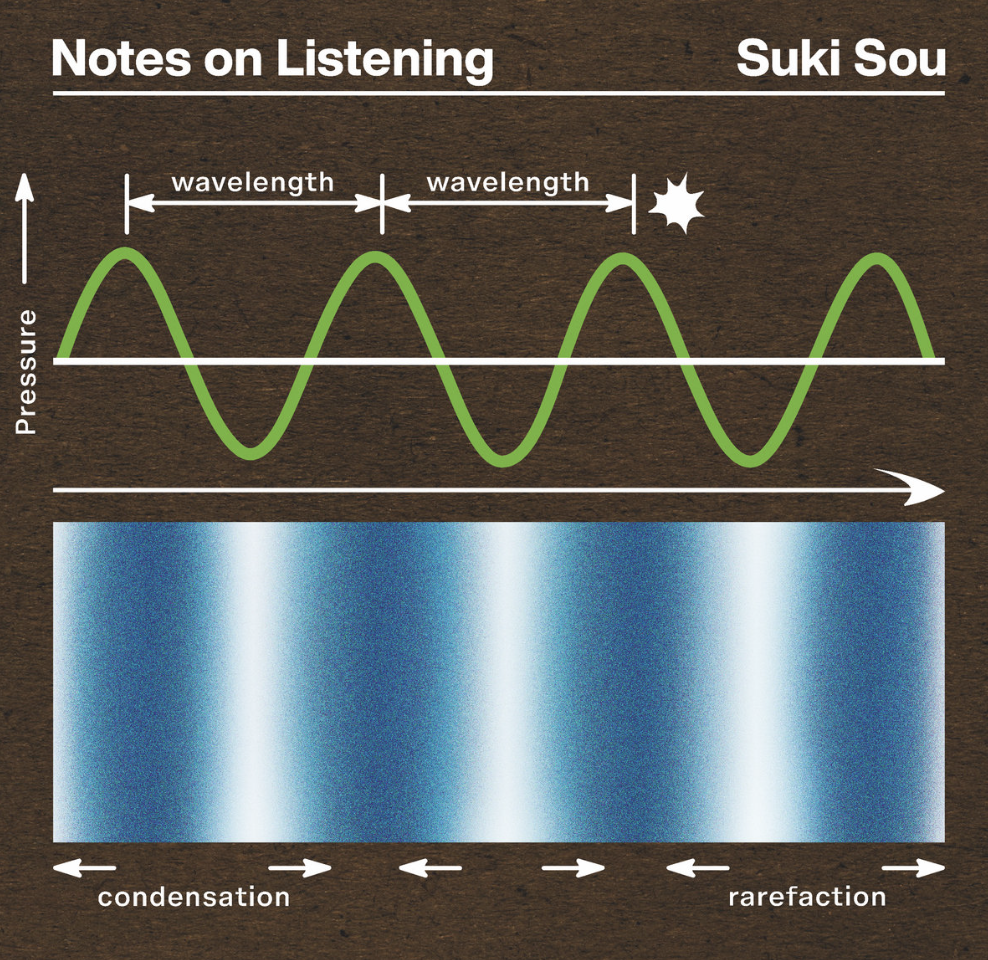
Gentle impressions in the modulated waves, ripples and drones, Suki Sou’s sophisticated analogue electronic pieces require a certain commitment.
Inviting a deeper listening experience, the intuitive self-taught composer and sound designer elicits subtle moods and evocations from a home studio apparatus of Moog, Arps and Buchla synths and MIDI controllers on the debut album, Notes On Listening.
Pitched somewhere between the nostalgic and electronic pioneered sounds of such luminaries as Suzanne Ciani, Sarah Davachi, Roedelius and Klaus Schulze and Library music, yet looking with opportunity towards the future, recollections of childhood out in the Far East are transported and fed into a symmetry of machine produced music and environmental, tactile humanism. There’s a soul within that multilayered network that works arppegiator, waveforms, algorithms and burbled and bobbed synthesized notes into genteel moving translations of abstract projections, feelings, places, even observed weather patterns.
Somewhere in the stratospheric ambient weightlessness of the ‘Kelvin-Helmholtz Clouds’ – the rare billowing wave pattern cloud phenomenon named after the professors of that title – and the moistened kosmische artificial splashes of ‘Velocity Of Water’, the distinctive memories of Sou’s journey from Macau to Berkshire, London and later, the Lake District, are transduced into ambient currents, melodies, languorous drifted spells, liquid flows and airy glides. It could be, as laid out in the notes, the reflections of listening to the Taiwanese pop star Teresa Tang in the rain at grandmother’s that is audible on ‘Petricher’. The outdoors is sealed off with the shut of a door or window in the studio on that one.
If JakoJako or the Warm Colours made an album with Metamono on Sky Records in the 1970s this could well be the result. Too minimal to be lush, yet beautifully, knowingly composed with room for serendipity, Notes On Listening brings warmth, and on the finale ‘Light Intervals’, a sort of pastoralist spiritualism to synthesised analogue electronica. Sou’s sources, influences make for an accomplished debut of subtly and purposeful ambience.
Lunar Bird ‘The Birthday Party’
(Supported by Help Musicians Do It Differently Fund 2022) 28th April 2023
Disarming malady and alienation with such vaporous gauzy diaphanous veils of dream wave, Lunar Bird with a myriad of fellow Italian artists and musicians weave vulnerability and fragility into the most purified of intoxicating pop songs.
Although making the move from their native home to take up residence in Cardiff a number of years back, founding members Roberta Musillami and Eliseo Di Malto evoke a Mediterranean and Adriatic light-giving feel of consumed holiday romance and of longing disconnection: the distance between lovers drawn apart.
Lingering in a lush synthesized haze, Lunar Bird (named after Joan Miró’s signature abstract bronze sculpture) once more ooze a subtle, sophisticated mirage of alternative European pop from the 80s with Beach House, Diva Dompe and Julia Holter. Although, rather surprisingly, the saddened, synth and piano-chimed, near psychedelic ‘Firestorm’ sounds like a collaboration between Kate Bush and The Beatles (Sgt. Pepper era), and the Giorgio Tuma and Riccardo Raho penned coastal Iberian, almost Latin-American percussive, twanged and fluted (courtesy of another guest, Marco Tuma) ‘Dreaming’ reminded me of the late Mandy; a touch too of a Hellenic Lee Hazelwood if you please.
From paradise to metaphorical plunges into the gauzy waters of the deep end, the group’s second album is one long extended languorous dream. The title-track opener both musically and lyrically glows. A slow release of Italo-electronica and strobe-lit soft aches, a near creeping buzz and hint of Numan-sampled Sugarbabes sits comfortably with breathless Beach House vibes.
Recent single-video ‘Creatures’ is a gilded, glistened and softly rippled enchantment, a call-to-arms of a kind for “misfits”, shone down on with certain radiance. The already mentioned Giorgio Tuma joins electro-siren Roberta in a translucent, almost hushed duet on the new wave ‘A Crow’. Another guest of many, Adriano Modica joins Roberta on the Abba-esque Eurovision grand opening ‘Driven By The Light’; Modica “learning to fly” over a blissful, heaven sent production.
Featured on the Monolith Cocktail a while back, another of the already released single-videos, ‘Venilia’ references the Roman deity of the winds and sea to an almost cinematic allurement that conceals a spell of restlessness in paradise.
The album’s bookended by another of those slowly released anthems, ‘Astronaut’. This time celestial fanned rays light up the ephemeral on a golden shimmer of 90s dream pop, as the intangible, the fleeting space dust and romantic allusions are captured and bottled for posterity.
Not so much dipping as submerged fully in that drowsy intoxicating dream vision, Lunar Bird entwine emotional pulls, anxieties with the most delicious, sumptuous of Southern European ethereal pop. The Birthday Party is a spellbinding songbook that subtly pushes the Italo-Welsh group into swimmingly new waters without losing the signature diaphanous bohemian sound we all love them for. There’s absolutely no reason they shouldn’t be much bigger, well known and successful with potential hits like this.
Tobias Meinhart And Berlin People ‘Dark Horse (Live At The A-Trane, Berlin)
(Sunnyside Records) 28th April

With an ever-widening international flavor, the Bavaria-born, but Brooklyn-based, saxophonist, composer and bandleader Tobias Meinhart picks up and infuses his sound with echoes of the NYC skyline, Latin America and Europe on his new album with the Berlin People ensemble.
Inspired by the dynamics of that set-up’s world tour – out on the road after storming onto the scene with the eponymous acclaimed debut –, Meinhart’s second album showcases a concept-bound live sound with performances from a two week spot at Berlin’s leading jazz club the A-Trane during 2021 and 2022.
Playing every night over the course of that period, encouraged by a respectful but appreciative clapping audience, Meinhart and his accompanying quartet of guitarist Kurt Rosenwinkel, pianist Ludwig Hornung, bassist Tom Berkmann and drummer Mathias Ruppnig shine both together and in the solo spotlight. And as that “dark horse” title suggests, each composition either finishes in a surprising way to where it started out or alludes to some hidden meaning. This might mean virtuoso skills in tandem with a mood, a groove and expressive breakout of dynamism.
With an air of Art Blakey & The Jazz Messengers, Dexter Gordon, Mark Tornes, Albert Ayler and more contemporary touches of European jazz throughout, there’s still room for the Afro-Brazilian style of BRBQ and Spanish flair of Chick Corea on the smooth Latin styled turn scenic dalliance and bustled park activity exchange, ‘Luna Park’, and the guitar work of Zappa and Nir Felder on the subtle Lalo Schifrin accented and tumultuous title-track. That same track has (like the later ‘Sonic River’) its very own introduction part; an almost clarinet-like solo saxophone lead-in of subtle rasped resonance and fluted flight.
Pining serenades softly build into flexed and bounced expressions of free jazz as drummed breakbeats suddenly evoke a splash of Buddy Rich when moving through a set of reflections, mirages and busier performances. Each instrument guided by as much deft skill as spontaneity, but with Meinhart switching between tenor and soprano fusing lighter spiraled climbs with shorter, more pecked or peppered toots.
You can hear that a real fluidity exists between each member of this troupe, as no matter the mood, the surprise, these live actions prove wholeheartedly rhythmic, melodic and above all top quality. Meinhart, as do his bandmates, reinforces an already glowing reputation as a leading light on the contemporary jazz scene with this essential album. This record captures them live on stage turning out both an explorative and classy kind of jazz dynamism; showcasing thought and action in perfect synchronicity.
Ale Hop & Laura Robles ‘Aqua Dulce’
(Buh Records) Available Now

Although both artist-researchers in this debut union grew up on the Peruvian coastline and popular beach area of Aqua Dulce near Lima, it wasn’t until years later and thousands of miles away in Berlin that they crossed paths and decided to work together. With a shared geography and musical interests Alejandro Cárdenas, under the guise of Ale Hop, and her foil Laura Robles liberate and transform the Afro-Peruvian heritage of their homeland from its colonial history: namely the Spanish Imperial Viceroyalty of Peru.
With a legacy of greedy conquest and genocide that wiped out the indigenous Incas, and the heinous uprooting of the people of Western and Central Africa, transported to the Americas including Peru, the local cultures and traditions managed to survive through subversion. One of the most important focal instruments (played here by Robles), the wooden cart-like cajón, was one such traditional percussive form with ties to Africa that was banned by the Spanish. The origins remain blurred but its thought to have originated in the ports of South America as a means to keep that drumming heritage, connection to home alive. Using the wooden packing cases that innocuously carried fruit and other goods, in a rudimental fashion, these boxes were adapted to be played whilst sitting on between the knees with hands, sticks, brushes or mallets. The basic shape remains, but is now no longer banished of course. Instead, it’s a mainstay of such Afro-Peruvian and Colonial-indigenous fusions as the two-bar figure Landó, the Zamacueca, the festive energetic improvised dance of Festejo, the Sande Las Diablos and the Alcatraz. The last of those being an erotic dance in which the man follows behind his tissue-decorated “posterior” female partner with a lit candle!
On this album the cajón’s quickening, stumbling or slowly lumbered rhythms go up against a radical reshaping of the coastal Peruvian environment, with natural evocations synthesized and made alien, otherworldly and futuristic. Improvisations later edited and with additional electronics and more obscured electric guitar, the African-Spanish-Amerindian dance of ‘Son De Las Diablos’ (which according to the late Peruvian “reciter and ethnomusicologist” Nicomedes Santa Cruz, may have no links at all with African rituals) is thrust into a sound world of non-musical wooden mechanized objects, synth purrs, poured primitivism and the atavistic.
A natural canopy of parrots, insect buzzing chatter; the creaks of and expansions of woodland and vines; and humidity are all turned into sci-fi with various effects, lunar bends and metallic fizzes/splashes/tears/ripples. One such scene, ‘El Fenómeno De La Niña’ sounds like Richard H. Kirk mooning in the exotic undergrowth.
Radio tunings and high-pitched whines and frequencies permeate a variation of rhythmic peregrinations and avant-garde sound experiments that build bridges with Peru’s incredible breathtaking landscapes and its ancient forms. Yet, can also evoke such alien and cosmic ideas too. In fact, Aqua Dulce doesn’t really sound much like anything else, except for the hints of Jon Hassell’s fourth world traverses on the brushed cajón, liquid poured title-track. And so both experienced artists/composers create a new dialogue; a sonic soundscape language as they reimagine a Peru unburdened and lifted from its colonial past.
Issei Herr ‘Distant Intervals’
(NNA Tapes)

Liminal in more ways than one, the Brooklyn cellist-composer Issei Herr’s debut album is both imbued and led by a number of transformations. From a change in musical direction to gender transition, a new life is articulated with an incredibly studied, moving work of suites, forms and memories that exist almost simultaneously in the past, present and future.
Classical groundings and that forms language (the “Aria”, “Elegy”, “Toccata” etc.) act as a base from which to explore various states of emotions, but also imagined possibilities. Reminding me in parts of fellow cellist and experimental artist Simon McCorry, Herr’s instrument of choice is similarly processed, overdubbed and improvised with – recorded, we’re told, in a bedroom closet of all places.
Distant Intervals begins with the recent couplet single of ‘Prelude (An Eternity Of Light)’ and ‘Aubade (The Farewell Is A Beginning)’. The former brings forth that yearned light to a stirring classical air, textured drones and a blown, dusted resonance of sophisticated sighs; the latter, a dawn serenade Aubade – a love song to the early morning made famous by John Donne no less – sounds almost like an English pastoralist yearn of majesty, sympathy and love. There’s a certain bass note on that same piece that seems to mark time itself. Both are class acts on an extended captivating album of deeply moving, inquisitive emotional pulls.
The ‘Aria’ on this album is quite different from the operatic allusions that this word would normally conjure; Herr both gracefully playing triplets of bowed notes and churning a kid of dance to the washed-out memories of a busy swimming pool scene. The eve-song ‘Serenata’ – in parenthesis, “To A Hidden Moon” – features a plucked, spring cello, saddening arcs, a certain feeling that borders on a cry, and what sounds like gentle mallets hitting the strings. ‘Fugato (Night’s Transfiguration)’ has a touch of Johann Johannsson and a choral-like quality of both awe and serenity in equal measure. Vocalist Maria BC offers a subtle Dead Can Dance ethereal swooned gravity to the album’s finale, ‘Aveu (The Beginning In A Farewell)’. More or less translating as “confession”, the Aveu here is used as a soothing vehicle for heartache and vulnerability, yet also gives off a real mystery too.
A parting from one stage to the next, Herr’s debut conveys, serenades and also offers more forlorn eulogies to past lives, woes as the pathway illuminates to a better future. This is a confident and quite accomplished work from the burgeoning composer and cellist that will stand the test of time.
James Howard ‘Peek-A-Boo’
(Faith & Industry) 14th April 2023

To a languid soundtrack of bendy, dreamy blue Hawaii (relocated to Margate), and Tales Of The Unexpected and Third Man waltzes performed in a spoiled ballroom that Strictly Come Dancing couldn’t even revive, James Howard once again wanders wistfully across a worn, battered, disconsolate post-Brexit landscape.
Appearing from out of the guises of both the Norfolk recorded, bleached onto parchment septic Isle folk of Thomas Nation (Battle Of The Grumbles), and the Blue House collaboration (Gobstopper), Howard’s newest songbook pulls from both, as a felt, if forlorn, picture of modern lawless Britain unfolds over a eleven-song cycle of idiosyncratic craft: Who else can evoke Roddy Frame, 70s Scott Walker, The Bluebells, Pink Floyd and Hansa studio saxophones all on the same album?
In the middle of an undeclared English Civil War of ideologies, divisions have never seemed so deep: beyond reconciliation. The puritanical demagogues on both sides seem to have drawn on that tumultuous period of our history. The bloodshed of that era left indelible scars on the country’s psyche; putting paid to revolution as a consequence. The film director Ben Wheatly tried, rather surreally, to encapsulate that same age in his 2013 film A Field In England. With all the events – including the roles of the hermetic, of science, religion and kingship versus a limited democracy – all unfolding in a field microcosm, England’s trauma bleed out into a both hallucinogenic and ominous nonsense of dream-realism. In one scene, the old lullaby of ‘Baloo, My Boy’ is sung across the desolation. A version of this ballad and Civil War curio is beautifully delivered by Howard as a wounded closer on Peek-A-Boo. Allegedly composed by the Bishop of Orkney’s daughter, Lady Anne Bothwell, after being “jilted” by the Earl of Mar’s son, Alexander Erskine (though to be fair he did have an excuse, having been killed on the field of battle), this is the lament of an abandoned mother and child. Repurposed rather nicely, this same song becomes a disarming, weepy swansong that makes perfect sense in the context of the album’s themes and mood.
Because somehow, Howard straddles multiple timelines with beautifully evoked ghosts of the Civil War and the Georgian with life in a contemporary setting. Nothing does this better than ‘County Lines’; matching the cross-border drug dealing crisis of the Home Counties and small towns with a languorous alt-pastoral and Scott Walker-esque country (I’m sure that’s a touch of steep pedal guitar) wane musical accompaniment that seems quite timeless. Again, there’s a melodious, lovely disarming quality that hides the pain, tragedy and sheer arrogant selfishness of those involved in the drug’s trade.
I’m not entirely sure what Howard is saying on the Pulp-ish ‘Family Values’ about the “nuclear family” set-up, and the paranoia of Cold War mutual assured nuclear destruction. As a Generation X(er) (just!), growing up in the 80s, it must have seemed a pretty daunting prospect, going toe-to-toe with the “Russkies”. Whilst When The Wind Blows and public information films on hiding under the stairs or an upturned table seemed terrifying, they also seems bonkers in hindsight. I’m not sure; in fact I lie, as I do know, not many of my peers seemed traumatized by it, or have lingering anxiety from that time. And as it turned out, so many of those aggrandized boastful military displays across Red Square included missiles made out of wood; the Soviet powers couldn’t even afford the fuel to power most of their arsenal. I’m wondering if Howard is trying to draw parallels with the present battle lines between much of the West (though allies are everywhere around the world) and Russia over their heinous invasion of Ukraine; that and a side line of disgust at the once accepted nuclear family unit set-up.
Augurs of a reckoning; the sullied state of a septic Isle; an English seaside Ennio Morricone; just some of the feels and atmospheres all listlessly and longingly channeled into a well-crafted songbook (complete with leveling-up asides/intervals). Howard shields the hurt to an extent with his soft stinging observations, aphorisms and melodramas on yet another fantastic album; one of my favourites of 2023 already.
Brìghde Chaimbeul ‘Carry Them With Us’
(tak:til/Glitterbeat) 14th April 2023
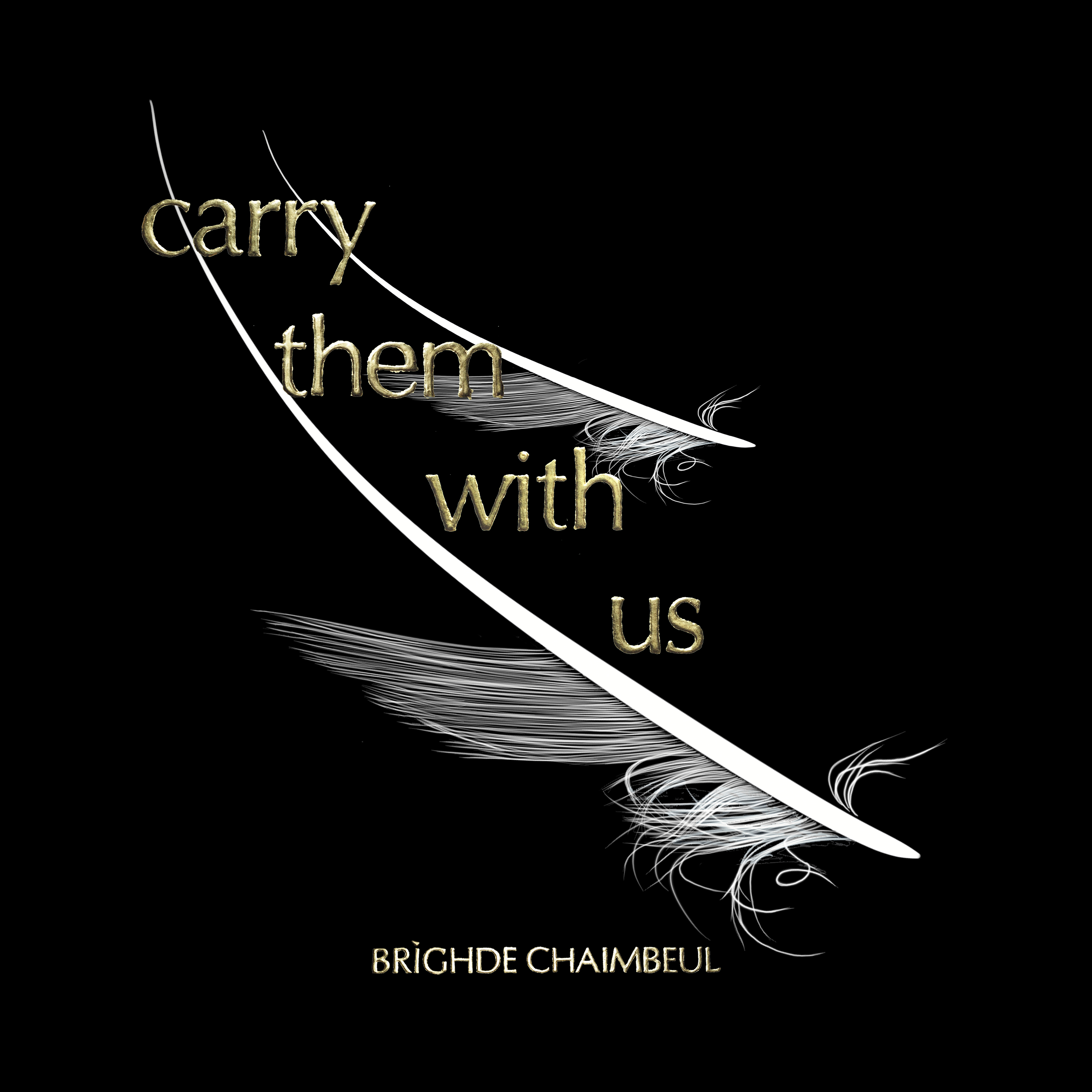
Squeezing new life into the obscure double-note droning Scottish small bagpipes, the Isle of Skye artist Brìghde Chaimbeul explores fertile new atmospheres on her second album, Carry Them With Us. Although borne out of long-held traditions, a bird themed mythology and Western Isles folklore, the piped and circular avian-like suffusions transform old arrangements and tales into something altogether different.
A familiar Celtic air is improvised with, transcribed to sound like a bedfellow of India, the Appalachians and the dream-realism folk of Chaimbeul’s tak:til label mates Širom. Already an award-winner (BBC Young Folk and Horizon prizes), the native Gaelic speaker expands horizons further on this newest work of mysticism and stirring scenic evocations by collaborating with the visionary saxophonist/artist/composer Colin Stetson.
Initially exchanging tweets, with an invitation from Stetson for Chaimbeul to record something for a documentary he was involved with, in kind the explorative American came over for a visit in the summer of last year. Writing and recording with his Scottish host, this sonic partnership ended up producing the “organic” foundations of this nine-track fusion of folk, the neoclassical, new age and fourth world-like peregrinations. Stetson appears on six of those tracks; although its difficult to know where one individual instrument, contribution ends and the other one starts, as both the small pipes and saxophone pretty much meld together in a mizzle or sustained bed of droned impressions. Saying that, ‘Uguviu (II)’ with its almost fiddled dance reminded me in part of Don Cherry, and has more obvious stirrings of new age jazz. It also reminded me a lot of Ariel Kalma. Together on the traditional sourced ‘Órgn An Eich Uisge: Song Of The Waterhorse’ they take what sounds like a Jacobean Highland battle drum arrangement towards the minimalistic borders of Cage and Riley, and the more spiraling vortex cosmos of Frédéric D. Oberland.
This inspired musical partnership proves highly successful envisioning an almost hermetic synthesis of influences and geography; the opening ‘Pilliú: The Call Of The Redshank’ and ‘Tha Fonn Gun Bhi Trom: I Am Disposed Of Mirth’ proving extraordinary, evocative riffs on bird-flight and the ancient lore of the land.
Uncoupled from Stetson, Chaimbeul channels both the Celtic and a whiff of India mountains on the fluty, turn near polka dance, ‘Banish The Giant Of Doubt & Despair’ – a tragic old tale of a drowned, once marauding, giant succumbing to his fate through the alluring siren song of the King’s daughter. We actually get to hear Chaimbeul’s effective apparitional-like voice, singing in the mother tongue on the beautiful misty vaporous finale, ‘Bonn Beinn Eadarra: The Haunting’. Another string to the proverbial bow you could say.
An evolution and a response to the traditions of the Western Isles, Chaimbeul’s drones, bellows and piped vapours conjure up a whole new folkloric magic that sonically reaches beyond Scotland’s borders. This is an album that connects different worlds and centuries on an impressive textural, tonal soundtrack of the recognisable and more abstract forms of Gaelic, minimalism and the new age.
Tuzeint ‘Raixes’
(Extra Soul Perception/Worldwide Records) 21st April 2023

Returning to his roots, Tuzeint opens up his heart on his Latin-soul flavoured debut.
Marking not only the first expansion by the community-collaborative Extra Soul Perception platform into the Spanish language, but this soloist release also finds, for the very first time, Tuzeint singing in his native Mexican-Spanish tongue too; aided by an ensemble of musicians playing a number of localized Central and South American instruments with links back to Iberia.
Channeling a CV that includes stints as the motivational force behind Mexico’s 90s hip-hop legends Control Machete, as a producer, and a remixer for M.I.A., Run The Jewels and Vampire Weekend, the thirty year old Monterrey-based artist weaves together a lilting, sauntering merger of Veracruz region stringed guitar work serenades, Afro-Brazilian percussion, r’n’b and sophisticated breakbeat soul.
Unmistakably Latin but with some subtle, interesting twists and whiffs of 80s new wave, some hip-hop production and a touch of the dreamy, near psychedelic, Raixes is like a tropical bleached romance between Earth period Vangelis, D’Angelo, Manduka, the Buena Vista Social Club, El Michal’s Affair and Les Sins. Accompanied by the plucked, flanged, delicately woven Baroque and folk of Xinto’s nylon-stringed, narrow-bodied Jorana Jarocha (almost a guitar but much smaller), Vico Diaz’s lower-pitched, almost double-bass-like, four-stringed Leona, Lucio de los Santos’ bird-y flute, Alan Fajardo’s shortened tooting and more suffused trumpet and a combined percussive and drummed effort from Jorge Jimenez, Andres Jamie, Orestes Gomez and multi-instrumentalist Enrique Toussaint, Tuzeint sings with a soul-love yearn and lulling relaxed flair.
To echoes of light jazz, tropical mirages, Gulfstream beachside troubadour reminisces and sumptuous soothed croons, burdens and desires are shared equally with romantic, languorous élan. As relaxed and inviting as this music is, the emotional draws are deep and affecting. But its nothing less than a delightful, soul bearing and enjoyable album; a neo-soul delight.
Les Abranis ‘Amazigh Freedom Rock 1973-1983’
(Bongo Joe Records) 28th April 2023

Making good on Bongo Joe’s 2018 45s series showcase of Les Abranis tracks, this expanded compilation follows the eclectic Algerian group’s adoption of garage, psych, disco, acid rock and synth-pop during a decade period of their existence.
Proudly marrying an atavistic Kabyle heritage to Western sounds, Les Abranis were born out of a diaspora and mass migration to France: Paris especially. The Berber Kabyle from Algeria’s Northern region and Atlas Mountains moved in great numbers to escape cultural persecution, civil war and economic strife. This ethnic group’s reach is far, with iconic stars of the screen, music and arts, politics and sports all fully embedded in popular French culture (Zinedine Zidane being one such superstar with those Kabyle roots).
However, politically, as Les Abranis promoted, this million-plus community seek autonomy, self-determination in Algeria: the name of which is used in the “freedom” barricade breaching title, the “Amazigh”. That freedom, found in Paris of the tumultuous counterculture late 60s, was not just political but musically important. It gave a greater scope to the band’s sound, as they opened up the traditional signature rhythms of home with a fusion of genres; sometimes to the consternation of their fellow Algerians, as one highlighted anecdote regales. Performing both this compilation’s opening high-pitched Doors and 60s garage beat grooving ‘Athedjaladde’ (which actually, as it progresses, also pulls in a guitar pedal wah of Isaac Hayes and touch of 60s Zappa) and the Habibi Funk like, suffused Doors (again) organ and handclapped spin ‘Ayetheri A L’ Afjare’ on national Algerian TV in 1973, as part of the more traditional Festival of Modern Algerian Song, they cause a certain furor and were near booted off stage: their hippie, loose liberal interpretation deemed too radical it seems.
Originally crossing paths in one-such Maghreb rich hip Paris neighbourhood in 1967, Shamy El Baz and Karim Abdenour conceived the idea of merging the Western styles they both loved with home. Bassist Madi Mehdi and drummer Samir Chabane would fill out that first proper lineup, playing a form of garage, psych and North African acid-rock. By the time they reached the 80s they’d not only changed personal – recruiting the Corsican jazz drummer and rhythm provider for fellow Kabyle superstar Idir, André “Dédé” Ceccarelli – but their style too; fully immersing themselves in synth pop. A chunk of the choice tracks on this collection actually come from the band’s 1983 album N1; the sound of which is slicker, smoother and enveloped in the decade’s vapoured production of disco, new wave, pop and soft rock. Songs like the female swooned and male vocal caroused ‘Therrza Rathwenza’, and the synthesized wind swept, Sly & Robbie era Grace jones slinked reggae groove ‘Avehri’ are two such examples of this shift. ‘El Guoum Agui’ sounds a bit 80s Paisley Prince, albeit with that exotic Algerian production. The cool Persian discotheque number ‘Akoudar’ is almost Chic-esque. But from a previous chapter in the band’s development, the organ-poked ‘Chenar la Blues’ sounds simultaneously like early Can, Canned Heat, the Stones and the Easybeats shimmying in a Berber dance.
There are some quite incredible progressive fusions and more than enough Parisian-Algerian nuggets to make this a vital addition to the collection. Kabyle culture rocks out in the Western arena.
Kiji Suedo ‘Hosek (EP)’
(Hobbes Music) Available Now

Following up on a well received album in December (Riot) for the Edinburgh electronic label Hobbes Music, Osaka artist Kiji Suedo heads lightly towards the dancefloor with an EP of “working it” House and Techno numeral-loaded tracks.
Jacked-up and softly pumped with various shimmered and melodious wave forms, acid-washes, knocked beats and hushed languid soulful vocal prompts/actions, Suedo offers up a deeper dance music listening experience.
It’s an early House meets Electronic Body Movement and sparse Harthouse/R&S Techno kind of vibe, with additional spells of untethered bulb-like jazzy organ notes, scrapping kinetic marbles and a near constant motion of rotating, sliding, switching and turning synthesized mechanisms.
Good calls have already been made: Moodyman and Herbert on the press sheet, and someone else gave a shout for Theo Parish. I would add to that equation some Basic Channel, Dave Clarke, Mike Dred and a hell of a lot of late 80s/early 90s sounds too. But in short, and without sounding to gauche, this is dance music for the mind, body and soul from an artist on the rise.
Puce Moment ‘Epic Ellipses’
(Sub Rosa) Available Now
From out of Nicolas Devos and Pénélope Michel’s Puce Moment sound research lab (a French located incubator, inspired, well so it sounds on occasion, by the famous Kosmische Zodiak Club frequented by Moebius, Roedelius and Schnitzler) emerges another self-styled “climatic-noise” soundtrack of slow building drama and gravitas.
Existing somewhere between the forms of peregrination and studious composition, the duo finds conclusions, just the right end points through intuition and experience. Working together now for 15 years, across the arenas of fiction, documentary and virtual reality, both foils on this sonic explorative journey can be said to have found that perfect syncopation.
Their fourth album together, Epic Ellipses evokes both the alien (the sci-fi meaning of the word) and the ambiguous. Over four long organic and synthesized atonal but yet melodious and motored tracks, off-world data, the sounds of strange oscillating and looming craft merge with vague percussive rhythms that could have been sourced from the South Seas, South America or Africa. Not so much ethnography as the balanced but untethered construction of new worlds, ritual is transduced into near-cinematic suspense, thriller and the mysterious.
“Allotropia” sets out from an echoed chasm of sine waves and static-rips in the fabric, before a siren’s ethereal voice materializes from industrial ominous atmospherics and internal, heartbeat rhythms. ‘Skyli’ has robotic-like calculus, fed digital data, cosmic undulations and a distant singular knocking beat. Gradually those knocks turn into a slow beat, as strange noises and the corridor to some distant constellation opens up and guides us onto some new plane. ‘Motor’ reminds me of Hamburg label Bureau B’s output – that tie to kosmische and German minimalist electronica perhaps. Although the lulled voice and vague elements of faraway lands eventually end up sounding quite dramatic: lost in the ether. An air of very early Cluster and Popol Vuh’s Affenstunde debut can be detected alongside Cosey Fanni Tutti under the quietened surface veils of the womb-like ‘Taifuu’. From vaporous mists, waves and ambience a filmic, immersive soundtrack builds; one that entices and organically forms visitations, memories, feelings of time and place: destination. Epic Ellipses is a quartet of moods, emotional draws that ends up inventing environments and score to mysterious surface and horizons.
Carla Boregas ‘Pena Ao Mar’
(iDEAL Recordings) Available Now

Featured last year on the Monolith Cocktail, congruously in electroacoustic jazz-primitivism union with fellow Brazilian explorative sound artist Maurício Takara on the Grande Massa D’Auga peregrination, Carla Boregas now drifts out an ambient, both non-musical and more melodic-hinted sonorous waves with her debut solo offering.
Although already making a name for herself, both in native Brazil and in Europe (currently based in Berlin) with the Rakto trio (with Paula Rebellato and again, Maurício Takara) and Fronte Violeta duo (with Anelena Toku), and as the founder of the experimental AUTA venue and Dama Da Noite label, Boregas now expands on a subtle minimalistic palette of tape play, sonic assemblage manipulations, field recordings and hidden instrument sources.
Conduced to roaming and following the played and synthesized air and wind flows, as we reflect on the tenuous, fragile and complex nature of existence, Pena Ao Mar (or “pity the sea”) envelopes the listener within an ambiguous veil of sci-fi, mysticism and wooded menagerie, and drones that evoke the hermetic and a distant vision of India.
The opening ‘Acôes em Paralelo’ (“actions in parallel”) manipulates, plays with what sounds like a reel-to-reel machine; a reversed, crackled and hum drone mix of the avant-garde tape culture of underground Spain and Italy, with touches of kosmiche. Those early resonations of German cosmic music (from Kluster to Tangerine Dream and Gunther Wüsthoff) and “sisters with transistors” luminaries such as Suzanne Ciani can be heard permeating the title-track’s fanning geometric rays and refractions; the otherworldly harmonium church music gauzy ‘Grafia do Invisível’ (“invisible spelling”); and the robotic calculating, alien bird tweeting and box-of-tricks vibrating ‘A Cidade dos Outros’ (“the city of others”). ‘Current 2 Ventos’ (“wind and currents”) seems to gravitate more towards tubular-like blown droned instrumentation (a kind of transmogrified version of a serialism styled wind quartet, and a Jodorowsky feel, whilst ‘Sopro’ (“breath”), with its night creatures forest atmospherics, spoken word experiments and spooked piano, errs towards hints of Lucrecia Dalt and Xqui.
Along varied vapours, currents, waves and wisps of air, Boregas transports the listener to both evaporated and more tangible (but only just) environments and moods; realms of reflection and mysterious spaces that attempt to capture the abstract feelings of being alive in a most vulnerable state.
A Begging Bowl Request From Your Host:
Hi, my name is Dominic Valvona and I’m the Founder of the music/culture blog monolithcocktail.com For the last ten years I’ve featured and supported music, musicians and labels we love across genres from around the world that we think you’ll want to know about. No content on the site is paid for or sponsored and we only feature artists we have genuine respect for /love. If you enjoy our reviews (and we often write long, thoughtful ones), found a new artist you admire or if we have featured you or artists you represent and would like to buy us a coffee at https://ko-fi.com/monolithcocktail to say cheers for spreading the word, then that would be much appreciated.
The April Digest 2023: Voodoo Drummer, African Head Charge, Marta Salogni and Tom Relleen, Social Playlist #75, Bowie, Sakamoto…
April 11, 2023
New Music on our radar, archive spots and now home to the Monolith Cocktail “cross-generational/cross-genre” Social Playlist
Words/Put Together By Dominic Valvona

A new thread, feed for 2023, the Digest pulls together tracks, videos and snippets of new music plus significant archival material and anniversary celebrating albums or artists -sometimes the odd obituary to those we lost on the way. From now on in the Digest will also be home to the regular Social Playlist (this month reaching its 75th edition); this is our imaginary radioshow, an eclectic playlist of anniversary celebrating albums, a smattering of recent(ish) tunes and the music I’ve loved or owned from across the decades.
April’s edition also features new music from the VOODOO DRUMMER, Peggy Seeger, Marta Salogni & Tom Relleen, Gabrielle Ornate, African Headcharge and Vukovar. And in the Archives there’s a trio of Bowie album celebrations; the 50th anniversary of Aladdin Sane, 40th of Let’s Dance and 30th of Black Tie White Noise (all released in the April of their respective years).
NEW MUSIC IN BRIEF
VOODOO DRUMMER ft. Blaine L. Reininger & Martyn Jacques ‘Aristophanes’ FROGS’
Inspired by he Ancient Greek playwright Aristophanes’ comedic play of the same title, Antiquity beckons on a new triumvirate set of movements from the Greek artist VOODOO DRUMMER and his contributing foils. On this Athenian mythological imbued single of neoclassical, the atavistic, avant-garde, theatrical and yet hopping playfulness, the drumming alter ego is joined by Stavros Parginos on cello, Blaine L. Reininger (of Tuxedomoon note) on violin and Martyn Jacques (Tiger Lillies) echoing the famous line from the play.
The microcosm style odyssey follows the liberating God Dionysus who, despairing of the state of Athens’ tragedies, travels to the underworld of Hades to bring the playwright Euripides back from the dead. And so we begin this adventure to the sounds of rattlesnake percussion, Hellenic pitter-patters, rolling drum rhythms and the plucks of 5th century BC Athens, before rowing across a splish-splashing pizzicato and majestically bowed lake (complete with a croaking frogs chorus), and a sort of Faust meets strangely quaint experimental late 60s vocal. The final movement strikes up a controlled tumult of screaming and harassed viola and “Afro-Dionysus” drums as Hades opens up and swallows whole. An inspired musical, sound experiment performance.
Peggy Seegar ‘The First Time Ever I Saw Your Face’
Of course they’ve all tried, some convincingly, others less so, but the rightly venerated doyen Peggy Seegar is the muse behind this iconic love yearn. And at the age of 87, with all the travails of age and loss, but wisdom and reflection it brings, Peggy reclaims this masterpiece for a new era. ‘The First Time Ever I Saw Your Face’ was originally written for Seeger by her then-estranged lover Ewan MacColl in early 1957. He sang it down a crackling transatlantic phone line to Peggy who had returned to the USA, unwilling to continue an affair with a married man. That was the only time he ever sang the song, but it went on to be covered by most of the greats, and become one of the great standards.
Simplistically stripped to just a piano accompaniment, Peggy’s gracefully works the magic.
Peggy says; I’ve had two life partners, one male and one female, and I have three children and 9 grandchildren. I’ve come to realise that the lyrics can be interpreted in so many ways. Ewan wrote the tune to mimic the heartbeat of someone wildly in love and I used to feel like a soaring bird when I sang this song. Now I’m grounded within it and that makes me happy.
The 2023 recording – released for the 67th anniversary of verse 2 (The first time ever I kissed your mouth…..) – arrives alongside the first segment of a new documentary about Peggy, Scenes From A Life, which details the history of the song.
Marta Salogni and Tom Relleen ‘Internal Logic II‘
A mirage; a twinkle of refractions and calling undulations; the alchemist’s stone drawing light through a filtered bendy lens. Yes, the surroundings found on the new sonic peregrination by Marta Salogni and Tom Relleen invite evocative visions, and convey ambiguous, mysterious settings, landscapes. ‘Internal Logic II’ is just one of a myriad of such electronic cartography inspired traverses from the duo’s upcoming album Music For Open Spaces (released 11th May 2023). If you don’t know the story, Relleen died from cancer just after recording this album, and so this is a posthumous tribute to the late experimental seeker, as a dreamy, deep listen showcase for his foil Salongi.
Conceived between the triangle of the reverent Joshua Tree shrine and desert, the Cornish coastline and London, award winning artist, producer and engineer Marta Salogni (Björk, Holly Herndon, Lucrecia Dalt) and the much missed musician and artist Tom Relleen (Tomaga, Oscillation) conjure alternative road trips, destinations and geography. The first track to be aired, ‘Internal Logic II’ ushers in a promising expanded work.
Gabrielle Ornate ‘Delirium’
Turning on the rawkish rock mode of St. Vincent, but in a 90s invoked musical setting of bohemia, the free-spirited Ornate is back with another full-on maximalist confident pop explosion of “delirious” empowerment. Delirium is just another strong dream spell statement from the versatile artist, who’s currently drawing attention through her Instagram account, the good old word-of-mouth and blogs like mine (although Ornate has also recently featured on the BBC Introducing platform). After a run of equally bestridden pop-rock gems, with hints of Prince and Christina Aguilera, Ornate must be contemplating that first album. I for one will be looking forward to that.
African Head Charge ‘Microdosing’
(On-U Sound)
Taking me back to the toking days of idle youth, splayed out around the Phibb’s house listening to the wafting smoking waves of reggae and dub emanating from Eric’s sound system, one of the most popular choice soundtracks to wile away those 90s hazed evenings was African Head Charge. Of course so very much more, and though generally in a languid intoxication from drugs or booze that iconic project had a lot going on, multilayered in the mix than we first appreciated: Proving highly influential in fact; that sound resonating with subsequent generations, regenerating my decade of the 90s.
After a twelve year layoff, the titans of that UK scene, On-U Sound, have announced the news of a new album entitled A Trip To Bolgatanga. That cult label’s instigator Adrian Sherwood once more joins AHC founding member Bonjo Iyabinghi Noah on another evolving, developing dubby-laden, amorphous Afro trip. Extending that partnership multi-instrumentalist Skip McDonald and fellow Tackhead co-conspirator Doug Wimbish. Drummer Perry Melius, whose involvement in the project dates back to the early 90s, adds a righteous rhythmic heft to a trio of tunes. In addition there are a number of notable fresh recruits. The horns and reeds of Paul Booth, Richard Roswell, and David Fullwood; Ras Manlenzi and Samuel Bergliter on keys; Vince Black on guitar. There’s additional percussion from Shadu Rock Adu, Mensa Aka, Akanuoe Angela, and Emmanuel Okine, strings from Ivan “Celloman” Hussey, plus the voice of the mighty Ghetto Priest. Very special guest, and one of Ghana’s foremost kologo players, King Ayisoba also provides vocals, and demonstrates his dexterity on the traditional two-stringed lute.
From that upcoming album (released July 7th) a taster of the album’s Ghanian roots odyssey, with ‘Microdosing’.
Vukovar ‘An Invisible Prison II/Eternally Yours’
And so the final death knell has been announced for Vukovar. After eight years – despite numerous wrangles and bust-ups, episodes of self-flagellation/self-destruction – the hermetic romantics of cold wave and all its musical bedfellows have signed their fate. The perron foundations are still strong however, with news of a new birth and direction (of a kind). This is a digest of course, so far too much water has flowed down the River Styx to cover in this brief feature, but I feel like a champion for this underground phenomenon – the Monolith has even played host to band members Rick and Dan and their various posts, serialisations over the last few years. And have pretty much covered near enough every release – which in that short period covers at least ten full albums, live ones too, singles and various other releases. And so I will leave you with links to the numerous reviews I’ve penned below.
Vukovar leave one last memento however: the final single, leaving present ‘An Invisible Prison II’ and a B-side of a sort, ‘Eternally Yours’. Treasure them both, as the funeral pyre burns, the alchemists of esoteric new wave are no more.
Vukovar/Michael Cash ‘Monument’
Vukovar ‘The Great Immurement’
Rick Clarke’s The Great Immurement
Rick Clarke ‘Astral Deaths & Astral Lights’
Dan Shea ‘Jukebox Lockdowns/Tribute to Simon Morris’
ARCHIVES/ANNIVERSARY
A trio of Bowie album anniversaries of one kind or another this April. The oldest of which, Aladdin Sane is unbelievably 50! Whilst Lets Dance is 40, and Black Tie White Noise is 30 this month.
Killing off Ziggy Stardust to assume the lightning anointed role of Aladdin Sane, Bowie’s split personality only partially moved on from its precursor. If Hunky Dory pretty much alluded to the USA from a distance, then Sane is living it.
From the scuzzed rock’n’roll chugging riffs to the Latin-Cuban styled piano flourishes and ‘give my regards to Broadway’, Bernstein/Brecht passing fancies (thank you Mike Garson on phenomenal pianist chops and theatrical duties), Bowie is cast adrift, absorbed in the aroma of the Americas as an unbalanced gender bending dame, trying to make sense of it all.
Fantastical, yet nostalgic in equal measure, the backlot of 50s drive-ins, Che Guevara styled revolution on the streets of Detroit and heart-crushing laments, effortlessly turn from tears to swaggered rock, with ‘Time’ hanging over proceedings as a monolithic reminder of death: the stereotype rock star death in particular, in the case of the New York Dolls‘ Billy Murcia, as immortalised in the song’s lyrics. That’s all without even mentioning the aching, plaintive malady of ‘Lady Grinning Soul‘; perhaps one of the best things Bowie had ever written to that point.
An ott full-on glamified version of the Stones‘ ‘Let’s Spend The Night Together’ signals Bowie’s intent, a precursor to his love letter to the British ‘beat group’ (1964-67) era, and the covers album Pin Ups – released later in the same year, as the final-finale death knell of Stardust and his alter egos. Glorious, one of Bowie’s greatest fantasies and never out if my top five, if occasionally making the number one spot.
Protesting his innocence, rather too strongly, the $17.5 million dollar-richer Bowie inadvertently struck commercial gold with his 15th studio album Lets Dance. The formative RCA years were replaced with an uneasy transition to EMI, whose pricey acquisition would at least boost the label’s coffers during the mid to late 80s.
Undervalued and inappropriately shafted, Bowie’s long-time collaborator Tony Visconti was dropped at the eleventh hour in favour of Chic’s Nile Rodgers.
What Rodgers brought to the table was a vibrant, polished, more swaggering sound. MTV friendly and able to rouse the masses to their feet – just listen to the infectious gilding that turned a simple backbeat and Kenny Logan-esque guitar lick into something way beyond pop on ‘Modern Love’.
Apart from a few well-meaning but dawdling numbers, this album was really a collection of potential, and in the case of ‘Cat People’, previously successful singles. A jumbled coherence of themes permeate however, as a faux-colonial, abroad in WWII backlit Singapore or Macao, mixed with sharp lemon meringue zoot suit, Bowie launched into a diatribe on domestic abuse, racism and oppression. Taking a special interest in the aborigines cause, he dedicated the eponymous title track to their struggle.
For every guarded metaphorical attack, there was a counterbalanced slide onto the dance floor – ‘Shake It’ one of the thin white duke’s less challenging but contagious soulful paeans to courtship. Presented as a ‘singers’ album, Bowie concentrated on honing his electric-blues vocal delivery, relinquishing the usual playing duties.
Despite selling six million copies and attracting a newfound audience, he resented the attention and increased pressure, especially as Let’s Dance was at odds with his original intentions. He’d blame Rodgers’ varnished production – though this never stopped them from working together again years later on Black Tie White Noise – for sending him in a commercial, but aridly dry artistic direction. However, it’s an impressive work of spritely charming and neon-glowing pop. Just the opening global hot-steeping trilogy of ‘Modern Love’, ‘China Girl’ and ‘Let’s Dance’ would be enough to justify Bowie’s tumultuous decade alone.
Bowie the glowing groom was above the trivial of platitude wedding vowels and practicing special moves for the couple’s signature last dance. For his marriage to Iman Abdulmajid, he composed a typically nuanced musical suite in lovesick tribute.
Part of this ceremonial accompaniment (the opening moiety of ‘The Wedding’ and bookended ‘The Wedding Song’) was integrated, in to what would be, his heralded solo comeback LP, Black Tie White Noise.
Meant as a representation of two entwined cultures, the vaguely eastern romantic saxophone and western backbeat were used as a leitmotif: seeping into a fair share of the album’s twelve tracks. Tied-in with a return to a city that had dominated his songbook with themes of isolation and drug addiction (from Young Americans to Lodger), L.A, would settle for Bowie’s take on the race issues of the day. Jetting in as the whole Rodney King episode sparked off an apocalyptic raging inferno, Bowie both scared and exhilarated, breathed in the toxic air for inspiration.
Eager to refrain from sounding too glib, he wrote the album’s title track as a counterbalance to the grinning, smug optimism found on the “United Colours of Benetton” billboards. Angling his wit at the ethnocentric MOR, Bowie himself liberally drops in slogans and motifs from Marvin Gaye, faux-reggae and New Jack Swing, as he duets with one of the scenes passing stars, Al B Sure!
Mixing it up in the ‘ghetto’, Bowie once again ropes in Niles Rodgers to add some funky gristle and sheen to the jazzy, soulful template. He also took notes from Miles Davis’s late 80s/early 90s adoption of street sounds and be bop; bringing in the revered former Art Ensemble of Chicago’s trumpet player, Lester Bowie, to blow the sort of signature-plaintive squeals and trapped bumble bee solos commonly found in Davis’s repertoire.
The influence works both ways of course, but the omnipresent Scott Walker has always forced Bowie to…well, improve himself. Not so much a competition – Bowie would never quite reach the stripped avant-garde morose of his American rival – the two artists nevertheless spur each other on. Paying back a favour, Bowie covers Walker’s 1978, traversing grown-up, ‘Nite Flights’ (attributed to The Walker Brothers, their last album together as a reformed trio), aping but doing it justice. Whether intentionally imbued by the Walker spirit, the original intended Tin Machine song, ‘You’ve Been Around’ (written with Reeves Gabrels) sounds even more like one of his than Nite Flights.
Former glorious foil, Mick Ronson is heard on the placid, smooth, cover of Cream’s ‘I Feel Free’ (instigated as a result of Ronson’s work on Morrissey’s Your Aresnal) and illusionary rich, autobiographical ‘Jump They Say’: the first time Bowie addresses his half-brother Terry’s suicide in the 80s, by equating his own metaphorical artistic leap.
The odd ‘pop-lite’ tune, Caribbean warbling karaoke ditty (‘Don’t Let Me Down & Down’) and garish, over-egged, rendition of Morrissey’s ‘I Know It’s Going To Happen Someday’ threw spanners into the works, yet Black Tie White Noise pointed towards a wider Bowie renaissance, as it triggered an impending tenure of solid, experimental releases.
Tracks and a few cover version surprises await on the Social Playlist below:
The Social Playlist #75
Anniversary Albums And Deaths Marked Alongside An Eclectic Mix Of Cross-Generational Music, Newish Tunes And A Few Surprises.
Just give me two hours of your precious time to expose you to some of the most magical, incredible, eclectic, and freakish music that’s somehow been missed, or not even picked up on the radar. For the Social is my uninterrupted radio show flow of carefully curated music; marking anniversary albums and, sadly, deaths, but also sharing my own favourite discoveries over the decades and a number of new(ish) tracks missed or left out of the blog’s Monthly playlists.
Volume 75 of this long-running playlist series pays a humble, but sizeable, elegy to the recently departed Japanese genius Sakamoto. Whether it was building a unifying electronic music post-war future with the Yellow Magic Orchestra, building Bamboo houses of colour with David Slyvain, scoring the harrowing tragedy of war with Merry Christmas Mr. Lawrence, or winning gold at the Oscars/Grammys for his innovative soundtrack work, the iconic composer reworked neoclassical and electronica into a most influential new language – not totally at odds with its past, yet constantly evolving and probing at the edges of the undiscovered. With over 50 albums, probably a lot more to pick from, I’ve purely chosen personal favourites from a mere smattering of his cannon.
As I mentioned in my Bowie archive spot, and part of this month’s anniversary celebrating albums selections, there’s a healthy dose of original versions and covers from Aladdin Sane, Let’s Dance and Black Tie White Noise. Joining the thinned white duke in the anniversaries are R.E.M. (Murmer is 40 this month), the Freestyle Fellowship (Intercity Griot‘s 30th) and the Yeah Yeah Yeahs (Fever To Tell‘s 20th).
Recent editions to Spotify include Don Cherry and foil Jean Schwarz paying homage to the deity Ornette Coleman on the ’77 Live special Roundtrip, ‘Cat Nip‘ from Levoit‘s Sharav album, and butt end of 2022 tracks from Raw Poetics and Elizabeth M. Drummond. Plus a real catch of choice music from across the ages and genres by New Young Pony Club, Sunny & The Sunliners, Oswald D’Andrea, Fred Pallem, Sweet Tee, Shira Small and others.
THAT TRACK LIST IN FULL________
Octopus ‘Panic In Detroit’
David Bowie ‘Shake It’
New Young Pony Club ‘Hiding On The Staircase’
Ryuichi Sakamoto ‘Just About Enough’
Pralo Ormi e la sua Orchestra ‘Black Pipe’
Ryuichi Sakamoto ‘The Garden Of Poppies’
Leslie Winer ‘John Says’
HEC ‘The Prettiest Star’
R.E.M. ‘West Of The Fields’
Yeah Yeah Yeahs ‘Black Tongue’
Alejandro Bravo ‘Naranjita’
Lulu ‘Watch That Man’
Sunny & The Sunliners ‘I Can Remember’
Oswald D’Andrea ‘Bambou Jump’
Harold McKinney ‘Freedom Jazz Dance’
Freestyle Fellowship ‘Heavyweights’
Ryuichi Sakamoto ‘ADELIC PENGUINS’
Elizabeth M. Drummond ‘Congratulations’
Metro ‘Criminal World’
Terry Riley & John Cale ‘Church Of Anthrax’
Leviot ‘Catnip’
Don Cherry & Jean Schwarz ‘Tribute To Ornette (Live)’
Fred Pellam & Le Sacre du Tympan ‘Stratageme 34’
Ryuichi Sakamoto ‘ISLAND OF WOODS’
David Bowie ‘Miracle Goodbye’
Sweet Tee ‘On The Smooth Tip’
Raw Poetic & Damu The Fudgemunk ‘A Mile In My Head’
Joe Mensah ‘Happy Beat’
Shira Small ‘Lights Gleam Lowly’
David Bowie ‘Nite Flights’
Ryuichi Sakamoto & David Slyvian ‘Heartbeat’
Cheval Sombre ‘Time Waits For No One’
Ryuichi Sakamoto ‘Before The War’
Shukar Collective ‘Calling Tagomago’
Ryuichi Sakamoto ‘riot in Lagos’
Our Daily Bread 567: The Oldest Voice In The World (Azerbaijan) ‘Thank You For Bringing Me Back To The Sky’
April 3, 2023
ALBUM PURVIEW SPECIAL
Dominic Valvona

CREDIT: Marilena Umuhoza Delli
The Oldest Voice In The World (Azerbaijan) ‘Thank You For Bringing Me Back To The Sky’
(Six Degrees Records) 6th April 2023
There can be few remote corners of this well-traversed globe left unrecorded, yet the celebrated polymath and renowned in-situ recordist Ian Brennan and his wife, but most importantly partner on these sonic expeditions, the filmmaker and photographer Marilena Umuhoza Delli, have found one such spot on the Azerbaijan border with Iran. So remote in fact, almost untouched by modernity and technology, that the language spoken in this mountainous village is almost unintelligible to even those living in the valley below.
Settled by the atavistic Talysh people of this region, this outlier of naturalistic and hardened living is an ancient place with challenging origins shrouded in thousands of years of obscurity. Perhaps ancestors of the old Iranian tribe the Cadusii, this unique ethnic community, clinging and camped out on the southern mountains of Azerbaijan, is famous for its longevity; said to be the home of the oldest ever recorded human, at (an allegedly) 168 years old! But despite that remoteness, the ever encroaching dreaded Covid-19 pandemic found its way there, and by the time Brennan and Delli travelled to this outcrop, the number of centenarians had diminished greatly. As if the pandemic wasn’t tragic enough, our sonic explorers found that the living conditions for these elders were extremely harsh: no indoors plumbing, forced to sleep on floorboard mattresses. And so this project, just the latest in at least fifty recordings by Brennan, became an antidote of a kind to anti-ageism.
As dangerous places, states in flux and aftermaths of genocide go, compared to many of Brennan’s tour-of-duties (Rwanda, Vietnam, Cambodia, Pakistan etc.) Azerbaijan, on the surface, seems a far less hostile safer bet. However, that Southern Caucus region’s decades old fight with its western neighbor Armenia over the complicated and disputed landlocked Nagorno-Karabakh region (the Armenian’s refer to it instead as the Artsakh) reared its ugly head again in 2020; only brought to a conclusion (of a sort) by a trilateral agreement overseen by Russia in November of that year. In a window of opportunity Brennan and Delli made the trek in late 2021. Just months later, Russia would of course invade Ukraine.

CREDIT: Marilena Umuhoza Delli
What they both discovered and recorded for posterity is a most incredible document of elderly sagacious voices very much alive, yet all to aware of their own mortality. Surviving COVID but left to mourn those that didn’t, this should be a lamentable, saddening proposition. Far from prying in on a collective trauma, with a number of the performers obviously distraught and in a state of anguish at times, Brennan’s hand was indeed kissed by a long-since retired shepherd, who repeated his gratitude (giving the album its title in the process): “Thank you for bringing me back to the sky”.
This album could, like so many previous recordings in this vain, be said to act as a sort of therapy; a release. It certainly isn’t in the spirit of Lomax, saving old voices before they disappear; an ethnomusicologist exercise in Western preservation. As a subtle augmentation of elements are added, with some vocal performances, aches and talks further transported by a number of past Brennan collaborators (Kronos Quartet, Tinariwen, The Good Ones and Yoka Honda) on the bonus tracks.
For those new to Brennan’s hands-off approach, the set-up is as un-intrusive and natural as possible. The surrounding environment isn’t just welcome to bleed into each recording but invited. This translates into the creaking of a door; the crackled flames of a furnace; and in the case of the afflatus-touched ‘Lullaby’, what sounds like a rhythmic trudge through water.
Whilst most expressions, deliveries of earthy travail and more heavenly thanksgiving are pretty stripped back, soft but effective uses of mirrored and echoed reversals are used on the warped piano yearned ‘My Mother Lived To Be 110’, and the more avant-garde piano and spoken ‘The Young Men Are Sent To Die In Rich Man’s War’. This turns some recordings into portals to other worlds, others, like something from Zardoz, or even psychedelic and otherworldly.
Voices are effected on the reverberated, forewarned ‘Son, Don’t Go There, The Road Is Dangerous’, turning a couple of different vocals into something both giddy and esoteric. I haven’t asked or searched it out so do forgive my ignorance, but the poetic ‘You Are A Flower Yet To Grow’ sounds like it has some kind of accompanying bassoon blowing away on it; and ‘Pepe, Pepe (Donkey Song)’ features what I can only describe as a sort of primitivism jazz horn. There’s hand drums being respectively rattled and hit on the longer, lyrically melodious dance, ‘Bulbul (Nightingale)’ and the more Persian sounding ‘Screaming From The Mountain Top For My Son’.

CREDIT: Marilena Umuhoza Delli
Amongst the often more distressed offerings and terms of abandonment, wise advice to longevity comes in the form of the trolley-full-rattled-crockery (or so it sounds) accompanied heartfelt ‘The Secret To Life: I Was Loved’, and the acoustic guitar wobbled and bandy-stringed, talked ‘The Secret To life: I Worked Hard And Ate Butter’ – dairy lovers like me take comfort; although my work rate of honest craft and toil will have to be increased considerably if that’s the case to long life.
A quartet, as I mentioned earlier, of collaborative transformations have been added as “bonus” material. All those involved have at some point crossed congruous and valuable paths with Brennan in the field or studio, the first being the Kronos Quartet who lift a sorrowful Talysh mountain border voice with a treatment of neoclassical held and bowed strings and gravitas. Yuka Honda, meanwhile, evokes Die Wilde Jagd and The Pyrolator on the sophisticated electronic and minimalist Techno affected ‘Prayer Overheard’.
One of Mali’s Tuareg luminaries of desert rock and blues, the much lauded Tinariwen, cast a near Medieval and Oriental dream spell on ‘Ghosts’, and the Rwandan farming bluesman, The Good Ones, provide an elasticated, stringy and stripped backing for the female-voiced ‘A Lifetime Still’ – complete with a light chorus of birds.
Loss, bereavement, the wise observations of those uncomplicated voices, this latest recording from Brennan and Dilli (who records each project through her lens) encourages a dialogue and offers a unique angle on ageing, or rather, the abandonment and prejudice of growing old. In a time in which we’ve grown to distrust, cast off and denigrate old age in the pursuit of eternal youth (cosmetically and through the filters of Instagram), the old are looked on with embarrassment and as a burden; their deaths on mass, as they were shunted out of hospitals into care homes to spread COVID, until recently, seen as just a unfortunate result of the pandemic. We’ve come to see ageing as a reminder of our own unwanted mortality. As I’ve said, those voices come alive in the presence of Brennan, cutting through the pretence and bullshit with the most emotionally profound wisdom and anguish of the times. With such a skilled touch, Brennan loses none of the atavistic traditions yet transforms his hosts’ song into the “now” with a near-psychedelic, otherworldly and spiritual production of folk and the avant-garde. This is quite unlike anything else you’ve heard.
Hi, my name is Dominic Valvona and I’m the Founder of the music/culture blog monolithcocktail.com For the last ten years I’ve featured and supported music, musicians and labels we love across genres from around the world that we think you’ll want to know about. No content on the site is paid for or sponsored and we only feature artists we have genuine respect for /love. If you enjoy our reviews (and we often write long, thoughtful ones), found a new artist you admire or if we have featured you or artists you represent and would like to buy us a coffee at https://ko-fi.com/monolithcocktail to say cheers for spreading the word, then that would be much appreciated.
Monthly Playlist Revue Of March 2023: Snapped Ankles, Tinariwen, Murs, ILLAMAN, Salem Trials, Anemic Cinema…
March 31, 2023
The Monolith Cocktail’s Monthly Playlist Of Choice Music
Picked By Dominic Valvona, Matt Oliver, Brian ‘Bordello’, Gillian Stone, Graham Domain.

Three and a half hours of choice music from March, the Monolith Cocktail Revue features tunes from our reviews and columns, plus the tracks we didn’t get room to feature. This month’s selection is courtesy of Dominic Valvona, Matt Oliver, Brian ‘Bordello’ She, Graham Domain and Gillian Stone.
____TRACK LIST____
Snapped Ankles ‘Planet You’
Sparkz ‘Overlord’
Spectacular Diagnostics ‘Political Monsters’
Anemic Cinema ‘Oneirophrenia’
ASSASSUN ‘Unfold On My Chest’
Man/Woman/Chainsaw ‘Back/Burden’
Salem Trials ‘Calculating R’
Ruxpin & Stafraenn Hakon ‘Unmapped Landscapes’
DJ Black Low ‘Thando’
Tinariwen w/ Fats Kaplin ‘Tenere Den’
Dur-Dur Band International ‘Wan Ka Helaa’
Adrian Younge/Ali Shaheed Muhammad & Lonnie Liston Smith ‘A New Spring’
Juppe ‘Fade’
Ramson Badbonez ‘Stir Fried (Remix)’
The Waeve ‘Kill Me Again’
Tilo Weber ‘Nacre Nacre’
Areia ‘The Deaf Man Three’
Sultan Stevenson ‘Summer Was Our Holy Place’
Chairman Maf ‘Deep Water’
Dub Sonata/BlackLiq ‘The B-Side’
Ali Farka Toure (Ft. Oumou Sangare) ‘Bandolobourou’
Philip Selway ‘Strange Dance’
Benedict Benjamin ‘White Noise’
Schizo Fun Addict ‘Over The Hill And Far Away’
Nivis ‘Rain On A Funeral March’
Saba Alizadeh ‘Nafir’
Frederic D. Oberland ‘Quatre Epaves d’Acier’
Qrauer ‘Foq (ANGRiDAD RMX)’
Carmen Jaci ‘I See’
Healing Force Project ‘Adrift In The Stratosphere’
Murs ‘Spaghetti At The Ghetty’
Efeks Ft. Breezy Lee & Steady ‘Grateful’
Rico James ‘All Candles’
Varnish La Piscine ‘NUBIAN FARLOW’
ILLAMAN Ft. Pitch 92 ‘Sometimes Relax’
AJ Suede/ Televangel ‘Terrible’
ILLAMAN Ft. Pitch 92 ‘Absolutely Tidy’
Che Noir/ Big Ghost Ltd. ‘Quiet Movers’
Niclas Tamas ‘Cosmology Mammal’
Tomo-Nakaguchi ‘The Starry Night’
Jman/The Argonautz ‘Dying Breed’
Farmabeats/Baileys Brown ‘They Live We Sleep (Pricks From The Thorn)’
Joel Harrison & Anthony Pirog ‘Critical Conversation’
Lukas Traxel ‘The Call’
Lucy Kruger & The Lost Boys ‘Heaving’
Smashing Red ‘Hot Sun’
Goodbye Karelle ‘Moonroad’
Halo Maud ‘Catch The Wave’
Night Noise Team ‘Little Shocks’
Ghosts On TV ‘Life In Plastic’
Salem Trials ‘Super Spreader’
$T33D$_uv-LUV ‘J.O.1.’
Première: Renato Fiorito ‘Medusa’
March 29, 2023
TRACK PREMIERE
Dominic Valvona
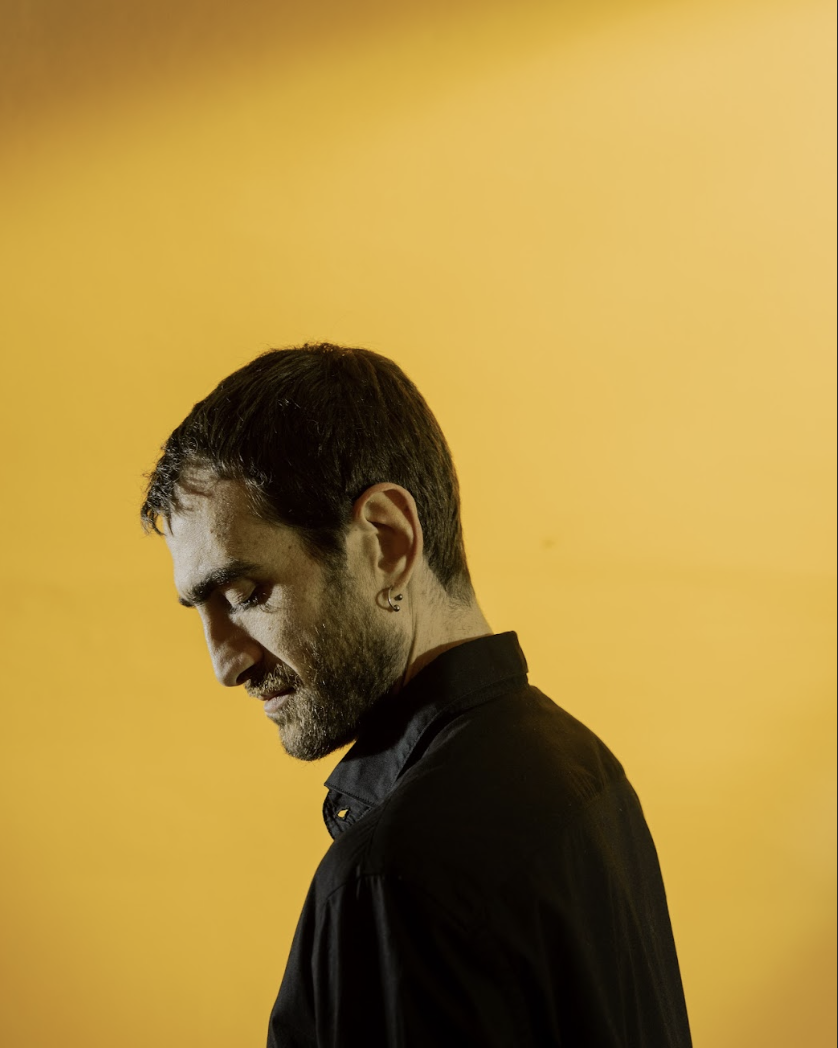
Renato Fiorito ‘Medusa’
Taken from the upcoming Lustra album, released on May 4th by Non Sempre Nuoce
A votive offering of gratitude and devotion to the city he calls home, Renato Fiorito’s personal vision of Naples is the subject of the upcoming symphony, Lustra.
Following on from the Neapolitan composer, sound artist, live performer and sound engineer’s site-specific sound installation ‘Straight/Wandering’, commissioned and premièred at the 2022 Le Guess Who?! festival, this new concept album pays a special sonic homage to both Naples’ rich afflatus and street musical theatre and the bustling lives of its people; merging and filtering collected field recordings from across the city with passing melodies, reverberations of fleeting song, exchanges and a production of stirring, congruous electronica.
Straddling the bay looking out towards the Gulf, a fertile fecund in part because of its precarious proximity to Mount Vesuvius, Naples has perhaps one of the most incredible histories of any important city: in fact, perhaps one of the oldest continuously inhabited legacies too, stretching back to its foundation by the Greeks in the first millennium B.C. Fought over in that time by untold invaders, part of a number of forced (and more welcome) kingdoms, the people have still maintained a strong independent identity: a unique marriage of turmoil, violence and the sublime. Fiorito calls it a “place of ashes, blood; place of flowers and wine”. Artistically and culturally ascendant whilst the undead still linger in catacombs below the streets, a busy modern society attempts to navigate an archaic metropolis.
With a saintly “voto” alter on every street corner; a shopkeeper’s aria and promenade serenade competing to be heard above the rigged mufflers of mopeds, Lustra, as its “illuminate” translation describes, lightens up Naples psychogeography, shining a lens on the daily sounds, the unplanned, uncloyed captured moments when the industrial and abstract comes into contact with the musical. This manifests as mere evaporations, mirages or vapoured airs of a time and place; mirages often suffused with the sound of the sea rolling ashore, a crackling fire or the non-musical rhythm of play, of tools working away on some project or other. Serialism woven into a fabric of engineered sine waves, refractions, ambience, metallic and minimalistic percussive beats, the familiar becomes mysterious, holy, even ominous; the ephemeral now caught and bottled for posterity.
From that album, the Monolith Cocktail is premiering the vaporous, patted-beat turn subtle circular wave ‘Medusa’. “Jellyfish” or a reference to the mythological gorgon immortalised by all the Italian greats, including Naples fleeting wanderer Caravaggio, there’s a sense of under-the-surface breathes beneath the building granular and lightly churned textures.
Released on May 4th Lustra sees Fiorito once more collaborate with his sonic partner and fellow Neapolitan Antonio Raia on the crackling fireside, faint melodic and reflective softly rasped saxophone memory ‘3694’. Fiorito and Raia previously created the similar conceived Thin Reactions soundscape during lockdown in 2021, for the same Naples boutique label Non Sempre Nuoce (a track from which we premièred). The album’s only other named guests, the notable Suonno d’Ajere trio, can be heard on the well-known transformed aria ‘Mmiez’ ‘o Ggrano’; emerging from a filtered dream like submersion, a ether of singing, wave forms and subtle beats, their signature serenade of Neapolitan song pulls focus on the city’s dignified street musician heritage.
A new language formed from the musical history of Naples; its loves, devotions, desires and day-to-day interactions take shape in a contemporary field of ambience and downplayed electronica. You can pre order it now.

