The Monthly Playlist selection of choice music, plus our Choice Albums list from the last month.

We decided at the start of the year to change things a little with a reminder of not only our favourite tracks from the last month, but also a list of choice albums too. This list includes both those releases we managed to feature and review on the site and those we just didn’t get the time or room for.
All entries are displayed alphabetically.
Meanwhile, our Monthly Playlist continues as normal, with all the choice tracks from May selected by Dominic Valvona, Matt Oliver and Brian ‘Bordello’ Shea.
CHOICE RELEASES FROM THE LAST MONTH OR SO:
A Single Ocean ‘S-T’
Review
The Balloonist ‘Dreamland’
(Wayside & Woodland) Review/Piece
Black Liq & Dub Sonata ‘Much Given, Much Tested’
The Bordellos ‘Liam Gallagher’
(Metal Postcard)
Cumsleg Borenail ‘It’s Your Collagen Not Your Conversation I Desire, My Pretty’
Famo Mountain ‘For Those Left Behind’ – This month’s cover art
Fir Cone Children ‘Gearshifting’
(Blackjack Illuminist Records) Review
LIUN + The Science Fiction Band ‘Does It Make You Love Your Life?’
(Heartcore Records) Review
Neon Crabs ‘Make Things Better’
(Half Edge Records) Review
SAD MAN ‘Art’
(Cruel Nature Records) Review
Staraya Derevyna ‘Garden Window Escape’
(Ramble Records/Avris Media) Review
Tomo-Nakaguchi ‘Out Of The Blue’
(Audiobulb Records) Review
Zavoloka ‘ISTYNA’
AND NOW, THE MONTHLY PLAYLIST::
LIUN + The Science Fiction Band ‘SPEAK TO ME’
SISTER WIVES ‘YnCanu’
Neon Crabs ‘J Spaceman’s Blues’
Fir Cone Children ‘Madness!’
A Single Ocean ‘White Bright Light’
Your 33 Black Angels ‘Your Sickness Solution’
Dabbla, Ghosttown, Dubbledge ‘Karate Good’
Black Liq & Dub Sonata ’10 Black Commandments’
Homeboy Sandman & Brand The Builder ‘Infinite Pockets’
Milena Casado ‘Yet I Can See’
Wildchild ‘Change For 2 Cents’
The Strange Neighbour & L One ‘625’
Pan Amsterdam & Leron Thomas ‘Evening Drive’
Famo Mountain ‘My Struggle To Survive’
Orain ‘Tangerine’
Smashing Red ‘Dark Eyed Girl’
Meggie Lennon ‘Running Away’
Dyr Faser ‘Sinister Dialogue’
Battle Elf ‘Stops Pretty Places’
Violet Nox ‘Strange Remix by Jonathan Santarelli’
Tomo-Nakaguchi ‘Indigo Line’
Tom O C Wilson ‘Better Off’
The Mining Co. ‘Treasure in Spain’
Oliver Earnest ‘Directionless’
The Bordellos ‘Cabbage Patch Doll Kiss’
Mama Oh No ‘Samba De Janeiro’
Zavoloka ‘Vesnianka’
Cumsleg Borenail ‘Signus Vectors’
OvO ‘Scavo’
Fatboi Sharif & Driveby ‘Swim Team Audible Function’
Cosmic Ear ‘Father and Son’
Staraya Derevnya ‘Tight-Lipped Thief’
Operation Keep The monolith Cocktail Afloat:
Hi, my name is Dominic Valvona and I’m the Founder of the music/culture blog monolithcocktail.com For the last 15 years both me and the MC team have featured and supported music, musicians and labels we love across genres from around the world: ones that we think you’ll want to know about. No content on the site is paid for or sponsored, and we only feature artists we have genuine respect for /love or interest in. If you enjoy our reviews (and we often write long, thoughtful ones), found a new artist you admire or if we have featured you or artists you represent and would like to say thanks or show support, than you can now buy us a coffee or donate via https://ko-fi.com/monolithcocktail
The Digest for April 2025: New Music/The Social Playlist
April 25, 2025
The Monthly Digest includes a clutch of accumulated new music review, and the Social Inter-Generational/Eclectic and Anniversary Albums Celebrating Playlist.

___/THE NEW___
Staraya Derevyna ‘Garden Window Escape’
(Ramble Records/Avris Media) 2nd May 2025
Pulling out of the historic district of St. Petersburg once more to conjure up an amorphous polygenesis-sourced hallucination, the pan-global Staraya Derevyna capture of diverse artists, led by the Israel/Ukrainian musician and sound engineer Gosha Hniu, wheel out the mechanical dream-machine on their latest estranged and avant-garde descriptive album Garden Window Escape.
Imagine Beefheart conducting the Sharmanko Kinetic Theatre, or Faust manhandling a pair of shearing buzzing shavers. Perhaps, the Plastic Beatniks warped mirage vision of Americana coming up against the sound worlds and the alternative pyschogeographic folk of Širom and La Tène. You can imagine the Red Crayola in Eastern Europe during the Medieval times, hanging out with CAN as they dish out their EFS series experiments whilst a languid Einstürzende Neubauten add their signature imaginings and post-punk industrial stirrings.
The imaginative hermitic workings and the transmogrified poetic works of the Russian polymath Arthur Molev that suffuse this latest release of performative and fantasy clockwork circus merges the mysterious with the murky, the atmospherics of alternative pastoral histories with the strained, strangulated and brassy textural wanes of bass clarinet, the flute and the cello, and the hidden source sounds of rope pulleys and cogs and levers that need oiling. For the icon Rus, the holy reimagined Rus is rewoven by the merry-go-round minstrels of Maya Pik, Ran Nahmias, Grundik Kasyansky, Miguel Pérez, Yoni Silver and Andrea Serafino to atheatre of esoteric poetry and dreams.
Who knows what it all means, but this collective always impress with their journeying and deeper connections to a sense of conceptualisation steeped in both the real and fantastical. Through the abstract and most emotive and surreal, every Staraya Derevyna is a revelation. And Garden Window Escapeis just as imaginative and evocative.
Michael Sarian ‘ESQUINA’
(Greenleaf Records) 25th April 2025
On the corner or a “corner”, albeit with a Spanish/Portuguese language entitled twist, the accomplished trumpeter, bandleader and composer Michael Sarian is imbued by the spirit of Miles Davis’s iconic 1972 LP – that and the electrified period that also took in Bitches Brew, Black Beauty and Agharta albums – on his latest album, ESQUINA.
Full of lunar mystery and dreamy mirages, Sarian traverses, hovers, inhabits and floats across a largely improvised vision of prog-jazz and jazz fusion; taking a different direction after a trio of albums that bordered more upon a chamber-jazz and acoustic sound. The same players now venture into territory mapped out so cosmically and exploratively by Jon Hassell, the Soft Machine, Nucleus, Weather Report, Herbie Hancock and the already mentioned Davis. In addition to the long form peregrinations that make up this three track album, the ensemble also transposes Portishead’s classic trip-hop track ‘Glory Box’; an influence for Sarian since he first heard it as a kid on its original release in the mid 90s, and here, transformed into a spacy soul-jazzy lounge vision of Pink Floyd and the El Michels Affair with the smooth melodic trumpet drifts and near sensitive expressions of Chat Baker and Kenny Dorman.
Back in the fold, now reconfigured and in a freeform mood of prompted celestial and hallucinatory dream experimentation and resonating gauze, noted Argentine pianist and composer Santiago Leibson probes, dabs, sustains Marion Brown bulb-like notes, galactic Davis sounds and Herbie Hancock effects, metallic and vibrating languages from the Hammond B3, the Mini Moog and Wurlitzer, Alaska born, NYC relocated in-demand bassist Marty Kenny offers near cosmic soulful bass lines, prog noodling and swamp funk undertones, and renowned Brooklyn-based drummer Nathan Ellman-Bell makes his way around the kit as he offers the subdued and descriptive and leaps of near d ‘n’ b-like breaks and cymbal splashes. As I said before, this is near lunar in its projection, on the edges of tripping out; at times, and as noted in the PR notes, sounding not too dissimilar to the work of Donny McCaslin. At other times it reminded me of Arve Henriksen. We are of course in the jazz fusion sphere of influence, but not quite indulgently prog enough to put people off.
Instead, we get a band escaping their surroundings, pepped up on electric Davis but not quite breaking out into the psychedelic funk boom-bap of that period. Dreaming and pushing an intuitive bond they conjure up an intergalactic dream of influences, musical genres as they enter another dimension. Tamed but adventurous, this is a group at their playful and inventive best.
iyatraQuartet ‘Wild Green’
11th April 2025

Imbibed by individually strong and impressive classical CVs and a shared experience of study at the Royal Academy of Music, the iyatraQuartet ensemble have previously merged a penchant for India and Arabia with European and closer-to-home influences from across time.
The last time I featured the quartet, back in 2020 with the Break The Dawn album, they gravitated towards India, both musically and religiously. The group’s name, pronounced “ey-at-ra”, is even taken from the Hindu expression for travel, “yatra”. It helps that the quartet’s co-founder and violinist maestro (to name just one instrument among her eclectic repertoire) Alice Barron studied South Indian violin techniques with the country’s star turn duo, the Mysore Brothers. And on this latest empirical and tapestry-come-alive thematic album of nature’s cycles and seasonal graces, Wild Green, you can hear the distinctive bellowed drone of that region’s Shruti box instrument on the title-track. As an indicator of the direction of travel and the scope of influences, this venerable, stirring choral fluctuated voiced sprouting of the pastoral was actually originally inspired by the noted historical European polymath figure of Hildegard of Bingen, better known as the Sibyl of the Rhine, who, apart from being a Benedictine abbess, founder of monasteries, a medical writer and practitioner, philosopher, mystic and visionary was also an influential composer of “monophony”, the simple musical form typically sung by a single singer or played by a single instrumentalist. In choir, or choral form as it is here, it usually means the ensemble of voices all singing the same melody. Incorporated within that framework is a vast swathe of traditional and folk music that counters subtle hints of those Indian foundations with the Medieval.
Either literally woven from a parchment canvas or played in the “wilds”, the garden idyllic, Barron, alongside George Sleightholme on clarinets, Rich Phillips on cello and Will Roberts on percussion (all four pitch in together voice wise), compose a greenery of Orcadians’ prayers, legendary tales of enchanted fish, lunar bound vibrations, Yuletide lullaby and the changing of the calendar seasons.
Beautifully pitched between the romantic languages of old Europe (the music box springs dance and love song ‘Beatriz’ is sung in the Medieval language of Occitan, which poured across borders from France into pockets of Spain, the valleys of Italy and Calabria) and vocalised expressions of the apparitional and banshee-like, the classical and atavistic, life is breathed into a rousing scenery. Celtic, Eastern European, the Baltics, the South American and fantastical are all entwinned on an album of minor rhapsody, the plaintive, yearned and near mysterious; the musicianship first rate as you’d expect, expressive, just as identifiable as it is obscured and used to sound out the growth of branches, seeds and flowers, the atmospheres of antiquity and a present reflection on nature, and the shrills, vibrations, looming arches and mists of imaginative storytelling. The voices, from across the ages, personify historical references and skill; illuminating and beatified in equal measures, with an ear for the classics, the folk-rock of the 1960s and early 1970s, various traditions, and the improvised.
This is living, breathing music that reflects the imaginative surroundings and themes of the ensemble as they mould chamber music, the classical, the pastoral, folklore and folk music to their own unique signature of the felt and stirring.
IOM ‘Spiritual Wastelands’
(Cruel Nature Records) 28th March 2025
Circulating, pulsing and dancing through the magnetic circuits of the inner body and mind, caught up in the chaotic stresses and violence of our current times, the latest album from the Spanish musician and sound designer Iker Ormazabal Martinez is powered by a caustic electricity and metallic industrial percussive tools.
Under the soloist guise of IOM, Martinez wields his EBM and industrial synth-techno influences to beat out and charge up a physical sonic response to modern existence. Wretched, sometimes near violent, but always with structure and rhythm, the nine concomitant pieces that make up the thematic whole of Spiritual Wastelands move between the darker club music of the German underground and the alien factories of dead industry.
From Basque country Vitoria to Catalonia Barcelona and a relocation in recent years to London, the granular guide of frazzled and force field gated electronica has merged his experiences as a keyboardist and sample-instigator for pop and rock groups, a musician with a company of Butoh dancers (originally a Japanese “dance of utter darkness” in which performers, usually covered in white paint makeup, intentionally use slow body movements and confront themes of darkness and transformation, but also far more radical and taboo subjects), and experimental electronic artist to create a vaporising density of tubular, barracking sheet metal dance music. Through the distress and clang of the pipes, the fizzled and machine reverberated, glimpses of trance-y light are found, and on the mystical voiced ‘Light’, featuring The Seer no less, there’s an obscured hint of Middle Eastern horns and a shrouded spiral of the Sufi against a darker churn of laboured drones and resonating steel.
Vocals sound near Germanic, or of that school, or go deep and near sinister; reminding me in part of Front 242 and NIN but put against sounds and rhythms and beats that err towards Basic Channel, Pan Sonic, Cabaret Voltaire and CABLE. The futuristic computerised and iterated saw brushed ‘Somatic Response’, sounds almost Kraftwerkian in comparison: perhaps a little Kriedler.
Mind and body yearning for spiritual guidance or a way out, react to the modern furnace on an album full of oomph and fried electricity. Does After releasing a variety of works on a myriad of labels, IOM finds the perfect pitch with Cruel Nature ever seldom put out an uninteresting or intriguing album.
Conrad Schnitzler ‘RhythmiCon’ and ‘Drei Kugeln’
(Flip-Flap) 29th March 2025
A leading, if often overlooked, progenitor of the Kosmiche and Krautrock eras, Conrad Schnitzler’s various stints as a founding member and instigator of the inaugural Kluster (forming the trio with fellow Zodiak Free Arts Lab stalwarts Hans-JoachimRoedelius and Dieter Moebius in 1969) and Tangerine Dream groups (an early member in 1970, he featured on the group’s debut LP Electronic Meditation) would reverberate throughout his solo and collaborative work, right up until his death in 2011. After more or less setting in motion an entire field of sound experimentation in the 1970s, by the 1980s Conrad had accumulated a strong body of work and was once again forming new bonds and ideas with Germany’s post-punk generation: integrating some of the more interesting ideas into his synthesizer-based modulations and soundscapes that would both echo and inform the German new wave and techno.
A Berlin stalwart and co-founder of the already mentioned and famous Zodiak Arts Lab, it would be Conrad’s contact with the leading performance and installation progenitor of that era, Jospeh Beuys, that helped form his early thinking and ideas of free play and experimentation. Leading, an admittedly amateur musician, to a both conceptual and playful method of exploration within the circuitry, cables, soundboards, switches and apparatus of electronic and analogue fields of sound development and rhythm. None more so than with this double-bill of unearthed album selections from the Flip-Flap label; a special platform set up in 2021to release a limited-edition series of selective works personally chosen by Conrad himself. A while back, it was the Hamburg-based, all-things German electronica, label Bureau B that seemed to have the role of releasing his recordings from the vaults and lab; some of which featured reworks, and finishing touches by the artist/musician/producer Kurt Dahlke (a founding member of D.A.F. and Der Plan of course), under his Pyrolator alias. But, seemingly, picking up the baton, this enterprise revives that body of work, previously left dormant or sealed behind closed doors.
The first album of which, Rhythmicon, is, as that title suggest, a selection of tracks focussed on the play and kinetic chain reactionary experiments of prompted, set in motion and manipulated rhythmic constructions. As part of my research, I’ve looked that album title up and found that it actually references an electro-mechanical musical instrument of the same name, designed and built by Leon Theremin for composer Henry Cowell. It was intended, so the Wikipedia entry goes, “to reveal connections between rhythms, pitches and the harmonic series.” A further description: the Rythmicon “used a series of perforated spinning disks, similar to a Nipkow disk, to interrupt the flow of light between bulbs and phototoreceptors aligned with the disk perforations. The interrupted signals created oscillations which were perceived as rhythms or tones depending on the speed of the disks. It generated both pitches and rhythms and has been described as a precursor of drum machines.”
I take it that this apparatus signals Conrad’s own idiosyncratic rhythm productions, created over an eighteen-year period from 1982; now collected together for an hour-plus album of strange, modulated shapes, reverberations, chemistry, neutrons, rays, bounces and tubular metallic cosmic dances and playful techno visions made on some orbiting spacelab.
Part futuristic, part tribal, part alien, part chemistry, part hypnotically entrancing and part new wave, Conrad sometimes leads and sometimes absorbs the current trends, the evolution taking place within electronic music during the pivotal 80s and 90s periods. And so, you can hear echoes of Luke Slater, Rob Hood, Autechre, Populaire Mechanik (the brainchild of fellow Berlin-based musician/drummer Wolfgang Seidel, who actually collaborated with Conrad during the Zodiak Lab days and was inspired to form the mechanic group as a consequence), Kriedler, Basic Channel and on the “7:51” track (all tracks are named after their duration in minutes and seconds) a touch of OMD’s debut album.
Intentionally made to be simple, there is however a lot of sophistication and skill in these often off-kilter rhythmic reactions; the art and skills of constant movement and drum machine-like patterns really mesmerising and spacy, but near skeletal industrial and machine made too with particles bouncing around and various symbiotic shapes forming.
By contrast, the second album to transmit from the Flip-Flap facilitators, Drei Kugeln, is more about the soundscape and the atmosphere. A continuous soundtrack in a manner, the thirty tracks that make up this both mysterious and alien visitation from the reaches of some science-fiction evoked off-world, subtly build or change a thematic sound palette of hidden metallic sources, force fields, paranormal activity, reversals, signals, lost and found transmissions and near choral passages of space awe and venerable breath.
Channelling past experiments with Tangerine Dream and other such congruous nebula searching and invoking kosmische music projects, but mythology and technology too, Conrad brings mystique to his deep investigations and chilled solar wind breathed vortex transformation of inner and outer space. Aboard a supernatural space freighter, or sucked into the very machine itself, Drei Kugeln is a very rare sonic immersive experience with plenty of interesting, explorative changes and feelings of both the uncertain and dreamy.
This is a great package and showcase for an innovator who is sadly missed and often forgotten in the story of electronic and analogue evolution. Proving just as fresh, alive and futuristic as the day they were recorded, these experiments perfectly balance out the more rhythmic encounters of the first album. Both releases are perfect examples of Conrad’s art form and constant motivation to explore and experiment. Nothing short of revelations from a back catalogue and library of electronic play and inventiveness that needs to be in the public realm and celebrated. Don’t choose, but put both releases on your wish list.
___/THE SOCIAL PLAYLIST VOLUME 96__
The Social Playlist is an accumulation of music I love and want to share; tracks from my various DJ sets and residencies over the years; and both selected cuts from those artists, luminaries we’ve lost and those albums celebrating anniversaries each month.
Running for over a decade or more now, Volume 96 is the latest eclectic and generational spanning playlist come radio show from me – the perfect radio show in fact, devoid of chatter, interruptions and inane self-promotion.
Each month I mark the passing of those artists we’ve recently lost, and during the last four weeks both Clem Burke (an oft Mod Ramone for the kicks, stalwart and force behind Blondie, and numerous collaborations, sit-ins) and David Thomas (the iconic frontman of the cult Pere Ubu).
In the Anniversary albums category, there’s tracks from Joan Baez’s Diamonds & Rust (released 50 years ago this mont), Roland Haynes’ 2nd Wave (another 50th), Prince’s Around The World In A Day (40 years old this exact week), the Aphex Twin’s …I Care Because You Do (30 this month), Pavement’s Wowee Zowee (also 30 this month), the Tindersticks celebrated self-titled LP of 1995, and The Books’ Lost And Safe (20 this month).
Amongst a selection of tracks from across the ages, the genres, and from across the world, there’s a smattering of recentish tracks from MC Paul Barman, Che Noir, Marcelo D2, Eiko Ishibasi and Leah Neal.
__/TRACKLIST____
Blondie ‘Dreaming’
Pere Ubu ‘Modern Dance’
Leah Neal ‘Down On The Freeway’
Joan Baez ‘Simple Twist Of Fate’
Eiko Ishibasi ‘Trial’
Che Noir ‘Bow And Arrow’
Erick Cosaque ‘An madam cadimalade’
Roland Haynes ‘2nd Wave’
MC Paul Barmen ‘Pearl Of Light’
Prince ‘America’
Pavement ‘Fight This Generation’
Pere Ubu ’49 Guitars And One Girl’
Aphex Twin ‘Next Heap With’
The Books ‘Vogt Dig For Kloppervok’
Marcelo D2 ‘LUCIDEZ
Agincourt ‘Going Home’
Tindersticks ‘No More Affairs’ The Anderson Council ‘Do You Remember Walter’
Kak ‘Electric Sailor’
Suburban Studs ‘PUTIN’S BOMB’
Blondie ‘Love At The Pier’
Autosalvage ‘Rampart Generalities’
Buffalo ‘Ballad Of Irving Fink’
Robert Dick ‘Third Stone From The Sun’
Blondie ‘Kung Fu Girl’
Chandra ‘Get It out of Your System’
Pere Ubu ‘Love Is Like Gravity’
Thee U.F.O ‘Kranke Schussel’
Romeo Void ‘Six Days and One’
Teisco ‘Vision of Shore’
Now For The Pleading:
Hi, my name is Dominic Valvona and I’m the Founder of the music/culture blog monolithcocktail.com For the last ten years both me and the MC team have featured and supported music, musicians and labels we love across genres from around the world: ones that we think you’ll want to know about. No content on the site is paid for or sponsored, and we only feature artists we have genuine respect for /love or interest in. If you enjoy our reviews (and we often write long, thoughtful ones), found a new artist you admire or if we have featured you or artists you represent and would like to say thanks or show support, than you can now buy us a coffee at https://ko-fi.com/monolithcocktail
The Monolith Cocktail Monthly Playlist Revue: Future Kult, Your Old Droog, Baby Cool, Drug Couple, Brown Calvin…
August 31, 2022
PLAYLISTS SPECIAL
TEAM EFFORT/ CURATED BY DOMINIC VALVONA

All the choice tracks from the last month, selected by the entire Monolith Cocktail team: Dominic Valvona, Matt Oliver, Brian ‘Bordello’ Shea, Graham Domain and Andrew C. Kidd.
For the past couple of months we’ve been experimenting with both Spotify version and Youtube (track list will vary) versions of the playlist. Whatever your preference found both below:
TRACKLIST
Future Kult ‘We’
Grooto Terazza ‘Tropische Krankheiten’
Speech Debelle Ft. Baby Sol ‘Away From Home’
Joe Nora & Mick Jenkins ‘Early’
A.G. ‘Alpha Beta’
Your Old Droog & Madlib ‘The Return Of The Sasquatch’
Gabrielle Ornate ‘The Undying Sleep’
Yumi And The Weather ‘Can You Tell’
Baby Cool ‘Magic’
Claude ‘Turn’
Lunar Bird ‘Venilia’
Imaad Wasif ‘Fader’
Legless Trials ‘X-Tyrant’
Dearly Beloved ‘Walker Park’
Staraya Derevnya ‘Scythian Nest’
Short Fuze & Dr. Kill ‘Me And My Demons’
Group ‘The Feeling’ JJ Doom ‘Guv’nor’ (Chad Hugo Remix)
DJ Nappa ‘Homeboys Hit It’
DJ Premier Ft. Run The Jewels ‘Terrible 2’s’
Zero dB ‘Anything’s Possible’ (Daisuke Tanabe Remix)
Underground Canopy ‘Feelm’
Revelators Sound System ‘George The Revelator’
Montparnasse Musique Ft. Muambuyi & Mopero Mupemba ‘Bonjour’
The Movers ‘Ku-Ku-Chi’
Yanna Momina ‘Heya (Welcome)’
Vieux Farka Toure & Khruangbin ‘Savanne’
Barrio Lindo ‘Espuma De Mur’
Brown Calvin ‘Perspective3’
Nok Cultural Ensemble Ft. Angel Bat Dawid ‘Enlightenment’
Li Yilei ‘A Hush In The Dark
Celestial North ‘Yarrow’
Andres Alcover ‘White Heat’
Nick Frater ‘Aerodrome Motel’
Drug Couple ‘Lemon Trees’
Cari Cari ‘Last Days On Earth’
Ali Murray ‘Passing Through The Void’
Diamanda La Berge Dramm ‘Orangut The Orangutan’
Your Old Droog ‘The Unknown Comic’
Jesse The Tree ‘Sun Dance’
TrueMendous & MysDiggi ‘Talkk’
STS & RJD2 ‘I Excel’
Jester Jacobs & Jack Danz ‘HIT’
Oliver Birch ‘Docile Healthier’
GOON ‘Emily Says’
Lucy & The Drill Holes ‘It’s Not My War’
Apathy, Jadekiss & Stu Bangas ‘No Time To Waste’
Verbz & Mr Slipz ‘Music Banging Like’
Sly Moon ‘Back For More’
Guilty Simpson Ft. Jason Rose & DJ Ragz ‘Make It Count’
Hi, my name is Dominic Valvona and I’m the Founder of the music/culture blog monolithcocktail.com For the last ten years I’ve featured and supported music, musicians and labels we love across genres from around the world that we think you’ll want to know about. No content on the site is paid for or sponsored and we only feature artists we have genuine respect for /love. If you enjoy our reviews (and we often write long, thoughtful ones), found a new artist you admire or if we have featured you or artists you represent and would like to buy us a coffee at https://ko-fi.com/monolithcocktail to say cheers for spreading the word, then that would be much appreciated.
The Perusal #34: Claude, Li Yilei, The Movers, Foch/Delplanque, Staraya Derevnya, Brown Calvin…
August 8, 2022
Dominic Valvona’s Reviews Roundup
The Movers ‘Vol 1 – 1970 – 1976’
(Analog Africa) 5th August 2022
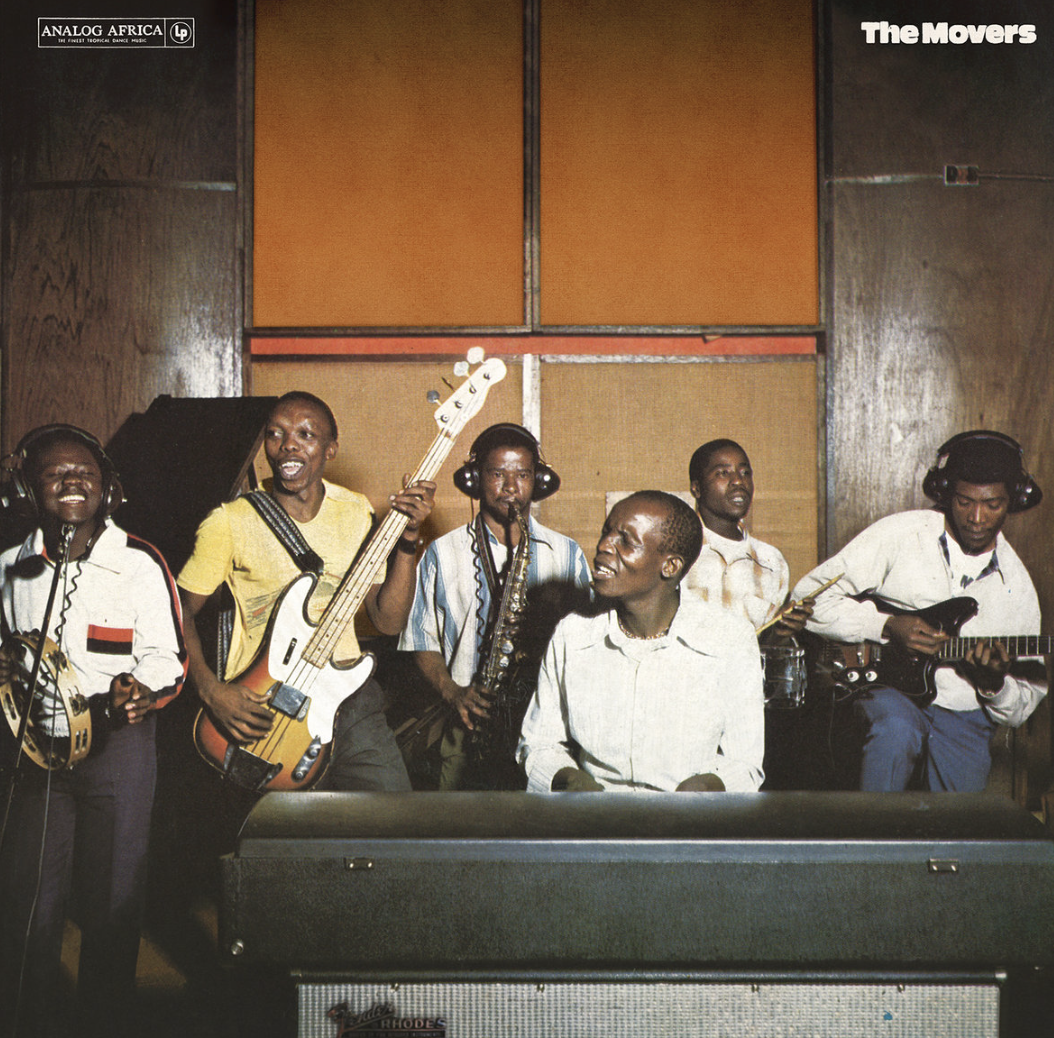
Although it struck Samy Ben Redjeb (founder of the Analog Africa label) instantaneously, the impact that was felt on that day in 1996 when introduced to the neat, sunny-side-up Township soul of The Movers has taken more than two-decades to come to fruition. But now in 2022, finally, there’s a choice compilation of the South African band’s back catalogue to rave about and soak up: just in time for a sizzling, Earth-scorching summer.
Possibly one of the most popular bands of the 1970s in their homeland – even breaking the Apartheid bonds of segregation as the first black band to get airplay on white radio stations -, The Movers have nevertheless left behind scant information, and a provenance riddled with holes. This is despite selling 500,000 copies of their debut LP, Crying Guitars, in just the space of a few months and in providing a peaceable (almost Caribbean in lilt) anthem (‘Soweto Inn’) soundtrack to the mid-70s student revolts and resistance. Yet it proved extremely difficult to track down anyone involved in this South African sensation.
However, what Samy did glean after help and introductions from Kaya Radio’s Nicky Blumenfeld was that the band first took shape in the late 60s, instigated by the two relatively unknown musician brothers, the bassist Norman and guitarist Oupa Hlongwane. To make this band a reality, the brothers approached the Alexandra township-based businessman Kenneth Siphayi with a proposal: if Siphayi would lay-out the money for them to buy some instruments in return they’d give him a cut from future live shows and record deals. In the end their patron didn’t just dole out the funds but took on a manager’s role, introducing them to the simmered, evangelical balm organist Sankie Chounyane. The ranks soon swelled however to accommodate the funky tight drumming of Sam Thabo and the relaxed reeds of saxophonist Lulu Masilela.
Initially they signed to the Teal Records label in 1969, releasing an instrumental record. But almost right away they worked with the vocalists Blondie Makhene (a fourteen year-old vocal prodigy we’re told) and Sophie Thapedi. With a great soulful voice Thapedi sang one of the band’s most popular, enduring hits ‘Soweto Inn’, and channeled Miriam Makeba on the Overton Berry Trio-esque organ suffused, cheek-popping and beautifully wooed ‘Ku-Ku-Chi’. Makhene for his part sounds far beyond his years on the infectious, stained glass township boogie ‘Kudala Sithandana’ and, in harmony with a heavenly female chorus, sounds a bit like Labi Siffre on the whistled fluty R&B turn ‘Six Mabone’.
Unmistakably South African; blessed with that languorous sunny disposition groove, The Movers took a piece of Stax soul revue, Booker Ts’ organ, Steve Cropper’s effective but never overplayed licks, and a taste of The Meters and combined it with the indigenous Mbaqanga (also known as “township jive”) and marabi (a sort of ragtime, jazzy and bluesy style that evolved out of the mining communities, synonymous for its cheap keyboard-led sound) styles. This spills out into reggae, even rock steady, yet always sounds inherently relaxed: never pushed, hurried. Chounyane’s organ standouts, but it never overpowers nor seems particular showy: thin but very effective, a township Ramsey Lewis bathing in the Lord’s light. ‘Give Five Or More’ is an unpressured eased introductory like beauty that features a buzzy organ but also those Stax chops and some gentle drum sizzles –for some reason it reminded me, melody-wise of The Monkees.
A soul revue from the heart of South Africa’s politically explosive townships, The Movers delivered a light gospel-tinged fusion of ripe hotfooted, containable energy. It would be a sacrilege to miss owning a slice of those sweetened South African-lilted R&B, soul, funk and rock steady grooves, so do yourselves a favour and pick up Vol. 1 this summer.
Claude ‘A Lot’s Gonna Change’
(American Dreams) 12th August 2022

Disarmingly wistful and woozy, the refined production and songwriting on Claudia Ferme’s debut album lays a gossamer veil over a litany of anxious quandaries and existential malaise.
Almost, to her credit, effortlessly dreamy, Ferme floats and drifts into a myriad of introspective roles, rooms and scenarios under the Claude alias. The Chicago-based artist nails the despondency of the times whilst giving a most languidly deadpan but essentially captivating voice to the growing pains of a “twenty something”: that first decade of “expectation”, of real responsibility, and yet in this infantile age, in which – especially my generation – we cling to youth and even childhood, you’re still considered an empty vessel and teenager with nothing to worry about and everything to look forward to. But Ferme offers up a certain emotionless face to such woes, troubles; even lightening the mood with the most diaphanous of laidback and aloof vocals, and a backing that is gently smoldered in a relaxed mix of 70s soft rock, synthwave, dream and art pop.
Featured a little while ago in one of my monthly perusals, the inaugural single and opener on this album, ‘Twenty Something’, sets out the vision and mood with its closed-eyes wispy saxophone motifs and perfectly dreamy reflections: “I’d rather be hurt by my own doing, then be let down by someone else. At least that’s what I tell myself.”
That’s followed by the most recent single, the Gabriel Garcia Márquez inspired ‘Roses’, which takes a line from the feted Colombian author’s famous Love in The Time Of Cholera novel and runs with all its metaphorical, symbolist connotations. The thorny prick of this flower’s stem and the book’s obsessive protagonist’s eating of it, bot alluding to themes of self-tortuous behavior. But what we take away from the song and lyrics is that we all need to be a lot more forgiving.
Elsewhere the painful anxieties and mental fatigue hang like post-it notes attached to a bedroom mobile on the listless ‘I Think I’ll Pass Today’, and on the all-too realistic outcomes of a burst bubble of love naiveties, Chromatics vapour trailing ‘Claustrophobia’ – a longing if dry yearn for magic and something lasting in a cynical world of fleeting, vacuous feelings and connectedness.
In contrast, the acoustically gorgeous ‘Meet Me’ has a slight air of Blonde Redhead and some kind of Spanish peppering. But the song that, softly, breaks the wafted, lush mold is the almost rocking ‘Oh, To Be’, which sets Ferme against a more electric spiky backing; adding a silent scream and edge to the synthesised suffusion.
A Lot’s Gonna Change is a most wonderful, captivating and skilfully delicious debut that subtly evokes the worlds of Aldous Harding, EX:Re and Cate Le Bon. A coming of age songbook, a rebirth, in which the harshness of the epoch, the pressures both unique and synonymous with a generation finding its way, are snuggled in a relaxed balm.
Staraya Derevnya ‘Boulder Blues’
(Ramble Records)
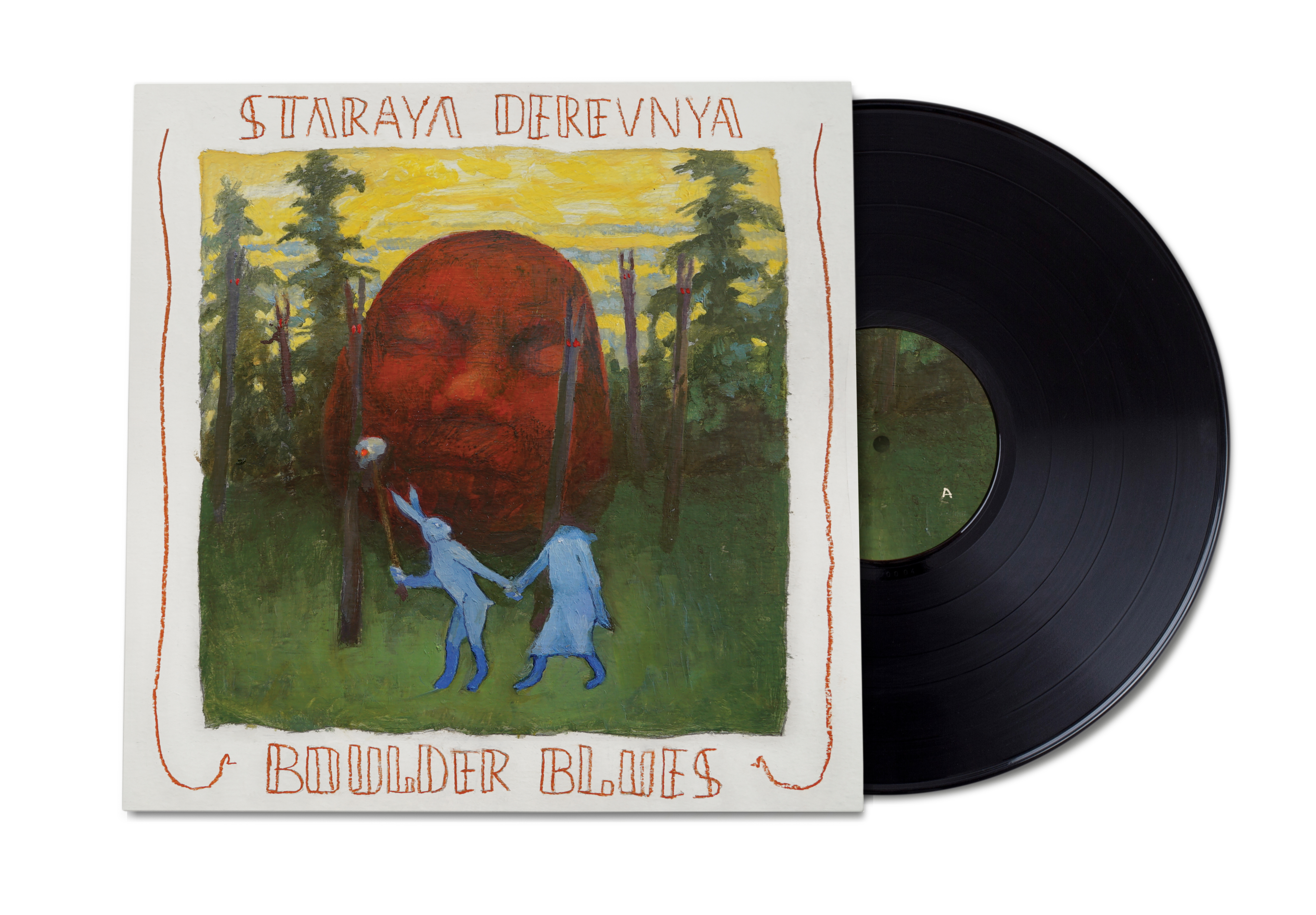
The pan-Israel ensemble are once more on the move, recording another elevated and mystical ethnographical transportive work that takes in and transduces not only their native lands but also the UK, Germany and Mexico. Boulder Blues then is a geographical soundboard of history and the avant-garde; of evoked ancient nomadic tribes and primitivism made psychedelics, and a mantra iteration of a very removed form of what we know as the blues.
With up to eleven (could be more) band members involved, many of which drift in and out of this five-track assemblage of peregrinations and mental release, there’s a lot to take in: to work out. Like “what the hell was that sound?” Or, “where the hell are we?”
Scratchy nylon Beefheart and the Velvet’s guitar, hoots and erratic mooning voices merge with Širom-like (that’s the second time I mention them in this roundup) percussion, Unlimited E.F.S. series Can skits and Faust as fantasies of the Mongolian steppes, the Black Sea, Kabbalah mysticism and krautrock era Germany are invoked. At times it resembles a communion between the Red Crayola and Holgar Czukay; at others, 666 era Aphrodite’s Child share the byway with Don Cherry and Pharoah Sanders.
Staraya Derevnya are totally out there with their “bubbling pelt” and “gallant spider” poetic descriptive wanderings, pains and blues abstractions. Still, they remain rhythmic, even melodious in places; dancing, marching and on the trinket ringed, shadowy ritual title-track, exhaustively repeating the same incantation for five-minutes straight.
I must confess. I really dig this collective. And I’ve even included them in the blog’s choice albums list before now. Boulder Blues is another incipient esoteric, magical album of post-punk, krautrock, psychedelic, far-out and primitive traverses.
Li Yilei ‘Secondary Self’
(LTR Records) 26th August 2022
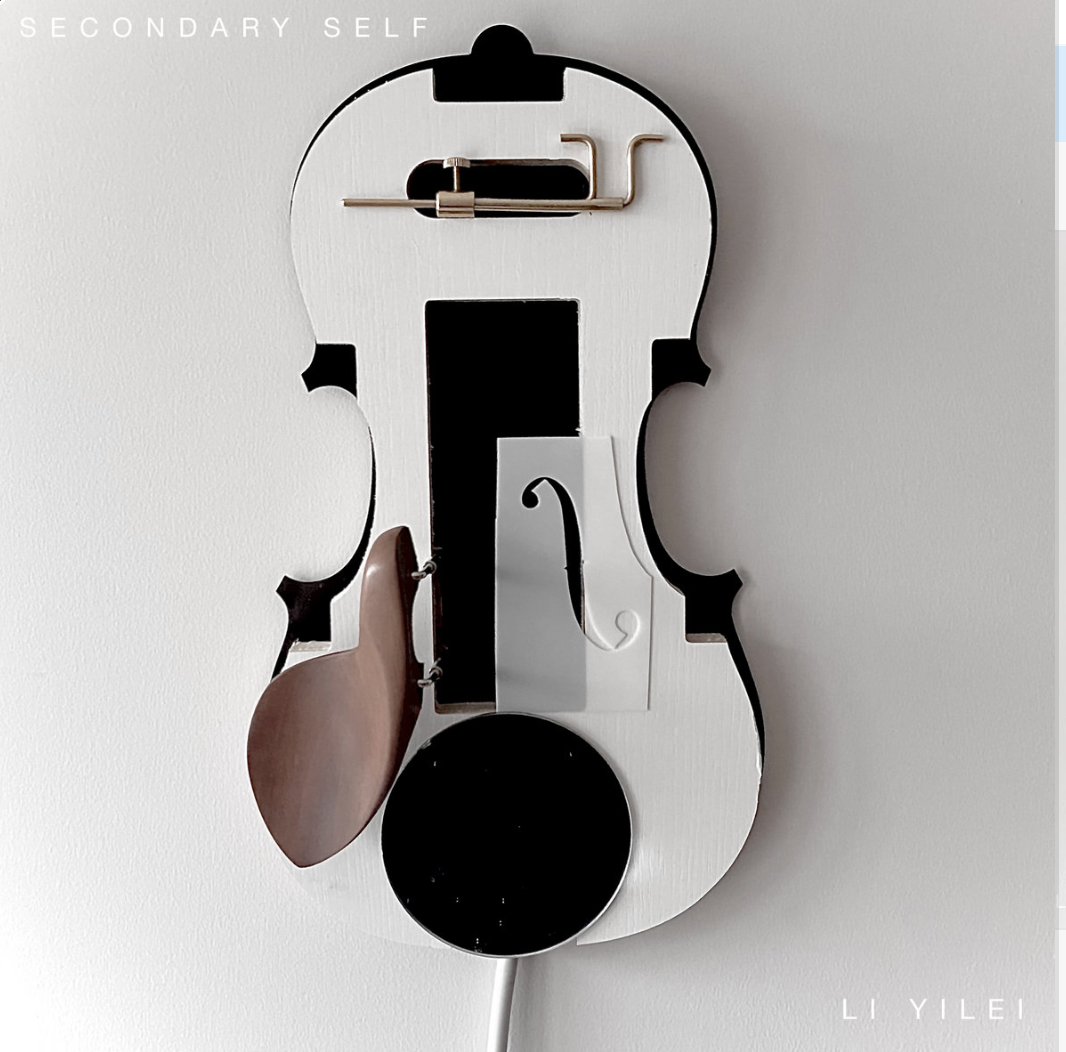
Spanning the entire Covid epoch, so to speak, and a period in which the sonic sculptor-composer Li Yilei travelled from her London-based home to native China and to Shanghai, Secondary Self is a surprisingly (as the PR notes remark) cohesive album of hidden source material powered recordings, abstract hymnals and coded language.
Made up for the most part by pieces originating from a Café OTO commission, there’s also an omitted (due to time constraints) track from Yilei’s 2020 debut album Unabled Form, plus the more recent serene meditation ‘Melt’ from February of this year. That spare experiment, ‘Warmth Ageing’, was created during sessions for the inaugural album synthesis of the evanescent and tactile; an album that received a glowing review from me at the time. Not so much interchangeable this searing, buzzy winged metallic current is a congruous fit on both albums; neither of which particularly offer connective themes of concepts.
That main body of work continues Yilei’s keening simulations of transformed settings, rumination’s and repurposed white spaces; created from a number of obscured and experimentally stretched instruments: the reverberation of percussive bowls and a serial wrangle of echoed guitar tabbing, harmonics and improvised squiggles. There may well be some kind of stringed instrument in there, effected and smothered in reverb, but for the majority of the time the trace of anything familiar is synthesised, electronically morphed into something more abstract, stranger, and on occasion, diaphanous.
It’s something approaching the beautiful that opens up the Secondary Self as an affecting otherworldly siren is sustained across the near ethereal, crystallised freeze of ‘A Hush In The Dark’. A semblance of some kind of voice and almost tender notes provide a touch of the natural: the composer even. As the title would suggest, the second suite ‘Bird Box’ once again features the familiar: the whistle and tweets of birds. Only this avian chorus is given a lunar galvanised bouncy buzz; accompanied later by a drilled code, or, a pummelled Morse-coded read-out. And so a back garden bird box is pierced with the higher sonic register and transported to some place else entirely.
‘Mosquito Alarm’ seems to be slowly driven by a looped photocopier, but flits with deeper bass-y pitches and cosmic mystery. There’s a brief spell of dog howls and more bird communication amongst the dreamy, near psychedelic lapping reversals, incanted whispers and memory recalls of ‘Murmur’ however.
The remaining tracks burble, vibrate and oscillate, recalling vague signs of early 70s analogue experiments, Ambient Works Vol. 2 Richard James, the kosmische and the unsaid. Yilei’s square waves, acousmatics and ruminated efforts cannot be easily defined. Instead, this is a sound that fluctuates between the arts space, the outdoors, and an amorphous myriad of electronic genres. This third album will do much to reinforce what I already knew back in 2020, that Li Yilei’s visions are quite unique, and that the artist is constantly pushing at the boundaries to create both the challenging and meditative.
Foch/Delplanque ‘Live Au GRM’
(Parenthèses Records)

From the equally hallowed and chthonian atmospheric environment of the Maison de la Radio et de la Musique’s studio 104 in Paris, an extemporized performance recording now made available, nearly, six years after its initial transmission.
By 2016, the year of this Groupe de Recherches Musicales curated concert series, the drummer-percussionist Philippe Foch and his foil at the time, and subsequently, the multi-tasking electronic music composer, critic, author, teacher (the list goes on and on) Mathias Delplanque had already produced the collaborative Taarang album that led to a 2015 residency at the National Centre For Musical Creation in Reims, and the Secret album of material recorded from that performance.
Pretty much accustomed to each other’s methods, by the time of Live Au GRM the synchronicity was at an apex, with Foch at the centre of a world percussive assemblage and Delplanque at his side sampling the results in real time.
Recondite empirical vibrations, scratches and stretches across frame drum skins and the resonance of cymbals are transformed further by Delplanque into otherworldly, mysterious forms of primitivism, mythology, musique concrete, the strung-out and cavernous. For we could well be in the incense chambers of Byzantium, the Minotaur’s maze, or, transported to India with a serialism burst of tablas.
Over the course of 26 minutes there’s bot spacious and sporadic passages of unprepared playfulness and exploration in an environment circled by scurrying bestial movements and noises from the darkness. Incipient patterns, traces across tubular metals emerge but are often shunted, shuttered and dissipated back into the shadows.
An alchemy of slapped and paddled physicality and shimmered reverberated trinkets, tinkles emanate from Foch’s eclectic ensemble of instrumentation on a polygenesis performance of hollowed and far denser bass-y tones. In places it reminded me of an entirely stripped of melody Širom, bits of Amon Düül II’s more experimental Dance Of The Lemmings and a little of Faust’s Werner “Zappi” Diermaier.
Scrabbled, almost clawed, and more singular beaten sounds, the hushed ssh-like whispers of a voice and galvanised buzzes appear out of nowhere on a transformative piece of treated and developing improvisation. There really is no telling where this sonic partnership will end up, or what atmospheres they’ll create, only that it will be both esoteric and in an avant-garde direction of percussive and drummed fascination.
Shepherd Stevenson ‘Man Down’
THLTTLDBB ‘SeeUSearching’
(both on Somewherecold Records)
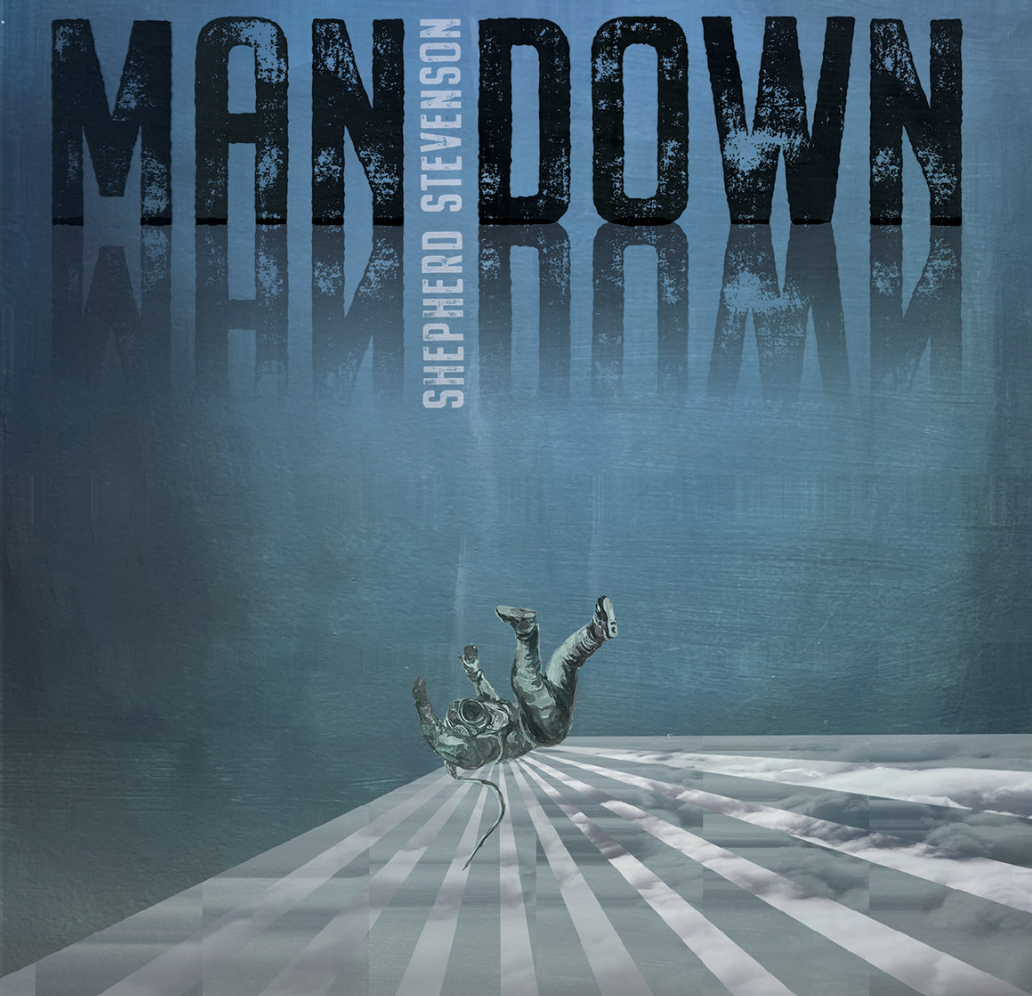
Taking on a filmic quality the multi-tasking L.A. musician, composer and actor Shepherd Stevenson’s inaugural solo effort is rich with the sound of placeable cinematic soundtracks.
Although starting out as and then becoming a stalwart of the alternative 1980s Denver scene (The Aviators, The Young Weasels, Crankcall Loveaffiar), and then going on to help found the L.A. rock band Pigmy Love Circus, Stevenson has also proved a considered hand at composing music for films – a recent list of which includes Erasing Eden, Doobious Sources and Mermaid Down. This album debut, Man Down, was itself originally written to accompany Annie Sperling and Mason Rothschild’s Deep Map art installation, which was projected onto the side of the U.S.S. Iowa, moored in Long Beach; part of the Alta Sea’s Project Blue, a ‘digital port for content and education resources for the emerging Blue Economy’ (that is, exploration, preservation and regeneration of the marine environment). And whether it’s intentional or not, Stevenson often conjures up spells of fluted and dreamy underwater fantasies: ‘Submissions’ to these ears sounds like a Verne-inspired dive beneath the waves, with a touch of both equal enchantment and scuba-equipped Bond thriller.
Occasionally something more foreboding, alien emerges from the depths like some ancient Lovecraftian leviathan. This effect, evocation can be felt on the oppressive and crushing bass, shadowy ‘Old Legions’ – a mix of Jóhann Jóhannsson at his most ominous and touch of Bernard Szajner and Room Of Wires.
For the majority of the time Stevenson molds kosmische, techno and synthwave into various futurist and mysterious projections; stirring up a gently burbled and bubbled acid and fluttered progressive-techno suite of otherworldly sonar waves and cosmic noir on the opening ‘B. Whaler’, and channeling Cliff Martinez on the scalextric-set looping dystopian scares ‘Sadurday’. There’s also some strange Germanic classical fairground thing going on with the Wendy Carlos and Roedelius harped, heavenly ‘ode to toy’ ‘With Dots’. I also detect some lovely climbing Eno notes on the deeply felt and bass-stamped, but neoclassical ebbing, ‘Hoary Notions’. And just when you think you’ve got him worked out, ‘Way Down’ motors at a nice speed towards Germanic 80s synth pop.
Hymnal Western-twanged dives, sci-fi vistas and unknown entities await on a finely-crafted, cinematic quality debut. Stripped of its original visuals, it’s left to the listener to dream and be moved to the lilted and more feared aspects of the imagination.
Under what could just be the longest acronym ever, or a particular recondite sequence known only to the artists, the duo of Matt Greenwall and Phillip Andrew Lewis conjure up the both gently cooed and reverberated hauntings of various imagined transmissions and transduced whispers on their new album of wispy and soothingly effective ambient suites.
Barely above that whisper, these quite but deeply stirring pieces seem to feed a collection of processed video and tape loops into the ether; the returning sound waves, broadcasts now sonic mirages, passages of the American strange, the waves lapping onto a cult 50s soft surf soundtrack, or, the breeze blowing gently across the Appalachian Mountains.
AM/FM radio signals crisply spark as glass birds sound and translucent bulbs ring in the resonance of a drone. The nebulous meets the ghostly; traces of a less fearful Twin Peaks and a haunted theatre are suffused in an ebbing ambient cycle. Voices come and go as movie dialogue is manipulated into echoes of the past. The dreamy spells linger as you catch some hallowed or mysterious presence drifting off into the empirical.
Elements of the semi-classical, trip-hop experiments, European library music, old film image reels and analogue ambient music can all be detected and felt on this both organic but artificially constructed, amorphous album. The opening ambient aria beauty, ‘Angela’s Light’, is worth the entrance fee alone.
Brown Calvin ‘dimension//perspective’
(AKP Recordings) 26th August 2022
Although split into “dimension” and “perspective” suites the latest elemental album from the Portland, via Philly, producer and composer Andre Burgos is an almost uninterrupted, constantly moving beat-making and cosmic expansive ball of energy.
Under the Brown Calvin alias, and uncoupled from his vocalist foil Brown Alice in the “intergalactic” Brown Calculus duo, Burgos’ Afrofuturist soundtrack transduces all the strains, stresses and rage of the last few years into a controlled chaos of universal proportions.
Traces of hip-hop, jazz, electronica, kosmische, soul and funk can be heard, morphed, effected, and warped as sporadic African hand drums spring into action and scrapped percussion add a sense of ancestral continuity to this ascension into space. Civility, society maybe a tinder box on Earth, but out into the cosmos lies possibilities; a certain escape and serenity, especially sonically, as this album can testify.
An ambitious, lengthy, infinity even, peregrination opens this album. What, in old money, would constitute the whole side of an LP is an astral and contorting vision of analogue-soundboard pulsating circuitry kosmische (ala Tangerine Dream, Moebius and Schulze), Afrikan Sciences oscillations and tangents of beats, ripples and purrs of Rhodes and progressive jazz.
The rest of the album isn’t so much broken up into demarcated parts as a number of symbolist, calculus numbered points along a flipped, staccato or churned journey of expressive freedom. All the shit, the despair and hate is fuelled into a spiritual quest for answers. A multitude of coded, infinity (that word again) suffixed ‘perspectives’ offer variations on the musical themes; some parts in that scope are more liquid, whilst others fracture off into to the psychedelic. Some float, others catch on a ball-in-the-cup loop or form a tumble of breaks. Shooting stars cross the great expanse and dancing translucent bulbs act as notation of a kind. There’s plenty of bending, arcs of distortion in those heavenly realms too; but also the threat of overload.
This is the soundtrack to the African space programme; an untethered energy of J. Dilla, Flying Lotus, slugabed, Don Cherry, Labelle and Floating Points. Burgos has a great capacity, hunger to try out many ideas and to take from eclectic sources; opening the way to free-form movements and a sonic alchemy. The Brown Calvin moniker proves a fruitful transition but also the vessel for a new cosmology and language with which to process our troubling times.
Die Welttraumforscher ‘Liederbuch’
(Bureau B) 26th August 2022
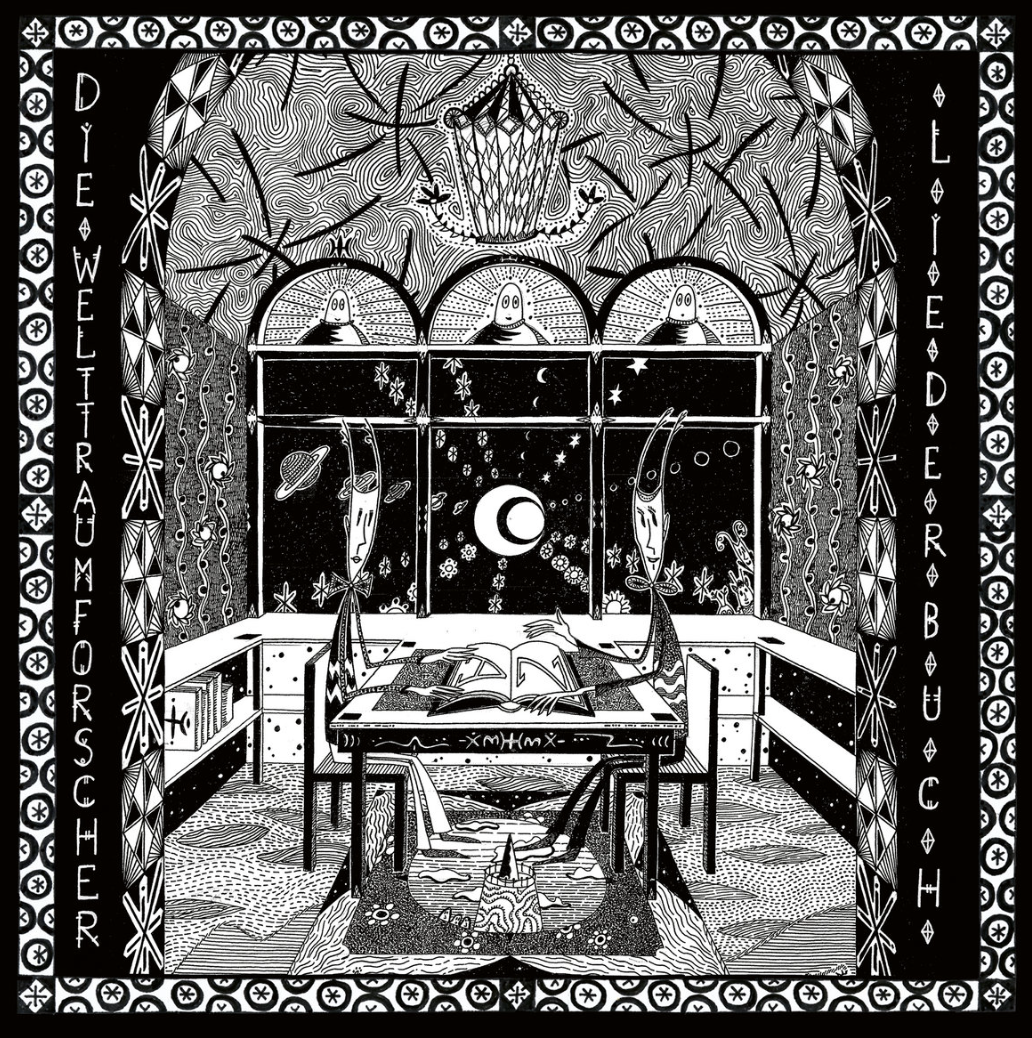
It’s a novel way in which to reconnect with an enchanted world inspired back catalogue; a project that’s spawned at least thirty albums and a fecund of illustrative, multimedia works. But for this latest Die Welttraumforscher (translating as The Space Explorers) album a couple of concept characters look back over a forty-year multiverse and pick out their favourite songs to tell a different story.
Conjured up from the mind of Christian Pfluger, the part Dadaist, part Swiss maverick fantasist, this “pop-up book” of imaginative fairytales now puts the “insect twins” turn compilers Brtz and Brxl at the centre of a new songbook.
Although already receiving a two-part retrospective last year (the fortieth anniversary year) the Liederbuch album seems to reach back to titles from Ein Sommer In Der Wirklichkert (from 1991) and Binike (1986) and keeps up the character board from across the decades.
In this magical landscape we meet cosmic-travellers (Lia and Mira from the Northern Crystal realm), silent forest dweller Ohm Olunde, the mysterious dark pilots, crop-circle researcher Leguan Rätselmann and the Owlmaster Kip Eulenmeister. Reminding me a little of the same magical dioramas and cast that inhabit the musical world of Scarlet’s Well, albeit a both very Germanic and Transalpine version, these characters are often playful, childlike and sweetly placed within an eclectic soundtrack.
Fluctuating between musical moods, genres, Pfluger (who remains very much an enigma) skips through echoes of the German new wave, the bucolic and ambrosian, and more lo fi. From the acoustic, with a touch of some Spanish flair and the pastoral, to preset Casio keyboard synth wheezes, the musical scope is varied and large. Mooning through woodlands to cosmic Theremin-like aerial loons, the storyboard drums up a myriad of settings too.
As influential as he is influenced, touches of progressive idiosyncratic stars mingle with shades of the kosmische, Per W, The Incredible String Band, SFA, Gorky’s Zygotic Mynci, Spike & Debbie and trip-hop. There’s also a bit in ‘Goldene Barken’ where someone blows their nose and coughs to a semi-post-punk, scratchy Velvets guitar backing.
Whimsical, cartoonish, and eccentric Pfluger’s imaginative cosmology remains a curio, a vehicle for escapism but the absurd and fantastical; the music, still after all this time, just as captivating and inviting.
Hi, my name is Dominic Valvona and I’m the Founder of the music/culture blog monolithcocktail.com For the last ten years I’ve featured and supported music, musicians and labels we love across genres from around the world that we think you’ll want to know about. No content on the site is paid for or sponsored and we only feature artists we have genuine respect for /love. If you enjoy our reviews (and we often write long, thoughtful ones), found a new artist you admire or if we have featured you or artists you represent and would like to buy us a coffee at https://ko-fi.com/monolithcocktail to say cheers for spreading the word, then that would be much appreciated.
Tickling Our Fancy 090: Harmonious Thelonious, Krononaut, Map 71, Phew, Young Knives…
August 18, 2020
Album Reviews Roundup/Dominic Valvona
In-between lockdowns the only good news is that at least this month and next is shaping up to be the busiest months in 2020 so far, with a significant rise in the number of releases. And so, just scratching the surface, I’ve picked out just a smattering of interesting and brilliant albums from the thousands that the Monolith Cocktail receives each month.
German contemporary electronic music pioneer Stefan Schwander under the Harmonious Thelonious title, creates a new sophisticated polygenesis dance album of itchy scratching no wave, the tribal and industrial for the Hamburg label Bureau B; a survey of various contemporary experimental artists come together for charity to interpret the amorphous Plague Score graphic score of Nick Gill; Japanese underground luminary Phew releases a sort of mixed compilation of new material and unreleased sessions from her 2017 album’s Light Sleep and Voice Hardcore for the Disciples imprint. Lurking in the jazz-fusion subterranean, a new project from classically leaning producer and guitarist Leo Abraham and jazz drummer Martin France and their ensemble of collaborators, is the latest release on Glitterbeat’s experimental instrumental imprint tak:til. Krononaut converges the avant-garde with post-rock, post-punk and krautrock. Sometime Roedelius foil Andrew Heath releases yet another understated ambient sound collage of the real and imaginary for the Disco Gecko label; the patient escapist ‘The Alchemist’s Muse’. The Israeli-Russian collective Staraya Derevnya release a treble album haul, though I’m concentrating on the marvellous culmination of improvised performances pieces and additional material avant-garde krautrock folk Inwards Opened The Floor.
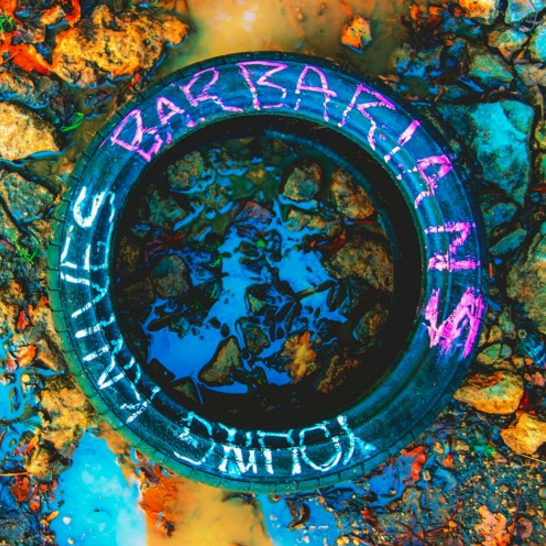
Handling the pandemic and escalating divisive free fall with spite, energy and violence, there’s the new Map 71 album, Turn Back Metropolis, and a barricade breaching, loud and primal return for the Young Knives with their first full-on album in nearly seven years, Barbarians.
Young Knives ‘Barbarians’
(Gadzook) Album/4th September 2020
Hurtling back from a four-year hiatus with a barrage, the brothers Dartnall unleash an angry firestorm of a dystopian album; the first fully realised collision since 2013’s Sick Octave.
The now not so Young Knives have been busy sharpening their sonic disconsolations in all that time, ready to pounce with an attack on the senses; reappearing at a most depressingly divisive time. Not that there hasn’t been more than enough material to keep the Knives awake at night, but they’ve been inspired to light the fuse by reading up on the apocalyptic philosopher/writer John Gray’s resigned tract on the illusions (as he sees it) of self-determination, Straw Dogs, and the controversial professional man-hater Valerie Solanas and her patriarchal death-knell, the S.C.U.M. Manifesto (an abbreviation of the Society For Cutting Up Men). In what’s said to be their most “cathartic” and “noisy” release yet, the self-confessed nihilists and miserablists have channeled the Clockwork Orange borstal of primal savage human nature, as explored in Gray’s polarizing theorem, and Solanas’ (what some critics and commentators consider a clever parody, even satire of “the performance of patriarchal social order it refuses”; though attempting to murder Andy Warhol, and by association the American critic Maria Amaya, puts a damper on that suggestion) utopian pipe-dream to knock seven bells out of the indie-dance and post-post-punk blueprints.
Essentially, as the title makes clear, despite all our graces, technologic advances and awareness, humans have never lost their barbaric cruelty. Is this just part of our nature and makeup? And if so, how do we live with it? It’s a quandary that hasn’t diminished over time, and a fate amplified in the pressing destructive times of 2020; a cold war of ideals, divisive politics kindled by a raging pandemic. And so, you can expect an explosive despondency from the Knives as they tear up and skulk through the debris.
It starts by plowing into a sustained menacing buzzy and harassed krautrock like grooving thrust merger of Techno, Siouxsie’s Banshees and PiL (Henry Dartnall will use will Lydon’s signature cocky sneer and haranguing rage throughout this Molotov hurling album), and continues to caustically cut-up a barreling and marching rant of These New Puritans, Scary Monsters and Outside era Bowie, NIN, the Chemical Brothers, Death From Above 1979 and The Slits. There’s even, I might suggest, a hint of supernatural Alex Harvey, albeit jazzed-up with rollicking Bloc Party drums, on the creeping witchery ‘Jenny Haniver’. I’m not surprised it has a daemonic esoteric feel, as the title refers to the ghastly unnatural looking mummified carcasses of rays and skates that have been dried-out and modified to resemble fanciful creatures like dragons and demons.
Brutality is everywhere, with samples of audio from a bare-knuckle brawl on the tortuous fist-clenched whirlwind title-track, and a squall of harsh and heavy breakbeats and alarms constantly rattle the cerebral. Yet breaking the barbarous grind and bounce are moments of brief relief: the venerable and prayerful female chorus on the ‘Holy Name 68’’ vignette (a distorted calm from the past), and the milder relief of a vague brass band finale serenade on the previously Blurt honking post-punk ‘Slashed What I Saw’ curtain call.
Henry shouts that the “scum will inherit the earth” and other such sloganism, knowing full well his rage will inevitably dissipate as the barricades come tumbling down once more. A future hell on repeat, the Knives at least have a good go at firing up the audience; it’s a noise and row that has been largely missing in the music world, and proves the perfect poisoned tonic for these end times. It’s good to have them back.
Phew ‘Vertigo KO’
(Disciples) Album/4th September 2020

In case you haven’t been introduced to the avant-garde voice iterations and various drone landscaping experiments of the Japanese artist known as Phew, then this new and unique compilation of her personal sonic statements and moods is both an eye-opener and a good place to start.
Phew’s entry into this field started with the instigation of the Osaka psychedelic-punk group Aunt Sally in 1978, which she fronted until their brief but influential burnout just a couple of years later. During the next decade Phew would work with an enviable cast of experimental doyens including Ryuchi Sakamoto, Alex Hacke of Einstürzende Neubauten fame and DAF’s Christo Haar, and also making an album with the illustrious Can pairing of Holgar Czukay and Jaki Leibzeit and legendary producer Conny Plank. Fast-forwarding to the noughties and the underground pioneer has performed live and recorded with The Raincoats’ Ana Da Silva, Jim O’Rourke and Ikue Mori and Yoshimi of the OOIOO/Boredoms/Saicobab arc of ensembles. Quite the providence, it’s a back catalogue that can be heard suffused throughout the latest collection of specially recorded new material, unreleased works from Phew’s two most recent solo album sessions (2017’s Light Sleep and Voice Hardcore) and a, removed from its original disjointed source, cover version.
Framed by the artist herself as “An unconscious sound sketch…” and as “personal documentary music”, Vertigo KO is a special kind of compilation. Forward thinking, progressive rather than looking back, the tracks on this album can’t be dated or easily linked back to those previous works. It sounds in fact like a new work entirely, made in the moment, all at the same conjuncture of creativity and thought. The label Disciples has already put out a limited edition cassette, Vertical Jamming, of Phew’s “long form drone work”, but this collection seems untethered, themeless concept wise and musically. Well that’s not entirely true, Phew states that her last two albums from which some of the martial has been lifted is personal and not an attempt at a “worldview”: the overall undercurrent and hidden message being “what a terrible world we live in, but let’s survive”. Phew seems to convey this survival by counterbalancing ascendant crystal rays of nature and heavenly with mysticism, otherworldliness and ominous Sci-fi: The skying drones and refractions that build towards a cathedral in the clouds on the opening ‘The Very Ears Of Morning’ evoke the beauty and enormity of nature’s first light. Yet by the second track Phew has transmogrified the loose post-punk slumbering Raincoats distress ‘The Void’; transporting the bare bones to a neon-futuristic industrial setting, ala Bladerunner.
Some of the more truly “out there” avant-garde moods involve various vocal repetitions and multi layering. These voices, intonations and peculiar annunciations can be in the form of obscured incantations (as they are on the vaporous hive humming consciousness mystery ‘Let’s Dance, Let’s Go’), vowel stretching (on the dial twisting ‘All That Vertigo’) or monastic (on the mystical Buddhist/Shinto call to prayer vacuum ‘Hearts And Flowers’). Sometimes it’s used as a rhythm, at other times as a lingering trace of yearning from the “void”.
Phew’s amorphous sonic sensibilities exist both in the metallic gauze of space and in more concentrated earthly reverence. A pioneer of the form, the Japanese icon of the underground continues to produce some of her strongest work as a new decade beckons, birthed in a pandemic. The signatures, reference points and mode will be familiar to those already well acquainted with the Phew’s varied catalogue, yet Vertigo KO offers some sublime and inventive surprises to be an essential edition to the collection. Those unfamiliar would do well to experience this set of suites and then work backwards.
Krononaut ‘Krononaut’
(tak:til/Glitterbeat Records) 4th September 2020
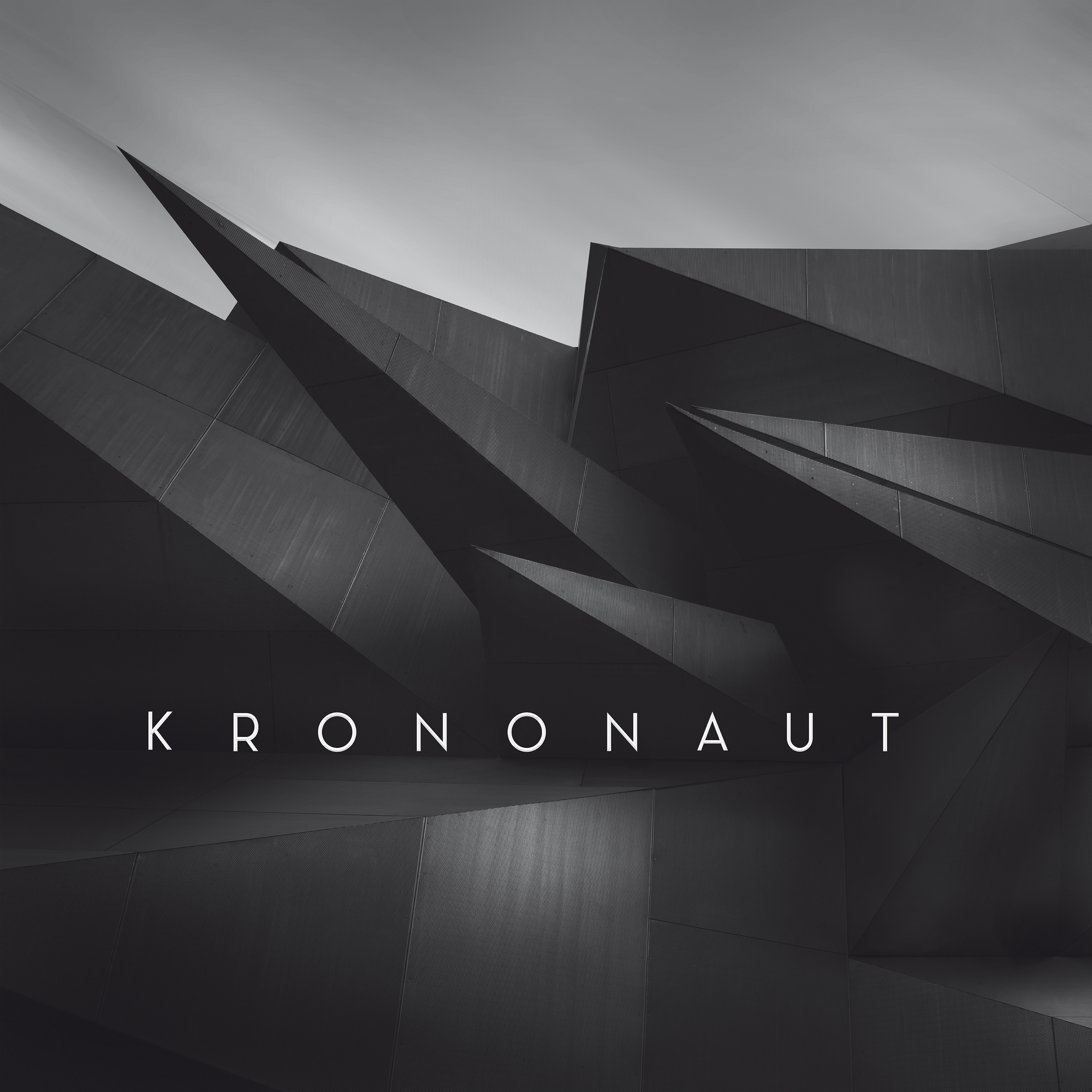
Out on the peripherals of identifiable jazz-fusion the newly assembled Krononaut ensemble conjure up a mysterious extemporize performance on their debut vision for Glitterbeat’s highly experimental instrumental imprint tak:til.
Instigated, led by producer and guitarist Leo Abraham (who’s contextual guitar lines can be heard on Eno’s sublime Small Craft On A Milk Sea LP) and drummer Martin France (who’s played with, amongst others, Nils Petter Molvaer and Evan Parker) but methodology wise a democratized unit that embraces the atmospherical leanings and peregrinations of its extended lineup of collaborators, Krononaut was created out of a musical disciplinary challenge: To converge Leo’s classical sensibilities and learning with Martin’s jazz background. The results of which linger, spiral and prowl in an abstract subterranean space of hybrid jazz, Jon Hassell’s possible musics, krautrock, post-punk, post-rock and, at least in part, are informed, inspired by the unique rhythms found in the Madoh Shamanic funeral music of Tajikistan.
Recorded in London last year over two sessions, the inaugural featuring multi-instrumentalist Shahzad Ismaily (from Tom Waits to Laurie Anderson) on bass, the follow-up, the enigmatic saxophonist Matana Roberts, Swedish trumpeter Arve Henriksen and on bass duties too, Tim Harries, the Krononaut album reimagines a musique concrete Miles Davis, Sam Rivers and Grachen Moncur III skulking a masked, mournful to a point, ether that once in a while floats into the ethereal (in evidence on the diaphanous aria veneration ‘Vision Of The Cross’).
Navigating dark recesses in a spidery probing with the bass on the shadowy ‘Location 14’, and evoking their label mates Pulled By Magnets on the semi-industrial, cavernous and falling ‘Power Law’, this ensemble creep into post-punk; sounding like a transmogrified deconstructive PiL. Yet despite this the Krononaut’s are never so disjointed, dark or brash as to raise the volume above the discordant or even delicate; nothing runs away or untethers itself completely from the musicians’ grip.
Vague bursts of Guru Guru, drifting Eastern horns and filmic qualities drift in and out of serialism vaporuos industrial soundscapes and odd primal lagoons. Sporadic fits of propulsive drummed rhythms materialize from these non-liner recordings, but for the most part we’re strung out in the stresses and entanglements of composed, sophisticated avant-garde explorers: jazz and those classical leanings only really play one of many parts to this conjuncture of elements.
Ponderous, stalking, lolloping, spiritual, fluctuating – an exercise in relearning and discovery in fact – the Krononaut album of fourth world like experiments is free of limitations. It’s a project that escapes, even defies, categorization; another congruous fit with the ethos of the tak:til label.
Harmonious Thelonious ‘Plong’
(Bureau B) 28th August 2020

Fitting congruously within the Bureau B label family, Stefan Schwander’s inaugural album of sophisticated minimalist dance music for the Hamburg platform chimes with its roster of German experimental electronic pioneers; from Zuckerzeit candy era Cluster to the deconstructive Populäre Mechanik and the more contemporary Pyrolator.
More or less ten years into his Harmonious Thelonious alter ego, Schwander now offers a more “industrial sound” made from concrete objects vision of his American “minimalism” convergence with African rhythms and European melodies signatures. Inspired in part by the iconic Basle club of Totentanz, where the German electronic artist spent some of his misspent youth catching performances by the no wave dance act Liquid Liquid, the Gun Club, Jonathan Richman and a very young Aztec Camera, the Plong album channels some of the atmosphere and nostalgic vibes of those formative years. The club is immortalized on the final track; a sort of tribal beat with a barely audible hooted dance track that could be described as “intelligent” techno for the soul. In fact, the Liquid Liquid reference, or at least that vibrant post-new wave dance sound that they excelled at, can be heard permeating tracks like ‘Höhlenmenschenmuzik’; a multi-textural bass pronounced no wave dance of Carl Craig and Kriedler, the title of which translates as “caveman music” and evokes atavistic cave daubings leaping off the dank walls and vibrating, dancing like a host of Keith Harring characters bouncing down a NYC boardwalk.
Elsewhere amongst the deep Detroit techno and house music the tubular and knocking mettalics, tight delayed electronic sequencing and cleverly layered kinetics and mirages of a mysterious Arabia can be detected on the opening desert sands ‘Original Member Of A Wedding Band’. An obscured xylophone or marimba somehow captures an air of Africa on the lightly malleted and translucent itching vibrant ‘Geistertrio Booking’, and the staccato clumsy motioned ‘The Roller’ features a quasi-bobbing West African rhythm.
The tribal is subtly transformed into a futuristic suspense; 80s electro and no wave dance is twinned with lurking industrial electronica; bubbling concoctions float across mechanical refractions on a meticulously constructed deep dance soundtrack of multiple interesting rhythms. Plong, which could be a title Harmonia/Cluster may very well have used, fits perfectly with the Bureau B vibe, yet cuts a clean polygenesis electronic dance sound of its own.
https://soundcloud.com/bureau-1/harmonious-thelonious-plong-snippets
Various ‘Plague Song’
(Via Bandcamp) Album/14th August 2020

A plague has descended on all our houses it seems, with no corner of the globe left untouched by Covid-19. Yet not so much a plague in either the Biblical sense or even a 1000th as destructive as the Black Death that left populations decimated Covid-19 predicted effects and the measures being used to contain it and our civil liberties is proving more destructive and stressful. As lockdown lifts for some, only to be reintroduced as clusters break out in localized areas, and thoughts and anxieties can be translated, we’re seeing creatives release their cathartic impressions and traumas.
One such contextualization, instigated by the North Yorkshire based composer, multi-instrumentalist, solo artist and member of Fireworks Night and The Monroe Transfer ensemble, Nick Gill brings together a international cast of experimental artists and composers to interpret the project leader’s pencil-shaded abstract ‘Plague Song’ graphic score. Following in the footsteps of John Cage who first pioneered the concept, Gill sketches a roughly hewn amorphous score that offers a freehand to those invited to respond. With no instructions as to duration, instrumentation or performance style it’s entirely down to the artists to conjure up something evocative; a sonic representation from the elongated funnels and arched lines found beneath sharper cross-hatching scribbled noise. The author of that graphic score does offer his own interpretation however; offering a suitably atmospheric and watery composition of Craig Ward like multi-textural guitar reverberations.
Erring towards the perimeters of ambient, neo-classical and experimental music the guests on this charitable compilation (proceeds going towards Médecins sans Frontières) produce some searching visions of the present mood. Carrying on the imbued literary (Anthony Burgess to Joseph Heller) cross chatter and abstracted resonance of his many sonic adventures in India and Southeast Asia, Oxford polymath Seb Reynolds cuts-up and morphs a recurring “not as fatal” line with the sound of veiled Orient and tram clatter on his take of the score. Others, such as the renowned NYC stage, film and even opera composer Nico Muhly, produce something more sublime and trembling; the composer behind soundtracks for The Reader and Marnie glides towards a skying ascendance of rippling ambient beauty.
In the quasi Sci-fi mood, electronic composer and performer Hainbach generates some strange off-world atmospheres and primal lunar threats with his interpretation: evoking, I think, Bernard Szajner’s Dune imagings. The spherical Canadian team-up of musician, activist and producer Rebecca Foon and Polaris Prize winning singer-songwriter, producer Patrick Watson prove a congruous pairing, offering up an almost cosmically heavenly searing soundtrack of voices obscured in the vapour.
The track list is numerous; too numerous to mention everyone, so I’ll just mention a few more highlights and standouts. Tiece beckon with a signature “witchery” and “smoky” trip-hop soulful jazzy vision that evokes a warped Four Tet, whilst vocalist, sound artist David Michael Curry goes for something more supernatural, strung-out, with his added locational cryptic post-rock bluesy “scene report from Somerville Masc.” And perhaps one of the oddest interpretations, double-bassist and organist composer, arranger Ben Summers takes the listener through shades of South America, jazzy cocktail hour club soiree and 60s Italian soundtracks: a million miles removed from the compilations leitmotif of shared mysterious ominous drones and recondite ambient carpeting.
Gill’s original graphics are lent a swathe of interpretations, some less somber than others, from a cosmology of contemporary composers. A survey of mood pieces, from science fiction augurs to introspective concentrations. Yet seldom does the soundtrack wallow in the darkness, or creep into nightmares, which considering the title seems both optimistic and a relief. Plague Song is a worthy embrace of the uncertain; a translation of abstract stress and danger given an expansive treatment.
Map 71 ‘Turn Back Metropolis’
(Foolproof Projects/Fourth Dimension Records) Album/4th September 2020
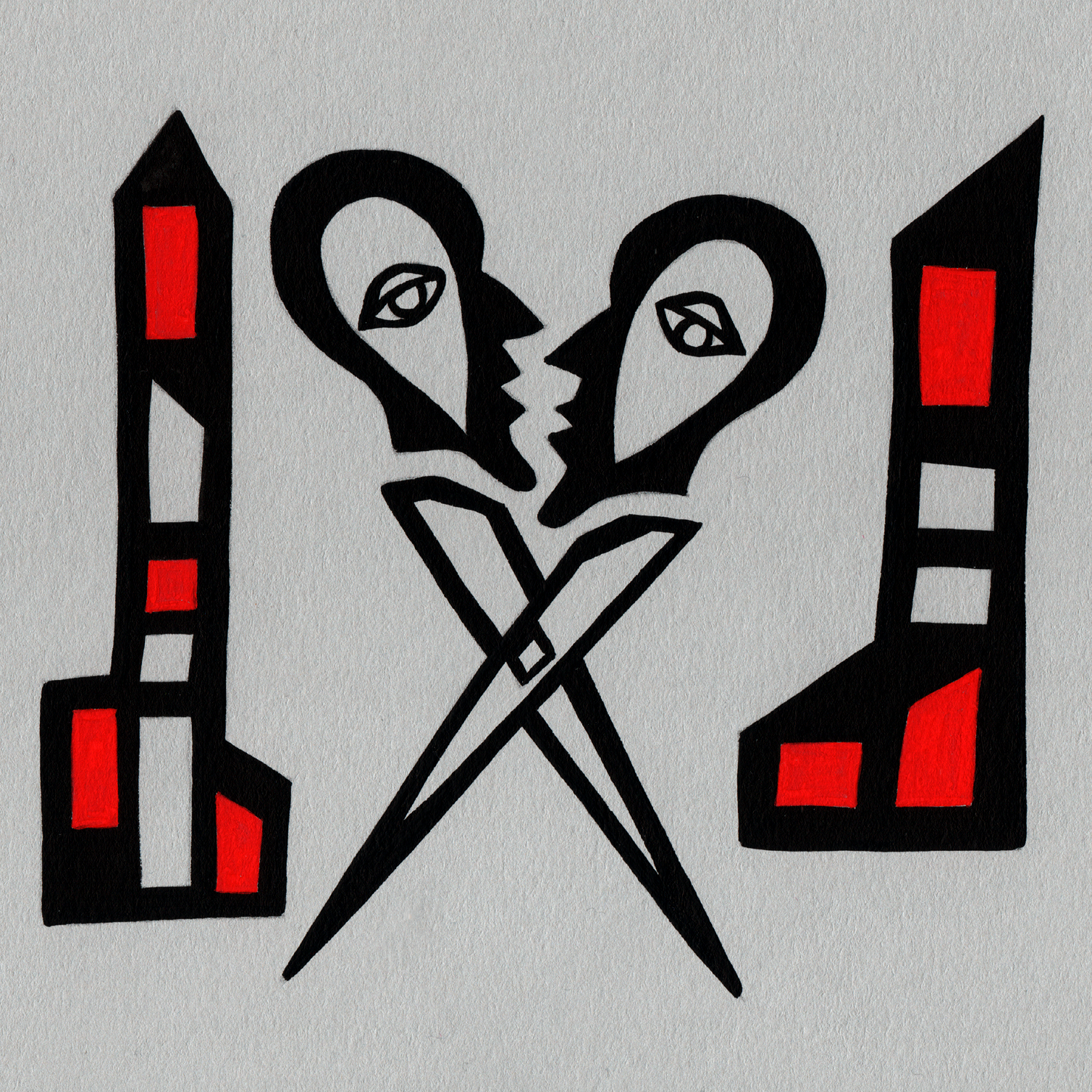
Just the sort of J.G Ballard and Anthony Burgess flavoured dystopian claustrophobia we need in these pandemic striven times; the estuary high-rise colliding duo of disillusioned poet and artist Lisa Jayne and pounding sonic foil Andy Pyne deliver a skulking barrage from the edges of the inner city and suburban wastelands. Under the Map 71 cover they release a fifth album sound-clash of post punk electronica, no wave, post Krautrock and tribal industrial music.
Turn Back Metropolis finds the urban-planners of derision and concrete hardened social realism back in the stairwells and landings of a decaying omnipresent city, dreaming of escapism: “The fields are in sight of the city, but there’s a curfew and the city waits for your return.”
Against the stench of this imposed backdrop of societal misdemeanors, the grime of everyday existence is lyrically and starkly drip-fed by Lisa over beating toms, slinking dub, sporadic drumming, alarmed synths, contorted metals and London swagger. Lisa channels a petulant Ari Up and Viv Albertine, whilst Andy, at any onetime, conjures up an accompaniment of Cabaret Voltaire, Fad Gadget, PiL, The Au Pairs, Lonelady, 80s Rick Rubin and The Classical.
Seething yet composed, they stalk their subjects like prey through the entrancing, spiraling and more cutting on a futuristic punk album of malcontent. Tracks such as the squalling, speed-shifting, arcade-fire over-surge ‘Highrise’ can induce vertigo, and the rattling ‘Stitches’ evokes a seedy switch-bladed administered trauma. Descriptively as livid as it is poetically brilliant, with a musically edgy, harrowing but crafted sonic accompaniment to match, Map 71 delivers another sinister violent architectural imposing shockwave.
Related posts from the Archives:
Map 71 ‘Sado-Technical-Exercise’ Review
Andrew Heath ‘The Alchemist’s Muse’
(Disco Gecko) Album/4th September 2020

Carrying the torch for the kind of ambient and neo-classical swathes and calmly evolving ruminations pioneered by such luminaries as Roedelius, Andrew Heath is a maestro of, what he calls, “small-case minimalism”. Lucky enough to work with the self-taught acolyte and co-founder of the electronic music and kosmsiche legends Kluster/Cluster/Qluster arc, Heath has obviously picked up some ideas from the best in the field. The English composer of refined, understated evocations collaborated with Roedelius on both the Meeting The Magus and Triptych In Blue suites.
The “magus” pupil has become the “alchemist” on this latest exploration of minimalism, texture, tone and the “sonic detritus that litters our environment”. Using, as ever, a kind of English pastoral and esoteric poetry to reference moods and locations, as well as the sources of some of his field recordings, Heath counterbalances his naturalistic settings with delicately played (but deeply felt) piano, resonating electric guitar, and on the album’s title track the swan like and sonorous bass-clarinet of guest Bill Howgego, and of course the various apparatus that transmits those soft, veiled ambient tones and gossamer atmospheres. This translates into translucent compositions that merge the intercom chatter of a pilot’s radio with dropped bauble piano notes and stratospheric gliding, on the opening piece ‘Observers And Airmen’, and the squawk of a woodland menagerie and running water with Eno-esque pining scenic mystery and alien wiry quivers, on ‘Of Mill Leats And The Walter Meadows’.
Hints, traces of voice can be found throughout, but its Heath’s second guest, Romanian poet, writer and journalist Maria Stadnika, who offers the most fragile and emotional. Returning, after appearing on heath’s 2018 Evanfall album, Stadnika’s sighed wistful whispery ‘The Garden Reveals Itself’ receives a ‘Night Mix’ re-run. The senses of those waiting on the inevitable cycle of life and other such poignant chimes on the passing of time are soundtracked with an accentuated magical dreamy night garden score.
Recorded at his home in the Cotswolds’ earlier in the year, and framed as an album that provides a certain sense of calm and tranquility, Heath’s idyllic set piece is indeed rich with moments of stillness and contemplation. It all sounds serenely beautiful. From the announcer on the subway vignette ‘A Good Service,’ to the wooing undercurrents of ‘The Muse And Her Dreams’, both echoes of daily life blend with more mysterious surroundings in a superb sound collage. Ambient music it seems is in good hands, Heath’s seventh album for the Disco Gecko label is a sublime patient suite that offers a rest in these most troubling, intense times.
Archives:
Andrew Heath And Toby Marks ‘Motion’ Review
Andrew Heath ‘Soundings’ Review
Andrew Heath ‘Evenfall’ Review tof068
Staraya Derevnya ‘Inwards Opened The Floor’
(Raash Records) Album/4th September 2020
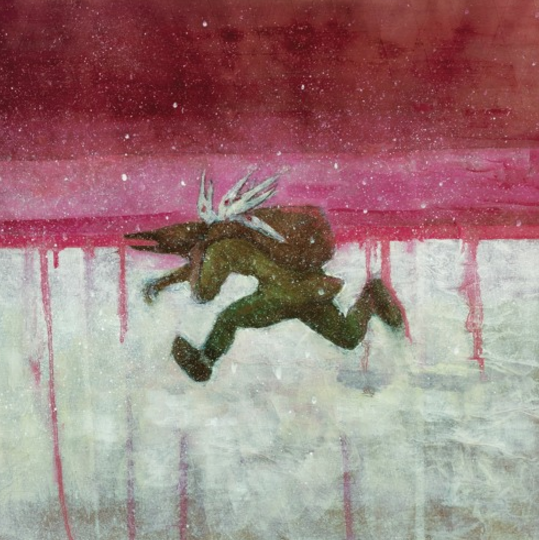
A culmination of Café OTO Project Space recorded performances from 2017 and additional material from that same year to 2019, the latest avant-garde inter-dimensional experiment from the Russian-Israeli straddling Staraya Derevnya is part of treble release schedule. Alongside the featured Inwards Opened The Floor there’s also a duo of improvisations recorded with Hans Grusel’s Kranken Kabinet entitled Still Life With Apples, released on cassette by Steep Gloss, and more live material under the OTO/Tusk title, released as a double CD spread by TQN-aut. A veritable bonanza of imaginative, much improvised albums from the St. Petersburg metro stop adorned group; though I’m going to concentrate on just the hallucinatory doors-of-perception opening opus, an expansive set of traverses, deconstructive marches and post-punk harangues built around lyrics inspired by the poems of Arthur Molev.
Expanding to accommodate up to twelve musicians, and an assemblage of musique concrete apparatus, radio waves, voices and more conventional instruments the Staraya Derevnya inhabit a shrouded soundscape of kosmische, post-punk and what can only be described as a kind of krautrock folk – think a meeting of The Faust Tapes and Can’s Unlimited scrapes and incipient windows in on cut short experiments but extended and more rhythmic.
Developing, magically entitled tracks such as ‘On How The Thorny Orbs Got Here’ drift off almost dreamily to a hushed narration and strung-out jazzy clarinet, brassy sonorous vibrations and short drum rolls, whilst the attic toy box clockwork march of ‘Chirik’ Is Heard From The Treetops’ chugs along at first like a wooden top Ballet Russes but then takes on a more traumatic force of industrial hooting and ripped, revved guitar: Russian folklore goes bananas.
Kazoos, rocking chairs, a not so “silent cello” help create a mysterious aura throughout: one that moves between the strained and distressed, the ambient and biting. For instance garroting wire cello and wooden tubular like percussion tangle with speed-shift space void effects and scrapes on the menacing ‘Hogweed Is Done With Buckwheat’, and on the almost swooning existential romance ‘Burning Bush And Apple Sauces’; soup plops, a radio broadcasted talky duet and a collage of piano and strings echo with hints of late Popul Vuh, OMD and the Pale Fountains.
The poetry is as whispery, haunting as it is erratic and harassed on these most probing clattery, screamed, rasped but equally fantastical tracks. I’m hooked. This is an astonishing set of cross-city amorphous urges, lingers and deconstructions like no other; an avant-garde wandering into the tapestry of Russian folklore and magic dream realism.
Hi, my name is Dominic Valvona and I’m the Founder of the music/culture blog monolithcocktail.com For the last ten years I’ve featured and supported music, musicians and labels we love across genres from around the world that we think you’ll want to know about. No content on the site is paid for or sponsored and we only feature artists we have genuine respect for /love. If you enjoy our reviews (and we often write long, thoughtful ones), found a new artist you admire or if we have featured you or artists you represent and would like to buy us a coffee at https://ko-fi.com/monolithcocktail to say cheers for spreading the word, then that would be much appreciated.
 Monolith Cocktail Blog