The Monthly Playlist: Choice Music From August 2023: GOAT, Ramson Badbonez, Jaimie Branch, Part Bat, Dave Meder ..
August 30, 2023
PLAYLIST/TEAM EFFORT
A summary of the last month on the Monolith Cocktail site

Each month Dominic Valvona curates an eclectic musical journey from all the choice releases featured on the Monolith Cocktail, with records selected from reviews by Dominic, Brian ‘Bordello’ Shea and Andrew C. Kidd. Plus Matt Oliver’s essential hip-hop revue and a smattering of tracks we didn’t get the chance to write about for a lack of time and space.
_____TRACKLIST_____
Ramson Badbonez ‘Weight’
FRSHRZ X Tom Caruna Ft. Essa, Phill Most Chill, Clencha, Frisco Boogie, YU, Jehst, Homeboy Sandman, Willie Evans Jr., Dr Syntax, Doc Brown, Wizdom (Green Jade), Chill aka Greenzilla, Jaz Kahina, Mas Law, Koba Kane, Blade, Pavan, Seanie T, Michie One, Graziella, Watusi87, K9, Si Philli, Apex Zero, Genesis Elijah, Longusto, Nutty P, Tubby Boy, LeeN, Skillit, F-Dot-1, SKANDOUZ, Dray, Artcha, Georgious Lazakis, Dekay, Dee Lush, Briti$h, Anyway tha God, Quartz Crystallius, Lemzi, BREIS, Leo Coltrane, Jugg GTB, Slippy Skillz, Scorzayzee, Obi Joe, El Da Sensei, Whirlwind D, Dillon, Cuts From Jazz T ‘BARS 50MC – Remix’
Azalu ‘Fleshbite’
Lunch Money Life ‘Love Won’t Hide Your Fears (The Bishop And The Bunsen Burner)’
GOAT ‘Unemployment Office’
Flat Worms ‘Suburban Swans’
Part Bat ‘Okay’
Group O ‘The Answer Machine’
Black Milk ‘Downs Get Up’
Apollo Brown ‘Three Piece’
Open Mike Eagle ‘We Should Have Made Otherground A Thing’
Raw Poetic, Damu The Fudgemunk ‘The Speed Of Power’
Stik Figa, Blu ‘Uknowhut? (The Expert Remix)’
Jaimie Branch ‘Bolinko Bass’
Trademarc, Mopes, SUBSTANCE810 ‘No Huddle’
Joell Ortiz, L’ Orange ‘In My Feelings’
Kut One, Jamal Gasol ‘Stay Sucker Free’
Belbury Poly ‘The Path’
Hydroplane ‘Stars (Twilight Mix)’
Slow Pulp ‘Broadview’
Yann Tiersen ‘Nivlenn’
Rojin Sharafi ‘dbkkk’
Andrew Hung ‘Find Out’
Misya Sinista, ILL BILL, Vinnie Paz, DJ Eclipse ‘Verbal Assualt’
Verbz, Nelson Dialect, Mr. Slipz ‘Edge Of Oblivion’
Koralle, Kid Abstrakt ‘Mission’
Rhinoceros Funk, Rico James ‘Pump This’
Sa-Roc ‘Talk To Me Nice’
Elisapie ‘Isumagijunnaitaungituq (The Unforgiven)’
MacArthur Maze, DJ D Sharp, Blvck Achilles, Champ Green, D. Bledsoe ‘Switching Lanes’
Bixiga 70 ‘Malungu’
Gibralter Drakus ‘Exode Ritual’
Dave Meder ‘Modern Gothic’
Knoel Scott, Marshall Allen ‘Les Funambules’
Vitamin G, Illinformed ‘Big Spender’
NC Lives ‘Cycle’ Candid Faces ‘Coming Home’
The Legless Crabs ‘Unstoppable’
Neon Kittens ‘Sunburn On My Legs’
En Fer ‘Mon Travail, Mon Honneur Et Ma Perseverance’
Craig Fortnam ‘All Dogs Are Robots’
Liraz ‘Bia Bia – JM Version’
Galun ‘Mirror’
Exit Rituals ‘A Fluid Portrait’
Dot Allison ‘220Hz’
Hi, my name is Dominic Valvona and I’m the Founder of the music/culture blog monolithcocktail.com For the last ten years I’ve featured and supported music, musicians and labels we love across genres from around the world that we think you’ll want to know about. No content on the site is paid for or sponsored and we only feature artists we have genuine respect for /love. If you enjoy our reviews (and we often write long, thoughtful ones), found a new artist you admire or if we have featured you or artists you represent and would like to buy us a coffee at https://ko-fi.com/monolithcocktail to say cheers for spreading the word, then that would be much appreciated.
DOMINIC VALVONA’S MONTHLY RECCOMEDNATIONS AND DISCOVERIES
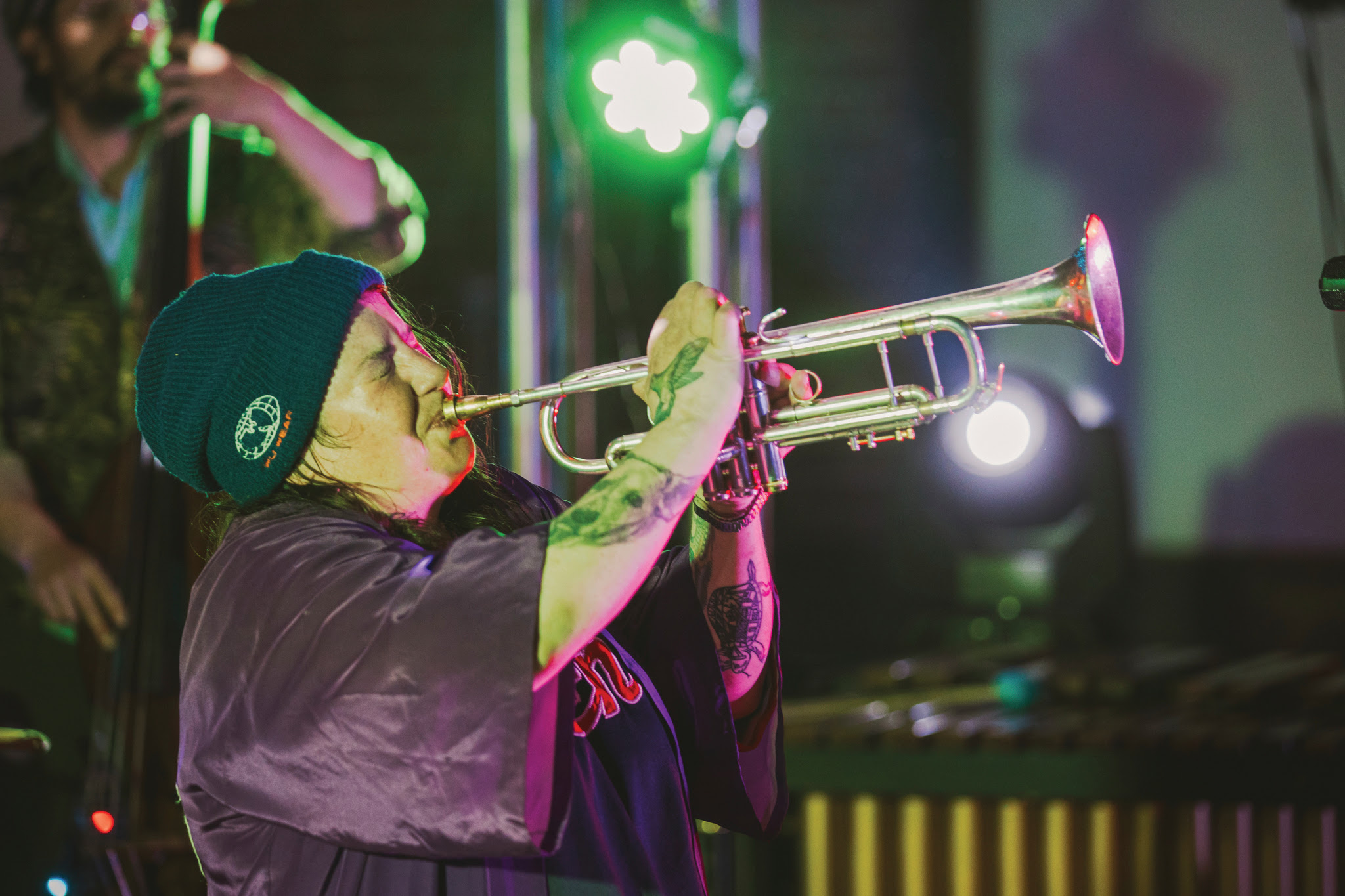
(Photo credit: Ben Semisch, courtesy of Bemis Center for Contemporary Arts)
Jaimie Branch ‘Fly Or Die Fly Or Die Fly Or Die ((word war))’
(International Anthem) 25th August 2023
As an unwittingly last will and testament, the late experimental trumpeter Jaimie Branch’s final led album with her Fly Or Die ensemble is a beautiful collision of ideas and worldly fusions that pushes and pulls but never comes unstuck. In fact, despite the “world war” suffix backdrop this album of both hollered and more disarming protestation colourfully embraces the melodic, the groove and even the playful.
Whilst the “avant-garde” label sticks, this rambunctious, more ambitious, more demanding minor opus flows and swings to a polygenesis mix of spiritual, conscious, Afro, Latin and Ethio-jazz, the great American songbook, no wave, noise and the psychedelic. And yet, on the other hand, is almost punk in attitude; a sort of anything goes in the pursuit of the message: an embodiment of challenging the boundaries.
In light of her untimely death at the age of just thirty-nine last year (the release of this album tying in with the first anniversary of her passing), this incredible statement can be read as a sonic monument; a legacy project left behind as a blueprint for a whole movement. The lyrics to the actionist rumpus ‘Burning Grey’, delivered more like Ariel Up or Polystyrene, to a swinging protest march of Phil Cohran, the Pan Afrikan Peoples Arkestra and Cab Calloway, seem almost prophetic: “Wish I had the time” and the lasting sign-off, “Don’t forget to fight”.
The final album is one Branch would recognize; more or less musically complete, recorded as it was back in April of 2022 during an artist residency at the Bemis Center For Contemporary Art in Omaha, Nebraska. However, Branch’s sister Kate and a cast of collaborators rallied round to finish the artwork and production; the final article a proud achievement encouraged on by well-wishers and friends alike.
Alongside “Breezy” Branch, who not only masters the trumpet but pushes her voice like never before and picks up on the percussion and some keys, is her stalwart troupe of Lester St. Louis (cello, flute, keys, marimba and voice), Jason Ajemian (double bass, electric bass, marimba and voice), and Chad Taylor (bells, drums, mbira, timpani and, you guessed it, marimba). That quartet is expanded further by an array of guests, including a trio of notable Chicago-hailed innovators (the city, one of Branch’s biggest influences and home for a period), the arranger/composer/engineer/trombonist Nick Broste, musician/vocalist Akenya Seymour and fellow International Anthem label mate, the drummer Daniel Villarreal (he released his debut, Panama ’77 on the imprint last year). Rounding that worthy impressive list off is the American multi-instrumentalist, Cave/Exo Planet/Circuit des Yeux (the list goes on) instigator Rob Frye.
Not so much a surprise, the album opens with a sort of stained glass bathed organ overture: part the afflatus, part pastoral hallowed ELP, part new age kosmische. A roll of bounded controlled thunder and gravitas is added to a crystal bellow and squeeze of radiant notes and the thinly pressured valves of Branch’s trumpet, which makes a brief appearance after the Ariel Kalma-like transcendence. ‘Aurora Rising’ lays down a short ceremonial communion with nature’s light before changing gear and spheres of influence. ‘Borealis Dancing’ now adds Mulatu Astake Ethio-jazz, a touch of Fela Kuti, Don Cherry and Yazz Ahmed to the ephemeral Northern Lights show as Branch toots long and softly at first before changing to higher pitch shrills. The rhythm, timing changes at the halfway mark towards a slinking groove of funk and Afro-jazz, the trumpet now cupped and echoing.
By the fourth track, ‘The Mountain’, there’s a complete sea change in mood, direction as Branch and her foils transform The Meat Puppets quickened country yin ‘Comin’ Down’. A dueting Branch and Ajemian bring it back home (so to speak) to the Ozarks and Appalachians via Paul Simon, Dylan, 60s West Coast troubadour traditions and a reimagined Sun Records. A brassy-sounded trumpet repeats the tone and springy country vocals as a gurgle of drawn-out cello plays a more somber rumination of hardy travail. To be honest, I was unaware of The Meat Puppets original, but this is a welcome meander in a different direction.
A full lineup joins in on the marimba heavy carnival turn mysterious swamp ether ‘Baba Louie’. Francis Bebey swerves to Satchmo New Orleans, whilst taking a dance around Masekela’s Soweto on a bustled bounce of joy and triumph, before succumbing to the voodoo psychedelic vapours; enticed by a cooing R&B flavoured misty Seymour. This bleeds into the bluegrass fiddled stirrings of ‘Bolinko Bass’, another Orleans evoked, almost regimental drummed bayou Mardi Gras of David Byrne, Funk Ark and Phil Ranelin. Almost mournful, ‘And Kuma Walks’ is more bluesy sounding, yet estranged at the same time; skulking amongst the spirits as someone saws through a fiddle as the trumpet aches in elegiac plaint.
Single, ‘Take Over The World’ is a hyped-up rattle and untethered excitement of no wave, punk jazz. Branch repeats a wild mantra and plays a burning bright thrill of trumpeted blasts whilst a controlled chaos spins all around her. Protest and partying converge for an electrifying, and later on, psychedelic bending stretched act of defiance.
The album ends by simmering down to a period of Afro-spiritual lament and reflection, on the sloganist berating ‘World War (Repirse)’. There’s serious bowed strings, trilled and forewarned trumpet, a sustained organ and windy, desolate enacted atmosphere on this weary actionist swan song: Branch urging caution at “false flags” and encouraging the fight.
For me Branch’s main instrument burns bright, and yet never seems to dominate, lead or overstay its welcome at any point on the album. Not for nothing is her own quote of “…meaning every note”, with not one rasp, trill, toot and cycle out of place; nothing is pushed but just felt and right at that moment. It feels to me, despite such a rich and diverse back catalogue, that Branch had so much more to give, her best still to come. And her gift was not just in crossing and mixing styles, influences, but also in pushing others to reach their own full potential as musicians. Fly Or Die Fly Or Die Fly Or Die ((word war)) is an accomplished album that channels the legacies of Chicago, New Orleans and New York to create an eclectic modern adventure in protest jazz.
Knoel Scott Ft. Marshall Allen ‘Celestial’
(Night Dreamers)

A leading light in the Sun Ra cosmology since auditioning for the Saturn jazz ambassador’s famous Arkestra ensemble in 1979, the baritone saxophonist, composer, vocalist and, when the occasion arises, dancer Knoel Scott amasses a lifetime of experience and musicianship on his debut solo-headed album. I say debut and solo, and without the extension of his previous KS Quintet named release, but the reeds specialist shares his Celestial project title with the Arkestra’s freeform progenitor, Marshall Allen.
Allen’s relationship with Sun Ra, on an album positively radiant and lunar with his guardianship and influence, goes back much further than Knoels; a stalwart since the ensemble’s formation in the 1950s, leading the troupe, the baton passed down as it were, after the cosmic Afrofuturist titan’s death in 1993. Unbelievably still in fine fettle, despite almost celebrating his centenary (that’s next May by the way), the avant-garde, inter-dimensional alto saxophonist, flutist, oboe, piccolo and EWI (that’s Electronic Wood Instrument) synthesist can be heard lending the latter’s strange sci-fi arcs, bends and space dust to the album’s title-track. It’s unsurprising to find that ‘Celestial’ has all the hallmarks of Ra too, written as it was originally with strings for the Arkestra, but never recorded.
The Arkestra family is extensive with celestial poetry taken from the late Arnold “Arto” Jenkins, recited on this universal lullaby. Art stuck with the Arkestra for thirty-six years, right up until his death in 2012. You can hear him and his “space megaphone” delivered offerings to the galaxy on Secrets Of The Sun, way back in 1962. As a homage to that universal-spiritualist’s wanton guidance, Knoel trips the radiant light fantastic, giving praise to the wisdom of the ancients and star people on a seeker’s performance of UFO oscillations, serenaded sentiments and dreamy translucence. It sounds like Cab Calloway and 50s wings being beamed up into Sun Ra’s off-world paradise.
The influence continues with the presence of the Paris scene stalwart and multifaceted (from Dancehall to Makossa, and of course jazz) drummer Chris Henderson, who’s experiences lend a both studied and more untethered freeform feel that moves between swing, big band, Latin, bop and the experimental.
This however is an inter-generational album, with fresher faces of the London scene, the very much in-demand UK keyboardist and versatile pianist Charlie Stacey and Verona-bred electric bassist and oft Arkestra and Knoel Quartet foil, Mikele Montolli. Hailed, quite rightly, as an advanced player, able to adapt to a wealth of styles, Stacey’s touch can evoke the best of those sublime 50s Blue Note recordings, touches of Oscar Peterson and Allen collaborator Terry Adams. The piano both flows with a tinkled busy lightness or strikes the heightened and jarring near-dissonance of freeform jazz; a descending off-tune part here, Cuban show time and bluesy or smoky lounge parts elsewhere: Unstated, yet moving along the action, or taking a soft stroll down the scales.
It’s another musician, part of the luminary brethren, that inspires the Afro-Cuban via Saturn’s rings ‘Makanda’. Paying tribute to a late mentor, Dr. Ken “Makanda” McIntyre, Knoel cooks up a Latin flavoured cool breeze of Havana, Harold Land vibes and R&B grooves: all undulated by sci-fi warbles and flits. A pivotal figure and influence for Knoel, “Makanda” (a name bestowed upon the reeds maestro and composer when playing in Africa, it translates from the Ndekele language as “many skins”, and in the Shona as “many heads”) founded the first ever African American music program in the States in 1971, and had worked with such notable talent as Eric Dolphy, Cecil Taylor and Nat Adderlay. Knoel and friends up the funk and balmy rhythms on this soulful homage to the late great man.
On his part, Knoel’s saxophone squawks, strains, honks and squeaks, and yet also serenades: even soothes. Wilder higher registered beak pecks turn into a near chaos, a cacophony, on the improvisation piece ‘Conversation With The Cosmos’. Coltrane, Sam Rivers and Anthony Braxton wail in zero gravity, whilst those wild rasps feel almost smoldering and lounge-like on the final mid paced twelve-bar slinky ‘Blu Blues’.
What a stellar set from the Arkestra acolyte, the Marshall and inner circle; and well done to the Night Dreamers for coaxing out this cosmic marvel. The process if you’re new to this label project, is to record the performances direct to tape before cutting on a Sally lathe the final vinyl artifact. In mono, recorded in an analogue studio, the sound is alive, inviting and, well, “celestial”. The experience speaks, communicates, and pushes the perimeters on every note, as a culmination of African American jazz styles are attuned to the stars.
Andrew Hung ‘Deliverance’
(Lex Records) 11th August 2023
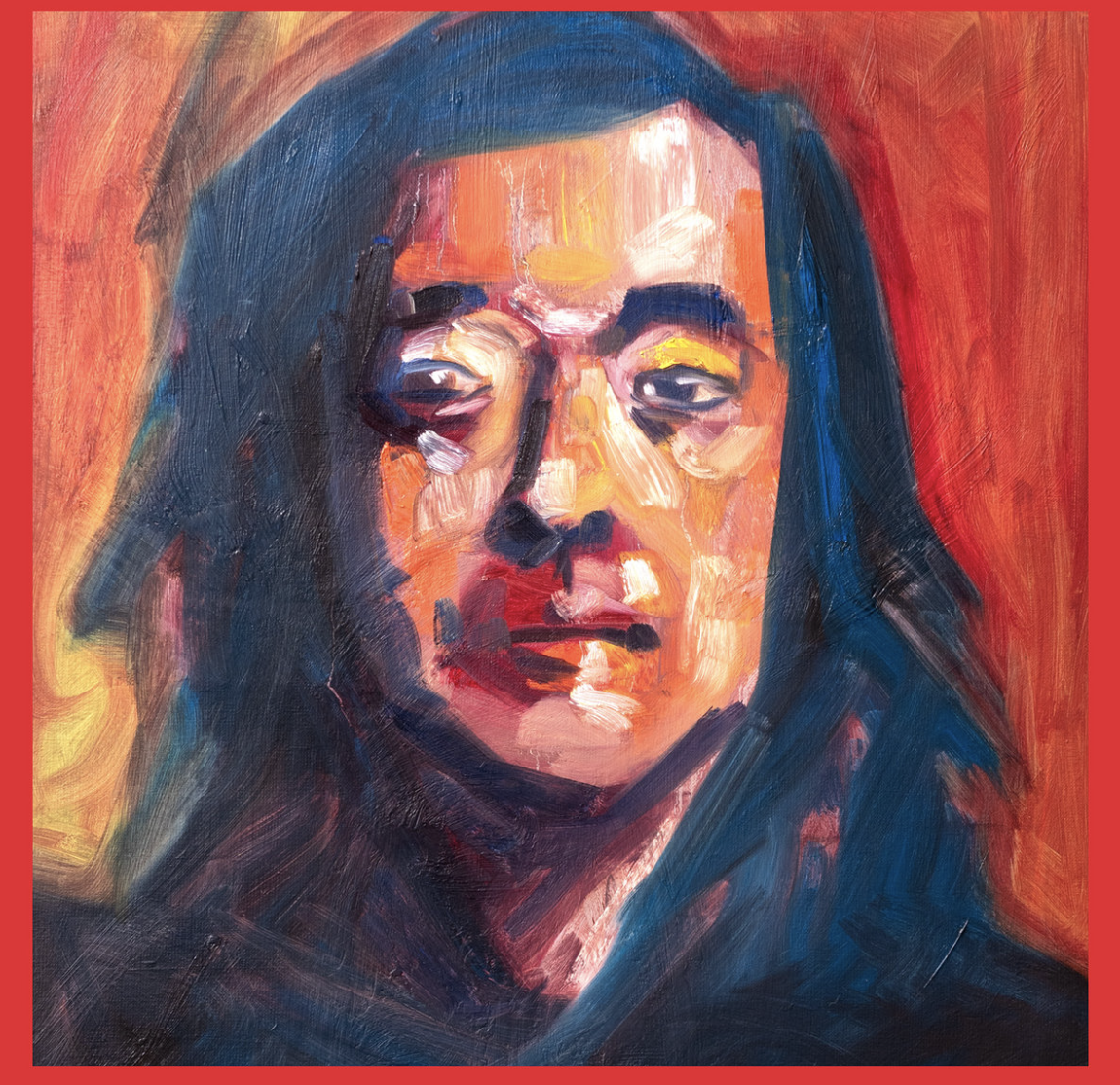
With pain, suffering and anguish former Fuck Buttons trick noise maker Andrew Hung finds a cathartic release on his third solo outing, Deliverance. But as that title suggest, the anxieties and sense of isolation and belonging now seem to have slowly dissipated as Hung feels he’s been delivered from the morose and dark fog of depression; although there’s plenty of broody, moody despair and darkened thoughts to wade through before catching the light of hope.
Hope, being set free, the constantly developing artist and producer does seem to have found his creative peace; likening this album to “the end of the chrysalis stage, like breaking free from a previous life.” Not so much reincarnation as a new incarnation, pushed on during lockdowns to mine the deep well of his soul, to face regrets and failings, but also find what’s missing.
An act of self-realization perhaps, Hung conducts a therapeutic session both unflinching and revealing. If the lyrics of ‘Don’t Believe It Now’ are anything to go by, thoughts and mental anguish at one point were truly dark. However, that filtered vapour counters the resigned with a reviving build up. And on the opening tunneled, Sister Bliss and Underworld like, moody turn freedom spin, ‘Ocean Mouth’, Hung faces a list of disappointing traits head on: Almost like taking a breath as the Robert Smith-like palpitations and rave-y Bloc Party velocity of the production avoids suffocation and gravitates towards the techno cathedral of light. Submerged at every turn with recurring references to water, Hung swims and navigates the torrents and tides to find a number of revelations about himself: conquering fear.
The previous solo album, Devastations (a choice album no less in my end of year lists for 2021) looked to the cosmos with a propulsion of electronic, kosmische, motorik, Madchester and synth pop influences, and featured Hung the self-taught singer evoking a mix of Robert Smith (some very cure-esque touches musically too), Karl Hyde, Mark Hollis and The Cry’s Kim Berly. More distressed, gasping and wrenching Hung takes some of those same influences forward on Deliverance, whilst also seeming to whip up a touch of Minny Pops, New Order, Soft Cell and John Foxx on the struggles of isolation and need to belong themed neo-romantic ‘Find Out’.
In another honest cycle of shedding shame and casting away the pain in favour of finding that alluded love “saturation”, ‘Never Be The Same’ builds from synthesized drum pad elements of the 80s German new wave, Factory Records and industrial synth-pop into another unshackled escape towards the light of revelation. I’d throw in Martin Dupont, Tears For Fears and Yazoo to that both pumped and vapourous mix.
Floundering no more, Hung looks to have found his place, his voice too. Deliverance finds him channeling his lamentable, pained, and unsure emotions into something positive and bright with another candid confessional solo album of rave-y synth-pop indie brilliance.
Various ‘Intended Consequences’
(Apranik Records)
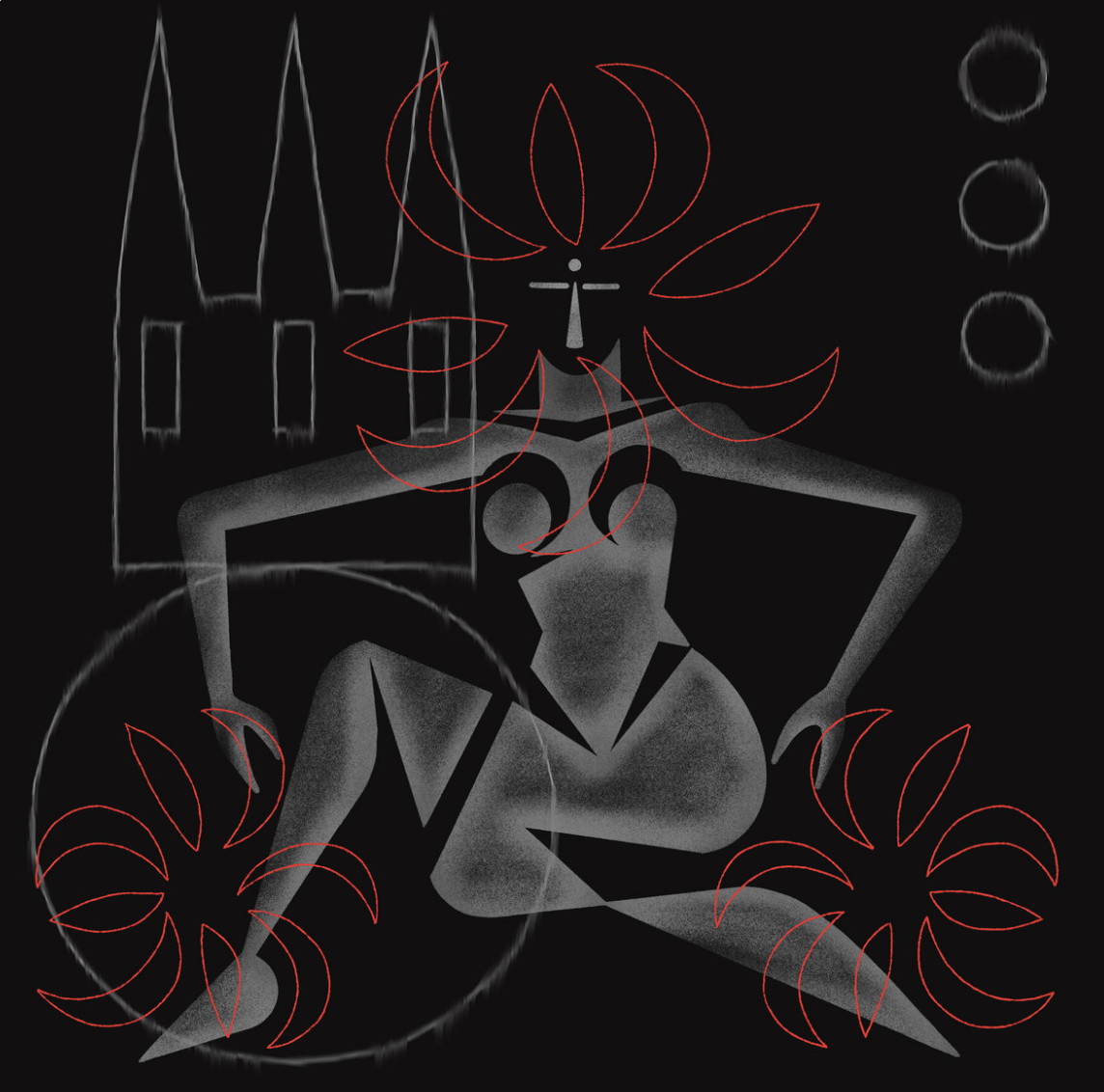
With a hellish multitude of flashpoints and distractions across the globe keeping the continuing fight for women’s liberation in Iran off the news rolls, it has become apparent that the Iranians themselves have been left to carry on the struggle with little support. In an ongoing war between the forces of the authoritarian religious state and a younger generation demanding an end to the erosions of there civil liberties and freedoms, the crisis in the country entered a dark bloody chapter last year with the murder in custody of Masha Zhina Amini by the “morality police”.
After a rightful campaign of protest and action at such a heinous crime, a brutal crackdown by the state led to mass arrests and even executions (mostly of male supporters, activists, and usually on trumped up charges). Further restrictions were invoked. And just as horrifying, in the last year, and right up to the last few months, there has been a nationwide spate of deliberate poisonings of schoolgirls (one of the groups who mobilized against the authorities in the wake of Amini’s cruel death) on mass. Defiant still, even in the face of such oppression, the brave women of Iran have strengthened their resolve only further.
In the face of such attacks, clampdowns, the music scene has responded with a strong message of resistance and solidarity. Despite everything, cities like the capital of Tehran have a strong music scene of contemporary artists, composers, DJs and performers working across all mediums, including art (which is probably why so much of the music is also so visceral, descriptive and evocative of imagery). One such collaborative force of advocates, AIDA and Nesa Azadikhah, co-founded the Apranik Records label, a platform for female empowerment. Following this year’s earlier Women Life Freedom compilation, a second spotlight volume delves further into not only the Tehran scene but picks out choice tracks from those female Iranians working outside the country, in such epicenters as London (AZADI.mp3) and Berlin (Ava Irandoost).
Sonic wise it covers everything from d’n’b, trance, deep house and techno to sound art experimentation. The range of moods is just as diverse in that respect, from restlessness to the reflective and chaotic.
Contributions from both Azadikhah (the hand drum rattled d’n’b breaks and spacy, airy trance ‘Perpetual’) and AIDA (the submerged melodious and dreamy techno ‘Ode To Expectations’, which features the final love-predicament film sample, “You know that I love you, I really do. But I have to look after myself too.”) can be found alongside a burgeoning talent pool. The already mentioned London-based producer and singer AZADI.mp3 opens this collection with a filtered female chorus of collective mantra protest, set to a sort of R&B, 2-step and bass throbbed production, on ‘Empty Platform’– just one of many tracks that uses the sounds of a more traditional Iran, especially the daf drum, alongside modern and futuristic warped effects. The sound artist and composer Rojin Sharafi likewise features the rattled rhythms of hand drums and some hidden spindled instrument – like running a stick across railings – on her entrancing kinetic techno ritual of “trauma”, ‘dbkk’.
Abji_hypersun allows the sounds of the environment to seep into her slow-building track of field recordings, collage and breaks (two-stroke scooters buzz by as distant female conversations reverberate on the street). Part jungle breaks pirate radio, part Matthew David, Jon The Dentist and LTJ Bukem, ‘Resist The God Trick’ evokes a tunneled vision of haunted reminisces and resistance in the shadows.
Emsho’s ‘Down Time’ is a rotor-bladed electro mix of Basic Channel and The Chemical Brothers, and Aida Shirazi’s mysterious wind of dark meta ‘R.E.V.O.L.U.T.I.O.N’ spells out the rage with a shadowy, near daemonic scripture of wrath and revenge – a gothic synth sinister avenging angel promises that the women of Iran will neither “forget” nor “forgive” their oppressors, torturers and murderers. Farzané seems to evoke the alien, the sci-fi on her experimental, sometimes disturbing dial twisting and crackled ‘Quori’ transmission, and the Berlin-based DJ, video artist and music producer Ava Irandoost draws on Laraaji-like dulcimer tones for her dream mirrored kosmische evocation ‘CINEREOUS’. The Tehran composer, pianist and bassist Ava Rasti draws a close to the compilation with a classical-tinged, harmonic ringed, saddened piano-lingering performance, entitled ‘Eight Night’ – an atmospheric troubled trauma is encapsulated with the deftest of touches.
It might be my own nostalgic penchant for 90s electronic music (my formative years of course), but this series (if we can call it that) could be an Iranian version of the Trance Europe Express compilations brought out during that decade; a treasure trove of discoveries and whole scenes that opened up a world of previously unknown music to many of us not living in the epicenters of North America, the UK and Europe and beyond. Hopefully this latest platform of innovative artists from across the arts will draw the attention it deserves; the message hardly virtuous, in your face, but sophisticated: the very act of female Iranians making a name for themselves despite censorship and bans a sign of empowerment and resistance in itself. Few groups deserve our support (which in the West has been sadly absent) more, but don’t just purchase for the cause but for the musical strives being awakened and produced under tyrannical oppression, and because this is a solid collection of great electronic music.
Nagat ‘Eyoun El Alb’
(WEWANTSOUNDS) 25th August 2023

Renowned as one of the greatest, most exceptional voices to have emerged from the golden 40s/50s/60s epoch of Egyptian and the greater Arabian songstresses and divas, Nagat El Seghirah was a rightly revered performer, who’s career spanned more than half a century.
Even in an age rich with accomplished, influential and groundbreaking singers Nagat held her own against such icons as Oum Kalthoum, Fairuz, Warda and perhaps the most celebrated of the lot, the anointed “voice of Egypt” Umm Kulthum. The latter, hailed the “star of the east”, was an influence on the early starter during the burgeoning years of imitation, when Nagat was a child, barely in her teens. Her affectionate appellation, “El Seghirah” or “El Sagheera”, can be translated as “the small”, “the young”, and marks the singer, performer and film star’s young apprenticeship; from entertaining the notable guests that gathered at her father’s (the famed calligrapher Mohamad Hosny) home at the age of five onwards, to her first role in cinema at the age of eight, starring in the 1947 film Hadiya. Hosny was known to push his extensive brood of children from two marriages, sometimes excessively, into various creative careers: Nagat’s half-sister was the famous actress Soad Hosny, her older brother, Ezz Eddin Hosni, a notable composer who helped her own development and natural talent.
During those initial years of development Nagat would interpret songs by such legendary figures as Mohamed Abdel Wahab, Baligh Hamdy and Kamal Al Taweel, but would find both her true and distinctive voice when interpreting the work of the Syrian diplomat-poet Nizar Qabbani. She gained adulation and fans after performing the esteemed poet’s tragic ‘Irja Ilyya’ (“Return To Me”), which is based on his sister who committed suicide rather than enter into an arranged marriage. Plaintive, stark, it rightly struck a chord with the public at the time, with its feminist lyrics and spotlight on forced marriages. It would be become a torchlight for freedom and injustice, with Nagat adding her own improvised original lines during the 1970s.
Born in 1938 but already gaining plaudits by the end of the next decade, into the next, Nagat released her first actual song ‘Why Don’t You Allow Me To Love You’ in 1955; the year she would also be married, for the first time, to a friend of one of her brothers: still only sixteen. It’s no surprise, although in no way a forced marriage, that she could, with a commanding voice, perform Qabbani’s tragedy. That marriage would only last however until the turn of the 1960s; when Nagat went on to marry the Egyptian film director Houssam El-din Mustafa in 1967 (a marriage that lasted an even shorter time). Nagat would remain, in fact seeing as she is still alive, in her eighties, remains unmarried. In recent years, since her singing retirement over twenty years ago, living a semi-reclusive life in Cairo but in poor health, there’s been some contact, even projects floated. Only last year she was featured on the official soundtrack for the streaming service series Moon Knight.
From concert to soundstage with starring roles in the films Black Candles, Beach Of Fun, My Dear Daughter and Dried Tears, Nagat gradually moved from shorter songs to ever more lengthy performances, some of which would last an hour. As time went on the songstress actress would find it harder to find those inspired works to perform. Retiring from film in 1976, Nagat would still persevere with music. And by the time she reached her early forties, in the 1980s, would release this four-track showcase of matured talented performances entitled Eyoun El Alb.
Originally brought out exclusively on cassette (like so much of the Egyptian music market), forty odd years later the reissue vinyl specialists of impeccable tastes (releasing a myriad of jazz titles and nuggets from across the Arabian world and Japan), WEWANTSOUNDS in conjunction with the Arabia and North African crate-digger Disco Abrabesquo (the moniker of the Egyptian, Amsterdam-residing DJ, Moataz Rageb), have pressed it onto vinyl for the first time. If you are a regular reader, or in fact a regular WWS’s follower and buyer, then you will be aware of that label’s previous collaboration with DA, last year’s (although they’ve also released a smattering of Egyptian focused records too over the years) Sharayet El Disco compilation. One notable inclusion on that eye-opening compilation (reviewed by me in May’s Perusal column) was from the legendary Al Massrieen. A much sought after recording outfit, the group’s Hany Shenouda produced the scenic, romantic ‘Ana Bashaa El Bahr’ (or “I Adore The Sea”) finale on this Nagat album. Adoration and yearned dreaminess for a place and time are evoked to Shenouda’s trebly near-psych tremolo guitar and light hand drum patters. Alongside the more lilting and fluted ‘Bahlam Meeak’ (“I Dream With You”), this is one of those examples of Nagat’s shortened form of storytelling romance and heartache. ‘Bahlam Meeak’ is also an example of Nagat’s more lightened, honeyed approach to what is a tinkled serenaded, wafted vision of blossom scented sand dune balladry. It evokes the music of Bacharach and the cool soundtracks of early 60s French and Italian new wave cinema.
Taking up the entirety of Side One, there’s the long form titular performance of heightened drama and searing swirled strings oboe and scuffled trinkets. Over eighteen-minutes of longed romantic gestures, the action pauses repeatedly between undefined sections; allowing the auditorium audience to show its appreciation, encouragement, which they do constantly, even when the music starts back up again. On a Matinee scale, this mini-story, unveiling of lovelorn exultations, but vulnerability and occasional lament, moves like a desert caravan across an Egyptian set, or, sumptuously glides into a Persian court. A fantastic display of sagacious craft, Nagat’s voice never has to rise or push to convey a class piece of theatre and effective yearn of love.
Only half that duration, but still a long track, ‘Fakru’ (“Do You Remember”) is a rumination; the vibrating pools of memoary reflected in the dreamy wobbled effects that permeate this fluctuating lead vocal delivery and prompting chorus of female voices. Classical Cairo, there’s a chink and tinkle of percussion and shimmy-shaking, belly dancing rhythm that luxuriantly accompanies a yearning poetic and sometimes coquettish Nagat on her reminisces. As I said already, this album represents various sides of the enchanting, soulful and also distinctive icon’s vocal presence and range. The long and short: the unmistakable sound of Egypt, but also those influences from abroad too, are melded together on a classy piece of cinematic and poetic mastery. Make room again on those creaking shelving units for another vinyl addition to the collection.
CHELA ‘Diagonal Drift’
(Echodelick – USA, We Here & Now – CA, Ramble Records – Aus, Worst Bassist Records – EU)
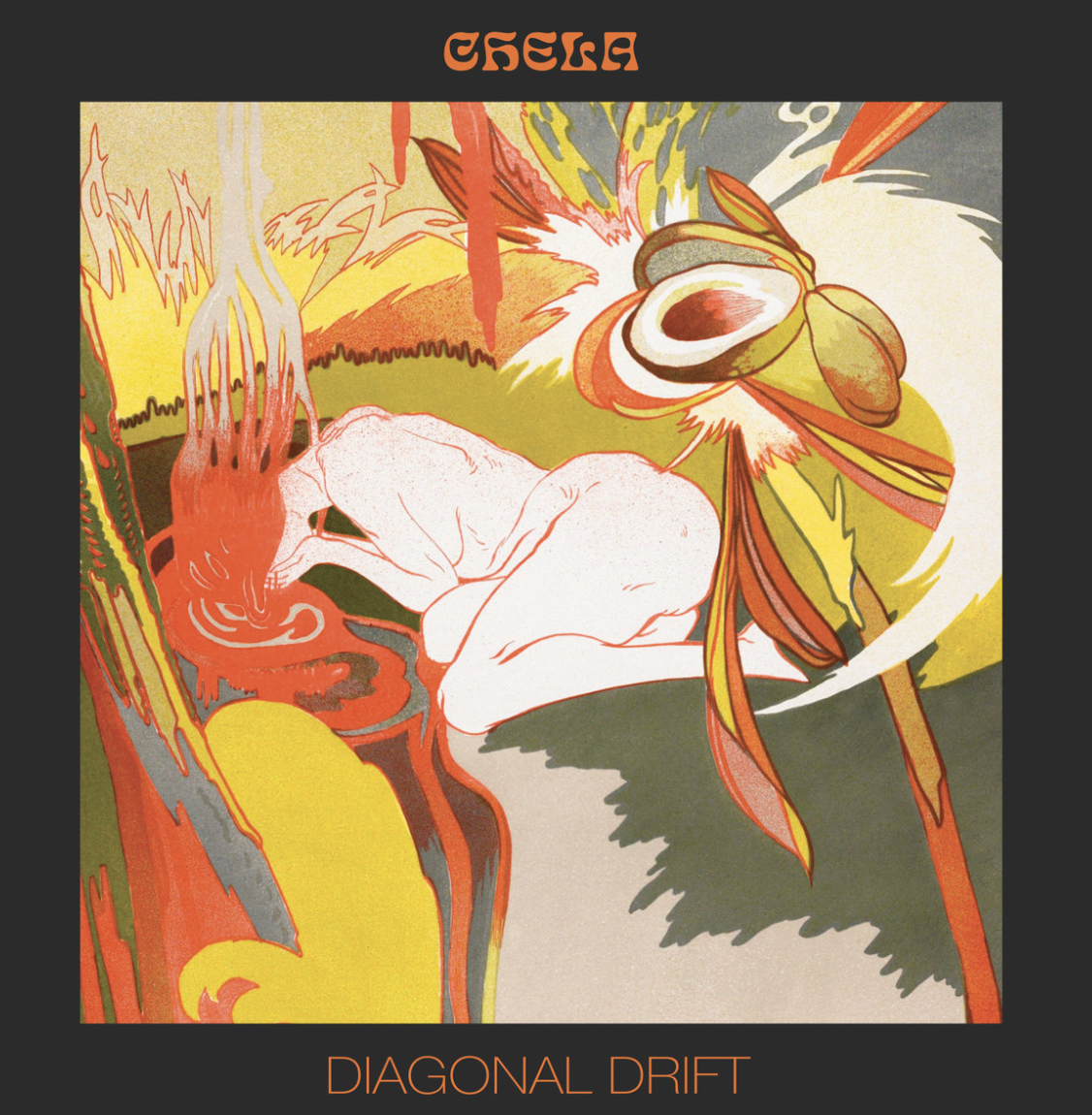
In communion with his long-time friend and collaborative foil in the University Challenged trio (alongside Oli Heffernan) Kohhei Matsuda, Ajay Saggar extends his blessed travels along the astral highways and byways with a new venture, CHELA.
Absorbed, imbued and inspired by Indian spiritualism, history and travails, its psychogeography and trauma, both partners in the new direction come together under the Sanskrit word for “disciple”; taken from the verb and root “to serve”, the “Chela” is similar in concept to a student, but implies a more loyal closeness with their teacher. In Hinduism this bond is considered sacred: An apt moniker for such inter-dimensional, afflatus dreamers and acolytes of raga, the new age, psychedlia and kosmische music.
Divine styler Saggar (who is also a member of King Champion Sounds, solos under the Bhajan Bhoy alias, and collaborates with Merinde Verbeck in the Deutsche Ashram duo) and Japanese noisenik Matsuda (most notably a member of the Bo Ningen quartet) spent much of 2022 putting this inaugural baptism together. And so with dedication to their art, the duo have sonically and melodically taken time, given depth to their new mysterious broadcast; that is, broadcasts from the ether, supernatural, uncertain, Fortean and cosmic. Different yet not entirely detached from previous incarnations, fans of both artists will pick up on past signatures, sounds and conceptions. However, they’ve managed to realign those same signatures, tuning into the mystical but often with trepidation and a sense that the noisier elements could consume all in their path.
Think Julius Eastman meets Fennesz we’re told; a good succinct summary. But I’d add a hell of a lot more, including Taylor Deupree and a cosmology of cosmic couriers. The opening ripple in the fabric of time, ‘Flyspray’, is an expanded peregrination of Beautifully tinkled Florian Fricke-like piano hauntings, Ariel Kalma and Syrinx new ageism and various Sky Records pioneers (Asmus Tietchens and Riechman spring to mind), all caught up in analogue wispy wind cacophony of divine rays, the esoteric and Eastern drones. Trippy warped reversals and folds, generator and processors nearly overwhelm the vague evocations of Tony Conrad, Schultz and a springy, but also spoke splayed banjo (which in itself seems to vaguely evoke the Balkans, Greece and strangely, India) on the reverberating ‘Appalachjo’.
In what could be a suggestion of “peace” and “harmony”, or reference to the Japanese town, ‘Heiwa’ is a hummed raga-like hymnal. A stand-up barrel-type piano plonks away from the ether, whilst ambient waves and traces of Dyzan invite heavenly reflection. ‘Ticker’ is a very different proposition. An intense chemistry of signals, beeps, quickened arrpegiator, moody signs of Faust and the sound of the Heart Of Darness are melted with Günter Schickert guitar, heavy acid Gong and various calculations.
‘Tanker’ feels like the most obvious attempt to score the sound of the title’s overbearing object; sounding like a alien freighter, both foreboding and mysterious. A scrawl and flapped ripple of radar and sonar bites into a resonating field of drones and sound waves, fog and guitar.
The final, spiritual and otherworldly track, ‘Worship’, features ghostly Indian voices and visitations from an event, service or chapter in time and history. A melodious piano chimes away in wisps of fanned cosmic mystique and cyclonic radio effects, whilst shades of FSOL, King Creosote (From Scotland With Love period) and Boards Of Canada linger. The video is more illuminating, a sepia film of bedside “worship”, healing for a leader, martyr, and a travelling funeral cortege that takes in rows of witnesses moved to touch, or just be in the essence of a distinguished teacher.
Once again with the cosmic and afflatus, Saggar and Matsuda expand their sound further. Diagonal Drift’s transcendental projection is just that, despite the building intensity and uncertainty, the broadcast noise of krautrock and kosmische styled aerial bends and radio tunings. CHELA is another welcome addition to the two artists oeuvre: one more step on the astral journey of mind-expanding experimentation.
Monthly Playlist Revue: July 2023
July 28, 2023
CHOICE MUSIC SELECTION FROM THE LAST MONTH ON THE MONOLITH COCKTAIL
TEAM EFFORT: DOMINIC VALVONA/MATT OLIVER/BRIAN ‘BORDELLO’ SHEA/GRAHAM DOMAIN/ANDREW C. KIDD
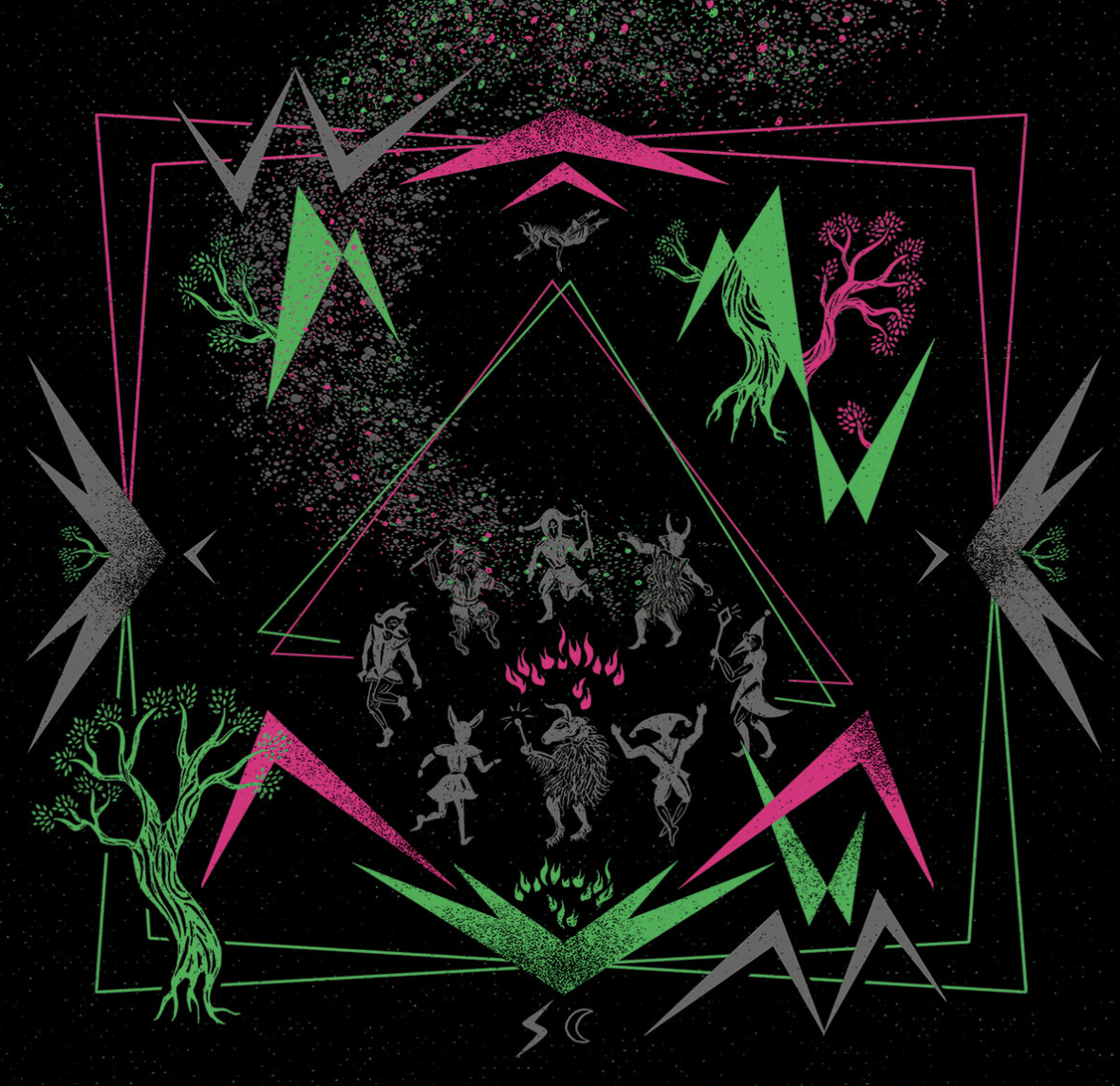
The Monolith Cocktail Monthly playlist is a revue of the last month on the blog, plus those tunes we didn’t get time to review or feature: including Matt Oliver‘s special hip-hop selection. Curated as a musical journey by Dominic Valvona, there’s a huge diverse array of choice tunes from across the genres and the globe, collated from an amalgamation of posts by Dominic Valvona, Brian ‘Bordello’ Shea, Graham Domain and Andrew C. Kidd.
THOSE TRACKS IN FULL ARE…
Habitat 617 Ft. Jack Slayta ‘Bricklayer’
Young Van Gundy Ft. Al Divino & Tha God Fahim ‘Fuyu No Senso’
J. Scienide & Napoleon Da Legend ‘Wind Parade’
Annie Taylor ‘Fucking Upset’
White Ring ‘Before He Took The Gun’
African Head Charge ‘Asalatua’
Mokoomba ‘Ndipe’
OKI ‘Tukinahan Kamuy’
Dip In The Dub ‘La Cumbia Del Sufi Que No Sabia Bailer’
Luiza Lian ‘Eu Estou Aqui’
Deja Blu ‘Crash’
It’s Karma It’s Cool ‘Vacations In A Taxi Cab’
Life Strike ‘Whip Around’
K-Nite 13 & Lee Scott Ft. Homeboy Sandman ‘Staple Junk’
The Moose Funk Squad ‘Abe Simpson’
Verb T & Vic Grimes ‘Your Heart Deserves’
SadhuGold ‘Fear Of A Black Yeti’
The Difference Machine ‘His Country’
Rusty Santos ‘Focus’
August Cooke ‘Shed With Me’
Maija Sofia ‘Telling The Bees’
Circe ‘My Boy Aphrodite’
Natalie Rose LeBrecht ‘Holy’
Hackedepicciotto ‘La Femme Sauvage’
Fat Frances ‘The Worm In The Wood’
Mike Gale ‘Summer Be Gone’
Stella Burns & Mick Harvey ‘My Heart Is A Jungle’
Emil Amos ‘Jealous Gods’
Oopsie Dasies ‘Illusioned-Broken Toys’
Zohastre ‘DUNE’ <THIS MONTH’S COVER ART STARS>
The Holy Family ‘Hell Born Babel’
The Dark Jazz Project ‘Jazz’
Healing Force Project ‘Inharmonious Layer’
Sebastian Reynolds ‘Cascade’
Caterina Barbieri ‘Sufyosowirl’
Ziur Ft. Abdullah Miniawy ‘Malikan’
Pierce Artists ‘Black Hooded Generals’
Stu Bangas & Chino XL ‘Who Told You’
Teflon/M.O.P. & DJ Premier ‘The Thoro Side’
Remulak & Moka Only ‘Starlings Green’
Jonny Wickham ‘Uncanny Valley’
Marty Isenberg ‘Life On Mars’
Gibralter Drakus ‘Exode Rural’
Las Mijas ‘Ronca (Carta Para Una Mija)’
Monthly Playlist: June 2023: Valia Calda, Killer Mike, Sparks, Kool Keith, Luzmila Carpio…
June 29, 2023

THE JUNE SELECTION: 50 plus tracks from the artists/bands we championed, rated and loved during the last thirty days. This is the eclectic, global and influential Monolith Cocktail Monthly Playlist, with music chosen from all the releases we covered in June plus those we didn’t have room for at that time. Selectors include Dominic Valvona (who curated this expansive playlist), Matt Oliver, Brian ‘Bordello’ Shea, Andrew C. Kidd and Graham Domain.
___TRACKLIST___
Valia Calda ‘Stalker’
La Jungle ‘La Compagnie de la Chanson’
Ramuntcho Matta ‘Hukai’
Pan Afrikan Peoples Arkestra ‘Nation Rising’
Killer Mike Ft. Jagged Edge ‘SUMMER’
Royalz Ft. THE HIDDEN CHARACTER ‘God In Da Ghetto’
Professor Elemental ‘Ready Or Not’
DJ Mk & Sonnyjim ‘WORTH THE RISK’
Revival Season ‘Chop’
Vieira and The Silvers ‘The Judge’
Trees Speak ‘Radiation’
Cat Box Room Bois ‘California Stars’
ANGHARAD ‘Postpartum’
Outer Limit Lotus ‘Let The Night Ride You’
The Kingfishers ‘Lapwings’
Sedona ‘Domino’
Katie Von Schleicher Ft. Lady Lamb ‘Elixir’
Mari Kalkun ‘Munamae Loomine (The Creation Of Munamagi|)’
Sparks ‘Not That Well Defined’
Bob Dylan ‘Queen Jane Approximately’
Maija Sofia ‘Four Winters’
Mike Cooper Ft. Viv Corringham ‘A Lemon Fell’
Dirty Dike Ft. Jam Baxter ‘The Places We’ve Been In’
The Chives ‘Your Mom’s A Bitch’
Lunch Money Life ‘The God Phone II’
Martha Skye Murphy ‘Dogs’
Sacrobosco ‘Pearl’
CODED ‘Binary Beautiful (Sunshine Variation)’
Baldruin ‘Zuruckgelassen’
Lauren Bousfield Ft. Ada Rock ‘Hazer’
Ital Tek ‘The Mirror’
Joe Woodham ‘Spring Tides’
WITCH ‘Streets Of Lusaka’
Celestial North ‘Otherworld’
Psyche ‘Kuma’
Omar Ahmad ‘Cygnet Song’
Luzmila Carpio ‘Inti Watana – El Retorno del Sol’
Ricardo Dias Gomes ‘Invernao Astral’
Andrew Heath ‘Fold’
Granny Smith ‘Egypt’
Spindle Ensemble & Evergreen Club Contemporary Gamelan ‘Lucid Living – Live’
Pawz One & Preed One ‘Revenge Of Silky Johnson’
ILL BILL, Non Phixion, La Coka Nostra, Kool G. Rap, Vinnie Paz ‘Root For The Villain’
Syrup Ft. Twit One, C. Tappin & Turt ‘Timing Perfect’
John Coltrane Ft. Eric Dolphy ‘Impressions – Live’
Vermin the Villain & ELAM ZULA ‘POWER OF TWO’
King Kashmere & Alecs Delarge Ft. HPBLK, Ash The Author & Booda French ‘Astro Children’
Lukah ‘First Copy’
Kool Keith ‘First Copy’
Stik Figa & The Expert ‘Slo Pokes’
S. Kalibre Ft. Scoob Rock, Slap Up Mill, Jabba The Kut ‘Murda Sound Bwoy’
Verbz, Nelson Dialect & Mr. Slipz ‘Beside Me’
Dillion & Diamond D ‘Uncut Gems’
The Perusal #44: Pan Afrikan Peoples Arkesta, Matt Donovan, Baldruin, Spindle Ensemble, Marty Isenberg…
June 13, 2023
Dominic Valvona’s Eclectic Reviews Spot (Unless stated otherwise, all releases are available to buy now)
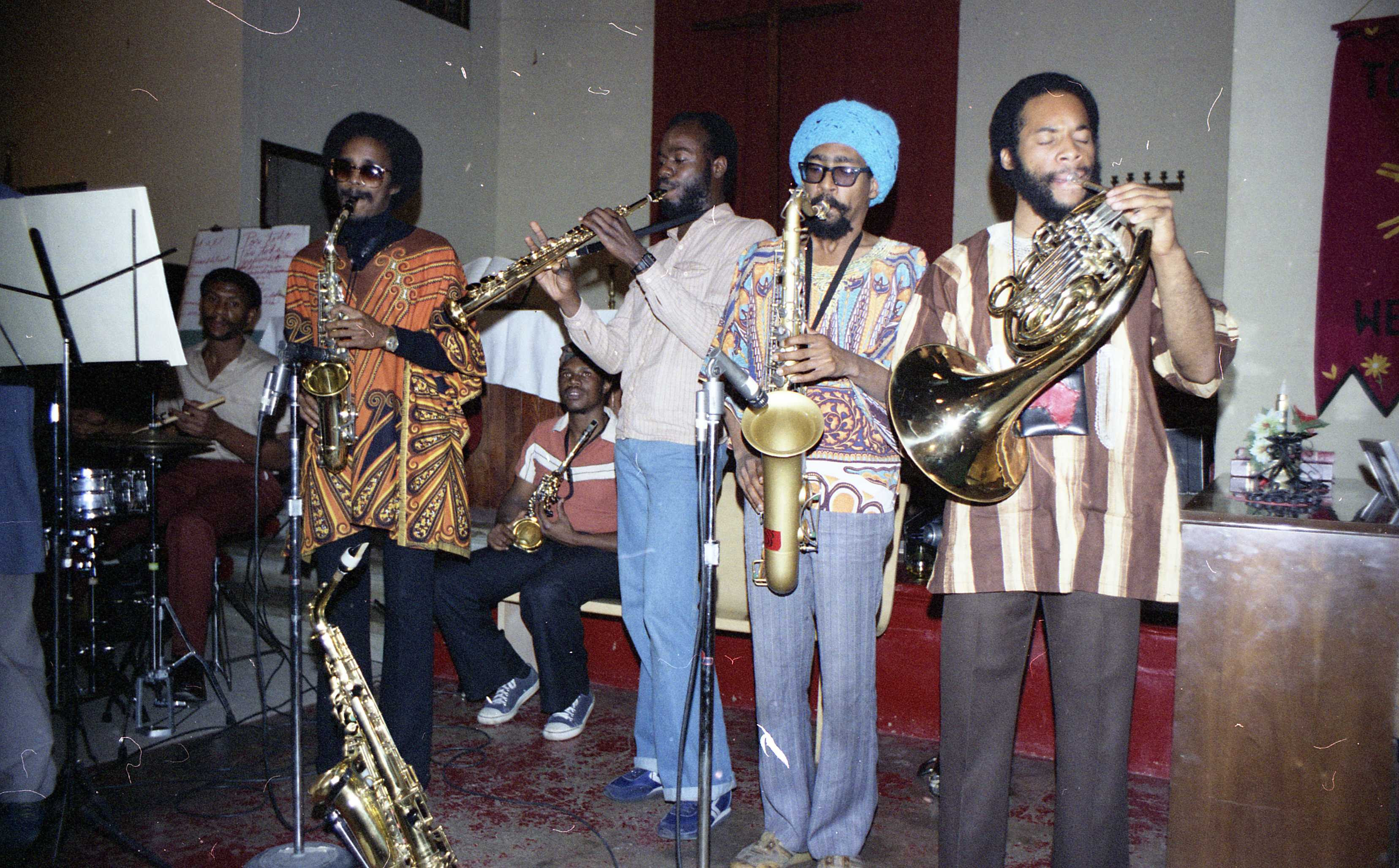
Photo Credit: Mark Weber
Pan Afrikan Peoples Arkestra ‘60’
(The Village) 14th June 2023
Serving the South Central L.A. Black community from within for six decades (and counting), the late Horace Tapscott and his preservation Arkestra ensemble captured and reflected the social and racial injustices of that oppressed community with a righteous politically conscious and radical jazz style blueprint; a documentation, but also self-reliant stand against the state’s brutality and economic suppression.
Two decades on from his passing and Tapscott’s vision has been handed down to a new generation; led in the new century by Mekala Session, scion of Arkestra stalwart alto Michael Session. More or less each incarnation, from a sixty year timeframe (hence that album title) is represented on this new celebratory collection; released by the ensemble’s own label imprint, The Village.
For a platform that continuously swelled its ranks with untold talent from the American West Coast and beyond (oft member, the trombonist and Tribe hub co-founder, Phil Ranelin is synonymous as a mainstay of the Detroit scene for example), and fermented connections culturally throughout the country, inspiring many, the Pan African Arkestra’s recordings on wax are few and far between. Most of the performances on this compilation journey through the years were collated from home-recordings; many of which have previously never been aired before. And the majority of those come from taped concerts in the L.A. arena, the exception being a summer of ’95 performance at the Moers Festival in Germany, during a period of “regrouping”. Some, believed missing, have been literally unearthed from the Ark’s archive; with even the lineup roll call having to be cross-referenced at times: and still not a 100% sure even then.

The Pan African Arkestra exists as a live entity; whether that was playing each weekend in the formative years at the South Park bandstand or, in the line of hostile LAPD fire as they played on a flatbed truck parked right in the middle of the street during the ’65 Watts riots (or “revolt” as its framed from the frustrated, put-upon Black community suffering inequality, little or no representation). In chronological order, the 60 album encapsulates each transformation of the troupe, beginning with the fifteen-minute long tribute to the ‘heart of the Tapscott family’ Pearline Fisher, or Gram Pearl “to those who loved her”. A grand matriarch, at the very centre of the family home, watching all the goings ons, including the band members arriving up the drive for rehearsals in the garage, Gram Pearl’s name was immortalised on the 1961 home recorded ‘The Golden Pearl’. Reverence shines through this early performance that seems to bridge the late 50s jazz of Gillespie, Ellington, Coltrane and the Savoy label with the coming age of the 60s Black consciousness and spiritual enlightenment. A “likely configuration” of Tapscott on a loose Oscar Peterson flow of barrel and saloon piano, Arthur Blythe and either Jimmy Woods or Guido Sinclair doubling up on saxophone, Lester Robertson on fluttered trombone, David Bryant on spoke-like and brushed double-bass and Bill Madison on swing-time and brushed drums mark one of the first lineups of the burgeoning Arkestra. As it turned out, pianist and conductor Tapscott was right to jump off Lionel Hampton’s Big Band tour bus that year; walking all the way back home, pissed but motivated to grow something new.
In the “pressure cooker” tumult of South Central L.A. a close-knit handful of artists gravitated to the beacon; at first going under the UGMA (Underground Musicians Association) abbreviation, this initial lineup included (amongst many others) the vocalist Linda Hill, drummer Donald Dean and the already noted bassist Bryant (who’ll crop up quite a lot during the course of this ensemble’s history) and saxophonist Woods. Many would appear on that compilation opener.
Although not until much later, the obvious influence/inspiration of Saturn’s cultural ambassador in Earth, Sun Ra, most be noted. Tapscott himself, easily an acolyte of that cosmic spirit, pointed out the differences between the two Arkestras; the original envisioned as an ark travelling through space, the other, a “cultural safe house for music” down here on terra firma. Whilst Sun Ra looked to the stars for an escape to some colour-blind society on a distant world, Tapscott’s troupe wanted to be amongst the people: screw the space race.
That blossoming unit found itself under FBI surveillance as a new decade beckoned; much of that paranoia down to the ensemble’s support for the Black Panthers. From the cusp of that decade, the 70s, there’s a recording of the Ark at Widney High School. With a far wider, expanded lineup and the Sarah Vaughan like commanding, but also dreamy, freely moving vocals of Hill and, so it seems, only a recurring Tapscott and Robertson, a lot of new faces appear on the fluctuating ‘Little A’s Chant’. A loose intoxication, a tamed wilderness permeates a mixture of The Lightman Plus One’s Cold Bair, Tyrone Washington’s Roots and the influence of Philip Cohran.
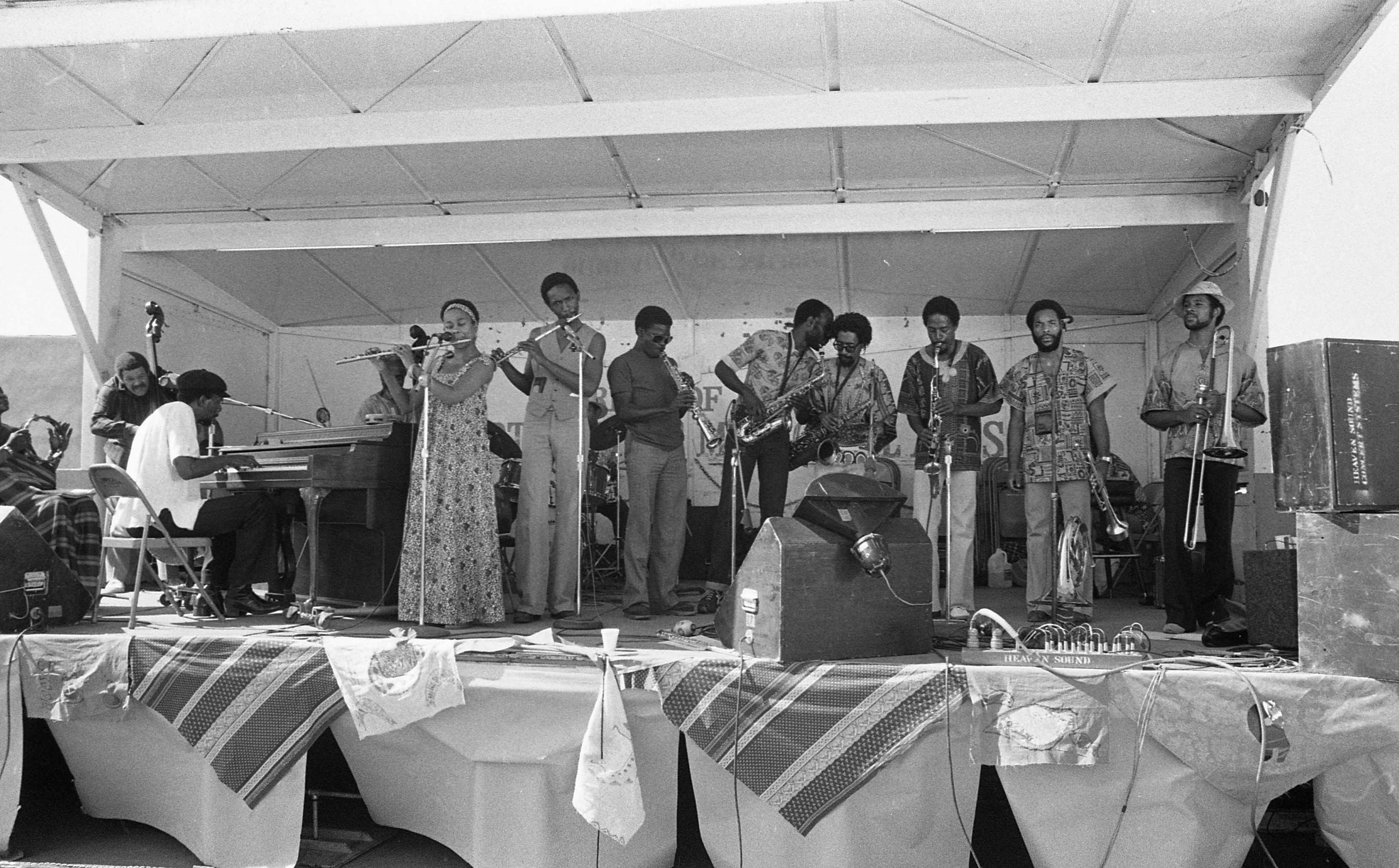
Photo Credit: Mark Weber
With the war paint on, entering the over-commodified decade of the 80s, the Ark, once more changing the roll call, fashion a piano heavy kaftan wearing fire out of Somaya “Peaches” Hasson’s ‘Nation Rising’. Turning in a Last Poets and Leon Thomas vocal performance, Juan Grey (aka Jujigwa) is a man in a hurry: he’s got “work to do”, “rising a nation”. Whistling and swinging down a boardwalk paved Nile on a Yusef Lateef and Pharaoh Sanders vibe, we got a double-front of both willowy flutes (Adele Sebastian and Dadisi Komolafa to thank for that) and altoists (Sabir Mateen delivering a honked and dynamic solo, with Gary Biar as foil), and the rattled congas of Moises Obligacion alongside the mini crescendo spiraling drums of Billy Hinton. Phew!
Forward again, and to the backdrop of an L.A. in flames, sparked by the Rodney King miscarriage of justice, the Ark are to be found on one of their rare trips to Europe; playing a concert at the Moers Festival in the summer of ’95. Regrouping with the help of a returning Jesses Sharps on soprano sax, Tapscott shares piano duties with Nate Morgan and a whole lot of brass on ‘The Ballad Of Deadwood Dick’. I will however name check Arthur Blythe on alto sax and recent converts Michael Session (on tenor), Charles Owens (also on tenor), Fundi Legohn (French horn), William Roper (tuba), Steve Smith (trumpet) and Thorman Green (trombone). An integral founding brother of the Ark, the already mentioned David Bryant is back on double bass, but sharing his duties with fellow bassist Roberto Miranda, whilst doubling up on the drums is the shared union of Fritz Wise and Sonship Theus. All together they conjure up another Egyptian tapestry whilst huffing and in bird-like illusion build up a brass heavy swing and sway. A galloping percussive rhythm (coconuts denoting a hoof-like fast trot) creates a travelling caravan vibe, as the melody, swells and punctuations evoke Skies Of America Ornate and touch of Bernstein.
The new century, a decade on from the death of their mentor and founder Tapscott, and the troupe is under a new steward and embracing another in-take of rightful minded jazz players. From a 2009 recording at the Jazz Bakery (pastries and bread with jazz, what’s not to like), with only a familiar Wise on drums (joined by Bill Madison), Sharp on soprano, Legohn on French horn and Smith on trumpet, we hear a Philip Cohran type spiritual and political fanfare for “justice”. L.A. notable Dwight Trible (recently giving divine voice to Kahil El’Zabar’s Ethnic Heritage Ensemble) is on expressive conscious-unloaded and right-on vocal duties, and the already mentioned Detroit icon Phil Ranelin can be heard on characteristic trombone. A riled and ached, seething indignation with shades of Sun Ra and the Pharaoh, ‘Justice’ is as free as it is fueled by rightful grievances.
The most recent performance, a decade later, is the Zebulon (in L.A. again) convert vision of ‘Dem Folks’. It’s conducted this time by another convert, the Egyptian-American-Muslim trombonist Zehkeraya El-Magharbel, who turns out to be a sound fit. The cast is further expanded with a quartet of spiritual rousing and more Gyrgory Ligeti otherworldly choral vocalists (Aankah Neel, Tamina Johnson-Lawson, Qur’an Shaheed and Maia, who’s also on flute), oboes, bass clarinets, a good showing of horns, and this time out, the keyboard skills of Brian Hargrove. A real fusion of dynamic parts, it begins with a virtuoso drilled, pummeled, slow to fast, percussive and drum introduction of rolls and cymbal hissing shimmers (ala Billy Cobham), before, at first, hitting a dissonance of wild drum mimicked voices. A soul-jazz groove finally lands after going through various changes, from fluted Lateef to echoes of Prince Lasha’s Search For Tomorrow communion with Herbie Hancock and a tumult of incantation and oscillated vocals. An untethered swell of orchestral jazz in the anointed light of Sun Ra and the wisdom of the ancients, ‘Dem Folks’ is the earthly community taken to anthemic highs. What a fitting, electrifying performance to mark the Pan Afrikan Arkestra’s newest incarnation; twenty years on from its pioneer’s death, the baton passed on and, as it obviously proves, is still in safe hands. The future is indeed bright for this long-running ensemble.
The 60 album proves an important preservation of a self-reliant social activist institution, integral to the community in which it serves, teaches and rises up. A great encapsulation of that story, musical journey and the changes it has gone through, this will both excite the Ark’s fans and newcomers to the cause.
Spindle Ensemble & Evergreen Club Contemporary Gamelan ‘Live In Toronto’
(Hidden Notes)
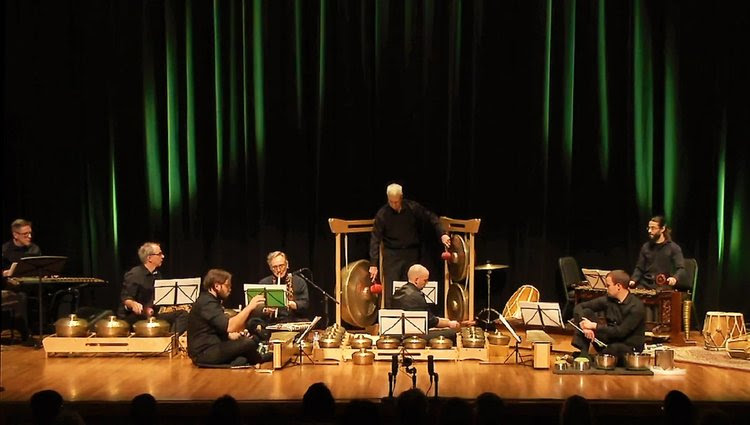
A congruous union of modern classical music and gamelan, Bristol’s Spindle Ensemble quartet and the Toronto Evergreen Club Contemporary Gamelan octet transport the listener to a blossomed, lush and evocative West Java landscape on their EP of both live and recorded studio performances.
In what proves to be an intuitive collaboration – the results of a chance meeting between the Spindle’s Harriet Riley and Evergreen’s Christopher Hull whilst both studying gamelan in Bali -, both partners respect and accentuate the qualities of their chosen forms and inspirations as they meld and weave together instruments from the West and Indonesian East. A balance is struck between contemporary explorations, probes and the timeless across three tracks. The gamelan ‘degung’ family of metallophones and bamboo instruments dance and bob along to and twinkle alongside the Spindle’s harp brushes, bulb-like note dripping marimba and vibraphone, sympathetic-bowed cello and violins, and deft subtle spells and waves of piano.
Written by the Spindle’s composer-pianist and harpist Daniel Inzani, the opening patter cascade of mallet notes and tinkles ‘Lucid Living’, was recorded at the Evergreen’s rehearsal space in downtown Toronto. A light enchanted dance of plucked and picked strings across lily pads, with an air of the willowed fluted pastoral, there’s an almost romantic but simultaneous closed-eyes, deep in thought moodiness to this first performance of adroit musicianship.
Also penned by a Spindle member, Harriet Riley’s mythological-loaded ‘Orpheus’ is part of the two group’s live performance at the city’s 918 Bathurst Street Centre For Culture, Arts, Media And Education – it must be noted at this point that the Bristol quartet travelled to the Evergreen’s backyard to foster this project, spending weeks rehearsing the repertoire before that inaugural live date. Barefoot in jungle temples, the Hellenic bard-poet (an Argonaut and famed survivor of Hade’s underworld) is planted down in the Indonesian exotic; wandering across an uninterrupted proscenium score of various Southeast Asian flavours. All the while accompanied by a soundtrack of pressing repeated chords, metallic chimes and drones, the arched and bowed. At times it’s a rasped mizzle, at others, a slow-paced rhythmic joy or flight that feels almost improvised if not free to fellow its natural path.
The final performance, ‘Open Fifths Gardens’, was composed by the Evergreen’s Andrew Timar and is another exotic allurement of the East. It suggested the dusk hour to me, and evoked the strings of Simon McCorry and Anne Müller: that push of classical instruments made to sound more contemporary and alive if abstract; not just read off the classical cannon score sheet but swelling up with a less guided, personal feel for the time, space and direction of travel in that moment.
In short: the gamelan sound is opened up further and spread wider into the arena of contemporary chamber and symphonic classical music, to conjure up an atmospheric kind of melodious and stirring theatre.
Matt Donovan ‘Sleep Until The Storm Ends’
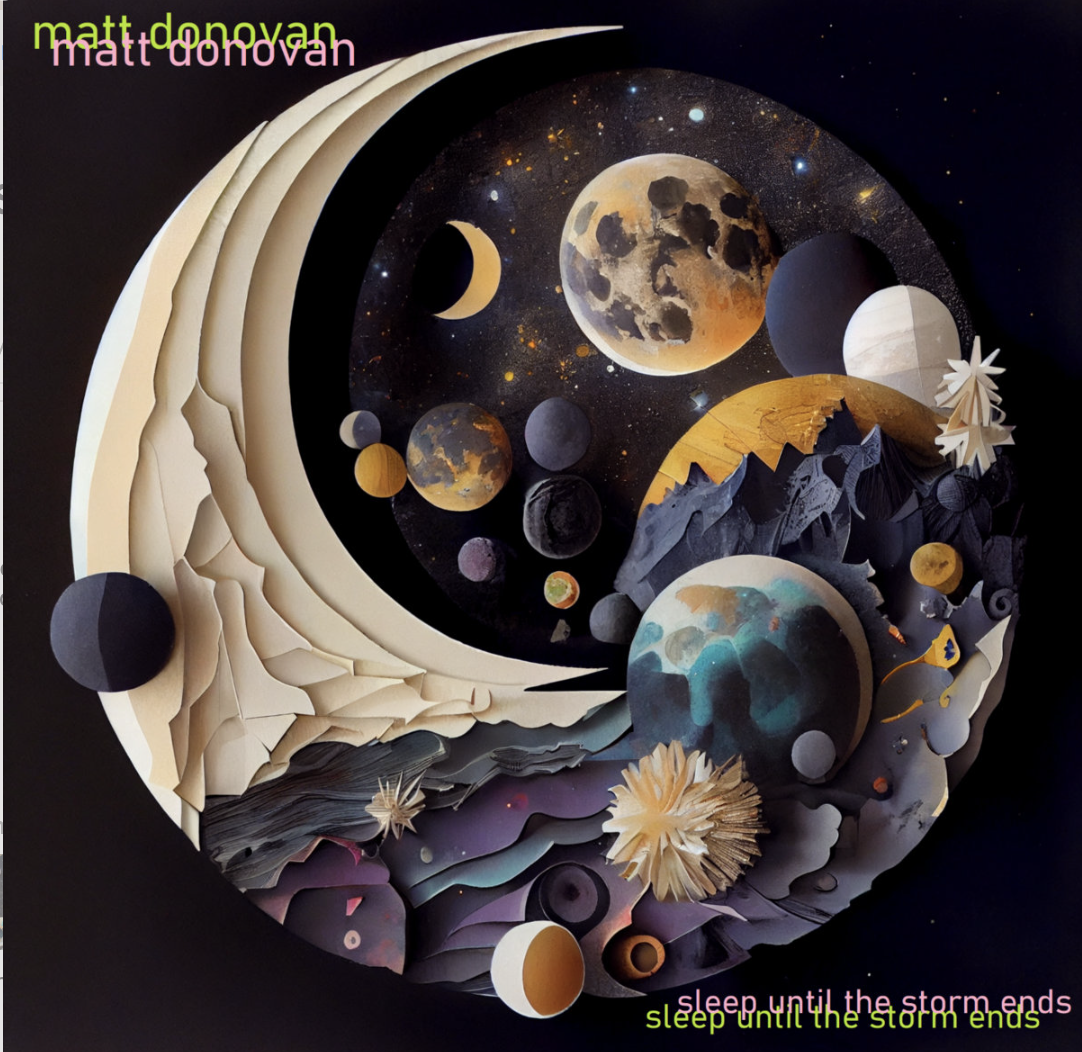
Marking three in a row of annual Spring-time delivered albums, the drummer-percussionist turn multi-instrumentalist solo artist Matt Donovan opens up his personal universe to the world. In the face of political, social discourse and ruin, lawlessness, loss and anxiety Donovan captures the evocative moments and scenes we all often take for granted; turning nighttime walks, the memories of loved ones into something musically and sonically lasting. A time is saved for posterity even if its just for Donovan and no one else; a kind of musical photo album that represents the sentiments, therapeutic stages of a period in his life.
And yet, with such universal tragedy and dislocation, there’s always hope; the music, even when the subject matter chimes with the God awful state of affairs currently destroying the country, remain loving and kind. Those of you who seeked out the (hopefully through my recommendations) previous Habit Formation (’22) and Underwater Swimming (’21) albums will find that Sleep Until The Storm Ends shares a familiar palette of kosmische/krautrock, alt 80s and 90s and post-punk influences. And yet it feels somehow different; mature and comfortable in its skin but exploring all the while.
With propulsive-motored stints in Eat Lights Become Lights, and as a foil to Nigel Bryant in the psych-krautrock-progressive-industrial Untied Knot duo, it’s hardly surprising to hear those Germanic influences permeating this newest album: A spot of the Dingers (Klaus and Thomas) here and a bit of Michael Rother and Manuel Göttsching guitar there. On some of the more reflective tracks like ‘A Sky Full Of Hope’ and ‘Night Walking’ its Tangerine Dream and company, albeit the latter has more than a touch of soundtrack Vangelis about it too, merged with pop, jazz and 80s indie influences. Although not German, just mere cousins on the astral plane, a few of these tracks reminded me of both Syrinx and Ariel Kalma’s new age, spiritual panoramic awakenings.
This is only half the story, as Donovan also effortlessly seems to weave The Field Mice’s ‘…letting go’ with Karl Hyde, Mick Harvey (especially on the few occasions he sings), the Durruti Column, Spaceman 3 and Eno (Another Green World era on the light-effected environmental plaint ‘The Crying Earth’). In practice this results in a sort of bell-tinkled and recalled leitmotif signature unfolding of Donovan’s moods and ruminations: goodbyes too. Sometimes its dreamy and other times near cosmic with climbing scales and Fripp-like sustain and flange-fanned guitar work, synth waves and heartfelt vibrations.
Barefoot Contessa daydreams sit well with clavichord buzz splintered boogies on yet another enriching and rewarding album that slowly unfurls its understated balm of warmth and also protestation gradually over repeated plays. On the fringes certainly, a true independent diy artist, Matt Donovan is far too good to stay under the radar. Do yourselves a favour, grab a copy on bandcamp now.
Baldruin ‘Relikte aus der Zukunfti’
(Buh Records) 19th June 2023

Lying somewhere between the Reformation, hermetic, supernatural and mysterious Far East, the German electronic musician-producer Johannes Schebler simultaneously occupies a liminal past and as yet unsure future on his latest journey, Relikte aus der Zukunfti.
Just as Roedelius, Moebuis and Schnitzler’s first recorded experiments, under the Kluster title, found a home on the synonymous German church organ music label Schwann, so congruous were those early kosmische innovators “hymnal qualities” and, if removed, links to the country’s rich venerated history of religious music, Schebler’s own small Bavarian village rectory upbringing can be heard permeating this fourteen-track traverse and score.
The chime and ring of Lutheran, but also Oldfield’s tubular, bells can be heard across a both holy and unholy atmosphere of cult Italian horror, prog-rock, krautrock, new age and vague Ethnographic absorptions. The paranormal and monastic; the chthonian and Oriental are constantly drawn upon to manifest a fog of uncertainty and intrigue; occasionally delivering heightened dramatics and the chills as the music evokes hints of Goblin, Fabio Frizzi and the presence of some ungodly force.
It begins however, with the blown, sax fluted and veiled ‘Under The Counter’ soundscape, which sounds more like a gauzy apparition of Sam Rivers or Colin Stetson in a Frederic D. Oberland expanse. ‘Ride On The Silver Lizard’ meanwhile, sounds like a brassy sitar transcendental mythology of Steve Hackett, Eroc and Srgius Golowin, and the airy ebbed ‘Predestined’ captures Finis Africae and Vangelis in a cloud vapour loop. The timpani-rumbled ‘Confused’ on the other hand could be a lost Sakamoto score; the late Japanese icon entering the underworld.
Stretching the imagination whilst hinting at various mystical lands, you can detect the more experimental, serial and less musical adventurous work of Širom and Walter Smetek existing in the same space as Popol Vuh, Alejandro Jodorowsky and the melodically afflatus. You’re never quite sure where you are exactly though: nor in what time period. The ground beneath your feet is translucent, or, like an ever-changing shimmer and shiver of evaporated atmospheres. This is a knowing album that taps into its influences and church music groundings to offer a balance between the spiritual and disturbing.
Ramuntcho Matta ‘S/T’
(WEWANTSOUNDS) 16th June 2023
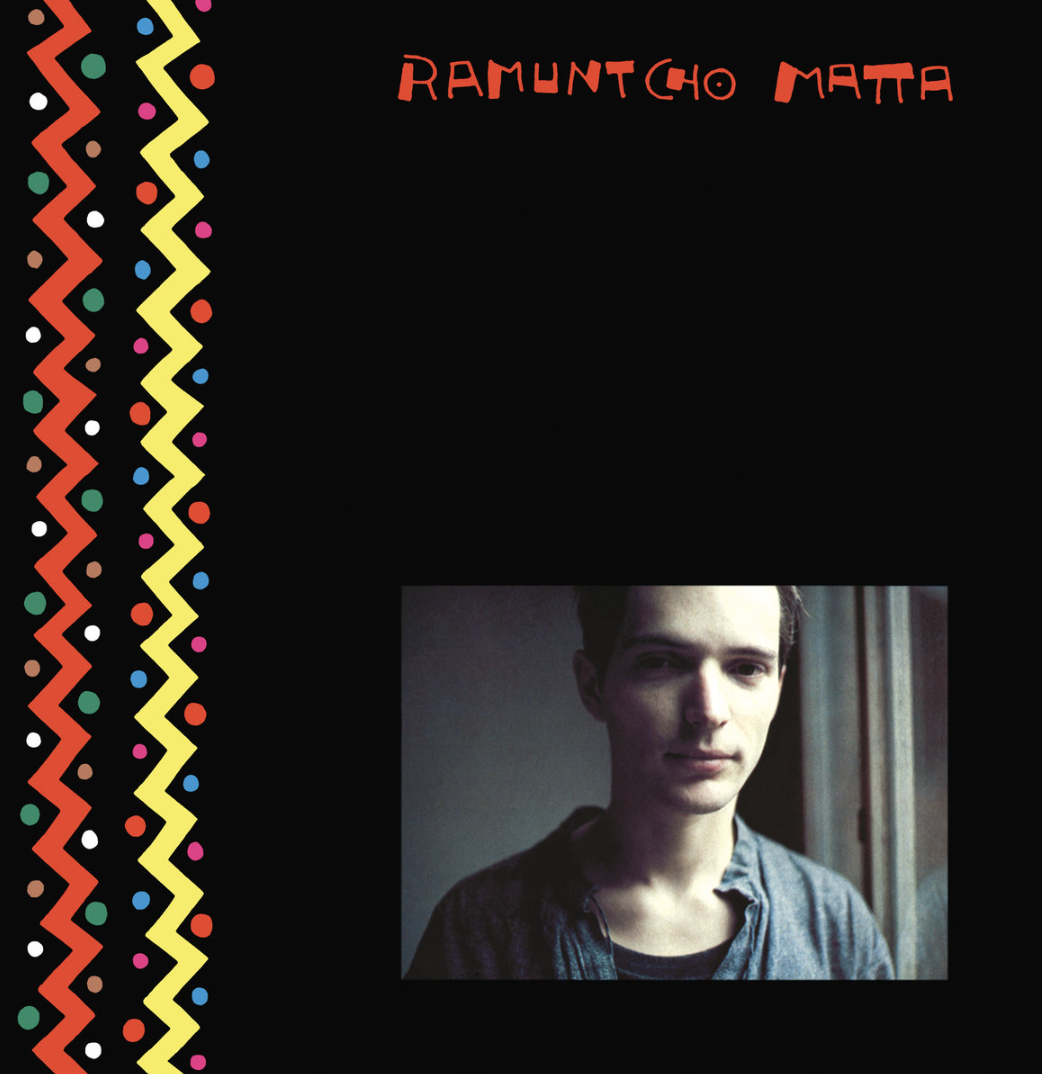
A sound production of contrasts; a collage of time spent in both New York City and Paris, where the graffiti’d downtown meets fourth world music explorations, Ramuntcho Matta’s absorption of those two cultural hives is a no wave and exotic theatre of diverse influences.
The younger sibling to and scion of the Matta arts brood – his father, the Chilean-born Roberto, a key if not always congruous member of the Surrealist movement with his ‘psychological morphologies’ or alien ‘inscapes’ coined subconscious manifestations, and brother, Gordon Matta-Clark, the ‘anarchitecture’ pioneer of such concepts as the ‘split’ house and various art performances -, Ramuntcho was a well-connected creative nomad who chose to plow his own furrow in the field of experimental music. He started out in this regard, in the company of such polymath avant-garde luminaries as Brion Gysin, Don Cherry and Laurie Anderson. The latter opened doors to everything New York had to offer in the late 70s and early 80s. Ramuntcho also shared a flat with scenesters Nana Vasconcelos and Arto Lindsay: living in the same building as the Talking Heads’ Chris Frantz and Tina Weymouth no less. Although tragedy would strike with the death of his brother and conceptual art icon Gordon in the late 70s, the burgeoning producer would stay on, falling in with the Mudd Club, CBGB and Danceteria in-crowd; taking note of the evolving polygenesis movements of early hip-hop, post-punk, electronica, no wave funk and more worldly sounds (from Soweto to the outback, Caribbean and Hispaniola).
But it all came together, or rather this particular project did – dusted off, remastered and given a deserving vinyl reissue by WEWANTSOUNDS – in Paris. With the CV –notably recording Don Cherry’s 1983 ‘Kick’ single for the boutique French label Mosquito, the original imprint for this self-titled album – and network expanding ever further, there would be performances with the Senegalese group Xalam and the Arabic rock group Carte de Séjour, with Rachid Taha. A residency in Lyon led to a meeting with the Algerian-born French avant-garde choreographer Régine Chopinot, who had taught dance at the city’s Croix-Rousse before forming her own experimental multimedia company. Chopinot invited Ramuntcho to compose the soundtrack to her upcoming Via show – the costume designer of which was a young aspiring Jean-Paul Gaultier.
Without seeing the actual production it’s difficult to gauge if the music was successful, complimentary or not. However, removed from that dance theatre setting the album works as a window in on a particular rich cultural exchange of ideas, sonics, sketches and soundscapes.
This ’85 released production was produced between Ramuntcho’s home and the Studio d’Auteuil in Paris; the former, a more solitary space for the album’s soundscapes and more ambient-minded pieces, the latter, a more rambunctious shared environment where all the album’s bandy and shunted no wave funk and Island life Grace Jones-esque tracks were recorded with the Stinky Toys and Elli & Jacno duo’s Elli Medeiros (on vocals), the Uruguayan percussionist Negrito Trasante, Suicide Romeo’s Frederic Cousseau (better known as Fred Goddard) on drums and Polo Lambardo on konks. That list may be extended depending on what information you read, although the WWS label and linear notes writer Jacques Denis have managed to pull together the fullest picture yet of a record hampered by misspelled band members and even a missing track listing. According to those same notes, Ramuntcho didn’t feel that the label had pushed the project or even promote it very well; hence why it disappeared: a find for crate diggers decades later.
A dance fusion of influences and ideas, this counterpoint of diverse elements opens on a gentler, almost mulling day dreamy guitar amble with the light-jazz touched ‘Gesti’. Like Marc Ribot on Iberian shores, there are a couple of these soloist moodscape pieces (see the more classical-tinged and loosened ‘Irimi Nage’). A second strand to this record’s sphere of influence is the didgeridoo sounding passages of Jon Hassell inspired sound cartography; as found on the outback resonated, barked fretboard experimental, water carrier poured ‘Avatar’, and mbira tine, funnel blowing, freight train honked primitive dance music spot ‘Zoique 3’.
The action sprawls across both the NYC and Paris underground on tracks like the shunting cut-up and counterbalance of discombobulated Art Of Noise and a repeated sweeter voiced spell of African or French-Polynesian Island song, on the ‘Sassam Kitaki’ switch. Most surprising is the fluid, bandy amalgamated hip 80s shining ‘Hukai’, which merges Casino Music with Orange Juice, Grace Jones, Lounge Lizards, Talking Heads and the sunny township polyrhythms of South Africa. ‘All Those Years’ in contrast, sounds like Saw Delight era Can rubbing shoulders with a reflectively blue XTC.
Also, in addition to shades of Dunkelziffer, Populaire Mechanik, Don Cherry (of course), Annie Anxiety and the Pop Group, there’s an exotic fauna and animalistic soundscape of French-Arabia, Africa and the Americas, to be found suffused amongst the electrified disjointed and vibrated no wave funky free-play.
I must confess, this album totally passed me by. I wasn’t even aware of it. Although only briefly, I even studied both Roberto and Gordon Matta when I was an art student, but had no idea there was another equally talented member of the clan. Hearing it now makes sense, so much of its makeup integral and over-used in the last two decades as the 80s becomes this generations’ 60s. There are some great eclectic hybrids and even no wave dance tunes to be found. Everything gels perfectly on this evolving, changing production; from the bendy to frazzled; atmospheric to off-kiltered. Ramuntcho’s theatre dance soundtrack is a complimentary bedfellow to Sakamoto’s computer disc experiments of the same(ish) period, released a while back on the WWS label. A great revived lost fusion from the avant-garde funk and no wave cannon.
Marty Isenberg ‘The Way I Feel Inside’
7th July 2023

It’s a name synonymous with whimsy poignancy, a signature frame and colour palette, but what the American filmmaker Wes Anderson and his perfectly constructed diorama movies are equally famous for is their carefully curated soundtracks. The scores of which have led to, in some cases, a revival of fortune for the said artists and bands that pepper such iconic films as Rushmore, The Royal Tenenbaums, The Life Aquatic, Fantastic Mr. Fox, Moonrise Kingdom and so on.
The unassuming Anderson has become such a cult figure himself that, in kind, a number of artists have penned homages or name checked his films or idiosyncratic view of the world. Arguably there is a certain hip, generation X selective and knowing calculation to those mixtape-like soundtracks that get used as prompts for poignancy, emotional states and the almost impossible to quantify with just actions or dialogue.
Not quite the homage in itself, the debut album from the NYC bassist and composer Marty Isenberg (stepping out under his own name for the first time) entwines the feelings of his own formative years with Anderson’s filmography: or rather, the music from those beautifully crafted stories of outsider isolation and pain. You could call it a covers album of a sort; an eight-song selection of reinterpretations would be better though. And yet, despite keeping some of the signature melodies, all of the original lyrics, Isenberg extends, menders and sets familiar emoted pulls in a different environment with a rich jazz transformation.
You’ll have to excuse my ignorance and a lack of info on who is joining Isenberg on this album: there’s electric guitar, drums, some sax and cornet, and a beautifully voiced singer with shades of Norah Jones and Esperanza Spalding. I’m going to suggest that members of Isenberg’s Like Minds Trio with Alicyn Yaffee and Eric Reeves could be involved. It would make perfect sense; the music does at least sound congruous.
Proving the most popular choices, The Royal Tenenbaums and The Life Aquatic dominant. From the former there’s a faithful harpsichord spindled version of the Velvet Underground’s ‘Stephanie Says’ that subtly transforms that Stones-like psychedelic old England vibe into a smooth 70s jazz light theme tune, with sections of swing and simmered feels. Velvet third wheel and oft collaborative partner, Nico has her pleasant of Lutheran melancholic song of regret and remembrance. ‘These Days’, lightened and taken back to Jackson Browne’s more lifted, sweetened origins. A Muscle Shoals electric piano (or Hammond) hovers as the vocals acquire more of a lilting and near scat-jazzy vocal arrangement that sounds almost Bacharach(ian).
Another Tenenbaums favourite, Eliot Smith’s ‘Needle In The Hay’ is given a jazzy touch. Isenberg opens with incipient bass bends, scales and nimble introspective picks as a less adolescent moody, despondent vocal points towards both Spalding and Tori Amos. The feels all there: the indie singer-songwriter dourness. Yet it’s given an off-script treatment of drama counterbalanced by the meandered.
Nick Drake’s achingly beautiful ‘Cello Song’, with all its connotations and personal tragedy, is a journey in itself of the wept and sympathetic. Sailing close to Beggars Banquet Stones, and the jazz of Mingus and Bobby Jackson at other times, a “cruel world” of sensitivity is softly expanded upon. That vocal is almost airy, if still carrying a beguiled plaintive tone.
My personal favourite (alongside Rushmore), The Life Aquatic offers up a double helping of Bowie covers and a Lennon/McCartney-like Zombies hymn. In what is a kind of meta exercise, the film’s Belafonte crew member and famous Brazilian musician Seu Jorge originally played around with a songbook of acoustic Bowie numbers; all of which are smattered throughout the Cousteau parody come homage. One of them, ‘Rebel Rebel’, is covered here; attuned more to Jorge’s Latin-sauntered origins than the glam-stomp actionist anthem of Diamond Dogs. In this version the song is played in the background of Peter Sellers’ The Party, or winding out of an early 60s jazz lounge. It’s both very twinkly and Tropicana light. ‘Life On Mars’ however, is faithful in part (tune wise anyway), yet takes the original crooner-vibe towards a mix of colliery band style horns and Stevie Wonder soul-jazz. The drama, edges are rounded but the overriding lament and emotional draw remain in tact. The pleasing ‘The Way I Feel Inside’ from a ‘65 Zombies is handled with a sweetness and enchantment that wouldn’t sound out of place on an Anderson film itself.
I’m totally unfamiliar with the band Steady Holiday, whose ‘So Long’ is playfully sent back to a dancehall era that weaves together echoes of WWII, the 50s and Dixie Jazz for a wistful, cornet nestled smooch.
Isenberg with subtlety and charm offers some surprising renditions. But what’s most surprising is that the bassist doesn’t grandstand, hog the spotlight with his double-bass instrument of choice; nor is this especially a bass-heavy showcase, but an adroit, attentive but ready to leap at a moment’s notice into action playing style that bends and lends itself to a variety of styles. There’s heartfelt connections balanced with a certain magic and even playfulness, a sharing of the artist’s tastes, record collection and personal aspirations; the main one being the loss of his father at a young age: old enough however to have been inspired by his dad’s own musical tastes, loves and collection of instruments. Finding a special affinity perhaps with Anderson’s many protagonists (there is a leitmotif of characters with only one parent in his films), that early loss led to Isenberg’s journey in musical study: from initially learning by feel and intuition, to majoring at the New School for Jazz And Contemporary Music in jazz performance. A beautiful and off-kilter, sometimes whimsical, songbook is transformed with a jazzy touch of personality.
Joe Woodham ‘Worldwide Weather’
(None More Records) 16th June 2023

Noting the changing tides and climate on warm suffused currents of looping guitar, field recordings and kosmische, post-rock and dream progressive styled languorous inspirations, Jouis band member Joe Woodham sonically and melodically charts various lunar-cycle driven weather fronts and metrological phenomena on his first solo album for the None More Records label.
Unburdened by climate change Cassandras’ and apocalyptic predictions, Woodham almost finds a certain comfort – even when yearning – in tracing and capturing the ebb and flow, the awe and beauty of the oceans as they are pulled by the moon’s cyclonic forces.
As an aside, and for trivia fans, album track ‘Neap Gloom’ (anything but as, well, gloomy as that title suggests; rather it’s a more airy and wafted proposition, with rain patters that sound rather nice) is a reference to the tide just after the first or third quarters of the moon: when there is the least difference between high and low waters.
The process of making this album itself comes from enjoyment, not dark clouds of angst or anxiety. The initial experiments were produced in fact on Woodham’s daughter’s Casio keyboard, which in turn was linked to a loop pedal. There’s more to it than that of course, but the intention was one of play and improvisation; later manipulated and layered with the clipped hiss, gates and crackled atmospherics of Matthew David, the suffused bird songs and whistles of Ernest Hood, and crashing surf and spray of the waves crashing against the shoreline.
The enormity is certainly present, but most of the peregrinations and moods slip and wash between the swimmingly and warmly drifting. It could be what sounds like a melodica on tracks like the gamelan malleted bells and concertinaed Parisian wafted ‘Gameplan B’ (no idea about that title, other than this could be a riff on the climate emergency brigades, “there is no planet B”, mantra), and squeezed mellowed, nicely wavy and dreamy (anything but) ‘Overcast’ that makes me think of Alex Paterson’s brand of mirage-dub. And, as referenced by Woodham himself in his accompanying quotes as the listening material when making this record, there’s an enervated whiff of Frances Bebey about the latter track, alongside hints of Jah Wobble and Odd Nosedam.
Amongst the variations of Manuel Göttsching, Michael Rother, Land Observation and Orange Crate Art guitar accents, lines, curves and cycles and sweeping weather fronts, the magical ‘Spring Tides’ builds from a Laraaji-like heavenly introduction into a slow forward momentum of beautiful slowcore and shoegaze (reminding me actually a little of The Besnard Lakes). Woodham actually sings on the psychedelic English folk-pastoral ‘Longshore Drift’ observation; sounding a little like James Yorkston in hymnal echoed benevolence.
Woodham effectively layers the counterflows and melodies of nature and the directions of tidal travel. There are some lovely moments on this album, some spots of reflection, as Woodham makes a case for just letting the music take you in its lunar drawn grasp. A really effective debut for the label.
Hi, my name is Dominic Valvona and I’m the Founder of the music/culture blog monolithcocktail.com For the last ten years this blog has featured and supported music, musicians and labels both I and my team of collaborators love across genres from around the world that we think you’ll want to know about. No content on the site is paid for or sponsored, and we only feature artists we have genuine respect and love for. If you enjoy our reviews (and we often write long, thoughtful ones), found a new artist you admire or, if we have featured you or artists you represent and would like to buy us a coffee at https://ko-fi.com/monolithcocktail to say cheers for spreading the word, then that would be much appreciated.
Monthly Playlist: May 2023: Delilah Holliday, Tony Allen, Alecs DeLarge & King Kashmere, Lucia Cadotsch…
May 31, 2023
CHOICE MUSIC FROM THE LAST MONTH: TEAM EFFORT
The Monthly Revue playlist of 2023; a choice selection of tracks from the last month on the blog. Curated by Dominic Valvona with Matt Oliver on the Rap Control once more, and music from reviews by Brian ‘Bordello’ Shea, Graham Domain and Andrew C. Kidd. Expect to hear the unexpected.
TRACKLIST//
Alecs DeLarge & King Kashmere ‘Damien Darhk’
Samuele Strufaldi ‘Davorio’
Les Dynamites ‘Pop Oud #2’
Andrew Hung ‘Ocean Mouth’
Matt Saxton ‘Freedom’
John Parish & Aldous Harding ‘Three Hours’
Lunar Bird ‘The Birthday Party’
YOVA ‘Feel Your Fear’
Atmosphere ‘Dotted Lines’
Illogic ‘Hot Lead’
Odd Holiday, Mattic & Daylight Robbery! ‘It Is Whut It Iz’
Delilah Holliday ‘Silent Streets’
Big Yawn ‘Crying’
Tony Allen ‘No Beginning’
Harold Land ‘Chocolate Mess’
Baby Cool ‘Magic (Live)’
Dyr Faser ‘This Menace’
Mekong ‘Out Of Control’
The Telescopes ‘(The Other Side)’
The Bordellos ‘Attack Of The Killer B-Sides’
Adjunct Ensemble ‘Nothing Grows/How Dare You Be Free’
Kassa Overkill, Danny Brown & Wiki ‘Clock Ticking’
Depf & Linefizzy ‘My Love’
Paw One ‘Sepekku’
Cas One ‘Silver Spoons’
Axel Holy & Badhabitz ‘Runnin’
Efeks, The Strange Neighbour & Downstroke ‘Its Only Right’
Chocolate Hills ‘Mermaids’
Orange Crate Art ‘We’re Just Innocent Men’
Tinariwen Ft. Fats Kaplin ‘Ezlan’
Cherry Bandora ‘Esy’
Danuk ‘Sewqo’
Lucia Cadotsch ‘I Won’t’
Jman & The Argonautz ‘Green Light’
Chuck Strangers & Obii Say ‘Say’
Billy Woods, Kenny Segal & Danny Brown ‘Year Zero’
Caterina Barbieri ‘Swirls Of You’
August Cooke ‘Flying Swimming Dredging’
Liz Davinci ‘I’m Through With Love’
Kayhan Kalhor & Toumani Diabate ‘Anywhere That Is Not Here’
Oceans ‘Mike Tysong’
Creep Show Ft. John Grant ‘Moneyback’
Jean Mignon ‘Canadian Exit’
Monthly Playlist Revue Of March 2023: Snapped Ankles, Tinariwen, Murs, ILLAMAN, Salem Trials, Anemic Cinema…
March 31, 2023
The Monolith Cocktail’s Monthly Playlist Of Choice Music
Picked By Dominic Valvona, Matt Oliver, Brian ‘Bordello’, Gillian Stone, Graham Domain.

Three and a half hours of choice music from March, the Monolith Cocktail Revue features tunes from our reviews and columns, plus the tracks we didn’t get room to feature. This month’s selection is courtesy of Dominic Valvona, Matt Oliver, Brian ‘Bordello’ She, Graham Domain and Gillian Stone.
____TRACK LIST____
Snapped Ankles ‘Planet You’
Sparkz ‘Overlord’
Spectacular Diagnostics ‘Political Monsters’
Anemic Cinema ‘Oneirophrenia’
ASSASSUN ‘Unfold On My Chest’
Man/Woman/Chainsaw ‘Back/Burden’
Salem Trials ‘Calculating R’
Ruxpin & Stafraenn Hakon ‘Unmapped Landscapes’
DJ Black Low ‘Thando’
Tinariwen w/ Fats Kaplin ‘Tenere Den’
Dur-Dur Band International ‘Wan Ka Helaa’
Adrian Younge/Ali Shaheed Muhammad & Lonnie Liston Smith ‘A New Spring’
Juppe ‘Fade’
Ramson Badbonez ‘Stir Fried (Remix)’
The Waeve ‘Kill Me Again’
Tilo Weber ‘Nacre Nacre’
Areia ‘The Deaf Man Three’
Sultan Stevenson ‘Summer Was Our Holy Place’
Chairman Maf ‘Deep Water’
Dub Sonata/BlackLiq ‘The B-Side’
Ali Farka Toure (Ft. Oumou Sangare) ‘Bandolobourou’
Philip Selway ‘Strange Dance’
Benedict Benjamin ‘White Noise’
Schizo Fun Addict ‘Over The Hill And Far Away’
Nivis ‘Rain On A Funeral March’
Saba Alizadeh ‘Nafir’
Frederic D. Oberland ‘Quatre Epaves d’Acier’
Qrauer ‘Foq (ANGRiDAD RMX)’
Carmen Jaci ‘I See’
Healing Force Project ‘Adrift In The Stratosphere’
Murs ‘Spaghetti At The Ghetty’
Efeks Ft. Breezy Lee & Steady ‘Grateful’
Rico James ‘All Candles’
Varnish La Piscine ‘NUBIAN FARLOW’
ILLAMAN Ft. Pitch 92 ‘Sometimes Relax’
AJ Suede/ Televangel ‘Terrible’
ILLAMAN Ft. Pitch 92 ‘Absolutely Tidy’
Che Noir/ Big Ghost Ltd. ‘Quiet Movers’
Niclas Tamas ‘Cosmology Mammal’
Tomo-Nakaguchi ‘The Starry Night’
Jman/The Argonautz ‘Dying Breed’
Farmabeats/Baileys Brown ‘They Live We Sleep (Pricks From The Thorn)’
Joel Harrison & Anthony Pirog ‘Critical Conversation’
Lukas Traxel ‘The Call’
Lucy Kruger & The Lost Boys ‘Heaving’
Smashing Red ‘Hot Sun’
Goodbye Karelle ‘Moonroad’
Halo Maud ‘Catch The Wave’
Night Noise Team ‘Little Shocks’
Ghosts On TV ‘Life In Plastic’
Salem Trials ‘Super Spreader’
$T33D$_uv-LUV ‘J.O.1.’
The Monolith Cocktail Social Playlist #74: Yoko Ono, Wayne Shorter, Trupa Trupa, Blue Lake…
March 14, 2023
Anniversary Albums And Deaths Marked Alongside An Eclectic Mix Of Cross-Generational Music, Newish Tunes And A Few Surprises. Dominic Valvona.

Just give me two hours of your precious time to expose you to some of the most magical, incredible, eclectic, and freakish music that’s somehow been missed, or not even picked up on the radar. For the Social is my uninterrupted radio show flow of carefully curated music; marking anniversary albums and, sadly, deaths, but also sharing my own favourite discoveries over the decades and a number of new(ish) tracks missed or left out of the blog’s Monthly playlists.
The grand dame of high and conceptual arts, Fluxus major, and formidable musician Yoko Ono recently celebrated her 90th birthday. Incredible. And still in fine fettle after nine decades of groundbreaking work. A smattering of choice songs from the back catalogue waits.
As is customary each month, I also mark a number of choice anniversary celebrating albums. 50 in March, there’s tracks from the Faces Ooh La La, T-Rex’s Tanx, Roxy Music’s For Your Pleasure, the Mahavishnu Orchestra’s Birds Of Fire and Cymande’s Second Time Round. There are also a couple of hip-hop specials, with 30th selections from Ice-T’s Home Invasion and Lords Of The Underground’s Here Come The Lords. A mere fledgling in comparison, I also selected a tune from Crime And The City’s 2013 rebirth, American Twilight – in my opinion one of their best.
As ever I also pay a small tribute to those we’ve lost on the way, with nods to both De La Soul’s Trugoy the Dove/Plug 2 (nee David Jolicoeur), and the jazz doyen Wayne Shorter.
Spread out amongst that lot is newish music from Trupa Trupa, Lee Paradise, Florence Adooni, The Church, Elaine Howley, Misha Panfilov, Hinako Omori and Blue Lake. I’m currently in the middle of an escapist binge, soaking up episodes of Miami Vice, and so couldn’t resist adding a more obscure soundtrack from the series: Executive Slack’s ‘Our Lady’.
38 tracks in all; the alternative soundtrack to your week, or weekend. The alternative radio show, devoid of the chatter, the sycophantic and the bores.
___Track List___
Yoko Ono ‘Hirake’
Trupa Trupa ‘OPÓR’
Executive Slacks ‘Our Lady’
Lee Paradise ‘Timeless’
Wayne Shorter ‘Angola’
R.A.P. Ferreira ‘Fighting Back’
De La Soul ‘Plug Tunin’’
Florence Adooni ‘Yinne’
Wayne Shorter ‘Joy Ryder’
Faces ‘My Fault’
Yoko Ono ‘Approximately Infinite Universe’
Crime And The City Solution ‘My Love Takes Me There’
The Church ‘No Other You’
Lords Of The Underground ‘Flow On (New Symphony)’
De La Soul ‘Oodles Of O’s’
T-Rex ‘Mister Mister’
Roxy Music ‘Beauty Queen’
Yoko Ono & Automatique ‘Coffin Car’
Yoko Ono ‘Growing Pain’
Elaine Howley ‘Silent Talk’
Floating World Pictures ‘Til Dusk, At Devran’
Wayne Shorter ‘The Soothsayer’
De La Soul ‘Pass The Plugs’
Wayne Shorter ‘Montezuma’
Nacho Mendez ‘Levais Mi Amor’
Paul Fishman ‘Paradise’
Misha Panfilov ‘At The Helm’
Hinako Omori ‘Snow’
Wayne Shorter ‘Harry’s Last Stand’
Mahavishnu Orchestra ‘Celestial Terrestrial Commuters’
De La Soul ‘Tread Water’
Missus Beastly ‘Decision’
Horse Lords ‘Rundling’
Yoko Ono ‘Greenfield Morning I Pushed An Empty Baby Carriage All Over The City’
Cymande ‘Anthracite’
Blue Lake ‘Shoots’
Yoko Ono ‘It’s Time For Action!’
Ice-T ‘G Style’
A March Digest: Lonnie Liston Smith, Saba Alizadeh, Crime And The City Solution, Faust Tapes, Brian Bordello…
March 9, 2023
New Music on our radar, news and archive spots
Dominic Valvona
A new thread, feed for 2023, the Digest pulls together tracks, videos and snippets of new music plus significant archival material and anniversary celebrating albums or artists. The March edition features new sounds from Lonnie Liston Smith, Saba Alizadeh, Benedict Benjamin, Sebastian Reynolds, Brian Bordello,…plus from the Archives, a tenth anniversary piece on Crime And The City Solution’s 2013 rebirth ‘American Twilight’, and 50th anniversary piece on the Faust Tapes.
NEW MUSIC IN BRIEF
Lonnie Liston Smith ‘Cosmic Change’
(Jazz Is Dead)
Smooth soulful vibes, bulb-like notes and cosmic fanning rays from the great jazz-funk doyen Lonnie Liston Smith, who is set to release his first album in 25 years! Thanks to the overseeing facilitators of the enriching Jazz Is Dead label project, Adrian Younge and Ali Shaheed Muhammad have coaxed the legendary artist, ensemble bandleader and sideman for such impressive luminaries as Miles Davis, Pharoah Sanders, Gato Barbieri and Leon Thomas, back into the studio; just one of many great names from the spiritual, conscious and funky-jazz rolls of inspiring talents.
Co-composing and collaborating with their chagrin Younge and Muhammad both work in the old magic with a sense of the new and forward; paying homage yet creating something new, performing the very kinds of influential music that had an impact on those who came later, namely the hip-hop fraternity (Jazzmatazz era Guru and the Digable Planets being just two such notable collaborators and acolytes).
I can’t wait to get a hold of the full deal.
Lonnie Liston Smith JID017 is due out on the 28th April 2023.
Saba Alizadeh ‘Nafir (Clamour)’
(30M Records)
A very special, politically important vivid visual and musical statement from the evocative Iranian artist-composer and reputable virtuoso kamancheh (Iranian spike fiddle) player, Saba Alizadeh, ‘Nafir’ (or “Clamour”) is a metaphorical, symbolic encapsulation on life during the recent uprisings. Set in motion after the callous killing of Mahsa Amini and the strict authoritarian imposition of Islamic law and the violation of women’s right, last year’s protests in Iran were brutally crushed – with a number of executions carried out on the most tenuous of charges. And, if it couldn’t get much worse, there’s been an escalation of mass poisonings in girl’s schools throughout the country. The war in Ukraine, a continued war of words with the West over Iran’s nuclear capabilities and the growing pains of the economy have done all they can to bury the attention, brave opposition and movement for change since the initial spark in July of 2022.
As a reminder to the pain and suffering of that movement, Alizadeh has released this touching and moving video and electroacoustic suite. You can read his statement and press blurb below, which explains the thinking, process behind this incredible track.
“Nafir” is the sound of a million outcries channeled through the ancient string instrument Kamancheh” says composer and musician Saba Alizadeh about his latest single. “It’s the voice of the shed tears and blood”.
His instrument, the Kamancheh is said to be resemble the spectrum of the human voice, and it’s why he used it prominently in this piece as a metaphor for singing, for the gathered voices and cries of the oppressed, fighting against the darkness, the oppressor, here represented by the rhythm section.
Alizadeh explains: “This section is based on the rhythms of T’azie (traditional religious mourning ceremonies during shia commemoration Ashura) but at the same time resembles the sound of explosions (the sound that became the soundtrack of our lives in Iran for the past 5 months) and a respirator machine. It is at the same time a spray paint can that is writing slogans on walls or wiping them out.
At some point in the piece the rhythm section crescendos and tries to distort and destroy the kamancheh melody but it is not able to.”
In the video which is masterfully implemented by visual artist Siavash Naghshbandi, the voice of the Kamancheh and the beam of light interact with each other: the louder the voice of the kamancheh gets the brighter the beam becomes. It battles with the rhythm section and a metaphoric swarm of Kalashnikov bullets (as a universal sign of oppression). The finale gives hope: the cry of the Kamancheh and the warm bright light succeed defeating the bullets, the darkness and oppression.
Benedict Benjamin ‘Furlough Blues’
I’m not sure I could put it better, but the high anxiety of the Covid era is as Benedict Benjamin (formerly of The Mariner’s Children and Peggy Sue) puts it, channeled through a merger of the Byrds, Electrelane and DJ Shadow. Folk bluesy pop meets the psychedelic the roll of breakbeats and even an echo of jazz on a pandemic journal that’s almost wistfully disarming in its vocal delivery.
Featured a while back in Brian Bordello’s column (and making last month’s choice music playlist), Benjamin has now painstakingly produced a video for the song, the first in a series of such visual storytelling accompaniments to songs taken from the upcoming Tunnel album (released in June). A mix of collage and stop motion, the Furlough Blues video is a visual metaphorical feast of rocketed lighthouses and “evil catholic altars” that blast off towards the moon and fly across various digests, magazine backgrounds, beaming out their light.
Since that video’s official drop last week, Benjamin has released another single ‘White Noise’, which moves the music into another psychedelic folksy indie direction: “Elliott Smith crossed with Serge Gainsbourg” as Benjamin puts it. Have a listen here:
Abel Ray Remixes Sebastian Reynolds ‘Cheptegei’
A simmered techno reverberated dance vision of polymath composer and long-distance runner Sebastian Reynolds’ most recent athletics-euphoric and travailed inspired ‘Cheptegei‘ by Abel Rey, has just been dropped on Youtube. Feel the itching electronic vibes as Rey builds up a sophisticated remix of the homage to the 5000M Ugandan superstar Joshua Kiprui Cheptegei. The original version appeared on Seb’s Athletics EP last May, but there’s news of a new album, Canary, being released this summer.
Lunar Bird ‘Creatures’
I just have room to mention the latest diaphanous dream-pop single and video from those heavenly creatures Lunar Bird. Beach House with a taste of Italy and Cardiff, the brilliant, beautifully captivating group, swayed and floated along by Roberta Musillami‘s charming lush vocals, have been a mainstay of the Monolith Cocktail for a few years now. Once more they beguile and charm, even with the most plaintive and yearning of themes, on this infectiously spellbound new song. You don’t need much more than that…just give it your time and embrace the Lunar Birds magic.
NEW MUSIC/LONGER READ HIGHLIGHT
Brian Bordello ‘Songs For Cilla To Sing’
(Think Like A Key Music)

It is telling that Brian Bordello uses the title of a famous and lauded book/movie that depicts the desperation of a diorama of washed-up, failed characters willing to die in the course of winning a dance marathon, and so gaining the attentions of those who might save them from a life of pure poverty (and worst of all, obscurity and irrelevance) in America’s great depression. Horace McCoy ‘They Shoot Horses Don’t They’ melodrama, later turned into a film by Sidney Pollock almost forty years later in 1969, reflects the Shea Family patriarch and instigator of the Bordellos and soloist’s own, against all odds, desperations to get noticed; leading to one of the great “what ifs” in rock ‘n’ roll’s annals.
As ridiculous as it may seem on the surface, the lower than lo fi (making Sparklehorse sound like a flash git bombastic ELO in comparison), nee no fi King of the well-worn Tascam four-track and St. Helens idiosyncratic Les Miserable, was only one person away on the Venn diagram of Cilla Black’s orbit. His potential songbook of flange-y distorted (more through low grade recording techniques) and curmudgeon demos did make its way to the, then retired from singing, Liverpool songbird – in the three or four decades before her death more the star of TV presenting and hosting than performer.
We don’t know what the late Cilla made of it; the 80s Merseyside via Manc diy, C86 and Jason Pierce-echoed hushed unrequited and lovesick pop musings of Brian, recorded on the most basic of bog-standard equipment.
And yet, the aphorism, puns, and “desperation” prove melodically heart aching, touching and, above all, truthful. Use your imagination. Replace that guitar with a conducted orchestra, a touch of Abbey Road professionalism, and you can easily hear the one-time hatcheck girl personality turn songstress belt out some of these lamentable odes. Especially such fair as the shabby rain-washed ‘Betrayal’ and the vibraphone-like chimed ‘Impossible’. Saying that, the creepier, wallowed and spanked ‘Not Such A Bad Girl’ could easily be a nun-habit frocked Marianne Faithful number, and the lo fi breezy, almost continental bastardised, Paris meets Entertaining Mr. Sloan, ‘Handsome Jacques’ isn’t a million miles away from any Gauloise-fawned chanteuses of the 60s Belle Époque era.
Of course for me, as Brian’s editor at the Monolith Cocktail (our Brian has now been furnishing us with his reviews for the last four years or more) but also as a fan and obvious insider, I know and hear his passion for the spirit of a purer, more personality driven rock ‘n’ roll, and for the pop symphonies, ballads of such starlets and characters as Cilla and her generation. A nostalgia perhaps for simpler times, but also for a time when there was such a thing as the working classes getting on in the music and arts industries. That despite living it rough with a bog in the brick outhouse, no central heating and the fact you had to entertain yourself in those days, the greatest changes, such icons could reign.
And so this songbook is as much about the past as it is in catapulting another working class talent onto a bigger stage: hopefully through such patronesses as Cilla. That wasn’t to be of course, and so Brian continues to drag his arse up the coalface of obscurity each week. Saying that, as part of the American label Think Like A Key Music’s diy series, this album has had a small flourish of popularity, even making some lo fi amazon chart the other week. For a Collection of Cilla demos – some since released and transformed on other Bordellos releases – lost down the back of a proverbial sofa, it’s done quite well. If imagining Brian Epstein inviting Ian McCulloch to front The Tremolos, or The Red Crayola, Spaceman 3 and a budget Inspiral Carpets time-travelled back to 1962 sounds like one incredible proposition, then this songbook is for you. Unguarded, heart-on-the-sleeve honesty, pity and yet always with a wry sense of humour, Brian has conjured up a brilliant album: possibly despite himself. A national destitution, his name should join the pantheon of such notable mavericks as Stevie R. Moore, Roky Erickson and Saint Julian of Cope.
ARCHIVES/ANNIVERSARY
Crime And The City Solution ‘American Twilght’
(Mute Records) 2013

The second/third/fourth rebirth, incarnation of the iconic cult Crime And The City Solution was launched in 2013 with, perhaps, one of the ensemble’s best albums yet: American Twilight. Ten years on and my original review, written for the Welsh-international indie webzine God Is In The TV, still stands.
Re-born, so to speak, after a twenty-year hiatus, the poetically forlorn Antipodes Crime & The City Solution have returned to document the miasma landscape of our troubled times.
Breathing in the toxic fumes of mass-unemployment, foreclosures and desperation, their re-location to what was once the industrial hub of America, Detroit, seems entirely apt. Home to the furious garage rock and political spit of the MC5 and Stooges (to name just two big guns from the motor city’s heritage) Detroit imbues its latest émigrés with a wealth of material to chew on.
The four horseman of impending doom have tested the waters lately, their scout parties observed on the horizon by the band, who announce to anyone that listens: “Here comes the rain!” Though there is, thankfully, always a chance of redemption: “We must not let the doomsayers and the naysayers cause us to lose our faith. Because without love and without hope there can be no future.”
Morosely inquisitive, our ‘shined-on’ vessels wrestle with compassionate displays of belief and optimism in a very bleak world. Hardly strangers to the darker and seedier side of the boardwalk, the group’s numerous twists and turns since their birth in the late 70s, has seen them burn up the punk/post-punk scenes of Sydney and Melbourne; relocate to London at the invitation of Bad Seed, Mick Harvey; and end-up gaunt and morbid, residing in Wim Wender’s black and white ‘Wings Of Desire’ Berlin: their most productive but fabled swan song.
At one time or another their ranks have included members from The Birthday Party, Nick Cave & The Bad Seeds, Einstürzende Neubauten and DAF. Now in the lord’s year of 2013, core founder Simon Bonney and ‘Ich bin ein Berliner’s’ Alexander Hacke and Bronwyn Adams are joined in their quest by visual artists Danielle de Picciotto, drummer Jim White (Dirty Three, Cat Power), guitarist David Eugene Edwards (16 Horsepower, Wovenhand), bassist Troy Gregory (Witches) and Moog, keyboard operator Matthew Smith (Outrageous Cherry, Volebeats).
Mob-handed their wide-screen panoramic sound seems more spiritual and relenting, though still informed by that Gothic, almost Lynchian, twang: amplified through the country blues and Americana that’s absorbed by the group on this American Twilight odyssey.
Released as a teaser a few months back, the beatific, choral backed, ‘My Love Takes Me There’ exudes a haloed magnificence, yet equally darkened with distorted guitars and plaintive vocals that hail back to the bands earlier brooding soliloquies. A mature romantic nature is also found on the leading single, ‘Goddess’, an Apache toms-beaten power paean to a mythologized beauty: perhaps the bands most commercial anthem yet, though still permeated by those esoteric layers of lapsed Catholicism and scuzzy strident rock.
Meanwhile ‘The Colonel (Doesn’t Call Anymore)’ is a chilled reading from the scriptures, complete with a teetering Tower of Babel and ravaged roaming wolves, Bonny comes on like a mix of Scott Walker and a jaded Bob Dylan. And the ‘Domina’ is a gospel swaying, minor lament, heavenly remorseful and waning.
Looking for inspiration, whether it’s in the atavistic spiritualism of ghosts of the desert or in the sepulchre of organised religion, Bonney and his pilgrims move towards the light on their expansive return to form.
Faust ‘Faust Tapes’
(Virgin) 1973

50 this year, the second Faust album release of 1973 was a publicity stunt of subterfuge on the general public. With a ridiculously silly throw-away price tag, the Virgin label had a massive loss-making exercise in stupidity on their hands with the launch of their German malcontent signings. Now iconic, a cultish collage of propagandist machine music, industrial snores, the avant-garde, and krautrock break-outs of performed scraps, the Faust Tape may have sold over 50,000 copies in the scramble for a good deal, but it did little to help the fortunes of the band. Here then is my original lengthy essay on that story and album, taken from my night 20 year-old kruatrock odyssey series.
Virgin records began life in 1972, the brainchild of Richard Branson, Nik Powell and Simon Dapper, the story of which began with a shop in Notting Hill gate and a backroom mail order business known as Virgin Records and Tapes. The company name reflected their in-experience and self-confessed, but enthusiastic, naivety towards business. Starting out at first to sell other labels material and to unearth those hard to get underground releases, these three rather green long-haired upstarts, quickly transgressed to setting up a label of their own within a year of starting. Specialising in import records, Virgin relied upon a dedicated customer base of like-minded heads, who would inform them of what was currently worth checking out. This included turning the trio of entrepreneurs onto the burgeoning Krautrock scene of the late 60’s and early 70’s.
Requests began to roll in for obscure German bands, so many in fact, that Drapper contacted the infamous Ohr label, putting in an order for the more hip-happening groups of the moment. Soon a rich bundle of over thirty titles arrived on Drapper’s desk, comprising mostly of ‘Utter rubbish’ – Drapper’s words – and a few highlights, such as Tangerine Dream and Faust. But by this time, Virgin had already made an early play for the proto-spiritual ambient pioneer Mike Oldfield, whose Tubular Bells opus would become the first official release on the label. Overtures then, were made to both the Tangerine Dream and Faust, who it seemed were just about to drop ship from their current paymasters Polydor.
Uwe Nettlebeck and his band of crazed, freewheeling insurgents had finally over-stayed their welcome with that major label, testing the patience of the boardroom just a little too far. Faust’s last album, So Far, failed to toe the party line as more commercially viable big-seller. Continuing instead to follow there own agenda, the band hurried along an uncompromising avant-garde pathway of revolutionary deconstructive music. A move that drew much celebrated reactionary pats on the back, but did little to shift copies of their albums. Cast adrift, Faust now welcomed the attention of Virgin, deciding to sign a deal, though Uwe had no intention of making life easy for them, insisting that the first release must be sold for free to the public.
Uwe then handed over a collection of cutting room floor ideas and musical experiment excerpts, left over from the previous album recording sessions, giving the content away to Virgin for a nominal fee: zero in other words. This set of 26 unique snippets, sound collages and cutaways, would be bundled together and be titled “The Faust Tapes”, and end up being priced at the reduced token rate of 49p – at the time the price of a single – to cover expenses. Virgin to this day insists they never lost any money on the deal.
From the mere glancing explorations in piano, drums and voices to encouraging moments of startling produced promising songs, chaos reigns down, with pitched intergalactic warfare breaking out amongst the spillage from some industrial accident, to make this bundle of tracks far from boring or uninspired. God only knows what the public would make of this LP, with its Bridget Riley Op-Art black and white cover and reputation scaremongering press clippings on the back, to the missing track list and controversial price tag.
Well, the first week of release alone they shifted 50,000 copies, doubling sales not soon after and putting the band in the charts – for the first and only time – at number 12, though they would be removed on the grounds of the cover price. The heads and public seemed to go into a sort of feeding frenzy, buying into this relatively unheard of act from the fatherland, as if it was a competition. A large number of people hated the record, once they actually got it home, and as a consequence the follow up record, released at the end of the year, Faust IV, sold quite poorly in comparison. Branson, carried away in the initial overnight success, was convinced that they’d created a new ingenuous business model with which to break new bands – he would quite quickly rethink that strategy.
The Faust Tapes were an enigma, with small mystifying scraps of info and those untitled vignettes; the album became something of a cult. John Peel added to the aloof campaign that went with the record, by announcing a list of mock titles for the as yet unnamed tracks, stirring up the listeners in anticipation to quickly grab a pen as he would only read them out once. As it turned out, old Peely was in on the act, swindling many fans including Julian Cope with a disdained gesture of ridicule.
Virgin decided to back up the over-whelming success of the 1973 album by bringing the guys over for their first ever UK tour.
Fair enough you might think, only Uwe and co. had other plans; like throwing some turbulent spanners into the faces of the label.
The band’s Hans-Joachim Irmler and Rudolf Sosna refused point blank to embark on the tour, unless a ridiculous advance sum of £500,000 was paid – half exuberant and half antagonistic, fully encouraged by Uwe. A now apparent rift formed within the ranks, leading to Werner Diermaier, Jean- Hearvé Péron and Gunter Wüsthoff and a hastily recruited Peter Blegvad of Slapp Happy infamy, to fulfil the live dates. In true rebellious style, Uwe conceived a sort of auto-destructive performance with pneumatic drills, TVs and a cement mixer acting as props, waiting to be interacted with or smashed to smithereens: If anyone in the band got bored by all this reactionary antagonism, they could take a rest and play on the handy pinball machine, which would also deck the stage. All of this was of course meant to test the audience’s patience, on top of the proceeding ear splitting, innards dislodging hailstorm of sound that would leave them feeling sick.
Borrowing a PA from none other then the world’s one time loudest band The Who, Faust upped the ante and went one louder, channelling the most insane industrial gut wrenching music through their engineer, Kurt Graupner’s satanic black box of tricks, whilst chewing up the stage with the many building site strewn tools. This resulted in an often gob-smacked audience reacting in disbelief at the musical equivalent of having a bucket of pig shit poured over their heads. Even Blegvad remarked that it was the worst music he’d ever heard, and that it induced countless bouts of nose bleeding, leaving him with feelings of misery and nausea – and that’s one of their friends and band mates He went on to describe witnessing one over-enthusiastic young man headbutting the stage floor in unison to the bass drums incessant pounding, the resulting streaming blood worn like a badge of honour.
Despite all this, their fans were quite forgiving and sympathetic to the cause, even happily lapping up the handed out manifestos of intent, though usually in that typical pleasant English manner of ours, which never really leads to acting on our convictions.
After the uproarious set of concerts, Faust were scheduled to record their fourth album; Virgin insisting on them recording in England at their very own choice studio, the famous Manor House in Oxfordshire. Uwe objected at first but backed down, his band of misfits agreeing under a certain duress. Irmler and Sosna must have agreed to set aside their demands, as they both appear on the record. Faust IV would be their third album proper and cause many upsets, tantrums and even lead to arrests – don’t worry I’m saving this till the next chapter for you.
The Faust Tapes finally gained a track list when transferred to CD, which basically rectifies to a certain extent, what is actually taking place on each piece of sound or music. Some tracks have French or German titles, such as ‘J’ai Mal Aux Dents’, which translates as “I have toothache”, or ‘Der Baum’, which means “the tree”. Most remain untitled still or are referred to as exercises with maybe a bracketed explanation for a guide.
BUT WHAT DOES IT SOUND LIKE?
Out of the eerie discourse of enigmatic sounding disturbances, fades into view a rumbling low bass and ivory tinkling cramped run down, as various sets of hands feel up the grand piano for a thrill. The rumble turns into a drone over this short rift, like a squadron of B52s flying overhead on their way to some unfortunate target. Our first exercise is over in under a minute, interrupted by the next, a call and response loop that features some garbled compressed drums and saxophone gargles. Sharp intersected snippets of screeching car brakes are dispersed throughout the track, as someone blares out an illegible cuckoo taunt in a fraught hysteria fashion.
‘Flashback Caruso’ gently flows in with some embracing wistful acoustic guitar picking and delicate artful strumming, in the manner of an English psychedelic folk number, with wry token impressions of a Germanic Syd Barrett, who sings of marshmallow sandwiches and Lewis Carroll garden parties. A leftover from the late 60’s, this delightful foray even has the vocals bounce from speaker to speaker, as gentle waves of beautiful percussion and piano head towards la la land – the first highlight of the album.
Next up, a return to the exercise labelling with an otherworldly effects driven voices segue way. Elephant like trumpeting and disturbed bellowing is dripped in reverb, delay and echo to create an unsightly incident in the middle of a Marrakech bazaar, before swiftly leaving the scene and stumbling into the next track. ‘J’ai Mal Aux Dents’ shambles in, falling over a mix of proto-punk and staccato Stooges, conducted by a jittery guitar, its erratic rhythmic workout attacked by various thrown in sound effects and a rather obtuse saxophone. Disregard for conventional grooving gets under way as the song moves into uncharted territory, though it awkwardly has all the appearance of Them’s ‘Gloria’ being played by Devo or Dr. Feelgood met with a torrent of situationist sloganeering.
Moving on, we eavesdrop onto an atmospheric recording of the band going about their daily routine washing up, stacking bottles, listening to the radio and continuously stomping up and down a never-ending flight of wooden stairs. An answer machine unravels its un-translated message, which could imply something serious or banal. Funky zip zapping break beat drumming announces the intro of ‘Arnulf and Zappi on drums’, an explosion of Silver Apples, UFO’s and hurried phasered sounds that interject over the glorious rhythms. Péron knocks up a soul shaking krautrock bass riff to get this party truly off the ground.
‘Dr. Schwitters’ whips up a mesmerising diagnosis of baroque electro synths, holy sounding melodies and futuristic brain food on this far too short and promising exquisite burst of ethereal bewitchment. The good doctor of the title certainly knows his pills, liberally dishing out some kaleidoscope inducing mind benders for this track. Soon we are thrust into the melancholy, as the next vignette has dark moody shifting mangled soundscapes to chew on; ones that suffocate the listener in their grip. A further couple of excerpts also stray towards the shadows, comprising of short uncomfortable bursts of Trappist monks solemnly groaning or delayed soaked chainsaws from space, cutting through an incessant tribal esoteric led drum barrage. All the while choral accompaniments float in the background, sending the willies right up you with their stirring macabre spooky wallowing.
Our good doctor returns to duty with another charmed moment of grooving, though it doesn’t have any of the same identifying themes of its counterpart, this quick shot of falling apart drums and whirling dreamy organs sure taste good though.
Side one finishes on a de-tuned untitled cacophony of cosmic slop, as chaotic forward rolling drums and alarming synthesizer currents of sparks bash away together in the primordial soup.
Side two opens with more untitled bouts of fun and trickery, as phasers, delay and echo conjugate round a shifting space age theme, before jumping head long into a menagerie of saxophones squeaking away in confused unison. These haunting animalistic sirens of sax sound like Sun Ra on a real downer, as they wallow away like a herd of brass wildebeest drifting across the Serengeti in pained expressions of woe. Storms now gather overhead on our next stop, with curious metallic sounding strings wrestled through a speed shifter grinder and taken on some oriental styled esoteric nightmare. A last departing gesture of Gothic evoking piano leaves its mark on this occult oddball.
Those low humming aeroplane drones are back on Sosna’s little suite of keyboard and guitar excursions; he is given a trio of tracks to bewilder the listener with. Firstly he builds up a Dune evocative sweeping veranda of humming bass and oscillating spirits, then lets loose on a promising piano score, played with alluring and poised composure, before ending on drip-dropping dabs of ghostly cosmic effects. These droplets work towards a rhythm and are accompanied by more over-head bombing raids and reverberating nonsense.
An old world calls from the mists on the following bundle of non-titled tracks, as an atmospheric caustic blowing soundscape is built up for a wandering set of drums and unobtrusive xylophone. This is dragged into an attention-starved moment of up-tempo tumbling rhythms, menaced with an onset of gongs, drills, rattles, scaffold tubes, which are processed through heavy reverb.
Then a twitchy guitar is let loose, pinging around and fiddling while the background burns away. Some light percussion and piano quietly go about their business, neither adding nor taking anything away from this aimless ditty.
We’re now into the final few furlongs, which are all more conventionally song based, though that’s a slight misleading description, as they’re anything but conventional. ‘Stretch Out Time’ starts with jangled guitars, bass and tambourine and Zappi’s cardboard box/tin pots sounding drum kit. The vocals ape the title and offer such poignant romantic reflections as:
‘Stretch out time, dive into my mind and sign,
Get answer and hold dime,
But not into the coco smile.
Love is really so,
Love is really true.’
Faust attempt to be loved by the listener!
‘Der Baum’ is a lo-fi affair, which constantly stop/starts over its duration. Tight delay on the drums and emphasised cymbal shimmers, go all proto ‘Jennifer’ on this warmly felt ode. A descriptive analogy to the environment is used to express some memories of a failed love affair:
‘See her sitting on her chair,
When she stops kissing I know she won’t care.
He opened the door, turned on the light,
And it hurt my eyes.’
They continue with a final regretful, but touching verse of:
‘Feeling like a tree today,
And it’s a nice feeling, yeah.
The wind has come now,
So the leaves, they’re gone,
Because the wind has come.
See her lying in her bed,
Must be a nice feeling for her head.’
The final song ‘Chère Chambre’ translates as “dear room”, though the colourful narrated French/German prose gives few clues as to whether the vocalist is spewing forth his thoughts from a lonely room, dictating an abundance of ideas to his secretly or reading aloud from a Dear John letter. Thankfully I found a transcribed translation that seems to describe a free-flowing uninterrupted spewing of motorway journeys, emotional wellbeing, questions and state of mind, all told in a story telling like rendition.
A twee folksy guitar plays all the way through in an affable manner, whilst the narrator switches languages and continues to eloquently lay down genial tones.
The Faust Tapes act as a jump-off point for the next album. With startling insights and textural ideas it draws obvious comparisons to CAN’s Limited Edition LP, which likewise dips into the psyche of the band, digging up promising snatches of pure gold. It differs however from the Faust studio albums, which tend to follow a particular theme through to a conclusion, whereas this album hops quite erratically from one idea to the next. Generally an impressive futuristic and de-constructive collection of tracks, with touches of pulchritude and effulgent wonder that further enhances the reputation of Faust as trailblazing counter culture visionary misfits.
MEMORIAL
Ye Gods….the jazz messenger, doyen of melodious free jazz and teacher of the ways, Wayne Shorter has sadly passed away. Blue Note deity, still making it, still pushing at the envelope and still relevant even in his 80s, saxophonist/clarinetist/composer Shorter leaves behind one of the most accomplished and enviable catalogues in the jazz cannon. Where do you start? Art Blakey. Miles Davis. Weather Report. Herbie Hancock. Gil Evans. The Power Of Three. Esperanza Spalding. The list goes on and on, and across so many eclectic planes; electronica to opera. And so here is just a smattering:
Hi, my name is Dominic Valvona and I’m the Founder of the music/culture blog monolithcocktail.com For the last ten years I’ve featured and supported music, musicians and labels we love across genres from around the world that we think you’ll want to know about. No content on the site is paid for or sponsored and we only feature artists we have genuine respect for /love. If you enjoy our reviews (and we often write long, thoughtful ones), found a new artist you admire or if we have featured you or artists you represent and would like to buy us a coffee at https://ko-fi.com/monolithcocktail to say cheers for spreading the word, then that would be much appreciated.
Monthly Playlist Revue Of February 2023: Moonlight Benjamin, Von Pea, Philip Selway, Pussy Riot…
February 28, 2023
The Monolith Cocktail’s Monthly Playlist Of Choice Music
Picked By Dominic Valvona, Matt Oliver, Brian ‘Bordello’, Gillian Stone, Graham Domain
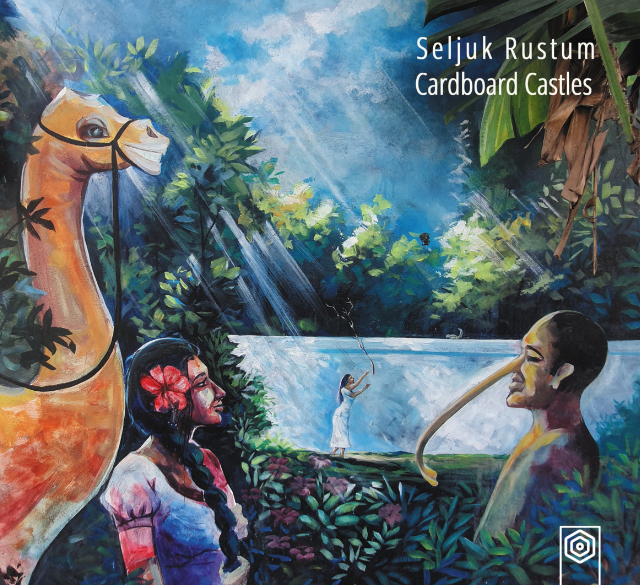
Four hours of choice music from February, the Monolith Cocktail Revue features tunes from our reviews and columns, plus the tracks we didn’t get room to feature. This month’s selection is courtesy of Dominic Valvona, Matt Oliver, Brian ‘Bordello’ She, Graham Domain and Gillian Stone.
.:TRACK LIST IN FULL:.
Moonlight Benjamin ‘Wayo’
Lunar Bird ‘Creatures’
Von Pea ‘Ode To Slick Rick’
Champion Poundcake ‘RAGS ANYMORE’
Spectacular Diagnostics ‘The Played List (Ft. Sonnyjim and Kid Acne)’
The Go! Team ‘Whammy-O’
Rogue Jones ‘Fffachlwch Bach (Bach)’
the clickBAITERS ‘Rear Ended’
Lucy & The Drill Holes ‘A Mouse’
Langkamer ‘Sing At Dawn’
First Day Of Spring ‘Normal Person (Love You Forever)’
SUO ‘Blue Evening’
Bondo ‘Instrument’
Mary Ocher ‘Love Is Not A Place (Ft. Your Government)’
Novelistme ‘Make Nothing’
Benjamin Benedict ‘Furlough Blues’
Za!/Tarta Relena/La TransMegaCobla ‘El Sweep The Lehelan’
Seljuk Rustum ‘Desi Bunny’
La Tene ‘La Taillée’
Imaad Wasif ‘Mr. Fear So Long (Money Mark Rework)’
Efeks ‘As Good As It Gets (Ft. The Strange Neighbour)’
The God Fahim ‘Man Of Steel’
Fliptrix ‘OCD With The LOVE (Ft. Coops And Verb T)’
Brainorchestra ‘Thin Patience’
Flying Monk & Wz (Corrupted Monk) ‘AF1’s’
Room Of Wires ‘Welcome To The End Game’
ANKHLEJOHN & LOOK DAMIEN! ‘CELINE AT THE MET GALA’
Pussy Riot ‘Putin’s Ashes’
Geeker-Natsumi ‘A Sheep That Never Gets Lost’
ASSASSUN ‘At Gunpoint’
Neon Kittens ‘Portable Fire’
Demikhov/Norda ‘Science! Science! Science!’
Antti Lötjönen ‘Circus/Citadel Pt. III’
Saint Abdullah ‘Divine Timing Is Intuitive’
Tachycardie ‘Collision Au Sens Strict’
Kety Fusco ‘Starless’
Polobi & The Gwo Ka Masters ‘Kawmélito’
Seaming To ‘Blessing’
Lisel ‘Immature’
Sly Moon ‘The Ghosts Comin’’
FUZ ‘First light’
Lavar The Star & Shabazz Palaces ‘Glass Top Roof (The One)’
Mecánica Clásica ‘Mantra De Felpa’
Kalia Vandever ‘Temper The Wound’
Xqui & Kaiho Zion ‘Agori Quitonie’
Stereo Hypnosis & Roedelius ‘VÍK I’
Philip Selway ‘Strange Dance’
The Good Ones ‘This Amazing Love Has Stayed With Me’
NO(w) Beauty ‘Atonia’
Floral Portrait ‘Winter Isolation’
Hawk Percival And Friends ‘The Mountain’
The Mining Co. ‘Wake Up’
Steve Stoeckel ‘Just One Kiss’
Chris Plum ‘As Long As The Sun’
Total Refreshment Centre ‘Black (Ft. Brother Portrait)’
Anteek Recipes ‘NY Fatcap’
Verb T & Illinformed ‘Bogus Journey’
Hus KingPin ‘Tony (Ft. Sagelnfinite)’ Copywrite/AWOL One & Kount Fif ‘Word From Our Sponsor’

