Dominic Valvona’s review roundup of new releases
As ever, another fine assortment of eclectic album and EP reviews from me this month, featuring new releases from David Cronenberg’s Wife, Kid Kin, Jack Ellister, Paul Jacobs, Quimper, Spaciousness and Paula Rae Gibson & Kit Downes.
In brief: I take a gander at new EPs from the cinematic post-rock artist, composer and producer Peter Lloyd, who releases his swathes of guitar-electronica under the Kid Kin pseudonym, and the Autumnal songbook of self-deprecating, sardonic love trysts and illusions from London’s bastions of antifolk, David Cronenberg’s Wife.
Album wise there’s the beautifully penned troubadour psychedelic folk and scenery instrumentals of Jack Ellister’s Telegraph Hill – his first LP for the You Are The Cosmos label -; the barreling scuzzy garage and synth psychedelic lo fi magnificence of Paul Jacob’s Easy; the esoteric surrealist magic-realism of Quimper’s Perdide, a new age ambient compilation; Spaciousness, from London’s Lo Recordings that attempts to praise and explore the ambient musical genre, in what is the first in a series of collections from the label; and the first, and challenging, collaboration between the experimental siren Paula Rae Gibson and British jazz pianist Kit Downes, Emotion Machine.
Paul Jacobs ‘Easy’ (Stolen Body Records) 19th October 2018
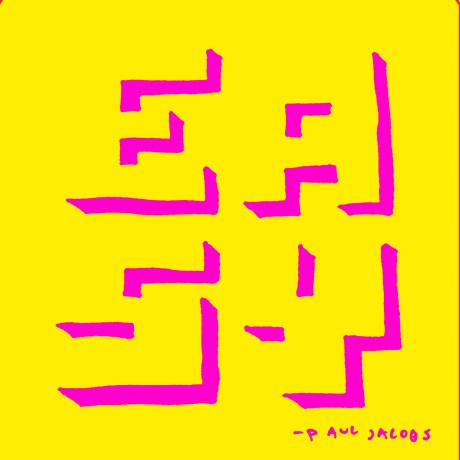
The very first sloppy collides of a track on this most fuzzy of hurtling and chaotic albums of vapour-wave pop, stonking garage and psychedelic twists and turns, could be, for all I can make out, a reversed bastardization of Bowie’s own ‘Holy Holy’. It certainly has the proto-Glam and strung-out rock’n’roll stomp of that record, but the maverick Paul Jacobs slurs and languidly warps, whatever it is, into a distortion-levels noisy Ty Segall.
Jacobs, who has already released eight albums of similar dizzying Kool Aid induced barrages (mostly on his own), indolently throws-up vague musical references throughout his latest album for the Stolen Body Records label; whether that’s turning on his best Lodger/Scary Monsters intonations and strutting messily but surely to an amalgamation of Liars and Blancmange on the cheque-cashing ‘Expensive’, or, whistling to the Native Indian backbeat of Adam And The Ants on ‘Laundry’, or, channeling PiL, the Killing Joke and Spiritualized on the Gothic spooked to deranged dreamy lullaby escape of ‘Trouble (Last Song)’. But you’re just as likely to hear passing shades of Sam Flax, Ariel Pink and Alan Vega swirling and bobbing about in the cycle wash of clattering sound clashes: It might all sound like a shamble. But it’s a most magnificent, bewildering and dynamic shamble.
Vocally Jacobs is masked under a lo fi mono-like production, which makes it difficult to catch what he’s on about at times. The odd whispered, crooned and melted lyric from these often mundane metaphorically entitled songs offer clues: a pop at the music industry here, soliloquy delivered anxiety, searching for purpose, there.
Layering a garage punk guitar with 1980s drum pad tom rolls, spacey chimes with vapours of post-punk, Paul Jacobs’ barreling, pummeling tunes are far more nuanced and sophisticated than I’ve described: Noisy of course, attuned as it is to a DIY sound, but brimming with riffs, hooks and splashes of radiant synth and psychedelic pop.
Cut from the same cloth as, the already mentioned, Liars, Ty Segall and Ariel Pink, Easy is an amazing record, a breakdown in motion, a racket that takes its core garage rock pretensions into the future.
Jack Ellister ‘Telegraph Hill’ (You Are The Cosmos) 27th November 2018
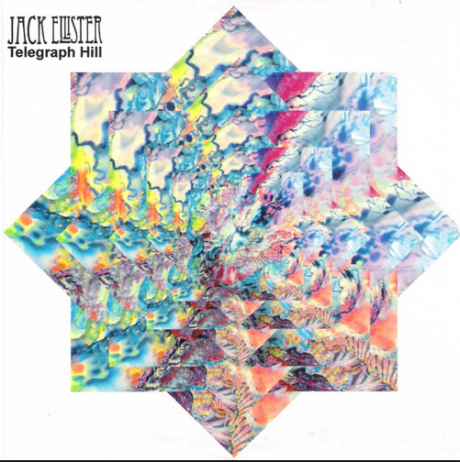
Penning a most placeable album, keeping it for the most part intimate, Jack Ellister’s latest collection of hazy troubadour balladry is turned down low and sweet, played out mostly on the acoustic guitar.
Normally associated with the Fruits de Mer label, releasing a string of singles and albums for them over the last six years, Ellister’s personable third album has found a new home on the You Are The Cosmos imprint.
An almost solitary affair, the multi-instrumentalist playing almost everything but the drums (played by long time collaborators Tomasz Helberg and Nico Stallmann), Telegraph Hill is an often lilted and twilled songbook of melodious psychedelic folk. The Telegraph Hill of that title refers to Ellister’s home studio in South East London, which can be read as an indication of his homely themes of belonging, of finding solace in the simple things and loved ones. The focus of many of these songs being the love-of-his-life muse, he expresses a joyful contentment throughout; wistfully and dreamily waxing lyrically like a lovesick Romeo.
Originally conceived as an EP bridge between albums, the nine-track Telegraph Hill is quite short in running time, and features a few instrumentals, two of which are more like passing interludes that seem to be added as padding; especially the final great American plains, Andes and Australian Outback merging, softened Native Indian stomp and gliding bird flight descriptive guitar peregrination, ‘Condor’. To be fair, the pastoral empirical ‘Maureen Feeding The Horses’, with its encapsulation of a rural scene (a moment in time) that captures a trapped kaleidoscopic sun shining through glass, illuminating this naturalistic aside, fits perfectly. ‘Icon Chamber’ however, seems an odd throwaway library music experiment from the laboratory in comparison.
Ellister is at his best when tenderly strumming a paean and singing; his fuzzy voice evoking a young Leonard Cohen on the Medieval chamber folksy ‘Roots’ (one of the album’s highlights), both Donovan and Tim Burgess on the trippy warbled flute-y and drum shuffling ‘High Above Our Heads’, and Syd Barrett on the Floydian via an enervated samba saunter ‘Mind Maneuvers’.
From pea-green seas of psychedelic nursery rhymes to 18th century inns, Ellister’s magical stirring atmospheres and folksy odes sound at any one time like visages of Caravan, The Incredible String Band, Fairfield Parlour, Spiritualized, Mike Cooper, Primal Scream and Roy Harper. Unobtrusive and unguarded, Telegraph Hill lays Ellister’s sensitive soul bare on what is, for the most part, a most assiduous halcyon earnest album of brilliantly crafted songs.
Kid Kin ‘Kid Kin EP’ November 2018

Never mind the worms the ‘Early Bird’ of the new EP from the Oxford multi-instrumentalist, producer, composer Peter Lloyd, has in this instance, caught the cyclonic glassy arpeggio rays of a multilayered crescendo instead. The third instrumental track from an EP of wide-lens anthemic post-rock visceral evocations, ‘The Early Bird’ features Lloyd’s signature ‘quiet/loud’ suffused climaxes and build-ups of various synth lines and descriptive, waning guitars.
Conceived as an encapsulation of his ‘connective’ ebb and flow live shows, Kid Kin is best experienced in its entirety, from beginning to end. Each track is separated – though ‘The Early Bird’ is followed by the Four Tet remix-esque radiant kinetic ‘Gets The Worm’, but in title split only – with no particular overlay or link. But squeeze them together into one continuous performance it would work well.
Saving his music from erring too close to Ad lands staple ideal of epic rock (U2, Coldplay), the opening ‘Jarmo’ vista sounds like a lost Mogwai soundtrack. The swelling, mindful but lifting towards the light ‘War Lullaby’ (which also features a strange 8-bit pinball ricocheting moment of electronica chaos) isn’t more than a fjord’s distance from sounding like Sigur Rós: a good thing in this case.
Confidently soundscaping post-rock panoramas, Peter Lloyd’s synthetic swathes and resonating layered guitar mini opuses are missing a documentary film. So descriptive is the drama and narrative. If immersing yourself in an ambient cinematic rock vision of moody and stirring expanses sounds right up your proverbial street; if you’re tired of post-rock’s old guard, then take a punt on the Kid.
Quimper ‘Perdide’ October 10th 2018
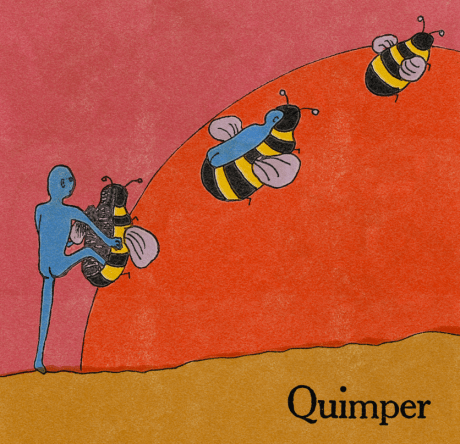
Curious oddities from beyond the ether and surface of Stefan Wul’s sci-fi paperback world of Perdide (the planet immortalized in the French author’s cult The Orphans Of Perdide) permeate the latest surreal musical séance from the beguiled Quimper duo.
A timely release for the bewitching hour, summoning up, as it does, vague vapours of Eastern European art house magical-realism, and imbued by both the 1970s library music and British horror soundtracks favoured by the Belbury Poly, The Advisory Circle and Berberian Sound Studios period Broadcast, Quimper once more occupy the esoteric heights.
Lynchian, peculiar, innocence turned into something otherworldly, the John Vertigen and his apparition vocalist foil Jodie Lowther (who also illustrates all their various releases) duo float, waft and shuffle around the most mysterious and kooky settings.
A whispery translucent cooed lullaby about the ‘Lovely Bees’, can eerily take on a most unsettling feeling, as Lowther’s vocals, or rather the most distant traces of them, channel a childish-like Japanese spirit to the accompaniment of a sinister dreamy sounding Roj. Elsewhere on this claustrophobic haunting soundtrack, Quimper imagine Mike Oldfield and John Carpenter communing, on the shivery spirit conjuring ‘Skin Without Size’; transduce an enervated vision of Richard James’ Polygon Windows through a ghost’s dissection, on ‘Vivisection’; dance to a mambo beat whilst a 1920s magic show opens a trapdoor to some snake god on ‘False Serpent Opens Doors’; and enact mellotron-mirage bucolic worship on, ‘Christ In A Field Of Caravans’.
They do all this from behind a gauze-y film of soft, wooing reverberation; only the essence, the air-y remains of what was once concrete, have been captured; broadcast, it sounds, through a Medium. Lynch should rightly love this stuff, especially Lowther’s untethered, so delicate and lingering as to not exist at all, nursery rhyme like siren calls. Perdide is one of the duo’s most interesting, realized albums yet, an illusionary surrealist world of creeping dreamscapes.
Various ‘Spaciousness: Music Without Horizons’ (Lo Recordings) 2nd November 2018
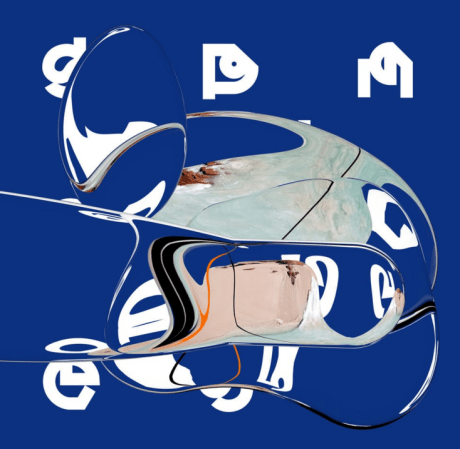
Tainted in part by its reputation for pseudo-hippie idealism and penchant for irritating whale song and the sounds of the rainforest – the soundtrack to countless holistic day spas -, new age music summons up a myriad of less than flattering connotations. Of course, as this first in a series of showcase purviews will prove, there’s actually much more to this often-maligned musical form.
In partnership with former Coil member Michael J York and musician/writer polymath Mark O Pilkington’s Attractor Press platform, Lo Recordings are here to celebrate its resurgence and more aloof, spiritual and philosophical highlights. As part of a wider project that will include writing, still and moving images and live events, the overlapping, multi-connective Spaciousness compilation provides an audio lineage; balancing peregrinations from both new age (but also embracing deep listening and post-classical) music’s progenitors and rising stars.
A leading luminaire, the divine styler of radiant transcendence, Laraaji, has by happy accident given this double-album straddling selection its title. Laraaji, who has himself, enjoyed a renewed interest in the last few years, especially for his ties to Brian Eno, and of course spiritual ambient quests, pops up partnering the Seahawks on the suitably aquatic undulated ‘Space Bubbles’ tribute to new age inspiration, dolphin-whisper, floatation tank and mind expanding drugs evangelist, John C Lilly. Another of the pioneers, Lasos, appears alongside the contemporary artist Carlos Gabriel Niño (one of the new guard, bridging the gap between the new age, the meditative, jazz and free form; signed to David Matthew’s – more of him later – expletory Leaving Records). The pair plays around with light on their majestic searing, glistening panoramic finale, ‘Going Home’. Lasos alongside another great doyen of the genre, Steven Halpern, were among the first artists to subvert and work outside the perimeters of the mainstream music industry; circumnavigating it by dealing direct with their audience through mail order cassettes.
Two of the already mentioned catalysts for Spaciousness, instigators behind Strange Attractor Press, also appear (under the Teleplasmite nom de plume) paying homage to a visionary muse, Ingo Swann. Propounding ‘remote views’, an artist and psychic, the duo construct a suitable Kosmische vaporous evocation on the roaming ‘Song For Ingo Swann’. Posthumous tribute is also paid to the late composer Susumu Yokota, with an ‘inter-generational span’ remix by DK of his dissipated ‘Wave Drops’ exploration; a soundscape of horse snorts, abstract saxophone, steam and Far East moorings.
The second wave of this new age movement is represented by artists such as MJ Lallo, who’s venerated, and equally expansive 2001: A Space Odyssey like, traverse, ‘Birth Of A Star Child’ is featured. Written originally for the Vatican in the 1980s, this version has been borrowed from a recent compilation of her home studio recordings, Take Me With You (1982-1997), this monastery in space choral eulogy was made by processing computerized drums, synth and Lallo’s voice through a Yamaha SPX 90 digital effects unit to produce an otherworldly, ageless sense of ominous awe.
Possibly one of the better-known figures of the last decade or more in his field, the renowned musician/producer and Tangerine Dream affiliate member in recent years, Ulrich Schnauss, partners with Lo Recordings founder Jon Tye on the jazzy desert wandering ‘Orange Cascade’. The duo’s diaphanous lulling visionary textures explore the intersection between live instrumentation (wafts of saxophone, sitar and flute in this case) and synthesized sound.
The most contemporary wave, so to speak, is represented by Matthew David’s (as Mindflight) Jon Hassell resonant stratospheric hymn ‘Ode To Flora’; Cathy Lucas’ ‘mating song of quarks’ primal soup bubbling and vague jazzy translucent ‘Chatterscope’; and Yamaneko’s ‘one big stare out of a bedroom window at 2 am’ sanctified, page-turning, mysterious ‘Lost Winters Hiding’. All these artists add to, or share, the vastness of space with their new ageism and cerebral ambient forbearers; a sign if any were needed that we could all do with a pause and a deeper purposeful meditative break from the divisive-ratcheted noise of our times.
In waves and cycles, the transcendent and deeply thoughtful search for peace and new horizons is gathering a pace. And what better example of its reach, scope and lineage (and future) than this inaugural Spaciousness purview; a collection that will do much to illuminate as push forward the limits of the new age and its various ambient sub genre strands and astral flights of fantasy. A great start to a wider investigation.
Paula Rae Gibson & Kit Downes ‘Emotion Machines’ (Slowfoot Records) 2nd November 2018
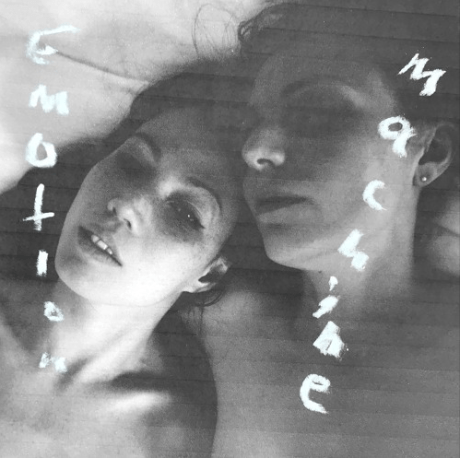
Amorphously set adrift into the abstract, untethered in compositional serialism, renowned photographer and experimental siren Paula Rae Gibson and collaborative foil, the acclaimed, award-winning British jazz pianist Kit Downes set out on a most challenging travail on the new album, Emotion Machine.
Already deconstructively – though also at times melodiously flowing – applying both equally stark and diaphanous vocals to a quartet of albums, Gibson’s minimal, but often striking, voice is in its element up against and submerged beneath Downes’ fine layering and often attenuate arrangements. Neither strung-out jazz nor avant-garde cabaret, the duo’s inaugural collaboration together is more conceptual sound design and dissonant drone than musical, with the odd flurry of neo-classical piano, some transduced cello and a splash of brushed-shuffled drumming offering the only traces or recognizable instrumentation throughout.
Re-translating their Delta Blues, Icelandic art-rock and early musical inspirations in a frayed somber and emotionally retching environment of uncertainty, they inhabit a miasma of toil and pained expression. In this gloom of uneasy, sometimes plaintive, surroundings the pauses, resonance and spaces are just as important as the minimalist instrumental accents and stripped-down-to-their-refined-essence-of-understanding fashioned lyrics: Gibson’s mix of concomitant couplets, stanzas and one-liners are left hanging in the expanses whilst Downes quivery, motor-purring snozzled and waned backing fades, dissipates or stops dead.
From the ethereal to the contralto, beautifully gossamer to ominously discordant, Emotion Machines is an efflux between the timeless and contemporary. Conceptually and artistically pushing the musical boundaries, as much a performance piece as cerebral exploration of the voice, Gibson and Downes interchange their disciplines to produce an evocative suite of poignant expressive heartache and drama.
David Cronenberg’s Wife ‘The Octoberman Sequence’ (Blang) 26th October 2018 (Download)/ 2nd November (Ltd. 12” Vinyl)
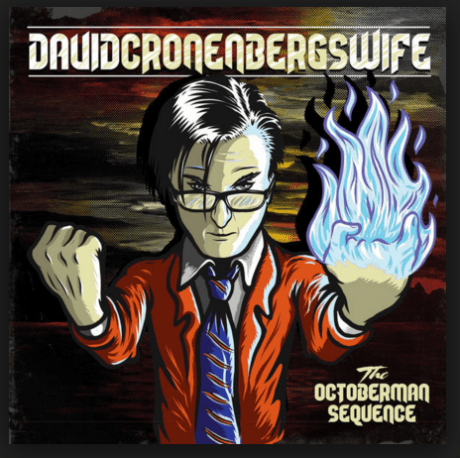
Weaponizing sardonic wit and despondency with élan, the antifolk cult London band, David Cronenberg’s Wife, offer up a signature serving of slice-of-life anxiety-riven and cross-signaled love derisions on their Autumnal EP.
Featuring a doublet of previously unrecorded resigned romantic numbers but fronted by the ‘live stalwart’ ‘Rules’ – two versions in fact; the single edit, a safe for the dour risk-averse airways, omits the only swearing word in the song: “Fuck around” -, The Octoberman Sequence is a most generous release from the DIY scenesters. ‘Rules’ itself is a galloping anthem that builds momentum and just keeps rolling on, pouring a hearty scorn on life-plans, the anguish life choices of the hand wringing middle classes, and Hollywood’s false platitude perfections as a strutting backing track of ? And The Mysterians/Sir Douglas Quintet organ stabs and proto Stooges (as fronted by Ian McCulloch) plows on. It’s easy to hear why this has become a live favourite. For one thing it dismembers the bullshit, spits out the unthinkable (the rules for s stress-free life, “Don’t marry”, tick, “Don’t have kids”, tick, being the first of the DCW’s seven-rule commandments), but above all, sounds great.
As for those previously unrecorded songs, the slumbered voice-over ridicule with lulled female accompanied ‘You Should See’ sets up our misdirected protagonist on a awkward date: So awkward in fact and indecisive, our lead’s inner monologue and own assured boastful knowledge of literature prompts him to spill the sexual predilections of Marcel Proust, before shuffling off home to “Masturbate over films made in the Czech Republic”. The other song, ‘The Dude Of Love’, is a 1960s good ol’ Freebird Southern boogie with a Kinks style chorus semi-stalker ditty. A rich, seedy, tableau of delusional creeps on the London Underground – one, a Lynyrd Skynyrd reject, the other, our awkward, but still egotistical, friend who seems to have totally misread the signals.
Nestled alongside these are the more serious intoned appendage love muscle punned ‘Love Organ’, and dour counterculture meets lamentable country blues troubadour ‘Song For Nobody’ – a kind of Dylan-as-pinning-cowboy paean turn disgruntled love rat finality that ends on a sour note.
Corralling the ditsy platitudes and unrealistic expectations of love in the age of #MeToo, DCW with wicked relish rattle and roll to their own unique post-punk, post-country and antifolk bombast on what is another clever and candid realized songbook of self-depreciation and protestation.
Tickling Our Fancy 069: Minyeshu, Dr. Chan, Brace! Brace!, Grand Blue Heron, Don Fiorino and Andy Haas…
October 9, 2018
Dominic Valvona’s new music reviews roundup

Another fine assortment of eclectic album reviews from me this month, with new releases from Papernut Cambridge, Sad Man, Grand Blue Heron, Don Fiorino and Andy Haas, Junkboy, Dr. Chan, Minyeshu, Earthling Society and Brace! Brace!
In brief there’s the saga of belonging epic new LP from the Ethiopian songstress Minyeshu, Daa Dee, a second volume of Mellotron-inspired library music from Papernut Cambridge, the latest Benelux skulking Gothic rock album from Grand Blue Heron, another maverick electronic album of challenging experimentation from Andrew Spackman, under his most recent incarnation as the Sad Man, a primal avant-garde jazz cry from the heart of Trump’s America from Don Fiorino and Andy Haas, the rage and maelstrom transduced through their latest improvised project together, American Nocturne; and a bucolic taster, and Music Mind compilation fundraiser track, from the upcoming new LP from the beachcomber psychedelic folk duo Junkboy.
I’ve also lined up the final album from the Krautrock, psychedelic space rocking Earthling Society, who sign off with an imaginary soundtrack to the cult Shaw Brothers Studio schlockier The Boxer’s Omen, plus two most brilliant albums from the French music scene, the first a shambling skater slacker punk meets garage petulant teenage angst treat from Dr. Chan, The Squier, and the second, the debut fuzzy colourful indie-pop album from the Parisian outfit Brace! Brace!
Minyeshu ‘Daa Dee’ (ARC Music) 26th October 2018
From the tentative first steps of childhood to the sagacious reflections of middle age, the sublime Ethiopian songstress Minyeshu Kifle Tedla soothingly, yearningly and diaphanously articulates the intergenerational longings and needs of belonging on her latest epic LP, Daa Dee. The sound of reassurance that Ethiopian parents coo to accompany their child’s baby steps, the title of Minyeshu’s album reflects her own, more uncertain, childhood. The celebrated singer was herself adopted; though far from held back or treated with prejudice, moving to the central hub of Addis Ababa at the age of seventeen, Minyeshu found fame and recognition after joining the distinguished National Theatre.
In a country that has borne the scars of both famine and war, Ethiopia has remained a fractious state. No wonder many of its people have joined a modern era diaspora. Though glimmers of hope remain, and in spite of these geopolitical problems and the fighting, the music and art scenes have continued to blossom. Minyeshu left in 1996, but not before discovering such acolytes as the doyen of the country’s famous Ethio-Jazz scene, Mulatu Astatke, the choreographer Tadesse Worku and singers Mahmoud Ahmed, Tilahun Gessesse and Bizunesh Bekele; all of whom she learnt from. First moving to Belgium and then later to the Netherlands, the burgeoning star of the Ethiopian People To People music and dance production has after decades of coming to terms with her departure finally found a home: a self-realization that home wasn’t a geographical location after all but wherever she felt most comfortable and belonged: “Home is me!”
The beautifully stirring ‘Yetal (Where Is It?)’ for example is both a winding saga, with the lifted gravitas of swelling and sharply accented strings, and acceptance of settling into that new European home.
Evoking that sense of belonging and the theme of roots, but also paying a tribute and lament to the sisterhood, Minyeshu conveys with a sauntering but sorrowful jazzy blues vibe the overladen daily trudge of collecting wood on ‘Enchet Lekema’; a hardship borne by the women of many outlier Ethiopian communities. Though it can be read as a much wider metaphor. The blues, in this case, the Ethiopian version of it (perhaps one of its original sources) that you find on ‘Tizita’ (which translates as ‘longing’ or ‘nostalgia’), has never sounded so lilting and divine; Minyeshu’s cantabile, charismatic soul harmonies, trills and near contralto accenting the lamentable themes.
There is celebration and joy too; new found views on life and a revived tribute to her birthplace feature on the opulently French-Arabian romance ‘Hailo Gaja (Let’s Dance)’, and musically meditating, the panoramic dreamy ‘Yachi Elet (That Moment)’ is a blissed and blessed encapsulation of memories and place – the album’s most traversing communion, with its sweet harmonies, bird-like flighty flutes and waning saxophone.
Not only merging geography but musical styles too, the Daa Dee LP effortlessly weaves jazz (both Western and Ethiopian) R&B, pop, dub, the theatrical, and on the cantering to lolloping skippy ‘Anteneh (It Is You?)’, reggae. Piano, strings and brass mix with the Ethiopian wooden washint flute and masenqo bowed lute to create an exotic but familiar pan-global sound. Minyeshu produces a heartwarming, sometimes giddy swirling, testament that is exciting, diverse and above all else, dynamic. Her voice is flawless, channeling our various journeys and travails but always placing a special connection to those Ethiopian roots.
Don Fiorino and Andy Haas ‘American Nocturne’ (Resonantmusic) 16th September 2018
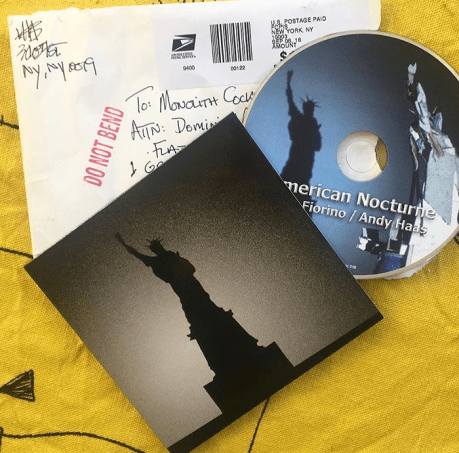
Amorphous unsettling augers and outright nightmares permeate the evocations of the American Nocturne visionaries Don Fiorino and Andy Haas on their latest album together. Alluded, as the title suggests, by the nocturne definition ‘a musical composition inspired by the night’, the darkest hour(s) in this case can’t help but build a plaintive warning about the political divisive administration of Trump’s America: Nicola Plana’s sepia adumbrated depiction of Liberty on the album’s cover pretty much reinforces the grimness and casting shadows of fear.
Musically strung-out, feeding off each other’s worries, protestations and confusion, Fiorino and Haas construct a lamentable cry and tumult of anger from their improvised synthesis of multi-layered abstractions.
Providence wise, Haas, who actually sent me this album after seeing my review of a U.S. Girls gig from earlier in the year (he was kind enough to note my brief mention of his Plastic Ono Band meets exile-in-America period Bowie saxophone playing on the tour; Haas being a member of Meg Remy’s touring band after playing on her recent LP, In A Poem Unlimited), once more stirs up a suitably pining, troubled saxophone led atmosphere; cast somewhere between Jon Hassell and Eno’s Possible Musics traverses, serialism jazz and the avant-garde. The Toronto native, originally during the 70s and early 80s a band member of the successful Canadian New wave export Martha And The Muffins, is an experimental journeyman. Having moved to New York for a period in the mid 80s to collaborate with a string of diverse underground artists (John Zorn, Marc Ribot, Thurston Moore and God Is My Co-Pilot) he’s made excursions back across the border; in recent times joining up with the Toronto supergroup, which features a lion’s share of the city’s most interesting artists and of course much of the backing group that now supports Meg Remy’s U.S. Girls, the Cosmic Range (who’s debut LP New Latitudes made our albums of the year feature in 2016). He’s also been working with that collective’s founder, Matt ‘Doc’ Dunn, on a new duo project named KIM (the fruits of which will be released later this year). But not only a collaborator, Haas has also recorded a stack of albums for the Resonantmusic imprint over the years (15 in total), the first of which, from 2005, included his American Nocturne foil, Fiorino. An artist with a penchant for stringed instruments (guitar, glissenter, lap steel, banjo, lotar, mandolin), Fiorino is equally as experimental; the painter musician imbued by blues, rock, psychedelic, country, jazz, Indian and Middle Eastern music has also played in and with a myriad of suitably eclectic musicians and projects (Radio I Ching, Hanuman Sextet, Adventures In Bluesland and Ronnie Wheeler’s Blues).
Recorded live with no overdubs, the adroit duo is brought together in a union of discordant opprobrious and visceral suffrage. Haas’ signature pained hoots, snozzled snuffles and more suffused saxophone lines drift at their most lamentable and blow hard at their most venerable and despondent over and around the spindly bended, quivery warbled and weird guitar phrases of Fiorino. Setting both esoteric and mysterious atmospheres, Haas is also in charge of the manic, often reversed or inverted, and usually erratic drum machine and bit-crushing warped electronic effects. Any hint of rhythm or a lull in proceedings, and it’s snuffed out by an often primal and distressed breakdown of some kind.
Skulking through some interesting soundscapes and fusions, tracks such as the opening ‘Waning Empire Blues’ conjures up a Southern American States gloom (where the Mason-Dixon line meets the dark ambient interior of New York) via a submerged vision of India. It also sounds, in part, like an imaginary partnership between Hassell and Ry Cooder. ‘Days Of The Jackals’ has a sort of Spanish Texas merges with Byzantium illusion and ‘New Orphans’ transduces the Aphex Twin into a shapeless, spiraling cacophony of pain.
With hints of the industrial, tubular metallic, blues, country, electro and Far East to be found, American Nocturne is essentially a deconstructive jazz album. Further out than most, even for a genre used to such heavy abstract experimentation, this cry from the bleeding heart of Trumpism opposition is as musically traumatic as it is complex and creatively descriptive. Fiorino and Haas envision a harrowing soundtrack fit for the looming miasma of our times.
Papernut Cambridge ‘Mellotron Phase: Volume 2’ (Ravenwood Music/Gare du Nord) 5th October 2018
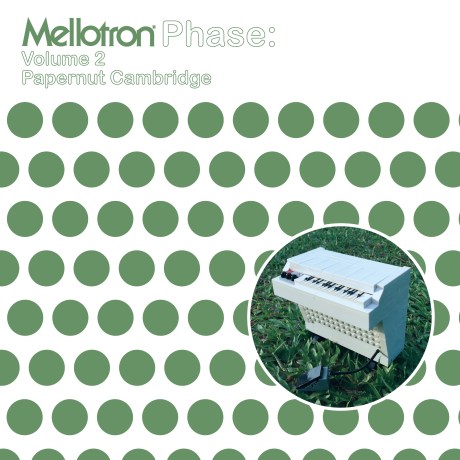
A one-man cottage industry (a impressively prolific one at that) Ian Button’s Eurostar connection inspired label seems to pop up in every other roundup of mine. The unofficial houseband/supergroup and Button pet project Papernut Cambridge, the ranks of which often swell or contract to accommodate an ever-growing label roster of artists, is once again widening its nostalgic pop and psychedelic tastes.
Following on from Button’s debut leap into halcyon cult and kitsch library music, Mellotron Phase: Volume 1 is another suite of similar soft melodic compositions, built around the hazy and dreamy polyphonic loops of the iconic keyboard: An instrument used to radiant, often woozy, affect on countless psych and progressive records. That first volume was a blissful, float-y visage of quasi-David Axelrod psychedelic litany, pop-sike, quaint 60s romances and a mellotron moods version of Claude Denjean cult lounge Moog covers.
This time around the basis for each instrumental vision is the rhythm accompaniments from Mattel’s disc-based Ontigan home-entertainment instrument. These early examples of instrumental loops and musical breaks were set out across the instrument’s keys so that chord sequences and variations can be used to construct an arrangement. Mellowed and toned-down in comparison to the first volume, though still featuring drum breaks, percussion, bass and on the Bacharach-composes-a-screwball-tribute-to-French-Western-pulp-fiction (Paris, Texas to Paris, France) ‘A Cowboy In Montmartre’, an accordion. If the French Wild West grabs you then there’s plenty of other weird and wonderful mélanges to be found on this whimsically romantic, sometimes comically vaudeville, and often-yearning fondly nostalgic album. The swirling cascade of soft focus tremolo vibrations of the stuttered ‘Cha-Cha-Charlie’ sounds like Blue Gene Tyranny catching a flight on George Harrison’s Magical Mystery Tour. The Sputnik space harp pastiche of ‘Cygnus Probe’ is equally as Gerry Anderson as it is Philippe Guerre, and ‘Boss Club’ reimagines Trojan Records transduced through lounge music. Kooky Bavarian Oompah Bands at an acid-tripping Technicolor circus add to the mirage-like mellotron kaleidoscope on ‘Sergeant Major Mushrooms’, Len Deighton’s quintessentially English clandestine spy everyman, as scored by John Barry, cameos on the clavinet spindly and The Kramford Look-esque ‘Parker’s Last Case’, and Amen Corner wear their soft soul shufflers on the Tamala backbeat ‘Soul Brogues’.
A curious love letter to the forgotten (though a host of champions, from individuals to labels, have revalued and showcased their work) composers and mavericks behind some of the best and most odd library music, Mellotron Phase will in time become a cult album itself. As quirky as it is serenading, alternative recalled obscure soundtracks that vaguely recall Jean-Pierre Decerf, Jimmy Harris, Stereolab, Jean-Claude Vannier and even Roy Budd are given a fond awakening by Button and his dusted-off mellotron muse.
Sad Man ‘ROM-COM’ October 2018
Haphazardly prolific, Andrew Spackman, under his most recent of alter egos, the Sad Man, has released an album/collection of giddy, erratic, in a state of conceptual agitation electronica every few months since the beginning of 2017. Many of which have featured in one form or another in this column.
The latest and possibly most restive of all his (if you can call it that) albums is the spasmodic computer love transmogrification ROM-COM. An almost seamless record, each track bleeding into, or mind melding with the next, the constantly changing if less ennui jumpy compositions are smoother and mindful this time around. This doesn’t mean it’s any less kooky, leaping from one effect to the next, or, suddenly scrabbling off in different directions following various nodes and interplays, leaving the original source and prompts behind. But I detect a more even, and daresay, sophisticated method to the usual skittish hyperactivity.
Showing that penchant for exploration tracks such as the tribal cosmic synwave ‘Play In The Sky’ fluctuate between the Twilight Zone and tetchy, tentacle slithery techno; whilst the shifting bit-crush cybernetic ‘Hat’ sounds like a transplanted to late 80s Detroit Art Of Noise one minute, the next, like a isotope chilled thriller soundtrack. Reverberating piano rays, staggered against abrasive drumbeats await the listener on the sadly melodic ‘King Of ‘. That is until a drilling drum break barrels in and gets jammed, turning the track into a jarring cylindrical headbanger. ‘Coat’ whip-cracks to a primitive homemade drum machine snare as it, lo fi style, dances along to a three-way of Harmonia, The Normal and Populare Mechanik, and the brilliantly entitled ‘Wasp Meat’ places Kraftwerk in Iain Banks Factory.
Almost uniquely in his own little orbit of maverick bastardize electronic experimentation, Spackman, who builds many of his own bizarre contraptions and instruments, strangulates, pushes and deconstructs techno, the Kosmische, Trip-Hop and various other branches of the genre to build back up a conceptually strange and bewildering new sonic shake-up of the electronic music landscape.
Grand Blue Heron ‘Come Again’ (Jezus Factory) October 19th 2018

Grand Blue Heron, or GBH as it were, do some serious grievous harm to the post-punk and alt-rock genres on their latest abrasive heavy-hitter, Come Again. Partial to the Gothic, the Benelux quartet prowl in the miasma; skulking under a repressed gauze and creeping fog of doom as they trudge across a esoteric landscape of STDs, metaphorical crimes of the heart and rejection.
Born out of the embers of the band Hitch, band mates Paul Lamont (who also served time with the experimental Belgium group and Jezus Factory label mates, A Clean Kitchen Is A Happy Kitchen) and Oliver Wyckhuyse formed GBH in 2015 as a vehicle for songs written by Lamont. Straight out of the blocks on their thrashing debut Hatch, they’ve hewn a signature sound that has proven difficult to pin down.
Both boldly loud with smashing drums and gritty distorted guitars, yet melodic and nuanced, they sound like The Black Angels and Bauhaus working over noir rock on the vortex that is ‘Wwyds’, a grunge-y Belgium version of John Lyndon backed by The Pixies on the controlled maelstrom title-track, and Metallica on the country-twanging, pendulous skull-banger ‘Head’. They also sail close to The Killing Joke, Sisters Of Mercy (especially on the decadent wastrel Gothic ‘The Cult’), Archers Of Loaf and, even, The Foo Fighters. They rollick in fits of rage and despondency, beating into shape all these various inspirations, yet they come out on top with their own sound in the end.
Playing live alongside some pretty decent bands of late (White Denim, Elefant, The Cult Of Dom Keller) the GBH continue to grow with confidence; producing a solid heavy rock and punk album that reinforces the justified, low-level as it might be, hype of the Belgium, and by extension, Flanders scene.
Dr. Chan ‘Squier’ (Stolen Body Records) October 12th 2018

Keeping up the petulant garage-punk-skate-slacker discourse of their obstinate debut, the French group with just a little more control and panache once more hang loose and play fast with their spikey influences on the second LP Squier.
Hanging out with a disgruntled shrug in a 1980s visage of L.A. central back lots, skating autumn time drained pools in a nocturnal motel setting, Dr. Chan crow about the transition from adolescence to infantile adulthood. Hardly more than teenagers themselves, the band seem obsessed with their own informative years of slackerdom; despondently ripping into the status of outsiders the lead singer sulkingly declares himself as “Just a young messy loser” on the opening boom bap garage turn space punk spiraling ‘Wicked & Wasted’, and a “Teenage motherfucker” on the funhouse skater-punk meets Thee Headcoats ‘Empty Pockets’.
The pains but also thrills of that time are channeled through a rolling backbeat of Black Lips, Detroit Cobras, Brian Jonestown Massacre, The Hunches, Nirvana and new wave influences. The most surprising being glimmers of The Strokes, albeit a distressed version, on the thrashed but polished, even melodic, ‘Girls!’ And, perhaps one of the album’s best tracks (certainly most tuneful), the bedeviled ride on the 666 Metro line ‘The Sinner’, could be an erratic early Arctic Monkeys missive meets Blink 182 outtake.
The Squier is an unpretentious strop, fueled as much by jacking-up besides over spilling dumpsters, zombified states of emptiness and despair as it is by carefree cathartic releases of bird-finger rebellious fun. Reminiscing for an adolescence that isn’t even theirs, Dr. Chan’s directed noise is every bit informed by the pin-ups of golden era 80s Thrasher magazine as by Nuggets, grunge and Jon Savage’s Black Hole: Californian Punk compilation. The fact they’re not even of the generation X fraternity that lived it, or even from L.A. for that matter, means there is an interesting disconnection that offers a rousing, new energetic take. In short: Ain’t a damn thing changed; the growing pains of teenage angst still firing most of the best and most dynamic shambling music.
Brace! Brace! ‘S/T’ (Howlin Banana) 12th October 2018

Looking for your next favourite French indie-pop group? Well look no further, the colourful Parisian outfit Brace! Brace! are here. Producing gorgeous hues of softened psychedelia, new wave, Britpop and slacker indie rock, this young but sophisticated band effortlessly melt the woozy and dreamy with more punchier dynamic urgency on their brilliant debut album.
Squirreled away in self-imposed seclusion, recording in the Jura Mountains, the isolation and concentration has proved more than fruitful. Offering a Sebastian Teller fronts Simian like twist on a cornucopia of North American and British influences, Brace! Brace! glorious debut features pastel shades of Blur, Gene, Dinosaur Jnr., Siouxsie And The Banshees (check the “I wrecked your childhood” refrain post-punk throb and phaser effect symmetry guitar of ‘Club Dorothée’ for proof) and the C86 generation. More contemporary wafts of Metronomy, Mew, Jacco Gardner, the Unknown Mortal Orchestra and Deerhunter (especially) permeate the band’s hazy filtered melodies and thoughtful prose too.
At the heart of it all lies the subtly crafted melodies and choruses. Never overworked, the lead-up and bridges gently meet their rendezvous with sweet élan and pace. Vocals are shared and range from the lilted to the wistful and more resigned; the themes of chaste and compromised love lushly and wantonly represented.
This is an album of two halves, the first erring towards quirky new wave, shoegaze-y hearty French pop – arguably featuring some of the band’s best melodies -, the second, a more drowsy echo-y affair. Together it makes for a near-perfect debut album, an introduction to one of the most exciting new fuzzy indie-pop bands of the moment.
Junkboy ‘Old Camera, New Film’ – Taken from Fretsore Record’s upcoming Music Minds fundraiser compilation; released on the 12th October 2018
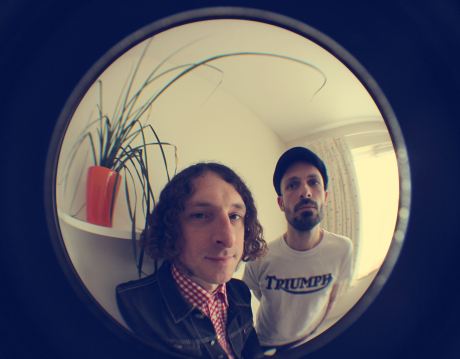
Quiet of late, or so we thought, the unassuming South Coast brothers Hanscomb have been signing love letters, hazy sonnets and languorous troubadour requests from the allegorical driftwood strewn yesteryear for a number of years now. The Brighton & Hove located siblings have garnered a fair amount of favorable press for their beautifully etched Baroque-pastoral idyllic psychedelic folk and delicately softly spoken harmonies.
To celebrate the release of their previous album, Sovereign Sky, the Monolith Cocktail invited the duo to compile a congruous Youtube playlist. Proper Blue Sky Thinking didn’t disappoint; the brothers’ Laurel Canyon, Freshman harmony scions and softened psychedelic inspirations acting like signposts and reference points for their signature nostalgic sound: The Beach Boys, Thorinshield, Mark Eric, The Lettermen, The Left Bank all more an appearance.
A precursor to, we hope, Junkboy’s next highly agreeable melodious LP, Trains, Trees, Topophilia (no release date has been set yet), the tenderly ruminating new instrumental (and a perfect encapsulation of their gauzy feel) ‘Old Camera, New Film’ offers a small preview of what’s to come. It’s also just one of the generous number of tracks donated to the worthy Music Minds (‘supporting healthy minds’) cause by a highly diverse and intergenerational cast of artists. Featuring such luminaries as Tom Robinson, Glen Tilbrook and Graham Goldman across three discs, the Fretsore Records release coincides with World Mental Health Day on the 12th October.
Sitting comfortably on the second disc with (two past Monolith Cocktail recommendations) My Autumn Empire, Field Harmonics and Yellow Six, Junkboy’s mindful delicate swelling strings with a hazy brassy, more harshly twanged guitar leitmotif beachcomber meditations prove a most perfect fit.
Earthling Society ‘MO – The Demon’ (Riot Season) 28th September 2018

Bowing out after fifteen years the Earthling Society’s swansong, MO – The Demon, transduces all the group’s various influences into a madcap Kool-aid bathed imaginary soundtrack. Inspired by the deranged Shaw Brothers film studio’s bad-taste-running-rampart straight-to-video martial arts horror schlock The Boxer’s Omen, the band scores the most appropriate of accompaniments.
The movie’s synopsis (though I’m not sure anyone ever actually wrote this story out; making it up in their head as they went along more likely) involves a revenge plot turn titanic spiritual struggle between the dark arts, as the mobster brother of a Hong Kong kickboxer, paralyzed by a cheating Thai rival, sets out on a path of vengeance only to find himself sidetracked by the enlightened allure of a Buddhist monastery and the quest to save the soul of a deceased monk (who by incarnated fate happens to be our protagonist’s brother from a previous life) killed by black magic. A convoluted plot within a story of vengeance, The Boxer’s Omen is a late night guilty pleasure; mixing as it does, truly terrible special effects with demon-bashing Kung Fu and Kickboxing.
Recorded at Leeds College of Music between November 2017 and February of 2018, MO – The Demon is an esoteric Jodorowsky cosmology of Muay Thai psychedelics, space rock, shoegaze, Krautrock and Far East fantasy. Accenting the mystical and introducing us to the soundtrack’s leitmotif, the opening theme song shimmers and cascades to faint glimmers of Embryo and Gila; and the craning, waning guitar that permeates throughout often resembles Manuel Göttsching later lines for Ash Ra Tempel. By the time we reach the bell-tolled spiritual vortex of the ‘Inauguration Of The Buddha Temple’ we’re in Acid Mothers territory, and the album’s most venerable sky-bound ascendant ‘Spring Snow’ has more than a touch of the Popol Vuh about it: The first section of this two-part vision features Korean vocalist Bomi Seo (courtesy of Tirikiliatops) casting incantation spells over a heavenly ambient paean, as the miasma and ominous haze dissipates to reveal a path to nirvana, before escalating into a laser whizzing Amon Duul II talks to Yogi style jam. The grand finale, ‘Jetavana Grove’, even reimagines George Harrison in a meeting of minds with Spiritualized and the Stone Roses; once more setting out on the Buddhist path of enlightenment.
Sucked into warped battle scenes on the spiritual planes, Hawkwind (circa Warriors On The Edge Of Time) panorama jams and various maelstroms, the Earthling Society capture the hallucinogenic, tripping indulgences of their source material well whilst offering the action and prompts for another set of heavy psych and Krautrock imbued performances. The Boxer’s Omen probably gets a much better soundtrack than it deserves, as the band sign off on a high.
Quarterly Playlist Revue: Part Three: Idris Ackamoor, Stella Sommer, Mac Miller, White Denim, Simon Love…
September 26, 2018
Playlist: Chosen by Dominic Valvona & Matt Oliver/ Curated by Dominic Valvona
Priding ourselves on the diverse, pan-global playlists we collate for your aural pleasure and indulgence, the Monolith Cocktail Quarterly Revue series is the eclectic behemoth of them all. With no demarcation of any kind or rules we mix the harrowing and gothic with beckoning polyrhythmic dancefloor screamers, flights of panoramic fantasy with raging protestations, and the most sublime peregrinations with experimental cries from the wilderness.
Everything you find on this playlist has either featured on the site over the last three months or been in our general orbit (the sheer volume of music we get sent means there is inevitably issues of space and time, and so some great tracks just don’t make it; this is our chance to feature those lost tracks). Below you will find a full track list, including links to reviews.
Tracklist:-
Malawi Mouse Boys ‘Hunger (Hymn)‘
Spike & Debbie ‘Strike – Compilation Version‘
Dur-Dur Band ‘Yabaal‘
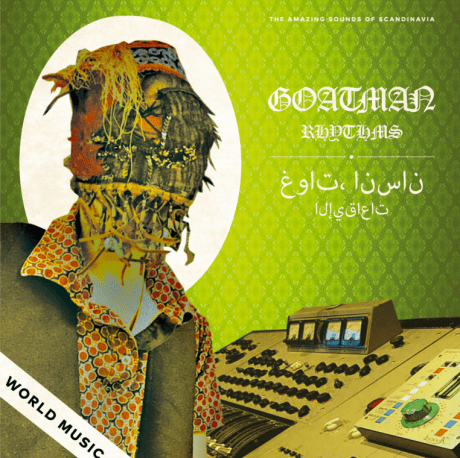
Goatman ‘Jaam Ak Salam’
Mac Miller ‘Party On Fifth Ave.‘
Parquet Floors ‘Wide Awake’
LCD Soundsystem ‘Oh Baby – Lovefingers Remix’
Papernut Cambridge ‘The Hobbledehoy‘
Yuzo Iwata ‘Gigolo’
Soft Science ‘Undone‘
Stella Sommer ‘Dark Princess, Dark Prince‘
Mehdi Rostami & Adib Rostami ‘Delight‘
Yiddish Glory (Loyko, Alexander Sevastian, Sophie Milman) ‘Shpatzir in Vald (A Walk In The Forest)‘
Yazz Ahmed ‘The Lost Pearl – Hector Plimmer Remix‘
John Coltrane ‘Impressions – Take 3’
Thelonious Monk ‘Nutty, Pt. 2’
RAM ‘Dambala Elouwe’
Vaudou Game ‘Tata Fatigue’
Derya Yıldırım, Grup Şimşek ‘Uc Kiz Bir Ana’
Idris Ackamoor & The Pyramids ‘Land Of Ra’
Bixiga 70 ‘Quebra Cabeça‘
Etuk Ubong ‘Black Debtors’
Ayalew Mesfin ‘Hasabe (My Worries)’
Ippu Mitsui ‘Shift Down‘
Otis Sandsjo ‘Teppich‘
Nyeusi ‘Jupiter’s Giant Red Spot’
Angels Die Hard ‘Acid Beach‘
Mothers ‘PINK’
Rat The Magnificent ‘Up The Street‘
American Nudism ‘Future 5-0’
Dead End, M, Second Son ‘Let The Music Talk‘
Tenesha The Wordsmith, DJ Khalab ‘Madea’
CRIMEAPPLE, Big Ghost Ltd. ‘Your Love’
The Last Skeptik, Mikill Pane, Allana Verde ‘Rules Of Engagement‘
Beans, Sam Fog ‘The Black Chasm’
Bronx Slang ‘Rushing The Stage‘
Wordburglar ‘Rental Patient‘
Gunshot ‘Sulphur‘
Stringmodulator ‘Betwixt & Between‘
Laure Briard ‘Janela’
Brian Bordello ‘Eddie Cochran’
Simon Love ‘God Bless The Dick Who Let You Go‘
Picturebox ‘The Vicar’s Dog‘
Atmosphere ‘Make It All Better Again’
Daniel Rossen ‘Deerslayer’
White Denim ‘Good News’
La Luz ‘Mean Dream’
Kammerflimmer Kollektief ‘Action 3: Thoughtless, Hamburg‘
Previous Quarterly Revues From 2018
Weekly Post Playlist#3: Aphex Twin, Any Other, Low…
September 21, 2018
Gianluigi Marsibilio’s Weekly Post Playlist

We’re back with our beloved weekly playlist. For this return I decided to bring you many beautiful new releases.
A cut above all and all there is, the featured track from Any Other we have to report is one of the most beautiful pieces from the Two, Geography album: a rare gem to be discovered absolutely.
Not only young discoveries like Any Other or TENUE but also absolute confirmations like the Low, who have produced a complex album, deep and able to reach the unreachable peaks for most of the bands in activity, a disk from low, but definitely not low-profile.
On the playlist we also share with you a more acoustic choice from Riccardo Sinigallia, singer-songwriter of the great Italian tradition who manages to combine wonderful texts, a coefficient of experimentation, always right and weighted.
The climax of the weekly point is a track from the Aphex Twin new Collapse EP; there is no need to say anything about a job of this kind perfectly pigeonholed in what is a unique project, visionary, music that goes beyond the common feeling.
Gianluigi Marsibilio
Tickling Our Fancy 065: Rat The Magnificent, Papernut Cambridge, Crayola Lectern, Mehdi Rostami & Adib Rostami, Kumo…
July 2, 2018
REVIEWS ROUNDUP/ WORDS: DOMINIC VALVONA
Welcome to Dominic Valvona’s regular reviews roundup. This latest edition of Tickling Our Fancy includes albums, EPs and singles by Rat The Magnificent, Papernut Cambridge, Kumo, Deben Bhattacharya, Mehdi Rostami & Adib Rostami, Moa Mckay, Crayola Lectern and Ippu Mitsui.
Interesting releases from across the world and music spectrums; Tickling Our Fancy is my most eclectic of reviews roundups. With no themes, demarcations of any kind, or reasoning other than providing a balanced platform for the intriguing, the great and at times, most odd releases, I bring you this month’s selection.
Electronic music composer extraordinaire Jono Podmore is back under the guises of Kumo with another serialism styled field recording, released through the London-based cassette tape label, Tapeworm; Rat The Magnificent rock, grunge, drone and grind their way through a new caustic shoegaze and industrial album, The Body As Pleasure; ARC Music sift through more of the celebrated late ethnomusicologist Deben Bhattacharya’s archives to bring us the fifth edition of their Musical Explorers series, Waves Of Joy/Bauls From Bengal, and also bring us a mesmerizing album of Kurdish traditional performances, Melodic Circles, by the Iranian cousins Mehdi Rostami & Adib Rostami; the Gare Du Nord label’s unofficial house band, Papernut Cambridge, return with another enviable ensemble led songbook of Glam Rock, Psych and poetic resignation, honouring the late polymath maverick scientist and utopian dreamer, Richard Buckminster Fuller; the enchanting quivery psychedelic bathers, Crayola Lectern, return with a new album of ghostly voiced heartbreak, ‘Happy Endings’. We also have the new peppy modern soul pop fusion EP from Moa McKay and friends, Illusions Of A Dream, and a more relaxed, calming electronic cruise from the Tokyo composer Ippu Mitsui.
Rat The Magnificent ‘The Body As Pleasure’ TTWD Records, 21st June 2018
Not as the name suggests, celebrating their rodent status whilst scratching like vermin at the bin bags in the gutter, as more guttural with seething yearning, Rat The Magnificent claw away in melodically dark despair on the new album, The Body As Pleasure. The noisy rock trio both clash and ponder on a grinding synthesis of pain, regret and isolation; dragging an impressive chorus of guest drone, grunge, shoegaze and post-rock exponents behind them. For the record, at any one time either caustic twiddling guitar, sonorous bass notes and harrowing longing vocals from Future Of The Left and Art Brut wingman Ian Gatskilkin, My Bloody Valentine and Graham Coxon band member Jen Marco and Hot Sauce Pony’s Caroline Gilchrist appear alongside a number of guest contributors – another Gilchrist for one, Stephen Gilchrist of Graham Coxon, The Damned and the Cardiacs infamy, being just one of the many.
That main catalyst and drive however is pendulously swung and elliptically (especially on the off-set rotation of the increasingly unhinged and entangled ‘Where You Been’) powered by the maverick trio maelstrom. Yet it’s a maelstrom of both fuzzed-up sinister prowling and melodious sensibilities. Like a Nordic sounding Thom Yorke drowning in a heavy dynamism of Swans, Interpol and Death From Above 1979 one minute, and plaintively following the contours of The Telescopes drones the next, the band conjure up all kinds of heavy rock and indie-on-steroids splinters, from The Birthday Party to DEUS, Marilyn Manson and the Archers Of Loaf.
Though the forebode and drone of songs like the skate punk Muse meets slacker rock ‘Olon’ and the Nick Cave No More Shall We Part swooned and trilled female vocalized like ‘Inevitable’ there’s a hint of lovelorn despair and confession. The most subdued dissipation, and oddest of finales, is the piano-accompanied-by-a-strange-crunching-Foley-sound ‘Panarron’, which stripes away the vortex of industrial anguish for an esoteric ambient soliloquy; the vocals so hushed as to be barely audible, as if the singer’s run out of steam, enervated and worn out: everything now off his chest, relieved yet fucked.
Noisy and caustic for sure, yet full of surprises (even space-age alpha wave synth on one track) The Body As Pleasure contorts and channels the energetic chaos through a prism of relief and accentuated tinkering. An illusion to all manner of references, the rodent’s left scurrying in the aftermath pick at the morsels to deliver a most intense album.
Papernut Cambridge ‘Outstairs Instairs’ Gare Du Nord, 29th June 2018
The first full length album since 2016’s generous carrier-bag packaged Love The Things Your Lover Love, the Ian Button instigated cottage industry, known as the Anglo-French romanticized Gare Du Nord, finally releases a follow-up from the label’s unofficial house band, Papernut Cambridge. Like a session group but made-up of mostly deft and critically applauded artists in their own rights, Button’s ragtag group of friends, acquaintances and label mates includes such refined minstrels and troubadours as Darren Hayman, Robert Rotifer, Jack Hayter, Emma Watson and Ralegh Long. This already enviable ensemble is broadened by the Hunky Dory period piano accents and Mike Garson plays Gershwin flourishes of pianists Terry Miles and Luke Smith, smatterings of Malcolm Doherty’s recorder arrangements, Sterling Roswell’s synth and the wailing, squawking and slinking Roxy Music saxophone of Stabs Mackenzie.
In a convoluted family tree style, this cast has consistently overlapped on a myriad of projects and releases; all emanating from Button’s end of the London train line HQ on the borders of Kent. As with that previous album and incarnation, the Papernut Cambridge conveys idiosyncratic tragedies, injustices and heartache through an often wistful and whimsical prism of 1970s musical nostalgia; the cut-off point of their inspiration and influence being the change over from the snug hazy security of late 60s to mid 70s Top Of The Pops, beaming and disarming the gender-bending teenage angst of Glam and Art Rock through a fond afterglow, to the petulant arrival of punk. Certainly nostalgic and cosy then, Outstairs Instairs builds a rich melody and frequent Glam-beat stonk around its deeper themes of loss, anger, resentment and malady. Yet with quintessential English humour dragging Button and his cast from feeling despondent and conceited, lyrics often finish with a subtle note of resigned wit to snap the protagonists and listener from despair: The Hollies conducting an elegiac service of remembrance styled ‘No Pressure’ pays a fond and warm homage to Button’s late father; humble recollections of dad’s sagacious advice to tickling ivory is saved from over-sentimentality by the final line of the song, “Sometimes you have to cater for cunts!”
As referencing goes, conducing the maverick utopia and inventive theorems of the late American scientist polymath Richard Buckminster Fuller takes some doing. Yet, from borrowing his, perhaps, far too over-analyzed (and thought) but astronomically accurate method of describing the actions of going up or down a staircase – going as far as to cleverly cut the vinyl version of this album so each side mirrors this spiraling rotation – for an album title to framing the name given in his honour for a carbon molecular, the ‘Fullercenes’, as a metaphor for the charged chemistry of love on the starry Alvin Stardust-Mott The Hoople-Bowie-esque opening track, Papernut Cambridge weave their icons and cerebral pining’s into articulate hazy pop. Though, making concessions for, as I’ve already remarked, 60s beat groups, psych and even grown-up rock’n’roll blues, the Nuts graze Goats Head Soup era Stones romantic weeping on ‘How To Love Someone’, and waft in their honky tonk Orleans boogie on the pastoral garden party ‘House Of Pink Icing’. On the Victoriana fairground knees-up comes sad tale of the “best dog in Battersea”, ‘Angelo Eggy’, they sound like a mongrel-breed of the Alex Harvey Band, Wings and Marmalade, and on the St. Peter-as-overburdened-civil-servant ‘New Forever’, they reimagine Highway 61 Revisited Dylan fronts The Soup Dragons or early The Charlatans. You can also expect to hear at any one time in the mix, hints of Edison Lighthouse, Fleetwood Mac, Cockney Rebel and The Rubettes.
From ill fated, nee cursed, characters to the all too-real forgotten victims of industry and losers in life, the Papernut Cambridge envelop pain and resignation in a warm caring blanket of nostalgic and beautifully crafted pop music. With an ensemble to die for, this is a sweetened if sad album of cherished memories and augurs to come; a missing link between 70s Top Of The Pops annuals, Hunky Dory and Aladdin Sane Bowie, Glam Rock and I Can See For Miles’ halcyon English songwriting compilations. A most magnificent return from a most maverick of outfits.
Crayola Lectern ‘Happy Endings’ Onomatopoeia, 1st June 2018
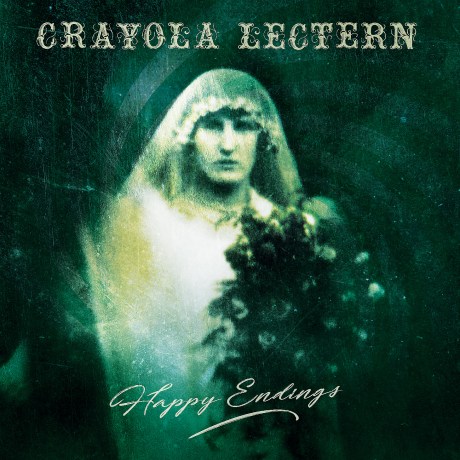
Bathing in the same South Downs of Southeast England water, even if it’s further west along the coastline at Worthing, as the gentle psych imbued outfits Electric Soft Parade and The Fiction Aisle, the Chris Anderson instigated Crayola Lectern embark on a most pastoral, stirring malady on the group’s second album, Happy Endings.
Featuring band members and guest spots from the former of those two Brighton bands, but also a trio from London stalwarts, The Cardiacs, the Crayola Lectern fondly and nostalgically absorb a cannon of rich 1960s psychedelia, seaside vaudeville, dancehall tea parties and quintessential irreverent witty eccentricity. Gazing through the pea green sea-like gauze-y sepia of the album’s cover (a photo of Anderson’s grandmother on her wedding day), revisiting old ghosts to a vague backing of early Floyd, Robert Wyatt, and even at times a spot of Family, Anderson moves amorphously through time whilst alluding to a rafter of contemporary problems: One of the overriding sentiments of which, gleamed from the beautifully hazy melodious piano led, and cherubic sung, opener ‘Rescue Mission’, is that love is really all; but whatever this self-centered world throws at you, “Don’t let the buggers bring you down.”
Diaphanously played throughout, softened, occasionally venerable and choral with dreaming visages of mellotron, trumpet and finely cast musical spells, the album can seem like it’s being summoned from the ether and beyond. Emerging from a burial-at-sea like seaweed covered aquatic specters on the ode to a ‘Submarine’ metaphor (which even includes lines in Latin), or caught in a nursery rhyme loop, lying in bed each night thinking of the inevitable, the theme of death is always close at hand; but handled with sighing reassurance and the comforting strains of a dashing about lullaby.
From end-of-the-pier shows to séances on a wet afternoon, the nostalgic quaintness of Happy Endings dips its toes into vibrato like waters, with shades of The Beach Boys Surf’s Up on ‘Secrets’, and presence of a lapping tide on the theatrical pining and beautiful ‘Barbara’s Persecution Complex’. A general ebb and flow motion, not just rhythmically and musically but in the relationship between an almost childlike innocence and the sagacious meditations of experience, is suffused throughout; though breakouts of rock opera, ascendant spiraling and more dramatic loveliness do splash about in the psychedelic mysterious waters. And on the title track, though it’s prefixed in brackets with ‘(No More)’, there’s an allusion to alien visitors that could be read as a metaphor for the illegal alien otherness of not starbound extraterrestrials but migrants, refugees and even our cousins across the Channel.
Conveying the mood and plaguing anxieties of the past and contemporary; circumnavigating the choppy waters of uncertainty; Anderson and his troupe effortlessly exude a subtle elegance and enchanting charm to produce a gauze-y psychedelic melodrama. Lush and quivery, Anderson’s vocals almost ghostly heartbreaking throughout, the piano played with an understated but emotive caring patience, Happy Endings is a peaceably beauty of a minor opus.
Various ‘Musical Explorers: Waves Of Joy/Bauls From Bengal: Field Recordings By Deben Bhattacharya’ ARC Music, 25th May 2018

If you’re a regular visitor to my reviews roundup then you might already be familiar with ARC Music’s Musical Explorer series: celebrating the work of pioneering ethnomusicologists, and currently sifting through the renowned archives of the late Indian field recordist and filmmaker, Deben Bhattacharya.
The fifth volume in this series once again delves into the rich vaults of material Bhattacharya captured when travelling his native Indian homeland: Other volumes highlight his recordings from Taiwan and Tibet; though he recorded in a multitude of locations and countries during his career.
Settling in London at the turn of the 1950s with mixed results (though after juggling many jobs, finally able to make a living from documenting exotic music, at the time mostly unknown to Western ears), Bhattacharya made many return trips, especially to his birthplace of Benares in Bengal. Previous editions in this explorers series (Colours Of Raga, Krishna In Spring) have either included or alluded to music from the region, and the dual film/audio recordings of Waves Of Joy/Bauls From Bengal is no different.
Amateurish and make-do by the technical standards of today, Bhattacharya’s ’12-volt battery’ powered laden ‘one-man mobile’ recording apparatus still magically captures the most unpretentious in-situ purity of performances. In natural surroundings, the majority in adulation or paean to spiritualist guidance and, not exclusively by any means, Hinduism, these timeless recordings seem to have been caught serendipitously: the opposite of staged, directed and scholarly.
Recorded before his death in 2001, the audio part of this package features a revolving troupe of players performing the spiritual enlightened poetics of the traditional holy wandering minstrels known as the Baul. Translated from the original Sanskrit word for ‘vatula’ or ‘mad’ – though in this case a kind of entranced devotional madness -, these sagacious weavers of philosophical devotion study the ambiguity between divine and sensual love; unburdened by established religion or dogma. Finding a commonality with the Sufis, and especially the ideas of the Persian mystic Rumi, the Baul’s song (also known as ‘bauls’, which can be confusing) are filled with poetic worship, but always stating humbleness, offering nothing other than love as the opening ‘Doya Kore Esho’, sung in exultation by Robi Das Baul, exemplifies:
How shall I adore Thy feet – incomparable?
No prayer or dedication have I
O gracious one!
No devotion,
nor wisdom do appear within my heart of hearts,
Bid farewell to my joylessness,
Give me more joy
In this humble abode of my heart.
Analogies to a “shoreless sea” and the desirable banks of joyful aspiration and nirvana that meet its waves coupled with symbolist fauna, dealing with death, and the conversion of lost souls to whatever guru is being venerated flow throughout this collection’s fourteen track songbook on a buoyant bending and dipping rhythmical accompaniment. Beautifully sung, hollering and soaring even, a quintet of baul minstrels take turns, accompanied by atavistic instrumentation. An intrinsic feature of which is the tucked under the arm ‘anandalahari’, a tabla like tension drum with a plucked string. Held tightly in one arm, the player can pull on a small knob to stretch this string whilst using his other hand to pluck away with a plectrum. Its bending resonance can be heard alongside the one-string drone ‘ektara’, fretless long-necked lute like ‘dotara’, small metal pellet ankle bells chiming ‘ghungru’, bamboo flute ‘banshi’ and tied around the waist clay kettle drum, the ‘duggi’.
All recorded in Shantiniketan, an area synonymous with baul history, these performances feature compositions from such revered gurus as the 19th century mystic/poet Lalon Shah Fakir and Matam Chand Gosain, but also more contemporary figures, such as the film actor and folk musician Mujib Paradeshi and lyricist, composer Bhaba Pagla: It all sounds timeless however, with only a subtle allocation made for more modern themed metaphors.
The documentary, filmed in 1973, is a grainy but colourful informative (if slightly stiff in narration) highlight, featuring as it does the Kenduli Mela festival in West Bengal. A huge momentous musical and religious gathering, it’s held at the birthplace of the famous poet Jaidev in the Birbhum district, attracting, as you’ll see, a myriad of baul ensembles. Probably unrecognizable today – in fact Simon Broughton, of Songlines fame, and the author of this compilation’s linear notes, remarks on its built-up modernity – the plains and riverside of Kenduli in the 1970s is agrarian with the only transport in sight, a multitude of ox pulled carts. Reading out poetic, wise lyrics whilst moving the camera from temples to villages and bazaars, the narrator informs and explains not only the folklore and myths of the baul, but also the basics of the instruments and songs. The message of this study is of the individual’s pursuit in communing with their spiritual guide unburdened by barriers, as the words, read out whilst resting the camera on the icon carvings of a temple sum up so well:
The road to you is barricaded with temples and mosques
I hear you calling my lord, but cannot reach you.
Teachers, preachers and prophets bar the way.
Both revelatory and insightful, an education you could say, Bhattacharya’s extensive archives showcase Indian music at its most venerable and spiritual. A snapshot on the devotional and a survey on the baul phenomenon this latest stimulating Musical Explorers package is a visual and audio treat.
Mehdi Rostami & Adib Rostami ‘Melodic Circles: Urban Classical Music From Iran’ ARC Music, 27th July 2018
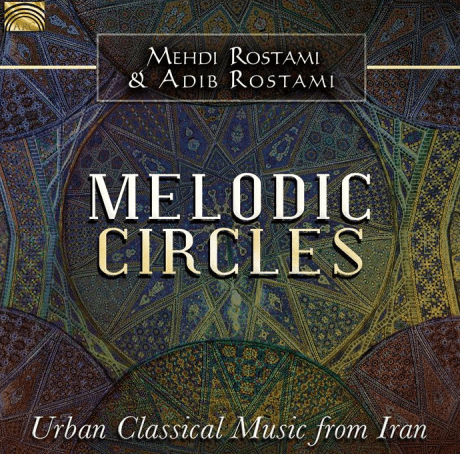
The second ARC Music release to grab my attention this month, the entrancing circular and eastern mirage rippling evocations of the Mehdi & Adib Rostami cousins bring a certain modernity to the classical ‘urban’ music of their homeland, Iran. Tensions between Iran (both with the nebulas and all too real physical influences) and its neighbours in the region, and of course the West, have never been shakier; especially with the recent collapse of the ‘nuclear deal’ and renewal of sanctions, but also with its military presence in Syria and the Yemen. And with the roots of the Rostami cousins’ performances deriving from the Kurdish music of Iran’s Fars province (‘widely considered’, as the liner notes suggests, ‘the cultural capital of Iran’; it is indeed the original home of the Persian people after all) you can’t help but think of the controversies and complexities that hound the Kurdish people in a number of violent flashpoints; most of which derive from the fight for an independent state: though not all Kurds are involved or even agree on the issue.
It makes a change then, to celebrate rather than hector or feel despondent about Iranian culture; ARC Music shedding a light on a positive, magical aspect of the country and its musicians; showcasing, as they do, the technical and creative improvisational skills of the Rostami maestros.
Conventionally divided into two general branches; one deriving from the ethnic minorities (which also includes Nomadic traditions), each with its own distant musical system, the second, and what you’ll hear on this album, is the urban tradition, though it’s a much later style: the ‘radif-e dastgāhi’. Passed down orally, the, what seems like an amalgamation of systems and ‘melodic circles’ structures (so named for the manner in which these Iranian melodies link together to form ‘circles’), ‘radif’ is traditionally divided into ‘instrumental and vocal music’. A serious dedication is needed, as each student of this system must learn their art with a number of masters; the ultimate goal of which, we’re told, is ‘for the musician to cultivate, through many years of practice and performance, the capacity to improvise, wherein ideally, the musician would create a new work in each performance.’ Not just able scions of that learning but international artists of repute and masters of their chosen Iranian instruments, the long-necked, plucked lute ‘setār’ and goblet-shaped drum, the ‘tombak’, the cousins studied with a wealth of talent. Mehdi began playing the wooden fretted setār at the tender age of six, going on to study under the tutelage of Mohammadreza Lofi and Hossein Alizadeh, and take a ‘masterclass’ with Kayhan Kalhor, whilst Adib started out learning the principal percussion instrument, the tombak, on his own before later taking lessons and refining his technique with Mohammed Ghodsi and Pejman Hadadi. He also studied the Iranian fiddle, the ‘kamancheh’, with Roozbeh Asadian and Lofi, and as his cousin did, took masterclasses with Kalhor.
Performing several times in the UK, including as part of the BBC Proms season and with the Syrian ‘qanum’ player Maya Youssef, under the Awj Trio collaboration, the cousins are calling this album their first official release. An album in two parts, subdivided into a trio and a quartet of various passages, Melodic Circles is essentially a contemporary interpretation of the atavistic Kurdish ‘Bayāt-e Tork’ and ‘Bayāt-e Esfahān’ cycles. Though following the handed-down prompts of these age old ‘modes’, they imbue their versions with deft improvisation; breathing in the atmosphere and mood of their surroundings and feelings on the day of the recordings to offer something organic and fresh.
‘Circle One’, comprised of three separate chapters, arises from the Persian epoch with a spindled trickle of ancient evocations; cantering and rolling when the rapid tub-thumping percussion joins in, beside the waters of the Fertile Crescent. The opening section, ‘Nostalgia’, alludes musically to another era, mystical and timeless but unmistakably played out in the present. It’s followed by any equally dusty mirage of enchantment and cascading dripping plucked notes on the travelling ‘Journey’; which, by the end of its perusal, turns a trickle into a flood.
The final piece of that trilogy, ‘Delight’, dashes straight in with a speedy, mesmerizing display of blurry percussion; the lute gliding and entrancing until locking into a circular loop, resonating with brass-y echoes and spiraling nuances.
The second ‘circle’, featuring a quartet of pieces, opens with the longing ‘Lonely’. Romantic gestures, ripples and vibrations gather momentum until reaching a crescendo and dissipating, on this dusky earthy track. Picking up on the intensity, ‘Life’ is like an energetic camel trot across mirage shimmered deserts, whilst, reaching tranquil, less galloping, waters ‘Past’ is the musing respite before the frenzied hypnotic circulations of the ‘Mystic Dance’ spin into play.
Caught in the moment, feeding off each other whilst channeling their intensive studies, the cousins perform with dexterous, masterful skill and a sense of freedom. Melodic Circles faithfully keeps the traditions of the Rostami’s native heritage alive in a contemporary setting; a heritage that is seldom celebrated in the West, especially in such trying times, yet proves an intoxicating experience of discovery.
Kumo ‘Day/Night’ Tapeworm
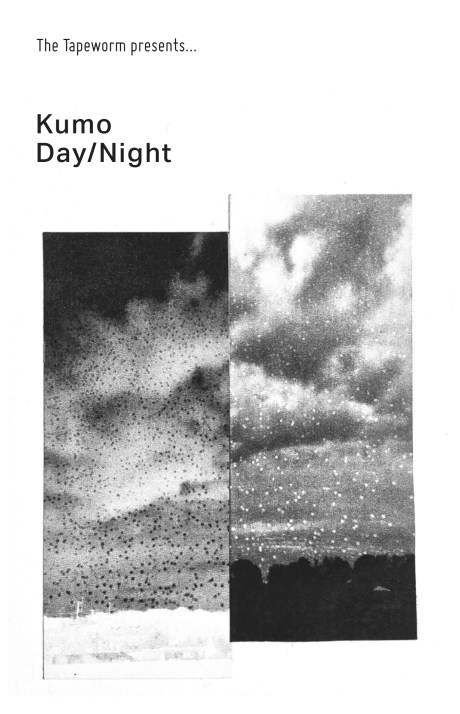
Releasing a myriad of ‘micro-scale’ peregrinations via his revitalized imprint Psychomat and now through the London-based cassette tape label Tapeworm, Jono Podmore once again channels his longest running alter-ego as Kumo for another serialism style trip into the unknown.
Finding a suitable home for his latest experiment with the highly conceptual Tapeworm (a label with an aloof roster of projects from serious thinkers and avant-garde artists alike, including the late Derek Jarman, Stephen O’Malley, Philip Jeck and Can’s one time front-of-house shaman, Damo Suzuki), the professor of ‘popular music practice’ at Cologne’s Hochschule für Musik, sometime Irmin Schmidt foil and guiding light of the Can legacy (the recent Lost Tapes being just one project he helped put together and produce), and founding instigator of the rebellious analogue adventurers Metamono, imbues a set of field recordings with decades of electronic experience.
Lifting off from the concrete of terra firma into alien Kosmische amorphous realms, his Day/Night moiety converts the environmental sounds (from mopeds to barking dogs, the sonorous bass boom of a subwoofer drifting from a car stereo, to city landscape birds squawking and commercial airplanes flying overhead) he recorded from the balcony of his South East London flat into something often mysterious and even at times transient. Both tracks are undulated with Tangerine Dream ambient machinations and oscillations, and ethereal siren trilled Theremin: left to linger, waft and occasionally ascend above the looming hovering clouds.
There are subtle differences between the two aspects of the same day of course; the movements and appearance of nocturnal wildlife and the human inhabitation of Podmore’s estate reverberate on the ‘Night’ recording; inverted owl-like signature sound and orbiting satellites overlap with darker stirrings and the visage shimmers of an unknown presence.
A Kosmische and avant-garde electronic panorama, viewed from a concrete vantage point, Podmore’s efflux styled synthesis convolutes the 360-degree city environment with engineered sounds to create another quality ambient drone and kinetic recording. If you like early Cluster (Kluster even), TD, Orb, even early Kraftwerk, and a lifetime of cerebral techno minimalism then track this tape down. You better be quick though, as it’s limited to only 125 copies!
Moa McKay ‘Illusions Of A Dream’ 29th June 2018
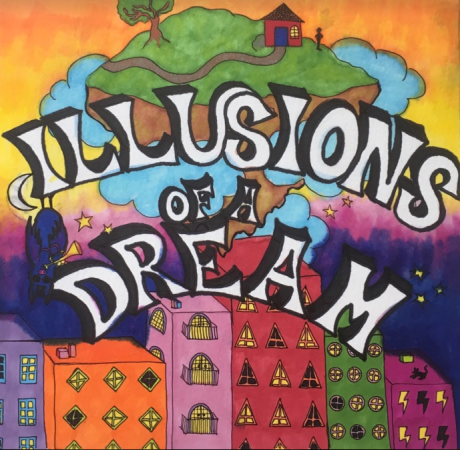
Though I know absolutely nothing about – what sounds to my ears like a sassy bubblegum soulstress with millennial pep – the pop-y soul singer Moa McKay, the lilting but deep grooves of the opening track from her summery new EP, wafting from my speakers, immediately caught my attention when I first heard it recently: alluringly intriguing, drawing me.
Though the lingering breezy jazz tones may evoke Frank era Amy Winehouse with a tinge of American R&B, McKay actually hails from Stockholm and resides in Berlin: a city that doesn’t exactly scream soul. Earlier material, from what I can deduce, is more in the mode of Scandi-pop heartbreak; sung in McKay’s native dialect. With a fresh outlook and collaborating with a trio of musicians that includes guitarist Tristan Banks, drummer Gabriele Gabrin and bass player Per Monstad, McKay now expands her vocal range on an EP’s worth of summertime retro soul pop hits.
Sounding as effortless and floaty as that summer breeze she arrives on, this smoky lounge meets urban suite is rich with nice little funk licks and twangs, rolling jazzy blues percussion and a live feel backing. R&B heartache with attitude, she weaves the woes and travails – from first person perspective to looking in from the outside – of relationships in the modern age. She won’t take any crap mind: channeling as she does, the steely women of 1960s soul and turning the “tramp” put-down on its head.
A modern take on the sort of fusion soul and jazz that the Talkin’ Loud label used to pump out in the 90s, but with nods to the original blueprints, McKay and her partners create a brilliant EP of pliable, melodious and sophisticated sun-dappled soul and pop.
https://soundcloud.com/oacay/sets/illusions-of-a-dream-ep
Ippu Mitsui ‘Shift Down EP’ Submarine Broadcasting Company, 6th July 2018
Atypical of EPs from the mysterious Tokyo-based composer of quirky ennui electronica, Ippu Mitsui’s latest transmission, as the title suggests, is a (gear)‘shift down’ from his usual broken-up, bit-y and effects cornucopia signature style of dance music. Choosing to flow and relax on a neon-glowed cruise through a quartet of both nocturnal prowls and sunset beckoning castaways, Mitsui’s kooky visions summon evocations of a Leaf Label soundtracked Drive, or Warp transmogrified Tokyo Drift: a pulse, you could say, perfect for motoring runs across an Akira illustrated cityscape.
Still throwing us curve-balls; bending and morphing, twisting and turning; changing the odd note for example on a bass run; despite throwing us occasionally, our enigmatic producer creates his most peaceful suite yet. From hanging out the back of a Sega games console 16-bit pixelated sports car on the title track, to imagining the Yellow Magic Orchestra pumping out from an 1980s West Coast lowrider stereo on ‘Squeeze 87’, and navigating early Aphex Twin and futurist Baroque on ‘Rotation’, Mitsui melds TR-808 electro and acid Techno with swelling strings to once again soundscape his own imaginations.
Idiosyncratic, sophisticated and plowing his own furrow, this emerging talent remains a well-kept secret on the electronic music scene. Hopefully, translating from his native Japan, and distributed in the last couple of years through independent UK labels and platforms, such as Bearsuit Records and, on this latest release, the Submarine Broadcasting Company, he’ll now reach a much wider audience at last.
Our Daily Bread 277: Premiere: Vukovar ‘Infinitum’
June 23, 2018
Premiere: Review: Words: Dominic Valvona
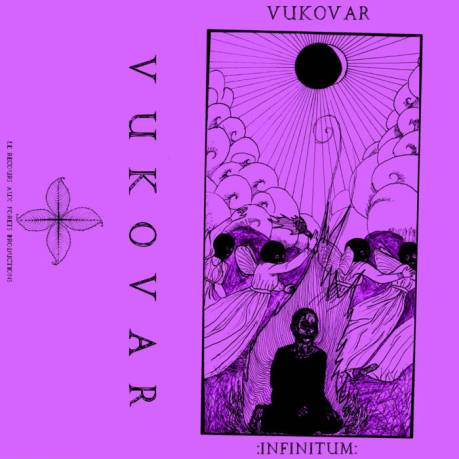
Vukovar ‘Infinitum’ Le Recours Forêts Production, 8th July 2018
Not since Richey Edwards etched ‘4 Real’ in blood across his arm, or Ian Curtis decided to hang himself have artists and bands taken themselves so seriously and to such extremes to prove their commitment to a musical cause; or even before that, checked out of for good at the ’27 club’. The romantically despondent and incredulous Vukovar are, in this non-committal age of vacuous validation and smoke, very much cut from that same cloth. Even their band name is taken from a most serious harrowing episode of modern barbarism: Vukovar the infamous and harrowing Croatian city where 300 poor souls, mostly Muslims, were rounded up and barbarically executed by Serb paramilitaries and the Yugoslav Peoples Army (the worst committed atrocity of its kind since WWII) during the implosive Balkan wars of the 1990s.
Easily one of the UK underground’s most promising bands, if not among the most important in the last five years, Vukovar have already produced a sizable catalogue of material; though each release barely has time to sink into the public consciousness before another ambitious epic replaces it. Infinitum is unquestionably one of the band’s deepest, darkest and mysterious records yet; inspired no doubt by recent events and the wearisome ebb and flow of jeopardy that surrounds them. Living by their art – almost dying by it in fact -, Vukovar are not to be taken lightly.
Consistently snatching defeat from the jaws of victory and hardly adverse to self-sabotage, Vukovar have despite countless mishaps, frustrations and fall-outs managed to release a quartet of three-syllable sloganize entitled albums of morbid Gothic and post-punk curiosity in that time. Their latest, and fifth, Infinitum pulls at the mortal coil of human misery in a murky quagmire. An endless backing track of reverberating delayed snare strikes, a rolling timpani bounding bass drum, esoteric stately sounding waltzes, unwieldy bestial guitar, resigned new romantic synth and escaped melodies muddily, and often amorphously, swim and oscillate around a combination of longing, if worn down and depressed, swooning vocals and Rimbaud-meets-Crowley-meets-Kant-on-the-edge-of-an-abyss poetic despairing narration, on what is a bleak if at times gloriously dark beauty of an album.
Often channeling the spirit of Ian Curtis (though not so much alter-worshipping the miserabilist icon as imbued by him), Scott Walker, The The, Martin Rev, David Sylvain and The Sisters Of Mercy on not just this album but the previous four opuses, it’s the ghostly echoes of Alan Vega’s inimitable rock’n’roll croon and nod to the melancholic heart of Spector’s girl group maladies that can be heard on the album’s most swaddled and beautifully sad song, ‘The Destroying Place’. And the album’s grand finale, delivered with a shade of monastic incantation, ‘Remains’, with its odd sound collage passages of insect-like chatter, strange foreign voices, far off screams and pitch-shift centrifugal motion effects, sounds vocally like John Cale sharing narration duties with his old Velvet’s honcho, Lou Reed.
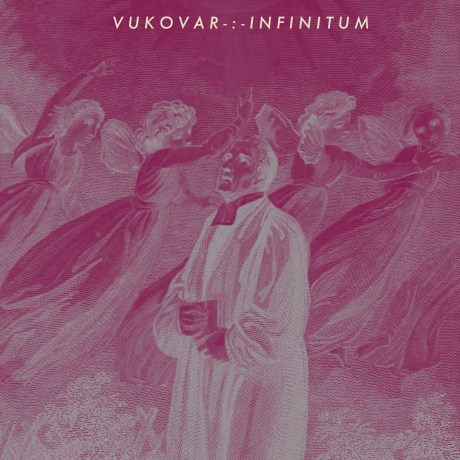
Bound-up in their own self-imposed limitations, these anarchistic dreamers go one further than the Hebrew code of law commandments by adhering to 13 of their own; each one a rule or restriction in the recording process that couldn’t be broken, at any cost. So strict were these conditions that even if the band were close to finishing the album, any infringement no matter how minor, would result in the entire sessions being abandoned. Mercifully they made it through to the end; releasing a troubled, bleak lo fi ritualistic romance of an album.
Vukovar, even if the resignation and despondency in the music reflects a broken spirit just waiting for the end times and a final release, are growing in confidence and creativity; stretching themselves to encompass the Gothic and miserable but also brilliant at escaping the murky waters’ pull of desperation to occasionally break free into the light with bursts of radiant post-punk pop excellence.
Pouring fuel on a bonfire of vanities, whilst pouring out their hearts, this serious act recoil from the spotlight with nothing short of contempt for many of their peers; frustrating even fans, and once again limiting the album’s release physically; confining it to a special limited edition number run on cassette tape.
The fact they can back it up, gives them an edge, way ahead of the usual indie and post-punk fodder we’re normally fed on a daily basis. As the bland-lead-the-bland in a merry dance, Vukovar, as they did on their last single, read from the cerebral, philosophical and the political in a ‘Clockwork Dance’ towards the precipice of doom; their fifth album no less polemical and important.
Dominic Valvona
Previous Vukovar reviews:
Emperor LP
Fornication LP
Puritan LP
The Clockwork Dance Single
The Monolith Cocktail Social: Playlist #XXXIII
May 3, 2018
DOMINIC VALVONA’S PLAYLIST
In danger of repeating myself forever, but for newcomers to the site here’s the premise of my playlist selections. Previously only ever shared via our Facebook profile and on Spotify our regular Monolith Cocktail Social playlists will also be posted here on the blog itself.
With no themes or demarcated reasoning Dominic Valvona picks songs from across a wide spectrum of genres, and from all eras; Selection #33 being no different, with it’s venerated and Tarot card reader divine styler Kosmische intro from Walter Wegmuller and Popol Vuh and musical journey through Ethiopian spiritual paeans (Berthe Raza), Swedish jazz fusion (Solar Plexus), sublime drifting electronic heartache (Left Of Manila), French new wave electronic agit punk (Kas Product), Arabic fuzzed-up R&B (Sharhabeel Ahmed) and 32 other just as wonderful excursions through time and place.
Tracks:

Our Daily Bread 271: Samba Touré ‘Wande’
April 27, 2018
WORDS: DOMINIC VALVONA

Samba Touré ‘Wande’ Glitterbeat Records, 25th May 2018
In a country abundant with guitar virtuosos, the highly genial Samba Touré still stands out as one of Mali’s most celebrated; transducing the travails, heartache but also joy of his homeland through his signature articulate nimble-fingered style of playing.
His third album for Glitterbeat Records – the first, Albala, was the label’s inaugural release in 2013 – Wande is billed as a warmer homely songbook. Recorded in under two weeks, allowing weekends for band members to scratch a living playing at weddings, sessions for the album were relaxed, performances captured on their first take with few overdubs. Previous albums Albala and 2015’s Gandadiko were made during the Islamist insurgency that swept aside and hijacked the Northeastern Tuareg communities’ battle for an autonomous state within the desert borderlands of Mali. Based in the western, more urban, Bamako, Touré encapsulated the fears of his fellow countrymen caught up in, what seemed highly probable until an intervention from the former colonial masters France, a struggle of ideologies that threatened to destroy Mali and bloodily remove its government. Reaching far into the Mali interior, certainly victorious in the field of propaganda in taking the legendary trading post of Timbuktu, Touré was well within his rights to feel anguish and fear as the hardliners – hardly an accommodating presence, known to burn instruments and even musicians that entertained anything other than their own warped sense of myopic worship – inched ever-closer to Mali’s capital.

Photo: Karim Diarra.
Darker albums certainly, yet still so lovingly meandrous, even buoyant, as to exude hope and caring sensibility. Better still, and even with the fallout from this insurgency ongoing (if forgotten by western media), Touré calls, as he does now, for unity: a return to peace.
Far from a complete break, the sadness endures on Wande: though Touré sadness is a most beautiful, cantering and lingering one. Especially when paying tribute to his friend and collaborator, sokou fiddle maestro Zoumana Tereta, on the spoken word with wavering drifty, almost dub-like echo-y effects tracks of the same name, which features the late musician’s spindly evocations from beyond the ether.
The ‘Songhai’ and ‘Crocodile’ bluesman, for that is the style he is most synonymous with, wouldn’t pigeonhole himself personally, preferring to call it contemporary ‘universal’ rock music. Touré has previously said, and reiterates now, that he doesn’t play ‘desert blues’ – a term he rightly associates as the music practiced in Northern Mali, Niger and Mauritania -, and you can also forget about calling it African ‘this’ or African ‘that’ too. Yet at the roots and core, for these are the lands where it all started, Touré’s subtle and relaxed guitar lines traverse the very ideas of blues etymology. The lo fi production feel of the rocking blues Yerfara/We Are Tired could be a lost inspiration for 80s period Rolling Stones with its almost transmogrified Start Me Up like Richards riff. Goy Boyro/The Good Work (Well Done) even begins with a Taj Mahal, BB King reminiscent introduction hook, before dipping over the horizon.
Throughout the album, whether it’s in paying a devotional paean to his beloved wife on the title track or gliding magically on the opening Yo Pouhala/Blah Blah Blah, Touré’s electric, and occasionally deft acoustic, guitar is accompanied by the buoyant and bobbing bending rhythms of the traditional tama talking drum, bowed waiving of the sokou and the vibrating spindle sound of the ngoni: All of which are played with an emphasis on the natural, unrehearsed and relaxed.
Not quite such a leap of faith or different to previous albums, an unpolished and laidback methodology has produced a slightly more sagacious, free-floating quality and another essential Touré classic.
Our Choice Albums/EPs of 2017: Part One: Yazz Ahmed to Al Lover Meets Cairo Liberation Front
December 4, 2017
CHOICE ALBUMS/EPS OF 2017 PART ONE: A – L
SELECTION/WORDS: DOMINIC VALVONA & MATT OLIVER

The decision making process:
Continuing to shy away from fatuous rating systems and ‘best of lists’, the Monolith Cocktail endeavors to offer a more eclectic spread of worthy ‘choice’ picks, with no album dominating or holding any particular numbered position – unlike most of our contemporaries lists stuck with the ridiculous task, for example, of explaining why one album is more deserving of their fatuous number 32 spot than another.
Lined up in alphabetical order then, our favourite new and reissued albums and EPs from 2017 are of course considered to be the most interesting, vibrant and dynamic of the year’s releases. But the best? Granted, to make this list you have to have made some sort of impact, but we’d never suggest these entries were categorically the best albums of 2017, even if that might be true. Instead our list is an indicator of our amorphous tastes, rounding up a year in the life of the Monolith Cocktail, and we hope, introducing you to titles and artists/bands that may have dropped below the radar or got lost in the noise of more commercial better promoted releases.
The Context: An Age Of Hysteria. Dominic Valvona
The silent majority to the wrath and often derision of a mouthy, louder, minority carried on defying and surprising the establishment on both sides of the political divide in 2017. The ‘outraged’ of Tunbridge Wells in the letters pages of yore has been replaced with the ‘outraged of social media’, as the year’s unofficial collective anxious end times tagline #losingourshit replaces moderation, distance and analyses: comment before taking it in fully and reading without prejudice.
Context is thrown out the window when the instant gratification of outrage surfaces.
Despite the rolling news miasma of events feeding into the social media vacuum that has now, more or less, become impossible to ignore or leave; despite the encroachment on every facet of our daily lives by technology and the progressive zealots augurs of a complete matrix like synchronization with our gadgets and tech, the fact that people can be bothered to release music on vinyl still, let alone cassette tapes, is heartening, even if the naysayers bemoan that it’s a gimmick, mostly repackaging old material and reissues or an excuse to charge a lot of money for the tactile and physical. The death of everything physical – from books to newspapers, vinyl to CDs – has always been exaggerated; fueled in hope more than actual demand by the camarilla of Silicon Valley.
Still, streaming is fast becoming the most popular model, even though hardly anyone is benefitting – even Spotify, whose business model is particularly hostile towards the artist, is branching out into other industries, including makeup, because though their value is constantly marketed as high, they have failed to make a profit. Soundcloud, running ads now, is constantly teetering on the edge of folding. And the high expectations, glossy launch of the artist love-in Tidal has failed likewise in changing that model, currently languishing way behind its rivals. Bandcamp meanwhile remains the best choice for artists at present, and gives more control to those who use it. Yet, Bandcamp have recently moved into marketing those who frequent its site, writing roundups and blog posts, moving into a promotional critic’s role. How far this will go is anyone’s guess, I’m a little uncomfortable myself with its implications, its method of choosing the worthy from its vast catalogue, and what incentivizes them. How any of these platforms will hold-up going into another uncertain year politically and economically is anyone’s guess, yet despite the constant harping and expectancy of one of these sites and many like them to close, they’ve all managed to limp on regardless.
A teetering stasis between the physical and the digital exists for now. Writing anyone off at this stage would be foolish.
History is a marvelous scholarly pursuit. Yet anything past the year dot of social media’s conception is either revised to fit contemporary fashions or discarded totally. And so a sense of perspective is needed more than ever, especially up against the worrying diplomatic and military developments taking place throughout the Middle East, Europe (both at the very heart of the EU, including Brexit and with the unfolding independence row in Catalonia, but also Russia’s continuing moves and baiting in the Ukraine), Central and South America and Asia.
We also have the march of the robots and automation to consider, the impact of which will take a little time to filter through but will eventually change all our lives, not necessarily for the better – the most repeated mantra that it will only replace the most monotonous, labour intensive and under resourced job roles shtick is evidently untrue, as automation, bots and the programs being designed and rolled out are coming not only for the middle class occupations but all our creative roles too.
Unsurprisingly much of the music that has been released in the past year reflects the ‘fake news’ obsessed, Trumpism, post-postmodern era in which we find ourselves, some brilliantly, others whining and melodramatic – the cyclone of #metoo and the mounting charge sheet of sexual assaults and misdemeanours stacking up against men in, it seems, most industries is live, but yet to filter through yet on record (well there are few exceptions of course). Not many artists offer answers, certainty or solutions though. And some would say that we’re missing the venom, bite, and the rebellious streak that defined the spirit of rock’n’roll, punk and hip-hop.
And so below, the albums and EPs chosen by myself, Matt Oliver and Ayfer Simms reflect the concerns, protestation, lament of the times in which we live: for better or for worse. And not just from the myopic view of the UK, Europe and North American music scenes, but also from Africa, South America, Australasia and Southeast Asia. The Monolith Cocktail has always done its utmost to draw our readers attention to what’s happening outside the Western dominated music industry, and this year’s two-part feature includes artists as diverse as the entrancing Algerian/Tunisian Bargou 08 and Moroccan Gnawa legend Maalem Mahmoud Gania.
So without further ado…here is the first part of this year’s ‘choice albums’ feature. Part two will follow in a week’s time, and our final Quarterly Revue Playlist the week after that.
A.
Yazz Ahmed ‘La Saboteuse’ (Naim Records)
Encapsulating the dreamy enchantment and exotic peregrinations of her Bahrain heritage with the polygenesis jazz scene of her London home, soloist, collaborator and composer extraordinaire Yazz Ahmed takes us on an evocative, transcendental at times, voyage with her new album, La Saboteuse.
Working with everyone from Radiohead – who’s Bloom track is covered by Yazz on this imaginative Arabian suffused suite – to These New Puritans, from Lee ‘Scratch’ Perry to Amel Zen, trumpet virtuoso – though she seems to be proficient with most wind and brass instruments, including the flugelhorn – Yazz steps out to lead her own small troupe on her first solo album since 2011’s Finding My Way Home. With Shabaka Hutchings on bass clarinet and Naadia Sheriff on Fender Rhodes piano, she lingers in an entrancing and often mysterious world of magical brooding vistas and dusky silhouetted sand dunes.
Isolated trumpet lingers and wafting meditations and traverse style vignettes are placed between longer performances of spiritual and Miles Davis sublimity, as Yazz guides us under the starry skies of Arabia and beyond. Dominic Valvona
Tony Allen ‘The Source’ (Bluenote)
The divine rhythm-provider to Fela Kuti, trustee of the Afrobeat groove, Tony Allen has, and not before time, been recognized for his ability to transcend the style he’s rightly venerated for. Hardly surprising to find him furnishing the jazz tastemakers choice label, Blue Note, with an impressive hybrid album of both – though arguably Afrobeat and jazz have influenced and inspired each other over the decades.
Releasing a four-track homage earlier in the year for the same label, a nod to one of his inspirations, Art Blakey (A Tribute To Art Blakey And The Jazz Messengers), Allen traverses that Blakey swing and the sound of the Savoy label via Lagos and the Parisian joints of the city he has called home for years on the polyrhythm elasticated The Source. Joining him on this enterprise is a band of Paris jazz musicians and the Cameroonian guitarist Indy Dibongue providing the licks, as well as the odd guest spot, including Damon Albarn’s low key contribution to the heralding Kuti funk Cool Cats – a reference no doubt to ‘Sir’ Victor Olaiya’s highlife band of the same name that Allen was hired to play claves for in his early career.
As I say, it has the swing, it has the funk, it has the jazz, and most definitely it returns to the source. Allen bends morphs and pushes those rhythms beyond showboating to produce a remarkable fusion and synergy. DV
Chino Amobi ‘PARADISO’ (UNO)

Looking out from the balcony of a crumbling civilization, reciting a chilling poetic melodramatic transmogrification of Edgar Allan Poe’s The City In The Sea, as tumultuous storms and waves, the sound of seagulls, the crashing of towers fallen into the sea and gargling howls conjure up all manner of Chthonian trepidation, Chino Amobi’s displaced stark and bleak electronic collage soundtrack PARADISO begins as it means to go on.
The Richmond, Virginia artist has dropped his Diamond Black Hearted Boy moniker in favour of his own name for this expansive plunge into the void. And what a dark world it is to discard masks and alter egos in.
A co-founder of the NON collective of African artists, and of the diaspora, Amobi’s remit is focused on ‘using sound as’ the ‘primary media, to articulate the visible and invisible structures that create binaries in society, and in turn distribute power. The exploration of ‘non, prior to the adjective gives intel into the focus of the label, creating sound opposing contemporary canons’.
This translates in the short concatenate serialist style vignettes and passages of worrying trepidation, heavy thumping, bleak, chilling and uncertain twisted minimal electronica, concrete, post punk, Foley sounds and experimental dystopian vistas. A long list of NON collaborators make appearances on this disturbing, at times violent, end times suite, whether it’s through narrated passages, occasional erratic and gauze-y raps or radio show interjections.
A contorted reality awaits, a world without end. Are we circling the void or already in it? Meanwhile crows feed on the flesh, heralded fanfares sound and bestial cyclones blow us off course from Paradise Lost into a sonic chaos. Yet, we’re not so lost as to be totally incapable of redemption; and the ill effects, as the glimmers that do appear allude and Amobi himself has suggested, are reversible. DV
Austra ‘Future Politics’

Imbued by, amongst others, the work of Nick Srnicek and Alex Williams and their manifesto for the end of capitalism tome, Inventing The Future, which calls for and envisions better days for all of us – an escape from the toxic neoliberalism that has defined that last twenty years -, the Canadian synth siren Katie Stelmanis creates a most encapsulating, pining and beautiful glossy synthesizer pop opus on Future Politics.
Written before the Trump victory of 2016 and the spiraling decay of both political and societal moderation that followed in its wake, Stelmanis, under her Austra persona, has inadvertently synchronized her angelical and suffused dreamy pop swooning airs, arias and coos to the anxious end times.
Stelmanis excels, as you will hear for yourselves, in evocative and cool glimmer-of-hope dreamy minimalist electronica pop. She strips away any excess this time around, going further than usual in producing a starker but highly melodious, trance-y and vaporous swooning melodrama fit for the club and heart. DV
B.
Bargou 08 ‘Targ’ (Glitterbeat Records)
Ahh…the sounds of a dusky reedy gasba flute; the tactile patted and burnished bendir drum; the rustic, earthy strung loutar, and the flowing, soaring scale vocals of the Bargou 08 project’s chief instigator Nidhal Yahyaoui, set an impressive atmosphere in the first couple of minutes of the album’s opening track, Chechel Khater. And that’s all you’d need, except there’s another eight equally evocative and thrilling tracks to hear.
The source of this sound derives from a relatively uncharted region that lies obscured between the mountains of northwest Tunisia and the Algerian border, called the Bargou Valley, which despite its barren isolation, has cultured a unique musical fusion, stretching back hundreds of years. Captivating and magical enough in its ancestral unchanged form, the songs of the valley, sung in the local Targ dialect (a language that is one part Berber, the other Arabic), are given a contemporary jolt that transforms the atavistic paeans, odes and poetry of yore into an intoxicating swirling rapture of electronic North African funk.
Filled with a legacy of turmoil and tension that goes back an aeon the album’s many themes, from describing a lover’s vital attributes on Mamchout to laments of alienation, resonate strongly with the growing unease of events, initiated six years ago by the Arab Spring. Tunisia itself is facing a struggle and teetering on the edge, with no guarantee that certain cultures won’t just disappear or be fragmented in the ensuing melee. Originally setting out to document his Bargou Valley home’s musical heritage before it disappeared, Yahyaoui has successfully and thankfully, with his musical partner, producer and the album’s keyboard player Sofyann Ben Youssef captured this rich mesmeric culture for posterity. And in doing so, produced a masterpiece that will endure. DV
Beans ‘Love Me Tonight’ (Tygr Rawwk Records)

Returning after a short hiatus with a highly prolific fervor, the founding member of the legendary Anti-Pop Consortium leftfield hip-hop troop Beans has made a sort of triple album comeback; putting out a triumvirate of bold, salacious, congruous and provocative records all within a few months of each other. It’s hard to choose but preference dictates that it is the middle of that trio Love Me Tonight that edges it.
A futuristic gleam of eeriness and trepidation hangs over proceedings as Beans travails Cliff Martinez meets Daft Punk club, torture chamber chiming gloom, Super Mario jazz acceleration, Exorcist organ and female led R&B. Changing moods convincingly each and every time, you think you’re getting a Kanye West style dancefloor disco rap album one minute, the next, a dystopian cerebral hip-hop ride into the abyss.
Reading out prose, narratives, scripts and passages like a rap ‘beat poet’ (as well as recording Beans has also released his debut novel, Die Tonight, this year) Beans spit is almost like abstract narration; lyrics broken down into compounds like chemistry and descriptive soliloquy.
In keeping with rap music’s provocative of featuring a roll call of collaborators and guests, Elucid and the Kid Prolific chide in on the hiccup scratching, “that dream is over”, – and perhaps my favourite track of Beans – dark chiming Waterboarding, and the darkwave R&B artist Prince Terrence adding the right soulful yearning tones to the Talons love-in, and pep to the club pumped opener, Apeshit.
Passing lyrical dexterity and abstract thoughts on all the ills currently spinning round in the tumult vortex of 2017, but also carrying on a theme of domestic abuse through a number of tracks, with a running forensic detailed commentary on a father and son crime scene on the disturbing V.X., Beans Love Me Tonight seems like a cry for help, or at least an attempt to make sense of it all. Though at times the lyrics are outright schlock pornographic, and accent hardly plaintive. In a manner it’s a tease, attracting certain condemnation as well as respect. DV
Big Toast & Ill Move Sporadic ‘You Are Not Special’ (Starch Records)

“Blocking today’s culture of aspiration with dollops of common sense; a specialist subject for this year’s UK curriculum that won’t fail you”. RnV, Aug 17
In these troubled times we need assurance and support more than ever. Big Toast and Ill Move Sporadic are not the knights in shining armour the situation requires, rerouting British bulldog spirit by mapping out modern reality more genuine than a million so called keep-it-realists. With one of the great voices to dwarf the mic on his way to becoming his own protest march, Big Toast hammers home the black and white of life ten times over, a dismissive totem who won’t budge for anyone and will battle any life aspect until it’s crying back to its casting couch.
IMS has the cheek to throw in a couple of slow jams to tuck you in when Toast is tucking you up, otherwise coming out swinging from the first bell and landing tooth-loosening one-twos. Anti-motivational speakers who will get your arse in gear, and what the youth of today should be listening to. Matt Oliver
Black Angels ‘Death Song’ (Partisan Records)

If you were looking for a creative musical reaction to Trump and the anxious times we live in then The Black Angels beautiful apocalyptic Death Song must be one of the most anguished and daemonic of responses. The Austin psych-rocking overlords first album in four years was written and recorded during the miasma of the US elections after all: and doesn’t it show!
An emotionally charged despair and anger with moments of catharsis, carried out to a Byzantine flavored soundtrack of esoteric Amon Duul II and Far East Family Band psych, a vortex of 80s Goth inspirations – including The cult and Siouxsie and the Banshees – and the tolling chimes of doom and drone, Death Song is, as the title suggests, a heavy, but most excellent trip.
Brooding romantically in Gothic tragedy as the world continues to turn, undaunted by the prospects of universal uncertainty, The Black Angels spread their wings magnificently on what is, perhaps, one of their best albums yet. The leviathans of the psych-rock scene have learnt much and after a recording hiatus return with something sharper, refined but just as mystical and hallucinatory. DV
The Bordellos ‘Love, Life And Billy Fury’ (Recordiau Prin)
Prolific, if haphazardly, dropping albums upon the unsuspecting, and quite frankly undeserving, public at a whim, St. Helen’s greatest dysfunctional family bring us one of their most ambitious collections of cynical derision and honest yearned anxiety yet: a kind of Joy ‘de vive’ Division.
More or less The Bordellos love songs collection, this latest lo fi affair – that makes even The Fall sound professional – is a raw opening of the heart, and in some cases, the veins. Transmogrifying Spector’s voices of the beehives (The Crystals to The Ronettes), the Spacemen 3, The Cure and, of course, The Velvet Underground, The Bordellos eulogize the nearly man of British rock’n’roll, Billy Fury, craft (perhaps) one of their most beautiful ballads, Starcrossed Radio, and pen a “speeding train” metaphor themed ode to breakups.
Romancing the stoned, the life, loves and failures of rock’n’roll are laid bear and as usual, ignored by an unsympathetic, disinterested public. But despite mostly alluding recognition and validation (because that seems to be all that matters in the social media age: affirmation from the echo-chamber of peers), The Bordellos mope and grind on, producing some of the most important diatribes and, in this case, scuzzy, dirge-y and primal garage band spirited love-pained grievances. DV
Brother Ali ‘All the Beauty in This Whole Life’ (Rhymesayers)

“A triumph of crowd gathering words to the wise meets devil’s advocacy, guaranteeing end of term honours”. RnV. May 17
In these troubled times we need assurance and support more than ever. Comparing two of 2017’s most prominent protesters, Joey Bada$$ (on All Amerikkkan Bada$$) got you to show your colours while keeping it funky. Brother Ali on the other hand was there so a circle could form around him when handing out affirmative rhymes that wouldn’t sound out of a place around a campfire, promising the “type of love you can’t type with your thumbs”.
Without detracting from the former, it’s the latter’s warmth that makes him sound like he’s talking to you one to one, and where a rapt audience will follow, that gets the nod; a soft, grit-speckled delivery assuring everything’s gonna work out even when he’s recounting history lessons to the contrary. To a backdrop of blazing suns starting to dip and winter huddles taking shape thanks to great cleanse and polish from Atmosphere’s Ant Davis, it’s confirmation you should always put faith in Brother Ali’s hands. MO
C.
Dr. Chan ‘Southside Suicides’ (Stolen Body Records)
Like some obscure French exchange garage band of students – the kind you’d find if it existed, on a European version of the Teenage Shutdown! compilations – hanging out in the 80s L.A. of plaid shirt and paisley bandana fatigue wearing skater-punks, Dr Chan are an abrasive and coarse mix of renegade petulant inspirations.
Essentially powered by garage rock and all its various manifestations, the group from the south of France hurtle through an up tempo and raging backbeat of The Chocolate Watch Band, The Standells, The Rationales, Black Lips and Detroit Cobras. The difference here is that they also throw in a miscreant Molotov of thrash punk, courtesy of Fidlar, and “death rap” – cue Florida’s $uicideboy$ and their dollar sign typeface indulgence – into the riot on their Southside Suicides protest. It gives the Chan’s brand of garage band mania a different intensity and drive: more screaming in a ball of flames spikiness than tripping psych.
Riled and obviously pissed about the current state of affairs both at home and overseas, Dr Chan’s rage and insolence is in keeping with the primal spirit of rock’n’roll: fun, fun, fun! It’s a blast. DV
Oliver Cherer ‘The Myth Of Violet Meek’ (Wayside & Woodland)

Set in the Forest of Dean, this lamentable concept album (billed as ‘part-fiction’ ‘part fact’) from the man behind Dollboy, Oliver Cherer, weaves the dreamy folkloric story of the tragic protagonist Violet Meek (a play on words of ‘violence’); mauled to death or not by the dancing bears of a visiting circus troupe in the twisted and, musically alluded ominous maybe magical, tree thickened woods. Based we’re told on a vaguely real event that happened in the 1880s, Cherer’s story isn’t just a vintage walk in the past and melodic indictment on the cruelty of Victorian society towards women, but draws parallels with the continuing issues of inequality, chauvinism and mistreatment still prevalent in our own times.
This is an unforgiving unflattering portrayal of England, a nascent nostalgic one with little room for equality and the presence of outsiders, but every bit as revealing about our present. As lovely, often dreamily so, as the music is the 70s pastoral accompaniment is often trembling and quivering, the fiddles distressed and bewitchery, enticing us into a esoteric psychogeography that features a languid brushed backbeat and Morris Dancers like flourish around the maypole on one song, but finds evil in the idyllic scenery on another.
In short, it is a most stunning, ambitious and beautiful minor opus. For those who like their folk and pastoral eerie and esoteric. DV
The Church ‘Man Woman Life Death Infinity’
To infinity and beyond, Australia’s stalwart alternative rock and pop guitar romantics The Church, nearly thirty years since their inception continue to breathily produce quiet masterpieces; continue to experiment and explore new sonic textures. Travelling into the ethereal, the sagacious Man Woman Life Death Infinity is a suffused glide and traverse of air-y vapours and misty mystery; beginning with the opening, soaring minor opus Another Century, sustained throughout, with each song materializing out of the ether.
Reflecting but an unconscious inspiration, The Church’s founding member Steve Kirby calls this album the group’s “water record”. Though all the characteristics of water, trickling chords, cascaded dripping notes and a sense of floating are all correct, this dreamy pop and transient songbook seems to leave the ocean floor and rivers for something more astral. Songs such as Submarine for instance seem imbued with a spirit of the Kosmische. Yet fans of the group’s staple of pop guitar swan songs and subtle psychedelic 80s lovelorn classics will love Before The Deluge and I Don’t Know How I Don’t Know: both of which show traces of that college rock meets garage riffage that arguably inspired or was picked up by The Stone Roses.
Still writing timeless anthems without lazily reverting to the back catalogue, still pushing forward after four decades, The Church can still illuminate and surprise. This, there 26th, album is anything but jaded. If anything it seems that The Church are still very much in the game, and able to balance familiarity with discovery. DV
Clap Your Hands Say Yeah ‘The Tourist’
Inimitably jump-starting a cerebral indie-pop scene in the mid noughties with his unique off-kilter melodies and quivered, yodeled vocals, the fiercely independent, Alec Ounsworth created major ripples with his nom de plume, Clap Your Hands Say Yeah’s self-released debut in 2005.
Ounsworth stumbles and ponders through a “post factual” strewn world of challenging emotions trying to make sense of it all on The Tourist. At times the album title could even be said to act as a metaphor for the artist’s own estranged and removed soul-searching: a tourist in his own country. Despite some sad and profound pathos heavy lyricism, Ounsworth’s “purging” of thoughts is meant to be a cathartic experience. The anxieties of our times can’t help but leak from every other line, yet this album is a fairly warm, jangly surprise package of lolloping and anthemic songs.
Building and soaring to an emotive brightened crescendo of sweetness and yearning on The Vanity Of Trying; contorting and bending guitar textures in a Robert Fripp fashion on the psych-pop gnarled Down (Is Where I Want To Be); and, up close and personal (every breathe audible) to the mic, driving through an 80s nocturnal rock ballad on Better Off, the inimitable Ounsworth careers through a full gamut of moods and chaos in the most natural and energetically purposeful way.
Clocking in at well under the forty minute mark (bands and artists take note) The Tourist is an unlabored, near-perfect melodious album. It says all it needs to and more; free of indulgence, and despite its bombast, sophisticated suffused layering is incredibly lean and brisk. A most enjoyable if poignant experience, this album already sets the benchmark in 2017, and is without doubt one of CYHSY’s best. DV
Full review…
Anna Coogan ‘The Lonely Cry Of Space & Time’
Not the easiest of bedfellows, difficult to love and often (rightly) condemned as indulgent and overblown, but the worlds of rock and opera do occasionally overlap in a congruous union. The unquestionably talented Anna Coogan for instance, mixes the two majestically, using her finely trained 3-octave soprano and classical background to offer fluttering siren-like arias that seem to surreptitiously manifest from, what is, an ever-changing metamorphosis of musical styles, on her latest album, The Lonely Cry Of Space & Time.
Inspired by scientific discoveries, a “childhood listening to Puccini’s La Boheme”, the fateful poet Sylvia Plath, the tumultuous grave mistakes of intervention in the Middle East and, no surprises, the 2016 US elections Coogan’s ambitious suite of songs and instrumental evocations is far from lofty and classical.
Spanning country, Ry Cooder desert meditations, Anna Calvi like trembled sensual emulations, PJ Harvey and even bubbly synth pop, Coogan together with musical collaborator Willie B – offering atmospheric Moog bass line undertones and drums – produces a ‘wave’ fixated lamenting and balletic travail and a surprise highlight of 2017. DV
D.
Daniel Son ‘Remo Gaggi’ (Crate Divizion)
“Toasting the high life and low lives, gangster rap bearing honourable intentions”. RnV, May 17
Canadian slick talker Daniel Son is the front for this, one of many Giallo Point heists that the UK producer ran during 2017. With the authentic mob experience evident in such titles as Flat Tyers, Car Seizures, Strippers Den etc and the kingpin adoring the sleeve, it’s instantly noticeable how dry GP’s noir-ish production is; sharply tailored loops of muted house band jazz that has seen nefarious comings and goings, but are gagged by confidentiality agreements and the fear of loose lips sinking ships.
Potent in what it doesn’t disclose, display one bead of sweat and you’re in trouble. Before you know it Daniel Son – “we the reason that the yacht insurance be going up” – has decked you with a leg sweep before disappearing back into the night. While it’s easy to apply Godfatherly stereotypes to Remo Gaggi, the style of this international union contrasting brash and diligent, compellingly separates the best from the rest. MO
Dope KNife ‘NineteenEightyFour’ (Strange Famous)

“An absolute battering ram of four wheel drive blasting through the boggiest of boom bap. Big Brother would think twice about listening in”. RnV, Feb 17
We’re not trying to discredit Dope KNife by saying that NineteenEightyFour is an almost unfashionable antidote to tween trap, happily, mercilessly fanning the flames of the very 2017 argument of what constitutes real hip-hop between upstarts and originals (and if there’s an argument abound, it’s only right that Sage Francis is tagged in as well). Far from an Orwellian vision yet probably something of a dystopia to some as he walks with an intimidating shadow, DK comes slathered in dirt, ready to punch you in the ear with a splattered larynx.
As a one-man steamroller on beats and rhymes it’s not an exact science, but that’s absolutely fine with us, the battle-hardened, bitter-as-blasé (yet also able to reference the Fresh Prince theme tune) Georgia emcee leaving competition standing (“I can’t help being a damn cynic, this damn planet got a fucking lot of wack in it”). MO
The Doppelgangaz ‘Dopp Hopp’ (Groggy Pack)
“A drop of ‘Dopp Hopp’ a day will keep the haters away; will creep up on the button marked ‘repeat’ until it progresses to heavy rotation”. RnV, Jul 17
Despite the sub-Gothic sleeve looking like the NY pair are auditioning badly for a death metal gig, Dopp Hopp ranks high on this year’s list on the strength of its smoothness alone. “Live by the cloak, die by the cloak” say The Ghastly Duo; but the mystery ends once their views from West Coast low riders, developing a smoky lens that’s intoxicating but never fuggy, embrace the inevitable sunshine.
Also readymade for reminiscing as on E.W.W. and Strong Ankles, the ‘Gangaz have set themselves the relatively easy task of riding the vibes properly, and they oblige with a natty turn of phrase prepared to shift towards the nearest street corner at their leisure. Dopp Hopp is another feather in a cap looking more and more like the crown jewels. Beats and rhymes guarantee return visits to golden-edged climes, where you simply have to rewind the boast that “if ‘Dopp Hopp’ was a beer, it’d be an IPA”. MO
75 Dollar Bill ‘Wood/Metal/Plastic/Pattern/Rhythm/Rock’
(Glitterbeat Records)
This album could have rightly qualified for last year’s feature, but re-launched, repackaged for Glitterbeat Records’ burgeoning new imprint tak:til, 75 Dollar Bill gets another shot: mainly because it slipped under most radars on its maiden voyage in 2016. Now in 2017 with a hopefully wider global release it will shine.
Adhering to Jon Hassell’s “fourth world music” blurring of the division between futurism and tradition the 75 Dollar Bill duo of NYC-based musicians Rick Brown and Che Chen, traverse the psychedelic desert rock and trance of the Maghreb, avant-garde, jazz and even swamp boogie delta blues in a most indolent but listless transient manner on W/M/P/P/R/R. Motivated by an interest in “compound meters” – meter involves the way multiple pulse layers work together to organize music in time; a compound essentially dividing the beat into three equal parts -, but playing in a fashion that feels natural and organic, the follow-up to 2015’s more “forward momentum, stomping and shaking” style Wooden Bag is a nuanced clever exploration of interconnected tonality and tactile responses to a wealth of harmonics and melodies from a pan-global array of influences: from modal jazz to Arabic modes and eastern scales.
What they produce is an often adumbrate, repetitive experience that builds gradually, slowly releasing various tangents of interplay between the principle duo and their extended backing group of friends; traversing genres and moods to evoke new expletory musical spaces. DV
E.
Ester Poly ‘Pique Dame’ (Ikarus Records)
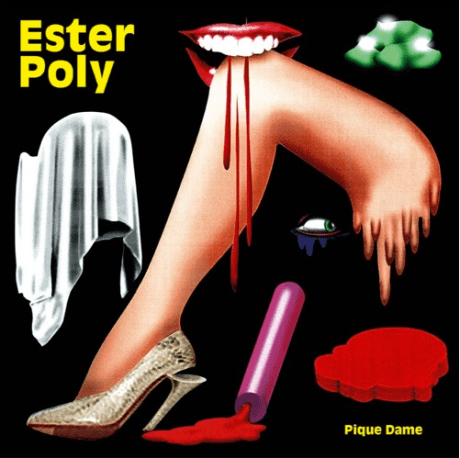
Experimentally rocking the cantons of their Swiss home for a while in their respective separate outfits, Béatrice Graf and Martina Bérther unite as an unholy drum and electric bass alliance under the Ester Poly (a scramble of ‘polyester’ of course) banner.
Pitching generation X(er) Bérther with Y(er) Graf, this rambunctious vehicle for the duo’s feminist protestations and irony is hardly hampered by the limitations of their chosen drum and bass instrumentation, and hardly comparable to any of the many such similar combinations plying their trade. Instead, Ester Poly use a stack of effects and distortion tools to widen their sound spectrum; evoking hints and obvious homages to post-punk, art school, Jazz, doom rock, heavy metal, no wave and Krautrock in the process.
Recorded in more or less one-takes, both combatants facing off against each other in the studio with no headphones or click track, Pique Dame captures not only the lively, hostile and enraged but also the humour (even if it is dark and resigned) of this energetic union. Despite the raging tumults, dynamism and soundclash of ideas, this album is a steady and even showcase of festering ideas and moods. It’s also quite brilliant and encapsulates the ‘pique’ perfectly; arousing, curious and irritated! DV
F.
Faust ‘Fresh Air’ (Bureau B)
Still banging the cement-mixer drum and manning the barricades after forty odd years in the business, the Jean-Hervé Péron and Werner “Zappi” Diermaier duo version of Faust – at its most base drummer/percussionist and bassist-come-tormentor of sound – and their latest protestation Fresh Air is a sort of art-provocateur road trip of the USA, featuring an abundance of locals and internationalist artists and musicians, picked-up on the way through New York, Texas and California: A counter-cultural agitation travail from coast to coast.
Featuring the usual Faust totems and that workmanlike methodology of extracting sounds and evocations from machinery, found objects, debris and the architecture – even Péron’s front door hinges from home make an appearance – Fresh Air is an urgent gasp for relief from the polluted, choked, environment. It’s also a highly convoluted attempt at transforming geometrical forms and abstractions into a sonic score. Three of the tracks on this album take their inspiration from a faux-workshop at the highly regarded California Institute of the Arts. A session that includes the loony 23-second vocal exercise symphony Partitur – defined loosely as “a sort of Dadaist choir, a musique impressionniste” by Péron –; the loose Slits do souk jazz, camel ride Chlorophyll, which features Barbara Manning “sneaking” in word association sketches alongside Zappi’s own strange utterings; and the saxophone squalling, motoring Lights Flicker, which again features Manning, bridging the role of Laurie Anderson and Patti Smith, repeating an agitated mantra over a quasi art-dance backing.
Continuing with their signature agitation, often menacing, call-to-arms whilst also sonically turning the abstract into something audible, Péron and Zappi can still be relied upon to create provocative statements, five decades on from when the original Faust dynamic barraged audiences with the most confrontational and experimental sound ideas. Struggling like the rest of us, but finding a comradely with another generation of artists and musicians, they look for hope in the miasma. DV
Craig Finn ‘We All Want The Same’ (Partisan Records)
Occupying a rich postmodern American literary landscape, channeling such celebrated chroniclers as Bruce Springsteen and Vic Chesnutt, former The Hold Steady, and prior to that Lifter Puller, front man Craig Finn has in more recent years carved out a career as a successful solo artist. In true Springsteen style, though with far less guttural bombast, Finn brings a certain levity and importance to the lives of America’s “ordinary folk”, building a highly erudite diorama to stage the unfolding, and to outsiders, the often inconsequential dramas that are acted out across the States on a daily cycle.
Subtly tapping into the “liberal” creative psyche of America, one that’s still in a state of shock, but also the so-called “blue collar” America that put Trump in the White House, Finn doesn’t so much point fingers or berate as reflect the resignation of a cast on the peripherals of society.
Enriched with the graceful subtle presence and soaring vocal harmonies of Caithlin De Marrais and singer/songwriter Annie Nero, the keys of Sam Kassirer, swaddling and lifting horns maestro Stuart Bogie and longtime contributor from The Hold Steady, guitarist Tad Kubler, the musical backdrop is a mix of rolling Warren Zevon piano psychodrama, bluesy rock’n’roll and Ashbury Park period E Street Band brass. A solid performance and assiduous edition to the modern American songbook, Finn’s third solo album shows a full-bodied, sagacious artist at his pinnacle. DV
G.
Maalem Mahmoud Gania ‘Colour Of The Night’ (Hive Mind Records)
Maalem Mahmoud Gania, the near-exulted star of the Moroccan honed Gnawa – a style of traditional Islamic dance, music and poetry with roots spread across the sub-Saharan crescent of Africa; considered by many to be one of the origins of the “blues” rhythm – and artisan of the genre’s key instrument, the camel-skin covered three-string lute like “guimbri”, released an extensive catalogue of recordings for labels such as Tichkaphone, La Voix El Maaref and Sonya Disques.
Choosing such a revered icon with which to launch their inaugural new imprint Hive Mind Records, the Brighton outfit’s inaugural baptism is the legend’s final studio recording, the afflatus, entrancing Colours Of The Night. What makes it special is that this is the first solo release by the artist outside his native homeland to be released on vinyl.
Stringy, wiry, occasionally a tone or two lower and played like a quasi-bass guitar, Gania’s playing style is raw, deep and always infectious: from blistering solos to slower and lighter ruminating descriptive articulations; this is equally matched by his atavistic soulful voice and the chorus of swooning, venerated female and male voices and harmonies that join him on each track.
Colours Of The Night is a highly hypnotic collection of performances both magical and transcendental, beautifully traversing Arabia and desert blues traditions. DV
Golden Teacher ‘No Luscious Life’
Seeming to just follow wherever the groove takes them, whether it’s ESG uptown/downtown Boho Noho Soho New York, electro Afrobeat, the griot traditions of West Africa or 80s Chicago House, the polygenesis influences of Glasgow’s sonic multilingual Golden Teacher sextet seamlessly entwine to produce the most solid of on-message dance music.
Flexing and limbering to a hip 80s heavy melting pot of sounds and references, the Glasgow troupe move like liquid through a soundtrack of polyrhythms, acid and tight drum presets, oscillations, clean and not so clean futuristic galactic house funk. Not many groups can inaugurate and move between both the Senegalese griot matriarch Aby Ngana Diop and Cabaret Voltaire on the same album, but such is the myriad of musical backgrounds, and they encompass every kind of genre you can think of, of the band members that make up this loose collective, you’re never quite sure what you might hear next.
Though rhythmically and melodically, pumping and sonically doing all the talking for them, there are succinct, atmospheric vocals from Cassie Ojay and Charles Lavenac to give either a certain sway and louche entrancing quality or, as on the opening Afro-funk meets pumping House Sauchiehall Withdrawal – a reference to one of Glasgow’s most, famous and popular main thoroughfares, with everything from the Glasgow School Of Art and CCA art hub of venues and galleries to shopping and nightclubs on its mile and a half long strip – a soulful austerity groundhog day political context: dutifully working the daily slog and for what?!
Moving to Glasgow, from about as far south of the border as you can go, a couple of years ago, one of the first gigs I saw was a sort of impromptu, diy style, performance from the group at The Old Hairdressers in town. Improvised to a degree they caught the wide-eyed excitement and dynamism of an earlier time as if it was fresh and new. A must-see live turn, the group has, unlike so many others before them, captured that free spirit and looseness on record. Yet production is really slick.
The city has always enjoyed a reputation for the eclectic, and Golden Teacher more than most, encapsulate that cross-pollination, borderless approach to absorbing music from across the globe – from The Levant to Compass Point – and making it funky. DV
H.
Happyiness ‘Write-In’ (Moshi Moshi)
Ah…the sound of a band embracing the heartfelt warmth, accentuated dazed melodies and special feel of such 70s fare as Randy Newman, Harry Nilsson and Big Star, Happyness evoke the hazy fond memories and subtle sophistication of these and other complimentary artists on their brilliant album Write In.
The opening Falling Down gambit, with its radiant phaser guitar, conjures up the Scottish indie supremos (and fellow Big Star acolytes) Teenage Fanclub, whilst the pastel-shaded saddened tone of The Reel Starts Again sounds like a lost, ghostly remnant of a George Harrison and Jeff Lynne malady. A touch of the Brighten The Corners era Pavement permeates the band’s weary slacker muffled Uptrend/Style Raids, but by the time we reach the halfway stage of the album the lads are back to thrashing out a languorous grunge-y grind on Bigger Glass Less Full.
Subtle and confident, Write In is a halcyon, beautifully executed album with real depth and personality. Happyness have found their flow with loose but perceptively well-crafted gentle pop songs of a timeless quality: to be played as the “credits roll forever”. DV
Here Are The Young Men And Uncle Peanut ‘This Is Standard Life’
(Musical Bear Records)
Unceremoniously released almost on the sly, though because we are inundated with 100s of releases every week it could be we missed this one, the brilliant cut price, and with far more humour, authenticity and irony than the Sleaford Mods (as if scribbled by David Shrigley) Here Are The Young Men & Uncle Peanut are back with a load more broadsides leveled at life’s most cunty personalities and foibles.
Not so much poetic, not really rap in the true sense of the word either, they make observational snatches of overheard misnomers, condemnations and Estuary patois on the modern toss life of a pissed-stained mattress society. Modern life isn’t so much rubbish as depressingly shite, as the group transmogrify a sort of Daft Punk ‘Teachers’ style litany of great influential bands into a council estate, backroom punk paean to the spirit of punk and good music; safe in the knowledge that Mark E Smith Is Still Doing The Fall, even after a hundred years!
Diatribes on outsourcing, hipsters (the Day The Hipsters Stole Our Look; those penny-farthing riding tossers), lads banter (“yes mate, yes mate, standard”), gentrification, “nobbers” (who are “fucking everywhere!” on the Underworld goes punk song of the same name) and pop stars abound, and there’s even collaborations with Art Brut’s inimitable Eddie Argos (on the and Billie Ray Martin (of S’Express and Electribe 101 fame).
It’s nothing short of fucking brilliant, short and anything but sweet. The use of swearing alone is commendable. A sort of vitriolic, generation X middle-aged series of rants on what we’ve lost, what we are set to lose and what we could do without. DV
I.
Ifriqiyya Électrique ‘Rûwâhîne’ (Glitterbeat Records)

Capturing something quite unique, the collaborative industrial post-punk and avant-garde rock scenes of Europe clash head-on with the descendants of the Hausa slaves atavistic rituals styled group, Ifriqiyya Electrique, create an often unworldly chthonian conjuncture of Sufi trance, spirit possession performance and technology.
A film project and now immersive sonic experience, inspired by the important Banga music traditions and the accommodating, rather than exorcising, of spirits ceremonial wild dances and call and response chanted exaltations of the black communities – originally transported to the region from sub-Saharan Africa – in the oasis towns of southern Tunisia, this astounding meeting of cultures and history is anything but scenic.
Formed in the Djerid Desert, the idea forged by field-recordist and veteran guitarist of the politically-charged Mediterranean punk and “avant-rock” scenes, François Cambuzat, and bassist Gianna Greco – both of which occasionally join forces with that livewire icon of the N.Y. underground, Lydia Lunch, to form the Putan Club -, the Ifriqiyya Electrique spans both continents and time. For their part, Cambuzat and Greco provide the grind, industrial soundscape texturing, sonorous drones and flayed guitars, but mostly, the “electrique”, whilst, offering a dialogue with the spirits and the tradition, Banga musician Ali Chouchen – joined in the live theatre by an expanded cast of fellow voices, krabebs and Tunisian tabla players from the community, which includes Tarek Sultan, Yahia Chouchen and Youssef Ghazala – provides peripheral sounding evocative echoed and esoteric vocals and equally haunting nagharat.
Spiritual conversations transformed and realigned with the machine age turmoil of industrial noise, Arthur Baker style rock and hip-hop production, post-punk and even Teutonic techno, Rûwâhîne is a rambunctious unique force. DV
J.
Jam Baxter ‘Mansion 38’ (High Focus)
“Half cut, whip smart. Ultimate, grungy outlaw hip-hop, putting the trap in trapdoor”. RnV, Mar 17
UK crown rulers High Focus reached new levels of cult when Mansion 38 became that creepy house at the end of the road that may be good for a heart-in-mouth laugh at Halloween, but not somewhere you’d venture to acquire a friendly cup of sugar.
Recorded and produced in Bangkok, Jam Baxter’s quotable cynicism is of an emcee breed that gets caught in a landslide escaping reality in a bid to keep himself amused, but whose focus is actually doing overtime. Seeming nonsense suddenly swoops down at you with lethal intent, most notably on the shrewd consumerist commentary on offer For a Limited Time Only. He of The Gruesome Features squats on Chemo’s production, and where there’s no such thing as a wrong turn, it’s alien, exotic, and worryingly comforting at once, slowly beginning sinkhole formation, and with Dumb demanding you take cover while running in slow-motion. Bugged out, bug-bombed, brilliant. MO
Jehst ‘Billy Green is Dead’ (YNR)

“Showing the sort of word association and plain English penmanship that has long made him the UK’s premier emcee”. RnV, Jun 17
Whether the eponymous subject of Jehst’s sixth full-length is man or myth, a reflection on society or the High Plains Drifter letting his imagination run wild while disclosing clues from his own personal memoirs, you’ll be hanging on Billy Green’s every move, tic and confession.
It’s the album’s lost, tired soul trying to keep the walls from closing in, but then seeming to be at peace with any pending doom. It’s the human element, from the debilitation of an everyday Joe to referencing the Kardashians and when the most important decisions can sometimes boil down to choosing “the Snickers or the Mars, E&J liquor or the six-pack of the Stella Artois”. It’s Jehst’s delivery that even when close to succumbing to heat exhaustion, finds a reserve from deep down that’s of an improbable, impeccable sharpness. It’s the simmering sphere of wax and wane production whose highs and lows run a perfect parallel. ‘Billy Green is Dead’, long live Jehst. MO
Jonwayne ‘Rap Album Two’ (Authors Recording Co)

“Personal struggle both poignant and unapologetic for showing its hand…watch its humble humanity become the choice of the open eared this year”. RnV, Feb 17
Rap Album Two approaches that long-standing hip-hop (and society in general) elephant in the room: the refusal to admit vulnerability. In laying crises on the line, Jonwayne becomes his own therapist and subsequently an outlet for the hesitant and anxious to claim as their own. At his most lo-fi, the times to think become deafening and don’t necessarily mean there’s a clean pathway to redemption.
It would take a kingsized about-turn for Jonwayne to become self-destructive on record, but it’s the legitimacy of his 20/20 vision and the potential of the what-ifs that sit kindly. Particularly on the beautifully dejected/accepting Out of Sight and Afraid of Us, bearing the powerful “look at these people, counting on me when I can’t even count on myself”, you can hear him fighting for his very survival. Also behind the excellent Black Boy Meets World by Danny Watts (who features here), Rap Album Two bridges the gap between cult hero and everyman icon. MO
K.
King Ayisoba ‘1000 Can Die’ (Glitterbeat Records)
Sounding the klaxon call in defense of his native Ghana, and Africa at large, on his inaugural LP for Glitterbeat Records, the striking, lively King Ayisoba, from the roots up, uses his guttural earthy howl and atavistic kologo lute to great effect in demonstrating not only a raw anger but also a deep love for a much misunderstood continent.
From the very outset Ayisoba and his contributors Wanlov da Kubolar & Big Gad – just two of the many guest appearances on this album – rap, sing and stamp a slogan sentiment on the opening Africa Needs Africa of, “Let’s fight for Africa/Africa needs us.” Covering the North African diaspora, the boat people’s sorry saga, the colonial past and umpteen other issues that more or less shape the image that those observers from outside the continent believe is the only side to Africa – between a misplaced sentimentality and outright ignorance. There is protestation and indictment, but also a lively focus on the positives too; finding solutions through the medium of music and culture.
In-between the fiery, bordering on punk, clatter of guluku, dundun and Djembe drums and rambunctious electronic phasing beats there are more plaintive, yearning stripped-back moments: Grandfather Song, a toiled from the soil of tragedy lament, offers a more intimate knee-jerk from the full-on band sound, and Dapagara is sent off into a sweeping, wafting vista by the Nigerian legend Orlando Julius’ traversing, reedy accentuated saxophone.
Raw from the heart, highly evocative and rebellious, King Ayisoba’s songs of rage and vitality actually offer a kind of hope in the face of adversity. The future of Ghana’s music scene is in good hands at least. DV
L.
L’Orange ‘The Ordinary Man’ (Mello Music Group)
“An evocative performance capturing a concerto producer whose trick-from-sleeve ratio remains visionary”. RnV, Nov 17
Another 12 months of might and magic on Mello Music Group, including must-checks from Oddisee and Mr Lif and Akrobatik as the reconvening Perceptionists. However, it’s the beatsmith with the knack from Nashville building up quite the back catalogue where Tenneseein’ is Tennebelievin’. Loosely based around the sleight-handed history of when illusionists were the rockstars of their day – on premise alone, L’Orange is out by himself – the mostly instrumental The Ordinary Man is described as “vaguely reminiscent of RJD2’s ‘Deadringer’”, where loops slip off straitjackets and straight up gallivant.
Reserving the mic for only a handful of guests after a starry stack of collaborative LPs, L’Orange offers jazziness with a spring in its step, even when its grainy monochrome quality appears to be suffering (perhaps reflecting his own personal health issues). Covered in a sweet patchwork of samples, the headnodding will rock your neck stiff (Cooler than Before soars like the plane on Raekwon’s Criminology), while placing it delicately upon a pillow. MO
Liars ‘TFCF’ (Mute)

The confusing soundtrack to a musical divorce, the enduring creative partnership behind the Liars, Angus Andrew and Aaron Hemphill, finally fell apart after the release of Mess. Though confounding fans and critics alike on every release, the now streamlined version of the Liars sees Andrew at the helm of, essentially, a one-man band, churning up and lurching through what should by rights be another ‘mess’ of ideas to produce something quite vivid and experimentally sharp.
Chronicling what he felt was akin to a musical marriage, Andrew sitting miserably slumped in a wedding dress, left holding the bouquet on the cover of TFCF (Theme From Crying Fountain) charts a deteriorating relationship, with dysfunctional material – some of which was marked for the next Hemphill & Andrew Liars album – spun into a brilliant sulky, miserable melodrama of electronic, new wave, punk and cerebral pop.
Leaving L.A. for his native home of Australia, a dethatched Andrew transmogrifies those American influences into acoustic, labored drum break lamentable sneers (The Grand Delusional), Love style Mexican psych flare crossed with Medieval courtship (Cliché Suite) and disjointed daggered, The Knack meets Beck, lurches (Cred Woes).
Often resigned, hurt, pranged with pity throughout, it hardly sounds appealing, yet TFCF is full of reinvention, experimentation and lyrically, both dreamily and petulantly opprobrious. DV
Al Lover Meets Cairo Liberation Front ‘Nymphaea Caerulea’ (Hoga Nord)
A meeting of exotic minds, San Francisco producer/remixer Al Lover (The Brian Jonestown Massacre to Goat) and the Tilburg collective Cairo Liberation Front set out on an evocative mesmerizing flight of escapist fantasy on the extended Nymphaea Caerulea EP.
Continuing a partnership with the Hoga Nord label and following up the previous Zodiak Versions, Al and his collaborators merge psychedelic dance music with a spiritually mysterious imagined vision of Egypt: Nymphaea Caerulea being the Latin name for the blue Egyptian lotus, a flower of the Orient.
Over six ‘levels’ they traverse and evoke entrancing Egyptian flute led feverish ritual, mysticism, sweeping desert winds, ancient kingdoms, belly dancing and cyclonic Afro-Futurist beats.
References to a new sonic deliverance, a musical Arab Spring, infuse the six instrumental tracks with a certain levity and theme. But rather than bang the drum of rage and protest in the land of the Pharaohs and old gods, Al and the Cairo Liberators create a moody mysterious, veiled soundtrack fit for the dancefloor. DV
Playlist: The Monolith Cocktail Social #29
July 21, 2017
A PLAYLIST FROM OUR IMAGINARY RADIO SHOW OR ‘SOCIAL’
Chosen by Dominic Valvona
In danger of repeating myself, but for newcomers to the site here’s the premise of my playlist selections. Previously only ever shared via our Facebook profile and on Spotify our regular Monolith Cocktail Social playlists will also be posted here on the blog itself.
With no themes or demarcated reasoning we pick songs from across a wide spectrum of genres, and from all eras. Reaching edition #29 and still as eclectic as ever, this latest playlist chosen by me, Dominic Valvona, features Canadian Hollywood tipping rock glory from Neil Merryweather, the funk, the whole funk and nothin’ but the funk from Bernie Worrell, Afrobeat garage from Wells Fargo, beautiful flighty jazz transmogrifications of The Beatles via Ramsey Lewis, and experimental peregrinations of fantasy from Nicole Mitchell. There’s also tracks from Monomono, Gurumanix, The Stepkids, Trane, Leland, Sensations Fix (a regular at the Monolith over the years), Syrinx and many more (see full tracklist below).
Tracklist:-
Neil Merryweather ‘Hollywood Blvd.’
Birth Control ‘Hope (Single Version)’
Sensations Fix ‘Substance Of U’
Bernie Worrell ‘Woo Together’
Soul Explosives ‘Tryin To Get Down’
Rim Kwaku Obeng, The Believers, KASA ‘I’m A Song Writer’
Tee Mac ‘Nepa Oh Nepa’
Shintaro Sakamoto ‘死者よ’
Tommy Mcgee ‘Come On’
Peace ‘I Don’t Know’
John Holt ‘Help Me Make It Through The Night’
Buckley ‘My, My, My’
The Beach Boys ‘With A Little Help From My Friends’
Peter Giger ft. Trilok Gurtu, Family Of Percussion, Archie Shepp, Wolfgang Dauner and Albert Mangelsdorff ‘Trans Tanz’
Goran Kajfes Subtropic Arkestra ‘Dokuz Seki/Esmerim’
Marco Di Marco ‘Le Mors Aux Dents’
The Last Poets ‘It’s A Trip’
Wells Fargo ‘Love Of My Life’
Monomono ‘Get Yourself Together’
Jesse Davis ft. Eric Clapton ‘Washita Love Child’
Gurumaniax ‘Voodoo Touch’
Min Bul ‘Champagne Of Course (Instrumental)’
Ramsey Lewis ‘Black Bird’
Ahmed Malek ‘Les Vacances De L’inspecteur Tahar’
Joe Maneri ‘Paniots Nine’
Shirley Nanette ‘All Of Your Life’
Eduardo Araujo and Silvinha ‘Sou Filho Deste Chão’
The Stepkids ‘Sweet Salvation’
Autumn ‘Goblin’s Gamble’
Pretty ‘Mustache In Your Face’
Trane ‘Still Burning Bright’
Hard Stuff ‘Jay Time’
Leland ‘I’ve Got Some Happiness’
Boots For Dancing ‘Salt In The Ocean’
Family Fodder ‘Savoir Faire (Single Version)’
Gabor Szabo ‘Song Of Injured Love’
Nicole Mitchell ‘Dance Of Many Hands’
Syrinx ‘Syren’
 Monolith Cocktail Blog