Our Monthly Playlist selection of choice music and Choice Releases list from the last month.

We decided at the start of the year to change things a little with a reminder of not only our favourite tracks from the last month but also a list of choice albums too. This list includes both those releases we managed to feature and review on the site and those we just didn’t get the room for – time restraints and the sheer volume of submissions each month mean there are always those records that miss out on receiving a full review, and so we have added a number of these to both our playlist and releases list.
All entries in the Choice Releases list are displayed alphabetically. Meanwhile, our Monthly Playlist continues as normal with all the choice tracks from October, taken either from reviews and pieces written by me – that’s Dominic Valvona – and Brian ‘Bordello’ Shea. Our resident Hip-Hop expert Matt Oliver has also put forward a smattering of crucial and highlighted tracks from the rap arena.
CHOICE RELEASES FROM THE LAST MONTH OR SO:
Bedd ‘Do Not Be Afraid’
Review
Joel Cusumano ‘Waxworld’
(Dandyboy Records) Review
Peter Evans’ Being & Becoming ‘Ars Ludicra’
(More Is More Records) Review
Will Glaser ‘Music of The Terrazoku, Ethnographic Recordings From An Imagined Future’
(Not Applicable) Review
Amira Kheir ‘Black Diamonds’
(Sterns Music/Contro Culture Music) Review
The Legendary Ten Seconds ‘Ricardian Churchward’
Review
NiCKY ‘with’
(PRAH Recordings) Review
Picniclunch ‘snaxbandwitches’
Review
Cosimo Querci ‘Rimane’
(Quindi Records) Review
Širom ‘In the Wind of Night, Hard-Fallen Incantations Whisper’
(Glitterbeat Records)
Striped Bananas ‘Eternity Forest’
Review
Sum of R ‘Spectral’
Tortoise ‘Touch’
(International Anthem X Nonesuch Records) Review
Vexations ‘A Dream Unhealthy’
(Cruel Nature Records) Review
Violet Nox ‘Silvae’
(Somewherecold Records) Review
THE PLAYLIST::
Howling Bells ‘Heavy Lifting’
Melody’s Echo Chamber ‘Eyes Closed’
Arcigrandone & Sone Institute ‘Ancide Sol La Morte’
Pray-Pax ‘Can’t’
Peter Evans Being & Becoming ‘Pulsar’
Petter Eldh Ft. Savannah Harris ‘MIDSUM BREW’
Myka 9, Blu & Mono En Stereo ‘Battle’
Jesse the Tree & Sage Francis ‘A Bad MFer’
Verb T & Vic Grimes ‘Distraction’
Elsio Mancusco & Berto Pisano ‘Nude per l’assassino’
Joker Starr Ft. AnyWay Tha God & Jazz T ‘Don’t Try to Test’
Summers Sons Ft. Ben B.C ‘Promises’
Sebastian Rojas ‘Pulmon Del Tropico’
Amira Kheir ‘Rabie Aljamal (Spring of Wonder)’
Oswald Slain ‘Cranberry Juice’
NiCKY ‘I Saw You’
The Legendary Ten Seconds ‘Bones in the River’
Edward Rogers ‘Astor Place’
Joel Cusumano ‘Death-Wax Girl’
The Stripped Bananas ‘Vampire of Mine’
Bedd ‘Paulie’s a Bum’
Legless Trials ‘American Russ Never Sleeps’
Vexations ‘Let Me In’
OvO ‘Gemma’
Sum of R ‘Violate’
GRABENFUSSS ‘Broken Kingdoms’
Cosimo Querci ‘Rimanemai’
Valley Voice ‘As Though I Knew’
Samara Cyn ‘vitamins n minerals’
The Strange Neighbour ‘No Mans Land’
Truth by Design ‘Stray Shots’
The Cool Kids, Sir Michael Rocks & Chuck Inglish ‘We Got Clips’
Dillion & Paten Locke ‘Always Never’
Sol Messiah & Connect The Dots Movement ‘Small axe wins the battle’
Tortoise ‘Works and Days’
Sirom ‘For You, This Eve, the Wolves Will Be Enchantingly Forsaken’
Violet Nox ‘Whisper’
Liz Cooper ‘New Day’
Sweeney ‘Silent J’
RULES ‘Run Boy’
Tinariwen ‘Chaghaybou – Adalan’
For the last 15 years both me and the MC team have featured and supported music, musicians and labels we love across genres from around the world: ones that we think you’ll want to know about. No content on the site is paid for or sponsored, and we only feature artists we have genuine respect for /love or interest in. If you enjoy our reviews (and we often write long, thoughtful ones), found a new artist you admire or if we have featured you or artists you represent and would like to say thanks or show support, than you can now buy us a coffee or donate via https://ko-fi.com/monolithcocktail
Halloween 2025: The Hell’s Bells Playlist
October 27, 2025
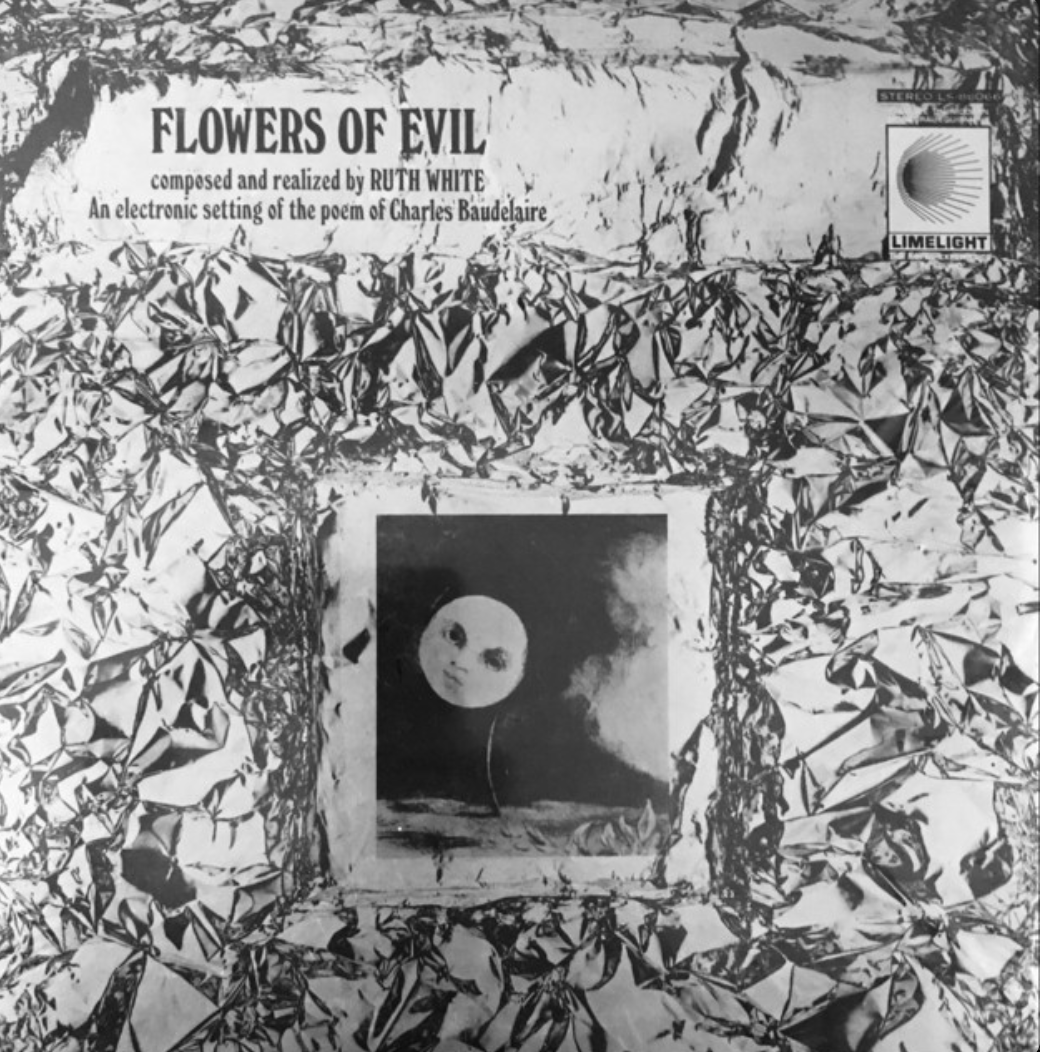
Fiendish sounds and fever dreams, the devil’s music selection this year is, as ever, a twisted tale of soundtracks, freakish and macabre passages, harrowed indie, horrorcore rap, the theatrical, esoteric post-punk and rock ‘n’ roll jukebox mischief. The selection this year devilishly devised by Dominic Valvona.
Pulp ‘The Mark of the Devil’
My Solid Ground ‘The Executioner’
The Wytches ‘Coffin Nails’
The Awkward Silences ‘Haunted by my own ghost’
Byron Lee & The Dragonaires ‘Frankenstein’
Naked City ‘Graveyard Shift (Live in Quebec 1988)’
itsokaylove & Black Wick ‘The Grim Denial’
Casper Ghostly & Uncommon Nasa ‘Floor Thirteen’
Lords Of The Underground ‘Psycho’
Fatboi Sharif, Driveby & Lungs ‘Basquiat Painted Transylvania’
itchy-O ‘Entangled|Unbinding – JG Thirlwell Remix’
The Northern Lighthouse Board ‘Ancient Sorceries’
Ruth White ‘The Litanies of Satan’
Nick Kuepfer ‘Vampyro’
Thomas Truax ‘The Cannibals Have Captured Our Nicole Kidman (Sebastian Reynolds Remix)’
The Eurosuite ‘Reflection Monster’
Kitchen Cynics ‘Phosphorus Tenement’
Lalo Schifrin ‘A Pact with Satan’
Pere Ubu ‘Satan’s Hamster’
Sonic Youth ‘Satan Is Boring’
30 Door Key ‘Cavern Of The Seasons Gone By’
Tetsuo ii ‘The Howling’
The Pretty Things ‘Death’
Mint Tattoo ‘Mark Of The Beast’
Librarians With Hickeys ‘Ghoul You Want’
The Legless Crabs ‘Sleep Sweet Satan’
Candice Gordon ‘Cannibal Love’
So Beast ‘Beastride’
Society of the Silver Cross ‘Mourning the Night’
A smattering of previous Halloween playlists and posts:
From 2012: Selection of Youtube videos and tunes.
Our Daily Bread 648: Tortoise ‘Touch’
October 23, 2025
Album Review By Dominic Valvona
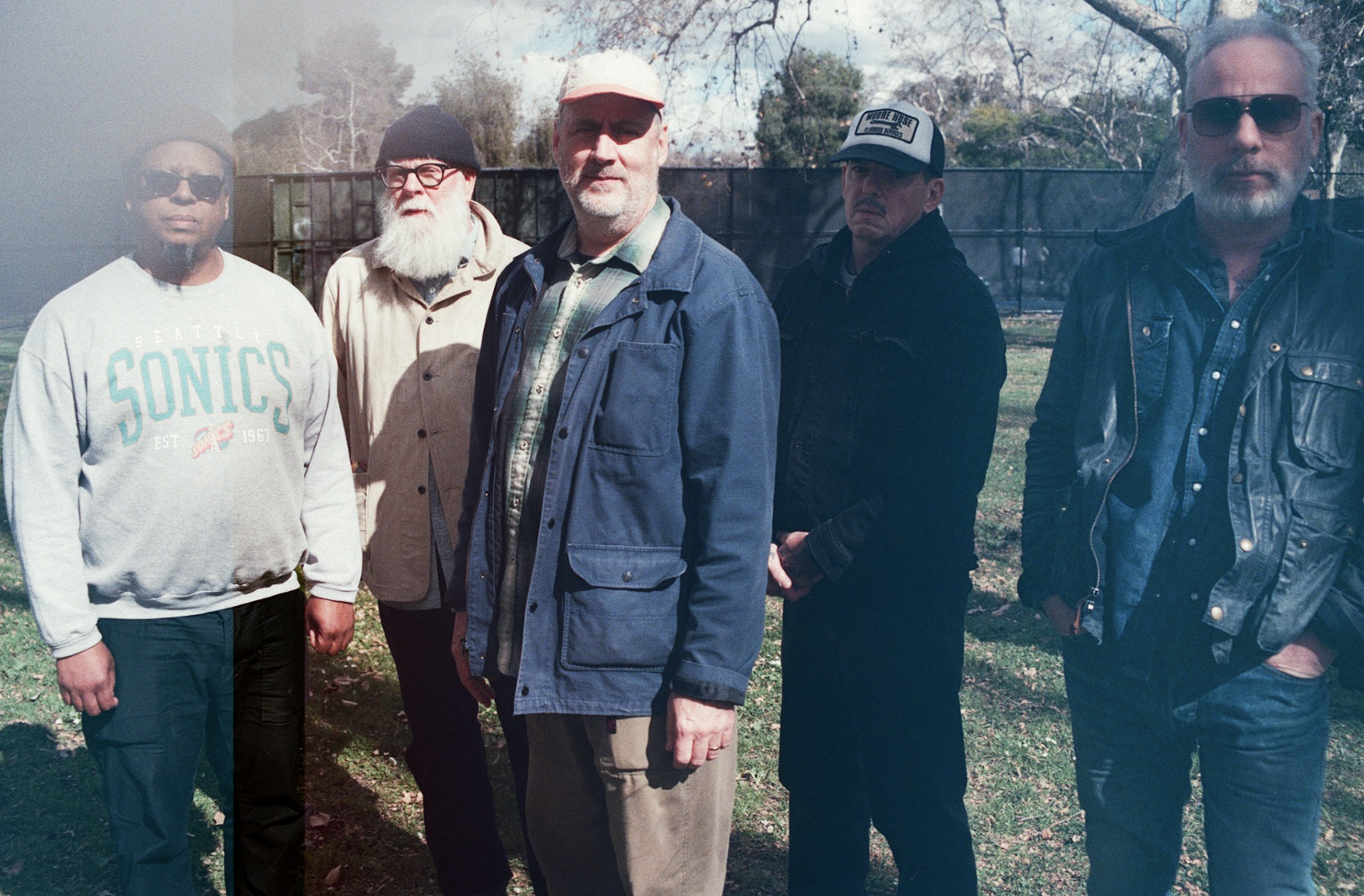
Image courtesy of Todd Weaver
Tortoise ‘Touch’
(International Anthem X Nonesuch Records) 24th October 2025
The highly influential and many tentacled Tortoise collective have pretty much reached a pantheon status as innovators of a postmodernist fusion of influences and musical strands that includes jazz and all its many fecund offshoots, rock, the leftfield, the avant-garde and the electronic. This almost seamless if explorative and experimental embrace of “post-everything” ideas is unsurprising, for they were hot-housed in that much important cultural hub of Chicago, home to some of the most important and most influential developments and artists in the jazz, the blues, rock ‘n’ roll, dance music and hip-hop fields. Of course, there’s also that post-rock scene tag to consider, a label that has followed the group around since their inception in the early 1990s – although the story really begins back in the late 80s with founding members Douglas McCombs and drummer John Herndorn, both of which, despite some lineup changes, departures and new recruitments over the past thirty odd years, have stayed the course.
Whether together under the Tortoise shell or apart, divided up into spin-offs and wholly sperate projects and entities (from the various versions of the Chicago Underground to Isotope 217 and Brokeback) their reach on the late 20th and early 21st centuries musical landscapes has been impressive. They’ve arguably created something that is there’s alone; a language and method (apparently anarchic yet egalitarian) that works for such a diverse range of musicians with experiences in an eclectic range of genres. But they’ve been apart as a group, so to speak, since the release of 2016’s The Catastrophist.
Committed however to unifying the vehicle that has proven so successful, stalwarts McCombs and Herndorn are joined by Dan Bitney, John McEntire and Jeff Parker for their eighth album, Touch. Their first album in nearly nine years is also the first album to be recorded across a tri-cities network. Previous records have been recorded more or less in the city that birthed them: Chicago. But now, members are spread across state lines, in Portland and L.A., and so there’s a new impetus and methodology of remote exchange and layering: The process has changed somewhat from the days of collectively living and creatively jamming together under one loft space roof.
They’re back, but then again, they never left, grouping as they have under various umbrellas and collaborations. For example, guitarist Parker has branched out in recent years under his own name with albums on International Anthem, one of the partners, alongside Nonesuch Records, in the co-operative label sharing enterprise behind the new Tortoise album. Just as renowned on record as they are live, fans and those who’ve yet to be drawn towards the group but who might find this latest album appealing, will be delighted to hear that there’s a whole bunch of both North American and European live dates to look forward to this year and next.
Preludes and tasters, videos and multimedia teasers have been dropped in the run up to the Touch album release – some involving recent International Anthem roster names. And so, the anticipation has been building for months. Those familiar with the treasured catalogue will find a group certainly keen to plough new sonic and musical furrows, and yet remain connected to such iconic albums as Millions Now Living Will Never Die and TNT.
With references to a demanding work by a love-sick and hurt Erik Satie, a submarine volcano in the Pacific and the heaviest element in the periodic table, there’s prompted doses of science, geography and the avant-garde made human with emotional pulls and swept gestures that could be called romantic. For this time around Tortoise, no matter how unique in practice, seem to be creating a certain drama and evocative sentiment on tracks like the estranged Parisian tango shimmy and classically strained ‘Promenade à deux’, and the twangy mirage Western, reframed by Sky Records, gravity defying cosmic soundtrack ‘Oganesson’ – named after the Armenian/Russian nuclear physicist and the element that has the most heavy protons and electrons on the Periodic table, atomic number 118: a synthetic element if anyone is asking, that doesn’t appear naturally on Earth and which is extremely difficult to process. The former of those two tracks features the guest strings pairing of violinist Marta Sofia Honer (readers may recall Honer’s The Closet Thing To Silence partnership last year for International Anthem with Ariel Kalma and Jeremiah Chiu, which went on to make our choice albums of 2024 list) and cellist Skip Vonkuske adding their own special something to the transmogrified Francophone vibes.
Expanding into all sorts of areas musically and sonically, the album matches The Cars with Pino Rucher and Holy Fuck on the tubular bristled, clapped and encouraged turn timpani rumbling and nicely rolled-off ‘Vexations’ – a reference to the incredibly tough one-page notation piece by Satie that calls for the pianist to repeat an instruction 840 times, and takes anywhere from 16 to 20 hours to perform; Cage, not one to put off by such trivialities of endurance and an audience’s attention, famously had a go at it -, and evokes a motorik driven sensibility of Rother and Electrelane with hints of Thomas Dinger on the electrically harped ‘Axial Seamount’ – named after the complex and still poorly understood, it’s said, Pacific Ocean submarine volcano that sits at the epicentre of the Cobb-Eickelberg Seamount chain; first discovered in the 1970s.
Many ideas are formed, all congruously converging to create something a bit different; the doorbell like chimes and lattice of tubular bells and scaffold coming together with jazz-rock and the kosmsiche, or the Techno beats of ‘Elka’ that follow on from the squirrelling 80s fusion of new wave jazz turn heavily laboured, weighted down ‘Works and Days’. ‘A Title Comes’ meanwhile, reminded me of Sven Wunder reimagining the Faust Tapes. This is what they do best, forming or transducing what could be a mess of influences, strands and experiences into something that gels and conjures up descriptions, emotions, scenes, events, science facts, chemicals, and states of the mind and the landscape. And with this latest album, the comeback that might or might not be, they continue to avoid definition. Flexing if anything and creating ever new pathways for sonic and musical exploration. This album however is filled with mood music: some that dances and is propulsive, and some that are far more lucid and sensitive. Touch is an album that I predict will grow on you and get better with each and every play. Only time will tell if it becomes one of their most endurable and lasting influential works.
For the last 15 years both me and the MC team have featured and supported music, musicians and labels we love across genres from around the world: ones that we think you’ll want to know about. No content on the site is paid for or sponsored, and we only feature artists we have genuine respect for /love or interest in. If you enjoy our reviews (and we often write long, thoughtful ones), found a new artist you admire or if we have featured you or artists you represent and would like to say thanks or show support, than you can now buy us a coffee or donate via https://ko-fi.com/monolithcocktail
THE MONTHLY DIGEST INCLUDES A CLUTCH OF ACCUMULATED NEW MUSIC REVIEWS; THE SOCIAL INTER-GENERATIONAL/ECLECTIC AND ANNIVERSARY ALBUMS CELEBRATING PLAYLIST; AND CHOICE PIECES FROM THE ARCHIVES.

Image: Violet Nox artwork by Allison Tanenhaus
_/THE NEW___
Bedd ‘Do Not Be Afraid’
31st October 2025
After an initial break from the site – this is down to me, and not the band -, the Oxford bedd project led by singer-songwriter, composer and producer Jamie Hyatt has now appeared twice in the space of just a few months: firstly, back in the June Digest with a bridging style EP entitled Monday 10:55, and now, this month, with a full debut album called Do Not Be Afraid.
Repeating myself again, sometimes I excel myself with a descriptive summary, and with one of bedd’s most early singles, ‘Auto Harp’ (released during the lockdowns of 2020) I described the sound as “an understated breath of fresh air from cosmic suburbia”. This beauty of a single was followed at a later date, during Covid isolation, by a premiere of ‘You Have Nice Things’, which seemed to have continued with its small-town landmarked sense of isolation and sad detachment on the EP’s title-track, the very specifically timed capture of nocturnal plaint and heartache ‘Monday 10:55’.
None of the tracks on that EP feature on this debut album, but it does gather up a string of previous singles, stretching back over the years, including ‘Party On dude (Endless)’, which featured on Jon Spira’s The Life and Deaths of Christopher Lee homage film in 2024. The track itself, is a two-parter of a sort, starting off with more haunted wistful piano tones, synthesized atmospherics and chemistry set sounds, before suddenly entering a party vibe of 80s old school hip-hop and electro samples and scratches and Chic-like funk: think Lovebug Starski meets Whistle and Doug E. Fresh in the graveyard. Jamie, the mastermind behind bedd and instigator of The Family Machine, The Desires and Medal trio of bands, has scored a few film projects over the years: most notably the Elstree 1976 documentary film that chronicles the making and legacy of Star Wars. You could say that this filmic quality and experience, a bit of scale and drama, has helped to lift much of the material, giving crescendo, a build-up and oomph to the mainly indie-rock and electronic-pop influenced sounds. Sometimes the near fatalistic tone of the voice and lyrics rises above the melancholy, malady and eulogy to twinkle and glisten with a big swell or sense of something much bigger: the universal perhaps.
Before going any further, I need to name the band that has formed around Jamie for this project, which includes “a range of celebrated local Oxford musical talent”. There’s bass player Darren Fellerdale and guitarist Neil Durbridge, both bandmates from Hyatt’s previous project The Family Machine, plus the guitarist Tom Sharp, electronic musician and producer Tim Midlen (aka The Mancles of Acid) and drummer Sam Spacksman. Together, they push the fragility and vulnerability towards the stars with music that sits comfortably between a traditional band set up and the electronic (much of which is atmospheric, rather than in the form of synth waves or bass lines and such; far more in the manner of the cosmic, of adding something more magical, of transmissions, the odd captured recordings of chatter and the environment); they sound on occasions vaguely Britpopish, a little like Radiohead circa Pablo Honey and The Bends, Jeff Buckley, Benjamin Shaw, and on the shorter saddened song track about expectations, of life and being left deflated ‘Bed Sheet’, like both Blur and Gene.
I’ve already used the word fatalistic, and with references to Bowie’s Ziggy period world ending calamity (‘Five Years’), and despondent impressions of our social media and self-obsessed culture and its ways of dealing with tragedy, death and loss (‘Gone’ and ‘I Whoo Yeah’), you’d be right to expect it. And yet, the candidness of Jamie’s lyrics, especially on the nostalgic and fragile eulogy ‘Everything’s Coming Around’, have lift and a quality of endurance as our protagonist pushes through a weight of memories. Cutting through beautifully the filters of an Instagram encased world, Jamie transforms real concerns, injury and failures into something very magical and full of memorable tunes, hooks and feeling. A great album from a fine project indeed.
Yusef Mumin ‘Journey To The Ancient’
(WEWANTSOUNDS) 31st October 2025
Continuing to unearth those both privately pressed and obscure recordings from a golden period of free from conscious and Black identity jazz, the reissue specialists at WEWANTSOUNDS have collaborated with the notable musician Yusef Mumin to bring some of his previously unreleased peregrinations and expressions to vinyl for the first time ever. Following on from last year’s extraordinary Black Artist Group ‘For Peace And Liberty, In Paris December 1972’ special (of which there are some musical parallels), the label has brought together a quartet of recordings from the multi-instrumentalist, co-band leader and pioneer’s personal archive. Bringing an expanded context, and a framing of the history, the relevance, the influences and sparks of inspiration, prominent jazz writer Pierre Crépon joins the dots with some insightful liner notes, making for a very desirable package.
Whilst I won’t just repeat Crépon’s studied but creatively written research and notes, a rough outline of Mumin’s career is needed before we go any further. Born Jospeh W Phillips on August 25th, 1944, the wartime baby grew up in Cleveland, a city that would prove a hub, crossroads for all kinds of societal, spiritual, radical and cultural activities. Drawn from a young age to such luminaries of the jazz form as The Modern Jazz Quartet and Yusef Lateef, but also classical pioneers such like Igor Stravinsky, Phillips would develop his own musical language, inspired by reading liberally a great many esoteric works: taking an interest in everything from Zen Buddhism to the Kabbalah, the Zohar, but eventually finding a calling from Islam. Cleveland during this time, as a growing epicentre of Black Nationalism, of Black self-preservation and worth, hosted such groups as the Nation of Islam (where they set up Mosque No. 18), a Moorish Science Temple and branches of the Ahmadiyya (an international Muslim movement started in India in 1889 by Mirza Ghulam Ahmad, who purported to be divinely appointed as both the Mahdi and Messiah). I’m not sure when, but in the tradition of such Islamic faith conversations, Phillips adopted the Yusuf Mumin name – a reconnection with his African/Islamic roots, a rebirth if you like and shedding of a European-Christianised identity, the mark of ownership.
Taking up alto saxophone, absorbing a fecund of jazz sounds and developments taking shape in the 1960s – from Ornette to Sun Ra and Ayler (an artist he’d have a lifeline interest in, a praise for; his own art said to be a continuation of what the free form tenor saxophonist started), Mumin gravitated towards the trumpeter Norman Howard, who’s credentials included a stint with Ayler: namely playing on his iconic Spirits LP. They formed a group together for a fleeting passage of time before Mumin co-founded his most iconic partnership a year or so later, the Black Unity Quartet. The original quartet soon pared down to the now legendary trio of Mumin (on reeds), the cellist Abdul Wadud and drummer Hasan Shahid (weirdly, and I must point this out, when searching online for a bio or any details of this short-lived group, there are multiple versions of this lineup being shared, examples of misinformation: names spelt wrong, instruments attributed wrongly too.) They’re predominantly known for the cult status and rarity of their only LP, Al-Fatihah, recorded in the December of ’68. Privately pressed with no interference, but crucially no publicity or push from a label, it would take decades for this record to be re-issued and given a larger significant launch and place in free form jazz history – an interview with Mumin, and a playlist selection featured in the Wire magazine at the time of this release. Inspired by the afflatus and the opening chapter of the Quran – the first seven verses of prayer that gives guidance and mercy -, Al-Fatihah can be translated into English as roughly “The Opening” and “The Key”. Carrying on this journey, going on to collaborate with an enviable cast of jazz greats Charles Tyler, Horace Tapscott, Arthur Blythe and Butch Morris, Mumin built up an impressive archive of his own recordings; some of which are now finally seeing the light of day as the Journey To The Ancients album.
With only his Dan Nuby double-bass credited pseudonym and the drummer William Holmes (an “associate” we’re told of the blistering alto free form, modal and hard bop luminary Sonny Simmons) as company, Mumin’s quartet of recordings are brought together for a fitting showcase of spiritual, longed, radical free-play and searching, questioning roots jazz. Despite featuring different themes, it feels like a complete work: a missing act from the celebrated cannon that connects the spiritual and political quest for African American liberty with a hunger for the homelands, and unity under the crescent flag. As my reading goes, the short opening passage of Bakumbadei, is a divine song of longing, and an invocation. As both Mumin himself and Crépon’s make clear, the title “relates to power of definition, or new wine, as offerings to the fathers.” Playing the cello, both as a mark of respect to his former foil Wadud (rightly acclaimed as one its finest practitioners in the jazz and classical fields) and because it just sounds so evocatively deep and almost pained in expressing a majesty, a dignity, and classical strain of the atavistic, Mumin also sings with an equally deep, but not quite baritone, voice, repeating the title chant, spell.
The very next piece, and title-track, now opens the door into a more extensive world of ancient caravan trail jazz. Incipient stirrings, shakes of Kahil El’Zabar and drifted rasps of saxophone moodily conjure up a landscape of some dreamt-up vision of Arabian North Africa, of the Middle East and the Fertile Crescent, but also of something far more out there in an alternative plane or dimension. A spiritual, pining Afro-journey with classical traces and a touch of the New York Art Quartet, Jospeh Jarman, Maurice McIntyre and the James Tatum Trio Plus. An awakening you could say, its sets the pathway up for what’s to come.
‘A Distant Land’ is another of those searches, this time for a new Jerusalem or a land in the sky. What could be tablas set up a more bended and buoyant Eastern feel of the longed. The spaced-out bass notes, sometimes ponderous, make steps on this slow rhythmic trial as the flute now, half in the style of Llyod McNeill and half in the style of Jeremy Steig chuffs and blows its course across a deep dive of temples and jungle.
More unsteady, with Holmes’ improvised like and active minor tumults of free form drumming, ‘Diaspora Impressionism’ is a tumble and uneven keel expression of the misplaced people, but also a response to the pain, ancestral trauma and indignity, the travails of the Transatlantic slave trade legacy. At time Mumin is blowing almost dry, without any spit, in reaching that encapsulation of hurt and anger; there’s parts in which he is literally, or sounds like it, fighting with his instruments as the fraught sax mimics the viola and violin. And yet amongst the splashes and rolls, there’s passages of rhythms and melody to be found; a yearning moment or two in which the trials and tribulations find some sort of peace. But as this combo go at it, they perform a wild form of jazz that has parallels with the art of the Children of the Forest, Wayne Shorter, Evan Parker’s more far out material, Ayler, Sunny Murray and Dewey Redman.
An album of beauty and toil; of consciousness and the imagination; a balanced and congruous set of recordings that feels like a unifying statement of divinity, experimentation, hardships and free expression. WWS have done it again and retrieved a vital album from a key and pioneering artist/musician in the story of free form jazz.
NiCKY ‘with’
(PRAH Recordings) 28th October 2025
Broadening the scope and the queer landscape musically whilst inviting in some congruous collaborative bedfellows since their last outing, with the by EP in 2024, the London songwriter and performance artist simply known as NiCKY presents a new songbook of haunted, touching, tender and resilient balladry, theatre-esque numbers, behind closed doors masquerades and near heartbreaking drama.
From the very first brush of tambourine and affecting touch of late-night saloon poised piano on the opening beautiful, but hunting, declaration ‘I Saw You’, I was sold. Slowly charged with expressions of both vulnerability and lust, played out in the dimmed lit recesses of an after-hours drinking hideaway, with one eye in anticipation of the next affair, the next pick-up, yet desiring a special frisson and love, with the passing influence of Lou Reed, John Cale, Stephan Trask and Anohni, NiCKY reworks lyrics originally conceived by the queer Irish playwright and activist Colm Ó Clúbhán and the theatre group that he became a member of once immigrating from his native Ireland to London in the early 70s, the Brixton Faeries: their activities emerging from the noted Railton Road squats. In its original form, the song first featured in the “agit-pop play about cottaging” GENTS, but finds a new avenue of expression, disarmed with a different kind of poignancy and heartache, and now repurposed for a restaging of Ó Clúbhán’s Reasons For Staying play – an avenue for telling the marginalised stories of the Irish diaspora in the capital, centring on the lives of its queer characters, but also of those women seeking abortions. It’s a highlight for me on a generous EP of such “uninhibited” serenades, off-Broadway cabaret turns, and the requited.
Already off to a great start then, the second number, ‘The Fall’ features the iconic French chanteuse, writer (from the International Times to plays), one-time tightrope walker (taking to the high wire or rope for such diverse companies as COUM Transmissions and Jérôme Savary’s Grand Magic Circus in Paris) and celebrated underground icon (memorably appearing and performing in Derek Jarman’s Jubilee and also, apparently taking part in Andrew Logan’s Alternative Miss World gala) Hermine Demoriane, who’s circus skills come in handy, metaphorically speaking, on a song about emotional support. Providing a safety net, Dermoriane’s unmistakable unique voice (for some reason, reminding me of Isabella Rosselini when she tries on a French accent) spins circus analogies to a piano led ballad that reminded me in part of both Mark Kuzelek and Elton. You can also pick up the soft, near brushed and slipped, drums I believe, of another guest, the alt-jazz, R&B and soul multi-instrumentalist and artist Donna Thompson, and the squeezed subtle wistful saxophone of either Euan Hinshelwood (who also produces and plays some bass on the EP) or CJ Calderwood (the multi-disciplinary artist and composer, who you may recognise as a member of both Lol K and Good Sad happy Bad): sorry, it doesn’t specify which one played on this track.
I use the words torch song, but in a lazy fashion, and it might be out of place here: Though you could perhaps argue that the heartbreaking curtain call, the swan song of ‘Fool’s Convention’ is one such torch song; apparently, so the notes say, a fusion of Kylie’s ‘I Believe In You’ and Nat King Cole’s ‘Nature Boy’. But there is a held, restrained, emotional charge to each of these songs that is hard to put a finger on.
In a liminal spot between resolution and malady; between hurt and lovelorn celebration; the rest of the album falls between Bob Fosse imbued theatre-musical and the music of John Howard, the observatory songwriting of Soho night owls, and a contemporary vision of a wistfully voyeuristic Ivor Novello cataloguing the goings ons and affairs at private views and parties in the capital. Although, the piano riff on ‘LDN Wars’ did remind me for some reason of Bruce Hornsby.
Variations on the signature include both the longed American dreamy stage number ‘Pink Pony Club’, which finds NiCKY adopting more of a Jack Shears persona; carried over into the next track, ‘Private Glance’, which has a Brazilian carnival meets Latin Miami atmosphere, and sounds at any one time like a shimmy-chimmy parade of Grace Jones, Midnight Magic and Roxy.
A most excellent second EP from an artist with much to share and shed on the themes of queer identity, vulnerability and resilience; the craft is superb and affecting. Definitely a choice release this month, if not this year.
Pray-Pax ‘The Lolita Years’
(Zel Zele) 24th October 2025
You’ve got admire anyone who can riff on CAN’s ‘Chain Reaction’ whilst deliberating on sexual and material fancies in the style of Lydia Lunch, but this is just one such take-away from a compilation style overview of the pioneering sound and musical theatre of the 1980s French duo. Combing a Krautrock sample with speeding cars and snatches, manipulations of Musique concrète, they turn a play-of-words on ‘Can’t’ to something approaching no wave post-punk swing. And they do this fusion of the haywire, the silly, the maverick, the dadaist and modern throughout a collection that brings together a multi-disciplinary array of their “unearthed” pieces.
A moiety, a part of the expanded Lolita Danse collective of dancers, artists, set designers and musicians – both that and the name of this survey possibly the very worst thing to ever look up online; that French obsession and flirtation with the taboo and all that -, Pray-Pax provided the soundtrack to an organised chaos of individual expressions and contemporary dances: an act that takes in circus-like acrobatics, the anarchic, kinetic and contemporary. And as part of a greater reprieve of this ensemble’s work, from ’81 to ’89, the design studio Mestiza Estudo is set to publish the Lolita Danse archive at the end of the year. As the press release outlines: “The book features material drawn from a selection of more than 10,000 images that document not only the collective’s performances but the entanglement of their personal and professional lives. This will form a portrait of the collective in motion: sets, costumes, music, videos, drawings, rehearsals, and more. The archive extends far beyond the visual: travel journals, letters, sound recordings, press clippings, and videos trace the full sweep of their creative ecosystem.”
Herding a messy story, from an ensemble that performed either solo in duets or as a group, and one that managed to slip any form of easy categorisation – never unifying under one banner, nor outlying or defining any particular sound or style -, the Istanbul/London shared label and NTS radio show platform Zel Zele present a fourteen (sixteen in the case of the digital formats, with the extras being bonus material as such) track document of art-music and sound fusions.
Behind the Pray-Pax moniker lies the creative instigators Thierry Azam and Alain Michon. These very capable experimental musicians combined the cabaret of the absurd, the frightening and playful with a sound collage that warped, reversed, cut-up and transmogrified everything from no wave to Iberian classical guitar, jazz, the classical, Fluxus, the concertinaed music of old France, post-punk, alt-Catholicism, the mysterious, noirish and the work of Francois Bayle and Pierre Schaeffer – especially on the opening flippery of the vague Afro-rhythmic, marimba bobbled, transmission synching cut-up ‘Domani non c’e sarà più’ (or “tomorrow there will be no tomorrow”), which sounds like a concrete version Holger Czukay, David Byrne and La Monte Young sharing the stage together.
There’s a combination of ideas that run from the rhythmic, the vocalised (though also examples of the talked, narrated and pranked) and beat driven to those that are soundtrack-like or just really odd. Tracks like ‘Down in the North’ sound like a phantom haunting The Residents and Art of Noise, whilst ‘Prudnik Blues’ sounds like a no wave jazz bluesy noirish juxtaposition of Cecil Taylor, Ramuntcho Matta and John Laurie. ‘Le Harve’ imagines Moebius and Roedelius decamping to the Northern French coastline, ‘No Regrets’ seems to transform some silver screen score from the 1920s into a Mexican mule ridden clip-clopping and French serenaded exotic experiment from Sakamoto’s Esperanto album. But bells also chime, pool balls are pocketed, dogs bark, wisps of ether draw across the crypt, and the rain falls on a number of atmospheric pieces. And within those perimeters you can detect passing traces of Devo, The Flying Lizards, Cage, and Lizzy Mercier Descloux.
Your mind has to do the conjuring without the performances (although there is a video of ‘Can’t’), and for that these pieces of music prove very intriguing, imaginative and in some instances, convulsive and hip in that downtown NYC way. In all, a very interesting survey of musicians combining performance art, dance and sound for a snapshot of the French experimental 80s.
Violet Nox ‘Silvae’
(Somewherecold Records) 21st October 2025
Building new worlds, futuristic landscapes and intergalactic safe havens in the wake of vapour trails of laconic, hypnotizing new age psy-trance mysticism, Violet Nox once more embrace Gaia, Greek mythological etymology, astrology and science-fiction/fact on their latest album, the poetically entitled Silvae.
The Boston, Massachusetts trio of synthesists and electronic crafters Dez DeCarlo and Andrew Abrahamson, and airy searching siren vocalist and caller Noell Dorsey occupy a dreamy ethereal plane that fits somewhere between Richard H. Kirk’s Sandoz, Vangelis, Lisa Gerrard, Banco de Gaia and ecological revering dance music – though that trio has expanded its ranks, indeed very pliable, over the course of the last decade.
On their eighth album together (released via the highly prolific and influential North American label Somewherecold Records) the topics of identity, androgyny, resolution, self-discovery, self-love and resistance are lifted towards the stars, pumped and projected through the veils of ambience, trance, dub, EDM, rave, electro-pop, cold wave, techno and more. The trio dreamingly, and in the moment, explore new textures, dynamics and atmospheres, and perhaps, produce their finest work to date: certainly, in places, the sound is more electronic-pop, with vague traces of New Order, Propaganda’s Claudia Brücken and 808 State – their sort of melodica like flutiness especially.
With references, title wise and lyrically to ancient Greek named guardian stars (“Arcturus”, brightest star in the Boötes constellation, notable for its seemingly red colouring, and observed, described by Ptolemy and Chaucer) and the ghostly visages of deep space to the “crescent” shaped cartilage of the knee (“Meniscus”), the album’s themes explore protection, recovery and pain (both physical and mental). Through the beckoning, the near operatic at times scaling, and drifted vocals of Dorsey they find relief, a second chance, in an astrosphere of near organic and sophisticated synthesizer and electronic apparatus plug-ins, effects, pads and keys. And sounds at any one time like a merger between Tangerine Dream, LFO and Massive Attack.
Whether it’s journeying into the subconscious or leaving for celestial rendezvous, Violet Nox turns the vaporous into an electronic art form that’s simultaneously yearning and mysterious, cinematic and ready for the dance floor. Fizzing with techy sophistication and escapism, the American electronic group continue to map out fresh cerebral sonic visions on their new, and again, possibly best album yet.
___/The Monolith Cocktail Social Playlist Vol. 102___
For the 102nd time, the Social Playlist is an accumulation of music I love and want to share, with tracks from my various DJ sets and residencies over the years and both selected cuts from those artists and luminaries we’ve lost on the way and from those albums celebrating anniversaries each month.
A couple of months back I celebrated the 100th edition of this series, which originally began over 12 years ago. The sole purpose being to select an eclectic and generational spanning playlist come radio show, devoid of podcast-esque indulgences and inane chatter. In later years, I’ve added a selection of timely anniversary celebrating albums to that track list, and paid homage to some of those artists lost on the way. In the former camp this month, and to tie in with the Archive spots on Ryuichi Sakamoto ‘Esperanto’ LP from 1985 and, though I actually missed the original release date in September, U.S. Girls’ Half Free LP from 2015. Other anniversary albums this month or year include François Hardy’s L’amitie (60), The Who’s By Numbers (50), Sparks Indiscreet (also 50), Grace Jones Slave To The Rhythm (40), Shriekback Oil And Gold (40), Pulp Different Class (30 this month, which I find hard to believe), DANGERDOOM ‘The Mouse & The Mask’ (20), Super Fury Animals ‘Love Kraft’ (20) and Broken Social Scene self-titled LP from 2005.
On the radar but missing out on a place in the blog’s Monthly Choice Music Playlist, I like to include a number of newish releases – anything really from the last four or five months of 2025. In October this list includes something from the L.A. collective Human Error Club, Alejandrito Argenal, Tetsuo ii, and Connect The Dots Movement collaboration with Sol Messiah.
The rest of this month’s social is made up of tunes loved, played out from across the last 60 or more decades: LICE (that rap union between Aesop Rock and Homeboy Sandman, which just so happens to be a decade old this year), François Tusques and Noel Mcghie, Harold Alexander, schroothoup, Angel Bat Dawid, Sandii, Inherit The Moon…
That Full track list is…
François Hardy ‘En t’attendant’
The Who ‘Dreaming From the Waist’
Broken Social Scene ‘Ibi Dreams Of Pavement (A Better Day)’
Mordicai Jones ‘Son Of A Simple Man’
Steve Reid ‘Kai’
Harold Alexander ‘New York Sister’
Sol Messiah & Connect The Dots Movement ‘What Goes Around’
Lice (Aesop Rock & Homeboy Sandman) ‘Katz’
Sparks ‘The Lady Is Lingering’
SANDII ‘Drip Dry Eyes’
Grace Jones ‘Slave To The Rhythm’
Super Fury Animals ‘Frequency’
Great Speckled Bird ‘Long Long Time To Get Old’
Shriekback ‘Nemesis’
Ryuichi Sakamoto ‘A Wongga Dance Song’
François Tusque & Noel Mcghie ‘Va Et Viens’
Pulp ‘Live Bed Show’
U.S. Girls ‘Sororal Feelings (Live)’
Alejandrito Argenal ‘Apasionada’
DANGERDOOM ‘The Mask’
HUMAN ERROR CLUB ‘FROGTOWN’
Angel Bat Dawid & Naima Nefertari ‘Black Stones of Sirius’
Tetsuo ii ‘Praise the Sun’
schroothoop ‘Bilkschade’
Amadou Diagne ‘Freedom’
We All Inherit the Moon ‘When We Finally Fall Asleep, Pt. 1’
Possible Humans ‘Absent Swimmer’
Polyrock ‘Cries and Whispers’
Trifle ‘Old Fashioned Prayer Meeting’
Excepter ‘Maids’
___/Archives___
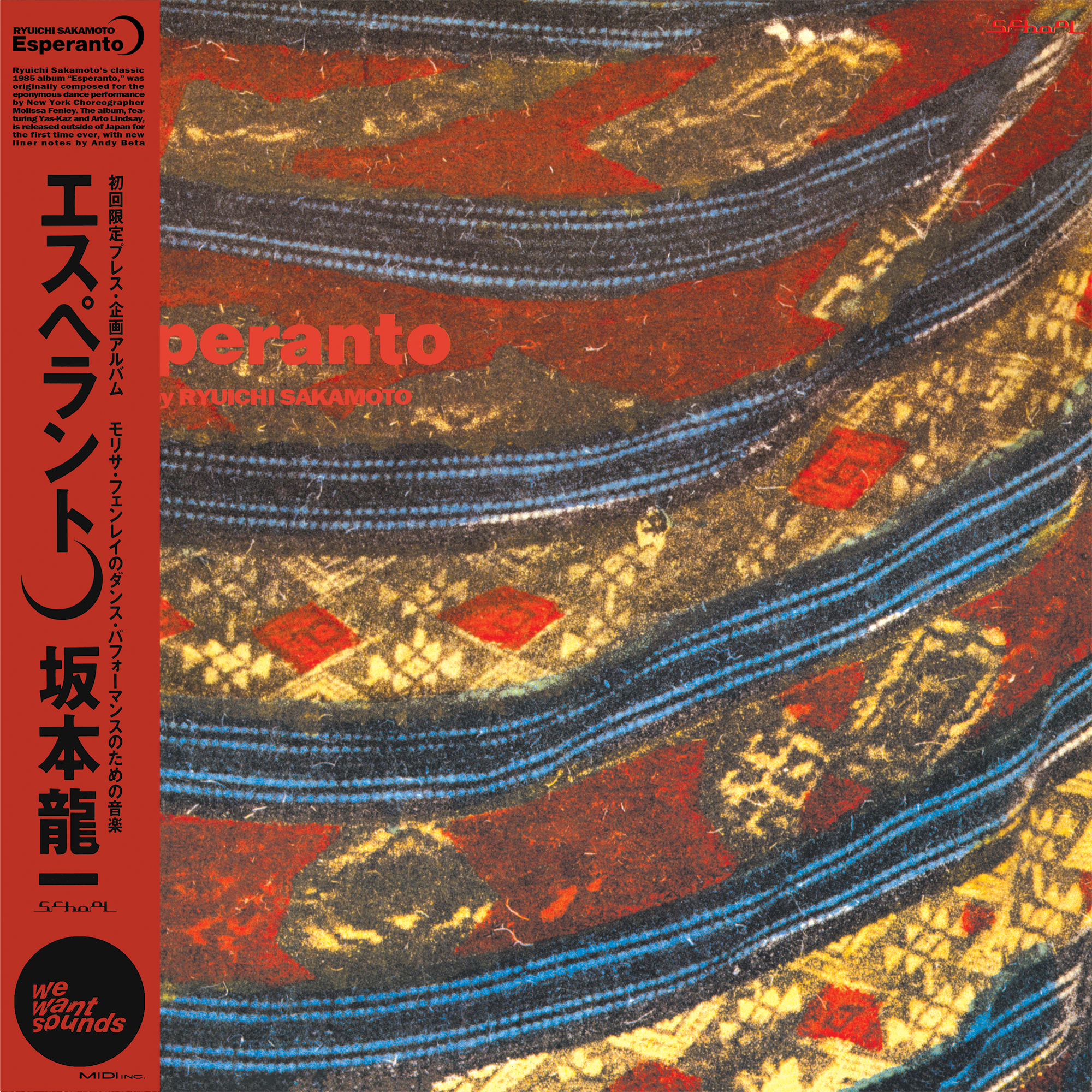
Ryuichi Sakamoto ‘Esperanto’
(Originally released October 5th 1985, and re-released by WEWANTSOUNDS in 2021)
Already riding the visionary synth waves with the Yello Magic Orchestra and through his inspirational projects with David Sylvian, Sakamoto went on to score success with the plaintive, harrowing Merry Christmas Mr. Lawrence soundtrack. The sixth solo release in that oeuvre however was a return to his more leftfield, challenging roots: a marked change from the semi-classical emotional pulls of the film soundtrack. A kind of cutting-edge theatre and ballet, Esperanto was composed for a performance by the New York choreographer Molissa Fenlay with contributions from the Lounge Lizard’s experimentalist guitarist Arto Lindsay and the Japanese percussionist Yas-Kaz. You’ll have to use your imagination to how it all worked visually – though later on art luminaries Kit Fitzgerald and Paul Garrin turned this soundtrack into a conceptual video project.
Sounding very much of its time, on the burgeoning apex of dance music and early hip-hop, electro, this polygenesis experiment often evokes both the Art Of Noise and Herbie Hancock’s ‘Rockit’. Using a super-sized computer and state-of-the-art tech, Sakamoto merged futuristic Japanese theatre with a mechanical Ballets Russes, workshop shunts and huffs with the plastic, and electronic body music with Hassell’s fourth world music inspirations.
Snatches of voices, dialogue get cut-up and looped in a primal techno performance of mechanics, rippled and tapping corrugated percussion, synth waves and oscillations, serial piano dashes and rolls, and Japanese spiritual garden enchantments. At any one time you can pick up the echoes of the Penguin Café Orchestra, Phillip Glass, Stockhausen, Kraftwerk, Depeche Mode, Eno and Populäre Mechanik within the often mysterious, exotic performativity. Motoring, bobbing or in staccato mode, Sakamoto produces a futurist dance set of suspense and experiment, an omnivorous feast of programmed and real sounds. Though very dated by today’s technological wizardry standards, the electro workshop Esperanto remains an iconic, very much sought after work well worth its admission price and indeed reissue status.
U.S. Girls ‘Half Free’
(4AD) 25th September 2015
Beckoned to the label hotbed of deconstructive cerebral pop 4AD, the Illinois raised, Toronto relocated, polygenesis songstress Meg Remy continues to entrance with her latest U.S. Girls album Half Free. Transmogrifying the template evocation of Ronnie Spector and The Shirelles with a fresh perspective and penchant for glitter ball maladies, neon lit dub and glamorous scintillating bubblegum pop, Remy’s moiety of revisionary girl group backbeats and venerable candid highly unsettling laments address a myriad of issues, from disparity between the sexes to the growing pains of modern womanhood – cue the unsettling vignette ‘Telephone Play No.1’, which plays out as a phone call catch-up between siblings but then unnervingly reinforces a deep resentment on stereotype psychology.
Remy’s most dazzling, hypnotically eclectic album yet, both thematically and musically, Half Free is essentially a highly sophisticated and gracefully slick pop triumph: On a parallel, alternative timeline this could have been (stay with me on this one) a Camille Paglia championed Madonna era masterpiece from the mid 80s; her veracious sensual heartache and woozy dream like escapism is certainly evoked at various times throughout the album. Madonna aside, Meg takes on the mantle of various female personalities and vamps, but often desexualizes and reduces their carnal allure to a sense of isolation and discomfort. Her cast of troubled personas this time around owes a debt to the characters of John Cassavetes and Michael Ondaatje, and to the broken-down protagonist of a lost 70s plaintive disco classic.
Channelling the wallowing despair of Ronnie Spector, and loosely walking the line of the troubled Nora Bass from Ondaatje’s Coming Through Slaughter novel, on the opening churning looped melodrama ‘Sororal Feelings’, Meg’s sisterly pleads of the broken wife yearningly progress through a Lee Hazelwood envisioned deep southern soundtrack: the strange fruit and methodology metaphorically replaced: “Going to hang myself. Hang myself from a family tree.” An emotional draining start, which grows on you with repeated plays, Sororal is followed up by the super-charged dub reggae hybrid ‘Damn That Valley’ – perhaps the most refreshing slice of on-message pop in 2015. Taking her cue from the acclaimed journalist Sebastian Junger’s Afghanistan front reportage War chronicles, Meg rages with a reverberating wall of sonic shrilling and grief as an imagined war widower riling against the futility and platitude sentiments of the government. Beating out an electro sound clash, part N.Y. City no wave of the early 80s, part Mikey Dread Jamaican sunshine dancehall, long-time collaborator and Toronto producer Onakabazien takes it to the next level.
Already aired, ‘Damn That Valley’ is the most colourfully vibrant of a trio of songs released since May in the run up towards the release of the LP. The second of these, ‘Woman’s Work’, closes the album. Extended from its more radio and video friendly version to a fading seven-minute plus requiem, the female gaze is sinisterly reproached by a Cindy Sherman posing façade and operatically Baroque gilded Moroder soundtrack. Amplifying the venerable atmospherics, Meg is joined by the siren sonic ethereal pitch of Ice Cream’s Amanda Grist – who can also be heard doubling-up on the Damn That Valley vocals – as they traverse an eerie veil of Catholic electro.
Released in more recent weeks, the last of this trio ‘Window Shades’ revives Gloria Ann Taylor’s original 70s unrequited disco ballad ‘Love Is A Hurting Thing’. Stumbled upon by Meg’s husband and DFA label signed artist Slim Twig (who contributes throughout the album); a touch of Madonna blusher and woozy glitter ball noir is added, whilst the universal theme is updated: apparently written after Meg watched the cod-autobiographical documentary Part Of Me, the meme circus spotlight on the life of Katie Perry that even with a soft coating of saccharine idolisation exposes the cracks and fatuous nature of celebratory.
Elsewhere on the album Meg appropriates the bubble gum glam of Bolan and the spikey punk beat of The Misfits on ‘Sed Knife’ (a minimal poem set to a bouncing backbeat, originally released as the B-side to 2012’s ‘Rosemary’). Whilst she offers an elegantly cool, misty oscillating sonorous bass-y air of mystique, – piqued by cold war jarred piano note suspense – clandestine variant on the spy thriller soundtrack with ‘New Age Thriller’: The actual battle it seems is between self-respect and male pressure. Red lipstick marks the collar of the churning, western guitar twanged, murky ‘Red Comes In Many Shades’, which itself borrows from the put-upon, downbeat beauty of Nancy Sinatra. Whether intentional or not, the song sounds like a slowed down version of New Age Thriller, and thematically dissects the struggles, and in this case, the betrayal of an affair.
Honing the darkness and plight of what was always celebrated as the innocent, teenage growing pains of adolescence with more gravitas, Meg’s robust themes swim amorphously through the dry-ice, crystal waves of the late 70s and 80s to produce a post-modern pop triumph. Progressing from the basement tapes and reverberated Spector sonic loops of the past to her latest incarnation as the pining pop artist, Meg Remy’s production values are highly ambitious: her previous work a precursor series of experimental outings. Without a doubt Half Free is her best, most mature, meticulous and glorious sounding collection of songs yet.
If you’ve enjoyed this selection, the writing, or been led down a rabbit hole into new musical terrains of aural pleasure, and if you can, then you can now show your appreciation by keeping the Monolith Cocktail afloat by donating via Ko-Fi.
For the last 15 years both me and the MC team have featured and supported music, musicians and labels we love across genres from around the world: ones that we think you’ll want to know about. No content on the site is paid for or sponsored, and we only feature artists we have genuine respect for /love or interest in. If you enjoy our reviews (and we often write long, thoughtful ones), found a new artist you admire or if we have featured you or artists you represent and would like to say thanks or show support, than you can now buy us a coffee or donate via https://ko-fi.com/monolithcocktail
Brian ‘Bordello’ Shea’s Reviews Roundup – Instant Reactions. All entries in alphabetical order.

Joel Cusumano ‘Waxworld’
Album (Dandyboy Records) 24th October 2025
I like this album. I was expecting the typical power pop tuneful bombast, which it does to a certain extent have, but with a slightly tattered heart that at times reminds me of what Blondie might have sounded like if they were fronted by Pete Perrett instead of the lovely Debbie – especially on “Through A Darkened Glass“. Waxworld is an entirely enjoyable listening experience, one I would recommend to all those power pop aficionados out there, as Joel Cusumano performs like he is Joel Cusumano and not a stars in the eyes Mathew Sweet.
John Howard ‘Kid In A Big World (The Prof Stone Remaster)’
Album (Think Like A Key Records) Released back in August 2025
Autumn is upon us and is the perfect season to discover or even rediscover this 50-year-old classic debut from one of Britain’s finest hidden treasures. Yes, John Howard‘s excellent debut has been remastered by Prof Stone, available from Think Like A Key Records Bandcamp as a download only.
Do I need to pontificate about the magic of this much written about debut. Probably not, but I will anyway. If Elton John was as good as people think he is, he would sound like this album. And John does not feel the need to sing in a phoney American accent or share Dame Edna’s stylist. Why he never made it as a chart regular and enlightened the screens of Saturday night tv in the seventies can only really be put down to the homophobia that existed in the 70’s especially in the upper offices of The BBC and as John never felt the need to hide the fact that he was gay (as Elton wisely career wise did).
Kid In A Big World is a wonderful record and should a hold a place both in all music lovers record collections and hearts … and if I was Amazon or Spotify or Youtube I would say if you enjoyed this album you might enjoy Hunky Dory, or Goodbye Yellow Brick Road or Year Of The Cat. And it deserves mentioning in the same breath.
The Legendary Ten Seconds ‘Ricardian Churchward’
Album – Released 2nd October 2025
I love Musical British Eccentrics (it takes one to know, so they say), and here we have a wham doozy of a release by The Legendary Ten Seconds. Imagine if you will, that Julian Cope had not taken drugs and only read Horrible Histories books and was influenced by The Monochrome Set, then he could well have made this album.
This is the kind of album that could one day (if enough people get to hear this gem of a release) become a bit of a cult classic. For it is a fine collection of psych folk Medieval indie-pop (is there such a thing). The only bad thing I can say about this release is that it’s not available as a CD, as it is one that I would happily add to my collection.
Legless Trials ‘American Russ Never Sleeps’
Single (Metal Postcard Records) Released 13th September 2025
More post punk glory from the Legless Trials. American Russ Never Sleeps pt 1 and pt2 is two tracks of Public Image Ltd styled smooth discord with an air of dubby splendour and chaotic lyricism that once again pokes holes into the flimsy facade of shittery that currently engulfs the world: like a bedtime story read to you by Michael Myers.
Picniclunch ‘snaxbandwitches’
Album – Released 13th October 2025
snaxbandwitches is an album of supreme post punk noisery, experimental fun and undoubtedly surprisingly tuneful. Think the Fall, early Pavement, Morphine (the band not the drug) and early Talking Heads but only if they had been in the pub since opening time and David Byrne had been replaced with someone less annoying.
This is the sound of the true alternative; the sound of a band who would not use a Rickenbaker guitar but an old Woolworths copy battered and played through a borrowed amp. Yes, this is the true spirit of the garage band; the true spirit of rock ‘n’ roll. This is a band who should join forces with The Legless Crabs and do a double headline tour of all the dives in America, and influence the current American underground. If I had a record label, I would sign them up.
Edward Rogers ‘Astor Place’
Album – Released 10th October 2025
I love warm sounding timeless, slightly unusual sounding pop albums and Astor Place is an unusual sounding pop album. Unusual in its joyful mash of psychedelia and rose tinged eloquent nostalgia, at times sounding like a true English gentleman narrating over a backdrop of a huge love-in from ‘67 and believe it or not, sadly it’s not ‘67 and that’s what is so unusual about this album that it would not sound out of place if it was, but not in a retro way just in its feeling and atmosphere, screaming guitars and cucumber sandwiches is it seems a match made in heaven. Hippy heaven even.
If Noel Coward made a psych album, I believe this is what it may have sounded like. And me being a huge Noel Coward fan and a lover of the whole fairytale of the summer of ‘67 I love it. He also name checks Tommy Steele in the lyrics, which for me makes this album slightly more fabulous than it already is.
Smash Palace ‘87’
Album – Released 10th October 2025
87 was supposed to be the second album from Smash Palace in 1987, but their label Epic dropped them before they got around to recording it and releasing it. So, what we have here is a strange beast: 5 of the songs have been rerecorded by the original band and the other five songs are the original studio demos recorded in the 80s. The five freshly recorded songs are bright and chirpy covered with an old MTV sheen, with guitars that jangle and guitars that strut like they are going out on a date with Keith Richards; songs, at times, that remind me of The Hoodoo Gurus and the Smithereens and other bands from the 80s of that ilk – the kind of bands VJ’S with mullets would introduce wearing shiny leather jackets and being all hip to go.
The other five are the real deal from the 80s recordings, not as shiny and bright but have the advantage or disadvantage, depending on how you feel about 80s major label production values, of having the atmosphere of that strange decade. The five 80s tracks one can imagine not being out of place on the Pretty In Pink soundtrack or The Breakfast Club or The Lost Boys…yes indeed, an album to soundtrack Molly Ringwald looking gorgeous.
Striped Bananas ‘Eternity Forest’
Album – Released 3rd October 2025
I always imagine that the married couple that make up the Striped Bananas live in a thatched cottage just outside some enchanted forest in upper Connecticut and spend their time weaving magic. For their music has a fairytale cartoon quality to its Psychedelia; it’s as if Lou and Nico had discovered and became addicted to candyfloss instead of Heroin.
Eternity Forest is a joyful beatastic trip of wonder and delight, an album full of melody, invention and fun; an album where guitars, Hammond organs and Theremin weave together to make one heavenly cartoon album of pure adventure. It’s like going on a daytrip to the fairground with the Banana Splits while having a playlist made up of Buffalo Springfield, The June Brides, The Velvet Underground the Archies and Strawberry Alarm Clock playing in transit. As the Beach Boys once eloquently put it: “it’s Fun Fun Fun”.
Vexations ‘A Dream Unhealthy’
Album (Cruel Nature Records) 17th October 2025
Vexations could well be your new favourite band. “A Dream Unhealthy” is a rather impressive beast of an album, five tracks of pure post psychedelic rock n roll, off kilter as hell and probably as hot, with almost spoken screamed vocals surfing on an explosion of noise frenzy. This album is worth hearing for the drumming alone, which is not to say that everything else about the band is not as equally as wonderful. They produce such a cavalcade of cavernous hypnotic spine-tingling beat poetry.
Brian ‘Bordello’ Shea and the Shea family house band, the Bordellos, have a new single out on Metal Postcard Records this month called ‘The Village People In Disguise‘.
If you’ve enjoyed this selection, the writing, or been led down a rabbit hole into new musical terrains of aural pleasure, and if you can, then you can now show your appreciation by keeping the Monolith Cocktail afloat by donating via Ko-Fi.
For the last 15 years both me and the MC team have featured and supported music, musicians and labels we love across genres from around the world: ones that we think you’ll want to know about. No content on the site is paid for or sponsored, and we only feature artists we have genuine respect for /love or interest in. If you enjoy our reviews (and we often write long, thoughtful ones), found a new artist you admire or if we have featured you or artists you represent and would like to say thanks or show support, than you can now buy us a coffee or donate via https://ko-fi.com/monolithcocktail
Tennyson In Space: Appl. E. (Parts 3 to 6)
October 10, 2025
The Monolith Cocktail Serialises Andrew C. Kidd’s Tennyson Imbued sci-fi Saga.
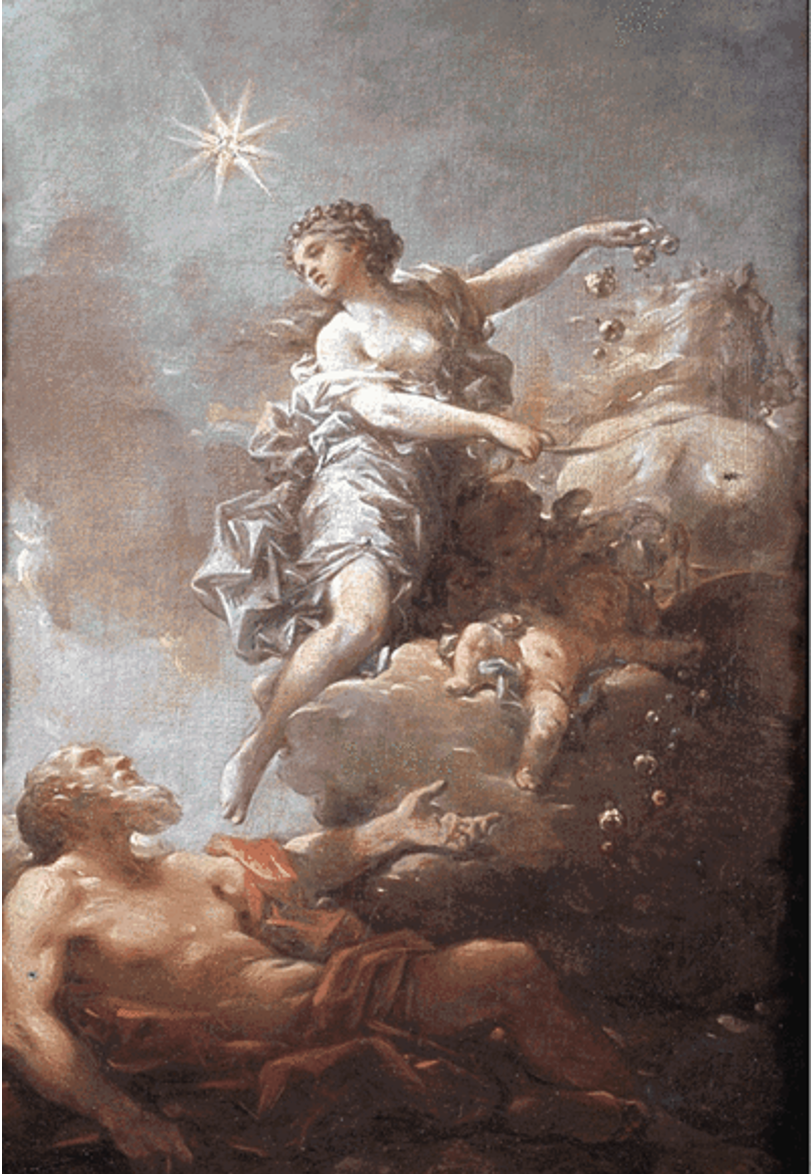
Dabbling over the last decade with showcasing exciting, sometimes improbable, intriguing work from new and aspiring writers, the Monolith Cocktail has played host to serialisations of stories by Rick Clarke (of Vukovar and The Tearless Life infamy) and Ayfer Simms (the Franco-Istanbul writer, and for a few years, an integral member of the MC team offering various reviews and conducting interviews).
Furnishing the site since Covid with review pieces and the odd feature, Glaswegian-based writer Andrew C. Kidd now adds his name to this list. Andrew shares his grand interstellar saga, Tennyson In Space, with the MC readers through an epic serialisation. Over the last five months or so we’ve published the Prologue, Part One and Part Two of The Violin, all four parts of the Hic Sunt Leones Et Corvi suite, the Pink Nepenthe and the first half of Appl. E. We now continue with the final chapters of the latter.
Part 3
With the conference having adjourned some hours ago, Alard stood pensively at the threshold of the generous living accommodation provided by the Domini. The dark walls seemed to be closing in on him. Each pipe had taken an apparently different route into and out of the stonework. Light-headedness sought to topple him. He squatted down in an attempt to shake off this strange sensation.
‘I fear your decision will lead to a trade disagreement… or worse’, □ motioned. ‘You haven’t the ethical approval or proprietary rights. I mean, for goodness sake, try to consider this objectively!’
Her monitor oscillated.
‘You have little regard for the inevitable consequences’, □ continued. ‘Hostility at this sensitive juncture is inconceivable.’
‘But you have just conceived it, have you not?’ Alard smirked. ‘In any case’, he quickly followed, ‘it was your algorithmic predictions that led us here. And it was your decision to take flight and open the first–’
‘I believe that we agreed never to disclose how we got here.’
□ was right. He had to stop these momentary lapses.
An apple, an apple, an apple! The Elusimicrobia had been yielded from an apple.
‘I must ask you to re-consider your choice. My predictive modelling of your decision has only one outcome: strife’, □ persisted.
Pacing up and down the room, Alard slapped his hands together, clasping them in a form of contorted prayer.
‘I have made my decision and that decision is final.’
‘If that is your final decision, our collaboration must end here’, □ replied.
How predictable, he thought to himself. Algorithmic sentience: the weighty burden of programmers!
‘Once you walk through those doors. We shall no longer know each other.’
‘Be quiet!’, Alard yelled. ‘Of course we will know each other.’ He mocked her nasal vocal output. ‘We created Appl. E. and we shall…’
Alard stopped talking.
The room imbued a strange silence. □’s screen was stock still.
* * *
He was holding his breath.
‘Right’, exhaling loudly, ‘apply the label now.’
Dr. El-hen looked at Alard, smiling warmly. The binding of the fluorophoric antibody to the antigenic epitope glowed neon green on their shared screen. The viridescent methylated cytosine groups were modifying histones. Mastery of the stem cell cycle was the prize for those who could determine all the histone states. It was proving to be an arduous journey. The destination was differentiation.
Alard and El-hen studied the screen. A symphony of cells and enzymes was playing. For now, it was harmonic. They would both have to wait for the triumphant climax.
With the immunolabelling complete, Alard and El-hen moved their shared attention to the cells as they aligned themselves in neat rows. Next, they would measure the density of the labels and match these to the cell cycle.
Human studies next, Alard had promised Professeur Meuse.
Their present research was proof-of-principle of their latest bioengineering success: the addition of methyl groups to the bases in the DNA sequence of the epidermal layer.
Lucidum: clarity. An accidental but poetic choice of the duo. Once identified, the process would be replicated on a micro-engineering level. Soon they would be able to print these signatures onto microfluidic chips.
‘I am so glad that you can join us tomorrow’, Dr. El-hen said.
Alard smiled as he removed the extrusion-printed specimen, placing the synthetic organ carefully in the biobath, An entire epidermal layer, clearer than he had ever imagined, was the result.
He placed it gently down on the counter to commence the stabilisation process. Appl. E. was added. Alard’s thoughts moved onto the next step: replication of cardiac tissue.
* * *
Professeur Meuse relaxed back into his chair in a demonstration of false certitude. Alard knew him to be a difficult man. They had both engaged in many arguments since the start of their collaborative venture.
‘But we are in the business of regenerating tissue, not harvesting it from people’, Alard affirmed.
He looked over at the Professeur. Lines creased his face. Fluorescent lighting had bleached his skin.
Meuse was old enough to have crossed the great celestial bridge that separated the old universe from the new. He had witnessed the Never War. Inter-planetary over-population. Decimation of cultural relativism through the autarchic hand of the Domini and his associates. All he had ever known was demographic turbulence. Perhaps years of anthropological study had worn him down? Could this explain his jaundiced opinion that farming human tissue was the solution to increasing the yield of primary cells?
It was hard to believe that the consummation of years of academic excellence had led this eminent figure to such a conclusion. Alard looked away from the Professeur who continued to stare out of the porthole.
The field of tissue regeneration had attracted all manner of interested parties. From Alard’s experience, those involved in this research could be broadly separated into two groups. The first sought to harness the technology for the sake of science. This was an advancement beyond any measure of what had been possible before.
There were also those who envisioned it as a commercial enterprise: a method of preservation, paid for by those had the financial firepower to fund their new hearts and lungs.
He could not place Meuse in either group. Beneath his clean-shaven façade, he knew that a darker character lurked. His entry into the regenerative sciences had occurred later in life. Why the move from population dynamics to tissue scaffolds? Alard considered that as the years advanced, perhaps the Professeur simply wished to live on.
‘How beautiful…’ El-Hen moved closer to the porthole. She had slackened her safety harness. Her face was being underlit in the soft light.
Outside the vessel, a water ice wreath levitated around the great head of Saturn. The soft gold imparted a subtle majesty. They had left the glacial Eris to visit one of their sponsors on base in a Saturnian moon cluster. A welcome party awaited their arrival.
Alard smiled absently. His thoughts remained with Meuse and his imagined flesh farms. The Professeur’s arguments had become more impassioned. He knew that with the right backing, he would seek to make his dangerous dream a dreadful reality.
As the vessel made its final approach, Alard turned to observe El-hen who continued to marvel at the glinting rings. Her hand was locked by Meuse. The tips of his fingers were strained white.
Alard’s desire for the docteur had not abated. It was evident from the time they had spent together that she felt similarly. A Bunsen flame burned deep inside them. It could only be a matter of time before its strength would cause the laboratories of Clan Dœmae to catch fire.
* * *
The issue is tissue.
Meuse’s mantra echoed silently in the mind of Alard.
Deep in the accommodation provided by their hosts on the Saturnian base, he replayed the last experiment in his somnolence.
The failure of the myocytic scaffold had not come as a surprise. New vessels had quickly outgrown the extracellular matrix which had quickly disintegrated before their eyes. Two-photon microscopy had yielded all the green nuclei they wished to see. Red vessels had started to proliferate on the dark background. Their thin lines were reassuring at first. Eventually, an all-consuming rubor reflected on their faces.
Rouge! Rouge! Rouge! Disintegrating muscle. We have become purveyors of necrosed tissue. Merchants of cellular death!
Please, Alard… El-hen leant forward on a polished plastic chair …I will speak to Ian–
A purposeless exercise. He is as desperate as we are. Tell him we have already replicated hundreds, probably thousands, of cell lines by now. Why the need for more?
Aes-the-tics. The scornful intermediary of Pallas sounded somewhere else in his subconscious. Her word bled out red onto the slide set.
Part 4
Meuse poured himself another drink. A gentle click noise sounded as the hatch of the door slid back into its closed position. El-hen had elected to retire to her quarters for the night. The Professeur and Alard were left alone.
‘I must say, you spoke with such authority that you almost convinced me that your theory is plausible’, Meuse opined with his back turned to Alard. The cling of the crystal glass connecting with the decanter rung passingly.
‘Life and death must co-join’, Alard pressed.
The Professeur returned to his seat and stared at Alard. His red-hair glowed in the soft light.
‘Lifeforms die and their cells die’, Meuse replied. ‘And once dead, there is no transference from the living to the extinguished state.’
He took a sip from his glass. Two slow shakes of his head followed in a subtle show of disdain.
‘I disagree wholeheartedly’, Alard retorted. ‘Take a body. Once death has consumed it, the cells do not die, but rather, serve to fertilise a world from which that body was bequeathed to. The body serves to–’
Alard paused. He had noticed Meuse holding his glass against the ceiling light to illuminate its amber contents. The Professeur eventually returned to Alard. A quick flick of his long hand beckoned him continue.
‘What I am proposing–’ Alard stretched his syllables irritably ‘–is that the ‘essence’ of the body, its being, élan vital, or however you wish to describe it, transitions. The body passes on what it once knew.’
‘So why I am unable to speak Inuinnaqtun or Natsilingmiutut? After all, I am a descendant of those who once communicated in these languages.’
A subtle shudder interrupted their conversation. The interstellar vessel continued on its return journey to Eris. Outside, the same black scene persisted, interrupted only by stars and the faint diagonal line of dust that ringed around a distant exoplanet.
‘If I may’, Meuse said. ‘Let us reshape our conversation, interesting as it has been, to talk shop for moment.’
‘Of course.’ Alard nodded. His vague form continued to flare out in holographic form.
‘It has come to my attention that your recent endeavours have been somewhat–’ Meuse considered his phrasing carefully ‘–less convincing.’
‘Less convincing?’, Alard echoed.
Meuse assented and opened a file onto the visual display. The read-outs of the failed myocytic scaffolding were quickly scanned by the duo.
‘Professeur’, Alard interjected. ‘I must insist that conversations of this nature involve Dr. El-hen. After all, she is one of the principal researchers involved in this work.’
‘Are you seeking to defer responsibility, Docteur Alard?’
‘Of course not. However, it is her intellectual property as much as mine. She should be given the opportunity to discuss these findings.’
‘Firstly, the IP is Dœmaen. Secondly, abject failure is not something to be “discussed”, Docteur.’
Meuse stared intently at Alard’s hologram. He continued:
‘What I wish to understand is how you plan to achieve success.’
‘You know as well as I do that this is science–’ Alard mirrored Meuse’s formality ‘–and that science is an iterative process. Accomplishments are met with disappointments, in equal measure.’
Meuse returned to the counter to recharge his glass. Alard considered the change in his superior’s tone. He was under no illusion that Meuse was a visionary. After all, it had been his decision with who to share his discovery with at the conference on Manitoud. He was also wary of the monopolism of his superior’s vision.
Rebus omnibus: Meuse’s motto.
Success above all else.
The bulbous base of the thick-cut glass orb covered the lower half of the Professeur’s face. Alard observed the unblinking eyes of Meuse – they had remained fixed upon him. He was being examined. The black pupils of the Professeur contracted latently. His irises were alive, drawing him in like a whirlpool. Why the scrutiny?
Alard sensed Meuse had a deeper awareness of something. An unpleasant sensation washed over him. Was it choler? Or jealousy? Shared failures had undoubtedly strengthened the bond between Alard and El-hen. He had been very careful in concealing his feelings towards her. Yet Alard was mindful that matters of the heart resided in strange metaphysical spaces. He was under no illusion that Meuse was a man of intuition.
‘Alors… tell me, Docteur Alard… how are we are going to convince our Patrons at Clan Dœmae that we will reach our goal?’, he pursued plainly.
‘We are already working at full capacity and at the limits of our ethical agreements–’
‘Why limit yourself when you know what can be achieved?’ The Professeur was rhetorical in his reply. He smiled drunkenly at Alard who shimmered silently. His oculi continued to spiral; the vision being imparted was a fanatical one.
‘Courage’, Meuse said before pausing.
‘Courage?’, Alard inflected.
‘Yes, courage!’, he hammered in reply, quickly sipping more of the amber liquid. The glass was placed down heavily on the table.
‘The word entered my mind as we are discussing your work on myocyte regeneration. Its etymology is fitting. Our ancestors would have pronounced it ‘corage’. Cor: after the heart.’
Meuse leant back in his chair. He toyed with the lip of his glass.
‘You see, dear Docteur. Only those who act courageously can affect true change. Imagine the possibility of endless regeneration. A new heart when atherosclerosis blocks the old one from beating. Neuronal cells reappearing in a disappearing brain. Organ failures consigned to the annals of antiquity.’
‘I am well aware of our intended destination, Professeur’, Alard broke in. ‘I also have my own imaginations of such a future.’
‘Then – don’t hold back! Do share these visions!’, Meuse demanded excitedly.
‘Okay, I have often wondered what will become of us after we have been replaced, or at least, once parts of us have been replaced. Who will be then? And what next, after our replaced organs fail. More implanted parts destined to malfunction.’
Alard saw that Meuse was transfixed upon his hologram.
‘Until now, all we have ever known is life as a two-dimensional line. One that has a beginning and an end. If we succeed in our research, we will not only lengthen that line but change how it is sewn.’
Alard hesitated. He had never spoken so openly about his sentiments on never-death.
‘What do you mean by “how it is sewn”?’, Meuse enquired.
‘We are more than carbonised shells’, Alard explained. ‘Death represents a severed line in our lives, but that line is never cleanly cut. It is left frayed, open to other thready remnants. Those tattered ends represent all the different physical and metaphysical aspects of our lives: hydrogen; oxygen; knowledge; id; ego; superego… our separate identities! It is from these remaining threads that the future material of our progeny are sewn.’
Alard paused for a moment.
‘Fibres are twisted into single strands that become woven into an embroidered patchwork’, he continued. ‘One that becomes more intricate with each passing generation. If we create the possibility of an endless cycle of forever-self, the fabric will never change. It is this fabric that binds us. Without it, we will simply stagnate.’
Meuse smiled thinly at Alard’s flickering holograph. The amber liquid had made him heady.
‘Is this a convoluted way to tell me that you are having reservations about our work?’, Meuse retorted glibly. ‘As I have already explained to you, I only seek to associate with those who have courage.’
Alard allowed the Professeur to continue unobstructed.
‘Let us move away from this allegorical posturing’, Meuse continued tersely. ‘Our Maîtres at the Clan have agreed in principle to my proposal. I believe El-hen may have mentioned this to you?’
Pupillary constriction. Choler, Alard affirmed. The Professeur was closing in on him. Alard shook his head.
‘Well, we need to press on with the next phase in cardiac muscle development.’ Meuse paused as he looked into the empty glass. His eyes then immediately met with Alard’s.
‘Organ harvesting–’
‘–is out of the question!’, Alard implanted angrily.
A loud thud sounded as the glass was thrown down onto the floor. The Professeur staggered as he stood up to walk over to the porthole. He stretched his back by winging out his arms. A sigh spread out into the room as Meuse brought his arms down.
‘If you wish to end our collaborative venture–’
‘End our…’, Alard exclaimed breathlessly.
‘If we cannot agree–’
‘Listen to me–’ Alard made a swift recovery, blocking Meuse ‘–you have the gall to lecture me on courage, yet it was I who took the bold step to isolate the Elusimicrobia at a time when the Eridians shirked their responsibilities. I approached the Domini who connected you to me. The rest lost out. You profited. But I must remind you that Appl. E. is my discovery. Where would be today had I not ventured out into the…’
‘Silence!’, Meuse bellowed angrily. ‘I must remind you that under the terms of our agreement on Manitoud, an agreement sanctioned by the Domini, you are not permitted to disclose the origins of your discovery on that Eridian hellhole!’
‘The truth alarms you’, Alard replied firmly.
‘Truths in this situation are unnecessary but they are not inconsequential’, the Professeur retorted.
Meuse sat down again after feeling light-headed. He was aware that drink was leading the conversation astray. Alard continued to talk but words evaporated around him. Meuse stood up again irritably. He walked over the porthole.
A showcase for the abyss! The Professeur observed the irregular arrangements of the stars that hung a thousand lifetimes away. His introspections progressed on an imagined line that connected these glittering dots. Thoughts of the Clan and the Domini interrupted its needling course so that it became knotted. Their requests had always been straightforward. Vita persavero. But what if his endeavours resulted in negative yields? Such an enterprise would no longer be theirs but his and his alone. He could not afford to fail.
Beads out sweat trickled at his hairline, reflecting indistinctly in the porthole. Beyond this, the interconnecting line had now balled itself into a malignant skein.
Meuse turned away to observe the interior of this room on the interstellar vessel. Here was reality. Anything else beyond this was simply plasma bound by an unknowable gravity. He thought positively, of Clan Dœmae and their recent procurement of Sobere on Eris, of the inevitable expansion, of life imperishable. His future could be a glorious one. The conquest to end all conquests.
He smiled reflexively at Alard the hologram, his thoughts simmering.
‘The agreed truth is that you yielded those cultures from an apple’, the Professeur affirmed bitterly.
‘An apple?’, Alard inflected brazenly. He started to laugh.
‘An apple’, Meuse re-echoed. He walked back over to the amber bottle.
El-hen, having been stirred by the steady crescendo of voices in the adjoining room, woke to listen to the warring researchers. She heard little other than the closing tone of the holographic software. Meuse had ended the transmission. The faint image of Alard faded from view. She listened to Meuse as he fumbled with the decanter.
* * *
After exiting the viewing room, Alard walked swiftly down the corridor to his quarters. His mind moved apace. He thought incoherently. His head had been made woolly by the argument with Meuse. The claustrophobia of the Saturnian moon module heightened his dissolution.
His assigned lodgings amounted to little more than a field camp. The straps on his somnolence stand were slack. When the modular engines cut to cease the simulated gravity in their overnight reset, he would be jostled uncomfortably in his sleep. He had already donned a survival suit as he doubted the ability of the oxygenators and heaters to sustain him.
Before his departure with El-hen, Meuse had explained to Alard that their sponsors were insistent that he was to be transferred to this rock. Apparently, this particular moon had garnered interest from planetary oceanographers.
Where there is ice, there is life.
Earlier, when Alard trundled over from the inter-lunar landing site, he had concluded that the existence of novel microbiota in this barren landscape was an impossibility. It was an absurd place. There was little evidence of any recent excavation. The skeleton crew that accompanied him were all automated. They simply compounded its lifelessness.
In his dormitory, Alard finally found some placidity in music. The positivity, the forward energy, the rhythmic simplicity – each note played soon settled the young researcher. He resolved that would wake afresh and card the wool that benumbed his mind to make peace with the Professeur and the Clan.
He was soon drifting between different dream sequences. The pool had returned. This time he had been immersed in it. It was murky in its depths. Bubbles frothed around him. A small shard of light wavered beside him. Alard followed it as a thin line, looking upwards to its source. Kicking, his body slowly ascended.
By the time he reached the surface, his lungs were bursting. He inhaled sharply at the breaching moment. Treading gently, he observed his thoughts of □ as oscillations that rippled outwards. Her memory blurred in and out of focus. Alard had not communicated with her since their disagreement on the future of their Elusimicrobia. The distance between them was more than any starship could travail. He had been informed that she had sought collaboration with those at Pallas.
Alard began to tire. His rate heart increased. Lactate acid was poisoning the muscles. He could no longer kick. Flailing, water splashed around him uncontrollably. His breathing had become chaotic. He gasped for air. Eventually, he started to sink. Still fighting, he turned one way then the next. The light source was no longer visible. His body started to cool. The pool darkened. Breath left him.
He awoke in a cold sweat. The plastic of his vertical berth felt glossy. Recycled air still entered his lungs. The straps were no tighter.
He called for one of the moon personnel. An automaton appeared at the threshold of his camp room.
‘I wish to send a communiqué.’ His slumbrous command was met with a pre-programmed pleasantry.
Alard was escorted the short distance from his quarters to the viewing room.
He thought little of Clan Dœmae and their decree that there was to be no communication with □. Even if Meuse and his associates were alerted to his present actions, his employment with the Clan had been effectively terminated. Despite his resolve to make amends, he knew the inner workings of the Clan too well. They would not take him back willingly. He would have to force their hand. By communicating with his rival, the Professeur, the Clan, everyone that he had worked for would be spooked.
His secret was their secret. Exposure risked everything.
The optical message lanced out of the base into the blackness. Alard had thrown down his astral gauntlet.
He returned to his stand and stared up at the low ceiling of the module. A neat latticework of bevelled lines intersected at regular intervals. Alard looked down and closed his eyes. He spun on an aslant axis. Music did very little to drown out his remembrances of his quarrel with Meuse. The cold dimensions of this moon closed in. Beneath him, invisible oceans of ice threatened to shatter. Eventually, a frozen hand carried him away into a bitter sleep.
Part 5
Some distance away, in the vacuum of space, between Alard’s moon and Eris, El-hen sobbed at her husband’s decision.
‘I am afraid–’ Meuse spoke firmly ‘–that the time has come to seek a newer collaborator. One with heart. One who will achieve more… desirable outcomes.’
She looked disconsolately at her husband as he continued:
‘Why are you so upset? We have lit a fire, my dear. We must take this opportunity to bathe in its light. We shall no longer operate in the shadows. Our advances will herald a new era in regenerative medicine. Our business is life!’, he exclaimed. ‘And the extension of it. It is important that we act decisively. Others are sure to follow. We cannot allow ourselves to be usurped.’
Meuse paused. He leant over towards El-hen who lay on the far side of their bed. Her body had turned away from him. She quickly withdrew her hand away from his.
The Professeur stood up and walked towards the door, feigning an absent stare. He stepped back to place his glass on the table beside their bed. The carefully co-ordinated sequence had meant that he had managed to catch his wife’s expression. She stared out blankly. A numb acceptance was etched on her face.
‘Your work with Dr. Alard – the incorporation of Appl. E. into the tissue scaffolds, the epidermal restoration, the replication in mucosal membranes – each of these steps have been important milestones…’
‘What will happen to Docteur Alard?’ Her red eyes, passionate and unyielding, had suddenly fixed upon his as he had relaxed to pour himself a drink.
‘He shall be relieved of his position’, Meuse replied curtly as he walked back towards the porthole with glass in hand.
El-hen stood up from the chair reflexively. She pivoted at the doorway, hand gripping its thick plastic frame, about to reply except that words were lost to her.
Meuse had returned to his study of the forever darkness that reached out at him beyond the porthole. He toyed with the already-emptied glass in his hand.
A smiling, elliptical shape materialised before him. It was the stiffened linen of a theatre mask mutating from one grotesque distortion to another. Its crooked mouth contorted into an incisor-exposing sneer. The grimace reflecting back at him was his own.
Earlier that evening, the Clan had intercepted Alard’s dispatch to □. Nothing contained within this message posed any immediate danger to the organisation. Nevertheless, the repercussive potential of a future exposition weighed heavily on his mind. Docteur Alard was under his direction. He bore responsibility for his team and their actions.
His thoughts moved to his wife. He felt a sense of embarrassment. Or was it fear? Regardless, she had burned both of them. Her tears were the salt-tears of a betrayer. Their salinity would cleanse the wound that she had inflicted upon their relationship.
He returned to the intercept.
Only if Alard hadn’t acted so rashly. That Square was with Pallas. He knows that. Dangerous Pallas. An unforgiving Clan.
The Professeur shuddered. More of the tranquillising liquid was required. He manoeuvred away from the vacuous void to fill his glass. Neptune came into view. She was cataract-white from this distance. A lifeless eye forever open in faceless space. Still, their craft was making good progress. Soon the pallid planet would orb blue-green before them. Eris beckoned.
Meuse paced towards the domed dormer which protruded out from the main body of the vessel like a blown-glass bleb. He sat cross-legged in the observation chair and took in the near-three-sixty-degree view of the stars. They were languid, always ambiguous, never revelatory. Their maddening stillness opposed his own self. He looked down at his glass and the golden liquid that was being made amber by the backlight from the lounge area. Its splendour bathed him in an artificial glow.
Earlier in the evening this liquid had imbued a sense of weightlessness, leaving him buoyant and drifting. As the contents of the glass had been emptied in successive measure, the weight of the fluid had been displaced inside him. He was plunging to depths unfathomable. Graceless thoughts surrounded him on his descent. A cruel disposition served as an anchor. His ego continued to sink until he was concealed by the plumes of sand and mud on the seabed of his mind. Subjectivity drowned him. He was left with an id-flooded ballast tank and a super-ego torpedoed.
Hours passed and the night drew on. A laser-message speared out of the interstellar vessel into the anonymity of space.
The restful stars continued to observe Meuse in his dormer. Their effect was disorientating. He stared into drained glass after drained glass. Nausea laddered up his gullet.
Retching, he slumped forward. His face was pressed uncomfortably against the thick pane. Meuse watched the endless black limbs of the cosmos extend towards him. It seized his body. He did not resist; rather, he simply closed his eyes and let the blanket blackness slowly smother him.
* * *
Shots continued to reverberate inside this cramped space. A kyphotic figure moved against the backdrop of the faint emergency light. His heart raced. A heavy head spun on many axes. The brightness dimmed as spasms tore through his body.
The pain was immense.
His shooter was smiling contortedly at his reflection in the corridor porthole. Blood slowly filled the gaps between his teeth. A fragmented tooth was lodged awkwardly in his top lip. The agent of Œmbelia had not been prepared for the recoil of the gun. After pulling the trigger, it kicked back into his face. A cold pain had already set in.
He walked back into the place where the bloodied body floated limply in a tangle of lax straps. Hyper-flexed knees were curled so that the figure took on a semi-circular shape. The gangly agent could not see his head. All he had heard was three dull thwumps.
The backfiring gun had filled the entirety of his visual field before it wrecked his face. But he was sure that was where his shots had entered.
Ideally, he would have liked a clean kill with the plasma cannon discharging between the eyes – had he had more bullets, he would have pulled the trigger once more for good measure. From his crude assessment of the scene, this did not appear to be necessary. His victims survival suit had been punctured beyond repair. There was no oxygen or accessory heat in this icy space.
He laughed at himself painfully as he vacated the camp.
* * *
A long clang echoed inside the arching hanger. The thermometer read two hundred below beyond the two-metre-thick blast doors. Inside, the temperature approximated minus fifteen Celsius.
The silhouetted outlines of three hooded figures were blurred by their warm breaths that cooled beyond the dew point. Each exhaled water droplet shrouded them in deeper obscurity.
After securing the newly-arrived craft, the attendants brushed down the ice that had encrusted the exterior of this vessel, eventually fastening the skybridge to one side of its fuselage.
Two figures alighted from the craft and were met by the Le Surveillant of this Eridian spaceport. He was a fastidious man, of middle age, donning a flat-crowned kofia, his spoken French was that of an islander. He gazed attentively as the matchstick outline of the flame-haired Meuse move quickly across the gangway. An extinguished El-hen trailed behind him.
‘Professeur’, Le Surveillant addressed Meuse as if the academic commanded a military garrison. ‘Professeur, we have received an emergency transmission from the Saturnian base.’
‘I shall take it in my quarters’, Meuse replied curtly, trying to feign indifference. A small bead of sweat rippled out from his temple. He brushed this away nervously. His head throbbed unbearably. The recollection of the previous night and his late-night instructions came flooding back to him.
‘Monsieur, it has been relayed to us on Fréquence Rouge. C’est une interception urgente.’
The Comorian stood firm.
‘In accordance with interstellar protocol, I must insist–’
‘Bien, bien.’
The Professeur followed Le Surveillant to the communication room, climbing the metal ladders to the gantry that dangled over the hanger.
‘Meuse here.’
El-hen observed her husband closely. He nodded infrequently. His verbalisation, silent to her through the thick glass of the tower, was made more difficult by his side-on stance. He mouthed something like ‘le transfert’ or ‘triompher’. She struggled to discern which it was. Meuse hailed from Québéc. His chantant often caught her out. Her intonation Maghrébine did likewise to him. Eventually, with his eyebrows raised sullenly, he turned to face her.
For whatever reason, she had been thinking of Alard and his decision to remain on the Saturnian base. It had been his way of demonstrating his determination. There he would stand his ground.
Alard the decisive! Principled Alard. She smiled as she thought of him.
‘Mon amour’, Meuse returned grievously. ‘Docteur Alard has been shot.’
Part 6
Alard awoke to the percussive sound of the ventilation unit. It spun cyclically. A deep thrum reverberated dully like a tabla. There was the glistening pitch of a triangle. He continued to imagine this scene as a strange symphonic dance.
His last memory had been lying bloodied in the rudimentary infirmary on that Saturnian hinterland. His transfer from their medical facilities to Ilion had been swift. Dr. El-hen had made the necessary arrangements. Her insistence that the novel Dœmaen tissue scaffold should trialled on Alard was met with congruent voices. He remained in a semi-conscious state. Oxygen tubes and intravenous lines filtered into him.
The soft tissue injuries to his hand and heel were minor. Dœmaen-derived neo-tissues were implanted to correct these.
His eye proved trickier. The bullet had pierced the cornea, rupturing his pupil and lens. Each had blown inwardly. The vitreous humour having escaped and long dried into his lower eyelid. His eye was deemed unsalvageable.
Meuse had insisted that Alard’s epigenetic signature needed altering. Full chromosomal supplanting was required, a technique that the researchers at the Clan had failed to master during their in vitro studies. Meuse sought the collective opinion of the resurrectional cognoscenti on his payroll. The first first-in-human trial of this experimental technique was sanctioned.
In a state of desperation, El-hen sough to convince the ailing Alard that this method was the only way that the Clan could save his sight. Whether it was the analgesia talking, or his own scientific intrigue, Alard agreed to this course of treatment.
‘Has □ replied?’, El-hen was asked. Alard had been met with silence. He knew that any trial of this magnitude was commercially sensitive. Pallas and her representatives could have no knowledge of it. A portcullis had sealed the Dœmaen research facility.
Alard had been born an Ilion, yet he was soon to abdicate his genetic line. Complete recombination of his DNA followed. He cared little for who or what he was or would become. He lay with his eyes bound. Appl. E. was infused. His memory was vague thereafter. Gene editing regressed him. The wheel of life came to a slow halt. He returned from adulthood to enter a pre-infant state.
Reversing foetal-further, the backpedalling gathered speed, until eventually, pluripotent cells spun out between the spokes in a dazzling array of nascency.
The wheel spun faster. His primogenitors proliferated, spiralling to disappear to reveal their procreators. The colours of carbon were the last he saw before he drifted off into an unconscious state.
Alard’s stay on Ilion was short-lived. In the days that followed, his new eye, a xenograph with his host immunity altered, had failed. Those in the hospital room ran through an exhaustive list of possible causes. Anti-microbial resistance, or potentially hyper-immunity from the recombinated signature? Maybe the bioink that was too thick? It could have been a simple infection.
The risk of rejection was supposed to have been removed by self-culturing and xenobotic-driven immunomodulation. Had it been the Appl. E.? The research team concluded that controlled studies were required. Plans were drawn up for future trials.
Those caring for Alard resolved to be unresolved. Alard’s bioengineered graft was being destroyed by his own cells. The cellular therapies he had received rendered him genotypically different. He had been changed irrecoverably. Once given, the ‘mark’ of the maker remains implanted within the nucleosomes and mitochondria.
What had been done could not be un-done. Alard was a Dœmaen now.
Meuse ordered the immediate discharge of his patient. Alard was sent to his homeland of Manitoud.
* * *
Blood seeped from his hand and his eye and his heel. The punctured Alard had been making the printed green grasses of the mountainside on his duvet blue. His hand grasped the leaf blades and tillers. He writhed in pain for the pain was still immense.
‘You come from the Reservoir of Xenos. You left as an Ilos.’
The voice of □ bored deep into his head.
‘Yet here you are, lying before me naked, ashamed, dying. Your tissue has been soiled following the failed experiments of the Clan.’
□ had changed since Alard last saw her. She was no longer an opaque screen. Her dream had always been to become embodied and she had achieved just that. Standing taller than any man or woman of the present age, her figure was slender and supple. Her black hair fell in thick waves. Bright green eyes bore into his very being.
‘I am an Ilos!’, Alard coughed uncomfortably. ‘It is my right–’
‘You resigned that right when you supplanted Ilion for Clan Dœmae. Your lymphocytic profile, your tissue signature, they are all stained with their mark. You cannot simply beg to be reverse-engineered to an Ilos again.’
Blood congealed through the gaps of Alard’s fingers as he pressed his palm tighter over the wound on his broken skull. The whites of his eye had become blood-filled. Arching his head back, he manoeuvred his body, coughing to clear his chest to ready himself to reply.
‘No! Before you ask again, the answer is no. It is not possible. I cannot regenerate you’, the scornful □ said pre-emptively.
‘You cannot, or you will not?’, Alard spluttered. The damaged muscles of his uncovered eye spasmed causing him to cry out in pain. He pressed his palm down harder.
He remained in this room, sleeping beneath the floral designs. His body moved in the sheets at frequent intervals to change the dimensions of the bright mountainside. The phosphorescence of the yellow light made his headache and nausea worse.
His euphoria soon abated. A calmer demeanour predominated in this stricken man. Occasional bursts of rabbling protest followed. Eventually, the room attained a strange silence, interspersed only by rapid rushes of deep breathing that would decrescendo to shallower sounds. His thoughts became confused, time-pressed, until – they faded to nothing.
Alard lay dead in the efflorescence of this room. His body rested amongst the violet colours of the sheeted flowers. A gentle wind had moved insouciantly through the narrow-tufted leaves of the white asphodels. A door opened. His body was transferred swiftly down the corridor towards the ejector.
His death had probably been preventable. □’s decision had been a conscious one, yet her passivity had been feigned to the fallen scientist. Power, or rather, the wielding of the broadsword of power, had always felt light in her algorithmic hands. But after Alard had been struck down, □ reflected how something as sharp as this could feel so blunt.
Years had passed since their bitter parting. She had not been prepared for Alard’s return. Despite all her strength and computational prowess, □ was left feeling something altogether different. She had never encountered the death of a patient before.
Although she had developed life-saving techniques with Pallas, she had elected not to deploy these to save Alard. Had this been out of spite? Or had she simply yielded to her algorithmic processes that assessed the probabilities to conclude that her decision was the correct one?
His body lay before her as he approached the anteroom of the ejector. Whatever the reason for her decision, it was inconsequential now. Death had consumed Alard. Even in this advanced age, anti-clockwise turning of the inscrutable hands of time was impossible.
In the days that proceeded his death, □ had learned that the bullet removed from Alard by the Dœmaen pathologist was that of an Œmbelian weapon. The fired shots had been far from clinical, yet they had proven fatal.
She wondered why those working at the Clan had transferred him to Manitoud. They must have known that he was dying. His tissues had obviously necrosed even before his arrival to this mountainous place. It was highly probable that there was not enough viable tissue to proceed with any meaningful reconstructive efforts. Had they data that she did not?
She had been led to believe that their techniques were at an early stage. Perhaps they had developed a method more novel than hers? She even considered the possibility that this had been an unsuccessful attempt by the Dœmaens to seek collaboration with her superiors at Pallas.
In reality, □ existed in a universe that was more complex than her algorithmic processes could quantify. Alard was sent to her to die. The Clan’s data were at a pre-clinical stage. Commercial interests preceded all else. Collaboration would never be acceptable in this cosmic game.
The Dœmaens had played a devious card. They considered □ to be their greatest threat. Conscience, morality, superego – they were well aware that personality, no matter how artificial the algorithm, was desired by the likes of □. The Clan harnessed the power of sorrow and torment. □ remained in a state of emotional infancy. By weaponising her creator, the Clan had launched a silent assault on all these aspects of her developing persona.
Alard had been deployed on his final mission to impart grief on an algorithm unexposed to the harsh realities of consciousness. Through this, □ would eventually be extinguished.
* * *
The long walls of Ilion disappeared from view. Feet-facing forward, Alard lay prone as he hurtled through space. A pulsed coil had launched his funeral pod into the lifeless vacuum.
Within the confines of his rectangular box, a screen flashed intermittently above his head. Alard’s upbringing, his training, all his marvellous discoveries – all these moments of his life played on repeat.
□ wondered whether she and Alard would not only progress through space, but time itself. The Thanatologist in the anteroom of the ejector had told her that some even make it to the event horizon of a black hole.
She had elected to share this cramped space with Alard as he progressed away from this life, perhaps unto a next one. □ had been uploaded to the confines of the circuity of the ten-by-ten-inch monitor above his waxen features.
Their journey would turn out to be a short one. The cosmic coffin unceremoniously careened off other coffins that littered the surrounding atmosphere of Manitoud, clustering together as flotsam.
□ persisted in personification. She possessed an ovoid face. It was featureless. She spoke to Alard. He was death-mask-calm. His skull one-eyed. Her laugh was made coarse and guttural by the poor-quality audio output.
Over time, the power waned inside their coffin. She recalled the times that Alard had guided her here. The pretences she had programmed into the Eridian systems had always been false. Detours from their scheduled trips to Dysnomia, the small moon that hung languidly above the base on Eris. Their small craft would pass through these very funeral fields on their way there.
Alard would dangle weightlessly to attach hooks to these matt-black containers, winching each one in turn towards their craft. It was a soundless task in these vacuous reaches. Inside the cargo hold, the crude hammering and scraping to crack open the coffins was cacophonous.
Alard cast each cracked coffin-shell to begin on the next one. The cut garments of those he exhumed were retained in a separate bag to the tissue samples. These he would eventually weave into in small patchworks.
The fabric that binds us.
Upon completion of this heinous work, he and □ would continue on their journey to Dysnomia to deliver their Eridian-agreed payload. They would deposit the surplus evidence of those they had exhumed in orbit. The thrusters of their craft would turn them away from the dark face of Dysnomia, to return to the Eridian laboratories.
She laughed at Appl. E. and its ridiculous nomenclature.
Alard the unashamed. Alard the wistful. Alard the visionary!
It had been in these very same cadaveric fields that they now found themselves in, amongst those they had sampled as they slept eternally. □ and Alard had agreed to waken these poor souls.
The harvesting of your flora will bring life to others, she had reassured them.
□ hoped that their coffin would be spilt open in the same way, releasing them into the openness of space. She imagined the steely glint of someone else’s scalpel cutting into Alard’s abdomen, spilling out the contents haphazardly. His gut-decayed microbiota, the Elusimicrobia, would be corralled into specimen pots and transported to blindingly bright rooms for centrifuging and incubation. Bacterial cells, cultured exponentially, would be added to polymers and hydrogels, serving to halt tissue rejection.
A perfect Promethean process. Tissues growing to die to be replaced to grow and die and be replaced again. Life persisting indefinitely. The light inside their coffin flickered as the power source began to dwindle. □ in her new state of consciousness wondered if those staring skywards on Eris would continue to perceive them as a coruscating star. Her primary sequencing returned with a more objective outcome, concluding that stars, like their observers, are only born so they can die.
A world of sonic/musical discoveries reviewed by Dominic Valvona. All entries in alphabetical order.
Peter Evans’ Being & Becoming ‘Ars Ludicra’
(More Is More Records) 17th October 2025
Without doubt one of the most exciting, dynamic and explorative trumpet players and band leaders on the avant-garde, psych, hard bop and beyond jazz scenes during the last decade, the New York-based musician and noted improviser Peter Evans once more lends his hallucinogenic, mirage squeezes and spiral climbs and his higher octave pitched, piccolo shrills and freefalls to another inception of the Being & Becoming ensemble: his primary band since its creation back in 2017.
Marking another “chapter”, encapsulating the small evolving group’s extensive touring schedule during the period of 2023 to 2024, the Latinized Ars Ludicra (which I’m sure translates as “sport arts”) captures a quartet (extended to a quintet when including the highly regarded and acclaimed soprano and flutist Alice Teyssier on the album’s finale, ‘Images’) fully trained up on an intensive live regime of flexing, dynamism and experiment. It’s said too that the group have widened their scope and extended their range of instrumentation to embrace sounds previously missing from the last two albums. This is a band, it’s pointed out in the accompanying literature, that has moved on much since their last outing in 2022, under the ‘Ars Memoria’ banner. At least a different energy anyway. But despite splish-splashing with constant resonating and crashing cymbals and the tight rolls and roll offs of Nigerian-American drummer Michael Shekwoaga Ode on the opening oasis promise of ‘Malibu’, there’s a balance struck between moods and action, with some passages and compositions breaching the twilight zone, the astra, a mirage that has more in common with Miles Davis and Wayne Shorter’s more untethered cosmic drifts, and their more abstract feels of transcendence and floating in a psychedelic nothingness on the outer reaches of space.
With the glassy bulb-like play, busy twinkled starry rings and doorbell ding dongs, cascades and translucent vibraphone spells of the Chicago-born but NYC based Blue Note artist Joel Ross these spacy and out-of-body elements recall both a magic and a slipping off into transcendent zones of Bitches Brew and the like. Although Ross could at any one time evoke glimpses of Roy Ayers, Gary Burton and contemporary peer Yuhan Su. There’s the melodious lightness of the Modern Jazz Quartet played against more post-bop and freeform experimentation that often lifts, but also casts out into the near surreal manifestations of dreams. Often it’s played against what I would call anti-music that’s more in keeping with the sound of the Soft Machine and the free-form, and at other times with the jazz-fusion of Weather Report, especially Joe Zawinul (an electronic apparatus and number of synths standing in for organs, electric piano and the like): I’m hearing this on the group’s extended Miles-esque blues-psych-trip and expressively agitated and riled-up cover of the late fateful Siberian poet and punk-folk icon Yanka Dyagilera’s ‘My Sorrow is Luminous’ – a sad tale really, born into the USSR, a fated progenitor of the underground punk scene, Dyagilera sadly died at the age of twenty-four just as the Berlin Wall came crumbling down and the transition from paranoid Cold War empire to free market chaos and oligarch mayhem. Running with the original sentiment, the original lament, and underscored with the historical context, the group nevertheless take it into uncharted territory – like a missing link between Third and Bitches Brew, but with the addition of Toshinori Kondo taking turns with Miles at lead.
The rest of the album features the neutron star electromagnetic radiation beam emitting inspired ‘Pulsar’, ‘Hank’s’ astral trip and the semi-symphonic classical bluesy meta contemplation of ‘Images’. On the latter, as mentioned earlier, guest flute-swapping virtuoso Teyssier provides flutters, flits and the sense of a mysterious woodland universe. ‘Pulsar’ has bounded and stick like Afro-Cubism drums, a hint of Jef Gilson, almost a touch of Chet Baker and vortex hallucinations of the atomised and of science. Evans trumpet all the while is curving and spiralling into infinity or drifting over amorphous borders when not shortened and high pitched, squeezed and tight.
I’d like to just mention the final member of this ensemble, Nick Jozwiak on bass, who moves about quite independently of his foils. Hardly conventional, that bass is flexes but offers little drive or rhythm but bobs up and gives a semblance of direction and timing. The multi-instrumentalist and avant-garde “hired gun” is also credited with synth duties, much like the majority of his colleagues, blending the two instruments together throughout an album that feels cosmic but not so much technological and futuristic, nor electronic.
Evans made our choice albums list last year with his trio (flanked by Koma Saxo and Post Koma instigator and bassist Petter Eldh and New York downtown experimental rock and jazz drummer pioneer Jim Black)and their Extra album. And I got to say, this third album from the Being & Becoming troupe is set to make this year’s list too. Evans is on a roll so to speak, with an album of quality performances and unified dynamics. They’ve managed to capture the live spirit whilst offering plenty of passages of thought, reflection and the cerebral, and to progress ever forward. It says so much about the quality of the group and their latest album, that it was recorded at the rightly venerated Van Gelder studios in New Jersey, with its 60 years plus history and status as a national treasure in the jazz world, home to recordings for Blue Note, Prestige, Impulse! And Verve. A stamp of real excellence, the spirits and vibes of that iconic studio seem to have materialised on the recording: A real recommendation if ever there was one.
Will Glaser ‘Music of The Terrazoku, Ethnographic Recordings From An Imagined Future’ (Not Applicable) 24th October 2025
Opening the door to possible worlds and to possible musics (in the sense of Hassell and his peers’ Fourth World experiments), prompted by climatic disaster/change, Will Glaser’s sprawling ambitious work of eclectic and amorphous, porous and developing peregrinations imagine societal changes through the merging of cultural sonic threads and archeology.
The London-based drummer, electronics manipulator, in-demand foil, and instigator of a multitude or projects has dreamt up an epic double-album format of environments, places and scenes from a world in which all continents seem to have conversed into one super soundscape of influences. Glaser has surmised a backstory, a springboard for his latest project. From a transitional stage in the wake of ecological collapse emerges a new “Earth tribe” network of surviving communities called the “Terrazouku”, resolute on living in harmony with nature whilst resisting the destructive urge to dominate. This vision unfolds over a generous offering of near uninterrupted soundtracks, traverses, expressions and rhythmic workouts.
For the first solo operation – that’s composed and produced entirely by Glaser – in a career that’s filled with collaborations, Glaser has reached out to an enviable who’s who of the current experimental scene in London. Names familiar to Monolith Cocktail readers, such as the composer, bassist and experimental vocalist Ruth Goller, the in-demand reeds player James Allsopp, vocalist Ed Dudley, and reeds experimentalist Alex Bonny, join the French violinist Agathe Max, improvising guitarist, composer Tara Cunningham, extremely busy drummer/percussionist Jem Doulton, Irish vocalist, composer Lauren Kinsella and cellist Kirke Gross. There are crossovers with the revolving lineups of both Sly & The Family Drone and Scarla O’ Horror, but also more than enough connections to each and every artist and musician involved across the album’s sixteen tracks. Some make a fleeting appearance, whilst others linger on for a few tracks. But they all increase the spheres of influence, the scope of the project to take in a near inexhaustible range of musical strands and ideas congruous to the evolution of this story.
Imagined as ethnographic artifacts, it seems that Glaser’s dreamt-up world returns to a primitive-like state of the electro-acoustic for a majority of the album’s length. An amalgamation of tribal naturism, the hermetic, esoteric, mystical and primordial, the album’s four, more or less seamless, sections suggest a real depth and quality.
At the outset we are transplanted and submerged into an environment both recognisable and mysterious. The ‘Then It Wasn’t’ opener manages to evoke gamelan, the go-go rhythms of David Ornette Cherry, the early work of the Aphex Twin, percussive fourth world ideas of Ganesh Anaadan’s Self Made LP with Hans Reichel, Test Dept., Wendy Carlos, the near anti-music drumming splish-splashing of free from jazz, and a taste of Sunburned Hand of Man. The first few tracks are what you might called long form, or at least over seven minutes in length, but tracks constantly vary. And so, all these influences develop in their own time. By the second track (‘Sunshower’), which carries over the ending from the last, the mood changes again with a sci-fi evocation of Komsische music and the Blade Runner score. The disembodied aahing and wooing voice of Ruth Goller can be heard alongside Agathe Max’s searing and stirring violin on a track both otherworldly and yet anchored softly and hauntingly towards classical ambient music. ‘Illusions of Abundance’ meanwhile, takes us into a twittery strange vegetation environment of shuttered and serialism style percussion, before developing into a lumbering Beefheart, Faust and Staraya Derevyna like bluegrass-psych trip through Raymond Boni’s jungle. By the way, the wild languid and out-of-shape guitar is courtesy of Tara Cunningham.
Side B, as it is mapped out, passes through vague suggestions of metal bowls and tubular bell like struck and shimmered Java and Tibet, and blown winds, before the dreamy, drifted and effected bass clarinet of James Allsopp circulates and waddles – duck like – in a style reminiscent of cosmic jazz, John Laurie, Constia Miereanu and Hans Koch on the trio of ‘Howl’, ‘Only The Wind’ and ‘Wrath’ tracks. This phase ends on the pleasantly entitled ‘When The Clouds Pass’; a track that seems to broadcast via the use of transduced bird tweets across an Alejandro Jodorowsky soundscape of mysticism.
The rhythmic phase if you like, Side C starts with a sort of shakers and shackled Afro-Thai type of bounding and bouncing percussive apparatus beat (that’s Jem Doulton’s introduction to this album). Alex Bonney’s flittered, almost digeridoo-like recorder flutters and chuffs over the top, and at times evokes the pan pipes of South America. The following track, ‘Bees’, however, is an entirely different proposition. This is where the electronics really kick in, with a hive mind activity of bees turned into a digital buzz and Germanic techno shutter beat. There’s more of this on ‘Pylons’, which matches lunar birds with dub and the pummelled sound of Room of Wires. I was also picking up hints of Front 242 and the Storm Bugs on this echoey electrified magnetic off-grid fourth world experiment.
Change is in the air and wind again on the final side of this double album spread. Richard H. Kirk like shouts, hysterics reverberate and are funnelled through a static charge and magnetic bombardment of friction and the electrically charged on ‘There’s Shit In The River’. Ed Dudley rages, swears and screams in fits to a distorted crushing of Cabaret Voltaire and Nitzer Ebb industrial primitivism, whilst the waters constantly run by. Copters above the brooding, underscored with menaced tides, continue a wash of the ominous and uncertain over a quartet of tracks steeped in strange jungle vegetation and alien outland mystique. Reimagining tribal gatherings, the convergence of polygenesis communitas unifying on a ravaged Earth that’s been reclaimed by an untamed nature, there’s some very strange and yet recognisable goings on. The near forlorn and sorrowful finale, ‘Dedicated To All Living Beings Who Suffer’, features Lauren Kinsella’s stark and yet grieving and felt reading of a poem by the Chinese poet and activist Yang Licai; played out to the Simon McCorry and Alison Cotton-esque avant-theatre-classical deeply grooved, soulful and wept cello of Kirke Gross. Both beautiful and poignantly full of a harrowed, sacrificial and political language, in the end it all comes down to the life-giving force of “water”. It’s an emotional end to a remarkable and ambitious album, which succeeds in holding the listener’s attention to the end.
Recordings from a Cassandra purported world, the warnings unheeded but with no real knowing grasp on reality, Glaser has built a possible future soundscape and cyber tribal rhythmic primitivism on the sonic fuel and carbon of the world as it is now to great effect and depth. From Mike Cooper to Glove of Bones, Fernando Grillo, John Bergamo, Paul Burwall, Tonto’s Expanding Head Band, Bush Of Ghosts era Eno, Jon Hassell and Jon Appleton’s work with Don Cherry, there’s a vast scope of rich influences on display and environments to absorb. An incredible project with untold possibilities that really does feel like a retrieved artifact from a future yet unmade.
GRABENFUSSS ‘The Horror’
Released 5th September 2025
I’m going blind on this recent submission from the obfuscated Glasgow magi behind this amalgamation, chemistry and incantation of hauntology, hermetic, sci-fi, tech, and righteous horror. Fans of the blog (always a good start with any request for a review) for a while, and materialising in my adopted city home of the last decade, this shrouded invocation deserves its anonymity, its mystique.
Their latest initiated rites drama is very, very good. And despite describing their own sound as lo fi sorcery, there’s nothing that lo fi about this ambitious, grand gestured astral and tormented projection and esoteric vexed minor opus. For there is a scale here that seems large and almost cinematic. From the increasingly agitated and riled language of the shriven and the post-punk acolyte of cryptic Gothic ceremony and spells, there’s both an alien and all too harrowed conjunction of worlds; of our trails and oppression under the spectre of technology, the unkindest of political systems, the threat of austerity, war and violence. At times the vocals, part Cabaret Voltaire, part Pop Group, but all Scottish indignation, summon up the arcane. There’s symbolism, the cryptic, the sacrificial, the moon child and the witchery at play, all with a 21st century twist.
Dealing with death in its many manifestations, there’s a serious theme at the heart of this work as it opens on a seemingly lighter bit of play and the sample/recording of a young kid’s take on the subject: When you die, your head falls off, and, and, your body goes into the attic, and, and, and your head goes off into space.” The accompanying incipient drones, charging of motors and generators give it a sort of Lynchian and creepy edge, however. This is ‘Company Robot’, a track of data, electronic rhythms, persistent horns, up beats, the cursed and brooding, the disconsolate and highly atmospheric. It crosses field recordings, magik and the machine to sound like a communal disturbance of the already mentioned Cabaret Voltaire, Coil, Ramleh and early Luce Mawdsley.
The soundtrack – as it would make a bloody good one – changes between Gothic industrialism to Kosmische, bounced techno and the chaos of a rolling cascade and pummel of real drums, and the echoed, resonated strokes and picks of a recognisable electric guitar. ‘Light Years Away’ is in the twisted techno camp, bobbing almost to a transformed recall of the Sabres of Paradise and Renegade Soundwave casting down fire and brimstone before a cathedral of lit rays takes over from a clash of drums and the growing noise of transmitted interference. ‘Broken Kingdoms’ starts off with a farty, flutter and sonorous drones, and yet is what I’d call ambient. There’s arching bends and the pierced sounds of hidden alarm, a shake of wind chime blown by esoteric winds, and the near munching of ariels. There could be a UFO present, oscillating overhead, its magnetic fields vibrating. But all of this is interrupted by the roll and smash collider of punk-Kraut-psych-rock drums and an unhinged vocal that repeats in a deranged mantra on “dignified death”. ‘Space Death’ is switch-manipulated percolation of the Pop Group in chthonian mood: Death haunts this doomed orbital convulsion of tongues, utterances and pain as tentacles thrash. Suddenly there’s a broadcast snippet from the news; a riot, police called as the audience at a musical behave with vulgar selfishness: the growing problem of decorous behaviour, chatting away and singing louder than the actors. This being Glasgow reimagined as a portal to unknown dimensions, there’s even a mention of the city’s football legacy with a Celtic Vs Rangers match.
In amongst the more extended tracks, there’s a number of vignette duration recordings coded and numbered under the ***PLSVHF*** headings. Of these, ‘No. 19’ features electronic arpeggiator, visitation transmissions and the odd snatch of a broadcast (something that repeated throughout the album) and a sort of quasi concrete manipulation of the orchestral, whilst ‘No. 31’ has more of a lunar rippled belch and guttural cosmic feel to it – this is where that guitar I mentioned appears.
Overall, imagine a horror show combination of Conrad Schnitzler, Locrian, Hunting Lodge, Yellow Swans and Escupemetralla evocations. Oh, and by the way, GRABENFUSSS is German for “Trench Foot”: make what you will of that; a harbinger of discomfort and agony. A thoroughly curious and tormented work of cosmic-harrowed wrath.
Amira Kheir ‘Black Diamonds’
(Sterns Music/Contro Culture Music) 10th October 2025
An offering of love, respect and homage to her roots, Amira Kheir re-energizes, makes anew and personalises traditional songs from a number of admired songwriters and crafts new magical mirage-style material on her incredible new studio album Black Diamonds. The fourth such self-production, released under her own Contro Culture label in union with the specialist UK label Sterns Music (responsible for introducing the music of such luminaries as Salif Keite, Youssou N’Dour and Franco & OK Jazz to these shores), offers up a dreamy and atmospheric songbook that seamlessly flows between musical styles and across the porous borders of Eastern and Western Africa and the Middle East. All to the benefit of Kheir’s ancestral homeland of Sudan, which positively shines like both the material and proverbial diamonds of the title.
Projecting connections to an afflatus and poetically envisioned land, Kheir beckons the listener into a world of positive vibes, of sweetness, of the lilted, and yet no less yearned, hungered and passionate. And so, the music and scene-setting lyricism of Fadl Almula, Abdel-Gadir Talodi, Abdel-Rahman Alrayyah and Isa Barwi are woven into fresh perspectives on the country and its surrounding neighbours, cultures. Paeans of a kind to the loved sit side-by-side with lyrical magical descriptions of Sudan’s topography and its fauna (the comforting recollected mentions of the neem and palm trees on the longing, dry rattled and spiritual Afro-jazz, with classical strains, ‘Ard Alafrah’, which translates as “land of happiness”), and such important city links as Umdurman, which sits on the western banks of the replenishing Nile (the often spelt or referred to as Omdurman, a major city in the Sudan located within the famous state of Khartoum, is mentioned on the rustically spindled, Tuareg-like and quasi-reggae riffed ‘Sundani’, “my Sudan”). I must add at this point, the piano that appears across these songs reminded me in part more of the South African jazz pianists Nduduzo Makhathini and Abdullah Ibrahim.
Vitally important to the Sudanese-Italian singer-songwriter, is language, with songs sang in Arabic, English and Italian; the links to cultures African, Arabian and European, and the blending of all three, setting her music and vocals apart. Winning a heap of plaudits for that unique eclectic voice, Kheir merges the influences of desert song with jazz, neo-soul, R&B, funk, desert-rock (you can feel the sand itself beneath your feet on the drifted ‘Zenuba’, which sounded in part like the brilliant harmonious dune-shifting mirages of Tinariwen), the Persian and the more traditional styles birthed in the Sudan. Ranging between the earthy and ethereal, the soulful and encapsulating, each song shows a variation of tone, performance and charged emotion: relaxed and beckoning, floating and encapsulating.
The depth is hardly pushed or forced, and yet there is a well of passion and stirring endorsement for a country she obviously loves and beautifies. There are some songs that pass the eight-minute mark, allowed to unfurl gently, soul searching and weaving a dream blanket of atmospheres that are magical and almost hypnotising. Perhaps more than ever, a celebration of such idyllic climes is needed, especially when faced with the devastating humanitarian crisis in the country right now.
But by lifting spirits, revitalising the beauty, grandeur, the magic and the atavistic, Kheir lightens up her vision of an enduring, fascinating, homely, nurturing and enchanting Sudan on a magnificent album of diaphanous and yearning beauty. There’s every chance this will make the end of year lists as one 2025’s most special and captivating albums. This is real soul, reimagined and once more connected to its original roots.
Elsio Mancuso & Berto Pisano ‘Nude Per L’Assassino’
(Four Flies Records) 17th October 2025
I’m sure many fans of the pulp Italian Giallo phenomenon will disagree, but as with most examples of this shock and gore, salacious and voyeuristic exploitation genre, it’s usually the soundtrack that has the quality and not the cinematography and storylines: as influential as they both are, a bridge to the slasher cult in both the US and UK. If wrapped up in some pseudo-European style, and in a foreign language, with film directors, screenwriters and actors alike pulled from more discerning productions, many of the films that were produced during the “golden age” (we’re talking the 60s and 70s) of Giallo were pretty crummy, exploitative and titillating.
There was of course the odd example of female revenge, or a female led cast that didn’t just lose their clothes, or graphically meet the most creatively lurid death. And many leading directors to this day pontificate about its iconic cinematography, its style and its influence. In the former camp, the latest Italian cult favourite to be lifted up by its far superior score, under the facilitation of the Four Flies Records label, Nude Per L’Assassino is one such revenge style flick (spoiler alert), with its racing leathers and motorcycle crash helmet wearing murderer exacting bloody vengeance on both the doctor responsible for the bodged abortion of a fellow model, and all those that either aided, abetted or showed callous disregard for the victim: this included a number of male photographers from the film’s Albatross Modelling Agency and some of its models too. To be fair, most of the victims are incredulous perverts, rapists, and vacuous individuals out to climb the slippery pole.
If researching this title, buried deep within the psyche of cult film buffs, you will find a repeated criticism: that by the date of this film, originally released in cinemas on the August 26th 1975, the genre had become stale, and that this movie was more or less an exercise in Giallo bingo card checklist ticking, with the style now “codified” (as someone else put it) and chiselled in crypt stone. The label describes the film as “the most sexist, sleaziest, and most unhinged Giallo film of the decade.” That reads like an endorsement if anything; a real temptation if ever I heard one.
But worry not, for the soundtrack carries more weight, and features connections and threads that link back to some of Italy’s top pioneering composing talent.
Believed lost but recently found and dusted off by the specialist Italian label, remastered from the original tapes, packaged too in a new “lavish” vinyl edition, Nude Per L’Assassino (or as it’s more well-known in the English-speaking world, stripped of its romantic Italian language, reduced to the blunter and creepier Strip Naked For Your Killer) is now being released just in time for its 50th anniversary. Why should we be excited? Well, probably because it’s pretty cool, and that this occult, hallucinogenic, romantic even, and funky surreal soundtrack is a rarefied find from some of Italy’s most notable composers and musicians of the period. Well, one of the names that adorns the title, Berto Pisano is at least in the running for that status. Pretty much carrying the credit, the only name acknowledged on the film itself, whilst erstwhile partner Elsio Mancuso’s name only previously appeared on the Italian Public Performance Rights Organization (PRO) registered paperwork. There’s very little about Mancusco however online; mostly references to collaborations with other notable composers working in the fields of suspense and that most Italian of Italian genres, the Western – namely the very un-Italian but synonymous with its cinema during the 60s and 70s, composer Vasco Vassil Kujucharov. Pisano, however, has a very well documented CV and history. The Sardinian born composer, conductor, arranger and musician started out as a double bass player on the burgeoning post-war jazz scene, playing with such movers as the Quartetto Astor (later the Asternovas), but also appearing in fellow Italian luminary Peiro Umiliani’s famous octet. He’d also cross creative paths with another of the revered Italian composer’s Armando Trovajoli. Outside jazz, and mostly famously perhaps, Pisano began a successful collaboration with the popular three-octave stretching soprano singing sensation Mina (Mina Anna Mazzini). His most highly prolific career move was in the realms of TV and film, composing around 50 scores and soundtracks across two decades: a mere sampler of titles being A Game Of Crime, Django Kills Softly, Kill! Kill! Kill! Kill! and Naughty Nun.
Making an appearance on both smooched, lilted jazzy serenading and cupped trumpet is the Italian flugelhornist and trumpeter Oscar Valdambrini. Bringing some much-needed class, Valdambrini’s resume includes stints with Rex Stewart, Gianni Basso and Freddie Hubbard (who’s influence I believe can be heard suffused amongst the reeds on this score), and arrangements with the already mentioned Trovajoli. It’s claimed the Turin-born maestro was a pivotal figure in the birth of modern jazz in his home country. His wafted pines, tender declarations, cornet-like swaddles, early Miles-esque passages and more Euro-Latino Herb Alpert spells add a certain jazz tinge to the supernatural suspense and spine-tingled dramatics.
And yet, this soundtrack’s opener kicks off proceedings with the bass and hi-hat of a Temptations or Curtis Mayfield record. Near Orleans and NYC back dropped Bondian with funk and soul influences, plus a hint of Lalo Schifrin thrown in on the horns, the film’s title track features scaling strings and tight breaks more in keeping with Motown than Italian slasher vogue. And yet, the second track, ‘Fotomodelle’ (the not so difficult to translate “photo model”) is almost reminiscent of Bacharach: albeit in a dippy Euro kitsch of lush romantic serenades and wooing female voices and skin flick signatures. For the record, so to speak, this package includes a number of variations on each of the main themes and pieces of incidental music, including the ‘Studio Fotografico’ bracketed version of the former, which has a little more sass and sexiness, a Hammond organ and lilt of Alpert trumpet, and the ‘Lounge’ version, which is just that, a jazzy and Bossa-like lounge smoochy take of bub-a-bub female vocals and deliciousness.
In the surrealist forbode category, and nightmarish zone, ‘Follia Omicida’ (“homicidal madness”) rolls in the timpani and tumultuous warnings, and ‘Occhi Senza Sguardo (Voce e Organo)’ (“eyes without gaze: voice and organ”) sets an elegiac funeral scene with its slumber church organ creeps. There are shivers on the psychologically dark prompted ‘Scivolando Nel Buio #2’ (“slipping into the dark”), and something bordering on sci-fi hypnotising terror on the female gasped earlier version of that same track. You can also pick up the use of Hitchcockian blade striking strings and other scares along the way. But for much of the soundtrack, it’s an uneasy entwined harmony of dreamy, even druggy, death and beautified satin thriller.
There’s a melancholy, a sadness, and yet friction of that Giallo signature creeping and stalking menace. But the quality is pretty good, the sound surprising in places. Each track is played with professional skill and respect and the art of description. And rather handily, it’s being released in time for Halloween. Four Flies have saved a classic from the snatches of obscurity whilst showcasing a killer soundtrack.
Sebastián Rojas ‘En La Orilla’
(Buh Records) 17th October 2025
Under crimson skies on the metaphorical, allegorical shoreline, bathed in a synthesized production of synth-wave, cold-wave, new wave pop and at least the spirit of Bolero, of South American experimental and roots pop, the Mexico City scene composer, musician and singer-songwriter Sebastián Rojas plots a solo journey from emotional maelstrom to stability on his debut album. Having previously played guitar in a number of bands from the homeland, straddling the downtown rock, post-punk and art-punk scenes, and collaborated with various artists, Rojas has decided to go it alone. Well, to a point, as he’s asked a few friends to play on that burgeoning venture.
Bringing along his The Americojones Experience foil Américo Hollander on bass, the Demencia Infantil’s Emiliano Tinajero on saxophone, the polymath Nicolás Fernández on synths (he also co-wrote the album track ‘Míranos’, which translates as “look at us”) and key Mexico indie scene figure Hugo Quezada (of Exploded View note) to produce, Rojas is backed by a congruous ensemble of sensitive, attuned and explorative musicians whilst navigating the choppy waters and emotionally blue tide that both beckons and backs away in languorous retreat. In addition to that lineup, there’s such a breadth of subtle instrumentation at use throughout the new album; from machines to the more organic use of acoustic guitar, percussion and the vibraphone (well, it could be a marimba too, but it sounds like the glassy bulb notes of Japanese environmental music meets The Thompson Twins and Cage on the magnetic ‘Marea’ (“tide”).
Informed by a run of bad luck, and a low point in his life, En La Orilla (“on the shore”) was born from a chain of events that began when Covid hit in 2020. Rojas was at the time on tour with his former band, just as they were about to take off, but for obvious reasons as the pandemic’s lockdowns curtailed international travel, was left high and dry, forced to return home broke from Berlin. To add to all the uncertainty, the career limbo, his mother fell gravely ill. And yet, Rojas, we are told, found love and the impetus to rebuild from the setbacks of the Covid crisis. The results of which are unfurled, wrapped in the enigmatic, and more obviously emotionally charged, spread across an album of atmospherics, balladry and the synthesized.
References in the PR literature point out the influences (in spirit) of different Bolero forms, and such icons of the genre as Pedro Infante and Los Panchos, plus the music of Benny Moré, an idol from the Cuban homeland of Rojas’ father. It’s not like you can easily detect it in what is a more contemporary embrace of the 80s, but the saxophone often, in its brassier form, often recalls its use in Central and Southern American music – at other times, it’s a mix of both new wave, Hansa studio and the mirage evoking. There are of course lyrically and most probably insider references to Mexico City and its surroundings, and the continents at large. The finale for instance, borrows a line, phrase from the late award-winning Chilean novelist, short story writer, poet and essayist Roberto Bolaño Ávalos. “Pulmón del trópico”, or “lung of the tropics”, finishes the album with breathing, living and airy abstract feelings played out to mysterious shadowy synths, plastic tubular bass and the psychedelic.
From vague echoes of Memory Tapes to China Crisis, Central Unit, Tiempo 55, Chromatics, Robert Wyatt, Japanese environmental music, imaginary 80s Miami and UK Fairlight synth wave pop and Factory pop, there’s a philosophical but also sentimental ease that permeates both the more stripped back and more atmospheric built songs. Bathed in rays and vapours, or dreamily sailing close to disconsolate abandon, Rojas and his fine ensemble of friends’ drift and lurk between the shadows and the light on an album of both nostalgic leaning and yet contemporary inventive pop music with a depth, sophistication and swimmingly bluesy feel. The Mexico City scene is rewired, re-articulated and made anew.
Cosimo Querci ‘Rimane’
(Quindi Records) Released 4th October 2025
Whilst the name may suggest connotations of the Renaissance, and the ancient valley of Casentino – its rich oval shaped landscape dotted with Medieval villages – location in which this debut solo album was made reinforces ideals of that period from Italy’s history, Cosimo Querci seems to send his idyllic surroundings into a swimming reverberated circulation of post-punk-dub, Krautrock, neo-psych, the baggy, new age and the possible music peregrination territory of both Jon Hassell and Finis Africae.
Certainly, attuned to his Italian roots and a particular period of more experimental, countercultural and leftfield music from the 70s and 80s, the psychedelic troubadour of looping flange and various echoed, dreamy filters and effects takes a core songbook of ideas and marries them to something subtly surprising and fresh, with evocations of the tropics, the Caribbean and the Fourth World. Ebbing in a constant reverberated cycle, with as much groove and rhythm as flights and passages of more atmospheric or light projected neo-spiritualist and cosmic feels, Rimane (“remains”) features five kaleidoscopic and light bathed tracks of differing length journeys. All of which could be said to have a hypnotic and wavy vibrated quality about them, soaked in reverb, resonance and soft spectrums of trippy gauze.
Almost entirely created by Querci (who not only sings but plays the electric 12-string guitar and the bass, an electric organ and flute) with his drumming and percussive foil Walter Bellini, the album progresses through the dreamy evocations of soundsystem culture and hints of Arthur Russell, Careless Hands, Phantom Band and Wild Havana before ending up in a light bringing union between Susumu Yokata and Sergius Golowin on the opening ‘Telepatica Pretesa’ (which I think translates as “telepathic claim”).
‘Rimanemai’ (“never stayed”) carries on the vibe, but this time with a dreamy trippy wash of Panda Bear, Sam Flex and CAN via the Stone Roses – here’s the baggy sound I mentioned earlier. There’s also a slight step change of the Latin on the beat.
‘Nina Ferale’ (“wild Nina”) inhabits the “possible musics” projects of Hassell and likeminded artists of that fourth world exploration; a touch of Malaysia perhaps, something off world too. But once the drums come in, we are in the territory of the Secret Machines and Neu! (using, if stumbling to catch a different timing, the famous motoik beat) and Stereolab.
‘Caotico Drammatico’ (“chaotic dramatic”) starts off very differently, to a sort of preset-like bossa Der Plan electronic shimmy: a little also like Kriedler. The light fills in from both sides as that synchronised rhythm carries through to an airy heavenly haze of indie and new age techno ala Banca de Gaia.
The finale, ‘Manina Nera’ has a very psychedelic, cavernous start with its echoey ricochet like shots off a circus snare and what sounds like a sustained melodica hanging in the ether. Sort of shoegaze, baggy and shuttering.
As debuts go, Rimane is a winner with cult status written all over it; the artist leaving us wanting more of this musical world that he’s created in the ancient valley region of Casentino. Those Italian roots have been taken to far off and imaginative places; a psychedelic world of possibilities.
If you’ve enjoyed this selection, the writing, or been led down a rabbit hole into new musical terrains of aural pleasure, and if you can, then you can now show your appreciation by keeping the Monolith Cocktail afloat by donating via Ko-Fi.
For the last 15 years both me and the MC team have featured and supported music, musicians and labels we love across genres from around the world: ones that we think you’ll want to know about. No content on the site is paid for or sponsored, and we only feature artists we have genuine respect for /love or interest in. If you enjoy our reviews (and we often write long, thoughtful ones), found a new artist you admire or if we have featured you or artists you represent and would like to say thanks or show support, than you can now buy us a coffee or donate via https://ko-fi.com/monolithcocktail
 Monolith Cocktail Blog