The Perusal #62: Kotra, Niton, Ruth Goller, The Dark Jazz Project, Martin Tétreault…
December 3, 2024
A WORLD OF SONIC/MUSICAL DISCOVERIES REVIEWED BY DOMINIC VALVONA
PHOTO CREDIT: PAULA RAE-GIBSON
(Unless stated otherwise, all releases are available now)

Kotra ‘Grit Light’
(I Shall Sing Until My Land Is Free)
As Putin’s invasion of the Ukraine depressingly continues unabated, passing the 1000 days mark a few weeks ago – which also happens to near enough coincide with the Ukraine’s commemorations of the Holodomer, a timely reminder of “mother” Russia’s destructive despotism and politically sanctioned revenge policies -, it falls upon labels like the electronic artists Dmyto Fedorenko and Kateryna Zavoloka’s I Shall Sing Until My Land Is Free to spread the sound of the sonic resistance. A soft power, a cultural emissary of that country’s experimental scene, the profits from its roster of artists, which includes both its founders, are donated to several self-defence and humanitarian foundations and local volunteer activists.
To paraphrase the opening from my 2024 review of Fedorenko (appearing under his Variát moniker) and the harsh and confrontational Japanese artist Merzbow’s Unintended Intentions collaboration, nothing concentrates the mind more than witnessing the brutal barbaric dystopian-scarred landscapes of war-torn Ukraine, and the carnage, loss of lives in the meat grinder of a bastardised WWI battle for survival. The fear, destruction of this conflict has been transmogrified into the abrasive, concrete debris soundscapes of nightmares on both that album and others; the Berlin-based Fedorenko appearing under a number of different guises, channelling heavy abstractions of sophisticated, industrial, intelligent techno and dance music across a swathe of concepts and works.
Escalating into the broader war many had forewarned, but unless willing to accept capitulation, further violent barbarity and the military conquest of even more of Eastern Europe, the Baltic nations and Balkans, there is no real painless conclusion to this invasion. Trump’s boastful rhetoric is just that. But worrying all the same, as negotiations, which can’t truly be anything other than favourable to Putin in any scenario offered, seem very likely in the New Year. The transactional President will want to wrap this horrifying, economically destructive war up, and so there is a rush now for both sides to gain their territorial footholds (the Ukraine’s incursion and hold over swathes of the Russian Kursk region will be vital in any deal negotiated; one of the country’s most successful military coups, and almost in itself the sole campaign that unnerved and setback Putin’s war machine the most). At long last the UK and America have given the go-ahead for long range missile attacks – though confined to the Kursk region. But it has come at such a late stage, even too late, just as the encumberment Ukraine supporting Biden administration is about to leave the White House. If delivered sooner alongside the delayed Leopard tanks and the F-16s (or in the numbers that President Zelensky asked for), we may very well be seeing the Ukraine in a much more favourable position. As it is, one of the only leverages that Trump could have used, those long range ATACMS, has been played. And what the Ukraine needs more than anything else is manpower.
Still, Putin’s Russia has failed to bully the Ukraine into subjugation and defeat. Russia’s military, for all the world to see, has been shown up on the battlefield and forced into sacrificing untold numbers in suicidal missions to gain mere yards of empty landscape. Drones have had the better of the Russians across the trenches and out at sea against the Black Sea fleet on numerous occasions. And in recent months, they’ve been joined by anywhere between ten to eleven thousand troops from North Korea in an attempt push the Ukrainians out of the Kursk. But even more unnerving and dramatic for the Russians is the unfolding events in Syria, which have taken Putin’s ally Assad by complete surprise. Insurgent/rebel groups opposed to the Syrian dictator have, even to their own astonishment, gained a vital foothold in Aleppo – the first time the Syrian government has lost control of the strategic and important city since the start of the civil war. A stretched Russia is currently bombing the hell out of them. The world is hanging on to see what happens next.
Bearing testimony to what has taken place and what might be about to happen in 2025, Fedorenko once more takes on the guise of another of his many faces, that of Kotra, to charge up the electrodes and electrical barbed wire with another heavy bass suffused and industrial techno album of electrification, force fields and buzzed machine hive activity. From dissonance and pulverizing bass noises a rhythm is hewn and honed; a buzz and scaffold of signals, of invisible forces and currents fused together with a bounce.
Carried across an hour-long immersion of sonic forbode and shuttered, tubed, kinetic and frazzled IDM-styled beats, there’s a thematic atmosphere of heavy payload alienness and humming, engineered and motorised machines. Some of these sounds mirror the ominous buzz of drones in the theatre of war, and others, the propeller-like hovered flight of bombers. In short, picture Rob Hood or Jeff Mills on Tresor, maybe even Basic Channel, collaborating with Carter Tutti Void whilst caught up in industrial scale warfare. I Shall Sing Until My Land Is Free have proved their worth in exporting such electronic experimentation to an international audience if nothing else. But this truly is music with a serious intention, forged in the darkness of barbaric invasion, from those who fight culturally and physically for the survival of their country’s identity.
Niton ‘11’
(Shameless Records/Pulver und Asche Records)
A connection to the Island of my birth, the Italian-Swiss trio of Niton bears the name of the small village on the Isle of Wight where Marconi famously and successfully transmitted some of the first wireless waves. On the 23rd of January 1901, on the verge of a new century, just a day after the death of Queen Victoria and that enduring epoch, the Italian inventor’s transmission reached from the southernmost tip of the Island to Lizard in Cornwall. By the end of that same year Marconi would attempt to reach America.
As we locals pronounce it, “Knighton” – which is really confusing as there is an actual Knighton on the Island too; we differentiate them by calling the latter “K-nighton” -, Niton lies close to the more famous and larger one-time Victorian resort of Ventnor on the southern coast. Marconi’s picturesque spot is the site of St. Catherine’s Lighthouse, looking out to the great beyond, where no land can be sited, and all that lies ahead is the expanse of the English Channel. Many have attached significance to this location over the years, and this experimental electronic-acoustic group have decided to adopt it as a link from one age to the next; of progression, the sense of opportunity and technological advancement against the implications of more foreboding era in which democratized altruism has turned into a dystopian nightmare.
Choosing a significant date of correspondence, “11th January 1901”, from the lead up to that successful experiment, the trio invite the French-born British composer, multidisciplinary artist and researcher Olivia Louvel to run Marconi’s written words through the Fortean radio set on the opening atmospheric piece from side B of their newest, and fourth, album. Currently (or so when I looked it up recently on Louvel’s own site) studying a PhD at Brighton – where coincidently I worked before making the move to Glasgow in 2015 – in the interplay of voice and sculpture across that University’s fine arts and sound art departments, the award-winning artist doesn’t just read aloud but transforms the material by playing with the language, from Italian to English and vice versa. Historical timelines are recalled but also erased by blankets of foggy time, separation and vaporous disembodied elements, as Louvel sounds both of that Victorian-on-the-cusp-of-a-new-century era and yet futuristically oblique.
A reference to that date, but also the number of collaborative artists taking part for the first time in expanding Niton’s sonic investigation and freedoms, 11 marks the group’s tenth anniversary and new approach.
Widening participation with an international cast, electronic violinist Zeno Gabaglio, analogue synthesist Luca Xelius and “amplified objects” manipulator El Toxyque work with both noted veterans and exciting burgeoning artists across a diverse range of genres and disciplines to provide something different; avenues, turns, peregrinations toward the surprising, intense or avant-garde.
Just to pluck out a few examples, the twin contributions of the Casablanca singer-songwriter and solo artist Meryem Aboulouafa and the award-winning Swiss poet, Babel festival for literature and translation founder/artistic director Vanni Bianconi open the album by airing an Italian poem read out and mystified with poignancy and pain of the bittersweet over a wispy mirage of amorphous Arabian and North African desert stirrings. But it’s followed by a complete change in direction with the glitch kinetics and quarks, the Duchampian bicycle wheel spokes turning and rattled, and drum smacked, punched and physically handled abstract ‘Spin-orbit interaction’, which features the experimental drummer-percussionist Julian Sartorius. There are experiments too that sound like a very removed vision of jazz with the English saxophonist John Butcher channelling Mats Gustafsson and Andy Haas strained sucked dry vibes and Krononaut-like abstract chills, visitations and alienness on the alternative Bureau B label-esque ‘I was dying’. And the Ex and Dog Faced Hermans guitarist Andy Moor provides resonating copper stringy wrangle, scraped and scratchy lines, carries, sustained hovers that sound like a fusion of the Red Crayola, Derek Bailey and Yonatan Gat on the psych-jazzy and mysterious living, breathing entity ‘Huella infinite’.
But perhaps the most out-there of these collaborations is with the Cameroon shaman Achille Ateba Mvando, who both ceremonially and excitable utters and dances the ancestors Bantu rituals to a combination of traditional hand drums and handclapped rhythms and more modern buzzes, glitches and starry projected ambience – reminding me in some ways of both Bantou Mentale and Avalache Kaito.
Transcribing a feel, a sense of history, invention and amorphous globalism, Niton and their foils/partners converse with the past whilst venturing further into electronic experiment and soundscaping on an immersive album of sonic atmospheres, investigation and evocation.
Ruth Goller ‘SKYLLA’
(International Anthem) 6th December 2024
For those that missed out at the time on the Italian-born but London-based composer, bassist and experimental vocalist Ruth Goller’s 2021 debut LP, those gracious folk at International Anthem have pressed another batch of vinyl copies: Such was the initial demand, and three years on, a clamour to own Goller’s inaugural soloist fronted album, that it felt right to make it available again. Originally released on longtime collaborator Bex Burch’s Vula Viel Records label – also, confusingly, the name of the composer, percussionist, producer and instrument maker’s group -, SKYLLA showcased an inner lucidity of expressive vocalisation and pinged, plucked, spindled and resonating bass guitar harmonics that garnered a host of plaudits.
But this timely reissue arrives in the wake of Goller’s impressive scope of activities since that album’s release, and just a few months after the release of the follow-up, SKYLLUMINA. The CV is way too prolific to list in its entirety here, but the expletory composer and bass player’s most notable credits include two of the most important and influential groups to set off a jazz renaissance in recent years, Acoustic Ladyland and Melt Yourself Down. Goller has also performed with such luminaries as Kit Downes, Sam Amidan, Marc Ribot and (Sir) Paul McCartney, and plays with both Let Spin and Vula Viel. And just in the last month Goller teamed up with the German drumming and saxophone TRAINING combo of Max Andrzejewski and Johannes Schleiermacher for the wild, tumultuous, wrangled and strange, yet also melodic and dreamy threads to knot album – a collaboration so good that it makes this year’s choice albums list, which goes out in the next week.
In an experimental, expressive and often otherworldly atmosphere – like a cross between introspective cerebralism, the alien and, later, the near chthonian and darkened –, Goller’s Nordic/Icelandic-like vocal utterances, soundings and spatial harmonical airings mirror the vibrating and trebly harmonic twangs, pulls and language of both the electric and double-bass. Accompanied by the attuned, often choral and tripsy sprite vocals of Alice Grant and Lauren Kinsella, the odd caught recognisable word is entwined with coos of the pastoral, the neoclassical, ethereal and pronounced and instrumental gangly strands and shuttered and bassy sonorous reverberations.
You could imagine Bjork, flanked by Susanna and Hatis Noit, conducting an alternative ceremony or a Northern European pagan woodland choir to the experimental bass guitar work of Jaco Pastorius and evocations of dal:um, Gunn-Truscinski, Ramuntcho Matta and on ‘In more turbulent times, she managed to take the perfect shot’ a touch of Refree – there’s what I can only describe as a transmogrified feel of the Iberian to this track. The vibes on the final third part of the album are more ominous, almost menacing, and recall the work of Scott Walker and Boris; albeit with more untethered, lighter voices floating about.
If any of that sounds like an invitation to rediscover Goller’s unique entwinned dance and abstract airs of voice and bass then you’d better make sure you get that copy ordered pronto, as the last time it sold out quickly.
To coincide with this reprise, Goller and filmmaker Pedro Velasco have created a suitable visual abstract swim of a video for the album track ‘What’s really important she wanted to know, pt. 2’. Filmed entirely underwater at a local public pool, the conceptual feelings of both floating and swimming in an abstract liquid are cut to the harmonic pings, padded springy climbs of the music.
The Dark Jazz Project ‘5’
(Irregular Patterns)
After a prolific fluctuation of identities and experiments, the singular maverick electronic and art-house boffin Andrew Spackman hung-up his former SAD MAN alias (after a splurge of numerous releases over the last five years) a few years back to crunch the codes of jazzcore under The Dark Jazz Project title.
‘100% political, 100% jazz, 100% dark’ we we’re told, this most recent platform for Andrew’s often sporadic leaps in electronic music and crushing techno filament cut ups is about as removed from that jazz tag as you can get. Any semblance to jazz has been lost under a heavy tubular and granular transmogrification of the ominous, mysterious and, well, dark. And after three albums in that mode, and after another change in the direction of travel with this April’s cult (re)score of The Cabinet of Dr. Caligari, Spackman drops a surprise album of material that further expands the boundaries – the only recurring theme being that you won’t find a shred of jazz.
Album number “5” combines the apparitional dance music and pop synth vocals of seafarer’s ghosts, dream creations and new age with the techno of the Artificial Intelligence series, House music and a range of sounds that can only be described as whistled pipes, magnetic, kinetic, crystalised and bassy.
Beneath, above and consumed by metaphorical and thematic waves, a shipping forecast of hallucination, ethereal allure, and the emotive is transduced and transmogrified through Spackman’s unique apparatus. For glimpses of Radiance Basic Channel, the acid of LFO, and dreaminess veils of epic45 morph into spells of Mixmaster Morris and 808 State on the 90s meets Ibiza entranced ‘The Boat Is Sinking’ – no, not a screaming tumult of shipwrecked fear and danger, but far more soulful electronic mirage of haunted dance music.
Tracks like ‘Too Far Away’ weave giddy high octave, near cartoonish, EDM singing with Depeche Mode and Mark Franklin, and the spatial counterpoint between space age fantasy and the more unsettling ‘Testpiece’ sounds like acid rain hitting a windowpane whilst Moroder sequences a trip through the mists of time. The opening thwack turn rhythmic, drum pad crunched metallic spindled ‘Thunder’, features turnkey twists and a strange, obscured sound source horn that sounds like something from Eno and Jon Hassell’s “possible musics” explorations.
For a reference and theme, Spackman maps out a new sound by utilising the plaint songs of love lost upon the waves. Meanwhile, the album’s artwork, credited to B.S. Halpern, illustrates the density of commercial shipping throughout the world’s oceans. But, as with so many of Spackman’s projects, those prompts are transformed into something alien and cerebral, yet also striking, discombobulating. I will say, it is among his most soulful and melodious works to date. A layered album of many strands musically and sonically, the voices, mostly ghostly but in a nice melodic dreamy way, go well together with the balance of electronic forces. Considering, and I lost track a while back now, that Spackman has probably released nigh on fifty albums and pieces since this blog started, he continues to equally surprise and develop.
Xqui & Dog Versus Shadows ‘Dwell Time’
(Subexotic) 6th December 2024
Mundane behemoths of consuming spending, the Arndale chain of America-style shopping malls, first exported to UK shores in the early 1960s, provides the environment and atmosphere for the latest project by the sonic partnership of Xqui and Dog Versus Shadows.
Lancashire artist Xqui will need little introduction to regular followers of the Monolith Cocktail. The highly prolific artist, occupying a liminal space between ambient music, sound art, musique concrete, field recordings, hidden source material, found sounds and voice experimentation/transference, has frequented my reviews roundups for years; always playing catch-up, he no sooner releases one project than another arrives along the pipeline a week or two later. But featuring for the first time on the site, Dog Versus Shadows is the nom de plume of the Nottingham-based and no less prolific Lee “Pylon”, who switched roles from platforming an abundance of experimental electronic sounds as the host of the underground radio show Kites & Pylons (broadcast on Doncaster’s Sine FM) to making music himself.
As part of a trilogy of shopping centre albums, made by a host of experimental contemporary artists for the Subexotic Records label, this duo transduces the innocuous consumption and day-to-day thoroughfare of such commercial spaces into J.G. Ballard style dystopias, the sci-fi, esoteric, playful, and inter-dimensional. Defined as the length of time a shopper spends in a shopping centre – from the moment they enter till the moment they leave -, the language of capitalist spending theory, “Dwell Time”, is enveloped by the synthesized, warped, mechanized and consumed atmospherics, sine waves, filters, effects, degraded surface sounds, rhythms, chemistry, liquids and data of electronic music.
Whilst no particular Arndale centre is named or made obvious – there were 23 of them built, from Aberdeen to Dartford -, the most infamous is probably Manchester, which was devastated by an IRA bomb in the mid 90s. Closer to home – well Lee’s anyway, there’s also one in Nottingham. Derided, quite rightly, for their original brutalist and unsympathetic architecture, and the way they popped up over the rubble and dust of far more congruous, loved Victorian High Streets, they’ve often served as the blights of modernity, a totem for all modernist ills and the degradation of far less consumerist-obsessed times, when shopping was a gentler and more localised affair. From the lay-out to displays and choice of pipped “muzak”, the Arndale – a portmanteau of its architects Arnold Hagenbach and Sam Chippendale – meccas of pointless spending lure the consumer into an artificial, alternative reality in which time, location doesn’t exist.
Here, the duo emphasis this dreamier fantastical but alien and looming ominous despair, balancing indoor water feature idyllic whimsy and enchantment, the projected paradise of shop display Flamingos with forbode, unease and the surreal. And so, they somehow express the hallucinatory transfixed shopper’s gaze at plastic exotica, so entranced that for a moment they zone out into a weird void, or, make something as ordinary as roller shutters, the mechanisms, and drudgery of opening or closing up take on something far more dramatic and overbearing – there’s what sounds like a enervated lash or whip that trashes away indolently throughout. ‘Bargain Bin Shuffle’ takes on a sort of train-like rhythm, whilst the retro ‘A Fancy Electronic Gadget’ tweets and bobbles like something from the minds of Bruno Spoerri and Nino Nardini. Weirdly, the title-track sounds like an ethnographic Dadaist take on Javanese music.
Mark E. Smith once prompted a Northern uprising over these encroaching dystopian examples of rampant consumerism, on his 1980 track ‘N.W.R.A.’; lyrically picturing the day it was razed to the ground (which nearly happened 16 years), with “security guards hung from moving escalators” – rather strong. Chiming even then with the loss of community shops to such temples of commercialism, it marked a worrying change in habits and spending powers. Xqui and Dog Versus Shadows channel such apocalyptic concerns, protestations and the mundane and artificialness of such environments into something approaching a both playful, retro, knowing and sci-fi soundtrack of transmogrified muzak.
Various Artists ‘Fauna’
(n5MD) 10th December 2024
A deeply connective reminder about what we owe to the natural environment and its wildlife, the newest compilation from Oakland-based label n5MD finds roster signing Franck Zaragoza (otherwise known as Ocoeur) curating a curious and emotionally pulled gathering of congruous ambient peregrinations, scores and vapoured sensibilities that abstractedly, or otherwise, fall under the topic heading.
The label statement drives at humanities growing divisions, pursuit of consumerist and selfish pleasures, destructive consumptions and exploitation of the planet. All this at the expense of our animal friends; our lengthy historical relationship one of detachment to their pain, emotions and needs. Released on International Animal Rights Day (December the 10th), and with proceeds going towards the French organization L214 (taking their name from the French rural code in which animals are described, or translated, as “sensitive beings”, this group’s origins grew out of a campaign to abolish the cruel practices of foie gras, and mass industrial scale meat and dairy production), Fauna gathers together the work of an international host of mostly solo electronic and neoclassical composers, musicians and duos. Many of which have released or continue to release music on the Californian label.
It’s curator himself, Zaragorza, lends a beautifully cooed and vaporous ambient evocation to the compilation. The French minimalist, known for his introspective pieces and soundtracks for video games and documentaries, appears under his long-standing Ocoeur moniker with the rather pleasing and drifted ‘Second Chance’.
But the album opens with the Turin artist Memory Noise, who ushers in the collection with the recollected vapours, adult and children’s voices of laughter and play, airy and surface atmospheric ‘L’ora’, which reminded me of both the Aphex Twin’s Selected Ambient Works Volume 2 LP and Eno. Memories resonate amongst the sine waves, shrouds of time and melodious textures on this stirring piece.
Within the fields of ambient music and its many pathways there’s examples of artists using subtle if deep and sonorous neoclassical piano (the Athens born but France-based multimedia composer of note, Zinovia Arvanitidi’s capitulating and heavenly play of elemental nature ‘Light And Clouds’, which is exquisite and moving, and reminded me of both Hania Rani and Nils Frahm), and what sounds like guitar (Micah Templeton-Wolfe, otherwise known as Stray Theories, use of a lingered and drifted guitar line on the glassy chimed, deep thinking if broody ‘Veil’ adds a touch of Land Observation to a Boards of Canada backdrop).
In the more ominous category, the Sardinian composer Martina Betti scores a dramatic psychogeography of welled suspense and lament and foreboding electricity on the incredibly evocative ‘Invisible Cities’. Whilst there’s a real hymnal beauty and emotional felt pull on Mikael Lind’s patter-like melodies and searching lullaby turn heightened strings stirring ‘Fur and Feathers’ – think a lamented tearful Sigur Ros collaborating with Harold Budd; one of the compilation’s highlights for me.
An emotional ambient coalesce of like-minded artists, aiming to make the world a better place, and to rebalance our neglective relationship and dominion over those we share planet Earth with, the benevolent Fauna is a gift, a magical and often mood-shifting immersive draw of top-quality stirring electronica.
Martin Tétreault ‘Vraiment plus du Snipettes!!!’
(DAME/Ambiances Magnétiques) 6th December 2024
As the exclamation marks denote this is the third such volume of retrieved archival experiments produced via an apparatus of record player, cassettes, radio and various surface sounds from the free improvisation Québec innovator Martin Tétreault. With over sixty releases under his belt there’s a lot of material floating about: a lot of it previously unused.
Although there’s been considerable gaps in this series, which initially began back in 1992 with the limited cassette collection Snipettes!, followed by a “reprise” in 2007 after that inaugural instalment was re-released on CD, the latest volume continues to draw upon the idiosyncratic turntablist’s more “irreverent” sonic, dialogue, concrete and musical collages. For there is levity, a sense of fun, playfulness, wit in the way each avant-garde etude, passage or improvised performance is spliced (more in the sense of how it sounds than actual methodology) and put together.
At the centre of it all, or most of this play, is the turntable, which often sounds as if it is being impeded or led astray through pitch and speed manipulation and covered or wrapped by hidden materials. Less Qbert or DJ Shadow and more Basquiat or Nam June Paik qualifying for an avant-garde version of the DMC World Championships, captured extracts of serious theory, science, philosophy, lectures, the state of consciousness are morphed, twisted or shunted by a lifetime of accumulated snippets from TV, radio, cartoons, theatre, the opera, the rock concert and the art world. High meets low art, popular soundtracks meet the Afro-Cuban, and retro futuristic predictions of computer power, of domed utopias and the like come up against the mooning, the loony and ridiculous.
At times it plays out like Fluxus skits, and at others, finds a new rhythm and groove bordering on Afro-jazz or no wave or even funk from the transformed source material. A bastardised jazz-prog-noodling Zappa can suddenly also evoke Django Reinhardt fronting The Fugs; an informative French speaker is taken over by staccato nylon-strung Caribbean music and an off-kilter transformation of the Tango; Michèle Bokanowski “cirque’ comes to town under a bendy hallucination of shooting effects and Library music zaps; an echo of Jef Gilson is lost in the background cacophony of classical theatre; articulated ideas on science and reality sit next to feminine coquettish French annunciation and the scraping, rubbing and distorted abrasion of paper; and retro computerised calculus and sci-fi is paired with the spooky gothic theatrics of Edgar Allen Poe. These are just some of the happy accidents or intended results (in my mind) of these often humorous and amusing snippets. The uninspiring concrete mundanity of loading the tape recorder and other mechanised clicks, the dialling of an old telephone, stretch the imagination, whilst also stretching the listener’s patience in what can only be described as another of these Tétreault teases or in-jokes.
Originally these recordings would have been directly recorded on to a reel-to-reel, bypassing any mixing console. And so all the “quirks” the surface noises, the fizzes, crispy crinkles and muffles are kept as part of the makeup, the character; as Tétreault puts it, in keeping with preserving as much of the original recordings as possible.
Reanimating and morphing a diverse range of collected fragments from lessons in hypnotising to Marx Brothers like nights at the opera, and from echoes of the Art Ensemble of Chicago to recontextualised lofty addresses and sketches, Vraiment plus du Snipettes!!! is in many ways an antidote to the seriousness and earnestness of this art form.
Facilitated by the Canadian Ambiances Magnétiques – just one of the many labels that gathers under the Distribution Ambiances Magnetiques (or DAME as it is known) platform umbrella – this third collection of fragments, variations further cements Tétreault’s playful and experimental legacy, whilst also introducing a new generation to his pioneering work in the field of turntable-led, but also radio and cassette tape, exploration and transference. I’d recommend to anyone interested in Philip Jeck, Christian Marcley, People Like Us and Milan Knizak.
Black Temple Pyrämid ‘Frontier Plains Wonderers’
(Cruel Nature Records)
Someone could easily dedicate a blog to just reviewing the output of Cruel Nature Records. This onslaught of a label catalogue can boast of around 58 releases in 2024 alone, ranging from the sublime to barracking and raw, the kosmische to avant-garde.
Brian ‘Bordello’ Shea has already dipped his toe into the prolific giving waters, reviewing a couple of records from the November schedule last month, but I’m going to pick up on a returning entity, the obscured Black Temple Pyrämid, who featured on this site back in 2021 with the veiled atmospheric acid-hippie folk, post-punk and kosmische style The Hierophant album – released on the most brilliant underground label Submarine Broadcasting Co.
Details remain succinct, but opening gateways into cultist worlds, imbued by the Teutonic luminaries of acid, trance krautrock, the Pyrämid seem to broadcast from Colorado. This latest album was previously “nestled” amongst a number of releases held together within Patrick R. Pärk’s Desolate Discs hexalogy, released back in October. Now uncoupled in its full visionary glory, the experience is one of hallucination, the paranormal, the pagan, the hermitic, the entrancing, the disturbed and alien.
Across a quartet of both rhythmic and soundtrack-style preignitions, the mood is one of mysterious immersion, occultist weird folk, of amorphous sounds from different geographical realms and vague religious atmospheres; starting with the near sinister industrial steam-pressed tunnel slow-beaten and clang-reverberated ‘Fishers Peak Worship Song’, which could be a slowed down version of a monotonous Neu! traveling down a metallic corridor with Fritch and A.R. & Machines until the krautrock vibes become overbearing, eating away at this Faust-like march.
‘6,651 Days’ (which I think I’ve calculated as eight years and a few months) is an oddity and off-kilter dance of Krautrock-jazz, Bex Burch and Brahja-like Ethnic fusions, and American Monoexide elements, whilst ‘Alchemy of Emptiness’ draws, at first, on John Carpenter and Goblin, before a supernatural fusion of Current 93 and Drew Mulholland passages emerge. You can throw in a transformed version of techno 2-step, steely effects pedal Ash Ra Tempel, ethereal spells of renaissance hermitic invention and the sound of a guitar being sawed or sheared on a workshop grinder.
The finale is a 23-minute soundtrack of twisted dirge-y post-punk and mystical pagan ceremonial rites and mood music. Suffrage, the state of it all, this traditional whole side of an LP spanning score keeps a constant smirched and gloomy rolling, beating rhythm whilst adding or subtracting, or congruously moving into varied passages of the choppy, the skippy, mystical, pained, recollected and at the very end a droning stained-glass ray of hope. I’m calling this is an atmospheric convene between The Legendary Pink Dots, a more subdued GOAT, the Velvets and Nature And Organisation.
Pitching it just right as always, Black Temple Pyrämid invoke mystery, thought and the abstract feelings of “loss” and “mid-life growth” in a temporal framework of visions.
For the last ten years I’ve featured and supported music, musicians and labels I and the blog’s other collaborators love across genres from around the world that we think you’ll want to know about. No content on the site is paid for or sponsored and we only feature artists we have genuine respect or love for. If you enjoy our reviews (and we often write long, thoughtful ones), found a new artist you admire, or if we have featured you or artists you represent and would like to buy us a coffee at https://ko-fi.com/monolithcocktail to say cheers for spreading the word, then that would be much appreciated.
The Monthly Playlist For November 2024
November 29, 2024
CHOICE/LOVED/ENJOYED MUSIC FROM THE LAST MONTH ON THE MONOLITH COCKTAIL: TEAM EFFORT
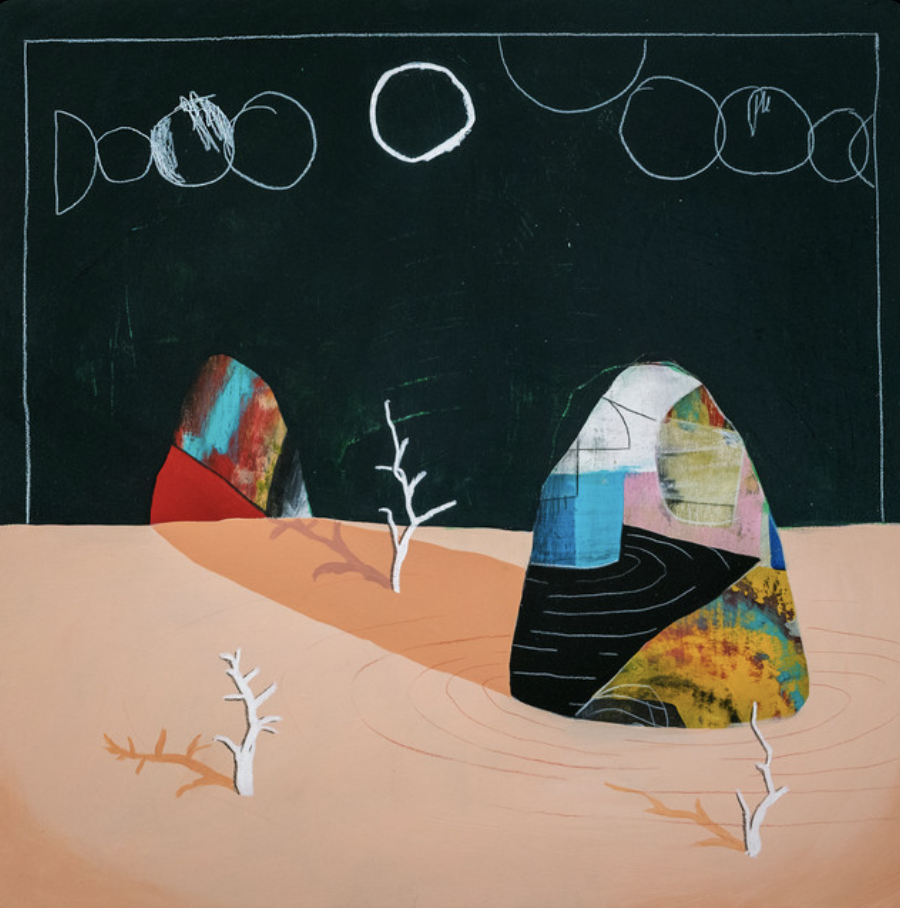
The Monthly Revue for November 2024: All the choice, loved and most enjoyed tracks from the last month, chosen by Dominic Valvona, Matt ‘Rap Control’ Oliver and Brian ‘Bordello’ Shea. As always our selection features a real shake up and mix of tracks that we’ve both covered in our review columns and articles over the last month, plus those tracks we didn’t have room to feature at the time.
Covering many bases, expect to hear and discover new sounds, new artists. Consider this playlist the blog’s very own ideal radio show: no chatter, no gaps, no cosy nepotism.
___/TRACKLIST_____
Les Amazones d’Afrique ‘Wa Jo’
Mulatu Astatke & Hoodna Orchestra ‘Major’
Orchestre Tout Puissant Marcel Duchamp ‘Speak by the E’
Marcelo D2 & SambaDrive ‘Samba de Primeira/Encontro com Nogueira’
Les Sons Du Cosmos ‘LAUNDRY’
Ric Branson Ft. Relense ‘Judas and the Black Messiah’
Juga-Naut Ft. Mr. Brown ‘Camel Coat’
Nowaah The Flood ‘On Location’
Blockhead ‘Orgy At The Port Authority’
Berke Can Ozcan & Jonah Parzen-Johnson ‘The Saint’
Elea Calvet ‘Landslide’
Roedelius ‘217 09’
Lolomis ‘Kristallen den Fina’
The South Hill Experiment ‘Silver Bullet’
Sparkz & Pitch 92 ‘Genius’
Jack Jetson & Illinformed ‘Pray’
Spectacular Diagnostics & Kipp Stone ‘BUCKET LIST’
Cavalier & Child Actor ‘Knight Of The East’
Walking The Dead ‘Fun Facts’
Humdrum ‘See Through You’
The Conspiracy ‘Tick Tok’
The Awkward Silences ‘Mother I’m on TV’
Trupa Trupa ‘Sister Ray’
Neon Kittens ‘Demons’
Bloom de Wilde ‘Dwindi’
Bell Monks ‘Before Dawn’
Spaces Unfolding & Pierre Alexandre Tremblay ‘In Praise of Shadows Pt. 2’
Gasper Ghostly ‘Floor Thirteen’
Son Of Sam & Masta Ace ‘Come A Long Way (Jehst Remix)’
Hegz & Dirty Hairy ‘Ruby Murray’
Glowry Boyz ‘FREE FALL’
Django Mankub ‘BEATSEVEN’
Sly & The Family Drone ‘Joyless Austere Post-war Biscuits’
Lolomis ‘Sieluni tanssimaan’
Cumsleg Borenail ‘Parade You ‘round Town’
Sam Gendel, Benny Bock & Hans P. Kjorstad ‘Charango’
Yazz Ahmed ‘A Paradise In The Hold’
Maalem Houssam Guinia ‘Matinba’
Baldruin ‘Hinein, hinaus, hinuber’
hackedepicciotto ‘Aichach – Live in Napoli’
Hornorkesteret ‘Krekling’
The Muldoons ‘Hours And Hours’
Juanita Stein ‘Motionless’
Sassyhiya ‘Take You Somewhere’
John Howard ‘If There’s a Star’
The Tulips ‘Haven’t Seen Her’
Jamison Field Murphy ‘Ermine Cloak’
Graham Reynolds ‘Long Island Sound’
Mauricio Moquillaza ‘___’
Kotra ‘Trials Of Discernment’
Our Daily Bread 633: Trupa Trupa ‘Sister Ray’ Single and News
November 27, 2024
SINGLE REVIEW/NEWS/PURVIEW: DOMINIC VALVONA

Photo Credit: Adam Plucinski
Becoming a near yearly dispatch of announcements from our dear friends in the famous Polish port of Gdańsk, the city’s most notable and self-coined “psychedelic post-punk” band of recent years, Trupa Trupa, are full of encouraging news and exciting prospects.
Hopefully you will have read my previous posts on their ttt (released as a limited cassette run), B Flat A and Of The Sun albums. But if not, in short, the band’s sound could be described as an intense and cerebral psychodrama, dream revelation, hypnotic, propelled and industrial post-punk, art and psychedelia locked-in conjuncture of East-European intelligentsia and abrasive wiry Gdańsk industrialism.
Their music, filled with a psychogeorgaphy, travails and activism, goes further than just sonically. Trupa Trupa band member and spokesman of a kind, and my first port-of-call, Grzegorz Kwiatkowski is not only a musician but a published poet/writer, academic and local activist: all three of which are channelled into the band’s unique sound.
Just last year, Grzegorz was involved in petitioning for a memorial to mark Gdańsk’s former Jewish ghetto. Housed as it was in the Old Red Mouse Granary on Granary Island in the city, this stain on the city’s reputation was eventually bombed by the Allies in 1945. The grandson of a concentration camp survivor himself, Grzegorz campaigned with others towards building a permanent link, reminder to a mostly “forgotten” part of the Polish city’s history.
The Jewish Chronicle published a piece on this achievement, interviewing Grzegorz, who commented at the time upon the proposed site as “…one of the last empty places [on the island] not full of luxury apartments”. For, as if to pile drive over such a heinous crime, this once final stopping point for the city’s remaining Jewish population before being cattled and sent to the death camps, is now rapidly becoming gentrified: a chapter, forensic scene, closed and paved over, as if nothing had ever happened. Just in time, a marker will now act as a point of remembrance and education, and prescient reminder. You can still read about that campaign in the JC here…
As featured in The Guardian, Kwiatkowski also helped uncover half a million shoes left to decay near the infamous Stutthof concentration camp. In a secluded, marshy, and wooded area 34 km east of the city of Gdańsk (or Danzig as it would have been known at the time) in the territory of the German-annexed Free City of Danzig, this camp was originally used to imprison Polish leaders and the intelligentsia, and was the first such camp constructed outside Germany itself: and the last to be liberated by the allies. Roughly 65,000 poor souls died there, either through murder, starvation, epidemics, extreme labour conditions, brutal and forced evacuations, or lack of medical attention. A third of that number were Jews. Many were also deported from that heinous crime scene to other death camps (estimated to be 25,000). Kwiatkowski has fought to have it preserved and recognised officially as a site of memory, which at this point in geopolitical turmoil, with antisemitism at record levels not only in Europe but across the world, and the increasingly depressing divisive nature of politics and activism in the X/Twitter/tiktok sphere, is needed more than ever.
Continuing the roles of activist-academic-poet, Kwiatkowski’s fortunes look very favourable over the next year, with workshops planned for both Harvard and Oxford, and an artist’s residency spot at Yale. The latter is an incredible opportunity, and furthers his poetic and musician roles, tying them together with his chosen speciality in amplifying the voices and testimonies of Holocaust survivors. Combing research and archival accounts from the University’s famous Fortunoff Video Archive, Kwiatkowski will fashion new poems and bring in his foils from Trupa Trupa to create new art. The results will be exhibited both at Yale and in his home city.

2024 going into 2025, Kwiatkowski and his foils build upon a burgeoning reputation as one the most dynamic and intelligent bands to emerge on the world circuit. Certainly, one of the most creatively exciting prospects to emerge out of the famous Polish city of Gdańsk; its geography and history of “old ghosts and hope” (as Kwiatkowski puts it) integral to their sound. In fact, so interwoven is that sense of place, of attachment, and what it means to walk a both catalyst and imposed history that I feel we need a very brief overview.
In a perpetual tug-of-war for dominion with its Prussian, then German neighbours, Gdańsk strategic and commercial position as Poland’s most important port has seen the famous city become a sort of geopolitical bargaining chip over the centuries because of its gateway to the Baltic. After one such episode in a “convoluted” legacy, the city and much of its surrounding atelier of villages were turned into the Free City state of Danzig after WWI; partly a compromised result of the Versailles Treaty in 1919. Under Nazi German control two decades later, it acted as a transportation point to the death camps for the city’s Jewish community.
Its famous luminaries include the present prime minister and former EU negotiator Donald Tusk, the philosopher Arthur Schopenhauer – credited as a major influence on the band -, and, although not strictly born within the city limits, the infamous madman of cinema Klaus Kinski – his most wild-eyed legendary role as the obsessive loon opera impresario, Brian Sweeney “Fitzcarraldo” Fitzgerald is also cited as a major influence, used as an analogy for Trupa Trupa’s own journey from the city’s underground to international favour. Can’s walrus mustacho maverick, Holger Czukay, was also born there: or rather Danzig as it was known at the time. Interestingly the video for their latest single ‘Sister Ray’, featured below, was shot in the band’s own Wrzeszcz studio, a stone’s throw away from Czukay’s own courtyard.
In what could be said to be a second chapter for the group, as they now par down from a quartet to the settled trio of drummer Tomasz Pawluczuk, co-vocalist and bassist Wojciech Juchniewicz and co-vocalist and guitarist Kwiatkowski, Trupa Trupa are set to release the first single from next year’s Mourners titled EP, ‘Sister Ray’. Borrowing both that title and a lo fi hardliner rock ‘n roll, bordering on post-punk, spirit from the Velvet Underground the band’s echoey repeated “towards the horizon” line is beefed-up with a broody dose of snarled trebly bass and a shot of growled throbbing sinewy knotted impetus. The now stripped-down, determined, and raw trio channel The Killing Joke, The Fall, Elastica, Banshees, Archie Bronson Outfit and Wire (especially the band’s Colin Newman and his solo work) on this slab of surreal attitude.
The accompanying video, shot once more by the Polish audiovisual artist, painter, musician, video and installation artist and professor at the Academy of Fine Arts in Gdańsk, Adam Witkowski, features visual expressive marks, brush slashes of painting and flipped through art journals inspired by the iconic genius Basquiat. It’s hardly surprising, given that two-thirds of the trio graduated in fine art, and continue to paint and practice graphic design.
Whilst notching up two sessions already for 6music, and with the invitation to perform on NPR’s Tiny Desk sessions, Trupa Trupa have attracted a lot of support and attention over the last eighteen months. Rivalling my own cheerleader support, Iggy Pop has raved about the band’s last couple of albums in true fandom style. And so, it’s hardly surprising, and considering their Syd Barret meets post-punk rawness, that they’ve attracted the talents of the acclaimed and very much in-demand British producer, composer and engineer Nick Launey to produce both this single and their newest EP, Mourners.
Based in L.A. for some time now, Launey’s prowess and vast experience has come in handy. Able to draw from a vast resource of helmed and steered productions from such notable talent as Nick Cave and the Bad Seeds, Anna Calvi, BRMC, the Yeah Yeah Yeahs and Arcade Fire, and before that, at the centre of the UK’s post-punk explosion in the late 70s and early 80s (you name it, he was there, whether it was PiL, Gang of Four, the Killing Joke or The Slits) the enthused veteran motivator really grabs hold of the Trupa Trupa sound and pushes it in a taut, tight and raw direction of energy.
The five-track Mourners EP is set to be released at the end of February next year, preceded by the title-track at the start of that same month, and once again released on Glitterbeat Records. ‘Sister Ray’ meanwhile is out now and will be followed by a UK tour. A world tour proper, starting in California, will begin straight after the release of Mourners in 2025.
In all its artsy glory, premiered today on Youtube by the band, ‘Sister Ray’:
THE DIGEST FOR NOVEMBER 2024: New Music/The Social Playlist/And Archives
November 22, 2024
THE MONTHLY DIGEST INCLUDES A CLUTCH OF ACCUMULATED NEW MUSIC REVIEWS; THE SOCIAL INTER-GENERATIONAL/ECLECTIC AND ANNIVERSARY ALBUMS CELEBRATING PLAYLIST; AND CHOICE PIECES FROM THE ARCHIVES.

Photo Credit:: Giovanna Ferin
____/THE NEW
Juanita Stein ‘The Weightless Hour’
ALBUM (Agricultural Audio) 29th November 2024
And perhaps it all comes to this, that after twenty-five years in the music business as both the frontwoman of the Howling Bells and as an established solo artist Juanita Stein has finally found the strength of her own voice and creative force. Stepping out from behind the safeguards of noisy rock to find that silence resonates deeper and further, Juanita erases everything but the most vital, emotionally receptive and connective elements from her music to produce a sagacious, confident (despite the fragility and vulnerability in places) songbook of personal memories.
Stripped back then, but even more powerful, Juanita faces up to her family’s past and her own, and faces up to the more troubled, traumatic experiences in the most diaphanous of ways. There’s a real clarity lyrically and musically, despite the coos, the often near ethereal airs and veils, and the reverberated echoes. And the minimal accompaniment, which changes between the acoustic and note struck electric guitar, and features a subtle gravitas of strings at times, chimed elements and the odd bass drum, either weaves or rings out evocations of Southern Gothic and Lee Hazelwood country, magical carousal and Laurel Canyon 60s influences, the music of 90s Drugstore and Juliana Hatfield, and a hint of Radiohead.
I’ve always loved Juanita’s voice, which is pretty unique in the best possible way: soothing, beautiful yet full of emotional turmoil, and verging on the apparitional on occasion. Here she sounds at times like a mix of Kristin Hersh, Tanya Donelly, Lana Del Rey and June McDoom at its most breathlessly gossamer. And considering the themes, that voice is never projected with anger, resentment or resignation at any time during the ten songs on this near perfect album. Put it this way, there’s neither a flood of emotions nor a moment in which the whole experience threatens to engulf Juanita.
Rather than write for characters, every lyric can be identified as a feeling, an experience that Juanita has personally been troubled by, gone through and lived. Growing up in a talented Australian family of artists (her late father Peter Stein, the renowned songwriter/musician, her mother Linda a former stage and TV actress, and her brother Joel the lead guitarist in the Howling Bells), but brought up in the Orthodox Jewish faith with its strict adherence to the Torah and just as strict schooling methods, Juanita claws, or takes, back what was lost during her childhood with a lyrical passion that borders at times on the poetic wise honesty of Leonard Cohen.
The accompanying PR notes use the word “imposed” when outlining Juanita’s Jewish roots. But that would suggest an abandonment or uneasy relationship with her identity, which you are born into. Juanita seems to me to be more objectional to the dominate patriarchal and masculine aspects of Judaism; the restrictive nature of old lore and laws and rules. For she stands up against antisemitism, especially recently with record numbers of incidents and violence meted out against the Jewish community around the whole Western world after the horrifying, barbaric murders and kidnaps perpetrated by Hamas on October the 7th last year. ‘Old World’ is a reminder of the evils of antisemitism, but also a reckoning with that ancestry. Unfolding over an acoustic country and Laurel Canyon-like trial of striking imagery that most beautifully haunting song finds Juanita revisiting her grandmother’s Prague home, now, even eighty years later, emptied of its once thriving Jewish communities – communities that can be traced back a thousand years or more, as mentioned in the Sephardi-Arabic Jewish merchant and traveller Ibrahim ibn Yaqub’s famous travelogues in 965 AD, and which numbered 92,000 before the Bohemia/Moravia partition of 1938/39, when Nazi Germany attempted to wipe them from the face of the earth; nearly succeeding, it’s believed at least two thirds of that figure perished in the Holocaust. Using a beautiful language of descriptive geography, the way the light falls upon that absence and legacy of destruction, the piles of ash, Juanita observes the eradication of the faith, the synagogues, and the way they were brutally changed into Christian places of worship: the recurring crucifix for example. Juanita’s grandmother was forced to leave at the age of fourteen, escaping the fate that awaited: namely transportation to the Theresienstadt camp built outside Prague, and eventual death in Auschwitz in Poland or the killing sites of the Baltic states.
Making some references to that Orthodox schooling again, but also written whilst waiting out the Covid lockdowns in Italy, the picturesque ‘Carry Me’ finds solace and sanctuary in a most charming, idyllic Tuscany surroundings. As the world grinds to an uneasy halt, Juanita, accompanied by subtle birdlife and the even softer sound of crickets and the environment, coos whilst playing a resounding, sounding out electric guitar turned up loud: but vulnerable and fragile. Again, I’m hearing Leonard Cohen. And there’s a nice, real softened plink-plonk of piano that’s just about there, which comes in at the end.
Moving on, the near aimless evoked ‘Driving Nowhere’ recollects a relationship going…well, nowhere. Featuring the duet partner of North Ireland artist Pat Dam Smyth, there seems to be a channelling of Hazelwood via Nick Cave and Roland S. Howard. The drifting apart of once entwinned partners is played out on the Australian country highway of heartache and emotional breakdowns, with Smyth, who supported Juanita in on her first London solo performance, adding a very congruous if deeper voiced sense of lived-in, resigned sadness.
Reflections there are many, especially when facing the “heady days” of the early noughties as the frontwoman of the highly successful (and a damn good band) Howling Bells on ‘The Game’, which sounds like Lana Del Rey backed by R.E.M. Not so much regrettable, as sadly conveyed recollections of fame and being at the centre of a whirlwind, a storm that left no room to breathe or process, it seems she both suffered and yet misses it. ‘Motionless’ has a heavy strum and chug to it that reflects the open-hearted revelations of another broken relationship; the stage set for honest reflection and for saying what needs to be exorcised before moving on.
The Weightless Hour is the perfect album from a great voice and songwriter, who’s now able to find that distance from the events of the past and a new sense of reflected candidness and honesty in motherhood. Juanita’s true self and strength opens-up, the noise diminished for something far more powerful. Not so much defiant as confident. A definite album of the year.
Spaces Unfolding + Pierre Alexandre Tremblay ‘Shadow Figures’
ALBUM (Bead Records)
Coinciding with the 50th anniversary of the revitalized Bead label, a special challenging site-specific work of non-musical experimentation and evocation from both the Spaces Unfolding trio of flutist improvisor Neil Metcalfe, avant-garde violinist Philip Wachsmann and drummer improvisor Emil Karlsen, and the electronic explorer Pierre Alexandre Tremblay.
In merging their own specialist forms – the acoustic and electronic – both partners on this improvised serialism of avant-garde, textural, atonal and more recognisable sound and instrument sources, expand the sonic palette further towards the abstract, mysterious and near paranormal. “In Praise Of…” and making concrete the otherworldly “Figures” from the “Shadows” this collaboration seems to channel the ominous and a sense of disturbance. The electronic effects, beds and signals set off an uneasy sense of technologies creeping encroachment, its power sources and unseen, near subverted presence.
But the triplet of atmospheric “In Praise Of Shadows” suites is dedicated to and takes its name from the celebrated Japanese titan of provocative literature Jun’ichirō Tanizaki and his notable essay on Japanese aesthetics. Noted for both his shocking depictions of sexuality, of kinks, of the submissive, and obsessions, and subtler portrayals of family life in his native country during a time of upheaval, as modernism took hold, as Imperialism rose and then was crushed and replaced by Westernized consumerism and progress, Tanizaki’s usual schtick was to place characters, affairs against a backdrop of cultural anguish. However, published in the 1930s, In Praise Of Shadows is a little different; made-up of 16 sections (a sample of titles: “The toilet aesthetic”, “A novelist’s daydreams”, “An uncanny silence”), the central theme uses analogies and abstract ideas of light and darkness to depict the comparisons between Western progress and its search for light and clarity with the subtilties and appreciation of the subdued and shadows in East Asian art and literature – or more specifically an appreciation of the Japanese concept of “Sabi”, or “world view”, which is centred around transience and imperfection. There’s far more to it all of course, including, which is very important in this context and as an influence on this recording, a piece on the layered tones of various kinds of shadows and their power to reflect low sheen materials: see the various “Refraction” entitled pieces of textual shadowy play.
I’m not sure if it is intentional or not, but some of the both harder and dulcimer-like plucks on the violin, the whistly aspects and higher pitched flutters of the flute and some of the near-taiko-like thunders of the drums evoke the music of Japan: somewhere between the traditional and the work of Yamash’ta & The Horizon and Farabi Tushiyuki Suzuki. It builds a sort of Oriental mysticism at times, a mysterious atmosphere of shadows, or an estranged Kubuki theatre, and of deeper meanings channelled by the tactile and textured.
At times I’m picking up echoes of Anthony Braxton, the work of Larry Austin, the Giuseppi Logan Quartet, some Sandro Gorli, Alan Sondheim and Fernando Grillo amongst the electrical fields, the sparks of freeform jazz, the scurries, the spidery finger work, restless crescendos, dry fluted chuffs and rasps, and solid thick-stringed pinches and strains. Untamed with moments of reflection, uncertainty, Shadow Figures pitches an environment and its sounds, its unseen wound-up, ratcheted and twisted objects with more skeletal, shaved, sieved and high-pitched avant-garde expressions.
Maalam Houssam Guinia ‘Dead of Night’
ALBUM (Hive Mind Records)
Accomplished student and innovator of the traditional Islamic dance, music and poetry exaltation of ‘Gnawa’ and the three-stringed lute-like instrument that goes together with that ancient practice, the ‘Guimbri’, Houssam Maalam Gania pays a certain homageto his upbringing and his roots as the scion of the late Gnawa master Maalam Mahmoud Gania. A catalyst for the label, a repackaged special reissue of Maalam Mahmoud’s sublime venerable Colours Of The Night performances kick-started the whole Hive Mind platform label back in 2017 – a label, I might add, with a considered taste in some of the more understated, lesser known recordings of world-class artisans and genres. This was soon followed by the label’s fourth release, Mosawi Swiri LP, which featured Houssam Maalam and a troupe of lively young musicians from the country’s fishing port town of Essaouira.
The youngest son of the virtuoso has obviously inherited all the right creative and musical attributes, performing as he does a remarkable adroit and earthy vocalised songbook of affectionate and devotional Gnawa-style pieces; pieces that his father would play and sing in the family home to his children. The title is both a riff on his father’s iconic LP and a reference to the nighttime hours in which this album was recorded, stripped down with no accompaniment, live on the 3rd of June 2022 in Casablanca using only a Tascam field recorder and two microphones.
Uncloyed (as the field-recordist producer Ian Brennan would say) and as intimate and atmospheric as you can get, with the tape left running to pick up any clearing of the throat and the breaths between singing, each performance is a one-man demonstration of the Gnawa artform and a hybrid of influences from Westernized blues to the music of the Tuareg and the influences of a wider West and North African geography. For that Moroccan heritage bleeds over borders, chiming even with certain traditional forms from as far as Southeast Asia: whether intentional or not. In solo form, Houssam Maalam manages to play polyrhythmically; using, what sounds like, the flat of his hand on occasion to simulate either a bass part or a hand drum. Plucked elasticity is combined with paddled hand movements, whilst a constant buzzy and wobbled rhythm is kept going. Sometimes it sounds more like a banjo, and at others like a makeshift guitar, but is always played with either a delicate, intricate hand or a more physical, bassy one. Expressively conveying the Godly, moments of joy and comfort, and the questioning, the voice resonates from the very soil. But it sounds like that voice has matured somewhat since Mosawi Swiri, grown perhaps as it resonates with those songs of childhood. Dead of Night achieves two things. Firstly, Houssam Maalam grows closer to his father’s legacy, and secondly, forges his own pathway and identity honing a unique Gnawa legacy. Be quick, as this is yet again a limited release – though I’m sure of there is enough demand, there might be a second repress.
Baldruin ‘Mosaike der Imagination’
ALBUM (Quindi Records)
Mosaike der Imagination, or “mosaics of the imagination”, is the latest mirage fantasy of vague worldly evocations, hallucinations, magical folk music and gossamer traverses from the German electronic artist Johannes Schebler, under the guises of Baldruin.
Regular readers may recall my review of last year’s Relikte aus der Zukunfti album, which I described as “lying somewhere between the Reformation, hermetic, supernatural and mysterious Far East”. I also pointed out the air of religious bellowed organ, the church atmospherics, and the toll of bells on that release. For just as Roedelius, Moebuis and Schnitzler’s first recorded experiments, under the Kluster title, found a home on the synonymous German church organ music label Schwann, so congruous were those early kosmische innovators “hymnal qualities” and, if removed, links to the country’s rich venerated history of religious music, Schebler’s own small Bavarian village rectory upbringing can be heard permeating this latest album too.
You can pick up passages of Tangerine Dream cathedral vibes and a glass-stained organ on, what is, a kaleidoscopic tapestry of fourth world music, occult folk and the amorphous international traditional sounds of (from what I can make out) Japan, India, Southeast Asia, Tibet and an imaginary vision of ritualistic, tribal paganist Europe.
From Orthodox monastery moans to the whispered spells, invocations of Baroque and folk-styled esotericism, and from the ceremonial to mysticism and the burning coals of martyrdom, spindled and softy but quickly malleted instrumentation, hand drums, the fluted and bone-like vibraphones merge with electronic algorithms, various forms of crystalized and tubular light and recurring chiming of timepieces.
This a strange coalesce of Laraaji, aboycalledcrow, David Casper, Xqui, Jon Hassell, Caravan of Anti-Matter, Belbury Poly and Benjamin Law on a diaphanous and hallucinatory alternative plane of light and shadows. Baldruin conjures up the dreamy, the haunted, and the magical on yet another transmogrified and reconfigured album of folk, worldly and religious imbued recondite sources.
Mauricio Moquillaza ‘S-T’
ALBUM (Buh Records)
Exotic, alien and near supernatural organisms and life emerge from machines on the new four-suite release from the Peruvian musician, sound artist and cultural manager of various projects and platforms Mauricio Moquillaza. Working across a diverse range of mediums, from theatre to dance, and part of the experimental Lima scene of recent times, Moquillaza has cultivated a process of organic and improvised electronica from an apparatus of electronic tools – specifically a Eurorack modular of hardware.
On this untitled experiment of “generated possibilities”, the sounds, repetitions and changing patterns are untethered; recorded as they are in one take and without any overdubs. Allowed to develop almost naturally, each piece sounds like a balancing act between stimulated machine learning and free improvisation; the results, a continuous hybrid of cosmic, cerebral and mystical languages, calculus, exotic birdlife simulated pitches and warbles, moist cave-like atmospheres and the rhythms of life.
As a bassist too, you’ll hear singular notes that are both deep and low, but fluctuating, as each movement of the cylindrical, the tubular and more openly expansive create a magical and sometimes ominous shadowy world. At times it sounds like transduced or transformed echoes of bobbled, chimed gamelan from an alternative plane, or a fourth world take on early techno music. And as is the artist’s raison d’etre, there is a constant looming edge of dissonance, some near crushing and crashing haywire noises (like some galactic space battle on the album’s third suite) ready to develop out of the various patterned process, the inter-dimensional free-exchanges and dancing arpeggiator-like notes that bob around in the lusher, more fun sections.
Like A.R. And The Machines rewired via a portal into a futuristic vision of South America, or Tangerine Dream fusing with the Eyot Tapes, Tomat, Richie Hawtin, and Autechre, Kosmische influences, cult pioneering library music, more stripped techno and contemporary experimental electronica combine to form both a cascading and ever-changing layered album of quality freeform electronica. If you follow or are aware of the quality Buh label, then you know that every release is intriguing and interesting, introducing us to great new innovators from the South American scene. And Moquillaza self-titled debut is no exception. A highly recommended release.
____/THE SOCIAL PLAYLIST VOL.92

The Social Playlist is an accumulation of music I love and want to share, tracks from my various DJ sets and residencies over the years, and both selected cuts from those artists, luminaries we’ve lost and those albums celebrating anniversaries each month.
Running for over a decade or more, Volume 92 is the latest eclectic and generational spanning playlist come radio show from me – the perfect radio show in fact, devoid of chatter, interruptions and inane self-promotion.
Each month I chose a select number of anniversary-celebrating albums, and in November that means a cheeky 60th throwback to The Beatles’ For Sale (which actually was released in December of ‘64, but I’m not doing a social playlist next month and have instead stuck it here), 50th nods to CAN’s Soon Over Babaluma (see my updated piece from the archives below), Kraftwerk’s Autobahn and Bernie Maupin’s The Jewel In The Lotus, 30th salutations to Autechre’s Amber, and a 20th salute to MF Doom’s MM..Food.
I like to include a smattering of newish or 2024 releases that I missed on release, or that failed for one reason or another to make the blog’s Monthly Playlist selection – usually down to a lack of room. That means inclusions for Paten Locke, itsokaylove & Black Wick, Jagu-Naut, Rosaceae, joe evil, Dad Doxxer – the last two transmogrifying The Beach Boys songs as part of the surreal dairy Sad Milk Collective’s recent compilation It’s Three O’ Clock, Go To Your Sink, Pour Some Milk, And Start To Think.
That leaves the rest of the playlist to my eclectic imagination, and pick of records I own, once owned or wished I’d owned. In that list, you will hear Suzanne Langille and Neel Murgai, Five Day Week Straw People, Ventre de Biche, Def IV, Creative Arts Ensemble, Principle Edwards Magic Theatre, Laercio De Freitas, Lightshine, Armando Trovajoli, Black Mist, Scribble, Dow Jones And The Industrials, Tiny Yong, International Harvester, UV Race, Claudya and Ken McIntyre.
TRACKLIST
Secret Oyster ‘Black Mist’
Dad Doxxxer ‘409’
Dow Jones And The Industrials ‘Let’s Go Steady’
Claudya ‘Jesus Cristo’
Ken McIntyre ‘Cosmos’
MF Doom Ft. Count Bass D ‘Potholderz’
Juga-Naut Ft. Mr. Brown ‘Same Planet’
Def IV ‘Do It E-Z’
Paten Locke ‘Widdit’
Creative Arts Ensemble ‘Unity’
Armando Trovajoli Ft. Monica Vitti ‘Suor Kathleen’
Laercio De Freitas ‘Pirambera’
Bernie Maupin ‘Mappo’ Lightshine ‘Lory’
International Harvester ‘There Is No Other Place’
CAN ‘Splash’
Autechre ‘Silverside’
Rosaceae ‘Rue Norvins’
Scribble ‘River’
Kraftwerk ‘Morgenspaziergang’
Suzanne Langille & Neel Murgai ‘Bury Myself Where I Stand’
itsokaylove & Black Wick ‘Real Dangerous Louis V Gold for the Cosmic Stoner’
UV Race ‘Nuclear Family’
Ventre De Biche ‘Les murs de brique’
MF Doom ‘Poo-Putt Platter’
Principle Edwards Magic Theatre ‘McAlpine’s Dream’
joe evil ‘All I Wanna Do’
Five Day Week Straw People ‘I’m going out Tonight’
Tiny Yong ‘Le Sauvage’
The Beatles ‘No Reply – Anthology 1 Version/Demo’
____/ARCHIVE
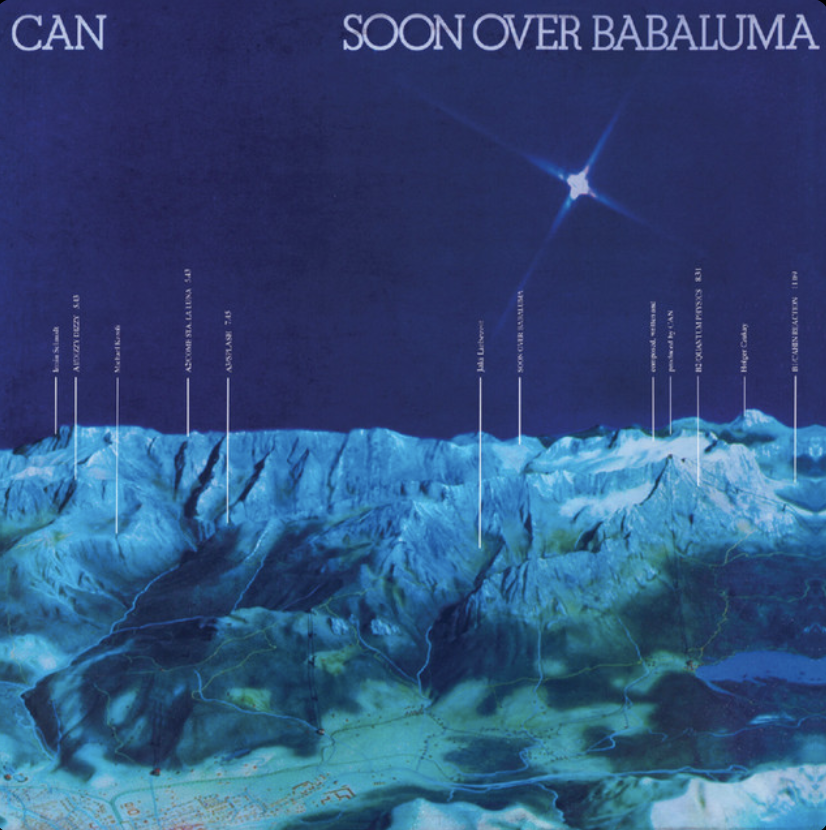
Retrieved and reshared from the Monolith Cocktail archives this month, a 50th anniversary special on CAN’s 1974 LP Soon Over Babaluma.
CAN ‘Soon Over Babaluma’
(United Artists) November 1974
Hawkwind once sang enthusiastically that, indeed, “Space Is Deep” on their 1972 progressive nebula traveling album Doremi Fasol Latido. Unfortunately for all the postulations and far out oscillating effects they failed to launch us further than our own stratosphere.
Interstellar overdrive and the promise of a journey beyond the stars never quite managed to leave behind the familiar sounding musical structures and instruments of Earthly genres, such as rock or jazz. Even Sun-Ra for all his visitor/emissary from another world talk, was still to a point chained to classicism; those outbursts of improvisation never quite soared to the dizzying celestial heights that we were promised.
Which leads me to CAN and their sixth studio album Soon Over Babaluma, a genuine bold attempt to lavish the cosmos with a fitting soundtrack; delivered by Cologne’s very own branch of NASA.
Previously on the 1973 heavenly diaphanous hymn Future Days, CAN had scaled new empyrean heights of excellence. Now they sat in the very lap of the Gods themselves, the only logical next step being outer space.
It helped of course that the injection of funds, acquired by Hildegard Schmidt, now paid for some new equipment; namely the futuristic sounding Alpha 77, a serious piece of kit that interrupts the sounds emanating from a keyboard to produce some startling effects and soundscapes. Looking like some kind of radioactive scanner and housed in a bog-standard clunky metal box, the Alpha 77 could have fallen off the back of truck bound for some nuclear science facility. The flight deck controls and rather old-fashioned register dials don’t quite reflect the abundance of sounds that can be created and fooled around with; Irmin Schmidt teases a vast array of ethereal sweeping sound collages from this box of tricks, that coats every part of this album.
Irmin wasn’t the only one to receive some new equipment, the band, as a whole, upgraded their sound desk: for the first time being able to record straight onto stereo. Also editing and overdubbing became a lot easier, benefiting the overall quality of sound and mixing. Technology always played its part but now it would direct the proceedings in 1974, as they began to lay down what would be the forthcoming Soon Over Babaluma album.
December 1973 saw the departure of Japanese troubadour and mushroom haiku mantra singer Damo Suzuki. A heated confrontation during a session for a TV soundtrack resulted in Damo snatching up his mike and a pre-amp, exclaiming, “That’s mine!” before skulking off in a strop.
The gear was returned in due course, but Damo remained aloof, never to return, the recent marriage into and conversion over to the Jehovah’s Witness religion playing a major part in his decision making. He may as well joined the Quakers, as hanging out with avant-garde rock stars was now frowned upon and discouraged to the point where life must have become quite square. Although the late experimental, improvising icon would later return to music full-time; going on to collaborate with some of the most inventive heirs of krautrock and a whole new generation of experimental artists and groups: the list is endless.
An empty vacuum emerged at first, the rest of the band feeling left in the lurch, the upcoming album deadline and tour commitments placing intense pressure on the group to find a replacement.
Unfortunately finding a new singer/front man wasn’t easy, either due to unsuitability or previous prior engagements that role remained aloof and unfilled. In the end it was their own transcendental guitar genius Michael Karoli who stepped up to take on the vocal duties, with Irmin lending his support and backing.
For the record Karoli does a pretty good job of it, sounding like a Germanic Syd Barrett and even at times evoking the dreamy quality of Suzuki himself. Irmin on the other hand comes across all creepy and crazed.
With an emphasis on the pursuit of other worldly experiments and space exploration, Soon Over Babaluma sports a suitable cover. Graphics artist Ulli Eichberger delivers a shining reflective moonscape cartography, with the song titles and personal etched over the lunar terrain as though they were the names of craters and the barren land features: though it also resembles some Alps type snowbound mountain scape.
The album title itself is claimed to be a parody type anagram of the old Weimar Republic era showtune ‘Moon Over Alabama’, made famous in renditions by Nina Simone and even David Bowie. Originally written by Bertolt Brecht, the genius German poet and playwright, and put to music by fellow countryman Kurt Weill for the 1930 satirical opera Rise and Fall of the City of Mahogany, the song was made even more iconic when the Nazis banned it three years later. Maybe it reeked too much of Cabaret and the savage biting social depictions of George Grosz, who painted grotesque images of the obscene decadence taking part in German society. The surge of the far-right encroaching on what they saw as bedlam with their even worse replacement ideology, turning on the social commentary of Brecht and Weill with vengeance.
Whether or not this is indeed the reason behind the moniker, there is no real reference to historical context; rather the mood is entirely directed towards space. Track titles such as ‘Come Sta, La Luna’, closest translation being “as it is, the moon”, and the scientific-in-nature ‘Chain Reaction’ and ‘Quantum Physics’, CAN certainly laid down enough signs of their newfound commitment to the course.
A move towards the more technological progressive and experimental ethos mixed with the jazz boundary defining pronunciations made by Ornette Coleman, Miles Davis and the already mentioned ex-resident of Saturn, Sun-Ra, CAN’s sound managed to surpass the previous journeyman as they now set out to tip toe across Orion and penetrate deep space.
But this wasn’t the only album released by CAN in the 1974, oh no! They also released a collection of studio offcuts and even further out there avant-garde sound collages entitled Limited Edition; so called as it was limited to only 15,000 copies, though only two years later it was released as a double album with 5 extra tracks.
Both versions include the Ethnological Forgery Series and the scraps and fragments of sound pieces and obscure cluttered impromptu jams that littered their back catalogue. The standout track is the ambient moving viscerally inspired ‘Gomorrha’, one of the most ethereal quality pieces they ever recorded and possibly the track that Damo walked out on. Its science fiction searching, and hearts of darkness espionage drama evoking atmosphere perfectly encapsulates the sea change taking place, having been recorded only months before work started on Soon Over Babaluma.
——A Deeper Reading—–
The sound of a small leap across the surface of the Moon, whose gravity has been swallowed by the Alpha 77 and re-directed into one illuminating bended note, this is how ‘Dizzy Dizzy’ begins.
Karoli floats in on a passing solar wind, floating above the rim shots and deeply reverberated bass like a lurking rock astronaut ready to pounce with his introduction gambit “rat-a-tat-a-tat-a-tat” vocal scat.
A sultry Afrobeat enriched beat bounces along as twangs of guitar mark the way, all the while Schmidt strokes his alluring array of space organs, fermenting some lofty aspiring effects with which the groove can walk on.
Soon the violin strikes up a haunting weeping melody that cuts through the expansive air, exquisite emotive strains from the stringed solo stir up a certain amount of pulchritude.
Soft brush strokes and heavily comatose cymbals contact Holger Czukay’s one note comfort blanket warm bass, rich in rebounded echo.
Karoli breathlessly sings such wise pronunciations as,
“I know, I don’t smoke with the angels, I know
Don’t throw ashtrays at me”
I think we know what kind of brand of choice he’s more than hinting at!
He goes onto lay his soul bear with the romantic gestured lines,
“I’m not made out of mature,
But I’m something out of the heart.
Throwing on you a kiss, kiss”
Almost jumbled around or miss-translated, these lyrics read like a cut and paste experiment.
Dizzy in love or dizzy due to the air being so thin up here in the upper echelons of space, Karoli seems to levitate on his whispered sonnet to some higher beings.
Schmidt eventually takes over, draining the vocals to a mere trace, that Alpha 77 synth manipulator now warming up and taking on a life of its own, becoming like a fifth member of the group. But it will be those felicities violins that have the last word, ending on a majestic duelling climax.
‘Come Sat, La Luna’ opens with a field trip recording of some stroll alongside the canal, the occasional croaking from some walk on part crow, interrupts the serene ambience. Karoli then rumbles in with a pleading dramatic rendition of the title off the back of some heavy duty compressed reverb, that makes it sound like the band are playing in a diving bell chamber.
The sense of entrapment and struggle to breathe in this now thick atmosphere, a morphine induced state is evoked in this dense sounding eulogy to some far-off planetary dimension.
Schmidt recites rather than sings his lines, which are deep in creepy effects and delivered through some unsettling eerie cadenced nonsense.
These vocals are more like riddles or cryptic announcements of foresight, such as the lines,
“I am not fighting, but I’m the night,
I am not dying, and I’m not hurt.
I am the right or the wrong, your hope,
I am the dancer on the tender road”
He goes on to express,
“I am the water and how I can flow”
Schmidt seems to be angling at some descriptive analogy, continuing with more caustic questioning,
“And why don’t you call me Sta?
Flowing over Babaluma,
It ain’t your friend.
You can do it alone,
And you don’t have to pay”
The song picks up some pace, almost swinging along in a jaunty motion, Liebezeit taps his way through, giving a special decompressed bass drum and kick drum solo, losing himself in a sudden joyful upturn.
From out of the mire approaches a grand piano and squalling guitar, both lost in a mini battling concerto, which grows towards an almost full on avant-garde free for all before calm is restored with the last warbling chorus from Karoli. Almost sorrowful in manner, the finale words almost trapped as though Karoli is zapped of his strength.
Side one ends with the all-out galactic jazz ensemble instrumental ‘Splash’.
Sun-Ra, Miles Davis, Ornette Coleman bump into each other on the set of Mission Impossible, all vying for elbowroom and paranoid up to the eyeballs.
Squawking, hooting sousaphone and grumbling thunder striking bass are met with fret board scrapping and incessant scratching, Liebezeit rattling off a series of rolling drums and double kicks, booting his kit round the room.
Just as a certain rhythm is broken in, cowbells and trinket percussion enter the alarming fray, bringing with them the black box recorder omnipresence of Schmidt’s 77, a glorious soundtrack to the stars is eminent.
Karoli begins a dystopian guitar solo from on top of some desolate mountainous range or Olympus Mons itself, melancholy wines and strains of harrowing pleads echo round the empty immense affinity of space.
An excitement of sorts starts to boil over as a barracking charge from the drums now piles in to the accompaniment of strangled brass and eastern harem sounding oboes, which pursue a deconstructed noisy voyage of discovery, wrestling control of these nine headed monster jams.
Once you’ve had time to calm down from the audio assault of ‘Splash’, side two awaits your attention with the doubled up ambient suites of ‘Chain Reaction’ and ‘Quantum Physics’, the energy and matter evoking scientific epic.
Beginning with the now familiar sound of the 77 revving up like some organic spacecraft dreamed up by Frank Herbert – in fact reminding me of the special effects from Dune the movie -, drums and bass slowly fade in with a soul shaking tambourine, shimmering and arousing r’n’b, before Karoli slides and rides all over his guitar, the celestial conductor.
The brewing accompaniment runs riot until fitting into an assured stride, the low plains pan out in front of us as the beat remains steady and ambitious in outlook.
Schmidt unveils grand gestures of melody from his very own inter-galactic flight deck, painting multiple soaring swathes of astrological envy for Karoli to now glide over with his best Damo evoking vocals.
Surreal imagery is conjured up and uttered with breathless enthusiasm; analogies of a Soviet flavour are transcribed thus,
“Elephant dominating Russian,
Don’t be running hurt.
Elephant running,
Dominating the deep”
The attitudes change with the take it or leave it gay abandon of the chorus,
“Chain reaction incoming when you get so small,
I said chain reaction incoming when you get so rushed”
Probing, encroaching guitar searches roam the moonscape, taking part in a call and response with Schmidt’s now crescendo illuminating collage of sound.
Liebezeit and Czukay both slump off into solo frenzies, traveling their very own particular rhythmic paths before a giant thunder clap strikes and sends the track towards free-fall.
Tribal beats clatter and clash, whilst haunting encircling brooding organs and ascending synths swoop, then the beats are reigned back in, as Karoli recalls the chorus.
Cyclonic chuggering grooves are interrupted with some unworldly seething effects, that wouldn’t sound out of place in 2001: A Space Odyssey, as the ghosts of Mars and the trembling spooky reaches of the far-off universe now hang heavily over the space flight.
Rim shots and interplanetary musings seep into the final outro of the track before bleeding over to the second act of ‘Quantum Physics’.
Gentle ramblings and distressing noises unearthed from the science lab, emanate throughout, all the while Liebezeit attempts to keep a groove going, constantly banging away in the background.
From out of nowhere, an unseemly black hole maybe, Schmidt unleashes a brave new world of sublime washes and choral ethereal charm. The sky at night has never sounded so angelic and worth investigating.
No description quite explains the climactic finale that signs off Soon Over Babaluma, invigorating escapism and traveling through the cosmos, in scenes reminiscent of Solaris.
Breathtaking in vision, the perfect emotional drama set in space takes some beating. Perhaps they should include this in any future first contact package shot into the universe; then again, any alien life form may just think we’re showing off.
If you enjoyed, felt informed, or marvel at my words and those of the Monolith Cocktail, please take a second or two to read the following message of alms pleading. Whilst I’m fully aware of the austerity, the lack of money, and an industry set on reducing all its creators, its critics and writers and motivators to a life of poverty, it is becoming near impossible to continue without support. And so with that in mind:
For the last ten years I’ve featured and supported music, musicians and labels I and the blog’s other collaborators love across genres from around the world that we think you’ll want to know about. No content on the site is paid for or sponsored and we only feature artists we have genuine respect or love for. If you enjoy our reviews (and we often write long, thoughtful ones), found a new artist you admire, or if we have featured you or artists you represent and would like to buy us a coffee at https://ko-fi.com/monolithcocktail to say cheers for spreading the word, then that would be much appreciated.
Our Daily Bread 632: Hornorkesteret, The Muldoons, The Salisman Communal Orchestration…
November 18, 2024
BRIAN ‘BORDELLO’ SHEA’S REVIEWS ROUNDUP – INSTANT REACTIONS.
The Conspiracy ‘Tick-Tok’
Single (Metal Postcard Records)
What I like about The Conspiracy is how bloody artfully British they are, like the Kinks or The Fall or Billy Childish or Comet Gain or the much-ignored Wonky Alice were artfully British. In fact, very much like Wonky Alice as The Conspiracy, like the aforementioned Wonky Alice, are criminally ignored, for The Conspiracy release songs of pop wonder that are maybe too clever to appeal to the common everyday white bread and I cannot believe it is not butter Oasis indie rock salivating radio X listening imbeciles.
Yes, The Conspiracy release songs filled with art pop and sublime arched melodies matched with pithy knowing lyrical commentaries on life today. They should be celebrated not locked away like the hidden treasure they truly are.
Empty House ‘Dream Lounge’
Album (Cruel Nature Records) 29th November 2024
Dream Lounge is a two-track instrumental album of pure dream inspiring glory. The first track, and title-track, is a 15 plus minute journey of subtle dance dream adventure that at no point ever grows boring and keeps you enrapt. It has the same hazy magic as The Smiths How Soon Is Now but with Morrissey’s vocals being replaced with Doug Ingle like organ virtuosity subtly weaving its way in and out of the track.
The Second track “Red Door” is a much more subtly rambunctious affair with throbbing synth bass and John Carpenter like soundtrack feel if written by Coil, and once again a long instrumental that never loses your attention.
Hornorkesteret ‘Dans fra dalstrøka’
Album (Panot)
This is marvellously unhinged. Its instrumental Norwegian folk music performed on string instruments made from Reindeer antlers accompanied by percussion, bass and mandolin: need I say more.
Well, it is all rather strange and quite wonderful and best described as ideal music for sploshing through snow to whilst making your way to the tavern over the hill. At times I keep expecting the dulcet deranged vocal stylings of Tom Waites to emerge; he really should consider making an album with Hornorkesteret,it would be rather beautiful indeed.
The Muldoons ‘We Saw The View’
Album (Last Night From Glasgow) 29th November 2024
Guitar pop jangle, don’t you just love it. I do when it is the coating to such bittersweet songs as these; songs that deal with life as you move on from your younger years of your early twenties of college and the excitement of first love to the problems that come with responsibilities. The boredom that can happen and slowly growing apart in a long-term relationship (“27 Year Itch”), the lack of joy in fulltime employment (“Same Old Same”), looking back at what could have been (“The Hill”), all subjects done with a warmth and melodious guitar strum. All is not lost though, “Lost Without You” is a song of true love and respect, and “We Saw The View” is a heartwarming and enjoyable listening of extremely well written snapshots of life wrapped in a pop glory the Pale Fountains and The Trashcan Sinatra’s would be proud of.
St James Infirmary ‘All Will Be Well’
Album (Cruel Nature Records) 29th November 2024
All Will Be Well is an album made up of six long tracks of psych-tinged extravagance and 60’s ambience beauty that will appeal to all those who enjoy the Brian Jonestown Massacre, The Velvets and their ilk. The opening track “Fingertips” is a seven-minute jaunt of Velvet Underground-like inspired beat and guitars, which finely carries into track two, the excellently named “Tremelo Voxstar”.
My favourite track on the album is a nine-minute instrumental of wonder, part Spacemen 3 part The Lounge Orchestra, a relaxing float through the nostalgia of 70’s TV testcard heaven.
The final and title track is over ten minutes long and starts all psych folk and ends up being a church like ode to heavenly discovery and cultdom. All Will Be Well is indeed a beautiful and lovely sounding album of bewitching subtle musical genre shifting originality.
The Salisman Communal Orchestration ‘A Queen Among Clods’
Album (Cruel Nature Records) 29th November 2024
If I remember correctly I gave The Salisman Communal Orchestration’s “Of The Desert “ EP a rather marvellous review earlier in the year, and rightly so as it was a fine beast of a EP. And this album is also of the same quality.
I love the psychedelic otherworldliness of SCO. I love the way the lead vocalist phrases his words. He sings with the soul of an sad imperfect empathetic angel, you actually believe in what he is saying, “[If I Wasn’t ]So Godam Blue” is so goddamn beautiful, and with some pretty wonderful lyrics: “remember those days when I pissed in the street, well that is not my style anymore”. Pure heartbreak poetry at its best. The following track “Rum Punch” is as equally beautiful, a psych country-tinged beauty full of sadness and pathos.
I really do love this album SCO have the perfect blend of magic and tragic, and “A Queen Among Clods” is defiantly one of the most impressive and heartfelt original sounding albums I have had the pleasure to write about this year. A true stunner.
SASSYHIYA ‘Take You Somewhere’
Album (Skep Wax Records)
“Take You Somewhere” is a rather wonderful pop listen. 12 songs in 35 Minutes and each minute blessed with a charm of post-punk indie pop magic that is quite lovely to behold.
For those who love the sound and feel of the output of the likes of the Fall and early Orange Juice and The Raincoats and Modern Lovers. Jangly guitars, post-punk basslines and quirky lyrics are all wrapped together to make a highly enjoyable album of perfect indie pop. SASSYHIYA have provided us the lucky listeners with a debut album of pure pop suss.
The South Hill Experiment ‘Silver Bullet’
Single
“Silver Bullet” is a rather fine pop single. Quite Beck like at times, it’s all clockwork rhythms and mantra choruses: “I think I’m getting over it” is repeated hoping to convince the poor soul that he is getting over, although obviously not, but the simple beauty of this song is in fact the simple beauty of “it”.
The South Hill Experiment have the same magic that can be found in the best of Hall & Oates, but with a slightly more alternative darker curve.
Tremendous ‘Slipping Away’
Single 13th December 2024
“Slipping Away” is a rather catchy slice of FM/AM pop rock that one of a certain age might remember lighting up the radio in the 70’s early 80’s, all Raspberries guitars and the second-hand glamour of hi heeled glitter boots floppy hats and velvet trousers. Tremendous are a band steeped in the nostalgic pull of how slightly underground mainstream rock sounded, arching the same bow as Redd Kross and The Darkness and doing it with a supreme confidence and love.
Unicorn ‘Shed No Tear The Early Late Unicorn’
Album (Think Like A Key) 6th December 2024
“Shed No Tear The Early Late Unicorn” is a compilation of the first and final recordings of the 60/ 70’s British Pastoral rock band Unicorn, and any lovers of country rock will no doubt love this fine laid back stroll through the British countryside. The Flying Burrito Brothers, The Eagles and even at times Crosby Stills Nash and Young and The Byrds in more of their country days all spring to mind when listening to these lovely warm sounding laid back well written songs of soft rock excellence.
Without sounding like a Ronco advert from the 70’s “Shed No Tear” may well be an ideal Christmas gift for your Eagles loving relative, for country rock is for life not just for Christmas.
Kalporz X Monolith Cocktail: Scoutcloud: Les Sons Du Cosmos: the cosmic routes of Will Miller & Co.
November 15, 2024
ALBUM REVIEW FROM OUR FRIENDS AT Kalporz
AUTHORED BY MONICA MAZZOLI TRANSLATED BY DOMINIC VALVONA

Continuing our successful collaboration and synergy with the leading Italian music publication Kalporz , the Monolith Cocktail shares and translates reviews, interviews and other bits from our respective sites each month. This month, and with a new facelift overhaul of the site (which we love by the way) Monica Mazzoli introduces us to producer and multi-instrumentalist Will Miller’s latest project Les Sons Du Cosmos.
Les Sons Du Cosmos: “the sounds of the cosmos” in Italian. A challenging name for the new group from producer and multi-instrumentalist Will Miller, already the mind behind the soul-jazz project (and much more) Resavoir, a member of Whitney (from 2015 to today always balanced between folk/country/soft pop) and a musician at the service of such notable names as A$AP Rocky (listen to “Back Home” in “At. Long. Last. A$AP”), Mac Miller (his trumpet on “Two Matches” in “GO:OD AM”) and SZA (keyboards, production and co-author of “Blind” in “SOS”).
COOLIDGE and LAUNDRY, the only two tracks under the name Les Sons Du Cosmos released thus far, are the result of a session from September 2023 by Will Miller with Eddie Burns (who already appears on a number of tracks on the latest Resavoir album) and William Corduroy. Miller & Co.’s studio in Little Village – a neighbourhood of Chicago – is the birthplace of two productions that never run idle, and move the coordinates of the Windy City jazz scene – as happens more and more often – into broader sound territories: the first single, released in August 2024, is the perfect combination of groove and flow, and features Semiratruth’s rapping on a track full of soul-funk-jazz textures; the second piece, also featuring Semiratruth, this time on the stylophone, is a two-minute instrumental with an enveloping rhythmic interweaving of cinematic/library (music) flavours.
Author: Monica Mazzoli
A WORLD OF SONIC/MUSICAL DISCOVERIES REVIEWED BY DOMINIC VALVONA
(Unless stated otherwise, all releases are available now)

CAN ‘Live in Keele 1977’
(Mute Records) 22nd November 2024
The sixth “live” album in Mute’s series of CAN performances, previously lost in the archives, or left to the bootleg community to post and share in various edited or mixed-up forms over the decades, Live in Keele is the second such live recording from the pivotal year of 1977. The most “requested” live performance yet we’re told, is taken from the band’s Keele University showcase, recorded in March of that year in the Staffordshire town of Newcastle-under-Lyme.
Whilst the legacy label Spoon has already released various versions of live material over the years – specifically the CAN Live 1971 – 1977 album -, and many fans have loaded up their amateur recordings onto Youtube and the like, this will be the first time proper that the Keele set has been released in its most complete, remastered form.
The set list has been argued over, depending on who you listen to and what version you find resurfacing on the net. But it can be agreed that the performance was a mix of refashioned, in-the-moment tracks from their most recent album, Saw Delight, some improvisations and recalls of past glories and themes. One such example lists ‘Fizz’ (as featured on that already mentioned Spoon endorsed Live collection), ‘Animal Waves’, ‘Sunshine Night And Day’, ‘Dizzy Dizzy’, ‘I Want More’, ‘Pinch’, ‘Don’t’ Say No’ and ‘Pellamen’ (an improvisation). And indeed, some of this is right, if only in short passages or bursts. But this release unhelpfully splits the tracks into non-committal numerical titles, ‘Eins’ to ‘Fünf’. Another version has the same performance kicking off with an untitled improv, followed by ‘Pinch’, ‘Don’t Say No’ and ‘Animal Waves’. The latter two’s inclusion is concrete, no argument. And I’m sure that’s a recall of ‘Pinch’ from Ege Bamyasi alongside a transmogrified glimpse of ‘I Want More’ in the mix.
But before we go any further, I feel we should familiarise ourselves with the band’s often dismissed or at least forgotten treasure, and the focal point of reference for this recording, the Saw Delight LP, plus the changes that had taken place in the setup and lineup during this pivotal year.
Traversing influences from around the globe, the ethnography alchemists CAN always effectively absorbed the traditional and authentic music of multiple cultures, including the Middle East, Far East and Turkey. However, it wasn’t until the release of 1977’s Saw Delight LP that the group found themselves lauded as so-called ‘world music’ pioneers. In truth this five track assiduous collection of Afro, Turkish, Arabian, South American and “Fourth World” imbued songs does sound like a precursor to the 80s explosion in ethnically traditional music.
Much of CAN’s later work is often passed over, if not dismissed. Perhaps this can be attributed to the fact that their last couple of albums proved disappointing, the strange proto-glam of Landed and the more disco-esque reggae of the conventional Flow Motion – which spawned their most commercial hit ‘I Want More’ – did little to ingratiate die-hard fans to the cause, with many believing they’d lost their experimental edge. Fortunately, I believe, Saw Delight placed them back on track for a momentary reprise, mainly due to the inclusion of former Traffic bass player Rosko Gee, and percussionist Reebop Kwaku Baah, who both added a touch of African grooves and Caribbean coolness to the Teutonic mix.
Rosko’s arrival changed the dynamics, allowing CAN’s co-founding bassist and producer Holger Czukay to step away from the instrument to concentrate on producing interloping and spontaneous sound effects. Interacting with telephone calls and various radio transmissions, Czukay created the technique of using a Morse code switch to relay the signal and tap out these often-strange sound bite samples.
Vocals at this time were shared by everyone, with Rosko pitching in with lyrics to ‘Call Me’ and collaborator Peter Gilmour (Journalist friend of the band who co-wrote tracks on their last two albums) supplying words for both ‘Don’t Say No’ and ‘Fly By Night’.
The music itself gyrated to a disco and funk fuelled world rhythm, sauntering along most of the time in a kind of infectiously serene fashion. The opening song on that album, ‘Don’t Say No’, springs into action, settling quite rapidly into a taut rhythmic and containable conducted feel-good jam. Oscillating and accelerating keyboard waves of sound shuffle around the wispy delivered vocals that prompt us to, “Do what you feel, what you need to do” in a relaxed Jamaican fashion. ‘Sunshine Day And Night’ featured a rallying conga intro, courtesy of Reebop, whose Ghanaian ancestry comes in quite handy on this West African flavoured jam. Czukay mingles at this point, shoehorning in waves of operator dialled phone conversations and snatches of transistor radio shows, whilst Irmin Schmidt emits a smog thick blanket of effects via his infamous Alpha 77 plaything.
Over on the flip side we find the 15-minute mini-opus ‘Animal Waves’, a moody piece that mixes elements of mysterious whispery windswept atmospherics with a more stirring and emotive melodic soundtrack. Touches of Cuban percussive grooves and African bubbling broody basslines pull at this sad and forlorn instrumental that is full of grandiose cinemascope and erudite musical charm. One of the more beguiling, if not strange, tracks is the sultry Barry White school of soulful disco, ‘Fly By Night’, a peculiar sounding funky balled that is unlike anything the group had ever recorded or where likely to never repeat.
Throughout this LP, the usually prominent and leading protagonist of the group, Michael Karoli, seems somehow restrained, playing the role of a drifter, though always managing to add desideratum moments of floating ark like celestial guitar licks at the right time. Also drumming prodigal magi Jaki Liebezeit moves to the sides, remaining an anchor, but reining in his usual freewheeling floor show of elaborate rolls, instead reverting to his machine accurate timings and leaving enough space for the percussion of Reebop.
The Keele performance must have been one of the group’s earliest stages to showcase the new material and their adopted new band members after Saw Delight’s release in March of that year. Riffing on the album’s highlight tracks, ‘Don’t Say No’ and ‘Animal Waves’, we can hear all the signature elements of groove and rhythm, and licks of the former on ‘Drei’, and the vaped and tunnelled shifts and starlit rays, the cyclonic tribal vocal samples and night flights of the latter on ‘Fünf’. Although, they sound like they’re in a hurry to set up the recognisable ‘Don’t Say No’ feel and beat, emerging suddenly as it does out of the previous Velvets-score-the-Omega-Man, cosmic summoning stained glass galactic organ and Hendrix-invoking performance – elements I’m sure of ‘Pinch’ with a hangover of their Soon Over Babluma period.
Elsewhere the performance is straight into a Turkish vision of whomp-whomp, whacker-whacker Fred Wesley J.B.’s and The Jimmy Castor Bunch, with echoes of Flow Motion. Schmidt’s keys seem to simultaneously invoke the sci-fi, Vincent Price horror show, Arabia, ? & The Mysterians and the acid, whilst Czukay gets the phone lines open, dialling up the operator with prank-like calls that leave the unsuspecting receiver hanging.
Liebezeit meanwhile keeps the groove going, busy but never overdoing his part nor bursting into a silly egotistical drum solo as he makes rhythmic trips from West Coast America to The Levant, Orient and Africa. Acid-rock, jazz, Afrobeat, funk, traditional influences meet as the action circles round the kit, the hi-hat pedal bounces and the cymbals shimmer and splash. Guitar prodigy Karoli has always pulled off a similar merger of influences whilst maintaining a cool aloof presence, rocking, fuzzing, wailing, screeching, and bending with the best of them. From Beefheart to Zappa, Garcia to Hendrix, he finds some incredible licks and riffs that squeal acid and psych rock but could be unconsciously and consciously gathered from all points of the compass and earths. Again, the Turkish, the Arabian, the Persian, the American West Coast scene, the avant-garde and even Eastern European seems to all come together in both tight and rubber banded displays of virtuoso riffage.
Latest recruit, Rosko Gee (Reebop Kwaku Baah isn’t mentioned as playing on this live recording) keeps a cool bass line going throughout. The ex-Traffic bassist adds a less driven and monotonous rhythm with funk, soul, R&B, African and Caribbean influences. These either sit underneath the freeform surface or go on long scale runs, and octave juggles, and sometimes just smoothly bounce around.
A defining period for CAN, the Live in Keele gig recording is a window in on a group that still retained it’s early 70s magic but was also moving on: an experiment with new members, and a freeing up of the long-established setup and sound. If you hated, or to put it less harshly, just aren’t into the Saw Delight LP period than you’ll still find much to excite and enjoy about this ’77 special. But if like me you rate that often missed out and sometimes dismissed entry in the CAN catalogue than you’ll be a little disappointed, as this performance doesn’t go far enough in using that album’s material, nor in breaking with the previous recordings and live shows. Yes, always improvising, and always transforming, often based on how the atmosphere is, where the crowd and vibrations take them, there is still a lot of familiar ground being retrodden. Most will be happy though, but heads and diehards will probably already know this set off-by-heart. Still, a worthwhile contribution to the series, and indeed one of their best captured gigs of that era.
Hackedepicciotto ‘The Best Of Hackedepicciotto (Live In Napoli)’
(Mute)
Responsible, in part at least, to helping shape a certain brooding yearned and dramatic sound over the last four decades in Berlin, the husband and wife creative partnership of Alexander Hacke and Danielle de Picciotto have at any one time, both separately and together, been members of Einstürzende Neubauten, Crime And The City Solution and the Anne Sexton Transformations imbued theatrical Ministry Of Wolves. During that time Danielle was the lead singer for the Space Cowboys and co-founded the famous Love Parade carnival.
As a duo in recent years, under the twinned Hackedepicciotto moniker, they’ve channelled much of that experience into a signature sound that embraces the cabaret and soundtrack gravitas of post-punk, post-industrial, electronica, the esoteric, weird folk and twisted fairytale: which they themselves have described as “symphonic drone”.
Their fifth album, the partial sonic and lyrical autobiography, part photo album scrap book dedication, Keepsakes, was released last year. As with most of their catalogue, the duo’s albums are either recorded in a stirring, inspiring location, or in a different country. The most recent being no exception, recorded as it was at Napoli’s legendary Auditorium Novecento using the famous venue’s stock of various instruments. The spirit of such early recorded crooners and composers as Enrico Caruso, in one of Europe’s first recording studios, hung. And amongst the tubular bells, the brass and grand piano Ennio Morricone’s twinkled and xylophone-like chimed sounding celeste was put to good use across an album of dedications to the partnership’s close friends and influential peers. For Keepsakes is (despite the cliché) the couple’s most personal, intimate album yet.
That album now forms the focal or centre point for this live release of choice bell tolled maladies and drone sonnets from the duo’s back catalogue. Performed over two nights, they’ve chosen to return to the Auditorium Novecento setting that made Keepsakes such an atmospherically rich and momentous, dramatic record. And so, they perform a quartet of songs from that most recent album alongside picks from the Menetekel (2017), The Current (2020), The Silver Threshold (2021) and Perseverantia (2023) albums. After the near hermetic, alchemist hymnal stripped opening a cappella version of The Silver Threshold’s beautified duet ‘Evermore’ – the duo’s first real stab at a love song -, and the Gothic Steppes throat-singer mystical-shrouded post-punk track ‘Awake’, taken from Perseverantia – Cave with shades of Sol Invictus and Brian Reitzell -, there’s a pretty faithful version of Keepsakes’ harder edged, gnarled and classical counterpoint ‘Aichach’. Dedicated to that small Bavarian town’s native electronic dance music pioneer Chrislo Haas – an agitating force behind Liasions Dangereuses, Minus Delta F, D.A.F. and Der Plan (the last three of which he co-founded) – , the late German icon’s proto punk and Tresor techno signature can be heard racing against sorrowful bowed strings on an instrumental that’s both sadly poignant and yet has a scuzzy, heavy attitude of dungeon synth disturbances and scaffold apparatus anvil beating. As an aside, the infamous Ilse Koch, the “concentration camp murderess”, “witch of Buchenwald”, who topped herself was imprisoned for life by the Americans in the late 1940s at that same town’s women’s prison.
After the Amon Düül II bubbling atmospheres and NASA transmissions of the slappy tablas, Celtic airs and apparitional aria ‘Third From The Sun’ (originally appearing on the Irish Sea imbued album, The Current), there’s a pairing of Keepsakes renditions; the female poet friend dedication, creeping and Gothic poetic, ‘Lovestuff’, and the tolled menacing moody chthonian ferryman’s journey ‘Songs Of Gratitude’. Later, with context and inspiration explained by Hacke (dedicated to a friend called Roland, who like Erik Satie before him in another age, but choosing the polar opposite colour, decided to only eat food that was black), there’s another faithful, if not even more sensory, spatial and entrancing version of ‘Schwarze Milch’. Translating as “black milk”, the odd cabaret sifts and brushed, hurdy-gurdy winded and smoky sax circus of the playful, disturbed and animal mask wearing cultish original now sounds more like a meeting of the Weimar Republic and American 1920s Jazz Age via Thomas Truax.
The rest of this twelve-track performance includes the Biblical mystical heralded hardliner symphonic ‘Jericho’ (sounding here, in this setting, like Dead Can Dance sharing the stage with Crime And The City Solution during their most morbidly morose days in 80s Berlin), which appeared on the couple’s debut album Menetekel in 2017; the elementals (from droplet of water to river to mountain and tree) sleigh ride of Carpathian, Celtic and Native Indian channelling ‘The Seventh Day’, taken from The Current album; the steam-punked vortex intense mix of frayed instrumentation and iron ‘The Silver Threshold’, taken from the album of the same name; and the otherworldly broadcast lament and beautified despair of Perseverantia’s twangy tremolo and affected strings brushed ‘Grace’, which here connects itself to and sounds like the reprise twin to the opening ‘Evermore’: a perfect bookend and curtain call.
By now accustomed to each other’s creative sparks, entwined completely, the couple traverse the sulfuric skyline landscapes of uncertainty and lament in perfect synergy. Live they manage to both project intimacy and yet the enormity of the world/worlds they conjure up and inhabit; the magical and Gothic, the chilling and “heaven sent”. This is the perfect showcase, and a more unique approach to showcasing the “best of” your catalogue. Not to mean this is any negative way, but it is only when you hear the vocals that you remember this is all live and performed in front of an audience (well, obviously the claps, whistles and cheers in between each track give it away). Why the couple aren’t more celebrated and known is a mystery to me, but hopefully this latest release will change that. A remarkable event of intensity, drama, the attuned, artful, Gothic, hermitic, industrial and celestial.
Mulatu Astatke & Hoodna Orchestra ‘Tension’
(Batov Records)
East Africa and the Levant merge together in a perfect harmonic invocation of the ancient spirits on this dream ticket, as the Ethio-jazz progenitor Mulatu Astatke matches his signature vibraphone evocations and his homeland’s sounds with those of Tel Aviv’s twelve-member collective the Hoodna Orchestra. Overseen all the while (and pitching in on tenor sax for the album’s ‘Delilah’) by the Dap-Kings instigator and Daptones label co-founder Neal Sugarman, who helped to initiate this album with the Orchestra’s very own guitarist Ilan Smilan (who also plays moonlights as a member of Sababa 5).
Whilst looking for the opportunity for a few years, the stars aligned, as they say, last year: thankfully before the current events that have brought real “tension”, war and an escalation of violence to Israel and its neighbours following the brutal horrific terrorist attacks of October 7th. Formed back in 2012 with a passion for untangling and rooting out African sounds, influences (especially from Ethiopia) that influenced Western musical forms, the Orchestra was well-prepared to embrace the magical vibrating music of the vibraphonist, pianist, organist, percussionist, composer and arranger Astatke.
A legend in spreading Ethiopia’s distinctive jazzy hybrid of traditional scales and rhythms with Western music and the classical, Astatke was among the first African-born artists to study in the US. After leaving his native Jimma birthplace during the early 1940s he trained abroad in London, Boston and New York, where he studied Latin and jazz music. Cultivating his own signature, he went on to collaborate with such luminaries as Duke Ellington and Mahmoud Ahmel. Although acclaimed for his art at the time and over the decades, Astatke was still confined to ethnologist fans, those in the know and crate-diggers of assured tastes. However, leaping forward, his music received a sort of renaissance reprisal off the back of the critically acclaimed Éthiopiques series of showcases put out by the French label Buda Musique during the late 90s. A compilation of songs from various singles and albums that Amha Records, Kaifa Records and Philips-Ethiopia released during the 1960s and 1970s in Ethiopia, this series included all the legends and gave rise to interest in the Ethio-jazz genre. Volume 4, dedicated to the music of Astatke, was featured in Jim Jarmush’s 2005 movie Broken Flower, giving further attention to the icon’s art.
During the new century Astatke found himself in demand, collaborating notably with The Heliocentrics, but many others from across the world. He also found a fanbase amongst the hip-hop set, his music sampled by a who’s who of rap producers and innovators.
Now, with the lightest of touches, his notes floating dreamily, hanging and drifting in the air, or bobbling, twinkling like translucent bulbs, Astatke’s signatures are put to good effect against an orchestra of instruments, from brass to organ, rhythm providing drums and various forms and apparatus of percussion.
Across six original Biblical and Levant reference entitled tracks, this combination raises the ancients, the atavistic and the mystical; merging Hebrew testament with Afrobeat, jazz, soul, funk, R&B and the tribal to evoke old historical Holy Land sites, the seductive enchantress who brought down Samson, and a famous Jerusalem city gateway. The album’s title-track introduces this fusion, with wafts of Pharoah Sanders and Getatchew Mekurya sax, glassy tinkles and shimmies and a constant chord prod of organ. Most surprisingly, it all sounds like a cool Lalo Schifrin chase sequence uprooted to the Tel Aviv coastline. The next, and lighter tune, ‘Major’, seems to channel Memphis soul, New Orleans and the Middle East, whilst the Judean hills archaeological site of ‘Hatula’ has an air of mystery, with the music in a near procession form sounding like The Budos Band being led by Idris Ackamoor. There’s some great piano on the latter, with Astatke’s virtuoso skills and sagacious experience touching on the classical, the Latin, gospel and Ethiopian with ease.
‘Yashan’, which literally translates into Hebrew as “old”, is a real Ethio-jazz imbued track of vibraphone glistened glassy notes – reminding me of the Modern Jazz Quartet -, but also features Afrobeat rhythms and Peter King and Fela-like saxophone rasps, squawks and deeper, near baritone tones. This could be the Wallias Band leading a swinging march through the valley of the kings. The temptress betrayer of the Book of Judges, ‘Delilah’ is scored with a seductive caress of wily flute and snake-charmer like brass, mirage style vibes, veiled sexiness and magical fantasy – imagine The City Champs meets Girma Hadgu.
The finale is a reference to the Jerusalem gate located in the old city, either built by or enlarged and remade by the Ottomans in the 14th century and known as the Gate of Silwan or the Mograbi Gate, or as here, the “Dung Gate” because it served as the dispatch point for the city’s garbage. Whilst contested, in Jewish lore it’s claimed to have been mentioned in the Book of Nehemiah and predates any claims a millennium of more later. Passing through it like a caravan trail of traders and minstrels, this combo of water carriers strikes up a metal hand drum, pots and pans rattling Afro-jazz and Arabian groovy spell. It’s a nice way to bring a harmonious end to the geographical evoked rhythm and soul map. The iconic Mulatu Astatke is neither leading nor following in this democratised union and exchange of cultures, sounds and fantasies, as the Hoodna Orchestra prove organically and instinctively gifted in extending the Ethio-jazz sound and melding with their foil.
Sly & The Family Drone ‘Moon Is Doom Backwards’
(Human Worth)
Incredibly, this is the very first time that I’ve ever written about this dynamic, discombobulation of post-punk-jazz-noise provocation, although members of this changeable collective lineup have appeared under different guises on the blog; just the other month Sly & The Family Drone’s reeds and bass clarinet player James Allsopp popped up on Scarla O’ Horror’s Semiconductor Taxidermy For The Masses exploratory workout.
Steered, if that’s the word, by recurring instigator Matt Cargill, who provides trick noises, various hazardous and dissonance electronic effects, voice and percussion, and with perhaps the best riff on a band name ever, the S&TFD’s provenance is kept mostly obscure. Except for the odd interview (usually with tQ), it is almost impossible to find out anything about them. Even in this day and age, and with the nefarious creep of AI, it seems incredible that there isn’t even a bio online.
But for this release, recorded in the September of 2021 at what sounds like the convivial Darling Buds of May evoked idyllic Larkins Farm, we have Kaz Buckland (on drums, electronics and reeds), Ed Dudley (electronics and voice) and Will Glaser (electronics and drums) joining both Allsopp and Cargill on an album of controlled chaos, pain, Fortean forbode, trauma, and distraught primal soup surveying.
According to the brief accompanying notes, this is perhaps their most ‘measured’, ‘meaningful’ and ‘meticulous’ work to date.
Time is maybe distorted, like an hallucination or fever dream on the finale, ‘Ankle Length Gloves’, which pitches the twinkled mechanisms and oddities of the Aphex Twin’s drukqs with a childlike toy xylophone or piano before paranormal forces take over, but the direction has a theme, a direction (if you can call it that), or at least concept. Not so much lost in the avant-garde, the konk and honk, shrieks and abstract sound manipulation and expressions, as knowing that there is a destination between the light and shade, the more incipient stirrings and the spikes, the barrages and cannonades. And there’s far more of the stirrings, the essence of instruments, the resonated, the echoed, the surface sounds and atmospheres than the full-on bombardments, the contorted and grinded on Moon Is Doom Backwards.
A wrestling match on the barricades between the forces of Marxism, Populism, the consumer culture, nepotism, and encroaching forces of a technological dystopia, the collective forces of this group provide a reification-style soundtrack to the crisis of our times. Often this means escaping via a trapdoor to beyond the ether, or, to off worlds and mysterious alien landscapes. But we’re always drawn back into the horror, stresses and contorted darkness of reality; a sonic PTSD manifested in industrial noises from Capitalism’s workshop.
Within those perimeters of rage, protestation, the menacing, unsettled and strung out there’s signs of Edrix Puzzle, Last Exit, The Bennie Maupin Ensemble’s Neophilia LP (especially the bass clarinet), Fred Frith, Bill Laswell, the live recordings of the Milford Graves, Charles Gayle and William Parker trio, Bill Dixon, Faust, Richard H. Kirk and Chris Corsano’s work with Bill Orcutt. And yet, there’s more, with both a hint of the Latin sound via Anthony Braxton and BAG on ‘Cuban Funeral Sandwich’, and the Art Ensemble of Chicago steered by unseen forces on the traumatic ‘Joyless Austere Post-War Biscuits’ – those two titles sounding like the worst picnic imaginable.
Poltergeist’s jamming activity, fizzles of sound waves and transmissions from the chthonian, ghost ship bristled low horns and higher pitched shrieks, bestial tubular growls, cymbal shaves, disturbances in the matrix, a short melody of pastoral reeds, drums that sounding like a beating. This is the sound of Moon Is Doom Backwards; pushing and striving to score this hideous age through the cerebral and chaotic.
Marcelo D2 & SambaDrive ‘Direct-to-Disc’
(Night Dreamer)
Transforming choice tracks from his back catalogue of solo albums, put out between 1998 and 2013, the influential and acclaimed Brazilian rapper Marcelo D2 replaces the samples, breaks and scratching for a live, reactive Latin-jazz and samba trio.
As part of the championed ‘direct-to-disc’ series overseen by the Night Dreamer label, the South American hip-hop legend laid down ten performed tracks backed by the brilliant SambaDrive direct onto vinyl at the Haarlem Artone Studio in Holland. With no cuts, no edits, as little interference as necessary, these recordings sound near spontaneous, in the moment. Shaped however in a preliminary fashion, by SambaDrive’s improvised performances that prefaced D2’s main act on tour, and by the rapper’s own experiments and congruous weaving of his homeland’s Latin sounds and atmospheres, including his collaborative projects with such legends as the late Sergio Mendes, the two musical worlds connect like a Samaba version of the Guru’s Jazzmatazz. The difference being, as that famous and accolade-carrying project featured samples mostly of the jazz greats it emulated and championed, this record (as outlined earlier) features an actual live act playing something faithful if a little lighter, more natural sounding and sometimes showman like, versions of the original D2 tracks.
A little older, wiser, and a few reinventions later, D2 playfully but still urgently raps lyrics from tracks that appeared on the Eu Tiro é Onda, À Procura da Batida Perfeita, A Arte do Barulho and Nada Pode Me Parar albums. All four were solo ventures that adopted and embraced a clever use of samba and Latin-jazz music that often culminated in the use of live bands and orchestras when performing live. But before that, going right back to the early 90s, D2 was instrumental in fusing hip-hop with other flavours, mostly notably alongside his late foil Skunk who co-founded the Planet Hemp group. A notable outfit in their homeland, they mixed cannabis culture with Californian skate punk and the sound of the Brazilian underground – think Beastie Boys meet Cypress Hill and The Dead Kennedys. But by the late 90s, D2 was ready to go solo, to broaden horizons, and find that international audience that had so far alluded him. By fully integrating the groove and funk, the jazzy and rock sounds of Brazil and the wider continent, his records really started to fly, with invitations from abroad, accolades and awards.
This won’t be the first time either that D2 has reinvented his sound and recorded different versions of his own music. Back in 2004 he was invited by the Brazilian MTV channel to create acoustic versions. Another decade, and the rapper is back recreating, refashioning and in some ways, opening the gates to new possibilities. Working with the talented trio of Mauro Berman on bass, Pablo Lapidusas on keys and Lourenço Monteiro on drums, those hip-hop orientated tracks are now more organic sounding, sauntering, laidback, smoother, and evocative of the lush sun blazed scenes of Rio and the lively shows of Cuba, the Latin theatre and lounge sets.
Stripping away much of the breaks, the hip-hop elements, tracks such as the opening ‘A Maldiçâo do Samba’ (taken from the 2003 album À Procura da Batida Perfeita) now sound more like Oscar Peterson jamming with Mendes, or Chucho Valdes flying down to Rio with Ramsey Lewis. ‘MD2 (A sigla no TAG)’, which originally appeared on the 2013 album Nada Pode Me Parar,sounds like Hemlock Ernst and Alfa Mist reworking Azymuth. And ‘A Procura da Batida Perfeita’, which translates as a Portuguese version of
“The Search for the Perfect Beat”, sounds like Uterco or Kid Frost backed by Gilberto. You can almost hear Lonnie Liston of the rhythm section of the Tamba Trio jamming with the Digable Planets or A Tribe Called Quest. In fact, it could be a rap version of a Jazz Is Dead project.
Elsewhere those bulb-like organ or electric piano notes linger and float over nocturnal lounge suites, the serenaded, playful, scenic and splashed. Though missing from this version, ‘Desabafo’ (the only solo track from 2008’s A Arte do Barulho album) originally featured a sample from Cláudya’s 1973, Lalo Schifrin meets Gilberto, horn blazed, ‘Deixa Eu Dizer’. The trio do a good job of invoking that showstopper, but also romantically entwine it with subtle Bossa hints and a romantic trailed-off piano.
The attitude, the passion, the crammed-in flow and more peppered lyricism is still very much on show, only now lilted towards a jazzier and Latin-fuelled backing that balances the urgency and freewheeling of the rapping with something more pliable, dissipating, funky and stylishly cool. Marcelo D2 & SambaDrive have created something very special; not so much an improvement as an alternative fruitful vision of Samba-rap.
Berke Can Özcan & Jonah Parzen-Johnson ‘It Was Always Time’
(We Jazz)
“It Was Always Time”, and it was always meant to be, for the telepathic readings of both creative partners in this project prove synchronised and bound, no matter how far out and off-kilter their experiments of curiosity go or take them.
The Turkish polymath drummer and sound designer Berke Can Özcan and his foil the Brooklyn-based baritone/alto saxophonist and flutist Jonah Parzen-Johnson, have worked together before, namely on the former’s Lycian atavistic geographical infused and inspired Twin Peaks album, last year. Parzen-Johnson, a featured guest alongside the Norwegian trumpeter Arve Henrikson, helped Özcan map the past lives and walking trials of an old civilisation that once called the Turkish shores its own.
But before even that, back in the April of 2022, Parzen-Johnson found himself boarding a flight to Istanbul to perform a one-off gig with Özcan. Incredibly the two had never met until thirty minutes before going on stage for a soundcheck. The gig must have proved a creative, dynamic success as both musicians have now come together under the equal billing of this new album, recorded for the Helsinki-based hub We Jazz. Parzen-Johnson has already made several records over the years for that label, including the soloist performance of You’re Never Really Alone from March of this year.
In this form they’re both free to operate yet tethered to a vapour, a mizzle and wisp of the atmospheric and the ambient; a substance that isn’t easy to define or describe, but a sonic, atonal and synthesized material that keeps the duo’s art from straying into dissonance or the avant-garde – though some will argue about the latter.
Creative adventurers of their respective instruments, Özcan’s balances his felt, tactile and exploratory drums and percussion and more off-kilter breaks and beats with Parzen-Johnson’s looping undulations, held sustained lingers, shortened reedy vibrations and full-on serenades, swaddles and quicker flutters.
Both the action and the more otherworldly passages extend beyond jazz and electronica into sci-fi and the blues on an album that manages to weave trauma, pain and sadness with wonder and joy. And because of that, there’s some surprising, unburdened performances, like the misty vespers, tubular percussive patterns, fluctuating sax and sweet memories of ‘São Paulo’, which sounds like Ben Vince in a primal South American soup with Tortoise and Albaster DePlume, and the more supernatural surface noise of the finale, ‘The Others’, a near entire electronic and atonal expression of mystique and danger that sounds more like the work of Xqui.
Elsewhere there’s parts that sound vaguely like the spiritual and more freeform jazz percussion of the Art Ensemble of Chicago and Maurice McIntyre; saxophone effected layers and weaving that evokes Colin Stetson and Donny McCaslin; and synthesized beds, patterns, oscillations and waves that orbit the same spheres as the Pidgins, TAU, Frederic D. Oberland (specifically his Solstice album), the Two Lone Swordsman and Etceteral. And when it all kicks off the pair remind me of Krolestwo, or a fantasy pairing of Anna Webber and Peter Giger.
From the dubby to tribal, the esoteric to cloud gazing, Berke Can Özcan and Jonah Parzen-Johnson play out their fears and joys across an exciting album of possibilities and expressive, erring on the heavenly at one point, feelings. A fruitful combination that will endure, and hopefully reconvene in the future.
Sam Grendel, Benny Brock, Hans P. Kjorstad ‘Dream Trio’
(Leaving Records)
Well, the title’s not wrong there, featuring as it does an experienced trio of notable names from the ever-expanding experimental jazz scene. First off, we have the L.A. based saxophonist and producer Sam Grendel, who’s either collaborated with, written for or been a foil to such noted artists and bands as Vampire Weekend, Sam Wilkes, Laurie Anderson, Ry Cooder…and the enviable list goes on and on. Standing one side of Grendal is the Oakland born but now L.A. residing keyboardist, composer, producer and sound designer Benny Bock, who’s been quite a mover and shaker in the electronic field, starting out as he did fixing up iconic synths at a repair shop before going on to work for the American audio engineer and synth designer (and of course, the founder of the no less iconic Oberheim Electronics company) Tom Oberheim. Bock has a wide sonic vocabulary though, which stretches from electronica to the classical and the worldly, and worked with such diverse acts as The Weekend, Feist and Rick Rubin. Completing the triangle, we have the musician and composer Hans P. Kjorstad, who’s speciality, if you will, is the study and use of microtonal music – as informed, so we are told, by Norwegian traditional music and experimental improvisation. As an extension of that study, Kjorstad also has an artistic interest in the audio-visual, working, as we’re also told, towards an increased sensitivity to the sensual potential in subtle tonality changes.
In case this leaves you feeling a little mystified, confused, the microtonal reference can be glibly explained as intervals that are smaller than a semitone, or a note that falls between keys. It’s more complicated than all that, and yet also simpler. And you know it when you hear it, as this dream trio headed project is informed and suffused by it. For it’s the tones of the instruments taking part, from Gendal’s “wind controller” and soprano saxophone to Bock’s UDO Audio synthesizer and Kjorstad’s violin, rather than their musicality that are on show here across ten eclectic expletory, improvised and extemporized recordings – and most importantly, with no overdubs.
The sphere of influences and sense of projecting untold landscapes, realms, fauna rich geography, moods and fantasy is spurred on by the location of this project: Japan. And you will hear the odd moment, passage of Bamboo music and the Japanese environmental music set throughout. But the most obvious international winding stopover is Peru, with the small Andean lute-family stringed ‘Charango’ inspired track. The trio astral plane across the vast ocean to a transformed South American environment of sounds, whilst also somehow evoking Michael Urbaniak’s violin, Sakamoto’s floppy disc mash-up chops and the fourth world no wave of Ramuntcho Matta.
Elsewhere the mood music, the tones, hinging effects, resonance and reverberations could be said to lean towards the most abstract forms of jazz (a touch of Anthony Braxton, Ornette Coleman and Andy Haas). And yet between the spidery rattles, textured and permeant sounding cuts (especially with some of Kjorstad’s style of marking the strings as if he was slowly using a saw rather than a bow, in a “col legno” style), the stumbled electronic drums and near mewling strains there’s a sense of musicality and even a rhythm at times with dreamy bulb-like notes, sounds of a transmogrified country-folky Appalachian mountains and the celestial (I’m thinking of Sun Ra). The near wistful and romantic serenading finale, ‘Everything Happens To Me’, isn’t a million miles away from Lester Young or even Charlie Parker.
And that isn’t even close to defining the album’s eclectic tastes, with the scores of Bill Helms sharing space with the bubbling lunar chemistry of such Library composers as Nino Nardini and Pierre Cavalli, the more melodic avant-garde experiments of Terry Riley, and smoother hybrid-jazz of The Jan Hammer Group and Greg Foat. That’s without mentioning the odd step towards post-rock and the 90s too.
The dream trio balance the challenging with tonal sensibilities and wildness without descending into dissonance, referencing so many ideas, musical memories and unconscious influences on the way to creating a diverse improvised album of real quality.
Orchestre Tout Puissant Marcel Duchamp ‘Ventre Unique’
(Bongo Joe)
A subversion of the beloved Benin Orchestre Poly-Rythmo de Cotonou and mischievous conceptual progenitor Marcel Duchamp, the multi-limbed, sometimes nebulous, Geneva-based collective are synonymous for fusing African sounds and rhythms with post-punk, no wave, psychedelia, jazz and art-rock. Like Duchamp, in an act of creative reappropriation, the “orchestra” take their Western African icon’s celebrated hybrid of obscure Vodoun, Jerk Fon and Cavacha Fon, Afrobeat, and even Bossa Afro and marry to their own rambunctious, sometimes more harmoniously beautiful, and intensified dance beats.
Without regurgitating the entire backstory and history, Orchestre Tout Puissant Marcel Duchamp’s main motivator and founding father, Vincent Bertholet, is also the co-founder of the Swiss label Bongo Joe. His revolving door of a concept and gathering of like-minded souls, has been going since 2006; the initial influences always consistent, but with a lineup that is always changing, engaging with new ideas and embracing a diverse cast of musicians from Europe and beyond. At present, that amounts to twelve musicians, some, returning faces, others forming a new intake of collaborators.
Boasting Western Africa’s “best rhythm section”, the spirt of Orchestre Poly-Rythmo de Cotonou permeates this latest album; the successor to their 2021, COVID epoch, We’re OK But We’re Lost Anyway. As the sleeve art (shoutout to the French painter Dove Perspicacius is in order) mightindicate the newest album, Ventre Unique, has its own weaving of creation, birth myth and dream realism fantasy. Without getting into it, the horse, centre and stuff of so many civilizations own myths and worship, strides an active volcano, whilst inside its stomach or womb figures lie together naked as the day they were born or indeed borne. For this album is all about the “spirit of generosity” and finding “commonality”, but also, I believe, finding a new pathway to shared collective endurance in an age of high anxiety and division.
At the time of recording this album at the Studio Midilive in Villetaneuse near Paris, the international group included Gilles Poizat on bugle, lead vocalist Liz Moscarola, marimba players Aïda Diop and Elena Beder, drummers Gabriel Valtchev and Guillaume Lantonnet, guitarists Romane Millet and Titi, trombonist Gif, viola-player Thomas Malnati-Levier, cellist Naomi Mabanda, and instigator-in-chief, Bertholet on the double bass. Everyone, more or less, pitches in on the vocals too, coalescing in harmonic spiritual accord, or in a worked-up or a more lilting style – catch latest recruit, or passing fancy, François Marry of Frànçois and the Atlas Mountains note, and her euphonious tones on ‘Tout Haut’. You can also hear new vocalist Mara Krastina (who will be more involved with the group in future we’re told) from Swiss band Massicot, sending us out on the finale ‘Smiling Like A Flower’.
You can hear every single note, every contribution and instrument; a united front of sound, even when building to a crescendo, accelerating at speed, or off-kilter. Swimmingly bobbling along on the marimba evocations of West Africa and a no wave dance fusion, the whole crew balance sophisticated coolness, a playfulness and a more humbling yearns for Gaia with agitation and tumultuous stresses. And within the perimeters of their influences, you can (OK, I can) echoes of Crack Cloud, Melt Yourself Down, the HiFiKlub, Robert Wyatt (as covered and transformed by Max Andrzejewski’s Hütte and Guests), Rip Rig & Panic, Family Fodder, Model Citizens, The Pop Group, and Pulsallama. Even then, that merely scratches the surface, as there’s a tint of aloof downtown New York Grace Jones on ‘Coagule’, and oddly, The Cure and The Banshees on the mystical percussive, and creeping double-bass subverted no wave jazzy ‘Petits Bouts’. But throughout, it had me reminiscing of an eclectic, African-infused 80s pop scene.
Lucid serendipities are countered with escalations, a shivering stress of strings, and discombobulating action and grooves, as the cover art horse clops and gallops throughout to remind us of our sentinel friend’s connection to the earth: or something like that. Ventre Unique provides the music of life in an increasingly hostile, traumatic world of woes; dancing to its own fluidity and beat with old and new friends/collaborators.
Hi, my name is Dominic Valvona and I’m the Founder of the music/culture blog monolithcocktail.com For the last ten years I’ve featured and supported music, musicians and labels we love across genres from around the world that we think you’ll want to know about. No content on the site is paid for or sponsored and we only feature artists we have genuine respect for /love. If you enjoy our reviews (and we often write long, thoughtful ones), found a new artist you admire or if we have featured you or artists you represent and would like to buy us a coffee at https://ko-fi.com/monolithcocktail to say cheers for spreading the word, then that would be much appreciated.
BRIAN ‘BORDELLO’ SHEA’S REVIEWS ROUNDUP – INSTANT REACTIONS.

PHOTO IMAGE: THE TULIPS
In Alphabertical Order::::
Armstrong ‘Future In The Present Tense’
Single (Self-Release)
Armstrong usually deal in producing quite beautiful pastoral pop, and to be honest Julian Pitt (aka Armstrong) has a god given talent for writing quite sublime melodies, and “Future In The Present Tense” has all the usual heavenly pop wonder he usually releases. But this time he has swapped the acoustic guitar for a synth and instead released a sublime synth pop single, one you could imagine buzzing around the charts in the early to mid 80’s. Once again naggingly catchy and rather beautiful.
Aiden Baker/Jack Chuter/Ryan Durfee ‘Laika World’
Album (Cruel Nature Records)
“Laika World” was made as a tribute to Laika the soviet Space dog, the first animal to ever orbit the earth, on November the 3rd 1957. How many other animals have since orbited the earth I do not know: I suppose if you have the burning need, just Google it.
This album is a strange sonic but relaxing adventure of floating in space ambiance, a totally relaxing and dreamlike set of instrumentals that is all reverb guitars and floating soothing synths and the far in the distance echoes of drums and tinkling keyboards with the occasional treated and cut up vocal, which on “Night Capsule Demand” sounds like a countdown to entering heaven.
“Laika World” is an excellent and rewarding listen, and is the ideal accompaniment for when you need that time to yourself to drift off into semi consciousness and enjoy your own thoughts.
bigflower ‘The King’
Single (Self-Release)
Another new track from bigflower; there really is no stopping the man. “The King” is a sonic escapade of ambient guitar and swamp jazz, a song that deals with having a dream of entering Graceland and finding Elvis dead on the floor; an atmospheric musical tale of ethereal sorrow and tragedy set in a mist like state of transient bliss and soft focus solitude.
Bloom De Wilde ‘The Circular Being’
Album
I love the muse and the music of Bloom de Wilde. It has a tender all-consuming innocence and hope that calmly plays Rock Paper Scissors with a wistful sadness and melancholy.
Bloom writes songs that offer hope against all the odds; songs that embrace the eccentrics and outsiders, all the underdogs in life. Maybe that is why I feel a connection to her music and at times find myself totally engrossed with her beautiful tapestry of pop, jazz, folk and psychedelia, which she has woven with great love and skill to make great art.
Bloom is a fine songwriter, which may sometimes be overlooked due to the wonderful eccentricities of her personality and is a quite an accomplished and original lyricist, as this fascinating eleven song album of love, hope and magic shows.
Empty Cut ‘Allens Cross’
Album (Cruel Nature Records)
Allens Cross is a leftfield album of derision and distorted beauty, music that incorporates electronica, hardcore, dub, jazz and industrial shoegaze and punk rock to quite magnificent affect. At times reminding me of the latter work of the Godlike genius of Scott Walker, and at other times like Throbbing Gristle – sometimes difficult to listen to but ultimately always rewarding.
There is a darkness and granite slab graininess that celebrates the everyday mundane life but fascinating in its unique perspective on their childhood growing up in Birmingham that inspires this fine album. “Fidget” is Black Sabbath like in its heaviness and desolateness, and “Spleen” is a sludge heavy dose of modern-day psychedelia with whirring synths and cut up spoken samples. All eight tracks on Allens Cross take you on a fascinating aural trip, and it really is a journey worth taking.
Ex-Vöid ‘Swansea’
Single (Tapete Records)
What we have here is another enjoyable romp of indie guitar rock. Yes, more of it. But unlike a lot of the indie guitar rock I’m hearing lately “Swansea” has a melody and fine Dinosaur Jnr like guitars, quite lovely male female vocals, which are almost folk-like but not in a way of old tin whistles and feeding the whippet the last of the bacon kind of way. I suppose this just gives it something slightly different feel to the other 1001 indie rock tracks I’ve heard this week. One that floats to the top like a becoming jellyfish with a sting in its tale. [if Jellyfish had tales].
Fun Facts ‘Apartment Rock’
Album 22nd November 2024
There is a lovely warm heavenly wonkiness to this album I very much appreciate, it has a certain dreamy like pop/psych experimental charm that comes on like Stereolab discovering the age of Aquarius in the local bar where hipsters hang out. Yes, it has the same slightly off kilter but straight-ahead pop that I so admire the great Schizo Fun Addict for. They have the same love of melody, and supply music that could soundtrack an angel licking ice cream from a cone whilst you wait in the dying embers of the day for your future true love to walk by and catch the glint in your eye and return it with honey wrapped heartfelt kisses. A fine album of pure blissful pop music.
Jamison Field Murphy ‘It Has To End’
Album (Tomato Flower) 11th November 2024
Ah yes this is more like it. At last, an album with warmth, soul experiment and beauty. Just when I was beginning to think that it was a thing of the past James Field Murphy turns up with this home recorded gem, an album that combines all the things I love about the magic of music: songs with melody, “That Boy” could well be an outtake from The Beach Boys Smiley Smile album, and “It has To End” has a wonderful bonkers McCartney feel to it [remember McCartney was the most experimental of all the Beatles], and this track combines pop with experimental to a beautifully short and wistful degree. “Hate” is another beautiful song; yes indeed, a hate that is alright to love and love it I do. I love the tape pops in the background: you really cannot beat recording on tape.
It Has To End is a rare thing, an album you do not want to end. It’s an album I will be returning to on a regular basis over the coming months as James manages to balance off pop/psych beauty with experimentation perfectly.
John Howard ‘If There’s A Star/ Little Prince’
Single 8th November 2024
I love the music of John Howard as it is just so elegant and eloquent. There is a timelessness to his songs; he writes songs that could have graced the stage in the days of Coward and Berlin, or, in the days of Ray Davies or even McCartney in his genius Ram days, or, in even more recent times, Neil Hannon who waved a stylish wand over the lads and birds debauched Brit Pop era whist arching his eyebrow and sipping a dry sherry.
John Howard has the same qualities of all these genius composers and with this fine single he supplies us with two short and sweet pop songs of baroque poptitude that most of us really do not deserve. If only life was like a John Howard piano ballad.
Humdrum ‘Every Heaven’
Album (Slumberland Records)
Humdrum must have a death wish, or a band with a massive amount of confidence. I mean, fancy calling yourselves Humdrum and then making an album of out and out pure jangle. Yes, need I say more. We all know what it sounds like, nothing that really steps out of the indie pop jangle. But it is a fine jangle album, at times reminding me of a jangly Cure but without the uniqueness of Robert Smiths voice: actually, the instrumental “Every Heaven” could well be a Cure backing track.
Yes, the usual influences; I’m sure every member of Humdrum have the complete collection of Sarah Records 7-inch singles and every edition of the C86 Boxset and own a Pastels badge. But that is what we love about jangle bands, their out and out passion for jangle. And this album I’d recommended for all those jangly guitar fiends.
Neon Kittens ‘Trick’
EP
The Neon Kittens are back with a 4-track EP to celebrate Halloween with four horror themed songs. The EP is called “Trick” and it is actually a bit of a treat for myself and the ever growing army of Neon Kittens fans. The obstreperous guitar wizardry once again all tangent shapes of misguided ridicule and delight taunt and encourage the ice cool aloofness of the no wave Lady Penelope Creighton-Ward into some quite deliciously salacious tales of horror and misadventure.
The Neon Kittens are not just a band worthy to write home about but are actually worthy enough to leave home just so you can write home about them.
Occult Character ‘Don’t Come To Mars’
EP (Metal Postcard Records)
The second October-released EP from Occult Character is here, and as I wrote in the review of their earlier Swifties EP, he is not always the easiest of artists to listen to but always fascinating. Once again these three tracks are not just fascinating but also highly enjoyable, especially the dark comedic and spot on lyrically “Cyber Cult” and “Jupiter Cellphone Survey”. All three tracks on this EP capture all the madness and darkness of modern life. Occult Character is an artist I recommend that you the listener get acquainted with.
The Tulips ‘Stars Dream Of You’
Single
“Stars Dream Of You” is a rather beautiful little pop song; a lovely sedate musical stroll down the winding paths of the totally besotted. Yes, a song that captures the first throes of love and yearning; a song that will remind you what it is like to feel that special feeling once again.
Author of this spread, Brian ‘Bordello’ Shea and his lo fi cult maverick band, have recently released a clutch of “Lo Fi Misses” , via Metal Postcard Records, on both Bandcamp and Spotify.
The Monthly Playlist for October 2024
October 31, 2024
CHOICE MUSIC FROM THE LAST MONTH ON THE MONOLITH COCKTAIL: TEAM EFFORT

The Monthly Revue for October 2024: Sixty choice tracks from the last month, chosen by Dominic Valvona, Matt ‘Rap Control’ Oliver and Brian ‘Bordello’ Shea. Features a real shake up and mix of tracks we’ve both covered in our review columns and articles over the last month.
We’ve also added a smattering of tracks that we either didn’t get the room to feature or missed at the time. Covering many bases, expect to hear and discover new sounds, new artists. Consider this playlist the blog’s very own ideal radio show: no chatter, no gaps, no cosy nepotism.
tRaCkLiSt
Anna Butterss ‘Bishop’
Peter Evans w/ Petter Eldh and Jim Black ‘Fully Born’
Juga-Naut ‘Two Thousand’
Mark Ski & Katiah One ‘I’m A Gamer’
Hemlock Ernst & Icky Reels ‘Break Time/In The Factory’
The Eurosuite ‘Bagman’
Not My Good Arm ‘Let em burn’
TRAINNING + Ruth Goller ‘lineage’
SCHØØL ‘The End’
Cosmopaark ‘Olive Tree’
Sassyhiya ‘Boat Called Predator’
Paten Locke & Dillon ‘JustRockin’
Sadistik & Alla S. ‘Figure with Meat’
Philmore Greene ‘Money Over Vegas Story’
Habitat 617 & DJ Severe ‘Soundclash’
Mr Slipz, Vitamin G, Jehst & Farma G ‘The Internet’
Rev. Eddie James and Family ‘Jesus Will Fix It’
Khalab ‘I Need A Modem (Nihiloxica Remix)’
Distropical ‘Independent Cricket League’
Greentea Peng ‘TARDIS (hardest)’
Che Noir & Rapsody ‘Black Girl’
Exterior ‘Boreal (Edit)’
Elea Calvet ‘Don’t make me go’
Juanita Stein ‘Mother Natures Scorn’
The Tearless Life ‘Beyond the Thread the Spinners Span’
Newburg Radio Chorus ‘Stand Up for Jesus’
Donald Beaman ‘Old Universe’
Groupe Derhane ‘IIkmge Tillnam’
The Poppermost ‘I Don’t Want To Know’
The Armoires ‘Ridley & Me After the Apocalypse’
Mike Chillingworth ‘Friday The Thirteenth’
Rachel Eckroth & John Hadfield ‘Saturn’
Niwel Tsumbu ‘Afrique Moderne’
Annarella and Django ‘Aduna Ak Asaman’
Alex Stolze ‘Tumult’
Violet Nox ‘Umbre’
Rhombus Index ‘Giiflora’
freddie Murphy & Chiara Lee ‘Terra Nova Part II’
Suumhow ‘E’
Cumsleg Borenail ‘Words Formed Around Swollen Gums Then Puked’
Yellow6 ‘Restart’
Max Jaffe ‘The Droopy’
Kungfoolish ‘Guns Down’
Skuff ‘Doozie’
Habitat 617, Lee Ramsay & Scorzayzee ‘The Settlement’
Sonnyjim, Giallo Point & Farma G ‘Exotic Cough’
Wish Master & Sonnyjim ‘Crème de la Crème’
Aidan Baker & Stefan Christhoff ‘Januar Pt.4’
Ex Norwegian & John Howard ‘What Are We Doing Here?’
The Junipers ‘While You Preside’
The Smashing Times ‘Mrs. Ladyships and The Cleanerhouse Boys’
Yaryu ‘Gandhara’
The Bordellos ‘I’m A Man’
Farma G & Jazz T ‘In Between The Lines’
The Expert & NAHreally ‘Sports!’
Wish Master, Kong The Artisan & Datkid ‘Masterpiece’
Jabee & Marv Won ‘Money Ain’t Everything’
Sparkz & Pitch 92 ‘Start And Show’
Clbrks & NickyDiesel ‘ADIOS’
Newburg Radio Chorus ‘Calvary’
Hi, my name is Dominic Valvona and I’m the Founder of the music/culture blog monolithcocktail.com For the last ten years I’ve featured and supported music, musicians and labels we love across genres from around the world that we think you’ll want to know about. No content on the site is paid for or sponsored and we only feature artists we have genuine respect for /love. If you enjoy our reviews (and we often write long, thoughtful ones), found a new artist you admire or if we have featured you or artists you represent and would like to buy us a coffee at https://ko-fi.com/monolithcocktail to say cheers for spreading the word, then that would be much appreciated.
Halloween 2024: Chthonian Party Tunes: King Gizzard, Vampire Rodents, Dust, Paten Locke, Head Shoppe…
October 24, 2024
THIS YEAR’S FIENDISH PLAYLIST SELECTED BY DOMINIC VALVONA
Morbid curiosities, ghoulish treats, horrorcore, and japes aplenty in this year’s Halloween playlist, as Dominic Valvona picks out 33 spooked, daemonic, Fortean and atmospheric tracks from across the decades and from an array of genres.
For your weekend mis-pleasures, sabbaths or monster mashing rave-ups, an ideal playlist of the macabre, esoteric and hellish.
Philip Martell ‘The Devil Rides Out Main Theme’
Shakane ‘Dance of the Dead’
Bass Drum of Death ‘No Demons’
Aphrodite’s Child ‘Babylon’
Andarta ‘Dehumanise’
King Gizzard & The Lizard Wizard ‘Vomit Coffin’
Vampire Rodents ‘Creeper’
CIX ‘Male Fantasies’
Vampire Lust ‘Lucretia My Reflection’
The Nausea ‘Respice Finem’
Drew Mulholland & Garden Gate ‘Witching Hours’
Tudor Lodge ‘Willow Tree’
Dhidalah ‘Dead’
Nicole Faux Naiv ‘Neocortex’
Ivan The Tolerable ‘Time Is A Grave’
Giuseppi Logan Quartet ‘Dance of Satan’
The Bollock Brothers ‘Horror Movies’
Dust ‘Learning To Die’
Lincoln Street Exit ‘Die’
Hawkestrel ‘Now I’m Feeling Zombiefied’
Pidgins ‘These Models Scale’
Faust ‘Beam Me up, Scotty’
Vox ‘Metaphysical Back Alley’
RJD2 ‘The Horror’
Paten Locke ‘Canseco’
MadShroom MC, Wolftone ‘WOLF SCAT’
Peter Principle ‘Werewolves at the Gates’
Dylan Jack Quartet ‘Of Caves, Tombs and Coffins’
Dando Shaft ‘The Black Prince Of Paradise’
Andre Tschaskowski ‘Threat and Suspense Pt. 11’
Modern Silent Cinema ‘The Moving Coffin’
Head Shoppe ‘Seance’
Philip Martell ‘Dracula AD 72 Main Theme’

