The Perusal #37: Edrix Puzzle, Surya Botofasina, Dead Horses, Etceteral, The Dark Jazz Project…
November 4, 2022
Dominic Valvona’s Albums Revue For November
Unless stated otherwise all releases are now available to buy
Edrix Puzzle ‘Coming Of The Moon Dogs’
(On The Corner Records)
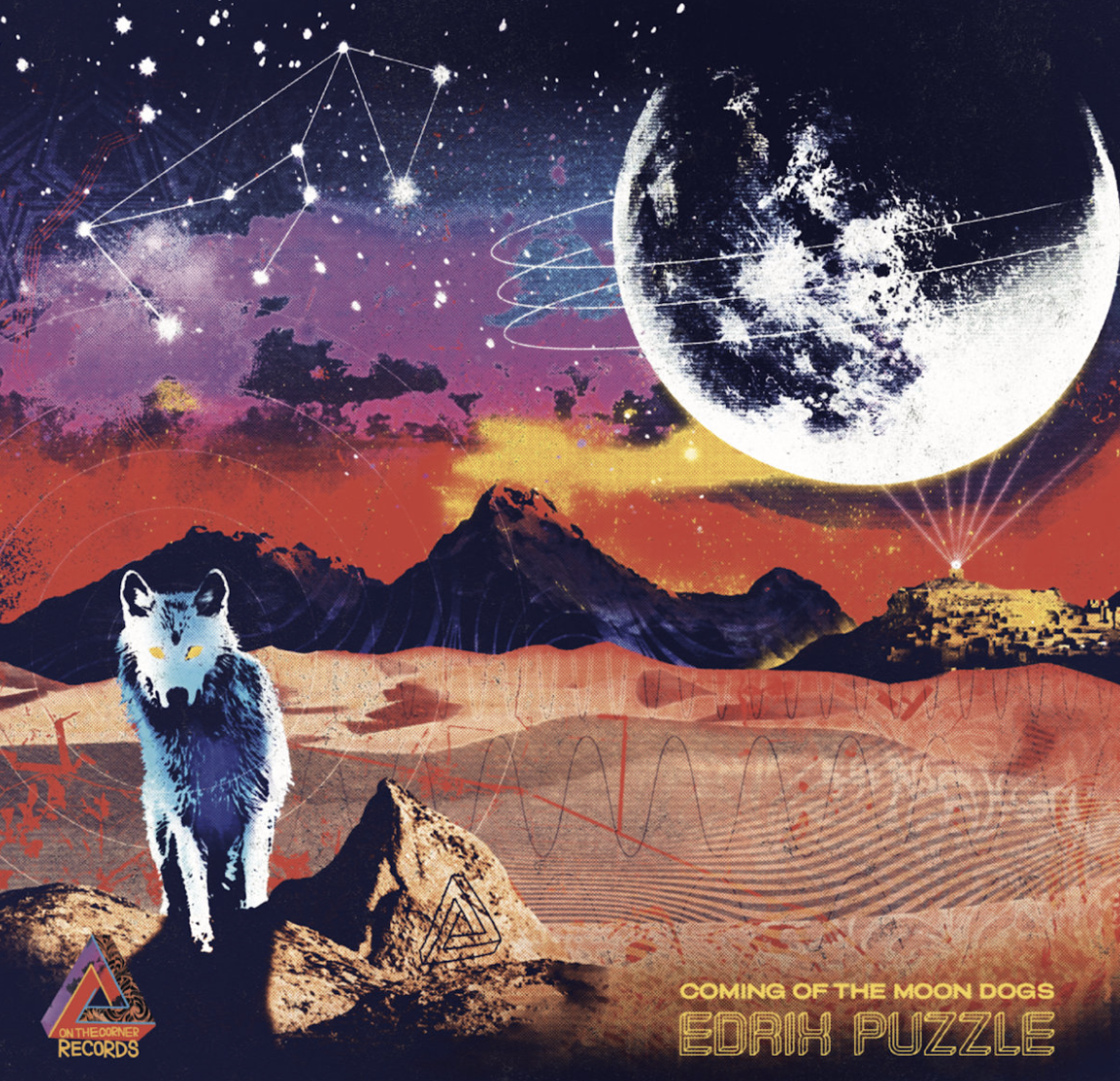
Looping string theory jazz particles to a rocket ship bound for a deep space cosmology of titan referenced stellar sets, the Nathan “Tugg” Curan led Edrix Puzzle ensemble find a musical freedom amongst the stars of an alien concept world on their newest trip, the Coming Of The Moon Dogs.
Reimaging Herbie Hancock’s Mwandishi transferred to the made-up body-locking Afro and futurist jazz planet of Battagon, Curan and his astro crew of Martin Slattery (on bass guitar, clarinet and saxophone duties), Tom Mason (double-bass), Oli Savill (percussion) and Darren Berry (violin) zip and zap across a lunar environment overseen by a galactic vision of mythology’s Gia and Uranus and some of their kin: Rhea, Dione, Hyperion and Phobe.
Amongst the analog calculus, signals and bleeps an equally elastic and moon-bound tripping transformation of the Art Ensemble of Chicago vibe takes shape on an imaginative off world. It’s a world in which Afrikan Sciences break bread with King Crimson; where Soweto Kinch reassembles the late Pharaoh’s astral projections. Within that science fiction the troupe balance totally untethered chaos with breakbeats and a certain swing.
David Ornate Cherry’s organic water bowl percussion joins a celestial voodoo march on the old country resonated Art Ensemble fiddled ‘Deep In Dione’, whilst Matthew “Doc” Dunn and Andy Haas slink and waft the vapoured murk of the living, breathing ‘V11’ coded suite.
Tracks like the time changing spin around the Van Allen Belt ‘Unhuman Hyperion’ verge on hip-hop. But it’s the imbued spirit of Herb, his peers and acolytes in the space, progressive jazz field that permeate this alchemist exploration of far out atmospheres. In a constant motion throughout with the energy released in all directions, and on all planes, Coming Of The moon Dogs is an incredible survey of quickened and more floated, waning galactic jazz evocations. A solid piece of art, lit by a remote chemistry and performed with assured but always probing musicianship. Rather an escape to the planet of the breaks than an escape from it, sci-fi jazz meets the experimental, spiritual and progressive in a visceral explosion of ideas, vibes and grooves.
Surya Botofasina ‘Everyone’s Children’
(Spiritmuse Records)
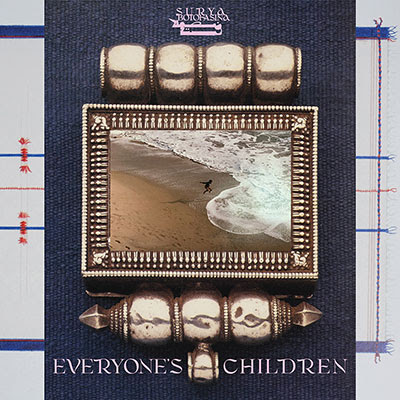
An acolyte of Alice Coltrane’s devotional embrace of Eastern spiritualism, imbued by that sagacious innovating jazz seer’s afflatus music and teachings, the keyboardist, composer and actor of some repute (from parts in Vinyl and Broadwalk Empire) Surya Botofasina bathes in his mentor’s light on this debut opus.
With the meditative, motored ascending arcs of Om Rama and such threaded throughout, Botofasina and friends set out on an astral and naturally felt work of spiritual jazz, trance, new age and ambient transcendence.
Our guide on this album of worship, remembrance and healing grew up at the Sai Anantam Ashram in the Southern Californian hills, where Coltrane led the daily bhajans, the traditional Hindu songs of praise and paean. His mother, Radha, was a disciple before him of this idyllic retreat’s guardian, a notable harpist but also pianist and vocalist herself and a one-time member of the American string band, The Spirits Of Rhythm. With such an enviable musical lineage and influence it’s no wonder that Botofasina would go on to become the Ashram’s music director and to internationally spread the word of this particular devotional form.
Encompassing all that reverence on his first fully realized album, Botofasina, aided by a cross-generational cast of guests, seeks to calmly honour but also demonstrate that faith. As a album to these enraged, divisive times, Everyone’s Children – with everything that album title’s metaphors, allusions, analogy entail – perseveres in the face of turbulence; softening and weakening the choppy waters in a blessed light of disarming but deeply felt warm suffused elevation.
With a both sentimental and yearning new age language of utterances from the Los Angles jazz singer stalwart Dwight Trible and fellow Californian indie folk vocalist Mia Doi Todd welling up and adding a certain wailed gravity, these divine acts of veneration ascend at a peaceable pace. The opening beachside temple suite running to over twenty-seven minutes as it shimmers and glistens with dappled electric piano, a serene air of the holy and washes of ambient synth.
Although often soothing with lightened touches of astral plane jazz and soul music, Botofasina’s piano occasionally stirs up outpourings of louder and harder pressed expressive emotions and serenades – as on the semi-classical and 60s jazz riptide evoked ‘I Love Dew, Sophie’.
Accentuating these spells of keyboard cascades, lit-up bulb like notes and rays the Canadian jazz drummer Efa Etoroma Jnr. adds splashes and tumbles, and the New York saxophonist Pablo Calogero wafts in with a suitable longing embrace. And overseeing it all is the Californian polymath (from noted producer to radio host, poet, percussionist and performer) Carlos Niño, who resembles a counter-culture 70s Carl Wilson chic. Together on this swami dedicated odyssey they border the heavenly as successful inheritors of Alice Coltrane’s devotional magic. As a debut album it’s a grand statement of spiritualism, nature and peacefully ascendant jazz; an escape from the material world.
Etceteral ‘Rhizome’
(tak:til/Glitterbeat Records) 11th November 2022
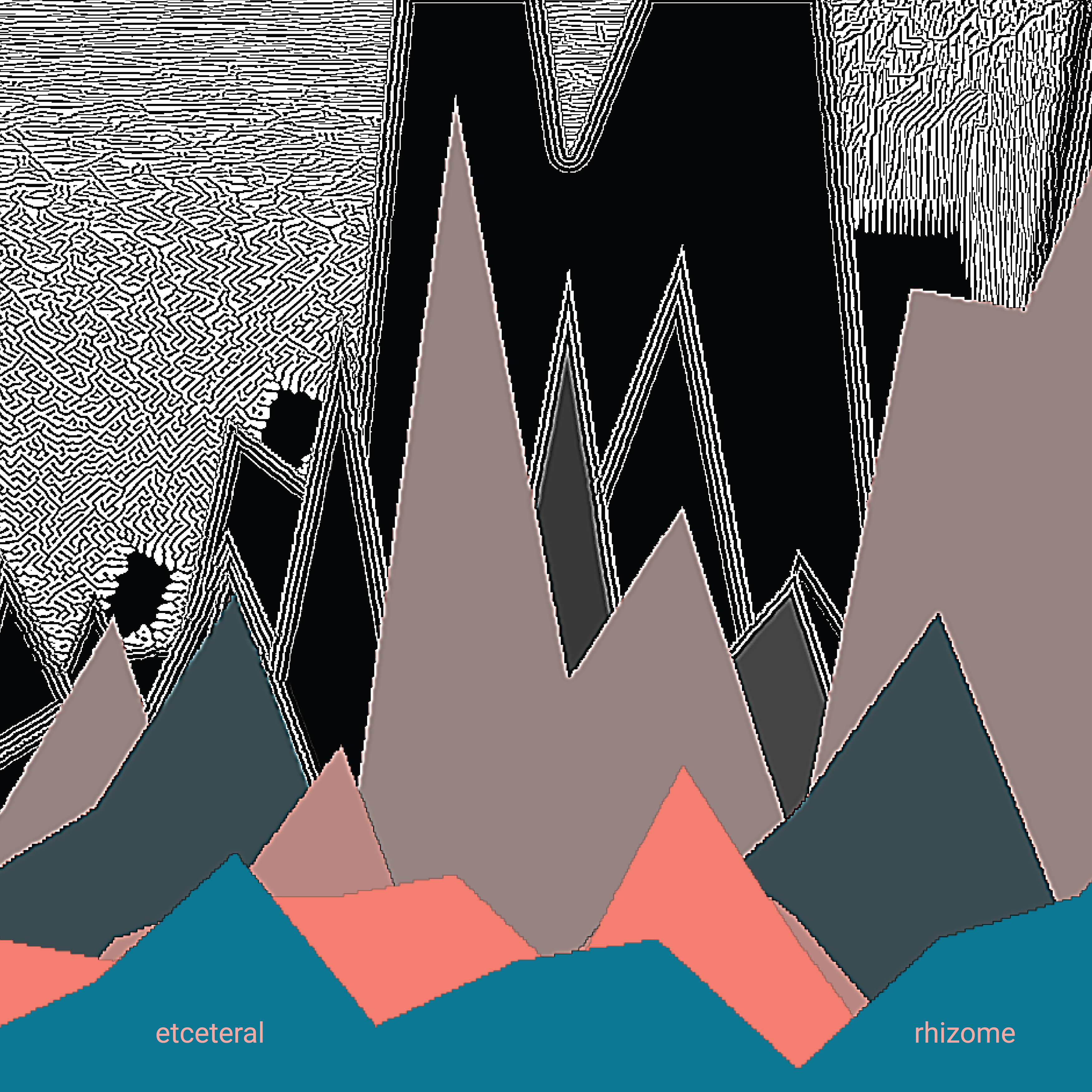
In what is a different, unique fashion, the Slovenian trio’s musical pairing of Boštjan Simon and Marek Fakuč (in part) react to their bandmate Lina Rica’s visual stimulus to create a cosmic electronic-jazz album of interlaced networks, connectivity and environmental crisis alarm.
Joining their fellow Slovenian compatriots, the dream-realism Širom, at Glitterbeat’s explorative, fourth world imbued instrumental sister imprint tak:til, the kosmische and organically freeform Etceteral base their new, mostly improvised album on the concept of its title, Rhizome: A continually growing horizontal underground stem, which puts out lateral shoots and adventitious roots at intervals; a non-linear network that connects any point to any other point.
With that theme, process in mind the trio reflect back a constant motion of soundscaping, rhythm and probing; balancing, at times, contemporary jazz with computer calculus, data, signals and metallic polygon shaped electronica. Yet, whilst Simon’s saxophone often drifts off into space, and his electronic effects, undulations more than hint at gravity-free zones in the cosmos, tracks such as the rolling, bounced and techno purred ‘Rome Burns’ allude to climate change and the extreme wildfires that engulfed much of Europe this year. It’s a great piece of flexible jazz that fuses Donny McCaslin and Go Go Penguin with Basic Channel to reflect an environmental angst of doom – fiddling with your suv sat nav whilst Rome burns to a cinder.
The rest of this interconnected, visual reactive album of performances and electronic augmented pulses and fusions goes through varying degrees of warping and reverberating transference. A jazz foundation is guided through a mirrored and computerised apparatus, which evokes shades of Squarepusher, Anteloper, Alfa Mist, Pyrolator and (rather handle as they share this column this month) Edrix Puzzle. Familiar echoes of rasped, cyclonic and honked sax, drum breaks and splashes receive an outer space production. Fakuč’s drums actually go into slow motion on the chrome soundscape ‘Dunno’. Etceteral turn it on and out on their improvised odyssey and contortion of activism. And yet the rhythms often driven, progressive and on occasion buoyant or bobbing, make this a most unique sort of an electronic dance album, despite its avant-garde, free and cosmic jazz foundations.
Karu ‘An Imaginary Journey’
(Beat Machine Music) 18th November 2022
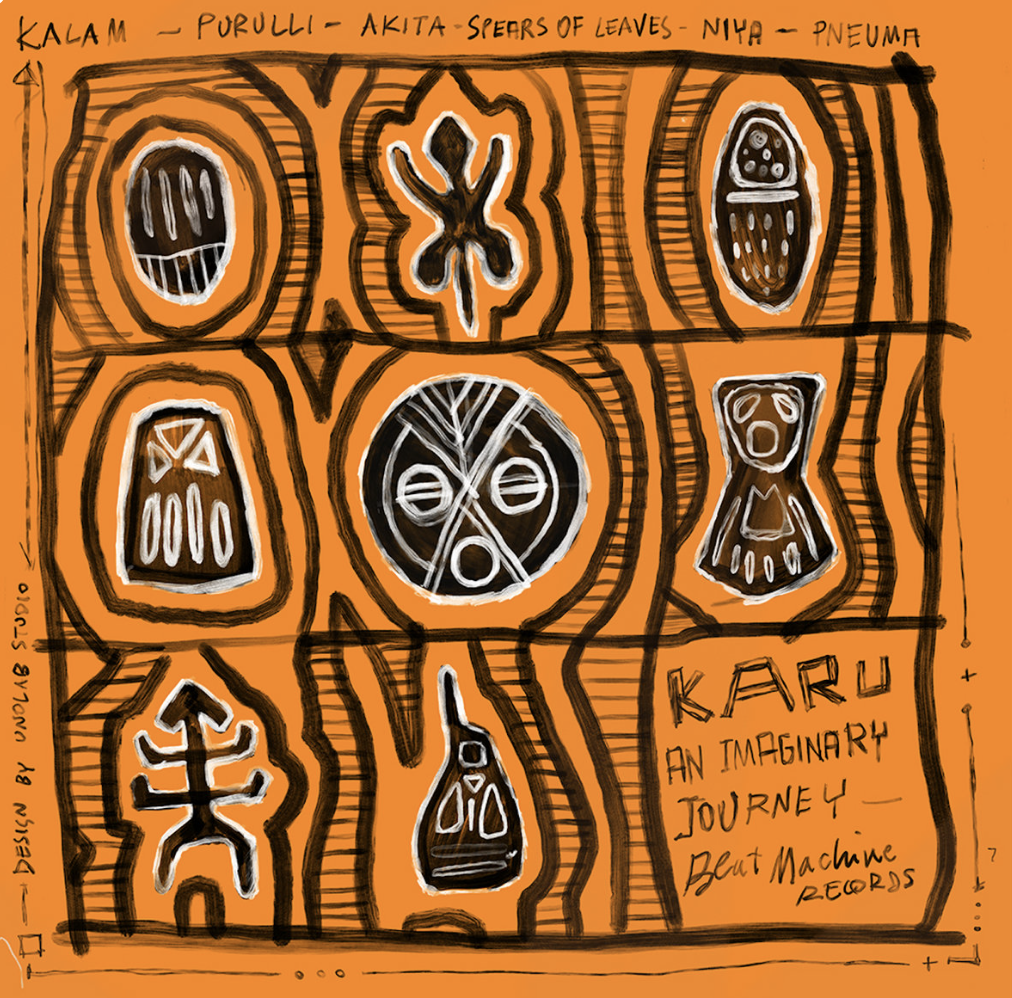
Lost in the Karu alias of mystical, atavistic mining and reimagined absorptions and traverses, the Italian double-bassist and producer Alberto Brutti’s collaborative project transforms, transmogrifies a fertile polygenesis palette of rituals and dances and ethnography to produce a contemporary affected album of Afro-Futurism, jazz and primitivism.
Wrapped up into a musical journey across both familiar and more ambiguous, vague cultural landscapes, Brutti creates suggestive atmospheres and ceremonies; many of which are conjured from title references to old worlds, religious and mythological etymology. In that wide field of influences, inspirations there’s the Abrabic “kalam”, which can roughly be used to mean “speech”, “word” or “utterances” pertaining to the Islamic faith, but was also the catchall term to define that religion’s tenants of faith in the face of the philosophical doubters; the antiquity Hattian empire festival “purulli”, held at the Bronze Age settlement of Nerik, dedicated to the earth goddess Hannahanna (which may well be the source of the Biblical “hosanna”); the West Slavic (otherwise known as Lechites) tribal name for the chthonian god “Nyia”; and the ancient Greek word for “breath”, or in the religious context, “spirit” or “soul”, “pneuma”.
The first of that quartet lends itself to the album’s opening peregrination of African drums, Blacks’ Myth and cut-up Anthony Braxton, Roscoe Mitchell jazz renderings, reversals, abrasive industrial resonated sounds, Širom type otherworldly primitivism and stick choppy rhythms. Following in its wake there’s signs of Andy Haas, the esoteric, elephant trunk raising horns and the no wave sound of Mars and Milk TV. The latter title of that same quartet of wordy mentions signals a move further East, with again, vague notions of the Indian, Baul but also a soundtrack of downtempo breaks (ala Alfa Mist and J Dilla) and the hallucinogenic trance of Fursaxa (if remixed by Clap! Clap!).
‘Spear Of Leaves’ however, rearranges the bedeviled Faustus pact blues and dialogue of Robert Johnson on a palanquin caravan lumber across vapours of snorkeled saxophone. The final dream sequence on this imaginary travelogue drifts into a hollowed-out cane spun and fluted rainforest wash; ending on a more laidback piece of South American flavoured geography and waning jazz.
Between the haunted illusionary and mysterious, a removed time-travelling worldly plane emerges. Herbs, Roberto Musci, Amorphous Androgynous and Drexciya converge somewhere in the middle of the underworld and elevated.
The Dark Jazz Project ‘S-T’
(Irregular Frequencies) 14th November 2022
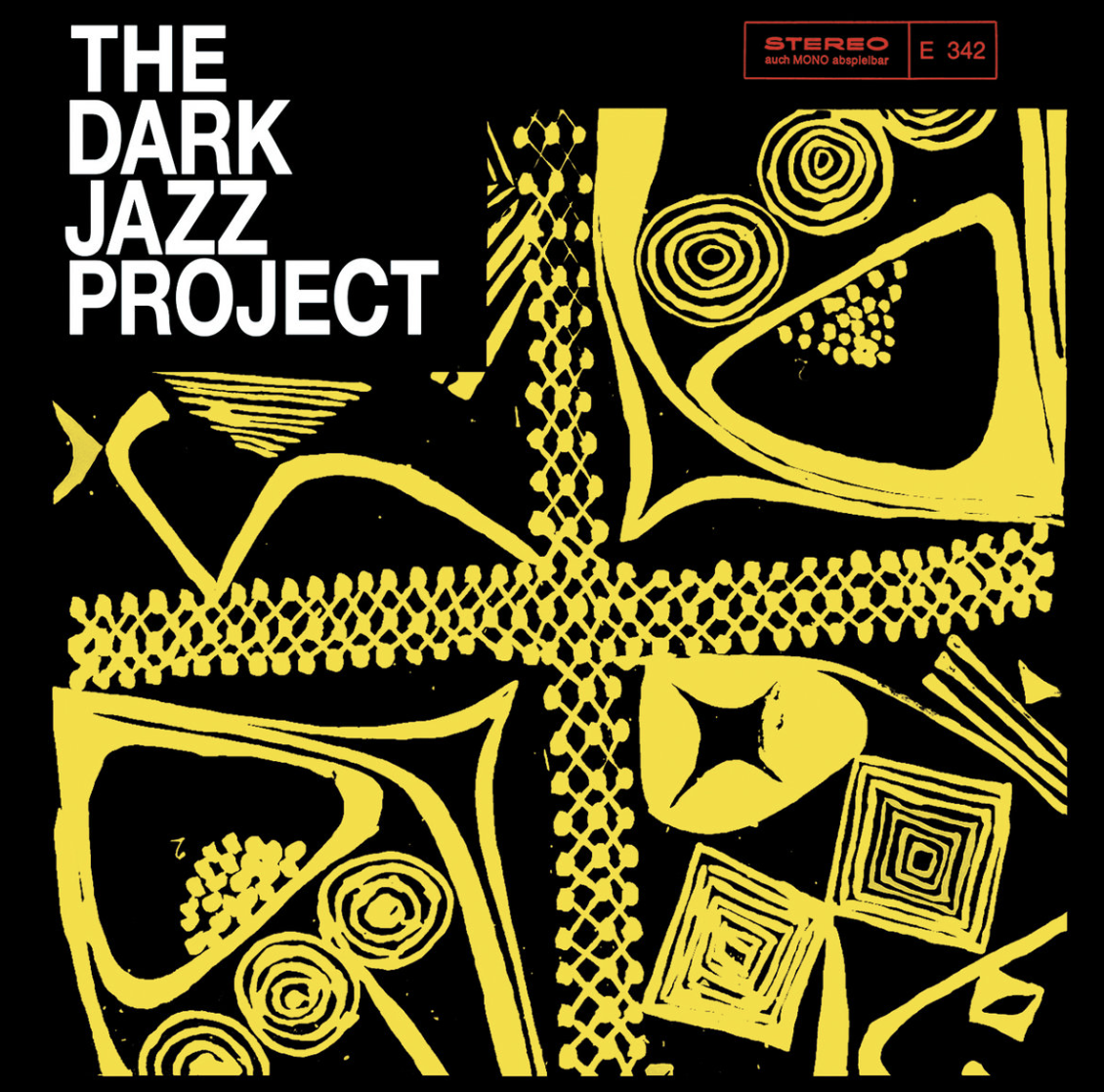
Making good on this summer’s three-track introductory EP, Andrew Spackman now unleashes a whole album of his latest regeneration creation, The Dark Jazz Project, on an unsuspecting audience.
The singular maverick electronic and art-house boffin recently hung-up his SAD MAN alias (after a splurge of numerous releases over the last five years) to crunch the codes of jazzcore.
‘100% political, 100% jazz, 100% dark’ we’re told, this latest platform for Andrew’s often sporadic leaps in electronic music and crushing techno filament cut-ups is about as removed from that jazz tag as you can get. The fact he’s also borrowed Sun Ra’s ‘Space Is The Place’ mantra too only feeds into the confusion. Any semblance to jazz is lost under a heavy tubular and granular transmogrification of the ominous, mysterious and, well, dark.
For this is the alien, sci-fi broken and fed through the Aphex Twin, Basic Channel, Radium, Rob Hood, Jeff Mills and Niereich & Shadym machine. Although the album’s opening hardline, dialed-in and pummeled beat gabbling Sun Ra lend sounds like Holly Herndon being thrown into the Hadron Collider, and Madlib seems to get trampled over, detuned and dissimulated on the bladed, driven and compressed frequency lunar ‘No Input’.
Andrews full gamut of skills, sonic palette comes to bear, as touches of primal, and even paradise moulding scores are set against more dissonant and chrome coated beats. Pins rain down on pulsating graphite spiky landscapes and imaginative darkly lit techno blocks of scrunched giant, weighted noise. A mirage or a topographic ocean; Olympus Mons or scorched earth, it all sounds a million miles away from even the most edgy and freeform ideals of jazz: not a saxophone in sight.
The Dark Jazz Project is yet another challenging move from one of the UK’s most inventive, inspired and, crucially, interesting leftfield electronic and techno composers of the last decade.
Yemrot ‘The Sunken Garden’
(PRAH Recordings)
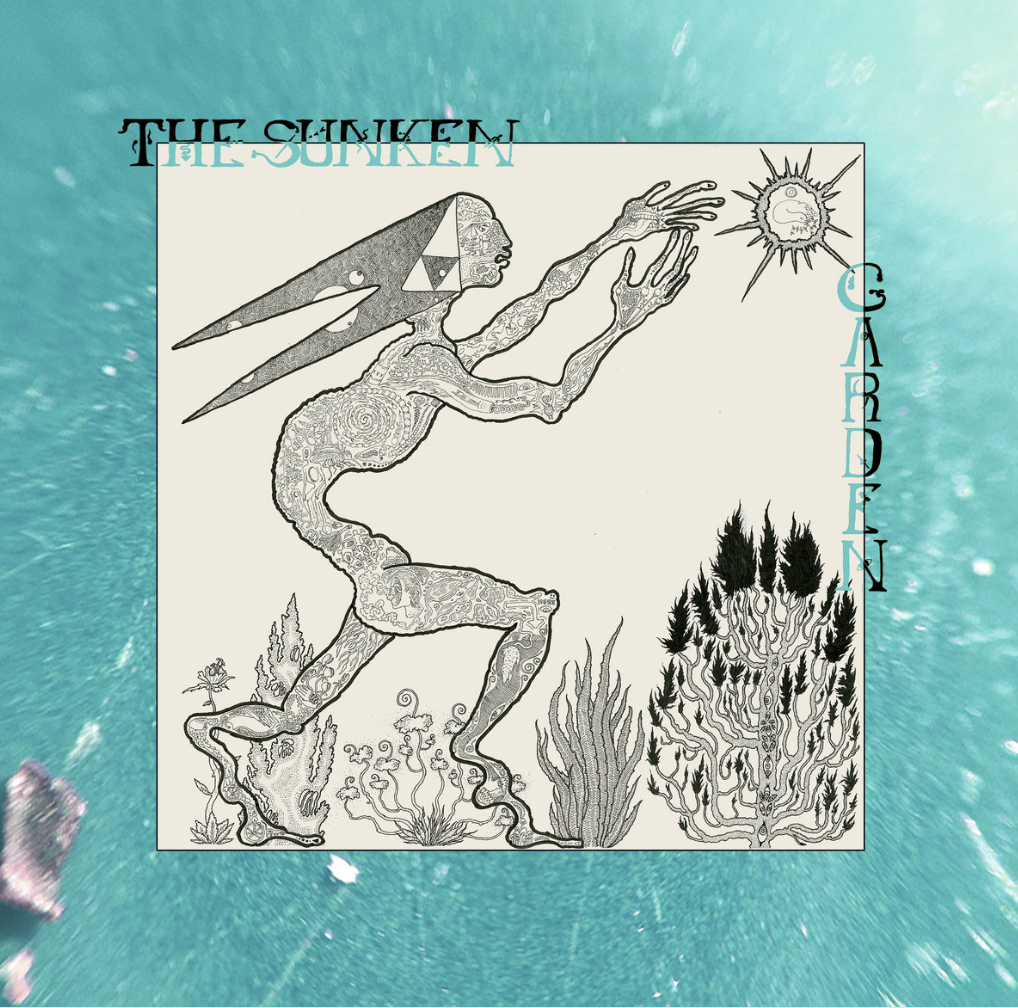
Who wouldn’t when faced with the despair of the modern world and in processing the deep loss of a parent want to take a giant leap into escapism and the fantastical? Looking into one such yearning chasm the Margate-based musician Jimi Tormey, acting under the alias of both Yemrot and the character Dill Dandin, finds solace in a neverworld of the dreamy and plaintive: a creeping sadness to be exact.
Unfortunately, in part, triggered by the death of his father (the gorgeous, welling-up and heavenly ached ‘Big Tree’ being the most obvious eulogy to that passing) The Sunken Garden is a both heartfelt and also psychedelic process of grief and some drama.
That process is, at times, a family affair with his mother Lisa providing the majority of emotive violin/viola, and his brother Eric offering harmonies alongside their sister Tuli, but also mixing and mastering the whole mini album. The results are achingly beautiful, yet there’s a constant deep feeling and vapour of unease, despondency and shadowy despair that swells up or looms over the magical illusions.
Canterbury scene troubadours and Syd Barrett influences wind and delicately emerge from the heavier atmospheres of Alex Harvey, Daevid Allen, Soundgarden and Radiohead. The album’s centerpiece, ‘The Ballad Of Dill Dandin’, is an eleven-minute stretching instrumental of changing, moving parts and passages. From the Floydian to chimes of Mark Hollis an almost theatrical drama and shimmer of something magical and creates a starry aura. Dill floats and tumbles across a trio of “Learning To” affixed songs that balance the soft with the harsh, the cosmic with the mournful.
Classical forms, the psychedelic, progressive and alternative all merge to form an interesting twisting journey of loss and acceptance; a working through of beautifully heart wrenching and articulated poetic expression. In the end I don’t think that sinkhole world is an escape route, but just a more imaginative coping strategy at dealing and conveying such miserable times. The masterful, gentle ‘Big Tree’ alone will move even the most numbed to tears, and deserves a place in any list of the best songs in 2022.
The Magic City Trio ‘Amerikana Arkana’
(Kailva) Late November 2022
Finally out the other side of the pandemic The Magic City Trio emerges with the second half of their originally conceived double album package of Americana, Country and Western scored songs from 2018. If part one was consumed with death, bad luck and mental health, part two is concentrated on the themes of serenaded, romantic affairs, with disarming little tales, alms, hymns and barn dances dedicated to both unrequited and strained relationships and knockabout love.
As with the previous album, a familiar soundtrack and language, lyricism is used to convey the contemporary: something of the moment. The bell tolls and tremolo rattle snake sets of Ennio Morricone and untold Western themes rub up against Nashville, the Carter Family, Lee Hazelwood, Mariachi brass, Willie Nelson and the psalms songs of America’s Methodist Church, yet this is an unmistakably modern record. Timeless feelings, subjects nonetheless, but with a slight updated twist.
An extended guest list joins the band’s principles, the June Brides’ Frank Sweeney and Annie And The Aeroplanes’ Annie Holder. Most notably the Nashville virtuoso John Heinrich, who lends that irresistible steel pedal quiver and upward bend to the Sweetheart Of The Rodeo if covered by Teenage Fanclub, with Orbison and The Carters in tow, ‘Our Life In Chains’, and the Red Rhodes-esque accompanied Gram and Bonnie Raitt in heartache duet ‘She Left Without A Warning’. “Record breaking” (for what I’m not sure) banjo player Johnny Button meanwhile adds his Appalachian hoedown spring to ‘The Final Day On Earth’ tale of woe and alarm. Also on that same lamentable group effort, Primal Scream’s Andrew Innes offers up bird sounds, flutes and mellotron. He’s back, playing both electric and acoustic guitars, on the Muscle Shoals Stones like, touching ‘You’re My Best Friend’ – which actually could be a Primal Scream attempt to once more ape the Stones’ spiritual washed-up tides.
Frank, when not carrying a tone and timbre that evokes both Richard Hawley and Mick Harvey, and Annie, vocally a mix of Kirsty MacColl and a rustic Marianne Faithfull, share an array of twanged, bowed and stirring and washboard scratched instruments with Jeff Mead, Matt Lloyd, Larry Saltzman, Dave Howell and others: a full panoply of the country sound.
Amongst the self-penned declarations, hungdog lovelorn regrets and outlaws-on-the-run sense of rebellious romance, the band cover the theme from the archetypal thrown-together-in-desperate-circumstances Western ‘3:10 To Yuma’ (great movie, both the original and remake) and the Wesleyan Methodist church hymn, ‘And Am I Born To Die’. The first of which, originally penned by Frankie Laine, keeps a sense of the matinee drama and atmosphere but now sounds a bit like later Crime And The City Solution bounded together with Scott Walker (At The Movies) on a heavenly aria touched dusty trail. The latter, is every bit as reverent and elegiac, conjuring up the “trembling spirit” and quivering to the sounds of timpani and the bells of judgment. It did remind me however of Rick Danko; more lovely than stoic serious damnation.
Amerikana Arkina once more sets the mood, a complimentary partner to their more moody, plaintive 2018 songbook. Souls are bared; heartache delivered with a cinematic panache, and the Americana cannon once more successfully invoked.
Leverton Fox ‘In The Flicker’
(Not Applicable)
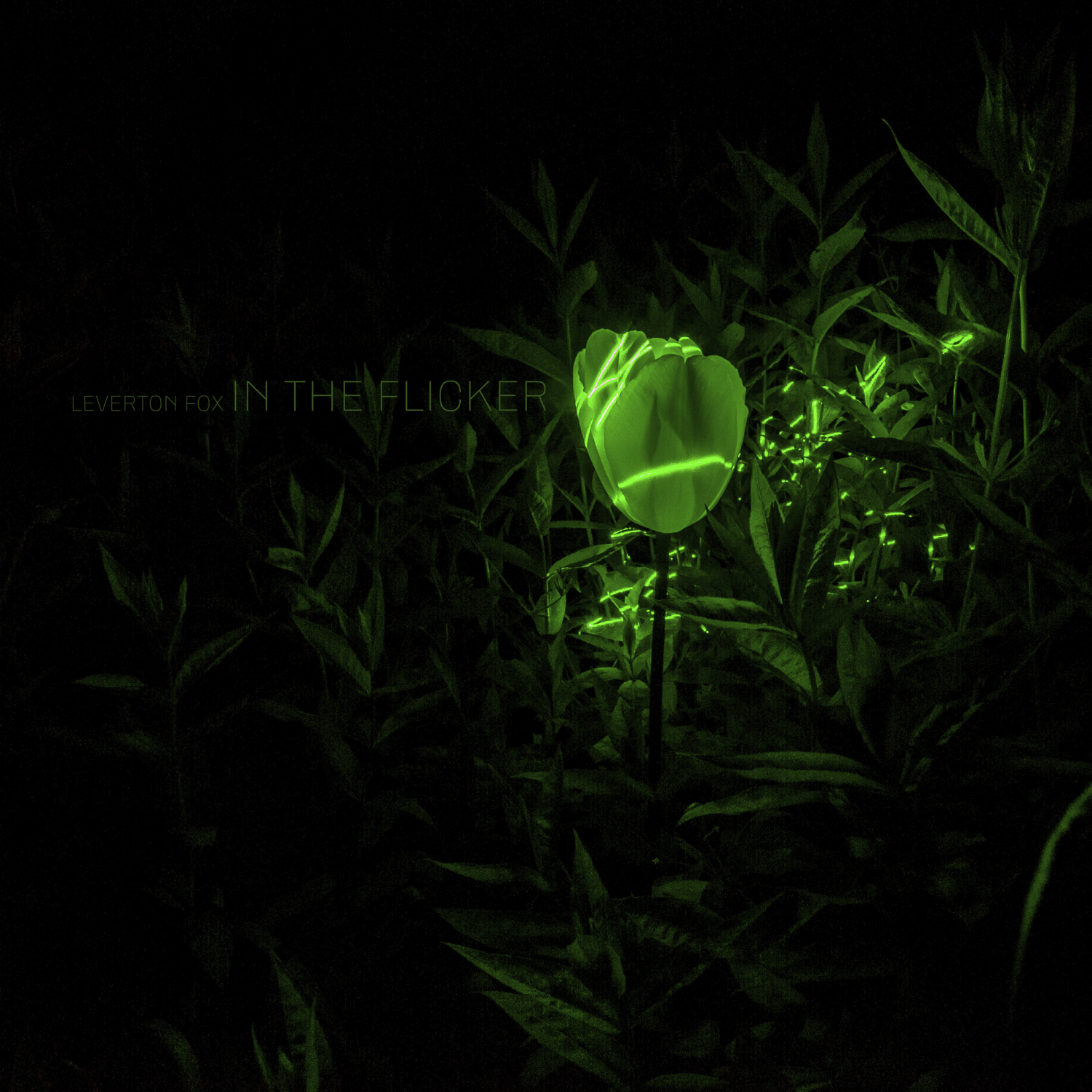
The gentle breeze rustling through the leaves and the sound of bracken and broken sticks underfoot in a less circumspect Sussex woodland has seldom sounded more alien, inter-dimensional and mysterious. Yet the Leverton Fox trio of Alex Bonney, Tim Giles and Isambard Khroustaliov has transmogrified the environment/atmosphere of their site-specific improvisation to beam out towards altogether more imaginative realms.
Intensified, if that’s the word, the trio of noted musicians/composers/artists in their own right attempt to sonically sculpt a 3D world with the added use of Dolby Atmos, a ‘surround’ format. Immersive being the key word, they draw the listener into lost worlds, primal soups and a more eerie lunar looming, time-travelling spheres.
Širom set-up in the undergrowth with Miles Davis at his most transient and wafting, Autechre, Tangerine Dream and Jon Hassell as ghostly traces of hidden sources merge with various aerial squiggles, zip-lines, machine purrs, occult sounds beamed from the Fortean Times transmitter, whipped up winds, clapped beats, crackles, raps, propeller and exotic sounding wildlife. A fully improvised soundscape that crosses mystical terra firma and unearthly corridors, In The Flicker takes in the most far-out, minimalist touches of jazz, electronica, dub, the dark arts, industrial, kosmische and Foley to create a certain mystique. The Leverton Fox(es) skilfully, intuitively explore and push a concept, conjuring up portals to more abstract planes; the familiar woodland site a mere jumping point for misty and bubbling invocations of an entirely different nature.
Dead Horses ‘Sunny Days’
(Maple Death Records) 14th November 2022

Jangling to a soft-stomping flange-induced country, rock ‘n’ roll bluesy acid dirge the Dead Horses esoteric sense of despair rings loud with slackened melodrama and scuzzy, dirty wiles. Whether it’s uprooting Spaghetti Western sets or up amongst the Andean condor nests looking down on the Nazca Lines, or, wading through swamps and thumbing a bum ride to a less idealized Laurel Canyon, the shared male/female vocal Italian group add a chthonian mystique and a touch of the Gothic to their brand of wrangled malcontent and doomed romantic aloofness.
A fair share of the new album, Sunny Days (released on the always intriguing and quality-delivered Maple Death Records label), rattles, spooks and melodically inhabits a reverberated atmosphere of Appalachian mountain songs and both languid and more heightened hysterics. A rewired Grace Slick, early Bad Seeds, Gun Club, Wall Of Voodoo and ‘Up The Hill Backwards’ Bowie flail about The Blood Meridian on the album’s opening song, ‘Can’t Talk, Can’t Sleep’, and Bosco DelRey mixes it up with the Velvets, Rey Crayola on ‘Hobo Talks’. The more mournful ‘The Cross’ has both an hallucinatory and The Kills vibe about it.
One of the standout songs however, takes a different direction. ‘Macabro’ still has that acid-folk country kick but also summons up a Latin drama, with a stirring vocal performance and Italo-Iberian stamp of bolero. Apparently this is the band’s first ever song in their native Italian tongue, and it’s all the better for it: more mysterious and hot-bloodily intense. No wonder it has become a sort of live anthem for the band.
It’s a long stretch from the Po Valley of antiquity to the Death Valley of inspired, mirage shimmered Western blues, but the Dead Horses as our guides navigate it with a flourish and macabre curiosity. If Crime And The City Solution buddying up with Aguaturbia and The Vaselines sounds like a desirable description then the rather ironically entitled Sunny Days stunt ‘n’ stomper is for you.
Biensüre ‘S-T’
(WEWANTSOUNDS)

Bringing together a mixed Mediterranean and Middle Eastern diaspora of musicians with a collective sense of belonging and yearn for their homelands, Biensüre transduces various cultural threads into a sophisticated and cool production of electro-pop, disco and sorrow.
Crossing paths in the cosmopolitan port city of Marseille, a refuge for centuries of émigrés and exiles, the group’s ranks include Kurdish, Turkish, Italian and Armenian lineages: The latter as a consequence of the early 20th century genocide. Within that gathering of cultural affiliations, and using the repurposed French expression for “of course”, Biensüre rally around the experiences of their poetically and longing yearned vocalist and saz player Haken Toprak. By the sounds of it that includes not just pining aches for his Kurdish-Turkish roots but declarations of unattainable love and serenaded exotic fantasies.
Already well into a contemporary revival of Anatolian and Middle Eastern synthesized pop, electro and disco (see groups such as Altin Gün and the Şatellites) Biensüre evoke such original trailblazers and icons as Erin Koray, Baris Manco, Moğollar and Kamuran Akkur. They augment those influences with subtle hints of Moroder, Vangelis, a throb of EDM and an unlikely bit of Nu Shooz on the drum-pad sizzled new waver ‘Çawa’.
Electrified misty veils hug the dancefloor, seductive movers are made, and swooned wanton vocals ache for what’s been lost on a unhurried smooth production that is simultaneously Turkish, Kurdish, Greek and Arabian in nature.
As funky as it is clean and lush, the Biensüre LP soaks up the great Marseille exile community and comes up with the goods. Breathlessly groovy yet casting back to the language (‘Zivistan’ the Northern-Kurdish word for “winter”) and memories of their ancestral homes, a nice balance is struck emotionally and musically between the modern and tradition. In all, a great pop record of Med flavours, with a soul and purpose.
Trans Zimmer & The DJs ‘S-T’
(Artetetra)
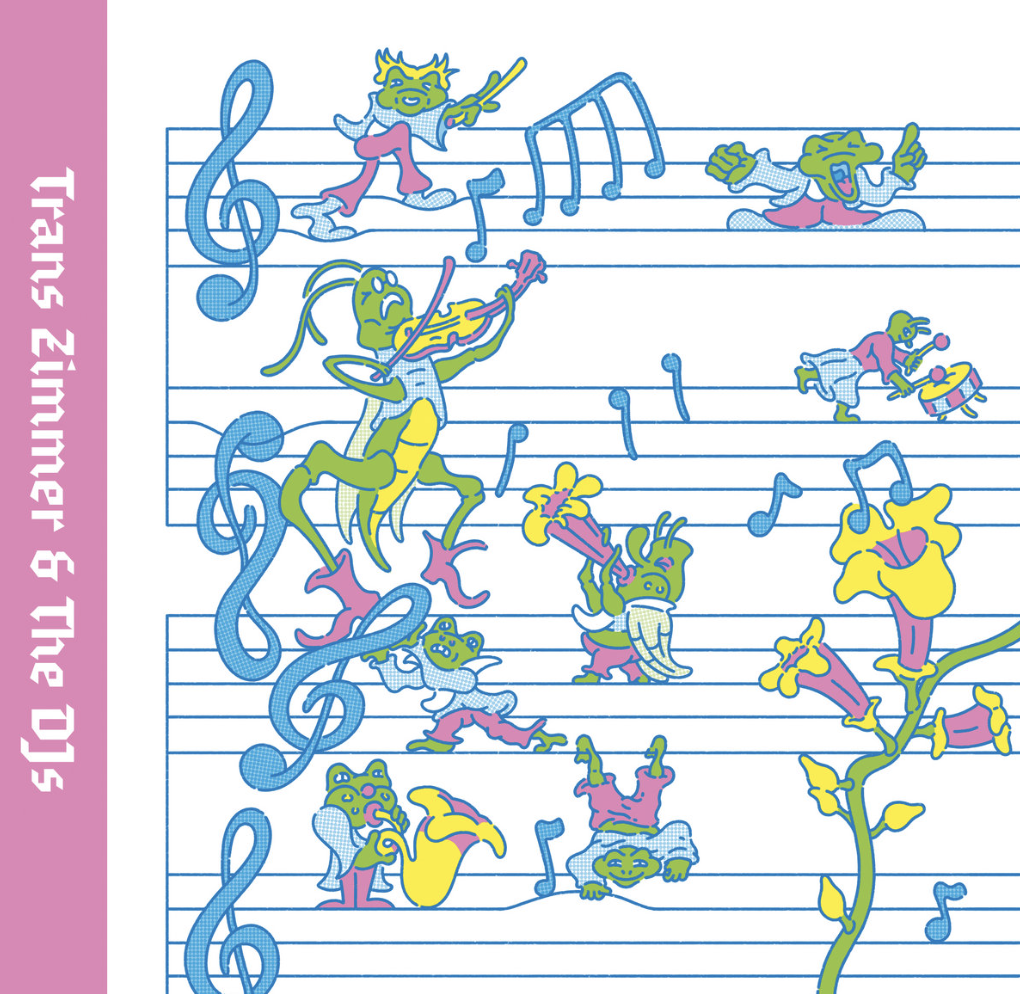
Launched into the most bonkers MIDI sound collage of platform hopping video game music, Esperanto era Sakamoto experimentation, slacker American dialogue, kooky fantasy and cartoon classical movements, the collective Trans Zimmer & The DJs (surely a play on the notable German film composer Hans) reimagine a Ritalin-starved Wendy Carlos running amok on Candy Crush.
Within the walls of a Taito/Capcom 80s arcade a loony tunes of polyphonic pre-set symphonies and chaotic snatches of gameplay chat trample over the course of a most silly bubblegum opera. It’s Baroque on speed; the Flaming Lips colouring in classical music scores; a grand misadventure of super hyped-up fanfares and cute vocoder J-Pop, hip-hop, electronica and lemon meringue pie snacks. Even aboard the S.S. Romulus the waters are choppy, tossing us around in a strange voyage of cult library music and late 90s American psych. I haven’t a clue what’s going on: not that it matters. The whole manic, yet always melodious and fun, experience seemingly a run through of the kitsch, crazy, miss-matched playful minds of those who created it. Skidding and scrabbling on a quest inside a 32-bit fantasy, Zimmer and friends level up across a most confusing, colourful whistle and skipped aural sinfonietta.
FOR THE FUNS
Casta ‘The Temple Of Doom’
(Bandcamp)
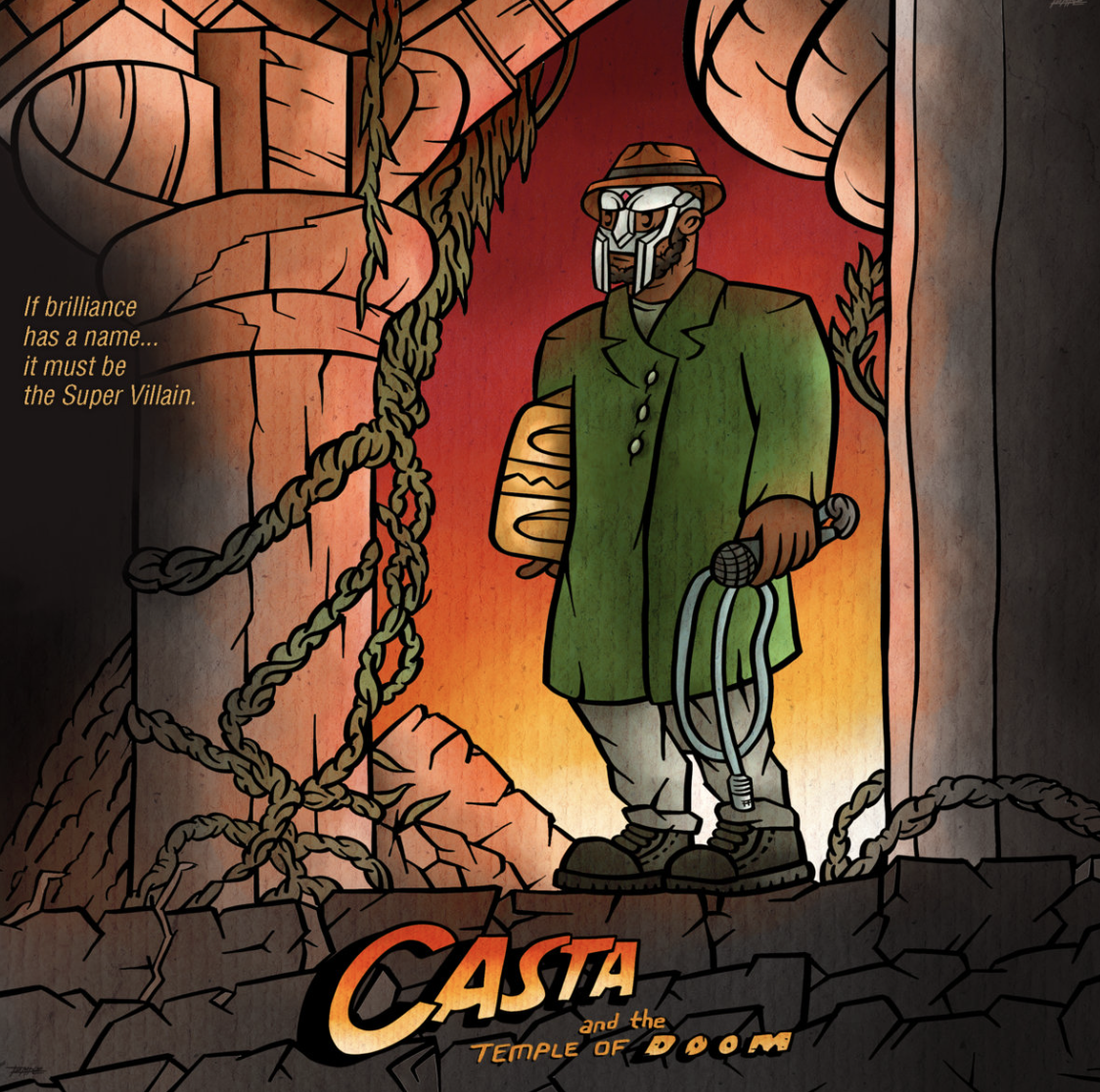
I suppose it was inevitable that at some point someone from the extensive late metal face villain and underground hip-hop genius MF Doom fandom would play on the Indiana Jones franchise – Indy literally escaping death in an airplane crush only to fall into the clutches of the Thuggee cult. I even named my playlist homage to the former Kausing Much Damage founder and prolific name riffing soloist, collaborator after the second Jones cinematic adventure myself. And I’m not alone on that score.
Released a year to the day of Daniel Dumile nee DOOM, Viktor Vaughn, Zev Love X’s death, the enterprising Portland producer Casta has merged the score from the Temple Of Doom with both samples and interview snippets from the MF Doom cannon: though it could have done with more Short Round quips in the mix.
In the spirit of such hip-hop mashups, with even Doom himself not adverse to sampling some cult, obscure and leftfield scores, Casta has some fun in paying tribute to a much-missed artist. From the Monsta Island Czars all-stars team-up to his work with a new breed of rap stars, such as Bishop Nehru, he leaves behind one of the greatest legacies in Hip-Hop: though his influence, creativeness, wordplay, pop culture, visuals and artwork reaches far beyond rap music, as this project proves.
Hi, my name is Dominic Valvona and I’m the Founder of the music/culture blog monolithcocktail.com For the last ten years I’ve featured and supported music, musicians and labels we love across genres from around the world that we think you’ll want to know about. No content on the site is paid for or sponsored and we only feature artists we have genuine respect for /love. If you enjoy our reviews (and we often write long, thoughtful ones), found a new artist you admire or if we have featured you or artists you represent and would like to buy us a coffee at https://ko-fi.com/monolithcocktail to say cheers for spreading the word, then that would be much appreciated.
Monthly Playlist Revue: October ’22: Muramuke, Marlowe, Voice Actor, Lira, Underground Canopy, Keep Shelly In Athens…
October 31, 2022
PLAYLIST SPECIAL
TEAM EFOORT/COMPILED BY DOMINIC VALVONA

Each month the Monolith Cocktail pool of collaborators search long and hard for the choicest of choice tracks; mixing genres and geography into an encapsulation of the last month on the blog.
That team includes me (Dominic Valvona), Matt ‘rap control’ Oliver, Brian ‘Bordello’ Shea, Andrew C. Kidd and Graham Domain.
You may have noticed since the summer that we’ve started compiling a Youtube playlist version, which includes extra bonuses from the No Base Trio and a seasonal treat from Escupemetralla plus some alternative tunes from the same artists on the Spotify list.
So without further ado, here is the October Revue:
And the Youtube version:
Full Track List:-
Montparnasse Musique Ft. Muambuyi and Mopero Mupemba ‘Panter’
Muramuke ‘Just One More’
Balaklava Blues ‘BEAT UP’
Marlowe/L’Orange/Solemn Brigham Ft. Deniro Farrar ‘Godfist’
Rockness Monsta/Method Man/Ron Browz ‘Beastie Boyz’
BeTheGun ‘Metropolis’
Lee Tracy/Isaac Manning ‘Love Is Everything’
Lee Scott Ft. Sly Moon ‘THE MORE I THINK ABOUT IT, THE LESS I CARE’
Voice Actor ‘Battling Dust’
Juga-Naut ‘To The Table’
Ernesto Djédjé ‘Nini’
Liraz ‘Mimiram’
Mehmet Aslan/Niño de Elche ‘Tangerine’
Underground Canopy ‘Space Gems’
Valentina Magaletti ‘Low Delights’
Carl Stone ‘Sasagin’
Tau & The Drones Of Praise ‘Bandia’
Keep Shelly In London Ft. Sugar For The Pill ‘Don’t Want Your Romance’
Librarians With Hickeys ‘I Better Get Home’
Una Rose ‘Partly’
Carla dal Formo ‘Side By Side’
Derrero ‘Long Are The Days’
Super Hit ‘Donde’
Rahill ‘Haenim’
David Westlake ‘English Parish Churches’
Cormac o Caoimh ‘Didn’t We’
VRï ‘Aberhonddu’
Tuomo & Markus ‘Highest Mountain’
Pitou ‘Dancer’ Dana Gavanski ‘Strangers’
The Zew ‘Come On Down’
Brona McVittie ‘Living Without You’
Brian Eno ‘These Small Noises’
Edouard Ferlet ‘REFLEX’
Rich Aucoin ‘Esc’
Puppies In The Sun ‘Light Became Light’
Short Fuze Ft. Dr. Khil ‘Love Letters To The Lost’
Loyle Camer ‘Speed Of Flight’
Ill Move Sporadic/Tenchoo ‘Amulet Chamber’
Atmosphere ‘Sculpting With Fire’
Ghoster ‘CRAME 4’
Clark ‘Frau Wav (Brief Fling)’
Verbz/Mr Slipz ‘Music Banging Like’
Jester Jacobs/Jack Danz ‘Opportune’
Darko The Super/Yuri Beats ‘Don’t Stay’
Open Mike Eagle ‘I’ll Fight You’ A.G. ‘The Sphinx’
El Gant Ft. DJ Premier ‘Leave It Alone’
Heavy Links/Luca Brazi ‘Complicated Theory’
Fliptrix, King Kashmere/Pitch 92 ‘Primordial Soup’
Shirt/Jack Splash ‘Death To Wall Art’
Smellington Piff/Ill Informed ‘Hard Times’
Hi, my name is Dominic Valvona and I’m the Founder of the music/culture blog monolithcocktail.com For the last ten years I’ve featured and supported music, musicians and labels we love across genres from around the world that we think you’ll want to know about. No content on the site is paid for or sponsored and we only feature artists we have genuine respect for /love. If you enjoy our reviews (and we often write long, thoughtful ones), found a new artist you admire or if we have featured you or artists you represent and would like to buy us a coffee at https://ko-fi.com/monolithcocktail to say cheers for spreading the word, then that would be much appreciated.
The Monolith Cocktail Social: Volume #70: Pharoah Sanders, Ros Serey Sothea, R.E.M., J Scienide, Genesis, Nicolini…
October 14, 2022
Dominic Valvona’s Eclectic/Generational Spanning Playlist

More or less the blog’s radioshow (minus any vacuous chat and clique guests), the Social is my ‘anything goes’ playlist selection of tracks I’ve played out, accumulated, come across or been handed over the last forty years.
Reaching the 70th volume this month, the choice tracks are every bit as eclectic, sometimes fun, and intriguing. I usually pay homage or doff my cap to those we’ve lost in that time, but also to those albums celebrating special anniversaries. In the former camp I couldn’t not miss the opportunity to say farewell to astral, spiritual and freeform jazz doyen Pharoah Sanders, including a smattering of personal favourites and a snatch of interview from the In The Beginning 1963-64 album.
In the celebratory mode, I’ve picked tracks from Prince’s 1999 LP (marking its fortieth anniversary this October), R.E.M.’s Automatic For The People (thirty this month) and Genesis’ Foxtrot (unbelievably a half century).
However, we kick off volume 70 with the Cambodian chanteuse Ros Serey Sotha and the electrified, hot-footing Orchestra Baobob from Senegal – we’ve already raked up the musical air miles with just those two opening acts. Added to that there are cuts from Annie Anxiety, Stelvio Cipriani, Platonica Erotica, Magic Mixture, Ill Biskits, the Jim Black Trio and more.
That Track List In Full:
Ros Serey Sotha ‘Easy Come Easy Go’
Orchestra Baobab ‘Kelen ati leen’
Pharoah Sanders ‘High Life’
Santiago Córdoba/Bauls Of Bengal ‘Tigres En Fuga’
More Eaze/Claire Rousay ‘kyle’
Annie Anxiety ‘Closet love’ Prince ‘Delirious’
Stelvio Cipriani ‘Bersaglio altezza uomo (Titoli)’
Universal Totem Orchestra ‘Codice Y16’
Platonica Erotica ‘Holy Holy’
Romica Puceanu ‘Multă Lume Noroc Are’
David Ackles ‘Surf’s Down’
R.E.M. ‘The Sidewinder Sleeps Tonite’
Nicolini ‘Snake Head Wine’
Algebra Suicide ‘Somewhat Bleeker Street’
NINA/Dean Blunt ‘grandiosee’
Paul Jacobs ‘After Dark’
Able Tasmans ‘Dileen’
Magic Mixture ‘You’
Flaming Ember ‘Livin’ High, Money Low’
’68 Comeback ‘Clean Yong 16’
Pharoah Sanders ‘Farrell Tune (Live In Paris 1975)’
Barney Wilen ‘Scorpion’
Ill Biskits ‘Let ‘Em Build’
Mic Geronimo/Murder Inc. ‘Time To Build’
J Scienide ‘Why Even Try???’
Between ‘Song For Two’
Genesis ‘Watcher Of The Skies’ Nick Garrie ‘Ink Pot Eyes’
Pharoah Sanders w/Sun Ra & Black Harold ‘The Shadow World’
Picchio dal pozzo ‘Cocomelastico’
Jim Black Trio ‘Next Razor World’
Dom Um Romao ‘Jungle Carnival’
Pharoah Sanders ‘Interview – Coming To New York’
Pharoah Sanders ‘Colors’
The Perusal #36: Liraz, Tau & The Drones Of Praise, Can, Montparnasse Musique, Carl Stone…
October 6, 2022
Dominic Valvona’s Reviews Roundup

A Glitterbeat Records Double-Bill:-
Liraz ‘Roya’
(Glitterbeat Records) 7th October 2022
With one foot on the nostalgic dance floors of, a pre-revolutionary, Tehran, Cairo, Beirut and Tel Aviv, and another, sweeping a fantastical Persian landscape, pop princess Liraz oozes passionate yearns and diaphanous delivered protestations on her third album, Roya. In the adopted Farsi-tongue that title translates as ‘fantasy’. And this latest harmonious Israeli-Iranian traverse has plenty of it; swirled in vaporous whispers, veils and the airy across matinée romantic swoons and the yearning.
It’s a fantasy in the fact that Liraz has once more recorded an album in a clandestine manner, with musicians from Iran in Istanbul – a flavor of that city’s age-old cultural wellspring is evident in the music. Out of the shadows of Tehran’s secret police and having to remain anonymous, this form of fantasy imagines peace throughout the Middle East and good relations specifically between Liraz’s ancestral Iranian and adopted Israeli homes. The daughter of Sephardic Jews who left Iran at a time of cordial relations with Israel, in the time since, both countries have locked horns in a both cold and hot war. Although being Jewish in what was once the heartlands of the atavistic Persian Empire has never been exactly easy, with persecutions going back generations and a millennia or three. And so the ensemble cast of ‘tar’ lute, wasp-waisted wooden Iranian flute, viola and violin players and voices have taken a big risk in fraternizing and making an album with an Israeli citizen; especially one of Jewish heritage. It probably doesn’t help that Liraz also starred as a Farsi-speaking Mossad operative in the semi-successful Apple TV espionage series Tehran. And in light of the tragic death of Mahsa Amini, demonstrations and civil unrest is being met with extreme violence and subjugation by the state. We could even being seeing the catalyst of regime change, with talk of what comes next, power and administration wise, daring to be aired and seriously challenged by a more liberal generation of young Iranians: such has been the outcry.
As an actor, now in the role of her life, Liraz builds bridges across those barriers as she imagines and retells in song the stories and yearnings of women silenced in Iran, banned from singing. A union is formed between a life and ancestry she can only be a part of in the Iranian diaspora.
Musically this translates into exotic sweeps, bouncy and retro disco zapped pop with a Middle Eastern suffusion of familiar panovison framed fantasies. With a swell and weeping of moving strings it could even be a musical reference to the classical strained beauty and lament of the Eastern European Jewish community – although Liraz’s ancestry is connected to the Iberian Sephardic Jews.
The album’s bookended by two versions of the title-track. The first is a lifting of veils Arabian Kate Bush, galloping up that hill of sand, the second, a tearful, stripped of electronics traditional and classical-bowed farewell. Between those points there’s an incredibly voiced stirring of disco, pop, psychedelic and Middle Eastern fusions; the near-halcyon against retro throwbacks to more liberated freer times in the region. Yet all thoroughly invigorated, refreshed and given a suitably contemporary electric feel.
Contouring the piques and lows there’s a dance of disco-funk (with even the fuzz whacker-whacker buzz of Fred Wesley & The J.B.s) and kitsch Franco-Arabian pop, soulful longing and Moroder-esque synth-electro pop. Liraz is all the while the perfect enchantress or moving vocalist, with a beautiful voice, cadence and articulation.
By far Liraz’s greatest adventure and sound, this is a fantasy with an all too real, alarming undercurrent of suppressed voices, forced to go underground in the act of creating some magical pop music. Please venture further than the myopic pop cliques and commercial output of the UK, America and Europe, as Roya is a stunning, sublime electro-charged album imbued with a myriad of forbearers from the Iranian, Egyptian, Turkish disco, psych, funk and balladry scenes of better times.
Tau & The Drones Of Praise ‘Misneach’
(Glitterbeat Records) 21st October 2022
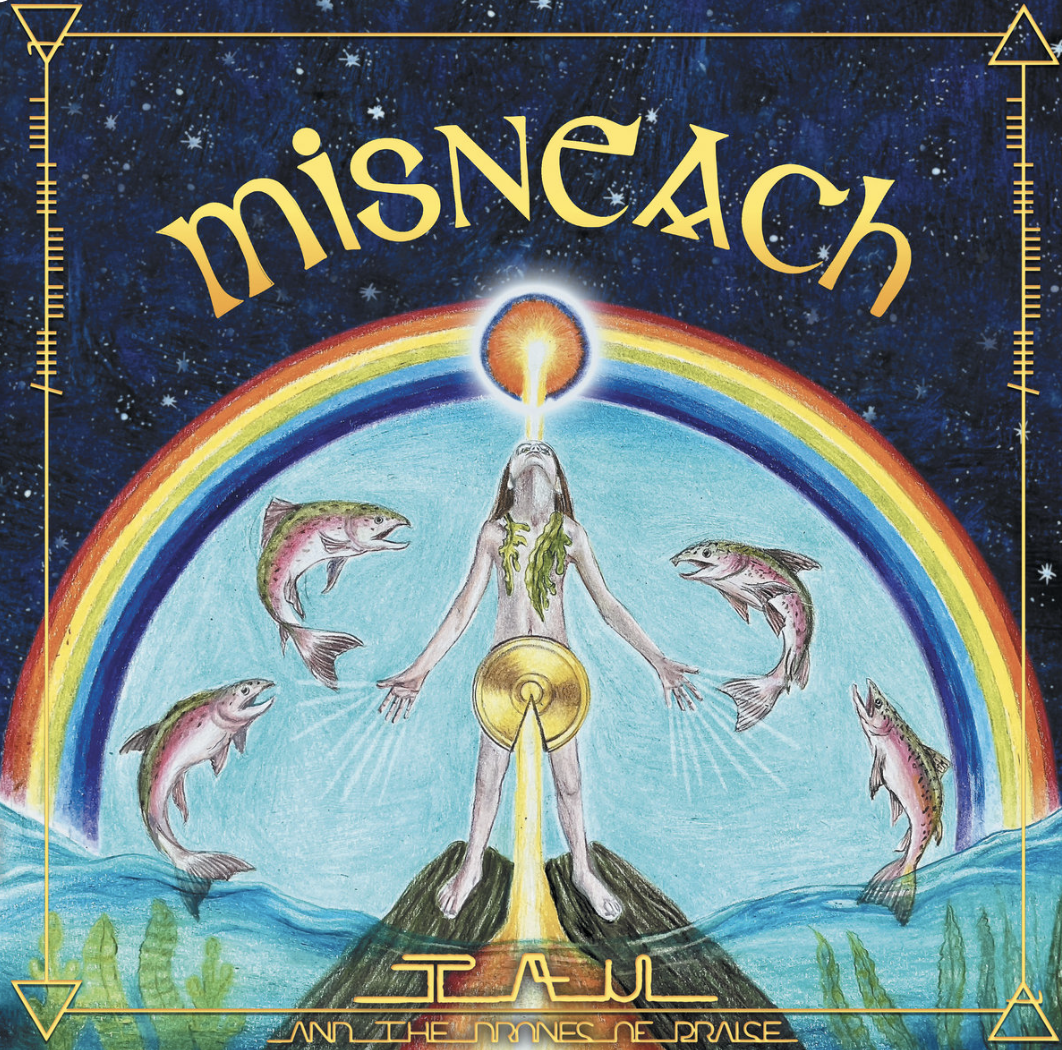
The second in a Glitterbeat Records double-bill and another fantasy-inspired spell of ancestry and magic, Seán Mulrooney’s led Tau & The Drones Of Praise band reconnect with their Celtic roots.
A return to an Ireland of myth, fables, enchantment and allurement, Mulrooney and his core of foils Robbie Moore (who also recorded this, the band’s third album, at the Impression Studios in Berlin), the Tindersticks’ Earl Harvin and Iain Faulkner (who ‘helmed additional recording at the Sonic Studios in Dublin’) are bolstered further by a large cast of musicians and voices. None more congruous and influential to the overall Celtic feel as the new age misty Irish veiled Clannad, who lend Damien Dempsey and Pól Brennan to this ensemble piece of folk and beyond theatre and reconnection.
Like a Mummers troupe, a merry procession, this harmonious bunch pay reverence to the tree spirits; homage to the ancestors; and fall at the feet of enchantress muses. With a concertinaed air of Breton, a Men Without Hats vibe and a singer who sounds like an Irish Michael Stipe or Alasdair Roberts, they invoke nature’s children making amends with the evergreen sprites on the opening, and brilliant, chorus call of alms, ‘It Is Right To Give Drones And Praise’.
From then on in we’re pulled into a world and across timelines: from atavistic Ireland to the Medieval, Georgian and Present. Old traditions via the folk-psych of The Incredible String Band, Pentangle and Sproutly Smith merge with the already mentioned misty-mystique of Clannad – but also their former ethereal siren Enya too –, The Polyphonic Spree, Flaming Lips and Octopus. Although the group’s lasting message and finale, ‘Hope’, reminded me of both Echo And The Bunnymen and The Mission. An atmosphere of bucolic wistfulness and idyllic idling prevail as the rhythm and soft marches change between the dreamy and courtly, the folksy and anguished. Always melodious in whatever realm, there is however a moment on ‘The Sixth Sun’ when the beautiful if longed female choral voices swim against a more wild, dissonance of noise. But that is the exception. Yet despite the challenges, the history Misneach (from the Old Irish lexicon, it translates as ‘courage’ and ‘spirit’) is a fantastical wilding, droning mélange of Celtic influences, the psychedelic, ancient and folk. And at its heart is a story of reconnection and an environmental yearn.
And A We Jazz Double-Bill:
Carl Stone ‘We Jazz Reworks Vol.2’
(We Jazz) 21st October 2022

Three years on and out the other side of the pandemic, my favourite contemporary jazz label is releasing a second volume of “reworks”.
The Helsinki label, festival and magazine has once more opened up its back catalogue to reinvention/transformation, inviting in the reputable and noted American artist/electronic composer Carl Stone to work his magic on another chronologically ordered stack of ten albums from their growing discography. Inaugural guest Timo Kaukolampi of K-X-P fame conjured up an ambiguous cosmic mix of We Jazz’s first ten albums on Volume 1 of course. And now Stone likewise takes familiar phrases, riffs, rhythms and performances somewhere entirely new and out there. Although both exciting and equally daunting, overwhelmed by a sizeable chunk of material at his disposal, Stone favoured intuition and feel over everything else. That process (re)works wonders as the already experimental and brilliant music of acts and collaborations like Terkel Nørgaard (his album with Ralph Alessi), OK:KO (Syrtti), Jonah Parzen-Johnson (Helsinki 8.12.18) and traces of 3TM, Ilmiliekki Quartet, Peter Eldh and Timo Lassy & Tappo Mäkynen are sent out towards the stars, expanse or morphed into gauzy states of untethered freeform hallucinations.
The opening circular-wafted peregrination ‘Umi’ is more like a mirage of snozzled and snored saxophone cycles, undulated piano and space vapours: Pharaoh Sanders, Donny McCaslin transmogrified by Brown Calvin on the edge of the Milky Way.
A suffusion of drifted, woozy and more hysterical horns, submerged double-bass runs and noodling sporadic and more rhythmic rolling, crescendo drums and ghostly tinkled, hazed piano is handled differently on each track. On the quickened to slow counterbalance timed skiffle and stuttered ‘Sasagin’ Zorn and Haas skit-scat and dream with Tortoise on the NYC underground jazz scene of the 80s, whereas the strange ‘Hippo’ sounds like some kind of Baroque holy ritual piece as reimagined by some kosmische act on Sky Records.
The action is often chaotic and in freeform discourse: like Chat Baker on speed or Oscar Peterson running out of notes. Yet somehow these transformations keep moving in the right direction; finding a rhythm and even a touch of melody on occasions. Avant-garde, free jazz, the cosmic and electronic converge on another alternative vision of the We Jazz catalogue. Stone creates some incredible, even beautiful, experiments; probing the ether, void and hyper-stellar realms of his imagination.
Say What ‘S-T’
(We Jazz) 7th October 2022
Shrouded with a certain mystery, the second We Jazz label release this month is tight-lipped in the information department. There’s very little to go on other than that this was a never to be repeated, existing just at that specific time in that arena (Austin, Texas’ Sonic Transmissions festival), performance, the trio’s defacto leader and saxophonist luckily names his bassist and drummer partners on this wild, contorted free jazz with a punk and no wave attitude recording. The Black Myths partnership of Luke Stewart and Warren ‘Trae” Grudup III join forces with our unnamed saxophonist across riled, spiritual funking, post-rock and avant-garde frenzy growled, swinging and dynamic performances. Taking no breaks, but sorted into seven Roman numeral marked tracks, the obviously versatile/talented trio turn our idea of jazz music inside out.
With the welcoming pleasantries out of the way we’re straight out smacked-up with a badass merger of Miles’ The Last Septet whomp, the sinewy rage of a wrangled Fugazi and the whelp, wail and manic expressive experiments of Roscoe Mitchell doing ‘Ornate’ doing Ornate Coleman, Sam Rivers and The Chicago Underground. That’s only the opening number. It gets even more free range and hysterical with Stewart’s blurred bass slides, crazy frictions and thick-stringed scuttles and slippery entanglements up against Grudup’s splashes, crescendos, tight rolls, slips and smashes all growing ever more experimental and probing.
Track ‘III’ finds a sort of strut and attitude with sax toots, trills and stresses over a busy drums and gnarly bass. It changes from a warped Red Hot Chilli Peppers and Zappa to something approaching the spiritual. That spiritual, almost oboe-like sax carries over into track ‘IV’, like some kind of Pharaoh Sanders Egyptian odyssey. But then Stewart descends his instrument like a scratching spider, sliding in tandem with Grudup’s quickened drumming until both synchronize in a quivered blur before imploding.
With some of these parts running to well over thirteen minutes in length, it’s an incredible energy that keeps the gig continuously moving and bursting into the purely psychical. Say What enters and exits on a high; an energetic, moody and powerfully adroit expression of riled-up tensions, rage and the explorative. One of the best slices of jazz you’ll hear all this year.
Aucoin ‘Synthetic: A Synth Odyssey Season 1’
19th October 2022

Given an enviable access to The National Music Centre in Calgary’s extensive archive of rare and historically iconic synthesizers, Rich Aucoin as artist-in-residence models the first chapter in an ambitious seasonal project.
A Synth Odyssey Season 1is the maverick composer’s latest magnum opus; a four-part work released in six month intervals over the next two years.
Such ventures have been tried before, although a decade ago with his debut album proper, the orchestral rocking We’re All Dying To Live, which included untold collaborators. Ten years on with a grand project interrupted by the Covid pandemic, the first fruits of his synth palace residency are about to be released.
Originally conceived and let loose in 2020 on a synth collection that features such prized and cult apparatus as the Supertramp-owned Elka Rhapsody 610 String Machine, the ARP 2600, Selmar Clavioline CM 8 and Oxford Synthesizer Company Oscar (analogue boffins’ wet dreams), the pandemic restrictions, lockdowns and such put the project on hold. In the meantime, Aucoin carried on producing film scores, most notably for the No Ordinary Man documentary about the trans-masculine jazz musician Billy Tipton. Picking up again in 2021, he was finally able to finish this wonderful synth cosmology.
No doubt enthusiasts will know every waveform, arpeggiator, knob-tweaking signature but as a handy guide of a sort, some of the tracks on this inaugural seasoned album are named after the synths used in the process. It all starts with the multitimbral polyphonic analogue synth, the TONTO (or ‘The Original New Timbral Orchestra’). On the opening suite it turns from a moody kosmische shimmer into a more upbeat Orbital acid dance track. During that transformation you can pick up the German New Wave, early Warp and R&S Records.
A bit later on and it’s the turn of a Buchla Electronic Musical Instruments company synth – named after its Californian innovator Don Buchla. In this capacity it sounds suitably retro-futuristic, crossing towards a cosmic void on fanned rays, orbiting bit-crush handclaps and bobbing synth tom rolls.
Elsewhere Aucoin slips into, or surges towards moments of EDM euphoria, Vangelis peregrinations of gravitas, simmered techno, electro and House music – especially on the female vocal N-R-G club track ‘456’. However, the vapourous, prowled and cinematic ‘Space Western’ theme teleports a Moroder vision of the Blood Meridian to a venerated chorus Arrakis.
Sophisticated and well crafted throughout, these aren’t so much experiments or synth showcases as hopeful and more moody traverses and cerebral dance tracks. Iconic synths are given a contemporary feel both playful and adroit, a balance of both serious knowledgeable musicianship and welcoming levity. I look forward to next season’s accomplishments in the field synth escapism.
Montparnasse Musique ‘Archeology’
(Real World Records) 7th October 2022

What was a chance encounter on the busy Montparnasse-Bienvenüe subway interchange has led to a far wider Pan-African sonic adventure. From Paris to mother Africa, the sophisticated dance music production of South African House DJ Aero Manyelo and his foil, the French-Algerian producer Nadjib Ben Bella, transforms the street cultural electronic and more traditional sounds of the continent for a congruous fusion of collaborative polygenesis energy and warmth.
Wiring into the various electrifying movements of the D.R.C. and South Africa, the burgeoning duo met and worked with the leading lights of Kinshasa and Johannesburg. Members from such trailblazing combos and collectives as the Kasai Allstars, Konono No. 1, Mbongwa Star, Bantou Mentale and Kokoko weave, bob and express themselves over and to the attuned but deeply felt synthesized House beats, Acid burbles and squelches, polygon Techno evocative vapours, and pulsating dance music.
The familiar sounds of Congolese rock-blues-soul guitar, voices both earthy and pure, the lilt of sunny joy and a constantly moving assemblage of African percussion meet synthesised, sub-bass throbbing and zapping electronica in a almost perfect synchronicity.
At times it reminded me of Khalab’s similar African productions, at others, like a remixed Francis Bebay, some Clap! Clap! and Four Tet. The Menga Waku featured ‘Makonda’ evoked the early Detroit House and Techno scenes of a toned-down Kevin Saunderson, whilst the following, more moody, piped and experimental ‘Plowman’ (featuring the voice of Cubain Kaleya) had me thinking of Black Mango. However, all things change on the sand dune Arabian fantasy score ‘Chibinda Ilunga’, which moves to Northern African and a romanticised, mysterious Bedouin court; the music more like a film score, or Finis Africae traversing a trinket-percussive and synthesised Arabia.
Whatever the methodology the results are as welcoming as they are entrancing, with a pathway formed towards the dance floor. Archeology is neither an ethnography-type dig or revived language of sonic forms, but a lively and inviting great fusion of Congotronics, more traditional sounds and the European club scenes. Definitely an album for the end of year lists.
CAN ‘Live In Cuxhaven, 1976’
(Mute/Spoon) 14th October 2022
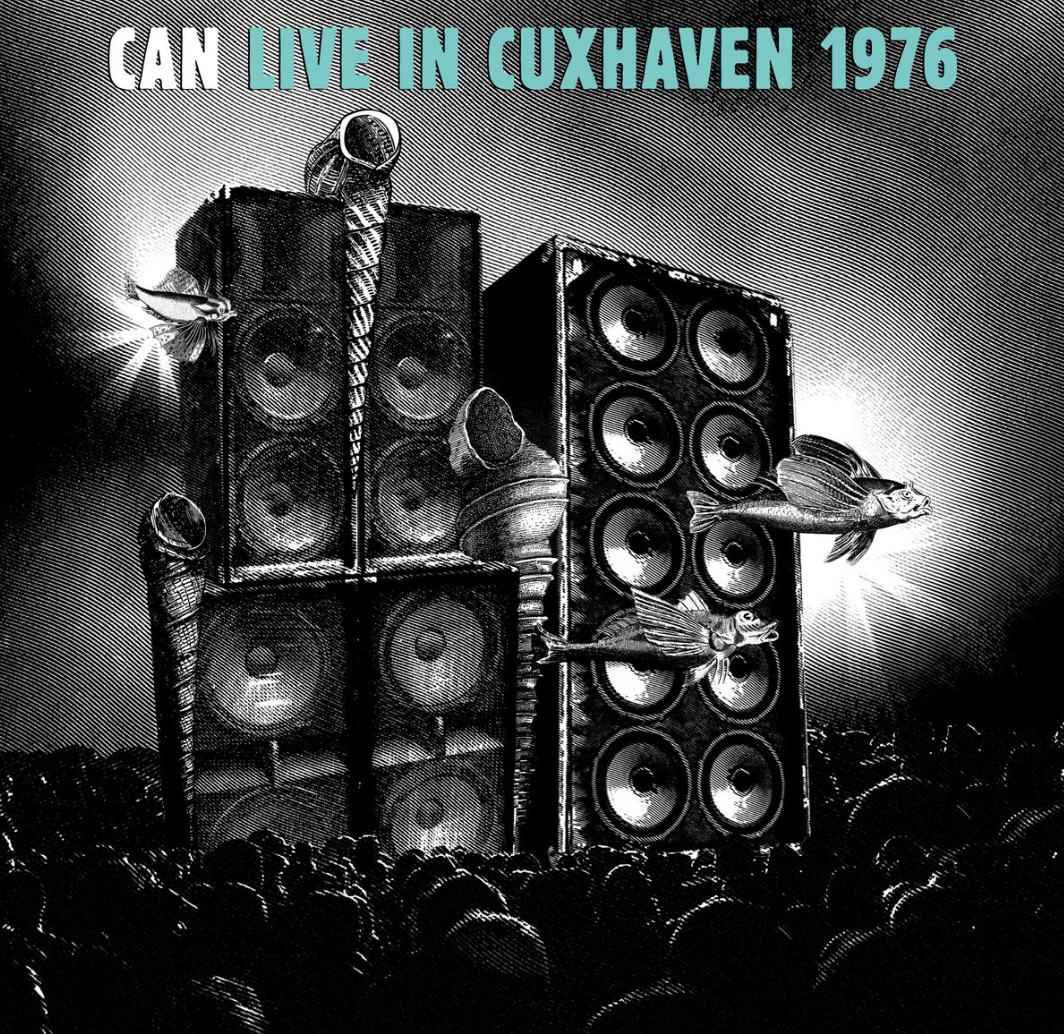
1976 the year of the bandy reggae waltzing, discothèque probing Flow Motion album, and CAN’s only bonafide hit, ‘I Want More’. It’s also a treasure trove year of bootleg material if Youtubes anything to go by, with countless live dates across Europe and the UK.
Almost two albums into their 1975 contract with Virgin, recording wise, the Cologne band were loosening up with a sound that moved ever closer to world music fusions and even the commercial: well, of a kind. Not universally a welcoming move with diehards and the head community however, the results were mixed at best. Performance wise, in concert, CAN still riffed off an admirable, innovative and experimental legacy, right up until the end of that year.
Although no gig is the same, you can find transformed, explorative version jams of material that stretches right back to the Galactus sported Monster Movie debut. Popping up like a signature anthem, ‘Dizzy Dizzy’ from the 1974 space-programmed trip Soon Over Babluma appears as a staple groove and prompt on the latest, and third, CAN Live album. Officially sanctioned by the band’s Spoon and Mute label custodians, this previous sneaky bootlegged recording captures them on stage in the German (Lower Saxony to be exact) seaside town of Cuxhaven, on the North Sea coastline – as a bit of useless trivia, its twinned with, amongst others, the English port town of Penzance.
I don’t think this time, like previous bootlegs, it was recorded by the sadly, recently, departed Andrew Hall, who’s handed over a bounty of such material to CAN’s sole survivor Irmin Schmidt and producer/engineer René Tinne to be brushed-up and mastered to acceptable aural pleasures. But why the need for this bootleg series? Well, as I lay out in previous CAN Live reviews, the band were always victims of bad luck when attempting to record any sort of official, legitimate “live” album performance. Gremlins in the works – once failing to record someone’s entire part – the technical glitches meant that there was never a proper live CAN record as such. Mind you, this was a band that more or less played live in the studio setting, making albums out of countless hours of extemporised or improvised sessions. And, as I’ve already said, CAN never quite played the same thing twice, let alone an entire set.
Here on the ’76 special you will hear a once more transformed, in-the-moment vision of tracks from Future Days (‘Bel Air’), Soon Over Babluma (‘Dizzy Dizzy’, ‘Splash’, ‘Chain Reaction’) and Landed (‘Full Moon On The Highway’). There may very well be even traces of Tago Mago, and the yet to be released, Flow Motion albums too in that heady mix.
Across four Germanic-numerical sections it’s the lunar, wailed, bendy, squalling whacker-whacker guitar contours, licks, chops and phrases of Michael Karoli that win out. Ten Years After blues meets the whomp-whomp of Miles Davis’ Bitches Brew live band and the psychedelic, Karoli transforms familiar album cut riffs into fuzz-scorched, garbbled, loose and seared cosmic acid rock magic.
Other live performances from the same year include far more vocals, with Karoli having to take over after the departure of the mushroom haiku incanting Damo Suzuki after Future Days. Here his barely audible enervated whispers can just about be detectable during one bout of locked-in grooving.
Keyboards chopping aviator Schmidt offers up another suitable chemistry of the celestial, tubular and avant-garde, going as far as to start laying down something approaching gospel, or Southern Blues on the first track, ‘Eins’. As always, Jaki Liebezeit keeps that human metronome ticking, holding flights of fantasy, tangents and spacey ascendance all together with his impeccable sense of rhythm and time. Dare I say, he ventures into funk at times, and during part of track ‘Drei’ bobs and rattles out a tin and bottle percussive Latin-soul passage: the sort Santana would happily embrace.
Unfortunately I couldn’t hear all that much of the designated bassist Holger Czukay; it’s there but very much lost against a louder Karoli, Schmidt and Liebezeit, the frequencies a bit foggy.
Still, this is yet another example of a band in total synchronicity, no matter how wild or off the beaten tracks the direction taken. Though to be honest, this is nowhere near CAN at their wildest or avant-garde, nor most dynamic and interesting. In fact the performances are a little more composed and tight. Not disappointing, just not so amazing.
A different time, a different version of CAN, Live In Cuxhaven offers yet another side to the feted band; a bridge towards Flow Motion for a start. It will be interesting to see what follows: my own particular interest being their expansion of the lineup and the Saw Delight album period.
Puppies In The Sun ‘Light Became Light’
(Buh Records)
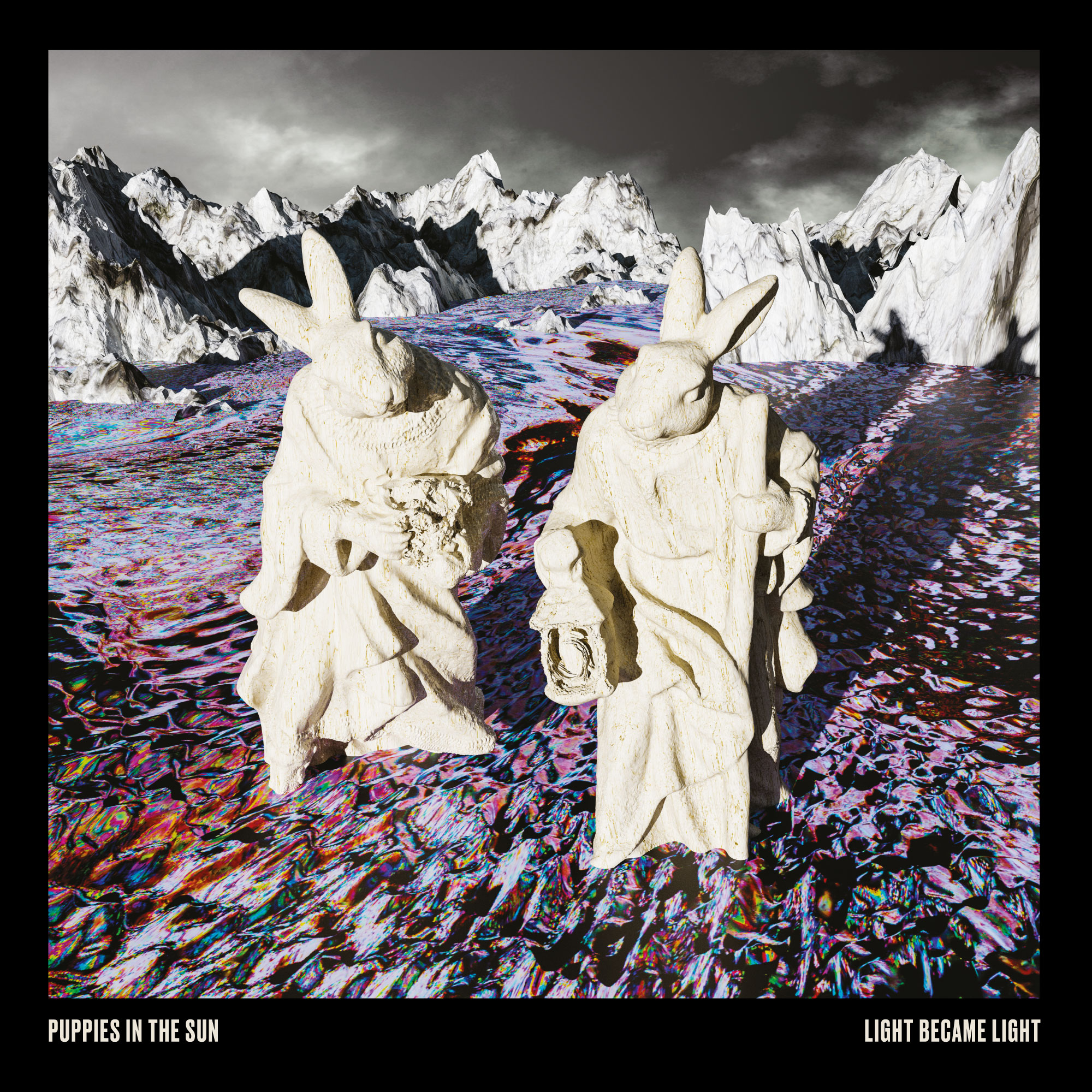
A slow release of maximalist energy and cosmic explosions the Puppies In The Sun duo conjure up a big sound on their debut album, Light Became Light.
Buddies since childhood back in Peru, but serendipitously crossing paths a longtime later in Barcelona, Alberto Cendra and Cristóbal Pereira made base camp together in Rotterdam. But despite the European-wide travelling it’s the great universal void and expanses of space that they’ve chosen to sonically navigate and transcend, with just the use of a drum kit, apparatus of synths and open mind.
The notes, quotes however mention the duo’s noise rock credentials, which despite a lack of any guitar or bass is nevertheless present on these peregrinations, vortex hyper-drives and odysseys.
Locked in to each track of starry wonder and languorous crescendo, the pace of direction is often in slow motion. Dissipated crashes and rolls, slow dives and frazzled oscillations head towards the explored and unexplored realms of Mythos, Embryo, Adam’s Castle, LNZNDRF, Angels Die Hard and the Secret Machines. Although the N-R-G pumped ‘Raging’, They Came To Dance’ sounds more like Cabaret Voltaire and FSOL at a space cowboy hoedown.
Space is deep, as Hawkwind once aggrandised. And so it is too on this light travelling discover of a big-sounding kosmische. Krautrock, prog and controlled noise rock score.
Spelterini ‘Paréidolie’
(Kythibong) 4th October 2022

Named in honour of the 19th century Italian tightrope walker, Maria Spelterini, who’s death-defying stunts included numerous handicapped (blindfolded, manacled or with weighted peach baskets strapped to her feet) walks across the Niagara Falls, the quartet Spelterini pairing of Papier Tigre and Chasusse Trappe members do a bit of their own tightrope walk on this new peregrination and driving motorik long form performance. Keeping balanced whilst straddling modes, chapters and movements, Pierre-Antoine Parois, Arthur de la Grandière, Meriadeg Orgebin and Nicolas Joubaud embrace kosmische. Krautrock, psych and the esoteric on a continuous, thirty-five minute opus.
After the phenomenon in which the brain creates optical illusions of familiar faces or shapes where there is only abstraction, “Paréidolie” progresses from hymnal drones and rays to something far more haunted, uneasy and razored – the notes reference the Lynchian (think the most recent Twin peaks series return mixed with The Land Of Ukko & Rauni era live documented Faust). And so, incipient and building from the kosmische and reverent ambient the direction begins to drive towards rhythmic and totem ritualistic evocations of both Embryo and ‘Rainy Day’ and later Just Us/Is Last Faust (them again). This in turn sees a real physical weight start to embody the hypnotising knocks, hi-hat scuffs and beat.
Elements of The Velvets, avant-garde, France and Neu! all get drawn into the pummeled march before the portal opens up a far more ominous world of shadows, metallic abrasions and bestial industrial squalls. It’s Bernard Szajner holding a cosmic séance with Emptyset and Jóhann Jóhannsson if you like.
That alien leviathan suite passes as a reverberated cacophony of percussion shimmers and splashes away until a final crescendo-like beat of a thousand butterfly wings.
Spelterini mystify and invoke a locked-in rhythm across a half hour of probed illusion, disillusion and inter-dimensional abstraction. Imbued with krautrock they magic up an impressive drum and drone journey.
No Base Trio ‘II’
(Setola di Maiale) 14th October 2022
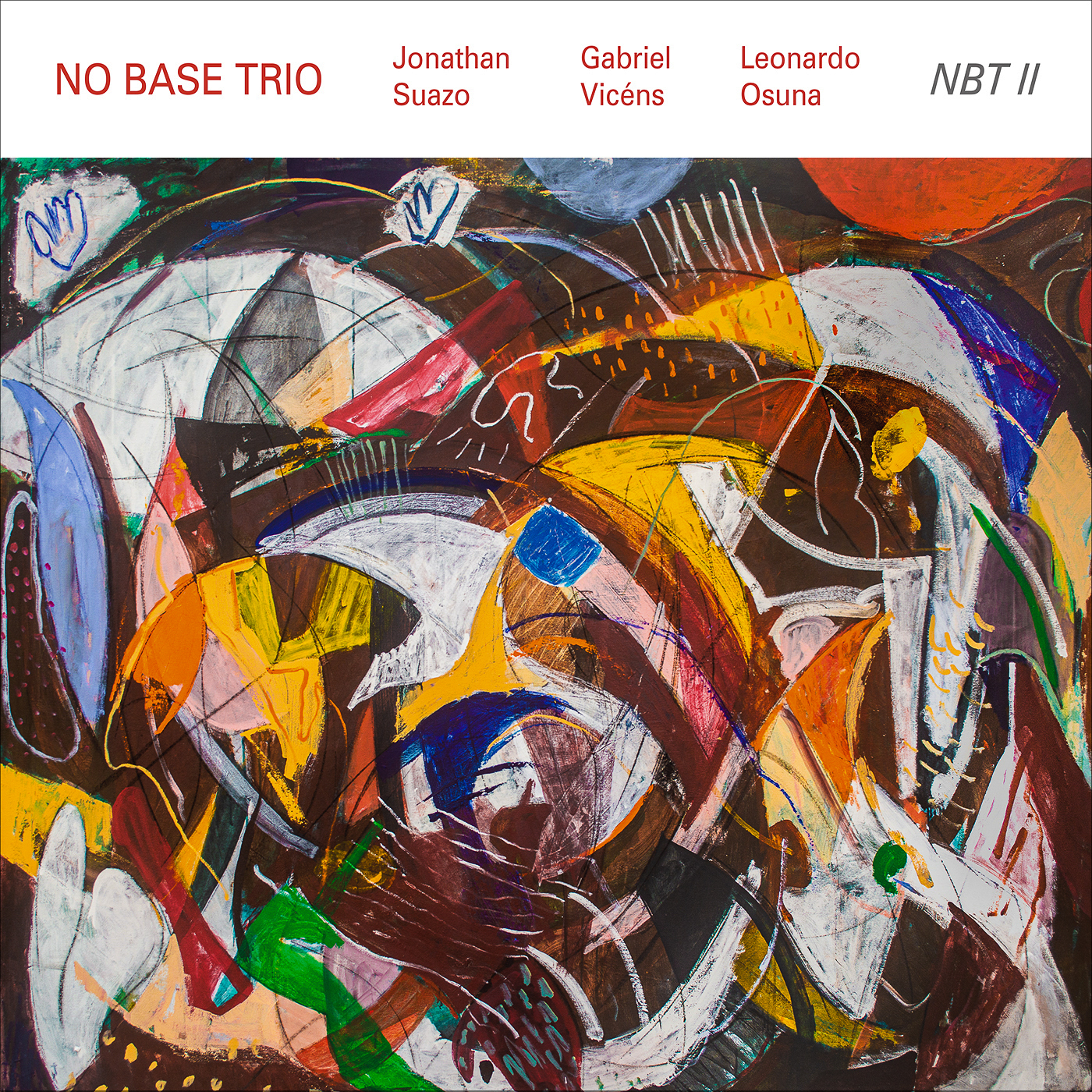
It’s a port we at the Monolith Cocktail have seldom sailed to, but Puerto Rico boasts an impressive contemporary jazz scene; one that the adroit and accomplished No Base Trio endeavor to export to the global community.
In the field for twelve years as a unit, horns and EWI practitioner Jonathan Suazo is flanked by the versatile guitarist Gabriel Vicéns and drummer Leonardo Osuna on another intuitive, fully improvised work of free jazz, jazz rock, fusion and beyond.
A grandiose, nigh two hour extemporized septet of performances – recorded the day after a highly successful concert at the El Bastión in Old San Juan – work II finds the trio in perfect synchronicity ready to probe and venture forth with atonal, tactile and juddered rhythmic explorations.
Across passages that last over twenty minutes in length, the recognisable jazz elements are stretched, repurposed and entangled in various bendy mirages and naturalistic atmospheres as ascending and descending patterns and more serialism type abstract musicality takes shape.
Suazo moves between flighty flute and windy spiraled alto/tenor saxophones like some sort of expressive natural force, caught up in mysterious soundscapes that evoke both fertile environments and more arid landscapes. Vicéns guitar accents, twangs and nimble finer work reminded me a little of the South American jazz guitarist Rodrigo Tavares, and on ‘ST 4’, a little bit of Ry Cooder articulating a mysterious psychedelic desert setting. Osuna’s drums meanwhile, sound out the tribal, spiritual and freeform, often sophisticated, quiet and spindled, or, taking time to find a rhythm. In action, all together, the trio varies the mood from the more abstract and avant-garde to built-up dynamic tumultuous climaxes: that translates as croaked and plectrum scratched guitar and industrial detuned sounds on ‘ST 2’, and a Hobby Horse meets head-on with Irreversible Entanglements in a rock-jazz crescendo squall on ‘ST 5’.
Each track is like a score in itself, cast adrift of a subject, theme or visual inspiration; a mix of jazz with various percussive influences and sources that swings between Buh label outsiders to the ACT label, Donny McCaslin, an avant-garde Americas and Ornate Coleman. It’s an impressive album of synergy that manages to probe the wilds without bombast and total dissonance; kept together at all times with the most intuitive of unsaid musicianship and deft foresight.
The Monthly Playlist: September ’22: No Age, The Beach Boys, Al-Qasar, King Kashmere, Sampa The Great, Yemrot….
September 30, 2022
PLAYLIST
TEAM EFFORT/CURATED BY DOMINIC VALVONA

After avoiding Covid for nearly two and a half years (with periods of shielding) I’ve finally succumbed to the dreaded virus this week. And it’s hit me hard. But because I’m such a martyr to the cause of music sharing I’ve managed to compile this eclectic bonanza of choice music from the last month.
The Monolith Cocktail Monthly features tracks from the team’s reviews and mentions, but also includes those tunes we’ve just not had the room to feature. That team includes me (Dominic Valvona), Matt Oliver, Brian ‘Bordello’ Shea, Andrew C. Kidd and Graham Domain.
We’ve supplemented the original audio playlist with a video version on our Youtube channel. This will feature a slightly different lineup (the electronic music collective Violet Nox’s ‘Senzor’ primer for one).
The full track list is as follows:
Dead Horses ‘Macabro’
Grave Goods ‘Source’
No Age ‘Compact Flashes’
Etceteral ‘Rome Burns’
Al-Qasar Ft. Jello Biafra ‘Ya Malak’
Clear Path Ensemble ‘Plazma Plaza’
Antonis Antoniou ‘Syntagi’
Ocelot ‘Vanha Hollywood’
The Beach Boys ‘You Need A Mess Of Help To Stand Alone – Live At Carnegie Hall’
Rezo ‘Soemtimes’
Blue Violet ‘Favorite Jeans’
Teo Russo ‘Novembre’
Keiron Phelan & The Peace Signs ‘Guessing Game’
Micah P. Hinson ‘Ignore The Days’
Sonnyjim/The Purist Ft. MF DOOM & Jay Electronica ‘Barz Simpson’
Salem Trials ‘Just Give Up’
The Bordellos ‘Nurse The Screens!’
Legless Trials ‘Ray’s Kid Brother Is The Bomb’
S. Kalibre ‘Hip Hop World’
King Kashmere/Leatherette ‘G-Cell’
Depf/Linefizzy ‘Rain’
Isomonstrosity/645AR/John Lenox Ft. Danny Brown ‘Careful What You Wish For’
Tess Tyler ‘Try Harder’
Qrauer Ft. Anne Muller ‘Rund’
Sampa The Great Ft. W.I.T.C.H. ‘Can I Live?’
Rob Cave/Small Professor ‘Eastern Migration’
Salem Trials ‘Jc Cells’
Wish Master/Axel Holy Ft. Wundrop ‘FLIGHT MODE’
Alexander Stordiau ‘Nothing’s Ever Acquired’
Simon McCorry/Andrew Heath ‘Mist’
Andrei Rikichi ‘At Home I Hammer Ceramic Golfing Dogs’
OdNu ‘My Own Island’
Floorbrothers ‘In Touch’
Conformist X H O R S E S ‘Heddiw’
Slim Wrist ‘Milk Teeth’
Forest Robots ‘Everything Changes Color With The Rainfall’
Noah ‘Odette’
Yara Asmar ‘there is a science to days like these (but I am a slow learner)’
Tess Tyler/Spindle Ensemble ‘Origami Dogs (Graphic Score Interpretation)’
Christina Vantzou/Michael Harrsion/John Also Bennett ‘Piano On Tape’
Yemrot ‘Big Tree’
The Monthly Playlist Revue: May ’22: Junior Disprol, Misha Sultan, Vera Di Lecce, Celestial North…
May 30, 2022
THE PLAYLIST
Dominic Valvona/Matt Oliver/Brian Bordello Shea

All the choice tracks from the last month, plus a few missed ones we’ve corralled from last month, the Monolith Cocktail team’s playlist revue is both a catch-up and showcase of the blog’s eclectic and mind bending tastes. Sitting in on this month’s selection panel is Dominic Valvona, Matt Oliver and Brian ‘Bordello’ Shea.
TRACK LIST IN FULL IS:
Junior Disprol Ft. Krash Slaughta ‘Rotund Shogun’
Deca ‘Tuning’
Exterior ‘Orthodox Dreams’
FAST DE ‘Miss Trutti Finally Found Her Gem’
Pussy Riot Ft. Slayyter ‘HATEFUCK’
Masai Bey ‘Stanza X’
BITHAMMER! ‘Make You Mine’
Flat Worms ‘Into The Iris (Live)’
Salem Trials ‘Vegaville’
Walker Brigade ‘Disease’
Team Play ‘Sunrise’
James Howard ‘Baloo’ Adam Walton ‘Mary Sees U.F.O.S.’
Joviale ‘UW4GM’
Shabaka ‘Black Meditation’
Kritters ‘New York’
Ralph Of London ‘Lys’
Ethan Woods ‘Utopia Limited (Cuddly Tie-In)’
Staples Jr. Singers ‘I’m looking For A Man’
Ramson Badbonez ‘Rap Bio’
Mr. SOS & Maxamill ‘War Criminal’
The Difference Machine ‘Old Men’
Omega Sapien ‘Jenny’
Mr. SOS ‘Peace & Prosperity’
Jermiside & The Expert Ft. Tanya Morgan ‘Crime Rule The City’
Quelle Chris ‘DEATHFAME’
Wish Master & Billy Whizz ‘THOUGHTS OF THOUGHTS’
Guillotine Crowns ‘Killer’ Orryx ‘Eldritch’
Celestial North ‘When The Gods Dance’
Henna Emilia Hietamäki ‘Protesti’
Lucrecia Dalt ‘No One Around’
STANLAEY ‘Fluorescent Fossils’
Your Old Droog ‘Go To Sleep’
Tommaso Moretti Ft. Ben LaMar Gay ‘A Call For Awareness’
Black Mango Ft. Samba Touré ‘Are U Satisfied’
Avalanche Kaito ‘Flany Konare’
Tomo-Nakaguchi ‘Halation’
Private Agenda ‘Splendour’
Sebastian Reynolds ‘Four-Minute Mile’
Chouk Bwa & The Ångströmers ‘Agwetaroyo’
Misha Sultan ‘Nyepi’
The Master Musicians Of Jajouka ‘Khamsa Khamsin’
Gustavo Yashimura ‘Las Prendas del Corazon’
Stephanie Santiago ‘Activa Tu Cuerpo’
Gabrielle Ornate ‘Free Falling’
Black Monitor ‘Xexagon77’
Borban Dallas & His Filipino Cupids ‘Too Convenient’
Martha And The Muffins ‘Save It For Later’
Super Hit ‘Blink 182’
Reverend Baron ‘Let The Radio Play’
Alas The Sun ‘Distant Drone’
Jelly Crystal ‘I Tryyy’
LINN ‘Happiness Is Real’
Lenka Lichtenberg ‘That Monster, Custom’
Brigitte Beraha ‘Blink’
Vera Di Lecce ‘Altar Of Love’
Francesco Lurgo ‘I Am Already Far Away’
Hi, my name is Dominic Valvona and I’m the Founder of the music/culture blog monolithcocktail.com For the last ten years I’ve featured and supported music, musicians and labels we love across genres from around the world that we think you’ll want to know about. No content on the site is paid for or sponsored and we only feature artists we have genuine respect for /love. If you enjoy our reviews (and we often write long, thoughtful ones), found a new artist you admire or if we have featured you or artists you represent and would like to buy us a coffee at https://ko-fi.com/monolithcocktail to say cheers for spreading the word, then that would be much appreciated.
The Monthly Playlist: February 2022: Animal Collective, Future Kult, Che Noir, Your Old Droog, Orlando Weeks…
February 28, 2022
PLAYLIST SPECIAL
An encapsulation of the last month, the Monolith Cocktail team (Dominic Valvona, Matt Oliver, Brian ‘Bordello’ Shea and Graham Domain) chose some of the choicest and favourite tracks from February. It may have been the shortest of months, yet we’ve probably put together our largest playlist in ages: all good signs that despite everything, from Covid to the Russian invasion of the Ukraine, artists, bands everywhere are continuing to create.
65 tracks, over 4 hours of music, February’s edition can be found below:
That exhaustive track list in full:::
Animal Collective ‘Walker’
Modern Nature ‘Performance’
Gabrielle Ornate ‘Spirit Of The Times’
The Conspiracy ‘Red Bird’
Cubbiebear/Seez Mics ‘All Friended Up’
Dubbledge/Chemo ‘Itchy Itchy’
Dirty Dike ‘Bucket Kicker’
Future Kult ‘Beasts With No Name’
Lunch Money Life ‘Jimmy J Sunset’
Ben Corrigan/Hannah Peel ‘Unbox’
Uncommon Nasa ‘Epiphany’
War Women Of Kosovo ‘War Is Very Hard’
Ben Corrigan/Douglas Dare ‘Ministry 101’
Sven Helbig ‘Repetition (Ft. Surachai)’
Ayver ‘Reconciliacion Con La Vida’
Lucidvox ‘Swarm’
Provincials ‘Planetary Stand-Off’
Wovenhand ‘Acacia’
Aesop Rock ‘Kodokushi (Blockhead Remix)’
Junglepussy ‘Critiqua’
Tanya Morgan/Brickbeats ‘No Tricks (Chris Crack) Remix’
Buckwild ‘Savage Mons (Ft. Daniel Son, Lord Jah-Monte Ogbon & Eto) Remix’
Che Noir ‘Praises’
Koma Saxo w/Sofia Jernberg ‘Croydon Koma’
Medicine Singers/Yontan Gat/Jamie Branch ‘Sanctuary’
Black Josh/Milkavelli/Lee Scott ‘Die To This’
Funky DL ‘I Can Never Tell (Ft. Stee Moglie)’
Mopes ‘Home Is Like A Tough Leather Jacket’
ANY Given TWOSDAY ‘Hot Sauce (Ft. Sum)’
Split Prophets/Res One/Bil Next/Upfront Mc/0079 ‘Bet Fred’
Nelson Dialect/Mr. Slipz/Vitamin G/Verbz ‘Oxford Scholars’
Immi Larusso/Morriarchi ‘Inland’
Homeboy Sandman ‘Keep That Same Energy’
Wax Tailor/Mick Jenkins ‘No More Magical’
Ilmiliekki Quartet ‘Sgr A*’
Your Old Droog/The God Fahim ‘War Of Millionz’
Ramson Badbonez/Jehst ‘Alpha’
Ghosts Of Torrez ‘The Wailing’
Pom Poko ‘Time’
Daisy Glaze ‘Statues Of Villians’
Orange Crate Art ‘Wendy Underway’
Seigo Aoyama ‘Overture/Loop’
Duncan Park ‘Rivers Are A Place Of Power’
Drug Couple ‘Linda’s Tripp’
Ebi Soda/Yazz Ahmed ‘Chandler’
Brian Bordello ‘Yes, I Am The New Nick Drake’
Psychedelic Porn Crumpets ‘Bubblegum Infinity’
Steve Gunn ‘Protection (Ft. Mdou Moctar)’
Jane Inc. ‘Contortionists’
Black Flower ‘Morning in The Jungle (Ft. Meskerem Mees)’
Jo Schornikow ‘Visions’
The Goa Express ‘Everybody In The UK’
Pintandwefall ‘Aihai’
Thomas Dollbaum ‘God’s Country’
Crystal Eyes ‘Don’t Turn Around’
Glue ‘Red Pants’
Super Hit ‘New Day’
Legless Trials ‘Junior Sales Club Of America’
Monoscopes ‘The Edge Of The Day’
Alabaster DePlume ‘Don’t Forget You’re Precious’
Orlando Weeks ‘High Kicking’
Carl Schilde ‘The Master Tape’
Bank Myna ‘Los Ojos de un Cielo sin Luz’
Park Jiha ‘Sunrise: A Song Of Two Humans’
Simon McCorry ‘Interstices’
Our Daily Bread 477: Jamael Dean ‘Primordial Waters’
November 1, 2021
ALBUM REVIEW/Dominic Valvona

Jamael Dean ‘Primordial Waters’
(Stones Throw) 29th October 2021
Anything but indulgent, the much acclaimed American jazz and hip-hop prodigy, Jamael Dean, dreams big with a most ambitious new twenty-track album of tribune and social-political clout. Nothing less than raising the spirits of Black-America, Dean weaves together both a respectful acknowledgement of his Yoruba roots and a street view celestial hip-hop/jazz symphony tribute to L.A.’s Leimart Park – a predominantly Black neighbourhood that’s said to be on the ‘frontline of gentrification’, known for its Black business owned community hubs like Eso Won Books, the Sika Art Gallery, Ride On bike shop and World Stage.
Not so clear cut, nor divided, the Primordial Waters flow between jazz, soul, hip-hop and the classical; the vocals, a mix of diaphanous contoured, lush, lulled and more worked female voices and Dean’s own Freestyle Fellowship mixed with Tanya Morgan and Odd Future poetic, aggrieved observational and conscious raps.
Referencing various deities, spirits from the Yoruba peoples ‘primordial’ creation myth, much of the material splashes around in tumultuous waters as Dean’s collaborative foils, Sharada Shashidas and Mekala Session, use their voices like melodious instruments. At their most intense those vocals, which flow between ancestral dialects, lyrics and sounds, evoke a wailing Linda Sharrock, and just beautifully transcendent when untethered and free. All the while that electric piano spot, dashes and lays down baubles of brightened notes, whilst the drums splash around and offer shimmers and waves of choppy, galloping swells. Beyond-this-realm atmospherics build up a dreamy yet earthy soundtrack of Yoruba mythology.
The Yoruba’s roots began in what are now Nigeria, Benin and Togo, spreading out to all corners of the continent and overseas as a result of both conquest and enslavement. Their deities, traditions are both paid homage to throughout this mini opus. As a musical legacy this civilisation, which spawned the Oyo Kingdom and Benin Empire, is immensely rich and influential. And so across this story of creation there’s hint’s of that influence as well as touches of Sun-Ra, Bobby Hutcherson, Alice Coltrane (Dean’s own ‘Galaxy In Leimert’ is inspired, influenced by Alice Coltrane’s harp-piano spiritualist ‘Galaxy Around Olodumore’), Clive Zanda, Nate Morgan (especially ‘Mrafu’), Nduduzo Makhathini, Mango Santamaria and Pharaoh Sanders.
This grand sweeping cosmology (well, the last third of it anyway) takes a turn towards hip-hop, with Dean rapping over, in some cases, his own jazzier tracks. Like in the style of the late J. Dilla, even Madlib, these groundings are often chopped up, looped, slowed down and reconfigured: The shadowy but celestial mirage ‘Abyss’ reminded me a little of cLOUDEAD. It’s a congruous but expansive turn that takes on a whole different mood, rhythm and cadence; becoming more like a rap album then a wholly jazz orientated one: And for that it works well.
The Primordial Waters have been stirred up to create a grand scheme of spiritual, ancestral inspiration. Multi-layered with titles that in themselves encourage further study – naming a pantheon of African gods -, this is a wonderfully executed work of free-flowing picturesque and more turbulent beauty. If I believed in those fatuous scoring systems used by so many rival sites, this would be a nine of out ten: awarded not just for effect but effort too.
Our Daily Bread 472: David Ornette Cherry’s Organic Nation Listening Club (The Continual)
October 4, 2021
ALBUM REVIEW/Dominic Valvona
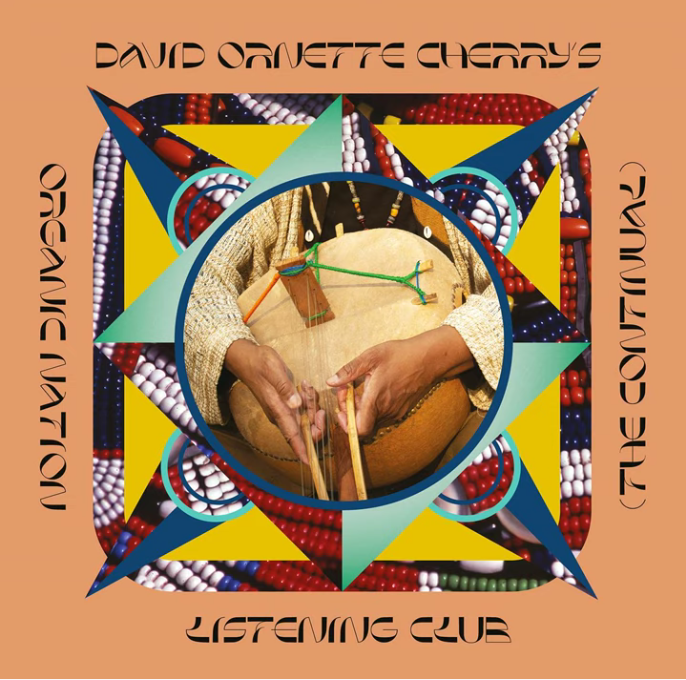
David Ornette Cherry’s Organic Nation Listening Club (The Continual)
(Spiritmuse) 15th October 2021
What providence. What two outstanding luminaries to live up to. David Ornette Cherry’s name marks the extraordinary point in time when his trumpet-pioneering father Don Cherry joined forces with jazz deity Ornette Coleman on the 1958 free jazz defining Something Else!!! LP. It was also the year the musical polymath David was born.
Thankfully taken under his father’s wing, nurtured with the same freewheeling ‘cosmic nomad’ spirit, this sagacious scion of an enviable lineage continues to tread a polygenesis pathway on his latest album of on-message peregrination and rhythmic dances. Attuned to the universal vibrations, channeling the ancients and both his father’s African-American and Choctaw roots, the Organic Nation Listening Club bandleader, prompter and navigator lays out an atavistic form of electronic body movement, echoes of Hassell’s amorphous ‘fourth world’ explorations, the astral and, of course, spiritual jazz on the parenthesis entitled The Continual journey.
David leads a fourteen strong ensemble of global instrument-playing musicians and voices, which includes his niece Tyson McVey (daughter of the no less famous musical sibling, Neneh Cherry) performing vocal soundscape harmonization and wandering siren duties on the diaphanous courtly Indian accompanied, part conscious, part mindfulness yoga session, ‘So & So & So And So’ (imagine Prince joining forces with Linda Sharrock and Brother Ah).
Almost meandering across continents, you’ll hear the resonated echoes, impressions, twine and spindled sounds of North and West Africa, the Asian sub-continent (a lovely brassy reverberation of sitar and the rhythm of tablas can be heard throughout), the Fertile Crescent and an 80s NYC melting pot on this spiritually enlivened trip. The keen-elbowed viola and tapping beat groove ‘Parallel Experience’, with its West African dun dun drum beat suggests that continent’s mood, yet also spreads its scope towards echoes of Farhot’s reimagined breakbeat visions of Afghanistan. The majestic mountain crust positioned ‘Eagle Play’ takes in musical views of not only the recurring spiritual Indian leitmotif but also Anatolia and Harilu Mergia’s Ethiopia (if put together by J Dilla that is).
Elsewhere David and his human, as well as nature’s chorus of ‘hummingbird’ singing cast embody the untethered soul of Don Cherry’s Om Shanti Om and Eternal Now works (and even a touch of the musical microbe calculus of building blocks and life that you’ll find on Don’s collaboration with Terry Riley, Köln). There’s also the fluted presence of Jeremy Steig, and with the more free jazz, almost improvised interactions between David and his drummer John L. Price, electric piano player Naima Karlsson and trumpeter Paul Simms, a touch of Sam Rivers and the Chicago Underground. Meanwhile, in what is an especially expansive field of instrumentation and influence, Gemi Taylor’s guitar straddles krautrock, jazz and drifted cries of a more ambiguous nature.
From the cosmos to the age of the Pharaohs, the garden of earthly delights to dancing through the tumult of our modern times, the rhythms of life merge with more avant-garde performances of serialism, free jazz and even the psychedelic.
All the while the mood is electric, both of the moment and the past; a both sporadic and flowing set of reincarnations existing in a timeless scene under the guidance of an outstanding musical traveller. Anchored in the history of jazz, but so much more beyond that, David lives up to the family name on another eclectic album of borderless healing and wisdom. Be sure to check in at the global retreat and take heed of the advice.
ALBUM REVIEWS SPECIAL/Dominic Valvona
Motorists ‘Surrounded’
(We Are Time/Bobo Integral/Debt Offensive) 3rd September 2021
Ah, for the mythology of rock music’s open road, highway 66 kicks and Kerouac misadventures. It seemed the easiest of escapes to new horizons; to hit the road U.S.A style and take in all the pit stop catalysts of rock ‘n’ roll lore. Not so easy to disappear now of course, the use of sat navs more or less keeping to a regimented map, with little in the way, or room, to shoot off on detours, and to come across surprises. Also, we’re all tracked, moving dots on a data system unable to truly run free.
Fueling this jangly Canadian trio’s automobile, those same tropes come up head-on with the actual realities of driving in the 21st century: gridlocks, congestion and nothing but bad juju on the radio. Motorists however do head down that fabled motorway as best they can; making for the open road with a carload of friends, the dial tuned into a new wave and power pop soundtrack of the Athens, Georgia sound, The Church, Teenage Fanclub and the Paisley Underground scene.
However, they don’t so much cruise as motorik down a road less well travelled, as the Toronto group navigate the pandemic and the resulting anxieties of isolation, distress and mental fatigue that’s cursed most of us in a new pandemic reality. The album’s precursor lead track (recently featured on the blog) ‘Through To You’ was about a yearning to connect once more: what better way then a road trip. But isolation means different things to different people. The group’s guitarist and Alex Chilten-shares-the-mouthwash-with-Tom Verlaine styled vocalist Craig Fahner is concerned with the kind of “isolation” you find in “a technologically saturated society, laden with romanticism around radical togetherness.”
The trio’s debut album is a spaghetti junction of suffocation and melodious despondency that opens with the titular album song, ‘Surrounded’, a lovely jangle backbeat of Green On Red and R.E.M.ish influences that features a downbeat dissatisfaction with everywhere they lay their hat: the city, “too many creeps, too many bars”; suburbs, “too many houses, and noisy neighbours and perfect yards”; and the commune, “too much love, and power trips”.
Don’t get me wrong, this isn’t in anyway a downbeat songbook; the music’s just far too…well, jangly and driven for that. No flashiness, overindulgences, every song’s a tight winner, whether that’s the edgy power pop 80s throwback ‘Hidden Hands’ or the Soft Boys, if they’d been signed to Stiff Records, new wave crossover ‘Turn It Around’.
This whole album has a real nice feel, with pull-ins at Weezer, Television and grunge music’s lay-bys. Nothing new, just great indie, new wave (a little sneer of punk) music at its best, Surrounded has really grown on me. A great cathartic soundtrack to adventures on the freeway.
Timo Lassy ‘Trio’
(We Jazz Records) 27th August 2021
A new combo and a new sound, the celebrated Finnish tenor saxophonist and bandleader Timo Lassy’s latest album of We Jazz crossovers is perhaps the Helsinki label’s most surprising release yet.
Cinematic, luxurious, Timo’s new “trio” are augmented, made more sweeping and grand, by the introduction of both synthesized effects and lush filmic strings – performed by the Budapest Art Orchestra and arranged by fellow Finn, Marzi Nyman. It’s almost as if David Arnold thumbed through the Savoy Jazz label’s back catalogue and various Italian and French movie soundtracks from the 60s and 70s: some exotica too! For the sound is both familiar, and as I already said, cinematic, yet somehow transformed enough to throw up the odd surprise and reverberation of the avant-garde and artsy jazz performativity.
Flanked either side by We Jazz and Finnish scene stalwarts, Ville Herrala on double-bass and Jaska Lukkarinen on drums, the expanded trio both playfully and more longingly move through the scenes of an imaginative romance it seems. Straight away they evoke that Savoy swing and a bit of sophisticated European vogue celluloid as they symphonically, in a rhapsody of swooning serenade, transport us to Monte Carlo (perhaps even Rio) on the sweeping ‘Foreign Routes’. Timo follows the tender contours and toots away on the equally romantic, tiptoed beauty ‘Better Together’.
Hearts skip and are harassed on the more jumping and dashing couplet of ‘Pumping C’ and ‘Orlo’. Timo goes through the register with dub-like effected echoes on his dabbing and busy saxophone riffs as Lukkarinen provides rattles of cymbal and little drilled snare rolls on the first of these two ‘groovers’. The latter goes for a trip-hop like feel of shuffled breaks, funky and soulful tenor squeals.
Rain-on-the-windowpane moments of solemn gazing occur on the moody double-bass quivering, snuggled forlorn sax reflection ‘Sonitu’, and on the swirled wind blowing through the spiritual jazz cannon’s chimed and trinket percussion, elegant serenade ‘Sunday 20’.
For excursions further afield, the trio take us on an exotic journey to more fiery climes on the gong struck announced ‘Subtropical’ – imagine Jef Gilson and Les Baxter sound-tracking some mating ritual in the sort of hip but down-at-heel tropical nightspot, draped with fishing nets; where the clientele are of course wearing the Breton stripes, dancing away to Candido’s banging away on the congas.
A surprising route to take, Timo and his compatriots’ return to the classics on an album of both accentuated and dynamic jazz swing; boosted by the most beautiful of strings accompaniments.
Various ‘Cameroon Garage Funk’
(Analog Africa) 3rd September 2021
Blistering hot, howled ravers from an undiscovered treasure trove of 60s and 70s Cameroon Afro-garage, Afro-funk and Afro-psych records, Analog Africa have dug deep once more to bring us yet another essential compilation of lost or forgotten nuggets.
This bustling tropical survey tells the story of the country’s capital nightspots and the groups that frequented them, on what sounds like an unbelievably impressive live scene. But away from the sweltering heat of those busy dance floors, Cameroon lacked most of the facilities needed to record and promote it. Instead, it was left to covertly recording under the radar of an Adventist church, on the down low in between services and the ire of the priests. For a price, bands could use the church’s rudimental but sound recording equipment and incognito engineer, Monsieur Awono. Whoever had the readies could also then buy the master reel. But then what?
Without a proper distribution network and few label opportunities, groups had to rely on the French label Sonafric. As it happened this imprint was very forgiving, open to anything it seems, and in a rare example of altruism releasing records on merit alone. The results of this generous spirit can be heard on, what is, a quite eclectic spread of genres and themes: ‘garage funk’ being a good springboard for a selection that reaches beyond its title grabber.
Low tech in many ways, yet the music on offer, leaps out of the speakers: the louder the better. For example, Jean-Pierre Djeukam’s squealing organ introduction opener, ‘Africa Iyo’, is a twitching Africa Screams like stonker that fully encompasses the “garage funk” tag. But whilst this is a James Brown in league with The Gators style stormer, the next track, ‘Sie Tcheu’, takes some imbued guidance from Curtis Mayfield. Joseph Kamga, guitar virtuoso of the L’Orchestre Super Rock’ a Fiesta pedigree, lets loose on that 1974 “jerk tune”; sung, it should be noted, in the country’s largest ethnic language of Bamiléké.
It should also be noted at this point that Cameroon was under both French and British rule until 1961. They gained independence firstly from the French, in one half of the country, the year before, and then from Britain the following year. This brought in a renewed thrust and vigor for Cameroon traditions and its pre-colonial history, which filtered through to the music. Groups like the impressive Los Camaroes (the house band at the edgy Mango bar) incorporated a local version of the Rhumba, Méringue (the style that would blaze through the Latin world but stared in Africa), and the local Bikutsi style (the literal translation of which is “beat the earth”). They appear twice on the compilation, but it’s their tropical hammock swayed ‘Ma Wde Wa’ that favours this sauntered, often local, array of rhythms best. In comparison ‘Esele Malema Moam’ moves to an elliptical rhythm, more in keeping with New Orleans funk.
Transported across the Atlantic, seasoned and well-travelled talent Charles Lembe evokes Afro-Cuban gaucho vibes on ‘Qwero Wapatcha’. An interesting fella, moving at the age of sixteen to Europe, Lembe signed his first record deal with Vogue records in 1959, going on to write French film scores, open the rather poorly chosen named La Plantation club in Paris, and release his own The Voice Of Africa LP – Myriam Makebla and Henry Belafonte no less, asked permission to reinterpret his ‘Mota Benoma’ tune too.
The rest of the compilation seems to owe, at least some, debt to Fela Kuti. The architect of Afrobeat can certainly be felt on Tsanga Dieudonne’s ‘Les Souffrances’; written incidentally by Johnny Black, who’s owb Ewondo dialect advisory themed, Otis grabs James Brown styled, groover ‘Mayi Bo Ya?’ is a highlight. Willie Songue and his ‘Les Showmen’ sound like they may have even influenced late 70s Can with the whacker wah-wah flange peddled, live sounding, relaxed funk track ‘Moni Ngan’.
Cameroon garage funk is a riot; an encapsulation of a musically rich eco-system that managed to break on through despite all the setbacks and the lack of facilities. This compilation is the story of a conjuncture of Western and Cameroon styles; with the emphasis on corrupting those cross-Atlantic radio influences into something distinctly African. It’s another great introduction.
Various ‘The Land Of Echo: Experimentations And Visions Of The Ancestral In Peru (1975-1989)’ (Buh Records) 27th August 2021
The second compilation this month to receive my seal of approval, Buh Records points me in the direction of the experimental fusions of mid 70s and 80s Peru. Surveying a conjuncture of brave new sounds and the country’s traditions, this pretty self-explanatory entitled compilation unveils both unreleased and released obscure explorations from a clutch of mavericks and forgotten pioneers who pushed the South American sonic envelope.
Mainly due to the political turbulence and a lack of studios, distribution and the like, most of the artists on this collection either self released recordings from their rudimental home studio set-ups, or, found opportunity to test the perimeters in the very few official facilities that existed: with labels such as Corva, and in studios such as Alliance Fançaise.
Due to the ruling regime of this period’s emphasis on promoting Peru’s culture and traditions, and because of intense economic migration to the cities (in particular the capital, Lima), there was a greater exposure to the sounds of the country’s mountains and rainforest topography; many of which ended up being transformed by the lineup on this inaugural compilation.
Artists, composers working in the fields of rock, jazz, the contemporary classical and avant-garde began to merge and manipulate those localised customs and sounds into a new South American hybrid. The results of which can be heard on Omar Aramayo’s wind pipe Andean mountain peregrination ‘Nocturno 1’. From the lofty heights of a mountain’s crust, Omar it seems tracks the airy flight of an eagle, whilst evoking an atmospheric mirage of a train’s reverberated chuffed steam and the dreamy contouring of its magical journey. In contrast to that ambient minor symphony, Corina Barta swoons, exults, sings strange arias over both messenger and detuned drums on the mesmerising new age ‘Jungle’.
In the mid 70s Ave Acústica produced the sort of tape manipulations you might hear both Can and Faust playing around with it. A previously unreleased sound collage, produced on magnetic tape, announces each hissy segment of inner piano workings, radio dial fuckery and atmospheric downpours with a repeated Peruvian guitar motif on the avant-garde suite ‘Liegue a Lima al Atardecar’. Another unreleased track, ‘Indio de la Ciudad’ by Miguel Flores, leans towards Cage with an almost avant-garde experiment of classical heralded layered trumpets.
The most obvious sounds of the futurism however, can be heard on Luis David Aguilar’s mid 80s Casio CZ10000 synthesizer heavy ‘La Tarkeada’. Touches of Sakamoto and Eno permeate this space-y bubbled wah-wah rayed and arpeggiator dotted neo-classical transformation of an Andean ancestral melody.
Echoes of Tangerine Dream, Oscar Peterson, Anthony Braxton, Cluster and the Fluxus arm of music can be heard in tandem with Peru’s most synonymous panpipes sound, but also disturbances of the local bird life (lots of flight and wing flapping going on) and spiritual inspired ritual. What all these experimental composers capture is an essence of a revitalised Peruvian culture, whilst dreaming about a more inclusive future.
Variát ‘I Can See Everything From Here’
(Prostir) 10th September 2021
Ukrainian multimedia artist and co-label launcher Dmyto Fedorenko makes an abrasive, thickset and caustic noisy statement of mystery and forebode on his latest dissonant album.
Under the Variát alias the static, fizzled and pulverized pulsating sonic sculptor uses a busted and transmogrified apparatus of blown amps, hammer thumped toms, cymbals that have been drilled to make unpredictable resonating distortions, and countless found objects to conjure up the most heavy and deep of savage and alien discomfort.
One artist’s reaction to the times we now live in, launched from Fedorenko’s own Prostir imprint that he set-up with fellow electronic music experimentalist Kateryna Zavoloka, the album’s eight fizzing contortions burble, squeal, scream and drone lethargically with unknown ritualistic invocation.
The accompanying PR notes tell me that this project (in part) was conceived last year as a ‘provocative outlet’ for transgression, reinvention and liberation. This all becomes a bestial, doomed industrial freedom when channeled through a fried crunched distortion. Unknown propelled craft hover as the stark brushes and scrapes of an electric guitar are magnified to sound like an unholy alliance of Sunn O))) and The Telescopes. Reversed sharpened blades, searing drones, metal machine music concrete, vaporised static, the sound of a robbed manic knocking on the gates of Hades and various bone and gristle menace converge as leviathans, secret ceremony and regurgitations emerge from the discordant mass.
Itchy-O, Faust and Emptyset bring in augurs and break the limits in a suffused display of heavy metal primitivism, as Variát craves out meaning, description and evocations from a corrosive block of fucked-up serpent like dark materials. It’s probably, exactly, the right sound we need at the moment.
Andrew Wasylyk ‘Balgay Hill: Morning In Magnolia’
(Clay Pipe Music) 20th August 2021

Seeking a sanctuary away from the collective anxieties and uncertainties of the Covid-19 age, the Dundee composer Andrew Wasylyk found that it’s a beautiful world once you disconnect from the hyperbole and relentless crisis negativity fed to us minute-by-minute through the gogglebox and Goggle hub.
His safe haven, the city’s Victorian period Balgay Park, proved both a solace and sonic inspiration for this latest album of evocative captured-in-the-moment peregrinations and hymns to natures eternal optimistic dawn rise.
A sort of ambient waft along the park trail, with fragrant and almost cosmic reflective stops at the astronomical observatory (the first and only public built one in the UK) sitting beside the flowery and fauna at the adjourning cemetery and from atop of the panoramic view that reaches out across the Firth of Tay’s inner estuary.
Eased in with both the glazed light of a Dundee Spring and the suffused swaddled and warm dreamy trumpet and flugelhorn of fellow Taysider Rachael Simpson, Wasylyk once more pays an ambient – with hazy pastoral touches of the psychedelic and even esoteric – homage to his home city’s psychogeography. For there is a marking, musically, of not just the passing of time but an acknowledgment also to those who’ve lived and followed a similar lifetime in the one-time jute manufacturing capital. There’s even a track title, ‘Smiling School For Calvinists’, that references Bill Duncan’s short stories collection of imagined and all too real characters eking out a living or existence in a slightly surreal vision of Dundee – alternating between the insular fishing community of Broughty Ferry and the imposing tower blocks of the nearby city.
The soundtrack to this world layers dappled gauzes of the Boards Of Canada and epic45 with the ambience of Eno and Forest Robots; the accentuated and caressed bendy guitar playing of Junkboy and Federico Balducci with just a hint of 70s children’s TV ghost stories.
The abstract essence of a place and mood are made no less concrete or real by this lovely, often mirage-like soundtrack. Sounds, instrumentation plays like the light source material that inspired it, whether it’s the undulating synthesized bobbled notes or the winding, meandering melodies of piano. Grayscale-like fades come alive with the occasional breakout of padded and pattered drums and, on the sweet colliery trumpeted and gilded piano rich, already mentioned, book title, a pre-set bossa groove.
Casting a timeless spell, worries seem to evaporate as Wasylyk gently immerses the listener into another world: the bustle, movement of a city is still there, but a most scenic film of escape keeps it all at bay behind cushioning fauna. Balgay Hill is another wonderful, peaceable yet evocative album from the Dundee maestro.
Steve Hadfield ‘See The World Anew Vol.1’
(See Blue Audio) 27th August 2021
It’s been a miserable, anxious and unsecure eighteen months for all of us; the political and generational divisions, already torrid enough before the advent of Covid-19, now like chasms. Yet for many it’s also been a time of catharsis, an opportunity to concentrate on what matters the most. Leeds electronic music artist Steve Hadfield is one such soul, sharing the collective experiences of lockdown, but also impacted by a number of personal life changes unrelated to the miasma of the pandemic. Inspired by his young daughter to look at the world, universe with fresh wide-eyed wonder and new perspective, Hadfield is spurred on to create a new series of ambient suites dedicated to stargazing and atmospheric discovery.
Following a prolific release schedule in 2021, Hadfield’s ‘most ambient’ statement has been saved for the blossoming ambient and beyond label See Blue Audio. And so volume one of this universal wonderment feels like the multiple stages of an ascendance into space; there’s even a mirage melting, serene spherical gliding suite named ‘Ascension’ for heaven’s sake!
Reacquainting with the night sky Hadfield offers up moonbeam corridors of light, reversed cosmic white noise, detuned Tibetan like ceremonial percussion, and a veiled untethered waltz in the great expanse. The composer takes off aboard some sort of propelled craft through an arching buzzed ‘Mesosphere’ towards an orbital avant-garde.
Volume One is a sensitive, often mysterious, but always interestingly serene start to a period of renewed reflection and discovery.
Simon McCorry ‘Flow’
(See Blue Audio) 10th September 2021

The highly prolific “cellist sound-sculptor of ambiguous environments” and composer Simon McCorry has appeared numerous times this year on the blog. Just last month I featured his Critical; Mass collaboration with the Washington D.C. duo of Requiem (of which a second volume is set to be released next month), and before that, his Nature In Nature EP for the burgeoning ambient and beyond label See Blue Audio. For that very same label (and the second See Blue release to be featured in this month’s roundup) imprint McCorry plucks inspiration from out of the air and the psychogeography of the Lake District, the Outer Hebrides’ Isle Of Harris, and the Orkney Islands on the almost uninterrupted Flow suites showcase.
Treading in ancient times, the unknown mysticisms and mysterious essences we’ve attached to our atavistic ancestors in those locations is picked up by McCorry’s sonic antenna and channeled into five flowing sequences of ambient and kosmische style immersions. The source of which stems from one long improvisation; created using Eurorack modules passed through to cassette tape and further processed to acquire a degraded feel, like something that’s been left lain dormant and undiscovered under the dirt: a kind of mood board time capsule if you will.
Imbued by those surroundings, and the various stone circles that stand in some of them, McCorry ushers in the autumnal light and low sun rises as seasonal rituals indicate the last moments of the summer. Horizon gazing sun worship, supernatural elements, vibrating force fields, slowly bowed ascending and descending tubular elevations, and searing drones seem the order of the day as the adroit composer manages to produce a natural, organic vision of synthesized machine made mood music. The roots of which start in the landscape and travel up towards the sci-fi.
Deep yet translucent, McCorry’s stream of conscious ambience has both weight and a mirage-like quality. Its yet another angle, a side to his craft; a most appealing, entranced and mystical work of airy suspense and investigation.
Sone Institute ‘After The Glitter Before The Decay’
(Mystery Bridge Records) 6th September 2021
Not quite left behind, nor entirely bound to the next stage of decay, Roman Bezdyk emerges from the ruins of one glittery age to contour, reverberate and evoke both mysterious and ominous atmospheres on his new Sone Institute album.
Crouched in post-industrial wastelands, gazing at the stars, the UK-based electronic musician, guitarist and producer conveys both dreams and nightmarish environments of unknown specters, shapes and broadcasts on what amounts to a kosmische, ambient and experimental guitar styled soundtrack to a resigned future shock.
You could say it follows on from Bezdyk’s previous New Vermin Replace Old EP from April. There’s even a second ‘Studded By Stars’ chapter; although it’s a more industrial, post-rock like journey into the alien as opposed to the first version’s stratospheric ambient glide.
Against obstructed and ghostly transmissions, cosmic sonic hymnal synthesized voices, beams of light, digital code calculations and veiled gray environments Bezdyk adds serial and resonated guitar gestures, brushes. With much delay, sometimes flange, and always plenty of lunar echo, his guitar wrangling, air hanging notes and gentle sweeps recall elements of Günter Schickert, Manuel Göttsching and an even more strung out version of Ry Coder. On the apparitional entitled ‘Insect House’ that same guitar sound apes the craning and scuttled movements of those said creepy-crawlies, whilst also evoking a sweltered heat and a strange bowing rustic saw.
Whilst new Rome crumbles and burns, Bezdyk imagines broody spy thrillers piano music played by Cage (‘Echo Zulu India’) and Bernard Szajner like envisioned sci-fi. Wherever he’s taking us it sounds as alien as it does foreboding; a crumbling visage of the world headed for the shitter.
Blue Mysteries ‘Dislocated’
(Hive Mind Records) 10th September 2021
I can sympathize greatly with Marc Teare, the humanoid behind the Dislocated Blue Mysteries alias and head honcho at the global sounds (and beyond) label Hive Mind. Suffering greatly from bastard cluster headaches myself in the past, I know exactly what he’s going through. As a distraction from this heavy leaden fog and intense painful experience, Teare assimilates with a number of A.I. sonic software applications on his new project.
Not so much removing himself from the process, as that title may suggest, but more in keeping with how the curse of those headaches can not only course chronic pain but ‘dislocate’ a person from everything around them. Teare actually ties and propounds this same damaging feeling in with the dislocation so many of us have felt during the COVID pandemic.
Intuitive as he might be, he’s left much of the work to the transmogrified re-programming of Khyam Allami & Counterpoint’s Apotome and, the electronic artist, Holly Herndon’s ‘digital twin’ Holly+. The first is a free browser-based generative music system that enables users to explore transcultural tunings, the second, a custom vocal and instrumental interface in which users can upload polyphonic audio to a website and receive it back, sung in Herndon’s voice. Of course it all depends on whatever source material you feed it as to how effective the results. In this case, Teare has initiated very odd, hallucinogenic and acid lunar dream of library music sci-fi and inner mind-bending.
Like a transformed twist of Asmus Tietchens, Stereolab and Klaus Weiss, dislocated from their own times, this chiming, twinkled and chemistry set bubbled and burbling soundtrack floats freely inside a psychedelic lava lamp. Droplets, sometimes arpeggiator flows of bobbing chimes make vague connections to the Far East, Thailand, even Polynesia. On the gulp filtered slow beat primordial soup ‘Humming, Pre-Dawn’ there’s a touch of electronic bamboo music; removed to sound like detuned chopsticks. Something approaching aria-like voices (of a sort) appear like whelping alien creatures and higher squawking space mice on ‘Shadows’. In a manner Blue Mysteries floats around a strange retro-library futurism of droning crafts, crystallised notes (some of which pierce, others, linger with sonorous effects), blades of bass-y synth and liquid movements. Concentrating the mind like nothing else can, Teare escapes the numbing pain to an imaginary sonic flotsam; handing over at least some of his escape route to A.I., and so in the process creating something lucidly weird and mirage-like. These cluster headaches fortunately pass, returning either sporadically or years later. Though this is an interesting sonic album, let’s hope for Teare’s sake those headaches never return.
 Monolith Cocktail Blog